In the years before Seduction of the Innocent and the rise of the Comics Code Authority (1954), there was an age undreamed of… Garish four-color comics of crime, horror, science fiction, the occult, and the weird filled the newsstands. The comic book had emerged as a definitive form in 1934, at first reprinting newspaper comic strips, but soon comic magazines emerged featuring original material. While the Golden Age of Comic Books is usually said to have begun with the advent of Superman in Action Comics #1 (18 April 1938), the lucrative field swiftly diversified into many different genres, not just superheroes. In the 1940s and 50s, one of the most notable and notorious genres was the horror comic.
Early comic books shared a great deal of crossover with the pulp magazines, including artists, writers, editors, and even publishers. Harry Donenfeld was the entrepreneur behind the Spicy pulp magazines that published Robert E. Howard and E. Hoffman Price—and the same magazines also published comic strips such as Olga Mesmer, The Girl with the X-Ray Eyes; Sally the Sleuth; and Polly of the Plains. Donenfeld would later expand his enterprises into the burgeoning field of comics in the mid-30s with Detective Comics, Inc.—known better today as DC Comics.
Around the same time, future Marvel Comics publisher Martin Goodman edited horror pulps. Julius Schwartz, the science fiction fan who acted as Lovecraft’s agent for At the Mountains of Madness and The Shadow Out of Time, became an editor for DC; Weird Tales writers Frank Belknap Long, Jr., Otto Binder, and Manly Wade Wellman, among others, all wrote comic book scripts. Weird Tales artists Virgil Finlay, Matt Fox, and Frank Kelly Freas worked in comics too. So when it came time to bring their skills to comics, many of the people involved with horror comics turned to horror pulps for inspiration.
Sometimes more than inspiration:
The one instance I remember was a very awkward one. It’s curious that I remember the name of the author who complained. It was August Derleth, a well-known horror writer. It was a story in one of our magazines, called “The Ornalean Clock,” and it involved the other staff writer. Mr. Derleth wrote in (it surprised me that he was reading these comic books) and sent us the story that he wrote which was about an Ornalean clock It was clear that it had been plagiarized.
It was very awkward. Richard [Hughes] confronted the writer, who did what plagiarists always do—that is, claimed he must have dipped into his unconscious, he wasn’t aware of it, and so forth. And perhaps the only defense he had was that it was so blatant!
Norman Fruman, assistant editor of the American Comics Group, quoted in Michael Vance’s Forbidden Adventures: The History of the American Comics Group 73
Derleth’s story was “The Ormolu Clock” in Weird Tales January 1950. Derleth’s friend Frank Belknap Long, Jr. had written the first issue of Adventures into the Unknown, the first ongoing horror comic, published by the American Comics Group. Derleth was well-known for his love of comic strips, and no doubt spotted the plagiarism because he followed the horror comics after Long had brought them to his attention. Ironically, it was Derleth who would write a letter to editor Richard Hughes encouraging them to continue to publish horror comics instead of canceling the series (Forbidden Adventures 110-111).
If ongoing horror comics began in 1948 with Adventures into the Unknown, the horror comics craze was kicked off by Crypt of Terror #17 (April/May 1950) from EC Comics—better known today under its later title, Tales from the Crypt. EC’s comic stories were, for the time, often well-written and well-illustrated; they often had a moral, but they could also feature darker twist endings, and a bit of grue. The many imitators of EC were not often as conscientious in their writing or art; much like the pulp magazines, the newcomers often leaned into gore, mutilations, eye gouging, drug abuse, and nasty ends where criminals get away with their crimes.
While individual comic book publishers had their own internal codes of censorship, there was no industry-wide limitation on content except for general statutes on obscenity. So while explicit sex and nudity were largely the province of Tijuana bibles, comic books on the stand could easily present gore, mutilations, dark and mature storylines, mouldering skeletons, vampires, voodoo, cannibalism, and all the rest. Plagiarism, either of published stories or swipes from other artists, was rife. Yet the period ended swiftly.
In 1954, a moral panic swept the United States (and was echoed in the United Kingdom and other countries around the world), spurred on by Frederic Wertham’s Seduction of the Innocent, his many articles in newspapers and magazines, and his testimony before the Senate Subcommittee on Juvenile Delinquency. Other pearl-clutchers and parents groups added their voices, and federal oversight seemed a real possibility—so the major comic publishers came together and formed the Comics Code Authority, whose Seal of Approval would mark approved comics. Not approved? Horror.
The formation of the CCA effectively ended most horror comics publishing in the United States for a generation, and had a chilling effect on comics intended for mature audiences. They would come back—the underground comix of the 1960s and 70s especially paid tribute to EC’s horror comics, and raised a general middle finger to the censorship of the CCA, while major publishers like Marvel and DC would push back little by little with their own horror comics in the 1960s, sometimes sidestepping the CCA by publishing full-sized comic magazines. This would lead to a great flowering of horror comics magazines from publishers like Warren and Skywald in the 1970s and 80s, and lay the groundwork for comics like Heavy Metal Magazine (originally a translation of the French magazine Metal Hurlant).
Ironically, in 1954 Weird Tales also ceased publication, one of the last of the old-time pulp magazines to give up the ghost, unable to compete either against science-fiction digests or the coming men’s adventure pulps that flourished in the postwar era. An entire sub-industry was gutted almost overnight. Former pulp writers and artists who had known, talked, and corresponded to H. P. Lovecraft, who might have adapted his work to a new medium, never got that chance…well, except during the period before 1954.
While there are thousands of pre-Code comic books, there are only a handful of comics that can be positively said to be “Lovecraftian horror,” either because they directly adapt a Lovecraft story or explicitly make reference to Lovecraft’s Mythos. If one were to include other early Mythos writers like Robert E. Howard, the list would be a little longer—“Skull of Doom” in Voodoo Comics #12 (1953), for example, seems to be an adaptation of Howard’s “Old Garfield’s Heart.” But for the sake of keeping this list manageable, here are some positively identified pre-Code Lovecraftian horror comics, many of which are in the public domain and can be read for free.
A Note: Many of these early comics were completed in small studios by teams of writers and artists, working for low rates, and often without credit. As such it is not always clear who exactly worked on many of these comics, but as far as it can be determined, the names of the writers, artists, letterers, etc. will be included below.
- “Captain Marvel Battles the Vampire” (Captain Marvel Adventures #1, Mar 1941)
- “The Horror of the Seas” (Captain America Comics #16, Jul 1942)
- “Dr. Styx” (Treasure Comics #2, Aug 1945)
- Red Dragon (Super-Magician Comics #10, 11, & 12, Feb-Mar-Apr 1946)
- “The Book of Doom” (Red Dragon #5, Oct-Nov 1948)
- “The Thing At Chugamung Cove!” (Amazing Mysteries #32, May 1949)
- “Experiment … In Death” (Weird Science #12, May-Jun 1950)
- “The Black Arts” (Weird Fantasy #14, Jul-Aug 1950)
- “Fitting Punishment” (Vault of Horror #16, Dec-Jan 1951)
- “Baby…It’s Cold Inside” (Vault of Horror #17, Feb-Mar 1951)
- “Prisoner on Charon’s Ferry” (Whiz Comics #143, Mar 1952)
- “Portrait of Death” (Weird Terror #1, Sep 1952)
- “The Corpse That Wouldn’t Die!” (Web of Evil #2, Jan 1953)
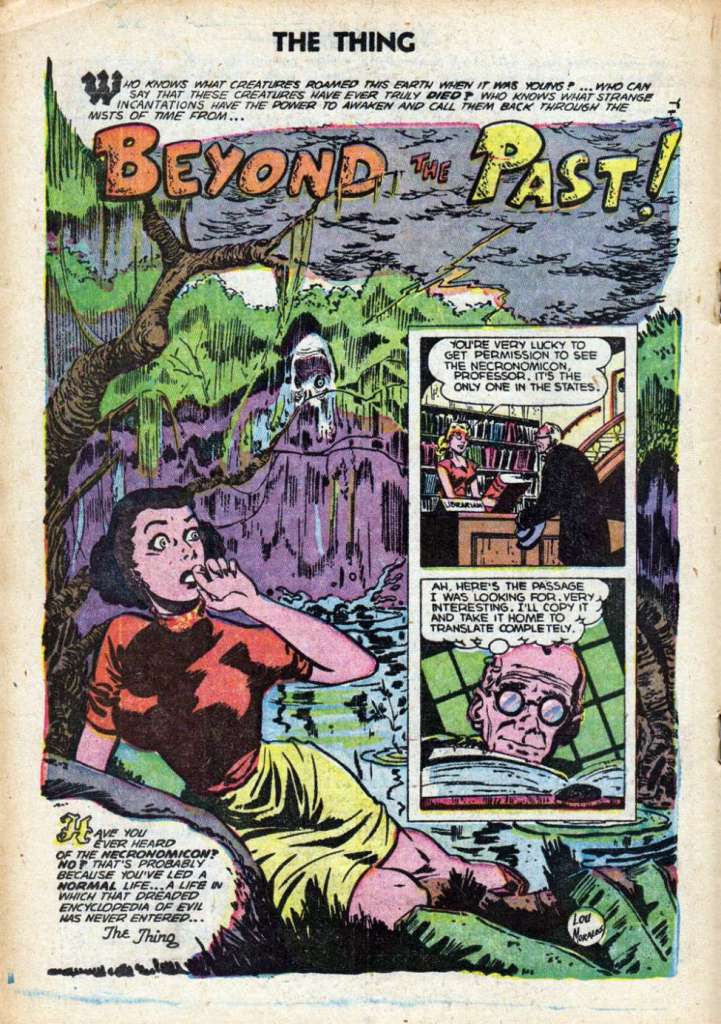
- “Beyond the Past” (The Thing #11, Nov-Dec 1953)
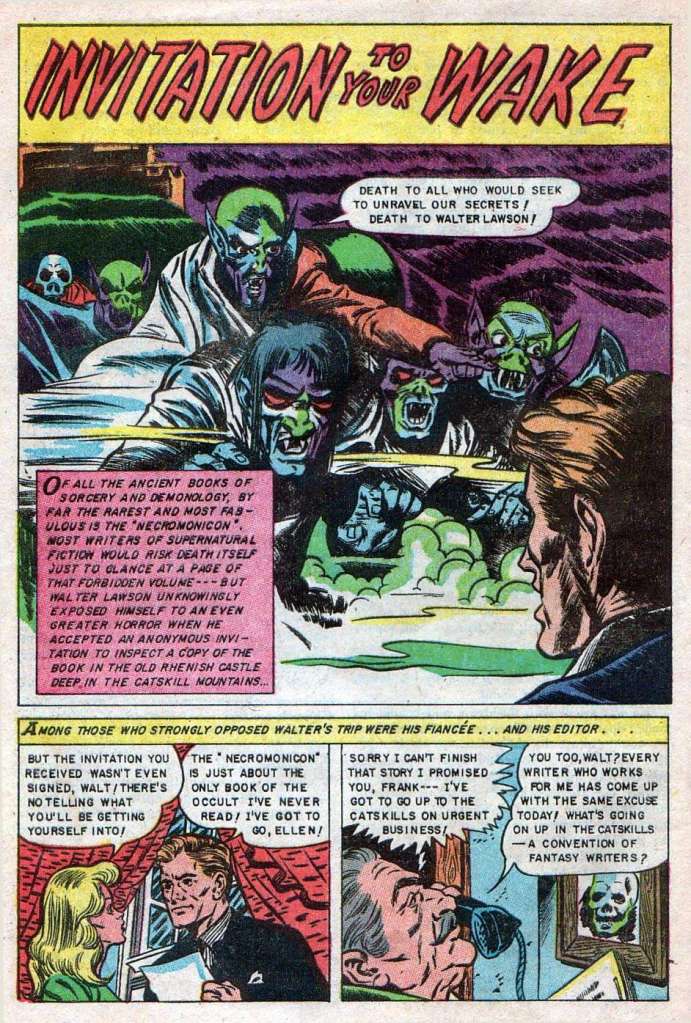
- “Invitation to Your Wake” (The Hand of Fate #21, Dec 1953)
“Captain Marvel Battles the Vampire” (March 1941)
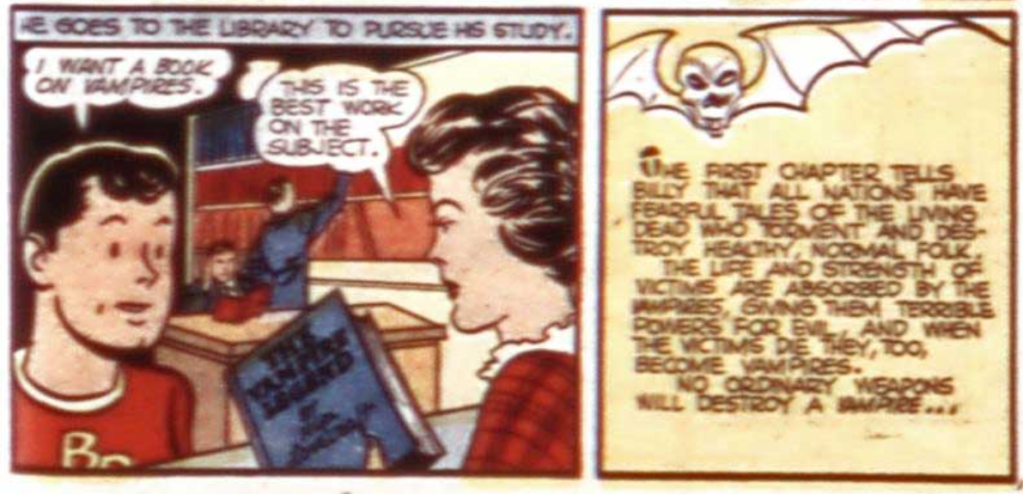
Published in Captain Marvel Adventures #1 (Fawcett Publications), this 16-page story of Captain Marvel (now often known as Shazam) was penciled by Jack Kirby and inked by Dick Briefer. The mystic hero finds himself up against one of the undead, and to better understand his foe and their weaknesses, a librarian hands him The Vampire Legend by H. P. Lovecraft. An unlikely title, but a neat homage to Lovecraft!
“The Horror of the Seas” (July 1942)
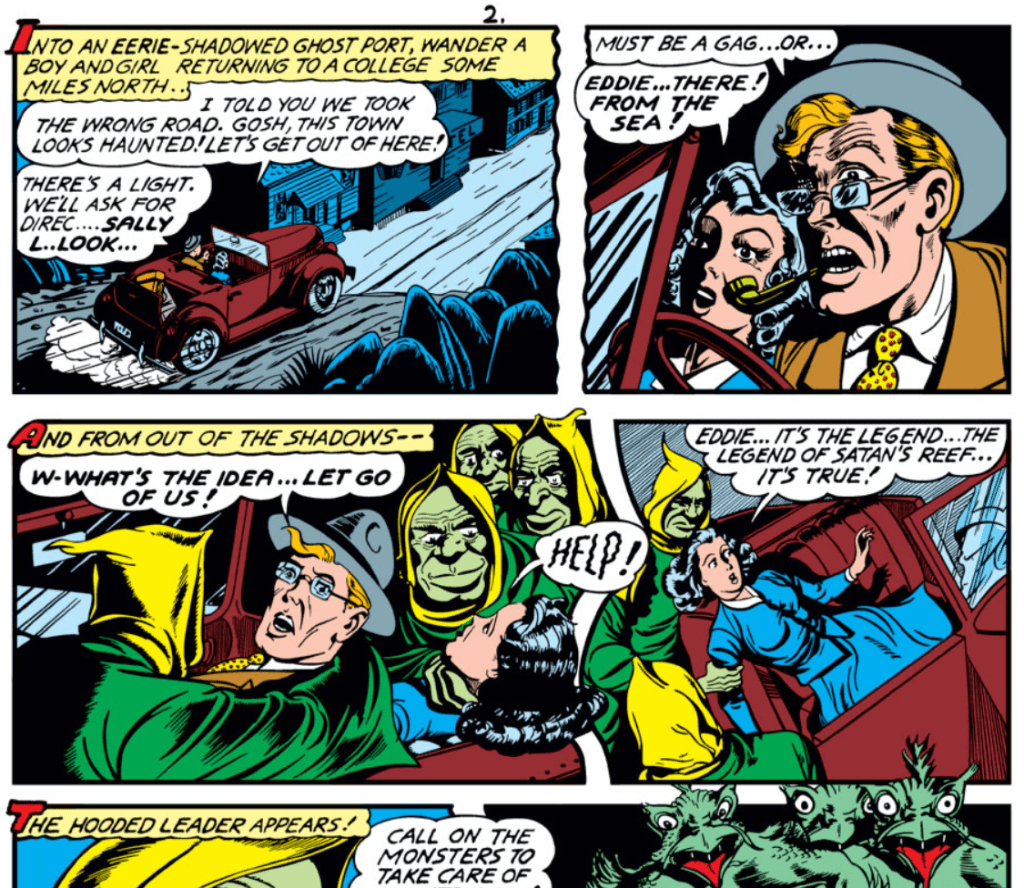
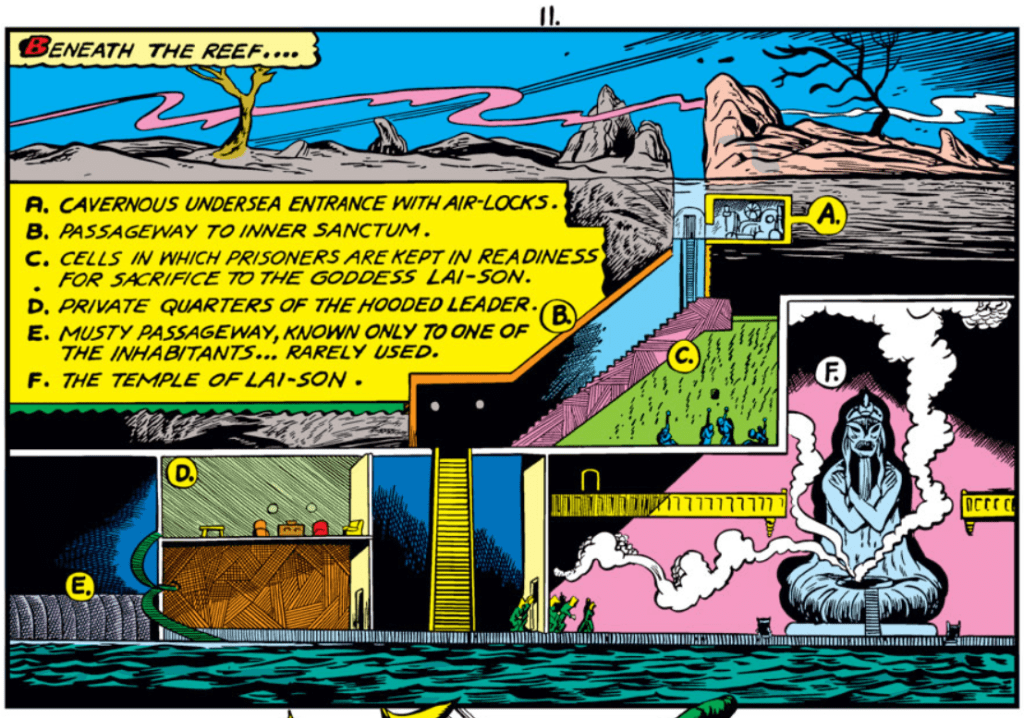
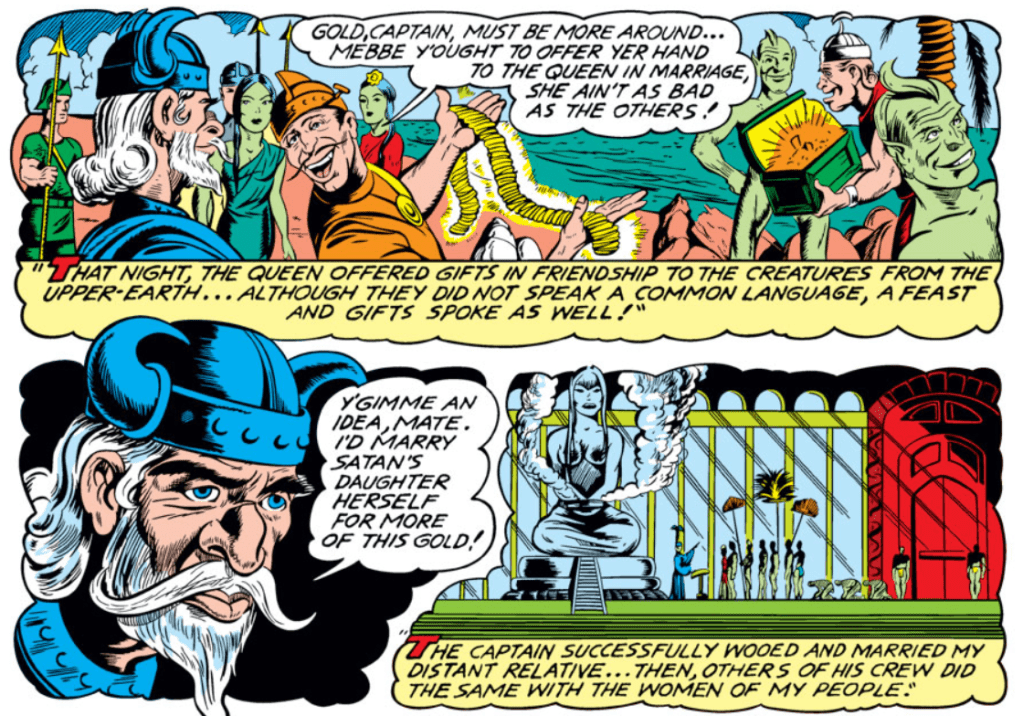
Published by Timely Comics (the precursor to Marvel Comics), this 20-page feature was drawn by Al Avison and edited by Stan Lee; others are not credited, but Marvel Masterworks: Golden Age Captain America vol. 4 gives the writer as Manly Wade Wellman, inks by Syd Shores and George Klein. This story is not a direct adaptation of Lovecraft, but shows a lot of influence from “The Shadow over Innsmouth.” Captain America and Bucky foil a Nazi plot that involves a mysterious town (“Valley-Port”) with an offshore reef (“Satan’s Reef”) taken over by hybrid aquatic creatures who worship a strange god; beings that came to this place after a group of European sailors met them, and whose captain married their queen in exchange for gold. However, instead of Cthulhu or Dagon, the goddess is Lai-Son, and the original marriage-minded interlopers are Vikings, not Yankees.
It is interesting to compare this story with “The Thing At Chugamung Cove!” (May 1949), Marvel’s other quasi-Lovecraftian story from the 1940s, since both are clearly borrowing off of “The Shadow over Innsmouth,” albeit not in the same way.
“Dr. Styx” (August 1945)
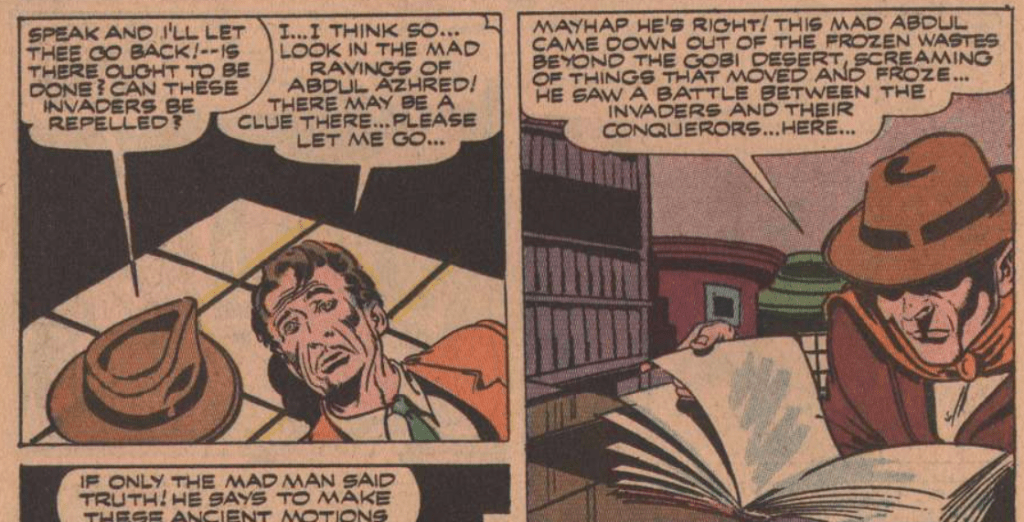
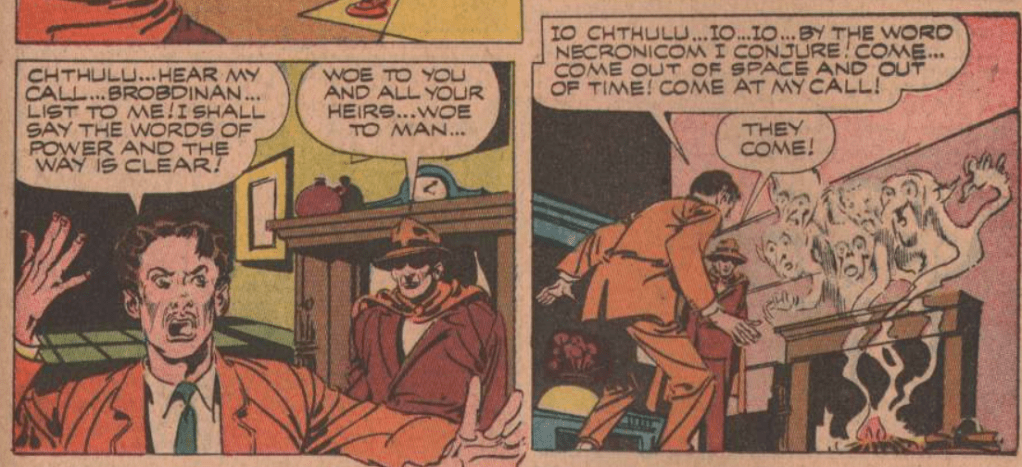
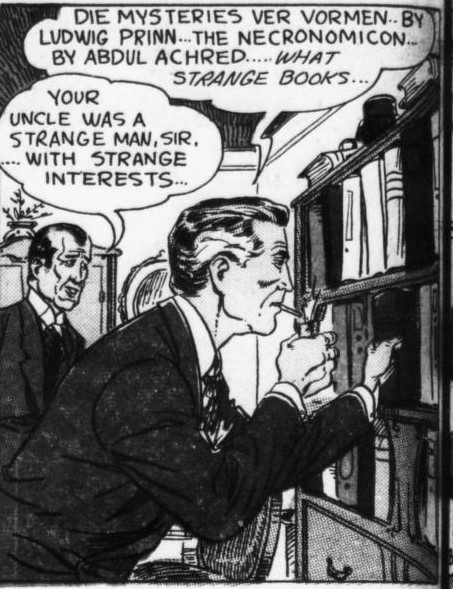
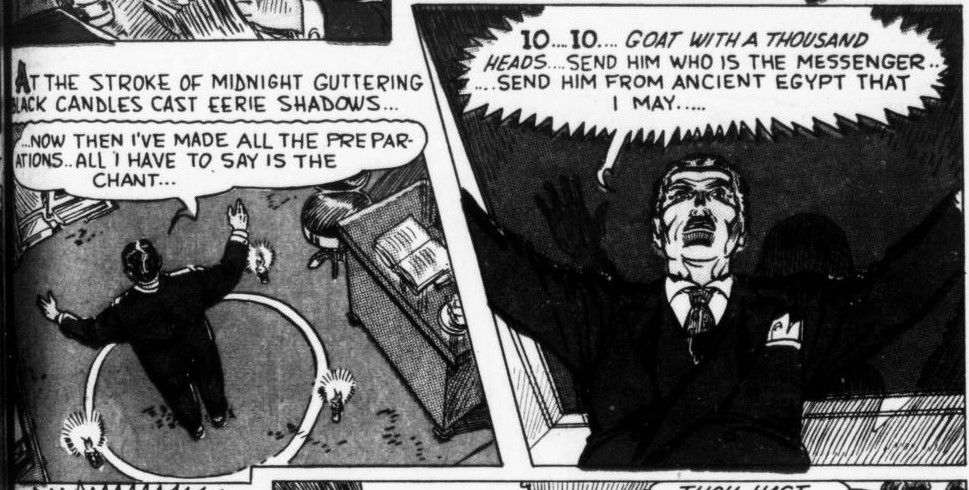
Published in Treasure Comics #2 (American Boys Comics Inc.), this uncredited 8-page comic presents an occult thriller whose eponymous hero is an unsung prototype to Doctor Fate, Doctor Strange, The Phantom Stranger, and John Constantine. Whoever the writer was, they must have read more than a little of the Mythos to cite Ludvig Prinn (created by Robert Bloch), Cthulhu, Abdul Alhazred, and the Necronomicon (however misspelled).

Red Dragon (Feb-Mar-Apr 1946)
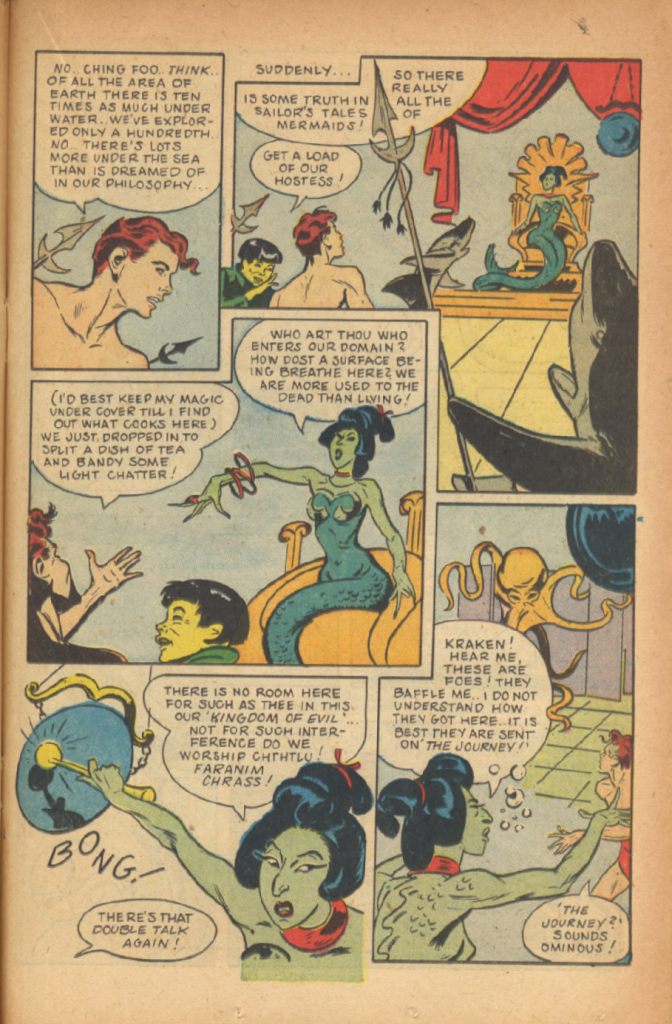
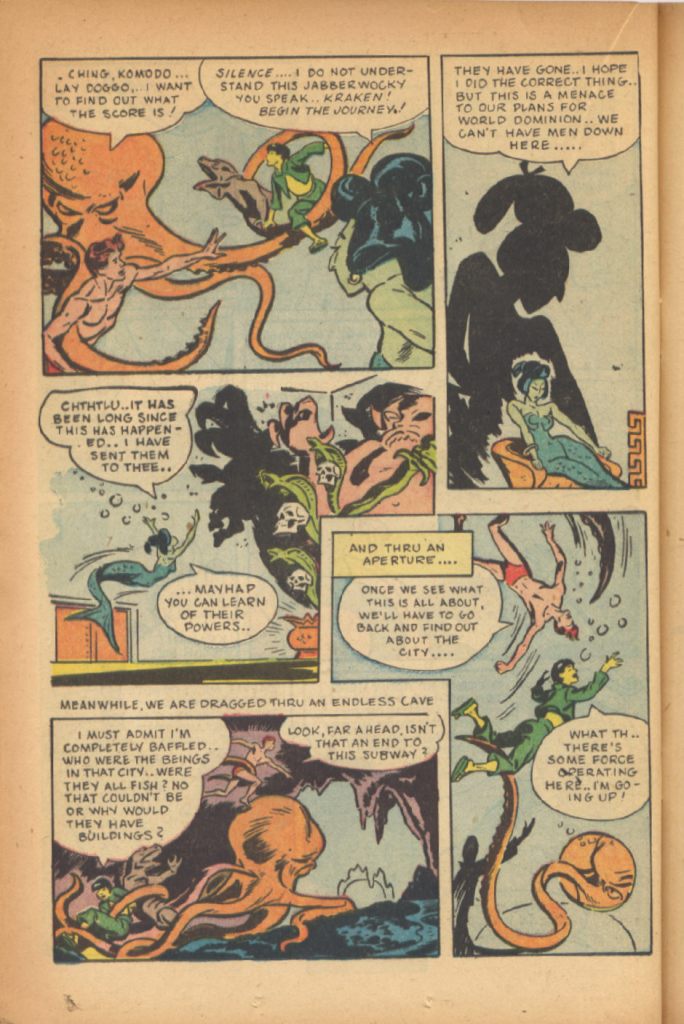
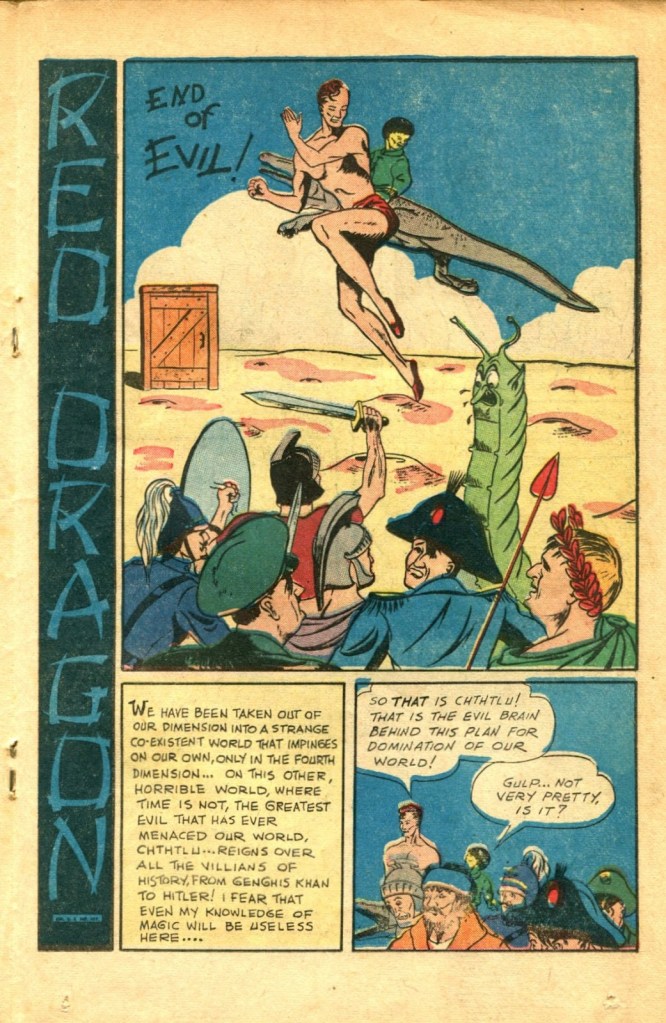
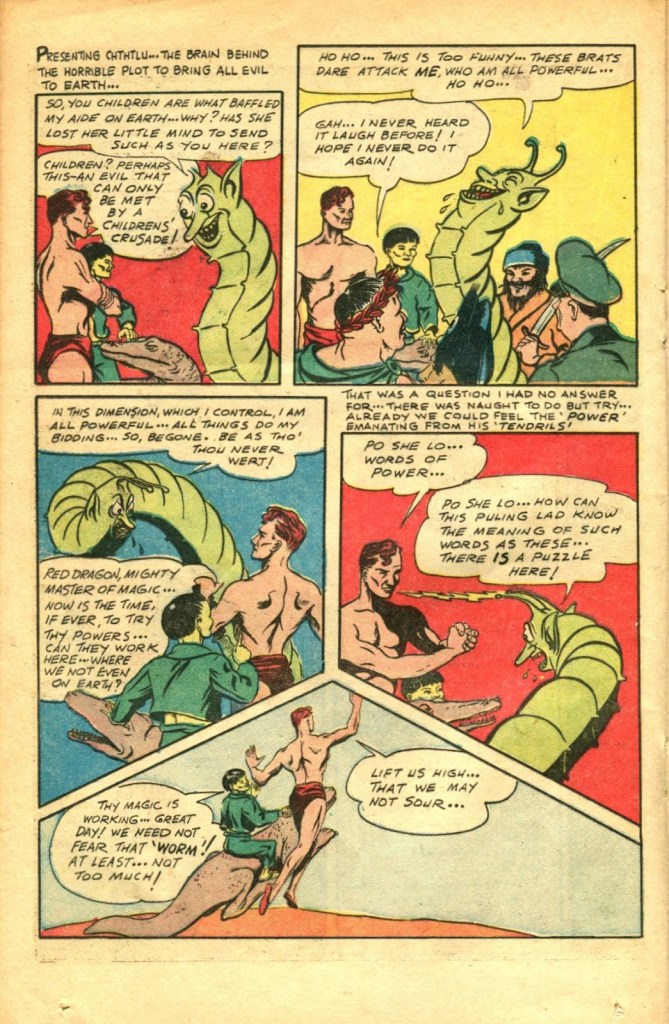
Red Dragon was a mystic superhero character whose adventures ran as a back-up feature in Super-Magician Comics published by Street & Smith, better known for their pulp magazines. Whereas most of Super-Magician Comics featured stories with the fantastic adventures of real magicians like Houdini, Red Dragon could perform acts of genuine magic by reciting the mystic words of power “Po She Lo” and a bit of doggerel rhyme. Red Dragon was accompanied on his adventures by a Chinese companion, Ching Foo, and a komodo dragon.
In a three-act adventure (“The Kingdom of Evil!” v.4 #10 Feb 1946, 8 pages; “Where Time Is Not” v.4 #11 Mar 1946, 8 pages; and “End of Evil!” v.4 #12 Apr 1946, 8 pages), Red Dragon and his companions run afoul of a cult of fish-men who worship Dagon and “Chthtlu”—an entity who dwells outside of normal space and time and is a giant green malevolent interdimensional worm with a humanoid face, a bit reminiscent of Mister Mind, and possibly inspired by him. The Lovecraftian influence is scant but noticeable. Sadly, no writer or artist is credited.

“The Book of Doom” (Oct-Nov 1948)
Red Dragon lent his name to two short series by Street & Smith in the 1940s. Like Super-Magician Comics, these were a mix of illusionism, mystery, and supernatural adventure. In Red Dragon #5 (Oct-Nov 1948), psychic investigator Dr. Savant tells the tale of a man who inherited an occult library—including a copy of the Necronmicon—and sought to raise the devil. Dr. Savant was suspicious (and he was right). The Lovecraftian elements are little more than trappings. This story ran for 8 pages; no artist or writer is credited.
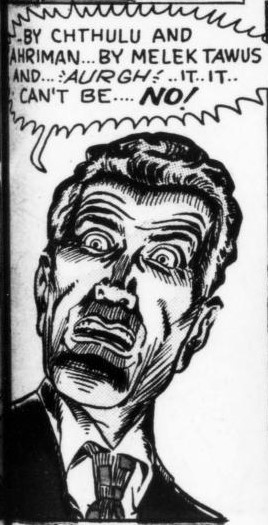
“The Thing At Chugamung Cove!” (May 1949)
Marvel Comics’ first foray into horror was Amazing Mysteries #32 (May 1949), which continued on the numbering from Sub-Mariner Comics #31, and the first story in that issue was “The Thing at Chugamung Cove!” (11 pages)—which is, in effect, a highly abridged and transformed version of Lovecraft’s “The Shadow over Innsmouth,” where a writer goes to the legendary deserted town and uncovers some frightful family history. No artist or writer is credited for this adaptation.

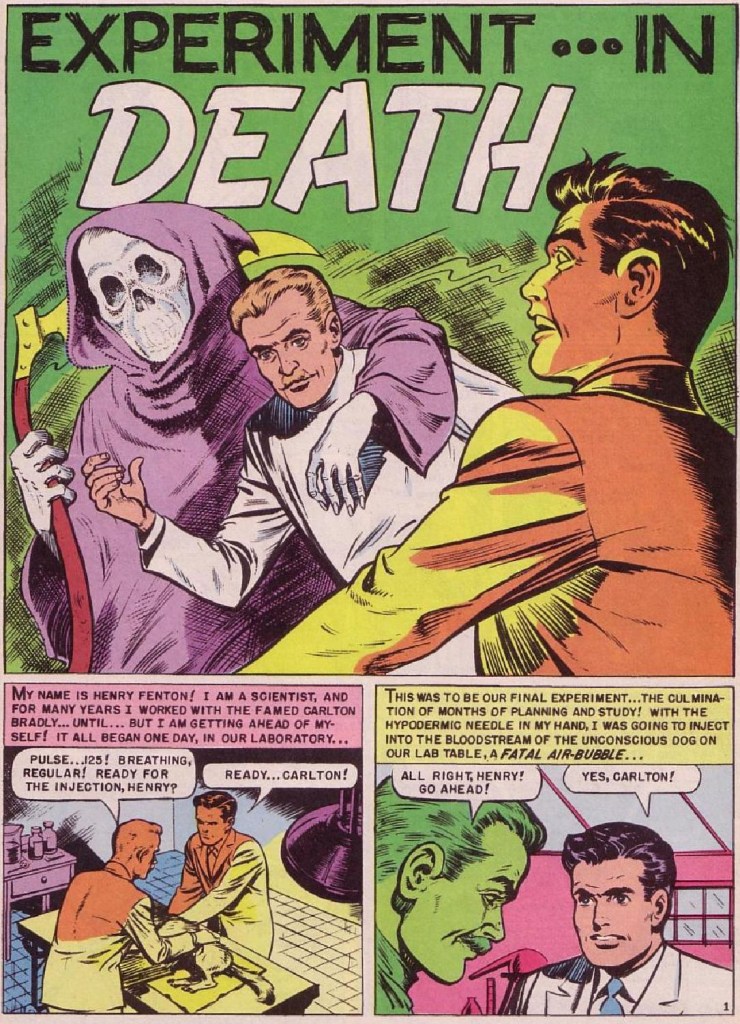
“Experiment … In Death” (May-June 1950)
Published in Weird Science #12 (EC Comics), this 6-page story co-scripted by Bill Gaines and Al Feldstein, and illustrated by Jack Kamen with letters by Jim Wroten, is clearly strongly inspired by H. P. Lovecraft’s “Herbert West—Reanimator”; but the lengthy six-part narrative has been largely scrapped to get at the core idea of a reagent that reanimates the dead, two doctors performing experiments to do just that, and how the degradation of the brain renders them violent. In ditching the plot, so too is ditched most of the gore, making this more of an intellectual horror.
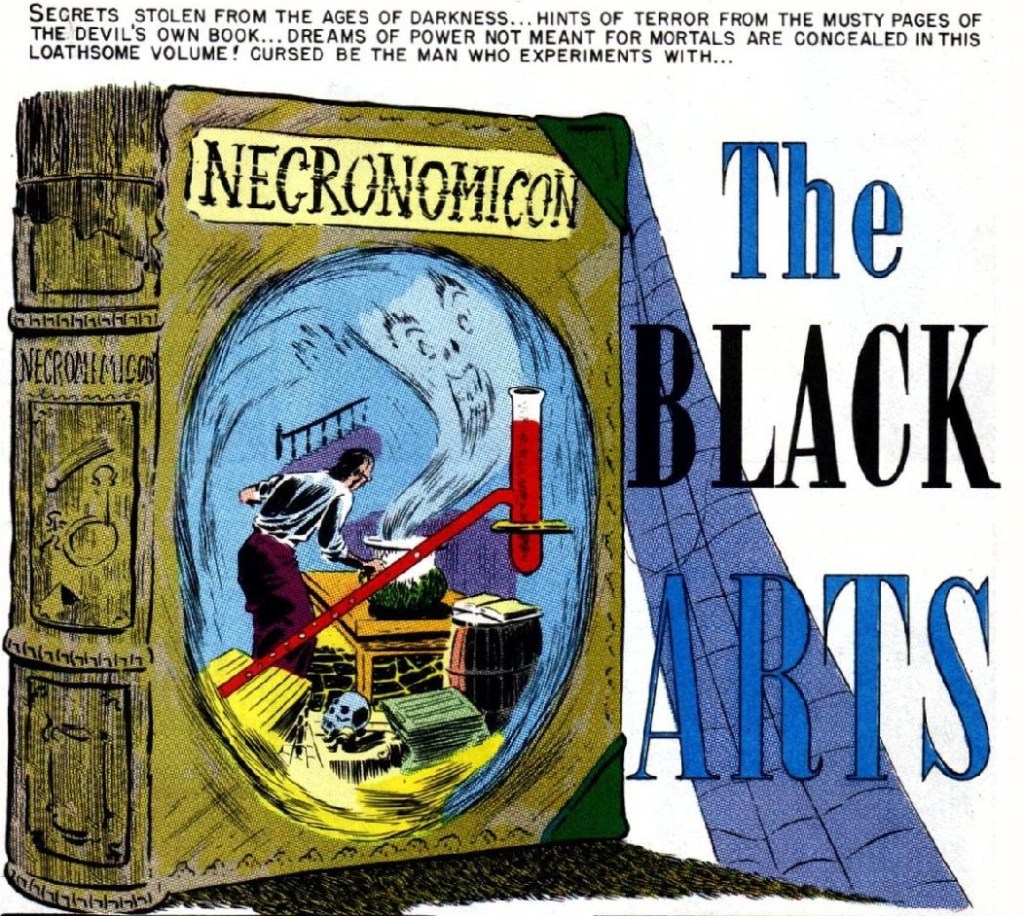
“The Black Arts” (July-August 1950)
Published in Weird Fantasy #14 (EC Comics), this 7-page story by written and inked Harry Harrison, penciled by Wally Wood, and lettered by Jim Wroten is a fairly generic tale of a young man that uses a recipe for a love potion from the Necronomicon to get a young woman to fall in love with him. Nice guys don’t use the black arts to date-rape young women, so the hint of a grisly comeuppance looks like karmic justice. The standout character here is the Necronomicon itself; which features prominently in the story.
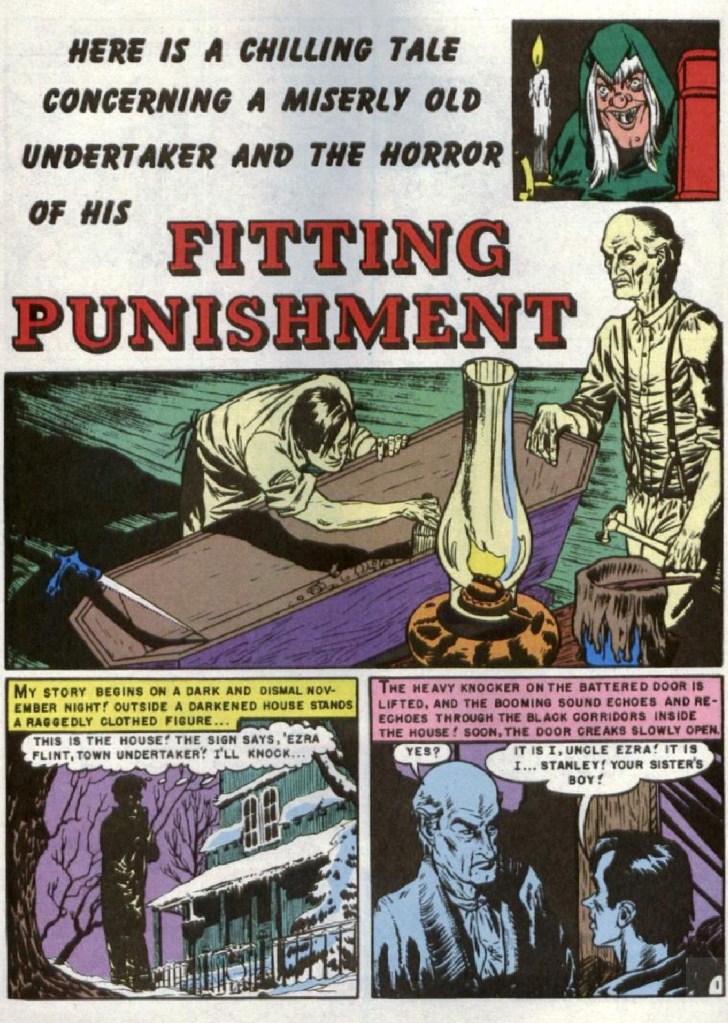
“Fitting Punishment” (December-January 1951)
Published in The Vault of Horror #16 (EC Comics), this 7-page uncredited adaptation of H. P. Lovecraft’s “In the Vault” was written by Al Feldstein, penciled and inked by Graham Ingels, and lettered by Jim Wroten. While stripped of much of Lovecraft’s prose and compressed to its bare essentials, Feldstein and Ingels manage to capture the essence of this very Poe-esque tale, whose climactic ending offers a vivid visual little less gruesome than Lovecraft’s original.
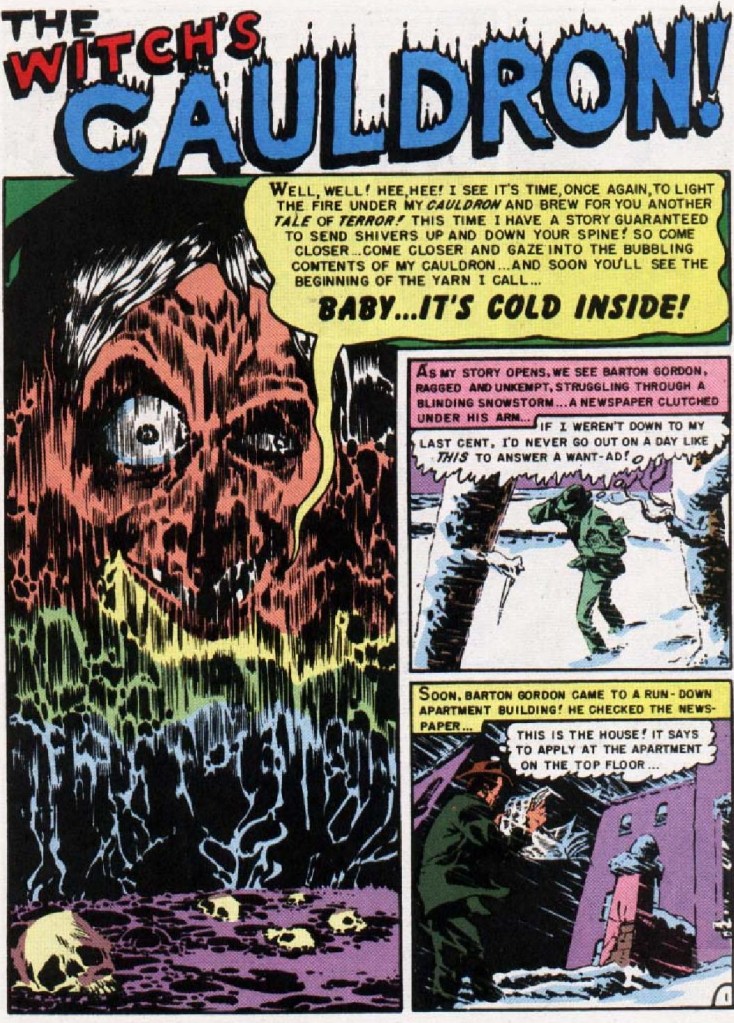
“Baby…It’s Cold Inside” (February-March 1951)
Published in The Vault of Horror #17 (EC Comics), this 7-page uncredited adaptation of Lovecraft’s “Cool Air” was co-written by Al Feldstein and Bill Gaines, penciled and inked by Graham Ingels, and lettered by Jim Wroten. As with “Fitting Punishment,” this isn’t a Mythos story and is very much in the Edgar Allan Poe vein, but even stripped bare to the essentials it gets the message across. “Cool Air” has been one of the more popular of Lovecraft’s stories to adapt to comics, having been adapted at least five times over the decades, perhaps because of its rather straightforward plot—and the gruesome climax.
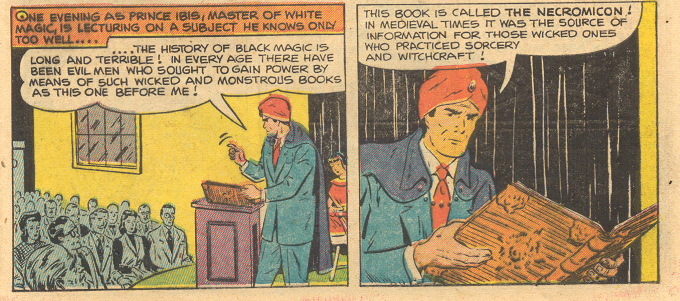
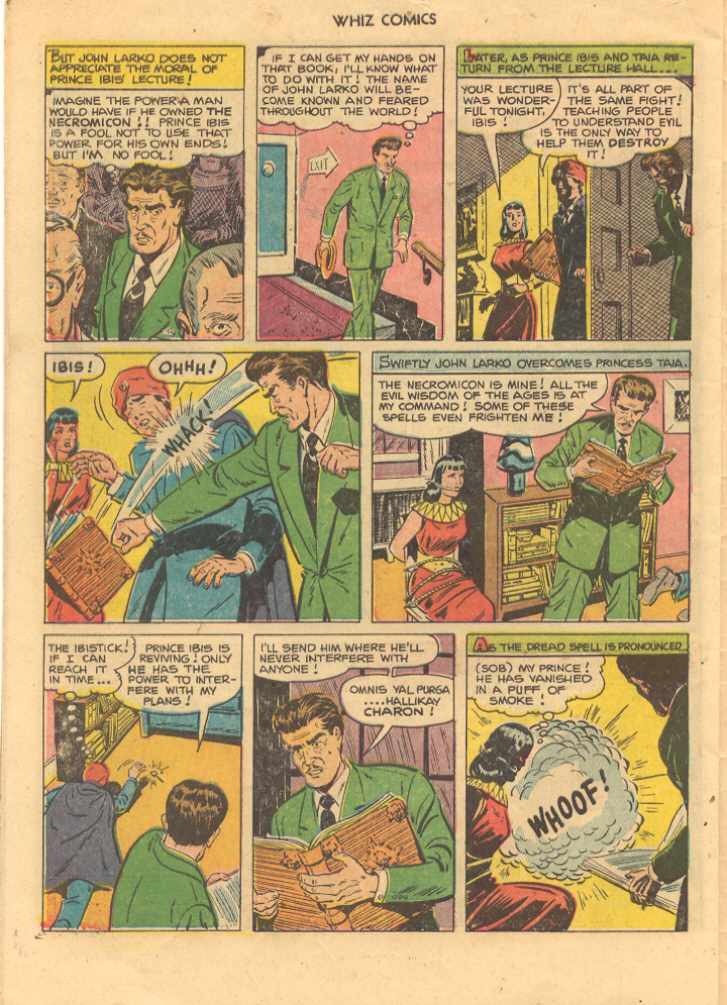
“Prisoner on Charon’s Ferry” (March 1952)
Published in Whiz Comics #143 (Fawcett Comics), this 6-page comic of Ibis the Invicible briefly features a grimoire called the Necromicon as a prop during a lecture, which an unscrupulous attendee uses to summon Charon (and later, a vulture). No artist or writer is credited, though the Grand Comic Book Database credits Bill Woolfolk with the script.
“Portrait of Death” (September 1952)
Published in Weird Terror #1 (Comic Media), this 7-page uncredited adaptation of Lovecraft’s “Pickman’s Model” was illustrated by Rudy Palais. As an adaptation, it’s interesting to compare “Portrait of Death” to “Fitting Punishment” and “Baby…It’s Cold Inside!” The line work and anatomy is a little cruder, the coloring a bit sloppier, and the writing takes many more liberties with the source material. Yet it is very much in the same spirit as the EC Comics adaptations.

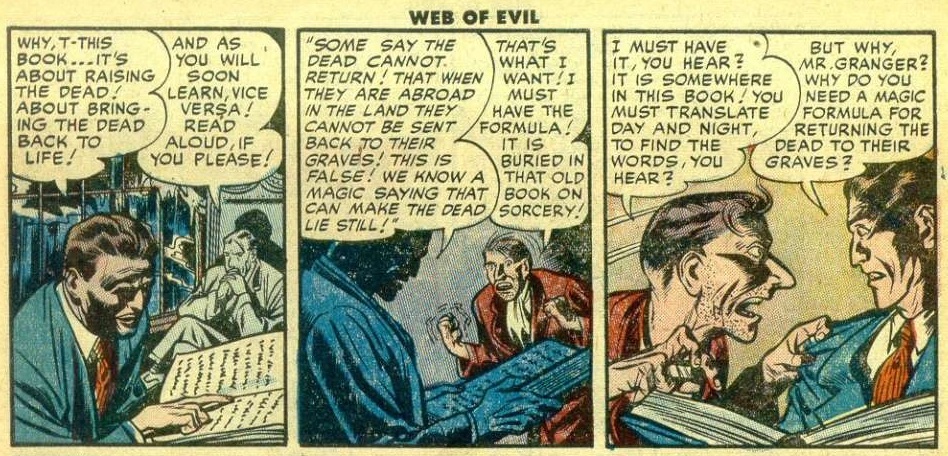
“The Corpse That Wouldn’t Die!” (January 1953)
Published in Web of Evil #2 (Quality) this 6-page story is largely adapted from Clark Ashton Smith’s “The Return of the Sorcerer,” though the eponymous sorcerer is not dismembered and the unnamed grimoire is in Sanskrit rather than the Arabic of the Necronomicon. The story was re-worked for Eerie Publications in the 1970s.
“Beyond the Past” (November-December 1953)
Published in The Thing #11 (Charlton Comics) this brief 4-page original story illustrated by Lou Morales is a definite homage to Lovecraft and the Necronomicon, albeit slightly garbled. The story had an odd afterlife, as newspapers—and then Frederic Wertham himself—mixed up the plot and thought that the Necronomicon a blood-drinking monster, not a tome of eldritch lore!
“Invitation to Your Wake” (December 1953)
Published in The Hand of Fate #21 (Ace Magazines), this 7-page original story has no credits, although the Grand Comics Database suggests it was penciled and inked by Sy Grudko, probably because of similarities of style. Like EC’s Tales from the Crypt and Vault of Horror, the stories in The Hand of Fate are narrated by a mysterious cloaked figure—by the stories tend to be more serious and less darkly humorous. Once again, the major Lovecraftian element is the appearance of the “Necromonicon,” as the rest of the monsters in this story are typical vampires, werewolves, etc.
There are no doubt many more pre-Code Lovecraftian horror comics out there—for a certain value of Lovecraftian. For example in “The Fish-Men of Nyarl-Amen” in More Fun Comics #65 (DC, March 1941) by Gardner Fox (writer) and Hal Sherman (art), mystic hero Doctor Fate defeats an army of prehistoric fish-men from beneath the sea. Chris Murray in Kevin Corstorphine in “Co(s)mic Horror” in New Critical Essays on Lovecraft argue this is a definite Lovecraftian influence:
The similarity to stories such as “The Call of Cthulhu,” with the sunken city of R’lyeth [sic], and also the Deep Ones who appear in “Dagon” and “The Shadow over Innsmouth” (1931) is obvious. Indeed, the name Nyarl-Amen seems reminiscent of Y’Ha-nthlei, the name of the undersea cyclopean city referred to in “The Shadow over Innsmouth,” and is certainly related to Nyarlathotep. However, the potential for horror in the tale is undercut, as is so often the case in comics of the time, by some rather clunky dialogue.
Murray & Corstophine, New Critical Essays on Lovecraft 166
Is it really? Hard to say. Gardner Fox in particular was well-known for riffing off of material from Weird Tales, both in prose and comics. Robert E. Howard’s Conan the Cimmerian was a definite influence on Fox’s character Crom the Barbarian who debuted in Out of this World #1 (Avon, June 1950), and Fox’s Kothar the Barbarian Swordsman novels (some of which were later adapted into Conan comics by Marvel!) So it wouldn’t be surprising if Fox was riffing off of Lovecraft in the 1940s. Yet, at the same time, Lovecraft didn’t hold a monopoly on fish-people either.
Another edge case is “The Last of Mr. Mordeaux,” penciled and inked by Joe Sinnott, which ran in Astonishing #11 (Atlas, Spring 1952). The 5-page story definitely seems to have taken inspiration from Lovecraft’s “The Lurking Fear” and “The Shadow over Innsmouth”: to prove his aristocratic lineage, the American Mr. Mordeaux travels to his ancestral castle in Hungary, and finds the remains of his family—driven underground centuries ago and degenerated into reptilian creatures, yet still bearing the hallmark bulging eyes and lack of eyebrows that Mr. Mordeaux still bears. Is this any looser of an adaptation than the other pre-Code horrors listed above? Where does the line fall between inspired-by and loose adaptation? In part, “Mordeaux” seems inspired-by because the premise is so broadly evocative of Lovecraft’s stories, but not directly evocative of any particular story. “The Lurking Fear” comes closest, but even that is a loose fit.
We get into the perennial question of: “What does Lovecraftian even mean, anyway?” Defined broadly enough, any terrible entity with tentacles or dark cult might look like stepped-on Lovecraft. In some cases, that’s probably true. With the publication of Lovecraft’s stories in hardback starting in 1939 by Arkham House, and the paperback editions that followed—including an Armed Services edition during World War II—Lovecraft’s fiction was more available than many of his contemporary pulp writers. Still, the Necronomicon didn’t appear in hundreds or even dozens of comics during these decades. It was an in-joke for dedicated fans—and perhaps that is how pre-Code Lovecraftian horror should best be understood. Something for the weird connoisseurs of the horror comic book and weird fiction.
The influence of Weird Tales and its circle of writers and artists on the early comic book industry could be a book in itself, ranging from Manly Wade Wellman’s work on Will Eisner’s The Spirit to the absolute sensation that was (and is) Robert E. Howard’s Conan the Cimmerian. Yet there was a certain magic to that Wild West period before the Code came down like a heavy lid, shutting down entire comic lines. While the Lovecraftian comics above aren’t particularly gruesome even by today’s standards, certainly not among the most notorious offenders of the 1940s and 50s, they were lost to time…and while the EC Comics have been collected and reprinted, many of the others remain virtually unknown.
With the arrival of the Comics Code Authority, comic books in the United States shifted ever more toward a younger audience, and toward superheroes. Unable to publish explicit horror comics, it may be unsurprising that the next Lovecraftian comics published were superhero comics like Justice League of America #10 (DC, March 1962), where the Necronomicon makes an appearance—but that would change. Underground comix creators, Marvel’s 1960s horror comics adaptations, the success of Conan the Barbarian (1970), Warren’s horror comics magazines, and Metal Hurlant’s Lovecraft special issue in 1979—the world of Lovecraftian horror comics was only groing to grow bigger and weirder.
Yet it started here, with a handful of pre-Code horror comics, many of which have never been reprinted. While these might not be the roots from which later Lovecraftian comics would grow, they were definitely precursors, part of that flood of sometimes dark, gory, and trashy four-color horror that scared parents and publishers into censorship. The first faltering steps to bring Lovecraft and Lovecraftian horror into a new medium.
Thanks to Will Murray for help and assistance.
Bobby Derie is the author of Weird Talers: Essays on Robert E. Howard and Others and Sex and the Cthulhu Mythos.
Deep Cuts in a Lovecraftian Vein uses Amazon Associate links. As an Amazon Associate I earn from qualifying purchases.
 Deep Cuts in a Lovecraftian Vein
“men’s adventure pulps” These weren’t pulps. They weren’t printed on pulp, didn’t have the pulp layout and were passed off as true stories.
LikeLike