
Weird Tales debuted in 1923 with a cover price of 25¢, at a time when slick magazines like Time and Life would sell for 15¢, and pulp magazines like Argosy All-Story went for 10¢. The difference in price was partially a function of circulation numbers, but also of advertising. The lower prices on slick publications and more popular pulp magazines was at least partially subsidized by the ads that ran in every issue—and a look at the ads could tell you a lot about a magazine and its readership, or at least the readership that the advertisers hoped to reach.
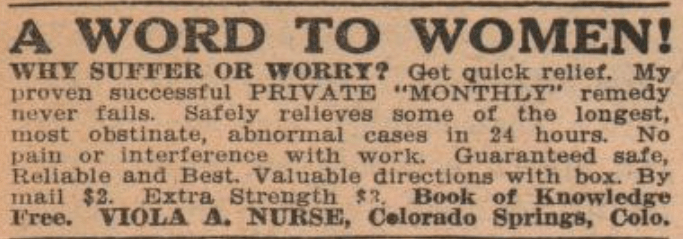
So what does it say about Weird Tales that in the very first issue, there was a full-page advertisement for birth control? And many thereafter.
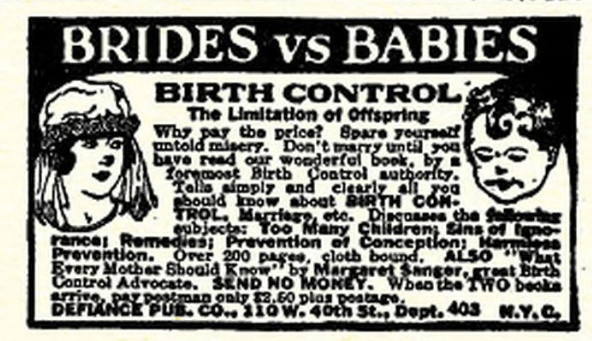
In 1873, the United States Congress passed the Act for the Suppression of Trade in, and Circulation of, Obscene Literature and Articles of Immoral Use into law. This law, and other similar state laws, were known as Comstock Laws; named after U.S. Postal inspector Anthony Comstock, who was the founder of of the New York Society for the Suppression of Vice. The 1873 law made it illegal to send any obscene matter through the mail—and while this was primarily aimed at disrupting the trade in pornography, it was also aimed very specifically at suppressing the sale of or knowledge of any form of birth control or abortion. The full text of the original law can be read here.
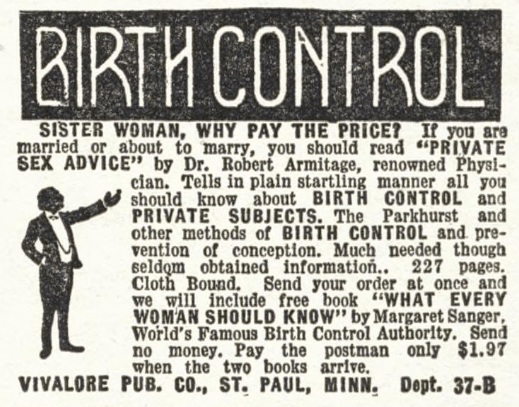
The Comstock laws were so broadly drawn and ill-defined that “obscenity” was very much in the eye of the beholder—or, as it happened, the postal inspector. Did a magazine extolling the nudist life count as pornography? Or a medical text book with explicit illustrations of human genitalia? Books of historical European art where the subject is a nude human figure? What about pulp magazines like Weird Tales which might have a nude on the cover, or on an interior illustration? These aren’t hypotheticals, these were real cases. A 1933 case of the State of New York v. Ben Kornfeld involved Spicy pulp magazines, and there are more examples if one wants to dig through Westlaw or Lexis databases for caselaw about pulps and obscenity.
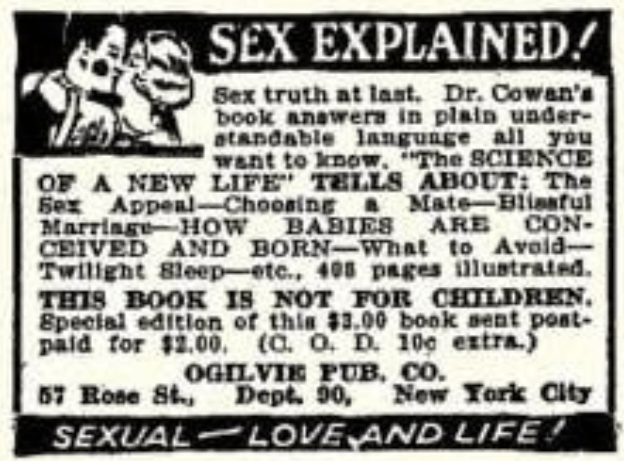
At the same time as these laws restricted the legal availability of such materials, they were faced with a growing population with a growing demand for not just pornography and prophylactics, but increased knowledge of sexual healthcare. The illegality of prophylactics also meant there was no governmental oversight, quality control, or user safety advocacy for their production or dissemination. Bad information about sexually transmitted infections was rampant; skin or rubber condoms and pessaries often failed; directions for herbal abortifacients could be effectively poisonous or ineffective.
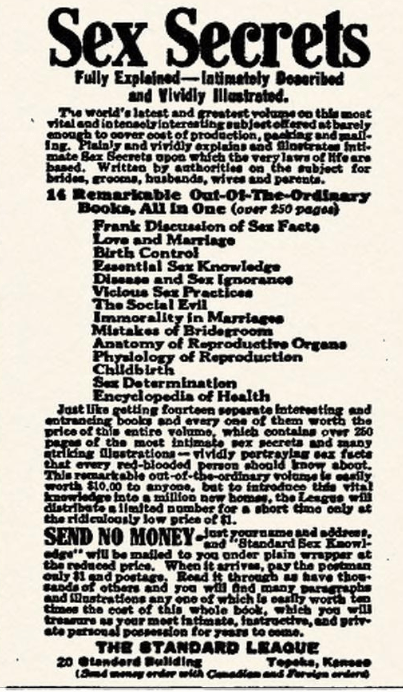
Some individuals pushed back against the legal restrictions of the Comstock laws, such as eugenicist and sex educator Margaret Sanger. Eugenics and birth control often go hand-in-hand during the early 20th century; while in practical terms a woman might enjoy sex but not wish (or be able to afford) a child, the philosophy of eugenics often provided an intellectual justification that went beyond perceived hedonism, as Lovecraft put it:
Modern civilisation, however, has developed a sentimental protection of the weak which ensures the survival of the inferior as well as the superior; so that unless something equally artificial* is done to counteract the tendency, we shall be overrun with the unlimited spawn of the biologically defective & incompetent. For the competent, on the other hand, birth control has become a grim & absolute necessity; since the industrialisation of the social order has made it absolutely impossible to rear a large family in a comfortable & enlightened manner without a far greater fortune than the majority of moderately competent, decently-born, & well-bred people possess. There is no use at all in expecting the tastefully-living but non-wealthy middle-class citizen not to practice birth control. As long as he knows he never can bring up ten children decently, he is going to stick to one or two or three & see that they are brought up decently. For him the matter is an intensely practical one, no matter what he may think in vague theory. The better classes, then, are outside the argument. With them birth control is an accomplished fact, & it will always be so. Meanwhile, since the reproduction of good blood is so artificially cut off, shall we allow bad blood to multiply unchecked through ignorance, till the spawn of weak & unfit stock forms the bulk of our population? My answer is emphatically no! To hell with principle—our first duty is to save the fundamental biological quality of the race!
—H. P. Lovecraft to August Derleth, 26 Mar 1927, Essential Solitude 1.78-79

In practice a grey market emerged to meet the public’s demand to know more about sex—and they needed some way to reach their customers. Before the rise of the internet or television, print was the major medium for advertisement. A local newspaper could cover a city or county, further if it was national; a pulp magazine could also potentially reach coast-to-coast and beyond.
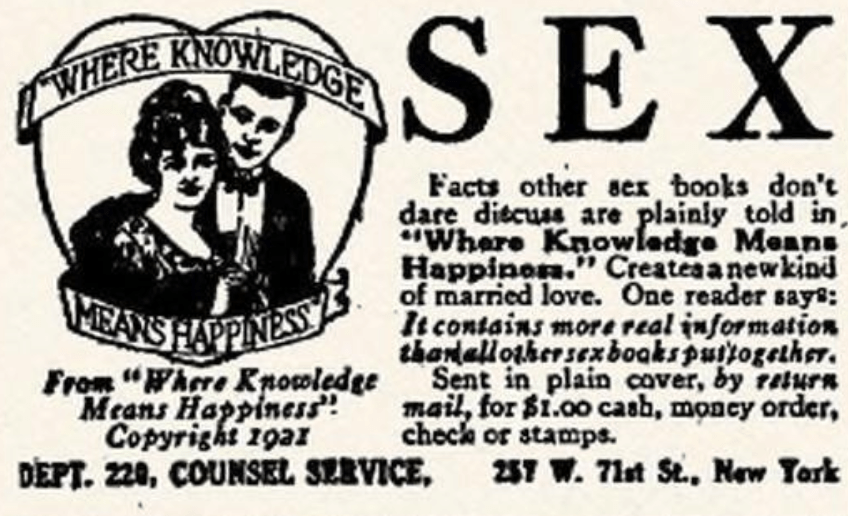
Doing this kind of business, however, required a deft touch. Because everything was going through the mails, that meant the seller and buyer both ran the risk of the postal inspector. Ads had to be relatively circumspect; they could sell the promise of sizzle, but not of steak. Works dedicated to flagellation and what readers today might call BDSM-oriented literature like A History of the Rod could be passed off as of historical or psychological interest, and other works might be passed off as of ethnological interest, like Voodoo Eros. How to perform an abortion at home, or a catalogue of marital aids to spice things up in a bedroom, was too explicit, however, and was liable to get the advertiser dragged before a federal judge.

Slick magazines wouldn’t normally court these kinds of advertisement; the folks selling potential Comstock law violations needed folks that were desperate or ignorant enough to believe the promises, and the prices needed to match their resources. Automobile and household appliance manufacturers weren’t spending to put ads in Weird Tales, and the ads you do see are usually very modest: luck rings, cheap firearms, pimple cures and weight loss pills, self-help books and correspondence courses, trusses and tires.
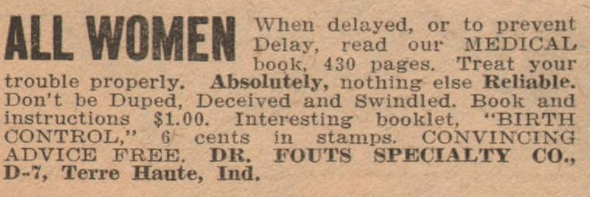
Dr. Fouts Specialty Co. of Terre Haute, Indiana first advertised in the pages of Weird Tales in the triple-sized May-June-July issue that marks the transition of the editorship from Edwin Baird to Farnsworth Wright. There is no indication that readers took any particular notice of this advertisement, although arch-fan Francis T. Laney did when he was going through back issues in 1946, and copied it verbatim into Fandango #10 so that the post-war sophisticates could gawk—even though the Comstock Laws were still on the books.
The first example of Dr. Fouts advertising I’ve been able to find is a small, discrete want ad placed in a Kansas newspaper:

The need for a sales person is telling: it suggests Dr. Fouts is ready to expand into new territory, and has the stock and capital to do so (or, at the least, was doing the 1910s equivalent of talking people into selling Tupperware to their neighbors). The advertisement in Weird Tales was apparently typical; Dr. Fouts used an almost identical ad the next year in an Illinois newspaper:
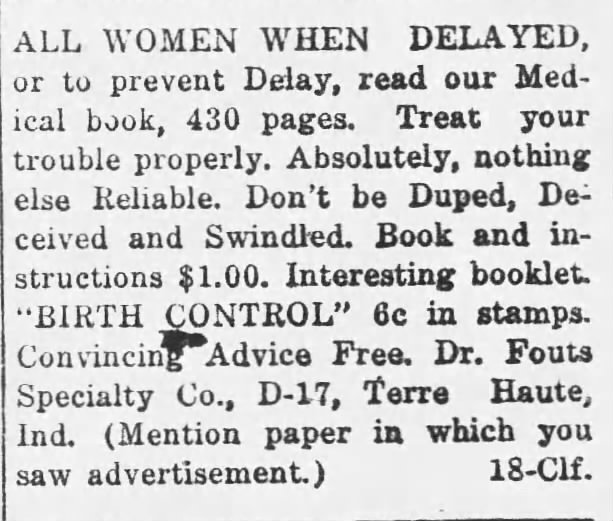
The full scope of Dr. Fouts’ business is unclear; for the small ads, at least, it was clearly mail-order, and it was definitely dancing on the fine line of a Comstock law violation. “To prevent Delay” was a dog whistle about a woman’s period being late, “BIRTH CONTROL” in all caps was designed to erase any doubt from the reader’s mind. What did this Medical Book or pamphlet actually consist of? It could have been as innocuous as Birth Control, or, The Limitation of Offspring by the Prevention of Conception, or it could have contained actual instructions for the rhythm method, inducing abortions, or the use of prophylactics to prevent pregnancy. We don’t know…but we do know one thing.
Dr. Fouts got caught.
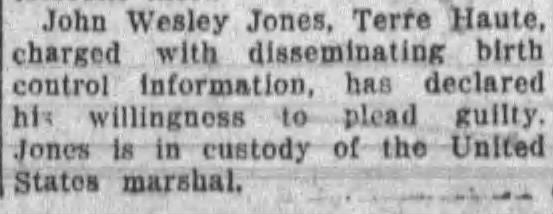
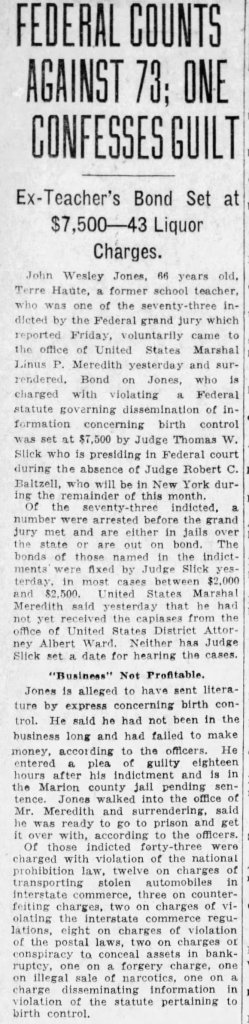
John Wesley Jones is listed on the 1910, 1920, and 1930 Federal censuses; records of his birth and earlier movements are not online, and the census data itself is somewhat suspect. The 1910 census gives his profession as attorney, and a birth year of 1865, which would make him 60 or 61 in 1925 if accurate; the 1920 and 1930 census gives his occupation as real estate agent and list his birth year as “abt 1863” and “abt 1857,” respectively—if the age he gave to the court is correct, he’d have to be born c. 1859. The claim that “he hadn’t been at the business long” rings untrue, considering Dr. Fouts Speciality Co. was in business since at least 1919, but it is possible that Jones didn’t originate the business, only purchased it from someone else. Indeed, none of the 1925 newspaper clippings identify Jones with Fouts; that would come later.
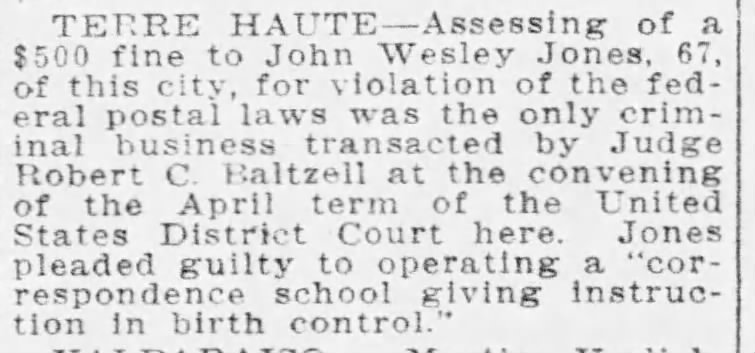
Perhaps because of his contrition in confessing, his apparent age, or claims not to have prospered, John Wesley Jones was let off with a fine and no prison term. That would change in 1927, when he was caught at it again.
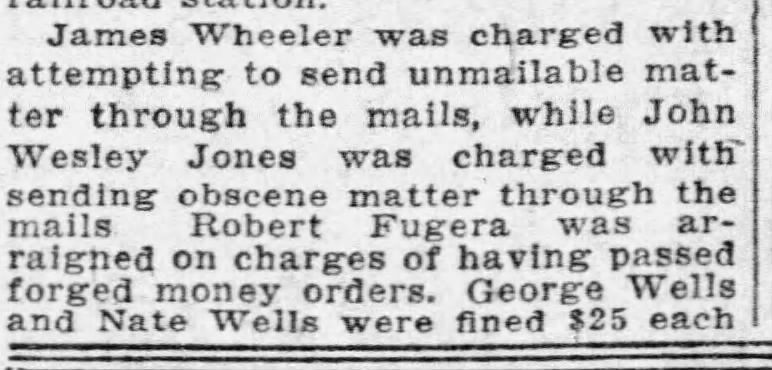
Perhaps aware he was facing a prison sentence, Jones went on the run from the law.
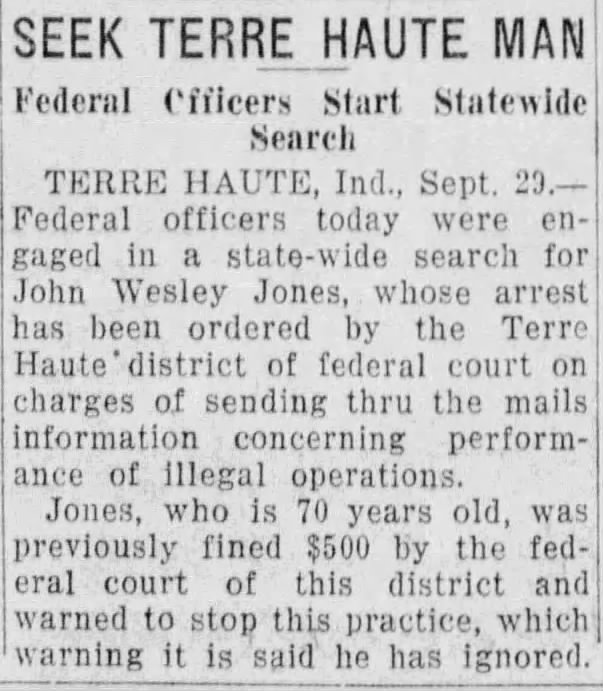
Notice at this point the newspaper claims Jones is 70 years old; he’s aged four years in the last one. Whether this is an issue of garbled communication or Jones lying about his age we may never know, but it becomes a recurring detail in subsequent newspaper clippings.
While Jones was the subject of a state-wide manhunt, another arrest happened in Chicago. Like the Don Corleone of sex education, Jones had apparently made birth control a family business.
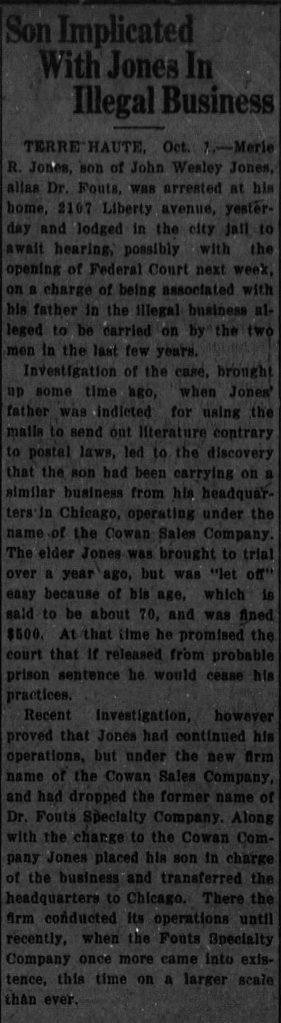
According to his enlistment papers, Merle Roosevelt Jones was born 15 October 1901. He was the son of John Wesley Jones and his wife, Zolah or Zoe Clara Jones (maiden name unknown), who according to the 1910 census married c.1900. No marriage license or announcement has yet surfaced in online archives, but the young man apparently worked as the Chicago end of the business. Combined with the 1919 Kansas ad, we get a hazy picture of a multi-state distribution network for birth control texts.
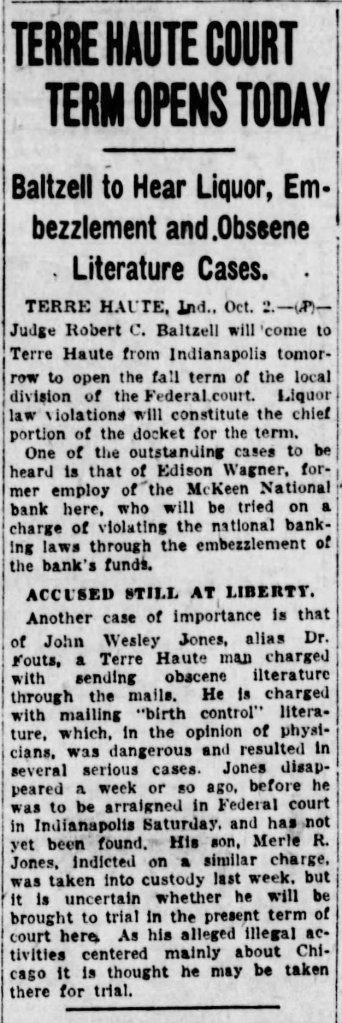
Unluckily for John Wesley Jones, his case would be heard by Federal Judge Robert C. Baltzell—the exact same judge who had been in charge of his 1926 conviction. Presumably, Baltzell was not amused when the elder Jones was finally located and brought to trial, which he was by November.
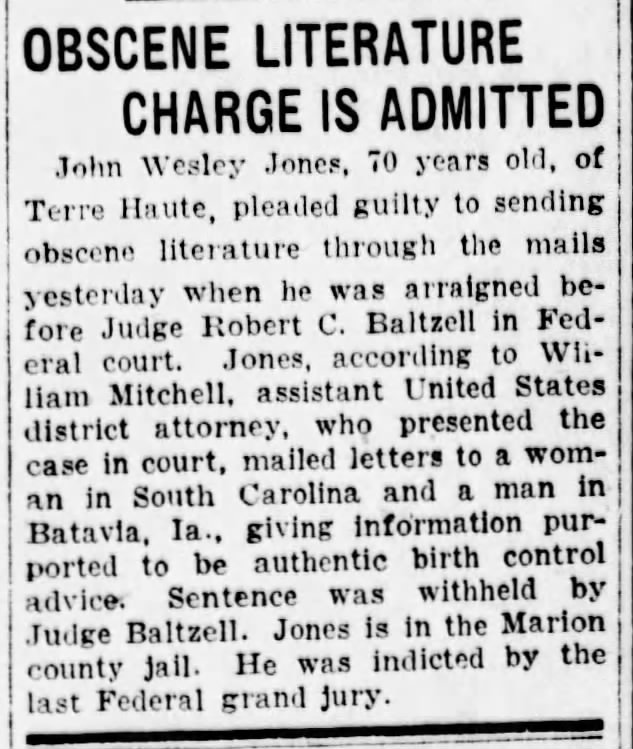
As in 1926, John Wesley Jones pled guilty. Various newspaper clippings say that Baltzell either withheld or deferred the sentence; given that Jones pled guilty, withheld seems more likely, but without access to the actual trial record we are at the mercy of oftentimes inaccurate court reporting. Given that Jones was still in custody at this time, I think it is more likely that the judge accepted the guilty plea but postponed sentencing for another day. No mention is made of any additional charges such as flight to avoid prosecution; whether this reflected a plea deal with the district attorney’s office or some other reason is not clear.
A follow-up piece suggests it was ads in magazines like Weird Tales that proved the downfall of the Jones boys.

The choice of words is interesting here: mail fraud is a different charge from selling obscene matter. The problem lay in the Comstock law itself: selling birth control and pornographic materials through the mail was illegal, but this grey market existed. Some unscrupulous sellers tried to have it both ways, by advertising in ways that promised explicit materials, but delivering materials which were too tame or censored to fall under the auspices of the Comstock laws. In that case, however, the postal inspector could still get the seller for false advertising: after all, mailing birth control literature might be illegal, but taking someone’s money for birth control literature and then not delivering it was fraud.
Given what little we know of the facts of the case, this doesn’t seem likely for Dr. Fouts. The few details available, especially the emphasis on “letters” being mailed, suggests he was running something of a sex education correspondence course for adults. It is possible the Jones boys also sold some less specific materials under false pretenses, but if so, there’s no other record in the papers of them being charged for mail fraud—just Comstock laws.
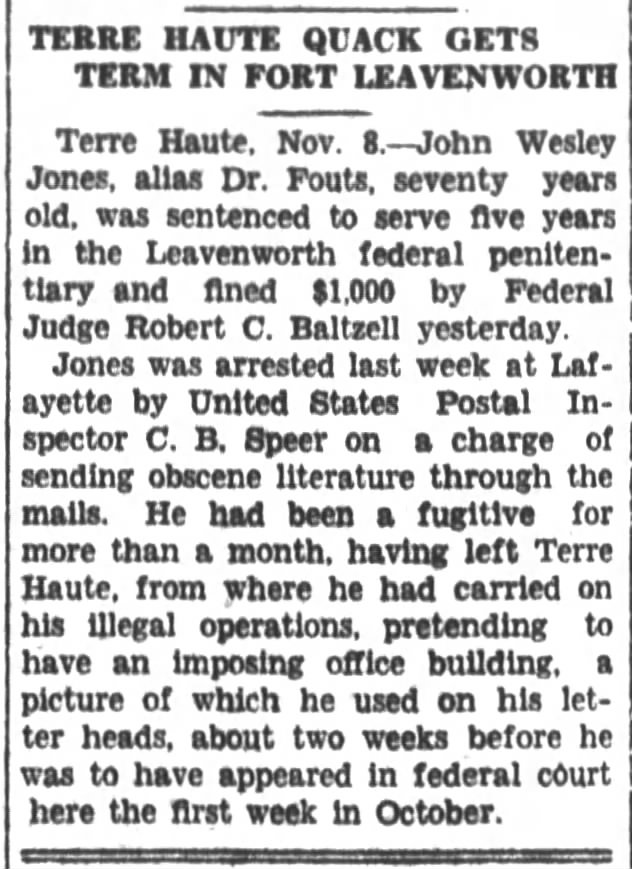
Five years is the maximum penalty under the 1873 law; whatever leniency Baltzell had for the elder Jones’ age (whatever that was) vanished with his second offense. While readers of the paper probably imagine heroic postal inspector C. B. Speer heroically nabbing the fugitive as he went to mail yet more forbidden secrets of prophylactics, the arrest itself doesn’t seem to have made the papers, and the general implication from the number of detail of newspaper clippings is that now that justice was handed down, interest in Dr. Fouts rapidly dwindled.
Presumably, John Wesley Jones went to the federal penitentiary at Leavenworth, Kansas. We know nothing of his time there, but the 1930 census has him back in Terre Haute, Indiana with his wife Zoe. It seems likely he got time off for good behavior. How his son Merle fared in Chicago with his own obscenity case is also unknown. In the 1940 census, Merle was living with his mother Zoe, no record of John Wesley Jones. When she died in 1942, the death certificate read “widowed.” Merle himself would go on to serve during World War II, marry, and live his life until he passed away on 15 November 1980.
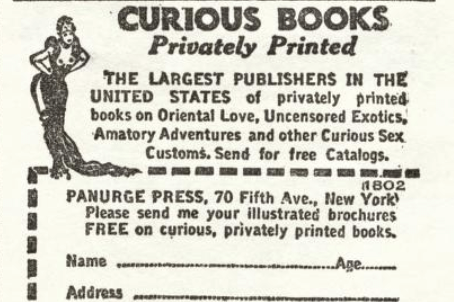
The small ads continued in Weird Tales under Farnsworth Wright’s editorship; the nature and prominence of the ads would shift over time, although readers from the beginning would still recognize certain adverts from the earliest issues. Birth control dropped out of prominence at the end of the 1920s, usually only cropping up in bookseller adverts trying to push curiosa. How much of this was due to Dr. Fouts getting put away in 1927? Or was someone at the Weird Tales office suddenly leery of guilt by association if they posted more such ads? More unanswered questions.
Who was Dr. Fouts? Was he a serial liar and conman who defrauded people and made money hand over fist in a multi-state criminal organization? A retired teacher trying to deliver accurate information on sex to desperate adults who were stuck in a culture policed by puritanical busybodies who wanted them to suffer for having a good time? Certainly, some of the other folks that broke the Comstock laws, detailed in books like Bookleggers and Smuthounds, were just profit-minded entrepreneurs that turned to pornography to make a profit. They weren’t all civic-minded culture-heroes fighting to bring knowledge to the people.
A century later, in an age when there is more information about reproduction available at the click of a button or at a public library than a single individual can absorb in a lifetime, running a correspondence course on birth control is so far removed from a crime in the United States that it is difficult to conceive of someone going to prison for it. Yet John Wesley Jones did.
It is important to remember that many Comstock laws are still on the books. While they have been deemed unconstitutional and are largely unenforced when it comes to birth control materials, cases such as Dobbs v. Jackson Women’s Health Organization show that there are still jurists attempting to put the genie back in the bottle, so to speak. A century of reproductive health progress could be just a Supreme Court decision away from being wiped out.
Bobby Derie is the author of Weird Talers: Essays on Robert E. Howard and Others and Sex and the Cthulhu Mythos.
Deep Cuts in a Lovecraftian Vein uses Amazon Associate links. As an Amazon Associate I earn from qualifying purchases.


Wow! This was wild! Excellent research. While we don’t have all the facts of what effects resulted from his advice, I like to think Dr. Fouts had good intentions. While reading, I also kept thinking that HPL and Sonia must’ve applied some sort of birth control in their marriage.
LikeLiked by 2 people
It seems likely. Not a subject either Howard or Sonia would discuss openly, though.
LikeLiked by 2 people
Given the times, in which they were married, it makes sense why they didn’t. Also, much of what she wrote later on about their marriage was to mainly refute other accounts of HPL, ultimately leaving out such intimate details.
LikeLiked by 1 person