When Robert E. Howard sat down at his typewriter to pound out another adventure of Conan the Cimmerian, there is no indication that he had any explicit age range in mind for the audience. Weird Tales was not an all-ages magazine by any stretch of the imagination, but anecdotes show its readers ran from young teens to college students, to grown men and women well into their professional lives. The artistic and literary content leaned toward a more mature audience, what with the occasional nudity, graphic violence, scary monsters, and dabbling in blasphemy and the occult, sometimes even torture and guarded references to more salacious fare such as incest and castration.
Conan the Cimmerian was right at home in Weird Tales, his adventures seldom as spicy as the Spicy pulps, or as gruesome as the Shudder pulps, but definitely at the upper limit of what was deemed acceptable by editor Farnsworth Wright—who sometimes censored stories that went too far over the line in some particular. It can be fairly said that whomever Conan was for in the 1930s, he was not explicitly aimed at kids.
The general audience for Conan remained somewhat ambiguous in the decades after Robert E. Howard’s death. The Gnome Press hardback collections of Conan’s adventures in the 1950s were priced above what the average kid could afford; the paperback reprints and collections put out in the 1960s and 70s were more affordable and accessible, but while the Frank Franzetta covers no doubt caught a few eyes and won a few converts among the younger audience, the paperbacks weren’t explicitly marketed to children.
Then in 1970, Marvel Comics published Conan the Barbarian #1. The formation of the Comics Code Authority in 1954 substantially altered the comics landscape in the United States over the subsequent decades; where before comics had been written, illustrated, and marketed for many audiences, some for children and others for adults, the blanket censorship of the CCA meant that nearly all of the comics sold on newsstands and to the direct market were now aimed almost exclusively at children and teenagers. While Conan the Cimmerian didn’t run around in body-hugging spandex fighting Communists, he still had to conform to a code that reigned in the gore, the sex, and sometimes the morality.
It was the beginning of the kidification of Conan.
Not that the Cimmerian went down without a fight. Marvel launched The Savage Sword of Conan in 1974 through its Curtis Magazines imprint, which allowed it to bypass the CCA and tell stories with more nudity and gore. The 1982 film Conan the Barbarian was given an R rating for nudity and violence—despite the fact that Mattel, who was trying to develop a Conan toy line, asked them to ease up:
Kalinske also worried that the Conan film might be too violent or sexually suggestive to merit an R rating from the Motion Picture Association of America, and he proposed that they “discuss how we might deal with that.”
—Conan Properties, Inc. v. Mattel, Inc., 712 F. Supp. 353 (S.D.N.Y. 1989)
Conan the Destroyer (1984), cut down on both sex and violence, and was able to secure a PG rating. The success of the films led to a Universal Studios attraction, The Adventures of Conan: A Sword & Sorcery Spectacular (1983-1993, video), and an animated show Conan the Adventurer (1992-1993), a highly bowdlerized version of the character far removed from Howard’s original conception. The follow-up animated series, Conan and the Young Warriors (1994) was aimed even more directly at younger viewers.
No gore, no sex, and not much in the way of moral ambiguity or complex plotting.
All during this same period, plenty of Conan material was being published for older audiences, from New pastiche novels to reprints of Howard’s original. Conan’s career in the comics waxed and waned with the decades, but has fairly consistently remained aimed primarily for more mature readers, without slipping into either outright pornography (except through bootleg productions like the Red Sonja & Conan: Hot and Dry Tijuana bible) or the more gory excesses of some small press comics like Crossed from Avatar Press.
The question might be asked: so why was Conan kidified at all?
We might as well ask why Norse mythology was bastardized into the blonde, blue-eyed Thor of Marvel Comics, or why Count Chocula wears an opera cape in the style of Bela Lugosi. The writers and artists that shape these works are drawing freely from the original source material, but without excessive concern for accuracy—they’re recycling and repurposing the material for their own ends. As with any adaptation, the end result may barely be recognizable. The Cthulhu plushies sold, cute and cuddly and green as they are, share little more than a name with H. P. Lovecraft’s hulking mountain of an extraterrestrial High Priest of the Old Ones in sunken R’lyeh.
These new works have to be read on their own merits. There’s no point in comparing Lovecraft’s original works to Howard Lovecraft and the Three Kingdoms or Mary Shelley’s School for Monsters: La Llorona in the Machine; the intended audiences and implicit sensibilities are completely different. So it is with Robert E. Howard’s “The Tower of the Elephant” and Barbarian Kids 1: La Torre del Elefante.
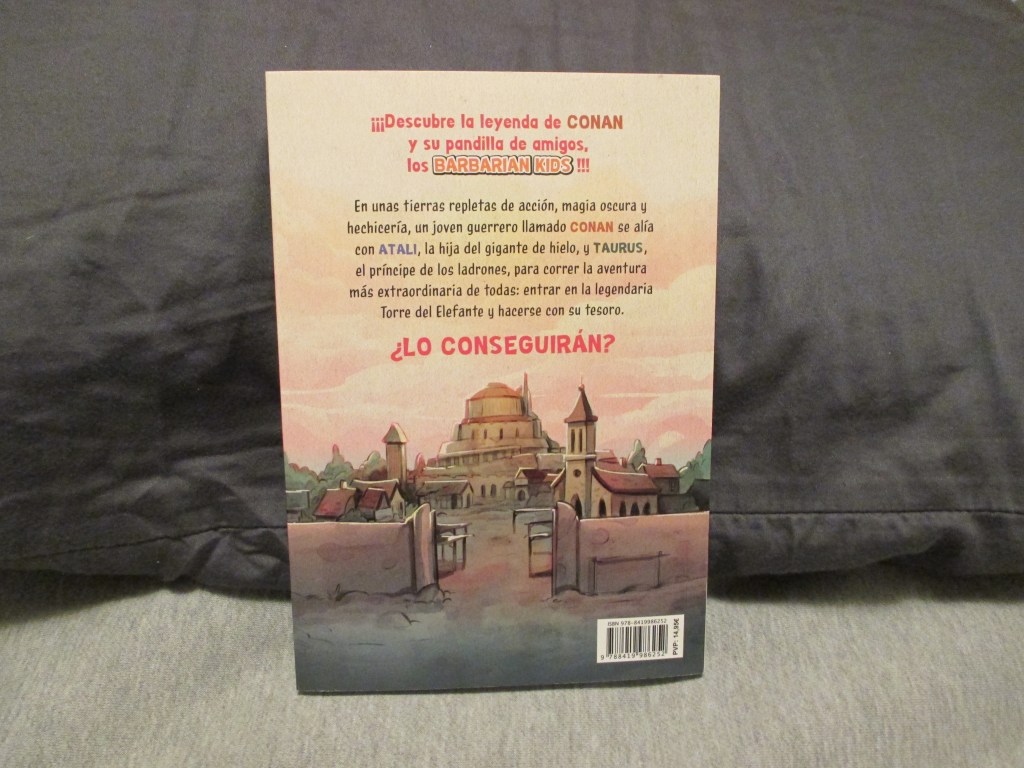
| ¡¡¡Descubre la leyenda de CONAN y su pandilla de amigos, los BARBARIAN KIDS!!! En unas tierras repletas de acción, magia oscura ya hechicería, un joven guerrero llamado CONAN se alía con ATALI, la hija del gigante de hielo, y TAURUS, el príncipe de los ladrones, para correr la aventura más extradorindaria de todas: entrar en la legendaria Torre del Elefante y hacerse con su tesoro. ¿LO CONSEGUIRÁN? | Discover the CONAN legend and his gang of friends, the BARBARIAN KIDS!!! In a world full of action, dark magic and sorcery, a young warrior called CONAN teams up with ATALI, the frost giant’s daughter, and TAURUS, the prince of thieves, to run the most extraordinary adventure of all: enter the legendary Tower of the Elephant and get their hands on its treasure. WILL THEY SUCCEED? |
| Back cover copy | English translation |
Barbarian Kids is an illustrated novel in Brazilian Portuguese by Nacho Golfe (writing) & Dani Peña (illustrations) which tells a highly bowdlerized version of Howard’s epic tale of a young Conan in Shadizar. In this story, Conan is adolescent, and his partners-in-crime are Taurus (from the original story) and Atali (very loosely adapted from “The Frost Giant’s Daughter,” but with powers reminiscent of Elsa in Frozen, and prefers to generate ice daggers). The trio successfully brave the tower’s difficulties, encounter the elephant-headed Yag-Kosha…and then overcome Yara, the evil wizard who imprisoned Yag-Kosha. In a duel of magic, the evil wizard is vanquished into a gem, the Heart of the Elephant…and everyone lives happily ever after.
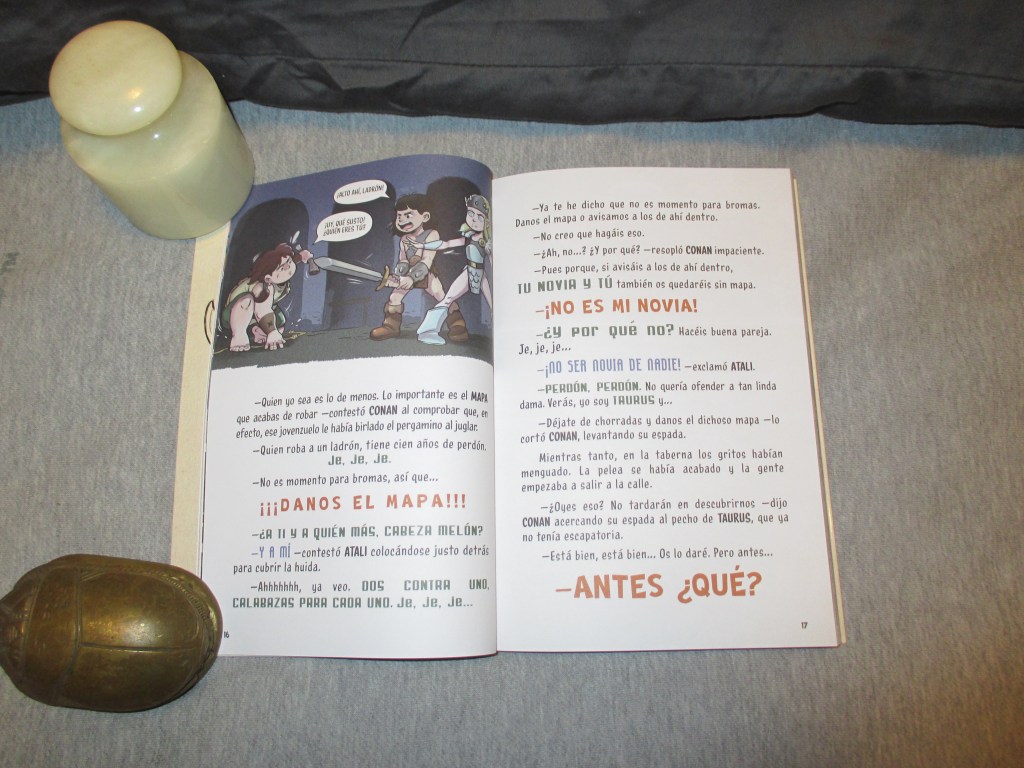
For a fantasy adventure aimed at the younger market, it’s easy to see why “The Tower of the Elephant” was chosen: this is the story with one of the chronologically youngest Conan (“The Frost-Giant’s Daughter” is presumably younger), and is as close to a traditional dungeon crawl adventure as Conan ever went on. Many of the changes made are sensible. Making Conan younger makes him more identifiable to younger readers; adding Atali to the mix makes it more attractive to girls; there is very little blood, and nobody dies. This is supposed to be a fun adventure for impressionable little minds, not a horror story to scare them.
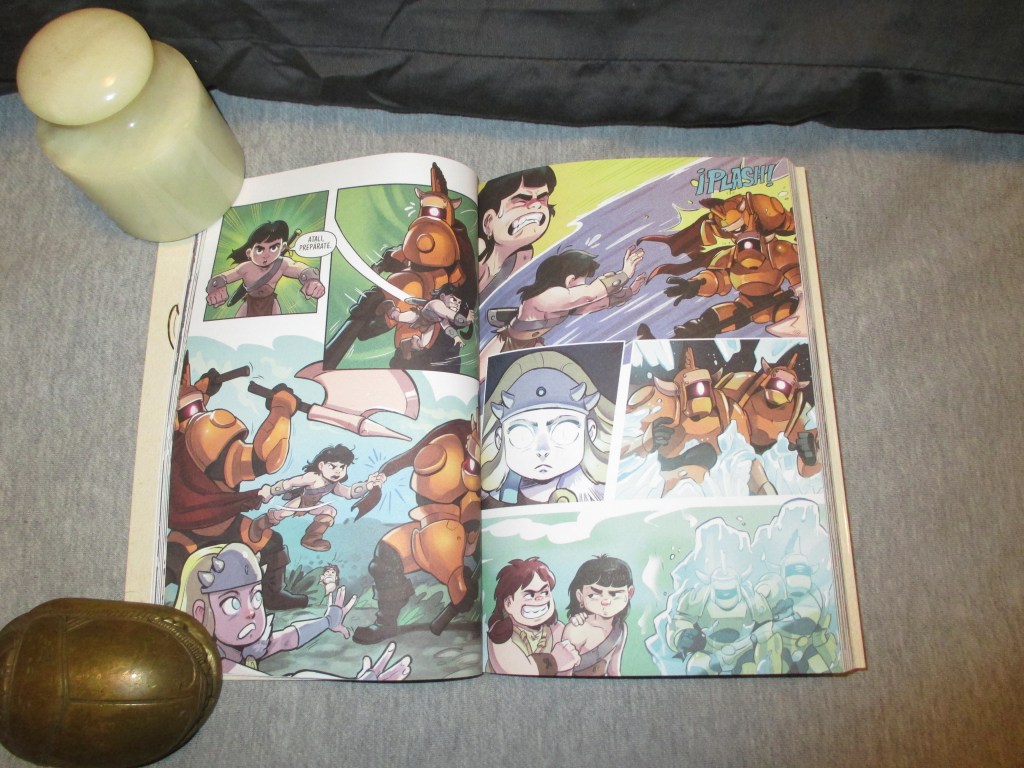
Golfe and Peña do their jobs; the story moves along at a quick pace, the text is designed to be engaging, the more action-packed sequences are rendered as comic panels in a half-graphic novel layout, there’s a puzzle involving gems, a lesson about teamwork is learned, and the heroes are rewarded for saving Yag-Kosha and overcoming the wizard.
What they have achieved is fine. Kids will no doubt love it. Yet they have also robbed the story of any depth. There’s no reason for this to be a Conan story anymore. When Roy Thomas and Barry Windsor-Smith adapted “The Tower of the Elephant” in Conan the Barbarian #4 (1971), comic book readers used to seeing heroes defeat and slay evil monsters were confronted with a tragic figure, broken on the rack. A creature that had flown through space, now confined to its tower in a crippled body. There was only one escape possible, and the stroke that Conan gave was one of mercy—and vengeance.

Roy Thomas notes in Barbarian Life: A Literary Biography of Conan the Barbarian Vol. 1, that in the latter half of the story, Conan is little more than a spectator, first as Yag-Kosha recounts how he came to this place, and then as a witness as the Cimmerian brings the Heart of the Elephant to Yara. This was not an uncommon device of Howard’s; many of his stories begin with a stirring opening, but feature a long and evocative historical narrative, vision, or dream that fills the expository needs of the story, explaining or hinting at some of the vast and shadowy background, so that the conclusion of the story is often the conclusion of a historical epic.

In Barbarian Kids 1, the epic of Yag-Kosha’s backstory is about four pages. The confrontation with Yara is not the foregone conclusion it is in Howard’s story; the three principals fight Yara in a duel of swords and sorcery. There is no mercy-stroke, no sacrifice. The idea of Conan as a witness to the end of some great history has vanished. The grandeur and cosmic sweep of Howard’s story are gone…and there is something inexpressibly sad about that, because that was what made “The Tower of the Elephant” so special.
It is a different story. Not a bad story, it is entertaining enough, the art is lively, the mix of fonts and lettering is eye-catching and probably perfect for younger readers. Perhaps, when the kids who read it get a bit older, they’ll read Howard’s original story and find out what they’ve been missing. I hope so.

Bobby Derie is the author of Weird Talers: Essays on Robert E. Howard and Others and Sex and the Cthulhu Mythos.
Deep Cuts in a Lovecraftian Vein uses Amazon Associate links. As an Amazon Associate I earn from qualifying purchases.
 Deep Cuts in a Lovecraftian Vein
Enjoyab
LikeLike
Great post!
As adults, I think we forget that kids want to read stories like Conan, but can’t because of the mature content. Children are literal barbarians, (I’ve seen it!), and they want to have adventures, wielding a sword, which is why I think it’s great that writers are rendering editions for kids. Especially if they have kids of their own. The stories may be stripped of all its original artistry, but as the young reader grows up, he/she will get to read the original works, and they’ll appreciate it even more so!
LikeLiked by 1 person