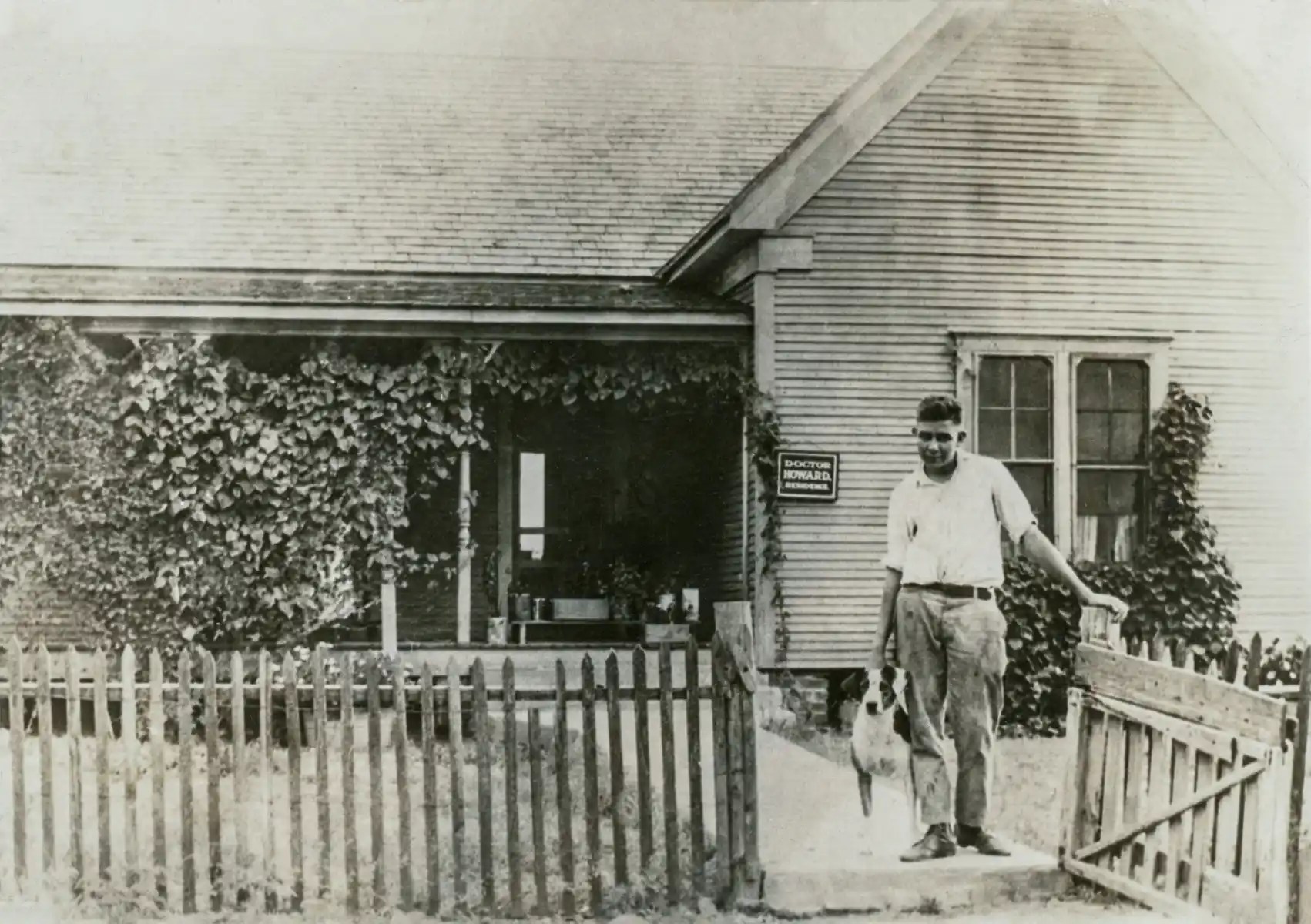
When Robert E. Howard and his mother died in the small town of Cross Plains, Texas on 11 June 1936, it was a shock to the small community. It was also news. Jack Scott, the owner and editor of the Cross Plains Review, did more than post the bare facts of the tragedy and the announcements for the funeral. Along with the normal materials, he published a letter from C. L. Moore to Dr. Isaac M. Howard consoling him on his son’s death (3 Jul 1936); published one of Robert’s award-winning school essays (19 Jun 1936), and the short story “A Man-Eating Jeopard” (14 Aug 1936). A year and a week after Bob’s death, he even published his “final” poem, “The Tempter” (18 Jun 1937). Yet one of the most unusual and interesting pieces that saw print in the Cross Plains Review after Bob’s death was “Robert E. Howard as a Boy” by Mrs. T. A. Burns (10 Jul 1936).
Elsie M. Cochran Burns (20 Jul 1889 – 28 Mar 1940) was the wife of Thomas Allen Burns. Born and raised in Burkett, TX, to the southwest of Cross Plains in neighboring Coleman County. In 1912 she was appointed the postmaster of the small town. In 1917, the Howard family came to Burkett, to live for a while. Young Robert attended the local school, and the dog Patch came to live with the Howard family (REH.world). Her brief memoir is one of the few to mention Howard’s childhood or his beloved pet, who is otherwise mostly known through Dr. Howard’s letters.
※
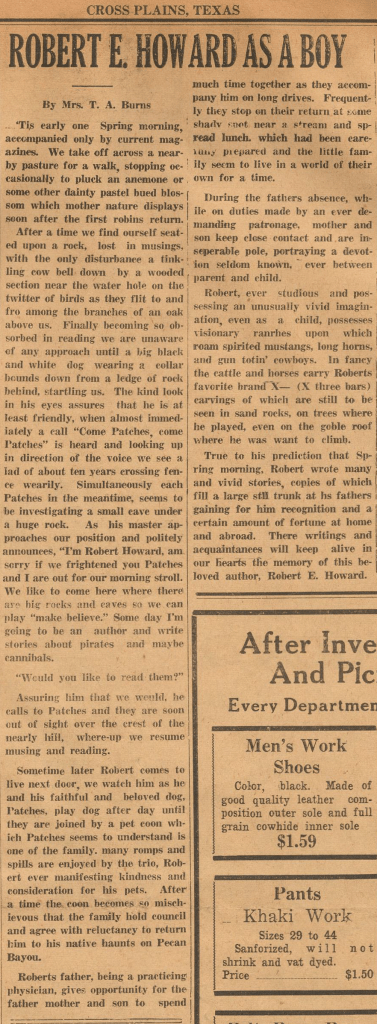
ROBERT E. HOWARD AS A BOY
by Mrs. T. A. Burns
`Tis early one Spring morning, accompanied only by current magazines. We take off across a nearby pasture
for a walk, stopping occasionally to pluck an anemone or some other dainty pastel hued blossom which
mother nature displays soon after the first robins return.
After a time we find ourself seated upon a rock, lost in musings, with the only disturbance a tinkling cow bell
down by a wooded section near the water hole on the twitter of birds as they flit to and fro among the
branches of an oak above us. Finally becoming so absorbed in reading we are unaware of any approach until a big black and white dog wearing a collar bounds down from a ledge of rock behind, startling us. The kind look in his eyes assures that he is at least friendly, when almost immediately a call “Come Patches, come Patches” is heard and looking up in direction of the voice we see a lad of about ten years crossing fence wearily. Simultaneously each [sic] Patches in the meantime, seems to be investigating a small cave under a huge rock. As his master approaches our position and politely announces, “I’m Robert Howard, am sorry if we frightened you Patches and I are out for our morning stroll. We like to come here where there are big rocks and caves so we can play “make believe.” Some day I’m going to be an author and write stories about pirates and maybe cannibals.
“Would you like to read them?”
Assuring him that we would, he calls to Patches and they are soon out of sight over the crest of the nearly hill, where-up we resume musing and reading.
Sometime later Robert comes to live next door, we watch him as he and his faithful and beloved dog, Patches, play dog after day until they are joined by a pet coon which Patches seems to understand is one of the family, many romps and spills are enjoyed by the trio, Robert ever manifesting kindness and consideration for his pets. After a time the coon becomes so mischievous that the family hold council and agree with reluctancy [sic] to return him to his native haunts on Pecan Bayou.
Roberts father, being a practicing physician, gives opportunity for the father mother and son to spend much
time together as they accompany him on long drives. Frequently they stop an their return at some shady spot near a stream and spread lunch. which had been carefully prepared and the little family seem to live in a world of their own for a time.
During the fathers absence, while on duties made by an ever demanding patronage, mother and son keep close contact and are inseparable pole, portraying a devotion seldom known, ever between parent and child.
Robert, ever studious and possessing an unusually vivid imagination, even as a child, possesses visionary
[ranches] upon which roam spirited mustangs, long horns, and gun totin’ cowboys. In fancy the cattle and
horses carry Roberts favorite brand X≡ (X three bars) carvings of which are still to be seen in sand rocks, on
trees where he played, even on the [gable] roof where he was want to climb.
True to his prediction that Spring morning, Robert wrote many and vivid stories, copies of which fill a large
sill trunk at [his] fathers I gaining for him recognition and a certain amount of fortune at home and abroad.
There writings and acquaintances will keep alive in our hearts the memory of this beloved author, Robert E.
Howard.
※
Elsie Burns died a few years later (obituary) from an embolism (death certificate). There would be no more memories of her young neighbor that grew up to be a famous pulp writer; though this would not be the end of her connection with Howard. In the transcripts of interviews conducted by L. Sprague and Catherine Crooke de Camp in Texas in the 1970s, conducted to compile material for their Howard biography Dark Valley Destiny, Elise Burns turns up several times. The de Camps were tracing the migration of the Howard family, and wanted to learn more about the woman who had written “Robert E. Howard as a Boy.” They did not discover much, as she had been dead over 30 years at that point, but they wanted to get it on the record. Par of their questions read:
AND: I don’t know now . . . This Mrs. Burns is . . . I guess she’s dead.
LS: Oh yes. Long since.
CdeC: She remembered Robert –
AND: May I tell you something about Mrs. Burns? Do you know anything about Mrs. Burns?
CdeC: Only she was a post mistress and she liked to write.
LS: And she married a man who was almost as fat as she was, who lived to be over a hundred years old.
AND: Fat? Her husband was not as big as I.
CdeC: Oh?
LS: Oh?
CdeC: Oh, I thought he was fat too.
And: Oh no. That was the show. Everybody loved her all right. And they liked him. They liked him, both of them. But he was such a tiny little fellow and here was this great big 300 pound woman. And she was precious to him. She took care of him just . . . He was quite a bit older and she . . . It was the greatest thing in the world, that he had her in his last years.
CdeC: Yes. I think that someone else said he was small. (to LS) You’ve always thought he was big.
LS: Mmm. Somebody said he was a big fat fellow.
AND: Oh, you’re mistaken. You’re mistaken.
LS: Must have had him mixed up with somebody else.
CdeC: Well I know that she . . .
JD: (to And) You were going to say, “Mrs. Burns . . . ” You had a story to tell, about Mrs. Burns?
AND: Oh I don’t have a story except that she was such a big person. And she had a sister not quite so big. But she was always so kind to this old fellow and took care of him and treated him like he was . . . er . . . her child.
CdeC: That was lovely.
—”Interview with Annie Newton Davis, 18 Oct 1978″ in “…when I last see him”:The de Camp Interviews on Robert E. Howard (2026) 193-194
AND: Annie Newton Davis
LS: L. Sprague de Camp
CdeC: Catherine de Camp
JD: Jocelyn Darling
Bobby Derie is the author of Weird Talers: Essays on Robert E. Howard and Others and Sex and the Cthulhu Mythos.
Deep Cuts in a Lovecraftian Vein uses Amazon Associate links. As an Amazon Associate I earn from qualifying purchases.


Yeah, de Camp was big time into body shaming. Always pointed out who was fat. Used the word “elephantine” a lot to describe people and even acquaintance’s wives. Sad, but so is REH’s and Lovecraft’s racism. I dunno, “part of that generation” excuse. I really hate an article de Camp did about the Kent State shootings. I still like ALL their fiction and appreciate that de Camp traveled to Texas and did the research that is available to current scholars.
LikeLiked by 1 person