We will probably never know who was the first Black creator to adapt Lovecraft to the medium of comics. Pre-Code Lovecraftian Horror Comics rarely credited their writers and artists; it is not impossible that one or more uncredited toiler in a small horror comic shop was Black. So too, there may be some obscure comic that hasn’t come to light yet where an early artist or writer applied their talents to a Lovecraft adaptation that has so far escaped notice. Such things happen, and when they come to light push back “first” a little further.
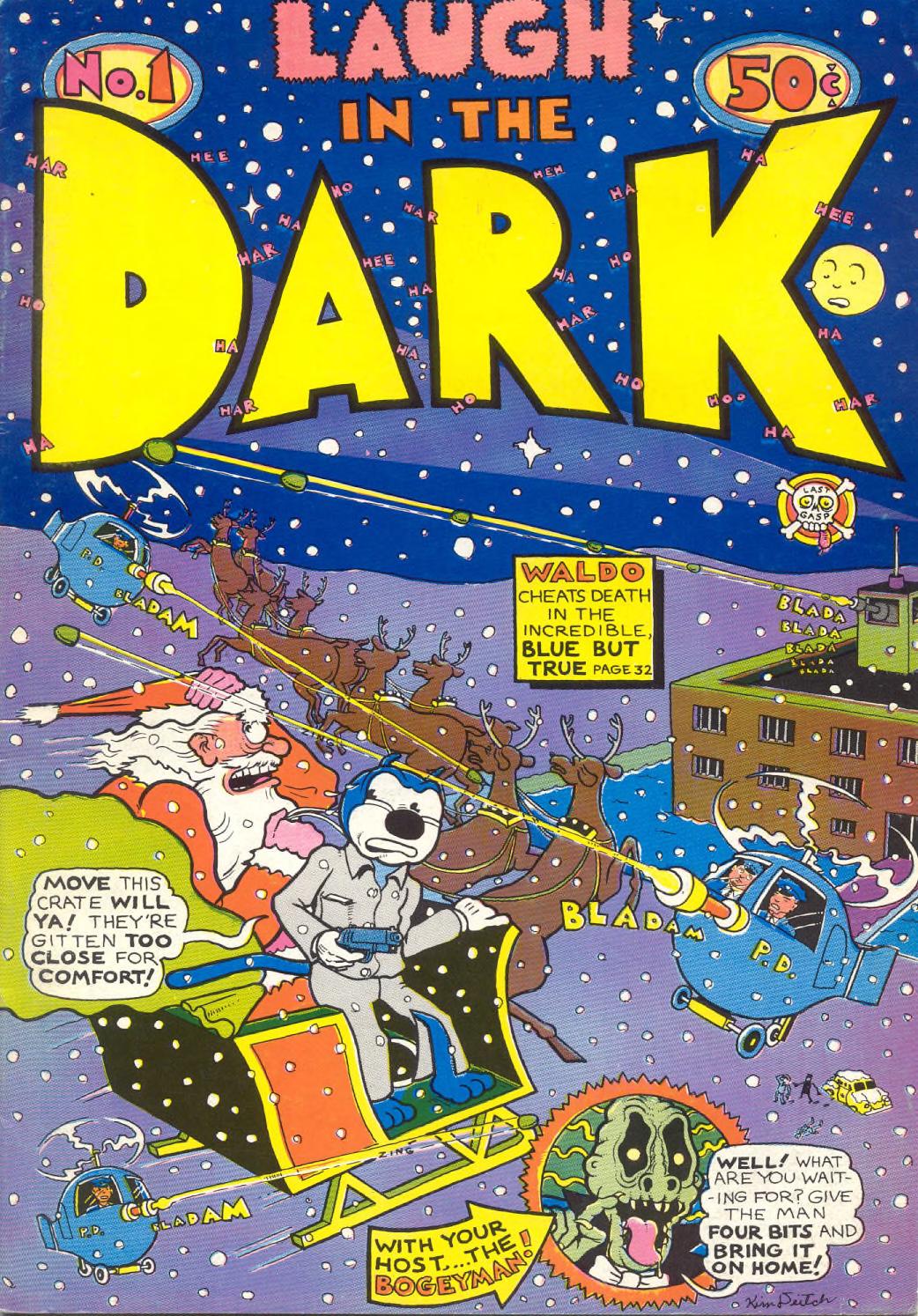
That being said, the first Lovecraft comic adaptation by a Black creator that I’m aware of is “H. P. Lovecraft’s The Ter’ble Old Man” in the underground comix Laugh in the Dark (1971, Last Gasp), by Larry Fuller.
After the Comics Code Authority was formed in 1954, horror and crime comics swiftly vanished from the newsstands of the United States. EC Comics’ was especially hard-hit. A generation that had grown up reading horror comics now could not find them; so some began to make their own. Young artists and writers began to write and draw their own comic strips and pages in the 1960s, publishing in outlets not covered by the CCA, such as college magazines, self-published ‘zines, and underground newspapers.
In 1968, Zap Comix #1 was published in San Francisco. A solo effort by Robert Crumb, this issue showcased an original art style completely unlike the conventional comic strips of mainstream publishers like Marvel, DC Comics, Gold Key, and Archie. The subject matter was also unconventional; without need to submit his work to the censors of the CCA, Crumb could include nudity, explicit sex, politics, drug use, racial issues, crime, horror, and whatever else he wanted. In subsequent issues, Crumb invited other creators to add their own contributions, including future legends like S. Clay Wilson, Spain Rodriguez, and Rick Griffin. These anthology comics provided a template for the underground comix movement.
Gary Arlington formed the San Francisco Comic Book Company in 1968; economic necessity forced him to sell his collection of Golden Age and EC comics, and the commercial outlet brought him into contact with like-minded readers and artists. Arlington embraced independent publishing, printing a number of underground comix during the 60s and 70s. One of these was Bogeyman #1 (1969), a horror comic inspired by classic EC comics created by Rory Hayes, a young teen with no formal artistic training who also worked the cash register at the store, and who would go on to earn a reputation for works like Cunt Comics. As with Zap Comix, while the first issue of Bogeyman was a solo effort by Hayes, the subsequent two issues of the short-lived series were anthology titles, showcasing horror-related work by several creators.
In 1970, Last Gasp Eco Funnies was founded in Berkeley, California. Among their comics would be EC-inspired horror comics like Skull (1970-1972) and Tales from the Leather Nun (1972), both of which featured Lovecraft adaptations or stories based on Lovecraft’s fiction and creations. In 1971, Last Gasp published a one-shot titled Laugh in the Dark; according to some sources (e.g. Lambiek Comicopledia), this was originally intended to be the fourth issue of Bogeyman, and features work by Rory Hayes and other artists that had contributed to previous issues. It also featured “Hairy” Larry Fuller’s one-page adaptation of H. P. Lovecraft’s “The Terrible Old Man.”
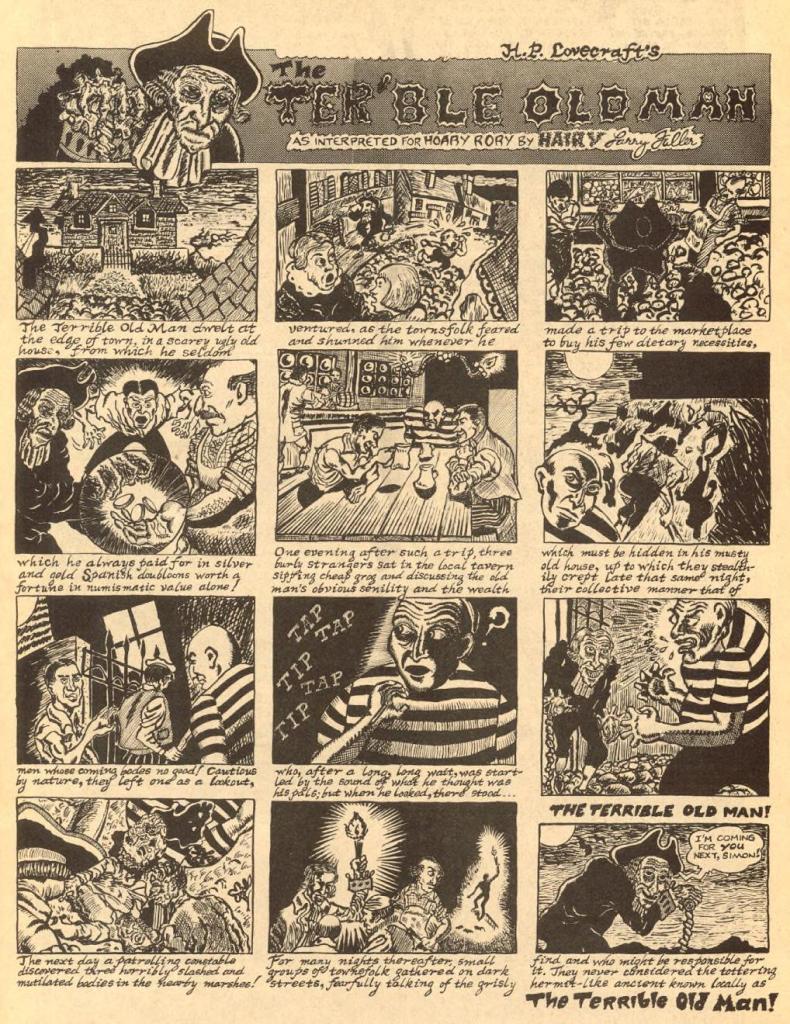
The first page I ever got paid for doing. Appeared in Laugh In the Dark, an underground circa 1970, all stories of HP Lovecraft. Thanks, Rory. May you rest in peace.
—Larry Fuller, Some Grass and a Gallery (2000)
“The Ter’ble Old Man” might have been Fuller’s first paid work, but it wasn’t his first published work. Ebon #1 (1970), the first comic to star a Black superhero in his own title, was published by Gary Arlington a year before Laugh in the Dark came out. These connections reinforce the idea that Laugh in the Dark started as a Bogeyman issue. In later years, Fuller would gain a reputation for his LGBTQ+ comics and pornographic comics like White Whore Funnies (1975-1979) and Gay Heartthrobs (1976-1981), and as a publisher.
“The Ter’ble Old Man” has remained relatively obscure in Lovecraftian comics history, mostly because it has never been reprinted, outside of reprints of the entire issue of Laugh in the Dark itself. While a competent adaptation, especially given the space constraints, the story lacks many of the grand images that would make for splashy illustrations, and Fuller’s line is workmanlike rather than exceptional, with the rough quality that is typical of underground comix at the time. Without context, this adaptation seems unexceptional; though largely faithful to Lovecraft’s text, it omits the more supernatural aspects of the story.
It is most interesting to consider this story in the context of what else was happening in publishing, especially comics and Lovecraft, at the time. Lovecraft was seeing a resurgence in the 60s and 70s due to paperback reprints; pulp fiction in general was seeing renewed interest that would lead to a brief revival of Weird Tales. The interest in Lovecraft wasn’t unique to Fuller—Laugh in the Dark also contains “Wilfred Kreel: Seeker of the Strange” (an adaptation of “The Lurking Fear”) by Manuel “Spain” Rodriguez (who is, very likely, the first Hispanic comic creator to adapt Lovecraft)—and there were several other Lovecraft adaptations that appeared in later underground comix.
Yet Lovecraft wasn’t just an underground idol; Lovecraft stories and adaptations appeared in both non-Code-approved comic magazines like Warren Publications’ Creepy and code-approved-but-bloodless horror comics from Marvel, who produced their own adaptation of “The Terrible Old Man” in Tower of Shadows #3 (1970), only six months prior, in 7 pages by Roy Thomas (script), Barry Windsor-Smith (pencils), Jean Simek (letters), Dan Adkins & John Verpoorten (inks). In comparison to Fuller, the Marvel effort is very conventional for the time—seven pages means fewer cramped panels, more space for Windsor-Smith to showcase his art—where Fuller’s adaptation is necessarily condensed. So, too, Marvel went through the trouble of securing permission to adapt the story from Arkham House, something that Last Gasp does not seem to have done with Laugh in the Dark (1971), but which they did do for Skull Comix #4 and #5 (1972).
In that context, underground comix appear as one thread in the spread of Lovecraft to greater recognition. His posthumous reputation had, in effect, street cred among the young creators of the underground, who could (and would) do things with Lovecraft’s work that Marvel and Warren Publications could not do. The creators who had placed themselves on the forefront of the medium would produce some of the first Lovecraftian pornography, some of the goriest Lovecraft adaptations, some of the most serious and accurate, and some of the funniest and most farcical. They made Lovecraft’s work their own—and that was what Larry Fuller was doing, not in a big splashy way, but in a single page of cramped panels.
Laugh in the Dark (1971) can be read at the Internet Archive.
Bobby Derie is the author of Weird Talers: Essays on Robert E. Howard and Others and Sex and the Cthulhu Mythos.
Deep Cuts in a Lovecraftian Vein uses Amazon Associate links. As an Amazon Associate I earn from qualifying purchases.
 Deep Cuts in a Lovecraftian Vein