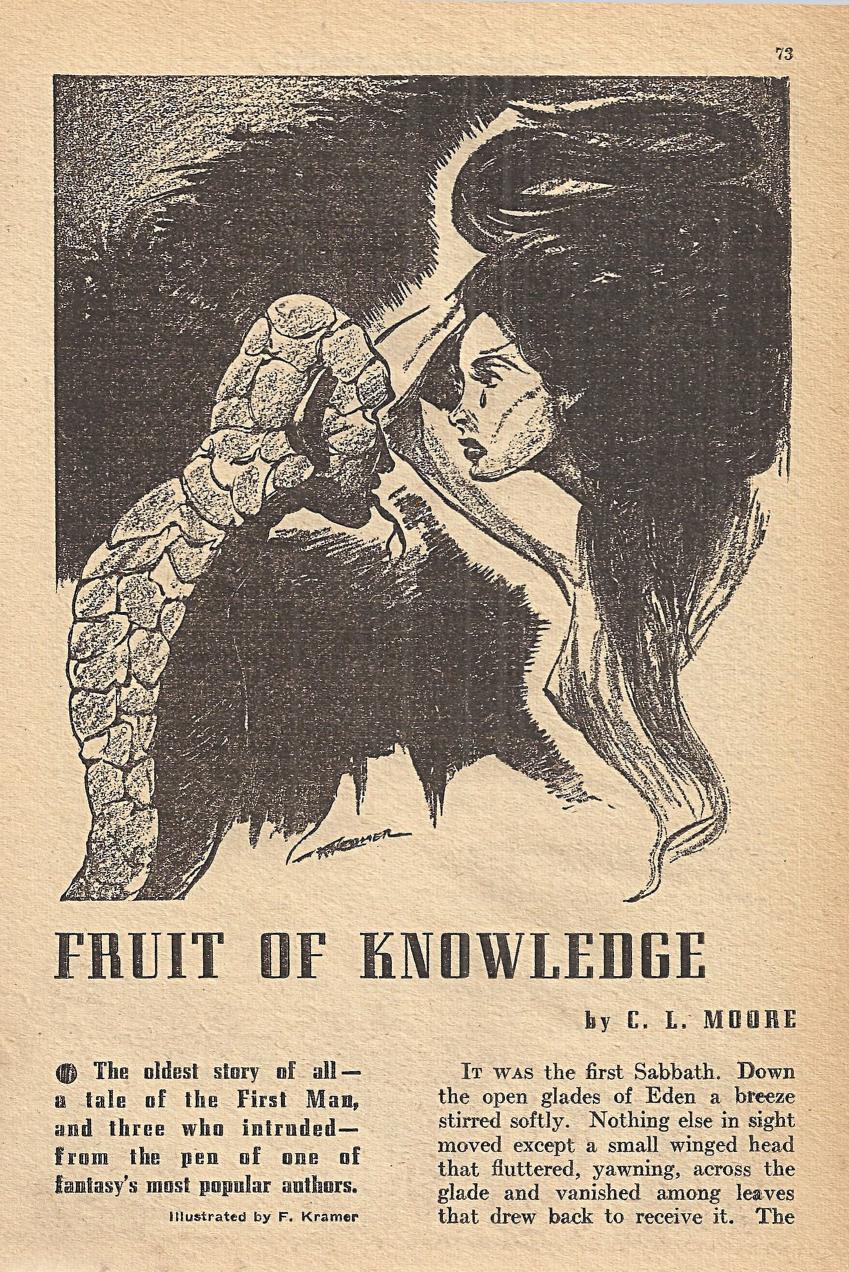
“Fruit of Knowledge” (1940) by C. L. Moore

By the way, I suppose they warned you about the Tree?
—C. L. Moore, “Fruit of Knowledge” in Unknown Oct 1940

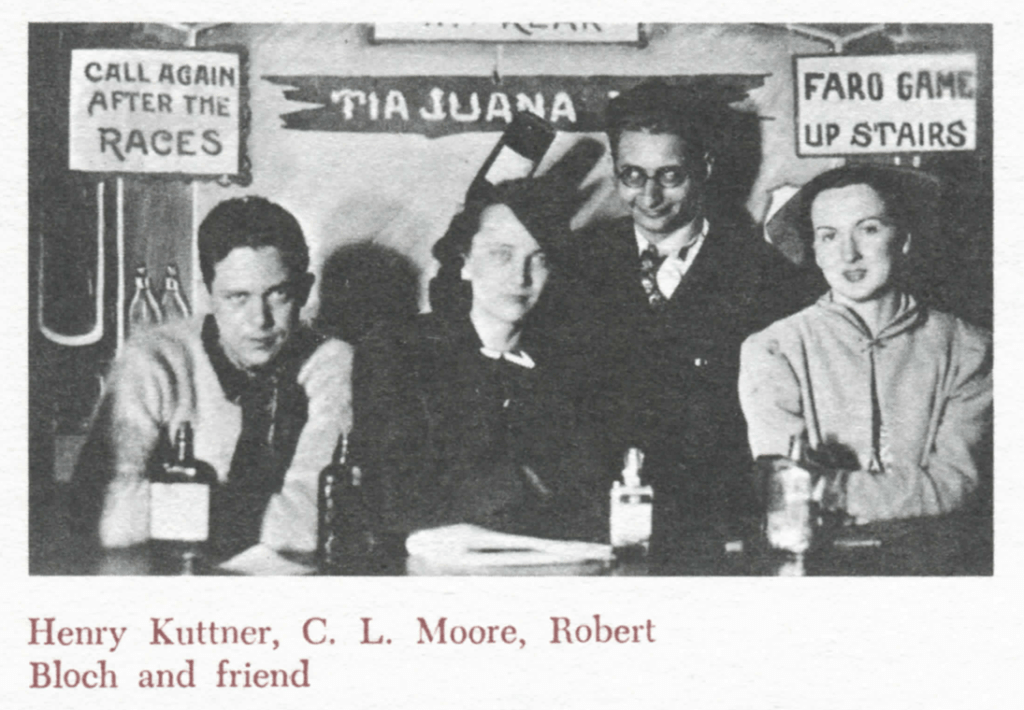
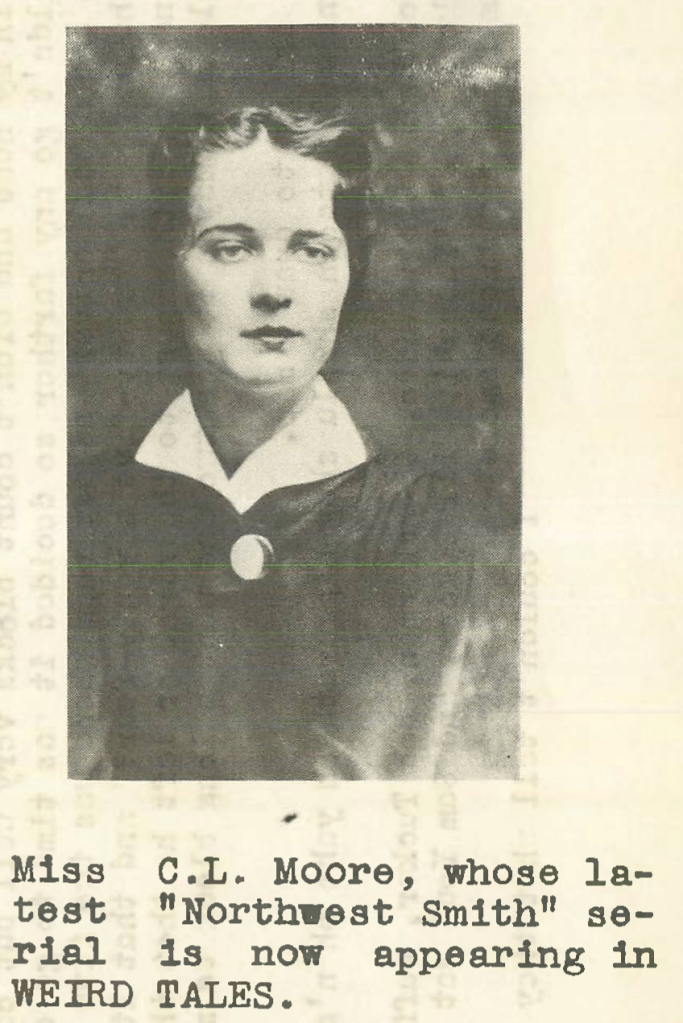
After her marriage to Henry Kuttner on 7 June 1940 in New York City, C. L. Moore’s byline appears only sporadically in magazines and novels. Most of their work, written together, would appear under his name, or that of a shared pseudonym such as Lewis Padgett. It is impossible, at this point, to say who wrote what—with one notable exception: the stories still published under Moore’s name are agreed to have been primarily, if not entirely, her own work with little involvement from her husband and writing partner.

The first story published under C. L. Moore’s own name after her marriage is “Fruit of Knowledge” in Unknown Oct 1940, and it is a major departure from Moore’s previous and much of her future work as far as content. The scene is a retelling of a part of the book of Genesis from the Old Testament, about the creation of Eve and Tree of Knowledge of Good and Evil. As such, the general gist of the plot is familiar to most readers; they have heard this story before and know how it ends. This is a story where all the attraction is in the telling of the tale.

In telling this tale, Moore reaches outside the Christian Bible and borrows the character of Lilith from the Jewish Talmud and folklore. Lilith was something of a favorite of the Weird Tales crowd, with Moore’s friend and fellow Lovecraft correspondent E. Hoffmann Price having written stories like “Queen of the Lilin” (Weird Tales Nov 1934) and “Well of the Angels” (Unknown May 1940), and others composing poems to her. A quintessence of evil and femininity, which are both alluring on their own, but together are especially powerful.

The story that unfolds is primarily from Lilith’s point of view, and holds many of the hallmarks of Moore’s style: the beauty of both men and women are emphasized, the characters driven by strong emotions, the prose sensuous, and there is that subtle ironic humor which had increasingly become prominent in Moore’s writing, the element that draws her more in line with Kuttner and the 1940s style of fantastic fiction which Unknown would become known for.

The re-use of a familiar story, retold in a very contemporary way, is somewhat similar to “Miracle in Three Dimensions” (1939), but here Moore needs no special device to lay the scene. She simply dives right in, and the characters speak in familiar accents, not attempting Biblical diction of the King James Version, so that characters say “you” and not “thou” or “thee” (with a few exceptions when Moore is taking the words more or less directly from the Bible.) If it is slightly blasphemous—God is not depicted as either omniscient or omnipotent—it is still an effective little drama, where the characters have their clear motivations and struggles, their plans and plots, their complications and upsets. Even knowing how it’s going to end, the story is told well enough that readers might want to see how, exactly, things play out.

“The woman thou gavest me—he began reproachfully, and then hesitated, meeting Eve’s eyes. The old godlike goodness was lost to him now, but he had not fallen low enough yet to let Eve know what he was thinking. He could not say, “The woman Thou gavest me has ruined us both—but I had a woman of my own before her and she never did me any harm.” No, he could not hurt this flesh of his flesh so deeply, but he was human now and he could not let her go unrebuked. He went on sulkily, “—she gave me the apple, and I ate.”
—C. L. Moore, “Fruit of Knowledge” in Unknown Oct 1940

Moore doesn’t seek to soften the essentially patriarchal nature of the Biblical story, though neither is this a proto-feminist take. Lilith is essentially deceitful, jealous, possessive, and finally vindictive; then again, when the bloom is off the rose, Adam blames Eve like a little boy pointing to his sister and saying she did it. Eve herself gets far less character development than Lilith, being largely passive, reactive, manipulated, and a possession to be granted where Lilith is proactive and makes more of her own choices. As a biblical commentary it might not have much to add, but as an entry in the seemingly interminable corpus of “fictional reimaginings of Biblical tales,” it’s not bad.

There is no indication of when Moore wrote this story or why; a story could take months to be published in a pulp magazine, and she might have written it before or after her marriage. Maybe it was that life event that spurred her interest in the old tale, or a chance to reframe the old story through her own eyes. We don’t know. Yet for a while, it was the last that the pulp magazines would see of C. L. Moore byline—on her own.

Scans of “Fruit of Knowledge” are available online at the Internet Archive.


Bobby Derie is the author of Weird Talers: Essays on Robert E. Howard and Others and Sex and the Cthulhu Mythos.

Deep Cuts in a Lovecraftian Vein uses Amazon Associate links. As an Amazon Associate I earn from qualifying purchases.
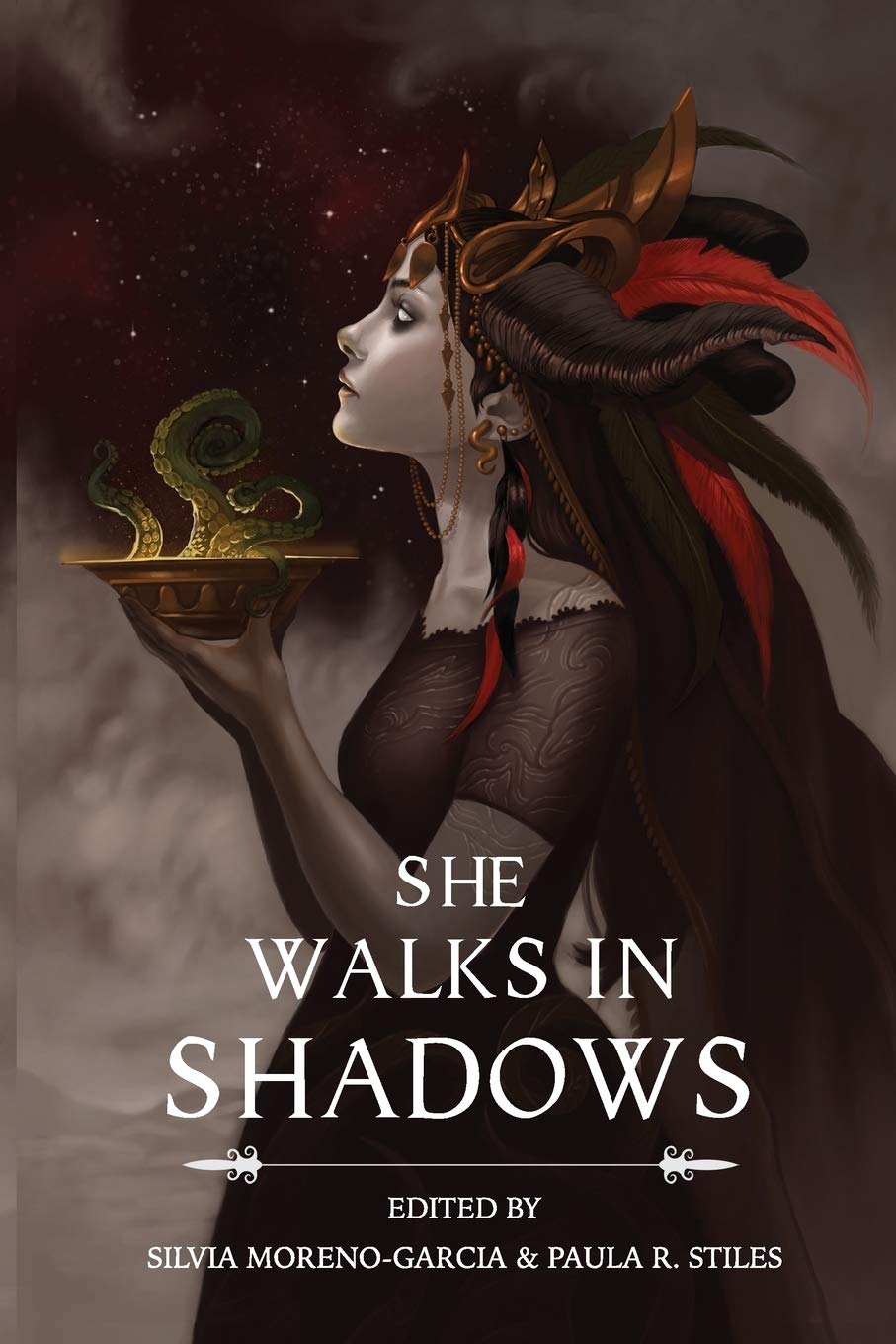
“Body to Body to Body” (2015) by Selena Chambers

Every woman’s body is a story, you see.
—Selena Chambers, “Body to Body to Body” in She Walks in Shadows (2015) 132

Lovecraftian genealogical narratives tend to focus on a single, often the paternal, line. What that tends to exclude is a large number of other ancestors and relatives: mothers, grandmothers, aunts, cousins, sisters, half-sisters, and step-siblings. Writers following Lovecraft were not averse to filling out and following other branches of various family trees. August Derleth’s “The Shuttered Room” (1959) follows some Whateley cousins, for example, and Lavinia Rising (2022) by Farah Rose Smith expands on Lavinia Whateley’s background.

These Mythos family reunion stories are often a bit contradictory; that’s the point. By expanding on unspoken relations, authors have the opportunity to give alternative narratives, fresh viewpoints, different and more complex takes on a set of events or individuals. That’s how myth cycles—and, more often than not, family stories, repeated in games of telephone down generations—tend to work. Readers get to balance the narratives and decide for themselves what “really” happened.

Yes, he knew about the Innsmouth blood now.
—H. P. Lovecraft, “The Thing on the Doorstep”

“Body to Body to Body” by Selena Chambers is set up chronologically as an immediate sequel to Lovecraft’s “The Thing in the Doorstep,” and narratively is structured in parallel: the police are interviewing a suspect, and she tells her tale. What marks this story as different is that the interviewee is Asenath Waite’s half-sister—from before their mother’s marriage to Ephraim Waite—and so the events she relates are largely a prequel to Lovecraft’s tale, expanding on Asenath’s background and childhood. How she became who she became, in every sense of the word.

Like “The Thing on the Cheerleader Squad” (2015) by Molly Tanzer and other stories that spin out of Lovecraft’s original, this story explores a different relationship dynamic with Asenath and Ephraim. In Lovecraft’s original story, questions of identity ultimately make Asenath a victim, overpowered and replaced by her father’s mind; stories like Tanzer and Chambers give Asenath more agency, and more of an identity of her own distinct from her father’s.

Chambers’ depiction of the Waite’s home life makes no bones about Ephraim Waite as a bigoted old occultist; it feels like there might be a hint of Lovecraft in the portrayal, reminiscent of how Mexican Gothic (2020) by Silvia Moreno-Garcia borrows some characterization from Lovecraft for its villain. However, the real delight in the story is the little details from the protagonist’s point of view, the hints of Innsmouth culture that go beyond Mythos lore and speak of lived experience in the town. And it offers an alternative ending to “The Thing on the Doorstep” which is more hopeful than Lovecraft’s vision.

“Boby to Body to Body” by Selena Chambers was published in She Walks in Shadows (2015) and its variations. It has not otherwise been reprinted.


Bobby Derie is the author of Weird Talers: Essays on Robert E. Howard and Others and Sex and the Cthulhu Mythos.

Deep Cuts in a Lovecraftian Vein uses Amazon Associate links. As an Amazon Associate” I earn from qualifying purchases.

“Song in a Minor Key” (1940) by C. L. Moore

Well, here was Earth beneath him. No longer a green star high in alien skies, but warm soil, new clover so near his face he could see all the little stems and trefoil leaves, moist earth granular at their roots.
—C. L. Moore, “Song in a Minor Key”

“The Green Hills of Earth” is as close to an anthem as C. L. Moore gave to Northwest Smith. His adventures take place almost exclusively on alien worlds. He is an outlaw, an adventurer, a hard man and not necessarily a noble one, but not without his honor or his principles. Raymond Chandler wrote in “The Simple Art of Murder” (1944) that the protagonists of hardboiled tales must be “the best man in his world and; a good enough man for any world.” He didn’t write that about Northwest Smith, but he might have.

What is “Song in a Minor Key?” It is the last of Moore’s works about Northwest Smith. It might have been a fragment of a story never completed, it might have been a coda. In a series that is never marked by any particular notions of continuity or character development, it offers both. Not a reflection on Smith’s adventures, but of the mysterious past never really spoken of elsewhere, and of a future: Smith is back on Earth. He’s there amid his green hills at last. Why, and for how long, we don’t know.

In a way, “Song in a Minor Key” is reminiscent of H. P. Lovecraft’s “The Silver Key.” Both are stories that deal with a reflection on childhood, happier times, but where Randolph Carter’s dream is to retrieve that key and relive the past, Northwest Smith’s approach to such nostalgic wishing is harsh. He knows who he is and what he has done; he knows, too, that he could not have done anything different. Faced with the same circumstances, even with all the knowledge of twenty years on the run, he would kill again—and end up right where we saw him, in dingy Martian spaceports or hunkering in a Venusian alley, exploring dead cities and strange worlds.

Maybe this was a goodbye to the character that had launched C. L. Moore into her pulp career, even though it feels like the opening of a new adventure. Which, perhaps, is fitting. Series characters in the pulps rarely had arcs; they rarely had a definite retirement or death. When Robert E. Howard wrote the adventures of characters like Solomon Kane, Kull of Atlantis, Bran Mak Morn, and Conan the Cimmerian, he never wrote their deaths—he might jump back and forth to different points in their lives, show Conan as a brash young thief in one tale and a conquering monarch in the next—and there was the certain sense that in the fullness of time these men were mortal and they would die. We even see the cult of Bran Mak Morn rise up, with the knowledge that he died on some ancient battlefield. But we never see it, we never get the send-off, the heroes do not ride off into the sunset and tell us that this is the end.

For the readers of Weird Tales who thrilled to the adventures of Northwest Smith for six years, the tales just…stopped. There were no more. The magazine itself changed its focus. “Song in a Minor Key” was published in the fanzines Scienti-Snaps (Feb 1940). She was still Catherine Lucille Moore when this was published; she would marry Harry Kuttner on 7 June 1940, in New York City. Moving on into the next phase of her life, and her writing career. Much of what she wrote from this point on would be with Kuttner, her husband and writing partner, and would appear under his name or a shared pseudonym. Relatively few works were signed C. L. Moore after 1940.

This was one of the last pieces we can say was truly her own voice, unalloyed.

Scans of the original publication of “Song in a Minor Key” are not currently available, but the text is available at Project Gutenberg.


Bobby Derie is the author of Weird Talers: Essays on Robert E. Howard and Others and Sex and the Cthulhu Mythos.

Deep Cuts in a Lovecraftian Vein uses Amazon Associate links. As an Amazon Associate I earn from qualifying purchases.
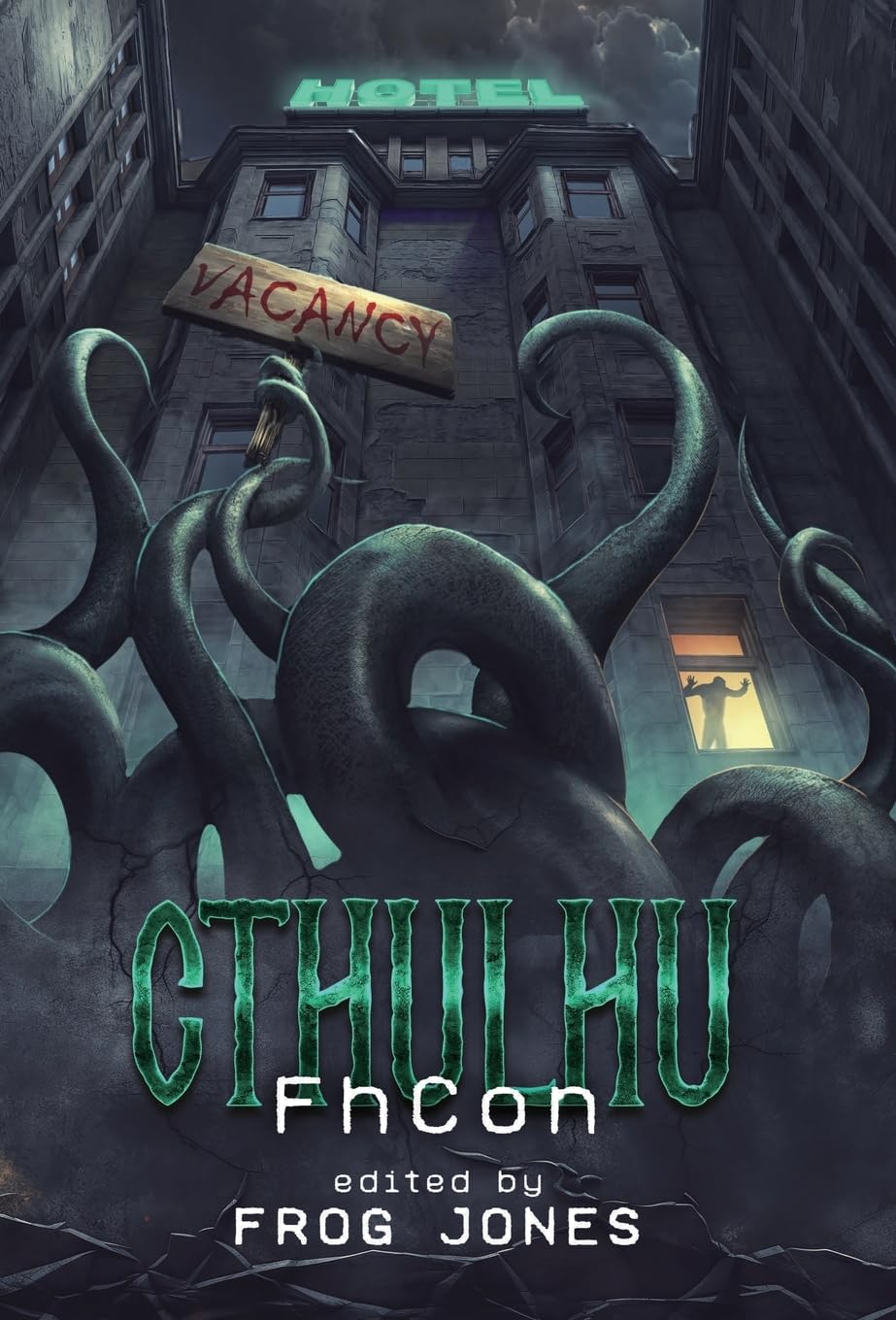
“Blessed Be Her Children” (2025) by Jessi Vasquez

The religious rites varied according to circumstances and the requirements of the people. The greater number of the ceremonies appear to have been practised for the purpose of securing fertility. Of these the sexual ritual has been given an overwhelming and quite unwarranted importance in the trials, for it became an obsession with the Christian judges and recorders to investigate the smallest and most minute details of the rite. Though in late examples the ceremony had possibly degenerated into a Bacchanalian orgy, there is evidence to prove that, like the same rite in other countries, it was originally a ceremonial magic to ensure fertility.
—Margaret Murray, The Witch-Cult in Western Europe (1921)

The conception of Shub-Niggurath as a fertility figure in Lovecraft’s artificial mythology, presented or hinted at in “The Mound” (1940) by Zealia Bishop & H. P. Lovecraft, has always carried with it certain implications. In the early 20th-century anthropological context, “fertility rites” in religion applied to humans, animals, and vegetables. There were rites to conceive and safely deliver children, to grow more crops, to have domestic animals increase in number. The sexual connotations were clear and sometimes salacious.

This was before in vitro fertilization or genetic engineering, before hormonal birth control or effective medical gender transition. Before contemporary labels like ace and aro. The anthropological perspective rarely took into account the vast diversity of reproductive schemes in nature, most of which don’t apply to humans and domestic animals; it did absorb a lot of the cultural norms regarding gender and sexual identity, and the reproductive focus of fertility cults in the literature can bear some strange parallels to reproductive abuse and pregnancy fetishism.

This is the heritage of Shub-Niggurath in the 21st century: one of the rare identified-as-female divinities (or at least entities) in the Cthulhu Mythos, and her cult is often treated as effectively the Quiverfull movement with optional magic and monsters. While that may be a simplification for a diverse array of works that run from “Shub-Niggurath’s Witnesses” (2015) by Valerie Valdes to “The Shadow over Des Moines” (2016) by Lisabet Sarai, the important takeaway is that Shub-Niggurath and her cult have been primarily shaped by early 20th-century ideas of sexuality and reproductive biology.

What does Shub-Niggurath have to offer if you’re asexual, transgender, gay, or just never want to have kids?

As for the rest of the idealistic traditional family concept, you know I never had any real interest in men. I guess I should have been more open about my romantic endeavors. I would have been, if I’d known you thought I was holding back for your sake. You suspected there was something with Rachel, and briefly, there was. There were also a few people in college of varying genders, and while I sometimes felt deep affection, I discovered I’m not terribly interested in physical intimacy. And I don’t feel like my life is incomplete without it.

I love cake. I love cozy mystery novels and sad romance movies. I love my friends, I love Liriope, I love you. And that’s enough. I wish I’d made this clearer to you.
—Jessi Vasquez, “Blessed Be Her Children” in Tales of Shub-Niggurath (2025) 192

“Blessed Be Her Children” by Jessi Vasquez is told in mostly epistolary format; as a series of journal entries, sometimes addressed to specific readers, in a contemporary setting involving a young divorced single mother, her daughter, and her older sister. This is a woman’s story, told from a woman’s perspective, dealing with the messy, complicated mess of faith and something more than faith as their relationships get tangled up with a cult that has an unnerving focus on fertility. The story is not explicitly set in the Cthulhu Mythos; it doesn’t need to drop Shub-Niggurath’s name to draw the familiar associations with goatish imagery associated with the cult. Yet it is very much written, at least in part, in response to how we look at Shub-Niggurath now compared to in 1940.

One squat, black temple of Tsathoggua was encountered, but it had been turned into a shrine of Shub-Niggurath, the All-Mother and wife of the Not-to-Be-Named One. This deity was a kind of sophisticated Astarte, and her worship struck the pious Catholic as supremely obnoxious. What he liked least of all were the emotional sounds emitted by the celebrants—jarring sounds in a race that had ceased to use vocal speech for ordinary purposes.
—H. P. Lovecraft & Zealia Bishop, “The Mound”

Lovecraft never presents Shub-Niggurath from a woman’s perspective. He very rarely addresses pregnancy and birth in the Mythos from the viewpoint of anyone who might have to gestate something and push it out of their body in forty weeks or so. Lavinia Whateley has a few lines in “The Dunwich Horror,” but that’s only afterward. Readers don’t get to see what joy or fear, horror or gratitude, disgust or distress that she felt at the conception of conception, pregnancy, and birth. The whole viewpoint of reproductive horror from a woman’s perspective came to the Mythos relatively late, and is still being explored in stories like “In His Daughter’s Darkling Womb” (1997) by Tina L. Jens and “A Thousand Young” (2025) by Andrea Pearson.

So Vasquez’s approach in “Blessed Be Her Children” is interesting. It is a rebellion against the default program that the cultists are running. The cult, rather than adapt to changing ideas, is still serving what is essentially an ultraconservative agenda: be fruitful and multiply, on our terms. “Blessed Be Her Children” isn’t a polemic in the guise of a piece of fiction, but it is correctly trying to portray a predatory religious group (that happens to be a Mythos cult) whose central ethos doesn’t take into account that nowadays not everyone is heterosexual and looking to have kids.

“Blesssed Be Her Children” by Jessi Vasquez was published in Tales of Shub-Niggurath (2025).


Bobby Derie is the author of Weird Talers: Essays on Robert E. Howard and Others and Sex and the Cthulhu Mythos.

Deep Cuts in a Lovecraftian Vein uses Amazon Associate links. As an Amazon Associate I earn from qualifying purchases.
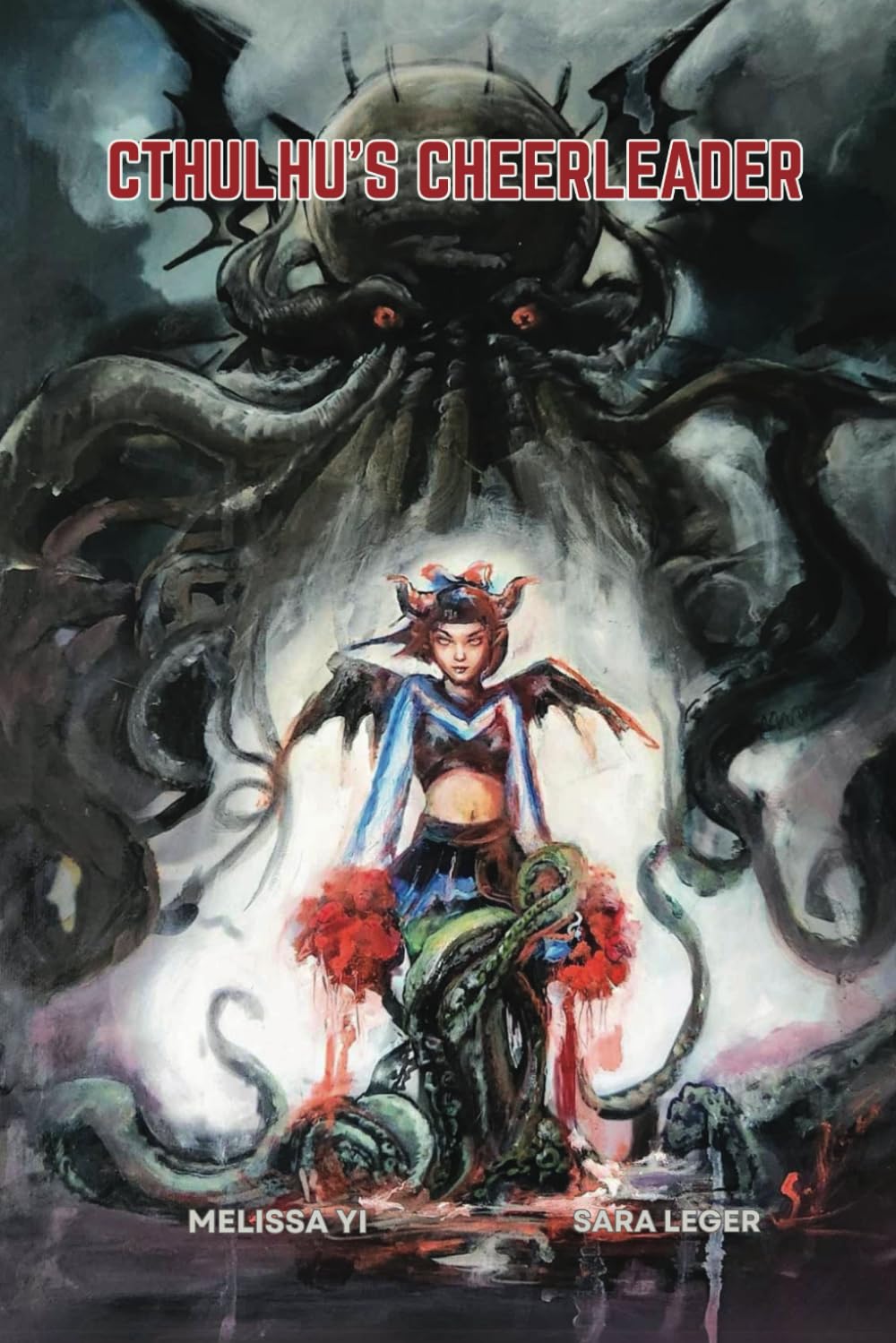
“Greater Than Gods” (1939) by C. L. Moore

If a man could see the end of his act, the end that comes at the far end of Time, and know what it meant—would men be greater than gods?
—Editor’s opening to C. L. Moore’s “Greater Than Gods” in Astounding Jul 1939

C. L. Moore had cut her teeth on interplanetary fiction. Yet the syntax of science fiction was changing, and her approach was shifting with it. Instead of the grungy spaceports of Northwest Smith or the alien cosmic soul-mates of “The Bright Illusion” (1934), “Greater Than Gods” opens up with a Science City divided into separate houses (including Telepathy House), and a very ancient, prosaic situation: a man torn between two women.

The story seems to be a further extrapolation of “Tryst in Time” (1936), working through another iteration of time travel theory:

I think of the future as an infinite reservoir of an infinite number of futures, each of them fixed, yet malleable as clay. Do you see what I mean? At every point along our way we confront crossroads at which we make choices among the many possible things we may do the next moment. Each crossroad leads to a different future, all of them possible, all of them fixed, waiting for our choice to give them reality.
—C. L. Moore, “Greater Than Gods” in Astounding Jul 1939

However, it’s also a kind of a gadget story. The protagonist, William Cory, head of Biology House, was on the trail of figuring out sex determination:

The pups were the living proof of Bill’s success in prenatal sex determination—six litters of squirming maleness with no female among them. They represented the fruit of long, painstaking experiments in the X-ray bombardment of chromosomes to separate and identify the genes carrying the factors of sex
determination, of countless failures and immeasurable patience. If the pups grew into normal dogs—well, it would be one long, sure stride nearer the day when, through Bill’s own handiwork, the world would be perfectly balanced bebetween male and female in exact proportion to the changing need.
—C. L. Moore, “Greater Than Gods” in Astounding Jul 1939

The problem that comes as Cory looks down the trousers of time, as Terry Pratchett put it, is that slowly more and more women were being born. The story becomes a thought-experiment on gender politics. Quite literally:

Women in public offices were proving very efficient; certainly they governed more peacefully than men. The first woman president won her office on a platform that promised no war so long as a woman dwelt in the White House.

Of course, some things suffered under the matriarchy. Women as a sex are not scientists, not inventors, not mechanics or engineers or architects. There were men enough to keep these essentially masculine arts alive—that is, as much of them as the new world needed.
—C. L. Moore, “Greater Than Gods” in Astounding Jul 1939

There are parallels here with David H. Keller’s “The Feminine Metamorphosis” (1929); a blatant, naked sexism that was not uncommon to the time. However, and here is the second twist, Bill Cory gets a glimpse down the other trouser-leg of time, into a world where his own experiments led to a eugenic future:

The first “X-ray” babies began to be born. Without exception they were fine, strong, healthy infants, and without exception of the predetermined sex. The Council was delighted; the parents were delighted; everyone was delighted except Bill.
—C. L. Moore, “Greater Than Gods” in Astounding Jul 1939

Both futures have their flaws, which is the point. It’s a moral conflict, the results deliberately exaggerated. The solution, when Cory arrives at it, is almost ludicrous—a polite fiction on the standards and morals of the age, when proposals were made and accepted more seriously—but it works, it’s true to its own internal logic.

The weird irony to the tale, the search for a third option when presented with an impossible choice, is very much in the vein of 1940s science fiction. How much influence, if any, Henry Kuttner had on this tale is impossible to tell; it has only ever been published under Moore’s name. Yet if she wrote it all on her own, then Moore had fully absorbed the influence of how science fiction was trending. It is a story that speaks to what her future work would look like.

“Greater Than Gods” was published in the July 1939 issue of Astounding. Scans of this issue are available on the Internet Archive.


Bobby Derie is the author of Weird Talers: Essays on Robert E. Howard and Others and Sex and the Cthulhu Mythos.

Deep Cuts in a Lovecraftian Vein uses Amazon Associate links. As an Amazon Associate I earn from qualifying purchases.
“A Thousand Young” (2025) by Andrea Pearson

After years of infertility, failed IVF cycles, and slowly decaying hope, she knew she was not one of the lucky or even one of the blessed, whatever that meant. She wasn’t meant to have children.

So when she first heard the name Dr. Keziah Mason offhandedly mentioned in an online infertility support group, it felt less like salvation and more like an invitation to finally belong.
—Andrea Pearson, “A Thousand Young” in Tales of Shub-Niggurath (2025), 213

Pregnancy has been a common element in weird fiction. The act of conception, the trauma of birth, the aftermath of a sexual act that leads to a natural set-up or sequel for a story, have been familiar elements since Arthur Machen’s “The Great God Pan” (1894) or Aleister Crowley’s Moonchild (1917)—and writers like H. P. Lovecraft (“The Dunwich Horror”, “The Curse of Yig”), Clark Ashton Smith (“The Nameless Offspring”) are direct literary descendants of that tradition.

The basic idea of the monstrous pregnancy was and remains largely unchanged in a great deal of weird fiction, there are a thousand and one variations on the fundamental idea, and entire academic books have been written on the subject in fiction and film, such as Women, Monstrosity, and Horror Film (2018) by Erin Harrington, The Rhetoric and Medicalization of Pregnancy and Childbirth in Horror Films (2020) by Courtney Patrick-Weber, and The Sinful Maternal: Motherhood in Possession Films (2024) by Lauren Rocha.

Pregnancy is still scary; women still go through a physical transformation and ordeal, even if they are more likely to survive it than a century ago. Unwanted pregnancies, as from rape, remain a real concern. With improvements in medicine involving fertility and infertility, the possibilities of pregnancy horror have shifted, however. Now we have adult fears of persistent infertility, of unsupportable pregnancies of multiples, dangerous pregnancies due to the mother’s health or age that are as yet possible due to science, and a shifting cultural emphasis on pregnancy and against abortion that threatens women’s bodily autonomy.

Yet these are themes, elements, narrative devices. Weird writers have addressed these issues in works like “In His Daughter’s Darkling Womb” (1997) by Tina L. Jens and Flowers for the Sea (2021) by Zin E. Rocklyn, both of which use more contemporary frameworks to set up the narrative framework for the monstrous pregnancy. The main difference between writers like Jens, Rocklyn, and Pearson from Machen, Crowley, and Lovecraft, however, is the change in protagonist focus. None of the older writers focus on the experience of pregnancy, none of them tell of the horror from the woman’s point of view. They are always outsiders looking in.

Andrea Pearson’s “A Thousand Young” is not a fetishistic gaze at pregnancy; we don’t get lascivious descriptions of baby bumps, labor, breastfeeding, etc. Strip away the Mythos elements and it is almost a classic monkey’s paw story, where the dearest wish is granted in a way that is unexpected or undesired. Yet it is told from the woman’s perspective; it is her body, her hopes, her dreams, that are at play, and as the story progresses, the reader gets a sense of the enormity of what is happening, and what will continue to happen, long after the last word is read on the final page. That is why it works—and what makes it a fitting paean to Shub-Niggurath, alongside stories like “Goat-Mother” (2004) by Pierre Comtois and “In Xochitl in Cuicatl in Shub-Niggurath” (2014) by Nelly Geraldine García-Rosas.

“A Thousand Young” by Andrea Pearson was published in Tales of Shub-Niggurath (2025).


Bobby Derie is the author of Weird Talers: Essays on Robert E. Howard and Others and Sex and the Cthulhu Mythos.

Deep Cuts in a Lovecraftian Vein uses Amazon Associate links. As an Amazon Associate I earn from qualifying purchases.
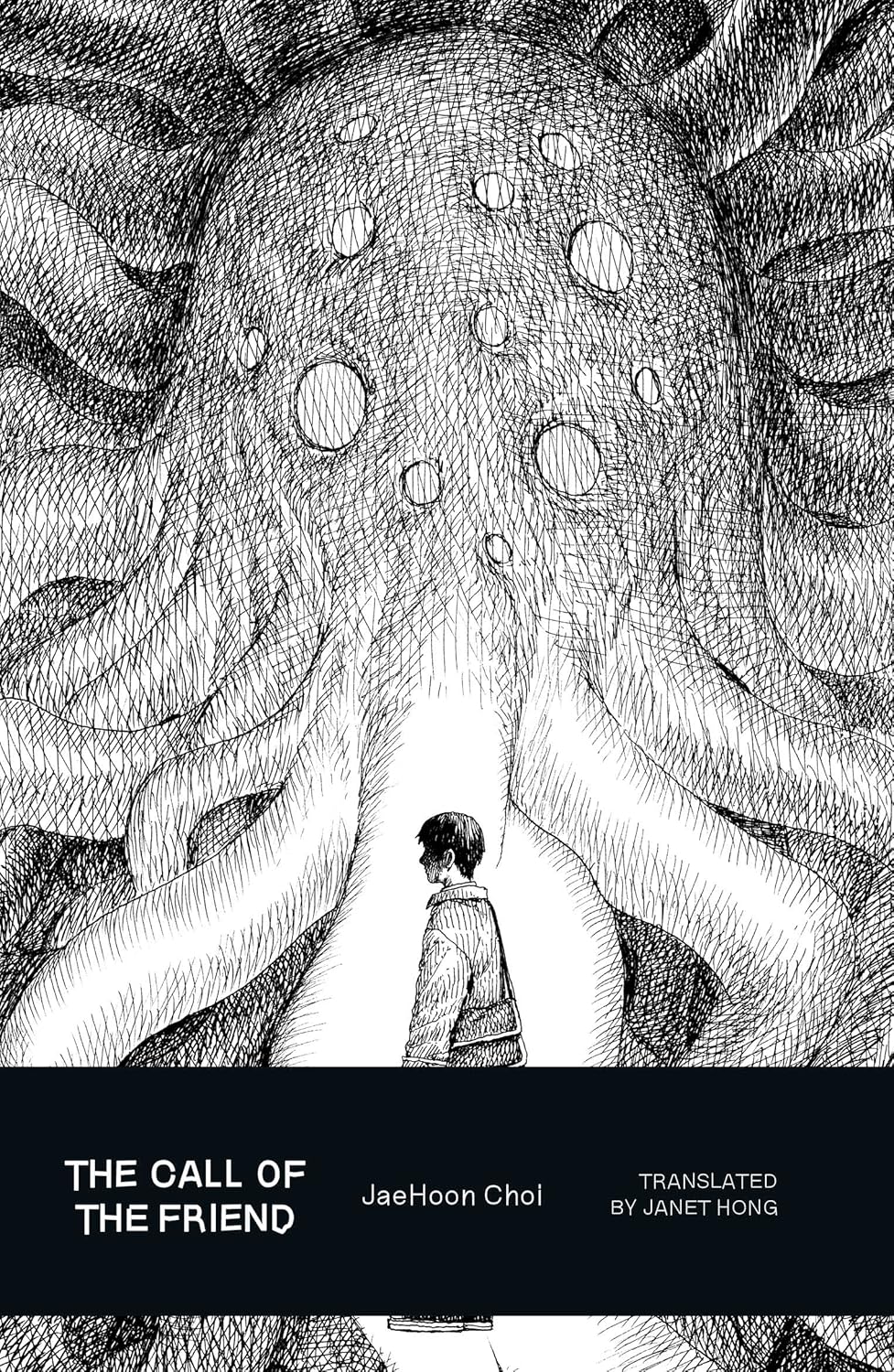
“Hellsgarde” (1939) by C. L. Moore

“You’ll find it by sunset only, my lady,” Guy of Garlot had told her with a sidelong grin marring his comely dark face. “Mists and wilderness ring it round, and there’s magic in the swamps about Hellsgarde. Magic—and worse, if legends speak truth. You’ll never come upon it save at evening.”
—C. L. Moore, “Hellsgarde” in Weird Tales (Apr 1939)

The last Jirel of Joiry story came out 15 months after the previous story, “Quest of the Starstone.” In that time, Moore had been publishing less. The market was changing. New fantasy and weird fiction magazines were out, Weird Tales had been sold and the offices moved to New York City; the editor Farnsworth Wright would soon be fired and, in 1940, would die. Moore’s connections to the magazine were fraying. But there was this one last hurrah.

While it wouldn’t be quite correct to say that the Jirel of Joiry tales to this point were formulaic, they did share very similar plots: Jirel would travel to some other land or dimension, face a supernatural peril, and overcome it through ingenuity and sheer spirit. The details varied, and sometimes she faced sorceresses or wizards and other times alien spirits and gods, but it was a common theme, one largely shared with several early Northwest Smith yarns. “Hellsgarde” still has that theme, but it is developed in a very different way, and with much more style and plot, than the previous tales—and for a good reason.

This is a horror story.

There are strong Gothic setting elements, and readers might well see it as an old dark house tale, with the decaying castle and the creepy family. Yet without sacrificing any of the adventurous elements—Jirel of Joiry is a woman of action, even when trapped in a cell, and her escape is murderous and bloody—this is definitely a story that emphasizes the creepy above the fantasy. It is the darkest of the original Jirel stories, and with neither a typical ghost or typical ghost-hunters, but something much more deliciously weird.

“With the passage of years the spirits of the violent dead draw farther and farther away from their deathscenes. Andred is long dead, and he revisits Hellsgarde Castle less often and less vindictively as the years go by. We have striven a long while to draw him back— but you alone succeeded. No, lady, you must endure Andred’s violence once again, or—”
—C. L. Moore, “Hellsgarde” in Weird Tales (Apr 1939)

The peril to Jirel in this story is exquisite. Once again, she is in a scenario where swordplay is of limited use. She is bound by loyalty to her retainers, she is physically trapped in the castle by the hunters after Andred’s spirit, and her vitality is a beacon to Andred’s ghost itself. It isn’t the first time that something about Jirel’s violent life has attracted supernatural attention (cf. “The Dark Land” (1936) by C. L. Moore), but the threat is more visceral this time, more rapacious. That adds a sense of personal danger, a threat of sensual violence to a tale that is already designed to unnerve. And like a great writer of the weird, C. L. Moore knows enough to leave the last horror unknown, only hinted at.

It’s a wonderful story, and the readers thought so too:

Hellsgarde was the most welcome story of the current issue, for it has the qualities one associates with C. L. Moore: beauty of style, an owtré air, and narrative unpredictability […]
—J. Vernon Shea in “The Eyrie,” Weird Tales (Jun-Jul 1939)

Hellsgarde was a superb, grand and everything else kind of story; I loved it to the very last exciting word.
—Ethel Tucker in “The Eyrie,” Weird Tales (Jun-Jul 1939)

And C. L. Moore gives us the one and only Jirel of Joiry! Boy! Whatanissue! I hope that C. L. Moore delights us in future issues with more stories of Northwest Smith and Jirel.
—John V. Baltadonis in “The Eyrie,” Weird Tales (Jun-Jul 1939)

You do give us thrill-mad fans such nice ‘oogy’ stories. Look at Jirel of Joiry—she certainly does get around. How about getting her and Northwest Smith to meet again. They did quite some time ago. They should get better acquainted, don’t you think?’
—Elaine McIntire in “The Eyrie,” Weird Tales (Jun-Jul 1939)

There would be no sequel. Jirel of Joiry had run her course under Moore, and there was little left of Northwest Smith. Which doesn’t mean that the story of “Hellsgarde” ends here.

In 1967, “Hellsgarde” was reprinted in The Man from U.N.C.L.E. Magazine (Nov 1967). This digest was published by Leo Margulies, who had bought the rights to Weird Tales, and edited by Cylvia Kleinman Margulies, his wife. Back numbers from Weird Tales tended to fill out the issues in the “Department of Lost Stories.” However, probably for reasons of space, when “Hellsgarde” was reprinted it was significantly abridged, and in parts rewritten. This was likely done by the editor, as reprints of “Hellsgarde” in Moore’s own collections follow the 1939 text.

Did Moore intend “Hellsgarde” as a send-off for Jirel? Did she lose contact with the character, after so many years and stories? Or was it just that she lost contact with Weird Tales, and focused her energies on the future—to her upcoming marriage with Henry Kuttner, and the career they would build together? We may never know.

“Hellsgarde” was published in the April 1939 issue of Weird Tales. Scans of this issue are available on the Internet Archive.

A comparison of the 1939 vs. 1967 texts of “Hellsgarde” is also available on the Internet Archive.


Bobby Derie is the author of Weird Talers: Essays on Robert E. Howard and Others and Sex and the Cthulhu Mythos.

Deep Cuts in a Lovecraftian Vein uses Amazon Associate links. As an Amazon Associate I earn from qualifying purchases.
Deeper Cut: Muriel E. Eddy’s Selected Letters to the Editor

Muriel E. Eddy was a writer, poet, the wife of pulp writer C. M. Eddy, Jr., a mother of three, and a correspondent with H. P. Lovecraft. Today, she is most remembered for her several memoirs written about Lovecraft, including “The Gentleman from Angell Street” (1961), “Howard Phillips Lovecraft” in Rhode Island on Lovecraft (1945), “Message in Stone” in Fate Magazine (Oct 1956), “Memories of H. P. L.” in The Magazine of Horror (Winter 1965-1966), “Lovecraft’s Marriage and Divorce” in Haunted (Jun 1968), and H. P. L. “The Man and the Image” (1969) (also partially reprinted as “Lovecraft: Among the Demons”). The most recent publication of the Eddys’ memoirs of Lovecraft is The Gentleman from Angell Street: Memories of H.P. Lovecraft (2025) from Helios House.

Less well-known is that Muriel E. Eddy was an inveterate letter writer, often writing in to newspapers and pulp magazines, and having her missives published quite a few times. Many of these letters are of marginal interest for Lovecraft fans, since she wrote many letters about other subjects, often simply praising a magazine or giving advice, for example, her letter published in the Jan. 1926 issue of Weird Tales:

Muriel E. Eddy, of Providence, Rhode Island, writes: “Lukundoo, by Edward Lucas White, in your November issue, receives my vote, as it is by far the most noteworthy, really thrilling and chilling tale you have yet published. It calls to my mind a story I read years ago (by a titled Englishman), entitled The Hand of Fate, wherein the unfortunate hero was fatally marked by an Egyptian magician, before his birth, by a snake. The snake began its growth from the birth of the hero, slowly, bit by bit, out of his side, causing his death. In that story no one dared destroy the hideous monster growing from the man’s side, as to have done so (some thought) would have caused him to bleed to death.”

However, that does leave a collection of letters from Muriel E. Eddy to the editors that do deal with Lovecraft and related matters. Most of these are individually brief and necessarily repetitive. As an addendum to her body of memoirs about Lovecraft, however, they have interest and value, giving greater context to how she constructed and presented the narrative of her friendship with Lovecraft over the years.

  1. Providence Journal, 2 Jan 1944
  2. Thrilling Wonder Stories, Feb 1948
  3. Thrilling Wonder Stories, Jun 1948
  4. Famous Fantastic Mysteries, Aug 1948
  5. The Atlanta Constitution, 8 Aug 1948
  6. Providence Journal, 26 Aug 1948
  7. Providence Journal, 19 Sep 1948
  8. Fantastic Adventures, Oct 1948
  9. Fantastic Adventures, Dec 1948
  10. Startling Stories, Mar 1949
  11. The Boston Globe, 29 Apr 1962
  12. Fantastic, May 1962
  13. Magazine of Horror, Jan 1965
  14. Providence Journal, 8 Jan 1966
  15. Magazine of Horror, Summer 1966
  16. Fantastic, May 1966
  17. Worlds of If, Oct 1966
  18. Providence Journal, 19 Feb 1968
  19. Magazine of Horror, Jul 1968

[1] Providence Journal, 2 Jan 1944

H. P. LOVECRAFT

Editor:

I enjoyed the article about Howard Phillips Lovecraft in the Sunday Journal of Dec. 26, by W. T. Scott, inasmuch as the late Mr. Lovecraft was well known to our family. It was my husband’s uncle, Arthur Eddy, who owned the bookshop on Weybosset street where H. P. Lovecraft loved to browse. Incidentally, there was one great love of Mr. Lovecraft’s life, perhaps unknown, and therefore overlooked, by most of the public. H. P. Lovecraft adored black cats, and would never pass by a stray black feline on the street without stopping to pat it. Mr. Lovecraft often brought his manuscripts to our house to read aloud to us before submitting them to publishers. He was an excellent reader, as well as writer, of weird and macabre tales, calculated to send cold shivers up and down one’s spine He was a gentleman and a scholar, indeed, as Mr. Scott has said in his most interesting article.

H. P. Lovecraft’s wife, whose name Mr. Scott did not know, was Sonia Greene, who lived in Brooklyn, New York.

We are pleased and honored to have been intimate friends of this gifted author. I am convinced that, some day, in the not too distant future, Providence will be proud of having produced such a prolific writer of weird, uncanny yarns that are already known throughout the world.

MRS. CLIFFORD M. EDDY

Notes: Written in response to “The Case of Howard Phillips Lovecraft of Providence, R.I.” by Winfield Townley Scott in the Providence Journal of 26 Dec 1943.

[2] Thrilling Wonder Stories, Feb 1948

LOVECRAFTIANA

Dear Sir: In the OCTOBER issue of “Thrilling Wonder Stories” I was intrigued by a letter from B. De Revere, in which he (or she?) mentioned liking H. P. Lovecraft’s horror tales. As my husband and I knew H. P. L. personally, (he lived in Providence all of his life) I want to publicly thank B. De Revere for all the nice things said re: Lovecraft.

If you, dear editor, had known the man as we did . . . of his passionate love for cats, his dislike of all fish, and his hatred of daylight, you perhaps would realize that anything he wrote in the “weird” or fantastic line, he really “lived” . . . and I used the word “live” advisedly . . . even when he lay dying in the hospital, he asked the nurse for a pencil and paper and vividly recorded (for the doctor’s benefit) exactly how he felt while dying.

Lovecraft was a tall, spare man. His skin was the color of tallow. His handclasp was firm but his hands were always ice-cold. He despised sunshine, and adored utter darkness. He wrote his best horror tales after midnight. His favorite food was sweet chocolate . . . he consumed pounds of it, and cheese and fruit. He loved coffee smothered with sugar . . . as strong as love and as black as sin!

Lovecraft’s marriage was short-lived and his divorce was conducted quietly and without press notices. We sympathized with him in his every mood, because we knew him intimately and well—we often visit his unamrked grave in beautiful Swan Point cemetery in Providence, where a huge shaft in the center of the burial plot proclaims that his parents sleep there. His grave was somewhat sunken, last time we visited it, and covered with creeping green myrtle vines. His very spirit seemed hovering over his grave as we stood there in silent prayer for a man whose genius shall ever life, after his boens have crumbled into dust.

During his lifetime, we used to tell him that his stories rivalled those of Edgar Allan Poe. He “pooh-poohed” the very notion! He considered his work nothing at all, and never displayed any vanity. He wrote simply because he HAD to write . . . from an inner urger that would not let him sleep. May he rest in peace!

—125 Pearl Street, Providence 7, Rhode Island.

Notes: While Lovecraft was very much a night-owl by preference, he was not opposed to sunlight and often walked and wrote outdoors during the daylight hours. Lovecraft noted his own appreciation for coffee, chocolate, and cheese, but he rarely ate fresh fruit. Lovecraft’s death diary existed and has been partially published in various formats, most recently in Collected Essays 5. There was a brief press notice about Lovecraft’s divorce in the Providence Journal 26 Mar 1929.

Link to Thrilling Wonder Stories, Feb 1948.

[3] Thrilling Wonder Stories, Jun 1948

H. P. LOVECRAFT, GENTLEMAN

by Mrs. Muriel E. Eddy

Editor: I’ve been besieged with requests for more information about Howard Phillips Lovecraft, the late Providence writer of weird yarns—so here goes! Lovecraft used to come over to our house and read his manuscripts night after night. Once, he gave my husband a new kind of hair-cutter and advised him to learn how to cut his own hair. It would, he averred, save many a barber’s bill. He assured us he always cut his own hair and shaved himself.

Lovecraft was the soul of neatness, and always looked like the old-fashioned gentleman of culture he preferred to call himself! He once visited the oldest church in Rhode Island with Mr. Eddy and, while there, signed his name in the register—”H. P. Lovecraft, Esquire, Gentleman.”

My hubby’s uncle (now dead) owned and operated a huge second-hand bookstore on Webosset street in Providence. His name was Arthur Eddy. Lovecraft spent hours at night, talking to our ancient uncle and poring over many volumes in the basement. He never appeared in daylight—but always turned up around the Witching Hour of twelve. Uncle liked H.P.L. and stayed open until the wee sma’ hours of morning, to humor this then embryo writer. He once predicted that, with the years, Lovecraft’s fame would mount. How right he was!

Lovecraft asked us to do much of his typing. He used an old, old machine on which he occasionally typed a story—one of the “invisible type” variety, no longer made. It is to be regretted that this typewriter was sold to a second-hand man when some disinterested outsider was cleaning his apartment after his death. I’m sure it would have been a collector’s item, had it not been sold to this unknown person, to whom the name “Lovecraft” meant nothing!

I have pictures of H. P. Lovecraft as a small child, and also pictures of his mother and father. Last summer we ascertained where his grandfather had lived during his boyhood and took interesting snapshots of the yard in which H.P.L. used to play—when he was not ill, for he was not a rugged child. I have a photo of his grandfather (who had brilliant dark eyes, a Lovecraft characteristic) and of his birthplace as well as of the grave in which he is buried (his body was placed in the ground, not in a vault).

I feel that memories of this man are precious indeed—and I even have a letter he wrote to us, congratulating our cat when she presented us with several kittens—written just as one would write to a human mother—because Lovecraft was noted for his great devotion to felines!

By the way, my favorite story in FEBRUARY TWS is “THE SHAPE OF THINGS” by Rad Bradbury. It is written in such a manner that one wonders if—MAYBE—it couldn’t be true! Fantastic but truly fsacinating stuff to ponder over! I enjoyed all the stories and I loved the monstrous hairy spider (?) on the cover! I’ll keep reading TWS!

—125 Pearl Street, Providence 7, Rhode Island.

Notes: The reference to the “disinterested outsider” might be an aside on R. H. Barlow, Lovecraft’s literary executor, who helped deposit Lovecraft’s papers at Brown University, and some of Lovecraft’s books. The remainder of Lovecraft’s possessions were disposed of by his surviving aunt, Annie Gamwell; it’s possible she sold or gave away the typewriter along with other items she did not wish or could not afford to keep. Several of the photographs mentioned appeared in Rhode Island on Lovecraft (1945).

Link to Thrilling Wonder Stories, Jun 1948.

[4] Famous Fantastic Mysteries, Aug 1948

ABOUT H. P. LOVECRAFT

Dear Editor:

My hubby picked up a copy of April 1948 Famous Fantastic Mysteries on the newsstand, and brought it home to me; he was fascinated by the cover . . . somehow, the pointing finger of the old genii with the red eyes and blue face and hair, popping out of the magic beanpot (at least, it looks like a tiny red-brown beanpot, to me!) intrigued him endlessly. He read it on the trolley coming home, and had all the other strap-hangers gaping, open-mouthed, and wondering, no doubt, what it was all about.

As usual, I turned to the letter deparment, first of all . . . somehow, when a magazine conducts such a department, it seems a safer magazine to read, proving that it is not afraid to publish readers’ frank comments . . . and what did my eyes discover there? Mention of Howard P. Lovecraft, Providence, R. I.’s own native son and favorite author of weird stories, in a letter signed Donald L. Fox, of Bicknell, Ind.

This letter praised a sketch of Lovecraft that appeared in the August 1947 issue on page 113 which I , most unfortunately, missed. In fact, this April issue is, believe it or not, the first one we’ve seen. Lay the blame on other lovers of uncanny yarns here in our city . . . no doubt copies of Famous Fantastic Mysteries sell so rapidly that no newsdealer can keep them stocked sufficiently for their customers.

If any kind reader happens to have this issue, if they’ll loan me their copy, I’ll guarantee its safe return, once I’ve glimpsed the drawing of Lovecraft.

You see, my husband and I were literary buddies of H.P.L., as we always called this now famous writer. he used to bring his manuscripts over to our house, for criticism, though Heaven knows they were always letter-perfect in our opinions. Just the same, Lovecraft would read them aloud, munching on bars of sweet chocolate between paragraphs, for he loved this confection. H.P.L. hated cold weather with an intense hatred. He was a man of many idiosyncrasies, but withal a wonderful pal and a staunceh friend. He always made himself perfectly at home with us, loved to pet our cats, and hated fish—in fact, any kind of sea-food was hateful to this master of the macabre.

When H.P.L. died, it broke our hearts. He was buried in historic old Swan Point Cemetery, here in Providence, and we often visit his grave. Sometimes it seems he is very near, as we read over cards he sent us on his various travels.

As for the magazine: “City of the Dead” is a great story . . . kept us interested throughout. We enjoyed Robert W. Chambers’ novelette, “The Messenger”, and the sketch of Algernon Blackwood was wonderfully executed. But best of all I enjoyed the wonderful “Readers’ Viewpoint” with letters from readers everywhere! From now on, I’m taking no chances. I’m ordering my copies of F.F.M. in advance.

Glad to see a letter from August Derleth . . . We know him, too. We met him last summer during his hurried trip to Providence.

Mrs. Muriel E. Eddy
125 Pearl St.
Providence 7, Rhode Island.

Notes: Muriel E. Eddy also corresponded with August Derleth.

Link to Famous Fantastic Mysteries, Aug 1948.

[5] The Atlanta Constitution, 8 Aug 1948

I am pleased to see Joe Lee’s article on Houdini . . . whose real name was Erich Weiss. My husband, Cliff Eddy, was “ghost writer” for Houdini for many years. He also assisted Houdini in exposing fake mediums. I am proud to say that Houdini and his wife Beatrice (now dead) were personal friends of mine. They were remarkable people . . . I often wondered what happened to their pet parrot, Laura, after she flew out an open window in Hollywood (after Houdini’s death) and was last seen heading for the foothills.

Laura always accompanied her mistress on tour and I remember the pretty green bird with the red head perched on her mistress’ shoulder as we walked up a busy street in a sudden downpour of rain.

Laura seemed to enjoy the rain and laughed delightedly and when we entered the lobby of the hotel where we were staying, the bedraggled parrot was still laughing. But when folks started to laugh at her she hid her head under a wing and cried like a baby.

Mrs. Houdini ordered half a melon for the parrot as a special treat, but Laura much preferred sipping tea from a spoon.

Mrs. Muriel E. Eddy,

Providence, R. I.

Notes: Written in reply to “I Knew Houdini” by Joe Lee, Houdini’s former publicity director, published in The American Weekly magazine section of the Chicago Herald-American for the week of 20 Jun 1948. While not directly related to Lovecraft, this letter is relevant for its insight into the Eddy/Houdini relationship, which in turn was connected with Lovecraft’s relationship with Harry Houdini and his wife, Bess Houdini. This letter was published simultaneously in multiple papers, also appearing in at least the Pittsburgh Sun-Telegraph, 8 Aug 1948 and the San Francisco Examiner, 8 Aug 1948.

Link to the Atlanta Constitution, 8 Aug 1948.
Link to the Pittsburgh Sun-Telegraph, 8 Aug 1948.

[6] Providence Journal, 26 Aug 1948

Writer of the Uncanny

Editor:

I read the Sonia H. Davis article on H. P. Lovecraft on the book page of the Aug. 22 Sunday Journal. I thank Mrs. Davis for giving us her impressions of one of the finest writers Providence has ever produced. My husband and I knew Lovecraft so well that we often visit his grave at Swan Point Cemetery in memory of a very dear friend and a gentleman of the “old school.”

Often, we typed Lovecraft’s manuscripts, finding it a joy to assist this prolific writer of the weird and uncanny. Lovecraft lived in a world of his own making, a sort of “dream world” where night became day. Most of his writings were accomplished at night. Providence was Lovecraft’s first, last and only real love in my opinion. He derived his inspiration from Providence’s little-known alleys, back streets and ancient burying grounds. We knew Lovecraft I really believe, better than anyone else (outside of his two aunts), and no finer gentleman ever lived, I feel safe in saying, than this man who just could not reconcile himself to married life, perhaps because his writing meant his entire life to him.

MRS. MURIEL E. EDDY
Providence.

Notes: In response to “Howard Phillips Lovecraft as His Wife Remembers Him” by Sonia H. Davis in The Providence Journal, 22 Aug 1948.

Link to letter in Providence Journal, 26 Aug 1948.

[7] Providence Journal, 19 Sep 1948

First, from a letter from Lovecraft’s friend Mrs. Clifford Eddy:

“I was deeply impressed . . . but one thing I think the charming Sonia overlooked entirely. Writing was H.P.L.’s entire life . . . Lovecraft often used to ssay: ‘I never was young; I was born old!’ But thanks to Sonia for giving us even the vaguest insight into married life with this extraordinary man.

“Sonia perhaps was unaware that after the divorce H. P. L. traveled several times ‘Boston-ward’ to visit a very fine young lady, and to assist her in literary work. The visits were sources of pleasure to the young lady, for she wrote me of visits to museums with H. P. L., of candle-lit suppers on cheese sandwiches and chocolate cake, and of his gentlemanliness and courtesy. It was purely a platonic friendship, but it proves that at heart H. P. L. was surely not a recluse entirely! He was human, but always his literary work came first, last and foremost!”

Notes: This excerpt ran in Winfield Townley Scott’s column, “Bookman’s Gallery,” in the Providence Journal, and was a further response to Sonia H. Davis’ article. The entire letter is available at the Brown Digital Repository. The “young lady” referred to was almost certainly Hazel Heald, a revision client that Lovecraft got in touch with trough Muriel E. Eddy, who had a somewhat romantic and rose-tinted view of their potential relationship.

[8] Fantastic Adventures, Oct 1948

SHAVER AND LOVECRAFT

Sirs:

The May issue of FA was a pip! It bubbled with good reading! “Forgotten Worlds” by Lawrence Chandler was wonderfully illustrated and it held my attention all the way.

I agree with Milton Papayianis of Barstow, California, regarding Richard S. Shaver and H. P. Lovecraft. Lovecraft, a close friend of the family for years, loved red roses, sweet chocolate ice-cream, and soft dreamy music. My husband has composed music for years, and H.P.L. lovecraft to watch him at work.

To those of you who love the weird things in life, I’m sure you love weird music too, as much as the late master of the weird did. My hubby often talked with H.P.L. about setting some of his weird poems to music, but unfortunately H.P.L.’s untimely death prevented this.

Muriel E. Eddy
125 Pearl St.
Providence 7, R.I.

Notes: In the 1940s, some fans drew connections between Lovecraft and the Shaver Mystery; Richard Shaver’s stories and many letters about them were published in the pages of Fantastic Adventures. I have been unable to find independent confirmation that Lovecraft particularly enjoyed roses or “soft dreamy music”; in his letters, Lovecraft indicated his musical tastes tended toward the popular music of his youth. C. M. Eddy, Jr. did write and publish songs, although it isn’t clear he ever approached Lovecraft about such an adaptation; composer Harold Farnese, however, did set some of Lovecraft’s weird poetry to music, so the idea isn’t too far-fetched.

Link to Fantastic Adventures, Oct 1948.

[9] Fantastic Adventures, Dec 1948

LOVECRAFT’S WIFE

Sirs:

Since my letter appeared in the October FA I have been deluged by letters asking me whether or not HPL, the great weird master, was ever married. The answer is, emphatically, yes.

He had a beautiful wife, and she has just written an article pertaining to her married life with him, which appeared, with her photo, in our local paper. HPL was her second husband. They divorced, and she remarried. Her third husband has since passed on. She stated in her article that Lovecraft loved cheese souffle for breakfast, cared very little for foreigners, and that he really loved his native Rhode Isalnd. The article was very interesting, and Sonia H. Greene Lovecraft Davis is really a fascinating woman. Perhaps she’ll read this and write into FA herself!

The October issue of FA was wonderful, from “kiver to kiver.”

Muriel E. Eddy
125 Pearl St.
Providence 7, R.I.

Notes: While they never met, Muriel Eddy and Sonia H. Davis did develop a correspondence after Sonia’s memoir on Lovecraft appeared in the Providence Journal.

Link to Fantastic Adventures, Dec 1948.

[10] Startling Stories, Mar 1949

MORE LOVECRAFTIANA
by Mrs. Muriel E. Eddy

Editor Startling Stories: I’ve been so interested in the many letters re: Lovecraft. Here in Providence, R.I., folks call me an authority on Howard Phillips Lovecraft, because my husband and I knew him intimately for many years. We were aware of his many idiosyncrasies and we loved him!

We know he was allergic to fish—so we never served him fish or any sea food! We knew he enjoyed the white baked meat of chicken—and cheese. He loved chocolates and when he married Sonia Greene in 1924 his two aunts gave our children over 100 empty chocolate boxes to play with! (In fact, a bathtub full!) We used an old gas-plate Lovecraft formerly brewed his coffee on, for a long time.

We remember how dearly this famous author of the weird and uncanny loved coffee with many spoonfuls of sugar! Many a night we listened to Lovecraft reading his original manuscripts—and enjoyed the facial expressions that played over his unusually mobile features as he read aloud with many a theatric gesture!

I’d be glad to furnish readers with any information on Lovecraft I am able to—and in the meantime I’ll just say I do enjoy “STARTLING STORIES” and the November issue was EXCEPTIONALLY fine! I LOVE your illustrations and covers!

—125 Pearl Street, Providence 7, Rhode Island.

Notes: When Lovecraft moved to New York City in March 1924 and married Sonia, he instructed his aunts to send much of his furniture and belongings to him in New York, and some of the other items ended up with the Eddys, who at the time were in a straitened financial situtation. With regards to chicken, Lovecraft’s letters and other memoirs confirm he did enjoy it, and his friend Harry Brobst, when interviewed by Will Murray, claimed that Lovecraft especially liked white meat and disliked dark meat (Ave Atque Vale 313).

Link to Startling Stories, Mar 1949.

[11] The Boston Globe, 29 Apr 1962

They Remember Howard Lovecraft

To the Editor—The year 1962 marks the 25th anniversary of the death of one of New England’s most prolific writers of the weird and uncanny in literature . . . the late Howard Phillips Lovecraft, who was born Aug. 20, 1890, and who died Mar. 15, 1937, in Providence.

My husband and I were personal friends of H.P.L. (as he is known to many of his readers) and we read many of his yarns, which are now published all over the world in many different languages. We spent many hours with this genius, talking over his stories and criticizing them in the rough spots.

Here at 588 Prairie av., Providence, we have many mementoes of this talented writer, who some say rivalled Edgar All[a]n Poe with his weird ideas. My husband, Clifford Eddy, was a frequent pal on the long midnight walks Lovecraft used to take to get story ideas.

MRS. MURIEL E. EDDY
Providence

Notes: According to a 2 Dec 1960 letter to August Derleth, the Eddys had established a Lovecraft “shrine” in a corner of their home for visitors, including photographs of HPL.

Link to The Boston Globe, 29 Apr 1962 letter.

[12] Fantastic, May 1962

Dear Editor:

I was greatly interested in Feb. FANTASTIC because of the story “The Shadow Out of Space,” by H. P. Lovecraft and August Derleth. My husband and I were close personal friends of the late H. P. Lovecraft. This year makes the 25th anniversary of Lovecraft’s death, which occurred March 15, 1937. He is interred in beautiful Swan Point Cemetery, Providence’s finest, most exclusive burying-ground. We often visit the grave of this unusually gifted author of the macabre.

I would be pleased to hear personally from any Lovecraft fans. I have plenty of time and will answer all letters if a stamp is enclosed.

Mrs. Muriel E. Eddy
688 Prairie Ave.
Providence 5, R.I.

Notes: “The Shadow Out of Space” was one of August Derleth’s “posthumous collaborations,” with H. P. Lovecraft, though in fact Derleth wrote them all, often based on some inspiration from Lovecraft or some prose fragment or portion of a letter.

Link to Fantastic, May 1962.

[13] Magazine of Horror, Jan 1965

Mrs. Muriel E. Eddy of 688 Prairie Avenue, Providence, RI, 02905, writes, “Having known Howard Phillips Lovecraft very well, from 1923 to the year of his death, 1937, I would like to share my memories of “HPL” with any of your readers who would care to write to me.

“HPL was a constant nocturnal caller at our home during those years. We discussed manuscripts constantly with him. We knew his aunts, too, and we often visit his grave, here in Providence, R. I.”

Notes: The Magazine of Horror had published some Lovecraft-related material in previous issues, which may have inspired this letter, and this offer probably led to Muriel E. Eddy’s “Memories of H. P. L.” being published in Magazine of Horror (Winter 1965-1966).

Link to Magazine of Horror, Jan 1965.

[14] Providence Journal, 8 Jan 1966

A Tribute to Howard P. Lovecraft

During our many years of close association with the late Providence-born author of weird, uncanny and bizarre tales, Howard Phillips Lovecraft, who died on March 15, 1937, we learned much about this wonderful writer that is not too widely known to those who read his stories and shiver, loving every word of them, or the students who are writing theses on this now famous Providence author of the macabre.

Born August 20, 1890, he was the only child of Sarah Susan (Phillips) Lovecraft and Winfield Scott Lovecraft. As a young boy, H. P. L. (as he was affectionately known to us) became interested in the weird. he was a devotee of Edgar All[a]n Poe, Ambrose Bierce, Arthur Machen, and others in that category.

Knowing Lovecraft made us appreciate the wonderful city we live in. he loved the fan-shaped designs over ancient doorways, and he loved to explore old cemeteries such as St. John’s Churchyard. Many of his stories were inspired by his ramblings in ancient cemeteries.

On March 15, 1966, this now famous writer, born and brought up in our fair city, will have been gone from our midst 29 long years, yet his fame is spreading like wildfire. 

His work is now internationally known. During the past seeral years we have had callers from England and Sweden who wanted to discuss H. P. L. and his writings with us and to see his last resting-place in beautiful Swan Point Cemetery. It is considered a rare privilege by my husband and me to realize that we knew this wonderful man personally.

Long may his memory live!

Muriel E. Eddy
Providence

Notes: In 1959, the Swedish editor and radioman Torsten Jungstedt visited the Eddys at their home in Providence, R.I., as recounted in letters to August Derleth.

[15] Magazine of Horror, Summer 1966

“Thanks for publishing my brief Memoirs of HPL,” writes Mrs. Muriel E. Eddy of 688 Prairie Avenue, Providence, Rhode Island 02905, “in the Winter 1965/66 issue, and thanks to readers who’ve written me how much they liked it. As my husband (Clifford Eddy) and I knew this master of weird fiction so well, I had some photos of HPL copied, so that I can send them (as mementos) to sincere Lovecraft fans. To those who care to send me a self-addressed, stamped envelope, regular size, I’ll send a picture. . . . Call on me, if you wish. We even had a caller from Sweden and two from England, wishing information on HPL, which we gave to them gladly. We still remember how HPL loved ice-cream and hated fish! I still have a chair HPL’s aunt (now gone) gave to me when HPL left Providence to marry Sonia Greene in New York. I used to own the folding bed HPL slept in (his aunt also gave it to me) until one night it collapsed on me! His aunt gave me many souvenirs of HPL which I cherish—those I have left—after all these years. Memories of HPL will never cease!

“Glad to see so many fine stories in the Winter issue. I believe that Master Nicholas, by Seabury Quinn, was my favorite. The Faceless God, but Robert Bloch, was a close second.”

Notes: The aunt was Annie Gamwell.

Link to Magazine of Horror, Summer 1966.

[16] Fantastic, May 1966

Dear Editor:

In the January, 1966 issue of Fantastic the story which held the most appeal for me was Robert Sheckley’s “What a Man Believes.” It really “rang the bell” for me!

Being an “old-timer” when it comes to reading odd, strange and different stories, I feel I am qualified to judge a story pretty well . . . and having read thousands of manuscripts during my lifetime (I’m heard of the R.I. Writers’ Guild here in Providence, R.I., and I’m almost 70 years old!), I don’t mind adding a few more “unbelievable tales” while I’m still alive! Robert Sheckley truly made an “unbelievable” tale BELIEVABLE!

My husband and I were bosom friends of the late weird writer, Howard Phillips Lovecraft, who died March 15, 1937, in our city, and who lies sleeping in beautiful Swan Point Cemetery. One night, after reading an especially weird manuscript aloud to us, he remarked that he believed the human brain was practically indestructible. . .that (who [k]new?), the brain MIGHT keep on functioning even after death. . .at least, it was a subject worth thinking about!

His remark has haunted me for years. Every time we visit Lovecraft’s grave, I think about it, and I wonder if, after death, it is ever a possibility that the human brain MIGHT keep right on functioning. . .whether the heart stops or not. . . .Sheer fantasy, I’m sure. . .or. . . is it?

To get off the subject. . .ALL of the stories in the January, 1966, issue are well worth reading. . .and of course Virgil Finlay’s weird illustration of “Six and Ten Are Johnny” is great. By the way, Virgil has also illustrated many Lovecraft stories. . .he’s my favorite illustrator!

Many times I regret that H.P. Lovecraft died so young. . . he was only 47 at his demise. He’d be 75 if he’d lived. We cherish his memory and invite correspondence referring to H.P.L. and all weird, uncanny subjects! KEEP UP THE GOOD WORK and I’ll continue to be a FANTASTIC FAN!

Mrs. Muriel E. Eddy
Pres. R. I. Writers’ Guild
688 Prairie Avenue
Providence, R.I. 02905

Notes: The anecdote about a brain still living evolved over time, derived from “Thoughts and Feelings of a Head Cut Off,” a story ghostwritten for Harry Houdini, possibly by C. M. Eddy, Jr. The identification of the idea with Lovecraft appeared notably in “Message in Stone” (1956) by Muriel E. Eddy. The idea of an indestructible brain doesn’t sound very much like the materialist H. P. Lovecraft, but it is possible he contributed the idea at some point during a brainstorming session and the years transformed the incident in Muriel E. Eddy’s mind.

Letter to Fantastic, May 1966.

[17] Worlds of If, Oct 1966

Dear Editor:

Toys for Debbie by David A. Kyle rang the bell for me. What a story! And what toys! ALL the stories were well worth reading—the illustrations were wonderful—your “letters” department was fine!

If I sound extra enthusiastic it’s because I AM! I’m a lover of “different” stories from way back. I’m pushing 70 now. My birthday is January 19, hubby’s is January 18—do we have any “birthday twins” among your readers?

My hubby and I have one entire room lined with weird and fantastic books and magazines. We were intimate friends of the late author of the weird and uncanny, H. P. Lovecraft. We spent many pleasant nighttime hours with this fantastic man, listening to him read his manuscripts aloud under flickering gaslight. This was in the early ’20s, when everybody didn’t have electricity in their homes! Nights seemed darker, then . . . and as H. P. L. loved darkness, we three reveled in it, as we pictured monsters, hobgoblins, shapeless creatures of his own imagination and witches steeped in witchcraft, while Lovecraft nibbled on a chicken leg and enjoyed our hospitality!

I could ramble on and on about our association with this master of the weird. We visit his grave often, and we have many pictures of H. P. L. and even one of his parents! We revere his memory and in his honor we peruse all “different” publications on the newsstands. Yours wins top honors with us! Also your cover appealed greatly to me, and it illustrated your feature story, a corker—The Moon Is a Harsh Mistress, by Robert A. Heinlein—beautifully. You’ve got yourself a steady If reader! 

—Mrs. Muriel  E. Eddy, President, R. I. Writers’ Guild, 688 Prairie Avenue, Providence, Rhode Island 02905.

Notes: Link to Worlds of If, Oct 1966.

[18] Providence Journal, 19 Feb 1968

In Memoriam: Howard Phillips Lovecraft

March 15 of this year will mark the 31st anniversary of the death of the new famous Providence author, Howard Phillips Lovecraft. Mr. Lovecraft’s many books of weird literature may be found in many public libraries now throughout the land, and his works have been translated into many foreign languages.

My late husband, Clifford martin Eddy, and I, knew Mr. Lovecraft very well. He was a constant visitor at our home, and as he preferred nighttime to day, we called him “The Man Who Came at Midnight.”

He used to love to read us his original manuscripts before submitting them to an editor. he was not conceited; in fact, he thought but little about his talent for conceiving weird and uncanny plots. I think the story that caused the most shivers when Lovecraft read it aloud, many years ago, was his now famous: “The Rats in the Walls” . . . truly a macabre yarn, a real weird classic in literature.

Born on the East Side, (Angell street, to be exact) Mr. Lovecraft loved Providence dearly. Many of his stories have a Providence-inspired background. One recognizes Benefit Street and Federal Hill in at least two of his weird tales!

All honor to the memory of Howard Phillips Lovecraft, now sleeping the eternal sleep in historic old Swan Point Cemetery. When I visit my husband’s grave, I always pay tribute also at the last resting-place of a truly great Providence author, recognized all over the world since his untimely death, (he died at only 47 years of age) the unforgettable Howard Phillips Lovecraft!

Mrs. Muriel E. Eddy
Providence

Notes: Ruth M. Eddy’s memoir of Lovecraft was “The Man Who Came at Midnight” (1949), recalling her childhood in the 20s when he came to visit.

[19] Magazine of Horror, Jul 1968

Mrs. Muriel E. Eddy writes from 688 Prairie Avenue, Providence, Rhode Island, 02905: “I am deeply sorry to tell you and interested readers of your esteemed magazine (which has always been a welcome visitor to our home) that my dear husband, author of several stories published in the now defunct WEIRD TALES, etc, such as The Loved Dead, Deaf, Dumb and Blind, etc., passed away on Tuesday, November 21, 1967, at the Osteopathic Hospital in Providence, R.I., after a long and painful illness. Death came to him as he slept. The doctor attending him telephoned me at quarter past six a. m., saying my husband had expired at about six a. m. Death came peacefully, after months of suffering.

“My husband, Clifford Martin Eddy, was a bosom pal of the late Howard Phillips Lovecraft, as so many people know, as since a letter of mine appeared in these columns a year or so ago, I received and answered much mail concerning our friendship with the late master of the macabre in fiction. Now my dear one lies sleeping in the same cemetery in which Howard P. Lovecraft sleeps, beautiful Swan Point Burial Ground, here on Blackstone Blvd., in Providence, R.I., where both Lovecraft and Eddy were born.

“Memories of HPL filled Mr. Eddy’s life, and we talked much about the happy times when Lovecraft came to visit us at our humble abode. Now that Mr. Eddy has left this earth I shall always recall those precious moments. To alleviate the loneliness incurred by my dear husband’s demise I shall be glad to answer any letters regarding HPL or my husband’s writings. Mr. Eddy and Mr. Lovecraft often discussed plots of their stories before writing them, and I was always an interested listener, although at times I, too, have tried my hand at weird stories. But these two men (I think you will agree) were tops in their field! August Derleth of Sauk City, Wisconsin, has re-published a few of my husband’s stories in anthologies, and I hope some of your readers remember the name ‘Eddy’ as well as that of Lovecraft! My husband was not as prolific a writer as was HPL, but what he did write was bloodcurdlingly readable! He was 71 at his death, and on February 10, 1968 we would have observed our Golden Wedding . . . but God saw fit to take him . . . and who we are to question God? Nevertheless, I miss him . . . sorely. Letters will help assuage my loneliness! I visit his grave (and Lovecraft’s) very often.”

Notes: Link to Magazine of Horror, Jul 1968.


Bobby Derie is the author of  Weird Talers: Essays on Robert E. Howard and Others  and  Sex and the Cthulhu Mythos .

Deep Cuts in a Lovecraftian Vein uses Amazon Associate links. As an Amazon Associate I earn from qualifying purchases.
“Miracle in Three Dimensions” (1939) by C. L. Moore

Strange Stories (1939-1941) was one of the rivals that rose during a fantasy boom in the waning years of Farnsworth Wright’s term as editor of Weird Tales. While many of the rivals had little in the way of style to offer, there was one thing they did that WT didn’t—pay. The magazine had gone a long period delaying payment, even to its most prolific and popular authors, while other pulp magazines often paid at least as well and often sooner than WT did. While we don’t know if that was a consideration for C. L. Moore, it might explain why she was writing a science fiction tale for one of Weird Tales‘ rivals instead of another Northwest Smith or Jirel of Joiry tale.

Strange Stories, of all the rivals, seemed to have collected Weird Tales‘ also-rans, and only ran for 13 issues. Most of the stories are nearly forgotten today, but a few have been reprinted, by dint of their authors’ later fame as their individual quality. Such is the case with “Miracle in Three Dimensions” by C. L. Moore, which was never quite a lost story, although seldom reprinted and never in any of her own collections during Moore’s lifetime.

Fundamentally, “Miracle in Three Dimensions,” published in the Apr 1939 issue of Strange Stories, is a gadget tale: inventor Blair O’Byrne has developed a prototype of the Star Trek holodeck, a kind of three-dimensional motion picture. Harboiled movie mogul Abe Silvers finds himself projected into Shakespeare’s A Midsummer Night’s Dream. Wright, a great Shakespeare fan who had tried to publish a pulp library of Shakespeare plays a few years before—of which A Midsummer Night’s Dream was the only one to make it to print—might have shown interest in the scenario, if he had seen it.

Yet the way that Moore develops the story is very different from any of her previous tales, even science fiction stories like “Greater Glories” (1935) and “Tryst in Time” (1936). While framed as a science fiction story, it has a certain fantasy logic:

Did you ever hear—” broke in Blair softly, as if he were following some private train of thought and had not heeded a word of Silvers’ harangue—”of savages covering their faces when explorerers bring out their cameras? They think a photograph will steal their souls. It’s an idea so widespread that it can’t have originated in mere local superstition. Tribes all over the world have it. African savages, Tibetan nomads, Chinese peasants, South American Indians. Even the ancient Egyptians, highly civilized as they were, deliberately made their drawings angular and unlifelike. All of them declared and believed that too good a likeness would draw the soul out into the picture.”
—C. L. Moore, “Miracle in Three Dimensions” in Strange Stories (Apr 1939)

Colonialist rhetoric aside, that particular style of writing, the combination of science fiction trops, fantasy logic, and contemporary setting, is something that would become very characteristic of the early 1940s pulp magazines like Unknown. It is a remarkable shift away from her previous style that the question must be asked: is this even a C. L. Moore story?

A glance at the names on the table of contents of Strange Stories (Apr 1939) includes familiar names like Henry Kuttner, August Derleth, Robert Bloch, Tally Mason, Marc Schorer, and Tarleton Fiske. Except…Tally Mason was one of Derleth’s pseudonyms. Tarleton Fiske was one of Bloch’s pseudonyms. Marc Schorer was a writing partner of August Derleth, and was republished in their collection Colonel Markeson and Less Pleasant People (1966) as by both. The use of pseudonyms by authors to fill out a table of contents and make it look like more writers were contributing than there were is an old pulp trick. Since Kuttner was already in the book with a story of his own, I suspect what happened is that they left his byline off of “Miracle in Three Dimensions,” and that this is actually the second Moore/Kuttner collaboration to see print. More was, as noted elsewhere, sometimes somewhat reluctant to reprint collaborations.

Was that the case here? Maybe, maybe not. There are no definite answers forthcoming, unless more evidence comes to light. So, whether the shift in style represents collaboration with Kuttner, or Moore’s own developing style in that direction is difficult to distinguish. Certainly, there’s a touch of the old sword-&-sorcery even in this tale which may have come from either:

Puck lured the spell-bewildered lovers into the fastnesses of the forest. They went stumbling through the fog, quarreling, blinded by mist and magic and their own troubled hearts. Swords flashed in the moonlight. Lysander and Demetrius were fighting among the veiled trees. Puch laughed, shrill and high and inhuman, and swept his brown arm down. And from Lysander came a choked gasp, the clatter of a fallen sword.
—C. L. Moore, “Miracle in Three Dimensions” in Strange Stories (Apr 1939)

Not quite Robert E. Howard, but then Moore and Kuttner seldom wrote gruesome or fierce action scenes.

The hybrid nature of the tale works; the ability to enter and leave the Shakespearian setting predates works like the Harold Shea stories of L. Sprague de Camp and Fletcher Pratt. It is, more importantly, a step away from the style of fiction of Weird Tales; there’s nothing really of Lovecraft, Robert E. Howard, Clark Ashton Smith, or A. Merritt in this tale. Whatever influences Moore (or Moore & Kuttner) had drawn from these authors, this story was now pushing into a new era, which would be dominated by writers like Ray Bradbury, Robert Bloch, and Margaret St. Clair, who straddled science fiction, fantasy, and horror, but often with a more ironic tone and contemporary viewpoint.

“Miracle in Three Dimensions” was published in the April 1939 issue of Strange Stories. Scans of this issue are available on the Internet Archive.


Bobby Derie is the author of Weird Talers: Essays on Robert E. Howard and Others and Sex and the Cthulhu Mythos.

Deep Cuts in a Lovecraftian Vein uses Amazon Associate links. As an Amazon Associate I earn from qualifying purchases.
“A Loobelier Licking” (1998) by Maxi Dell

Lois Gresh writers her erotic fiction under the nom de plume Maxi Dell. […] She says about her story: “Perception marks the boundaries of reality. What seems strange to us, what we fight the most, may be the only thing that matters. In a world of cold darkness the heat of love ignites sex even if the lover is a so-called demon.”
Demon Sex (1998), 45-46

Some writers of Cthulhu Mythos fiction approach the project with the care of a pasticheur working another episode into a series of canonical tales—like writing an unofficial sequel to a classic Sherlock Holmes story, they might write “what happened next” for Lovecraft’s “The Dunwich Horror” or “The Shadow over Innsmouth”; such is the case with “The Shuttered Room” by August Derleth. Other writers prefer to reinterpret the story, providing an alternate take on what really happened, this is what you see with “The Black Brat of Dunwich” (1997) by Stanley C. Sargent.

In her Mythos fiction career, Lois H. Gresh’s approach is closer to that of a DJ, remixing familiar songs and beats but putting her own spin on it. She doesn’t re-tell old stories, she doesn’t try to abide by anyone’s canon, and the result is something that at once has a lot of familiar elements, but is nothing like what you’ve heard before—and perhaps not what you would expect, either. None of which is a bad thing, unless you go into her stories expecting something else.

You’ll be twenty tomorrow, Emilie. It’s time for us to share The Gift.” Rolfe’s voice was hoarse, gravel grating against the fishdead air.

She said, “The Gift is something I definitely don’t want for my birthday. How about if we just say here in Innsmouth and never have sex?”
—Maxi Dell, “A Loobelier Licking” in Demon Sex 48

The story is set in Innsmouth, though not quite the same Innsmouth readers will find familiar. It deals with Yog-Sothoth and Eihort, the latter an eldritch entity that was created by Ramsey Campbell for his Mythos stories. Emilie and Rolfe are best friends, 19 years old, irrepressibly horny, outsiders among outsiders—and is stuck in a tricky situation. Emilie is the cosmic equivalent of an ugly duckling, physically unlovely and ostracized because she carries the genes of a Great Old One. The Innsmouthers want to kill her. The brood of Eihort, the Loobeliers, Yog-Sothoth, and most especially her friend Rolfe want to impregnate her.

Except if she gets pregnant, she dies and Cthulhu gets loose and ends the world.

If that sounds a little complicated—well, yes. It’s also sexually explicit, more than slightly surreal, and probably doesn’t make too much sense if you think about it too long. Emilie’s negative body image, search for love, and the apparent fact of her imminent demise or translation to another reality if she gives in to her teenage lust plays as very nearly a parody, a kind of cosmic teenage sex comedy. While it plays a little more serious than that (at least from Emilie’s point of view), in an era when “monsterfucker” is a tag for a vast swathe of fiction, I think audiences today might have more sympathy for Emilie.

It’s not just that she wants to get laid. She wants love, too.

Rolfe, on the other hand, is utterly inept. By his logic, he and Emilie are two of a kind, and he’s the only option for her to survive—his every effort to get laid, however, reinforces the problem. In the end, he’s been friendzoned so hard the reader would almost feel sorry for him, if he wasn’t so utterly without romance.

[“]Our only chance is to mate with each other before they get to you.”

He was being ridiculous. As if her only choices were sex with Rolfe or sex with a fish. What an absurd thought. Of course, if it came down to it, she’d choose Rolfe. He wasn’t a fish, after all, and he did have a certain raw masculinity that she found appealing. Plus, she’d known him since they were children, and he was her only friend. But still…

Maybe it was the way he put it: mating.
—Maxi Dell, “A Loobelier Licking” in Demon Sex 49

(Readers may, at this point, wonder what the heck a loobelier is. As near as I can tell, they appear only in this story and nowhere else, so it would be a terrible spoiler to reveal that. Trust me, knowing what they are does not significantly make much more sense in context.)

As an erotic horror story, if you don’t invest too much time in thinking about it, this is fun. Gresh has a knack for entertaining prose and slightly surreal situations (see “Showdown at Red Hook” (2011) by Lois H. Gresh), and this is no exception. While probably never going to appear in any list of canonical Innsmouth tales, I think the subversion of expectations, as much as the anticipation of Emilie’s final decision, is what makes this story work.

“A Loobelier Licking” as by Maxi Dell was published in Demon Sex (1998). It has not been reprinted.


Bobby Derie is the author of Weird Talers: Essays on Robert E. Howard and Others and Sex and the Cthulhu Mythos.

Deep Cuts in a Lovecraftian Vein uses Amazon Associate links. As an Amazon Associate I earn from qualifying purchases.