This review deals with a work of erotic art and writing. As part of this review, selected images with depictions of nudity will be displayed. As such, please be advised before reading further.
My proper introduction to the Japanese-language Cthulhu Mythos came courtesy of Edward Lipsett and Kurodahan Press (2002-2025). For over twenty years, Kurodahan worked to translate into English works that would otherwise never have been available to monolingual Anglophones like myself. Thanks to their efforts I was able to read Asamatsu Ken (朝松健) and Rampo Edogawa (江戸川 乱歩) and many others I hadn’t heard of; and I gained an appreciation for the work of the people translating those stories back into English. Now that Kurodahan Press is no more and their titles out of print, I regret I didn’t have the money to buy everything they put out, or the time to read it all.
In Kurodahan’s Night Voices, Night Journeys (2005) the first volume of Lairs of the Hidden Gods stories (an anthology series of Japanese Cthulhu Mythos tales), there is an essay titled “Lovecraftian Landscapes: Four Decades of H.P. Lovecraft and Manga” by Yonezawa Yoshihiro (米澤嘉博) trans. Ryan Morris, where he described an early Lovecraft translation:
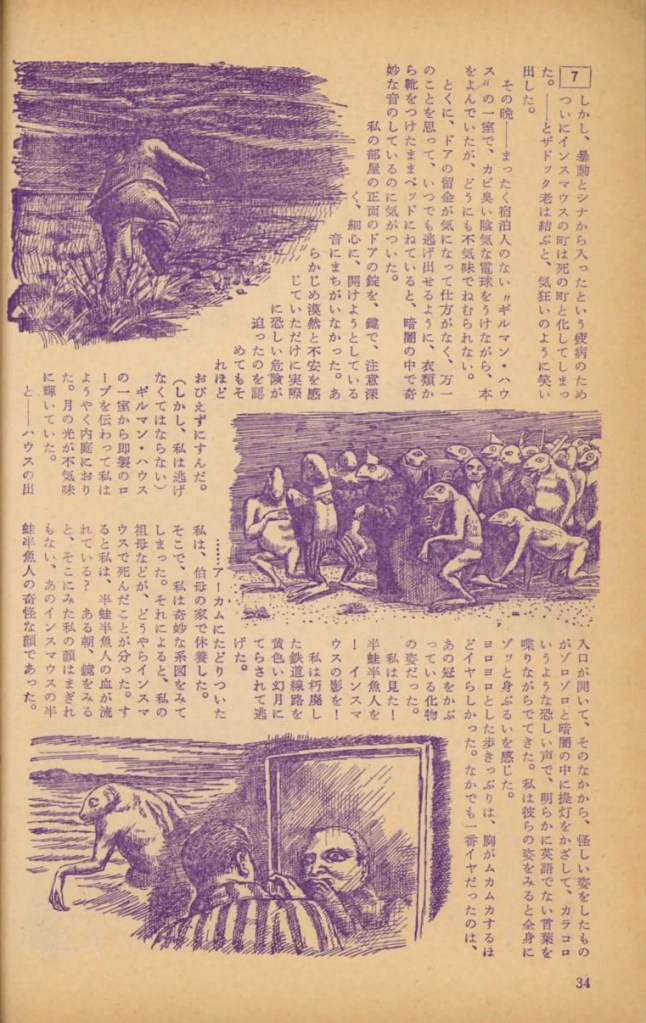
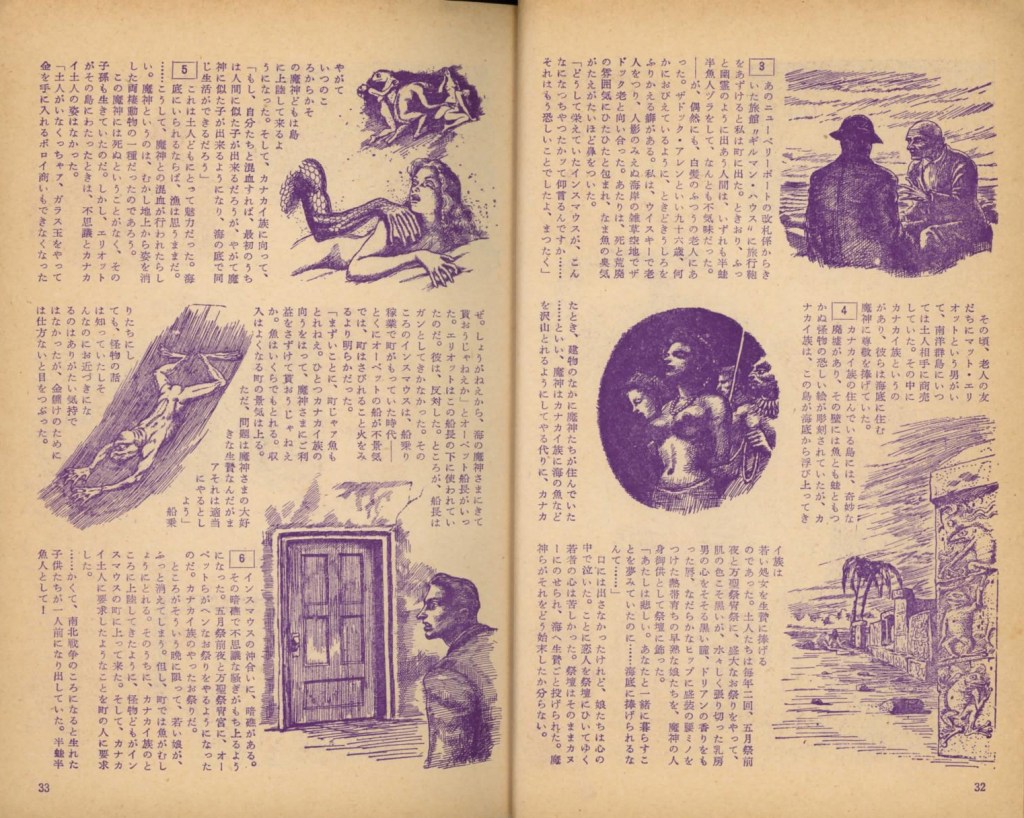
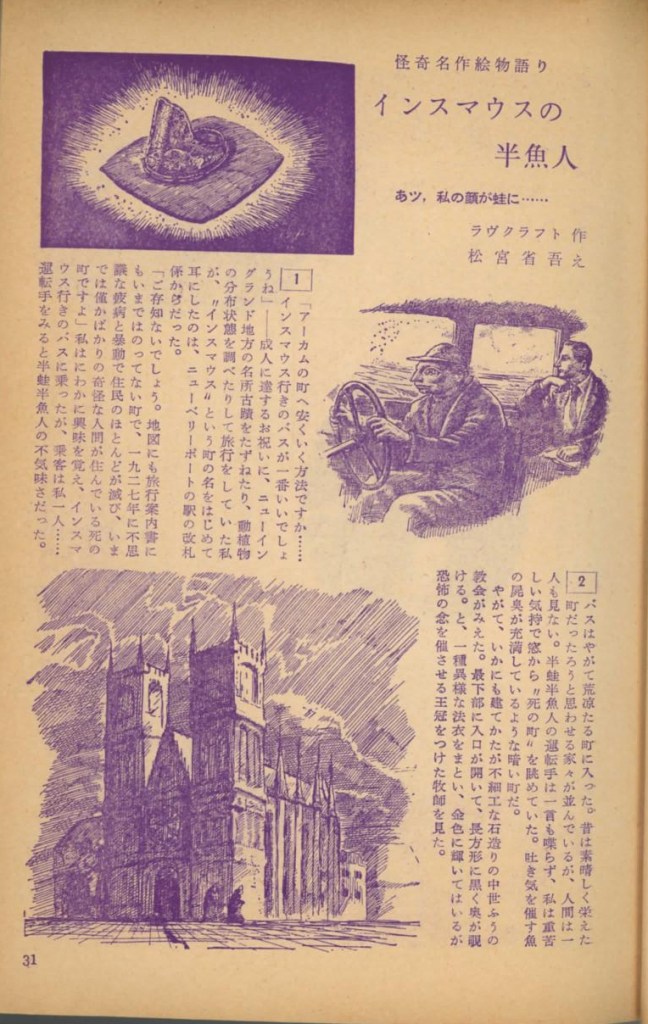
It was entitled The Fishmen of Innsmouth (illustrated by Shōgo Matsumiya) and appeared as part of the feature article, The Greatest Horror Stories from Around the World, Illustrated in issue Three of Ugoku Kao (Moving Face), the “tabloid strictly for men,” originally published as an offshoot of the very popular 1950s erotic entertainment magazine Hyaku-man in no Yoru (One Million Nights of One Million People). The subtitle read “Horrors! My face—it’s become… a frog!” The story featured pictures of half-naked women with such outrageous captions as “The Khanakai tribe made sacrifices of young virgins. THe bosoms of these fast-maturing tropically-raised maidens, with their black skin, breasts like ripe peaches, dark eyes that could seduce any man, lips with scents like durian, and gently curving waists hidden only by grass skirts, were but decorations on the altar: offerings to the Demon God.” The illustrations were fine black-and-white ink pieces that had all the mood of a Western horror novel, and although the FIshmen looked more like frogs, they were certainly grotquese. These drawings were perhaps made more accessible thanks to their being in the similar Vein as the “Lost world” monster stories of Oguri Mushitaro and Kayama Shigeru. It was only a four-page illustrated story, but it is most likely the first ever domestic H.P. Lovecraft visual work. (294)
Dr. Justin Mullis asked if I had a copy; I did not, but was able to procure a copy of Moving Faces, vol. 1, no. 3 (Mar 1959) [うごく顔 第1巻第3号(1959年3月)]. I then asked a friend, Dr. Dierk Guenther in Japan (who helped out before on “Medusa’s Curse” (1995) by Sakura Mizuki (桜 水樹氏)), to translate it into English.
The result is everything that Yonezawa Yoshihiro described in his essay and more. An abbreviated, localized, sexploitation version of Lovecraft’s “The Shadow over Innsmouth” crammed into four pages for a Japanese men’s magazine. Given when and where it was published, the work also reflects something of the language and attitudes of the postwar period in Japan; reader discretion advised. No translator is credited for the original translation/abridgement. Dierk Guenther’s comments on the translation will be marked by dagger symbols (†) and included at the end of the translated text.
※
A famous story of monsters
The Fishmen of Innsmouth
“Ah, my face, it looks like a frog …”
Author: Lovecraft Matsumiya Shōgo/Art [New translation and notes: Dierk Guenther]
(1) “The cheapest way to Arkham town? That would be the bus in the direction of Innsmouth.”
I was celebrating my coming of age with a tour of New England, visiting historic sites as well as researching the distribution patterns of flora and fauna. It was from an agent at the train station of Newburyport that I heard for the first time the name of the town of Innsmouth.
“You seem not to be aware of this. The town can’t be found on maps or tourism brochures. In 1927 the town was hit by a mysterious infectious disease and violent riots that reduced the town’s population. Now the town is dead, and only a few, very peculiar people are living there.”
My interest was immediately raised, and I took the bus to Innsmouth, being the only person on board. The bus driver had uncanny features, looking like half-fish, half-frog.
(2) Soon, the bus arrived in a bleak town. Many houses lined up that were reminders that in earlier times, the town must have been very beautiful and flourishing. Not one single person could be seen. The half frog, half fish bus driver didn’t say one word, and with a gloomy feeling, I looked out of the window at the “town of death”. It was a dark town that felt nauseous with an overall stench of decaying fish.
Soon, an awkwardly constructed stone building, a medieval-style church, could be seen. The entry in the building’s basement was open, revealing a rectangle of blackness inside. And then I saw a priest, who was wrapped in a peculiar vestment. He wore a frightening golden tiara-like crown.
(3) I checked myself in at the hotel Gilman House, of which I had heard from the agent in Newburyport, left my luggage there, and went into town. All the ghost-like people whom I met occasionally, who seemed to come out of nowhere, looked like half-frog, half-fish, and were unsettling. And then, by coincidence, I met a white-haired elderly person. His name was Zadok Allan, and he was 96 years old. He appeared frightened and had the peculiar habit of sometimes looking behind himself.
Luring the old man by offering him whiskey, we went to a part of the beach with no one around and here I spoke with Zadok.
The area was wrapped in an atmosphere of death and destruction and the unbearable stench of raw fish filled the air.
“Can you tell me why the blooming Innsmouth became like this?”
“That was a truly horrible thing.”
Around the time these events unfolded, there was a friend of the old man by the name of Matt Eliot, who on an island chain in the South Pacific traded with the natives living there†. Among these natives was the tribe of the Kanakys, who paid respect to evil gods that lived under the sea.
(4) On the island where the Kanakys lived there was a peculiar ruin. On its wall were engraved terrifying images of fish and frogs and random monstrous creatures. The Kanakys claimed that when the island rose out of the sea, evil gods lived in this building. Thanks to the evil gods, the Kanakys could catch a lot of fish and other creatures from the depths of the sea. In return, the Kanakys offered young virgins as living sacrifice to the evil gods.
The islanders held twice a year a big festival, on the evening before the May Festival and on All Saints’ Day. Young women of dark skin and firm, full breasts stirred the hearts of men like a vaguely ominous bell. Their lips tasted of the aroma of the durian fruit. They were tropical-bred and quick to become passionate. Wearing at their curved hips a ceremonial waist loincloth, they were taken to an altar as a human sacrifice to the dark gods.
Although they did not say “I am sad. Although I dreamt of living together with you. What fate, being given to the depth of the sea,” the young women cried in their hearts.
Especially, the hearts of the young men who led their lovers to the altar were filled with anguish. The altar was set up on a canoe, and together with the sacrificial victims, it was thrown into the sea. How the gods then disposed of the sacrifices I cannot say.
And then at one point, the evil gods came on land. They told the Kanakys: “If you mix your blood with ours, then at first children that resemble humans will be born, but the children will be like the evil gods and can also live in the depths of the sea.”
(5) This appealed to the islanders. They thought if they could live on the sea floor they would be free like the fish, and so began to mate with the evil gods. It is possible that the evil gods were an amphibious species who in old times had vanished from the land. These evil gods were beyond death, and even their descendants continued to live on.
When Elliott arrived on the island, strangely, the Kanakys had vanished. Captain Obed said: “With no natives around, we can’t do any profitable business. Well, as there seems to be no other way, can we attract the evil gods from the sea?”
Elliott served under the captain, and he was opposed to this idea. However, the captain stubbornly refused to listen. In those days, Innsmouth was a town that survived on the seafaring trade. Especially if Obed’s ship (or: business) would hit a slump, it was absolutely obvious that the town would fall into decline.
“To make matters worse, one can’t even catch fish in the town. Look, those Kanakys got their blessings from these evil gods, aren’t they? They could catch fish in unlimited quantities. If we make money, the city’s economy will improve. The problem is what to do about those human sacrifices these evil gods like so much. Well, we can handle this flexibly.”
Even the sailors knew the stories about the monsters, and they were not pleased to get close to such things, but for the sake of money, they shut their eyes to it.
(6) There is a reef off the coast of Innsmouth. And on this reef a weird disturbance occurred. On the eve before the May Festival and on the All Souls’ festival, Obed and his men conducted a strange festival. It was the festival held by the Kanakys. By the way, only on these evenings young women vanished without a trace. However, in the town, fish could be caught in extraordinary quantities. It was around this time that the monsters who had come to the land in the year of the Kanakys appeared in Innsmouth. And they demanded from the townspeople what they had also demanded from the Kanakys. Thus, by the time of the Civil War the children who had been born were beginning to come of age. They were half frog, half fishmen.
(7) But, riots and a plague brought in from China†† turned Innsmouth into a town of death, concluded old man Zadok, laughing like a drooling lunatic†††.
This evening, there was not one single guest in the Gilman House. In my room, which stank of mould, and under the dim, gloomy glow of an electric bulb, I read a book. Due to being beset by an eerie feeling, I couldn’t sleep at all. I couldn’t keep from staring at the door latch, and just in case anything might happen, I slept in my clothes and shoes so that I could easily escape from the room. In the darkness, I heard a strange noise. It was without a doubt the sound of someone opening carefully and with great caution the lock of my room’s front door with a key. Because I had already felt a vague sense of uneasiness beforehand, even while I realized that a terrible danger was approaching, I managed not to be frightened. (Still, I had to get into safety.) Using a quickly made improvised rope, I climbed down from my room in the Gilman House into the inner yard. The moonlight radiated eerily. Then the entry of the house opened, and from the inside appeared gradually strange forms in the darkness, holding up lanterns, speaking in frightening, rattling voices, uttering words that were clearly not English.
Seeing these forms, my whole body shivered. Their staggering gait was so repulsive that it turned my stomach.
The most disgusting one among them was the form of a monster that wore a crown. And then I saw them clearly: The half-frog, half-fishmen! The shadow of Innsmouth! I fled along the decayed railway tracks, bathed in yellow phantom moonlight. When I returned to Arkham I rested at a count’s house. There I saw an eerie pattern. I learned that, seemingly, my grandmother and others had died in Innsmouth. Did this mean that I had half frog, half fishmen blood in my veins? One morning, I looked in the mirror and the face that I saw there was unmistakably the creepy face of an Innsmouth half-frog, half-fishman.
† The original Japanese translator uses doujin, which is an outdated and offensive term for indigenous people.
†† The original translator uses a very derogatory term for China. The text was translated in an era before Japan and China took up diplomatic relations, so the term for China may still have been common in Japan in 1959.
††† The original translator used an extremely offensive term for “mad person” that is nowadays regarded as insulting and dehumanizing.
※
Without attempting to directly translate any of Lovecraft’s prose, the uncredited Japanese translator still tried to present something of Lovecraft’s style in a Japanese context—while waxing eloquent on the young Polynesian women that Lovecraft essentially glossed over in the original. The abridged text is an artifact of both when and where it was published; other stories in the same feature include “The Monkey’s Paw” by W. W. Jacobs, “The Upper Berth” by F. Marion Crawford, and “The Strange Adventure of a Private Secretary” by Algernon Blackwood, so Lovecraft and Innsmouth were in good company, especially considering that neither would be commonly known in Japan.
The illustrations by Shōgo Matsumiya also deserve mention: these are actually very good, equal to or better than most of the pulp illustrations that Lovecraft received in English-language periodicals in the United States, United Kingdom, or Canada during this period. While some are clearly there mainly for titillation, the figure-work is solid for the limited space, and those island ruins are especially evocative.
It is interesting to contrast “The Fishmen of Innsmouth” with another Lovecraft story that appeared in a risque men’s magazine at this time, “The Rats in the Walls” (1956). At a time when English-language periodicals were trying to gently censor Lovecraft, the Japanese periodical that aimed for shock and sensationalism leaned the other way.
Thanks again to Dierk Guenther for the translation and notes.
Imagine yourself in the United States of America, 1965. The children born of the baby boom in World War II are teenagers now. A television in nearly every home. The pulp magazines have been dead for a decade. Garish paperbacks reprint the contents of old Weird Tales. Arkham House celebrates its 26th year of operation—and a long-promised project finally saw fruition. The first volume of the Selected Letters of H. P. Lovecraft was shipped out to connoisseurs of the weird, like you. The kind of project normally reserved for much more important and successful authors. It was, though few understood it at the time, the birth of Lovecraft scholarship. Readers could finally learn something more about Lovecraft’s life, in his own words. One passage might have raised a moment of interest:
But one thing Mme. Greene says quite desolates me—she avers that her fair and frivolous offspring is not to be captivated by the charms of any highbrow, not even the otherwise irresistible Bolingbroke! —H. P. Lovecraft to Rheinhart Kleiner, 30 Aug 1921, Selected Letters 1.149
Thirty-one pages later, you would have found out her name:
At dinner—about one-thirty—were Loveman, Theobald, Long, Mme. Greene, and the latter’s flapper offspring, yclept Florence—pert, spoiled, and ultra-independent infant rather more hard-boiled of visage than her benignant mater. —H. P. Lovecraft to Maurice W. Moe, 18 May 1922, Selected Letters 1.180
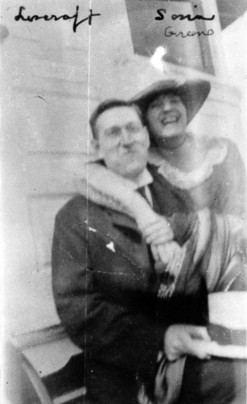
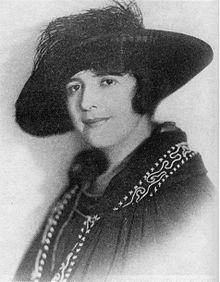
That would, very likely, be the last that you would have read about Florence Carol Greene (19 Mar 1903 – 31 Mar 1979), the daughter of Sonia H. Greene, for another decade. She does not appear in Lovecraft’s Selected Letters again, not even after Howard and Sonia married. L. Sprague de Camp in Lovecraft: A Biography (1975), describes her as the sole surviving child of Sonia’s first marriage; Frank Belknap Long in Howard Phillips Lovecraft—Dreamer on the Nightside (1975) gives a little anecdote from when they met:
Sonia’s daughter was very pretty, with freckles that met across the bridge of her nose, and blonde hair and a waist so slim it seemed a little unreal. Unfortunately she was soon to leave New York, to be with a young man to whom she had recently become engaged. (50)
Sonia herself was reticent in writing about her daughter; her memoir of her marriage with Lovecraft barely mentioned the child, never the woman she became. In part, this is understandable: by the time Sonia and Howard married in 1924, Florence was apparently out of the house, living on her own, and she and her mother had some fundamental break that never really mended. Astute readers would have realized that H. P. Lovecraft had, at least technically, a step-daughter from his brief marriage—but who was she?
Readers never really get an idea of how much material from Sonia that Everts had; whether those represent all he had gathered and was willing to share, or if there was more unpublished, possibly because it was of little interest outside a specialized circle of Lovecraft fans and scholars.
That specialized circle had a name: the Esoteric Order of Dagon Amateur Press Association. Modeled on the same amateur press associations that Lovecraft had been a member of, the EOD was (and as of this writing, still is) an organization where a select group of Lovecraftian fans and scholars connect and share their latest writings, discoveries, and analyses through periodic zines. Everts was a member for a long time, and while he is best known to fans through the works he published through The Strange Company and articles that were published in commercially-available magazines, the zines he put together for EOD are an often fascinating look at what was the bleeding edge of Lovecraftian research.
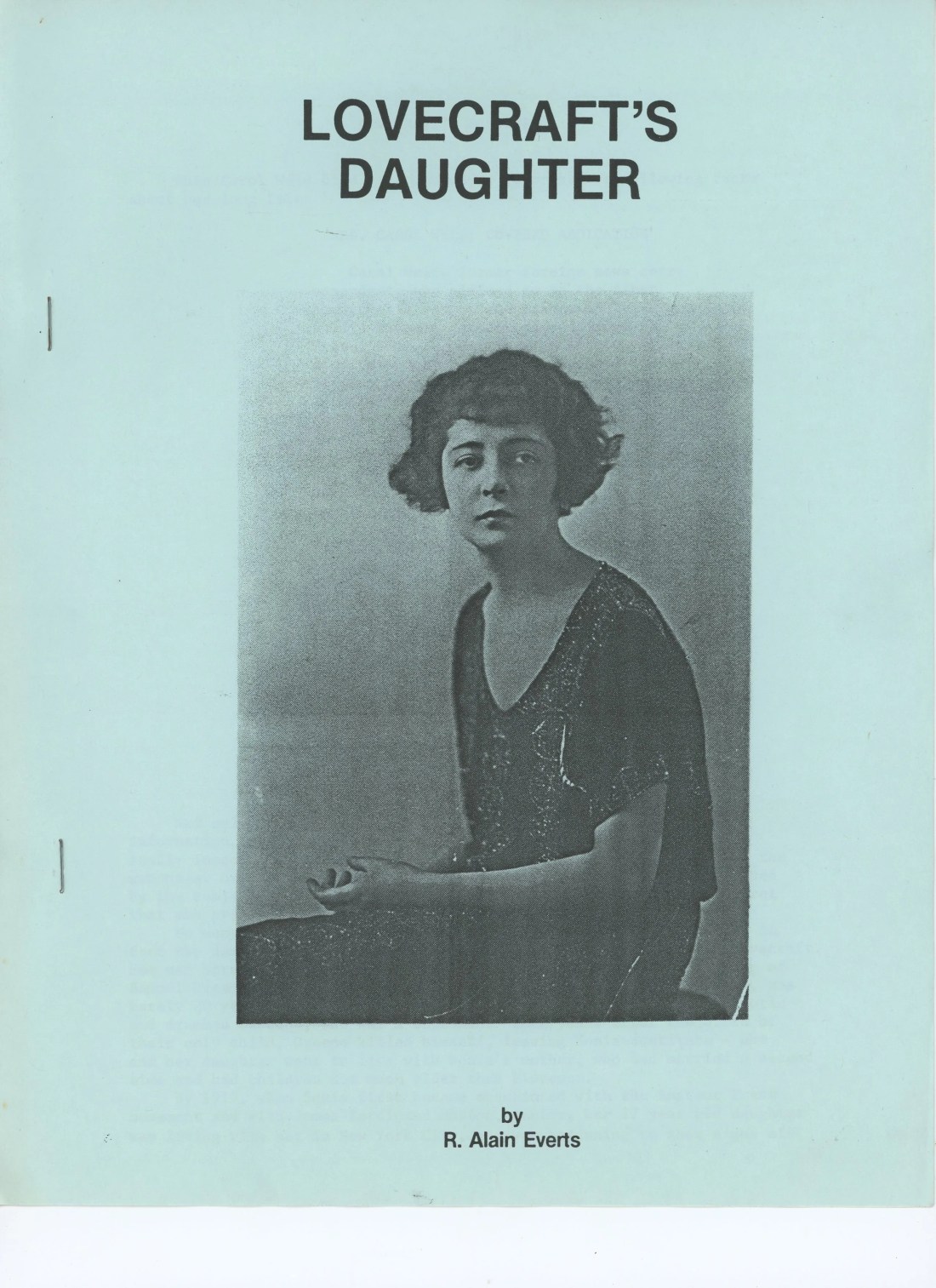
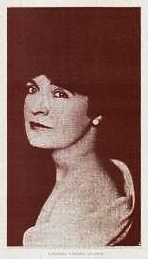
In 1983, Everts issued three thin stapled pamphlets titled Lovecraft’s Daughter, Lovecraft’s Daughter II, and Lovecraft’s Daughter III as part of his contributions to the EOD mailings, summarizing and synthesizing his research on Florence Carol Greene—better known in her adult and professional life as Carol Weld. These pamphlets were never collected, never reprinted, never made available to the wider public, except when a member of the EOD sold part of their collection or died, and their heirs offered it for sale. They are hen’s teeth, and it is difficult to assess their impact. Certainly, later biographies of Lovecraft like S. T. Joshi’s I Am Providence have a bit more to say about her, but her connection to Lovecraft is so tangential and tenuous that tracing her life may seem a digression.
Monica Wasserman, who edited Sonia’s autobiography Two Hearts That Beat As One (2024), doesn’t think so. In her own page on Florence Carol Greene, Wasserman correlated the contents. The only child of immigrant parents in the U.S.; her father out of the picture, her mother raising Florence by herself as a single mother, with the aid of her own mother (who was busy raising two half-siblings). Florence was intelligent, probably feisty, likely stubborn, and independent. What she thought of Lovecraft or her mother’s remarriage is unknown, but Florence’s relationship with her nominal stepfather appears to have been nonexistent.
Everts’ pamphlet Lovecraft’s Daughter is relatively accurate on the biographical details, and some of his information came directly from Sonia:
Sonia recalled to me various dinners at her apartment with both Lovecraft and Samuel Loveman present, where she and Florence would host them for an evening of food and conversation. On some occasions, Sonia and Florence would disagree so strongly that they would fight in front of their guests.
The break between mother and daughter was apparently total. Everts noted that:
When I wrote on Sonia’s behalf in 1967 to Carold Weld (as she then styled herself), the letter was returned to me, opened, with a handwritten message that the envelope had been opened by mistake. I will never forget Sonia’s expression when I showed her this enveloped, and she replied sadly that the handwriting was Florence’s.
There are many reasons why adult children might go “no contact” with their parents, and we don’t have Carol Weld’s side of the story. We only indirectly have Sonia’s through a few writings and Everts’ account in Lovecraft’s Daughter. Unfortunately, the latter is responsible for at least one rumor that has proven hard to kill:
Some years earlier, I believe Sonia mentioned to me that Florence was about 18, she had fallen in love with a nice man with background credentials of impeccable quality – they should have been, for the man was Sonia’s half-brother, by her mother’s second marriage.
Monica Wasserman noted that this was probably a point of confusion, as Sonia’s half-brother Sydney married a young woman named Florence Stone in 1923, and Everts may have easily mistaken one Florence for another, especially with Long’s comment about an engagement, which may have hinted that her daughter was intending to marry, either to someone Sonia didn’t approve of or simply to escape her mother’s household. Whatever the truth, Florence Carol Greene would marry John Weld in 1927, and thereafter be known as Carol Weld.
Today, Lovecraft’s Daughter and its sequels, rare and obscure, aren’t of much interest for its raw information on Carol Weld. Digital genealogical records, newspaper archives, and the collections of the mother and daughter’s papers in their respective archives give access to more information than Everts had access to in 1983. Its interest lies in its expression of Everts’ continued use of his time with Sonia, how he found ways to express that information to an audience of Lovecraftian fans and scholars. This is how information got promulgated before the dawn of the internet, and this is also how rumors start.
Which is why it is important not to rely exclusively on these old fanzines, but to try and view them in their appropriate historical context, and with a critical eye toward not only their sources for information, but how they are synthesizing that information and presenting it to others. Historical data is valuable, but it must also be re-assessed, especially when new information becomes available. Lovecraft’s Daughter was a step on the path of gaining greater insight into who Carol Weld was, and how her story and Lovecraft’s connected; it is an essential part in understanding Sonia’s life and the realities she faced as a single mother in New York. That it has been superseded by later sources isn’t a surprise or a detraction.
Or had Lovecraft been casting sheep’s eyes upon some young woman whom he lacked the nerve to approach openly? Could it have been his fellow-amateur and ghosting client Winifred Virginia Jackson, with whom he had quite—for him—a close friendship? —L. Sprague de Camp, H. P. Lovecraft: A Biography (1975) 123
In 1943, Arkham House published Beyond the Wall of Sleep, the second collection of Lovecraft’s fiction. It was the first book publication of “The Crawling Chaos” (1921) and “The Green Meadow” (1927), two stories co-written by H. P. Lovecraft and Winifred V. Jackson—there credited as “Elizabeth Berkeley.” Fans deciphered the pseudonym; George T. Wetzel correctly identified Winifred Virginia Jackson as one of Lovecraft’s collaborators in The Lovecraft Collector’s Library, vol. VII(1955). Details about Lovecraft’s collaborators, however, were thin on the ground. Aside from a few references in the first volumes of Lovecraft’s Selected Letters and a brief bit of speculation by de Camp, there was nothing available on their relationship or the stories they wrote together.
In 1976, you had to be an exceptional Lovecraft fan to know much about Winifred Virginia Jackson.
R. Alain Everts and George T. Wetzel were two exceptional Lovecraft fans. Everts had interviewed many surviving friends and associates of Lovecraft, including developing a friendship with the former Mrs. Lovecraft, Sonia H. Davis, and written such essays as “Mrs. Howard Phillips Lovecraft” (1973) and “Howard Phillips Lovecraft and Sex” (1974). In the process, Everts had also alienated many people (see The Curse of Cthulhu [PDF]). Wetzel likewise distinguished himself as a fan-scholar and publisher; the seven volumes of his Lovecraft Collector’s Library were a starting point, collecting many of Lovecraft’s early amateur writings and writings about Lovecraft (which Everts would later publish the collected edition through his imprint The Strange Company in 1979), along with several other articles and miscellaneous publications. Wetzel was also considered a bigot by fellow fans, and accused of writing poison pen letters (“In Memoriam: George Wetzel” in Ibid 45 [PDF]).
Winifred Virginia Jackson—Lovecraft’s Lost Romance (1976) combined Everts’ and Wetzel’s respective skills, interests, and prejudices. Counting the covers, it is a small 8.5″ x 11″ stapled pamphlet of 11 sheets (which technically makes 18 pages, although some of those are blank), which includes a mix of biographical essay, black-and-white reproductions of photographs, and photostatic copies of some of Jackson’s poetry from amateur journals. A fairly typical fan-product of the period, a touch more scholarly and influential than most, if only because information on Jackson would remain scarce for decades, until the greater availability of digital records and the digitization of books, newspapers, and ‘zines made it possible to obtain greater information and accuracy about her life…with some caveats.
To give an idea of what this means, here is a quick sketch of WVJ’s life based on readily available documents just on ancestry.com:
14 Aug 1913, marriage to Horace Wheeler Jordan in Boston, MA. (Massachusetts marriage records) [Presumably divorced between 1910 and 1913]
1920, living with her mother in Boston, now single but still listed as Winifred Jordan, working as a stenographer in a law office (1920 Federal Census)
1930, living with her mother in Boston, occupation listed as writer/book writer (1930 Federal Census)
1950, living with Eugene Holmes in Boston, marital status “widowed” (1950 Federal Census)
20 Apr 1959, death of Winifred Virginia Jackson (obituary)
While this seems like a lot of specific information, there’s a lot that isn’t shown here: where she went to school and college; her career in amateur journalism; the books she wrote, edited, and published; her work as co-founder and then owner of the B. J. Brimmer Company with William Stanley Braithwaite; etc. The records we do have are rife with inaccuracies: the 1880 Federal Census lists her as “son” rather than daughter; the ages given in later census records are always incorrect, which led one researcher, Charles Trombee, to conclude she habitually lied about her age (Lovecraft Collaborator–Winifred Virginia Jackson), and even Ancestry.com and Findagrave disagree on her exact birth date. Certain records are missing, possibly lost or never digitized—so we know she divorced her husbands, but don’t necessarily know when exactly.
So keep that in mind: Everts and Wetzel were working with incomplete data. While reporting what they had discovered, not all of what they report would be accurate, and not all of their speculations would be accurate either. Even today, a biographer would have a lot of work to do to fill in the gaps of Winifred Virginia Jackson’s life.
Some of what was reported was, frankly, gossip. For example, the idea that Lovecraft and WVJ shared any romantic interest arises from Wetzel’s correspondence with amateur journalist Willametta Keffer:
Mrs. Keffer wrote to Wetzel on 23 January 1956 stating that everybody in Amateur Journalism thought Lovecraft would marry Winifred Jordan. She added: “Now don’t you go encoraching on my territory here, this is an aspect that hasn’t been touched and I’m working it up […] A long time member of NAPA who knew and met both HPL and Winifred Virginia told me of the ‘romance’.”
Writing to Wetzel again, twenty years later:
She also added that Mrs. Jordan was “supposed to have had a torrid affair with an editor and I found some substantiation in a Year Book of the Bibliotheque Society of Boston.”
Taking this gossip as gospel, and combined with less-than-complete biographical information, Everts and Wetzel made a couple of deductive leaps which, in hindsight, are unfortunate:
Her marriage was brief and ended in divorce about early 1919. Her husband Horace Jordan was a Negro – in fact Winifred Virginia Jackson had always been a champion of the Negro – today at least one of her descendants is also married to a Black. By the time she had met Lovecraft, her marriage was over and she was the msitress of the celebrated Negro author William Stanley Braithwaite. His marriage prevented him from marrying Winifred, but for ma[n]y years she remained his mistress. However, this affair did not prevent Winifred Jackson from becoming very attracted to the single HPL. […] It is doubtful if Lovecraft himself knw of her former husband and her liaison (although Lovecraft did enjoy gossip) with Braithwiate [sic], – but even if he had he might not have cared anyway. […] What is known as fact is that many older Ajays have told Everts that they were surprised that Lovecraft had not married Winifred Jackson. It is a fact that Lovecraft took a snapshot of Winifred Jackson at the seaside, and it is known that she and HPL were romantically linked by the 1921 Boston National Amateur Press Ass[o]ciation convention. In the words of Sonia Lovecraft to Everts in 1967, “I stole HPL away from Winifred Jackson.”
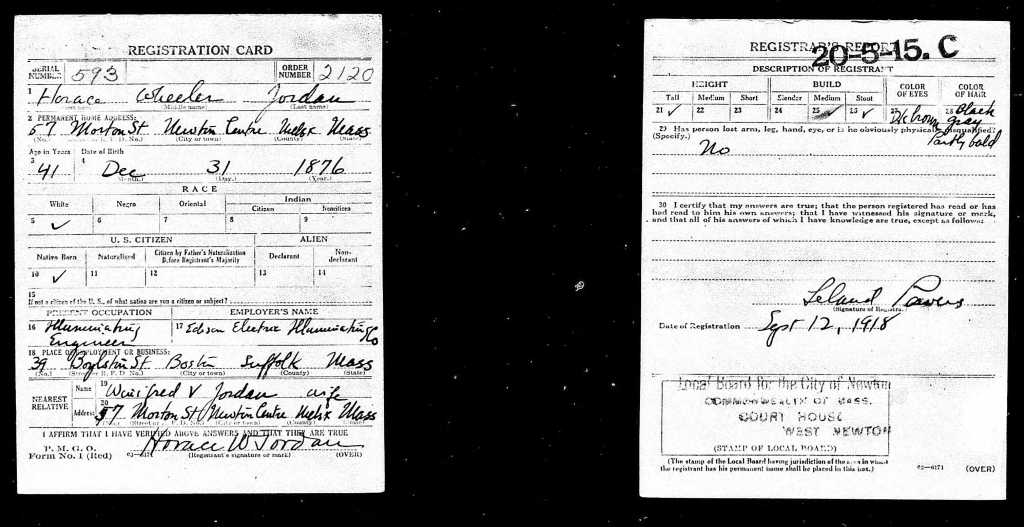
There is a lot to unpack there. Let’s start at the beginning: Horace Wheeler Jordan was, according to census records and his WWI draft card, white:
Was Winifred Virginia Jackson a champion of Black rights and culture, despite being white? Probably. Trombee notes that she had poems published in The Brownie Book (aimed at Black children) and The Crisis, a Black literary magazine, and was mistakenly listed among Black poets in Colored girls and boys’ inspiring United States history, and a heart to heart talk about white folks (1921) by William Henry Harrison, Jr. and Negro Poets and their Poems(1923) by Robert Thomas Kerlin. Winifred Virginia Jackson co-founded the B. J. Brimmer Company with mixed-race poet, author, and editor William Stanley Braithwaite, which company published various works by Black authors, including Sidelights on Negro Soldiers (1923) by Charles H. Williams. She does not appear to have had any children, so it’s not clear who her “descendants” were in this specific case; probably the children of her surviving cousins.
The accusation that Winifred Virginia Jackson carried out an extramarital affair with William Stanley Braithwaite is, so far as I have been able to determine, unsubstantiated. If Wetzel is to be trusted, the rumor began in amateur journalism, but it first hit print with Winifred Virginia Jackson—Lovecraft’s Lost Romance. No private letter from Jackson or Braithwaite has emerged that hints at any kind of sexual relationship between the two (although given that Braithwaite was married and that interracial relationships were taboo in the 1920s, this may not be so unusual). Scholarly works like The William Stanley Braithwaite Reader (1972) make no mention of such an affair, nor was it mentioned in any of Braithwaite’s autobiographical essays (although again, this isn’t surprising).
Of their friendship (and Braithwaite’s admiration of Jackson as a poet) we can be fairly certain. Braithwaite’s Anthology of Magazine Verse for 1921 devotes a chunk of space to Jackson; Braithwaite wrote an introduction to her book Backroads: Maine Narratives—with Lyrics (1922); and in the Twentieth Anniversary Number (1921 annual of the Bibliophile Society in Boston), Braithwaite wrote an introduction, “The Poetry of Winifred Virginia Jackson,” to give three examples. Perhaps it was the latter that Keffer was thinking of when she said the “Year Book of the Bibliotheque Society of Boston,” since the Bibliophile Society of Boston did issue an annual, often titled a Year Book. Yet there is nothing in that introduction the least scandalous or suggestive of a romantic or sexual relationship. Nor did Keffer ever produce the tell-all article she hoped to.
Everts’ comment on “stealing” Lovecraft from Jackson is more interesting; as discussed in “Howard Phillips Lovecraft and Sex” (1974) by R. A. Everts, we don’t have any way to really prove or disprove this, as Everts is reporting a private communication that was is only ever published here and nowhere else. We are dependent on his memory and his trustworthiness as a source. Still, the idea that the bachelor Lovecraft might be hypothetically paired with various single women in amateur journalism, especially those he worked closely with, such as Jackson, isn’t far-fetched. After all, when Lovecraft did eventually marry, it was to an eligible single woman in amateur journalism with whom he worked closely, Sonia H. Greene.
There is a little more in Winifred Virginia Jackson—Lovecraft’s Lost Romance, such as a reproduction of the photo Lovecraft took of Jackson, but not much else of real consequence. Everts and Wetzel based their idea of a romance (real, potential, or imagined) on the 30-40-year-old memories of gossiping amateur journalists. Some of the facts about Winifred Virginia Jackson they got right, others wrong; the sources being what they are, this isn’t surprising or even a substantial criticism. Mistakes happen all the time in genealogical and biographical research, and the misidentification of a single individual in an error-filled record can lead even the most well-meaning researcher off into a chain of fantasy. The affair with Braithwaite remains unproven, though perhaps some love letter will surface one day to give it substance. The uncritical repetition of the claim decade after decade shows the dangers that can come from relying on a single unreliable source.
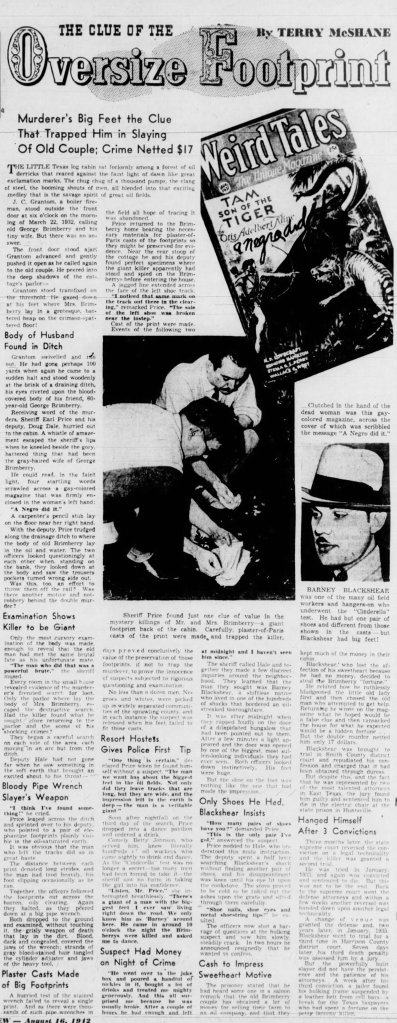
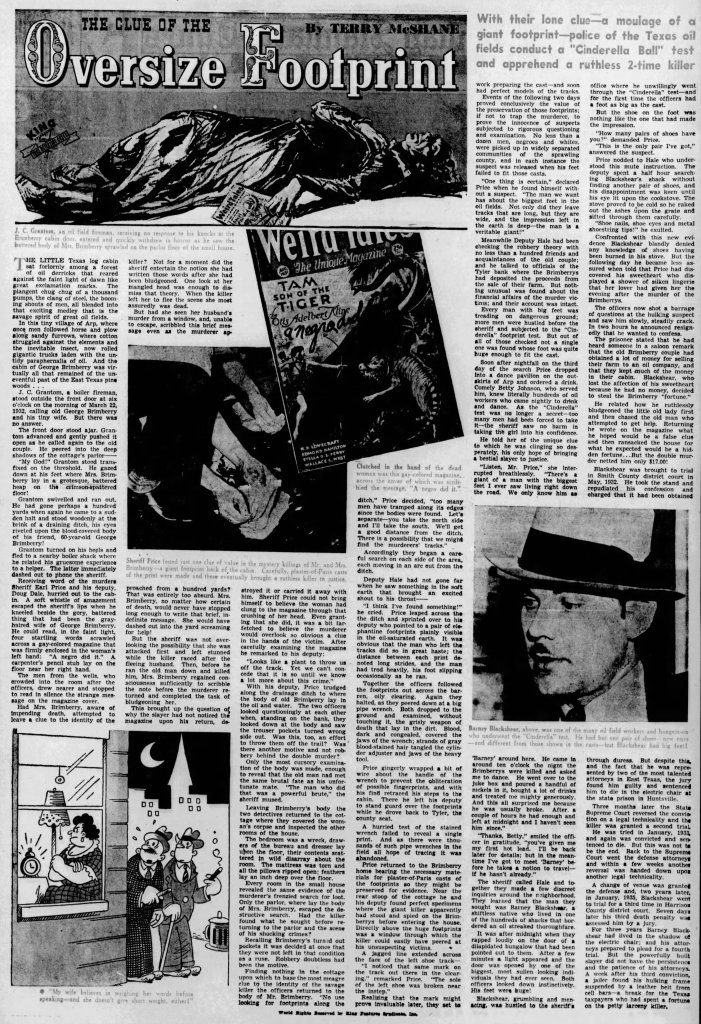
He could read, in the faint light, four startling words scrawled across a gay-colored magazine that was firmly enclosed in the woman’s left hand:
“A Negro did it.”
A carpenter’s pencil stub lay on the floor near her right hand.
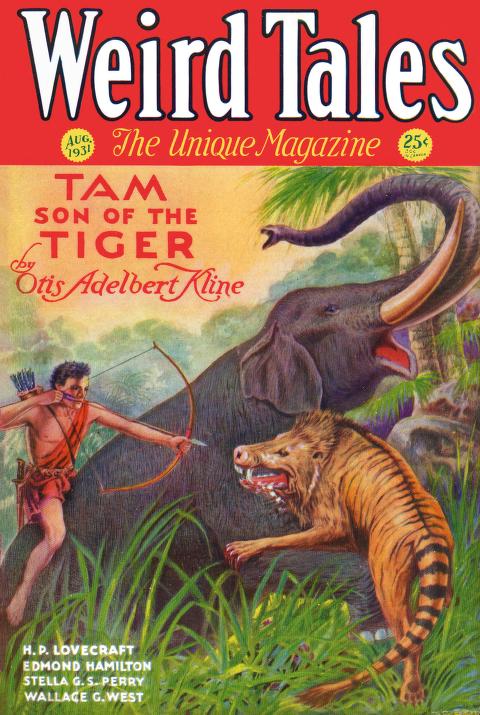
The magazine in question appeared to be a copy of Weird Tales Aug 1931. An issue that happened to include H. P. Lovecraft’s “The Whisperer in Darkness.”
However, digging into the history of the case reveals what McShane got right—and wrong—about this case, right down to the pulp magazine in question.
In digging into the case, the major sources available are newspaper archives, a few legal decisions from the case’s appeals that remain available, and a scattering of supporting documents. Not all of the newspaper articles are reliable, often giving inaccurate names and ages, especially the earliest accounts when few facts of the case were known. However, without access to the trial transcript (which may well not have been retained, it being over 90 years since the case was tried), these are what we have to go by.
The first reports came in on 22 March 1932, about a murder that had occurred in the small town of Arp, Texas the night before:
J. L. Grantom, employed as a fireman by the Zion Oil company at an oil well across from the Brimberry shack, went to the two room house at 10:45 and found Mrs. Brimberry’s body. He called Deputy Sheriff Jim Bradford of Alp and together they discovered Brimberry’s body in a ditch about 60 feet from the house. His knuckles were bruised as though he had fought his assailant.
It was believed Brimberry was killed first and his money wallet looted, then the assailant went into the house and killed the woman. A blood covered flatiron was found near her body. She clutched a small pencil in her hand and on a nearby magazine had scrawled “Negro killed me.” Her purse was lying open on the floor, empty. —”Man and Wife are Murdered with Flatiron,” The Orange Leader, 22 Mar 1932 (1)
The victims were George Thomas Brimberry (18 Apr 1867 – 21 Mar 1932) and his wife Ethel Viola Brimberry (May 1877 – 21 Mar 1932). Newspaper accounts often depict the couple as elderly and German when they were closer to middle-aged; the latter possibly a mistake stemming from the fact that his father was born in Georgia. George Brimberry is described as a well-digger, and this occupation appears on his entry in the 1930 Federal Census. According to contemporary accounts, Viola Brimberry also took in laundry to supplement their income. Deputy Sheriff Jim Bradford of Arp was apparently the first responder. Neighbors and relatives were questioned:
The pair had been married about seven or eight years, the relatives reported. It was the second marriage for both. They had been living near Arp for the last year and the man had been digging wells and the woman taking in laundry for a living.
Possibility that robbery might have been the motive was advanced by neighbors. They said the old man joked about his wife saving money. He was a cheerful person, neighbors averred. —”Bury Slaying,” Tyler (TX) Morning Telegraph, 24 Mar 1932 (2)
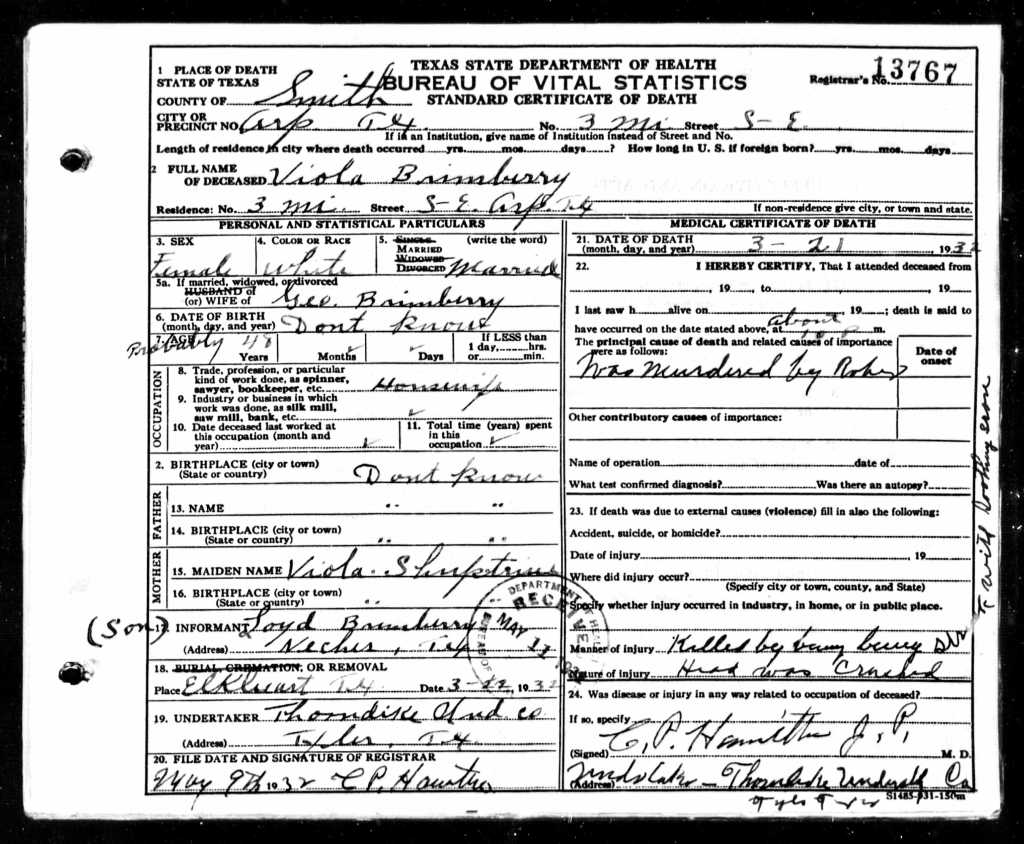
The death certificate for Viola Brimberry reads simply “was murdered by robber.”
The woman’s wounds were so horrible that officers believed the note was false, being an attempt to mislead investigators. —”Well Digger And Wife Beaten To Death Near Arp,” The Kilgore (TX) News Herald, 22 Mar 1932 (1)
Other officers involved include Constable W. B. Webb (Arp), Deputy Sheriff H. R. Turner (Tyler), and Deputy Sheriff Doug Hale (Tyler). Later sources include Sheriff Earl Price (Tyler), but at the time of the initial murder investigation the sheriff was Tom C. Sikes; Price defeated him in the March 1932 primary, and won the following election, but did not take office until January 1933.
The note on the magazine was a salacious detail that was widely reported, even as the police investigating the murders took it as a red herring. It was not long before the police had a suspect in custody.
The man was arrested late yesterday near the scene of the slaying. Officers said they found a pair of blood-stained trousers, which the suspect admitted he was wearing Monday night. The man’s shoes fitted the tracks leading from the Brimberry cabin, they stated. The clothes were turned over to chemists for a comparison of the blood on them with that of the victims. —”Man Arrested In Connection Double Murder,” Corsicana (TX) Daily Sun, 23 Mar 1932 (2)
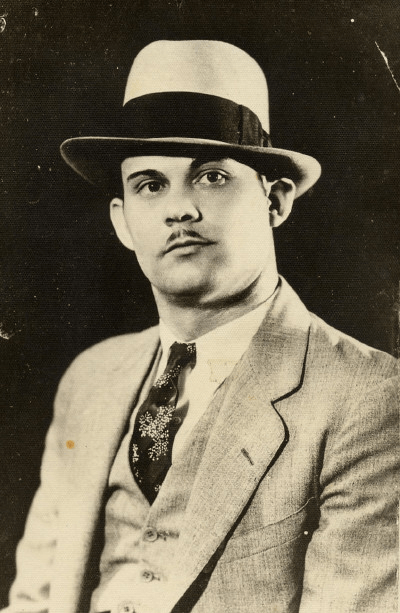
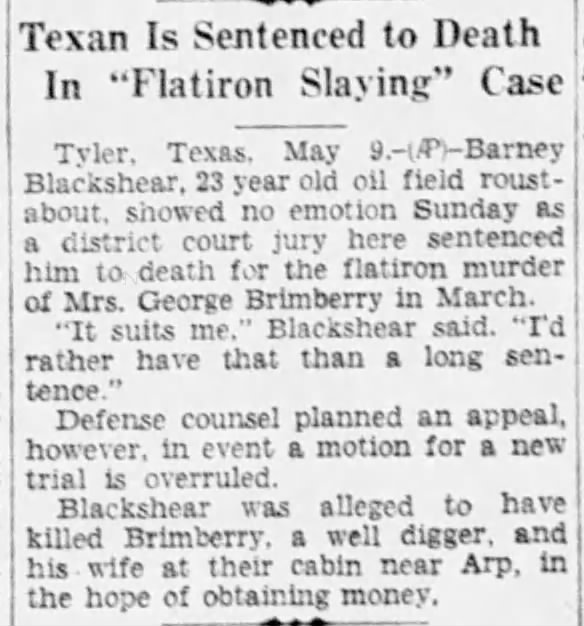
The suspect was Barney Bascum Blackshear (8 Dec 1908 – 19 Nov 1936); the 1930 Federal census gives his occupation as “laborer,” and the newspapers routinely referred to him as an oil field “roustabout,” or itinerant worker. Blackshear had been in the Arp vicinity for about a week. (“Bury Slaying,” Tyler (TX) Morning Telegraph, 24 Mar 1932 (2))
There were no witnesses to the murders; and the newspaper accounts offer few details of the circumstances, e.g.:
A keg, partly filled with beer, was found in the cabin, and glasses showing traces of beer were found, leaving investigators to believe the killer had visited the couple and had been given beer. —”Killer Ues Flat Iron to Slay Couple Near Arp,” The Tyler (TX) Journal, 25 Mar 1932 (5)
Evidence against Blackshear was apparently circumstantial. McShane mentions plaster casts of footprints, with Blackshear the only man who, Cinderella-like, had feet big enough to fit the tracks. Contemporary newspaper articles mention little else in the way of physical evidence:
Another important development of the day was a discovery of a heavy oil well wrench buried in the field and on a line with the tracks which were discovered there. The heavy tool was clotted with blood and grey hair, leading deputies to the conclusion that it was the weapon used to fell Brimberry. —”Oil Field Worker of Arp Held in Connection with Brutal Murder There Monday,” The Kilgore (TX) Daily News Herald, 23 Mar 1932 (1)
Meanwhile, questioning of Barney Blackshear, 23, charged with the killing here Wednesday in D. Y. Gaiens’ justice court, had started, according to Deputy Sheriff H. R. Turner, who is heading the invesitgation. Blackshear is in jail without bond. he has denied any connection with the case.
Blackshear was arrested within half a mile of the murder scene late Tuesday by deputy sheriffs from Tyler. A stained pair of trousers, a blodo smeared oil field wrench and flat iron, a pair of badly worn shoes and clothing from the two victims are being held as evidence in the case.
Efforts to gather finger prints from the articles in the curde two room hut where the pair lived were fruitless.
No one, not even relatives of the Brimberrys, has been permitted to view the prisoner in jail here. Efforts of newspaperman to obtain an interview have been unsuccessful. —”Bury Slaying Victims Today; Quiz Suspect,” Tyler (TX) Morning Telegraph, 24 Mar 1932 (1)
Tyler, TX is the county seat of Smith County, where Arp is, and the location of the courthouse. In hindsight, the isolation of Blackshear seems suspect. It was only about six days after his arrest that Blackshear made a written confession to the murders:
The lengthy statement which Blackshear made and signed yesterday before District Attorney Goens, County Attorney Gentry and Deputies Turner and Bradford recounted, Blackshear’s activities in recent months and up to the time of his arrest. —”Suspect Tells Story,” Tyler (TX) Morning Telegraph, 29 Mar 1932 (1)
[…] he was in need of funds by reason of unemployment and that he spent Monday with his brother and sister-in-law. After having leaving his relatives the statement declared he went to a negro church a hundred yards north of the Brimberry cabin. There he waited until nightfall and then called on the Brimberrys.
After leaving the Brimberry cabin Blackshear was said to have gone to a Cafe at Arp where he ate a heavy meal, danced and played the piano. Afterwards he went to his brother’s house at Lewiston and spent the night, he was quoted as having said.
Tuesday morning, the statement continued in susbtance, Blackshear and his brother drove to the Brimberry cabin and joined the curious crowd milling around there. They stayed there only a few minutes, Blackshear said. —”Suspect Tells,” Tyler (TX) Morning Telegraph, 29 Mar 1932 (2)
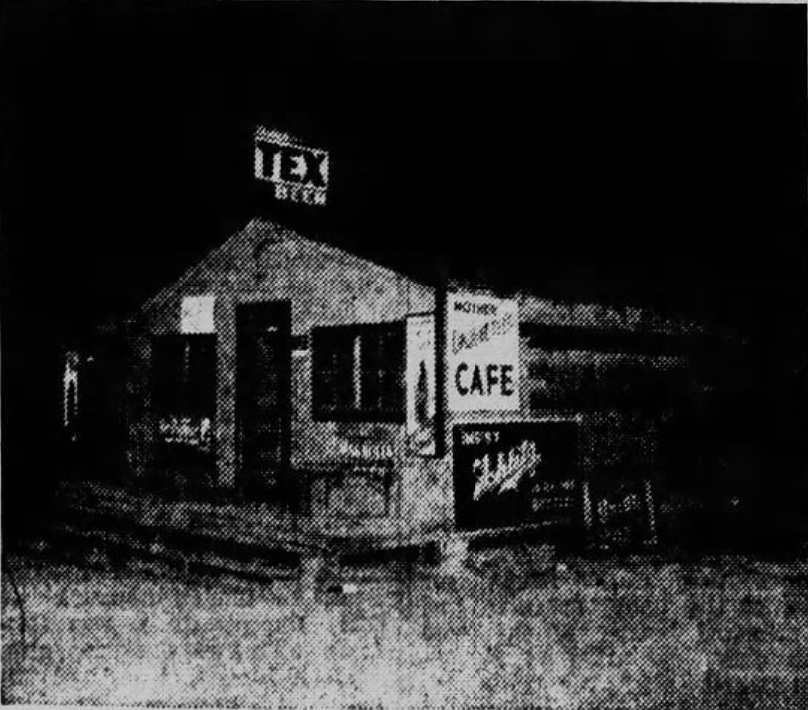
The “Cafe” was the Ironhead Cafe, a local eatery that was also a speakeasy (this was still during Prohibition). There are a couple of paraphrases of the confession in the papers, not all of which jive exactly with each other, so without the actual written confession, take these as approximate. For example:
In his confession, Blackshear said that he waited near the Brimberry cabin until dark, and then went to the house. On the way there, he picked up an oil well wrencha nd hit it near the door. Later he lured Brimberry outside on the pretext of giving him a drink of liquor. When they passed the spot where the wrench was hidden, he said he picked it up and hit his victim in the forehead. He fell without making a sound, Blackshear said.
He then returned to the cabin where he found Mrs. Brimberry finishing her evening meal. As he went in, he related, he picked up a smoothing iron from the stove and struck her in the back of the head. She fell, the confession continued, and he struck a second blow. —”Man Admits Killing East Texas Couple,” The Houston (TX) Chronicle, 29 Mar 1932 (1)
Blackshear would contend that the confession was forced:
Deputy Sheriffs Jim Bradford and H. R. Turner; Day Jailor Charlie Gabriel and Night Jailor Charlie Gabriel, Jr., were questioned at length regarding the confinement of Blackshear in a dark cell and the conversation between the prisoner and officers before the statement was made. […] Jailor Gabriel admitted that Blackshear had been confined in the dark cell for six days because officers had instructed him to keep the prisoner away from other prisoners and that the solitary confinement cell was the only one which was available. Gabreil [sic] said that he fed Blackshear regularly and answered every call he made. He testified that the same bedding and food were served him as other prisoners. […] Deputy Turner denied emphatically that Blackshear was coerced into making his statement and said that he had promised him nothing. he inferred that the statement was made after a three hours’ talk in which Blackshear had been told what evidence had been collected. —”Sensational,” Tyler (Texas) Morning Telepgraph, 7 May 1932 (2)
As the attorneys prepared to present this evidence to the Grand Jury, they attempted to bolster it by tying the note on the magazine to Blackshear:
Considered as probably the most important clue is the bit of writing on a magazine which was found in the dead woman’s hand. It said: “A negro killed me.” The magazine and a specimen of Blackshear’s handwriting have been sent to experts in Dallas to determine if they were written by the same hand. —”Suspect Tells,” Tyler (TX) Morning Telegraph, 29 Mar 1932 (2)
The state’s handwriting expert would later testify that it was Blackshear’s handwriting on the magazine:
W. A. Weaver, Dallas, an expert in handwriting, testified he had examined the writing on the magazine, Blackshear’s signature to the statement given officers, and that of a poem entitled “Twenty-One Years,” written by Blackshear, and they were all the handwriting of the same person. Defense counsel objections prevented Weaver from illustrating on a blackboard how he arrived at his conclusions. —”Sensational,” Tyler (Texas) Morning Telepgraph, 7 May 1932 (2), cf. “Jury Weighs Arp Slaying,” The Times (Shreveport, LA), 8 May 1932 (5)
The prosecutor also called as witness one of Viola’s sons, who testified:
E. L. Denman, son of Mrs. Brimberry by a former marriage, testified that the words, “negro kill me,” scrawled in his mother’s hand were not in the handwriting of his mother. Efforts of the defense in cross-examination to bring from in information concerning whether the Brimberrys lived happily were blocked by objections by the state. —”Sensational,” Tyler (Texas) Morning Telepgraph, 7 May 1932 (2), cf. “Blackshear,” Tyler (TX) Morning Telegraph, 15 Dec 1933 (8)
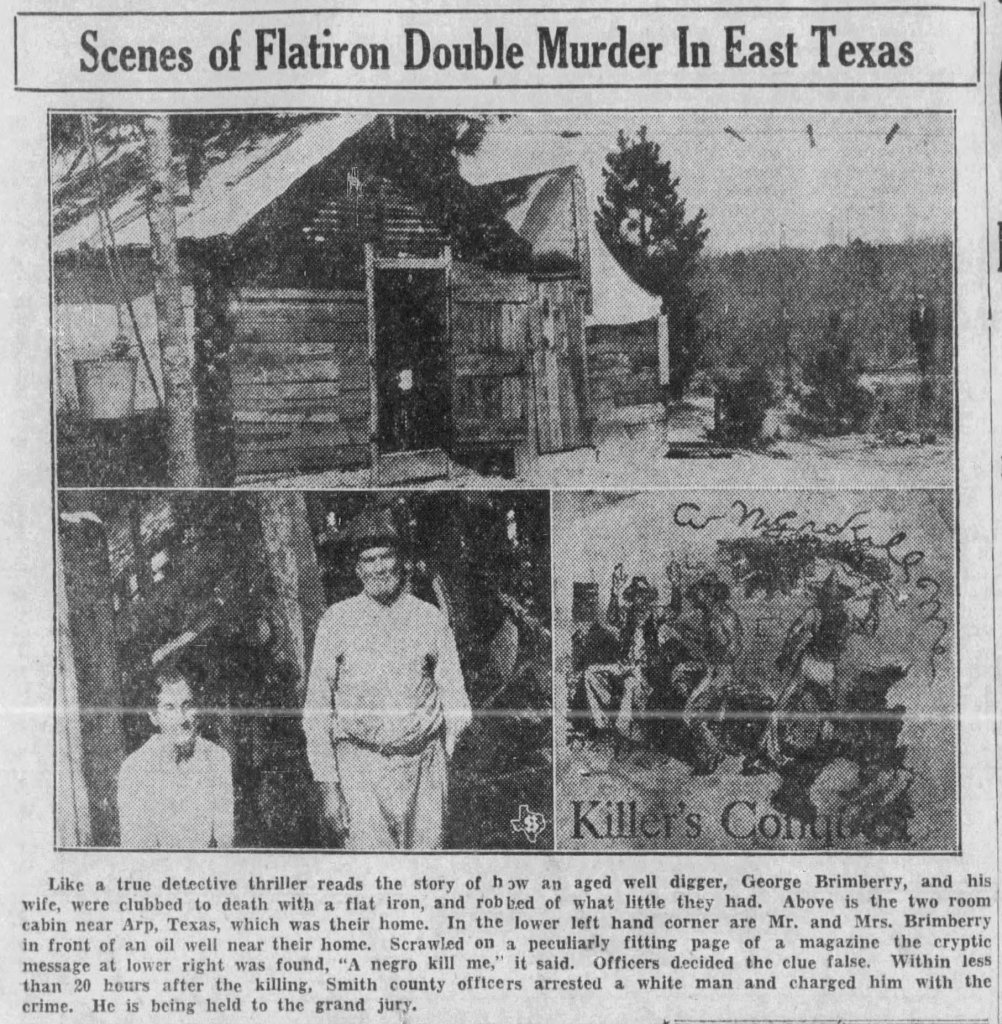
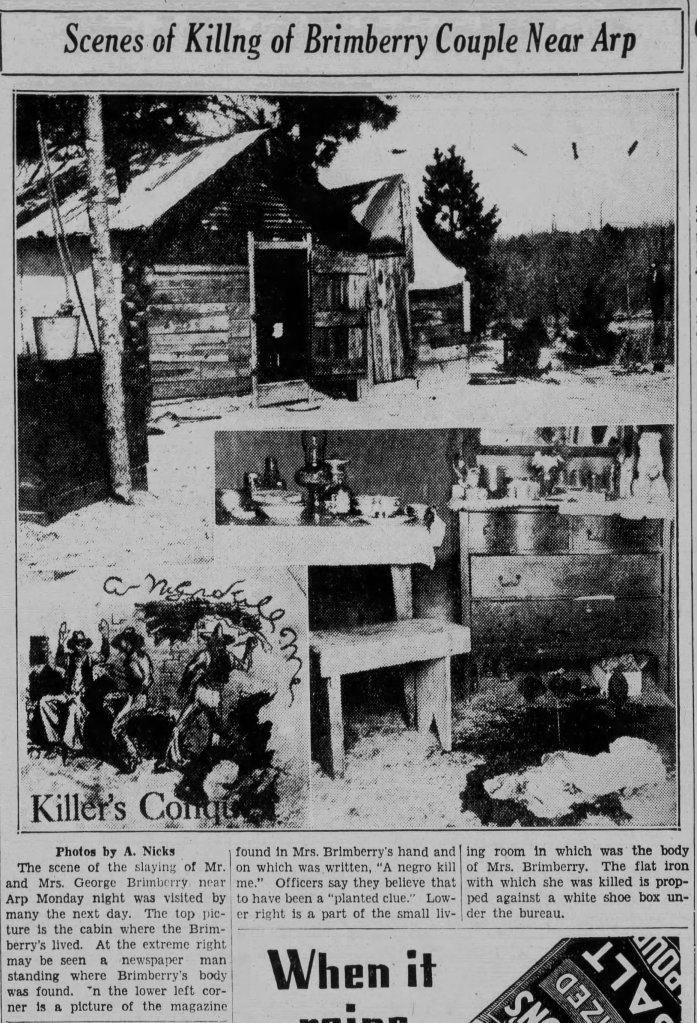
Speaking of that annotated magazine—none of the newspaper accounts give the title or date. However, two photos of the incriminating scrawl were included in photos:
“Killer’s Conquest” was never published in Weird Tales. “Killer’s Conquest” by George Cory Franklin was published in Triple-X Western (Apr 1932). Which perhaps makes more sense than a year-old issue of Weird Tales. What probably happened is that when McShane’s article went to press, there was no image of the incriminating pulp, so someone at the newspaper bought a copy of a magazine from about the correct time and scrawled on it themselves.
So we have a Weird Tales murder mystery without a copy of Weird Tales! Probably.
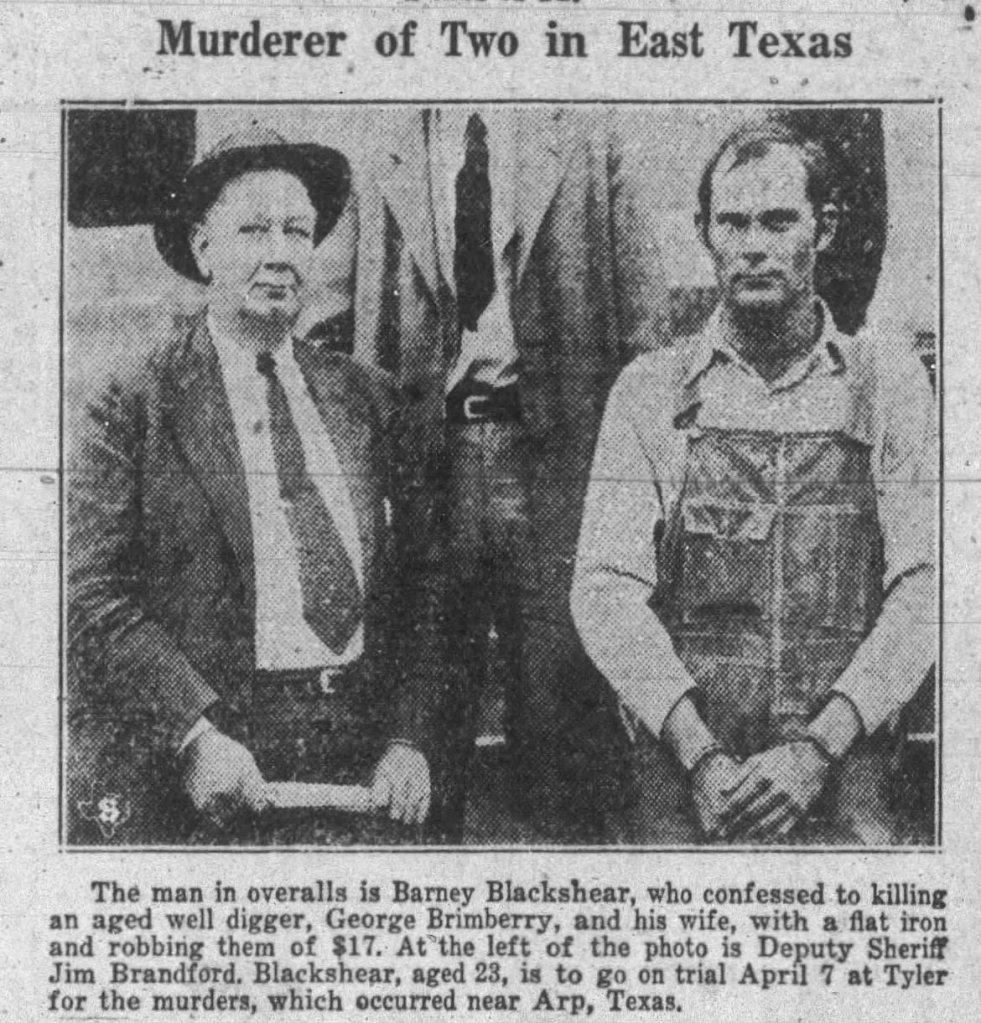
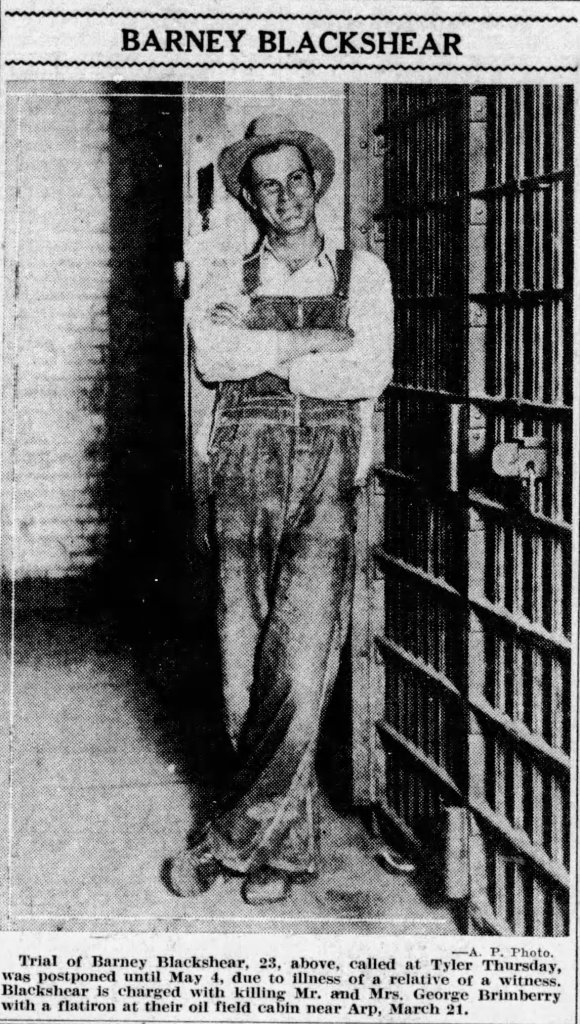
A special grand jury was called and returned two indictments, one for the murder of George and one for the murder of Viola, in short order; trial date for the murder of Viola was set for the next week, and public defenders appointed for Blackshear’s defense (“Blackshear Trial Date Set,” The Tyler (TX) Tribune, 30 Mar 1932 (1)). Blackshear posed for a few photographs from reporters.
Things were not looking good for Blackshear. Although the physical evidence was circumstantial and there were no witnesses to the crimes, a signed confession is the kind of thing that swings juries. The defense initially called into question whether the court was legally in session, then the venire (panel of prospective jurors) that had been called, claiming irregularities and a faulty indictment; the judge didn’t buy either motion (“Judge Overrules Motion to Quash Murder Indictment,” Corsicana (TX) Daily Sun, 7 Apr 1932 (3)).
The public defenders made an effort to produce a strong defense:
During the examination of prospective jurors references were made to a statement Blackshear is said by the state to have made and signed. The defense by its questions intimated the statement will be challenged and efforts made to prevent its introduction if the state tries to use it, on the ground that it was obtained by coercion and under duress in that Blackshear was ept in a dark cell until he agreed to sign.
[…] Blackshear, clean shaven, entered the courtroom in the custody of Deputy Sheriff Mart Jones and took a seat in a chair alongside the raling, directly facing the jury box. Throughout the morning session he continually smoked one cigarette after another.
He was dressed in a dark suit and from outward appearances was not the same man that was arrested near the murder scene. At that time he was clad in a pair of worn overalls, a blue shirt and badly worn shoes. —”First Day,” Tyler (TX) Morning Telegraph, 5 May 1932 (5)
Appearances count for much in jury trials, and presenting Blackshear clean-shaven and in a suit was likely designed to produce a positive reaction from the jury, as someone who did not look like a murderer. The fact that they already questioned the confession shows that they were working every angle. But the odds were stacked against them, and the defense then apparently decided on an insanity defense (“Continue Blackshear Trial; May Plead Insanity,” Tyler (TX) Morning Telegraph, 8 Apr 1932 (1)).
This can be seen as a bit of a Hail Mary by the defense; a last-ditch effort to save Blackshear’s life. He was facing the electric chair if convicted, and there was little hope of overcoming a signed confession in open court, but the insane could not be executed. The problem then became one of proving to the jury that Blackshear wasn’t mentally competent. This was accomplished in part by soliciting witness testimony to Blackshear’s mental instability and his history of mental illness:
Mrs. Ruby Whitman of Rowlett, who admitted she had lived with Blackshear, testified that Blackshear was subject to fits of mental derangement and that he had twice attempted to commit suicide. —”State Produced Arp Confession,” San Antonio (TX) Express-News, 7 May 1932 (4)
Ren Whitman, husband of Ruby Whitman, corroborated testimony of his wife that Blackshear twice had attempted to commit suicide in her presence. […] Dr. W. Howard Bryant testified he believed Blackshear of unsound mind, but refused to say his condition was more than a “border line” case. —”Youth Tried For Death of Aged Couple,” The Time (Shreveport, LA) 8 May 1932 (1)
Some other things came out during the trial as well:
The state returned Deputy Sheriff Turner to the stand in an effort to impeach the testimony of Harold Dawson, 17, that Blackshear’s nose was bleeding and the defendant wiped his own blood on the clothing which the state contended Blackshear wore on the night of the murder. —”Jury Weighs Arp Slaying,” The Times (Shreveport, LA), 8 May 1932 (5)
Mrs. Otis Murray, a neighbor of the slain couple, said that Mrs. Brimberry told her within 12 hours of the killing that a “dope head” was making love to her and planned to kill Brimberry and take her for himself. The “dope head” was not named. The witness said the Brimberrys were incompatible and that Mrs. Brimberry planned to leave her huhsband the next day. […] A letter written by Mrs. Brimberry to her son the day of the slaying corroborated Mrs. Murray’s testimony in part. Mrs. Brimberry asked protection from her husband and requested her son to say nothing of her intention to leave him as “she knew what was about to happen to him.” —”State Produced Arp Confession,” San Antonio (TX) Express-News, 7 May 1932 (4)
J. K. Rivers, named in the state’s injunction suit to padlock the Ironhead Cafe near Arp as the proprietor, was one of the first witnesses. He testified that Brimberry had dug a well for him.
A subsequent witness, Mrs. Otis Murray, testified that Mrs. Brimberry told her on the day of the killing that she had had trouble with her husband over money, but that her husband had been unable to give it to her because he had not received all of his pay—$38—for digging the Ironhead Cafe well. H. R. (Luck) Turner, deputy sheriff, testied as to finding of a cellar, after being tipped off as to its existence by D. M. Maynor, of defense counsel, communicating with the well dug for the cafe by Brimberry. he told of the ingenious manner in which the well served as the entrance to the cellar, while at the same time performing all the functions of a well used for supplying water, how the pipe through which beer flowed from the cellar led to the kitchen sink and how 900 bottles of beer had been found in the cellar, together with electric lights and fans. —”Deny Blackshear New Trial,” Tyler (TX) Morning Telegraph, 4 Jun 1932 (1-2)
How much of this was true, we have no idea. But it wasn’t enough to convince the jury of Blackshear’s innocence.
The defense motioned for a new trial on jury misconduct; they were overruled, but appealed (“Overrules New Trial Plea for Blackshear,” Corsicana (TX) Daily Sun, 3 Jun 1932 (15)). The appeal was heard in Feburary 1933, and the Court of Appeals reversed the verdict and remanded the case for a new trial, citing improper handling of evidence involving the handwriting expert:
Considering the bill of exception, it appears therefrom that officers found in one hand of deceased a magazine on which was written the words “A negro kill me.” In the other hand of deceased they found a lead pencil. An official of Smith county went to the jail while appellant was under arrest and in custody, and, without warning appellant, had appellant write several specimens of his signature. There was also introduced in evidence appellant’s written statement, in which he confessed his guilt. The prosecuting attorney had in his possession a poem written in longhand, entitled “Twenty One Years.” This poem was never introduced in evidence and the record is silent as to who wrote it or as to how the state obtained possession of it. The state called and used as a witness one Weaver, a handwriting expert. This witness examined the magazine found in the hand of deceased, the signature to appellant’s written statement, the specimens of handwriting taken from appellant without warning, and the poem entitled “Twenty One Years.” After his examination of these writings, he testified that the same person who wrote the words on the magazine “A negro kill me” signed appellant’s written statement, wrote the poem entitled “Twenty One Years” and signed the specimens of handwriting obtained from appellant while he was in jail. The bill of exception manifests error. —Blackshear v. State, 58 S.W.2d 105 (Tex. Crim. App. 1933).
The second trial took place in November 1933. In the year and change since he had been in jail, a couple things had changed:
Since Blackshear’s first trial, the state’s star witness, H. R. (Luck) Turner, a deputy sheriff at the time of [t]he killing, has died. Turner headed the investigation. Duncan Maynor, widely known East Texas lawyer who was chief of the defense counsel, also is dead. —”Second Trial of Blackshear,” Corsicana (TX) Daily Sun, 27 Nov 1933 (2)
A request was made for change of venue, which was denied. Unlike the first trial, in this trial Blackshear took the stand to testify in his own defense. Not much in the way of new details are gained from newspaper accounts, although the position of the Ironhead Cafe becomes a bit clearer:
“Cuter” Rivers operated the Ironhead Cafe where Blackshear, the defendant, said in a written statement, now in evidence in the trial, allegedly went after leaving the Brimberry home. At the Ironhead Cafe, Blackshear drank whiskey, ate some sausages and played a nickel piano, his statement said. —”Blackshear,” Tyler (TX) Morning Telegraph, 15 Dec 1933 (8)
A later article expanded on the Ironhead Cafe as a rough establishment that featured in two additional murders, not counting the ones Blackshear was indicted for, and again reiterated the Brimberrys’ connection to the speakeasy:
During the trial of Barney Blackshear for the murder of Mrs. Brimberry, the defense brought out the fact her husband, who was also murdered, had dug the water well for Rivers which connected with the underground room. There was some trouble about payment, witnesses testified, and Mrs. Brimberry was said to have told neighbors the day of the killing that she and her husband were coming to town the next day to report Rivers for selling liquor. —”An Old ‘Trouble Spot’ For Officers,” Tyler (TX) Morning Telegraph, 13 Apr 1936 (2)
Additional details were also offered on Blackshear’s previous suicide attempts (involving the use of a straight razor). The defense seems to have relied on largely the same insanity defense as before; this time, when Blackshear took the stand in his own defense, the prosecution grilled him on his affair with Ruby Whitman:
The state scored heavily when it secured an admission from Blackshear that he knew it was wrong to be living with another man’s wife at his (Blackshear’s) brother’s house; and that for that reason he told his brother the woman was his wife.
Defense attorneys had contended through Dr. Bryant that Blackshear did not know right from wrong. —”Blackshear Takes Stand In His Own Defense,” Tyler (TX) Morning Telegraph, 16 Dec 1933 (1)
Once again, the signed confession was introduced as evidence (“Statement of Oil Worker introduced at 2d Murder Trial,” The News San Antiono (TX), 14 Dec 1933 (18)). And, once again, Barney Blackshear was sentenced to death for the murder of Viola Brimberry (“Blackshear Gets Death Sentence in Arp Slaying,” The Houston (TX) Chronicle, 18 Dec 1933 (1)).
Once again, an appeal was made (“Appeal Second Death Conviction of Barney Blackshear of Tyler,” Tyler (TX) Morning Telegraph, 24 Apr 1934 (2)). The appeal was heard in June 1934, and once again the verdict reversed, and the case remanded for new trial somewhere else:
It appears from the record that the special veniremen were summoned from different sections of the county and that the case had been discussed in every part of the county. We are constrained to hold that the record in its entirety leads us to the conclusion that the appellant’s case had been prejudged to the extent that it was impossible that he could obtain that character of a fair and impartial trial contemplated by the Constitution. —Blackshear v. State, 72 S.W.2d 601 (Tex. Crim. App. 1934).
Given the fairly extensive newspaper coverage, this isn’t a huge surprise.
The third trial of Barney Blackshear took place in Marshall in Harrison County, TX in January 1935 (“Testimony Being Taken In Slaying,” (The Waxahachie (TX) Daily Light, 22 Jan 1935, (1)). We don’t have many details of the third trial, but apparently, the change of venue didn’t help: on 29 January 1935, Blackshear was sentenced to death for the third time for the murder of Viola Brimberry. Once again, the verdict was appealed, and Blackshear got his due process (“Appeals Court to Hear Argument on Blackshear Case,” The Marshall (TX) News Messenger, 13 Nov 1935 (3)).
Once again, the appeals court reversed and remanded the decision, this time finding particular fault with how the confession was arrived at:
The court sharply criticized methods used by officers in obtaining a purported confession from the defendant. The opinion said it was admitted that Blackshear was incarcerated in a dark cell for approximately six days and nights.
Judge F. L. Hawkins, who wrote the opinion, quoted as follows from an opinion of the court in another case:
“Neither policemen, detectives nor jailers are clothed in this country with inquisitorial powers. It is true that some of the laws of Spain ahve been ingrafted on ours, but not the dungeon, the bludgeon, the burning faggot or any of the concomitant tortures of the inquisition. These belong to the ages of bigotry, intolerance and sueprstition and have no place in our civilization. An attempt to revive them, even in mild form ought to call forth execration of the people and the sverest condemnation of the law.” —”Blackshear Again Escapes Death as Case Is Reversed,” Denton (TX) Record-Chronicle, 17 Jun 1936 (1) cf. Blackshear v. State, 95 S.W.2d 960, 130 Tex.Cr.R. 557 (Tex. Crim. App. 1936)
“It was so dark that one’s hand could hardly be seen before him” Judge Hawkins wrote in the opinion. “There were no lights, no charis and no bed. Appellant slept on a mattress on the concrete floor. he could not obtain water unless it was brought to him by the jailer.”
“Our conclusion is that there was no issue for the jury as the uncontrovertible evidence conclusively established that the confession was involuntary,” the opinion held. —”Court Reverses Death Sentence,” San Antiono (TX) Express-News, 18 Jun 1936 (4)
At this point, Barney Blackshear had been in jail over four years. He had suffered through three trials and three death sentences, and was facing a fourth trial for the murder of Viola Brimberry—and was still technically under indictment for the murder of George Brimberry, if the state wanted to press the issue. Perhaps that is why in November 1936, Blackshear used a straight razor to slash his wrists. This third suicide attempt was successful (“Blackshear Ends Long Parade of Murder Trials By Killing Himself,” The Marshall (TX) News Messenger, 20 Nov 1936 (1)).
We will never know what really happened in Apr, TX that night in 1932. That Blackshear was mistreated in jail and forced into a confession is now apparent; that there may have been someone else with reason to murder the Brimberry’s is possible, though unprovable at this chronological distance. To the credit of the Texas Justice system, Blackberry’s right to appeal was heard, repeatedly, and the appeals court sided with him each time. But appeals take time, and innocent or guilty, long years of imprisonment can wear on anyone. Newspapers suggest the suicide may have been inspired by an infatuation with a woman who had been writing him letters that had gone sour, but the true cause was likely complicated and personal (“Blackshear,” Tyler (TX) Morning Telegraph, 20 Nov 1936 (2)).
Misinformation was not uncommon in reporting on the case; especially later, when memories were a bit faded. Later narratives in the 1940s like “Today’s True Detective Story” by Sam D. Cohen (The Pittsburgh Post Gazette, 28 Jul 1941 (18)) mixed fact with fiction; no mention of making a cast of the bootprint, claim that Blackshear hung himself rather than cutting his arms, which is how he actually killed himself. McShane makes the same error, claiming Blackshear hung himself by his belt, which suggests perhaps he was reading some of the same sources Cohen did, only elaborated a little further. Cohen and McShane also emphasized different officers in the case, with Cohen focusing on Deputy Jim Bradfard and McShane on Sherrif Earl Price; neither give much mention to Deputy Turner, who supposedly obtained the confession. This suggests the journalists may have interviewed different men about the case, resulting in some of the confusion surrounding it.
When journalists get so many of the basic facts wrong, the use of an old issue of Weird Tales as a prop seems almost harmless. But it’s emblematic of an emphasis on style and sensationalism over accuracy—and perhaps an example of why it doesn’t do to rely too heavily on a single newspaper account.
Weird Tales sometimes included weird crimes among its pages, though not one where a man was convicted to death and won reprieve, though not release, three times. The case caught my attention because of the tenuous pulp magazine connection, a clue that was widely seen as a red herring, but which the prosecutors attempted to use anyway. There is more to this strange story, no doubt. It may involve bootlegging in Texas, and rural police efforts to force confessions; the value of handwriting experts and what, exactly, that poem was. A fuller story of a pair of brutal murders, which we may never know.
W. H. Pugmire was born in 1951; the kaiju classic Gojira (ゴジラ) was awakened by nuclear testing a few years later in 1954. The giant monster came stomping onto U.S. shores in 1956 as Godzilla, King of the Monsters!, edited, dubbed, and with added footage of actor Raymond Burr to make a substantially different film from the original—but it the first Japanese feature to become a commercial hit in the United States, and went on to spread the love of giant monsters internationally as well.
Japanese science fiction, fantasy, and horror film fandom in the United States began as an outgrowth of science fiction fandom; period fanzines included the occasional kaiju film that made it to the U.S. as they would other international science fiction, fantasy, and horror films. The films were shown in movie theaters and drive-ins, but there was often limited press coverage and no availability for private screenings. If you missed Gigantis the Fire-Monster (1955) or The Manster (1961), you were simply out of luck, and would be lucky to see a grainy black-and-white photograph in a film magazine like Famous Monsters of Filmland.
In 1957, however, Screen Gems, a television subsidiary of Columbia Pictures, produced its Shock Theatre package—a group of older horror films that could be aired for local broadcast. Thus began the tradition in the U.S. of the local horror host, who acted (and sometimes interacted) with these cheap classic films for an often precocious audience, who stayed up late into the night to watch monster movies. It became a popular staple, and more film packages followed as horror hosts proliferated. Re-runs made it possible for these films to gain a new and wider audience, and by the 1960s a package called Creature Features, including the Japanese kaiju movies of the 1950s, was released.
GIGANTIS, THE FIRE MONSTER
The only time I saw this show was on a late TV movie feature about five years ago. because my father is anti-monster/horror and fantasy/sf, I had to creep from my bedroom and turn the set on very low—dad’s bedroom was just above the set—so, I could not hear what was happening and that furthered my difficulties. My memory, thus, is not very detailed about the film. […] I’d like to see this film again, if just to see how much of the plot I’ve forgotten. I just hope it comes on some Saturday movie show so I don’t have to strain my eyes and ears, fearing that every sound I hear is the demon in the bedroom just above. —Bill Pugmire, Jr., The Japanese Film Fantasy Journal #7 (Mar 1971) 13 in Early Kaiju Fandom Volume 5: Japanese Fantasy Film Journal(2026) 196
The broader access to Japanese science fiction, fantasy, and horror films in the 1960s and 70s spurred the growth of related fandom in the U.S. (As did the growing media footprint from Marvel comics adaptations, toys, etc.) Specialist fanzines began to emerge, sharing information on Japanese productions past, present, and future.
Bradford Grant Boyle began publishing his fanzine Japanese Giants in the mid-1970s. In later years, he began a fanzine archive project and in 2024, he published the first of the Early Kaiju Fandom series, reprinting these now-obscure and early fanzines to preserve them for fans and scholars. Not just those interested in Japanese films, but for those who are interested in fandom itself, the way fans organize, their interactions, the often crude but energetic output of their devotion.
I began picking up these books more out of general than specific interest; print-on-demand books are low print run almost by default, can disappear at any time, and once out of print are often unobtainable at any price. Nor was I disappointed when the books arrived; the scans were clear, the zines themselves had the charm that often marks enthusiastic amateur productions. Before the internet, wikis, and even home video, there were teens putting these together using typewriters and stencils, laying them out with X-acto knives and glue. They’re fun.
So imagine my surprise when I found a letter from a young W. H. Pugmire in volume 5. And then another, and an article, and…
I was a huge horror film nut as a kid (Famous Monsters ofFilmland #69 is dedicated to me), and I lived for horror films. My first fanzines were a combo of SF (my high school girlfriend who was my co-editor was into SF —indeed, her parents had met at an early meeting of the Nameless Ones) and horror films. I was determined, in high school, that my future career was to be an actor in horror films, but that changed when I was sent to Ireland as a Mormon missionary and became obsessed with horror fiction. —W. H. Pugmire, Chunga #22 (Jan 2014), 30
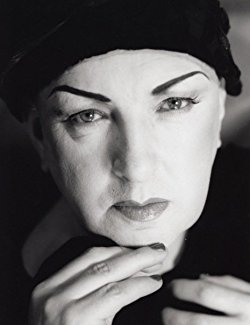
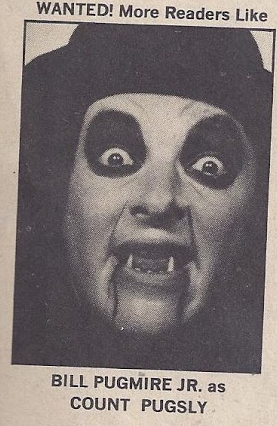
Today, Wilum Hopfrog Pugmire (born: William Harry Pugmire; 3 May 1951–25 Mar 2019) is best known as a Lovecraftian author, poet, and editor; and for his contributions to punk literature. His early interactions with fandom have been noted previously—he famously appeared in Famous Monsters of Filmland #69 (Sep 1970) in his “Count Pugsly” makeup—but his love of giant monster films isn’t something that’s really been examined in any depth, and there’s something fascinating about reading through these early writings and getting a better idea of the young man who wrote them. Not a renowned Lovecraftian author; not yet the persona of Wilum Hopfrog Pugmire; but an earnest fan with a gift for writing and a lot of evident enthusiasm.
Famous Monsters of Filmland #69 (4)
This led to a certain degree of notoriety:
I first encountered the name “Bill Pugmire” around 1970, in the pages of Famous Monsters of Filmland, to which he frequently contributed letters of comment, and in Greg Shoemaker’s venerable Japanese Fantasy Film Journal, to which he also contributed letters and columns. In my young mind at the time, I considered him famous. —Stephen Mark Rainey, “R.I.P. Wilum H. Pugmire” (26 Mar 2019), The Blog Where Horror Dwells.
The Japanese Fantasy Film Journal was edited and published by Greg Shoemaker from 1968-1983, for a total of 15 issues. Early issues were mimeographed, then apparently offset-printed, and at last professionally printed for the final issues. In terms of length, early issues ran less than 20 pages (including covers), while later issues tended to be ~40 pages. General contents varied, but often included entries on a number of Japanese sci-fi, fantasy, and horror films (or related non-Japanese films, like The Valley of Gwangi) in brief, followed by more in-depth reviews of select films. Shoemaker also covered some early Japanese animation, and included fanfiction, advertisements, and a letters page. Issues were illustrated with a combination of homegrown artwork and stills from films (taken from various sources).
W. H. Pugmire in the Japanese Fantasy Film Journal
The following list is a survey of Pugmire’s contributions to the Japanese Fantasy Film Journal, as an aid for anyone interested. Entries take the form of:
JFFM #Issue Number.Issue Page number [Page number in Early Kaiju Fandom Volume 5]. Title of piece (if any). Description of contents. (Other comments.)
Selected quotations from the material will follow some entries.
JFFM 5.18 [129]. “Are you ready for… SEATTLEHORBS???” Advertisement for a xeroxed sci-fi, horror, and fantasy film fanzine, edited by W. H. Pugmire and Brian Wise.
JFFM 6.3-4 [138-139]. Letter. Discussion of what should go into an editorial and letters page. Comment on Destroy All Monsters (1968), and a comparison of the Godzilla films to the Frankenstein films. Mention of Speed Racer (1967-1968). (Letters from Ernie Farino would reference Pugmire’s letter in JFFM 7.6 [189] and JFFM 8.43 [264].)
JFFM 7.4-5 [187-188]. Letter. Comments on JFFM #6, including the reviews of The Valley of Gwangi (1969), The Mysterians (1957), and the anime Marine Boy (1965).
JFFM 7.13 [196]. “Film Comment.” A series of comments on various kaiju films by fans, including Pugmire’s thoughts on Gigantis, The Fire Monster (1959). (JFFM 8.7-9 [228-229] contains a rebuttal to the “Film Comment” article, including a response to Pugmire on Gigantis.)
JFFM 8.4 [225]. Letter. Comments on JFFM #7, including comments on Gamera, the Giant Monster (1965), Frankenstein Conquers the World (1966), Jesse James Meets Frankenstein’s Daughter (1966), and the anime Prince Planet (1965-1966).
JFFM 8.9 [230]. “Fanzines Corner.” Includes an advertisement for Pugmire’s Flabbergasting Rambling #3:
Flabbergasting Ramblings #3 (25¢; Bill Pugmire, 5115 S. Mead St., Seattle, Wash. 98188; photo-copy: 8 ½x 11 ) Last issue of this variety zine so that Bill can devote more time to fantasy films publications. It covers such things as the “Blondie” comics, “Did Sherlock Holmes Kill Dracula?”—about linking characters in literature, and an odd item on ghosts in Hamlet. Interesting reading.
JFFM 10.5-6 [302-303]. Letter. Comments on JFFM #9, and on fanzines reviews.
JFFM 10.19-21 [316-318]. “Matango: Pro and Con.” Joint article on Matango (1963) by Pugmire and Fred Ray. Pugmire reviewed the film positively, Ray was negative in his critique. (JFFM 11.3-6 [342-345] includes letters responding to this article. An advertisement for this issue in Son of the WSFA Journal #137 mentions the piece.)
JFFM 11.38 [377]. “Fanzines Corner.” Includes an advertisement for Pugmire’s zine Lovecraftian Midnight Fantasies.
Midnight Fantasies (Bill Pugmire, 5115 South Mead St., Seattle, Wash. 98118; free; offset; published every 4 months; 8 ½x 11) A personal zine of very good quality that deals primarily with Lovecraft, Bloch, Derleth, Arkham House, et. al. An informal zine—a meandering sort of publication. Send for Bill’s current issue, but print run is limited so you may have to wait for a copy.
With issue 12, the Japanese Fantasy Film Journal shifted format and focus; with more professional layout, more and better art, and fewer letters and fan articles, and Pugmire’s contributions seem to stop. Whether this reflects Pugmire dropping the zine (not surprising given its irregular schedule and the price increasing from 50¢ to $3 an issue), or just Shoemaker’s changes to the zine making appearances in the zine less likely are unclear.
Late in life, Pugmire still remembered JFFJ fondly:
How I loved JFFJ! I remember writing a long positive critique of MANTAGO for an issue, and film-maker Fred Ray wrote a counter-critique slagging the film. I lost all my copies of JFFJ from water damage, alas. —W. H. Pugmire, Comment (12 Jun 2011) on “Greg Shoemaker on The Japanese Fantasy Film Journal,” Sidelong Glances of a Pigeon Kicker.
Each of these fanzines is a time capsule; a snapshot into an era of fandom and popular culture, and the surprising thing isn’t to find a random contribution from W. H. Pugmire in a fanzine from the 1970s—it’s finding an intact copy of such a fanzine at all. Many of these zines had very limited circulation and there were little or no serious archival efforts to preserve them. Even today, when university libraries (like the Hevelin collection at the University of Iowa) and private groups like the First Fandom Experience and the Fanac Fan History Project are making an effort to preserve and reproduce fanzines, there are huge gaps in what is being preserved.
So kudos to Brad Boyle and the Early Kaiju Fanzine series, for helping to preserve a part of our culture that might otherwise easily be lost. Certainly, it is fun to see what W. H. Pugmire’s thoughts were on giant monster movies, as a part of his general love of monsters and horror.
There were many women in the brief life span of Robert Ervin Howard. And yet there were very few. —Howard Preece, “Women and Robert E. Howard” in Fantasy Crossroads #3 (1975), 20
The study of the life and writing of Robert E. Howard has typically trailed that of H. P. Lovecraft. This was due to the different circumstances surrounding their deaths, disposition of their papers, publication or republication of their works, and the fan scenes that developed around their works and fiction. Notably, Howard was not surrounded with many literary-minded friends who published memoirs and remembrances soon after his death the way Lovecraft was, and biographical essays took long decades to emerge. As a consequence, many aspects of Robert E. Howard’s life only really began to emerge in the 1970 and 80s.
Harold Richard Preece (16 Jan 1906 – 24 Nov 1992) was one of Robert E. Howard’s close friends during the late 1920s, one of a group of literary-minded young Texans who Howard corresponded with. Preece would go on to other things after his association with Howard, including work with the Federal Writer’s Project in Texas to document folksongs and folklore, writing about civil rights, writing westerns for pulp magazines, and authoring several books. In the mid-late 1960s, Glenn Lord (agent for Howard’s estate) came in contact with Preece searching for more information on Robert E. Howard from those who knew him. So Preece came into contact with Howard fandom, and wrote several essays and articles, notably “The Last Celt” (1968), “Women and Robert E. Howard” (1975), and “Robert’s Lady Cousin” (1978).
In Howard’s surviving correspondence, the letters from Howard to Preece date from 1927 to 1930, and the last mention of Preece in Howard’s letters is in 1932. This gives an approximate range from the period of their friendship, or at least their period of closest acquaintance. This closely aligns with Preece’s account of their friendship in “The Last Celt”; where Preece met Howard in Austin, TX in 1927, through mutual friend Truett Vinson. Preece, Howard, and Vinson would become members of The Junto, a collaborative amateur journal that ran until 1930.
Most of Preece’s information on and impressions of Howard came from his few personal meetings with him, several years of correspondence, and their mutual participation in The Junto and related ventures (compare with Howard’s correspondence with Lenore Preece, Harold’s sister); supplemented by scanty biographical essays and articles by others. The survey of women in Howard’s life is thus slanted largely toward those whom Preece knew about (e.g. Howard’s cousin Maxine Ervin, a mutual acquaintance and member of the Junto), and those relationships that Howard told Preece or others in the Junto about.
These latter women are generally nameless and difficult or impossible to identify positively; they seem to represent infatuation on Bob’s part rather than relationships in the strictest sense. To give an example:
There was first, of all, the carnival girl. Some months of our correspondence had passed before he mentioned her. Then because of my own ambivalent feelings about women, I brought up the subject to Bob.
His reply was a single sentence recollection. He wrote – I quote from memory – that he’d lost interest in romance because of a let-down from a carnival girl when he was age fifteen. —Howard Preece, “Women and Robert E. Howard” in Fantasy Crossroads #3 (1975), 20
We have to take Preece’s word for it, since the letter doesn’t appear to survive and the anecdote doesn’t appear in Howard’s other letters (there is an anecdote about a carnival girl, but not one that Howard says he was interested in or betrayed by). Other aspects of Preece’s memory are verifiable, however. When he wrote:
There was a really noble letter he sent me – a capsule defense of women, breathing the spirit of Margaret Fuller and Mary Wellstonecraft. Sadly it is a part of the Howard correspondence that has been lost so that I must again quote, indirectly from memory. —Howard Preece, “Women and Robert E. Howard” in Fantasy Crossroads #3 (1975), 20
Fortunately, the letter was eventually found and published. It reads in part:
Salaam:
You’re right; women are great actors. But I can’t agree with you in your statement that the great women can be counted on the fingers of one hand. Men have sat at the feet of women down the ages and our civilization, bad or good, we owe to the influence of women.
Let us look at the records of the great women.
Sappho: doubtless the greatest woman poet who ever lived; certainly one of the greatest of all time. The direct incentive of the lyric age of Greece, the age that for pure beauty, surpasses all others. How shall a pen like mine sing of the beauties of Sappho, of the golden streams which flowed from her pen, of her voice which was fairer than the song of a dark star, of the fragrance of her hair and shimmering loveliness of her body? Has it been proven that she was a Lesbian in the generally accepted sense of the word? Who ever accused her but the early Christian — ignorant monks and monastery swine who were set on breaking all the old golden idols; and Daudet, a libertine, a groveling ape who could see no good in anything; Mure, a drunkard and a blatant braggart whose word I hold of less weight than a feather drifting before a south wind. May the saints preserve Comparetti who was man enough to uphold pure womanhood, and scholar enough to prove what he said. No prude was Sappho but a full blooded woman, passionate and open hearted with a golden song and a soul large enough to enfold the whole world. […] —Robert E. Howard to Harold Preece, c. Dec 1928, Collected Letters of Robert E. Howard 1.258-259
And so on for several more pages, praising various women and their achievements. So we can say that Preece’s memory wasn’t completely flawed. His judgment, however, was idiosyncratic. For instance, he wrote in the essay about Robert E. Howard and the carnival girl:
Conan, is naturally, Bob Howard’s wish-picture of the author himself. But I can believe that every major character portrayed by a writer is a projection of its creator or of someone who has left some indelible, if sub-conscious impression, on the lonely, frustrated person sitting at the typewriter. Even if some model is magnified beyond proper due, and, as I believe, that Bob gave the carnival woman a stature in memory that she could not have possessed in plain fact.
All of Bob’s lusty, virile women are this woman. Yet none of them are. —Howard Preece, “Women and Robert E. Howard” in Fantasy Crossroads #3 (1975), 22
It doesn’t seem that Harold Preece and Robert E. Howard had much contact after 1930, which is critical when considering “Women and Robert E. Howard,” because Howard’s most notable relationship with a woman was his dating Novalyne Price from 1934-1936, her version of events given in the memoir One Who Walked Alone (1986). When assessing Preece’s essay with a critical eye, his general ignorance of Novalyne becomes abundantly clear, since he merely repeats what he heard from Glenn Lord, the agent for the Howard estate, and summarizes his opinion of her as “a cheap coquette” (Fantasy Crossroads #3, 22).
Novalyne was not amused:
Harold Preece did, as many people do, jumped to conclusions when he had incomplete information in which he showed that he did not know and understand Bob that well. He called me a “cheap coquette.” That was because he did not know the entire story. —Novalyne Price Ellis to L. Sprague de Camp, 5 Aug 1979, Selected Letters of Novalyne Price Ellis 37
In comparing Lovecraft studies and Howard studies, it is interesting to note the important contributions to the understanding of both authors’ lives by the women with whom they were romantically involved. Sonia H. Davis wrote her The Private Life of H. P. Lovecraft (1985), and Novalyne Price Ellis wrote One Who Walked Alone (1986)—but what is not generally acknowledged is that both women were driven to write and publish their version in part because of the misconceptions and untruths spread about them in print. And it is notable the degree to which disbelief, attempts to discredit, and misogyny were common responses to their efforts. As E. Hoffmann Price, a fellow pulp writer who had known the Texas pulpser wrote when he learned that Novalyne Price Ellis was looking to publish her memoir at the same time as the de Camps were working on their biography of Robert E. Howard:
If the lady you mention published a well-documented book, On Sinning with R.E.H., she might outsell you, unless the oafery seize & destroy her scurrilious volume. It is to laugh! I knew him when is not sufficient. One must also write for other than dizzy fans. —E. Hoffmann Price to L. Sprague de Cmap, 7 Apr 1978, Collected Letters of Dr. Isaac M. Howard 308
In the scheme of Robert E. Howard scholarship, “Women and Robert E. Howard” has largely shrunk in importance. Preece’s recollections are few, imprecise, and overwhelmed by his suppositions, which have largely not stood the test of time, though there have been similar efforts to read various women in his life as the inspiration for various female characters in his fiction. The shot across Novalyne Price Ellis’ bow is more notable than the carnival girl, as it speaks to the reception of Novalyne into the nascent Howard scholarship. Ultimately, Preece didn’t actually know any of the women he was writing about, and ignorance of the subject did not dissuade him from weighing in on it.
If anyone speculated about Lovecraft’s sexuality while he was alive, they were polite enough not to publish about it. It wasn’t until Lovecraft was safely dead that the lockpicks of biographers went for his underwear drawer. When Winfield Townley Scott published “His Own Most Fantastic Creation: Howard Phillips Lovecraft” in The Providence Journal for 26 Dec 1943, he wrote:
His stories are sexless and one supposes the man was nearly so, all but mothered into impotency. One can say that almost all of his adult relationships were homosexual, if the word is intended in the blandest sense: there is no sign of strong sexual impulse of any kind. He was “not at ease” with women. His marriage was a mistake and a quick failure. He was disturbed by even mildly sexual writing. When he bought pulps at Douglass Dana’s Old College Book Shop, at the foot of College Street, he tore off the more lurid covers lest friends misunderstand his interests.
Speculation on Lovecraft’s sexuality picked up during the period of the Lavender Scare. Attention on that front shifted to his ex-wife, Sonia H. Davis, who was perhaps uniquely in a position to know. Her memoir does not go into any detail, but suggests Lovecraft was reserved, e.g.:
When I parted for the night, I said “Howard, won’t you kiss me goodnight?” His reply was, “No, it is better not to.” —Sonia H. Davis, “The Private Life of H. P. Lovecraft” in Ave Atque Vale 143
This scene has been interpreted as an invitation to resume marital relations and Lovecraft’s decline; the morality involved is old-fashioned these days. But certainly Sonia implied that she and Howard engaged in normal heterosexual relations as a married couple. She implied further in the “pinkey” anecdote and the “asequately excellent lover” comments in Memories of Lovecraft (1969), and once, August Derleth asked her directly about it:
A propos your piece on Lovecraft, the question of HPL and sex had been bothering me for some time, especially in view of his violent reaction against Oscar Wilde as a person, however much he admired his work; so in 1953 when I was in Los Angeles, I asked Sonia Davis—the ex-Mrs. Lovecraft—rather bluntly about HPL’s sexual adequacy. She assured me that he had been entirely adequate sexually, and since she impressed me as a well-sexed woman, not easily satisfied, I concluded that HPL’s “aversion” was very probably nothing more than a kind of puritanism—that is, it was something “gentlemen” didn’t discuss, and so on. —August Derleth, Haunted vol. 1, no. 3 (June 1968), 114.
The idea of Lovecraft as prudish, sexually repressed, asexual, or homosexual thus developed further in the literature; L. Sprague de Camp would synthesize several of these lines of thought in “Sonia & H. P. L.” (1973) and his biographical essay “Eldritch Yankee Gentleman” (1971), where he wrote:
He abhorred sexual irregularities and deviations, yet his own approach to sex was so prissy and inhibited as to make some wonder whether he, too, had a touch of lavender. —L. Sprague de Camp, “Eldritch Yankee Gentleman” part 1, Fantastic Stories (Aug 1971) 98
Writers have described Lovecraft as “sexless,” which does not seem to have been really the case. During the early months of his marriage, he seems to have performed his husbandly duties adequately if without great enthusiasm. The charge of “latent homosexual tendencies” has, however, becomes such a fad that it is leveled at almost any notable, including Lovecraft, whose love life is the lease unusual. As far as the evidence goes, it is probably true that Lovecraft had a low sexual drive. Otherwise, there is nothing to support the “latent homosexual” charge. —L. Sprague de Camp, “Eldritch Yankee Gentleman” part 2, Fantastic Stories (Oct 1971)
Comments like this may have been what inspired R. Alain Everts to write up “Howard Phillips Lovecraft and Sex: or The Sex Life of a Gentleman” for Nyctalops #9 (1974), an article based on Sonia’s memories of her long-dead second husband and H. P. Lovecraft’s sexuality:
During the course of my friendship with Sonia Lovecraft, the topic of her sexual relationship with Howard Phillips Lovecraft came up not once—due more to the young age at that time of this author, than to the lack of his scholarship. Fortunately for me, however, several times Mrs. Lovecraft brought up the subject herself and this scholar duly recorded and filed away the pertinent data.
In several unpublished recollections of HPL, Sonia mentioned in passing that aspect of their relationship—of course, as was HPL, she was also a Victorian prude when it came to sex and sexual relations; however Sonia lived into an age of greater liberties regarding sexual matters and the revelation of them in publick. And, she also had given birth to two children prior to her 20th birthday, children by her first husband, only one of which survived. This experience, although somewhat traumatic and repressing to her at the time, was certainly much more than Howard had ever had, for he was a virgin at their marriage in 1924. His bride was hardly blushing, and although both were not enthusiastic in any sexual sense of the word, both were able to sustain satisfying sexual relations.
There are two immediate issues with this piece: first, the degree to which it tracks with (and thus was likely informed by) earlier works like Winfield Townley Scotts’s influential biographical essay make it suspect, and second, the source documents and conversations that Everts cites have never been published. While we know he was in contact with an elderly Sonia H. Davis for several years, this means that everything he’s reporting is being filtered through his own viewpoints and in his own words, and the veracity of the material is qualified by how trustworthy Everts himself is as a scholar and journalist (see The Curse of Cthulhu for some potential issues).
Even if Everts accurately presented Sonia’s comments on Lovecraft’s sexual reticience, she herself may have been influenced by posthumous publications on HPL. For example, when Everts quotes her as saying:
Sonia also reaffirmed a statement that I have heard from various sources—that when HPL was growing to young manhood, “his mother’s admonitions to him were ‘devastating.’” This possibly pertains to HPL’s looks—his mother did tell him that he was “grotesque” and that he should not go out at daytime for fear of scaring the neighbours. No doubt some sexual admonitions arose also, for the entire family, according to what Sonia recalls Annie Gamwell telling her, knew of Winfield Lovecraft’s paresis, and the adventures with prostitutes and women on his lengthy travels that gave him his affliction. In fact, Annie told Sonia prior to her marrying HPL that they could not have children—in fact this was a warning that Annie was giving to Sonia, and to me her choice of words was interesting—could not instead of should not.
The idea that Susan Lovecraft was concerned about her son’s appearance first appeared in the letters of Clara Lovrien Hess to Winfield Townley Scott, and were reported in his column in the Providence Journal. Sonia was in correspondence with Scott at the time (some of their letters remain at the John Hay Library) and would have learned of this; Scott’s research and speculations may well have influenced her memories. The story of Annie Gamwell confessing that HPL’s father had syphilis, for example, was written after Scott revealed Winfield Scott Lovecraft’s diagnosis and cause of death. It is impossible to tell, at this distance, how much if at all Sonia’s memories were fitted to the facts as reported, rather than straight recollections, with all their inherent inconsistencies and errors.
If this skepticism seems extreme, it is because the evaluation of historical evidence demands a certain amount of rigorous questioning of the sources: who is writing? When did they write it? Why did they write it? What sources influenced the writing? Both Everts and Sonia had their own biases when expressing views on Lovecraft’s sexuality, explicit and implicit, and this has to be understood when reading the essay. Without access to Everts’ source materials, we cannot tell if he was censoring Sonia by leaving out recollections that didn’t fit his theme (that of Lovecraft as heterosexual, capable of sexual intercourse, but of low sex drive), or if he was presenting everything she said and adding his own interpretation based on the then-current state of Lovecraft scholarship. The emphasis on Winfield Lovecraft’s syphilis, for example, appears to be an addendum to the discussion on WSL and syphillis in Dr. David H. Keller’s “Shadows over Lovecraft” (1948), Dr. Kenneth Sterling’s “A Reply to Keller’s Article on Lovecraft” (1951), and Arthur S. Koki’s “H. P. Lovecraft: An Introduction to His Life and Writings” (1962).
The degree to which “Howard Phillips Lovecraft and Sex” parallels or is in conversation with Lovecraft scholarship of the 1970s cannot really be overstated. While the quotes from Sonia’s unpublished memoirs or interviews are unique and original, the actual content strongly follows existing lines of thought. For example, when Everts quotes her as saying:
He was reared more like a girl evidently instead of being reared like a man; yet he was far from unsexed as someone has stated. But it was this sort of up-bringing, I believe, that made him squeamish and prudish about perfectly natural functions.
The “reared like a girl” comment dovetails some anecdotes in Sonia’s account that Susan Lovecraft had hoped to give birth to a girl, and that a young Lovecraft (who, as many infants in the 1890s, wore dresses and kept long hair) “looked like a beautiful little girl” and his mother cried bitterly when the long locks were cut off (Ave Atque Valley 121). Sonia and Lovecraft didn’t begin their relationship until after Susan Lovecraft’s death, so Sonia was reporting at best second-hand recollections, which were then quoted (hopefully accurately) by Everts—but the photographs of the infant Lovecraft in a dress were published in Rhode Island on Lovecraft (1945), and Lovecraft’s own recollections of his earliest years were published in the first volumes of the Selected Letters.
The degree to which Sonia’s memories were affected by such post-Lovecraft materials is unknown; that she speculated on such things seems clear, based on material that didn’t pass through Everts’ hands. Everts’ motivation for adding it in this essay seems clear enough: it’s relevant, even if speculative, and it helps sell the narrative of a young Lovecraft who was prudish and dominated by his mother, “all but mothered into impotency” as Winfield Townley Scott put it.
An interesting question to ask is: what is not in “Howard Phillips Lovecraft and Sex?” There is no reference to any speculations about Lovecraft as a homosexual or transgender. This was not a strong theme in Lovecraft scholarship at the time, although it would swiftly become one when L. Sprague de Camp’s Lovecraft: A Biography(1975) came out the following year. While Winfield Townley Scott had given short shrift to the idea of Lovecraft as a homosexual, de Camp would devote an entire chapter to Lovecraft’s sex life and speculation of HPL as a closeted homosexual. Whether this was a deliberate choice on Everts’ part (in some private correspondence, Everts evinced some homophobia), or simply accurate reporting of Sonia’s thoughts is unknown.
The idea of Lovecraft as transgender is relatively recent, and mostly based on the same evidence that was presented for HPL as a closeted homosexual; e.g. the idea that his mother attempted to raise him as a girl, as Sonia speculates in this essay. This harkens back to an older perspective on homosexuality that muddled sexuality and gender identity, with the idea that homosexual men were necessarily effiminate and possibly overly-influenced by women when young. Contemporary understanding of transgender identity does not follow this line of thought, but when reading older material out of context, misunderstandings can happen.
Also absent are any quotes from Lovecraft’s letters on the subject of sex. This may be more understandable as HPL’s more extensive discussions on the subject weren’t published until the later Selected Letters volumes published after this article came out. Some of Sonia’s further comments on Lovecraft and sex in her letters to August Derleth are also not present, but there is no reason to believe Everts would have had access to those letters and she may never have repeated those comments to him.
Today, “Howard Phillips Lovecraft and Sex” is probably more interesting for the snippets from Sonia H. Davis than for Everts’ speculations and interpretations on Lovecraft’s sexuality. Some of the estimations have held up as more evidence has been presented: the idea of Lovecraft having a low sex drive seems well-supported based on his letters, the impressions of friends, and especially Sonia’s estimation quoted here. Lovecraft the prude has shown to be more complicated; his correspondence doesn’t include any frankly explicit or erotic material, but he was not otherwise reticient in writing about sex, even if he never went into anatomical detail. There is some supporting evidence in the memoirs of Mara Kirk Hart for Lovecraft’s reticience in discussing sex verbally.
“Howard Phillips Lovecraft and Sex: or The Sex Life of a Gentleman” by R. A. Everts is ultimately a nonfiction work representative of a particular historical period and context, and understanding what works that Everts and Sonia were influenced by and responding to changes how we read and understand the essay. Its historical impact on Lovecraft studies hasn’t been dramatic; there are no terrific revelations here, mostly quite confirmations of ideas that had already been passed around before. However, it is one of the first works to discuss Lovecraft and Sonia’s sex life openly, quoting some of Sonia’s own words on the subject, and for that, at least, it has a place in the study of the lives of both H. P. Lovecraft and Sonia H. Davis.
Immediately after “Sonia & H. P. L.” by L. Sprague de Camp in The Normal Lovecraft (1973) is an essay by Gerry de la Ree titled “When Sonia Sizzled” that also takes as its subject Sonia H. Davis, the former wife of H. P. Lovecraft. De la Ree was a noted collector who managed to procure an enviable number of original letters and artwork connected with pulp writers of the 1930s, including original art from Clark Ashton Smith, and he used part of this collection as the basis for a series of publications, of which The Normal Lovecraft was one example.
“When Sonia Sizzled” is one of several essays and articles that he wrote on pulp matters. Like much of The Normal Lovecraft, it has never been reprinted. The essay begins, thus:
Except for a repeated general distaste for life in New York City, H P. Lovecraft in general restricted commentary on his two years of married life with Sonia Shifirkin Greene. His brief autobiographical sketch, published in 1963 by Arkham Hosue and written some 30 years earlier, makes no mention of this period.
Likewise, in “Ec’h-Pi-El Speaks”, an autobiographical sketch written in 1929 and published by this writer last year, H. P. L. again skipped over the period of his marriage as if it had never existed.
Lovecraft’s closest associates have often testified to his apparent lack of interest in the opposite sex, and both his fiction and his countless letters seem to bear out this contention. —Gerry de la Ree, “When Sonia Sizzled” in The Normal Lovecraft 28
In context, by 1973 Arkham House had published the first three volumes of Lovecraft’s Selected Letters, which covered a period up to 1931—the entirety of his New York period (1924-1926) and marriage leading up to the divorce decree (1924-1929). August Derleth and Donald Wandrei, editors of those volumes, had selected, excerpted, and in places edited Lovecraft’s letters to emphasize information value and points of interest. Sonis is mentioned in ~45 pages of Selected Letters I and ~14 pages of Selected Letters II, mostly in letters to his aunts or to mutual friends and amateur journalists. But it is a paltry account of the marriage; whether the editors did this deliberately or it fell out like that as they prioritized Lovecraft’s fiction isn’t clear.
Today, with so many of Lovecraft’s unabridged letters published thanks to Hippocampus Press, we have a better sense for how often Lovecraft mentioned Sonia in his letters, and to whom. In fact, he did mention her much more frequently and in greater detail in letters to his aunts than anyone else, and to some correspondents—especially later ones—he does not mention his marriage at all. There was nothing particularly nefarious in this omission; Lovecraft was under no obligation to bare his soul to everyone he wrote a letter to, and the failure of his marriage must have been a source of personal disappointment and embarrassment.
Gerry de la Ree knew this. And with diligence and no doubt money, he bought Sonia’s letters to Samuel Loveman from the 1940s. “When Sonia Sizzled” consists mostly of excerpts from these letters, which date from after Sonia had been informed of Lovecraft’s death and when she had come into contact with Derleth, but before she published her memoir. In one letter, Sonia enclosed a letter she had received from August Derleth dated 21 November 1947, to get Loveman’s opinion on it. De la Ree quotes an excerpt:
I have so far had no reply to my letter of 18 September. Meanwhile, I hope you are not going ahead regardless of our stipulations to arrange for publication of anything containing Writings of any kind, letters or otherwise, of H. P. Lovecraft, thus making it necessary for us to enjoin publication and ale, and to bring suit, which we will certainly do if any manuscript containing works of Lovecraft does not pass through our office for the executor’s permission.
You will be interested to know that we know have in Lovecraft’s own letters to his aunts a complete and detailed account of how things went during his entire married life. —Quoted in The Normal Lovecraft 29
Derleth was not the executor of Lovecraft’s estate. He was not even the literary executor; that was R. H. Barlow, who died in 1951. Arkham House had an agreement with Lovecraft’s surviving aunt Annie Gamwell to publish HPL’s writings before her death in 1941, and on this basis Derleth often pretended to complete authority over Lovecraft’s copyrighted work, and occasionally threatened legal action against those who published or republished anything by Lovecraft without Arkham House’s blessing. In hindsight, this can be seen as a deliberate bluff, a means for Derleth to concentrate and maintain control of the Lovecraft material, if not an actual monopoly.
However, at the time, this would not have been easy to discern; if Derleth had ever sued and been forced to go through discovery by someone calling his bluff, things might have gone very differently for Arkham House and Lovecraft’s legacy. Sonia’s follow-up to this was a letter to Loveman dated 1 Jan 1948; it mostly continues repeats assertions that appeared in her memoir, particularly that she financially supported Lovecraft during the New York period, which Derleth had flatly denied.
Readers in 1973 might have appreciated the peek behind the scenes, which led to the publication of Sonia’s memoir in 1948; although there was much more drama to it than these few letter excerpts state. The actual details of how much financial assistance Lovecraft received from his wife and aunts during that period is interesting for those who would like to reconstruct Lovecraft’s parsimonious budget; it was obviously sufficient to live on, but not thrive, or else he wouldn’t have left.
The third and final letter snippet de la Ree quotes from is dated 16 Nov 1949, after the publication of Something About Cats and Other Pieces by Arkham House, which contains a version of Sonia’s memoir, “The Horror at Martin’s Beach” (1923), and “Four O’Clock” (1949). By this point, Sonia and Derleth had achieved détente, which would grow into amicability in later years. De la Ree quotes her as writing to Loveman:
Yes, Derleth sent me a copy of “Cats”. He paid me a modicum for the H. P. L. story as well as for the two revisions, and while not much, it helped last year when I wasn’t earning anything while I was sick. —Quoted in The Normal Lovecraft 31
None of these letters has ever been published in full, and aren’t likely to be anytime soon. If they still survive, it is in someone’s private collection. When read in conjunction with letters from Sonia and Derleth that survive at the John Hay Library and Wisconsin Historical Society, we can get a fuller picture of the tumultuous period in the late 1940s when Sonia stumbled into the complicated literary legacy of her deceased husband, and had to contend with one of the biggest fish in that small pond that was Lovecraft publishing.
Still, this was when Sonia was hot—or as de la Ree put it, when she sizzled—when her memoir was the hottest thing to hit Lovecraft fans since Arkham House had begun publishing in 1939. We know now, because of access to Derleth’s letters, that he was more concerned with Sonia’s portrayal of Lovecraft as antisemitic than with how much money she gave to Lovecraft to live on in New York, and his efforts to discredit and downplay her memoir probably reflect Derleth’s own interests in Lovecraft’s legacy as much as his friendship with the late HPL.
In 1973, “When Sonia Sizzled” was a peek behind the curtain of Lovecraft publishing in the 1940s, and was probably safe to publish because both Sonia and Derleth were safely deceased. Searchers after more data on Sonia herself were no doubt disappointed, but even if this isn’t the most substantial piece, it is still a piece of the puzzle that was her life, both with and after her marriage to H. P. Lovecraft. It wasn’t the whole story, nor did it pretend to be, but it added a bit of context to how Sonia came to publish her memoir. Today, with more of the pieces of the puzzle, we have a better picture of what happened.
During my recent visit to Los Angeles over the Christmas hollidays [sic], I telephoned the Diana Lynn Lodge where Mrs. Sonia Lovecraft Davis had been living for the past 8 years. I phoned on 22 December and spoke with Mrs. Davis’ nurse, who informed me that Sonia was quite ill and deteriorating rapidly. She no longer read – that used to give her the greatest pleasure – as did writing, which she also no longer did. For the most part she watched television and slept – and of course died alone in that particularly horrible manner that we condemn the old to. —R. Alain Everts, “Mrs. Howard Phillips Lovecraft” in Nyctalops #8 (Apr 1973), 45
Sonia H. Davis, the former wife of H. P. Lovecraft, was seldom mentioned in his letters after the divorce was filed in 1929. She largely disappeared from his life after the editing of “European Glimpses” in 1933. Was not informed of his death in 1937, and did not learn of it until 1946. Many of Lovecraft’s friends and correspondents did not know he was married, or if they knew, did not know Sonia’s name or where she was. When Winfield Townley Scott published “His Own Most Fantastic Creation: Howard Phillips Lovecraft” in The Providence Journal for 26 Dec 1943, he wrote honestly:
Then a quite astonishing thing happened—I don’t know how else to describe this sudden outbreak of a semi-invalid tangled with apron strings; Lovecraft in 1924 went to New York and married. So far I have not discovered either the woman’s name or her present whereabouts.
The next year, in “His Own Most Fantastic Creation” in Marginalia (1944, Arkham House), the first extensive biographical essay on Lovecraft, Scott had at least learned Sonia’s name and some basic account of the marriage, though he added:
It is very difficult—and so I think I shall not bury this somewhat footnote-ish aside in an actual footnote but, without apology, keep it up here in larger print—to write of Lovecraft’s marriage. This is principally because the former Mrs. Lovecraft is inaccessible; one hears that she is remarried and that she is probably living out West, but even old friends of Lovecraft who knew his wife are unable to establish communication with her because they are denied, by her relatives, knowledge of her present name and whereabouts. To write of the marriage from others’ reminiscences and speculations is under the circumstances certainly permissible, and as certainly embarrassing. One can only hope, in view of Lovecraft’s increasing fame and the consequent importance of his biography and of the need for fairness all around, that this one woman who ever lived intimately with him will tell her story. Until then, one can only piece the story together form the fragments offered by outsiders—human outsiders! (ibid. 321)
Sonia did finally get in contact with Winfield Townley Scott, and with his assistance, she did write her memoir of the marriage, and he also helped her to get it published, in abridged and edited form. This led to Sonia meeting August Derleth, the eventual publication of “Four O’Clock” (1949), and many other things—but relatively little from or about Sonia herself made it to print. She had some scattered references in mid-century amateur journals, including attempts to sell books associated with Lovecraft. In 1961, when Scott revised his biographical essay for his collection Exiles and Fabrications, he included material from Sonia’s memoir, but new material on or about Sonia was almost nil.
Fans eager for data could look to “Lovecraft’s Marriage and Divorce” (1968) by Muriel E. Eddy, but would scarcely learn anything not already in Sonia’s memoir. August Derleth put together Memories of Lovecraft (1969) from some of Sonia’s letters, but again, this is fairly thin. New facts about Sonia, and new information on her marriage with Lovecraft wasn’t really made public until after her death.
I heard later that Sonia had died on 26 December 1972 – I had the pleasure of her acquaintance for nearly 5 years, and of her family for the same length of time. it was on her 85th birthday in 1968 that I first met her personally although I had corresponded with her from some time previously. I was more than anxious to meet her, to try and persuade her to talk about her second husband, Howard Phillips Lovecraft, which she was at first extremely reticent to do – she was now the widowed Mrs. Nathaniel Abraham Davis, and owed most of her final good memories ot him. However, during the course of our personal acquaintance, in which I visited her several dozen times, to talk with her, to tape record her reminiscences of Howard Lovecraft, and her own life, to take her out to lunch and on special errands, and simply to visit this lonely and charming, and until her decline into senility, vibrant lady. —R. Alain Everts, “Mrs. Howard Phillips Lovecraft” in Nyctalops #8 (Apr 1973), 45
Everts’ article was the first really new information on Sonia H. Davis’ life and background available to fandom, and it must have derived from his communications with Sonia and her family. Later authors, like L. Sprague de Camp in Lovecraft: A Biography (1975), either Drew on Everts’ piece or similar sources when writing about her birth in what is now Ukraine, her parents, her early history as a young immigrant to the United Kingdom and then the United States, apprenticeship as a milliner, and all the events that led up to her marriage with Lovecraft and carried on afterwards. Everts, at least, had read Sonia’s autobiography in manuscript, later published as Two Hearts That Beat As One(2024), edited by Monica Wasserman.
Scholarship is not just the accumulation of evidence, the piling together of facts, the collection of books and manuscripts to cite and quote with uncritical acceptance. Today, we can compare Everts’ article with Sonia’s autobiography and other sources and conclude it is largely accurate. However, there is a lot that Everts doesn’t say in this short piece as well. Everts’ relationship with Sonia was not always completely friendly; Everts developed a negative reputation in fandom, partially covered in The Curse of Cthulhu(2002), whereby he alienated several fans by action or inaction, such as the failure to return a photograph of Robert E. Howard lent by Novalyne Price Ellis, accusations of other borrowings, etc. A photocopy of a letter from Everts to Sonia dated 24 Apr 1969 survives among the August Derleth papers at the Wisconsin Historical Society, which includes admission of borrowing material without permission, and responses to some allegations apparently levied against Everts by Sonia, though in that letter Everts states his intention to return everything and his belief that the true sources of the allegations are August Derleth and Muriel E. Eddy.
Which is a long way to say, we have to read this piece with the understanding that it is not Sonia H. Davis expressing herself directly to the reader, but is filtered and edited through Everts, and Everts does not include anything in the article that speaks to their possible contretemps.
From 1946 until about 1960, Sonia worked at various jobs – she broke her hip that year and had to go to live in a rest home in southern Los Angeles. In 1965, she was transferred to the Diana Lynn Lodge in Sunland, on the north rim of the San Fernando Valley, where she died just after Christmas of 1972. —R. Alain Everts/ 21 January 1973 —R. Alain Everts, “Mrs. Howard Phillips Lovecraft” in Nyctalops #8 (Apr 1973), 45
“Mrs. Howard Phillips Lovecraft” has been superseded as a source of information about Sonia’s life by later works, the only really unique information in there concerns her relationship with Everts (which, again, not the whole story) and the end of her life. It holds a place in historical scholarship because when we ask how we know certain information and when did we know it, Everts’ article stands out as a point where new biographical information on Sonia became publicly available, where fans and scholars could read and cite it. The snapshot it offers of the end of Sonia’s life, with Everts as one of her few points of contact outside the rest home, is poignant but necessarily brief.
Yet it is also at this point that Everts takes a hand in shaping the narrative of Sonia and her marriage to Lovecraft. He would go on to create his own publishing imprint, The Strange Company, whose publications include material borrowed or copied from Sonia’s files, including Alcestis: A Play (1985) by Sonia H. Greene & H. P. Lovecraft. We can only speculate why Everts waited until after Sonia was dead; perhaps the money wasn’t there earlier, or life got in the way; such things happen. Sadly, his correspondence and interviews with Sonia have never been transcribed and published or made accessible, save in brief essays like “Mrs. Howard Phillips Lovecraft.”
Yet there was another essay on Sonia H. Davis published in 1973, and one that showcases a different approach to the same material. This was “Sonia & H. P. L.” by L. Sprague de Camp, one of the items in The Normal Lovecraft (1973, Gerry de la Ree), a magazine-sized chapbook published by fans for fans. To understand de Camp’s approach, we need to wind back a little:
For five years I had been writing short articles for [George] Scither’s Amra on authors of heroic fantasy, such as Pratt, Howard, and Lovecraft. In 1970 I decided to expand the series by rewriting these pieces as regular magazine articles and eventually to combine them into a book. The only market for the articles was the now defunct Fantastic Stories, which paid badly and often neglected to register copyrights. […] The book, Literary Swordsmen and Sorcerers, which resulted from these labors, was slow to become airborne. I tried a sample and synopsis on a prospective new agent; no results, so for a few years I put it aside. In 1974 I sold the book to Arkham House; it appeared in 1976 and is still in print. Meanwhile my book-length biography of Lovecraft had been published. —L. Sprague de Camp, Time & Chance: An Autobiography, 366-367
The first biographical article on Lovecraft, “Eldritch Yankee Gentleman,” ran in two parts in Fantastic Stories August and October 1971; Sonia appears in the second part, which covers 1921-1937. For sources, de Camp leaned heavily (or exclusively) on Sonia’s memoir and Lovecraft’s letters at the John Hay Library in Providence, RI, where they had been deposited after Lovecraft’s death. There is no indication that de Camp contacted Sonia directly—and given the timing, this might be understandable; by the time de Camp got seriously into writing about Lovecraft, Sonia was in her twilight years, in a rest home in California, health declining. By the time de Camp decided to expand his biographical essay of Lovecraft into a full-blown book, Sonia was already dead.
So what did de Camp have to write about in “Sonia & H. P. L.” that wasn’t already published?
Five years later, Lovecraft wrote Derleth: “My one venture into matrimony ended in the divorce-court for reasons 98 per cent financial”. This ignores other weighty factors, such as his topomania (his fantastic attachment to Providence), his xenophobia, and his strong anti-sexual bias, which he probably got from his mother and which made him at best a tepid and half-unwilling lover. —L. Sprague de Camp, “Sonia & H. P. L.” in The Normal Lovecraft 25
It would be fair to say that de Camp was correlating the contents; he could take Sonia’s memoir, combine that material with Lovecraft’s letters, and use the ideas from Winfield Townley Scott’s biographical essay as a framework to build his own image of Lovecraft, Sonia, and their relationship. When de Camp sticks to just the facts, this has the overall benefit of combining Sonia and Lovecraft’s different perspectives of the marriage and relationship; however, whenever de Camp gets into analysis, his own biases show through more strongly:
Lovecraft never pretended to be other than he was. Sonia had taken the initiative in their courtship, although he had tried to warn her of what she was getting into. And if the episode left him looking hardly heroic, he would not have looked much more so, according to the mores of the time, if he had gone on letting Sonia support him.
Over the next few years, Lovecraft and Sonia visited each other every times. Although Sonia was a full-blooded woman, Lovecraft declined to renew martial relations. For reasons that we can guess at but cannot really know, he let his maternal tabu against sex prevail, even though it would have been perfectly legal and moral. Although his organs and instincts, as far as is known, were normal, he had been early inclucated with the ideas that sex was “sordid” and “bestial”. Young persons might be subject to irrepressible animal urges, but middle-aged persons like himself and Sonia ought to be “all though” with it. (To him, middle age began at thirty.)
Then came the divorce and Sonia’s move to California. Poor strenuous, generous, passionate, managerial, loving Sonia! The moral would seem to be: girls, don’t marry a man with the ideas of “making a man of him” or otherwise drastically changing him. It won’t work. —L. Sprague de Camp, “Sonia & H. P. L.” in The Normal Lovecraft 27
This was the kind of psychologizing that de Camp would receive considerable criticism for when Lovecraft: A Biography (1975) came out, but more than that, there’s a great deal of rampant speculation and characterization on de Camp’s part in those few paragraphs. It was Winfield Townley Scott who had first emphasized that Lovecraft’s relationship with his mother was unhealthy and speculated on Lovecraft’s sexuality, on fairly weak evidence, and de Camp doubled down on both ideas.
The characterization of Sonia as “a full-blooded woman” was a counterpoint to that; de Camp built her up as a sexual entity in opposition to Lovecraft’s apparent asexuality. In this, de Camp was not alone—August Derleth had famously cornered Sonia in 1953 and asked about her sex life with Lovecraft. As he put it:
A propos your piece on Lovecraft, the question of HPL and sex had been bothering me for some time, especially in view of his violent reaction against Oscar Wilde as a person, however much he admired his work; so in 1953 when I was in Los Angeles, I asked Sonia Davis—the ex-Mrs. Lovecraft—rather bluntly about HPL’s sexual adequacy. She assured me that he had been entirely adequate sexually, and since she impressed me as a well-sexed woman, not easily satisfied, I concluded that HPL’s “aversion” was very probably nothing more than a kind of puritanism—that is, it was something “gentlemen” didn’t discuss, and so on. —August Derleth, Haunted vol. 1, no. 3 (June 1968), 114.
This interest in Sonia and Lovecraft’s sexual life can be seen in the historical context of the Lavender Scare as an effort on the part of some scholars to establish Lovecraft as heterosexual; Sonia’s confirmation of heterosexual relations would help immensely in that regard. De Camp would bring up the possibility of Lovecraft as a closeted homosexual in Lovecraft: A Biography (Derleth was, at the time of its publication dead and thus past the ability to protest). Both de Camp and Derleth seemed fixated on the idea of Sonia as sexually aggressive, though never to the point of suggesting she was promiscuous, and make this part of their characterization.
When de Camp did finally write Lovecraft: A Biography, he had more to say about Sonia than he did in “Sonia & H. P. L.”; the bibliography includes both Everts’ “Mrs. Howard Phillips Lovecraft,” Derleth’s letter in Haunted, and “Misc. unpublished autobiographical MSS. in the John Hay Library” (479), in addition to Sonia’s memoir and Memories of Lovecraft (1969). Yet it is easy to see how, in 1973, not long after Sonia H. Davis passed away, her memory was already being shaped and fitted to the purpose of would-be Lovecraft biographers, her words selectively used to convey the impression they wished to give rather than presented unaltered.
Ruth Muriel Eddy Bell (27 May 1921 – 21 May 2009) was not the last living person to have met H. P. Lovecraft—but with her passing went one of the last living memories of the Old Gent. Fortunately for us, she recorded her impressions in a brief memoir, “The Man Who Came At Midnight,” first published inThe Fantasy Commentator, Vol. III, no. 3 (Summer-Fall 1949).
How much Ruth might remember, and how accurate are those recollections? We know from Lovecraft’s correspondence with her mother Muriel E. Eddy that HPL first visited the Eddys in 1923. Ruth was the youngest of the three children, only about two years old when Lovecraft supposedly came at midnight. These early impressions were very likely influenced in later years by Muriel’s various memoirs of Lovecraft, her stories told and retold until they became part of family lore. So what we have is not a “pure” memoir, but a memoir that was expanded, shaped, and influenced by the other things written about Lovecraft by his friends and possibly critics. This was a step in the process of building Lovecraft’s legend.
※
THE MAN WHO CAME AT MIDNIGHT by Ruth M, Eddy
Gaslight flickered eerily through the crack in my bedroom door. It was Hallowe’en, night of the supernatural, and long past midnight, I had drifted off to sleep with visions of hobgoblins and Jack-o’-lanterns drifting through my childish mind. Suddenly, as in a dream, I heard a sepulchral voice saying, “Slithering…sliding…squealing…the rats in the walls!”
Half-asleep, half-awake, I lay in the darkness for a moment, and then shouted for my mother as loudly as I could. She came into my room and spoke softly, “Everything’s all right, dear. It’s just Mr. Lovecraft telling us about the new story he’s writing. Don’t be afraid. Go back to sleep.” Her warm tones were reassuring, and I was comforted as she leaned down to kiss me.
But sleep was impossible, for little as I was then, I lay listening to the strange-sounding story our nocturnal visitor was reading. As I was to find out years later, not only was Howard Phillips Lovecraft an expert writer of weird, spooky and uncanny tales, but he was also something of an actor. He made his fictional characters come truly alive through reciting his manuscripts aloud. And this he did in the wee sma’ hours of the morning as my parents listened attentively.
Lovecraft did not like daylight. He preferred darkness, always. Even when doing creative writing at home, if it was daytime he would draw the heavy curtains and write by artificial light. He did not like to leave his house during the day, but he and my father would often explore dark, unlighted alleys after midnight, walking along wharves and dimly-silhouetted bridges on the edge of the swamplands. It is not hard to imagine H.P.L. postulating unknown entities in these dark places, and from such nocturnal jaunts would often come ideas for his future stories.
In case I could stay awake long enough, I would sometimes listen to these tales, drifting off to sleep however before the story had ended. I grew accustomed to his voice, though I never quite got up enough courage to peek past the bedroom door at the reader himself. Yet in later years, as my father and mother discussed this friend of theirs, I could not help feeling that I had really known him, too.
How Lovecraft loved coal-black cats! He always had one near him. Cats sat in his lap while he wrote and they followed him out on his lone midnight explorings. His beloved black cat played a prominent part in ’’The Rats in the Walls,” and when one day this cat disappeared he became heartsick.
I feel H.P.L. would have been astounded, indeed, had he heard his “Dunwich Horror” broadcast two years ago on Hallowe’en. Never a lover of modern days and ways, using even such a common device as a telephone annoyed this gentleman and scholar of a different world! He preferred writing by hand to typing, and my parents often typed his manuscripts to relieve him of a hated task.
The shy and reticent Howard Lovecraft gained encouragement from my father and mother because of their interest and enthusiasm in his work, and soon after that Hallowe’en night he sold his macabre “Rats in the Walls” to a well-known magazine. Not a Hallowe’en has passed since Lovecraft’s death in 1937 without my family gathering for the reading aloud of a weird story by our favorite author—now internationally famous as a writer in the genre—although our eloquence cannot compare with his masterful interpretations.
And even though I never saw Howard Phillips Lovecraft, I shall always remember him as the man who came at midnight!
※
Muriel wrote several times about Lovecraft reading “The Rats in the Walls” (Weird Tales Mar 1924) in manuscript to the Eddys, including in “Message in Stone” (1956), and the accounts of mother and daughter are consistent, though Ruth offers her own viewpoint and details. There are other details in the account that show things a young Ruth could not have known and picked up later—the bit about Lovecraft’s pet cat, for example. The idea of Lovecraft loving the darkness speaks to early myth-making; as with most aspects of Lovecraft’s legend, the reality is more complicated, with his letters often painting him as both a night owl and enjoying sunlit walks and writing outdoors in the daylight.
It is fun to imagine what it might have been like, to lie awake in the dark and hear a sonorous voice read off a dark tale, probably filled with words she did not yet understand…and only later coming to understand who she had been listening to. There is no indication that Ruth Eddy was being dishonest in this account, only that she was being influenced by more than her childhood memories. She was so young, after all; and was writing of events twenty-five years in the past. No surprise, then, to find that her adult mind may have shaped whatever impressions she had from those sleepless nights of long ago.