Lost Tale: “The Guardian of the Malecon” (1926) by Arthur J. Burks

Historical Racism

This story contains racist historical stereotypes.
Reader discretion advised.


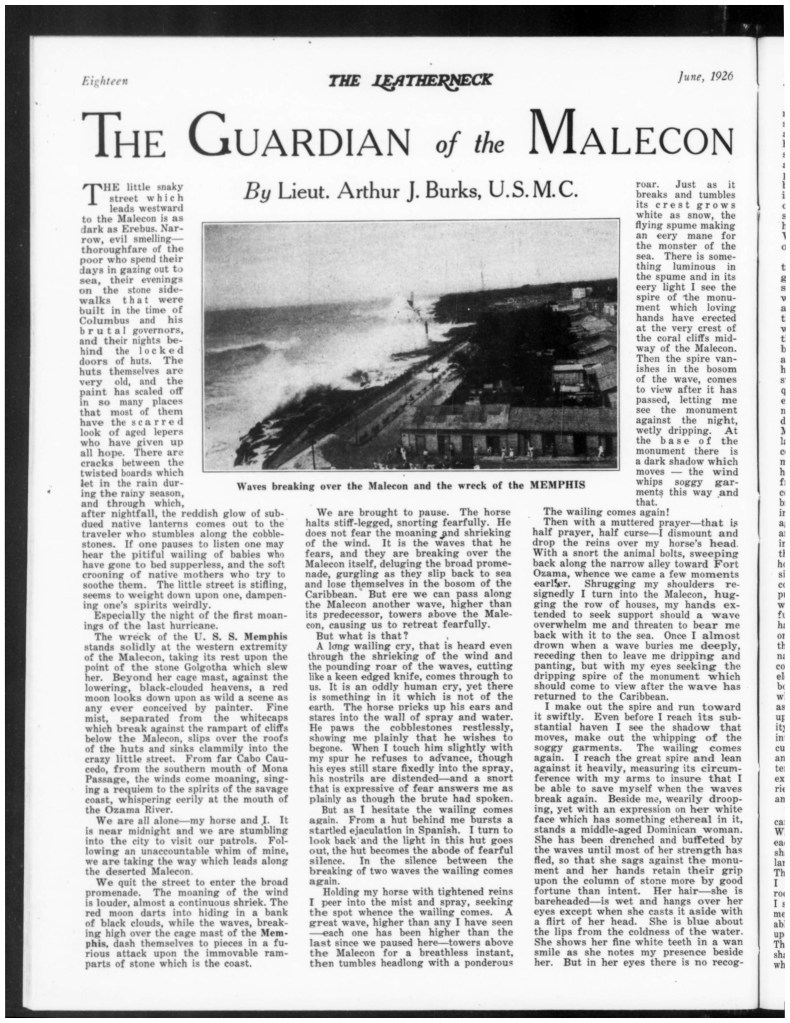
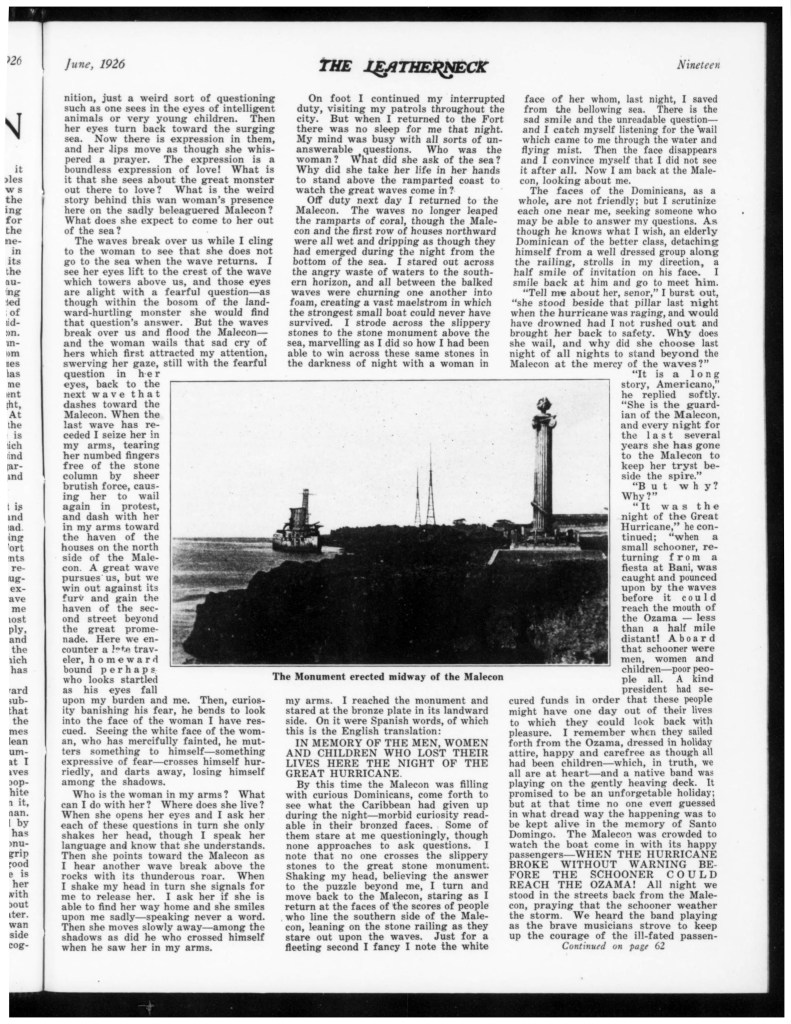
This story was first published in The Leatherneck, June 1926. The Malecón de Santo Domingo is the seafront boulevard that runs along the bay.

For more details, please see the Lost Weird Tales of Arthur J. Burks.

The Guardian of the Malecon

by Arthur J. Burks

The little sneaky street which leads westward to the Malecon is as dark as Erebus. Narrow, evil smelling—thoroughfare of the poor who spend their days in gazing out to sea, their evenings on the stone sidewalks that were built in the time of Columbus and his brutal governors, and their nights behind the locked doors of huts. The huts themselves are very old, and the paint has scaled off in so many places that most of them have the scarred look of aged lepers who have given up all hope. There are cracks between the twisted boards which let in the rain during the rainy season, and through which, after nightfall, the reddish glow of subdued native lanterns comes out to the traveler who stumbles along the cobblestones. If one pauses to listen one may hear the pitiful wailing of babies who have gone to bed supperless, and the soft crooning of native mothers who try to soothe them. The little street is stifling, seems to weight down upon one, dampening one’s spirits weirdly.

Especially the night of the first moanings of the last hurricane.

The wreck of the U. S. S. Memphis stands solidly at the western extremity of the Malecon, taking its rest upon the point of the stone Gogotha which slew her. Beyond her cage mast, against the lowering, black-clouded heavens, a red moon looks down upon as wild a scene as any ever conceived by a painter. Fine mister, separated from the whitecaps which break against the rampart of cliffs below the Malecon, slips over the roofs of the huts and sinks clammily into the crazy little street. From far Cabo Caucedo, from the southern mouth of Mona Passage, the winds come moaning, singing a requiem to the spirits of the savage coast, whispering eerily at the mouth of the Ozama River.

We are all alone—my horse and I. It is near midnight and we are stumbling into the city to visit our patrols. Following an unaccountable whim of mine, we are taking the way which leads along the deserted Malecon.

We quit the street to enter the broad promenade. The moaning of the wind is louder, almost a continuous shriek. The red moon darts into hiding in a bank of black clouds, while the waves, breaking high over the cage mast of the Memphis, dash themselves to pieces in a furious attack upon the immovable ramparts of stone which is the coast.

We are brought to pause. The horse halts stiff-legged, snorting fearfully. He does not fear the moaning and shrieking of the wind. It is the waves that he fears, and they are breaking over the Malecon itself, deluging the broad promenade, gurgling as they slip back to Sea and lose themselves in the bosom of the Caribbean. But ere we can pass along the Malecon another wave, higher than its predecessor, towers above the Malecon, causing us to retreat fearfully.

But what is that?

A long wailing cry, that is heard even through the shrieking of the wind and the pounding roar of the waves, cutting like a keen edged knife, comes through to us. It is an oddly human cry, yet there is something in it which is not of the earth. The horse pricks up his ears and stares into the wall of spray and water. He paws the cobblestones restlessly, showing me plainly that he wishes to be gone. When I touch him slightly with my spur he refuses to advance, though his eyes stare fixedly into the spray, his nostrils are distended—and a snort that is expressive of fear answers me as plainly as though the brute had spoken.

But as I hesitate the wailing comes against. From a hut behind me bursts a startled ejaculation in Spanish. I turn to look back and the light in this hut goes out, the hut becomes the abode of fearful silence. In the silence between the breaking of two waves the wailing comes again.

Holding my horse with tightened reins I peers into the mist and spray, seeking the spot whence the wailing comes. A great wave, higher than any I have seen—each one has been higher than the last since we paused here—towers above the Malecon for a breathless instant, then tumbles headlong with a ponderous roar. Just as it breaks and tumbles its crest grows white as snow, the flying spume making an eery mane for the monster of the sea. There is something luminous in the spume and in its every light I see the spirit of the monument which loving hands have erected at the very crest of the coral cliffs mid-way of the Malecon. Then the spire vanishes in the bosom of the wave, comes to view after it has passed, letting me see the monument against the night, wetly dripping. At the base of the monument there is a dark shadow which moves—the wind whips soggy garments this way and that.

The wailing comes again!

Then with a muttered prayer—that is half prayer, half curse—I dismount and drop the reins over my horse’s head. With a snort the animal bolts, sweeping back along the narrow alley toward Fort Ozama, whence we came a few moments earlier. Shrugging my shoulders resignedly I turn into the Malecon, hugging the row of houses, my hands extended to seek support should a wave overwhelm me and threaten to bear me back with it to the sea. Once I almost drown when a wave buries me deeply, receding then to leave me dripping and panting, but with my eyes seeking the dripping spire of the monument which should come to view after the wave has returned to the Caribbean.

I make out the spire and run toward it swiftly. Even before I reach its substantial haven I see the shadow that moves, make out the whipping of the soggy garments. The wailing comes again. I reach the great spire and lean against it heavily, measuring its circumference with my arms to insure that I be able to save myself when the waves break again. Besides me, wearily drooping, yet with an expression on her white face which has something ethereal in it, stands a middle-aged Dominican woman. She has been drenched and buffeted by the waves until most of her strength has fled, so that she sags against the monument and her hands retain their grip upon the count of stone more by good fortune than intent. Her hair—she is bareheaded—is wet and hangs over her eyes except when she casts it aside with a flirt of her head. She is blue about the lips from the coldness of the water. She shows her fine white teeth in a wan smile as she notes my presence beside her. But in her eyes there is no recognition, just a weird sort of questioning such as one sees in the eyes of intelligent animals or very young children. Then her eyes turn back toward the surging sea. Now there is expression in them, and her lips move as though she whispered a prayer. The expression is a boundless expression of love! What is it that she sees about the great monster out there to love? What is the weird story behind this wan woman’s presence here on the sadly beleaguered Malecon? What does she expect to come to her out of the sea?

The waves break over us while I cling to the woman to see that she does not go to the sea when the wave returns. I see her eyes lift to the crest of the wave which towers above us, and those eyes are alight with a fearful question—as though within the bosom of the landward-hurtling monster she would find that question’s answer. But the waves break over us and flood the Malecon—and the woman wails that sad cry of hers which first attracted my attention, swerving her gaze, still with the fearful question in her eyes, back to the next wave that dashes toward the Malecon. When the last wave has receded I seize her in my arms, tearing her numbed fingers free of the stone by sheer British force, causing her to wait again in protest, and dash with her in my arms toward the haven of the houses on the north side of the Malecon. A great wave pursues us, but we win out against its fury and gain the heaven of the second street beyond the great promenade. Here we encounter a later traveler, Howard bound perhaps, who looks startled as his eyes fall upon my burden and me. Then, curiosity banishing his fear, he bends to look into the face of the woman I have rescued. Seeing the white face of the woman, who has mercifully fainted, he mutters something to himself—something expressive of fear—crosses himself hurriedly, and darts away, losing himself among the shadows.

Who is the woman in my arms? What can I do with her? Where does she live? When she opens her eyes and I ask her each of these questions in turn she only shakes her head, though I speak her language and know that she understands. Then she points toward the Malecon as I hear another wave break above the rocks with its thunderous roar. When I shake my head in turn she signals for me to release her. I ask her if she is able to find her way home and she smiles upon me sadly—speaking never a word. Then she moves slowly away—among the shadows as did he who crossed himself when he saw her in my arms.

On foot I continued my interrupted duty, visiting my patrols throughout the city. But when I returned to the Fort there was no sleep for me that night. My mind was busy with all sorts of unanswerable questions. Who was the woman? What did she ask of the sea? Why did she take her life in her hands to stand above the ramparted coast to watch the great waves come in?

Off duty next day I turned to the Malecon. The waves no longer leaped the ramparts of coral, though the Malecon and the first row of houses northward were all wet and dripping as though they had emerged during the night from the bottom of the sea. I started out across the angry waste of waters to the southern horizon, and all between the balked waves were churning one another into foam, creating a vast maelstrom in which the strongest small boat could never have survived. I strode across the slippery stones to the stone monument above the sea, marvelling as I did so how I had been Abe to win across those same stones in the darkness of night with a woman in my arms. I reached the monument and stared at the bronze plate in its landward side. On it were Spanish words, of which this is the English translation:

IN MEMORY OF THE MEN, WOMEN AND CHILDREN WHO LOST THEIR LIVES HERE THE NIGHT OF THE GREAT HURRICANE.

By this time the Malecon was filling with curious Dominicans, come forth to see what the Caribbean had given up during the night—morbid curiosity readable in their bronzed faces. Some of them stare at me questioningly, though none approaches to ask questions. I note that no one crosses the slippery stones to the great stone monument. Shaking my head, believing the answer to the puzzle beyond me, I turn and move back to the Malecon, staring as I return at the faces of the scores of people who line the southern side of the Malecon, leaning on the stone railing as they stare out upon the waves. Just for a fleeting second I fancy I note the white face of her whom, last night, I saved from the bellowing sea. There is the sad smile and the unreadable question—and I catch myself listening for the wail which came to me through the water and flying mist. Then the face disappears and I convince myself that I did not see it after all. Now I am back at the Malecon, looking about me.

The faces of the Dominicans, as a whole, are not friendly; but I scrutinize each one near me, seeking someone who may be able to answer my questions. As though he knows what I wish, an elderly Dominican of the better class, detaching himself from a well dressed group along the railing, strolls in my direction, a half smile of invitation on his face. I smile back at him and go to meet him.

“Tell me about her, senor,” I burst out, “she stood beside that pillar last night when the hurricane was raging, and would have drowned had I not rushed out and brought her back to safety. Why does she wail, and why did she choose light night of all nights to stand beyond the Malecon at the mercy of the waves?”

“It is a long story, Americano,” he replied softly. “she is the guardian of the Malecon, and every night for the last several years she had gone to the Malecon to keep her tryst beside the spire.”

“But why? Why?”

“It was the night of the Great Hurricane,” he continued; “when a small schooner, returning from a fiesta at Bani, was caught and pounced upon by the waves before it could reach the mouth of the Ozama—less than half a mile distant! Aboard that schooner were men, women and children—poor people all. A kind president had secured funds in order that these people might have one day out of their lives to which they could look back with pleasure. I remember when they sailed forth from the Ozama, dressed in holiday attire, happy and carefree as though all had been children—which, in truth, we all are at heart—and a native band was playing on the gently heaving deck. It promised to be an unforgettable holiday; but at that time no one even guessed in what Dread the happening was to be kept alive in the memory of Santo Domingo. The Male one was crowded to watch the boat come in with its happy passengers—WHEN THE HURRICANE BROKE WITHOUT WARNING BEFORE THE SCHOONER COULD READ THE OZAMA! All night we stood in the streets back from the Malecon, praying that the schooner weather the storm. We heard the band playing as the brave musicians strove to keep up the courage of the ill-fated passengers. But the band stopped at last, and we saw that the lights of the schooner were slowly but surely moving landward—now hidden in a trough of the waves, now in plain view at the crest of a monster of the sea. Ever and anon we caught the wailing of those yet left alive aboard her. Then the lights vanished as a terrible wave engulfed the schooner; the wailing died out as disappears a candle flame in a wind—and silence settled over the Malecon save for the shrieking of the waves and the screaming of the wind. There was no way of going to the rescue! It would have been suicide to no avail, senor! One man tried to swim out of the schooner—we found his body next day in the middle of second street north of the Malecon—and with him were the bodies of many others. That monument yonder was erected in memory of one of the saddest pages in Dominican history.”

“But the woman! What of her?”

“All of her family, save her husband, was aboard the schooner. All save one of them returned—the youngest, a girl of twelve, best-beloved of her family—we found their bodies north of the Malecon. But the girl never came back! The sea took her and has never given her up.”

“But the woman’s husband, who you saw was not a board? Why does he permit her to visit the Malecon alone?”

“Her husband, senor,” replied the man, “was the only Dominican who tried to reach the foundering schooner. He failed, as I have told you. Now, there is no one of the family save the wife and mother—who comes nightly to the Malecon to pray that the sea give up her best-beloved. But there is no reason to fear her, senor. She is harmless, though all Santo Domingo knows that she has lost her mind—she does not even grow angry at the men and boys who follow her about, hurling gibes at her for a lunatic. So you can see that there is really no harm in her.”

“Yes,” I replied bitterly, “I can well understand. But do you?”

Many months later, when I stood on the deck of an outbound transport, leaving Santo Domingo behind to drop slowly out of sight below the horizon, I stood at the rail and looked back toward the Malecon. We had left the Ozama at nightfall and already lights had flashed on in the Capital City. A revolving light to guide mariners blinked on and off as it circled in its huge cage above the harbor. Its light flashed for an instant along the coast, causing the spire of the monument to stand out in startling relief as it passed. Just for an instant it was; but in its pathway, coming across the slippery stones from the Malecon, I fancied I could make out the shadowy outlines of a woman who walked slowly, with her great eyes fixed questioningly upon the sea. Then the light passed on and, after a long time, Santo Domingo dropped out of sight beneath the heaving waste.

In The Leatherneck, the tale ends with the notice “[Reprinted by permission of WEIRD TALES].” Arthur J. Burks published six “Strange Tales of Santo Domingo” in the pages of Weird Tales, but this is not one of them. Not quite weird enough, perhaps, for Farnsworth Wright.

The Carribean to the south, beyond the Malecon, was a mighty Sapphire mystery encircling the world. […] To the west of the Malecon the wrecked U. S. S. Memphis, often seen now in newsreels, rested solidly upon the stone Golgotha which had crucified her. And when the waves were running in their crests broke into creamy foam over the very top of her cage mast, which had not then been taken down by the salvaging interests.
—Arthur J. Burks, Land of Checkerboard Families (1932) 8-9

The U.S.S. Memphis was real, and wrecked in the harbor of Santo Domingo in 1916. The partially dismantled wreck would still have been visible in the 1920s when Burks was stationed there.


Bobby Derie is the author of Weird Talers: Essays on Robert E. Howard and Others and Sex and the Cthulhu Mythos.

Deep Cuts in a Lovecraftian Vein uses Amazon Associate links. As an Amazon Associate I earn from qualifying purchases.
In Defense Of Transgender Mermaids: George Sterling’s Strange Waters (1926) by Joe Koch

Strange Waters is a narrative poem by George Sterling released in a small chapbook edition in 1926, the same year Sterling died by suicide. As his last published poem, the language is more economical than the “things of tinsel and fustian, the frippery of a by-gone fashion” that drew criticism earlier in his career when his “brilliant but too facile craftsmanship was tempted by the worst excesses of the Tennysonian tradition,” according to Harriet Monroe of Poetry Magazine

Sterling’s lyrical intemperance had, however, attracted praise from Ambrose Bierce, who for nearly a decade mentored him and enthusiastically publicized his poems, most notably in an effusive afterword for “A Wine of Wizardry,” a decadent and hallucinatory horror-fantasy poem published in Cosmopolitan magazine in 1907. Controversy over Bierce’s claims of greatness for Sterling went viral across US print media, and arguments over Sterling’s talent—or lack of it—made him famous. Clark Ashton Smith credited “A Wine of Wizardry” with inspiring him to write poetry at age fifteen and soon became Sterling’s protégé and a lifelong correspondent.

Aside from connections with weird fiction, Sterling—as a Bohemian figure, perhaps more than as a writer—influenced many contemporaries whose work has fared better than his. He shared an intense friendship with Jack London, critiquing and polishing London’s novels The Call of The Wild and The Sea-Wolf. He was a founding member of the West Coast artist’s colony Carmel-by-the-Sea, an early twentieth-century self-styled pagan commune of sorts populated by writers, artists, musicians, theater people, and other nonconformists.

Biographical information matters to me when reading Strange Waters, because the poem’s glaringly offensive flaw—the twist ending that I’ll spoil for you momentarily—is the sort of thing too easily dismissed as lazy writing, or a product of olden times, as if everyone in the vaguely defined past suffered from debilitating sexual repression and unexamined prejudices.

This simply isn’t true.

Nor is the potential accusation of lazy writing. Every choice in the poem, including what is not said, feels precise and deliberate. The plot twist could easily play as slapstick. But rather than presenting this potentially titillating “tale of forbidden love” in a saucy manner, our narrator opens with brooding insomniac musings, a compulsion born of gulls crying out and storm gales brewing over the nighttime sea. Mournful framing sets the stage for a tragedy rather than a farce.

Our narrator introduces Ralph and Mary, a fairly average and averagely happy heterosexual couple living on the California coast. Their equanimity is interrupted by a letter from Mary’s estranged brother in Ireland. Physically reacting to the letter “as tho it were a snake,” Mary throws it on the floor. Of her brother, Mary will only say he is a “monster.”

From his deathbed, the brother has sent his eighteen-year-old twin daughters to live with Mary. They’ll be arriving soon to “avenge me for a distant hour, your nails along my cheek, your virtuous words.” Mary suggests the girls might be better off sent “to some good school,” but Ralph shuts down the conversation, insensitive to the implications of assault in the letter, and Mary’s obvious misgivings.

The girls arrive. Intrusively, our narrator describes them, and continues re-describing them—one might even say fetishizing them—as the poem goes on. We hear they’re beautiful and tall, like “twin eaglets, fierce of eye and orange-crowned.” Of the two, Deidre is “more girlish” while Callirhoe is “an inch taller, and shouldered like a boy.” Deidre isn’t mentioned again until the end of the story, whereas Callirhoe is granted an assertive personality. She winces gruffly when Mary kisses her in greeting, trounces Ralph’s philosophical arguments in conversation, and makes a habit of staring him down. With wounded pride, Ralph’s anger and suspicion fester.

You see where this is leading, don’t you?

The transmisogynist tropes are all there, except for a prominent Adam’s apple and five o’clock shadow.

Callirhoe is going to die, though not directly by Ralph’s hand. His spying, harassment, and threats drive the girls to flee, resulting in Callirhoe’s fall from a sea cliff “clad scantily in her scarlet bathing suit.” Found thus bared, she’s subjected to an unfortunate and cheap twist ending I’m all too familiar with. I call it “Dead Gender Reveal Party.” While handling her corpse, Ralph exclaims, “Christ, Mary! Christ! Callirhoe’s a boy!”

Not only is Callirhoe portrayed as an absurd caricature of supposedly masculine traits, she’s murdered, manhandled, and misgendered for shock value. She’s literally referred to after death as “the other.” Before the big shock, though, there’s another shock; two, in fact. Ralph discovers, by snooping at their bedroom door, that the twins are incestuous lesbians.

The brother’s letter has suggested he passed down his incestuous leanings to his children, and Mary’s behavior confirms some family dysfunction, but the idea of homosexuality is what most outrages Ralph. The plot moves according to Ralph’s growing rage step by step toward greater perceived perversities, positioning transness as the greatest perversion of all.

While there’s no excuse to write a transgender character in such an objectifying and cartoonish way in 2026 (although contemporary authors I won’t name have proudly done so and somehow evaded censure), what about one-hundred years ago? Can we dismiss Strange Waters as an antiquated product of its time?

Even if the correct scholarly answer is yes, dismissal doesn’t satisfy me. Dismissal is too close to denial. The fascist claim that being transgender is a new fad unheard of in the past is a deliberate lie. Erasing records of our existence, destroying research on our medical care, and eradicating language that names our legacy help perpetuate that lie, tactics most famously practiced in Nazi Germany and widely used in the US today. Cutting out the parts of history you don’t like and repackaging the past for a new and newly ignorant generation has become streamlined by modern techno-fascists; through our personal devices, information is simultaneously ephemeral and ubiquitous, while our attention spans are weary, waning, and overtaxed.

Denial is a spell that’s easy to fall under. Denial is a tool of oppressors and abusers. Dismissing human hatred and misogyny as things of the past represents a form of cultural denial that allows that which is denied to flourish.

Hatred does the most harm in disguise. In the deepest waters, the parts of our being that have yet to be explored, the tendrils of hatred find fertile conditions for growth. We may wish to see ourselves as having overcome all prejudices and biases at some point in our personal or societal histories, but overcoming is cyclical, part of a meaningful life’s ongoing work. We enable hatred when we pretend it’s behind us.

We might say George Sterling mistreated and exploited Callirhoe as you’d expect for a man of his time, but since he lived, worked, and performed with nonconformists, was openly polyamorous, and was far too popular and active as a socialite in artsy circles not to know plenty of queers and a few transgender people, I wonder how much blame lies with the poem’s patriarch Ralph rather than the author. In trying to sort out prejudice from portrayal, I’m drawn into a darker, weirder story lurking beneath the surface of the story in Strange Waters.

Maybe this is my compulsive habit as a fiction writer, re-making art that’s failed me. Maybe I’m telling myself a different story because the plot of the poem is offensive. Or maybe I’m rebelling against writing nonfiction because it collapses possibilities into fact, and writing, to me, is about expanding—or exploding—the possible.

With two patriarchs in Strange Waters, Ralph in the present and Mary’s brother in the past, we open with an insomniac narrator musing about the stormy sea. Their mournful voice is soon subsumed by Ralph, whose hostile dialogue and action moves the plot forward. These dual voices remain somewhat in opposition throughout the poem, as do the double patriarchs, and other doublings and couplings that build both ambiguity and tension.

In Gothic fashion, the past violates the present, doubling time when first the letter and then the twins (themselves doubles) arrive from Ireland. Mary’s brother implies some horrific or cruel parallel when he writes of his daughters, “Ha! We are of the same blood, they and I! There’s more in that than you’ve a notion of.” Does this mean that they are, to use Mary’s word for her brother, monsters?

Resonances, ripples, waves; we might wonder how much Mary, who is utterly un-shocked by Callirhoe (both alive and dead), recognizes in the twins. Is her brother really her sister? The narrator never swerves from calling this a “tale of forbidden love” rather than a tale of perversion or abuse. And how exactly do monsters reproduce?

“Like sea-born things,” the girls go swimming three times a day, every day, eschewing the company of chaperones. They’re strong swimmers, described as feral or mythological creatures: “twin eaglets,” “stranded stars,” “wild things,” “gorgeous snakes about to strike,” and “amorous reptiles.” Song-like interludes in their voices punctuate the narrative, and it’s not clear if these are their thoughts, their actual words, or some psychic, siren-like intrusion. Perhaps these are the sad, desperate, and rebellious songs of a dying species; of mermaids.

Who hears these songs? Is it Mary, who has no children, despite a marriage with “love-hunger long to satisfy” in which she and Ralph “longed…often for dear children”? Mary’s silence is pivotal, holding certain mysteries below the surface of the plot. Instead of a drowning (an ending), things unknown perpetuate doubts that keep the plot alive after the story is over.

Likewise, instead of resolving reader uncertainty by showing the drowned maiden of Gothic tradition, Deidre swims away, neither definitively alive nor dead, but becoming (narratively) something Other. Just before they find Callirhoe’s body, a fisherman tells Ralph and Mary that he saw Deidre from a distance “take the surf at yonder beach, alone, and watched her head on every wave until she faded in the distance. Say—she’ll be in China in a week or two!”

Mary makes her single decisive statement to Ralph about Deidre’s missing body: “No—you’ll look in vain. She’s gone forever.” We don’t know how she feels or what motivates her; only that Mary forbids a search party.

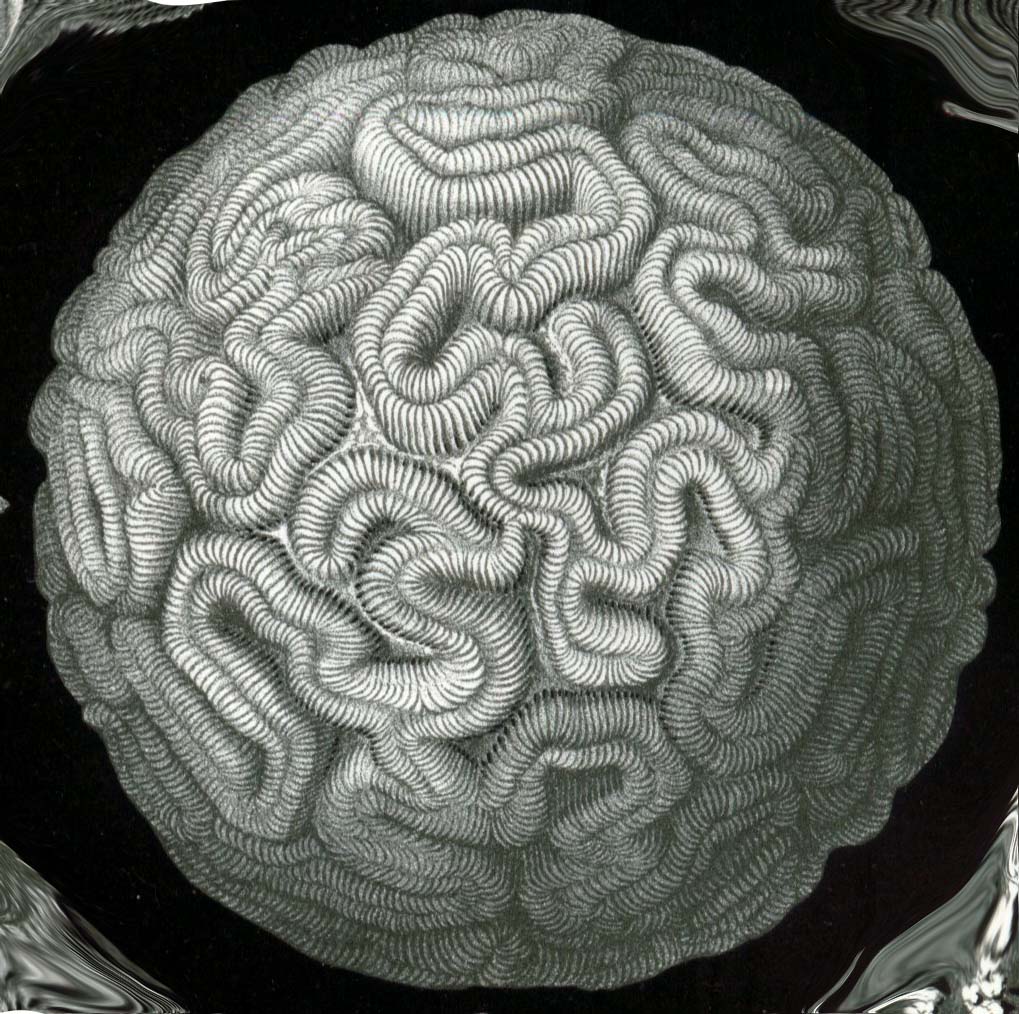
The story I’m left with is fanciful. It’s about a family of cryptids separated by the flight of their matriarch, who has rejected her sea-born powers in favor of domestic normalcy. Drawing parallels between the strange waters of the subconscious mind and the actual sea, I’m reminded that what we know of marine biology includes more complex reproductive processes and gender flexibility than the mere idea of transgender mermaids, or of an estranged brother who somehow impregnates himself, or of a not-mother who protects a child’s gambit toward freedom that might mirror her own past. The deepest parts of the ocean remain subject only to scientific speculation, not exploration. Maybe they’re like the psychological depths of our being, the places where poetry originates.

I’m also left thinking about the poet composing the tale near the Pacific Ocean, perhaps gazing out into the darkness, disturbed by stirring waves and crying gulls on yet another sleepless, hungover night. He would have been about two years younger than me at the time. I wonder how often Sterling’s fingers strayed to the vial of cyanide labeled “Peace” that he was known to have kept with him for nearly the last twenty years of his life.

Is Sterling’s sympathy lacking, or did he intend to critique Ralph’s petty cruelty? Did he intend to show a system where women have no power and morals are upside-down? He might have treated the mermaids better in death and not made Callirhoe a punchline, but I realize there’s only so much empathy you can expect from certain men, especially those cheated by toxic fame and feeling past their prime. Sometimes, as he may or may not have meant to imply, the best option is to take to the surf and see where it leads you; to take flight, and become what you never imagined possible.

Strange Waters (1926) by George Sterling may be read for free at the Internet Archive.

Resources:

Harriet Monroe “Review: The Poetry of George Sterling” Poetry Vol. 7 No. 6 March, 1916

Harriet Monroe “Two Poets Say Farewell” Poetry Vol. 29 No. 4 January, 1927

Joy Lanzendorfer “Bohemian Tragedy: The Rise, Fall, and Afterlife of George Sterling’s California Arts Colony” Poetry Foundation, February 26, 2018

Gary Kamiya “S.F.’s Unofficial Poet Laureate Thrived In ‘Cool, Grey City of Love’ —For a Time” San Francisco Chronicle, October 15, 2020

Jim Fisher “George Sterling: Historical Essay” FoundSF.org (digital historical archive managed by Shaping San Francisco)

Peter Kratzke “The Man Who Would Have It All: George Sterling and The American Dream” Americana: The Journal of American Popular Culture, 1900 to Present  June, 2005


Joe Koch writes literary horror and surrealist trash. Their books include The Wingspan of Severed Hands, Invaginies, Convulsive, and The Couvade, which received a 2019 Shirley Jackson Award nomination. His short work appears in The Best Weird Fiction of the Year, Southwest Review, Nightmare, Vastarien, and many others. Joe co-edited the art horror anthology Stories of the Eye and has collaborated with other authors and poets on  several speculative writing projects. Find Joe (he/they) online at horrorsong.blog.

Copyright 2026 Joe Koch.

“Bat’s Belfry” (1926) by August Derleth

Vampirism is still a force to cope with; it has been in flower since Bram Stoker’s Dracula.

August Derleth, “The Weird Tale in English Since 1890” (1930) in The Ghost #3 (1945) 6

Before August Derleth pastiched H. P. Lovecraft, and coined the term “Cthulhu Mythos”; before Derleth pastiched Sherlock Holmes, and created the detective Solar Pons; before he published anything else—Derleth pastiched Bram Stoker and Dracula with “Bat’s Belfry,” his first professional sale.

Dracula in the mid-1920s was not the cultural sensation that it is today. In 1924, Hamilton Deane wrote the first authorized dramatic adaptation of Stoker’s novel. In 1927 John L. Balderston would revise the play for Broadway. American audiences thrilled to the stage production, starring Hungarian actor Bela Lugosi in the title role with a characteristic opera cape—and in 1931, director Tod Browning featured Lugosi and other actors from the production in the first Hollywood film adaptation. With each step, Dracula’s exposure increased, and the image and reputation of the Count expanded by magnitudes.

In 1925, however, Dracula was known as a modestly successful horror story, the best and most popular of Bram Stoker’s novels, still in print 13 years after his death. While readers of Weird Tales could be sure to have at least heard of the book, even if they hadn’t read it, the vampire count had not yet hit icon status. Yet a young August Derleth was inspired by Dracula to write a story—or, perhaps more accurately, to market a story he had already written:

A long time ago, it seems (the year was 1925), when I had written forty stories, none of which had sold, I thought it time to take stock I looked over everything I had written—most of it pretty bad—and selected one story which I thought might be sold. The result was felicitous.

August Derleth, foreword to Evening in Spring (1945 edition)

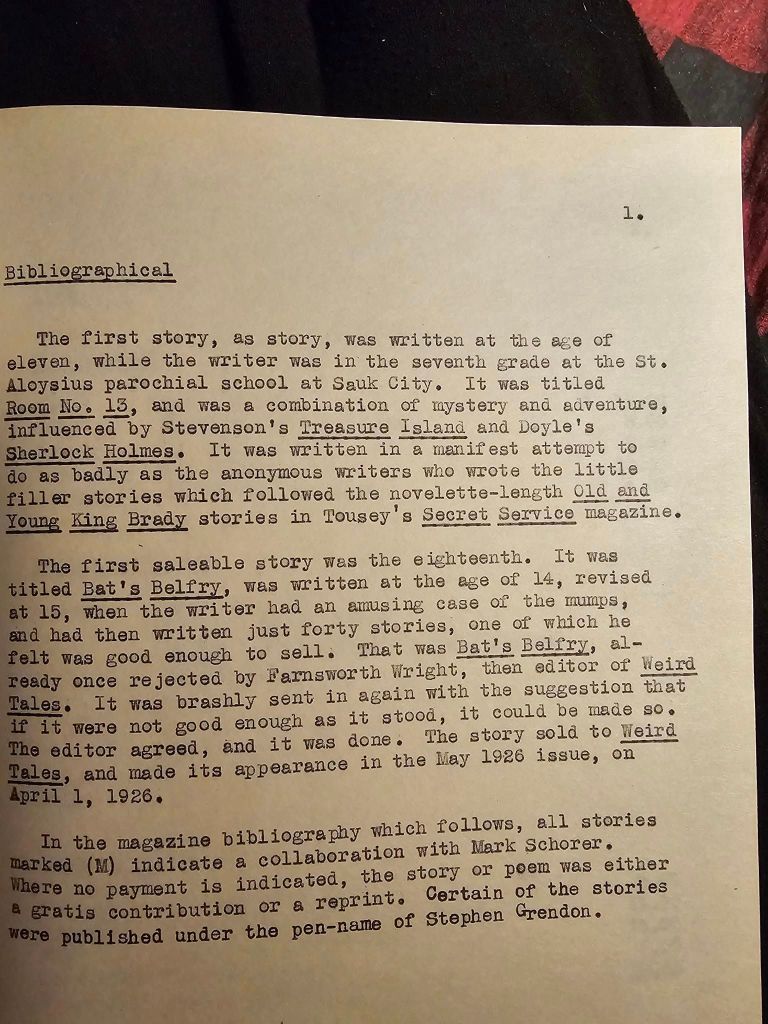
It isn’t exactly clear when Derleth wrote this story, and various details get muddled in the telling and retelling. Various sources claim he began writing at 13, and that “Bat’s Belfry” was written when he was 13, 14, or 15. In his personal publication record, Derleth wrote:

Later, Derleth would write:

I began at thirteen, and I sold at fifteen. The selling of my first story involved a direct challenge to the ego. I had written forty stories before I sold one, and that I should then have sold one ways purely an accident of determination. I had fixed upon the figure forty, resolving that when I had written forty stories without selling one, I would re-examine my determination to become a writer, because I had read somewhere that Charles Dickens had taken his first book to forty publishers before it was accepted. By that accident of reading, I fixed upon forty, and when I had written forty, most of them weird stories which had been duly rejected by Farnsworth Wright of Weird Tales, I looked them all over, one after the other, and endured my own private soul-struggled. On one or two rejection slips Wright had penned a brief, encouraging note—”Try us again!” or “Sorry. Try once more.”—and I read the stories thus rejected with especial interest. They did not seem to me to merit re-submission, but my eighteenth story did. I felt that it was honestly as good as many of the things which Wright had been publishing, and, if it was not up to acceptable status, it could be brought up to that level. So, firmly but politely, I resubmitted the story, stating that I felt it could be made acceptable, and in response received a most agreeable letter from Wright suggesting certain changes, calling my attention to my error in the matter of the Cockney dialect, with the felicitous result that the story, revised, was ultimately sold.

August Derleth, Writing Fiction 164-165

This version of the story, straight from Derleth, is probably the most detailed and accurate version—with a few caveats. The original title of the story wasn’t even “Bat’s Belfry,” and there was much more involved in the revision than removing a Cockney accent. Fortunately, we can track the development of the story because Derleth saved Wright’s rejection letter:

Dear Mr. Derleth:-

I have again given a careful reading to THE LOCKED BOOK. The workmanship is very uneven, almost as if you had written part of it under the fever of an urgent inspiration, and the rest merely as a matter of routine hack-work. But—I think it can be made acceptable for WEIRD TALES. The last half of the story is well handled, except the ending. You have adduced no reason why Sir Harry Barclay should wish to summon Satan, when all he wants to do is the pious deed of staking the bodies of the vampires. You have made no connection between the skeletons and the final scene where Satan appears. In other words, the whole story is left “up in the air”—you have braided a rope, but left the ends out without bringing them together in one cord. And the beginning contains altogether too much of the grocer’s conversation—I think the whole scene with the grocer is irrelevant and merely interrupts the flow of the narrative. All that the grocer incident does for the story is to establish the fact of the disappearances of four girls, and the fact that the last Baronet Lohrville was a devil incarnate. This fact can be much more naturally established than by interrupting your story to drag in a dialect-speaking grocer for two pages of conversation. Your narrative first takes on vigor and movement on page 7, where you begin: “Three days ago Mortimer came to me,” etc., and it keeps up nearly to the end, where it sags by reason that nothing is decided, and that the ending is no true denouement at all, for it has very little connection with the facts of the narrative itself, neither explaining them nor being a development or working-out or consequence of the facts of the story itself. What possible connection, the readers would think, exists between the vampire-talk that has gone before, the finding of the skeletons, the extinguishing of the lights, the bat-wings in the dark—what possible connection between these things and the ending of the story, the appearance of Satan? I fear the reader would be disappointed. The story is very well handled in part, yet awkwardly treated in other parts.

Farnsworth Wright to August Derleth, 24 Sep 1925, MSS. Wisconsin Historical Society.

At the end of its first year in business, Weird Tales was in a bad way; a company shake-up in 1924 ousted then-editor Edwin Baird, and Farnsworth Wright (formerly first reader for the magazine, who would sift through the slush pile of submissions for stories worth publishing) ended up in the editorial chair, and after the owner J. C. Henneberger was forced out of management, Wright had the creative freedom to run Weird Tales his own way. This still involved, at first, running stories bought under Baird—but as they went through the issues, Wright would be in the market for new material. Enter August Derleth.

Of immediate notice in this letter is that this isn’t the first time Derleth has submitted this story; it would become Derleth’s practice to submit and re-submit stories until they sold, and that so many of his works did sell to Weird Tales shows the value of his persistence (and Wright’s need for material). As Derleth would later tell it:

Since that time I learned fairly accurately to judge when stories were being rejected because there were a fair number of stories on hand, and the editor could afford to be more selective; and in every such case, without exception, I simply waited several months, retyped the manuscript, and submitted the story in question again, and in every case it was duly accepted on some resubmission, ranging from the first resubmission to the ninth, an opening having appeared for it and the story being good enough for filler if not feature. Something like fifty stories have been sold in this fashion, though I do not recommend it as a steady practice, and cite it only as an example of a) ego, b) a certain ability to judge from the editorial point of view as well as from that of the writer.

August Derleth, Writing Fiction 165

Derleth’s strategy worked in part because of Wright’s extreme conscientiousness as an editor. Wright’s willingness to work with a new potential writer and give detailed advice and criticism on how to improve a story was not limited to Derleth; his encouragement extended to many new writers trying their luck with Weird Tales. That was one of Wright’s more endearing characteristics, well-remembered by many writers who might otherwise just receive a pre-printed rejection slip.

For his part, Derleth seems to have taken Wright’s criticism to heart, for in the published version of the story there is no lengthy dialogue sequence. The grocer’s tale is rendered down to a single long paragraph. Later in life, Derleth would recall:

The danger in distant settings lies in inadequate knowledge. In the original version of my first published short story (Bat’s Belfry, Weird Tales, May 1926), which was set in the country down from London (which, for a beginner of fifteen, seems in retrospect to be the height of self-assurance), I introduced a pub-keeper who spoke in Cockney dialect. Possibly due to saturation reading of Conan Doyle, Sax Rohmer, Edgar Wallace, et al, I had somehow conceived the impression that most of the lower classes in England habitually dropped their h’s from many words and added them to many others where they did not belong. The late Farnsworth Wright, then editor of Weird Tales, pointed out that the Cockney dialect was limited to a bounded area within the city of London, and that it was not likely that such a speech pattern would make its appearance in the down country, or, if it did, that it would last for any length of time, since all dialects are naturally subject to change under the influence of the prevailing speech patterns. Had I checked on this simple fact before submitting the story, I would not have made an error, which now necessitated revision; but I made the mistake of taking the dialect more or less for granted—I ascribed it to a class of people rather than to a district; a little unbiased interpretation would have enlightened me even without reference to any source of information, for dialects are never a matter of class, but always of region.

August Derleth, Writing Fiction 64-65

The story was revised and resubmitted to Wright, who responded back:

Dear Mr. Derleth:-

Almost! And with a little touching up of the ending, THE LOCKED BOOK will be ready for the pages of WEIRD TALES. (And please number your pages; to avoid confusion in case the pages get misplaced).

The story is vastly improved. You are on the right track in the present ending, but you have fallen down badly just the same. For in a story of this kind, does the reader want to enjoy the spectacle of the appearance of the vampires before Barclay, or does he want ’em to appear and then finis? You know the answer. You have deliberately turned from the high spot in your story as if you had suddenly become tired of writing. You have not squeezed out all the horror you could from the situation; in fact, you have hardly squeezed out any. Drain it dry (the situation, I mean). Touch up the ending, let us see the gloating eyes of the vampires as they move on Barclay—let us see Barclay immovable under the hypnotic, glittering, evil gaze of the old Baron, and the sinuous, gliding movements of the four women as their red lips part in a smile and they gently caress those lips with a soft lapping motion of their tongues—while Barclay continues to write—let him fight the spell, let him drop his eyes and start to his feet—let the most beautiful of the vampires come before him, arms outstretch or all for at once, perhaps—I am resisting with all the power of my will, he cries—the rememberance of that parted mouth, those crimson lips remains—she is still here, in front of me, as I write; I will take one more look at her face, and then pray—I look—her face approaches mine and—My God! I no longer want to pray!—a sharp stinging sensation at my throat—my God—it is—

Some such ending. Write it yourself. You don’t need to rewrite what has gone before, hwoever.

Farnsworth Wright to August Derleth, 6 Oct 1925, MSS. Wisconsin Historical Society.

For fans who have rolled their eyes a little at the protagonist continuing to write as the horror takes them, as in H. P. Lovecraft’s “Dagon” and “The Diary of Alonzo Typer,” there is a certain irony in Wright actually suggesting such an ending to the impressionable young Derleth. For his part, Derleth took Wright’s advice on how to write the ending rather literally, presumably to give the editor exactly what he wanted:

I can not tolerate their virulence . . . . I endeavored to rise but I could not do so. . . . I am no longer master of my own will! The vampires are leering demoniacally at me. . . . I am doomed to die . . . and yet to live forever in the ranks of the Undead. Their faces are approaching closer to mine and soon I shall sink into oblivion . . . but anything is better than this . . . to see the malignant Undead around me . . . A sharp stinging sensation in my throat. . . . My God! . . . . it is—

August Derleth, “Bat’s Belfry” in Weird Tales Mar 1926

Still, this final revision did the trick:

Dear Mr. Derleth:-

Your story, BAT’S BELFRY (I prefer your new title), is acceptable for publication in WEIRD TALES, in its new form. Our minimumr ate of half a cent a word, on publication, is unfortunately our standard rate at present except in very exceptional circumstances, and we must keep this rate until we clear off the debts left us by the old company. As your story measures about 3600 words, this will amount to $18 on publication for BAT’S BELFRY. Is this satisfactory?

Farnsworth Wright to August Derleth, 15 Oct 1925, MSS. Wisconsin Historical Society.

It apparently was, and Derleth had his first professional sale. The story would be published in the March 1926 issue of Weird Tales.

One of the interesting things about “Bat’s Belfry” is its format: the first part consists of a letter, there is a brief narrative interlude, and then the rest of the story consists of excerpts from Barclay’s diary. Stoker’s use of the epistolary novel format was something of an archaic device when Dracula appeared in 1897, and was prone to misuse by inexperienced writers. Wright noted this in a follow-up letter when Derleth apparently tried to follow the success of “Bat’s Belfry” with another story in a similar format:

Dear Mr. Derleth:-

I am returning THE PIECE OF PARCHMENT. The diary form is particularly hard to use in a story, altho many of our writers, under the influence of Bram Stoker’s “DRACULA,” have tried to use it, and sometimes they succeed. But it ordinarily is the surest device for killing reader-interest.

Farnsworth Wright to August Derleth, 9 Jan 1936, MSS. Wisconsin Historical Society.

Derleth would take this advice to heart too, recapitulating this advice to others:

Very probably the success of Bram Stoker’s Dracula inspired a flood of similarly conceived stories written in the form of a diary, but on the whole, this form is very difficult to do well. That is because the writer is always caught between the necessity of getting on with his story and of keeping a semblance of verisimilitude about the entries as they are likely to be made.

August Derleth, Writing Fiction 126

More interesting perhaps is that for those familiar with Derleth’s later creative efforts, “Bat’s Belfry” has many hallmarks of his later Cthulhu Mythos fiction. Aside from the obvious characteristics of pastiche, where Derleth apes or recaps some of the key imagery or elements from Stoker’s original (compare the vampire women seducing Harker and Barclay), there is the emphasis on the library of occult books which foreshadow the development of a five-foot shelf of eldritch tomes in later Mythos fiction. This includes a very Derlethian, weirdly self-referential element when the protagonist, digging through an old trunk, comes across an early edition of Dracula! This is strongly reminiscent of how in some of his later Mythos fiction such as “Beyond the Threshold” (WT Sep 1941), Derleth would place copies of Arkham House books such as The Outsider and Others next to the Necronomicon. Indeed, the Book of Thoth in this story serves much the same function as the Necronomicon might in later Mythos fiction, being almost a prototype for the Necromonicon-as-grimoire trope.

To be frank, “Bat’s Belfry” is far from Derleth’s best work, borderline juvenalia. While it may not be hack-work, it is plainly a potboiler, and one which Wright himself seems to have partially dictated. Derleth skews from Stoker in having Barclay attempt to use actual magic against the vampires (Leon, a Catholic like Derleth himself, fares a bit better), but the diary format of the final encounter renders is a bit ridiculous. Nevertheless, the story had its attractions for editors. While it didn’t place among the best stories in the issue, it was selected for reprint in the British More Not at Night anthology by Christine Campbell Thomson. This was the first of what would be many reprints in various horror and vampire anthologies over the decades.

As his first publication, “Bat’s Belfry” became part of Derleth’s own personal legend, and on the twentieth anniversary of his becoming a writer, his people threw a party to celebrate:

The Capital Times 28 Mar 1946

Another article suggests 130 guests attended Derleth’s 20th anniversary of becoming a writer (The Capital Times 4 Apr 1946). Yet that is not the end of “Bat’s Belfry.”

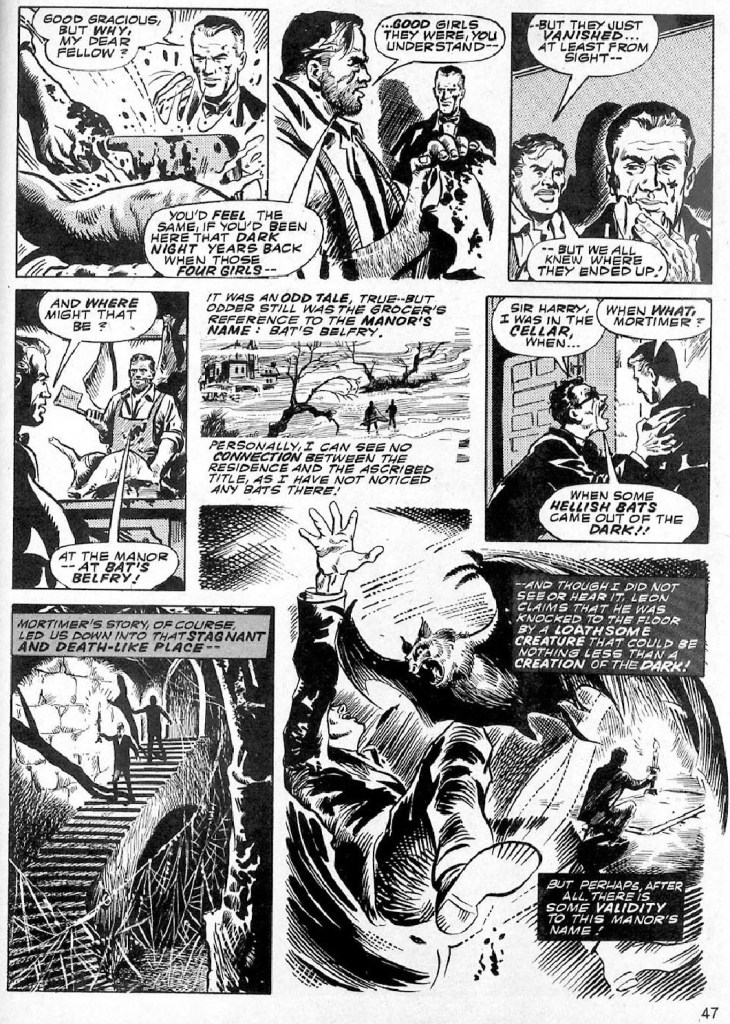
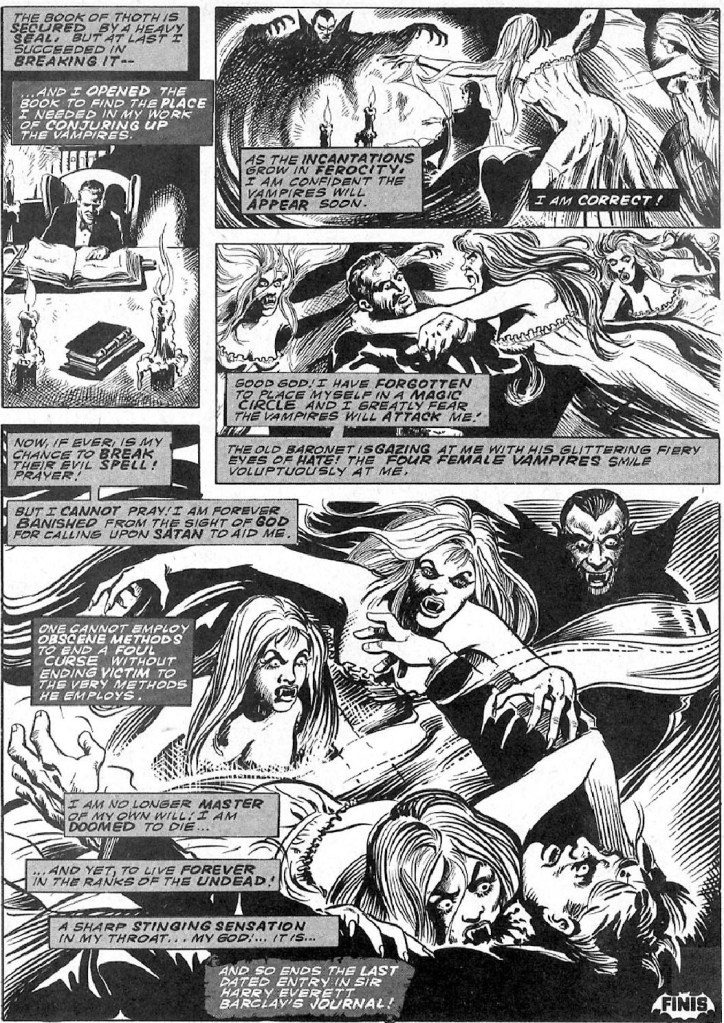
In the 1970s, Marvel Comics circumvented the restrictive Comics Code Authority, which effectively prevented them from publishing adult-oriented comics, particularly horror and the more lurid and grisly sword & sorcery, by publishing full-sized comic magazines, initially under their Curtis imprint. One of these efforts was the black-and-white Vampire Tales, and in the third issue (February 1974), they published an adaptation of “Bat’s Belfry,” with writing by Don Macgregor and pencils and inks by Vicente Ibáñez.

The best that can be said of this adaptation is that Macgregor and Ibáñez highlight the most compelling and evocative images in Derleth’s story, emphasizing the Gothic atmosphere, while preserving much of Derleth’s prose. Ibáñez’ layouts in particular sometimes break from a strict grid format, to give the suggestion of action in a story that has little of it. The encounter with the grocer, for example, is no longer a paragraph in a diary, but is now a sequence where a burly man butchers a carcass and splashes bystanders with blood as he warns them about the old baron.

Because the comic adaptation was set well after the success of the 1927 play and the 1931 film, the Baron wears an opera cape and has slicked-back hair, very much in the Lugosi mold, while all of the vampires have prominent fangs—an element that first appeared in Turkish and Mexican film vampires, but gained wide popularity in the United States from the Hammer Dracula films starring Christopher Lee that began in 1958. It is characteristic of adaptions to update older bloodsuckers to fit the expectations of a contemporary audience.

H. P. Lovecraft never evinced an opinion on “Bat’s Belfry” in any surviving letter; indeed, Derleth did not ask Wright for Lovecraft’s address until after the story had been accepted. However, there is reason to believe that Lovecraft did note Derleth’s first publication in Weird Tales. In The Village Green (192?) by Edith Miniter, H. P. Lovecraft was depicted in the novel as “the man with the long chin” (in reference to Lovecraft’s prognathous jaw), and in one scene she wrote:

Indeed the large man with the long chin, who had received a letter from “Bob” Davis containing the startling words: “It (The Bats in the Belfry) is splendidly written, but it exceeds the speed limit . . . . I have been some time coming to a conclusion about this story, but I didn’t want to push the matter hastily. Even now I may be wrong. . . .” took the confession in a nonchalant manner that shocked his confreres. When he tried to introduce the Elizabethan Dramatists he was drowned by outcries, “Man you don’t know your luck. An editor owning up that he may be wrong! Ye Gods and little walruses. Send him a weird one not quite as weird.[“]

Edith Miniter, The Village Green and Other Pieces 147

The title, “The Bats in the Belfry” is too close to “The Bat’s Belfry” for coincidence. Given the talk of editors, it seems likely that “Bob” Davis in this case is based on Farnsworth Wright; possibly Derleth had shared one or more of Wright’s letters ruminating on or rejecting “Bat’s Belfry.” Or perhaps Miniter garbled Lovecraft’s message. In either case, it is an odd denouement to an odd little story, that began as “The Locked Book” and ended up as “Bat’s Belfry.”

Readers interested in the story “Bat’s Belfry” can read it online.

In 2010 Marvel Comics reprinted Vampire Tales as a collected edition in three volumes; “Bat’s Belfry” can be read in the first volume, in both hardcopy and as an ebook.


Bobby Derie is the author of Weird Talers: Essays on Robert E. Howard and Others and Sex and the Cthulhu Mythos.

Deep Cuts in a Lovecraftian Vein uses Amazon Associate links. As an Amazon Associate I earn from qualifying purchases.

Samuel Loveman’s The Hermaphrodite: A Poem (1926): Societal Devaluing + Desire in the Face of Marginalization by Salem Void

The relationship between H.P Lovecraft and the author of The Hermaphrodite, Samuel Loveman, was a subtle display of H. P.’s ability to pick and choose which characteristics of an individual’s personhood to center, and which to discard. Samuel Loveman was a Jewish American poet, critic,  dramatist, and a homosexual who was said to have cohabitated with men often cited as “friends”’ up until the time of his death. Lovecraft and Loveman’s friendship was largely centered around their creative works and the symbiotic benefits within the literary world the two shared with one another.

Among Samuel Loveman’s best-known works is the sprawling, epic poem The Hermaphrodite, in which Loveman writes from the perspective of an unknown narrator only addressed as “brother of mine” being visited by Hermaphrodite in what feels like a dream in the middle of the night. The narrator is largely sympathetic to the plights Hermaphrodite discloses he has suffered, often anticipating a shift toward more positive, grand things coming in the story that unfortunately never comes. The Hermaphrodite as written by Samuel Loveman is a beautiful and painfully accurate depiction of what it is to exist born as someone innately confusing and “other” than those around you, both the awe and the agony. What it is to be born as a marginalized person who is simultaneously coveted and rejected by society at large, which I am sure Samuel Loveman must have related to as a Jewish homosexual among peers that rejected both of these parts of his personhood in order to view him as more human. 

H.P Lovecraft sung his praises for The Hermaphrodite, writing in a letter:   

I’m glad you’ve sent for “The Hermaphrodite”, which is the most purely classical poem written in this generation. Loveman is an authentic genius, & has kept the Hellenic (or perhaps I should say Hellenistic) spirit more perfectly than anyone else I know of. He belongs vividly & definitely to the colourful civilisation of Alexandria & Antioch.

H. P. Lovecraft to Donald Wandrei, 11 Jan 1927, Letters with Donald and Howard Wandrei and to Emil Petaja 31

It doesn’t particularly shock me that Lovecraft saw this poem for what it was, a stunning work of art that rivaled Homer and Theocritus, as the poem does end with this abnormal specter of humanity deciding that its best for him to turn to stone and leave the others for good. What startles me about Lovecraft’s involvement with this work of Loveman’s is not his praise of it, but his willingness to spread this work to other authors who very well could have come to the opposite understanding and sought to immerse themselves in the history of Hermaphrodite even further. With how paranoid Lovecraft seemed to be for much of his life about the spread of agendas he saw as harmful, I’m shocked that this wouldn’t extend to what art he shares with his peers depending on what message it might include. 

As a writer who is both Black, disabled, trans, intersex and a few other things that are considered marginalized identities, The Hermaphrodite is wildly impactful when it comes to describing the experience of simultaneous desire and devaluing and how confusing and impossible that is to navigate. When Hermaphrodite initially appears to the narrator in this dream, he is said to have winged eyeliner and red lips, the color of fire, with breasts and pale skin. There are many implications throughout the poem of paleness being directly associated with cleanliness, godliness, purity, which is a motif that so many white American and non-American authors and poets and scholars employed in their writing, that I find it unimportant to focus too deeply on. This association with paleness and purity and godliness is one that was enforced in us through the arts, our education, religion and much more, but it is not the central point in the tale, nor does it change the way that people receive Hermaphrodite in any significant way. 

The tale that Hermaphrodite tells the narrator first is one where he is accepted into a township, not told to leave, but the energy among everyone shifts so coldly due to assumptions that nobody would even dare to address directly with him. Not only was Hermaphrodite viewed as a bad entity to have around, but also a symbol of further evils to come—Hermaphrodite could not bear this mockery in spite of being “accepted” so he left. This is directly relatable to me as a Black transmasculine intersex person who finds conditional acceptance in many places, the condition being that of accepting that others will speak of my existence as one of potential disorder and disruption. The agonizing choice of deciding to choose loneliness against conditional acceptance. 

Hermaphrodite continues on, and a tale is told of famine except for in the vineyards where the grapes burst freely with wine and in this space everyone drunk with wine he allowed himself to let his guard down and be free and laugh and cry with the others as they did. Though, in the morning, as “beauty and lust were made visible” in the night, those who drank were considered to be defiled because of what they saw. Some continued to drink, but this time in silence so they did not attract the attention of those who had not imbibed, but this was not enough, and Hermaphrodite still witnessed the murder and crucifixion of many of his brothers. He recounts the experience of seeing the deaths, the bodies of his brothers slain, and discovering that many had escaped leaving him “to oblivion.” 

When Hermaphrodite says this, the narrator rejects it vehemently, insisting that it was a mistake or perhaps that they saw someone like Hermaphrodite “fearless and good, They swept him recreant from their sight”—getting rid of what they saw in front of them that they could not understand, even though he loved them like a brother and they had drank and laughed and cried together. Loveman was close friends with another homosexual American poet, Hart Crane, who he supported and in the end was a primary influence in Crane deciding against suicide. From this knowledge coupled with the sympathetic and hopeful tone of the narrator, we can conclude that Loveman felt a kinship with those of us considered too different to function in this society. Hermaphrodite recounts the tale of his birth, being told “Thou shalt appear in many places, Love, shalt thou love, but not fair faces,” outlining the prophetic vision that Hermaphrodite is capable of love, but it will not be returned in equal measure, doomed to a life of half-acceptance. 

Hermaphrodite recounts being brought back into the light and returning to a city again where people crowd him and swoon at his beauty, hailing him as a picture of youth. They declare him a new god that can grant others immortality, and from his heart gushed wine and everyone was happy. The narrator is gleeful at this tale, saying that they know in their gut that Hermaphrodite came forth to liberate them, as everyone yearned for his touch and for his drink. This is the illusion of desire as acceptance. Just because they see Hermaphrodite at this time he has brought riches and beauty to them, doesn’t mean that this condition will stay, that the desire will stay present as a positive force.

At night, Hermaphrodite’s slain friends came to him in a dream, declaring that Hermaphrodite will not find rest there, as immortality is a promise to being alone forever. This dream puts him into a state of shock, feeling frozen like stone, unable to stir when the people lift their hands up in thirst to him. Hermaphrodite is soon after declared evil, though, beautiful and tender, but must be destroyed. The narrator laments how painful it must be to suffer the same thing twice, and again, attempts to reassure Hermaphrodite that this won’t be his perpetual experience. 

Hermaphrodite meets someone who tells him to “Be frozen,” and “be marble and be free, Save in thine antique agony”—as a plea to Hermaphrodite to end the pain by ending the cycle of devaluing and veneration that breaks and confuses him so deeply. In the end, he accepts this condition of life where he can fade into the spirit of the world, to be both alive and not, accepting this death as the ultimate choice of his own, instead of the choice of the world. Hermaphrodite experiences the shock of being allowed to indulge in both the horrors of manhood (i.e. war, loss) and the splendors of womanhood (veneration, protection, indulgence), but is not allowed to exist in either space more than transiently, and there is no direction toward what place he would be allowed to exist in more than temporarily. Loveman was drafted in World War I and was not happy about it, a poet of somewhat delicate sensibilities, this gives him insight into the things that are expected of men and echoes of this sentiment are heard throughout this work.  

That is the painful purgatory that comes with being intersex, that differs from the matter of being trans. There is no clear transition space that exists when you were born existing in a nebulous state that nobody can clearly define to begin with. So we are just shuffled into the junk drawer of life, as that is easier than examining what it means to have a gender, to be a man, or a woman, or neither or both. 

The culmination of Hermaphrodite’s lonely travels through Greece is that Hermaphrodite cannot exist in the world as it is, as he is, so the only way to exist is in dreams and in marble figures left to time, which will lose the colors they have been brightly painted becoming blank and pale, to become a symbol. I relate this condition of life to another phenomenon coined called “social death” which refers to the condition of people not accepted as fully human by wider society. As a Black, disabled intersex person, I feel I exist in a state of premature social death, where I have not yet found a way to fully integrate myself into society because I am not seen as fully human to others because I cannot be categorized and boxed into the neat and orderly boxes that we as humans have created for ourselves so that we can feel in control. 

Intersex existence is seen as a deviation from nature, and thus a deviation from order—a sign of the destruction of the structures that have kept us thriving as people. In reality, the true sign of destruction and what holds us back as a society from further thriving is no longer pretending that intersex existence is an unknown that should spur fear. 

Samuel Loveman learned after H. P. Lovecraft’s death, that he was a very avid antisemite, and claimed he burned his letters in a scathing essay titled “Of Gold and Sawdust” where he repudiated their friendship, though did make it clear that Lovecraft was “however, loyal in his appreciation of me as a poet.” This reaction to the confirmed understanding that Loveman was only conditionally accepted by his friend Lovecraft, along with the intensely sympathetic narration of The Hermaphrodite, tells me that Loveman didn’t agree with conditional acceptance, and would despise the way that intersex erasure is still propagated constantly to this very day. 

The Hermaphrodite is an unfortunately beautiful and tragic show of how little our perception and treatment of intersex people has changed throughout time, and a passionate plea to allow individuals like Hermaphrodite to love, live, experience joy, sorrow and to be lost among the rest who are lost, too.

The Hermaphrodite: A Poem can be read for free online at the Brown Digital Repository.


Salem Void (He/Him) is a man-shaped biomechanical bear that can be “found” in the swamplands of Virginia writing speculative fiction, queer + trans nonfiction, weird dark horror, and more. He hopes his work can be both the salt and the salve on your wounds. 

He can be found @thewarmvoid on all socials, as well as Patreon + Substack. 

Copyright 2023 Salem Void.

“To Mr. Theobald” (1926) by Samuel Loveman

To Mr. Theobald

(Upon His Return to Providence)

In Providence at fringèd eve
Old Theobald takes his cap and cane,
And where the antique shadows weave,
Dreams his Colonial dreams again.

Sees the pale periwigs that pass
Pause delicately by, then far
Past balustrades that shine like glass
To seek his eighteenth century there.

Dream, Theobald—close your tired eyes,
Forget the ruder world around;
Only these by-gone folks were wise,
Only the vaniquish’d world was sound.

Hold them an instant if you will,
Shadows of perfume, light and flowers—
We never knew their grace until
You, by your genius, made them ours!

—Samuel Loveman, The United Amateur (July 1926)
Reprinted in Out of the Immortal Night (2004), 111-112

It seems very likely that Samuel Loveman was H. P. Lovecraft’s first Jewish friend, and his first homosexual one. Loveman was a great link in the web of correspondence among weird writers in the early 20th century; he traded letters with Ambrose Bierce, George Sterling, Clark Ashton Smith, and in 1917 answered the call of H. P. Lovecraft to return to amateur journalism. Upon acceptance, Lovecraft wrote:

Loveman has become reinstated in the United through me. Jew or not, I am rather proud to be his sponsor for the second advent to the Association. His poetical gifts are of the highest order, & I doubt if the amateur world can boast his superior.
—H. P. Lovecraft to Rheinhart Kleiner, 8 Nov 1917 Letters to Rheinhart Kleiner 119

This began an association that lasted the rest of Lovecraft’s life, mostly carried out through letters and the occasional visit. In the dream that became “The Statement of Randolph Carter” (1919), the character of Harley Warren was based on Loveman; the manuscript of Lovecraft’s Grecian fable “Hypnos” (1923) is dedicated “To S.L.”; together in 1922-1923 Loveman and Lovecraft edited The Poetical Works of Jonathan E. Hoag. Lovecraft’s praise of Loveman’s poetry in the pages of the National Amateur (Mar 1922) led to a critical battle in the columns of the Oracle and the Conservative between Lovecraft, Michael Oscar White, Frank Belknap Long, and Alfred Galpin.

Through Loveman, H. P. Lovecraft met Hart Crane, and got his one and only job during his stay in New York City—stuffing envelopes, for a couple of weeks. They were both key members of the Kalem Club, a group of writers in New York so-called because the founding member’s last names all began with K, L, or M. One might add a hundred more little details and connections; they were close friends, booklovers, and fellow-poets.

Loveman wrote at least three poems specifically dedicated to H. P. Lovecraft: “To Satan” (1923), “Bacchanale” (1924), and “To Mr. Theobald” (1926). This last poem refers specifically to Lovecraft’s pseudonym “Lewis Theobald, Jr.”, which in Lovecraft’s letters was sometimes shortened to “Theobaldus” or “Grandpa Theobald.” The occasion of the poem was Lovecraft leaving New York to return to Providence. In 1924, Lovecraft had quietly eloped to Brooklyn to marry Sonia H. Greene—a friend and fellow amateur journalist. Sonia had even invited both of them down to visit, in 1922, and would later write in her memoirs:

Long before H. P. and I were married he said to me in a letter when speaking of Loveman, “Loveman is a poet and a literary genius. […] The only discrepancy I find in him is that he is of the Semitic race, a Jew.”

Then I replied that I was a little surprised at H. P.’s discrimination in this instance—that I thought H. P. to be above such a petty fallacy—and that perhaps our friendship might find itself on the rocks under the circumstances, since I too am of the Hebrew people—but that surely, he, H. P., could not have been serious, that elegance of manner, cultural background, social experience and the truly artistic temperament, intellectuality and refinement surely do not choose any particular color, race or creed; that these attributes should be highly appreciated no matter where they may be found!

It was only after several such exchanges of letters that he put the “pianissimo” on his thoughts (perhaps) and curtailed his outbursts of discrimination. In fact, it was after this that our own correspondence became more frequent and more intimate until, as I then believed, H. P. became entirely rid of his prejudices in this direction, and that no more need have been said about them.
—Sonia H. Davis, The Private Life of H. P. Lovecraft 26

By 1926, however, the marriage had fallen apart. Loss of her job and ill-health had forced Sonia to relocate to the midwest, where Lovecraft would not follow. Living alone in the city, unable to find steady employment, and finally robbed of his clothes (and an expensive radio set that Lovecraft had been holding for Loveman), the Old Gent returned to Providence in April of that year.

Hence Loveman’s letter; a cheery, intimate portrait of his friend, who he knew well enough to emphasize the Colonial architecture and history of Providence that Lovecraft so loved. A silver lining on a dark cloud that spelled the end of Lovecraft’s marriage, and a long absence from their physical company; meetings of the Kalem Club for Lovecraft would become fewer and farther between. In a memoir to his friend after his death, Loveman would write:

Lovecraft’s stay in New York, after the separation from his wife (a tragedy to those who knew the inside of the affair), was one of complete rebellion against everything that the huge city had to offer. He hated the noise, the interminable rudeness of the inhabitants, the rowdy and rancid slums. […] He declaimed with flushed cheeks and a rising voice against (so he called it) “the mixed mongrel population—the very scum and dregs of Europe and the Near East,” that filled and permeated the area of the entire city. He anticipated with a heart-breaking intensity and longing that only his closest friends knew—a liberation and return to New England—back to his beloved Providence with its antique gables and narrow streets, to the Colonial reconstruction of what is now known to the readers of his weird fiction as “Arkham country.”
—Samuel Loveman, “Howard Phillips Lovecraft” (1948)
Reprinted in Out of the Immortal Night 221

Later in Loveman’s life, when Lovecraft’s letters began to be published and after correspondence with Sonia H. Davis, he became aware of the depths of the Old Gent’s antisemitism in the 1930s and roughly denounced his old friend:

During that period I believed Howard was a saint. Of course, he wasn’t. […] Lovecraft had a hypocritical streak to him that few were able to recognize. Sonia, his wife, was indubitably his innocent victim. Her love for him blinded her to many things. Among the things he said to her was, “Too bad Loveman’s a Jew; he’s such a nice guy.” I was, in the early phase of our friendship, an easy mark. He was, however, loyal in his appreciation of me as a poet.
—Samuel Loveman, “Of Gold and Sawdust” in The Occult Lovecraft (1975) 22

It is impossible to appreciate “To Mr. Theobald” without understanding the larger context of how it came to be rewritten, the nature of their friendship at that point…a friendship that Loveman would later look back on with such evident disappointment, in himself and in Lovecraft. Fans of Lovecraft’s fiction and poetry can certainly relate; too close a look at one’s literary heroes often reveals flaws that were not immediately apparent on that first happy exposure to their work.

Loveman’s focus in later life is on Lovecraft’s antisemitism. No comment from Lovecraft was ever made in print about Loveman’s homosexuality, and it is not clear if he was even aware that Loveman was gay, although there are certainly hints in the letters that Lovecraft knew about Hart Crane, so it is possible. Still, there is something in these poems dedicated to Lovecraft—and the poems that Lovecraft wrote dedicated to Loveman—which are melancholy today, pressed flowers of a real friendship. Lovecraft was serious when he wrote:

So like in name, in art so much the less,
Let Lovecraft lines to Loveman’s Muse address:
How blest art thou, who thro’ thy pow’r of song
Beside Pierus’ sacred fount belong.
—H. P. Lovecraft, “To Samuel Loveman, Esquire, on his Poetry and Drama, Writ in the Elizabethan Style” (1915)
Reprinted in The Ancient Track 94


Bobby Derie is the author of Weird Talers: Essays on Robert E. Howard & Others (2019) and Sex and the Cthulhu Mythos (2014).