“In the Confessional” (1892) by Adolphe Danziger de Castro

Not long after “The Electric Executioner” saw print, H. P. Lovecraft made a curious reference:

None of our firm has had very good success in placing clients’ manuscripts—though I did accidentally land Yig, and three tales of Old Dolph’s—but I am convinced that failures on the part of different members have been for almost opposite reasons.
—H. P. Lovecraft to Frank Belknap Long, 3 Nov 1930, Selected Letters 3.204

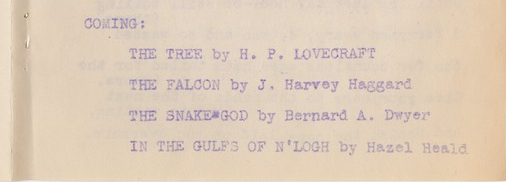
In late 1929 or early 1930, editor of Weird Tales Farnsworth Wright announced that the company would be launching a new magazine: Strange Stories.

By the way—Wright tells me he is about to launch another magazine, devoted to “stories which are truly strange & unusual in plot.” All subjects will be included—even weird stuff now & then. I don’t suppose this opening will mean much to me, but it ought to mean a new market for one of your versatility.
—H. P. Lovecraft to August Derleth, 25 Feb 1930, Essential Solitude 1.249

Farnsworth tells me that the company is going to publish another magazine this summer, using stories of all sorts, so long as they are somewhat out of the ordinary. I gather that they don’t have to be impossible, but just different from the general run of stories. I’m hoping to just about double my income from his company when that magazine comes out. Of course, I may not be able to sell them a blightin’ thing.
—Robert E. Howard to Tevis Clyde Smith, c. Feb 1930, Collected Letters 2.17

The issue is a little confused, since in June 1930 Wright announced yet another magazine, Oriental Stories, and Strange Stories was never published. Macfadden had published the short-lived pulp True Strange Stories (Mar-Nov 1929) and claimed rights to the title. Lovecraft and Robert E. Howard both comment on the legal dispute in their letters which dragged out for months. Lovecraft summarized things succinctly:

As for Wright’s projected third magazine—I am astonished that you have not heard of the plan before! The idea—broached first a year or more ago—was for a magazine to contain wildly unusual & bizarre stories, not excluding a few weird items; & it progressed to a stage where Wright actually began accepting tales for it. He took items from Belknap, & from my odd old Biercian client, Dr. Dangizer–de Castro. I had not known what the name was to be, until Robert E. Howard spoke of the conflict with Macfadden’s. I saw an issue or two of the defunct Macfadden thing a year & a half ago, when Vrest Orton tried to write for it; but did not know that the name remained a legal entity after the collapse of the venture itself. Now that the W.T. company is in such an evident mess, (did you receive the form letter urging patience about remittances?) I hardly expect the third magazine to be started at all. Just how serious Wright’s intentions ever were, one can’t be sure. I fancy it was always a vague future project with him.
—H. P. Lovecraft to Clark Ashton Smith, 25 Dec 1930, Dawnward Spire, Lonely Hill 285 

Nowhere in his correspondence does Lovecraft give the title of the third revision, and it isn’t clear when it was done, except that it must be between December 1929 (“two de Castro jobs” DS 285) and November 1930 (“three tales of Old Dolph’s” SL3.204); this could explain the long genesis of “The Electric Executioner,” if Lovecraft was actually revising two tales. The only reference to this third revision discovered so far are in the unpublished letters of Lovecraft’s literary executor R. H. Barlow:

How about The Electric Executioner & The Last Test? Old de Castro has an unpublished HPL “revision” – In the Confessional, which it might be well to harpoon.
—R. H. Barlow to August Derleth, 6 May [1937?]

I think I mentioned the unpublished MS about Poland, which he ghosted for old de Castro, & which remains in his possession. The Last Test & The Electric Executioner are absolutely HP’s, by his own admission.
—R. H. Barlow to August Derleth, 20 June [1937?]

“In the Confessional” was the title story of In the Confessional and the Following(1893), and concerns a Polish countess in Paris; it was first published in The San Francisco Examiner May 1892. It was from this volume that de Castro’s two other stories that Lovecraft revised, “A Sacrifice to Science” and “The Automatic Executioner”, are drawn.

What Lovecraft might have added to “In the Confessional” is mostly unknown, but in another letter he wrote:

I’ve put Yog-Sothoth and Tsathoggua in yarns ghost-written for Adolphe de Castro […]
—H. P. Lovecraft to Emil Petaja, 31 May 1935, Letters with Donald and Howard Wandrei and to Emil Petaja 437

Since Yog-Sothoth appears in “The Last Test” and “The Electric Executioner” but Tsathoggua does not, it is possible that Tsathoggua has a reference in the third revision…and that is all we know about that. It is not even clear if the story would be weird fiction at all, if the market was Strange Stories.

The only possible reference to this story in de Castro’s extent correspondence is this anecdote to John Stanton of Arkham House:

Lovecraft and the late Mrs. de Castro and myself were at dinner at the Styvensen in New York. He had been revising a short story for me, the scene of which was laid in my native land, Poland. There had been some difference of opinion regarding the plot—made by correspondence. In response to his last letter I—stante pede, as it were, made a new plot and sent it to him. Thereupon he flattered me by saying that it was not likely I had so quickly made so new and excellent a plot. My reply was, “come to New York and we’ll discuss it.” At an elaborate bit of dinner we talked the matter over.
—Adolphe de Castro to John Stanton, 9 Mar 1949

Much of the story of “In the Confessional” is set in Poland, in a flashback/embedded narrative. If de Castro’s account is at all accurate, it would suggest that the final version worked up by Lovecraft would have varied from the original. This does not, unfortunately, help us identify the third revision. It is not clear when this would have occurred; Lovecraft mentions having dinner with de Castro at least twice in his letters to Lillian Clark during his 1928 stay in New York, but the phrase “come to New York” suggests Lovecraft was not there—so possibly 1929.

The Adolphe de Castro papers at the Jewish American Archives contain typescripts related to the other two Lovecraft revisions. Of the third revision, there is no obvious sign; de Castro’s papers contain no typescript titled “In the Confessional,” or any other English-language manuscript which suggests the plot or characters of that story. However, there is an undated typescript in Spanish titled “La Confesión de La Condesa Valera” which is a translation and expansion of de Castro’s English-language story.

Lovecraft scholars have been looking for a revision to “In the Confessional,” here among Adolphe de Castro’s papers we have a revision of “In the Confessional,” is this a previously unknown Lovecraft revision?

Probably not.

La Confesión de La Condesa Valera” is without a doubt an expansion and revision of “In the Confessional.” However, we have no idea when it was written (the typescript is undated), and the text itself shows no evidence of any Lovecraftian input. In part, this may well be due to the translation from English to Spanish, which would require the whole text to be filtered through de Castro once again, but more than that the story lacks any weird element, although there is a touch of science fiction at one point. There is no reference to Lovecraft’s artificial mythology, even as a red herring or bit of color.

It is not impossible to completely rule out Lovecraft having some influence on the tale, but it must be remembered that the information we have on the third de Castro revision in Lovecraft’s letters is very slight—Lovecraft himself never names the story; that was provided by Barlow in a letter to Derleth, and Barlow may have got it wrong, or confused the name of the revision with the name of the book from which the stories originally came. So there is no guarantee that we are even looking in the right place when we look for a revision of “In the Confessional.”

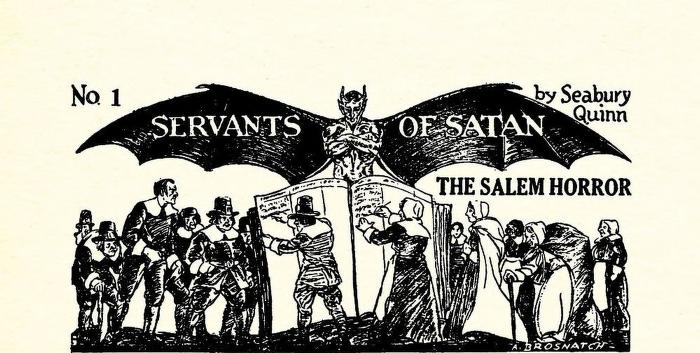
With an eye toward the possibilities, and admitting that we are in the realm of speculation, “In the Confessional” might actually have been a candidate for Strange Stories with a bit of work. The mutilation of the Countess Wanda’s face would have fit rather neatly into the “weird terror” or “shudder pulp” vein that was gaining popularity at the time, and Weird Tales included a few stories of this sort such as Seabury Quinn’s “The House of Horror” (1926), and the tragic ending is suitably poetic and bloody; if the prose had been reworked and maybe expanded a little, it could probably have sold. Would Lovecraft have taken this route? He could work with grue (“Herbert West–Reanimator,” “In the Vault,” “The Loved Dead” with C. M. Eddy), although he usually didn’t. Likewise, Lovecraft did not exclusively write weird fiction (“Sweet Ermengarde” being the most notable example), although he usually did.

La Confesión” is a fairly substantial revision of the original story–but not on those lines. The scene is moved to World War I, and embeds the original narrative into a story about a hunt for a German spy in France, with a romantic subplot. The happy ending, where it turns out the “poison” that Valera took is nothing poisonous at all, is a far cry from the original conte cruel finale, which is probably one of the few parts of the story Lovecraft might have approved of (although we do not have his exact response to the original story, Lovecraft called the book “execrable.”) These could well be taken as examples of updating the story and modifying it to be more salable—for what market, we have no idea. The only really notably strange part is a small science fiction element, which appears early in the story and is never mentioned again:

El Cura era un hombre de ciencia, y en el corto periodo de tiempo que hacía estaba en París, había perfeccionado una serie de cometas, con un sistema de placas sensitivas afectadas por Ias corrientes de aire. Estos cometas el hizo remontar, y de este modo pudo descubrir la dirección del gran cañón con el que el enemigo hostilizaba a París.

Para estas observaciones aéreas, había organizado un pequeño grupo de mujeres de su parróquia, y estaban dispuestas de tal manera en la torre de la iglesia, que formaban una cadena viviente, pudíendo dar al instante, a las autoridades información de cualquier movimiento en el cielo, sea cual fuere la altura o la distancia.
—Adolphe de Castro, “La Confesión de Valera,” American Jewish Archives (MS-348)

The Priest was a man of science, and in the short time he had been in Paris, he had perfected a series of kites, with a system of sensitive plates affected by air currents. He made these comets soar, and in this way he was able to discover the direction of the great cannon with which the enemy was harassing Paris.

For these aerial observations he had organized a small group of women from his parish, and they were arranged in such a way in the church tower that they formed a living chain, and could instantly give the authorities information of any movement in the sky, whatever the height or distance.
—Rough translation, “The Confession of Valera”

The language and construction, however, remains very much de Castro’s rather than Lovecraft’s. The odd framing device of Valera in the confessional telling her story through dialogue (and then Wanda telling Valera her story in a mess of a nested narrative) is handled almost exactly as it was in the original story; Lovecraft had handled complicated narratives before with much more grace in “The Call of Cthulhu” (1928), and it is hard to believe that he would have not restructured the narrative more readably if he had taken the job. Also notably absent is any description of the architecture of Paris or any other location, which would be an odd lack in a Lovecraft story.

There does not seem any given point in “La Confesión” that can be pointed out as representing a definite, or even likely, survival of Lovecraftian influence. If anything, a comparison of “In the Confessional” and “La Confesión” versus “A Sacrifice to Science” and “Surama of Atlantis” or “The Automatic Executioner” and “The Automatic Electric Executioner” shows how substantially Lovecraft tended to rewrite these stories, compared to de Castro revising his own work, as is apparently the case with “La Confesión.”

So we are left with a story that is most interesting as a scholarly footnote: here it is, it exists, and there is little more to say about it. “La Confesión” in its current form does not appear to ever been published in English or Spanish, and may never be.


Bobby Derie is the author of Weird Talers: Essays on Robert E. Howard & Others (2019) and Sex and the Cthulhu Mythos (2014).
“Surama of Atlantis” and “The Automatic Electric Executioner” (1953) by H. P. Lovecraft & Adolphe Danziger de Castro

To say that “The Surama of Atlantis” and “The Automatic Electric Executioner” are discoveries is a bit of a misstep: they were never really lost. After de Castro’s death in 1959 his papers made their way to the Hebrew Union College-Jewish Institute of Religion, who in turn donated them to the American Jewish Archives in 1988 as Manuscript Collection No. 348. The excellent inventory of the de Castro collection by Chris Powell in 1996 notes both the existence of the texts and their relation to Lovecraft’s revisions. J.-M. Rajala noted in the 2011 Lovecraft Annual:

2 linear feet of de Castro’s papers, including unspecified manuscripts, are in the American Jewish Archives of the Hebrew Union College of Cincinnati (The Jacob Marcus Rader Center, MS-348), and I wonder if these have been carefully examined by anyone. (56)

Powell had, writing in “The Revised Adolphe de Castro” in Lovecraft Studies #36:

He minimally revised “The Electric Executioner” and retitled it “The Automatic Electric Executioner”. He also revised “The Last Test”, creating “The Surama of Atlantis”. He made minimal revisions to most of the story but made more substantial changes at the beginning to describe the origin of the shadowy character, Surama, and to the final outcome of the story. (24)

Powell also noted that:

“Surama of Atlantis” is planned to be included in The Nyarlathotep Cycle being edited by Robert M. Price for upcoming release by Chaosium. (24n14)

However, “Surama of Atlantis” and the other texts were not published in The Nyarlathotep Cycle or anywhere else, though Price thanks Chris Powell in his introduction. There is likely a story there, but the end is that “Surama of Atlantis” has remained in obscurity to the present day.

The original texts by Adolphe de Castro which Lovecraft worked from are those published within In the Confessional and the Following (1893). As is characteristic of Lovecraft, he completely rewrote both “The Automatic Executioner” and “A Sacrifice to Science.” Presumably this would also have been the case with the third revision, though no text of this revision is known to survive.

This work would initially have been done by hand; though no manuscript copies survive, and were later typed by someone (de Castro for “The Last Test,” Lovecraft for “The Electric Executioner”) for submission to Farnsworth Wright at Weird Tales. These final typescripts are also non-extant, so it is not clear what editorial changes, if any, that Wright made when they were published in the pages of Weird Tales. Martin Andersson has pointed out that there are also minor differences between the Weird Tales texts and the version of the stories published in Something About Cats and Others (1949, Arkham House); these differences are not reflected in the AJA texts, so we can be reasonably certain de Castro did not reference the Arkham House text.

For the three new typescripts, the variations from the Weird Tales text include variant titles, spellings (and misspellings), typographical errors, and changes in phrase and formatting that range from slight to rewriting entire paragraphs. The most substantial differences are with “Surama of Atlantis,” which is about 500 words longer, adding a relatively substantial beginning scene and slightly expanded ending, among other changes.

It is difficult to say who is responsible for the differences between the Weird Tales texts and the AJA typescripts; part of the differences (typos, dropped and repeated words, etc.) can be put down to typist error, but not the insertion or substitution of phrases and entire passages. As these do not appear in the Weird Tales texts, they are either survivals from a previous draft (Lovecraft was known to do multiple drafts of stories), or were added in afterwards (almost certainly by de Castro). The possibility of both cannot be ruled out; that is de Castro may have re-typed “Surama of Atlantis” from an older draft of “Clarendon’s Last Test” by Lovecraft and made his own alterations on top of that. The very-unLovecraft-like passage that ends “????” is almost certainly from de Castro.

The passengers on the Satsu Maru cascaded down the gang-plank, glad to be once more on American soil. There was a slight pause in the flow and then a tall thin man, wearing a gray ulster and a fedora hat that shaded his bespectackled eyes, short nose and bearded chin appeared.

Following him was a pretty young woman, dressed in gray with a large straw hat, the brim held down over the ears by a wide blue ribbon. Her left hand held the chain of a gold mesh bag, while her right clutched the collar around the neck of a magnificent St. Bernard dog.

Closely following them was an individual, tall beyond the ordinary, garbed in a long black cape that hung on his shoulders, and covered his entire body, what was seen of his face when the wind lifted the wide brim of his soft large slouch hat, was shocking; it indicated that the head had no hair. His eyes, like glinting black obsidian, were set so deep in the sockets that they seemed black pools in a cavernous skull. In fact, a closer view strengthened the assumption that it was a skull. there was no nose other than a depression and there were no lips over the large yellow teeth.

A moment he stood still, gazing at the sunlit wharf, at the people, and the large Hotel bus which was stationed a short distance from the gangplank.

As the black-clad skeleton halted, it irritated the bespectackled gentleman who turned and said, “What makes you so slow, Surama?”

The individual called Surama, grinned horribly and said, “Coming, doctor.”
—Adolphe Danziger de Castro, “Surama of Atlantis,” Jewish American Archives (MS-348)

What parts of “Surama of Atlantis” were written by Adolphe de Castro, and why? What parts might be strange survivals from an earlier Lovecraft draft? Is there any way to tell? Objectively, no. Without access to Lovecraft’s original manuscript, it is impossible to say definitively one way or another. Yet we can say a few things.

Lovecraft did not make any fuss over substantial errors when “The Last Test” was published, so we can assume the text in Weird Tales is predominantly as he wrote it in the final draft. Also, given that the first title Lovecraft mentions in his letters is “Clarendon’s Last Test,” it is apparent that “Clarendon” was not a change made by de Castro to the manuscript sent to Weird Tales. In “Surama of Atlantis,” the doctor’s last name is “Schuyler” rather than Clarendon. It is also notable that the name “Schuyler” does appear in the Weird Tales script, as Alfred Schuyler Clarendon and Frances Schuyler Clarendon both attest. This oddity could be the result if Schuyler was the original name, and that Clarendon was then added later—but this presumes two drafts, an early draft and a final one. In any case, it is notable that at no point does de Castro revert to the names in “A Sacrifice for Science” (i.e. Clinton for Clarendon/Schuyler, et al.)

The character of Surama evolved from the character of Mort in “A Sacrifice to Science,” but the Atlantean background was pure Lovecraft—“De Castro wanted it excluded at first—but as it turned out, that was the one thing which Wright singled out to mention in describing the tale!” (Dawnward Spire, Lonely Hill 165) Much of the variant material in “Surama of Atlantis” focuses on Surama, from the title and the opening scene to the bizarre ending. If we do accept the idea that there was a previous draft, and that “Surama of Atlantis” retains several features from it, the most obvious are the ones that describe turtle-like attributes to Surama. In “The Last Test” only a single such descriptor exists:

Unlike the ideal subordinate, he seemed despite his impassive features to spend no effort in concealing such emotions as he possessed. Instead, he carried about an insidious atmosphere of irony or amusement, accompanied at certain moments by a deep, guttural chuckle like that of a giant turtle which has just torn to pieces some furry animal and is ambling away toward the sea.

In “Surama of Atlantis,” however, numerous references of turtle-like characteristics are applied to Surama. The idea of Surama as a kind of monstrous turtle-man works within the logic of the story except for one part: the double-aftermath.

In the afternoon the leisurely firemen overhauled the ruins and found two skeletons—or rather one human skeleton with the skull intact with the frame; of the other only the skull—a very human skull, but with osseous outlines disturbingly suggesting a saurian of some sort. The skull reminded people of Surama, and only well-cut clothing could have made a body as indicated by the skeleton look like a man.

An added horror to the situation was a big hole found under the stout fence back of the destroyed building, and Pat McMonigall, the street car watchman, returning from his beat, assured neighbors that he had seen “a turtle as big as a house” ambling down the hill to the bay, a statement that was not take quite seriously, although Pat McMonigall was a rather abstemious chap. Did Surama go back to Atlantis????
—Adolphe Danziger de Castro, “Surama of Atlantis,” Jewish American Archives (MS-348)

It is completely incongruous for Surama to make his way back down to the sea and to leave behind a skull and skeleton for paleontologists to muddle over, at least not unless Surama was wearing the skull like a hat and peering out through the eye-sockets. If this is a survival from an earlier draft, it isn’t clear how this discrepancy might be resolved—either de Castro wrote the entire ending himself (the unLovecraftian line “Did Surama go back to Atlantis????” is almost certainly his; it reads like an annotation accidentally copied onto the line), or possibly de Castro borrowed verbiage from the Weird Tales version and grafted it onto the earlier draft to give a double-aftermath where there was only one before.

It is also worth noting that in the Weird Tales version, it is specified “that’s all that can reach him, James, unless you can catch him asleep and drive a stake through his heart.” A very vampire-like touch which is at odds with Surama as a kind of turtle, but also much simpler and perhaps more reasonable in keeping with his corpse-like appearance. This is changed in “Surama of Atlantis,” with the suggestion that no ordinary weapon can pierce his shell.

A less evident but more serious problem in “Surama of Atlantis” is the question of narration: who is the narrator? Lovecraft gives no specific identity, the story is related anonymously. Yet the beginning of “Surama of Atlantis” specifies that the narrator is a reporter who was injured by Surama and has not long to live, while the ending states:

Dalton probably gave Dr. Jackson an inkling of the truth, and that good soul had not many secrets from his son, who is the writer of these lines.” (ibid.)

It is a very unLovecraftian mistake; but is it the case of a botch in trying to merge an earlier draft with the later Weird Tales text, or de Castro failing to notice the discrepancy as he added his own additions to the story? Notably, there is a reporter who is injured (though not seriously) by Surama in the course of the story, who plays a key role in events; however, if Lovecraft provided such an opening, would he not have also included a suitable closing? It seems an odd plot hook to leave hanging.

It is important to note several places where the Weird Tales text has expanded on the same text in “Surama of Atlantis.” The appointment of Schuyler/Clarendon to San Quentin is given much more space in “The Last Test,” which foreshadows the governor’s political struggles and losing his appointment power. The benefits of Schuyler/Clarendon’s appointment are noted at greater length, as is the emotional argument when Dalton asks for Georgina’s hand in marriage. Instructing Dalton to blot out the Greek passages but send Miller the notebooks makes much more narrative sense than just telling Dalton to blot out and burn everything, as happens in “Surama of Atlantis.” These are the kind of changes which reinforce the narrative as a whole—and they are the kind of changes that one would expect to see between earlier and successive drafts.

It is the omissions as much as anything which suggests that de Castro was not working directly from a copy of Weird Tales. There does not seem to be any narrative reason to have not copied these sections as-is, since they have little overall impact on the other changes in the story. Yet this cannot be taken proof positive of an earlier draft; it could simply be that de Castro made all the changes on his own. It is notable that of the major changes, two—the extended opening and ending—provide an identity for the narrator of the story. The burrowing-turtle aftermath leaves the story open for a hypothetical sequel.

The rest of the changes are minor, and a couple are mysterious. “The Last Test” refers to the Royal Hotel, which burned down in 1906; “Surama of Atlantis” instead refers to the Phelan Building—which also burned down in 1906, but was then rebuilt in 1908 and still survives today; it’s not clear what benefit one has over the other, since both were still standing in the 1890s when the story takes place. The focus at on “microbio death” is a bit weirder:

“Don’t look so shaken up, old fellow! A veteran politician-fighter like you must have seen plenty of unmaskings before. I tell you, I never had even the start of a fever cure. But my studies had taken me into some queer places, and it was just my damned luck to listen to the stories of some still queerer people.
—Adolphe Danziger de Castro & H. P. Lovecraft, “The Last Test”

“Don’t look so shaken up, old fellow! A veteran politician-fighter like you must have seen plenty of unmaskings before. I tell you, I never had even the start of a fever cure. But my studies had taken me into some queer places, and it was just my damned luck to listen to the stories of some still queerer people who preach microbio death.
—Adolphe Danziger de Castro, “Surama of Atlantis,” Jewish American Archives (MS-348)

It seems to be an effort to provide some reason for Schuyler’s mania with watching people die from the black fever, but the phrase makes so little sense in context it’s hard to see what the author was getting at. If that phrase was a survival from a previous Lovecraft draft, dropping it for the simpler obsession on the power of life and death over a patient seems much cleaner.

The searchers had found the place only because of the chanting and the final cry. It had been close to five that morning, and after an all-night encampment the party had begun to pack up for its empty-handed return to the mines. Then somebody had heard faint rhythms in the distance, and knew that one of the noxious old native rituals was being howled from some lonely spot up the slope of the corpse-shaped mountain. They heard the same old names—Mictlanteuctli, Tonatiuh-Metzli, Cthulhutl, Ya-R’lyeh, and all the rest—but the queer thing was that some English words were mixed with them. Real white man’s English, and no greaser patter. Guided by the sound, they had hastened up the weed-entangled mountainside toward it, when after a spell of quiet the shriek had burst upon them. It was a terrible thing—a worse thing than any of them had ever heard before. There seemed to be some smoke, too, and a morbid acrid smell.

Then they stumbled on the cave, its entrance screened by scrub mesquites, but now emitting clouds of fetid smoke. It was lighted within, the horrible altars and grotesque images revealed flickeringly by candles which must have been changed less than a half-hour before; and on the gravelly floor lay the horror that made all the crowd reel backward. It was Feldon, head burned to a crisp by some odd device he had slipped over it—a kind of wire cage connected with a rather shaken-up battery which had evidently fallen to the floor from a nearby altar-pot. When the men saw it they exchanged glances, thinking of the “automatic electric executioner” Feldon had always boasted of inventing—the thing which everyone had rejected, but had tried to steal and copy. The papers were safe in Feldon’s open portmanteau which stood close by, and an hour later the column of searchers started back for No. 3 with a grisly burden on an improvised stretcher.
—Adolphe Danziger de Castro, “The Automatic Electric Executioner,” Jewish American Archives (MS-348)

Unlike “Surama of Atlantis,” the changes between the three texts of “The Automatic Electric Executioner”/“The Electric Executioner” are much more minor, although strangely a bit more complicated since there are three texts to work with, and in addition to the small but substantial changes, both of the typescripts in the de Castro Archive contain numerous typos and errors of spelling, as well as idiosyncratic formatting differences.

The 1930 text of “The Electric Executioner” in Weird Tales may be assumed to be the oldest of the texts; “The Automatic Electric Executioner” text is bound in a manuscript dated 1953, and may be assumed to be the newest. However, the undated, unbound typescript of “The Electric Executioner” does not sit neatly between the two; textually, the undated text and the Weird Tales text follow each other more closely than “The Automatic Electric Executioner” and the Weird Tales text, but the undated typescript contains several small but notable additions and rephrasing not in either of the other texts.

Most likely, this means that both “The Automatic Electric Executioner” and the unbound text of “The Electric Executioner” represent two different branches of transcription, both copied from the same source (either a copy of Weird Tales, or the typescript received from Lovecraft) and copied and altered at different times, without reference to one another. This would explain the differences and similarities between the three texts without requiring any hypothetical earlier drafts. (Why de Castro would type out “The Automatic Electric Executioner” fresh without making reference to the undated typescript, which has differences from the published version, is another questionbut not one with any ready answers.)

Of the substantial differences, they are few: the title of “The Automatic Electric Executioner” is a combination of “The Automatic Executioner” and “The Electric Executioner”; the story is set in 1899 in the standalone typescript of “The Electric Executioner” and 1889 in the others; the discovery of the body scene in “The Electric Executioner” is a bit longer, and there are some minor geographical differences.

S. T. Joshi in his annotations for this story notes that the San Mateo Mountains are actually in New Mexico; and this is apparently an error on Lovecraft’s part. De Castro’s “The Automatic Executioner” has the protagonist go to Mexico City, and from there towards Orizaba which is in the Sierra Madre Oriental range, although it is never named. “The Electric Executioner” standalone typescript has the nameless narrator headed both to Guadalajara and via Guadalajara to Mexico City—it isn’t clear why the change was made, but was obviously a bit of geographic confusion. In one text the narrator goes to the The Fonda Nacional (“National Inn”) and in the other to the Hotel Interbide; both were hotels in Mexico City. Why the change from one to the other is also unclear.

Something perhaps notable is that all three texts retain the odd racism against Mexicans expressed by Arthur Feldon in the story, which reflects something of Lovecraft’s own prejudices and understanding regarding Mexicans and Native Americans—a combination of racial and class prejudice. From De Castro’s other writings, he either agreed with these generally or at least appears to have felt no need to alter them, as the key phrases (“I hate greasers but I like Mexicans!” etc.) remain intact in every textual variation. Treatment of Mexican characters in “A Sacrifice to Science” (right down to using the slur “greaser”) would seem to suggest no major disagreement between de Castro and Lovecraft on the matter.

Aside from noting how difficult some of the Nahuatl and quasi-Nahuatl names appear to have been for de Castro to type, the most interesting part about the variations on “The Electric Executioner” is simply their existence. There isn’t any evidence that the undated typescript came from Lovecraft’s typewriter (at least, the number of typos would seem to argue against it, given Lovecraft’s punctiliousness), and the variations between the texts are comparatively minor. While it is not impossible that Lovecraft was responsible for some of the bits that don’t appear in the Weird Tales text, the changes are so small and affect so little of the story, compared to “Surama of Atlantis” that like as not the average reader would miss them on a read-through unless specifically pointed out.

As a point of hardcore Lovecraftian scholarship and nerdism, “Surama of Atlantis” and “The Automatic Electric Executioner” provide interesting insight on how changes to Lovecraft stories can not work, and perhaps reflect on the difficult process of drafting and revision. That these stories have gone unpublished is perhaps not surprising; the audience for a variorum of such texts is small, and the rights would presumably remain with de Castro’s estate. But that they exist at all should interest and thrill Lovecraft fans: who knows what else may yet remain, in some dusty archive, or in an amateur journal not yet thoroughly picked-over?


Bobby Derie is the author of Weird Talers: Essays on Robert E. Howard & Others (2019) and Sex and the Cthulhu Mythos (2014).

“The Automatic Executioner” (1891) & “A Sacrifice to Science” (1893) by Adolphe Danziger de Castro

Dear Sir,

My friend, Mr. Samuel Loveman, was kind enough to mention that you might be inclined to aid me in bringing out one or the other of my labors which sadly need revision.

If you can, please let me know and under what conditions we can co-operate. 

Yours sincerely,

—Adolphe de Castro to H. P. Lovecraft, 20 Nov 1927,
Letters to Alfred Galpin & Others
 341

In 1927, an article was published in the Associated Press proposing new evidence for the demise of Ambrose Bierce. The source was Dr. Adolphe Danziger de Castro, who had picked up the gossip while down in Mexico. De Castro and Bierce had been friends for twenty-five years, and had collaborated on a translation of The Monk and the Hangman’s Daughter (1891), and the Western Author’s Publishing Association which published de Castro’s collection of stories In the Confessional and the Following (1893), some of which had been previously published in newspapers and magazines. The friendship ended rather badly, with Bierce breaking his cane over de Castro’s head—but the article on Bierce achieved wide circulation, and de Castro smelled an opportunity:

Years and years ago I published a volume of short stories (now not to be had at any price, and Uncle Sam and myself are the only ones who have copies of the same) and if these stories could be licked into shape, I am certain they would be published. It all depends upon my literary godfather. Suppose I send you part of one of these stories just for a passing judgment whether you could be inclined to consider the matter, if all things become equal?
—Adolphe de Castro to H. P. Lovecraft, 25 Nov 1927, LAG 342

Lovecraft in 1927 was in Providence, Rhode Island; his effort to make his way in New York had failed, and so had his marriage, although his wife would not press him for a divorce until 1929. With no steady employment, Lovecraft and his friend Frank Belknap Long, Jr. did revision work for clients, re-writing stories and offering advice for modest fees. Their friend Samuel Loveman was not officially an agent, but steered potential clients their way: Zealia Brown Reed (Spirit of Revision 8-9) and Adolphe Danziger de Castro.

Initially, de Castro was looking for one or two books of stories to be revised; there are some calculations on a letter from de Castro to Lovecraft dated 5 Dec 1927 to this effect (LAG 345). This quickly expanded as he suggested Lovecraft assist him in writing a memoir or biography titled Bierce and I, mentioned in a letter dated 8 Dec 1927. Lovecraft was wary: de Castro had no money to pay up front, and Lovecraft was in no financial position to take work on a speculative basis. At this point (December 1927), Lovecraft claims:

He’s too gordam fussy to make his work a paying proposition for me—for his fiction is unspeakable, his paying ability meagre, and his demands for revisions—after his first version—extensive. I about exploded over the dragging monotony of a silly thing which I renamed Clarendon’s Last Test; and after I wearily sent in the result of a whole month’s brain-fog, (incurred for a deplorable pittance!) the old reprobate shot it back with requests for extensive changes (based wholly on the new ideas I had injected!) which would have involved just as much work again, and without any additional fee. That was too much. I hurled the whole Hastur-hateful thing back at him—together with his measly cheque and a dollar bill to cover the postage he’d expended—but he took it all in good part, and returned the cheque and dollar with a laudably generous gesture! Now—after thinking it over—he decided to use the tale just as I fixed it up. Vaya con Dios, Don Adolfo—he’s one reviser who won’t raise any controversy by claiming authorship of the beastly mess! But I can’t tackle any more of his fiction. It raises a choking kind of mental “complex” preclusive of effort. I’ll consider his straight prose memoirs, but nothing where constructive art is concern’d.
—H. P. Lovecraft to Frank Belknap Long, January 1928, Selected Letters 2.207-208

A letter from de Castro to Lovecraft dated 4 February 1928 confirms Lovecraft’s claims (LAG 347-348), and returns the check (for $16), begging Lovecraft to accept it.

The story in question began as “A Sacrifice to Science”; de Castro claimed:

Thinking back to the fate of “The Last Test,” I recall its first publication in 1889, then titled, “Dr. Clinton’s Discovery.” In 1893, I published a volume of short stories, incorporating “Dr. Clinton” but had changed his name to Dr. Calrendon [sic]. The issue of seven thousand copies, paper-covered at 50 cents, sold out in record time. I think I am the only person who has a copy of the volume. In 1900 I went from San Francisco to New York. There I re-wrote the story and named it “The Last Test.” Excepting the introductory paragraph to the story which I wrote in New York, the body of the tale suffered no change from that published in the collection.
—Adolphe de Castro to August Derleth, 20 November 1949

The actual publishing history appears more complicated. No publication under the title “Dr. Clinton’s Discovery” has been found; the earliest publication for “A Sacrifice to Science” is in The Californian vol. III, no. 2 (January 1893); it was then subsequently published in In the Confessional and the Following (1893), with minor changes in the text. The Photoplay Weekly for August 1915 includes the snippet:

[Danziger] has completed many scenarios, including The Ghetto Apostate, The Human Devil-Fish, The Fatal Love Letter, and Dr. Clarendon’s Discovery, all of which are feature productions.

This screenplay appears to be non-extant. In any case, for the 1928 version de Castro had provided Lovecraft with the 1893 text.

For most readers, the interest in “A Sacrifice to Science” is as the bones on which “The Last Test” is built, and from that lens, the story is especially interesting because it is rare for us to have the “before” of a Lovecraft revision; most of his clients provided either only a plot-germ or synopsis, or the story is based on a draft that does not survive. Here, we have both the original story (in two texts) and the revision to compare.

“A Sacrifice to Science” is a turn-of-the-century thriller (that is isn’t very thrilling), very vaguely in the line of Robert Louis Stevenson’s more fantastic and better-composed tale of mad science such as Strange Case of Dr Jekyll and Mr Hyde (1886), which had inspired Arthur Machen’s “The Great God Pan” and “The Inmost Light” (1894) or “The Novel of the White Powder” (1895). There is a germ of a solid idea there, but the plot and writing don’t develop any tension in the reader. The skeleton-like character of Mort feels almost allegorical—Death always at the doctor’s side—but he is ultimately very mortal indeed, and far less interesting in his role as Igor to Clinton’s Dr. Frankenstein.

In comparing the 1892 and the 1893 texts, it is apparent that despite the small spelling and formatting changes, a number of passages and even entire paragraphs have been cut; all references to the “Typhus Clintoni” were excised. It isn’t clear why this should be so—one would assume that since In the Confessional and the Following would not have a strict word-limit. The most interesting detail is the bare sketch of a background on Mort, and the implication of testing on prisoners in the West Indies, making Dr. Clnton even more diabolical.

In comparing “A Sacrifice to Science” and its revision, the surprising thing is how much of the essential story and its details Lovecraft retained as he transitioned it to the form of weird pulp fiction. All of the essentials of the plot are reproduced, only with more detail and drama given to events, and perhaps surprising for those who think them Lovecraft’s weakest points as a writer, more attention and focus on character motivation and dialogue. Many of the fine details are kept as well, such as the sister referring to the assistant as the doctor’s “evil genius,” and the outbreak of fever among the Mexican population—which is, perhaps surprisingly, more developed in de Castro’s original.

Study of this story also shows where some of the less Lovecraftian story beats in “The Last Test” come from. Georgina’s tendency to faint—a trait Lovecraft decried in Gothic heroines—comes from Alvira’s episodes. The jealous romantic triangle began with de Castro, it was Lovecraft that gave it the “Fall of the House of Usher” proportions of “The Last Test.” The curious reticence of Surama to handle the afflicted Dick must have its origins in Mort’s complaint at the toll taken on his dogs.

As was also typical, Lovecraft sent a handwritten manuscript, and wished for no changes to what he wrote, to which de Castro wrote in reply:

I haven’t as yet had the time to look up Mr. Long. And mentioning Mr. Long recalls that I have never asked you if, in your opinion “Clarendon’s Last Test” is likely to have a market. I shall not make any changes in the story, but when it is typewritten I shall send it on its rounds, and le bon Dieu peut savoir if it will find some one to take it. The horror story isn’t much in demand now, I fancy.

—Adolphe de Castro to H. P. Lovecraft, 7 Feb 1928, LAG 349

Despite this promise to not make any changes, apparently de Castro did:

Dear Mr. Lovecraft,

With my own suffering fingers I finished last night the copying on the typewriter of THE LAST TEST, and don’t know whether to send you an abrazo – a brotherly embrace – or, you, being so much younger than I, to give you my fatherly blessing for what you did for me; for the more I read the story the more I find that it has “workmanship” and a masterly touch.

For a moment I wanted to send you the story as I copied it, thinking you might perhaps elect to change a word here and there, as your own judgment should direct, and then I said to myself “Lovecraft’s eye has missed little as he went over it ‘scratching'” and I sent the story to “Weird Tales” at Indianapolis.

You will notice that I underscored the words “as I copied it”, meaning thereby that I took the liberty to write a phrase or use a word as I had been taught by Ambrose Bierce. These are: the word ‘persons’ for people. The latter referring to the people of a city, county, state or nation, the former referring to individuals, – “there were a number of persons” and not “people”; or many people for many persons. The second is a Biercean doctrine that a sentence ought never to begin with a negative assertion of something denoting a positive, and vice versa, such as: “I don’t believe Jim cares for it”; whereas it should be “I believe Jim doesn’t care for it”, which is really the essence of the assumption or belief. In other words: we believe a thing is or is not, it is our attitude in the matter, but if we say we don’t believe, we establish a non-attitude (although it might equally be a non-believing attitude) in the case where a positive is concerned.

I am very eager to hear your opinion in the matter, comprehending, of course, that idiomatic form or usage is, excepted.

I confess that your entire review of the matter relative to the story is correct, although I do not regret to have written you as I did, since it brought forth your most illuminative letter. And what is more, Egad! I really like the story.

—Adolphe de Castro to H. P. Lovecraft, 1 Apr 1928, LAG 353

Lovecraft’s chagrin at this turn of events must be imagined; his response does not appear to survive. As Lovecraft’s manuscript does not survive, it is not clear what changes de Castro made, although it seems it was he who changed it from “Clarendon’s Last Test” to “The Last Test.” Farnsworth Wright, editor of Weird Tales, could likely not help but notice the references to Lovecraft’s Mythos embedded in the story. Nevertheless, the story was accepted for $175.00, and duly appeared in the November 1928 issue of Weird Tales. Whatever the changes de Castro introduced, they could not have been extensive, for Lovecraft commented:

Old de Castro’s story that I revised is in the current Weird Tales. It doesn’t look so bad now. The element of Atlantean mystery is wholly of my own introducing. De Castro wanted it excluded at first—but as it turned out, that was the one thing which Wright singled out to mention in describing the tale!
—H. P. Lovecraft to Clark Ashton Smith, 27 Oct 1928, Dawnward Spire, Lonely Hill 165

In June 1929, de Castro was again asking Lovecraft to revise his 1893 stories (ES1.196), and as before, eventually agreed to Lovecraft’s terms of cash in advance:

I am just now confronting a damnable revision job from old De Castro—the Bierce satellite & biographer—who has made delay impossible by paying in advance! Consider me, then, as lost in chaos & woe for the next couple of weeks. It is like what I did for him in 1927-8—doctoring up some fictional junk he wrote in 1893. The old boy is going abroad on the 10th, & wants the work delivered while he is in London.
—H. P. Lovecraft to August Derleth, 8 Jul 1929, Essential Solitude1.200

The de Castro story in question was “The Automatic Executioner,” which was first published in The Wave, 14 Nov 1891. As before, Lovecraft completely rewrote the story, although keeping the essential plot and most of the names, and hewing closer to de Castro’s original plot, Lovecraft still added in references to his artificial mythology.

In one sense, “The Automatic Executioner” is an example of one of the earliest and most prominent modes of science fiction: gadget fiction. Thomas Alva Edison was still the wizard of Menlo Park in the 1890s, inventors like Alexander Graham Bell were honored as heroes. Jules Verne and H. G. Wells postulated on technological advances and their potential impact, and the basic idea of a new invention that revolutionizes the world—and the inventor that receives fame for it—was still current well into the 1920s and 30s, when writers like Robert E. Howard tried their hand at it with stories like “The Iron Terror.”

At the same time, the story is not strictly gadget fiction. The invention (Chekov’s noose, as it were) is only one part of a story which involves suggestions of hypnotism and astral projection, relatively occult concepts for what otherwise might be a “pseudo-scientific” story in 1920s pulp parlance. When compared to “A Sacrifice to Science,” it makes a kind of sense that Lovecraft had far less to add or change to the original tale—his principal changes being to turn the “automatic electric executioner” from an electric noose down to a portable electrocution device, and to transform the nature and depiction of Feldon’s madness. In this, Lovecraft incorporated elements of indigenous Mexican religion, his own artificial Mythos, and a curious encounter that Lovecraft himself had on a train:

The journey was made amusing by the presence in the seat beside me of a slightly demented German—a well-drest and respectable-looking fellow whom I had observ’d at the tavern reading a German paper before the start of the coach. He shew’d no signs of his affliction till we reach’d a sort of stagnant mill-pond near Newark, in New-jersey, when suddenly he burst forth the the question, “iss diss der Greadt Zalt Lake?” deeming the inquiry address to me, I reply’d that I scarcely thought his identification correct; whereupon he reliev’d me of all responsibility by remarking in a far-off, sententious voice—“I vassn’t talkingk to you; I vass shooter leddingk my light shine!” Properly rebuk’d for my officious desire to give information, I held my peace and permitted my seatmate to illuminate without hindrance. After a time he became vocal again, confiding to the empty air ahead, “I’m radiating all der time, und nopotty knows it!”
—H. P. Lovecraft, “Travels in the Provinces of America” (1929) in Collected Essays 2.34

Lovecraft also expanded upon Feldon’s motivations for stealing the papers, which de Castro does not go into, an attempt to provide at least a moderately stronger explanation for the experience in the train car, and Feldon’s death—since de Castro leaves him alive at the end, while Lovecraft makes sure the executioner executes. What Lovecraft probably didn’t know is that de Castro was himself an inventor—he had patents for incandescent electric lamps and X-ray tubes—so possibly de Castro knew something of the paranoia of the inventor at getting scooped, and the singular obsession that Feldon expressed, the pride in the technical details of its working. More curious are the bits that Lovecraft left out: the name of the protagonist and his betrothed (and her position as editor of a newspaper, if that was not a spur-of-the-moment lie) and Feldon’s background so that he was never a sheriff in Montreal.

Being a nebulous mix of genres, it’s possible that de Castro could have sold this story to The Black Cat in the 1910s, or even possibly the earliest issues of Amazing Stories or Weird Tales—but there is no denying that the language is often stilted, and by the late 1920s badly needed the updated that Lovecraft provided if it was to have any hope of getting published. That Lovecraft wrote it with Weird Tales in mind seems almost certain; it might have found a home at Wonder Stories, but that would have meant dealing with Hugo Gernsback, whose reputation for non-payment Lovecraft was well aware of by 1929.

“The Electric Executioner” was accepted rather promptly by the end of February 1930 (ES1.249), and would be published in the August 1930 Weird Tales. This caused at least one reader to inquire:

Adolph de Castro, I note, mentions these gods, places, or whatever they are, only the spelling is different, as Cthulhutl, Yog Sototl. Both you and he, I believe, use the phrase fhtaghn.
—Robert E. Howard to H. P. Lovecraft, 9 Aug 1930, A Means To Freedom 1.37

The reasons for its echoes in Dr. de Castro’s work is that the latter gentleman is a revision-client of mine—into whose tales I have stuck these glancing references for sheer fun.
—H. P. Lovecraft to Robert E. Howard, 14 Aug 1930, A Means To Freedom 1.40

Lovecraft apparently also explained this to Farnsworth Wright:

I suppose he was curious about getting stories from several authors—Heald, de Castro, Reed &c (besides parts of mss. From Barlow, Bloch, Rimel, &c)—which contained earmarks of my style.
—H. P. Lovecraft to William Lumley, 14 Nov 1935, Selected Letters 5.207

Lovecraft did apparently revise a third tale for de Castro, and it was sold to Farnsworth Wright for Strange Stories, a magazine projected to be published alongside Weird Tales, much as Oriental Stories/The Magic Carpet would be, but legal troubles with the name prevented the magazine from coming out, and this revision is believed to be lost.

Since their publication in 1928 and 1930, the only extant versions of “The Last Test” and “The Electric Executioner” have been the versions published in Weird Tales, which were eventually published in Something About Cats and Other Pieces (1949, Arkham House), and afterward became accepted publicly as Lovecraft revisions or ghostwriting jobs and subsequently reprinted in many other places.

However, this was not quite the end of the story. In 1953 when de Castro was 94 years old, he had bound a typed manuscript titled Surama of Atlantis and The Horror In A Mexican Train Plus Narrative Poems; the two lead stories “Surama of Atlantis” and “The Automatic Electric Executioner” are variants of “The Last Test” and “The Electric Executioner,” respectively, differing sometimes slightly and in other places markedly from the Weird Tales text. De Castro’s papers, now at the American Jewish Archives, also contain an undated typescript of “The Electric Executioner” with small variations from both “The Automatic Electric Executioner” and the Weird Tales text. For more on these, please see the companion post on “Surama of Atlantis” and “The Automatic Electric Executioner” (1953) by H. P. Lovecraft and Adolphe Danziger de Castro.

“A Sacrifice to Science” and “The Automatic Executioner” are in the public domain, and the 1893 versions may be read online for free here; the 1892 version of “A Sacrifice to Science” is also in the public domain, and may be read online for free here. They have also been reprinted in the variorum edition of Lovecraft’s Collected Fiction, Vol. 4 (Revisions and Collaborations) (2017), alongside “The Electric Executioner” and “The Last Test.”


Bobby Derie is the author of Weird Talers: Essays on Robert E. Howard & Others (2019) and Sex and the Cthulhu Mythos (2014).
Cities of the Red Night (1981) by William S. Burroughs

When Lovecraft began to hit his peaks in the late 1920s a young William Burroughs was cultivating a lifetime hatred of authority during his tenure at the Los Alamos Ranch School in New Mexico. In August 1931, teenage Bill could have gone to a news-stand in Los Alamos town and picked up the latest issue of Weird Tales, there to read about “the monstrous nuclear chaos beyond angled space which the Necronomicon had mercifully cloaked under the name of Azathoth” from Lovecraft’s ‘The Whisperer in Darkness’.
—John Coulthart, Architects of Fear

Thirteen years and change after Lovecraft’s death, in Mexico:

1950_07_27-page-007

Somewhere in that grainy black-and-white photo are William S. Burroughs, who would become the godfather of the Beat generation and punk, and R. H. Barlow, the literary executor of H. P. Lovecraft. After Lovecraft’s death, Barlow had gone to university in Kansas City, MO and Berkeley, CA, before emigrating to Mexico in the 1940s. Barlow became an expert in Nahuatl and Mexica anthropology, a professor at Mexico City College, taught classes on Mayan codices and language.

Low tuition and cost of living combined with the G. I. Bill made Mexico City College a popular destination for American expatriates, including a young William S. Burroughs II, his wife Jean Vollmer, and their children. Burroughs studied the Mayan codices and mythology, suffered opiate withdrawal, experimented with orgone, and engaged in homosexual affairs. On the atmosphere of Mexico City, he remarked:

This is basically an oriental culture (80% Indian) where everyone has mastered the art of minding his own business. If a man wants to wear a monocle or carry a cane he does not hesitate to do it and no one gives him a second glance. Boys and young men walk down the street arm in arm and no one pays them any mind. It is not that people here don’t care what other’s think. It simply would not occur to a Mexican to expect criticism from a stranger, nor would it occur to anyone to criticize the behavior of others.
—William S. Burroughs to Allen Ginsberg, 1 May 1950, The Letters of William S. Burroughs: 1945 to 1959, 69

Despite Burroughs’ assertion, homophobia was still present in Mexico in the ’50s, and many homosexuals remained closeted. It is believed that fear of being “outed” may have been the reason behind the suicide of R. H. Barlow, who took an overdose of sleeping pills after a New Year’s Eve party ringing in 1951. Burroughs remarked:

A queer Professor from K.C., Mo., head of the Anthropology dept. here at M.C.C. where I collect my $75 per month, knocked himself off a few days ago with an overdose of goof balls. Vomit all over the bed. I can’t see this suicide kick.
—William S. Burroughs to Allen Ginsberg, 11 Jan 1951, ibid. 78

This was, as far as is known, the first of Burroughs’ brushes with things Lovecraftian.

The stay in Mexico City was short-lived. On 6 September 1951, Burroughs shot his wife Joan Vollmer in the head and killed her during a party. The children were sent back stateside to live with their grandparents, and after protracted legal proceedings, Burroughs left Mexico and was tried in absentia. Burroughs then spent several months traveling through South America, seeking out the drug yagé (ayahuasca), a fictionalized account of which was published as The Yage Letters (1963).

Burroughs’ writing became more experimental and nonlinear; Naked Lunch (1959) brought something like fame, as the book became the focus of an important 1966 obscenity case in the United States. He traveled: Rome, Tangiers, Paris, London. Mayan codices surfaced in his life again in London, as he sought to collaborate with artist Malcolm McNeill, even arranging to view the Dresden Codex at the British Library, for the work Ah Pook is Here. The complete work never quite came off, though both creators’ parts have been published since.

By 1974 he was back in the United States, in New York City—where just a few years later the Necronomicon by “Simon” was being put together at an occult bookstore called Magickal Childe. As Khem Caighan, the illustrator of the book, put it:

It was about that time that William Burroughs dropped by, having caught wind of a “Necronomicon” in the neighborhood. After going through the pages and a few lines of powder, he offered the comment that it was “good shit.” He might have meant the manuscript too—check out the “Invocation” on page xvii of his Cities of the Red Night. Humwawa, Pazuzu, and Kutulu are listed among the Usual Suspects.
—quoted in The Necronomicon Files 138

The success of the first hardback editions of the Simon Necronomicon gave way to a mass-market paperback. In 1978 Burroughs wrote an essay on this development “Some considerations on the paperback publication of the NECRONOMICON” (ibid. 139), where he said:

With some knowledge of the black arts from prolonged residence in Morocco, I have been surprised and at first shocked to find real secrets of courses and spells revealed in paperback publications for all to see and use. […] Is there not something skulking and cowardly about this Adept hiding in his magick circle and forcing demons to do the dirty jobs he is afraid to do himself, like some Mafia don behind bulletproof glass giving orders to his hitmen? Perhaps the Adept of the future will meet his demons face to face. (ibid)

As Dan Harms and John Wisdom Gonce III note in the Necronomicon Files, Burroughs fails to speak specifically about any edition of the Necronomicon in his essay, but the editors of the paperback edition truncated a quote from the essay and slapped in on the back book anyway. The full and unadulterated version they quote:

Let the secrets of the ages be revealed. This is the best assurance against such secrets being monopolized by vested interests for sordid and selfish ends. The publication of the NECRONOMICON may well be a landmark in the liberation of the human spirit. (ibid, 140)

All of these factors—drugs, homosexual experiences, Mayan codicology and mythology, death and violence, studies in the occult, and travels in South America, Africa, and Europe—came together in the experimental novel Cities of the Red Night (1981). Among those ingredients were Burroughs’ tangential brushes with things Lovecraftian. As Khem Caighan and Harms & Gonce note, the opening invocation to Cities is:

This book is dedicated to the Ancient Ones, to the Lord of Abominations, Humwawa, whose face is a mass of entrails, whose breath is the stench of dung and the perfume of death, Dark Angel of all that is excreted and sours, Lord of Decay, Lord of the Future, who rides on a whispering south wind, to Pazuzu, Lord of Fevers and Plagues, Dark Angel of the Four Winds with rotting genitals from which he howls through sharpened teeth over stricken cities, to Kutulu, the Sleeping Serpent who cannot be summoned […] to Ah Pook, the Destroyer, to the Great Old One and the Star Beast, to Pan, God of Panic, to the nameless gods of dispersal and emptiness, to Hassan I Sabbah, Master of the Assassins.

To all the scribes and artists and practitioners of magic through whom these spirits have been manifested….

NOTHING IS TRUE. EVERYTHING IS PERMITTED.

Cities of the Red Night xvii-xviii

Harms & Gonce have called Cities of the Red Night a “surrealistic tribute to pulp fiction,” and it may even be that. We know little of what pulps that Burroughs read, but we do know that he read them. The manuscripts for The Yage Letters mention True; Cities of the Red Night includes reference to Amazing Stories, Weird Tales, and Adventure Stories (329); The Place of Dead Roads (1983) includes a short but accurate summary of Frank Belknap Long Jr.’s “The Hounds of Tindalos” from Weird Tales. In one interview, Burroughs said:

I read Black Mask; I remember Weird Tales and Amazing Stories—there were some very good ones in there, and some of them I’ve never been able to find I used some of those in my own work, but I’d like to find the originals, but never could. Who was that guy [who wrote about] “the Old Ones”?

H. P. Lovecraft?

There was somebody else.

Arthuer Machen?

He was another one, too. But anyway, Lovecraft was quite good and earnest. This place right by the—it’s always New England—where there’s vile rural slums that stunk of fish because they’re these half-fish people! It was great.

—”William S. Burroughs: The Final Interview” in Burroughs and Friends: Lost Interviews 66

The book is nonlinear, bouncing back and forth between narratives that interconnect in odd ways, sharing characters, hinting at a bigger picture that never quite resolves. Burroughs had a skill for pulp-style genre fiction, but his greater talent lay in subverting readers’ expectations. Just when you think you know what is going on, the next chapter usually proves you wrong. Plot threads are laid down and then forgotten, or picked up a hundred pages later in a completely different context. The eponymous Cities of the Red Night are simultaneously physical locations that exist before all other human civilizations, places that can be visited, and spiritual stages in a journey of soul improvement.

If you had to give the whole text a label, “experimental novel” works as well as any. The book defies rational analysis because it defies conventions, full stop. The protagonists are almost exclusively violent and homosexual, the sexual situations graphic, genres blend together quickly and easily. Considerable chunks of the text are pure exposition, describing imaginary weapons, occult rites, the structure of a revolution that never happened, cities that didn’t exist, fantastic and impossible combinations of drugs and sexually transmitted diseases, conspiracy theories involving aliens and time travel, and complicated systems of reincarnation.

It is busy book, bursting with ideas and imagery, and quite lavishly indulges in breaking taboos. In many ways, Cities of the Red Night is a regurgitation of long-festering ideas and influences; chunks of the early book seem inspired by the Yage Letters, chunks of the later chapters from Ah Pook Is Here. Those who have read more of Burroughs’ earlier works may get more out of it than those who come in cold, but anyone expecting a trippy read that yet resolves itself into some kind of ongoing revelation a la Robert Anton Wilson’s The Eye in the Pyramid (1975) might want to brace themselves. The end of Cities of Red Night does not resolve; the plot threads are not tied up; characters and ideas are left where dropped, like a child’s playthings.

Maybe next book.

There were two more books, in what is generously defined as a “trilogy”: The Place of Dead Roads (1983) and The Western Lands (1987). There are some nominal connections between the stories, and a great many common themes, but as with Cities of the Red Night there is not really any sort of overarching plot. The scope and characters change, gunslingers in the Old West that seek escape into space, or away from death, and these things are tied together in different ways, but…they are books more suited to sortilege than casual entertainment.

They are also ugly. Burroughs’ sexual tastes at that point in his life were homosexual, and nearly all of the sexual encounters in the book are homosexual, which is fine and maybe to be expected—those squeamish about such things might consider what it is like for a homosexual man or woman to read a book that goes on at length about heterosexual encounters and how they might feel. Yet it is also true that many of the sexual encounters skew young, even to the point of pedophilia; this was noticeable in The Yage Letters and is hard to miss in Cities of the Red Night, which includes teenage prostitutes and sexually-active young boys. Female characters are almost absent, and those present often villainous or included solely for purposes of reproduction. At points in the trilogy this breaks out to straight misogyny where the characters hope to break free of women as essential for reproduction altogether.

Racism is prevalent, although a bit complicated. Burroughs’ protagonists are almost always white and male, like Burroughs himself. Stereotypes based on race and ethnicity are common, often exaggerated for comedic or scatological effect, and racial pejoratives aren’t uncommon. It’s unclear sometimes how much of this is Burroughs’ deliberate taboo-breaking and how much of it is just Burroughs’ own prejudice, the drug-addicted, homosexual gringo globetrotting the world, trying to keep one step ahead of the criminal convictions, carrying the remnants of early 20th century colonial attitudes with him where he went.

Is it Lovecraftian? Is anything of Burroughs? The Simon Necronomicon certainly had its influence, however small, on Cities of the Red Night and its sequels; The Place of Dead Roads has absorbed a chunk of “The Hounds of Tindalos” into its literary DNA. Burroughs even had a story published in a Lovecraftian anthology: “Wind Die. You Die. We Die.” (1968) appeared in The Starry Wisdom: A Tribute To H. P. Lovecraft (1994); it contains not one word in reference to the Mythos or Lovecraft. Yet Ramsey Campbell in the introduction to that book observed:

Burroughs has fun with pulp in very much the same way that Lovecraft parodied such stuff in his letters. (7)

Which is certainly true. Lovecraft and Burroughs were both working with some of the same building blocks—quite literally in the case of “The Hounds of Tindalos”—albeit to different purposes and with a vastly different sense of aesthetics. John Coulthart in his essay “Architects of Fear” draws this comparison as well, and says of Cities of the Red Night:

Burroughs’ cities are brothers to Lovecraft’s Nameless City, and to Irem, City of Pillars, described in ‘The Call of Cthulhu’ as the rumoured home of the Cthulhu Cult. The Cities of the Red Night are invoked with a litany of Barbarous Names, a paean to the “nameless Gods of dispersal and emptiness” that includes the Sumerian deities that Burroughs found catalogued in the ‘Urilia Text’ from the Avon Books Necronomicon, and which includes (how could it not?) “Kutulu, the Sleeping Serpent who cannot be summoned.” In Burroughs work the ‘Lovecraftian’ is transmuted, the unspeakable becomes the spoken and the nameless is named at last, beneath the pitiless gaze of Burroughs’ own “mad Arab”, Hassan I Sabbah, Hashish Eater and Master of Assassins. “Nothing is true, everything is permitted.”

Burroughs remains one of the most influential postmodernist writers of the 20th century. Lovecraft, through however many degrees of contact, was an influence on Burroughs. Distinguishing between the shades of their joint influence on subsequent authors is like trying to put a crowbar under a fingernail to see what lies underneath. That is the creeping nature of literary influence; like one of Burroughs’ fictional viruses, it gets into almost everything, and often comes from unlikely sources at unexpected times.

You don’t have to have even read Lovecraft to be influenced by him.

Which is both a very Lovecraftian and a very Burroughsian thought.


Bobby Derie is the author of Weird Talers: Essays on Robert E. Howard & Others (2019) and Sex and the Cthulhu Mythos (2014).

One Who Walked Alone (1986) by Novalyne Price Ellis

Then he told me about the fan mail he’d gotten. He had received letters from somebody in England; one from Australia; letters from several diffrent states like California, Pennsylvania, and far away places like that. He talked about writer friends of his—Price, Lovecraft, Derleth whose name I had seen in a writer’s magazine, and other people I’d never heard of. They wrote to him and he wrote to them. It all sounded interesting and was, I guess, a world far removed from Cross Plains. Although it was interesting, it didn’t make writing as a profession appeal to me. I want to write, but I also want to be in the thick of life around me.
—Novalyne Price Ellis, One Who Walked Alone (1986) 116

In May of 1933, Novalyne Price graduated from Daniel Baker College in Brownwood, TX. The Great Depression had settled on Texas, and jobs were scarce—especially for college-educated women. She found a job forty miles away in a small town called Cross Plains, as a schoolteacher in English and public speaking at the local highschool. At a time when many small towns were paying their teachers with scrip, the Cross Plains paid cash…though it did come with certain expectations.

No smoking. No drinking (Prohibition had just ended). No dancing, movies, or playing bridge with members of the faculty. Teachers were expected to live in town, and go to church in town every Sunday. Her response was visceral:

I want a cigarette, and I want a glass of beer. I can’t stand the stuff. I hate it as much as the Board of Trustees do, but I want a cigarette, and I want a beer.
—Novalyne Price Ellis, One Who Walked Alone (1986) 36

Above all, Novalyne Price wanted to be a writer. There was one in town. His name was Robert E. Howard.

One Who Walked Alone (1986) is drawn from the diaries Novalyne kept of Cross Plains from 1934 until 1936, when she left to begin graduate courses in Louisiana. The entries are edited, probably a little censored here or there to spare a feeling or two from those still alive at the time it was published and to keep focused on her relationship, but revealing nonetheless. The relationship was not the soul of romance; Robert E. Howard was a successful writer, and tried to help Novalyne with her writing, even putting him in touch with his agent Otis Adelbert Kline—but their interests in writing were very different things. Early on during a date, when Bob was driving her out in the country in his car, she explained the plot of the story “I Gave My Daughter Movie Fame”:

“A woman has an illegitimate child, a daughter, and she tries to make it up to her. The child is adopted by this aunt of hers. But the woman can’t give up. She keeps doing things for the girl. Finally, she helps the gil become a movie star and very famous.”

Which I was talking, I could see that Bob was trying very hard to keep from laughing. But what was even strangter to me was that the more I talked, the more it became sort of cock-eyed even to me. I didn’t knwo what it took to win movie fame. True, I read movie success stories in magazines. I went to the movies once in awhile. I knew when the acting was good or bad. Did that qualify me to write about movie fame? As for illegitimate children—Well, when I was growing up, two girls whom I knew had illegitimate children. Did that qualify me to know about things like that?
—Novalyne Price Ellis, One Who Walked Alone (1986) 60

Novalyne’s memoir draws attention because of the Robert E. Howard connection, and it delivers in that regard with many colorful and critical anecdotes; though she was never his wife or even his fiance, it is more intimate and revealing in many ways than The Private Life of H. P. Lovecraft (1985) by Sonia H. Davis is of Howard’s friend in Providence.

Yet the main character is Novalyne herself, and she does not blush to hide her own flaws. The Novalyne of 1934-1936 is a young woman in a world that expects everything of her except to have a life of her own. She herself has more than a few expectations, and her relationship with Bob Howard waxes and wanes as the two willful individuals circle between kissing and butting heads again and again. The prospect of marriage hangs over the relationship as it goes on, but there are obstacles: Howard’s mother, dying slowly as her disease consumes her; Howard’s status as an outsider in the small town of Cross Plains; and Novalyne herself, who also dates some of Howard’s friends at the same time, and can’t quite make up her mind who she loves.

It’s hard not to fall in love with the young Novalyne Price a little; she’s a flint that strikes sparks off Bob, able to give as good as she gets, though sometimes her barbs sting a little deep. One exchange from late in their relationship can’t help but raise a smile:

“In a way, I suppose I want to make it a love story,” I said, thinking and planning as I talked. “But I want the woman to have a man-sized man to love. I was thinking that someone—a young woman—from another state who had an illegitimate child—”

“What are you always thinking about illegitimate children?” he asked. “How many illegitimate children have you had?”

“A dozen,” I snapped. “One every thirty days.”

He grinned and relaxed a little. “I suppose if any woman could do it, you could.”
—Novalyne Price Ellis, One Who Walked Alone (1986) 155-156

More serious conversations dealt with racial prejudice. Although never marked as such, Cross Plains was a sundown town in the Jim Crow days; Brownwood had an African-American population, but that was restricted to a part of the small city called “The Flat.” Howard, though more liberal and progressive in some issues, still held to racial prejudices that Novalyne did not.

“Every man has to uphold his race and protect his women and children,” Bob said earnestly. “He has to build the best damn world he can. You mix and mingle the races, and what do you get? You get a mongrel race—a race that’s not white and not black.”

It seemed to me he was leaving out something important. “Very well, then,” I said flatly. “If a man’s going to fight to keep his race pure, don’t let him go down to the flat and leave a half-white, half-black child down there.”

Bob jerked the steering wheel so abruptly that we almost ran off the road. “Well, damn it,” he groaned. “There’s something there that you don’t understand.”
—Novalyne Price Ellis, One Who Walked Alone (1986) 95-96

Novalyne’s views may have been influenced in part by her own experiences; her father had been mistaken for a Native American and subject to prejudice by Texans, and Bob’s mother herself supposedly wondered if she had any Native American heritage, with the prejudice unspoken but not hidden.

As a diarist, Novalyne Price was no Samuel Pepys; and we may assume that many of the incidental details of life were quietly edited out. Sometimes, this leaves little mysteries. In April 1935, Novalyne was briefly hospitalized following acute nausea, vomiting, and weight loss; the exact nature of her illness is never discussed in detail, leaving readers to make their own conclusions.

As a young woman, and never becoming truly intimate with Howard’s homelife, there are things that Novalyne gets wrong. She is an accurate reporter of facts, with many of the details she gives being verifiable by Howard’s letters (most of which had not been published at the time One Who Walked Alone was out), and newspaper articles in the local paper, the Cross Plains Review. Interpretation, however, doesn’t always follow: the illness of Hester Jane Howard was much more severe and fraught than Novalyne guessed—and frustration at Bob’s doting on his mother’s health is one of the key issues in their relationship.

Howard himself wrote very little about Novalyne in his letters. His local friends would no doubt prefer to hear about it in person; most of his writer friends simply didn’t share details of their relationships at all. H. P. Lovecraft never appears to have told his Texas friend that he had been married, during all their six years of correspondence.

Several times, Bob has shown me letters he’s gotten from fans of his. He had one from Providence and one from New York just the other day. They have all been nice letters, and I can understand his pride.
—Novalyne Price Ellis, One Who Walked Alone (1986) 128

One thing that might frustrate those who pick up Ellis’ book with the intent on getting a behind-the-scenes look at how Robert E. Howard wrote, or his relationships with other pulpsters, is that this is specifically the part of Bob’s life that Novalyne seemed to have the least interest in. There are a few anecdotes scattered about, proof of Lovecraft’s influence on Howard, but Novalyne’s interests in literature were so vastly different that the Weird Tales and Sports Story material seemed to be completely out of her sphere.

“Bob,” I interrupted him. “Do you mean that writer friend of yours—that Lovecourt—”

“Lovecraft,” he repeated, still emphatic. “One of the greatest writers of our time. Now, girl, I’ll bring some of the things he’s written for you to read if—”

“Oh, no,” I said hurriedly. “That’s perfectly all right. I don’t want—I don’t really have time to read very much right now, with teaching and trying to get kids ready for interscholastic speech contests.”

He looked at me without speaking as if he were trying to make up his mind if I meant what I said.

“All I wanted to know was what kind of comment about life does he make?” I asked. “And I want to know what kind of comment you make about life in your Conan stories.”
—Novalyne Price Ellis, One Who Walked Alone (1986) 116

The book ends, as all memoirs of Robert E. Howard end, with his sudden suicide. However, as this is Novalyne’s story, things do not end right at the moment she got the news. As with all suicides, the story continues on with the survivor, the loved ones and friends, who must carry on until they find some kind of closure. So did Novalyne Price.

The unspoken epilogue is what happened after. Novalyne Price received her master’s degree, got married, adopted a son, taught school, and wrote a little when she could. She was an excellent teacher, and her students often won awards. Robert E. Howard’s star began to shine brighter posthumously; a series of hardbacks from Gnome Press in the 1950s gave way to an immensely popular series of paperbacks with covers by Frank Frazetta, the “Howard Boom” of the 60s which inspired dozens of sword & sorcery novels and ushered in a new wave of fantasy. Marvel Comics began adapting his characters to comic books in the 1970s, and in 1982 Conan the Barbarian hit movie screens.

The study of his life and letters slowly picked up. Novalyne Price Ellis was one of those interviewed by the de Camps for Dark Valley Destiny (1983), a biography of Robert E. Howard. As with Sonia H. Davis and H. P. Lovecraft, Novalyne’s views of Bob were not universally welcomed by the biographers:

If the lady you mention published a well-documented book, On Sinning with R.E.H., she might outsell you, unless the oafery seize & destroy her scurilous volume. It is to laugh! I knew him when is not sufficient. One must also write for other than dizzy fans.
—E. Hoffmann Price to L. Sprague de Camp, 7 Apr 1978
in The Collected Letters of Dr. Isaac M. Howard 308

E. Hoffmann Price (no relation to Novalyne) was a fellow pulpster and correspondent who had visited Robert E. Howard twice in Cross Plains (neither time meeting Novalyne), and wrote extended memoirs, published in several places. De Camp appears to have used his recollections to “check” Novalyne’s own assertions, much as August Derleth used Lovecraft’s letters to “check” the claims made by Sonia H. Davis.

Letters never tell the whole story. Especially the parts that the writers don’t care to tell.

One Who Walked Alone was published in 1986. Novaylne Price Ellis stayed in touch with some of the Howard scholars, and a briefer and rarer reminiscence was published titled Day of the Stranger: Further Memories of Robert E. Howard (1989, Necronomicon Press), now quite scarce.

A former student of hers, Michael Scott Myers, was so taken with her memoir that he optioned the rights from her for a film. The result was The Whole Wide World (1996), with Renee Zellweger playing the part of Novalyne Price, and Vincent D’Onofrio as Robert E. Howard. A second edition of One Who Walked Alone was published in 1996, with Zellweger featured prominently on the cover, though they are effectively identical.

In 2018, an Index with notes to the book was produced, and given away free at Robert E. Howard Days, which is held at the Robert E. Howard House and Museum in Cross Plains. It is available online for free here.


Bobby Derie is the author of Weird Talers: Essays on Robert E. Howard & Others (2019) and Sex and the Cthulhu Mythos (2014).

“Pages Found Among the Effects of Miss Edith M. Teller” (2005) by Caitlín R. Kiernan

And you stood up, then. You stood, taller than I recalled because you have grown longer, and the moon flashed across the glistening scales below your small breasts, your nipples as erect and sharp as barnacles, thorns grown from the sea, and I took a step back, despite myself.

Do not retreat.
Do not retreat from me.

Only my thoughts, not yours. I will not now be so conceited as to believe I could ever know your thoughts. Not after what she has done with you, or you have done with her. Mother Hydra has held you tight to her bosom in the lightless places at the bottom of the world, and she has accepted all your gifts, all those human parts you were forever trying to cast aside. The old flesh.
—Caitlín R. Kiernan, “Pages Found Among The Effects of Miss Edith M. Tiller” in Frog Toes and Tentacles (2005), 13

Monsters have a particular fascination in a transgender context. The act of transformation, however violent or painful, gives results. What you were is gone, and you have become something else—perhaps who you were meant to be. Body dysmorphic disorder is real, and the fantasy of such transformations that do not require months or years of hormone replacement therapy and surgery is real.

There is a sexual component to such transformation fantasies. Consider the ending to The Shape of Water, blood erupting in clouds from the vertical scars in her neck as the gills finally come in, as a visual metaphor for losing her virginity all over again. To become a woman…and more than that, to cast her old life behind. Such transformations are one-way, like puberty. You can’t go back again.

In the various sequels to “The Shadow over Innsmouth,” a great deal of focus is given to the transformation itself, its implications and effects. “The Gathering” (2017) by Brian Lumley and “All Our Salt-Bottled Hearts” (2016) by Sonya Taaffe both look at what happens when the change does not come, and how those who cannot go down beneath the waves to live in glory forever and ever deal with that. Caitlín R. Kiernan, by contrast, looks at a heretic. Someone who has refused the call.

And her lover.

Innsmouth-related erotica is not exactly rare; Tide of Desire (1983) by Sheena Clayton is an entire novel exploring it, and one could easily fill a fairly decent anthology of short stories including such pearls as “The Flower of Innsmouth” (2011) by Monique Poirier or “Madeline Marsh’s Midlife Crisis” (2015) by K. Z. Morano. Yet it is rare to find stories that focus on the characters involved, their complex motivations and emotions, as much as the sexual action itself. In stories like “The Innsmouth Porno VHS” (2014) by Adolf Lovecraft, the characters involved are consciously skeezy and the fetish is teratophilia; they don’t have any emotional investment in the transformation or the people transformed, much like folks fetishize transgender sex workers, seeing them not as individuals but as commodities.

Not so with Caitlín R. Kiernan.

She wants you to feel the reunion of these two lovers, one of whom took the plunge (literally), and the other who would not. Wants that taste of real horror as the act begins, and the clothes are shredded “making of them ribbons for a mermaid’s hair.” Edith’s lover Samaritana did not come back as she had known her…and there are surprises in store.

I stopped struggling (I had been; I can say that now, because I know I ama a heretic) and lay entirely still while those tendrils worked their way quickly between my legs, those strong tendrils or arms sprouting from the hairless mound where your sex had been, twisting back upon themselves, flexing, searching like blind, unfed serpents. What is it the old stories say? Cut off one, and two will sprout in its stead? (ibid., 21)

There is much unsaid in the story. The text has the quality of Edwardian prose, at once explicit and poetic. This is not sexploitation, no actors mugging for the camera and faking orgasms. Elaborations on the Mother Hydra mythos are hinted at but not elaborated upon, and the relationship, like many of the relationships in her fiction, does not have a happy ending. The subtitle for this story is:

Dead by her own hand, Janury 7th, 1905
Danvers State Insane Asylum, Mass.

Which is how it should be. Not every story, even an erotic story, has a happy ending. Transgender folks know that better than most. The struggle of whether or not to transition is real, and takes its toll both physically and psychologically. There is more to unpack in this story…and that probably says more to its quality than anything else.

“Pages Found Among the Effects of Miss Edith M. Teller” was first published in Frog Toes and Tentacles (2005).


Bobby Derie is the author of Weird Talers: Essays on Robert E. Howard & Others (2019) and Sex and the Cthulhu Mythos (2014).

¿Donde Duermes, Elderado? Y Otros Poemas (1964) by Clérigo Herrero

Am pulling out of a bad physical slump and have not done too much work, apart from the writing of poems in Spanish, some of which I hope to place sooner or later with Latin-American periodicals. They have been checked over by a good Spanish professor, who did not find too much to correct.
—Clark Ashton Smith to August Derleth, 31 March 1950, Selected Letters of Clark Ashton Smith 364

English was the language of Weird Tales during its first run (1923-1954), though stories might have snippets of any number of languages, natural, artificial, and fictional.

Neither H. P. Lovecraft nor Robert E. Howard were ever fluent in Spanish, though both of them were at least somewhat familiar with it. The evidence for Lovecraft’s knowledge is fairly slight: the two passages in his story “The Mound,” which had been ghostwritten for Zealia Brown Reed Bishop, both of which are largely accurate (the final portion was deliberately designed to appear somewhat crude); Lovecraft’s library included a copy of Ollendorff’s New Method of Learning to Read, Write, and Speak the Spanish Language (Lovecraft’s Library 139), which may have served him as a reference. Lovecraft also used Spanish openings and closings to some of his letters to Bernard Austin Dwyer in 1928 (during the period “The Mound” was written, and when Lovecraft recounted his dream of Roman Hispania), signing himself once “Luis Randolfo Cartero y Teobaldo” (LMM 468)

Robert E. Howard’s knowledge of Spanish was probably more utilitarian. In at least a casual way, he had picked up at least a small stock of Spanish and Mexican words—exclamations, terms of address, names of food and drink. Certainly, when Spanish-speaking characters appear in his stories their English dialogue tends to be sprinkled with a few choice Spanish terms, although sometimes with some peculiarities of spelling; a common technique when Howard wanted to express something of the rural or uneducated nature of the speaker, though it’s hard to tell sometimes if he is doing it on purpose or not, as he seems to have dropped this tendency in Spanish relatively quickly. So, for example, in “Red Shadows” (1928) he writes “Senhor,” in “Winner Take All” (1930) he writes “Senyor,” but in “The Horror from the Mound” (1932) he writes “Señor.”

In late 1948 or early 1949, Smith learned Spanish, made his first translations of Spanish poetry, and wrote his first poems in Spanish.
—Donald Sidney-Fryer, “A Memoir of Timeus Gaylord: reminsicences of Two Visits with Clark Ashton Smith, &c.” in The Romanticist #2 (1978) 3

Smith had already taught himself French from dictionaries and grammars in the 1920s; Lovecraft would praise his translations of Baudelaire. A decade after the death of Howard and Lovecraft, Smith would do the same with Spanish. All three men shared a love of language and poetry, and were autodidacts, but Smith was the only one of the three to attempt anything like fluency in Spanish, at least to the point of translating and composing poetry in that language.

His hopes of being published in that language do not appear to have been fulfilled during his lifetime, although some of his translations of Spanish poetry from Gustavo Adolfo Bécquer, José A. Calcaño, and José Santos Chocano (“El Cantor de América”) did see print in zines and his poetry collections, and some of the English translations of his Spanish poems also appeared in his Arkham House poetry collections—including a translation or two of “Clérigo Herrero,” Smith’s Spanish pen-name (“Cleric Smith”—Clark, clerk, cleric).

After Smith’s death in 1961, his widow attempted to continue to publish his work, and selling some of his letters and manuscripts in conjunction with letterpress printer and bookdealer Roy A. Squires. One of these projects was the small pamphlet ¿Donde Duermes, Elderado? Y Otros Poemas (1964), done entirely in Spanish, publishing eight of his poems as by Clérigo Herrero. The colophon says this printing was only 160 copies, although the bibliographies say 176.

Donde-inside

Typescripts of some of his other Spanish poems, discovered after this printing, were published in Shadows Seen & Unseen (2007), showing something of his process:

SSU-sample

For long decades, the Spanish poetry of Clark Ashton Smith was relatively unavailable: published far apart in limited editions. Today it has all been republished as part of the Collected Poetry and Translations of Clark Ashton Smith (2012) …and it is a testament to one of the great voices of Weird Tales to extend himself this way, to explore and express himself in another language. Because there is far more to this world than just the English language.

El mundo es el suyo,
El sol es el tuyo,
La luna es la mía.

The world is yours,
The sun is thine,
The moon is mine.


Bobby Derie is the author of Weird Talers: Essays on Robert E. Howard & Others (2019) and Sex and the Cthulhu Mythos (2014).

The Witch-Cult in Western Europe (1921) by Margaret A. Murray

“He had not read in vain such treatises as Miss Murray’s Witch-Cult in Western Europe; and knew that up to recent years there had certainly survived among peasants and furtive folk a frightful and clandestine system of assemblies and orgies descended from dark religions antedating the Aryan world, and appearing in popular legends as Black Masses and Witches’ Sabbaths.”
—H. P. Lovecraft, “The Horror at Red Hook”

“The other manuscript papers were all brief notes, some of them accounts of the queer dreams of different persons, some of them citations from theosophical books and magazines (notably W. Scott-Elliot’s Atlantis and the Lost Lemuria), and the rest comments on long-surviving secret societies and hidden cults, with references to passages in such mythological and anthropological source-books as Frazer’s Golden Bough and Miss Murray’s Witch-Cult in Western Europe.”
—H. P. Lovecraft, “The Call of Cthulhu”

I took a good deal of it at college, and am familiar with most of the standard authorities such as Tylor, Lubbock, Frazer, Quatrefages, Murray, Osborn, Keith, Boule, G. Elliot Smith, and so on.
—H. P. Lovecraft, “The Whisperer in Darkness”

Margaret Alice Murray was 58 and already a successful Egyptologist when she published The Witch-Cult in Western Europe: A Study in Anthropology in 1921. On the strength of that book, she wrote the article on Witchcraft for the Encyclopedia Britannica in 1929, which remained in print in various editions until 1969. The influence of that book—and its sequel, The God of the Witches (1931)—has profoundly impacted how entire generations have come to see witchcraft. And it played a critical part in the development of the Lovecraft Mythos.

The book has an odd place in the Mythos. Certainly, Lovecraft was inspired by it, and Murray’s thesis as interpreted through Lovecraft’s own lens strongly influenced “The Festival,” “The Dreams in the Witch House,” and other stories. He included it among other real works in “The Horror at Red Hook” and “The Call of Cthulhu,” so it is technically a kind of Mythos tome, although not by any stretch a grimoire akin to the Necronomicon. Subsequent authors have borrowed on its dual status as both a real book and a “Mythos” work as well.

So while never writing a Mythos story or probably reading anything that Lovecraft wrote, Margaret Murray and her Witch-Cult in Western Europe are in the rare position of being adopted into the Mythos. She shares this status with a few others: Robert W. Chambers and The King in Yellow, Helena Blavatsky and The Book of Dzyan. Yet Murray’s impact on Lovecraft was profoundly greater than the mythology of Hastur or Theosophy. It began in 1924, at the New York Public Library:

The most revealing and stupefying book among those I have been reading is “The Witch Cult in Western Europe”, by Margaret Alice Murray, which was published in 1921 and reviewed with great attention by Burton Rascoe in the Tribune. In this book the problem of witchcraft superstition is attacked from an entirely new angle—wherein the explanation of delusion and hysteria is discarded in favour of an hypothesis almost exactly like the one used by Arthur Machen in fiction [marginal note: The Three Impostors]—i.e. that there has existed since prehistoric times, side by side with the dominant religion, a dark, secret, and terrible system of worship nocturnally practiced by the peasants and including the most horrible rites and incantations. This worship, Miss Murray believes, is handed down from the squat Mongoloid peoples who inhabited Europe before the coming of the Aryans; and reflects the life and thought of a barbarous culture in which stockbreeding had not yet been supplanted by agriculture. This latter feature is clear from the dates of the two great nocturnal feasts and orgies… Roodmas, or April 30, and Hallowe’en, or October 31—dates having a connexion with nothing whatever in agriculture (unlike such agricultural festivals as Easter, Harvest-home, etc.), but corresponding with uncanny fidelity to the breeding-seasons of the flocks and herds. Buttressed by an amazing array of sound documentary evidence taken from witchcraft trial reports, Miss Murray unhesitatingly asserts that the similarities and consistencies in the testimony of witch-suspects cannot be explained on any assumption save one which allows for a certain amount of actuality. In her mind, practically all the confessions treat not of dreams and delusions, but form highly coloured versions of real meetings and ceremonies conducted in deep woods and lonely places betwixt midnight and dawn, attended by secretly annotated peasants stolen thither one by one, and presided over by local cult-leaders clad in animal skins and called the “Devils” of their particular branches or “Covens”. The hideous nature of the cult-rites is amply attested—and the whole subject takes on a new fascination when one reflects that the system probably survived to comparatively recent times. Miss Murray has no difficulty in tracing the cult’s presence in the Salem witchcraft of 1692, and entures to name the Reverend George Burroughs as “Devil” of the particular branch or Coven involved. Cotton Mather thus stands vindicated, and displayed as the suppressor of a movement involving the most loathsome and offensive practices. Another point of interest is the association of Joan of Arc with the witch-cult—a circumstance which makes one weep less at her fiery martyrdom. The use of this newly unearthed lore in a study of American superstition will be quite new, so that I really believe my book will have some degree of interest if it is ever suffered to materialise.
—H. P. Lovecraft to Lillian D. Clark, 30 Mar 1924, Letters from New York 53-54

The book never materialized, but Lovecraft melded Murray’s hypothesis of an underground witch-cult practicing remnants of a pagan religion and married it to the idea of primitive pre-human survivals and their connection with fairies (“the Little People”) in the fiction of Arthur Machen (which he had also lately been reading), and formed his own theory of history—which would go on to inform much of his fiction. Not for nothing would Richard Upton Pickman in “Pickman’s Model” have a Salem Village ancestor hanged for witchcraft in 1692, or that Joseph Curwen would flee from there to Providence, R. I. in the annals of The Case of Charles Dexter Ward.

The combination of Machen and Murray was assisted by Murray including in her work certain euhemeristic ideas and scientific racialism:

The dwarf race which at one time inhabited Europe has left few concrete remains, but it has survived in innumerable stories of fairies and elves. Nothing, however, is known of the religious beliefs and cults of these early people, except the fact that every seven years they made a human sacrifice to their god—‘And aye at every seven years they pay the teind to hell’—and that like the Khonds they stole children from the neighbouring races and brought them up to be the victims. That there was a strong connexion between witches and fairies had been known to all students of fairy lore. I suggest that the cult of the fairy or primitive race survived until less than three hundred years ago, and that the people who practised it were known as witches. I have already pointed out that many of the witch-belief and practices coincide with those of an existing dwarf race, viz. the Lapps.
—Margaret Murray, The Witch-Cult in Western Europe, 238

The Sámi people (historically Lapps, Laplanders) are an indigenous people in Northern Europe; racial anthropologists in Lovecraft’s time categorized them as “Mongoloid” (along with Asians and Native Americans) as opposed to the majority population of Europe which was “Caucasoid.” Although this was not the primary focus of Murray’s work, Lovecraft took this as concrete scientific evidence to support his existing prejudices. Along with Sir James George Frazer’s The Golden Bough: A Study in Comparative Religion (1890), Murray’s book offers what in the 1920s seemed a very rational, dogmatic, albeit radical re-interpretation of a chunk of European (and at least one episode of American) history.

Not everyone accepted The Witch-Cult in Western Europe as genuine; Jacqueline Simpson in Margaret Murray: Who Believed Her and Why? chronicles some of the academic blowback, including Murray’s misrepresentation and misinterpretation of sources. Lovecraft was at best peripherally aware of this academic debate, with two exceptions:

The witch-cult was an objective example of that element of reaction against mediaeval piety which appears in certain leering gargoyles & in various sinister undertones in literary & other art. As for its origin—I am wholly against Summers & with Miss Murray. Summers has let his serious acceptance of Christianity bias him. He is blind to dozens of points of resemblance betwixt witch-cult practices (especially festival dates) & primitive-reliques of Nature-worship all over Europe, & makes a very weak argument in his earlier witchcraft book which Koenig lent me.
—H. P. Lovecraft to Clark Ashton Smith, 29 Nov 1933, Dawnward Spire, Lonely Hill 484

The theories of Miss Murray regarding the source of the cult have been attacked from different angles by scholars as antipodal as Joseph McCabe & the Rev. Montague Summers, but I still think they are as plausible as any yet advanced. You will, I think, appreciate “The White People” anew upon giving it a post-Murray re-reading.
—H. P. Lovecraft to Fritz Leiber, 19 Dec 1936, Letters to C. L. Moore and Others 302

Joseph McCabe was a noted atheist, and while Lovecraft doesn’t cite the exact work in question, McCabe made a glowing endorsement of Murray and her book in The Story of Religious Controversy (1929). Montague Summers also addressed Murray’s book at some length in The History of Witchcraft and Demonology (1926), commenting at one point:

Miss Murray does not seem to suspect that Witchcraft was in truth a foul and noisome heresy, the poison of the Manichees. Her “Dianic cult,” which name she gives to this “ancient religion” supposed to have survived until the Middle Ages and even later and to have been a formidable rival to Christianity, is none other than black heresy and the worship of Satan, no primitive belief with pre-agricultural rites, in latter days persecuted, misinterpreted, and misunderstood. It is true that in the Middle Ages Christianity hadnot a rival but a foe, the eternal enemy of the Church Militant against whom she yet contends to-day, the dark Lord of that city which is set contrariwise to the City of God, the Terrible Shadow of destruction and despair.

Miss Murray with tireless industry has accumulated a vast number of details by the help of which she seeks to build up and support her imaginative thesis. Even those that show the appropriation by the cult of evil of the more hideous heath practices, both of lust and cruelty, which prevailed among savage or decadent peoples, afford no evidence whatsoever of any continuity of an earlier relgiion, whilst by far the greater number of the facts she quotes are deflected, although no doubt unconsciously, and sharply wrested so as to be patent of the sginification it is endeavoured to read into them. (ibid. 32-33)

Summers’ critique is undercut by his belief that witches were both Satanic and had magical powers; McCabe’s because his antipathy toward religion led him to be too credulous in accepting Murray’s thesis wholeheartedly. While scholars, neither were academics or anthropologists. Lovecraft himself in another letter suggests that Murray’s book is “probably about 85% right” (Letters with Donald and Howard Wandrei and to Emil Petaja 463)

There is no reference in Lovecraft’s published letters to Murray’s sequel, The God of the Witches (1931); he apparently never read it, and perhaps never heard of it. Murray herself has very little to say about her witch-research in her autobiography:

Though my Witch Cult in Western Europe did not appear till 1921 the greater part of the research had been done during the war. The book received a hostile reception from many strictly christian sects and reviewers, but it made its way in spite of oppostion.

My second book on the same subejct, which is really on the survival of pagan beliefs and rites under a veneer of Christianity, was The God of the Witches. It was a flop and was remaindered in two years. But it was the 1939-45 war that made it known. I think because it was a change from the monotony of the kind of books that are published in and just after a a war. Also as a remainder it was cheap, selling at five shillings.

My view of Joan of Arc roused, and still rouses, fierce opposition. I am not usually a fighter, but when I am attacked with words like “I don’t believe one word you say about Joan of Arc,” I have to defend myself.

I have one effective reply which is, “Have you studied the original documents?” I have always found that these ardent worshippers have to acknowledge, when pressed, that they have not read anything of the kind. then I retort, “Well, I have,” and I reel off the names of the contemporary recorders (and there are a good many of them) while my critic’s eyes get rounder and rounder. I wind up by saying, “It is hardly worth while to continue the discussion, is it? For you and I have such different standpoints. I argue from contemporary documentary evidence, and you from hearsay.” The book was re-published after the war and has proved a best seller.
—Margaret Murray, My First Hundred Years (1963), 104-105

The Lovecraftian legacy of Margaret Murray is embodied in “witch-haunted Arkham” in all of its incarnations, in the “Dreams in the Witch House” and the witch-cult in general that appears in works such as “The Festival” and “The Thing on the Doorstep.” Works inspired directly by Lovecraft in this vein include “The Salem Horror” (1937) by Henry Kuttner, “Satan’s Servants” (1949) by Robert Bloch, and the graphic novel Providence (2015-2107) by Alan Moore and Jacen Burrows. The Witch-Cult in Western Europe is referenced by name in Mythos stories such as “The Fairground Horror” (1976) by Brian Lumley and “A Critical Commentary on the Necronomicon” (1988) by Robert M. Price.

The long tail of Murray’s influence on fantasy fiction encompasses more than just Lovecraft and those he influenced. Herbert Gorman in “The Place Called Dagon” (1927), which Lovecraft read, shows a survival of the Salem witch-cult; so does the film I Married A Witch (1942), Fritz Leiber’s novel Conjure Wife (1943), etc. all the way to Lords of Salem (2013) and American Horror Story: Coven (2014). Her books were a direct inspiration for the creation of Wicca by Gerald Gardner and Doreen Valiente, and the prolific occult literature produced from those fertile grounds has, in turn, influenced a great deal of horror and weird fiction…and, of course, Lovecraftian occultism:

In the west, the conjuration, cultivation, or worship of this Power was strenuously opposed with the advent of the Solar, Monotheistic religions and those who clung to the Old Ways were effectively extinguished. The wholesale slaughter of those called “Witches” during the Inquisition is an example of this […] The current revival of the cult called WICCA is a manifestation of the ancient secret societies that sought to tap this telluric, occult force and use it to their own advantage, and to the advantage of humanity, as was the original intent.
—Simon, Necronomicon xxii

Anthropology has pushed back and moved on. Outside of occult circles, there is no strong belief that Murray’s “witch-cult” actually existed. Historians and anthropologists have a better understanding of witch trials in the early modern period, both in Europe and the Americas. Instead of an organized pagan survival, there is a mess of politics, religion, folklore, and disparate human dramas and tragedies.

What does that mean for the Mythos?

For the most part, Mythos fiction reflects the syntax of the period. The Salem Witch Trials are a part of the history of Massachusetts; Lovecraft himself never attributes any of the innocent victims of that hysteria as actual witches in his fiction, instead he added fictional characters such as Keziah Mason and Joseph Curwen to the milieu. These characters and their stories are dependent on the historical reality of the witch trials, but the interpretation of that history is still up to contemporary authors and audiences.

The “cult” of the Stella Sapiente in Moore & Burrows’ Providence, for example, looks very little like the 13-member covens that Margaret Murray wrote about in The Witch-Cult of Western Europe, but it retains certain features derived from Murray that feature in Lovecraft’s work. The image of Nyarlathotep as the “Black Man” of the witch-cult remains intact in many Mythos stories, and is derived directly from Murray and Machen as discussed in “Collector the Third: Charles Wilson Hodap (1842-1944)” (1995) by Kenneth W. Faig, Jr.

So Margaret Murray and The Witch-Cult in Western Europe remain a historical touchstone for the Mythos. Both a part of it and oddly apart from it. The book is not “canon” in the sense that its ideas are absolutely true within the fictional reality of the Mythos, yet it is in the canon of works which directly influenced and are referenced by Lovecraft and his contemporaries, alongside The King in Yellow and The Book of Dzyan, Arthur Machen’s The Three Imposters, etc.


Bobby Derie is the author of Weird Talers: Essays on Robert E. Howard & Others (2019) and Sex and the Cthulhu Mythos (2014).
“Cosmic Horror” (1945) by Dorothy Tilden Spoerl

Lovecraft’s tales fascinate me, but they do not frighten.
—Dorothy Tilden Spoerl, “Cosmic Horror” in The Ghost #3 (1945)

The Ghost was an amateur journal published by Lovecraft’s friend W. Paul Cook; it had a very small print run, and was never sold. The contents were drawn largely from Lovecraft’s circle of friends and correspondents, and include important pieces—August Derleth’s thesis on weird fiction, which shows Lovecraft’s influence; E. Hoffmann Price’s memoirs of Farnsworth Wright and Robert E. Howard, which would be the start of his Book of the Dead; essays on James F. Morton, etc. The content was not all Lovecraftian, but these rarities became collector’s items because of that content.

Issue #3 begins with a little mystery: a rather one-page article of appreciation on Lovecraft entitled “Cosmic Horror” by Dorothy Tilden Spoerl. It has been largely forgotten by time, although it appears to be one of the first such appreciations by a woman on Lovecraft’s fiction to see print. But who was Spoerl? What connection did she have with Lovecraft?

There is no obvious trace of Dorothy T. Spoerl in Lovecraft’s published correspondence. Her autobiography makes no mention of Lovecraft, pulp fiction, or amateur journalism; although it gives a little context: in 1945 she was 35 years old, married to minister Howard Spoerl, and had a PhD in Psychology; “Cosmic Horror” appears to be her only amateur publication of record. On her husband Howard Spoerl, there is a little more data: he had placed poems in the amateur journal Driftwind (1935, produced by Walter J. Coates, a friend of Lovecraft’s), Leaves (1938, produced by R. H. Barlow, Lovecraft’s literary executor), and The Ghost (1945 and 1947 issues).

The Spoerls, then, appear to have been at least friends-of-friends and part of the wider community of amateur journalism, even if they never met Lovecraft directly.

The title as much as anything suggests that Dorothy Tilden Spoerl had read Lovecraft’s essay “Supernatural Horror in Literature”, which had first seen print in W. Paul Cook’s earlier amateur journal The Recluse (1927); revised, expanded, and serialized (but the series never finished) for the fanzine The Fantasy Fan (1933-1935); and finally Arkham House reprinted the whole thing in The Outsider and Others (1939). So we know that Spoerl read that; the essay specifically mentions both “The Shunned House” and “The Picture in the House,” which stories had appeared in multiple formats before 1945, including The Outsider and Others; but we have no idea what all of Lovecraft she read.

Yet she did read him.

Which says something in itself. Though one can hardly imagine a pair of folks more ideologically different—Spoerl’s faith appears to have been very sincere; Lovecraft a determined atheist—she did find a connection with him through his fiction. It spoke to a part of her own experience, and that was something she wanted to share. We don’t know why she read Lovecraft, but her reaction to reading Lovecraft speaks to why the Old Gent’s fiction retains its popularity: the themes resonate with people, even those markedly different in outlook from Lovecraft himself.

Spoerl
The Ghost #3 (1945)

The Reverend Doctor Dorothy Tilden Spoerl died in 1999 at the age of 93. “Cosmic Horror” was published only once, in The Ghost #3 (1945). No copyright renewal could be located.


Bobby Derie is the author of Weird Talers: Essays on Robert E. Howard & Others (2019) and Sex and the Cthulhu Mythos (2014).
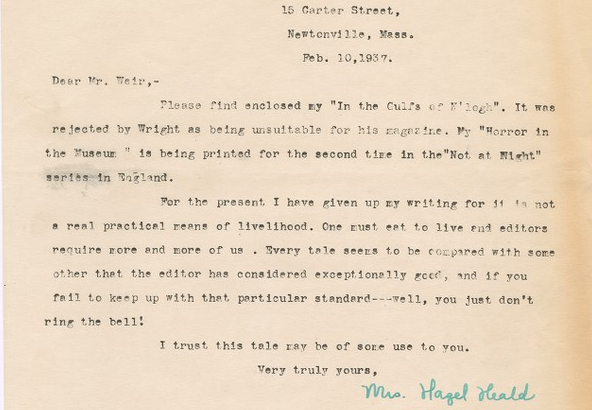
Orphne #1 & #2 (2018) by Mani C. Price

We live in a Golden Age of Mythos comics. More Mythos comics have been published in the last two decades than in the four that came before that. Lovecraftian references can, and do, appear in everything from webcomics to manga, from The Woman of Arkham Advertiser (A・Aの女): Article 01: In The Vault (2019) by Takata Yuki (高田 悠希) to “The Elder Sister-like One, Vol. 1” (2016) by Pochi Iida (飯田ぽち。) to Innsmouth (2019) by Megan James and Calla Cthulhu (2017). Independent presses have risen with the advent of affordable print-on-demand comic publishing services like IndyPlanet and digital comic marketplaces like Comixology have made it much easier for creators to get their work out there—and to highlight more diverse voices.

orphne002

When Randolph Carter was thirty he lost the key of the gate of dreams.
—H. P. Lovecraft, The Silver Key

“The gods travel into men’s dreams by way of a key hole and exit from whence they came once their divine mission is complete.”
—Artemidorus, quoted in Orphne #1

Mythos comics cover all the ground that prose Mythos fiction does, from pastiche and parody to genre-bending and genre-blending; it is rarely four-color superheroes punching out the minions of Great Cthulhu. There is room for comedy, erotica, dark fantasy, science fiction, and sometimes quite subtle and atmospheric horrors. What sets comics and graphic novels apart from their pure prose counterparts, or even illustrated stories, is the ability of art and words to come together a such a way as to create a unique reading experience—there are things that can be done in a graphic novel that would be difficult or impossible to pull off in a prose story.

Mani C. Price is a visionary artist and diviner; her penchant for Lovecraft and mythology is evident from her artwork. As the writer and artist for Orphne, Price brings her interests to bear with references to Classical Greek mythology, magic, and Lovecraftian references that are present but not pressed on the viewer. There is no mention in these stories to Lovecraft’s “The Silver Key,” yet the artistic theme of both issues emphasizes keys and key-holes; the figure of Mr. Angell is the image of H. P. Lovecraft—whom Muriel Eddy described as “The Man from Angell Street,” referring to his family’s house in Providence, Rhode Island.

Orphne prefers to show rather than tell; there are mysteries for the reader to unravel, characters are not introduced, and their identities must be divined by what they say and do. We know little about the main character Victoria, but that little we do know is intriguing…she is, more than Mr. Angell, the central character and mystery of the story so far. What key will unlock those answers?

But always I shall guard against the mocking and insatiate Hypnos, lord of sleep, against the night sky, and against the mad ambitions of knowledge and philosophy.
—H. P. Lovecraft, “Hypnos”

Lovecraft also had a penchant for Greek and Roman myth, and in the second issue this brings in the figure of Hypnos, Lord of Dreams. Some readers may draw parallels between this character and another popular comics character: Dream of the Endless, created by Neil Gaiman for his run on Sandman (1989-1986). The similarities are superficial, however; Gaiman and Price (and Lovecraft) are drawing in common from the well of Greco-Roman mythology in populating their Dreamlands. As the holder of the artifact that Victoria seeks, Hypnos is being set up as the primary antagonist in a story where most of the conflict so far is unseen—a combination of internal conflicts and unknown forces acting on Victoria, secrets unspoken, hints of supernatural influence.

Where the story goes from here is another question that goes unanswered. Issues #1 and #2 were published in 2018, but the series is not yet finished. Art takes time, and as Orphne is being produced by an individual rather than a big company, some delay is to be expected before we see issue #3. Yet it seems certain that it will be worth the wait.

Orphne #1 and #2 are written and illustrated by Mani C. Price, coloring and layout by Justin Wolfson, lettering by Jason Price, editing by Jason Price and the late Sam Gafford. Issues can be purchased directly from the website Mani The Uncanny.


Bobby Derie is the author of Weird Talers: Essays on Robert E. Howard & Others (2019) and Sex and the Cthulhu Mythos (2014).