Deeper Cut: Lovecraftian Movie Posters From Ghana

The first regular movie screenings in Gold Coast colony took place in Accra shortly after 1900 when traveling showmen from other parts of West Africa began screening their wares in various coastal cities on tours that took place over a period of months. The Gold Coast’s first purpose-built movie theatre, constructed by the British businessman John Bartholomew on Station Road in Accra, dates from 1914, just seven years after the first purpose-built theatre appeared in the United Kingdom, illustrating the very rapid spread of cinema technology and film entertainment across the empire although the logistical and financial challenges of operating in a colonial location limited further expansion at that time.

Gareth McFeely, “Gone Are The Days”: a social and business history of cinema-going in Gold Coast/Ghana, 1910-1982 (2015) 138

The British Empire claimed the Gold Coast in Western Africa as a colony from 1821-1957, and for many years it was white British businessmen who dominated the modest cinema industry and controlled what kinds of films were shown and when—and sometimes to whom, as Batholomew’s theater sometimes staged “Europeans Only” showings (McFeely 142). The modest little industry expanded slowly through the period of silent films and into the era of sound, marketing primarily English-language British and American films to an increasingly English-speaking and English-literate audience. Films were subject to the approval of the Cinematograph Exhibition Censorship Board of Control and other British laws and regulations.

Even as neighborhood theaters continued to expand to meet the needs of a growing urban population, beginning in the 1940s, the colonial government’s Gold Coast Film Unit also used buses to distribute documentary films, newsreels, and government information films to rural areas, including propaganda films produced by the Colonial Film Unit. In 1957, Ghana achieved independence and operated as a commonwealth realm; the new government took over the colonial-era government’s production and showing of films, and this continued when Ghana became a republic in 1960, with the government-owned Ghana Film Industry Corporation established in 1964 and the state-owned West African Pictures Co. Ltd., which ran a chain of movie theaters. Foreign entities like AMPECA (American Motion Picture Export Company) had to deal not just with government regulations and censorship, but sometimes direct competition with private theater owners in Ghana.

Political unrest and economic hardship rocked Ghana for much of the later 20th century, notably the military coups of 1966, 1972, 1979, and 1981; the government finally transitioned back to civilian democratic rule in 1993. During this period of turmoil, film censorship in the country slackened:

Films such as Blacula and The Exorcist underline the mild nature of censorship in the mid 1970s: a decade earlier the censor banned almost all horror films, never mind ones that contained dramatic scenes of bodies rising from the dead or adolescent girls possessed by evil spirits.

Gareth McFeely, “Gone Are The Days”: a social and business history of cinema-going in Gold Coast/Ghana, 1910-1982 (2015) 311

Economic hardship still continued, with inflation, widespread unemployment, and sometimes radical shifts in government policies all making it more costly to import films and keep up ticket receipts. Worse, after the 1981 coup the government enacted a nighttime curfew that lasted for two years, effectively destroying the old business model of nighttime cinema screenings.

In the early 1980s, the first independent films were produced in Ghana, many taking advantage of the Video Home System (VHS) technology to film direct-to-video. Videocassette recorders (VCRs) first became commercially available in the mid-1950s, but it wasn’t until the 1970s that home systems became commercially viable, with VHS emerging as the dominant format. The increasing availability and lowering costs of VHS VCRs spurred the home video market; films that were previously only available in traditional movie theaters could now be rented or purchased to view at home for relatively little cost, and the smaller, more portable, and cheaper VHS cameras lowered costs for independent filmmakers. Video rental stores proliferated in countries like the United States of America and the United Kingdom, and some filmmakers and distributors increasingly skipped traditional theater releases, releasing their films directly to video.

In many ways, the VCR changed how people all over the world watched and interacted with movies. Video cassettes were now marketed directly to the public, with the art on the paper sleeve taking the place of the traditional cinema poster. The lowering cost and increasing availability of video cassette technology allowed it to penetrate new global markets. You no longer needed to build a special building just to show films, and entrepreneurs were no longer restricted to government-made entertainment or officially licensed imports. In the 1980s, as the first independent Ghanaian filmmakers were shooting direct-to-video, small VCR-based theaters and video clubs began to pop up in urban areas of Ghana like the capital Accra, often with pirated video tapes:

With the widespread introduction of foreign videocassettes into Ghana in the mid-1980s, a group of entrepreneurs created small-scale mobile film distribution empires, sending their agents out on the road with videocassettes, television monitors, VCRs, portable gas-powered generators and rolled-up canvas movie posters. This mobile cinema phenomenon quickly became a part of the cultural domain of even the smallest villages and hamlets in the Ghanaian countryside. In the early years a big city distributor or his aide would roll into town—often by bus—possibly for three or four days, and begin the local version of a movie marathon. By day this would generally occur within the confines of a family home or possibly some small communal meeting center, such as a social club; by night, weather permitting, in the open air. By the early 1990s, these mobile cinema operations had peaked and local businessmen at the village level had largely replaced their traveling predecessors, purchasing their own TV sets, generators and VCRs. In order to assist with marketing, the big city distributors continued to provide a hand-painted-on-canvas movie poster with each cassette they rented or sold.

Ernie Wolfe III, “Adventures in African Cinema, 1975-1998” in Extreme Canvas (2000) 25-26

The timeline for when exactly hand-painted posters emerged in Ghana is unclear; through the 1970s Ghanaian theaters would use standard industry posters:

The main methods of advertising to this varied clientele were posters outside the theatres and the projection of trailers for coming attractions. Until the 1970s, American and British film distribution companies supplied posters and other advertising materials at the same time as the reels of film, while locally hand-painted canvas posters, similar to the vivid panels used to publicize concert party performance, were also used at times.

Gareth McFeely, “Gone Are The Days”: a social and business history of cinema-going in Gold Coast/Ghana, 1910-1982 (2015) 166

Using pirated VHS tapes would mean no official marketing materials, however; to advertise these films, local Ghanaian artists were commissioned to hand paint posters, often on cheaply available materials like flour sacks (and later, locally milled linen canvases, Wolfe 26). These were typically local commercial artists—sign painters and the like—who watched the film or used existing video cassette box art for inspiration. Many of these were foreign films, produced in Hong Kong, India, Nigeria, and the United States; as a consequence, the artistic sensibilities and commercial priorities for these handmade signs were very different from Hollywood or Bollywood counterparts. Few actor names appear, and the posters may feature nudity, graphic violence, gore, and spoilers that didn’t appear in the original advertising materials.

By the late 1990s cheap preprinted publicity materials had crowded local advertising traditions out, while the video club boom had also peaked, reducing the demand for eye-catching advertising materials in a market where profit margins were razor-thin.

Gareth McFeely, “Gone Are The Days”: a social and business history of cinema-going in Gold Coast/Ghana, 1910-1982 (2015) 166

Pure economics ultimately brought about the demise of this once-thriving and extremely localized contemporary African painting phenomenon. By 1996, with the Ghanaian economic boom of the late 1980s and early 1990s nearing its end, mobile cinemas were all but gone and video clubs had reached their peak. Business interests outside of Ghana, often from Europe, had begun providing many more video titles to the local marketplace, and with them for the first time came a large inventory of free offset-printed posters.

Ernie Wolfe III, “Adventures in African Cinema, 1975-1998” in Extreme Canvas (2000) 26, 28

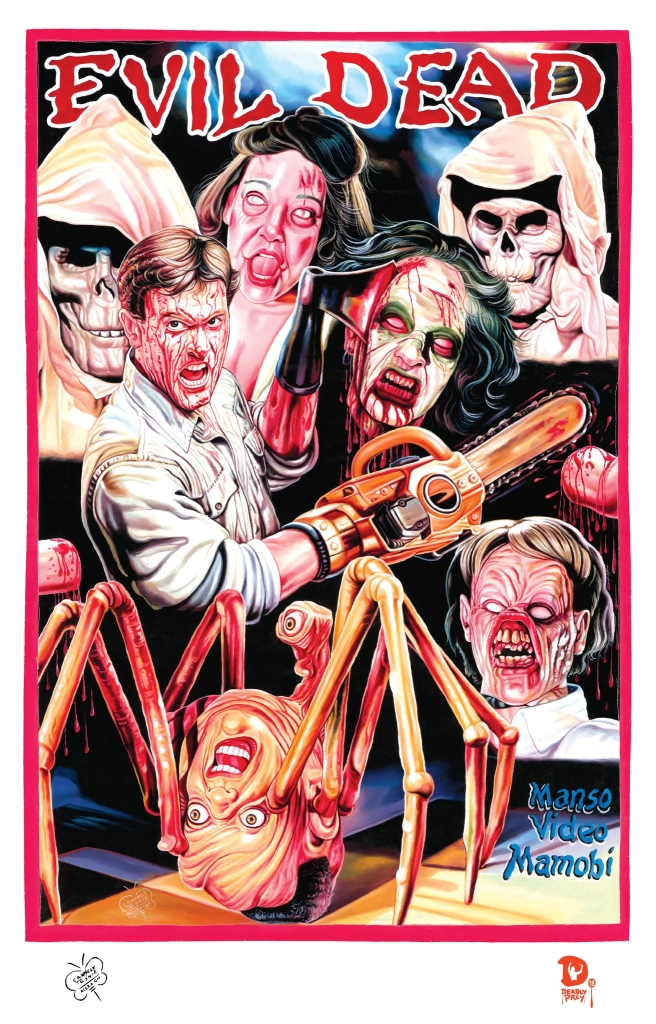
By the 2000s, the hand-painted movie poster tradition was in serious decline; the spread of television in Ghana, the advent of digital video discs, and mobile video streaming increasingly made home viewing more accessible and affordable to local audiences. The Ghanaian movie posters began to receive international recognition with the publication of works like Extreme Canvas (2000) and art gallery exhibitions. As local demand declined, the market for such art shifted. Original posters became collectibles to be displayed in art galleries and sold on eBay; new posters might be commissioned and prints sold through marketers like the Deadly Prey Gallery for a Western audience who appreciated the aesthetic, or produced for exhibitions of contemporary African art—but the original theaters and context in which these artworks first emerged is essentially gone.

Of all the films to receive the Ghanaian treatment, very few are examples of Lovecraftian cinema. While potentially any video cassette could make its way to Ghana, there were a few practical limitations when considering such works that have come to light: the film had to be released on video cassette between c. 1985-1999, a relatively available mainstream or direct-to-video release, and would need to be sufficiently lurid or gory to appeal to Ghanaian audiences—or at least, to produce a poster sufficiently striking or memorable to be subsequently noticed and reproduced for Western audiences. By no means has every handpainted movie poster from Ghana been preserved; these posters are the quintessence of ephemeral commercial art, aging quickly and destined to be eventually discarded once their purpose was served.

In practice, this rules out the early Lovecraftian films of the 1960s like The Haunted Palace (1963), Die, Monster, Die! (1965), or The Curse of the Crimson Altar (1968), and more obscure or international independent efforts like Cthulhu Mansion (1990) or Cthulhu (2000), leaving a handful of adaptations and more loosely Lovecraftian films.

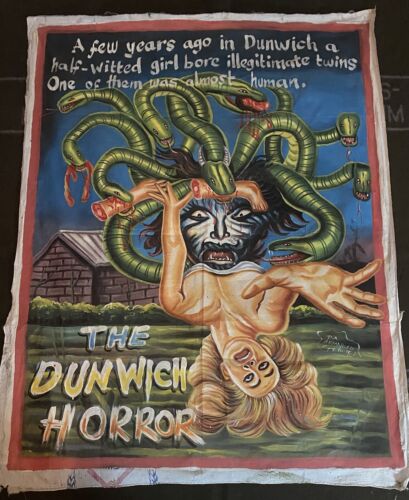
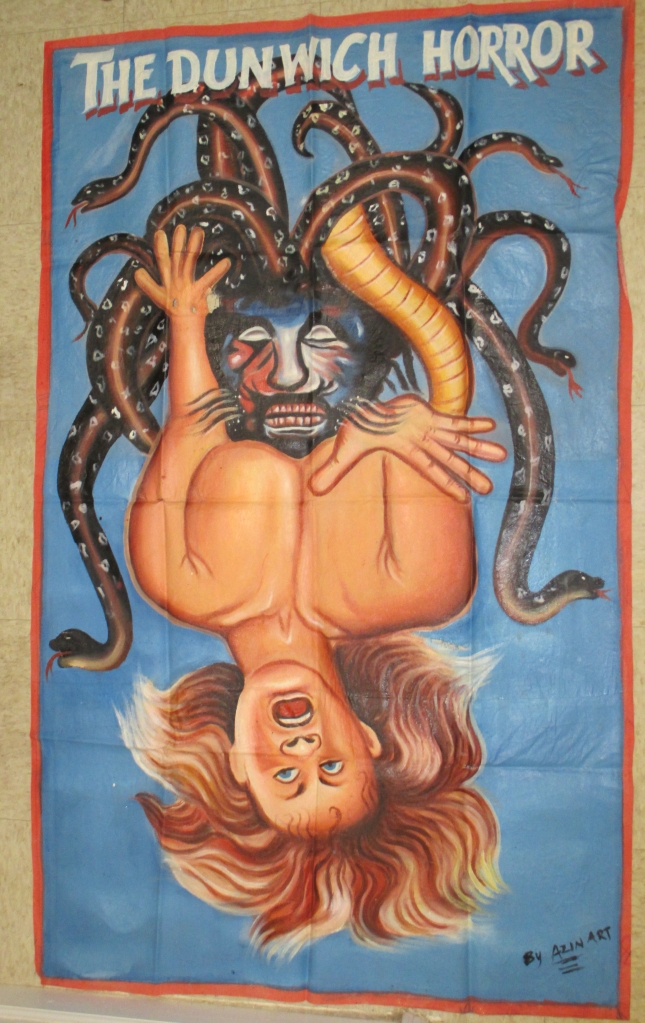
The Dunwich Horror (1970)

A loose update and adaptation of Lovecraft’s “The Dunwich Horror,” set in the contemporary late 1960s. While there are few gory scenes in the film, the psychedelic visuals, Rosemary’s Baby-esque plot, and a brief scene of Wilbur Whateley’s twin brother might all appeal to horror aficionados in Ghana.

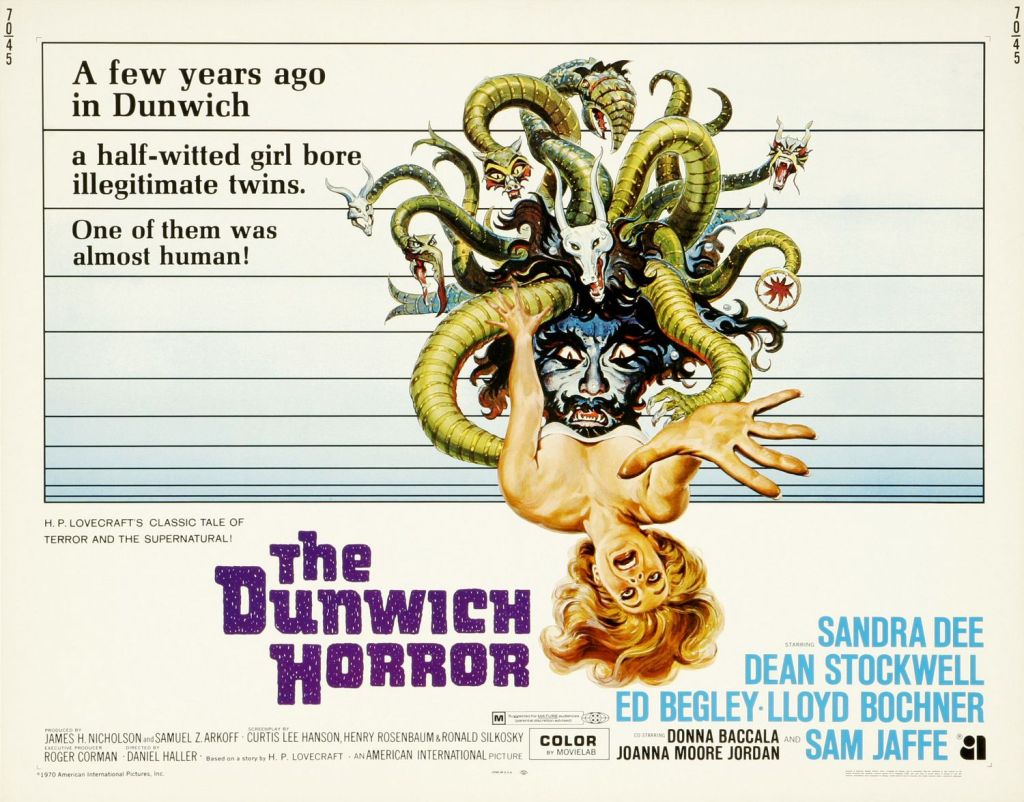
Official poster for The Dunwich Horror for reference.
Source: private collection

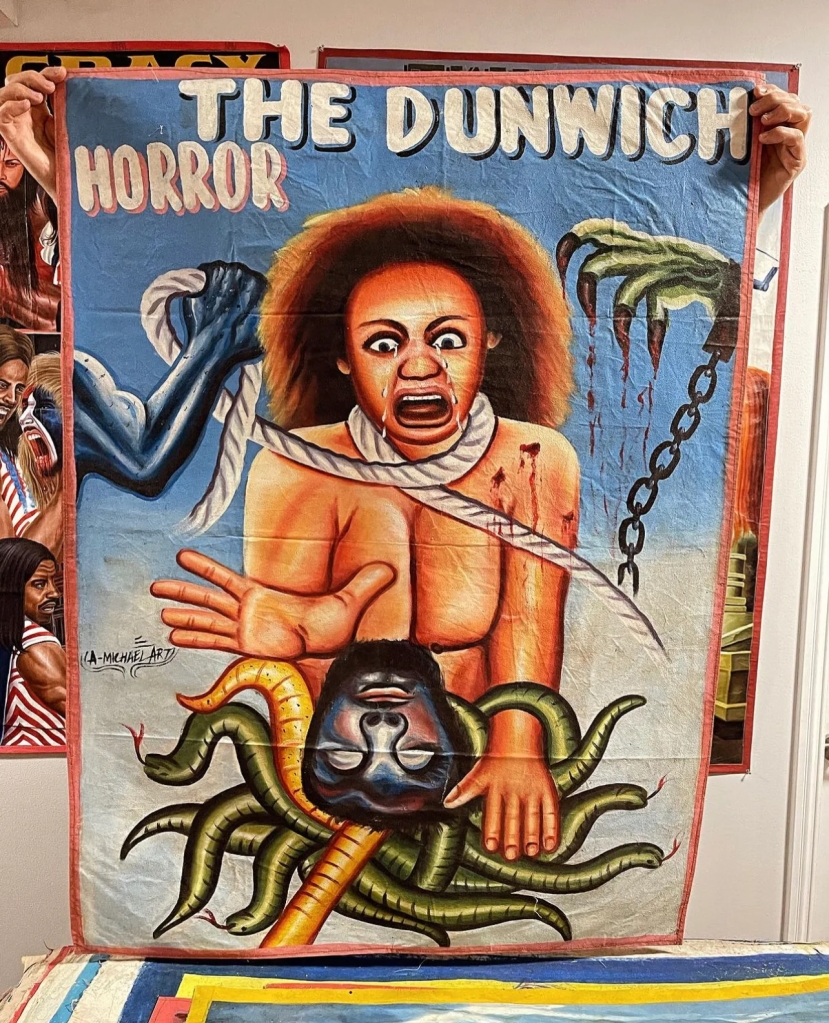
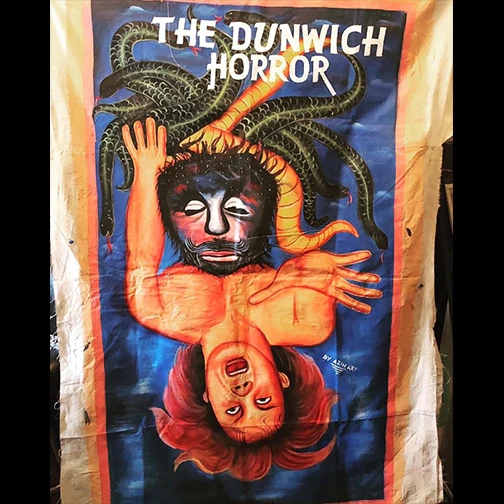
These posters all follow the official marketing for The Dunwich Horror (1970) fairly closely, and given when the film was released—before the “Golden Age” of hand-painted posters, when official posters were in circulation—some of the earlier artists may well have seen versions of that poster and consciously modeled their images on that. It’s notable that the poster signed A. Michael Art, which is probably the most recent, differs much more markedly in the design (even depicting actress Sandra Dee as Black!), and with several uncharacteristic elements not in the film (the grasping hands, the rope around her neck). What’s really striking is how all of the artists chose to depict the tentacles as snake-like hair, turning Wilbur Whateley’s twin into a gorgon-like figure.

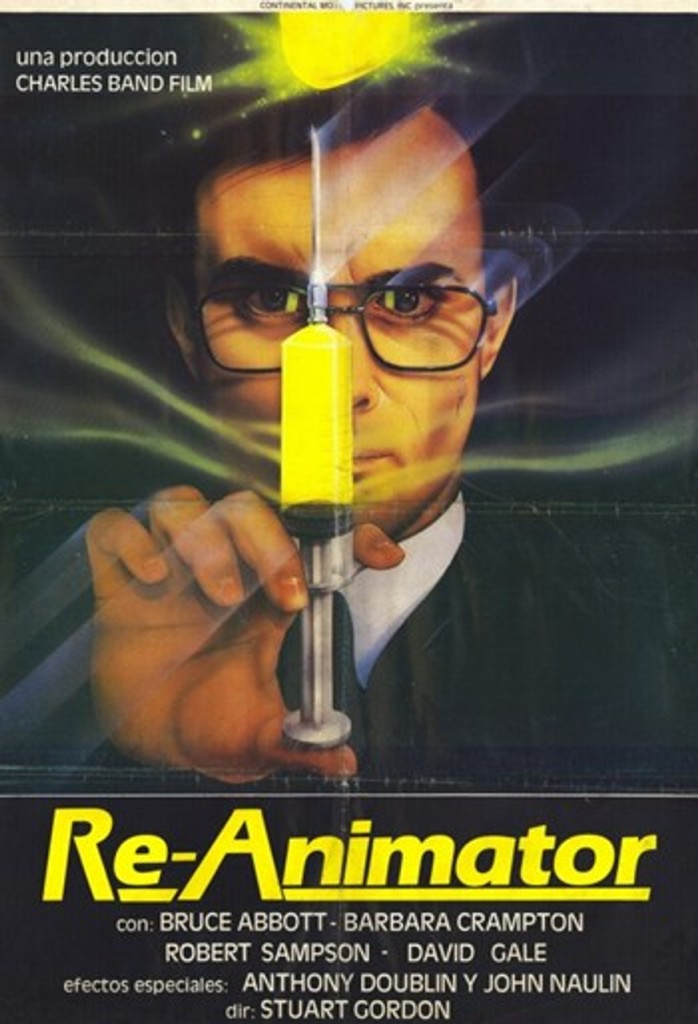
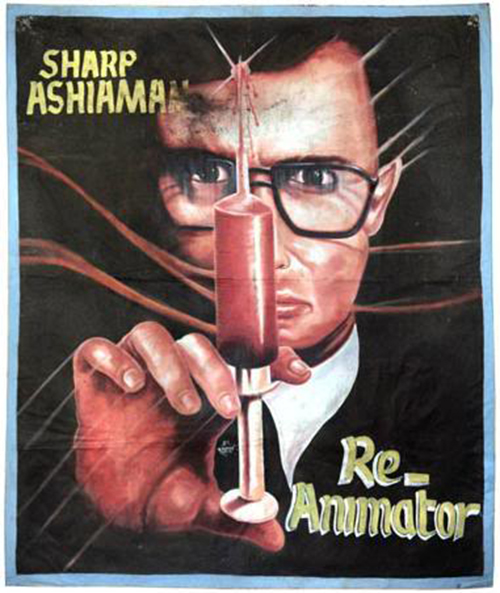
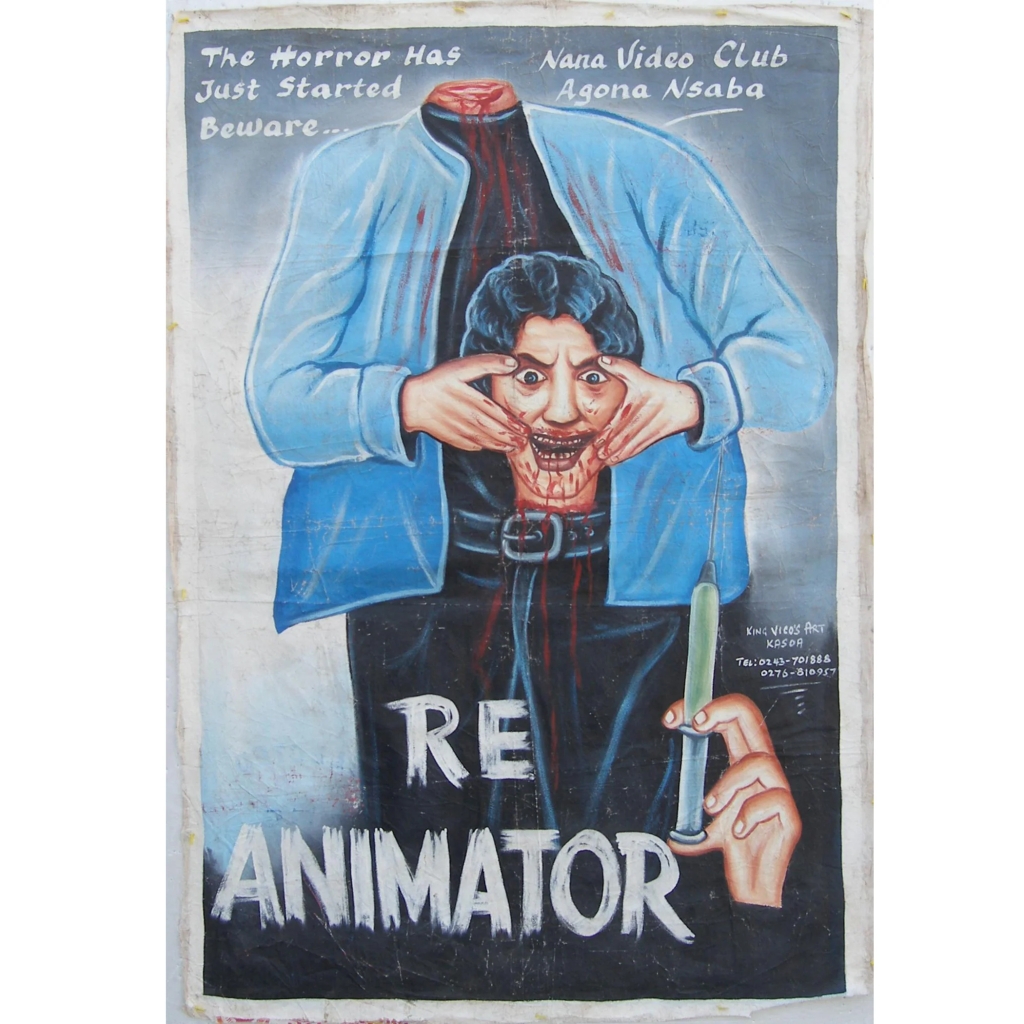
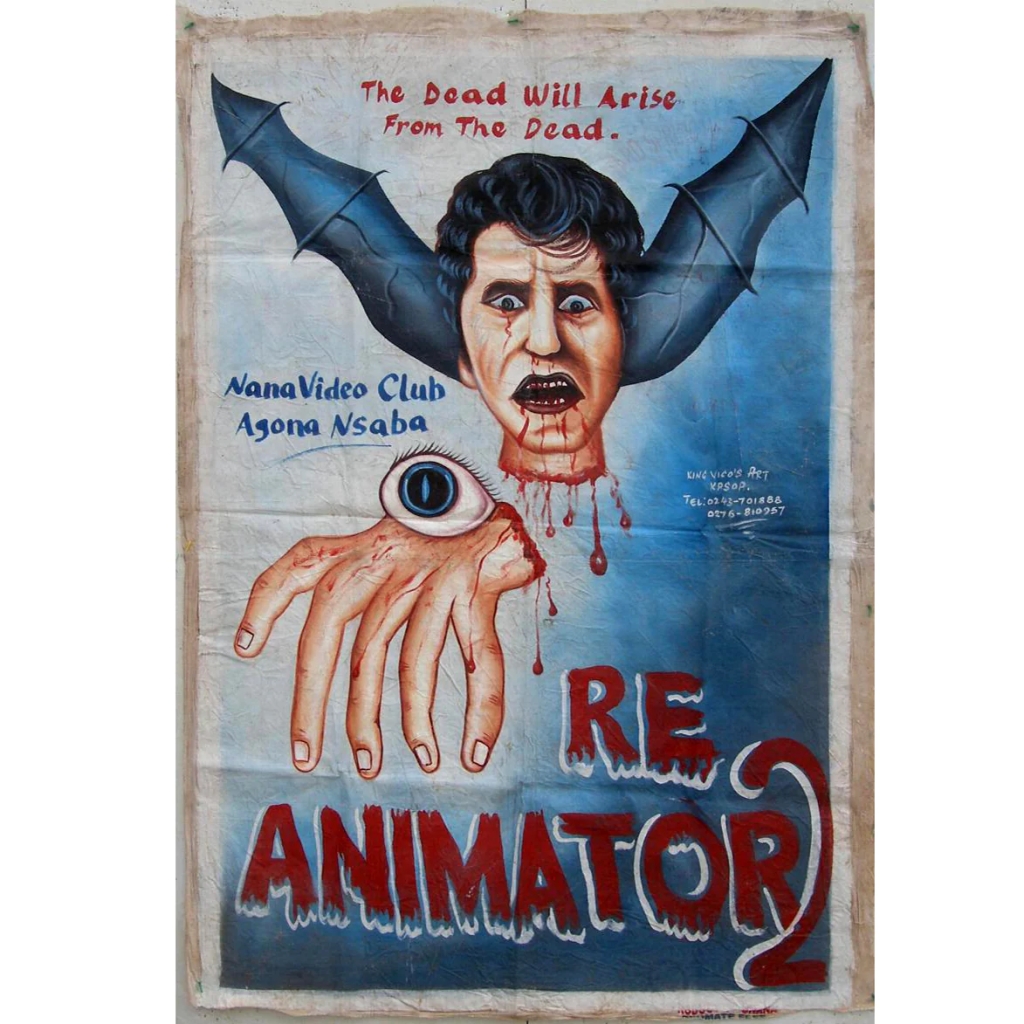
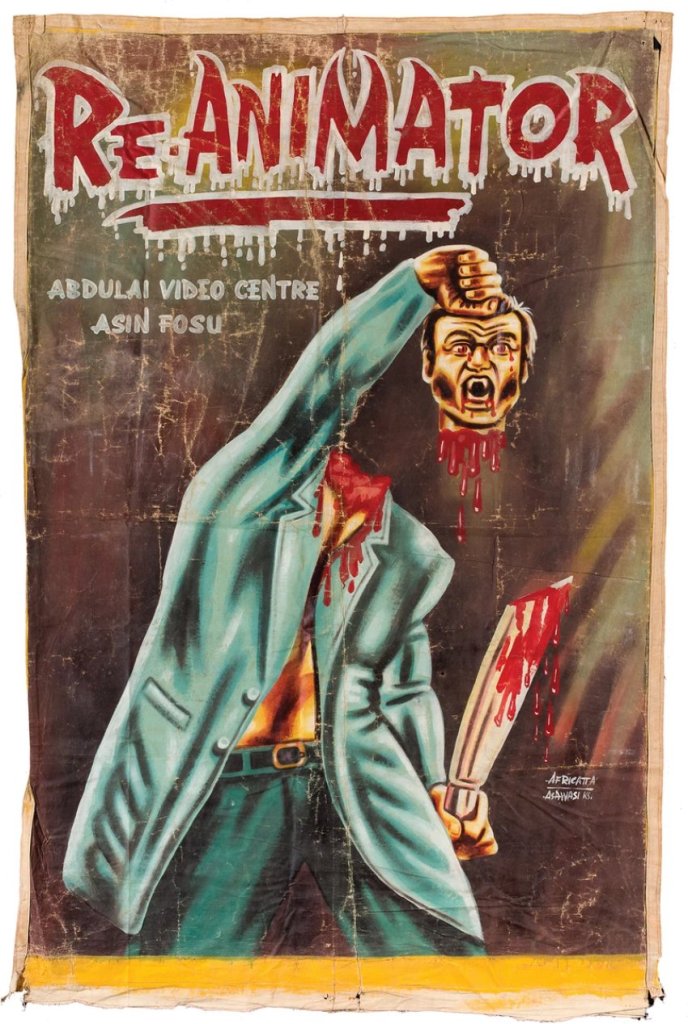
Re-Animator (1985), Bride of Re-Animator (1990), and Beyond Re-Animator (2003)

The first Lovecraftian film by director Stuart Gordon and producer Brian Yuzna was an update and adaptation of “Herbert West–Reanimator,” followed by sequels Bride of Re-Animator and Beyond Re-Animator. Unlike the rather sedate Lovecraft adaptations of the 60s, this was a horror comedy with outstanding practical gore effects, black humor, vivid action, and intense visuals. It is little surprise that it attracted the attention of Ghanaian audiences.

Official Spanish Re-Animator poster for reference.
Source: Tribalgh Ethnic Art Gallery
Source: X.com
Original Japanese Re-Animator poster for reference.
Source: X.com
Source: Extreme Canvas 2 228
Source: Deadly Prey Galley on Facebook

The gore and nudity in Re-Animator, Bride of Re-Animator (labeled as Re-Animator 2 above), and Beyond Re-Animator gave Ghanaian artists plenty of opportunity to use their own imaginations, with the decapitation of Dr. Carl Hill (David Gale) given the spotlight. Two of the posters closely follow international marketing materials, albeit with their own Ghanaian spin (the reanimating reagent is replaced with blood in the first poster featuring Jeffrey Combs as Dr. Herbert West, and Barbara Crampton appears to have gotten a breast augmentation and is no longer censored by the blood drop in the lovingly rendered head-giving-head scene). While not explicitly labeled as Beyond Re-Animator, the final poster is easy to identify as that film because of the distinct depiction of the scene where a rat fights a reanimated penis (although in the film, the testicles are not attached).

Very noticeable about these posters is the skill and attention given to the lettering; while some of the artists may have closely copied other posters or appear to have been told the plot of the movie instead of watching it, the lettering on the titles is terrific.

Source: Extreme Canvas 2 226

As a related piece of work, consider this poster for Dr. Giggles (1992). Jeffrey Combs doesn’t appear in this movie—the eponymous doctor was played by Larry Drake—but Dr. Herbert West obviously resonated with at least one Ghanaian artist.

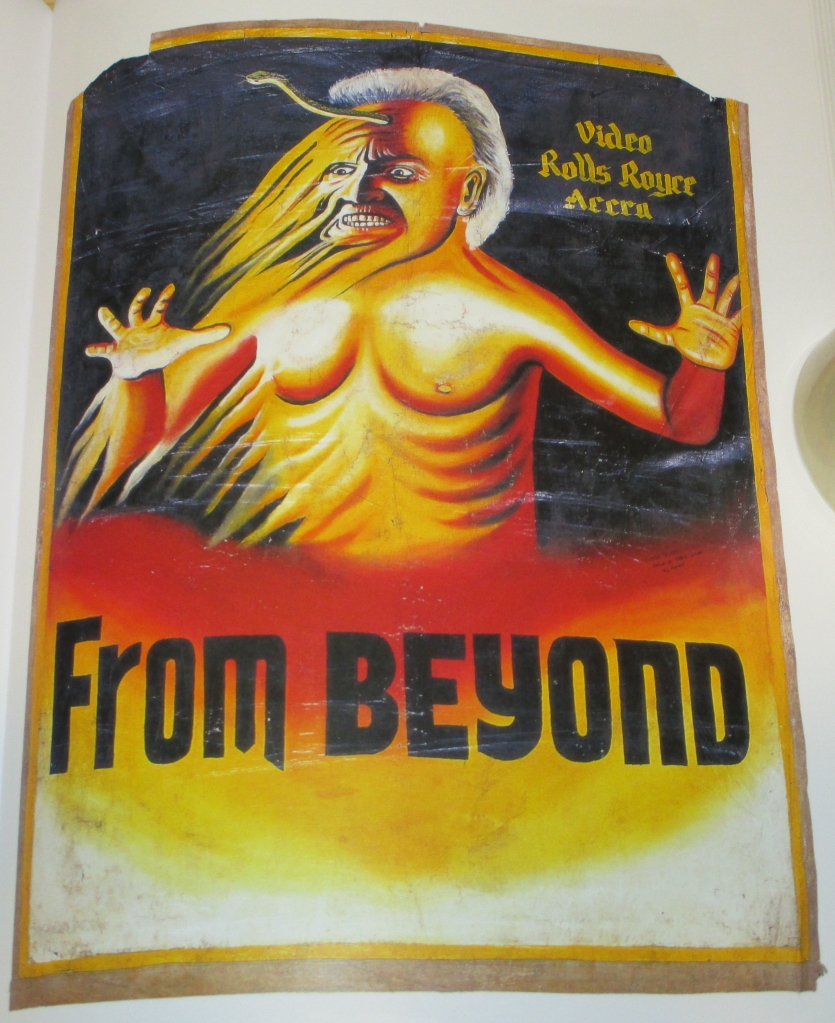
From Beyond (1986)

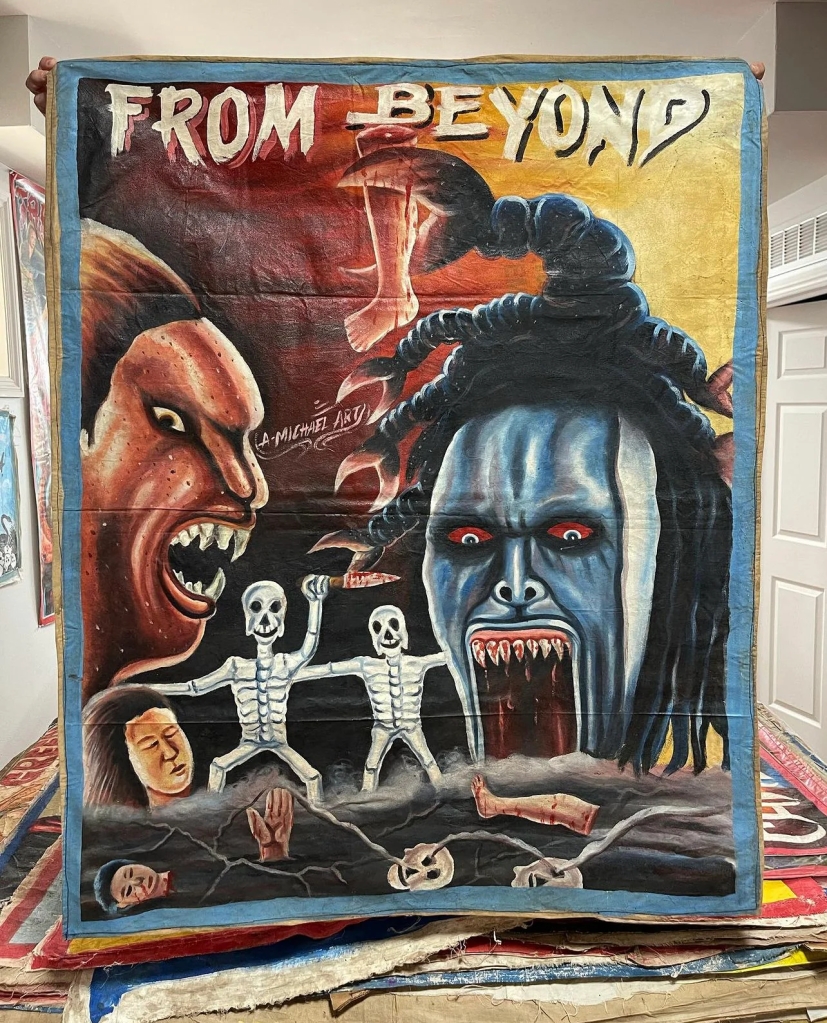
The second Lovecraftian film by director Stuart Gordon and producer Brian Yuzna is an update and adaptation of Lovecraft’s “From Beyond.” This film doubles down on suggestions of sex and the visual effects, with inhuman monsters and grotesque transformations. Fewer posters of this work have been preserved.

Source: Extreme Canvas 191
Source: Deadly Prey Gallery

The first poster for From Beyond is a not-entirely-inaccurate rendition of Dr. Pretorius (Ted Sorel) in his makeup; although the enlarged, external pineal gland has been rendered as a snake (shades of The Dunwich Horror posters). By contrast, the second post is completely unrecognizable as any imagery from the film, and indicates that the artist probably painted it based on a description or straight from the imagination.

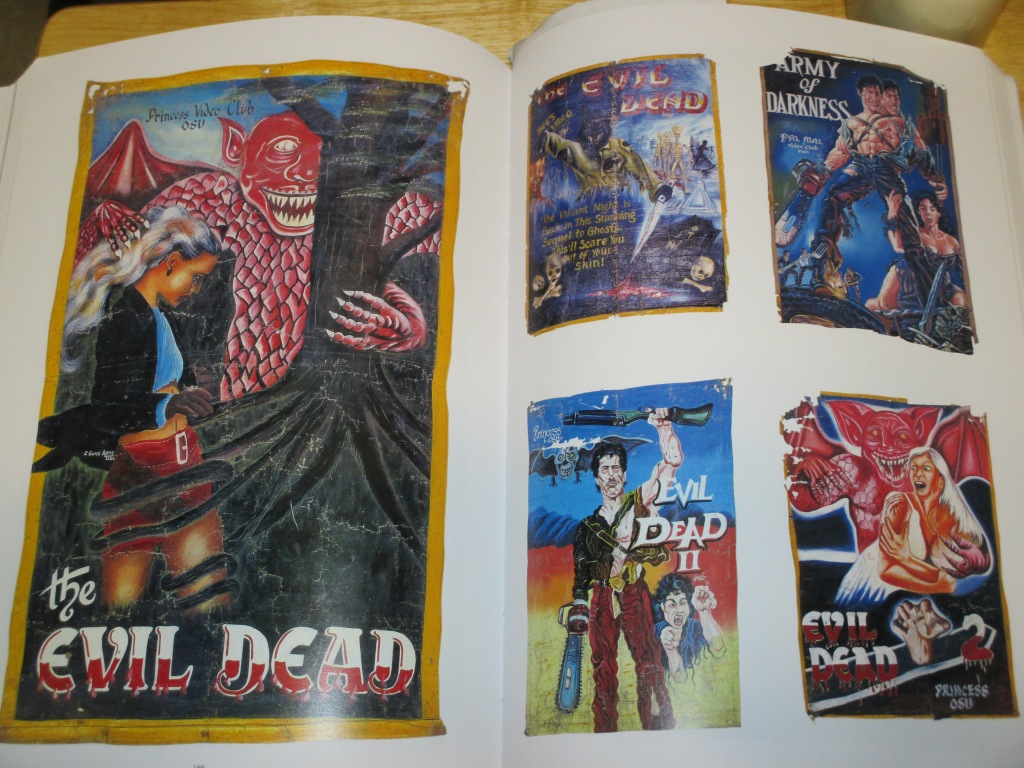
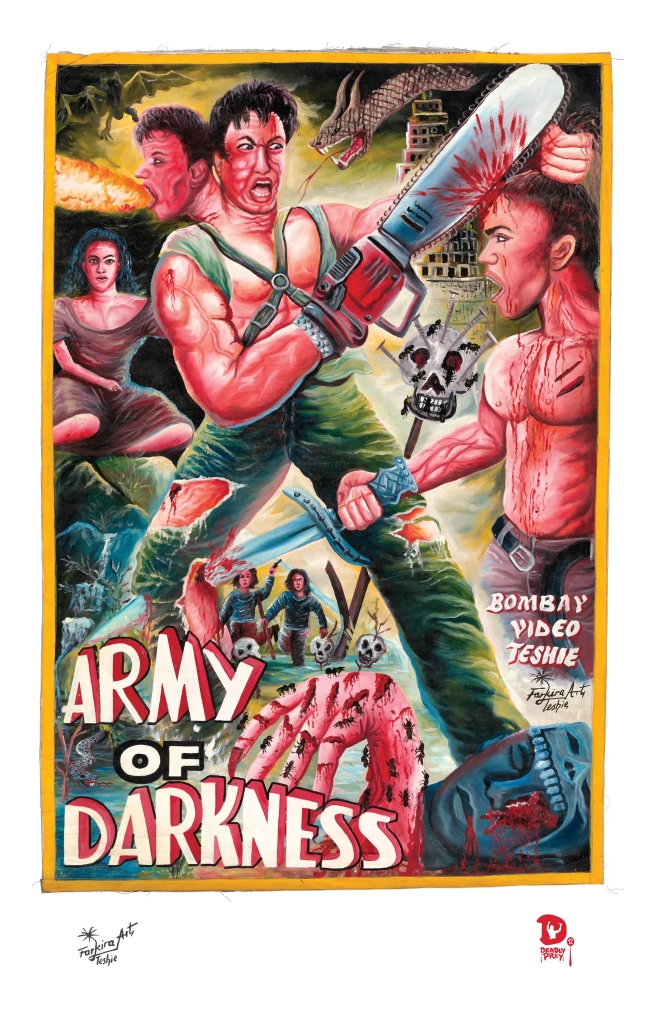
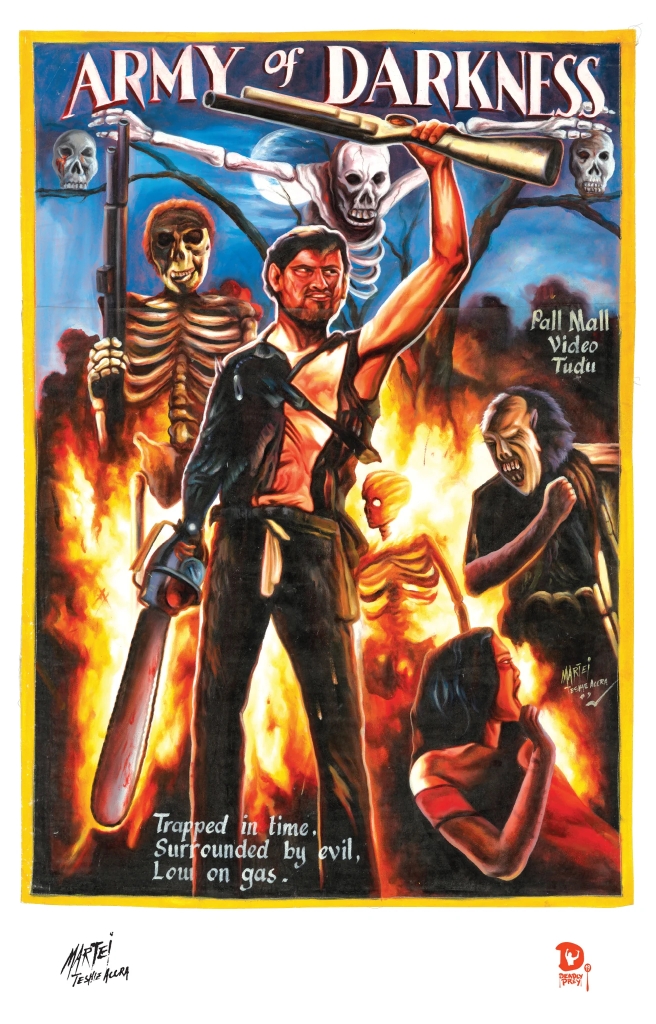
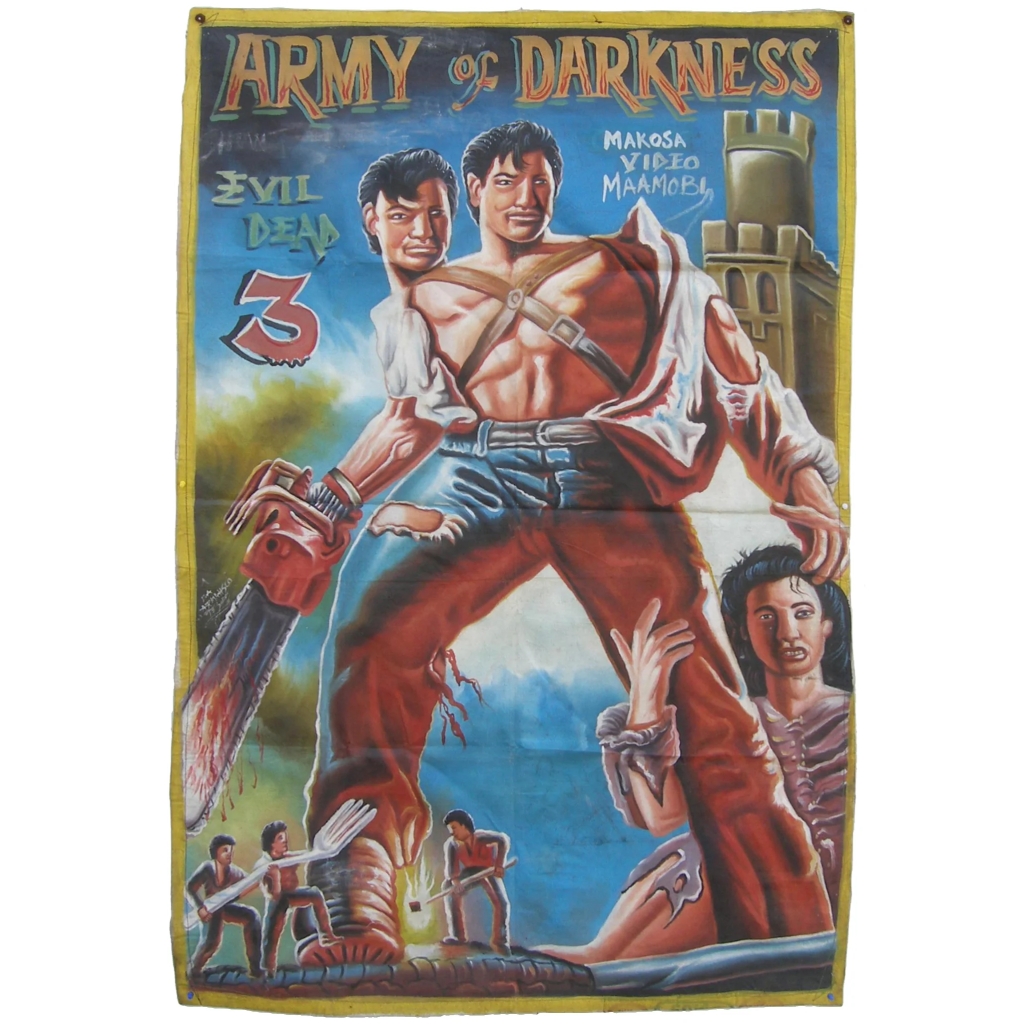
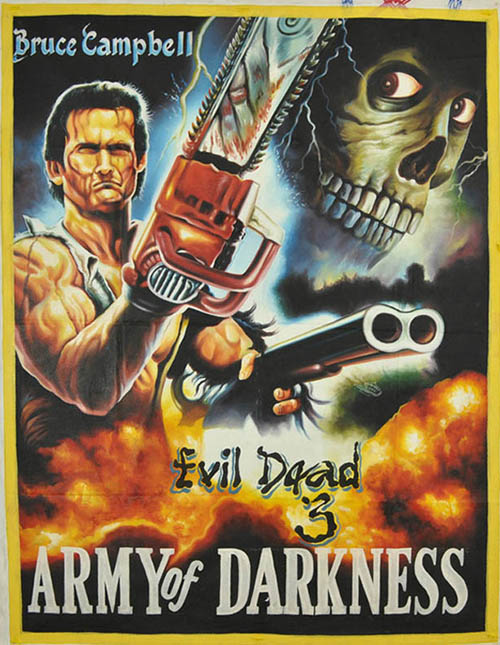
Evil Dead II (1987) & Army of Darkness (1992)

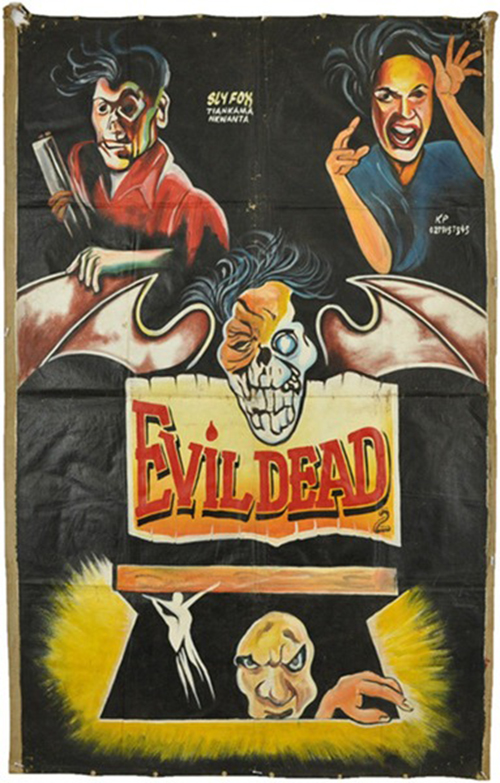
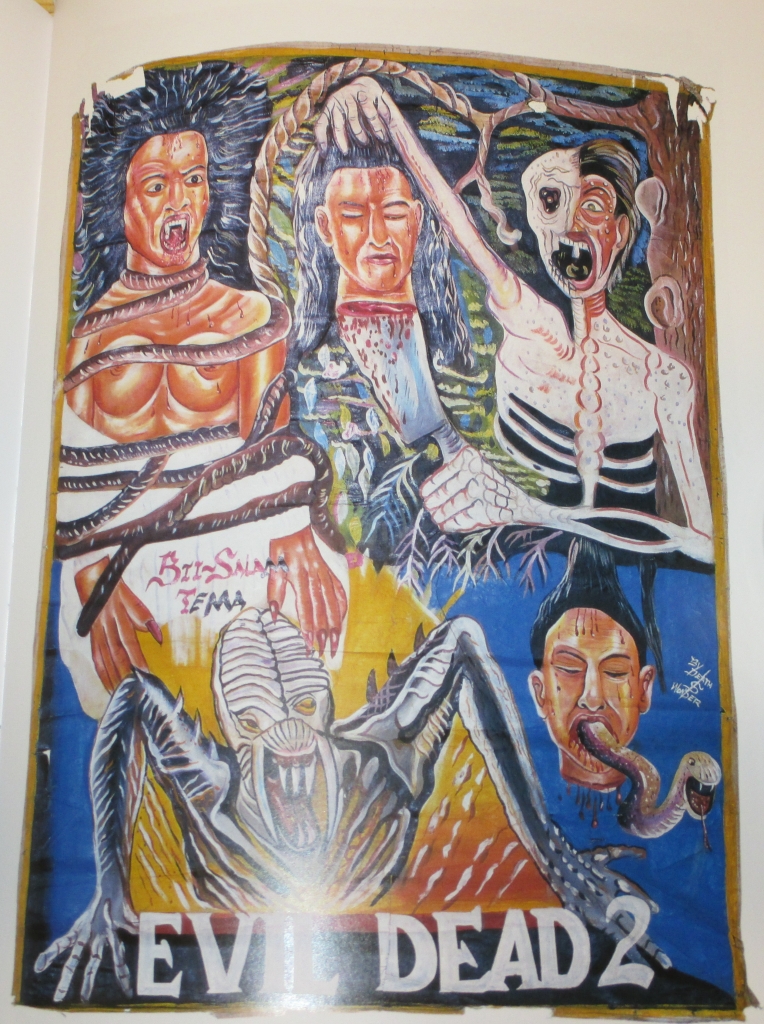
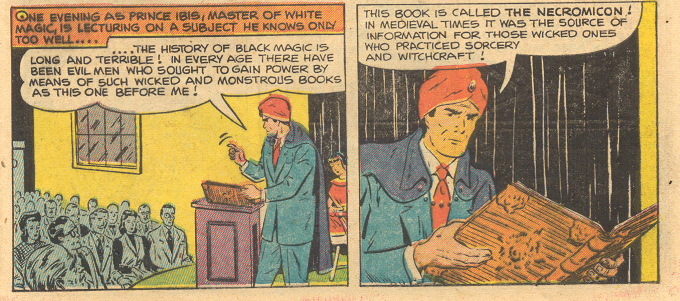
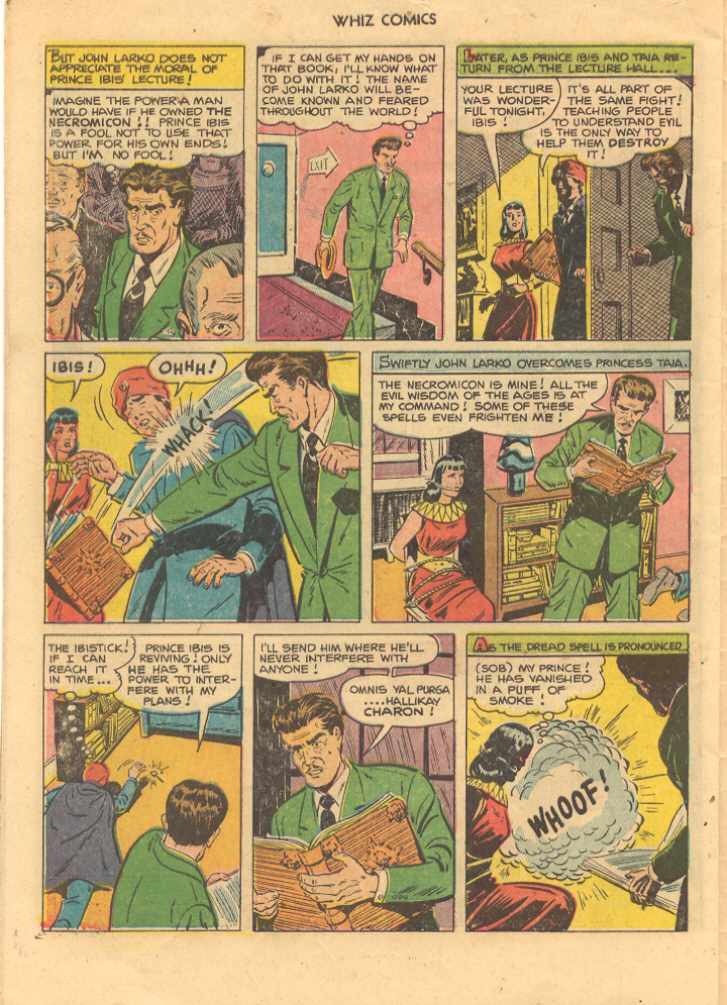
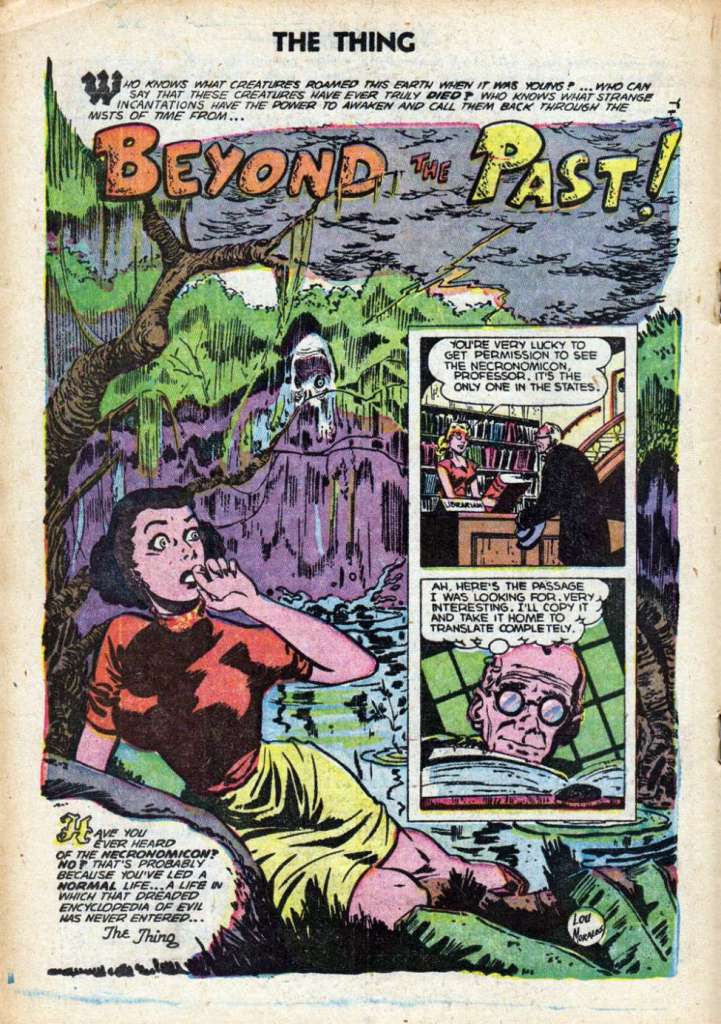
Director Sam Raimi’s Evil Dead II and its sequel Army of Darkness defined the look of the Necronomicon for moviegoing audiences for a generation, and the image of the book as roughly bound in human skin with an actual face visible on the cover continues to influence depictions of Lovecraft’s fictional tome today. Ghanaian artists seem less interested in depicting the Necronomicon ex Mortis, however, than they were with the character of Ash (played by Bruce Campbell) with his iconic chainsaw-prosthetic.

Source: Extreme Canvas 185
Source: Extreme Canvas 186-187
Source: Tribalgh Ethnic Art Gallery

Between the two Sam Raimi films, there are a lot of great images and scenes for Ghanaian artists. Which is why it is surprising that the artists sometimes recombine the Evil Dead imagery with that drawn from other films, such as Amando de Ossorio’s Blind Dead series, John Carpenter’s The Thing, and what might be Pumpkinhead. Which might be false advertising, but the important thing was to get butts in seats, and the more exotic imagery of some of the posters shows how syncrenistic these posters could be, borrowing horrific images from other films to fill in the space and spice up the post.

Hellboy (2004)

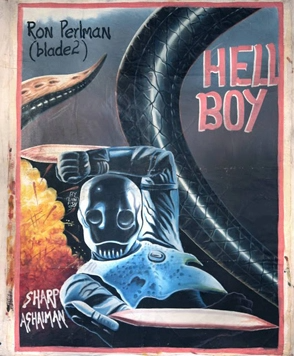
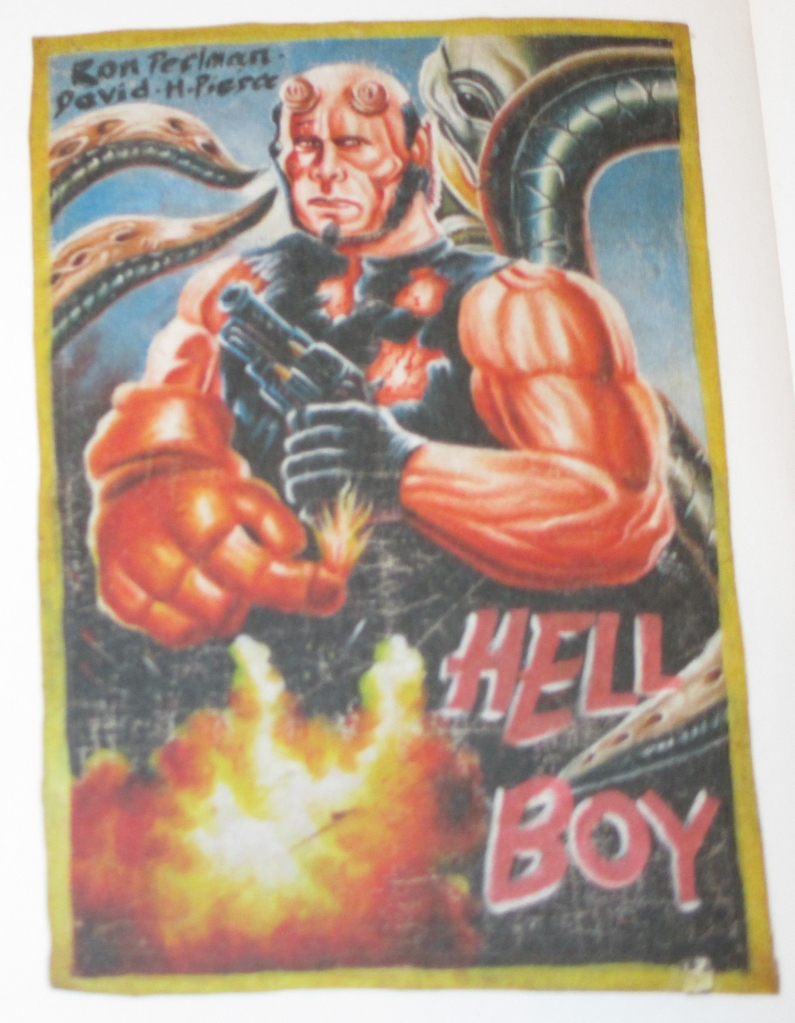
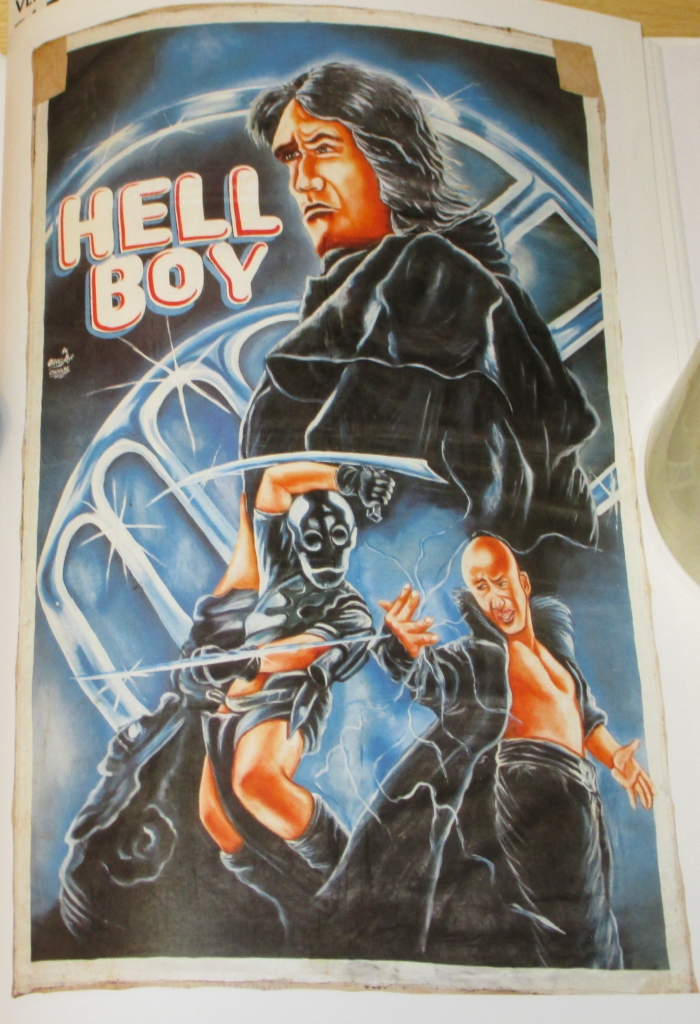
This adaptation of Mike Mignola’s comic book character to the silver screen by director Guillermo del Toro falls outside the “Golden Age” of Ghanaian movie posters, and posters for it may have been produced later for Western audiences. The final Lovecraftian villain for the film gets less attention than Hellboy (Ron Perlman) and Karl Ruprecht Kroenen (Ladislav Beran).

Source: Mollusc No.6
Source: Ghanavision

It’s interesting to note that the first two posters both mention Ron Perlman by name, which was rare during the Golden Age unless the lead was an international superstar like Arnold Schwarzenegger. Bizarrely, David Hyde Pierce is also mentioned; Pierce had provided the voice for Abe Sapien (played by Doug Jones), but went uncredited in the film.

Some readers might be disappointed that these hand-painted Ghanaian posters aren’t more “Lovecraftian” in the sense of emphasizing imagery familiar to Western audiences—there are scarcely any tentacles, nary a Necronomicon, no signs pointing to Dunwich or Arkham or Miskatonic University—but that is part of the point and the charm of these posters. They were being created outside the wider Western cultural milieu; they were at several removes from the original fiction H. P. Lovecraft wrote, and were working within their own cultural context, with images that stood out to them or made sense for their purpose.

This is Lovecraftian cinema as Ghanaians would have seen it in the 80s, 90s, and 00s. When school kids might wait for the sun to go down, praying it wouldn’t rain, and then crowding into an open-air theater, like a drive-in without cars, all eyes glued on the screen. There were people in Ghana that could chant “Klaatu barada nikto!” as loudly as anyone else anywhere else in the world, who would hold their breath as David Gale’s disembodied head was lowered between the nubile legs of Barbara Crampton, or cringe as Ken Forey was eaten alive by things just beyond the edge of perception. It was their part of a shared experience, and these posters are the remnants of that, as surely as any Mythos tome ever stood as a record and monument of a lost age.

Suggested Further Reading:


Bobby Derie is the author of Weird Talers: Essays on Robert E. Howard and Others and Sex and the Cthulhu Mythos.

Deep Cuts in a Lovecraftian Vein uses Amazon Associate links. As an Amazon Associate I earn from qualifying purchases.
Deeper Cut: Lovecraft, Miniter, Stoker: the Dracula Revision

In The Essential Dracula (1979), Bram Stoker scholars Raymond T. McNally and Radu Florescu revealed a letter (H. P. Lovecraft to R. H. Barlow, 10 Dec 1932) that had been drawn to their attention by horror anthologist and scholar Les Daniels, where H. P. Lovecraft claimed that an old woman he knew had turned down the chance to revise Stoker’s Dracula. The letter had not been published before this. Although Lovecraft’s claim had been made in print as early as 1938, and a letter with the anecdote was published in the first volume of Lovecraft’s Selected Letters from Arkham House in 1965, this seems to be the first time the Stoker scholar community became generally aware of the claim. The authors were intrigued by the possibilities:

This is very intriguing! Lovecraft believed that someone else had written the final draft of Stoker’s book. Now that we have found Stoker’s notes, it is clear that Stoker at least did all the basic research for the book, as well as the outline of its contents. But was he capable of completing this massive re-write? If he was in the early stages of syphilis would he have been able to finish the work, or did he assign the final task to someone else?

We wrote to Professor Barton L. St. Armand of Brown University and [L.] Sprague de Camp, both the leading experts on Lovecraft, but neither could identify the “old lady.”

McNally & Florescu, The Essential Dracula 24

Without much supporting detail in Lovecraft’s letter, there was little that McNally and Florescu could do to authenticate the claim. St. Armand quotes the same letter from Lovecraft to Barlow in The Roots of Horror In the Fiction of H. P. Lovecraft (1977), two years before The Essential Dracula was published, but apparently had not found the letters identifying the potential reviser yet.

The connection between Lovecraft and Stoker, however ephemeral, and the influence this had on Lovecraft’s opinion of Stoker and his work excited some interest. While Lovecraft’s anecdote did not single-handedly invent the idea that Stoker did not write Dracula in totality, it did add fuel to the fire for those who wanted to speculate who else may have had a hand in writing the great vampire novel. Periodically Lovecraft’s claim about a Dracula revision has re-emerged in Stoker scholarship; the most extensive treatment of the story was by the late great David J. Skal in Something in the Blood (2016) 329-331.

Skal devotes several pages to the claim and cites two additional appearances of the anecdote in Lovecraft’s letters (HPL to Frank Belknap Long, Jr., 7 Oct 1923, which appeared in Selected Letters, and HPL to Donald Wandrei, 29 Jan 1927) that provide much more detail than most, as well as Lovecraft’s 1938 essay. Through these additional sources, Skal discovered that the “old lady” was noted amateur journalist Edith Miniter, and he dug into her life (his bibliography notably cites Dead Houses & Other Works by Edith Miniter), to see if there was any evidence to support the claim.

Something in the Blood zooms in on Miniter’s employment by the Boston Home Journal in January 1894 and the uncredited reviews of the Lyceum’s plays being performed in Boston at that time. Skal noted that Bram Stoker, as the business manager of the Lyceum, was also the company’s press contact and would have bought the advertising. However, Skal stops short of saying that Lovecraft’s anecdote actually happened or that any actual contact between Miniter and Stoker took place. While the idea that Stoker may have had help in drafting Dracula was intriguing—Skal addresses several theories that had been put forward about this—he obviously failed to find any convincing evidence to support Lovecraft’s claims.

Rickard Berghorn in Powers of Darkness: The Unique Edition of Dracula, traces over the same steps (and the same letters Skal quoted, as well as references in O Fortunate Floridian), and draws a hypothetical connection between the apocryphal Dracula draft and Lovecraft’s “The Rats in the Walls”:

The anecdote about Stoker’s draft apparently captured Lovecraft’s interest, and he must have asked questions of Mrs. Miniter; for example, if she could remember any differences between the draft and the finished novel. A scene like the one with the blood rite and the Count’s degenerate relatives in forgotten caves under the castle is so bizarre, original, and magnificent that Edith Miniter ought to have remembered at least that one among other scenes that might have been included in Stoker’s draft and later were deleted. (Berghorn 33)

A full response to this claim would be an essay in itself. On its face, the claim is speculative: Lovecraft never mentions Miniter or Dracula anywhere as an inspiration for the story, and no details are ever given of the draft as Miniter saw it. Even if Lovecraft wasn’t inspired by Miniter’s account, the potential influence of Dracula on “The Rats in the Walls” cannot be completely ruled out. Barton Levi St. Armand in The Roots of Horror In the Fiction of H. P. Lovecraft dedicates a long endnote on pages 94-95 to the possible influence of Dracula on the story, and also noted that Carfax, the Virginia home of the Delapores, is the same as Dracula’s English home in Stoker’s novel (St. Armand 21).

Berghorn’s further suggestion that Lovecraft may have read “The Judge’s House” in Dracula’s Guest and Other Weird Stories (1914) and that this inspired the story deserves greater attention (Berghorn 34). If Dracula or Miniter’s account of the Stoker’s unrevised draft seems an unlikely influence on “The Rats in the Walls,” then the idea that “The Judge’s House” served as inspiration seems impossible: “The Rats in the Walls” was written in 1923 and Lovecraft’s letters indicate that he did not read “The Judge’s House” until 1935, when the story was reprinted in Weird Tales (ES 2.683, DS 595). Of course, to know that, Berghorn would have had to delve through much more of Lovecraft’s published correspondence.

Which brings up the point: there are more instances in Lovecraft’s letters dealing with the speculative Dracula revision than McNally, Florescu, Skal, or Berghorn reported, or were probably aware of. Most of these instances have been noted in passing by Lovecraft scholars who, looking at what Dracula scholars have written, reported in turn that there was not enough information to confirm the anecdote. A typical annotation from Lovecraft’s published letters might help illustrate the issue; this is the one that accompanies the infamous 1932 letter to R. H. Barlow that McNally and Florescu quoted:

HPL refers to Edith Miniter (186[7]-1934), an amateur associate and the author of a professionally published novel, Our Natupski Neighbors (1916) and other works. HPL tells this story repeatedly in letters, and presumably heard it directly from Miniter, with whom he was in touch since at least 1921, but it has not been independently confirmed.

S. T. Joshi & David J. Schultz, O Fortunate Floridian 45n4

Between the two camps, there is thus a bit of a gap: the Stoker scholars largely haven’t been fully aware of or made full use of the Lovecraft material, and Lovecraft scholars have largely rested on the fact that Stoker scholars have not turned up anything new regarding the issue. Yet in the intervening years, a good deal more of Lovecraft’s letters have been published, and more data on Miniter and Stoker’s lives have emerged that provide considerable historical context to both Lovecraft’s claims and the development of Dracula.

What is needed is a joint approach. By compiling all of Lovecraft’s claims about the Dracula revision from his letters and examining them in the context of recent scholarship that shed light on Stoker’s life and the writing of Dracula, a better assessment of Lovecraft’s claims about Miniter and the Dracula revision—and whether they amount to anything—can be made.

What Lovecraft Claimed

The first reference to the Dracula revision in Lovecraft’s surviving letters dates to 1923:

Speaking of [W. Paul] Cook, he hath just lent me two books, one of which is Bram Stoker’s last production, The Lair of the White Worm. The plot idea is colossal, but the development is so childish that I cannot imagine how the thing ever got into printunless on the reputation of Dracula. The rambling and unmotivated narration, the puerile and stagey characterisation, the irrational propensity of everyone to do the most stupid possible thing at precisely the wrong moment and for no cause at all, and the involved development of a personality afterward relegated to utter insignificance—all this proves to me either that Dracula (Mrs. Miniter saw Dracula in manuscript about thirty years ago. It was incredibly slovenly. She considered the job of revision, but charged too much for Stoker.) and The Jewel of Seven Stars were touched up Bushwork-fashion by a superior hand who arranged all the details, or that by the end of his life (he died in 1912, the year after the Lair was issued) he trickled out in a pitiful and inept senility. But the book is a painful thing!

H. P. Lovecraft to Frank Belknap Long, 7 Oct 1923, Selected Letters 1.255

When H. P. Lovecraft encountered Edith Dowe Miniter (1867-1934) c. 1918, she was already a grand dame of amateur journalism, a writer who had been placing short stories, poetry, and articles in Boston newspapers and magazines since the early 1890s, and a novelist (Out Natupski Neighbors, 1916). In 1923, Lovecraft was an amateur journalist and writer of short stories who eked out a small income doing ghostwriting and revision work for popular author David Van Bush (hence “Bushwork”), which may have colored his perspective a bit.

It is worth noting that Lovecraft’s anecdote was written in 1923, before the first authorized play based on Dracula written by Hamilton Deane, which premiered in 1924 and toured for three years. American producer Horace Liveright bought the rights and John L. Balderston revised it for Broadway, which opened in New York in 1927 and went on to great success. Broadway actors like Bela Lugosi would be cast in the 1931 film from Universal Pictures. Lovecraft’s anecdote thus predates the broad popularity of Dracula as a character, when its reputation was far less than it is today, and so was likely not inspired by the later popularity of Dracula as a cultural phenomenon.

In his influential essay “Supernatural Horror in Literature” (written between 1925-1927, and later revised and expanded), his opinion of Stoker is the same as in 1923, although more politely phrased and (as it was intended for the public) without reference to Miniter or any hypothetical reviser:

Better known than Shiel is the ingenious Bram Stoker, who created many starkly horrific conceptions in a series of novels whose poor technique sadly impairs their net effect. The Lair of the White Worm, dealing with a gigantic primitive entity that lurks in a vault beneath an ancient castle, utterly ruins a magnificent idea by a development almost infantile. The Jewel of Seven Stars, touching on a strange Egyptian resurrection, is less crudely written. But best of all is the famous Dracula, which has become almost the standard modern exploitation of the frightful vampire myth. Count Dracula, a vampire, dwells in a horrible castle in the Carpathians; but finally migrates to England with the design of populating the country with fellow vampires. How an Englishman fares within Dracula’s stronghold of terrors, and how the dead fiend’s plot for domination is at last defeated, are elements which unite to form a tale now justly assigned a permanent place in English letters.

H. P. Lovecraft, “Supernatural Horror in Literature” Collected Essays 2.112

In private, however, Lovecraft leveled his charge with characteristic self-assurance:

Have you read anything of Stoker’s aside from “Dracula”? “The Jewel of Seven Stars” is pretty fair, but “The Lair of the Whie Worm” is absolutely the most amorphous & infantile mess I’ve ever seen between cloth covers; & that in spite of a magnificent idea which one would ordinarily deem well-nigh fool-proof. Stoker was absolutely devoid of a sense of form, & could not write a coherent tale to save his life. Everything of his went through the hands of a re-writer, (except, perhaps, the “White Worm”) & it is curious to note that one of our circle of amateur journalists—an old lady named Mrs. Miniter—had a chance to revise the “Dracula” MS. (which was a fiendish mess!) before its publication, but turned it down because Stoker refused to pay the price which the difficulty of the work impelled her to charge. Stoker had a brilliantly fantastic mind, but was unable to shape the images he created.

H. P. Lovecraft to Donald Wandrei, 29 Jan 1927, Letters with Donald and Howard Wandrei and to Emil Petaja 37-38

By this point, Lovecraft seems convinced that Stoker used revisers for his fiction, as when he wrote:

Stoker had creative genius but no sense of form. He couldn’t write any decent connected novel without extensive help & revision. Have you ever seen the pitiful mess “The Lair of the White Worm”? Poor Bram makes a fizzle of a truly magnificent horror idea which I’d ordinarily consider fool-proof. Do you know his “Jewel of Seven Stars”? That is much better.

H. P. Lovecraft to Donald Wandrei, 12 Apr 1927, Letters with Donald and Howard Wandrei and to Emil Petaja 89

It is worth pointing out that Lovecraft’s references to Stoker’s fiction in his letters show that he had only read Dracula and weirder stories such as The Lair of the White Worm and The Jewel of Seven Stars. When Weird Tales ran Stoker’s “The Judge’s House” in the March 1935 issue, Lovecraft wrote: “The Stoker reprint could have been worse—& it was absolutely new to me.” (ES 2.683).

Stoker’s stuff, aside from “Dracula” & “The Jewel of Seven Stars” is pretty poor. He depended almost wholly on revisers. One book of his—”The Lair of the White Worm”—is about the most puerile thing I’ve ever seen between cloth covers. Many insist that it is a dry conscious burlesque of his own work, but I feel certain that it represents his one solitary attempt to get before the public without revisers. It was, by the way, his last book. “Seven Stars” isn’t at all bad in its way.

H. P. Lovecraft to Richard Ely Morse, 28 Jul 1932, Letters to Hyman Bradofsky & Others 36

The subject of Miniter’s potential revision does not come up often in Lovecraft’s letters, but the argument, denuded of most detail, finally appeared in the original letter cited by McNally and Florescu, and so the most-cited by other Dracula scholars, in 1932:

I never heard of the Stoker book you mention—is it any good? Stoker was a very inept writer when not helped out by revisers, & his “Lair of the White Worm” is so bad that many have mistaken it for burlesque. I know an old lady who almost had the job of revising “Dracula” back in the early 1890s—she saw the original MS., & says it was a fearful mess. Finally someone else (Stoker thought her price for the work was too high) whipped it into such shape as it now possesses.

H. P. Lovecraft to R. H. Barlow, 10 Dec 1932, O Fortunate Floridian 44-45

It is worth pointing out how sparse this version of the anecdote isnot even mentioning Miniter by nameand while pithy, it may have spurred suspicions that someone other than Stoker had a hand in Dracula. R. H. Barlow was a consummate fan of weird fiction and a noted collector, even as a teenager, who wrote to pulp writers asking for autographs and manuscripts. No doubt such a query is behind Lovecraft’s response:

As for the old lady who almost revised Dracula—I know that she has not any reliquiae of the incident. She never was in direct touch with Stoker, a representative of his having brought the MS. & later taken it away when no terms could be reached.

H. P. Lovecraft to R. H. Barlow, Sep 1933, O Fortunate Floridian 81

This is the first added detail to the anecdote since Lovecraft first told it in 1923and it would make a lot of sense, if Stoker and Miniter were never in direct contact, for why there is no record of this supposed offer to revise Dracula. At times, Lovecraft would even walk back his assertion that Dracula was revised a little by noting it was a personal theory, not established fact:

About “The Lair of the White Worm”—I may have told you that my theory of its spectacular inferiority to the other Stoker products is that it represents the one thing which the author published unrevised. It is certain that all the rest were extensively gone over by others—I know someone who turned down the job of revising the original crude “Dracula” MS. Some have thought that the “White Worm” was written as a joke—a sort of satire on the terror-novel—but to me this theory is absurd & untenable.

H. P. Lovecraft to Richard Ely Morse, 29 Apr 1934, Letters to Hyman Bradofsky & Others 78

Edith Miniter died on 5 June 1934. Lovecraft wrote quite a bit about the doyenne of amateur journalism, and the reference to the Dracula revision was slipped in here and there, including for the first time a firm date:

Hope you can catch up with your correspondence—right now I owe 8 letters, have one revision job to do, & have one elegy to write . . . . the latter on Mrs. Miniter (the lady who almost revised “Dracula” in 1893), who died last June.

H. P. Lovecraft to R. H. Barlow, 1 Sep 1934, O Fortunate Floridian 173

Lovecraft also drew on his own experience as a ghost-writer or reviser when discussing Stoker, as he did in a longer discussion about those who rely on book doctors:

Systematic, long-term deception is always difficult—& before long 95% of all literary bubbles burst. The biggest surviving unburst bubble I know of is that of the late Bram Stoker. Usually, the literary parasite finds it impossible after a while to get aid from accustomed sources—so changes his reviser or tries to go on alone, & makes a spectacular flop.

H. P. Lovecraft to R. H. Barlow, 25 Sep 1934, O Fortunate Floridian 179

Which adequately describes Lovecraft’s interpretation of Stoker and The Lair of the White Worm. Lovecraft only discussed this matter with Barlow because they’d already gone over the Miniter anecdote. Mostly, however, the anecdote was repeated to those who hadn’t heard it before:

[W. Paul Cook] had with him some tremendously interesting antiquarian material—old papers of the ancestors of the late Mrs. Miniter (prominent amateur journalist who 40 years ago turned down a chance to revise “Dracula”), whose literary executor he is. The items included letters from a soldier at the front in the War of 1812, letters from 49ers in California, Civil War letters, & other documents of kindred historic value. I am now keeping this material pending the discovery of suitably appreciative blood-heirs of Mrs. Miniter.

H. P. Lovecraft to August Derleth, 4 Dec 1934, Essential Solitude 2.669

Notwithstanding her saturation with the spectral lore of the countryside, Mrs. Miniter did not care for stories of a macabre or supernatural cast; regarding them as hopelessly extravagant and unrepresentative of life. Perhaps that is one reason why, in the early Boston days, she had declined a chance to revise a manuscript of this sort which later met with much fame—the vampire-novel “Dracula”, whose author was then touring America as manager for Sir Henry Irving.

H. P. Lovecraft, “Mrs. MiniterEstimates and Recollections” (written 1934, published 1938) Collected Essays 1.381

“Mrs. Miniter—Estimates and Recollections” was the only time Lovecraft publicly asserted the claim that Miniter had been offered the chance to revise Dracula (after all, by that point both Miniter and Stoker were dead), and adds the intriguing detail that the offer was made when Sir Henry Irving was touring the United States in 4 Sep 1893-17 Mar 1894, which included a Boston leg at the Tremont Theater for four weeks starting 1 Jan 1894. Lovecraft’s continued references to 1893 suggest he wasn’t aware that the tour didn’t hit Boston until 1894, and was possibly simply counting back 30 years from 1923.

This led to a slight expansion of the original anecdote, embedded in general commentary that reveals Lovecraft’s overall opinion of Dracula as an author, apparently occasioned by some comments by young fan Lionel E. Dilbeck:

About “Dracula”—while I doubt the value of Dilbeck’s comments, I must say that I really think the novel is considerably overrated. It has some magnificent high spots—the Castle scene, & the coming of Dracula to Whitby—but as a whole it drags woefully toward the end, & is here & there pervaded by a certain mawkishness. Stoker was a queer bird—absolutely devoid of literary ability yet full of splendid ideas & images. ______ his work __________ the pitifully ludicrous “Lair of the White Worm” was revised by others. As coincidence would have it, I knew an old lady (Mrs. Miniter of Wilbraham, Mass. [the original of “Dunwich”], who died a year ago) who saw the original [MS]. version of “Dracula” in 1893, when a newspaper woman in Boston. Stoker was then in the U.S. as a manager of Sir Henry Irving’s company, & was submitting his MS. to various revisers. He offered the job to Mrs. Miniter, but she found it too difficult to accept at the offered price. She read the MS., & always said it was one of the poorest & most rambling pieces of writing she ever saw. Whatever merits of form the published book may have are due not to Stoker but to whatever unknown person did the revision. The same, of course, is true of his other better products—”The Jewel of Seven Stars”, &c.

H. P. Lovecraft to Emil Petaja, 6 Mar 1935, Letters with Donald and Howard Wandrei and to Emil Petaja 414-415

Subsequent mentions in Lovecraft’s letters are few, and add no other details:

Mrs. Miniter (who, incidentally, once turned down a chance to revise the unpublished manuscript of “Dracula” in 1893!) is buried in Wilbraham’s spectral “Dell”—not far from the grave of her robustious great-uncle George.

H. P. Lovecraft to Clark Ashton Smith, 26 Mar 1935, Dawnward Spire, Lonely Hill 596

Anent Stoker—I read “The Jewel of Seven Stars” years ago, & thought it not at all bad. On the other hand, “The Lair of the White Worm” is almost the worst novel I have ever seen in cloth covers! [Henry St. Clair] Whitehead used to insist that Stoker wrote this latter as a joke or parody—it is so much worse than anything else of his—but I convinced him that the case is probably somewhat different. The fact is that all his successful works were drastically revised—I knew an old lady, now dead, who in 1893 was offered the job of revising “Dracula” (a frightful mess in MS.) but turned it down because of the inadequate pay offered. Probably the “Lair” (his last book, published just before he died) forms his one single attempt to get across a book without revision—hence the abysmal difference from all his former tales. The idea is a splendid one, but he spoils it in the telling. I wish somebody else would write a novel on this theme!

H. P. Lovecraft to Duane W. Rimel, 12 Nov 1935, Letters to F. Lee Baldwin et al. 298

That is, barring any further discoveries among Lovecraft’s letters, all of the times Lovecraft made the claim that Miniter was offered the chance to revise Dracula. This is the body of work that needs to be evaluated.

Evaluating The Claims

The first and most critical point in evaluating these claims is that there is no direct reference to such a revision being offered in the surviving works of either Bram Stoker or Edith Miniter. H. P. Lovecraft is the sole source for this claim, which he repeated in his letters for at least 12 years (1923-1935). The lack of a direct reference from Stoker or Miniter is lamentable, as that would be first-hand, rock-solid evidence; however, the lack of such evidence is certainly plausible under the circumstances.

Lovecraft claims Stoker had no direct dealings with Miniter, and that she interacted with a representative, so Stoker might not even know who had been offered the job, if he did seek a reviser. Likewise, Miniter seldom if ever published anything about her proofreading or editing work, and what private papers remain don’t seem to concern that aspect of her life and work. Lovecraft’s statement that Miniter had “no residue” of the job offer is also plausible in context; after all, why would she keep any correspondence or notes about a job she had refused thirty years ago?

Why Lovecraft? Lovecraft and Miniter met, and probably began to correspond, c. 1920. The Dracula revision story might have been a natural anecdote to relay to a teller of weird tales, though Lovecraft never discusses the circumstances under which he heard it. Of all of Miniter’s friends and correspondents, Lovecraft is the one most remembered, most studied, and arguably most likely to spread gossip about a classic work of horror literature. So the fact that the anecdote has been preserved only through the auspices of Lovecraft’s incorrigible nature and correspondence isn’t unusual under the circumstances.

Since Lovecraft is our sole source of data for the anecdote, it has to be asked: how reliable was Lovecraft? Was he the type to make false claims, exaggerate, invent details, etc? Would the years have affected his memory?

Lovecraft did like the occasional literary hoax, such as The Battle That Ended The Century (1934) with R. H. Barlow, which was mailed anonymously to various of their friends and correspondents as a tongue-in-cheek joke. Yet he did not have a habit of inventing anecdotes in letters. Lovecraft had a penchant for prejudice in that he tended to seize on data that supported his suppositions and doggedly held to such views—it can be seen how the Miniter anecdote informed his belief that Stoker had someone revise his text, and in repeating the story and reading some of Stoker’s later work, Lovecraft became dead certain about it—and he could also be wrong. Yet he seldom knowingly spread false information in his letters (mostly related to private matters; he referred to his aunt’s case of breast cancer and mastectomy as a case of the “grippe” in letters to friends), and was generally very honest and had a good memory. While his anecdotes could wax poetic at points, he was a solid technical observer.

Concerning the Dracula revision anecdote in particular, for 12-odd years and to multiple correspondents, Lovecraft tells essentially the same story, sometimes adding a bit of detail but with no grand embellishments or ludicrous claims (beyond, possibly, the assertion that Stoker had to be revised). If Lovecraft was wrong, he was wrong from the start.

The most notable shift in the telling is the slight ambiguity of the date. In 1923, Lovecraft claims the revision offer was made “about thirty years ago”; in 1927 “before its publication” (i.e. before 1897); in 1932 “in the early 1890s”; in 1934 it was “40 years ago” and the very concrete “1893.” All of these coincide closely, but it appears Lovecraft was initially a bit ambiguous about the dating because he didn’t know, and then gelled on a more specific date (1893) later. It is perhaps notable that Lovecraft did not offer the detail that Stoker was “then touring America as manager for Sir Henry Irving” until 1934. In fact, both Miniter and Stoker were in Boston during late December 1893/January 1894, and their geographic proximity at the same time certainly makes the claim more plausible, but the lateness of the recollection might also suggest that Lovecraft shifted his date to accord with the dates of the tour.

Lovecraft’s motivation in repeating this anecdote, time and again, with slight variations and sparse additional details, was because it was interesting and because it supported his personal assessment of Stoker’s flaws as a writer. There seems little reason for Lovecraft to have invented the anecdote out of whole cloth, nor was he prone to such tall tales. Miniter, we can only presume, told the tale to Lovecraft because she thought it would interest him as an aficionado of horror fiction. There is no evidence she told it to anyone else. We have to accept the possibility that Edith Miniter told Lovecraft a fib, and he believed it wholesale. However, it seems odd that they could be friends for ~14 years and Miniter would never let Lovecraft in on the joke, if this was the case.

Accepting for the moment that Lovecraft heard the anecdote from Miniter, believed the anecdote, and reliably told the anecdote to others with little change or embellishment, how plausible is the scenario that he puts forth? What state was the Dracula manuscript in 1893/1894, would Stoker have been looking for someone to revise it, and would Edith Miniter be someone who might have been contacted to do the job?

What did the Dracula MS look like in 1893/1894?

Bram Stoker’s original notes for Dracula were sold at auction by his widow in 1913 (the year after his death) and surfaced again in 1970 when purchased by rare book dealer Abraham Rosenbach. The existence of these notes gained wider awareness when Raymond McNally and Radu Florescu reported on them in their book In Search of Dracula (1972). The entire collection of written notes, outlines, newspaper clippings, drawings, and assorted materials were reprinted in full as Bram Stoker’s Notes for Dracula: A Facsimile Edition (2013) and Drafts of Dracula (2019). A memo on an undated page notes possible titles as The Un-Dead or The Dead Un-Dead (Notes 91).

In 1984, bookseller John McLaughlin acquired the typescript draft for the novel, which was later sold at auction. The handwritten first page gives the title as The Un-Dead, and is dated 1897; this title also appears on the contract Stoker signed in 1897. The state of the draft manuscript shows a good deal of hand-correction, including by cutting and re-arranging sheets:

STOKER, Abraham (“Bram”) (1847-1912). Typescript of The Un-Dead, published as Dracula (London, 1897), WITH AUTOGRAPH ADDITIONS, CORRECTIONS AND DELETIONS IN INK BY THE AUTHOR, signed or initialed by Stoker in some 26 places, and with his name and address (“Bram Stoker, 17 St. Leonard’s Terrace, Chelsea, London”) on versos of some chapter endings, preceded by a hand-lettered title-page by Stoker (using the title The Un-Dead), dated 1897. Carbon and ribbon typescript (largely carbon, with some words, usually names of places or characters, typed directly into blank spaces), comprising Stoker’s revised typescript used as the printer’s setting copy, with the printer’s occasional blue pencil markings. Probably typed by Stoker in London and perhaps in Cruden Bay, Scotland, 1890-97.

530 sheets (comprising unnumbered title and pp. 1-541, with irregularities), lacking 8 pp. (175, 233, 297, 521, 525, 532, 534, 537), pp. 177 and 295 skipped in pagination but text continuous. Typed on the rectos of sheets of wove paper of varying size (ranging from 8.5 to 14.5 inches in height). Stoker (like his contemporary, Arthur Conan Doyle) cut and reassembled some pages of his manuscript as part of the editorial process, often adding necessary connecting text in ink (see below under “Pagination”). Several marginal notes in the text are perhaps in the hand of William Thornley Stoker, the author’s brother, some pencilled punctuation possibly added by an editor. A few marginal tears, not affecting text and without loss to paper, occasional minor soiling, otherwise IN AN EXCELLENT STATE OF PRESERVATION THROUGHOUT.

From Sotherby’s catalog entry, quoted in Simone Berni’s Dracula by Bram Stoker: The Mystery of the Early Editions 17-18

The manuscript text is followed closely by that of the published work (for comparison, a copy of the first edition, lacking ads, with a July, 1897 presentation inscription was used). Minor variations in the text occur such as “done” for “finished”, etc., all of which could have easily been altered in proofs. It seems apparent that this is a hybrid assemblage, prepared as setting copy (hence the editorial notations), but distilled from the pages of Stoker’s actual working document. The peculiar features leading to this conclusion are manifold, as follows:

Organization. Nearly all leaves bear three different page numbers; two written in Stoker’s hand, the third typewritten. Of the three, the typewritten and one handwritten numeral have been crossed off. The final hand-numbered sequence begins with page 3 (preceded by the preface note and the first page of the text) and continues through the final leaf, numbered 541. The ms. is complete save for five pages, the remaining discrepancy in the number of leaves to numbered pages accounted for in Stoker’s method of organization, some leaves bearing two consecutive numbers (more on this later). The hand-numbered page 3 also bears the partially obliterated typewritten page number 103, indicating that at one point in the evolution of the novel, the published opening was actually the 102nd page of the text. […]

Of particular interest is the method by which Stoker apparently reorganized the early form of the novel…by cutting the manuscript into pieces, then glueing it back together in the desired sequence. This practice is evident on many pages throughout the text, with gaps bridged by lengthy holograph inserts between the pasted-up portions. The second set of page numbers in Stoker’s hand might indicate that this shifting of the text was accomplished more than once. An attempt to re-assemble the work in the original order was stymied by the fact that some chapters were never numbered within the original context, but begin anew, the first page of each bearing the number 1. This occurs in chapters 19 and 23 through 27, the final chapter.

From The Book Sail 16th Anniversary Catalogue (1984)

The first thing that should be apparent is that if Edith Miniter ever saw a manuscript, it wasn’t even titled Dracula yet: both the final draft manuscript and the 1897 contract are for a book titled The Un-Dead. Dracula has been suggested to be a change insisted upon by Stoker’s publisher Archibald Constable & Co. (Berni 16), although no one really knows when it was changed between the final draft and the typesetting stage (Skal 363).

The second notable feature is that the few dates on the notes cover a broad range (1890-1896); there is reason to believe that the novel was set in the 1893 calendar year, as the dates and days of the week coincide with 1893, and Elizabeth Miller has made the cogent argument that by summer of that year “much of the novel had already taken shape” (Dracula: Sense and Nonsense). An 1896 news snippet suggests Stoker was working on the final chapters in c. June 1896 (Washington D.C. Times 21 Jun 1896), and in an 1897 interview with Jane “Lorna” Stoddard, Stoker claimed it took him three years to write the book (“Mr. Bram Stoker: A Chat with the Author of Dracula.”) That being said, even at a relatively late date (1897, the year Dracula went to press) it is evident that the manuscript was being whipped into final form with many insertions, corrections, deletions, and interpolations.

So what, hypothetically, could Miniter have seen in 1893/1894 if she had been presented with the job? The handwritten notes contain both a rough outline of the book (Notes 29-31), and synopses for several chapters (Notes 32-83), often in very fragmentary form, along with miscellaneous notes, timetables, vampire lore, etc. Much of this material cannot be effectively dated, though any pages or materials dated 1895 or later can be effectively ruled out. Theoretically, Stoker could have had the bones of the novel on paper, waiting to be written. Or he could have had a (very) rough draft, either handwritten or typed.

Robert Eighteen-Bisang and Elizabeth Miller in “Dracula: The Novel We Could Have Read” point out:

Had Bram Stoker adhered to his initial plans for his masterpiece and dashed it off with the same haste that marks many of his other works, Dracula would be a very different book. A German professor named Max Windshoeffel would confront Count Wampyr from Styria. Lucy Westerna would be engaged to Dr. Seward, and one of the vampire hunters (possibly Mina) would be slain by a werewolf.

Drafts of Dracula 287

So the plot and characters could well have been substantially different, though apparently similar enough for Miniter to recognize it in Stoker’s published novel. Even the format could have been markedly different.

Somewhere during the drafting process, the chapter or story that was later published as “Dracula’s Guest,” published after Stoker’s death, may have been cut from or spun out from the main text. In the preface to Dracula’s Guest and Other Weird Tales (1914), the widow Florence Stoker wrote:

To his original list of stories in this book, I have added an hitherto unpublished episode from Dracula. It was originally excised owing to the length of the book, and may prove of interest to the many readers of what is considered my husband’s most remarkable work.

Harry Ludlam, who mined Bram Stoker’s son Noel for family lore, added:

Florence Stoker lived to see “Dracula” become a sensation both as a play and a film—and enter the world’s language. It was she who decided to publish the forgotten chapter of “Dracula” which had been cut from the book before its publication in 1897. A former check taker at the Lyceum named Jarvis, who had been a loyal assistant to Bram, was appointed literary executor, and he discovered the manuscript while going through Bram’s papers. The episode, titled “Dracula’s Guest”, headed the short stories Bram had been selecting as he died, when the book was published in 1914.

A Biography of Dracula: The Life Story of Bram Stoker 151

Both accounts are a little lacking in detail; but it is clear that “Dracula’s Guest” is not in an epistolary format like the 1897 novel, but a rather straightforward narrative stylistically similar to Stoker’s stories written in the 1890-1892 period such as “The Squaw” (1893). Further, the characters and plot show many differences from both Stoker’s notes for Dracula and the 1897 text of the novel. Aside from Florence Stoker’s word on the matter, there is little in the story itself to suggest it was ever a part of The Un-Dead, and it is not clear when “Dracula’s Guest” was written or how it would fit into the drafting process.

Scholars like Clive Leatherdale and Elizabeth Miller have pointed out in books like Dracula Unearthed and Dracula: Sense and Nonsense the inconsistencies between short story and novel, and conjecture a more complicated relationship with “Dracula’s Guest” than as an excised chapter from the final novel. It is possible that “Dracula’s Guest” was an original story that Stoker set aside and expanded into The Un-Dead, for instance, or that it was part of a much earlier draft of the novel that lacked the epistolary format. Rickard Berghorn notes that references to the events of “Dracula’s Guest” appear to survive in the 1897 final draft, but not the 1897 novel (Berghorn 27). This suggests some version of “Dracula’s Guest” probably survived relatively late into the drafting process, but it likely wasn’t the 1914 narrative.

Whatever the case, it can be said with some certainty the working copy of The Un-Dead in 1893/1894 could not have looked much like the finished 1897 product, though several of the key characters and scenes might have been in there—enough to be recognizable to Miniter, apparently. Stoker’s notes for the novel certainly existed at the time, and that is enough to say that the idea of The Un-Dead existing in 1893/1894 as either a draft or an outline and set of chapter synopses has to be considered plausible. It is also apparent that Stoker would add to his notes and continue to write and revise the book almost right up to publication is proven by the existence and state of the 1897 draft.

Edith Miniter (through Lovecraft) is supposed to have said of Dracula as she saw it: “It was incredibly slovenly,” “a fearful mess,” and “one of the poorest & most rambling pieces of writing”—and this could possibly represent either a single sentiment refracted through the lens of Lovecraft three times or three separate statements she made. Certainly, if someone dumped a pile of handwritten notes a la the facsimile edition of the notes to Dracula in her lap, Miniter’s response might seem likely. If the manuscript was typed and in better order than that—effectively, a lost draft of The Un-Dead rather than a collection of outlines, synopses, and notes—it would be more of a reflection on Miniter’s appraisal of Stoker’s prose than anything else.

Did Bram Stoker need a reviser?

While it might not be obvious, this is actually three related questions wrapped up into one:

  • Did Bram Stoker actually write Dracula?
  • Did Stoker look for someone to proofread, edit, revise, or ghostwrite his material?
  • To what extent was Dracula written, revised, or edited by unseen hands?

Every book has to go through several hands, the text can change in any number of different ways without a record of who made the changes, and Dracula has always been lacking somewhat in the bibliographic details. We don’t know, for example, exactly how many drafts that Stoker went through from 1890 to 1897, or who all may have had a hand in it at various stages. On top of that, there has been considerable speculation on the authorship and editing of Dracula for many decades. A final determination is not possible here, but with respect to the question of where Stoker was at as a writer in 1893/1894, we can say a few things.

At the time The Un-Dead was conceived and written, Stoker’s primary occupation was as the manager of the actor Sir Henry Irving and the Lyceum Theater in London, a position which required him also to go with the company on tour, interact with press agents, etc. He found time to write both fiction and nonfiction, beginning with short stories like “The Crystal Cup” (1872) and the book The Duties of Clerks of Petty Sessions in Ireland (1879)—a rather dry and unimaginative handbook for civil servants—but encompassing everything from fairy stories for children to novels. In 1893-1894, while touring and managing Irvign’s company, collecting notes for and (possibly) drafting The Un-Dead, Stoker also wrote two rather modest novels, The Watter’s Mou’ (1895) and The Shoulder of Shasta (1895); and several short stories including “The Man from Shorrox” (1894), “A Dream of Red Hands” (1894), “The Red Stockade” (1894), “When the Sky Rains Gold” (1894), “Crooken Sands” (1894), and “Our New House” (1895).

“Modest” is a subjective assessment for Stoker’s early novels, but critics don’t offer shock and surprise that the author of The Duties of Clerks of Petty Sessions in Ireland wrote The Shoulder of Shasta. By almost universal agreement, Dracula was much more complex and polished work than any of his previous novels—and, as Lovecraft noted, better than later works such as The Lair of the White Worm (1912), which even Clive Leatherdale in Dracula Unearthed admits “bears signs of an ailing mind[.]” Was it just the fact that The Un-Dead percolated for at least six years, and went through an unknown number of drafts before it was polished into the horror gem that it is—or did somebody else have a hand in it?

To be clear, Stoker’s notes leave no doubt that the primary conception and details of Dracula were his. Even beyond the notes and annotations in his own hand on the final draft, there are themes and elements from his other work that carry through in Dracula and lend credence to his authorship of the novel. Given the long gestation of Dracula compared to his other novels and stories, which were written relatively quickly and with less careful planning, it is no surprise that the final product is much more polished than his other works, even if the final race to the finish seems to have been a rush job. Perhaps importantly, there is no evidence that Stoker ever employed a ghostwriter, or even a proofreader, to touch up any of his other works. While Bram Stoker’s other novels may be less than brilliant, he was a competent writer on his own with a distinct voice.

However, as pointed out above, the publishing process means that manuscripts go through several hands. The change of the title from The Un-Dead to Dracula is one clue that the editor at Archibald Constable & Co. might have had an influence on the final product. More than that, several small changes were apparently made to the galley proofs which make for textual differences between the 1897 final draft and the 1897 book text. The final draft would be re-typed, galleys read and corrected, then typeset for printing, at least some of which would have been outside of Stoker’s direct participation. What else might have been changed between the point where Stoker submitted the manuscript and it went to print?

It is important to recognize that the Dracula that went to print in 1897 shows all the scars of a somewhat arduous development, not the smooth and error-free prose of a work that has been gone over carefully by someone being paid to do the job. While Stoker might have benefited from a careful proofreader or detail-oriented editor or reviser making a pass at the draft, errors and contradictions in the text (none of which are very substantial to the plot) suggest that this did not happen—or if it did, that subsequent passes undid a lot of hard work.

The 1897 text contains numerous inconsistencies in spelling, geography, and detail, most of them minor, but some rather odd. For example, in the 1897 text Dracula says “I bid you welcome, Mr. Harker”—except Dracula was expecting Harker’s employer, Mr. Hawkins, and only learned Harker would replace him when Harker hands Dracula a letter. In the 1901 abridgment, this error is corrected by removing “Mr. Harker” from the line. In the 1897 final draft, a passage exists that shows Castle Dracula disappearing in a volcanic eruption; this was excised from the novel, but an earlier passage referring to volcanic energies designed to set up this climax was inadvertently retained.

Whether or not other hands than Stoker’s helped shape the text that would be Dracula, it is clear that the text of Dracula wasn’t completely sacrosanct, even after the first publication:

  • The 1901 paperback edition by Constable was abridged; Elizabeth Miller in “Shape-shifting Dracula: The Abridged Edition of 1901″ (The Green Book #5) says that it is not clear whether Stoker himself, an editor, or both were responsible for cutting ~25,000 words from the 1897 text. Part of the clean-up of the text involved correcting some of the inconsistencies and errors in the 1897 edition.
  • Various newspaper editors who serialized the text chopped it up basically as needed to fit, and sometimes added synopses (e.g. Buffalo Courier 21 Feb 1900) and variant titles (see The Forgotten Writings of Bram Stoker 8-9).
  • The 1899 American edition from Doubleday and McClure corrected some minor errors and introduced new ones.
  • An 1899 Swedish translation by the pseudonymous “A—e” was published as Mörkrets Makter (translated into English as Powers of Darkness); this adaptation, serialized in the newspaper Dagen, contains significant differences from Stoker’s novel, and a new preface claimed to be written by Stoker himself. Mörkrets Makter was later abridged in another serialization in the Swedish newspaper Aftonbladet Halfvecko-Upplaga.
  • The 1901 Icelandic edition Makt Myrkanna (also translated into English as Powers of Darkness) translated and abridged by Valdimar Ásmundsson from the abridged Swedish version of Mörkrets Makter published in Aftonbladet Halfvecko-Upplaga, was both serialized in the newspaper Fjallkonan and later published as a standalone book.
  • Other translations during Bram Stoker’s lifetime include the Hungarian (1898), Russian (1902), and German (1908) editions; these are not noted as diverging widely from the English text, though are obscure (Berni 69). Most of the early translations were likely unauthorized; only Germany was a signatory of the Berne Convention regarding international copyrights at the time, and no evidence in the form of contracts, etc. has come down to us suggesting they were authorized.
  • Stoker also wrote the first theatrical adaptation (really, a staged reading) in 1897, Dracula: or The Un-Dead to secure the performance copyright; a surviving manuscript shows excerpts from the novel’s galley proofs were amended with Stoker’s handwritten directions, very similar to the cut-and-paste method used in the 1897 final draft (Greg Buzwell, “Bram Stoker’s Stage Adaptation of Dracula).
  • Skal has suggested that Jarvis (or someone other than Florence Stoker) had a hand in editing “Dracula’s Guest” for the 1914 edition (Skal 503).

There has been some speculation that Mörkrets Makter (and thus Makt Myrkanna) was based on some earlier draft of The Un-Dead, given similarities between details present in Stoker’s notes (but not the final novel Dracula) and the Scandinavian version(s). Rickard Berghorn in “Is Mörkrets Makter Based On An Early Draft of Dracula?” in Powers of Darkness: The Unique Version of Dracula and Hans de Roos in Appendix B in Powers of Darkness: The Lost Version of Dracula highlight the character of a deaf-mute housekeeper, a police detective character, a secret red room, the odd Anglicisms in the translations, and the similarity of the blonde vampire woman in Mörkrets Makter with the golden-haired female vampire in “Dracula’s Guest” among other parallels that are including in Stoker’s notes but not in the 1897 final draft or published 1897 text. Berghorn also notes how Mörkrets Makter includes a scene strongly reminiscent of Stoker’s story “A Gipsy Prophecy” (1885).

However, nothing conclusive is drawn by Berghorn and de Roos; there is no individual element or scene which can indisputably be traced back to the notes for The Un-Dead but not to Dracula. Each individual element could be a coincidence or drawn from standard tropes of literature at the time, as Jason Colavito pointed out concerning the deaf-mute housekeeper (Why the Icelandic “Dracula” Adaptation Is Probably Not Evidence for a Lost Original Version of Bram Stoker’s Classic Vampire Novel). While the possibility remains that Mörkrets Makter was partially translated or expanded from an earlier version of the draft, it cannot be definitely proven; and Berghorn notes in particular that “Mörkrets Makter cannot be a straight translation of an early draft” (Berghorn 29); there are simply too many elements added by the anonymous Swedish translator.

An earlier draft would add another drop of ink to the already murky issue of what The Un-Dead looked like before the 1897 final draft. Taken with Stoker’s notes and the heavily annotated and cut-and-paste nature of the 1897 final draft, we get a picture of the text of The Un-Dead as fairly fluid up until its 1897 publication, and even after that, there was room for abridgment, adaptation, and translation—sometimes of a transformative nature. This both suggests that Stoker was flexible enough on the final product to accept editorial input on changes to be made and that any changes made by someone other than Stoker could well have gotten indiscernibly lost on the way to the final 1897 text.

Lovecraft’s repeated assertion that Dracula was “touched up” by someone else is based on his own private assessment of Stoker’s later fiction, inspired by Miniter’s anecdote, and informed by his own experience as a reviser and ghostwriter. That it found resonance with critics and scholars who believed someone else had a hand in Dracula must be considered a kind of atemporal synchronicity: different people coming to similar conclusions at different times. This chain of speculation that Stoker had help in writing the novel is found throughout Dracula scholarship, and various names have been offered as potentially having a hand in the final draft, such as Hall Caine (“Hommy-Beg,” to whom Dracula is dedicated). McNally and Florescu floated this possibility in The Essential Dracula 24, and Skal casts doubt on the claim in Something in the Blood 338, noting Caine’s own writing commitments at the time.

Other writers have disavowed any claim that anyone but Stoker could have written Dracula, e.g.:

Perhaps the most important effect of Stoker’s interpolations is to explode the myth, first put forth by horror writer H. P. Lovecraft, that Stoker got into such a muddle writing Dracula that he eventually found an American ghost-writer to finish it for him. Lovecraft, who spent his time ghosting other people’s material, should have known better. An admirer of Dracula, he unashamedly used its first four chapters for a whole section of his own book, The Case of Charles Dexter Ward. It is obvious that no British ghost-writer or editor, let alone an American, could have produced the text of Dracula with all of its little nudges in the ribs. The only person who could have written it is Stoker himself.

Bernard Davis, “Inspirations, Imitations and In-Jokes in Stoker’s Dracula” in Bram Stoker’s Dracula: A Documentary Journey into Vampire Country and the Dracula Phenomenon 225

Davis makes his point, though he probably takes the umbrage a bit too far. The “whole section of his own book” Davis is referring to amounts to a single paragraph in Lovecraft’s short novel:

The next card was from Klausenburg in Transylvania, and told of Ward’s progress toward his destination. He was going to visit a Baron Ferenczy, whose estate lay in the mountains east of Rakus; and was to be addressed at Rakus in the care of that nobleman. Another card from Rakus a week later, saying that his host’s carriage had met him and that he was leaving the village for the mountains, was his last message for a considerable time; indeed, he did not reply to his parents’ frequent letters until May, when he wrote to discourage the plan of his mother for a meeting in London, Paris, or Rome during the summer, when the elder Wards were planning to travel in Europe. His researches, he said, were such that he could not leave his present quarters; while the situation of Baron Ferenczy’s castle did not favour visits. It was on a crag in the dark wooded mountains, and the region was so shunned by the country folk that normal people could not help feeling ill at ease. Moreover, the Baron was not a person likely to appeal to correct and conservative New England gentlefolk. His aspect and manners had idiosyncrasies, and his age was so great as to be disquieting. It would be better, Charles said, if his parents would wait for his return to Providence; which could scarcely be far distant.

H. P. Lovecraft, The Case of Charles Dexter Ward

This probably is a nod to Dracula—Lovecraft enjoyed his in-jokes too—but to say he “unashamedly used” the first four chapters of Dracula (where Harker is at Castle Dracula) is a misrepresentation.

Details about Lovecraftian borrowings from Stoker aside, Davis’ main issue is illustrative: Lovecraft’s anecdote about a potential reviser was a claim Stoker scholars took seriously, if only so they could dismiss it. Lovecraft’s claim strengthened the belief that someone other than Bram Stoker might have had in writing Dracula. The documentary evidence, however, doesn’t seem to support this. Bram Stoker may have desperately needed a proofreader, editor, or reviser at various points while writing this novel, but he doesn’t seem to have actually had one except near the end when the final draft was prepared for publication.

Was Edith Miniter a candidate to revise Dracula?

This is really the crux of the matter. Even if Miniter and Stoker were both in Boston in 1893/1894, and Stoker had The Un-Dead in some form ready to be revised, edited, ghostwritten, or whatever, and had been on the look-out for someone to do the job for him, why would the job be offered to Edith Miniter of all people?

Edith Miniter owned and edited the Worcester County News with her husband from 1887-1890; the inexperienced couple mismanaged the business and, after being sued for libel, sold it off. Edith separated from her husband, an alcoholic, and worked several jobs as a newspaper proofreader and editor over the next several years before joining the Boston Home Journal in 1893 (see Kenneth W. Faig, Jr.’s “Edith Miniter: A Life” in Dead Houses and Other Works). At least some of her work must have involved theatre reviews, as she gave a lecture “on weekly journalism and its attitude to the theatre” to the Playgoers Club in 1898 (The Boston Globe, 14 Aug 1898); Skal in Something in the Blood notes reviews for Irving’s Boston 1894 performances in the Boston Home Journal, but as they are unattributed they cannot be tied directly to Miniter (and, oddly, weren’t even overly positive reviews). According to Lovecraft, Miniter had been employed at some point as a proofreader in Cambridge, Mass.:

[…] only last week I asked Mrs. Miniter for exact particulars of the occasional proofreading she used to do for Ginn & Co. at their plant in Cambridgeport.

H. P. Lovecraft to Lillian D. Clark, 29 Mar 1926, Letters to Family & Family Friends 2.583

Ginn & Company was an American textbook publisher; it is not clear when Miniter may have worked for them, or on what. So we can say at least that Miniter did do proofreading and editing, for newspapers, magazines, and books, possibly more or less freelance, and had at least a vague connection to the theatre as a journalist, but no proven connection to Stoker.

A notable element of Lovecraft’s claims is that “She never was in direct touch with Stoker” but with “a representative of his[.]” This makes eminent sense, considering that Stoker was on tour at the time and as Irving’s manager was probably incredibly busy with coralling actors, luggage, and setpieces between cities; managing receipts and hotels; etc. Lovecraft gives no hint to the identity of this hypothetical representative, but there was at least one common contact that both Stoker and Miniter knew or had dealings with.

William Henry Rideing was the editor of the Youth’s Companion magazine; he had bought poems from Stoker for the magazine in the 1880s, and had encouraged Stoker to write fiction (Paul Murray, From The Shadow of Dracula 147). Youth’s Companion also published some of the poetry of Edith Miniter, and she is known to have toured the magazine’s offices in 1894 (as part of an amateur journalism convention), meaning someone had the connections to arrange such a tour (The Boston Globe, 19 Jul 1894). Beyond the fact that both Stoker and Miniter were in contact with Rideing at some point in their lives, however, it isn’t clear if they both knew him at the same time. The existence of Rideing proves that there was a potential point of contact, but it doesn’t prove that Rideing was that point of contact.

While Miniter may have been in the job market for freelance proofreading, revision, and editing jobs in late 1893/early 1894, The Un-Dead would seem a poor fit for her particular talents and inclinations. Her prose fiction is marked by a concern with realistic subjects and a sardonic wit; she does not appear to have liked fantastic fiction and wrote little supernatural or Gothic fiction. At that point in her literary career she had never worked at novel length. If we conjecture that Rideing or someone else connected with Stoker made the offer directly to Miniter, they would have to be someone who knew Miniter and her professional skills, and confident of her ability to work at book length, but was ignorant of her tastes and style. It seems an ill-fit.

One particular point in Lovecraft’s claims is that Stoker’s representative “was submitting his MS. to various revisers”—the implication being that Miniter was not the only one approached for the job, but also that Miniter was not the only one to turn the job down. On the one hand, this seems perfectly reasonable and might make the claim more plausible: Miniter wasn’t singled out for her particular skills, she was one of many potential revisers approached to whip up a mass of notes or draft into publishable shape, but the pay was too low for the work. On the other hand, that also implies that multiple people were approached to revise The Un-Dead in 1893-1894 and not a single one of them mentioned it after Dracula was published in 1897 or exploded on the stage in 1927 or on the silver screen in 1931. Granted, given 30-40 years between events many of the approached revisers might have died, but it seems odd that no such claims emerged during the explosion in Dracula‘s popularity.

There is a possible resolution to this inconsistency: Stoker or his representative may have placed an advertisement in a newspaper for a proofreader or editor, which Miniter answered (or vice versa, Miniter could have placed such an ad looking for work and received an inquiry in response). Such ads were often anonymous, not using any identifiable names, but were publicly listed and could reach a wide audience. The problem with the theory is that neither Stoker nor Miniter were known to place and answer such ads, and no such advertisement has been clearly linked to either of them. So while it may fit the facts, it is, again, no more than just another conjecture without evidence, the most plausible of several unprovable scenarios.

Conclusions

The chronology of the writing of Dracula is poorly documented. We have Stoker’s notes and a final draft, but we have no idea how many drafts proceeded that, or what they look like. There is no evidence that Stoker had The Un-Dead in any shape for a reviser or editor to look at in 1893-1894, and he clearly continued to work on the book on his own right up until publication in 1897.

We know that some editing influence happened between that final draft and the text that went to print in 1897 (if only a change in title), but it is also clear that such editing, revision, or proofreading was not sufficient to address the numerous small inconsistencies that pepper the 1897 text. We don’t know if Stoker was ever even looking for a reviser, editor, or proofreader at any point prior to submitting the book for print. If he did, their influence in the text is not apparent because we don’t have any of those earlier drafts of the book. Stoker’s own hand is clearly marked in the 1897 final draft.

If you look hard enough for connections between two disparate persons, you’re likely to find some common thread or potential point of contact. To see Miniter as a possible reviser, we have to accept Lovecraft’s statements at face value, and then work from there to imagine how the pieces fit together. Yet we cannot lose sight of the fact that there is, except for Lovecraft’s letters, no evidence that Miniter and Stoker had any contact at all, even through a representative.

In the end, the addition of several more quotes from Lovecraft’s letters has not substantially improved what we know. Nothing can be confirmed or denied. There is nothing in Lovecraft’s account that directly contradicts the known facts of how Bram Stoker came to write Dracula, and there is also nothing in the known facts that directly supports Lovecraft’s second-hand anecdote. Yet by interrogating all of this evidence, we can at least show what we don’t know and why. It may even point to some potential avenues of future research: if more of Lovecraft’s letters or additional material from Edith Miniter’s papers come to light, or if Stoker’s correspondence in 1893/1894 contains some subtle hint that has been heretofore overlooked in its relevance, it might shed more light onto the drafting process of what became Dracula.

That is kind of the point of this whole exercise: it’s not just a question of what we know, but how we know it. Not just what evidence is available, but how we interpret that evidence critically and in its historical context. We may still not know much about what happened with Stoker’s unborn Dracula in 1893/1894, but now we know a lot more about Lovecraft’s anecdote.

As Stoker scholar Elizabeth Miller points out in Dracula: Sense and Nonsense, Lovecraft’s claims are hearsay. This is true. It is very interesting hearsay, if for no other reason than it scribbles in something on an otherwise blank spot in the history of the book that would be Dracula, but until some new evidence comes to light, fans and scholars alike will have to decide for themselves what they believe did or did not happen in Boston in that winter, and whether or not Edith Miniter sat down and carefully read page after page of the manuscript entrusted to her, evaluating the cost of her labor for this odd project, The Un-Dead, by Mr. Bram Stoker.

Addendum: Lovecraft on Stoker

While the majority of the references to Bram Stoker or his work in Lovecraft’s letters and essays have been quoted above, this probably gives a fairly skewed impression, and it is worth taking a moment to briefly go over what we know and don’t know regarding Lovecraft and Stoker aside from the Miniter anecdote.

Lovecraft does not appear to have read much of Stoker’s work, nor to know much of his life. This isn’t unusual given Lovecraft’s preference for weird fiction, the fact that he was only six years old when Dracula came out in 1897, and there was no biography of Stoker published until long after Lovecraft’s death. That Lovecraft heard of Stoker at all before the increased popular awareness that came with the plays and then the film is probably due entirely to the modest success of Dracula as a horror novel, cited as it was by reference works such as The Supernatural in Modern English Fiction (1917) by Dorothy Scarborough & The Tale of Terror (1921) by Edith Birkhead.

We don’t know exactly when Lovecraft first read Dracula (sometime before 1923, when he first makes mention of it in his letters) or in what edition, although it seems likely to have been an American edition and was probably a borrowed copy or read in a library, as he still didn’t have a personal copy by 1931. When it comes to Dracula, it is clear that Lovecraft enjoyed the first four chapters with Harker at Castle Dracula, but struggled to maintain interest as more characters were introduced and the melodrama heightened:

I agree very few good vampire tales exist. “Dracula” wouldn’t be so bad if it were all like the first or castle section, but unfortunately it doesn’t maintain this level. It is really very hard to work with a superstition as well-known & conventionalised as those of the vampire & werewolf. Some day I may idly try my hand, but so far I have found original synthetic horrors much more tractable.

H. P. Lovecraft to Clark Ashton Smith, 7 Nov 1930, Dawnward Spire, Lonely Hill 262

Your library acquisitions sound highly interesting. I must get “Dracula” some time; though it is really very uneven, with long slack passages & many bits of puerile sentimentality.

H. P. Lovecraft to Clark Ashton Smith, 27 Dec 1931, Dawnward Spire, Lonely Hill 338

“Dracula” isn’t bad—but it is very mediocre as compared with the real classics of supernatural literature.

H. P. Lovecraft to Natalie H. Wooley, 18 Jul 1933, Letters to Robert Bloch & Others 188

We know Lovecraft read The Jewel of Seven Stars in 1920 because he says so in a letter:

I have just finished Stoker’s “Jewel of Seven Stars”, lent me by Cook. It has defects, but is on the whole splendid—much better than Blackwood.

H. P. Lovecraft to Rheinhart Kleiner, 10 Feb 1920, Letters to Rheinhart Kleiner & Others 156

Lovecraft was also lent a copy of The Lair of the White Worm in Fall 1922 by W. Paul Cook (Selected Letters 1.255), and it was this story as much as anything that seems to have permanently spoiled Lovecraft’s conception of Stoker as a writer. It isn’t clear what else of Stoker’s that Lovecraft might have read, aside from “The Judge’s House” which was reprinted in Weird Tales in 1935 (ES 2.683, DS 595).

We know that Lovecraft had books in his library with reprints of “The Squaw” and “Dracula’s Guest,” but there is nothing in his letters about these stories. Nor is there any mention of The Mystery of the Sea or The Lady of the Shroud, though he was probably at least aware of them from his friends (Donald Wandrei mentions The Mystery of the Sea LWH 82). When Lovecraft updated his essay “Supernatural Horror in Literature” in the 1930s, he left the paragraph on Stoker as it was.

Unsurprisingly, Lovecraft seems to have generally missed the 1924 British theatre adaptation of Dracula, but when the American edition of the play was announced in 1927, a friend let him know, possibly sending him a program or newspaper announcement:

As for “Dracula”—bless my soul, but I never thought that anybody’d ever make a stage-play of it! I observe that there seem to be no castle scenes, & fear that Mr. Stoker would feel himself somewhat curtailed were he to mingle in the sophisticated throng of dramatic presentation. I shou’d bewail with much profundity my inability to witness this enactment; but as it is, I seem to have outlived all my response to the theatre—finding in it no imaginative nourishment, & never feeling really satisfied till I get the subject in visualisable form on the printed page. Therefore my periwig-rendings are less Sabazian than they might otherwise prove. If the play were in town and cost less than two bucks for a decent seat, I’d surely sop it up–but since it ain’t, I feel that I can deny myself a glimpse & still live unshadowed by any cloud likely to affec the major part of my after years. Incidentally—it will be interesting to watch the developments of the shew, & see how well your predictions regarding its vitality are verify’d.

H. P. Lovecraft to James F. Morton, 20 Oct 1927, Letters to James F. Morton 149

At this point, Lovecraft had separated from his wife and returned to Providence after his brief interlude in New York, so he no longer had access to Broadway theatres and would have had to wait for the production to travel to Rhode Island, even if he had any interest in it. The disparaging comment on Stoker and the “sophisticated throng” suggests Lovecraft might not have been aware of Stoker’s theatre connections at this point.

Lovecraft seems to have missed all the drama surrounding Nosferatu (1922) and never mentions that silent film. He did mention the the 1931 Universal Studios production of Dracula (1927):

Of the [Lon] Chaney cinemas which you list, I have seen “The Miracle Man”, “The Hunchback of Notre Dame”, & “The Unholy Three.” I believe he would have appeared in “Dracula” had he lived. I saw that film in Miami on Whitehead’s recommendation, but didn’t get much of a kick except for the castle scenes at the very beginning.

H. P. Lovecraft to J. Vernon Shea, 14 Aug 1931, Letters to J. Vernon Shea 35

Frankenstein” was the only cinema I attended during the autumn of 1931, & I was woefully disappointed. No attempt to follow the noble was made, & everything was cheap, artificial, & mechanical. I might have expected it, though—for “Dracula” (which I saw in Miami, Fla. last June) was just as bad.

H. P. Lovecraft to Clark Ashton Smith, 28 Jan 1932, Dawnward Spire, Lonely Hill 344

And the screen “Dracula” in 1931–I saw the beginning of that in Miami, Fla.—but couldn’t bear to watch it drag to its full term of dreariness, hence walked out into the fragrant tropic moonlight!

H. P. Lovecraft to Farnsworth Wright, 16 Feb 1933, Letters to Woodburn Harris & Others 78

Yes—& kindred apologies for overrating your esteem for Signor Lugosi. However—if I recall the film “Dracula” aright, this bird is far from bad. The trouble with that opus was (a) the sloppiness of Stoker himself, & (b) the infinitely greater sloppiness of the cinematic adapters. The acting was fully as good as the lousy text would permit!

H. P. Lovecraft to R. H. Barlow, 1 Sep 1934, O Fortunate Floridian 173

None of these views are a surprise (except possibly the reference to “Signor” Lugosi; Lovecraft was apparently under the misapprehension from his name that Lugosi was Italian rather than Hungarian, a not-uncommon misconception). Lovecraft was exactly the kind of literary-minded person who wanted accuracy in his adaptations, and the 1931 film, being adapted from the 1927 play which was a slimmed-down version of the 1924 play that abridged the 1897 novel in translation—well, it wasn’t aimed to please Lovecraft. One can quite imagine his displeasure as the film transitioned away from the castle scenes, and wonder how long he tolerated the drama before he slipped out of the theatre, bored and unhappy, to take in the moonlit Miamai night.

In this context—with Lovecraft so relatively ignorant of Stoker’s life and work, with Dracula not quite measuring up to what he had hoped the disappointment that was Lair of the White Worm, that Lovecraft seems to have been willing to so readily accept the Edith Miniter anecdote, and even to use it as a basis for his much more expansive declaration that everything Stoker did was revised. For Lovecraft, that was the theory that fit the facts. Of course, Lovecraft did not have all the facts—and so came to an erroneous conclusion.

Even so, Lovecraft lived and wrote in the shadow of Dracula. When he wrote about how difficult it was to write a vampire story, it was because Dracula (novel, play, and film) had increasingly defined what a vampire was and what their attributes and habits were for generations of weird fiction fans and writers. Stoker’s depiction of a vampire in Dracula set a standard in weird fiction which all other writers who came after had to deal with. When Lovecraft did eventually assay his own vampire story (“The Shunned House”), it is easy to see he was attempting something almost as far from Stoker as could be managed while still being a vampire yarn.


Bobby Derie is the author of Weird Talers: Essays on Robert E. Howard and Others and Sex and the Cthulhu Mythos.

Deep Cuts in a Lovecraftian Vein uses Amazon Associate links. As an Amazon Associate I earn from qualifying purchases.
Deeper Cut: Lovecraft’s Last Christmas

Greetings—& a thousand thanks for the delightful mortuary relique! It arrived, thanks to the careful packing, in what was probably very much its condition when shipped—the upper part in two large & joinable sections, a third large section, & a sizeable array of smaller fragments. I shall have an interesting time trying to piece the latter together—a sort of picture puzzle de luxe—& wish I had the aid of a clever reconstructive expert like Barlow . . . who last summer completely reassembled & restored a cherished Chinese vase which I broke. This will certainly form a most delightful & appropriate embellishment for my ghoulish lair, & I surely appreciate your thoughtfulness ins dending it. I presume you were assisted by Howard the Baby Ghoul in excavating it—& must congratulate him on his keen scent for good specimens!

Have just finished decorating a Christmas tree.

Season’s best wishes

—E’ch-Pi-El

H. P. Lovecraft to Willis Conover, [24 December] 1936, Letters to Robert Bloch & Others 406

Although he did not darken the door of any church in Providence for midnight mass on Christmas Eve; and would most likely have been happier reading a scary ghost story while huddled near the steam vents, there can be little doubt that H. P. Lovecraft enjoyed Christmas. There was no religious element to this ritual, and probably it owed much to the Christmases of his boyhood years, which were remembered and recounted well into adulthood, when his mother and grandparents were alive, when the whole household (including the servants) would gather to sing songs, and the black kitten would purr as it chased chestnuts from the fire.

Such celebrations stopped with the death of Lovecraft’s grandfather. The household was broken up, and Lovecraft’s Christmases during his teenage years were likely smaller, more intimate affairs, perhaps with only his mother, or gathering together with his aunts for a meal and exchange of presents. As the family resources spread thin, and Lovecraft traveled further afield, even these gatherings might have been briefer and less formal affairs. We know that the family did not always have a tree for Christmas, but when at last his elder aunt Lillian Clark died, financial circumstances forced Lovecraft and his surviving aunt Annie Gamwell to move in together at 66 College Street, for a few Christmases at least they did have a tree.

Such was the case for Lovecraft’s last Christmas in 1936 as well.

Our Christmas here was commendably festive—including a tree, as in ‘34 & ‘35.

H. P. Lovecraft to Richard Ely Morse, 28 Jan 1937, Letters to Hyman Bradofsky & Others 141

As in previous years, Lovecraft sent out a stack of Christmas greetings to friends, and a scattering of cards and gifts must have arrived by post from the far-flung corners of his correspondence. At this late stage in his life, Lovecraft’s correspondence was voluminous, with regular letters to dozens of people, and probably less frequent missives and postcards to dozens more. Writing swiftly as he did and conveying much the same news, Lovecraft often took to copying the same accounts of events nearly verbatim. So we have about a dozen versions of his 1936 Christmas, many almost identical. The following may be taken as exemplary:

Our Yule in general was commendably festive—including a turkey dinner over at Spotty’s house with our hostess meandering among the tables & finally jumping-up on the window-seat for a nap. We had a tree in front of the hearth in my aunt’s living-room—its verdant boughs thickly festooned with a tinsel imitation of Volusia County’s best Spanish moss, & its outlines emphasised by a not ungraceful lighting system. Around its base were ranged the Saturnalian gifts—which (on my side) included a hassock tall enough to let me reach the top shelves of my bookcases, & (on my aunt’s side) a cabinet of odds & ends, not unlike my own filing cabinets, but of more ladylike arrangement & aspect. Of outside gifts—apart from our somnolent household panther—the most disintctive was perhaps that which came quite unexpectedly from young Conover, the editor of the new fan magazine (which is, by the way, about to absorb Leedle Shoolie’s Fantasy) in Cambridge, Maryland . . . down de Eastern Sho’. For lo! when I had removed numberless layers of corrugated paper & excelsior, what should I find before me but the yellowed & crumbling fragments of a long-interred human skull! Verily, a fitting gift from an infant ghoul to one of the hoary elders of the necropolitan clan! The sightlessly staring monument of mortality came from an Indian mound—apparently even more fruitful than those of Cassia & New Sum-myrna—not far from the sender’s home; a place distinguished by many archaeological exploits on the part of the enterprising editor & his young friends. Its condition is such as to make its reassembling a somewhat ticklish task—so that I may reserve it for the ministrations of an expert vase & calendar-stone mender upon the occasion of his next visit! Viewing this shattered yield of the ossuary, the reflective fancy strives to evoke the image of him to whom it once belonged. Was it some feathered chieftain who in his day oft ululated in triumph as he counted the tufted scalps sliced from coppery or colonist foes? Or some crafty shaman who with masque & drum called forth from the Great Abyss those shadowy Things where were better left uncalled? This we may never know—unless perchance some incantationd roned out of the pages of the Necronomicon will have power to draw strange emanations from the lifeles & centuries clay, & raise up amidst the cobwebs of my ancient study a shimmering mist not without power to speak. In such a case, the revelation might be such that no man hearing it could any longer live save as one of those hapless entities ‘who laugh, but smile no more’!

H. P. Lovecraft to R. H. Barlow, 27 Dec 1936, O Fortunate Floridian! 385-386

“Spotty” was Spotty Perkins, a female cat that belonged to the boarding house across the courtyard from where Lovecraft and his aunt stayed, where they sometimes took their meals. Spotty was noted as the mother of several other cats in the neighborhood, including those Lovecraft named Sam and John Perkins, and the “Earl of Minto.” For more on the boarding house and its inhabitants, see Ken Faig Jr.’s excellent book Lovecraftian People and Places.

Willis Conover Jr. (1920-1996) was all of sixteen years old, one of a number of precocious science fiction fans who had written to Lovecraft, and fell into correspondence with the writer when he wrote back. The discovery of Native American remains in the Cambridge, Maryland area is not terribly surprising: the area has been noted for its ossuaries by archaeologists, and contemporary newspaper accounts about looting of Native American burials and monuments are common, e.g.:

The cavalier and disrespectful treatment of indigenous remains by average folk has to be seen as the flip side of the coin to the cavalier and disrespectful treatment of indigenous remains by scientists and museums, who often had little respect for non-white peoples and cultures when it came to the disinterment, removal, and display of remains. Lovecraft would have seen Native American remains before—in museums in New York, Boston, and Washington, D.C., and the newly-excavated gravesite in St. Augustine. Yet Lovecraft never actually broke into any mounds—the ones mentioned in Cassia and New Smyrna, Florida, near where R. H. Barlow lived in DeLand, were apparently shell-middens—nor did he show any inclination to do so.

Typical tourist postcard
Period photograph shows the remains as Lovecraft would have seen them.

Lovecraft himself would touch on this morbid penchant for display in “Out of the Æons” (1935), and noted in passing the naked commercial trade in indigenous remains that museums engaged in, without respect to the local cultures or the wishes and beliefs of the descendants of the bodies they exhumed and made off with. Many years later, when relaying his side of this incident, Conover would reflect:

For centuries, beyond doubt, the skull and leg-bones had marked time in the ferrous soil of Sandy Hill. If I had been older and more sensible of their origin I should not have removed them. At fifteen, however, I thought of them as no more than stage-properties.

Atop my bookcase now, the transient pieces added rusty-beige to the colors of my magazines.

A few days before Christmas, while addressing prints of a card I had designed, I happened to glance at the bookcase.

On an impulse, I took down the skull, put it in a pasteboard box, and mailed it to HPL.

Willis Conover, Jr., Lovecraft at Last 163

Lovecraft received the memento mori with grace, and wrote back to Conover to thank him for the gift:

Yours of Dec. 26 arrived while I was still admiring, with all the zest of fresh acquisition, the gruesome loot of Howard the Infant Ghoul. Don’t worry about the fractures—I’m sure a little Duco cement will work wonders when the proper skill is applied. Certainly, Chief Thunder-Under-the-Ground isn’t going into any ash-can, by a long shot! As for one of the Chief’s legs—thanks for the idea of sending it, although the dome itself forms a pretty generous quota. If any other logical claimants exist, you might supply them in preference. Otherwise, I’m sure I’d keenly appreciate such a monument of mortality at some time when its sending might prove convenient. I shall keep a careful watch on the Chief’s cranium, & will let you know of any curious agitations occasioned by resentment at the various indignities accorded his disject membra. At the moment, he seems singularly—perhaps deceptively—peaceful. Meanwhile let me thank you afresh for what is certainly my most distinctive Yuletide gift of recent years!

H. P. Lovecraft to Willis Conover, 10 Jan 1937, Letters to Robert Bloch & Others 407

“Chief Thunder-Under-the-Ground” appears to be the name Lovecraft settled on for the skull, as it appears in other letters, e.g:

Haven’t yet tried to piece together Big Chief Thunder-Under-the Ground’s skull—indeed, I guess I’d better wait for your next providential sojourn & let you try your luck. Meanwhile the amiable donor offers me in addition one of the big chief’s legs—the other being promised to a local friend. Apparently quite a bit of the old boy turned up after all his centuries of repose! Alas, poor Yorick! Well—the noble sachem’s dome will always be regard with veneration around here!

H. P. Lovecraft to R. H. Barlow, 3 Jan 1937, O Fortunate Floridian! 392

While this basic account was copied almost verbatim, or briefly abridged, in many letters to Lovecraft’s varied correspondents, it was also his nature to tweak and individualize the contents to their respective recipients. So for example, when it came to Robert Bloch, creator of De Vermis Mysteriis:

[…] This we may never know—unless perchance some incantation droned out of the pages of old Ludvig Prinn’s De Vermis Mysteriis will have power to draw strang emantions from the lifeless & centuried clay, & raise up amidst the cobwebs of my ancient study a shimmering mist not without power to speak. In such a case, the revelation might be such that no man hearing it could any longer live save as one of those hapless entities ‘who laugh, but smile no more’!

H. P. Lovecraft to Robert Bloch, 7 Jan 1937, Letters to Robert Bloch & Others 183-184

And to Clark Ashton Smith, who created The Book of Eibon:

[…] This we may never know—unless perchance some incantation droned out of the Book of Eibon will have power to draw strang emantions from the lifeless & centuried clay, & raise up amidst the cobwebs of my ancient study a shimmering mist not without power to speak. In such a case, the revelation might be such that no man hearing it could any longer live save as one of those hapless entities ‘who laugh, but smile no more’!

H. P. Lovecraft to Clark Ashton Smith, 5 Feb 1937, Dawnward Spire, Lonely Hill 665

And to Richard F. Searight, who created the Eltdown Shards:

[…] This we may never know—unless perchance some incantation droned out of the pages of the Necronomicon, or from the most feared of the Eltdown Shards, will have power to draw strang emantions from the lifeless & centuried clay, & raise up amidst the cobwebs of my ancient study a shimmering mist not without power to speak. In such a case, the revelation might be such that no man hearing it could any longer live save as one of those hapless entities ‘who laugh, but smile no more’!

H. P. Lovecraft to Richard F. Searight, 14 Feb 1937, Letters to E. Hoffmann Price & Richard F. Searight 436

And to August Derleth, with whom Lovecraft had just been discussing the telepathic experiments of J. B. Rhone, who had established the Duke University Parapsychology Laboratory in 1935 for the scientific study of psychic phenomena:

[…] This we may never know—unless perchance some incantation droned out of the pages of the Necronomicon will have power to draw strang emantions from the lifeless & centuried clay, & raise up amidst the cobwebs of my ancient study a shimmering mist not without power to speak . . . or to communicate ideas after the fashion of our friend Prof. Rhine. In such a case, the revelation might be such that no man hearing it could any longer live save as one of those hapless entities ‘who laugh, but smile no more’!

H. P. Lovecraft to August Derleth, 17 Jan 1937, Essential Solitude 2.764

It was a mild winter in Providence, for the most part; and the trip to the boarding-house for a hot meal would not have been far for either Lovecraft or his aged aunt. Neither of them knew it would be their last Christmas feast together—but though his letters were generally cheerful, Lovecraft knew he was not well.

Since Yuletide, my annals are largely the quiet chronicles of infirmity. Despite the general mildness of the winter, I was caught in the cold two or three times in early December—& as a result have had some of my old-time foot & ankle swelling, which occasionally forces me to wear an old pair of cut & stretched shoes. This won’t wholly go until I’ve had a week or two of eighty degree weather to be outdoors & active in.. And on top of this came the pervasive & enervating malady (probably some form of intestinal grippe) which has forced me on a diet & sapped my strength to a minum. My programme, as you may well imagine, has greatly suffered—but so far I haven’t been forced wholly off my feet. Indeed, on warm days I totter forth in the afternoon for air & exercise. Were the winter so cold as to prevent these modest airings, I should be much worse off.

H. P. Lovecraft to James F. Morton, final letter, Letters to James F. Morton 397

The extreme sensitivity to cold which caused swelling in the extremities (edema), and in one case caused him to pass out, was a condition that Lovecraft had dealt with for years; possibly Raynaud syndrome. The digestion issues, however, weren’t a case of stomach flu (grippe), but cancer. Within months, possibly weeks, of writing those words, Lovecraft was dead.

There is no record of what happened to that skull, one of Lovecraft’s last Christmas presents. R. H. Barlow may have taken it with him when, soon after Lovecraft’s death, he arrived to help Annie Gamwell put her nephew’s affairs in order. Or perhaps the shards of bone were swept into a box and passed down to some distant cousin when Annie herself died in 1941. Most likely they were simply discarded, and like most refuse of the era tossed into an incinerator—the “ash can” that Lovecraft had hoped to save it from.

Like many little mysteries about Lovecraft’s life, and the afterlife of his belongings, we don’t know.

When we look at and discuss Lovecraft’s life from a holistic view—even zoomed in close to a single event, like an exchange of presents on Christmas Eve—there is no moral here, no dark and supernatural terror. Lovecraft did not die of cancer in 1937 because he received a looted Native American skull as a gift from a well-meaning if slightly ghoulish teenage fan (who, despite this youthful bit of desecration, would go on to a long and successful life), or because he was an atheist that did not darken the door of a church on the anniversary of Christ’s birth. Lovecraft was not rewarded with this morbid token because he was particularly racist against Native Americans, whom he had rarely met and often regarded more as historical than contemporary figures.

Lovecraft spent the better part of his life looking back at what was, to him, self-evidently better times. A childhood surrounded by family, with the comforts that wealth and affluence could bring. To see his family circle shrink one by one, until only he and his aunt were left. See money and comforts slowly diminish, year after year. Feel the flagging of his strength and the pains in his stomach, and not know what exactly was wrong with him. It is easy, despite his many faults and prejudices, to see Lovecraft as a pitiable figure.

Yet what simple joys there were, Lovecraft did enjoy. To share a holiday and a meal with a loved one, to make an event out of it, to exchange gifts, and to make a few memories. It was in every sense his final Christmas, his final holiday, the last little ritual of tradition that linked him with those Christmases of years past. The few months that were left to him would increasingly be spent in pain and infirmity, with little respite. Not because of any particular evil Lovecraft had done in his life, not because he was a racist or an atheist, but because he was human, and to be human is to die. The one universal truth of human existence.

Before Lovecraft died, he lived. His last Christmas was a celebration of that life, with the aunt he loved, with the friends he wanted to share that with, writing about it in his letters and greeting cards. Their appreciation of Lovecraft is why we still know about his Christmas today, when so many holidays of so many have been lost to time and memory forever.


Bobby Derie is the author of Weird Talers: Essays on Robert E. Howard and Others and Sex and the Cthulhu Mythos.

Deep Cuts in a Lovecraftian Vein uses Amazon Associate links. As an Amazon Associate I earn from qualifying purchases.
Pre-Code Lovecraftian Horror Comics

In the years before Seduction of the Innocent and the rise of the Comics Code Authority (1954), there was an age undreamed of… Garish four-color comics of crime, horror, science fiction, the occult, and the weird filled the newsstands. The comic book had emerged as a definitive form in 1934, at first reprinting newspaper comic strips, but soon comic magazines emerged featuring original material. While the Golden Age of Comic Books is usually said to have begun with the advent of Superman in Action Comics #1 (18 April 1938), the lucrative field swiftly diversified into many different genres, not just superheroes. In the 1940s and 50s, one of the most notable and notorious genres was the horror comic.

Early comic books shared a great deal of crossover with the pulp magazines, including artists, writers, editors, and even publishers. Harry Donenfeld was the entrepreneur behind the Spicy pulp magazines that published Robert E. Howard and E. Hoffman Price—and the same magazines also published comic strips such as Olga Mesmer, The Girl with the X-Ray Eyes; Sally the Sleuth; and Polly of the Plains. Donenfeld would later expand his enterprises into the burgeoning field of comics in the mid-30s with Detective Comics, Inc.—known better today as DC Comics.

Around the same time, future Marvel Comics publisher Martin Goodman edited horror pulps. Julius Schwartz, the science fiction fan who acted as Lovecraft’s agent for At the Mountains of Madness and The Shadow Out of Time, became an editor for DC; Weird Tales writers Frank Belknap Long, Jr., Otto Binder, and Manly Wade Wellman, among others, all wrote comic book scripts. Weird Tales artists Virgil Finlay, Matt Fox, and Frank Kelly Freas worked in comics too. So when it came time to bring their skills to comics, many of the people involved with horror comics turned to horror pulps for inspiration.

Sometimes more than inspiration:

The one instance I remember was a very awkward one. It’s curious that I remember the name of the author who complained. It was August Derleth, a well-known horror writer. It was a story in one of our magazines, called “The Ornalean Clock,” and it involved the other staff writer. Mr. Derleth wrote in (it surprised me that he was reading these comic books) and sent us the story that he wrote which was about an Ornalean clock It was clear that it had been plagiarized.

It was very awkward. Richard [Hughes] confronted the writer, who did what plagiarists always do—that is, claimed he must have dipped into his unconscious, he wasn’t aware of it, and so forth. And perhaps the only defense he had was that it was so blatant!

Norman Fruman, assistant editor of the American Comics Group, quoted in Michael Vance’s Forbidden Adventures: The History of the American Comics Group 73

Derleth’s story was “The Ormolu Clock” in Weird Tales January 1950. Derleth’s friend Frank Belknap Long, Jr. had written the first issue of Adventures into the Unknown, the first ongoing horror comic, published by the American Comics Group. Derleth was well-known for his love of comic strips, and no doubt spotted the plagiarism because he followed the horror comics after Long had brought them to his attention. Ironically, it was Derleth who would write a letter to editor Richard Hughes encouraging them to continue to publish horror comics instead of canceling the series (Forbidden Adventures 110-111).

If ongoing horror comics began in 1948 with Adventures into the Unknown, the horror comics craze was kicked off by Crypt of Terror #17 (April/May 1950) from EC Comics—better known today under its later title, Tales from the Crypt. EC’s comic stories were, for the time, often well-written and well-illustrated; they often had a moral, but they could also feature darker twist endings, and a bit of grue. The many imitators of EC were not often as conscientious in their writing or art; much like the pulp magazines, the newcomers often leaned into gore, mutilations, eye gouging, drug abuse, and nasty ends where criminals get away with their crimes.

While individual comic book publishers had their own internal codes of censorship, there was no industry-wide limitation on content except for general statutes on obscenity. So while explicit sex and nudity were largely the province of Tijuana bibles, comic books on the stand could easily present gore, mutilations, dark and mature storylines, mouldering skeletons, vampires, voodoo, cannibalism, and all the rest. Plagiarism, either of published stories or swipes from other artists, was rife. Yet the period ended swiftly.

In 1954, a moral panic swept the United States (and was echoed in the United Kingdom and other countries around the world), spurred on by Frederic Wertham’s Seduction of the Innocent, his many articles in newspapers and magazines, and his testimony before the Senate Subcommittee on Juvenile Delinquency. Other pearl-clutchers and parents groups added their voices, and federal oversight seemed a real possibility—so the major comic publishers came together and formed the Comics Code Authority, whose Seal of Approval would mark approved comics. Not approved? Horror.

The formation of the CCA effectively ended most horror comics publishing in the United States for a generation, and had a chilling effect on comics intended for mature audiences. They would come back—the underground comix of the 1960s and 70s especially paid tribute to EC’s horror comics, and raised a general middle finger to the censorship of the CCA, while major publishers like Marvel and DC would push back little by little with their own horror comics in the 1960s, sometimes sidestepping the CCA by publishing full-sized comic magazines. This would lead to a great flowering of horror comics magazines from publishers like Warren and Skywald in the 1970s and 80s, and lay the groundwork for comics like Heavy Metal Magazine (originally a translation of the French magazine Metal Hurlant).

Ironically, in 1954 Weird Tales also ceased publication, one of the last of the old-time pulp magazines to give up the ghost, unable to compete either against science-fiction digests or the coming men’s adventure pulps that flourished in the postwar era. An entire sub-industry was gutted almost overnight. Former pulp writers and artists who had known, talked, and corresponded to H. P. Lovecraft, who might have adapted his work to a new medium, never got that chance…well, except during the period before 1954.

While there are thousands of pre-Code comic books, there are only a handful of comics that can be positively said to be “Lovecraftian horror,” either because they directly adapt a Lovecraft story or explicitly make reference to Lovecraft’s Mythos. If one were to include other early Mythos writers like Robert E. Howard, the list would be a little longer—“Skull of Doom” in Voodoo Comics #12 (1953), for example, seems to be an adaptation of Howard’s “Old Garfield’s Heart.” But for the sake of keeping this list manageable, here are some positively identified pre-Code Lovecraftian horror comics, many of which are in the public domain and can be read for free.

A Note: Many of these early comics were completed in small studios by teams of writers and artists, working for low rates, and often without credit. As such it is not always clear who exactly worked on many of these comics, but as far as it can be determined, the names of the writers, artists, letterers, etc. will be included below.

“Captain Marvel Battles the Vampire” (March 1941)

Published in Captain Marvel Adventures #1 (Fawcett Publications), this 16-page story of Captain Marvel (now often known as Shazam) was penciled by Jack Kirby and inked by Dick Briefer. The mystic hero finds himself up against one of the undead, and to better understand his foe and their weaknesses, a librarian hands him The Vampire Legend by H. P. Lovecraft. An unlikely title, but a neat homage to Lovecraft!

“Dr. Styx” (August 1945)

Published in Treasure Comics #2 (American Boys Comics Inc.), this uncredited 8-page comic presents an occult thriller whose eponymous hero is an unsung prototype to Doctor Fate, Doctor Strange, The Phantom Stranger, and John Constantine. Whoever the writer was, they must have read more than a little of the Mythos to cite Ludvig Prinn (created by Robert Bloch), Cthulhu, Abdul Alhazred, and the Necronomicon (however misspelled).

Red Dragon (Feb-Mar-Apr 1946)

Red Dragon was a mystic superhero character whose adventures ran as a back-up feature in Super-Magician Comics published by Street & Smith, better known for their pulp magazines. Whereas most of Super-Magician Comics featured stories with the fantastic adventures of real magicians like Houdini, Red Dragon could perform acts of genuine magic by reciting the mystic words of power “Po She Lo” and a bit of doggerel rhyme. Red Dragon was accompanied on his adventures by a Chinese companion, Ching Foo, and a komodo dragon.

In a three-act adventure (“The Kingdom of Evil!” v.4 #10 Feb 1946, 8 pages; “Where Time Is Not” v.4 #11 Mar 1946, 8 pages; and “End of Evil!” v.4 #12 Apr 1946, 8 pages), Red Dragon and his companions run afoul of a cult of fish-men who worship Dagon and “Chthtlu”—an entity who dwells outside of normal space and time and is a giant green malevolent interdimensional worm with a humanoid face, a bit reminiscent of Mister Mind, and possibly inspired by him. The Lovecraftian influence is scant but noticeable. Sadly, no writer or artist is credited.

“The Thing At Chugamung Cove!” (May 1949)

Marvel Comics’ first foray into horror was Amazing Mysteries #32 (May 1949), which continued on the numbering from Sub-Mariner Comics #31, and the first story in that issue was “The Thing at Chugamung Cove!” (11 pages)—which is, in effect, a highly abridged and transformed version of Lovecraft’s “The Shadow over Innsmouth,” where a writer goes to the legendary deserted town and uncovers some frightful family history. No artist or writer is credited for this adaptation.

“Experiment … In Death” (May-June 1950)

Published in Weird Science #12 (EC Comics), this 6-page story co-scripted by Bill Gaines and Al Feldstein, and illustrated by Jack Kamen with letters by Jim Wroten, is clearly strongly inspired by H. P. Lovecraft’s “Herbert West—Reanimator”; but the lengthy six-part narrative has been largely scrapped to get at the core idea of a reagent that reanimates the dead, two doctors performing experiments to do just that, and how the degradation of the brain renders them violent. In ditching the plot, so too is ditched most of the gore, making this more of an intellectual horror.

“The Black Arts” (July-August 1950)

Published in Weird Fantasy #14 (EC Comics), this 7-page story by written and inked Harry Harrison, penciled by Wally Wood, and lettered by Jim Wroten is a fairly generic tale of a young man that uses a recipe for a love potion from the Necronomicon to get a young woman to fall in love with him. Nice guys don’t use the black arts to date-rape young women, so the hint of a grisly comeuppance looks like karmic justice. The standout character here is the Necronomicon itself; which features prominently in the story.

“Fitting Punishment” (December-January 1951)

Published in The Vault of Horror #16 (EC Comics), this 7-page uncredited adaptation of H. P. Lovecraft’s “In the Vault” was written by Al Feldstein, penciled and inked by Graham Ingels, and lettered by Jim Wroten. While stripped of much of Lovecraft’s prose and compressed to its bare essentials, Feldstein and Ingels manage to capture the essence of this very Poe-esque tale, whose climactic ending offers a vivid visual little less gruesome than Lovecraft’s original.

“Baby…It’s Cold Inside” (February-March 1951)

Published in The Vault of Horror #17 (EC Comics), this 7-page uncredited adaptation of Lovecraft’s “Cool Air” was co-written by Al Feldstein and Bill Gaines, penciled and inked by Graham Ingels, and lettered by Jim Wroten. As with “Fitting Punishment,” this isn’t a Mythos story and is very much in the Edgar Allan Poe vein, but even stripped bare to the essentials it gets the message across. “Cool Air” has been one of the more popular of Lovecraft’s stories to adapt to comics, having been adapted at least five times over the decades, perhaps because of its rather straightforward plot—and the gruesome climax.

“Prisoner on Charon’s Ferry” (March 1952)

Published in Whiz Comics #143 (Fawcett Comics), this 6-page comic of Ibis the Invicible briefly features a grimoire called the Necromicon as a prop during a lecture, which an unscrupulous attendee uses to summon Charon (and later, a vulture). No artist or writer is credited, though the Grand Comic Book Database credits Bill Woolfolk with the script.

“Portrait of Death” (September 1952)

Published in Weird Terror #1 (Comic Media), this 7-page uncredited adaptation of Lovecraft’s “Pickman’s Model” was illustrated by Rudy Palais. As an adaptation, it’s interesting to compare “Portrait of Death” to “Fitting Punishment” and “Baby…It’s Cold Inside!” The line work and anatomy is a little cruder, the coloring a bit sloppier, and the writing takes many more liberties with the source material. Yet it is very much in the same spirit as the EC Comics adaptations.

The Corpse That Wouldn’t Die!” (January 1953)

Published in Web of Evil #2 (Quality) this 6-page story is largely adapted from Clark Ashton Smith’s “The Return of the Sorcerer,” though the eponymous sorcerer is not dismembered and the unnamed grimoire is in Sanskrit rather than the Arabic of the Necronomicon. The story was re-worked for Eerie Publications in the 1970s.

Beyond the Past” (November-December 1953)

Published in The Thing #11 (Charlton Comics) this brief 4-page original story illustrated by Lou Morales is a definite homage to Lovecraft and the Necronomicon, albeit slightly garbled. The story had an odd afterlife, as newspapers—and then Frederic Wertham himself—mixed up the plot and thought that the Necronomicon a blood-drinking monster, not a tome of eldritch lore!

“Invitation to Your Wake” (December 1953)

Published in The Hand of Fate #21 (Ace Magazines), this 7-page original story has no credits, although the Grand Comics Database suggests it was penciled and inked by Sy Grudko, probably because of similarities of style. Like EC’s Tales from the Crypt and Vault of Horror, the stories in The Hand of Fate are narrated by a mysterious cloaked figure—by the stories tend to be more serious and less darkly humorous. Once again, the major Lovecraftian element is the appearance of the “Necromonicon,” as the rest of the monsters in this story are typical vampires, werewolves, etc.


There are no doubt many more pre-Code Lovecraftian horror comics out there—for a certain value of Lovecraftian. For example in “The Fish-Men of Nyarl-Amen” in More Fun Comics #65 (DC, March 1941) by Gardner Fox (writer) and Hal Sherman (art), mystic hero Doctor Fate defeats an army of prehistoric fish-men from beneath the sea. Chris Murray in Kevin Corstorphine in “Co(s)mic Horror” in New Critical Essays on Lovecraft argue this is a definite Lovecraftian influence:

The similarity to stories such as “The Call of Cthulhu,” with the sunken city of R’lyeth [sic], and also the Deep Ones who appear in “Dagon” and “The Shadow over Innsmouth” (1931) is obvious. Indeed, the name Nyarl-Amen seems reminiscent of Y’Ha-nthlei, the name of the undersea cyclopean city referred to in “The Shadow over Innsmouth,” and is certainly related to Nyarlathotep. However, the potential for horror in the tale is undercut, as is so often the case in comics of the time, by some rather clunky dialogue.

Murray & Corstophine, New Critical Essays on Lovecraft 166

Is it really? Hard to say. Gardner Fox in particular was well-known for riffing off of material from Weird Tales, both in prose and comics. Robert E. Howard’s Conan the Cimmerian was a definite influence on Fox’s character Crom the Barbarian who debuted in Out of this World #1 (Avon, June 1950), and Fox’s Kothar the Barbarian Swordsman novels (some of which were later adapted into Conan comics by Marvel!) So it wouldn’t be surprising if Fox was riffing off of Lovecraft in the 1940s. Yet, at the same time, Lovecraft didn’t hold a monopoly on fish-people either.

Another edge case is “The Last of Mr. Mordeaux,” penciled and inked by Joe Sinnott, which ran in Astonishing #11 (Atlas, Spring 1952). The 5-page story definitely seems to have taken inspiration from Lovecraft’s “The Lurking Fear” and “The Shadow over Innsmouth”: to prove his aristocratic lineage, the American Mr. Mordeaux travels to his ancestral castle in Hungary, and finds the remains of his family—driven underground centuries ago and degenerated into reptilian creatures, yet still bearing the hallmark bulging eyes and lack of eyebrows that Mr. Mordeaux still bears. Is this any looser of an adaptation than the other pre-Code horrors listed above? Where does the line fall between inspired-by and loose adaptation? In part, “Mordeaux” seems inspired-by because the premise is so broadly evocative of Lovecraft’s stories, but not directly evocative of any particular story. “The Lurking Fear” comes closest, but even that is a loose fit.

We get into the perennial question of: “What does Lovecraftian even mean, anyway?” Defined broadly enough, any terrible entity with tentacles or dark cult might look like stepped-on Lovecraft. In some cases, that’s probably true. With the publication of Lovecraft’s stories in hardback starting in 1939 by Arkham House, and the paperback editions that followed—including an Armed Services edition during World War II—Lovecraft’s fiction was more available than many of his contemporary pulp writers. Still, the Necronomicon didn’t appear in hundreds or even dozens of comics during these decades. It was an in-joke for dedicated fans—and perhaps that is how pre-Code Lovecraftian horror should best be understood. Something for the weird connoisseurs of the horror comic book and weird fiction.

The influence of Weird Tales and its circle of writers and artists on the early comic book industry could be a book in itself, ranging from Manly Wade Wellman’s work on Will Eisner’s The Spirit to the absolute sensation that was (and is) Robert E. Howard’s Conan the Cimmerian. Yet there was a certain magic to that Wild West period before the Code came down like a heavy lid, shutting down entire comic lines. While the Lovecraftian comics above aren’t particularly gruesome even by today’s standards, certainly not among the most notorious offenders of the 1940s and 50s, they were lost to time…and while the EC Comics have been collected and reprinted, many of the others remain virtually unknown.

With the arrival of the Comics Code Authority, comic books in the United States shifted ever more toward a younger audience, and toward superheroes. Unable to publish explicit horror comics, it may be unsurprising that the next Lovecraftian comics published were superhero comics like Justice League of America #10 (DC, March 1962), where the Necronomicon makes an appearance—but that would change. Underground comix creators, Marvel’s 1960s horror comics adaptations, the success of Conan the Barbarian (1970), Warren’s horror comics magazines, and Metal Hurlant’s Lovecraft special issue in 1979—the world of Lovecraftian horror comics was only groing to grow bigger and weirder.

Yet it started here, with a handful of pre-Code horror comics, many of which have never been reprinted. While these might not be the roots from which later Lovecraftian comics would grow, they were definitely precursors, part of that flood of sometimes dark, gory, and trashy four-color horror that scared parents and publishers into censorship. The first faltering steps to bring Lovecraft and Lovecraftian horror into a new medium.

Thanks to Will Murray for help and assistance.


Bobby Derie is the author of Weird Talers: Essays on Robert E. Howard and Others and Sex and the Cthulhu Mythos.

Deep Cuts in a Lovecraftian Vein uses Amazon Associate links. As an Amazon Associate I earn from qualifying purchases.
A Short History of the Black Mythos

This is a brief history of Mythos fiction by and about Black people. “Mythos” in this context refers specifically to the artificial mythology created by H. P. Lovecraft and his contemporaries, popularly known as the Lovecraft Mythos, and then extended by subsequent authors as the Cthulhu Mythos. To a much lesser degree, it touches on Lovecraftian fiction and cosmic horror by Black authors, but this is focused much more narrowly on Lovecraft, Cthulhu, & the associated Mythos.


The present Negro inhabitants were known to him, and he was very courteously shown about the interior by old Asa and his stout wife Hannah.

H. P. Lovecraft, The Case of Charles Dexter Ward

The house at Olney Court, with its Black inhabitants Asa and Hannah, really existed. It was occupied by William and Delilah Townsend, who had a long association with Lovecraft’s family, Delilah acted as a housekeeper for his aunt and was mentioned in several of his letters. Delilah died in 1944; if anyone wrote to her about Lovecraft or his family, or attempted an interview, it has not come to light. Real people, there all the time, but given little attention, often overlooked, their contributions, even if passive, obfuscated. Think of this as an unintended metaphor: Black people have never been absent from the Mythos, but they are often easily overlooked.

Weird Tales as White Mythic Space (1923-1954)

Jim Crow did not prevent Black people from buying Weird Tales, or writing or illustrating for the magazine. However, there was no survey of fans to see who was buying the pulps, and the letter pages in ‘The Eyrie’ don’t really disclose such things. We know H. P. Lovecraft was white, we know his contemporaries who contributed to the nascent Mythos such as Robert E. Howard, Clark Ashton Smith, and August Derleth were white. This wasn’t a conscious decision on Lovecraft’s part, just the way the demographics shook out: after all, he rarely met his fellow pulp writers face-to-face, and a writer’s byline can conceal much if they choose—readers did not know at first that “M. Brundage” or “C. L. Moore” were women, or that “Francis Flagg” was really Henry George Weiss, whose pseudonym may have helped him avoid certain anti-German prejudice after World War I.

Just because researchers cannot (yet) name a specific Black fan who bought and read Weird Tales during Lovecraft’s lifetime, nor a specific Black writer for the magazine during that period, doesn’t mean they didn’t exist. Or that it would be unusual if they did. Such things were simply not talked about very openly during the 20s and 30s; and the editorial policy of the early Weird Tales editors Edwin Baird (1923-1924), Farnsworth Wright (1924-1940), and Dorothy McIlwraith (1940-1954) (all white) with regards to race are a closed book to us. No specific comment about race or prejudice in Weird Tales has yet come to light from them; but looking at the stories and art that they accepted and published, we can say a few things.

The bulk of the stories in Weird Tales from 1923-1954 had white protagonists; Black characters (and other people of color) were often supporting characters or antagonists. Black stereotypes were common, although not universal. Racist language, including the N-word, was included from the very first issue, although again, not universal. Stories that focused on Black prejudice, such as “The Last Horror” (1927) by Eli Colter, were relatively rare or “Black Canaan” (1936) by Robert E. Howard; stories that portrayed Black people as parts of voodoo cults or the like, such as “Mother of Serpents” (1936) by Robert Bloch, relatively common. Artistic depictions of Black people tended to follow the line of the stories, see Black People and Africa on the Cover of Weird Tales.

Weird Tales in its initial run might be perceived as a white mythic space, where a Black reader, writer, artist, or any character who wasn’t a stereotype would be out of place in the all-white milieu. The truth is more nuanced; the prevailing prejudice kept Weird Tales from headlining Black protagonists, but not every character was a villain or a racist stereotype. We might not know their names, but there’s no reason to doubt that Black people did read Weird Tales. There may be Black pulp writers who wrote under pseudonyms and haven’t been identified yet. At the same time, it’s fair to say that Weird Tales from 1923-1954 was very, very white, and as a consequence, the early Mythos conceived by Lovecraft and his contemporaries was very white as well.

Jim Crow & August Derleth (1937-1971)

There was no formal law preventing any Black fan or writer from writing their own Mythos fiction or poetry, and with the death of H. P. Lovecraft in 1937 he could hardly have objected if anyone did. Shortly after Lovecraft’s death, his friends August Derleth and Donald Wandrei began their efforts to get Lovecraft published between hard covers. When they failed to entice major publishers to take the job, they formed their own independent publisher, Arkham House, which they would jointly own and run, with Derleth as the major editor and manager of the business until his death in 1971.

Under Derleth’s guidance, Arkham House published not only the work of H. P. Lovecraft, but other pulp writers from Weird Tales and the fantasy and science fiction pulps as well, such as Robert E. Howard, Clark Ashton Smith, Henry S. Whitehead, Seabury Quinn, Robert Bloch, and Ray Bradbury. Derleth also became an anthologist of note, with books like Sleep No More (1944) and Tales of the Cthulhu Mythos (1969) drawing heavily from Weird Tales. As a consequence, the contents of these anthologies tended to be mostly white authors; not terribly surprising when you consider how white Weird Tales was in the first place.

Derleth also had a chilling effect on the production of new Mythos fiction outside the control of Arkham House. Claiming to represent Lovecraft’s estate, Derleth made legal threats against folks like C. Hall Thompson who attempted to write their own Mythos fiction. While there is no indication that Derleth was specifically targeting Black writers, the effect of the two policies—focusing on re-printing white authors from Weird Tales and controlling who did write new Mythos fiction—severely restricted the opportunities any writer might have to professionally publish their Mythos fiction, and inadvertently kept the Mythos writer pool pretty much exclusively white men for decades.

This wasn’t an issue limited to Derleth; John W. Campbell, the editor of Astounding and also an anthologist, was notedly racist and sexist and likewise excluded many writers that weren’t white men. The lack of diversity was an endemic issue in the science fiction field throughout the Jim Crow era. Amateur publication in fanzines faced fewer restrictions, but organized fandom had its own associated prejudices that often limited Black participation (see Jim Crow, Science Fiction, and WorldCon).

This is a very long way to say that the overall history of Black fans and writers in the Mythos is mostly silent from the 1920s through the 1970s. Black people were almost certainly reading and writing weird fiction, but the peculiar dynamics of the industry, headed by white men and geared toward largely white audiences, severely restricted the diversity of what saw publication. The Civil Rights Act of 1964 and the Voting Rights Act of 1965, however, signaled an end to Jim Crow, and the death of August Derleth in 1971 ended Arkham House’s near-monopoly on Mythos fiction. While it would take time for Mythos publishing to open up, and many prejudices remained, Mythos fiction was now increasingly an equal opportunity field.

Sword & Sorcery to Sword & Soul (1960s-1980s)

The 1960s saw a boom in fantasy paperback publishing. The paperback edition of The Lord of the Rings was immensely popular, as were the Conan the Cimmerian stories of Robert E. Howard with their captivating covers by Frank Frazetta, edited by L. Sprague de Camp. The Ballantine Adult Fantasy series by Lin Carter cheaply reprinted a vast range of long-out-of-print fantasy, from Lord Dunsany and William Morriss to H. P. Lovecraft. Readers clamored for more, and writers and artists surged to meet the need.

Robert E. Howard’s particular style, with its focus on action and flawed heroes with a kind of earthy, hardboiled realism distinct from the more ideological good-and-evil of Tolkien, became known as heroic fantasy or Sword & Sorcery. Many imitators swiftly followed, and de Camp and Carter, in particular, wrote new tales of Howard’s Conan or rewrote non-Conan stories as Conan stories for an eager audience. Marvel Comics licensed Conan for comics, and in 1970 Conan the Barbarian was born, the Sword & Sorcery boom spread into comics.

The problem was that these stories from the 1930s being reprinted or adapted in the 1960s and 70s still had intact all of the prejudice of the 1930s. Many of the same racist stereotypes that plagued Weird Tales were being reprinted, and worse, emulated by later authors who were trying to pastiche Robert E. Howard’s style. This became a notable issue with stories like “The Vale of Lost Women”(1967) by Robert E. Howard, which elicited comments from both Black and white fans for its racism. Black fans, though still a minority in organized fandom, were increasingly making their voices heard. One of the most vocal and creative was Charles R. Saunders, whose essay “Die Black Dog! A Look At Racism In Fantasy Literature” (1975) specifically called out Carter and de Camp for continuing these 1930s racist tropes in a post-Jim Crow America.

Saunders’ frustration could be well understood. Black fans of fantasy and weird fiction faced a marketplace stuffed full of books by white people, for white people, starring white protagonists, with Black, indigenous, and other people of color often relegated as supporting characters or antagonists. Black heroes in pulp fiction in the 1930s were rare, and the recycled racism of the 1970s kept them uncommon. Saunders wanted to read fantasy and weird fiction about people like himself, whom he could identify with.

So he wrote it.

Saunders began publishing action-heavy fantasy stories centered on Black protagonists in the mid-1970s, initially in fanzines and then in professional magazines and novels. If Middle Earth and the Hyborian Age are fantasy extensions of Europe, Saunders’ Nyumbani tales are fantasy extensions of Africa. The new mode of fiction has been named Sword & Soul. Saunders also wrote horror fiction, and his story “Jeroboam Henley’s Debt” (1982) is the earliest Cthulhu Mythos story by a Black author that I have found.

Saunders’ influence on genre fiction should not be ignored simply because most of it was in Mythos-adjacent fantasy instead of churning out Lovecraft pastiches. The rise of sword & sorcery and the difficulties it faced with reconciling the 1930s prejudices of the original stories and creators with contemporary audiences paralleled the same struggles being worked out in weird and horror fiction. The subgenres have always been closely aligned, since Lovecraft and Robert E. Howard were friends and correspondents who worked references to each other’s creations into their work.

Increasing Integration (1990s-2011)

As the older generation of fans and writers have died and retired, so too have most of the remaining attitudes toward racial stereotypes in genre fiction. Black fans and writers became more welcomed for their contributions, such as Ex Libris Miskatonici (1993) by Joan C. Stanley and Cthulhu Trek (2008) by Leslie Thomas, and increasing critical attention was paid to the issues of race and prejudice in the life and work of H. P. Lovecraft, his contemporaries, and their literary heirs and followers. Sometimes this was expressed in fiction, such as “Collector the Third: Charles Wilson Hodap (1842-1944)” (1995) by Kenneth W. Faig, Jr., “Nautical-Looking Negroes” (1996) by Peter Cannon & Robert M. Price, and “Shoggoths in Bloom” (2008) by Elizabeth Bear.

More often it found expression in non-fiction biographies, essays, and editorials. The concerted project by editors S. T. Joshi and David E. Schultz (mostly through Derrick Hussey’s Hippocampus Press) to publish Lovecraft’s entire, uncensored correspondence, as well as his essays and fiction, provided never-before-available insight into and awareness of Lovecraft’s prejudices. Similar efforts resulted in the publication of the complete letters of Robert E. Howard by the Robert E. Howard Foundation Press.

Readers could no longer turn a blind eye to the prejudices of the past, and the tide of public opinion began to shift.

It is difficult to point out any major Black Mythos writers during this period because the field was still opening up. The table of contents of anthologies became more diverse, more small presses were bringing out their own books, magazines, ezines, etc. With proliferation came fracture: there was no single voice that stood out from the rest or dominated the field. H. P. Lovecraft had fallen into the public domain, and many writers and artists focused on revisiting and expanding on Lovecraft’s Mythos. Print-on-demand technology, global logistics, and the advent of crowdfunding led to an explosion in small press anthologies in the mid-2010s.

The Mythos was primed for another explosion in popularity—and notoriety.

Beyond Lovecraft (2011-)

In 2011, Nnedi Okorafor won the World Fantasy Award for her novel Who Fears Death. The award, inaugurated in 1975, was nicknamed “The Howard” after Howard P. Lovecraft and Robert E. Howard, and was a bust of Lovecraft’s head sculpted by weird fiction writer and cartoonist Gahan Wilson. Okorafor published an article on her blog about Lovecraft’s racism & The World Fantasy Award statuette, noting her conflict that one of the highest honors in the field bore the name and image of a noted white supremacist and racist. The post sparked an internet shitstorm, and a petition to change the award. In 2015, the World Fantasy Awards Administration officially replaced the statuette; Lovecraft was no longer the face of the award.

The online outrage revealed some important things: 1) that old prejudices die hard, and 2) that the current generation of Black writers, artists, and fans were increasingly active, prominent, and their voices would be heard.

Some of these Black writers would tackle Lovecraft’s works directly, like Victor LaValle with“The Ballad of Black Tom” (2016) and “Up from Slavery” (2019). Others would tackle Lovecraft and his views themselves, either directly, as with The City We Became (2020) by N. K. Jemisin, or indirectly, as with Ring Shout (2020) by P. Djèlí Clark. Some writers don’t deal with Lovecraft or the Mythos at all but still work with the ideas and tropes of cosmic horror in works like Tentacle (2019) by Rita Indiana and Flowers for the Sea (2021) by Zin E. Rocklyn. Anthologies like Heroes of Red Hook (2016) and EOM: Equal Opportunity Madness (2017) showcases the increasing diversity of Mythos fiction writers.

Tabletop roleplaying games have also begun to address issues of race and diversity more openly. Lovecraftian roleplaying has been around since the 1980s and faced many of the same issues of racial stereotypes as genre fiction, but in recent years game designers and writers have increasingly come to work on addressing the history of racism in weird fiction and how to deal with those issues in play. Chris Spivey of Darker Hue Studios in particular has centered games like Harlem Unbound (2017) and Haunted West (2021) on issues of representation, inclusion, and accuracy.

In 2016, white novelist Matt Ruff published Lovecraft Country (2016), an episodic novel set in 1950s Jim Crow America. The name alleges a connection with Lovecraft, or at least an allegorical Lovecraft country, which is rarely evident in the book—but if found an audience, and perhaps most importantly an adaptation. Misha Greene adapted the novel as a 10-issue series for HBO, starring Jurnee Smollett and Jonathan Majors as the leads. While having about as much to do with Lovecraft as the source novel, the series received strongly positive critical responses, especially for the performances by Smollet and Majors, and raising awareness about sundown towns, Emmett Till, and the Tulsa race massacre.

Lovecraft Country doesn’t ultimately have much to say about Lovecraft, and it wasn’t the first Lovecraft-related film or TV show with Black actors—Ken Foree in From Beyond (1986) and Elliot Knight in The Color Out of Space (2019) being two prominent examples—but it was the first such cinematic work to be focused on Black characters and interests. Lovecraft Country and the response to it illustrate how far things have come from that white mythic space that was the Weird Tales milieu of the 1920s and 30s. Whatever prejudices Lovecraft and his contemporaries held when they were alive, today’s audience largely doesn’t share them. Many actively oppose those same ideologies and are turning cosmic horror and the Mythos—with and without Lovecraft to their own ends, to tell their own stories.

There are many more stories by Black writers to come.

Is There A Black Mythos?

While the above sections have dealt with issues of “Where are the Black Mythos authors?” and “Who are the Black Mythos authors?,” it has largely sidestepped the issue about whether there is any part of the Cthulhu Mythos oriented toward or focused on Black people or Black characters. After all, representation in the 1920s and 30s wasn’t great, but it wasn’t nonexistent either.

H. P. Lovecraft had relatively few stories focused on Black characters, although they are sometimes a part of the subject without appearing. For example, “The Picture in the House” does not include any Black characters, but the eponymous picture from Relatione del Reame di Congo (1591) by Filippo Pigafetta is very much tied into the Colonial depiction of indigenous Africans. Stories like “Facts Concerning the Late Arthur Jermyn and His Family,” “Winged Death” (1934) by Hazel Heald & H. P. Lovecraft, and poems like “The Outpost” touch on Colonial Africa and its peoples. Subsequent writers have written stories referencing or based on those tales, like “Magna Mater” (2015) by Arinn Dembo. Other writers got in on the idea of setting Mythos or Mythos-adjacent stories in Africa, such as “The Tree-Men of M’bwa” (1932) by Donald Wandrei. So one could definitely make an argument that that a subset of Mythos fiction deals with a Lovecraftian version of Africa and its peoples. This line of reasoning has been picked up especially by tabletop game designers, with books like Secrets of Kenya (2007), Secrets of Morocco (2008), and Secrets of the Congo (2009) expanding on ideas from Lovecraft and elsewhere.

Lovecraft himself seems to have had vague ideas about a more cohesive mythology involving Africa in general. “Medusa’s Coil” (1939) by Zealia Bishop & H. P. Lovecraft references a tribe from “Arthur Jermyn,” the ruins of Zimbabwe from “The Outpost,” and possibly the worship of Cthulhu and Tsathoggua among certain African peoples hinted at in “Winged Death.” However, that story is notably one of his most blatantly racist, and there are very few who have chosen to try and build off of it, one example being “Hairwork” (2015) by Gemma Files.

Outside of Lovecraft’s own work, there are tie-in works from his fellow Mythos co-creators and collaborators. For example, Robert Bloch’s depiction of Haiti in “Mother of Serpents” (1936), Henry S. Whitehead’s Canevin tales including “Cassius” (1931), Robert E. Howard’s Solomon Kane tales set in Africa, and the Conan stories set in Hyborian Age Kush. Individual works display the author’s own prejudices and don’t always reflect Lovecraft’s own themes in the Mythos—Lovecraft, for example, didn’t reference voodoo very much in his fiction, and made it clear that the cult of Cthulhu in “The Call of Cthulhu” was distinct from that religion. While some later writers like L. Sprague de Camp and Lin Carter have picked up and expanded on Black characters in Robert E. Howard’s Hyborian Age, for the most part, the shift in social awareness that came with the Civil Rights Movement in the United States appears to have precluded a great deal of interest in revisiting or reviving some of the characters and ideas in these works, which are often firmly enmeshed with bigotry or ideas of white supremacy.

The focus so far has been on derivative works from Lovecraft and his contemporaries, but many other Mythos writers included Black characters. The issue is, the work of writers like Ramey Campbell, Brian Lumley, W. H. Pugmire, Stephen King, etc. are all under copyright; using their work requires permission, which often isn’t asked for or granted. The communal atmosphere of a shared setting hasn’t really come together in the same way as it was with Lovecraft & co. in the 1920s and 30s—N. K. Jemisin, for instance, isn’t borrowing Black Tom from Victor LaValle for a story, nor is P. Djèlí Clark dropping references to Charles Saunders’ Imaro in Ring Shout.

That means that many stories today are being written that call back to Lovecraft and his life or beliefs, but they are effectively being written as independent works, not talking to each other, not building off one another. If there isn’t sharing, there isn’t a shared Mythos. So while there are a lot of stories that have spun out from “The Shadow over Innsmouth” and “The Dunwich Horror,” the cluster of derivative works that directly reference Black characters in Lovecraft’s fiction tends to be fairly few by comparison. Outside of the roleplaying games, there has not so far been the same level of interest in expanding on that material in fiction; works like “The Ballad of Black Tom” which inserts original Black characters into an existing Lovecraft setting seem more common, and that is understandable.

In part, this is because there isn’t a lot in Lovecraft specifically Black-oriented to work with, and what is there is often not a positive portrayal. The same could be said for most of his contemporaries. These were pulp stories where the characterization of Black people in various contexts—the Caribbean, the American South, and various parts of Africa—could and did get by with stereotypes, prejudices, Colonialist attitudes, and just plain lazy research that would not fly today. In Lovecraft’s day, the idea that Great Zimbabwe was the result of some unknown white civilization because the indigenous Black Africans were deemed incapable of civilization was commonly accepted. Today, a glance at the Wikipedia page shows how incorrect this view was. So how do writers today reconcile the bad anthropology in “The Outpost” with the contemporary understanding of Great Zimbabwe’s history?

Most just don’t. That isn’t a needle that most writers are interested in threading. Nor can you really blame anyone who would rather work on an original setting or mythology instead of writing a gloss to Lovecraft or Robert E. Howard’s take on Black people. The lack of interest can generally be seen in the lack of publication: there is no anthology of Cthulhu Mythos stories set in Africa, for example…and perhaps that is a good thing. Because for most of the Mythos’ history, such stories would have been written by white people, for a presumed white audience, showcasing the biases of their era. There are already dozens of anthologies that accomplish that quite well without focusing on what white authors think of a pre-decolonization Africa.

Apologies & Disclaimers

I had initially planned to make this “A Short History of the BIPOC Mythos” (Black, Indigenous, and People of Color), but the scope of such a work was too much for the format. The same obstacles in place for publishing Black authors also were in place for indigenous writers and people of color, with few differences—and those mostly having to do with works in translation or non-English language publication—but the specifics of prejudices expressed by Lovecraft & co. reflect broader cultural trends that really require their own essays to talk about. So, apologies for not addressing any other specific race or ethnicity. Not trying to discount their contributions, just too much to focus on in a single essay.

A disclaimer: I have used “Black” throughout. In the United States especially, “Black” as a racial categorization has been applied equally to African Americans, Black British, Black Hispanics, Afro-Caribbeans, Indigenous Australians, Melanesians, etc., and has given rise to a Black identity that reaches across those individual ethnicities (e.g. Black Lives Matter). It seemed more correct to use a term that addressed a broader Black identity than to narrowly specify “African American” or the like.

Finally, there are any number of works by Black authors not included here. I tried to touch on all the major works I am aware of, but I can’t read everything. If you think I’ve missed something significant, please leave a comment and let me know.


Bobby Derie is the author of Weird Talers: Essays on Robert E. Howard and Others and Sex and the Cthulhu Mythos.

Deeper Cut: Jean Ray and Weird Tales

Historical Antisemitism Warning
Some quotes in this article contain antisemitic sentiments from translations of stories written in the 1920s. These quotes are included as part of a discussion of the historical context of antisemitism in relation to weird fiction and Weird Tales. Reader discretion is advised.


The shortest tale, John Flanders’ Nude With a Dagger, was a peach. Let’s hear more from him.

Jack Darrow in “The Eyrie,” Weird Tales Jan 1935

The November 1934 issue of Weird Tales featured a cover by Margaret Brundage illustrating a scene from E. Hoffmann Price’s “Queen of the Lilin”; Robert E. Howard’s latest serial of Conan the Cimmerian, “The People of the Black Circle,” came to its conclusion; and familiar names like August Derleth, Dorothy Quick, Kirk Mashburn, Arlton Eadie, and Paul Ernst all made an appearance. A highlight for many readers was a reprint of “The Music of Erich Zann” by H. P. Lovecraft—and right before it, a new author, one John Flanders with the provocatively-titled “Nude with a Dagger.” Lovecraft must have seen the story, and probably read it, though he made no comment on it at that time. Yet it was not the last time John Flanders would appear in Weird Tales…and Lovecraft would take note of him.

Raymundus Joannes de Kremer (8 July 1887 – 17 September 1964) was a Belgian (Flemish) writer born in Ghent. His first book of weird fiction, Les Contes du Whisky (“Whisky Tales,” 1925) published under the pen-name Jean Ray garnered immediate praise; critic Gérard Harry dubbed him “the Belgian Edgar Allan Poe.” This literary fame was brief; de Kremer was arrested and convicted for embezzlement in 1926, and served two years in prison. On his release, de Kremer wrote to live in multiple languages and under many pseudonyms—weird fiction and detective stories in French as Jean Ray, boy’s adventure stories in Dutch as John Flanders, etc.

The United States possessed both a tremendous appetite for fiction and a considerable production capacity; millions of words were being written every month for pulp magazines in the United States in the 1930s, and some of those magazines were being distributed internationally, or repackaged and produced in localized versions, as sometimes happened in the United Kingdom and Canada. Translations both into and out of English also occurred; a savvy pulp writer who sold only the North American serial rights to a story could have their agent sell the story to international markets. The payments for translation rights were often less than the original sale, but the same story could be sold multiple times to different language markets and make a decent profit. The same was true, to a smaller extent, for stories translated into English for the pulp market. The only trick was finding a pulp willing to pay for them.

Weird Tales represented an unusually approachable market for non-English fantastic fiction. Fantasies and exotica translated into English was nothing new; the 1,001 Nights filtered into English originally from French editions, and Greek and Roman ghost stories would be familiar to Classics students. In his essay “Supernatural Horror in Literature” H. P. Lovecraft noted the fame of certain German and French writers of the weird whose work had filtered into English translation, as well as Lafcadio Hearn whose Kwaidan (1904) had helped to popularize Japanese ghost stories and folk tales. Weird Tales had included occasional translations from as early as 1923, under Edwin Baird, and editor Farnsworth Wright continued the practice—not always regularly, but occasionally. This included works like “Fioraccio” (WT Oct 1934) by Giovanni Magherini-Graziani and “The Violet Death” (WT Jul 1935) by Gustav Meyrink…and de Kremer, aka Jean Ray, aka John Flanders.

English-language readers first encountered Jean Ray’s fiction in the 1930s, when Roy Temple House, the founding editor of Books Abroad, translated seven stroeis fro the American pulp magazines Weird Tales, Terror Tales, and Dime Mystery. These works all appeared under the Flanders pseudonym. […] House translated other authors from French and German for Weird Tales during the mid-1930s, most notably Gustav Meyrink, but Jean Ray’s ales appear to have dominated his efforts for the pulps. These early translations of the author’s work are competent and flow smoothly. House tok some liberties with his source material: he made significant changes in at least one case, and the titles are often complete different, though to what extant these English titles were his doing or the results of editorial decisions is unclear. His versions are faithful to the overall content, however, if not always down to the level of the sentence or word. A more incisive criticism might be that House did not choose the best of Jean Ray’s material in print by that point, though perhaps not all of it was available to him.

Scott Nicolay, translator’s introduction to Whiskey Tales (2019), xi-xii

It was in these translated stories in Weird Tales in the mid-1930s that Lovecraft got his only taste of Jean Ray’s work—and even filtered through Roy Temple House’s translation and Farnsworth Wright’s editing, he found them worth commenting on, at least in passing. For fans of Lovecraft or Ray, it is worth considering each of these translations in turn.

“Nude with a Dagger” (WT Nov 1934)

The old money-lender bumped into a weird problem that all his hardness could not penetrate.

Weird Tales Epigraph

This story first appeared in Les contes du whisky (1925) under the title “Le Tableaux” (“The Portrait”). Scott Nicolay noted that Jean Ray’s collections work on themes, which are often lost when stories are taken out of that context. In this case, the tale of a pawnbroker and the dead man’s vengeance echoes several other tales in the same book, variations on a theme of supernatural comeuppance. The thrust of the plot is well-worn; Lovecraft assayed something thematically similar in “In the Vault” (1925), and usurers and pawnbrokers are familiar villains from Shakespeare’s Shylock on down. The degree to which translators can take liberties with the original might be glimpsed by comparing two translations:

Gryde chuckled. Having noticed me, he motioned for me to examine a medium-sized canvas standing in the library. I had a moment of astonishment and admiration. I had never seen anything so beautiful before.

It was a large figure of a nude man, godlike in beauty, approaching from some far-off realm of clouds and distant thunderstorms, of night and flames.
Gryde sneered. When he noticed me, he called my attention to a moderately large painting which stood against his bookcase. When I caught sight of it, I started with surprize and admiration. It seemed to me that I had never seen anything so perfect.

It was a life-sized nude, a man as handsome as a god, standing out against a vague, cloudy background, a background of tempest, night and flame.
“The Portrait,” trans. Scott Nicolay, Whiskey Tales 144“Nude with a Dagger,” trans. House, Weird Tales Nov 1934

In his notes to the translation, Nicolay notes the provocativeness of the title, and suggests a “bait-and-switch,” a shock to readers expecting a female nude. What strikes me, however, is the last part of the title—”with a dagger” is more than a slight foreshadowing of the story’s end, almost giving the game away, as happened when H. P. Lovecraft’s “Facts Concerning the Late Arthur Jermyn and His Family” was published in its pages as “The White Ape.” Weird Tales had a habit of “spoiling” stories a bit in this way, which as much as anything suggests that editor Farnsworth Wright may have had a hand in the title.

Lovecraft never referred to this tale in any of his published letters, though he could hardly have missed it. Weird Tales readers seemed divided on it, with one reader noting it “falls into the class of the stale plot”; another simply called it “rank.” In truth it probably isn’t that bad, but as a small and homely tale of spectral vengeance, it is a little too familiar in outline and bereft of style to have much impact on veteran Weird Tales readers.

“The Graveyard Duchess” (WT Dec 1934)

The tale of a ghastly horror that stalked at night through the cemetery—a blood-chilling story of the Undead

Weird Tales Epigraph

“Le gardien du cimetière” (“The Cemetery Guard”) first appeared in abridged form in Ciné (30 Nov 1919), the complete version in Le journal de Gand (3 Aug 1920), at which journal Ray would be part of the editorial staff in the 1920s, and it was included in Les contes du whisky. Once again, Weird Tales does not go for subtlety: the title, opening illustration, and epigraph all more than hint at the nature of the story and the eponymous duchess. Yet for all that, like many of Jean Ray’s other stories in Whiskey Tales, while the subject matter isn’t terribly original, there is a charm in the manner of the telling, and the manner of the ending fits well with similar stories in Weird Tales. Most of the comments in the Eyrie concerning this issue are taken up with Robert E. Howard, Clark Ashton Smith, and the sensational debut of C. L. Moore, but reader Fred Anger wrote:

John Flanders’ The Graveyard Duchess was next in line; despite its briefness, it was well written, and the hackneyed vampire plot was given a new twist. More from Flanders.

Another reader who enjoyed “The Graveyard Duchess” was H. P. Lovecraft:

The Derleth-Schorer & Byrne stories are both good of their kind, while “The Graveyard Duchess” is really excellent.

H. P. Lovecraft to F. Lee Baldwin, 7 Dec 1934, Letters to F. Lee Baldwin et al. 114

While Lovecraft was not over-fond of vampire tales, he did appreciate those that approached the old idea from a different angle, like “The Canal” (1927) by Everil Worrell. In that respect, “The Graveyard Duchess” as it develops is almost a psychological horror tale until the end, and in the manner of its narration—a frame-story of explaining matters to the authorities—it shares the same basic approach that Lovecraft would take in stories like “The Statement of Randolph Carter” and “The Thing on the Doorstep.” Also like the latter story, the ending essentially involves emptying a revolver into an undead corpse.

The brevity of the story was probably a plus for Wright, who would often be stuck trying to fill the pages between longer stories.

“The Aztec Ring” (WT Apr 1935)

A story of the grim and terrible conflict that took place one night in a pawnbroker’s shop

Weird Tales Epigraph

“Josuah Güllick, Prêteur sur gages” (“Josuah Güllick, Pawnbroker”) was first published in L’Ami due livre (15 Apr 1924); a slightly revised version appeared in Les contes du whisky the next year. This was the story most altered between its initial French version and the English translation that ran in Weird Tales; while readers might guess with the given name “Josuah” or “Joshua” who was depicted as a greedy pawnbroker was intended as a Jewish stereotype character, in the original there is no question of the antisemitism:

When whiskey unlocks the magnificent door to the City of Dreams, I envision myself in a room piled high with all the luxuries I have glimpsed in museums, in the displays of fine department stores, and pictures in fancy books. A huge fireplace surrounds me with its friendly glow, a club chair soothes my limbs, the heavenly liquor casts strange flames at the whims of crystal decanter, and upon the dark marble of a high, high chimney, bold letters are inscribed:

May God punish the Jews!

Alas, all my wealth is there, in the City of Mirages. My stove is more often red with rust than with flames, and the inscription of my contempt is not in golden letters in the beautiful polished stone of a fireplace, but in the aching flesh of my heart—and each night my prayer carries to God the cry of my singular hatred:

May God punish the Jews!

“”Josuah Güllick, Pawnbroker”,” trans. Scott Nicolay, Whiskey Tales 144

Almost twenty years after the Dreyfus affair and eight years before Adolf Hitler would become Chancellor of Germany, antisemitism was still rife in Europe. This style of fantastic tale that centers around prejudice wasn’t unknown in French-language literature at the time; Black Magic (1929) by Paul Morand being another example focused more on anti-Black prejudice and stereotypes. The surprise is not that these words were written as much as that somewhere between Ghent and Chicago, where Weird Tales had its offices, someone had the good sense to strike out these two passages and every other overt bit of antisemitism in the story. There were other, smaller changes to the story, too. Originally the gem set in the ring is an “Inca jewel”; presumably “Aztec” had a bit more familiarity and cachet, and so it became the new title, taking further attention away from the original subject.

Without those passages, the story turns from an explicitly antisemitic morality play to a more generalized anti-usury story—very much in the vein of “Nude with a Dagger.” Readers gave it faint praise, noting “The Aztec Ring was very good of its type.” Lovecraft was more blunt:

“The Aztec Ring” & “The Man Who Could Not Go Home” are routine stuff.

H. P. Lovecraft to R. H. Barlow, 20 Apr 1935, O Fortunate Floridian 255

Lovecraft, who increasingly copied portions of his letters to multiple correspondents to help deal with his massive correspondence, said the same thing to Emil Petaja (LWP 429). It is perhaps worth noting that this was the second time Jean Ray and Lovecraft appeared together in Weird Tales though neither under their real name: Lovecraft was represented by “Out of the Æons” as by Hazel Heald.

“The Mystery of the Last Guest” (WT Oct 1935)

Out of the black night came a grisly horror—a tale of stark terror

Weird Tales epigraph

“Le Dernier Voyageur” (“The Last Guest” or “The Last Traveller”) was first published in La Revue Belge (1 May 1929), and then republished in the collection La croisière des ombres: Histoires hantées de terre et de mer (“The Shadow Cruise: Haunted Tales of Sea and Air,” 1932). These were the stories that came out of Jean Ray’s two years of incarceration, where his mind could roam free, even if his body could not. As with Whisky Tales, the collection has a theme that works better together, one story dovetailing with another, than apart. In truth, the stories in La croisière des ombres verge much more closely on the kind of fiction that William Hope Hodgson and Algernon Blackwood would write than the earlier stories of supernatural vengeance and comeuppance; it would have been fascinating to get Lovecraft’s comments on Jean Ray’s “The Mainz Psalter”—but instead, the last tale of John Flanders that Lovecraft read was “The Mystery of the Last Guest.”

In the original French, there is a certain playfulness and precision of language that is lost; set as it is in an English seaside resort, some of the original lines were in English, and the names like Buttercup and Chickenbread are, as Nicolay points out, very Dickensian. Like “The Graveyard Duchess,” the horror is initially very much psychological rather than supernatural, only at the end does Ray leave some evidence to suggest the unseen reality. Unlike that earlier tale, his development of the plot is slower and more careful, the tension building steadily to a revelation …and then a kind of afterthought or meditation. It is without question the weirdest of the four John Flanders stories, and even in House’s translation probably scans the best. Readers of Weird Tales appear to agree when they wrote:

The Mystery of the Last Guest left me all goose-pimples. Flanders is always good. […]

The Mystery of the Last Guest by John Flanders is an excellent tale of a dreadful menace, which is suggested, making the story extra creepy. […] My selections for first, second, and third places are, respectively, The Mystery of the Last Guest, The Cold Grey God, and In a Graveyard.

Weird Tales Dec 1935

Despite the accolades, the praise for Flanders was entirely overshadowed by praise for C. L. Moore, Robert E. Howard, Clark Ashton Smith, and other popular and prolific writers. While Farnsworth Wright wouldn’t give up on using the occasional translation in Weird Tales, the experiment with John Flanders seems to have run its course by the end of 1935. Whether this was a matter of cost or lack of reader response or both, no one can say now. It probably didn’t help that Jean Ray happened to hit the page at the same time as startling new talents like C. L. Moore.

The first note Lovecraft received on “The Mystery of the Last Guest” came from Price:

In my hasty critique of WT shorts, I overlooked John Flanders’ story—I hereby make an amendment of the blanket indictment. His drawing of the characters was quite delightful and the ending—striking, when it got under one’s skin.

E. Hoffmann Price to H. P. Lovecraft, 4 Oct 1935, MSS. John Hay Library

To which Lovecraft replied:

The Flanders story is really quite notable—with some actually convincing atmospheric touches. I’ve seen fairly good stuff of his before—especially a yarn called “The Graveyard Duchess.”

H. P. Lovecraft to E. Hoffmann Price, 13 Oct 1935, Letters to E. Hoffmann Price and Richard F. Searight 205

Which pretty much set the stage for Lovecraft’s further comments:

October W T a trifle better than Septr. Moore & Flanders yarns good—Binder & Russell mediocre.

H. P. Lovecraft to August Derleth, 6 Oct 1935, Essential Solitude 2.710

There was certainly some powerful atmosphere & suggestion in the central parts of that Flanders tale.

H. P. Lovecraft to Richard Ely Morse, 13 Oct 1935, Letters to Hyman Bradofsky and Others 105

W T of late has been lousy. “Vulthoom” & the Bloch item only decent Sept. features, & Oct. saved only by “Cold Grey God” & a tale by one John Flanders.

H. P. Lovecraft to R. H. Barlow, 21 Oct 1935, O Fortunate Floridian 300

W T is rather lousy of late. In the Sept issue “Vulthoom” & “Shambler form the Stars” barely save it from being a total loss, while “Cold Grey God” & “Last Guest” perform a similar service fro the Oct. number.

H. P. Lovecraft to Lee McBride White, 28 Oct 1935, Letters to J. Vernon Shea et al. 362

Oct. W T certainly beat the Sept. issue. I liked the Flanders tale exceedingly, & believe the author will be worth watching. He had another good thing some months ago—“The Graveyard Duchess.”

H. P. Lovecraft to Duane W. Rimel, 12 Nov 1935, Letters to F. Lee Baldwin et al. 299

The pithy comments on the contents of Weird Tales were typical of Lovcraft’s letters; he rarely went into great detail about the stories he enjoyed or why he enjoyed the, although those occasional discussions are a real treat. In the case of John Flanders, he appears to have made enough of an impression to have been more than a blip on Lovecraft’s radar—but there would, sadly, simply be nothing more forthcoming from John Flanders in Weird Tales.

Dime Magazine and Terror Tales

Jean Ray had three other stories published in American pulps during this period:

  • “A Night in Camberwell,” Terror Tales (Sep 1934): “La nuit de Camberwall” first appeared in L’Ami du Livre (15 Nov 1923), collected in Les contes du whisky. A noir-esque vignette with no supernatural element.
  • “If Thy Right Hand Offends Thee,” Terror Tales (Nov 1934): “La dette de Gumpelmeyer” (“Gumpelmeyer’s Debt”) first appeared in Le journal de Gand (11 Oct 1922), collected in Les contes du whisky. A Jewish jeweler accidentally cuts off a hand; guilt or something more weighs on him. An antisemitic parable-cum-conte cruel in line with Ray’s other stories of the period, but notable for the image of severed or disembodied hands that reoccurs in his work.
  • “The Broken Idol,” Dime Mystery Magazine (Jul 1935): “Le singe” (“The Monkey) first appeared in Le journal de Gand (18 Mar 1921), collected in Les contes du whisky. A collector has bought an ivory statue of Hanuman, but does not heed the warning and suffers the consequences. Of a piece with “The Aztec Ring,” minus the antisemitism.

Terror Tales and Dime Mystery Magazine were both entries into the “shudder pulps” or “weird menace”; they rarely dealt with supernatural or super-science threats, but often included stories of weird crimes, bondage, torture, sadism, and excessive violence and cruelty. They formed minor competitors to Weird Tales, which sometimes dabbled in publishing weird menace stories itself. Given that several of the tales in Les contes du whisky have no supernatural element, if Weird Tales rejected them then the weird menace pulps may have been the only likely market—or vice versa.

There are no comments about these stories in Lovecraft’s letters, and he generally didn’t take these magazines. However, Lovecraft claimed to have purchased the first (Sep 1934) issue of Terror Tales (ES2.655, LPS 127, 326), so he probably did read at least “A Night in Camberwell.” This piece is unlikely to have raised Lovecraft’s appreciation for John Flanders.

Recommended Further Reading (in English)

While there are many excellent books collecting Jean Ray’s work, and critically analyzing his life and fiction, in French, Flemish, or German; sources in English tend to be more scarce. The best and most complete translations currently available is the six-volume series from Wakefield Press translated by Scott Nicolay, who also provides informative introductions and afterwords, beginning with Whiskey Tales and Cruise of Shadows.

Hubert Van Calenbergh’s “Jean Ray and the Belgian School of the Weird” was first printed in the (now scarce and expensive) My Own Private Spectres (1999, Midnight House), but was also published in Studies in Weird Fiction #24 which may be more accessible.

As general references to Jean Ray’s influence go, Jaap Boekestein’s “Dutch and Flemish fandom, fifties and sixties” (2000) and J. A. Dautzenberg’s “A Survey of Dutch and Flemish Science Fiction (Panorama des SF néerlandaises)” in Science Fiction Studies, Vol. 8, No. 2 (Jul., 1981) may be helpful.


Bobby Derie is the author of Weird Talers: Essays on Robert E. Howard and Others and Sex and the Cthulhu Mythos.

Deep Cuts in a Lovecraftian Vein uses Amazon Associate links. As an Amazon Associate I earn from qualifying purchases.
Deeper Cut: Spirits of Bigotry Past & Present: H. P. Lovecraft & J. K. Rowling

The main points of concern for the journalists seem to be the same as those of the bloggers; first and foremost they feel the need to express that Rowling is wrong and transphobic, but they also want to present their views on the debate of whether liking Harry Potter is still justifiable. The separating the art from the artist discussion is a crucial part of the majority of these articles. Several of the authors mention other controversial artists such as H.P. Lovecraft and analyse how these situations were handled.

Fleur Heiltjes, Alive but #Cancelled? The Public’s Response to the Controversial Author (2021) 31

In 1967, Roland Barthes published his essay “La Mort de l’Auteur” (“The Death of the Author”). This influential work of literary criticism examined the relationship between the author and their work; interest in a work often extends to interest in the author, and what we know about the author informs how we read a work. Many literary critics of H. P. Lovecraft have read elements from his own life in his fiction. Sometimes these readings are supported by primary evidence. Lovecraft himself noted in his letters that real-world personal experiences and places he had visited sometimes informed his fiction. For example:

[…] am now on the 22nd manuscript page of a long short story to be called “The Dunwich Horror”. The action takes place amongst the wild domed hills of the upper Miskatonic Valley, far northwest of Arkham, & is based on several old New England legends—one of which I heard only last month during my sojourn in Wilbraham.

H. P. Lovecraft to August Derleth, 4 Aug 1928, Essential Solitude 1.151

While evidence from Lovecraft’s letters has led to deeper insight into his life, his writing process, and his fiction, their wider publication beginning with the Selected Letters of H. P. Lovecraft from Arkham House also led to wider awareness of his personal prejudices. While many readers would have already picked up touches of early 20th-century prejudices in Lovecraft’s fiction and poetry, Lovecraft’s growing reputation as a writer, this reputation always cared with it the unpleasant reality that Lovecraft was racist, an antisemite, homophobic, etc. As his fame spread and his works entered the public domain, that same public—which has grown ever more diverse—has re-evaluated both Lovecraft and his work.

Lovecraft’s prejudices have become part of his legend. For many, they have become his defining feature: a popular image that is easy to turn to caricature and resistant to nuance and complexity. H. P. Lovecraft has become the ghost of a bigoted past who continues to haunt the readers of today. Unfortunately, the present is haunted by its own bigoted spirits.

Prejudice has become almost as indelible a part of the legend of British writer J. K. Rowling over the last few years as Lovecraft—and this has drawn comparison between the two. However, there are many important differences between the two writers, both in their specific circumstances and how they are read and interpreted by today’s audiences. Comparing two bigoted authors is fundamentally different from comparing apples to oranges…because to torture a metaphor, we have to take into account not just the fruit, but the trees they grow from, the orchard, the terroir: the historical context in which a living author and a dead one lived and worked.

H. P. Lovecraft, Spirit of a Bigoted Past

Howard Phillips Lovecraft (1890-1937) was a pulp writer and amateur journalist. Born into a moderately affluent white family in Providence, Rhode Island, a series of deaths in the family greatly reduced its fortunes. Lacking strong financial acumen or prospects, and with limited education, Lovecraft lived much of his life in genteel poverty, largely unknown outside of a small but ardent circle of admirers of pulp magazines such as Weird Tales, where many of his stories have published. After his death, his friends and fans continued to promote and publish his work, to expand and elaborate on the shared universe known as the Cthulhu Mythos he had devised, and to study his life and letters. Lovecraft’s fame is largely posthumous: he died a relatively obscure pulp author and reaped few financial rewards from his work. Awareness of his racism began to grow in the public consciousness after the publication of his Selected Letters (1965-1976) and especially Lovecraft: A Biography (1975) by L. Sprague de Camp, which not only emphasized his prejudices but contained the first widespread publication of the poem “On the Creation of Niggers,” which along with his childhood pet, the black cat Nigger-man, has become part of his legend, and usually the first things cited as examples of his racism.

It is not unusual that a white man in the early 20th century United States of America might be anti-immigrant, racist, homophobic, and misogynist: this was the era of the second Ku Klux Klan, Jim Crow, and the rise of the Nazi party. Women did not have the right to vote in the US until 18 August 1920, two days before Lovecraft’s thirtieth birthday. Lovecraft would never live to see the Holocaust, the Stonewall Riots, or the Civil Rights Movement. His prejudices reflect the period he lived in, and were widespread.

That is an explanation, not an excuse. Lovecraft may not have known better as a child or young adult, but as he entered his twenties he learned not everyone shared his bigotry. Relatively early in his writing career, Lovecraft received public pushback against his prejudices (“Not All Anglo-Saxons” (1911) by Herbert O’Hara Molineux, “Concerning the Conservative” (1915) by Charles D. Isaacson). After this censure, Lovecraft did not assay such public prejudice again, but kept his comments largely to himself and his close friends and family. While Lovecraft’s fiction shows the definite prejudices of his period, what we know of Lovecraft’s own prejudices comes almost exclusively from his thousands of letters and the memoirs of his friends and family, including his wife Sonia (The Private Life of H. P. Lovecraft (1985) by Sonia H. Davis, Her Letters To Lovecraft: Sonia H. Greene). Through his letters, we see Lovecraft at his best and worst, in his travels (Deeper Cut: Lovecraft in Chinatown, Deeper Cut: Lovecraft in Harlem) and in those he met and interacted with (Deeper Cut: Elsa Gidlow & Les Mouches Fantastiques, Deeper Cut: William Stanley Braithwaite).

While Lovecraft’s views on race were not static throughout his life, and were strongly influenced by his travels and meeting different people, he never overcame the prejudices of his earlier life.

Lovecraft’s influence on contemporary genre fiction cannot be overstated. He was a friend and encouragement to Robert E. Howard, Clark Ashton Smith, Robert Bloch, C. L. Moore, August Derleth, Donald A. Wollheim, James Blish, and many more; his fiction, down to the most obscure fragment, has been published and republished. The shared universe he created and encouraged has been enthusiastically embraced by fans, writers, artists, and game designers for decades, all the more so since his fiction has entered the public domain. Despite Lovecraft’s personal prejudices, his work has been embraced by and re-imagined by generations of women, BIPOC, and LGBTQ+ folk. Many works today specifically address the complex issues of Lovecraft’s personal prejudices (“The Ballad of Black Tom” (2016) by Victor LaValle, The City We Became (2020) by N. K. Jemisin)—Lovecraft has become a public domain character as much as Cthulhu, the spirit of a bigoted past who continues to haunt the present.

J. K. Rowling, Spirit of a Bigoted Present

Joanne Rowling (1965- ) was born in Yate, Gloucestershire, in the United Kingdom. From a fairly stolid middle-class background, she matriculated to university, graduated with a B.A. in French from the University of Exeter. Her first young adult novel Harry Potter and the Philosopher’s Stone (1997) reached widespread acclaim on publication, would be followed by more books, a series of critical and commercially successful films, merchandise, licensing deals, etc. Millions of copies of her books sold, and Rowling herself became a multimillionaire. With newfound wealth came both adulation and expectations: Rowling came under the public spotlight, her social media presence the subject of constant attention and criticism.

In the late 2010s, Rowling’s opposition to gender transition and transgender individuals have come increasingly to public attention and received commensurate criticism. (“JK Rowling criticised over ‘transphobic’ tweet about menstruation”). While Rowling attempted to justify her views with a self-serving essay (“J. K. Rowling Writes about Her Reasons for Speaking out on Sex and Gender Issues”), she has neither apologized nor corrected her views. Instead, Rowling doubled down on her prejudices and has used her wealth and public position to continue to discriminate against transgender individuals and support anti-trans activists (GLAAD Accountability Project: J. K. Rowling).

Rowling’s social media presence and the huge footprint of the Harry Potter media empire have led to swift and tremendous public awareness of her anti-trans prejudices. Individual friends and public figures, including those involved with the Harry Potter films, have variously distanced themselves from her views (Every Harry Potter actor who’s spoken out against J.K. Rowling) or supported her despite her prejudices (Ralph Fiennes defends JK Rowling). Her wealth and, perhaps, her ego have largely sheltered her from consequences: despite substantial efforts to publicly educate her on the realities of the discrimination that transgender people face, Rowling has doubled down on her beliefs in the face of criticism and opposition—and there isn’t much anyone can do about it.

There is a timing aspect to the rapid death spiral of Rowling’s reputation: her initial displays of transphobia have come at a time of increased awareness and vocal support from transgender people in the face of a rising of toxic political rhetoric against transgender people, especially in the United Kingdom (The Growth of the Anti-Transgender Movement in the United Kingdom, The Roots of Anti-Trans Feminism in the U.K.), but also internationally. The backlash against and support for Rowling and her transphobia have a strong partisan bias, even if that puts Rowling into proximity with individuals she herself wouldn’t want to be associated with (Putin cites J.K. Rowling as proof of West’s ‘cancel culture’) and her prejudices have had real-world consequences (How J. K. Rowling helped kill a proposed American LGBTQ civil rights law).

That’s the explanation, not an excuse. The terminal online nature of media in the 2010s and 2020s has made Rowling’s tweets a feeding frenzy of takes, trolls, and political posturing for those eager to stake out their space in the culture wars, but when you cut through the clickbait ledes, the facts are pretty straightforward. LGBTQ+ people in the United Kingdom had been fighting for and winning equal rights throughout Rowling’s life (Timeline of LGBT history in the United Kingdom). This isn’t a case where Rowling was raised a bigot in a terminally transphobic society and is repeating popular prejudices. Rowling’s transphobia is a marginal, reactionary pushback against legal recognition and protections that have taken LGBTQ folks decades of organized effort to secure. Instead of supporting the rights of women or working to protect the transgender fans of the Harry Potter series who have quite literally enriched her, Rowling has become one of the gilded bogeymen of Twitter, using her wealth and privilege to promote her agenda (If J. K. Rowling’s Women’s Shelter Turns Away Trans Women, Then It Isn’t Helping Women).

Comparison

When taken into comparison like that, the differences between Lovecraft and Rowling may seem a bit stark—but context is important. Lovecraft doesn’t get a pass just because his bigotry was commonplace while Rowling’s is marginal—but the fact that they had such different life experiences and reactions when confronted on their prejudice is in large part due to the 80-odd years between Lovecraft’s death and Rowling first hitting “like” on a transphobe’s tweet. We can only imagine what Lovecraft might have been like had he had Twitter, but we cannot know. As it is, lacking a broad public forum or the desire to push his prejudices in such a way, Lovecraft’s prejudices were kept mostly private until his death. The spotlight never shown on Lovecraft in that way during his life, except for the very briefest of moments; by the time fans could seriously react to his bigotry, Lovecraft was dead.

Rowling has the benefit of many things that never came to Lovecraft during his life—a university education, fame & fortune during her lifetime—but not a filter. Fame comes at its own cost, both in terms of loss of privacy and dealing with toxic fandom, but twenty-plus years since Harry Potter and the Philosopher’s Stone hit shelves, any sympathy for the online hate Rowling deals with has to be balanced against the fact that she’s had decades to manage and shape her media presence. When Rowling responded to allegations in 2020, she made a clear statement that she was not playing the victim:

I haven’t written this essay in the hope that anybody will get out a violin for me, not even a teeny-weeny one. I’m extraordinarily fortunate; I’m a survivor, certainly not a victim. I’ve only mentioned my past because, like every other human being on this planet, I have a complex backstory, which shapes my fears, my interests and my opinions. I never forget that inner complexity when I’m creating a fictional character and I certainly never forget it when it comes to trans people.

All I’m asking – all I want – is for similar empathy, similar understanding, to be extended to the many millions of women whose sole crime is wanting their concerns to be heard without receiving threats and abuse.

J.K. Rowling Writes about Her Reasons for Speaking out on Sex and Gender Issues

Rowling went on to oppose Scotland’s Gender Recognition Reform bill; apparently she supports every trans person’s right to live in any way that feels authentic and comfortable them as long as it doesn’t involve the right for trans women to call themselves women. Which is a step further than Lovecraft went. While it may be damning with faint praise to say Lovecraft never joined the KKK or participated in a lynching, the only physical act of discrimination Lovecraft’s ever performed was riding on a segregated bus. Then again, Lovecraft had no money. We have no idea what he would have done, if had the means to do it. Discrimination is a matter of means and opportunity as much as motivation.

Which is why comparison between H. P. Lovecraft and J. K. Rowling sort of falls apart. Both were and are prejudiced, respectively. Their exact prejudices are different (transgender identities was not understood in the same way during Lovecraft’s lifetime, see Deeper Cut: The Hormonal Lovecraft), as were the forms their discrimination took, and the arc of their reputation. It was shaped by the context of their lives and careers; if Lovecraft had been successful, perhaps he would have faced more backlash during his lifetime, if Rowling had died in poverty and Harry Potter kept alive by an ardent circle of fans, her tweets only published decades later, we wouldn’t be hearing about her transphobia until then. For want a nail, the main thing that Rowling and Lovecraft have in common, if you ignore all their circumstances, is that they were both bigoted.

So why compare Lovecraft & Rowling? Why not Rowling & Ernest Hemingway? In truth, Rowling has been compared to many other bigoted authors—and as with Lovecraft, the comparisons tend to be pretty superficial. When you get down to the level of what exactly people believed and how they expressed their discrimination, the divide between historical racism and contemporary racism, between letters in amateur journals which get seen by tens of people months later versus tweets that are seen by thousands of people in seconds—it gets difficult to make meaningful comparisons.

J. K. Rowling is no H. P. Lovecraft, and vice versa. Nor do we read them quite the same.

How We Read Bigoted Authors

Barthe’s “death of the author” is metaphorical as much as it is literal: while it might be polite to wait until the author is dead and can no longer comment on their work, in a broader perspective the point of “death of the author” is that the reader can engage with the text without knowing anything about the author, or without reference to the author’s comments and other writings outside of the text. For writers that might still have a pulse and some brain activity, it might be better to think of it in terms of “ignoring the author”—not with the intention of trying to enjoy an author with disagreeable views, but as a technique of literary criticism.

What readers generally can’t ignore is what they themselves bring to the text. Readers today don’t need to know anything about H. P. Lovecraft to figure out he was influenced by early 20th century views of race in stories like “Facts concerning the Late Arthur Jermyn and His Family.” However, readers today will also generally have very different interpretations of the concentration camps in “The Shadow over Innsmouth” than someone reading the story in the 1920s and 30s, and are more likely to draw comparisons with the Nazis and the Holocaust than with the enemy alien camps of World War I which Lovecraft was familiar with (“The Doom That Came to Innsmouth” (1999) by Brian McNaughton & “The Litany of Earth” (2014) by Ruthanna Emrys).

This is part of the reason Lovecraft’s reputation as a racist is so pronounced: if someone had a black cat named after a racial slur for Black people today, as Lovecraft did as a child, it would be so far beyond the pale of what is acceptable today that there would be accurately labeled as a terrible bigot. At the time when Lovecraft owned the cat, that wasn’t an uncommon name for a black pet. It is still an example of Lovecraft’s racism, but in context it is more accurately seen as part of a wider cultural trend in a society that is much more openly racist than today’s, not Lovecraft being uniquely racist. Which is generally why historical context is important when looking at dead authors and their fiction: looking at the past solely through the lens of contemporary experience often leads to misunderstanding and misrepresentation (presentism).

Given how prevalent racism, antisemitism, homophobia, sexism, etc. were in the past, it should come as no surprise that there were a lot of bigoted authors. With the combination of social progress and increases in scientific knowledge, it’s not surprising that there are a lot of authors who end up on the wrong side of history—and many of them, like Lovecraft, were fairly conservative or reactionary even with respect to the politics and social views of their own time. Even then, humans tend to be rather complex: for example, Lovecraft was a bigot in terms of race, but he was progressive in other areas such as opposition to censorship, support for women writers, and New Deal-style socialism.

Not that you would really know that from reading his stories. Those are aspects of Lovecraft’s personality and life that never found expression in his fiction. Readers who approach Lovecraft’s fiction with a “death of the author” perspective would be totally ignorant of anything except what is in the stories themselves. Which is why “death of the author” is a tool in the literary criticism toolbox, but not the only technique or approach that can or should be used to evaluate a work or body of work.

In practice, most readers bring something of their understanding of an author to the work when they read it. After the revelation of Marion Zimmer Bradley’s child sexual abuse, for instance, it can be very difficult not to look at her fiction through the lens of this knowledge (“Doom of the Thrice-Cursed” (1997) by Marion Zimmer Bradley). Readers aware of Lovecraft’s racism will tend to read his stories with an eye toward finding expressions of his racism in those stories—and they will find it, although their understanding may be imperfect without a broader understanding of the historical context of Lovecraft’s life and how and when and why he wrote the story.

Before the internet, it might have been said that posterity would probably not be kind to J. K. Rowling…but things are faster now, and Rowling is a bigger target. It took decades after he was dead for Lovecraft to become big enough to attract serious scholarship and opprobrium for his racism Fans, literary critics, and scholars were already combing over Rowling’s every word before she liked her first tweet. Unlike Lovecraft, Rowling is alive as the vultures pick her literary bones and the scholars root through her tweets like diviners making note of lesions on a bird’s liver. Rowling has a voice to push back against her critics in a way that Lovecraft can’t. She also has a possibility of redemption that Lovecraft will never have.

Cancel Culture

Minus some required reading for school or work, nobody has to read H. P. Lovecraft or J. K. Rowling. Their literary status is due to popularity, but there’s no compulsion behind it in the sense of the Nazis handing out copies of Mein Kampf. If you don’t want to read about Cthulhu or Harry Potter…why not change the channel, return the library book, block the tweets? Read or watch or listen to something else. Don’t give then your precious attention or your dollars.

For all the hyperbole that pundits, politicians, and celebrities have given to “cancel culture” and the terrible consequences that folks can suffer if held to account for being racist or sexist or anything else, the fundamental idea behind it is essentially laissez faire: you the consumer get to decide what to buy, what to read, etc. While social media can drum up semi-organized boycotts, share information about the intended subject of ostracism, or rally signatures for specific projects, for most people it’s a decision as simple, straightforward, and personal as putting an aluminum can in the recycling bin instead of the trash. The individual effort involved is generally minimal. It is only the net effect of thousands of potential customers en masse exercising their right to not buy what someone else is selling that has real impact on the bottom line.

In this way, cancel culture combines two effective techniques: social ostracism and economic impact. The massed body of the public cannot issue fines or enforce social mores, but they can refuse to buy Rowling’s books or ignore her until she either goes away or decides to act right. The latter is, perhaps, what a lot of people hope for: that an author who has said something stupid, bigoted, and offensive will realize the error of their ways, learn better, apologize, grow as a person, and make amends. Many fans want the moral values of the creator to match their content; there is a collective guilt that can be experienced in continuing to enjoy and support an author with bigoted views.

After all, the dollars, euros, and pounds spent on Harry Potter books, films, games, and merchandise are ultimately ending up in J. K. Rowling’s pocket…which she will then dip into to continue to support anti-LGBTQ+ legislation, or fund shelters that discriminate against trans women, or a shiny new smartphone to tweet with. Most readers don’t like to be complicit in supporting those authors who actively support their oppressors. When they are made aware of it, anyway.

The major problem of cancel culture is that the economic impact often has minimal visible effect, at least not for individuals as wealthy as J. K. Rowling is. She has already made her money, she’s already won. If nobody spent a penny on any Harry Potteriana for the rest of her life and she was stuck self-publishing verbose crime thrillers, she’s probably still set for life. Rowling’s wealth insulates her from pretty much any sort of collective economic action. If readers hope Rowling will one day shift her views and come to accept that trans women are women, it probably won’t be because there’s an economic impetus driving the decision.

H. P. Lovecraft cannot be canceled.

If nobody buys Lovecraft’s books, the text of them is still free on the internet. Lovecraft, for the most part, is in the public domain. Like it or not, he belongs to all of us now, and there is no way to stop people from using Lovecraft’s texts and his Mythos in pretty much any way they see fit. If the economic carrot-and-stick of cancel culture doesn’t work on Rowling because she’s too rich to care, it doesn’t work on Lovecraft because he’s broke and dead. No matter what nasty names Lovecraft is called on the internet, his moldering bones in Swan Point Cemetery, Providence, R.I. won’t rotate even a quarter-turn. No amount of urine on his grave can change his mind.

At least none of the money is going to benefit the prejudices Lovecraft had while he was alive.

The Two-Headed Ghost

Lovecraft cannot be canceled, but his legend continues—and his position in the literary firmament continues to be evaluated, debated, argued, as when his image was removed from the World Fantasy Award in 2015. Which is as it should be. While many readers identify strongly with works of fiction, the characters inside, and values they espouse—while many readers may idolize the creators of their favorite book, comic, game, or film—at the end of the day, H. P. Lovecraft and J. K. Rowling are just people. Very flawed, very complex human beings, not secular saints, and deserving of praise and sanction in response to their actions the same as anybody else.

Bigotry is a two-headed ghost. Janus-like, it stares into both the past and the future. Readers cannot escape the reality of historical racism, they can only choose how they themselves will approach the material and authors. If you as a reader cannot see past H. P. Lovecraft as anything but a bigot, cannot stand to read him, don’t want to hear about historical context or anything else that smacks of an excuse for racism, homophobia, antisemitism, etc.

Then don’t read him. Nobody can force you to. That’s your right. If you ever change your mind, Lovecraft will still be there. The dead cannot be hurt, only forgotten and misremembered.

Readers can also choose not to endorse and support bigots in the present. Unlike Lovecraft, J. K. Rowling can still change, can still look to the future—and she can already see, in the scholarly articles, the heartfelt fan letters, the opportunistic political punditry—what her legacy is shaping up to be. People may or may not read Harry Potter in a hundred years, but the question Rowling faces is how she herself will be remembered.

As long as an author breathes, they have a chance to change, to grow, to redeem themselves, at least a little. Lovecraft didn’t live long enough to do that; perhaps most don’t. The tide of history is relentless, and no one can see perfectly either where it came from or where it is going…nor force anyone else to change their minds. In the final analysis, all readers are faced with Barthes’ choice: how do they choose to approach the authors and their work? Because it is up to the readers to decide who they read, and how and why they read them. Whether to ignore their faults, or to accept them.


Bobby Derie is the author of Weird Talers: Essays on Robert E. Howard and Others and Sex and the Cthulhu Mythos.

Deep Cuts in a Lovecraftian Vein uses Amazon Associate links. As an Amazon Associate I earn from qualifying purchases.

Deeper Cut: Lovecraft in Chinatown

Chinatown [in San Francisco] must still be a fascinating & mysterious place, even though old-timers say it is merely a pallid echo of the original pre-1906 quarter. The only Chinatowns I’ve seen are those in Prov., Boston, & N.Y.—the latter the most picturesque of the three.

H. P. Lovecraft to E. Hoffmann Price, 14 Mar 1935, Letters to E. Hoffmann Price 170

For his first thirty years, H. P. Lovecraft seldom left his native Providence, Rhode Island. All of his travels, his visits with friends, and to ethnic enclaves in different cities—as well as his marriage and all of his professionally-published fiction—happened in the last seventeen years of his life. The vast majority of character growth, exposure to different cultures, and challenges to Lovecraft’s prejudices happened in the final third of his existence. Which is why it is interesting to see what Lovecraft writes about various ethnic neighborhoods and enclaves he visited, including the few Chinatowns he visited on his travels.

Despite the name, “Chinatown” is a bit of a misnomer. In the 19th century, especially after the end of slavery, employers in the United States began to import cheap labor from Asia—including the Empire of China, Japan, the British Raj and other central and south Asian countries, Southeast Asian nations like Formosa (Taiwan) and Siam (Thailand), and the Indonesian archipelago. All of these “Asians” came to the United States at different times and places—and because of their different appearance, cultures, religions, language, and perceived economic competition, faced tremendous discrimination and even violence from the American citizens. Like many other immigrants, they tended to be poor and poorly paid, and settled in the cheapest or least desired neighborhoods and ghettoes—which in time came to include Asian-owned shops, restaurants, and other businesses; as well as schools, cemeteries, temples, and cultural centers or benevolent societies—and became, in effect, small organic communities operating alongside and within larger and predominantly white American cities.

While commonly called “Chinatowns” because the bulk of the immigrant population and their Asian-American descendants were perceived to be Chinese, these communities were not usually homogenous, but included many different nationalities and ethnicities, and the “flavor” of a given Chinatown could vary considerably from city-to-city—even the preferred dialect of the Chinese language and the style of Americanized Chinese food would often reflect the province(s) where the majority of the immigrants had emigrated from.

Like other ethnic and linguistic minorities in the United States, Asian immigrants faced social, economic, and legal discrimination. The 1882 Chinese Exclusion Act and the Immigration Act of 1917 (the “Asiatic Barred Zone Act”) effectively halted immigration from Asia to the United States for decades; legal rules like Lum vRice, 275 U.S. 78 (1927) confirmed Asian-Americans as “colored” for the purposes of race laws, often prevented mixed-race marriages, segregating where Asian-Americans could work, live, and go to school. The Massie Case in 1932 highlights how prejudice against Asians could be deadly violent—and how socially accepted such violence was.

In the face of restricted immigration and ongoing discrimination, many Chinatowns shrank or ceased to exist altogether, the populations moving on—yet others thrived and grew, and still exist today, the largest existing both as vibrant communities still absorbing generations of immigrants and perhaps increasingly as tourist attractions. Yet in their endurance, they made their mark on American culture as well; the Asian architecture and festivals and the rags-to-riches stories of hardworking Asian immigrants struggling for their success became a part of the mythos of their cities. There was a dark side to this mythos too: Yellow Menace fears of enemy aliens, criminal gangs, opium dens, and tong wars filled the newspapers, dime novels, and eventually the pulps. It was not without reason that Robert E. Howard made his weird detective Steve Harrison’s beat Chinatown—the Texan was playing to the expectations of a pulp audience that had been raised to think of these ethnic enclaves in terms of stereotypes and prejudice.

Lovecraft, who visited Chinatowns in the 1920s and 30s, was aware of all of this—and his comments have to be understood as an outsider, a tourist who wants a glimpse of the exotic East he had long held in his imagination but never actually had the chance to visit.

Chinatown was as close to Asia as Lovecraft would ever get.

Providence

There were two small Chinatowns in Providence, Rhode Island: a small one centered around Burrill St. that burned down in 1906, and a newer one centered on Empire Street which was torn down in 1951 as the city extended the street and expanded it, not coincidentally razing the old buildings and displacing the small community there. While Lovecraft could have theoretically visited both during his lifetime, he was no doubt more familiar with the small community centered around Empire St.—as Empire intersects with Westminster St., where the Chin Lee Co. First Class Chop Sooey and American Restaurant stood, an establishment where Lovecraft and his aunt sometimes took their meals:

Christmas, thank Pegāna, was decently mild—& I succeeded in dragging my elder aunt down town for the first time in a year & a half—to partake of an old-time Christmas feast with plum pudding and all, at the hospitable refctory of that staunch upholder of ancient English tradition—Chin Lee, Esq., (a very distant eastern connexion—phonetically at least—of the main Virginia line of Stratford & Arlington!) who so liberally stocked you with chow mein at our little pre-Maxfield supper last June.

H. P. Lovecraft to James F. Morton, 27 Dec 1929, Letters to James F. Morton 212

“Chin Lee” (Chin Dong Goon) was the proprietor of the restaurant that was in or near the Providence Chinatown; an early menu survives showing largely American and French dishes, but this was probably for white customers. His daughter Grace Lee Boggs reports she was born in the family apartment above that restaurant.

Regrettably, Lovecraft doesn’t offer any more descriptive details of the Providence Chinatown, although he must have passed through or near it several times during his life. Being so relatively small both geographically and in terms of population, it probably lacked much in the way of distinctive architecture or tourist draw, although one can easily imagine Lovecraft taking out-of-towners for a stroll down Empire St. and making the turn at Westminster St., in case they wanted some chow mein or chop suey.

Boston

We threaded the colonial lanes of Beacon Hill, Chapel, Old Corner, Old South Church, old State House, Faneuil Hall, Paul Revere’s house, (built 1676) birthplace of Mortonius’ grandfather, old North Church, hellish colonial byways of the North End, (the scene of “Pickman’s Model”—I was heartbroken to find the actual alley & house of the tale utterly demolished; a whole crooked line of buildings having been torn down) & the relatively commonplace Chinatown along Beach St.

H. P. Lovecraft to Lillian D. Clark, 17 Jul 1927, Letters to Family & Family Friends 2.609

Boston was an international port for centuries, but the sprinkling of Chinese and other Asian nationals only appears to have formed an ethnic enclave in the 1870s, after a number of immigrants were brought over from California to Massachusetts as cheap labor. Despite discrimination, the Boston Chinatown grew and flourished, and was the largest New England Chinatown outside of New York during Lovecraft’s lifetime—and the only one in the region to survive to the present day.

It isn’t clear when Lovecraft first visited Boston’s Chinatown. Amateur journalism brought him more contacts and spurred his first adult travels outside of Providence, to Boston to meet up with fellow amateurs, and to listen to Lord Dunsany at Copley Plaza in 1919. Lovecraft might well have seen the Boston Chinatown on any visit in the 1920s; the 1927 letter to his aunt Lillian D. Clark discusses a tour of Boston where Lovecraft showed Donald Wandrei the sights, so he must have been familiar with it sometime before that.

As with Providence’s Chinatown, Lovecraft doesn’t give any real description. “Prosaic” probably implies that it was not markedly touristy at the time, and that the architecture mostly reflected Western styles. The paifang archway that now stands at the head of Beach St. as a symbolic entrance wasn’t erected until 1982, so in Lovecraft’s time the distinction would have been made in non-English signage, the greater number of Asian faces on the street, the sounds of people speaking Taishanese, and the smell of Chinese food wafting out from kitchens.

New York

Klei, now at the head of a triangular expedition with the same personnel as Saturday’s, proceeded to lead us into the slums; with “Chinatown” as an ulterior objective. […] And then Chinatown appeared. Here cleanliness reigned, for certain enterprising rubberneck-wagon owners use it as a sort of seat of local colour–they have fake opium joints which they point out as the real thing. Doyers St., the main thoroughfare, is narrow and crooked. It is fascinatingly Oriental, and Loveman rhapsodised on the evil faces of the natives. Probably it was only the usual low-caste physiognomy of the coolie type which so thrilled him–but bless me! Let the poets find thrills where they can.

H. P. Lovecraft to the Molo, 18 May 1922, Letters to Maurice W. Moe 97

The Manhattan Chinatown in New York City was, and remains, the largest Asian ethnic enclave on the East Coast of the United States. On his first trip to New York in 1922, Lovecraft’s friend Rheinhart Kleiner took him and fellow visitor Samuel Loveman on a tour of many points of interest in the city. Already, as Lovecraft noted, the area was becoming picaresque and beginning to cater to tourists, though it was still a thriving community and probably more Asian people in one place than Lovecraft had seen before.

It was a place that Lovecraft would revisit at least a few times during his stay in New York (1924-1926), and possibly he would pass by or close to it several times in later years depending on his route through the city. In his letters, he noted his second visit:

Another thing I visited that day was Chinatown—Mott and Dyer Sts., branching off from sordid Chatham Square. This I had seen after dark two years ago with Kleiner and Loveman; but I now beheld it for the first time by day. There are some interesting Oriental balconies, carved and gilded, but so few that one’s expectations are invariably disappointed.

H. P. Lovecraft to Lillian D. Clark, 1 Aug 1924, Letters to Family and Family Friends 1.141

At this point, Lovecraft would have probably already seen the Chinatowns in Providence and Boston, so he might have had his hopes up that New York—bigger and older than both—might have more of an exotic flavor. In this, like other Chinatowns, Lovecraft would be somewhat disappointed: these were working, living communities, not the romantic transplanted neighborhoods from Asian cities or dangerous ghettoes he might have imagined or hoped for:

Kirk, Leeds, & I once explored the N.Y. Chinatown during a tong war, when there were pairs of policemen stationed around at short intervals apart to prevent trouble—but we couldn’t scare up a single flying bullet.

H. P. Lovecraft to E. Hoffmann Price, 14 Mar 1935, Letters to E. Hoffmann Price 170

“Tongs” or benevolent societies were mutual assistance organizations that initially grew up in the West Coast Chinatowns such as San Francisco, and from there spread out or encouraged the formation of new groups. Despite the laudable stated purpose of helping its members—many Chinese immigrants in the 19th and early 20th century would have been relatively poor, spoken little or no English, and lacked many contacts to secure housing or handle immigration legalities—some of these groups became infamous for their association with criminal enterprises such as gambling, protection rackets, human trafficking, and sex work, and for the vicious fighting that could break out between rival organizations.

These “tong wars,” especially those in San Francisco, grabbed national headlines in the late 19th century, but diminished in scale and intensity in the 20th century. “Tong War” headlines appear in 1924 and 1925, and newspapers were prone to sensationalize the prospect of a bloody gang fight, so it isn’t clear when Lovecraft went on this particular expedition.

New York Daily News, 19 Oct 1924

There is some indication that Lovecraft got used to Chinatown, and passed through it or near it semi-regularly as needs dictated:

After leaving [Samuel Loveman] at his airy domicile & starting on a walk over Brooklyn Bridge & up through Chinatown to the north, Kirk & I decided to surprise Loveman with a birthday gift–as which, after much deliberation, we chose a bookcase, plus several cheap decorative accessories to brighten & domesticate his room.

H. P. Lovecraft to Lillian D. Clark, 22 Jan 1925, Letters to Family and Family Friends 1.237-8

During the period of his stay in New York, Lovecraft walked much of the city and became, in his own lights, a tour guide, particularly to its surviving Colonial buildings. When Donald Wandrei was to visit New York in 1927, Lovecraft made sure he didn’t miss out on the New York Chinatown either, giving him instructions much as he would for Harlem:

Chinatown (walk along Park Row from City Hall, turn into Mott St. at Chatham Sq.)

H. P. Lovecraft to Donald Wandrei, 1 Jul 1927, Letters with Donald & Howard Wandrei 128

Lovecraft had left New York in 1926 and moved back to Providence, which is probably the only reason why he didn’t show Wandrei the Manhattan Chinatown himself, as he did with the Boston Chinatown. Lovecraft still passed through New York periodically the rest of his life, and it was on one of these trips when Frank “Sonny” Belknap Long, Jr. wanted to visit some sites in New York, he turned to “Grandpa Theobald” to lead him:

We later followed a route of quaint sights–old chuchyards, waterfront areas, Chinatown, Five Points, &c.–which Sonny had compiled from a series of newspaper articles, & on which he needed his old Grandpas’ expert guidance. I could steer him without difficulty, & we coerced everything on the programme.

H. P. Lovecraft to Lillian D. Clark, 2-3 Jul 1931, Letters to Family and Family Friends 2.930

Other Chinatowns

There were other Chinatowns in cities Lovecraft visited including Cleveland, Miami, New Orleans, and Philadelphia, some of which still exist, others of which are no more. It does not appear that Lovecraft visited these ethnic enclaves, or if he did, chose not to make any reference to them in his surviving letters. Most of these, like Providence’s own quarter, would have been relatively small and easy to overlook, especially as Lovecraft was often traveling quickly and on the cheap.

Chinatown & Lovecraft’s Asiaphobia

Lovecraft was both a white supremacist and came to hate New York City and its large immigrant population. There are many comments in his letters regarding his particular animosity towards New York and its immigrant population, an animosity that informed several stories written or conceived while he wrote in the story such as “He,” “The Horror at Red Hook,” and “The Call of Cthulhu.” Readers of passages like the following might wonder if Lovecraft’s animosity toward the city were inspired in any way by Chinatown or its inhabitants:

You can’t imagine the horror of being engulfed in a maelstrom of repulsive Orientals whose aberrant physiogonomies & rat-like temperaments grate more & more on the sensibilities of an aesthetically impressionable person. New York represents such a stupidenous ruin & decay–such a hideous replacement of virile & sound-heritaged stock by whipped, cringing, furtive dregs & offscourings–that I don’t see how anyone can live long in it without sickening.

H. P. Lovecraft to Donald Wandrei, 1 Jul 1927, Letters with Donald & Howard Wandrei 84

The fact is, Lovecraft was not predominantly talking about the Chinese, Japanese, Korean, or any other Asian nationality or ethnicty whose immigrants came to New York: he was talking about Jews. While it seems weird to us today to talk about Jews as “Orientals,” the stereotypes of the early 20th century often considered Jewish peoples to have immigrated from, or be descended from people who immigrated from, the Near East, Middle East, or Central Asia (particularly with regards to the Khazar hypothesis, which Lovecraft seems to have picked up in New York). This identification is made much more explicit in other letters, where Lovecraft directly references the supposed Asian origins of Jews—and the best that can be said about those prejudices is that Lovecraft wasn’t being uniquely horrible, but was reflecting a very common way of “othering” Jewish immigrants and Jewish-Americans.

The odd thing about the Chinatowns and other ethnic enclaves that Lovecraft encountered on his travels is that he generally did not despise their existence. He accepted the existence of non-Anglo-American cultures, and even stated his admiration for what little he knew of Chinese and Japanese culture in many letters; he also vociferously didn’t want those cultures to spread or intrude on what he saw as white American culture. A self-contained enclave was preferable to the great American Melting Pot. While he never said it in such words, Lovecraft didn’t mind the Chinese in Chinatown anymore than he would have minded the Chinese in China.

That was part of Lovecraft’s rationale for his hatred of New York—the idea that it had once been an American city and that now all the (particularly Jewish) immigrants had come in and taken over; so that it had effectively ceased to be American by his standards (although a glance at the census might have enlightened Lovecraft to the fact that there weren’t quite as many Jews in New York as he thought). In a later letter, Lovecraft wrote:

I freely admitted that the nascent replacement-culture of New York might have as much potential intrinsic merit as any other culture, & that the centuries might conceivably refine & develop it into something of unique excellence–as interesting & non-repugnant to us as Chinese or Saracenic culture.

H. P. Lovecraft to Donald A. Wollheim, 9 Jul 1935, Letters to Robert Bloch & Others 308

Lovecraft’s experience of Chinese culture was limited to what he had read in books, the art he had seen in museums, and his brief trips to Chinatowns in Providence, Boston, and New York; he was as much a tourist as any diner in a Chinese restaurant in the United States, and the “exotic” atmosphere of carved and gilded balconies, delicate Japanese prints, and the music of bamboo flutes was his main expectation. In many ways, this expectation of the exotic remains in American culture, from the decor at American Chinese restaurants to the busloads of tourists who visit the various Chinatowns around the country—or, if that is insufficiently real, perhaps to the China Pavilion at Epcot Center in Orlando.

What needs to be understood about Lovecraft’s racism and his experience with Chinatowns is that this was by and large the limit of his experience with Asian immigrants and Asian-Americans. Social and legal discrimination in the United States had helped segregate Asian peoples in these few cities, and in these few parts of cities—his experience, and his prejudices, were not unique. Lovecraft’s asiaphobia and asiaphilia were informed by and reflected the culture he was a part of.

Those same stereotypes still inform aspects of our experiences today, even though the Asiatic Barred Zone Act has long been abolished. Many of us are still tourists with notions of an exotic Orient that reduces the real people and cultures, fascinating in their history and variety, down to a handful of set roles and expectations. Lovecraft’s Chinatown visits neither cured nor exacerbated his prejudices; he neither feared and hated the Asian-Americans he met nor fell in love with them. At best, these visits expanded his world, at least a little…and perhaps in our own lives, if we visit Chinatown, we might appreciate them for what they are and have been, instead of being disappointed that they don’t live up to the fantasies of opium dens and tong wars that were dated even when Lovecraft strolled those streets.


Bobby Derie is the author of Weird Talers: Essays on Robert E. Howard & Others (2019) and Sex and the Cthulhu Mythos (2014).

Deeper Cut: The Two Masters: H. P. Lovecraft, J. R. R. Tolkien, & Racism in Fantasy

Howard Phillips Lovecraft (1890-1937) and John Ronald Reuel Tolkien (1892-1973) were contemporary denizens of the late 19th and early 20th centuries, and each would become a critical influence on the development of fantasy fiction throughout the latter half of the 20th century and continuing on into the current day. Their influence on each other was, as far as can be determined, practically nonexistent: there is no record of any correspondence between them, and while Tolkien did publish poetry and essays during Lovecraft’s lifetime, his first major work of fiction The Hobbit was not published until September 1937—and Lovecraft died in March of that year. Tolkien had more opportunity to read Lovecraft, whose work was reprinted in the United Kingdom in the Not At Night series, the British edition of Weird Tales, and increasingly in other hardback and paperback anthologies following Lovecraft’s death, but there is no direct indication from Tolkien’s correspondence that he did.

Even if the two did not directly interact with each other on a personal level or read one another’s works, they were both white heterosexual cisgender men who were born and grew up in the Anglosphere—and so it should not come as any great surprise that their respective fictional worlds bare some similarities, and are informed by the prejudices and social norms that they shared. Their works in turn strongly influenced the development of fantasy fiction as it exists today. While a detailed comparison of their lives and works could fill a book, a brief look at some of the key parallels and differences shows how racial ideology shaped both Middle Earth and the Lovecraft Mythos—sometimes in similar ways, sometimes very differently.

British vs. American Fantasy Racism

By the turn of the century, both the United Kingdom and the United States of America were global colonial empires that used military force and other forms of influence (economic, cultural, etc.) to dominate or eradicate indigenous populations and further their geopolitical goals. While many of their colonies broke away and achieved independence over the course of the 20th century, Lovecraft and Tolkien were both familiar with and their views informed by the racist and colonialist ideology that supported the efforts to expand and maintain those holdings, including white supremacist propaganda such as Rudyard Kipling’s “The White Man’s Burden” (1899).

Because of this shared cultural basis, trying to map the cultural differences in racial ideology between Tolkien and Lovecraft can be difficult. The United States with its large BIPOC population, formal laws legalizing racial discrimination (Black Codes or Jim Crow, the Asiatic Barred Zone Act, Virginia’s Racial Integrity Act of 1924, etc.), and recent and ongoing history of racial violence (slavery, the American Civil War, the American Indian Wars, lynching, the Tulsa Massacre of 1921, etc.) was perhaps more well-known for racial discrimination than Britain—but the British Empire saw its fair share of violence as well including civil wars, rebellions, and even the 1919 race riots. The Anglosphere, as a whole, was permeated with ideas of white supremacy, colour prejudice, and racial violence.

While Lovecraft and Tolkien had vast differences in their lives and upbringing, they shared that common identity of being white, male, and “Anglo-Saxon” (a term which has become so misused politically, co-opted by white supremacists, and which is of sufficiently questionable historical value that historians are seriously arguing to stop using it). What differentiates them is less any particular national flavor or expression of racism, but in the traditions of fantasy fiction they were working within.

Michael Moorcock famously summed up The Lord of the Rings as “Epic Pooh”, noting:

The Lord of the Rings is much more deep-rooted in its infantilism than a good many
of the more obviously juvenile books it influenced. It is Winnie-the-Pooh posing as an
epic. If the Shire is a suburban garden, Sauron and his henchmen are that old
bourgeois bugaboo, the Mob – mindless football supporters throwing their beerbottles over the fence the worst aspects of modern urban society represented as the
whole by a fearful, backward-yearning class for whom “good taste” is synonymous
with “restraint” (pastel colours, murmured protest) and “civilized” behaviour means
“conventional behaviour in all circumstances”.

Many of Moorcock’s criticisms can apply as well to Lovecraft as to Tolkien: “The Silver Key” is undoubtedly a look backwards to simpler and happier times and “The Street” is effectively a nativist fable where everything was fine until the immigrants came in and property values started to decline, to take only two examples. Lovecraft and Tolkien both held the image of the traditional English rural gentry as a kind of ideal.

Yet Lovecraft was no hobbit. While Lovecraft had an antiquarian yearning for old buildings and a rose-tinted vision of British Colonial period, his fiction was mostly set in the current day and focused on themes of degeneration, hoary survivals from the past, ancient aliens, and cults rather than a celebration or exultation of the small joys in life. While Lovecraft regretted what he called the coming “Machine Culture,” he did not ignore or decry the advancement of technology and industrialization, or exalt a rural state that had fallen into decay. Dunwich is no Shire, for all the rural trappings; it is kind of an anti-Shire, a place where old ways and habits have turned inward and strange.

Moorcock places Tolkien in a tradition of fantasy that includes writers like Lord Dunsany, William Morris, and C. S. Lewis, British authors noted for their backward-looking fantasy with often stark differences between good and evil. Lovecraft was influenced by Dunsany too—but Lovecraft’s fantasy is part of the American school of fantasy as exemplified by Robert E. Howard, Clark Ashton Smith, and Fritz Leiber, Jr., who were his friends and correspondents. While no one will accuse Lovecraft of being an action writer in the Sword & Sorcery mold, this school of American fantasy is closer to the hardboiled detective fiction of the period (see George Knight’s “Robert E. Howard: Hardboiled Heroic Fantasist” in The Dark Barbarian), influenced by realism. Lovecraft et al. aren’t generally looking to preserve an idyll setting from corruption: their worlds are already corrupted, lived in, and sometimes degenerate. Good and evil are rarely absolute, or absolutely defined; and the moral grayness is intimate with the settings and the characters.

Understanding this difference is critical to appreciate how both Tolkien and Lovecraft are informed by and use race in their fiction. They are coming from a not-identical but substantially similar ideological background of colonialism and white supremacy, but how they express that ideology is shaped by what both are trying to accomplish, and how they do it.

White Mythic Spaces & Black Hobbits

The popular perception of the First World War has remained an inherently white mythic space in which white men fight against other whtie men and where minorities, when and if they are featured, are given an anonymous secondary role and are subject to the will and motivation of their white heroic leaders.

Stefan Aguirre Quiroga, “Race, Battlefield 1 and the White Mythic Space of the First World War” (2018)

H. P. Lovecraft and J. R. R. Tolkien were white heterosexual men who were writing for what they probably assumed would be a white heterosexual male audience, and the majority of characters in all of their stories are also white, heterosexual (to the degree they express any sexuality), and male. In this, they were not any different from the thousands of other writers at the time, from Ernest Hemingway and J. D. Salinger to P. G. Wodehouse and Joseph Conrad. In many cases, neither Tolkien nor Lovecraft had to specify whether a principal character was “white” in terms of early 20th-century colour prejudice: it was assumed unless stated or implied otherwise. This is what makes stories like “Medusa’s Coil” possible: if every character’s race was clearly defined rather than assumed, there could be no subterfuge and thus no story.

White heterosexual man was the default everyman; the express normal. Anything that was not—women, gay, Black, etc.—was “other.” When most folks think of racism in the works of Lovecraft or Tolkien, this overwhelming default whiteness, heterosexuality, and masculinity is often understood, but difficult to acknowledge or talk about because it is still seen as the default. For white audiences especially, the vast numbers of white people in the Lovecraft Mythos or Middle Earth don’t look weird, because white audiences are used to seeing all-white casts. This mythic white space is something that most white audiences might not even question until they see an adaptation or derivative work with more diverse casting, such as the inclusion of Black characters in The Color Out of Space (2020) or The Lord of the Rings: The Rings of Power (2022).

Is it really that weird to have Black and brown hobbits?

Almost no Afro-American would deny that life for blacks is infinitely better than it was forty years aog. But in the worlds of today’s fantasy, the racial atmosphere remains unchanged. Blacks are either ignored or are portrayed in the same hackneyed stereotypes that should have died with colonialism. A detailed discussion of contemporary fantasy is really a topic for another essay. However, J. R. R. Tolkien and Michael Moorcock are good examples of writers who construct worlds wherein blacks are absent. There is really nothing wrong with that. Who needs black Hobbits? Seriously, the point is that it is better to be ignored than maligned.

Charles R. Saunders, “Die Black Dog!: A Look At Racism in Fantasy Literature”

Arguments over Black hobbits run into two issues: what Tolkien wrote, and what Tolkien did not write. As far as what Tolkien wrote, fans and scholars willing may recall that in the prologue to The Lord of the Rings, in the chapter “Concerning Hobbits,” the Harfoots were described as “browner of skin,” and the Fallonides were “fairer of skin and also of hair.” Whether this corresponded to different races as they are popularly recognized today or whether this reflected or could be interpreted as the early 20th-century racialist ideas of the difference between “dark whites” (Melanochroi) and “fair whites” (Xanthochroi) is up for debate. Tolkien wrote that some hobbits were browner of skin, but that was it. He didn’t go into anthropological detail on the subject.

What Tolkien did not write about hobbits and other characters in his work was anything that utilized the standard racial terminology of the early 20th century. Lovecraft, writing stories set in his contemporary world, could and sometimes did specify Caucasian, Asian, Negroid, etc., and go into as much detail as any anthropologist or Ku Klux Klanner, if necessary. He could and sometimes (though rarely) in his fiction even used racial pejoratives and slurs, particularly if he wanted to establish a given character as a racist (as in “Through the Gates of the Silver Key” and “Medusa’s Coil.”) There aren’t a lot of BIPOC characters in Lovecraft’s Mythos, but they exist and are described using familiar terms.

Tolkien didn’t do this; arguably, he couldn’t. Middle Earth is handicapped from using this technical language of race because the fictional setting does not have the same constituent cultural baggage that led to such terminology. “Black hobbits” don’t exist in Middle Earth as Tolkien wrote it not because the physiognomy is impossible but because “Blackness” in the real-world racial sense does not exist in Middle Earth as Tolkien originally conceived it.

Which is a long way to say that yes, there are Dark Elves in Middle Earth, but they’re Moriquendi who are called that because they never saw the light of the Two Trees, not because they necessarily have more skin pigment than other elves; likewise the Black Númenóreans were “black” in that they associated with Sauron, not because of the color of their skin or hair. Tolkien wasn’t explicitly framing his characters in terms of 20th-century racism the way Lovecraft could and did. That doesn’t mean that those racialist ideas didn’t inform what Tolkien did write, and the people who read, illustrated, and wrote about Middle Earth were also bringing their cultural baggage of 20th-century racism with them in interpreting the material.

When illustrators depicted elves and hobbits from Tolkien’s writings, they tended largely to show them as white—reinforcing the idea of the mythic white space, above and beyond the actual words Tolkien wrote. These artistic decisions are important: Tolkien never specifies anywhere in The Hobbit or The Lord of the Rings that elves have pointed ears, either, but pointed ears have since become a defining feature of fantasy elves.

The Lovecraft Mythos doesn’t tend to get the same “Black hobbits” debate because as much as his works also represent a white mythic space and many of the same preconceptions are there, Lovecraft also very expressly wrote about BIPOC as well. Lovecraft’s characterization of those non-white characters tends to be very stereotypical—the Native American Grey Eagle from “The Curse of Yig” and “The Mound” could have stepped out of a turn-of-the-century Western dime novel, and is a literary cousin to the Native Americans of James Fenimore Cooper’s Leatherstocking Tales. While it’s weird to think of Lovecraft as more expressly racially inclusive than Tolkien in his fiction, the point is that Lovecraft was working within the contemporary framework of racial ideology and the language that was part of his setting (an expression of hardboiled realism) and Tolkien was working outside of that ideology and language, building a world from a different set of first principles that didn’t necessarily have to agree with the real world (an expression of idealism).

Lovecraft and Tolkien were both bringing similar cultural assumptions to bear when creating their fiction, and they were by and large being read and interpreted by the same audience. When we think about race in Middle Earth and the Lovecraft Mythos, we have to keep in mind the large part that reader response plays in the racial ideas being expressed. Every reader brings their own prejudices and ideology to these stories that can color how they can interpret both what is expressly written, and what is not written. Are the Black hobbits not there because Tolkien didn’t explicitly write them, or because we refuse to consider the possibility of Black hobbits? If Black hobbits break our suspension of disbelief, why is that? What does that say about us?

Machen & Mongoloids

When we talk about mythic white space and Black hobbits, we are focusing on real-world racialist terminology as applied to fantasy settings; yet some of the hallmarks of both Middle Earth and the Lovecraft Mythos are the fantasy races that occupy them: the Elves, Dwarves, Orcs, Ents, Hobbits, Trolls, Deep Ones, Mi-Go, Ghouls, and Great Race of Yith, among others. Nor were Tolkien and Lovecraft alone in this kind of creation: Lord Dunsany’s fantasies included creatures from Classical myth and folklore such as centaurs (“The Bride of the Man-Horse”) and elves (“The Kith of the Elf-Folk”); E. R. Eddison in The Worm Ouroboros (1922) had Demons, Witches, Imps, Pixies, and Goblins who were essentially humans with individual nation-states of Demonland, Witchland, Impland, etc.; Edgar Rice Burroughs transplanted colonialist tropes to space in his Barsoom tales beginning with A Princess of Mars (1912), with Green Martians, White Martians, Red Martians, Yellow Martians, and Black Martians; Poul Anderson’s The Broken Sword (1954) drew from folklore and myth to depict a near-genocidal conflict between elves and trolls, with many other supernatural tribes and nations drawn into the conflict.

The creation, depiction, and reception of all of these fantasy peoples and kindreds were informed by contemporary ideas of race, and the practice of euhemerism in particular introduced a good deal of scientific racism and racial stereotypes into fantasy fiction. Different creators didn’t apply all the same aspects of 20th-century racism in their writing, and the unevenness of the approach can sometimes make it difficult to distinguish how an author is being influenced, but a particular example might help demonstrate how this worked.

They would be seen by a peasant in the fields walking towards some green and rounded hillock, and seen no more on earth; and there are stories of mothers who have left a child quietly sleeping, with the cottage door rudely barred with a piece of wood, and have returned, not to find the plump and rosy little Saxon, but a thin and wizened creature, with sallow skin and black, piercing eyes, the child of another race. Then, again, there were myths darker still; the dread of witch and wizard, the lurid evil of the Sabbath, and the hint of demons who mingled with the daughters of men. And just as we have turned the terrible ‘fair folk’ into a company of benignant, if freakish elves, so we have hidden from us the black foulness of the witch and her companions under a popular diablerie of old women and broomsticks, and a comic cat with tail on end. […] Supposing these traditions to be true, who were the demons who are reported to have attended the Sabbaths? I need not say that I laid aside what I may call the supernatural hypothesis of the Middle Ages, and came to the conclusion that fairies and devils were of one and the same race and origin; invention, no doubt, and the Gothic fancy of old days, had done much in the way of exaggeration and distortion; yet I firmly believe that beneath all this imagery there was a black background of truth.

Arthur Machen, “The Novel of the Black Seal” (1895)

Machen penned a loose grouping of stories that supposed the “Little People” (elves, fairies, etc.) were not purely supernatural or otherworldly beings of myth but were based on genuine, physical beings; a lost branch of the human family tree, of which strange survivals might yet exist in the contemporary period—and Machen was directly paralleled in “scientific” literature by anthropologists like Margaret Murray, who in The Witch-Cult of Western Europe (1921) argued that the witch-cult did exist and that it was the nature-religion passed down from a pre-Caucasian “Mongoloid” people in Europe, “Mongoloid” being one of the scientific racism designations for Asian peoples which covered everything from Huns, Magyars, and Sami peoples to Chinese, Indians, and even Jews in some cases. Machen’s emphasis on sallow skin and slant eyes was a direct reference to stereotypes of “Mongoloid” appearance.
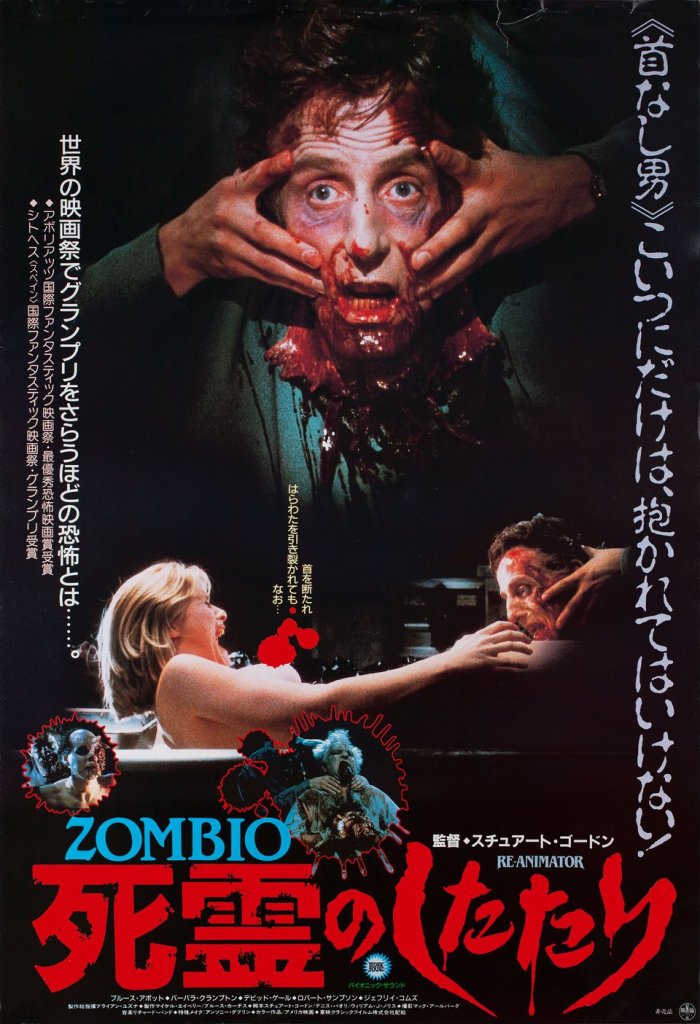
H. P. Lovecraft was directly inspired by both Arthur Machen and Margaret Murray; he adopted and conglomerated their ideas into his own personal theory of the witch-cult and strange survivals of a pre-human race, which inspired stories like “The Festival,” and in turn influenced correspondents like Robert E. Howard (see “Conan and the Little People”). Yet Tolkien, while probably not drawing directly from Machen as Lovecraft had, was absolutely influenced by these same stereotypes. In one letter he wrote:

The Orcs are definitely stated to be corruptions of the ‘human’ form seen in Elves and Men. They are (or were) squat, broad, flat-nosed, sallow-skinned, with wide mouths and slant eyes; in fact degraded and repulsive versions of the (to Europeans) least lovely Mongol-types.

J. R. R. Tolkien to Forrest J. Ackermann, June 1958, Letters of J. R. R. Tolkien 274

This is an example of how real-world racial stereotypes influenced Tolkien and Lovecraft. Yet it is important to appreciate that Tolkien and Lovecraft were generally not simply using fantasy as a metaphor for real-world racial conflicts: the appearance of the Orcs were inspired by stereotypes of Asian people, but the Orcs are not culturally Asian or intended to represent real-life nations like China or Japan; neither were the Deep Ones of Innsmouth representative of Asians, Black people, Jews or any other real-life race or ethnicity. H. P. Lovecraft did dabble in a fantasy Yellow Peril with the story “Polaris,” but that was again, not metaphorical: he was very explicit that the ancient Inutos were supposed to be the ancestors of the Inuit of today.

Which again is the difference in approach between Lovecraft and Tolkien. Because he was writing stories predominantly set in contemporary time and with the language of contemporary race and prejudices, Lovecraft had no need for metaphors to conceal racial prejudice—he could be as explicit as he needed to be for the story, and generally was. Lovecraft could and did use real-world racism to his narrative advantage, using racial stereotypes and prejudices as stepping stones to lead readers into much more fantastic and weirder territory. The real-world prejudice expressed against the folks of Innsmouth, for instance, is based on the false assumption that the sailors and townsfolk and intermarried with Chinese brides and Pacific Islanders; the locals of Massachusetts couldn’t even conceive of who the Innsmouth folk actually married. Machen’s adoption of euhemerism to fantasy held tremendous potential for Lovecraft (and many other fantasy writers) to adapt creatures of myth into contemporary scientific racism terms, and writers after Lovecraft continue to use real-world (and changing) attitudes towards race as part of their stories, as in “The Litany of Earth” by Ruthanna Emrys.

By contrast, Tolkien’s racial ideology is more subliminal: the whole framing of the background of Middle Earth and the development and depiction of its peoples is very strongly inspired by the implicit biases of Tolkien’s upbringing in a culture of white supremacy. The delineation of the various kindreds of the Elves is almost Linnaean in its approach, but a lot of the underlying assumptions of race and prejudice in The Lord of the Rings are unexamined and thus never worked out in the course of the books.

For example, one basic problem is the idea of a race, like orcs, being depicted as wholly evil. This is dangerously representative of racist propaganda of the early 20th century, the kind of blanket bigotry which led directly to the Holocaust. While Tolkien doesn’t address this much in the actual text of The Lord of the Rings, he admits in one letter:

[…] asserted somewhere, Book Five, page 190, where Frodo assets that the orcs are not evil in origin. We believe that, I suppose, of all human kinds and sorts and breeds, though some appear, both as individuals and groups to be, by us at any rate, unredeemable…

J. R. R. Tolkien to W. H. Auden, 12 May 1965, Letters of J. R. R. Tolkien 355

The Shadow that bred them can only mock, it cannot make: not real new things of its own. I don’t think it gave life to the orcs, it only ruined them and twisted them; and if they are to live at all, they have to live like other living creatures.

J. R. R. Tolkien, The Lord of the Rings, Book 5, page 190

Whether or not Tolkien was consciously aware of the influences on his writing, the first generation of readers of The Lord of the Rings lived during the tumultuous 1950s, 60s, 70s did so in the shadow of the Holocaust, when de-colonization and civil rights movements were front-page news, and they could hardly have missed it. While not everyone would read racial bias into the work of Tolkien—or even Lovecraft, whose more explicitly racist works were not widely published for the first few decades—reading race in their stories was very common, and why the idea of fantasy races persists in fantasy fiction to this day. Tolkien and Lovecraft were not alone in this recontextualization of mythic and folkloric figures in terms of early 20th-century racist ideology, but they were both very influential in promoting that idea, either explicitly (in terms of Lovecraft and the witch-cult/Little People theory) or implicitly (Tolkien’s evil orcs).

Half-Elves & Hybridity

As for the negro question in general—I think that intermarriage ought to be banned in view of the vast number of blacks in the country. Illicit miscegenation by the white male is bad enough, heaven knows—but at least the hybrid offspring is kept below a definite colour-line & kept from vitiating the main stock. Nothing but pain & disaster can come from the mingling of black & white, & the law ought to aid in checking this criminal folly. Granting the negro his full due, he is not the sort of material which can mix successfully into the fabric of a civilised Caucasian nation. Isolated cases of high-grade hybrids prove nothing. It is easy to see the ultimate result of the wholesale pollution of highly evolved blood by definitely inferior strains.

H. P. Lovecraft to J. Vernon Shea, 30 July 1933, Letters to J. Vernon Shea et al. 142-143

Irredeemably evil races are one problematic ramification of the influence of racial ideology on fantasy literature, but once you include the idea of “races” in a fantasy setting, it may necessarily introduce other contingent ideas such as interracial relationships, individuals with biracial or multiracial ancestry, eugenics, and genocide. Both Tolkien and Lovecraft developed these ideas into their fictional words in different ways, and they had plenty of works to draw inspiration from, including the demigods of Classical Greek and Roman mythology and contemporary fantasists like Lord Dunsany (the eponymous “Bride of the Man-Horse” had as grandparents a centaur, a god, a desert lion, and a sphinx) and Arthur Machen (notably Helen Vaughan of “The Great God Pan”).

Lovecraft would be inspired by “The Great God Pan” in particular when he wrote “The Dunwich Horror,” and the hybrid entity Wilbur Whately and his twin can fairly be described as a product of cosmic miscegenation. In his fiction, Lovecraft essentially always uses portrays race-mixing as something abhorrent, or resulting in a monstrous entity; readers might read something of Lovecraft’s personal prejudice into that fact, but in terms of stories like “Facts Concerning the Late Arthur Jermyn and His Family,” “The Curse of Yig,” and “The Shadow over Innsmouth” the monstrous aspect comes from a genuinely monstrous and inhuman parent, and the effects of that heritage (regardless of how remote) tend to be out of proportion—that is to say, Lovecraft wasn’t being realistic, he was employing fantasy genetics to achieve certain narrative results.

Genetics as a discipline developed throughout the 20th century; the idea of heredity was fairly firmly established before Darwin published his theory of evolution in 1859, but the actual mechanism of inheritance (DNA) was not discovered until 1953. Genetic engineering during the writing of the Lovecraft Mythos and Middle Earth was essentially the art of horse breeders and the science of Gregor Mendel’s peas. When we read about the swine-things found beneath Exham Priority in “The Rats in the Walls” or the hybrid gyaa-yothn in “The Mound,” we’re looking at fantasy eugenics at play—and the same is true for Tolkien’s orcs, uruks, and other servants:

The Orcs were first bred by the Dark Power of the North in the Elder Days. […] And these creatures, being filled with malice, hating even their own kind, quickly developed many barbarous dialects as there were groups or settlements of their race, so that their Orkish speech was of little use to them in intercourse between different tribes.

J. R. R. Tolkien, The Lord of the Rings, Appendix F, page 409

If Lovecraft used hybridity to emphasize the monstrous for his own story ends, Tolkien could do this as well. In various places in The Lord of the Rings Tolkien seems to hint at different possible relationships between various breeds of hobbits and elves, men, and dwarves, and also of half-orcs and goblin-men, and even once refers to those “out of Far Harad black men like half-trolls” at the Battle of the Pelennor Fields…but most of these relationships are suggested only, or explicit only in supplementary materials. Interracial relationships are almost entirely off-the-page, and only those involving humans and elves like Aragorn’s marriage to Arwen are explicit in The Lord of the Rings itself. The most prominent hybrids in The Lord of the Rings and its backstory are the twin half-elves Elrond and Elros, whose lines of descent would intermarry in a symbolic restoration of the sundered nobility of Númenór on the throne of Gondor.

The differences between Elrond and Wilbur Whateley may seem to outweigh their similarities, but both characters were ultimately expressions of how their different creators used the idea of racial hybridity to tell the stories they wanted to tell. Lovecraft, a devotee of horror and weird fiction, made his hybrids monstrous, creatures that were both human and inhuman; Tolkien’s narrative of nobility and restoration used them as a vehicle for the return of the king. In both cases, the authors were influenced by ideas of interracial relationships and eugenics: they found expression in different ways, but they were coming from the same basic idea that if you cross a horse and a donkey you get a mule, something that partakes of both parents and yet is neither.

Jews, Dwarves, & Hitler

The dwarves of course are quite obviously—wouldn’t you say that in many ways they remind you of the Jews? Their words are Semitic obviously, constructed to be Semitic.

J. R. R. Tolkien, 1964 Interview

Meir Y. Soloveichik in The Secrets Jews of The Hobbit makes the argument that Tolkien coded Jewish stereotypes into the Dwarves of Middle Earth. A case could be made that at least some of these aspects are coincidental; Tolkien was partly inspired by the Nibelunglied, with its magic ring, dragon, magic sword, and greedy dwarves, so he wasn’t exactly making up the dwarves out of whole cloth, but was drawing inspiration from Norse and Germanic myth. Leaving aside for the moment whether the Nibelunglied coded antisemitism into its depiction of dwarves, this confluence of fantasy, Germany, and racism raises the question: what were Lovecraft and Tolkien’s responses to Hitler and Nazism?

Lovecraft, because he died in March 1937, only saw the early years of the rise of Hitler and the Nazi party. As an antisemite himself, Lovecraft was at first willing to believe the propaganda of the Nazi party after Hitler was named chancellor of Germany in 1933, and though he disagreed with some aspects of the antisemitic Nazi program, he was sympathetic with others:

Our literature & drama, selected by Jewish producers & great Jewish publishing houses like Knopf, & feeling the pressure of Jewish finance & mercantile advertising, are daily getting farther & farther from the real feelings of the plain American in New England or Virginia or Kansas; whilst the profound Semitism of New York is affecting the “intellectuals” who flock there & creating a flimsy & synthetic body of culture & ideology radically hostile to the virile American attitude. Some day I hope that a reasonably civilised way of getting America’s voice uppermost again can be devised. Not that I would advocate violence—but certainly, I can’t regard the Nazis with that complete lack of sympathy shewn by those who take popular newspaper sentiment at face value. By the way—it’s hardly accurate to compare the Jewish with the negro problem. The trouble with the Jew is not his blood—which can mix with ours without disastrous results—but his persistent & antagonistic culture-tradition. On the other hand, the negro represents a vastly inferior biological variant which must under no circumstances taint our Aryan stock. The absolute colour-line as applied to negroes is both necessary & sensible, whereas a similar deadline against Jews (though attempted by Hitler) is ridiculous.

H. P. Lovecraft to J. Vernon Shea, 29 May 1933, Letters to J. Vernon Shea et al. 132-133

Within a few years, Hitler’s moves had already alienated Lovecraft, and Lovecraft’s criticisms would outnumber his moderate initial support for some phases of Nazism. The initial interest Lovecraft had in a fascist state that shared his white/Nordic/Aryan identity, and which promoted ideas of white supremacy, antisemitism, and nationalism that Lovecraft shared waned relatively quickly as it became apparent that the Nazis were violent anti-intellectual thugs. For his part, Lovecraft never wrote any reference to the Nazis into his fiction, and only one blatantly Jewish character (the bookshop dealer in “The Descendant”). This may or may not have been the result of earlier pushback Lovecraft had received on publicly voicing antisemitic comments, which he then did not repeat.

Tolkien’s response to Hitler and the Nazis is more directly antithetical. As a philologist, Tolkien was more aware than Lovecraft of the linguistic origin and meaning of “Aryan” and “Semite,” and whatever white supremacist ideas Tolkien might have absorbed growing up in the United Kingdom, they did not extend to embracing any aspect of Nazism or its racist ideology. Tolkien made this quite plain in a pair of letters about a proposed German translation of The Hobbit, where he wrote in part:

I do not regard the (probable) absence of all Jewish blood as necessarily honourable; and I have many Jewish friends, and should regret giving any colour to the nation that I subscribed to the wholly pernicious and unscientific race-doctrine.

J. R. R. Tolkien to Stanley Unwin, 25 July 1938, Letters of J. R. R. Tolkien 37

I am not of Aryan extraction: that is Indo-iranian; as far as I am aware none of my ancestors spoke Hindustani, Persian, Gypsy or any related dialects. But if I am to understand that you are enquiring whether I am of Jewish origin, I can only reply that I regret that I appear to have no ancestors of that gifted people.

J. R. R. Tolkien to Rütten & Leoning Verlag, 25 July 1938, Letters of J. R. R. Tolkien 37

Tolkien’s anti-Hitler attitudes would understandably grow more acute after Nazi Germany declared war on Great Britain, and stemmed in part from the great deal of study that Tolkien had put into the Norse and Germanic literature and folklore, which Nazis were corrupting with their racist ideology:

Anyway, I have in this War a burning private grudge—which would probably make me a better soldier at 49 than I was at 22: against that ruddy little ignoramus Adolf Hitler (for the odd thing about demonic inspiration and impetus is that it in no way enhances the purely intellectual stature: it chiefly affects the mere will). Ruining, perverting, misapplying, and making for ever accursed, that noble northern spirit, a supreme contribution to Europe, which I ever loved, and tried to present in its true light.

J. R. R. Tolkien to Michael Tolkien, 9 June 1941, Letters of J. R. R. Tolkien 55-56

Tolkien’s concern about the influence of Nazi ideology on “corrupting” the Norse and Germanic literature he so loved (keeping in mind that English is a Germanic language) with the white supremacist and antisemitic prejudice was well-founded, even today hate groups appropriate Norse and Germanic symbols such as runes, and terms like “Anglo-Saxon” are used to foster white supremacist ideals.

What Tolkien and Lovecraft perhaps did not see coming was the long tail of white supremacist ideological influence on fantasy—not so much the Nazis themselves, who would go on to become stock villains and the models for many more in works like Kthulhu Reich (2019) by Asamatsu Ken (朝松健), but in the way that readers and critics would interpret the racial ideologies and prejudices in fantasy fiction through the lens of World War II. Racial depictions and ideas which would be relatively mainstream and unremarkable before the 1940s thus become subject to atemporal criticism. An example might help demonstrate this:

[Robert E.] Howard’s tales, on the other hand, imagine a world in which a powerful blue-eyed muscled barbarian of the north can subdue various supernatural and racial grotesqueries. It’s hard not to see in his most well-known creation a kind of Death’s Head SS commando in a loincloth, treading the jeweled kingdoms of the earth beneath his jackboots.

W. Scott Poole, In the Mountains of Madness 229

Thus does Poole describe Robert E. Howard’s most popular creation, Conan the Cimmerian. In fairness to Poole, Howard was a white supremacist and subscribed to the idea of a white “Aryan” race; it’s part of the reason Howard got on with Lovecraft. This did influence their fiction: the very first Conan story, “The Phoenix on the Sword,” states that it takes place “between the years when the oceans drank Atlantis and the gleaming cities, and the years of the rise of the Sons of Aryas”—a clear reference to the Aryan race theory. However, Poole misses that just because you’re a white supremacist in the 1930s doesn’t automatically make you a Nazi or Nazi sympathizer. Robert E. Howard was an antisemite, but Howard and Lovecraft argued about the Nazis in their letters, and Howard was not in favor of them—not because of any antiracist sentiment, but because he didn’t trust fascist politics, disliked propaganda, and detested bullying.

To some folks, it may seem like splitting hairs: does it really matter if an individual was a card-carrying, goose-stepping, Heil Hitler-ing Nazi™ instead of a general population American or British white supremacist?

Consider Tolkien and his dwarves. You would be hard-pressed to find a fantasist of that period more clearly opposed to Nazism, but being anti-Nazi doesn’t mean your work is free from antisemitic stereotypes or white supremacy. “Nazi” is a powerful label, but it is prone to dilution through misuse and overapplication, and it tends to flatten out any possible nuance or depth. Strictly speaking, Lovecraft, Howard, and Tolkien were never Nazis—but all three of them were drawing on some of the same ideas that the Nazis used in formulating their imagery and ideology. Historical racism is a reality in fantasy fiction that needs to be acknowledged and addressed, and that’s hard to do when blanket labels are applied without respect to historical accuracy, as Poole did with Howard. Characterizing Conan as a Nazi stormtrooper is both inaccurate and lazy; it reduces the character to caricature instead of acknowledging or exploring the complicated ways ’30s racist ideologies informed and shaped fantasy fiction—and Conan the Cimmerian was an is a hugely influential character in fantasy.

The problem with antisemitism in fantasy is that it is pernicious—antisemitism has found so much expression in European myth and folklore, and through that folklore in fantasy literature, sometimes coded and sometimes overt, it can be terribly easy for writers to repeat stereotypes. Sometimes without necessarily knowing that they are doing it.

When J. K. Rowling, for example, attributed goblins in the Harry Potter books as being secretive, greedy, big-nosed bankers looked down upon by wizards, she was perpetuating antisemitic stereotypes. They are little different from Tolkien’s dwarves, with the possible exception of being less subtle and less fully developed—Tolkien expanded considerably on the original presentation in The Hobbit, and the dwarves are never without positive attributes like courage—but it’s still a lot of the same iconography that the Nazis used in Jud Süß.

There is a bit of irony here in that Lovecraft, who was noted as an antisemite during his life and for his at least moderate initial agreement with Hitler, should not be a major force for antisemitic imagery in fantasy while Tolkien who was vocally opposed to Hitler may have coded antisemitic imagery into his dwarves—and did it so well that many aspects like dwarf beards and greed have become incredibly commonplace in fantasy fiction. The distinction between Lovecraft and Tolkien’s personal beliefs and their fiction is a critical one: a writer doesn’t have to believe in racist stereotypes to repeat racist ideas, nor is a racist required to make everything they write reflect their personal prejudices.

Personal Comparisons

I have the hatred of apartheid in my bones; and most of all I detest the segregation or separation of Language and Literature. I do not care which of them you think White.

J. R. R. Tolkien, “Valedictory Address to the University of Oxford” (1959) in J.R.R. Tolkien, Scholar and Storyteller: Essays in Memoriam

It is a fact that we have many more examples of H. P. Lovecraft being explicitly racist than we do J. R. R. Tolkien; it is also a fact that we have many more examples of Tolkien being antiracist than Lovecraft—speaking out against apartheid in South Africa, as above, or denouncing association of Middle Earth with white supremacist ideas, for example when he was asked if Middle Earth corresponds to “Nordic Europe” Tolkien wrote:

Not Nordic, please! A word I personally dislike; it is associated, though of French origin, with racialist theories.

J. R. R. Tolkien to Charlotte and Denis PLimmer, 8 Feb 1967, Letters of J. R. R. Tolkien 375

However, before saying with absolute certainty that Lovecraft was more racist than Tolkien, it is important to remember that Lovecraft died in 1937, before World War II, the Holocaust, the Civil Rights Movement in the United States, and decolonization movements around the world. Lovecraft, more than Tolkien, lived in a culture of legal segregation and anti-miscegenation laws, and saw the rise of the second incarnation of the Ku Klux Klan, the Silver Shirts, and the Coughlinites as well as the Nazi party…and perhaps more importantly, we have a lot more letters from Lovecraft than Tolkien.

The published letters of H. P. Lovecraft comprise more than twenty volumes, with more still to be published, and cover a period of about 26 years (1911 – 1937). The published letters of J. R. R. Tolkien mostly consist of The Letters of J. R. R. Tolkien (1981) and cover 59 years (1914 – 1972). That isn’t to say there aren’t more Tolkien letters out there, but they largely haven’t been published or studied to the extent that Lovecraft’s letters have been, and the bits that have been published have been largely from during or after WW2. Which is to say: we have a lot more racist material from Lovecraft in part because we have a lot more material period, and we have more antiracist material from Tolkien in part because we have a lot more post-WW2 material, when Tolkien seems to have turned against racism, especially in association with his work.

It isn’t just that we have more material on racism from Lovecraft than Tolkien, we have more material from Lovecraft on almost everything—jazz music, Harlem, Ernest Hemingway, pornography, homosexuality, Adolf Hitler and the Nazi party, different types of cheese and canned beans, the Scottsboro Trial, etc.—at least, everything before his death in 1937. We will never know if Lovecraft might have changed his stance had he lived to see the true horrors perpetrated by the Nazis against Jews, Roma, homosexuals, etc. during the Holocaust, or the successes achieved by the Civil Rights movements.

Tolkien, to his credit, does appear to have been on the right side of history in opposing Hitler and apartheid—but keep in mind that we do not know the full picture of how he got to that point-of-view, and that views on race and prejudice are often muddy and conflicting, especially when seen through the lens of the present. It is easy in hindsight to see that the Nazis were monsters all along, and that the signs were all there…but it is different in the moment, when reports are conflicting, information is imperfect, and it is impossible to know how things will turn out. Historical racism was complicated, and so were historical individuals: Lovecraft and Tolkien were not simple men, nor were their views static throughout their life, but reflected changes in their lives and the world around them.

For all that Lovecraft was effectively always an antisemite, his views on Jews shifted considerably from his earliest references as a teenager to those at the end of his life. Lovecraft had Jewish friends like Tolkien did, and like Tolkien Lovecraft could credit them as being very gifted as well; Lovecraft even married a Jew, Sonia H. Greene. It is possible to oppose antisemitism and still code dwarves as Jewish; it is equally possible to be antisemitic and have Jewish friends. Not every bit of prejudice in the Lovecraft Mythos is an example of Lovecraft’s own prejudice: the real-life racial discrimination depicted in “The Shadow over Innsmouth” is a red herring for the much weirder interspecies relationships taking place. Nor is Tolkien’s stance against white supremacist readings of Middle Earth necessarily reflective of what he wrote: he may have opposed Hitler, but he still wrote a story that shows the heavy influence of the European-centered white supremacist mindset of the day.

More than many authors, we tend to associate Lovecraft and Tolkien with their respective works, but we should not mistake their personal feelings as being necessarily reflective of what appeared in their works. While the letters and supplementary writings of Lovecraft and Tolkien can give us great insight into their lives and imaginary worlds, the Lovecraft Mythos and Middle Earth must also stand on their own—must be interpreted by readers as works apart from the authors themselves. Which readers have been doing for generations, sometimes addressing the racial ideas and implications, and sometimes continuing them.

The Racialist Legacy of Lovecraft & Tolkien

In tabletop roleplaying games like Dungeons & Dragons and massive multiplayer online roleplaying games like Worlds of Warcraft, one of the first choices a player makes is to decide their character’s race. Choosing a race can determine physical appearance, language, physical and mental attributes, and restrict access to various careers or classes. Race in fantasy gaming thus achieves a dream of every racialist in the early 20th century: to be able to both quantify the differences between groups of people, and to hardcode discrimination against them, segregating different races so that they in truth tend to obey various stereotypes.
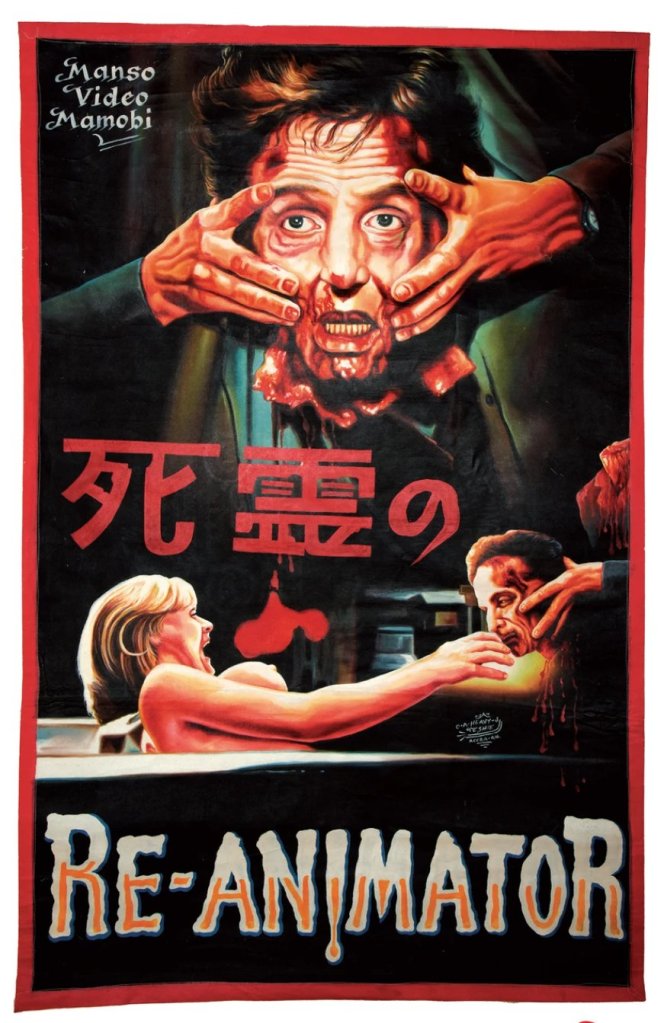
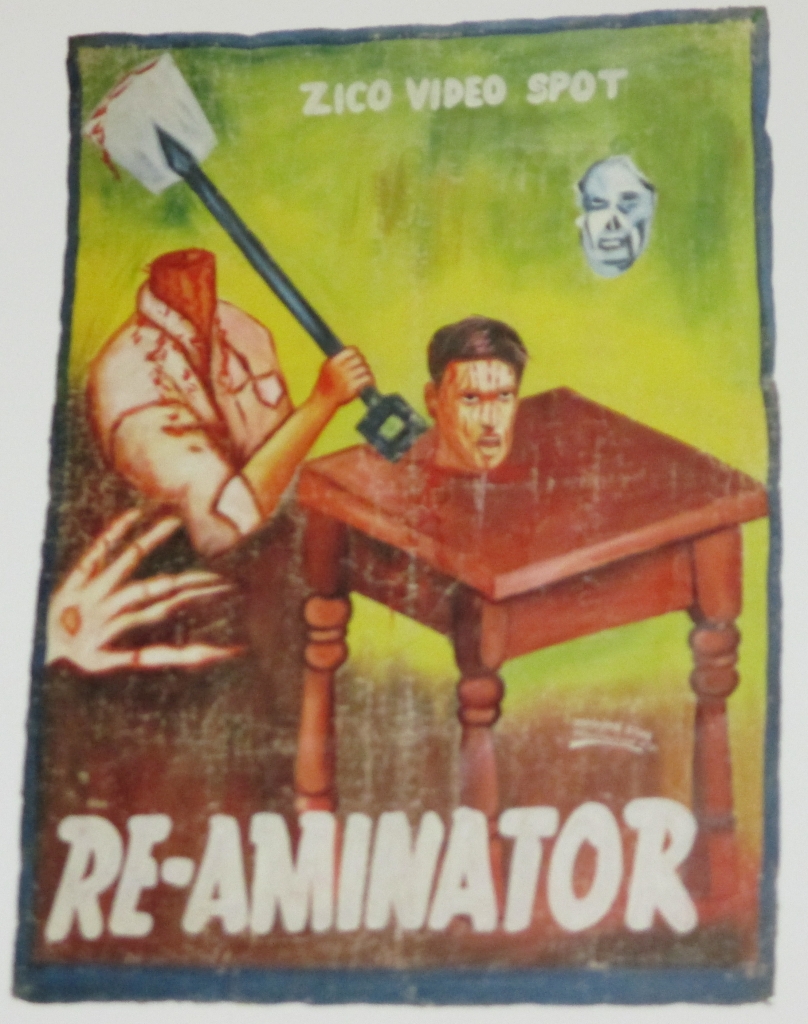
At least, in some scenarios. In practice, race in fantasy gaming is one option among many, and here are often exceptions, special rules, and bending of said rules to allow players greater freedom to play the character they want. Yet the very fact that we use the term “race” to describe whether a player character is an elf, dwarf, human, halfling, orc, etc. is a reflection of the enduring legacy of Tolkien, Lovecraft, and other 20th century writers on the field of fantasy. Tolkien may not have invented elves and dwarves, taking inspiration from Norse and Germanic sagas and stories, but in a real way The Lord of the Rings helped codify elves and dwarves in the popular imagination—with many variations and further refinements; Gary Gygax famously included a long list of fantasy inspirations for Dungeons & Dragons in Appendix N. The Call of Cthulhu Roleplaying Game (1981) by Sandy Petersen and published by Chaosium, Inc. doesn’t let players pick the race of their characters (at least, in terms of elves and dwarves, players can still pick skin color, ethnicity, nationality, etc.), but they do couch Lovecraft’s various entities in racial terms: Greater and Lesser Servitor Races, Independent Races, etc.

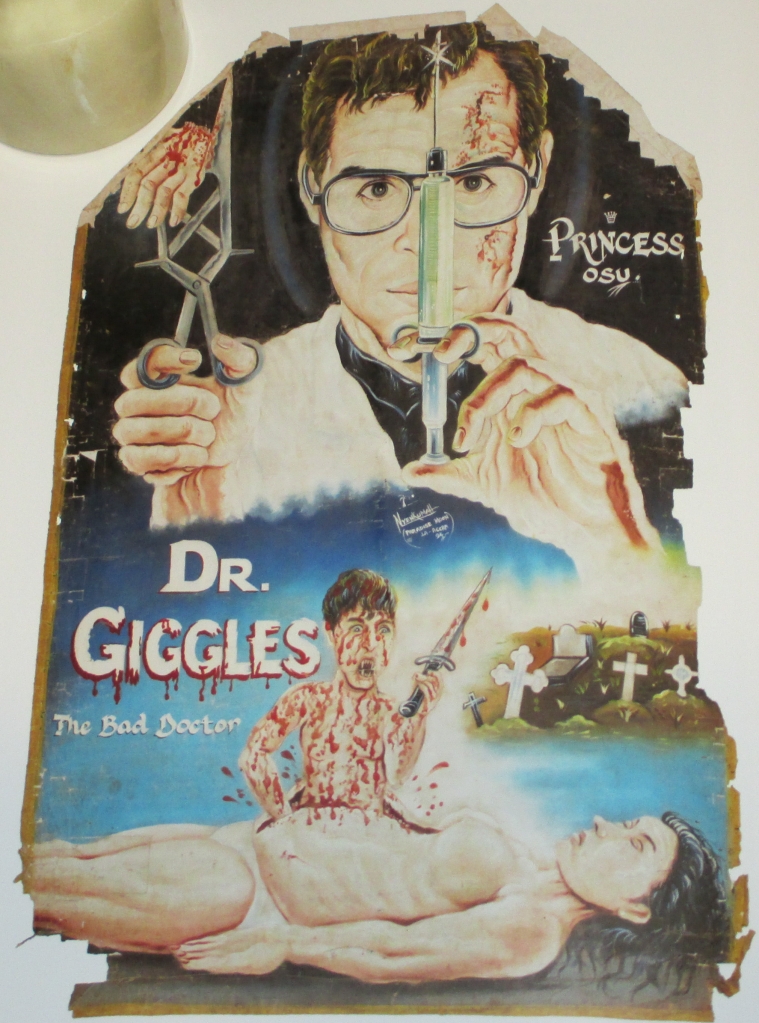
Fantasy gaming is one prominent example of how the idea of race has permeated the field of fantasy literature, but the influence of Tolkien, Lovecraft, et al. goes much further. The Lord of the Rings spawned innumerable fantasy trilogy imitators; the Lovecraft Mythos has had thousands of stories, poems, novels, and games expanding off of or adapting the original material Lovecraft wrote. Both Lovecraft and Tolkien’s work have been adapted to film, spectacularly so in the case of the Lord of the Rings trilogy directed by Peter Jackson, who followed up with a three-film adaptation of The Hobbit.

None of those six films featured Black hobbits. Tolkien’s white mythic space remained intact.

All of the issues of race in Lovecraft and Tolkien’s work come into play in the works derived, inspired, or adapted from Middle Earth and the Lovecraft Mythos. Lovecraft and Tolkien were writing in the early-to-mid 20th century and that culture shaped their work, and because their work has been successful contemporary audiences still have to grapple with the legacy of racial ideology, white supremacy, and antisemitic imagery that appears in what they wrote. More than that, there are generations of writers and artists who have carried on tropes of half-elves, changelings, cosmic miscegenation, and selectively bred servant races without addressing where those ideas come from, or what the ramifications of their inclusion in their stories are.

More than ever, some writers and artists are addressing those issues. Casts of films and streaming shows are getting more diverse, cultural appropriation is less prominent, some of the old tropes are re-examined. The Shadowrun (1989, FASA) roleplaying game has elves, dwarves, orks, and trolls in a near-future cyberpunk setting, one where fantasy racism coexists and blends with real-world racism; Ruthanna Emrys’ The Litany of Earth (2014) looks back at “The Shadow over Innsmouth” from the perspective of the Japanese internment camps of World War II.

Orcs aren’t always evil anymore. A Deep One hybrid may be subject to racial profiling and discrimination. The syntax of race has shifted from Tolkien and Lovecraft’s day, and the interpretations and expansions of that work shift with them, often trailing the current consensus—and faced with reactionary feedback.

We have always lived in a politically-charged, race-conscious culture. Many major events of Lovecraft and Tolkien’s lives were centered around racial conflict, racial violence, and racist ideology. There was no “simpler time” without such conflict, not within historical memory. Greater diversity in adaptations of Tolkien and Lovecraft’s material to different media is a more recent development—a step away from the white mythic space that the Lovecraft Mythos and Middle Earth have occupied for so long—but it is no more politically-charged or forced than when Tolkien and Lovecraft chose how to write their stories in the first place, or when the first artist for their works decided that a given character should look Caucasian rather than Asian, or that orcs should be green or black.

As with picking a race in a roleplaying game, these choices have consequences that can restrict some options and open up others. The foundations of the white mythic space of Middle Earth and the Lovecraft Mythos were laid down by Lovecraft and Tolkien as they wrote as white men to a presumably mostly white and male audience, but the space was built up by generations of writers and artists that perpetuated that imagery of imaginary worlds filled with white people. The reactionary impulse to growing diversity in fantasy is a desire to retreat to that white mythic space—and in doing so, they reiterate the same attitudes that Moorcock criticized Tolkien for. Hobbits wanting to be safe in the Shire, ignoring everything beyond their own borders, upset at any perceived intrusion.

The legacy of H. P. Lovecraft and J. R. R. Tolkien is more than just issues of half-elves and interracial communities in coastal Massachusetts, but the ideas of race that they absorbed in their life, that influenced them and found expression in their fiction, are still relevant today. Just as we deal with the aftermath of racial conflict that Lovecraft and Tolkien lived through in their own lives, we have to deal with how that conflict found expression in their creative works. Lovecraft and Tolkien are dead; they have made all the artistic choices they can. It is up to audiences and creators now to make their own decisions as to how they will address the literary legacy left to them—the future of what the Mythos and Middle Earth can be—and this is only a small part of dealing with the ongoing consequences of historical racism in daily life.

A Final Word

This is not by any means an exhaustive or complete examination of race in the lives and works of Lovecraft or Tolkien; entire books have been written on both men and their fiction, and the well of literary analysis and biography has not yet been exhausted. The point of this essay is to illustrate some of the commonalities and differences in how racism influenced Lovecraft and Tolkien, how it found expression in their respective imaginary worlds, and how their audience then interpreted that work through the lens of their own prejudice as well. Declaring Lovecraft or The Lord of the Rings as racist isn’t technically inaccurate, but it is a gross simplification that obscures how pervasive racism and white supremacy were—and, sadly, still are.


Bobby Derie is the author of Weird Talers: Essays on Robert E. Howard & Others (2019) and Sex and the Cthulhu Mythos (2014).

Deeper Cut: The Hormonal Lovecraft

We soon found, however, that we were dealing with an entirely different order of phenomena, and that the secretion of the pancreas is normally called into play not by nervous channels at all, but by a chemical substance which is formed in the mucous membrane of the upper parts of the small intestine under the influence of acid, and is carried thence by the blood-stream to the gland-cells of the pancreas.

W. M. Bayliss and E. H. Starling, “The Mechanism of Pancreatic Secretion” (1902)

H. P. Lovecraft (1890-1937) was born into a world without birth control pills, insulin for diabetics, anabolic steroids, hormone therapy for diseases such as cancer and thyroid disease; or hormone replacement therapy for menopausal women, intersex individuals, or transgender people. He would not, in fact, live to see many of these medical miracles carried into practice: endocrinology was in its infancy, the word “hormone” was not coined by Starling until 1905, and chemical synthesis of hormones would take decades to realize and become practical.

Hormones had their place in medicine long before the 1900s: anatomists had identified glands centuries before, and animal and plant sources of hormones were used as part of traditional and scientific medicine. Yet it was not until Lovecraft’s lifetime that scientists began to understand the functionality of glands, what their secretions were, and how they worked. While we often focus on the electrical and mechanical marvels of the 20th century such as the telephone, airplanes, and electric lightbulbs, the hormone revolution was no less earth-shattering in how it has ultimately transformed human society—in helping to manage disease, fertility, sexual characteristics, and growth disorders in unprecedented ways.

With the discovery of glandular secretions and hormones, supplemented by further discoveries and advancements in the potential utility of this information came public awareness and interest, particularly in matters of sex. While not everyone could point to the pituitary gland or thyroid gland, at least fifty percent of the adult population could reliably locate the testes, and the knowledge that women had corresponding organs was also general knowledge. Early experiments with castration and transplantation of testes in animals such as Arnold Adolph Berthold’s 1849 experiments with roosters had rendered some remarkable effects…and some wondered if similar effects could be achieved in humans.

The Gland Doctors

Xenotransplantation, the surgical attachment of non-human animal tissue to or into human bodies, gained interest in the 19th century. In 1889, at the age of 72, Dr. Charles-Édouard Brown-Séquard published his findings that a hypodermic injection of extracts of animal testicles had given him renewed sexual potency (Brown-Séquard). In the 1910s, Dr. Eugen Steinach experimented with testicular secretions in animals, observing the effects when injected into female guinea pigs, who obtained more noticeably masculine secondary characteristics and behaviors. Theorizing this could be applied to humans, in 1918 he performed the “Steinach procedure” (a partial vasectomy that would hopefully help the body retain testicular hormonal secretions) on a human being, and the reported positive results resulted in a flood of patients and much publicity (Dr. Steinach Coming To Make Old Young).

Thus glandular injections, as well as the Steinach operation (which renders an external secretion internal by making gonads wholly ductless), often cause complete changes in emotional life.

H. P. Lovecraft to Alfred Galpin, 20 Jan 1933, Letters to Alfred Galpin & Others 280

“Glandular injections” in this case might refer also to injections of glandular secretions to make up for deficiencies in the subject’s body. This was the case of Ewan Forbes, who was assigned female at birth but underwent injections of testosterone as an early form of treatment (see The Hidden Case of Ewan Forbes by Zoë Playdon.)

Where injections of hormones could achieve some real medical benefit, neither Brown-Séquard or Steinach’s procedures transplanting glandular tissue achieved the effects they claimed. However, the reported success and the demand for medical intervention to address health issues, especially sexual health and wellbeing, inspired more fantastic procedures and claims. The two most notorious “gland doctors” were Dr. Serge Voronoff and “Dr.” John R. Brinkley.

Voronoff’s early work involved the transplanting of testicles and other glands from animal to animal, and xenotransplantation of chimpanzee thyroid glands into humans suffering thyroid deficiencies. The procedure for which he gained wealth and fame was the xenotransplantation of chimpanzee testicular tissue (slices, not whole organs) into human beings; he also transplanted chimpanzee ovary tissue into women in menopause, and more exotic experiments (see David Hamilton’s The Monkey Gland Affair).

None of Voronoff’s patients experienced the promised increase in vigor or sexual potency, although many may have experienced a placebo effect. Yet the immense popularity of the procedure (whether performed by Voronoff or someone else) inspired others. One of these was John R. Brinkley, a conman and quack doctor whose specialty was transplanting goat glands—testicles and ovaries—to restore or enhance sexual function and cure disease. While this was even more medically dubious than Voronoff’s procedure (Brinkley’s medical diploma had come from a diploma mill), the claims gained enough fame and fortune for Brinkley to continue to operate, sometimes running his own hospitals (Plan Hospital At Ensenada, see also Pope Brock’s Charlatan: America’s Most Dangerous Huckster, the Man Who Pursued Him, and the Age of Flimflam).

In these grey after-years, without the spontaneity of the of the occasion, I can’t get the same old mood. The old man has aged and dry’d up since good old 1927! Well–let’s think on the subject at our respective leisures, (if such exist) and maybe one of us will get an idea and go ahead with the goat-gland surgery.

H. P. Lovecraft to Maurice W. Moe, 19 Jan 1931, Letters to Maurice W. Moe 281

Lovecraft was joking; he is comparing his inability to think of a comedic plot to follow up his story “Ibid” to sexual impotence.

The gland transplantation era would peak and fade during Lovecraft’s lifetime, and despite his quote to Moe above, there’s no evidence Lovecraft was ever interested in either procedure—but he was aware of them. This was accepted medical science that Lovecraft incorporated into his world view and philosophy, as when he would state:

The difference between good will and hate is very clear scientifically. These instincts are seen to be diverse in excitation, manner of operation, and effect—modern research shewing the one to be a product of hormones from such glands as the gonads and the pineal, while the other comes almost exclusively from adrenal hormones.

H. P. Lovecraft to Robert E. Howard, 3 Apr 1934, A Means to Freedom 2.728

Genuine medical advancements in identifying hormones and gland function and sensationalized claims of gland transplantation both entered into the public consciousness, not just as the butt of jokes but also inspiring fiction.

Gland Stories

The articles on serums & gland extracts have all sorts of fictional possibilities—some of which have been cleverly used already, while others await the hand of the capable expert.

H. P. Lovecraft to Clark Ashton Smith, 25 July 1935, Dawnward Spire, Lonely Hill 612

Early science fiction stories in the pulps were often focused on gadgets such as robots, spaceships, and various rays of strange and unusual effects. Yet during the 1920s and 30s at least dozens, and possibly hundreds of “gland stories” emerged. These stories capitalized on the theories and claims of glands and hormones in the popular press and medical journals. While scientists and doctors (real or quacks) could make expansive claims about the potentials of glands, writers in the science fiction pulps could realize those fantastic claims, in stories like W. Alexander’s “The Anais Gland” (Amazing Stories Nov 1928), Capt. S. P. Meek’s “The Gland Murders” (Amazing Detective Jan 1930), Clare Winger Harris’ “The Ape Cycle” (Science Wonder Quarterly Spring 1930), Malcolm Alfred’s “The Gland Men of the Island” (Wonder Stories Jan 1931, also published as “The Ho-Ming Gland” Feb Amazing Stories 1933), Raymond A. Palmer’s “Three From The Test-Tube” (Wonder Stories Dec 1935), Ed Earl Repp’s “The Gland Superman” (Amazing Stories Oct 1938)…and a small story about the stimulation of the pituitary gland by H. P. Lovecraft called “From Beyond” (The Fantasy Fan Jun 1934).

As for the pineal gland—modern endocrinology has fairly well established its actual function in the human system…as a regulator of the chemical & biological changes attending adolescence & maturity. But surely the legends lose nothing in picturesqueness & imaginative value through being merely legends.

H. P. Lovecraft to Clark Ashton Smith, 24 Mar 1933, Dawnward Spire, Lonely Hill 412

While nothing in our normal experience is ever likely to call forth any additional senses, it is not impossible that experiments with the ductless glands might open up a fresh sensitivity or two—& then what impressions might not pour in?

H. P. Lovecraft to Clark Ashton Smith, 18 Nov 1933, Dawnward Spire, Lonely Hill 478-479

In the pulps, manipulations of the glands could achieve biological miracles: immortality, gigantism, the transformation of humans into apes and apes into humans, and other more obscure and imaginative possibilities. At their worst in these stories, glands became nothing more than a kind of phlebotinum, an excuse for any and all bizarre transformations or effects that the writer wished to achieve, the equivalent of red kryptonite in the Superman comics or a transporter malfunction on Star Trek. Yet at their best, gland stories represented with fair accuracy to the scientific knowledge of the day the possibilities that increased scientific knowledge and medical control of hormones offered.

Because this was essentially new technology, the technological abilities sometimes ran ahead of the social structures they would effect, and morality often lagged behind. All three tendencies tend to be exemplified in science fiction, where the results are often miraculous and the moral and ethical ramifications are still seen through the lens of the early 20th century. When Lovecraft waxed on about the possibility of hormones to improve life, for example, he wasn’t thinking of birth control or transgender people:

Wiggam, like Prof. J. B. S. Haldane, believes that much will be done in future toward the artificial development of Homo sapiens, but I doubt very much whether such development can ever reach more than a tiny fraction of the extremes they postulate. In the first place, the complexity of the laws governing organic growth is enormous—so enormous that the number of unknown factors must always remain hopelessly great. We can discover & apply a few biological principles—but the limit of effectiveness is soon reached. For example—despite all the advances in endocrinology & all the experiments in glandular rejuvenation, there is no such thing as a permanent or well-balanced staving-off of senescence & dissolution. And in the second place, the fact that human beings live by emotion & caprice rather than by reason will probably prevent the widespread application of any unified plan of eugenics.

H. P. Lovecraft to Natalie H. Wooley, 22 Nov 1934, Letters to Robert Bloch & Others 297

In his letters, Lovecraft doesn’t touch directly on the implications of sex hormones specifically on sex and gender. During his life, the understanding of gender identity, and how they interacted with biological sex and sexual orientation was very different than today. There were a number of individuals that did not conform to their gender assigned at birth, and individuals that felt sexual attraction to members of their own gender, and Lovecraft’s understanding of how this all worked was fairly minimal—psychologists and sexologists would use terms like urning and uranian to describe those whose biological sex did not match their observed sexual attraction, but often struggled with individuals who failed to fit neatly into defined gender behavior or roles.

In the pulps, the nexus of hormones and gender identity or sexuality sometimes bore odd fruit. Seabury Quinn’s “Strange Interval” (Weird Tales May 1936) involves a man captured by pirates who is castrated and dressed in women’s clothes; as their body changes from the lack of testosterone, the character transitions mentally and physically into a woman and engages in a lesbian relationship with another woman. The character de-transitions by the end of the tale—mentally, at least; the physical removal of their gonads cannot be healed—but it is a crude example of how the basic ideas of hormonal changes to the body can affect identity. A more “scientific” example is Dr. David Keller’s “The Feminine Metamorphosis” (Science Wonder Stories Aug 1929), where an underground organization of women, tired of being discriminated against, use surgery and injections to transition to men and rule the world. The main flaw to the plan is that the transitioners sourced their hormones or tissues from Asian men infected with syphilis, and now suffer from the disease.

Keller and Quinn were both contemporaries of Lovecraft, and his peers at Weird Tales; neither can be said to have a progressive viewpoint toward women (even by the standards of the 1920s and 30s), and these stories are about as sexist as can be imagined. Lovecraft, when he finally wrote a kind of gender transition story in “The Thing on the Doorstep” (written Aug 1933, published Weird Tales Jan 1937) used a transfer of personality rather than biological process or surgery to effect the change…yet even then, when Edward Pickman Derby’s friend sees the forced transition he describes it in biological terms, glands and all:

The face beside me was twisted almost unrecognisably for a moment, while through the whole body there passed a shivering motion—as if all the bones, organs, muscles, nerves, and glands were readjusting themselves to a radically different posture, set of stresses, and general personality.

Transitioning Into the 21st Century

The advances in scientific research into glands and hormones were paralleled by advancements in gender reassignment surgery, psychological understanding of gender dysphoria, and shifting legal and societal attitudes towards sex, gender, and orientation. While we do not normally think of H. P. Lovecraft and his pulp peers as being influenced by all these changes and scientific advancements—they were. This was their world, as much as Jim Crow, the Great War, and the Great Depression.

When readers today read stories like “The Thing on the Doorstep,” “Strange Interval,” and “The Feminine Metamorphosis,” they understand those stories through the syntax of a world where transgender rights, and often transgender people, are in danger. Over a century after the discovery of hormones, our societies still struggle with the ramifications of their use…but the conversation has changed. There is no question about whether insulin, steroids, or hormonal birth control are effective; the goat-gland doctors and monkey gland men are gone, and natural and synthetic hormones are now potent tools in the medical tool chest. The question of today is one of when and how those medical options may be exercised, and by whom.

When we see the often clumsy grappling with issues of gender and biological sex in these stories by Lovecraft, Quinn, and Keller it is a bit simplistic to say that these men were transphobic in the contemporary sense, if only because awareness of gender dysphoria and the possibilities of transitioning were as hypothetical as space travel and human cloning.

Transitioning was only in its medical infancy during the 20s and 30s; these writers fumbled with new ideas, with no inkling of what the reality of hormone replacement therapy would look like—except possibly Keller, who worked as a doctor and a psychiatrist and wrote books on sexology. Of the three, Keller had the best grasp of the contemporary medical profession’s ideas regarding gender the scientific potential of surgery and hormone therapy at the time—but he focused not on the individual but on contemporary social concerns vis-a-vis “the war of the sexes” rather than gender dysphoria.

In their own historical context, it seems evident these men did not set out to be bigots toward a population which for all practical purposes barely existed yet. Their failure to imagine or understand that population is typical: readers might compare how pulp writers imagined flying cars and colonies on Mars but largely missed the smartphone and the internet. Failure to see the future does not excuse other or related prejudices (sexism, homophobia, etc.) as expressed in their fiction, but to judge them by the standards of present understanding of transgender issues is to miss the fact that those issues by and large didn’t exist in the popular consciousness yet.

Gland stories, and pulp stories of gender transition have to be seen as intimately tied together with and influenced by how science was changing during the early 20th century, presenting new facts and ideas for pulp writers like Lovecraft to explore. Often their approach was flawed, but just as the flaw in a gem may catch the eye, so too are the flaws in their stories fascinating in their own way. These stories are historical artifacts of a more primitive line of thought regarding medical science, gender, and transition as they were in the 1920s and 30s…and, hopefully, demonstrate how much our society has changed in the last hundred years, thanks to the discovery of hormones.


Bobby Derie is the author of Weird Talers: Essays on Robert E. Howard & Others (2019) and Sex and the Cthulhu Mythos (2014).