The oldest and strongest emotion of mankind is fear, and the oldest and strongest kind of fear is fear of the unknown. —H. P. Lovecraft, “Supernatural Horror in Literature”
While many horror stories grapple with fear of the unknown, there are elements within and without the narrative of cozy horror stories that bring the work in question into a safer, more knowable realm, allowing for a sense of comfort to take hold. —Jose Cruz, “The H Word: Getting Cozy With Horror”
“Cozy horror” is the current term for a broad swathe of horror-flavored creative works. It is probably more properly a mode of weird fiction than a subgenre. A kind of attitude and approach that reaches across genre conventions. Not everything with horror trappings is necessarily horrific in the pure sense of the term. With experience comes familiarity. Bela Lugosi capes, Boris Karloff neck-bolts and flat top, plush Cthulhus all come from the same Hallowe’en-store aesthetic of cozy horror.
Parts of Lovecraftian horror have been cozy for a long time.
In part, this is because Mythos fiction, more than most, tends to be intensely self-referential. Writers want the readers to make connections with other stories, they want to be part of something bigger. Sometimes this bleeds over into full-blown nostalgia; “The Discovery of the Ghooric Zone” (1977) by Richard Lupoff and “Down into Silence” (2018) by Storm Constantine are both stories that bank on the reader not only being able to catch the hints, but to share in that sensation of quiet longing and awed recognition. Others just go for straight-up humor, even to the point of parody and satire: what is “At the Mountains of Murkiness, or From Lovecraft to Leacock” (1940) by Arthur C. Clarke if not taking the piss out of Lovecraftian horror, in a gentle and ribbing British manner?
The balancing point of “cozy Lovecraftian horror” is going to be subjective. It needs to at least work as a weird tale on its own; it needs to be a part of or allude to the Mythos in a way that the readers can recognize and respond to. Jose Cruz’ four elements of Familiarity, Sensuousness, Distance, and Fun are all important—but three of those, at least, are typical of most Mythos stories by default. Readers rarely identify with finding our great-great-great-grandma was a Deep One or Ape Princess, or experience the anxiety of living in the attic room of a witch house and dealing with an extradimensional rodent infestation when they really should be focusing on their finals. The Fun aspect of cozy horror is probably the trickiest and most argumentative aspect of the whole business.
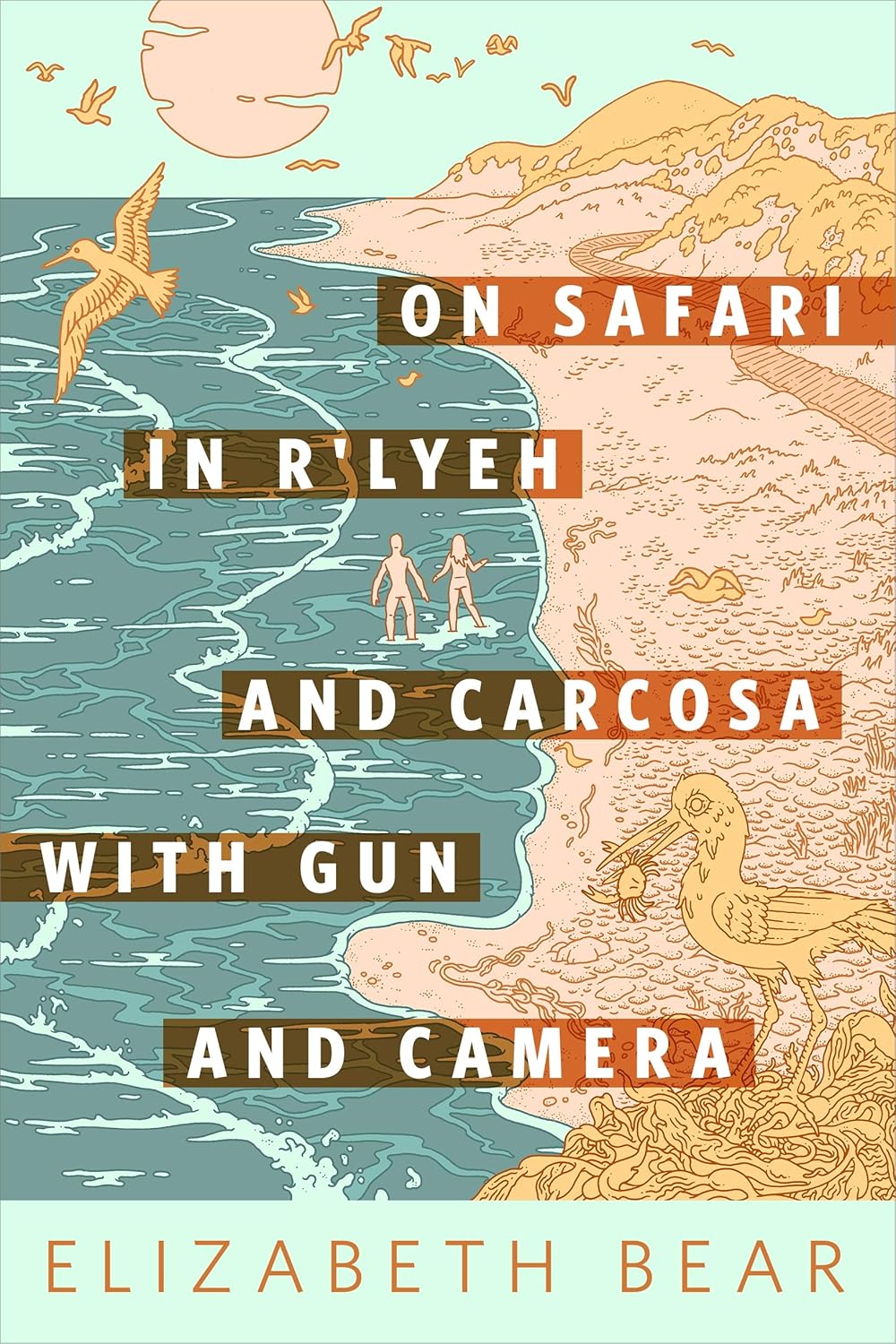
That being said, I believe “On Safari in R’lyeh and Carcosa with Gun and Camera” (2020) by Elizabeth Bear stands out as a very good representation of cozy Lovecraftian horror. The overall shape of the narrative is intensely familiar: how many scions of Innsmouth (never mentioned under that name) have come back home, in how many different variations? Yet the way the story is told is relatively light and novel: a fifty-something female physics professor with tenure and a penchant for sushi. A perfect setup for any number of funny-because-its-true comments about the lives of women in academia.
I note, entirely for the record and apropos of nothing, that I am the only female tenured faculty in the physics department. I note, entirely for the record and apropos of nothing, that I do an estimated thirty-six percent of the emotional labor in my sixteen-person department.
Female grad students and admins do the rest. And it’s not like we’re any less introverted and non-neurotypical than the dudes. We’re just forced to learn to endure more discomfort in order to have careers. —Elizabeth Bear, “On Safari in R’lyeh and Carcosa with Gun and Camera” (2020)
If the story was just a whine, no matter how well-deserved, it probably wouldn’t sustain interest. Yet Bear is very good at composing her narratives, and has structure the story with an in media res action sequence right at the start to let us know that yes, the safari with guns and cameras are real, we’re getting to that. Then she gets to that. It’s not exactly a novel story structure, but it’s a workhorse of fiction for a reason: putting a bit of action first as a hook to draw the reader in, and then it can build up again.
The actual horror in the story is slight. The monsters aren’t very monstrous, the characters aren’t really scared as much as driven by scientific curiosity; blasting away at byakhees like Hunter S. Thompson in bat country is a select aesthetic that doesn’t really encourage the same kind of comforting glow of, say, a mountain that walked or stumbled, or the remnants of an ancient cannibal feast that happens to have the unmistakable physical tell-tales of your own peculiar family. This is not quite on the level of a hypothetical Abbott and Costello Meet Cthulhu, but it’s not far from it.
It is the kind of good, clean fun that you can have when you learn to stop worrying and love the Lovecraft Mythos—and it managed to do it without naming Deep Ones, without running across a copy of the Necronomicon, and only mentioning Miskatonic Univeristy once and in regards to a failed graduate thesis in genetics. If the rules at play seem to owe a little more to the Call of Cthulhu Roleplaying Game than Lovecraft’s original, then at least Bear has the good sense not to recapitulate the entire Mythos, August Derleth style. She gives just enough lore to keep things moving, and no more.
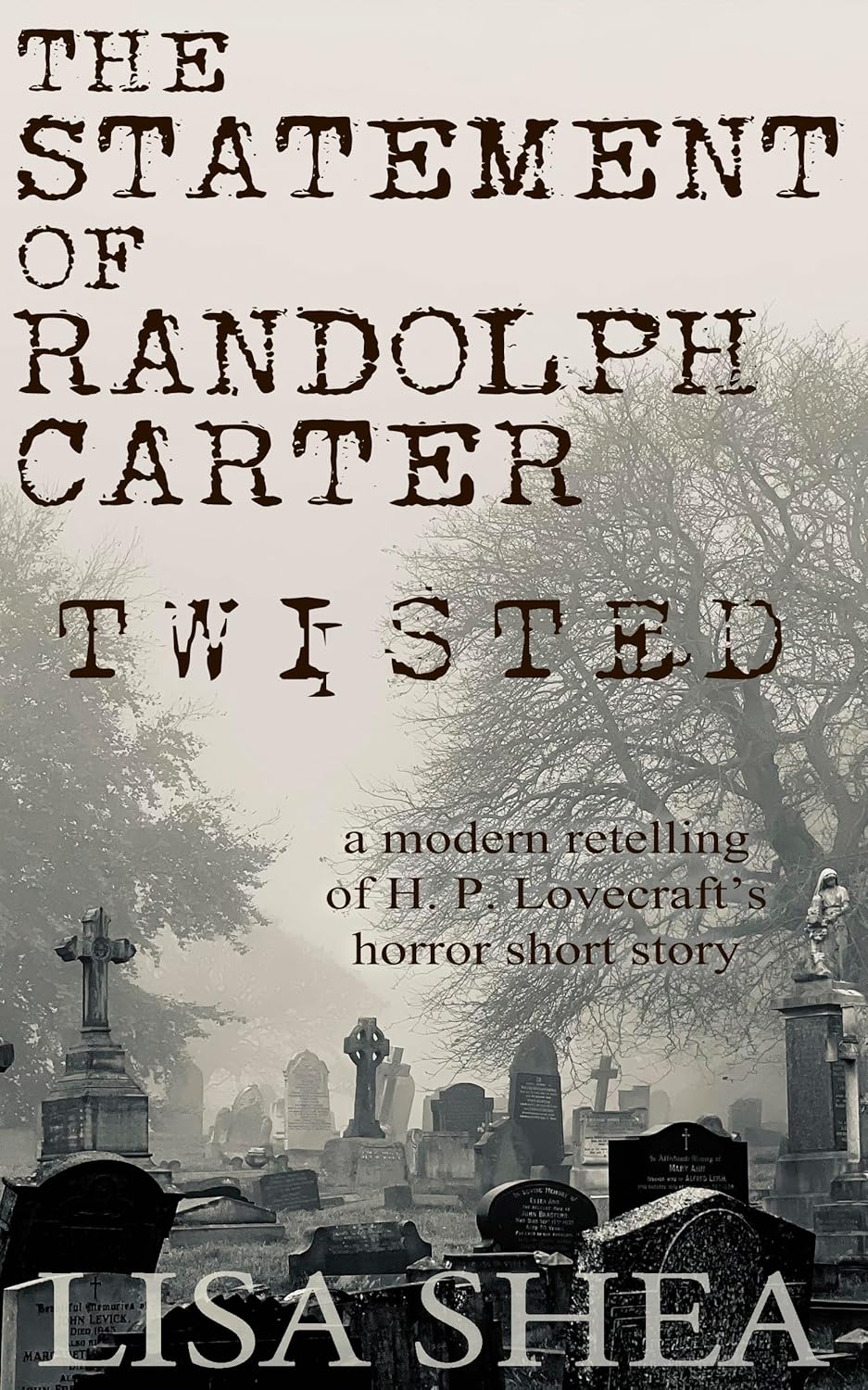
The dream originally took place in New England, in a cemetery there. For some reason, Lovecraft decided to relocate it to Florida, which makes NO sense to me. Florida doesn’t have a history of ancient cemeteries stretching back hundreds of years. Also, Florida is barely above ocean level! —Lisa Shea, “Author’s Note” in “The Statement of Randolph Carter Twisted” (2024)
The only topographical features of H. P. Lovecraft’s “The Statement of Randolph Carter” are the “Gainsville pike” and the “Big Cypress Swamp.” This has led many to believe the story takes place in Florida, near the city of Gainesville. It is possible that Lovecraft actually intended the location to be Georgia—his friend Samuel Loveman, who appeared in his dream and is depicted as Harley Warren, was stationed at Camp Gordon, only about 40 miles from Gainesville, GA.
I don’t point this out to nitpick, but to applaud. Lisa Shea’s author’s note gives evidence she really thought about Lovecraft’s story. Looked at how he framed it, what he did and did not achieve in a narrative sense. There have been many efforts to revise, revisit, revamp, and rewrite Lovecraft’s stories, from “His Mouth Will Taste Of Wormwood” (1990) by Poppy Z. Brite to “The Ballad of Black Tom” (2016) by Victor LaValle to “Kanye West—Reanimator” (2015) by Joshua Chaplinsky. Like old folktales, there is room for infinite variation. The first version of a story isn’t necessarily the best one, even if it’s the one repeated most often.
Shea’s “twist” to “The Statement of Randolph Carter” is an update to setting, characters, and attitude. No ambiguous Southern swamp in the 1910s and military telephones with long wires; this is set in Massachusetts in the 21st century with smartphones. The characters are younger, but their relationship is less ambiguous. The shift in setting and character requires a few tweaks in the plot; but the end result is tight. Nothing superfluous, no attempts to cram in a random “fhtagn!” where it isn’t needed. True to the spirit of Lovecraft’s original, but adapted to the current syntax.
There’s even a nice little flourish at the end. A little twist of the knife that Lovecraft didn’t do.
As a twisted tale, it works. What works best about it, however, might be the approach. Instead of approach Lovecraft’s tales as canon, they are approached as examples to study and learn from. Jumping-off points rather than fixed stars in the firmament.
If you read the original “The Statement of Randolph Carter” by Lovecraft, how would you change the scenes so they were more scary to you? —Lisa Shea, “Author’s Note” in “The Statement of Randolph Carter Twisted” (2024)
An einem seiner vielen ereignislosen, langweiligen Abenden beschließt der junge Jacop O’Damsel, freiberuflicher Nerd, sich besoffen in einem Hinterhof schlafen zu legen. Blöd, wenn ausgerechnet da plötzlich ein intergalaktischer Dimensionsschlürfer auftaucht. Bevor Jacop überhaupt die Chance bekommt, einen Kater zu haben, nimmt in das Ding auch schon einfach so mit.
Jacop wacht in Xoth auf, einer fremden Welt voller abartiger Kreaturen – oder solite man sagen: geradezu unsagbar grauenhaft? Auf jeden Fall sind da noch die »Humanisten«, eine Bande von stinkigen Fischköpfen, die Menschen kultarig verehren, und die Jacop angeblich für eine Mission brauchen. Und gäbe es niche genug an Wahnsinn zu verkraften, setzt der Bürgermeister der Stadt, der mächtige Cthulhu, seine besten Killer auf den Fall an. Den großen Alten sei Dank gibt es da noch Yen Niggurath, ein hübisches Ziegenmädchen, Des Gefallen an dem hilflosen Menschlein findet. Zusammen mit ihr get Jacop dem »Ordus Humanus« auf den Grund, Dennis – bei Cthulhus fettem Arsch! – er hat keine Lust, ständig um sein Leben zu rennen.
Vor dem Hintergrund von H. P. Lovecrafts Cthulhu Mythos entwirft Anna-Maria Jung eine Geschichte voller Monster, Nerds, Monsternerds und Nerd monster. Und der Mann aus der Angell Street kommt auch drin vor.
On one of his many uneventful, boring evenings, young Jacop O’Damsel, a freelance nerd, decides to get drunk and sleep in a backyard. Too bad when an intergalactic dimensional shambler suddenly turns up. Before Jacop even gets the chance to have a hangover, the thing takes him with it.
Jacop wakes up in Xoth, a strange world full of disgusting creatures – or should we say, downright unspeakably horrible? In any case, there are also the “Humanists”, a gang of smelly fishheads who worship humans in a cult-like manner and who supposedly need Jacop for a mission. And when there isn’t enough madness to deal with, the mayor of the city, the mighty Cthulhu, sets his best killers on the case. Thank the Great Old Ones, there is also Yen Niggurath, a pretty goat girl who takes a liking to the helpless little human. Together with her, Jacop gets to the bottom of the “Ordus Humanus”, Dennis – by Cthulhu’s fat ass! – he doesn’t want to constantly run for his life.
Against the backdrop of H. P. Lovecraft’s Cthulhu Mythos, Anna-Maria Jung creates a story full of monsters, nerds, monster nerds and nerd monsters. And the man from Angell Street appears in it too.
Back cover copy, 2010 edition
English translation
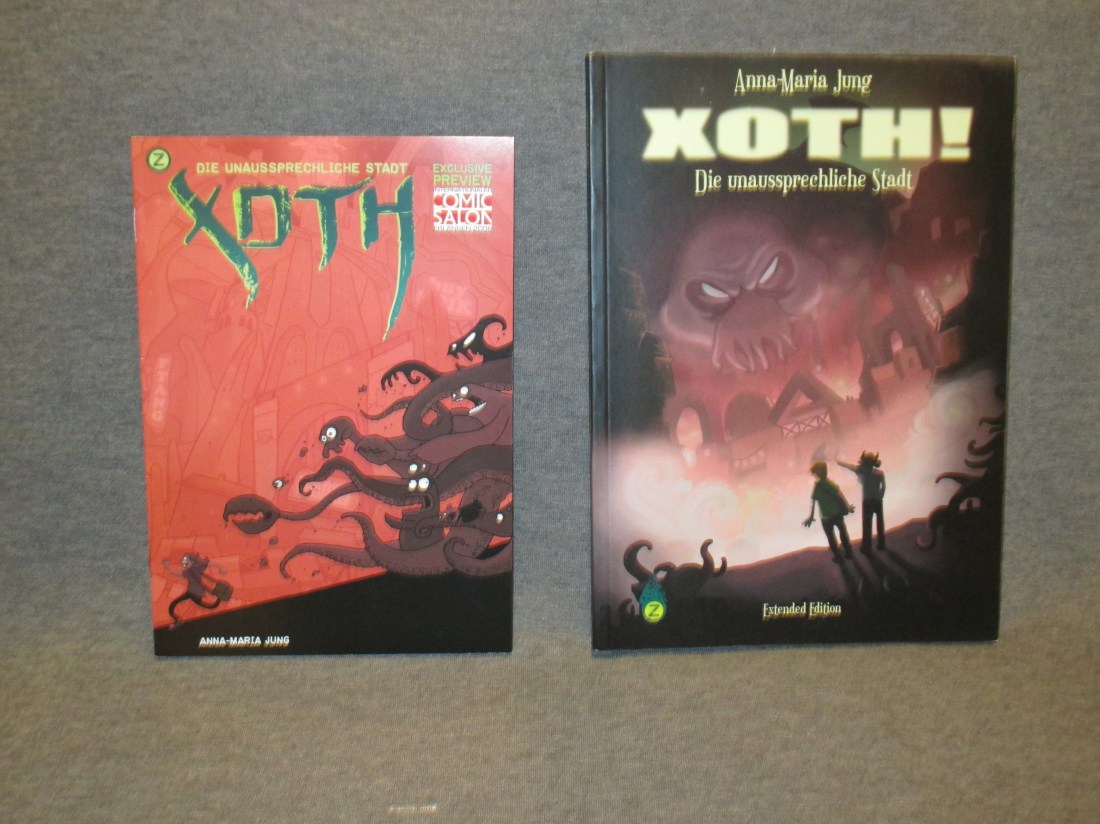
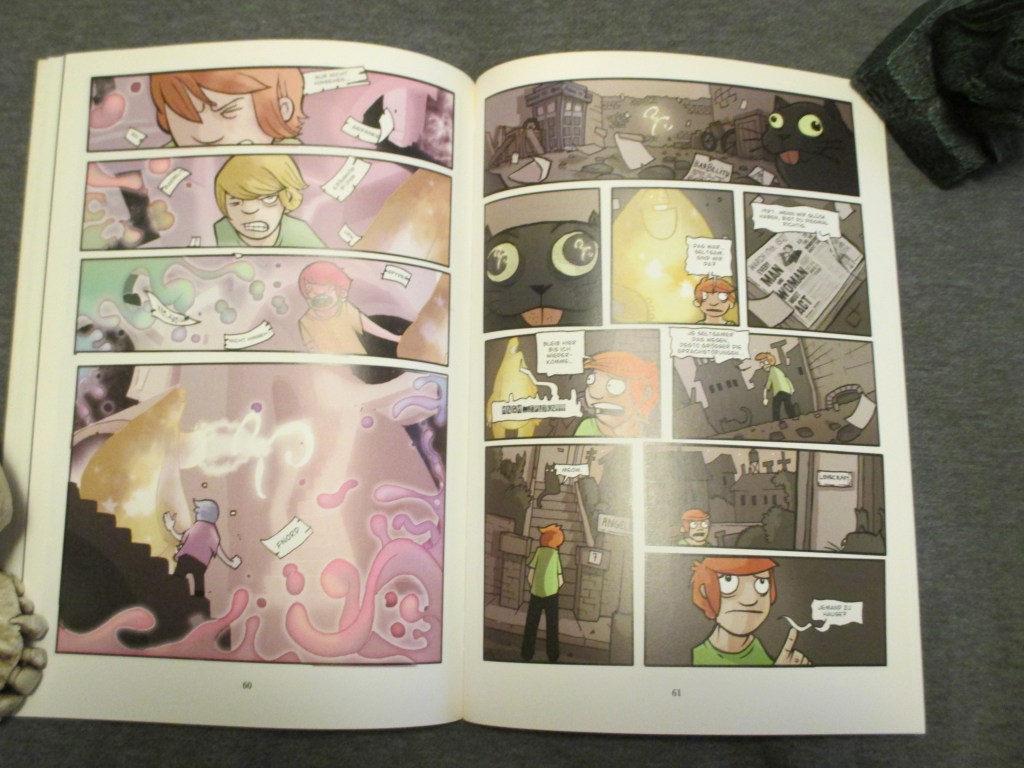
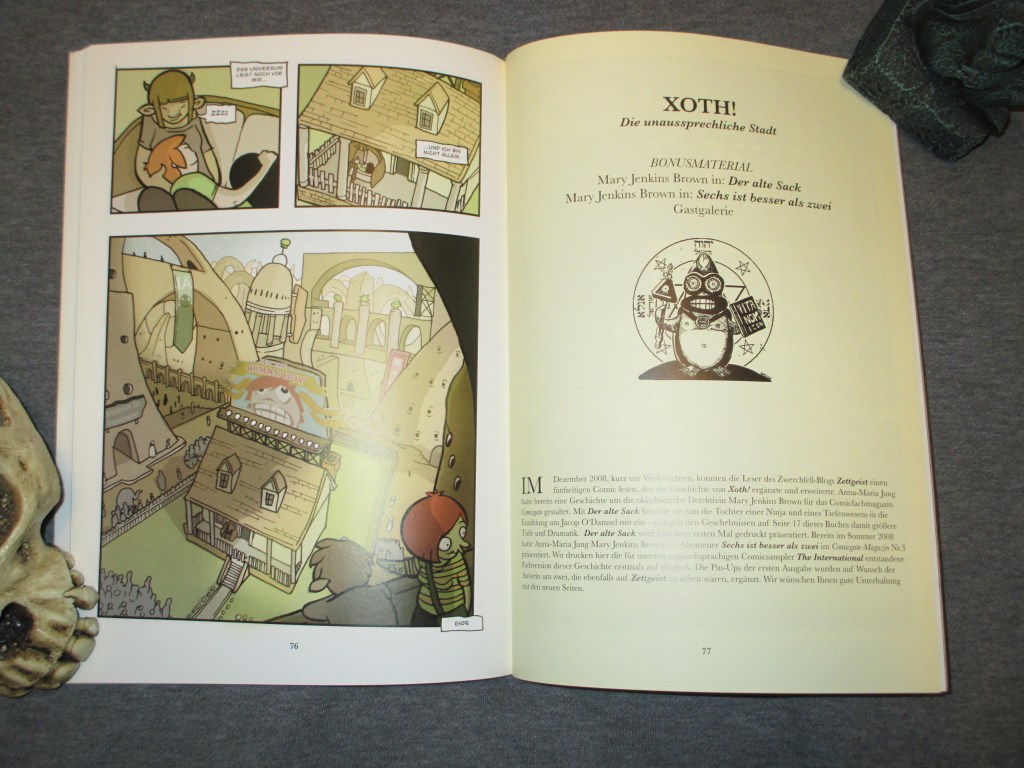
Xoth! Die unaussprechlichen Stadt (“Xoth! The unspeakable City!”) is a 2007 graphic written and drawn by Anna-Maria Jung ( https://www.annamariajung.com/ ), an Austrian illustrator with a penchant for monsters and nerds. The publication history is a little difficult to piece out, because part of the history has been eaten by the web, but the Internet Archive maintains a copy of (most) of the old website, which offers some background:
Xoth! ist ein 70 seitiges Farbcomic, das auf dem “Cthulhu-Mythos” von Howard Philips Lovecraft beruht.
Die Idee für Xoth! kam Anna-Maria Jung 2006 in New York, als sie ein Buch zu H.P. Lovecrafts Cthulhu Mythos entdeckte. Beruhend auf diesem Mythos entstand die Idee, eine einzige Heimatwelt für Lovecrafts Kreaturen zu kreieren.
Anna-Maria diplomierte 2007 mit einer Arbeit über »Lovecraft in den Medien«. Diese Diplomarbeit wurde eine konzeptuelle Vorarbeit für ihren Comic sie erforschte Lovecrafts Vergangenheit, den gesamten Mythos und seine Einflüsse auf die Medienwelt. Auf Wunsch kann man diese Diplomarbeit bei mir als PDF kostenlos bestellen.
Als praktischen Teil entwickelte sie die Charaktere, Hintergründe, Gegenstände, Zusammenhänge, Beziehungen und Verhältnisse einer Welt, die sie, inspiriert von Sci-Fi Autor Lin Carter, Xoth taufte.
Xoth! is a 70-page color comic based on the “Cthulhu Mythos” by Howard Philips Lovecraft.
Anna-Maria Jung came up with the idea for Xoth! in 2006 in New York when she discovered a book about HP Lovecraft’s Cthulhu Mythos. Based on this myth, the idea of creating a single home world for Lovecraft’s creatures was born.
Anna-Maria graduated in 2007 with a thesis on “Lovecraft in the Media.” This thesis was a conceptual preparatory work for her comic; she researched Lovecraft’s past, the entire myth and his influence on the media world. If you wish, you can order this thesis from me free of charge as a PDF.
As a practical part, she developed the characters, backgrounds, objects, contexts, relationships and conditions of a world that she named Xoth, inspired by sci-fi author Lin Carter.
Was ist Xoth? (Deutsche)
What is Xoth? (English)
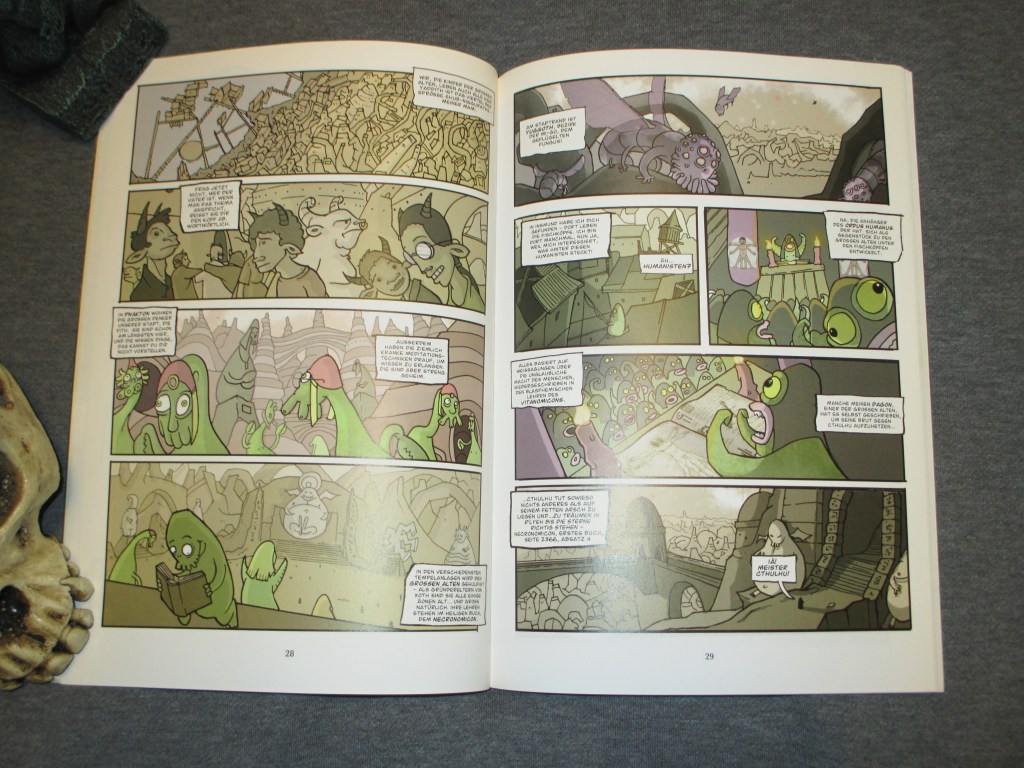
Lin Carter’s Mythos fiction was published in The Xothic Legend Cycle by Chaosium; Xoth was the star from which Cthulhu originated, and Carter’s fiction dealt with Cthulhu’s progeny. Cthulhu himself appears in Jung’s Xoth! as the mayor of the city.
Unfortunately, with the death of early web, stuff like Jacop O’Damsel’s MySpace page and the English translation of some of the comic pages are likely sadly gone forever.
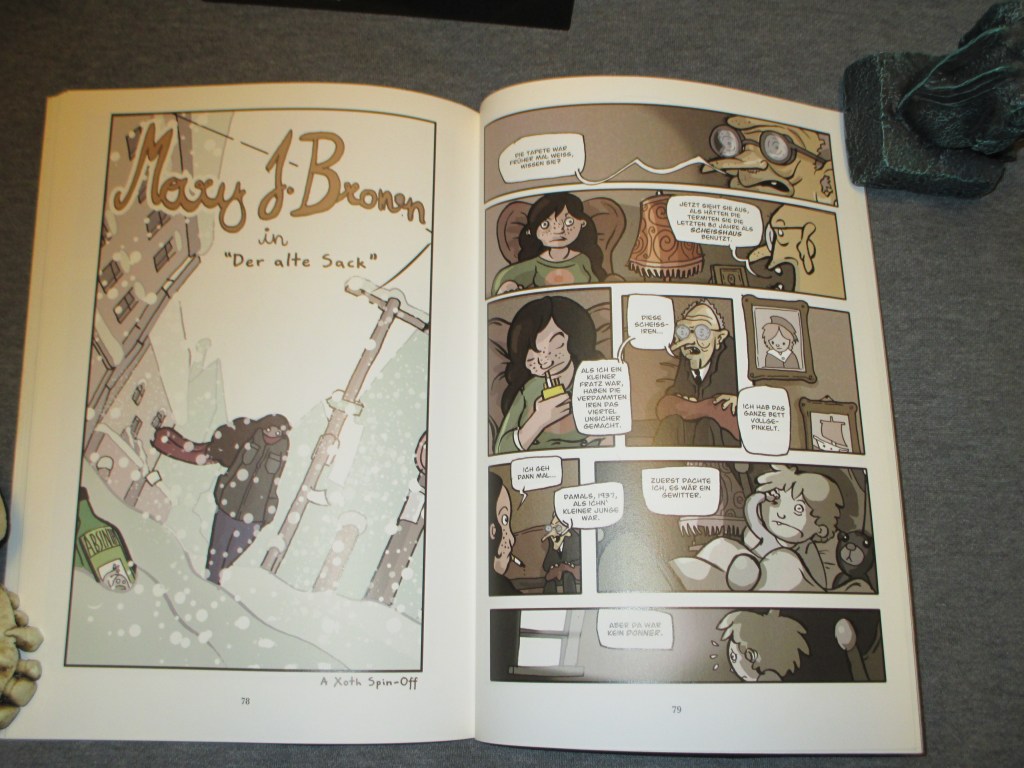
A 2008 “exclusive preview” of Xoth for the Internationaler Comic Salon Erlangen 2008, where the book presumably premiered; Jung also wrote and drew a spin-off comic titled “Marie Jenkins Brown: Sechs ist Besser als zwei” (“Mary Jenkins Brown: Six Is Better Than Two”) published in Comicgate Magazin #3 (2008). Both Xoth! and the Marie Jenkins Brown spin-off were collected and published in the Xoth! Die unaussprechliche Stadt Extended Edition (2010, Zwerchfell Verlag).
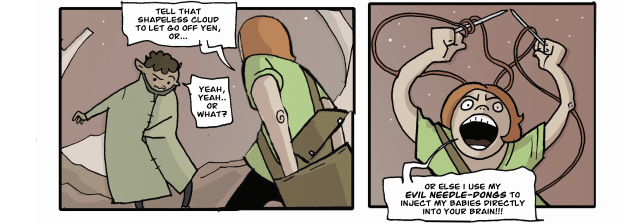
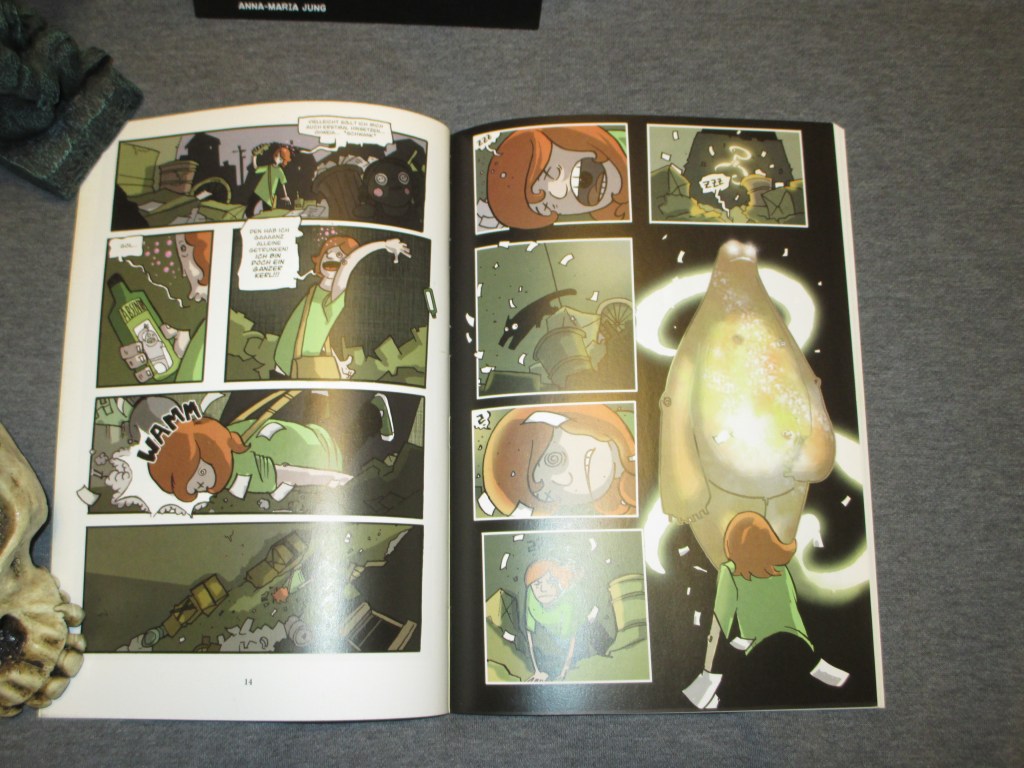
Absinthe and Dimensional Shamblers don’t mix.
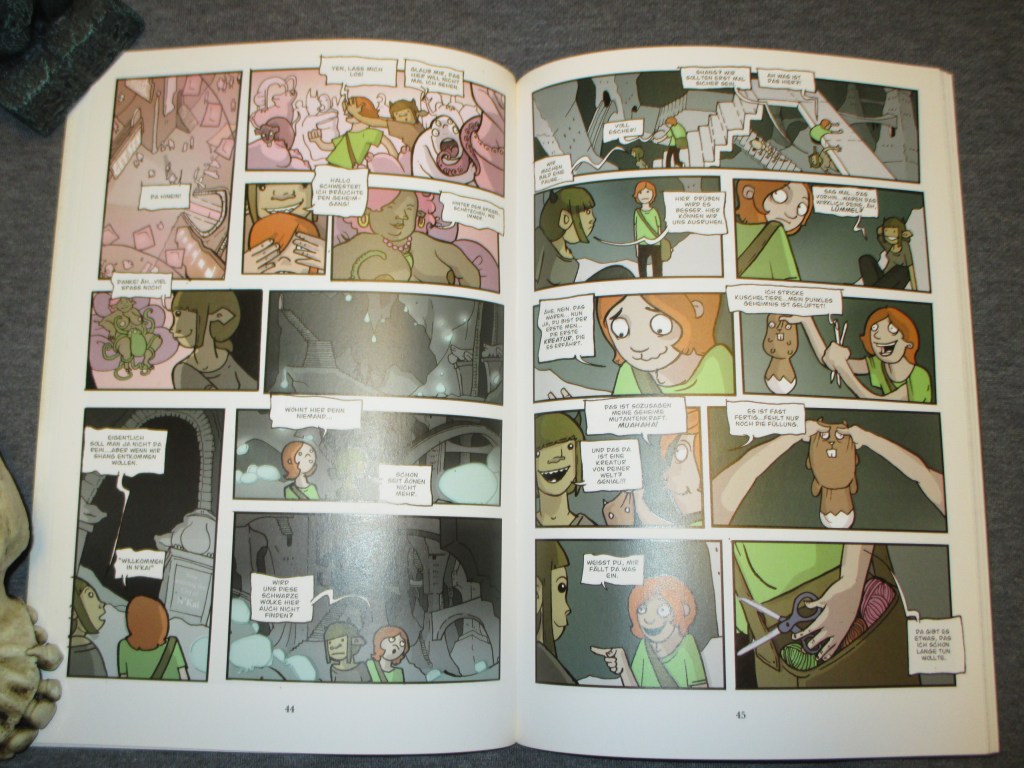
There is a slightly cartoonish, early-2000s webcomic vibe to Jung’s art style, which might make some folks to confuse Xoth! for a comic intended for kids at first glance, but really this is aimed at a more mature audiences, with references to alcohol and sex, and some brief cartoon nudity that is designed to amuse rather than titillate. It’s a fun takeoff of the Mythos for grown ups, especially grownups who were monster enthusiasts in their youth.
Fans will appreciate the many references to Lovecraft’s Mythos (and the Call of Cthulhu Roleplaying Game) sprinkled throughout the story. It’s definitely played for humor more than horror, reminiscent of works like The Unspeakable Vault (of Doom!), but with more narrative and focus on characters. This is really the story of Jacop O’Damsel, the sole human in the city.
Fortunately, Jacop has help from Yen Niggurath, one of the Dark Young, who takes a shine to him. Their relationship has a meet-cute quality, and there’s a certain romantic frisson between the two almost from the start.
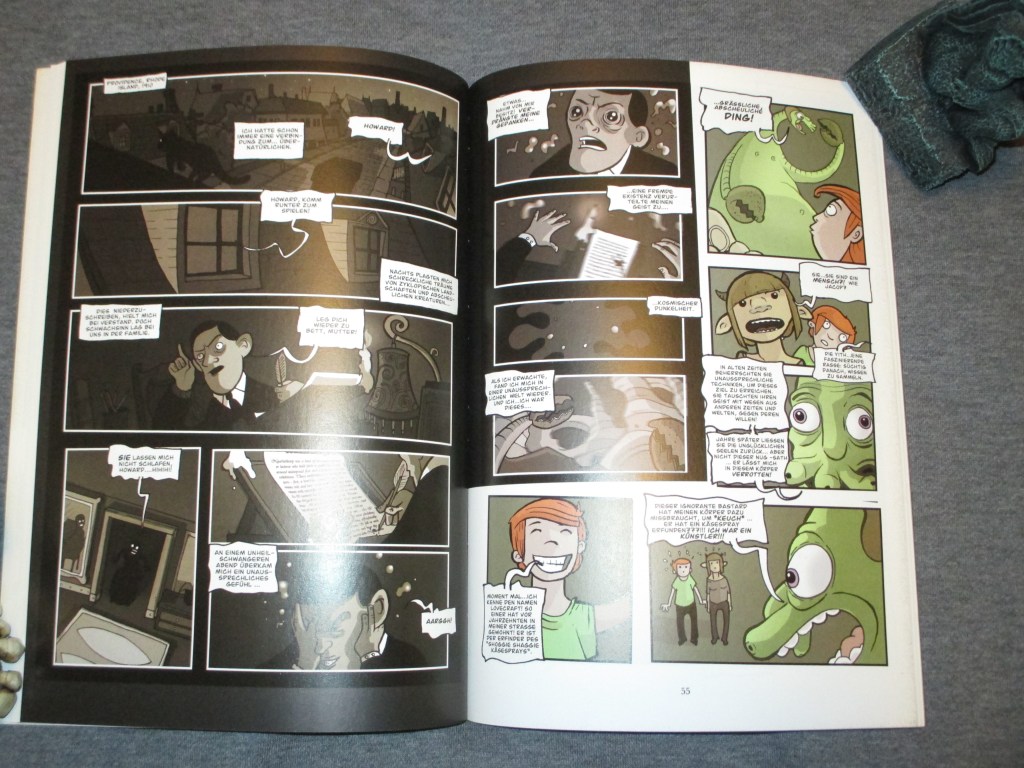
Lovecraft, “the Man from Angell Street.” does indeed make an appearance, although he spends most of the comic in the body of a Yithian he’s been mind-swapped with. Which is a fun way to include Lovecraft in what is otherwise a contemporary setting that includes cellphones.
A scene where Jacop meets a dying Lovecraft in 1937 is also included, although Jung makes a slip here in getting the date and address incorrect.
It is a fun graphic novel. The plot isn’t very profound, but not all stories have to be epic. Some people just learn to accept where they are and who they’re with. To monsters, humans are ultimately just another monster.
The Mary Jenkins Brown spin-off comics are a bit more deliberately mature, even racy in parts. Mary is an occult detective in these brief strips, but seems more interested in getting laid than solving mysteries. They’re short and cute, played for laughs more than eroticism. It’s nice to have them collected somewhere.
There is no published English translation of Xoth!, and sadly probably never will be, which I feel is a pity because there was a time and place when I think it would have definitely found an appreciative audience. The German-language Extended Edition is still available for sale, and Anna-Maria Jung’s webstore has a lot of cool shirts.
And that, friends and neighbors, was eau de cancer, a body rotting from the inside out. Strong today. Very strong. —Christine Morgan, “Waxen” (2018) in Around Eldritch Corners (2024) 164
Robert W. Chambers and H. P. Lovecraft generally did not write historical fiction. Their stories were set in the present, they dealt with contemporary issues and concerns. Many readers today lack the historical context to understand where Lovecraft and Chambers were necessarily writing from when they wrote their stories. The conventions, the issues, the current events that found expression in their fiction.
The militarism and xenophobia in “The Repairer of Reputations” often catch newcomers to the Yellow Mythos off-guard. Readers today aren’t familiar with the wave of future war fiction that inspired the setting, the rising nationalism, the ugly Yellow Peril fantasies which those first readers in 1895 would have been primed with. Chambers set his tale in an alternate future, but was writing for an audience of the present.
Sometimes people stumble across the Yellow Mythos. Sometimes it’s omnipresent and only a trick of perception is needed to see it. Yet it tends to zero in on the broken, the outcast, the ones out on the fringes of society. Where things are already broken down, the black stars rise. When things can hardly get worse, there’s something worse waiting, in Carcosa.
“Waxen” by Christine Morgan is a wonderful example of a type of story that has no generic label as yet, although it probably should. They’re a slightly supernatural twist on the conte cruel; an object arrives that turns the protagonist’s own sins against them in some fashion. It’s a close cousin to “Binky Malomar And His Amazing Instant Pussy Kit” (1994) by Nancy Collins, but lust isn’t the cardinal sin here. It is a very specific form of greed, as nastily precise to the syntax of this era as Chambers’ militarism was to his.
How long and how well, he wondered, would the candles mask the full-on decay? When she did die, nobody had to know, did they? The checks would keep coming until it was reported, and who else but him would be reporting it? Quitting the agency and claiming he’d been hired as her live-in was the smartest thing he’d ever done. —Christine Morgan, “Waxen” (2018) in Around Eldritch Corners (2024) 164-165
Morgan knows her business; “Waxen” doesn’t overstay its welcome, just sets up the story, sketches the characters, and lets events unfold. It does exactly what it sets out to do, in clear and evocative language, with just enough detail and just enough room for the reader to imagine what comes next. Yet brief as it is, the story is not timeless; without ever giving a date, it is set in a nebulous now of scented candles, chemotherapy, and medical fraud. Maybe someday, someone will need that historical context explained to them.
An idle glance at the label didn’t tell him much.
C&C Candles, Lake Hali, The Hyades.
Never heard of them. —Christine Morgan, “Waxen” (2018) in Around Eldritch Corners (2024) 163
Lovecraft had a rare faculty for beginning with something commonplace and building up an overwhelming aura of horror that left his readers hanging onto the ropes. In that sense, I can’t think of anyone who could surpass him. He had a knack of delving into man’s subconscious, untranslated fears—putting them into an appreciable form, giving them appealing names and personifying one’s own, inmost, half-comprehended, even personal nightmares. —Bruce Bryan in “The Eyrie,” Weird Tales (Jul 1937)
H. P. Lovecraft created Yig for “The Curse of Yig” (WT Nov 1929), ghostwritten for Zealia Bishop. Yig is also mentioned as “Niguratl-Yig” in “The Electric Executioner” (WT Aug 1930), ghostwritten for Adolphe de Castro; and “The Father of Serpents” in “The Whisperer in Darkness” (WT Aug 1931); “Yig the Serpent-God” in “Out of the Æons” (WT Apr 1935), ghostwritten for Hazel Heald, and “Mother of Serpents” (1936) by Robert Bloch. Five appearances over the course of eight years, all in the pages of Weird Tales, and to the casual reader all by different authors.
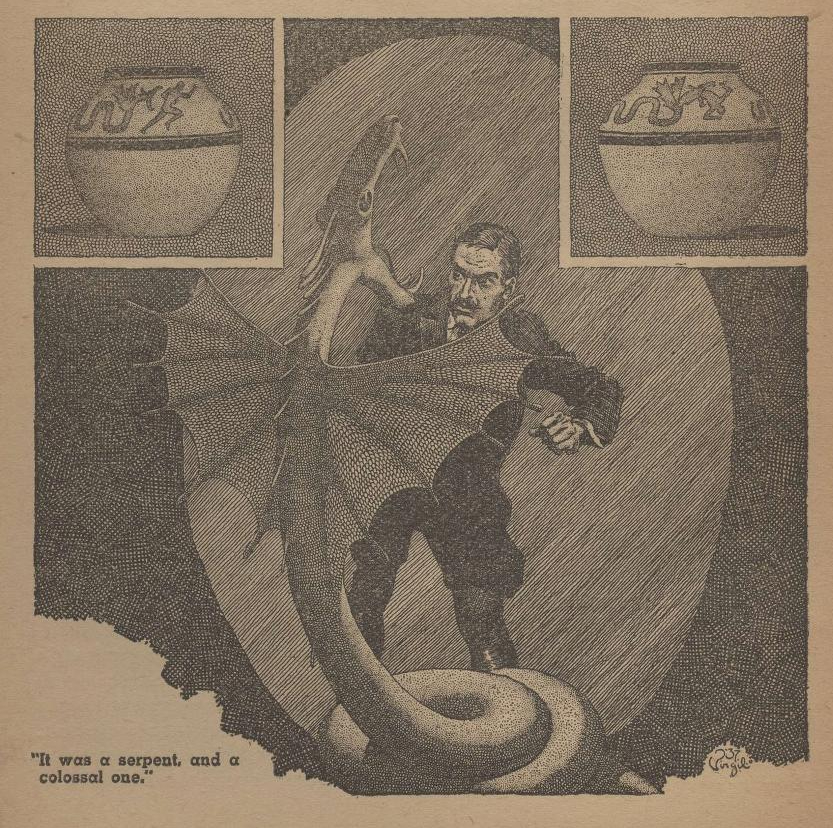
Perhaps that is why in 1937 professional archaeologist and pulp author Bruce Bryan borrowed Yig—here under the name “Yig-Satuti”—for his archaeological horror yarn, “The Ho-Ho-Kam Horror,” which ran in Weird Tales Sep 1937 issue.
“On the Mountain-That-Is-Heaven,” he hissed fiercely, “the white man is a trespasser. Yig-Satuti does not welcome visitors who come to dig up his secrets. It is bad medicine for those who seek to disturb the ancient dwelling-place of the god.” —Bruce Bryan, “The Ho-Ho Kam Horror” in Weird Tales (Sep 1937)
G. W. Thomas has described “The Ho-Ho-Kam Horror” as “an unnoticed Cthulhu Mythos sequel” (Snake Gods & Were-Serpents), and he’s largely correct. Dedicated fans recognized the reference to Yig at least as early as the 1950s, when George Wetzel included it in one of the listings in his TheLovecraft Collector’s Library (1955); the story is also listed in Chris Jarocha-Ernst’s mammoth A Cthulhu Mythos Bibliography & Concordance(1999). However, the story has never been reprinted outside of its original appearance, not in a random Mythos anthology or anywhere else, contributing to its overall obscurity and lack of recognition.
Even for dedicated Mythos-hounds, the story is easy to miss. Bruce Bryan was never a member of Lovecraft’s circle of correspondents, and outside of the reference to Yig, the story has no other connections to the Mythos—nor many to its probable inspiration, “The Curse of Yig.” For one, the story is not set in Oklahoma, but in Superstition Mountain in Arizona; the Native American groups involved thus shift in relation to that portion of the Southwest, and the mythology shifts with it, becoming associated with the Hohokam culture. Bizarrely, even though Yig-Satuti is depicted with wings, Bryan makes no effort to connect it with Queztacoatl as Lovecraft had done.
The story takes on a more familiar shape than Lovecraft’s “The Curse of Yig,” echoing “Sunfire” (1923) by Francis Stevens, “The Monster-God of Mamurth” (1926) by Edmond Hamilton, and “The Thing on the Roof” (1932) by Robert E. Howard among others—all stories where in an ancient and deserted city or temple, the monstrous god of the forgotten people remains to be discovered by archaeologists or treasure-hunters. While there’s a certain Lovecraftian touch in the framing of the story, since the last of it is told through a diary the protagonist discovered and the final sentence is an appropriately italicized culminating revelation, it is otherwise a bit crude. The pot that prognosticates the archaeologist’s doom, for example, is never explained in any detail.
By far the most substantial difference between Bryan and Lovecraft, however, might be in their treatment of Native American characters and culture.
Few would consider Lovecraft an exemplar when it comes to the accurate or sympathetic portrayal of Native Americans in his fiction. While there are sparingly few references to Native Americans in his corpus, the one Native American character who is named and speaks is Grey Eagle in “The Curse of Yig” and “The Mound,” and he is basically a walking stereotype of the Old Native American Chief, complete with the kind of English patois that Barbra A. Meek in “And the Injun Goes ‘How!’: Representations of American Indian English in white public space” (2006) called “Hollywood Injun English.” Yet for all that, Lovecraft obviously did research for his stories set in Oklahoma, accurately names the Native American peoples that would have been there, and references some of their genuine beliefs, like Tiráwa. The worst negative stereotype Lovecraft indulges in is depicting the Native Americans with a penchant for alcohol.
Bruce Bryan did his research too—albeit, a few folks wrote in to Weird Tales to correct a few points:
I read with much enjoyment Bruce Bryan’s story The Ho-Ho-Kam Horror. I lived near Superstition Mountain for about eight years, and learned to speak the Pima dialect fairly well. Naturally, I took quite an interest in the Indians, their legends and the ruins of the Hohokam. Little is known of the Hohokam, but there were a few errors in the story which I think the author should have corrected. ‘The Hopi and Smoki Indians do not live near Superstition Mountain, nor do they get their snakes for the rain dance there. I doubt if they know of the existence of the place. The story is based on legend, apparently, and legend has it that the Hohokam did not live on Superstition Mountain; the ancestors of the Apache Indians lived in that vicinity, and the Hohokam, who are apparently the ancestors of the Pimas (although this is not certain), lived and farmed the Gila River valley when the valley was not such a desert as it is now. The Casa Grande ruins (a four-story adobe structure) were built by the Hohokam who continually warred with the Apaches of Superstition Mountain. The Pimas and Apaches don’t get along any too well today, as far as that goes. In regard to the Hohokam-built ruins, the age of these ruins is probably more than two thousand years. At that time (when the Hohokam lived there) they irrigated the land with water from the Gila. Some of the ditches are filled with lava. It must have been quite a while ago that the volcanoes in Arizona erupted. […] Little can be said of Superstition Mountain. In the present century no white man has climbed it alone and come back, although a few have tried. Planes can’t fly very low over it, due to strong and gusty updrafts. An exploring party recently made a trip over part of the mountain to try to discover the cause of loud and thunderous noises, like the reports of guns, but found nothing. —Paul Smith in “The Eyrie,” Weird Tales (Nov 1937)
However, the issue has less to do with Bryan’s anthropology of the deceased Hohokam culture and geography than his depiction of the living Native Americans and their culture. Lovecraft kept the Native Americans almost always off the page, talked about rather than depicted directly interacting with the white viewpoint characters, and while Yig is depicted as part of their belief-system, but is not necessarily evil nor was his worship all-encompassing. Bryan has the Native American characters much more present, and the white viewpoint characters interact with them directly—which means there’s a lot more room for stereotyping, especially within the already hackneyed scenario of one lone white man with a group of Indigenous laborers.
The only one named is Jim Red-Cloud, who becomes the mouthpiece for the Native American viewpoint:
“Don’t be ridiculous, Jim!” I snapped angrily. “You’re not a superstitious child. You went to the white man’s schools. And you’ve been with me a long time. Tell me, just what or who is this Yig-Satuti?”
The Pima winced at my words, as if they expressed some damnable blasphemy. In the smoldering depths of his eyes modern teachings seemed to struggle with the antique lore of his savage forefathers.
“Some things the white man’s schools do not teach,” he whispered almost fearfully. “Some things they do not know. Yig-Satuti is the Indian’s god beyond all other gods. It is not well to speak his name, for he is jealous of his secrecy. Those who know, worship him in hidden places that the white man does not suspect. It is better so. Yig-Satuti is older than the earth itself, and all wisdom is his heritage. Here on his mountain we are trespassers. Much evil will come if we do not go.” —Bruce Bryan, “The Ho-Ho Kam Horror” in Weird Tales (Sep 1937)
Before long, the “rational” white archaeologist who ignores the warnings to the curious offered by Jim Red-Cloud. The nameless, faceless indigenous laborers are demeaned as superstitious and primitive children, whom the white man tries to coax with money and then threatens with implied violence. It is little surprise when the white man ends up alone and eaten by the ancient horror his excavation has unearthed.
A very old-fashioned story, one where none of the characters come out looking good.
In terms of Native American representation, the Yig Cycle stories—whether written by Lovecraft or anyone else—often suffer from difficulties in their portrayal and presentation of indigenous peoples and their culture. Part of this is due to ignorance, part of this is due to stereotypes, and part of this is just the lens of the storytelling. The default perspective is of voyeuristic outsiders to an indigenous culture poking around where they are not invited and don’t belong. It is a Colonialist narrative, told from the standpoint of the colonizer, and even when bad things happen to said colonizer, it does so by representing the indigenous culture as exotic, secretive, and dangerous. Reiterating and reinforcing stereotypes.
Not all Yig Cycle fiction is like that; “The Head of T’la-yub” (2015) by Nelly Geraldine García-Rosas for example provides a very different viewpoint, and the approach is much more respectful with regards to depicting Native American characters as possessing agency, and of how and why they integrate indigenous beliefs with the Cthulhu Mythos. If there’s a lesson to be learned from “The Ho-Ho-Kam Horror” by Bruce Bryan, it might be to listen more, keep an open mind, and try to see things from someone else’s perspective.
If nothing else, it would make a more interesting story if it had been written from Jim Red-Cloud’s point of view.
South of Stygia are the vast black kingdoms of the Amazons, the Kushites, the Atlaians and the hybrid empire of Zembabwe. —Robert E. Howard, “The Hyborian Age”
The Hyborian Age of Conan the Cimmerian was no mythical white space, occupied only by pale Caucasians. In formulating the adventures of the Cimmerian, Robert E. Howard drew on everything he knew: Conan’s travels encompass not just a fantasy geography, but chronologies and genres. The barbarian might find himself leading a battle of European-style medieval knights; on the deck of a ship whose pirates could have stepped out of Robert Louis Stevenson’s Treasure Island; in a frontier wilderness fort reminiscent of pioneer Texas; in a stone temple that might have stood in some fantastic vision of ancient Egypt—and in a fantasy equivalent of Africa, populated by Black people, who were to Conan’s friends, allies, enemies, and lovers.
The Conan stories, while fantasy and aimed at Weird Tales, grew out of Howard’s love for history and adventure fiction, and writing historical adventure stories for magazines like Oriental Stories. The conceit of the Hyborian Age is that by setting it before any known period, Howard had a free hand to invent details that would otherwise trip him up if trying to write a realistic historical yarn.
For pulps like Adventure, accuracy was paramount; the magazine prided itself on publishing stories from people who knew their subject, who had gone out and lived in exotic lands, and returned to tell the tale. To that end, Adventure invited readers to write in with their questions, for Adventure’s stable of writers to answer. In September 2024, scholar Patrice Louinet came across a letter printed in a copy of Adventure (30 December 1923):
White Man and Native of West Africa
HAUSAS—trading-factory terms—marriage ceremonies and customs:
Question:—”I am writing to get some information in regard to the customs, habits, etc., of the natives of that part of Africa which is included in your section in ‘Ask Adventure.’
Are the natives of a war-like stock? That is, did they come from a fighting race?
How much authority does the superintendent of a trading-post possess?
Do the whites interfere with the natives in dealing with native criminals?
What are some of the punishments of native wrong-doers by the whites? By the natives themselves?
What are some marriage customs among the natives? Am I right in supposing a native has full power to punish his wife in any way he pleases?
Have the morals of the African natives been raised by the rule of the white men or have they decreased in standard?
Is the ceremony of Mumbo-Jumbo—or something of some name like that—for the correcting of disobedient women used in that part of Africa? If so, how is it carried out?
What is the customary costume of the natives?
I apologize for asking so many questions, but I am very much interested in Africa. If by any chance this letter should be published in Adventure, please do not print my name.” —R.E.H., Cross Plains, Texas. Text from REH.world.
This would be Robert E. Howard of Cross Plains, Texas—and if the questions of a 17-year-old boy seem somewhat ignorant, it must be remembered that knowledge of Africa was by no means widespread in the rural United States during the 1920s and 30s. For many years and even decades to come, Africa would be the metaphorical “dark continent,” whose peoples, geography, and history were intermixed with fantasy, racism, and plain ignorance. Howard’s questions were honest ones, and it is to his credit that he sought out answers instead of immediately falling back to stereotypes and fantasy when he wrote his first few African stories.
The Conan boom in the 1960s and 70s brought with it not just an increased admiration for Robert E. Howard as a writer and Conan the Cimmerian as a character, but new criticism and new sensibilities. As Marvel Comics adapted Howard’s character and stories to a new medium, they had to face the reality that this was a new world: the Civil Rights movement had won victories with the decision in Brown vs. the Board of Education (1954) and the passage of the Civil Rights Act of 1964. Black Pride and other movements raised awareness of the roots of the African diaspora in the United States and surrounding countries.
Adaption to this new reality was, at first, slow. “The Vale of Lost Women”(1967) by Robert E. Howard is one example of how 1930s stereotypes and prejudice found an unwelcome audience in the 1960s and 70s, and how later writers and artists worked to make this work acceptable to a contemporary audience of all races. Not every creator was so conscientious; in 1975, Black fan Charles R. Saunders wrote “Die Black Dog! A Look At Racism in Fantasy Literature.” While it was one thing for something Robert E. Howard, who died in 1936 and never lived to see the changes in US society, to rely on racial stereotypes the essay specifically called out latter-day creators of Conan pastiche for continuing to use such lazy and biased storytelling nearly four decades later.
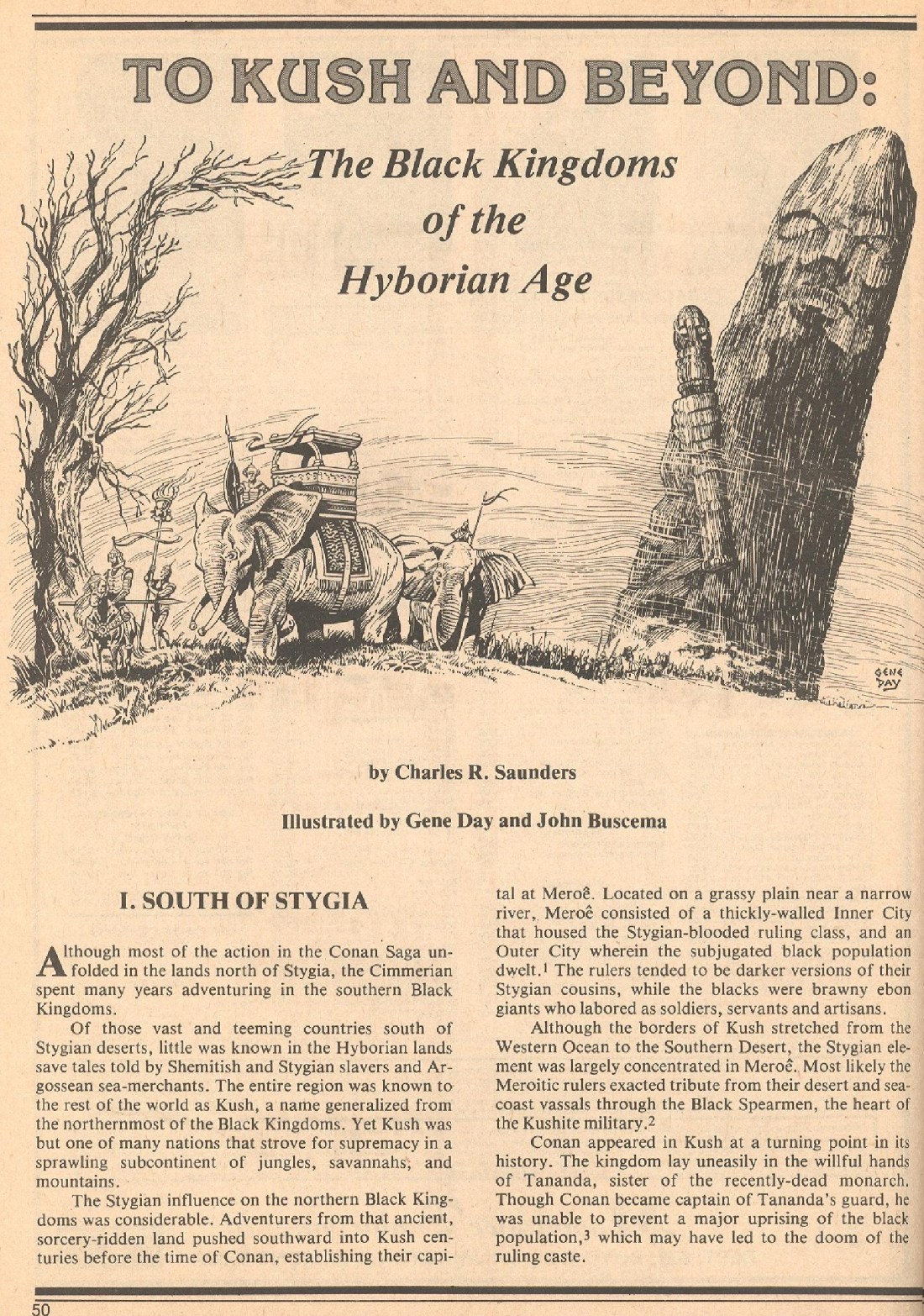
Just because Charles R. Saunders called out writers of heroic fantasy doesn’t mean he stepped away from the genre; quite the opposite. In 1980, Saunders published two related essays: “Hyborian Africa” was published in the fanzine Paragon #1 (May 1980), and “To Kush and Beyond: The Black Kingdoms of the Hyborian Age” was published in Savage Sword of Conan #56 (Sep 1980). Both essays deal with similar subject matter: an exploration of the “Black Kingdoms” mentioned in Howard’s essay “The Hyborian Age,” references to which are sprinkled throughout Conan’s adventures. However, the purpose and approach of each essay is different.
The historical derivation of the lands south of Stygia, the Black Kingdoms, are less obvious. Nonetheless, a look at any reference work on African history quickly exposes Howard’s inspirations for the names of some of his Black Kingdoms, if not their cultural backgrounds [.] Kush, Punt, Darfar, Zembabwei and Amazon are names as familiar to African scholars as those of Poland, France, Spain and Italy are to students of the European past. —Charles R. Saunders, “Hyborian Africa,” Paragon #1 (1980), 27
“Hyborian Africa” looks at the historical sources and inspiration behind Howard’s stories. Given that this was a fanzine and that Howard studies was in its infancy, the usual apparatus of scholarly writing is neither present nor expected: no footnotes, no bibliography. However, Saunders’ care in the article is evident. He addresses only the stories written by Robert E. Howard, not later pastiches or derivative material from the Marvel comic books. It is brief, at only a little over two pages, but the history offered is largely accurate…and if Saunders criticizes some of Howard’s depictions of these fantasy versions of African kingdoms, he also offers a parting observation:
Although Howard’s depictions of Hyborian Age blacks consisted primarily of stock racist stereotypes, he did do more research into African history than such contemporaries as Edgar Rice Burroughs. Even today, the mention of the wor[d] “Kush’ would draw only blank stares from most people. With the exception of Darfar, Howard’s historical foundations for his Black Kingdoms were as solid as those of the rest of Conan’s world. And this is to his credit. —Charles R. Saunders, “Hyborian Africa,” Paragon #1 (1980), 29
“To Kush and Beyond: The Black Kingdoms of the Hyborian Age” was published as a literary exploration of the Black Kingdoms as they appear in the broader Conan mythology, which includes not just Howard’s stories but also stories that were completed or re-written by L. Sprague de Camp and Lin Carter like “Hawks over Shem,” “The Snout in the Dark,” and “The City of Skulls.” In adapting Conan stories to comics, Marvel had included some of de Camp and Carter’s creations, including Conan’s ally Juma the Kushite, and so Saunders incorporates that lore into his survey of the Black Kingdoms of the Hyborian Age. Saunders’ work provided an explanation and codification of lore on the world of Conan that both readers and writers could reference.
Being published in a comics magazine, Saunders’ essay was illustrated by Conan artists John Buscema and Gene Day, and being of a scholarly character includes a page of endnote citations, for a total of 7 pages. Saunders’ interest in African history is still present, though less explicit. In the closing paragraph, for example, he writes:
The cataclysm that formed the outlinees of the modern world separated the land south of the River Styx from the rest of the world, and raised up from the sea the entire west coast of what is now Africa. Much of the history and lore of the Black Kingdoms perished in the disaster—yet the Black Kingdoms did not truly die. Kush, Darfar and Punt rose again in historical times, and the West African Kingdom of Dahomey boasted a formidable corps of Amazon warriors. Like so many other nations and races, the African can trace their history “back into the mists of the forgotten Hyborian Age….” —Charles R. Saunders, Savage Sword of Conan #56 (1980), 54
While the two essays have very different purposes, considered together gives the sense that Charles R. Saunders wasn’t just chronicling the lore of the Hyborian world and glossing it to make it fit. Saunders was studying the work of Howard and other writers to see how they used Black characters and African history in their stories, for good or for ill—and he used those lessons when he wrote his own fiction, the kind of heroic fantasy series that he wanted to read.
Saunders combined his interests in African history and heroic fantasy in his own fiction, including the Dossouye stories about fantasy warrior-women that were first published in the anthology Amazons! (1979), and the Nyumbani setting stories that feature his hero Imaro—who would star in Saunder’s first novel, Imaro (1981). These are the critical early stories of Sword & Soul (see Milton J. Davis’ A Sword and Soul Primer), and they represent a desire to look beyond what other people have written to what stories have not been written, that need to be written, and to write them.
Eldritch Fappenings This review deals with a work that contains excessive cartoon violence and sexuality. Selected images with cartoon depictions of body horror, violence, genitalia and/or sexually explicit contact will be displayed. As such, please be advised before reading further.
Lovecraft não era sequer um grande astesão, mas is so também não importa, como o rock e, mais que ele, o punk rock, provou inúmeras vezes. Um artista menos dotado é perfeitamente capaz de Fazer uma obra mais oportuna, historicamente falando, do que um virtuose incapaz de pensar sua própria profissão em termos amplos. Mas isso também não era o caso de Lovecraft, um artesão obviamente limitado e um artista incapaz de seguir as veredas que ele mesmo abria a golpes desajeitados de marreta. Sua dificuldade técnica fica ainda mais evidente em Reanimator, uma de suas obras menos felizes, mas capaz de gerar tantas pérolas pelas mãos de artists mais dotados que o próprio, como o quadrinista Juscelino Neco.
Lovecraft wasn’t even a great artist, but that doesn’t matter either, as rock and, more than that, punk rock, have proven time and time again. A less gifted artist is perfectly capable of making a more timely work, historically speaking, than a virtuoso incapable of thinking about his own profession in broad terms. But that wasn’t the case with Lovecraft either, an obviously limited craftsman and an artist incapable of following the paths he himself opened up with clumsy sledgehammer blows. His technical difficulty is even more evident in Reanimator, one of his less successful works, but capable of generating so many pearls in the hands of artists more gifted than himself, such as the comic artist Juscelino Neco.
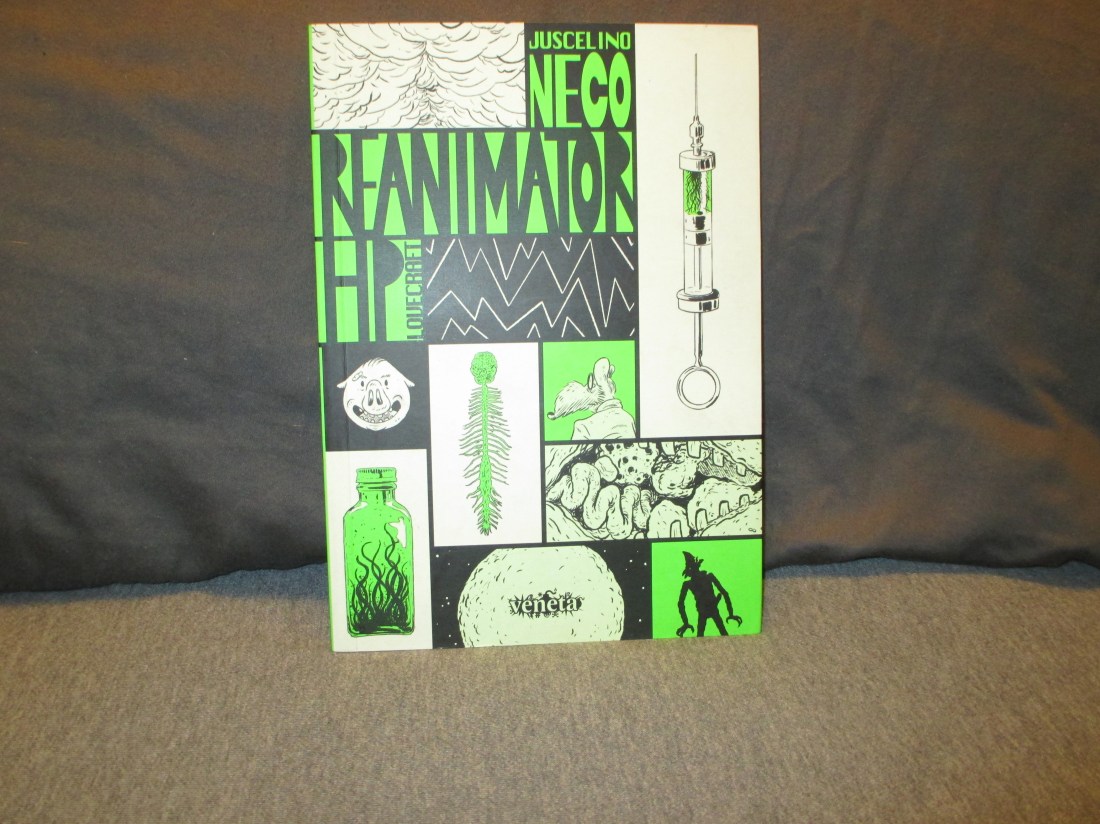
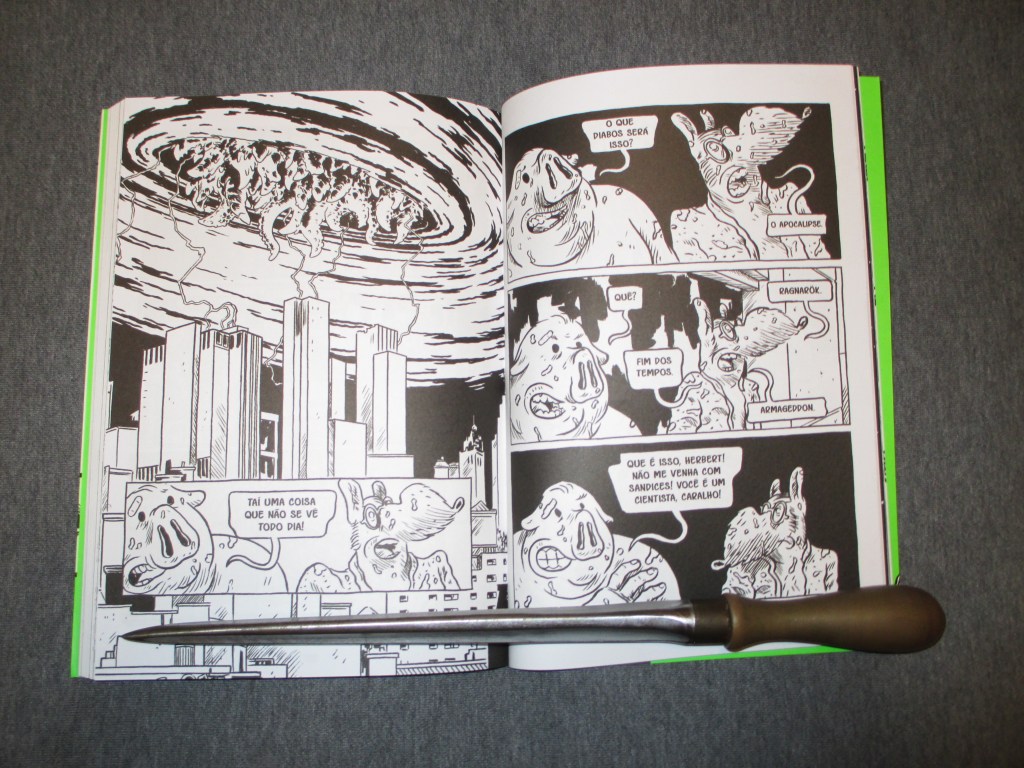
Rocha’s introduction to Juscelino Neco’s Reanimator(2020) is irreverent toward Howard Phillips Lovecraft. Yet irreverence has ironically been the cornerstone to the posthumous success of “Herbert West—Reanimator.” This minor tale of Lovecraft’s, his first commercial effort at horror fiction, has been adapted, expanded upon, reimagined, and incorporated into other works innumerable times since its first publication—something that has only been possible because artists have been free to do what they like with this story and its setting and characters, to freely distort and play with tone, characterization, and events as they see fit. To turn the grue-filled six episodes into dark comedies, zombie gorefests, introspective reflections on sexuality, and the mechanistic nature of life…all to entertain, explore, and reexamine what Lovecraft did and did not do.
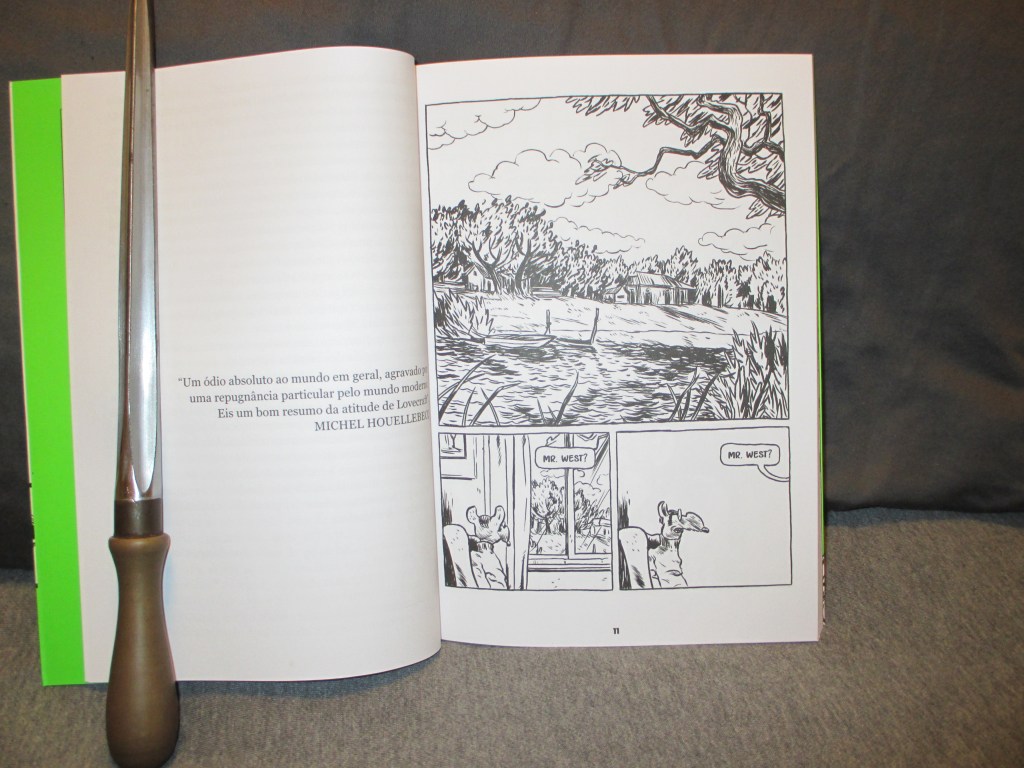
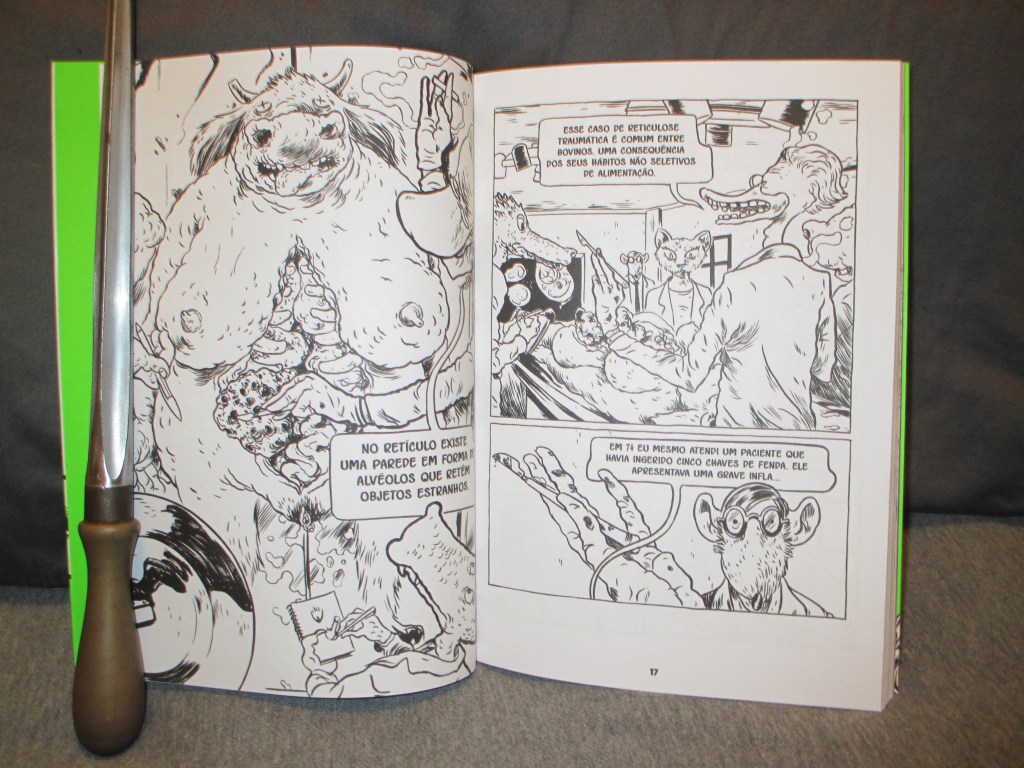
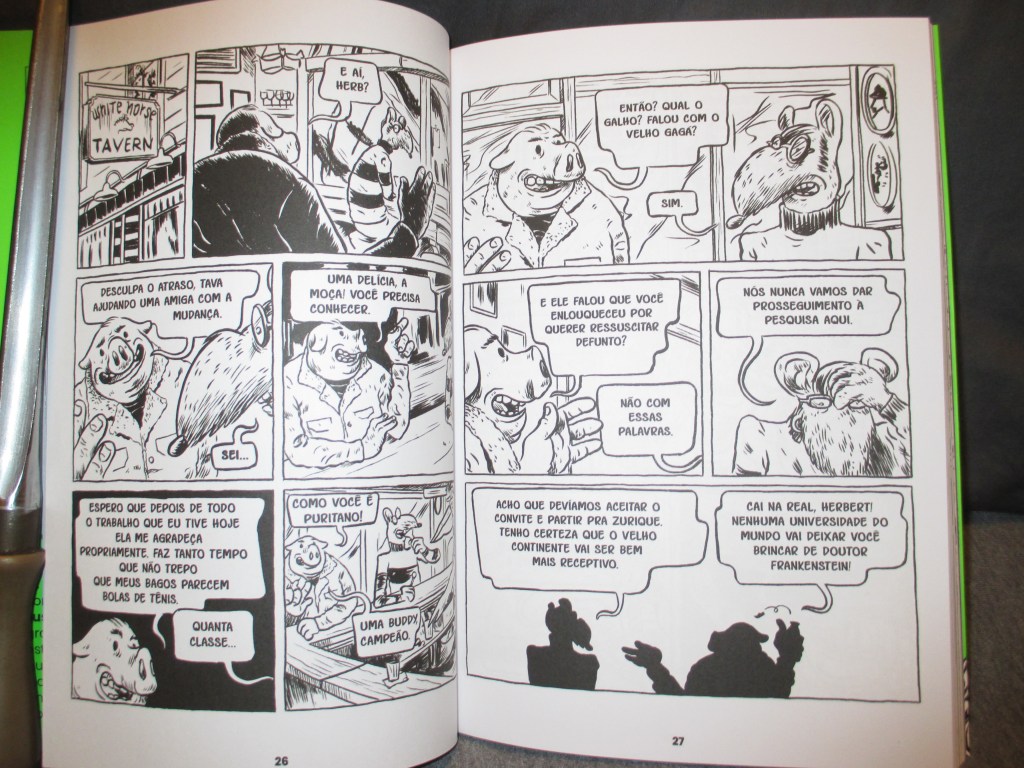
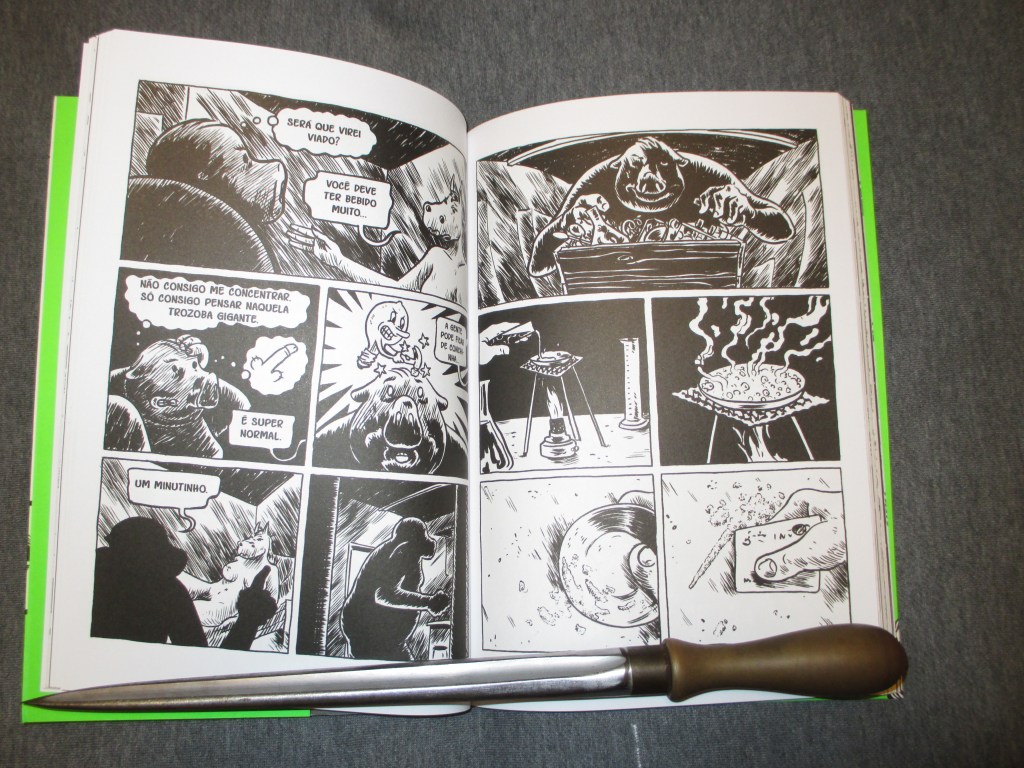
What Brazilian comic creator Juscelino Neco did was to approach “Herbert West—Reanimator” through the lens of 1960s underground comix. Herbert West and the other characters are cast as anthropomorphic animals, the grungy cousins of Mickey Mouse and Bugs Bunny, and their adventures are sexually explicit, violent, and drug-fueled. Neco put on the page everything that Lovecraft left off the page—and added a few other details of his own along the way.
The beginning is relatively restrained, Herbert West is in medical school. The broad outline of the first portion of Neco’s graphic novel follows the opening episode of Lovecraft’s story, although Neco takes many liberties with the framing of characters and events. As well as making the most of the opportunity to add a little gross-out imagery, such as a full-page pin-up of an autopsy in progress.
It is difficult to express how emotive the combination of art and text can be. The instinctive comparison is something like Art Spiegelman’s Maus, but the over-the-top black humor characteristic of the film Re-Animator(1985) is still there. There will be a page of dark panels where West laments the unimaginative bureaucracy that refuses to entertain his ideas about reanimation—and then you turn the page and its West talking to himself while being the bottom in a graphically-portrayed homosexual BDSM scene.
Then West gets an assistant. Someone to help him out.
In Neco’s Reanimator, the porcine assistant is no passive observer of events, but an active partner in West’s operations. They enable West’s experiments, but also his worst impulses. Together the two secure their first victim/experimental subject—and this is where things start to get a little more punk rock. The presence of drugs and the necessity of violence start to ramp up swiftly.
Until, while with a prostitute, the assistant cooks up some reanimation agent like its crack cocaine and injects himself. It does provide new life for spent flesh, but is also suggests a new sideline for West and his friend as drug dealers.
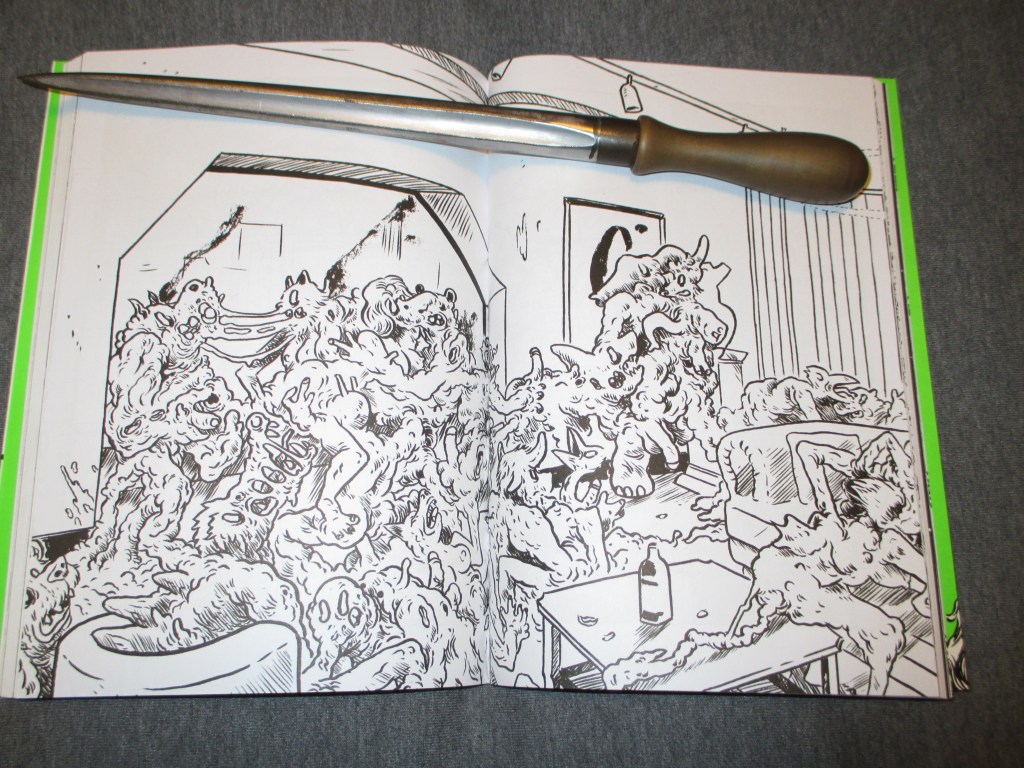
At this point, Neco’s Reanimator has completely abandoned Lovecraft’s narrative for a literal orgy of sex and violence. One that continues to try and outdo itself with almost every turn of the page. There is one scene at a reanimation drug-fueled party that is reminiscent of something like the end of Brian Yuzna’s Society (1989), where the individual ceases to exist.
From there, Neco goes full eldritch, bringing in some of Lovecraft’s other ideas while retaining the same ’60s underground comix shock mentality.
It is never clear, at the end, whether this is something Herbert West and his friend have caused by defying the laws of nature, or just a coincidental apocalypse. In a way, it doesn’t matter. Something fundamental has changed, the scientific genie has been let loose from the bottle and they can’t put it back. The world ends…and Neco doesn’t stop there. The world is fucked. Quite literally.
Reanimator (2020) by Juscelino Neco works on its own terms. It’s fun, disgusting, ribald, edgy, slightly ridiculous, and in the end cosmic in its scope. Readers are left without all the answers, but there’s the impression that one man’s obsession, with the aid and assistance of a friend, has led to the destruction of an entire world. That isn’t how Lovecraft ended the story, but that is the point. To do what Lovecraft would not have done, to use his fiction as a springboard, not to limit creators to only aping what he wrote forever.
There’s a routine to the art of a scare. First, get into position. —Sarah Musnicky, “The Mask It Wears” in Spectrum: An Autistic Horror Anthology(2024) 147
Horror follows the syntax of its age. Bela Lugosi’s opera cape set the standard for vampire dress for generations. The talking boards used by séances were commercialized as parlor games, and decades later there are books and films where ouija boards are considered genuine hotlines to the afterlife. H. P. Lovecraft lived during a time when many of the trappings of horror we know today were first being standardized and commercialized.
Lovecraft never visited a haunted house attraction or saw a slasher film. Those are the product of a later period. We, Lovecraft’s heirs, live in a different world, one awash with horror stories in every medium. Tastes have not necessarily refined, but they have agglutinated. Old familiar horrors carry a nostalgic twang, not a breathless shiver—but that’s a problem that Lovecraft himself faced.
The true weird tale has something more than secret murder, bloody bones, or a sheeted form clanking chains according to rule. —H. P. Lovecraft, “Supernatual Horror in Literature”
Generally speaking, Lovecraft did not set his horrors in far away exotic places and distant times. His horrors might have been ancient, but they were set in the now, an age with motorcars, submarines, airplanes, radio, telephones, and electric lights. If they had cellphones and the internet in the 1920s and 30s, Lovecraft would have had to factor them into the plots of his weird tales.
Lovecraft did not concern himself overmuch with the methods of the Society for Psychical Research or the Hermetic Order of the Golden Dawn; heterodox occultism of any stripe was something he largely lacked interest in. Likewise, he never let a vampire in an opera cape stride onto one of his pages. The pages of Weird Tales were filled with old familiar horrors. Lovecraft strove to provide something different; something new and unexpected.
Second, wait for the first round of screams heading in your direction. —Sarah Musnicky, “The Mask It Wears” in Spectrum: An Autistic Horror Anthology(2024) 147
There is nothing wrong with playing with old familiar horrors, or of trying to marry old tropes to new ones. A number of writers have played with combining Lovecraftian horrors with the slasher genre that gained prominence with Hollywood slasher films like Halloween (1978) and Friday the 13th (1980). Robert M. Price’s “A Mate for the Mutilator” (2004) comes to mind, and Chaosium’s Blood Brothers (1990). How well it works depends on the skill of the creator involved; the personal, psychological horror of the slasher stalking their prey, or the gore-filled climax of an elaborate or particularly bloody kill are rather more visceral than the kind of cerebral horror to which Lovecraft aspired. Yet they are not incompatible.
“The Mask It Wears” by Sarah Musnicky plays very specifically with horror tropes, in the syntax of the now. It was published in Spectrum: An Autistic Horror Anthology, and there is something evocative of that theme throughout this story, without actually giving a label to it. The narrator has a routine as part of their job. When something happens that throws them off-script, they’re thrown off their game. The mask they put on for dealing with their coworkers and the outside world slips—and that is the double meaning in the title. Not just the mask that the killer wears on their spree, or the mask that the protagonist wears on their job, but the mask of normal behavior that the protagonist projects, all the time, to deal with a world that seems, if not innately hostile, then somewhat incomprehensible.
Musnicky never tries to assign a label to her protagonist, why they do what they do, why they react the way they do to the unexpectedly. Yet the behavior and mindset are there, for those who recognize such things. It sets them apart from the rest of the would-be victims. Unable to move with the herd, the killer in the haunted house walks right into their room.
Lovecraft was fond of a terminal revelation, something that the whole story had been building up to, but only revealed in its fullness in the end. It was a style of fiction that owed something to mystery and detective fiction, where the last twist was revealed to explain away the final puzzle—though in Lovecraft’s case, he was willing to reveal just enough for the reader’s imagination to fill in the blanks. Musnicky’s story ends much the same way. We never get all the answers. Just enough.
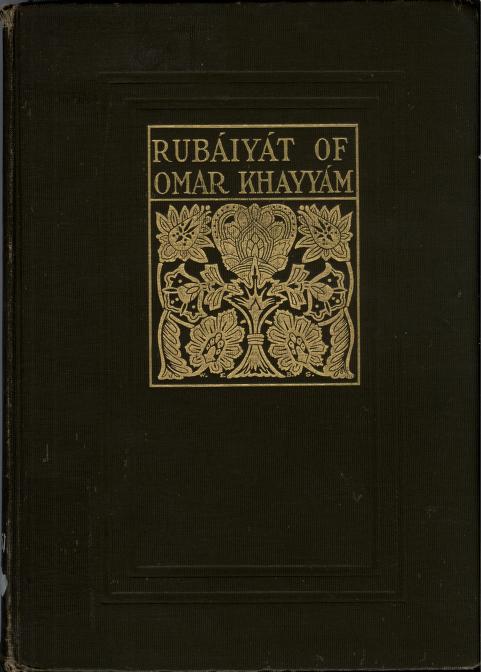
The Persian word رباعی (rendered rubāʿī in English) refers to a poem of four lines or parts; in English terms, a quatrain. Following the traditional conventions of Persian poetry these were composed using one of two thirteen-syllable meters. رباعيّات (rubāʿiyyāt) is the plural form; so the Rubáiyát of Omar Khayyám could be literally rendered as The Quatrains of Omar Khayyám—but where’s the style in that?
In the 1850s, English poet and writer Edward FitzGerald was involved in translations of Spanish and Persian poetry and plays into English. In 1856-7, Edward Byles Cowell, a former professor under whom FitzGerald had studied the Persian language, sent him transcripts of two Persian manuscript with a series of quatrains by Omar Khayyám (1048-1131), a Persian polymath who lived in the Seljuk Empire. How much of the poetry which is attributed to Khayyám that he actually wrote is a matter of conjecture and debate. There are no known original manuscripts from Khayyám containing poetry, only verses that were quoted by others, decades or centuries after his death. So the poems that FitzGerald translated were from much-later collations of extant verse, some or all of which may never have been written by Khayyám itself.
FitzGerald took a free hand to translation; he rendered each rubāʿī into a four-line quatrain, often rhyming in an AABA form. The result was published as the Rubáiyát of Omar Khayyám in 1859, to little notice. However, subsequent editions were published over the years and decades, with FitzGerald taking advantage of the reprints to expand subsequent editions with more poems, and to tweak the translations. By the end of the 19th century, the work had achieved monumental popularity, reflecting in part the expansion of the British Empire and the pervasive Orientalism that occasionally peaked into popular phases, like the Egyptomania that swept the English-speaking world after the discovery of King Tutankhamun’s tomb.
In addition to the authorized editions by FitzGerald, which could differ substantially from each other, there were innumerable other translations and pirated editions. The language and even numbering of the quatrains differ between editions. As a result, like the Christian Bible, it is difficult to talk about the Rubáiyát of Omar Khayyám as a single text, but rather as a corpus of related works within which are distinct traditions. For our purposes, the text of FitzGerald’s 5th (1898) edition appears most influential.
Given the immense popularity of the Rubáiyát of Omar Khayyám in the late 19th and early 20th centuries, it shouldn’t be surprising that several Weird Tales writers during the 1930s read and enjoyed some version of this book, and that it influenced them to greater or lesser degree, including the three most-remembered today: H. P. Lovecraft, Robert E. Howard, and Clark Ashton Smith.
H. P. Lovecraft
The w. k. Khayyam-Fitzgerald reference to philosophy seems to shew an under-appreciation of the pure joy of argument. However—the genial maker of tents was none one to appreciate anything truly intellectual in a detached way. —H. P. Lovecraft to Rheinhart Kleiner, 23 Feb 1918, LRKO 105-106
The first reference to the Rubáiyát of Omar Khayyám in Lovecraft’s letters shows a familiarity with FitzGerald’s translation; the last name Khayyám had been literally translated as “Tentmaker”, hence Lovecraft’s reference to the “genial maker of tents.” The quatrain in question is probably:
Myself when young did eagerly frequent Doctor and Saint, and heard great argument About it and about: but evermore Came out by the same door where in I went. —XXVII. Rubáiyát of Omar Khayyám (5th ed, 1898)
It is not exactly clear when Lovecraft read Khayyám/FitzGerald, although it seems to have been several years before 1918:
As to the Rubaiyat of Omar & FitzGerald, it is so long since I read the thing that I have forgotten its details. I did not especially like it—which is doubtless the reason I never perused it a second time. —H. P. Lovecraft to Rheinhart Kleiner, 11 Jun 1920, LRKO 167-168
Lovecraft doesn’t explain further, but there are certainly some aspects of Khayyám’s poetry that might have rubbed the weird writer the wrong way—his meticulousness for meter, Khayyám’s topics including love and drinking, the obtuseness of some of the translated images—and perhaps the sheer prosaicness of the poetry, which were far less fantastic than the 1,001 Nights.
During the course of discussion [George Kirk] gave me two books—one a fine sidelight on colonial life at Princeton College, & the other a variorum edition of the Rubaiyat which I wanted to send my correspondent Woodburn Harris—an Omar enthusiast. Nothing could make him take pay for either. —H. P. Lovecraft to Lillian D. Clark, 27-28 May 1930, LFF 2.855
Kirk was a bookseller and friend of Lovecraft’s; Harris was another correspondent, unfortunately none of their published letters attest to any conversations on Khayyám. Lovecraft’s final word on the poet and his work appeared in his suggestions for a reading guide, the final chapter for Anne Tillery Renshaw‘s textbook Well Bread Speech (1936), which never made it into the finished product:
In the Oriental field we do not have to be asked to read the Arabian Nights or Fitzgerald’s translation of Omar’s Rubiyat. —H. P. Lovecraft, Collected Essays2.186
Lovecraft’s reading list didn’t necessarily reflect his personal tastes, only his professional assessment of what books qualified as those people should read as part of a literary education. It is a reflection of his acknowledgement of the tremendous popularity and influence of Khayyám’s poetry in FitzGerald’s translation as much as anything else.
It’s a pity we don’t have more of Lovecraft’s thoughts on Khayyám, and especially whether the Persian poet’s poetry was any inspiration at all to that of his famous Arabic poet, Abdul Alhazred and his Al Azif—which was at least partially written in poetry. Though aside from the common geographic origin in the Middle East (albeit different parts of it) and being poets, the biographies of Alhazred and Khayyám show few similarities.
Robert E. Howard
In the words of Omar Khayyam: “East is East and West is West To a ramblin’ gay galoot.” —Robert E. Howard to Tevis Clyde Smith, 8 Jun 1923, CL1.3
In the first surviving letter from Robert E. Howard, he mentions Omar Khayyám by name—although the poetic reference is actually to Rudyard Kipling’s “The Ballad of East and West” (1889). Howard’s interest in poetry is often overlooked, but poetry pervades his fiction, and Howard himself was lauded as a poet of considerable power by Lovecraft.
Howard’s letters to his friend Tevis Clyde Smith include a great deal of off-the-cuff poetry (some of it ribald, jocular, or doggerel verse), as well as quotations from other verses that Howard had read, heard, or memorized. For example:
“Methought a voice within the temple cried, When all the temple is prepared within, Why loiter drowsy worshippers outside?” “I tell you this, when started from the goal, Over the flaming shoulders of the foal, Of heaven’d Parwin and Mushtari they flung, In my predestined plot of dust and soul.” “A book of verses underneath a bough, A loaf of bread, a jug of wine and thou, Beside me singing in the wilderness, Ah, wilderness were Paradise enow!” “Look to rose about us,” Lo, “Laughing,” she says, “Into the world I blow, “At once the silken tassel of my purse, Tare [sic], and my treasures to the garden throw.
— Robert E. Howard to Tevis Clyde Smith, 6 Aug 1925, CL1.61-62
These are lines for quatrains II, LXXV, XII, and XIV of the 5th (1898) edition. It isn’t clear if Howard read this specific edition, but he seems to have read at least some version derived from the 5th edition text. Howard scholar Steve Trout noted Howard’s quotations may have come from Little Blue Book #1, which followed the text of FitzGerald’s 5th edition (Howard History).
In more serious letters, Howard would praise Khayyám, e.g.:
I have carefully gone over, in my mind, the most powerful men — that is, in my opinion — in all of the world’s literature and here is my list:
Jack London, Leonid Andreyev, Omar Khayyam, Eugene O’Neill, William Shakespeare.
All these men, and especially London and Khayyam, to my mind stand out so far above the rest of the world that comparison is futile, a waste of time. Reading these men and appreciating them makes a man feel life not altogether useless. —Robert E. Howard to Tevis Clyde Smith, week of 20 Feb 1928, CL1.166
Howard also wrote to Lovecraft, listing Khayyám among his favorite poets (MF1.510/ CL2.419). Although Howard was still just as likely to take the poet’s name in vain for the sake of a joke:
“Old Stiff had a friend, Hatrack by name; The life he led was a sin and a shame. He, lounged like Omar beneath a bough, With a whore and jug of beer — and how!” —Robert E. Howard to Tevis Clyde Smith, c. Mar 1929, CL1.319
The reference is to one of the most famous of Khayyám’s quatrains:
A Book of Verses underneath the Bough, A Jug of Wine, a Loaf of Bread—and Thou Beside me singing in the Wilderness— Oh, Wilderness were Paradise enow! —XII. Rubáiyát of Omar Khayyám (5th ed, 1898)
One of Howard’s greatest tributes to Khayyám and FitzGerald was to quote from the Rubáiyát of Omar Khayyám‘s 1898 edition in the opening chapters of the serial “Skull-Face” (Weird TalesOct–Nov–Dec 1929). And in One Who Walked Alone (1986) by Novalyne Price Ellis, it is written:
Bob’s attention was centered on a copy of The Rubáiyat. He already had a copy, but he said he might come back next week and pick up that book and another one—that one by Cabell. (92)
Price would herself quote from Rubáiyát of Omar Khayyám in her memoir.
Upon his death, Howard’s father donated his library to Howard Payne University in nearby Brownwood; this included a copy of the Rubáiyát of Omar Khayyám, a later edition which combined the aspects of FitzGerald’s previous translations, and is listed as “the First and Fifth versions.”
Clark Ashton Smith
Then I began to write verse, including, I remember, some rather lame imitations of the Rubaiyat. Gradually I acquired a feeling for meter and rhythm; and at sixteen or seventeen was able to sell a few poems to magazines. —Clark Ashton Smith to Samuel J. Sackett, 30 Jun 1939, SLCAS 359
Poe, not Omar Khayyam, was the first poet who impressed me, and I’ll never forget the thrill of finding his poems in a grammar-school l ibrary at the age of thirteen. I remember too that the librarian commented reprovingly on my morbid and unhealthy taste in reading-matter! —Clark Ashton Smith to Samuel J. Sackett, 11 Jul 1950, SLCAS 364
I did a lot of boyhood scribbling, imitations of Omar, lurid Oriental romances, etc;, and at 17 sold several pseudo-Orientales to the Black Cat and the Overland Monthly. —Clark Ashton Smith to L. Sprague de Camp, 21 Oct 1953, SLCAS 371
Compared to Lovecraft and Howard, Smith was the most accomplished poet of the three, having collected and published a good deal of his poetry during his lifetime, and having achieved some small measure of fame for his poetry while breathing. Smith was not as hidebound as early Lovecraft was, and more experimental than Howard, even to the point of translating and writing poetry in other languages. His rich vocabulary, striking images, and the mentorship of poets like George Sterling steered made Clark Ashton Smith a weird poet par excellance—and Sterling was well-versed in poetry enough to comment on a perceived lift, intentional or not:
But here is your excellent poem to comment on, which I’ll venture to the extent of saying I like it very much, but am of the opinion that it’s first line is too suggestive of that which begins “The Rubaiyat.” — George Sterling to Clark Ashton Smith, 14 Jul 1914, SU 109, SLCAS 23
You’re quite right about the resemblance of the first line of my poem to the one in the Rubaiyat:—“Before the phantom of false morning died,” which begins the second quatrain of that poem. It’s strange that I’d not noticed the reminiscence before. I’ve not thought of a new line, so far. — Clark Ashton Smith to George Sterling, 27 Jul 1914, SU 110
Before the phantom of False morning died, Methought a Voice within the Tavern cried, “When all the Temple is prepared within, “Why nods the drowsy Worshiper outside?”
Ere yet the soaring after-fire was flown, I found a city in the twilight lone— Asleep in lapse of some forgotten land And griping horizons of deserts prone.
Unfortunately, Smith’s maturation as a poet came at a time when U.S. tastes in poetry were shifting away from his preferred style. As a consequence, despite initial fame as a young poet, Smith struggled throughout his adult life with poverty and the difficulty of making a living and supporting his parents. Selling poems and fiction were two ways Smith worked during the 1910s-1920s to sustain himself and his family, as well as gifts from friends, manual labor, and efforts to self-publish his own verse (among his enthusiastic customers were Lovecraft and Howard). Smith had literary appetites, but little cash to feed it.
Most of my reading now will have to be in the form of re-reading, since I can’t afford new books. The prices have gone up astoundingly. . . . I spent yesterday afternoon with Omar and Leopardi (the latter the volume you sent me) and found them better company than ever. — Clark Ashton Smith to Samuel Loveman, 7 Nov 1918, BUS 132
My table is covered with a litter of borrowed books—“The Rubaiyat of Hafiz,” “Thus Spake Zharathtustra,” [sic] “A Feast of Lanterns,” and others . . . Do you know this rendering of Hafiz, by L. Cranmer-Byng? Much of it is excellent (d—d if I can see much difference between Hafiz and Omar, in regard to thought and feeling) and one stanza haunts me:
“That night we wrought Love’s miracle again; For one brief gloom one soul was born of twain: Now Death shall weary at the springs of Youth, By singing water that he sealed in vain.” — Clark Ashton Smith to Samuel Loveman, 15 Dec 1918, BUS 142-143
The Rubáiyát of Hafiz is another collection of Persian quatrains rendered into English. Hafiz (also as Hafez) had been translated into English before Khayyám, but the success of the Rubáiyát of Omar Khayyám encouraged further translations of Persian poetry in the now-familiar mold of FitzGerald’s translations. Good marketing strategy, if nothing else.
Khayyám forms one of Smith’s poetic touchstones, at least in his letters, no doubt because of his re-reading of his poetry. The quotations from and allusions to Khayyám’s verses all seem to come from FitzGerald’s 1898 text, or a text derived from that edition.
It desolates me to hear that you have been unwell. There’s d—d little in life, beyond the brief Epicurean category of Omar’s stanza, “A book of verses underneath the bough, etc.” Even art is a kind of Barmecides-feast, when one is sick, or indisposed. As for the rest—the “wine” and “bread” are worse than mockery to a sick and queasy stomach. And love—love is the shadow of a dead, forgotten dream,—or a ravenous, writhing, serpent-shapen flame from the cauldron-fires of Malebolge. — Clark Ashton Smith to Samuel Loveman, 12 Aug 1919, BUS 169
I can’t imagine what the place is like now, even with such oases, and “wells amid the waste” as will continue to exist. — Clark Ashton Smith to George Sterling, 28 Aug 1919, SU 174
A Moment’s Halt—a momentary taste Of BEING from the Well amid the Waste— And Lo!—the phantom Caravan has reach’d The NOTHING it set out from—Oh, make haste! —XLVIII. Rubáiyát of Omar Khayyám (5th ed, 1898)
Clark Ashton Smith shared Lovecraft’s love of the fantasy Middle East and Near East of the 1,001 Nights, but unlike his friend, Smith was very much fond of alcohol and the company of women, and so was more able to marry Khayyám into his fantasy Orientalist mindset:
I can readily imagine you in Alexandria or Lesbos, or, in a later incarnation, wandering through the Baghdad of Haroun or Almansour, after the journey of the Persian wastes. . . . Alas, for Omar, and Saddi, and Shiraz with its golden wine and golden roses! I wish we were there in Shiraz or Baghdad or Ispahan, with “Time’s purple” a thousand years deep between us and this nightmare of the modern world! — Clark Ashton Smith to Samuel Loveman, 29 Aug 1919, BUS 171
In time, Smith’s appreciation of Khayyám/FitzGerald’s bore poetic fruit:
I’ve completed two longer poems, which I’ll send you in my next. One is an ode to Omar Khayam [sic], the other a fantastic dialogue entitled “The Ghoul and the Seraph.” — Clark Ashton Smith to Samuel Loveman, 31 Aug 1919, BUS 191
The poem was “To Omar Khayyam.” It was well-received by Smith’s friends, but faced some initial difficulty getting published, apparently due to the stigma of Prohibition:
“Asia” has returned my “Omar” ode. They seemed to like the poem, but, I dare say, thought its publication in their pages not “advisable.” It might “get them in bad” with many of their readers. The hedonism (not to mention the pessimism) of the poem would be anathema to a lot of people in this Puritan paradise. It’s incredible, but ch is the fact . . . Even in San Francisco, people are being fined or imprisoned for carrying pocket-flasks! The old Blue Laws were nothing to some of these new statutes. I dare say they’ll want to stop the publication of such books as “The Rubaiyat.” Why not, when it’s against the law to publish or disseminate recipes for the manufacture of wine or beer, or even to use the word “beer,[”] “whiskey,” etc in an advertisement or label, or on a bill-board! — Clark Ashton Smith to Samuel Loveman, 25 Feb 1920, BUS 202-203
Smith eventually sold the poem to The Lyric West in 1921 for $5. However, the magazine sat on the poem for years, so the first publications was actually Smith’s own 1922 self-published poem collection Ebony and Crystal, where Lovecraft and Howard would have read it. In June 1926, The Lyric West finally published Smith’s ode. It was well-received.
I won a poetry prize the other day, much to my amazement. I was awarded fifty dollars for the best poem published in volume 5 of “The Lyric West”, a Los Angeles poetry magazine. The poem was “To Omar Khayyam”, which they had held for years before printing. I had forgotten all about it, in fact. — Clark Ashton Smith to Donald Wandrei, 13 Mar 1927, TWU 53
Three Weird Talers. Three different takes on the Rubáiyát of Omar Khayyám. While an 11th/12th century Persian poet (as filtered through a 19th century Englishman) might not be the most obvious of influences, this work was part of the shared cultural heritage of weird fiction in the 1920s and 30s.
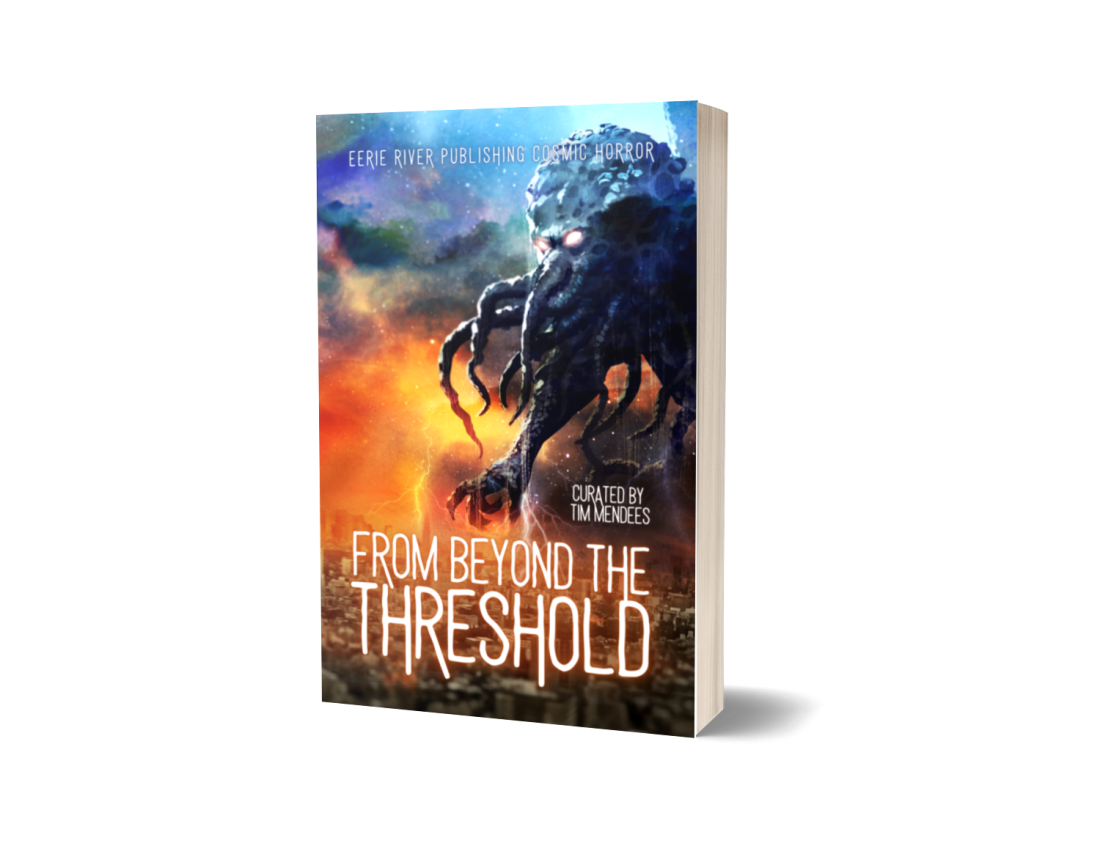
In “The Things We Did in the Dark” (2024) by Julia Darcey, two women are isolated in a special place, to service the needs of an unseen god in the dark. In that story, their position is not voluntary. They are there as a punishment, and ultimately as a sacrifice, valued only for their bodies and the work they can do. Georgia Cook’s “The Well” in the 2023 cosmic horror anthology From Beyond the Threshold by Eerie River Publishing, the situation is almost the mirror opposite. Two women, a special place, an unseen god below—but this nameless pair have been called. They are there of their own free will. Cast off everything else to embrace a life of service to the dark.
Cosmic horror, at least as Lovecraft tried to define it in his essay “Supernatural Horror in Literature,” is a kind of inversion of religious awe. It is the dark twin to wonder and glory at the face of the divine, the elucidation and humility that comes from the revelation of cosmic mystery. The sure sense or knowledge that there is something more than this life, with all of its pains and disappointments; something that by its very revelation of existence upends how we think of the world and how it works.
Yet there are those for whom darkness is a part of them. Perhaps it completes them, in a very different way than others are fulfilled by faith. While some Lovecraftian protagonists go mad from the revelation—as the trope goes—others find a kind of acceptance in the new order that the truth reveals.
A very few embrace the revelation. This is part of the discussion in “The Book of Fhtagn” (2021) by Jamie Lackey; the question of why someone would become a cultist in service to an eldritch entity and the trappings of religion that have sprung up about them. The answer in that story is a kind of parallel to this one: having become aware of the dark truth, they do not fight it, reject it, go mad, or simply go through the motions of life under the knowledge that all is pointless. They welcome it. They want to be a part of it.
In the opening to Arthur Machen’s “The White People” (1904), the great Welsh horror writer presents an opening episode on the nature of sorcery and sanctity:
‘Yes, and of the sinners, too. I think you are falling into the very general error of confining the spiritual world to the supremely good; but the supremely wicked, necessarily, have their portion in it. The merely carnal, sensual man can no more be a great sinner than he can be a great saint. Most of us are just indifferent, mixed-up creatures; we muddle through the world without realizing the meaning and the inner sense of things, and, consequently, our wickedness and our goodness are alike second-rate, unimportant.’
‘And you think the great sinner, then, will be an ascetic, as well as the great saint?’
‘Great people of all kinds forsake the imperfect copies and go to the perfect originals. I have no doubt but that many of the very highest among the saints have never done a “good action” (using the words in their ordinary sense). And, on the other hand, there have been those who have sounded the very depths of sin, who all their lives have never done an “ill deed.”‘
In a Machenian sense, the women of “The Things We Did In The Dark” are not sinners, and those in “The Well” are. Not because the women on that windswept island with the well are having murderous orgies in the swamp like Lovecraft’s Cthulhu cultists, but because they are working in their slow and deliberate way, to serve an end. They’ve turned their back on the human race…and though they harm no one directly, in their service they have tossed away everything they once knew and loved.
“…I’m not afraid,” she whispers.
“Of course you ain’t,” the old woman snaps. “S’not right to be afraid.” —Georgia Cook, “The Well” in From Beyond the Threshold(2023) 68
There is a parallel in both stories to cloistered nuns; and nunneries were sometimes used as prisons to dispose of unwanted daughters and those who fell out of accepted society. Yet in “The Well,” the Keepers have walked willingly into their prison. There are no walls, nothing to prevent them from escaping that we can see. No rules and no enforcers.
They’re there because they want to be there.
That’s a bit marvelous and horrific. The acceptance of the darkness within. The recognition of something greater than themselves. Women who have pushed through pain and loss and out the other side, and found a place and purpose there, in the chaos beyond their old lives and every human attachment that held them there.
 Deep Cuts in a Lovecraftian Vein