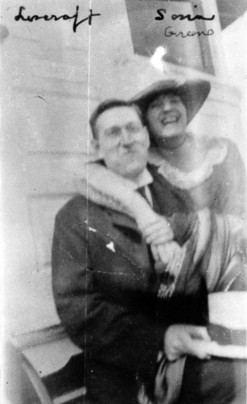
The Rainbow Vol. I, No. 1 (Oct. 1921) & Vol. II, No. 2 (May 1922) by Sonia H. Greene (ed.)

Also, she hath told him that I am egotistical from reading Nietzsche—which disturbeth me not in the least. Anybody can call me anything he damn pleases if he will give fifty sinkers to the organ fund & issue a United paper as good as the RAINBOW promises to be! […] By the way—I have just returned proofs of my RAINBOW article, which is a melange of cynical aphorisms culled from two letters of mine. Whoever was the printer knoweth his business, for errors were monstrous few. The R. will evidently be quite some paper—pictures ‘n’ everything. Surely Mrs. G is the find of the present year amateurically, & I regret very much the recent indisposition to which you refer.
—H. P. Lovecraft to Rheinhart Kleiner, 30 Aug 1921, Letters to Rheinhart Kleiner & Others 187

In July 1921, Sonia H. Greene met H. P. Lovecraft at the National Amateur Press Association convention in Boston. The meeting led to an extended correspondence, and eventually their marriage in 1924. Yet before they married, Sonia worked hard on a new project: an amateur journal of her own. Many amateurs issued their own journals, forerunners of the ‘zine culture of today, put together with love, enthusiasm, and and often rather modest equipment. H. P. Lovecraft had issued his own amateur journal, The Conservative (1915-1919, 1923), and he suppiled both content for the two issues, but also proofreading and (perhaps) editorial assistance.

Finally #598 was reached, & the visitor was introduced to the present regent of these domains—my elder aunt. Both seemed delighted with each other, & my aunt has ever been eloquent in her praise of Mme. G., whose ideas, speech, manner, aspect, & even attire impressed her with the greatest of favourableness. In truth, this visit has materially heightened my aunt’s respect for amateurdom—an institution whose extreme democracy & occasional heterogeneity have at times made it necessary for me to apologise for it. During the session at #598, Rainbow proofs were the main topic. I read most of them, denatured a sketch which some might have taken as a caricature on myself, & set aside for revision a piece of verse entitled “Mors Omnibus Communis”. I am told that you advised the inclusion of this piece in the R. If so, why the hell didn’t you correct it? It could not stand as it was. The R. will be quite some paper—believe Grandpa! Since the visit I have let Mme. G. have Loveman’s “Triumph in Eternity”, which will lend a finishing touch of exquisite classicism. It is one of the most splendid poems amateurdom has ever produced. At length the meeting adjourned, & Mme. G. generously invited both my aunt & myself to dinner at the Crown. Having had a noon meal, (we eat but twice daily) we were not ready for another; so my aunt had to decline, whilst I went along & consumed only a cup of coffee & portion of chocolate ice-cream.
—H. P. Lovecraft to Rheinhart Kleiner, 21 Sep 1921, Letters to Rheinhart Kleiner & Others 190

Sonia H. Greene was not an amateur printer with a handpress; she had the amateur magazine typeset and printed professionally, including with photographs, on good paper. This makes those two issues some of the handsomest amateur journals of the period. There is no indication of the number of copies of each issue, but given the size of each issue (the first issue was 14 pages, the second issue 20), even a modest run of 50 copies, complete with proofs, would have been a considerable outlay of cash, and the printrun may well have been higher.

Beyond a doubt, the leading amateur publication of the season is Mrs. Sonia H. Greene’s resplendent October Rainbow. The editor is anxious to have this magazine reach every member of the United, and hopes that all who have been accidentally overlooked will notify her at 259 Parkside Ave., Brooklyn, N.Y., that the omission may be repaired.
—“News Notes,” United Amateur 21, No. 1 (Sep 1921), Collected Essays 1.299

In 1921, Lovecraft was the Official Editor for his faction of the United Amateur Press Association of America; an election dispute in the organization some years before had split the membership, and Lovecraft assumed a leadership role. It is no doubt Lovecraft’s personal influence that convinced Sonia H. Greene to join the UAPA, and to issue The Rainbow to both the United and National members. How much more influence Lovecraft had on the production of The Rainbow is a matter of conjecture.

The Rainbow (October 1921), Vol. I, No. 1

How many struggling mortals languish and pine for want of an adequate outlet for self-expression! Thousands find it a prime necessity to give vent to their thoughts on paper—thousands who think deeply and feel strongly, yet who through diffidenceor hesitancy tend to be inarticulate regarding their half-conscious aesthetic and intellectual longings. Such persons, knowing how prone are ones near and dear to misunderstand, must either speak through the medium of writing or remain mute, lonely and repressed.
—Sonia H. Greene, “Amateurdom and the Editor,” The Rainbow (vol. 1, no. 1) 3

Thus does Sonia open her first amateur journal. The contents include “Ode to Florence” by Sonia H. Greene (poem; Florence Carol Greene being her daughter), “Nietzsche as a Practical Prophet” by Alfred Galpin (essay), “Philosophia” by Sonia H. Greene (essay), “How I Would Like To Be Entertained At The Next National Convention” by James F. Morton (poem), “More Omnibus Communis” by Sonia H. Greene (poem), “Nietscheism and Realism” by H. P. Lovecraft (essay), “Idle Idylls” by Sonia H. Greene (essay), “To—” by Rheinhart Kleiner (poem), “A Triumph in Eternity” by Samuel Loveman (poem), two letters from Sonia H. Greene, and “Oh, If The Gods” by Rheinhart Kleiner (poem).

The most notable thing about his issue is that the editing and writing of the editorials show little to no influence from Lovecraft, though he likely helped procure some of the contents. Galpin, Kleiner, Morton, and Loveman were all mutual friends of the two, and one of the letters is to their amateur friend Edith Miniter with praise for her novel Out Naputski Neighbors (1916). Lovecraft’s essay “Nietscheism and Realism” was stitched together from two letters to Sonia on the subject of Nietzsche, which subject she had been arguing through correspondence with both Lovecraft and Galpin.

I have just read proofs of my RAINBOW article, which consists of some cynical aphorisms culled from two letters of mine. I fear this stuff will shock friend Mocrates—but it may help prepare him for the fuller shock of my “Confession of Unfaith” in Campbell’s next LIBERAL.
—H. P. Lovecraft to the Gallomo, 31 Aug 1921, Letters to Alfred Galpin 104

There is still the air of the amateur to the production; not in the formatting or the editing, but the content. Sonia’s material doesn’t exactly dominate the issue thanks to the meaty essays by Lovecraft and Galpin, but her own essays are relatively weak and unfocused by comparison. Given the placement and source of Lovecraft and Galpin’s essays, I suspect that “Philosophia” is borrowed from one of her letters to Galpin or Lovecraft, addressing a similar subject but in a very informal way; her strongest passage being:

When the intellectually and phsyically strong will learn how to rule wisely and humanely, and the weak will recognize the limits of their natural ability; when the strong will properly compensate the weak for their efforts, giving them the chance to develop according to their lights; when property and the accumulation of superfluous wealth and dominant power shell not be placed above human comfort and life—then may civilization rise to altitudes not yet achieved in the history of man. There must be neither “master nor slave,” but “leader and led.” Then, and then only, may there be a justifiable hope for the advent of the superman.
—Sonia H. Greene, “Philosphia,” The Rainbow (vol. 1, no. 1) 7

H. P. Lovecraft made a great deal about The Rainbow in the pages of amateur journals; aside from The United Amateur, he also penned Rainbow called Best First Issue” in the National Amateur 44, No. 4 (Mar 1922), CE 1.310-312, and he wrote about it in letters to friends:

You have probably seen Mrs. G.’s paper—The Rainbow—ere this, and may judge her general amateur interest by it. After her amazing pledge to the O.O. Fund I do not know how tactful it would be to suggest recruiting funds immediately; but after a duly decorous interval I fancy the matter might well be broached. You might drop her a line of welcome, her address being 259 Parkside Ave., Brooklyn, N.Y. Mrs. G. is an agnostic & anti-religionist, as you may observe in the Rainbow; but is too Russian & emotional to share the biting cynicism of Galpin & myself.
—H. P. Lovecraft to Anne Tillery Renshaw, 3 Oct 1921, Letters to Elizabeth Toldridge 367

The issue, already fairly long by amateur standards, might have been longer still, but at least one item was apparently left out of The Rainbow:

I have sent to Arkham House snapshots of HPL’s aunts, some postcards, a story revised by HP. and a fictitious story I wrote about HP a few months after I met him, but at his request I did not publish it in the Rainbow because, as he told it, it was too obviously a description of himself.
—Sonia Davis to Winfield Townley Scott, 11 Dec 1948, MSS. John Hay Library

By inference, this would be “Four O’Clock” (1949) by Sonia H. Greene.

It must not have been too long after the successful mailing of the first issue that plans came underway for a second.

The Rainbow (May 1922), Vol. II, No. 2

Without a doubt the greatest publishing event of the season is the second number of Mrs. Sonia H. Greene’s magnificent Rainbow. It is difficult to imagine either mechanical lavishness or excellence of contents carried to a greater extreme, and the United may well be proud of having such an exponent. The editorial tone is a stimulating one, forming an influence in just the proper direction at this trying juncture of amateur history. A special word is due the excellent portraits of eminent amateurs, among which is the first likeness of our poet-laureate, Mrs. S. Lilian McMullen (Lillian Middleton) ever published in Amatuer Journalism. Amateurs failing to receive The Rainbow are urged to notify the editor at 259 Parkside Ave., Booklyn, N.Y.
—”News Notes,” United Amateur 21, No. 5 (May 1922), Collected Essays 1.317

The second (and ultimately final) issue of The Rainbow was even larger and more lavish than the first. It begins with three extensive editorial essays: “Amateurdom and the Editor,” “Recruiting,” and “Opinion” (all unsigned); followed by “Commercialism—The Curse of Art” (essay), “Amatory Aphorisms” (prose), “A Game of Chess” (essay), and “Heins versus Houtain” (essay), all by Sonia H. Greene; “I Wonder” (poem) and “Keep Smiling” (poem), by B. C. Brightrall, “My Yesterdays” (poem) by W. C. Brightrall, “The Distant Forest” (poem) by Betty Jane Kendall, “Certain Ideals” (essay) by Edith Miniter, “Behind the Swinging Door” (poem) by Lilian Middleton, “Celephais” (short story) by H. P. Lovecraft, “Misconceptions of Art” (essay) by James F. Morton, “A Letter to G— K—” (poem) by Samuel Loveman, “Through the Eyes of the Poet” (essay) by Maurice W. Moe, “Frank Harris” (essay) by Alfred Galpin, “Amatuerdom of the Editor” (essay) by “The Editor.”

There are new names: Maurice W. Moe was a friend of Lovecraft, Lillian Middleton was a well-known amateur poet, W. C. or B. C. Brightall was probably William Clemens Brightall, an amateur poet and traveling salesman who would publisha book of poetry titled Tip o’ The Tongue (1925), and Betty Jane Kendall, only nine years old, was the daughter of former NAPA president Frank Austin Kendall, and her mother Jennie Kendall Plaisier was still active in amateurdom as well. Lovecraft fans will note the first publication of Lovecraft’s story “Celephrais,” and Loveman’s poem “A Letter to G— K—” is a reference to bookseller George Kirk, a mutual friend of Lovecraft and Loveman who would go on to be one of the founding members of the Kalem Club during Lovecraft’s New York adventure.

Some readers might wonder if Lovecraft had a heavier hand in the editing of this issue, at least in touching up some of the four unsigned editorial pieces. It’s hard to tell, especially since there is very little in Lovecraft’s letters on the creation of this issue, his only comment being:

I am grateful to Mrs. Greene for her editorial in support of my literary policies, as indeed for many instances of a courtesy & generosity seldom found in this degenerate aera. You may be assur’d that I shall not diminish the frequency of the epistles I send her, tho’ I am of opinion that S. Loveman & my grandchild Alfredus deserve much of the credit for her retention in the United. I regret that she hath suffer’d indignites from Mrs. Houtain; whose cast of mind, I suspect, is not exempt from the petty cruelty & fondness for gossip which blemish the humours of the most commonplace females.
—H. P. Lovecraft to Rheinhart Kleiner, 25 Jan 1922, Letters to Rheinhart Kleiner & Others 194

The former is a reference to the lead editorial “Amateurdom and the Editor,” which reads like some of Lovecraft’s unsigned editorials in other amateur journals—and it is written in the third person, whereas Sonia’s more personable editorial “Amateurdom of the Editor” is written in the first person. While it is impossible to tell, without some surviving manuscript or letter, I would not be surprised if Lovecraft helped Sonia complete this issue by revising a few of the earlier, unsigned editorials. At the very least, Lovecraft was seeing these editorials, or proofs thereof, months earlier than anyone else if the date on his letter to Kleiner is to be believed.

The later bit regarding “Mrs. Houtain,” is a reference to Sonia’s essay “Heins versus Houtain,” and involves a dispute between NAPA president Elsie Houtain and the teenaged Official Editor John Milton Heins; Sonia had not been in amateur journalism long and was already feeling the effects of some of the politics and personalities that come with any small organization.

Some gauge to response to these two issue of The Rainbow can be had in the memoirs of Lovecraft and Sonia’s mutual amateur friends:

Just previous to his coming to Brooklyn, and no doubt as part of her campaign to impress herself upon Lovecraft, his wife-to-be had issued an elaborate number of an amateur magazine, The Rainbow. It contained half-tone reproductions of Lovecraft’s portrait, together with portraits of his friends and articles or poems from their pens. It was a great success from the amateur journalist’s point-of-view, and I believe it may have been during the early stage of her married life with Lovecraft that she decided to issue another one. Printing costs being then, as now, quite high, I suppose the first issue cost a couple of hundred dollars. The second could not have cost much less. I don’t know what crisis took place in her affairs at this time—she had been holding a well-paid job as “buyer” in an uptown hat shop—but to pay for this issue she made an arrangement with the printer whereby his wife could obtain all the hats she wanted up to the amount of the bill. I am almost certain that Lovecraft was prominently featured in the first Rainbow, but he may have had enough influence to keep himself out of too conspicuous a place in the second. But this mere conjecture.
—Rheinhart Kleiner, “A Memoir of Lovecraft” in Ave Atque Vale 105

But I leave all the fascinating details of that convention to tell of The Rainbow, issued by Sonia Greene in the following October. It was a large and handsome affair, illustrated with half-tone reproductions of photographs of well-known amateurs of the day and containing excellent contributions by many of them. Lovecraft, still in Providence, reviewed it at some length in The National Amateur, for March, 1922. He said, in part, that The Rainbow represented “a genuinely artistic and intelligent attempt to crystallise homogeneously a definite mood as handled by many writers.” He said much more, and it was all highly satisfactory to Mrs. Greene. In fact, the vivacious Brooklyn widow was quite dazed with delight.
—Rheinhart Kleiner, “Discourse on H. P. Lovecraft” in Ave Atque Vale 194

Some time in the school year 1921-1922 I received a brief visit at Madison from Sonia Greene, later Mrs. Lovecraft. She had recently joined the United Amatuer Press Association, met Howard, and presented ponderous essays by Howard and me in her amateur publication, The Rainbow (October, 1921). Howard and I were then both faithful to a vaguely aesthetic sort of Nietzscheism. In her incidenta correspondence with me she found that besides my fondness for Nietzsche I was even fonder of Dostoievski, and it was this discovery (the Russians were not so generally in style in those days) that imprelled her to meet me in person.
—Alfred Galpin, “Memories of a Friendship” in Ave Atque Vale 203

Kleiner’s recollection of the arrangement with the printer may be confused with a later affair; when in 1928 she had her own hat shop for a time (cf. Letters to Family and Family Friends 2.628-629), but the admiration of both those amateurs even decades later was real.

So why were there only two issues? No doubt cost was a major factor, and perhaps time. Publishing an amateur journal is a largely thankless task, and Sonia’s final editorial speaks of her burning the metaphorical midnight oil to write and edit; perhaps business and her personal life made putting together and issuing a third issue untenable. Even Lovecraft had gaps in the publication of his much more modest journal The Conservative, which he finally revived for a few issues in 1923.

The Rainbow (Vol. I, No. 1) has historically been the most accessible of the two issues because in 1977 Marc Michaud of the Necronomicon Press issued a facsimile reproduction in an edition of 550 copies, and this facsimile edition is still widely available at reasonable prices, for those interested in this early piece of Lovecraftiana, and to read Lovecraft’s essay in something close to it’s original context, as part of a conversation with Sonia.

The Rainbow (Vol. II, No. 2) has never been reprinted. However, as it is in the public domain a digital copy of the issue is now available for free on the Internet Archive.


Bobby Derie is the author of Weird Talers: Essays on Robert E. Howard and Others and Sex and the Cthulhu Mythos.

Deep Cuts in a Lovecraftian Vein uses Amazon Associate links. As an Amazon Associate I earn from qualifying purchases.
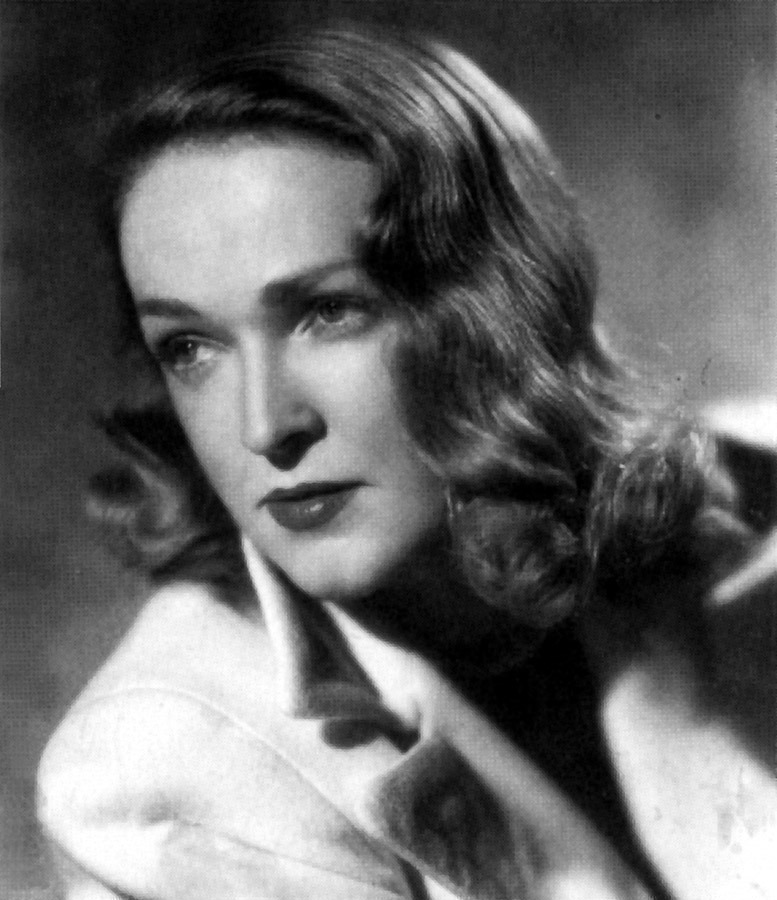
“The Dunwich Horror” (1945) by Silvia Richards & H. P. Lovecraft

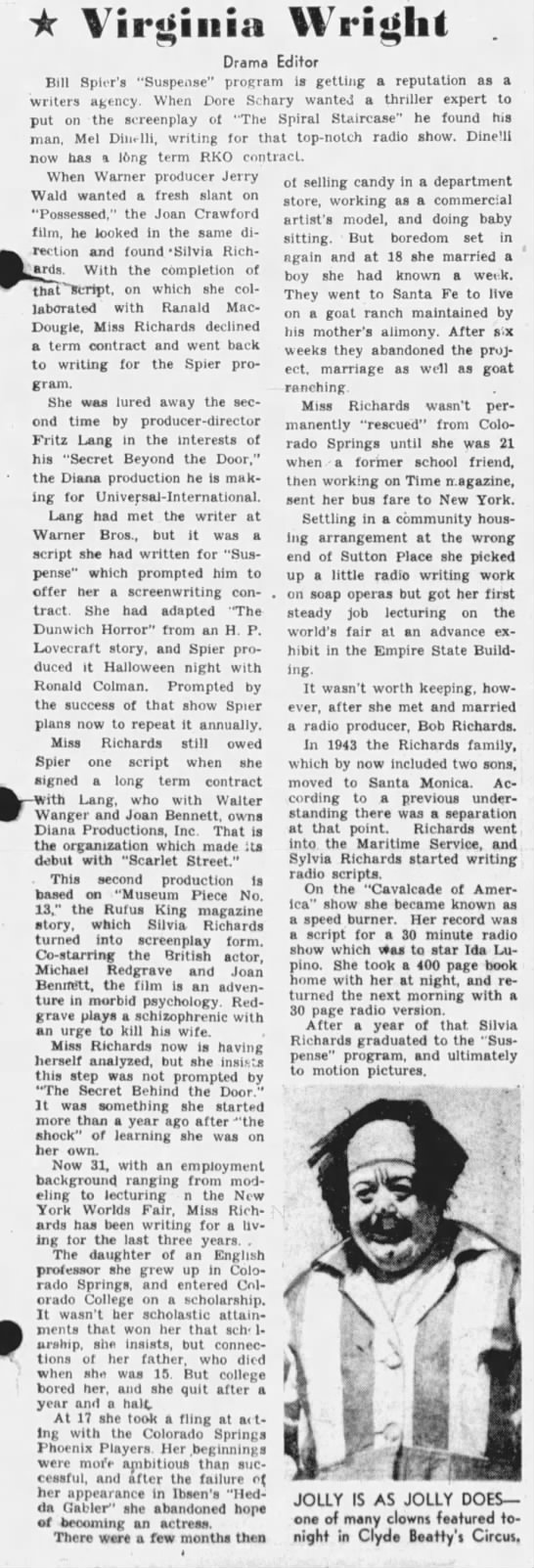
Clown Warning

The newspaper clipping below includes a terrifying picture of Jolly the clown. Reader discretion advised.


Silvia Richards

“The Dunwich Horror” by H. P. Lovecraft was first published in Weird Tales (Apr 1929). It was not republished until a decade later, when Arkham House brought out the first collection of Lovecraft’s fiction, The Outsider and Others (1939). Despite wartime paper shortages, the story was reprinted in the omnibus Great Tales of Terror and the Supernatural (1944). The following year, “The Dunwich Horror” lent its name to a paperback edition The Dunwich Horror (1945, Bath House), an armed services edition The Dunwich Horror and Other Weird Stories (1945). On Hallowe’en night (although many newspapers list it as playing on 1 November), a radio adaptation of “The Dunwich Horror,” written by Silvia Richards, was performed by Ronald Colman.

The show was called Suspense and began broadcasting in 1940, lasting until 1962. It did not originally feature stories involving science fiction or the supernatural, but increasingly featured more and more such adaptations during its run.

Silvia Richards’ screenplay makes many necessary adaptations for a radio drama. It begins like Orson Welles’ infamous 1938 broadcast of H. G. Wells’ The War of the Worlds, as a mock news-broadcast, but the asides for vividly audio-acted scenes and music make it much more of a dramatization. Dr. Henry Armitage narrates the entire story, as though reporting in live from Dunwich (here pronounced correctled as Dunnich). Richards retains all the essential plot points of Lovecraft’s story and several key passages, although much of his language is lost in abridgement and change in presentation. Notably, she retains most if not all of the audio cues—animal noises and suchlike—which the story contains, which translate well into the new medium.

As a production, the radioplay is interesting for the effort to reproduce the accents, the sounds of whipporwills, the pronounciation of the odd names. As a screenplay, there’s a rather admirable skill in boiling Lovecraft’s narrative (all ~17,500 words of it) down to something that could play in less than twenty-four minutes (a half-hour timeslot has to leave room for commercials); her abridgement was probably about 6,000 words (24 pages) total. An interesting addition was the source for an “alternate formula”: Falconer’s Mystical Formulae of the Middle Ages. Whether Silvia Richards was aware of it or not, this would be one of, if not the, first Mythos tome invented by a woman author.

Lovecraft’s friends, Clifford M. & Muriel E. Eddy, heard the broadcast and commented on it:

Hearing Lovecraft’s ‘Dunwich Horror‘ dramatized on the radion program….”Suspense”……….with the movie star..Ronald Colman….as the narrator…..gave your friends, the Clifford Eddys of Pearl street, a real thrill. I hope you, too, heard it…though I cannot say I cared much for the “Orson Welles” type of presentation…..trying to put the idea across that the thing was really happening right then, was silly. It made a burlesque out of that which I had considered a truly fine horror yarn. Lovecraft himself read that yarn aloud to us…..when it was still in manuscript form…and the way he read it made chills REALLY creep up and down our spines. It was a Hallowe’en yarn….but I think most listeners failed to get the real significance.
—Muriel K. Eddy to Winfield Townley Scott, 2 Nov 1945, MSS. Brown Digital Repository

Silvia Richards continued to work in Hollywood as a script writer for radio, film, and television; the article above from the Los Angeles Daily News for 1 Apr 1947 is the most I’ve found about her life in her own words. A former Communist, she was later called to testify before the House Committee on Un-American Activities, and her collaboration (in part to protect her two young sons) included testifying against her ex-husband Robert L. Richards. She is not known to have done any further adaptations of Lovecraftian material, but her radioplay stands as an early, fairly faithful adaptation of Lovecraft’s material to a new medium.

You can listen to Silvia Richards’ 1945 adaptation of “The Dunwich Horror” for Suspense for free online here.


Bobby Derie is the author of Weird Talers: Essays on Robert E. Howard and Others and Sex and the Cthulhu Mythos.

Deep Cuts in a Lovecraftian Vein uses Amazon Associate links. As an Amazon Associate I earn from qualifying purchases.

“The Book of Fhtagn” (2021) by Jamie Lackey

I’d thought that changing the ghost to a scion of the Elder Gods made the play more relatable, and that changing Rosencrantz and Guildenstern into mad cultists had added a bit of reality. But maybe that was just me.
—Jamie Lackey, “The Book of Fhtagn”

It’s not just her. Lovecraft may not have literally rewritten Shakespeare to dd in elements of his own Mythos, but he did have an interpretation of the Bard’s most famous depiction of madness which dovetails nicely with Lackey’s philosophical approach to Innsmouth in “The Book of Fhtagn”:

Continuing in the dramatick line, but ascending the scale several degrees, I find “Hamlet” a most absorbing character, even as you do. It is hard for me to give an original estimate or opinion, since other commentators’ opinions are so abundant; but I find in Hamlet a rare, delicate, & nearly poetical mind, filled with the highest ideals and pervaded by the delusion (common to all gentle & retired characters unless their temperament be scientific & predominantly rational—which is seldom the case with poets) that all humanity approximates such a standard as he conceives. All at once, however, man’s inherent baseness becomes apparent to him under the most soul-trying circumstances; exhibiting itself not in the remote world, but in the person of his mother & his uncle, in such a manner as to convince him most suddenly & most vitally that there is no good in humanity. Well may he question life, when the perfidiousness of those whom he has reason to believe the best of mortals, is so cruelly obtruded on his notice. Having had his theories of life founded on mediaeval and pragmatical conceptions, he now loses that subtle something which impels persons to go on in the ordinary currents; specifically, he loses the conviction that the usual motives & pursuits of life are more than empty illusions or trifles. Now this is not “madness“—I am sick of hearing fools & superficial criticks prate about “Hamlet’s madness”. It is really a distressing glimpse of absolute truth. But in effect, it approximates mental derangement. Reason is unimpaired, but Hamlet no longer sees any occasion for its use. He perceives the objects & events about him, & their relation to each other & to himself, as clearly as before; but his new estimate of their importance, and his lack of any aim or desire to pursue an ordinary course amongst them, impart to his point of view such a contemptuous, ironical singularity that he may well be thought a madman by mistake. He sums up this position himself when he says:

“How weary, stale, flat, & unprofitable
Seem to me all the uses of this world
Fie on’t! ah, Fie! ’tis an unweeded garden
That grows to seed. Things rank & gross in Nature
Possess it merely.”

—H. P. Lovecraft to Alfred Galpin, 14 Nov 1918, Letters to Alfred Galpin & Others 219-220
Quoting Shakespeare’s Hamlet, Act I, Scene 2.

There is a kind of depth in the philosophy of the Lovecraft Mythos which is rarely explored in fiction. Scott R. Jones went into it in When The Stars Are Right: Toward An Authentic R’lyehian Spiritualityand Randolph Partain in Lessons From An Indifferent Cosmos: How Cthulhu Can Help You Be A Better Human. Few look beyond the self-blinded earthgazers who see Cthulhu as an evil that must be vanquished, or Innsmouth as a place of horror that has to be escaped rather than a place of dark beauty to be explored and appreciated.

Which is exactly the choice that Jamie Lackey presents in “The Book of Fhtagn.”

The closest works of comparison are probably Innsmouth (2019) by Megan James and “Down into Silence” (2018) by Storm Constantine. With “The Book of Fhtagn,” they present an Innsmouth not as it was, but as it is or might be. A contemporary Innsmouth where the Mythos coexists with smartphones and pumpkin spice, high school plays and global warming. Where James and Constantine play up the domestic and tourist angles, however, Lackey leans into the darker aspect of things: what if it’s not just about being born in Innsmouth, or visiting it? What if there’s a choice involved in becoming a full member of the community? Personal sacrifices to be made? Which begs deep questions about Lovecraft’s philosophy, of going through the motions of daily life when we are all just temporary, meaningless things on a cosmic scale of time.

And, for a teenager in high school, what the heck to do with the rest of their life.

I had gone into the ocean, and a part of me would now live there forever.
—Jamie Lackey, “The Book of Fhtagn”

Like Lovecraft’s Hamlet, Lackey’s Kimberely gets her glimpse of absolute truth—and finds in that contemplation of how small and pointless the mundanity of life is, a certain freedom of detachment from everyday things—and in time she finds the courage to embrace her new purpose.

Jamie Lackey’s “The Book of Fhtagn” is published in the Fall 2021 issue of Starward Shadows Quarterly.


Bobby Derie is the author of Weird Talers: Essays on Robert E. Howard and Others and Sex and the Cthulhu Mythos.

Deep Cuts in a Lovecraftian Vein uses Amazon Associate links. As an Amazon Associate I earn from qualifying purchases.
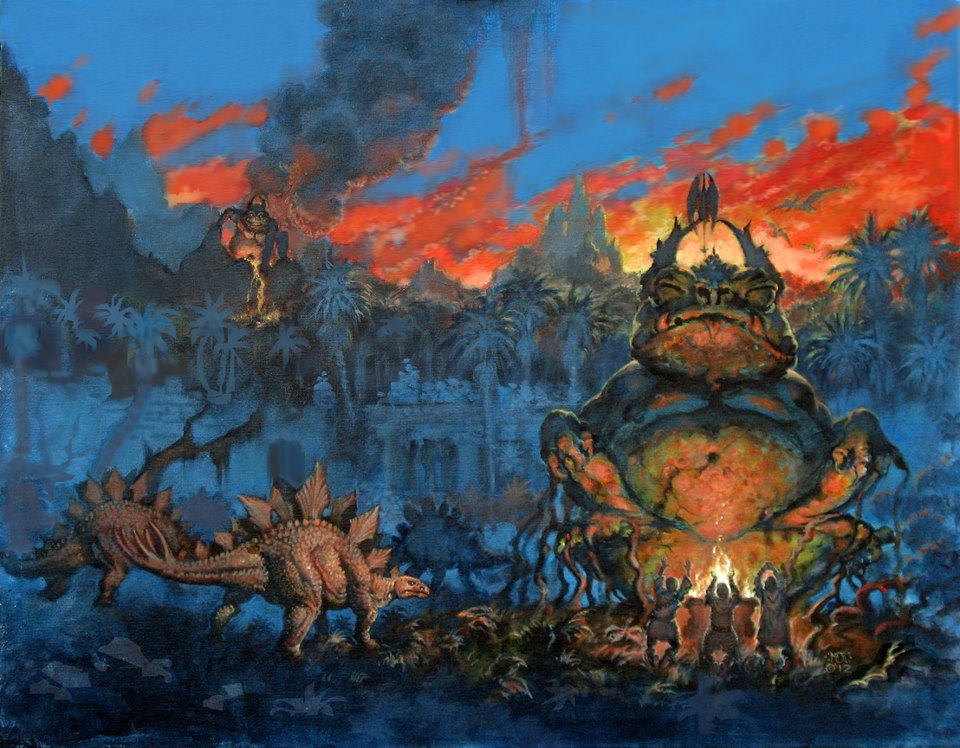
“Zolamin and the Mad God” (2013) by Lisa Morton

“You can best me at dice, girl, but let’s see how well you do in my bed.”

She’d grinned, but Amarkosa had shouted from the bar, “You, sir, would be well advised to release her arm while you’ve still got one of your own.” The spectators had all guffawed, but the barbarian had flushed and yanked Zolamin close. “I think I can handle this—”

When she broke the bottle of ale over his head, he was only stunned—but when he found the jagged bottleneck pressed to his throat, he’d sobered up quickly. “You can leave like a good boy,” Zolamin told him, “or you can leave like a dead man. Your choice.”
—Lisa Morton, “Zolamin and the Mad God” in Deepest, Darkest Eden: New Tales of Hyberborea (2013) 111

Pedants can argue whether or not Clark Ashton Smith’s stories of Hyperborea count as sword & sorcery; stories like “The Seven Geases” are replete with sorcery, but little swordplay. As with his contemporaries like Robert E. Howard, C. L. Moore, E. R. Eddision, Lord Dunsany, Poul Anderson, J. R. R. Tolkien, Smith took inspiration from Orientalist fiction such as the 1,001 Nights and epic tales such as the Prose Eddas. Their settings of Pegāna and Elf-land, Witchland and Demonland, Middle Earth, the Hyborian and Thurian Ages, Hyperborea and Poiseidonis are exotic fantasy-lands, filled with thieves, warriors, wizards, and monsters. Each of them added to a growing fantasy milieu which blossomed in roleplaying games like Dungeons & Dragons, and inspired the huge resurgence in fantasy settings which continues today.

What differed for each writer was the approach. Howard’s tales of Conan the Cimmerian, Kull of Atlantis, and and Solomon Kane are action-packed, bloody, dark, with a gritty, hardboiled American sensibility. Clark Ashton Smith’s stories such as “The Weird of Avoosl Wuthoqquan” and “The Black Abbot of Puthuum” are more sardonic, less focused on bloodshed, giving more detail to the descriptions of gems and cruelty, to sorcery and horror. If Howard’s tales are heroic fantasy, driven by protagonists that live by their swords and their wits, Smith is closer to dark fantasy, with few heroes to triumph, where many of the main characters are undone by their own hubris and unbridled desires.

Lisa Morton’s Zolamin shares a literary lineage with Howard’s Valeria (“Red Nails”) and Bêlit (“The Queen of the Black Coast”) and Moore’s Jirel of Joiry, in that she is a woman warrior and mercenary; but the setting of the story and the overall tone is definitely Clark Ashton Smith’s Hyperborea…though a little more explicit than Smith could ever publish:

She remembered her mother, forced into a life of prostitution after her parents had traded her at the age of ten for a pair of oxen. Zolamin’s mother had borne her while still a teen; her father could have been any of dozens of men. Determined that her daughter would not follow in her footsteps, mother had done her best to disguise the child’s gender and raised her as a boy […]
—Lisa Morton, “Zolamin and the Mad God” in Deepest, Darkest Eden 114

Zolamin’s backstory is essential to her character for this story, because the Mad God plays on her ambitions, small and different as they are. Her character drives the story, and if it is not quite hardboiled fantasy in the vein of Dashiell Hammet’s Red Harvest with swords, it is still a respectable entry in a fairly small body of work: stories set in the worlds of Clark Ashton Smith, and striving to capture some of the mood of his tales rather than pastiche the way he wrote them. Like “Hode of the High Place” (1984) by Jessica Amanda Salmonson, it isn’t sword-skill which determines the course of the story as much as choices made which are a bit darker and more psychologically driven. There are scenes of action but they are often anti-climactic, interrupted by the visions of the Mad God, and that in itself is part of why the story works, because Zolamin has to decide how to handle the messy affair she has stumbled into…and unlike Conan and the Tower of the Elephant, there is no mercy to be dealt out here.

“Zolamin and the Mad God” was published in Deepest, Darkest Eden: New Tales of Hyberborea (2013). It has not yet been reprinted.


Bobby Derie is the author of Weird Talers: Essays on Robert E. Howard and Others and Sex and the Cthulhu Mythos.

Deep Cuts in a Lovecraftian Vein uses Amazon Associate links. As an Amazon Associate I earn from qualifying purchases.
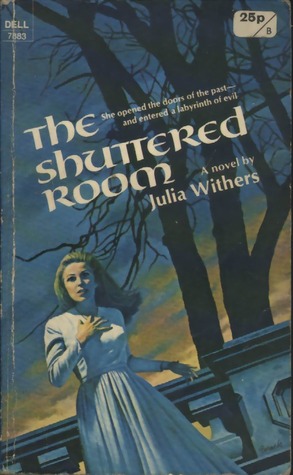
The Shuttered Room (1966) by Julia Withers

Incidentally, I’ve just sold Heritage Productions THE SHUTTERED ROOM. No doubt they’ll flesh out the “romance” between Dunwich boy and Innsmouth girl to give it “body” and we’ll have a shilling shocker out of it, but I couldn’t care less, really….
—August Derleth to Ramsey Campbell, 6 Feb 1964, Letters to Arkham 170

“The Shuttered Room,” the title story for the collection The Shuttered Room and Other Pieces (1959), is arguably Derleth’s greatest work of fanfiction. While originally billed as one of Derleth’s “posthumous collaborations,” and Derleth had claimed to base it on unspecified notes by Lovecraft. In one letter, Derleth described it as:

[…] wedding of the Innsmouth and Dunwich themes, as manifestly HPL intended to do, judging by his scant notes.
—August Derleth to Felix Stefanile, August 11, 1958, MSS. Wisconsin Historical Society

Whether or not these notes actually existed is open to speculation; no surviving letters suggests Lovecraft had any intention to unite the two themes. Nevertheless, in 1958 Derleth sat down to write the story (A Look Behind the Derleth Mythos 215, 231). The result is not his best Mythos story, or even his best pastiche, but probably the best fanfiction story that Derleth would ever write, a literal union of the Whateley and Marsh family trees from “The Dunwich Horror” and “The Shadow over Innsmouth,” paying detailed homage to both.

In the 1960s, August Derleth and Arkham House began to have some success in selling the film rights to various Lovecraft & related properties, resulting in five films:

Despite the fact that every film except The Shuttered Room was distributed by American International Productions, this wasn’t an early effort at a cinematic universe or franchise along the lines of the Universal monsters. While a couple of the films shared a few elements such as the Necronomicon, each was produced separately and without any direct tie-ins to the others in the form of characters, sets, props, or storylines.

The films all received different marketing promotions and led to the creation of associate media: Die, Monster, Die! got a comic book adaptation and there was an Italian fotonovela created for Curse of the Crimson Altar, for example. In 1966, released before the film came out, The Shuttered Room received a film novelization—as a kind of Gothic romance.

The novel was written by “Julia Withers,” a pseudonym used by prolific novelist and ghostwriter Jerrold Mundis who had worked on several different screenplay novelizations in the late 1960s. It’s difficult to tell how successful the slim paperback (only 156 pages) was. It is even more difficult to tell if Mundis ever bothered to read Derleth’s original story. Probably not; there is little enough let of Derleth’s original story in the screenplay by D. B. Ledrov and Nathaniel Tanchuck. Much of the best writing in the short story is in the descriptive passages that Derleth wrote so well, and the best part of the film is the cinematography; the novel lacks both.

The Shuttered Room (novel) is a very barebones kind of contemporary thriller dressed up (at least in terms of the cover) as a kind of Gothic romance, where family secrets, an old building, and a family curse threaten a nice young couple. There is no Mythos content beyond the name of Dunwich itself—here an isolated island rather than a town. Even “Whateley” is rendered as “Whately,” and there is no reference to Innsmouth at all. What Mundis does add above and beyond what is in the film is a touch of the grotesque, some backstory that either never made it to the final film or was cut out, and one important thing…

There, squatting in the midst of the tumbled bedding from that long-abandoned bed, sat a monstrous, leathery-skinned creature that was neither frog nor man, one gorged with food, with blood still slavery from its batrachian jaws and upon its webbed fingers—a monstrous entity that had strong, powerfully long arms, grown from its bestial body like those of a frog, and tapering off into a man’s hands, save for the webbing between the fingers…
—August Derleth, “The Shuttered Room” in The Watchers Out of Time 158

Something vaguely resembling a woman crouched in that doorway. Its hair was long and matted and tangled. A tattered filthy garment hung from its twisted body. Its eyes were large and bulbous. Its nose was non-existent, only two gaping holes. A slit with jagged teeth served for a mouth. It’s skin was leathery and cracked—scale-like, actually—and it glistened with moisture.
—Julia Withers (Jerrod Mundis), The Shuttered Room 149

Imagine trying to describe a Deep One/Whateley hybrid, in a setting which has already expunged every reference to Innsmouth and to an audience that has no familiarity with “The Dunwich Horror.” The solution in Mundis’ The Shuttered Room was to describe the nameless Whately child as a monstrous freak: “stillborn…or it should have been…but it lived.”

“Ontogeny recapitulates phylogeny,” as Lovecraft would put it. The idea was that living things re-experience the stages of evolution as they grow; so that human embryos have gills…tails…which are lost as they develop. The idea that an embryo might get “stuck” at a certain stage and yet successfully be born and grow to adulthood is not unique to The Shuttered Room novel. In fact, it is strongly reminiscent of the 1953 horror film The Maze—and one has to wonder if Derleth might not have taken a bit of inspiration from this film too. Some years after Derleth wrote “The Shuttered Room,” Ramsey Campbell mentioned the film to Derleth:

There have been movies with a definite slant toward the conceptions of the Mythos, however […] there was the one starring Richard Carlson titled THE MAZE, which was about the hideous frog-creature which is kept and fed in an ancient castle, and finally turns out to be the first in a line who now live in the castle!
—Ramsey Campbell to August Derleth, 10 Aug 1961, Letters to Arkham 12-13

Did Derleth borrow from The Maze? Did Jerrold Mundis? In such a case as this, where the original work has been so translated, and so changed in the transformation from short story to screenplay to short novel, it’s difficult to say…but the various works stand as distinct iterations of a very odd cadet line of the Mythos.

The film was not so creative. Or perhaps it just wasn’t in the budget. The company forewent any supernatural or preternatural explanation; there was no monster, and almost no explanation. In that sense, at least, the novel is an improvement on the film, or at least a step closer to Derleth’s original story. The idea of a madwoman trapped in the attic is closer to Jane Eyre than Cthulhu; perhaps that’s why the marketing of The Shuttered Room (novel) bears the hallmarks of the Gothic romances of its day, rather than any effort to market it to Lovecraft fans. The novel stands as an example of how truly weird and diffuse Lovecraftian influence can get.


Bobby Derie is the author of Weird Talers: Essays on Robert E. Howard & Others (2019) and Sex and the Cthulhu Mythos (2014).

“Hode of the High Place” (1984) by Jessica Amanda Salmonson

For the first time he recognized that the possession of an object was never as ecstatic as the seeking; the reality never as pleasurable as the dream.
—Jessica Amanda Salmonson, “Hode of the High Place” in The Last Continent 201

There is no pithy word for stories that are inspired by Clark Ashton Smith, that partake of his style and essence, are reminiscent of his darker moods and most erotic intimations. When someone writes a tale that draws inspiration from H. P. Lovecraft, or involves him in some form, we call it “Lovecraftian.” For the Bard of Auburn, we might say “Smithian,” but there are many Smiths. “Klarkash-Tonian” is a bit of a mouthful. Nothing seems to succinctly embrace the whole concept.

It is a rare story where we have need of such a word.

“Hode of the High Place” is not set explicitly in Smith’s Zothique, or any other fantasy world we know. In mood, in device, in tone, it could well be. It fits neatly among the other neo-Zothique tales of The Last Continent: New Tales of Zothique (1999), one of the very few anthologies where authors are encouraged to play in Clark Ashton Smith’s imaginary worlds. Smith himself might well have smiled and recognized this story as a literary descendant, had he lived long enough to read it.

When considering those who follow Smith, there is a tendency toward pastiche, as in “The Vulviflora of Vuutsavek” (2008) by Charlotte Alchemilla Smythe. Salmonson is wise enough to not try and mimic the same tendency for arcane vocabulary, but there are elements of Smith that readers will recognize in the tone, the omniscient third-person perspective which is almost voyeuristic in following the triumphs and tragedies of this story. Then there is the erotic element.

A gelatinous mass flowed over him, oblivious to his thrashing, smothering him as the water had smothered the flames. Then he felt something expected and pleasant: gentle, rhythmic constrictions around his genitals.
—Jessica Amanda Salmonson, “Hode of the High Place” in The Last Continent 197

One of the hallmarks of Smith’s fiction was a fascination with scenes of unnatural carnal pleasures, necrophilia (or perhaps more accurately, a love that extends beyond death), assignations with witches, lamia, and succubi, etc. It isn’t in every work, and it isn’t in any sense explicit by contemporary terms, even his play The Dead Will Cuckold You (1951) is concerned with character and relationships rather than actually describing the actions of genitalia. Some of Smith’s stories which could only be published in expurgated form during his lifetime, such as “Mother of Toads” (Weird Tales Jul 1938), are quaint in terms of actual sexual content, though still potent in terms of image, plot, and suggestion.

This reticence toward explicit sexual description in Smith’s fiction, and his frustration with the standards of his day that censored even that, can be easily understood. Clark Ashton Smith was writing weird fiction of which sex was a part, but not weird erotica or pornography with a weird setting. The point of Smith’s stories was not to sexually excite the reader, not in the way of Victorian erotica like The Way of a Man With A Maid. The erotic element was always intimately tied to the weirdness in some fashion, as with the work of Arthur Machen. Perhaps Smith might have been more explicit if editors and laws had allowed it, but there was no way it could have been published in the 1930s under existing censorship laws.

Contemporary writers don’t operate under the same restrictions. It is much more acceptable these days to be much more explicit about sexual relations. Salmonson could no doubt have gotten away with far more sexual content in this story; other tales are more explicit. Yet this is not a case where the point is to titillate the reader; it is a necessary plot point for the story. Ultimately, I would say that “Hode of the High Place” shows admirable restraint, getting just explicit enough to cross that conceptual line between “suitable for young adults” to “suitable for adult audiences,” but not becoming particularly lurid or distracting from the rest of the story…indeed, the brief sexual scenes are ultimately critical.

It was fashioned in the shape of a bone with a serpent wrapped around, the universal insignia used on jars of poison, pictured on no-trespassing signs to prove the warning adamant, and marked on maps to show where wayfarers had best not go.
—Jessica Amanda Salmonson, “Hode of the High Place” in The Last Continent 206

If “Hode of the High Place” is not set in Zothique itself, it still feels like it could be set beneath a dying sun on a dying world, one last tragedy being acted out with all of its follies and its terrible inevitability.

Jessica Amanda Salmonson’s “Hode of the High Place” was first published in Beyond Lands of Never (1984), the second volume of the fantasy Lands of Never (1983). It was republished in The Last Continent: New Tales of Zothique (1999), and in her collection Dark Tales (2002).


Bobby Derie is the author of Weird Talers: Essays on Robert E. Howard & Others (2019) and Sex and the Cthulhu Mythos (2014).

Shadows of Wings (1930) by Susan Myra Gregory

A poet-friend of mine, Susan Myra Gregory of Monterey, sister of the novelist Jackson Gregory, asked me to write a preface for a little collection of her verse which is being brought out in Southern California. She has a real lyric talent, of the true feminine Sapphic type, and I was glad to do the preface—an odd interlude in the writing of my Antarean novelette.
—Clark Ashton Smith to H. P. Lovecraft, 10 Dec 1929, Dawnward Spire, Lonely Hill 190

Susan Myra Gregory was 46 years old when her small 40-page book of poems was published, with a card cover, by the Troubadour Press in San Diego. She had worked for many years as a teacher of English and journalism at Analy high school and Monterey high school. Gregory provided some of the local color to John Steinbeck, who set novel Tortilla Flat (1935) in Monterey and dedicated it to her. There are few references to her in Smith’s published letters, but it seems likely that, as with many California poets, Susan Myra Gregory may have met Clark Ashton Smith through his mentor George Sterling, or possibly when Smith made one of his trips down from Auburn to Carmel. Her brother Jackson Gregory, an author of popular westerns, whose wife Lotus McGlashan Gregory had bought a few of Clark Ashton Smith’s drawings some years before (The Shadow of the Unattained 200).

Whatever the extent of their relationship, it was obviously enough of a relationship for Smith to gladly write an introduction to her poetry collection.

05

It is easy to see why Smith would enjoy Gregory’s poetry. Poems such as “Tonight,” “Necromancy,” and “Orpheus’ Song to Eurydice” touch on some of his favorite themes, and his introduction struck enough of a chord with one contemporary reviewer to quotes liberally from it. 

if she is more Classical and less cosmic or macabre in her scope than either Sterling or Smith, her poems smack of the fantastic verse which Arkham House would publish in volumes such as Fire and Sleet and Candlelight (1961). “Dream” and “Sleep” might not have been out of place in the pages of Weird Tales, and indeed several of these poems are reprinted from various magazines and journals.

From a strictly commercial standpoint, the book is a bit of a trifle, and has a certain vanity-press air, although it was published as part of a series of ten booklets by modern poets. Classic poems dedicated to Sappho had less cachet to the general public during the interwar years, though no doubt H. P. Lovecraft or Samuel Loveman, both dedicated Classicists, would have appreciated the beauty of lines like:

No, the “lost songs of Sappho” are not lost;
Only ye seek afar for something near.

Though no doubt Lovecraft would have tsk’d at the use of archaic English diction in this instance, Clark Ashton Smith’s edict that “it seems impossible that such poetry as hers will not always have its lovers” is true, or at least it should be. For the sentiments are sweet, the language is soft, and lines such as “Beauty so keen is like a two-edged sword” deserve to be mumbled through the lips of some trenchcoat-clad detective in a Noir film.

Susan Myra Gregory’s poetic career did not end with this book; she had several poems published in Singing Years: The Sonoma County Anthology of Poetry and Prose (1933), but what further contact she had with Clark Ashton Smith is unclear. She died in 1939.

Shadows of Wings has been scanned and is available here.


Bobby Derie is the author of Weird Talers: Essays on Robert E. Howard & Others (2019) and Sex and the Cthulhu Mythos (2014).

Haunted West (2021) by Darker Hue Studios

Here men and women were confronted, in the very recent past, by conditions that had been forgotten east of the Mississippi for centuries. When men began to write of the West, it was to exploit its more lurid aspects for sensational purposes. Hence, rose the “cowboy” tradition, the “Wild West” tradition—an absolutely criminal distortion of the literary growth of the region and traditions that made a vulgar jest out of what should have been one of the most vital and inspiring pageants of American history. What the ignorant and blundering pens of sensational yellow-backed novel writers failed in doing, the pens of sophisticated arm-chair critics completed. Really good writers, with a few exceptions, shied away from the Western tale, lest they be branded with the yellow-backed dime novelist. It seems to me, from what I’ve read and heard, that most people who have never seen the West, are devided [sic] into classes—the class that believes the West swarms with movie-type cowboys and Indians where bullets whiz continually—and the class that lifts the lip in scorn and rejects all the tales of the West as mere drivel. The truth, as of course you realize, not belonging to either of the above mentioned classes, lies about half-way between. Men didnt [sic] go about with guns slung all over them, shooting at the drop of a hat, hanging rustlers to every tree, chasing Indians twenty-three hours of the day, but life was a fierce and hard grind, and murder and sudden death were common. Now thinking people all over America are beginning to realize the truths of the pioneer West, with the resultant boom in good Western literature—which I hope spells the doom of the Wild Bill dime-novel.
—Robert E. Howard to H. P. Lovecraft, c. Feb 1931, A Means to Freedom 1.152

Before the pulp magazine was the dime novel and the nickel weekly; and these early popular media were the crucibles for many of the tropes of pulp fiction: genrefication (western, detective, etc.), series characters (Nick Carter, Deadwood Dick, etc.), catchy titles, fan clubs, etc. It was mass entertainment, cheaply printed, incredibly popular—and spread the legend of the Wild West, which during Lovecraft’s lifetime transitioned into the Old West. The frontier was gone, but it lived on in stories of cowboys, rustling, gunfights, and constant war with Native Americans—and it flourished in the pulps, with hundreds of titles, and made the leap to theater, radio, and finally film. John Wayne’s first leading role was Big Trail (1930), released the same year that Lovecraft and Robert E. Howard began their correspondence.

In the pulp magazines, genre segregation could be strict, but there were exceptions. Occasionally writers would set fantasy, horror, and science fiction stories in a Southwestern setting; usually this wasn’t during frontier days but…there were exceptions. H. P. Lovecraft himself had stories set in the Southwest, almost an entire cycle’s worth: “The Transition of Juan Romero,” “The Electric Executioner” with Adolphe de Castro, and “The Curse of Yig,” “The Mound,” and “Medusa’s Coil” with Zealia Bishop. While these Southwestern tales would inspire further stories of “Yig Country,” and tales set in the American Southwest,these were not Western stories set in the frontier. The true Weird Western was pioneered by writers like Robert E. Howard in stories like “The Horror from the Mound” (Weird Tales May 1932) and “Old Garfield’s Heart” (WT Dec 1933).

The idea of the Weird Western spread slowly an unevenly; it was hybrid genre that didn’t always find a ready home in every market, for fiction, film, or comic books, though there are plenty of examples of all three. All of these sources, and the periodic resurgence of the Western film in popularity over the decades, from the Spaghetti Westerns, Acid Westerns like El Topo (1970) and Deadman (1996) to gritty Anti-Westerns like Unforgiven (1992), and fanciful weird westerns like Wild Wild West (1999), Cowboys & Aliens (2011), and horror westerns like Bone Tomahawk (2015), have contributed to a rich and diverse array of media for fans and writers to mine for ideas…and for some folks, a sandbox to play in.

Western roleplaying games are a minority in the United States; the field tends to be dominated by fantasy-oriented RPGs like Dungeons & Dragons and its various settings. Yet they exist. TSR, the creators of D&D, published Boot Hill in 1975, Kenzer Co. published Aces & Eights, GURPS published GURPS Old West and included various “Dixie” settings in their GURPS Alternate Earths books, Pinnacle published the weird western Deadlands in 1996 to some acclaim…and in fact published some of the first Cthulhu Mythos-related weird western game material with Adios A-Mi-Go (1998, long out-of-print but available as an affordable ebook.)

Deadlands tends to be emblematic with the problem of bringing the Wild West as a roleplaying setting. The exact dates vary, but most folks consider the “Old West” to be post-the American Civil War (after 1865) and the dawn of the 20th century. This was a period of tremendous historical racism in the United States, encompassing the abolition of slavery, Reconstruction, and the end of Reconstruction. Native American tribes had been forced onto reservations through military force, and kept there with force and laws, their children sent away to schools. Mexicans and other Hispanics peoples were routinely subject to persecution and stereotypes, as were immigrants of all stripes, especially Chinese and other Asian immigrants on the West coast.

Roleplaying games like Deadlands, written mostly by white people for a mostly white audience, and having often absorbed many misconceptions about the Lost Cause and racial stereotypes, were notoriously bad in their presentation of the Confederacy as sympathetic, paid little to no heed to how people of color would feel playing the game, were rife with racial stereotypes (especially with regards to Native Americans, who were often reduced to funny animal names and Dime Novel broken English), and gave little to no thought to the racial tensions and social realities of the turbulent period they were, at least nominally, attempting to depict.

Which, to be fair, is a tall order. Historical racism is a difficult subject to address in any context, when you’ve got a group of people gathered around a table or in an online chatroom, trying to work out a cooperative storytelling experience with dice, not everyone involved is going to even be aware of all the issues at play. Popular media depictions of Native Americans in Western media have strongly colored most expectations about how they “should” be portrayed, much as films like Gone With the Wind (1939) have influenced ideas of what upperclass Southern plantation life was like antebellum.

Mix in the Cthulhu Mythos, and the job might be a little tougher. It’s one thing to make an attempt to produce a setting that directly addresses the challenge of including (and even spotlighting) the diverse array of races, ethnicities, and cultures in the Wild West, and something else to do that while working in concepts and materials that date back to the 1930s. H. P. Lovecraft sketched out a few ideas towards a Southwestern Mythos, but he had no direct firsthand knowledge of the region or cultures, and his depictions of Native Americans and Hispanic characters in particular tend to be rife with dime western stereotypes.

[“]You let um ’lone, you have no bad medicine. Red man know, he no get catch. White man meddle, he no come back. Keep ’way little hills. No good. Grey Eagle say this.”
—H. P. Lovecraft & Zealia Bishop, “The Mound”

Which has to be understood to appreciate that Haunted West (2021) by Darker Hue Studios got it right.

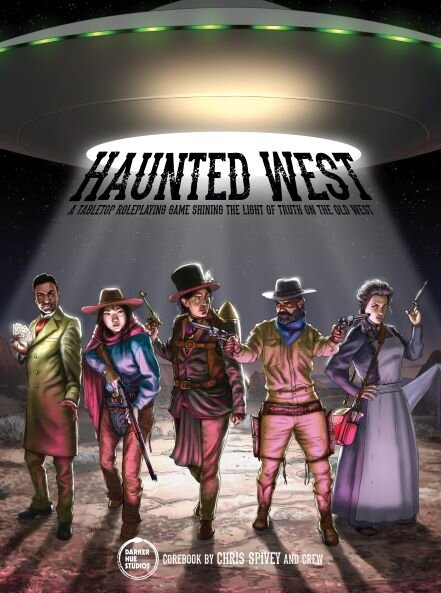
Haunted West is a standalone Weird West roleplaying game by Darker Hue Studios, the producers of Harlem Unbound. The game uses the Ouroboros System, which is strongly derived from the Basic Roleplaying System used by the Call of Cthulhu Roleplaying Game and its many variants, spin-offs, and equivalents. The game itself draws strongly but not exclusively on the Cthulhu Mythos for the “weird” aspect of the game, and while there are enough mechanical differences that you cannot quite drop a Valusian with a shotgun into your Call of Cthulhu 7th Edition or World War Cthulhu campaign, the actual work to convert the stats is minimal and intuitive. Most of the changes in the Ouroboros System are the kind of advancements that should have been made to CoC about five editions ago, offering greater granularity to the percentile rolls, options and abilities to make characters more effective, and different levels of roleplaying granularity (from breaking out the miniatures for combat to a rules lite experience that focuses less on dice and more on narrative roleplaying). I wouldn’t quite call Ouroboros the CoC-equivalent of a heartbreaker, nor is it a perfect system, but it’s definitely trying to address some of the inherent mechanical flaws of Basic Roleplaying.

Front and center in the game is the focus on who is playing, and the nature of the Old West as an incredibly diverse place—and how to roleplay that. While this technically isn’t the first game where you can be a Black cowboy and find that the Mi-Go are mutilating cattle, it’s the first game that focuses on the actual experience of a Black man or woman (or transgender character!) might work in such a setting, how you might bring together a Chinese immigrant, a Mexican vaquero, a Buffalo soldier and his Two-Spirits spouse, to deal with the mystery of stolen Innsmouth gold, a lone settlement that’s turned into a cult of Shub-Niggurath—or what happens if the Ku Klux Klan get ahold of a copy of the Necronomicon.

From a setting perspective, the historical research is excellent. The natural point of comparison would be Chaosium’s Down Darker Trails (2017), the CoC 7th ed. supplement for the Old West. That book is 256 pages, Haunted West is 800 pages—and it is interesting to compare the differences in approach. Both have large sections devoted to raw mechanics and the history of the setting; both also include ways to incorporate the Mythos into the setting and address issues like playing characters of a different race or ethnicity than your own. Down Darker Trails devotes half of page 11 to the question of ethnicity, noting:

As a player, your choice of ethnicity and gender are two factors that go in to making your character’s backstory. The game does not dictate any advantages or disadvantages to a particular ethnicity or gender, so the choice is entirely up to you.

While this might sound like damning with faint praise, from a historical gaming standpoint (and perhaps especially an historical Call of Cthulhu gaming standpoint), this isn’t bad. While the game has never said “no, you can’t play a Black character,” various roleplaying games and supplements over the decades have given specific mechanical advantages or disadvantages based on a player character’s race or gender, and Call of Cthulhu itself has not always been great about encouraging or expressing diversity; game products like Secrets of Kenya (2007) made an effort to discuss the historical reality of racism, but doesn’t really do a good job of it, often falling back on stereotypes (one of the player professions is literally “Great White Hunter.”) Down Darker Trails doesn’t offer many roleplaying hints in that regard. It seems to be aware of the issues, but doesn’t have a good approach to how to actually approach and resolve those issues.

Haunted West faces the issue right off the bat on page 7:

Can I Play A Character of a Race Other Than My Own?
Yes, if done with respect and care. Will you fail? Likely, yes. We all do. But it’s so important to make the attempt and keep trying. Apologize if you hurt someone; you can’t expect them to accept your apology, but you can do your best to listen and make amends. If the community or group you’re in doesn’t understand or hold space for you to fail and try again, it’s probably time to move on.

There is a lot more detail offered for how to play a character in the game, a lot of history and setting information, but above all else this is a game where the designers consciously went into it with the idea of making it an inclusive experience, of not relying on old stereotypes and preconceptions about the Old West, and making it a game that everyone can enjoy while specifically catering to a diverse audience.

In a game set in the real world, history & geography occupy a weird space: all the detail you could want can be found in actual history books. Players can be pointed toward Wikipedia or other easily-accessible online sources, and there is more information there than can be squeezed into even an 800-page book. Haunted West strives to face this reality by offering perspective, as well as history: the usual narrative of the Old West is centered on the actions of European & American colonization, and this book makes a good effort to show that there were other narratives involved…free Black people, immigrants, indigenous peoples.

So where does that leave the Mythos? Well, the game is first and foremost a Weird West game first, with a heavy Mythos flavor.

Roleplaying games focused on historical periods focus on the history above all else; the point of such products is to provide the players will all the rules and setting material they need to build their characters and play their own game. Sometimes this means a few pre-fabricated towns to use as centers for campaigns, some pre-written scenarios and pre-generated characters, but mostly it involves a lot of history and mechanics dominating the book.

So the Mythos as a presence in the Old West in Haunted West can be a bit vague. There are cults, monsters, tomes, artifacts, weird phenomena, etc. but you don’t get a full “secret history” of the Old West from a Mythos perspective. You don’t get firm dates for when the first Innsmouth kin might have arrived from back East, and by association you don’t necessarily get key personalities and non-player characters. There’s room for tens of thousands of stories, but it isn’t the case where there’s only one copy of the Necronomicon in the territory of Nevada, or anything that specific.

A notable absence from the lore is any reference to the snake-god Yig. Lovecraft and his contemporaries wrote almost nothing about the Mythos in the Southwest during the period of the Old West, so writers today almost have a blank slate to write to, and they do in stories like “Showdown at Red Hook” (2011) by Lois H. Gresh. It is not like a sourcebook set around Innsmouth, Arkham, Dunwich or other popular “Lovecraft Country” settings where dozens of authors have set stories or made references from the 1930s through the present day and a really keen writer might have fun trying to incorporate as much as possible, making glosses where stories contradict each other, etc. One of the few things Lovecraft was specific about was Yig, so the absence of the snake-god is notable.

Probably this was a deliberate omission to avoid associating any particular aspect of Mythos-worship to a specific ethnicity or group of people, given the tremendous care given to the depiction of Indigenous peoples in this book, including the (very rare) predominant use of their given names for themselves rather than exonyms (Ndee rather than Apache), etc.

Overall production is excellent; desktop publishing has come a long way, and there are no issues with the formatting. Good use is made of historical photographs & public domain art, while the original art assets are a mixed bag; Kurt Komoda and and Alex Mayo’s work seems to stand out the best. I backed the kickstarter on Haunted West and got access to an early digital edition which is the basis for this review, but the digital and hardcopy editions are both coming out in 2021 and can be ordered at the Darker Hues Studios shop.


Bobby Derie is the author of Weird Talers: Essays on Robert E. Howard & Others (2019) and Sex and the Cthulhu Mythos (2014).

Le Bol Maudit (1982) by Enki Bilal

Et tu sauras ce que je sais…tu connaîtras par ce bol, les secrets les plus terrifiants, car comme moi tu es damné… par Yuggoth le maudit prends!!!
—Enki Bilal, Le Bol Maudit 2

And you will know what I know … you will know by this bowl, the most terrifying secrets, because like me you are damned … by Yuggoth the evil take this!!!
—English translation

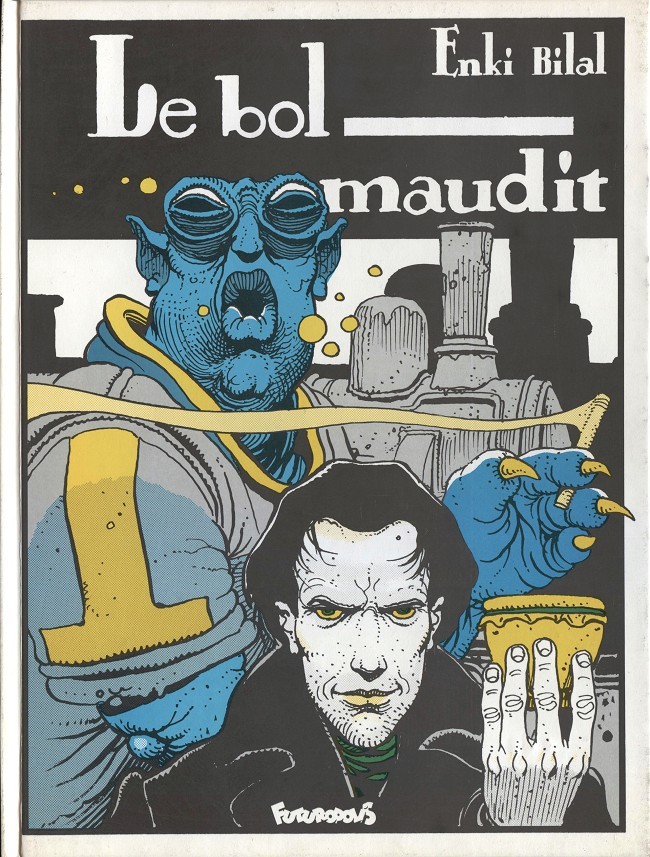
“Le Bol Maudit” (“The Evil Bowl”) was the first story that Enki Bilal published, in the Franco-Belgian magazine Pilote in 1971. Over the next few years, Bilal would publish several more short stories in Pilote, including “A tire d’aile” (“On the Wing”), “Ophiuchus” (from the Greek, “Serpent-bearer”), “La chose a venir” (“The Thing To Come”), “Ciel de nuit” (“Night Sky”), “Kling Klang,” “Le mutant” (“The Mutant”), and “Fermez les volets et ouvrez l’oeil” (“Close the shutters and keep your eyes open”).

Most of these were very short black and white affairs, some only a couple pages long, with surreal and science fiction themes: astronauts, aliens, mutants, dreams—that would see much broader exploration in his more well-known and longer works such as Légendes d’Aujourd’hui (with Pierre Christin) and the Nikopol trilogy, which was partially adapted in the film Immortel (2004). These early works by Bilal were later collected, first by Minoustchine in 1975 as L’appel des étoiles (“The Call of the Stars”, 1975), containing only five stories, and then by Futuropolis in Le Bol Maudit (1982) containing eight. An English translation of the Minoustchine volume (reprinting “The Evil Bowl,” “On the Wing,” “Ophiuchus,” “Pulse” (“La chose a venir”), and “Close your shutters and watch out!”) was published by Flying Buffalo as The Call of the Stars (1978).

“The Call Of The Stars,
or the dark destiny of men called on by
the unutterable and inconceivable unknown.
Four stories with a Lovecraftian touch,
plus an authentic dream-nightmare voyage
I experienced with my tender companion
To whom I dedicate this collection dark with hope.”
Enki Bilal
—Back cover text of The Call of the Stars

In this early work, Bilal is displaying many of his influences very openly; there are gorgeous full-page compositions that show the influence of Philippe Druillet’s Lone Sloane, which was also published in Pilote for a period; scenes inspired rather blatantly from 2001: A Space Odyssey (1968), and there are stories like “Ophiuchus” which is essentially an adaptation of, or at least a variation on, H. P. Lovecraft’s “The Shadow over Innsmouth.” Bilal hadn’t quite reached his distinctive style of art and storytelling yet, but he was definitely on his way.

IMG_2608

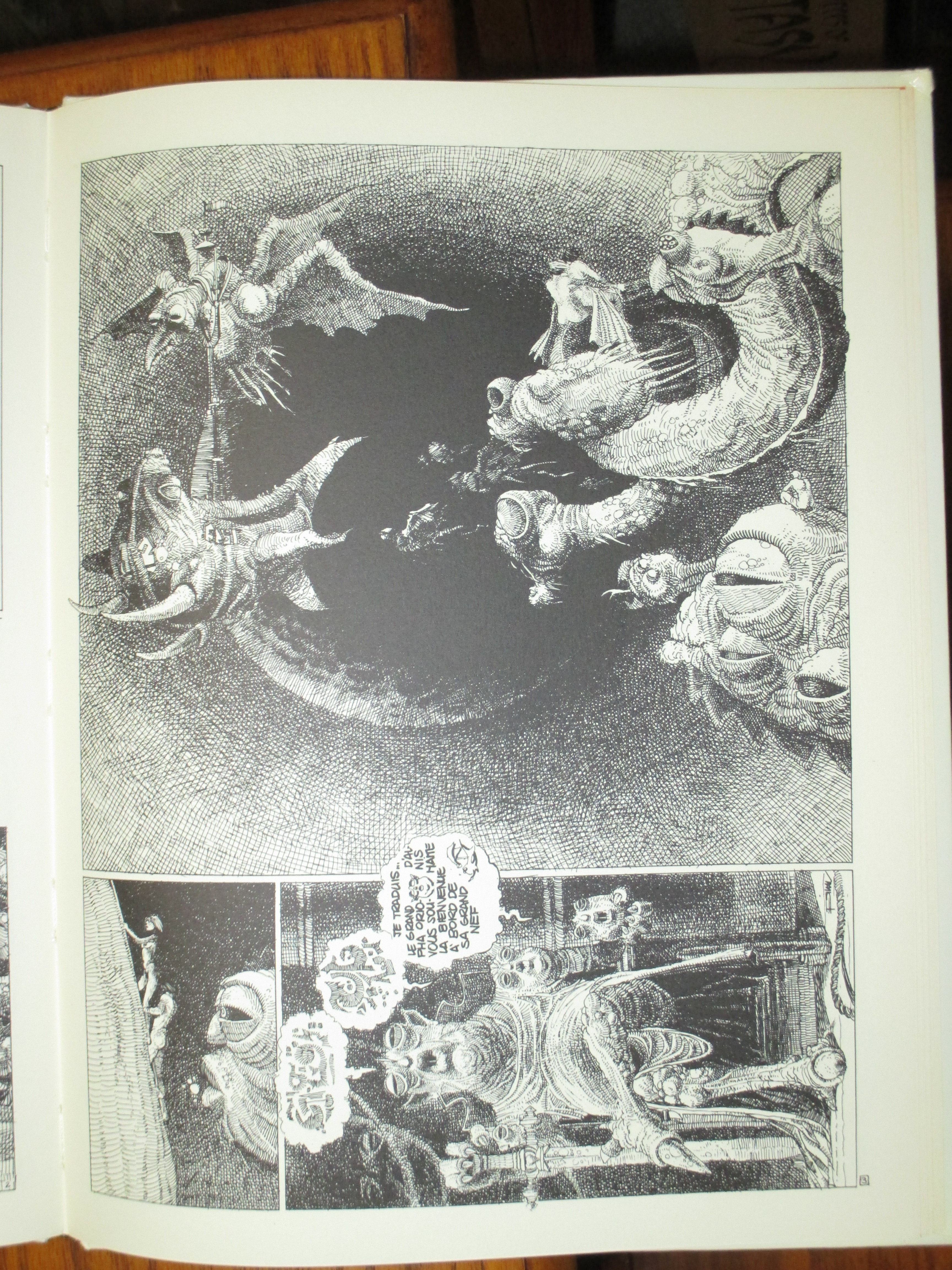
Pages from “Le Bol Maudit”

“Le Bol Maudit” has the most explicit references to Lovecraft, although these are basically just Easter eggs for fans. Appreciation for Lovecraft blossomed in France, and in the Franco-Belgian comics circles during this periods, which would culminate in the special Lovecraft issue of Metal Hurlant in 1979, and still continues today in works like La Planète aux Cauchemars (2019) by Mathieu Sapin & Patrick Pion

IMG_2609

Panels from “Ophiuchus”

From a Lovecraftian standpoint, “Ophiuchus” is probably the most interesting, however. “Beau Rivage” (“Beautiful Shore,” “Pampona Beach” in the Flying Buffalo translation) is an intriguing variation on Innsmouth. A city of an alien race, human enough but decaying, mutating, shunning the sun, participating in the strange cult of Ophiucus until, the distant constellation. None of Bilal’s stories attempt horror, exactly, although a few of them have that surreal twist reminiscent of the Twilight Zone. In this respect, Bilal’s twist on Lovecraft’s ending is fitting: it is one thing to be an outsider among a crowd, not knowing why you don’t belong, and something else again to know yourself truly and completely…and know exactly why, and why you can never go home again.

IMG_2610

Page from “Fermez les volets et ouvrez l’oeil”

The most ambitious story, artistically, is the last one: “Fermez les volets et ouvrez l’oeil,” a surreal, fantastic dream-voyage of a young man and woman, with some incredibly elaborate crosshatching and a kind of plot like a more mature, Tolkien-esque version of Winsor McCay’s “Little Nemo.” There are some creatures and places here that would not be out of place in Lovecraft’s Dreamlands, although there is no explicit connection made. Like Lovecraft and Randolph Carter, Bilal inserts himself into his work now and again, most deliberately and explicitly in “Fermez les volets et ouvrez l’oeil,” where he is the male dreamer.

Taken all in all, Le Bol Maudit is a fun collection; the individual stories don’t build up into anything bigger, but they provide an interesting insight into Bilal’s earliest work, and a few nice little Lovecraftian Easter eggs for fans. The Flying Buffalo translations leave a little something to be desired; and chunks of the text go from serif to sans serif without warning. While apparently Bilal did his own lettering, parts of the English translation (translator and letterer uncredited) look like they were done with a typewriter, while others were lettered by hand or used stencils. It would nice to see a new translation into English, perhaps including the stories that never made it into the Flying Buffalo volume…but whether that will ever happen, who can say?

Thanks to Dave Haden at Tentaclii for pointing out a couple things I missed.


Bobby Derie is the author of Weird Talers: Essays on Robert E. Howard & Others (2019) and Sex and the Cthulhu Mythos (2014).

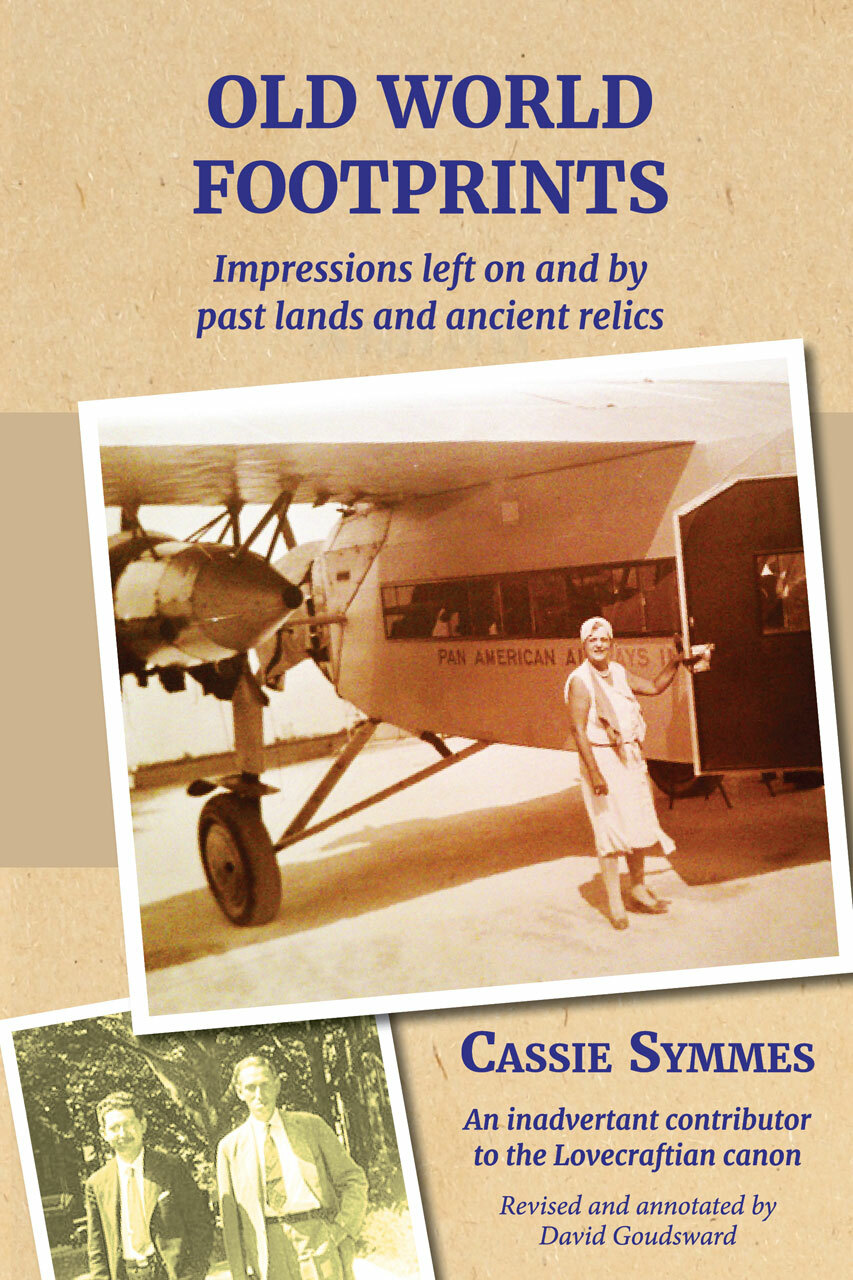
Old World Footprints (1928) by Cassie Symmes & Portrait of Ambrose Bierce (1929) by Adolphe de Castro

The fact that H. P. Lovecraft worked as a ghostwriter and reviser of other’s writing is common knowledge. Most of the work that receives attention is the weird fiction which he wrote for clients, to appear under their names in pulp magazines like Weird Tales and Wonder Stories, but Lovecraft’s revision services were much broader, covering everything from poetry (such as his work for David Van Bush and Josephine Evalyn Crane Blossom) to travelogues, such as European Glimpses (1988) by Sonia H. Greene.

Two of these works, Old World Footprints (1928) by Cassie Symmes and Portrait of Ambrose Bierce (1929) by Adolphe de Castro, are both connected with Lovecraft and his long-time friend Frank Belknap Long, Jr. By the late 1920s Long had set out to be a professional writer, and had published several short stories in Weird Tales, including “The Were-Snake” (1925), a book of poems, A Man from Genoa and Other Poems (1926). That book was underwritten by his aunt, Cassie Symmes, and printed by W. Paul Cook. Symmes was so impressed with the production that she hired Cook to produce a travelogue of her 1924-1927 trips to Europe, asking her nephew to provide the preface. Lovecraft was asked to correct the proofs.

Lovecraft did a little more than that. For many decades, Old World Footprints remained one of the rarest works of Lovecraftiana, but a 2021 reprint from Bold Venture Press has finally made it available to the average fan. Dave Goudsward tracks the history of Lovecraft’s involvement, including where and how Lovecraft touched up Symmes’ prose, to the extant that he basically ghost-wrote Long’s preface.

I concocted a euphemistic hash for young Long to sign—a preface to a tame travel-book by his aunt that bored him so badly he couldn’t think of anything to say! He didn’t want to turn down the request for a preface—so got me to cook up some amiable ambiguities for him.
—H. P. Lovecraft to Clark Ashton Smith, 19 Dec 1929, quoted in Old World Footprints (2021) 54

As the text of the travelogue itself is very short, the book is expanded with a biographical essay on Cassie Symmes, with focus on her involvement with all things Lovecraftian—she was, for instance, the person who gave Frank Belknap Long, Jr. a small statuette of the Hindu god Ganesa, which in turn inspired the figure of Chaugnar Faugn in Long’s novelette The Horror from the Hills (Weird Tales Jan—Feb-Mar 1931). The book also contains a collection of quotes from Lovecraft’s letters about Symmes and the book, making it a single point of reference for those who don’t own or wish to dig through multiple volumes of letters. Even for those not interested in the travelogue might yet find some interest in the light it sheds on Lovecraft & Long’s friendship.

I was asked to provide the foreword to this book, and one of the key points I made in that bears repeating here: even if you though you’d read everything Lovecraft had to offer, you almost certainly haven’t read this.

Long’s involvement with Portrait of Ambrose Bierce would be more substantial, while Lovecraft’s would be slighter. In 1927, Adolphe Danziger de Castro received some nationwide attention when an article he wrote supposedly giving some insight to how his one-time friend Ambrose Bierce had died was picked up by the Associated Press. De Castro sought to parlay this fifteen minutes of fame into an opportunity to revise and reprint some of his fiction, which was badly out of date, and he wrote to H. P. Lovecraft to do this. Lovecraft was willing to consider the revision work…and then de Castro made a further suggestion:

Now, to something else. you probably have seen the flash of publicity I have received lately with regard to Bierce. I have written the first part of a book, BIERCE AND I. It is the part relating to the west. I lost over two thousand letters of B. in the San Francisco fire. but the letters, 14 in all, he wrote me since 1900 I have and with these I am going to build the second part. Bob Davis assures me that he will get me a publisher at once. This means that I would be able to realize some money from the work. In this work, however, no revision as you suggest for the story is possible, for the reason that it my “I” that enters in the work and my style, with the exception of some expression here and there, is fairly well known. As these are purely reminiscences, even the aesthetic arrangement could not be changed. As the matter of the story is virtually settled—and it would please me if I could get it next week – what idea can you suggest about BIERCE AND I?
—Adolphe de Castro to H. P. Lovecraft, 8 Dec 1927, Letters to Alfred Galpin and Others 346

Lovecraft did revise some of de Castro’s fiction, and did so for “The Last Test” (Weird Tales Nov 1928), “The Electric Executioner” (Weird Tales Aug 1930), and a third revision. It appears during 1928 Lovecraft had recommended that Long might also help de Castro in some way, but de Castro was fixed on Lovecraft as a potential reviser or collaborator:

However, since I wrote you I added about fifty thousand words to the Bierce book, original matter written by Bierce and bearing on certain reminiscences I note.

The title of the book will not be BIERCE AND I but simply AMBROSE BIERCE. As I appear in the book a great deal as the teller of the story I deemed the former title over-descriptive.

What pains me, I frankly confess, is that there are probably many literary blemishes of which a book of this sort ought to be absolutely free. But I have written more than 115,000 words and have grown very tired. It is equally obvious that I cannot have the work done—as correctors might prove correctioners—spoiling the personal tone for an assumed form. It is not every one, my friend, who has your sure touch and is so sympathetic to the subject under discussion.

Albert & Charles Boni have the matter under consideration (this is in confidence, of course) but there are a number of publishers quite desirous of bringing out the book
—Adolphe de Castro to H. P. Lovecraft, 25 Feb 1928, Letters to Alfred Galpin and Others 351

It was at this point that Frank Belknap Long re-enters the picture:

Old Danziger-de Castro is now in touch with Belknap, & that little imp has just revised his memoirs of Bierce absolutely free of charge, in return for the privilege of prefixing a signed preface! Belknap thinks it will bear him onward toward fame to be thus visibly connected with a work likely to become a standard source-authority for future Bierce biographers. […] It seems that de Castro has written a great deal of more or less solid material, besides serving the government in several important capacities—consular & otherwise. Belknap says he is 62 years old, stout, & genial.
—H. P. Lovecraft to Donald Wandrei, 16 Mar 1928, Letters with Donald & Howard Wandrei 206

Ambrose Bierce in 1928 was much more famous than he is today, and the mystery of his disappearance—and the pop-culture trends that were already circulating regarding it; in 1932 Charles Fort’s book Wild Talents would propose the theory that someone was collecting Ambroses, which would enter the modern lore of conspiracy theory, pseudoscience, and UFO abductions. While today Mythos fans might recognize Bierce as the author of “An Inhabitant of Carcosa” (1886) and “Haïta the Shepherd” (1891), which Robert W. Chambers drew on for The King in Yellow (1895), in the 1920s Bierce occupied a position closer to that which Lovecraft himself would later occupy, recognized as a master of the weird tale with stories like “The Damned Thing” (1893) as a thematic precursor to Lovecraft’s own “The Unnameable” and “The Color Out of Space.”

So Long’s desire to attach his name to a piece of Bierce scholarship is a little more understandable in that context than it might be today. However, once de Castro got the preface and revised manuscript back, he wrote to Lovecraft again:

Now to something else…Belknap Long wrote a nice bit of preface to my Bierce book; but I’ll be this, that and t’other, if I like the book as I wrote it; although Belknap thinks it very good. There is something missing in it, something I could do if I were away from harassing conditions and disturbing elements. It has been read by three publishers and rejected on a certain expressed criticism and the adulti stulti seem not to comprehend that I know better than they what is the trouble. The book is written by the person who for more than twenty-five years was in closest touch with Ambrose Bierce with little confidences that no other human being knew or heard. Naturally it is written in the first person singular—how else could it have the personal touch? However, this makes it “reminiscent” rather than biographical, and they want a pure unadulterated biography—although not quite true, as one publisher expressed it; and this publisher actually offered a big advance royalty—what do you think of that? No wonder I am bewildered and don’t know how, where, and to whom to turn. nor have I put any great criticism of Bierce’s works in my book, but I have left out oceans of matter of most interesting personal character—not wishing to make the book too long.
—Adolphe de Castro to H. P. Lovecraft, 1 Apr 1928, Letters to Alfred Galpin and Others
 353-4

In his letters to de Castro, Lovecraft is unfailingly polite. In his letters to others, he is much more direct about the whole matter:

As for the memoirs themselves—alas! They are again set back to the raw material stage. Belknap did not take any job away from his old grandpa—he refused to consider it till old ‘Dolph stated positively that he could not have the work done by anybody on any cash basis whatsoever. But behold & lament! Though the job is done, yet it isn’t—for since the revision no less than three publishers have rejected the MS. on the ground that the style is still too crude, & the material still too ill-proportioned! I thought that Belknap must have made a rather light job of it when he said that he did that whole long book MS. in only two days—& lo! That is just about what did happen! Now old ‘Dolph is looking for a regular recasting in the slow, extensive, & painfully conscientious manner of Grandpa Nekrophilos—indeed, a suggestion from the third & latest rejecting publisher has led him to consider a radical change of plan, & an abandonment of the memoir style for a regular biographical treatise in the third person. This, of course, means a radical text-upheaval which really amounts to collaboration rather than revision. But—eheu!—though his ideas are bigger, his purse most infelicitously isn’t; so that he plaintively announces himself as ‘bewildered, & at a loss how, where, & to whom to turn’. He hems & haws & alludes delicately to the ‘almost certain’ profits of the biography if it can be properly formulated & launched—placing the likely receipts most alluringly at about $50,000.00. [Fancy!] What he is leading up to is undoubtedly a proposition for me to do the work on a speculative basis—i.e., for a certain percentage of the possible royalties—but right here is where Grandpa pauses for sombre reflection! As a piece of work—rightly done—it would be a staggering all-summer asphyxiation cutting off alike my immediately remunerative revision, & any possible original fiction I might wish to write. In exchange for this sacrifice I would have a double gamble, with two exceedingly doubtful spots—(a) whether any publisher would take the damn thing after all, & (b) whether, being published, it would really drag in enough to make a collaborator’s percentage anything more than a joke. Yes—the old gentleman will be very deliberate! Moreover—I don’t know how big a percentage a collaborator really ought to ask. And yet, at that, there’s certainly great stuff in the book; real source material that no future Bierce student (if such the coming years may hold) can afford to overlook. Belknap went wild over it—eating up every word so avidly that he didn’t see any mistakes at all until he started to go over it a second time with critical pencil in hand—& I shall be glad to get a chance to read the MS. myself. Old ‘Dolph still talks of making a stage-coach trip to Providence—& I shall certainly receive him with civility if he does. But in my opinion he’d better stick to Belknap—who is right on he ground for personal consultation, & who is willing to toil for fame alone—as his collaborator, telling him just how extensive he wants the changes, & giving him plenty of time to make a really thorough job. In recompense he ought to include the Child’s name on the title-page—”Ambrose Bierce: By Adolphe de Castro & Frank Belknap Long, Jun.” Just how much fame it would bring Belknap remains to be seen. The book is no mere controversial item—it’s a long string of general Bierce reminiscences—& now that a triple rejection has chastened him, Old ‘Dolph would probably be willing to cut down the [“Monk and the Hangman’s Daughter”] episode till it occupied a less disproportionate space in his whole oeuvre.
—H. P. Lovecraft to Donald Wandrei, 5 Apr 1928, LWP 209-210

There was a bit of back and forth, and Lovecraft & Long actually met with de Castro at the latter’s apartment in New York City. However, Lovecraft was less than hopeful about the outcome:

I’m afraid the old duffer can’t or won’t pay a decent advance price, hence I doubt if I take the revision job after all; though I shall read the book fully & prepare a helpful synopsis & list of suggestions. My own interest impels me to do this—& I  have promised him such a list by next Thursday.
—H. P. Lovecraft to Lillian D. Clark, 29 Apr 1928, Letters to Family & Family Friends 2.635

The next few months were trying; de Castro continued to pester Lovecraft to work on the book, and Lovecraft refused to do so for less than $150 up front—a sizable fee for a very sizable job, and less than de Castro had been paid for the stories Lovecraft had revised for him had sold for. Nevertheless, it seems like Lovecraft did send his promised list of suggestions, and Long did apparently do a light revision of the text, and eventually de Castro managed to sell it:

Old Adolphe de Castro has turned up again, & is pestering Belknap & me with dubious revision propositions. He says the Century Co. has just accepted his Bierce book, which is surely interesting if true. He claims to have just returned from a European trip.
—H. P. Lovecraft to August Derleth, 2/9/16 Nov 1928, Essential Solitude 1.167

Portrait of Ambrose Bierce (1929, Century Co.) was published in attractive hardcover, complete with photographic plates, a fold-out facsimile of Bierce’s “The Town Crier” articles of 1969, and a brief prologue by Frank Belknap Long (who signed himself, in James Branch Cabell’s fashion, as simply “Belknap Long.”) The extent of Long’s revision of the manuscript isn’t clear, a comparison of the table of contents for Bierce and I that de Castro had mailed to Lovecraft (LAGO 350) and the final table of contents of Portrait of Ambrose Bierce shows many of the chapters are nearly identical, so there was no major re-shuffling of the contents. Still, it appears de Castro might have taken some advice from Lovecraft:

Old De Castro’s book has been attacked quite violently by some reviewers—& not unjustly, since it is truly a slovenly & egotistical concoction which doesn’t give Bierce half his due. I have glanced through the printed copy, I see that the author took all of my advice regarding deletions, though giving me no credit therefor. Belknap’s preface opens with a misprint—Beaudlaire.
—H. P. Lovecraft to Clark Ashton Smith, 14 Apr 1929, Dawnward Spire, Lonely Hill 173

Aside from this, Lovecraft never claimed to have any part in the final text of Portrait of Ambrose Bierce, and in truth it’s difficult to see any part of the book he might have had a hand in. The tone throughout is from de Castro’s point of view, and one would be hard-pressed to find a word distinctive of Lovecraft’s vocabulary or philosophy, unless it be in Long’s own preface. Certainly, the book does not deal even cursorily with Bierce’s weird fiction; Lovecraft’s friend Samuel Loveman’s 21 Letters of Ambrose Bierce (1922) is cited in the bibliography, but under the wrong title. Certainly if Lovecraft did have any direct hand in the book, he would have striven to correct that error. When Long finally saw the finished product, he was nonplussed:

First we stopped at Kirk’s, where the Child took a look at De Castro’s Bierce book with his preface in it. The result was something of a shock; for there were many grave misprints, & old De Castro had interpolated a whole section of a personal letter which Belknap wrote him in praise of the volume. Sonny intends, however, to buy the book eventually. It was a cheap trick of old De Castro’s not to give us both free copies!
—H. P. Lovecraft to Lillian D. Clark, 28-29 Apr 1929, Letters to Family & Family Friends 2.761

Portrait of Ambrose Bierce was not the end of Lovecraft’s personal and professional relationship with de Castro, although it seems to have been the end of de Castro’s professional relationship with Long. The poor reception of the book seems to have negated any hoped-for recognition association with it might bring, and the book itself is of relatively limited value to Bierce scholars, since so much of the facts are filtered through de Castro’s own self-importance and determination to give himself what he felt was due credit—often at the expense of Bierce, and in the bibliography at the expense of Bierce’s friend the poet George Sterling, who had committed suicide in 1926. That was in exceptionally poor taste.

If it’s a failure as a work of biography, as an artifact, Portrait of Ambrose Bierce is interesting as another thread in the web of connections between two masters of the weird tale—aside from his association with de Castro (The Monk & the Hangman’s Daughter, Portrait of Ambrose Bierce), and Samuel Loveman (21 Letters of Ambrose Bierce), Lovecraft was also connected to Bierce through Clark Ashton Smith, whose mentor was George Sterling (and Sterling had actually commented on Lovecraft’s story “Dagon”). There are some more obscure connections, if you dig for them, in certain anecdotes in Lovecraft’s letters. Robert E. Howard ended up reading Portrait of Ambrose Bierce, and brought it up in is letters to Lovecraft (A Means to Freedom 1.453, 2.539).

Perhaps belatedly, the affair also cemented Lovecraft’s professional standing with regard to de Castro:

Just heard from old De Castro—he thinks his Bierce book would have been better received if I had revised it! Well—if he’d been willing to pay, I’d have been willing to work!
—H. P. Lovecraft to Clark Ashton Smith, 5 Jun 1929, Dawnward Spire, Lonely Hill 176

Lovecraft never would revise any full-length book for de Castro, although he did do a revision or two—cash up front.

What these two books show is that there was a lot more to Lovecraft’s career as a revisionist than just his weird fiction—and that when it came to revision, as opposed to fiction written for his own aesthetics, Lovecraft could be somewhat mercenary. Although he was always willing to help out a friend, Lovecraft couldn’t afford to take big revision jobs without the promise of pay—an attitude which would, eventually, see him get out of the revision business altogether.


Bobby Derie is the author of Weird Talers: Essays on Robert E. Howard & Others (2019) and Sex and the Cthulhu Mythos (2014).