Shadows of Wings (1930) by Susan Myra Gregory

A poet-friend of mine, Susan Myra Gregory of Monterey, sister of the novelist Jackson Gregory, asked me to write a preface for a little collection of her verse which is being brought out in Southern California. She has a real lyric talent, of the true feminine Sapphic type, and I was glad to do the preface—an odd interlude in the writing of my Antarean novelette.
—Clark Ashton Smith to H. P. Lovecraft, 10 Dec 1929, Dawnward Spire, Lonely Hill 190

Susan Myra Gregory was 46 years old when her small 40-page book of poems was published, with a card cover, by the Troubadour Press in San Diego. She had worked for many years as a teacher of English and journalism at Analy high school and Monterey high school. Gregory provided some of the local color to John Steinbeck, who set novel Tortilla Flat (1935) in Monterey and dedicated it to her. There are few references to her in Smith’s published letters, but it seems likely that, as with many California poets, Susan Myra Gregory may have met Clark Ashton Smith through his mentor George Sterling, or possibly when Smith made one of his trips down from Auburn to Carmel. Her brother Jackson Gregory, an author of popular westerns, whose wife Lotus McGlashan Gregory had bought a few of Clark Ashton Smith’s drawings some years before (The Shadow of the Unattained 200).

Whatever the extent of their relationship, it was obviously enough of a relationship for Smith to gladly write an introduction to her poetry collection.

05

It is easy to see why Smith would enjoy Gregory’s poetry. Poems such as “Tonight,” “Necromancy,” and “Orpheus’ Song to Eurydice” touch on some of his favorite themes, and his introduction struck enough of a chord with one contemporary reviewer to quotes liberally from it. 

if she is more Classical and less cosmic or macabre in her scope than either Sterling or Smith, her poems smack of the fantastic verse which Arkham House would publish in volumes such as Fire and Sleet and Candlelight (1961). “Dream” and “Sleep” might not have been out of place in the pages of Weird Tales, and indeed several of these poems are reprinted from various magazines and journals.

From a strictly commercial standpoint, the book is a bit of a trifle, and has a certain vanity-press air, although it was published as part of a series of ten booklets by modern poets. Classic poems dedicated to Sappho had less cachet to the general public during the interwar years, though no doubt H. P. Lovecraft or Samuel Loveman, both dedicated Classicists, would have appreciated the beauty of lines like:

No, the “lost songs of Sappho” are not lost;
Only ye seek afar for something near.

Though no doubt Lovecraft would have tsk’d at the use of archaic English diction in this instance, Clark Ashton Smith’s edict that “it seems impossible that such poetry as hers will not always have its lovers” is true, or at least it should be. For the sentiments are sweet, the language is soft, and lines such as “Beauty so keen is like a two-edged sword” deserve to be mumbled through the lips of some trenchcoat-clad detective in a Noir film.

Susan Myra Gregory’s poetic career did not end with this book; she had several poems published in Singing Years: The Sonoma County Anthology of Poetry and Prose (1933), but what further contact she had with Clark Ashton Smith is unclear. She died in 1939.

Shadows of Wings has been scanned and is available here.


Bobby Derie is the author of Weird Talers: Essays on Robert E. Howard & Others (2019) and Sex and the Cthulhu Mythos (2014).
Haunted West (2021) by Darker Hue Studios

Here men and women were confronted, in the very recent past, by conditions that had been forgotten east of the Mississippi for centuries. When men began to write of the West, it was to exploit its more lurid aspects for sensational purposes. Hence, rose the “cowboy” tradition, the “Wild West” tradition—an absolutely criminal distortion of the literary growth of the region and traditions that made a vulgar jest out of what should have been one of the most vital and inspiring pageants of American history. What the ignorant and blundering pens of sensational yellow-backed novel writers failed in doing, the pens of sophisticated arm-chair critics completed. Really good writers, with a few exceptions, shied away from the Western tale, lest they be branded with the yellow-backed dime novelist. It seems to me, from what I’ve read and heard, that most people who have never seen the West, are devided [sic] into classes—the class that believes the West swarms with movie-type cowboys and Indians where bullets whiz continually—and the class that lifts the lip in scorn and rejects all the tales of the West as mere drivel. The truth, as of course you realize, not belonging to either of the above mentioned classes, lies about half-way between. Men didnt [sic] go about with guns slung all over them, shooting at the drop of a hat, hanging rustlers to every tree, chasing Indians twenty-three hours of the day, but life was a fierce and hard grind, and murder and sudden death were common. Now thinking people all over America are beginning to realize the truths of the pioneer West, with the resultant boom in good Western literature—which I hope spells the doom of the Wild Bill dime-novel.
—Robert E. Howard to H. P. Lovecraft, c. Feb 1931, A Means to Freedom 1.152

Before the pulp magazine was the dime novel and the nickel weekly; and these early popular media were the crucibles for many of the tropes of pulp fiction: genrefication (western, detective, etc.), series characters (Nick Carter, Deadwood Dick, etc.), catchy titles, fan clubs, etc. It was mass entertainment, cheaply printed, incredibly popular—and spread the legend of the Wild West, which during Lovecraft’s lifetime transitioned into the Old West. The frontier was gone, but it lived on in stories of cowboys, rustling, gunfights, and constant war with Native Americans—and it flourished in the pulps, with hundreds of titles, and made the leap to theater, radio, and finally film. John Wayne’s first leading role was Big Trail (1930), released the same year that Lovecraft and Robert E. Howard began their correspondence.

In the pulp magazines, genre segregation could be strict, but there were exceptions. Occasionally writers would set fantasy, horror, and science fiction stories in a Southwestern setting; usually this wasn’t during frontier days but…there were exceptions. H. P. Lovecraft himself had stories set in the Southwest, almost an entire cycle’s worth: “The Transition of Juan Romero,” “The Electric Executioner” with Adolphe de Castro, and “The Curse of Yig,” “The Mound,” and “Medusa’s Coil” with Zealia Bishop. While these Southwestern tales would inspire further stories of “Yig Country,” and tales set in the American Southwest,these were not Western stories set in the frontier. The true Weird Western was pioneered by writers like Robert E. Howard in stories like “The Horror from the Mound” (Weird Tales May 1932) and “Old Garfield’s Heart” (WT Dec 1933).

The idea of the Weird Western spread slowly an unevenly; it was hybrid genre that didn’t always find a ready home in every market, for fiction, film, or comic books, though there are plenty of examples of all three. All of these sources, and the periodic resurgence of the Western film in popularity over the decades, from the Spaghetti Westerns, Acid Westerns like El Topo (1970) and Deadman (1996) to gritty Anti-Westerns like Unforgiven (1992), and fanciful weird westerns like Wild Wild West (1999), Cowboys & Aliens (2011), and horror westerns like Bone Tomahawk (2015), have contributed to a rich and diverse array of media for fans and writers to mine for ideas…and for some folks, a sandbox to play in.

Western roleplaying games are a minority in the United States; the field tends to be dominated by fantasy-oriented RPGs like Dungeons & Dragons and its various settings. Yet they exist. TSR, the creators of D&D, published Boot Hill in 1975, Kenzer Co. published Aces & Eights, GURPS published GURPS Old West and included various “Dixie” settings in their GURPS Alternate Earths books, Pinnacle published the weird western Deadlands in 1996 to some acclaim…and in fact published some of the first Cthulhu Mythos-related weird western game material with Adios A-Mi-Go (1998, long out-of-print but available as an affordable ebook.)

Deadlands tends to be emblematic with the problem of bringing the Wild West as a roleplaying setting. The exact dates vary, but most folks consider the “Old West” to be post-the American Civil War (after 1865) and the dawn of the 20th century. This was a period of tremendous historical racism in the United States, encompassing the abolition of slavery, Reconstruction, and the end of Reconstruction. Native American tribes had been forced onto reservations through military force, and kept there with force and laws, their children sent away to schools. Mexicans and other Hispanics peoples were routinely subject to persecution and stereotypes, as were immigrants of all stripes, especially Chinese and other Asian immigrants on the West coast.

Roleplaying games like Deadlands, written mostly by white people for a mostly white audience, and having often absorbed many misconceptions about the Lost Cause and racial stereotypes, were notoriously bad in their presentation of the Confederacy as sympathetic, paid little to no heed to how people of color would feel playing the game, were rife with racial stereotypes (especially with regards to Native Americans, who were often reduced to funny animal names and Dime Novel broken English), and gave little to no thought to the racial tensions and social realities of the turbulent period they were, at least nominally, attempting to depict.

Which, to be fair, is a tall order. Historical racism is a difficult subject to address in any context, when you’ve got a group of people gathered around a table or in an online chatroom, trying to work out a cooperative storytelling experience with dice, not everyone involved is going to even be aware of all the issues at play. Popular media depictions of Native Americans in Western media have strongly colored most expectations about how they “should” be portrayed, much as films like Gone With the Wind (1939) have influenced ideas of what upperclass Southern plantation life was like antebellum.

Mix in the Cthulhu Mythos, and the job might be a little tougher. It’s one thing to make an attempt to produce a setting that directly addresses the challenge of including (and even spotlighting) the diverse array of races, ethnicities, and cultures in the Wild West, and something else to do that while working in concepts and materials that date back to the 1930s. H. P. Lovecraft sketched out a few ideas towards a Southwestern Mythos, but he had no direct firsthand knowledge of the region or cultures, and his depictions of Native Americans and Hispanic characters in particular tend to be rife with dime western stereotypes.

[“]You let um ’lone, you have no bad medicine. Red man know, he no get catch. White man meddle, he no come back. Keep ’way little hills. No good. Grey Eagle say this.”
—H. P. Lovecraft & Zealia Bishop, “The Mound”

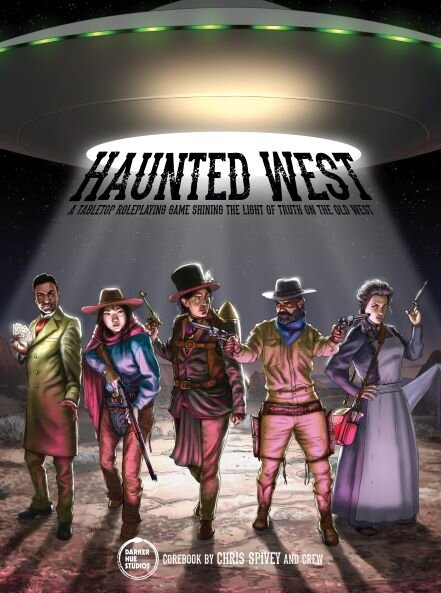
Which has to be understood to appreciate that Haunted West (2021) by Darker Hue Studios got it right.

Haunted West is a standalone Weird West roleplaying game by Darker Hue Studios, the producers of Harlem Unbound. The game uses the Ouroboros System, which is strongly derived from the Basic Roleplaying System used by the Call of Cthulhu Roleplaying Game and its many variants, spin-offs, and equivalents. The game itself draws strongly but not exclusively on the Cthulhu Mythos for the “weird” aspect of the game, and while there are enough mechanical differences that you cannot quite drop a Valusian with a shotgun into your Call of Cthulhu 7th Edition or World War Cthulhu campaign, the actual work to convert the stats is minimal and intuitive. Most of the changes in the Ouroboros System are the kind of advancements that should have been made to CoC about five editions ago, offering greater granularity to the percentile rolls, options and abilities to make characters more effective, and different levels of roleplaying granularity (from breaking out the miniatures for combat to a rules lite experience that focuses less on dice and more on narrative roleplaying). I wouldn’t quite call Ouroboros the CoC-equivalent of a heartbreaker, nor is it a perfect system, but it’s definitely trying to address some of the inherent mechanical flaws of Basic Roleplaying.

Front and center in the game is the focus on who is playing, and the nature of the Old West as an incredibly diverse place—and how to roleplay that. While this technically isn’t the first game where you can be a Black cowboy and find that the Mi-Go are mutilating cattle, it’s the first game that focuses on the actual experience of a Black man or woman (or transgender character!) might work in such a setting, how you might bring together a Chinese immigrant, a Mexican vaquero, a Buffalo soldier and his Two-Spirits spouse, to deal with the mystery of stolen Innsmouth gold, a lone settlement that’s turned into a cult of Shub-Niggurath—or what happens if the Ku Klux Klan get ahold of a copy of the Necronomicon.

From a setting perspective, the historical research is excellent. The natural point of comparison would be Chaosium’s Down Darker Trails (2017), the CoC 7th ed. supplement for the Old West. That book is 256 pages, Haunted West is 800 pages—and it is interesting to compare the differences in approach. Both have large sections devoted to raw mechanics and the history of the setting; both also include ways to incorporate the Mythos into the setting and address issues like playing characters of a different race or ethnicity than your own. Down Darker Trails devotes half of page 11 to the question of ethnicity, noting:

As a player, your choice of ethnicity and gender are two factors that go in to making your character’s backstory. The game does not dictate any advantages or disadvantages to a particular ethnicity or gender, so the choice is entirely up to you.

While this might sound like damning with faint praise, from a historical gaming standpoint (and perhaps especially an historical Call of Cthulhu gaming standpoint), this isn’t bad. While the game has never said “no, you can’t play a Black character,” various roleplaying games and supplements over the decades have given specific mechanical advantages or disadvantages based on a player character’s race or gender, and Call of Cthulhu itself has not always been great about encouraging or expressing diversity; game products like Secrets of Kenya (2007) made an effort to discuss the historical reality of racism, but doesn’t really do a good job of it, often falling back on stereotypes (one of the player professions is literally “Great White Hunter.”) Down Darker Trails doesn’t offer many roleplaying hints in that regard. It seems to be aware of the issues, but doesn’t have a good approach to how to actually approach and resolve those issues.

Haunted West faces the issue right off the bat on page 7:

Can I Play A Character of a Race Other Than My Own?
Yes, if done with respect and care. Will you fail? Likely, yes. We all do. But it’s so important to make the attempt and keep trying. Apologize if you hurt someone; you can’t expect them to accept your apology, but you can do your best to listen and make amends. If the community or group you’re in doesn’t understand or hold space for you to fail and try again, it’s probably time to move on.

There is a lot more detail offered for how to play a character in the game, a lot of history and setting information, but above all else this is a game where the designers consciously went into it with the idea of making it an inclusive experience, of not relying on old stereotypes and preconceptions about the Old West, and making it a game that everyone can enjoy while specifically catering to a diverse audience.

In a game set in the real world, history & geography occupy a weird space: all the detail you could want can be found in actual history books. Players can be pointed toward Wikipedia or other easily-accessible online sources, and there is more information there than can be squeezed into even an 800-page book. Haunted West strives to face this reality by offering perspective, as well as history: the usual narrative of the Old West is centered on the actions of European & American colonization, and this book makes a good effort to show that there were other narratives involved…free Black people, immigrants, indigenous peoples.

So where does that leave the Mythos? Well, the game is first and foremost a Weird West game first, with a heavy Mythos flavor.

Roleplaying games focused on historical periods focus on the history above all else; the point of such products is to provide the players will all the rules and setting material they need to build their characters and play their own game. Sometimes this means a few pre-fabricated towns to use as centers for campaigns, some pre-written scenarios and pre-generated characters, but mostly it involves a lot of history and mechanics dominating the book.

So the Mythos as a presence in the Old West in Haunted West can be a bit vague. There are cults, monsters, tomes, artifacts, weird phenomena, etc. but you don’t get a full “secret history” of the Old West from a Mythos perspective. You don’t get firm dates for when the first Innsmouth kin might have arrived from back East, and by association you don’t necessarily get key personalities and non-player characters. There’s room for tens of thousands of stories, but it isn’t the case where there’s only one copy of the Necronomicon in the territory of Nevada, or anything that specific.

A notable absence from the lore is any reference to the snake-god Yig. Lovecraft and his contemporaries wrote almost nothing about the Mythos in the Southwest during the period of the Old West, so writers today almost have a blank slate to write to, and they do in stories like “Showdown at Red Hook” (2011) by Lois H. Gresh. It is not like a sourcebook set around Innsmouth, Arkham, Dunwich or other popular “Lovecraft Country” settings where dozens of authors have set stories or made references from the 1930s through the present day and a really keen writer might have fun trying to incorporate as much as possible, making glosses where stories contradict each other, etc. One of the few things Lovecraft was specific about was Yig, so the absence of the snake-god is notable.

Probably this was a deliberate omission to avoid associating any particular aspect of Mythos-worship to a specific ethnicity or group of people, given the tremendous care given to the depiction of Indigenous peoples in this book, including the (very rare) predominant use of their given names for themselves rather than exonyms (Ndee rather than Apache), etc.

Overall production is excellent; desktop publishing has come a long way, and there are no issues with the formatting. Good use is made of historical photographs & public domain art, while the original art assets are a mixed bag; Kurt Komoda and and Alex Mayo’s work seems to stand out the best. I backed the kickstarter on Haunted West and got access to an early digital edition which is the basis for this review, but the digital and hardcopy editions are both coming out in 2021 and can be ordered at the Darker Hues Studios shop.


Bobby Derie is the author of Weird Talers: Essays on Robert E. Howard & Others (2019) and Sex and the Cthulhu Mythos (2014).
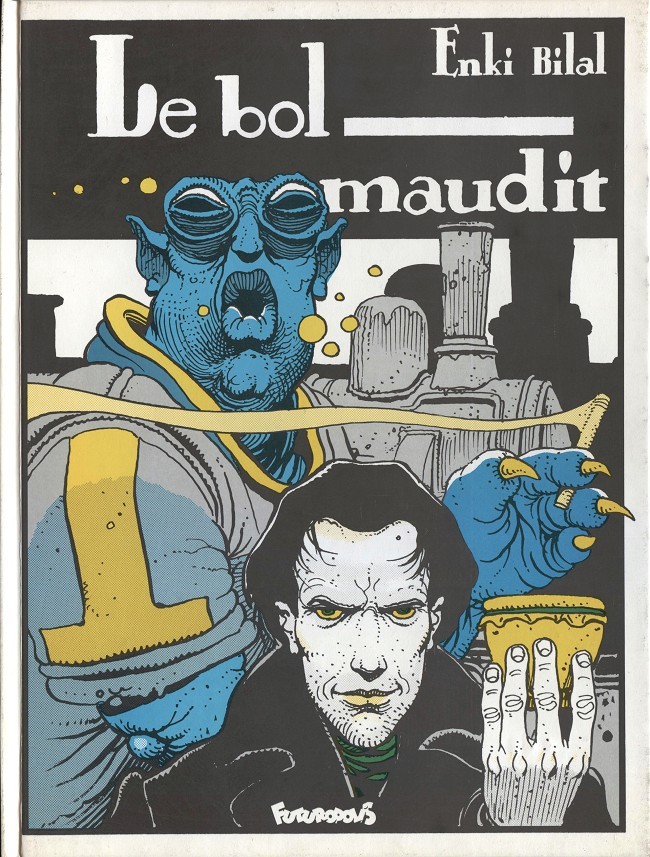
Le Bol Maudit (1982) by Enki Bilal

Et tu sauras ce que je sais…tu connaîtras par ce bol, les secrets les plus terrifiants, car comme moi tu es damné… par Yuggoth le maudit prends!!!
—Enki Bilal, Le Bol Maudit 2

And you will know what I know … you will know by this bowl, the most terrifying secrets, because like me you are damned … by Yuggoth the evil take this!!!
—English translation

“Le Bol Maudit” (“The Evil Bowl”) was the first story that Enki Bilal published, in the Franco-Belgian magazine Pilote in 1971. Over the next few years, Bilal would publish several more short stories in Pilote, including “A tire d’aile” (“On the Wing”), “Ophiuchus” (from the Greek, “Serpent-bearer”), “La chose a venir” (“The Thing To Come”), “Ciel de nuit” (“Night Sky”), “Kling Klang,” “Le mutant” (“The Mutant”), and “Fermez les volets et ouvrez l’oeil” (“Close the shutters and keep your eyes open”).

Most of these were very short black and white affairs, some only a couple pages long, with surreal and science fiction themes: astronauts, aliens, mutants, dreams—that would see much broader exploration in his more well-known and longer works such as Légendes d’Aujourd’hui (with Pierre Christin) and the Nikopol trilogy, which was partially adapted in the film Immortel (2004). These early works by Bilal were later collected, first by Minoustchine in 1975 as L’appel des étoiles (“The Call of the Stars”, 1975), containing only five stories, and then by Futuropolis in Le Bol Maudit (1982) containing eight. An English translation of the Minoustchine volume (reprinting “The Evil Bowl,” “On the Wing,” “Ophiuchus,” “Pulse” (“La chose a venir”), and “Close your shutters and watch out!”) was published by Flying Buffalo as The Call of the Stars (1978).

“The Call Of The Stars,
or the dark destiny of men called on by
the unutterable and inconceivable unknown.
Four stories with a Lovecraftian touch,
plus an authentic dream-nightmare voyage
I experienced with my tender companion
To whom I dedicate this collection dark with hope.”
Enki Bilal
—Back cover text of The Call of the Stars

In this early work, Bilal is displaying many of his influences very openly; there are gorgeous full-page compositions that show the influence of Philippe Druillet’s Lone Sloane, which was also published in Pilote for a period; scenes inspired rather blatantly from 2001: A Space Odyssey (1968), and there are stories like “Ophiuchus” which is essentially an adaptation of, or at least a variation on, H. P. Lovecraft’s “The Shadow over Innsmouth.” Bilal hadn’t quite reached his distinctive style of art and storytelling yet, but he was definitely on his way.

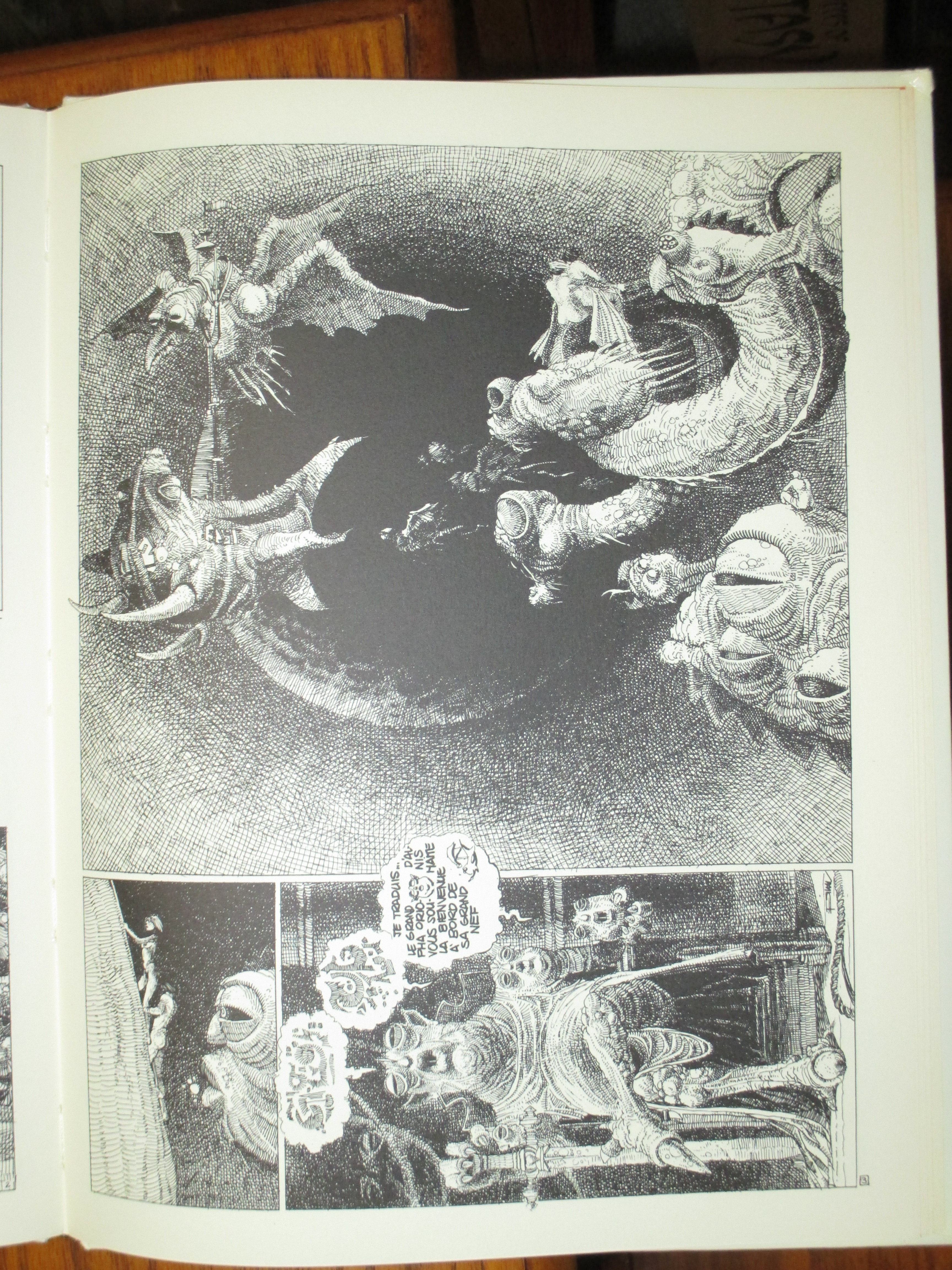
IMG_2608

Pages from “Le Bol Maudit”

“Le Bol Maudit” has the most explicit references to Lovecraft, although these are basically just Easter eggs for fans. Appreciation for Lovecraft blossomed in France, and in the Franco-Belgian comics circles during this periods, which would culminate in the special Lovecraft issue of Metal Hurlant in 1979, and still continues today in works like La Planète aux Cauchemars (2019) by Mathieu Sapin & Patrick Pion

IMG_2609

Panels from “Ophiuchus”

From a Lovecraftian standpoint, “Ophiuchus” is probably the most interesting, however. “Beau Rivage” (“Beautiful Shore,” “Pampona Beach” in the Flying Buffalo translation) is an intriguing variation on Innsmouth. A city of an alien race, human enough but decaying, mutating, shunning the sun, participating in the strange cult of Ophiucus until, the distant constellation. None of Bilal’s stories attempt horror, exactly, although a few of them have that surreal twist reminiscent of the Twilight Zone. In this respect, Bilal’s twist on Lovecraft’s ending is fitting: it is one thing to be an outsider among a crowd, not knowing why you don’t belong, and something else again to know yourself truly and completely…and know exactly why, and why you can never go home again.

IMG_2610

Page from “Fermez les volets et ouvrez l’oeil”

The most ambitious story, artistically, is the last one: “Fermez les volets et ouvrez l’oeil,” a surreal, fantastic dream-voyage of a young man and woman, with some incredibly elaborate crosshatching and a kind of plot like a more mature, Tolkien-esque version of Winsor McCay’s “Little Nemo.” There are some creatures and places here that would not be out of place in Lovecraft’s Dreamlands, although there is no explicit connection made. Like Lovecraft and Randolph Carter, Bilal inserts himself into his work now and again, most deliberately and explicitly in “Fermez les volets et ouvrez l’oeil,” where he is the male dreamer.

Taken all in all, Le Bol Maudit is a fun collection; the individual stories don’t build up into anything bigger, but they provide an interesting insight into Bilal’s earliest work, and a few nice little Lovecraftian Easter eggs for fans. The Flying Buffalo translations leave a little something to be desired; and chunks of the text go from serif to sans serif without warning. While apparently Bilal did his own lettering, parts of the English translation (translator and letterer uncredited) look like they were done with a typewriter, while others were lettered by hand or used stencils. It would nice to see a new translation into English, perhaps including the stories that never made it into the Flying Buffalo volume…but whether that will ever happen, who can say?

Thanks to Dave Haden at Tentaclii for pointing out a couple things I missed.


Bobby Derie is the author of Weird Talers: Essays on Robert E. Howard & Others (2019) and Sex and the Cthulhu Mythos (2014).
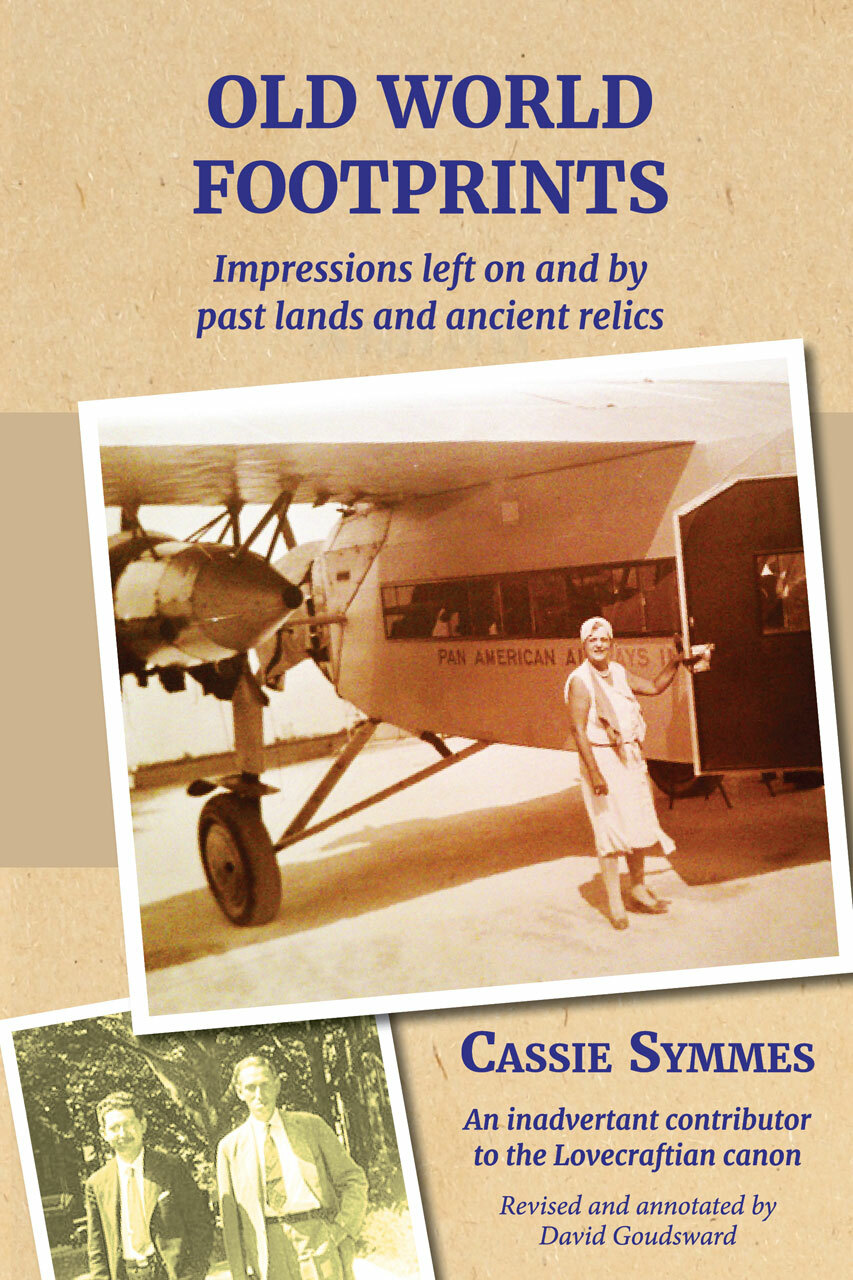
Old World Footprints (1928) by Cassie Symmes & Portrait of Ambrose Bierce (1929) by Adolphe de Castro

The fact that H. P. Lovecraft worked as a ghostwriter and reviser of other’s writing is common knowledge. Most of the work that receives attention is the weird fiction which he wrote for clients, to appear under their names in pulp magazines like Weird Tales and Wonder Stories, but Lovecraft’s revision services were much broader, covering everything from poetry (such as his work for David Van Bush and Josephine Evalyn Crane Blossom) to travelogues, such as European Glimpses (1988) by Sonia H. Greene.

Two of these works, Old World Footprints (1928) by Cassie Symmes and Portrait of Ambrose Bierce (1929) by Adolphe de Castro, are both connected with Lovecraft and his long-time friend Frank Belknap Long, Jr. By the late 1920s Long had set out to be a professional writer, and had published several short stories in Weird Tales, including “The Were-Snake” (1925), a book of poems, A Man from Genoa and Other Poems (1926). That book was underwritten by his aunt, Cassie Symmes, and printed by W. Paul Cook. Symmes was so impressed with the production that she hired Cook to produce a travelogue of her 1924-1927 trips to Europe, asking her nephew to provide the preface. Lovecraft was asked to correct the proofs.

Lovecraft did a little more than that. For many decades, Old World Footprints remained one of the rarest works of Lovecraftiana, but a 2021 reprint from Bold Venture Press has finally made it available to the average fan. Dave Goudsward tracks the history of Lovecraft’s involvement, including where and how Lovecraft touched up Symmes’ prose, to the extant that he basically ghost-wrote Long’s preface.

I concocted a euphemistic hash for young Long to sign—a preface to a tame travel-book by his aunt that bored him so badly he couldn’t think of anything to say! He didn’t want to turn down the request for a preface—so got me to cook up some amiable ambiguities for him.
—H. P. Lovecraft to Clark Ashton Smith, 19 Dec 1929, quoted in Old World Footprints (2021) 54

As the text of the travelogue itself is very short, the book is expanded with a biographical essay on Cassie Symmes, with focus on her involvement with all things Lovecraftian—she was, for instance, the person who gave Frank Belknap Long, Jr. a small statuette of the Hindu god Ganesa, which in turn inspired the figure of Chaugnar Faugn in Long’s novelette The Horror from the Hills (Weird Tales Jan—Feb-Mar 1931). The book also contains a collection of quotes from Lovecraft’s letters about Symmes and the book, making it a single point of reference for those who don’t own or wish to dig through multiple volumes of letters. Even for those not interested in the travelogue might yet find some interest in the light it sheds on Lovecraft & Long’s friendship.

I was asked to provide the foreword to this book, and one of the key points I made in that bears repeating here: even if you though you’d read everything Lovecraft had to offer, you almost certainly haven’t read this.

Long’s involvement with Portrait of Ambrose Bierce would be more substantial, while Lovecraft’s would be slighter. In 1927, Adolphe Danziger de Castro received some nationwide attention when an article he wrote supposedly giving some insight to how his one-time friend Ambrose Bierce had died was picked up by the Associated Press. De Castro sought to parlay this fifteen minutes of fame into an opportunity to revise and reprint some of his fiction, which was badly out of date, and he wrote to H. P. Lovecraft to do this. Lovecraft was willing to consider the revision work…and then de Castro made a further suggestion:

Now, to something else. you probably have seen the flash of publicity I have received lately with regard to Bierce. I have written the first part of a book, BIERCE AND I. It is the part relating to the west. I lost over two thousand letters of B. in the San Francisco fire. but the letters, 14 in all, he wrote me since 1900 I have and with these I am going to build the second part. Bob Davis assures me that he will get me a publisher at once. This means that I would be able to realize some money from the work. In this work, however, no revision as you suggest for the story is possible, for the reason that it my “I” that enters in the work and my style, with the exception of some expression here and there, is fairly well known. As these are purely reminiscences, even the aesthetic arrangement could not be changed. As the matter of the story is virtually settled—and it would please me if I could get it next week – what idea can you suggest about BIERCE AND I?
—Adolphe de Castro to H. P. Lovecraft, 8 Dec 1927, Letters to Alfred Galpin and Others 346

Lovecraft did revise some of de Castro’s fiction, and did so for “The Last Test” (Weird Tales Nov 1928), “The Electric Executioner” (Weird Tales Aug 1930), and a third revision. It appears during 1928 Lovecraft had recommended that Long might also help de Castro in some way, but de Castro was fixed on Lovecraft as a potential reviser or collaborator:

However, since I wrote you I added about fifty thousand words to the Bierce book, original matter written by Bierce and bearing on certain reminiscences I note.

The title of the book will not be BIERCE AND I but simply AMBROSE BIERCE. As I appear in the book a great deal as the teller of the story I deemed the former title over-descriptive.

What pains me, I frankly confess, is that there are probably many literary blemishes of which a book of this sort ought to be absolutely free. But I have written more than 115,000 words and have grown very tired. It is equally obvious that I cannot have the work done—as correctors might prove correctioners—spoiling the personal tone for an assumed form. It is not every one, my friend, who has your sure touch and is so sympathetic to the subject under discussion.

Albert & Charles Boni have the matter under consideration (this is in confidence, of course) but there are a number of publishers quite desirous of bringing out the book
—Adolphe de Castro to H. P. Lovecraft, 25 Feb 1928, Letters to Alfred Galpin and Others 351

It was at this point that Frank Belknap Long re-enters the picture:

Old Danziger-de Castro is now in touch with Belknap, & that little imp has just revised his memoirs of Bierce absolutely free of charge, in return for the privilege of prefixing a signed preface! Belknap thinks it will bear him onward toward fame to be thus visibly connected with a work likely to become a standard source-authority for future Bierce biographers. […] It seems that de Castro has written a great deal of more or less solid material, besides serving the government in several important capacities—consular & otherwise. Belknap says he is 62 years old, stout, & genial.
—H. P. Lovecraft to Donald Wandrei, 16 Mar 1928, Letters with Donald & Howard Wandrei 206

Ambrose Bierce in 1928 was much more famous than he is today, and the mystery of his disappearance—and the pop-culture trends that were already circulating regarding it; in 1932 Charles Fort’s book Wild Talents would propose the theory that someone was collecting Ambroses, which would enter the modern lore of conspiracy theory, pseudoscience, and UFO abductions. While today Mythos fans might recognize Bierce as the author of “An Inhabitant of Carcosa” (1886) and “Haïta the Shepherd” (1891), which Robert W. Chambers drew on for The King in Yellow (1895), in the 1920s Bierce occupied a position closer to that which Lovecraft himself would later occupy, recognized as a master of the weird tale with stories like “The Damned Thing” (1893) as a thematic precursor to Lovecraft’s own “The Unnameable” and “The Color Out of Space.”

So Long’s desire to attach his name to a piece of Bierce scholarship is a little more understandable in that context than it might be today. However, once de Castro got the preface and revised manuscript back, he wrote to Lovecraft again:

Now to something else…Belknap Long wrote a nice bit of preface to my Bierce book; but I’ll be this, that and t’other, if I like the book as I wrote it; although Belknap thinks it very good. There is something missing in it, something I could do if I were away from harassing conditions and disturbing elements. It has been read by three publishers and rejected on a certain expressed criticism and the adulti stulti seem not to comprehend that I know better than they what is the trouble. The book is written by the person who for more than twenty-five years was in closest touch with Ambrose Bierce with little confidences that no other human being knew or heard. Naturally it is written in the first person singular—how else could it have the personal touch? However, this makes it “reminiscent” rather than biographical, and they want a pure unadulterated biography—although not quite true, as one publisher expressed it; and this publisher actually offered a big advance royalty—what do you think of that? No wonder I am bewildered and don’t know how, where, and to whom to turn. nor have I put any great criticism of Bierce’s works in my book, but I have left out oceans of matter of most interesting personal character—not wishing to make the book too long.
—Adolphe de Castro to H. P. Lovecraft, 1 Apr 1928, Letters to Alfred Galpin and Others
 353-4

In his letters to de Castro, Lovecraft is unfailingly polite. In his letters to others, he is much more direct about the whole matter:

As for the memoirs themselves—alas! They are again set back to the raw material stage. Belknap did not take any job away from his old grandpa—he refused to consider it till old ‘Dolph stated positively that he could not have the work done by anybody on any cash basis whatsoever. But behold & lament! Though the job is done, yet it isn’t—for since the revision no less than three publishers have rejected the MS. on the ground that the style is still too crude, & the material still too ill-proportioned! I thought that Belknap must have made a rather light job of it when he said that he did that whole long book MS. in only two days—& lo! That is just about what did happen! Now old ‘Dolph is looking for a regular recasting in the slow, extensive, & painfully conscientious manner of Grandpa Nekrophilos—indeed, a suggestion from the third & latest rejecting publisher has led him to consider a radical change of plan, & an abandonment of the memoir style for a regular biographical treatise in the third person. This, of course, means a radical text-upheaval which really amounts to collaboration rather than revision. But—eheu!—though his ideas are bigger, his purse most infelicitously isn’t; so that he plaintively announces himself as ‘bewildered, & at a loss how, where, & to whom to turn’. He hems & haws & alludes delicately to the ‘almost certain’ profits of the biography if it can be properly formulated & launched—placing the likely receipts most alluringly at about $50,000.00. [Fancy!] What he is leading up to is undoubtedly a proposition for me to do the work on a speculative basis—i.e., for a certain percentage of the possible royalties—but right here is where Grandpa pauses for sombre reflection! As a piece of work—rightly done—it would be a staggering all-summer asphyxiation cutting off alike my immediately remunerative revision, & any possible original fiction I might wish to write. In exchange for this sacrifice I would have a double gamble, with two exceedingly doubtful spots—(a) whether any publisher would take the damn thing after all, & (b) whether, being published, it would really drag in enough to make a collaborator’s percentage anything more than a joke. Yes—the old gentleman will be very deliberate! Moreover—I don’t know how big a percentage a collaborator really ought to ask. And yet, at that, there’s certainly great stuff in the book; real source material that no future Bierce student (if such the coming years may hold) can afford to overlook. Belknap went wild over it—eating up every word so avidly that he didn’t see any mistakes at all until he started to go over it a second time with critical pencil in hand—& I shall be glad to get a chance to read the MS. myself. Old ‘Dolph still talks of making a stage-coach trip to Providence—& I shall certainly receive him with civility if he does. But in my opinion he’d better stick to Belknap—who is right on he ground for personal consultation, & who is willing to toil for fame alone—as his collaborator, telling him just how extensive he wants the changes, & giving him plenty of time to make a really thorough job. In recompense he ought to include the Child’s name on the title-page—”Ambrose Bierce: By Adolphe de Castro & Frank Belknap Long, Jun.” Just how much fame it would bring Belknap remains to be seen. The book is no mere controversial item—it’s a long string of general Bierce reminiscences—& now that a triple rejection has chastened him, Old ‘Dolph would probably be willing to cut down the [“Monk and the Hangman’s Daughter”] episode till it occupied a less disproportionate space in his whole oeuvre.
—H. P. Lovecraft to Donald Wandrei, 5 Apr 1928, LWP 209-210

There was a bit of back and forth, and Lovecraft & Long actually met with de Castro at the latter’s apartment in New York City. However, Lovecraft was less than hopeful about the outcome:

I’m afraid the old duffer can’t or won’t pay a decent advance price, hence I doubt if I take the revision job after all; though I shall read the book fully & prepare a helpful synopsis & list of suggestions. My own interest impels me to do this—& I  have promised him such a list by next Thursday.
—H. P. Lovecraft to Lillian D. Clark, 29 Apr 1928, Letters to Family & Family Friends 2.635

The next few months were trying; de Castro continued to pester Lovecraft to work on the book, and Lovecraft refused to do so for less than $150 up front—a sizable fee for a very sizable job, and less than de Castro had been paid for the stories Lovecraft had revised for him had sold for. Nevertheless, it seems like Lovecraft did send his promised list of suggestions, and Long did apparently do a light revision of the text, and eventually de Castro managed to sell it:

Old Adolphe de Castro has turned up again, & is pestering Belknap & me with dubious revision propositions. He says the Century Co. has just accepted his Bierce book, which is surely interesting if true. He claims to have just returned from a European trip.
—H. P. Lovecraft to August Derleth, 2/9/16 Nov 1928, Essential Solitude 1.167

Portrait of Ambrose Bierce (1929, Century Co.) was published in attractive hardcover, complete with photographic plates, a fold-out facsimile of Bierce’s “The Town Crier” articles of 1969, and a brief prologue by Frank Belknap Long (who signed himself, in James Branch Cabell’s fashion, as simply “Belknap Long.”) The extent of Long’s revision of the manuscript isn’t clear, a comparison of the table of contents for Bierce and I that de Castro had mailed to Lovecraft (LAGO 350) and the final table of contents of Portrait of Ambrose Bierce shows many of the chapters are nearly identical, so there was no major re-shuffling of the contents. Still, it appears de Castro might have taken some advice from Lovecraft:

Old De Castro’s book has been attacked quite violently by some reviewers—& not unjustly, since it is truly a slovenly & egotistical concoction which doesn’t give Bierce half his due. I have glanced through the printed copy, I see that the author took all of my advice regarding deletions, though giving me no credit therefor. Belknap’s preface opens with a misprint—Beaudlaire.
—H. P. Lovecraft to Clark Ashton Smith, 14 Apr 1929, Dawnward Spire, Lonely Hill 173

Aside from this, Lovecraft never claimed to have any part in the final text of Portrait of Ambrose Bierce, and in truth it’s difficult to see any part of the book he might have had a hand in. The tone throughout is from de Castro’s point of view, and one would be hard-pressed to find a word distinctive of Lovecraft’s vocabulary or philosophy, unless it be in Long’s own preface. Certainly, the book does not deal even cursorily with Bierce’s weird fiction; Lovecraft’s friend Samuel Loveman’s 21 Letters of Ambrose Bierce (1922) is cited in the bibliography, but under the wrong title. Certainly if Lovecraft did have any direct hand in the book, he would have striven to correct that error. When Long finally saw the finished product, he was nonplussed:

First we stopped at Kirk’s, where the Child took a look at De Castro’s Bierce book with his preface in it. The result was something of a shock; for there were many grave misprints, & old De Castro had interpolated a whole section of a personal letter which Belknap wrote him in praise of the volume. Sonny intends, however, to buy the book eventually. It was a cheap trick of old De Castro’s not to give us both free copies!
—H. P. Lovecraft to Lillian D. Clark, 28-29 Apr 1929, Letters to Family & Family Friends 2.761

Portrait of Ambrose Bierce was not the end of Lovecraft’s personal and professional relationship with de Castro, although it seems to have been the end of de Castro’s professional relationship with Long. The poor reception of the book seems to have negated any hoped-for recognition association with it might bring, and the book itself is of relatively limited value to Bierce scholars, since so much of the facts are filtered through de Castro’s own self-importance and determination to give himself what he felt was due credit—often at the expense of Bierce, and in the bibliography at the expense of Bierce’s friend the poet George Sterling, who had committed suicide in 1926. That was in exceptionally poor taste.

If it’s a failure as a work of biography, as an artifact, Portrait of Ambrose Bierce is interesting as another thread in the web of connections between two masters of the weird tale—aside from his association with de Castro (The Monk & the Hangman’s Daughter, Portrait of Ambrose Bierce), and Samuel Loveman (21 Letters of Ambrose Bierce), Lovecraft was also connected to Bierce through Clark Ashton Smith, whose mentor was George Sterling (and Sterling had actually commented on Lovecraft’s story “Dagon”). There are some more obscure connections, if you dig for them, in certain anecdotes in Lovecraft’s letters. Robert E. Howard ended up reading Portrait of Ambrose Bierce, and brought it up in is letters to Lovecraft (A Means to Freedom 1.453, 2.539).

Perhaps belatedly, the affair also cemented Lovecraft’s professional standing with regard to de Castro:

Just heard from old De Castro—he thinks his Bierce book would have been better received if I had revised it! Well—if he’d been willing to pay, I’d have been willing to work!
—H. P. Lovecraft to Clark Ashton Smith, 5 Jun 1929, Dawnward Spire, Lonely Hill 176

Lovecraft never would revise any full-length book for de Castro, although he did do a revision or two—cash up front.

What these two books show is that there was a lot more to Lovecraft’s career as a revisionist than just his weird fiction—and that when it came to revision, as opposed to fiction written for his own aesthetics, Lovecraft could be somewhat mercenary. Although he was always willing to help out a friend, Lovecraft couldn’t afford to take big revision jobs without the promise of pay—an attitude which would, eventually, see him get out of the revision business altogether.


Bobby Derie is the author of Weird Talers: Essays on Robert E. Howard & Others (2019) and Sex and the Cthulhu Mythos (2014).
The Village Green (192?) by Edith Miniter

Meanwhile [R. H. Barlow] has elected himself a sort of successor to Cook & me as literary executor for Mrs. Miniter, & is busily going over the huge bale of unclassified Miniteriana which Cook sent here last year. Amongst this material is the long-lust novelette of 1923 (about a literary club with figures taken from the Hub Organisation—I am recognisably depicted!) called “The Village Green” […]
—H. P. Lovecraft to Edward H. Cole, 15 Aug 1936, Letters to Albert Galpin & Others 143

Even during his lifetime, H. P. Lovecraft was a character that blurred the lines between reality and fiction. His personal myth was born by the persona he projected in his vast correspondence—but his encounters with folks he met in-person were no less memorable. Frank Belknap Long, Jr. famously killed a fictionalized Howard in “The Space-Eaters” (Weird Tales, July 1928), one of the first Cthulhu Mythos stories; Robert Bloch did the same thing in “The Shambler from the Stars” (Weird Tales, Sep 1935), and Lovecraft’s wife would base a character on him in “Four O’Clock” (1949). In the decades that followed his death, Lovecraft would enter fully into his own mythology; August Derleth would cite his books alongside the Necronomicon, and out past the known planets Richard A. Lupoff would find him in “The Discovery of the Ghooric Zone” (1977). Since then Lovecraft’s image has appeared in short fictions, comics, manga, games, and other media. Actor Jeffrey Combs even famously played him in Necronomicon: Book of the Dead (1993)—with the aid of a prosthetic to mimic Lovecraft’s prognathous jaw.

Yet one of the earliest literary depictions of H. P. Lovecraft has been read by very few people.

A group that didn’t feel interested in jaunty publications talked just as jauntily about literature, and not entirely their own. Indeed the large man with the long chin, who had received a letter from “Bob” Davis containing the words: “It (The Bats in the Belfry) is splendidly written, but it exceeds the speed limit….I have been some time coming to a conclusion about this story, but I didn’t want to push the matter hastily. Even now I may be wrong….” took the confession in a nonchalant manner that shocked his confreres.
—Edith Miniter, The Village Green and Other Pieces 147

“The large man with the long chin” is later identified as H. Theobald, Jr.; “Theobald” being one of Lovecraft’s pseudonyms in amateur journalism, as seen in “To Mr. Theobald” (1926) by Samuel Loveman. To appreciate the characterization, it is necessary to be familiar with the author.

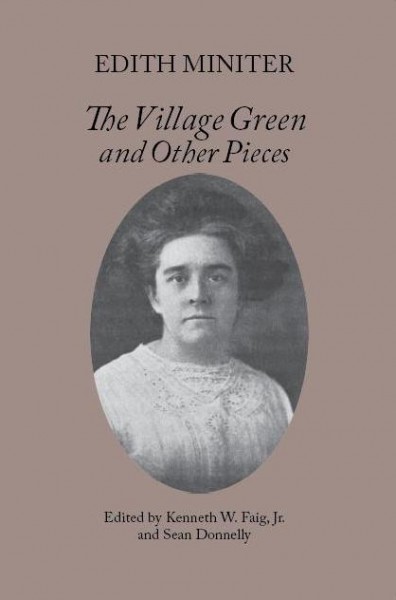
Edith May Dowe Miniter (1867-1934) was a journalist, both amateur and professional. She became involved in amateur journalism at age 13, edited and published many papers, and was largely associated with the Hub Club in Boston, Massachusetts, and the National Amateur Press Association; she would serve terms as president of both organizations, the first woman to hold executive office in amateur journalism, and even met her husband through amateur journalism (NAPA History, Early Amateur Journalism in Massachusetts, and “The Other Miniter: In Search of John T. Miniter” in The Fossil 386).

Through amateur journalism, Edith Miniter met Lovecraft. They actually met in person at the 1921 National Amateur Press Association convention in Boston, where Lovecraft would also meet his future wife Sonia H. Greene. Miniter’s amateur journals contain many insightful snippets on folks including Lovecraft and Winifred Virginia Jackson. She was noted particularly for her wit, which was scathing and unsparing, but also often irreverent and universal, an example of which is “Falco Ossifracus” (1921), the first parody and pastiche of Lovecraft’s particularly florid style. Lovecraft in turn wrote poems dedicated to her and her cats, and held the elder stateswoman of amateur journalism in high esteem.

While she published many stories and poems, her only novel was Our Natupski Neighbors (1916); she started other novels, including The Village Green, but never completed any of them before her death in 1934. Lovecraft was one of those who helped scatter her mother’s ashes in Wilbraham, Massachusetts, whose scenery and lore had helped to inform “The Dunwich Horror.” Her papers first went to fellow amateur journalist W. Paul Cook, and then Lovecraft’s teenaged friend R. H. Barlow, whom had been introduced to amateur journalism through Lovecraft, got involved. Barlow would eventually publish Miniter’s short story “Dead Houses” in his journal Leaves, alongside other pieces from the Lovecraft circle, and some of her papers were later donated to the John Hay Library along with Lovecraft’s materials.

The Village Green, however, would languish mostly inaccessible until 2013 when it was finally published in The Village Green and Other Pieces, edited by Kenneth W. Faig, Jr. and Sean Donnelly. The editors suggest that the novel was written circa 1923-1925, and go on to say:

Make no mistake—the editors make no exaggerated claims for The Village Green, whose portrait of a local literary club patterned on Edith’s Hub Club never really jells into a coherent narrative. (xi)

The unfinished novel is very old fashioned by contemporary standards, in terms of prose and framing, but of its time it would have been quite candid. It is Dickensian in the sense that it is a novel of incidents and episodes, often prosaic, fragments of discussion with layers of a social game of manners both implicit and explicit; it is similar to Sherwood Anderson’s Winesburg, Ohio (1919) in that it is a starkly realistic example of the inner lives of ordinary people, including their sexual affairs—though while Miniter is explicit that the affairs happen, she isn’t explicit about any of the details of coitus itself. The result never quite comes together, because, much like life, it just continues on until it stops. Probably the closest comparison would be some of August Derleth’s output of regional literature called the Sac Prairie Saga.

Lovecraft’s character is probably the main drew of the novel for most. The reference to “The Bats in the Belfry” is, I suspect, a reference to “Bat’s Belfry,” the first story by August Derleth in Weird Tales (May 1926), which if true might indicate Miniter was working on the manuscript rather later than 1925. The scenes or episodes with H. Theobald, Jr. are few, yet as Lovecraft noted, he is easy to recognize:

Theobald—the man with the long chin—opined that this retort had been ancient in the 18th century. At this arose a fusillade of comments. Theobald did not really try to live in the 18th century, though he might date letters 1723 and refer to Colonies. Had he actually asked for a typewrite with a long “s”? Did he smoke the pipes of that period—did he read newspapers of that day? “I hate to say it, but you’re nothing better than an anachronism, Theobald,” observed Trinkett.

Theobald calmed the tumult with an upraised hand—the too white hand of an invalid. “‘Tis plain,” he said, “that my character is receiving a Dickensonian or 19th century distortion to the grotesque, which well conceals the quiet manners of a gentleman of Geo. the II’s reign. You must know that in my time ’twas thought monstrous vulgar to excite remark in publick assemblies; and that no matter how humorsome a queer old fellow might be he would save his odd humors for the coffee-house, nor seek to drag them into a rout of any sort of mixt genteel company.”
—Edith Miniter, The Village Green and Other Pieces 148

It is hard to tell how much of this is true to life for Lovecraft’s behavior in person, and how much of it is Miniter gently taking the piss with her good friend. Her amateur journal pieces which mention Lovecraft don’t tend to go into this level of detail in putting words into his mouth, but at the same time these are very similar sentiments—and spellings—to what Lovecraft would include in his correspondence with others. If it’s a parody or a caricature, it is a gentle one, and Theobald’s insistence on being a 17th century gentleman in the 20th century is not too far from what Lovecraft often presented himself as. Whether Miniter actually quotes directly from Lovecraft is impossible to say at this remove.

The Village Green will probably be too much for weird fiction fans; the decidedly non-fantastic plot and incomplete status will likely shy away everyone except historians and Lovecraft scholars. Yet it is important not to forget what it represents: Lovecraft’s impact on the lives of those around him, including women like Edith Miniter, who wished to immortalize her friend in one of her stories. While incomplete, the novel stands as a testament to an important figure in amateur journalism history, a regional writer whose work is often unrecognized today, and deserves to be better appreciated for what she wrote and accomplished in her life.

The manuscript for The Village Green is available online at the John Hay Library.


Bobby Derie is the author of Weird Talers: Essays on Robert E. Howard & Others (2019) and Sex and the Cthulhu Mythos (2014).

Dagger of Blood (1997) by John Blackburn

Eldritch Fappenings

This review deals with a work of pornography, and the history of erotic art and writing. As part of this review, selected images with cartoon depictions of genitalia and/or sexually explicit contact will be displayed.
As such, please be advised before reading further.


They that write as a trade to please the whim of the day, they are like sailors that work at the rafts only to warm their hands and to distract their thoughts from their certain doom; their rafts go all to pieces before the ship breaks up.
—Lord Dunsany, “The Raft-Builders”(1915)

Popular fiction, whether it be for pulp magazines, comic books, or pornography, is ephemeral. Precious few authors have the kind of posthumous renaissance that H. P. Lovecraft has experienced. Even those who build up a considerable body of work, or a dedicated following, often sink out of sight once they die. Their works aren’t reprinted. Work goes uncollected, unread, forgotten.

John Blackburn died in 2006. His raft is breaking up.

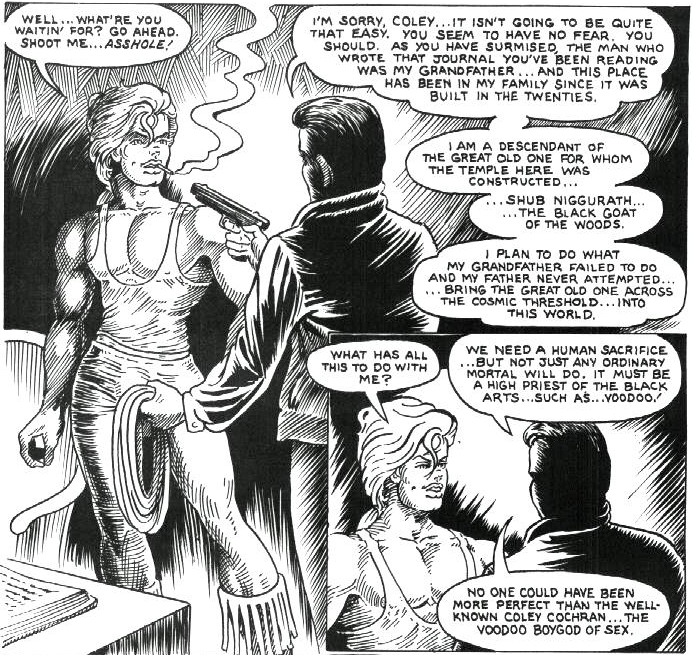
In 1989, Blackburn self-published his own comic, Coley on Voodoo Island, acting as writer, artist, and letterer. While normally categorized among gay comics, Coley is bisexual, or maybe pansexual: a living sex icon, his very presence tends to attract everyone, regardless of sexuality or gender identity. Some folks might characterize Coley—the ageless, immortal, six-pack-abs voodoo sex god with a large penis, a bottomless libido, and a constant parade of sexual partners—as a form of wish fulfillment. Yet it is wish fulfillment in the same way that Conan the Cimmerian, or Captain America, or the Vampire Lestat are. Coley embodies a pure fantasy, a larger-than-life figure who moves through the world, and in so doing changes it.

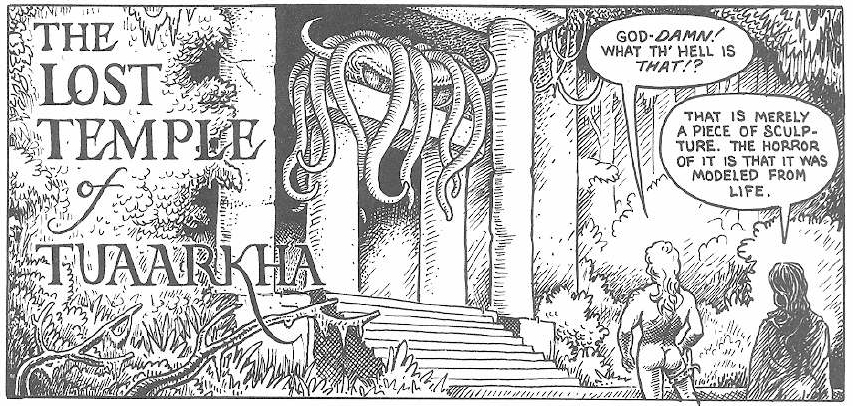
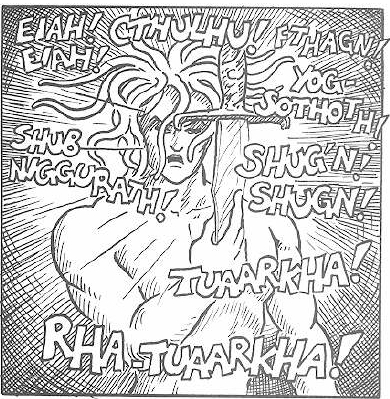
The first four issues of Coley’s adventures were self-published by Blackburn; in 1992 Fantagraphics, which was publishing a great number of alternative, independent, and erotic comics, picked up Coley and reprinted the first adventures and then new ones. While a supernatural fantasy element was present from the beginning, the Cthulhu Mythos slid into the mix in 1993 with the two-issue series Idol of Flesh, where Coley runs up against a cult of Shub-Niggurath.

gcrw1_127

Idol of Flesh #2 (1993)

As an artist, Blackburn puts a lot of work into his hatching; you can see some influence from superhero comics in the often skin-tight clothes and Coley’s heroic proportions, and this sometimes goes for other characters as well. Compositions tend to be focused: the reader’s eye is usually drawn to the center of each panel, each pane, and backgrounds usually fade out to dark hatching during the frequent erotic scenes or conversational back-and-forth. Stylistically very different from Le Pornomicon (2005) by Logan Kowalsky or Insania Tenebris (2020) by Raúlo Cáceres, many readers might fairly judge it to be almost crude by comparison. It might be better to compare Blackburn’s work with underground cartoonists of the ’70s in terms of style and technique.

The plot of the series revolves around Coley, even when he isn’t on the page. The other characters are almost invariably attracted to him, but have to figure out for themselves what that means, what their relationship is about, particularly as Coley—while a loyal friend, and able to fall in love easily with others—has basically zero interest in monogamous relationships, and resists anyone else’s efforts to constrain or define his behavior. This tends to put him at odds with local authority figures, such as the police, religious types, and general bigots—and in a few cases, attracts supernatural forces.

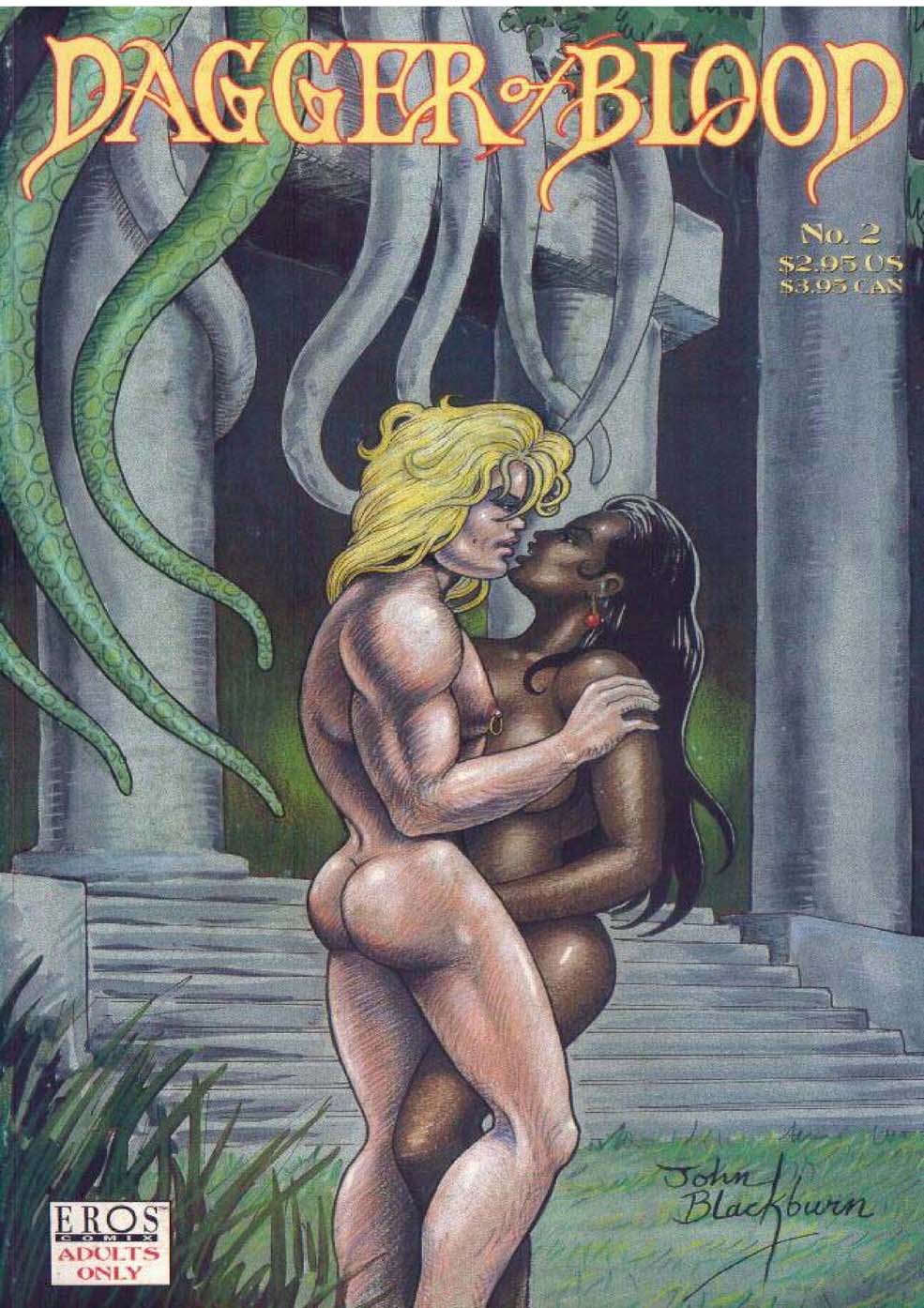
The Cthulhu Mythos intrudes on Coley and his gaggle of associates in the three-issue Dagger of Blood series in 1997. This was the final standalone comic produced featuring Coley, although Fantagraphics would publish three additional omnibus albums titled Coley Running Wild from 1997-2003. Coley’s earlier encounter with the cult of Shub-Niggurath put him on the cultist radar, and he now has to deal with another descendant of the Old Ones.

GCRW8217

Dagger of Blood #2

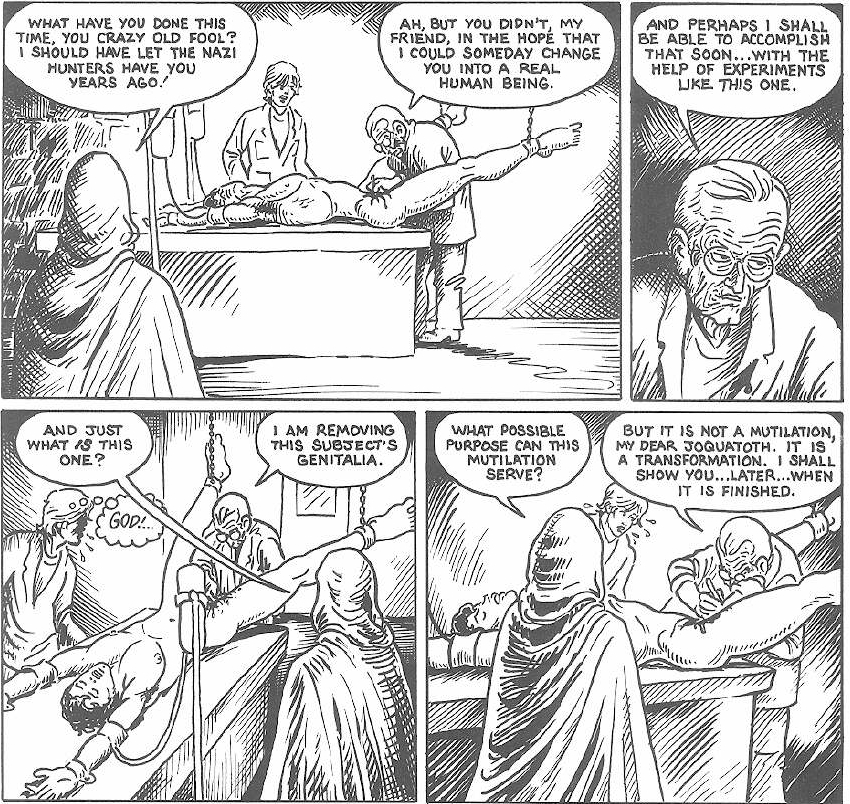
While the story takes many X-rated breaks, the plot takes a turn strongly reminiscent of the post-war Men’s Adventure Pulps of the late 1940s and 50s—though not one that would probably ever have passed the editors of those magazines.

GCRW8220

Dagger of Blood #2

Old Nazi mad scientist in a temple of the Old Ones deep inside a jungle probably sounds like an exploitation script treatment even before you add the pornstars, voodoo sex god, flagellation scenes, interracial relationships, body modification, sex changes, and bloody violence…but there is something more interesting at work here.

One of the things that sets Coley apart from the other characters in this series is that he is completely accepting of both his body and his sexuality; it helps that by the standards of the characters in the comic, he’s basically perfect: young, slim, muscled, big genitalia, etc. and he maintains it with seemingly zero effort. By contrast, many of the other characters are not at all happy with their body or their sexuality. The main antagonist Joquatoth is dealing with the effects of his inhuman heritage—and wants to stay human. If he wasn’t deliberately set up as evil, he could be seen as an almost tragic figure, facing issues of body image that parallel those of many transgender folk as they deal with issues like puberty, or strive to achieve a body closer to their gender identity via hormones and surgery.

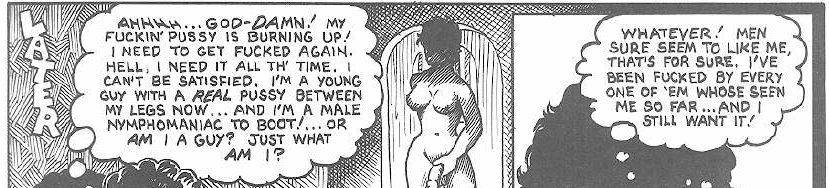
Blackburn doesn’t explore these issues in anything like depth; the castration scene is a setup for a sub-plot where the genitalia of two characters are swapped: Coley’s lover Lonny gets a vagina, and the mostly lesbian Kit gets his penis. Lonny and Kit’s introspection at these drastic and fantastical changes to their bodies is less than profound…but it’s there.

GCRW8304

Dagger of Blood #3

The idea of transsexual or intersex characters that don’t conform strictly to a sex or gender binary are nothing new, not even in Lovecraft’s time. His friend Samuel Loveman wrote “The Hermaphrodite” in 1926, pulp stories like Seabury Quinn’s “Strange Interval” (Weird Tales May 1936) and Lovecraft’s own “The Thing on the Doorstep” (Weird Tales Jan 1937) play with gender-changes, albeit in very non-explicit and largely sexless ways. It takes a certain amount of artistic freedom to actually depict and address some of these issues, and that just wasn’t possible under the editorial and mail censorship of the 1930s, even if there had been writers among Lovecraft’s correspondents and devotees who had desired to address such issues.

Which is one of the things that makes Dagger of Blood stand out. Yes, it’s very blatantly pornography, with a rare page that goes by without nudity or some sexual act; it’s a comic book and not a novel, which places it in that weird intersection of being doubly disposable for being taboo in subject matter and a medium often derided at the time as childish or trash (though that was slowly changing). The Mythos material is slight, being two storylines involving cultists with semi-human leaders. There is a tentacle erotica scene, which might owe something to the popularity of Japanese manga and anime like Toshio Maeda’s La Blue Girl (manga 1989-1992, original video animation 1992-1993).

GCRW8311

Dagger of Blood #3

Yet it’s for that exact reason that Dagger of Blood has its charms, and can even address some of these issues of gender, sexuality, relationships, and body image when contemporary Mythos works largely didn’t…because Blackburn didn’t have to subscribe to the same editorial taboos, the social norms and mores that he would if he had been working for Marvel Comics or even Playboy. Working on his own he had more creative freedom to get really weird—and that kind of growth can be important. Even if Blackburn’s Coley opus isn’t destined to stand the test of time, it is one of Dunsany’s rafts set adrift…and who knows what it might inspire, if it does survive a little while longer?

Our ships were all unseaworthy from the first.

There goes the raft that Homer made for Helen.
—Lord Dunsany, “The Raft-Builders” (1915)

John Blackburn’s Dagger of Blood #1-3 were published by Eros Comix in 1997; they were collected in Coley Running Wild, Book Three: Hardthrob (2003).


Bobby Derie is the author of Weird Talers: Essays on Robert E. Howard & Others (2019) and Sex and the Cthulhu Mythos (2014).

Cthulhu (2007)

What the story reminded me of, more than anything else, was friends of mine who are gay, who come from these backwoods towns and then escape to the city to make an adult life. And then, fifteen or twenty years later, they’re in their thirties, and a parent dies, or the sister has a child, or whatever, and they have to go back and engage with that family and that place. One of Lovecraft’s major themes, and I think “The Shadow Over Innsmouth” expresses this best, is the horror of heredity. So I was writing from that feeling of threat, but also the issues of heredity, of anxiety about having children, and I decided to merge the two things.
—Grant Cogswell, “Interview: Dan Gildark & Grant Cogswell of Cthulhu” by Kent M. Beeson

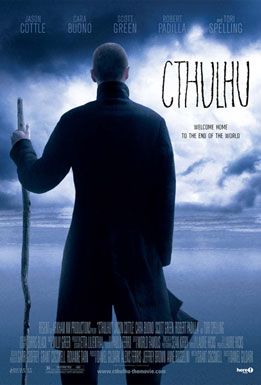
The 2007 horror film Cthulhu was written by Grant Cogswell & Daniel Gildark, directed by Gildark, and stars Jason Cottle as Russell Marsh, a homosexual history professor at Cascadia University that has to return to the small town he escaped from when his mother dies. The 100 minute long film that follows is largely inspired by Lovecraft’s “The Shadow over Innsmouth,” but is almost a cinematic adaptation of Robert M. Price’s essay “Homosexual Panic in ‘The Outsider'” (1982).

Cthulhu had an odd production; from interviews and the commentary track on the DVD, it seems like the idea for the script was born in 2003, actual shooting happened in 2005, and it finally premiered at the 2007 Seattle International Film Festival, with limited theatrical release in 2008 followed swiftly by a DVD release. The film was shot in the Pacific Northwest and had an estimated budget of $1 million dollars, a chunk of which ($175,000) was personally financed by Cogswell, who was left homeless when the film failed to recoup costs (Subject of Seattle film talks about the movie that almost destroyed him). Gildark and Cogswell are very forthright in the DVD track about the cinematic shortcomings of the film and their own inexperience in filmmaking, but the film that they made is worth considering on its own merits:

The genre films I’m most interested in are the ones that are indescribable, that move back and forth across genres. They aren’t true horror in the traditional sense; they kind of skirt the edges. To call our film a gay film is misleading, but to call it a straight horror film is misleading as well, so it really is kind of a bastard version of those genres, which I’m totally comfortable with. It makes it hard to market, but anything interesting takes from different fields and doesn’t try to be a purist art form.
—Dan Gildark, “Interview: Dan Gildark & Grant Cogswell of Cthulhu” by Kent M. Beeson

In Lovecraft’s “The Shadow over Innsmouth,” from a plot perspective the sexuality of the main character is largely moot. There are no real potential love-interests, and romance and sexual attraction are not on the menu. Homosexual (or transsexual) readings of the story focus on the nameless protagonist as an outsider who enters a community of outsiders, scared and frightened by what they uncover, and who discovers too late that they are what they had sought to escape—and finally come to embrace that, and the community that they at first had rejected.

This is not the story that Cogswell & Gildark tell. The homosexuality of Russell Marsh is a key component of character and a driver for many of the conflicts and relationships in the film, but he is openly aware of that fact—and it blinds him to some of what is going on, viewing some of the conflict with his family as a reflection of his sexuality instead of the much darker reality. Yet at the same time, his sexuality very much is a key aspect to this story, because the Innsmouth story is a generational one—and it’s hard to get biological grandkids from a gay prodigal son. Brian Johnson in “Paranoia, Panic, and the Queer Weird” elegantly describes this as “the monstrous forces of a cultic paternal heteronormativity” (New Directions in Supernatural Horror Literature 257).

That’s compelling, at the level of personal horror. Russell Marsh thinks himself an outsider because of his homosexuality, but the reality is far weirder. There are things he still doesn’t know about himself—but during the course of this film, he finds out. That revelation, filtered through a much more different perspective than Lovecraft ever intended as it may be, still works. Getting there, however…that doesn’t work so well.

Jason Cottle, who plays Russell Marsh, is also credited with some additional writing, and it’s more or less his performance that carries most of the film. His ability to convey irritation, outrage, disgust, and quiet longing is what will appeal to the audience’s sympathies, if anything. Richard Garfield’s performance as Zadok is fun, and Scott Patrick Green’s performance as Marsh’s homosexual friend Mike also stand out as they get basically scenes to themselves, talking while Cottle’s Marsh listens. The other characters have fewer lines and less development, and it’s Cottle who has to be the focus of the film, and he is.

Like the ill-fitting wig Cottle wears early on in the film, however, it’s not enough. Sometimes passion and vision can only take you so far, and unlike Dagon (2001), another film adapted from “The Shadow over Innsmouth,” there really isn’t that strong, almost campy and arresting visual style, fast pacing, and effects work which can take a clunky script and still produce an effective horror film. There are also some beautiful cinematography in Cthulhu, and the production really did their best to make use of the local scenery. The breadth and majesty of the Pacific rolling up in some scenes is excellent, until the CGI Deep Ones come marching in.

It wasn’t long ago that a horror film with gay content would have had no hope of landing a major U.S. distributor, but in today’s niche-driven industry, the sexuality of Cthulhu‘s main character may well prove a savvy marketing move. On the one hand, gay and lesbian film festivals have cultivated an audience that’s been proven hungry for movies with gay themes, regardless of hype or production values.
“Oh, the Horror: The Making of ‘Cthulhu'” by Annie Wagner

Cthulhu wasn’t really marketed or distributed as a gay or queer film, but it has been adopted by some critics as queer cinema. Russell Marsh is certain homosexual; the first protagonist in a Mythos film to be openly played as homosexual. His homosexuality is crucial to the conflicts in the story. But Russell Marsh himself isn’t really conflicted about his homosexuality. Russell starts the film at peace with himself, agitated only by confronting those that he feels see him as the monstrous other. Yet Gildark wouldn’t call it a gay or straight horror film…and maybe with good reason.

Consider the argument that:

[…] monstrous figures in American cinema were and are informed by their given era’s social understanding of homosexuality, or more broadly queerness.
—Harry M. Benshoff, “‘Way Too Gay to Be Ignored’: The Production and Reception of Queer Horror Cinema in the Twenty-First Century” in Speaking of Monsters: A Teratological Anthology 131)

Homosexuality and transsexuality have made tremendous strides in mainstream acceptance and legal recognition in the last few decades, but this is still the cultural era of incels and TERFs. It is the heterosexual characters in this film that appear to be the real monsters—but Russell Marsh isn’t exactly heroic or normal by contrast either. As estranged from his family as he might be, he is still a Marsh…and in his own way he is a monster too. The inevitability in that, the way Marsh discovers that he cannot escape the essential kinship with these characters that he opposes, the ties that bind—is very Lovecraftian. Yet the ending is ambiguous; Marsh lashes out, but the audience never sees at who. The blow fails to fall.

Cthulhu lives in that undefined, unknowable, unfilmed ground. Russell Marsh is confronted with who he is, who his family is; but we don’t see the choice he is forced to make, between his family and his friend-and-lover. Between the demands of tradition, culture, and (arguably) biology, versus friendship and sexuality. If he strikes down his lover, he has completed the Lovecraftian arc of “The Shadow over Innsmouth” and become that which he hated. If he strikes down his father, he affirms his sexuality and friendship over any ties of blood…even though it will probably cost them both their lives. Which is more horrific depends on the audience; either way, Russell Marsh will have to betray someone, and himself.

Cthulhu (2007) is available on DVD and some streaming services.


Bobby Derie is the author of Weird Talers: Essays on Robert E. Howard & Others (2019) and Sex and the Cthulhu Mythos (2014).
Cthulhu on Lesbos (2011) by David Jalajel

The professor had been stricken whilst returning from the Newport boat; falling suddenly, as witnesses said, after having been jostled by a nautical-looking negro who had come from one of the queer dark courts on the precipitous hillside which formed a short cut from the waterfront to the deceased’s home in Williams Street. Physicians were unable to find any visible disorder, but concluded after perplexed debate that some obscure lesion of the heart, induced by the brisk ascent of so steep a hill by so elderly a man, was responsible for the end.
—H. P. Lovecraft, “The Call of Cthulhu”

Jostled negro come from of queer on hillside
Formed a short from waterfront home in Williams
Street. Physicians find but concluded after
Lesion of heart, by
—David Jalajel, Cthulhu on Lesbos 10

The earliest contributors of the Cthulhu Mythos were poets—H. P. Lovecraft, Clark Ashton Smith, Robert E. Howard, August Derleth, Frank Belknap Long, Jr., R. H. Barlow, etc. all composed verse, of various types and quality. Weird Tales was more accepting of poetry than some of the other pulps, and the poetic sensibilities of the authors often found expression in the fiction itself, through Lovecraft’s curious couplet or Howard’s fictional poet Justin Geoffrey and his lines in “The Black Stone.”

This tradition was basically immediately continued by fans, from “Shadow Over Innsmouth” (1942) by Virginia Anderson & “The Woods of Averoigne” (1934) by Grace Stillman to “Yig Country” (1993) by Ann K. Schwader and “Cthulhu Sex (ahem!)—a poem—” (1998) by Katherine Morel. Yet some poets aren’t content to stick to strictly traditional approaches. Some of them get downright experimental.

David Jalajel’s basic conceit in Cthulhu on Lesbos is pretty simple: he has taken the text of H. P. Lovecraft’s “The Call of Cthulhu” and chopped it up into a series of Sapphic stanzas, so named for Sappho of Lesbos, arguably the most famous Greek woman poet in history, whose legend gave rise to the terms sapphic and Lesbian in reference to female homosexuality. More than this, Jalajel has subtly shifted the meaning of the text with certain insertions ([Lesbos], always in brackets) and erasures (“queer,” “Negro,” and “Chinamen.”)

Sailing for London, I reëmbarked at once for the Norwegian capital; and one autumn day landed at the trim wharves in the shadow of the Egeberg. Johansen’s address, I discovered, lay in the Old Town of King Harold Haardrada, which kept alive the name of Oslo during all the centuries that the greater city masqueraded as “Christiana”. I made the brief trip by taxicab, and knocked with palpitant heart at the door of a neat and ancient building with plastered front.
—H. P. Lovecraft, “The Call of Cthulhu”

Sailing [Lesbos], one and at trim in shadow
Lay in Old Town King which alive the name of
[Lesbos] during all that greater city
Made the by knocked with
—David Jalajel, Cthulhu on Lesbos 46

The result is a weirdly altered narrative, one that transposes the action to the Greek island of Lesbos, but also tackles, subtly, an emphasis on issues of race and sexuality, simply by both highlighting and removing instances of “queer,” “Chinamen,” and “Negro” in the text. It makes for a challenging, disjointed read; sentences don’t resolve neatly at the end of stanzas, words rush together, disconnected and out of place, a paragraph whittled down to four broken lines…yet there is a bit of craft and art to how this is done, just as a collage has a certain aesthetic and order to what might otherwise be indecipherable fragments.

The premise and the technique are perhaps a bit more interesting than the result, for most Mythos fans. Those hoping for a homoerotic re-interpretation of Lovecraft will be disappointed. What jumps out upon a reading of the text is, shorn of context, the sheer poetic choice of phrase that Lovecraft employed in the story. His training as a poet always shown through in his fiction, but in this text, eroded as a stone on a Lesbian beach, select phrases stand out as particularly evocative and capturing and communicating the mood of the story.

Slowly, amidst the distorted horrors of that indescribable scene, she began to churn the lethal waters; whilst on the masonry of that charnel shore that was not of earth the titan Thing from the stars slavered and gibbered like Polypheme cursing the fleeing ship of Odysseus. Then, bolder than the storied Cyclops, great Cthulhu slid greasily into the water and began to pursue with vast wave-raising strokes of cosmic potency. Briden looked back and went mad, laughing shrilly as he kept on laughing at intervals till death found him one night in the cabin whilst Johansen was wandering deliriously.
—H. P. Lovecraft, “The Call of Cthulhu”

Shore that earth the titan from stars and gibbered
Cursing fleeing ship of hen, bolder storied
Cyclops, great Cthulhu the water vast strokes
Cosmic and laughing 
—David Jalajel, Cthulhu on Lesbos 52 


Bobby Derie is the author of Weird Talers: Essays on Robert E. Howard & Others (2019) and Sex and the Cthulhu Mythos (2014).
“The Tale of Toad Loop” (1998) by Stanley C. Sargent

When I first began writing weird fiction, just under a decade ago, I never expected any of my stories would see print. I wrote tales that I, as a reader, would like to read but could rarely find.
—Stanley C. Sargent, “Author’s Preface” in Ancient Exhumations +2 (2004) x

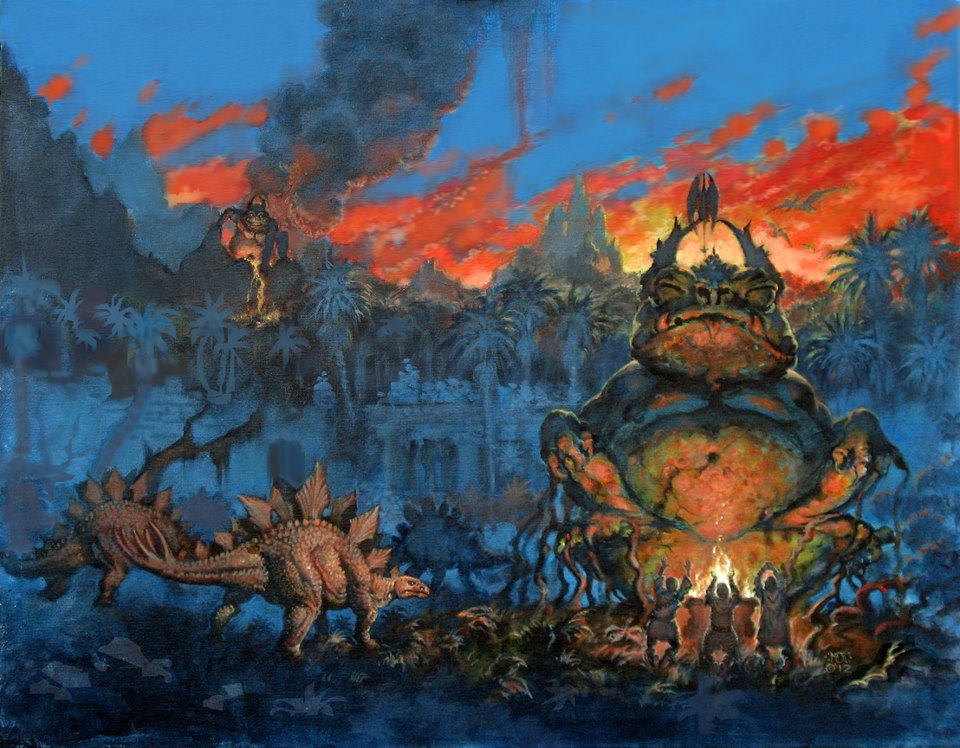
“The Tale of Toad Loop” is one of Sargent’s most-reprinted tales. It was first published online in the webzine Nightscapes (January 1998), and later that year in the print magazine Dark Legacy (August 1988). It featured in his first collection of stories, Ancient Exhumations (1999), and its slightly expanded sequel Ancient Exhumations+2 (2004). The anthology Eldritch Blue: Love & Sex in the Cthulhu Mythos (2004) reprinted it, and the year after that it appeared in The Tsathoggua Cycle: Terror Tales of the Toad God (2005).

The relative success of the story in the early 2000s, and the reason why it’s been mostly forgotten by editors since is fairly straightforward: “The Tale of Toad Loop” might be the quintessential Mythos pastiche.

Which is not in any way a negative criticism. The story is not poorly written, it does not focus solely on the surface aspects of Mythos fiction, makes no effort to ape Lovecraft’s style, nor does it overload the reader with dozens of references to other stories. It is not bad pastiche. Yet it is also recognizable as a work in a distinct tradition, in a certain style, in imitation of what has come before.

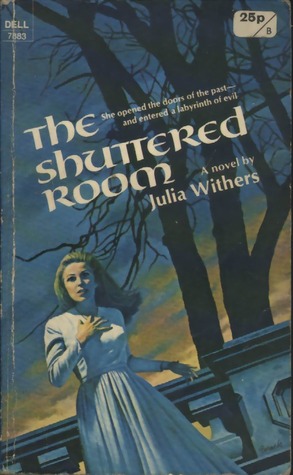
“Toad Loop” owes its existence to “The Shadow over Innsmouth” and “The Dunwich Horror” by H. P. Lovecraft, August Derleth’s novel The Lurker at the Threshold (or at least, the fragment “The Round Tower” by Lovecraft which Derleth incorporated into the story), and through that snippet Clark Ashton Smith’s Tsathoggua. It has a style reminiscent of Derleth’s “The Shuttered Room” or “Witches’ Hollow,” the idea of carving out a new corner of the Mythos with connections to the old familiar stories. Familiar themes in unfamiliar places. Old wine in new bottles.

When read in the context of those stories, “The Tale of Toad Loop” stands out as perfectly competent and of a piece with those works. It fits into the Mythos neatly as a lost puzzle piece, lending a slightly new outline to the picture. Sargent is not an eager fanboy expounding some pet theory of the Mythos. The prose is slightly more explicit than Lovecraft or Derleth would have used in terms of language, gore, and sexuality, but otherwise it has the same feel of a piece that was written in those decades between the death of Lovecraft in 1937 and the first non-Arkham House Cthulhu Mythos anthology, The Disciples of Cthulhu, in 1976.

Tastes change.

Like “The Devil’s Hop Yard” (1978) by Richard Lupoff, Sargent’s story is essentially a rehash of a familiar Mythos narrative: a rural locale, a sorcerer that is a little too successful at summoning, a young woman who ends up conceiving the inconceivable. In this case, Pritchy Kwik stands in for Lavinia Whateley, and is given even less agency—not even a line of dialogue—and there are a few other criticisms that might be leveled against the plot:

The Injuns claimed the Circle was built for some kind of unearthly critter that come down from the sky on occasion. Toadaggwa, they called it, sayin’ it put the stones to questionable uses at certain times of the year. Truth is, they were scared shitless of the place without really knowing why. They gave the Loop the widest possible berth, swearin’ the stones were the works of demons here long before any of the tribes. None of the whites confessed to belief in such savage superstitions, yet we all steered clear of the Loop just like the redskins did.
—Stanley C. Sargent, “The Tale of Toad Loop” in Ancient Exhumations +2 (2004) 109-110

It is weird to think about writing “Injuns” and “redskins” in the 1990s. Rationally, Sargent was trying to keep within the vocabulary and viewpoint of a rustic yokel in Madland County (based on southern Ohio), at some unspecified date (references to “Captain Marsh” of Innsmouth suggests the 1850s). It is the kind of reference that wouldn’t have raised an eyebrow for decades in the United States…but cultural syntax shifts. Would an editor let “Injuns” pass today?

In the broader context of the story, this is an incidental detail. Yet it is symptomatic of the issue for the story as a whole. “The Tale of Toad Loop” is a perfectly competent little tale, but it broaches no new ground, not in the characterization, or the storytelling style. It is a variation on a very familiar theme, but the theme is too familiar, and while there’s a twist in the end and the framing, it doesn’t stand out as particularly genius or original in the sense of Sargent’s “The Black Brat of Dunwich” (1997).

While “The Tale of Toad Loop” more or less fits in Eldritch Blue, it would feel old-fashioned and out of place in Cthulhurotica or Conqueror Womb: Lusty Tales of Shub-Niggurath. There are any number of tales of cosmic miscegenation in the Mythos already; it is hard to see what Sargent adds to the subject that is new, novel, revolutionary, or thrilling in that particular. Neither the sex nor the gore rises to the level of notability in a market with extreme horror, erotic horror, and splatterpunk. It is hard to judge the shift in the tastes of consumers of Mythos fiction, but it is usually excellence of ideas as much as excellence of prose that makes tales stand out, and “The Tale of Toad Loop” may be doomed to future obscurity simply because it was too successful at being excellent pastiche of an older style of Mythos fiction which has largely fallen out of fashion.

It is worth pointing out that “The Tale of Toad Loop” is not exemplary of all of Sargent’s fiction. He was a creative and capable writer who experimented with style and subject, continuing to grow and develop throughout his literary career. “The Black Brat of Dunwich” (1997) and “The Insider” (1998) are both good stories that still deserve to be read.

Readers interested in determining for themselves whether Sargent’s style is out of step with the current vogue of Mythos fiction, the story may be read for free at Nightscapes.


Bobby Derie is the author of Weird Talers: Essays on Robert E. Howard & Others (2019) and Sex and the Cthulhu Mythos (2014).

“Massacre à Miskatonic High School” (2008) by Jean-Jacques Dzialowski & Dimitri Fogolin

Depuis la nuit des temps,
Des dieux noirs corrompent notre monde.
Ce sont les Grands Anciens.

La folie est leur visage.
L’horreur est leur royaume.
Leur éveil approache…
Since the dawn of time,
The dark gods corrupt our world.
These are the Old Ones.

Madness is their face.
Horror is their kingdom.
Their awakening approaches…
Back cover, Les Mondes de Lovecraft

MondesLes Mondes de Lovecraft (“The Worlds of Lovecraft,” 2008, Soleil) is a standalone French-language comic anthology of stories set in the world of H. P. Lovecraft, including an adaptation of Lovecraft’s “Dagon.” Two of the stories in the book are the work of Jean-Jacques Dzialowski (writer) & Dimitri Fogolin (artist): “Le Signe sans Nom” (“The Nameless Sign”) and “Massacre à Miskatonic High School” (“Miskatonic High School Massacre”). The two works are complementary, in that they tell different sides of the same story from different perspectives. “Le Signe sans Nom” is given after-the-fact, during the deposition of a Sergeant McDermot, who responded to the events at Miskatonic High. “Massacre à Miskatonic High School” on the other hand gives the perspective of the school shooters. 


IMG_2591

The 1999 Columbine High School Massacre casts a long shadow over culture and pop culture alike. The media blitz helped to inspire numerous copycats; partisan politicians and pundits in the United States tend to quickly politicize shootings to minimize arguments over gun ownership as happened in the aftermath of the 2012 Sandy Hook Elementary School Shootings. Comic books have rarely touched on such controversial and emotionally-charged territory; DC Comics notoriously cancelled the Hellblazer story “Shoot” by Warren Ellis, Phil Jimenez, and Andy Lanning in 1999 over concerns of backlash.

At the bottom of most coverage of such shootings is one question: Why did they do it? What drove these kids to kill other kids?

Real-world causes are complex: psychological issues, a disturbed home life, access to firearms are all contributing factors. In the worlds of H. P. Lovecraft however…it’s rather simple.

They want the books.

Toute sa vie, grand-père a cherché les livres. Il en avait trouvé certains et il m’a laissé plein de notes…

All his life, grandfather searched for books. He had found some and he left me lots of notes …

In real life, the two Columbine Massacre shooters committed suicide in the library. In this Miskatonic Massacre, Dzialowski and Fogolin have something similar happen, but for very different reasons. Taking a page from Lovecraft’s “The Dunwich Horror,” the two shooters want access to the ancient tomes contained (somewhat inexplicably) in the Miskatonic High School library.

“Massacre à Miskatonic High School” is nine pages; “Le Signe sans Nom” is eight. The two works should really be considered as parts of the same story, and being parallel narratives, they have visual and textual echoes and references to one another—the final panels are largely identical. Fogolin, however, approaches each story separately. “Le Signe sans Nom” is darker, with more blacks, greys, and blues, while “Massacre” is brighter, dominated by yellows and greens—appropriate enough given the prominence of Hastur in this chapter of the story. The layouts for both stories also start the same: a regular nine-panel grid, which breaks down in the subsequent pages.

Given the subject matter, there is a certain amount of commendable reticence to show too much. We see bullets, blood, dead bodies, but we don’t actually see anyone get shot on the page, in close up or detail. Readers can be appalled at what is happening without seeing every last bullet hole or shard of bone. At the same time, this gloss of violence and the digital coloring lends a certain muddiness to the compositions; one wonders how it would have been different if Jacen Burrows or Raulo Cáceres might have handled the same material.

IMG_2600

Lovecraft never quite tackled such a mundane horror as a school shooting. Yet the horror in this story is a little different from real life. What if Wilbur Whateley had reached the Necronomicon? Would he have succeeded in clearing off the Earth, or would he have ended up as these two did? The central issue isn’t just the horrors perpetrated, but that the two shooters in this story very nearly succeeded. If someone had been a little more competent…how much more damage could they have wrought?

Perhaps more importantly, what’s to stop the same thing from happening again?

“Le Signe sans Nom” and “Massacre à Miskatonic High School” are both published in Les Mondes de Lovecraft. It has not been translated into English or reprinted, as far as I have been able to ascertain.


Bobby Derie is the author of Weird Talers: Essays on Robert E. Howard & Others (2019) and Sex and the Cthulhu Mythos (2014).