“Cindy: Scrub-Lady in a State Street Skyscraper” (1920) by H. P. Lovecraft

Ethel: Cashier in a Broad Street BuffetCindy: Scrub-Lady in a State Street Skyscraper
Beautiful and calm and proud,
Only Ethel’s soul seems bowed;
Throngs may pass her, kind or curt,
They can neither heal nor hurt;
There she sits with manner strange,
Taking checks and making change!

Eyes are dark, but something fled
Leaves them heavy as the dead;
Brow is white, but something there
Lingers like an old despair;
Lips are sweet, but coldly curled—
Oh, so weary of the world!

Ethel’s always dressed in black;
Parting thus may leave its track.
Ethel’s always wan and pale;
Pining is not known to fail.
Though a life or love you rue,
Ethel, how I pity you!

—Randolph St. John
Black of face and white of tooth,
Cindy’s soul has lost its youth.
Strangely heedless of the crowd,
O’er her mop forever bow’d:
Eyes may roll and lips may grin,
But there’s something dead within!

Brow serene—resign’d to Fate—
Some three hundred pounds in weight—
Cindy wields a cynic’s broom,
Thinking not of hope or doom.
For the world she cares no more—
She has seen it all before!

Cindy’s always dressed in red,
With a kerchief round her head.
What may blight the damsel so?
Watermelon, work, or woe?
Tho’ her days may placid be,
Glad I am, that I’m not she!

—L. Theobald, Jun.
The Tryout no. 6, June 1920

We are spoiled for lore with regard to Lovecraft; because he left such a paper trail, because conscientious individuals like R. H. Barlow, August Derleth, and Donald Wandrei worked to preserve his letters, and then Arkham House, Necronomicon Press, Hippocampus Press, et al. to see them published, we know more about Lovecraft and his thoughts on things than almost any other pulp writer. However, he didn’t make a habit of leaving a trace for every bit of verse he left scattered in every amateur journal.

“Cindy: Scrub-Lady in a State Street Skyscraper” by H. P. Lovecraft (writing under his pseudonym Lewis Theobald, Jun.) appeared as above, opposite “Ethel: Cashier in a Broad Street Buffet” by his friend Rheinhart Kleiner (writing as Randolph St. John) in the same issue of the amateur journal The Tryout. The two poems are obviously a set, with the exact same number of lines, common meter and subject. Beyond that, there is nothing more known about the background of the poems except what is contained in the text; no letter survives regarding their genesis, publication, or reception in Lovecraft’s Letters to Rheinhart Kleiner or any other volume of Lovecraft’s published letters.

The setting is presumably in Providence, R.I. (which has both a Broad St. and State St.); although Kleiner being a New Yorker, there’s the possibility they were writing from their respective locations. Kleiner wrote a handful of brief memoirs of Lovecraft without mentioning these poems, but in “A Memoir of Lovecraft” (1948) he wrote what might conceivably be their genesis, a trip to Providence that Kleiner took in 1917 with the express purpose of visiting Lovecraft:

On our way back to his home, and while we were still downtown, I suggested stopping in at a cafeteria for a cup of coffee. He agreed, but took milk himself, and watched me dispose of coffee and cake, or possibly pie, with some curiosity. It occurred to me later that this visit to a public eating-house—a most unpretentious one—might have been a distinct departure from his own usual habits.
Lovecraft Remembered 196

Yet without any more specific reference to go on, we are in speculative territory. We don’t know if this was part of a contest, a jest, or an old shame for the both of them.

It can be clearly seen that this is a lighter bit of verse. Both Lovecraft and Kleiner are being melodramatic about their subjects to the point of parody. The poets were still relatively young (Lovecraft was 30 in 1920, Kleiner was 28) white men who took as their subject two apparently older working women, and finding something dreary and dead in their countenance. Kleiner appears authentic (“I pity thee!”), while Lovecraft is obviously having a bit more fun, which given his subject and the way her frames it, makes a rather forgettable bit of verse come off nastier to readers today. This wasn’t untypical of Lovecraft’s satirical verse, and Kleiner would write in “A Note on Howard P. Lovecraft’s Verse” (1919):

As a satirist along familiar lines, particularly those laid down by Butler, Swift, and Pope, he is most himself—paradoxical thought it seems. In reading his satires one cannot help but feel the zest with which the author has composed them. They are admirable for the way in which they reveal the depth and intensity of Mr. Lovecraft’s convictions, while the wit, irony, sarcasm, and humour to be found in them serve as an indication of his powers as a conversationalist. The almost relentless ferocity of his satires is constantly relieved by an attendant broad humour which has the merit of causing the readers to chuckle more than once in the perusal of some attack levelled against the particular person or policy which may have incurred Mr. Lovecraft’s displeasure.
Lovecraft Remembered 402

The only thing that makes “Cindy” really stand out among the mass of Lovecraft’s poetry is that it is his only poem that takes as it subject a black woman. It isn’t clear that this is a specific individual or a kind of archetype; “Cindy” in this sense has to be taken as short for “Cinderella,” a shorthand pseudonym for any cleaning woman. The traits that Lovecraft assigns to her: dark-skinned, white teeth, overweight, dressed in red, with a kerchief around her head suggests the “mammy” archetype, which was popular in the United States from the 19th century and on through the 20th century in advertising (Aunt Jemima being one prominent example), and as a stock character in fiction and film (Hattie McDaniel’s characters in Gone with the Wind (1939) and Song of the South (1946) as examples).

Lovecraft’s poem appears to be a response to Kleiner’s; the meter, length, and the shared details (Ethel as being dressed entirely in one color, both women are world-weary, etc.) definitely suggest this relationship. Give the quasi-seriousness of Kleiner’s effort, I suspect Lovecraft wrote his poem as a jocular rejoinder, satirically poking fun at his friend’s effort to pity and commiserate with someone he shared so little in common with. That is speculative, but it would certainly have been apt if Kleiner wrote his poem of the “wan and pale” Ethel, dressed in black, and Lovecraft countered with the exact racial opposite—a black Cindy, dressed in red.

The nastiness of Lovecraft’s poem stems largely from his reliance on stereotype. His major negative inference on Cindy’s appearance is her obesity (“Some three hundred pounds in weight”), and this is in keeping with Lovecraft’s general attitude, as he disliked fat—to the point that when he himself began to push 200 pounds during his marriage in the mid-1920s (the result of his wife’s cooking and eating out), he took to a strenuous “diet” that saw him shed the “excess” weight—and established the poor eating habits which would stick with him all of his life. This is compounded when Lovecraft ascribes one of the potential “blights” on Cindy’s life as “watermelon”—he’s basically using both a racial stereotype (that African-Americans love watermelon) to suggest that Cindy’s weight is a result of gluttony, rather than, say, a poor diet and chronic lack of sleep caused by working long hours for low pay.

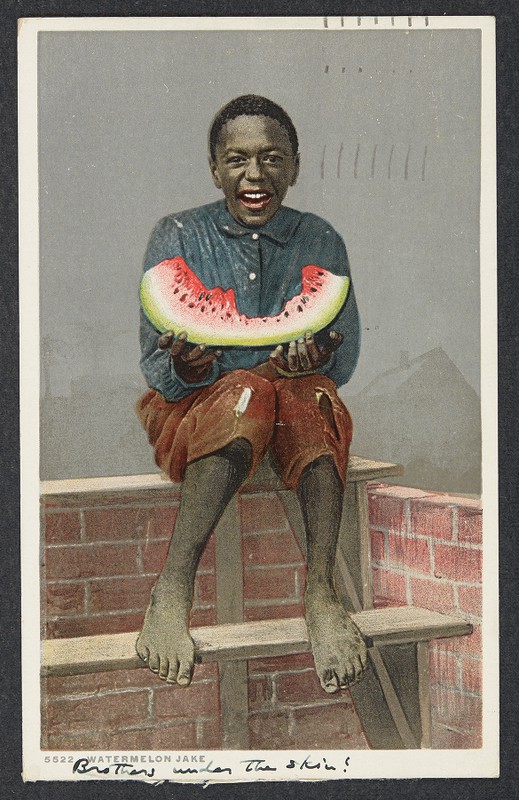
The watermelon stereotype was extremely common during the period—at least one of the many postcards Lovecraft sent that survive might serve as an example of how ubiquitous it was, and how innocuous and “self-evident” it might have seemed at the time to Lovecraft. Lovecraft also liked watermelon, hence the annotation at the bottom of the card.

watermelon

The major question with this poem might well be: how racist is it? That it is racist isn’t arguable; Lovecraft clearly uses the racial stereotypes of the 1900s in its depiction of an African-American woman. Beyond those images though—it’s hard to say if this rises about the racist background count of the 1920s. It is certainly not a specifically positive view of a working-class African-American woman; and it is probably damning with faint praise to say that it doesn’t call for violence, use a racial pejorative, or ascribe any negative attribute or predilection to Cindy based on race beyond a hypothetical fondness for watermelon. In that sense, Lovecraft was contributing to the overall stereotypes regarding black people, but the best that can be said is he doesn’t appear to have been particularly malicious in their use. The most honest aspect of the poem is undoubtedly the last line, where Lovecraft writes: “Glad I am, that I’m not she!”

Readers might also ask how misogynist these poems are. We don’t get a lot of context for the poems except that these are two working-class women, black and white, employed in relatively menial positions, and we can assume that they have to work for a living and have done for some indeterminate but long period of time. The depictions aren’t entirely negative, but both also assume that whatever spark of joy life had for these women is gone, and that is what makes them pitiable, or at least sympathetic. However, the perspective is very much through the eyes of the someone else—the women don’t get to talk about their experiences in their own voice, we get no peek into their inner life.

The poems, basically, tell us more about the poets than their supposed subjects.

“Cindy: Scrub-Lady in a State Street Skyscraper” has been published in a number of collections of Lovecraft’s poetry; Kleiner’s “Ethel: Cashier in a Broad Street Buffet” is a bit more scarce, being rarely republished since its initial appearance in The Tryout. Both are in the public domain, and both have been reprinted in the appendices to Letters to Rheinhart Kleiner.


Bobby Derie is the author of Weird Talers: Essays on Robert E. Howard & Others (2019) and Sex and the Cthulhu Mythos (2014).

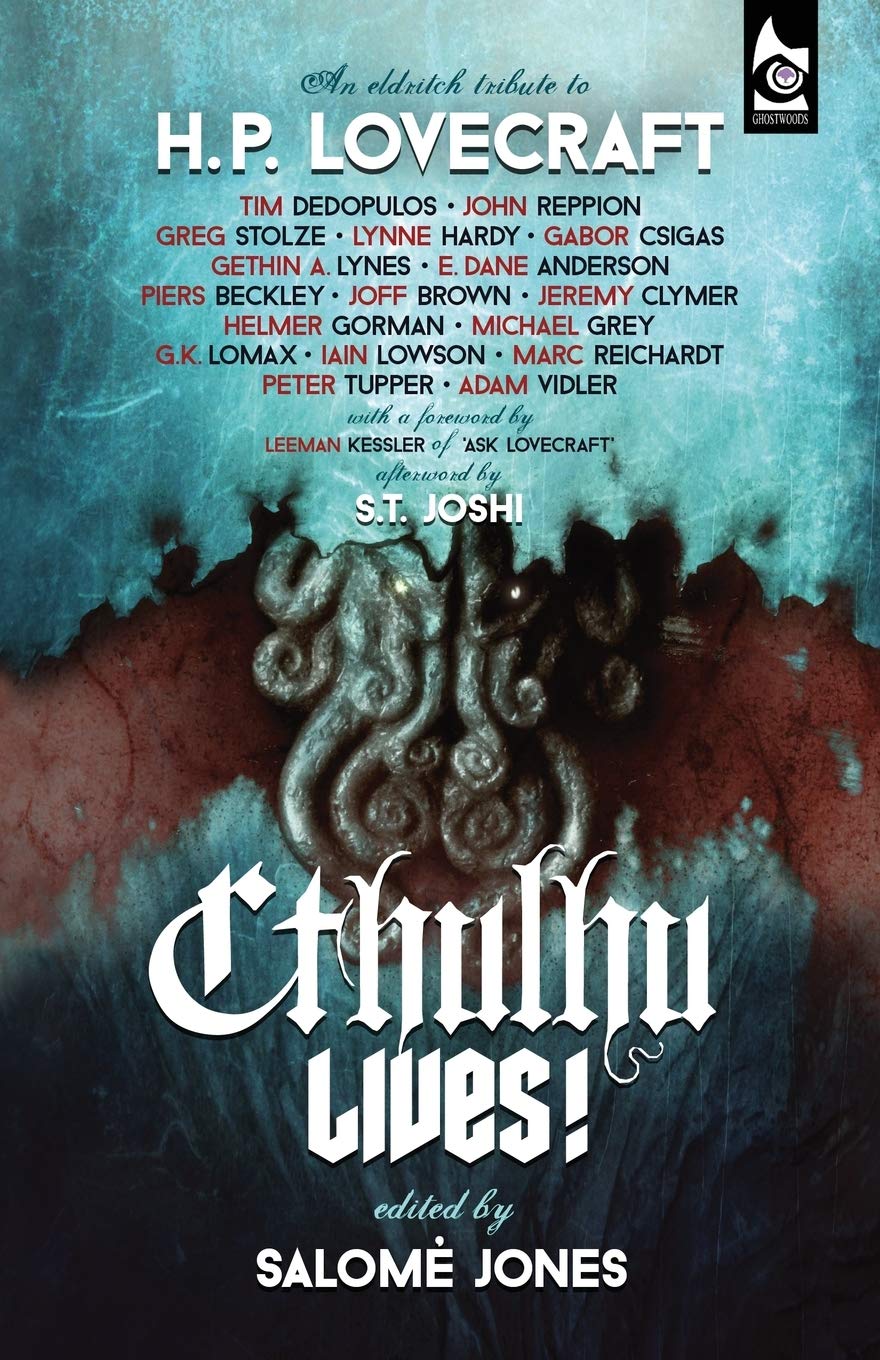
“Scritch, Scratch” (2014) by Lynne Hardy

Scritch, scratch, see the rat,
Bright eyes and twitching tail,
Scritch, scratch, chase the rat,
‘Cross hill, and stream, and dale.
—Lynne Hardy, “Scritch, Scratch” in Cthulhu Lives! 158

In the April 1924 issue of Weird Tales a story appeared by H. P. Lovecraft titled “The White Ape.” It wasn’t Lovecraft’s title. In conscious imitation of Edgar Allan Poe, Lovecraft’s original title had been “Facts Concerning the Late Arthur Jermyn and His Family.” An annoyed Lovecraft explained to the editor Edwin Baird on “The White Ape”:

I wish I could convert you to my point of view regarding the annoying literalness and flaccidity of that latter title…but all I can do is say that it is the only title which I could never possibly have applied to that particular tale; that it is at war with the spirit and internal harmonies of the narrative, and clashes fearsomely with the effect of the opening paragraph. One thing—you may be sure that if I ever entitled a story The White Ape, there would be no ape in it. There would be something at first taken for an ape, which would not be an ape. But how can one ever get those subtleties across?
—H. P. Lovecraft to Edwin Baird, 3 Feb 1924, Selected Letters 1.294

The problem with “The White Ape” is that it gives the game away at the start. For Lovecraft, the point was to stave off the moment of ultimate revelation, to let the reader’s imagination fill in the details while building up the events, letting things sink in. Readers can certainly read “Arthur Jermyn” more than once, and appreciate what Lovecraft does with the story, but the revelation can only really be experienced once.

The effectiveness of this approach can be seen in another of Lovecraft’s stories: “The Rats in the Walls” (Weird Tales Mar 1924). The title might be the greatest trick that Lovecraft ever pulled: there are no rats in the story, not a one, though the narrator reads of them, dreams of them, and thinks he hears them scurrying about. The rats, it turns out, are not the ultimate horror of it all…

…which brings us to Lynne Hardy and her story. Which isn’t about rats either, exactly.

“Scritch, Scratch” works as much as it does because it is essentially an update on the old moral about progress sweeping away old traditions which ought not to be fucked with, and that hoary old Aesop slots well into a Lovecraftian milieu. Readers can sense what’s coming, the only question is the specifics, and Hardy delivers without either rushing it or drawing it out too long.

The story is an appropriate “eldritch tribute” to Lovecraft without falling into the domain of pastiche. Hardy hints, but doesn’t show her hand; there are no gods with strange names, no tentacles, not even any cults or strange tomes, as such. It is close to folk horror, and with a little bit of work could easily have become a full-blown part of the Mythos and a pastiche. Genre-savvy readers could easily see an investigator dropped into the strange goings-on, more of the history of the strange little church and its carvings discovered, some solution discovered before the end…

That would be a very different and less effective work of fiction. It might make for a decent game.

Hardy has a long history with roleplaying games, having written extensively for the Cthulhu Mythos Roleplaying Game and Achtung! Cthulhu. In 2018 for Free RPG Day she and Chaosium released a version of “Scritch, Scratch” adapted for play, which readers can download for free. It’s worth pointing out that what works for a standalone Lovecraftian story doesn’t necessarily work for a roleplaying game: the story itself doesn’t have a protagonist as such, while the player characters in the game very much like to think of themselves as protagonists and want to accomplish something. In that regard, Call of Cthulhu cases like “Scritch, Scratch” (2018) become interactive storytelling experiences: the players aren’t just reliving the events of “Scritch, Scratch” (2014), they get to have a say in events.

The basis for this scenario came about as the result of a bit of an emergency. I was just about to set off to the airport for a convention when I received a message from the organizer—one of their guests was no longer able to attend, but was supposed to be running a tailor-made Call of Cthulhu scenario for a Kickstarter backer. Could I step into the breach?

So, on the plane, I got my head together with my husband, Richard, and, after batting a few ideas around, decided to base it on a short story I’d written for the Cthulhu Lives anthology, published by Ghostwoods Books. Not exactly the same—that wouldn’t work—but looking at the events from a different viewpoint. Following its successful premiere at OrcaCon, the scenario has been run at a number of conventions with the pre-generated investigators provided. It’s always great fun to see how different groups tackle the character interaction and their investigators’ fate.

I hope you enjoy it, too.
—Lynne Hardy, “Foreword” in “Scritch, Scratch” (2018)

The scenario has to go into a little more explicit detail than the story. Readers who enjoy the mystery should probably give it a pass; some of the glamour of the Mythos tends to be lost when it’s packed into the relatively dry explanations that are sort of necessary. While readers of the story don’t need to know what’s going on to appreciate Hardy’s prose, gamemasters who are supposed to be running the event absolutely do.

“Scritch, Scratch” was published in Cthulhu Lives!: An Eldritch Tribute to H. P. Lovcraft (2014). It has not yet been reprinted.


Bobby Derie is the author of Weird Talers: Essays on Robert E. Howard & Others (2019) and Sex and the Cthulhu Mythos (2014).
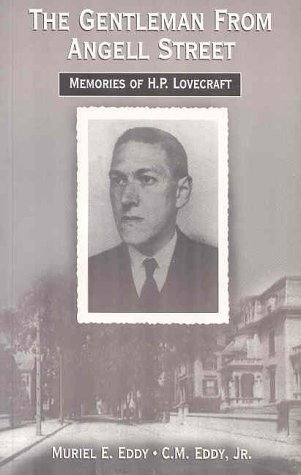
The Gentleman from Angell Street (2001) by Muriel E. Eddy & C. M. Eddy Jr.

I have, I may remark, been able to secure Mr. Baird’s acceptance of two tales by my adopted son Eddy, which he had before rejected. Upon my correcting them, he profest himself willing to print them in early issues; they being intitul’d respectively “Ashes”, and “The Ghost-Eater”. In exchange for my revisory service, Eddy types my own manuscripts in the approv’d double-spac’d form; this labour being particularly abhorrent to my sensibilities.

But I must give over these my remarks, for I must take a nap against the afternoon; when (tho’ ’tis devilish cold) I am pledg’d to visit my son Eddy in East-Providence, & help him with his newest fiction, a pleasing & morbid study in hysterical necrophily, intitul’d “The Lov’d Dead”.
—H. P. Lovecraft to James F. Morton, 20 Oct 1923, Letters to James F. Morton 57

The Gentleman from Angell Street: Memories of H. P. Lovecraft (2001) is a collection of the reminiscences of H. P. Lovecraft by the Eddy family, who lived in East Providence and first became acquainted with Lovecraft while he lived at 598 Angell St. in Providence, Rhode Island. All of the non-fiction pieces in this slim collection had been previously published, but all of them had been out-of-print for decades, so the slim collection was a bit of boon to researchers in not having to pay collectors’ prices to read them.

Muriel Elizabeth (Gammons) Eddy and Clifford Martin Eddy, Jr. were married in 1918; they were both writers, in various genres, and Muriel in particular would be president of the Rhode Island Writers’ Guild for over 20 years, while Eddy would have a pulp career that included three stories revised in part by their Providence neighbor H. P. Lovecraft, which were published in Weird Tales—and much else that Lovecraft never had a hand in besides. Students of Lovecraft’s letters will remember the way Lovecraft pleaded with another revision client, Zealia Brown Reed, to give Eddy the job of typing her manuscripts as the Great Depression set in and pushed the Eddys to the brink of poverty.

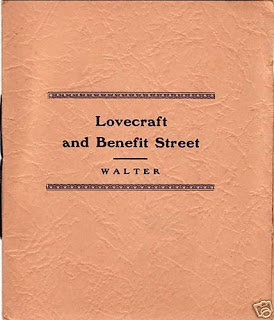
While Lovecraft was closest to C. M. Eddy, Jr., to the extant of calling him one of his “adopted” sons or grandchildren, it was Muriel E. Eddy that wrote the most about her family’s relationship with H. P. Lovecraft. Her first memoir, “Howard Phillips Lovecraft” was published in Rhode Island on Lovecraft (1945) alongside “Lovecraft and Benefit Street” (1943) by Dorothy C. Walter and other works. In 1961 she expanded that essay into “The Gentleman from Angell Street”, and wrote several other short pieces, some privately printed, including H. P. Lovecraft Esquire: Gentleman (no date), The Howard Phillips Lovecraft We Knew (n.d.), “Memories of H. P. L.” (1965), “Lovecraft’s Marriage and Divorce” (1968), Howard Philips Lovecraft: The Man and the Image (1969), and “Lovecraft: Among the Demons” (1970). In addition to this, she wrote a number of letters, some published and some surviving at the John Hay Library where she weighed in on the early biographical sketch of Lovecraft by Winfield Townley Scott and Sonia H. Davis’ memoir of her former husband.

The rest of the family was rather more limited. C. M. Eddy Jr. published “Walks with H. P. Lovecraft” in The Dark Brotherhood and Other Pieces (1966, Arkham House), and their daughter Ruth M. Eddy wrote “The Man Who Came At Midnight” (1949).

The activeness of Muriel E. Eddy in publishing and discussing her experiences with Lovecraft from the late 1930s until her death 1978 means that she had a rather substantial influence on Lovecraft scholarship during that period. To illustrate this, L. Sprague de Camp’s critical H. P. Lovecraft: A Biography (1975) cites seven of Muriel E. Eddy’s publications, plus C. M. Eddy and Ruth M. Eddy’s contributions. In general, these memoirs can be said to be honest and valuable contributions to the understanding of Lovecraft’s life…but are they accurate?

The accuracy of memoirs is important; human memories are imperfect, and tend to fade and distort over time or under influence. Yet these accounts are often all we have to go on for many events and details of life. The more accurate a memoir is, that is the more of it that we can verify according to other documents of the period (Lovecraft’s letters, census data, city maps and directories, etc.), the more we can count the memoir as a reliable source of data for the information that cannot be so independently verified. With some of these memoirs, written decades after the events…and given that they are often the sole source for some of the anecdotes regarding Lovecraft, it is important to look at some of these sources critically.

C. M. Eddy’s “Walks With Lovecraft,” describing their gambols and hikes together in and out of the city, can be said to be reasonably accurate and reliable, insofar as the details of Lovecraft jive with what we know from his lettersthere is, for example, an extended account by Lovecraft of their search for “Dark Swamp,” which agrees fairly closely with C. M. Eddy’s version. There are one or two spots where Eddy may be mistaken, but overall it is a solid essay.

Muriel E. Eddy’s memoirs are a bit more complicated to deal with. The 1945 version “Howard Phillips Lovecraft,” written less than a decade after the subject’s death, is relatively straightforward and accuratethough with little slips here and there; she recalled the Dark Swamp adventure, but referred to it as Black Swamp. Still, it provides a good bit of detail on their association, including some unique insights on the revision-work that Lovecraft did for C. M. Eddy, Jr. and many notes on Lovecraft’s habits and character traits that jive exactly with his letters. The later, expanded version that is “The Gentleman from Angell Street” and appears in the eponymous booklet adds much interesting detailbut the accuracy of this new information, and thus the reliability of the whole account, is less.

For example, Muriel E. Eddy wrote:

Our acquaintance with the Lovecraft family stemmed through my husband’s mother having once met Sarah Lovecraft at a “Women Suffrage” meeting,… although I never learned whether or not Howard’s mother really believed believed in equal rights for women.
—Muriel E. Eddy, The Gentleman from Angell Street 4

This is an intriguing detail, since we know so little (relatively speaking) about Sarah Susan Phillips Lovecraft, and far from impossible. It might explain some of Lovecraft’s attitudes towards women and women’s rights as expressed in his life and letters. However, the memoir also includes a number of small speculations and anecdotes, and these tended to get more evident the further into the expanded essay the reader gets. Some of the anecdotes are likely true, but are strongly influenced by Muriel’s rosey-hued nostalgia; for example when she wrote:

Mrs. Gamwell also gave the children about a hundred picture postcards that Sonia had mailed to Howard. These all held loving, spirited messages to H.P.L. from his sweetheart in New York. Not knowing their possible value in the far-away future, I did not hold on to any of these cards bearing Sonia’s signature, written in her breezy, happy handwriting. It was plain to be seen, from the messages on the cards, that this pretty woman of writing ability—among her other gifts—really liked our H.P.L.! And the strange part of it all was that he had not once mentioned his love affair to us…and we were his very good friends.

The children played for hours with the cards, and they eventually went the way all children’s toys go…in the ash-heap! (ibid. 17)

If a reader traced Muriel’s accounts of Lovecraft over the years, some details shift in the telling. Notably, her account of the extant of Lovecraft’s revision of “The Loved Dead” changes over time, and is a bit at odds with her husband’s own account, given in the Summer 1948 issue of the Arkham Sampler; her insistence on C. M. Eddy Jr.’s sole authorship was likely a response to August Derleth and Arkham House’s publication of stories which Lovecraft had revised or ghostwritten with the emphasis on Lovecraft’s contribution. So too, her references to Lovecraft’s mother seem to shift to reflect views on Susan Lovecraft in line with other memoirs—and this kind of “alignment” of views can easily distort the historical picture, since it appears that several contemporary memoirs are supporting the same image, when in reality later sources may be partially based on earlier ones. A tricky knot to untangle when a memoir is “revised” as “The Gentleman from Angell Street” was.

The most substantial difference between the 1945 and 1961 essays however is the section dealing with Lovecraft’s revision client Hazel Heald.

In this same year, 1932, I formed a little New England writers’ club of my own, and one of my members, a divorcee was very anxious to succeed in the weird writing field. She sent me an original manuscript with a very passable plot, yet told unconvincingly and amateurishly. I let Lovecraft read it when next he came over to our house on Pearl Street, and he agreed that it did have possibilities. (ibid, 22-23)

This is the start of Muriel E. Eddy’s account of “The Man of Stone” (1932) by Hazel Heald & H. P. Lovecraft. For quite a long time, this was the only such account; Lovecraft wrote little about much of his revision work, and Heald’s own version of events is largely unpublished, although she makes an allusion to the Eddys in a letter:

About HPL and whether he was separated or divorced—I am certain he was divorced but have written to someone I know who will give me all the facts as her husband signed certain papers at that time.
—Hazel Heald to August Derleth, 7 Apr 1937

C. M. Eddy Jr. is claimed to have signed the Lovecrafts’ divorce decree as a witness, though Lovecraft himself did not sign it. So while Heald does not give the exact circumstances of her and Lovecraft coming together, there is nothing to directly counter Muriel E. Eddy’s version of events. At the same time, there is every evidence that Muriel E. Eddy’s version of events was including some information from her friend Hazel Heald, at second- or third-hand.

A skeptical scholar might thus wonder how much of it that Muriel E. Eddy knew and neglected to tell in 1945, versus how much of it she heard about later and incorporated into her expanded memoir—and on top of that, how much Muriel E. Eddy’s rose-tinted spectacles were skewing her account. Particularly notable in “The Gentleman from Angell Street” is her suggestion that Heald held a romantic interest in Lovecraft, and:

With a little encouragement, I am convinced that H.P.L. and Hazel might have married, and they would have made a good pair. But Lovecraft knew his health was failing, and perhaps he did not feel like taking a chance on another marriage, seeing that his first one had failed so miserably.
—Muriel E. Eddy, The Gentleman from Angell Street 26

This kind of speculation, and the obvious incorporation of second-or-third-hand information that fed into it, make “The Gentleman from Angell Street” less reliable of a source than it could have been. Which is unfortunate, given that we otherwise have little information on the Heald-Lovecraft stories besides the brief mentions in Lovecraft’s letters, and the sparing accounts given in Heald’s surviving correspondence with August Derleth.

An addendum to “The Gentleman from Angel Street” published in 1977 discusses the death of Sonia H. Davis and August Derleth; these memories are brief, vivid, and fairly accurate. She ends with the rather bittersweet yet hopeful note:

Thus the original Lovecraftian circle has been dwindling, and yet, a new one grows in ever widening arcs among the interest generated by fanzine magazines, biographies of HPL, and the eternal works and character of the man himself. (ibid. 29)

Ruth M. Eddy was born in 1921; she would have been only about two years old when Lovecraft met her parents and first visited their house in 1923, and five when Lovecraft returned to Providence after his stay in New York City. Her brief memoir of his visit was published in 1949, and it may be wondered how much of this she actually remembered at such a young age…but some things do stick in the memory, long after children grow up. So she wrote “The Man Who Came At Midnight:”

Gaslight flicked eerily through the crack in my bedroom door. It was Halloween, night of the supernatural, and long past midnight. I had drifted off to sleep with visions of hobgoblins and Jack-o’-lanterns drifting through my childish mind. Suddenly, as in a dream, I heard a sepulchral voice saying, “Slithering…sliding…squealing…the rats in the walls!”

Half-asleep, half-awake, I lay in the darkness for a moment, and then shouted for my mother as loudly as I could. She came into my room and spoke softly, “Everything’s all right, dear. It’s just Mr. Lovecraft telling us about the new story he’s writing. Don’t be afraid. Go back to sleep…[“]
—Ruth M. Eddy, The Gentleman from Angell Street 59

Ruth’s accounts jive with her mother’s memoir of Lovecraft’s early visits; from Lovecraft’s letters, we know “The Rats in the Walls” was written at about the time he met the Eddys, so it would not be surprising if he read his story aloud to his new friends. Given that this was published after Muriel E. Eddy’s account, there’s also the strong possibility that Ruth was influenced by her mother’s memoir, or at least her parent’s version of events.

There is not much in “The Man Who Came At Midngith” for scholarly interest; no new tidbit of information to seize on—but most memoirs aren’t written for academia, as a record of key facts and vital statistics, or even to set the record straight. They are simply a record of impressions and anecdotes, to keep the memory of the individual from being forgotten as those who knew them in turn grow old and die. Sometimes entertaining, sometimes insightful or gutwrenching—when the person is gone, a life is made of such moments, recalled and set down by those they touched. Or if not a life, then the first step from a pallid ghost to becoming a living myth.

Not a Halloween has passed since Lovecraft’s death in 1937 without my family fathering for the reading aloud of a weird story by our favourite author—now internationally famous as a writer in the genre—although our eloquence cannot compare with his masterful interpretations. (ibid. 61)

The Gentleman from Angell Street: Memories of H. P. Lovecraft was published in 2001 by Fenham Publishing, founded by Jim Dyer, the grandson of C. M. Eddy Jr. and Muriel E. Eddy.


Bobby Derie is the author of Weird Talers: Essays on Robert E. Howard & Others (2019) and Sex and the Cthulhu Mythos (2014).
“Nora” (2019) by Angela Oddling

I asked all our contributors to choose a god from Lovecraft’s pantheon and tell a story about them. It could be a horror story, sure. But it could also be sci-fi, fantasy, action, comedy or anything in between, as long as it focused on the gods of Lovecraft…or in some instances a new Lovecraftian god they created.
—Russel Nohelty, Cthulhu Is Hard To Spell

There is no wrong age to discover Lovecraft.

Anecdotally, a lot of fans discover Lovecraft when relatively young; twelve or thirteen is a common age given. Old enough for a childhood love of monsters to graduate toward some of the more literary horrors, where happy endings need no longer be expected as default. Everyone has their first exposure somehow: a comic book, a tatty paperback, the helpful librarian, a passing reference in a cartoon that leads to clicking through a link on a wiki article and then…

In a lot of ways, Lovecraft’s body of work is almost all-ages. There’s no explicit sex, and not much violence and gore. There is the very occasional N-word, but the same could be said of Mark Twain and Huckleberry Finn. The four-letter word scale of expletives tops out at “damn” and “hell.” Lovecraft didn’t need to say “fuck” to communicate his horrors. You don’t need to be nasty or profane to be Lovecraftian; though some authors have found it effective.

You can see this generally in the number of Mythos works which are produced for all different ages. There are hardcore adult pornographic Mythos works and there is C is for Cthulhu. While they share an inspiration, the age range of the audiences they’re going for are completely different. Other products are more ambiguous. They try to hit the sweet spot of being for both young adults and older adults; scary stories that can be read in the dark and enjoyed by anyone.

Which is the basic mentality behind the comics anthology Cthulhu Is Hard To Spell (2019), and its first entry “Nora” by Angela Oddling. Hitting that sweet spot between growing up and grown up. The book contains works suitable for…not all ages, but most ages. No nudity or nipples, no gore and not much blood, but not shying away from the suggestion of sex, violence, or blood. Art and storytelling that varies between the comedic to the serious and back again. It’s a good mix.

“Nora” by Angela Oddling is a story that might strike readers initially as aimed at the teenager or adolescent end of the spectrum. The art is polished, but “cartoony” rather than realistic; the character has big eyes and big fangs and only four digits on each hand—the same coding for the characters on The Simpsons or Mickey Mouse. It’s easy to mistake that kind of visual rhetoric as code that something is “for kids” rather than “for adults”—but as Matt Groening’s Life in Hell and Family Guy should show, that kind of coding can be deceiving. Disney’s Mickey is an anthropomorphic mouse, but so are the Jewish characters in Art Spiegelman’s Maus. It’s what the creator does with those characters that tells you what audience they’re aiming for…

Nora

Oddling hits the “sweet spot” for both young adults and older adults. Her story has overtones of Lovecraft’s “The Outsider” to it, and it works for much the same reason. Human beings are social animals. Conscious of their need to belong. To find their tribe. It’s not a deep or complex story, but at 8 pages long it is just as long as it needs to be to make its point, without feeling rushed or stretched out. There’s a Sarah’s Scribbles-esque quality in how it addresses an anxiety that is at once shared by someone growing up, and someone that is already considered a grown up in society.

In this sense, the “simplified” art works well to not limit or define the audience; we all can see ourselves as monsters, and see ourselves in monsters. Oddling’s palette is deliberately restrained: the white and blue and black make the pale yellow “pop” with emphasis on the page, and highlight the transitions from cold/alone to warm/together…and finally the very last panel, with its balance of colors, to show the strange acceptance. Not a complicated visual language, but again, it doesn’t have to be: a simple idea well-executed can be tremendously effective in communicating ideas visually, to complement the text of the story.

“Nora” was created by Angela Oddling and published in Cthulhu Is Hard to Spell (2019, Wannabee Press), edited by Russell Nohelty. The book was originally launched on Kickstarter, though you can still buy hardcopies on etsy and digital editions are available on Kindle/Comixology.


Bobby Derie is the author of Weird Talers: Essays on Robert E. Howard & Others (2019) and Sex and the Cthulhu Mythos (2014).
Monster Girl Encyclopedia II (2016) by Kenkou Cross (健康クロス)

Eldritch Fappenings

This review deals with a work of erotic content, and the history of erotic art and writing. As part of this review, selected art displaying cartoon nudity will be included.
As such, please be advised before reading further.


Monsters once were ghastly beasts that devoured the flesh and blood of human beings. However, since the ascension of the new Overlord, a succubus with godlike power, monsters have taken on utterly different, bewitching, and fantastic forms resembling those of alluring women. These outward changes have been accompanied by dramatic shifts in their ways of life, patterns of behavior, and values.
—foreword to Monster Girl Encyclopedia Vol. II

The Monster Girl Encyclopedia (魔物娘図鑑, 2015) by Kenkou Cross (健康クロス) is a variation on the popular pseudobiblia bestiary genre. In the Dungeons & Dragons-inspired fantasy setting that Kenkou Cross has created, a succubus has risen to the position of evil Overlord, and turned all the monsters into, essentially, nubile female forms obsessed with sex. The second volume in the series (魔物娘図鑑 II, 2016) has introduced some Mythos-related entities including the shoggoth, and the series has gone on to generate a good deal of fanfiction, dōjinshi (同人誌, fan-created artwork, comics, etc.) and expanded media, which varies from the sedate to the outright pornographic…and these two works have been translated into English by DK with “English Adaptation” by Harriet Fray.

To really understand and appreciate what Kenkou Cross has done, we have to look at how they got here.

Dungeons & Dragons was published in 1974, a collaboration between Gary Gygax and Dave Arneson and published by TSR, Inc. The original boxed set included a Monsters & Treasure booklet which had brief descriptions of and rules for iconic fantasy monsters—and these were, for the most part, taken from generic fantasy (The Hobbit and The Lord of the Rings, Greek mythology, the 1,001 Nights, etc.); there weren’t much in the way of “original” monsters. In 1977 a revised and expanded edition of the game was published which included a much expanded Monster Manual, which included not only more monsters and illustrations on the monsters, but details on their culture, life, habits, etc. These were still pretty scanty, but from this humble beginning nearly every other roleplaying game has developed their own bestiary or critter compendium. In 1980, TSR Inc. published Deities & Demigods by Jim Ward, which included the first published bestiary of the Cthulhu Mythos.

1-a97fbbd69f

This led to a little kerfuffle; the author had gotten permission from Arkham House to use the Mythos in the book, but Arkham House had also just granted a license to Chaosium, Inc. to develop a roleplaying game based on the Mythos, and they were also developing an RPG based on the Elric stories of Michael Moorcock (who had done basically the same thing as Arkham House). No harm was done, and in the book’s third printing TSR Inc. dropped the two sections with a brief notice.

Chaosium, Inc. itself would take a different approach to its monsters. Efforts to categorize the entities in the Mythos dated back to the 1930s efforts of R. H. Barlow and the 1940s efforts of August Derleth and F. T. Laney, whose critical essay “The Cthulhu Mythos: A Glossary” was published in Beyond the Wall of Sleep (1943, Arkham House). So while the new Call of Cthulhu Roleplaying Game (1981, Chaosium, Inc.) did contain a very Dungeons & Dragons-style bestiary section in the main roleplaying book, it also produced a pair of very novel products that were different than anything TSR, Inc. had done to that point: S. Petersen’s Field Guide to Cthulhu Monsters: A Field Observer’s Handbook of Preternatural Entities (1988) and S. Petersen’s Field Guide to Creatures of the Dreamlands (1989).

These were lavishly illustrated books which hewed closer to Barlowe’s Guide to Extraterrestrials (1987) in design and format than the “standard” roleplaying game bestiary, providing lavish full illustrations for each monster in forms that would go on to be iconic, and solely dedicated to the identification, habits, culture, etc. of the various entities within, instead of game stats. All the stats for these creatures were in the Call of Cthulhu Roleplaying Game book itself, and the books have become so iconic that the latest (7th) edition of the game has produced a brand new version, S. Petersen’s Field Guide to Lovecraftian Horrors (2016).

81QwaubiTNL

The Call of Cthulhu Roleplaying Game was not just released in English, however. It was translated into several languages, including Japanese—and the game proved to be a major hit in Japan. More products were translated, including the ’88 and ’89 S. Petersen’s Field Guides (a combined edition was published by Hobby Japan in 1994), and the company and fans in Japan began to produce original material for the game, both official and unofficial—dōjinshi.

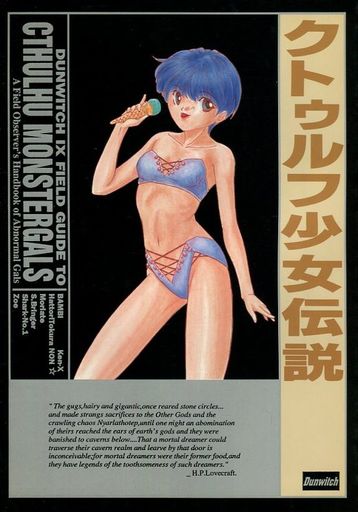
One of these dōjinshi products was the Dunwitch IX Field Guide to Cthulhu Monstergals. This was essentially a fan-created spoof of the S. Petersen guides, right down to the format, except that the familiar Cthulhu Mythos entities were replaced by monster girl versions of themselves.

1263599

Monster girls are a Japanese cultural phenomenon where a normally frightening monster is replaced with a moe (萌え) version of itself; moe being a term that designates a feeling of strong affection and cuteness, and is often combined with non-anthromorphic entities or concepts to create a (typically) young and attractive female character to personify the normally unrelateable. The juxtaposition might be near-sacrilegious to folks that like to keep the Mythos scary, but should be understood as a product of Japanese fan interpretation, all in good fun. Monster girls have been the focus of “monster girlfriend” manga and anime, including “The Elder Sister-like One, Vol. 1” (2016) by Pochi Iida (飯田ぽち。)…and the Monster Girl Encyclopedia which was published in 2015.

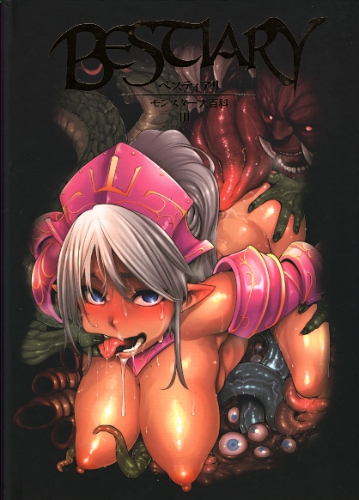
Sometimes, artists go beyond the bounds of “cute” and clean, relatively innocent and positive sexual attraction implied by moe and venture into actual hardcore erotic artwork and writing. This twist often makes the cute girls the victims of the now much more traditionally monstrous monsters. An example of this is Shindo L (新堂 エル)’s Bestiary series which so far as three volumes (2011-2015); the third volume includes a section on the Deep Ones, who in Shindo L’s setting are quite literally rapacious towards human women.

2113850

Which brings us back to Kenkou Cross and the Monster Girl Encyclopedia. This book is not a roleplaying game product, although it is derived from and uses some of the same tropes. There is no game system specified, no statistics or mechanics for the monsters like in Dungeons & Dragons. Instead, it is purely a pseudo-literary production, an “in-character” scholarly manuscript from the setting that the monster girls are from, much like the S. Petersen’s guidebooks. Aside from the artwork, which is generally PG-13 (bare female breasts, but no genitalia), the text itself shows a lot of thought and effort that has gone into the monsters, how the change to be part-succubi has effected them, feeding and mating habits (basically the same thing in this case), etc.

The Lovecraftian references are few, and include the iconic D&D monster the Mindflayer, the Wendigo (loosely connected to August Derleth’s interpretation of Ithaqua), the spider-creature Atlach-Nacha (created by Clark Ashton Smith, already the focus of a Japanese game and associated media) and most especially the Shoggoth.

Shoggoth

The interesting thing about the Shoggoth entry is that Kenkou Cross has reinterpreted their position as “servitors” to the Elder Things in At the Mountains of Madness to coincide with the Japanese pop-culture archetype of the maid—in particular, the conception of the “French Maid” outfit popularized in Victorian and Edwardian fiction (and associated pornography) and the act of being subservient in a sense that approaches (and sometimes sublimates into) domination-subjugation fantasies. “Maid-play” need not be violent, as the position can hold a great potential for sexual subtext and power fantasies without crossing the line into rape, but the formal nature of the attire and the potential power imbalance makes maids, butlers, etc. popular characters in Japanese anime and manga.

Shoggoths are slime monsters with amorphous bodies. They were created long ago to serve monsters of the untold nether reaches, but upon acquiring intelligence and emotion with the rise of the current Overlord, they are thought to have fled their once-masters.
—foreword to Monster Girl Encyclopedia Vol. II, 167 

Which makes the Monster Girl Encyclopedia incarnation of the Shoggoth both somewhat kinky, and probably the most sex-positive possible spin on the original source material, is that the (now female) Shoggoth feels the need to fulfill this position, but is not actually enslaved and still holds a great deal of power in the relationship, which is basically entered into of their own will (although the Overlord’s influence certainly gives them a push). Needless to say, the various authors of Monster Girl Encyclopedia-derived dōjinshi take whatever tack fits the needs of their particular work, ranging from the benign monster girlfriend romantic comedy to explicit erotica (within the limits of Japanese censorship laws, for works produced in Japan).

Kenkou Cross doesn’t delve deep into the Mythos in this volume; the Lovecraftian entities are hinted at being separate from many of the other monsters under the Overlord’s direct control, but Cthulhu and Shub-Niggurath are not named explicitly. In much the same way, Dungeons & Dragons has largely eschewed using the Lovecraft Mythos directly since Deities & Demigods (1981), although they have Lovecraftian critters in the form of mindflayers, aboleths, and other “aberrations.” Much of the Monster Girl Encyclopedia world remains a very vague fantasy kitchen sink; quasi-medieval in the Dungeons & Dragons manner with adventurers, quests, etc. It is testament to the wide and pervasive influence of Western (particularly British and American) on Japanese contemporary pop culture.

It might be difficult for some Mythos fans to think of shoggoths as basically sex-obsessed slime-girl maids, but that’s where the route of transmission, derivation, and development sort of become important. Because Kenkou Cross’ interpretation of the Shoggoths, for their setting, is really no different or less than any other interpretation of the Lovecraftian entity, from Robert Bloch’s “Notebook Found In A Deserted House” (1951) to “Shoggoths in Bloom” (2008) by Elizabeth Bear. And the MGE version of shoggoths is not restricted to Japan, but has filtered back into English through translation and derivation. 

Monster Girl Encyclopedia II (魔物娘図鑑 II) by Kenkou Cross (健康クロス) was first published in 2016; it was translated and published in English by Seven Seas in 2016.


Bobby Derie is the author of Weird Talers: Essays on Robert E. Howard & Others (2019) and Sex and the Cthulhu Mythos (2014).

“Beckoner of the Nightwatch” (1989) by Jessica Amanda Salmonson

To the many authors who fired my sense of wonder as a child, and to the anthologists who drew my youthful attention to the best stories of the time. These people, some living, some gone, are cumulatively responsible for those stories of mine that I call “little horrors,” the kind mainly selected for the present collection. A handful of these people are named in dedications for individual stories.
—dedication in John Collier and Fredric Brown Went Quarrelling Through My Head

for H. P. Lovecraft and Robert Bloch
—dedication to “Beckoner of the Nightwatch” (ibid. 103)

Jessica Amanda Salmonson gives the date that “Beckoner of the Nightwatch” was given as 1974. She was 24 years old then, editor of The Literary Magazine of Fantasy and Terror, and coming out as transgender—one of the first fans to do so—and continued on to a long career as writer, poet, editor, and anthologist.

“Beckoner” was either only published once, fifteen years after it was written, or it was published the first time in 1974 in a ‘zine so scarce as to have been missed by catalogers, and then again for the final time in 1989. Such things happen; not every story finds a home or an audience the year it is written. It is a slight tale; at three-and-a-half pages it definitely counts as a “short-short,” and despite the dedication the story has no overt connections to the Mythos that might otherwise have guaranteed it a slot in innumerable anthologies.

Which is rather interesting in itself. What is it about this story, so brief and yet complete in itself, that speaks to Salmonson—and to readers—of Bloch and Lovecraft? Those names together bring to mind their quasi-collaboration “Satan’s Servants” (1949), their triptych of Mythos stories “The Suicide in the Study” (1935), “The Shambler from the Stars” (1935), and “The Haunter of the Dark” (1936). Yet “Beckoner” doesn’t quite suggest those.

It is reminiscent of, if anything, Lovecraft’s “The Unnamable” or “The Picture in the House”, or Bloch’s “The Unspeakable Betrothal” (1949). “Little horror” is as good a descriptor as any; the scene is set and the action begins not someplace and time long ago and far away, but in the now, right here. The kind of horror that can find you at work, or in the apartment building, when it’s dark and you’re alone; where your own imagination may be playing tricks at you as something moves in the dark and you fill in the details of what might cause those sounds.

Yet this isn’t a sedate M. R. James ghost story. The horror, when it appears on the page at last, stepping into the light of a flashlight, beckoning for the protagonist to follow, blood oozing from the bullet holes in its belly…is real. Some solid, physical thing. A real horror, however uncanny. That was the transition, the hand-off from Lovecraft to Bloch in many ways. It wasn’t all clanking chains and bloody bones, horror could be, had to be both of the mind and have a physical existence outside of it; had to both repel and attract us. Perhaps that’s what Salmonson was trying to capture here. Because at the end, we still don’t know what the Beckoner was trying to beckon us to.

[…] intent rather than length is what define’s “little.” In my earlier collection of little horrors, HAG’S TAPESTRY published in England, I called them cyanide-laced candies in a chocolate sampler, as opposed to a condemned man’s final banquet. Hardly earth-shaking in importance, but entertaining. Although I admit to numerous influences or inspirations, I trust the end result is strictly my own.
—Author’s notes in John Collier and Fredric Brown Went Quarrelling Through My Head

In “The Picture in the House,” Lovecraft famously began: “Searchers after horror haunt strange, far places.” Yet his point was that there were plenty of horrors right at home, if you cared to look. In 1984, Salmonson wrote a poem titled “Searchers After Horror (Paraphrasing Lovecraft),” which serves as the proem to this book, which begins:

We searchers after horror haunt strange, far places:

We. There’s a sense of community among horror readers. An affection for old familiar horrors, the thrill of the chase in hunting down obscure books and films, a recognition of that inexplicable drive that sets us apart to look for and experience the ghastly, the morbid, the dark and grotesque…yet it is also the same sense of community that lets us delight in the Addams Family, The Nightmare Before Christmas, Gahan Wilson, Warren Magazines and Famous Monsters of Filmland, Mike Mignola and Eric Powell and Steve Niles.

Not every horror story has to be epic in scale. Cthulhu need not rise from the depths every story, the zombies need not overrun the world in every episode. If they did, then the shock and awe and grandeur of those horrors gets lost; one of those things Neil Gaiman hinted at in Only the End of the World Again. In this sense, little horrors are necessary for we searchers after horror.

Jessica Amanda Salmonson’s “The Beckoner of the Nightwatch” was published in John Collier and Fredric Brown Went Quarrelling Through My Head (1989). It has not been republished.


Bobby Derie is the author of Weird Talers: Essays on Robert E. Howard & Others (2019) and Sex and the Cthulhu Mythos (2014).

Derleth: Hawk…and Dove (1997) by Dorothy M. Grobe Litersky

He was known for his prolific writing production—at one time 10,000 words a day. He was also bisexual.

This book moves through Derleth’s many talents, from a five-year-old’s first reading experience to the man’s present statue as the only classic author to come out of the 20th century. It speaks eloquently of the hellish life endured by homosexuals in a society where their kind of living was confined to the boundaries of “closet” walls.
—Back cover copy of Derleth: Hawk…and Dove

Dorothy M. Grobe Litersky was a Wisconsinite, a charter member of the August Derleth Society, and one of the founders of the Rhinelander School of Arts where Derleth was engaged as a Writer in Residence. By her own account, this book—so far the only full biography of August Derleth’s life—was the result of 25-30 years of research, including interviews with family and friends and reference to Derleth’s private journals and correspondence, archived with his other papers at the Wisconsin Historical Society.

Before going into the particulars of Derleth: Hawk…and Dove, it’s important to place Derleth’s life in its proper context. He was born in 1909 in Sauk City, Wisconsin; sold his first story, “Bat’s Belfry” to Weird Tales at age 16, and from that point on never looked back at the writing game. He was a regular at Weird Tales, but prolific beyond that pulp magazine and that genre; a friend and correspondent of H. P. Lovecraft, Robert E. Howard, Clark Ashton Smith, E. Hoffmann Price and others, when Lovecraft died in 1937 it was Derleth and his friend Donald Wandrei that conspired to publish Lovecraft’s fiction and letters in hardcover. When they could not convince an established publisher to do it, they founded their own small press. Arkham House would, for the next fifty years, be one of the most important publishers of weird fiction, fantastic poetry, and Lovecraft-related materials in the world.

Derleth had a literary life outside of Arkham House. He became an important regional writer with the Sac Prairie Saga, a series of novels and short stories about his native Wisconsin and especially his home tome of Sauk City and the adjacent Prairie du Sac. For mystery fiction he created the detective characters Judge Peck and Solar Pons, the latter a deliberate pastiche of Sherlock Holmes, who remains popular. Beyond that, he wrote nonfiction histories and biographies, children’s books (including a series for which the authors received the Apostolic Blessing of Pope John XXIII) and poetry, articles and reviews. Awarded a Guggenheim fellowship in 1938, Derleth used the money to bind his collection of newspaper comics; those archives are now an important source for comic strips that may otherwise have been lost to time.

Much of this would have been opaque to even dedicated fans and readers of Arkham House. Derleth was a capable self-promoter, as his volumes, August Derleth: Twenty Years of WritingAugust Derleth: Twenty-Five Years of Writing, and August Derleth: Thirty Years of Writing attest, but he rarely wrote publicly about his marriage, love life, children, or the full details of his business. He had a diverse fanbase, but their interests typically appear narrow: the weird fans had little interest in his Sac Prairie saga, the Solar Pons fans little interest in his poetry, etc. So while there was no little interest in Derleth as a writer, bookman, publisher, and individual, there were few works that could—or even tried—to encompass all of the man and his range of writing. Those few works were mostly published by the August Derleth Society, which continues to work today to keep his writing in print and his memory alive.

Derleth’s death in 1971 saw an opening up of both Lovecraft scholarship and wider dissemination of the Mythos. During his time at the helm of Arkham House, Derleth had strongly claimed proprietary interest on Lovecraft’s fiction and letters, assuming effective (if not legal) control from Lovecraft’s literary executor R. H. Barlow. Derleth limited the ability of others to publish Mythos and Lovecraft-related works beyond Arkham House’s control (see the C. Hall Thompson affair and the publication of The Private Life of H. P. Lovecraft (1985) by Sonia H. Davis). Without him, and with the 12-year lawsuit between Arkham House co-founder Donald Wandrei and Derleth’s estate over the rights to the Lovecraft material, Mythos fiction began to proliferate. Derleth himself became criticized posthumously, both for his actions as editor and publisher, and for his Mythos fiction; Richard L. Tierney’s “The Derleth Mythos” (1973) was a watershed moment that emphasized the critical pushback against Derleth among Lovecraft studies.

Yet for all this, there was still relatively little on Derleth as an individual. The August Derleth Society Newsletter and volumes such as Remembering Derleth (1988), Return to Derleth (1993), and August Harvest (1994) are memoirs and essays by those who knew him, but approach hagiography at points. While valuable in their own right, there was for some decades after Derleth’s death no one willing or able to do the kind of initial work comparable to L. Sprague de Camp’s Lovecraft: A Biography (1975).

Not until Dorothy M. Grobe Litersky, who had been gathering material for the book since before Derleth’s death, finally wrote and published it.

Her book is, even from the most generous reading, far from perfect. Readers interested in a detailed account of his writing career, the development and publication schedule of Arkham House and its imprints, even his friendship with Lovecraft will be disappointed. There are no real revelations on these aspects of his life. It is not that Litersky ignores these things, but her interest is more focused on Derleth’s personal life.

As Derleth’s biographer, I have, to the best of my ability, tried to present as accurate a profile as possible. He wanted a portrayal of the whole man, free of the closet of lies he had been forced to hide in throughout his lifetime.
—Litersky, Derleth: Hawk…and Dove ix

While written without malice, Litersky’s “warts and all” approach to Derleth’s life includes a number of statements and assertions that are serious eye-openers to those who had only known Derleth through his fiction, essays on Lovecraft, and introductions to Arkham House books. Some of these are unequivocally true; many are simply impossible to verify without more information—and Litersky’s citations are minimal, often frustrating to work with, missing dates or page numbers, and typically take the form of “A. D. Journal” or “Robert Marx to A.D.” (ibid. 130); dates and page numbers are rare. Where they do exist, they are almost invariably accurate; there is every evidence that while she had access she was drawing directly from Derleth’s correspondence. However, the citations are still sparse and often lacking critical information, making it difficult to verify the contents.

One example of an event that we can confirm:

A group of about fifty young people converging upon the Place of Hawks on an evening in mid-October, 1948, included a precocious fourteen-year-old beauty who had made up her mind a year earlier that she was going to marry August Derleth.
—Litersky, Derleth: Hawk…and Dove 113

August Derleth’s marriage to Sandra Winters in 1953, which resulted in two children (April and Walden Derleth) and ended in divorce in 1959 is a matter of public record. They became engaged when she was 16 and still attending high school, and married shortly after she turned 18 in 1953, when Derleth was 44 years old (Rhinelander Daily News, 7 Feb 1953). The relationship appears to have been sexual even before they were married—and that Derleth was far from head-over-heels in love with the apparently infatuated teenager:

Oh, yes, I would not deny that Sandra has done me a lot of good. Not just making love to her, Sandra herself. Of course, she is sharp enough to know that, and I think that in this lies the ultimate dissolution of the affair, unless an accident makes it necessary for us to be married. For, being young, she is entirely likely, even with her mother’s advice, to take me for granted, and that might well be fatal. She has been frank enough to say that she intended all along that I should ultimately need her more than she needs me, and, while she intends to marry me, she intends also to have as much of her cake and eat much of it too, as possible. That never works, manifestly. But whatever takes place, it is certain that I have already benefited a great deal, and all the clothes and jewelry I’ve bought her won’t balance my own benefits.
—August Derleth to Zealia Bishop, 18 Aug 1949

Litersky’s account of the marriage goes into further detail, but there remains much unspoken about the entire relationship. The biographer never cites Sandra’s version of events; she appears to have relied entirely on Derleth’s accounts, despite the fact that the former Mrs. Derleth was still alive. There are no interviews with or letters from Sandra that might shed light on her side of the story. Derleth is apparently the sole source of all of the lurid details (her affairs, his affairs, the nude photography, the surprise pregnancy, etc.), as filtered through Litersky’s gloss of Derleth’s letters and journals.

The issue of statutory rape is hardly discussed. Sandra Winters as portrayed in the book is described as sexually precocious, and it beggars belief that a girl at fourteen could seduce a 40-year-old man. Derleth had to know what he was getting into, and it feels weird that in the context of the book more attention is not given to how the difference in ages was felt by both the immediate family or the community at large, or to how this reflected in the wider context of Derleth’s personal life. This is characteristic of Litersky’s style throughout the book; she presents the events as a fait accompli, not laying any moral judgment on Derleth’s flaws or foibles, but her portrait of others is colored by Derleth’s own perceptions—they become supporting characters, sympathetic when Derleth loves them and flawed or monstrous when he turns against them.

How reliable Litersky’s information is remains an open question. The book is not without errors of fact, and there are certainly instances where error of interpretation seem likely. The nature and paucity of the citations makes it difficult to assess the overall accuracy of the text, or even of specific sections. As a researcher, the book must be considered more as a guideline than a source of concrete data. Each instance has to be independently verified as much as possible.

That being said, very few of the claims in Derleth: Hawk…and Dove claims appear to be entirely baseless. If the interested reader can track down Litersky’s original sources or supplement them with other primary materials, usually there is at least some evidence to support them. To take one example:

Years later after Derleth’s death Sara told her story to a class of young students and reporters of her walk in the woods with August. She was relaxing on a blanket when he proceeded to discard all his clothes except his socks and to dance under the trees. She said she was shocked and embarrassed and pretended to be asleep.
—Litersky, Derleth: Hawk…and Dove 206

While somewhat inexplicable to Sara (and Litersky), a letter from Derleth to Lovecraft may suggest that nudism was a common practice for him, at least when the weather permitted: “I am brown as a berry, and have managed to rouse some indignation by being a one-man nudist colony on the hills only a  third of a mile across the river from the village” (Essential Solitude 632–33). So while we cannot say that this event actually happened, we can at least say that there is evidence that Derleth may have at least engaged in this behavior at some point. The anecdote is at least plausible, even if it isn’t provable.

A more complicated matter is Litersky’s assertion that August Derleth was bisexual, especially that he maintained long-term sexual relationships with both men and women. For reasons of privacy, Litersky does not name all of Derleth’s sexual partners outright; even her citations in this regard appear more circumspect than usual. This makes it especially difficult to verify; and there are no published letters where Derleth specifically states he has ever engaged in a homosexual relationship.

The importance of this aspect of Derleth’s character is arguable: it would make him the first bisexual author in the Cthulhu Mythos, and perhaps lend insight into readings of his fiction. Certainly it would cast some of Derleth’s occasional homophobic comments into new perspective, e.g.:

Barlow is I am sure a homo; from what I have heard, so was the later minister-weird taler Henry S. Whitehead.
—August Derleth to Donald Wollheim, 21 Mar n.d. [1937]

Could this be performative homophobia from a closeted bisexual? Or the genuine mild prejudice of an individual who, regardless of their sexuality, conformed to early 20th-century cultural norms regarding gender behavior and sexuality? Hard to tell. But the possibility of Derleth being on the LGBTQ+ spectrum is interesting, and deserves a deeper look.

When the subject turned to sex, August stated, “…I have no inhibitions, had few all my life sexually, that if I wanted to masturbate, I did so without guilt; if I wished to make love to a member of my own sex, likewise; if I wished to make love to a woman, again, likewise, the only condition being that sexual pleasure must rise from love, or at least a deep and genuine affection….”
—Litersky, Derleth: Hawk…and Dove 211

Here, Litersky is apparently relaying a snippet from a private conversation, as no other source is cited, so no separate confirmation is possible. Some of her statements in this line are even more unreliable; for example when she wrote:

The name Mara was mentioned only casually. He’s in love with her, the correspondent realized suddenly. Her fingers, holding the letter, felt a strange vibration. She met Mara a few years later, and had another shock. Mara was not a young lady, as she’d assumed. It wasn’t until after August’s death, a decade later, that she’d discovered her psychic flash had been 100% correct. August was bisexual and was indeed in love with Mara.
—Litersky, Derleth: Hawk…and Dove 180

“Mara” was a name used in some of Derleth’s poetry and fiction, notably in an eponymous 1948 ghost story about an unfaithful female lover; the volume of poetry This Wound (1962), which includes love poems, is dedicated to “Mara.” So while there was apparently a Mara (probably a nickname of a pseudonym), there is no indication Mara was male—also but not enough information for positive identification.

August Derleth never admits to a homosexual liaison or relationship in his published letters, but he did discuss sexuality in his correspondence, and there are several letters which are suggestive of the idea that he might be open to it, at least intellectually:

I must confess, that though I am steeped in abnormal sex, having studied all kinds of perverts at first hand, the suspicion of necrophilia in A Rose for Emily never once entered my mind. [. . .] Here is a woman starved for something—what is it, love perhaps? Let us assume it is. But she knows nothing about it. Love to her means a possession, a having. What she had come to regard as hers seems to be too independent. She kills. Thus, she keeps, she possesses, she loves. Necrophilia may or may not enter into this relation; it’s a minor point to me, since my own experience with people in this existence has led me to look on such things as part and parcel of life, though I am still conservative enough to be horrified by them, deeply. Yet I would be the first to jump tot the defense of a necrophiliac, a homosexual, &c., largely because I know that so often these poor creatures are incapable of helping themselves, have had their nerve systems tortured and twisted permanently from birth.
—August Derleth to H. P. Lovecraft, 9 Nov 1931, ES 406

I can understand your detestation of sex irregularities in life as violations of harmony and I here fully agree with you. I had previously misunderstood you to mean protestation from a basis of morals, and on this basis I would have stood squarely opposed to you. I have known and still know many people who are sexually irregular, both homosexual men and women, and except for three cases out of perhaps 21, I have always found these people highly intellectual, fully aware of what they were doing, and in all cases quite helpless. Speaking perspectively and in the abstract, I could as easily conceive myself entering upon a monogamous homosexual relation as a heterosexual one—though perhaps practice would change that pointofview. To quibble about mere words, I should not say that perverts necessarily lived inartistically.
—August Derleth to H. P. Lovecraft, 14 Feb 1933, ES 543

The idea that Derleth had an interest in the psychology of sex is supported by evidence he took out a subscription (under a pseudonym) to ONE Institute Quarterly, the journal of homosexual studies, in 1962. He would discuss the issue with others besides Lovecraft as well:

As for homosexuals—my only feeling is that I abhor promiscuity and I dislike violently to see children troubled; but this holds true also for heterosexuals, so there is actually no prejudice. Consenting behavior between adults is not offensive to me. But I do detest the flamboyant homo, the almost professional gay. To tell the truth I don’t know many real homos, though; I do know quite a number of bisexuals, and I never found one offensive, indeed, many of them strike me as brilliant, and most of them appear to be limited to one lasting affection, and are not promiscuous, that is one woman, and one man—oddly, there seems to be no conflict despite what the head-shrinkers insist  upon.
—August Derleth to Ramsey Campbell, 24 May 1966, Letters to Arkham 277-278

The subject comes up more than once in the Derleth-Campbell letters, and it is this sort of substantial quote which perhaps could have lent authority to Derleth: Hawk…and Dove. Therein lies what is arguably the single major issue with the book, beyond any question of Litersky’s style, sourcing, or quality of her analysis:

Missing Journal dates and dates of letters to and from August Derleth resulted from biographer’s incomplete notes, and a loss of actual copies of those items, journal entries and letters, beyond her control. When her lawyers accidentally discovered that the failure of Derleth’s lawyer to renew copyrights on all of Augie’s works, as requested by the U. S. Copyright offices, and informed April and Walden Derleth of the fact, the children not only moved quickly to remedy the mistake, they froze the Derleth papers in the Wisconsin State Historical Society’s Museum archives to prevent anyone access to them until the year 2020. Only then will it be possible to verify some of the material in Chapter 22, and elsewhere throughout the book.
—Litersky, Derleth: Hawk…and Dove 201-202

This is essentially the claim for why the book is not cited better than it is. Unfortunately, like everything else in the book, it is impossible to take Litersky at face value. It is true that there are some restrictions on access to portions of the Derleth archive, as described in the Administrative/Restriction Information; not all of the details quite align with Litersky’s version of events given above, but circumstances can change over time—or perhaps she misunderstood or misrepresented the reasons for the sealing. We don’t know.

It also isn’t clear why Litersky chose to publish this through the National Writers Press—a vanity press—rather than the August Derleth Society; one can imagine the content might have given the ADS pause. To say that Litersky’s assertions or interpretations of August Derleth’s life are “contested” or “controversial” would be inaccurate; most scholars don’t engage with Litersky’s biography at all. In part, this is more a reflection of a failure of the scope of Derleth: Hawk…and Dove than the question of its scholarship or distribution.

Readers who want to learn more about Derleth and Arkham House or Derleth and the Cthulhu Mythos will pick up John Haefele’s August Derleth Redux (2010) or A Look Behind the Derleth Mythos (2014); those interested in his Sac Prairie writings will pick up Evelyn Schroth’s The Derleth Saga (1979). For those who want more information on the man himself, his volumes of letters with H. P. Lovecraft and Ramsey Campbell are the major primary sources available in print.

In many ways, Litersky’s biography is characteristic of many first biographies of authors, in that it is only a beginning. Derleth: Hawk…and Dove is not the last word in Derleth studies; it is at best the start of the serious study of his life and work, and any subsequent biographer of Derleth will be forced to read Litersky and tackle the errors and weaknesses in her approach if they hope to produce anything that can surpass her work. Such a biography, when and if it written, can at least take advantage of sources that Litersky herself did not have available: the published letters, digital scans of unpublished correspondence, databases to help track down errant Derleth publications and criticism—and it would be worthwhile to see such a book published.

August Derleth was an important figure in the life and literary afterlife of H. P. Lovecraft, Robert E. Howard, Clark Ashton Smith, and many other writers. His vast body of work and his personal life are of interest in and of themselves, but he also touched on the lives of so many others—it was largely through his hard work and diligence that Arkham House became a legend, and that Lovecraft, the Mythos, and even weird fiction are still known and loved today. Whatever his personal flaws and foibles, and Derleth was certainly no saint, the ripples his life left on the world continue to expand and touch others. 


Bobby Derie is the author of Weird Talers: Essays on Robert E. Howard & Others (2019) and Sex and the Cthulhu Mythos (2014).

“The Flower of Innsmouth” (2011) by Monique Poirier

Eldritch Fappenings

This review deals with a work of erotic content, and the history of erotic art and writing. As part of this review, selected passages with descriptions of genitalia and/or sexually explicit contact will be included.
As such, please be advised before reading further.


In ’forty-six Cap’n Obed took a second wife that nobody in the taown never see—some says he didn’t want to, but was made to by them as he’d called in—had three children by her—two as disappeared young, but one gal as looked like anybody else an’ was eddicated in Europe. Obed finally got her married off by a trick to an Arkham feller as didn’t suspect nothin’.
—H. P. Lovecraft, The Shadow over Innsmouth

The undeniable fact of “The Shadow over Innsmouth” is that a great deal of sex has occurred. That is true in pretty much every town; human beings do not spontaneously pop into existence, but are the end result of a typically long and somewhat agreeably messy process of conception, gestation, birth. Within the specific parameters of Lovecraft’s plot, Innsmouth itself has hosted a lot of sexual liaisons with the Deep Ones, and this has fired imaginations in many strange ways because unlike with stories such as “The Call of Cthulhu,” sex is essentially the driving engine of the plot. The central horror of the story isn’t just the revelation that Deep Ones exist, but that they are breeding with humans.

Most of the sequels, prequels, and miscellaneous episodes inspired by Lovecraft’s story deal with the subject in one form or another, examining the gender and sexual politics, the vast possible permutations of marriage, lineage, growing up with or without “the Innsmouth Look.” Most of them don’t get into erotic details. Tide of Desire (1983) by Sheena Clayton does, a little; “Pages Found Among the Effects of Miss Edith M. Teller” (2005) by Caitlín R. Kiernan broaches some new territory; “Mail Order Bride” (1999) by Ann K. Schwader and “A Coven in Essex County” (2016) by J. M. Yales hints at nuptial horrors…

…but does Innsmouth sex have to be horrific?

Fans of horror are no stranger to teratophilia, the love of monsters. While it would be an exaggeration to say that Cthulhu Mythos erotica has been with us nearly as long as we have conceived of Cthulhu, the sexualization of “monstrous” entities has been and is and will be an ongoing aspect of reader interaction. It was not long after Carmilla or Dracula’s wives appeared on the page that “sexy vampires” became a thing, and artists and writers have, in their own way and in their own time, broached the subject of a sexy Deep One or Deep One hybrid.

The psychology of why is varied and individual. The Innsmouth Porno VHS (2014) focuses on a fascination with the different, the monstrous, the alien, the deformed. There’s a certain jaded sensibility expressed where “normal” is no longer arousing. “Under the Keeper of the Key” by Jaap Boekestein in Lovecraft After Dark (2015) uses the Innsmouth transformation as the ultimate physical expression of the mental and spiritual changes experienced during BDSM.

Monique Poirier is more sex-positive. What if a young couple just really hit it off and try something a bit different and end up liking it?

I’d never so much as seen Octavia’s unclothed ankle, never laid a hand upon her thigh for more than the barest moment before she demurely removed it. She had always been most perfectly modest and coy. In the echoing distance, thunder rolled, and another volley of sleet pelted the windows with a smooth hiss. Lightning flashed, and I saw it reflect in her eyes with a ravenous light.
—Monique Poirier, “The Flower of Innsmouth” in Whispers in Darkness

It’s fun. There’s no blood and gore, no hand-wringing or guilt, no rape or regret. All those things have their place, and there are absolutely flavors of Innsmouth fiction that will give them to you. Yet it has to be remembered that the Victorians, for all their straitlaced propriety, produced and consumed a vast amount of pornography as well. Just because sex is taboo doesn’t mean people didn’t do it.

Frankly, it makes you wonder why someone else didn’t do try to write a story like this before.

Plotwise, “The Flower of Innsmouth” is technically a prequel to “The Shadow over Innsmouth,” showing how the youngest daughter of Captain Marsh’s got “married off by a trick.” The setup was right there in Lovecraft’s own story. If one wants to get technical, there’s room to nitpick: Poirier uses “Obadiah” instead of “Obed,” “Octavia” instead of “Eliza,” the marriage should have been in 1867 instead of 1870—but there’s room to gloss that kind of detail. However, most readers will probably be more interested in the kind of bedroom scene that Lovecraft did not and would not write:

Something hot and slick probed between my buttocks in insistent exploration. I think I made a noise of protest then, and certainly tensed at the intrusion, but Octavia chose that moment to tighten her nether muscles in a paroxysm around my manhood, as if she meant to draw it up into her body entirely and the whole of me with it. (ibid.)

There is a bit of a delight in the language involved. It is probably closer to Edwardian than Victorian; reminiscent of The Way of a Man with a Maid (1908), but in the confluence between historical erotica and historical Mythos fiction, Poirier manages to get the message across without losing contemporary audiences entirely. She hits a lot of tropes—”I’m not like other girls”—but tropes aren’t a sin if used well. Nor does the story overstay its welcome; there is a plot, there is a scene, and the finale is a single sentence—but that’s really all you need for a story like this. As a brief episode of Innsmouth history, this works. As a brief erotic episode, this also works.

“The Flower of Innsmouth” by Monique Poirier was first published in Whispers in Darkness: Lovecraftian Erotica (2011, Circlet Press); it has since been reprinted in her own collection This World Between: Erotic Stories (2018).


Bobby Derie is the author of Weird Talers: Essays on Robert E. Howard & Others (2019) and Sex and the Cthulhu Mythos (2014).

“Lovecraft and Benefit Street” (1943) by Dorothy C. Walter

The house was—and for that matter still is—of a kind to attract the attention of the curious. Originally a farm or semi-farm building, it followed the average New England colonial lines of the middle eighteenth century—the prosperous peaked-roof sort, with two stories and dormerless attic, and with the Georgian doorway and interior panelling dictated by the progress of taste at that time. It faced south, with one gable end buried to the lower windows in the eastward rising hill, and the other exposed to the foundations toward the street. Its construction, over a century and a half ago, had followed the grading and straightening of the road in that especial vicinity; for Benefit Street—at first called Back Street—was laid out as a lane winding amongst the graveyards of the first settlers, and straightened only when the removal of the bodies to the North Burial Ground made it decently possible to cut through the old family plots.
—H. P. Lovecraft, “The Shunned House”

Dorothy Charlotte Walters was secretary of the League of Vermont Writers, a worker on the Vermont Commission on Country Life, and local historian and writer who had attended Brown University in Providence.  She met H. P. Lovecraft only once, in early 1934 while visiting Providence; her memoir of that meeting was later published as “Three Hours with H. P. Lovecraft” (1959). But her first memoir of Lovecraft, published in 1943, as “Lovecraft and Benefit Street.” It is one of the first such memoirs of Lovecraft by any of his female acquaintances.

Returning from such rambles in space and time to his desk in his sightly study from which he overlooked the treetops of Benefit Street, dark against the sky-glow of downtown Providence, he spent night after night, which was his working time, using the familiar localities, the characteristic family and Christian names of Rhode Island, and factual details of the present and past of the life and business of Providence to furnish a setting for tales and doings that were strange indeed.
—Dorothy C. Walter, “Lovecraft and Benefit Street”

At the time they met, Lovecraft was ensconced at 66 College Street, his final home; the window in Lovecraft’s study offered a good view of the treetops and roofs lower down the hill. Walter’s piece combines elements of biography and literary criticism; it is obvious she either read or re-read a good chunk of Lovecraft’s fiction before writing this piece, probably from the first Arkham House collection The Outsider and Others (1939) which she mentions later on in the piece. Some of her observations are more cogent than others:

In the making of imaginative tales of the sort that Mr. Lovecraft wrote there cannot help being a good deal of claptrap and mumbo-jumbo. His stories suffer, if too many are read in quick succession, from similarity in the method of producing a weird atmosphere. It is easy to tire of gothic effects in landscape and in weather when one knows that by such artifices one is being “softened up” to be bowled over at the appropriate moment by the horror of the narrative. One longs for a mystery to develop in a neat, ordinary house, or for a homicide committed in brilliant daylight. Many of the stories are too long. Cutting would have improved them. And Mr. Lovecraft leaned too heavily on a few trick words that had come to have a heightened significance for him—nameless and forbidden, for example, to mention two. He also relied much too often on references to things distasteful to himself that he assumed would produce similar feelings of aversion or fear or disgust in others—fishy odors, for instance, which he couldn’t endure and used again and again as a symbol of the evil and the malevolent; the strangeness of the foreigner; the unpleasantness of things squirmy and slimy; and chief of all, the sensation of cold. […] He would have agreed with Dante in making hell cold. (ibid.)

Subjective assessments aside, there are criticisms and observations in Walter’s piece which would be repeated by many others—indeed, some of the myths about Lovecraft may have been partially popularized by her little memoir. The main thrust of her article is not just about Lovecraft, but about Benefit Street itself, and here it should be remembered that Walter and Lovecraft were of an age—she was born in 1889, he in 1890—and shared a few of the same influences and, probably, prejudices. So in describing the street, she wrote:

One can savor early Providence under its elms, or the Yankee Providence of today, and one can also travel to foreign lands without leaving the street, if one has an open sesame to the pleasant hospitality of the Syrian, Portuguese, and Jewish homes that cluster around its opposite ends. (ibid.)

Benefit Street also provides the setting of “The Shunned House,” and so  involves one of the more dramatic and complicated publishing histories in the Lovecraftian corpus. Robert Weinberg wrote an excellent article on the publishing history of “The Shunned House,” but the short version is that in 1928, Lovecraft’s friend W. Paul Cook—a small-time printer—offered to publish the story in an edition of 250 copies. It would have been Lovecraft’s first standalone hardcover publication. Nothing went right. The edition was printed, but not bound; some of the unbound sheets were bound by R. H. Barlow, and later still some were bound by Arkham House, becoming an odd collector’s item long after Lovecraft’s death, with asking prices in the thousands of dollars (and at least one set of forgeries). The general failure of the book to be properly published during his lifetime was one of Lovecraft’s many discouragements and regrets in the writing game. Cook mentions the printing briefly in his own memoir “In Memoriam: Howard Phillips Lovecraft: Recollections, Appreciations, Estimates” (1941), which is probably all that Walter knew of the matter.

Her own approach to this confluence of Lovecraft and local history comes by way of an anecdote:

But one below-zero night in northern Vermont, in search of a bedtime story, she opened the huge Lovecraft volume that a friend had loaned her. Her eye chanced on a familiar name in a story entitled “The Shunned House,” and she read on just where she had opened the book, astonished to find herself in Providence, wandering along Benefit Street. It was pleasant to be so transported so unexpectedly to a neighborhood well known since college days, interesting and amusing to find it figuring as a setting for the outrageous events of a weird tale when she had always considered it seemly and sedate. She read on, absorbed in the pleasures of recollection. And before she knew it, she was getting shivers and a crinkly spine out of the hair-raising particulars of an uncanny and not very believable yarn. Well, of course it was late, and a very cold night! But what more could a writer of weird fiction have asked for his efforts! (ibid)

Walter’s memoir doesn’t offer any uniquely critical insight into Lovecraft: their association was too brief. Yet it as an example, if any be needed, at how we all touch the lives of others, and might be remembered afterwards by those we knew but briefly. Walter has her few anecdotes of Lovecraft, expands on his fiction and character through her own lens, and even though there is little hard data here that you won’t find anywhere else, she still adds what little she has to the store of Lovecraftian lore. We are richer for her brief memoirs of Lovecraft than we would be without them.

“Lovecraft on Benefit Street” was first published by W. Paul Cook in The Ghost #1 (1943), reprinted by his Driftwind Press as a small chapbook, reprinted again in the fanzine Xenon (July 1944), reached something like wider publication in Rhode Island on Lovecraft (1945, Donald M. Grant), and finally in Lovecraft Remembered (1998, Arkham House).

“Three Hours with Lovecraft” was first published in The Shuttered Room and Other Pieces (1959, Arkham House), republished in Lovecraft Remembered (1998, Arkham House), A Weird Writer in Our Midst (2010, Hippocampus Press), and again in Ave atque Vale: Reminiscences of H. P. Lovecraft (2018, Necronomicon Press).


Bobby Derie is the author of Weird Talers: Essays on Robert E. Howard & Others (2019) and Sex and the Cthulhu Mythos (2014).
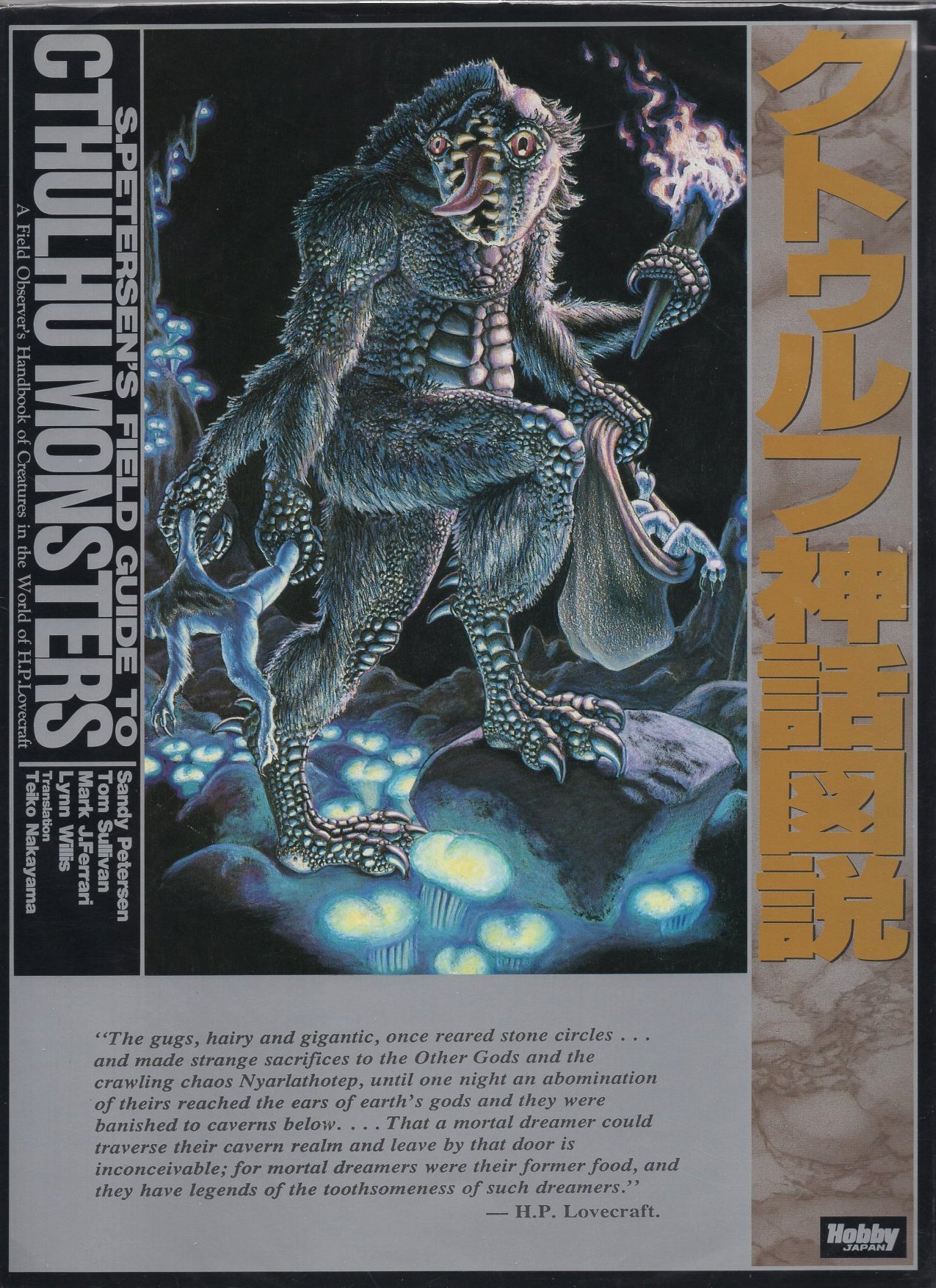
The Dream-Quest of Vellitt Boe (2016) by Kij Johnson

In a land defined by dreaming men and bickering gods, there were no sure rules, but there was also no certain randomness.
—Kij Johnson, The Dream-Quest of Vellitt Boe 133-134

You don’t have to have read Lovecraft or Dunsany to appreciate The Dream-Quest of Vellitt Boe. Without those references, it is still a very competent fantasy novelette. Johnson has a good eye for detail, characterization, description; the plot moves quick, never gets hung up too long in one place, one peril. Vellitt Boe is on a mission, after all.

That being said, without the historical context of Lovecraft and Dunsany, The Dream-Quest of Vellitt Boe is in danger of being misunderstood as a generic fantasy novel, of the sort inspired by a thousand sessions of Dungeons & Dragons, Tunnels & Trolls, or Fighting Fantasy. This comes almost as a consequence of how you get from Lord Dunsany to Kij Johnson, and to really appreciate what she is doing in this novelette and how it got there requires a bit of background. 

H. P. Lovecraft discovered Lord Dunsany in 1919. The Anglo-Irish peer had created an artificial mythology in his tales of Pegāna, which would inspire Lovecraft’s own mythos, and the stories of “Beyond the Fields We Know” in Tales of Three Hemispheres (1919) including “Idle Days on the Yann” and “The Shop in Go-By Street” would lay the groundwork for Lovecraft’s Dreamlands.

It is important to remember that Lovecraft built his Mythos over time, defining and re-defining it as time went on and other influences came to bear. “The Cats of Ulthar” (written June 1920) was not originally set in the Dreamlands; it was a generic fantasy. The first actual Dreamlands story was “Celephaïs” (written November 1920). In later fiction, these early fantasies and their names and geographies would be subsumed into the Dreamlands—and the “Dream Cycle” with its vagaries and contradictions (were exactly is Leng?) have given compilers of Mythos-lore much to chew on and argue about.

Randolph Carter came into existence in 1919 as well, in “The Statement of Randolph Carter.” This early story had nothing to do with the Dreamlands either; Lovecraft recorded a dream in his letters involving himself and his friend Samuel Loveman. In turning the dream into a story, Loveman became “Hartley Warren” and Lovecraft himself became “Randolph Carter.” The character became a self-identified counterpart for Lovecraft himself in his stories, though he appeared in only a few of them, notably “The Silver Key” (1926), which is the only one that was a Dreamlands tale until The Dream-Quest of Unknown Kadath (written 1926-1927).

Lovecraft’s Dream-Quest is fundamentally different from anything he wrote before or since. Maybe that is why in part it found no publication during his lifetime. Too long, too weird, too inexplicably full of adventure—it is this novelette which binds together Lovecraft’s “dream” stories, early fantasies, and Randolph Carter stories. Without Dream-Quest, you could argue the Dreamlands are still a part of the Mythos, but places like Ulthar wouldn’t be a part of it. This was the story that really gave the scope and connective tissue that bound much of Lovecraft’s early fiction together. In structure and conception, it is much more similar to David Lindsay’s A Voyage to Arcturus (1920) or E. R. Eddison’s The Worm Ouroboros (1922) than anything else.

There aren’t really any women in it.

Which is true for much more of Lovecraft’s fiction than just The Dream-Quest of Unknown Kadath. As discussed in Sex and the Cthulhu Mythos, Lovecraft does have female characters in his stories, but the gender balance is distinctly skewed towards male characters. In large part, this seems to be simply because Lovecraft seldom made a character female unless there was a reason for her to be female. Which is why the only absolute reference to women in Dream-Quest is:

It is known that in disguise the younger among the Great Ones often espouse the daughters of men, so that around the borders of the cold waste wherein stands Kadath the peasants must all bear their blood. 

That’s it. There are other references to women in some of the other stories, if you look hard enough—the cat-killing wife in “The Cats of Ulthar” for example—but for the most part, women are implicit. Priests, but no priestesses. “Men” as a generic term for all persons of every gender, in the very 18th century sense. Rapacious gods of the Greco-Roman school, but no lusty goddesses bedding the handsome young men around Kadath.

It was in this context that Kij Johnson wrote her own Dream-Quest, and it is in many ways both a continuation of the tradition of Dunsany and Lovecraft, and a reflection on those works.

And I must of course acknowledge Lovecraft’s The Dream-Quest of Unknown Kadath. I first read it at ten, thrilled and terrified, and uncomfortable with the racism but not yet aware that the total absence of women was also problematic. This story is my adult self returning to a thing I loved as a child and seeing whether I could make adult sense of it.
—Kij Johnson, “Acknowledgements” in The Dream-Quest of Vellitt Boe 167

Johnson did the work, sifted the stories. The story is set between “The Silver Key” and “Through the Gates of the Silver Key”; it references Lovecraft’s geography and zoology, but also subtly grounds and expands them. The Dreamlands are seen through the eyes of a native, an intelligent and experienced woman who knows more of how things work and finds delight in them. The skill of her construction is such that she never needs to cite a story specifically; it is never written that “In Ulthar no man may kill a cat,” because the idea is implicit in the story: no one even thinks of trying to kill a cat in Ulthar. It simply doesn’t come up. More amusingly and refreshingly, we get little anecdotes like how a young Vellitt Boe tried to climb Hatheg-Kla under the logic that it was only said no man could climb it. A neat bit which feels a bit like Éowyn taking a swing at the Witch-King of Angmar.

The story is at its best when it is showing rather than telling. Why not a woman’s college in Ulthar? Why not a female far-traveler? Nothing in Randolph Carter’s dream-quest required him to have a penis, so what’s to stop a woman from having her own adventure in the Dreamlands? Absolutely nothing.

The story is arguably at its weakest when it stops showing and starts telling.

She had never met a woman from the waking world. Once she asked Carter about it.

“Women don’t dream large dreams,” he had said, dismissively. “It is all babies and housework. Tiny dreams.”

Men said stupid things all the time, and it was perhaps no surprise that men of the waking world might do so as well, yet she was disappointed in Carter. Her dreams were large, of trains a mile long and ships that climbed to the stars, of learning the languages of squids and slime-molds, of crossing a chessboard the size of a city. That night and for years afterward, she had envisioned another dream land, built from the imaginings of powerful women dreamers. (ibid. 71-72)

In narrative terms, the characterization of Randolph Carter as a bit of a straw-man serves its purpose only in highlighting Boe’s struggles as a woman. Even in the Dreamlands, there are gender norms and imbalances; the women’s college of Ulthar is the youngest and most vulnerable of the seven universities, and even a hint of scandal could see it closed, upper education cut off. In that sense, Johnson needed some character to personify the casual misogyny that Boe quested against as much as anything else.

Carter as a mouthpiece is problematic mainly because he never voices such views in Lovecraft’s fiction, and as he is implicitly Lovecraft’s alter-ego (though Johnson does not make this point) it can be read as Johnson putting words in Lovecraft’s mouth. While Lovecraft did evince a few chauvinistic statements during his life, he never wrote anything like what Carter says in Johnson’s Dream-Quest. The statement (“powerful women dreamers” is a great line) needed to be made at some point, if for no other reason than it sets up the finale, but the characterization seems off; rather like Ervin Howard in “The Ballad of Black Tom” (2016) by Victor LaValle. If a dead horse is going to be beaten, at least beat it for something it actually did.

There is a line in the story that may be uncomfortable, but then it would be a sad world where such a line would be otherwise:

As a young woman, when she had been beautiful and had worn her hair short and her clothes loose to conceal that fact, she had known all the signs of men and read them well enough that she had been successfully robbed only three times and raped once; but none of those had burned from her the hunger for empty spaces, strange cities, new oceans. (ibid. 83)

Nothing of the act, which happened sometime in the far past, is shown. Which is good; the last thing the story needed was an exploitative recap, some trauma porn of the effect and slow recovery. The event happened, it didn’t define her. It is also not the only mention of rape in the story; Vellitt Boe is traveling mostly alone in a quasi-Early Modern fantasy world. Sexual assault need not have a gender bias (the setting rarely hints at lesbianism as a possibility, and male homosexuality is completely absent from the text) but old habits die hard. How many women traveling alone today have the same fear?

Which is perhaps the one real criticism of The Dream-Quest of Villett Boe. It is great for what it is, but if the purpose was to have a message as well tell a story, it feels like it could have been that much better. Why aren’t there any female gods in the Dreamlands? Why aren’t there any female dreamers? Johnson wasn’t obliged to stick to Lovecraft or Dunsany in every regard, and doesn’t. Yet her Dreamland is almost too close to the waking world in some of its gender constructs and mores.

You might be interested to know that at the party one very bright young woman described her adolescent reading of SF as a genuinely subversive force in her life, a real alternative to the fundamentalist community into which she had been born. This alternative had nothing to do with the cardboard heroes and heroines or the imperial American/engineering values which she had skipped right over. What got to her were the alien landscapes and alien creatures. We scholars perhaps tend to forget how much subversive potential both SF and fantasy have, even at their crudest.
—Joanna Russ, To Write Like A Woman 64

Russ, of course, wrote her own Dreamlands tale: “My Boat” (1976). Ironically, Russ’s story features a powerful woman dreamer (who also happens to be black), exactly the kind of character that Villett Boe lamented never meeting in her own Dreamlands. It’s a pity that the two characters didn’t run across each other—but the tales remain complementary. The Dreamlands is big enough for both characters, and more besides.

The book is at its most subversive when just letting Vellitt Boe find her own way, rather than being escorted by guards or ghouls or rescued by gugs. The Dreamlands through her eyes is a delight, and just having a female character be the protagonist of a Dreamlands story in itself is more of a statement that See? Women can explore the Dreamlands too! than any of the casual misogyny attributed to Randolph Carter (or, implicitly, Lovecraft). If Johnson’s goal beyond writing the story was to write a Dreamlands where the women aren’t invisible and mute, she can certainly be said to have succeeded. Above and beyond that, The Dream-Quest of Vellitt Boe is a very rare thing: a good Dreamlands story, written in a way that is not a pastiche of Dunsany or Lovecraft.

Kij Johnson’s The Dream-Quest of Vellitt Boe was published in 2016 by Tor.


Bobby Derie is the author of Weird Talers: Essays on Robert E. Howard & Others (2019) and Sex and the Cthulhu Mythos (2014).