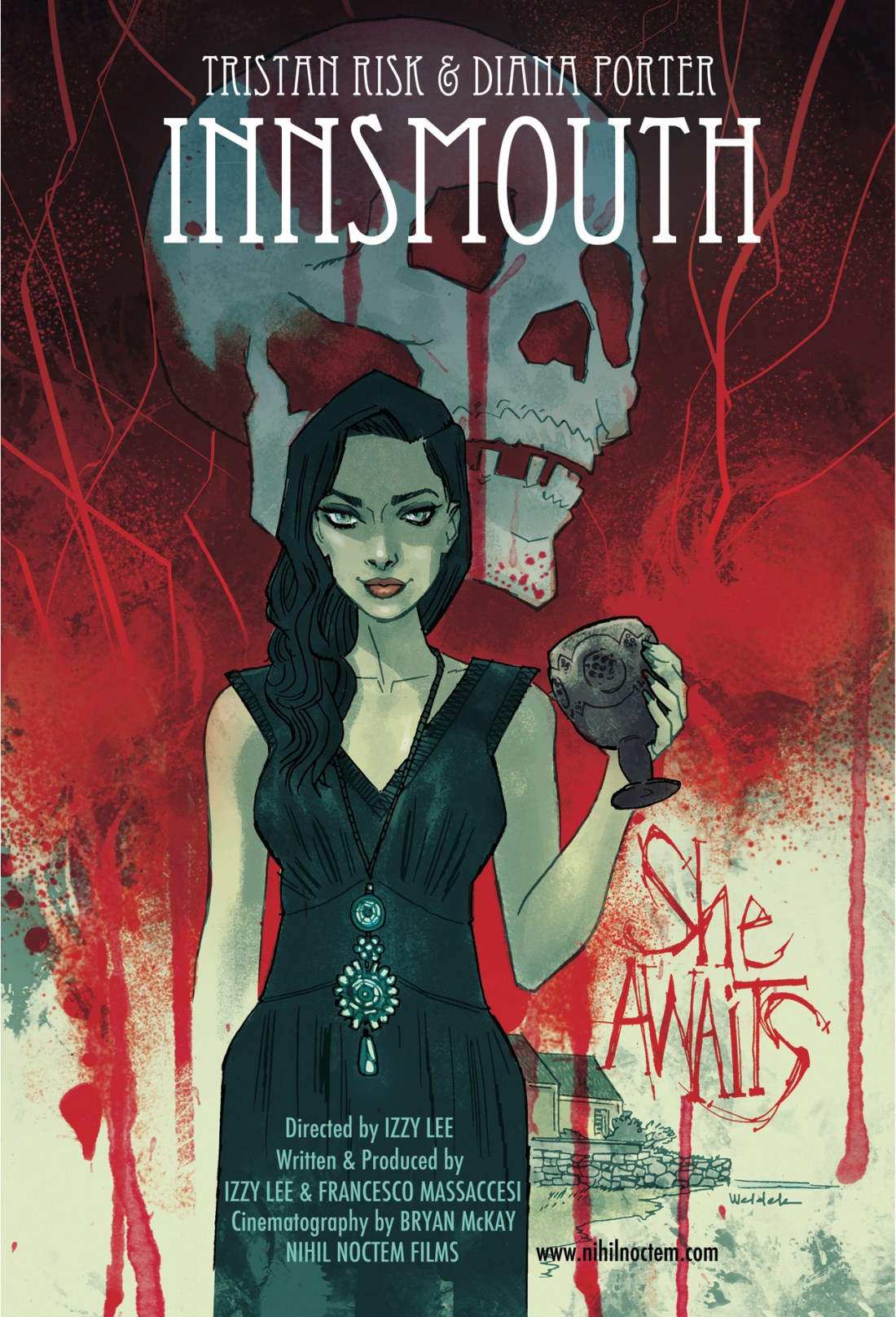
Innsmouth (2015)

インスマスを覆う影 (Innsumasu o Oou Kage, 1994). Return to Innsmouth (1999). Dagon (2001). Innsmouth Legacy (2004). Cthulhu (2007). Innsmouth (2015). H. P. Lovecraft’s The Deep Ones (2020). The Innsmouth School for Girls (2023). H. P. Lovecraft’s The Shadow over Innsmouth (2024).

Those titles don’t even cover the entire cinematic legacy of H. P. Lovecraft’s “The Shadow over Innsmouth,” which includes a number of short films, television episodes, and a broad thematic influence that crops up in a number of films. Innsmouth, with its relatively accessible settings, modicum of action, near-human creatures that are fairly easy to depict with make-up and prosthetics, and a combination of folk, cosmic, and body horror vibes is one of the most popular and identifiable works for filmmakers to either adapt, riff on, or incorporate into their own original works.

Each film is unique, each faces its own limitations and creative choices, which makes the variations on the familiar theme interesting for comparison with the others. So what sets Innsmouth (2015) apart from its fellows?

Innsmouth (2015) is an 11-minute short film, directed by Izzy Lee, written by Izzy Lee and Francesco Massaccesi based on the novella by H. P. Lovecraft, and starring Diana Porter and Tristan Risk. Cinematographer was Bryan McKay, and they even used the exterior of the Wentworth Coolidge Mansion, which Lovecraft actually visited (Horror Guide to Northern New England 211).

The story is a highly abbreviated adaptation of “The Shadow over Innsmouth” crossed with a police procedural: Detective Olmstead travels to Innsmouth to solve a murder, and finds some unexpected genealogical (and gynecological) revelations. As Izzy Lee put it:

Innsmouth was created to make [Lovecraft] roll over in his grave a little by having the cast 98% female and switching the gender roles. […] there’s also a ton of light being shed on how film excludes central female characters. I wanted to create a film where women call the shots onscreen, in nearly every role.
—quoted in Joe Yanick’s “Izzy Lee puts a New Spin on Lovecraft with Short INNSMOUTH” (Diabolique, 8 Mar 2016)

The result is, like most shorts with hard budget limitations, a bit bare-bones. One of those works that promise something a bit more than can be delivered in the running time. It would have been nice to have seen this premise stretched out to feature length, more atmosphere, and characters and plot given more time to develop. Yet within the constraints, Lee seems to have achieved her directorial goals.

Most of the cast is women, and that results in a shift in focus away from the normally patriarchal stories of Innsmouth. In The Deep Ones (2020), the point is made explicit that this is a story about fish men impregnating human women; in Cthulhu (2007), the prodigal son is not exactly welcomed home, but is expected to get busy fairly immediately with breeding the next generation of Deep One hybrids. The male characters in these stories rarely come out sympathetic, and the women characters are often fairly eager to accommodate.

KATHERINE 
Asses are made to bear, and so are you.

PETRUCHIO 
Women are made to bear, and so are you.
—Shakespeare, The Taming of the Shrew, Act II, Scene 1

Lee and Massaccesi’s script doesn’t ignore the Deep One colonization project angle, but they do but their own twist on it, which is aided by some relatively simple but very effective props/makeup effects. Picture Innsmouth as more matriarchal and more fishlike in their reproduction and you get the gist.

Detective Diana Olmstead (Diana Porter) arrives on the scene of a bizarre death: a body with a strange bite wound and a mysterious egg sac on her back. A clue leads her to Innsmouth, where she meets a seductive and horrific fate in the form of Alice Marsh (Tristan Risk: American Mary, The Editor, ABCs of Death 2). Innsmouth explores the “monstrous feminine” with an all-female cast and two male extras. This is notable because Lovecraft’s universe is traditionally male-dominated.

You can expect nudity, blood, egg sacs, gills, teeth, claws, and a soon-to-be notorious scene with Tristan Risk.
—”Innsmouth” at H. P. Lovecraft Film Festival website

Part of the short film’s fame comes from one scene that it would be unfair to spoil. It is enough to say that of all the films that have tried to capture something of the sexual and body horror that Lovecraft implied in his story but could never put on the page, Izzy Lee’s “Innsmouth” may be the most daring in trying to depict it. Kudos to Tristan Risk for her work in bringing that to the screen. In the hands of a less conscientious director, the camera might have lingered too long and crossed the line into exploitation, but I think the brief glimpse into the eye of madness was the mingled shock and titillation needed to set this short film apart.

As with many short films, the length ultimately works against it. This film whets the appetite for a more daring, less traditional reimagination of Lovecraft’s story that treats the subject seriously and isn’t afraid to break a few taboos if it gives the final product some punch, but doesn’t completely satisfy. Lovecraftian film fans who appreciate more mature fare should watch this at least once; filmmakers tackling Innsmouth should challenge themselves to see what works here.

After its initial run on the film festival circuit, Innsmouth (2015) was available for a time on DVD from Nihil Noctem films, though it is now out of print. As of this writing, the film is available for streaming on Shudder.


Bobby Derie is the author of Weird Talers: Essays on Robert E. Howard and Others and Sex and the Cthulhu Mythos.

Deep Cuts in a Lovecraftian Vein uses Amazon Associate links. As an Amazon Associate I earn from qualifying purchases.
“Of Gold and Sawdust” (1975) by Samuel Loveman

Antisemitism

The following article deals explicitly with antisemitism in a historical context. Frank discussion of these matters requires the reproduction of at least some samples of antisemitic speech from historical sources (e.g. Lovecraft’s letters). As such, please be advised before reading further.


“American literature has produced three great writers of terror fiction: Edgar Allan Poe, Ambrose Bierce and Howard Phillips Lovecraft. It has been my good fortune—certainly, no inconsiderable one—to have been on intimate terms with tow of these: Ambrose Bierce and Howard Phillips Lovecraft.
—Samuel Loveman, “Howard Phillips Lovecraft” in The Arkham Sampler (Summer 1948)

For a matter of three years and more I was actually in daily association with him—years of plenitude and literary activity; years of happiness. I can safely assert that Lovecraft’s conversation takes its place among the masters of that brilliant but difficult art.
—Samuel Loveman, “Lovecraft as a Conversationalist” in the Howard Phillips Lovecraft Memorial Symposium (1958)

During that period I believed Howard was a saint. Of course, he wasn’t. What I did not realize (or know) was that he was an arrant anti-Semite who concealed his smouldering hatred of me because of my taint of Jewish ancestry. It would be impossible for me to describe the smug, cloaked hypocrisy of H.P.L.
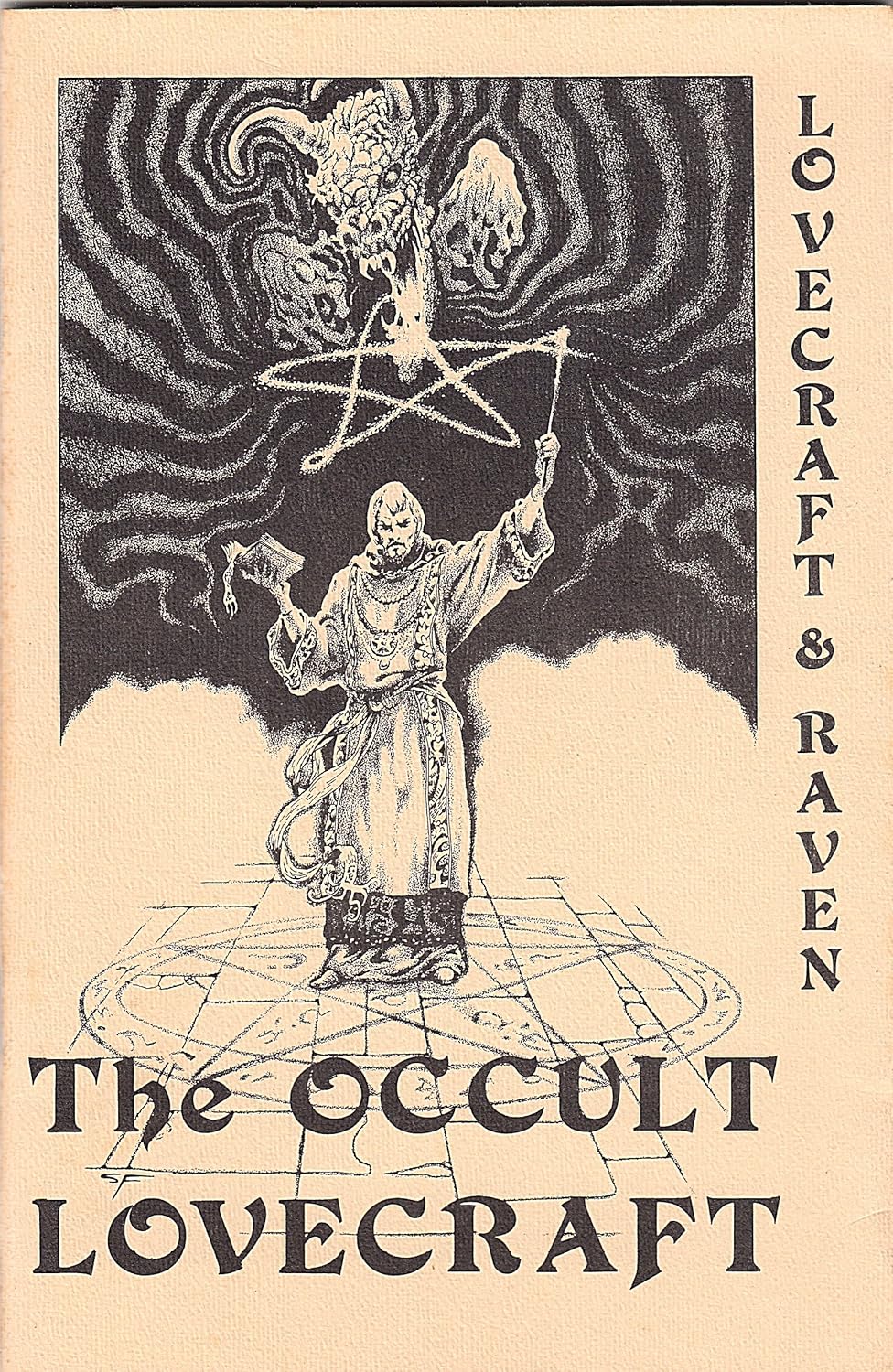
—Samuel Loveman, “Of Gold and Sawdust” in The Occult Lovecraft (1975), 22

H. P. Lovecraft came into contact with Samuel Loveman (1887-1976) in 1917; the two shared a love of poetry and Classical themes, and with their correspondence, Loveman was drawn back into amateur journalism.

Loveman has become reinstated in the United through me. Jew or not, I am rather proud to be his sponsor for the second advent to the Association. His poetical gifts are of the highest order, & I doubt if the amateur world can boast his superior.
—H. P. Lovecraft to Rheinhart Kleiner, 8 Nov 1917, LRK 93

Lovecraft’s antisemitism, so adamant when speaking about the faceless, anonymous mass of Jews as a people, often broke down at the individual level. Loveman and Lovecraft became close friends, and their acquaintence brought Lovecraft into contact with the poet Hart Crane and his circle. In her memoir, Sonia H. Greene claimed that when she wished to prove to Lovecraft that his antisemitic prejudices were bunk, she invited both HPL and Loveman to New York. During the period of Lovecraft’s marriage and inhabitation of New York (1924-1926), the two were closely associated, sometimes seeing one another on a daily business, and for a time were neighbors at 169 Clinton Street. When thieves broke into Lovecraft’s apartment and stole his clothes and his wife’s suitcase, they also stole an expensive radio set that Loveman had secured with HPL.

Loveman and Lovecraft did not always move in exactly the same circles, however. For one, Loveman was a working bookman, always either employed or operating as a bookseller on his own account, while Lovecraft perpetually failed to find gainful employment. For two, Loveman was gay, a fact that Lovecraft never directly alludes to (and possibly was ignorant of); Loveman’s homosexual affairs are absent in Lovecraft’s letters, and largely only became more widely written about in later decades. After Lovecraft left New York, their lives drew apart, though they seem to have remained in correspondence until Lovecraft’s death.

For the next few decades, Loveman was a bookman. He developed a somewhat infamous reputation for his fanciful catalogues and a few inept attempts at forgery. As Lovecraft’s posthumous star waxed, Loveman produced three memoirs of his friend: the largely laudatory “Howard Phillips Lovecraft” (1948) that barely mentions Lovecraft’s xenophobia in New York, the anecdotal “Lovecraft as a Conversationalist” (1958), and the much more barebones and critical “Gold and Sawdust” (1975), written near the end of his life and addressing, for essentially the first time in print, his reaction to Lovecraft’s antisemitism.

So what changed Loveman’s attitude?

During Lovecraft’s lifetime, he had several Jewish correspondents, including Sonia H. Greene, Adolphe de Castro, Robert Bloch, Julius Schwartz, and Kenneth Sterling. While Lovecraft was an antisemite, these people were still his friends and loved ones; as such, his letters to them are notably absent of anti-Jewish sentiments. Even when Lovecraft was discussing the Nazis with a teenaged Robert Bloch in late 1933, HPL was careful to talk around certain issues, never once mentioning Jews or the Nazis’ antisemitic policies directly, e.g.:

Regarding the defeat of disproportionate cultural & standard-building influence by sharply-differentiated minority-groups—here again we have a sound principle misinterpreted & made a basis for ignorant, cruel, & fatuous action. There is of course no possible defence of the policy of wholesale confiscation, de-industrailisation, & (in effect) expulsion pursued toward groups of citizens on grounds of ancestral origin. Not only is it barbaric in the hardship it inflicts, but it involves a faulty application of ethnology & anthropology. However—this does not obscure the fact that there is always a peril of the concentration of disproportionate power & articulateness in the hands of non-representative & alien-minded minorities—whether or not of alien birth or blood. Cases are very numerous where small groups of especially active & powerful thinkers have tacitly & gradually secured a “corner” on expression & value-definition in nations widely different from themselves in natural instincts, outlook, & aspirations.
—H. P. Lovecraft to Robert Bloch, [late October 1933], LRB 82-83

Lovecraft’s surviving letters to Loveman are few and end in 1927, so we don’t know exactly how or if HPL discussed the Nazis with his other Jewish friend, but based on his letters to Bloch et al., it seems reasonable to assume that HPL was careful to never give his friend offence on account of his Jewish ethnicity. It is quite possible that at the time of Lovecraft’s death in 1937, Loveman had no idea of Lovecraft’s real thoughts about the Nazis during Hitler’s rise to power, or the discussions he had with others as the antisemitic policies began to go into effect. If Loveman did have any idea about Lovecraft’s antisemitism, it likely came from his friendship with Sonia H. Davis, Lovecraft’s ex-wife.

In the mid-1940s, as WW2 was coming to a close, Loveman was contacted by early Lovecraft biographer Winfield Townley Scott, who was looking for data. Loveman pointed Scott at Sonia, and between Scott’s article and Sonia’s memoir, she seems to have come into correspondence with Loveman again; at least, there are some letters between the two dated 1947. Sonia had been in correspondence with August Derleth, who attacked her memoir and claims of Lovecraft’s prejudice, keeping in mind that this was in the immediate aftermath of the Holocaust. Sonia vented her spleen a little to Loveman:

In his Marginalia he is all wrong in stating how much older I am than HP, also that our divorce was the result of HP’s inability to write for money or his lack of desire to write for money. None of this is true. I carried a handsome salary at the time and provided many things for him. I did not leave him on account of non-providence, but chiefly on account of his harping hatred of J__s.
—Sonia Davis to Samuel Loveman, 4 Jan 1948, JHL

This is likely why Loveman wrote:

Her treatment by H.P. L. was, whether consciously or unconsciously, cruel. His anti-Semitism formed the basis for their eventual divorce. Howard’s monomania about race was about as close to insanity as anything I can think of.
—Samuel Loveman, “Of Gold and Sawdust” in The Occult Lovecraft (1975), 22

Elsewhere, Sonia wrote:

But I told him this very soon after we met; especially when he remarked that it was too bad that Samuel Loveman was a Jew.
—Sonia Davis to Winfield Townley Scott, 24 Sep 1948, JHL

This is presumably the source for when Loveman wrote:

Lovecraft had a hypocritical streak to him that few were able to recognize. Sonia, his wife, was indubitably his innocent victim. her love for him blinded her to many things. Among the things he said to her was, “Too bad Loveman’s a Jew; he’s such a nice guy.”
—Samuel Loveman, “Of Gold and Sawdust” in The Occult Lovecraft (1975), 22

This kind of context was important because Loveman had relatively little save his own memories of Lovecraft to go by when he wrote his first memoir of Lovecraft, published in 1948. He wrote to Derleth:

I look forward to the publication of the letters [of Lovecraft] with a great deal of eagerness. I have practically nothing at all, or I would have tend[er]ed them to you. All my material was either destroyed or confiscated when I left Cleveland for New York.
—Samuel Loveman to August Derleth, 1 Dec 1949,
quoted in Letters to Maurice W. Moe & Others 29

How Loveman lost most of his letters from Lovecraft isn’t clear, but in the 1940s Loveman purchased several hundred pages of letters that Frank Belknap Long, Jr. had received from Lovecraft; HPL’s letters were already becoming collectors’ items. When Loveman wrote his second memoir of Lovecraft in 1958, this material was presumably available, but perhaps Loveman had not taken the time to read through several hundred pages of his friend’s infamous handwriting when approached for a brief memoir.

So what happened between 1958 and 1975 that caused Loveman to write:

The one last letter of his I have fills the bill, and a hundredfold more! It advocates the extinction of the Jews and their exclusion from colleges. The letter was written to a partner of W. Paul Cook, who published my books, “The Sphinx” and “The Hermaphrodite.”
—Samuel Loveman, “Of Gold and Sawdust” in The Occult Lovecraft (1975), 22

The unnamed “partner” would be Walter J. Coates, an amateur journalist and small press publisher during the 30s; Coates’ letters from Lovecraft had apparently also passed through Loveman’s hands. Several of Lovecraft’s letters to Coates appear to be in private hands or lost, so the exact statements that Loveman found so damnable are not widely available. However, a letter from Lovecraft to Coates contains several of these sentiments:

Undeniably—all apart from the effects of natural change and altered philosophic-scientific-psychological perspective—the world of American taste & opinion is distinctly & lamentably Jew-ridden as a result of the control of publicity media by New York Semitic groups. Some of this influence certainly seeps into Anglo-Saxon critical & creative writing to an unfortunate extent; so that we have a real problem of literary & aesthetic fumigation on our hands. The causes are many—but I think the worst factor is a sheer callous indifference which holds the native mind down to mere commercialism & size & speed worship, allowing the restless & ambitious alien to claim the centre of the intellectual stage by default In a commercialized civilization publicity & fame are determined by economic causes alone—& there is where the special talents of Messrs. Cohen & Levi count. Before we can put them in their place, we must de-commercialise the culture—& that, alas, is a full-sized man’s job! Some progress could be made, though, if all the universities could get together & insist on strictly Aryan standards of taste. They could do much, in a quiet & subtle way, by cutting down the Semite percentage in faculty & student body alike.
—H. P. Lovecraft to Walter John Coates, [mid-October? 1929], LWH 121

The date is uncertain, but the sentiments are in keeping with some of Lovecraft’s other letters. It followed Lovecraft’s time in New York, when he was most vociferous about the city and its Jewish population. The idea that Jews exerted an outsized influence on national media was one that Lovecraft apparently picked up in New York and retained in follow years, and unfortunately dovetailed with Nazi propaganda. Similar-though-not-identical statements appear in some of Lovecraft’s letters from 1933 and ’34, though this is the most explicit instance where Lovecraft suggests censorship of Jews from universities and academia.

The title of Loveman’s final essay, “Of Gold and Sawdust,” echoes a famous statement from W. Paul Cook’s “In Memoriam: Howard Phillips Lovecraft” (1941), on Lovecraft’s return to Providence after his stint in New York—a frustrating period which had seen Lovecraft married, separated, failed to find employment, robbed, and utterly miserable by the end of it, but had matured somewhat as a writer with his best work ahead of him, still to be written—”He had been tried in the fire and came out pure gold.”

These were happy days when I believed H.P.L. was pure gold—not sawdust!
—Samuel Loveman, “Of Gold and Sawdust” in The Occult Lovecraft (1975), 21

What Loveman’s final essay—really, his final word—on Lovecraft captures is the sense of betrayal. These were two men who had been intimate friends, through thick and thin, who had dedicated poems to each other (cf. “To Mr. Theobald” (1926) by Samuel Loveman), who were, if far from agreeing on every subject, at the least open and accepting of differences of opinion. In the 1920s and 30s, when antisemitism was so rife in the United States and rising abroad, there was likely a bit of trust there, that at least Lovecraft was different. Maybe (we don’t know, unless Loveman’s letters to Sonia surface), he even doubted Sonia’s initial claims regarding Lovecraft’s antisemitism, since they didn’t match his own memories.

Then the letters came into his hands that gave undeniable proof.

There is a broader context that Loveman missed, having not lived long enough to see the publication of more of Lovecraft’s correspondence than the first volumes of the Selected Letters from Arkham House. He did not see where Lovecraft’s antisemitism began or where it ended, did not see how and why Lovecraft’s prejudices changed over time and in response to personal and world events. Would it have made any difference? “Of Gold and Sawdust” is the cry of a wounded soul, of memories forever poisoned by the thought that in his heart, Lovecraft had hated Loveman just because he was a Jew.

Lovecraft’s letters do not speak of hatred for his friend Sam Loveman. Imperfect as Lovecraft was, he was loyal in his appreciation for Loveman as a friend and poet. That makes “Of Gold and Sawdust” especially bittersweet; there is no reply that Lovecraft could make, no apology, no way to mend the hurt he had inadvertently caused. While Lovecraft’s friends are all dead, it is a feeling that echoes in the lives of many fans who, wanting to learn more about this Lovecraft person and their stories, finds out about his prejudices. It is something we all have to come to terms with, each in our own way.

“Of Gold and Sawdust” was published in The Occult Lovecraft (1975). It has not been reprinted.


Bobby Derie is the author of Weird Talers: Essays on Robert E. Howard and Others and Sex and the Cthulhu Mythos.

Deep Cuts in a Lovecraftian Vein uses Amazon Associate links. As an Amazon Associate I earn from qualifying purchases.
Saga de Xam (1967) by Jean Rollin & Nicolas Devil

Eldritch Fappenings

This review deals with a work of erotic content. As part of this review, selected art displaying cartoon nudity will be included.
As such, please be advised before reading further.


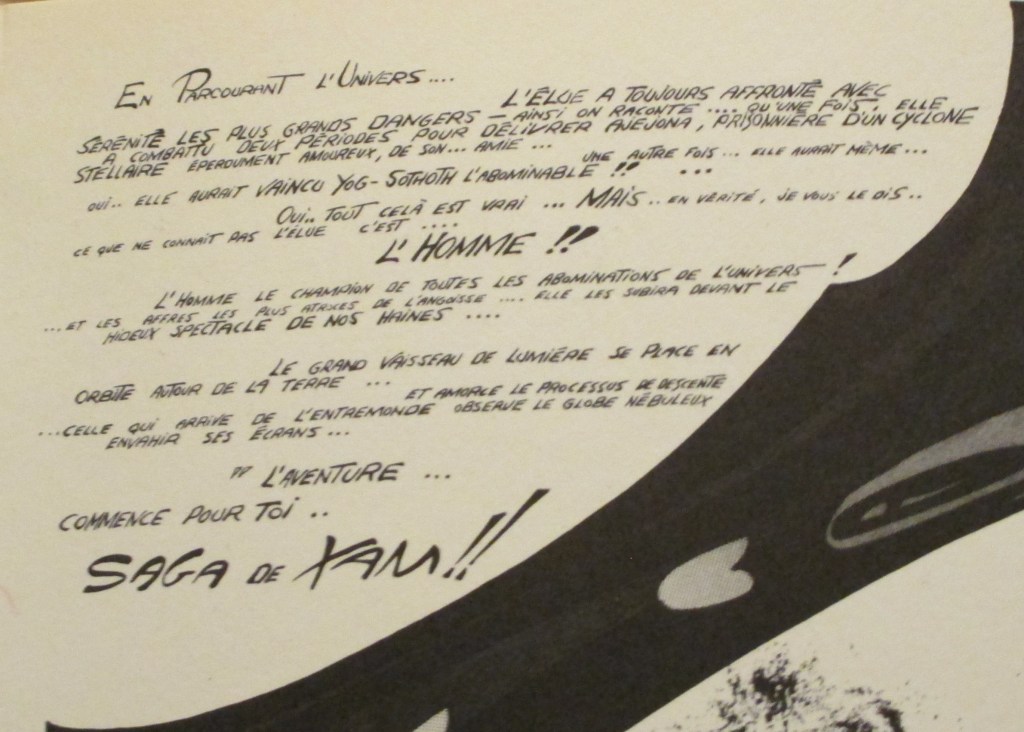
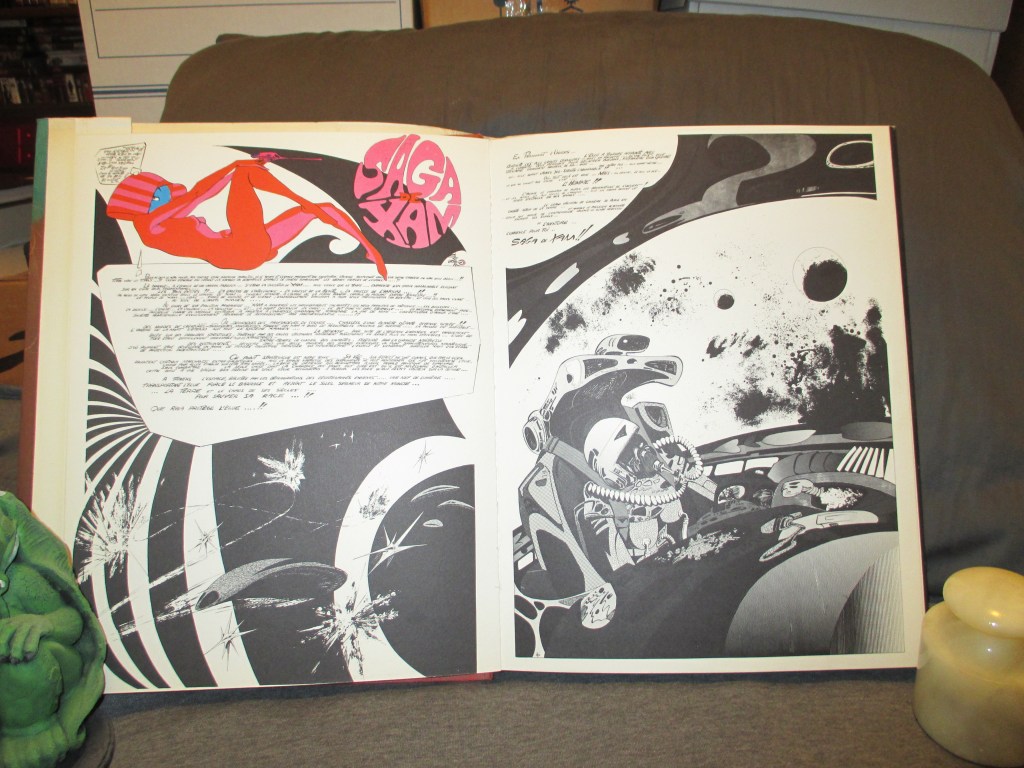
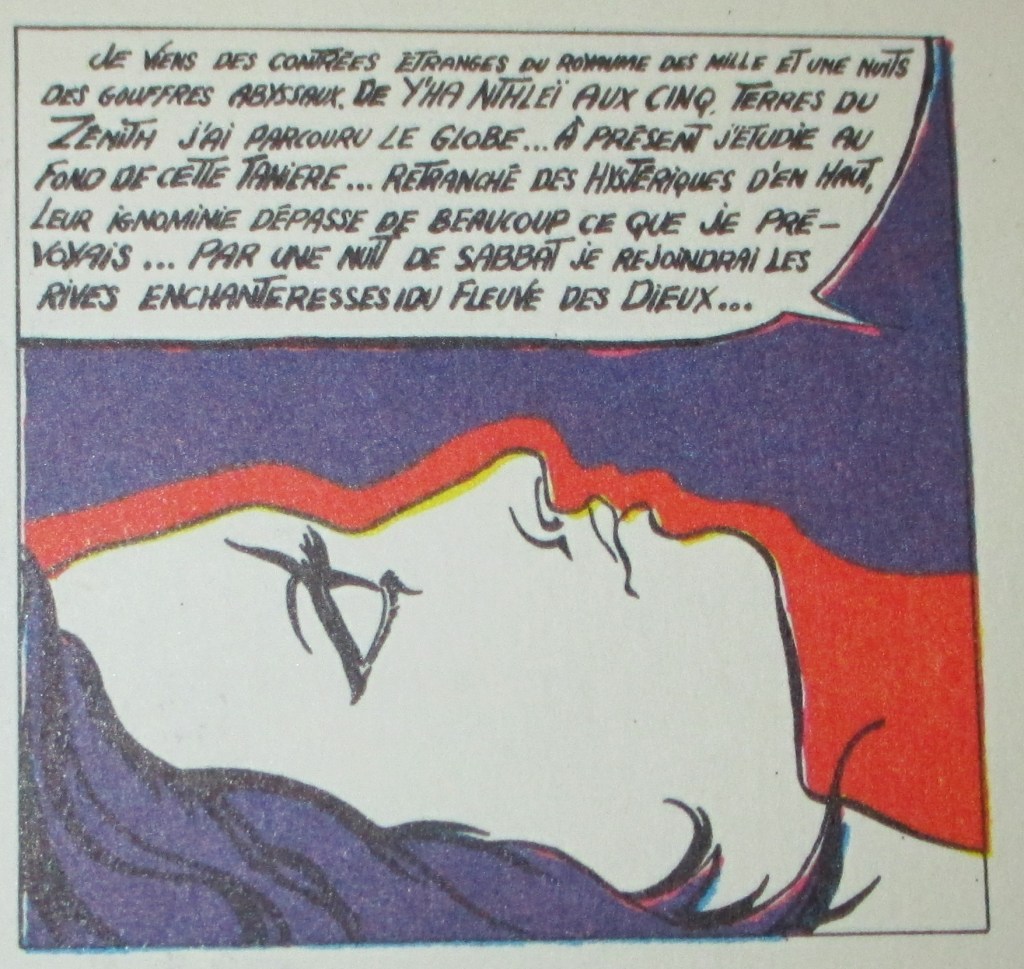
En Parcourant l’Univers . . .

L’Élue a toujours affronté avec sérénité les plus grands dangers—ainsi on raconte . . . . qu ‘une fois, elle a combattu deux périodese fois . . . Elle aurait m pour délivrer ajejona, prisonniére d’un cyclone stellaire éperoument amoureux, de son . . . amie . . .

Une autre fois . . . Elle aurait mème . . . oui … Elle aurait vaincu Yog-Sothoth l;abominable!! . . .

Oui . . tout celà est vrai . . . MAIS … en verité, je vous Le ois . . ce que ne connaître pas l’élue c’est . . . . L’HOMME !!

L’Homme le champion de toutes Les abominations de l’univers—! . . . et Les affres Les plus atroces de l’angoisse . . . . Elle Les subira devant Le hideux spectacle de nos haines . . . .

Le grand vaisseau de lumiére SE place en orbite author de la terre . . .

Et amorle Le processus de descente . . . celle qui arrive de l’entremonde observe Le globe nébuleux envahir ses écrans . . .

L’aventure … commence pour toi . . Saga de Xam!
Traveling the Universe . . .

The Chosen One has always faced the greatest dangers with serenity—thus it is said . . . . that once, she fought twice . . . She would have to free Ajejona, prisoner of a stellar cyclone, desperately in love, from her . . . friend . . .

Another time… She would have even… yes… She would have defeated the abominable Yog-Sothoth!!…

Yes… all this is true… BUT… truly, I tell you… what not knowing the chosen one is… MAN!!

Man, the champion of all the abominations of the universe—! . . . and the most atrocious pangs of anguish . . . . She will endure them before the hideous spectacle of our hatreds . . . .

The great ship of light places itself in orbit above the earth . . .

And begins the process of descent . . . she who arrives from the in-between world observes the nebulous globe invade her screens . . .

The adventure… begins for you . . Saga of Xam!
Saga de Xam (1967), chapter 1English translation

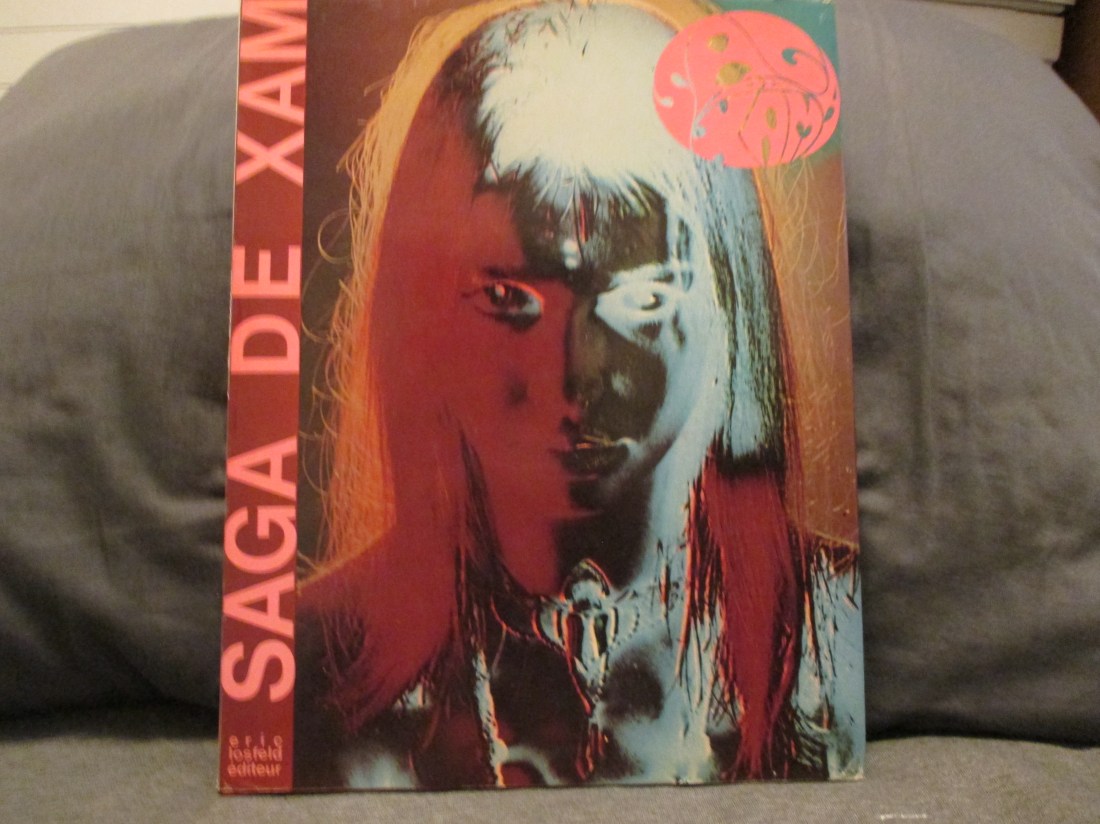
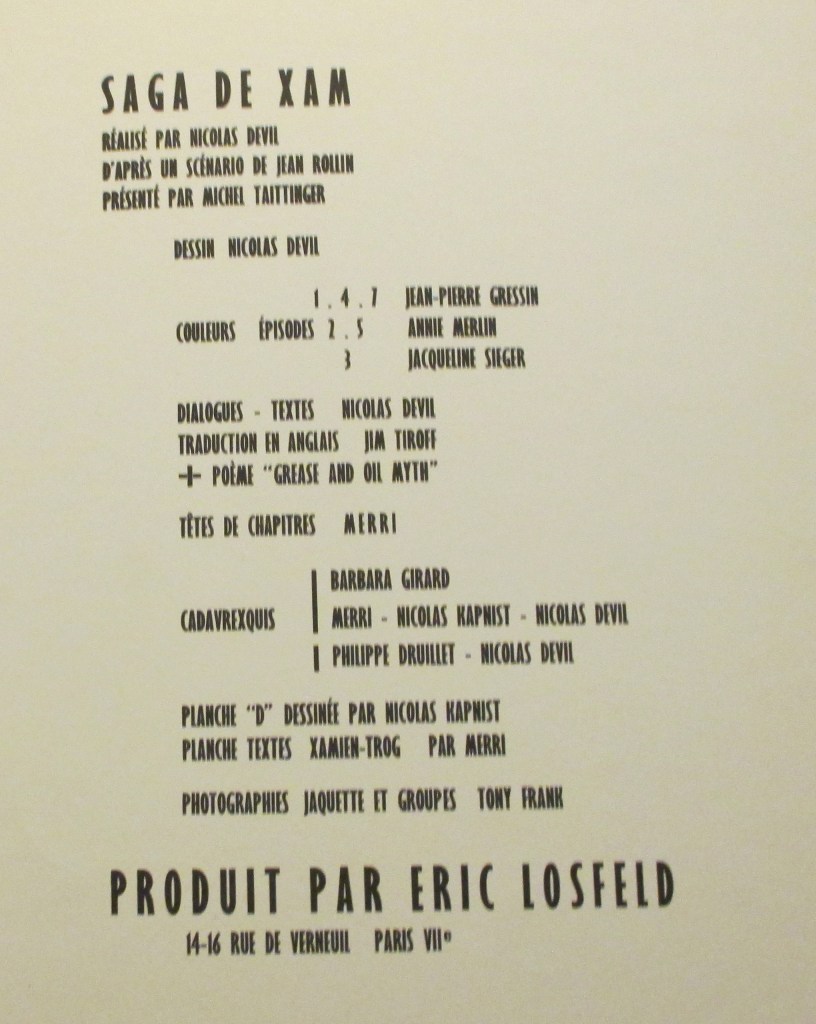
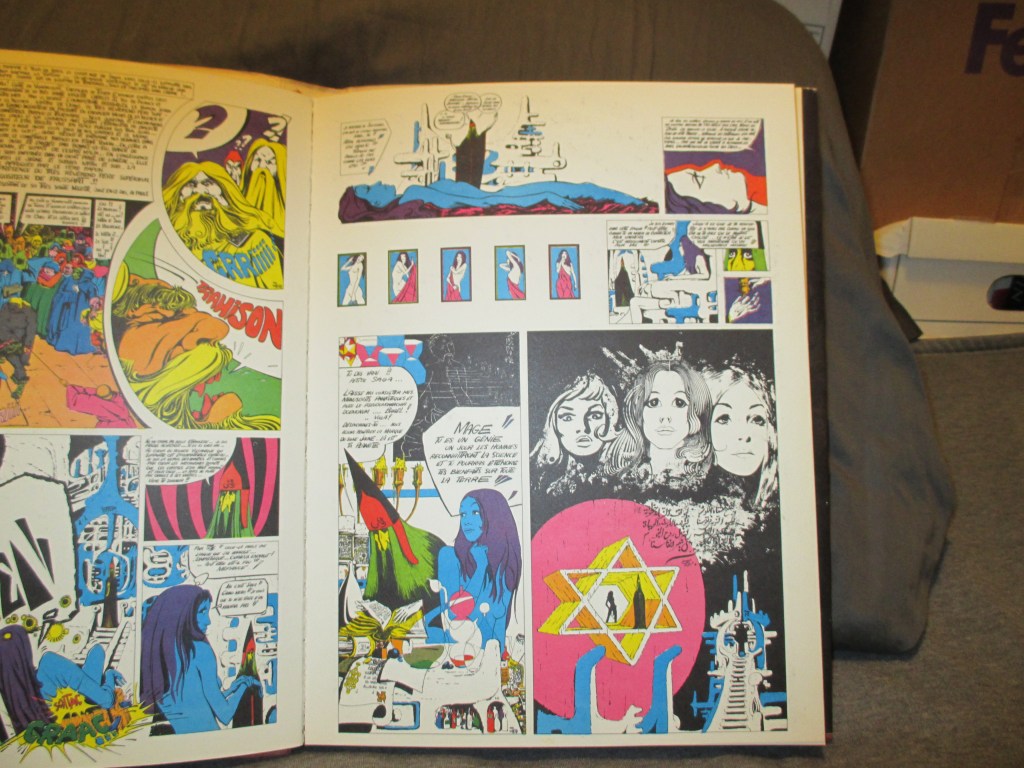
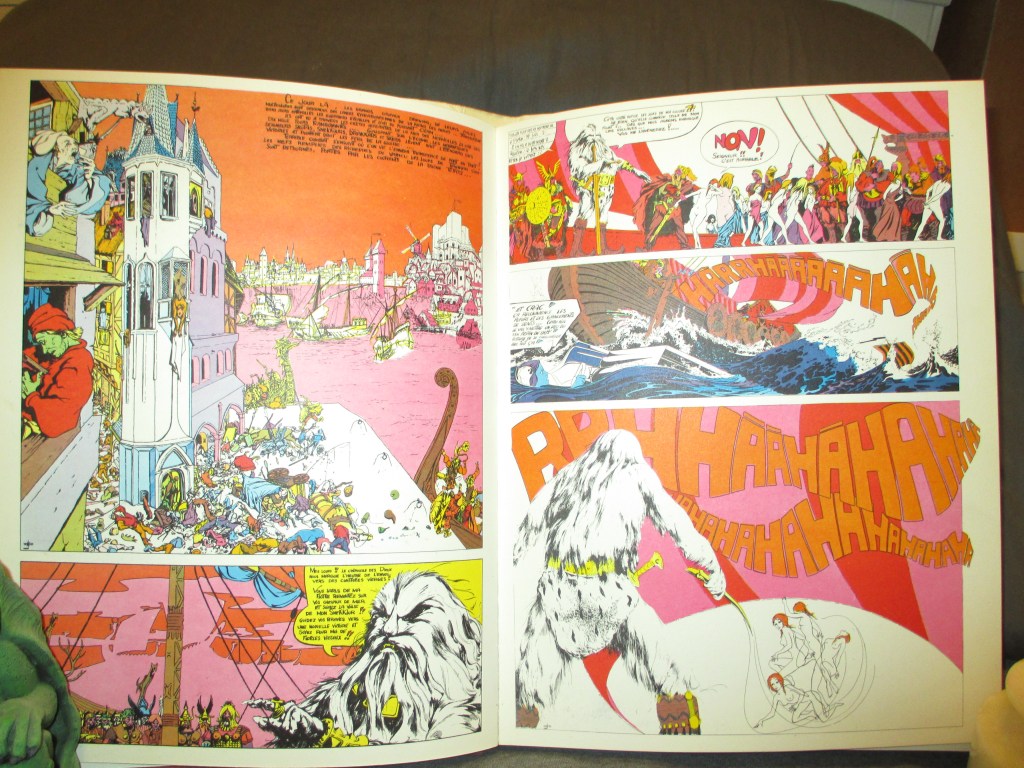
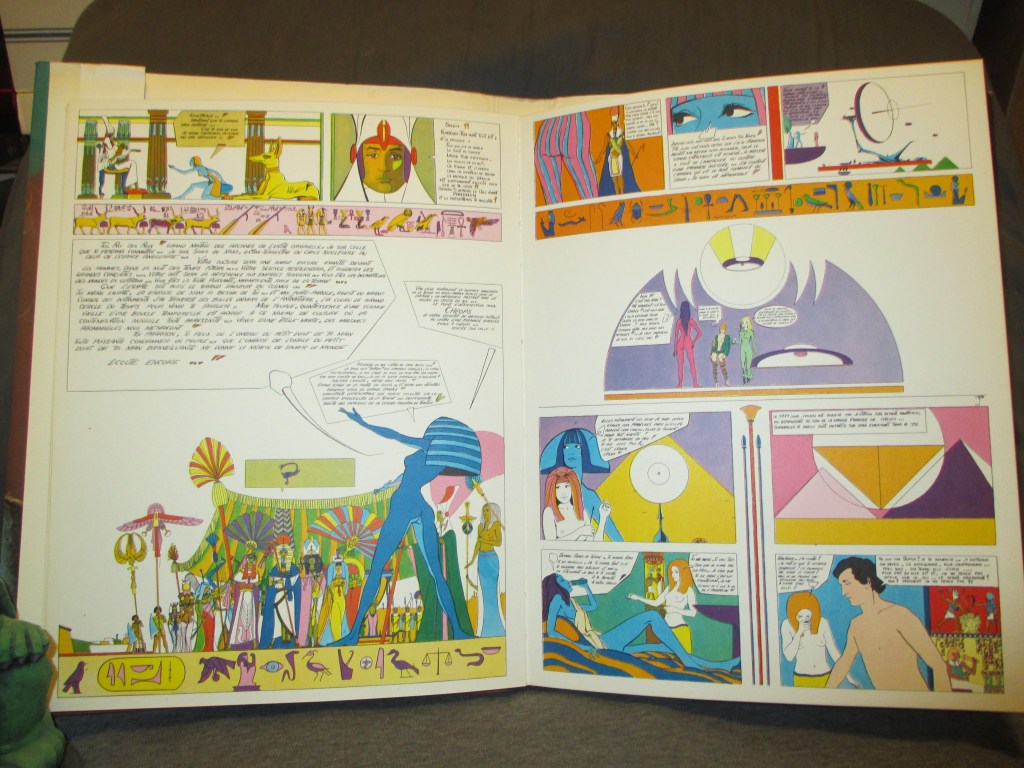
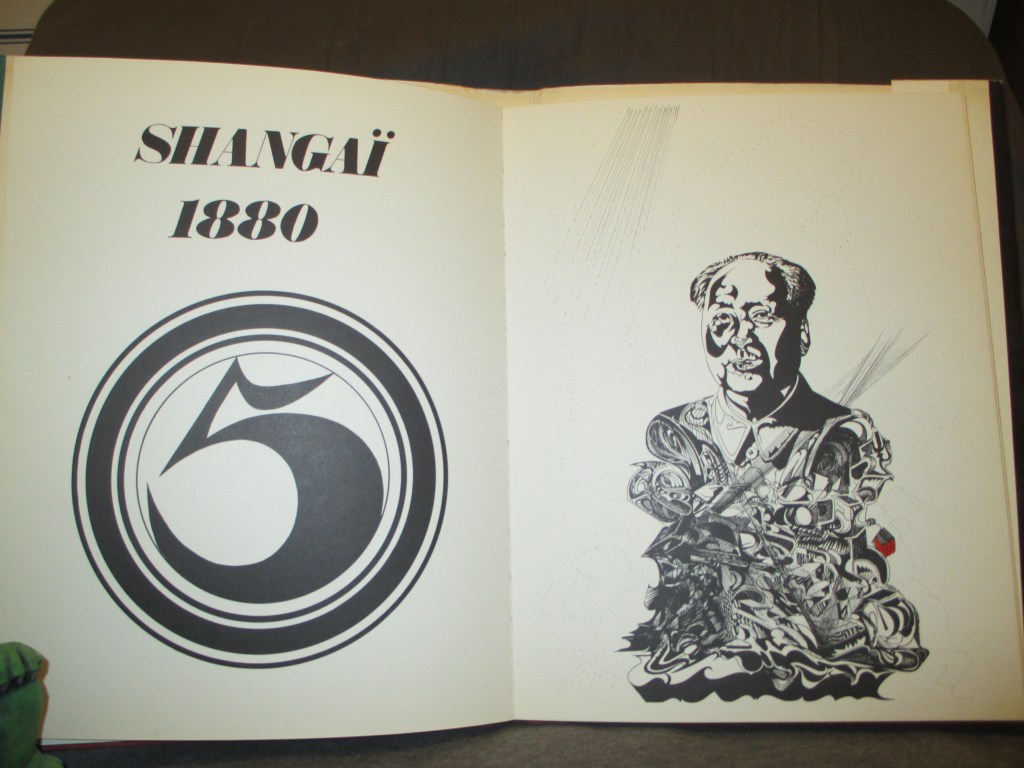
In 1967, French director Jean Rollin had not yet made his mark on cinema. While he had directed a few films, his moody, unconventional erotic horror/fantasies like Le viol du vampire (1968, “The Rape of the Vampire”), La vampire nue (1970, “The Nude Vampire”), and Le Frisson des Vampires (1971, “The Shiver of the Vampires”) all lay in the future. However, he was in contact with Éric Losfeld, a French publisher of literary and artistic works that challenged the sensibilities of the day, including fantasy, science fiction, and erotic comics like Barbarella by Jean-Claude Forest, Lone Sloane: Mystère des Abîmes by Phillipe Druillet, and Phoebe Zeit-Geist by Guy Peellaert, as well as Nicolas Devil (Nicolas Deville), who served as art director for Rollin’s short Les pays loin (1965, “The Far Countries”).

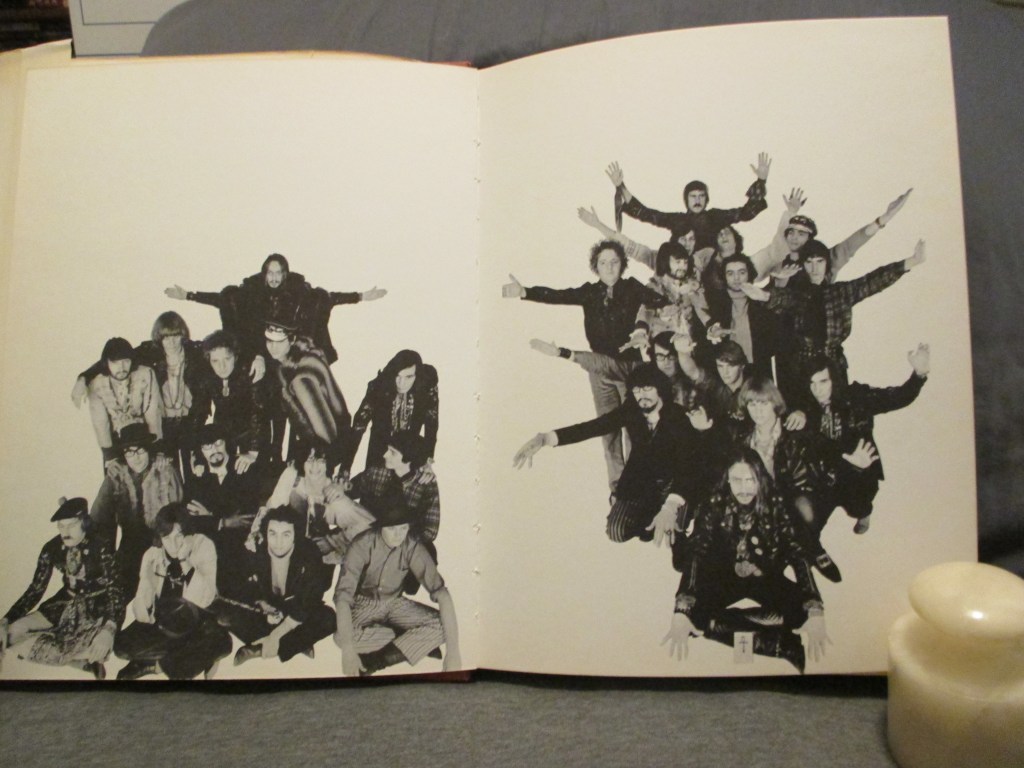
Together, they produced Saga de Xam. Rollin’s scenario had been intended for a science-fiction film that never materialized. Nicolas Devil took that script and realized it artistically. The blue-skinned woman Saga from the planet Xam is on a mission to Earth, and moves through a series of surreal adventures that expose her to the best and worst of humanity in a blend fantasy, science fiction, and eroticism for six chapters, plus a seventh chapter that is largely splash pages. Barbara Girard, Merri, Nicolas Kapnist, and Phillipe Druillet all lend their talents, and actor Jim Tiroff provides a poem in English, “Grease and Oil Myth.” While Devil is the primary creator, the final chapter uses the Exquisite Corpse approach, with creators building on each other’s work.

Credits page
The creative team.

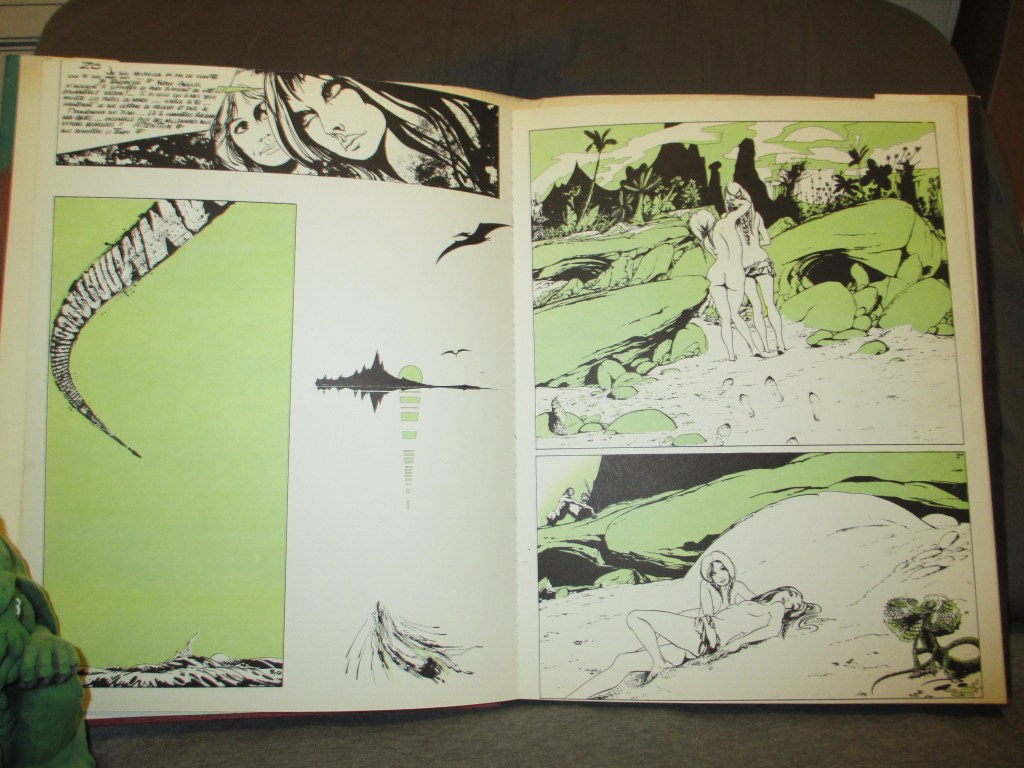
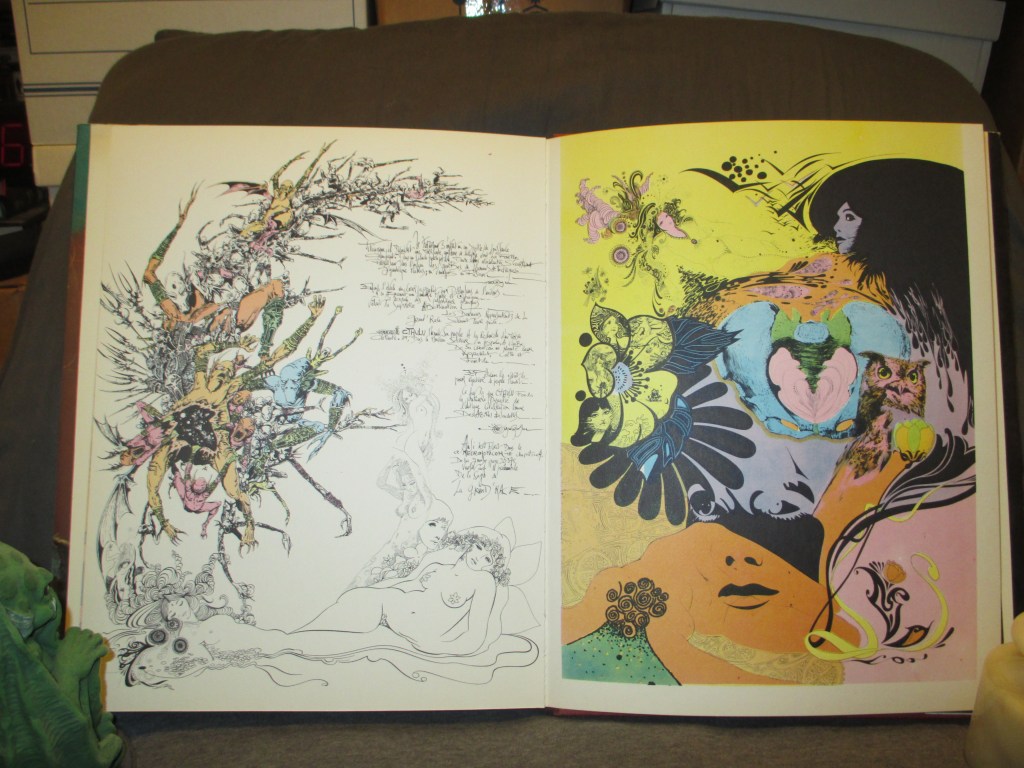
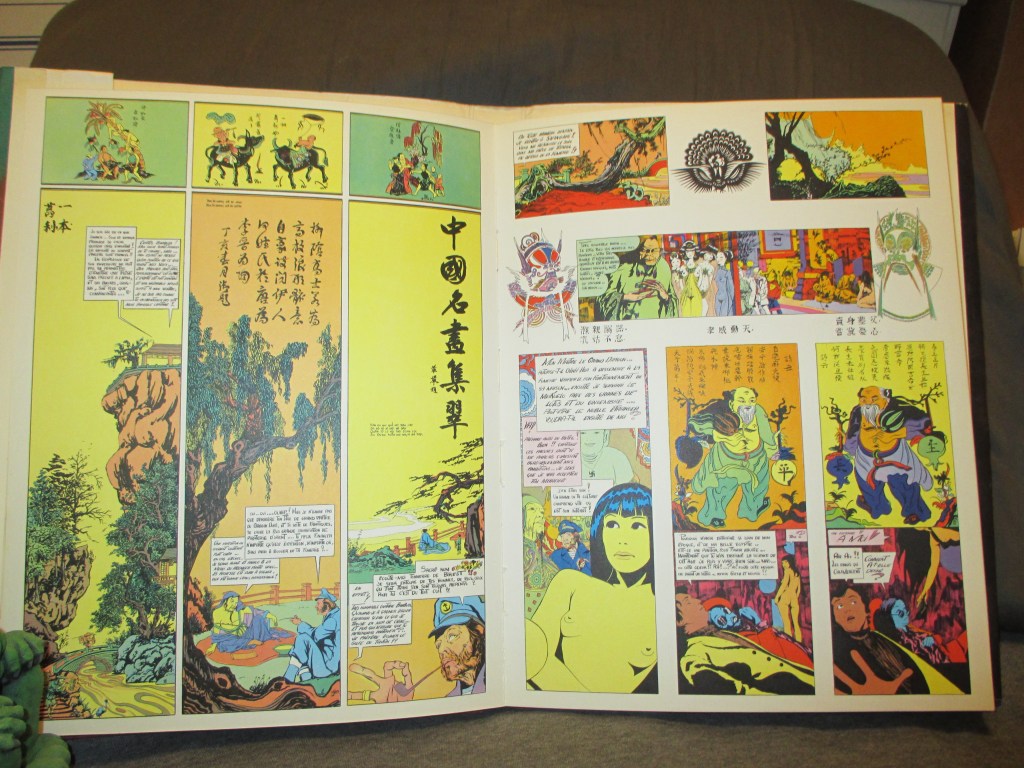
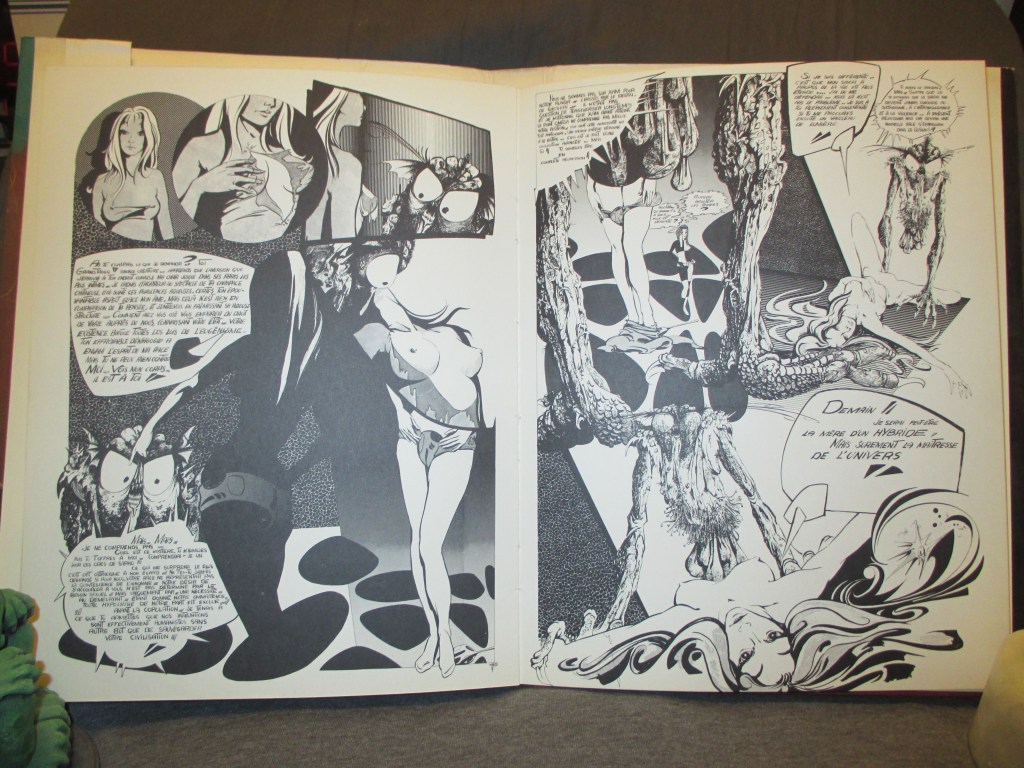
Saga de Xam was released as a single large hardbound album by Éric Losfeld in 1967. Because it was drawn on large boards and reduced to fit the page size, some of Devil’s hand-lettered text is very difficult to read without a magnifying glass, but the overall production quality was high, with excellent print quality and vibrant colors. It was in every sense of the word an avant-garde production, a psychedelic graphic novel that played with all manner of artistic styles, techniques, layout, coloring, and storytelling. Published in an edition of 5000 copies that quickly sold out, the book was somewhat legendary until relatively recently: there were reprints in 1980 and 2022, and an English translation is due for release in 2025.

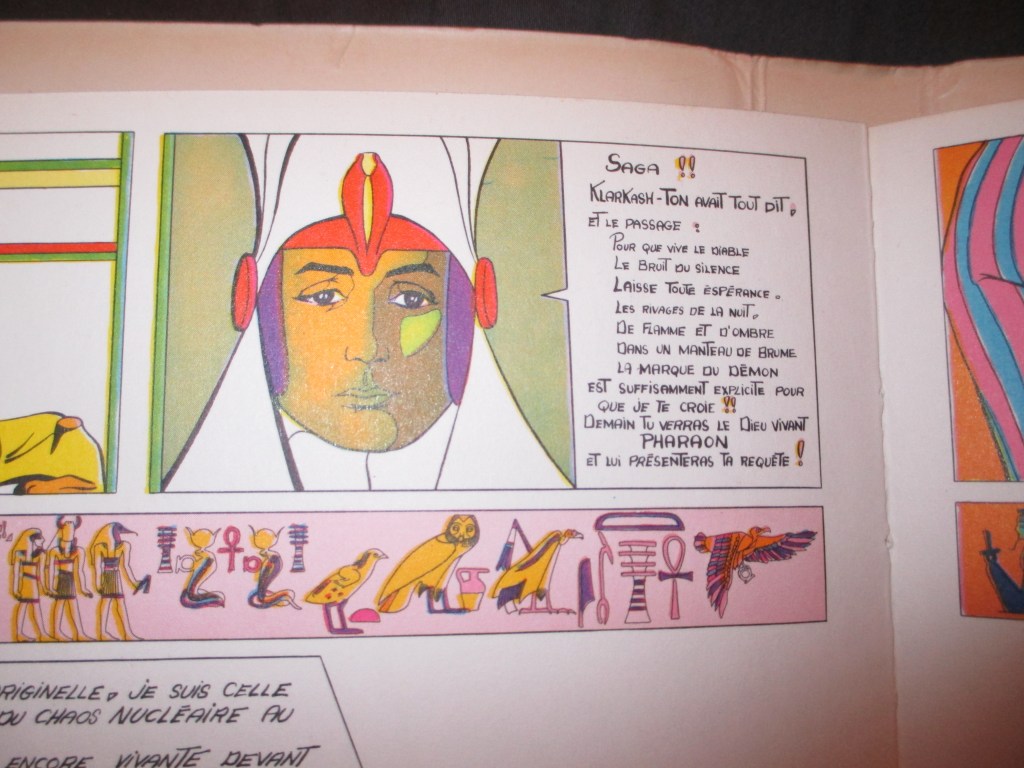
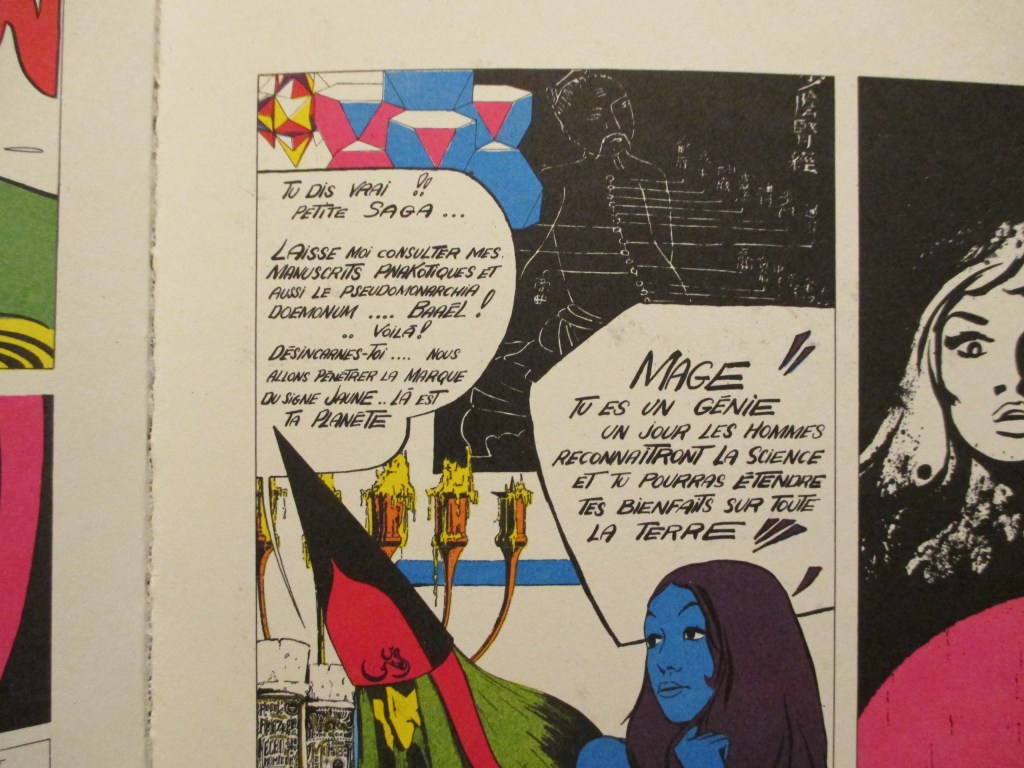
Lovecraft’s Mythos are subtly but consciously present in the text, woven into the storyline at different points. At one point, for instance, Saga encounters Abdul Alhazred; in another, a poem by “Klarkash-Ton” is quoted:

Klarkash-Ton avait tout dit, etc Le passage:

Pour que vive le diable
Le bruit du silence
Laisse toute éspérance.
Les rivages de la nuit,
De flamme et d’ombre
Dans un manteau de brume
Le marque du démon
Klarkash-Ton has said it all, and the passage:

Long live the devil
The sound of silence
Leaves all hope.
The shores of the night,
Of flame and shadow
In a cloak of mist
The demonic mark
Saga de Xam (1967), chapter 4English translation

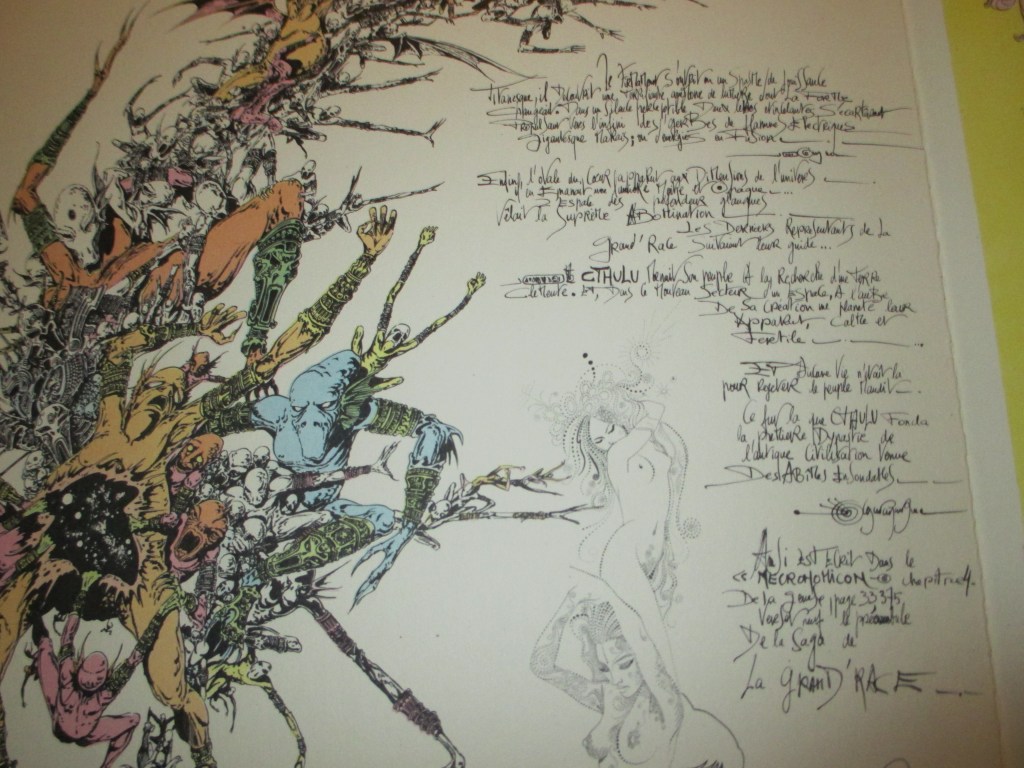
While such blank verse isn’t a translation of any poem of Clark Ashton Smith’s that I could find, it is a nice homage to the master of Averoigne. There are several other references scattered throughout the book, not necessarily playing a large part in the proceedings but adding to the charm for fans of the Mythos. Among Fruillet’s pages in chapter 7 is one ripped straight from the Necronomicon, or at least definitely in keeping with the pages that would be published in the Métal Hurlant/Heavy Metal/Metal Extra Lovecraft Special a few years later. It’s tempting to speculate that all the Mythos elements in the book might come from Druillet’s contributions, but it is impossible to tell on such a collaborative work.

Abdul Alhazred name-drops Y’ha-nthlei from “The Shadow over Innsmouth”
Abdul Alhazred consults the Pnakotic Manuscripts

The visual style and politics are both very ensconced in the 60s counterculture; Saga is often nude but rarely powerless, violently rejecting rapists, leading women to free themselves, and developing love affairs with other women. There is a certain quirky mid-century aspect to the depictions, for example. Chapter 5 is specifically set in China, and the color tone literally renders the Asian women yellow, just as Saga is depicted as blue.

The ending is also a bit stark; when the hideous and violent Troggs invade, rather than destroying them Saga chooses to make love, not war—literally, by conceiving a hybrid child with the Grand Trogg. In an era dominated by the Vietnam War, the idea of finding a peaceful means of coexistence had its appeal.

That, then, is the story of Saga of Xam: to learn that love and sex should be given freely, not taken by force.

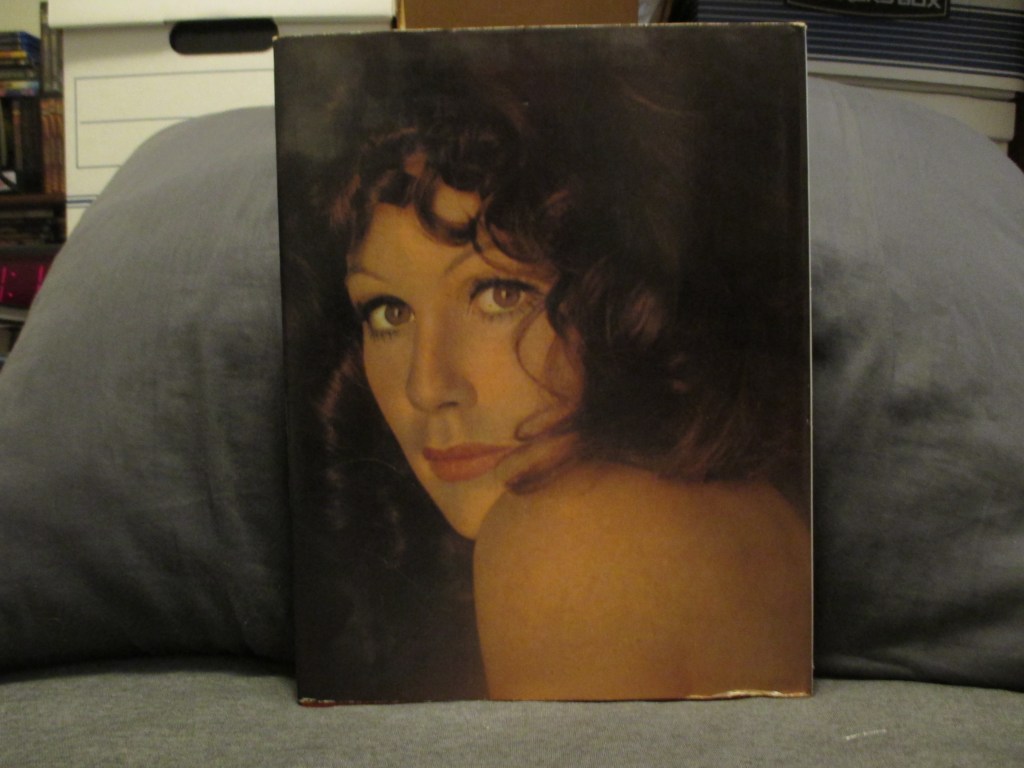
Back cover of the first edition.

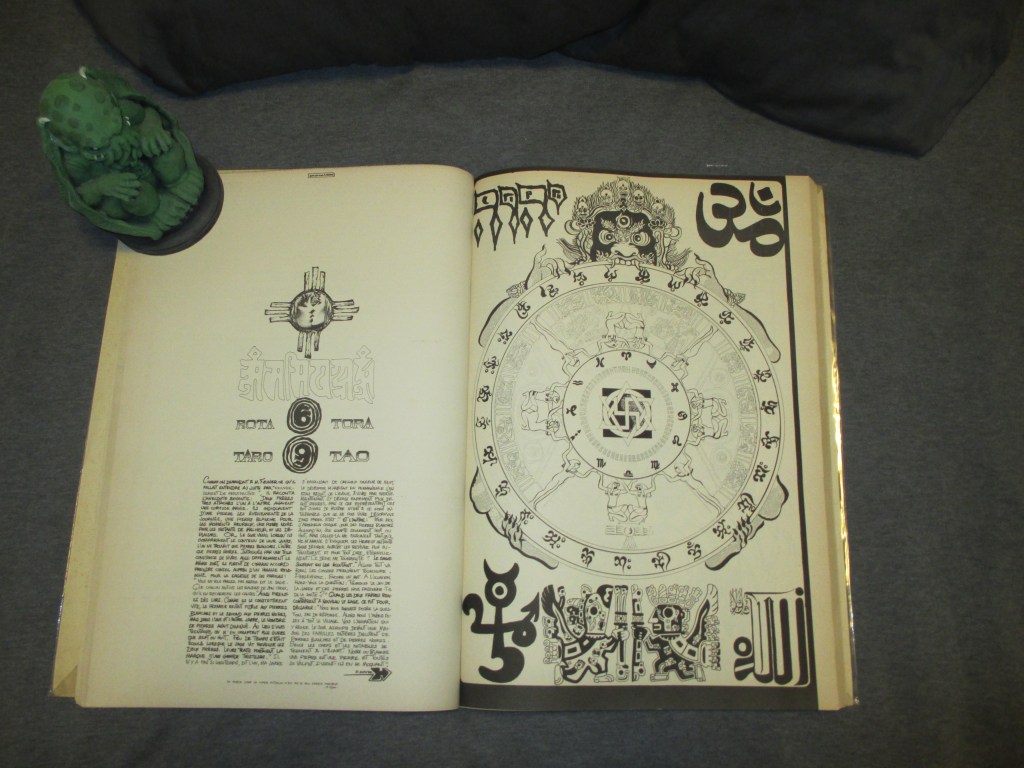
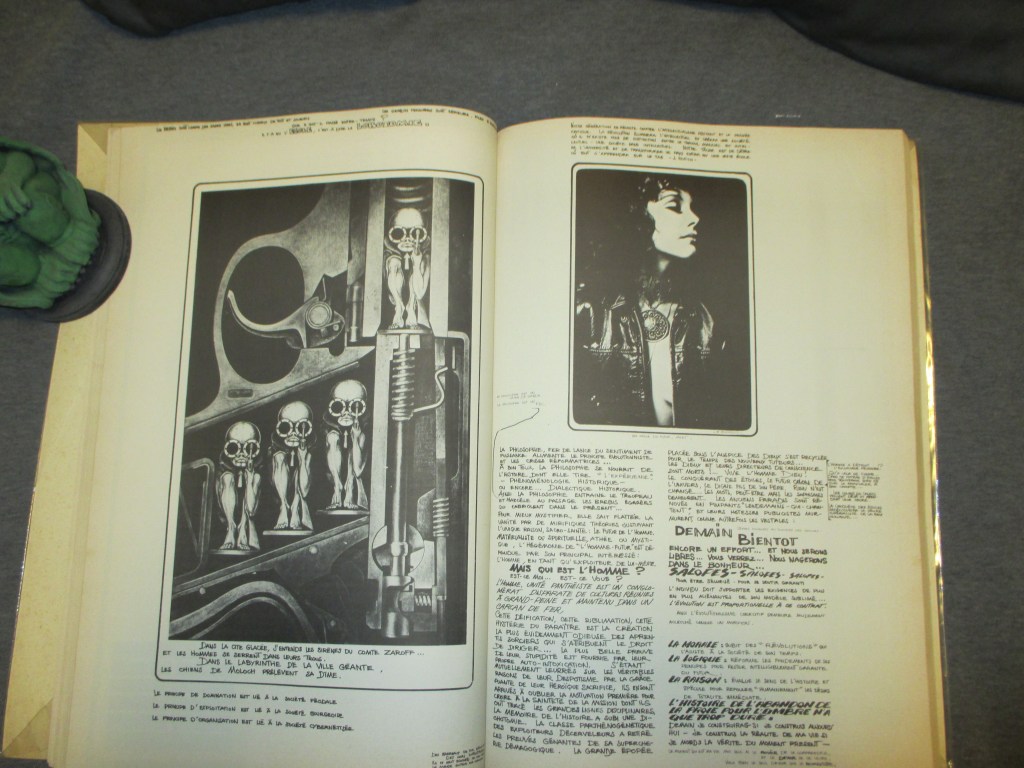
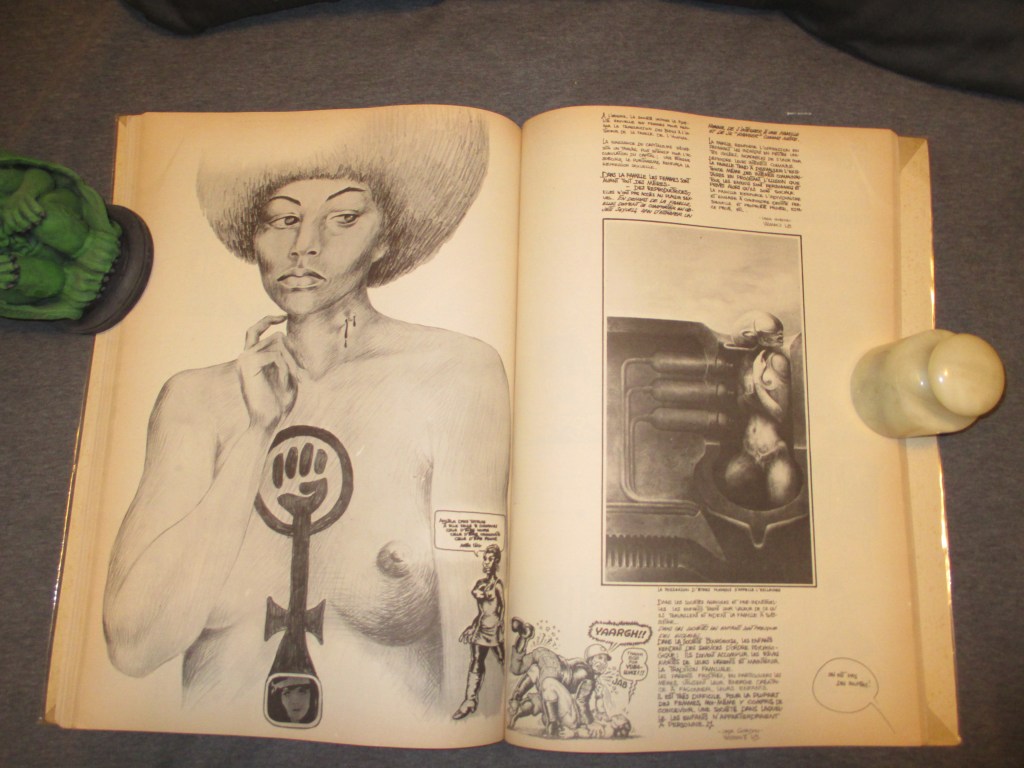
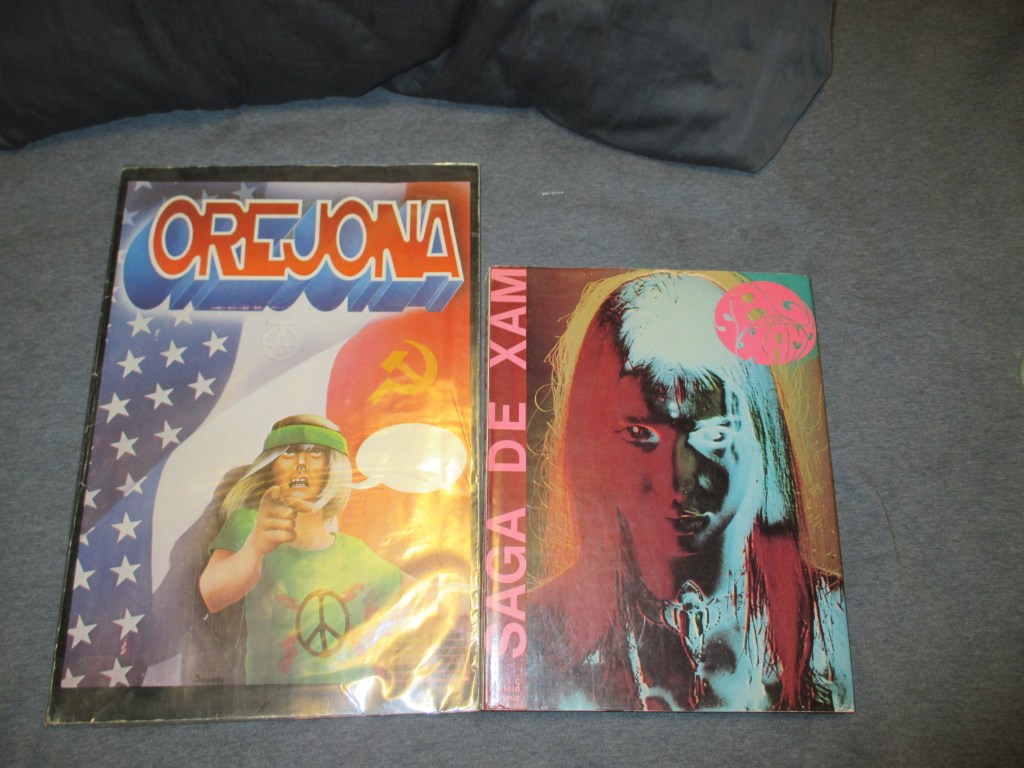
Nicolas Devil had another major graphic novel, Orejona ou Saga Generation (1974), in the form of an enormous softcover with soft paper. Despite the name, there is no direct connection to Saga de Xam except philosophically, continuing the countercultural vibe. Stylistically, it is another masterpiece of the moment, a collage of American underground comix, newsprint, original art, photographs, occult designs, and even some H. R. Giger thrown in for good measure, but there is no explicit Mythos material that I can see.

While the original Saga de Xam and its 1980 reprint remain scarce, the 2022 French reprint and the 2025 English translation remain available, and hopefully this book will continue to find an appreciative audience as something more than a scarce collector’s item.


Bobby Derie is the author of Weird Talers: Essays on Robert E. Howard and Others and Sex and the Cthulhu Mythos.

Deep Cuts in a Lovecraftian Vein uses Amazon Associate links. As an Amazon Associate I earn from qualifying purchases.
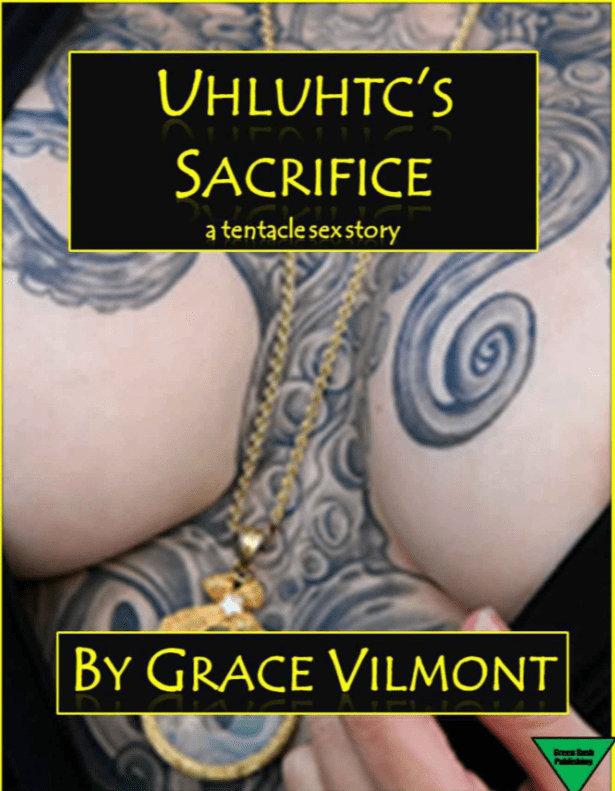
“Uhluhtc’s Sacrifice” (2013) by Grace Vilmont

Eldritch Fappenings

This review concerns a work of erotica, and as such may involve text and images of an adult nature.
Reader discretion advised.


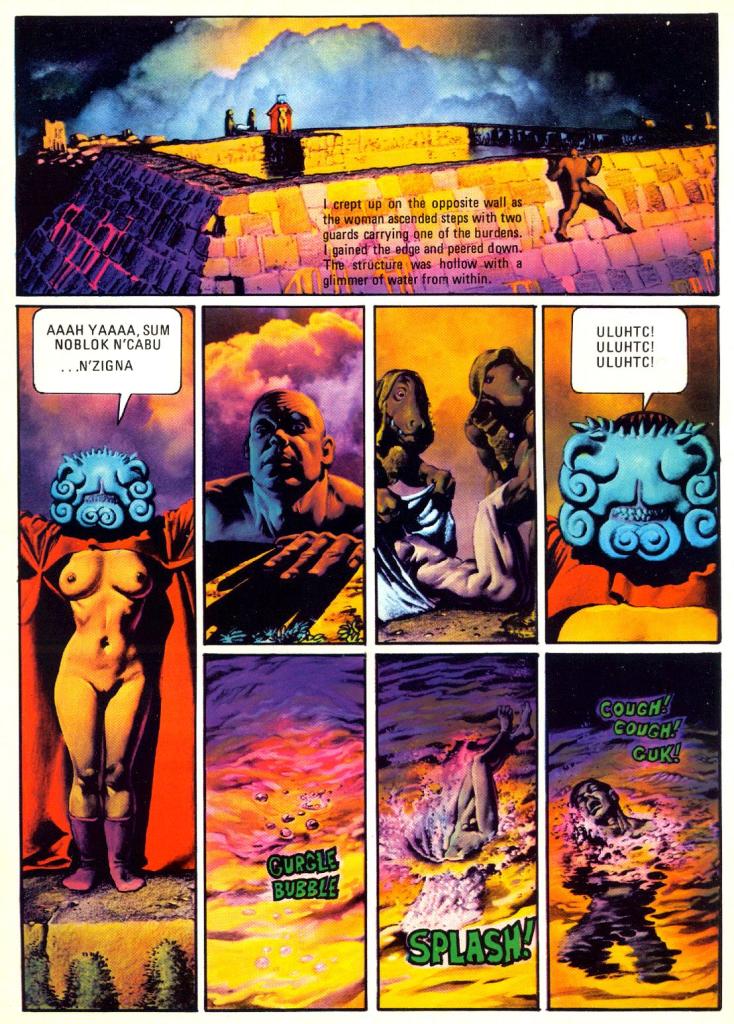
Yes, if you spell Uhluhtc backwards it becomes Cthulhu. It’s not terribly clever as an authorial tool, but it is a semi-smart homage to that fine animated filme Heavy Metal.
—Grace Vilmont, “Author’s Note,” “Uhluhtc’s Sacrifice”

Uhluhtc appears in the segment “Den” in the film Heavy Metal (1982); this was an adaptation of Richard Corben’s character and story of the same name in Heavy Metal Magazine and Métal Hurlant—there being a lot more Lovecraftian material in the pages of those magazines than just in the Métal Hurlant/Heavy Metal/Metal Extra Lovecraft Special. Corben had used “Uhluhtc” in one of his early Den episodes.

Heavy Metal Magazine (June 1977)

Corben was likely inspired by “Count Alucard” in Son of Dracula (1943), a transparent anadrome used as an alias by the vampire played by Lon Chaney, Jr. In both cases, the purpose of the reversal isn’t really to conceal the identity as much as to plant an Easter egg for fans to find. It’s a nod and wink, a signal to readers that the writer is a horror fan too.

What makes it an appropriate title for Grace Vilmont’s tentacle and cultist erotic novella, a light-hearted and sexually explicit horror-sex-comedy that leans heavier on the sex comedy than the horror, is the way Vilmont’s approach to the Lovecraftian tropes inverts traditional ways of casting sexuality as evil or depraved. The way it plays with the tropes is very explicitly tongue-in-cheek (and tentacle-in-cheek, and every other orifice), but there is a core of message there. It is good unclean fun that manages to be sex-drenched and irreverent without being nasty or raunchy in the way of some erotica titles that play more with violent or onerous taboos, but is also very expressly contrasting itself against negative depictions of sexuality.

It does get a little silly at parts:

“I probably should have told you more. But I never expected this. You’re carrying Uhluhtc’s spawn—”

“I know,” Cassie said proudly.

“Brenda continued as if Cassie hadn’t spoken. “—and your body needs a near constant supply of human semen. I don’t pretend to understand the reasons why or the logic behind it. But you need to get fucked and fertilized right now.”
—Grace Vilmont, “Uhluhtc’s Sacrifice”

Vilmont’s tale is one of a spate of tentacle-sex-with-optional-impregnation stories that have appeared, often in waves, in ebook format; a sister to Booty Call of Cthulhu (2012) by Dalia Daudelin and its sequels. While readers may or may not be titillated by the tentacle sex, it is the approach to the setting and characters that is often more interesting from the perspective of historical context.

This tale is centered on the completely consenting cultists; who, aside from their tendency toward orgies and summoning eldritch entities, have less malice per capita than the average book club. Their robes have zippers and while race is seldom explicitly mentioned, it’s clear that the majority of characters at least are coded as Caucasian; the racial dynamics of Lovecraft’s cult of Cthulhu were left at the door, no one is being violently sexually assaulted or hurt. If there is any shade thrown in this story, it is a swipe toward the sexual repression and bigotry associated with Evangelical Christianity:

“I was sick of the way Mom used Christianity as a hammer to control me and everything else around her.” […]

“Nothing we do here is illegal in any way.”

Cassie nodded. “But the evangelicals she fell in with would consider this an affront to God.” She nodded sagely then broke character and giggled. “I used Mom’s journal and her descriptions of the orgies and everything else when I masturbated for the first time. That’s why I’m here.”
—Grace Vilmont, “Uhluhtc’s Sacrifice”

There is an example of an important broader point in horror and erotic literature. Both horror and erotica are often fundamentally concerned with transgression, whether of social and moral norms or physical laws and reality. The corpse that rises from the grave is unnatural and violates our sensibilities of the distinction between life and death; incest violates sexual norms regarding appropriate partners (and often involves some complicated relationships and power dynamics, to boot). When they come together, this collision of transgressions can sometimes achieve a greater frisson than either could alone.

However, the narrative desire for sex positivity also means that the rhetoric of the story can easily get flipped.

Satanic and Lovecraftian cults are staples of horror fiction in large part because they are cast in contrast to Christianity, the dominant religious and moral framework for much of the intended audience. This emphasis on Christianity is useful because Christian dogmatic norms of sexual behavior means you can get that element of sexual transgression—the Black Mass with the body of a naked woman as an altar, the wild ritual orgies, the occasional sexual sacrifice to an eldritch entity—which really works in stories like “The Black Stone” by Robert E. Howard.

When those sexual antics are displayed as evil, corrupting, illegal, etc.; the cult itself and its members assume those attributes. When those same cults are aligned in a sex positive manner to contrast with the often reactionary and sexually repressive ideology of Christian sects, you get to an odd place where you are essentially confirming the biases of the majority in one regard (look at all the sex they’re having!) while at the same time casting the Christians as the real bad guys (look at those prejudiced, sexless bigots.

If that sounds familiar, it’s because it is very much a real-world issue translated onto the page and dressed up in horror clothes. Progressive and open attitudes towards sexual activity are nothing new, but they are very much still contentious and topical issues because the folks trying to repress that sexuality (whether or not they claim to be Christian) have never given up on the topic. The cult of Cthulhu (well, Uhluhtc in this case) becomes a stand-in for all of those who have suffered prejudice from those attempting to control or repress their sexuality.

Except they can summon some tentacles to really spice things up. It is a fantasy, after all.

This progressive framing of what would traditionally be “evil” cults, particularly in terms of their approach to sex, is in part driven by the real-world shift in attitudes regarding sex and religion, and ongoing cultural clashes between opposing ideologies and questioning of traditional narratives of sexual morality and religious dogma. The syntax of the era continues to find expression in the fiction of that era, even when it’s tentacle porn. While Lovecraft and Vilmont Grace may not have been consciously modelling their respective works to reflect ongoing societal issues, it is clear when reading them in historical context that the how and why of their cults’ approach to sex was in part shaped by the issues they faced at the time.

While I had initially first found this as an Amazon ebook, it seems to no longer be available from Amazon, but is still available on Goodreads.


Bobby Derie is the author of Weird Talers: Essays on Robert E. Howard and Others and Sex and the Cthulhu Mythos.

Deep Cuts in a Lovecraftian Vein uses Amazon Associate links. As an Amazon Associate I earn from qualifying purchases.
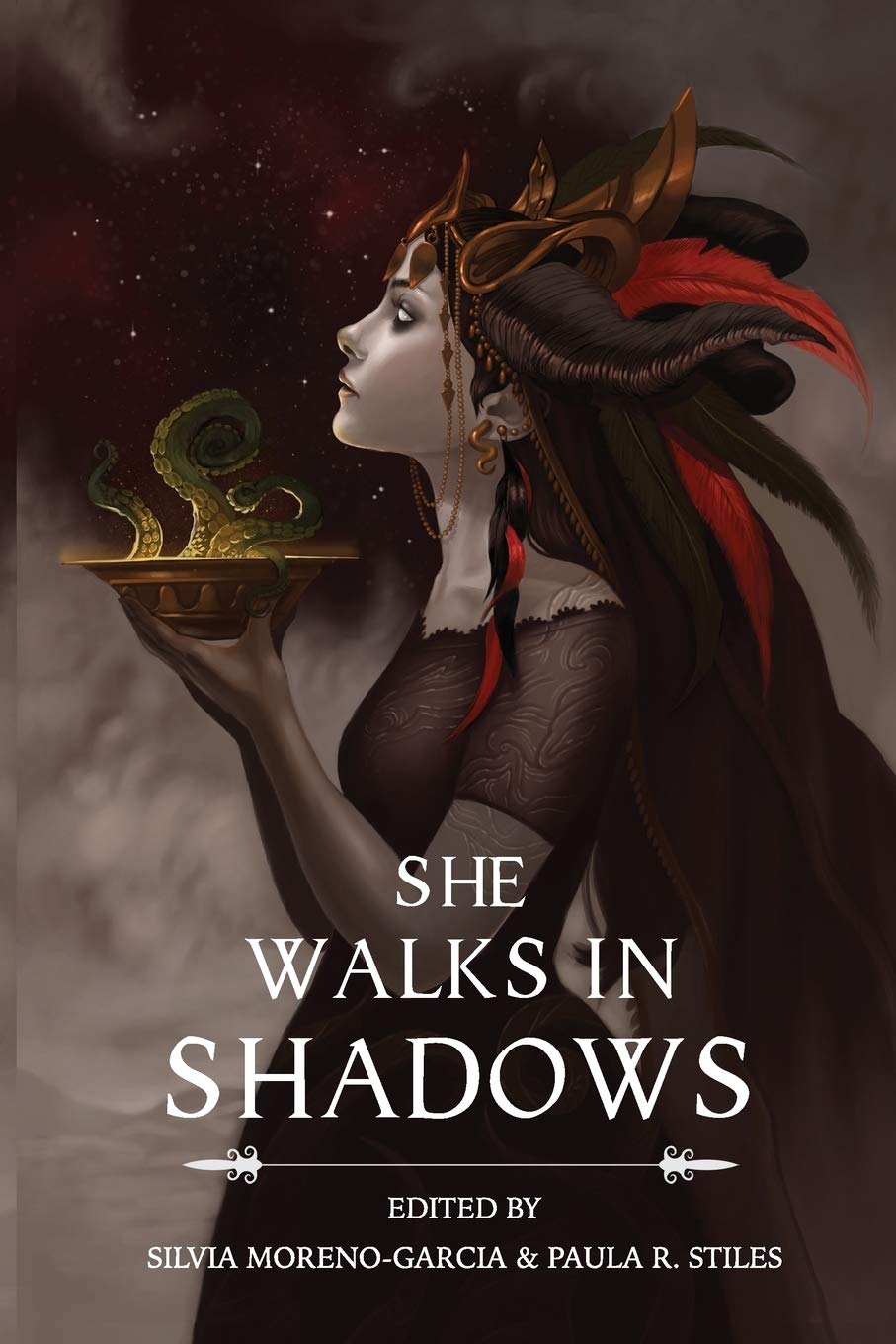
“Lavinia’s Wood” (2015) by Angela Slatter

He noticed only the tiny waist, the flaring lower hourglass of her hips, and the bushy white triangle at the junction of her sturdy legs. He was so distracted that he didn’t notice the malformations on her flanks, her hips, the myriad tiny eyes embedded there, blinking lashless lids in the flickering orange glow.
—Angela Slatter, “Lavinia’s Wood” in She Walks In Shadows 69

Readers and scholars often talk about the body of fiction inspired by Lovecraft in terms of religion and folklore. That is the nearest real equivalent we have to a very unusual phenomenon, where so many different authors are riffing off similar ideas, similar characters and stories. Terms like canon get thrown about a great deal, and some of Lovecraft’s own stories are as close to the Biblical canon get. Most authors agree that the events of “The Dunwich Horror” and “The Shadow over Innsmouth” happened, though they might fiddle with the details, and expand in different ways on what came before and after.

Yet the Mythos is not a single coherent body of internally-consistent works, or some divine text interpreted by many different authors. It is a sprawling mass of stories by different writers who often work in familiar cycles. The point is that not all of the stories do agree, or can agree. There is no one absolute, true, final, and complete version of any story. There are multiple different takes on the same subject, and they are often strongly divergent. Readers might be able to reconcile “The Dunwich Horror,” “The Shuttered Room” by August Derleth, “The Devil’s Hop Yard” by Richard Lupoff, and “The Cry in the Darkness” by Richard Baron as all being episodes in a single tale, but it is harder to fit in Lavinia Rising by Farah Rose Smith, The Dunwich Romance by Edward Lee, or “Lavinia’s Wood” by Angela Slatter.

At some point, there are too many differences to gloss, too many points of disagreement.

Too many different versions of Lavinia Whateley (or, in some versions, Whatley).

“The Dunwich Horror” is Lavinia’s story as much as that of her sons, though she is given short shrift by the folk of Dunwich. Various authors have expanded on her character. In some, she is a pure victim, like her predecessor Mary in Arthur Machen’s “The Great God Pan.” In many stories, Lavinia lacks agency, utterly dominated by her overbearing father Wizard Whateley. In a few, she is more active, even malevolent, an active participant rather than a meek vessel to be filled.

It is a rare story that suggests that Wilbur and his brother take as much from Lavinia as they do from Yog-Sothoth. Angela Slatter’s version in “Lavinia’s Wood” is more complicated than most, giving evidence of Lavinia’s dreams, desires, and actions that go far beyond the woman seen in Lovecraft’s account. Someone who dreams of a world beyond Dunwich, and who herself is not quite completely human.

There is a degree of pathos to Dunwich prequels. Readers already know Lavinia’s fate, or at least one of her possible fates. How she gets there is where authors diverge; what details they choose to emphasize, and what aspects of the character they develop in new directions. In “Lavinia’s Wood,” Angela Slatter gives Lavinia context. Social, geographic, biographical, biological. Lavinia as a part of the decayed Whateleys, in contrast to her richer and more educated cousins; as an outsider even among the inbred rural folk of Dunwich; her relation with her father and his books; and even how her body differed from others in ways not immediately obvious.

“Lavinia’s Wood” is not the prequel to “The Dunwich Horror.” It is one of many. Yet it is an interesting, insightful take on Lavinia, one that sheds a different light on the preceding events—and who knows what elements of that might make their way into further stories in the Dunwich cycle?

“Lavinia’s Wood” by Angela Slatter was first published in She Walks In Shadows, and its reprints. It has not otherwise been reprinted.


Bobby Derie is the author of Weird Talers: Essays on Robert E. Howard and Others and Sex and the Cthulhu Mythos.

Deep Cuts in a Lovecraftian Vein uses Amazon Associate links. As an Amazon Associate I earn from qualifying purchases.
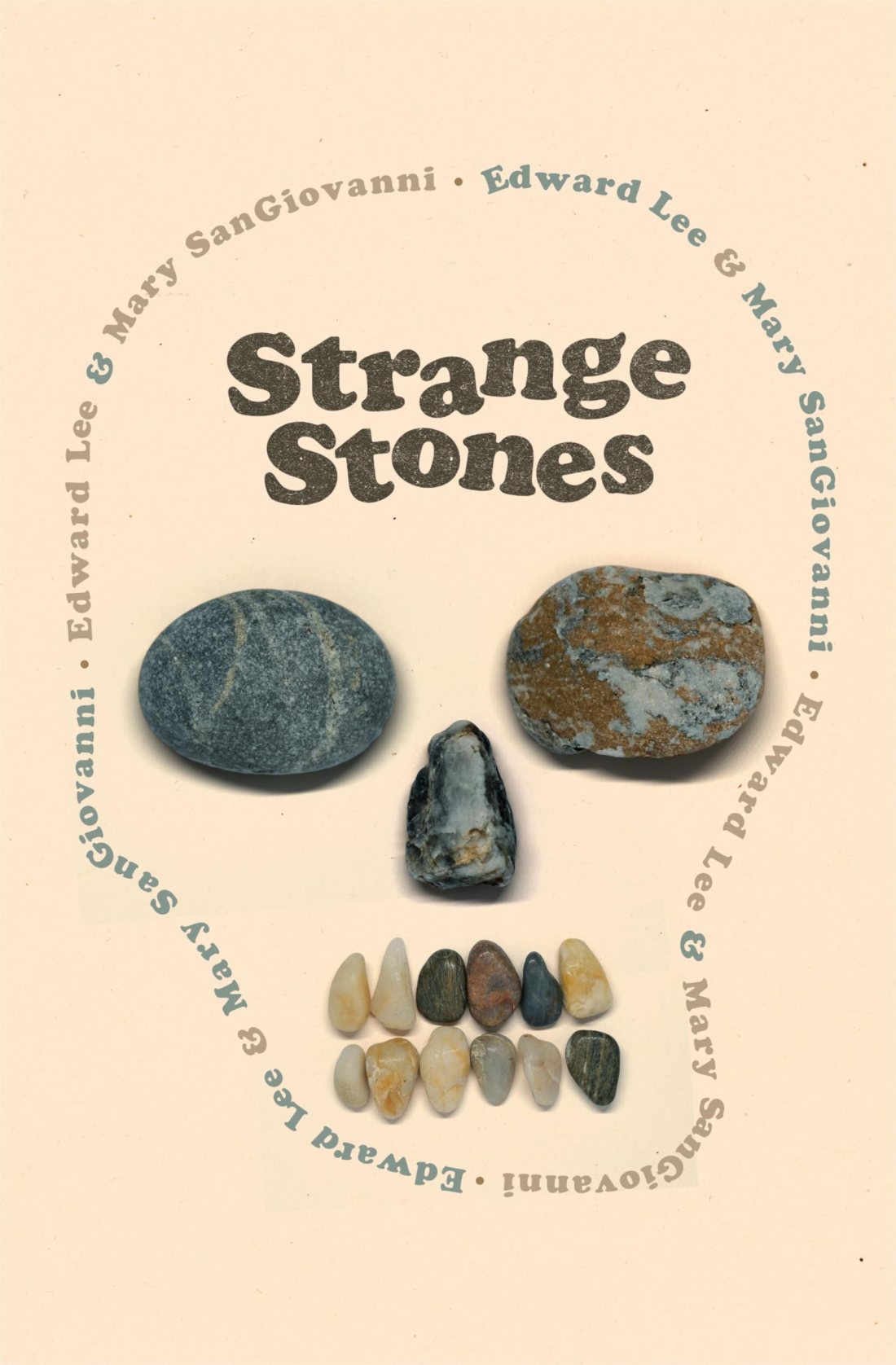
Strange Stones (2025) by Edward Lee & Mary SanGiovanni

It was Arkham House that perpetuated the Big Lie in this case, and from there a mechanism of critical bandwagonism took off and continues to this day. The tenet is, if you tell a lie big enough and enough times, people will believe it. That’s why Lovecraft has been raved about for all these decades. It’s a big lie that readers have been force-fed by a pro-Lovecraftian syndicate designed to make money.
—Edward Lee & Mary SanGiovanni, Strange Stones (2025) 3

Professor Robert Everard, who speaks those words at a horror convention, is a Lovecraft-hating asshole. That is his point. If the sentiment gets a rise out of you and makes you want to refute it, congratulations: the authors have succeeded at their characterization. It is a very unconventional way to draw readers into a rather meta short Lovecraftian horror novel, but Everard’s arguments and the context in which they take place are important to understand, because they’re fundamental to the plot of the novel.

Fiction genres in the sense that we think of them today tended to emerge around the turn of the 20th century. Western dime novels were a staple of 19th century popular literature in the United States; science fiction, mysteries, fan clubs, etc. all preceded the emergence of pulp magazines in the 1910s and 1920s, but it was really the pulp magazines that began to crystallize genre as we think of it today, and especially organized fandom as we think of it today. The horror conventions today are all descended, more or less, from the early science fiction fan conventions of the 1930s in the United States.

Genre is only secondarily a literary convention; the primary purpose was marketing. Specialization allowed pulp magazines to carve out niches and develop dedicated readership that they could directly market to. Magazines in the same genre competed with one another for the same dimes and quarters; Weird Tales had to struggle against Ghost Stories, Tales of Magic and Mystery, Strange Tales of Mystery and Terror, Terror Tales, Famous Fantastic Mysteries, Unusual Stories, and others, and tried to draw in readers from science fiction magazines like Astounding Stories, Amazing Stories, Wonder Stories, and Planet Stories.

Hardbacks, paperbacks, comics, and movie makers all learned this lesson, that specialization has the benefit of attracting a specific, dedicated readership. And once you have that audience, the quality of the content is less important than if it stays in genre. Decades of genre products have been, essentially, disposable pap, churned out quick and cheap for an eager audience that cared less about quality than if it was horror or science fiction. This is the kind of silly, low-quality stuff that gives genre media a bad name, but it’s also the stuff that’s generally predominant at any given moment. True genre classics are rare, and stand out because so much of the run-of-the-mill material is generic, familiar monsters and spaceships.

In this sense, what is a genre convention, then, then a target-rich environment? The earliest conventions weren’t entirely uncommercial, but they weren’t dominated by dealer rooms or particular creators promoting their latest film or book, which are common attributes of contemporary conventions. What creators and companies learned was that it’s a lot easier to sell your product if your customers are all in the same place; genre conventions in the United States in particular have become an important part of the economic ecosystem of various celebrities, independent dealers, small companies, and boutique shops.

The cultural phenomenon of the convention has developed to the point where it’s become a key aspects of organized fan culture, to the point of becoming the setting of new creative works, like I Am Providence: A Novel (2016) by Nick Mamatas and Screamland: Death of the Party (2012) by Harold Sipe, Christopher Sebela, and Lee Leslie. And it’s this crux of the commercialization of horror and the convention experience which forms the springboard setting for Edward Lee and Mary SanGiovanni’s novel Strange Stones (2025).

Richard Everard’s grudging kvetch against Lovecraft’s ascendance in horror media is in part a tongue-in-cheek jab at a genuine aspect of fandom and how Lovecraft and his Mythos have faced posthumous commercialization and pop culture significance way beyond its initial tiny dedicated genre audience. Everard’s own interaction with the convention circuit has been primarily a lecherous attempt to get in the pants of as many women as he could, a series of sexual conquests that is both a kind of wish fulfillment and a genuine recognition that yes, fans do hook up at conventions. Rachel Bloom wasn’t being entirely inaccurate with Fuck Me Ray Bradbury in the way genre literary figures can attract groupies.

There is a dark side to that, too: many prominent or even beloved genre literary figures have been revealed as sex pests or abusers. Alec Nevala-Lee’s excellent Astounding: John W. Campbell, Isaac Asimov, Robert A. Heinlein, L. Ron Hubbard, and the Golden Age of Science Fiction (2018) contains accounts of bad behavior by writers like Isaac Asimov, for example. This kind of contact between fans and creators is mainly possible because of events like conventions, where individuals who would normally be separated by hundreds or thousands of miles are brought into geographical proximity and with shared purpose.

So Everard is a caricature of specific figures in convention culture: a lecher (right there in the name: “Everard”/”Ever-hard”), a high-minded academic who snobbishly looks down on the tastes of the masses, a shit-stirrer more focused on selling his own books and tearing others down instead of creating something positive. All of which makes him less than sympathetic when he does encounter some real horror.

The back three-quarters of the short novel are a whirlwind tour through several of Lovecraft’s Mythos stories, but not in a way that readers might think. Lee and SanGiovanni are very carefully and deliberately introducing Lovecraftian settings like Innsmouth, Arkham, and Dunwich in ways that are very accurate to Lovecraft’s fiction—often focused on small details, which are then blown up and expanded upon—but not trying to pastiche Lovecraft’s particular style or language. So it is very deliberately Lovecraftian, with Everard’s familiarity with Lovecraft’s corpus letting him recognize where and when he is, yet at the same time the settings are fresh, parts of the setting that Lovecraft himself never put on the page.

Readers might be curious if there are any connections with Edward Lee’s “Hardcore Lovecraft” series which includes books like The Haunter at the Threshold and The Wet Dreams of Dead Gods. Strictly speaking, the answer is no; Lee’s own Lovecraftian novels remain very distinct in setting and approach, and Strange Stones is in general much less explicit in terms of violence, gore, and sexual activity. That doesn’t mean it isn’t there, but it is less prominent in the plot. In part because the focus of the story isn’t on titillation or exploitation-level sex and violence, while there is definitely transgressive grue and sexual activity, the pace of the story is such that the writers don’t dwell on it in anything like the detail of Lee’s more extreme solo works.

One important characteristic of Strange Stones, however, is that it is not nostalgic for Lovecraft. Works of the type “Lovecraft was right! The Mythos was real!” or revisiting old stomping grounds like Dunwich and Innsmouth can lead to much more watered-down horrors. Like Bela Lugosi’s Dracula or Boris Karloff’s Frankenstein or Lon Chaney Jr.’s Wolfman, there comes a point where Cthulhu becomes overly familiar, to the point that the appearance of the Big C comes across more as a friendly face than a stark horrific reality that haunts the imagination. A point Ken Hite touched on in “Cthulhu’s Polymorphous Perversity” in Cthulhurotica, discussing the plush toy incarnations of Lovecraft’s primal alien horror.

Instead, Lee and SanGiovanni present Lovecraft’s Mythos as terrifying.

Dismembered corpses. Perverse sexual defilements. Sudden violence. The Mythos in Strange Stones has all the subtlety of a Goatwhore album cover or an issue of Crossed by Garth Ennis and Jacen Burrows. Readers are going to have to make their way through dead babies, threats of anal assault by oversized piscine pricks, and an alien orgy in which dismembered torsos feature prominently. The Mythos is not a dry, abstract, intellectual horror in this novel; it is a living, breathing cult simmering with malice, madness, and strange and terrible hungers. That this is not quite as extreme in terms of sex and violence as Edward Lee gets up to on his own is not the same as saying that this novel is tame or soft in any way.

It is a difference in emphasis. Everard doesn’t see the clean Mythos that Lovecraft presented to the world, with its carefully-constructed narratives where all the orgies and most of the violence happens off the page. What Everard sees is Lovecraft with the blinders taken off; what Lovecraftian fiction could look like, if writers approached his Mythos with the imagination normally reserved for a particularly lurid Cannibal Corpse album or exploitation film. Fairly reminiscent in many ways of what Antony Johnston, Alan Moore, and Jace Burrows did in The Courtyard and Neonomicon, though without quite as elaborate a working-out of details.

Strange Stones is, after all, a fairly short novel, briskly paced, and not concerned with a unified theory of the Cthulhu Mythos as much as keeping the story moving through each step of Everard’s ordeal. While there is room for a sequel, as a one-and-done novel it stands alone effectively enough. While not perfect, it is fun and a quick read, quite unlike the majority of Mythos fiction published these days.


Bobby Derie is the author of Weird Talers: Essays on Robert E. Howard and Others and Sex and the Cthulhu Mythos.

Deep Cuts in a Lovecraftian Vein uses Amazon Associate links. As an Amazon Associate I earn from qualifying purchases.
“De Deabus Minoribus Exterioris Theomagicae” (2015) by Jilly Dreadful

On page 50, quire E, on the 7th leaf, on the face of one of the only decorative plates in the book, an illustration, beneath which these handwritten words appear (Translations are my own):

Idh-yaa Lythalia Vhuzompha
Shub-Niggurath Yaghni Yidhra (names of lesser outer goddesses)
Dare licentiam ad ut eam in servitium vestrum Arma capere milites,
(Give her permission to arem soldiers in your service.)
—Jilly Dreadful, “De Deabus Minoribus Exterioris Theomagicae”
in She Walks In Shadows (2015) 51

There is a strong strain of bibliophilia that runs right through the heart of the Mythos, its authors and readers. Part of the game was creating eldritch tomes like the Necronomicon and Unaussprechlichen Kulten, some of them with detailed backstories, strange and terrible authors, and blasphemous contents that were often only hinted at—secret histories, oddly effective spells, sanity-sapping diagrams and illustrations.

Yet very few Mythos tomes are written by women. Even fewer are written for women.

The patriarchal bias in the Mythos tome bookshelf is largely an unconscious one. It wasn’t that Lovecraft and his contemporaries couldn’t conceive of women mystics and magicians, they just didn’t make them the authors of any books. Likewise, female-presenting Mythos entities were in the minority, and didn’t start to increase in number, variety, and importance until relatively late, with the introduction of entities like Cthylla (see “In His Daughter’s Darkling Womb” (1997) by Tina L. Jens) and Ammutseba (see “Ammutseba Rising” (2015) by Ann K. Schwader), and the expansion of entities like Mother Hydra (see “Objects From the Gilman-Waite Collection” (2003) by Ann K. Schwader) and Shub-Niggurath (see “In Xochitl in Cuicatl in Shub-Niggurath” (2014) by Nelly Geraldine García-Rosas).

How women interacted with the male-dominated cult space of the Mythos, and why they did so, may seem like questions directly born out of second-wave feminism—but while there have been efforts to address those issues, directly or indirectly (see “A Coven in Essex County” (2016) by J. M. Yales), in practice such explorations have been relatively rare and limited in scope. Because beyond writing a feminist lore for the Mythos, there needs to be a narrative attached to it, a story that demands telling that uses that lore in some essential way.

That’s what makes Jilly Dreadful’s “De Deadbus Minoribus Exterioris Theomagicae” so much fun. The experimental format is the breadcrumb trail of a bibliophilic investigation, but the mythology is different in focus from the typical Mythos lore. What it outlines is a representative undercurrent to the popular literary cults of Cthulhu, Hastur, Nyarlathotep, and other Mythos entities normally presented in a male aspect; and that aspect has not to do with gender than sex.

Woodcut features worm-like Idh-yaa; sylvan Lythalia; Vhuzompha covered in multiple sets of eyes, mouths, as well as male and female genitalia; horned goat goddess Shub-Niggurath suckling infant devil at breast; many-tentacled Yaghni; and beautiful dream-witch Yidhra.
—Jilly Dreadful, “De Deabus Minoribus Exterioris Theomagicae”
in She Walks In Shadows (2015) 53

If it were just another story of yet another researcher finding yet another eldritch tome and falling prey to its influence, that wouldn’t be terribly original; something to be judged on the execution, like a panel of judges marking their scorecards. However, there is a shift near the end—a final twist of the knife which, if it isn’t entirely foreshadowed, rather makes the piece. It breaks a wall that is rarely broken in Mythos fiction, and addresses the reader directly.

There is room for more elaboration on the secret history and alternate Mythos theology suggested by this story; perhaps some other writer will pick up the ball and sketch their own elaboration, add their own little flourish to what Jilly Dreadful has started here. That is how the Mythos grows, after all.


Bobby Derie is the author of Weird Talers: Essays on Robert E. Howard and Others and Sex and the Cthulhu Mythos.

Deep Cuts in a Lovecraftian Vein uses Amazon Associate links. As an Amazon Associate I earn from qualifying purchases.

“Innsmouth Park” (2025) by Jane Routley

The day Oswald arrived, he called us to my father’s study and said peremptorily, “It is a truth universally acknowledged that a spinster sister with a small portion is nothing but a burden to her relatives. I want you silly women married and out of my household as soon as possible.” Then he burned my father’s extensive collection of coastal plants and butterflies and sold his library.
—Jane Routley, “Innsmouth Park” in Into the Cthulhu-Universe (2025) 76-77

We don’t like Oswald.

Jane Austen’s role in weird fiction is underappreciated, largely because she herself didn’t really write any (although Northanger Abbey is a biting satire of the Gothic novel, and a must-read for Gothic fans which even Lovecraft acknowledged, which has to at least classify Austen as weird fiction’s strange aunt.) Yet the world she described, the characters and milieu she envisioned, have been enduring and influential far beyond the genre she initially worked in. Generations of writers have called back to Austen, and mashups like Sense and Sensibility and Sea Monsters (2009) by Austen & Ben H. Winters, Regency Cthulhu (2023) by Andrew Peregrine & Lynne Hardy, and Secrets & Sacrifices: A Regency Cthulhu Novel (2024) by Cath Lauria all point to a similar rainy-day afternoon brainstorm:

Why not mix Austen and Lovecraft?

“In ’forty-six Cap’n Obed took a second wife that nobody in the taown never see—some says he didn’t want to, but was made to by them as he’d called in—had three children by her—two as disappeared young, but one gal as looked like anybody else an’ was eddicated in Europe. Obed finally got her married off by a trick to an Arkham feller as didn’t suspect nothin’. But nobody aoutside’ll hev nothin’ to do with Innsmouth folks naow. Barnabas Marsh that runs the refin’ry naow is Obed’s grandson by his fust wife—son of Onesiphorus, his eldest son, but his mother was another o’ them as wa’n’t never seed aoutdoors.
—H. P. Lovecraft, “The Shadow over Innsmouth”

Lovecraft did not live in Austen’s world, but the New England society that Lovecraft came from retained some of the same social mores and norms as in Austen’s day. Marriages were not just alliances of mutual love and affection, but involved perceptions of respectability and status, and practical concerns of money and temperament. While women in the UK have more options today than they did in the late 18th/early 19th century, the societal obsessions with marriage, reproduction, and compatibility are still there for many.

Jane Routley in “Innsmouth Park” takes this to heart. She drops an Innsmouth gent into an Austen scenario. Between the Oswalds of the world and the intelligent, meek, and slightly inhuman (but very wealthy) owner of Innsmouth Park, readers might suspect that they know the outcome of this short story before it gets three pages in. However, Routley does have a twist or two for the readers, and manages to pull off a solid story out of what could easily have been a farce.

As in any mashup, the tone tends to be rather light, and in this case favors Austen over Lovecraft. Nothing wrong with that; Austen’s strength was her setting and characters, and the Mythos is a flavor that mixes well into different settings. What makes it fun, however, are the little flourishes, the nods to both Austen and Lovecraft, and the very careful effort to build up the relationship between protagonist Eugenia and her potential suitor Rowah Marsh. We get to see things, not from the Lovecraftian point of view, but from the Austenian.

Whoever asked the Marsh daughter how she felt getting married off “by a trick?” Would she have been relieved to be out from under her domineering father, or lost and at sea among people she had never met before? Was it a step down or a step up in terms of her lifestyle and freedoms? We don’t get those questions or answers in “The Shadow over Innsmouth,” but you can be damned sure if Austen was writing that story that we would.

Routley recognizes this. While the story is filled with witty lines and little nods to her literary forebears, at the core the story is played straight. If you really did read an Austenian take on “The Shadow over Innsmouth,” it would have the same basic outlines as “Innsmouth Park.” We don’t like Oswald because he represents all the overbearing dudebro assholes we have to deal with in our own lives, but in the specific Austenian context he plays the necessary role of the manifest social norms that are forcing the woman protagonist out of the family home and into a suitable marriage (other options, such as being a governess, being considered but found unsatisfactory.)

That is really what makes “Innsmouth Park” work; the choice that is made is ultimately not driven by green or love or lust, but a practical consideration of limited options and the available alternatives. Faced with a momentous life decision, Eugenia zeroes in on what really matters to her, and the priorities may or may not surprise the Lovecraft fans—but the Austen fans will understand.


Bobby Derie is the author of Weird Talers: Essays on Robert E. Howard and Others and Sex and the Cthulhu Mythos.

Deep Cuts in a Lovecraftian Vein uses Amazon Associate links. As an Amazon Associate I earn from qualifying purchases.
“The Tunnel” (2025) by Zoe Burgess

Ever since Helen Vaughan saw ‘the face of The Great God Pan’ and Lavinia Whately gave birth to the spawn of Yog-Sothoth, a sexual undercurrent has existed in cosmic horror. Rarely seen but its effects often felt, eroticism helps to shape tales of the uncanny and unfathomable.
—Back cover copy of Beyond Desire (2025)

Lovecraftian erotica is not the same as erotic horror. However horrific some elements of Lovecraftian erotica may be, it is a rare story that manages to mingle terror and titillation, rather than just use the tropes of the Mythos in another erotic fantasy with eldritch entities. “Cthulhu for Christmas” (2023) by Meghan Maslow or Tentacles and Wedding Bells (2022) by Margaret L. Carter owe more to cozy romances than horror for their structure, just as Booty Call of Cthulhu (2012) by Dalia Daudelin is more of a straight sex tale, and “The Vulviflora of Vuutsavek” (2008) by Charlotte Alchemilla Smythe is an exercise in pastiche. It is a relatively rare story that tries to find the balance between fear and lust, that plays the two forms of excitement against each other on a knife’s edge, that is unsettling in its sensuality.

This is a difficult balance, yet it seems to be what Zoe Burgess aims for in “The Tunnel.” The beginning of this story was featured in the Flash Horror 250 Contest in 2024, and if that visceral opening whets a reader’s whistle, Burgess goes much deeper—and gets more explicit—as the story is developed in her joint collection with Tim Mendees: Beyond Desire: Tales of Erotic Cosmic Horror (2025); the volume also contains “Writhing Mind” (2022) by Zoe Burgess.

Like in that story, “The Tunnel” is a tale of obsession, of an almost fetishistic desire for knowledge and sensation. There’s a quality reminiscent of Clive Barker’s “The Hellbound Heart,” the familiar outlines of which have been seen in many weird and erotic stories over the decades. Shades of Dr. Raymond’s search in Mary’s brain for the Great God Pan, or of William’s desire to uncover real magic through the artifact in The Invitation (2017) by InCase The language of the story is deliberately decadent, emphasizing the physical, the intimate, and hinting at something more than merely carnal.

This was what awoke Izzy’s companions, and they were greeted by faces of fear and adjective horror as the iron shell melted away to reveal the throbbing flesh-like pages of the manuscript inside.
—Zoe Burgess, “The Tunnel” in Beyond Desire (2025) 166

There is a literalness to the descriptions that is reminiscent of “Night Voices, Night Journeys” (2005) by Inoue Masahiko (井上雅彦), but it is probably more accurate to say that Burgess knows the tropes of the genre and plays to them. Familiar images remixed, recombined, carefully arranged. The tunnel of the title is both physical distance for the protagonist Izzy to transverse and the metaphysical vagina to be reborn from. The reader is just along for the ride, the voyeur of a journey of discovery and self-discovery:

Izzy held onto tarlike hips and almost felt like they were pushing deeper into the unknown, as that hot cavern pulsated and caressed as well.
—Zoe Burgess, “The Tunnel” in Beyond Desire (2025) 175

Metaphor and description break down on such an ecstatic psychosexual journey. Burgess strives to capture both novel sensations and something beyond that, some spiritual contagion that warps and fills and makes the sex act something profoundly more than just sticking tab A into slot B, repeat as desired. The story is essentially a spiritual descendant of the climax of Ramsey Campbell’s “The Moon Lens,” a story of initiation and transformation; while the cosmic horror is not called Shub-Niggurath, Burgess’ Void Walker has some of the same attributes.

More than anything else, “The Tunnel” by Zoe Burgess is an effort to tell an erotic horror story in the Lovecraftian mode. Not by invoking Cthulhu and the Necronomicon, but by trying to invoke familiar images and aspects as she tells a raw, uncensored story of transgression, transfiguration, and finally a kind of transcendence. When Izzy goes back out into the world, born from the tunnel, they are a carrier of a strange and terrible disease of knowledge, one which they desire to spread—and isn’t that so very familiar, readers of the Mythos?


Bobby Derie is the author of Weird Talers: Essays on Robert E. Howard and Others and Sex and the Cthulhu Mythos.

Deep Cuts in a Lovecraftian Vein uses Amazon Associate links. As an Amazon Associate I earn from qualifying purchases.
“The House of Idiot Children” (2008) by W. H. Pugmire & Maryanne K. Snyder

Tell my sad little life story? I was a weird kid. Believed I was a Witch when very young, as did my older sister. She and I used to practice what we thought was magick. Grew up knowing I was a sissy (loved playing house with the neighborhood girls, but always dressed LIKE them, wearing play dresses &c) and being tormented for it by grown-ups, kids at school, and thus I became an introvert and created my own realms of reality where I could be safe. My best friend in high school was Jewish, and that began a Jewish identification. Later I learned that I AM Jewish on my mom’s side of the family.
—W. H. Pugmire, “An Interview with W. H. PUGMIRE” (28 Feb 2009) by Jeffrey Thomas

There is a fine distinction between Jewish weird fiction and weird fiction that takes Jews or Judaism as its subject. Jewish weird fiction should be, ideally, written from a Jewish point of view; that may or may not involve aspects of Jewish religion or culture, but it should definitely have that viewpoint—and ideally, it should be written by someone who has lived experience to lend verisimilitude and authenticity to the story, who can approach the story as someone other than an outsider looking in. A good example might be “My Mother Was A Witch” (1966) by William Tenn.

A story doesn’t have to have a Jewish point-of-view to be about Jews or Judaism. Innumerable examples of Christian supernatural fiction reach back to Jewish religion and folklore to tell a story that is still focused, primarily, on a Christian point of view. The Wandering Jew in legend and literature may be Jewish in name, but their characterization follows the narratives conceived by predominantly Christian writers.
“The House of Idiot Children” (2008) by W. H. Pugmire & Maryanne K. Snider is, I suspect, their attempt at Jewish weird fiction. It follows Rav Samuel Shammua, a teacher in a small Jewish community who works at a school for autistic students. The description of the students reflects common depictions of autistic savants, formerly and derogatorily known as idiot savants:
They sat there, some very still some moving slightly back and forth, all staring into the air before them. Samuel shocked himself to feeling suddenly jealous. What did they see as they looked into nothingness. What did they listen to with an inner ear? The world saw these children as idiots who would always have difficulty functioning with the normal ear; and yet these children each contained a singular degree of genius. One was a mathematical genius. Another had memorized huge portions of Torah and Talmud in both English and Hebrew. And Moshe, who sat awaiting him, had excelled in the art of gematria […]
—W. H. Pugmire & Maryanne K. Sinder, “The House of Idiot Children” in Weird Tales #308 (26)

As in many of his stories, Pugmire slightly reworked the language in subsequent publications, so for example in An Imp of Aether (2019) he wrote:

[…] saw some students who, sitting at various tables awaiting instructors, watched his entrance, some very still, some moving slightly to and fro. Samuel shocked himself with feelings of sudden jealousy. What did they see with their autistic senses, what could they hear with an inner ear? The world saw these children as idiots who would always have difficulty functioning in the “normal” world; and yet these children each contained a singular degree of genius. One excelled in mathematics, another had memorized weighty portions of Torah and Talmudic lore, in both English and Hebrew. And mOshe, who sat awaiting him, had excelled in the art of gematria […] (44)

Autistic savants have their in supernatural literature, like the young girl Tiffany in Hellbound: Hellraiser II (1988) who uses her knack for puzzle solving to solve the Lament configuration. Such peculiar aptitudes can interact oddly with certain aspects of Jewish culture. The Hebrew alphabet has 22 letters, each of which can also represent an associated number, a practice called gematria. This overlap of linguistic and mathematical concepts has significant interest with topics like cryptography, the interpretation of certain Jewish and Christian religious texts, as well as Kabbalah and other occult systems. The intersection of these different areas of interest has been a fruitful area for creatives, such as the film Pi (1998) where a genius Jewish mathematician’s investigations into the nature of π reveal a number which might be the secret name of God.

Pugmire and Snider play with this idea:

“A twenty-third Hebrew letter, a letter of fire.” The elder man raised his hand so as to thoughtfully stroke his beard. “An angelic letter. A letter out of which nothing is formed.”

Samuel’s face felt odd, and he ran his hands over it, trying not to shudder. “You know of this?” His voice was laced with fear, for never had he experienced such a conversation. The mysteries of cabalistic lore were something with which he had never trafficked. He had seen certain friends of his become utterly obsessed with studying the Zohar and other such books, to the detriment of everything else. It was a lure in which he had no wish to find himself entangled.
—W. H. Pugmire & Maryanne K. Sinder, “The House of Idiot Children” in Weird Tales #308 (26)

Unlike “The Chabad of Innsmouth” (2014) by Marsha Morman or Dreidel of Dread: The Very Cthulhu Hanukkah (2024) by Alex Shvartsman and Tomeu Riera, this story has nothing to do with the Lovecraft Mythos. Yet there is something indelibly Lovecraftian in how Samuel Shammua is drawn into this esoteric study—an idea that madness and genius as linked, even as savanthood and autism are linked in Shammua’s mind.

“They’re not like others, that’s the point!” Samuel suddenly shouted, his face flushed with anger. “They are special creatures, for whom we especially care. What the hell is normal, Avram? Were you a normal kid? Our religious and ethnic heritage makes us outsiders in the normal world, that’s why we’re hated, that’s why madmen seek to destroy us.”
—W. H. Pugmire & Maryanne K. Sinder, “The House of Idiot Children” in Weird Tales #308 (29)

All of these elements come together in this story in an ending that is expected, and yet powerful. We the readers never learn the final mystery, which Moshe and the autistic children know and which Samuel Shammua learns. It is a literally ineffable truth, a knowledge beyond the scope of human experience. Whatever flaws the story might have in its depiction of autistic children, this was a deliberate and researched effort to weave together these disparate threads into a story that tried to express a weird tale from a Jewish point of view.

“The House of Idiot Children” was first published in Weird Tales #308 (Jan/Feb 2008). It was slightly revised and republished in The Tangled Muse (2008, Centipede Press), and then slightly revised again for An Imp of Aether (2019), which appears to be the authors’ final version.


Bobby Derie is the author of Weird Talers: Essays on Robert E. Howard and Others and Sex and the Cthulhu Mythos.

Deep Cuts in a Lovecraftian Vein uses Amazon Associate links. As an Amazon Associate I earn from qualifying purchases.