Posts

The Call of the Friend (2025) by JaeHoon Choi (최재훈) trans. Janet Hong

THE CALL OF THE FRIEND is part of the Lovecraft Reanimated project, where leading Korean speculative fiction writers reimagine the works of horror master H.P. Loveccraft, while honoring his eerie, grotesque imagery and the blurred boundaries between reality and fantasy, they update his ideas for a global audience.
The Call of the Friend (2025), inside cover flap

The Call of the Friend (친구의 부름) is a standalone black-and-white graphic novel by Korean comic artist and writer JaeHoon Choi (최재훈), first published in 2020. The English translation by Janet Hong was published in 2025 by Honford Star. The story is set in contemporary urban Korea, where university student Wonjun checks in on his friend Jingu, whose sister (a K-pop idol) has recently committed suicide, implicitly because of a scandalous affair. It is in Jingu’s apartment that Wonjun spots a strange idol.

The story that unspools is not a straightforward linear narrative. It is intimate, focused on Wonjun, with everyone other than Jingu essentially faceless. Readers get pieces of the puzzle, but the full story isn’t spelled out for them, readers are forced to interpret the evidence as best they can. In this, they are given a single helpful hint in a short essay at the end of the book:

Some live a life of violence, while others make every effort to avoid stepping on an insect. But no matter the severity or type of sin, the moment we realize we have sinned, we experience fear. The fear isn’t so much the dread of punishment or retribution. It stems from the knowledge that we’ve hurt someone or caused their unhappiness, and the sin manifests as fear. Depending on the intensity of this fear, we can either be liberated from our guilt or ensnared by it.

While I don’t want the theme to be too obvious in this story, I hope readers might be able to tangibly experience Wonjun’s guilt. These long, nocturnal reflections on our current human condition, set against H. P. Lovecraft’s world of unexplained fears, have prompted me to contemplate the words we’ve spoken, the conflict and guilt we’ve endured, as well as the subsequent death and feat they cause.
The Call of the Friend (2025), 104-105

As an essay, it is slightly reminiscent of Arthur Machen’s prologue to “The White People” on ‘sorcery & sanctity.’ The idea of fear as a fundamental response to a transgression—an instinctive response to some imbalance caused by action or inaction—and that this fear can liberate or ensnare guilt, has its attractions. Yet how does this philosophical approach jive with Lovecraft’s famous proclamation that “the strongest kind of fear is fear of the unknown”?

When you don’t know what the sin was. When the only way you have to measure how badly you’ve hurt someone is the measure of the fear you feel in response to it. Whether this is what JaeHoon Choi intended with The Call of the Friend I cannot say, but the presence of the Cthulhu Mythos in this story is suggestive of something that goes beyond tawdry K-pop star drama and the suicide of the sister of a friend. It suggests that there’s something much bigger at work here, something unseen and unknowable, and it threatens to ensnare Wonjun entirely.

The Call of the Friend is somewhat reminiscent of Minetaro Mochizuki’s Hauntress (1993) in general outline—both of them deal with young university students living on their own, the one checking in on the other to whom something has happened, and with a supernatural horror creeping into their lives—and more importantly, that sensation of an urban legend unfolding in a space of familiar, contemporary surroundings. These are characters ill-equipped to deal with the psychological terrors of their experiences. They have no strong faith, no occult skills or leanings. They are regular people, with limited resources, facing the uncanny.

That works. JaeHoon Choi takes advantage of the prosaic setting and characters to make the distortions of perception all the more disturbing for taking place in setting of absolute reality. Readers will question how much of this is in Wonjun’s head, will wonder when we slip into dream, hallucination, or twisted memory. The idol forms a locus of manifestation, a central image to embody what it is happening, but even until the end, readers have to decide how much of this is really happening.

The comic ends like an unresolved chord. Readers don’t get answers. Only the impression that they have witnessed something. Perhaps that is the answer itself.

Janet Hong’s translation of the graphic novel into English is very readable and smooth. While most of the graphic novel itself has relatively sparse dialogue, the essay at the end is very clear and easy to understand, and a valuable key to understanding the work.

The Call of the Friend (2025) by JaeHoon Choi and translated by Janet Hong is available at the Honford Star website as an ebook or softcover.


Bobby Derie is the author of Weird Talers: Essays on Robert E. Howard and Others and Sex and the Cthulhu Mythos.

Deep Cuts in a Lovecraftian Vein uses Amazon Associate links. As an Amazon Associate I earn from qualifying purchases.

Deeper Cut: C. L. Moore Early Career Retrospective

The writing life of Catherine Lucille Moore (24 Jan 1911 – 4 Apr 1987) can be roughly divided into five periods, dominated by major life events:

  • C. L. Moore Before The Pulps (1911-1930): Her juvenilia and early amateur work that ran from her childhood through her second year at Indiana University, when she had to withdraw and begin working to support her family.
  • Early Career (1933-1940): C. L. Moore’s first professional publication, from her first appearance in Weird Tales through her marriage with Henry Kuttner in 1940.
  • Professional Writer (1940-1958): C. L. Moore and Kuttner as a prolific writing team, for pulps, novels, fanzines, and television, all through World War II and afterward into Kuttner’s teaching career, only ending with his death in 1958.
  • Late Career (1958-1963): C. L. Moore’s late career was dominated by scriptwriting for television. It ended with her marriage to Thomas Reggie in 1963.
  • Twilight years (1963-1987): With C. L. Moore’s second marriage and her early onset of Alzheimer’s disease, output practically ceased. The period saw the consolidation and republication of her work, as well as interviews and biographical materials. It ended with her death.

Of all the periods of Moore’s work, her early career gets the most attention. It is dominated by her output at Weird Tales, and to a lesser extent at Astounding, and follows her transition from weird fiction to the characteristic fantasy and science fiction that marked Unknown in the 1940s. This retrospective takes a look at what C. L. Moore was writing and publishing, and why and how the events of that period shaped the writer she was—and would become.

1933

[…] it was a rainy afternoon in the middle of the Depression, I had nothing to do—but I really should’ve looked busy because jobs were hard to get! I didn’t want to appear that I wasn’t earning my daily keep! To take up time, I was practicing things on the typewriter to improve my speed—things like ‘the quick brown fox jumped over the lazy dog.” That got boring, so I began to write bits of poetry I remembered from my college courses…in particular, I was quoting a poem called “The Haystack in the Flood.” […] The poem was about a woman in 13th century France who is being pursued by enemies of some kind…she was running across a field and these men were after her. I had misquoted a line in my mind, as well as on the typewriter, and referred to a “Red, running figure.” […] At the time I thought, “Ha! A red, running figure! Why is she running? Who is she running from and where is she running to? What’s going to happen to her? Strangely enough, I just swung from that line of poetry into the opening of “Shambleau.”
⁠—Interview: C. L. Moore Talks To Chacal in Chacal #1 (1976), 26

The Great Depression had ended C. L. Moore’s attempt at college, and with it her opportunities to publish her stories. She worked as a secretary at the Fletcher Trust Company in Indianapolis, where her fiancé also worked as a teller. Her spare dimes and quarters went to issues of Amazing Stories, Wonder Stories, Astounding, and Weird Tales, and at last she mustered up the courage to submit a story unlike anything else on the stands. The effect on the fans was electric, the effect of the check for the story no less so on C. L. Moore—it was her first professional sale and publication. By the time “Shambleau” hit stands, there are indications she was already writing sequels:

I trust your revisions may make Mrs. Moore’s second story as striking and interesting as this one.
—H. P. Lovecraft to Farnsworth Wright, 21 Nov 1933, Letters to Woodburn Harris 86

Moore would, from her reading, be aware of the possibilities of a series character like Northwest Smith. Farnsworth Wright, editor of Weird Tales, was willing to work with new writers. So it is not surprising that following stories followed Smith’s adventures, with little continuity but often featuring the same vivid imagery and ideas that marked “Shambleau.”

1934

I hope you will not be too much disappointed in the stories that follow. Perhaps, when you have read those appearing in the April and May issues, you will write again to tell me what you thought of them.
—C. L. Moore to R. H. Barlow, 8 Mar 1934, MSS. Brown Digital Repository

Both Farnsworth Wright and the fans of Weird Tales were pleased with Moore’s work, and 1934 became a busy year, with three further adventures of Northwest Smith appearing in quick succession ( “Black Thirst,” “Scarlet Dream,” and “Dust of the Gods”). Through Weird Tales, Moore also came in touch with pulp fans like R. H. Barlow and Forrest J. Ackerman. Her “secret” identity was swiftly revealed in the May 1934 issue of The Fantasy Fan, though many pulp readers would not learn this for years.

Yes, I do much more revising that I care about. Have to, tho it simply sickens me, and I hate everybody in sight while laboring away at the disgusting job. A story of mine which I’ve just sold to ASTOUNDING and which will appear in Oct. is really a third of one original N.W.Smith tale. I had that almost finished when I saw that it was two stories, and split it apart. Then the half I got to work on began to show amoeba-like tendencies toward division, and the third attempt resulted in THE BRIGHT ILLUSION, which I’ve sold, to Astounding. The other two nuclei are still simmering gently in the back of my mind, and may emerge some day.
—C. L. Moore to R. H. Barlow, 5 Jul 1934, MSS Brown Digital Repository

While it may have looked like Moore was selling everything she could write to Weird Tales, the truth was more complicated. Some stories didn’t work out, and Farnsworth Wright apparently rejected some stories and sent others back for revision. This was the unglamorous work of pulp writing, and Moore was learning the ropes of the trade, including rewriting stories to send to other magazines, which is how she splashed Astounding.

Near the end of the year, feeling that the Northwest Smith stories were growing stale, Moore tried another character on Farnsworth Wright: Jirel of Joiry. The character arose from some of Moore’s pre-pulp world-building, given a new life in Weird Tales:

Long, long ago I had thoughts of a belligerent dame who must have been her progenitor, and went so far as to begin a story which went something like this: “The noise of battle beating up around the walls of Arazon castle rang sweetly in the ears of Arazon’s warrior lady.” And I think it went no farther. So far as I know she stands ther eyet listening to the tumult of an eternal battle. Back to her Jirel of Joiry no doubt traces her ancestry.
—C. L. Moore, “An Autobiographical Sketch of C. L. Moore,” Echoes of Valor 2, 37-38

As with Northwest Smith, the fan response was extremely positive. More swiftly followed up “Black God’s Kiss” with a direct sequel, “Black God’s Shadow,” that was published before the end of the year.

1935

Now a fairly well-established author at Weird Tales, Moore began correspondence with other authors, including E. Hoffmann Price, Robert E. Howard, and H. P. Lovecraft. From the surviving correspondence, we can see that all of these individuals had their influence on Moore’s writing practice: Lovecraft’s considered criticism, Price’s practical pulp-writing advice, and Howard’s encouragement and sharing of his own swordswoman stories all entered into consideration.

From a publication viewpoint, 1935 was probably a letdown, Moore only sold and saw published four professional tales: two Northwest Smith yarns (“Julhi,” “The Cold Gray God”), including one with an illustration by Moore, and a Jirel story (“Jirel Meets Magic”) to Weird Tales, and another “thought-variant” story for Astounding (“Greater Glories”). Reading between the lines, the implication is that Wright was getting more selective about what he bought from Moore. For her own part, Moore’s interest in fandom and the pulp community was increasing, as marked by a collaboration with arch-fan Forrest J Ackerman (“Nymph of Darkness”) and taking part in a round-robin tale with A. Merritt, H. P. Lovecraft, Robert E. Howard, and Frank Belknap Long (“The Challenge from Beyond”) for Fantasy Magazine.

These were Moore’s first collaborations with other writers since childhood, and were, perhaps, important lessons in what worked and what didn’t. In “The Challenge from Beyond,” it was clear how each writer was working the parts on their own, often with drastic shifts in style and tone, not making a cohesive whole. With “Nymph of Darkness,” Moore was working from Ackerman’s ideasbut even if they shared the brainstorming, she was clearly doing all the actual work of writing.

1936

Glad you liked “The Dark Land”. I made the drawing a long time ago, and wrote the story so I could bring it in, with the addition of a cadaverous head and a swirl of vagueness.
C. L. Moore to H. P. Lovecraft, 30 Jan 1936, Letters to C. L. Moore 108

The year started out wellthe new issue of Weird Tales was on the stands with a Jirel story (“The Dark Land”), with a drawing by C. L. Moore to boot. The next month would see another Ackerman collaboration on a Northwest Smith tale (“Yvala”), and two more would be published by the end of the year (“Lost Paradise”, “Tree of Life”). Tragedy, however, would quickly mar the year.

On 13 February 1936, Moore’s fiancé (Herbert) Ernest Lewis died from a self-inflicted gunshot wound to the head; the newspapers presented it as an accident while cleaning his rifle, which was stored in the bank vault, Lewis being part of a shooting club that used a nearby range. Moore was desolate and took some weeks off work to mourn, traveling by bus with her mother to Florida. Lovecraft kept up a steady stream of letters to keep her mind occupied during the period of mourning. Only a few months later, on 11 June 1936, her friend Robert E. Howard took his own life with a self-inflicted gunshot wound to the head. Moore spread the news to Lovecraft, who spread it to others.

At this time, Moore was in contact with the literary agent Otis Adelbert Kline (former agent for Howard and Price), and was trying to expand her writing markets, but neither was quite to her tastes and apparently came to nothing.

My recent writings seem to have bogged down completely. In the last five months I have produced one trashy horror which Kline ages ago asked me to rewrite, thinking he could sell it in a revised form and which I haven’t touched since, and a drippy love-story which languished away and ceased half-finished some six weeks ago. The weather is partly responsible, but I must admit a sort of mental vacuum which shows no promise of change. I devote seven and a half hours daily to my secretarial duties and spend the rest of the time sewing desultorily, knitting a very handsome afg[h]an, attending about three movies weekly, induling in endless gossip with friends. How long this cloistered and nun-like seclusion will continue I wish I knew. I suspect that if my brain were functioning I would find myself bored to a horrible death, and rather dread the awakening. A few non-commercial attempts which I mentioned I should be very happy to have you read if I could ever get them finished to my satisfaction. I am writing and rewriting them over and over, in moments of comparative consciousness, and am far from satisfied even yet. However, to quote Mr. Penner once again, There’ll come a day.
—C. L. Moore to H. P. Lovecraft, 24 Jun 1936, Letters to C. L. Moore 143

She did manage a sale to Astounding (“Tryst in Time”), which may have begun as a rejected Northwest Smith yarn, Wright apparently still being more critical about which stories he would accept.

1937

Glad to hear that you & C L M are collaborating on a dual masterpiece. The result certainly ought to be powerful enough! Staging a meeting betwixt the mediaeval Jirel & the future Northwest Smith will call for some of your most adroit time-juggling—but with two keen imaginations at work no obstacle is likely to be unsurmountable. Good luck to both of you aesthetically & financially!
—H. P. Lovecraft to Henry Kuttner, 8 Feb 1937, Letters to C. L. Moore 262

In May 1936, Lovecraft had introduced Moore and Kuttner through mail. Their correspondence developed, and eventually led to collaboration. At this point, one of our best sources on C. L. Moore (her letters with Lovecraft) dries up, due to Lovecraft’s death on 15 March 1937. So too, Moore’s publications in the pulps dry up. She was, very probably, busy with work, caring for her family, and managing a burgeoning romance with Kuttner.

It was in 1937 that Moore made her first trip to Los Angeles, California, where she and a friend met Kuttner in person—and another Kuttner collaborator, Robert Bloch (Fanscient #8).

CA: You met Mr. Kuttner, then, through your writing?

MOORE: Yes. We corresponded for a while, and then I came out with a friend for my first visit to California and we met. He moved to New York shortly after that. Then He made several trips to Indianapolis, where I was living, and eventually he persuaded me that it would be a good idea to get married. He was perfectly right. We had a fine marriage.
Interview with C. L. Moore in Contemporary Authors vol. 104, 326

1938

No, I haven’t yet beaten my typewriter into knitting needlesI have beaten it much more lucratively in the process of hammering out a tale for Astounding in my usual vein, to be known as GREATER THAN GODS and to be publishedsometime. They just accepted it the other day. And a new story about a maidenwell, a femalenamed Jirel of Joiry has just gone off to Wright in the hope that he realizes as well as I do how badly he needs it.

[…] I look forward to LEAVES, not for Werewoman’s sake but for the pleasure I expect to derive from reading it.
C. L. Moore to R. H. Barlow, 13 Jul 1938

Moore appears to have done little writing in 1938; or at least, nothing that was published. “Werewoman” was an early, rejected Northwest Smith story. It was published, finally, in her friend R. H. Barlow’s amateur journal Leaves. E. Hoffmann Price’s memoir Book of the Dead also recalls Moore traveled to California in 1938 (262).

We can presume that she hadn’t given up writing, but was probably still busy with her job, Henry Kuttner, and possibly her mother’s growing illness.

1939

Farnsworth Wright was not yet out as editor at Weird Tales, but the magazine had been sold and relocated to New York. Moore’s last contributions to the Unique Magazine appeared in 1939: her final Jirel of Joiry tale (“Hellsgarde”), and an expurgated version of a Northwest Smith tale previously published in a fanzine (“Nymph of Darkness”).

If Moore’s relationship with Weird Tales was coming to an end, however, she was pursuing new opportunities with other magazines (“Miracle in Three Dimensions,” “Greater Than Gods”). These stories mark a definite shift in style, possibly due to unspoken collaboration with Henry Kuttneror at least, from his influence. She was moving into the lighter style of science fiction that would become a hallmark of their work in the 1940s.

Maude Moore, mother of Catherine, died of colon cancer on 8 Oct 1939.

1940

Moore’s job at the Fletcher Trust Company was implicitly dependent on her remaining single; in the sexist environment at the time, married women were expected to be supported by their husbands. In 1940, Moore took a tremendous plungeshe left her job, left Indianapolis, and moved to New York City, where on 7 June 1940 she married Henry Kuttner. It was the start of a new chapter in her life and her professional career, one where the “C. L. Moore” byline largely disappeared, as she and her husband wrote almost everything together, but published largely under his name or shared pseudonyms.

The final Northwest Smith tale (“Song in a Minor Key”) appeared in the fanzines Scienti-Snaps; Farnsworth Wright was no longer editor of Weird Tales, and would soon be dead, and the new editor Dorothy McIlwraith had no relationship with Moore and was moving the magazine in a different direction from interplanetary stories or sword & sorcery. Instead, Moore and Kuttner turned their attention to a new fantasy magazine, Unknown, which pointed the way to the future (“All Is Illusion,” “Fruit of Knowledge”).


The hallmarks of Moore’s early career were stories that straddled genres. Northwest Smith’s tales have an interplanetary setting, but he often faces alien gods, sorcerers, and psychic vampires of various stripes. The Jirel of Joiry stories are nominally sword & sorcery, but there is little swordplay and many of the strange worlds she encounters are better seen as other dimensions. Her early protagonists regularly face experiences that pass beyond the normal sensory experience, dealing with beings and sensations that strain their minds and senses to their hiltyet the characters themselves have an almost hardboiled aspect to them, adventurers and outlaws.

Over the course of those seven years, Moore received feedback from editors, agents, fans, and fellow writers. Some of them, like Lovecraft and Barlow, encouraged Moore’s artistic creativity; others like E. Hoffmann Price emphasized the practical necessities of pulp fiction. Moore absorbed all of this influence, and when the initial spate of her stories falters in 1936 after the tragedies of her fiancé and Robert E. Howard’s death, one gets the sense that Moore had realized her own limitations. Even her non-series stories in Astounding were, ultimately, developed from initial ideas intended for Northwest Smith.

The lack of published work in 1937 and 1938 should not be taken as evidence that Moore wasn’t writing. More likely, she had ceased selling. When she does emerge back into professional publication in 1939 and 1940, her work shows a definite maturity in plotting and characterizationher last tales of Jirel of Joiry and Northwest Smith are some of her best of the series.

The end of Moore’s early career dovetails into her next period. The collaboration with Kuttner that began with “Quest of the Starstone” did not lead immediately to a slew of new stories, but Kuttner’s influence on her style and thinking are obvious in the 1940 stories, and while not often quite as recognized, some of Moore’s style is evident in a few of Kuttner’s stories from the same period. Their marriage may have formalized their writing partnership, but it seems clear that Moore and Kuttner were working together, unofficially at least, during 1937-1940and perhaps some of the stories normally attributed to Kuttner alone are possibly collaborations as well.

The seven years of Moore’s early career mark her journeyman period. She had emerged from writing just for herself and stepped into the professional arena, where she learned both discipline and disappointment; she had to suffer rejection and revision; made friends and lost them; worried over her creativity and received tremendous encouragement from people she admired and respected. Hard financial necessities and the social mores that bound single women in society shaped some of her decisions, but the voice she found was her owneven if, as desires and circumstances dictated, her own byline was largely lost as she focused on collaboration with Kuttner.

C. L. Moore was not just another pulpsmith, churning out endless variations on the same storythough she definitely ran her own themes through several variations as she learned the business of pulp fiction writing. Her early attempts at series characters, Northwest Smith and Jirel of Joiry, were incredibly well received by fans, but the series were not really written as a series of connected episodes, and that may be why Moore ultimately abandoned her early creations to focus on new characters and different stories. Others might have given up; Moore embraced the changes she needed to make. First, for the sake of her family and financial well-being, and then for love and the chance at a new life.

It was Moore’s early career that laid the groundwork for acclaimed stories like “The Twonky” (1942), “Mimsy Were the Borogroves” (1943), “No Woman Born” (1944), “Vintage Season” (1946), “Daemon” (1946), “Two-Handed Engine” (1955), and novels like Judgment Night (1952).


Bobby Derie is the author of Weird Talers: Essays on Robert E. Howard and Others and Sex and the Cthulhu Mythos.

Deep Cuts in a Lovecraftian Vein uses Amazon Associate links. As an Amazon Associate I earn from qualifying purchases.
“All Is Illusion” (1940) by C. L. Moore & Henry Kuttner

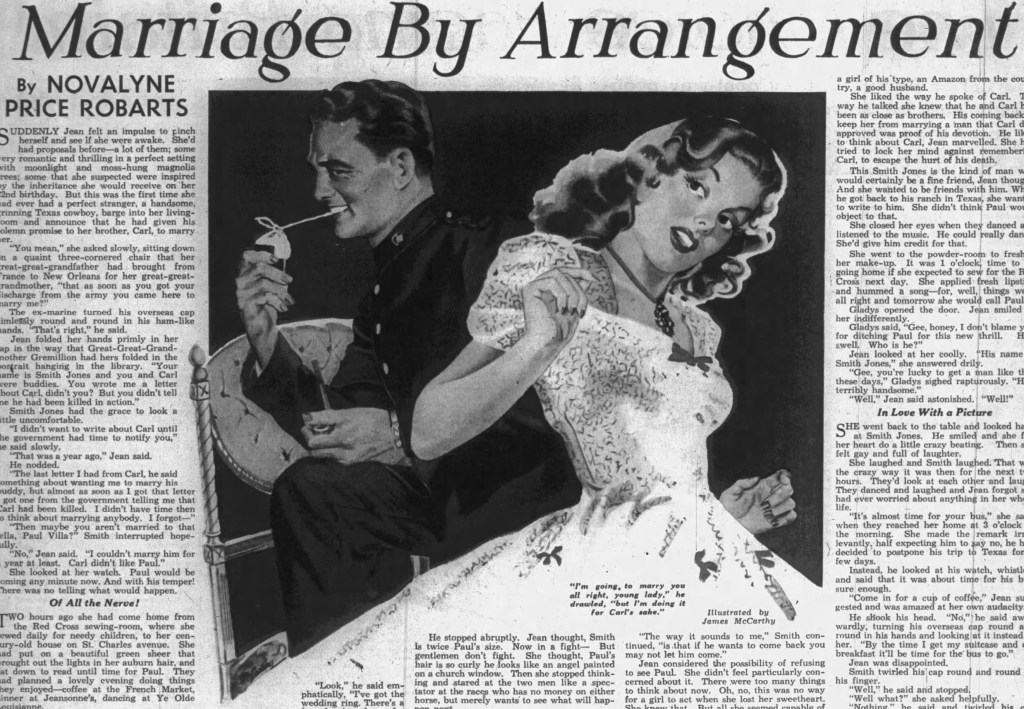
Four years after H. P. Lovecraft introduced them by mail, on 7 June 1940, Henry Kuttner, Jr. married Catherine Lucille Moore in New York City. Kuttner was 25, Moore was 29. The witnesses were Mrs. Beverly Claire Finlay (wife of the Weird Tales artist Virgil Finlay) and Mrs. Annie Kuttner (the groom’s mother). It would mark both a new personal and professional chapter in the life of both writers.

Moore no longer had her job. Kuttner had no other source of employment; his draft registration card, filed in 1940, lists him as self-employed, and his agent Julius Schwartz as his next of kin. They both needed to buckle down to write, and having already completed their first collaboration in “Quest of the Starstone” (1937), they may well have continued. Certainly, after their marriage, they formed one of the most formidable writing teams in pulp magazine history:

Chacal: Did you ever have any reservations about collaborating with Kuttner? 

Moore: Nope. “The Quest of the Star Stone,” our first, worked out well enough to show us we could do it and after that we never gave it much thought. We just went ahead and wrote, either separately or together, depending on how that particular piece of work progressed. Remember, we weren’t turning out stories for posterity, but for this month’s rent. I so often hear of collaborators who tear down each other’s work—even successful, long-established collaborators. We didn’t have time for that kind of nonsense. We just traded typewriters; when one got stuck the other took over with a minimum of rewriting. Often none at all. Usually none at all. With us, at least, it worked out fine. It was also very nice to have somebody who could take over when the other guy got stuck. We sincerely loved each other’s writing and enjoyed tremendously what came out of the other guy’s typewriter. It was a fine relationship.
“Interview: C. L. Moore Talks To Chacal” in Chacal #1 (1976), 30

One friend of the married couple actually got a chance to witness this in practice:

Hank came feeling his was downstairs, and, as he located the coffee, the typewriter upstairs began to make noises. One half hour, maybe three-quarters, we’d had our morning coffee, and Hank said something about going upstairs and getting dressed. He disappeared.

They didn’t pass each other on the stairs, but Catherine turned up very shortly afterward, reconstructed the coffee, which Hank and I had finished, and I had my second wake-up with her—with the typewriter going on at the same rate upstairs. Once more, say three-quarters of an hour passed, and Catherine said something about getting into day clothes, and disappeared. Hanke came down, dressed, and said something cheerful about breakfast—with the typewriter going on as usual. This went on. They worked at it in shifts, in relays, continuously, until about two o’clock that Saturday afternoon, when the one downstairs did not go upstairs when the one upstairs came down. This time the typing stopped.

[…] I learned later, from John [Campbell], that they always worked that way, and worked so well at it that the only way he could tell who had written what was if the word ‘gray’ came in the story. One of them habitually spelled it ‘grey.’
—George O. Smith, The Worlds of George O. Smith (1982) 31

“Grey” is the preferred British spelling, and Moore had a tendency to use it in her private letters (although in publication, editors had their own way, e.g. “The Cold Gray God” (1935) by C. L. Moore). Moore commented on their differences in writing:

CA: People have trouble, don’t they, identifying which stories are yours and which are collaborations?

MOORE: Well, mine were probably a good deal more verbose, and I tended to have compound sentences. Henry wrote very tersely. That’s about the only difference, except that I was greatly prone to adjectives and so forth, and he got his effect over without quite so much embellishment. There was a distinct difference, but in most cases I think not enough for the general reader to be aware of.
Interview with C. L. Moore in Contemporary Authors vol. 104, 327

Kuttner’s view on Moore’s style is paraphrased by Guy Amory:

Kuttner likes the way C. L. Moore writes (and who doesn’t). He wishes he could write like her—but claims that when he tries imitating it comes out so much trash. If you’ve read any of his stories you realize that Hank is a master of the bingety-boom type of fiction—but with feeling! He puts more Incident in ten pages of Elak than any other author in WEIRD, and makes you feel it. He paints his picture with masterfully abrupt dabs, while Moore lays on her horror with the touch of a mosaic master, building up. Kuttner knocks you down and keeps you bouncing. Moore swirls you in cobwebs and totes you away into infinity. Combining their efforts in ’37 for QUEST OF THE STARSTONE they turned out something to remember … with Hank’s flair for lightning pace and Moore’s for description they went to town.
Guy Amory, “Is It True What They Say About Kuttner?”
in Future Fantasia (1939) vol. 1, no. 2

Because of the way they worked, it isn’t possible to discern, after 7 July 1940, which stories were written by husband or wife; they both collaborated so intimately that most stories are attributed to them both, even if they appeared under the byline Henry Kuttner. The exception is stories that appeared under C. L. Moore’s own byline, these are believed to be largely or entirely her own work. While everyone has their theories, attributing stories like the Hogben Chronicles to Kuttner or “The Twonky” to Moore, there isn’t any real way to tell. With this marriage of personalities and talents, Moore had ended the first stage of her professional career and entered a new one.

“All Is Illusion” was first published in Unknown Apr 1940, as by Henry Kuttner. It has sometimes also been credited to Moore-and-Kuttner, and not unreasonably so: there’s no reason to suspect that Moore and Kuttner weren’t collaborating before their marriage, and the strong shift in Moore’s later science fiction in stories like “Miracle in Three Dimensions” (1939) and “Greater Than Gods” (1939) show at least Kuttner’s influence on her style, if not some active cooperation. So what can we say about who wrote “All Is Illusion” for Unknown?

Moore looked around for the waiter, but could not locate him in the swirling gray smoke.
—”All Is Illusion” in Unknown Apr 1940

The comment on “gray” vs. “grey” might be seen as a clue, but unfortunately, that only works if we have the original manuscript to work with. Editors tend to impose their own spellings on stories that appear in their magazines, and most American editors during the period preferred “gray.”

The story itself is, if not a shaggy dog story, then something very closely akin to it. To work, it requires a certain suspension of disbelief and a familiarity with at least the broad outlines of Classical mythology, such as Ovid’s Metamorphoses, because it is framed as an anecdote and presented as an intrusion of fantasy into a contemporary setting. There is no world-building as such, and very little explanation; the story even borrows on some of the most well-worn tropes available for such a tale:

Moore turned.

The tavern was gone. Only the empty lot remained.
—”All Is Illusion” in Unknown Apr 1940

This intrusion of familiar fantasy in a contemporary setting with the addition of a strong comedic tone, rather than being played for horror or moralism, is a Hallmark of the 1940s fantasy published in Unknown. Darker shades of similar ideas would be played with by Ray Bradbury and Robert Bloch, and more serious attempts would be the playground of L. Sprague de Camp and Fletcher Pratt, but here in this story we get the surreal, the fantastic, the hallucinatory all in a setting of very firmly established reality.

There is little about this story that screams “C. L. Moore wrote me.” The early fantasy section, with the disappearing tavern inhabited by the mythological figures, I can easily believe might have been a C. L. Moore section; so too, the reference to Midsummer Eve echoes “Miracle in Three Dimensions” (1939) and the transformations in Shakespeare’s play A Midsummer Night’s Dream. The details about New York read more like the kind of thing Henry Kuttner would pick up on. Humor and ridiculous happenings were not a strong aspect of C. L. Moore’s early work, but both are strongly present here. The prose itself does not read hugely different from either of their individual works from the period.

There is no strong reason to either suspect or deny C. L. Moore’s involvement in this story. It was credited to Henry Kuttner on publication, and is only co-credited to Moore afterward because of the revelation of the nature of their collaboration, but the seamless nature of that collaboration means trying to pick and choose between whether a story is a Moore tale or a Kuttner tale is ultimately a false choice. The two writers came together during the late 1930s, and the fusion of their work in 1940 gave way to something new and largely indistinguishable from its parts.

The fat old man arose and went toward the back. He passed close to Moore’s table, and, glancing aside, said in a kindly voice, “All is Maya—illusion.” He hiccuped, drew himself up in a dignified manner, and hastily continued his journey into the smoke.
—”All Is Illusion” in Unknown Apr 1940

Scans of “All Is Illusion” are available online at the Internet Archive.


Bobby Derie is the author of Weird Talers: Essays on Robert E. Howard and Others and Sex and the Cthulhu Mythos.

Deep Cuts in a Lovecraftian Vein uses Amazon Associate links. As an Amazon Associate I earn from qualifying purchases.
“Chosen” (2015) by Lyndsey Holder

Brown Jenkin was agitated, running circles around me, climbing up my back and crawling down into my lap, staring at me with his beady black eyes. I reached out to him tentatively and he nuzzled my hand, stirring a strange kind of love in my heart.
—Lyndsey Holder, “Chosen” in She Walks in Shadows (2015) 160

Familiar horrors inspire a kind of wish-fulfillment. Thousands of readers of Bram Stoker’s Dracula and Anne Rice’s The Vampire Lestat have imagined what it would be like to be undead, ageless and powerful, bound by night and loosed from the morals of humanity. Roleplaying games like Werewolf: the Apocalypse let fans of werewolf movies and lore vicariously embody the power and ferocity of the change. Contemporary witches look back at the witch trials and pay tribute to those hypothetical ancestors, sometimes drawing imaginary connections to the persecuted of Salem Village in the Province of Massachusetts Bay.

Lovecraftian horrors are not so familiar as vampires and werewolves, and so there are fewer who wish to truly meet or embody those horrors. Fewer readers express a desire to be Pickman-esque ghouls than to become vampires, though more than a few would happily undergo the change into a Deep One and dwell in wonder and glory forever beneath the waves. While there are a few Lovecraftian witches, occultists like Keziah Mason and Joseph Curwen are often still figures of horror, not mentors or figures of nostalgia akin to Dracula.

“Chosen” by Lyndsey Holder thus enters a rather scarce territory. We very often see Keziah Mason presented as the stereotypical witch, the old hag with the familiar, steeped in the blood libel of child sacrifice from old legends. Sometimes, rarely, we see her as the archetypal Lovecraftian witch, the one who embodies the kind of freedom, wisdom, and power—and attracts the kind of prosecution—that embodies the more mythical ancestors of contemporary Wiccans, as inspired by The Witch-Cult in Western Europe (1921) by Margaret A. Murray.

Holder’s story is very short, just six pages long, short and to the point, and all too easy to spoil. The biggest unanswered question might be why the nameless girl protagonist is a child in Vancouver, very far from Arkham as the broom flies. However, Lyndsey Holder is herself Canadian. Maybe there’s a bit of wish-fulfillment in this story, a fictional accounting of a pilgrimage she would have taken if the dreams had come to her. Certainly, Mythos fans can appreciate why they might save and scrimp to travel thousands of miles just to be there, where horror once walked. More than a few fans stride the streets of Providence and Salem every year, after all, thinking of Lovecraft and witches.

The horror in this story doesn’t really come from Keziah Mason or her familiar Brown Jenkin. They are familiar figures, and there is something comforting in their portrayal. The horror in the story is how the protagonist reacts to them, how her life changes when they become a part of it. The ending is certainly a fitting one. Not every Lovecraft fan would choose that way to become a part of the Mythos, but for those who are given a chance to be part of the story…well, a few readers at least will understand.

“Chosen” by Lyndsey Holder was published in She Walks in Shadows (2015) and its reprints, it has not otherwise been republished.


Bobby Derie is the author of Weird Talers: Essays on Robert E. Howard and Others and Sex and the Cthulhu Mythos.

Deep Cuts in a Lovecraftian Vein uses Amazon Associate links. As an Amazon Associate” I earn from qualifying purchases.

“Fruit of Knowledge” (1940) by C. L. Moore

By the way, I suppose they warned you about the Tree?
—C. L. Moore, “Fruit of Knowledge” in Unknown Oct 1940

After her marriage to Henry Kuttner on 7 June 1940 in New York City, C. L. Moore’s byline appears only sporadically in magazines and novels. Most of their work, written together, would appear under his name, or that of a shared pseudonym such as Lewis Padgett. It is impossible, at this point, to say who wrote what—with one notable exception: the stories still published under Moore’s name are agreed to have been primarily, if not entirely, her own work with little involvement from her husband and writing partner.

The first story published under C. L. Moore’s own name after her marriage is “Fruit of Knowledge” in Unknown Oct 1940, and it is a major departure from Moore’s previous and much of her future work as far as content. The scene is a retelling of a part of the book of Genesis from the Old Testament, about the creation of Eve and Tree of Knowledge of Good and Evil. As such, the general gist of the plot is familiar to most readers; they have heard this story before and know how it ends. This is a story where all the attraction is in the telling of the tale.

In telling this tale, Moore reaches outside the Christian Bible and borrows the character of Lilith from the Jewish Talmud and folklore. Lilith was something of a favorite of the Weird Tales crowd, with Moore’s friend and fellow Lovecraft correspondent E. Hoffmann Price having written stories like “Queen of the Lilin” (Weird Tales Nov 1934) and “Well of the Angels” (Unknown May 1940), and others composing poems to her. A quintessence of evil and femininity, which are both alluring on their own, but together are especially powerful.

The story that unfolds is primarily from Lilith’s point of view, and holds many of the hallmarks of Moore’s style: the beauty of both men and women are emphasized, the characters driven by strong emotions, the prose sensuous, and there is that subtle ironic humor which had increasingly become prominent in Moore’s writing, the element that draws her more in line with Kuttner and the 1940s style of fantastic fiction which Unknown would become known for.

The re-use of a familiar story, retold in a very contemporary way, is somewhat similar to “Miracle in Three Dimensions” (1939), but here Moore needs no special device to lay the scene. She simply dives right in, and the characters speak in familiar accents, not attempting Biblical diction of the King James Version, so that characters say “you” and not “thou” or “thee” (with a few exceptions when Moore is taking the words more or less directly from the Bible.) If it is slightly blasphemous—God is not depicted as either omniscient or omnipotent—it is still an effective little drama, where the characters have their clear motivations and struggles, their plans and plots, their complications and upsets. Even knowing how it’s going to end, the story is told well enough that readers might want to see how, exactly, things play out.

“The woman thou gavest me—he began reproachfully, and then hesitated, meeting Eve’s eyes. The old godlike goodness was lost to him now, but he had not fallen low enough yet to let Eve know what he was thinking. He could not say, “The woman Thou gavest me has ruined us both—but I had a woman of my own before her and she never did me any harm.” No, he could not hurt this flesh of his flesh so deeply, but he was human now and he could not let her go unrebuked. He went on sulkily, “—she gave me the apple, and I ate.”
—C. L. Moore, “Fruit of Knowledge” in Unknown Oct 1940

Moore doesn’t seek to soften the essentially patriarchal nature of the Biblical story, though neither is this a proto-feminist take. Lilith is essentially deceitful, jealous, possessive, and finally vindictive; then again, when the bloom is off the rose, Adam blames Eve like a little boy pointing to his sister and saying she did it. Eve herself gets far less character development than Lilith, being largely passive, reactive, manipulated, and a possession to be granted where Lilith is proactive and makes more of her own choices. As a biblical commentary it might not have much to add, but as an entry in the seemingly interminable corpus of “fictional reimaginings of Biblical tales,” it’s not bad.

There is no indication of when Moore wrote this story or why; a story could take months to be published in a pulp magazine, and she might have written it before or after her marriage. Maybe it was that life event that spurred her interest in the old tale, or a chance to reframe the old story through her own eyes. We don’t know. Yet for a while, it was the last that the pulp magazines would see of C. L. Moore byline—on her own.

Scans of “Fruit of Knowledge” are available online at the Internet Archive.


Bobby Derie is the author of Weird Talers: Essays on Robert E. Howard and Others and Sex and the Cthulhu Mythos.

Deep Cuts in a Lovecraftian Vein uses Amazon Associate links. As an Amazon Associate I earn from qualifying purchases.

“Body to Body to Body” (2015) by Selena Chambers

Every woman’s body is a story, you see.
—Selena Chambers, “Body to Body to Body” in She Walks in Shadows (2015) 132

Lovecraftian genealogical narratives tend to focus on a single, often the paternal, line. What that tends to exclude is a large number of other ancestors and relatives: mothers, grandmothers, aunts, cousins, sisters, half-sisters, and step-siblings. Writers following Lovecraft were not averse to filling out and following other branches of various family trees. August Derleth’s “The Shuttered Room” (1959) follows some Whateley cousins, for example, and Lavinia Rising (2022) by Farah Rose Smith expands on Lavinia Whateley’s background.

These Mythos family reunion stories are often a bit contradictory; that’s the point. By expanding on unspoken relations, authors have the opportunity to give alternative narratives, fresh viewpoints, different and more complex takes on a set of events or individuals. That’s how myth cycles—and, more often than not, family stories, repeated in games of telephone down generations—tend to work. Readers get to balance the narratives and decide for themselves what “really” happened.

Yes, he knew about the Innsmouth blood now.
—H. P. Lovecraft, “The Thing on the Doorstep”

“Body to Body to Body” by Selena Chambers is set up chronologically as an immediate sequel to Lovecraft’s “The Thing in the Doorstep,” and narratively is structured in parallel: the police are interviewing a suspect, and she tells her tale. What marks this story as different is that the interviewee is Asenath Waite’s half-sister—from before their mother’s marriage to Ephraim Waite—and so the events she relates are largely a prequel to Lovecraft’s tale, expanding on Asenath’s background and childhood. How she became who she became, in every sense of the word.

Like “The Thing on the Cheerleader Squad” (2015) by Molly Tanzer and other stories that spin out of Lovecraft’s original, this story explores a different relationship dynamic with Asenath and Ephraim. In Lovecraft’s original story, questions of identity ultimately make Asenath a victim, overpowered and replaced by her father’s mind; stories like Tanzer and Chambers give Asenath more agency, and more of an identity of her own distinct from her father’s.

Chambers’ depiction of the Waite’s home life makes no bones about Ephraim Waite as a bigoted old occultist; it feels like there might be a hint of Lovecraft in the portrayal, reminiscent of how Mexican Gothic (2020) by Silvia Moreno-Garcia borrows some characterization from Lovecraft for its villain. However, the real delight in the story is the little details from the protagonist’s point of view, the hints of Innsmouth culture that go beyond Mythos lore and speak of lived experience in the town. And it offers an alternative ending to “The Thing on the Doorstep” which is more hopeful than Lovecraft’s vision.

“Boby to Body to Body” by Selena Chambers was published in She Walks in Shadows (2015) and its variations. It has not otherwise been reprinted.


Bobby Derie is the author of Weird Talers: Essays on Robert E. Howard and Others and Sex and the Cthulhu Mythos.

Deep Cuts in a Lovecraftian Vein uses Amazon Associate links. As an Amazon Associate” I earn from qualifying purchases.

“Song in a Minor Key” (1940) by C. L. Moore

Well, here was Earth beneath him. No longer a green star high in alien skies, but warm soil, new clover so near his face he could see all the little stems and trefoil leaves, moist earth granular at their roots.
—C. L. Moore, “Song in a Minor Key”

“The Green Hills of Earth” is as close to an anthem as C. L. Moore gave to Northwest Smith. His adventures take place almost exclusively on alien worlds. He is an outlaw, an adventurer, a hard man and not necessarily a noble one, but not without his honor or his principles. Raymond Chandler wrote in “The Simple Art of Murder” (1944) that the protagonists of hardboiled tales must be “the best man in his world and; a good enough man for any world.” He didn’t write that about Northwest Smith, but he might have.

What is “Song in a Minor Key?” It is the last of Moore’s works about Northwest Smith. It might have been a fragment of a story never completed, it might have been a coda. In a series that is never marked by any particular notions of continuity or character development, it offers both. Not a reflection on Smith’s adventures, but of the mysterious past never really spoken of elsewhere, and of a future: Smith is back on Earth. He’s there amid his green hills at last. Why, and for how long, we don’t know.

In a way, “Song in a Minor Key” is reminiscent of H. P. Lovecraft’s “The Silver Key.” Both are stories that deal with a reflection on childhood, happier times, but where Randolph Carter’s dream is to retrieve that key and relive the past, Northwest Smith’s approach to such nostalgic wishing is harsh. He knows who he is and what he has done; he knows, too, that he could not have done anything different. Faced with the same circumstances, even with all the knowledge of twenty years on the run, he would kill again—and end up right where we saw him, in dingy Martian spaceports or hunkering in a Venusian alley, exploring dead cities and strange worlds.

Maybe this was a goodbye to the character that had launched C. L. Moore into her pulp career, even though it feels like the opening of a new adventure. Which, perhaps, is fitting. Series characters in the pulps rarely had arcs; they rarely had a definite retirement or death. When Robert E. Howard wrote the adventures of characters like Solomon Kane, Kull of Atlantis, Bran Mak Morn, and Conan the Cimmerian, he never wrote their deaths—he might jump back and forth to different points in their lives, show Conan as a brash young thief in one tale and a conquering monarch in the next—and there was the certain sense that in the fullness of time these men were mortal and they would die. We even see the cult of Bran Mak Morn rise up, with the knowledge that he died on some ancient battlefield. But we never see it, we never get the send-off, the heroes do not ride off into the sunset and tell us that this is the end.

For the readers of Weird Tales who thrilled to the adventures of Northwest Smith for six years, the tales just…stopped. There were no more. The magazine itself changed its focus. “Song in a Minor Key” was published in the fanzines Scienti-Snaps (Feb 1940). She was still Catherine Lucille Moore when this was published; she would marry Harry Kuttner on 7 June 1940, in New York City. Moving on into the next phase of her life, and her writing career. Much of what she wrote from this point on would be with Kuttner, her husband and writing partner, and would appear under his name or a shared pseudonym. Relatively few works were signed C. L. Moore after 1940.

This was one of the last pieces we can say was truly her own voice, unalloyed.

Scans of the original publication of “Song in a Minor Key” are not currently available, but the text is available at Project Gutenberg.


Bobby Derie is the author of Weird Talers: Essays on Robert E. Howard and Others and Sex and the Cthulhu Mythos.

Deep Cuts in a Lovecraftian Vein uses Amazon Associate links. As an Amazon Associate I earn from qualifying purchases.

“Blessed Be Her Children” (2025) by Jessi Vasquez

The religious rites varied according to circumstances and the requirements of the people. The greater number of the ceremonies appear to have been practised for the purpose of securing fertility. Of these the sexual ritual has been given an overwhelming and quite unwarranted importance in the trials, for it became an obsession with the Christian judges and recorders to investigate the smallest and most minute details of the rite. Though in late examples the ceremony had possibly degenerated into a Bacchanalian orgy, there is evidence to prove that, like the same rite in other countries, it was originally a ceremonial magic to ensure fertility.
—Margaret Murray, The Witch-Cult in Western Europe (1921)

The conception of Shub-Niggurath as a fertility figure in Lovecraft’s artificial mythology, presented or hinted at in “The Mound” (1940) by Zealia Bishop & H. P. Lovecraft, has always carried with it certain implications. In the early 20th-century anthropological context, “fertility rites” in religion applied to humans, animals, and vegetables. There were rites to conceive and safely deliver children, to grow more crops, to have domestic animals increase in number. The sexual connotations were clear and sometimes salacious.

This was before in vitro fertilization or genetic engineering, before hormonal birth control or effective medical gender transition. Before contemporary labels like ace and aro. The anthropological perspective rarely took into account the vast diversity of reproductive schemes in nature, most of which don’t apply to humans and domestic animals; it did absorb a lot of the cultural norms regarding gender and sexual identity, and the reproductive focus of fertility cults in the literature can bear some strange parallels to reproductive abuse and pregnancy fetishism.

This is the heritage of Shub-Niggurath in the 21st century: one of the rare identified-as-female divinities (or at least entities) in the Cthulhu Mythos, and her cult is often treated as effectively the Quiverfull movement with optional magic and monsters. While that may be a simplification for a diverse array of works that run from “Shub-Niggurath’s Witnesses” (2015) by Valerie Valdes to “The Shadow over Des Moines” (2016) by Lisabet Sarai, the important takeaway is that Shub-Niggurath and her cult have been primarily shaped by early 20th-century ideas of sexuality and reproductive biology.

What does Shub-Niggurath have to offer if you’re asexual, transgender, gay, or just never want to have kids?

As for the rest of the idealistic traditional family concept, you know I never had any real interest in men. I guess I should have been more open about my romantic endeavors. I would have been, if I’d known you thought I was holding back for your sake. You suspected there was something with Rachel, and briefly, there was. There were also a few people in college of varying genders, and while I sometimes felt deep affection, I discovered I’m not terribly interested in physical intimacy. And I don’t feel like my life is incomplete without it.

I love cake. I love cozy mystery novels and sad romance movies. I love my friends, I love Liriope, I love you. And that’s enough. I wish I’d made this clearer to you.
—Jessi Vasquez, “Blessed Be Her Children” in Tales of Shub-Niggurath (2025) 192

“Blessed Be Her Children” by Jessi Vasquez is told in mostly epistolary format; as a series of journal entries, sometimes addressed to specific readers, in a contemporary setting involving a young divorced single mother, her daughter, and her older sister. This is a woman’s story, told from a woman’s perspective, dealing with the messy, complicated mess of faith and something more than faith as their relationships get tangled up with a cult that has an unnerving focus on fertility. The story is not explicitly set in the Cthulhu Mythos; it doesn’t need to drop Shub-Niggurath’s name to draw the familiar associations with goatish imagery associated with the cult. Yet it is very much written, at least in part, in response to how we look at Shub-Niggurath now compared to in 1940.

One squat, black temple of Tsathoggua was encountered, but it had been turned into a shrine of Shub-Niggurath, the All-Mother and wife of the Not-to-Be-Named One. This deity was a kind of sophisticated Astarte, and her worship struck the pious Catholic as supremely obnoxious. What he liked least of all were the emotional sounds emitted by the celebrants—jarring sounds in a race that had ceased to use vocal speech for ordinary purposes.
—H. P. Lovecraft & Zealia Bishop, “The Mound”

Lovecraft never presents Shub-Niggurath from a woman’s perspective. He very rarely addresses pregnancy and birth in the Mythos from the viewpoint of anyone who might have to gestate something and push it out of their body in forty weeks or so. Lavinia Whateley has a few lines in “The Dunwich Horror,” but that’s only afterward. Readers don’t get to see what joy or fear, horror or gratitude, disgust or distress that she felt at the conception of conception, pregnancy, and birth. The whole viewpoint of reproductive horror from a woman’s perspective came to the Mythos relatively late, and is still being explored in stories like “In His Daughter’s Darkling Womb” (1997) by Tina L. Jens and “A Thousand Young” (2025) by Andrea Pearson.

So Vasquez’s approach in “Blessed Be Her Children” is interesting. It is a rebellion against the default program that the cultists are running. The cult, rather than adapt to changing ideas, is still serving what is essentially an ultraconservative agenda: be fruitful and multiply, on our terms. “Blessed Be Her Children” isn’t a polemic in the guise of a piece of fiction, but it is correctly trying to portray a predatory religious group (that happens to be a Mythos cult) whose central ethos doesn’t take into account that nowadays not everyone is heterosexual and looking to have kids.

“Blesssed Be Her Children” by Jessi Vasquez was published in Tales of Shub-Niggurath (2025).


Bobby Derie is the author of Weird Talers: Essays on Robert E. Howard and Others and Sex and the Cthulhu Mythos.

Deep Cuts in a Lovecraftian Vein uses Amazon Associate links. As an Amazon Associate I earn from qualifying purchases.
“Greater Than Gods” (1939) by C. L. Moore

If a man could see the end of his act, the end that comes at the far end of Time, and know what it meant—would men be greater than gods?
—Editor’s opening to C. L. Moore’s “Greater Than Gods” in Astounding Jul 1939

C. L. Moore had cut her teeth on interplanetary fiction. Yet the syntax of science fiction was changing, and her approach was shifting with it. Instead of the grungy spaceports of Northwest Smith or the alien cosmic soul-mates of “The Bright Illusion” (1934), “Greater Than Gods” opens up with a Science City divided into separate houses (including Telepathy House), and a very ancient, prosaic situation: a man torn between two women.

The story seems to be a further extrapolation of “Tryst in Time” (1936), working through another iteration of time travel theory:

I think of the future as an infinite reservoir of an infinite number of futures, each of them fixed, yet malleable as clay. Do you see what I mean? At every point along our way we confront crossroads at which we make choices among the many possible things we may do the next moment. Each crossroad leads to a different future, all of them possible, all of them fixed, waiting for our choice to give them reality.
—C. L. Moore, “Greater Than Gods” in Astounding Jul 1939

However, it’s also a kind of a gadget story. The protagonist, William Cory, head of Biology House, was on the trail of figuring out sex determination:

The pups were the living proof of Bill’s success in prenatal sex determination—six litters of squirming maleness with no female among them. They represented the fruit of long, painstaking experiments in the X-ray bombardment of chromosomes to separate and identify the genes carrying the factors of sex
determination, of countless failures and immeasurable patience. If the pups grew into normal dogs—well, it would be one long, sure stride nearer the day when, through Bill’s own handiwork, the world would be perfectly balanced bebetween male and female in exact proportion to the changing need.
—C. L. Moore, “Greater Than Gods” in Astounding Jul 1939

The problem that comes as Cory looks down the trousers of time, as Terry Pratchett put it, is that slowly more and more women were being born. The story becomes a thought-experiment on gender politics. Quite literally:

Women in public offices were proving very efficient; certainly they governed more peacefully than men. The first woman president won her office on a platform that promised no war so long as a woman dwelt in the White House.

Of course, some things suffered under the matriarchy. Women as a sex are not scientists, not inventors, not mechanics or engineers or architects. There were men enough to keep these essentially masculine arts alive—that is, as much of them as the new world needed.
—C. L. Moore, “Greater Than Gods” in Astounding Jul 1939

There are parallels here with David H. Keller’s “The Feminine Metamorphosis” (1929); a blatant, naked sexism that was not uncommon to the time. However, and here is the second twist, Bill Cory gets a glimpse down the other trouser-leg of time, into a world where his own experiments led to a eugenic future:

The first “X-ray” babies began to be born. Without exception they were fine, strong, healthy infants, and without exception of the predetermined sex. The Council was delighted; the parents were delighted; everyone was delighted except Bill.
—C. L. Moore, “Greater Than Gods” in Astounding Jul 1939

Both futures have their flaws, which is the point. It’s a moral conflict, the results deliberately exaggerated. The solution, when Cory arrives at it, is almost ludicrous—a polite fiction on the standards and morals of the age, when proposals were made and accepted more seriously—but it works, it’s true to its own internal logic.

The weird irony to the tale, the search for a third option when presented with an impossible choice, is very much in the vein of 1940s science fiction. How much influence, if any, Henry Kuttner had on this tale is impossible to tell; it has only ever been published under Moore’s name. Yet if she wrote it all on her own, then Moore had fully absorbed the influence of how science fiction was trending. It is a story that speaks to what her future work would look like.

“Greater Than Gods” was published in the July 1939 issue of Astounding. Scans of this issue are available on the Internet Archive.


Bobby Derie is the author of Weird Talers: Essays on Robert E. Howard and Others and Sex and the Cthulhu Mythos.

Deep Cuts in a Lovecraftian Vein uses Amazon Associate links. As an Amazon Associate I earn from qualifying purchases.
“A Thousand Young” (2025) by Andrea Pearson

After years of infertility, failed IVF cycles, and slowly decaying hope, she knew she was not one of the lucky or even one of the blessed, whatever that meant. She wasn’t meant to have children.

So when she first heard the name Dr. Keziah Mason offhandedly mentioned in an online infertility support group, it felt less like salvation and more like an invitation to finally belong.
—Andrea Pearson, “A Thousand Young” in Tales of Shub-Niggurath (2025), 213

Pregnancy has been a common element in weird fiction. The act of conception, the trauma of birth, the aftermath of a sexual act that leads to a natural set-up or sequel for a story, have been familiar elements since Arthur Machen’s “The Great God Pan” (1894) or Aleister Crowley’s Moonchild (1917)—and writers like H. P. Lovecraft (“The Dunwich Horror”, “The Curse of Yig”), Clark Ashton Smith (“The Nameless Offspring”) are direct literary descendants of that tradition.

The basic idea of the monstrous pregnancy was and remains largely unchanged in a great deal of weird fiction, there are a thousand and one variations on the fundamental idea, and entire academic books have been written on the subject in fiction and film, such as Women, Monstrosity, and Horror Film (2018) by Erin Harrington, The Rhetoric and Medicalization of Pregnancy and Childbirth in Horror Films (2020) by Courtney Patrick-Weber, and The Sinful Maternal: Motherhood in Possession Films (2024) by Lauren Rocha.

Pregnancy is still scary; women still go through a physical transformation and ordeal, even if they are more likely to survive it than a century ago. Unwanted pregnancies, as from rape, remain a real concern. With improvements in medicine involving fertility and infertility, the possibilities of pregnancy horror have shifted, however. Now we have adult fears of persistent infertility, of unsupportable pregnancies of multiples, dangerous pregnancies due to the mother’s health or age that are as yet possible due to science, and a shifting cultural emphasis on pregnancy and against abortion that threatens women’s bodily autonomy.

Yet these are themes, elements, narrative devices. Weird writers have addressed these issues in works like “In His Daughter’s Darkling Womb” (1997) by Tina L. Jens and Flowers for the Sea (2021) by Zin E. Rocklyn, both of which use more contemporary frameworks to set up the narrative framework for the monstrous pregnancy. The main difference between writers like Jens, Rocklyn, and Pearson from Machen, Crowley, and Lovecraft, however, is the change in protagonist focus. None of the older writers focus on the experience of pregnancy, none of them tell of the horror from the woman’s point of view. They are always outsiders looking in.

Andrea Pearson’s “A Thousand Young” is not a fetishistic gaze at pregnancy; we don’t get lascivious descriptions of baby bumps, labor, breastfeeding, etc. Strip away the Mythos elements and it is almost a classic monkey’s paw story, where the dearest wish is granted in a way that is unexpected or undesired. Yet it is told from the woman’s perspective; it is her body, her hopes, her dreams, that are at play, and as the story progresses, the reader gets a sense of the enormity of what is happening, and what will continue to happen, long after the last word is read on the final page. That is why it works—and what makes it a fitting paean to Shub-Niggurath, alongside stories like “Goat-Mother” (2004) by Pierre Comtois and “In Xochitl in Cuicatl in Shub-Niggurath” (2014) by Nelly Geraldine García-Rosas.

“A Thousand Young” by Andrea Pearson was published in Tales of Shub-Niggurath (2025).


Bobby Derie is the author of Weird Talers: Essays on Robert E. Howard and Others and Sex and the Cthulhu Mythos.

Deep Cuts in a Lovecraftian Vein uses Amazon Associate links. As an Amazon Associate I earn from qualifying purchases.