Posts

Collwen the Cimmerian Volume One (2019) by Matthew N. Sneedon

“KNOW, oh prince, that between the years when the oceans drank Atlantis and the gleaming cities, and the years of the rise of the Sons of Aryas, there was an Age undreamed of, when shining kingdoms lay spread across the world like blue mantles beneath the stars—Nemedia, Ophir, Brythunia, Hyperborea, Zamora with its dark-haired women and towers of spider-haunted mystery, Zingara with its chivalry, Koth that bordered on the pastoral lands of Shem, Stygia with its shadow-guarded tombs, Hyrkania whose riders wore steel and silk and gold. But the proudest kingdom of the world was Aquilonia, reigning supreme in the dreaming west. Hither came Conan, the Cimmerian, black-haired, sullen- eyed, sword in hand, a thief, a reaver, a slayer, with gigantic melancholies and gigantic mirth, to tread the jeweled thrones of the Earth under his sandalled feet.”
—The Nemedian Chronicles

Robert E. Howard, “The Phoenix on the Sword”

Know, you scholars of the occult, that during the patriachal years of Hyborian Age the crazy and decadent kings established their totalitarian kingdoms under the sky: Nemedia, with its spurious and imprecise chronicles; Ophir; Brythunia; Zamoa, where young girls were forced to prostitute themselves in dark temples; Zingara and her presumed knights; Koth, who sold their daughters as slaves to the harems of Hirkania to be covered with silk and gold chains. But the greatest and most powerful was Aquilonia, the tarnished jewel of the West in the hands of conceited and incapable men.

And from Cimmeria came Collwen, a free and indomitable woman from the north, with black hair as the firmament, eyes as intense blue as the hottest flame and the animal profile of a wild mountain panther; sword in hand and ready to crush with her footsteps the arrogant patriarchs of the world.

Imagine that the ultimate hero of sword and sorcery, no matter how much the misogynist chronicles had distorted it, was a strong and indomitable woman. Imagine that a daughter of CImmeria would have been the protagonist of thousands of adventures as mercenary, pirate and chief of men; and that her inimitable feats, marked with the tip of her sword, deserved not to be forgotten again.

Matthew N. Sneedon, Collwen the Cimmerian Volume One

Most of Robert E. Howard’s heroes were men. A survey of the pulp magazines those characters appeared in during his life such as Weird Tales and Oriental Stories showed that this focus on male protagonists was common. It was unusual for there to be women protagonists in those pulps, and rare indeed to see a woman serial character such as C. L. Moore’s Jirel of Joiry, who first saw life in “Black God’s Kiss” (1934).

When Jirel appeared, two years after Robert E. Howard’s Cimmerian first took to the page in “The Phoenix on the Sword,” readers of Weird Tales hailed her as a veritable female Conanbut that wasn’t strictly accurate. Jirel was not an alternate-gender version of Howard’s most famous barbarian, nor were the stories of Jirel of Joiry the same kind of hardboiled fantasy rooted in historical adventure fiction that the Conan tales were. If there were any characters like that, they were in Howard’s own stories: Bêlit, the Queen of the Black Coast; Valeria of the Red Brotherhood; Red Sonia of Rogatino; and Dark Agnes de Chastillonthe latter of whom never saw print during Howard’s lifetime, but Moore would read her story and gush about it in her letters with Robert E. Howard.

The first pastiches of Howard’s particular style of fantasy did not see print until after his death. Weird Tales tried to fill the gap the pulpster had left in their pages with Clifford Ball’s fantasies “Duar the Accursed” (WT May 1937) and “The Thief of Forthe” (WT Jul 1937), and Henry Kuttner’s Elak of Atlantis in “Thunder in the Dawn” (WT May-Jun 1938), “Spawn of Dagon” (WT Jul 1938), “Beyond the Phoenix Gate” (WT Oct 1938), and “Dragon Moon” (WT Jan 1941). Very likely, the dismissal of Farnsworth Wright and the ascension of Dorothy McIlwraith as editor of Weird Tales signaled an editorial policy shift away from heroic fantasy, a field that was rapidly becoming competitive.

Musclebound barbarians of any gender were not the norm in fantasy fiction during the 40s and 50s, although male protagonists still dominated in fantasy fiction such as Poul Anderson’s The Broken Sword (1954) and J. R. R. Tolkien’s The Lord of the Rings (1955). The 1960s, with its paperback reprints of Howard’s Conan and other fantasies, saw a revival of interest with a new generation of writers. Michael Moorcock created Elric of Melniboné with “The Dreaming City” (Science Fantasy No. 47, June 1961), and Joanna Russ created her swordswoman Alyx with “I Thought She Was Afeard Till She Stroked My Beard” (Orbit 2, 1967), among others.

Marvel Comics obtained a license from the Robert E. Howard estate, and in 1970 published Conan the Barbarian, which would run for decades and hundreds of issues, spawning many different series, graphic novels, and related works. In Conan the Barbarian #23 (1973), series writer Roy Thomas and artist Barry Windsor Smith introduced the character of Red Sonjainspired by Howard’s Red Sonya of Rogatino from “The Shadow of the Vulture,” Red Sonja was created to be a female swordswoman in the Howardian mold, a female counterpart but not clone of their successful Cimmerian. Red Sonja would go on to have her own series, guest star in various comics, serve as the protagonist in six fantasy novels by David C. Smith and a 1985 film, and her adventures continue today.

Unlike Conan, Red Sonja had no single main writer, and because she is a licensed character, her continuity has seen a great deal more flux. Where most of the official Conan pastiches by writers like L. Sprague de Camp, Lin Carter, and Robert Jordan kept the Cimmerian firmly grounded in Howard’s Hyborian Age, Sonja’s career has been more varied. There is no single “Probable Outline of Red Sonja’s Career,” the way there is for Conan. While her comics often have long story arcs or reoccurring characters like the villainous wizard Kulan Gath, they do not exist in a single rational chronicle.

Many of these stories are little more than generic quasi-medieval European fantasies with a female swordswoman protagonist who happens to be Red Sonjaand various writers and artists have taken advantage of this fact by writing their own versions of the She-Devil. Marada the She-Wolf (1982) by Chris Claremont and John Bolton was originally planned as a Red Sonja story, but was changed because of licensing issues. Frank Thorne worked on Marvel’s Red Sonja stories, and when he left the book created his own, more explicitly erotic version of the character, Ghita of Alizarr in 1979.

There are many many more examples that could be cited. For instance, Jessica Amanda Salmanson’s Amazons! anthology in in 1979, which introduced the Sword & Soul character Dossouye, inspired by the real-life women warrior society of Dahomey; and Marion Zimmer Bradley began the long-running Sword and Sorceress anthology series in 1984. The point of this brief history is threefold:

  • There are plenty of women protagonists in heroic fantasy.
  • They are not just Conan the Cimmerian with the serial numbers filed off and a pair of breasts.
  • Their stories are not simply Robert E. Howard pastiches.

These are important points to keep in mind when considering Collwen the Cimmerian Volume One (2019), because this is a work which exists in a specific context, and it has to be evaluated both for what it is, and what it is trying to be, as far as the author Matthew N. Sneedon has stated in his introduction.

Unlike Jirel, Red Sonja, Dossouye, etc., Collwen the Cimmerian is a deliberate and explicit gender-swapped version of Conan the Cimmerian. While their adventures are not identical, the basic descriptions, attitudes, and activities of the characters are substantially similar, and they are operating in the same milieu: Sneedon has set Collwen’s adventures in Robert E. Howard’s Hyborian Age, in the cities and countries from the Conan stories. In this respect Collwen the Cimmerian is perhaps a bit closer to fanfiction or The Song of Bêlit (2020) by Rodolfo Martínez than any of the original heroic fantasy women about such as Jirel or Alyx.

There are two stories in Collwen the Cimmerian Volume One: “The She-Master of the Dark Conclave” and “The Offspring of the Depths.” Both are serviceable and straightforward pastiches; “The Offspring of the Depths” has some initial similarities to Howard’s Conan story “Gods of the North” but turns into something more Lovecraftian before the end. Collwen is a perfectly adequate female pastiche of Conan, played absolutely straight: there are no jokes, no sly asides about gender trope reversals like rescuing and bedding princes, and very little about Collwen’s sexuality at all. The one time it comes up in any substantial way is a single passage:

Collwen had left her homeland to travel the world on her two powerful legs, not on a palanquin. She did not wish to spend years lying on a couch surrounded by maidservants to fatten up and let a round merchant impregnate her with a dozen cubs. She was not motivated by gold or gems. She just wanted to make the most of life; to see all the forgotten corners and wonders of the world, from the western coasts of the Picts to the eastern jungles of Khitai; to eat, drink, love and, above all, fight. She had not board to Stygia to obtain a sack full of gold, but to relish the war that had seen her being born.

Matthew N. Sneedon, Collwen the Cimmerian Volume One

Robert E. Howard’s Conan never explicitly denied the desire to settle down with a wife and have a bunch of kids after a big score. He never had to: there were fewer social expectations for men in the 1930s to settle down and procreate compared with women. Most male protagonists in heroic fantasy don’t have to consciously address or even acknowledge the gender and sexual expectations of their period; by contrast, women fantasy protagonists like Jirel and Red Sonja have had to explicitly deal with these social norms and mores, and how these issues are brought up and dealt with has changed over time.

In her own series of Marvel comics, for example, Red Sonja was noted for an oath to maintain her virginity unless defeated in battlea point which allowed the series to titillate in her chainmail bikini but avoided the appearance of promiscuity that Red Sonja would have had if she had engaged in as many casual sexual liaisons as Conan did. Her oath of celibacy was essentially a hard-coded example of the double standard about sexual experience between men and women in the 20th century. Gail Simone’s 2013 soft reboot of Red Sonja discarded both the character’s celibacy and her heterosexuality, making Sonja both bisexual and removing the supernatural onus against casual sex; writers since have played with both ideas in their own interpretations of the character.

Sneedon doesn’t spend much time on this particular aspect of Collwen’s character, nor does he necessarily have to: having a female character doesn’t necessarily require talking about such issues any more than a male character might. However, in the context of the opening paragraphs to these two stories, it is interesting to note that Sneedon spends little time or effort to actually depict the patriarchal nature of the Hyborian Age. There are a few echoes of the casual sexism that punctuated Robert E. Howard’s Conan series (like calling a grown woman “girl” as a diminutive), but less sexual discrimination or efforts to violently enforce gender norms than perhaps might be expected given the explicit contrast apparently intended between Conan and Collwen’s sagas.

If the patriarchy that Collwen is supposed to rebel against isn’t well-defined, Collwen the Cimmerian Volume One unfortunately fallen into one of the traps of pastiching fantasy fiction from the 1930s: racism in the setting. Robert E. Howard’s Hyborian Age was marked by a combination of contemporary racial attitudes and ahistorical social conventions. Slavery existed, and it was largely slavery as practiced in antiquity or Biblical timesnot restricted to a single race or by skin color, as was the chattel slavery of the South before the American Civil War. Yet when Howard speaks of that slavery he sometimes casts it in explicitly contemporary racial terms:

“Valerius does not protect his subjects against his allies. Hundreds who could not pay the ransom imposed upon them have been sold to the Kothic slave-traders.”

Conan’s head jerked up and a lethal flame lit his blue eyes. He swore gustily, his mighty hands knotting into iron hammers.

“Aye, white men sell white men and white women, as it was in the feudal days. In the palaces of Shem and of Turan they will live out the lives of slaves. Valerius is king, but the unity for which the people looked, even though of the sword, is not complete.[“]

Robert E. Howard, The Hour of the Dragon

In the 1930s, Howard could get away with explicitly exporting contemporary racial attitudes into his mythical Hyborian Age simply because they were so utterly common and widely-held that few readers or editors would find fault with such sentiments; he would lean more heavily into such ideas in describing the racially segregated society in “Shadows in Zamboula,” and would be most explicit about the racial and sexual dynamics in “The Vale of Lost Women”(1967).

Writers who choose to pastiche Howard thus face a challenge: how to be faithful to the spirit of the world Robert E. Howard created and maintain continuity with his stories without explicitly continuing or endorsing those same racial prejudices and attitudes in their own fiction. It can be a fine dance: it is appropriate in a historical story to have a character with historically accurate racial prejudices; it is not appropriate for that character’s prejudices to be portrayed by the narrative as true or accurate. The failure of writers like L. Sprague de Camp and Lin Carter to observe this distinction in their own Conan pastiches was specifically called out in “Die Black Dog! A Look At Racism In Fantasy Literature” (1975, rev. 2011) by Charles R. Saunders.

Sneedon has not managed to find the correct balance. For example, one character states:

Ngozi is my servant. She was a real princess in her tribe, but here she’s worth less than nothing. We must fear nothing of her. She’s a brute and an ignoramus, incapable of understanding what we expect. But she does understand what would happen to her if she tried to betray me.

Matthew N. Sneedon, Collwen the Cimmerian Volume One

Having a character be racist toward another character is unpleasant, but can help to define a character as unsympathetic or evil, and the relationship between the characters can be defined by that tension of racial prejudice with its arrogance and potential violence. Yet at no point does Sneedon do anything with Ngozi to disprove this prejudice, or to develop this relationship along those lines. Ngozi has no agency, no real voice for her own perspective, no chance to defend herself or deny or defy the stereotypes. The betrayal never takes place, and perhaps was not even planned. It is an attitude that a Howardian villain might well have expressed in a Conan story, but it was written in the 2010s, not the 1930s…and that is terrible. Sneedon should have known better.

Whenever a reader or critic comes across a work like this one, which takes a familiar character and setting and then changes some fundamental aspect like the gender of the main characterquestions have to be asked: why Collween the Cimmerian? What is it about the Hyborian Age in particular that made it the correct setting for Collwen as a character? How is Collwen different from Conan, and how is that difference integral to the stories written about her? Is it just fanfiction, or is there any deeper purpose to these pastiches that serves as contrast to and comment on Robert E. Howard’s stories?

Unfortunately, answers aren’t very forthcoming.

Collwen the Cimmerian Volume One (2019) by Matthew N. Sneedon is available on Amazon Kindle.


Bobby Derie is the author of Weird Talers: Essays on Robert E. Howard & Others (2019) and Sex and the Cthulhu Mythos (2014).

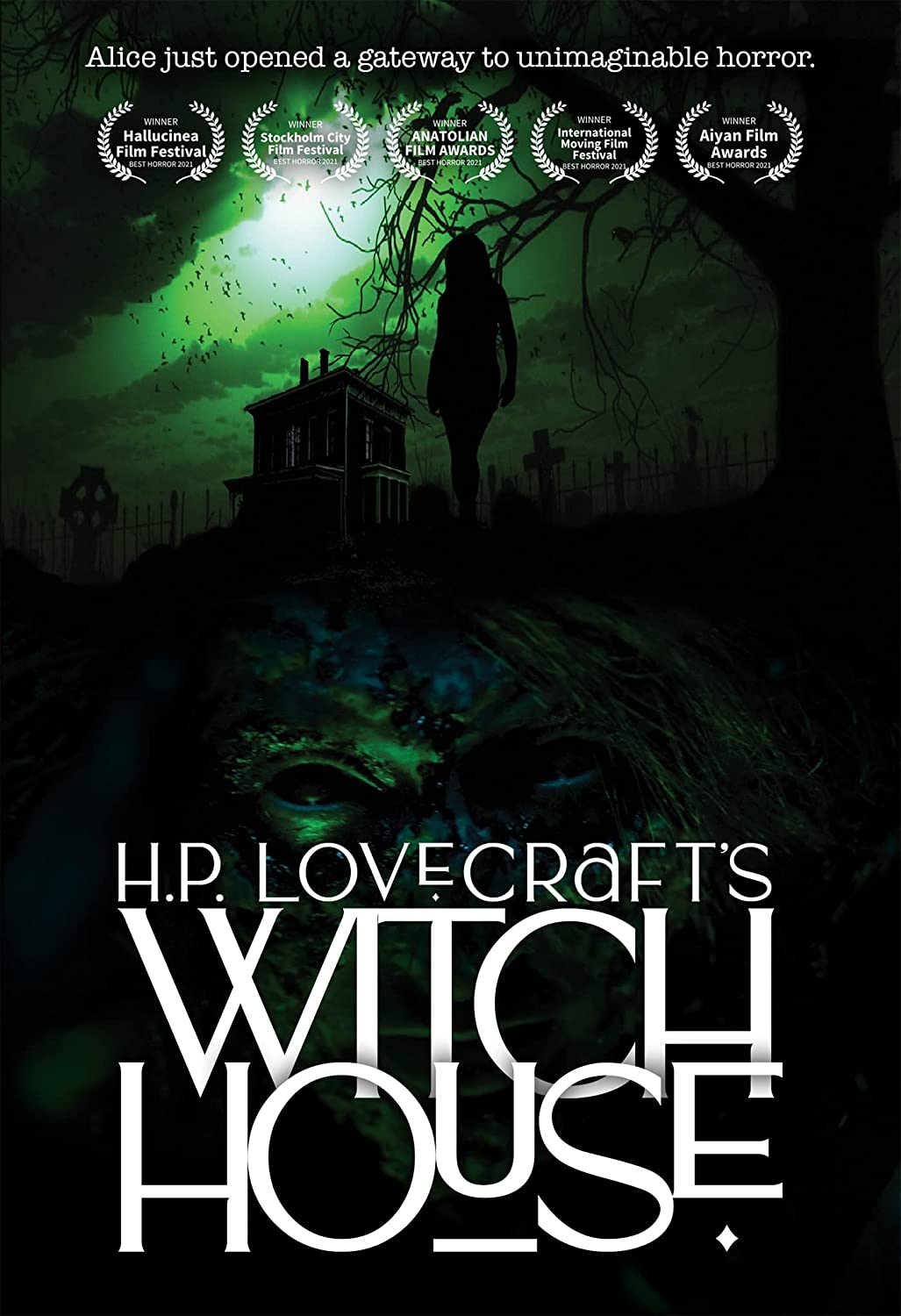
H. P. Lovecraft’s Witch House (2021)

After that he killed the time at a cheap cinema show, seeing the inane performance over and over again without paying any attention to it.

H. P. Lovecraft, “The Dreams in the Witch House”

Lovecraftian cinema is a diverse body of work, from short films to feature-length presentations to episodes of television or streaming shows; live-action to animation; zero-budget schlock and student films to big-budget Hollywood productions; from works that strive to adapt Lovecraft’s stories to the screen with various degrees of fidelity to more original presentations that take inspiration from or make reference to things Lovecraftian but seek to tell their own stories and focus on their own characters. In brief, Lovecraftian cinema is simply an extension of the Mythos into another media, with all of its own quirks and conventions.

H. P. Lovecraft’s Witch House (2021), directed by Bobby Easley, is loosely inspired by “The Dreams in the Witch House,” but with several twists. Mathematics graduate student Alice Gilman (Portia Chelleynn) is fleeing an abusive relationship and boards in an old house (the historic Hannah House in Indianapolis), which has a dark history involving the witch Keziah Mason (Andrea Collins), and whose odd angles and witchcraft tie in to Gilman’s own theories about other dimensions—and as the bodies pile up, Gilman learns that Mason and her coven are still very much active…

When compared to other productions of this type and covering this sort of material, H. P. Lovecraft’s Witch House is firmly in the middle of the pack of independent film festival fare such as The Last Case of August T. Harrison (2016), H. P. Lovecraft’s Two Left Arms (2017), H. P. Lovecraft’s The Deep Ones (2020), and Sacrifice (2020). All of these films pay more than lip-service homage to Lovecraft and the Mythos, are produced on modest budgets, and are serious efforts at a dramatic storyline and low-key horror rather than campy horror-comedies (e.g. The Last Lovecraft: The Relic of Cthulhu (2011), Killer Rack (2015)), arthouse reimaginings (e.g. Herbert West Reanimator (2018)), or reboots of previous franchises (e.g. Castle Freak (2020), The Resonator: Miskatonic U (2021)).

Individual performances, writing, cinematography, special effects (practical and CGI), score, and sound design vary—every film has its high points and low points, and if none of these seem destined right now for classic or break-out-hit status alongside films like Reanimator (1985), neither are they completely without merit or enjoyment. For most of these films, the problems they run into isn’t low budget or bad actors but poor writing: these are the cinematic equivalent of Cthulhu Mythos pastiche stories, and it shows in every familiar plot point and trope. The creators probably mean well by incorporating the Simon Necronomicon and its symbols, or by referencing Lovecraft and how his Mythos is really real…but these are both very old hat, and less clever than they might think.

Still, if nothing else, it’s fun to see how different creators approach the same material, like new wine in old bottles, and how far a given director or actor or special effects unit will go in pursuit of giving the audience something they haven’t seen before. For H. P. Lovecraft’s Witch House, there are a few pleasant surprises: Alice Gilman might be the first bisexual character in Lovecraftian cinema, and her brief love scene was probably the first live-action, non-pornographic lesbian love scene in a Mythos film. The dream sequences in particular are rather effective, and the lead actress Portia Chelleynn turns in a very competent performance.

Using you as a vessel for the birth of the antichrist.

H. P. Lovecraft’s Witch House

If there is a criticism to be leveled against H. P. Lovecraft’s Witch House, it’s the emphasis on Satanic witchcraft and the recycling of plot elements of Rosemary’s Baby into its Lovecraftian framework…and that requires a bit of explanation for why it might look like it would work, and why it really doesn’t.

The Salem Witch Trials were the belated American expression of a centuries-long persecution by civil and religious authorities of an imagined Satanic conspiracy. The Witch-Cult in Western Europe (1921) by Margaret A. Murray recast this as an imagined pagan religious conspiracy, and this was the form of the “witch-cult” which H. P. Lovecraft understood, believed, and worked into his stories. The diaspora of the Salem witch-cult is referenced in The Case of Charles Dexter Ward, “The Festival,” “The Dunwich Horror,” “The Dreams in the Witch House” and other stories. Following Murray, Lovecraft eschewed Satanism in his witchcraft—rather than something as prosaic as Christianity, Lovecraft was developing his own artificial mythology that was outside the narrow confines of God and Satan.

Likewise, Satanism had nothing much to do with Lovecraft, at least while he was alive and for some decades thereafter. In 1966, Anton LeVay founded the Church of Satan, a non-theistic religious philosophy that took the theatrical trappings and some of the rituals which literature—including accounts of the witch trials—associated with Satanism in the early modern period. The founding was propitious; Ira Levin’s novel Rosemary’s Baby came out in 1967, and the award-winning film was released in 1968. LaVey published The Satanic Bible in 1969, William Peter Blatty’s novel The Exorcist came out in 1971, and in 1973 was also adapted to the screen. Bands like Black Sabbath (1968) and Coven (1967) adopted elements of Satanism and occultism in their acts, laying some of the groundwork for what would become black metal.

It was the start of a Satanic pop culture renaissance, one that borrowed from and built on earlier ideas of Satanism, but took it in a new direction, some more theatrical and some more serious; sometimes both. Despite his dearth of Satanic connections, Lovecraft had his part too. Lovecraftian references appear in The Satanic Rituals (1972), notably “The Ceremony of Nine Angles” and “The Call of Cthulhu”; The Dunwich Horror (1970) deliberately echoed many of the beats of Rosemary’s Baby, with Nancy Wagner (Sandra Dee) serving in the role of Rosemary, complete with weird dreams, cultic conspiracy, and infernal impregnation. From there, parallel paths developed: Satanists and occultists borrowing Lovecraft into their rituals, philosophy, and theology, and pop culture confusing the Lovecraftian Mythos with Satanism as they sought to borrow on the dark appeal of both for black metal music, horror films, comics, and other media.

In the case of H. P. Lovecraft’s The Witch House, it’s easy to see where the writers were coming from and what they were going for: Keziah Mason was intended to be the genuine Salem Witch in Lovecraft’s story, and accused witches were believed to be associated with Satanism. It isn’t much of a stretch to give Keziah Mason a Satanic coven, or a typically Satanic goal…it’s just not a very Lovecraftian take on the subject. Quite the opposite of Lovecraft’s very non-Satanic take on witchcraft, really. It’s not even how most contemporary non-theistic Satanists and occultists would integrate Lovecraft’s Mythos into their beliefs and practices.

Which isn’t quite a damning indictment of the film as a whole, but it emphasizes the issue with Lovecraftian film pastiche: the people writing these movies and putting them together mean well, but are largely aping the most obvious aspects of Lovecraft’s Mythos stories without understanding the underlying ideas and mood that make those work. In “The Dreams in the Witch House,” the ultimate revelation was that the horrors were real…that there was a cruel reality that lay behind the Salem witch accusations, that the accused were not just innocent victims of religious mania; something a bit closer to The Lords of Salem (2012).

On its own merits, as a part of the Lovecraftian cinematic oeuvre, H. P. Lovecraft’s The Witch House isn’t a terrible film—but it is exemplary of an approach that misses the mark of what can make a really great Lovecraftian film, focusing on obvious surface elements and easy references, like Miskatonic University hoodies instead of making a film that captures the feel of a Lovecraft story.

H. P. Lovecraft’s Witch House was released in 2021 and is available on DVD and streaming.


Bobby Derie is the author of Weird Talers: Essays on Robert E. Howard & Others (2019) and Sex and the Cthulhu Mythos (2014).

Sailing Downward To The Cthulhu Call (2022) by Lisa Shea

Who hath desired the Sea—the sight of salt-water unbounded?
The heave and the halt and the hurl and the crash of the comber wind-hounded?
The sleek-barrelled swell before storm—grey, foamless, enormous, and growing?
Stark calm on the lap of the Line—or the crazy-eyed hurricane blowing?
His Sea in no showing the same—his Sea and the same ’neath all showing—
            His Sea that his being fulfils?
So and no otherwise—so and no otherwise Hill-men desire their Hills!

Rudyard Kipling, “The Sea and the Hills” from Kim (1900)

There are weird things out in the water. We still thrill to every strange creature that washes ashore, or is dredged up from the depths by a storm; the exotic, almost alien lifeforms that we glimpse through submarines or haul up in nets. The great depths of the ocean remain unexplored territory where wonders and terrors may yet reside: shipwrecks, volcanoes, lost cities. Nautical tales often contain elements of mystery, survival, adventure, and horror…and have left their mark on science fiction and fantasy. Krakens, Cthulhu, and Godzilla are all part of the lore and mystery of the ocean; sailors were the first great explorers who have lent their terminology to starships and space marines.

Yet for all the weird inspiration that the seas and oceans of the world have lent to H. P. Lovecraft and other weird writers, actual nautical weird fiction is a distinct and often overlooked subgenre. William Hope Hodgson, who was himself a sailor, was no doubt the greatest master of the weird nautical tale with his Sargasso Sea stories, “The Island of the Ud” (1907), and the unforgettable “The Voice in the Night” (1907), which inspired the Japanese film Matango (マタンゴ, 1963). H. P. Lovecraft would dabble in the genre with “Dagon” and the final chapter in “The Call of Cthulhu,” Frank Belknap Long, Jr. would contribute “The Ocean-Leech” in Weird Tales.

Nautical fiction has not gone extinct, but like railroad fiction and zeppelin stories, cultural and technological shifts have made such tales less common than before. Fewer people travel by water over long distances, with motors and electronics making it easier for ships to travel and stay in communication. Many of the tropes of nautical fiction are readily adapted to space travel stories—Event Horizon (1997) is essentially a ghost ship story set in space—and vice versa, as shown by films like The Abyss (1989) and Underwater (2020), so it might be more accurate to say that nautical fiction is undergoing an evolution as it finds its place in a changing culture.

Sometimes evolution tries something weird.

As the title might indicate, I was informed by a fellow author that every series absolutely must stay within a well-defined genre. Being a contrarian, I promptly set out to write a series in which each subsequent story is set with the same characters in a wildly different genre. I would love to hear your thoughts as I write this series as to which genres I should tackle next. Space Opera? Cozy Mystery? Amish Romance? The fun of me posting series as I write them is that it provides you, the reader, with an opportunity to shape and guide the results!

Lisa Shea, A Lovecraft Romp Through Every Genre There Is – And Some That Are Not

“Sailing Downwind to the Cthulhu Call” by Lisa Shea is Book 4 in an ongoing series about Samantha, a Black bisexual woman with a Mythos artifact and dire premonitions of Cthulhu’s emergence, and her friend-and-romantic-interest Gabriel. Strictly speaking, it might be better to regard these as chapters in a serial: while each attempts a distinct genre (1 – Horror, 2 – Mystery, 3 – Science Fiction, 4 – Sea Stories, and 5 – Romance), none of them is quite a standalone story in itself. Nor does the narrative seem complete; presumably more books are forthcoming at some point to carry Samantha and Gabriel’s story onwards, hopefully to some kind of conclusion.

Lisa Shea is a prolific author who is game for anything, and the decision to specifically try and do a nautical story with the Cthulhu Mythos has a lot of potential. While “Cthulhu,” “Dagon,” or “The Shadow over Innsmouth” might seem the obvious candidates for maritime adventures, one could just as easily imagine a sailor of any time period coming across a ghost ship crewed by Mi-Go brain canisters, or an Antarctic cruise ship that hits a frozen shoggoth. Sailing has such a rich and fascinating history, has been such a constant in human life even to the present day, that a story could be set almost anywhere or anytime.

Shea was slightly constrained in that she was keeping the same characters and continuing an overall narrative; “Sailing Downwind to the Cthulhu Call” starts out with them aboard ship, has a bit of light-hearted fun with nautical terminology, and tries to stay on topic…which is kind of where it begins to fall apart.

“I suppose, if I’m going to be reciting lines from doomed naval incidents, the Titanic shouldn’t be my first choice. Seems only two men of color were even on the ship, out of its 2,224 passengers.”

Lisa Shea, “Sailing Downwind to the Cthulhu Call”

How many people can recite the exact number of passengers on the Titanic off the top of their heads in casual banter? Keeping in mind that at no point in the proceeding does this character demonstrate that she is a Titanic fanatic. The point is driven home in the next paragraph when she begins to go into the details of the Port Chicago disaster, without any real prompting. It is not that this is information she couldn’t know, or have looked up at some point, but for a character that doesn’t know port from starboard it feels very out of character, and almost like the kind of filler used to fluff out historical romance novels for which page count is more important than pacing.

The point of bringing up the Port Chicago disaster specifically appears to be to prompt a discussion between Samantha and Gabriel on the issue of historical racism and the historical racial diversity of sailing crews, e.g.:

“When I was a boy, our neighbor was African-American. Elderly. Wrinkledlike a raisin. He’d served on the U.S.S. Mason in World War II. It said out of Boston, you know. The entire crew was African-Ameircan. At the time, our Navy wouldn’t mix those types with the white sailors.”

His brow furrowed. “Can you imagine, caring about something like that while the Nazis were slaughtering Jewish people by the trian-car-load?”

I could very well imagine.

Lisa Shea, “Sailing Downwind to the Cthulhu Call”

If this was a single bit of conversation in a longer novel, it might stand out less. Perhaps it might even help establish elements of their characters better and explain their romantic rapport since they both appear to be WWII naval buffs. However, the interaction doesn’t really drive the plot of the chapter or the story forward at all. It’s fascinating as trivia and in another context it might provide an interesting line of inquiry—how did changing racial politics affect the dynamics of sailing ships?—but in this story, the question has to be asked: what is the point? Because neither the Titanic, the Port Chicago disaster, or the U.S.S. Mason figure into Samantha and Gabriel’s little sailing cruise to Nantucket Island.

“Sailing Downwind” is technically a sea story because it takes place at sea, on a small sailboat, and most of the content is explicitly related to sailing in some fashion—even the discussion about why rum and why alcohol is measured in proof, which makes me wish Shea had consulted And a Bottle of Rum: A History of the New World in Ten Cocktails by Wayne Curtis. Yet it feels like a missed opportunity. The sailing is a little too smooth. Samantha never really learns anything about how to help out around the ship in her brief time on it. Long car trips have been planned with more care and contained more incident and excitement. For a single chapter in a longer novel, this wouldn’t be a complaint, but in a chapter trying to bill itself as nautical fiction, it just feels like so much more could have been done with the idea…a storm. Rough waves. Shark attack. Man overboard. Lost at sea. Sneaky Deep One stealing the rum. St. Elmo’s fire. Pirates (off Nantucket? Perhaps not.)

The Cthulhu Mythos material is a continuation of the story from previous books. Readers who skipped those can get the gist of the idea rather quickly; Samantha has a crystal, a piece of alien technology which is somewhere between a palantir and a browser for extraterrestrial webcams, and it’s safer to use it far away from land just in case Cthulhu decides to make a guest appearance.

I murmured, “The Chinese government would love to get their hands on this. It seems the cameras are simply orbs of energy. There’s one currently by a mountain range. I remember it from last time. I can even see how the clouds driftingby get caught in its peaks and drag a bit. It’s quite lovely.”

Lisa Shea, “Sailing Downwind to the Cthulhu Call”

The Mythos material is slight. That isn’t a bad thing in and of itself, Lovecraftian mood and ideas are more important than quotes from the Necronomicon and eldritch entities with tongue-twisting names. Unfortunately, there isn’t much of that mood either. In trying to make this a “sea story,” “Sailing Downwind” gives short shrift to also being a Mythos story. On paper, there’s no reason why it can’t be both—the nominal reason for the cruise is grounded in using the Mythos device, the Mythos device is used, and Gabriel uses sailing lore to try and interpret some of the information retrieved—and maybe it would have worked, if there was more story there.

If the essential goal of “Sailing Downwind” was to write a work of nautical fiction that mentions Cthulhu in ~25 pages, then it technically fulfills that goal…but only technically. There are some real missed opportunities here, as far as what could have been done with the same characters and the same premise with the same word count. Shea could have made this much more dramatic, much more focused on the sailing experience, emphasized the nautical horrors of the Mythos…but, Shea misses the boat. The overall impression is less of a sea story or a Mythos story, but a bridging chapter between the science fiction chapter (#3) and the sweet romance chapter (#5).

But more wonderful than the lore of old men and the lore of books is the secret lore of ocean. Blue, green, grey, white, or black; smooth, ruffled, or mountainous; that ocean is not silent.

H. P. Lovecraft, “The White Ship”

“Sailing Downwind to the Cthulhu Call – Book 4 – Sea Stories (A Lovecraft Romp Through Every Genre There Is – And Some That Are Not)” (2022) by Lisa Shea is available on Amazon Kindle.


Bobby Derie is the author of Weird Talers: Essays on Robert E. Howard & Others (2019) and Sex and the Cthulhu Mythos (2014).

A Jewish Deadhead Looks At Lovecraft by M. I. Black

A Jewish Deadhead Looks at Lovecraft
by M.I. Black

The hi-fi system and the bean bag chair of my adolescent room were purchased with Bar Mitzvah gelt, the financial gain from the coming-of-age ritual marking the moment that thirteen-year-olds become accountable for their own actions in the Jewish community in which they are being raised. Most of my friends, visitors to my comfy chamber, were being raised Catholic or Protestant, and I understood from our dialogs that there was no precise equivalent to the Mitzvah milestone in Christianity. Religions—I was learning—were very different from each other. For example, there was no Jewish equivalent to the Christian concept of hell, other than—as the joke goes—New York City in August. As a counterpoint, ceremonies in which babies receive their names occurred in both Judaism and Christianity. Yet some have taken the ceremony’s gravity to the high heavens: my seventh-grade American history class taught me that the American Puritan Jonathan Edwards famously etched the importance of baptism when he professed, “The road to hell is paved with the skulls of unbaptized babies.”

Sounded like an image from an H.P. Lovecraft story to me.

I would discuss hell with friends, who all thought Jonathan Edwards was an idiot, and we pretty much all agreed that hell seemed like a recruitment tool to get people to become Christian, at worst, or a warning to persuade people not to do evil, at best. None of our theological debates, however, were as long or as exhilarating as our battles in our role-playing games, such as pitting a Paladin against a rattle of ten Bone Devils.

Deities and Demigods, a reference book for Dungeons & Dragons, introduced Lovecraft to me, as well as the works of Fritz Leiber and Michael Moorcock. I still have the first edition of the now prized D&D tome; a later edition excised the Cthulhu and Moorcockian sections due to a complicated legal squabble about copyrights. To this day, the line art for Lovecraft’s section (“Cthulhu Mythos”) still lures me to read its entries. 

In high school, my friends and I began playing Dungeons & Dragons less and less and began reading books and listening to music more and more. I fell headfirst into the world of H.P. Lovecraft and fell head-over-heels for the songs of the Grateful Dead. The predominantly black and gray (with shattering reds and white) wraps of the Del Rey paperbacks called to me from the well-ordered shelves of a now-defunct chain bookstore in our shopping mall. I might have even bought Dead Set—a live, double-CD of The Grateful Dead—the same afternoon as The Doom that Came to Sarnath and Other Stories, my first Lovecraft book. To this day, I love the artwork of the album and the book, both famous for skulls and skeletons. I remain a fan of the graphical, as well as the auditory. And if what music I was listening to could somehow coalesce with what I was reading, more power to the successfully sound-tracked story.

In my bean bag chair, I soon discovered that I could not read Lovecraft and listen to the Grateful Dead at the same time. Despite the blanched bones, Lovecraft and the Grateful Dead did not sync up for me. Although lyrical in the sense of expressing deep emotions and observations, Lovecraft is not enthusiastic as, say, Ray Bradbury, whose writing could be paired up with several albums of the Grateful Dead. In contrast, Lovecraft begged for classical, to my ear, and I have heard that a few death-metal bands have been heavily influenced by his writing.

Why did I like Lovecraft’s stories? I loved how they created a universe of mythological deities and devices, not something you find in Poe, who I was also reading for pleasure way back when. The creatures of Lovecraft’s genius were indifferent to us earthlings at best, and at worst, they are malevolent with infinite, inescapable reach. His horror rang true for me.  The Romantic and romance can find no purchase in the world of Lovecraft. No one seeks out the healing power of escaping to nature, nor does any major character seem faithful to love, unlike Poe. 

Years later, while managing an independent bookstore in my twenties, I was surprised to read that Lovecraft had actually married. And in my thirties, another Lovecraft fan shared with me—as if unearthing something that should have remained buried—that H.P. was a racist and an antisemite though his former wife was a Jew. I seemed to recall stories that seemed to smack at racism, more so than the run-of-the-mill stories from that time period, but now with my new knowledge, these claims seemed more obvious in retrospect.

Soon I found myself struggling with how to handle this horrid information on Lovecraft, working through something like the Kübler-Ross stages of grief. In mild shock, I told myself that if Lovecraft had lived longer, perhaps he would have outgrown the infantile compulsion that places one member of the human race over another. That Lovecraft was a product of a time—a victim of a puritanical upbringing—in which the insulated often deluded themselves into imagining that to belong to a higher rung in an alleged hierarchy is to live a life more supreme. Perhaps his trait, this reoccurring folly birthed of unfettered fear, retarded in Lovecraft any hopeful internal spark that may have illuminated him to achieve a happier life. Yes, I told myself that he was miserable, and this was the cause of his grumbling hate. If he had lived longer, experienced more of the 20th Century, the horrors of the Holocaust would have made Lovecraft dial back any theories he had about the Jews. And that the struggles of American Civil Rights would wrestle any bad beliefs on race.

In denial, I comforted myself by reading about Lovecraft’s mentoring and befriending a young writer, Robert Bloch, born a Jew, most famous for the novel Psycho, made more famous by the Hitchcock film. Surely, Lovecraft did not hate this Jew. Or, in Lovecraft’s eyes, it seemed a Jew could be born a Jew and then rise above whatever it was that Lovecraft did not like about the Jews. He had loved a Jew when he married his wife, right? They were happy, at least for a while. No, Lovecraft was not really an antisemite. Not a bad one. There were too many Jewish people in his life for him to be hardcore. The court of public opinion had an active imagination.

Then I read some more about Lovecraft, from his own letters.

What came next for me was the argument that art should stand alone, so who cares about the author, right?  I remembered my dad’s chestnut: “Don’t learn too much about your heroes; just concentrate on what makes them heroic.” Can we not engage the work of art as it is by itself, separating it from any intentions of the artist? There was no benefit in learning about the author, for it was the reader that created the text. Reader Response literary theory aided in my denial.

Most fans, of course, want to know a little about the creator of their affection.

So, I read more about Lovecraft. I grew angry. A dead ringer for Gomer Pyle, he allowed all the women in his life—it seemed to me—to bully him. Although fairly prolific, he could not make a living stringing gloomy nouns, adjectives, and verbs together to create his signature ether of impending doom. But how signature was his cosmos? You take a gigantic octopus and stick it on the body of dragon, and—presto—you have Cthulhu, like a platypus, but scary. Oh, and don’t forget, there’s no meaning to life, the bad guys always win, and the cosmos is dead cold. A triad of existential angst! Stunningly creative! Pure genius!

My fist-clenching phase proved short-lived. I still liked his work.

What if I just read the stories I’ve read before? Or just the authors who took his mythos and ran with it in their books? Just watched the movies based on Lovecraft’s works?

Bargaining puttered by in a fleeting stage.

Should we not keep Lovecraft buried? Ignore his faults? Or numb ourselves to the sins of nasty opinions that he may never have acted upon other than to drip some poison in his stories with a random remark of rancor, the sloppiness of stereotype, the temper tantrum of a theme against the mixing of races? I can admire him at his best and ignore his worst. Lovecraft is dead. And we are all going to die. What was the point really? Art does not matter. Nothing matters. There is no fun to be had. There’s no one to look up to. I’m depressed.

The stories of the Grateful Dead soundtrack made me less depressed.

It is my experience from the first story I read of Lovecraft’s, “The Hound,” narrated by a graverobber set on his own goal of unearthing another graverobber from his grave, that a Lovecraft story is often the Grateful Dead story in reverse. In Lovecraft, if you unearth something, there will be hell to pay. Grateful Dead folklore tells another story.

While trying to name the band, guitarist Jerry Garcia lowered a blind finger into an open dictionary and came down on an entry. This entry described the folktale form of a hero coming upon an unburied corpse, giving the dead a burial, and later “going down the road” completing a difficult task with the aid of a stranger, who is the spirit of the grateful dead returning a favor.

Lovecraft’s Necronomicon, acting as the Cthulhuian Book of the Dead, shares accounts of the Old Ones—Lovecraft’s cosmological dreaded deities from space. Deadheads over the last forty years that have pointed to a passage from an uncited “Egyptian Book of the Dead” to bolster the meaning of the moniker of the band:

We now return our souls to the creator,

as we stand on the edge of eternal darkness.

Let our chant fill the void

in order that others may know.

In the land of the night

the ship of the sun

is drawn by the grateful dead.

Reading the Grateful Dead: A Critical Survey (2012), 40n6

In Lovecraft, the dead do not return to the creator to serve.  The dead or undead do not chant but moan. They do not draw the source of light but are forever drowning in darkness. Skeletons populate the worlds of both Lovecraft and the Grateful Dead, although, in one of these worlds, a skull screams as opposed to grins. Does Lovecraft now, who is still dead, scream on a level of hell that could be found in Dante’s cartographic efforts? Would he be on the Eighth Level of Hell, the realm of torment designed for Falsifiers? Maybe a part of him resides in hell. And the part of him that created a community of readers and writers, ironically through stories of dread and isolation, resides on some astral plane, high above the Inferno.

So, what is my role to play in the Lovecraft story? I will be the wandering hero, who has just found the dead body of Lovecraft, who will bury the bad thoughts of him and stated by him, and I will sing about what was truly deific in him and his work, to bring light up and to bury darkness down, to chant to all who will listen that we humans are complex creatures, given to contradictions, with a talent for winter growth, and I will eulogize that to err is human and to forgive divine. Atonement and forgiveness are not just for Yom Kippur, and someone does not need to ask for your forgiveness to receive it. And for the flawed mortal known as Lovecraft, if some essence of him is somewhere in a celestial plane and can find rest through my accepting the role as folk hero, maybe Lovecraft can be thought of as one of the grateful dead.


M.I. Black has written for advertising agencies, managed new and used bookstores, taught creative writing and media studies, and has worked as a communications officer in libraries. Copyright 2023 M. I. Black.

“(UN)Bury Your Gays: A Queering of Herbert West – Reanimator by H.P. Lovecraft” (2022) by Clinton W. Waters

While he was with me, the wonder and diabolism of his experiments fascinated me utterly, and I was his closest companion. Now that he is gone and the spell is broken, the actual fear is greater. Memories and possibilities are ever more hideous than realities.

H. P. Lovecraft, “Herbert West—Reanimator”

How do you go about queering Herbert West?

In 1922, before Weird Tales had ever hit the stands, H. P. Lovecraft’s first commercial work went into print: six brief tales of gruesome mad science, for which he was to be paid five dollars an episode. Commercial hack work, and Lovecraft knew it; it would not be published again until Lovecraft was safely dead and beyond objecting. From there it entered the domain of reprints, and it became the basis for the 1985 film Reanimator. The film, with the iconic performance by Jeffrey Combs as Herbert West and the glowing green reanimation agent, was a smash success. It inspired a franchise of movies, a novelization, comic books, merchandise, and stories chronicling the further adventure of the reanimator, his foes and rivals.

Herbert West has become one of Lovecraft’s breakout characters.

It is harder to pin down when the queer interpretations began. The basic building blocks were always there, from the beginning: West and his unnamed partner’s close homosocial bond, like Holmes and his Watson; Lovecraft’s typical asexuality and lack of romance in the story; the allegorical implications of men trying to create life without women, especially via the Freudian technique of injecting some of their special serum into the body. One might also add the loneliness of the outsiders, forced to hide their actions from the world, forced out onto the fringes just to be themselves without discrimination.

For queer folk, reading into the text or the adaptations something of their own experience, maybe Herbert West was always queer too. He just wasn’t out about it yet.

Brian McNaughton may have been the first to really play with the idea in “Herbert West—Reincarnated: Part II, The Horror from the Holy Land” (2000), published in Crypt of Cthulhu #106 and his collection Nasty Stories. Molly Tanzer certainly brought in the open with “Herbert West in Love” (2012). The erotic appeal was made manifest in “Herburt East: Refuckinator” (2012) by Lula Lisbon. Alan Moore & Jacen Burrows expressly coded West and his companion as queer in Providence (2017), which played off against their own queer protagonist…and there are more. The constellation of Reanimator-derived works continues to grow; some are more explicitly queer than others. Each of these interpretations is different, both in their understanding and in their depiction of what being queer means, and in what they drew from Lovecraft or what they borrowed from other media; the glowing green reagent being a common element in most stories written after 1985.

The fluid was fluorescent and green as I gently tipped the vial. A single bead of he concoction caught on the lip of the tube and then fell, splashing into the beed’s mouth.

Clinton W. Waters, “(UN)Bury Your Gays: A Queering of Herbert West – Reanimator by H.P. Lovecraft”

“(UN)Bury Your Gays” is a spiritual sequel to “Herbert West—Reanimator”; one that retreads a little familiar ground (it is a reanimator story, it would be more shocking if there wasn’t a reanimation), but is overall smaller, more focused: the protagonists are not simply repeating the Herbert West/unnamed assistant dynamic, but are exploring a much more complicated, nuanced, realistic friendship as the only two queer kids in high school. There is a sensibility in the story reminiscent of “Pale, Trembling Youth” (1986) by W. H. Pugmire & Jessica Amanda Salmonson; a weird sort of universality to the outsider experience which makes the characters much more sympathetic than West and his nameless assistant ever were.

Waters sets the action in the current day, and a certain pop-culture sensibility flows through the scenario: like the genre-savvy characters in the Scream films, they can picture themselves in a horror story and sometimes try to interpret what’s happening through that lens, riffing on vampirism and flesh-eating zombies in a way that Herbert West & his assistant in 1922 couldn’t. Less directly and less obviously, the two teens also approach their sexuality and relationship through the same lens. This is far and away from a Lovecraftian interpretation of Brokeback Mountain, but there are shades of the same relationship dynamics at play. What the leads have isn’t sexual, but they are tied together by their sexuality. A shared intimacy, but not exclusivity.

In a lot of ways, Waters flips Lovecraft’s script. Instead of a nameless protagonist talking about his relationship with Herbert West, we have the great-grand nephew Humphrey West telling the tale of his best friend. Where Herbert West is focused on reanimation practically to the exclusion of all else and seems to take his relationship with the unnamed narrator for granted, in “(UN)Bury Your Gays” the focus is all about the relationship between Humphrey and his friend, with reanimation a catalyst for a shift in their dynamic, and that is what the story is ultimately about.

Of Daniel “Danny” Moreland, I can only speak fondly. He was my closest companion. My champion. My single greatest achievement.

Clinton W. Waters, “(UN)Bury Your Gays: A Queering of Herbert West – Reanimator by H.P. Lovecraft”

A key point in Waters’ approach is that it is a queering, not the queering of “Herbert West—Reanimator.” This is one interpretation, one take, one possible iteration of the infinite possibilities of exploring Lovecraft’s original narrative, characters, or concepts through a queer lens. Rather than repeating what Molly Tanzer or Alan Moore wrote, Waters is presenting a different permutation on the same idea—one that is more inspired by Lovecraft’s original than a strict revisitation of the same familiar story and characters.

Because there is more than one way to be queer, and more than one way to reanimate the Lovecraftian corpus.

“(UN)Bury Your Gays: A Queering of Herbert West – Reanimator by H.P. Lovecraft” (2022) by Clinton W. Waters is available on Amazon Kindle.


Bobby Derie is the author of Weird Talers: Essays on Robert E. Howard & Others (2019) and Sex and the Cthulhu Mythos (2014).

Her Letters To Robert E. Howard: Hester Jane Ervin Howard

Dec 9 – ’26

My dear little boy:

This is such nasty weather I do hope you keep your feet dry and warm. I am afraid you will expose yourself and take the flu. Please wear your overcoat, or at least your suit with coat and vest. I warned you.

Hester Howard to Robert E. Howard, The Collected Letters of Dr. Isaac M. Howard 6

Hester Jane Ervin was born 11 July 1870 in Hill County, Texas, the eighth child of “Colonel” George W. Ervin and his wife Sara Jane. The family eventually settled in Lewisville, where Hester began attending school, where she learned to read and write, and found a special love for poetry:

She loved poetry. Written poetry by sheets and reams, almost books of it, was stored in her memory so that from Robert’s babyhood he had heard its recital. Day by [day,] heard poetry from his mother. She was a lover of the beautiful.

Dr. I. M. Howard to E. Hoffmann Price, 21 Jun 1944, The Collected Letters of Dr. Isaac M. Howard 205

The Erwin family moved as circumstances changed. From Lewisville to Lampasas, TX, and from there to Exeter, MO. Hester Howard’s profession was probably that of a family caretaker, helping to care for her older relatives and her younger stepsiblings; she is known to have traveled to visit relatives in Texas. Marriage, however, remained elusive…until 12 Jan 1904, when she was 33 years old, Hester married a traveling physician, Dr. Isaac M. Howard. (Renegades & Rogues 7-10)

The Howards’ marriage was marked by frequent moves, and private difficulties. They appear to have had trouble conceiving, and even made steps toward fostering Wallace Howard, the youngest child of Dr. Howard’s brother David. The adoption was only called off when Hester became pregnant. She gave birth to Robert Ervin Howard on 22 Jan 1906, when she was 36 years old. A second pregnancy c. 1908 ended in a miscarriage, and Robert would be her only child. (Renegades & Rogues 16-17, 19)

In October 1919, the Howards finally settled down in the small town of Cross Plains, TX; which would be Hester Howard’s home for the rest of her life, aside from a brief stay in Brownwood while Robert was finishing his high school education, and trips to various hospitals and the like. Hester Howard’s death certificate lists the cause of death as tuberculosis, and it is known that for several years she had suffered at least intermittent and increasingly bad health. It isn’t clear when the disease began to manifest, but by the time Howard began corresponding with H. P. Lovecraft in the 1930s the spells of ill-health were no doubt pronounced; Dr. Howard stated in one letter dated 11 Jul 1936 that “Mrs. Howard had been in failing health for five years” (The Collected Letters of Dr. Isaac M. Howard 76), and around that time Robert mentions a:

[…] small health resort about thirty miles east of Waco where I spent a week.

Robert E. Howard to H. P. Lovecraft, c. Jun 1931, A Means to Freedom 1.166

This would have been the Torbett Sanitarium at Marlin, TX, which was run by friends of the Howards and where Hester would receive occasional treatment—almost 160 miles from Cross Plains. The illness would progress, and caring for his mother, paying for her treatment, and getting her back and forth from various hospitals would take a toll on the Howard family.

Only two letters survive from Hester Howard to Robert E. Howard survive, the first dated 9 Dec 1926, the second 4 Jan 1927. At that time, Robert E. Howard was in Brownwood, TX, attending the Howard Payne Academy with the aim for a certificate in bookkeeping, all the while working on his writing. His career in the pulps was just beginning—but it was almost cut short:

There are some cases of measles in Brownwood, and if you begin to feel bad, ache or feverish or anything, go to Dr. Fowler, Bailey or Snyder, or any of these men, & let them go over you to see what your trouble is. Try to be sensible about yourself & keep fit.

Hester Howard to Robert E. Howard, 4 Jan 1927, The Collected Letters of Dr. Isaac M. Howard 7

The measles outbreak turned into an epidemic, including the boarding house where Robert was staying. According to his friend Lindsey Tyson, the almost-19-year-old Robert did the exact opposite of heeding his mother’s advice:

While we were there an epidemic of measles got started, the Powells we were living with had a baby girl who got the disease. The Howards heard about the epidemic and came to take Bob home as he had never had the measles. Bob said this time I damn [sic] sure will have this stuff, he did not want to go. He went into the bathroom that the little girl had been useing [sic] picked up a glass that the child had probably been useing, [sic] drank out of it, rubbed a towel over his face that he thought she had probably been using.

Quoted in Renegades & Rogues 86

Unsurprisingly, Robert E. Howard got measles.

Hester Howard’s two surviving letters to her son show all the concerns a mother might have for a son who was effectively living away from home for the first time. They ask about his health, give his bank account information, share bits of local news and gossip, sending a bit of money for Christmas 1926 so Robert could buy books—and there would have been more letters from home, probably a steady stream of them week after week during the fall, winter, and spring semesters:

Well, I will write again first of next week if I can’t come.

Hester Howard to Robert E. Howard, 9 Dec 1926, The Collected Letters of Dr. Isaac M. Howard 6

Well, i believe that is all for this time. Please change your shirts every 2 or 3 days, also your handkerchiefs & sox. Please keep clean, and bring Lindsey [Tyson] & one of the other boys home with you on the 21st next. Don’t know, but we might get to come for you. Can’t tell yet, but will write again. Be sure & write to Mother with love–

Hester Howard to Robert E. Howard, 4 Jan 1927, The Collected Letters of Dr. Isaac M. Howard 8

How many more letters flowed between mother and son? While Robert E. Howard went on periodic trips throughout his adult life, as far south as the Mexican border and as far west as New Mexico, he rarely stayed in any town or city outside of Cross Plains for long unless he was there to take care of his mother. It is not hard to imagine him sending a postcard or letter from his trips to brighten her day, but he hardly seems to have stayed in one place away from home long enough for any sort of correspondence outside of the extended Brownwood sojourn.

Today, the Howard house in Cross Plains is a museum, and visitors can walk through the rooms and imagine Hester Howard sitting at the table to write out a letter to her son. There would be chores to do around the house; food to cook and animals to look after, washing and knitting or sewing to be done, the newspaper to read, perhaps friends and neighbors to visit with…and Bob’s room, right next to her own, with its piles of books and magazines, waiting for her boy to come home. She would jot down her thoughts, her hopes and concerns, for the young man who was her only son, hoping and praying he would be okay…and waiting, perhaps, on his own letters home to let her know how he progressed in his studies, what movies he had seen, or what King Kull was getting up to in Valusia.

These are not the literary letters that Robert E. Howard might have received from C. L. Moore, or the teasing love-letters from Novalyne Price, but the utterly prosaic letters of a woman who had come very far in life to settle in a small West Texas town, and wanted to make sure her son changed his socks so his feet wouldn’t stink. Far and away from how we might think of Robert E. Howard, who liked to fill his letters to H. P. Lovecraft with blood and thunder…but a part of him that should not be overlooked: the man, not the legend, and the mother who kept him in clean shirts and socks.


Bobby Derie is the author of Weird Talers: Essays on Robert E. Howard & Others (2019) and Sex and the Cthulhu Mythos (2014).

Devil’s Due: A Transgender Tale (2021) by Diane Woods

It began with what has been called Cancel Culture, I suppose. Without much warning, I was subjected to a number of public accusations by various women of my alleged misdeeds. These accusations were largely unsubstantiated and were simply the public revenge of various disgruntled and jilted former lovers and employees.

But the resulting furor was considerable. I was dropped by my long-time publisher, in a very public manner. My book sales, which had been very considerable (and some quite lucrative movie development deals) quickly began to evaporate. […]

I spent a small fortune on lawyers. It was not successful. And in the court of public opinion, I was tried and convicted in short order. And so, it was in the depths of despair that I somehow found a most unusual, a most intriguing, website for someone or something called “The Repairer of Reputation”.

Diane Woods, Devil’s Due: A Transgender Tale (2021)

“The Repairer of Reputations” is the first, weirdest, and arguably most important tale in Robert W. Chamber’s 1895 collection The King in Yellow. It is also the hardest to actually follow up: Chambers had set the scene thirty years in his future, in the manner of future war stories like H. G. Wells’ “The Land Ironclads” (1903). The narrator is unreliable, as is Mr. Wilde, the eponymous Repairer of Reputations, which adds to the mystery and disquiet of the story—how much of this is true, and how much is madness?

While a few works like Alan Moore & Jacen Burrows’ Providence have deliberately woven some elements of that story into their own, this is rare. Most who draw on The King in Yellow focus on the Yellow Mythos surrounding the play, such as “Cordelia’s Song from The King in Yellow” (1938) by Vincent Starrett & “Evening Reflections, Carcosa” (2011) by Ann K. Schwader rather than the events of the story. So there is a certain cleverness in how Diane Woods takes the idea of the Repairer of Reputations and gives it the perfect contemporary context: who would be in more need of such a service than someone who has been canceled?

Political partisans can be relieved that this book is not about cancel culture, either for or against. The social ostracism is the catalyst for the events of the story, and Woods never goes into vast detail about how true the allegations are or whether the outrage is justified or not. This is, as the story suggests, a transgender tale: the way that the protagonist’s reputation is repaired involves becoming someone else.

Impossibly, my transformation was complete. This was monstrously alarming, of course, but Tanya assured me that this need not be a permanent change. For my own personal reasons, this felt deeply ironic to me. At the same time, deeply erotic.

Since my adolescence, I had been obsessed with the idea of a male being transformed into a female. And since my teens, I had compulsion to periodically dress in the clothes of a female. This has been my most closely guarded secret, of course. But it may help explain what happened next.

Diane Woods, Devil’s Due: A Transgender Tale (2021)

Fantasy gender-bending stories are nothing new. H. P. Lovecraft had body-swapping in “The Thing on the Doorstep,” Bergier used Mythos magic in “Celui qui suscitait l’effroi…” (1958), John Blackburn had a surgical solution in Dagger of Blood (1997), and so on. The method varied, but the result was often the same: a gender transition that was often swift and total. The reality of transition is much longer, messier, and more difficult, involving various degrees of psychiatric evaluation and therapy, hormone treatments, and possibly surgery—and accompanied by legal and bureaucratic hurdles, healing times, side effects from medication, and social ostracism.

Transgender fantasies cut past many of the real-life difficulties to focus on the drama—and sometimes wonder—of the transformation itself, and in many ways are probably closer to transformation erotica than to any desire to live vicariously through someone else’s transition. In this respect, many such “gender bender” tales are closer to a fetishization of the idea of gender transition, titillating readers with the taboo of crossing that imaginary definitive line between male and female, rather than any effort to create an authentic transgender character.

Devil’s Due: A Transgender Tale is not King in Yellow erotica in the usual sense, however. There are a few scattered erotic scenes in the book, but those hoping for a version of the King in Yellow to appear with a three-foot penis will be sadly disappointed. Fantasy transition tales like this one have a body of tropes of their own, involving how willing the participant is, how they come to accept or reject their new gender, etc.; if the physical transition is swift, the mental transition and acceptance of new gender—and often new sexuality—takes longer, and Diane Woods plays with some of the familiar tropes, but shies away from going into lengthy and explicit sex scenes as the protagonist, now a woman, has to find out if she is a lesbian or bisexual.

While the premise of the story is focused on the repairing of the protagonist’s reputation, and the gender transition is a part of that, the plot gets a little messier. Rather than keep strictly to the Yellow Mythos, Wood brings in elements of the Cthulhu Mythos including Randi Carter (a transitioned Randolph Carter) and Nyarlathotep; the relatively magical physical gender transition is accompanied by a science fiction hypnosis/brainwashing device that facilitates the mental transition and sets up a somewhat Twilight Zone-esque ending. It is far more Mythos material than is strictly necessary for the plot, and gives the story a bit of a fanfiction feel which it didn’t need to accomplish some of the plot twists—but some of the twists themselves aren’t bad.

It is important to note that Devil’s Due does not tackle a difficult subject via the medium of the Mythos in the manner of “Koenigsberg’s Model” (2011) by Peter Tupper & “The Ape in Me: A Tale of Lovecraftian Lust” (2016) by Raine Roka; that is, Woods is not using the story to address any social theme or element in Chambers or Lovecraft’s fiction, or any such theme or element in their personal prejudices. Devil’s Due is a transformation story that uses the Mythos for inspiration and aesthetics, but there’s not any deeper message about how Lovecraft felt about gender or how Chambers depicted gender in his stories.

Which is fair: not every latter-day Mythos story has to be a commentary on what has gone before. Devil’s Due is a competently-written fantasy transformation story; the riff off of “The Repairer of Reputations” helps it stand out from the dozens of other titles involving gender transformation on the Amazon ebook stocklist, and that is no doubt the point. If anything, it perhaps reads a bit closer to some of the older, less sexually explicit transvestite and transgender stories edited by Sandy Thomas.

Devil’s Due: A Transgender Tale (2021) by Diane Woods is available on Amazon Kindle, it was briefly available as a paperback.


Bobby Derie is the author of Weird Talers: Essays on Robert E. Howard & Others (2019) and Sex and the Cthulhu Mythos (2014).

Howard, Mon Amour (2018) by Martine Chifflot

Sonia (Assise en train d’écrire, elle s’interrompt, levant la tête et s’exprimant a voix haute):
Howard est mort.
Quelle tristesse!

Et moi, qui ne suis plus tout à fait sa veuve…
Divorcée, remariée, je ne peux plus être sa veuve officielle.
Sonia (Sitting down to write, she interrupts herself, raises her head and speaks out loud):
Howard is dead.
What sadness!

And I, who am not quite his widow anymore…
Divorced, remarried, I can no longer be his widow, officially.
Howard, Mon Amour 19English translation
Scene 1

Ever since the publication of The Private Life of H. P. Lovecraft (1985) by Sonia H. Davis in various recensions, there has been great interest in the marriage of H. P. Lovecraft, and in his wife Sonia Haft Greene, who remarried in 1936 and became Sonia H. Davis. As the story of their marriage has unfolded in letters and memoirs, the narrative possibilities have struck several writers. Richard Lupoff included Sonia as a character in Lovecraft’s Book (1985), later expanded or restored as Marblehead (2015), to give one prominent example. Readers and scholars who have traced the story of their meeting, their work on the Rainbow, their collaborations “The Horror at Martin’s Beach” (1923), “Four O’Clock” (1949), Alcestis: A Play (1985), and “European Glimpses” (1988), and their final separation all speak to a dramatic narrative—some might say a tragedy, for all human lives tend toward tragedy at the end.

Howard, Mon Amour is a short drama in 23 scenes by Martine Chifflot. The scene is 1946; their mutual friend Wheeler Dryden has informed Sonia of the death of H. P. Lovecraft, nearly a decade prior. The two had fallen out of touch, and apparently contact had been broken prior to her third and final marriage to Nathaniel A. Davis. Alone while writing, the phantom of Lovecraft appears…whether his ghost, or a hallucination born of her grief, never quite clear. It doesn’t really matter.

Howard: Je suis ici, Sonia; je resterai aussi longtemps que tu vivras. Les choses là-bas ne sont pas tout à fait semblables à ce que l’on raconte, à ce que, moi-même, j’en ai dit et je ne suis pas autorisé à en parler mais il a été permis que je revienne… pour toi, comme pour t’accompagner, comme pour te remercier.Howard: I am here, Sonia; I will stay as long as you live. Things down there are not quite the same as we are told, as I myself have said, and I am not allowed to talk about them, but I have been allowed to come back… for you, as if to accompany you, as if to thank you.
Howard, Mon Amour 22English translation
Scene 2

The French found an early appreciation for Lovecraft, and not just his fiction but many of his letters and associated biographical materials have been translated into French, including Sonia’s memoir. “Un mari nommé H.P.L.” (“A Husband Named H.P.L.” in Lovecraft (Robert Laffront, 1991) appears to have been Chifflot’s main source of data on the marriage, and Chifflot’s drama is fairly accurate to the facts. She may put words into her character’s mouths, but the events play out largely in accordance with Sonia’s account of the marriage, warts and all; the drama of the scenes is a little heightened in the telling, the events more emotional and detailed, but also emotionally true to how Sonia told them herself.

Tante Lilian (ou Sonia L’imitant), apres un moment de silence):
Chère Sonia, nous vous remercions mais cela est tout bonnement impossible.

Voyez-vous, Howard et nous-mêmes sommes des Phillips et nous ne pouvons envisager que l’épouse de Howard doive traviller pour vivre à Providence. Cela constitue une sort de déshonneur que nouse ne pouvons tolérer pour Howard et pour nous-mêmes.

Non. L’épouse de Howard Phillips Lovecraft no peut entretenir son ménage, ni ses tantes. C’est le devoir du mari de subvenir aux besoins familiaux et Howard a joué de malchance à cet égard. Nous connaissons, tout comme vous, les grandes qualités de Howard et nouse aimerions vous voir réunis mais cela ne se peut dans de telles conditions. Vous nous entretiendriez et nous seriouns à votre charge. Ce serait une honte pour nous malgré votre générosité. Cela ne se peut, chère Madame… et nous devrons tous souffrir en silence.
Aunt Lilian (or Sonia imitating her), after a moment of silence):
Dear Sonia, we thank you but this is simply impossible.

You see, we and Howard are Phillips and we cannot contemplate Howard’s wife having to work to live in Providence. This is a dishonor that we cannot tolerate for Howard and ourselves.


No. The wife of Howard Phillips Lovecraft cannot support his household, nor his aunts. It is the husband’s duty to provide for his family, and Howard has been unfortunate in this regard. We know, as you do, the great qualities of Howard and we would like to see you reunited, but it is not possible under these conditions. You would be supporting us and we would be in your charge. It would be a shame for us despite your generosity. It cannot be, dear Madame… and we must all suffer in silence.
Howard, Mon Amour 64English translation
Scene 16

Most of the scenes are monologues, recalling some incident from their married lives; the more interesting scenes are dialogues, where Howard and Sonia actually have a bit of back-and-forth; other characters like Howard’s aunts Lillian and Annie have brief roles, and as suggested, could simply be retold by the actress playing Sonia doing their parts. It is a work meant to be not just read, but acted out; Chifflot herself has performed on stage in the role of Sonia:

Howard, Mon Amour. Scène 10. Sebastien Ciesielski et Martine Chifflot

For all the research that went in Howard, Mon Amour, there are a few idiosyncrasies that go beyond the facts. Little attention is given to Sonia’s Jewish identity or how Howard’s prejudices and antisemitism spiked during his stressful stay in New York, for example. There is an odd moment where Sonia believes that Howard’s correspondence with his revision client Zealia Bishop caused a “cooling” (refroidissement) of their relationship; and another where Sonia is said to dislike Crowley (in reality, Sonia and Aleister Crowley never met, it’s all an internet hoax). Which can all be explained as dramatic license rather than error or intentional misdirection. These are things that might stand out to a Lovecraft scholar with a penchant for pedantry more than a Lovecraft fan.

The emotional core of the work is true, however. In many ways, Sonia did find herself haunted by Lovecraft’s ghost for the rest of her life; his legacy clung to her as people asked her about the marriage, and many of her surviving letters survive because they are about Howard or addressed to his friends like August Derleth and Samuel Loveman. In Howard, Mon Amour, Sonia seems to accept that…and that she still loves him. Which, perhaps, is true. It was never love that got in the way of their relationship, but everything else around them: her health, his aunts, their finances, a difference in wants and needs, what they were and were not willing to do.

Howard, Mon Amour by Martine Chifflot was published in 2018 by L’Aigle Botté, and has been performed on stage as “Lovecraft, Mon Amour.” An English translation by Claude Antony has been announced:


Bobby Derie is the author of Weird Talers: Essays on Robert E. Howard & Others (2019) and Sex and the Cthulhu Mythos (2014).

Lavinia Rising (2022) by Farah Rose Smith

Lavinia was one who would be apt to mutter such things, for she was a lone creature given to wandering amidst thunderstorms in the hills and trying to read the great odorous books which her father had inherited through two centuries of Whateleys, and which were fast falling to pieces with age and worm-holes. She had never been to school, but was filled with disjointed scraps of ancient lore that Old Whateley had taught her. The remote farmhouse had always been feared because of Old Whateley’s reputation for black magic, and the unexplained death by violence of Mrs. Whateley when Lavinia was twelve years old had not helped to make the place popular. Isolated among strange influences, Lavinia was fond of wild and grandiose day-dreams and singular occupations; nor was her leisure much taken up by household cares in a home from which all standards of order and cleanliness had long since disappeared.

H. P. Lovecraft, “The Dunwich Horror”

There is a small cycle of stories involving Lavinia Whateley, spinning out from “The Dunwich Horror.” W. H. Pugmire & Robert M. Price suggested her survival in “The Tree House” in The Dunwich Cycle; Alex Picchetti went into explicit detail about her conception of the twins in “When The Stars Come” in Whispers in Darkness: Lovecraftian Erotica; Edward Lee was no less explicit in describing Lavinia’s relationship with her sons in The Dunwich Romance.

Yet these stories are all more or less unsympathetic—perhaps not surprising as they were all written by men, and accept that Lavinia was a more or less willing participant in the events leading up to the Dunwich Horror; a cultist who finally grew afraid of her children and quietly disappeared off the page when her part in the story was over. Few of them focus on what it was like to be Lavinia Whateley. Albinos don’t have it easy in life, even when they’re not uneducated and living in rural poverty under the will of a demented wizard intent on using her as a broodmare for a pair of cosmic horror antichrists. There is little of the realism of that hard life in their characterizations. As Smith puts it:

Also, as a fellow disabled New England woman living in poverty, I felt there was something beyond affinity forming between my eyes and the words on the page. I wanted to hear her, imagine her as more fully-formed than Lovecraft had made her.

Farah Rose Smith, A Disability Scholar Looks At Lovecraft

Lovecraft’s model of Lavinia Whateley was Mary from Arthur Machen’s “The Great God Pan”—a young woman raised to be the subject of an experiment by an older, learned man, who gives birth to an enfant terrible, inhuman in aspect. Mary is barely there in Machen’s story, and Lovecraft gave her both more background and characterization—but not very positive characterization, and even the description of Lavinia is unflattering. Lavinia was “a somewhat deformed, unattractive albino woman of thirty-five,” a “slatternly, crinkly-haired albino,” with “misproportioned arms” and the Whateley chinlessness.

Some of Lovecraft’s descriptions are particular: why the misproportioned arms? Why an albino? Why crinkly hair? Readers and writers might gloss some of these: making Lavinia an albino helped to heighten the contrast with her “black brat,” Wilbur Whateley; crinkly hair can be a sign of dryness, suggesting she doesn’t wash it, which would go along with the idea that Lavinia was “slatternly” or unkempt, dirty, a common characteristic of poor whites in Lovecraft’s fiction. Yet Farah Rose Smith looked at these pieces of the puzzle and went a different way…

Ma was born in the back of a show wagon to a dyin’ hottentot (that’s what Barnum called ’em, she said, but said she’d slap me cross the cheeks top and bottom if I ever said it myself) and “New England’s tallest Negro.” When she was a little gilr, they told her to get out when she could, or else Barnum’d put her on display like them and even take out her body parts fer exhibition after she was dead.

Farah Rose Smith, Lavinia Rising 21

This puts, to pun a phrase, an entirely different complexion on the matter. Lovecraft gives no attention to Lavinia Whateley’s maternal line except to say that Mrs. Whateley died violently when the girl was twelve years old. He has nothing to say about Wilbur Whateley’s maternal grandparents. Human zoos and human oddities were real—and often very exploitative—enterprises in the late 19th and early 20th century, as famously depicted in the 1932 pre-Code horror film Freaks. Making Lavinia mixed-race highlights a heritage of discrimination…and a life she didn’t want for her sons.

Like “The Ballad of Black Tom” (2016) by Victor LaValle, Lavinia Rising is an alternate point of view for “The Dunwich Horror,” but largely follows the plot of Lovecraft’s story. This changes the story from a horror to a tragedy; readers know what is going to happen, more or less, and the difference is that we get Lavinia’s point of view as she grows up, dealing with her illnesses and disabilities, the discrimination and misogyny of a rural New England town and a patriarchal household ruled by a twisted madman that sees her as no more than a means to an end. There is little happiness in that life, and we know how it is going to end.

Yet what Farah Rose Smith offers readers is one thing more: what happens after the end. A brief epilogue to “The Dunwich Horror” which focuses on her actions to understand what happened to her children, as opposed to what happened to Mamie Bishop or Wilbur Whateley. The domestic drama and very human grief may be completely counter to Lovecraft’s idea of cosmic horror…but that is rather the point. Lovecraft did enough damage to Lavinia’s reputation; it’s time to hear her own story in her own words, and her point of view makes her an outsider in her own family of outsiders.

The only book really comparable to Lavinia Rising in the corpus of weird fiction is Helen’s Story (2013) by Rosanne Rabinowitz—and while the stories are very different in how they turn out, there is a similarity in that both of these works revisit women in weird fiction who have been ill-served by the rather patriarchial attitudes of the late 19th and early 20th century. Both Machen and Lovecraft were fully capable of writing fiction from the point of view of women, and capable too of imagining them as sympathetic and intelligent beings—Machen’s “The White People” and “The Man of Stone” (1932) by Hazel Heald & H. P. Lovecraft showcase that, at least a little—but they rarely did so. In focusing on their supernatural horrors, Lovecraft and Machen largely overlook or choose not to detail the domestic horrors and psychological horrors of those women’s lives, except by inference…or, in the case of Lavinia, a single desperate conversation:

Through all the years Wilbur had treated his half-deformed albino mother with a growing contempt, finally forbidding her to go to the hills with him on May-Eve and Hallowmass; and in 1926 the poor creature complained to Mamie Bishop of being afraid of him.

“They’s more abaout him as I knows than I kin tell ye, Mamie,” she said, “an’ naowadays they’s more nor what I know myself. I vaow afur Gawd, I dun’t know what he wants nor what he’s a-tryin’ to dew.”

H. P. Lovecraft, “The Dunwich Horror”

Smith retains Lovecraft’s dialogue verbatim, but expands on the scene and the thoughts and events behind them. Like Rabinowitz, the main point of departure is the part of the story where the woman died or disappeared—and their survival marks the transition from the familiar to the unfamiliar. This is all about the parts of the story the reader never got to read about…and, it has to be said, Smith does it well. It is a compelling story, and if there are a few inconsistencies here and there, those might as easily be chalked up to an unreliable narrator and unreliable transcription as error.

Plus, we get to learn the name of Wilbur’s brother.

Farah Rose Smith’s Lavinia Rising was published in 2022; some of her other Lovecraftian fiction is included in the collections The Witch is the Body (2021) and Of One Pure Will (2021).


Bobby Derie is the author of Weird Talers: Essays on Robert E. Howard & Others (2019) and Sex and the Cthulhu Mythos (2014).

Deeper Cut: Lovecraft in Chinatown

Chinatown [in San Francisco] must still be a fascinating & mysterious place, even though old-timers say it is merely a pallid echo of the original pre-1906 quarter. The only Chinatowns I’ve seen are those in Prov., Boston, & N.Y.—the latter the most picturesque of the three.

H. P. Lovecraft to E. Hoffmann Price, 14 Mar 1935, Letters to E. Hoffmann Price 170

For his first thirty years, H. P. Lovecraft seldom left his native Providence, Rhode Island. All of his travels, his visits with friends, and to ethnic enclaves in different cities—as well as his marriage and all of his professionally-published fiction—happened in the last seventeen years of his life. The vast majority of character growth, exposure to different cultures, and challenges to Lovecraft’s prejudices happened in the final third of his existence. Which is why it is interesting to see what Lovecraft writes about various ethnic neighborhoods and enclaves he visited, including the few Chinatowns he visited on his travels.

Despite the name, “Chinatown” is a bit of a misnomer. In the 19th century, especially after the end of slavery, employers in the United States began to import cheap labor from Asia—including the Empire of China, Japan, the British Raj and other central and south Asian countries, Southeast Asian nations like Formosa (Taiwan) and Siam (Thailand), and the Indonesian archipelago. All of these “Asians” came to the United States at different times and places—and because of their different appearance, cultures, religions, language, and perceived economic competition, faced tremendous discrimination and even violence from the American citizens. Like many other immigrants, they tended to be poor and poorly paid, and settled in the cheapest or least desired neighborhoods and ghettoes—which in time came to include Asian-owned shops, restaurants, and other businesses; as well as schools, cemeteries, temples, and cultural centers or benevolent societies—and became, in effect, small organic communities operating alongside and within larger and predominantly white American cities.

While commonly called “Chinatowns” because the bulk of the immigrant population and their Asian-American descendants were perceived to be Chinese, these communities were not usually homogenous, but included many different nationalities and ethnicities, and the “flavor” of a given Chinatown could vary considerably from city-to-city—even the preferred dialect of the Chinese language and the style of Americanized Chinese food would often reflect the province(s) where the majority of the immigrants had emigrated from.

Like other ethnic and linguistic minorities in the United States, Asian immigrants faced social, economic, and legal discrimination. The 1882 Chinese Exclusion Act and the Immigration Act of 1917 (the “Asiatic Barred Zone Act”) effectively halted immigration from Asia to the United States for decades; legal rules like Lum vRice, 275 U.S. 78 (1927) confirmed Asian-Americans as “colored” for the purposes of race laws, often prevented mixed-race marriages, segregating where Asian-Americans could work, live, and go to school. The Massie Case in 1932 highlights how prejudice against Asians could be deadly violent—and how socially accepted such violence was.

In the face of restricted immigration and ongoing discrimination, many Chinatowns shrank or ceased to exist altogether, the populations moving on—yet others thrived and grew, and still exist today, the largest existing both as vibrant communities still absorbing generations of immigrants and perhaps increasingly as tourist attractions. Yet in their endurance, they made their mark on American culture as well; the Asian architecture and festivals and the rags-to-riches stories of hardworking Asian immigrants struggling for their success became a part of the mythos of their cities. There was a dark side to this mythos too: Yellow Menace fears of enemy aliens, criminal gangs, opium dens, and tong wars filled the newspapers, dime novels, and eventually the pulps. It was not without reason that Robert E. Howard made his weird detective Steve Harrison’s beat Chinatown—the Texan was playing to the expectations of a pulp audience that had been raised to think of these ethnic enclaves in terms of stereotypes and prejudice.

Lovecraft, who visited Chinatowns in the 1920s and 30s, was aware of all of this—and his comments have to be understood as an outsider, a tourist who wants a glimpse of the exotic East he had long held in his imagination but never actually had the chance to visit.

Chinatown was as close to Asia as Lovecraft would ever get.

Providence

There were two small Chinatowns in Providence, Rhode Island: a small one centered around Burrill St. that burned down in 1906, and a newer one centered on Empire Street which was torn down in 1951 as the city extended the street and expanded it, not coincidentally razing the old buildings and displacing the small community there. While Lovecraft could have theoretically visited both during his lifetime, he was no doubt more familiar with the small community centered around Empire St.—as Empire intersects with Westminster St., where the Chin Lee Co. First Class Chop Sooey and American Restaurant stood, an establishment where Lovecraft and his aunt sometimes took their meals:

Christmas, thank Pegāna, was decently mild—& I succeeded in dragging my elder aunt down town for the first time in a year & a half—to partake of an old-time Christmas feast with plum pudding and all, at the hospitable refctory of that staunch upholder of ancient English tradition—Chin Lee, Esq., (a very distant eastern connexion—phonetically at least—of the main Virginia line of Stratford & Arlington!) who so liberally stocked you with chow mein at our little pre-Maxfield supper last June.

H. P. Lovecraft to James F. Morton, 27 Dec 1929, Letters to James F. Morton 212

“Chin Lee” (Chin Dong Goon) was the proprietor of the restaurant that was in or near the Providence Chinatown; an early menu survives showing largely American and French dishes, but this was probably for white customers. His daughter Grace Lee Boggs reports she was born in the family apartment above that restaurant.

Regrettably, Lovecraft doesn’t offer any more descriptive details of the Providence Chinatown, although he must have passed through or near it several times during his life. Being so relatively small both geographically and in terms of population, it probably lacked much in the way of distinctive architecture or tourist draw, although one can easily imagine Lovecraft taking out-of-towners for a stroll down Empire St. and making the turn at Westminster St., in case they wanted some chow mein or chop suey.

Boston

We threaded the colonial lanes of Beacon Hill, Chapel, Old Corner, Old South Church, old State House, Faneuil Hall, Paul Revere’s house, (built 1676) birthplace of Mortonius’ grandfather, old North Church, hellish colonial byways of the North End, (the scene of “Pickman’s Model”—I was heartbroken to find the actual alley & house of the tale utterly demolished; a whole crooked line of buildings having been torn down) & the relatively commonplace Chinatown along Beach St.

H. P. Lovecraft to Lillian D. Clark, 17 Jul 1927, Letters to Family & Family Friends 2.609

Boston was an international port for centuries, but the sprinkling of Chinese and other Asian nationals only appears to have formed an ethnic enclave in the 1870s, after a number of immigrants were brought over from California to Massachusetts as cheap labor. Despite discrimination, the Boston Chinatown grew and flourished, and was the largest New England Chinatown outside of New York during Lovecraft’s lifetime—and the only one in the region to survive to the present day.

It isn’t clear when Lovecraft first visited Boston’s Chinatown. Amateur journalism brought him more contacts and spurred his first adult travels outside of Providence, to Boston to meet up with fellow amateurs, and to listen to Lord Dunsany at Copley Plaza in 1919. Lovecraft might well have seen the Boston Chinatown on any visit in the 1920s; the 1927 letter to his aunt Lillian D. Clark discusses a tour of Boston where Lovecraft showed Donald Wandrei the sights, so he must have been familiar with it sometime before that.

As with Providence’s Chinatown, Lovecraft doesn’t give any real description. “Prosaic” probably implies that it was not markedly touristy at the time, and that the architecture mostly reflected Western styles. The paifang archway that now stands at the head of Beach St. as a symbolic entrance wasn’t erected until 1982, so in Lovecraft’s time the distinction would have been made in non-English signage, the greater number of Asian faces on the street, the sounds of people speaking Taishanese, and the smell of Chinese food wafting out from kitchens.

New York

Klei, now at the head of a triangular expedition with the same personnel as Saturday’s, proceeded to lead us into the slums; with “Chinatown” as an ulterior objective. […] And then Chinatown appeared. Here cleanliness reigned, for certain enterprising rubberneck-wagon owners use it as a sort of seat of local colour–they have fake opium joints which they point out as the real thing. Doyers St., the main thoroughfare, is narrow and crooked. It is fascinatingly Oriental, and Loveman rhapsodised on the evil faces of the natives. Probably it was only the usual low-caste physiognomy of the coolie type which so thrilled him–but bless me! Let the poets find thrills where they can.

H. P. Lovecraft to the Molo, 18 May 1922, Letters to Maurice W. Moe 97

The Manhattan Chinatown in New York City was, and remains, the largest Asian ethnic enclave on the East Coast of the United States. On his first trip to New York in 1922, Lovecraft’s friend Rheinhart Kleiner took him and fellow visitor Samuel Loveman on a tour of many points of interest in the city. Already, as Lovecraft noted, the area was becoming picaresque and beginning to cater to tourists, though it was still a thriving community and probably more Asian people in one place than Lovecraft had seen before.

It was a place that Lovecraft would revisit at least a few times during his stay in New York (1924-1926), and possibly he would pass by or close to it several times in later years depending on his route through the city. In his letters, he noted his second visit:

Another thing I visited that day was Chinatown—Mott and Dyer Sts., branching off from sordid Chatham Square. This I had seen after dark two years ago with Kleiner and Loveman; but I now beheld it for the first time by day. There are some interesting Oriental balconies, carved and gilded, but so few that one’s expectations are invariably disappointed.

H. P. Lovecraft to Lillian D. Clark, 1 Aug 1924, Letters to Family and Family Friends 1.141

At this point, Lovecraft would have probably already seen the Chinatowns in Providence and Boston, so he might have had his hopes up that New York—bigger and older than both—might have more of an exotic flavor. In this, like other Chinatowns, Lovecraft would be somewhat disappointed: these were working, living communities, not the romantic transplanted neighborhoods from Asian cities or dangerous ghettoes he might have imagined or hoped for:

Kirk, Leeds, & I once explored the N.Y. Chinatown during a tong war, when there were pairs of policemen stationed around at short intervals apart to prevent trouble—but we couldn’t scare up a single flying bullet.

H. P. Lovecraft to E. Hoffmann Price, 14 Mar 1935, Letters to E. Hoffmann Price 170

“Tongs” or benevolent societies were mutual assistance organizations that initially grew up in the West Coast Chinatowns such as San Francisco, and from there spread out or encouraged the formation of new groups. Despite the laudable stated purpose of helping its members—many Chinese immigrants in the 19th and early 20th century would have been relatively poor, spoken little or no English, and lacked many contacts to secure housing or handle immigration legalities—some of these groups became infamous for their association with criminal enterprises such as gambling, protection rackets, human trafficking, and sex work, and for the vicious fighting that could break out between rival organizations.

These “tong wars,” especially those in San Francisco, grabbed national headlines in the late 19th century, but diminished in scale and intensity in the 20th century. “Tong War” headlines appear in 1924 and 1925, and newspapers were prone to sensationalize the prospect of a bloody gang fight, so it isn’t clear when Lovecraft went on this particular expedition.

New York Daily News, 19 Oct 1924

There is some indication that Lovecraft got used to Chinatown, and passed through it or near it semi-regularly as needs dictated:

After leaving [Samuel Loveman] at his airy domicile & starting on a walk over Brooklyn Bridge & up through Chinatown to the north, Kirk & I decided to surprise Loveman with a birthday gift–as which, after much deliberation, we chose a bookcase, plus several cheap decorative accessories to brighten & domesticate his room.

H. P. Lovecraft to Lillian D. Clark, 22 Jan 1925, Letters to Family and Family Friends 1.237-8

During the period of his stay in New York, Lovecraft walked much of the city and became, in his own lights, a tour guide, particularly to its surviving Colonial buildings. When Donald Wandrei was to visit New York in 1927, Lovecraft made sure he didn’t miss out on the New York Chinatown either, giving him instructions much as he would for Harlem:

Chinatown (walk along Park Row from City Hall, turn into Mott St. at Chatham Sq.)

H. P. Lovecraft to Donald Wandrei, 1 Jul 1927, Letters with Donald & Howard Wandrei 128

Lovecraft had left New York in 1926 and moved back to Providence, which is probably the only reason why he didn’t show Wandrei the Manhattan Chinatown himself, as he did with the Boston Chinatown. Lovecraft still passed through New York periodically the rest of his life, and it was on one of these trips when Frank “Sonny” Belknap Long, Jr. wanted to visit some sites in New York, he turned to “Grandpa Theobald” to lead him:

We later followed a route of quaint sights–old chuchyards, waterfront areas, Chinatown, Five Points, &c.–which Sonny had compiled from a series of newspaper articles, & on which he needed his old Grandpas’ expert guidance. I could steer him without difficulty, & we coerced everything on the programme.

H. P. Lovecraft to Lillian D. Clark, 2-3 Jul 1931, Letters to Family and Family Friends 2.930

Other Chinatowns

There were other Chinatowns in cities Lovecraft visited including Cleveland, Miami, New Orleans, and Philadelphia, some of which still exist, others of which are no more. It does not appear that Lovecraft visited these ethnic enclaves, or if he did, chose not to make any reference to them in his surviving letters. Most of these, like Providence’s own quarter, would have been relatively small and easy to overlook, especially as Lovecraft was often traveling quickly and on the cheap.

Chinatown & Lovecraft’s Asiaphobia

Lovecraft was both a white supremacist and came to hate New York City and its large immigrant population. There are many comments in his letters regarding his particular animosity towards New York and its immigrant population, an animosity that informed several stories written or conceived while he wrote in the story such as “He,” “The Horror at Red Hook,” and “The Call of Cthulhu.” Readers of passages like the following might wonder if Lovecraft’s animosity toward the city were inspired in any way by Chinatown or its inhabitants:

You can’t imagine the horror of being engulfed in a maelstrom of repulsive Orientals whose aberrant physiogonomies & rat-like temperaments grate more & more on the sensibilities of an aesthetically impressionable person. New York represents such a stupidenous ruin & decay–such a hideous replacement of virile & sound-heritaged stock by whipped, cringing, furtive dregs & offscourings–that I don’t see how anyone can live long in it without sickening.

H. P. Lovecraft to Donald Wandrei, 1 Jul 1927, Letters with Donald & Howard Wandrei 84

The fact is, Lovecraft was not predominantly talking about the Chinese, Japanese, Korean, or any other Asian nationality or ethnicty whose immigrants came to New York: he was talking about Jews. While it seems weird to us today to talk about Jews as “Orientals,” the stereotypes of the early 20th century often considered Jewish peoples to have immigrated from, or be descended from people who immigrated from, the Near East, Middle East, or Central Asia (particularly with regards to the Khazar hypothesis, which Lovecraft seems to have picked up in New York). This identification is made much more explicit in other letters, where Lovecraft directly references the supposed Asian origins of Jews—and the best that can be said about those prejudices is that Lovecraft wasn’t being uniquely horrible, but was reflecting a very common way of “othering” Jewish immigrants and Jewish-Americans.

The odd thing about the Chinatowns and other ethnic enclaves that Lovecraft encountered on his travels is that he generally did not despise their existence. He accepted the existence of non-Anglo-American cultures, and even stated his admiration for what little he knew of Chinese and Japanese culture in many letters; he also vociferously didn’t want those cultures to spread or intrude on what he saw as white American culture. A self-contained enclave was preferable to the great American Melting Pot. While he never said it in such words, Lovecraft didn’t mind the Chinese in Chinatown anymore than he would have minded the Chinese in China.

That was part of Lovecraft’s rationale for his hatred of New York—the idea that it had once been an American city and that now all the (particularly Jewish) immigrants had come in and taken over; so that it had effectively ceased to be American by his standards (although a glance at the census might have enlightened Lovecraft to the fact that there weren’t quite as many Jews in New York as he thought). In a later letter, Lovecraft wrote:

I freely admitted that the nascent replacement-culture of New York might have as much potential intrinsic merit as any other culture, & that the centuries might conceivably refine & develop it into something of unique excellence–as interesting & non-repugnant to us as Chinese or Saracenic culture.

H. P. Lovecraft to Donald A. Wollheim, 9 Jul 1935, Letters to Robert Bloch & Others 308

Lovecraft’s experience of Chinese culture was limited to what he had read in books, the art he had seen in museums, and his brief trips to Chinatowns in Providence, Boston, and New York; he was as much a tourist as any diner in a Chinese restaurant in the United States, and the “exotic” atmosphere of carved and gilded balconies, delicate Japanese prints, and the music of bamboo flutes was his main expectation. In many ways, this expectation of the exotic remains in American culture, from the decor at American Chinese restaurants to the busloads of tourists who visit the various Chinatowns around the country—or, if that is insufficiently real, perhaps to the China Pavilion at Epcot Center in Orlando.

What needs to be understood about Lovecraft’s racism and his experience with Chinatowns is that this was by and large the limit of his experience with Asian immigrants and Asian-Americans. Social and legal discrimination in the United States had helped segregate Asian peoples in these few cities, and in these few parts of cities—his experience, and his prejudices, were not unique. Lovecraft’s asiaphobia and asiaphilia were informed by and reflected the culture he was a part of.

Those same stereotypes still inform aspects of our experiences today, even though the Asiatic Barred Zone Act has long been abolished. Many of us are still tourists with notions of an exotic Orient that reduces the real people and cultures, fascinating in their history and variety, down to a handful of set roles and expectations. Lovecraft’s Chinatown visits neither cured nor exacerbated his prejudices; he neither feared and hated the Asian-Americans he met nor fell in love with them. At best, these visits expanded his world, at least a little…and perhaps in our own lives, if we visit Chinatown, we might appreciate them for what they are and have been, instead of being disappointed that they don’t live up to the fantasies of opium dens and tong wars that were dated even when Lovecraft strolled those streets.


Bobby Derie is the author of Weird Talers: Essays on Robert E. Howard & Others (2019) and Sex and the Cthulhu Mythos (2014).