Posts

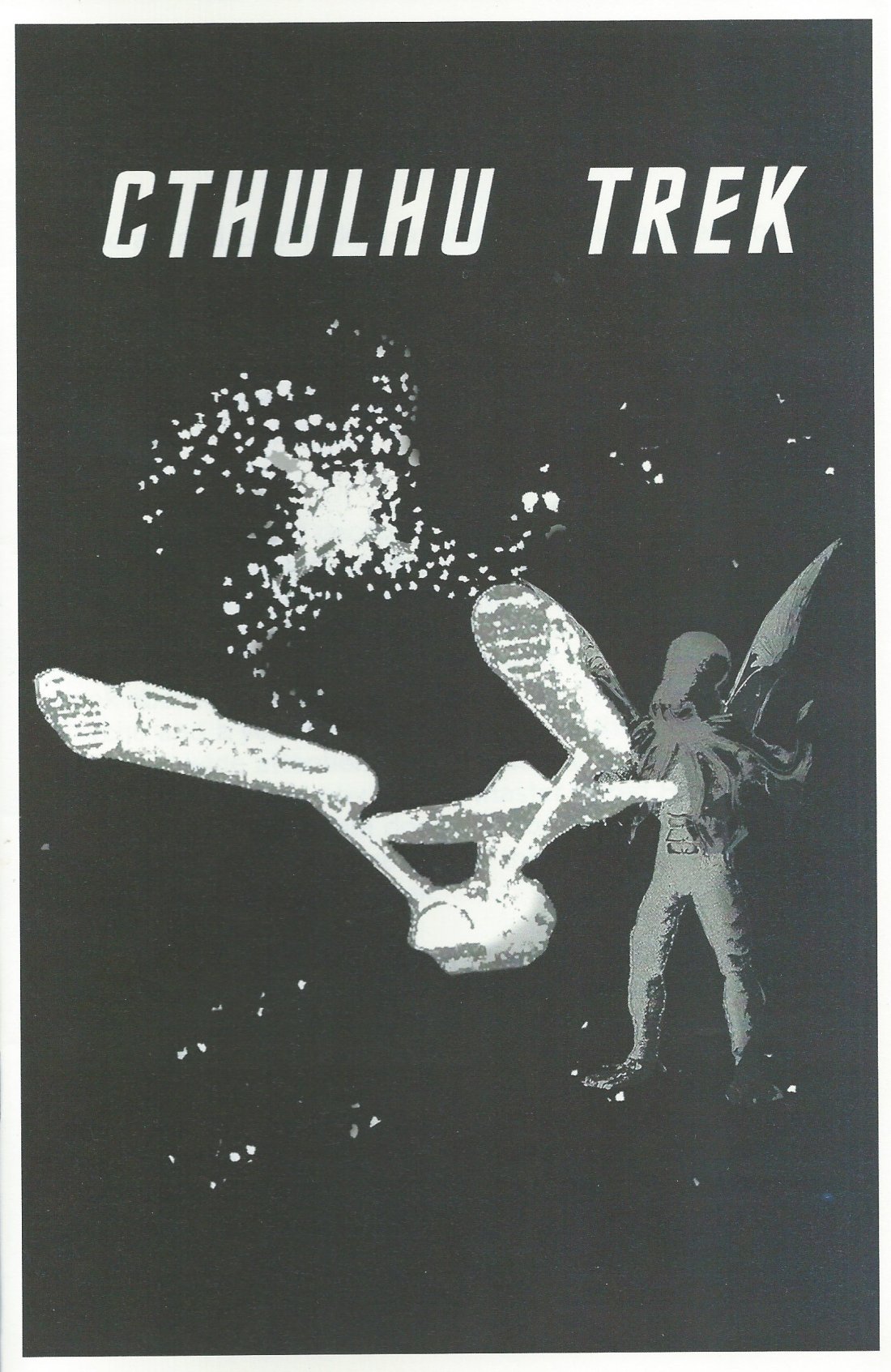
Cthulhu Trek (2008) by Leslie Thomas

Cthulhu Trek– Written and Edited Les Thomas, Layout and Illustrations Cabin Campbell, 1st. Edition, 2008. Star Trek collides with Lovecraftain horror. Robert Blochʼs Lovecraft/ Star Trek connection, Jeffery Combs HPL/ ST characters. Plus Sutter Cane (sometimes spelled Kane) Star Trek Fiction (Warning: Explicit sex and violence). $4.00
—Leslie Thomas, 13th Hour Books

In the early 1930s, science fiction fandom came into being. One of the characteristics of this fandom was the strong influence of the amateur journalism movement. It wasn’t just that there were fanatical readers of pulp fiction, but they documented their love and excitement, their fan art and fan poetry and fanfiction, their discussions and feuds.

Today, we talk about fandom studies with textbooks like the Fan Fiction Studies Reader because these early ‘zines are the trace fossils of the fans themselves, most of whom are sadly gone and can no longer give us living memories of what it was like to buy the magazines off the rack, to organize the first conventions, make their own costumes at home. To carry out debates by mail, and see the wonders and terrors of the Atomic Age and Space Age and finally the Digital Age be manifest around them.

As the fans grew up, fandom grew up with them. Scholars like Brian Wilson have traced the history of rule 34 from the first nude artwork that graced the 1930s fanzines to the Star Trek slashfic written and analyzed by Joanna Russ to the internet erotica of today. Things percolated together and got profoundly, lovingly, weird. Mash-ups between different genres, different properties, entirely different fandoms came together, often just for laughs or following some singular vision of “Hey, wouldn’t this be cool?” or “Hey, wouldn’t this be hot?”

Leslie Thomas is a fan of both Star Trek and the Cthulhu Mythos. His 2008 ‘zine Cthulhu Trek is a labor of love, an unpaginated 16-page staplebound black-and-white expression of profound and utter nerdiness—and it is, in many ways, an exemplar of what a fanzine can be: fun, scholarly by its own lights, and brimming with creativity and enthusiasm.

McCoy opened another cabinet and, from it he pulled out a small jar and handed it to Kirk. “I have to ask Jim, but did you have sex with a Yithian lately,” a slight smile crossed his kindly face as he place [sic] the alcohol back into its cabinet.
—Leslie Thomas, “Cream” in Cthulhu Trek

The first few pages of the ‘zine trace connections between Star Trek and the Mythos—principally via Robert Bloch, who wrote three episodes of the original series, and versatile actor Jeffrey Combs whose credits include multiple roles in both Star Trek series and various Lovecraftian films and adaptations, most especially the Re-Animator series, From Beyond, The Evil Clergyman, Necronomicon: Book of the Dead, and The Dunwich Horror (2009).

Like a good hoax, Thomas then transitions into fanfiction—presenting pieces of the Mythos-inflected Star Trek fiction of Sutter Kane. Of these, the bare two pages of Kirk picking up an extraterrestrial (or should that be extratemporal?) STD are perhaps the most memorable, although Chekov’s encounter with a dominatrix is certainly not something that will be forgotten in a hurry, barring blunt forced trauma to the head or the alcoholic equivalent.

Cthulhu Trek ends with the rather odd bit of trivia that Will Wheaton starred in The Curse (1987), a rarely-remembered film based on Lovecraft’s “The Colour out of Space.” Wheaton, of course, gained popularity by playing Wesley Crusher on Star Trek: The Next Generation, and if it feels weird to turn the page from Sulu in the grips of madness to a tidbit that feels straight out of the Internet Movie Database…well, it is. Like all fanzines, Cthulhu Trek is idiosyncratic, produced by one writer who was also his own editor, with Cabin Campbell as illustrator and layout artist.

Could Thomas have taken it further? Could he have produced a full-fledged erotic Star Trek/Cthulhu Mythos opus, self-published it, and reached the heights of fame that E. L. James did? Maybe. So could you. What he did instead was write and publish a funny little chapbook as a bit of amusement for himself and his fellow fans. Which is pratically the definition for what fanfiction is: the desire not just to create something inspired by some work, but to share it with others. That is what Cthulhu Trek is, ultimately; not a masturbation aid, but an endearing effort to share the love of Star Trak and the Cthulhu Mythos.


Bobby Derie is the author of Weird Talers: Essays on Robert E. Howard and Others and Sex and the Cthulhu Mythos.

Deep Cuts in a Lovecraftian Vein uses Amazon Associate links. As an Amazon Associate I earn from qualifying purchases.

A Transmasculine Horror Writer Looks At Lovecraft

A Transmasculine Horror Writer Looks At Lovecraft
by Joe Koch

If we speculate that all horror is body horror—and we may because the emotional energy experienced interacting with horror arises physiologically in the body—cosmic horror seems to be the exception. Body horror and cosmic horror stand at two opposite ends of a spectrum, the former associated with violence and grossing out the reader in the most carnal way, and the latter concerned with the mental horror of existential dread and terrible awe. When my Yellow Mythos novella “The Wingspan of Severed Hands” was called “cosmic body horror” by beta readers, the label sounded like a conundrum. I’ve thought about the contrast since then, and I’d like to share my impression of what unites the personal and cosmic by digging into Lovecraft’s body horror from a transmasculine perspective.

The horror of cosmic horror arises from the realization that humanity is insignificant in the universe. In Lovecraft, we are like ants under the crushing feet of indifferent elder things that intersect with our world from other dimensions. The threat of cosmic horror comes from outside the body, outside the mind, and outside of the entire framework of quotidian reality. There’s comfort in cosmic horror: the fact that an outside realm exists might mean escape is possible from the confines of the physical world. For anyone ill at ease in their body, the horror of cosmic horror holds a convoluted sort of hope.

Lovecraft’s stories create a world of escape from everyday concerns. Politics, economic struggles, romance, or any significant emotion besides terror takes a back seat to the moment of horror which comes at the end of a systematic mental journey of denial, analysis, and skepticism. The body with its immediate needs and routine desires is almost completely erased in Lovecraft’s fiction, except when the body itself becomes the location of horror.

I’m intrigued by how often it does.

Despite pervasive problematic views that make his work very hard to stomach as a queer, feminist, transmasculine person, what interests me in revisiting Lovecraft today is the very present question of the body. He seems to struggle with it. A nagging tension exists between the dysphoric body horror of his “reversion to type” tales and the fantasies of protagonists who escape their bodies by dreams, drugs, and alien intervention; a divergence between Lovecraft’s claims of scientific rationality and the utterly irrational astral travels he portrays with the veracity of desire.

Body swapping between humans and even alien entities in Lovecraft tales typically comes from the character’s desire to go beyond a given body’s limitations: to perhaps travel in space, interact with alien or forbidden technologies, or achieve a kind of immortality. Gender swapping occurs in “The Thing on the Doorstep” when the occult practitioner Ephraim steals his daughter Asenath’s body before his death, leaving her to perish in his corpse. Because he believes he needs a male body to achieve mastery, he romances and marries an older man while in his daughter’s body to gain access to the intimacy required for another body swap. Asenath’s female body is murdered after the swap, and the husband stuck in her rotting female corpse slogs around with his mind still alive trying to warn the narrator. The female body expires in a soupy mess on the narrator’s doorstep, fulfilling the horror of the title.

Just to be clear, this is no transgender person’s fantasy.

The most queer thing about “The Thing on the Doorstep” is the way Lovecraft reveals the multiple levels of body swapping. The layers covering up Ephraim’s true identity, layers of a possession within a possession, a mask within a mask, are peeled away one by one as the narrator realizes afterwards who he has been interacting with. The process of removing mask after mask rings true to me as a person who has gone through the rather shocking growth process of coming out to myself and then to others.

Gender nonconformity is presented in the story as an aberration, a belief shared by many conservatives today. The narrator shows disapproval and disgust when the female body of Asenath exhibits behaviors Lovecraft associates with masculinity. This external point of view is fixated on the binary and dwells on an impression of wrongness, evoking the fear that if we feel out of sync internally, others will see the mismatch and despise us for it, a fear gender nonconforming people often face. Some trans people overcompensate by performing their assigned gender so expertly as a cover up that they go through phases of self doubt, feeling like an imposter. Lovecraft gives Ephraim a hateful degree of misogyny as motivation for body swapping, with no room in his rigid view for gender fluidity.

Misogyny is a typical misconception about transmasculine people and transgender men. Reactionaries even frame it as an accusation against us, as if hatred of women drives our desire for self-expression. Nothing could be further from the truth. Misogyny is not the same as gender dysphoria in my experience. I’m a feminist. I express this strongly in my fiction. Yet if I could snap my fingers and wake up in a more masculinebody, I’d do it in a heartbeat. Not out of hatred or disdain; it’s a much more personal and intimate desire for outward presentation to align with my internal reality and to fulfill childhood visions of self.

The common term for what drives us to change is gender euphoria. When we are addressed using correct names and pronouns, and when we see ourselves represented in the body and external world as we know ourselves in our minds, we experience gender euphoria. Our motivation is not hatred but joy. We simply want to feel at home in our bodies, which I think is a very reasonable human wish.

From reading Lovecraft, I have the impression he didn’t feel very much at home in his body. He missed school often and failed to graduate due to a nervous breakdown (I Am Providence 1.97-102, 126-128). He confessed to suicidal thoughts in his letters several times, most explicitly:

The method was the only trouble. I didn’t like messy exits, & dignified ones were hard to find. Really good poisons were hard to get—those in my chemical laboratory (I reëstablished this institution in the basement of the new place) were crude & painful. Bullets were spattery & unreliable. Hanging was ignominious. Daggers were messy unless one could arrange to open a wrist-vein in a bowl of warm water—& even that had its drawbacks despite good Roman precedent. Falls from a cliff were positively vulgar in view of the probable state of the remains. Well—what tempted me most was the warm, shallow, reed-grown Barrington River down the east shore of the bay. I used to go there on my bicycle & look speculatively at it. […] How easy it would be to wade out among the rushes & lie face down in the warm water till oblivion came. there would be a certain gurgling or choking unpleasantness at first—but it would soon be over. Then the long, peaceful night of non-existence….
—H. P. Lovecraft to J. Vernon Shea, 4 Feb 1934, Letters to J. Vernon Shea et al. 222

He said that learning about human reproduction from a science book ended his interest in the subject of sex at an early age (“ I knew everything there is to be known about the anatomy and physiology of reproduction in both sexes before I was eight years old” Selected Letters 1.304). He died young partly due to his avoidance of doctors, seeking medical treatment for cancer when it was too advanced for anything other than palliative treatment. Clara Hess, a neighbor, recalled:

Mrs. Lovecraft talked continuously of her unfortunate son who was so hideous that he hid from everyone and did not like to walk upon the streets where people could gaze at him. (Ave Atque Vale 166)

Lovecraft wrote stories such as “The Shadow Over Innsmouth” and “Arthur Jermyn” rife with fear of being or becoming a monster hybrid. The discovery that they are genetically inhuman is the heart of the protagonist’s horror. An inherited “degenerative” element in the protagonist’s character triumphs over their intellect no matter how hard they fight, dragging them down the evolutionary ladder to engage in reprehensible, inhuman, and likely cannibalistic behavior. Intellect will be subsumed by madness because in Lovecraft, biological determinism always wins.

The monster is the body. The hero is the mind.

The mind of the protagonist, no matter how noble, is trapped in the body and doomed to express biology. Like modern gender critical theorists, Lovecraft claimed to believe only what science can objectively prove. This eugenicist point of view falls apart when the science of biology is not severed from the science of psychology and the larger body of the society, culture, and the full set of direct human experiences in which an individual’s gender is formed and reinforced.

I suspect if Lovecraft were alive today, he would tend to align with those who oppose transgender rights in a similar way that he aligned with the predominant view of his time classifying homosexuality as a perverse abnormality and crime. If he were interested in the subject of gender, and there’s not much to suggest he was beyond brief mentions in his letters of his repulsion for effeminate men (Sex and the Cthulhu Mythos 28-43), he would perhaps, like modern gender critical theorists, label people like me delusional.

There’s little in his work to welcome me, but ironically Lovecraft populated his work with portraits of body dysphoria that feel familiar. Gender dysphoria is the sense of unease or distress one feels when one’s gender identity and body don’t match. When it’s misinterpreted or denied, it may become extreme and debilitating. Lovecraft’s depictions of self-loathing, of the feeling of horror within the self and the sense of having inherited a biological curse that tortures a mind trapped in the wrong body strike a very similar tone. If torture seems too strong a word, check out the statistics for anxiety, depression, and suicide among transgender people who are denied medical care or who encounter familial and societal opposition to their mere existence (Transgender individuals at greater risk of mental health problems, Mental Health and the LGBTQ+ Community).

Feeling tortured by living in an incorrect body isn’t a universal transgender experience, but it’s a very common one. Shame and self-loathing can destroy quality of life, preventing a person from socializing or pursuing hobbies and career. I’ve had my share of days where like Lovecraft I “hid from everyone and did not like to walk upon the streets where people could gaze on him” due to the burden of gender dysphoria.

Owning it and taking action lifts the burden. I picture poor Asenath’s liquifying body from the ending of “The Thing on the Doorstep” as a symbol of self-loathing: this corpse-like and “foul, stunted parody” of self, a self fetid with dysphoria that I dutifully lugged around for half a century before coming out. The corpse in the story can’t speak, and the man inside it dies silenced, able only to deliver a scribbled note. I’m glad that’s not my fate.

In the real world, we’re stuck with one body, no swapping allowed. As transgender people, we know real life body horror. Knowing the opposite—euphoria, groundedness, and a deep sense of being at home in one’s body—is definitive of the transgender experience. And while our concern in this essay is horror, I think it’s vital to contrast the horror discussion with the empowering reality of the health, self-acceptance, and immense happiness transgender people enjoy when they practice freedom of expression and have access to corrective care. Modern discourse focuses on the negative statistics to emphasize a need for change or vilify us as unwell monsters, but my everyday reality is not a struggle with illness or horror. I’m significantly happier and in much better physical health now.

The parallels with coming out in Lovecraft’s fiction keep the horror intact. A protagonist’s success in going beyond the limitations of a story’s physical world won’t negate Lovecraftian biological determinism, but will usually lead to a different kind of body horror. The consequence of crossing the border between worlds is the creation of a bridge: be warned, once the (closet) door is opened, it can never be closed. Once the protagonist’s mind has transgressed liminal space, the body becomes liminal and thus subject to invasion by entities or energies from non-human dimensions, an often unwilling conduit between worlds.

Considered outside of Loveraft’s fiction, the body as liminal and changeable is a mere fact of existence. Time will change all of us, like it or not, as we age. Food, exercise, medications; all of the subtle and bold chemical alterations we make to the body impact the moods and cognitive functions of the mind. The mind doesn’t reign in isolation as a detached godhead; mind and body dynamically interact. I’d personally go so far as to speculate the mind may be a myth dreamed up by the body. If self is an expression of interconnecting systems and body is the engine of impermanence, Lovecraft’s cosmic horror is simply a restatement of physiological fact.

Is it really a horror to know oneself as permeable and changeable? In contrast to the horror tales, Lovecraft’s Randolph Carter stories such as “The Silver Key” and “The Dream-Quest of Unknown Kadath” depict flexibility as an asset. They show monsters and aliens as characters rather than unknowable forces. Carter can astral travel, time travel, and interact with other-dimensional spaces and entities. In navigating the dream world, Carter comes to know himself more fully as his quest sends him back to his childhood home, which may symbolically be the authentic body.

At the end of his story arc, Carter achieves a sort of immortality by inhabiting the liminal state of being neither alive nor dead. The horror of permeability fades with the explorer’s increased pleasure and mastery in negotiating a wider range of experience.

Transgender people tend to live, at least for some time, in a liminal state between the gender binary extremes, as neither male nor female. We may lack access to obtain care for aspects of medical transition, we may need to delay it for a variety of reasons, or we simply may not want it. Many nonbinary and agender people in particular seek no physical alteration to the body and continue to present according to society’s standards for their assigned gender. This is why one must never assume another person’s gender based solely on their appearance.

On the uncertain or transgressive borderline between things which can and can’t be known, things neither alive nor dead, we run up against cosmic horror that is not body horror. Lovecraft unintentionally captured the experience of body dysphoria in his work, and the yearning for transformation beyond physical limitations is a fantasy he engaged with in his fiction repeatedly. Whilewe can posit all horror is body horror because the mind is dependent upon the body’s processes for input and existence, I think this is too limiting. It’s as if we’ve given ourselves a diagnosis of awe as a mere chemical or physiological anomaly. Even the staunch biological determinist Lovecraft pointed to something much bigger in the scope of the cosmos.


Joe Koch (He/They) writes literary horror and surrealist trash. Joe is a Shirley Jackson Award finalist and the author of The Wingspan of Severed Hands, The Couvade, and the forthcoming collection Convulsive from Apocalypse Party Press. Their short fiction appears in Year’s Best Hardcore Horror, Not All Monsters, Liminal Spaces, and many others. Find Joe online at horrorsong.blog and on Twitter @horrorsong.

Copyright 2022 Joe Koch.

“The Fluff at the Threshold” (1996) by Simon Leo Barber

WHICH ELDER BEING MAKES THE BEST SEX PARTNER?
There are many opinions, but shoggoths come well recommended for sheer versatility.
Thus:
Found posted by: Nyar@blibble.demon.co.uk, November 1994
Retyped in by: Kevin@fairbruk.demon.co.uk (so the typos are all my fault)

10 Reasons why a shoggoth is the perfect lover
———————————————-
1) It can form any pseudopod, and thus can form the perfect extrusion or cavity to suit your needs.

2) It will sleep on the wet patch, or on the floor, or even in the garage.

3) It can keep going as long as you want it to.

4) Since it has a different biological basis, it cannot give you any form of STD, and thus barrier methods are not required. Please remember to wash your shoggoth in an antiseptic if sharing between partners.

5) It cannot get you pregnant

6) It can give you a back massage, answer the phone, open a beer, have sex with multiple people, change the CD _and_ take dictation all at the same time. (They also make good secretaries.) They do have a slight problem with Microsoft Word for Windows though, no-one is quite sure why.

7) It can hold the door shut so no-one can burst in on you.

8) It never suffers from impotence or headaches.

9) It will respect you in the morning and will not leave you for someone else (unless they happen to know ‘bind shoggoth’ as well. At this point your shoggoth will get very confused, split into two shoggoths, and bits of both will keep commuting between the two masses. Great for parties.)

10) It won’t insist on you meeting it’s parents. (If you do meet its parents, lose 1d6/0 SAN.)

Nyar – now all I have to do is learn to summon one…

alt.sex.cthulhu FAQ (29 May 1997)

On 30 November 2001, a would-be erotic fanfiction writer under the pseudonym Winston Marrs (lifted from a character in the 1994 Shadowrun game for Sega Genesis) uploaded a story titled “The Mother of Cthulu” (sic) to an erotic fanfiction site called The Grey Archive. Via the internet archive, you can revisit the Grey Archive just as it was on the day the story was posted—but you can’t read it. The archive didn’t try to capture “The Mother of Cthulu” until after the Grey Archive had changed its hosting service, and the old addresses all led to spam sites. Nor did anyone else apparently think to preserve Winston Marrs’ erotic opus elsewhere on the internet.

“The Mother of Cthulu” is lost to time.

Which is a fate that has probably occurred to the bulk of erotic Lovecraftian fanfiction on the internet over the last twenty-plus years. Erotica is an inherently disposable mode of fiction; with rare exception the literary and artistic value of individual works doesn’t overcome the taboo nature of ownership. Erotic fiction on the internet faces additional challenges: site owners and administrators retire or pass away, copyright claims can deter downloading or hosting content, file formats go obsolete, changes in search engines make finding it harder. While a number of fans have written adult-oriented Mythos fiction, much of it is by its very nature obscure to the casual user—or even the dedicated researcher.

In the early days of computer networking, popular networks like Usenet fulfilled the function that forums and social media sites do today. Many of these early networks, and the world wide web they began to interact with, were poorly or incompletely archived, like the Grey Archive above. Bits and pieces still exist, in some form or another. Google acquired the Usenet archives in 2001, and you can still visit Usenet groups like alt.sex.cthulhu today—if you’re willing to dig through twenty-plus years of pornographic spam.

Fortunately, if you dig down far enough, you don’t have to. Back around 1996, an archive site for alt.sex.cthulhu was created at cthulhu.org, and the Internet Archive has a copy of that. These were stories originally posted to the alt.sex.cthulhu Usenet group in the mid-to-late 1990s…which is probably as far back as internet Lovecraftian erotica can go. Included in this archive is “The Fluff At The Threshold” by Simon Leo Barber…which can serve as an exemplar of Lovecraftian erotic fanfiction during this period. A core sample from the digital Mountains of Madness.

It was to my cousin’s house on Carcosa Crescent that I came that December, to look over the property and to set the place in order. I had been long overseas, first working as an assistant to the Professor Of Difficult Sums at Celaeno Gate College in the sultry Celebes Islands, and then recalled to the family Regiment when it formed up at the end of the War of Liberation in 2029, when the stranglehold of the EC over the (now happily Nationalised) landmass of Europe, had been so crashingly broken.
—Simon Leo Barber, “The Fluff At The Threshold”

One of the hallmarks of this story is that it is pretty much pure pastiche—while the setting is in the (now not so far and distant) future of 2029, in a near-Cthulhupunk setting, Barber is deliberately invoking tropes of Mythos fiction past: the inheritance gambit, where a relative died and now the protagonist inherits their property and its terrible secrets.

The setting is almost surreal, the kind of mish-mash of 90s references and silliness one might expect to find in a bizarro novel today. This is not porn-without-plot, there’s a fair narrative built up before we get to anything that might be mistaken for a naughty bit. As weird as it may sound, while this exact combination of strangeness may never have been arrived at before or since, the thread of humor in the story is exceptionally characteristic of much fanfiction in the period. The general attitude toward the material is reminiscent of farcical works like Bored of the Rings and National Lampoon’s Doon, or the Lovecraftian episode of The Adventures of Samurai Cat.

Good clean fun…well, maybe not entirely clean.

“Our Dark Mother Of The Woods,” I smiled to myself, making a reverent sinuous gesture, as tentacle-like as an internal skeleton would allow, to Shub-Niggurath, the Dark Goat Of The Woods With A Thousand Young. “Or, as they’d call her under the EC’s Correction Enforcement Policies, “The Ethnically Coloured Caprine Deity-Person of The Sylvan Ecosystem With The Relaxed Attitude To Birth-Control”……..”
—Simon Leo Barber, “The Fluff At The Threshold”

Readers looking for exquisite descriptions of shoggoth sex should probably look elsewhere. While there is that kind of smut on alt.sex.cthulhu archives and elsewhere, this is a Mythos story about sex in the same way that “The Dunwich Horror” or “The Shadow over Innsmouth” is—just one that takes place in a dystopic future full of talking animals.

Which is, in its own way, a testament to the kind of variety one sees in erotic fanfiction. It’s not all hardcore pornography, nor has it ever been. While there is plenty of sexually explicit Lovecraftian fanfiction out there, on sites like Literotica.com and the Alt Sex Stories Repository, the erotic impulse isn’t restricted to just the nastiest and most explicit kink-laden literary porn one can dream up…it can be fun too.


Bobby Derie is the author of Weird Talers: Essays on Robert E. Howard and Others and Sex and the Cthulhu Mythos.

Deep Cuts in a Lovecraftian Vein uses Amazon Associate links. As an Amazon Associate I earn from qualifying purchases.

Her Letters To Lovecraft: Genevieve K. Sully & Helen V. Sully

Genevieve K. Sully, who wrote to you, is the mother of Helen Sully. Helen met HPL in 1933, and also met Donald [Wandrei]. Donald, in his visit to California, spent much time at the Sully home. HPL’s letters to the Sullys, from what I have seen of them, are marvelous and show a slightly different and most lovable angle of his multi-sided personality, together with amazing knowledge of California history and western sorcery.
—Clark Ashton Smith to August Derleth, 13 Apr 1937, Eccentric, Impractical Devils 255

Genevieve Knoll was born in 1880. She married James O. Sully in 1903, the same year she graduated from the University of California – Berkeley. James Sully is listed in the 1910 U.S. Census as a year older, self-employed, and an English immigrant who had been naturalized. The Sullies had two daughters: Helen V. (b. 1904) and Marion (b. 1911). Not much is known about their life and marriage; the 1920 U.S. Census lists two Genevieve Sullies in California, with daughters Helen and Marion, one in Berkeley (with James as head of household) and one in Auburn (without), and one suspects that they were separated at this point, perhaps for economic reasons (more work in Berkeley)—there are suggestions in Clark Ashton Smith’s letters that Genevieve was splitting her time between Auburn and Berkeley, and was married at least as late as 1925 (Dawnward Spire, Lonely Hill 75). By the time of the 1930 U.S. Census, Genevieve and James were listed as divorced. While in Auburn, the Sullies met a young poet, artist, and day-laborer named Clark Ashton Smith who cared for his two aging parents:

It was in the fall of 1919 that we first met Clark and became interested in his poetry. We were all congenial from the start. We also took many walks in the foothills near Auburn, enjoying the woods, rocks and flowers, Clark Always adding to our love and appreciation of Nature.
—Genevieve K. Sully, Emperor of Dreams: A Clark Ashton Smith Bibliography 190

Genevieve was 39 in 1919; Clark Ashton Smith was 26. They remained friends—and perhaps more than that—for decades. We get only scattered references to her in Smith’s letters, and a handful of letters to her are reprinted in the Selected Letters of Clark Ashton Smith, showing that they were close friends and she was an admirer and promoter of his art. While no letters yet published have explicitly referred to a sexual relationship, their acquaintence has long been considered an affair, and at one point he had even made out a last will and testament bequeathing her his library, paintings, and art objects (EID 309). One of her most significant impacts on Smith, as far as weird fiction fans are concerned, was apparently encouraging Smith to write for Weird Tales:

One hot summer—that of 1927—when we were all wilted and tired of the heat, we invited Clark to go with us on a camping trip to the moutnains in the Donner Peak-Summit region. In order to take this trip, CLark had to make complicated arrangements for the comfort of his parents. […] It is hard for anyone to believe the primiaitive way in which the SMiths lived—no running water or electricty, and a kichen stove as the only means of heat and cooking. […]

After a few days of short walks, we proposed a longer walk—to Crater Ridge—where we had gone many times in the past, but now we were going with a companion who came under a spell of strange thought, transforming the scene into a foreboding and grotesque landscape, which Clark later used in his now famous story, “The City of the Singing Flame.” Clark wandered about among the boulders, studying the rocks and general terrain. We could all see that he was deeply affected by the place.

Later in the afternoon while Clark was still feeling a strange influence, after we had sat down to looka t the views which combine to make this place especially beautiful, I suddenly sugested that he use his powers of writing for fiction, which would be more emuneratie than poetry. His financial situation at the time was critical, and some practical advice seemed in order.
—Genevieve K. Sully, Emperor of Dreams: A Clark Ashton Smith Bibliography 190

Whether it was this exact trip or another, something like this certainly happened, for Smith confirmed it:

About eighteen months ago, I was taken to task for idleness by a woman-friend, and pledged myself to industry. Once started, the pledge has not been hard to keep.
—Clark Ashton Smith to H. P. Lovecraft, c. Jan 1931, Dawnward Spire, Lonely Hill 297

Relatively less is heard of Helen and Marion during this period, though both women graduated highschool and apparently university, with a focus on music. Both of them would also have heard of H. P. Lovecraft, for during one trip Smith read aloud one of his stories to them by campfirelight:

By the way, I read your “Picture in the House” aloud one evening by the light of our campfire in the mountains; and it was received with great enthusiasm by my hostess Mrs. Sully and her daughters.
—Clark Ashton Smith to H. P. Lovecraft, 22 Aug 1930, Dawnward Spire, Lonely Hill 227

In 1933, Helen was a 29-year old and working as a teacher of music and art at the Auburn highschool, when she decided to take a trip by boat through the Panama Canal, with a stop in Cuba, and then New York, Providence, Quebec, and Chicago for the 1933 World’s Fair. Smith was conscientious to write ahead to Providence and New York so that Helen V. Sully would have a warm welcome.

My aunt & I will be greatly pleased to welcome your friend Miss Sully if she visits Providence, & can undoubtedly display enough historic & antiquarian sights to fill a sojourn of any duration. If the East is new to her, she will find in its many evidences of long, continuous settlement a quite unique fascination.
—H. P. Lovecraft to Clark Ashton Smith, 14 Jun 1933, DS 420

I think a day will enable Miss Sully to see most of the historic high spots of urban Providence, & I shall be glad to exhibit them when she arrives. Tell her to let me know exact place & date of arrival, & I will be on hand—trusting to ingenuity in establishing identification. When she is in New York she ought without fail to look up the Longs—230 West 97th St. They are in a better position to entertain her than any other “gang” family, having a pleasant apartment, a lavish table, a car, & a servant. Sonny Belknap is one of your staunchest admirers, whatever may be his lapses as a correspondent. The Longs’ telephone is Riverside 9-3465.
—H. P. Lovecraft to Clark Ashton Smith, 29 Jun 1933, DS 423

I trust Miss Sully’s trip is proving pleasant; & shall, unless contrarily instructed, be on the lookout July 19 at 6 a.m. at the Colonial Line pier . . . . which lies right in the lee of the ancient hill’s southerly extremity, on a waterfront having considerable picturesqueness. The yellow poppy ought to facilitate identification—though it’s too bad you couldn’t have furnished some of your typical nameless vegetation from Saturn & Antares! A second day in Prov. would enable many picturesque suburbs, (& perhaps ancient Newport) as well as the city proper to be covered; thus affording an extremely [good] picture of R.I. I hope that young Melmoth & Sonny Belknap [take] part in displaying seething Manhattan to the visitor—[& if she is] not already provided with Bostonian guidance, I think that [W. Paul] Cook would be delighted to shew off the Athens of America. I [envy] Miss Sully her coming sight of Quebec—to which I fear I can’t get this year, since my aunt’s accident will probably prevent any long absences on my part.
—H. P. Lovecraft to Clark Ashton Smith, 12 Jul 1933, DS 425-426

Hope I haven’t bored Klarkash-Ton’s gifted emissary with colonial sights. We tried a new boat today–a rival to the old Sagamore. Yr obt Grandsire
Melmoth III
and Helen
—H. P. Lovecraft and Helen Sully to Donald Wandrei, 20 Jul 1933, LWP 306

Elsewhere in his letters, Lovecraft joked that his young friends Frank Belknap Long, Jr. and Donald Wandrei nearly fought a duel over the right to host Miss Sully:

By the way–a very gifted & prepossessing friend of Klarkash-Ton’s in Auburn is touring the east (after a trip through the Panama Canal & to Cuba) for the first time, & looking up his various friends & correspondents….a young gentlewoman, a teacher of music & drawing, named Helen V. Sully. She looked up Wandrei & Belknap in N.Y., & the Longs brought her here in their car when ound for Onset last Wednesday. After seeing Prov. & Newport she has gone on to Gloucester & Quebec. On the return trip she will pass through Chicago & look up Wright–& if you can get down there (about Aug. 8 or 9–I’ll let you known when she decides & notifies me), she would like very much to meet you. Try it if possible.
—H. P. Lovecraft to August Derleth, 23 Jul 1933, Essential Solitude 2.595-596

Sorry you won’t be in Chicago during Miss Sully’s brief stay there–she is an extremely intelligent & prepossessing young person, & Wandrei & Sonny Belknap nearly fought a duel (2 syllables, not rhyming with cool!) over the question of precedence in escorting her about New York during her sojourn in the place. Whether her predetermined tourist itinerary will permit of a side-trip to Sauk City I don’t know, but I’ll pass your invitation on when writing her next momentary address. She gives quite an interesting picture of good old Klarkash-Ton–who would seem to be sorely hadnicapped by poverty, parental dominance, & a generally uncongenial environment.
—H. P. Lovecraft to August Derleth, late Jul 1933, Essential Solitude 2.598-599

Helen didn’t manage to get to Sauk City to see Derleth, but she met Weird Tales editor Farnsworth Wright in Chicago before returning home.

news

The Placer Herald, 22 July 1933

The 1933 trip is perhaps more remembered by Lovecraft fans for her brief memoir of the visit, “Some Memories of H. P. L.” (originally published as “Memories of Lovecraft: II” in 1969), where she wrote that he insisted on paying for all the expenses of her brief stay in Providence, despite his economic circumstances…and for one anecdote in particular:

That night, after dinner, he took me down into a graveyard near where Edgar Allan Poe had lived, or was he buried there? I can’t remember. It was dark and he began telling me strange, weird stories in a sepulchral tone and, despite the fact that I am a very matter-of-fact person, something about his manner, the darkness, and a sort of eery light that seemed to hover over the gravestones got me so wrought up that I began running out of the cemetery with him close at my heels, and with the one thought that I must get up to the street before he, or whatever it was, grabbed me. I reached a street lamp trembling, panting, and almost in tears and he had the strangest look on his face, almost of triumph. Nothing was said.
—Helen V. Sully, “Some Memories of H. P. L.” in Ave Atque Vale 365-366

She apparently shared this sensation with Lovecraft, as he later wrote to her:

About the hidden churchyard of St. John’s—there must be some unsuspected vampiric horror burrowing down there & emitting vague miasmatic influences, since you are the third person to receive a definite creep of fear drom it….the others being Samuel Loveman & H. Warner Munn. I took Loveman there at midngiht, & when we got separated among the tombs he couldn’t be quite sure whether a faint luminosity bobbing above a distant nameless grave was my electric torch or a corpse-light of less describably origin! Munn was there with W. Paul Cook & me, & had an odd, unacountable dislike of a certain unplaceable, deliberate scratching which recurred at intervals around 3 a.m. How superstitous some people are!
—H. P. Lovecraft to Helen V. Sully, 17 Oct 1933, Letters to Wilfred B. Talman and Helen V. and Genevieve Sully 305

More important, however, was what that visit led to: a correspondence between Lovecraft and the Sullies.

The next day, I left. I wrote to thank Mr. Lovecraft for all his kindness. […] Our correspondence dated from my first letter to him. My impulse was to answer immediately. But he, in turn, always answered almost by return mail. His letters were so voluminous and must have taken so long to write and I felt his talents should be used elsewhere: and always felt guilty that he should spend so much time on me. The result was that I deliberately became less punctual about writing, to my present regret, because I do not think now that I was taking his time from more valuable work. My writing became more and more sporadic, but I think we corresponded up to a time near his death.
—Helen V. Sully, “Some Memories of H. P. L.” in Ave Atque Vale 366

The surviving correspondence consists of 25 letters, dating from immediately after Helen’s note of thanks in July 1933 until July 1936. As Clark Ashton Smith said, the letters are full of Lovecraft’s typical erudition, ranging widely in subject, going over his travels and politics, Arthur Machen’s The Hill of Dreams and Howard Wandrei’s artwork among many others. She in turn wrote of her hiking trips and visits to Clark Ashton Smith, her friends and other issues…and, perhaps, opened up to him a little about her inner life.

By mid-1934, Helen had confided to Lovecraft a sense of melancholy or oppression about life—in fact, thoughts of death, and perhaps suicide—exactly what she said is unclear, as we only have Lovecraft’s side of the correspondence, but there is a thread in their correspondence on happiness and the meaning of life where Lovecraft portrays both a sort of objective optimism about life and death, which lasted over a year. The culmination of this line of thought was in 1935, where he seems to quote from her own letters about feeling “hopeless, useless, incompetent, & generally miserable” (LTS 423)—to which Lovecraft responded by pointing out how gifted she was, and how much more miserable he should be in his own circumstances, and finally says:

So—as a final homiletic word from garrulous & sententious old age—for Tsathoggua’s sake cheer up! Things aren’t as bad as they seem—& even if your highest ambitions are never fulfilled, you will undoubtedly find enough cheering things along the road to make existence worth enduring.
—H. P. Lovecraft to Helen V. Sully, 15 August 1935, LTS 431

This is a side of Lovecraft that is rarely seen; the closest point of comparison is probably in 1936 when Lovecraft did his best to keep C. L. Moore occupied after the death of her fiancé. Perhaps it even helped; Helen V. Sully lived a long, full life. In remembering him in 1969, she ended:

Anyone who came into contact with him could not fail to realize that here was a rare and unique person, of great refinement and brilliant intellect, and one who combined the genius which produced his finest writings and the attributes of a true gentleman.
—Helen V. Sully, “Some Memories of H. P. L.” in Ave Atque Vale 366

There is far less to say about the correspondence between Lovecraft and Genevieve K. Sully. Only four letters from Lovecraft to her are known to survive, dating from 1934 to 1937, and Lovecraft may have conveyed respects to her through his letters to Helen V. Sully and Clark Ashton Smith rather than corresponding with her directly for the most part. The 1934 letters apparently were sent to commemorate trips that Mrs. Sully had taken and included gifts including an “elongated, acorn-like object which somewhat baffles my botanical ignorance” (LTS 473)—probably an immature Redwood pine cone. She also reported on Donald Wandrei’s visit to see Clark Ashton Smith in November 1934, during which Wandrei was hosted by the Sullies.

The final letter, dated 7 February 1937, is a belated response to a 1936 Christmas card or letter that Genevieve K. Sully had thought to send to him, and includes a copy of his poem “To Klarkash-Ton, Wizard of Averoigne” and reports on the local cats, and on coming into acquaintence with Jonquil & Fritz Leiber Jr. Perhaps there were other letters, now lost; the genial tone and subjects of the last epistle suggests they might have kept up a sporadic correspondence. Lovecraft signed off with: “Best 1937 wishes for all the househould.—Yrs most sincerely—H. P. Lovecraft” (LTS 487).

Nor did the Sullies forget Lovecraft in later years. Clark Ashton Smith wrote to August Derleth in the 1940s:

Don’t forget my extra copy of Beyond the Wall of Sleep. The one you sent me will go as a slightly overdue birthday gift to Mrs. Sully’s daughter Helen (Mrs. Nelson Best) who met Lovecraft through my introduction back in 1933.
—Clark Ashton Smith to August Derleth, 30 Nov 1943, EID 342

Can you send me another copy of Something About Cats and add it to my bill? I want it for a girl who once met Lovecraft.
—Clark Ashton Smith to August Derleth, 7 Dec 1949, EID 412

Many fans may only know Helen V. Sully as “a girl who once met Lovecraft,” but that rather understates the relationship. Taken together, Lovecraft’s correspondence with Genevieve K. Sully and Helen V. Sully was fairly substantial, and covered aspects of geography and philosophy which he did not broach with any other correspondent. While we can only speculate what it meant to a young woman who felt depressed in her daily life to receive a letter from a kind older man who write to her about cats and to “for Tsathoggua’s sake cheer up!”…perhaps it helped. What more can any human being do for another, when they’re feeling down?

Fourteen letters and postcards to Helen V. Sully were excerpted for volumes IV and V of the Selected Letters of H. P. Lovecraft; all twenty-five pieces of correspondence were published in full, along with the four letters from Genevieve K. Sully, in Letters to Wilfred B. Talman and to Helen V. and Genevive Sully. Several of the original letters can be viewed online.


Bobby Derie is the author of Weird Talers: Essays on Robert E. Howard and Others and Sex and the Cthulhu Mythos.

Deep Cuts in a Lovecraftian Vein uses Amazon Associate links. As an Amazon Associate I earn from qualifying purchases.

“Celui qui suscitait l’effroi…” (1958) by Jacques Janus

In France, Jacques Bergier and Louis Pauwels discovered and launched him. They had spoken of him as early as Le Matin des magiciens, and gave him a significant role in their great enterprise by publishing a tale of his in the first issue of Planète. To them we owe our first encounter with the “grand génie venu d’aileurs,” and we are deeply gratefl to them. Thanks to them, Lovecraft is, paradoxically, better known and more appreciated n France than in his own country.
—Maurice Lévy, trans. S. T. Joshi, Lovecraft, A Study in the Fantastic 12

Translated collections of Lovecraft’s work began to appear in France in the 1950s, beginning with La Couleur tombée du ciel (1954, Editions Donoël). Yet Lévy is correct that Bergier and Pauwels played a substantial part in raising awareness of Lovecraft in France during the 1960s; first in their conspiratorial opus Le Matin des magiciens (1960) translated into English as The Morning of the Magicians (1968), an incredibly influential work that helped popularize everything from Ancient Astronauts to Nazi occultism, and then in the French science fiction magazine Planète (1961-1972) which they co-edited.

In the first issue of Planètewhich included a translation of Lovecraft’s “Hypnos”, Bergier claimed that he had actually corresponded with H. P. Lovecraft for six years in the 1930s, and quoted from his letters about “The Music of Erich Zann.” Scholars consider this correspondence apochryphal—Lovecraft makes no mention of a French correspondent, and Bergier was never able to present the letters—but not impossible. After all, issues of Weird Tales made their way to continental Europe in the 1930s, and Bergier had two letters published in Weird Tales, in the March 1936 and September 1937 issues; it would not have been impossible for him to have written Lovecraft care of the editor of the magazine.

Then again, Bergier had a complicated life, and many of his more fantastic claims could not be verified; a point Patrick Clot touches on in “Jacques Bergier, mythe ou réalité?,” his preface to Bergier’s in Admirations (2001). One of the stranger episodes involves one of the first French-language original Cthulhu Mythos stories.

Satellite (1958-1962) was a French science fiction magazine, which featured a combination of translated material and original French-language fiction. The third issue included the Mythos pastiche “Celui qui suscitait l’effroi…” (“The One Who Arouses Fear…”) by “Jacques Janus”—with an introduction by Bergier:

Il était une fois un peintre et un docteur tous deux également épris de science fiction au point de passer des journées entiéres à la Bibliothèque Nationale pour y découvrir les trésors enfous dans les viuex «ROBINSON» d’avant-guerre.

Ils s’ignoraient jusq’au jour où ils réclameérent en même temps un episode passionnant de GUY L’ÉCLAIR…

Et de cet ÉCLAIR devait jaillir Jacques JANUS, un auteur bien particulier puisqu’il n’a jamais écrit que des pastiches, mais don’t la plupart sont de véritables bijoux, plus vrais que nature.

Nous en avons sélectionnés quatre autres que nous vous présenterons dans les mois à venir.
 
Voici pour aujourd’hui un récit noir, trés noir et cependant chargé d’intentions ironiques que vous ne manquerez pas de noter au passage…
 
A Jacques Bergier
Once upon a time, there was a painter and a doctor, both equally fond of science fiction to the point of spending whole days at the Bibliothèque Nationale to discover the treasures buried in the pre-war “ROBINSON” books.

They did not know each other until the day when they demanded at the same time an exciting story of FLASH GORDON…

And from this FLASH was to spring Jacques JANUS, a very special author since he only ever wrote pastiches, but most of which are real jewels, larger than life.

We have selected four others that we will present to you in the months to come.

Here is a black story for today, very dark and yet full of ironic intentions that you will not fail to note in passing…

Jacques Bergier
Satellite no. 3 (Mar 1958) 93

Two things stand out in this opening: the claim that “Jacques Janus” is a collaborative pseudonym between Bergier and another writer (which makes sense: Janus is the Roman god of two faces), and that a total of five pastiches were planned. These apparently didn’t pan out: I have only been able to find one more story under this name: “Une Librairie… Très Spéciale” in Satellite no. 9 (Sep 1958), a pastiche of Robert Sheckley.

“Celui qui suscitait l’effroi…” has been reprinted only once, in Jean-Jacques Nguyen’s fanzine Le Courrier d’Arkham (1991). Nor has it ever been translated into English in any anthology or periodical. It was written at a time when the Cthulhu Mythos wsa dominated by pastiche, much of it from August Derleth, and which included his novel The Lurker at the Threshold (1945), but before Lovecraft’s popularity really bloomed in France in the 1960s. The result is a quirky, but very lovingly rendered effort by a pair of dedicated Lovecraft fans to write an original tale in the style of Lovecraft.

The opening sets the scene:

J’ai longtemps gardé le silence, espérant que ma mort viendrait éteindre jusqu’au souvenir de la deplorable publicité faite autour de mon nom durant tout le mois de septembre 1923 à la première page de l’Arkham Advertiser ainsi que dans les principaux journaux du Massachusetts.

Mais je viens d’apprendre que des archéologues aussi réputés que le professeur Arthur Kennelon et que Sir Dennis Osterwell s’apprêtaient à entreprendre de nouvelles fouilles sur la vieille colline de Ranwich. Je crois de mon devoir aujourd’hui de parler et de répéter une fois encore ce que je n’ai cessé d’implorer tout au long du procès: qu’on laisse la tour s’écrouler… que personne ne touche à la paroi Maudite de la dernière cave…

Hélas, j’écris ces lignes à regret car je sens qu’ils auront la légèreté coupable de n’y attacher aucune importance réelle.

Aucun être n’a, je pense, éprouvé autant d’attachement, autant de solicitude attentive que moi pour l’homme qui se nommait Rolf Chapvet. Aucun ne l’a observe avec une curiosité aussi insatiable, avec une perseverance plus soutenue et il n’est personne au monde qui puisse affirmer l’avoir mieux connu.

Pourtant j’attest que ce sont bien mes doigts qui ont imprimé leurs marques sur sa peau blême au cours de l’effroyable nuit dans le caveau Shadmeth. Ce sont mes mains qui ont serré son cou glacé et c’est dans mon esprit, guidé par la certitude absolue de débarrasser la Terre du plus abominable monster qu’elle ait jamais porté, que j’ai puisé le courage necessaire pour aller jusqu’au bout de ce contact hideux et pour étrangler sans remords cette creature qui n’aurait jamais du être appellee à la vie.
I kept silent for a long time, hoping that my death would extinguish even the memory of the deplorable publicity made around my name during the whole month of September 1923 on the front page of the Arkham Advertiser as well as in the principal newspapers of Massachusetts.

But I have just learned that such renowned archaeologists as Professor Arthur Kennelon and Sir Dennis Osterwell are preparing to undertake new excavations on the old hill of Ranwich. I believe it is my duty today to speak and to repeat once again what I have constantly implored throughout the trial: that the tower be allowed to collapse… that no one touch the cursed wall from the final cellar…

Alas, I write these lines with regret because I feel that they will recklessly not attach any real importance to them.

No being has, I think, felt as much attachment, as much attentive solicitude as I for the man who was called Rolf Chapvet. No one has observed him with such insatiable curiosity, with more sustained perseverance, and there is no one in the world who can claim to have known him better.


Yet I attest that it was my fingers that left their marks on his pale skin during the dreadful night in the Shadmeth vault. It was my hands that gripped his frozen neck and it was in my mind, guided by the absolute certainty of ridding the Earth of the most abominable monster it had ever borne, that I drew the courage necessary to go as far as at the end of this hideous contact and to strangle without remorse this creature which should never have been called to life.
Satellite no. 3 (Mar 1958) 93-94

The story is set in Lovecraft country; principally in and around Arkham. Indeed, an English translator might well simply retitle it “The Ranwich Horror” to emphasize the degree to which the author is riffing off of “Dunwich” in their naming. The opening narration is very strongly reminiscent of Lovecraft’s “The Thing on the Doorstep,” and much of the unnamed narrator’s focus is on the strange history of his friend Rolf Chapvet, beginning with his father:

Jonathan Chapvet était l’homme le plus paisible du monde, du moins à l’époque où je le connus. Il avait énormément voyage, au cours d’une vie bien remplie et sa demeure, une des plus belles de la ville, était bourrée d’objets exotiques et singuliers ramenés de tous les coins du monde et don’t les forms déconcertantes pour la plupart des habitants de la cite qui n’avaient jamais quitté la Nouvelle Angleterr, n’étaient sans doute pas étrangères aux rumeurs qui couraient sur son compte.

Elles cessèrent d’ailleurs lorsque Jonathan se maria et qu’il s’intall définitivement à Arkham pour y exercer la profession tranquille d’architecte.

A la lumière de ce que je sais maintenant, je ne peux m’empêcher de croire qu’il y avait quelque chose d’assez déconcerant dans les conceptions architecturales de Jonathan.
Jonathan Chapvet was the most peaceful man in the world, at least when I knew him. He had traveled a lot during a busy life and his home, one of the most beautiful in the city, was stuffed with exotic and singular objects brought back from all over the world and whose forms were disconcerting for the most part. inhabitants of the city who had never left New England, were doubtless no strangers to the rumors which ran about him.

They ceased when Jonathan got married and settled permanently in Arkham to practice the quiet profession of architect.

In light of what I know now, I can’t help but believe that there was something rather disconcerting about Jonathan’s architectural designs.
Satellite no. 3 (Mar 1958) 95-96

Much of the story makes direct reference to H. P. Lovecraft’s map of Arkham, which had been published by Arkham House in Marginalia (1944). If you have the map, you can follow along as the story as it references Saltonstall Street and Garrison Street, and you know what the narrator is talking about when he mentions the deserted island in the middle of the Miskatonic River.

The elder Chapvet died, and Rolf grew up strange, morbid, and brilliant, surrounded by rumors. At one point after his father’s death illness seized him:

Son corps se tordait, son visage devenait blanc, ses narines se pinçaient, tandis qu’il roulait des yeux hagards qui paraissaient voir un spectacle inconnu des hommes.

Il arrivait à l’enfant de prononcer d’étranges paroles où revenaient sans cesse des mots  inconnus comme Askairoth… Yog-Shoggoth, et parfois comme une plainte craintive: Tekeli-li, Tekeli-li…
His body writhed, his face turned white, his nostrils pinched, while he rolled haggard eyes that seemed to see a sight unknown to men.


It happened to the child to utter strange words in which unfamiliar words kept coming back like Askairoth… Yog-Shoggoth, and sometimes like a fearful complaint: Tekeli-li, Tekeli-li…
Satellite no. 3 (Mar 1958) 97

“Yog-Shoggoth” appears to be an unintentional error—easy enough if the author(s) were working from memory instead of having the books in front of them—but it is hard to tell. Lovecraft himself may have confused the issue a bit when he used constructions like “Niguratl-Yig” in “The Electric Executioner,” or the confusion may have been deliberate. Keep in mind that in the 1950s, much less of the “lore” of the Mythos had been set in stone by repeated usage.

Chapvet survived, and at an early age matriculated to a very famous university:

Vint le temps d’études plus sérieuses. Rolf entra à l’Université de Miskatonic à quatorze ans, très en avance sur ses condisciples.

Il ne s’y lia avec personne, sauf avec le poète Sandy Baskerfield, celui qui devait publier un extravagant volume de vers intitule « Shaggaï ou les Horreurs Indicibles » deux ans seulement avant d’être interné à l’asile de Lipgood où il mourut d’un mal inconnu qui lui faisait le corps entièrement recouvert d’une sorte de tegument écailleux…
The time came for more serious studies. Rolf entered the Miskatonic University at the age of fourteen, far ahead of his classmates.

He became friends with no one there, except with the poet Sandy Baskerfield, the one who was to publish an extravagant volume of verse entitled Shaggai or the Unspeakable Horrors only two years before being interned in the asylum of Lipgood where he died of an unknown illness which made his body entirely covered with a sort of scaly integument…
Satellite no. 3 (Mar 1958) 98

The planet “Shaggai” was first mentioned by Lovecraft in “The Haunter of the Dark”; it would become more infamous in Ramsey Campbell’s “The Insects from Shaggai” (1964) and other stories that utilized those particular extraterrestrial entities, and Lin Carter’s “Shaggai” (1971). Sandy Bakersfield is in good company with the likes of poet Justin Geoffrey from Robert E. Howard’s “The Black Stone” and Edwin Derby in “The Thing on the Doorstep,” and generations of other Mythos poets who met their strange and terrible dooms.

Rumors and unusual incidents continued to cluster around Chapver at Miskatonic, but that didn’t stop him from doing the inevitable:

Il passait tous ses instants libres à compulser sans relâche les précieux volumes de sciences occultes qui font depuis longtemps la célebrité de l’Université de Miskatonic.

C’est ainsi qu’il put se plonger tour à tour dans le terrifiant Livre d’Eibon, le De Vermis Mysteriis de Ludwig Prin, et le Culte des Goules du trop fameux comte d’Erlette, sans oublier l’épouvantable Nécronomicon de l’arabe dément Abdul Alhazred.

Il alla même jusqu’à recopier des fragments de l’Unaussprechlichen de Von Junzt pour lesquels il fit faire une reliure spéciale en peau luisante, et il se procura, Dieu sait comment, la majeure partie des odieux manuscrits Pnakotiques.
He spent all his free time relentlessly perusing the precious volumes of occult sciences that have long made Miskatonic University famous.

This is how he was able to immerse himself in turn in the terrifying Book of Eibon, De Vermis Mysteriis by Ludwig Prinn, and Culte des Goules by the too famous Comte d’Erlette, not to mention the dreadful Necronomicon of the demented Arab Abdul Alhazred.

He even went so far as to copy fragments of Von Junzt’s Unaussprechlichen for which he had a special binding made in shiny leather, and he obtained, God knows how, the major part of the odious Pnakotic manuscripts.
Satellite no. 3 (Mar 1958) 99

Even in the 1950s, this kind of scene was cliché; it would be easier to count the Mythos pastiches published up to this point that didn’t include a shelf-full of the old familiar favorites from among the eldritch tomes. It was part of the game, and “Jacques Janus” had to know what they were playing at. Mythos fiction today is not necessarily more sophisticated, but this is part of the reason why pastiche fell out of favor: you almost know the story beats before they’re going to happen, and there’s very few surprises…but imagine reading this before there were Tales of the Cthulhu Mythos (1969), when Mythos stories were scarce and scattered in magazines and books. Many readers of this story may have heard or read of Lovecraft, but probably wouldn’t be familiar with much of the rest.

Chapvet graduated and came of age:

A vingt at un ans, Rolf entra en possession de la plus grande partie de la fortune de son père, et c’est alors qu’il fit l’acquisition de la tour de Ranwich et du lopin de terre qui l’entourait.

Il déménagea sa biblithèque et s’enferma à Ranwich.

La tour était bâtie au sommet d’une colline de fort mauvaise reputation. On assurait que des séances orgiaques et même des sacrifices humains s’étaient consommés là au siècle precedent. Il se trouvait encoure des vieillards qui avaient connu les précédents ccupants du château, avant l’incendie qui, en  une nuit, sans un soufflé de vent, avait dévoré toute la bâtisse, et ses propriétaires, ne laissant subsister que la tour, croulante, mais au sujet de laquelle circulaient des bruits fâcheux.
At the age of twenty-one, Rolf came into possession of the greater part of his father’s fortune, and it was then that he acquired the tower at Ranwich and the plot of land which surrounded it.

He moved his library and shut himself up in Ranwich.

The tower was built on the top of a hill of very bad reputation. It was said that orgiastic seances and even human sacrifices had been consumed there in the previous century. There were still old people who had known the previous occupants of the castle, before the fire which, in one night, without a breath of wind, had devoured the whole building, and its owners, leaving only the tower, crumbling, but about which annoying rumors circulated.
Satellite no. 3 (Mar 1958) 99-100

The idea of a tower or castle on a hill is much more reminiscent of rural France than Massachusetts. If a reader wanted to justify the presence of such a structure, they might point to the tower in The Lurker at the Threshold for a possible inspiration, but this definitely feels like more of a European plot point than an American one. The superstitious peasants who live around Ranwich and spread even more rumors likewise feel like something out of a Dracula or Frankenstein film than the degenerate inhabitants of Dunwich.

Au commencement de l’été 1923, la rumeur publique prit un autre ton. On affirma qu’une femme étrangère au pays vivait à la tour, d’une beauté inquiétante et qui ne pouvait être, disait-on, qu’inspirée par le démon.

Je savais parfaitement que Rolf vivait seul, là-haut. Il ne s’était jamais intéressé aux femmes, d’ailleurs, qu’il jugeait indignes de partager la vie d’un homme tel que lui. Aussi mis-je ces nouvelles inventions sur le compte de l’imagination débridée de quelque fermier qui avait dû prendre ses désirs pour la réalité un soir de libation.

Peu après, deux, puis trois jeunes gens disparurent. Il fut impossible d’en trtrouver aucune trace. La police enquêta. En vain. Tout ce qu’on put savoir, c’est que l’un d’entre eux s’était juré de découvrir l’identité de la Dame Noire, comme on la nommait. La dernière fois qu’il avait été vu vivant, il se dirigeait vers Ranwich.
At the beginning of the summer of 1923, public rumor took on a different tone. It was said that a woman from outside the country lived in the tower, of disturbing beauty and who, it was said, could only be inspired by the demon.

I knew perfectly well that Rolf lived alone up there. He had never been interested in women, moreover, whom he considered unworthy of sharing the life of a man such as himself. So I put these new inventions down to the unbridled imagination of some farmer who must have taken his wishes for reality one night of libation.

Shortly after, two, then three young people disappeared. It was impossible to find any trace of them. The police investigated. In vain. All that could be known was that one of them had sworn to find out the identity of the Dark Lady, as she was called. He was last seen alive heading for Ranwich.
Satellite no. 3 (Mar 1958) 100

The disappearances among the locals led to an investigation, but nothing came of. More people disappeared, and one, Jommy Lagrest, went to the asylum…and it was something he said that sent the nameless narrator to investigate Ranwich himself, and would lead ultimately to the events mentioned at the beginning of the story:

C’est alors que je pris ma decision: j’irais à Ranwich et je verrais Rolf. Il y avait un mot qui m’avait frappe, dans le récit de Jommy Lagrest, un mot qu’il ne pouvait avoir inventé, un mot que je me rappelais avoir entendu en d’autres circonstances tout aussi troublantes: Shoggoth… le bouc aux mille chevreaux.It was then that I made my decision: I would go to Ranwich and see Rolf. There was one word that struck me in Jommy Lagrest’s story, a word he couldn’t have invented, a word I remembered hearing in other, equally disturbing circumstances: Shoggoth… the goat with a thousand young.
Satellite no. 3 (Mar 1958) 101

Canny readers might, at this point, wonder at the authors’ error—first mistaking “Yog-Sothoth” for “Yog-Shoggoth,” and now “Shoggoth” for “Shub-Niggurath”—and that’s not something that’s easy to answer. Had they, in their limited access to Mythos fiction, drawn the wrong idea? Was it an error in some early translation or transcript that led to the confusion of barbarous names? We don’t know. If one insists on trying to make the story fit with other Mythos stories, then one explanation might be that someone—perhaps the narrator—has misheard or misconsrued. But in the narrative of the story itself, the error is of little import.

The narrator enters the tower, and goes then beneath it, into the cellars. The reader, if they have been paying attention, already knows what is going to happen, much as the readers of “The Thing on the Doorstep” knew at some point a revolver would be emptied. The only question left was why…the key to all the little mysteries…and then that final veil is lifted:

« YOG… OH YOG SHOGGOTH… HUISH NYARTH’O… L’GEB… UAAH OGHTROP… »

Et je vis avec horreur ce qui arrivait: petit à petit, au rythme de l’invocation immonde, le brouillard s’élevait, pregnant une forme vaguement humaine.

Il s’étrait, formant des bras, un corps, toute une infâme parodie d’être vivant. Sa masse vibrait, des volutes se tordaient, s’étiraient en prolongements hideux, entourant Rolf d’une étreinte caressante et monstreuse.

ET SOUS L’INFLUENCE DE L’EFFROYABLE ENTITE QU’IL AVAIT EVOQUEE, LE CORPS DE ROLF CHAPVET SE TRANSFORMAIT!

Ses traits tremblaient, le brouillard paraissait, s’infiltrer à travers toute sa peau. Une modification insensible commençait à dessiner un masque féminin d’une diabolique perversité sur les contours de son visage: l’atroce réalité de la Dame Noire et de ses sacrifces sanglants…

Oui, c’est bien vrai, je le confesse sans honte aucune, de mes propres mains, moi, sa mère, j’ai étranglé Rolf Chapvet.
“YOG… OH YOG SHOGGOTH… HUISH NYARTH’O… L’GEB… UAAH OGHTROP…”

And I saw with horror what happened: little by little, to the rhythm of the filthy invocation, the fog rose, pregnant with a vaguely human form.

It stretched, forming arms, a body, a whole infamous parody of being alive. Its mass vibrated, spirals twisted, stretched out in hideous extensions, surrounding Rolf in a caressing and monstrous embrace.

AND UNDER THE INFLUENCE OF THE TERRIBLE ENTITY HE HAD CALLED UP, ROLF CHAPVET’S BODY WAS TRANSFORMED!

His features trembled, the fog seemed to seep through all his skin. An imperceptible modification began to draw a feminine mask of diabolical perversity on the contours of her face: the atrocious reality of the Dark Lady and her bloody sacrifices…

Yes, it’s very true, I confess without any shame, with my own hands, I, his mother, strangled Rolf Chapvet.
Satellite no. 3 (Mar 1958) 103

The twin revelations no doubt strike readers differently today than they did in 1958. The narrator’s identity explains away how they know all they do about Rolf Chapvet, while at the same time almost constituting a sly poke at Lovecraft’s habit of silencing or ignoring mothers in his fiction. Her discovery of Rolf’s transgender activities—whether one considers that the occultist was possessed, as Asenath Waite was in “The Thing on the Doorstep,” or simply transformed in accordance with their wishes—no doubt strikes a chord considering the rejection and violence that many transgender people face today. It definitely invites new reading of the line “Il ne s’était jamais intéressé aux femmes, d’ailleurs, qu’il jugeait indignes de partager la vie d’un homme tel que lui.” (“He had never been interested in women, moreover, whom he considered unworthy of sharing the life of a man such as himself.”)

One might ask: who is “Celui qui suscitait l’effroi…”? Was it Rolf that was afraid of his mother, or was it the Dark Lady who instilled fear in the people around Ranwich?

I wonder how this story would have been received, if it had been translated and published in English decades ago. In terms of writing, a more skilled and erudite translator could no doubt do better with the prose. As a pastiche, it is of middling grade, neither the most excruciatingly dull or immediately compelling. What other writers might have picked up the idea of Yog-Shoggoth and expanded on it? Would transgender readers might have responded to this story differently than their cisgender peers?

Perhaps nothing. “Celui qui suscitait l’effroi…” has very little legacy today; not even a footnote in Mythos history. A very deep cut, but one that deserves to be better known.


Bobby Derie is the author of Weird Talers: Essays on Robert E. Howard and Others and Sex and the Cthulhu Mythos.

Deep Cuts in a Lovecraftian Vein uses Amazon Associate links. As an Amazon Associate I earn from qualifying purchases.

“Black God’s Kiss” (1934) by C. L. Moore

As to the work of C. L. Moore—I don’t agree with your low estimate. These tales have a peculiar quality of cosmic weirdness, hard to define but easy to recognise, which makrs them out as really unique. […] In these tales there is an indefinable atmosphere of vague outsidesness & cosmic dread which marks weird work of the best sort. How notably they contrast with the average pulp product—whose bizarre subject-matter is wholly neutralised by the brisk, almost cheerful manner of narration! Whether the Moore tales will keep their pristine quality or deterioriate as their author picks up the methods, formulae, & style of cheap magazine fiction, still remains to be seen.
—H. P. Lovecraft to William F. Anger, 28 Jan 1935, Letters to Robert Bloch & Others 227

C. L. Moore burst into the pages of Weird Tales in 1933 with “Shambleau”—a science fantasy that earned universal praise and introduced her character Northwest Smith. She followed that success with three more tales of Smith: “Black Thirst” (WT Apr 1934), “Scarlet Dream” (WT May 1934), and “Dust of the Gods” (WT Aug 1934). These stories were all self-contained, with a common setting and characters, but with no strong narrative continuity. These episodes all took place during Smith’s life as an interstellar outlaw, but there was no overarching plot between episodes, and few if any clues to put them in any order aside from order of publication.

Then in the October 1934 issue of Weird Tales, Moore introduced a new character—a fiery, red-headed warrior-woman in medieval France—Jirel of Joiry. In later years, recalling the character, Moore remembered:

Long, long ago I had thoughts of a belligerent dame who must have been her progenitor, and went so far as to begin a story which went something like this: “The noise of battle beating up around the walls of Arazon castle rang sweetly in the ears of Arazon’s warrior lady.” And I think it went no farther. So far as I know she stands ther eyet listening to the tumult of an eternal battle. Back to her Jirel of Joiry no doubt traces her ancestry.

Jirel’s Guillaume whom I so ruthlessly slew in the first of her stories, yet whom I can’t quite let die, was patterned after the drawing of Pav of Romne with which I illustrated her latest story, “The Dark Land” in Weird Tales. I made that drawing somewhere in the remote past, and have cherished it all these years in the confidence that someday it would come in handy. I meant to use it to illustrate “Black God’s Kiss,” first of the Jirel tales, but somehow the story got out of hand, and I’ve never since been able to introduce a situation it would fit until “The Dark Land.”
—C. L. Moore, “An Autobiographical Sketch of C. L. Moore,” Echoes of Valor 2, 37-38

Weird Tales v27 n01 [1936-01]_0054

Weird Tales Jan 1936

In later years, she would write of her two most famous redheads:

Shambleau and Jirel bear a close relationship to each other, and both, I believe, unconsciously reflect the woman I wish I could have been. I owe a great deal of my literary outpourings to Himself, My Unconscious.
—C. L. Moore, The Faces of Science Fiction

The basic plot, of a strange journey and a Faustian bargain, are familiar enough elements from a dozen weird fiction stories. Female protagonists, especially swordswomen, were rare. Robert E. Howard had included Bêlit in “Queen of the Black Coast” (WT May 1934), and long-time readers might recall R. T. M. Scott’s “Nimba, The Cave Girl” (WT Mar 1923), so it wasn’t as if Jirel was exactly the first to grace the pages of the Unique Magazine—but Moore brought her own unique style.

At least, H. P. Lovecraft thought so, and wasn’t shy to tell others about it:

Black God great stuff—real nightmare outsideness.
—H. P. Lovecraft to R. H. Barlow, 7 Oct 1934, O Fortunate Floridian 183

Oct. W.T. about average, on the whole. The Moore item is really very notable—full of a tensity & atmospheric suggestion of encroaching dream-worlds which none of the other authors seem able to achieve. I’ll try to look up the item in Astounding, even though it be les from the the hackneyed & conventional.
—H. P. Lovecraft to R. H. Barlow, 26 Oct 1934, O Fortunate Floridian 187

“The Black God’s Kiss”, despite overtones of conventional romance, is great stuff. The other-world descriptions & suggestions are stupendous.
—H. P. Lovecraft to Duane W. Rimel, 22 Dec 1934, Letters to F. Lee Baldwin et al. 248

Nor was Lovecraft alone in his praise, as the story received praise in “The Eyrie,” Weird Tales‘ letters pages, such as:

I (and I’m sure many others) want to hear a great deal more of Jirel. She’s the kind of person I’d like to be myself. A sort of feminine version of Conan the Cimmerian. He, too, is one of my favorites.
—Mary A. Conklin, Weird Tales Dec 1934

The creator of Cthulhu’s admiration for the tale can be easily understood; this is easily the most Lovecraftian of C. L. Moore’s early stories. Jirel’s descent into the tunnel recalls stories like Lovecraft’s “The Rats in the Walls” and “The Festival,” and her description is as pure an effort at non-Euclidean geometry as anything Lovecraft attempted:

There was something queer about the angles of those curves. She was no scholar in geometry or aught else, but she felt intuitively that the bend and slant of the way she went were somehow outside any other angles or bends she had ever known.
C. L. Moore, “Black God’s Kiss” in Weird Tales Oct 1934

The comparison of Jirel with Conan is one that would be made again, as Jirel and the Cimmerian’s adventures continued. They were contemporaries, and their creators thought a bit alike, as they would find out through correspondence, when Robert E. Howard let her read his own story about a flame-haired French swordswoman, Dark Agnes de Chastillon. Moore’s Jirel stories tend to lean more into the sorcery than the swordplay; while she has a sword and uses it in “Black God’s Kiss,” her quest is a very un-Conan-like one for a sorcerous weapon to aid her where force of arms has failed, and in many of her other stories she faces supernatural threats where her blade is useless.

If many of the readers liked “Black God’s Kiss,” at least one of them did not:

The Black God’s Kiss was by far the poorest C. L. Moore story yet. The first three of C. L. Moore’s tales were excellent, but the last two were rather pediculous.
—Fred Anger, Weird Tales Dec 1934

William F. Anger’s sour note in “The Eyrie” might be forgotten, except for one coincidence: he had become a correspondent of H. P. Lovecraft. Though Lovecraft had not yet started to correspond with C. L. Moore, as he later would, he felt obliged to defend the merits of Moore’s fiction, including “Black God’s Kiss”:

Regarding the Moore stories—one has to separate the undeniably hackneyed & mechanical romance from the often remarkable background against which it is arrayed. “The Black God’s Kiss” had a vastly clever setting—the pre-human tunnel beneath the castle, the upsetting of gravitational & dimensional balance, the strange, ultra-dimensional world of unknown laws & shapes & phenomena, &c. &c. If that could be taken out of the sentimental plot & made the scene of events of really cosmically bizarre motivation, it would be tremendously powerful. The distinctive thing about Miss Moore is her ability to devise conditions & sights & phenomena of utter strangeness & originality, & to describe them in a language conveying something of their outre, phantasmagoric, & dread-filled quality. That in itself is an accomplishment possessed by very few of the contributors to the cheap pulp magazines. For the most part, allegedly “Weird” writers phrase their stories in such a brisk, cheerful, matter-of-fact, colloquial, dialogue-ridden sort of style that all genuine ene of shadow & menace is lost. So far, Miss M. has escaped this pitfall; though continued writing for miserable rags like the current pulps will probably spoil her as it has spoiled Quinn, Hamilton, & all the rest. The editors will encourage her worst tendencies—the sticky romance & cheap “Action”—& discourage everything of real merit (the macabre language, the original descriptive touches, the indefinite atmosphere, the brooding tension, &c.) which her present work possesses. Nothing will ever teach the asses who peddle cheap magazines that a weird story should not & cannot be an “action” or “character” story. The only justification for a weird tale is that it be an authentic & convincing picture of a certain human mood; & this means that vague impressions & atmosphere must predominate. Events must not be crowded, & human characters must not assume too great importance. The real protagonists of fantasy fiction are not people but phenomena. The logical climax is not a revelation of what somebody does, but a glimpse of the existence of some condition contrary to nature as commonly accepted.
—H. P. Lovecraft to William F. Anger, 16 Feb 1935, LRBO 229

While Lovecraft never wrote these exact words to C. L. Moore, when they did get to corresponding she had her own response:

Also, since I’m disagreeing with everything today, I’ll have a shot at your dislike for romance contrasted with your love and understanding of fantasy. You don’t ahve to take Dumas any more literally than you do Dunsany. Of course lots of people probably do look persistently through rose-colored glasses, but then dear, sincere old Lumley believes implicitly in his phantasms. To me it’s just as pleasant to imagine during the duration of the story that there is a loely springtime world people exclusively by handsome heroes and exquisite heroines and life is one long romp of adventure with no unpleasant attribtues at all, as it is to believe for the length of the story that time, space and natural law can be elastic enough to permit the existence of a Shambleau or a Cthulhu (have I spelled him right?). Your point, of course, is that to be acceptable as release-literature the hapenings must be incredibly outside, not aganst the phenomena of nature. Does that mean that you can’t with self-respect, enjoy Howard’s gorgeous Conan sagas, which are surely pure romance for the most part?
—C. L. Moore to H. P. Lovecraft, 11 Dec 1935, Letters to C. L. Moore and Others 88-89

A large part of the charm in the early Moore stories, be they tales of Northwest Smith or Jirel of Joiry or science fiction tales like “The Bright Illusion” (Astounding Stories Oct 1934) is the imaginative and lush descriptions, often trying to capture in words some utterly alien emotion or experience above and beyond what anyone might imagine a young woman working as a secretary in an Indianapolis bank during the Great Depression might ever dream of. Yet she did dream them, and her early fantasies made a mark.

There are two interesting sequels to “Black God’s Kiss.” The first is quite literally a direct sequel: “Black God’s Shadow” was published only a couple months later in the December 1934 issue of Weird Tales. This would be the first direct sequel she had ever written, a step away from the disconnected adventures of Northwest Smith—and while she never developed the setting of Joiry with as much depth as Robert E. Howard did the Hyborian Age for Conan, it was still a step in the direction of the fantasy worlds that would follow in coming decades.

The second sequel is more complicated. In early 1934, Lovecraft’s young friend R. H. Barlow began to correspond with C. L. Moore. Barlow learned that Moore was in talks with William Crawford to try and publish some of her stories. Barlow was an amateur printer and bookbinder, and wanted to publish a small edition of her stories. The correspondence between C. L. Moore and Lovecraft actually began when Barlow enlisted Lovecraft’s aid to try and convince here to give Barlow the good stories:

I shall be glad to cooperate in any way possible, & will endeavour at the earliest opportunity to write the authoress such a letter as you suggest—pointing out sound as distinguished from commercial lines of development, yet avoiding any air of supercilious fault finding or lack of appreciativeness. There is no question but that her work possesses a strain of authentic cosmic alienage & extreme originality found in no other weirdist since Klarkash-Ton—a pervasive atmospheric tension, & a curious facility in evoking images of utter trangeness & suggesting monstrous gateways from the tri-dimensional world to other spheres of entity.
—H. P. Lovecraft to R. H. Barlow, 16 Mar 1935, O Fortunate Floridian 217

There was some finagling, but eventually Barlow and Lovecraft convinced Moore to allow Barlow to publish a small edition containing “Shambleau,” “Black Thirst,” and “Black God’s Kiss”—Lovecraft considered her best stories at the time. As it happened, neither Barlow or Crawford’s volumes ever came to press, although Barlow did print and bind some other works of Moore’s, notably a few copies of “Were-Woman.”

Without “Black God’s Kiss” and Jirel of Joiry, H. P. Lovecaft and C. L. Moore may never have begun to correspond—which would have changed the trajectory of both their lives.


Bobby Derie is the author of Weird Talers: Essays on Robert E. Howard and Others and Sex and the Cthulhu Mythos.

Deep Cuts in a Lovecraftian Vein uses Amazon Associate links. As an Amazon Associate I earn from qualifying purchases.

“Lovecraft Slept Here” (2003) by Denise Dumars

The hotel had an H. P. Lovecraft room, which Laetitia had booked for us when she learned of my interest in the man and his writings. She was verye excited about it for the desk clerk remarked that Lovecraft himself had once stayed there. I did not want to burst her bubble of adorable enthusiasm by telling her that, despite his desire to visit Clark Ashton Smith in Northern California, he had never had the chance to visit the West Coast.
—Denise Dumars, Lovecraft Slept Here 199

Even when he was alive, H. P. Lovecraft was a name to conjure with. Friends like Frank Belknap Long, Jr. and Robert Bloch put characters based on him into their stories, so did his future wife, Sonia H. Greene in “Four O’Clock” (1949). After his death, writers in Weird Tales like August Derleth and Manly Wade Wellman sometimes dropped his name into their stories, blending fact and fiction, making the creator of Cthulhu into an expert in Mythos lore who disguised fact as fiction. It was a short step from there until Lovecraft became a kind of legendary figure, and not every story that invoked or involved Lovecraft necessarily tied directly into the Mythos.

Sometimes, things run in series. Robert Bloch’s “The Man Who Collected Poe” (1951) inspired Gregory Nicoll’s “The Man Who Collected Lovecraft” (1977), Randall Larson’s “The Thing That Collected Bloch” (1977), Phillip C. Heath’s “The Man Who Collected Bloch” (1987), Phillip Weber’s “The Man Who Collected Lovecraft” (1987), Kim Newman’s “The Man Who Collected Clive Barker” (1990), Mark Samuel’s “The Man Who Collected Machen” (2010), and Nick Mamatas’ “The Dude Who Collected Lovecraft” (2017). These are stories less about their subjects than about the obsession with their subjects, the fandom and the kind of behavior it can generate.

This is metafiction in the sense that there is a nod and a wink to the stories; plenty of historical figures have fiction written about them, but these are generally stories written by fans, about fans, with in-depth knowledge of the fandom, and mostly for fans. When you read a story like Fritz Leiber Jr.’s “To Arkham and the Stars” (1966) or “Lord Dunsany’s Teapot” (2011) by Naomi Novik, the narrative leans more heavily toward homage, but for the stories that are focused more on the legend, Lovecraft himself doesn’t have to appear at all. It’s his legacy, the idea of him that informs the atmosphere and drives the action.

Which is the case with “Lovecraft Slept Here.”

Denise Dumars is familiar with Lovecraft fandom, with articles in ‘zines like Crypt of Cthulhu and Tekeli-Li, poems like “Cthulhu” and “The Whitleys Have The Innsmouth Look” published in Space and Time and The Arkham Sampler—and there is a lot about “Lovecraft Slept Here” that might strike a fellow Lovecraft-fan as correct. The protagonist as the ardent devotee of Lovecraft, secure in their formidable knowledge and constantly dropping “eldritch” and “squamous” into the descriptions of the scenery; the chintzy Oregon hotel that claims Lovecraft slept there, even though that is an impossiblity. It is a reasonably solid set-up, it hits a few of the right cues…so why doesn’t it work?

There is a degree of tongue firmly in cheek in “Lovecraft Slept Here,” which ends with a last line that strives to do one better than “The Diary of Alonzo Typer,” and in terms of content and approach it is a close cousin to stories like Mamatas’ “The Dude Who Collected Lovecraft” and the other variations on the theme. Pacing is one problem; the story drags a bit at the beginning, then is rushed at the end; the reveal, when it happens, has no real foreshadowing or build-up. Good atmosphere and pacing can make up for limited plot, but lacking both, this is a fan effort that falls a bit flat. The poor protagonist is ultimately a caricature of fandom, like Comic Book Guy, but not nearly so entertaining as he strikes his final pose.

Which is, really, the point of these kind of metafiction stories. Not necessarily to be moralistic, or to excite the imagination by tying supernatural fantasies to fandom, but as a kind of acknowledgement of fan behavior—an ability for the community to look at themselves and laugh, and maybe to acknowledge something of the absurdity that underlies the seriousness and drama in all human endeavors. These stories are the mirrors in which fandom reflects something of itself, warts and all, and often thumbs a nose at its own face.

“Lovecraft Slept Here” by Denise Dumars was published in the anthology of the same name.
It has not been reprinted.


Bobby Derie is the author of Weird Talers: Essays on Robert E. Howard and Others and Sex and the Cthulhu Mythos.

Deep Cuts in a Lovecraftian Vein uses Amazon Associate links. As an Amazon Associate I earn from qualifying purchases.

“Binky Malomar And His Amazing Instant Pussy Kit” (1994) by Nancy Collins

And that wonderful voice and Southern attitude has grown in her work, permeated it. Made it unique. It’s not just a pleasant echo anymore, it’s the whole voice, and it’s special. These stories will prove that to you. They are as varied and wonderful as they come. Some of them, even if they weren’t good, deserve attention just for their unique titles: “Binky Malomar and his Amazing Instant Pussy Kit”, for example.
—Joe R. Lansdale, introduction to Nameless Sins 13

There’s an art to a good title. The title is the first thing you see of any book or story, unless an author happens to already be so successful that they put their name in larger font than. When a reader runs their name over a book spine or a cover, down the table of contents, or increasingly in some digitally organized list, the title is the first chance to hook the reader in. A title is a promise to the reader about what is to come—and pulp writers like H. P. Lovecraft knew that. Which is why he famously wrote:

One thing—you may be sure that if I ever entitled a story The White Ape, there would be no ape in it.
—H. P. Lovcraft to Edwin Baird, 3 Feb 1924, Selected Letters 1.294

If your title is enough to get someone to read the story, to get eyeballs on it, you’ve already won half the battle as an author. For Lovecraft, what he was selling to readers was not the promise of the title, it was the twist, the surprise. Anyone looking for the rats in “The Rats in the Walls” is playing Lovecraft’s game, setting themselves up to be shocked.

So why did you want to read about “Binky Malomar And His Amazing Instant Pussy Kit”?

Prurient interest, scientific curiosity, maybe just a tingle of admiration at the pure audacity? Nancy Collins knows how to push buttons; just turning the page can be a transgressive act when your title is “Binky Malomar and his Amazing Instant Pussy Kit,” and the readers become complicit as they read the long title with the naughty word in it and still keep reading. If it feels not quite as naughty in the days when vast portions of cyberspace are devoted to pornography, then keep in mind that this was aiming for a market which is not quite extinct, but is in serious decline: the ribald story.

I first wrote this in 1983 and sent it to National Lampoon, which duly informed me they didn’t accept unsolicited manuscripts—no matter how much they liked them. The story was inspired by the classic NatLamps of old, William Kotzwinkle’s Jack In the Box, and the travails of a friend of mine (who shall remain nameless) who was actually desperate enough to send away for “instant pussy tablets” advertised in the back of Harvey.
—Nancy Collins, Nameless Sins 166

The ribald story has a lot in common with weird fiction. In both cases, the point is not exactly to scare or arouse the reader, but to stimulate the mind. Hints and suggestions are potent at building up atmosphere and exciting the reader’s imagination. They can be transgressive in ways that stick with the reader long after the story is over, explicit in some areas and deliberately evasive in others. Many of the classics of ribald literature have had a fantastical element: old fairy tales before Disney got to them, for instance, and Rabelaisian works like Béroalde de Verville’s Fantastic Tales, or the Way to Attain (as translated by Arthur Machen). The weird ribald tale, or a story that combines elements of transgressive sexual humor and horror, is a traditional mode—especially appropriate when after many ribald adventures, the protagonists come at last to a nastily moralistic end.

For most of the “Binky Malomar And His Amazing Instant Pussy Kit,” Nancy Collins delivers exactly what the readers might expect from the title: one 1980s teenagers sexual frustration made horrifyingly manifest. A Lynchian descent into the small ads at the back of comic books and skinmags, as dire in its way as some of the raunchy 1980s comedies. Binky himself is less sympathetic than pathetic; he evokes a degree of pathos, but there are no illusions that his character is any morally superior to any other in the story. We just spend more time with him and his troubles…and Nancy Collins is one of those authors that knows that while it may be wrong to go too far, it is always fun to go much, much further than too far.

“I’m gonna go to my uncle’s farm this weekend. My cousin Horace is gonna let me fuck one of the sheep. You wanna go?”

The thought of Skooky laboring behind the shanks of some poor, unsuspecting ewe was enought to make Binky want to barf.
—Nancy Collins, “Binky Malomar And His Amazing Instant Pussy kit” in Nameless Sins 173

It isn’t until almost the end that readers start to learn that, like Lovecraft, Nancy Collins knows better than to give the whole game away: the title is the tasty bait for the reader to nibble at, once they’re hooked, she reels them in…and the result is satisfying. The ending is absolutely what makes the entire story. It is that little step past over the edge from reality into the world of the fantastic, the Mythos intruding on reality, and the end result is quite literally climactic—this may be the best Cthulhu Mythos stories about masturbation that has ever been written.

Like Nancy Collins’ “The Thing from Lover’s Lane” (1996), “Binky Malomar And His Amazing Instant Pussy Kit” pulls no punches and is essentially a standalone Mythos story, a one-off which rewards a familiarity with the Cthulhu Mythos but doesn’t try to fit into any larger chronology or define some new corner of Lovecaft country of its own…but it works because it doesn’t have to do any of that. It is a relatively straightforward, punchy story with solid comedic timing that knows exactly what it’s doing and why…and it is kind of sad that it’s gone unrecognized as a really good weird ribald story, a much-neglected genre which might include stories like Karl Edward Wagner’s “Deep in the Depths of the Acme Warehouse” (1994) and Robert Bloch’s “Philtre Tip” (1961).

“Binky Malomar And His Amazing Instant Pussy Kit” by Nancy Collins was published in her collection Nameless Sins (1994). It has not been reprinted.


Bobby Derie is the author of Weird Talers: Essays on Robert E. Howard and Others and Sex and the Cthulhu Mythos.

Deep Cuts in a Lovecraftian Vein uses Amazon Associate links. As an Amazon Associate I earn from qualifying purchases.

A Polio Survivor Looks At Lovecraft

A Polio Survivor Looks At Lovecraft
by Connie Todd Lila

A sixty cent paperback with a lurid, horror movie cover brought H.P. Lovecraft into my world and began a love affair that is thriving these 50+ years later. The circumstances of my introduction most certainly played a forceful role in the depth of his impact on me. A childhood case of polio went misdiagnosed as one of those “mysterious childhood fevers,” since I lived in the Age of the Vaccine… “It couldn’t be polio, she’s had the shots.” The disease attacked not my legs, but my spine. Already a loner at school, the twisting of my spine drew comments from classmates, forcing me deeper into my own keeping. At age 14, I underwent spinal fusion surgery to give me as normal a backbone as was possible. I spent that year, my freshman year, in a complete body cast, flat in bed. An easel contraption made to sit on my plaster chest held a book, making it possible for me to work with tutors and keep up with classes. Most importantly, that easel made it possible to read. American aphorist Mason Cooley said, “Reading gives us someplace to go when we have to stay where we are.” My sanity serves as proof of that statement. If Lovecraft’s madness-filled mountains, crumbling edifices, and gaunt-haunted nights had not entered my isolated young life just then, I can’t say where my mind might have wandered, or promise that I’d have wanted to come back.

The paperback anthology that, literally, made possible my endurance that year was a present from my mother. Very familiar with my childhood taste for classic black and white horror films, monster movies and scary stories, this paperback with a flaming skull on a dark cover caught her eye in a supermarket checkout lane. In this author, I found kindred, a companion to sit with me all the long nights sleep would not come; a magician with a wand of words who placed before my mind’s eye fantastic, terrible, and wonderful images into which I could “journey” and escape my prison of plaster. Odd as it is to say, the madness he offered me to “go into” kept me sane–and me a young girl.

Company did not come to my house. There was abuse, cruelty and sadness there, and I believe, these decades later, that my mother kept company away so no one would see how “wrong” our home was. I learned of H.P.L.’s own preference for solitude and his own company. In L. Sprague de Camp’s H. P. Lovecraft: A Biography (1975), de Camp relates how Lovecraft’s maternal grandfather used to “lead him about the unlighted house at night” to cure the boy of fear of the dark. “For the rest of his life, Lovecraft preferred night as the time to be up and abroad.” (de Camp, Chapter Two “Bent Twigs” 17-18). In the same chapter, de Camp describes the eight-year-old Lovecraft as “a born bookworm, he was affected more by the printed word than by his peers” (18). I sought solitude myself, some for my spinal oddity, some from habit. If Lovecraft found solace in words, not people, so would I.

The opening line of “The Outsider” (per Joshi and Schultz, probably written Spring or Summer, 1921; first published in Weird Tales April 1926) proclaims: “Unhappy is he to whom the memories of childhood bring only fear and sadness.” I concede that the drama in this far exceeds the actuality of my experience; in my defense, the reader can understand how and why my young self would cling so fiercely to the author of that line… he “gets it.”

Becoming a Lovecraftian scholar required me to vastly stretch my vocabulary. I first read his works with a dictionary at my side. Of course, I fell in love with every line of purple prose. H.P.L. said of himself, of “The Outsider,” in a 1931 letter to J. Vernon Shea (from An H.P. Lovecraft Encyclopedia, S.T. Joshi and David E. Schultz, 2001), that this story was “. . . almost comic in the bombastic pomposity of its language” (198). This language painted fantastical places for me to “go,” from my limited, plastered world. He continues with not being able to understand how he could have let himself be tangled in such “baroque & windy rhetoric” (from the same letter). It still moves me that Lovecraft couldn’t avoid purple prose even when being self-critical for its use. In my sophomore year, upright and mobile again after re-learning to walk, I began a study of the development of Lovecraft’s genius by tracking down and reading, in order, his body of work. Today, as a published writer, I credit my own peacock tail of a vocabulary and love of the written word to my early–and ongoing–obsession with Lovecraft.

In “The Shadow Over Innsmouth” (per Joshi and Schultz, written November-December 1931; first published as a book 1936, Visionary Publishing Company, Everett, PA), I found the comfort of the familiar yet again, in a grown up, darker interpretation of my girlhood fascination with mermaids. This novella even inspired a D&D campaign I composed around the Cthulhu Mythos (…in which I may or may not have furtively placed an opened sardine can on a warm radiator at the game point where one of the Great Old Ones rose from the waves…dark gaming is all about atmosphere). I continue to be impressed anew by his mind; to wit, a recent PBS cooking program featured an island inspired dish with “Ia” in the title. The translation means “fish,” something I never knew. What Lovecraftian fan cannot chant, “Iä! Iä! Cthulhu fhtagn,” even if we didn’t know what we were saying?

Into this unabashed celebration of the person who connected the dots for me in a flavor I craved, and helped me keep my own dots together during a terrible time in my girlhood, I do interject a mild complaint. The volume, More Annotated H.P. Lovecraft (annotated by S.T. Joshi and Peter Cannon, 1999), is a fine reference, scholarly notes alongside ten of Lovecraft’s tales. My complaint is directed to the back cover, to the comment there. It is not credited, simply pronounces Lovecraft’s work “on a par with Edgar Allan Poe, Lovecraft’s mentor.” To be fair, this comment could simply mean that Lovecraft chose Poe as his scholarly mentor, which he certainly did. During his many tutored removals from school, he augmented his studies by reading voraciously, proclaiming at age eight: “I struck EDGAR ALLAN POE!!” Poe remained his lifelong enthusiasm and the strongest single influence on him. (de Camp, Chapter Three “Night Gaunts,” 31). The comment, unsupported, always implies to me that Lovecraft studied with Poe. Poe died 10-7-1849, according to biographies. Lovecraft was born 8-20-1890. Short of a really static-free séance, Poe could not have actually “mentored” Lovecraft. I wonder if I am the only Lovecraft scholar distressed by this casual comment? If so, please forgive a fanatic, driven from a youth isolated and different.

If the truest compliment is mimicry, then I do my own chosen mentor justice with my published work. A forthcoming anthology of Lovecraftian fiction from Infernal Ink Press contains my own dark piece; and there is another one jumping up and down on my desk, eager for me to give it wings to its own submission call.

I’ve been researching and re-reading Lovecraft for more than half a century now. Nowhere have I come upon a claim that his work saved anyone’s sanity–except here.


Connie Todd Lila writes from her home in the Central Wisconsin woods. Her published works include “Selkie Lament” (fiction) in Enchanted Conversation; “Dandelion Spring” (poem) in The Essential Herbal; “Don’t Sew Your Weddin’ Dress” (poem) in Hypnopomp Literary Magazine; “Keeping The Faith” (fiction) in The Monsters We Forgot; “Changeling” (poem) in Fiddler’s Green Peculiar Parish Magazine; “Smoke and Mirrors” (fiction) in Dark Carnival; and “Key” (fiction) to be published in the forthcoming anthology from Infernal Ink Books.

“A Polio Survivor Looks At Lovecraft” is her first guest post for a blog.

Copyright 2022 Connie Todd Lila

Eldritch Tarot (2021) by Sara Bardi

As for fortune-telling—I won’t try to argue the matter, but believe your continued studies in the various sciences will eventually cause you to abandon belief. Authentic psychology is one thing, but irresponsible prophecy is another.
—H. P. Lovecraft to Nils Frome, 19 December 1937, Letters to F. Lee Baldwin &c. 348

After a successful crowdfunding, Sara Bardi’s Eldritch Tarot has been unleashed upon the world—but this is not the first and will certainly not be the last tarot to take inspiration from H. P. Lovecraft and the Cthulhu Mythos. To review this deck properly requires a certain understanding of what tarot is, where it comes from, how it has developed over the centuries—and how and why Lovecraftian tarots became a thing.

What has come to be the “standard” deck of playing cards in the English-speaking world has ten pip cards (numbered Ace to 10) and three court cards (Jack, Queen, King) in four suits (typically diamonds ♦, spades ♠, hearts ♥, and clubs ♣). These 52 cards are often augmented by two “Jokers,” who have no suit and often are used as wild cards for some games. The exact number of cards, suits, etc. have varied over the centuries and in different countries, through a long and not always well-documented evolution.

Playing cards appear to have entered Italy from trade with the Mamlūk Empire in about the last quarter of the Fourteenth century (A Cultural History of the Tarot 8-9, 12-13). These early Mamlūk decks had four suits (Swords, Coins, Cups, and Polo Sticks); when translated into a European cultural milieu, where polo was less popular, the fourth suit became Batons (Clubs in English)—and over time, as the deck designs proliferated throughout Europe, different countries and places developed slightly different names and symbols. So the Italian suit of Coope (Cups) became Herzen (Hearts) in German, and Rosen (Roses) in Switzerland; Italian Denari (Coins) became Oros (Gold) in Spanish, Schellen (Bells) in German, Diamonds in English. Spade (Swords) became Spades in English.

Tarot cards are a branch of the evolution of the “standard” deck, and were intended to play games. A typical contemporary tarot deck has four suits (typically Cups, Coins, Swords, and Batons), each with pip cards (A to 10) and four court cards (Knave, Knight, Queen, King); twenty-one trumps, and a Fool card, which gives a total of 78. As with the “normal” playing deck, this was not set in stone, and there were many variations, especially considering the suits, the number and type of trumps, how they were ordered, etc. The trumps were incorporated for trick-taking games: whoever had the higher trump took the trick. Contemporary trick-taking games like Bourré played with normal playing carts designate one of the suits as trumps at the start of the game. In contemporary uses for divination & magic, the trumps (including the Fool) are typically called the Major Arcana, while the pip-cards and court-cards constitute the Minor Arcana.

Tarot decks begin to show up around Milan in the first half of the 15th century (A Cultural History of the Tarot 33-39), and spread and developed from there across Europe for several centuries. As might be expected, there were many local variations, some of which continued on and others which petered out. Eventually, certain consistent styles of decks became dominant: by the about the beginning of the 17th century, the most popular style of tarot deck in France was the Tarot de Marseille. Cartomancy, or divination by shuffling and revealing the cards, appears to have begun in the mid-to-late 18th century in France, and was popularized by the publication of Etteilla, ou manière de se récréer avec le jeu de cartes in 1770 (A Cultural History of the Tarot 93-95).

The system in Etteilla was not tarot-card reading as we know it today. The author Jean-Baptiste Alliette made a variation on the Tarot de Marseille (he used a piquet pack, which had the pip cards from 2 to 6 removed, plus the addition of an “Etteilla” card to represent the asker.) While Alliette was focusing on tarot for fortune-telling as a past-time, French occultist Antoine Court de Gébelin  began to interpret the tarot trumps as occult symbols, and worked them into his system, claiming that they were a corrupted version of the Egyptian Book of Thoth (Egyptomania was prominent in France at the time, and would continue to be popular into the 19th century, which can be seen in developments such as Egyptian Freemasonry). De Gébelin surmised that tarot had been brought to Europe by the Romani (popularly, though pejoratively, called “gypsies,” and who were believed by some to be displaced Egyptians), and the association of tarot and the Romani would continue in the popular consciousness for centuries (A Cultural History of the Tarot 102-109).

By the time Alliette began selling the Etteilla and tarot decks for fortune telling, tarot as a card game had been defunct in Paris, though still popular in other parts of Europe. Building off of the work of de Gébelin and Alliette, Éliphas Lévi Zahed revised and incorporated the symbolism of the tarot trumps into his systemic works of ceremonial magic, including Dogme et Rituel de la haute magie (1854-1856), La Clef des Grands Mystères (1861), and Histoire de la magie (1860)—the latter of which, in the English translation, would eventually be read by H. P. Lovecraft. Lévi brought together medieval European systems of correspondences, the zodiac, kabbalah, and the tarot trumps into a single system (A Cultural History of the Tarot 111-117).

While Lévi allowed that tarot was useful for cartomancy, his incorporation of tarot into a system of magic opened up the tarot to be used in other magical operations—and the alterations made in the tarot decks of Lévi, Alliette, and other popularizers like Papus (Gérard Anaclet Vincent Encausse) in the correspondences, numbering, and iconography of the trump cards encouraged others to make further alterations. There were many different occultists throughout Europe who developed the tarot as a means of divination or incorporated it into their occult philosophy—including Helena Blavatasky—but to focus on the path that leads to Lovecraftian tarots, the work of Lévi & co. was particularly influential on a small a group of English ceremonial magicians known as the Hermetic Order of the Golden Dawn (A Cultural History of the Tarot 126-136; A History of the Occult Tarot 76-90).

One of the founders of this society, Samuel Lidell Macgregor Mathers, published The Tarot: Its Occult Signification, Use in Fortune-Telling and Method of Play (1888) the same year that the Hermetic Order of the Golden Dawn came into existence. The order was organized along the lines of a Freemason lodge (albeit accepting both men and women) with three degrees of initiation, and the system they used was based on a Cipher Manuscript that included instruction on using the tarot for magical operations. While drawing heavily on Alliette, Lévi, & Papus and still recognizably based on the Tarot of Marseille, the Cipher Manuscript again made several changes in the associations & numbering of the trumps. Among the initiates of the order were Arthur Machen and his friend Arthur Edward Waite, Algernon Blackwood, Aleister Crowley, Dion Fortune, William Butler Yeats, and William Sharp; a good book on some of these is Talking to the Gods: Occultism in the Work of W. B. Years, Arthur Machen, Algernon Blackwood, and Dion Fortune by Susan Johnston Graf. Though the Order was relatively small, it had an outsized influence on contemporary occultism. The system of ceremonial magic that the Cipher Manuscript and related teachings described, and the tarot deck needed for it, would inform the decks and systems of its initiates (A History of the Occult Tarot 91-113).

In particular, in 1909 Arthur Edward Waite designed a deck, with art provided by Pamela Colman Smith (also known as “Pixie”). Waite based his iconography and numbering on the Order’s, with a few changes, but Smith apparently took inspiration from a 15th century tarot called the “Sola-Busca” deck. Unlike most tarot decks which left the pip cards relatively plain, this deck included full illustrations for all cards, which Pixie followed in her deck. The resulting deck, which was published by Rider and is popularly (if inaccurately) known as the Rider-Waite tarot has become the most popular and influential tarot deck of the last century, with its suits (Wands, Pentacles, Cups, Swords), trump names and numbering, and iconography becoming the blueprint for most future commercial tarots (A Cultural History of the Tarot 144-148, A History of the Occult Tarot 127-141).

The Waite-Smith tarot deck was widely published after World War II, and like ouija boards and other aspects of spiritualism and occultism found a new generation of adherents during the New Age movement in the 1970s. Yet before that happened, tarot was already a part of Lovecraftian occultism.

Aleister Crowley is a now-elderly Englishman who has dabbled in this sort of thing since his Oxford days. He is, really, of course, a sort of maniac or degenerate despite his tremendous mystical scholarship. He has organised secret groups of repulsive Satanic & phallic worship in many places in Europe & Asia, & has been quietly kicked out of a dozen countries. Sooner or later the US. (he is now [in] N.Y.) will probably deport him—which will be bad luck for him, since England will probably put him in jail when he is sent home. T. Everett Harré—whom I have met & whom Long knows well—has seen quite a bit of Crowley, & thinks he is about the most loathsome & sinister skunk at large. And when a Rabelaisian soul like Harré (who is never sober!) thinks that of anybody, the person must be a pretty bad egg indeed! Crowley is the compiler of the fairly well-known “Oxford Book of Mystical verse”, & a standard writer on occult subjects. the story of Wakefield’s which brings him in (under another name, of course) is in the collection “They Return at Evening,” which I’ll lend you if you like.
—H. P. Lovecraft to Emil Petaja, 5 April 1935,
Letters with Donald and Howard Wandrei and to Emil Petaja 420-421

Aleister Crowley is probably the most infamous former member of the Hermetic Order of the Golden Dawn, and expanded and changed its teachings in his subsequent magickal organizations the Argentum Astrum (A∴A∴) and the Ordo Templi Orientis (O.T.O.). As part of his occult publications, Crowley developed his own variant of the tarot deck, often called the Thoth deck (A Cultural History of the Tarot 137-142, A History of the Occult Tarot 142-156). Crowley’s final secretary and acolyte at the time of his death was a young man named Kenneth Grant, who went on to continute to develop and practice Crowley’s magickal system of Thelema, and to publish his own exegesis of the Golden Dawn-derived system. What sets Grant apart from from Crowley is that he directly incorporated fictional elements from the work of Arthur Machen and H. P. Lovecraft into his system in books like The Magical Revival (1972) and eventually inspired artist-occultist Linda Falorio to create the Shadow Tarot (A History of the Occult Tarot 310-311). Other occultist such as Nema Andahadna also used tarot in their Crowley-derived magickal systems. As an example of what this looks like:

One of Crowley’s methods of counter-checking a name or a number was by reducing it to a single number and adding together its component digits, referring the result to a Tarot Key. For example, if a spirit gave as its number 761, this would be checked thus: 7 + 6 + 1 = XIV, the Tarot Key entiled Art; and if the symbols and attributions of this Key were consant with the meaning of the number itself, it offered good ground for assuming that a bona fide spirit had responded to the invocation; but further tests would be necessary if doubt remained. Not only can the disembodied spirit of dead or sleeping people impersonate spirits and work evil by such means, but—which is infinitely more dangerous—extracosmic entities can masquerade as spirits and, if they are not banished before they can gain a foothold in the consciousness of he who invoked them, obsession follows. Austin Spare is the authority on their control; Lovecraft, on the devasation they leave in their wake when they are let loose upon the earth.
—Kenneth Grant, The Magical Revival 110

Grant wasn’t the only magician playing with Lovecraftian occultism, but he was the most prominent working within a syncretic system that incorporated tarot as part of its magical workings, as opposed to works like the George Hay-edited The Necronomicon: The Book of Dead Names (1978), which was styled on the medieval European grimoire tradition…which, of course, did not use the tarot in an occult context because playing cards and tarot cards weren’t introduced until the late medieval period, and then just for gaming. Those interested in a history of Lovecraftian occultism in general are encouraged to pick up The Necronomicon Files by Daniel Harms & John Wisdom Gonce III.

The H. P. Lovecraft Tarot

By the 1990s, would-be occultists could find mass-market paperback copies of the Simon Necronomicon and copies of the Waite-Smith deck in the New Ages shelves of their local bookstore, but there wasn’t really a Lovecraft-specific deck until David Wynn and Daryl Hutchinson came together to publish The H. P. Lovecraft Tarot (Mythos Books LLC, 1997/2002) in two limited editions, which now command high prices on the secondary market. This tarot largely follows the format of the Waite-Smith tarot in geneal form: there are 22 trumps, and the other cards are numbered in descending order and divided into four suits (Man, Artifacts, Tomes, and Sites), with each card depicting something from Lovecraft’s stories. The manual (by Eric C. Friedman) gives readings and a suggested spread, not disimilar from various Alliette-derived popular fortune-telling books. As a deck, it’s obviously intended as a bit of fun without any of the Waite-Smith style symbolism, opting instead for sepia-toned images, and is a product of New Age occultism married to popular culture—but still representing a lot of work!

2D6PUJP

The H. R. Giger Tarot

Swiss artist H. R. Giger named two of his art collections Necronomicon, and although its particular subjects took little inspiration from Lovecraft, that connection between their work has continued (as discussed in “Elder Gods” (1997) by Nancy Collins). In 1992, the occultist Akron adapted 22 of Giger’s famous paintings into Baphomet: Tarot der Unterwelt, which was released as the H. R. Giger Tarot in English. These cards consist of only the trumps/Major Arcana, as well as a fold-out poster for the spread and a 224-page booklet (in the English edition, the German hardback is 408 pages) on potential spreads and interpretations of the cards. Akron had previously worked on The Crowley Tarot (1995), and shows the influence of Kenneth Grant in designating this a “shadow tarot,” but the purpose is more mystical than magical, less New Age in the sense of occult fun-and-games and more intended as a serious (and very cool-looking) tool for personal introspection and spiritual growth.

The Necronomicon Tarot

In the mid-2000s occult publisher Llewellyn published the “Necronomicon Series” by Donald Tyson, a series of pop-occult books with a Lovecraftian theme, including Tyson’s novel Alhazred: The Author of the Necronomicon (2006), a specious magical biography of Lovecraft, some ersatz grimoires, and in collaboration with artist Anne Stokes a tarot deck and manual: the Necronomicon Tarot (2007). This is a full tarot of 22 trumps and four suits (Discs, Cups, Wands, and Swords). While Stokes’ artwork stands out as effective and creative, this is really little more than a re-skin of the Waite-Smith tarot; so that even though the Minor Arcana all bear full illustrations, the system of planetary and elemental correspondences, the suggested readings, etc. are all basically a version of Arthur Edward Waite’s The Pictorial Key to the Tarot (1911). Any tarot-reader already familiar with other systems can pretty much pick this deck up and use it. In this, Tyson’s tarot is totally in keeping with the rest of his work on the Necronomicon Series: pure pop-occultism.

The Dark Grimoire Tarot

By this point it was easier than ever before for basically anyone to print their own tarot, in a consistent size and relatively high quality. Which is why in 2008 the The Dark Grimoire Tarot by Michele Penko and Giovani Pelosini was published by Lo Scarabeo in Italy. Despite the unassuming English name, this is in fact a multi-lingual deck and three of the alternate titles are Tarocchi del Necronomicon, Tarot del Necronomicon, and Tarot du Necronomicon, just in case you had any doubts what they were about. This is quite literally just the Waite-Smith deck with different art; all the trumps and suits are the same. The book of instructions is split into six languages, and so only amounts to twelve pages for the English text, offering a very simple pentagram-inspired spread and some concise interpretations. If you don’t already know how to interpret tarot cards, this book won’t give you much to go on—but other than that, it isn’t really very different from the Necronomicon Tarot, and both are pretty much just tarot decks as product, rather than a showcase for art or a legitimate attempt at a useful occult tool.

ftLJXEy

The Book of Azathoth Tarot

The 18th century French occultists declared the tarot deck the Book of Thoth, a legendary tome of magical lore which was encoded into the trumps of the deck; in this postmodern world, an occultist called Nemo has reworked this material into the Book of Azathoth Tarot. The first edition of these cards in 2012 had a really ugly back, but the subsequent edition has a much nicer design. Compared to the previous examples, this might be considered the most “serious” of the Lovecraftian tarots to date, as the art incorporates many details other decks ignore or drop. It is a full tarot strongly inspired by the Waite-Smith tarot deck, right down to the same suits and trump names and numbers, and even moreso as it incorporates Hebrew letters, astrological symbols, and Zodiac signs into the iconography, and is obviously closely following some of Smith’s iconic designs, with a Mythos twist.

Which kind of works in its favor, oddly enough. The artwork has a design like medieval woodcuts, with a stark but uniform yellow-and-black color scheme that gives a very clean appearance, and combined with the more classic design gives the deck a more traditional and authentic feel, even though the materials are all completely contemporary. The guidebook (2020) that goes with the deck is sold separately, hardbound and in full color. It is, again, very traditional.

IMG_2663

Cthulhu’s Vault Tarot Card Set

Released in 2019 with art by Jacob Walker, the Cthulhu’s Vault Tarot Card Set is possibly the ipsissimus of cheap, lazy, and uninspired Lovecraftian reskins of the Waite-Smith tarot. While some of the art isn’t bad and this is a full 78-card deck, that’s damning with faint praise. In the era of cheap printing as sales move away from brick-and-mortar locations and to online marketplaces, this is also the future of Lovecraftian tarot. Anybody with enough raw art and a minimum of design skill can throw together a tarot deck…and have! You can buy the Cthulhu Dark Arts Tarot, Old Whispers Tarot, and the Forbidden Tarot, and no doubt more that I haven’t run across yet.

In an increasingly competitive marketplace, we might expect that a lot of these tarots will fail commercially, and sink out of sight—maybe to reappear on auction websites at fabulous prices, maybe to be remaindered or gather dust at used bookstores and in basements and attics. But with the barrier for entry so low, we might also see a slew of these cheap decks published for the considerable future. While it is ridiculous to assume that any commercial tarot deck is made without an eye toward profit, the lack of care evident in some of today’s tarot decks illustrates how far we’ve come from the roots of the occult tarot, and how seriously folks like Gébelin, Elliette, Éliphas Lévi, Mathers, and Crowley took them. Tarot really has become just a toy for most people.

IMG_2665

The Eldritch Tarot

Which brings us to The Eldritch Tarot by Sara Bardi, successfully crowdfunded and published in 2021. Bardi is an Italian artist, perhaps best known for her webcomic Lovely Lovecraft. The Eldritch Tarot comes with no manual, no key to interpretation, but what it does come with is a lot of heart. The occult DNA of the Waite-Smith tarot deck is still there in the names and numbers of the Major Arcana, but that’s largely where it ends. The four suits are denoted by symbols for The Call of Cthulhu (tentacle), Under the Pyramids (broken chalice), The Dunwich Horror (wavy dagger), and At the Mountains of Madness (the pentagram version of the Elder Sign), and every one of the 78 cards features art in Bardi’s characteristic style.

This is closer to the H. P. Lovecraft Tarot than anything else, but there are no pretenses to occultism in Bardi’s tarot. This is the kind of deck where, if you want to dig out the rules for a tarot trick-taking game, you could sit down at a convention and play a couple hands with friends and have a good time. Or if you want to lay out a spread and tell some fortunes, look up the guidelines on the internet or pick up a cheap book from the library. This is a deck that is mostly shorn of tradition, but the art is clean, detailed, and maybe best of all relevant: this is a deck made by a Lovecraft fan, for Lovecraft fans.

IMG_2666

Lovecraft and Tarot

Meaningless spotted pasteboards […]
—H. P. Lovecraft to James F. Morton, 3 Feb 1932, Letters to James F. Morton 294

It’s not clear if H. P. Lovecraft ever saw a tarot deck; I’ve yet to find any direct mention of tarot or cartomancy in his published letters or essays. This isn’t vastly surprising: the global popularity in tarot didn’t start to rise until after World War II, long after he was dead; Lovecraft was not given to esoteric knowledge of card games; and his few occult-minded friends such as E. Hoffmann Price and William Lumley do not appear to have had any knowledge of tarot, or at least none is mentioned.

At the same time, we can be fairly certain that Lovecraft was aware that tarot existed, and that cartomancy was a form of divination. Lovecraft had read Lévi’s History of Magic (translated by A. E. Waite), with its references to the tarot; he had also read fictional works like The Golem by Gustav Meyrink (translated by Madge Pemberton), which includes its tarot scene. So it is reasonable to assume that Lovecraft was at least vaguely aware of tarot, its purported occult history, and their use in both games and divination. Certainly, Lovecraft may have been thinking of tarot when he wrote:

One day a caravan of strange wanderers from the South entered the narrow cobbled streets of Ulthar. Dark wanderers they were, and unlike the other roving folk who passed through the village twice every year. In the market-place they told fortunes for silver, […]
—H. P. Lovecraft, “The Cats of Ulthar”

Yet this could also have meant palm-reading, or some other form of divination. Lovecraft may have known little solid about tarot until fairly late in life: there is no direct reference to tarot in his early articles attacking astrology, or his outline for The Cancer of Superstition, a book he had planned to write for Harry Houdini, but which was scuttled by the magician’s death. Weird Tales did advertise books of cartomancy, but most of these would have used a standard playing card deck, not tarot.

Cards

Weird Tales May 1935

It is doubtful that Lovecraft would have any strong belief in either the occult history of the tarot, and no belief at all in its value in divination. He was, as the he mentioned to fan Nils Frome in 1937, not a believer in fortune-telling; too much the mechanist materialist. Nor, for all that he read up somewhat on occultism, does Lovecraft appear to have been generally aware of the Hermetic Order of the Golden Dawn or Crowley’s system of Thelema—which is understandable; Lovecraft was no more an occultist than he was a card player.


Bobby Derie is the author of Weird Talers: Essays on Robert E. Howard and Others and Sex and the Cthulhu Mythos.

Deep Cuts in a Lovecraftian Vein uses Amazon Associate links. As an Amazon Associate I earn from qualifying purchases.