Posts

Her Letters To Lovecraft: Annie Emeline Phillips Gamwell

My other aunt was yet a very young lady when I first began to observe events around me. She was rather a favourite in the younger social set, & brought the principal touch of gayety to a rather conservative household. To the sprightly conversation & repartee of this younger generation, I owe  my first lessons in the school of Pope. I could sense the artificiality of the atmosphere, & often strove to ape the airs & affectations of those whom I observed & studied. I extracted not a little celebrity & egotism from my mimicry of various types of callers; particularly one Edward F. Gamwell, who next to my grandfather was my ideal male. I was infinitely delighted when this individual (then a Brown student) decided upon a lasting affiliation with the family. The engagement of my aunt & Mr. Gamwell, & the customary levity of the younger set in their good-natured raillery of the two, imparted to me a curiously worldly cynicism regarding sentimental matters, & forever turned my Muse from the field which you so gracefully adore.
—H. P. Lovecraft to Rheinhart Kleiner, 16 Nov 1916, Letters to Rheinhart Kleiner & Others 64

Anna Emeline Gamwell was the youngest of the five children of Whipple Van Buren Phillips and Rhoby Alzada (Place) Phillips. She was born 10 July 1866, the year after the American Civil War ended, and a decade after her oldest sister, Lillian Delora Phillips. Her formal education occurred at Miss Abbott’s School for Young Ladies in Providence, graduating in the class of 1885 at 19 years old. It is not clear if she was employed after graduating, but for the next twelve years Annie continued to live with her parents and family.

She was still present in the household when her second-oldest sister Sarah Susan Phillips married Winfield Scott Lovecraft in 1889, and when her nephew Howard Phillips Lovecraft was born in the family home in 1890. Winfield was institutionalized for general paresis (late-stage syphilis) in 1893, and so Howard’s earliest memories of his aunt would have been from this period, growing up with her in the family home.

Alone, [Joel Dorman Steele] covered half the major sciences with his “fourteen weeks in Astronomy”, ditto Geology, Chemistry, Physics, Botany, Physiology, Zoölogy….& more, for all I know (these being the ones I have)….& in conjunction with his wife, Esther Baker Steele, he prepared for A. S. Barnes & Co. the series of histories (Ancient, Mediaeval-Modern, Greek, Roman, French, American, &c. &c.) known as Barnes’ Brief Histories. When my younger aunt was in school she had about all of these books, & I seized on them myself—as they reposed on attic shelves—when I was very young, later picking up a few which she had not preserved.
—H. P. Lovecraft to Wilfred Blanch Talman, Dec 1931, Letters to Wilfred B. Talman 190

She was still in the household in the 1890s when the family fortunes began to shift:

[…] the reminder of old events took her back in fancy to that trying period in the earlier 1890’s when the first dam broke. The telegram to my grandfather announcing the bad news came at midnight, & she was the only person in the house who was wakened by the doorbell. She signed for the message & waked my grandfather—& he did not get much sleep during the rest of the night!
—H. P. Lovecraft to F. Lee Baldwin, 23 Dec 1934, Letters to F. Lee Baldwin 119-120

img

The Boston Glove, 4 June 1897, 9

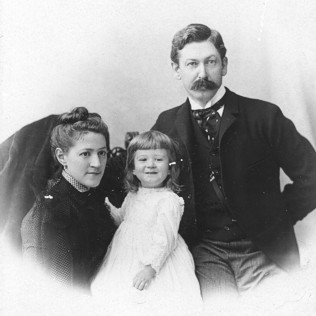
On 3 June 1897, Annie married Edward Francis Gamwell, a newspaperman who worked as city editor of the Cambridge Chronicle (1896-1901), then editor and proprietor of the Cambridge Tribune (1901-1912), and editor of the Budget and American Cultivator (1913-1915). She moved to Cambridge, Massachusetts with her husband, and gave birth to two children: Phillips Gamwell in 1898, and Marion Roby Gamwell (1900), who died just five days after birth.

Early letters must exist from a young H. P. Lovecraft to his aunt’s household, for Howard was fond of his young cousin despite the eight years that separated them, but these letters are no longer extent. At some point in his teens, however, Phillip Gamwell contracted tuberculosis. In October 1916, Annie took her son to Roswell, Colorado to stay with her in-laws, in hopes that the climate would help arrest his illness. Phillips Gamwell died on 31 December 1916. Annie and her husband separated, and she returned to Providence to stay with her widowed brother Edwin Phillips.

In 1904 Whipple Phillips had died, and the family home had been broken up. Howard Lovecraft and his mother Susie lived together in a house on the same street, and were still there when Annie returned to the city. Lovecraft had failed to graduate highschool, or to find employment; but he had emerged into the world of amateur journalism, where his literary ability was quickly making a splash. Edwin Phillips died in 1918, and from this point on Annie appears to have lived in rented quarters in Providence. In 1919, perhaps driven by financial concerns, Susie Lovecraft’s health broke down, and she was confined to Butler Hospital, where Winfield Lovecraft had died in 1898. Annie and her elder sister Lillian began to keep house for their nephew; Annie also worked, the 1920 census records Annie Gamwell working as a public school teacher, and she was also librarian in Col. George Shepley’s private collection of Rhode Islandiana for at least some period.

The first surviving letter from H. P. Lovecraft to his aunt Annie Emeline Phillips Gamwell is dated 19 August 1921—four months after the death of Sarah Susan Phillips Lovecraft at Butler Hospital. Howard had gone to Boston for the National Amateur Press Association convention, his first trip away from home as an adult. The letters give a deep and in-depth account of the whole convention, though curiously he does not mention meeting Sonia Haft Greene, a divorced Jewish Russian immigrant who had joined amateur journalism.

Those early letters set the tone; when in Providence, Howard and his aunts were in close contact, when he traveled afar, they kept in touch by frequent, often detailed letters, which assumed a diary-like character. The courtship between Howard and Sonia proceeded across rivers of ink and a number of visits between 1921-1924. Lovecraft’s aunts met Sonia during this period, and it appears that Annie and Sonia became particularly close. Why isn’t exactly clear; Lovecraft’s letters contain frequent mentions of Annie’s friends and alludes to many social activities that suggest Annie was the more gregarious and outgoing of the two aunts, and the more able and prone to travel. Annie actually visited Sonia and Howard during a trip to New York, which occasioned Sonia to pen a note to her:

Darling,
Ten minutes after your special to Howard I am rushing this off to you. Gee! I’m so glad you can come! For the length of time you can stay, can be decided on after you get here.

It doesn’t make any difference about my own lack of time just now—because Howard and Belknap and maybe Morton can take you to places of interest in the daytime and you can rest comfortably in the evenings talking to me, while Howard can go out if he wishes or remain with us.

And on Saturday evening and Sunday the three of us can have a perfectly lovely time[.]

My Dear, I do hope you can stay a long time! Who knows? I’m a regular female Micawber—something unexpected may happen—pleasureable [sic] and beneficial so that you can remain here.

I just can’t wait until you get here.

With eager and pleasureable anticipation

I am
Lovingly Yours
Sonia
—Sonia H. Greene to Annie E. P. Gamwell, 24 Sep 1922, Letters to Family & Family Friends 2.73

For his part, Howard noted:

For friendliness and generosity she sure beats hell—she is so stuck on my younger aunt Mrs. Gamwell, that she’s trying to get her to come to N.Y. and permanently share her abode! And strange to say, my aunt likes her immensely despite a racial and social chasm which she doesn’t often bridge.
—H. P. Lovecraft to Maurice W. Moe, 21 Jun 1922, Letters to Maurice W. Moe 102-103

Perhaps they just got along. Or perhaps Sonia was already thinking of Lovecraft as more than just a good friend and wanted to be friends with her potential in-laws. It might have been during this particular trip when Sonia alleges that Annie confided certain things to her about the family:

No doubt some sexual admonitions arose also, for the entire family, according to what Sonia recalls Annie Gamwell telling her, knew of Winfield Lovecraft’s paresis, and the adventures with prostitutes and women on his lengthy travels that gave him his affliction. In fact, Annie told Sonia prior to her marrying HPL that they could not have children—in fact this was a warning that Annie was giving to Sonia, and to me her choice of words was interesting—could not instead of should not.
—R. Alain Everts, Howard Phillips Lovecraft and Sex

How much we can trust Everts’ second- or third-hand information is unclear; Sonia herself does not make this statement in her memoir The Private Life of H. P. Lovecraft, nor has it been published elsewhere, nor did Annie make any reference to it after Howard’s death. If Annie did confide this information, it did not stop the sudden engagement and marriage of Howard and Sonia in 1924—nor were Annie and Lillian informed until after the marriage had been completed.

Lillian and Annie were apparently in close contact during this period, and Lovecraft’s letters to both of his aunts are nearly interchangeable in picking up the diary where it had left off earlier. The elder sister, Lillian, was living at 598 Angell St., while Annie apparently kept her own separate quarters.

By 1926, Sonia and Howard separated, and he returned to Providence. Sonia in her memoir claims that the aunts made it clear that Sonia could not be seen to support her husband in Providence; it is not clear how to reconcile this with the apparently friendly relationship between Sonia and Annie c.1922-1925—but circumstances can change. Lillian was older, and possibly more conservative; Annie was more tied in to Providence’s social life, and thus perhaps more conscious of social status. We don’t know.

Initially, Howard apparently lived apart from both his aunts, but very soon after his return Lillian took ill and it fell on Howard to assist her until a nurse could be obtained. Why Annie could not fulfill this function is unclear (possibly age, she was 60 years old in 1926). If she was still employed at the time, it might explain why she left the care of her elder sister to her nephew. Soon, Lillian and Howard would combine households at 10 Barnes St., while his younger aunt continued to live in her own quarters.

Annie and Howard were not in any way distant, however. Like her nephew, Annie had the travel bug, and liked to visit places, either on her own or in the company of her nephew. In October 1926 they went on a tour of locations related to the family, including the village of Greene, Rhode Island which Whipple Phillips had renamed, the Ionic Lodge No. 28 he had founded, the house where Lillian was born, and other such sites connected to their family. On her own, Annie Gamwell would travel south to Atlantic City and Florida, and north to Ogunquit, Maine. It is apparent from Lovecraft’s letters that Annie would also write while on her travels, as he himself would do.

Annie was also, like her nephew, very attached to the family home and better days, which might be shown by two incidents, the first reported by Sonia:

Upon one of my trips to Providence before H. P. and I were married, Mrs. Gamwell and he took me to see the old homestead, with its beautiful, spacious grounds and huge stables (this was before it was turned into a modern office building), three sides of which today form a street with many houses. With still a great deal of regret and much pride Mrs. Gamwell showed me the horse-block at the cub, and lovingly ran her hand over it. It was twilight at the time and I was not quite able to see distinctly, but when she turned her head away, I think it was to hide the tears that welled up in her eyes.
—Sonia H. Davis, “The Private Life of H. P. Lovecraft” in Ave Atque Vale 120.

Roughly a decade later, in 1932 the stables were torn down:

my surviving aunt, then a small girl, put a tin box of records into the unfinish’d walls, to be exhum’d & studied by the archaeologists of a fabulous posterity. Alas that she shou’d live to see its destruction & reclaim the records herself! Last summer, when the workmen had it partly razed, she went over & looked in the place where she had put the records 51 years before. They were still there—Harsford’s Baking Powder box rusted but intact, & the contents only slightly touched by the mould of intervening aeons. My aunt’s tintype, & that of a youthful friend (now dead) quite decipherable, & their messages to a future civilisation legible in every part. She still has the box—but alas, we have no hope of erecting another daily castle in which to reincorporate it with a XX century postscript!
—H. P. Lovecraft to Alfred Galpin, 27 Oct 1932, Letters to Alfred Galpin & Others 272

In another letter, Lovecraft described the contents of the time capsule the 15-year-old Annie had secreted as “her tintype, a newspaper page, and a couple of ‘to whom it may concern’ letters” (LMM 311).

Lillian Delora Phillips Clark died on 3 July 1932. Her illness and the attendant costs had put a crunch on the family finances; Lovecraft brought in little money with his writing and revision work, and the residue of the monies inherited from Whipple Phillips & other estates must have been seriously depleted. Lovecraft wrote:

My aunt has always been the family banker, and now that she is down I have charge of all papers & accounts, & can see in stark plainness the utter desperateness of our financial situation.
—H. P. Lovecraft to Alfred Galpin, 24 Jun 1933, Letters to Alfred Galpin & Others 292

For reasons of economy, Howard and Annie would need to find some joint residence. Relatively soon, they found one:

My aunt’s friend—a high-school teacher of German—had long wanted her to move in above her if ever the flat should be vacant. On May 1st it did become vacant, & my aunt was duly informed. We looked it over, found it would be ideal for both, & at once clinched the bargain.
—H. P. Lovecraft to Donald Wandrei, 31 May 1933, Letters with Donald & Howard Wandrei 303

So Annie and Howard moved into 66 College St., which would be Lovecraft’s final home. He was very happy to at last be in a Colonial house, and family furniture was unearthed from storage and the household set up…but not without a snag.

On June 14, before the complete settlement of our new abode, my aunt broke her ankle through a slip on the stairs while descending to answer the doorbell during my absence. Doctors….ambulance to R. I. Hospital…..x-ray…..setting under aether…..plaster cast…..room in Ward K…..prospect of being in bed six weeks & on crutches several more…….& a financial strain utterly ruinous to us at the present juncture! Such is life. Of course there is no danger or actual illness, but the restriction to bed is accursedly unpleasant & productive of backaches. After another week my aunt will probably be brought home with a nurse. She reads, writes notes, & eats fairly well—very well, in fact, today. I call at the hospital each afternoon. Naturally the disaster has kept me overwhelmingly busy—with the house in its unsettled state & everything in the air.
—H. P. Lovecraft to Alfred Galpin, 24 Jun 1933, Letters to Alfred Galpin & Others 289

She evidently mistook 2 steps (an isolated pair, before the staircase turns for the main descent) for one, & landed with a disastrous thud. For a long time she thought the trouble was only a sprain, so that she simply sat still on the staircase talking with her caller & waiting for the ache to subside. At last, however, the pain caused her to summon a physician “just to be on the safe side”–& he, diagnosing the matter at once, imparted the bad news & turned her over to a specialist. I fancy the patient will be walking on her own feet by Chistmas–though twinges & awkwardness will probably persist much longer.
—H. P. Lovecraft to Elizabeth Toldridge, 5 Oct 1933, Letters to Elizabeth Toldridge  256

Howard was back to nursing an aunt again, with the concomitant disruption of his own writing and no ability to travel—but what else was there to do? They were all the immediate family that either had left. As before, Lovecraft tracked his aunt’s progressive recovery in his letters:

Her plaster cast came off last Thursday, but the doctor wishes her to remain in bed for a while before attempting locomotion or crutches.
—H. P. Lovecraft to R. H. Barlow, 8 Aug 1933, O Fortunate Floridian! 72

Now that her cast is off, she has trouble about blood rushing to the injured foot when it is lowered from an horizontal position–hence is not yet about on crutches.
—H. P. Lovecraft to R. H. Barlow, 21 Aug 1933, OFF 76

My aunt gave me a birthday present of a week’s emancipation from nursing responsibilities—by getting others to come in afternoons—& I have hastened to utilise my freedom in snatching at least one real trip from the brief & waning summer!
—H. P. Lovecraft to Clark Ashton Smith, 3 Sep 1933, Dawnward Spire, Lonely Hill 437

My aunt is vastly improved—all around the house on a cane, & occasionally gets downstairs & out in the garden. The nurse went Sept. 13, & I am now much less tied down than I was. We’ve installed an electrical device for opening the front door from upstairs—which is very useful when I’m not available for bell-answering. Just now she is about to attempt a motor ride in a friend’s car—her first large-scale glimpse of the outside world since June 14.
—H. P. Lovecraft to R. H. Barlow, Sep 1933, OFF 79

I am glad to say that my aunt is now vastly better—out everywhere with a single cane, & all around the house with no cane at all. Since she has assumed charge of domestic matters, the house begins to look infinitely more home-like—curtains hung, more old family furniture brought out of storage, & so on.
—H. P. Lovecraft to Arthur Harris, 24 Dec 1933, Letters to Rheinhart Kleiner & Others 288

Since my aunt is now wholly on her feet again, & able to be alone in the house, the one doubtful element at the end is finances.
—H. P. Lovecraft to R. H. Barlow, 10 Feb 1934, OFF 106

Annie’s recovered mobility freed Lovecraft to travel, including his extensive trip to Florida in 1934 to stay with the Barlows in DeLand. We have little idea of her personal life, except through Lovecraft’s letters. She read newspapers and clipped articles for him, borrowed books from the library and read them, watched films at the cinema, listened to the radio, and took her meals from the nearby boarding house. When guests traveled to Providence to meet Lovecraft from 1932-1937, she would have met them—including R. H. Barlow, Helen V. Sully, Harry K. Brobst, and Kenneth Sterling. Her travels resumed, including trips to Ogunquit, Maine and Marblehead, Massachusetts.

By the end 1934, aunt and nephew were ensconced in cozy domesticity:

My aunt & I had an exceptionally pleasant Christmas, & I hope the same is true of yourself. We had a tree for the first time in over a quarter of a century. […] We began the day most auspiciously by listening to the British Empire broadcast—which I hope you did not miss. […] I turned down the dollar bill that was tied on top of one of my gifts […] Later in the day came a turkey feast at the boarding house across the back garden (home of the late Sam Perkins), a general unveiling of gifts, & a session of conversation & contemplation by candlelight & tree-light.
—H. P. Lovecraft to Elizabeth Toldridge, 29 Dec 1934, Letters to Elizabeth Toldridge 285

1935 went well too. Lovecraft made what would be his final trip to Florida. In the fall & winter, Annie and her nephew would attend a series of public speakers at nearby Brown University on a diverse array of subjects, some of which found their way into his letters. Lovecraft’s letters to his aunt while on his travels continue, but lose a degree of detail; perhaps the diary-entries were more important to Lillian, who was housebound for prolonged periods. Perhaps his correspondence had simply grown too unmanageable; increasingly, letters from 1935-1936 include portions copied between multiple correspondents, showing how Lovecraft was working swiftly.

In 1936 illness hit again.

Following my own attack of grippe my aunt came down with an infinitely severer version of the same curst malady, so that since Feby. 17 I have had no time to be aught save a combined nurse, butler, & errand boy. And no daylight in sight—indeed, complications seem likely to prolong the siege, & perhaps to necessitate my aunt’s sojourn at an hospital for a while…thus repeating the chaos of June-July ‘33.
—H. P. Lovecraft to R. H. Barlow, 11 Mar 1936, OFF 320-321

Howard uniformly describes this illness as “grippe,” but Annie Gamwell quickly required hospitalization. Her death certificate notes that her right breast was surgically removed in 1936, suggesting that she was actually suffering from breast cancer and required a mastectomy, and subsequent stay in a convalescent home and nursing. During this time, Lovecraft gained closer contact with some of her aunt’s friends, notably Bertha Rausch, Mayte Sutton, and Marian F. Bonner, who would become correspondents. These women, at least, may have known the truth of Annie’s illness.

My aunt was in excellent spirits, & seemed to be making a fine recovery. She had just had an adequate duck dinner, & was completing the ice cream dessert when I arrived. Of course the whole experience is not a pleasant one—there has been pain (although the etherisation, conducted under modern conditions, was wholly free from unpleasantness & nausea), & there is still discomfort from the constant reclining in a fixed position; but everything is progressing according to schedule, & Dr. Kingman—whom I called up the other day—considers the case very satisfactory.
—H. P. Lovecraft to Marian F. Bonner, 22 Mar 1936, Letters to Family & Family Friends 2.1011

Let me say that my aunt is doing very well at the hospital—now taking good meals, & sitting up each day a little. Yesterday morning she was wheeled on the sun porch for a glimpse of the park-like grounds. I call on alternate days, but so far she has received no other visitors. She still has, of course, much discomfort—digestive stress, sleeplessness, & the irritation of reclining in one fixed position. The length of her stay is not yet certain—but she likes this hospital so much better than the one where she was in 1933 that she has not the same nervous anxiety to get away. Her present abode is on the same grounds as the other hospital, but is a wholly different building—only remotely connected with the R. I. Hospital proper. It is a select institution—the best hospital in the state—called the Jane Brown Memorial […]
—H. P. Lovecraft to Elizabeth Toldridge, 27 Mar 1936, Letters to Elizabeth Toldridge 327

I believe you last heard from me in early March, when my aunt was about to go to the hospital. She went on the 17th—as it to celebrate the festival of Hibernia’s saint—& was there for three solid weeks. Meanwhile I had to act as her secretary, messenger, telephone-clerk, & what the hell—so that the confusion which I previously described increased to the utter, ultimate breaking-point. […] Well—my aunt left the hospital April 7, & spent two weeks at a convalescent home—returning to 66 a week ago yesterday. She is much better, & takes walks every pleasant day with my assistance; but it may be some time before her health will let her perform all the chores of 66 without coöperation.
—H. P. Lovecraft to R. H. Barlow, 29 Apr 1936, OFF 327

On Tuesday, April 7, at 4 p.m., the patient left the gas-house district by motor to complete here convalescence at Dorcus Convalescent Home, 32, Blackstone Blvd. (cor Irving Ave.) (Tel. PL 3485), an extremely prepossessing private retreat whose domestic atmosphere & favourable situation ought to aid greatly in promoting rapid recovery. After a trial of a ground-floor room (which proved too noisy), the patient is now settled in a really delightful second-floor room at the front of the house, with a door leading out upon a screened porch which commands a fine view of the boulevard. The edifice is a relique of the 189’s, but makes up in comfort what it lacks in taste. The patient, though missing the detailed & instantaneous service provided by the hospital, is getting to like it better & better—& indeed finds the cuisine even superior to Aunt Jane Brown’s. When I called yesterday afternoon she seemed in fine shape indeed, & ate her dinner at a table while seated on the edge of the bed. She continues to welcome callers–the best hour being in the morning at any time after 10, & the second-best being in the afternoon betwixt 3 & 4. The mid-day period is devoted to a siesta—a habit she ought to continue after her return to the Garden House.
—H. P. Lovecraft to Maran F. Bonner, 9 Apr 1936, Letters to Family & Family Friends 2.1019

My aunt continues to improve, but I am about ‘all in’—on the verge of some sort of nervous collapse, & with the worst digestive trouble since the autumn of 1934.
—H. P. Lovecraft to Donald Wandrei, 24 Jun 1936, Letters with Donald & Howard Wandrei 351

Once again, Lovecraft’s letters track his aunt’s recovery…but he had no real ability to travel, and his own health continued to worsen. Due to the fact that they were seeing each other practically every day, there are very few letters for 1936-1937, though he kept up a diary for his aunt for the period of her hospitalization. They had a Christmas tree again for 1936, and one mutual friend wrote:

At Christmas time, I would get his help to “smuggle in” my present to his aunt. I can clearly remember the three of us sitting around their tiny Christmas Tree.
—Marion F. Bonner, “Miscellaneous Impressions of H. P. L.” (1945) in Ave Atque Vale 433

His illness worsened in 1937, which he described to his friends as “the grippe,” though in truth it was cancer in its terminal stages. In his 1937 letters, Lovecraft continues to refer to his aunt:

My aunt has also suffered from a touch of grippe.
—H. P. Lovecraft to Adolphe de Castro, 17 Feb 1937, Letters to Alfred Galpin & Others 398

About 79 letters, notes, and postcards from H. P. Lovecraft to his aunt Annie Gamwell survive at the John Hay Library and in the Arkham House Transcripts. Only three of these letters were published, in abridged form, in the Selected Letters (Arkham House), a few in Letters from New York (Night Shade Books). 364 letters between Lovecraft and his aunts, all that are known to survive, are published in the two volumes of Letters to Family & Family Friends (2020, Hippocampus Press).

Two letters from Annie to Lovecraft survive: 12 June 1935 and 21 July 1935; in addition to this, Annie has signed a number of joint notes and letters. Two letters is not much by which to judge her side of the correspondence, but the letters seem to reflect a similar attitude toward letter writing as Lovecraft himself expressed in his letters to her: full of details of daily life, interesting encounters, homely minutiae.

I’ll shut up now.
All love & best wishes
Aunt Annie
—Annie Gamwell to H. P. Lovecraft, 21 July 1935

More of Annie’s correspondence survives from after her nephew’s death. As the heir to his estate, she became the focus of interest from August Derleth & Donald Wandrei (who would found Arkham House to publish Lovecraft’s work), R. H. Barlow (who would be his literary executor), and Lovecrat’s myriad correspondents. The positions of aunt and nephew were now reversed, with Annie now having to handle Lovecraft’s correspondence, as he had done for her during her hospitalizations in 1933 and 1936.

I know how much store Mrs. Gamwell set by him, and how much she missed him after his death.
—Marion F. Bonner, “Miscellaneous Impressions of H. P. L.” (1945)

With the death of her own children and now her nephew, the branch of the family descended from Whipple Phillips and Rhoby Place was coming to its end. Annie’s heirs would be cousins, the bits and pieces of family property distributed among them. Annie Emeline Phillips Gamwell died 29 January 1941. She was buried in the family plot at Swan Point Cemetery, with the remains of her children.


Bobby Derie is the author of Weird Talers: Essays on Robert E. Howard & Others (2019) and Sex and the Cthulhu Mythos (2014).

Her Letters To Lovecraft: Lillian Delora Phillips Clark

The children of Whipple and Rhoby Phillips are Lillian D., now wife of Dr. Franklin C. Clark of Providence; Sarah S, mother of the autobiographer; Edwin E.; and Anna, now wife of Mr. Edward Gamwell, Associate Editor of The Boston Budget and Beacon. My mother and Aunt Lillian were both educated at the Wheaton Seminary in Norton, Massachusetts, and are both accomplished landscape painters in oil. My Aunt Lillian also attended the State Normal School, and was for some time a teacher.
—H. P. Lovecraft to Maurice W. Moe, 1 Jan 1915, Letters to Maurice W. Moe 43-44

The story of the correspondence of H. P. Lovecraft and his aunt Lillian Delora Phillips Clark is the story of Lillian herself; for almost everything we know about her, beside some impersonal records and statistics, come from their correspondence, and from Lovecraft’s mentions of his aunt in his letters to others. In many ways, we can only see Lillian through Lovecraft—as he saw her, and presented her to his friends and loved ones.

Lillian Delora Phillips was born on 20 April 1856, the eldest of the five children of Whipple Van Buren Phillips and his wife Robie Alzada Phillips (née Place). She was educated at the Wheaton Seminary (1872-1873) and attended the State Normal School (c.1874-1875), although there is no record that she took a degree. Nineteen years old, intelligent and educated, Lillian apparently began work as a teacher, although records of where and when she was employed are no longer extant. She lived with her family for several through at least 1881. She was likely still living at home in 1889 when her younger sister Sarah Susan Phillips married Winfield Scott Lovecraft, and when her nephew Howard Phillips Lovecraft entered the world. Letters from Lovecraft’s grandfather in 1895 and 1899 both refer to “Lillie,” attesting to her continued presence in, or at least near the household.

All of Lillian’s surviving younger siblings (Emeline Phillips died in childhood) married before her (although strangely, brother Edward married his wife Martha in 1894 and 1903), but in 1902 at age 46 she married Dr. Franklin Chase Clark—and no doubt, finally moved out of the family household, if she hadn’t already. The death of her father Whipple Phillips in 1904 caused the breakup of the household at 454 Angell St. in Providence—Susan and Howard Lovecraft moved to 598 Angell St., and most of the family furniture and assets of Whipple’s estate were broken up among the surviving children. Still, “Aunt Lillian” remained young Howard Lovecraft’s closest relative beside his mother, and no doubt they kept in touch with visits or cards over the next fifteen years, as Howard grew. Her husband, Dr. Clark, was one of the few men of his generation left to stand as a parental figure for Lovecraft. Of these childhood years, Lovecraft would write:

My two aunts presented rather a contrast. The elder was (& still is) a devotee of science & literature. She was a potent influence, I think, in turning my fancy toward the classics, while my old love of chemistry also arise from her remarks on that science. She was (though she has ceased to paint now) an artist of great power. When she married Dr. Clark, she proved the means of introducing me to the most substantial classical element of all! […] My predilection for natural science, fostered by my Aunt Lillian, took form in a love for chemistry.
—H. P. Lovecraft to Rheinhart Kleiner, 16 Nov 1916, Letters to Rheinhart Kleiner & Others 64, 69

In 1915, Dr. Clark died. The marriage was childless, not surprising given their respective ages. Lillian moved into a series of rented rooms; much of this period (1915-1919) is unclear as to what she was doing, or if she had any occupation in Providence. In 1919, Susie Lovecraft suffered a breakdown and was admitted to Butler Hospital; her sister Annie Gamwell moved into 598 Angell St. with Lovecraft, and Lillian must have been by as well, although 1919-1920 she was working and living as a caregiver or housekeeper at 135 Benefit St., which Lovecraft visited. This house would be the model for “The Shunned House.”

The death of Lovecraft’s mother in 1921 precipitated his travels, first to Boston and then to New York, on amateur affairs and his first letters to Lillian and Annie are from this period. It was during this period when Lovecraft was courting Sonia H. Greene that age and affliction began to tell on Lillian:

My aunt (not the one you saw, but the elder & 598-governing one) became prostrate with grippe the very day after I wrote you—I guess the two shows were two or too much for her—& Fortune depressed the dignity of a Theobaldus to the ignomin of domestick exertion. In fine, I had to serve as a sort of composite nurse & housekeeper, even descending to the depths of preparing food & cleansing & dehydrating china & silver….but let us not think of such demeaning practicalities.
—H. P. Lovecraft to James F. Morton, 25 Mar 1923, Letters to James F. Morton 31

As with many cases of “la grippe,” in Lovecraft’s letters regarding his aunts, it isn’t clear if this was influenza or some other illness. The 67-year-old aunt was the principal recipient of Howard’s surviving letters to his aunts, describing in detail his first and subsequent visits to New York…and no doubt tremendously surprised in early 1924 when her nephew announced via letter his marriage to Sonia H. Greene, and consequent move to New York City. Lovecraft’s letters to his aunts quickly assume a diary-like character, interrupted only when one or the other of the aunts was actually down there visiting Howard, and hence there was no need to write.

I startled her considerably when I told her we had a detailed account of their life together in HPL’s letters to Mrs. Clark.
—August Derleth to R. H. Barlow, 23 Oct 1947, MSS. Wisconsin Historical Society

Howard and Sonia separated in 1926, and Howard returned to Providence. The timing would prove to be fortunate; Lillian’s health had begun to decline:

On May 16 my elder aunt—Mrs. Clark—got tooken with a spasm of intercostal neuralgia; & although at no time in any danger, was confined absolutely to her bed until a day or two ago. At first, before a good nurse could be obtain’d, I had to stay over at her place day & night; going home only to collect my mail; but eventually we got a competent daughter of Hygeia—a h’elderly Cockney lydy nymed Missus ‘Arrrison, oo’s ‘ad mooch h’experience a-treatin of sech cyses—so that all I have to do now is bring in meals, run grocery & pharmacy errands, & stick around for three hours in the h’arfternoon, w’en Mrs. ‘Arrison tykes ‘er h’outin’. A coupla days ago my aunt sat up for the first time, & yesterday she staged a pedestrian experiment which might be called quite successful if you don’t judge it by your Pat. Ramblers. Within a month I hope she will be able to move over here.
—H. P. Lovecraft to James F. Morton, 10 Jun 1926, Letters to James F. Morton 108

Howard and Lillian would combine households at 10 Barnes St. from 1926 through 1932. Lovecraft’s letters to others are unspecific about Lillian’s illness; sometimes attributing them to intercostal neuralgia, lumbago, and digestive troubles, but they obviously occasioned considerable pain, limited movement, and during the worst spells required constant nursing. Some of Lovecraft’s letters to Elizabeth Toldridge give the flavor of this period and his accounts of it:

My aunt had another acute spell lately, & is helped by a nurse each day. She has, however, just secured a new physician who is to administer some ray treatments about which he is highly optimistic.
—H. P. Lovecraft to Elizabeth Toldridge, 30 Aug 1930, Letters to Elizabeth Toldridge 155

My aunt seems much better than in July—due largely to a new physician who gives ultra-violet ray treatments. A nurse, however, is still necessary.
—H. P. Lovecraft to Elizabeth Toldridge, late Aug/Sep 1930, Letters to Elizabeth Toldridge 157

My aunt’s health is decidedly better, & she no longer requires the nurse. The coming of furnace heat & its dryness is a good thing for her, I think.
—H. P. Lovecraft
to Elizabeth Toldridge, 24 Oct 1930, Letters to Elizabeth Toldridge 163

My aunt, I am glad to say, seems to continue her improvement; & I hope to be able to drag her out to a good Thanksgiving dinner at the nearest restaurant.
—H. P. Lovecraft to Elizabeth Toldridge, 23 Nov 1930, Letters to Elizabeth Toldridge 167

My aunt shews no signs of any recurrence of the acute trouble of last summer, though of course she cannot undergo much exertion, or make trips outside except on special occasions.
—H. P. Lovecraft to Elizabeth Toldridge, 25 Jan 1931, Letters to Elizabeth Toldridge 172

My elder aunt has been unusually well—for her—this summer, so that I shall try to get her outdoors more upon my return home.
—H. P. Lovecraft to Elizabeth Toldridge, 19 Jul 1931, Letters to Elizabeth Toldridge 186

My aunt is better again—coming down stairs occasionally.
—H. P. Lovecraft to Elizabeth Toldridge, 31 Oct 1931, Letters to Elizabeth Toldridge 192

I succeeded in getting my aunt out again to a Christmas dinner, & she seems none the worse for it. Hope her confidence in her travelling ability is now so much restored that she will attempt occasional excursions without the excuse of a holiday.
—H. P. Lovecraft to Elizabeth Toldridge, 16 Jan 1932, Letters to Elizabeth Toldridge 197

My aunt’s health continues on a reasonably encouraging though scarcely active level.
—H. P. Lovecraft to Elizabeth Toldridge, 26 Feb 1932, Letters to Elizabeth Toldridge 207

My aunt, though not going outdoors, has had no relapses of acute trouble during the winter.
—H. P. Lovecraft to Elizabeth Toldridge, 20 Apr 1932, Letters to Elizabeth Toldridge 210

In periods when Lillian was well, or well enough, Howard traveled as his means allowed—notably his 1931 trip to Florida, where his letters and postcards to his “elder aunt” overflow with description, detail, and matters of historical interest. Many of these letters are signed something along the lines of: “My dear daughter Lillian”—a joke on Lovecraft’s pretense at being the “Old Gent”—and signed something along the lines of “Yr aff: nephew & obt Servt” (“Your affectionate nephew & obedient servant”).

Lillian was apparently well enough in the early summer of 1932 that Lovecraft made another trip down South…but he had to hurry home.

When I reached here at seven-thirty p.m. Friday my aunt was in a painless semi-coma, & it is doubtful whether she recognised me. Doctor & nurse, however, were leaving nothing undone; & Mrs. Gamwell was coöperating valiantly. General weakening & collapse of the whole organic system, caused by the long strain of arthritic pain & precipitated by an unprecedentedly severe attack, had brought about a sinking from which the doctor gave no hope of recovery. Saturday brought no change, save a period of difficult breathing in the morning which Dr. Brown interpreted as a bad sign—predicting ultimate disaster within twenty-four hours. Sunday the melancholy prediction was fulfilled, & 1932 was irrevocably entered as a black year for this household. The end was so peaceful & unconscious that I could not believe a change had occurred when the nurse declared it final.

Services will be held tomorrow at the Knowles Funeral Chapel on the ancient hill not far from here—& close to where my aunt & Dr. Clark lived in & around 1910. Although Mrs. Clark had no more use for orthodox cant & childish immortality myths than I, the services will be conducted in the ancient Church of England tradition by the Rev. Alfred Johnson, a venerable friend of both Phillips & Clark families who also officiated for my mother in 1921. My aunt would have preferred him, since the poetry of the Anglican ritual is a thing of eternal beauty aside from its hollow meaning, whereas the jargon of the Baptists (her immediate ancestral tradition) & other Evangelicals contains only the hollowness without the beauty. She had no patience, intellectually, with any sects save the Anglican and Unitarian; though she was still technically on the rolls of the old first Baptist Church.

Internment will be in the Clark lot at Swan Point Cemetery—the same cemetery which contains the Phillips lot where I shall be interred. I waived rights in the Lovecraft lot at Woodlawn (N.Y.) a decade ago, since I wish to be permanently merged with Old Providence.

Mrs. Gamwell will appreciate your expressions of sympathy. The present event is, despite its inevitability, a blow of the first magnitude to both survivors—especially to me, since my aunt was the real animating spirit & homemaking nucleus of 10 Barnes. The suddenness of the event is both bewildering and merciful—the latter because we cannot yet realise, subjectively, that it has actually occurred at all. It would, for example, seem incredibly unnatural to disturb the pillows now arranged for my aunt in the rocker beside my centre-table—her accustomed reading-place each evening. The earlier newspapers piled up during my absence contain interesting annotations in her hand.
—H. P. Lovecraft to James F. Morton, 5 Jul 1932, Letters to James F. Morton 299-300

The death of Lillian led to a major shakeup in Lovecraft’s life; he had been surviving on the residue of his and his mother’s inheritance from the estate of Whipple Phillips, as commonly doled out by his aunts. Now with Lillian’s death, the family’s finances were burdened by final medical and funeral costs, and it became necessary for them to combine households—they moved in together to 66 College Street. A large painting of the Rocks at Narragansett Pier by Lillian D. Clark was placed above the stairway.

My dear Aunt Lillian:

In replying to your recent & highly appreciated epistles, let me first thank you for sending the suit & minor accessories.
— H. P. Lovecraft to Lillian D. Clark, 29 Sep 1922, Letters to Family & Family Friends 75

There must have been letters from Aunt Lillian to her nephew, certainly during the 1924-1926 period in New York, Lovecraft mentions receiving small stipends of money and communications from his aunts. Yet none of them survive. We have only Howard’s side of the correspondence, as first he kept in touch with his elder aunt, and then he took care of her through her painful, semi-invalid days…but of the inner self of Lillian D. Clark, we can only hazard a guess. Having no children of her own, Howard must have been the closest thing to a son to her, and their relationship was clearly precious to them both, and his letters from afar were no doubt a lifeline during the “semi-invalid” period when Lillian was confined to her bed or indoors.

His letters to her show that Lovecraft was more open to exclamations on race to letters to his aunt than he might have been to others; if Lillian, who was barely nine when the American Civil War ended, had her own prejudices and shared them with her nephew, it would not be a great surprise. It is more difficult to read the things that are not in Lovecraft’s letters, such as Sonia’s suggestion in The Private Life of H. P. Lovecraft that the aunts were against the marriage. Certainly, when the time came to fetch Lovecraft back to Providence in 1926, it was Lillian that went down to New York to help arrange the details of the move…but there was never a word of reproach about this in Howard’s letters to or about his aunt.

About 285 letters, postcards, and notes to Lillian Clark from Lovecraft are known to survive at the John Hay Library in Providence, and many are transcribed in part in the Arkham House Transcripts. 27 of these letters had been previously published in abridged form in the first three volumes of the Selected Letters (Arkham House), and of the 76 letters in Letters from New York (Night Shade Books), 69 are to Lillian. 364 letters between Lovecraft and his aunts, all that are known to survive, are published in the two volumes of Letters to Family & Family Friends (2020, Hippocampus Press).


Bobby Derie is the author of Weird Talers: Essays on Robert E. Howard & Others (2019) and Sex and the Cthulhu Mythos (2014).

“Massacre à Miskatonic High School” (2008) by Jean-Jacques Dzialowski & Dimitri Fogolin

Depuis la nuit des temps,
Des dieux noirs corrompent notre monde.
Ce sont les Grands Anciens.

La folie est leur visage.
L’horreur est leur royaume.
Leur éveil approache…
Since the dawn of time,
The dark gods corrupt our world.
These are the Old Ones.

Madness is their face.
Horror is their kingdom.
Their awakening approaches…
Back cover, Les Mondes de Lovecraft

MondesLes Mondes de Lovecraft (“The Worlds of Lovecraft,” 2008, Soleil) is a standalone French-language comic anthology of stories set in the world of H. P. Lovecraft, including an adaptation of Lovecraft’s “Dagon.” Two of the stories in the book are the work of Jean-Jacques Dzialowski (writer) & Dimitri Fogolin (artist): “Le Signe sans Nom” (“The Nameless Sign”) and “Massacre à Miskatonic High School” (“Miskatonic High School Massacre”). The two works are complementary, in that they tell different sides of the same story from different perspectives. “Le Signe sans Nom” is given after-the-fact, during the deposition of a Sergeant McDermot, who responded to the events at Miskatonic High. “Massacre à Miskatonic High School” on the other hand gives the perspective of the school shooters. 


IMG_2591

The 1999 Columbine High School Massacre casts a long shadow over culture and pop culture alike. The media blitz helped to inspire numerous copycats; partisan politicians and pundits in the United States tend to quickly politicize shootings to minimize arguments over gun ownership as happened in the aftermath of the 2012 Sandy Hook Elementary School Shootings. Comic books have rarely touched on such controversial and emotionally-charged territory; DC Comics notoriously cancelled the Hellblazer story “Shoot” by Warren Ellis, Phil Jimenez, and Andy Lanning in 1999 over concerns of backlash.

At the bottom of most coverage of such shootings is one question: Why did they do it? What drove these kids to kill other kids?

Real-world causes are complex: psychological issues, a disturbed home life, access to firearms are all contributing factors. In the worlds of H. P. Lovecraft however…it’s rather simple.

They want the books.

Toute sa vie, grand-père a cherché les livres. Il en avait trouvé certains et il m’a laissé plein de notes…

All his life, grandfather searched for books. He had found some and he left me lots of notes …

In real life, the two Columbine Massacre shooters committed suicide in the library. In this Miskatonic Massacre, Dzialowski and Fogolin have something similar happen, but for very different reasons. Taking a page from Lovecraft’s “The Dunwich Horror,” the two shooters want access to the ancient tomes contained (somewhat inexplicably) in the Miskatonic High School library.

“Massacre à Miskatonic High School” is nine pages; “Le Signe sans Nom” is eight. The two works should really be considered as parts of the same story, and being parallel narratives, they have visual and textual echoes and references to one another—the final panels are largely identical. Fogolin, however, approaches each story separately. “Le Signe sans Nom” is darker, with more blacks, greys, and blues, while “Massacre” is brighter, dominated by yellows and greens—appropriate enough given the prominence of Hastur in this chapter of the story. The layouts for both stories also start the same: a regular nine-panel grid, which breaks down in the subsequent pages.

Given the subject matter, there is a certain amount of commendable reticence to show too much. We see bullets, blood, dead bodies, but we don’t actually see anyone get shot on the page, in close up or detail. Readers can be appalled at what is happening without seeing every last bullet hole or shard of bone. At the same time, this gloss of violence and the digital coloring lends a certain muddiness to the compositions; one wonders how it would have been different if Jacen Burrows or Raulo Cáceres might have handled the same material.

IMG_2600

Lovecraft never quite tackled such a mundane horror as a school shooting. Yet the horror in this story is a little different from real life. What if Wilbur Whateley had reached the Necronomicon? Would he have succeeded in clearing off the Earth, or would he have ended up as these two did? The central issue isn’t just the horrors perpetrated, but that the two shooters in this story very nearly succeeded. If someone had been a little more competent…how much more damage could they have wrought?

Perhaps more importantly, what’s to stop the same thing from happening again?

“Le Signe sans Nom” and “Massacre à Miskatonic High School” are both published in Les Mondes de Lovecraft. It has not been translated into English or reprinted, as far as I have been able to ascertain.


Bobby Derie is the author of Weird Talers: Essays on Robert E. Howard & Others (2019) and Sex and the Cthulhu Mythos (2014).

Insania Tenebris (2020) by Raúlo Cáceres

This dossier collects research on the nineteenth-century engravings of a mysterious Goya student that represent impossible beings and disturbing anachronisms.

Following in the footsteps of the Genius of Providence and inspired by the Cthulhu Mythos, the group of writers The Bastards of Abdul Alhazred and the cartoonist Raúlo Cáceres come together to recreate this universe of madness and darkness.
—Back cover copy, Insania Tenebris, translated from the Spanish

Spanish artist Raúlo Cáceres is no stranger to Lovecraft, and though many fans might not recognize him by name, there’s no mistaking his incredibly detailed, explicit style that often takes horror and eroticism for its subject. His comics and graphic novels in this vein include Elizabeth Bathory, Cuentos Mórbidos, Justine y Juliette (after the Marquis de Sade novels), and Agues Calientes, which have been translated into several languages. Less pornographic but still fun are books like Galeria de los Engendros Album de Cromos de los Monstruos, an album of monsters in the vein of 1970s and 80s compilations for kids.

For English-speaking audiences, Cáceres’ most notable work would include his work on Crossed, Crécy, and The Extinction Parade, but he also provided some gorgeous covers for Alan Moore and Jacen Burrow’s Providence which showcase not just his skill and style, but his deep appreciation for the details of Lovecraft’s Mythos.

providence-raulo-cover-02-finalwords

Cáceres was also the artist on the Lovecraftian horror series Code Pru, written by Garth Ennis, and Ennis/Cáceres continued the storyline in the anthology book Cinema Purgatorio, and provided illustrations for the Lovecraftian alien gods of Spanish roleplaying game Eden.

In 2020, Raúlo Cáceres published the first volume of Insania Tenebris: Textos de Los Bastards de Abdul Alhazered (Shadowy Madness: Texts from the Bastards of Abdul Alhazred), a 32-page collaborative project where multiple Spanish writers provided short text pieces to accompany Cáceres’ unique vision of Lovecraft’s Mythos—which takes the form of a series of found documents. Imagine stumbling across a dossier of evidence proving the existence of the Mythos, from ancient times through World War 2 and to the present day—illustrated in glorious and disturbing detail.

It is these collaborators who are the “Bastards of Alhazred”: Gabriel Soriano, Emilio Gómez, J. M. Morcillo, La doctora X, Gómez Navarro, Tito Alberto, and of course, Raúlo Cáceres himself.

InsTen3

En el lecho de un ataud asiste
sobre absorta dama, su piel mancilla
un lúgubre gul perpetra y resiste.

In the bed of a coffin attends
Above lost lady, her skin stained
A melancholy ghoul persists and remains.
—”Despertar oscuro” by Emilio Gómez, Insania Tenebris 10

Like many extreme artists, Cáceres is at his best when there are no holds barred—but just because he can show as much graphic detail as he wishes to doesn’t mean every scene has to be fit for a death metal album or a storyboard for a graphic erotic horror film. Look at the names on the niches in the wall: Clark Ashton Smith in the top left, the name “Agatha Tremoth” on the coffin lid. This is an homage and illustration for Smith’s “The Nameless Offspring,” a ghoul story that Lovecraft praised.

InsTen4

En dicho grabado, y tal como se describe en el texto de Notre-Dame, destaca la figure de un caballero ritualista invocador de seres oscuros que, a través de la utilización de plegarias de sangre, buscará la intersección con seres del más allá, valiéndose para ello de la lectura del libro prohibido De Vermis Misteriis, utilizado como llave conductora a la mediación interdimensional.

In said engraving, and as described in the Notre-Dame text, the figure of a knight ritually invoking dark beings stands out who, through the use of bloody prayers, will seek the intersection with beings from beyond, availing himself by reading from the forbidden book De Vermis Misteriis, used as a conductive key to interdimensional mediation.
—”Las cartas de Notre-Dame” by Emilio Gómez, Insania Tenebris 6

There are influences here beyond just Lovecraftian fiction and in-jokes. As with Monster Girl Encyclopedia II (2016) by Kenkou Cross (健康クロス), the Call of Cthulhu Roleplaying Game had an obvious visual influence in the way Cáceres depicts some of his Mythos entities, notably the Night-Gaunts, Mi-Go, and Dark Young of Shub-Niggurath. The nature of the texts are also representative of gaming influence: these are all in-character pieces, found documents, meant to be read and interpreted not as complete stories in and of themselves but as deliberate fragments—like piecing together the clues in a Cthulhu Mythos story, from copied snatches of journals and paintings.

InsTen1

En esta, encuentra un viejo diario firmado por un tal capitán Pierre Eaudon, escrito en francés, con extraños dibujos de figuras humanas de aspecto reptiloide, cálculos matemáticos, anagramas y las palabras “YIG” y “VALUSIA” repetidas de forma obsesiva a lo largo del texto.

In it, he finds an old diary signed by a certain Captain Pierre Eaudon, written in French, with strange drawings of human figures of reptilian aspect, mathematical calculations, anagrams and the words “YIG” and “VALUSIA” repeated obsessively throughout of the text.
—”Informe de las SS” by J. M. Morcillo, Insania Tenebris 14

There are scenes in this portfolio which might turn a weak stomach or dissuade the prudish; notably a cannibal feast captured in particularly lurid detail, and the final pièce de résistance which captures Cthulhu and his paramour mid-coitus as the acolytes look on…and there are scenes that might make a reader smile, like the nod to death metal church-burning, the Mi-Go and the astronauts…and maybe just the care and detail that went into the written work as well.

For make no mistake, while Cáceres’ art is the main attraction (especially for those who don’t read Spanish), this is a true collaboration and the Bastards deliver appropriately creepy context that adds depth and substance to already fantastic scenes. There is a story here, told in bits and pieces, building up to more than just a portfolio of exquisite artwork. Goya’s student found himself on the trail of something bigger and darker than he could have imagined.

As of this writing, Insania Tenebris (2020) is only on sale in Spain, and has not been translated. A second volume, Insania Tenebris 2, is due to be published in 2021…and if anything, looks more daring and fantastic.

With thanks and appreciation to Iantha Maria Fyolek for her help. Any errors in translation are mine.


Bobby Derie is the author of Weird Talers: Essays on Robert E. Howard & Others (2019) and Sex and the Cthulhu Mythos (2014).

“La mano de la diosa” (2013) by Fátima Fernández & Paco Zarco

Lovecraftian horror appeals to a blind and sick cosmos where human beings are little more than ants. The abysses of the human soul that the tortured characters of Poe traversed, give way, in Lovecraft, to a struggle of inhuman powers, nightmarish deities that dispute the dominion of the living beings and that have, among us, their brotherhoods, their cults and their devotees.

Since the disappearance of the master, his fictions have gradually increased in popularity until they became, together with The Lord of the Rings, one of the most fascinating literary mythologies of our time. His influence on popular culture is still valid, demonstrating a surprising ability to adapt to the tastes and sensibilities of several generations.

The authors of CTHULHU magazine come together again to pay tribute and emotional tribute to what we can consider the father of modern horror and his pantheon of nightmare creatures and deities. A journey through 15 stories that demonstrate the variety and richness of a privileged imagination.
—Manuel Mota, Lovecraft un homenaje en 15 historietas (2013), back cover copy
Translated from Spanish

Diábolo Ediciones of Madrid has been publishing Cthulhu, a Spanish-language anthology of comics and dark fiction, since 2007. Despite the name, the majority of the stories in any given issue aren’t necessarily explicitly devoted to the Cthulhu Mythos, although most issues have at least some Lovecraftian reference. The focus is on horror and dark fantasy, and the editors are not afraid for the works to be gory or involve nudity, if that’s what the story calls for, but they also contain moments of light-hearted ghoulish fun like the episodes of El Joven Lovecraft by José Oliver and Bart Torress. Special issues have been devoted to William Hope Hodgson and Robert E. Howard.

In 2013, Diábolo Ediciones published Lovecraft en los cómics. Un homenaje en 15 Historietas (Lovecraft in the Comics, An homage in 15 stories). The creators all presented diffrent styles and approaches, from a straight adaptation of “The Transition of Juan Romero” by Juan Aguilera to original works, every mood from ghoulish comedy and satire to visceral body horror, styles ranging from neatly inked black-and-white to digitally colored works. It is probably the first Mythos comic anthology to include former president Barack Obama and former secretary of state Hillary Clinton among its characters—which is to say, the book showcases not just the depth of talent that the editors of Cthulhu can draw upon, but the vast variety of approaches there are to the subject of the Mythos.

“La mano de la diosa” (“The Hand of the Goddess”) by writer Fátima Fernández & artist Paco Zarco is an original Cthulhu Mythos story, set in contemporary Spain, in a rather classical Cthulhu mode: a journalist after a story  finds themselves on the trail of something more than they expected.

No se trataba de seguir la logica, sino las pistas.
It was not about following the logic, but the clues.

The story is based on a real-life series of curious events. The Fuente de Cibeles (Fountain of Cybele) in Madrid includes a statue of the goddess Cybele—the Magna Mater of Lovecraft’s “The Rats in the Walls”—by sculptor Francisco Gutiérrez. In 1994 and 2002, the left hand of the statue was broken off. The events were seemingly unrelated, the statue was repaired…

…pero nunca se recupero la mano robada de la diosa.
…but they never recovered the stolen hand of the goddess.

As setups go, this is a solid premise for a Mythos story. Fernández conveys the minimal amount of information necessary in a few succinct captions, as if the reporter was giving the voice-over on a film, and Zarco captures the mood of the events in an economical and effective manner. The focus of the panels is drawn to the statue of Cybele, to the stump of the hand, to the trenchcoat-wrapped reporter who moves between shadows on cracked pavement. This could almost be a Kolchak story…or, if it had been cast in stark blacks and whites, a noir. Essentially an occult detective tale, with a protagonist that doesn’t yet know it’s an occult detective tale.

IMG_2583

Turn the page, and the dialogue begins. Human players also complicate the simplicity of one person’s narration; readers now have to deal with multiple points of view, conflicting motivations, weigh each word and sentence carefully to look for hidden meaning. Who do you trust now?

IMG_2584

Mi madre era une persona gentil y hermosa en todos los sentidos. Pero ambiciosa.
My mother was a gentle and beautiful woman in every way. But ambitious.

Lovecraft had made a study of the detective stories of Edgar Allan Poe, and many of his Mythos tales follow a similar form of nested narrative. There is the story set in the now (here, the reporter investigating the missing hand of the statue), and there is the story in the past (the story being told to him); the story in the past is the nested narrative, like the manuscript uncovered in “The Mound” or Rose’s diary in “The Man of Stone.” The reader simultaneously is in the present, with the protagonist, but they are also looking over their shoulder and reading what they read. This narrative trick allowed Lovecraft to avoid the simple exposition of the narrator simply telling the reader (through some audience surrogate) what they have discovered, and takes the reader on the journey of discovery along with them. It also allows for a very effective reveal when the two layers of the narrative meet: past foreshadowing future.

IMG_2586

Paco Zarco’s artwork is competent, and he has an eye for panel layouts the emphasizes the repetition of key elements—portraits, eyes, hands—in a way the underlines the relatively sparse script. Considering relatively little is happening, this might seem like padding, but it feels more like pacing. At seven pages, “La mano de la diosa” doesn’t overstay its welcome or drag at all, but the Mythos twist, when it comes, is sudden.

In black and white, it might be much more effective; the digital coloring and shading, especially on the backgrounds, does little service to the linework and tends to emphasize the flatness of the faces rather than give them depth. That is a common issue with digital colorization, trying to achieve effects with the palette instead of the pen tends to catch the eye like a false note catches the ear.

Mi madra siempre me decía que las estatuas disponían de mucho tiempo para pensar y observar…
My mother always told me that the statues had a lot of time to think and observe …

IMG_2587

Zarco knows what he is doing when the actual supernatural element arrives onto the page; the clearly defined boxes of the panels give way to Dutch angles, ragged and uneven panel breaks and gutters. Like Jacen Burrows in Providence, this is visual rhetoric that informs the reader without telling them explicitly that they’ve entered a nightmare; like a horror movie when the killer’s motif begins to play, and the camera shifts from smooth movement to sudden and abrupt close-ups and shifts.

Algo mas fuerte que su ambicion se apoderaba de el.
Something stronger than his ambition took hold of him.

“La mano de la diosa” manages to evoke the Mythos without a single fhtagn, and very few tentacles; a particularly Lovecraftian figure makes an appearance in the final panels in a bit of a well-worn twist, for readers who have read enough Mythos stories to recognize similar endings. At seven pages it is neither too long or too short for the story it has to tell, getting the job done without rushing it or overstaying its welcome, and most of that is told not through the text, but by visual storytelling and unspoken hints. In the context of Lovecraft un homenaje en 15 historietas, it is the most subtle, the most understated of the stories…and one which is set in Spain, and couldn’t really be set anywhere else.

Lovecraft un homenaje en 15 historietas has not yet been translated into English.


Bobby Derie is the author of Weird Talers: Essays on Robert E. Howard & Others (2019) and Sex and the Cthulhu Mythos (2014).

Her Letters to Lovecraft: Elizabeth Toldridge

Dear Judge Lovecraft,

So pleased to have your wonderful letter today, which will have to be pondered over more than ours! Am hastening to send this out, closed cuttings, for fear they will become untimely, although they are not very astonishing, I do fear me! Am frankly delighted you liked some of my last ones sent—it makes me very proud and happy […]

I am, faithfully yours,

E. Toldridge
4 June 1935, MSS. John Hay Library

In 1924, H. P. Lovecraft—who at this point was well-known in amateur journalism circles for his poetry and poetry criticism—was invited to be a judge for a poetry contest held by the League of American Penwomen. One of the participants was Elizabeth Augusta Toldridge (1861-1940), a graduate of the Maryland State Normal School (now Townson University) who had worked as a clerk at the U.S. Treasury, and the author of two collections of poetry: The Soul of Love (1910) and Mother’s Love Songs (1911). She had also published a fair amount of poetry in newspapers, sometimes under the name of her father Barnet Toldridge.

By 1928, Toldridge was 67 years old, and apparently living alone in the Farragut building in Washington, D.C. There is no evidence she ever married or had children, and seemed to live alone. Toldridge was presumably retired from her work as a clerk, and apparently had recently suffered an accident of unknown severity; Lovecraft later described her as “crippled and shut in,” although newspaper accounts suggest she was still relatively active in the American Poetry Circle in D.C.

anthology

Evening Star, 9 June 1929
Lovecraft’s library included a copy of American Poetry Circle Anthology (New York; Leacy N. Green-Leach, 1929; LL 25), inscribed “to Judge H. P. Lovecraft” from Toldridge. 

Lovecraft’s first letter to Elizabeth Toldridge is dated 16 August 1928; he was answering her inquiry about the long-ago poetry competition. What followed was a correspondence that would last the rest of Lovecraft’s life; 103 letters survive from 1928 to 1937 representing Lovecraft’s side of the correspondence which Toldridge had dutifully kept. Her own letters, kept by Lovecraft, amount to only five plus some miscellaneous cards, preserved among his papers at the John Hay Library. So, as with many of Lovecraft’s other women penpals, most of what we know about their correspondence comes from his letters…and what he mentioned of her in letters to others.

Just before leaving town I shall have to telephone the good old lady amateur poet Miss Toldridge, who (though learned & interesting in letters) is probably a bore, but who would naturally be offended if she heard of my passing through without a word on the wire.
—H. P. Lovecraft to Lillian D. Clark, 6 May 1929, Letters to Family & Family Friends 2.792-793

Upon my return I gave my duty telephone call to the old lady—Miss Toldridge—& she cordially insisted that I pay at least a brief call in person. She is a somewhat stately & intelligent gentlewoman living amidst family portraits & reliques in a pleasant apartment-house in Farragut Park. After a short call—less boresome than I had anticipated—I returned to my hotel & spent the later evening reading.
—H. P. Lovecraft to Lillian D. Clark, 7 May 1929, LFF 2.795

Over the next eight years and change, Lovecraft and Toldridge would discuss poetry, writing, ancient history and anthropology, and modern politics. On his trips to the American South, Lovecraft dutifully sent back travelogues and postcards, and Toldridge followed the careers of Lovecraft and his contemporaries in the pulps. A particular aspect of their correspondence was Toldridge’s tendency to send Lovecraft cuttings from newspapers on subjects she thought he would be interested in—anthropology, literature, the British royal family, etc.—which would often serve as meat for Lovecraft’s next dutiful letter. It is from these remarks that we get some of Lovecraft’s most interesting comments on contemporary anthropology during the 1930s…and perhaps they gave him ideas as well.

download

This cutting, for example, was sent with Toldridge’s letters of 1 July 1935, MSS John Hay Library. While it’s probably a bit much to say this could have been part of the inspiration for “An Heir to the Mesozoic” (1938) by Hazel Heald, if Lovecraft did have any hand in that work, maybe Toldridge’s clipping proved an inspiration…or perhaps not; there is too little evidence to say anything definite.

What we can say is that Lovecraft continued to keep in touch—and while Toldridge continued to address her letters to “Judge Lovecraft,” he began to affectionately refer to her (at least in his letters to others) as “Aunt Lizzie” or “Aunt Liz.” In 1934 when traveling through Washington, D.C. he stopped by to see her again, and encouraged his young friend R. H. Barlow to do likewise:

By the way—try to get time to call on that good old lady who addresses me as “Judge”—the poetess Miss Elizabeth Toldridge, The Farragut, Farragut Sq. (Telephone District 5870) She is crippled & shut in, & welcomes any pleasant breath from the outside. She’s heard all about you, & hopes to see you. You’ll find her really very cultivated  interesting underneath a veneer of Victorian mannerisms. A kindly & admirable soul, all told.
—H. P. Lovecraft to R. H. Barlow, 1 Sep 1934, O Fortunate Floridian! 174-175

Hope you’ll look up Miss Toldridge before long—in the Farragut apartment house at Farragut Square. The poor old soul will probably have to move soon, though she’s lived there 32 years; since the owners want to transform the edifice into a medical building.
—H. P. Lovecraft to R. H. Barlow, 26 Oct 1934, OFF 186

Glad you’ve called on good old Miss Toldridge, & hope he moving will be as easy as possible. It was really a crime to dislodge the amiable old soul from her shelter of 30 years—but I trust she’ll find the La Salle not less comfortable after a while.
—H. P. Lovecraft to R. H. Barlow, 1 Dec 1934, OFF 193

Glad you took nice old Miss Toldridge to see “Don Quixote”—she seems to get around very little nowadays, with lameness & natural timidity acting in conjunction.
—H. P. Lovecraft to R. H. Barlow, 24 May 1935, OFF 275

In 1934, Barlow and Lovecraft perpetrated a hoax, anonymously mailing out copies of “The Battle That Ended The Century” to their friends—which were mailed from Washington, D.C. Toldridge was one of Lovecraft’s few acquaintances in the city at the time, but there is no record of her being the D.C. end of the hoax in their extant correspondence. More likely it was one of Barlow’s friends in the area who mailed off the bit of fun…and the association of Barlow, Lovecraft, & Toldridge had other benefits. Toldridge submitted some of her poetry to Barlow for use in his amateur journals The Dragon-Fly and Leaves, where her poem “H. P. Lovecraft” (1937) was eventually published. When Lovecraft visited her in D.C. in 1935, they discussed the possibility of Barlow publishing a collection of her poetry:

Well—I called on Aunt Liz, but she doesn’t seem to want to name the definite contents of any book yet. Says she wants to write some more & “better” poems for it! Didn’t get a chance to talk amateurdom—-another old lady was there most of the time discussing this & that. You’ll be sorry to hear that Lady Macdonald died last month. Her daughter sent Miss T. the sand news. Aunt Liz sent you all sorts of regards, & said she thought you were the nicest boy she had ever encountered. She marvels at the maturity of your mind.
—H. P. Lovecraft to R. H. Barlow, 1 Sep 1935, OFF 289

A manuscript for a collection of her poetry titled Winnings was left behind after her death.

Periodic references to Toldridge appear in Lovecraft’s letters to Barlow, and Barlow in Lovecraft’s letters to Toldridge, as they all three appear to have kept in touch from in 1935-1937. Lovecraft’s letters appear to show a growing awareness of her own mortality, as age and health issues continue to be referenced, and in late 1936 Lovecraft received an unexpected gift:

Yesterday I received from Aunt Lizzie that heirloom ring which she’s talked so much about. I had tried my best to stop her sending it—she ought to snap out of that “not long for this world” attitude. Hope you drop her occasional cheering letters. I try to do so.
—H. P. Lovecraft to R. H. Barlow, 11 Dec 1936, OFF 384

By the time you have the letter in which I acknowledge—most gratefully & appreciatively—the delightful & memory-surrounded ring which arrived on Thursday. It is pleasant indeed to know its history, & the source of that attractive [“]planetary system” of diamonds. Let me repeat my thanks for this honour of custodianship—& my assurances that the heirloom is at your complete disposal whenever you wish to have it with you again. I am sure that the kinsfolk in the mother land will appreciate most profoundly the other reliques sent to them—although in this case also you really ought to have retained the article for your own enjoyment. No apologies are necessary for the ‘un-shined’ state of the ring—indeed, I always prefer a certain appearance of mellowness in any object to utter, sapolio-suggesting spic-&-span-ness. So once more let me attest my sincerest appreciation & gratitude!
—H. P. Lovecraft to Elizabeth Toldridge, 21 Dec 1936, Letters to Elizabeth Toldridge 349

Elizabeth Toldridge sticks out as a bit of an oddity among Lovecraft’s correspondents: she doesn’t appear to have had any direct relationship with amateur journalism until relatively late in life, when Lovecraft got her into the National Amateur Press Association, nor was she a fellow pulpster, a fan, family, or a family friend. Little to no mention of her is made in Lovecraft’s letters to anyone except Barlow and his aunts.

Yet she wrote to him in 1928; Lovecraft was too much of a gentleman not to answer. So she kept writing, and he kept answering…and so grew their correspondence and friendship over a period of years. Whether he was humoring her because of her age, or whether she was really lonely and desperate for contact is impossible to say at this juncture, but as with many folks, Lovecraft’s initial assessment became much more positive once he had a chance to meet and talk with her face to face. Their correspondence on poetry certainly appears to have helped Lovecraft away from his strict adherence to meter (he once proclaimed himself a “metrical mechanic”) to the more evocative verse of his “Fungi from Yuggoth.”

Lovecraft’s last letter to Toldridge is dated 7 January 1937. He was glad to hear that the copy of The Shadow over Innsmouth, published by Visionary Press, had arrived to her safely. He included a poetic tribute to his friend Clark Ashton Smith, “To Klarkash-Ton, Wizard of Averoigne”—and he signed off simply:

All good wishes

Yrs most sincerely,

H P Lovecraft

Of the one thousand abridged letters in the Selected Letters, 84 were selected from Lovecraft’s letters to Elizabeth Toldridge; in part, no doubt, to the breadth of the subject matter of their correspondence. The full 103 letters from Lovecraft to Toldridge were published in Letters to Elizabeth Toldridge and Anne Tillery Renshaw in 2014. The few surviving letters and cards from Toldridge to Lovecraft, along with many poetry manuscripts she sent, may be read online for free at the John Hay Library—although the faint pencil strokes and the yellowing from the acidic newsprint cuttings laid in with the letters make them difficult to read.


Bobby Derie is the author of Weird Talers: Essays on Robert E. Howard & Others (2019) and Sex and the Cthulhu Mythos (2014).

“O que dorme” (2016) by Bábara Garcia & Elias Aquino

“O que dorme” (“What sleeps”) by writer Bábara Garcia & artist Elias Aquino is the final entry in the comic anthology O Despertar de Cthulhu em Quadrinhos (“The Awakening of Cthulhu in Comics,” 2016) by Brazilian publisher Editora Draco. The book was edited by Raphael Fernandes, who introduces the volume on the inside cover flaps:

The cult work of H. P. Lovecraft is the main inspiration for this collection with eight comics that will transfer the imagination to the darkest side of the human mind, a cosmic horror in white and green.

[…] The Awakening of Cthulhu in Comics and the horror that cannot be uttered, get lost in images and stories that shouldn’t have been conceived. Now there’s no turning back for those involved by the tentacles of despair, it’s time to wake up to a decadent reality tinged with just two colors.

All of the comics, including “O que dorme” are done in black, white, and green—and the addition of the bright, almost sickly green against the otherwise stark noir black-and-whites significantly enhances both the effectiveness of the individual stories, and the uniformity of the overall book—readers might compare the glowing green Loc-Nar from the Heavy Metal (1981) film, or the sickly yellow in Frank Miller’s That Yellow Bastard (1996)—it’s not that the Mythos are color-coded, since any entities that appear on the page can be seen in black and white as well, but only that the splash of color is used by the artists to convey subtleties of mood and atmosphere. Like in the title page, where the green is a faint tinge against the night sky.

IMG_2571

The setting is contemporary. The sensibility is postmodern. Captions and word balloons, but no thought bubbles, no sound effects. A rural community in the mountains which produces coffee. A young woman named Greta who can’t sleep, but stays up all night reading Edgar Allan Poe, a Bauhaus poster on her wall…

I always planned to leave as soon as I had money or a place to stay. Time passed and neither happened.

IMG_2576

Here, the green frames figures and offers contrast. Varies in depth and intensity, fading into the shadows on the corners, but distinct. It gives texture to what would be a blank wall, but doesn’t bleed past the outlines. The atmosphere is aggressively normal, yet something’s off. People talk about the heat, a bad smell, it hasn’t rained, the panels darken as it shifts to nighttime…most of the storytelling is expressed in these little details, showing rather than telling. Ordinary scenes and remarks receive significance only because they are what are being shown to the reader, in the same way as a David Lynch film or Mike Mignola’s Hellboy.

But the fact is that, little by little, everyone stopped sleeping. An entire city sleepless.

Things move quicker. The timeline grows uncertain, but within a panel the corpses appear, and things shift from uneasy to macabre. There is a Poe-like quality to the rapid downward spiral…but the reader knows there are pages left. How much worse can it get?

IMG_2577

The rain comes.

There’s nothing explicitly Mythos to any of this yet, no ancient tomes, not a whisper of alien entities or black stars. Everything that’s happened to this point, it could a disease, a toxic gas, simple madness as the heat and lack of sleep take their toll on frail human psyches. Then the rules change.

IMG_2578

The green in the story to this point had been balanced, contained, a highlight; this deep splash shows it as pervasive, all-encompassing…and a herald of what’s coming. Maybe it was always that.

The only ones who were saved were those who were lucky enough to be already dead.

IMG_2582

As narratives go, the twenty pages go by swiftly. This is a story all about mood and atmosphere, not explanations. No one is at fault, no one went poking about where they shouldn’t, or read the wrong spell and awakened the eldritch horror. There is no cult to worship the things that crawl down off the mountain. It isn’t a deep dive into the lore of the Mythos, though there is definitely some artistic influence from the Call of Cthulhu Roleplaying Game on the design of the Dark Young of Shub-Niggurath. This is almost the definition of the Mythos as uncaring, not even necessarily malevolent, but simply destroying humanity by its very presence, like a tiger in the jungle stepping on so many ants.

“O que dorme” showcases the universality of the Lovecraftian experience. The liminal spaces we know are out there, the things that creep in from outside.

O Despertar de Cthulhu em Quadrinhos has not yet been translated into English.


Bobby Derie is the author of Weird Talers: Essays on Robert E. Howard & Others (2019) and Sex and the Cthulhu Mythos (2014).

“R. H. B.” (1978) by Andreas and Rivière


À Suivre (“To Be Continued”, 1978-1997) was one of the major Franco-Belgian comic magazines of the period, publishing such great European comics creators as Alexandro Jodorowsky, Milo Manara, Mœbius (Jean Giraud), François Schuiten, and Guido Crepax, a contemporary of magazines like Métal hurlant and Pilote, focusing on comics for a more mature audience.

“R. H. B,” by Andreas (Andreas Martens) and Rivière (François Rivière) was published in À Suivre 6-7, the July-August double issue for 1978. The title stands for Robert Hayward Barlow, friend and literary executor to H. P. Lovecraft. This coincides with the increased enthusiasm for Lovecraft in France, particularly the publication of LETTRES, 1 (1914-1926), which was published May 1978—a translation of Lovecraft’s letters, taken from volume I and part of volume II of Arkham House’s five-volume Selected Letters series. By comparison, Métal hurlant‘s Lovecraft special issue was published in September 1978.

metal

H. P. Lovecraft received a fan letter from a 13-year-old R. H. Barlow in June 1931; Lovecraft was then 41 years old, and the two continued corresponding for six years, until Lovecraft’s death in 1937. The two met in May 1934, when Lovecraft took a trip down to Barlow’s family home in DeLand, Florida, a visit which lasted seven weeks; they met again briefly in New York during the winter of 1934-1935, where Lovecraft was in the habit of meeting friends for New Years Eve, and Lovecraft repeated his trip to visit the Barlows in Florida in 1935, where he spent ten weeks with his hosts, but begged off the invitation to stay all summer. Their next visit was when Barlow came to visit Lovecraft in Providence, Rhode Island, 28 July 1936, when the teenager stayed more than a month at the boarding house behind Lovecraft’s residence. It was the last time the two would meet; Lovecraft would die of cancer on 15 March 1937. Lovecraft’s “Instructions in Case of Decease,” dating from 1936, named Barlow his literary executor…and it is through Barlow’s efforts that many of Lovecraft’s papers, unpublished stories, and letters were preserved at the John Hay Library.

The comic proper is presaged by an introduction by editor Marc Voline:

suiver-2

At the time the Ides et Autres (“Ides and Others”) fanzine published an unpublished poem by Lovecraft (3), (A Suivre) presents a comic strip approach of the great writer universe. “Biography of Robert H. Barlow and his relationship with HP Lovecraft” is the first of a five-part series, collected under the title Mythographies. Andreas and Rivière designed this as a kind of oblique exploration, referential and ironic, of sometimes poorly known literary universe. As for Lovecraft the famous “hermit of Providence,” we wanted—they say—to prove that the legend that he would, during his life, never leaves the perimeter of New England was all simply false. From the thick and rather indigestible biography of the author of La malediction d’Ansmouth (“The Shadow over Innsmouth”) written by Lyon Sprague de Camp, we briefly identify with the existence of an endearing and terribly pathetic “fan” most assiduous without doubt Lovecraft. Robert Barlow well deserved homage …

Marc Voline

Most of the material in the comic would come from L. Sprague de Camp’s H. P. Lovecraft: A Biography (1975); this would not be available in French until 1987 when Richard D. Nolane translated it as H. P. Lovecraft ; le Roman de sa Vie, so the creators of “R. H. B.” were working through some linguistic hurdles and miscommunications. As Lettres 1 doesn’t have any actual letters from Barlow, essentially all of the material for “R. H. B.” was drawn directly from de Camp’s book, with many phrases translated directly from the English edition.

suiver-4

Small issues of translation aside, this is a starkly beautiful comic, with fantastic linework by Andreas, who obviously referenced what photos of Lovecraft were available. Translation of the French above:

Robert’s is not a happy family. There are frequent conflicts between him and his father, who suffers from depression (he is paranoid and continually fears the coming of improbable enemies.) Bernice, the wife of the colonel, spoiled the only son and quarreled with his father.

In spring 1934, Robert makes a profit of the absence of his father to invite Lovecraft to De Land. In April this year, HPL makes this journey. Lovecraft, in contact with the hot climate of Florida, is in an unusual state. He presents himself to Barlow with hatless and coatless.

His first stay in the house of his admirer is as a dream thanks to Bobby, he will see for the first and last time in his life a river full of alligators, at Silver Springs!

By comparison, this is how de Camp described this encounter:

The family home was at De Land, Florida, seventeen miles inland from Daytona Beach. Barlow’s father, Everett D. Barlow, was a retired U. S. Army lieutenant colonel and something of a mental case. Subject to moods of intense depression, he suffered from delusions of having to defend his home against the attacks of a mysterious Them. He was cracked on religion and on sex.

Robert Barlow got on badly with his father. At this time, he told his friends that he hated the colonel; although later, after his parents had been divorced, he carried on a friendly correspondence with him. Robert Barlow’s mother, Bernice Barlow, spoiled and pampered her son (somewhat as Lovecraft’s mother had done with him) and quarreled with her husband over the boy’s upbringing.

In the spring of 1934, Barlow and his mother were at De Land while the father, in the North, recuperated with relatives from one of his attacks. In January, Robert Barlow began urging Lovecraft to come for a visit to Florida. By April, Lovecraft had planned the trip. […] At the Barlows’, the heat stimulated Lovecraft. In high spirits he went hatless and coatless and boasted of the tan he was working up. His one disappointment was in not being able to go on to Havana. He was consoled by a trip with the Barlows to Silver Springs. There he had his first view of a jungle-shaded tropical river and even glimpsed wild alligators.
—L. Sprague de Camp, H. P. Lovecraft: A Biography 393-394

There are some errors in de Camp’s portrayal, which were repeated by Rivière. Lt. Col. Everett D. Barlow had seen action during World War I, and may have suffered from post-traumatic stress disorder; Lovecraft was aware of the elder Barlow’s mental illness and was notably more sympathetic than de Camp:

I surely am sorry that your father remains under the weather psychologically. These depressed states may be troublesome to others, & may seem exasperating when coupled with good physical health, yet they are really every inch as painful & unavoidable as any other form of illness. The victim can’t help himself any more than a victim of indigestion or cardiac trouble can. The more we know of psychology, the less distinction we are able to make betwixt the functional disorders known as “mental” and “physical.”
—H. P. Lovecraft to R. H. Barlow, 10 April 1934, O Fortunate Floridian! 125

suiver-6

The narrative is, like most biographies, not some action-and-romance-packed account. Artist and writer manage to convey a sense time passing with the arrangement of the panels, particularly an extended shot of a kitten falling through perfect blackness that stretches out over several pages. While Lovecraft is the principal focus of the story because of the narrative, he dies in 1937…and Barlow’s story goes on, to his university education in Kansas, California, and then Mexico.

suiver-8

suiver-9

He unfortunately suffers the cruel intolerance due to his particular sexuality, at present known to all. It is the subject of an odious blackmail as a result of links with a Mexican youth. On 2 January 1951, it takes a large amount of sedatives and falls asleep forever. He is 33 years of age.

There are large parts of Barlow’s life that are not included in this brief but poignant bio-comic, because de Camp was more focused on those parts of Barlow’s life that concerned Lovecraft. We don’t read much about his career as a poet or writer of fiction; the issue of his sexuality and how de Camp came to publicize it was touched on in “The Night Ocean” (1936) by R. H. Barlow with H. P. Lovecraft, and here we see an example of how information spreads.

Notably absent from “R. H. B.” is an accurate depiction of R. H. Barlow himself. De Camp didn’t include any photographs in his biography for Andreas to base his depictions on, and few photos of Barlow at that point had been published.

1935-E

c. 1935

Left to right: H. P. Lovecraft, R. H. Barlow, Bernice Barlow, unknown cat, Wayne Barlow

“R. H. B.” stands as an artistic achievement, and one of (if not the first) graphic adaptations of Lovecraft’s life to feature R. H. Barlow, who did so much to preserve his legacy. Others appear in Alan Moore & Jacen Burrow’s graphic novel Providence (2015-2017); Henrik Möller & Lars Krantz’s Vägan Till NecronomiconCreation of the Necronomicon (2017); Sam Gafford & Jason Eckhardt’s Some Notes on a Nonentity (2017); and especially in Alex Nikolavitch, Gervasio, Carlos Aón, & Lara Lee’s H. P. Lovecraft: He Who Wrote in the Darkness: A Graphic Novel (2018), which showcases Lovecraft’s first encounter with Barlow in 1934…and all of these showcase how Barlow’s story has assumed its own mythical proportion, entwined with Lovecraft’s own.

While it was not uncommon for works in À Suivre to be reprinted, other than the publication in À Suivre, the only other publication of “R. H. B.”  that I have been able to confirm is in The Cosmical Horror of H. P. Lovecraft: A Pictorial Anthology (1991), a tri-lingual guide to Lovecraft comics published up to that point, which reproduces six of the eight pages of “R. H. B.” and Révélations posthumes (1980), a collection of Rivière and Andreas’ biographical comics from À Suivre.


Bobby Derie is the author of Weird Talers: Essays on Robert E. Howard & Others (2019) and Sex and the Cthulhu Mythos (2014).

Agents of Dreamland (2017) by Caitlín R. Kiernan

The Truth Is Out There
—X Files, “Pilot,” 10 September 1993

The Federal Bureau of Investigation was created in 1908, when H. P. Lovecraft was eighteen years old. In his youth, he had formed a detective agency with his friends, inspired by the Pinkerton National Detective Agency and similar private companies. The Secret Service was the arm of the U. S. Treasury department, set up to crack counterfeiting rings and protect the president; the Black Chamber, forerunner of the National Security Agency, wouldn’t be formed until 1919.

Lovecraft had grown up in a world without G-men. With the passage of the Volstead Act and Prohibition, that would change. Hardboiled pulp crime magazines demanded more than just Sherlock Holmes-style consulting detectives, police detectives, Texas Rangers, federal marshals, or Pinkertons, though all of those characters had their place in the pages of magazines like Black Mask. Dashiell Hammett cut his teeth with The Continental Op, who worked for a fictional Continental Detective Agency modeled after the Pinkertons that Hammett himself would work for. Yet it was the rise of organized crime that came with Prohibition, and the personage of J. Edgar Hoover as head of the new Bureau of Investigation, that put their stamp on the idea of government agents in pulp fiction.

Which is why the opening to “The Shadow over Innsmouth” starts off as it does:

During the winter of 1927–28 officials of the Federal government made a strange and secret investigation of certain conditions in the ancient Massachusetts seaport of Innsmouth. The public first learned of it in February, when a vast series of raids and arrests occurred, followed by the deliberate burning and dynamiting—under suitable precautions—of an enormous number of crumbling, worm-eaten, and supposedly empty houses along the abandoned waterfront. Uninquiring souls let this occurrence pass as one of the major clashes in a spasmodic war on liquor.

H. P. Lovecraft didn’t invent the idea that governments conceal certain things from the public; the Great War impressed on the whole nation the importance of some things remaining secret. Yet it is important to place “The Shadow over Innsmouth” in that context of the rise of the G-men, of government agencies concerned with finding secrets and keeping them…and to understand that the roots of spy fiction in the Mythos, the whole cloak-and-tentacle business in Bruce Sterling’s “The Unthinkable” (1991), Alan Moore’s “The Courtyard” (1994), Delta Green (1997), Charles Stross’ “A Colder War” (2000) and The Atrocity Archives (2004), “The Star that is Not a Star” (2016) by Lucy Brady—they’re all part of a continuing tradition, born out of changes in the United States government, world affairs, and the semiotic impact on an American culture that knows that its government is hiding things from it.

Which leads also to flavors and trends in spy fiction. Ian Fleming’s James Bond is flashy, emotionally damaged, fighting secret wars against terrorists with next-generation gadgetry; Len Deighton’s unnamed protagonist of The IPCRESS FILE is faced with something no less fantastic, but the syntax is different—James Bond doesn’t deal with paperwork and bureaucracy. Spy fiction tends to vacillate between the glamorous fantasy and the grungy reality. The staid George Smiley of John le Carré’s Tinker, Tailor, Soldier, Spy is not the psychologically damaged one-man-army of Robert Ludlum’s The Bourne Identity, but they’re two sides of the same fictional coin, different iterations of the concept of the government agent, the finders and keepers of secrets.

Which is all background to set Caitlín R. Kiernan’s Agents of Dreamland in it’s proper context: the here-and-now of 2015, with a hazy secret history that extends out of knowing into past and future alike. The post-Cold War zeitgeist married the pre-war concept of G-men with the burgeoning fields of Ufology, the Shaver Mystery, Men in Black and Black Helicopters, and the warehouse at the end of Raiders of the Lost Ark. Pulp fiction jumped the semiotic shark when conspiracy fantasies like Robert Shea & Robert Anton Wilson’s The Illuminatus! Trilogy and Umberto Eco’s Foucault’s Pendulum became more or less indistinguishable from the actual conspiracy theories being peddled in Fate Magazine. When The X-Files hit in 1993, based on the 70s journalistic exploits of Kolchak, the Night Stalker, it was a spike driven straight into the vein of the American collective unconscious.

People want to believe the truth really is out there…and that the government knows and is hiding it.

Post-X Files fiction in this vein is rife, everything from big-budget Hollywood blockbusters like Independence Day (1996), Men in Black (1997), and Paul (2011) to graphic novels like Groom Lake (2009). Some are played straight, others for laughs—the bigger the cover-up, the more people and resources at play, the more it stretches the suspension of disbelief that any government agency can keep a lid on anything for any period of time.

Yet at the same time, everyone accepts that governments do successfully cover up things all the time. Documents are unclassified over time and reveal the details of events that happened in the shadows…and we know there are files still sealed. Secret histories under lock and seal. Anything might be in there—and that’s the attraction of the government conspiracy mindset. The imagination can populate those locked binders with any secrets—never mind that most of them are probably mundane things, like the sexual escapades of past presidents now safely dead, or the schematics for encryption machines rusting away in some government warehouse.

While his parents sleep, the boy is treated to Ray Harryhausen’s Rhedosaurus, Charles Laughton’s Quasimodo, and, finally, English director James Whale’s little-known and once-believed-lost The Star Maiden (1934).
—Caitlín R. Kiernan, Agents of Dreamland (2017), 48

Agents of Dreamland is the first in her Tinfoil Dossier series, which will probably be compared to Charles Stross’s Laundry series by default: both involve the Men-in-Black end of a government cover up, agencies working behind the scenes to investigate and contain the Mythos. The two bodies of work are distinctly different beasts, however. Kiernan’s point-of-view character the Signalman is on the ragged end of a career out on the edge of the spook world, a veteran of too many horrors. Not the smartest or the most clever, no Jason Bourne-style action scenes, just a bone-weary tiredness and a looming sense of desperation hovering over all.

That’s the mood. This is a war that can’t be won, because the people fighting it don’t realize it is a war yet.

The lore is stripped down; this isn’t a roleplaying game supplement about the Men in Black and their valiant secret war against the Cthulhu Mythos. This is grungier, grittier, more homely and with an air of inevitability. There are scenes and themes reminiscent of Mexican Gothic (2020) by Silvia Moreno-Garcia. Lovecraft, for all that he created, was working within a late-19th/early-20th century frame of scientific understanding—and science has dug up some much stranger things since 1937.

Kiernan doles out the information from the black dossier in measured doses, switching point of view and time between chapters, balancing exposition and description. The idea isn’t to give the reader too much at once, to let the reader form their own connections, to feel the people that are in these places at these times. It’s a spy story written like a Cthulhu Mythos story, and by the time the reader finds out the truth about The Star Maiden, puts the pieces together and think they have a clue about where this is going…

The truth is weirder than you think.

Caitlín R. Kiernan’s Agents of Dreamland (2017) is the first in the Tinfoil Dossier series, and is followed by Black Helicopters (2018) and The Tindalos Asset (2020).


Bobby Derie is the author of Weird Talers: Essays on Robert E. Howard & Others (2019) and Sex and the Cthulhu Mythos (2014).

Jim Crow, Science Fiction, and WorldCon

No black fans had become active to any extent by 1957, but females without brothers or husbands in fandom became more numerous. The one who attracted the most notice was Lee Hoffman, whom everyone had assumed to be male until she appeared at a fan gathering for the first time and almost disrupted the New Orleans Worldcon in 1951 in the process.
—Harry Warner, Jr. “Fandom Between World War II and Sputnik” in Science Fiction Fandom 70

Nolacon I, held over Labor Day weekend (September 1-3) in New Orleans in 1951, was the ninth WorldCon. Harry Warner’s pronouncement that no black fans had become active in fandom by 1957 was not true: black fans bought pulps and science-fiction books, and some even participated in “active fandom” as members of science fiction fan clubs and organizations. Allen Glasser in “History of the Scienceers” recalled:

During the early months of the Scienceers’ existence—from its start in December 1929 through the spring of 1930—our president was Warren Fitzgerald. As previously mentioned, Warren was about fifteen years older than the other members. He was a light-skinned Negro—amiable, cultured, and a fine gentleman in every sense of that word. With his gracious, darker-hued wife, Warren made our young members welcome to use his Harlem home for our meetings—an offer we gratefully accepted.
(Science Fiction Fanzine Reader 49)

Attendees at Nolacon might be forgiven for thinking otherwise. While the convention itself made no formal statement regarding race, racial segregation was very much in effect in New Orleans in the 1950s. Public transportation, restrooms, and other facilities were segregated into “white” and “colored” under Jim Crow; restaurants, hotels, and other businesses simply refused to serve black customers, blacks and whites had separate beaches and parks.

There were less than 200 attendees. Nolacon Bulletin #2 (July 1951) lists 196 members; Harry Warner, Jr. in in his memoir of fandom in the 50s A Wealth of Fable says 183 were officially registered “and 300 or more persons were believed to be on hand at one time or another” (352). Membership at the door was $1; tickets for the southern chicken fried banquet, $2.50. The convention hall was at the St. Charles Hotel, which was air-conditioned—and traditionally white-only. Not all the rooms in the surrounding hotels were air-conditioned, and fans sweltered in the heat. Unable to sleep, they began an all-night poker game in room 770, which became a two-day room party that reached legendary proportions.

One highlight was a midnight showing of The Day the Earth Stood Still at the local Saenger Theater. Seating was segregated. Black attendees would have had to enter through a side door, to sit up on the balcony. Had any black science fiction fans done so, the film they watched could have stood as a metaphor for the mythic white space they found themselves in: a film of the possibilities of the future starring white people, for white people; the few non-white actors such as Rama Bai and Spencer Chan went uncredited.

day-the-earth-stood-still-people-watch-as-klaatu-approaches-crowd

Segregation had risen as an issue in science fiction fandom long before Nolacon I was a glimmer in the New Orleans Science-Fantasy Society’s eye. In Summer of 1944, archfans Forrest J. Ackerman and Jack Speer had published an 8-page one-shot periodical in the Fantasy Amateur Press Association titled Black & White [PDF]. Ackerman published an editorial denouncing Speer’s racial prejudice and support of Jim Crow; and recalled:

On our way to the Nycon [1939, the first WorldCon], Morojo and I felt distinctly uncomfortable, embarrass[ed] to be members of such a country, when we passed through a certain state wherein seats in the coaches were partitioned temporarily and marked “For Colored Only.” We resented this, we did not like to think any colored people were blaming us in their minds, looking at us accusingly. Beyond personal, selfish considerations, we considered the situation fundamentally unjust. (Science Fiction Fanzine Reader 92)

The other half of the ‘zine was Speers’ rebuttal; which is proof if any was needed that even science fiction fans could be prejudiced and close-minded. The best that can be said is that Speer’s position was soundly thrashed in the fanzines that reviewed the periodical. Seven years later, it was in another fan-periodical that the issue of Jim Crow and Nolacon was raised:

On the subject of this year’s World Science Fiction Convention: It will be of great interest to this editor to discover whether there were both WHITE and COLORED entrances to the convention-hall this year, for the tenets of the sovereign state of Louisiana and the noble city of New Orleans strictly forbid the mingling of ‘Caucasian and non-Caucasian races’ in such public buildings as are usually the sites of conventions. Just as a clinical study, let’s review the case.

We know that the basis for the persecution, discrimination, and segregation of and against the negro in the southern U.S. is an economic one. It is profitable for the Southern bourgeoisie (if we may borrow a work from the marxist lexicons) to oppress the Negro and other minority groups. The only way in which to fight this racist fascism is [to] make it extremely unprofitable for the South to pursue this racist policy.

Cities like Miami Beach and New Orleans derive a sufficient sum from the tourist trade (which includes the many convention dollars spent, not at the auction, but on such relative nonessentials as food and lodging) to make them review with alacrity the necessity of maintaining feudal laws in the face of a serious decrease in this income. Therefore, we must look upon the South’s financial dependency on the tourist trade as a weapon which democratic Americans from more e[n]lightented sections of the county must use, as a club if need be, against the forces of bourgeois reaction and open fascism in the South.

Many progressives are foregoing the annual vacation-trip to Miami Beach, in the hope that this will graphically inform the business interests in the south who profit from such vacation-trips that democratic dollars shall not be spent to uphold [and] strengthen an undemocratic system.

It is up to the fans who will vote on future convention site[s] to make sure that all fans will be able to have an equally good time, regardless of the racial, national, or religious differences that may be evident to the eye of a sovereign state or a noble city.

—Michael DeAngelis, Asmodeus #2 (Fall 1951), 5

The call to action may sound familiar. The World Science Fiction Convention still struggles with issues of making sure that all fans, regardless of race, gender, religion, sexual orientation, or ableness are able to fully participate, enjoy, and share their common love of science fiction art, literature, and media. While the Jack Speer of this generation may no longer be arguing explicitly and out loud for segregation, behavior which demeans, denigrates, and disenfranchises others based on such factors accomplishes much the same thing. Likewise, DeAngelis’ suggestion that fans vote with their wallets, choosing not to financially support racist policies, is still very much sound advice.

The editorial in Asmodeus #2 made little splash in fandom; by the time it came out, it isn’t clear that it would have been in time to affect attendance, even if it had achieved widespread distribution. Yet at least two fans chose to respond, in letter to the editors. The first is from L. Sprague de Camp:

Mr. DeAngelis’s attribution of Southern race-prejudice to the economic motives of the Southern reactionary bourgeoisie is the usual Marxian pseudo-scientific fertilizer, based on the ludicrous assumption that people mostly act in accordance with economic class interests. If he’d lived in the South he’d know that the strongest such prejudice is found among the Southern white proletariat, & and that it’s based not on economics but on a psycho-cultural attitude imbibed in childhood and derived from the former Southern caste system. Actually Southern segregational practices are highly unprofitable to all Southerners, but most Southern whites take the view they’d rather be poor than suffer what they consider spiritual defilement. I don’t approve of their attitude any more than deA, but to drag in Communist twaddle merely confuses the issue.
—L. Sprague de Camp, Asmodeus #3 (Spring 1952), 25

This is ultimately nitpicking without addressing the substance of the problem, something else that fans of science fiction today will recognize whenever the issue of discrimination rears its head. A penchant for pedantry often undermines any real progress, and carefully side-steps the issue of acknowledging a problem exists or what to do about it.

The second letter is from Redd Boggs, a prominent fan and fanzine publisher who has been nominated for several Retro Hugo awards for his fan-writing:

DeAngelis seems to be belaboring a dead horse with his remarks on the Nolacon. And after all, it was not the fault of the Southern fans themselves that Jim Crow exists down there. I might think more of them if I know they were doing what they could to break down racial barriers, but I don’t think less of them for putting on a convention despite the segregation that had to be observed. What else could they do? Should we have allowed the South to have a convention? I think we should have. They deserved the chance to have one, and to deny them one on the basis of racial prejudice smacks of another kind of prejudice. Sectional discrimination is almost as bad as racial discrimination. I don’t think fandom should ever allow a con to be held in a hotel where anti-Semitic rules are found, or—if it is anywhere but the South—where Negroes are barred, but if we go to the South there is little or no alternative. If there is an alternative, as there will be almost anywhere north of the Mason-Dixon, I trust we’ll take it. Otherwise, deAngelis’ analysis of the economic basis of segregation leaves much to be desired. I fail to see how an end to the tourist trade, if it affected the South very much, could accomplish anything but the opposite effect Mike desires: making the whites poorer and thus more in competition than ever with the Negro.
—Redd Boggs, Asmodeus #3, 27

“Sectional discrimination” in 1952 was the “reverse racism” of the 2020s—a fallacy used by those who claim that efforts to combat or reverse racial discrimination are themselves a form of discrimination. Boggs’ claims break down what might be the typical white fan’s mindset of the era: philosophically displeased with Jim Crow, but unwilling to actually do anything about it.

Implicit in all the Asmodeus debate are a number of implicit prejudices: that the culture of the American South was monolithic and unchangeable, that economics were a key factor in racial discrimination, that African-Americans were as a population disadvantaged by this discrimination, that science fiction fandom should not support racial discrimination…and that fandom as a whole was unwilling or unable to confront these issues with positive action.

We don’t know if any black fans tried to attend Nolacon I and were turned away at the door, but these issues were not simply theoretical—they were real, and affected real people. We know because there is at least one account of that actually happening:

[Gene Deweese had] been corresponding with a girl, Bev Clark, in northern Indiana, and wanted me to go with him to meet her, which suited me fine; I was finally finding girls I could talk to. Gene arranged things and we went up. It was the first time I’d met a black (or African-American, if you prefer) person socially. We got along fine, and later on we’d arranged that the three of us would drive to Midwestcon, again in my car; that car got a lot of use that summer; Juanita and her friend Lee Tremper would meet us there, and we’d have fun. We arrived at Beatley’s Hotel (or Beastley’s-on-the-Bayou, which was one of the fannish descriptions at the time) but Bev was refused admittance. No blacks allowed. None of us had even considered the possibility. On the way out, we talked to a few fans sitting on the hotel porch and some anger was expressed, especially by Harlan Ellison, who said that all fandom would hear about this outrage. We drove home, and as far as I know, nobody ever mentioned the episode again. Except me, of course.
—Buck Coulson, “Midwest Memories” in Mimosa #13 [PDF] (1993), 36

That was in 1953; Coulson added that later that year Bev attended the 1953 WorldCon in Philadelphia with them and there were “no room problems.” Juanita Coulson (she and Buck married in 1954), would add on to the account:

Lots of people commiserated and thought this was terrible and something should be done about it—but nobody did anything. We happen to know this particular instance pretty well. The convention hotel was Beatley’s at Indian Lake, a Midwestcon, and the Negro girl fan was Beverly Clark. She, Buck and Gene drove over from Indiana, had their reservations cleverly lost by the hotel management, much sympathy and no action from the other con attendees, and turned around and drove back that same night. A procedure I would not recommend. I didn’t find out about this until Saturday night, despite repeated inquiries of other people, some of whom were witnesses to the earlier incident. (I had come on the bus with Lee Tremper, expecting to meet the other trio. Obviously, I never did.) What could have been done? Well, at an outside guess I would say if the managers of the con and plenty of the fans had gotten together and promised the hotel keeper if she didn’t admit a guest with a reservation regardless of color they’d take their business elsewhere something might well have been accomplished. Nobody suggested this, and there was no indication that enough of the fans were willing to put their actions where their mouths were. They had lots of company in mundania at that time. […] It’s nice to think fans are slans and ahead of their times and farseeing and politically and socially advanced and all—but I’d take it with a healthy dose of salt. I been there. At least I got into fandom on the time-line edge, It was at that break point in the early-mid 50s that hotels began realizing there’d been an emancipation proclamation* or Buck and I would have missed a lot of cons. We wrote ahead to the hotel in Philly to make sure Bev Clark and her friend Eleanor Turner would be admitted, or we probably wouldn’t have gone.
—Juanita Coulson, Starling #14 [PDF] (1970), 19-20

Racial segregation in the United States has been officially over for some time; Supreme Court cases like Brown v. Board of Education (1954) and Heart of Atlanta Motel, Inc. v. United States (1964) and legislation such as the Civil Rights Act of 1964 helped end Jim Crow—though it was a long and uphill struggle, and far from bloodless. We still deal with the issues raised by segregation and its ends today, culturally and socio-economically.

The full effects of Jim Crow and racism both implicit and explicit prevalent on early fandom will never be known. How do you measure the effect of those fans who wanted to attend, but were denied access to the hotel where the convention was held? How many fans were turned off by the lukewarm response from fans like Redd Boggs, who didn’t agree with Jim Crow but were willing to implicitly endorse it so that Southerners could have their own science fiction conventions?

While Jim Crow is a thing of the past, it is a part of science fiction fandom history—and one which we forget only at our own peril. There was a time when white fans did nothing, while black fans had to use side entrances and were denied entrance. If we are to not be hypocrites, to embrace and celebrate our diversity and look ahead to the future, we must make sure that all science fiction fans are treated equally—not harassed or discriminated against, not made second-class citizens because of their ethnicity, religion, gender, or sexual orientation—and to not retreat when such remarks are made.

Remarks were made at the 78th WorldCon, CoNZealand, in 2020. George R. R. Martin has been criticized for his hosting of the Hugo Awards at the event, where he spent considerable time discussing historically important figures in science fiction like John W. Campbell—long time editor of Astounding (1937-1971) and a noted racist in the Jack Speer vein. Martin has also been criticized for disrespecting the award winners, mispronouncing names and undercutting accomplishments like N. K. Jemisin’s “hat trick” of three Hugo awards for best novel in as many years, and four in the last five (2016, 2017, 2018, and 2020). Several times, Martin reminisced about when fandom was so much smaller, and the convention was simply held in a hotel.

Many fans and writers, including Jemisin and other nominees and winners, tweeted, blogged, and essayed about the awards, but one observation from genre fiction scholar Jess Nevins stood out:

In their way, the SFF gatekeepers are the equivalent of the Lost Cause Southerners: clinging for dear life to this fantasy construction of the past that is at angle to the real thing, making secular saints of white men of reprehensible moralities and behavior. (tweeted by @JessNevins 11:17 AM · Aug 2, 2020)

It can be difficult to get away from the shadow of the past. John W. Campbell and H. P. Lovecraft were racist; that does not negate their accomplishments as editor and writer, respectively, but it does cast a shadow over their legacy. In 2011, Nnedi Okorafor’s response to winning the World Fantasy Award—then in Lovecraft’s likeness and nicknamed “The Howard”—sparked a petition for the replacement of the award, which happened in 2015. In her acceptance speech for the John W. Campbell Memorial Award for Best New Writer, Jeannette Ng called out the award’s namesake:

John W. Campbell, for whom this award was named, was a fascist. Through his editorial control of [Astounding Science Fiction], he is responsible for setting a tone of science fiction that still haunts the genre to this day. Sterile. Male. White. Exalting in the ambitions of imperialists and colonisers, settlers and industrialists.

Her words sparked change; the award was renamed to the Astounding Award for Best New Writer, and Ng herself earned the 2020 Hugo for Best Related Work for making that speech.

Positive change can happen, if people raise their voices and work for it.


Originally published in The Cromcast Chronicle #1 (Dec 2020).

Bobby Derie is the author of Weird Talers: Essays on Robert E. Howard & Others (2019) and Sex and the Cthulhu Mythos (2014).