Posts

“Medusa’s Curse” (1995) by Sakura Mizuki (桜 水樹氏)

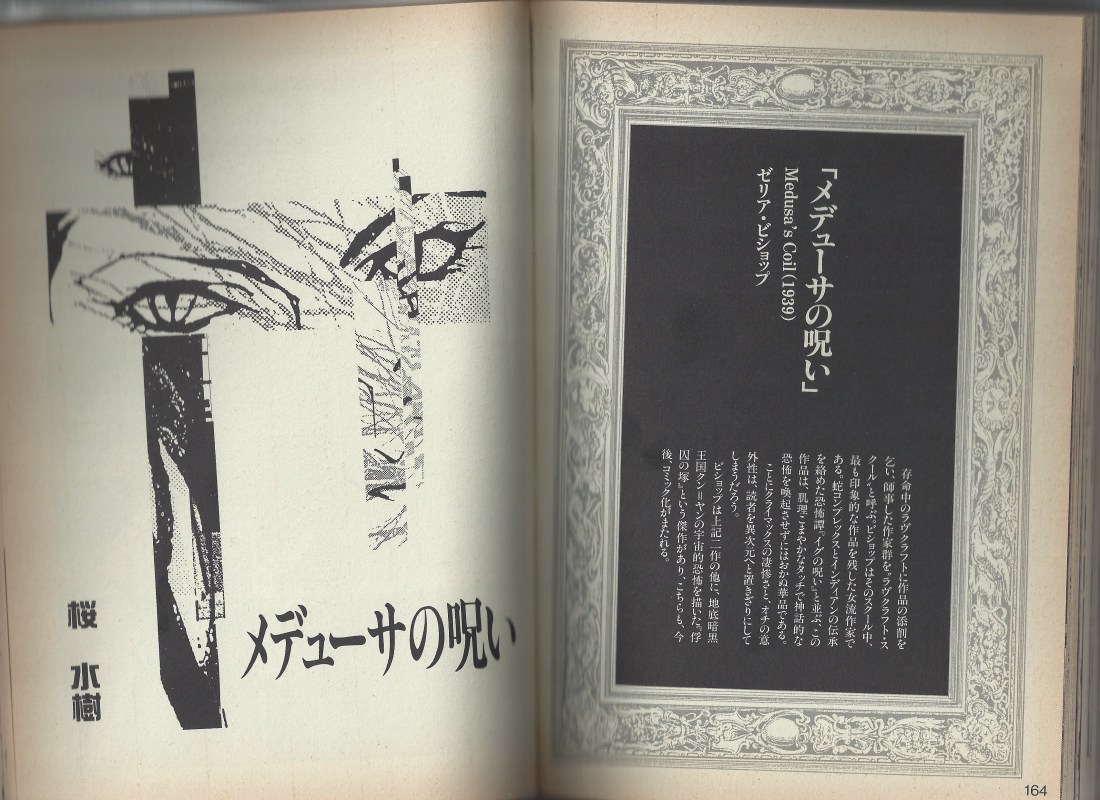
While many of H. P. Lovecraft’s tales have been adapted to the form of comics, and no few have been translated into other languages, it is comparatively rarer to see translations and adaptions of the revisions and ghostwriting stories into languages other than English. One of the very few such treatments is an adaptation of “Medusa’s Coil” (1939) by Zealia Bishop & H. P. Lovecraft entitled 「メデューサの呪い」(“Medusa’s Curse”) by 桜 水樹氏 (Sakura Mizuki), published in 妖神降臨―真ク・リトル・リトル神話コミック (1995), a collection of adaptations of comparatively lesser-known Mythos fiction by Robert Bloch, Henry Kuttner, and others. “Medusa’s Curse” is the final story in the volume, and begins with a preface:

The writers who during Lovecraft’s lifetime asked him to edit their stories are called ‘Lovecraft school’. Among this group the female author Z. Bishop left a most impressive work. Medusa’s Coil can be compared with Bishop’s other story “The Curse of Yig” which combines snake phobia and Native American folk tale. Due to its fine details, Medusa’s Coil is a special work that evokes mythological fear. Especially the outbreaking catastrophe at the story’s climax and the last unexpected twist take the reader into another dimension and leave him there.

Besides these two stories, Bishop also wrote the excellent story “The Mound” about the underground kingdom of K’n-yan and its cosmic terror. It is expected that this story will also be turned into a manga at one point.
—trans. Dr. Dierk Günther

SCAN0381

The adaptation removes the original Southern plantation setting, moving the story into a contemporary American South full of late 80s/early 90s styles. This transition also removes many of the objectionable elements from the original, as there are now no slaves (or people of color) in the story, no references to Africa, and the final revelations are focused much more on the cosmic horror of Marceline Bedard.

SCAN0382
“Marceline Bedard”

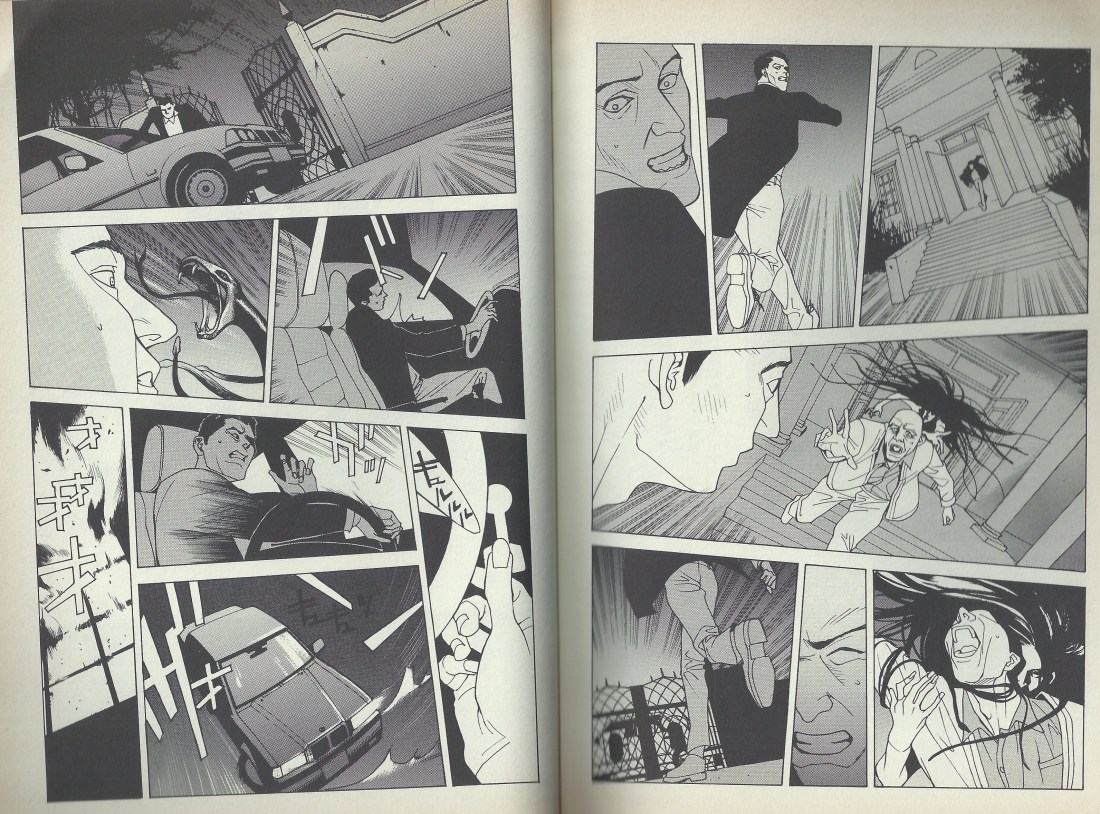
Sakura’s art style throughout is very subdued, realistic, with the slightly effeminate bishonen look to the younger male characters Denis and Marsh. It effectively communicates the quasi-love triangle set-up of the original story, the interplay between Denis, his friend Marsh, and Marceline as wife and nude model for the painting. For most of the story, the action is purely on that psychological level, no hint of the supernatural.

While there are liberties taken with truncating the story to fit in the space, overall this is a very faithful adaptation, with lines of dialogue borrowed directly from the story (sometimes in abbreviated form). The art tells more of the story than the dialogue, as a good graphic adaptation always does; little details like the ligature marks of the blood on the floor where the body was dragged, the shape of the handle and blade of the sword taken from a tulwar…and, of course, the painting itself, which attempts to express the inexpressible.

SCAN0383
Sound of heart beating
Shocked sound
Hissing sound of snake
Aaaaaahhhhhhhhhh
Sound of gunshot

One of the things the story adds is a literal emphasis on the serpentine aspect of Marceline Bedard and her hair which is lacking in the original story. Lovecraft and Bishop used the term “Medusa” metaphorically, the hair as an alien thing, perhaps closer to the strange tentacles of C. L. Moore’s “Shambleau” (1934) than to the monster of Greek myth. This becomes more obvious after her death, when the story goes from a bloody lover’s triangle to overt supernatural horror.

SCAN0384
Sound of car door, fire, screeching tires.

Note here how the narrator is in a panic, and the framework of the panels reflects that. No longer are they square and even, now everything is skewed and at Dutch angles, reflecting action and movement that the reader doesn’t see, but which happens in the gutters. It is a very effective way to show the disordered, chaotic state of mind, and is used to great effect on these pages. The very regularity and normality of the opening of the story makes it all the more jarring when the horror finally appears on the page.

All reference to Marceline as being mixed-race is gone, Sophonisba’s speech is gone, and with them all explicit references to Cthulhu and the Mythos. The story is certainly simpler for it, both from a narrative perspective and visually, while sacrificing none of the inherent power of the story. The tension builds nicely until the first bloody climax, and then the real horror begins… The final revelation now is less Marceline’s identity than the fact that the house had supposedly burnt down five or six years previously. Ending it in that way makes it more of a ghost story, similar to some of the tales in Lafcadio Hearn’s Kwaidan: Stories and Studies of Strange Things (1904).

Translations and adaptations are tricky, especially when going back and forth between different media and languages. How much did Sakura deliberately jettison from the starting text, which was probably a Japanese translation rather than the original English? There are obvious efforts to remain faithful to the general events and specific wording of the story, even as it is updated to a contemporary setting (as are most of the other adaptations in the manga anthology), lines of dialogue from the English original come through in recognizable form when translated back into English, which can be a remarkable achievement in itself.

「メデューサの呪い」(“Medusa’s Curse”) by 桜 水樹氏 (Sakura Mizuki), published in 妖神降臨―真ク・リトル・リトル神話コミック (1995); I have not been able to find any reprints or translations.

With thanks and assistance to Dr. Dierk Günther of Tokushima University for assistance and translation of the Japanese original.


Bobby Derie is the author of Weird Talers: Essays on Robert E. Howard & Others (2019) and Sex and the Cthulhu Mythos (2014).
“There Are More Things” (1974) by Jorge Luis Borges

Horatio
Oh, day and night, but this is wondrous strange.

Hamlet
And therefore as a stranger give it welcome.
There are more things in heaven and earth, Horatio,
Than are dreamt of in our philosophy.
—William Shakespeare, Hamlet, Act 1, Scene 5

To the memory of H. P. Lovecraft
—Jorge Luis Borges, dedication to “There Are More Things” (1975)

The picture painted by Barton Levi St. Armand in “Synchronistic Worlds: Lovecraft and Borges” is of a man both familiar with Lovecraft’s work and life, yet willing to disavow such knowledge; at once appreciative and critical. The great Argentinian writer of Ficciones (1944) and El Aleph (1945), which was translated and published as Labyrinths (1962) in English, was born nine years and a world apart from Lovecraft, yet like astronomical objects their orbits were destined for the occasional collision. Borges would afford Lovecraft space in his Introduction to American Literature (1971), for example, he wrote:

In his stories one meets beings from remote planets and from ancient or future epochs who dell in human bodies to study the universe, or, conversely, souls of our time who during sleep explore monstrous worlds, distant in time and space. Among his works we shall recall “The Color from Space,” [sic] “The Dunwich Horror,” and “The Rats in the Wall.” [sic]

We don’t know when and where Borges first met Lovecraft, in a literary sense. Some translation in a Spanish or Argentinean magazine, perhaps; an inclusion in some anthology maybe, or a lonely Arkham House title that had made its way to Buenos Aires. The stories he mentioned were all included in The Outsider and Others (1939), so it is possible.

The details don’t really matter; Borges read Lovecraft. Borges wrote a story dedicated to Lovecraft. It first appeared in the magazine Crisis (May 1974), and then was published in his collection El libro de Arena (1975, “The Book of Sand”); appeared in The Atlantic Monthly the same year. In 1977, in New York City, the makers of the Simon Necronomicon took care to note:

In the July, 1975, issue of The Atlantic Monthly, there appeared a story entitled “There Are More Thing”, written by Jorge Luis Borges, “To the memory of H. P. Lovecraft”. this gesture by a man of the literary stature of Borges is certainly an indication that Lovecraft has finally ascended to his rightful place in the history of American literature, nearly forty years after his death. (xi)

Given his own love of literary hoaxes, one can only wonder what Borges would make of his own name being used to supplement one of the most prolific hoaxes ever published regarding Lovecraft’s most famous literary creation.

“There Are More Things” is set in Turdera, in Lomas de Zamora Partido in Buenos Aires; the narrator a doctor of philosophy from the University of Texas at Austin. The details of the setting and the people are drawn from life; you could picture Borges walking those streets, talking to those people. Hinting rather than telling anything outright.

A house is the first focus of the story—the Red House, descended from Edgar Allan Poe’s House of Usher, from Lovecraft’s Shunned House and Exham Priory in “The Rats in the Walls.” Things are hinted at but not explained; as with many of Lovecraft’s works, it has the form of a detective story, the protagonist spiraling in toward the central mystery.

Like most Lovecraft stories, there is little of plot. The narrator follows compulsion rather than plan, is driven by events, none of the people who meet him tell him anything although they all clearly know or think they know something. It is a wonderful sentiment of taboo, the line that must not be crossed which is inevitably crossed. The reader follows him as enters the Red House. What he finds in there…maybe some meditation on “The Dunwich Horror” which no other author had thought to imagine:

[…] a second great siege of carpentry went on at the old house. It was all inside the sealed upper part, and from bits of discarded lumber people concluded that the youth and his grandfather had knocked out all the partitions and even removed the attic floor, leaving only one vast open void between the ground story and the peaked roof.
—H. P. Lovecraft, “The Dunwich Horror”

The dining room and library of my recollections were now (the dividing wall having been torn out) one large ruinous room, with pieces of furniture scattered here and there. I will not attempt to describe them, because in spite of the pitiless white light I am not certain I actually saw them. Let me explain: In order truly to see a thing, one must first understand it. An armchair implies the human body, its joints and members; scissors, teh act of cutting. What can be told from a lamp, or an automobile? The savage cannot really perceive the missionary’s Bible; the passenger does not see the same ship’s rigging as the crew. If we truly saw the universe, perhaps we would not understand it.
—Jorge Luis Borges, “There Are More Things”

Many of Lovecraft’s works have touched on the horror unseen, or sometimes literally unseeable—as in “The Dunwich Horror” and “The Colour Out of Space.” A tradition that Lovecraft borrowed from Guy de Maupassant’s “Le Horla” (1887), Ambrose Bierce’s “The Damned Thing” (1893), Algernon Blackwood’s “The Willows” (1907), and other stories. Borges delighted in these questions of perception, the hypothetical infinities made manifest in his stories such as “The Book of Sand.” His tribute to the memory of Lovecraft is to sketch at the shadows such strangely-dimensioned monsters might cast, and to let the reader draw their own conclusions.

The final sentence is a sentiment that fans of Lovecraft may wish to meditate on:

Curiosity got the better of fear, and I did not close my eyes.

If you were the protagonist in a Lovecraftian story…if you had an opportunity to see Cthulhu rise from the depths, or to breach the forbidden upper story where the Dunwich Horror was imprisoned, to go down that stair in Red Hook, leaf through the brittle pages of the Necronomicon, or follow the carved steps beneath the altar in Exham Priory…would you?

As much as we may joke about how protagonists act in a horror story or film, descending into peril, touching the cursed idol, reading the forbidden book, etc., would our own curiosity overpower our fears? To be blasted like the Nazis in Raiders of the Lost Ark, destroyed for our impertinence…or to experience for ourselves that awesome culminating revelation which we had only felt distant, shuddering echoes of in the italicized final sentences of a Lovecraft story?

Well, it’s something to think about.


Bobby Derie is the author of Weird Talers: Essays on Robert E. Howard & Others (2019) and Sex and the Cthulhu Mythos (2014).
“Riemannian Dreams” (2010) by Juan Miguel Marín

He was getting an intuitive knack for solving Riemannian equations, and astonished Professor Upham by his comprehension of fourth-dimensional and other problems which had floored all the rest of the class.
—H. P. Lovecraft, “The Dreams in the Witch House”

What inspired your story? The weird quasi-Lovecraftian speculations behind Einstein’s theory of relativity and its Riemannian mathematics.
Interview: Juan Miguel Marín

When it comes to the erotic possibilities of the Lovecraft Mythos, “The Dreams in the Witch House” and “The Whisperer in Darkness” may not jump immediately to mind, much less German mathematician Georg Friedrich Bernhard Riemann (1826-1866). Yet that is what Juan Miguel Marín attempts in his entry for the Cthulhurotica anthology…and not without some success. Whether Marín knew it or not, his particular approach of visitations of the Lovecraftian erotic through dreams echoes certain critical interpretations of Lovecraft’s “The Dreams in the Witch House”:

But something significant happens in this dream. Keziah thrusts into Gilman’s right hand “a huge grey quill” with which to sign his name to the devil’s book and to provide the necessary blood. Brown Jenkin races across his body, up to his shoulders and down his right arm, to bite him in the wrist, causing a “spurt” of blood at which Gilman faints. The next morning “his cuff was brown with dried blood.” The stories of the devil’s book are, let us admit, rather unimaginative, but they conceal a masturbatory fantasy that seems actually at work here. Gilman faints away because he cannot accept the wet dream.
—Robert Waugh, “The Ecstasies of ‘The Thing on the Doorstep’, ‘Medusa’s Coil,’ and Other Erotic Studies” in A Monster of Voices 101

“Riemannian Dreams” begins as an echo of Riemann’s own mathematical proofs, stating the facts as clearly as he can, but also a kind of dream-diary. The timeline is unclear; Riemann died in 1866, but he feels the dreams were inspired by the Edison wax phonograph, c.1899; other references to “The Dreams in the Witch House” and “The Whisperer in Darkness,” and Einstein’s theory of relativity put it somewhere between 1905 and the 1920s. Perhaps this is not the Bernhard Riemann, but another professor; or some alternate timeline where Riemann survived another forty or fifty years.

The lack of certainty is a hallmark of Marín’s narrative. For the most part, readers are presented with bits and pieces, notes and letters, fragments of a story that build up to suggest a narrative. This echoes how Lovecraft would do much the same thing with “The Whisperer in Darkness” and other tales, although the connective tissue is a bit thinner here; the dates not quite adding up is one example, but more importantly, we gain no real glimpse of Riemann’s waking life—his protestant faith, his wife, where he lives and works, though there are references to teaching. The material world is faint, hazy, dream-like, but the dream sequences themselves are vivid.

Riemann’s wet dreams are queer; they do not fall easily into any particular spectrum of sexuality, the subjects of his attention being particularly fluid—now male, now female, sometimes both.

In the first lucid dream I could glimpse only a young, pale, androgynous face, which the water ripples sometimes hid, sometimes revealed. I could not tell whether the atractive stranger was a boy or a girl. I could only notice the blond-auburn hair, pale skin of a healthy pinkish color, rose-colored cheeks, rosy red lips, and the eyes… […] I see now a beautiful backside. Like mine, also covred with nothing but a loincloth. My scientific curiosity tries to find out more about those lovely hips but the mist prevents me.
—Juan Miguel Marín, “Riemannian Dreams” in Cthulhurotica 72-73

The “scientific curiosity” is a hallmark of the Lovecraftian protagonist, the libidi sciendi, the desire to know. It’s tempting to look for metaphors here in Riemann’s efforts to define the nature of the subject of his desires, a quest for self-knowledge of his own sexuality as much as an effort to define an external reality. The subjects of his dream-vision, however, are a bit outside of those dreamt in this particular Horatio’s philosophy…at least at the start.

As an episode, “Riemannian Dreams” occupies a bit of an odd place in the Mythos. It is not situated clearly in respect to any time and place, but the connections between this story and “The Dreams in the Witch House” and “The Whisperer in Darkness” are established clearly and deliberately, but not the timeline. It’s not quite sequel, prequel, or interqual, simply an episode. Contrast this to a story such as “The Dreams in the Laundromat” by Elizabeth Reeve in Whispers in Darkness: Lovecraftian Erotica, which takes care to establish setting and continuity, set after “The Dreams in the Witch House” and focusing on the continuing legacy of Keziah Mason and Walter Gilman. “Riemannian Dreams” walks a fine line between mathematical logic and dream logic; fitting, since ultimately that is the choice which Riemann is presented with at the end.

What is your favorite bit?

“…leaving me covered in salty sweat, uncomfortably wet, and, unfortunately, awake.”
Interview: Juan Miguel Marín

“Riemannian Dreams” was published in Cthulhurotica (2010), and has not yet been reprinted. Juan Miguel Marín is also the author of “The Bats in the Walls” (2010).


Bobby Derie is the author of Weird Talers: Essays on Robert E. Howard & Others (2019) and Sex and the Cthulhu Mythos (2014).

“The Book of the Forgotten Ones” (1977) by Nema Andahadna

There cometh the Book of the Forgotten Ones. This shall be for the priests of Maat.
In the name of creation and that which is before it, Aumgn!
—NAHADA 62, “The Forgotten Ones”
The Cincinnati Journal of Ceremonial Magick, Vol. I, No. II, 59

If a reader were to browse through the chapter on Lovecraftian magick in Robert North’s New Flesh Palladium (2006, 4th edition) or The Book of Lies: The Disinformation Guide to Magick and the Occult (2008), or peruse Kenneth Grant’s later Typhonian Trilogies, especially Outside the Circles of Time (1980), they would come across references to a supposed Lovecraftian occult text or work called The Book of the Forgotten Ones. One of the rituals is discussed briefly in The Necronomicon Files (2003). Yet unlike Necronomicon Gnosis: A Practical Introduction (2007) by Asenath Mason, you cannot exactly go online and buy a nice hardcopy edition of this particular occult text.

Some years ago I received a communication from the Maatian gestalt via the mediumship of Soror Andahadna (Nema).
—Allan Holub, “The Second Book of the Forgotten Ones”
The Cincinnati Journal of Magick, Vol. II, No. VI, 33

The Book of the Forgotten Ones is a channeled text, received by the medium Soror Andahadna (Nema, Maggie Ingalls). The reception of texts from a divine or supernatural source is accepted by many religions and occult groups, examples include Joseph Smith and the Book of Mormon or Kenneth Grant and the Book of the Spider. One can even draw a Lovecraftian parallel with the images of Cthulhu created by sensitive artists in “The Call of Cthulhu.”

Nema was a practitioner of Thelema, the system of ceremonial magick created by Aleister Crowley and extended by Kenneth Grant and others, and in 1974 had channeled the book Liber Pennae Praenumbra: The Book of the Foreshadowing of the Feather, which established her own “Maat” current, based on Thelemic principles. She joined the Bates Cabal in Ohio, helped write and publish The Cincinnati Journal of Ceremonial Magick in 1976, co-founded the Horus-Maat Lodge in 1979, and published a number of works on her Ma’atian magick. She was a member of Kenneth Grant’s Typhonian Order for several years, and alongside Michael Bertiaux became one of Grant’s favorite examples of Lovecraftian occults in his Typhonian trilogies.

Soror Andahadna, a contemporary priestess of Maat, has received snatches from beyond the Abyss, and they comprise The Book of the Forgotten Ones. It contains allusions to mysteries that first appeared in the writings of Frater Achad [Charles Stansfield Jones]. It would appear that there exists just without the circle of mundane awareness a complete grimoire of magical formulae. It is perhaps from this lost grimoire that artists and poets have been drawing with increasing frequency over the past century, or since the ‘first whirlings’ of the New Aeon were adumbrated more than four hundred years ago in the writings of Rabelais, and earlier initiates.
—Kenneth Grant, Outside the Circles of Time 46-47

“Snatches” is perhaps the best description of it, because if The Book of the Forgotten Ones has ever been a single complete text, I’ve found no record it. What we have are three separate chapters which were published over the space of a decade in the Cincinnati Journal of Ceremonial Magick, alongside much other Thelemic and Ma’atian material by Nema and the Bates Cabal.

The first chapter is “The Forgotten Ones,” published in Vol. 1, no. 2, pp.59-63 as by NAHADA 62. The text is dated 16 July 1971, which would make this earlier than the Liber Pennae Penumbra, and contains no overt references the Lovecraft Mythos, being for the most part a long series of short declarative sentences and instructions, for example:

Ye know Me, though my name be forgotten, in the dread of impending events. I am the motion of a leaf blown down an empty street. I am the sender of omens.

Chant the incantation of My Name.

It will destroy you. Pronounce My Name aloud, in repetition—it will banish all but pure Awareness.

Descend into My Temple, meet yourself. Bear thence the Wand of the Papyrus, and the sword, the shield of mine devise, and the eye Globe. Ye are twain therein, and learn the Alchemy and Mass of No*.
—NAHADA 62, “The Forgotten Ones”
The Cincinnati Journal of Ceremonial Magick, Vol. I, No. 2, 60

These could be taken as instructions for a ritual, couched in symbolic language for adepts. As to who the “Forgotten Ones” are, Nema would later expand on that slightly in her work Maat Magick: A Guide to Self-Initiation (1995), with a bit of a Jungian approach:

I call our survival urges the Forgotten Ones (FO) because our intellects tend to forget them or to trivialize them. Our individual and collective Egos are artifacts of intellect; it’s ego’s vanity that blinds intellect to the power of the FO. […] The Forgotten Ones include, but are not limited to, the instincts of hunger, sex, fight-or-flight, clanning, communication, curiosity, altruism and religion, all those imperatives or actions ensuring survival of self, offspring, and species. The gods our ancestors worshipped are rooted in the Forgotten Ones, given typical human personalities, then made larger and more powerful than humans. […] The gods and goddesses of the old pantheons gained independent life through centuries of worship and did play a directing role in the spiritual, moral and social lives of their devotees.

The second chapter is “Return of the Elder Gods: An Invocation of the Forgotten Ones” in The Cincinnati Journal of Ceremonial Magick vol. 1, no. 3, pp.17-26 (1978), as by “Nema and the Shadow.” Unlike the previous chapter, this is a completely different style, much more expositional and less ceremonial; it discusses the Elder Gods, their relation to the Forgotten Ones, and how (and why) to invoke the latter to aid against the invasion of the former. This is the ritual discussed in The Necronomicon Files (2003, 120-1); the paragraph in The Book of Lies 145 seems based directly on The Necronomicon Files. In one of those “as above, so below” turnabouts, it seems that:

In the Macrocosm, these forces are the Elder Gods; in the Microcosm, they are the Forgotten Ones. to  our present Consciousness, these gods are Qlipothic, constituting the Dark aspects of the anti-Universe and the human Unconscious respectively. Admittedly, there is a certain danger inherent in contact them; but there is sure disaster in neglecting to do so.
—Nema and the Shadow, “Return of the Elder Gods”
The Cincinnati Journal of Ceremonial Magick, Vol. I, No. 3, 17

While not explicitly Mythos-related (unless you count the term ‘Elder Gods’ in a sense Lovecraft never used), there are details of the work that suggest Nema was definitely being inspired by the work of Kenneth Grant, particularly Cults of the Shadow (1976) and Nightside of Eden (1977). It is notable that in Maat Magick, Nema writes:

Mr. Grant expresses a dangerous experience in Nightside, one that can be approached “in person” only from above the Abyss. […] He speaks more eloquently on the subject than anyone since H. P. Lovecraft. Unlike H.P. L., Mr. Grant is a conscious adept and priest of the eldrich [sic] dark; rather than speak of unspeakable horrors, he presents useful information about the denizens of the tunnels and the dangers of the Nightside. (209)

What really brought all this together was “The Second Book of the Forgotten Ones” in The Cincinnati Journal of Magick vol. II, no. 6, pp.33-53 (1988) by Allen Holub. This essay is an exegesis on Nema’s channeled text, along with a channeled text of his own received 7 January 1976, and directly connects these workings with the Lovecraft Mythos…sortof:

By way of introduction; this essay discusses a collection of forces deemed variously the Elder Gods, the Old Ones, and the Forgotten Ones. The two former names are unfortunate as they associate these forces with the writings of H.P. Lovecraft. Though Lovecraft may or may not have been in contact with these beings, his fearful ravings are of little use to the practicing magician. As far as I can determine, the forces discussed below have no relation whatever with the begins contacted by Lovecraft, even though some of them bear the same names. This similarity of nomenclature may be attributed to Lovecraft having indeed reached the Portal, that is, the verge of true communication with the Dark Forces. However, instead of communicating with them, he was eaten by them. The forces Lovecraft represents in his stories are not the true Elder Gods at all but are the shadows of the Elder Gods distorted to the point of unrecognizability by madness. For these reasons, the forces here will be called the Forgotten Ones, a name they choose for themselves. These are not the gods of the Lovecraft Mythos.
—Allen Holub, “The Second Book of the Forgotten Ones”
The Cincinnati Journal of Magick, Vol. II, No. VI, 33-34

Holub’s forceful assertion that the Forgotten Ones/Elder Gods are not the same as any entities in Lovecraft’s fiction appears to be a direct confirmation that some people did see the connections. Kenneth Grant appears to blithely ignore this entirely in his chapter on “The Forgotten Ones” in Outside the Circles of Time, and given the relative scarcity of the original journals, it’s possible few people were the wiser. Whether Holub was ever speaking for Nema on the matter is unknown.

In content, these snippets of The Book of the Forgotten Ones are both disappointing and interesting. The original channeled text and ritual by Nema appear to represent her genuine spiritual and occult leanings and practice, related as they are to the Ma’at current; Holub and Grant both seized on these as inspiration and raw material for their own expansion of the material. In the case of Kenneth Grant—who was apparently eager to seize on any magical practice vaguely related to his own Lovecraftian leanings—this resulted in the rather wider dissemination of The Book of the Forgotten Ones than it would otherwise have gotten.


Bobby Derie is the author of Weird Talers: Essays on Robert E. Howard & Others (2019) and Sex and the Cthulhu Mythos (2014).
“Legacy of Salt” (2016) by Silvia Moreno-Garcia

The Mayans thought the cenotes were portals to the realm of the dead, Xibalba, but his family called it by another name, Y’ha-nthlei, and the cenote was Yliah’he. It had no meaning in Mayan, this was an older language, the elders had told him. A language from before the Conquest, before the great pyramids rose upon the limestone bedrock of Yucatán. Much of the knowledge had been lost through the years, but some true names and words remained. Yliah’he.
—Silvia Moreno-Garcia, “Legacy of Salt” in The Mammoth Book of Cthulhu 324

The Mythos, from its small hard core of writings by Lovecraft and his contemporaries, has been spun out by many writers in many ways. That is the great gift of it: being able to play with the ideas, to have readers trace the shape of old stories and old ideas, newly embodied: refreshed, reincarnated, yet recognizable.

Scene: Yucatán, the 1960s. An old family, an old house; echoes of Edgar Allan Poe, the shadows a little darker in the harsh tropical sunlight. The family name is Marin rather than Marsh; there is no Devil’s Reef, but there is the cenote Yliah’he.

A Mexican Innsmouth, a new corner of Lovecraft country.

The story itself is a romance, almost a telenovela; we know this story even if we haven’t read it before. Will they/won’t they? There are all the usual and unusual obstructions: a fiance back in Mexico City, the call of the modern world, the titillating hint of incest. Yet Silvia Moreno-Garcia carries us through admirably. She knows these waters, the details that make the setting pop, the buttons to push to keep the reader wondering, until the very end, which way it will go.

Silvia Moreno-Garcia wrote “Legacy of Salt” around the time she was reading a lot of philosophy of biology materials and also a Darwin biography as part of her Master’s degree studies. “Some of the scientific issues I was exploring collided with this story. I have always found ‘The Shadow Over Innsmouth’ to be fascinating since it seems to dip its toes into the notion of repulsion/attraction. Is it such a bad thing to swim eternally in underwater palaces? I kind of like the idea. The Yucatán peninsula is definitely nothing like New England but the numerous markers for archaeological sites somewhat reminded me of the nation of the past creeping upon the present, which occurs in some of Lovecraft’s fiction.”
The Mammoth Book of Cthulhu 312

Unlike “Ahuizotl” (2011) by Nelly Geraldine García-Rosas or “Mail Order Bride” (1999) by Ann K. Schwader, there is very little of horror in this story, and that which remains is mixed with fascination. The protagonist, Eduardo Marin, has tragedy in his life—father dead in a car crash, a mother that abandoned him to start a new family—but there is nothing as traumatic to the family as a whole as the raid on Innsmouth which overshadows and informs “All Our Salt-Bottled Hearts” (2016) by Sonya Taaffe and “The Litany of Earth” (2014) by Ruthanna Emrys.

Except in the sense that the Marins are survivors; remnants of some family line that dates back before the Conquest of Mexico. There are hints throughout the story, references to the Mayan rain-god Chaac, in the shape of a frog, but nothing specific. Hints, remnants, just enough to whet the imagination. The lack of knowledge, loss of knowledge, is the great sub-theme of this story. The biological and material “legacy of salt” is undeniable, but there is a loss of cultural knowledge keenly felt…and that too is a legacy of the Conquest.

“Legacy of Salt” was published in The Mammoth Book of Cthulhu (2016), and has not yet been reprinted. Silvia Moreno-Garcia has been an editor, writer, and translator. Her Lovecraftian fiction includes “Flash Frame” (2010), “In the House of the Hummingbirds” (2012), “The Sea, Like Broken Glass” (2014), and “In the Details” (2015), and her latest novel is Mexican Gothic (2020).


Bobby Derie is the author of Weird Talers: Essays on Robert E. Howard & Others (2019) and Sex and the Cthulhu Mythos (2014).
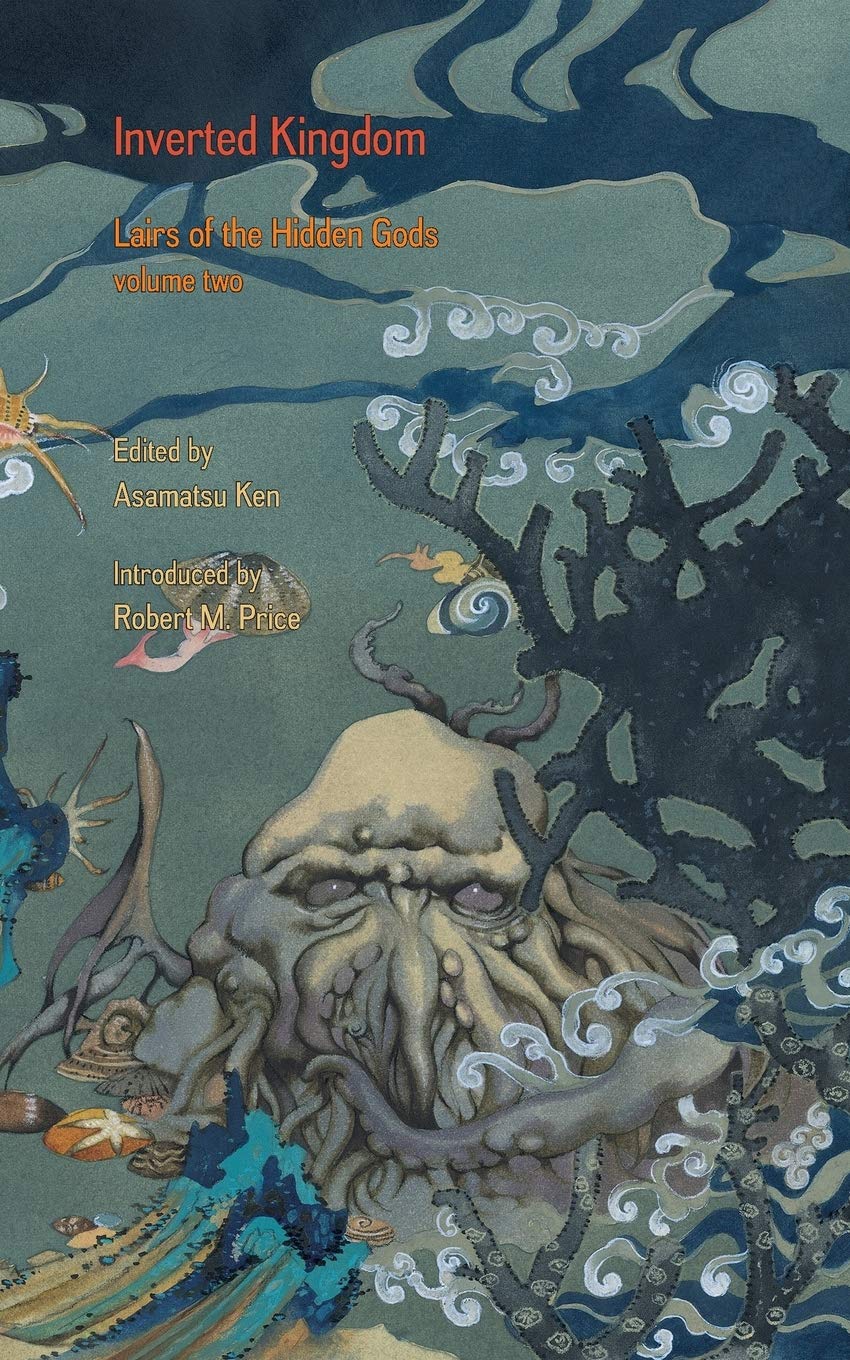
Tide of Desire (1983) by Sheena Clayton

“Their religion? You mean, they have one of their own?”

“The Reformed Order of Dagon. It’s a branch, or a schism of a church that was founded in Massachusetts about a hundred and fifty years ago. As I understand it, the main body of the church was stamped out by some pretty high-handed federal action back in the nineteen-twenties. But they never got around to bothering the Squampottis bunch, either because they’re so isolated, or because cooler heads prevailed in Washington. The thing in Massachusetts was remarkably well hushed-up. All the relevant government records have been destroyed.”
—Brian McNaughton, Tide of Desire (1983)

The very first erotic novel to deal with the legacy of Innsmouth came from the typewriter of Brian McNaughton. Active as a fan during his teenage years in the 1950s, McNaughton was briefly a journalist before turning his hand to erotic novels, starting with In Flagrant Delight (1971). His “break” came in the late 70s when he began producing erotic horror novels, starting with Satan’s Love Child (1977)—the publisher’s title, not his—which included elements of or references to the Cthulhu Mythos. It was successful enough to merit several other books, and McNaughton transitioned back over into doing mainstream horror in Weirdbook and other publications, and won the World Fantasy Award for Throne of Bones (1997).

Erotic horror wasn’t exactly new, as Grady Hendrix notes in Paperbacks from Hell: The Twisted History of ’70s and ’80s Horror Fiction, sex has long been a selling point and those two decades saw a boom in erotic horror and horror erotica. Still, this was a decade before Ramsey Campbell’s Scared Stiff: Tales of Sex and Death (1987) or the anthology Hot Blood (1989), and erotic horror fiction of the period tended to work off existing properties like Universal Monsters or classic horror novels—The Adult Version of Dracula (1970) and The Adult Version of Frankenstein (1970) being exemplary of the latter trend. By comparison, Lovecraft was largely a virgin field for erotic horror, or at least not entirely played out.

Beginning in the early 1980s, McNaughton wrote a series of erotic novels for Tigress Books. These were written under the pseudonym “Sheena Clayton,” and the line itself may have been aimed more at a female audience than typical adult novels of the period, a more hot-blooded and explicit counterpart to mainstream romance novels. The books tend to feature female protagonists and writers with female names, and the relatively sedate photo covers give the impression. On the name, McNaughton once wrote:

Sheena Clayton was the illegitimate daughter of Sheena, Queen of the Jungle, and
John Clayton, Lord Greystroke. I channeled her in several novels, of which TIDE OF
DESIRE may have been the best. (Sex and the Cthulhu Mythos 202)

These novels were Love and Desire (1982), The Aura of Seduction (1982), Tide of Desire
(1982/3), Danielle Book Two (1983), There Lies Love (1983), and Perfect Love (1983). All of these to greater or lesser extant contain references to the Mythos. For example, Edward Pickman Derby appears briefly as a member of a “Rats in the Walls”-esque Magna Mater cult in Love and Desire; Ramsey Campbell’s Lovecraftian fictional grimoire Astral Rape from his novel The Parasite (1980) is prominent in Danielle Book Two; and the cult in Perfect Love was founded by a Rev. H. P. Whateley from Arkham, Massachusetts.

Inside the door, Cthulhu ran up with a hearty meow, and he seemed just as glad to see Melisande as herself. The girl was quite indifferent to him, however, perhaps even a bit impatient with his rubbing against her ankles.

“Scat!” Antonia cried, moving him along with a nudge of her toe. “Cthulhu doesn’t normally take to strangers.”

“Who?” The girl seemed startled, even shocked.

“Cthulhu. That’s the cat’s name.”
—Brian McNaughton, Tide of Desire (1983)

The style of the novel partakes strongly of the Derlethian combination that Lovecraft’s fictional works exist in the world of Tide of Desire, and that the stories chronicle at least partially real events, so that the Mythos definitely exists. A good point of comparison might be Robert Bloch’s novel Strange Eons (1979). More interesting for fans of McNaughton’s later Mythos fiction is that several of the concepts for the Deep One culture are carried over between the novel and his story “The Doom That Came to Innsmouth” (1999). For example, the idea of a Deep One hybrid transitioning from land to water is called “Passing Over”:

“Dagon flay me alive! Ye be right! What an old ninny I be! Our Caleb’s daughter, she passed over a good ten-fifteen years ago. I ain’t seed her lately, but she be down there, don’t you worry. You look like her; that got me all confused. You look like her before she passed over, I mean. I never seed her before she passed over, of course, but I got her picture as a girl someplace. Our Caleb sent pictures of him and his mainland wife and all their kids to prove that the kids didn’t have the look, no more’n he did. But that girl sure did, all right. Poor Caleb. He was right about hisself, he never passed over, but he never told his daughter a word about the Blessing of the Deep Ones. So there she lied, passing over in the middle of nowhere, miles from the sea, and not knowing what the hell were happening to her.”

Mrs. Nicker mumbled to herself as she debated the whereabouts of the photograph she’d mentioned. Then she said to Antonia: “But by pure luck-or more likely it were the hand of Dagon stretching out to help her-there were this colored man from New Orleans who knew somewhat about the doings of the Deep Ones, and he told her she had better get herself to the sea, fast. She paid him to help her, and he took her to… where? To Charleston, South Carolina, that’s right! So she got there just in time to pass over. Then she come to Squampottis and told us all about it. It were the most exciting thing happened on this here island since the visitation of Shug-N’gai, just after the federals smote all them blasphemers and heretics at Innsmouth. That were in nineteen-and-twenty-eight, I do believe. Who says my memory ain’t perfect, hey? Don’t you try to tell me about our Caleb, boy. You wasn’t even borned then.”
—Brian McNaughton, Tide of Desire (1983)

The gist of the novel is that the protagonist, Antonia Shiel, is herself a descendant of the Deep Ones whose body is preparing to “cross over,” encountering a splinter sect of the Esoteric Order of Dagon on Squampottis Island—and realizing too late that she herself has the “Squampottis look.” the changes in herself adding a touch of body horror to the novel as her hair falls out and her feet swell…all of which are undone by the ending.

“Your hair seems to be thicker all of a sudden,” he noted admiringly. “That lovely pubic patch is just like a beautiful young woman’s, and not bare like a child’s. And the hair on your scalp looks thicker already.” (ibid)

The novel comes to an abrupt, jarringly disconcerting “happy ending” very atypical for McNaughton’s novels, as the novel was bowdlerized badly by the editors. McNaughton found the original ending and was revising Tide of Desire for eventual publication at Wildside Press, under the title Riptide. However, McNaughton’s untimely death in 2004 appears to have ended any plans to republish the novel. We can only speculate what the original ending would have been, but given that the story as a whole is a kind of contemporary, sexually explicit update to “The Shadow over Innsmouth,” it would have been both appropriate and in keeping with the tone of the novel if Antonia had “passed over” and joined the Deep Ones.

It would be wrong to say that Tide of Desire, or any of the Sheena Clayton novels, were influential. Pornography is ephemeral literature, and the novels didn’t make much of a splash in Lovecraftian circles when they came out. Which is unfortunate because, as Matthew Carpenter notes in his own review and synopsis, this is actually a very competent Mythos novel, and presaged some of the ideas developed independently by later writers. Sonya Taaffe in “All Our Salt-Bottled Hearts” (2016) wrote about some hybrids that don’t make the transition, and McNaughton wrote:

“It’s me that’ll die, it’s me that’ll be dumped into the ground like dead meat.” She began to sob bitterly, clawing at the arms of the chair with abnormally large hands. “Oh, you should see Rev. Preserved. He’s like an angel! Just last month I seed him in all his glory at Marsh Cove, taking no less than a dozen of our maidens, and our Melly one of them. Whether she be carrying his child or not, I don’t know, it be too soon to tell. When Rev. Preserved told me to have faith, I nearly believed it. He were like a god walking on earth. He said I’d pass over yet, but I don’t believe him now. Dead meat in the churchyard, that’s where I be bound.” (ibid.)

Tide of Desire is not quite the spiritual ancestor of erotic Deep One works such as The Innsmouth Porno VHS (2014), Innsmouth After Dark (2014), Taken By The Deep Ones (2015), Ichythic in the Afterglow (2015), and The Pleasures Under Innsmouth (2020). There is rather less sex, and that less explicit, than one might think; there are no sexual encounters such as in Alan Moore and Jacen Burrows’ Neonomicon (2011).

Which makes sense, because Brian McNaughton was not writing an erotic story dealing primarily with sexual encounters with Deep Ones, a horror story not afraid to go into details like mature sexual relationships, body image issues over breast size and pubic hair, etc. Vulgar terms for genitalia are completely absent. One of the more explicit passages in the book is almost sedate by contemporary standards:

She’d had only two hours of fitful sleep, sleep plagued by distorted versions of her conversations with the Boggs boy and Rev. Marsh and Mrs. Nicker; by dreams in which she gazed on a hostile world through a black veil, where she lay wheezing in a dark bedroom in Hamlen, where a long-dead minister pinned her against the Joyful Pillar in the town square with ravaging thrusts of his phallus while Melisande Seale looked on with demonic glee. (ibid.)

More of a dry (wet?) run for the paranormal romance novel genre, in many respects.

Whatever the initial print run was, Tide of Desire did not become an instant collector’s item. Very few copies of any of the Sheena Clayton novels appear to survive, with Tide of Desire being noted as especially rare…at last in the English version.

tide_japan (1)

By a quirk of fate, Tide of Desire actually got a Japanese translation and publication in 1984. 謎に包まれた孤島の愛 was one of a number of erotic novels translated into Japanese for mail order. Although out-of-print, copies may still be available today on the second-hand market.

For those who do desperately desire to read this novel, while the paperback is long out of print, ebook editions (really text files, but beggars cannot be choosers) of the Sheena Clayton novels are available from Triple X Books.


Bobby Derie is the author of Weird Talers: Essays on Robert E. Howard & Others (2019) and Sex and the Cthulhu Mythos (2014).
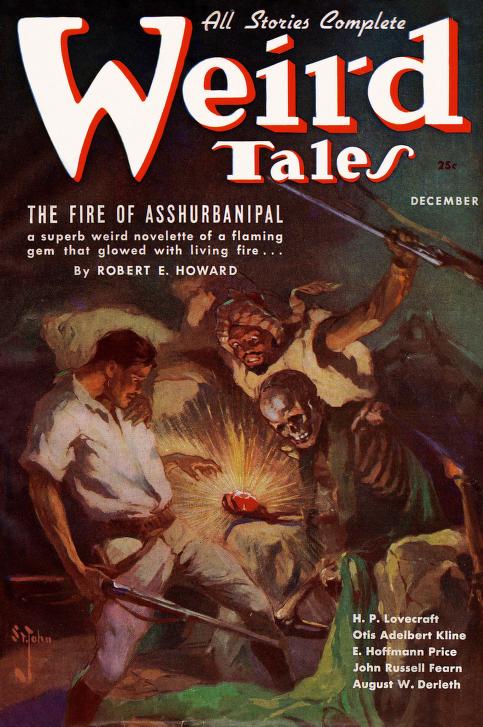
“The Nature of Faith” (2010) by Oscar Rios

In the early 90’s I got into the Cthulhu Mythos, from the works of R.E. Howard and the H.P. Lovecraft.  I’d been a role player for years playing Dungeons and Dragons, Star Frontiers and soon learned about the game Call of Cthulhu. […]

I started running Call of Cthulhu games at conventions… I started writing my own games… I started writing for Chaosium, the publisher of the Call of Cthulhu Role Playing Game…

Slowly the Call of Cthulhu Role Playing Game became a bigger and bigger part of my life.  I wrote more, became published more often, and even branched off into cosmic horror fiction.  Running scenarios at conventions soon became holding panels and seminars.  Writing my own scenarios became editing the scenarios of others.  Being published became publishing the works of others while working with Miskatonic River Press.  Then that changed to being in charge of a small publishing house producing supplements for the Call of Cthulhu Role Playing Game.

Then I stopped and looked back… to realize that twenty years has gone by.
—Oscar Rios, “Twenty Years Searching For The Necronomicon” (2013)

The Call of Cthulhu Roleplaying Game is undoubtedly one of the most critical vectors of infection for disseminating Lovecraft and the Mythos into the popular consciousness. Certainly, Weird Tales and Arkham House did their parts, popular paperback editions from Ballantine and Del Rey assured a wider audience, Hollywood films like The Dunwich Horror (1969) and Re-Animator (1985) spread the word. Yet after the death of August Derleth, it was Chaosium that launched its Call of Cthulhu Fiction line, reprinting both long-out-of-print classics and introducing new authors into the field. The roleplaying game has an international scope and appeal, and has attracted talented artists and writers.

Oscar Rios had been writing for Call of Cthulhu for six years when “The Nature of Faith” was published in Cthulhu’s Dark Cults: Ten Tales of Dark & Secretive Orders (2010). The roleplaying game roots show, but only if you’re already familiar with the material. The Order of the Silver Twilight, mentioned in passing, is from the Shadows of Yog-Sothoth campaign. This isn’t a gaming scenario re-cast as a novella, just an original work of fiction from someone steeped in the setting and its lore.

In a real way, the story is a love-letter to Dunwich, both as Lovecraft first described it and as it developed with the additions of other authors. It should be considered in the context (if not actually the continuity) of “The Devil’s Hop Yard” (1978) by Richard Lupoff & “The Cry in the Darkness” (2011) by Richard Baron, although unlike those stories it makes no mention of the Whateleys at all. The character of Gertrude “Gerdy” Pope, in particular, whose near-albino appearance is so evocative of Lavinia Whateley and Hester Sawyer, explained here as a “type” that shows up in Dunwich on occasion.

If there’s a flaw in the story, it might be a penchant for organization and exposition. When Rios writes:

Gerdy’s understanding of the Believers history was scant, but she knew they were a secretive group dedicated to worshiping nature, studying various forms of magic, and living in harmony with the world around them. Exactly the type of organization that appealed to her sensibilities.

The first Believers had apparently come to Dunwich from Salem, fleeing the witch hysteria that swept through that coastal community. It was said they were led here by dreams, unconscious calls beckoning them to these hills. For hundreds of years the Believers have lived in Dunwich, elarning much about the landscape’s unqiue and still-mysterious history. Many knew they were not the first people called here, and some suspected they would not be the last. Gerdy had seen enough of their inner workings to know that Believers varied in the nature of their gifts, abilities, and worship, but one rule was universal within their cult: secrecy.
Cthulhu’s Dark Cults 136

It’s almost a write-up from a setting-book, and certainly more in line with New Age-y, Wicca-oriented, post-WWII fiction than the rather more sinister and nameless cultic activities of Lovecraft’s “The Dunwich Horror” or August Derleth’s The Lurker at the Threshold (1945).

Which is not to say that the Believers don’t have their darker aspects, nor that there aren’t more mysteries left unspoken than laid out plain. It’s notable that the plot is mainly focused on the women of the townGerdy, Mother & Marie Bishop, Virginia Adams, Ne’seal, Celestia. The story wouldn’t pass the Bechdel Test, but by Mythos standards it has much more female representation than typical. But then, the gist of the story boils down to gender politics, with the intrusive, logical male outsider invading the peaceful, intuitive, female-dominated Dunwich. And hinted at being part of a cycle of such things.

“Men!” she proclaimed aloud, “ya never listen. Mebbe next time.”
Cthulhu’s Dark Cults 152

A bit of an inversion from “The Dunwich Horror,” where Lavinia Whateley is used, sidelined, and ultimately disappeared; the female playing her role and then ushered quickly off-stage. Yet not exactly progressive either; there are still stereotypes at play here, both male and female. It is difficult to break out of those ideas of gender roles and actions, in any mode of fiction.

Oscar Rios’ “The Nature of Faith” was first published in Cthulhu’s Dark Cults (2010), it has not been republished.


Bobby Derie is the author of Weird Talers: Essays on Robert E. Howard & Others (2019) and Sex and the Cthulhu Mythos (2014).

“The Genesis Mausoleum” (2016) by Colleen Douglas

And right here—speaking of new writers and square deals—we want to mention something that causes editors no end of trouble and makes them proceed cautiously in dealing with people unknown to them. We’re talking now about plagiarism. We hold this to be not only the most despicable form of theft, but a heinous crime perpetuated by thieves against whom the editor has no defense.
—Edwin Baird, first editor of Weird Tales,
“What Editors Want: Why Manuscripts Go Home” (October 1923),
reprinted in The Thing’s Incredible! The Secret Origins of Weird Tales 270

Some Mythos writers have been claimed to construct their stories with all the care of a good hoax; some Mythos fans have gone so far as to fabricate library entries, advertisements, bookplates, realistic photos, and facsimile books and artifacts—most in good fun, with little intent to truly deceive. When L. Sprague de Camp created the Al Azif (Owlswick Press, 1973), it was with a nod and wink. H. P. Lovecraft, his contemporaries, and literary followers have used pseudonyms for both commercial and literary reasons, partially or wholly disguising their authorship but not with any attempt to defraud the reader or publisher.

From a literary perspective, there is a great deal of the Mythos which lends itself to recycling. Plots, characters, settings, sometimes even language can often end up in new stories, particularly in the form of pastiche. How many times have readers read Abdul Alhazred’s dread couplet? How many writers have borrowed wholesale bits and pieces of the stories of Lovecraft, Robert E. Howard, and Clark Ashton Smith? As those first Mythos works move into the public domain, the line between original fiction and creative recycling of older material gets blurrier, as in the case of “Kanye West—Reanimator” (2015) by Joshua Chaplinsky vs. “Herburt East: Refuckinator” (2012) by Lula Lisbon.

Yet both of those authors acknowledged their source, publicly. They transformed the material into a novel, original work. This has, unfortunately, not always been the case.

In 2015, Dark Regions Press crowdfunded Dreams From The Witch House: Female Voices of Lovecraftian Horrorwhich hit its goals and entered print in 2016. Among the contents was a story by a new author: “The Genesis Mausoleum” by Colleen Douglas. This turned out, as at least one reviewer quickly noted, to actually be Clark Ashton Smith’s “The Seed from the Sepulcher” (Weird Tales Oct 1933). Ironically, far from being an obscure tale from one of Lovecraft’s contemporaries, “The Seed from the Sepulcher” is Smith’s most-anthologized story. Dark Regions Press admitted the error and published a new edition of the book in 2018, excising all mention of Colleen Douglas.

This has made the first edition, first printing relatively scarce (and, if online booksellers are not scrupulous in their ISBNs and descriptions, difficult to make out from its later edition, which has an identical cover and near-identical contents). A close examination of the text, however, has revealed something more complicated than someone re-typing Smith’s original story and then adding a new title and their own name to the manuscript.

The most obvious change is that Douglas substituted the names of the two protagonists: Smith’s James Falmer and Roderick Thone become Morgan Arpad and Marshal Tefere, respectively. A comparison of the text with the original Weird Tales publication shows more than that: a number of substantial changes, including re-wording, excisions, and changes in punctuation. Nothing to much change the plot, but substantial enough to make me wonder if these were all her own changes, or the reflection of a different textual tradition.

While we like to think of stories as being “a text,” the facts are rarely that simple. Writers often create drafts and synopses before the final manuscript, which may be submitted, rejected, revised, re-submitted, accepted, copy-edited, published, corrected, and re-published. In the pulps especially, stories may be cannibalized and re-written, so that that a single story may have many different textual variations—some of which might be relatively minor (misspellings or odd punctuation) and some of which might be substantial (an editor re-wrote the last paragraphs to change the ending).

Scott Connors in A Vintage from Atlantis: The Collected Fantasies of Clark Ashton Smith Vol. 3 gives a succinct overview of the textual history of “The Seed from the Sepulchre.” Clark Ashton Smith originally wrote a synopsis for the tale, and then a typescript which was submitted to Strange Tales of Mystery and Terror. This version was rejected, revised, re-submitted, and accepted. Editor Harry Bates copy-edited the typescript, but Strange Tales folded. Smith re-revised the tale and submitted it to Weird Tales, where it was rejected, revised, re-submitted, and eventually accepted and saw print. (During this process, Smith also showed the story to H. P. Lovecraft and gave a copy of the typescript to fan R. H. Barlow).

The October 1933 Weird Tales printing has been (as far as I have been able to determine) the basis for all subsequent publications until the time of A Vintage from Atlantis. Scott Connors had tracked down the typescripts and created a variorum of the different texts of “The Seed from the Sepulchre” in 2007, on which the Collected Fantasies version is based. Yet “The Genesis Mausoleum” differs from this version as well—so where did Colleen Douglas get the text for the story, and what exactly did she do to it?

Side-by-side comparison of “The Genesis Mausoleum” text with the 1933 Weird Tales text reveals a few things. Aside from the replacement of Falmer and Thone throughout, all of Smith’s original use of the word “Indian” have been replaced—once with “Amerindian,” once with “Incan,” and the rest with “guide” or “guides” as appropriate. A good chunk of Smith’s more obscure or flavorful vocabulary has been removed or replaced with simpler counterparts. A number of sentences and clauses have been removed, effectively “tightening up” the story. The most substantial example of this kind of economy:

“The Seed from the Sepulcher” (1933):

“My head! My head! he muttered. “There must be something in my brain, something that grows and spreads; I tell you, I can feel it there. I haven’t felt right at any time since I left the burial pit… my mind has been queer ever since. It must have been the spores of the ancient devil-plant… The spores have taken root… The thing is splitting my skull, going down into my brain—a plant that springs out of a human cranium—as if from a flower pot!”

“The Genesis Mausoleum” (2016):

“My head! My head!” he muttered. “There must be somthing in my brain, something that grows and spreads; I can feel it there taking root!”

Some of these changes require the addition of a few new words, as above where Douglas added “I can feel it there taking root!”, but this accounts for less than 1% of the total text. The story, as abridged and altered as it may be, is still almost pure Clark Ashton Smith.

The systematic nature of the changes become more obvious when comparing the 2016 and 1933 texts side by side: there is at least one word or punctuation mark changed in every single paragraph. While there are sentences as Smith wrote them, whole and untouched, the changes taken as a whole seem much more substantial than a simple 2016 editorial pass…but such changes might make sense if the person making the changes were attempting to disguise the story so that it would not be flagged by plagiarism software.

As for the actual textual source for “The Genesis Mausoleum,” there is reason to suspect that it was not the 1933 text (in any of its numerous anthology publications), but the readily-available e-text version on the Eldritch Dark website, titled “The Seed from the Sepulchre” (last edited 2009). This website hosts a good deal of Clark Ashton Smith’s fiction and poetry, but the texts are known to have numerous small issues with spelling, punctuation, and formatting. One of the characteristic “tells” of the Eldritch Dark text compared to the 1933 text is a small issue of formatting:

“The Seed from the Sepulcher” (1933):

Thone decided after a while, as he lay staring at his companion, that the latter’s taciturnity and moroseness were perhaps due to disappointment over his failure to find the treasure. It must have been that, together with some tropical infection working in the man’s blood. However, he admitted doubtfully to himself, it was not like Falmer to be disappointed or downcast under such circumstances.

Falmer did not speak again, but sat glaring before him as if he saw something invisible to others beyond the labyrinth of fire-touched boughs and lianas in which the whispering, stealthy darkness crouched. Somehow, there was a shadowy fear in his aspect. Thone continued to watch him, and saw that the Indians, impassive and cryptic, were also watching him, as if with some obscure expectancy. The riddle was too much for Thone, and he gave it up after a while, lapsing into restless, fever-turbulent slumber from which he awakened at intervals, to see the set face of Falmer, dimmer and more distorted each time with the slowly dying fire and the invading shadows.

“The Seed from the Sepulchre” (Eldritch Dark):

Thone decided after a while, as he lay staring at his companion, that the latter’s taciturnity and moroseness were perhaps due to disappointment over his failure to find the treasure. It must have been that, together with some tropical infection working in the man’s blood. However, he admitted doubtfully to himself, it was not like Falmer to be disappointed or downcast under such circumstances. Falmer did not speak again, but sat glaring before him as if he saw something invisible to others beyond the labyrinth of fire-touched boughs and lianas in which the whispering, stealthy darkness crouched. Somehow, there was a shadowy fear in his aspect. Thone continued to watch him, and saw that the Indians, impassive and cryptic, were also watching him, as if with some obscure expectancy. The riddle was too much for Thone, and he gave it up after a while, lapsing into restless, fever-turbulent slumber from which he awakened at intervals, to see the set face of Falmer, dimmer and more distorted each time with the slowly dying fire and the invading shadows.

“The Genesis Mausoleum” combines the two paragraphs into one, just as the Eldritch Dark text does. While this cannot be taken as definitive proof, it is at least suggestive.

The level of alteration in the story may also be another reason which the editor of Dreams From The Witch House didn’t catch it. While it’s true that nobody can read everything, there seems to have been a deliberate and not unskilled effort to deceive in the way the text was edited, possibly to fool online plagiarism detection tools.

The question remains: why?

Colleen Douglas‘, a graduate in Creative Writing, has a South American background;. She hails from the former British colony of Guyana and has lived in London for over two decades. She has always enjoyed works with some form of darkness, be it the gradual crreping or more blatantly obvious kind. Her interest in writing began at the age of 14, when she wrote her first horror story, after reading her father’s copy of Burial: The Manitou by Graham Masterton. She listens to rock music when writing fight scenes and haunts cafés when she begins and completes a project. The latter maybe a frame narrative habit, she cannot honestly account for the former. As a writer, she has always been drawn to the unconventional. She writes dark fantasy with elements of horror and science-fiction. She loves her eclectic disposition and storytelling diversity, as it places her in a unique atmosphere, with new challenges to conquer each time she writes.
—Author Biographies, Dreams From The Witch House (first edition)

If Colleen Douglas did get a BA in Creative Writing, as her author bio for her 2014 novel Origins claims, she knew well what she was doing both in editing the story and submitting it under a false title and her own name. It is not that she cannot write, if her 2014 interview and a brief excerpt on the inspiration of “The Genesis Mausoleum” are accurate:

When I was a young teen, I went to visit my grandmother, who lived in a village on the East Coast of the Demerara River. She lived in an old-style house, built on stilts near the main road which ran through the village. On late afternoons would sit on the stairs after my chores. It was one such afternoon that I spotted the flashes of red against the verdant green of the parapet on the opposite side of the road. I was fascinated and tried to discern the source, which turned out to be a green frog tied in a red bow. It proceeded to make its way up the stairs of a neighbour’s house and as it reached the top stair it disappeared. Almost instantly, there was awful screaming from within that house. I ran inside to tell my gran what I had seen. She told me to say nothing. That memory stayed with me. Later, I learned the woman in that house was an outsider who came to teach the children and had started an affair with the son of a “spiritualist” ( I use the term exceedingly loosely). At the time, I had no context, but in later years when I thought of what I’d seen, William Blake came to mind… “There are things known, and things unknown, and in between are the Doors.” It seemed to me that like the neighbor in my grandmother’s village, the characters in “The Genesis Mausoleum” had met such a “door.”
—Dreams From The Witch House (first edition) 340

The odd thing is, Clark Ashton Smith, the “victim” of the theft is long dead. While it isn’t clear if the 1933 copyright for “The Seed from the Sepulcher” was renewed (CASiana Enterprises, which handles Smith’s literary estate, have it copyrighted 1989), more than one story has already been written with it as an inspiration. As noted above, other Mythos stories have borrowed heavily and not been considered plagiarism, because the author added something new to them. A remixed or revision of the original text could have found honest acclaim for skill and creativity.

It is good such cases as “The Genesis Mausoleum” are so rare in Mythos fiction. The whole literary game involves a spirit of generosity and credit-where-credit is due. If we lose sight of that, what is left?

My thanks and appreciation to Scott Connors and Dave Goudsward for help on this post.


Bobby Derie is the author of Weird Talers: Essays on Robert E. Howard & Others (2019) and Sex and the Cthulhu Mythos (2014).


“Ahuizotl” (2011) by Nelly Geraldine García-Rosas

The author speaks: I decided to set the plot of “Ahuizotl” in early New Spain (a couple of decades after the Spanish conquest of the Aztec Empire), becaue this period represented the primordial soup of the present Mexican idiosyncrasy. Aztec mythical creatures and gods, like the ahuizotl, were considered to be demons or diabolical beings by the Spaniards, so it was pretty interesting to “play” with the narrative, mixing that ancient lore with Lovecraftian Mythos and actual historical details.
—Nelly Geraldine García-Rosas, Historical Lovecraft 162

During their lifetimes, H. P. Lovecraft and Robert E. Howard began to incorporate elements of Mesoamerican myth and geography into their Mythos fiction. Howard’s strange pillar in the Yucatán in “The Black Stone” (1931), and the Temple of the Toad in Guatemala in “The Thing on the Roof” (1932); Lovecraft with stories like “The Transition of Juan Romero” (written 1919), the invocations of Quetzacoatl in “The Curse of Yig” (1929) and “The Mound” (1940) written with Zealia Bishop, the hybrid exclamation “Cthulhutl fhtaghn! Niguratl-Yig! Yog-Sototl—” in “The Electric Executioner” (1930) with Adolphe de Castro. These snippets have fueled much speculation as to the interaction between the Mythos and Mesoamerican religions and cultures as explored by Richard L. Tierney in his essay “Cthulhu in Mesoamerica” and Stuart M. Boland in his “Interlude with Lovecraft.” The basic idea, I suspect, influenced Mike Mignola’s interpretation of Aztec religion and the Ogdru Jahad in the pages of Hellboy.

Howard, Lovecraft and his revision clients were not setting out to create any kind of cohesive mythology in the 1930s, the incidental references to Mesoamerican religion are fleeting and hinting glimpses of ties to a rich—and in the 1930s, still largely mysterious—mythology. Aztecs and Mayans in pulp fiction were often depicted as bloody-handed followers of pagan gods, contemporary prejudices against Mexicans and Native Americans mixing with the genuine excitement over the strange and fantastic ruins and artwork left behind. It is good to see someone pick up these threads and do something more with them.

They sand in an odd tongue, but repeated constantly “Chlúha! Chlúa! Dagoatl! Dagoatl!” and howled like dogs, their cries increasing.
—Nelly Geraldine García-Rosas, Historical Lovecraft 160-161

Most of what we know of the ahuizotl comes from the Florentine Codex, although there are other artistic depictions of the “spiny aquatic thing,” and the depiction of the creature here—and its habits—are in accord with that. García-Rosas wisely goes into little detail about the creature’s relation to the Mythos; we are treated to odd dreams, strange encounters, a small obsidian image…and that is it, basically. There is more of implication than exposition, and that is generally how it should be in a Mythos story, where the mood is all-important.

What mood is that? “Ahuizotl” is very brief, almost a sketch. A journey from Old Spain to New Spain, where unknown horrors wait. The troubled nun, once Elena Villaplana, and for the last thirty years Ágata de la Inmaculada Concepción, follows in the footsteps of her conquistador brother and finds…something more than is dreamt of in her philosophy. She sees things without understanding them, records images and events without grasping their meaning. Almost an allegory for Spain itself, which tried to conquer, subjugate, and swallow entire peoples and cultures into itself.

“Ahuizotl” was translated by Silvia Moreno-Garcia for Historical Lovecraft: Tales of Horror Through Time (2011), and reprinted in The Apex Book of World SF 3 (2014/2015). Nelly Geraldine García-Rosas has written a number of other Lovecraftian stories, including “Tloque Nahuaque” (2011) and “In Xochitl in Cuicatl in Shub-Niggurath” (2014) among many others.

“Ahuizotl” is available online at the Innsmouth Free Press website.


Bobby Derie is the author of Weird Talers: Essays on Robert E. Howard & Others (2019) and Sex and the Cthulhu Mythos (2014).
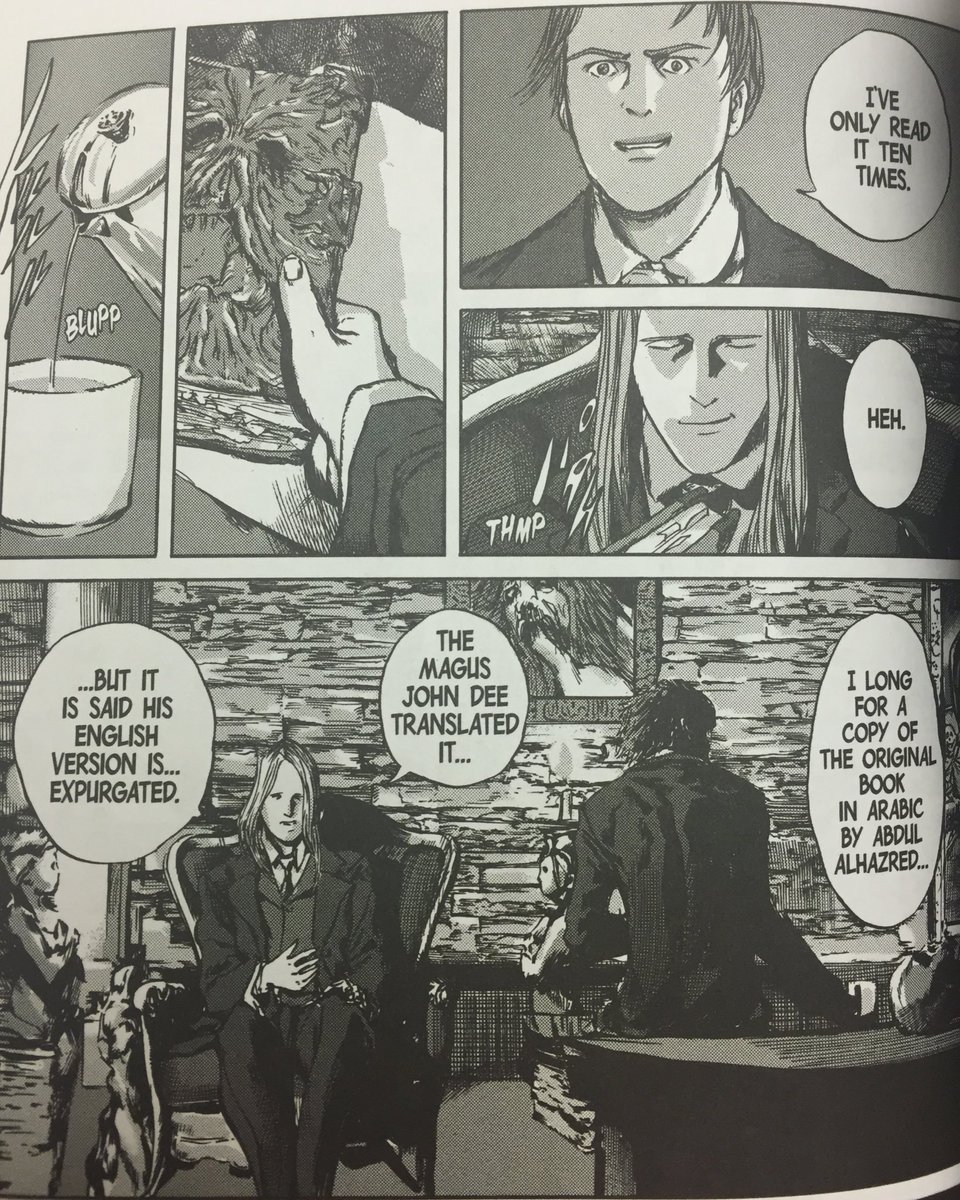
“The Nyarlathotep Experience™” (2019) by Miguel Fliguer

Nyarlathotep . . . the crawling chaos . . . I am the last . . . I will tell the audient void. . . .
—H. P. Lovecraft, “Nyarlathotep”

There is no one alive to read it. And there won’t ever be. Encased within the silicon chip, the text speaks forever into the void.
—Miguel Fliguer, “The Nyarlathotep Experience™” in Ancestors & Descendants 314

Rhetoric is not a lost art, but one which people often understand only intuitively. A horror novel, a corporate memo, and a brochure for a theme park are all written differently, even though their intended audience may end up being the exact same person. How those pieces of writing address that individual, their aims and what they do (and don’t) say help define them. You don’t normally expect corpspeak in a horror story; for example.

Yet all are forms of persuasive writing. The brochure wants you to buy a ticket, the memo wants you to buy into the idea, the horror novel wants you to buy into the mood. In “The Nyarlathotep Experience™,” Miguel Fliguer wants you to buy into all three.

As with  “Collector the Third: Charles Wilson Hodap (1842-1944)” (1995) by Kenneth W. Faig, Jr., there’s a strong metatexual element to Fliguer’s story. The assumption is that the audience is familiar with not just Nyarlathotep, the Crawling Chaos, but with Lovecraft’s original story “Nyarlathotep”—that this is a piece of fiction that exists in the world, subject now to the utterly surreal process of being transformed into an amusement park ride 20 minutes into the future. The very mundane rhetorical approach to the subject matter is reminiscent of “Commencement” (2001) by Joyce Carol Oates. The utterly self-absorbed, amoral bitching about what “Legal” would allow and the ultimate escape offered as the ride ends and the customers are released through the gift-shop with the various Nyarlathotep dolls and merch on sale works. Isn’t that what some soulless corporate hack sound like?

There are bookends to the piece, however. The first is context. It comes at the end of the collection Ancestors & Descendants (2019), the pieces of which progress chronologically. So the reader of the book, if going through it from the beginning, knows before they even get there that they’re coming up on the end, as in, the penultimate chapter of the book. They’ve already passed through all the past decades. This is the future.

So when Fliguer opens up on the blasted, frozen remnants of Florida drifting quietly through the eternity of space, to this document that no-one is left to read, there’s a definite sense of anticipation. It can’t be just a ride, can it? There has to be more to it. Yet the farther it goes on, the more Fliguer keeps to the straight schtick—not without the occasional joke about how Legal won’t let them use psychedelic drugs or insists on there being an emergency exit—but the whole thing, the journey of the ride, is to relive the experience of reading “Nyaralathotep,” and a reader can easily get lost in that little mental game, remembering the old story, wondering how they would possibly turn it into a lived experience, with special effects and actors.

Then you get to the very end, the last page.

I’m reminded of Robert Bloch.

Lovecraft and Bloch famously created a triptych: “The Shambler from the Stars” (1935, Bloch), “The Haunter of the Dark” (1935, Lovecraft), and “The Shadow from the Steeple” (1950, Bloch). There is an image in that final story, drawn from Lovecraft’s “Fungi from Yuggoth” sonnets, number XXI – Nyarlathotep. Fliguer uses the same image, in homage to Lovecraft or Bloch or both…and there is a promise there, because it is taken from the end of the first stanza of the sonnet, readers who remember that may remember the rest:

Soon from the sea a noxious birth began;
Forgotten lands with weedy spires of gold;
The ground was cleft, and mad auroras rolled
Down on the quaking citadels of man.
Then, crushing what he chanced to mould in play,
The idiot Chaos blew Earth’s dust away.

A preview for the end of the world.

Miguel Fliguer’s “The Nyarlathotep Experience™” was published in Ancestors & Descendants (2019). His other Lovecraftian fiction includes the collection Cooking with Lovecraft: Supernatural Horror in the Kitchen (2017), also published in Spanish as Cocinando Con Lovecraft: Relatos y Recetas de Humor Sobrenatural (2018), his fiction has also appeared on Círculo de Lovecraft.


Bobby Derie is the author of Weird Talers: Essays on Robert E. Howard & Others (2019) and Sex and the Cthulhu Mythos (2014).