It was the publicity attending this investigation which set reporters on the track of the Whateleys, and caused the Boston Globe and Arkham Advertiser to print flamboyant Sunday stories of young Wilbur’s precociousness, Old Whateley’s black magic, the shelves of strange books, the sealed second story of the ancient farmhouse, and the weirdness of the whole region and its hill noises.
—H. P. Lovecraft, “The Dunwich Horror”
The public knows of the Miskatonic Expedition through our frequent wireless reports to the Arkham Advertiser and Associated Press, and through the later articles of Pabodie and myself.
—H. P. Lovecraft, At the Mountains of Madness
As was only natural under the circumstances, this piquant debating finally got into print in the form of letters to the Arkham Advertiser; some of which were copied in the press of those Vermont regions whence the flood-stories came.
—H. P. Lovecraft, “The Whisperer in Darkness”
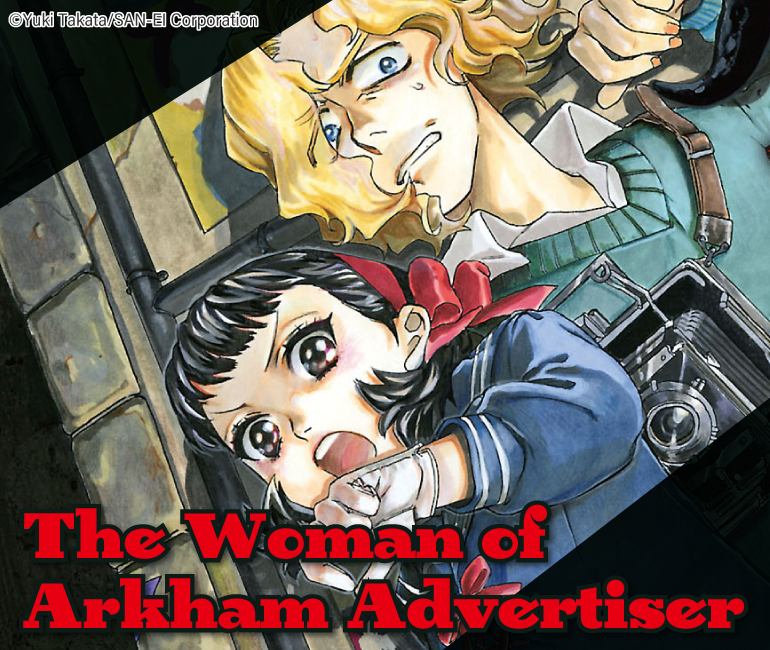
Lovecraftian manga have been undergoing a recent renaissance in Japan, with the critically acclaimed reception of Tanabe Gou’s adaptations of At the Mountains of Madness, “The Hound,” “The Colour Out of Space,” and most recently “The Call of Cthulhu,” all of which have been or are being translated and published in foreign language editions: Spanish, Italian, French, German, English, etc. Other popular adaptations include the Cthulhu no Yobi Koe series by Chuuou Higashiguchi (中央東口), and related manga include the Minase Yomu and the Really Scary Cthulhu Mythology (水瀬陽夢と本当はこわいクトゥルフ神話) series by Yoshihara Masahiko (吉原雅彦), and the many Zone of Cthulhu manga released by the SAN-EI Corporation (三栄)—which includes TheWoman of Arkham Advertiser (A・Aの女) series by Takata Yuki (高田 悠希).
The conceit of the series is simple: Alice Allan is a cub reporter for the Arkham Advertiser, the local newspaper that appears in several of Lovecraft’s stories, and her “cases” cover a number of Lovecraft’s stories, both Mythos and non-Mythos, as set around Arkham. The result is a series of adaptations with a twist: we get to see the stories from a new perspective, that of a young newspaperwoman investigating the odd happenings. The series is categorized as a seinen (青年漫画), aimed at young men (18-30s), being more realistic and less action-packed than manga like One Piece or Dragon Ball, but readers of all genders and ages can appreciate it.
Chibi version of Billy, a supporting character.
The adaptation is played seriously, but with more than a few laughs thrown in, the figures sometimes reduced to small chibi-style exaggerated figures to emphasize the one-off joke, familiar from manga like Shirow Masamune’s original Ghost in the Shell. The translation by Amimaru Translation and Localization Services Ltd. is mostly solid, although every now and again a joke may fail to land due to some cultural crossing of wires.
The small details and stark contrasts in the illustrations really shine though. Takata Yuki has worked hard to express the America of the 1920s, full of newsboys and the transition from the small industrial city of Arkham to out-of-the-way rural community of Peck Valley is like traveling back in time. Done in simple black-and-white, the bright outside scenes are given white backgrounds, while the moment the intrepid reporters step into the vault, the page is dominated by huge splashes of stark black, a very effective presentation that accentuates the emotional response of Alice Allan and her associate Billy.
Alice herself is the major focus and driver of the plot. She desires to prove herself as a reporter, and this is her first real opportunity to do so, by looking into the morbid details around the mysterious death and quick burial. While her enthusiasm is sometimes played for laughs, especially when contrasted against her long-suffering friend Billy, it is very effective at cutting right to the heart of Lovecraft’s story.
The story is not exactly a straight adaptation; Takata Yuki wisely doesn’t attempt to mimic the style of Lovecraft’s prose, and takes a few liberties with the ending, hinting at this being a small piece of a bigger picture that the reporters know they can’t quite see yet. Which works very well; Alice Allan is an engaging, energetic, enthusiastic protagonist, and starting slow with one of Lovecraft’s more low-key stories as their first “case” was a wise decision on the part of Takata Yuki.
The Woman of the Arkham Advertiser is available in Japanese on Kindle, and in English on Manga Planet subscription service.
I recently saw a newer and better Wandrei tale, The Tree-Men of M’Bwa, which he should have no difficulty selling to either Bates or Wright.
—August Derleth to H. P. Lovecraft, 14 Aug 1931, Essential Solitude 1.360
[…] I must congratulate you on the novel & original cosmic thrills, & the extremely effective climax, of The Tree-Man. I surely hope this has found—or will find—favour with the editorial fraternity.
—H. P. Lovecraft to Donald Wandrei, 25 Sep 1931, Letters With Donald and Howard Wandrei and to Emil Petaja 271
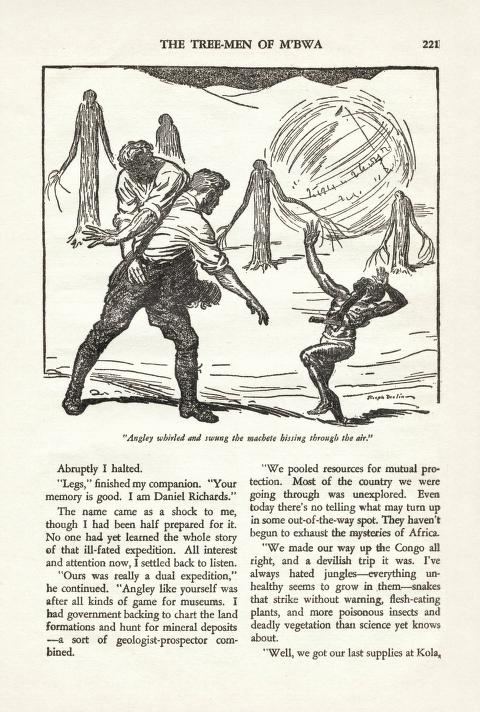
“The Tree-Men of M’bwa” by Donald Wandrei was published in the February 1932 issue of Weird Tales. It is neither explicitly a tale of the Cthulhu Mythos nor not a Mythos tale. As with “The Fire Vampires” (WT Feb 1933), Wandrei makes no specific reference to Cthulhu, the Necronomicon, etc. But “The Tree-Men of M’bwa” involves some very Lovecraftian elements, passing references to Atlantis and Mu, and uses the incredibly ambiguous term “Evil Old Ones.” The ambiguity has helped ensure the general obscurity of the story: it has never been published in any English-language Mythos anthology. Indeed, it would probably not be considered part of the Mythos at all except that it was posthumously adopted as part of the Mythos by the Call of Cthulhu Roleplaying Game, appearing as part of the “African Mythos” in works such as Malleus Monstrum (2006), Secrets of Kenya (2007), and The Masks of Nyarlathotep Companion (2014).
The desire to incorporate “The Tree-Men of M’bwa” into the Mythos likely has less to do with the relative merits of the story than the general lack of Mythos fiction dealing with Africa in general. Lovecraft ghost-wrote “Winged Death” for Hazel Heald and “Imprisoned with the Pharaohs” for Harry Houdini, but there are extraordinarily few stories from the first generation of Mythos-writers set in Africa, unless you count Robert E. Howard’s adventures of Solomon Kane, which do not deal with the Mythos directly.
Even then, there is nothing particularly special about this story that separates it from any other weird tale set in Africa and that doesn’t directly contradict any other bit of Mythos-lore, except that Donald Wandrei was part of the circle of Lovecraft’s correspondents and did write at least one actual Mythos story. Hugh B. Cave’s “The Cult of the White Ape” (Weird Tales Feb 1933) might as easily have been borrowed into the Mythos, but as Cave corresponded only briefly with Lovecraft it is generally forgotten, whereas “The Tree-Men of M’bwa” has gone on to its weird literary afterlife.
In context, “The Tree-Men of M’bwa” is a typical “mysteries of darkest Africa” story, where intrepid great white hunters and explorers (led by at least a dozen of the indigenous people who have been there their entire lives and know pretty much where everything is and why you don’t want to muck about with the crashed aliens, etc.) stumble into some unknown peril. The focus of these stories is almost solely on the white people who are telling the narrative, and center it on themselves; the black people are often little more than an afterthought, and Wandrei does not vary from formula.
Most of the country we were going through was unexplored. Even today there’s no telling what may turn up in some out of the way spot. They haven’t begun to exhaust the mysteries of Africa.
—Donald Wandrei, “The Tree-Men of M’bwa”
How much actual research Wandrei did for the story is debatable. The geography is roughly correct, if one makes general allowances (i.e. that the fabled Mountains of the Moon” referred to are the Rwenzori Mountains of Uganda, and “Kola” is actually “Kole,” a town closer to the border) it’s safe to say that he at least glanced at a map. I have not yet found a people in the region named “Neguchi” or similar; either Wandrei picked the name out of an obscure text or made it up. The word “M’bwa” is Swahili, and means “dog.” Whether Wandrei knew that or not is, again, unknown; he may have simply liked the sound of it as sufficiently alien to English.
“M’bwa” is the only African named in the story. The indigenous guides are only the “Neguchi boys,” which turn of phrase could be read as discriminatory when applied by a white man to a group of black men in the 1930s. Africa itself is veritably a character in this story, hostile and alien to the white men who seek to probe its mysteries; Wandrei emphasizes early on:
Why my boat had stopped in this filthy hell-hole on the Gold Coast, I don’t know, but here we were overnight and I had gone ashore to break the monotony of scalding days at sea. It wasn’t much imporvement, even after sunset. Fierce, steamy heat that made you boil with sweat. An unpleasant smell, half-native, half-decayed vegetation, that every village seemed to have. (ibid.)
There are a couple of interesting details to the encounter with M’bwa and the Whirling Flux. The first is the number of trees—despite this being an “unexplored” part of Africa, it is quite evident that there have been at least twenty “explorers” there before him, and the indigenous peoples seem well-informed of the spot in general. The earliest visitors were an Atlantean, an Egyptian, and a Roman—in the 1930s, that would implicitly mean “three white men,” although such racial divisions would have been meaningless in ancient Rome or Egypt. The one tree-man that speaks to Daniel Richards did so apparently in English, suggesting he too was white.
The word zombie is never used in the story to refer to M’bwa, although the dead man has many of the attributes of the revenant; the word was just coming into vogue with the publication of William Seabrook’s The Magic Island (1929), and the film White Zombie (1932) which it inspired; many writers at Weird Tales penned zombie stories during this period, and readers would have been aware of that, even without a voodoo connection.
“The Tree-Men of M’bwa” is arguably not as bad as “The Cult of the White Ape” or “Mother of Serpents” (1936) by Robert Bloch in terms of its portrayal of black people, but neither did Wandrei go out of his way to give an informed or sympathetic portrayal either. It is a white person’s story, written by a white person for what would presumably be a white audience, and it reads like that. That it has been seized on by the Call of Cthulhu roleplaying crowd as a component of the “African Mythos” speaks more to the general paucity of such material available than to any particular merit of the story itself.
Donald Wandrei’s “The Tree-Men of M’bwa” was first published in Weird Tales (Feb 1932); it was reprinted in Wandrei’s collections The Eye and the Finger(1944, Arkham House) and Don’t Dream: The Collected Horror and Fantasy of Donald Wandrei(1997, Fedogan & Bremer; paperback edition 2017). The long gap between publications is one reason why this story has remained so obscure for many decades, but now that it is more available perhaps it will find a new audience.
Yoth Tlaggon
A mysterious God. The first time the name was written was in a letter form H. P. Lovecraft to C. A. Smith, a close friend and associate of the American horror writer, dated April 4th, 1932. However, Father Lucio Damiani published a monograph on Ancient History entitled Visions of Kusha in which he writes that “In the days when Atlantis was still called Kusha, and Lemuria known as Shalarali, Yoth Tlaggon was named one of the Nine Princes of Hell.” Damiani could have had no knowledge of the Lovecraft letter, for it was not publsihed until 1970.
—Asamatsu Ken, Kthulhu Reich228
Yoth-Tlaggon—at the Crimson Spring. Hour of the Amorphous Reflection. —H. P. Lovecraft to Clark Ashton Smith, 4 Apr 1932, Dawnward Spire, Lonely Hill360
Kthulhu Reich (2019) by Asamatsu Ken (朝松健) is a novel from Kurodahan Press. It is comprised of seven interrelated short stories published between 1994 and 1999, and is presented here in English by translator Jim Rion. Each of the stories involves Nazi Germany, and involves the Cthulhu Mythos in some way, and though they do not form a single consistent narrative, together form a kind of occult history of World War II and its legacy.
Lovecraft died in 1937; he lived to see the rise of Mussolini and the fascists in Italy and Adolf Hitler and the Nazi party to power in Germany, and the opening shots of what would become World War II in the Japanese invasion of Manchuria and the Italian invasion of Ethiopia. Though he did not know it, Lovecraft also became aware of the opening stages of the Holocaust as Hitler’s government instituted laws discriminating against Jews in Germany, a practice which the antisemitic Lovecraft had mixed feelings with—approving as he did of Nazi Germany’s ultranationalism, but not their unscientific racial discrimination. He never lived to see how wrong he was regarding Hitler and Mussolini, never saw the true horrors of the Holocaust.
World War II has become fertile ground writers of weird and fantasy fiction; the Nazi interest with the occult and esoteric, based partially on truth, as detailed in books like Nicholas Goodrick Clarke’s The Occult Roots of Nazism(1993) and Kenneth Hite’s The Nazi Occult(2013). Works like Le Matin des magiciens (1960) popularized the idea of the Nazi occult for a new generation, and have led to works like the Indiana Jones adventures Raiders of the Lost Ark (1981) and Indiana Jones and the Last Crusade (1989), the Hellboy comic books and film, and innumerable other appearances.
“Hitler’s a nut on the subject. He’s crazy. He’s obsessed with the occult.”
—Musgrove, Raiders of the Lost Ark
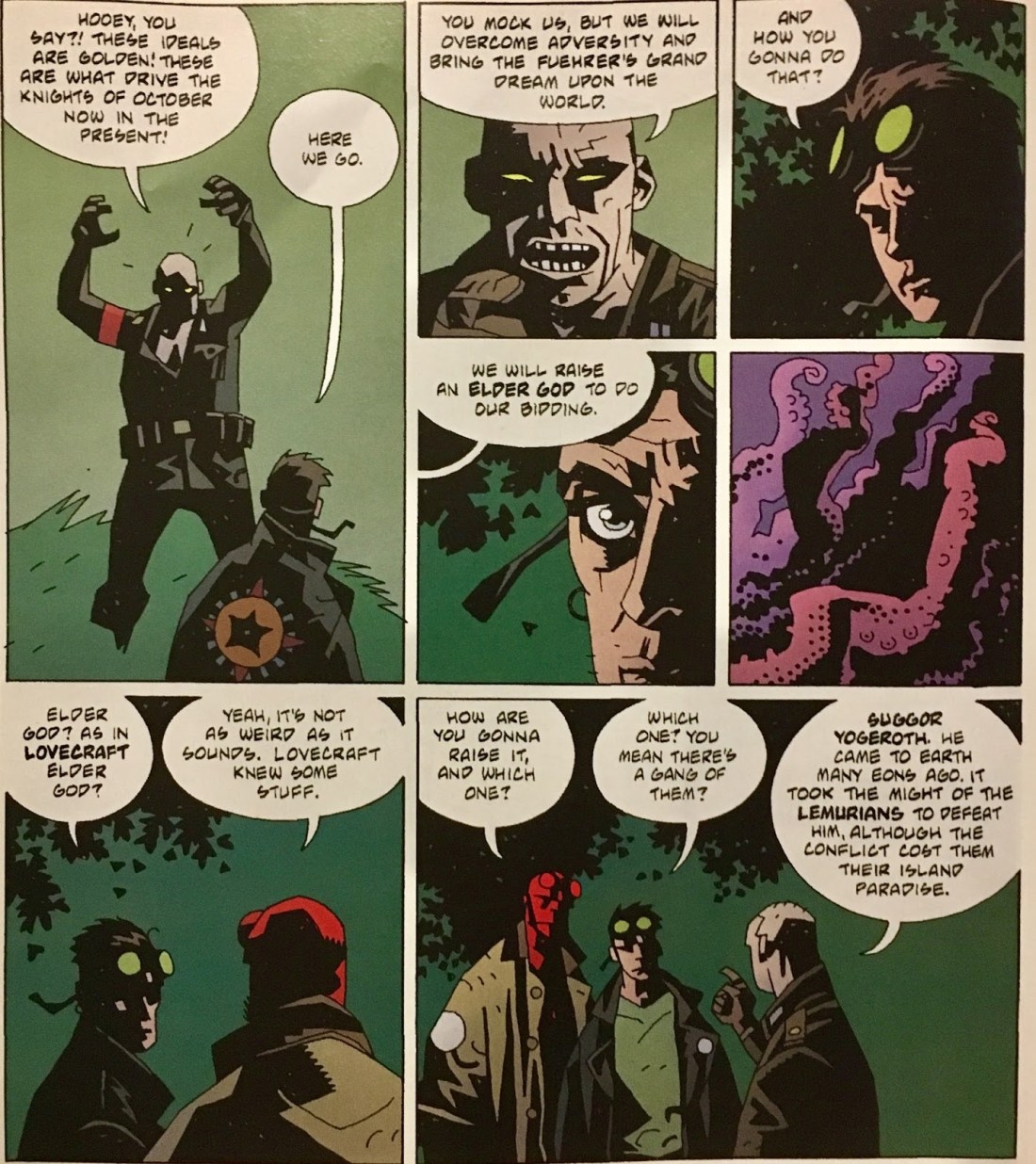
This has been true for the Cthulhu Mythos as well. Herbert West famously found employment in Nazi Germany in Brian McNaughton’s “Herbert West—Reincarnated Part II: The Horror in the Holy Land”; Charles Stross’ The Atrocity Archives(2004) deals with the occult fallout of the Nazi’s Mythos-delvings; Mike Mignola and Jim Robinson have Hellboy team up with Starman and Batman to face Neo-Nazis (and classical Nazis!) summoning Lovecraftian horrors in Batman/Hellboy/Starman(1999).
Art by Mike Mignola, script by Jim Robinson, Batman/Hellboy/Starman #2 (1999)
The Mythos occult WWII angle had become essentially a Mythos subgenre with the release of the roleplaying games World War Cthulhu (2013, Cubicle 7) and Achtung! Cthulhu (2013, Modiphius), which in turn have led to new anthologies like World War Cthulhu(2014, Dark Regions), and even video games.
Which is a long way to say that Asamatsu Ken was a bit ahead of the curve when he first published these stories in Japan in 1994-1999. Some of the stories are eerily prescient as far as capturing the essential dynamic of the post-2000 Mythos WWII craze. Magic is real, the Nazis—deluded and arrogant as they might be, playing with forces they don’t understand—are often portrayed as a genuine occult threat to the entire world. The action is often pulpy, but Asamatsu Ken shows real research in trying to make sure the names, dates, and equipment are correct. The individual stories are like separate, individual episodes taken from a long, drawn-out conflict, but they are constructed with all the care of a good hoax. Mythos references are typically slid in alongside real occult names and texts, the Nazi’s actual activities provide the context for the stories.
In the first place, it is important that we realize that the term “racist,” as used today, has strong post-WWII connotations. We have become much more liberal and open-minded following the dreadful experiences and revelations of the second World War, and anyone espousing extreme anti-ethnic views today must surely be a reactionary, a redneck, or a nut. “Racism” has become extremely unpopular, and we associate the term with the horrors of Auschwitz and Buchenwald.
—Dirk W. Mosig, “Was Lovecraft a Racist?” in Crypt of Cthulhu #98 (1998) 4
One of the shadows looming over Kthulhu Reich (or any other Mythos WWII novel or story) is how it addresses the nature of racism and antisemitism in general, and the Holocaust in particular. No nation in the conflict was free from prejudice and discrimination, but the attempts at genocide which were such a hallmark of WW II present a subject that writers have to decide how to deal with. It is perhaps appropriate that Asamatsu Ken chooses to begin the collection with “The Corporal’s Self-Portrait”—a story which would otherwise seem a bit out-of-place in the anthology, dealing as it does with a contemporary postwar Japan and touching on the attitudes towards racism and how they’ve changed.
“I can take the Koreans and the Chinese. They’re like us, at least. But the day all these Thais and Vietnamese, Cambodians and Filipinios, and Indians and Iranians and Iraqis shoed up, this place became unbearable.”
“Hey, come on… That’s really racist!” I chided, unable to must any real force.
Hirata ignored me.
“They come here to Japan and take the jobs honest students used to be able to count on. Then they send our valuable yen back to their own countries. And then there’s our women! They seduce our women and sully the pure blood of Yamato!”
Hirata doesn’t stop. The narrator at least protests, though his words fall on deaf ears. The incident gains sinister connotations as the story unfolds, much like the film Max(2002), yet the reader is shown this angry young man, whose life parallels that of the eponymous Boys from Brazil, and he can muster only ineffective rebukes to his obvious and appallingly vocal prejudice. Asamatsu Ken does not turn a blind eye to the horrors that the Nazis perpetrated. Nor to the real threat that racism and prejudice still form.
Jim Rion deserves accolades here for an excellent translation on what must have been a difficult job—combining as it does real historical elements, occult jargon, Japanese cultural references, the Cthulhu Mythos, the unusual episode “April 20th, 1889” that consists of a series of found documents, and some really well-done action scenes in “The Mask of Yoth Tlaggon.”
This review deals with a work of pornography, and the history of erotic art and writing. As part of this review, selected art with depictions of genitalia and/or sexually explicit contact will be included. As such, please be advised before reading further.
Pornomicon . . . derived from the Greek Word “Porne”, meaning prostitute. But the word on the whole means nothing to me.
—Logan, The Pornomicon5
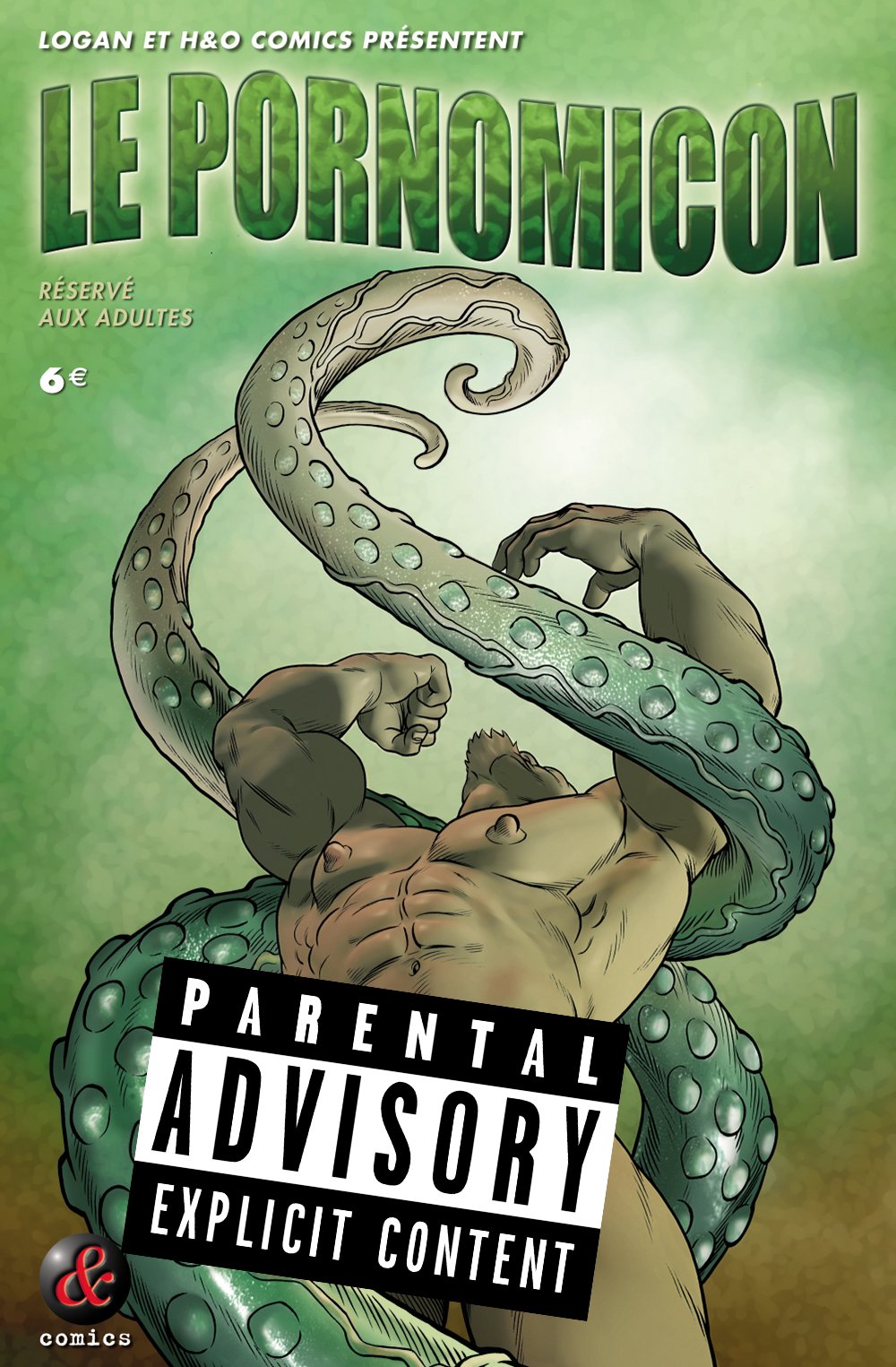
Le Pornomiconis a 2005 French-language one-shot homoerotic horror comic book created by writer/artist Logan Kowalsky (credited here simply as “Logan”) by H & O Editions; it was translated into English by Class Comics in 2006. While long out of print, it is still available as an ebook from Class Comics’ website.
The first known erotic comic based on Lovecraft’s Mythos was “Tales of the Leather Nun’s Grandmother” in the underground comix Tales from the Leather Nun(1973, Last Gasp), and ever since there has been a steady addition to the oeuvre of erotic Mythos comic books and graphic novels. For the most part, however, these works are typically created for a heterosexual audience, with women as the primary focus of all sex acts and male-on-female (or, increasingly, tentacle-on-female) pairings making up the majority of all sex acts. A rather smaller cross-section of such works dip into LGBTQ relationships or focus extensively on non-heterosexual intercourse.
One of the first of these was John Blackburn’s Coleyseries (1989-1999), which featured the bisexual Coley Cochran, who occasionally encountered the servants or descendants of the Old Ones; Noé and Barreiro’s El Convent Infernal (The Convent of Hell,1996) includes several lesbian scenes, as well as a sexually-explicit copy of the Necronomicon and a notorious tentacle sex scene. The latter work might well have been part of Logan’s inspiration for Le Pornomicon, focusing as it does on the eponymous tome and penetrative sex featuring penis-headed tentacles.
In this respect, readers may suspect an influence from Japanese hentai on one or both works, and there’s probably some truth to that. However, given the focus on size, penetration, and masculinity in Le Pornomicon, the tentacle works well to foster the visual rhetoric of the story when it makes an appearance, taking things from the cartoonishly oversized to beyond anything humanly possible.
The visual grammer permitted by the tentacle is extremely useful to the pornographer. With no restriction on length, it permits penetration without blocking the view. It can also be used as a form of restraint, permiting multiple penetration, sexualised bondage and east of access. Best of all for the tentacle as a pornographic device, while it may often look suspiciously like a penis, to the extent of possessing a foreskin or glans, or even ejaculating upon climax, it is not a sexual organ by definition.
—The Erotic Anime Movie Guide58
It perhaps needs to be said that there is not a single homoerotic aesthetic; the gamut of LGBTQ+ works encompasses a vast range of body types, relationships, preferences, etc. Le Pornomicon tends toward burly, over-muscled, often hairy subjects; the genitals are cartoonishly oversized and the holes are elastic, the relationships are almost entirely purely sexual with no romantic bonds, blushing nervousness, consideration of feelings, etc. While some folks might reductively say “Well, it’s porn,” not all porn is like that. Not even all homoerotic Mythos fiction; “Herbert West in Love” (2012) by Molly Tanzer and “Herburt East: Refuckinator” (2012) by Lula Lisbon both exhibit very different aesthetics, despite both focusing on the homoerotic potential of “Herbert West–Reanimator.”
Part of the reason Logan focuses so slightly on the human relationships is because the main character of the book is not human, but the eponymous Pornomicon and its associated Mythos. The story is set across two time periods, two brief encounters united by the presence of the Pornomicon, and in this way it is reminiscent of the Loc-Nar in the animated film Heavy Metal(1981). Like that object, the presence of the Pornomicon is associated with mental and physical corruption, introducing elements of body horror and the monstrously alien as the humans are possessed, transformed, and eventually subsumed by inhuman carnality. In the universe of the Pornomicon, Cthulhu and Yog-Sothoth are inherently sexual beings, but unlike in the works of Lovecraft or other writers who focus on these entities having sexual relations with human beings to spawn progeny, there is no focus on reproduction. Cthulhu does not impregnate these burly male characters, they become a part of him.
Which could be read as a form of homosexual panic, or a reflection of the implicit bias against sexuality in slasher films where couples who sneak off for a bit of illicit fun receive a brutal comeuppance as they are macheted to death—although it seems likely that neither of these was consciously intended. Rather, Logan offers a pornographic horror comic with no happy ending, the encounters with the Pornomicon are by their nature lustful and end badly for those who tamper with the Great Old Ones, but that would probably be true for anyone of any gender or sexuality. The unbiased nature of Cthulhu and Yog-Sothoth in taking all victims equally only appears to be biased because the story focuses exclusively on homosexual men.
Logan also takes visual inspiration from Mythos-related works. In particular, the background of page 10 is annotated “Apres Mike Mignola” and directly references the visual imagery in the Hellboy: Seed of Destruction(1994) series.
Above, left: Mike Mignola, Hellboy: Seed of Destruction #3.
Above, right: Logan, The Pornomicon.
Sometime after the publication of Le Pornomicon, Logan began a series of illustrations titled The Pornomicon Legacy, but so far there is no indication of another volume forthcoming.
It has been known for a long time, then, that Lovecraft had the same prejudice againt the Japanese as he did againt the Chinese, or African-Americans. […] So what? Mishima Yukio was gay, and Kawabata Yasunari committed suicide after being spurned by the maid. The personal proclivities of literary greats have nothing to do with the quality of their masterpieces.
We Japanese tend to be forgiving of heroes. We feel absolutely no contradiction in being enthralled by the Cthulhu Mythos, and the fact that Lovecraft was prejudiced.
—Asamatsu Ken, foreword to The Dreaming God2
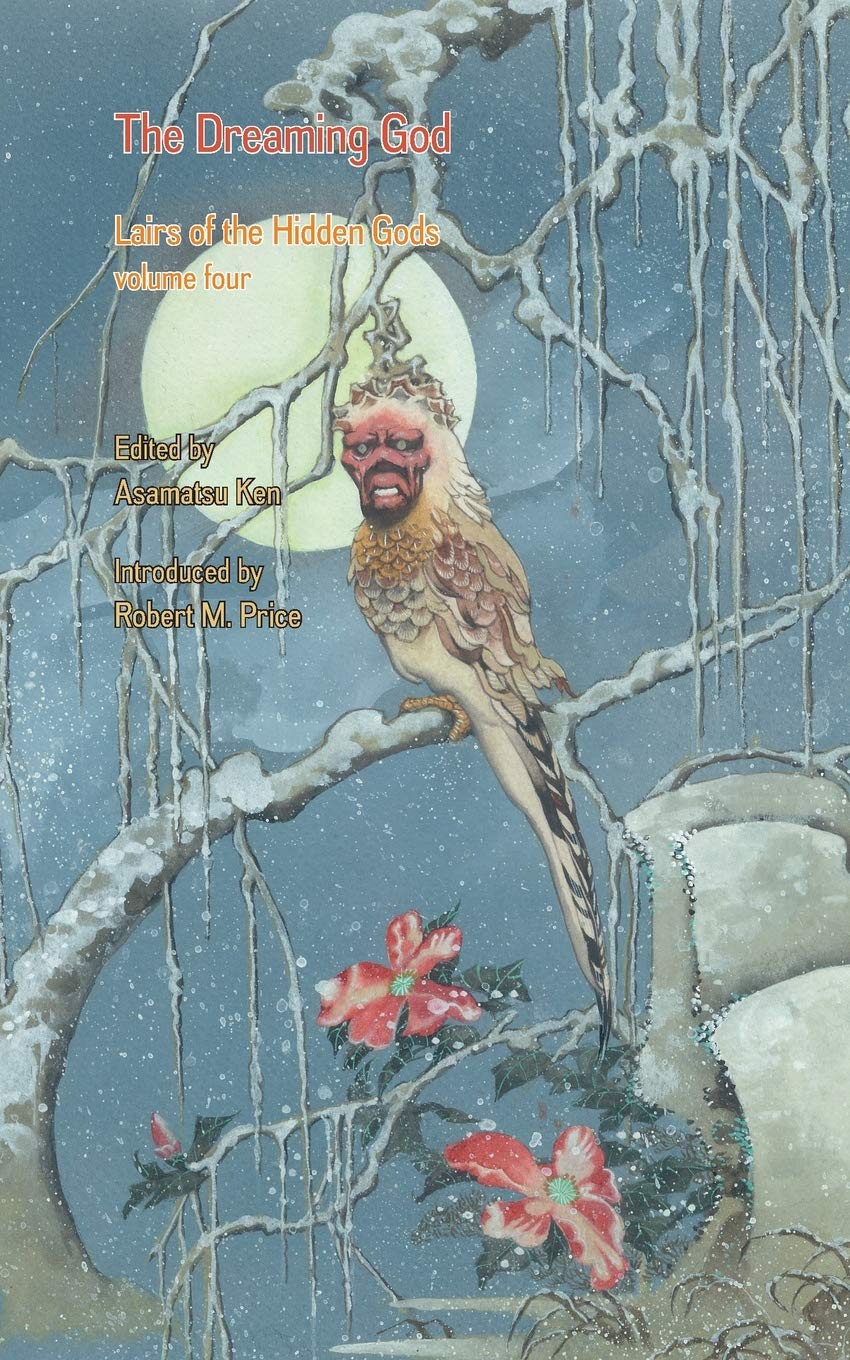
“Quest of the Nameless City” (2007) by Tachihara Tōya (立原透耶) is a story in The Dreaming God, the fourth and final volume in the Lairs of the Hidden Gods series from Kurodahan Press, edited by Asamatsu Ken (朝松健). It is the English-language translation of the 2002 story 苦思楽西遊博 (Kushi Kakusei Yūhaku); the translator was Kathleen Taji.
Journey to the West is one of the classic Chinese novels, comparable to Homer’s Odyssey in Western literature, and has served as inspiration for a vast array of fiction, film, manga, cartoons, etc., including the venerable and popular Dragon Ball saga. Tachihara Tōya may be the first to remix this classic with the Cthulhu Mythos. Lovecraft scholar Robert M. Price also notes in the introduction that the story also draws from (or at least strongly parallels) August Derleth’s Trail of Cthulhuserial novel in parts. Most notably, the third chapter (“Sandy’s Story”) echoes a major plot point in “The Black Island” (1951) where the narrating character is affected by the Elder Sign.
The result is a fragment of an epic. Tachihara provides three chapters from three different character perspectives; the full story could be a hundred. A taste of what-might-have-been. The Mythos in “Quest of the Nameless City” is not quite that as Lovecraft or Derleth had written it; the Old Ones are filtered through a different cultural lens, and though we are not given vast details about their place within the cosmology, the story incorporates the Mythos entities into the gestalt as it does all the other inhuman creatures from Journey to the West. As the character Pigsy notes in chapter two:
The world is vast, and there are even manuscripts like the Book of Mountains and Seas, full of Chinese mythology. Thus, I suppose the existence of such fantastic beings is not astonishing in the least.
—Tachihara Tōya, “Quest of the Nameless City” in The Dreaming God41-42
Initially, one of the key aspects of the Cthulhu Mythos is that it is different, explicitly alien and other to both Christian theology and “typical” horrors like ghosts, vampires, werewolves, and zombies which abounded in the pulp fiction of the time. This was not an ironclad rule if you tiptoed even a little outside the bounds of Lovecraft’s own writing; Robert E. Howard had no qualms about including the occasional vampire in his Conan and Solomon Kane stories, which are tied in to the wider Mythos, and other authors have been more explicit in adding Cthulhu & co. to the kitchensink of contemporary fantasy and horror. This trend was perhaps best emphasized when Dungeons & Dragons added the Cthulhu Mythos to Deities & Demigods (1980), Cthulhu was given stats alongside Japanese and Norse deities and Arthurian and Native American heroes.
What Tachihara is doing in “Quest of the Nameless City,” whether intentionally or just as a side effect of the brilliant idea of combining the Mythos with Journey to the West, is effectively lampshading this tendancy to assimilation. Like any “authentic” mythology, the Cthulhu Mythos is ripe for multiple interpretations, some conflicting, and some adapting the familiar stories into new contexts. There are no contradictions here that cannot be ironed out by another chapter, another gloss, or simply let stand to be enjoyed on their own merits.
Well, I can tell you one thing: Lovecraft would never have written this! But whether he would have been capable of it, or would have approved it, these questions are quite distinct. And yet it is a Lovecraftian tale; it belongs in this anthology.
—Robert M. Price, foreord to “Necrophallus” in Night Voices, Night Journeys237
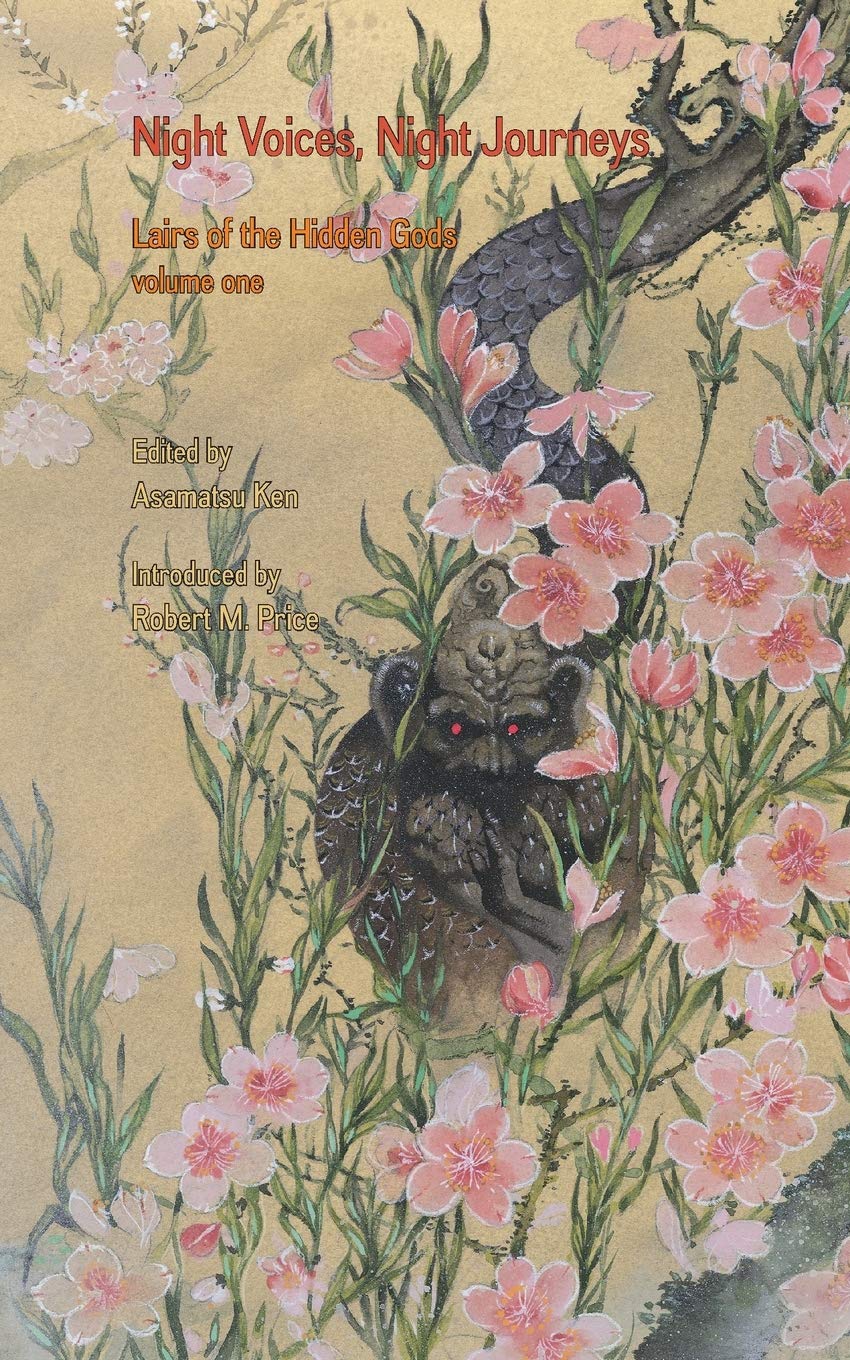
“Necrophallus” (2005) by Makino Osamu (牧野修) is a story in Night Voices, Night Journeys, the first volume in the Lairs of the Hidden Gods series from Kurodahan Press, edited by Asamatsu Ken (朝松健). It is the English-language translation of the 2002 story 屍の懐剣 (Shikabane no Nekorufaruso); the translator was Chun Jin.
The name of the story is warning and enticement at once. Necro, death. Phallus, the male sexual organ. Like the Necronomicon, it is a name to conjure with and be repelled by. Readers who see the title and keep reading have committed themselves to the act. Sex and death have always been intimately linked in horror; sex is taboo and transgression, excitement and anticipation. The building blocks of any good horror story. Lovecraft understood this, used it in his fiction—not in any explicit depiction, but by intimation and action; “The Loved Dead” by C. M. Eddy, Jr. and H. P. Lovecraft is a tale of necrophilia told from the necrophile’s point of view.
Lovecraft, of course, never lived to learn about Ed Gein, or to see the rise of the slasher film, splatterpunk fiction, torture porn. There was sadism and masochism in the pulps—even in the early Cthulhu Mythos! Robert E. Howard’s bloody flagellation scene in “The Black Stone” was a taste of what was to come in the weird terror pulps; the garish magazines which promised torture, mutilation, strange and terrible surgeries, gruesome injuries…and sex. Naked women, heaving bosoms, strange violations; always implicit in the pulps, because the could not publish the explicit.
Not Lovecraft’s scene.
Makino Osamu, however, brings the splatterpunk mentality to the Cthulhu Mythos. Filmgoers might point to similarities with Audition (オーディション, Ōdishon, 1999), but while there are definite cinematic flourishes to “Necrophallus,” the narrative itself doesn’t hit the same beats. The narrator is a hunter for the limits of human experience; psychologically damaged, sadistic but not in the sense of cruelty but in some profound sociopathic sense. What he meets, when the eponymous Necrophallus appears, is something beyond the limits of mere human sadism.
Which is really the success of “Necrophallus”: to have that moment of Lovecraftian realization, of the smallness of human endeavor, embedded in and expressed through the worldview of a violent, gory psychosexual narrative. There’s no humor to leaven the horror, as is the case in Edward Lee’s “Hardcore Lovecraft” line; no refuge in outrageousness. And, for that matter, not really much in the way of titillation or moral. The protagonist is a monster; if the reader feels any sympathy for them at the end, it is only because they are a human monster, whose appetites have led them into the clutches of something so much worse.
Like most such extreme horror, when taken out of context and without having gone through the narrative the imagery can approach the ridiculous…but then the surreality of the scene is the point. The idea of having arrived at some new state through the bloody and painful process is akin to birth, and once through the other side the narrator is transformed and ready for the final revelations.
Chī-chan rubs its dangling tentacles against my own. They make a sound like someone slurping their spaghetti. Not to compare with being dismembered by the Necrophallus, but such mingling of entrails also holds something like the remnants of pleasure.
—Makino Osamu, “Necrophallus” in Night Voices, Night Journeys253
Unlike “She Flows” by Takeuchi Yoshikazu (竹内義和), “Necrophallus” has the minimum of explicit Mythos connections; Yuggoth is invoked by name, while At the Mountains of Madness and Miskatonic University are hinted at. It could be cataloged in the next edition of the Cthulhu Mythos Encyclopedia, stats could be provided for the Necrophallus in some module of the Call of Cthulhu Roleplaying Game without anyone blinking an eye.
It doesn’t really need that, however. The story could have stood on its own without that, being Lovecraftian without being explicitly Mythos. Which is probably the real testament to what Makino Osamu has achieved. Whether or not you like the story, with its sexually explicit scenes and bloody body horror, “Necrophallus” has successfully adapted elements of Lovecraft’s style of culminating revelations to a very different mode of fiction. That in itself is an achievement.
I told him I saw no need to broaden, i.e., to dilute, my understanding of “Lovecraftian.” […] I realize that genres grow and develop by an incremenetal process of transgressions of inherited genre conventions. Thus it is no crime to do something different and still call it “Lovecraftian.” What passes for Lovecraftian tomorrow may seem quite different from what the term denotes today. But I can’t pretend to see how you get there from here.
—Robert M. Price, foreword to “She Flows,” Straight to Darkness193-194
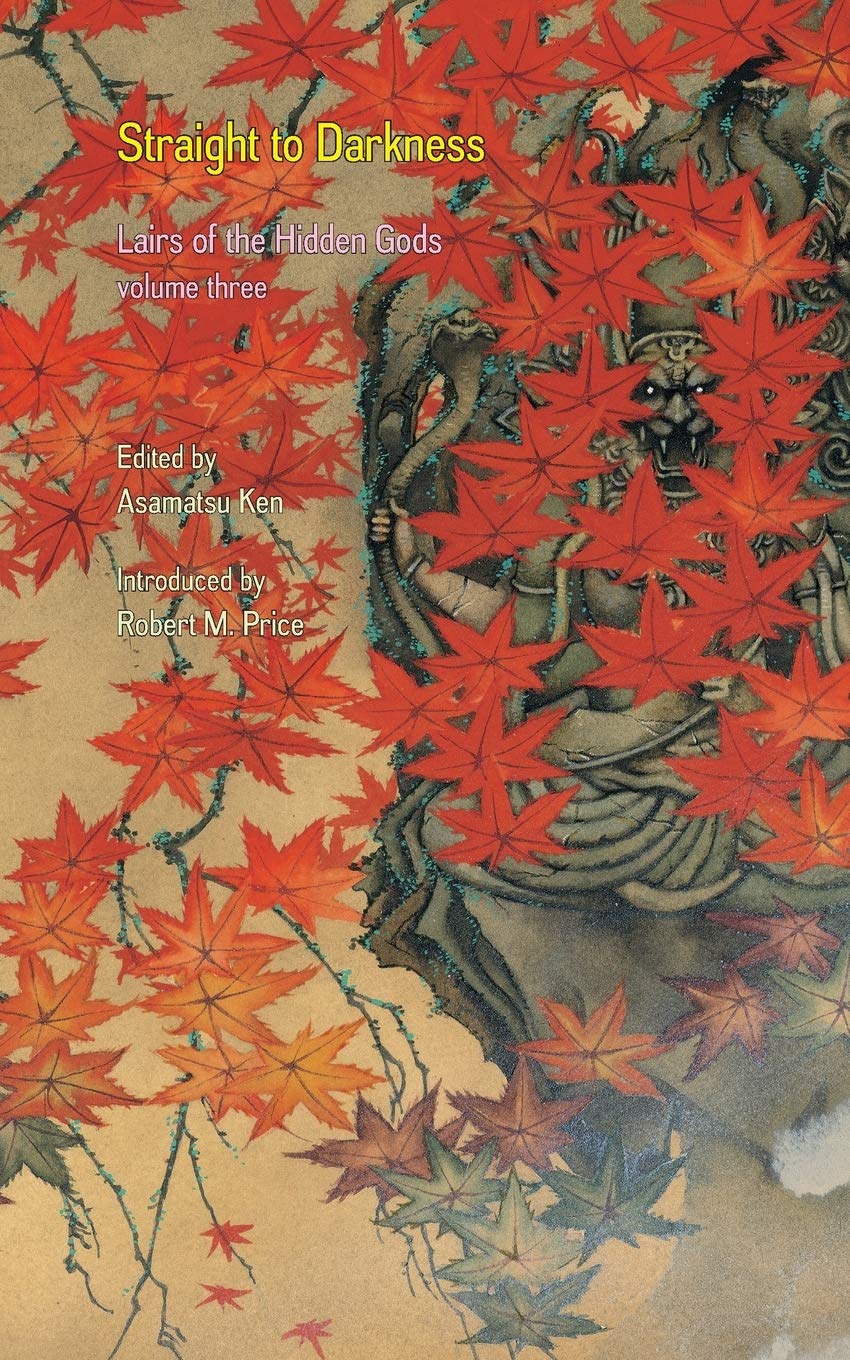
“She Flows” (2006) by Takeuchi Yoshikazu (竹内義和) was published in the third volume in the Lairs of the Hidden Gods series from Kurodahan Press, edited by Asamatsu Ken (朝松健). It is the English-language translation of the 2002 story 清・少女 (Se Shojō); the translator was Nora Stevens Heath.
The Mythos as a concept is a struggle for definition. What makes a Mythos tale? Does it have to use specific words, deliberate tie-ins? What are the minimal requirements? The status of “Mother of Serpents” (1936) by Robert Bloch as a Mythos story hangs on a single word. “Hypothetical Materfamilias” (1994) by Adèle Olivia Gladwell is a Lovecraftian tale with three. “Red Goat, Black Goat” (2010) by Nadia Bulkin has none, though we recognize the shadow of Shub-Niggurath without ever reading the name of the Black Goat of the Woods. Does any story become a Mythos story if it includes the Necronomicon? Can a story be Mythos but not Lovecraftian, if it uses the right words but in a vary un-Lovecraftian way?
Rhetorical questions. There is no set canon to the Mythos, no strict definition as to what is or is not Lovecraftian. Every individual carries a canon in their head, maybe multiple canons. You the reader decide whether a story is Mythos or Lovecraftian to you. Don’t let anyone else decide for you.
“She Flows” is challenging in this regard. There are, as Robert M. Price notes in his foreword, no explicit connections to the Mythos. The implicit connections are filtered through what feels like a different cultural lens: compensated dating, alcoholic parents, abusive parents, depression. Two girls with eyes a little too wide apart.
People with monstrous faces, long red tongues.
The reader has to make their own connections. Takeuchi’s approach is showing more than telling. Never says “Deep One,” or “Innsmouth.” But they write:
My theme is the ocean.
All I sing are songs about the ocean. You know that folksong, “My Bonnie lies over the ocean”? I liked that one. I remember my dad always used to sing it softly into my ear when I was little.
So maybe that’s why all the songs I write are about the ocean.
—Takeuchi Yoshikazu, “She Flows,” Straight to Darkness206
Where does the reader’s mind go? A European folksong. A mother who hates her daughter’s face. Was her father a Deep One…or a Caucasian? It’s a story about the ambiguity. Reading between the lines. The reader bringing their own understanding to complete the story. Robert M. Price in his foreword wondered if this was a Deep One story; couldn’t quite make up his mind because there is nothing definite there.
Yet in context, this is a story in a Mythos anthology. Had it been placed in an anthology of yōkai stories, would it have been received differently? It would not be difficult to see these creatures as some form of yōkai, or as some delusion of a mind unhinged by child abuse. The story is weaponized ambiguity. It cuts those who want it to mean more than what it is, who want it to connect to something larger than itself.
Is “She Flows” Lovecraftian? It is if you want it to be.
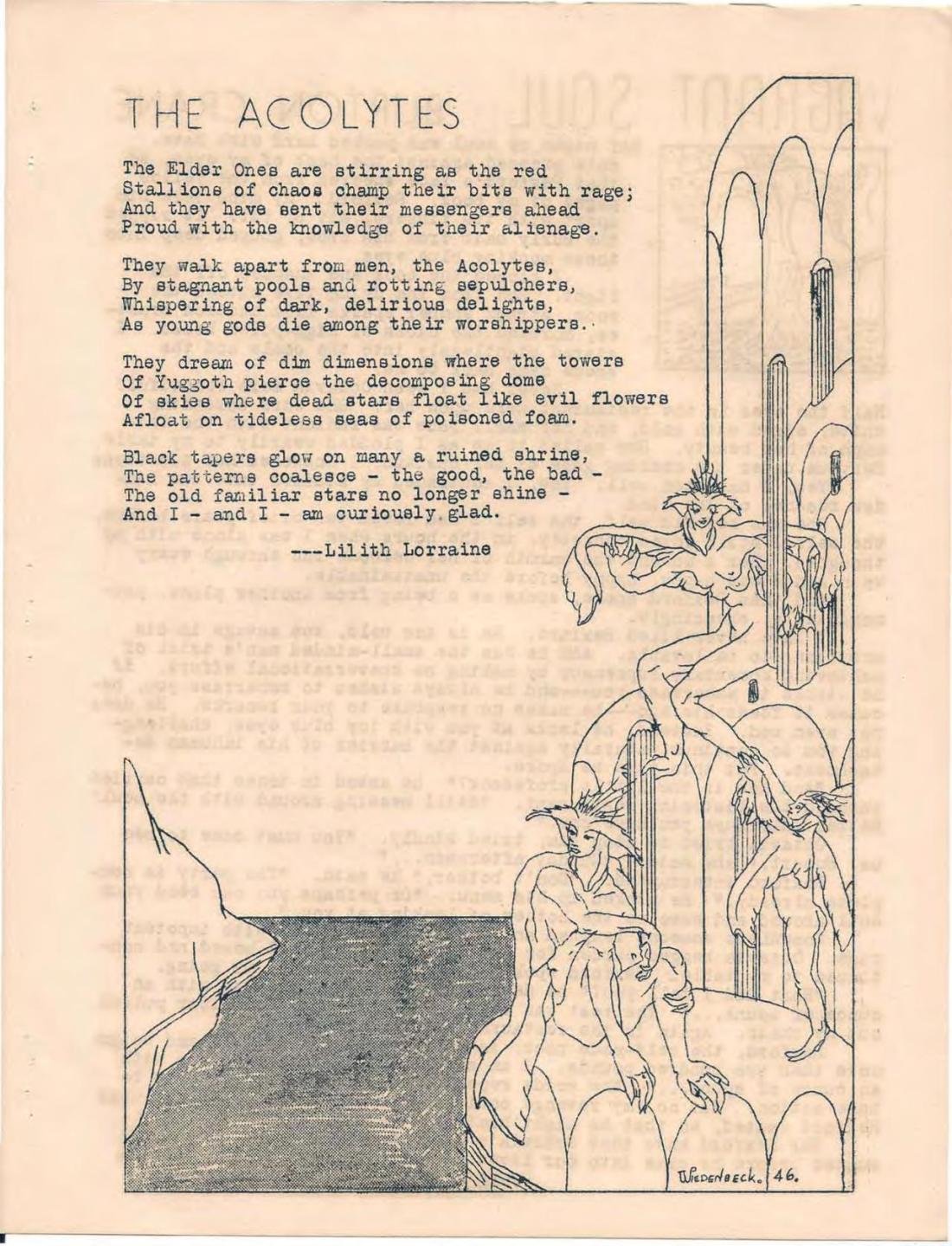
The Elder Ones are stirring as the red
Stallions of chaos champ their bits with rage;
And they have sent their messengers ahead
Proud with the knowledge of their alienage.
They walk apart from men, the Acolytes,
By stagnant pools and rotting sepulchers,
Whispering of dark, delirious delights,
As young gods die among their worshippers.
They dream of dim dimensions where the towers
Of Yuggoth pierce the decomposing dome
Of skies where dead stars float like evil flowers
Afloat on tideless seas of poisoned foam.
Black tapers glow on many a ruined shrine,
The patterns coalesce – the good, the bad –
The old familiar stars no longer shine –
And I – and I – am curiously glad.
—Lilith Lorraine, “The Acolytes” in The Acolyte(Spring 1946)
Mary Maude Wright (née Dunn) wrote under a number of pseudonyms, at least three of them masculine. She wrote pulp fiction for some of the same magazines as H. P. Lovecraft and Clark Ashton Smith, but among early science fiction fandom she had her greatest esteem as a poet, for she was prolific and skilled. As a correspondent of August Derleth and Clark Ashton Smith, like Margaret St. Clair, she was on the fringes of the Weird Tales circle. She was likewise associated with The Acolyte, Francis T. Laney’s prominent 1940s fanzine devoted to Lovecraft and his contemporaries, sharing space with Virginia “Nanek” Anderson, Fritz Leiber, Jr., E. Hoffmann Price and other pulp fans and professional pulpsters.
Sgt. R. A. HOFFMAN. Acolyte art editor, reports from “Somewhere in Tex- Texas” on his visit to the home of Lilith Lorraine, noted poet:
…I Visited San Antonio, which I found to be a primitive, degenerate town, and telephoned Lilith Lorraine, mentioning that CAS had insisted I look her up… She and her husband met me in their car, and drove me out to their Shrine (Avalon Poetry Shrine. — eds.). As we entered the grounds, I heard the barking of what seemed to be myriad dogs, though it turned out to be only three— two of them Russian wolf and the other a crossbreed between Russian wolf and spitz. All were beautiful creatures and very friendly. Inside I was startled to find a veritable menagerie. A large parrot was quietly perched inside its huge cage which sat on the floor, and two cats were snarling at each other. They also have a monkey, but it was asleep in bed at the time, though later she brought it out.
Miss Lorraine is a most amazing person, and going out there was a most fascinating adventure. She and her husband have been married 33 years, but she says she is all the time receiving love letters from strangers. She prefers her pen-name so much that even her husband calls her Miss Lorraine sometimes! They are both native Texans, and she is complete with drawl and all. She has a charming personality and a fine sense of humor.
I had only 2 1/2 hours before my bus, and every minute was spent in incessant conversation or in listening to Lilith read us some of her verse. She read me selections from her then as yet unpublished book The Day of Judgement (Banner Press, 1944), and I was completely caught in her spell, totally swept away with them. She showed me the shrine itself, and the sunken garden, though unfortunately it was late at night, and the floodlights did not give the proper perspective we would have desired….Miss Lorraine thinks CAS the finest American poet since Poe….
Lilith Lorraine’s previous poems in The Acolyte were “On Walking in the Tomb” (Fall 1943) and “Black Cathedrals” (Spring 1944), but “The Acolytes” was a little different. It came in the final issue (#14) of the ‘zine, and is a tribute to those who contributed to the important little magazine…those who, through their efforts kept interest in H. P. Lovecraft and Robert E. Howard going after their death, who began the study of their work and the creation of original fiction and poetry of the Mythos.
The last lines of the poem are strangely appropriate; evocative of Lovecraft and perhaps Robert W. Chambers’. The Acolyte was extinct with this issue, but the Acolytes, that first post-Lovecraft generation of fans and scholars survived and flourished. The stars were right…and Lilith Lorraine was there, to capture a moment in verse.
My heart is gently warmed, in particular, by the many works left by an obscure writer who lived in Providence in the early twentieth century. when I read his work, I am strangely suffused with warmth, as though I have found a friend from beyond the seas.
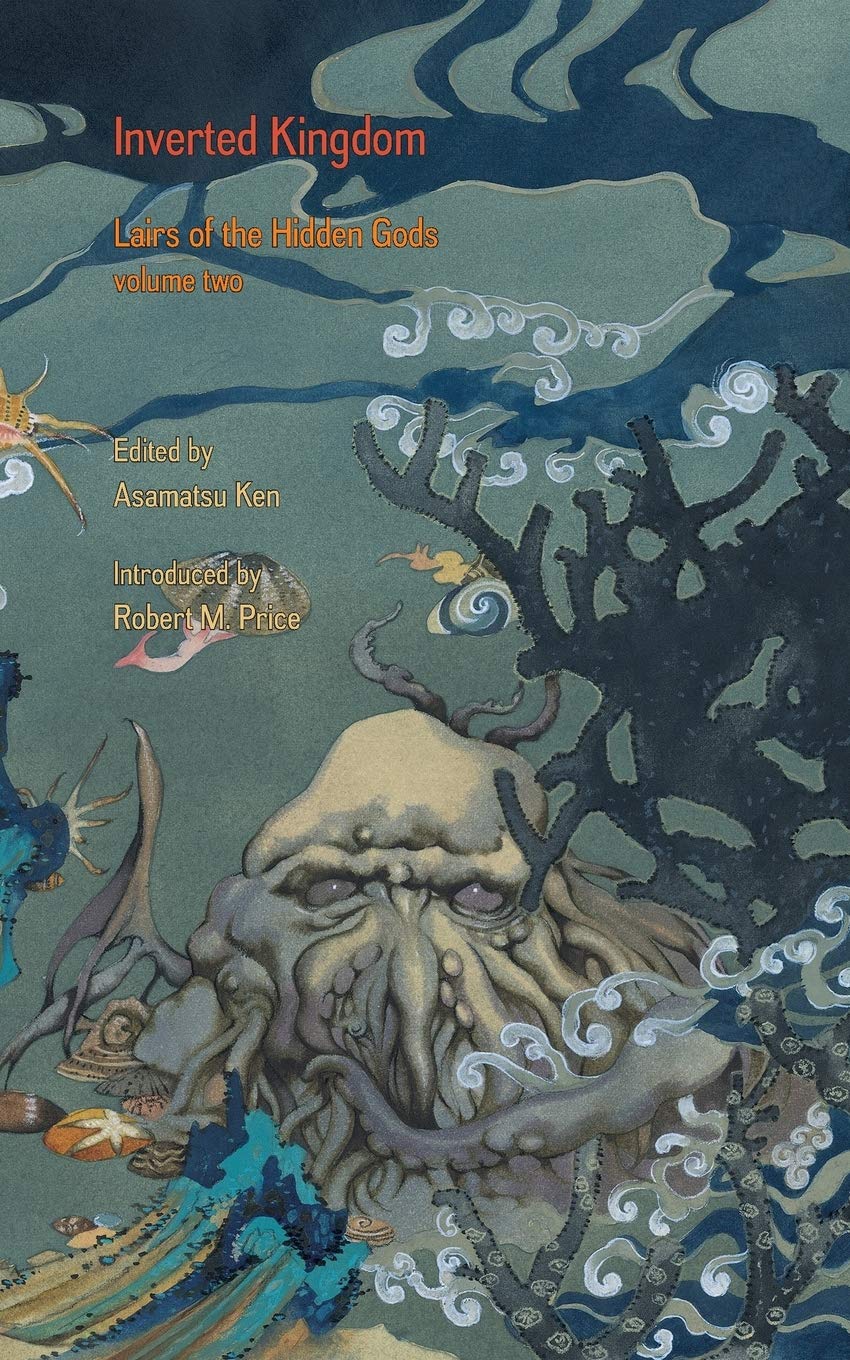
—“A Night at Yuan-Su,”Inverted Kingdom: Lairs of the Hidden Gods Vol. Two279
“A Night at Yuan-Su” (2005) by Nanjō Takenori (南條竹則) was published in the second volume in the Lairs of the Hidden Gods series from Kurodahan Press, edited by Asamatsu Ken (朝松健). It is the English-language translation of the 2002 story ユアン・スーの一夜 (Yuan Sū no Yoru); the translator was Usha Jayaraman.
In his letters, H. P. Lovecraft decried the loss of old buildings, old ways of life. He was not a Luddite, but his sense of aesthetics was tied to antique styles, and he despaired when an old block of buildings was torn down to make way for something new, as a piece of the past was lost. In this sense, he felt a stranger in his own century. Some of these sentiments are apparent in his fiction, in stories like “He” and “The Outsider.” The idea is expressed most succinctly in sonnet XXX of the Fungi from Yuggoth cycle, “Background”:
I never can be tied to raw, new things,
For I first saw the light in an old town,
In this brief tale, Nanjō Takenori sketches the story of a different outsider, thousands of miles away, lamenting the slow loss of historic Tokyo. There are nods to Lovecraft here and there—and a certain kind of humor. The narrator’s deprecation of human beings could almost have turned into one of Lovecraft’s rants about immigrants, the new people displacing the old, but stops short; “A Night at Yuan-Su” is not “The Street” or any other kind of racist fable. It is, ultimately, about a lonely creature out for a drink and a bit of quiet companionship.
This is where the narrative takes a turn, from the atmospheric descriptions of Yuan-Su (really Harajuku in Tokyo), its old buildings torn down to make way for housing developments, to the more fantastic. Reminiscences of a bar named HE, where Imhotep serves araq to an odd clientele. Odd reactions, fragments of names. Unlike Lovecraft’s eponymous Outsider, there is no final revelation in the story…but there is still that peculiar sense of humor. Earlier in the tale, the nameless narrator describes the evil spell of Betelgeuse, the red star, has on them. At the end, finally settling down with a beer and a bowl of tofu, they are thwarted by a shot of ergoutou (Chinese sorghum liquor)—one of the popular brands of which is Red Star.
Given the setting, I almost suspect there are parts of the joke I’m missing. Perhaps the narrator’s particular attributes reflect some specific species of yōkai which Japanese readers might be more familiar with; perhaps the fragmentary names of bars contain more half-hidden meanings for those familiar with Mandarin and Japanese. Whether this is the case or not, doesn’t really matter for the enjoyment of the story. It’s a mood piece, a snapshot of a night, a moment, an attitude. We have all been outsiders, at times; there’s an empathy there for those who desire simple comforts which are then denied.
Never again will I go into that dirty town. Not even on a bright, moonlit night! I have no need to. If my loneliness gets the better of me, if I feel like visiting a friend, I can always go to Celephaïs, the city of dreams, wrapt in its golden aura…
—”A Night at Yuan-Su,”Inverted Kingdom: Lairs of the Hidden Gods Vol. Two285
In a dream I fled from that haunted and accursed pile, and ran swiftly and silently in the moonlight. When I returned to the churchyard place of marble and went down the steps I found the stone trap-door immovable; but I was not sorry, for I had hated the antique castle and the trees. Now I ride with the mocking and friendly ghouls on the night-wind, and play by day amongst the catacombs of Nephren-Ka in the sealed and unknown valley of Hadoth by the Nile. I know that light is not for me, save that of the moon over the rock tombs of Neb, nor any gaiety save the unnamed feasts of Nitokris beneath the Great Pyramid; yet in my new wildness and freedom I almost welcome the bitterness of alienage.
—“The Outsider”
The end of “A Night at Yuan-Su” is curiously ambiguous. Does the nameless narrator mean literally that they will go to Celephaïs, or is that a poetic statement to refer to diving once more into Lovecraft’s fiction, finding comfort in the old familiar tales? It can be read either way; nothing the narrator says or does up to this point is explicitly supernatural. Whether they are a human recluse or something else is left up to the reader—and many readers will want to believe in the stranger, more fantastic option. It is a meaner, uglier world that doesn’t allow for a bar named HE to stand on some corner of Harajuku, where exiles from fantastic lands can sip anise-flavored liquors with their collars turned up and their big hats dipped low over their faces, speaking of distant planets and the depths of the sea.
Let me add that I got a comparable kick out of “Mother of Serpents”—whose Haitian atmosphere is convincing, & whose climax is magnificently clever, powerful, & unexpected.
—H. P. Lovecraft to Robert Bloch, 3 Dec 1936, Letters to Robert Bloch & Others179
Voodoo—whether it be Haitian Vodou, New Orleans Voodoo, rootwork, Obeah, or any other name for the syncretic practices derived from indigenous religions by African slaves in the New World—has an odd place in the Cthulhu Mythos. H. P. Lovecraft wrote very little about it; in all of his fiction, there are only two explicit references to voodoo of any sort:
[…] the one known scandal of my immediate forbears—the case of my cousin, young Randolph Delapore of Carfax, who went among the negroes and became a voodoo priest after he returned from the Mexican War.
—H. P. Lovecraft, “The Rats in the Walls” (1924)
Voodoo orgies multiply in Hayti, and African outposts report ominous mutterings. […] The statuette, idol, fetish, or whatever it was, had been captured some months before in the wooded swamps south of New Orleans during a raid on a supposed voodoo meeting; and so singular and hideous were the rites connected with it, that the police could not but realise that they had stumbled on a dark cult totally unknown to them, and infinitely more diabolic than even the blackest of the African voodoo circles.
—H. P. Lovecraft, “The Call of Cthulhu” (1928)
The sect in “The Call of Cthulhu” turns out to not be connected with voodoo at all, but both references are extremely vague on the details. Much the same could be said of “Medusa’s Coil” (written 1930), which does not feature voodoo explicitly, but includes “wrinkled Sophonisba, the ancient Zulu witch-woman” who provides the connection between Africa and the American South.
The vagueness is perhaps as it should be: Lovecraft was fairly ignorant on the subject of voodoo, as were most in the United States in the early 20th century. Interest in Haitian Vodou increased during the long United States occupation of Haiti (1915-1934) and the Dominican Republic (1916-1924). This experience provided the inspiration and raw material for Arthur J. Burks and other future pulp writers to spin wild tales of curses, cannibals, and human sacrifice; writer William Seabrook lived in Haiti for a period and investigated it, his book The Magic Island (1929) and its account of zombies stirred the American imagination, with Weird Tales writers such as Seabury Quinn and August Derleth quickly borrowing his erudition for stories like “The Corpse Master” (Weird Tales July 1929) and “The House in the Magnolias” (Strange Tales of Mystery and Terror June 1932). For more on this line, see Zombies from the Pulps!(2014).
Lovecraft read The Magic Island in 1931, while visiting Rev. Henry S. Whitehead in Florida. (Letters to F. Lee Baldwin &c. 195) Whitehead had spent summers in the U. S. Virgin Islands, which had been sold to the United States in 1917, and penned tales and articles for the pulps based on the stories of “Obi” and “Jumbees” he encountered.
From The Letters of Henry S. Whitehead (1942)
After Lovecraft read The Magic Island, references to voodoo evaporate from his stories, although there are occasional references in his letters. Knowledge, in this case, may have killed the mystery that voodoo had for Lovecraft; there is no evidence he ever read Zora Neale Hurston or any other anthropologist on the subject, and there is a notable absence of reference to voodoo stories in his essay “Supernatural Horror in Literature”—which he had initially written and published before reading The Magic Island, but which remained without reference to African-American authors or voodoo tales as supernatural fiction even in the later revised and expanded versions.
There was always a racial element as well.
Ordinarily voodoo & Yogi stuff leaves me cold, for I can’t feel enough closeness to savage or other non-Caucasian magic.
—H. P. Lovecraft to J. Vernon Shea, 3 Sep 1931, Letters to J. Vernon Shea &c.45
Curious that your ghost ideas in youth excluded the Indian while including the negro. For my part, though, I can’t feel much weirdness in connexion with any but the white race—so that nigger voodoo stories very largely leave me cold.
—H. P. Lovecraft to Robert E. Howard, 30 Oct 1931, A Means to Freedom1.231
The racial aspect has much to do with prevailing American attitudes about Haiti and black religion in general. Colonialist attitudes remained firmly in place in much of the United States, to the point where Lovecraft and Robert E. Howard were shocked to hear of interracial marriages in the Virgin Islands from Whitehead. In reviewing August Derleth’s voodoo story “The House in the Magnolias,” Lovecraft wrote to his friend:
[…] you have the woman describe herself & family as Haitian, which conclusively implies nigger blood. There are no pure white Haitians. White persons living in Haiti are not citizens, & always refer to themselves in terms of their original nationalities—French, American, Spanish, or whatever they may be. The old French Creoles were wholly extirpated—murdered or exiled—at the beginning of the 19th century.
—H. P. Lovecraft to August Derleth, 9 Sep 1931, Essential Solitude1.376
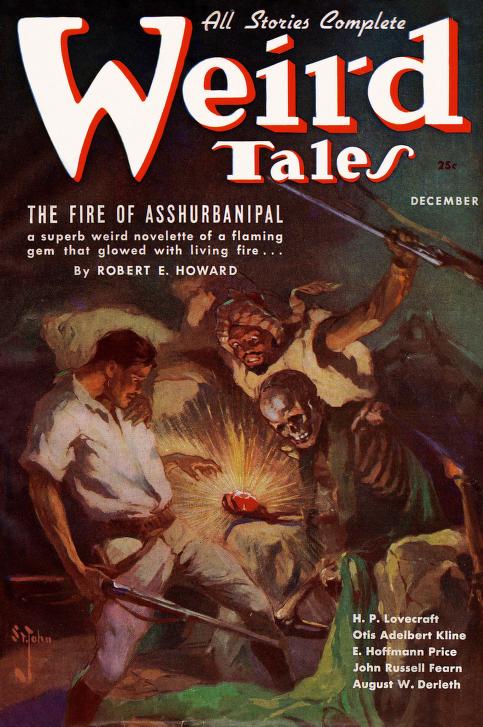
Which leads eventually to Robert Bloch’s “Mother of Serpents” (Weird Tales Dec 1936). Nothing much remains as to the genesis of this short story; there is no evidence that Lovecraft had a hand in it, or even saw it before publication. Far from Bloch’s mature work, this is a potboiler that goes for the jugular of Haitian racial and cultural stereotypes and never lets it go.
There were no happy blacks in Haiti then. They had known too much of torture and death; the carefree life of the West Indian neighbors was utterly alien to these slaves and descendants of slaves. A strange mixture of races flourished; fierce tribesmen from Ashanti, Damballah, and the Guinea Coast; sullen Caribs; dusky offspring of renegade Frenchmen; bastard admixtures of Spanish, Negro, and Indian blood. Sly, treacherous half-breeds and mulattos ruled the coast, but there were even worse dwellers in the hills behind. —Robert Bloch, “Mother of Serpents”
Essentially a conte cruel with voodoo trappings and a supernatural denouement, much of the atmosphere of “Mother of Serpents” is built up in these broad strokes and fine details; Haiti is described as the epitome of racial tensions, black magic, and vice with all the care that Clark Ashton Smith would give to describing an island of necromancers in the far-flung future of Zothique. The description is half-erudite; it’s clear that Bloch was using Seabrook or some other sources for a few of the basic facts on Haiti (such as the legend that Henri Christophe committed suicide with a silver bullet), but it is equally obvious that he was inventing little horrible details left and right. Every character is a stereotype, and there are no heroes. The voodoo-inflected president—keeping in mind this was nearly two decades before the reign of François “Papa Doc” Duvalier—is (literally) a bastard, a criminal, a “black Machiavelli” who enriches himself at the expense of the country…and what is worse in his mother’s eyes, he sullies his black heritage by marrying a mixed-race woman.
Trying to unpack all the racial insinuations in this short story would take longer than the story itself, and wouldn’t achieve much. How much of this claptrap Bloch actually believed is debatable; it’s pure pulp pandering. The Mythos connection is a slim one:
The Snake-God is the real deity of the obeah cults. The blacks worshipped the Serpent in Dahomey and Senegal from time immemorial. They venerate the reptiles in a curious way, and there is some obscure linkage between the Snake and the crescent moon. Curious, isn’t it—this serpent superstition? The garden of Eden had its tempter, and the Bible tells of Moses and his staff of snakes. The Egyptians revered Set, and the ancient Hindoos had a cobra god. It seems to be general throughout the world—the kindred hatred and reverence of serpents. Always they seem to be worshipped as creatures of evil. Our own American Indians believed in Yig, and Aztec myths follow the pattern.
—Robert Bloch, “Mother of Serpents”
Damballah (in different spellings) is one of the principal loa in Haitian Vodou, and is depicted as a snake. The Egyptian god Set (Seth, Setekh, etc.) is not depicted as a serpent; possibly Bloch was making an error and remembering Robert E. Howard’s Stygian snake-deity Set from the Conan tales; although Bloch did not like Conan. Yig was the creation of H. P. Lovecraft, and appeared in “The Curse of Yig” (1929) and “The Mound” (1940), published as by Zealia Brown Reed Bishop; Lovecraft might have sent Bloch the manuscript for the latter, or perhaps Bloch was only referencing “The Curse of Yig.” In any event, the inclusion of Yig among the snake-deities must have been Bloch’s tip of the hat to Lovecraft.
“Mother of Serpents” barely qualifies as a Mythos tale. Despite being reprinted a number of times, it has not been included in any of the collections of Bloch’s Mythos fiction, and has only been reprinted in a single Mythos anthology: Il terrore di Cthulhu (1968). It is often forgotten today—a relic of Bloch’s youth, when he was still trying to find his feet in the publishing game, a few months before the death of H. P. Lovecraft and a full decade before Psycho (1959).
Voodoo, rootwork, and other syncretic religions of the Americas continue to be an element in the Cthulhu Mythos; this is especially true for roleplaying games, where occupations like “Conjure Woman” are part of Harlem Unbound and rules for voodoo magic in Secrets of New Orleans. Individual depictions run from Hollywood tropes to efforts at accurate ethnographic representation. with so little written about voodoo and how and where it fits into the Mythos, at least from Lovecraft, writers are free to indulge their imagination—and do. Some of them, such as Robert Bloch, let themselves lean in too far on the pulp stereotypes and racism both implicit and explicit in the early depictions of Haiti and Vodou.






 Deep Cuts in a Lovecraftian Vein