
Vampirism is still a force to cope with; it has been in flower since Bram Stoker’s Dracula.
August Derleth, “The Weird Tale in English Since 1890” (1930) in The Ghost #3 (1945) 6
Before August Derleth pastiched H. P. Lovecraft, and coined the term “Cthulhu Mythos”; before Derleth pastiched Sherlock Holmes, and created the detective Solar Pons; before he published anything else—Derleth pastiched Bram Stoker and Dracula with “Bat’s Belfry,” his first professional sale.
Dracula in the mid-1920s was not the cultural sensation that it is today. In 1924, Hamilton Deane wrote the first authorized dramatic adaptation of Stoker’s novel. In 1927 John L. Balderston would revise the play for Broadway. American audiences thrilled to the stage production, starring Hungarian actor Bela Lugosi in the title role with a characteristic opera cape—and in 1931, director Tod Browning featured Lugosi and other actors from the production in the first Hollywood film adaptation. With each step, Dracula’s exposure increased, and the image and reputation of the Count expanded by magnitudes.
In 1925, however, Dracula was known as a modestly successful horror story, the best and most popular of Bram Stoker’s novels, still in print 13 years after his death. While readers of Weird Tales could be sure to have at least heard of the book, even if they hadn’t read it, the vampire count had not yet hit icon status. Yet a young August Derleth was inspired by Dracula to write a story—or, perhaps more accurately, to market a story he had already written:
A long time ago, it seems (the year was 1925), when I had written forty stories, none of which had sold, I thought it time to take stock I looked over everything I had written—most of it pretty bad—and selected one story which I thought might be sold. The result was felicitous.
August Derleth, foreword to Evening in Spring (1945 edition)
It isn’t exactly clear when Derleth wrote this story, and various details get muddled in the telling and retelling. Various sources claim he began writing at 13, and that “Bat’s Belfry” was written when he was 13, 14, or 15. In his personal publication record, Derleth wrote:
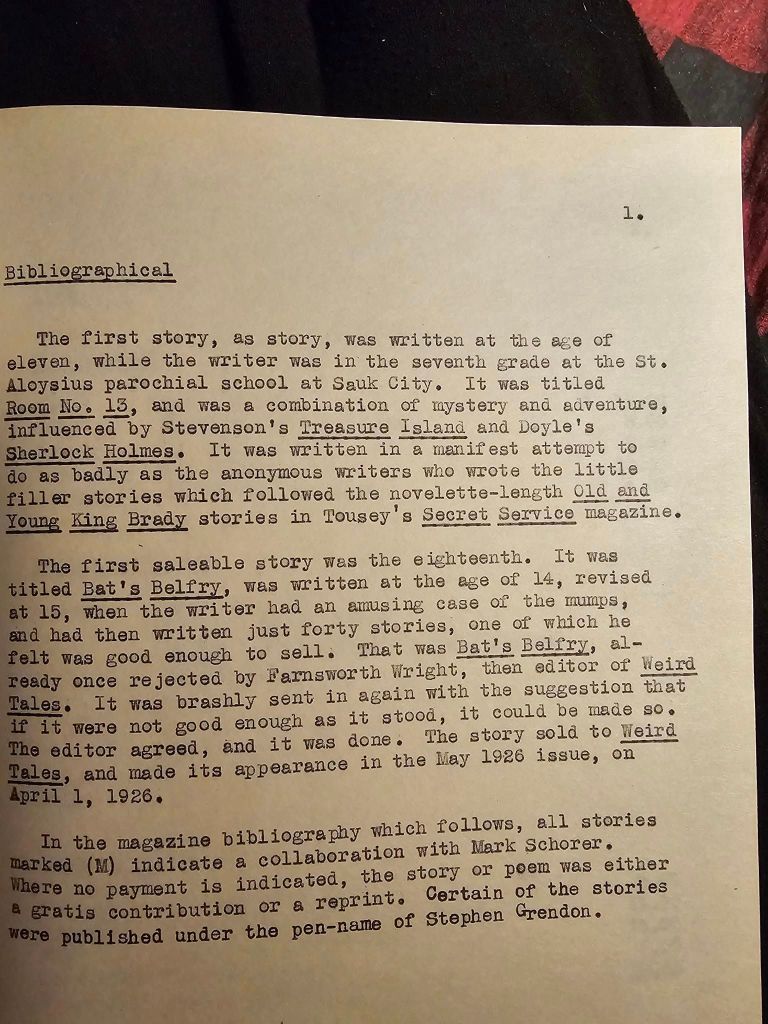
Later, Derleth would write:
I began at thirteen, and I sold at fifteen. The selling of my first story involved a direct challenge to the ego. I had written forty stories before I sold one, and that I should then have sold one ways purely an accident of determination. I had fixed upon the figure forty, resolving that when I had written forty stories without selling one, I would re-examine my determination to become a writer, because I had read somewhere that Charles Dickens had taken his first book to forty publishers before it was accepted. By that accident of reading, I fixed upon forty, and when I had written forty, most of them weird stories which had been duly rejected by Farnsworth Wright of Weird Tales, I looked them all over, one after the other, and endured my own private soul-struggled. On one or two rejection slips Wright had penned a brief, encouraging note—”Try us again!” or “Sorry. Try once more.”—and I read the stories thus rejected with especial interest. They did not seem to me to merit re-submission, but my eighteenth story did. I felt that it was honestly as good as many of the things which Wright had been publishing, and, if it was not up to acceptable status, it could be brought up to that level. So, firmly but politely, I resubmitted the story, stating that I felt it could be made acceptable, and in response received a most agreeable letter from Wright suggesting certain changes, calling my attention to my error in the matter of the Cockney dialect, with the felicitous result that the story, revised, was ultimately sold.
August Derleth, Writing Fiction 164-165
This version of the story, straight from Derleth, is probably the most detailed and accurate version—with a few caveats. The original title of the story wasn’t even “Bat’s Belfry,” and there was much more involved in the revision than removing a Cockney accent. Fortunately, we can track the development of the story because Derleth saved Wright’s rejection letter:
Dear Mr. Derleth:-
I have again given a careful reading to THE LOCKED BOOK. The workmanship is very uneven, almost as if you had written part of it under the fever of an urgent inspiration, and the rest merely as a matter of routine hack-work. But—I think it can be made acceptable for WEIRD TALES. The last half of the story is well handled, except the ending. You have adduced no reason why Sir Harry Barclay should wish to summon Satan, when all he wants to do is the pious deed of staking the bodies of the vampires. You have made no connection between the skeletons and the final scene where Satan appears. In other words, the whole story is left “up in the air”—you have braided a rope, but left the ends out without bringing them together in one cord. And the beginning contains altogether too much of the grocer’s conversation—I think the whole scene with the grocer is irrelevant and merely interrupts the flow of the narrative. All that the grocer incident does for the story is to establish the fact of the disappearances of four girls, and the fact that the last Baronet Lohrville was a devil incarnate. This fact can be much more naturally established than by interrupting your story to drag in a dialect-speaking grocer for two pages of conversation. Your narrative first takes on vigor and movement on page 7, where you begin: “Three days ago Mortimer came to me,” etc., and it keeps up nearly to the end, where it sags by reason that nothing is decided, and that the ending is no true denouement at all, for it has very little connection with the facts of the narrative itself, neither explaining them nor being a development or working-out or consequence of the facts of the story itself. What possible connection, the readers would think, exists between the vampire-talk that has gone before, the finding of the skeletons, the extinguishing of the lights, the bat-wings in the dark—what possible connection between these things and the ending of the story, the appearance of Satan? I fear the reader would be disappointed. The story is very well handled in part, yet awkwardly treated in other parts.
Farnsworth Wright to August Derleth, 24 Sep 1925, MSS. Wisconsin Historical Society.
At the end of its first year in business, Weird Tales was in a bad way; a company shake-up in 1924 ousted then-editor Edwin Baird, and Farnsworth Wright (formerly first reader for the magazine, who would sift through the slush pile of submissions for stories worth publishing) ended up in the editorial chair, and after the owner J. C. Henneberger was forced out of management, Wright had the creative freedom to run Weird Tales his own way. This still involved, at first, running stories bought under Baird—but as they went through the issues, Wright would be in the market for new material. Enter August Derleth.
Of immediate notice in this letter is that this isn’t the first time Derleth has submitted this story; it would become Derleth’s practice to submit and re-submit stories until they sold, and that so many of his works did sell to Weird Tales shows the value of his persistence (and Wright’s need for material). As Derleth would later tell it:
Since that time I learned fairly accurately to judge when stories were being rejected because there were a fair number of stories on hand, and the editor could afford to be more selective; and in every such case, without exception, I simply waited several months, retyped the manuscript, and submitted the story in question again, and in every case it was duly accepted on some resubmission, ranging from the first resubmission to the ninth, an opening having appeared for it and the story being good enough for filler if not feature. Something like fifty stories have been sold in this fashion, though I do not recommend it as a steady practice, and cite it only as an example of a) ego, b) a certain ability to judge from the editorial point of view as well as from that of the writer.
August Derleth, Writing Fiction 165
Derleth’s strategy worked in part because of Wright’s extreme conscientiousness as an editor. Wright’s willingness to work with a new potential writer and give detailed advice and criticism on how to improve a story was not limited to Derleth; his encouragement extended to many new writers trying their luck with Weird Tales. That was one of Wright’s more endearing characteristics, well-remembered by many writers who might otherwise just receive a pre-printed rejection slip.
For his part, Derleth seems to have taken Wright’s criticism to heart, for in the published version of the story there is no lengthy dialogue sequence. The grocer’s tale is rendered down to a single long paragraph. Later in life, Derleth would recall:
The danger in distant settings lies in inadequate knowledge. In the original version of my first published short story (Bat’s Belfry, Weird Tales, May 1926), which was set in the country down from London (which, for a beginner of fifteen, seems in retrospect to be the height of self-assurance), I introduced a pub-keeper who spoke in Cockney dialect. Possibly due to saturation reading of Conan Doyle, Sax Rohmer, Edgar Wallace, et al, I had somehow conceived the impression that most of the lower classes in England habitually dropped their h’s from many words and added them to many others where they did not belong. The late Farnsworth Wright, then editor of Weird Tales, pointed out that the Cockney dialect was limited to a bounded area within the city of London, and that it was not likely that such a speech pattern would make its appearance in the down country, or, if it did, that it would last for any length of time, since all dialects are naturally subject to change under the influence of the prevailing speech patterns. Had I checked on this simple fact before submitting the story, I would not have made an error, which now necessitated revision; but I made the mistake of taking the dialect more or less for granted—I ascribed it to a class of people rather than to a district; a little unbiased interpretation would have enlightened me even without reference to any source of information, for dialects are never a matter of class, but always of region.
August Derleth, Writing Fiction 64-65
The story was revised and resubmitted to Wright, who responded back:
Dear Mr. Derleth:-
Almost! And with a little touching up of the ending, THE LOCKED BOOK will be ready for the pages of WEIRD TALES. (And please number your pages; to avoid confusion in case the pages get misplaced).
The story is vastly improved. You are on the right track in the present ending, but you have fallen down badly just the same. For in a story of this kind, does the reader want to enjoy the spectacle of the appearance of the vampires before Barclay, or does he want ’em to appear and then finis? You know the answer. You have deliberately turned from the high spot in your story as if you had suddenly become tired of writing. You have not squeezed out all the horror you could from the situation; in fact, you have hardly squeezed out any. Drain it dry (the situation, I mean). Touch up the ending, let us see the gloating eyes of the vampires as they move on Barclay—let us see Barclay immovable under the hypnotic, glittering, evil gaze of the old Baron, and the sinuous, gliding movements of the four women as their red lips part in a smile and they gently caress those lips with a soft lapping motion of their tongues—while Barclay continues to write—let him fight the spell, let him drop his eyes and start to his feet—let the most beautiful of the vampires come before him, arms outstretch or all for at once, perhaps—I am resisting with all the power of my will, he cries—the rememberance of that parted mouth, those crimson lips remains—she is still here, in front of me, as I write; I will take one more look at her face, and then pray—I look—her face approaches mine and—My God! I no longer want to pray!—a sharp stinging sensation at my throat—my God—it is—
Some such ending. Write it yourself. You don’t need to rewrite what has gone before, hwoever.
Farnsworth Wright to August Derleth, 6 Oct 1925, MSS. Wisconsin Historical Society.
For fans who have rolled their eyes a little at the protagonist continuing to write as the horror takes them, as in H. P. Lovecraft’s “Dagon” and “The Diary of Alonzo Typer,” there is a certain irony in Wright actually suggesting such an ending to the impressionable young Derleth. For his part, Derleth took Wright’s advice on how to write the ending rather literally, presumably to give the editor exactly what he wanted:
I can not tolerate their virulence . . . . I endeavored to rise but I could not do so. . . . I am no longer master of my own will! The vampires are leering demoniacally at me. . . . I am doomed to die . . . and yet to live forever in the ranks of the Undead. Their faces are approaching closer to mine and soon I shall sink into oblivion . . . but anything is better than this . . . to see the malignant Undead around me . . . A sharp stinging sensation in my throat. . . . My God! . . . . it is—
August Derleth, “Bat’s Belfry” in Weird Tales Mar 1926
Still, this final revision did the trick:
Dear Mr. Derleth:-
Your story, BAT’S BELFRY (I prefer your new title), is acceptable for publication in WEIRD TALES, in its new form. Our minimumr ate of half a cent a word, on publication, is unfortunately our standard rate at present except in very exceptional circumstances, and we must keep this rate until we clear off the debts left us by the old company. As your story measures about 3600 words, this will amount to $18 on publication for BAT’S BELFRY. Is this satisfactory?
Farnsworth Wright to August Derleth, 15 Oct 1925, MSS. Wisconsin Historical Society.
It apparently was, and Derleth had his first professional sale. The story would be published in the March 1926 issue of Weird Tales.
One of the interesting things about “Bat’s Belfry” is its format: the first part consists of a letter, there is a brief narrative interlude, and then the rest of the story consists of excerpts from Barclay’s diary. Stoker’s use of the epistolary novel format was something of an archaic device when Dracula appeared in 1897, and was prone to misuse by inexperienced writers. Wright noted this in a follow-up letter when Derleth apparently tried to follow the success of “Bat’s Belfry” with another story in a similar format:
Dear Mr. Derleth:-
I am returning THE PIECE OF PARCHMENT. The diary form is particularly hard to use in a story, altho many of our writers, under the influence of Bram Stoker’s “DRACULA,” have tried to use it, and sometimes they succeed. But it ordinarily is the surest device for killing reader-interest.
Farnsworth Wright to August Derleth, 9 Jan 1936, MSS. Wisconsin Historical Society.
Derleth would take this advice to heart too, recapitulating this advice to others:
Very probably the success of Bram Stoker’s Dracula inspired a flood of similarly conceived stories written in the form of a diary, but on the whole, this form is very difficult to do well. That is because the writer is always caught between the necessity of getting on with his story and of keeping a semblance of verisimilitude about the entries as they are likely to be made.
August Derleth, Writing Fiction 126
More interesting perhaps is that for those familiar with Derleth’s later creative efforts, “Bat’s Belfry” has many hallmarks of his later Cthulhu Mythos fiction. Aside from the obvious characteristics of pastiche, where Derleth apes or recaps some of the key imagery or elements from Stoker’s original (compare the vampire women seducing Harker and Barclay), there is the emphasis on the library of occult books which foreshadow the development of a five-foot shelf of eldritch tomes in later Mythos fiction. This includes a very Derlethian, weirdly self-referential element when the protagonist, digging through an old trunk, comes across an early edition of Dracula! This is strongly reminiscent of how in some of his later Mythos fiction such as “Beyond the Threshold” (WT Sep 1941), Derleth would place copies of Arkham House books such as The Outsider and Others next to the Necronomicon. Indeed, the Book of Thoth in this story serves much the same function as the Necronomicon might in later Mythos fiction, being almost a prototype for the Necromonicon-as-grimoire trope.
To be frank, “Bat’s Belfry” is far from Derleth’s best work, borderline juvenalia. While it may not be hack-work, it is plainly a potboiler, and one which Wright himself seems to have partially dictated. Derleth skews from Stoker in having Barclay attempt to use actual magic against the vampires (Leon, a Catholic like Derleth himself, fares a bit better), but the diary format of the final encounter renders is a bit ridiculous. Nevertheless, the story had its attractions for editors. While it didn’t place among the best stories in the issue, it was selected for reprint in the British More Not at Night anthology by Christine Campbell Thomson. This was the first of what would be many reprints in various horror and vampire anthologies over the decades.
As his first publication, “Bat’s Belfry” became part of Derleth’s own personal legend, and on the twentieth anniversary of his becoming a writer, his people threw a party to celebrate:

Another article suggests 130 guests attended Derleth’s 20th anniversary of becoming a writer (The Capital Times 4 Apr 1946). Yet that is not the end of “Bat’s Belfry.”

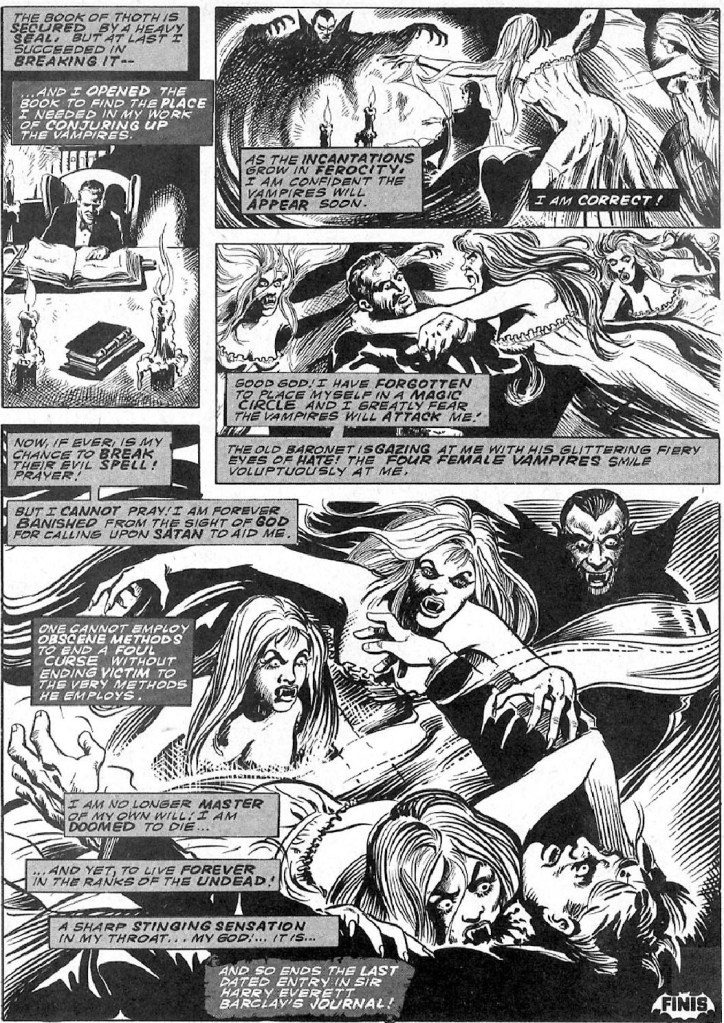
In the 1970s, Marvel Comics circumvented the restrictive Comics Code Authority, which effectively prevented them from publishing adult-oriented comics, particularly horror and the more lurid and grisly sword & sorcery, by publishing full-sized comic magazines, initially under their Curtis imprint. One of these efforts was the black-and-white Vampire Tales, and in the third issue (February 1974), they published an adaptation of “Bat’s Belfry,” with writing by Don Macgregor and pencils and inks by Vicente Ibáñez.

The best that can be said of this adaptation is that Macgregor and Ibáñez highlight the most compelling and evocative images in Derleth’s story, emphasizing the Gothic atmosphere, while preserving much of Derleth’s prose. Ibáñez’ layouts in particular sometimes break from a strict grid format, to give the suggestion of action in a story that has little of it. The encounter with the grocer, for example, is no longer a paragraph in a diary, but is now a sequence where a burly man butchers a carcass and splashes bystanders with blood as he warns them about the old baron.
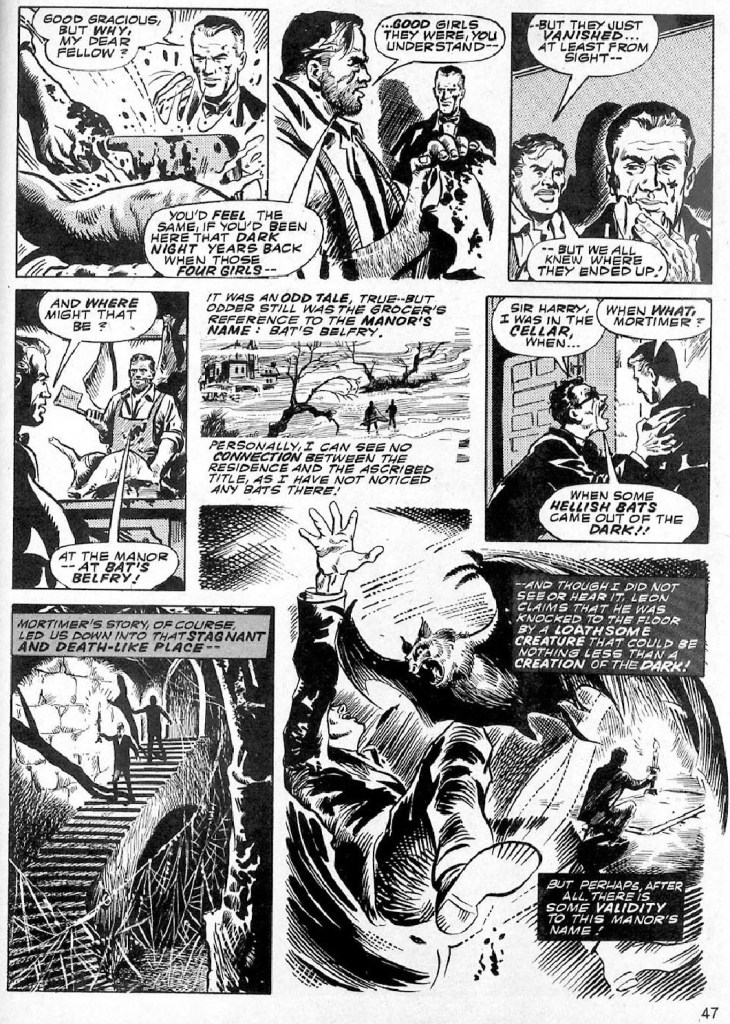
Because the comic adaptation was set well after the success of the 1927 play and the 1931 film, the Baron wears an opera cape and has slicked-back hair, very much in the Lugosi mold, while all of the vampires have prominent fangs—an element that first appeared in Turkish and Mexican film vampires, but gained wide popularity in the United States from the Hammer Dracula films starring Christopher Lee that began in 1958. It is characteristic of adaptions to update older bloodsuckers to fit the expectations of a contemporary audience.
H. P. Lovecraft never evinced an opinion on “Bat’s Belfry” in any surviving letter; indeed, Derleth did not ask Wright for Lovecraft’s address until after the story had been accepted. However, there is reason to believe that Lovecraft did note Derleth’s first publication in Weird Tales. In The Village Green (192?) by Edith Miniter, H. P. Lovecraft was depicted in the novel as “the man with the long chin” (in reference to Lovecraft’s prognathous jaw), and in one scene she wrote:
Indeed the large man with the long chin, who had received a letter from “Bob” Davis containing the startling words: “It (The Bats in the Belfry) is splendidly written, but it exceeds the speed limit . . . . I have been some time coming to a conclusion about this story, but I didn’t want to push the matter hastily. Even now I may be wrong. . . .” took the confession in a nonchalant manner that shocked his confreres. When he tried to introduce the Elizabethan Dramatists he was drowned by outcries, “Man you don’t know your luck. An editor owning up that he may be wrong! Ye Gods and little walruses. Send him a weird one not quite as weird.[“]
Edith Miniter, The Village Green and Other Pieces 147
The title, “The Bats in the Belfry” is too close to “The Bat’s Belfry” for coincidence. Given the talk of editors, it seems likely that “Bob” Davis in this case is based on Farnsworth Wright; possibly Derleth had shared one or more of Wright’s letters ruminating on or rejecting “Bat’s Belfry.” Or perhaps Miniter garbled Lovecraft’s message. In either case, it is an odd denouement to an odd little story, that began as “The Locked Book” and ended up as “Bat’s Belfry.”
Readers interested in the story “Bat’s Belfry” can read it online.
In 2010 Marvel Comics reprinted Vampire Tales as a collected edition in three volumes; “Bat’s Belfry” can be read in the first volume, in both hardcopy and as an ebook.
Bobby Derie is the author of Weird Talers: Essays on Robert E. Howard and Others and Sex and the Cthulhu Mythos.
Deep Cuts in a Lovecraftian Vein uses Amazon Associate links. As an Amazon Associate I earn from qualifying purchases.

 Deep Cuts in a Lovecraftian Vein