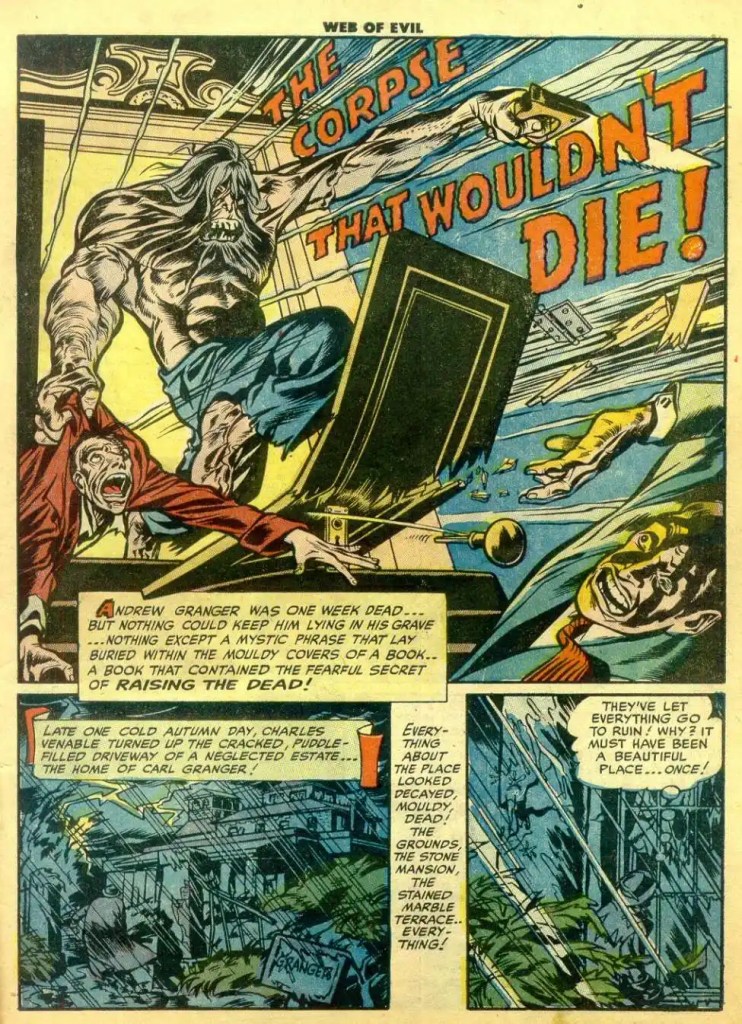
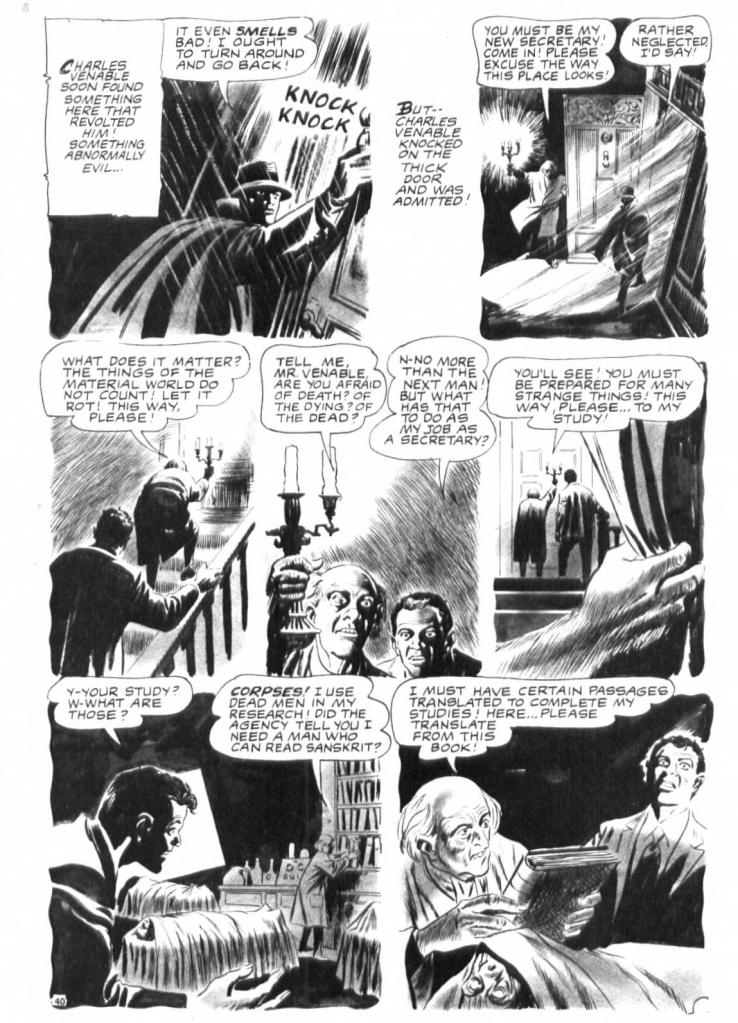
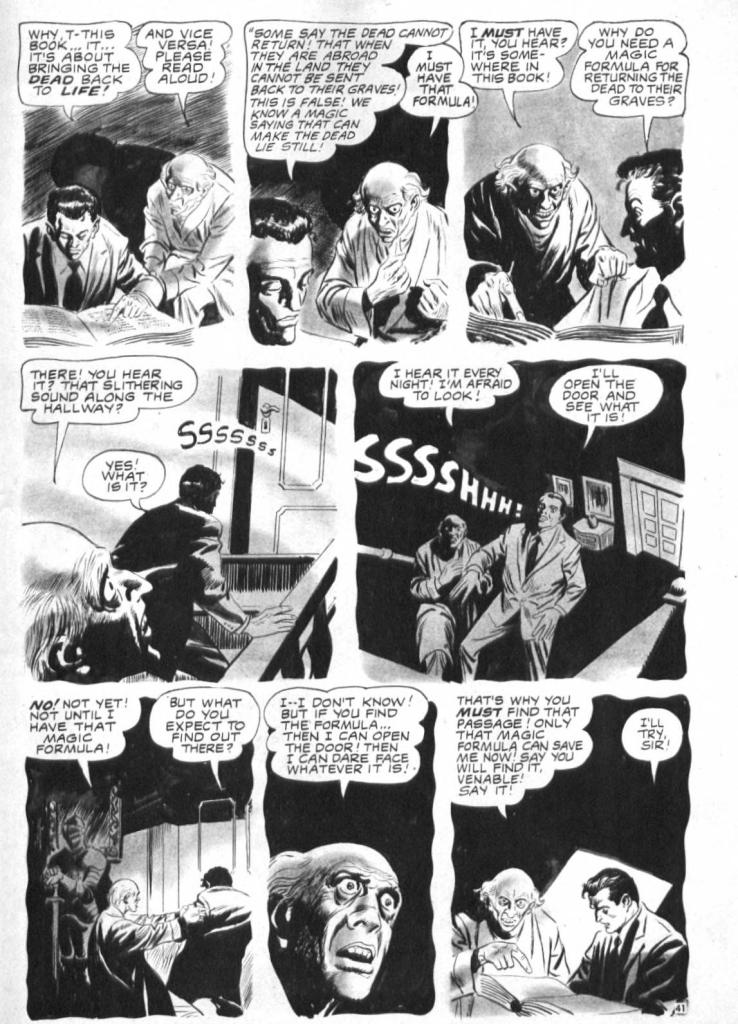
“The Corpse That Wouldn’t Die!” (1953) by Jack Cole

I have given the whole of a cloudy Sabbath to finish my dismembered corpse story—“The Return of Helman Carnby”. I shall enclose the carbon with this; and I hope you will like it. The thing became a sizable yarn, with all the details that I worked out . . . It goes to “Ghost Stories”, then to W. T.,—both of which will doubtless reject it. But I think myself that the tale is a pretty fair literary beginning for the New Year. I like to picture it in the sunny and lightsome pages of the “Ladies’ Home Journal.”
—Clark Ashton Smith to H. P. Lovecraft, c. early Jan 1931, Dawnward Spire, Lonely Hill 290

Needless to say, I perused the monstrous narrative of Helman Carnby with the most acute & shuddering admiration; &, having made the verbal changes indicated in your supplementary note, have forwarded to Derleth with instructions for return to you through Wandrei. It is certainly a great piece of work, & I am extremely flattered by the prominent part played therein by the Necronomicon. But God! If there is still a copy of the original Arabic version in existence, what safety can we guarantee for this unhappy planet? Is it not true that no copy was found when the police entered the seemingly deserted mansion of Carnby & observed those hideous & inexplicable conditions which the newspapers were not allowed to print? What of that utterly unthinkable foot-mark which seemed to be burned into the floor? But one must not think of such things! Anyway, it’s a great yarn, & the cumulative suspense & malign suggestiveness of the earlier parts are enough to set any outfit of teeth—even false ones on a dentist’s cupboard shelf—chattering! It looks to me quite all right as it is—if there were any way of piling on another shudder, I’d say it would be by veiling the final horror a little more obscurely from actual sight, & trying to hint or imply the blasphemous abnormality which sent the secretary fleeing from that accursed habitation. I certainly hope that the tale will find a typographical haven.
—H. P. Lovecraft to Clark Ashton Smith, c. 18 Jan 1931, Dawnward Spire, Lonely Hill 293

Ghost Stories did not take “The Return of Helman Carnby,” not even after Smith re-wrote the ending and sent it back for another look; nor was it published by Weird Tales. The story was published in Strange Tales of Mystery and Terror (Sep 1931), under the title “The Return of the Sorcerer.” This is arguably Smith’s most distinctly “Lovecraftian” story, being an explicit extension of Lovecraft’s Mythos rather than involving any of Smith’s own fabulous settings and entities, and one of the first uses of the Necronomicon outside of Lovecraft’s own works (compare “The Were-Snake” (1925) by Frank Belknap Long, Jr. and “The Picture” (1939) by Robert D. Harris).

“The Return of the Sorcerer” was reprinted in Smith’s first Arkham House collection Out of Space and Time (1942), and anthologist August Derleth selected it for inclusion in Sleep No More (1944), which meant it was included in the Armed Services Edition of that book issued to soldiers during World War II. One can just about imagine a marine en route across the Pacific Ocean idling away a sweltering hour reading of the dismembered corpse crawling from the grave. By the 1950s, however, “The Return of the Sorcerer” had been out of print for years—though not forgotten.

Web of Evil was a horror comic published by Quality in the years immediately before the formation of the Comics Code Authority, and which ran 21 issues. The product was typical of the era: often shoddy artwork and simple, quick stories that emphasized grue and taboo, shock and suspense. The stories were often unsigned and the creators weren’t above lifting a plot from an old pulp magazine from time to time.

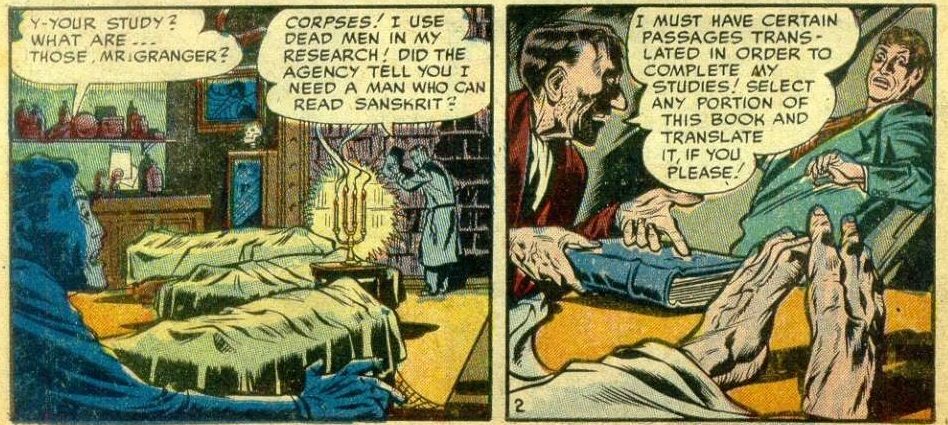
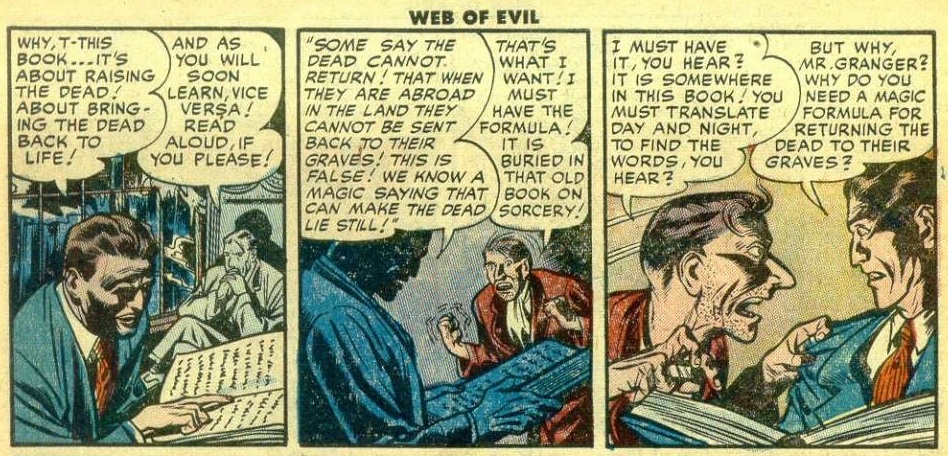
“The Corpse That Wouldn’t Die!” in Web of Evil #2 (Jan 1953) by artist Jack Cole is very clearly based on “The Return of the Sorcerer.” The names were changed to hide the plagiarism, and the unnamed Necronomicon is in Sanskrit rather than Arabic, but the essentials of the story are clearly recognizable. It may no longer be a Mythos story, but for all that it has a distinct charm for those that recognize that Cole is, at least, lifting from the best.

At six pages, the action moves fast—and in almost every panel, Cole tries to add some dramatic element of lighting or motion to capture the eye or set the tone, which often leads to near-comical exaggeration. Though there is not so much grue as there might have been: after all the corpse of the deceased sorcerer is still intact when it returns from the grave.

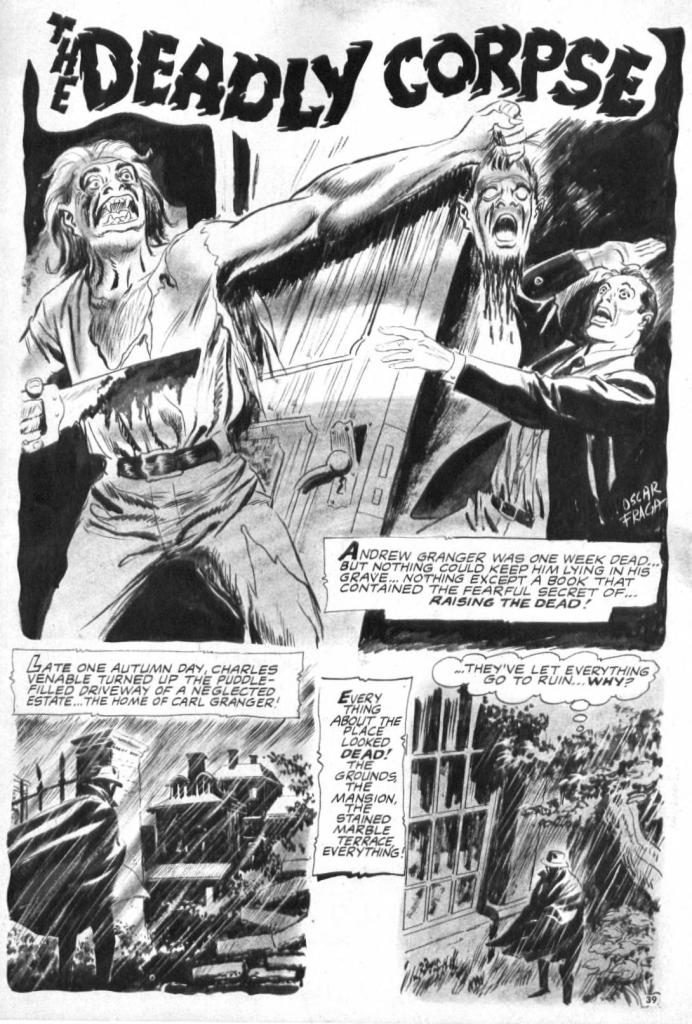
Lifting stories from pulp writers was not unusual in the 50s, and “The Corpse That Wouldn’t Die!” sits neatly among the Pre-Code Lovecraftian Horror Comics. The tale has been reprinted a number of times, including a version in Tales of Voodoo vol. 5, no. 2 (Mar 1972), where the art was reworked by Oscar Fraga and the result retitled “The Deadly Corpse” (sample pages below). Fraga’s rework updates the art to match the sensibilities of Eerie Publications in the 70s, but doesn’t add anything new to the story itself.

The original Web of Evil version can be read for free at Comic Book Plus.


Bobby Derie is the author of Weird Talers: Essays on Robert E. Howard and Others and Sex and the Cthulhu Mythos.

Deep Cuts in a Lovecraftian Vein uses Amazon Associate links. As an Amazon Associate I earn from qualifying purchases.

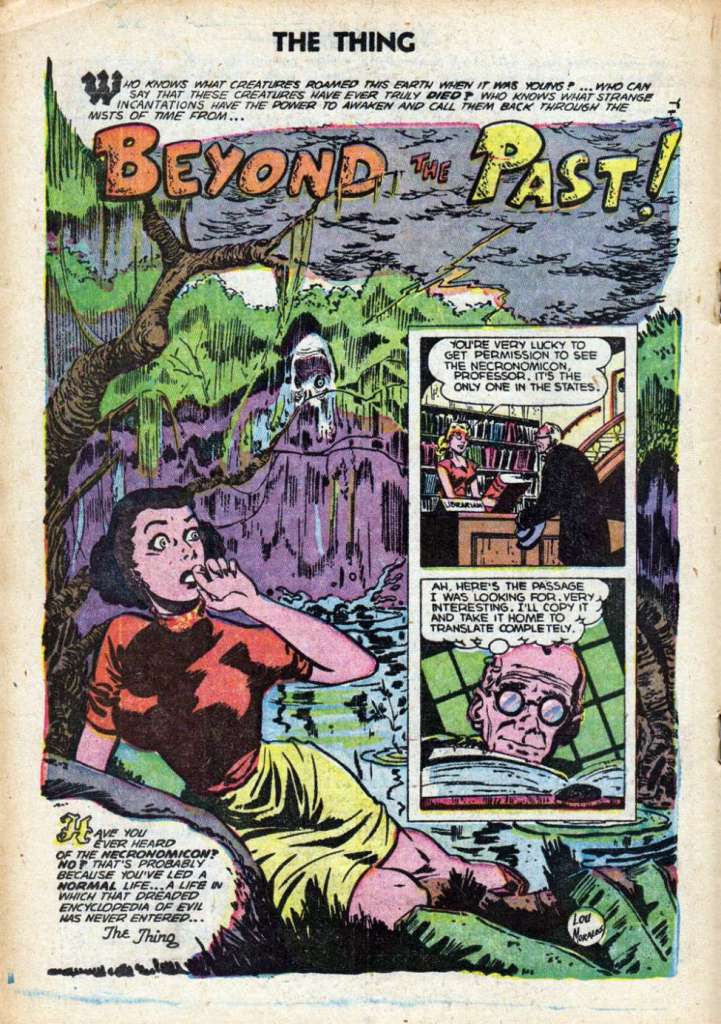
“Beyond the Past” (1953) by Lou Morales

Have you ever heard of the Necronomicon? No? That’s probably because you’ve led a normal life…a life in which that dreaded encyclopedia of evil has never entered…

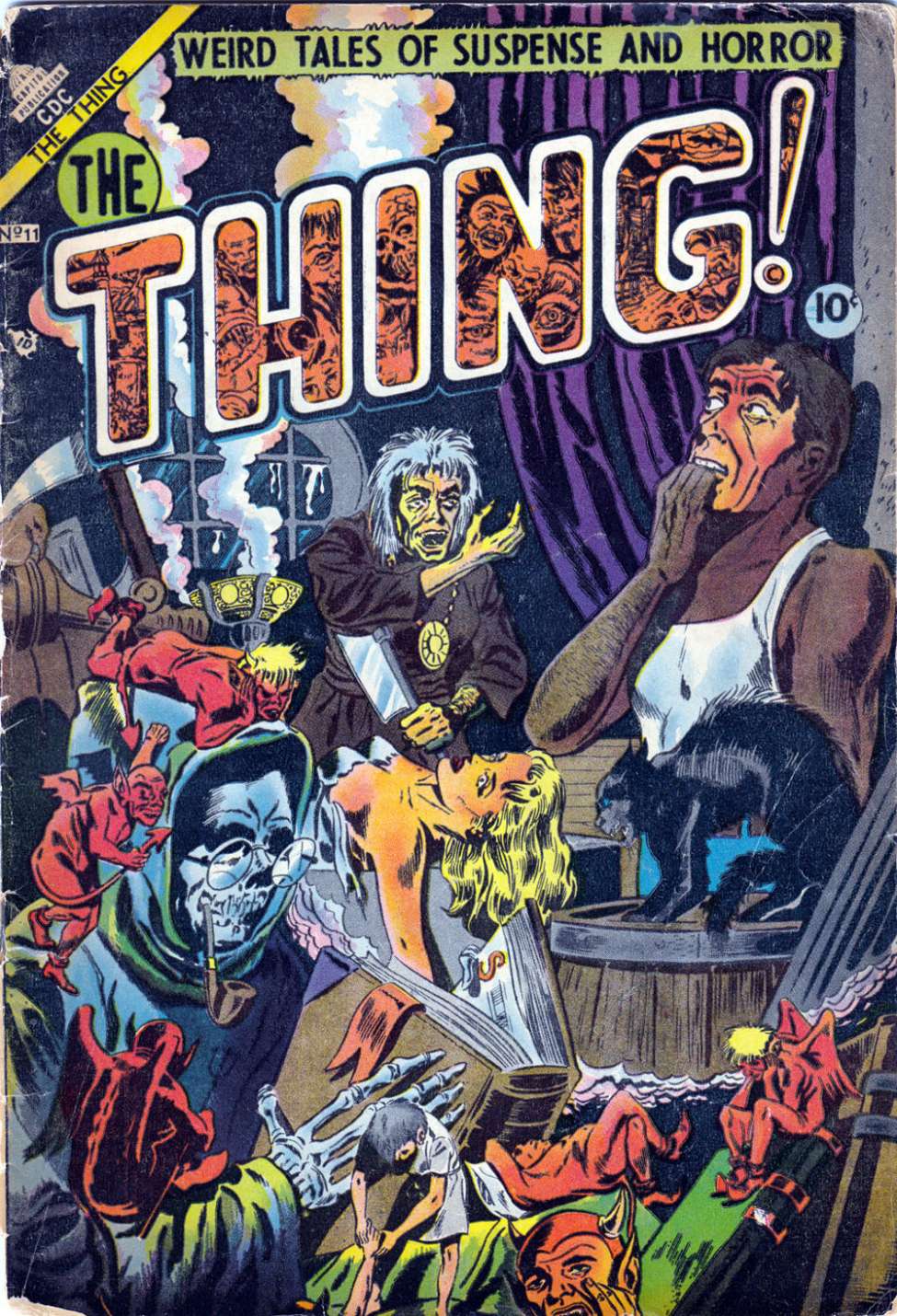
The Thing #11 (Nov-Dec 1953), 18

1953. The war was over. On the magazine racks, brightly-colored comic books, eager to catch the eye and earn the dimes of children and adults alike. Romances, westerns, a scattering of super-heroes, crime, science fiction, and horror. The pulp magazines are dying, fewer of them on the stands every month, but the comic books are lurid and varied, each outfit competing with the other.

Charlton Comics was a latecomer to the field of horror comics. Their most notable entry was The Thing, a horror anthology comic consciously modeled on EC’s Tales from the Crypt, launched in February 1952 and lasted 17 issues, ending in November 1954; today most notable for the artistic talents of a young Steve Ditko in the later issues. Under the editorship of Al Fago, The Thing sought to distinguish itself in a crowded field with low page rates and relatively lax editorial oversight, with the hope this artistic freedom would provide solid stories and provocative artwork—and unfortunately for them, they succeeded in drawing attention to themselves, though not the kind they wanted. (The Charlton Companion 48, 52-4)

In The Thing #11, released in November 1953. “Beyond the Past” was a short comic in the middle of the issue, only 4 pages. Artist Lou Morales signed the first page, but the writer, letterer, etc. are uncredited, which was typical. Comics in the 50s were often churned out swiftly, in workshop fashion, and individual creators were not always credited. The other stories in the issue (and many issues before and after) were written by Carl Memling, and he may be responsible for the script on “Beyond the Past” as well.

The story itself is relatively direct and minor: an old professor studies the Necronomicon, mumbles an incantation (“Xnapantha..xnapnatha..Chrtlu..xmondii…”), and accidentally calls up that which he cannot put down. Lovecraft had many fans among the early horror comics, as evidenced by “Baby… It’s Cold Inside!” in Vault of Horror #17 (1951), and “Portrait of Death” (1952) in Weird Terror #1 (1952). For the most part, this would be classed as forgettable filler, but for two things.

For one, “Beyond the Past” is an early appearance of the Necronomicon in a comic book. For two, it caught the attention of Fredric Wertham, and became a footnote in the moral panic that led, ultimately, to the institution of the Comics Code Authority and the vanishing of horror comics from the shelves in the United States and other countries.

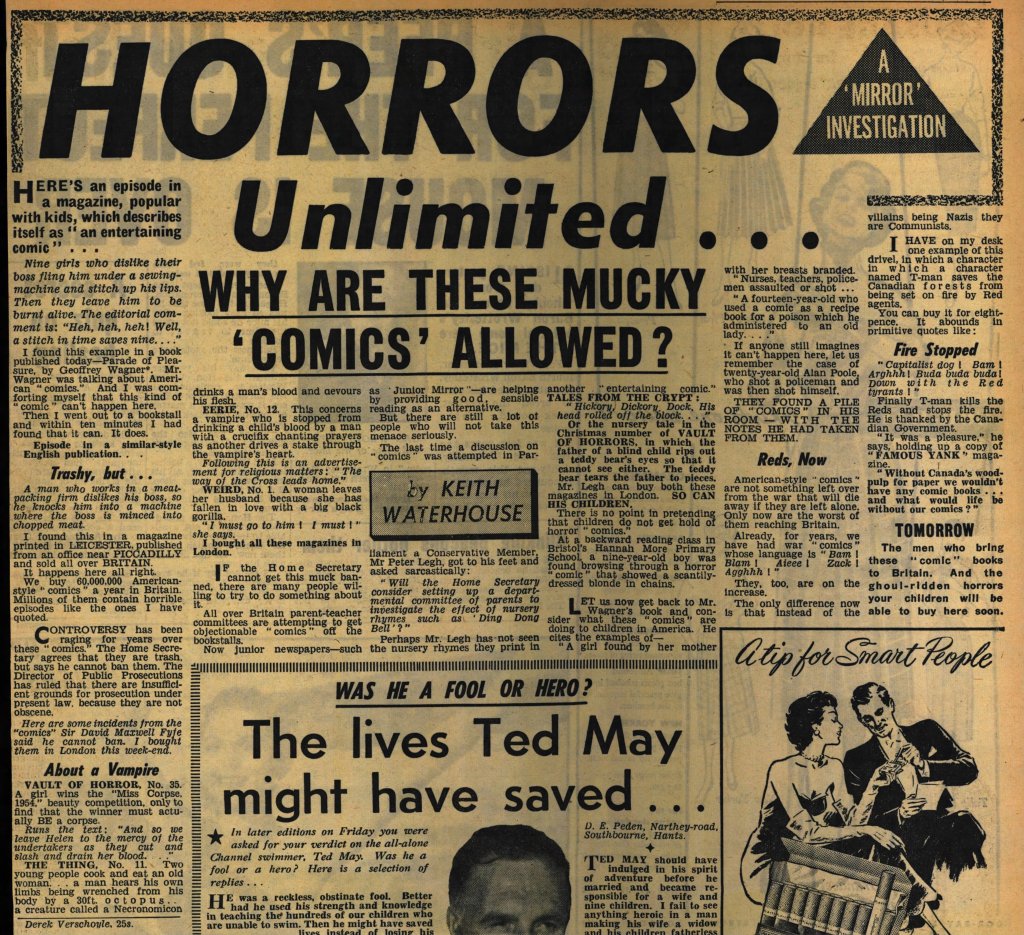
The Thing, No. 11. Two young people cook and eat an old woman. . . a man hears his own limbs being wrenched from his body by a 30ft. octopus . . a creature called a Necronomicon drinks a man’s blood and devours his flesh.

Keith Waterhouse, “Horrors Unlimited” in the London Daily Mirror, 13 September 1954

Nearly a year after The Thing #11 was first published, an article ran in the London Daily Mirror, decrying the comics that kids were buying these days. This was not exceptional; the United Kingdom had been undergoing its own moral panic about comic books, which would eventually result in the Children and Young Persons (Harmful Publications) Act, which was passed into law in 1955. For details see Martin Baker’s excellent A Haunt of Fears: The Strange History of the British Horror Comics Campaign; see also John A. Lent (ed.)’s Pulp Demons: International Dimensions of the Postwar Anti-Comics Campaign, which adds important detail.

Keith Waterhouse focused on imported American horror comics and described a handful of issues in a sensationalist style. Never mind the issues he rants about had likely been off the stands (in the United States, at least) for months; and that he could hardly have read them very carefully if he mistook the Necronomicon for the blood-thirsty monster Xnapantha the professor had summoned. No one was likely to fact-check him.

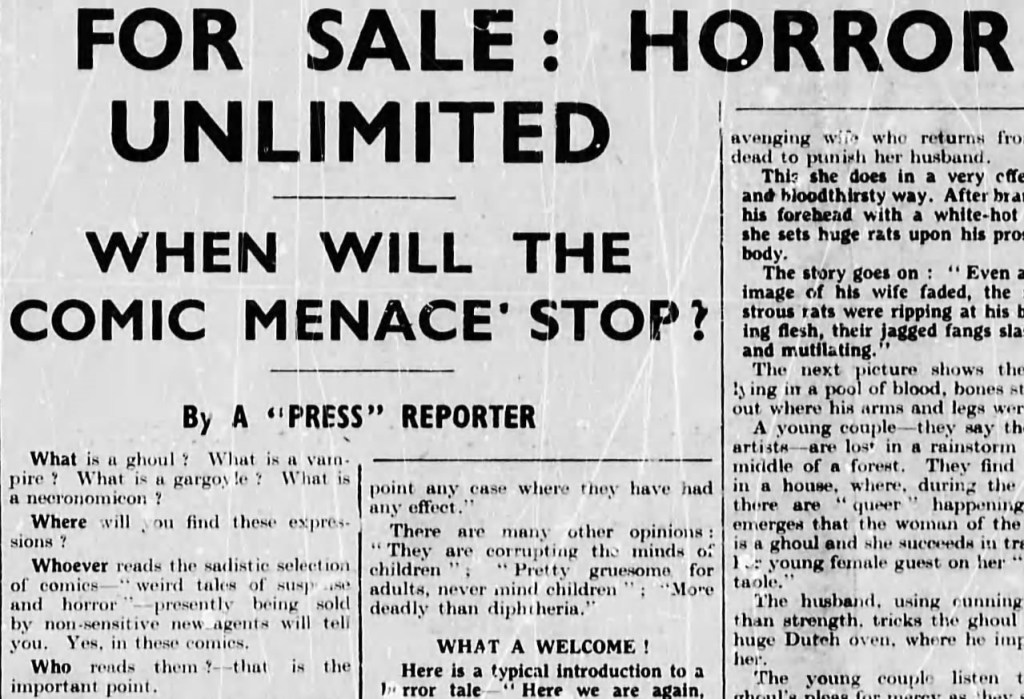
This article was paraphrased in at least one other British paper, which asked “What is a necronomicon?”:

The Clydebank Press, 5 Nov 1954, p1

Someone in the United States, however, also read Waterhouse’s article.

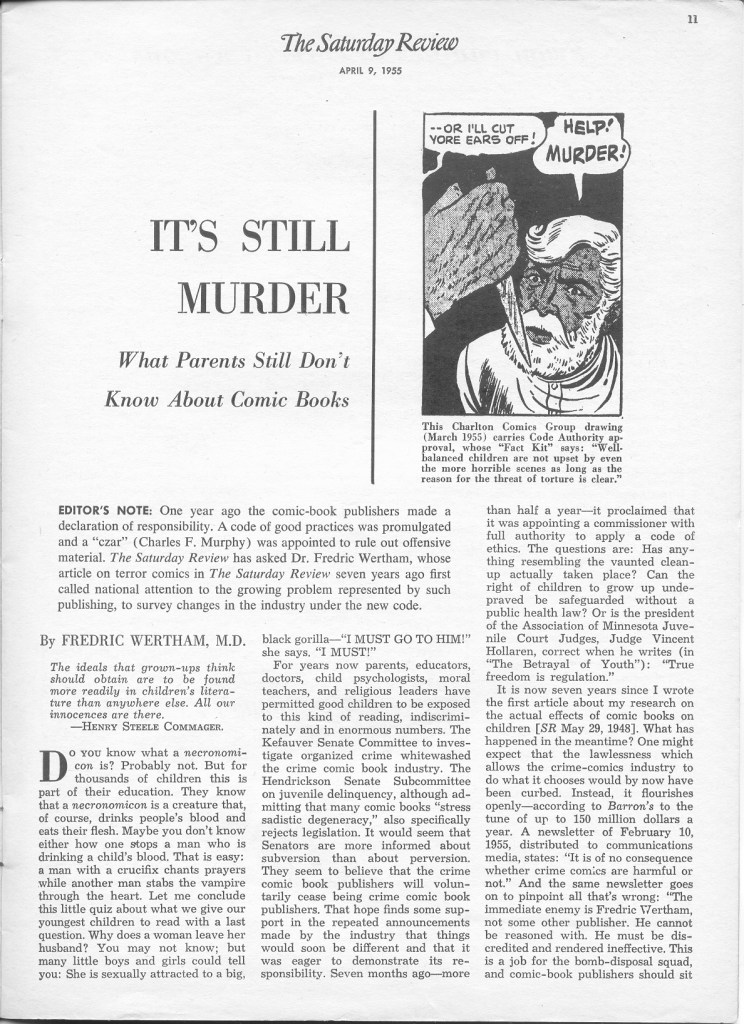
Do you know what a necronomicon is? Probably not. But for thousands of children this is part of their education. They know that a necronomicon is a creature that, of course, drinks people’s blood and eats their flesh.

Fredric Wertham, “It’s Still Murder” in the Saturday Review 9 April 1955, 11

By 1955, Wertham had won. In April 1954 his book Seduction of the Innocent had stirred a moral panic in the United States and abroad to the highest level, he testified before the Senate Subcommittee on Juvenile Delinquency in April and June, and in September the collective comic book publishers in the United States formed the Comics Code Authority, censoring themselves to stave off government interference. Crime and horror comics vanished from the newsstands, and would have a ripple effect around the world, starting similar moral panics in the United Kingdom and other countries.

Yet Wertham continued to campaign against the deleterious influence of comic books on the youth. Thanks to the research of Carol Tilley, we now know that Wertham faked his research, distorted facts and figures to match his narrative. What most folks don’t acknowledge is that Wertham didn’t stop. He certainly wasn’t above reusing Waterhouse’s garbled idea of what a Necronomicon was to his own benefit.

Wertham used the leading question about the Necronomicon more than once; a 1954 article titled “The curse of the comic books” appeared in the journal Religious Education Vol. 49, No. 6 a few months prior with essentially the same opening, and Wertham may have reused it elsewhere.

There is no surprise in this case that Wertham got the details wrong; there are numerous examples in Seduction of the Innocent where his apparent encyclopedic knowledge of comic characters and plots is shown to be superficial at best. What’s surprising is how he got ahold of a British newspaper article—possibly through a clipping service—and how swiftly and avidly he seized on the word Necronomicon, apparently in complete ignorance of its provenance.

Like a weird game of telephone, the misconception about the Necronomicon, now totally separated from its source material, continued to promulgate through the web of concerned citizens.

Dear Parents:
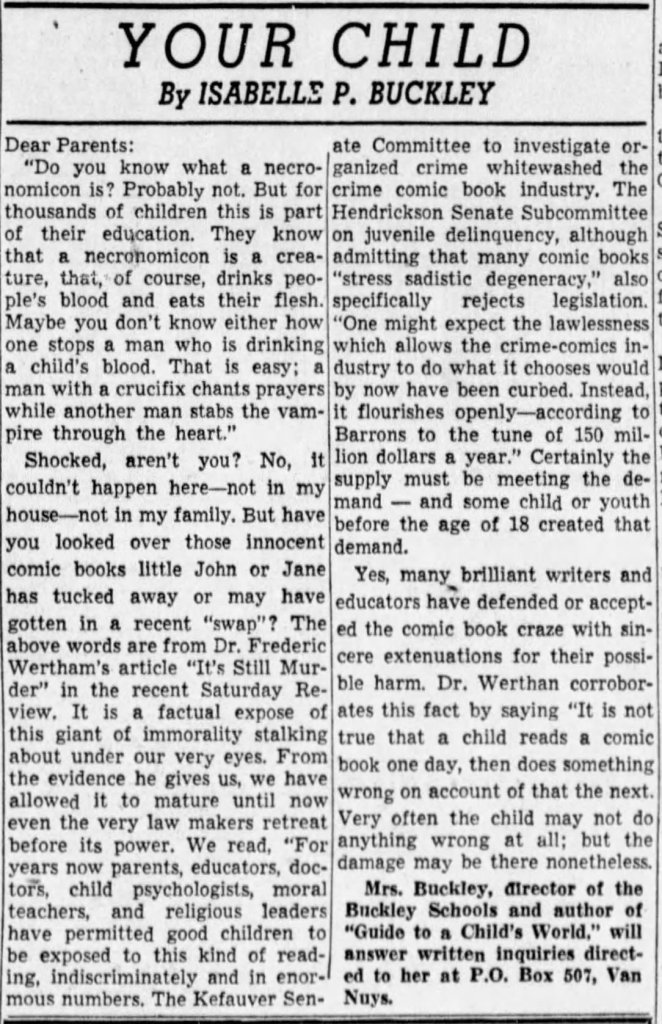
“Do you know what a necronomicon is? Probably not.[“]

Isabelle P. Buckley, “Your Child” in the North Hollywood Valley Times, 22 Apr 1955, 11

Buckley depended on Wertham’s integrity as a scholar; she took his article as fact as she clutched her metaphorical pearls and told parents to worry about what their kids might pick up down at the corner drug store or newspaper stand. Wertham depended on Waterhouse’s journalistic integrity, that the reporter had gotten his facts correct. Neither of them bothered to investigate for themselves, any more than Lou Morales picked up an Arkham House book to confirm whether it was supposed to be “Chrtlu” or “Cthulhu” in the incantation.

After all, who would notice?

“Beyond the Past,” like many of the stories from The Thing, has relished in relative obscurity. Now in the public domain, it was finally reprinted in Haunted Horror #25 (2016, IDW), and in rougher form in The Giant Readers Thing (2019, Gwandanaland Comics), but the whole story can be read for free at Comic Book Plus.

Addendum: A sharp-eyed reader pointed out that while this might be one of the earliest comic appearances of the Necronomicon by name, the story “Dr. Styx” in Treasure Comics #2 (Aug 1945) includes the writings of the mad Arab Abdul Alhazred. Read G. W. Thomas’ article on the story here. The Necronomicon also featured in “The Black Arts” in Weird Fantasy #14 (Jul-Aug 1950).


Bobby Derie is the author of Weird Talers: Essays on Robert E. Howard and Others and Sex and the Cthulhu Mythos.

Deep Cuts in a Lovecraftian Vein uses Amazon Associate links. As an Amazon Associate I earn from qualifying purchases.

Psyche (1953) by August Derleth

Never send to know for whom the bell tolls;
it tolls for thee.

For ego and satyr,
for lover and beloved;

ask to know for whom the heart beats,
send to ask for whom the quickened pulse,
bend to hear the hushed impassioned voice
sobbing your name or mine in all the body’s rapture:
or send to know for whom arms’ clasp,
eyes’ love, the hot possessive mouth;

for lover and beloved,
islandless man, of sea and land equally,
of sky and stars, of heaven and hell—
but never need to ask for whom the bell tolls;
make each man’s answer to yourself:
It tolls for me.

August Derleth, canto XIV of “Enigma: Variations on a Theme of Donne,” in Psyche (1953) 25

No man is an island, entire of itself; every man is a piece of the continent, a part of the main. If a clod be washed away by the sea, Europe is the less, as well as if a promontory were, as well as if a manor of thy friend’s or of thine own were: any man’s death diminishes me, because I am involved in mankind, and therefore never send to know for whom the bell tolls; it tolls for thee.

John Donne, Meditation XVII in Devotions Upon Emergent Occasions, and severall steps in my Sicknes (1623)

August Derleth’s greatest fame today is as a publisher, co-founder of Arkham House in 1939 with Donald Wandrei. Derleth was also an editor and anthologist of note, and a writer of diverse works of fiction and nonfiction, from the quiet regional portrayals of his Sac Prairie Saga to the potboiler horrors of Weird Tales, from the delicately plotted pastiches of Solar Pons to young adult and juvenile fiction; in non-fiction his works included everything from a book on Wisconsin’s rivers to newspaper columns on his nature walks to his biography of Henry David Thoreau.

Yet before, and during, and among all this other writing, August Derleth was a poet. He wrote, and what is more importantly published, reams of verse from the fantastic and the macabre to the lighthearted, odes on nature to sonnets on love, in many different meters and forms. Poetry was a sensibility and avocation that Derleth shared with many of his contemporaries, including Lovecraft, Clark Ashton Smith, Robert E. Howard, and many other writers for Weird Tales. Some of it has been republished here or there, particularly those bits of verse dedicated to or relevant to Lovecraft fans such as “Providence: Two Gentlemen Meet at Midnight” and “On Reading Old Letters, For H. P. L.,” but for the most part Derleth’s poetry remains unreprinted and largely unexamined.

This is a pity as such works provide, if nothing else, an interesting study of the importance of historical context. Derleth’s 1953 collection of love poetry Psyche is a good example.

These are poems of love and anguish. In this cycle of thirty-one poems, August Derleth tells the moving story of a love from its first awakening through uncertanty and agony to its foreseen dissolution.

These poems not only represent August Derleth at this best, but bid fair to take a place among the finest love poetry of our time.

Psyche, inner jacket flap

To anyone that holds this book in its hands, it may appear the prosaic but well-made product of a small press—in this case, the Prairie Press of Iowa City, Iowa—72 pages of good paper on cloth boards with a floral print; the dust jacket, when intact, is often rather tanned by sun and age. The contents are divided into two sections; “Enigma: Variations on a Theme of Donne” runs to 14 cantos, each taking inspiration from John Donne’s lines, and the second cycle of thirty poems runs the gamut of a love affair, from “I. When first I saw you” to “XXX. Beloved, now you are gone.” A few of these later poems have erotic elements, such as:

Something speaks for the essential you scattered here
in the black skirt and the blue blouse,
and the aqua pants with the embroidered I love you
and Forget-Me-Not (and who could?),
the slip in the usual pink and the gold slippers,
and the little bra from which the breasts
have spilled tightly above the taut belly
and Venus’ mound and the indolent legs
in their skilled proportions where you lie
waiting for love, savoring your victory
sweet in your smile, in your eye,
aloof, serene: the thin shoulders,
the slender arms, the small round
still firm nates behind,
all waiting for love, to be possessed
and to possess in ecstasy of union,
knowing my Achilles’ heel:
with that small cat’s contentment of triumph
the smile aware and the eyes
confident and the legs parted
where the dark hair already glistens
and the lips, there shadowed, opening
to sheathe my sword, waiting for love and lust,
knowing I will cross the room and touch and feel,
knowing I will possess and be possessed,
not alone because our mutual wish dictates
but because I must.

August Derleth, “XVII.” in Psyche 46

This collection of thirty poems was apparently a selection from a much longer cycle of love-poetry, which came to light after Derleth’s death when Peter Ruber, who had become editor of Arkham House in 1997, went through some of Derleth’s old files:

Another very important find was the entire Psyche lyric love poems cycle. Derleth published 30 in a 72-page book of that title in 1953. In reality, he had written 233 Psyche poems, and we have them in chronological order. The entire group will be published late 1997 or early 1998.

M. Dianne Bergenske, “Hidden Literary Treasures Revealed: Unpublished Works of Wisconsin Author August Derleth” in BookLovers (V5, N1), 7.

As with Ruber’s projected biography of Derleth and other projects, this never came to pass. However, Psyche did reach a wider audience in another form: as an LP.

Sauk Prairie (2015) 80
“S-P STAR,” June 16, 1960

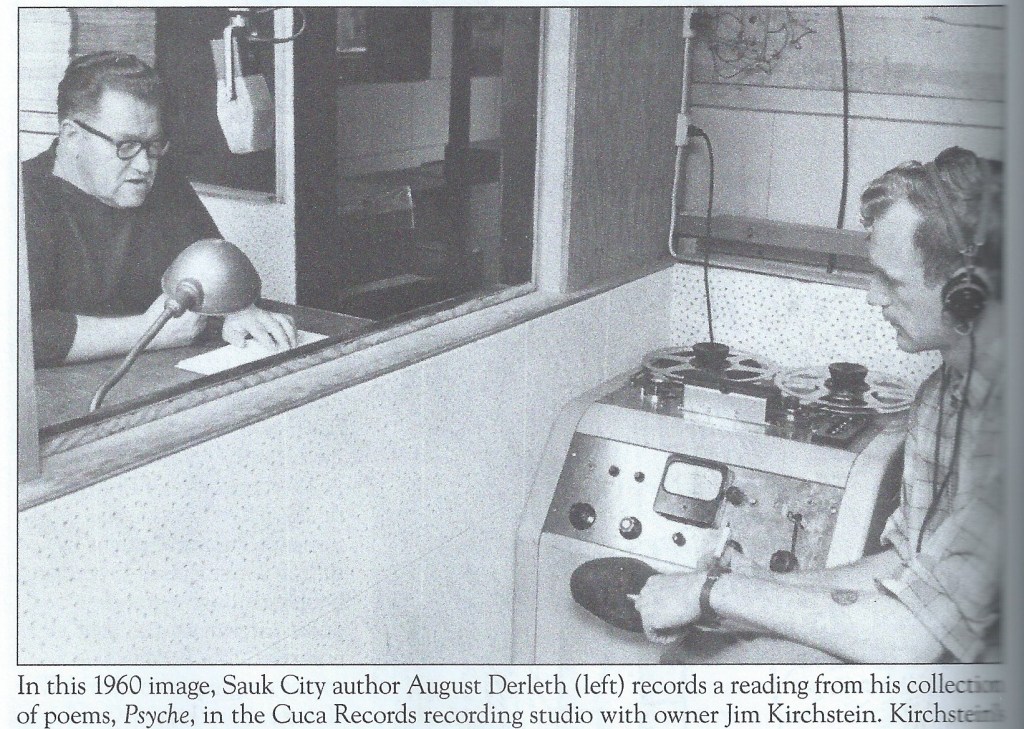
It isn’t clear how well Psyche sold, but it evinced enough interest that in 1960 Derleth recorded the lyrics onto vinyl at the Cuca Records Company in his native Sauk City:

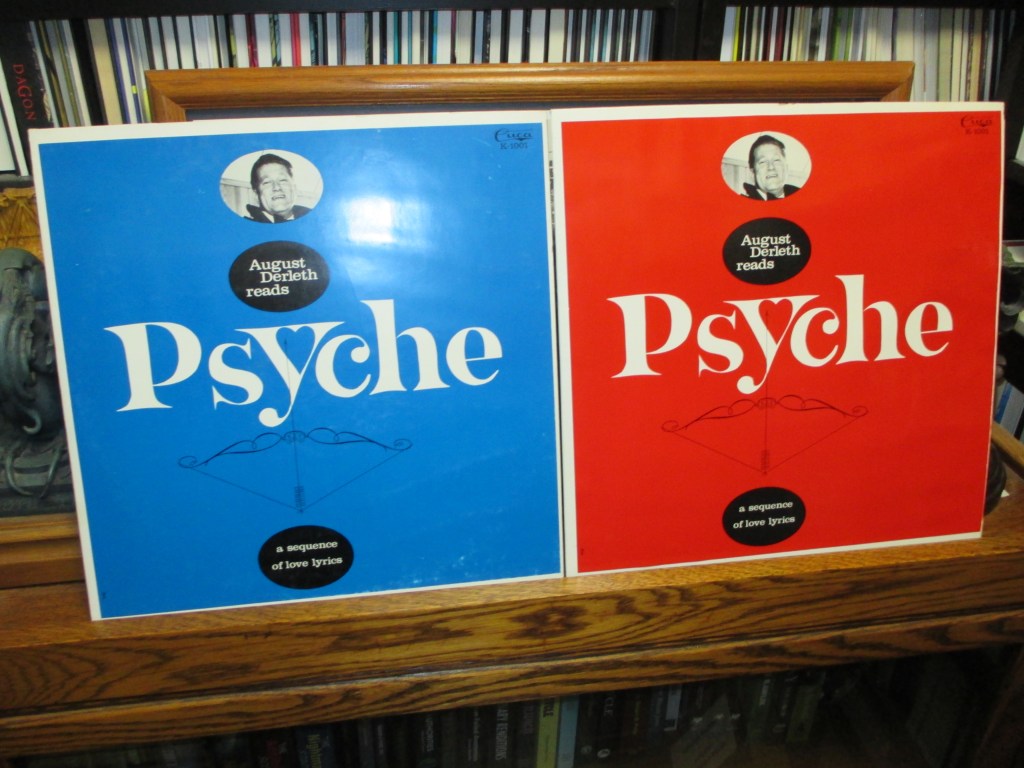
The LP was released with both a blue and a red slipcase; it isn’t clear if this represents separate printings or one printing, as the discs and backmatter are otherwise identical.

The title Psyche is in reference to the tale of Cupid and Psyche from the Metamorphoses of Apuleius, and Derleth’s dedication in the book is: “for the woman who was Psyche and is gone…” which casts Derleth as Cupid, overcoming obstacles to achieve union. Such dramatic romances were not unusual within Derleth’s fiction, and there was often a quasi-autobiographical element, for example, the teenaged romance with “Margery” (a local Sauk City girl) which formed the basis for his first novel, Evening in Spring (1945).

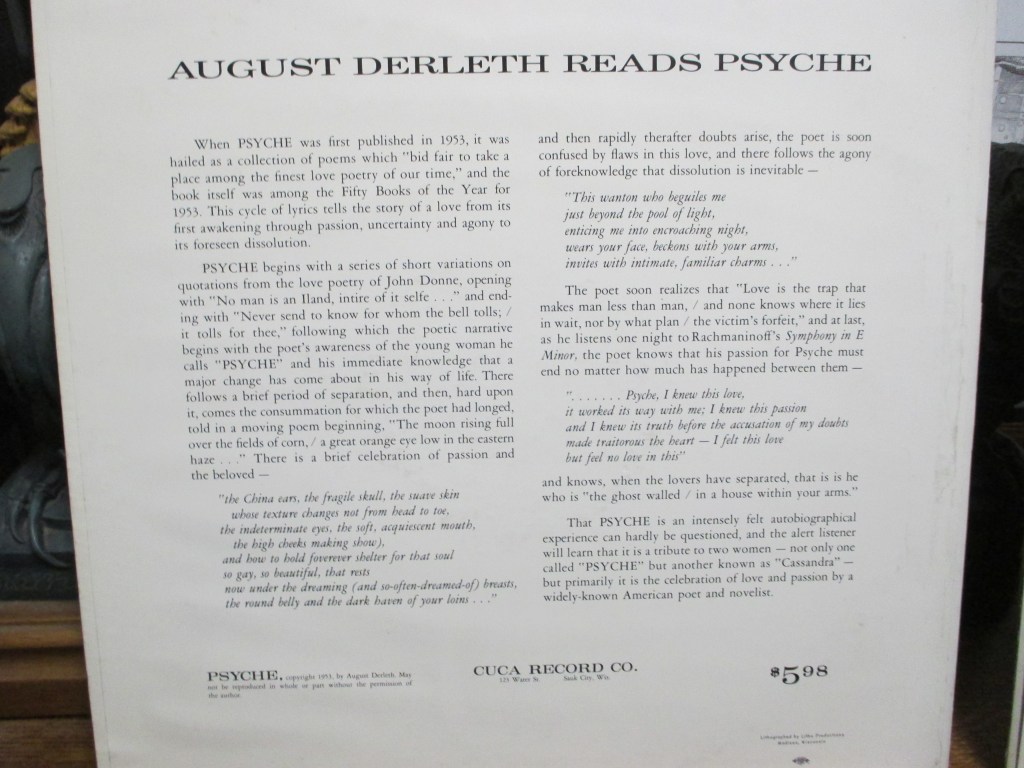
The liner notes are clear on the autobiographical element of Psyche:

That PSYCHE is an immensely felt autobiographical experience can hardly be questioned, and the alert listener will learn that it is a tribute to two women—not only one called “PSYCHE” but another known as “Cassandra”—but primarily it is the celebration of love and passion by a widely-known poet and novelist.

Liner notes to Psyche (1960)

“Cassandra” had been the subject of a previous book of primarily nature poems, Habitant of Dusk: A Garland for Cassandra (1946). In Psyche, Cassandra is mentioned by name only in a single poem:

Death is my mistress; what name I give her matters not—
call her Psyche or Cassandra,
Call her by any name you will,
Death it is in love’s own guise,
my mistress.

August Derleth, canto XIII of “Enigma: Variations on a Them of Donne,” in Psyche (1953) 24

According to Derleth: Hawk…and Dove (1997) by Dorothy M. Grobe Litersky, Cassandra was another romantic entanglement of Derleth’s in the early-mid 1940s, and their affair would be the subject for his unpublished novel Droughts of March.

For all that Derleth mined his personal experiences for fictional and poetic material and inspiration, he was not keen to publish his love affairs and generally avoided providing sufficient information in print for the average reader to identify who he was talking about. Sauk City was, after all, a small town and people would talk. Still, students of Derleth’s life would not be surprised at reading in Litersky’s biography that “Psyche” was none other than Sandra Winters, who married August Derleth in 1953, the year that Psyche was published. There is nothing unusual about a man writing love-poems to his wife, after all.

Except for one important detail.

PSYCHE is now virtually done in its 4th draft, and it seems to stand up very well in amatory verse, at which I have never pretended to be very good. But then, I have always had that as a poet I am at best a second-rater, which is saying a good deal, because there are a lot of poets far worse than that. But this book is most revealing and cannot be published for some (3) years because it is plainly about an affair with a girl who is not more than 15, and the facts wd currently be too obvious to local readers.

August Derleth to Carl Jacobi, 9 Jul 1949, MSS. Bowling Green University Library

Sandra Evelyn Winters was born 1 March 1935; according to Litersky she met August Derleth in 1948, and they married on 6 April 1953. That his relationship with her before their marriage was sexual is not much doubted; in another letter, he wrote:

Oh, yes, I would not deny that Sandra has done me a lot of good. Not just making love to her, Sandra herself. Of course, she is sharp enough to know that, and I think that in this lies the ultimate dissolution of the affair, unless an accident makes it necessary for us to be married. For, being young, she is entirely likely, even with her mother’s advice, to take me for granted, and that might well be fatal. She has been frank enough to say that she intended all along that I should ultimately need her more than she needs me, and, while she intends to marry me, she intends also to have as much of her cake and eat much of it too, as possible. That never works, manifestly. But whatever takes place, it is certain that I have already benefited a great deal, and all the clothes and jewelry I’ve bought her won’t balance my own benefits.

August Derleth to Zealia Bishop, 18 Aug 1949, MSS. Wsconsin Historical Society

Given the age gap (August Derleth was born in 24 February 1909, making him 40 years old in 1949 when these letters were written), Derleth may have had more to worry about than his reputation; statutory rape charges were a real possibility. As Litersky points out, this fact rather changes how Psyche is read. When Derleth writes:

When first I saw you,
but one among a sea of faces,
my glance swept past, came wondering back
in search of something from alien places
to see the countenance of little more than child,
demure, aloof, and bland,
not akin to what I felt—that wild,
strange beauty, that warm impassioned spirit
lurking deep,
hidden by a child’s serene and lovely face,
inscrutable as sleep.

As Iseult, Helen of Troy,
immortal Psyche—you, too, in this child’s guise:
something from deep within gazed tranquil back,
the challenge of your untamed spirit looked
from out your eyes.

August Derleth, “I.” in Psyche 26

At what age would you as the reader have put Psyche and Derleth based on this poem? Do you read it differently now that you know he met his future wife as a thirteen-year-old girl, and this poem might be an attempt to capture—or at least capitalize on—the beginning of that relationship? Without that piece of information about who Psyche was based on and her age at the time, Psyche is little more than an innocuous curiosity. With that bit of historical context, it becomes a different thing entirely, and a reader might not only look for new meaning in the lines, but find it. Comparable in some ways to “Doom of the Thrice-Cursed” (1997) by Marion Zimmer Bradley, it is impossible to turn back the clock to before you knew, and read the words they wrote with innocent eyes.

With thanks and appreciation to John Haefele for his help with this article.


Bobby Derie is the author of Weird Talers: Essays on Robert E. Howard and Others and Sex and the Cthulhu Mythos.

Deep Cuts in a Lovecraftian Vein uses Amazon Associate links. As an Amazon Associate I earn from qualifying purchases.

“H. P. Lovecraft: A Pupil’s View” (1953) by Zealia Bishop

Some of Lovecraft’s friends remonstrated with him and regretted that he spent so much time as a revisionist. There is no evidence, however, that Lovecraft chafed at this means of making an extremely meagre living. He was generous with his astounding sapience and derived a genuine sense of pleasure and satisfaction out of giving his wisdom and erudition to help others.
—Zealia Bishop, “H. P. Lovecraft: A Pupil’s View” in Ave Atque Vale 253

As much as scholars of H. P. Lovecraft’s life and work rely on the rich trove of letters that he has left behind, they do not cover all of his life—and his many friends, family, acquaintances, and revision clients left their own record of his life, in letters and diaries and memoirs. The sources are valuable accounts, but as new information becomes available, they are also subject to new scrutiny, and what might have been considered rock-solid “facts” about Lovecraft in the 1950s and ’60s is sometimes subject to reinterpretation and change.

“H. P. Lovecraft: A Pupil’s View” was published in 1953 as part of The Curse of Yig (Arkham House). The author was Zealia Bishop, who from roughly 1927-1937 was one of Lovecraft’s correspondents and revision clients. From her synopses Lovecraft produced three weird tales (“The Curse of Yig,” “Medusa’s Coil,” and “The Mound”) and had a hand in several of her unpublished stories. This memoir was for many years was essentially the only information that most fans and scholars had on this part of Lovecraft’s life.

It was not until the Selected Letters II was published, containing fourteen abridged letters from the Lovecraft/Bishop correspondence and scattered references about Zealia Bishop by Lovecraft in letters to others that there was anything to verify or compare her account…and it would not be until 2015, when a trove of recently-found letters from the Lovecraft/Bishop correspondence was published as The Spirit of Revision (H. P. Lovecraft Historical Society) that a fuller picture of their professional and personal relationship could be established.

Even before The Spirit of Revision, however, scholars questioned parts of Bishop’s essay.  For example, her account of how she came into contact with Lovecraft:

It was in 1928 in a small bookstore in Cleveland that I first learned of Lovecraft. The bookstore was managed by Samuel Loveman, a bibliophile and writer of verse who had achieved some minor fame as friend of the poet, Hart Crane. […] Bookstore proprietors are always being asked by amateurs to recommend publishers, teachers and critics. I was no exception. At my inquiry, in the course of our conversation, Mr. Loveman told me about Lovecraft.

“Write to him,” he advised. “He can help you, if anyone can.”
—Zealia Bishop, “H. P. Lovecraft: A Pupil’s View” in Ave Atque Vale 253-254

The problem was, Samuel Loveman was not in Cleveland in 1928, but in New York City, where he had moved in 1924; the earliest letter from Lovecraft to Zealia is dated 10 May 1927 (SOR 29). While she might well have gotten in contact with Lovecraft via his friend Sam Loveman, it almost certainly could not have happened the way she said it did. Nor is this the only discrepancy that can be pointed out in Zealia’s memoir.

To understand some of the problems in “A Pupil’s View,” it might help to know how and when it was written. August Derleth wrote to Zealia Bishop shortly after Lovecraft’s death in 1937, asking for any letters she could contribute to what would become the Selected Letters and about the stories that R. H. Barlow had said Lovecraft had revised/ghostwritten for her. In one of her answering letters, Zealia promised:

I shall prepare an article or—data—on what I think may be of general interest in regard to Howard’s revision work—and send you within the next week—but shall await your reply and if I have anything which you can use I shall compile it for you—and do all in my power to assist you in every way.
—Zealia Bishop to August Derleth, 8 Apr 1937, MSS. Wisconsin Historical Society

There is no evidence that Zealia actually produced an article in 1937, and the subject come up again in the Bishop/Derleth correspondence in 1950:

I hope you won’t find too many things wrong with the Lovecraft article. If that passes, then I shall not worry about the others, for he is not an altogether easy subject about whom one can write, yet a very interesting one. Thank you for sending me Cats etc. I shall send you a check for same…but you are always hitting me between the eyes, it seems, as being the only one who was really indebted to Lovecraft as a “client”, paying him for revision! Do you think that is all quite “cricket” as hard as I’ve worked for so many years? Remember, it was Loveman who first sent me to Lovecraft (when he was living in Cleveland) and I sometimes wonder if he remembers about it, however, it was Howard who had me take a course at Columbia University and also study privately with Thomas Uzzell—while I was in New York and it was then we found out I could gain much more by my own efforts with Howard guiding me along the way when I needed it…but I never should have followed the path of the weird tale despite all the material I gathered from the people in the south and in Mexico and Latin America. My yet unfinished tale is one with Aztec mythology woven through it and I think Howard was well pleased with the progress I made without his supervision…even as he was with three of my novels. Sometimes I shall send you the letters he wrote about them…telling me how I had progressed with structure and the choice of words.
Zealia Bishop to August Derleth, 13 Jan 1950, MSS. Wisconsin Historical Society

Cut to two years later:

You’re wrong, fellow, I haven’t fallen down on the job about the articles on you and H. P. L. I finished them two years ago, but kept rewriting them, unable to throw off that damnable self-consciousness instilled in me by Lovecraft. Now, however, I’ve developed more positiveness and will send them to you for approval and corrections where you feel necessary.
—Zealia Bishop to August Derleth, 12 Aug 1952, MSS. Wisconsin Historical Society

Far from being the fresh recollections of a Lovecraft just recently passed in 1937, then, “H. P. Lovecraft: A Pupil’s View” was really written some 13-15 years after his death. A few allowances for memory might be made in such a span of time, but there are other key factors in the composition of “A Pupil’s View” to consider. The first of these is August Derleth’s quiet role in the production.

Would you prefer that I send on the Lovecraft and Derleth articles for you to groan over, and cut, augment and suggest in person?
—Zealia Bishop to August Derleth, 15 Sep 1952, MSS. Wisconsin Historical Society

At last here is the article. I hope that it does not fall far short of my opinion of you and that you will see some improvement in my writing. Feel free to augment and delete as you see fit. […] At the time I began the article on you I started one on Lovecraft this should be finished for your approval before I get there—you understand I will need photographs for both? […] In the event my short stories are published as a collection I plan to include both articles. Does that meet with your approval? If only the weird are selected for one book then both articles—DERLETH-LOVECRAFT—would be most appropos—Zealia Bishop to August Derleth, 15 Oct 1952, MSS. Wisconsin Historical Society

At this point, Zealia had committed to writing two profiles, one on Lovecraft (“A Pupil’s View”) and one on Derleth himself (“A Wisconsin Balzac”). Bishop’s letters to Derleth continue to talk about re-writing these articles into 1953, when Zealia Bishop signed a contract for Arkham House to publish The Curse of Yig. Whatever the final product that Zealia delivered after years of re-writing, she apparently did not think it adequate, and instructed Derleth:

Evidently you misunderstood me that day at lunch in Madison. I thought I was very explicit—as well as Helen—that I told you “everything was ready to go except I wanted to rewrite the DERLETH and LOVECRAFT articles. And that I would positively have to rewrite the LOVECRAFT article entirely.”

I have done what I could on it and am sending it as is, “but I am not in the slightest pleased with it and feel that I should be the one to rewrite it.”

The material is here and could be redone beautifully but it would take me at least another two weeks so I am sending it so that you may pass judgement edit it and then if you think I should rewrite it return or bring it.
—Zealia Bishop to August Derleth, 25 Apr 1953, MSS. Wisconsin Historical Society

If necessary “brush up” the Eschutcheon [sic] as well as the Derleth & Lovecraft articles
—Zealia Bishop to August Derleth, n.d. (1953?), MSS. Wisconsin Historical Society

Looking at “A Pupil’s View” with an eye toward a possible Derlethian influence, several parts of the memoir jump out immediately. The first few glowing paragraphs of “A Pupil’s View” do not sound like Zealia Bishop; they discuss Lovecraft’s rise in prominence in American letters (which Zealia does not seem aware of), his devoted followers and fellow pulpsters (including several she never mentions in any other letter and probably never heard of, such as Robert E. Howard and Henry Kuttner); and references to overseas sales, the Arkham House collections of Lovecraft’s fiction, and “magazines containing his work command equally high premiums” which sound very much like the standard Derlethian sales line.

Later in the narrative, Zealia Bishop goes into a very atypical reference to the Cthulhu Mythos—in accordance with Derleth’s interpretation:

[…] our conversation naturally turned to Lovecraft and his fantastic story themes, especially those of the Cthulhu Mythos, which were based on a curious pantheon of Gods and Elder Beings with a marked basic similarity to the Christian Genesis story of the struggle between good and evil.
—Zealia Bishop, “H. P. Lovecraft: A Pupil’s View” in Ave Atque Vale 261

It is conceivable that Bishop had absorbed this point of view from Derleth’s introductions in Arkham House books and his various Cthulhu Mythos stories. The conversation is supposed to have happened in June 1928, and “The Call of Cthulhu” had been published in the February 1928 Weird Tales, so the timing for talking about Cthulhu isn’t necessarily off—but the phrase “Cthulhu Mythos” wasn’t coined or popularized until some years later by Derleth. The last paragraphs too are very Derlethian in tone, especially:

But in this rather specialized field, undoubtedly Lovecraft’s own attitudes about sex and love (capably discussed in H.P.L.: A Memoir, by August Derleth) got in his way when he revised the work of his pupils. These were experiences not entirely within his ken.
—Zealia Bishop, “H. P. Lovecraft: A Pupil’s View” in Ave Atque Vale 263

Without access to the original manuscript that Zealia Bishop submitted to August Derleth, it is speculative to guess at his how much or any of this was material he wrote. To play devil’s advocate: If Derleth did have a large hand in this piece, or at least did a proper editorial pass on the the manuscript, we might expect certain little details to have been quietly edited out that were left in. For example, Zealia’s rather hyperbolic claims about Lovecraft’s ability with languages:

He was well versed in the language of the Kaffirs, Damoras, Swahilhi and the Chulhu and Zani—who are extremely tenacious of their ancient religion. […]  He wrote as fluently in Greek and Latin as in English and when he began his strict instructions in Aztec Mythology he often wrote to me in Spanish.
—Zealia Bishop, “H. P. Lovecraft: A Pupil’s View” in Ave Atque Vale 254, 255

While Lovecraft was proficient in Latin, and had some rudimentary knowledge of Greek and Spanish (the latter at least for the Spanish phrases in “The Mound”), he had no knowledge of African languages. It’s possible that Lovecraft had written something about these language (probably referencing from an encyclopedia article) in a letter which does not survive, but you’d think Derleth would have caught this error…but, we can only speculate. Taken together, a Derleth editing/partial re-write and aged memory might explain a few of the parts of the “A Pupil’s View” that don’t fit what we know of Lovecraft from other sources.

The second key factor to consider in “A Pupil’s View” is why Zealia wrote it, and her motives were not restricted to praising Lovecraft and preserving his memory. She wanted to make it absolutely clear who actually wrote the stories in The Curse of Yig:

There in Oklahoma, doubting more and more that I would ever become a writer, let alone a successful one, I sat one evening with a group of old Oklahoma settlers who had driven out to my sister’s ranch. We sat around the kitchen fire and talked. Finally the conversation rambled on to folklore. Grandma Compton, my sister’s mother-in-law, told a horror story about a couple who pioneered in Oklahoma not far from where we were. This story was a spark to me. I wrote a tale called “The Curse of Yig,” in which snakes figured, wove it around some of my Aztec knowledge instilled in me by Lovecraft, and sent it off to him. He was delighted wit this trend toward realism and horror, and fairly showed me with letters and instructions.

Now at least I really went to work. I rewrote the story and together we revised and injected erudition into it about the Aztec Snake God, Yig. Finally, under his careful direction, I had a decent and I felt salable weird-horror story.
—Zealia Bishop, “H. P. Lovecraft: A Pupil’s View” in Ave Atque Vale 258

So on with “Medusa’s Coil” and “The Mound.” Zealia Bishop would not admit to Lovecraft’s authorship, or even of his editing. Even the name of her memoir “A Pupil’s View” shows how she wanted the relationship to be perceived: she was Lovecraft’s student, paying him for his writing advice, not a client paying him to ghost-write stories for her. So above and beyond all else, “A Pupil’s View” was written specifically to convince readers and critics that these were not Lovecraft revisions or collaborations—which is what Derleth and Arkham House had been selling the Bishop/Lovecraft stories as in Beyond the Wall of Sleep (1943) and Marginalia (1944).

Lovecraft told a different story in his letters, including to August Derleth and his friend and future literary executor R. H. Barlow. August Derleth had written to Zealia Bishop on Barlow’s advice, with the specific aim of publishing the Lovecraft collaborations. So Derleth was certainly well aware of what Zealia Bishop was doing, and why she was doing it. One late letter makes this perfectly clear:

Remember, August, in Howard’s new book—His Letters etc., please don’t let it appear that I was never able to do anything for myself. Is it your opinion that in these anthologies all credit goes to Howard? Was that your intention or what?
—Zealia Bishop to August Derleth, n.d., MSS. Wisconsin Historical Society

Selected Letters II was published in 1968, the same year that Zealia Bishop passed away.

Taking it as a given then what Zealia Bishop was trying to accomplish with “A Pupil’s View” was primarily to preserve her reputation as a writer—that writing in 1952-1953 should would be trying to recall events from about 25 years prior when she first began to correspond with Lovecraft—and that August Derleth appears to have had at a quiet hand in amending and editing the document—is there anything of value to be extracted from it? Can we trust anything that Zealia Bishop wrote?

Surprisingly, more than you think. While some of her claims are farcical (Lovecraft wasn’t an expert on Aztec mythology either), the correspondence in The Spirit of Revision actually supports Zealia Bishop’s general narrative of the relationship. In the absence of more of her letters to Lovecraft, which are long gone at this point, it is her only account of her side of the relationship, including her frustrations at their different tastes in writing. In addition to this, “A Pupil’s View” is the only first-person account of Zealia’s brief meeting with Lovecraft and Frank Belknap Long, Jr. in New York City on 29 May 1929.

The most difficult question remains Zealia’s account of the actual conception and background behind “The Curse of Yig,” “Medusa’s Coil,” and “The Mound.” Lovecraft’s letters make it pretty clear that he ended up writing most of “The Curse of Yig,” and basically all of “Medusa’s Coil” and “The Mound” from synopses provided by Bishop. So what, if anything, can we trust of her account?

In our conversation we discussed among things my short novel, “The Mound”—an outgrowth of another tale told by the Comptons from their recollections of two old Indians living near Binger, Oklahoma—and my stories, “The Curse of Yig” and “Medusa’s Coil,” which I had picked up as an idea from a Negress who did some housecleaning for me and expanded into a story similar in treatment to my earlier horror tale.
—Zealia Bishop, “H. P. Lovecraft: A Pupil’s View” in Ave Atque Vale 259-260

The sources of inspiration given seem plausible. “Grandma Compton” appears as a character in both “The Curse of Yig” and “The Mound,” and Zealia Brown Bishop’s sister was Grace Brown Compton—so there is no reason to doubt that Grace Compton’s mother-in-law was the original for “Grandma Compton.” The locale of “The Mound” is reasonably accurate to the mound-legends around Binger, Oklahoma. “Medusa’s Coil” is not tied to the Grandma Compton mythos, but an African-American housekeeper telling the story of a mixed-race woman “passing” as white is not far-fetched.

Serious cracks in the Zealia Bishop’s narrative don’t appear to have been seriously appeared until after her death. In “A Pupil’s View,” she alleges that at Lovecraft’s advice, Frank Belknap Long worked with her on “The Mound”:

In the ensuing conversation we took up the subject of “Medusa’s Coil.” It was decided that I should continue working on that under Lovecraft’s direction. “However,” he said, “I would like Belknap to work with you on your new story ‘The Mound.’ He may have something fresher and more interesting to offer.[“] […]

At Lovecraft’s gentle insistence, I left “The Mound” with Frank Belknap Long, and it was Long who advised and worked with me on that short novel. Lovecraft’s instructions were negligible; he merely advised both Belknap and myself when we felt we were not following his guidance.
—Zealia Bishop, “H. P. Lovecraft: A Pupil’s View” in Ave Atque Vale 260

In his own memoir of Lovecraft, Frank Belknap Long refuted this:

I had nothing whatever to do with the writing of The Mound. That brooding, somber, and magnificently atmospheric story is Lovecraftian from the first page to the last.
—Frank Belknap Long, Howard Phillips Lovecraft: Dreamer on the Nightside (1975) xiii-xiv

The truth appears to have been somewhat more complicated, at least according to the surviving correspondent and typescripts. Lovecraft certainly appears to have written “The Mound” based on the Binger mound legends provided by Zealia Bishop; when it failed to sell, he advised her to let Belknap market it, and he had abridged the novella and tried to do so, but failed:

You perhaps did not remember that I sent The Mount to Sonny Belknap over two years ago—in fact immediately after the old Boston lady—I’m grieved to learn of her death—returned it.) I wired him just not to send the unabridged copy to Mr. Barlow at once […]
—Zealia Bishop to H. P. Lovecraft, 26 May 1934, The Spirit of Revision 177

As to the matter of the Bishop MSS.of course, it’s only fair to Mrs. Bin view of what she’s paid for ghosting or revisionto let her try the stuff on any possible markets. I assumed that Sonny Belknap, as her literary agent, had done so; & am astonished to find that any stone was left unturned.
—H. P. Lovecraft to R. H. Barlow, 26 Jun 1934, O Fortunate Floridian! 143

R. H. Barlow was able to eventually cobble together a complete version of the manuscript, which he then bound with letters from Zealia Bishop and Frank Belknap Long relevant to its provenance.

In 1978, S. T. Joshi launched a more serious criticism at Bishop’s narrative in his essay “Who Wrote ‘The Mound?'” in Nyctalops #14. Joshi’s careful picking through the available evidence (Lovecraft’s published and unpublished letters, and manuscript material in the Lovecraft collection at John Hay Library at Brown University) reconstructed the convoluted textual history, and dismissed Bishop’s claims of authorship.

Others were coming more-or-less to the same conclusion and articles like “The Mound of Yig?” (1973, Etchings & Odysseys) by W. E. Baardson, “In Search of Yig” (1974, Nyctalops #9) by John J. Koblas, “‘Yig,’ ‘The Mound’ and American Indian Lore” (1983, Crypt of Cthulhu #11) by Michael DiGregorio all looked for the genuine lore underlying “The Curse of Yig” and “The Mound,” taking Bishop’s basic claims of inspiration from regional folklore as true—and unfortunately spending a lot of time looking in the wrong places for a bit of lore that Lovecraft had invented.

Joshi would edit the corrected third printing to The Horror in the Museum and Other Revisions (1989, Arkham House), and in his “A Note on the Texts” referenced the abridgement, mistranscription, and editing of Bishop’s stories by Long and Derleth. The book also reprinted August Derleth’s 1970 introduction (“Lovecraft’s ‘Revisions'”), where the Arkham House founder quoted from “A Pupil’s View”:

The stories I sent to him always came back so revised from their basic idea that I felt I was a complete failure as a writer.
—Zealia Bishop, “H. P. Lovecraft: A Pupil’s View” in Ave Atque Vale 257

There is a certain pathos to this statement, because it is probably true. It is rather sad in many ways that we cannot take more of “A Pupil’s View” as the unvarnished truth. It would be easier to read and believe Zealia’s account of her struggles with the difference between where she wanted to go in her writing versus the direction that Lovecraft direction if it wasn’t necessary to put each statement under the critical microscope. Her affection for her “mentor” certainly seems genuine, even if she sometimes disagreed with him, and the occasional overblown claim about his linguistic abilities seems to be more a sign of admiration than a deliberate effort to mislead. Errors like Lovecraft’s age (she gives his age as 35 in 1928, he was actually 38) appear to be honest mistakes, the kind of thing Derleth should have caught.

“H. P. Lovecraft: A Pupil’s View” was first published in The Curse of Yig (1953, Arkham House) and has been reprinted in Lovecraft Remembered (1998, Arkham House) and Ave Atque Vale (2018, Necronomicon Press).


Bobby Derie is the author of Weird Talers: Essays on Robert E. Howard & Others (2019) and Sex and the Cthulhu Mythos (2014).

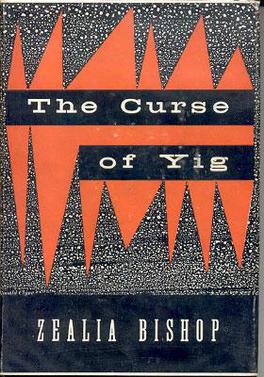
The Curse of Yig (1953) by Zealia Bishop

After the death of H. P. Lovecraft in 1937, his friends August Derleth and Donald Wandrei (founders of Arkham House), and R. H. Barlow (Lovecraft’s literary executor) began a concerted effort to get his fiction, poetry, and letters into print. This process took decades, publication being relatively slow and expensive, and the audience being mostly restricted to hardcore fans. Among all the legendary Arkham House publications, Zealia Bishop’s The Curse of Yig (1953) stands out as the first Mythos collection attributed to a woman—and would remain the sole such book for some decades. The contents are fairly succinct:

Like many books, The Curse of Yig didn’t just happen. At the time of Lovecraft’s death, only “The Curse of Yig” (1929) was published; both “The Mound” and “Medusa’s Coil” had been rejected by Farnsworth Wright, editor of Weird Tales, and apparently failed to find a home elsewhere. One of the first jobs that Derleth & co. faced was finding out what revision-work and collaborations that Lovecraft had actually done and obtaining manuscripts and permission to publish them.

H. P. wrote stories for a half dozen, some of which I can prove by documents. Bloch (Don’t quote me—there are amenities to be preserved), Heald, Reed, Lumley, had outright jobs done, Rimel & others his enormous tinkering resulting in a wholly re-written ms. These things are—some of them worth collecting–but not in his own books. He said many times he would not permit a collaboration in his collected stories, so certainly he’d resent these things. We’re going to have a hamper full as it is.

Mrs. Reed had him do 3 stories,

  1928 – YIG – pub. – written outright for her
*1929 – THE MOUND – novelette – ditto
*      ”  – Medusa’s Coil – embodying a notion of hers, but all HPL nonetheless

* I have only the ms. of these

[…] Perhaps the works he ghosted could be called “collaborations” without scaring off the ghostees, & made another book. There’s years of work to be sorted & printed.
R. H. Barlow to August Derleth, 31 Mar n.d. [1937], MSS. Wisconsin Historical Society

Derleth managed to get in contact with Zealia Bishop in 1937, and they discussed Lovecraft’s letters and revisions. In an early letter, Zealia promised:

I shall prepare an article or—data—on what I think may be of general interest in regard to Howard’s revision work—and send you within the next week—but shall await your reply and if I have anything which you can use I shall compile it for you—and do all in my power to assist you in every way.
—Zealia Bishop to August Derleth, 8 Apr 1937, MSS. Wisconsin Historical Society

The article didn’t come. What did happen is that Derleth apparently edited these stories and then apparently acted as Bishop’s agent to sell them to Weird Tales. The timeline on how exactly this happened is a little unclear, but over a year later in the January 1939 issue of Weird TalesDerleth’s version of “Medusa’s Coil” was published. Fan response was positive, and ‘The Eyrie’ for March 1939 reveals it was voted the second-favorite story in the issue. The success of “Medusa’s Coil” might explain why Bishop’s “The Curse of Yig” was included as a “Classic Reprint” in the April 1939 issue of Weird Talesand it was also positively received in “The Eyrie.” “The Mound” did not see print until the November 1940 issue of Weird Tales, possibly due to its length. None of these stories were presented with any mention of Lovecraft’s authorship in Weird Tales.

Following Barlow’s suggestion, Arkham House initially focused on publishing H. P. Lovecraft’s fiction on its own: The Outsider and Others (1939) and Beyond the Wall of Sleep (1943) collects nearly all of his fiction. The latter book, however, also included some of his “collaborations,” including “The Curse of Yig” and “The Mound”—this would have been the first time Lovecraft’s hand in Zealia Bishop’s stories was publicly acknowledged. “Medusa’s Coil” was republished in Marginalia (1944), alongside other revisions and collaborations; these Arkham House texts both used Derleth’s edited versions of “The Mound” and “Medusa’s Coil,” rather than the original Lovecraft/Bishop version.

Was it your intention to make them appear as his stories?
—Zealia Bishop to August Derleth, 28 Jan 1949, MSS. Wisconsin Historical Society

Zealia Bishop’s letters with Derleth in the mid-to-late 1940s defend her authorship of the three weird stories, other evidence of Lovecraft writing them from synopses notwithstanding. She also continued to promise him an article on her relationship with Lovecraft:

I hope you won’t find too many things wrong with the Lovecraft article. If that passes, then I shall not worry about the others, for he is not an altogether easy subject about whom one can write, yet a very interesting one.
Zealia Bishop to August Derleth, 13 Jan 1950, MSS. Wisconsin Historical Society

Arkham House was slowing down publication in the late 1940s and early 50s. Derleth had repeatedly cited low sales, with books selling out only very slowly despite the relatively small print runs. By the 1950s most of the weird fiction pulps had folded, and even the venerable Weird Tales was on its last few years of existence. So it is somewhat surprising that around 1952, Zealia’s letters start to discuss a print collection of her fiction…and she was also working on not just the long-promised article on Lovecraft, but another on Derleth himself:

You’re wrong, fellow, I haven’t fallen down on the job about the articles on you and H. P. L. I finished them two years ago, but kept rewriting them, unable to throw off that damnable self-consciousness instilled in me by Lovecraft. Now, however, I’ve developed more positiveness and will send them to you for approval and corrections where you feel necessary.

I plan to use both of them in the story collection but if, after reading them, you wish to suggest a market, it might be well to have them previously published.

After you read them and also see the assembled collection, how about writing a “Foreword”? You know I worked and studied hard before I began studying under Lovecraft and Long. Considering that it was during the darkest years of the depression, I paid them both well for their instructions, criticism and any revision. My record at Columbia University will bear out my years of studying and ambition. What shall I do about reprints of stories published in magazines now out of print? […]

What about the reprinting of stories once published in stories now out of business or publications discontinued by a publisher tho’ still in business? What of those published in Confessions?
—Zealia Bishop to August Derleth, 12 Aug 1952, MSS. Wisconsin Historical Society

Derleth’s reaction to this had to be a bit mixed. The time and place for Zealia’s memoir of Lovecraft would ideally have been earlier—in Marginalia maybe, or The Arkham Sampler (1948-1949)—and it didn’t seem that Zealia Bishop had anything genuinely weird to offer besides the three Lovecraft revisions, and those had already been published and re-published. “The Curse of Yig” in particular had been published twice in Weird Tales, three times in hardcover, and most recently in the paperback Avon’s Fantasy Reader No. 14 (1950).

At last here is the article. I hope that it does not fall far short of my opinion of you and that you will see some improvement in my writing. Feel free to augment and delete as you see fit. […] At the time I began the article on you I started one on Lovecraft this should be finished for your approval before I get there—you understand I will need photographs for both? […] In the event my short stories are published as a collection I plan to include both articles. Does that meet with your approval? If only the weird are selected for one book then both articles—DERLETH-LOVECRAFT—would be most appropos—Zealia Bishop to August Derleth, 15 Oct 1952, MSS. Wisconsin Historical Society

Will have some time to redo my DERLETH and LOVECRAFT articles. If they meet with your approval do you have a market for them or will you suggest one to me, though later they will go in the book with the weird short? Why don’t you quote me a price for publication (by ARKHAM HOUSE) for such a volume? I would like to have such a book done well, such as ARKHAM HOUSE does.
—Zealia Bishop to August Derleth, 18 Nov 1952, MSS. Wisconsin Historical Society

The discussion with Derleth now takes on a more business-like tone. The moment that Derleth might have been dreading arrived: Zealia had fixated on Derleth as a possible publisher for her collection. Vanity publishing was a skeleton in Arkham House’s closet: not a service that was widely advertised or ever publicly acknowledged, but a circumstance occasionally resorted to, at least with old Weird Tales authors that Derleth was familiar with and presumably whose material was not vastly divergent from Arkham House’s core focus. Given the relatively expensive costs of publishing, the high cost of the resulting books, the small print numbers, and the slow sales, it also wasn’t likely to be a strong financial investment—and that’s before you consider that most of the volume’s contents would be reprints. Derleth presumably expressed at least some of these risks to Zealia Bishop:

What you say about the publishing of the stories interests me. In the event we come to an agreement, how must this money be paid your company? You say you must get $2.50 for you to break even—then what of the author?

I would like to do this, followed by at least three other books, if you could pass on the work, but I would not want the weird tales published if you feel more credit should go to LOVECRAFT. After all, August, he was the teacher and I  the pupil and he was polishing my efforts, trying to direct me, but he did not do any more than you and Frank Long did. While erratic and always in need of money, Frank was an excellent and driving tutor even though we could not always see “eye-to-eye”. I was always pulling between the two teachers trying to write as I wished, not as they were determined I should, but I gained much from both of them as well as from your own kind interest and advice. Yet I would not want to publish the stories as my own efforts if you do not feel I am justified in claiming them. So be perfectly frank and we shall proceed from there.

Am re submitting the articles with the one on H. P. L. Maybe this time you will like the Derleth one better.
—Zealia Bishop to August Derleth, 14 Dec 1952, MSS. Wisconsin Historical Society

I would like very much to work out a plan with you for the publishing of not only the one volume but possibly several more. I feel after your editing, they will all be good and should have reasonable sales. […] My reason for asking how the money is to be paid is that under the circumstances, I cannot draw from a personal fund. I have talked to our banker who has told me “if the contract warrants it” I may borrow the sum.

It is now up to you about the contract. […] I will have the weird tales and articles to you immediately after Christmas. What you choose and assemble will be, of course, entirely up to you.
—Zealia Bishop to August Derleth, 22 Dec 1952, MSS. Wisconsin Historical Society

It isn’t clear what Zealia means by “editing” here—that is, whether she means the usual services of copy-editing by removing typos and grammatical errors and checking for factual accuracy, or editing that was more along the lines of wholesale revision, as Lovecraft would have done. Possibly she didn’t know herself. At the very least, he seemed to have convinced her that the volume should consist solely of the three weird tales revised by Lovecraft, plus her articles (if she ever finished them). The issue of cost and “breaking even” is another key issue: assuming that Zealia Bishop was paying for the printing, who was getting what percentage of the cover cost? Without the actual contracts or the Arkham House business records it is difficult to assess, but we get further hints as their correspondence addresses more details of the project.

First, though, Zealia had to finish her articles on Lovecraft and Derleth.

In three days I wrote exactly four words on the revision of the DERLETH article. Howarver [sic], after your letter I set up all night finishing it as well as the ESCHUTECHEON [sic]—so go over them both with a “curry comb”—streamline them where necessary-especially with newspaper publication in mind for DERLETH—and elaborate upon the “HOUSE OF GHOSTS” as I have no details on that other than behind it is: that ARKHAM HOUSE was founded on the memory of LOVECRAFT and his fictious [sic] name of ARKHAM – Incorporate that as you see fit.

I do not think, however, that for the book the real meaty stuff should be deleted.

But revise both article and story as necessary and have both retyped and send me a statement. Do please send the ESCHUTCHEON to your editor friend if it passes your approval. I will work on the LOVECRAFT article tonight and tomorrow night and it will follow as quickly as typed to be handled the same as the DERLETH one. If you find these two articles and the three Weird stories adequate for publication in book form, then let’s get down to figures, publicity plan etc;.

You know I told you I would have to know how muchwhen the bills had to be met and so on. After all, I have to plan ahead for any unusual expense or it would not pass D. W.’s approval—certainly not for writing. He loathes publicity and does not encourage my writing—maybe I should use my little granddaughter’s name—LESLIE S. REED—and become an individual-new-unknown-etc.-and after the successful publication of several things bring out a good personality story—?
—Zealia Bishop to August Derleth, 14 Apr 1953, MSS. Wisconsin Historical Society

This was a little over a week after August Derleth’s marriage; one can imagine that it had begun to dawn on him that for the monies to get the book published, she apparently wanted him to put her articles into printable shape as well as every other task involved with assembling a manuscript. D. W. Bishop was Zealia’s husband, and at that time was essentially an invalid, although he apparently still largely controlled the couple’s finances. The idea of using a pseudonym was probably vetoed by Derleth: one of Zealia’s most bankable assets was likely name recognition from Weird Tales fans from over a decade prior.

Evidently you misunderstood me that day at lunch in Madison. I thought I was very explicit—as well as Helen—that I told you “everything was ready to go except I wanted to rewrite the DERLETH and LOVECRAFT articles. And that I would positively have to rewrite the LOVECRAFT article entirely.”

I have done what I could on it and am sending it as is, “but I am not in the slightest pleased with it and feel that I should be the one to rewrite it.”

The material is here and could be redone beautifully but it would take me at least another two weeks so I am sending it so that you may pass judgement edit it and then if you think I should rewrite it return or bring it.

I will do the foreword as quickly as possible.
—Zealia Bishop to August Derleth, 25 Apr 1953, MSS. Wisconsin Historical Society

The Lovecraft article is finished—but you’ll have to have it retypedHelen cannot type fast enough & my secretary has had a baby, has to stay home—etc—etc—so—take it as is—but it must be slicked up & retyped.
—Zealia Bishop to August Derleth, n.d. (after Apr 1953), MSS. Wisconsin Historical Society

Ultimately The Curse of Yig was published without a foreword, so presumably it was either cut or never finished.

In the correspondence, there are suggestions that Derleth may have been trying to agent the Lovecraft and Derleth essays to magazines or fanzines before the book was published. If this was the case, no record of a prior publication has been found. It’s reasonable to assume that the original manuscripts for the two profiles “H. P. Lovecraft: A Pupil’s View” and “A Wisconsin Balzac: A Profile of August Derleth” required more than a little copy-editing, and possibly wholesale re-writing, including lengthy bibliographical lists in Derleth’s profile, which elicited a comment:

Approve manuscript-with exceptions: some typographical errors and suggest Derleth profile be cut to eliminate so much commercialism and cataloging which should be in a separate pamphlet. Suggest I proof read—What about contract? We should settle on that before printer begins work—
—Zealia Bishop to August Derleth, 29 Jun 1953, MSS. Wisconsin Historical Society

The contracts arrived—but you do not mention in your letter that the DERLETH & LOVECRAFT articles are included in THE CURSE OF YIG. Without them the publications would be of little, if any, value to me. I merely mentioned that I thought the article about you included too much listing of your works and killed the interest about the writer and man. […] Your prices do not correspond with those in the printers’ letter. I shall send a check to the artist. Also, watch for proofs from photographers.
—Zealia Bishop to August Derleth, 19 Jul 1953, MSS. Wisconsin Historical Society

Before desktop publishing, print costs would be a bit vague: the printer’s letter would have included the quote for costs for an approximate number of books at so many pages; the addition of photographs, large changes in the text, etc. could require substantial rework in terms of layout and raise the cost of the final product. Which is apparently about what happened with The Curse of Yig.

I am going to ask that you proofread this manuscript—particularly the Lovecraft. It needs some smoothing—it seems a little jerky—Maybe you will not think so—. […] I’m much too anxious about publicity, August—that can come with my new name—But I do wish the picture of Derleth & Lovecraft included in the Curse of Yig.
—Zealia Bishop to August Derleth, 16 Sep 1953, MSS. Wisconsin Historical Society

You should add that I have done journalism or writing for several newspapers including an historical series around Clay County Missouri—That I am a member of the National Federation of Press Women & the Missouri Womens Press Club. These women hold pretty well together & would feel slighted if mention were not mad on the blurb.

It would be better if the book dd not come out too soon or at least that the printers bill does not come before Dec if you can so arrange it.

Our Dispersion sale is Oct 21—Final settlement & especially in the case of a dispersal, if normally takes from 60 to 90 days—
—Zealia Bishop to August Derleth, n.d. (Sep 1953?)

The “dispersion sale” refers to the selling off of the livestock of Highland View Farms, which the Bishops owned; presumably with D. W. Bishop incapacitated they were no longer able to manage the rigorous cattle business. The blurb on the inside rear flap of her book jacket does include all of the points she wished included in the above letter.

Zblurb

We have not yet had the bill from Banta, but it will be coming along in a week or ten days, and it will be due thirty days from its date. I will send you a copy of it promptly, but I will not notify you how much you will have to pay until some time later, since we will want to wait at least until November 10th to give payments and orders time to come in. We have had 27 advance orders to date, and of course we have about 100 standing orders with the shops, though their payments will very probably not come through at once, and you will have to be remitted to you after you have met the bill.  Our shipment indicates that somewhere between 1200 and 1220 copies of THE CURSE OF YIG were printed; the book itself is very handsome, I feel.
—August Derleth to Zealia Bishop, 20 Oct 1953, MSS. Wisconsin Historical Society

I enclose a copy of the bill from the printing company for THE CURSE OF YIG. This is due November 15. You will note its details, please, and then return it to me in the envelope enclosed for that purpose. You will see that 1217 copies of the book came to $1,698.23, or a cost over all of approximately $1.40 per book. The deduction of $14.45 is listed as “150 copies of last section” which I had printed for lecture platform use, and it is thus my personal expense, and is included here only because it is part of the “job” of printing for Banta.

Now, then, as of today, the book has actually brought is, with the per copy deduction for our handling charge already taken off, a total of $127.40, which, deducted from $1698.25, would leave you—as of today, that is—the sum of $1,5580.73 to send to me. However, this sum will be further reduced by still further orders to come in and to be paid for. $127.50 represents only 50 copies of the book at $3 the copy, less .45$ handling charge […] We have, however, sold 157 copies of the book thus far, and there are thus manifestly more payments due to us. I do not know how many of those payments will come in before the bill must be paid, but it seems certain that the total amount you will have to pay will be not less than $1,400.00, judging by previous experience with payments to us.

A study of the bill will show you some interesting things. For instance, the inclusion of the two photographs, which you wanted inserted, added a total of $55.78 to the cost of production. Alterations in text and jacket, at $5.50 an hour, added a further total of $73.60. These were potentially avoidable expenses, of course; to offset them I could arrange only for an $11.58 deduction as indicated in the final credit entry. On the other hand, the 200 extra copies I added to the print order, cost only another hundred dollars, which, it seems to me, is well worth the additional expense, since we have just 200 copies more with which to come into the black from the red on this title. We should come out all right; happily, we are discovering that patrons who do already have your stories in our earlier collections are still ordering this title because they want a complete Arkham House collection. […] Do now please arrange to send the required sum as soon as I let you know; figure on paying at least $1,400.00 […]
John Stanton to Zealia Bishop, 27 Oct 1953, MSS. Wisconsin Historical Society

Arkham House contracted with George Banta Publishing Company of Wisconsin for the physical publication of the books; John Stanton was an Arkham House employee that handled some of the business matters. Copies of the “lecture platform” edition of “A Wisconsin Balzac” appear to be extremely rare ephemera.
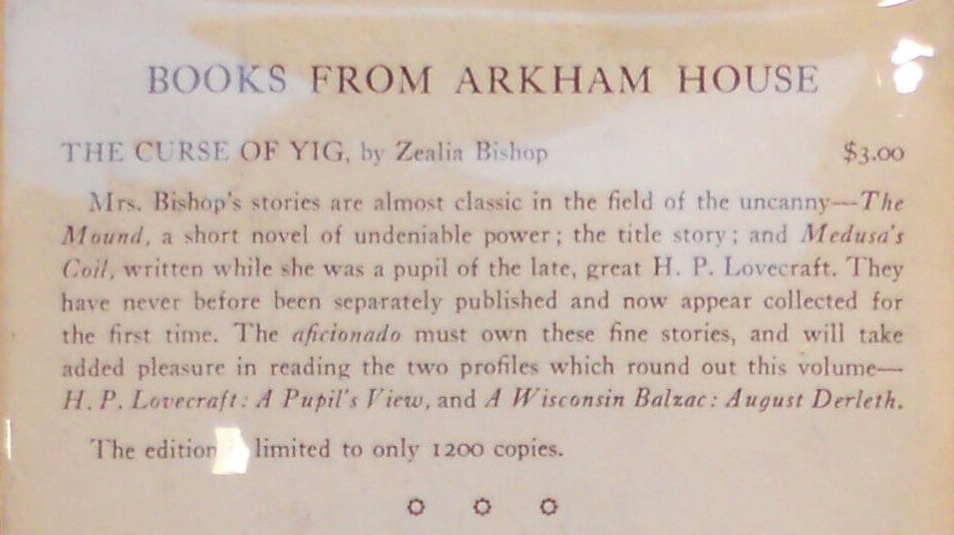
s-l1600

As the bill comes due, the question of reimbursement and profits comes up again. The stock price of the book was $3, and the “handling fee” was $0.45/book, so the gross value of each book was $2.55. At 1217 books, that left a potential gross of $3103.35—but how much of that would Zealia be getting? How many copies would have to sell for her to recoup the cost of printing? There’s no doubt that Derleth had to be getting at least a portion of the cover price to keep the lights on at Arkham House. Nevertheless, the terms must have been acceptable enough, because Zealia footed the printer’s bill.

Herewith is check on account for 300.00—leaving a balance of 1100.00 which you shall have not later than November 14th. I may be in Madison on that day or before—but you may depend on the check on that day in any eventuality. This has been a little difficult to handle as you told me that the bill would come in on Nov 10th & be payable in thirty days—If this is the fact let me know as it would be easier for me & I would not have to borrow any money—as I will have checks coming in to cover the amount early in Dec—Write me about this at once. It means a great deal to me—as previously explained. […]

I’m not interested in publicity–merely that sales pay the amount used to publish it—
—Zealia Bishop to August Derleth, n.d. (c. late Oct 1953), MSS. Wisconsin Historical Society

Herewith is the 1100.00 balance on the printing bill etc.—in three checks. I would like, if possible, for you to deposit them a few days intervals. The money is on deposit—but we have a devil of a banker—who is just as apt as not to call me out of a sound sleep & say “why are this….”  knowing that D. W. would know nothing of the deal & that I would be called upon to explain. Things will not always be like this—at present, however, to antagonize anyone could be disastrous. Since you can be assured that the money is in the bank I know you will arrange to handle the amount with your usual diplomacy.

It is impossible to say now how “Yig” is going or will go over. I’m receiving “fan” mail, of course—but that’s all happened before— […]

D. W. took one fleeting glance at the book. He did not so much as touch  it & has never mentioned it. That has cut me deeply—the girls, too, are wounded over his attitude—but it has only made me more determined to continue on—to do something more as often as I can—I cannot be destroyed—so many & so much depend upon me & my well being. […]

I hope “Yig” is successful enough to offset the printer’s bill & that we may publish one or two more under this plan then perhaps the other things will sell outright.
—Zealia Bishop to August Derleth, n.d. (c. Nov 1953), MSS. Wisconsin Historical Society

If Zealia Bishop hoped that the book would sell quickly, she had either deluded herself or else Derleth hadn’t been entirely forthright about the economics of the situation. As it was, it was not many months later when he was forced to write the kind of letter a writer hates to get.

I’m afraid you haven’t read your contract with Arkham House. There is no money due you by February 10th, I am sorry to say. The very earliest that any payment would be earned, would be in June, and I am not sure that there will be a payment then. The contract specifies that royalty reports on earnings shall be made after every half year, and that payments shall be made thereon not later than June and December respectively, following. Thus your first royalty reportwhich I shall try to have made up and enclose for youcarries you up to 1 January 1954, and covers the sale of only 250 books. And we have sold just 20 books since then, for a total of 270 books so far.

You will recall, too, that the total bill was $1,712.68, of which $14.45 was my personal responsibility—see my letter of 27 October 1953—leaving the actual cost of THE CURSE OF YIG—not counting other expenses incurred here which I did not put on the bill—at $1,698.23. Of this sum, you were asked to pay only $1,400.00, in the hope that the remaining figure would be earned by the time the bill was met. It was not quite earned; so you do not begin to receive monies until some months after (the first June to December) our royalty reports show that your book has earned the full $298.23. That is to say, form the first report of earnings, we must deduct no less than $298.23 plus a .45¢ per title handling charge, as per contract. If my estimate, purely off the cuff, is correct, the payment to you in June will be approximately $150.00, $20 more or less. My rough estimate puts it at just short of $150.00, but if I can have Alice make up the royalty statement in time to enclose it in this letter, than you will know for certain just what is due you in June; following which, the next payment will be made to you in December of this year, and on the same basis, at the same intervals, thereafter.

I am sorry that THE CURSE OF YIG has not sold faster; we are now just under 25% of the edition sold, and I know we will sell all the books, but they are just not moving fast, and none of our titles do so move. It took us 10 years to sell 1200 copies of THE OUTSIDER & OTHERS; yet, on the other hand, we sold 4,000 copies of SLAN in short of 4 years. But you will recall that I told you in advance not to expect any miracle sales, but a slow, steady accretion of sales. An initial payment of $150 or slightly less does represent 10% of your investment, and that is not too bad for two months’ sales, considering. […] We published Seabury Quinn’s ROADS in a 2000 copy edition in 1948 under a similar arrangement; it took him 4 years to recoup his $900 investment, and he is still earning his royalties now. We published David Keller’s TALES FROM UNDERWOOD in 1951 under a similar arrangement; he invested $1725, and still has $1450 to be earned for him.
—August Derleth to Zealia Bishop, 22 Jan 1954, MSS. Wisconsin Historical Society

25% would equate to about ~300 books sold in only two months (or a bit longer, counting advance sales); that should have grossed $900, or $765 minus the handling charges. If Zealia still owed ~$300 on the printing and might still expect $150 in June, that suggests her share or 300 books sold amounted to $450 net, so she was getting something like $1.50 per book (and remember that the printing cost was $1.40 per book). That leaves a full dollar of the cover cost unaccounted for, so either Derleth’s math is fuzzy, or (hopefully) there is a large piece of the accounting picture missing, because at $1.50 a copy Zealia would have to sell almost the entire run to earn out her initial investment ($1,698.23 / $1.50 per book = 1133 books), much less expect to see a profit.

We can compare these estimates with the one extant earnings statement:
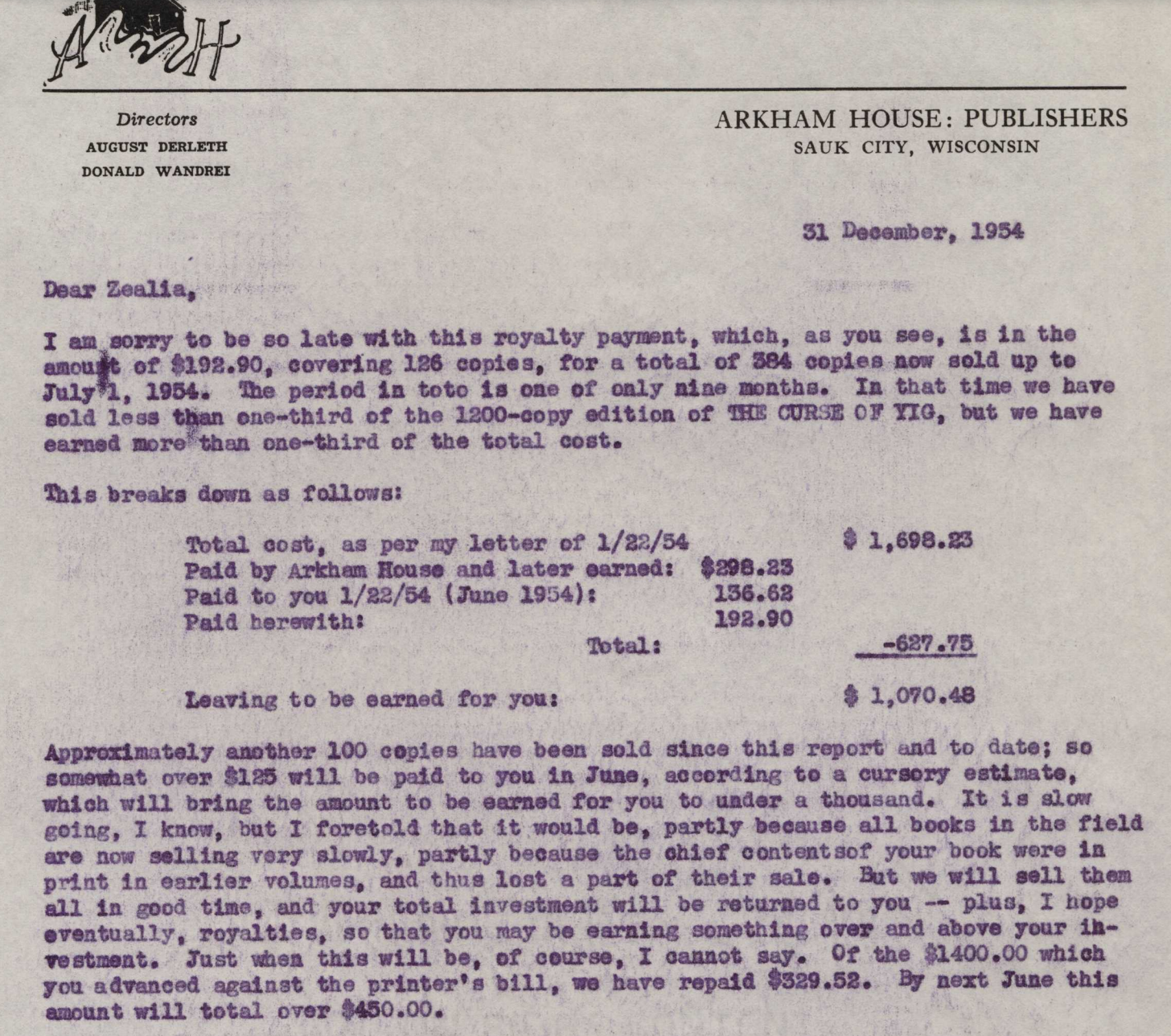
Screenshot 2020-12-20 at 6.52.30 PM

$627.75 / 384 books = $1.63 per book, which isn’t far off from the estimate (presumably Derleth is rounding somewhere), but the basic picture is the same: to actually earn back her money, much less make a profit, The Curse of Yig would need to sell most of the edition. Just to break even, Arkham House would need to sell ($1,070.48 / $1.63 per book = 657 books), and there were only 833 left in the edition—and some of those might probably be author’s copies, archival copies, etc. At the current rate (384 books/year) the book wouldn’t be expected to show a real profit until 1956.

Unfortunately, that didn’t happen. Instead of sales remaining steady, they appear to have decreased:

Our Bishop book, done in October 1953, has sold only 450 copies so far; and our Metcalfe, done in April 54, only 400. The one was largely reprint material, true, but the other was new work, though by a British author.
—August Derleth to Clark Ashton Smith, 26 May 1955, Eccentric, Impracticable Devils 451

Several of Zealia’s later letters to Derleth, tracking her economic decline, include requests for checks ahead of the agreed-upon schedule, no matter how small. In at least some cases, Derleth appears to have done his best to comply…but any hopes of actual profit, much less further publication, probably vanished quickly.

Certainly there seems to be an even interest in Yig—What do you think about a paperback for it—& in Airports etc?
—Zealia Bishop to August Derleth, n.d., MSS. Wisconsin Historical Society

The reason it’s called vanity publishing is because it is vain.

At the end of the day, The Curse of Yig would seem to largely be a book for Arkham House collectors more than general fantasy or horror readers. One contemporary review probably said it best:

Zealia B. Bishop’s The Curse of Yig (Arkham House, $3) contains three negligible stories from Weird Tales, plus two first-rate biographical profiles: one plausibly presenting H. P. Lovecraft in a somewhat less favorable light than that in which he is shown by his idolaters, and one which comes close to doing justice to the fabulous career of August Derleth.
—”Recommended Reading” in Fantasy and Science Fiction, vol. 6, no.2 (Feb 1954) 95

Much of the enduring legacy of The Curse of Yig lies not with the stories themselves—these were the Derleth-edited texts, later superseded by corrected texts compiled and edited by S. T. Joshi in The Horror in the Museum and Other Revisions (1989, Arkham House). “A Wisconsin Balzac” has never been reprinted, and may well have been written entirely by Derleth himself.

What has been reprinted, and is perhaps the most remembered inclusion to The Curse of Yig is “H. P. Lovecraft: A Pupil’s View”—Zealia’s long-simmering, often re-written memoir of being Lovecraft’s student-cum-revision client. While not without its flaws, this was until the publication of their letters the only account of Lovecraft and Zealia Bishop’s professional and personal relationship available.

Which in its own way is what The Curse of Yig is: a testament to the lasting impact of these two human beings on one another, and through their fiction on the world. No other woman would be so associated with Lovecraft for decades afterwards; no other woman would have her own Mythos anthology until after the death of August Derleth in 1971. The Curse of Yig might have been a commercial failure, but those books still exist, and are purchased and read today. While every writer might hope for profit during their own lifetime, what more could a writer hope for, after they’re dead and gone, but to be read and remembered?


Bobby Derie is the author of Weird Talers: Essays on Robert E. Howard & Others (2019) and Sex and the Cthulhu Mythos (2014).
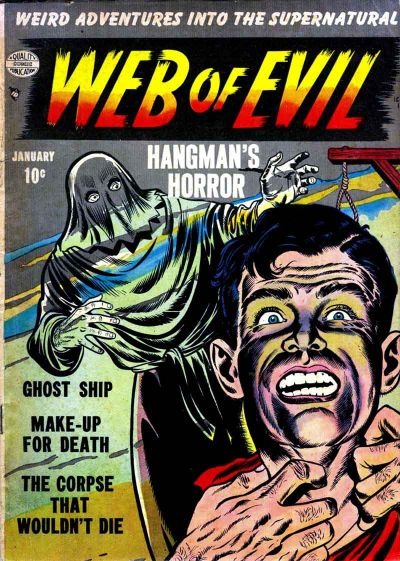
“Surama of Atlantis” and “The Automatic Electric Executioner” (1953) by H. P. Lovecraft & Adolphe Danziger de Castro

To say that “The Surama of Atlantis” and “The Automatic Electric Executioner” are discoveries is a bit of a misstep: they were never really lost. After de Castro’s death in 1959 his papers made their way to the Hebrew Union College-Jewish Institute of Religion, who in turn donated them to the American Jewish Archives in 1988 as Manuscript Collection No. 348. The excellent inventory of the de Castro collection by Chris Powell in 1996 notes both the existence of the texts and their relation to Lovecraft’s revisions. J.-M. Rajala noted in the 2011 Lovecraft Annual:

2 linear feet of de Castro’s papers, including unspecified manuscripts, are in the American Jewish Archives of the Hebrew Union College of Cincinnati (The Jacob Marcus Rader Center, MS-348), and I wonder if these have been carefully examined by anyone. (56)

Powell had, writing in “The Revised Adolphe de Castro” in Lovecraft Studies #36:

He minimally revised “The Electric Executioner” and retitled it “The Automatic Electric Executioner”. He also revised “The Last Test”, creating “The Surama of Atlantis”. He made minimal revisions to most of the story but made more substantial changes at the beginning to describe the origin of the shadowy character, Surama, and to the final outcome of the story. (24)

Powell also noted that:

“Surama of Atlantis” is planned to be included in The Nyarlathotep Cycle being edited by Robert M. Price for upcoming release by Chaosium. (24n14)

However, “Surama of Atlantis” and the other texts were not published in The Nyarlathotep Cycle or anywhere else, though Price thanks Chris Powell in his introduction. There is likely a story there, but the end is that “Surama of Atlantis” has remained in obscurity to the present day.

The original texts by Adolphe de Castro which Lovecraft worked from are those published within In the Confessional and the Following (1893). As is characteristic of Lovecraft, he completely rewrote both “The Automatic Executioner” and “A Sacrifice to Science.” Presumably this would also have been the case with the third revision, though no text of this revision is known to survive.

This work would initially have been done by hand; though no manuscript copies survive, and were later typed by someone (de Castro for “The Last Test,” Lovecraft for “The Electric Executioner”) for submission to Farnsworth Wright at Weird Tales. These final typescripts are also non-extant, so it is not clear what editorial changes, if any, that Wright made when they were published in the pages of Weird Tales. Martin Andersson has pointed out that there are also minor differences between the Weird Tales texts and the version of the stories published in Something About Cats and Others (1949, Arkham House); these differences are not reflected in the AJA texts, so we can be reasonably certain de Castro did not reference the Arkham House text.

For the three new typescripts, the variations from the Weird Tales text include variant titles, spellings (and misspellings), typographical errors, and changes in phrase and formatting that range from slight to rewriting entire paragraphs. The most substantial differences are with “Surama of Atlantis,” which is about 500 words longer, adding a relatively substantial beginning scene and slightly expanded ending, among other changes.

It is difficult to say who is responsible for the differences between the Weird Tales texts and the AJA typescripts; part of the differences (typos, dropped and repeated words, etc.) can be put down to typist error, but not the insertion or substitution of phrases and entire passages. As these do not appear in the Weird Tales texts, they are either survivals from a previous draft (Lovecraft was known to do multiple drafts of stories), or were added in afterwards (almost certainly by de Castro). The possibility of both cannot be ruled out; that is de Castro may have re-typed “Surama of Atlantis” from an older draft of “Clarendon’s Last Test” by Lovecraft and made his own alterations on top of that. The very-unLovecraft-like passage that ends “????” is almost certainly from de Castro.

The passengers on the Satsu Maru cascaded down the gang-plank, glad to be once more on American soil. There was a slight pause in the flow and then a tall thin man, wearing a gray ulster and a fedora hat that shaded his bespectackled eyes, short nose and bearded chin appeared.

Following him was a pretty young woman, dressed in gray with a large straw hat, the brim held down over the ears by a wide blue ribbon. Her left hand held the chain of a gold mesh bag, while her right clutched the collar around the neck of a magnificent St. Bernard dog.

Closely following them was an individual, tall beyond the ordinary, garbed in a long black cape that hung on his shoulders, and covered his entire body, what was seen of his face when the wind lifted the wide brim of his soft large slouch hat, was shocking; it indicated that the head had no hair. His eyes, like glinting black obsidian, were set so deep in the sockets that they seemed black pools in a cavernous skull. In fact, a closer view strengthened the assumption that it was a skull. there was no nose other than a depression and there were no lips over the large yellow teeth.

A moment he stood still, gazing at the sunlit wharf, at the people, and the large Hotel bus which was stationed a short distance from the gangplank.

As the black-clad skeleton halted, it irritated the bespectackled gentleman who turned and said, “What makes you so slow, Surama?”

The individual called Surama, grinned horribly and said, “Coming, doctor.”
—Adolphe Danziger de Castro, “Surama of Atlantis,” Jewish American Archives (MS-348)

What parts of “Surama of Atlantis” were written by Adolphe de Castro, and why? What parts might be strange survivals from an earlier Lovecraft draft? Is there any way to tell? Objectively, no. Without access to Lovecraft’s original manuscript, it is impossible to say definitively one way or another. Yet we can say a few things.

Lovecraft did not make any fuss over substantial errors when “The Last Test” was published, so we can assume the text in Weird Tales is predominantly as he wrote it in the final draft. Also, given that the first title Lovecraft mentions in his letters is “Clarendon’s Last Test,” it is apparent that “Clarendon” was not a change made by de Castro to the manuscript sent to Weird Tales. In “Surama of Atlantis,” the doctor’s last name is “Schuyler” rather than Clarendon. It is also notable that the name “Schuyler” does appear in the Weird Tales script, as Alfred Schuyler Clarendon and Frances Schuyler Clarendon both attest. This oddity could be the result if Schuyler was the original name, and that Clarendon was then added later—but this presumes two drafts, an early draft and a final one. In any case, it is notable that at no point does de Castro revert to the names in “A Sacrifice for Science” (i.e. Clinton for Clarendon/Schuyler, et al.)

The character of Surama evolved from the character of Mort in “A Sacrifice to Science,” but the Atlantean background was pure Lovecraft—“De Castro wanted it excluded at first—but as it turned out, that was the one thing which Wright singled out to mention in describing the tale!” (Dawnward Spire, Lonely Hill 165) Much of the variant material in “Surama of Atlantis” focuses on Surama, from the title and the opening scene to the bizarre ending. If we do accept the idea that there was a previous draft, and that “Surama of Atlantis” retains several features from it, the most obvious are the ones that describe turtle-like attributes to Surama. In “The Last Test” only a single such descriptor exists:

Unlike the ideal subordinate, he seemed despite his impassive features to spend no effort in concealing such emotions as he possessed. Instead, he carried about an insidious atmosphere of irony or amusement, accompanied at certain moments by a deep, guttural chuckle like that of a giant turtle which has just torn to pieces some furry animal and is ambling away toward the sea.

In “Surama of Atlantis,” however, numerous references of turtle-like characteristics are applied to Surama. The idea of Surama as a kind of monstrous turtle-man works within the logic of the story except for one part: the double-aftermath.

In the afternoon the leisurely firemen overhauled the ruins and found two skeletons—or rather one human skeleton with the skull intact with the frame; of the other only the skull—a very human skull, but with osseous outlines disturbingly suggesting a saurian of some sort. The skull reminded people of Surama, and only well-cut clothing could have made a body as indicated by the skeleton look like a man.

An added horror to the situation was a big hole found under the stout fence back of the destroyed building, and Pat McMonigall, the street car watchman, returning from his beat, assured neighbors that he had seen “a turtle as big as a house” ambling down the hill to the bay, a statement that was not take quite seriously, although Pat McMonigall was a rather abstemious chap. Did Surama go back to Atlantis????
—Adolphe Danziger de Castro, “Surama of Atlantis,” Jewish American Archives (MS-348)

It is completely incongruous for Surama to make his way back down to the sea and to leave behind a skull and skeleton for paleontologists to muddle over, at least not unless Surama was wearing the skull like a hat and peering out through the eye-sockets. If this is a survival from an earlier draft, it isn’t clear how this discrepancy might be resolved—either de Castro wrote the entire ending himself (the unLovecraftian line “Did Surama go back to Atlantis????” is almost certainly his; it reads like an annotation accidentally copied onto the line), or possibly de Castro borrowed verbiage from the Weird Tales version and grafted it onto the earlier draft to give a double-aftermath where there was only one before.

It is also worth noting that in the Weird Tales version, it is specified “that’s all that can reach him, James, unless you can catch him asleep and drive a stake through his heart.” A very vampire-like touch which is at odds with Surama as a kind of turtle, but also much simpler and perhaps more reasonable in keeping with his corpse-like appearance. This is changed in “Surama of Atlantis,” with the suggestion that no ordinary weapon can pierce his shell.

A less evident but more serious problem in “Surama of Atlantis” is the question of narration: who is the narrator? Lovecraft gives no specific identity, the story is related anonymously. Yet the beginning of “Surama of Atlantis” specifies that the narrator is a reporter who was injured by Surama and has not long to live, while the ending states:

Dalton probably gave Dr. Jackson an inkling of the truth, and that good soul had not many secrets from his son, who is the writer of these lines.” (ibid.)

It is a very unLovecraftian mistake; but is it the case of a botch in trying to merge an earlier draft with the later Weird Tales text, or de Castro failing to notice the discrepancy as he added his own additions to the story? Notably, there is a reporter who is injured (though not seriously) by Surama in the course of the story, who plays a key role in events; however, if Lovecraft provided such an opening, would he not have also included a suitable closing? It seems an odd plot hook to leave hanging.

It is important to note several places where the Weird Tales text has expanded on the same text in “Surama of Atlantis.” The appointment of Schuyler/Clarendon to San Quentin is given much more space in “The Last Test,” which foreshadows the governor’s political struggles and losing his appointment power. The benefits of Schuyler/Clarendon’s appointment are noted at greater length, as is the emotional argument when Dalton asks for Georgina’s hand in marriage. Instructing Dalton to blot out the Greek passages but send Miller the notebooks makes much more narrative sense than just telling Dalton to blot out and burn everything, as happens in “Surama of Atlantis.” These are the kind of changes which reinforce the narrative as a whole—and they are the kind of changes that one would expect to see between earlier and successive drafts.

It is the omissions as much as anything which suggests that de Castro was not working directly from a copy of Weird Tales. There does not seem to be any narrative reason to have not copied these sections as-is, since they have little overall impact on the other changes in the story. Yet this cannot be taken proof positive of an earlier draft; it could simply be that de Castro made all the changes on his own. It is notable that of the major changes, two—the extended opening and ending—provide an identity for the narrator of the story. The burrowing-turtle aftermath leaves the story open for a hypothetical sequel.

The rest of the changes are minor, and a couple are mysterious. “The Last Test” refers to the Royal Hotel, which burned down in 1906; “Surama of Atlantis” instead refers to the Phelan Building—which also burned down in 1906, but was then rebuilt in 1908 and still survives today; it’s not clear what benefit one has over the other, since both were still standing in the 1890s when the story takes place. The focus at on “microbio death” is a bit weirder:

“Don’t look so shaken up, old fellow! A veteran politician-fighter like you must have seen plenty of unmaskings before. I tell you, I never had even the start of a fever cure. But my studies had taken me into some queer places, and it was just my damned luck to listen to the stories of some still queerer people.
—Adolphe Danziger de Castro & H. P. Lovecraft, “The Last Test”

“Don’t look so shaken up, old fellow! A veteran politician-fighter like you must have seen plenty of unmaskings before. I tell you, I never had even the start of a fever cure. But my studies had taken me into some queer places, and it was just my damned luck to listen to the stories of some still queerer people who preach microbio death.
—Adolphe Danziger de Castro, “Surama of Atlantis,” Jewish American Archives (MS-348)

It seems to be an effort to provide some reason for Schuyler’s mania with watching people die from the black fever, but the phrase makes so little sense in context it’s hard to see what the author was getting at. If that phrase was a survival from a previous Lovecraft draft, dropping it for the simpler obsession on the power of life and death over a patient seems much cleaner.

The searchers had found the place only because of the chanting and the final cry. It had been close to five that morning, and after an all-night encampment the party had begun to pack up for its empty-handed return to the mines. Then somebody had heard faint rhythms in the distance, and knew that one of the noxious old native rituals was being howled from some lonely spot up the slope of the corpse-shaped mountain. They heard the same old names—Mictlanteuctli, Tonatiuh-Metzli, Cthulhutl, Ya-R’lyeh, and all the rest—but the queer thing was that some English words were mixed with them. Real white man’s English, and no greaser patter. Guided by the sound, they had hastened up the weed-entangled mountainside toward it, when after a spell of quiet the shriek had burst upon them. It was a terrible thing—a worse thing than any of them had ever heard before. There seemed to be some smoke, too, and a morbid acrid smell.

Then they stumbled on the cave, its entrance screened by scrub mesquites, but now emitting clouds of fetid smoke. It was lighted within, the horrible altars and grotesque images revealed flickeringly by candles which must have been changed less than a half-hour before; and on the gravelly floor lay the horror that made all the crowd reel backward. It was Feldon, head burned to a crisp by some odd device he had slipped over it—a kind of wire cage connected with a rather shaken-up battery which had evidently fallen to the floor from a nearby altar-pot. When the men saw it they exchanged glances, thinking of the “automatic electric executioner” Feldon had always boasted of inventing—the thing which everyone had rejected, but had tried to steal and copy. The papers were safe in Feldon’s open portmanteau which stood close by, and an hour later the column of searchers started back for No. 3 with a grisly burden on an improvised stretcher.
—Adolphe Danziger de Castro, “The Automatic Electric Executioner,” Jewish American Archives (MS-348)

Unlike “Surama of Atlantis,” the changes between the three texts of “The Automatic Electric Executioner”/“The Electric Executioner” are much more minor, although strangely a bit more complicated since there are three texts to work with, and in addition to the small but substantial changes, both of the typescripts in the de Castro Archive contain numerous typos and errors of spelling, as well as idiosyncratic formatting differences.

The 1930 text of “The Electric Executioner” in Weird Tales may be assumed to be the oldest of the texts; “The Automatic Electric Executioner” text is bound in a manuscript dated 1953, and may be assumed to be the newest. However, the undated, unbound typescript of “The Electric Executioner” does not sit neatly between the two; textually, the undated text and the Weird Tales text follow each other more closely than “The Automatic Electric Executioner” and the Weird Tales text, but the undated typescript contains several small but notable additions and rephrasing not in either of the other texts.

Most likely, this means that both “The Automatic Electric Executioner” and the unbound text of “The Electric Executioner” represent two different branches of transcription, both copied from the same source (either a copy of Weird Tales, or the typescript received from Lovecraft) and copied and altered at different times, without reference to one another. This would explain the differences and similarities between the three texts without requiring any hypothetical earlier drafts. (Why de Castro would type out “The Automatic Electric Executioner” fresh without making reference to the undated typescript, which has differences from the published version, is another questionbut not one with any ready answers.)

Of the substantial differences, they are few: the title of “The Automatic Electric Executioner” is a combination of “The Automatic Executioner” and “The Electric Executioner”; the story is set in 1899 in the standalone typescript of “The Electric Executioner” and 1889 in the others; the discovery of the body scene in “The Electric Executioner” is a bit longer, and there are some minor geographical differences.

S. T. Joshi in his annotations for this story notes that the San Mateo Mountains are actually in New Mexico; and this is apparently an error on Lovecraft’s part. De Castro’s “The Automatic Executioner” has the protagonist go to Mexico City, and from there towards Orizaba which is in the Sierra Madre Oriental range, although it is never named. “The Electric Executioner” standalone typescript has the nameless narrator headed both to Guadalajara and via Guadalajara to Mexico City—it isn’t clear why the change was made, but was obviously a bit of geographic confusion. In one text the narrator goes to the The Fonda Nacional (“National Inn”) and in the other to the Hotel Interbide; both were hotels in Mexico City. Why the change from one to the other is also unclear.

Something perhaps notable is that all three texts retain the odd racism against Mexicans expressed by Arthur Feldon in the story, which reflects something of Lovecraft’s own prejudices and understanding regarding Mexicans and Native Americans—a combination of racial and class prejudice. From De Castro’s other writings, he either agreed with these generally or at least appears to have felt no need to alter them, as the key phrases (“I hate greasers but I like Mexicans!” etc.) remain intact in every textual variation. Treatment of Mexican characters in “A Sacrifice to Science” (right down to using the slur “greaser”) would seem to suggest no major disagreement between de Castro and Lovecraft on the matter.

Aside from noting how difficult some of the Nahuatl and quasi-Nahuatl names appear to have been for de Castro to type, the most interesting part about the variations on “The Electric Executioner” is simply their existence. There isn’t any evidence that the undated typescript came from Lovecraft’s typewriter (at least, the number of typos would seem to argue against it, given Lovecraft’s punctiliousness), and the variations between the texts are comparatively minor. While it is not impossible that Lovecraft was responsible for some of the bits that don’t appear in the Weird Tales text, the changes are so small and affect so little of the story, compared to “Surama of Atlantis” that like as not the average reader would miss them on a read-through unless specifically pointed out.

As a point of hardcore Lovecraftian scholarship and nerdism, “Surama of Atlantis” and “The Automatic Electric Executioner” provide interesting insight on how changes to Lovecraft stories can not work, and perhaps reflect on the difficult process of drafting and revision. That these stories have gone unpublished is perhaps not surprising; the audience for a variorum of such texts is small, and the rights would presumably remain with de Castro’s estate. But that they exist at all should interest and thrill Lovecraft fans: who knows what else may yet remain, in some dusty archive, or in an amateur journal not yet thoroughly picked-over?


Bobby Derie is the author of Weird Talers: Essays on Robert E. Howard & Others (2019) and Sex and the Cthulhu Mythos (2014).