Ancestors Are Just People—Robert Heinlein’s “‘All You Zombies—’” (1959) by O. F. Cieri

Does the sun still exist at night, or does it die every day? This is the question at the heart of Robert Heinlein’s “All You Zombies—”, where a time traveler experiences his entire life in one work shift before settling down in his cot for a well-earned rest.

This story is one of the greats of the golden age of science fiction that moves huge ideas through a few short pages. It has a relatively slow start, with two guys in a bar talking about their jobs and their lives. One guy is the bartender; the other is an advice columnist who specializes in answering questions from Unmarried Mothers. It doesn’t spoil anything to reveal that the columnist was himself an Unmarried Mother once, which explains how easily he can describe their point of view.

At the core of the story is a question of whether the individual has a concrete value in an ever-shifting universe. Heinlein’s answer, hinted at in the title, is both No, and Yes. “All You Zombies—”’s central premise is that the individual experience is the only one we can have, and yet the self is so malleable that it can be completely transformed by external forces. War, employment, sex and gender are all interchangeable, meaningless and foundational. And yet despite the baseless nature of the self in an uncaring universe, the central figure ends his shift believing only in himself. 

“The Snake That Eats Its Own Tail, Forever and Ever . . . I know where I came from—but where did all you zombies come from?”
—Robert Heinlein, “All You Zombies—” in The Magazine of Fantasy and Science Fiction (Mar 1959) 15

In an uncaring universe where the individual is self-creating and permanently fluctuating, who is the Other? Does anything exist outside the Self? If I die, does the whole world? The lonely conclusion of this logic is addressed even within the text, where the protagonist signs off his narrative with: “I miss you.”

“All You Zombies—” is complex enough to survive spoilers, but to enjoy the full experience, it is best to go in blind. Talking about it requires delving into the meat of time travel and paradox, so the rest of the review will feature spoilers.

You’ve been warned!!!

The story doesn’t fall apart at the worldbuilding level, but the inciting incident of the story is superfluous. The premise is that time travel became possible not long after interstellar travel, leading to many different necessary support teams for fifth-dimensional servicemembers. The protagonist, the one true individual we can prove, is one such servicemember of the Time and Space Corps. His story is littered with the acronyms of made-up military organizations and their support structures. There’s the Women’s Emergency National Corps, Hospitality & Entertainment Section (W.E.N.C.H.E.S), a.k.a the Auxiliary Nursing Group, Extraterrestrial Legions (A.N.G.E.L) or Women’s Hospitality Order Refortifying & Encouraging Spacemen, probably the most honest acronym (W.H.O.R.E.S). Space can be lonely, and women are enlisted wholesale in the war effort to prop up male servicemembers psychologically and sexually. Technology is sufficiently advanced that natural beauty is not as important as being fit to endure the stress of the job, but not so much that the work is not gender segregated. Despite the heavy lifting that the phrase ‘women’s work’ does in context, there is an emphasis on the dignity of the work, as a necessity for morale, and as spacers in their own right.

Long before any of this is revealed, the Unwed Mother reveals that he used to be a woman who was interested in taking on one of these roles. He’d never felt beautiful as a woman, but the Time and Space Corps could change anything about him. He would be thrown into the vast frontier of space, rewritten as a different person, and emerge as successful by feminine standards, with a husband in a stable professional career. Before he can apply, a handsome man with ‘a fat wad of hundreds’ takes him out on a few dates, knocks him up, and disappears.

The bartender knows all this already, because he is the Unwed Mother after many long years in the Service, and as he listens to the Unwed Mother he casually organizes the circumstances for his own conception and birth by offering to introduce the Unwed Mother to the cad who left him alone and pregnant. Slipping him a fat wad of hundreds, he sends him through time to meet his pre-transition self, then skips ahead nine months to collect his infant self and dump the child off at an orphanage. Meanwhile, the doctors wake the Unwed Mother up post-labor to inform him of an undescended set of testicles nestled inside his groin. Due to birth complications, they have decided to advance the development of the testes and help him adjust to life in a new gender.

With this one act, the Unwed Mother’s life is destroyed. His original plans to take night classes and join the WENCHES are out of his grasp. The doctors pressure him to put the child up for adoption, a superfluous decision when his future self snatches the baby and dumps it at an orphanage. After his transition, he wanders aimlessly for years, struggling to feel at home in his body, before ambling into a bar for a drink. There, his bartender sets him up with a few dates with his former self before dragging him to the Sub-Rockies Base in 1985 for recruitment. As his shift ends, the bartender closes up for the night, hops to the same Sub Rockies Annex in 1999, downs a bottle of whiskey, and types up his report.

The crux of the story is to create a time paradox scenario where a man could conceive and birth himself, and all the references to military life are trappings to provide a sliver of justification for these actions. The recruiter knows to recruit himself for his own role, and as a bonus, he gets to ensure his own birth, too. To create the effect he wanted, Heinlein ad-libbed from older material and left some of their debris behind.

“All You Zombies—” bristles with the anxieties of post-war America, full of acronymic federal bureaus, new medical treatments for sleep, headaches, moods, and birth control. Medical advances make the body transparent through better anesthesia and X-rays, increasing the availability of plastic surgery. The Space Race punctures the horizon, condoms roll back generational fears of unplanned pregnancies. The story’s heart is a deeply anxious question about the nature of personhood in the face of scientific progress, and included on this list is the question of what makes a man.

When the story is viewed as a question on the nature of identity, it makes sense that Christine Jorgensen’s name would be used to illustrate the protagonist’s intersex condition. Otherwise, the protagonists’ sex organs are the only part of him left to nature. At birth, he just so happened to have both sex organs. His condition is used to form a window through which medical science can dictate his gender, but science itself plays no role in his self-identity. The protagonist is characterised as being remarkably easy-going and level-headed. While he is clearly aimless and depressed after the loss of his daughter-self, he’s quite comfortable in his masculinity. He makes a few jokes about sympathising with women as someone who used to be one, but doesn’t show any regret for his transition. In fact, he balks at threats to his masculinity.

Clearly, these are circumstances that create a cohesive image for Heinlein, who might have struggled to understand news stories about pre-liberation gender transition. Heinlein’s perspective is very normative in centering gender identity in the genitals, with a brief, hand-waved period of months in which the protagonist learns their new social role. In-universe, the protagonist is characterised as being an excellent field agent for his even temperament, implying that anomalies require a degree of gender fluidity. On the other hand, the setup established that girls aren’t allowed in space except as sexual accessories.

This contradiction seems to have crossed Heinlein’s mind long enough for him to envision a space future in Starship Troopers with a fully integrated infantry unit. If it’s supposed that Starship Troopers takes place along the same spacetime continuum, long enough for America to find an enemy amongst the stars, then the mood stabilizers, plastic surgery, and birth control have crafted a society with gender equality that conforms neatly to heterosexual standards. 

For Heinlein, gender equality is something that needs to be forged in flesh, cut and synthesized into a physical ideal. That wasn’t unique to him. The golden age of science fiction delighted in using the mind as a tool to shape the world in a playground with practically no friction between a problem and its solution. Science fiction acted as the drafting stage for a design patent and its practical application. 

Heinlein, as the story’s ultimate authority, in the story asserts himself a few times, most notably in the central premise that the space frontier will immediately lead to exploring time. Or that the United States would be the leader of that technological revolution, though in Heinlein’s defense, Americans who didn’t believe that were put on a list. More unique to Heinlein is the proud assertion that anyone would sleep with themselves if given the chance. There’s no way to be sure about that, but it’s necessary for the story, and Heinlein seems to believe it. Therefore, it is true. But would Heinlein’s protagonist sleep with himself as a man, or only a woman? If not, why not?

Heinlein’s use of an intersex person with an incredibly rare case of chimerism interrogates the limits of heterosexual expectations without abandoning them, like an astronaut tethered to a ship through his oxygen tank.

But Heinlein’s vision still centers a biological assignment that can be made by doctors on an operating table without the patient’s input. That someone’s sense of self can be altered for life in just a few months of training, given our current political climate, seems unsettling. Heinlein’s use of an intersex person with an incredibly rare case of chimerism interrogates the limits of heterosexual expectations without abandoning them, like an astronaut tethered to a ship through his oxygen tank. The umbilical cord of binary sex and gender lashes the story to simplistic modes of social graces even while it threatens to strike out on its own. The real question  “All You Zombies—” asks: is anybody out there on the other end of this leash? Who are you people? Will you still be there in the morning?

“All You Zombies—” (1959) by Robert Heinlein may be read for free at the Internet Archive.


O. F. Cieri is based out of NYC. In 2013 she won first place in BMCC’s Poetry Competition. In 2016 she won an Honourable Mention in LaborArts Make Work Visible Competition. Her non-fiction has been carried by Hyperallergic and the Invisible Oranges. She published her first book, Lord of Thundertown, with Ninestar Press in 2020. In February of 2023 she published her second book, Lockdown Laureate, with Castaigne Publishing. Her third book, Backmask, was published by Malarkey in June of 2023. https://ofcieri.com/

Copyright 2026 O. F. Cieri.
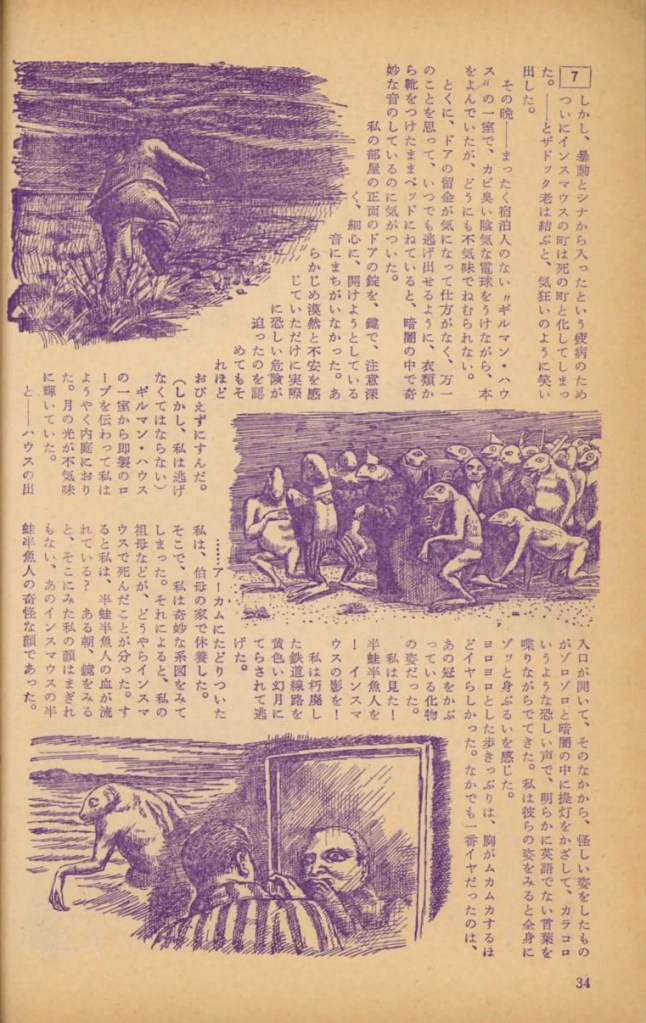
“The Fishmen of Innsmouth” 「インスマウスの半魚人」(1959) by H. P. Lovecraft & Shōgo Matsumiya (絵・松宮省吾)

Eldritch Fappenings

This review deals with a work of erotic art and writing.
As part of this review, selected images with depictions of nudity will be displayed.
As such, please be advised before reading further.


My proper introduction to the Japanese-language Cthulhu Mythos came courtesy of Edward Lipsett and Kurodahan Press (2002-2025). For over twenty years, Kurodahan worked to translate into English works that would otherwise never have been available to monolingual Anglophones like myself. Thanks to their efforts I was able to read Asamatsu Ken (朝松健) and Rampo Edogawa (江戸川 乱歩) and many others I hadn’t heard of; and I gained an appreciation for the work of the people translating those stories back into English. Now that Kurodahan Press is no more and their titles out of print, I regret I didn’t have the money to buy everything they put out, or the time to read it all.

In Kurodahan’s Night Voices, Night Journeys (2005) the first volume of Lairs of the Hidden Gods stories (an anthology series of Japanese Cthulhu Mythos tales), there is an essay titled “Lovecraftian Landscapes: Four Decades of H.P. Lovecraft and Manga” by Yonezawa Yoshihiro (米澤嘉博) trans. Ryan Morris, where he described an early Lovecraft translation:

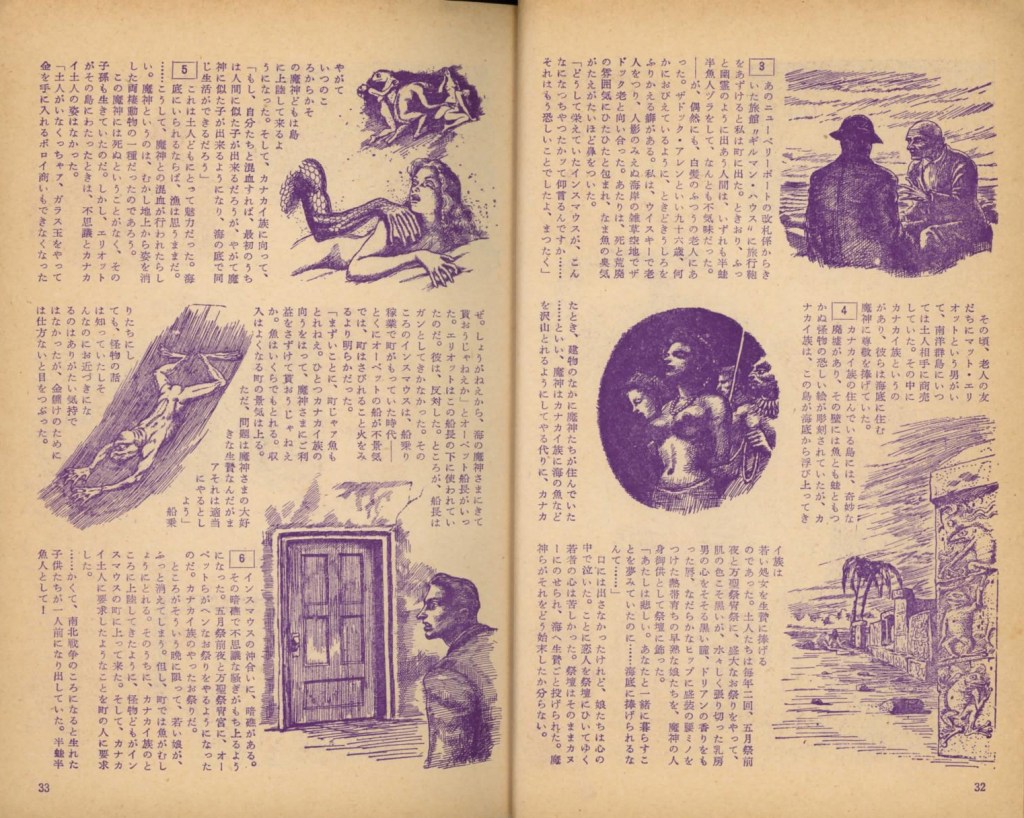
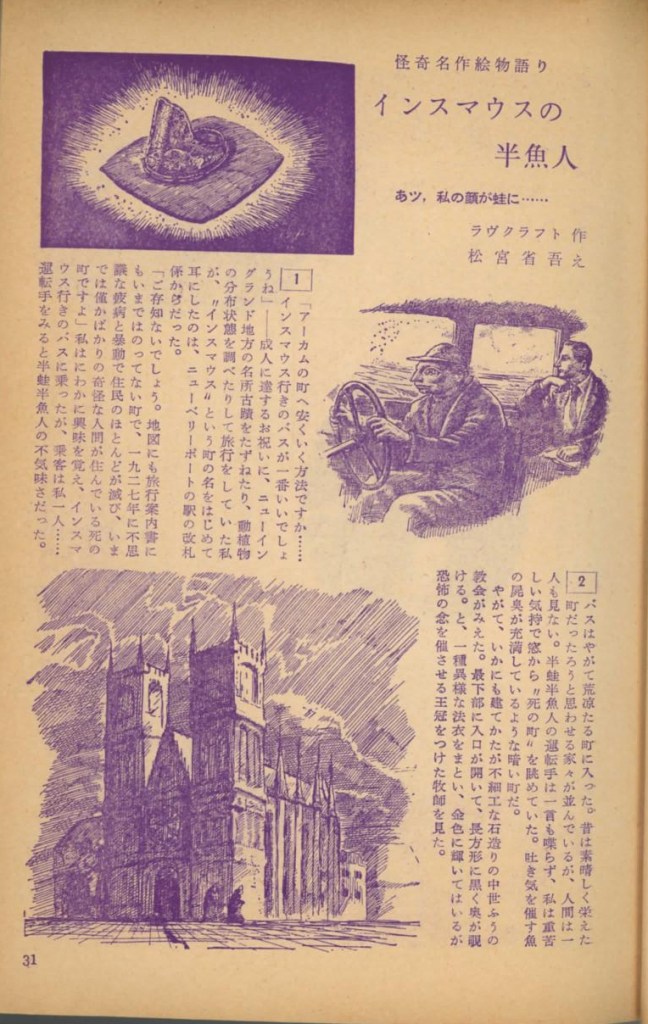
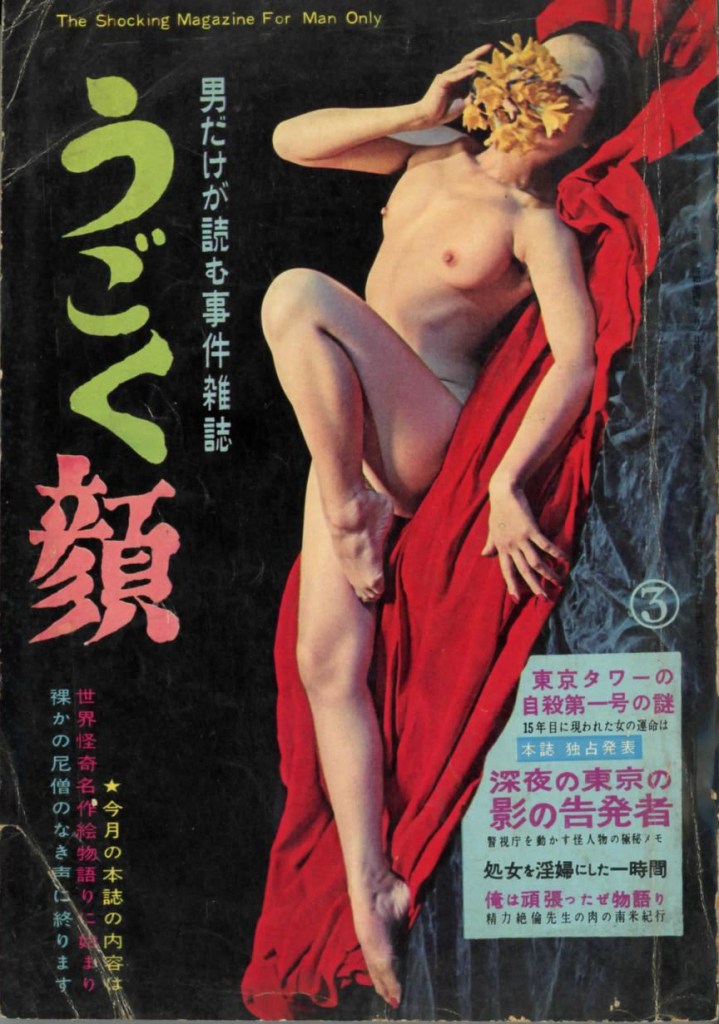
It was entitled The Fishmen of Innsmouth (illustrated by Shōgo Matsumiya) and appeared as part of the feature article, The Greatest Horror Stories from Around the World, Illustrated in issue Three of Ugoku Kao (Moving Face), the “tabloid strictly for men,” originally published as an offshoot of the very popular 1950s erotic entertainment magazine Hyaku-man in no Yoru (One Million Nights of One Million People). The subtitle read “Horrors! My face—it’s become… a frog!” The story featured pictures of half-naked women with such outrageous captions as “The Khanakai tribe made sacrifices of young virgins. THe bosoms of these fast-maturing tropically-raised maidens, with their black skin, breasts like ripe peaches, dark eyes that could seduce any man, lips with scents like durian, and gently curving waists hidden only by grass skirts, were but decorations on the altar: offerings to the Demon God.” The illustrations were fine black-and-white ink pieces that had all the mood of a Western horror novel, and although the FIshmen looked more like frogs, they were certainly grotquese. These drawings were perhaps made more accessible thanks to their being in the similar Vein as the “Lost world” monster stories of Oguri Mushitaro and Kayama Shigeru. It was only a four-page illustrated story, but it is most likely the first ever domestic H.P. Lovecraft visual work. (294)

Dr. Justin Mullis asked if I had a copy; I did not, but was able to procure a copy of Moving Faces, vol. 1, no. 3 (Mar 1959) [うごく顔 第1巻第3号(1959年3月)]. I then asked a friend, Dr. Dierk Guenther in Japan (who helped out before on “Medusa’s Curse” (1995) by Sakura Mizuki (桜 水樹氏)), to translate it into English.

The result is everything that Yonezawa Yoshihiro described in his essay and more. An abbreviated, localized, sexploitation version of Lovecraft’s “The Shadow over Innsmouth” crammed into four pages for a Japanese men’s magazine. Given when and where it was published, the work also reflects something of the language and attitudes of the postwar period in Japan; reader discretion advised. No translator is credited for the original translation/abridgement. Dierk Guenther’s comments on the translation will be marked by dagger symbols (†) and included at the end of the translated text.

A famous story of monsters

The Fishmen of Innsmouth

“Ah, my face, it looks like a frog …”

Author: Lovecraft
Matsumiya Shōgo/Art
[New translation and notes: Dierk Guenther]

(1) “The cheapest way to Arkham town? That would be the bus in the direction of Innsmouth.”

I was celebrating my coming of age with a tour of New England, visiting historic sites as well as researching the distribution patterns of flora and fauna. It was from an agent at the train station of Newburyport that I heard for the first time the name of the town of Innsmouth.

“You seem not to be aware of this. The town can’t be found on maps or tourism brochures. In 1927 the town was hit by a mysterious infectious disease and violent riots that reduced the town’s population. Now the town is dead, and only a few, very peculiar people are living there.”

My interest was immediately raised, and I took the bus to Innsmouth, being the only person on board. The bus driver had uncanny features, looking like half-fish, half-frog.

(2) Soon, the bus arrived in a bleak town. Many houses lined up that were reminders that in earlier times, the town must have been very beautiful and flourishing. Not one single person could be seen. The half frog, half fish bus driver didn’t say one word, and with a gloomy feeling, I looked out of the window at the “town of death”. It was a dark town that felt nauseous with an overall stench of decaying fish.

Soon, an awkwardly constructed stone building, a medieval-style church, could be seen. The entry in the building’s basement was open, revealing a rectangle of blackness inside. And then I saw a priest, who was wrapped in a peculiar vestment. He wore a frightening golden tiara-like crown.

(3) I checked myself in at the hotel Gilman House, of which I had heard from the agent in Newburyport, left my luggage there, and went into town. All the ghost-like people whom I met occasionally, who seemed to come out of nowhere, looked like half-frog, half-fish, and were unsettling. And then, by coincidence, I met a white-haired elderly person. His name was Zadok Allan, and he was 96 years old. He appeared frightened and had the peculiar habit of sometimes looking behind himself.

Luring the old man by offering him whiskey, we went to a part of the beach with no one around and here I spoke with Zadok.

The area was wrapped in an atmosphere of death and destruction and the unbearable stench of raw fish filled the air.

“Can you tell me why the blooming Innsmouth became like this?”

“That was a truly horrible thing.”

Around the time these events unfolded, there was a friend of the old man by the name of Matt Eliot, who on an island chain in the South Pacific traded with the natives living there†. Among these natives was the tribe of the Kanakys, who paid respect to evil gods that lived under the sea.

(4) On the island where the Kanakys lived there was a peculiar ruin. On its wall were engraved terrifying images of fish and frogs and random monstrous creatures. The Kanakys claimed that when the island rose out of the sea, evil gods lived in this building. Thanks to the evil gods, the Kanakys could catch a lot of fish and other creatures from the depths of the sea. In return, the Kanakys offered young virgins as living sacrifice to the evil gods.

The islanders held twice a year a big festival, on the evening before the May Festival and on All Saints’ Day. Young women of dark skin and firm, full breasts stirred the hearts of men like a vaguely ominous bell. Their lips tasted of the aroma of the durian fruit. They were tropical-bred and quick to become passionate. Wearing at their curved hips a ceremonial waist loincloth, they were taken to an altar as a human sacrifice to the dark gods.

Although they did not say “I am sad. Although I dreamt of living together with you. What fate, being given to the depth of the sea,” the young women cried in their hearts.

Especially, the hearts of the young men who led their lovers to the altar were filled with anguish. The altar was set up on a canoe, and together with the sacrificial victims, it was thrown into the sea. How the gods then disposed of the sacrifices I cannot say.

And then at one point, the evil gods came on land. They told the Kanakys: “If you mix your blood with ours, then at first children that resemble humans will be born, but the children will be like the evil gods and can also live in the depths of the sea.”

(5) This appealed to the islanders. They thought if they could live on the sea floor they would be free like the fish, and so began to mate with the evil gods. It is possible that the evil gods were an amphibious species who in old times had vanished from the land. These evil gods were beyond death, and even their descendants continued to live on.

When Elliott arrived on the island, strangely, the Kanakys had vanished. Captain Obed said: “With no natives around, we can’t do any profitable business. Well, as there seems to be no other way, can we attract the evil gods from the sea?”

Elliott served under the captain, and he was opposed to this idea. However, the captain stubbornly refused to listen. In those days, Innsmouth was a town that survived on the seafaring trade. Especially if Obed’s ship (or: business) would hit a slump, it was absolutely obvious that the town would fall into decline.

“To make matters worse, one can’t even catch fish in the town. Look, those Kanakys got their blessings from these evil gods, aren’t they? They could catch fish in unlimited quantities. If we make money, the city’s economy will improve. The problem is what to do about those human sacrifices these evil gods like so much. Well, we can handle this flexibly.”

Even the sailors knew the stories about the monsters, and they were not pleased to get close to such things, but for the sake of money, they shut their eyes to it.

(6) There is a reef off the coast of Innsmouth. And on this reef a weird disturbance occurred. On the eve before the May Festival and on the All Souls’ festival, Obed and his men conducted a strange festival. It was the festival held by the Kanakys. By the way, only on these evenings young women vanished without a trace. However, in the town, fish could be caught in extraordinary quantities. It was around this time that the monsters who had come to the land in the year of the Kanakys appeared in Innsmouth. And they demanded from the townspeople what they had also demanded from the Kanakys. Thus, by the time of the Civil War the children who had been born were beginning to come of age. They were half frog, half fishmen.

(7) But, riots and a plague brought in from China†† turned Innsmouth into a town of death, concluded old man Zadok, laughing like a drooling lunatic†††.

This evening, there was not one single guest in the Gilman House. In my room, which stank of mould, and under the dim, gloomy glow of an electric bulb, I read a book. Due to being beset by an eerie feeling, I couldn’t sleep at all. I couldn’t keep from staring at the door latch, and just in case anything might happen, I slept in my clothes and shoes so that I could easily escape from the room. In the darkness, I heard a strange noise. It was without a doubt the sound of someone opening carefully and with great caution the lock of my room’s front door with a key. Because I had already felt a vague sense of uneasiness beforehand, even while I realized that a terrible danger was approaching, I managed not to be frightened. (Still, I had to get into safety.) Using a quickly made improvised rope, I climbed down from my room in the Gilman House into the inner yard. The moonlight radiated eerily. Then the entry of the house opened, and from the inside appeared gradually strange forms in the darkness, holding up lanterns, speaking in frightening, rattling voices, uttering words that were clearly not English.

Seeing these forms, my whole body shivered. Their staggering gait was so repulsive that it turned my stomach.

The most disgusting one among them was the form of a monster that wore a crown. And then I saw them clearly: The half-frog, half-fishmen! The shadow of Innsmouth! I fled along the decayed railway tracks, bathed in yellow phantom moonlight. When I returned to Arkham I rested at a count’s house. There I saw an eerie pattern. I learned that, seemingly, my grandmother and others had died in Innsmouth. Did this mean that I had half frog, half fishmen blood in my veins? One morning, I looked in the mirror and the face that I saw there was unmistakably the creepy face of an Innsmouth half-frog, half-fishman. 

† The original Japanese translator uses doujin, which is an outdated and offensive term for indigenous people.

†† The original translator uses a very derogatory term for China. The text was translated in an era before Japan and China took up diplomatic relations, so the term for China may still have been common in Japan in 1959.

††† The original translator used an extremely offensive term for “mad person” that is nowadays regarded as insulting and dehumanizing.

Without attempting to directly translate any of Lovecraft’s prose, the uncredited Japanese translator still tried to present something of Lovecraft’s style in a Japanese context—while waxing eloquent on the young Polynesian women that Lovecraft essentially glossed over in the original. The abridged text is an artifact of both when and where it was published; other stories in the same feature include “The Monkey’s Paw” by W. W. Jacobs, “The Upper Berth” by F. Marion Crawford, and “The Strange Adventure of a Private Secretary” by Algernon Blackwood, so Lovecraft and Innsmouth were in good company, especially considering that neither would be commonly known in Japan.

The illustrations by Shōgo Matsumiya also deserve mention: these are actually very good, equal to or better than most of the pulp illustrations that Lovecraft received in English-language periodicals in the United States, United Kingdom, or Canada during this period. While some are clearly there mainly for titillation, the figure-work is solid for the limited space, and those island ruins are especially evocative.

It is interesting to contrast “The Fishmen of Innsmouth” with another Lovecraft story that appeared in a risque men’s magazine at this time, “The Rats in the Walls” (1956). At a time when English-language periodicals were trying to gently censor Lovecraft, the Japanese periodical that aimed for shock and sensationalism leaned the other way.

Thanks again to Dierk Guenther for the translation and notes.


Bobby Derie is the author of Weird Talers: Essays on Robert E. Howard and Others and Sex and the Cthulhu Mythos.

Deep Cuts in a Lovecraftian Vein uses Amazon Associate links. As an Amazon Associate I earn from qualifying purchases.

“Three Hours with H. P. Lovecraft” (1959) by Dorothy C. Walter

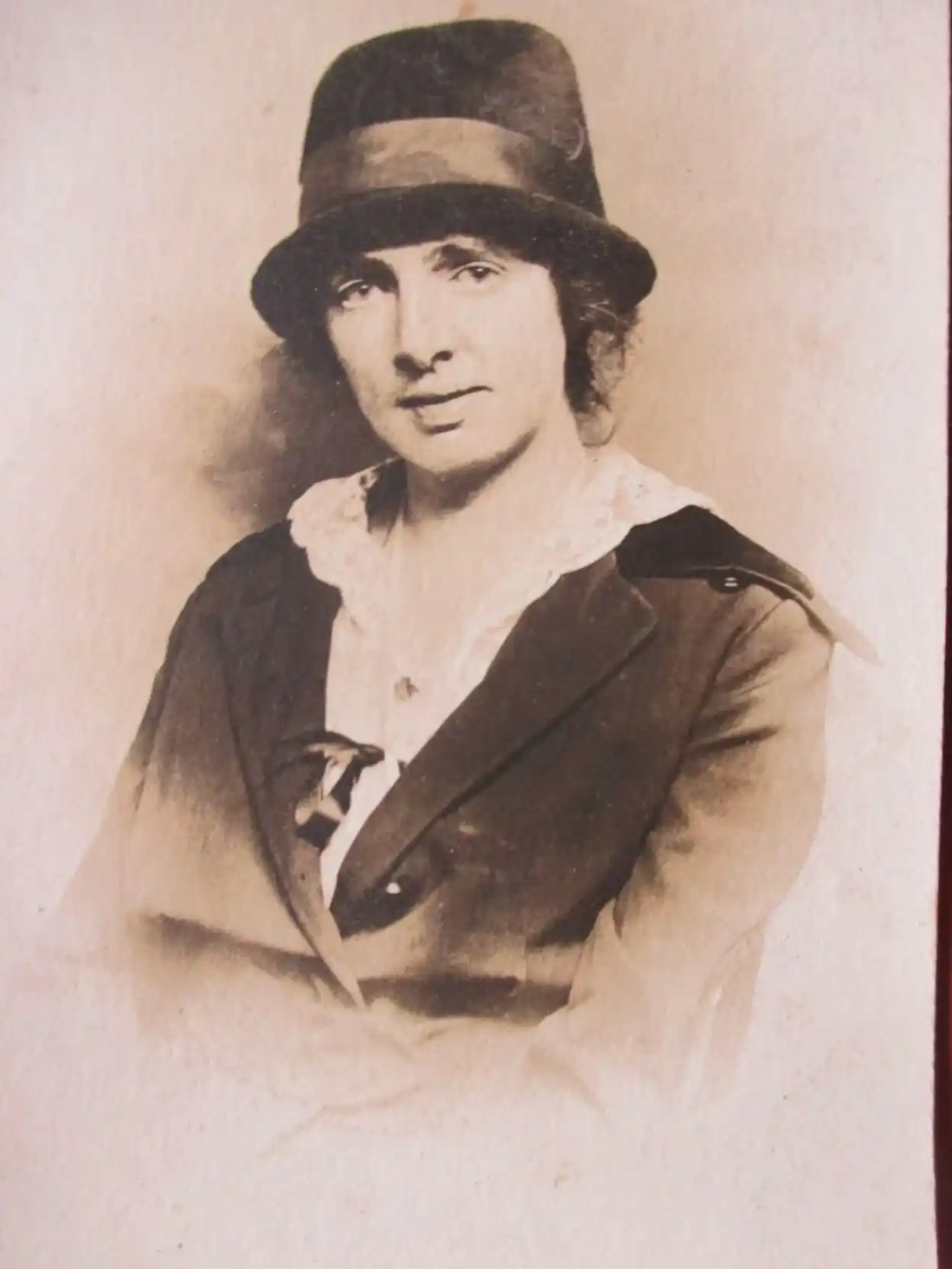
The time of this meeting was early in 1934. Mr. Lovecraft was living in Providence, Rhode Island, his native city. I was spending the winter with relatives there. A man who knew us both wanted us to become acquainted, and so it came about that one day Mr. Lovecraft climbed our doorsteps, rang out bell, and settled down on my aunt’s parlor sofa for a leisurely conversation.
—Dorothy C. Walter, “Three Hours with H. P. Lovecraft” in The Shuttered Room & Other Pieces 178

Lovecraft scholars are spoiled in the sense that so many of Lovecraft’s letters have survived. There are direct, primary source accounts of Lovecraft’s life and thought that are just absent from the majority of pulp writers or average individuals of the time when Lovecraft lived. This also means we have a large body of material to compare and contrast memoirs and anecdotes of Lovecraft’s life with; a way to evaluate the accuracy of recollections and see what a particular memoir actually adds to our understanding of Lovecraft’s life that his letters do not.

However, not everything made it into Lovecraft’s letters, or not all letters survive. There is, for example, no direct mention of Dorothy C. Walter or any meeting with her in Lovecraft’s extant correspondence. That doesn’t necessarily mean that the meeting didn’t happen or that Walter made it up, as is suspected with “The Ten-Cent Ivory Tower” (1946) by John Wilstach or “The Day He Met Lovecraft” (1972) by Lew Shaw. It does mean that we need to examine the content of Walter’s memoir carefully to evaluate the plausibility of the scenario and confirm and corroborating details.

In the opening to her memoir, Walter claims her meeting with Lovecraft occurred in “early 1934.” Lovecraft spent two weeks in New York City with friends after Christmas, returning to Providence on January 9th. Walter adds a further detail:

[…] I took my turn tending an exhibit of distinguished paintings of bird-life being shown that week by my aunt’s pet project, the Audubon Society, at the John Hay Library […]
—Dorothy C. Walter, “Three Hours with H. P. Lovecraft” in The Shuttered Room & Other Pieces 182

The Calendar of Events January 1934 for Brown University shows that from 9 – 23 January, the John Hay Library at Brown University hosted “Paintings of North American Birds by Rex Brasher under the auspices of the Audu­bon Society.” So that’s a good corroborating detail; it shows that Walter was at least in the right place at the right time, and narrows down the scope of when the visit could have occurred. Her memoir also emphasizes the extreme cold of that January, which called Lovecraft to beg off his first appointment to visit. Lovecraft was particularly sensitive to cold due to some undiagnosed circulatory issue, and this jives with behavior and observations in Lovecraft’s letters for January 1934, which contain passages like this:

I envy you your climate—we’re having a cold spell, so that I haven’t been out of the house for three days.
—H. P. Lovecraft to R. H. Barlow, [31 Jan 1934], O Fortunate Floridian 103

So while we don’t have explicit reference to Lovecraft visiting with Dorothy C. Walter some Sunday afternoon in mid-to-late January in his letters, such a visit is certainly very plausible.

To play devil’s advocate for a moment; the main reason to suspect the authenticity of Walter’s memoir, besides the lack of mention in HPL’s letters, is that the memoir is embellished with some additional research which may have skewed or informed her depiction of Lovecraft. Walter had written about Lovecraft previously in “Lovecraft and Benefit Street” (1943), and letters and papers at the John Hay Library show she was somewhat active in the early Lovecraft studies from shortly after Lovecraft’s death through the early 1960s, in part through her connection with Lovecraft’s friend W. Paul Cook (whom she claims encouraged her to meet with Lovecraft). It is clear reading her “Three Hours with H. P. Lovecraft” that some of her information was derived from Cook and/or his memoir  “In Memoriam” (1941), including the anecdote with the kitten:

“Lovecraft, you know, prefers to write at night. He is also passionately devoted to cats. I suppose he knows every Tabby and Tom in Providence and loves them all.

“Years ago when I was living in Massachusetts and he was visiting me, I asked him to write an article on the Supernatural in Literature for the magazine I was getting out. He did it too—to the Queen’s tatste—but that’s not the story. Knowing his nocturnal habits, I settled him at my desk to make a start on it, when the lateness of the hour forced me off to bed to be ready to pull out and go to work next day. Just before I left him, I dropped a half-grown kitten into his lap. he was delighted. In no time at all the little cat was curled up comfortably, safe in the presence of a friend.

“Next morning I found Howard sitting exactly as I had left him—not one scratch on his paper, the kitten still asleep in his arms. And when I remonstrated because he hadn’t got on with my article, he replied, ‘But I didn’t want to disturb kitty!’
—Dorothy C. Walter, “Three Hours with H. P. Lovecraft” in The Shuttered Room & Other Pieces 189

The two versions of the anecdote aren’t identical, but it’s clear that Walter wasn’t above repeating second-hand material to pad out her brief hours with Lovecraft. In truth, aside from the fact of the encounter itself, there really isn’t much new information about Lovecraft that is contained in Walter’s memoir, no major surprises in thought or action, just a confirmation of Lovecraft’s habits as he himself maintained and as seen by someone outside his normal circle and a couple brief anecdotes. Better to have it than not, but easy to overlook among more substantial or provocative memoirs like The Private Life of H. P. Lovecraft (1985) by Sonia H. Davis.

Which is perhaps, as it should be. Not a great deal can be expected from a three-hour visit, nor did it develop into the kind of friendship and correspondence that Lovecraft had with other women. It was one of many social calls that were part of the life of old New England, even into the 1930s.

Soon after his call I went back to my home in Vermont, remaining away from Providence for several years. By the time I returned, Mr. Lovecraft was dead.
—Dorothy C. Walter, “Three Hours with H. P. Lovecraft” in The Shuttered Room & Other Pieces 178

Based on a letter from August Derleth dated 2 Nov 1959, Walter was concerned about misprints in “Three Hours with H. P. Lovecraft.” These concerns were apparently well-founded, as in a letter to Derleth dated 9 Jul 1960, Walter points out several misprints and a dropped line. Derleth’s reply dated 13 Jul 1960 was apologetic, but the damage was done. After initial publication in The Shuttered Room & Other Pieces (1959), “Three Hours with H. P. Lovecraft” was reprinted in Lovecraft Remembered (1998) and Ave Atque Vale (2018), retaining the same errors, and was translated into German for Das schleichende Chaos (2006).

Perhaps, when it is reprinted again, some kindly editor might fix the errors that Walter felt plagued the piece.


Bobby Derie is the author of Weird Talers: Essays on Robert E. Howard and Others and Sex and the Cthulhu Mythos.

Deep Cuts in a Lovecraftian Vein uses Amazon Associate links. As an Amazon Associate I earn from qualifying purchases.