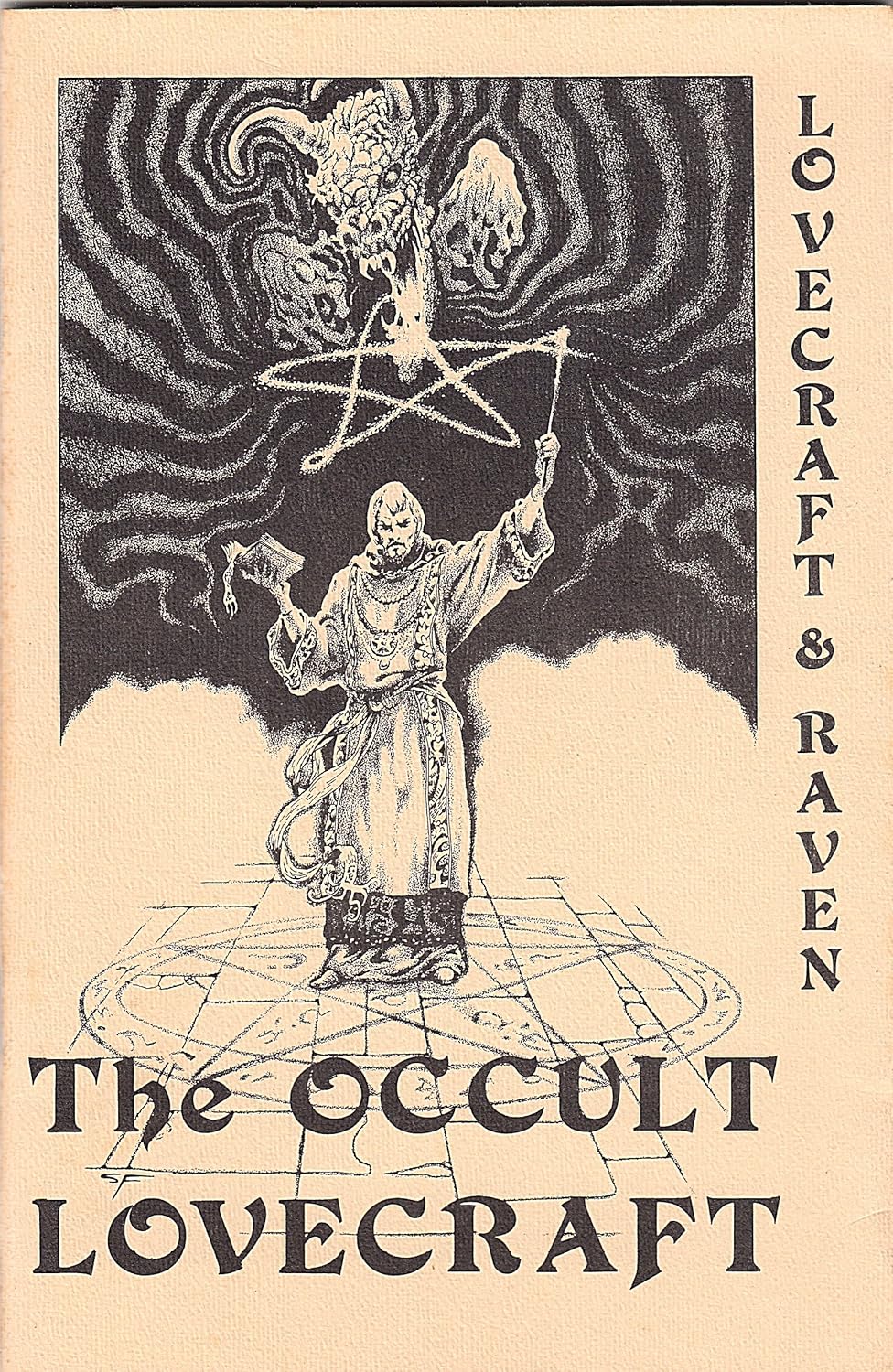
“Of Gold and Sawdust” (1975) by Samuel Loveman

Antisemitism

The following article deals explicitly with antisemitism in a historical context. Frank discussion of these matters requires the reproduction of at least some samples of antisemitic speech from historical sources (e.g. Lovecraft’s letters). As such, please be advised before reading further.


“American literature has produced three great writers of terror fiction: Edgar Allan Poe, Ambrose Bierce and Howard Phillips Lovecraft. It has been my good fortune—certainly, no inconsiderable one—to have been on intimate terms with tow of these: Ambrose Bierce and Howard Phillips Lovecraft.
—Samuel Loveman, “Howard Phillips Lovecraft” in The Arkham Sampler (Summer 1948)

For a matter of three years and more I was actually in daily association with him—years of plenitude and literary activity; years of happiness. I can safely assert that Lovecraft’s conversation takes its place among the masters of that brilliant but difficult art.
—Samuel Loveman, “Lovecraft as a Conversationalist” in the Howard Phillips Lovecraft Memorial Symposium (1958)

During that period I believed Howard was a saint. Of course, he wasn’t. What I did not realize (or know) was that he was an arrant anti-Semite who concealed his smouldering hatred of me because of my taint of Jewish ancestry. It would be impossible for me to describe the smug, cloaked hypocrisy of H.P.L.
—Samuel Loveman, “Of Gold and Sawdust” in The Occult Lovecraft (1975), 22

H. P. Lovecraft came into contact with Samuel Loveman (1887-1976) in 1917; the two shared a love of poetry and Classical themes, and with their correspondence, Loveman was drawn back into amateur journalism.

Loveman has become reinstated in the United through me. Jew or not, I am rather proud to be his sponsor for the second advent to the Association. His poetical gifts are of the highest order, & I doubt if the amateur world can boast his superior.
—H. P. Lovecraft to Rheinhart Kleiner, 8 Nov 1917, LRK 93

Lovecraft’s antisemitism, so adamant when speaking about the faceless, anonymous mass of Jews as a people, often broke down at the individual level. Loveman and Lovecraft became close friends, and their acquaintence brought Lovecraft into contact with the poet Hart Crane and his circle. In her memoir, Sonia H. Greene claimed that when she wished to prove to Lovecraft that his antisemitic prejudices were bunk, she invited both HPL and Loveman to New York. During the period of Lovecraft’s marriage and inhabitation of New York (1924-1926), the two were closely associated, sometimes seeing one another on a daily business, and for a time were neighbors at 169 Clinton Street. When thieves broke into Lovecraft’s apartment and stole his clothes and his wife’s suitcase, they also stole an expensive radio set that Loveman had secured with HPL.

Loveman and Lovecraft did not always move in exactly the same circles, however. For one, Loveman was a working bookman, always either employed or operating as a bookseller on his own account, while Lovecraft perpetually failed to find gainful employment. For two, Loveman was gay, a fact that Lovecraft never directly alludes to (and possibly was ignorant of); Loveman’s homosexual affairs are absent in Lovecraft’s letters, and largely only became more widely written about in later decades. After Lovecraft left New York, their lives drew apart, though they seem to have remained in correspondence until Lovecraft’s death.

For the next few decades, Loveman was a bookman. He developed a somewhat infamous reputation for his fanciful catalogues and a few inept attempts at forgery. As Lovecraft’s posthumous star waxed, Loveman produced three memoirs of his friend: the largely laudatory “Howard Phillips Lovecraft” (1948) that barely mentions Lovecraft’s xenophobia in New York, the anecdotal “Lovecraft as a Conversationalist” (1958), and the much more barebones and critical “Gold and Sawdust” (1975), written near the end of his life and addressing, for essentially the first time in print, his reaction to Lovecraft’s antisemitism.

So what changed Loveman’s attitude?

During Lovecraft’s lifetime, he had several Jewish correspondents, including Sonia H. Greene, Adolphe de Castro, Robert Bloch, Julius Schwartz, and Kenneth Sterling. While Lovecraft was an antisemite, these people were still his friends and loved ones; as such, his letters to them are notably absent of anti-Jewish sentiments. Even when Lovecraft was discussing the Nazis with a teenaged Robert Bloch in late 1933, HPL was careful to talk around certain issues, never once mentioning Jews or the Nazis’ antisemitic policies directly, e.g.:

Regarding the defeat of disproportionate cultural & standard-building influence by sharply-differentiated minority-groups—here again we have a sound principle misinterpreted & made a basis for ignorant, cruel, & fatuous action. There is of course no possible defence of the policy of wholesale confiscation, de-industrailisation, & (in effect) expulsion pursued toward groups of citizens on grounds of ancestral origin. Not only is it barbaric in the hardship it inflicts, but it involves a faulty application of ethnology & anthropology. However—this does not obscure the fact that there is always a peril of the concentration of disproportionate power & articulateness in the hands of non-representative & alien-minded minorities—whether or not of alien birth or blood. Cases are very numerous where small groups of especially active & powerful thinkers have tacitly & gradually secured a “corner” on expression & value-definition in nations widely different from themselves in natural instincts, outlook, & aspirations.
—H. P. Lovecraft to Robert Bloch, [late October 1933], LRB 82-83

Lovecraft’s surviving letters to Loveman are few and end in 1927, so we don’t know exactly how or if HPL discussed the Nazis with his other Jewish friend, but based on his letters to Bloch et al., it seems reasonable to assume that HPL was careful to never give his friend offence on account of his Jewish ethnicity. It is quite possible that at the time of Lovecraft’s death in 1937, Loveman had no idea of Lovecraft’s real thoughts about the Nazis during Hitler’s rise to power, or the discussions he had with others as the antisemitic policies began to go into effect. If Loveman did have any idea about Lovecraft’s antisemitism, it likely came from his friendship with Sonia H. Davis, Lovecraft’s ex-wife.

In the mid-1940s, as WW2 was coming to a close, Loveman was contacted by early Lovecraft biographer Winfield Townley Scott, who was looking for data. Loveman pointed Scott at Sonia, and between Scott’s article and Sonia’s memoir, she seems to have come into correspondence with Loveman again; at least, there are some letters between the two dated 1947. Sonia had been in correspondence with August Derleth, who attacked her memoir and claims of Lovecraft’s prejudice, keeping in mind that this was in the immediate aftermath of the Holocaust. Sonia vented her spleen a little to Loveman:

In his Marginalia he is all wrong in stating how much older I am than HP, also that our divorce was the result of HP’s inability to write for money or his lack of desire to write for money. None of this is true. I carried a handsome salary at the time and provided many things for him. I did not leave him on account of non-providence, but chiefly on account of his harping hatred of J__s.
—Sonia Davis to Samuel Loveman, 4 Jan 1948, JHL

This is likely why Loveman wrote:

Her treatment by H.P. L. was, whether consciously or unconsciously, cruel. His anti-Semitism formed the basis for their eventual divorce. Howard’s monomania about race was about as close to insanity as anything I can think of.
—Samuel Loveman, “Of Gold and Sawdust” in The Occult Lovecraft (1975), 22

Elsewhere, Sonia wrote:

But I told him this very soon after we met; especially when he remarked that it was too bad that Samuel Loveman was a Jew.
—Sonia Davis to Winfield Townley Scott, 24 Sep 1948, JHL

This is presumably the source for when Loveman wrote:

Lovecraft had a hypocritical streak to him that few were able to recognize. Sonia, his wife, was indubitably his innocent victim. her love for him blinded her to many things. Among the things he said to her was, “Too bad Loveman’s a Jew; he’s such a nice guy.”
—Samuel Loveman, “Of Gold and Sawdust” in The Occult Lovecraft (1975), 22

This kind of context was important because Loveman had relatively little save his own memories of Lovecraft to go by when he wrote his first memoir of Lovecraft, published in 1948. He wrote to Derleth:

I look forward to the publication of the letters [of Lovecraft] with a great deal of eagerness. I have practically nothing at all, or I would have tend[er]ed them to you. All my material was either destroyed or confiscated when I left Cleveland for New York.
—Samuel Loveman to August Derleth, 1 Dec 1949,
quoted in Letters to Maurice W. Moe & Others 29

How Loveman lost most of his letters from Lovecraft isn’t clear, but in the 1940s Loveman purchased several hundred pages of letters that Frank Belknap Long, Jr. had received from Lovecraft; HPL’s letters were already becoming collectors’ items. When Loveman wrote his second memoir of Lovecraft in 1958, this material was presumably available, but perhaps Loveman had not taken the time to read through several hundred pages of his friend’s infamous handwriting when approached for a brief memoir.

So what happened between 1958 and 1975 that caused Loveman to write:

The one last letter of his I have fills the bill, and a hundredfold more! It advocates the extinction of the Jews and their exclusion from colleges. The letter was written to a partner of W. Paul Cook, who published my books, “The Sphinx” and “The Hermaphrodite.”
—Samuel Loveman, “Of Gold and Sawdust” in The Occult Lovecraft (1975), 22

The unnamed “partner” would be Walter J. Coates, an amateur journalist and small press publisher during the 30s; Coates’ letters from Lovecraft had apparently also passed through Loveman’s hands. Several of Lovecraft’s letters to Coates appear to be in private hands or lost, so the exact statements that Loveman found so damnable are not widely available. However, a letter from Lovecraft to Coates contains several of these sentiments:

Undeniably—all apart from the effects of natural change and altered philosophic-scientific-psychological perspective—the world of American taste & opinion is distinctly & lamentably Jew-ridden as a result of the control of publicity media by New York Semitic groups. Some of this influence certainly seeps into Anglo-Saxon critical & creative writing to an unfortunate extent; so that we have a real problem of literary & aesthetic fumigation on our hands. The causes are many—but I think the worst factor is a sheer callous indifference which holds the native mind down to mere commercialism & size & speed worship, allowing the restless & ambitious alien to claim the centre of the intellectual stage by default In a commercialized civilization publicity & fame are determined by economic causes alone—& there is where the special talents of Messrs. Cohen & Levi count. Before we can put them in their place, we must de-commercialise the culture—& that, alas, is a full-sized man’s job! Some progress could be made, though, if all the universities could get together & insist on strictly Aryan standards of taste. They could do much, in a quiet & subtle way, by cutting down the Semite percentage in faculty & student body alike.
—H. P. Lovecraft to Walter John Coates, [mid-October? 1929], LWH 121

The date is uncertain, but the sentiments are in keeping with some of Lovecraft’s other letters. It followed Lovecraft’s time in New York, when he was most vociferous about the city and its Jewish population. The idea that Jews exerted an outsized influence on national media was one that Lovecraft apparently picked up in New York and retained in follow years, and unfortunately dovetailed with Nazi propaganda. Similar-though-not-identical statements appear in some of Lovecraft’s letters from 1933 and ’34, though this is the most explicit instance where Lovecraft suggests censorship of Jews from universities and academia.

The title of Loveman’s final essay, “Of Gold and Sawdust,” echoes a famous statement from W. Paul Cook’s “In Memoriam: Howard Phillips Lovecraft” (1941), on Lovecraft’s return to Providence after his stint in New York—a frustrating period which had seen Lovecraft married, separated, failed to find employment, robbed, and utterly miserable by the end of it, but had matured somewhat as a writer with his best work ahead of him, still to be written—”He had been tried in the fire and came out pure gold.”

These were happy days when I believed H.P.L. was pure gold—not sawdust!
—Samuel Loveman, “Of Gold and Sawdust” in The Occult Lovecraft (1975), 21

What Loveman’s final essay—really, his final word—on Lovecraft captures is the sense of betrayal. These were two men who had been intimate friends, through thick and thin, who had dedicated poems to each other (cf. “To Mr. Theobald” (1926) by Samuel Loveman), who were, if far from agreeing on every subject, at the least open and accepting of differences of opinion. In the 1920s and 30s, when antisemitism was so rife in the United States and rising abroad, there was likely a bit of trust there, that at least Lovecraft was different. Maybe (we don’t know, unless Loveman’s letters to Sonia surface), he even doubted Sonia’s initial claims regarding Lovecraft’s antisemitism, since they didn’t match his own memories.

Then the letters came into his hands that gave undeniable proof.

There is a broader context that Loveman missed, having not lived long enough to see the publication of more of Lovecraft’s correspondence than the first volumes of the Selected Letters from Arkham House. He did not see where Lovecraft’s antisemitism began or where it ended, did not see how and why Lovecraft’s prejudices changed over time and in response to personal and world events. Would it have made any difference? “Of Gold and Sawdust” is the cry of a wounded soul, of memories forever poisoned by the thought that in his heart, Lovecraft had hated Loveman just because he was a Jew.

Lovecraft’s letters do not speak of hatred for his friend Sam Loveman. Imperfect as Lovecraft was, he was loyal in his appreciation for Loveman as a friend and poet. That makes “Of Gold and Sawdust” especially bittersweet; there is no reply that Lovecraft could make, no apology, no way to mend the hurt he had inadvertently caused. While Lovecraft’s friends are all dead, it is a feeling that echoes in the lives of many fans who, wanting to learn more about this Lovecraft person and their stories, finds out about his prejudices. It is something we all have to come to terms with, each in our own way.

“Of Gold and Sawdust” was published in The Occult Lovecraft (1975). It has not been reprinted.


Bobby Derie is the author of Weird Talers: Essays on Robert E. Howard and Others and Sex and the Cthulhu Mythos.

Deep Cuts in a Lovecraftian Vein uses Amazon Associate links. As an Amazon Associate I earn from qualifying purchases.
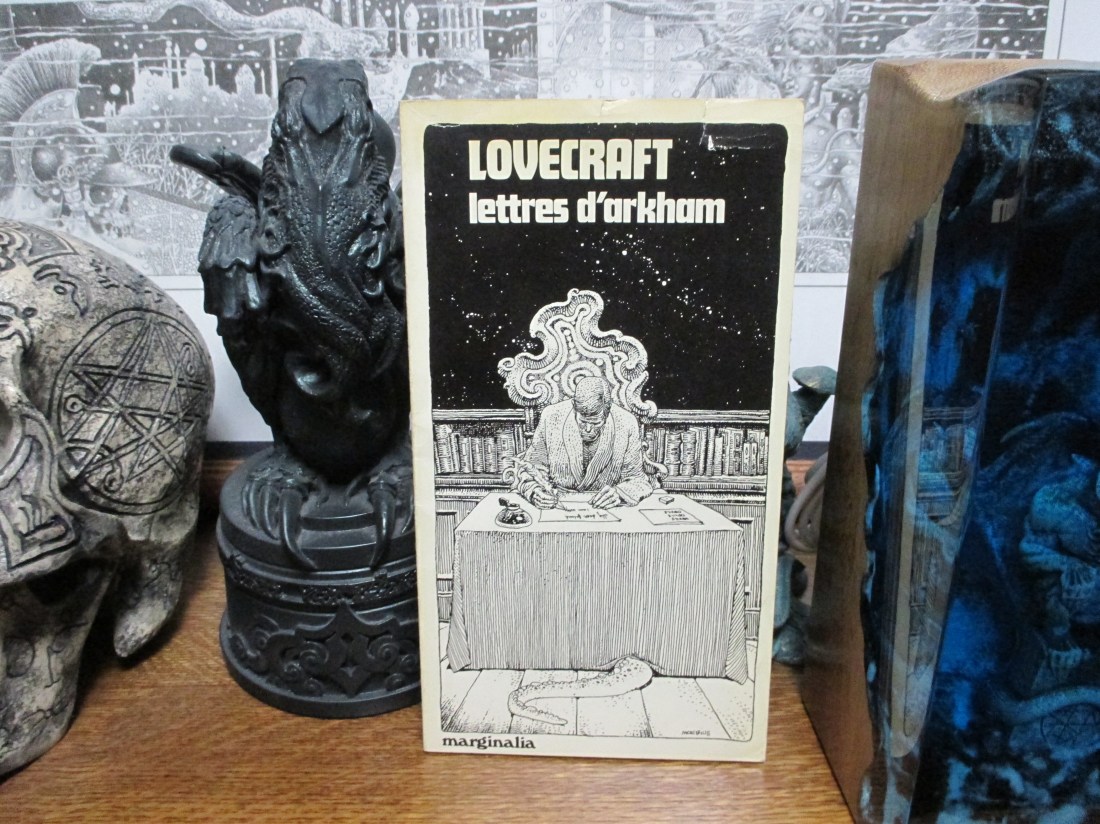
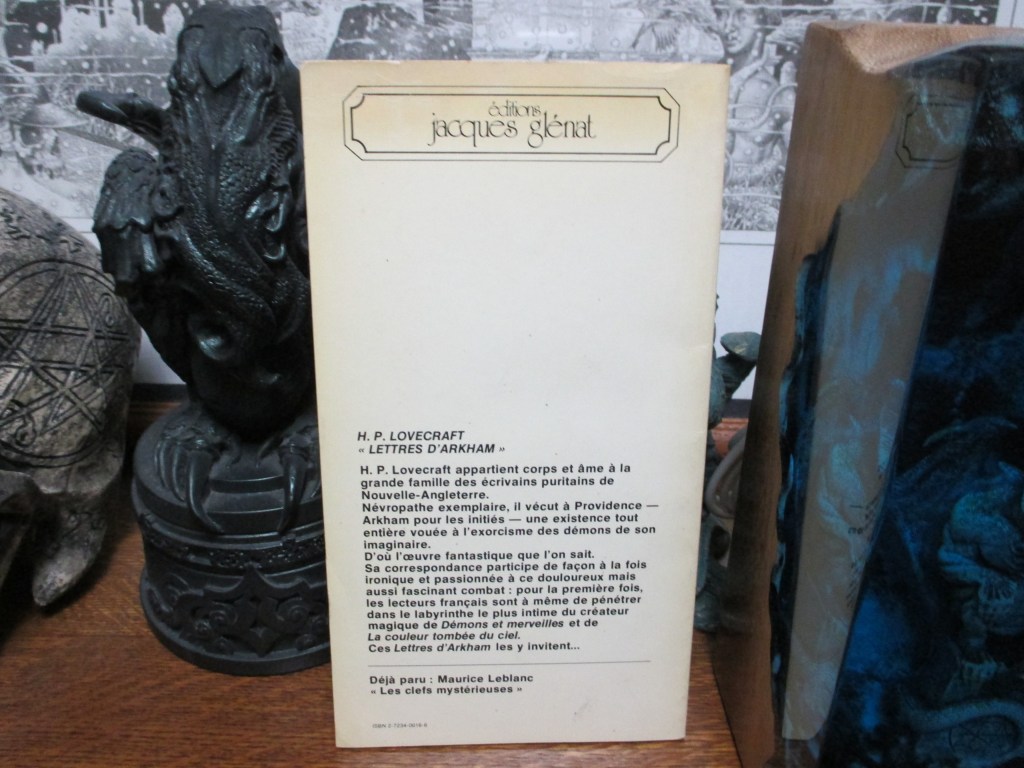
Lettres d’Arkham (1975) by H. P. Lovecraft & François Rivière

H. P. Lovecraft appartient corps et âme à la grande familie des écrivains puritans de Nouvelle-Angleterre.

Névropathe exemplaire, il vécut à Providence—Arkham pour tes initiés—une existence tout entière vouée à l’exorcisme des démons de son imaginaire.

D’où l’œuvre fantastique que l’on sait.

Sa correspondance participle de façon à la fois ironique et passionnée à ce douloureux mais aussi fascinant combat : pour la première fois, les lecteurs français sont à même de pénetrer dans le labyrinthe le plus intime du créateur magique de Démons et merveilles et di La coouleur tombée du ciel.

Ces Lettres d’Arkham les y invitent…
H. P. Lovecraft belongs body and soul to the great family of New England Puritan writers.

Exemplary neurotic, he lived in Providence—Arkham for the initiates—a life entirely devoted to exorcising the demons of his imagination.

Hence the fantastic work we all know.

His correspondence is an ironic and passionate contribution to this painful but fascinating struggle: for the first time, French readers are able to penetrate the most intimate labyrinth of the magical creator of Démons et merveilles and La coouleur tombée du ciel.

These Letters from Arkham invite them to do so…
Back cover copyEnglish translation

French audiences may have been aware of H. P. Lovecraft as early as the 1930s, when English-language books and periodicals made it to European shores; Jacques Bergier even claimed to have carried on a brief correspondence with Lovecraft, and he certainly had two letters published in the pages of Weird Tales despite living in France at the time.

Lovecraft’s major introduction to French audiences came in the 1950s with collections like La couleur tombée du ciel (“The Color from the sky”/”The Colour Out of Space”) [1954, Denoël], and Démons et merveilles (“Demons and Marvels”) [1955, Deux Rives] that translated Lovecraft’s prose into French. Both of included introductions from Bergier, who provided many readers with their first insight into Lovecraft himself—who he was, and where he came from. Both books went through many reprints and editions.

In 1964, Arkham House published the first volume of Lovecraft’s Selected Letters. This project had begun shortly after Lovecraft’s death in 1937, as August Derleth and Donald Wandrei had begun contacting Lovecraft’s correspondents and requesting letters to transcribe for future publication. The scope and cost of the project soon made actual publication of the Arkham House Transcripts—at least in their entirety—impractical; war time paper rationing and rising post-war costs delayed the project further. The first three volumes, released under the editorship of Derleth and Wandrei, represent a compromise to their original vision—but also a tremendous effort, and one nearly unique.

Lovecraft had died broke and was far from a popular or mainstream author; the publication of his letters not only kick-started real Lovecraft biographical scholarship and literary criticism, but it helped center Lovecraft himself as an individual worth reading. More of Lovecraft’s letters would be published than those of Ernest Hemingway, Dashiell Hammett, or dozens of other much more popular authors.

Of course the French had to get in on the action.

Early translations of Lovecraft’s letters into French began piecemeal, in literary and fan periodicals; the biography is a bit opaque to English-language readers living in the United States, but a special issue of L’Herne dedicated to Lovecraft in 1969 stands out for translating a few letters, amid a mass of literary and biographical material that marks the first major critical publication on Lovecraft in any language. The 1970s in France would see growing interest in Lovecraft, especially in the field of Franco-Belgian comics; the contributors of Metal Hurlant (“Howling Metal,” translated into English markets as Heavy Metal magazine), which began in 1974, was founded by Jean Giraud (Mœbius) and Philippe Druillet, both of whom would go on to fame…and through Metal Hurlant, many graphic adaptations of Lovecraft’s stories, and stories inspired by Lovecraft and his creations, would be published in the pages of Metal Hurlant and Heavy Metal, to audiences around the world.

Lettres d’Arkham (1975, Jacques Glénat), translated by François Rivière, is a slim booklet of 80 pages, counting all the introductory material. The cover is by Mœbius, and plays to Lovecraft’s legend: seated at a table, writing with a quill pen, a row of antique volumes behind him, against a starry landscape, a tail or tentacle discreetly emerging from beneath the table cloth.

Jacques Glénat had founded Glénat Éditions in 1972; it is now a major publisher of bandes dessinées, and also publishes French translations of manga and nonfiction periodicals. But this was early days, and Lettres d’Arkham was the second entry in a series titled Marginalia; the first was a reprint of Les clefs mystérieuses (“The Mysterious Keys”) by Maurice Leblanc, the creator of Arsène Lupin. This was apparently an experiment in shorter-form material, mostly fiction reprints, with Rivière as overall editor of the series. Lettres d’Arkham appears to be the sole non-fiction entry.

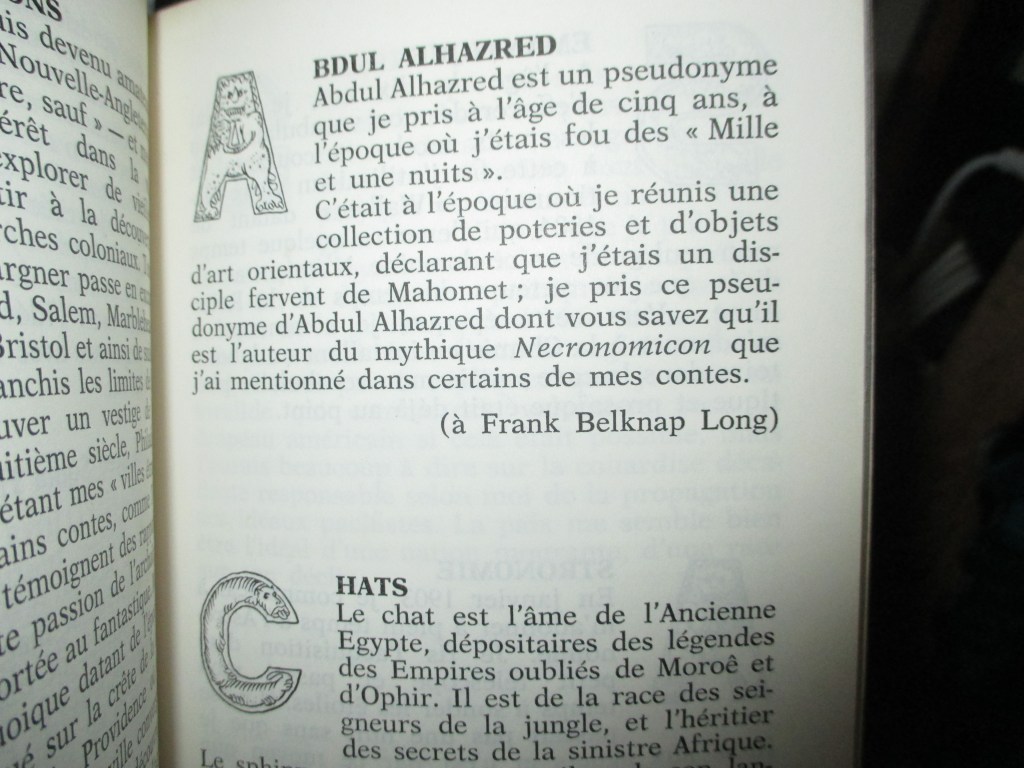
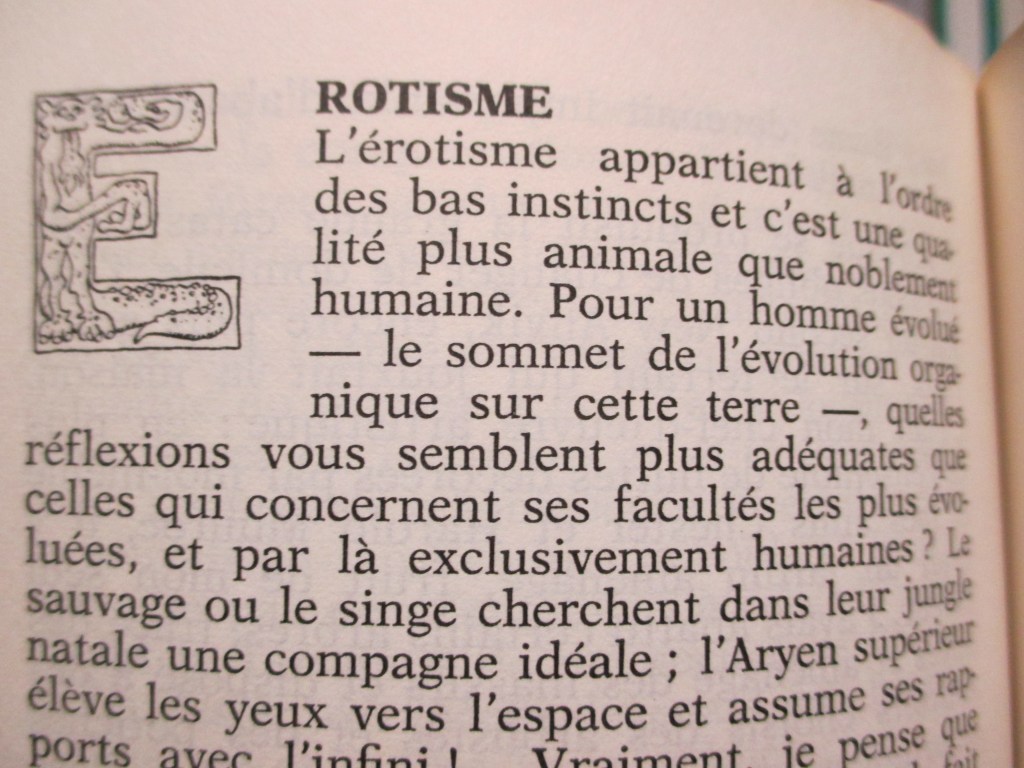
Given the short format, Yves Rivière apparently opted against trying to translate entire letters. Instead, after a brief initial essay (“Lovecraft, un cauchemar Américan”/”Lovecraft, an American nightmare”) and chronology of his life, Rivière presents a series of excerpts from the first two volumes of the Selected Letters, divided into individual topics.

The initial letters, reminiscent of illuminated manuscripts, were created by the artist Floc’h (Jean-Claude Floch), who would become known for his many collaborations with François Rivière.

Most of the translations don’t specify date or even the recipient of the letter, so from a scholastic viewpoint Lettres d’Arkham wasn’t ideal—but translating one of Lovecraft’s letters is more difficult than translating one of his stories or poems. There is no guiding narrative, the letters are full of quirky language, obscure topical and geographic references, callbacks to previous correspondence. Even though Derleth and Wandrei had already edited and censored Lovecraft’s letters to give the excerpts in the Selected Letters volumes better readability (and to remove or downplay some of Lovecraft’s more racist sentiments), Rivière was trying to translate some pretty tricky material for an entirely new audience.

Generally speaking, Rivière seems to have done a pretty decent job of the translations. The most egregious errors are (and this might be expected), geographical. For example, the entry for Salem places it in New York instead of Massachusetts. Still, for a Lovecraft fan in 1970s France, how else were you going to read any of Lovecraft’s letters at all?

For francophone readers, that is still an issue. The vast majority of Lovecraft’s letters have never been translated into French, and might never be (one can only imagine the difficulty of trying to translate some of Lovecraft’s slang-filled letters or stream-of-consciousness sections into French). Some further attempts have been made to present a part of Lovecraft’s correspondence to a French audiences: in 1978 there was Lettres Tome 1 (1914-1936), translated by Jacques Parson, for example, but there was no Lettres 2 forthcoming. Several other collections of part of Lovecraft’s letters have been published, especially in recent years, much of the correspondence from Lovecraft’s later years, and with friends like Clark Ashton Smith, August Derleth, C. L. Moore, Fritz Leiber, E. Hoffmann Price, and Robert E. Howard, remains untranslated.

There are people working on that last one, however. A translation of the correspondence of Robert E. Howard and H. P. Lovecraft into French by David Camus and Patrice Louinet was successfully crowdfunded, and although health issues have delayed the project, it still looks fantastic.

It has to be emphasized what a labor of love translation is; it is never simply a matter of translating word-for-word, but always trying to capture the essence of what is being communicated. English-language readers have an advantage over the French in that we have practically every word that Lovecraft has written published, but as he wrote them; French readers and scholars face not only a limited amount of such material, but have to deal with multiple translations of those same stories and letters in various formats.

Considering that the whole of Arkham House’s Selected Letters has never been translated, much less any of the later, more complete volumes of letters by Necronomicon Press or Hippocampus Press, Lettres d’Arkham remained relevant in France long past the point where most Lovecraft scholarship had superseded the Arkham House Selected Letters.


Bobby Derie is the author of Weird Talers: Essays on Robert E. Howard & Others (2019) and Sex and the Cthulhu Mythos (2014).

Robert E. Howard’s “Sword Woman” (1975): A Refusal of Roles by Sapphire Lazuli

Much discussion has been brought to light, in recent times, to ponder what it means to identify with a gender identity. Perhaps ponder is too gentle a word, these discussions have often been led by those who oppose the idea of gender nonconformity and thus are designed to diminish the credibility of those outside of the gender binary. “What is a woman?”—the question is asked tirelessly by this crowd in an attempt to quell the happening of gender nonconformity. It is often put forth as an idea that was only recently made blurry: 

… and now our culture is telling us that the differences between girls and boys don’t matter, that if you identify with something then you are that thing. (Walsh, What is a Woman 2022)

Gender is a concept that has grown and evolved over numerous cultures; the modern idea of one gender identity can seem a stark contrast to that of past times. Looking at gender across cultures brings difficulty to a single unified ideal. The idea of asking the question, “what is a woman?” is poised to be one of critical discourse, e.g.: 

… if I’m talking publicly about what a man or a woman is, I’m not going to give credence to an argument that has no biological or logical basis. It doesn’t make any sense. (Shapiro 2019) 

But there is quite an argument to be made that viewing gender as a single, unified concept is an uninformed idea.

I bring all this to light after having recently read through Robert E. Howard’s “Sword Woman,” a story I had suspected would fall victim to such uninformed ideas. Knowing of other pulp stories that had explored queer themes such as Fred Hayley’s Satan Was a Lesbian (1966), I had expected a tiring Mulan-type story with much less the feminine liberation and far more derogatory discussion of gender expression. Instead, “Sword Woman” allows its characters to explore an incredibly nuanced idea of what gender and expression can mean both within and outside of the perception of others. I was surprised to find such a story written in the 1930s at first, but this later served as a reminder of the queer happenings that this time period was littered with.

“Sword Woman” is a burning fire of feminine rage, gender exploration, and a hard, “who cares?” To the question of “what is a woman?” The story’s lead, Dark Agnes, finds themself on a murder spree, killing men time and time again as each threatens seizure of Agnes’ free will. Murder frees them from betrothal, from slavery, and from two attempted assassinations; Agnes begins the story a mere damsel in distress and ends it as a serrated blade, sharpened by the necks of those who would oppose them.

In exploring such a presentation of gender identity and expression, it is important to understand how gender has evolved over time. It is easy to think of gender as a single, static state tied to the presence of particular genitalia, though this has not always been the case for humanity. In fact, even where such ideas have been linked, the presentation of specific genders has changed drastically over time. 

In Paula Gunn Allen’s The Sacred Hoop: Recovering the Feminine in American Indian Traditions (1986), she writes about the nuance of gender in Native American cultures: 

In considering gender-based roles, we must remember that while the roles themselves were fixed in most archaic American cultures, with divisions of ‘women’s work’ and ‘men’s work’, the individuals fit into these roles on a basis of proclivity, inclination, and temperament. (Allen 1986)

This kind of gender expression, one which is determined by the individual’s own experience with their identity, is quite opposed to the modern conservative perception of gender, in which it is a defined state determined for the individual rather than by them.

This is where Robert E. Howard’s “Sword Woman” follows its approach to gender identity. The story centres around Dark Agnes, a character who whisks themself and anyone around them into a whirlwind explosion of feminine rage and tyranny. Agnes begins this story as a product to be owned; they are betrothed to a man named Francois and the thought leaves a revolting taste in their mouth. So, when their sister, Ysabel offers Agnes with the means “… to free herself. Do not cling by your fingers to life, to become as our mother, and as your sister…” (Howard 1979) by handing them a dagger, Agnes refuses the proposed suicide and instead murders Francois.

Agnes does a lot at this moment: not only are they shattering the chains that bind them to the ownership of men, but they are also leaching the masculine blood to take wholly as their own. As from this point onward, Agnes refuses their position as a woman; refuses being the key word here. Thrown to the side are their betrothal, the temptation for suicide, their placidity, even their feminine garbs are thrown into a river to be forgotten.  Agnes refuses everything that had once defined them and takes this moment to reinvent themself. It would have been easy for this moment to mirror the suffragettes and their seizure of the typically masculine roles, swapping one gendered cage for another, but instead, Howard allows Agnes a freedom of exploration that will go on to bring a new, personal definition of gender by the end of the story.

I have been referring to Agnes here with they/them pronouns, though it should be noted that Agnes is referred to with she/her pronouns in the book. I choose they/them here as I feel such pronouns better reflect who this character is; perhaps even he/him would be better fit, as Agnes themself proclaims at the book’s conclusion, “Remember, I am woman no more.” To which their comrade, Etienne Villiers, agrees, “[we are] brothers in arms” (Howard, 1979).

This proclamation taking place near the end of the story further cements how Agnes’ gender evolves throughout the story. As they continue their murder spree of dastardly men, Agnes finds themself constantly covered in blood. They make efforts to wash, though eventually, the blood that stains Agnes’ body sinks so deep into their skin that the blood of man and the blood of Agnes are one and the same. I hear an echo of the struggles that the Macbeths encountered after their murder of Duncan, “Will all great Neptune’s ocean wash this blood clean from my hand? No, this my hand will rather…” (Macbeth 2.2.75). Unlike Macbeth, however, Agnes takes in this stolen crimson stain with pride and sanity. It is as though they becomes more wholly themselves, the   more blood they leech.

Importantly, Agnes does not reject this gender identity. It is one that is somewhat thrust upon them, the idea of Agnes becoming a masculine figure is first proposed by Etienne Villiers who fears Agnes will be too recognisable by their father’s scouts dressed in their royal, feminine attire. However, the actual expression of Agnes’ identity as a masculine figure is one defined only by Agnes. Not once do they actually refer to themself as a man, only that they are no longer a woman. I think that it is poignant to point out that had this story been written today, Agnes would likely have aligned more with a non-binary gender identity rather than strictly male or female.

Agnes is the loudest voice when it comes to their newfound identity, often reminding Etienne, here they feel truly as they ought to be. Early after taking the masculine identity, Etienne jests, “By Saint Michele, in all my life I never saw a woman drain a flagon like that! You will be drunk, girl.” Which is met by Agnes’s cold reminder, “You forget I am a girl no longer,” (Howard, 1979) Interesting to note that they say girl here and not woman as they do come the conclusion, a reflection of their growth.

I think what is most pertinent here is the determination of gender. Understanding that gender can be determined not just at a singular point in one’s life, but rather at multiple points allows a much broader description of what gender is. Allen writes:

… the Kaska would designate a daughter in a family that had only daughters as a boy. When she was young, around five, her parents would tie a pouch of dried bear ovaries to her belt… and she would function in the Kaska male role for the rest of her life. (Allen 1986) 

We see here a clear presentation of gender as a fluid state, with an understanding of roles existing outside of biology. Here, gender seems to be focused more on the utilitarian aspect of the community. Dark Agnes’ gender identity is not unlike this determination. They take up their masculine identity as it is better fitted to the position they find themself in, and will later take a more personal position at their meeting with Guiscard de Clisson. 

Here, Agnes seeks to become a sword woman, to ride among men in the fields of battle. Only, this position they take ends in turmoil as their party is ambushed and killed. Absolutely we can understand that Agnes’ party’s deaths are not caused by their readoption of the female identity, but there is certainly a metaphorical message in that Agnes suffers when they return to the facade. This is where Agnes’s proclamation, “Remember, I am woman no more.” (Howard 1979) takes place, after losing their brothers in arms, after suffering in the position they had rejected in the beginning. 

It should not be ignored when this story was likely written either. The 1920s through to the 1930s were a period of much change; the world itself was both recovering from and about to enter a world war after all. And among all of this change, a woman named Lili Elbe had begun an exploration of her own gender identity.

Lili Elbe was the second trans woman ever to receive sex reassignment surgery ninety years ago in 1931. There is quite a lot to discuss with her story, but what is important here is the timing and widespread knowledge. Lili’s story, along with many others, should have been lost when the Institut für Sexualwissenschaft was burnt down by the Nazis in 1933, however, her semi-autobiographical book, Man Into Woman (now titled Lili: A Portrait of the First Sex Change), received an English publication in that same year. Along with this, her story featured heavily in German and Dutch Newspapers. Lili Elbe was no unknown figure; she had become quite the public idea by the time of her death in 1931.

There is currently no evidence to suggest this novel came into Howard’s hands, importantly, he does not mention it in his letters. That being said, I still find the existence of Lili Elbe and others like her at the time to be incredibly interesting. It is as though they are surrounding each letter of the page without needing to be there at all. Our society has been incredibly queer for a lot longer than it has often been thought to be, and stories such as this, alongside real-life events, help highlight that fact. Perhaps it is no wonder then that “Sword Woman” was so open to pushing the boundaries of what gender really is.

“Sword Woman” surprised me in ways I never would have thought it could. Often it is difficult to engage with literature from times past when so much of it constructs walls to keep ‘people like me’ on the outskirts. It is refreshing to encounter this story and leave with so few negative thoughts.

Howard’s exploration of gender is one of incredible nuance, never seeming to worry all that much about the perception of others. Instead, gender in Howard’s “Sword Woman” is an experience wholly for the individual, a definition that aligns itself so well with our current. Rather than ask the reader to question, “what is a woman?” Howard rejects the idea entirely, and states, in blood-red ink: gender is created only from the thread one chooses to sew.

While written by Robert E. Howard in the 1930s, “Sword Woman” was not published until 1975, and is still in copyright in the United States. This and other tales of Dark Agnes may be read in the Robert E. Howard collection Sword Woman and Other Historical Adventures (2011).

Works Cited

Allen, P. G. (1986). The Sacred Hoop: Recovering the Feminine in American Indian Traditions. 2015 reprint: Open Road Media.

Folk, J. (Director). (2022). What is a Woman? [Motion Picture].

Haley, F. (1966). Satan Was a Lesbian. 2018 reprint: CreateSpace Independent Publishing Platform.

Howard, R. E. (1979). Sword Woman. Berkley Books.

Lili Elbe, N. H. (2015). Lili: A Portrait of the First Sex Change. Canelo.

Shakespeare, W. (2015). The Complete Works of William Shakespeare. Barnes & Noble Inc.

Shaprio, B. (2019, April 9). An interview with Ben Shapiro: social justice, free speech and transgender pronouns. (P. Nieto, Interviewer) Retrieved from: https://www.laloyolan.com/opinion/an-interview-with-ben-shapiro-social-justice-free-speech-and-transgender-pronouns/article_229644e1-0052-58c0-a441-e47724c05c93.html


Sapphire Lazuli (she/they) is a writer of weird horror and perverted desires based in Australia. She draws on thier experiences as a trans woman of colour and a lesbian, often doing their part to bring more queer voices into the worlds she crafts.

Their prose is often described as beautifully poetic, and adjacent to the writer, Sapphire does not write stories that will hold your hand. Though,  be it cosmic entities appearing as places, gross and erotic explorations of the boundaries of form, or deep dives into the darkest ridges of the mind and desire, their horror is bound to allure you.

Twitter: @lazuli_sapphire

YouTube: @sapphicsapph

Blog: www.sapphirelazuli.com

Copyright 2023 Sapphire Lazuli