“Candlewax” (1990) by W. H. Pugmire & Ashleigh Talbot

Eldritch Fappenings
This review deals in part with artwork that includes nudity and/or sexuality explicit content.
As such, please be advised before reading further.


In the 1985 Christmas supplement to the fanzine Fungi, W. H. Pugmire‘s story “Candlewax” first saw publication. This was one of Pugmire’s earliest efforts at Mythos fiction, and is a part of his Sesqua Valley cycle—his own corner of Lovecraft country set in the Pacific Northwest, populated by characters like Simon Gregory Williams. While Pugmire would go on to write many more tales of Sesqua Valley, which have been collected and published in various volumes, “Candlewax” is one of the comparatively rarer tales, having been reprinted only a handful of times—and, most interestingly, in an illustrated edition.

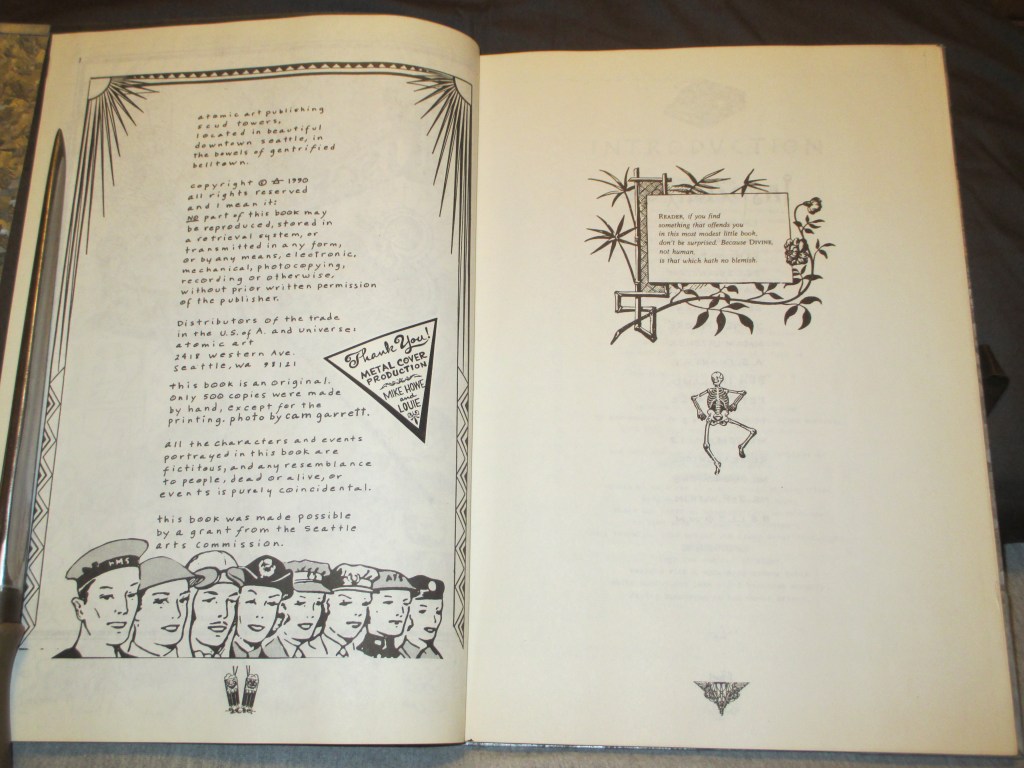
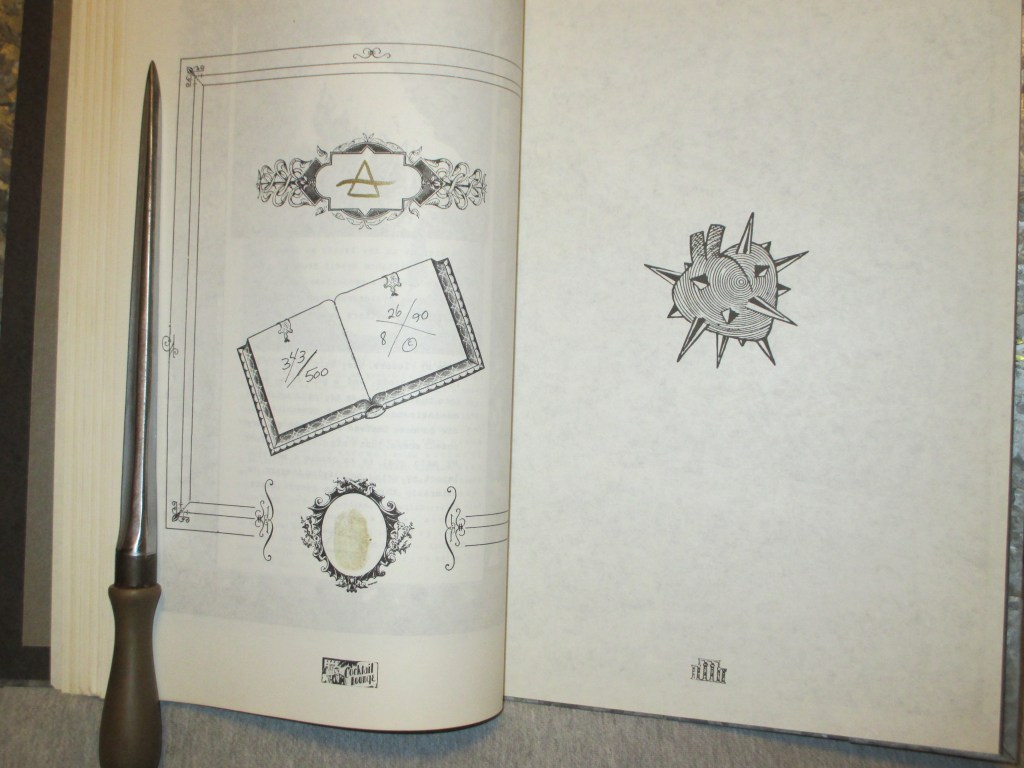
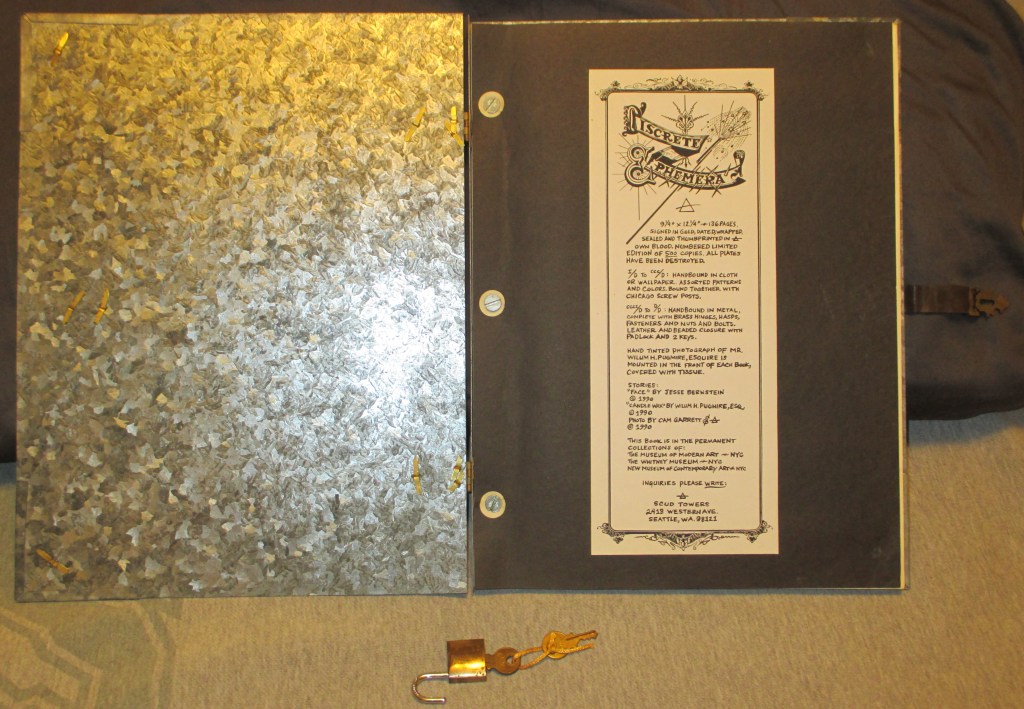
Discrete Ephemera (1990) is a limited edition (500 copies) book art project by Ashleigh Talbot, and illustrated texts by Steven J. Bernstein (“Face”) and W. H. Pugmire (“Candlewax,” as “W. F. Pugmire”), made possible by an art grant. Madame Talbot is presented throughout via a symbol:

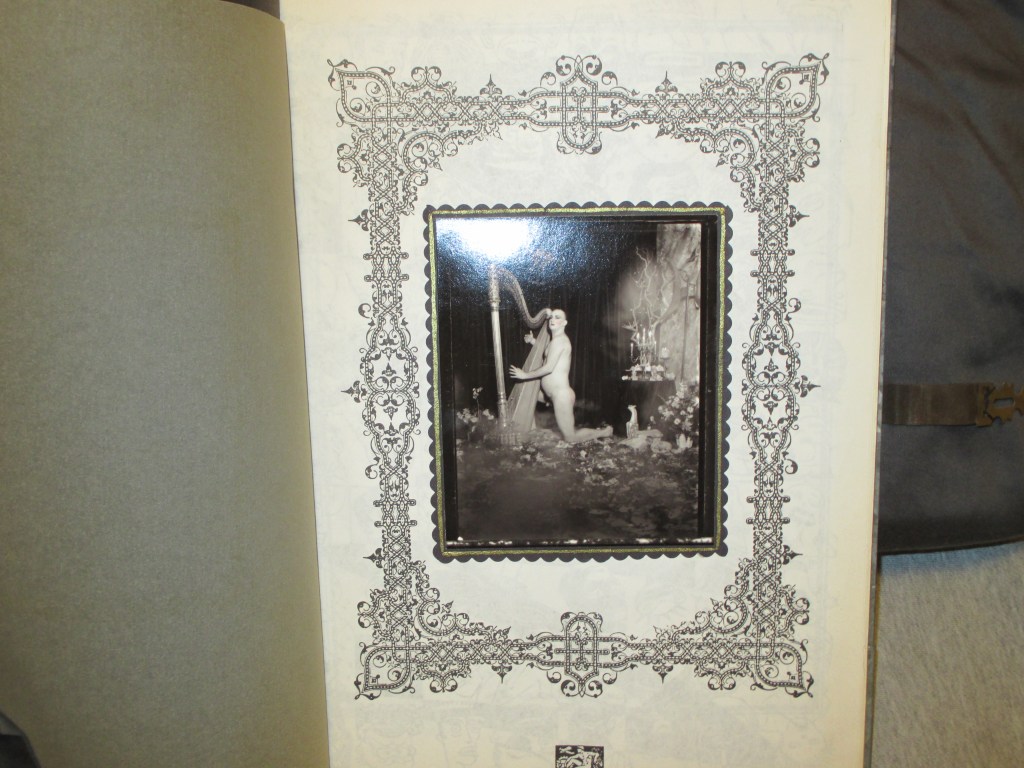
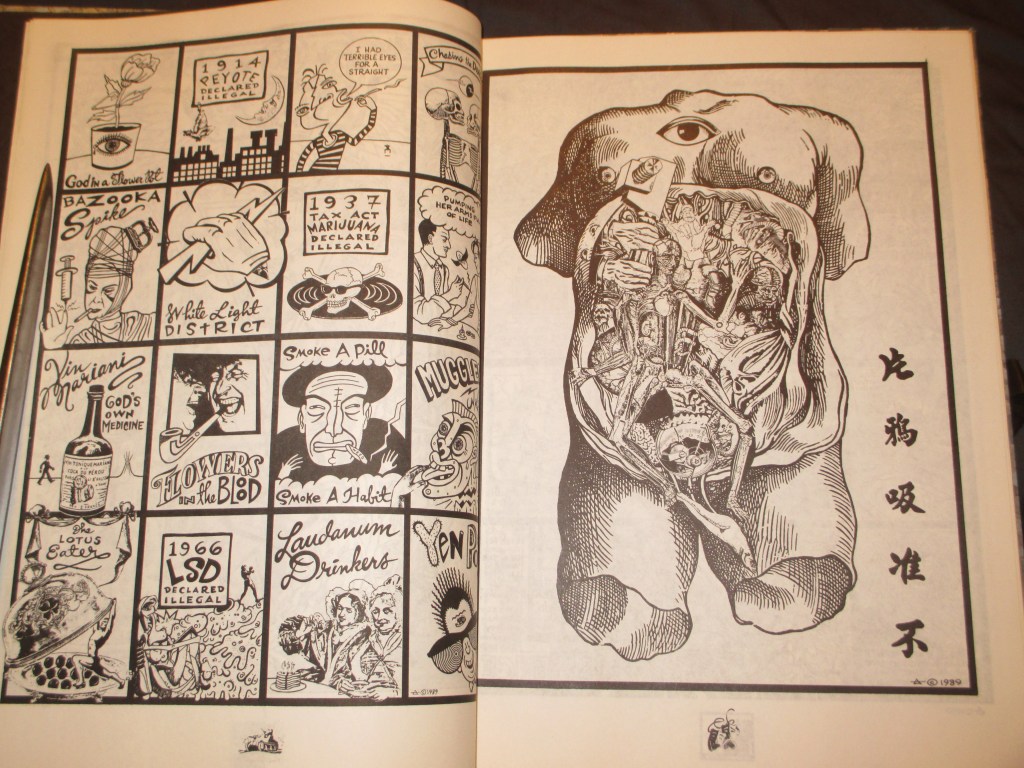
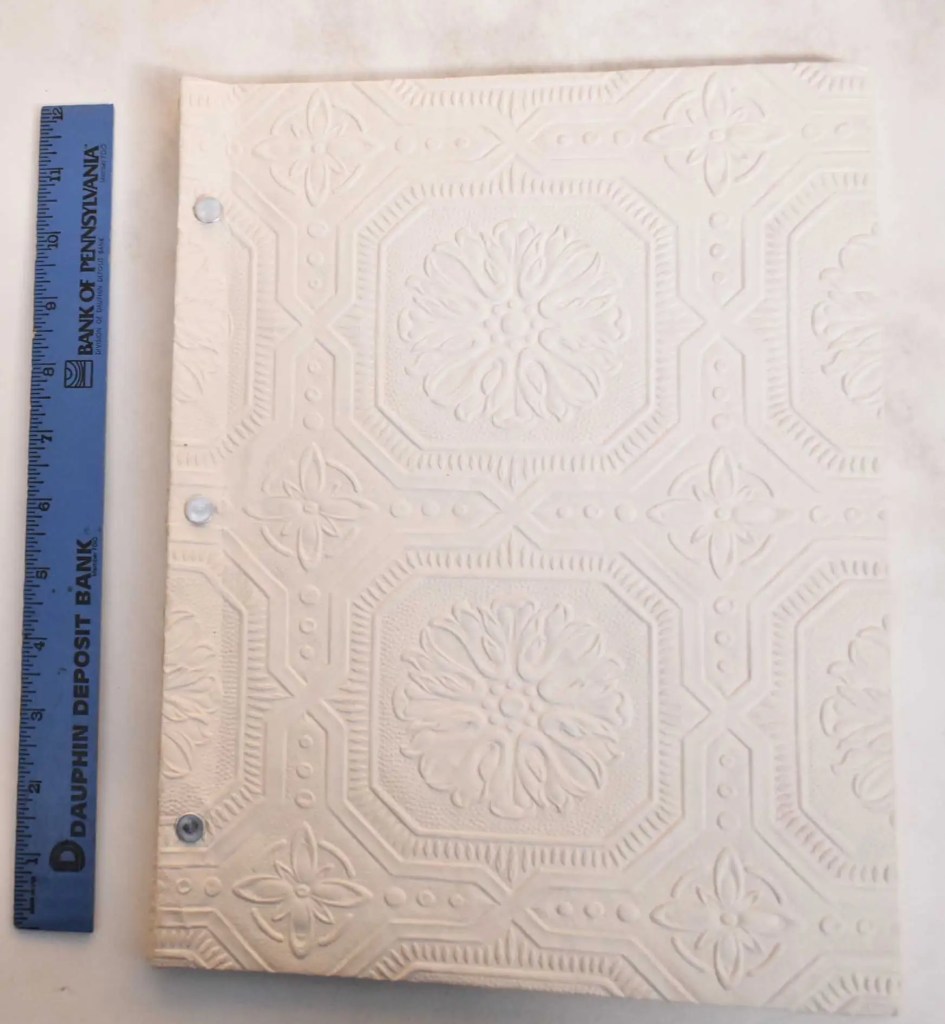
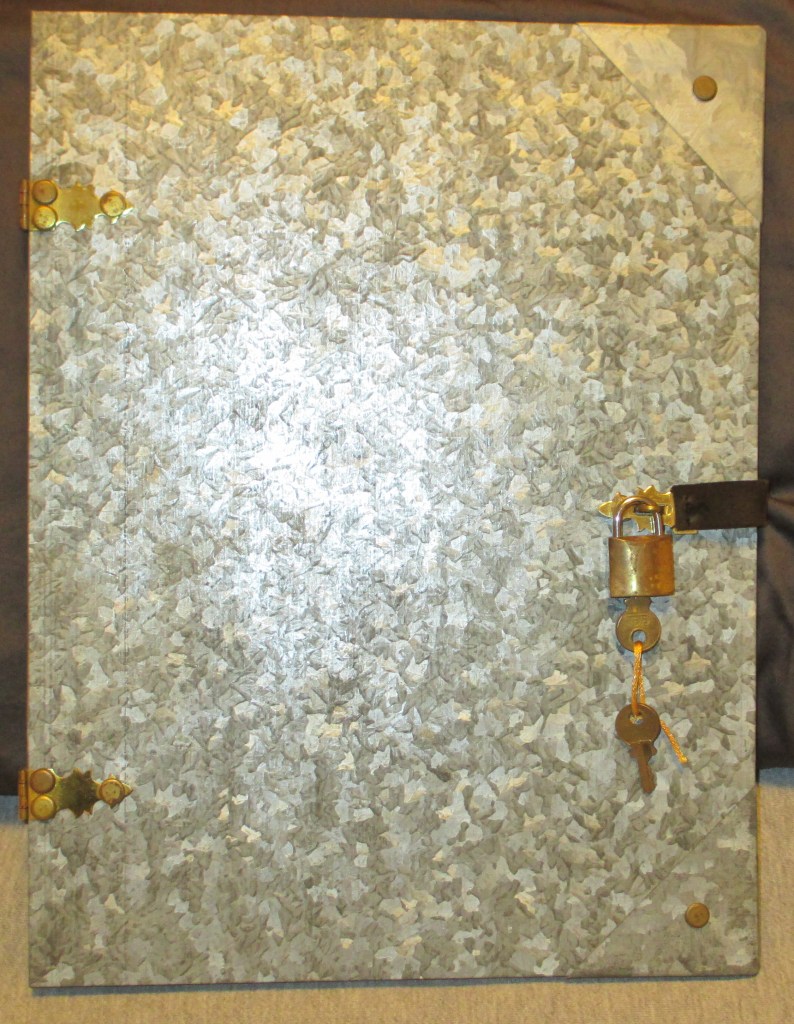
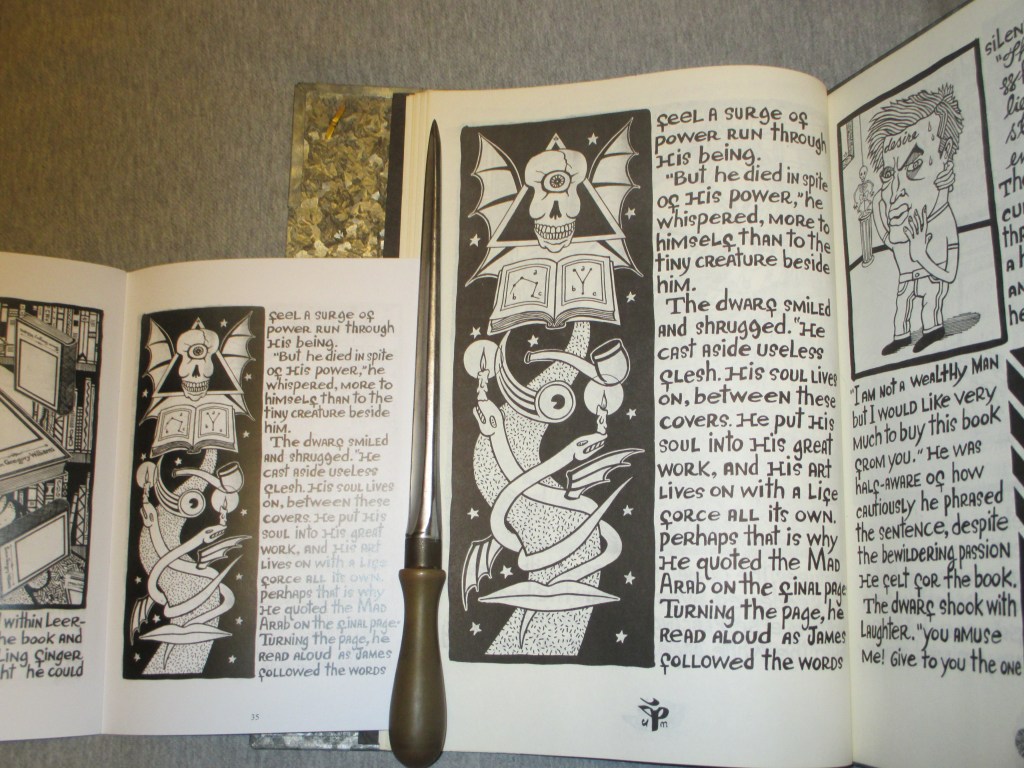
The book exists in different states. My copy of 136 unnumbered sheets is bound between sheet metal plates with a small brass padlock, while others are bound in textured wallpaper; with a fingerprint imprint in gold ink (some listings say blood, but it looks like gold ink to me) on the limitation page, and a tipped-in photo of Pugmire in the nude. The overall aesthetic is strongly reminiscent of underground comix, punk zines, and copybooks of the 1960s-1980s, with an emphasis on cut-and-paste techniques, surreal imagery, the presentation of familiar images in unfamiliar contexts or subtly distorted, and a Burroughs-esque eye for the unfiltered and sometimes teratophiliac reality presented by medical textbooks and cabinets of curiosity.
Example of the wallpaper cover from the Mullen Books listing.

The illustrated version of Pugmire’s “Candlewax” is distinct from the rest of the project, but mostly because it has a coherent, linear narrative, with a darker, more Gothic tone than the more stylized kaleidoscope of images that preceeded this section, or the much more comic-strip style collaboration “Faces” with Bernstein. While Talbot continues to use the same distinctive style, the illustrations work to complement the text, at times a strict depiction, and at times more abstract and evocative.
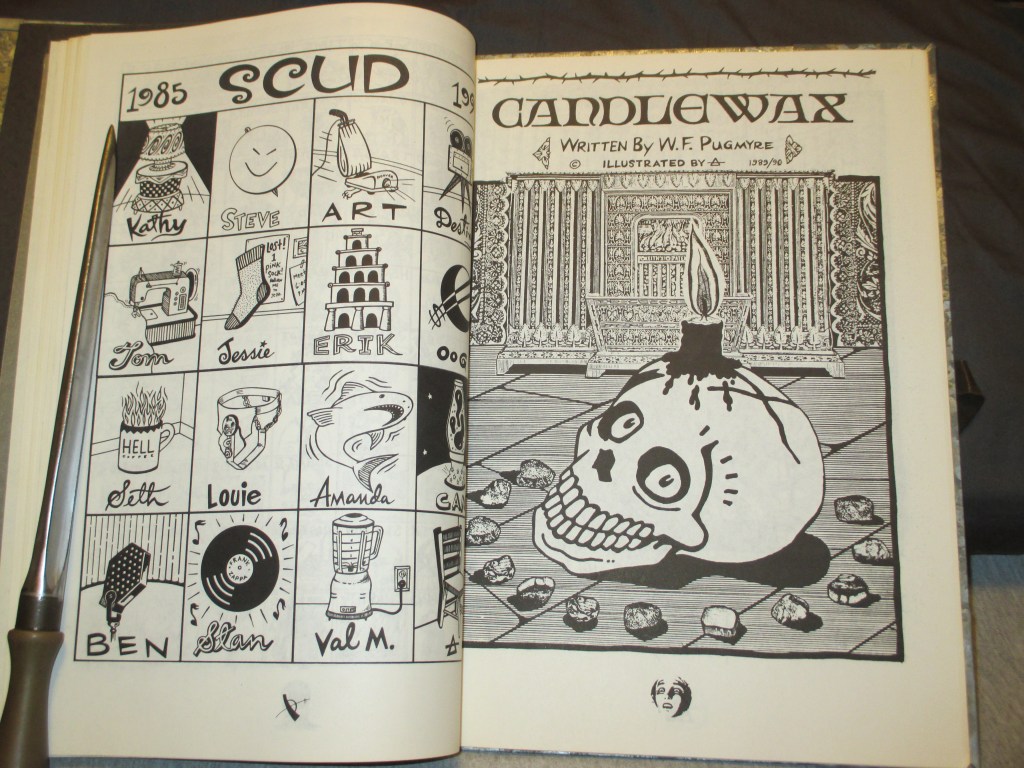
The story itself is a sketch in miniature of bibliomania, murder, necromancy, hubris, and revenge. A fitting snapshot of the kind of obsession that has characterized aspects of the Mythos (and readers of the Mythos) from the beginning.

At least two versions of the “Candlewax” text have seen print. Pugmire had a tendency to rewrite his stories when they were reprinted, and this seems to be the case here as well. To give the flavor of the difference:

The man was a dwarf. His bent and twisted frame, disfigured by age and nameless ailments, seemed perpetually trembling. Drool moistened thin black lips, and yellow pus oozed from reddened eyes. A skeletal finger tapped the book that lay before him, and he addressed his visitor in a whispered voice.

“His name was Simon Gregory Williams. He wrote this book of spells in the late 1960s. That in itself makes it unique. Most of my books are ancient tomes, crumbling and worm-infected. But, as you see, this looks almost new.”
The tiny man bent his twisted frame toward the curious tome. Drool moistened his thin grey lips; yellow pus oozed from his reddened eyes. A skeletal finger tapped the yellow cover of the book. He addressed his visitor in a low whispered voice.

“His name was Simon Gregory Williams. He wrote this book of spells thirty years ago, while visiting the poet William Davis Manly, in your curious Sesqua Valley.” Here he opened the book and turned to various illustrated pages. He stopped at a vivid depiction of a tremendous mountain of white stone, the twin peaks of which resembled wings folded up on a daemon’s shoulders. “The infamous Mount Selta, of which I’ve heard so much. And below, in purple ink, the name ‘Khroyd’Hon’; such a strange name.”
“Candlewax” in Discrete Ephemera (1990)“Candlewax” in Mythos Tales & Others #1

The 1996 text deals much more with the Sesqua Valley cycle, probably to better incorporate it into the loose collection of stories and the Mythos that Pugmire would continue to build on in tales like “An Imp of Aether” (1997). Readers hunting this particular text may find themselves like the protagonist Oscar James, hunters of arcane lore about that mysterious vale and its even more mysterious occupants.
Left: Sesqua Rising, right: Discrete Ephemera

With an edition of only 500 copies, Discrete Ephemera and its illustrated version of “Candlewax” is very scarce and relatively expensive. Graeme Phillips reprinted the entire illustrated story in the chapbook Sesqua Rising (2016), but that was limited to only 50 copies, and is even scarcer, making this one of the rarest of Pugmire’s collaborations.
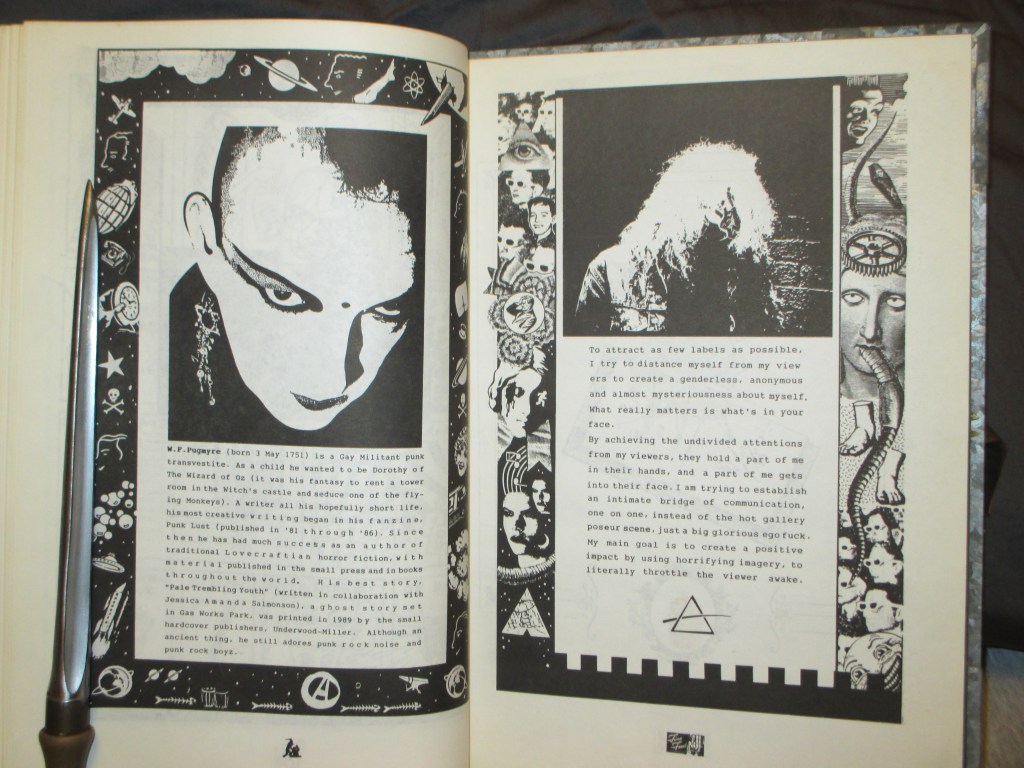
Madame Talbot also collaborated with Pugmire on some illustrated prose poems, and wrote:

I was thrill’d when one of my early Mythos stories, “Candlewax”, appear’d fully illustrated in one of Ashleigh’s hand-made books. There is nothing more thrilling than working on projects with outstanding artists 

W. H. Pugmire, “In Collaboration with Genius” (2016)

What is Discrete Ephemera and “Candlewax”? A collaboration of talents, a cross-pollination of ideas, attitudes, and styles. Discrete Ephemera is a kind of punkish grimoire, an art object to be experienced more than a text to be read and consumed, and in that sense “Candlewax” almost feels like a metatext…or, perhaps, a warning. For now, this copy is in my library. In time, it will be passed on to someone else. Hopefully, someone who gets it.


Bobby Derie is the author of Weird Talers: Essays on Robert E. Howard and Others and Sex and the Cthulhu Mythos.

Deep Cuts in a Lovecraftian Vein uses Amazon Associate links. As an Amazon Associate I earn from qualifying purchases.


“His Mouth Will Taste Of Wormwood” (1990) by Poppy Z. Brite

I cannot reveal the details of our shocking expeditions, or catalogue even partly the worst of the trophies adorning the nameless museum we prepared in the great stone house where we jointly dwelt, alone and servantless. Our museum was a blasphemous, unthinkable place, where with the satanic taste of neurotic virtuosi we had assembled an universe of terror and decay to excite our jaded sensibilities.
—H. P. Lovecraft, “The Hound”

These rooms were where our museum would be set up. At last I came to agree with Lois that only the plundering of graves might cure us of the most stifling ennui we had yet suffered.
—Poppy Z. Brite, “His Mouth Will Taste Of Wormwood”

Lovecraft’s mythos is a true mythology. The stories have become generational, told and retold, embellished and expanded upon, adapted to the syntax of the era. “The Hound” is as decadent a story as Lovecraft ever wrote, and its spawn include “Houndwife” (2010) by Caitlín R. Kiernan and “Some Distant Baying Sound” (2009) by W. H. Pugmire, both of which reiterate the old tale with variations, examining new aspects of the strange relationship that binds the two morbid companions in their darkling quest.

So does Poppy Z. Brite (AKA Billy Martin) in “His Mouth Will Taste Of Wormwood,” except here the tale is rewoven from the bones up. More explicit, more elaborate; not a sequel or prequel or continuation of Lovecraft’s “The Hound” but a reimagining. Putting onto the page all the things that Lovecraft himself never would: blood, sex, necrophilia, bestiality, a touch of actual New Orleans voodoo-lore.

Which, in the hand of someone with less skill, taste, or imagination, could easily have slipped over into edgelord territory. Alan Moore and Jacen Burrows’ Neonomicon is an example where efforts to put on the page what Lovecraft left off are sometimes claimed to have crossed the invisible and wavering line of good taste; to have pushed past “explicit” into “exploitation.” Brite plays a careful balancing act here, more extreme than Lovecraft was, less explicit than Edward Lee’s “Hardcore Lovecraft” series would be.

It isn’t pornography, to put it bluntly. It’s art.

Nor is it an effort to do Lovecraft one better, though readers can judge for themselves which version of the story they prefer. The setting has changed, from Lovecraft’s London to Brite’s New Orleans; from the 1900s to the 1980s. St. John and his nameless narrator companion have been replaced by Louis and Howard, though their roles really haven’t changed that much. Louis/St. John is still the more active and daring of the pair, possessed of the dark vitality and hunger for sensation that drives the plot of the story; Howard is more passive, yin to his yang, submissive (sometimes literally) but also enabling. Like other post-Lovecraft takes on the characters, the homosocial bond between the two becomes explicit (and homosexual or bisexual) in this later incarnation.

If published decade or two earlier, that might have been a problem. Stories with LGBTQ characters that come to a bad end can sometimes be interpreted as moral fables. No such message here need be understood or implied: Louis and Howard aren’t punished because they end up lovers. Being a same-sex couple isn’t the key point here of failure here: it’s being a pair of graverobbers and digging up the wrong sorcerer’s grave.

It’s not a healthy relationship, nor was it ever meant to be. Two people egging each other on to greater and greater depths, pushing until they cross a threshold and invite supernatural retribution. This is the aspect of fable to “The Hound” that is missing from many other stories by Lovecraft, and Brite’s story captures that very well.

“His Mouth Will Taste Of Wormwood” is one of Poppy Z. Brite’s most-anthologized stories; good places to read it include Cthulhu 2000 (1999) and Brite’s anthology Wormwood: A Collection of Stories (1995).


Bobby Derie is the author of Weird Talers: Essays on Robert E. Howard & Others (2019) and Sex and the Cthulhu Mythos (2014).

“Love’s Eldritch Ichor” (1990) by Esther M. Friesner

If you had not used Ms. Lovecraft’s text as the basis for our novel, Fires on the Sea would have languished as unknown as its first authoress. What a loss to us all that would have been!
—Esther M. Friesner, “Love’s Eldritch Ichor” in Cthulhu 2000 (1991) 244

The initial premise of “Love’s Eldritch Ichor” is designed to knock the steadfast and serious fan of H. P. Lovecraft and the Cthulhu Mythos off their rocker: what if one of H. P. Lovecraft’s manuscripts was being re-written and published as a contemporary romance novel, trashy cover and sex scenes and all? For a writer whom many fans had raised up on a pedestal, both in real life and in fiction, the juxtaposition of tone and genres is designed to raise hackles. Then when the knife is firmly inserted, Esther M. Friesner starts to twist it just enough to tickle the funnybone…

There is a fine line between a reference and an in-joke. Readers intimately familiar with the fiction of H. P. Lovecraft recognize the reference in the title to “I Had Vacantly Crumpled It into My Pocket … But By God, Eliot, It Was a Photograph from Life!” (1964) by Joanna Russ, and that recognition preps the reader for the story: it helps to establish the world. In-jokes are similar in that they are never explained to the reader; either they get them or they do not. The elaborate riffing on Gnophkehs in “Nautical-Looking Negroes” (1996) by Peter Cannon & Robert M. Price is an in-joke, only really comprehensible to someone aware of the fan-scholar debate on the subject. While it contains a lot of clever wordplay and humorous imagery and characterization, “Love’s Eldritch Ichor” is built on Mythos in-jokes, from by-the-way references to various Mythos stories to a groaner of a knock-knock joke from a gang of shoggoths. Yet there is a lot more at work in the story.

“Love’s Eldritch Ichor” blends fiction and reality: set in a contemporary (1990) world of cappucino machines and Tim Burton’s Batman (1989), but one where both Lovecraft and his literary creations such as Arkham both coexist. While the former is uncommon, the latter is very typical of a certain type of Mythos fiction. Lovecraft himself would drop references to Arthur Machen and Clark Ashton Smith into stories like “The Dunwich Horror” and “The Call of Cthulhu”; August Derleth would go Lovecraft one better by dropping in references to Lovecraft and the Arkham House collection of his tales next to the Necronomicon. Derleth was not doing this tongue-in-cheek, he was building an idea that Lovecraft had based some of his tales on reality—an idea revisited by later authors such as Robert Bloch in his novel Strange Aeons (1978) and Alan Moore and Jacen Burrows’ Providence (2015-2017). Where other authors use that as a jumping-off point to reflect on, revisit, or revise Lovecraft’s fiction, Friesner does it to underline the silliness of the premise, to take off the kid gloves and show nothing is off-limits.

If the gloves are off for Lovecraft, Friesner also isn’t worried about bloodying her knuckles against the cut-throat world of book contracts, agents, and editors, and the whole innate silliness of the romance industry. Most of the jokes made are at the expense of Robin Pennyworth, the sole male reader in a female-dominated book publisher. His awareness of his failure to meet up to 1980s expectations of masculine attitude and behavior, reminiscent (if not so focused on homophobia) of “Gilgamesh in the Outback” (1986) by Robert Silverberg, is meat for his domineering boss Marybeth Conran, who is quick with a cutting remark like:

If everything Chuckie Ward tells me is true, she’s led a life of such isolation that when you stumbled into her life, no wonder she mistook you for a man.

Sarah Pickman, the object of Robin’s amour and the co-author of Fires of the Sea, is portrayed far more positively than Conranwhose only goal is to rule her department with an iron fist and bind the writers with the worst possible contracts. In many subtle ways, Friesner plays up her parallels with her supposed ancestor H. P. Lovecraftreclusive nature, thriftiness, and the invitation by a romantic partner to New York City all being obvious homages to Lovecraft’s nature and biography.

So too, Friesner has put some effort into the references to the romance novel itself, alluding to characters and scenes that would be appropriate if Lovecraft himself had written an Innsmouth-based romance novel…which does beg the question of whether or not she was aware of previous efforts in this direction. Robert M. Price, writing as “Sally Theobald” (a play on one of Lovecraft’s pseudonyms) published an eldritch confessional-style yarn titled “I Wore The Brassiere of Doom” (1986); Brian McNaughton, writing as “Sheena Clayton” had written an Innsmouth-based erotic/romance novel titled Tides of Desire (1983). Price, like Friesner, focused on the silliness of the serious and asexual Lovecraft trying his hand at such an unfamiliar genre; McNaughton was aiming less at humor and more at a serious erotic paranormal romance work (although he was a couple decades early for that particular genre). Both ideas have bones: Edward Lee would revisit the idea of Lovecraft maintaining a sideline in erotic fiction with Trolley No. 1852 (2009)while Friesner was playing the idea for laughs, in the long run it looks like there’s at least some market for those kind of materials.

The topicality of the story might make it something less than classic; its references to late-80s American culture are already dated nearly three decades after its original publication, such as the final whopper:

[…] while I looked and looked for mention of a pace-name you use, consulting the Britannica and the geographical listings in the Unabridged, it only shows up a an adjective. It sounds so familiar. I think I may have heard of a Trump resort located there, but correct me if I’m wrong.

Where is Stygia?

This is at least a more subtle insertion of a Trump reference into Lovecraftiana than Trump Vs. Cthulhu: Two Small Hands, One Big Problem (2018), and is actually a very clever final in-joke referencing the works of Robert E. Howard (who, along with Clark Ashton Smith, get nods in the story). Lovecraft had written in a letter:

There is no such name as Stygia … the adjective Stygian being derived from the name Styx—the River of the Dead. Two-Gun Bob misuses the word-root when he speaks of a country called “Stygia”. Indeed, he takes frequent & unwarranted liberties with classical names ( or variants of names) in devising a nomenclature for his prehistoric world. Price & I have laboured with him in vain on that point.
—H. P. Lovecraft to Duane W. Rimel, 28 Sep 1935, Letters to F. Lee Baldwin &c. 290

This is Friesner showing her homework and giving the knife one last little twist, this time to Robert E. Howard fans, although her subtle references to Red Sonja owe more to the Marvel comic books or the 1985 film than anything Ms. Cromwell (er, Robert E. Howard) ever wrote.

“Love’s Eldritch Ichor” was first published in World Fantasy Convention 1990: An H.P. Lovecraft Centenary Celebration (1990), and reprinted in Friesner’s collection It’s Been Fun (1991), the anthologies Cthulhu 2000 (1995) and Cthulhu and the Coeds, or, Kids & Squids (2000); it has also been translated into French as “L’amour est une indicible purulence” and published in Fées & gestes (1998). Her story “The Shunned Trailer” was published in The Cackle of Cthulhu (2018).


Bobby Derie is the author of Sex and the Cthulhu Mythos (2014)