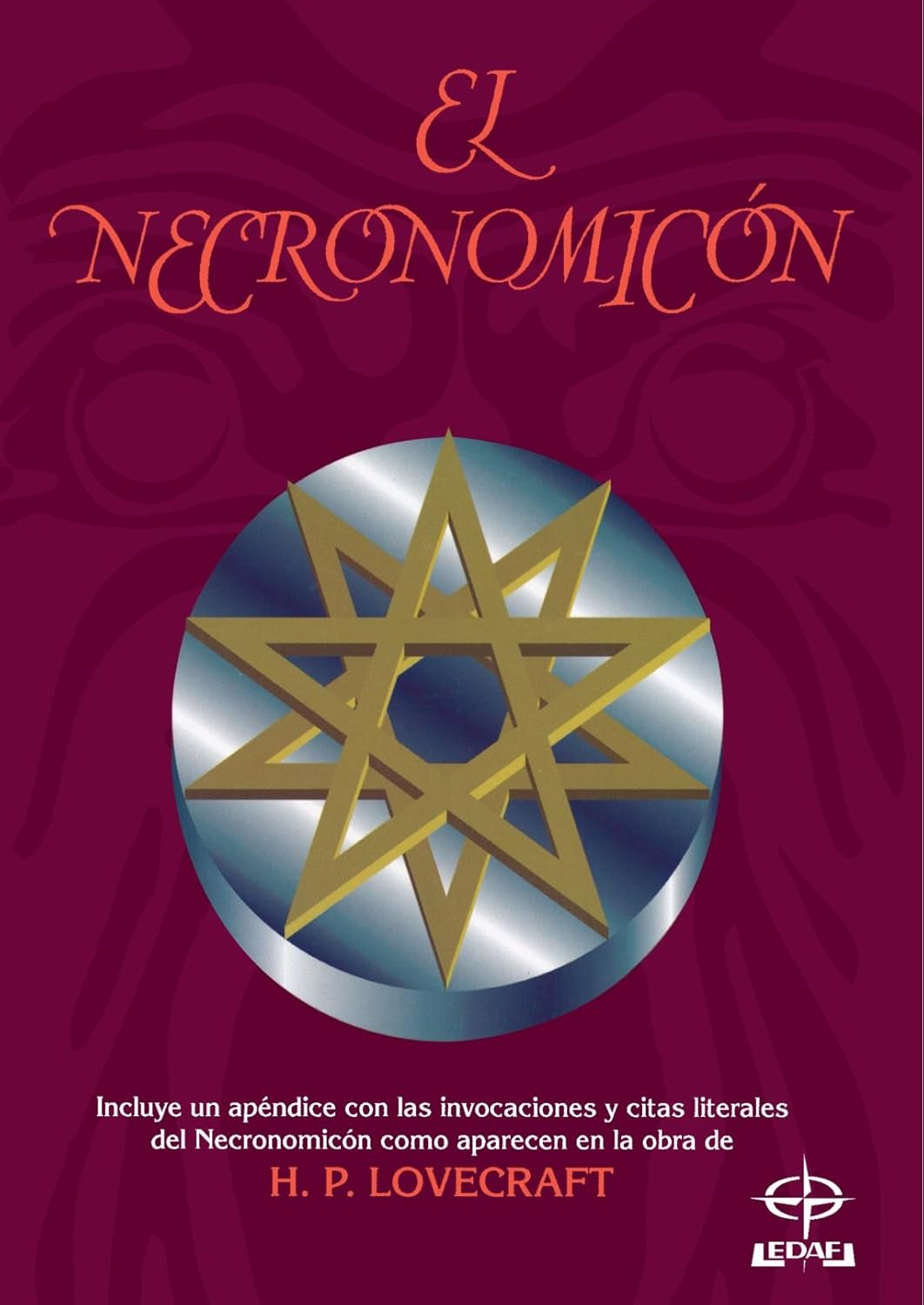
El Necronomicón (1992) trans. Elías Sarhan & Fragmentos Originales del Necronomicón (2001) trans. Marcelo Bigliano

A major focus of the Western occult tradition is the grimoire. For the most part, the occult tradition that has come down to us is primarily a literate one rather than an oral one; and potential occultists are more likely to first encounter magical teachings in written form than by word of mouth. While that may be shifting a bit in an era of ubiquitous streaming video and podcasts, for the most part it holds true: Western magic as we know it has focused heavily on written texts as a primary store of data and means of transmission. Readers interested in delving further into the topic are recommended to read Owen Davies’ excellent and accessible Grimoires: A History of Magic Books.

Translations are a major part of the occult publishing scene. Dan Harms regularly reviews new translations of occult manuscripts and texts into English. However, these reviews rarely deal with just the quality of the individual translation, but the selection and editing of the text, the critical and academic apparatus that surrounds the text. While some works might be simply translated into another language without comment, most translations involve either selective transmission, or the addition of explanatory and critical material that adds to the value of the translation by providing additional historical or literary context, or speaks to the translator’s intended purpose for the translation.

This approach also applies to the Lovecraftian occult tradition, particularly with regard to the various recensions of the Necronomicon that have been translated from English into other languages. We have previously discussed how English-language occult traditions have influenced non-anglophone occult works such as Magic of Atlantis: Sauthenerom: The Real Source of the Necronomicon (1985) by Frank G. Ripel & Necronomicon: Il Libro Proibito di Abdul Alhazred (2022) by Mirando Gurzo, but these are primarily original works. A comparison of two non-English Necronomicon translations might better demonstrate point.

El Necronomicón (1992) trans. Elías Sarhan

The Simon Necromonicon (1977) was the first, most popular, and at this point most pirated Grimoire associated with the Lovecraftian occult tradition; for decades the mass-market paperback edition has been a mainstay of New Age bookshelves, and has numerous sequels and derivative works. Elías Sarhan’s authorized translation, first published in 1992 by EDAF in Spain, has also gone through multiple editions. It is a faithful translation of the Avon paperback edition, including Simon’s acknowledgments, the preface to the second edition, the quote from the Chaldean Oracle of Zoroaster, and all illustrations, magical seals, and non-English names in the original text, with one notable exception:

The highly characteristic Necronomicon gate sigil created by Khem Caigan which normally graces the cover and frontispiece of the Simon Necronomicon is nowhere in evidence. Whether Avon didn’t ship the plates or that wasn’t part of the licensing deal, the publishers simply didn’t use it, at least on several printings. The paperback copy I have includes a generic computer-generated 10-pointed star on the cover. Considering how prominently Caigan’s design has been displayed in many editions and how widely it has been swiped by artists as a generic Lovecraftian symbol, its absence is a significant departure from English-language version.
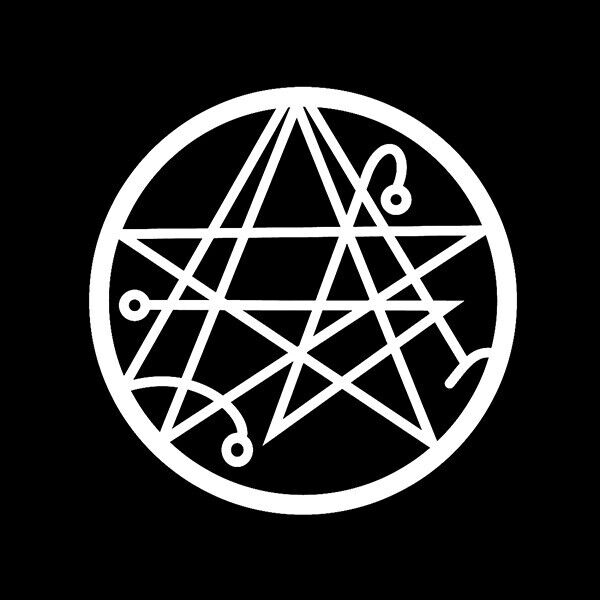
Necronomicon gate sigil created by Khem Caigan

In addition, there is an appendix. “Cronología, Fragmentos e Invocaciones de H. P. Lovecraft sobre « El Necronomicón»” (“Chronology, Fragments, and Invocations from H. P. Lovecraft’s Necronomicon). This begins with an introduction by Alberto Santos Castillo, an editor of many Spanish-language translations of Lovecraft’s works, that begins:

Si abordamos la obra de H. P. Lovecraft teniendo en cuenca el contenido del presented libro, nos surgeon does cuestiones queue son como dos caras different es del author de Providence: el iniciado en saberes ocultos y el escéptico materialista.

A lo largo de toda su vida, Lovecraft defendió que el contenido de sus historias era producto de un ejercicio literario propio de la ficción y que no mostraban ningún tipo de realidad posible o alternativa a la nuestra. Desde muy pequeño convivió con la soledad y el aislamiento. La imagen de su abuelo Whipple, un hombre bondadoso y «sabio», por toda esa biblioteca que le donó a su muerte, afianzaron en él esa inquietud por el concocimiento. El mundo debía ser creado y medido entre los povorientos volúmenes de las estanterías. Sin embargo, Lovecraft ansiaba un saber oculto cuando las pesadillas y las obsesiones se cebaban en él. Al leer su obra, uno descubre que hay una verdad que se escapa entre líneas, frente a esa imagen de frialdad y distanciameiento emocional pretendido.
If we approach the work of H. P. Lovecraft taking into account the content of the presented book, there are two different faces of the author of Providence: the initiate in occult knowledge and the materialistic skeptic.

Throughout his life, Lovecraft maintained that the content of his stories was the product of a literary exercise characteristic of fiction and that they did not depict any kind of possible or alternative reality to our own. From a very young age, he lived with loneliness and isolation. The image of his grandfather Whipple, a kind and “wise” man, and the entire library he donated to him upon his death, strengthened his desire for knowledge. The world had to be created and measured among the dusty volumes on the shelves. However, Lovecraft yearned for hidden knowledge when nightmares and obsessions took their toll on him. Reading his work, one discovers that there is a truth that escapes between the lines, in contrast to that image of coldness and intended emotional detachment.
El Necronomicón 271English translation

Simon’s Necronomicon has any number of flaws, many of which are discussed in The Necronomicon Files by Dan Harms and John W. Gonce, but there are two immediate issues every Lovecraft fan and would-be Lovecraftian occultists have to face: 1) Simon’s assertions of the real existence of the Necronomicon goes against what we know of Lovecraft’s life, attitudes, and knowledge of the occult; and 2) Simon’s Necronomicon, purportedly a translation of the original text, bears basically no similarity to the Necronomicon that Lovecraft and his contemporaries wrote about, containing only a scattered handful of familiar-sounding names and none of the translations or contents supposed to be in there according to stories like “The Dunwich Horror.”

To address these shortcomings and add value to the basic Simonomicon, Castillo tacked on an appendix that contains (in order), a Spanish translation of Lovecraft’s “History of the Necronomicon,” a collection of quotes (“fragmentos”) from the Necronomicon that Lovecraft peppered into his work in stories like “The Nameless City” and “The Dunwich Horror,” and finally a collection of incantations from Lovecraft’s work, mostly in his made-up artificial language (e.g. « ¡Wza-y’ei! ¡Wza-y’ei! Y’kaa haa bho: ii, Rhan-Tegoth: Cthulhu fthang: ¡Ei! ¡Ei! ¡Ei! ¡Ei! Rhan-Tegoth. ¡Rhan-Tegooth, Rhan-Tegoth!» (287) adapted from “The Horror in the Museum”). Some minor spelling and formatting errors aside from the translation, this is a neat piece of work and a definite improvement over the base version of Simon’s Necronomicon, and makes sense for a Spanish translator that knows they need to address both potential audiences: those primarily interested in Lovecraft’s fiction and those primarily interested in the occult.

Fragmentos Originales del Necronomicón (2001) trans. Marcelo Bigliano

The Necronomicon: The Book of Dead Names (1978) edited by George Hay is probably the second-most popular (and pirated) Necronomicon grimoires in existence. Except much of the book is not actually a grimoire at all; of the 184 pages, there are 12 pages of front matter, an introduction by Colin Wilson that weaves a fictional history of the “real” Necronomicon manuscript (pp. 13-56), a fake letter from Dr. Stanislaus Hinterstoisser (pp. 57-64), a commentary by Robert Turner (pp. 65-80), and a note on supposed decipherment of the text (pp. 81-102) before readers actually get to the supposed English translation of the medieval grimoire that inspired Lovecraft (pp.103-140). Then there are the appendices in the form of three essays: “Young Man Lovecraft” by L. Sprague de Camp (pp. 141-146), “Dreams of Dead Names” by Christopher Frayling (pp. 147-171), “Lovecraft and Landscape” by Angela Carter (pp. 171-182), and the whole book is rounded off with a bibliography (pp. 183-4).

The actual Necronomicon material in the Hay Necronomicon is effectively less than 40 pages. Which might explain why someone had the bright idea to cut out the pseudo-scholarship and present a highly abridged translation of the book. That is exactly what Marcelo Bigliano did in Fragmentos Originales del Necronomicón: El Libro de Los Nombres Muertos de Abdul al-Hazred (2001), published by Tomo in Mexico in several editions, as a modestly sized and priced paperback.

Where El Necronomicón was being inclusive, Fragmentos Originales is selective. Bigliano begins with what appears to be an original prologue that essentially lays out an abbreviated version of Lovecraft’s history of the Necronomicon and then tries to sell the authenticity of the Necronomicon as an occult document. To give a sample:

También los conocidos libros negros titulados Seventh Books of Moses son mencionados por Lovecraft en sus relatos. Si se considera la relación entre estas obras, basadas en versiones latinas alterads de Key of Solomon y ciertos textos hebreos poco conocidos: The Leyden Papyrus, un antiquo libro de magia egipcio que se le considera parte de un todo con el Eigth Book of Moses y the Sword of Moses, que a su vez se cree que contiene en Ninth and Tenth Books de la serie, surge con fuerza un sistema mágico estrechmente relacionado con el Necronomicón.Also the well-known black books titled the Seventh Books of Moses are also mentioned by Lovecraft in his stories. Considering the relationship between these works, based on altered Latin versions of the Key of Solomon and certain little-known Hebrew texts—The Leyden Papyrus, an ancient Egyptian book of magic considered part of a whole with the Eighth Book of Moses and the Sword of Moses, which in turn is believed to contain the Ninth and Tenth Books of the series—a magical system emerges that is closely related to the Necronomicon.
Fragmentos Originales del Necronomicón 9English translation

However, this is really an uncredited translation of Robert Turner’s “The Necronomicon: A Commentary” from the Hay Necronomicon:

The well-known ‘black books’ entitled the Sixth and Seventh Books of Moses are mentioned by Lovecraft in his stories, and if one considers the terlationship between these works—based on corrupt Latin versions of the Key of Solomon and certain little known Hebrew texts—The Leyden Papyrus,—an ancient Egyptian book of magic said to be one with the Eighth Book of Moses—and The Sword of Moses—held to contain the Ninth and Tenth Books in the series, a system of magic closely related to concept of the Necronomicon powerfully emerges. (Hay 68)

Lovecraft does not mention the Sixth and Seventh Books of Moses—which are genuine grimoires—in any of his fiction, though the title crops up in some related works by other authors (Dan Harms pointed out to me that the Seventh Book of Moses appears in “Wentworth’s Day,” one of Derleth’s “posthumous collaborations” with Lovecraft). This is part of Turner’s wind-up to the actual magical manuscript material he invented, and if it resembles those “authentic” grimoires at all, it’s because he designed them to.

Following this prologue (pp. 8-16), Bigliano then presents the translation of Turner’s “Foreword” (Hay 105, 108; Fragmentos 17-20), sans illustrations, and then jumps directly into a highly abbreviated rundown of the major eldritch entities in the Lovecraft Mythos, again borrowed from Turner (Hay 74-75; Fragmentos 20-23). For example:

Shub-Niggurat
El Gran Macho Cabrío Negro de los Bosques con un millar de Jóvenes. La manifestación Terrenal del Poder de los Antiquos. El Dios del Aquelarre de las Brujas. La naturaleza ELemental de Shub-Niggurat es la de la Tierra, simbolizada por el signo de Tauro en los cielos y, en el mundo, por la Puerta del Viento del Norte.
Shub-Niggurath
The Great Black Goat of the Woods with a thousand Young. The Earthly manifestation of the Power of the Ancients. The God of the Witches’ Sabbath. Shub-Niggurath’s Elemental nature is that of the Earth, symbolized by the sign of Taurus in the heavens and, in the world, by the Gate of the North Wind.
Fragmentos Originales del Necronomicón 23English translation

Not actually sure if Bigliano picked up these planetary associations somewhere or if they’re original additions to the text, but from there he continues directly into a translation of the magical manuscript portion of the Hay Necronomicon, including reproducing all the sigils and seal (pp. 25-85). A conclusion chapter is also borrowed from Turner in an earlier part of the book (Hay 78-79; Fragmentos 87-89). A brief note on Lovecraft (pp. 91-92) is followed by a translation of Angela Carter’s essay (pp. 93-116), and finally a section on the Cthulhu Mythos (pp. 117-124).

In the end, the Fragmentos lives up to its title: like a handful of pages from a larger manuscript that have been re-bound as their own work. Bigliano cut out the heart of the Hay Necronomicon and packaged it as a mass-market grimoire along the lines of the Simon Necronomicon, judiciously rearranging bits and pieces to suit his needs or tastes and ejecting most of the more peripheral matter about the supposed manuscript’s origins and connections to Lovecraft. All of the tongue-in-cheek elements, such as Colin Wilson’s carefully written introduction, and all the more elaborate illustrations, were cut. That isn’t particularly surprising when one considers that there are no notices of permission granted; this was, by all appearances, one of the many unauthorized translations of the Hay Necronomicon and its material.

The two Spanish-language grimoires are separated in time, translator, and geographical publishing context, but were both working toward a similar end: translating this English-language Lovecraftian occult material to a Spanish-language market who were presumably familiar with Lovecraft and eager for more. The popularity of the works can be attested by their multiple editions, and the different paths that the editors and translators took to the material represent respective approaches.

It is fun to think how, in a couple of centuries, historians of the occult might have multiple different recensions and translations of the Necronomicon available, and will have to figure how the family of texts relate to one another, to try and understand or re-create the chain of events or decisions that led to such similar material following different paths. If only the Fragmentos survived, one could not reconstruct the Hay Necronomicon; but they could probably ascertain its influence on Eldritch Witchcraft: A Grimoire of Lovecraftian Magick (2023) by Amentia Mari & Orlee Stewart based on certain illustrations and lore. Who knows what the Lovecraftian occult tradition might look like, in a different time and in different tongues?


Bobby Derie is the author of Weird Talers: Essays on Robert E. Howard and Others and Sex and the Cthulhu Mythos.

Deep Cuts in a Lovecraftian Vein uses Amazon Associate links. As an Amazon Associate I earn from qualifying purchases.
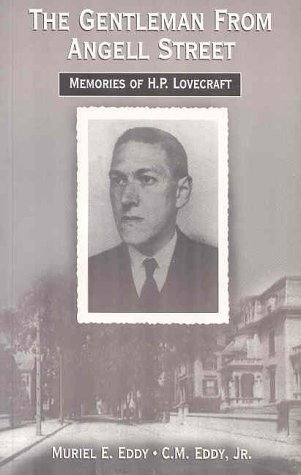

The Gentleman from Angell Street (2001) by Muriel E. Eddy & C. M. Eddy Jr.

I have, I may remark, been able to secure Mr. Baird’s acceptance of two tales by my adopted son Eddy, which he had before rejected. Upon my correcting them, he profest himself willing to print them in early issues; they being intitul’d respectively “Ashes”, and “The Ghost-Eater”. In exchange for my revisory service, Eddy types my own manuscripts in the approv’d double-spac’d form; this labour being particularly abhorrent to my sensibilities.

But I must give over these my remarks, for I must take a nap against the afternoon; when (tho’ ’tis devilish cold) I am pledg’d to visit my son Eddy in East-Providence, & help him with his newest fiction, a pleasing & morbid study in hysterical necrophily, intitul’d “The Lov’d Dead”.
—H. P. Lovecraft to James F. Morton, 20 Oct 1923, Letters to James F. Morton 57

The Gentleman from Angell Street: Memories of H. P. Lovecraft (2001) is a collection of the reminiscences of H. P. Lovecraft by the Eddy family, who lived in East Providence and first became acquainted with Lovecraft while he lived at 598 Angell St. in Providence, Rhode Island. All of the non-fiction pieces in this slim collection had been previously published, but all of them had been out-of-print for decades, so the slim collection was a bit of boon to researchers in not having to pay collectors’ prices to read them.

Muriel Elizabeth (Gammons) Eddy and Clifford Martin Eddy, Jr. were married in 1918; they were both writers, in various genres, and Muriel in particular would be president of the Rhode Island Writers’ Guild for over 20 years, while Eddy would have a pulp career that included three stories revised in part by their Providence neighbor H. P. Lovecraft, which were published in Weird Tales—and much else that Lovecraft never had a hand in besides. Students of Lovecraft’s letters will remember the way Lovecraft pleaded with another revision client, Zealia Brown Reed, to give Eddy the job of typing her manuscripts as the Great Depression set in and pushed the Eddys to the brink of poverty.

While Lovecraft was closest to C. M. Eddy, Jr., to the extant of calling him one of his “adopted” sons or grandchildren, it was Muriel E. Eddy that wrote the most about her family’s relationship with H. P. Lovecraft. Her first memoir, “Howard Phillips Lovecraft” was published in Rhode Island on Lovecraft (1945) alongside “Lovecraft and Benefit Street” (1943) by Dorothy C. Walter and other works. In 1961 she expanded that essay into “The Gentleman from Angell Street”, and wrote several other short pieces, some privately printed, including H. P. Lovecraft Esquire: Gentleman (no date), The Howard Phillips Lovecraft We Knew (n.d.), “Memories of H. P. L.” (1965), “Lovecraft’s Marriage and Divorce” (1968), Howard Philips Lovecraft: The Man and the Image (1969), and “Lovecraft: Among the Demons” (1970). In addition to this, she wrote a number of letters, some published and some surviving at the John Hay Library where she weighed in on the early biographical sketch of Lovecraft by Winfield Townley Scott and Sonia H. Davis’ memoir of her former husband.

The rest of the family was rather more limited. C. M. Eddy Jr. published “Walks with H. P. Lovecraft” in The Dark Brotherhood and Other Pieces (1966, Arkham House), and their daughter Ruth M. Eddy wrote “The Man Who Came At Midnight” (1949).

The activeness of Muriel E. Eddy in publishing and discussing her experiences with Lovecraft from the late 1930s until her death 1978 means that she had a rather substantial influence on Lovecraft scholarship during that period. To illustrate this, L. Sprague de Camp’s critical H. P. Lovecraft: A Biography (1975) cites seven of Muriel E. Eddy’s publications, plus C. M. Eddy and Ruth M. Eddy’s contributions. In general, these memoirs can be said to be honest and valuable contributions to the understanding of Lovecraft’s life…but are they accurate?

The accuracy of memoirs is important; human memories are imperfect, and tend to fade and distort over time or under influence. Yet these accounts are often all we have to go on for many events and details of life. The more accurate a memoir is, that is the more of it that we can verify according to other documents of the period (Lovecraft’s letters, census data, city maps and directories, etc.), the more we can count the memoir as a reliable source of data for the information that cannot be so independently verified. With some of these memoirs, written decades after the events…and given that they are often the sole source for some of the anecdotes regarding Lovecraft, it is important to look at some of these sources critically.

C. M. Eddy’s “Walks With Lovecraft,” describing their gambols and hikes together in and out of the city, can be said to be reasonably accurate and reliable, insofar as the details of Lovecraft jive with what we know from his lettersthere is, for example, an extended account by Lovecraft of their search for “Dark Swamp,” which agrees fairly closely with C. M. Eddy’s version. There are one or two spots where Eddy may be mistaken, but overall it is a solid essay.

Muriel E. Eddy’s memoirs are a bit more complicated to deal with. The 1945 version “Howard Phillips Lovecraft,” written less than a decade after the subject’s death, is relatively straightforward and accuratethough with little slips here and there; she recalled the Dark Swamp adventure, but referred to it as Black Swamp. Still, it provides a good bit of detail on their association, including some unique insights on the revision-work that Lovecraft did for C. M. Eddy, Jr. and many notes on Lovecraft’s habits and character traits that jive exactly with his letters. The later, expanded version that is “The Gentleman from Angell Street” and appears in the eponymous booklet adds much interesting detailbut the accuracy of this new information, and thus the reliability of the whole account, is less.

For example, Muriel E. Eddy wrote:

Our acquaintance with the Lovecraft family stemmed through my husband’s mother having once met Sarah Lovecraft at a “Women Suffrage” meeting,… although I never learned whether or not Howard’s mother really believed believed in equal rights for women.
—Muriel E. Eddy, The Gentleman from Angell Street 4

This is an intriguing detail, since we know so little (relatively speaking) about Sarah Susan Phillips Lovecraft, and far from impossible. It might explain some of Lovecraft’s attitudes towards women and women’s rights as expressed in his life and letters. However, the memoir also includes a number of small speculations and anecdotes, and these tended to get more evident the further into the expanded essay the reader gets. Some of the anecdotes are likely true, but are strongly influenced by Muriel’s rosey-hued nostalgia; for example when she wrote:

Mrs. Gamwell also gave the children about a hundred picture postcards that Sonia had mailed to Howard. These all held loving, spirited messages to H.P.L. from his sweetheart in New York. Not knowing their possible value in the far-away future, I did not hold on to any of these cards bearing Sonia’s signature, written in her breezy, happy handwriting. It was plain to be seen, from the messages on the cards, that this pretty woman of writing ability—among her other gifts—really liked our H.P.L.! And the strange part of it all was that he had not once mentioned his love affair to us…and we were his very good friends.

The children played for hours with the cards, and they eventually went the way all children’s toys go…in the ash-heap! (ibid. 17)

If a reader traced Muriel’s accounts of Lovecraft over the years, some details shift in the telling. Notably, her account of the extant of Lovecraft’s revision of “The Loved Dead” changes over time, and is a bit at odds with her husband’s own account, given in the Summer 1948 issue of the Arkham Sampler; her insistence on C. M. Eddy Jr.’s sole authorship was likely a response to August Derleth and Arkham House’s publication of stories which Lovecraft had revised or ghostwritten with the emphasis on Lovecraft’s contribution. So too, her references to Lovecraft’s mother seem to shift to reflect views on Susan Lovecraft in line with other memoirs—and this kind of “alignment” of views can easily distort the historical picture, since it appears that several contemporary memoirs are supporting the same image, when in reality later sources may be partially based on earlier ones. A tricky knot to untangle when a memoir is “revised” as “The Gentleman from Angell Street” was.

The most substantial difference between the 1945 and 1961 essays however is the section dealing with Lovecraft’s revision client Hazel Heald.

In this same year, 1932, I formed a little New England writers’ club of my own, and one of my members, a divorcee was very anxious to succeed in the weird writing field. She sent me an original manuscript with a very passable plot, yet told unconvincingly and amateurishly. I let Lovecraft read it when next he came over to our house on Pearl Street, and he agreed that it did have possibilities. (ibid, 22-23)

This is the start of Muriel E. Eddy’s account of “The Man of Stone” (1932) by Hazel Heald & H. P. Lovecraft. For quite a long time, this was the only such account; Lovecraft wrote little about much of his revision work, and Heald’s own version of events is largely unpublished, although she makes an allusion to the Eddys in a letter:

About HPL and whether he was separated or divorced—I am certain he was divorced but have written to someone I know who will give me all the facts as her husband signed certain papers at that time.
—Hazel Heald to August Derleth, 7 Apr 1937

C. M. Eddy Jr. is claimed to have signed the Lovecrafts’ divorce decree as a witness, though Lovecraft himself did not sign it. So while Heald does not give the exact circumstances of her and Lovecraft coming together, there is nothing to directly counter Muriel E. Eddy’s version of events. At the same time, there is every evidence that Muriel E. Eddy’s version of events was including some information from her friend Hazel Heald, at second- or third-hand.

A skeptical scholar might thus wonder how much of it that Muriel E. Eddy knew and neglected to tell in 1945, versus how much of it she heard about later and incorporated into her expanded memoir—and on top of that, how much Muriel E. Eddy’s rose-tinted spectacles were skewing her account. Particularly notable in “The Gentleman from Angell Street” is her suggestion that Heald held a romantic interest in Lovecraft, and:

With a little encouragement, I am convinced that H.P.L. and Hazel might have married, and they would have made a good pair. But Lovecraft knew his health was failing, and perhaps he did not feel like taking a chance on another marriage, seeing that his first one had failed so miserably.
—Muriel E. Eddy, The Gentleman from Angell Street 26

This kind of speculation, and the obvious incorporation of second-or-third-hand information that fed into it, make “The Gentleman from Angell Street” less reliable of a source than it could have been. Which is unfortunate, given that we otherwise have little information on the Heald-Lovecraft stories besides the brief mentions in Lovecraft’s letters, and the sparing accounts given in Heald’s surviving correspondence with August Derleth.

An addendum to “The Gentleman from Angel Street” published in 1977 discusses the death of Sonia H. Davis and August Derleth; these memories are brief, vivid, and fairly accurate. She ends with the rather bittersweet yet hopeful note:

Thus the original Lovecraftian circle has been dwindling, and yet, a new one grows in ever widening arcs among the interest generated by fanzine magazines, biographies of HPL, and the eternal works and character of the man himself. (ibid. 29)

Ruth M. Eddy was born in 1921; she would have been only about two years old when Lovecraft met her parents and first visited their house in 1923, and five when Lovecraft returned to Providence after his stay in New York City. Her brief memoir of his visit was published in 1949, and it may be wondered how much of this she actually remembered at such a young age…but some things do stick in the memory, long after children grow up. So she wrote “The Man Who Came At Midnight:”

Gaslight flicked eerily through the crack in my bedroom door. It was Halloween, night of the supernatural, and long past midnight. I had drifted off to sleep with visions of hobgoblins and Jack-o’-lanterns drifting through my childish mind. Suddenly, as in a dream, I heard a sepulchral voice saying, “Slithering…sliding…squealing…the rats in the walls!”

Half-asleep, half-awake, I lay in the darkness for a moment, and then shouted for my mother as loudly as I could. She came into my room and spoke softly, “Everything’s all right, dear. It’s just Mr. Lovecraft telling us about the new story he’s writing. Don’t be afraid. Go back to sleep…[“]
—Ruth M. Eddy, The Gentleman from Angell Street 59

Ruth’s accounts jive with her mother’s memoir of Lovecraft’s early visits; from Lovecraft’s letters, we know “The Rats in the Walls” was written at about the time he met the Eddys, so it would not be surprising if he read his story aloud to his new friends. Given that this was published after Muriel E. Eddy’s account, there’s also the strong possibility that Ruth was influenced by her mother’s memoir, or at least her parent’s version of events.

There is not much in “The Man Who Came At Midngith” for scholarly interest; no new tidbit of information to seize on—but most memoirs aren’t written for academia, as a record of key facts and vital statistics, or even to set the record straight. They are simply a record of impressions and anecdotes, to keep the memory of the individual from being forgotten as those who knew them in turn grow old and die. Sometimes entertaining, sometimes insightful or gutwrenching—when the person is gone, a life is made of such moments, recalled and set down by those they touched. Or if not a life, then the first step from a pallid ghost to becoming a living myth.

Not a Halloween has passed since Lovecraft’s death in 1937 without my family fathering for the reading aloud of a weird story by our favourite author—now internationally famous as a writer in the genre—although our eloquence cannot compare with his masterful interpretations. (ibid. 61)

The Gentleman from Angell Street: Memories of H. P. Lovecraft was published in 2001 by Fenham Publishing, founded by Jim Dyer, the grandson of C. M. Eddy Jr. and Muriel E. Eddy.


Bobby Derie is the author of Weird Talers: Essays on Robert E. Howard & Others (2019) and Sex and the Cthulhu Mythos (2014).

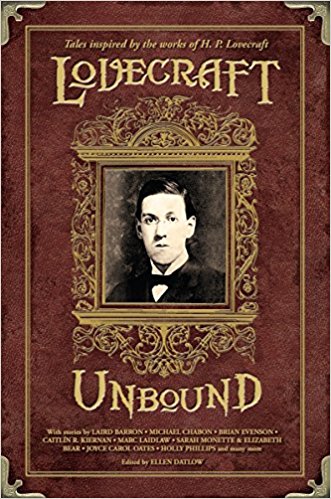
“Commencement” (2001) by Joyce Carol Oates

When I was eleven or twelve years old, I discovered H. P. Lovecraft in the Lockport Public Library, in upstate New York—the collection of Lovecraft stories was large and unwieldy with a distinctive font, which I can “see” vividly if I shut my eyes. The stories that riveted me immediately were “The Rats in the Walls” and “The Dunwich Horror.” At once I fell under the Lovecraftian spell—subsequently I have reprinted Lovecraft tales in anthologies of “literary” stories in the hope of breaking down the artificial barriers and unfortunate prejudices between genres.
—Joyce Carol Oates, Lovecraft Unbound 

Joyce Carol Oates had written eloquently about Lovecraft in The King of the Weird (1996), and curated a collection of his best fiction, Tales of H. P. Lovecraft (1997). Two of her novelettes have appeared in the Lovecraftian anthologies: “Commencement” in Lovecraft Unbound (2009) and “Shadows of the Evening” in Dreams from the Witch House: Female Voices of Lovecraftian Horror (2015). Neither is a story of the Cthulhu Mythos. Oates does not partake of the shared creative universe created by Lovecraft and his contemporaries, her works are not set in and do not expand on the setting as Tina L. Jens does in “In His Daughter’s Darkling Womb” or Margaret L. Carter does in “Prey of the Goat”; she does not reference Lovecraft himself as Joanna Russ in “I Had Vacantly Crumpled It Into My Pocket…But By God, Eliot, It Was A Photograph From Life!” or Adèle Olivia Gladwell in “Hypothetical Materfamilias.”

What is a Lovecraftian tale, without the Mythos and without Lovecraft?

LovecraftUnboundEllen Datlow, editor of Lovecraft Unbound, states in her introduction that she had read and enjoyed Lovecraft, but:

I’ve also read the multitudes of pastiches in anthologies of work “inspired” by Lovecraft, but most—for me, at least—are too obvious and bring little new to the table.

It’s a fair observation, and goes hand-in-hand with Oates’ remark on the prejudices of genre fiction. Lovecraft is more than just a bunch of strange and evocative names, and in his essay Supernatural Horror in Literature, the Providence gentleman himself observed:

The true weird tale has something more than secret murder, bloody bones, or a sheeted form clanking chains according to rule. A certain atmosphere of breathless and unexplainable dread of outer, unknown forces must be present; and there must be a hint, expressed with a seriousness and portentousness becoming its subject, of that most terrible conception of the human brain—a malign and particular suspension or defeat of those fixed laws of Nature which are our only safeguard against the assaults of chaos and the daemons of unplumbed space.

Lovecraftian pastiche may replace “bloody bones” with “eldritch tentacles” and the “clanking chains” with the Necronomicon, but the same principle applies: what writers are trying to recapture should not be the outward form of Lovecraft’s Mythos, but the central mood or essence. This is what Oates tries to capture in her tale, without recourse or reference to any of the outer trappings of the Mythos.

“Commencement” is a work of weird allegory. It is time for Commencement at the University, the annual academic ritual through which graduates get their degrees. There are no names, for even though this is a special event (the two hundredth anniversary of the University), it is also somewhat timeless, a ritual repeated every year without fail. The formula of the university commencement gives the shape of the story. As the pomp and symbolism of the ceremony slowly unfolds, so too do we get a glimpse of the broader setting—advancements in human genetic engineering, cloning, hints of hard science fiction—and the themes of continuity, of the marriage of ancestral strength to contemporary progress.

Then comes the climax, the conferring of the honorary degrees. The mystery of the Pyramid, foreshadowed slowly and with a slow build up of suspense Lovecraft would have approved of, is revealed but not explained. The viewpoint character for the story is the Assistant Mace Bearer, a nameless protagonist that harkens back to the initiates of “The Festival” and “The Shadow over Innsmouth”—unsure and unready for what transpires, as the Commencement continues in its final stages of the Recessional and Disrobing, they find the central truth to all such rituals: to participate in it is to experience a profound change. Like the protagonist in “The Shadow over Innsmouth,” they accept this new self that they have become.

The crux of Oates’ conception is the subversion of expectations; the fact that the ceremonies of medieval universities are still used in the present day are taken as granted. Lovecraft could not have contrived a better source of robed cultists or strange rites than reality provides. What Oates adds is the secondary layer of meaning—the mystery that the outward forms hide and disguise—and then drives it how during the climax. The horror of “Commencement” is not in the visceral details of the conferring of the honorary degrees, but in the culpability of the thousands of attendees, the group acceptance and participation which normalized such bloody exercises as the gladiatorial games of ancient Rome, Madama la Guillotine during the Terror, the Salem Witch Trials, or the sacrifices of Xipe Totec atop the Pyramid of the Sun in Tenochtitlán.

Is it Lovecraftian? The University is not Miskatonic University, not as Lovecraft envisaged it. A story does not automatically become Lovecraftian because an editor includes it in an anthology. Context can color a story, suggest associations which the author might not have intended. If encountered outside Lovecraft Unbound—Oates’ novelette first appeared in Redshift: Extreme Visions of Speculative Fiction (2001)—would it strike the reader as Lovecraftian? Without any direct allusion to Lovecraft’s works, the average reader probably wouldn’t make that connection. Technically, the story does not even have any supernatural element. Yet the influence of Lovecraft is certainly in the piece, with echoes of his themes and methods. Critical readers would no doubt pick up on the Lovecraftian vibe, as Datlow appears to have done, and scholars might look at Oates’ own definition of Lovecraft’s fiction:

Lovecraft with the fusion of the gothic tale and what would come to be defined as science fiction, and with the development of a species of horror fantasy set in meticulously described, historically grounded places (predominantly, in Lovecraft, Providence, Rhode Island; Salem, Massachusetts; and a region in northern central Massachusetts to which he gave the name “the Miskatonic Valley”) in which a seemingly normal, intelligent scholar or professor, usually a celibate bachelor, pursues a mystery it would wiser for him to flee.
—Joyce Carol Oates, Tales of H. P. Lovecraft viii

This is, if not exactly a synopsis for “Commencement,” at least highly evocative of the final product. It may not fulfill Lovecraft’s definition of a weird tale, and readers may never know whether or not Oates consciously had Lovecraft in mind when she conceived and executed this story, it certainly shows his influence. Not with tentacles or the Necronomicon, but by reproducing in form the shape and mood of Lovecraft’s stories, at least as she understands it.

So yes, “Commencement” is Lovecraftian.


Bobby Derie is the author of Sex and the Cthulhu Mythos (2014)