“The House of Idiot Children” (2008) by W. H. Pugmire & Maryanne K. Snyder

Tell my sad little life story? I was a weird kid. Believed I was a Witch when very young, as did my older sister. She and I used to practice what we thought was magick. Grew up knowing I was a sissy (loved playing house with the neighborhood girls, but always dressed LIKE them, wearing play dresses &c) and being tormented for it by grown-ups, kids at school, and thus I became an introvert and created my own realms of reality where I could be safe. My best friend in high school was Jewish, and that began a Jewish identification. Later I learned that I AM Jewish on my mom’s side of the family.
—W. H. Pugmire, “An Interview with W. H. PUGMIRE” (28 Feb 2009) by Jeffrey Thomas

There is a fine distinction between Jewish weird fiction and weird fiction that takes Jews or Judaism as its subject. Jewish weird fiction should be, ideally, written from a Jewish point of view; that may or may not involve aspects of Jewish religion or culture, but it should definitely have that viewpoint—and ideally, it should be written by someone who has lived experience to lend verisimilitude and authenticity to the story, who can approach the story as someone other than an outsider looking in. A good example might be “My Mother Was A Witch” (1966) by William Tenn.

A story doesn’t have to have a Jewish point-of-view to be about Jews or Judaism. Innumerable examples of Christian supernatural fiction reach back to Jewish religion and folklore to tell a story that is still focused, primarily, on a Christian point of view. The Wandering Jew in legend and literature may be Jewish in name, but their characterization follows the narratives conceived by predominantly Christian writers.

“The House of Idiot Children” (2008) by W. H. Pugmire & Maryanne K. Snider is, I suspect, their attempt at Jewish weird fiction. It follows Rav Samuel Shammua, a teacher in a small Jewish community who works at a school for autistic students. The description of the students reflects common depictions of autistic savants, formerly and derogatorily known as idiot savants:

They sat there, some very still some moving slightly back and forth, all staring into the air before them. Samuel shocked himself to feeling suddenly jealous. What did they see as they looked into nothingness. What did they listen to with an inner ear? The world saw these children as idiots who would always have difficulty functioning with the normal ear; and yet these children each contained a singular degree of genius. One was a mathematical genius. Another had memorized huge portions of Torah and Talmud in both English and Hebrew. And Moshe, who sat awaiting him, had excelled in the art of gematria […]
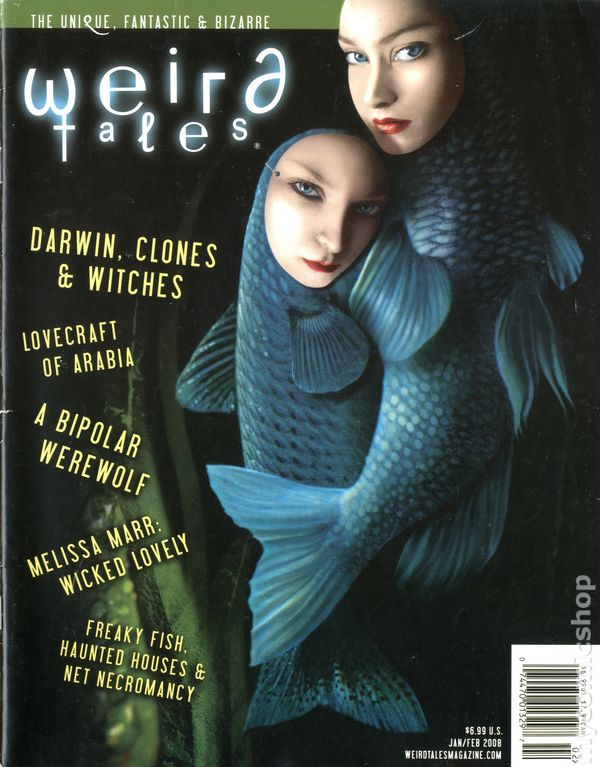
—W. H. Pugmire & Maryanne K. Sinder, “The House of Idiot Children” in Weird Tales #308 (26)

As in many of his stories, Pugmire slightly reworked the language in subsequent publications, so for example in An Imp of Aether (2019) he wrote:

[…] saw some students who, sitting at various tables awaiting instructors, watched his entrance, some very still, some moving slightly to and fro. Samuel shocked himself with feelings of sudden jealousy. What did they see with their autistic senses, what could they hear with an inner ear? The world saw these children as idiots who would always have difficulty functioning in the “normal” world; and yet these children each contained a singular degree of genius. One excelled in mathematics, another had memorized weighty portions of Torah and Talmudic lore, in both English and Hebrew. And mOshe, who sat awaiting him, had excelled in the art of gematria […] (44)

Autistic savants have their in supernatural literature, like the young girl Tiffany in Hellbound: Hellraiser II (1988) who uses her knack for puzzle solving to solve the Lament configuration. Such peculiar aptitudes can interact oddly with certain aspects of Jewish culture. The Hebrew alphabet has 22 letters, each of which can also represent an associated number, a practice called gematria. This overlap of linguistic and mathematical concepts has significant interest with topics like cryptography, the interpretation of certain Jewish and Christian religious texts, as well as Kabbalah and other occult systems. The intersection of these different areas of interest has been a fruitful area for creatives, such as the film Pi (1998) where a genius Jewish mathematician’s investigations into the nature of π reveal a number which might be the secret name of God.

Pugmire and Snider play with this idea:

“A twenty-third Hebrew letter, a letter of fire.” The elder man raised his hand so as to thoughtfully stroke his beard. “An angelic letter. A letter out of which nothing is formed.”

Samuel’s face felt odd, and he ran his hands over it, trying not to shudder. “You know of this?” His voice was laced with fear, for never had he experienced such a conversation. The mysteries of cabalistic lore were something with which he had never trafficked. He had seen certain friends of his become utterly obsessed with studying the Zohar and other such books, to the detriment of everything else. It was a lure in which he had no wish to find himself entangled.
—W. H. Pugmire & Maryanne K. Sinder, “The House of Idiot Children” in Weird Tales #308 (26)

Unlike “The Chabad of Innsmouth” (2014) by Marsha Morman or Dreidel of Dread: The Very Cthulhu Hanukkah (2024) by Alex Shvartsman and Tomeu Riera, this story has nothing to do with the Lovecraft Mythos. Yet there is something indelibly Lovecraftian in how Samuel Shammua is drawn into this esoteric study—an idea that madness and genius as linked, even as savanthood and autism are linked in Shammua’s mind.

“They’re not like others, that’s the point!” Samuel suddenly shouted, his face flushed with anger. “They are special creatures, for whom we especially care. What the hell is normal, Avram? Were you a normal kid? Our religious and ethnic heritage makes us outsiders in the normal world, that’s why we’re hated, that’s why madmen seek to destroy us.”
—W. H. Pugmire & Maryanne K. Sinder, “The House of Idiot Children” in Weird Tales #308 (29)

All of these elements come together in this story in an ending that is expected, and yet powerful. We the readers never learn the final mystery, which Moshe and the autistic children know and which Samuel Shammua learns. It is a literally ineffable truth, a knowledge beyond the scope of human experience. Whatever flaws the story might have in its depiction of autistic children, this was a deliberate and researched effort to weave together these disparate threads into a story that tried to express a weird tale from a Jewish point of view.

“The House of Idiot Children” was first published in Weird Tales #308 (Jan/Feb 2008). It was slightly revised and republished in The Tangled Muse (2008, Centipede Press), and then slightly revised again for An Imp of Aether (2019), which appears to be the authors’ final version.


Bobby Derie is the author of Weird Talers: Essays on Robert E. Howard and Others and Sex and the Cthulhu Mythos.

Deep Cuts in a Lovecraftian Vein uses Amazon Associate links. As an Amazon Associate I earn from qualifying purchases.
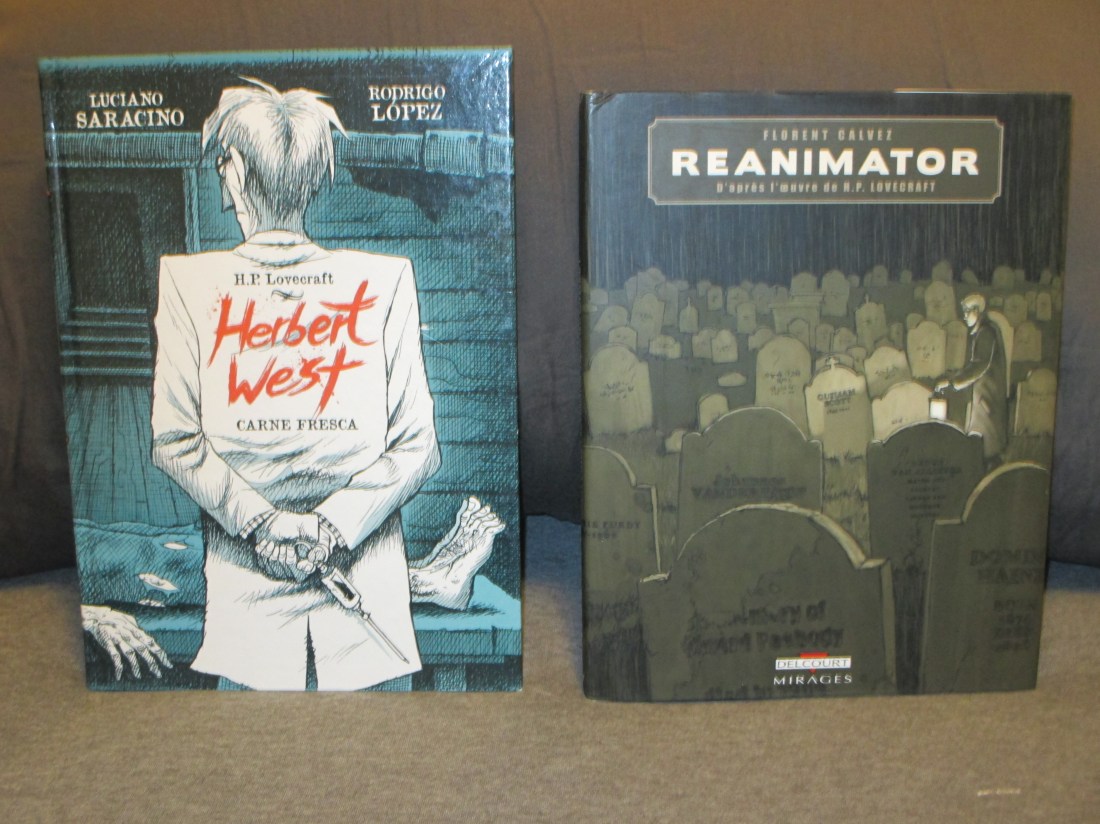
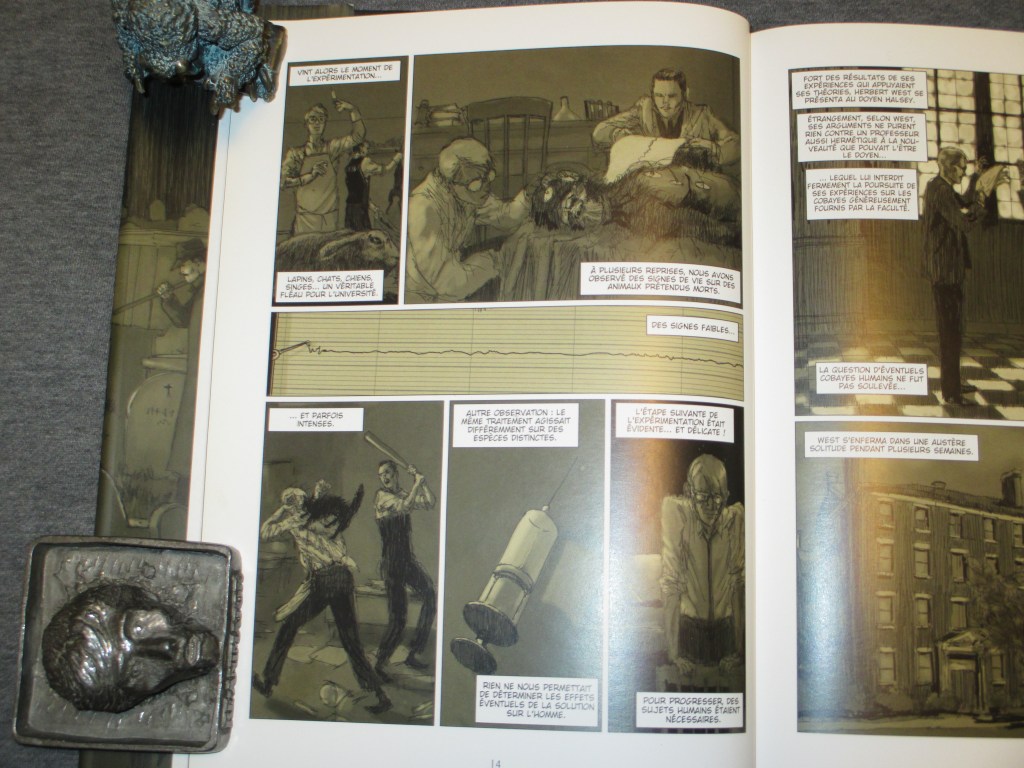
Reanimator (2008) by Florent Calvez v. Herbert West: Carne Fresca (2021) by Luciano Saracino & Rodrigo López

Not all of H. P. Lovecraft’s works are of equal merit, or of equal attractiveness to readers, artists, and writers. While some stories have been adapted many times in different media, others languish in relative obscurity—reprinted in Lovecraft’s collections, but rarely in anthologies, and with less impact on popular culture. The whys and wherefores differ with each tale; generally, such works were not popular during Lovecraft’s lifetime and may have only been published after his death, have little or no direct connection to the Mythos, or represent some difficulty due to changing tastes or the prejudices expressed in the story.

As something that represents all three of these categories, “Herbert West—Reanimator” is an unexpected posthumous breakout hit for Lovecraft. Initially published as a series of six interconnected short tales in the pages of Home Brew, and not published more widely until after Lovecraft’s death when Weird Tales reprinted them, “Herbert West—Reanimator” has only slight connection to Lovecraft’s wider Mythos with the Arkham/Miskatonic University setting, and contains a chapter with one of the most baldly racist characters and characterizations in Lovecraft’s oeuvre. Written as Lovecraft’s first attempt at commercial fiction, it isn’t really typical of his later style or efforts at all.

Yet…there is something about Dr. Herbert West that has thrilled audiences and inspired writers and artists for decades. The 1985 film Re-Animator spawned a small film franchise, a novelization, comic books, and merchandise; helped launch the Lovecraftian film careers of Stuart Gordon, Brian Yuzna, Jeffrey Combs, and Barbara Crampton; and even a hardcore pornographic film: Re-Penetrator (2004). Beyond this, many writers have taken a stab at the Re-Animator, including the anthology Legacy of the Reanimator (2015), Peter Rawlik’s Reanimators (2013) and Reanimatrix (2016), “Herbert West in Love” (2012) by Molly Tanzer, “Kanye West—Reanimator” (2015) by Joshua Chaplinsky, “Herburt East: Refuckinator” (2012) by Lula Lisbon, “(UN)Bury Your Gays: A Queering of Herbert West – Reanimator by H.P. Lovecraft” by Clinton W. Waters, and “Herbert West and the Mammaries of Madness” (2015) by Dixie Pinoit, “Albertina West: Reanimator” by TL Wiswell—among many others.

Comic and graphic adaptations of “Herbert West—Reanimator” are especially fascinating, because on those rare occasions where readers get two full adaptations, of approximately equal length, for side-by-side comparison, you can see how very different two adaptations can be of the same material—and how much work goes into turning a prose text into a comic script.

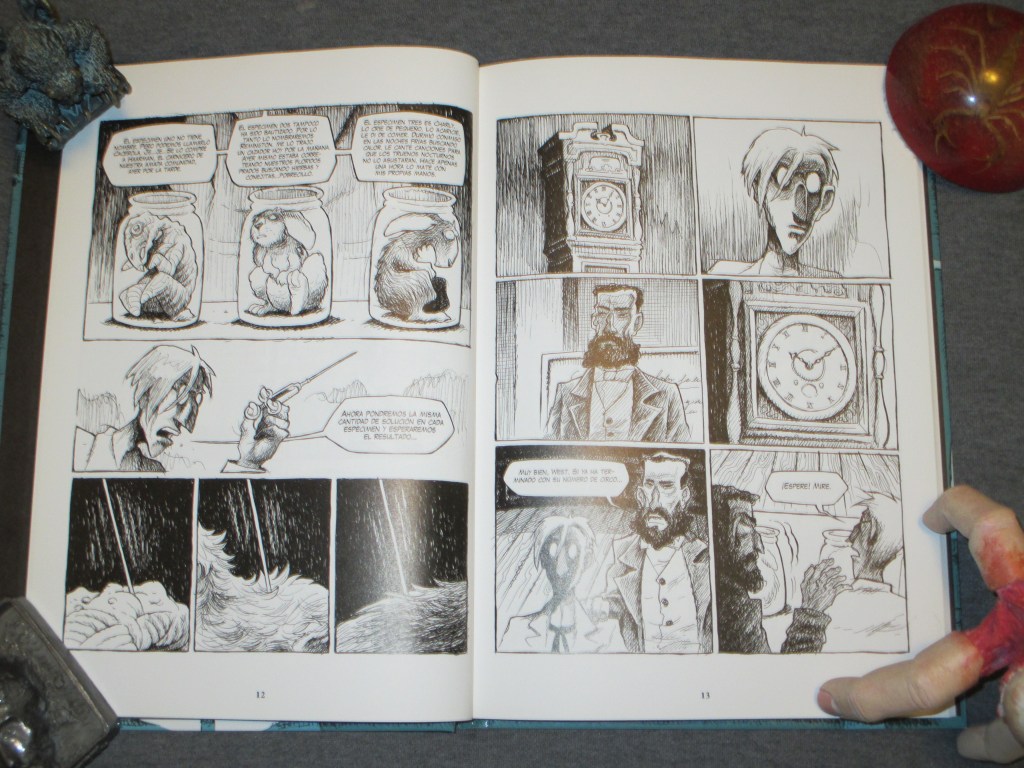
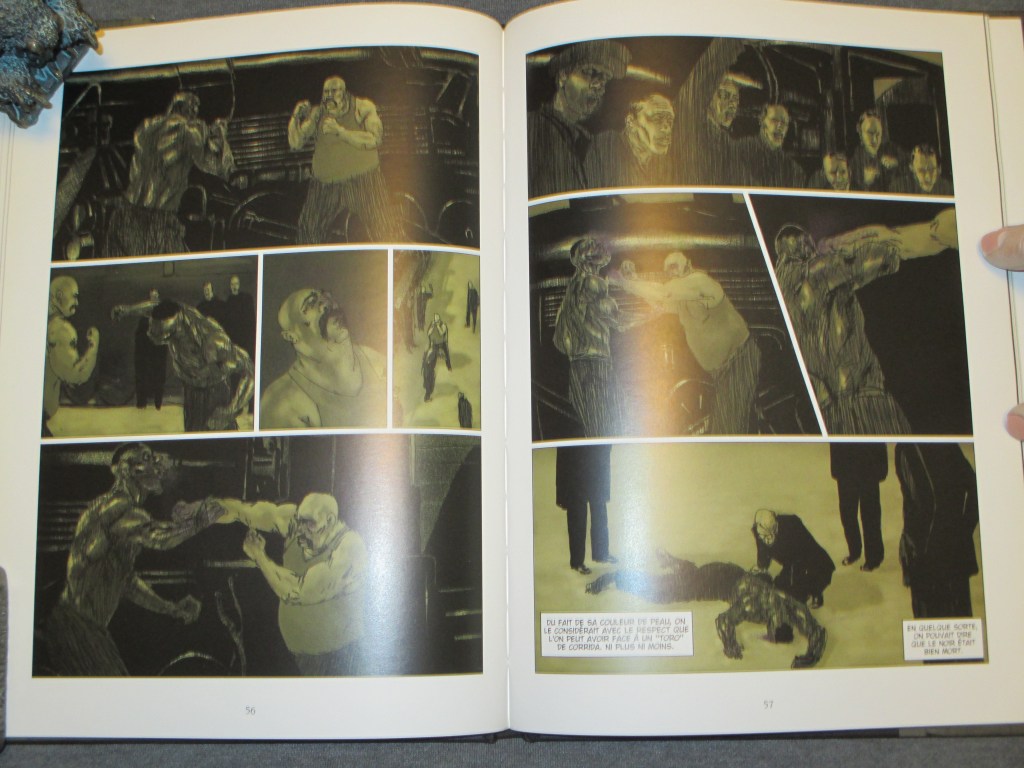
Such an opportunity presents itself with Reanimator (2008) by Florent Calvez, a hardbound 112-page French-language bande dessinee published by Delcourt, and Herbert West: Carne Fresca (“Fresh Meat”) (2021) by Luciano Saracino (script) and Rodrigo López (art), a 96-page Spanish-language hardbound album published by Dolmen. Both of these works adapt the full six episodes of “Herbert West—Reanimator” fairly faithfully—but how they do it and what they choose to emphasize is very different.

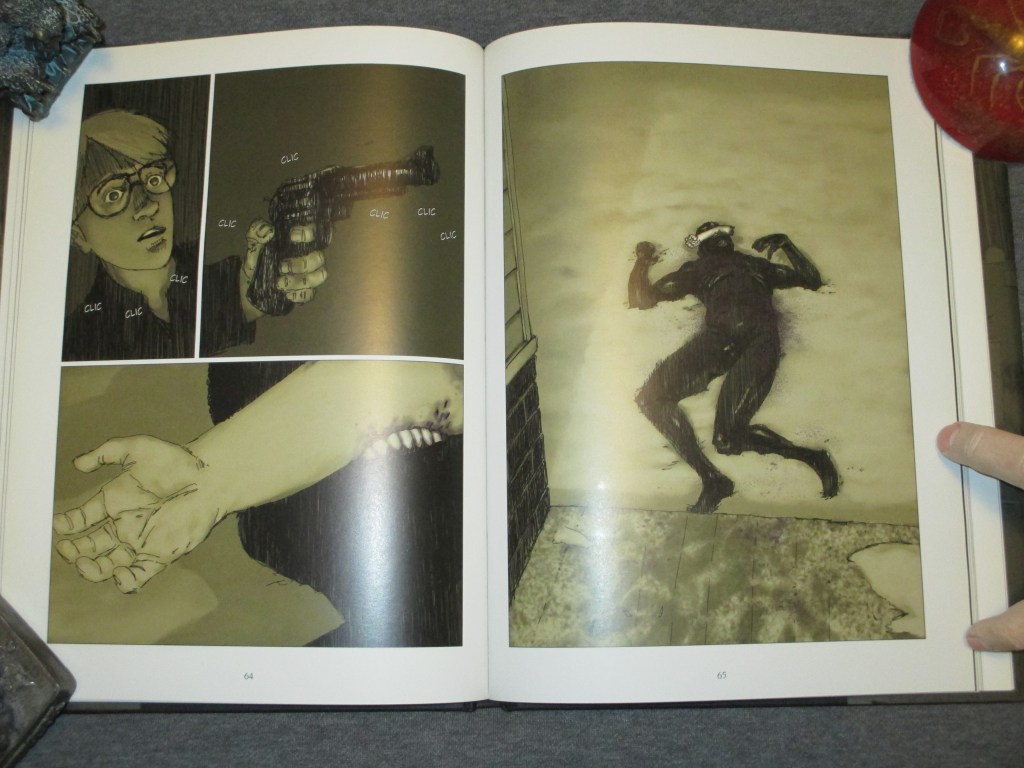
Calvez’ Reanimator is a sepia-toned period piece, starkly realistic. Unlike many later works, there are few if any visual cues or references to the 1985 film; Herbert West is blond, for example, as Lovecraft’s narrator described him, not a brunet like actor Jeffrey Combs. The most notable reference to the film is the brief shot of West being attacked by a reanimated black cat, a scene made infamous in the movie.

The main departure from Lovecraft’s story is that Calvez provides a framing narrative: the nameless assistant, older now, and visually similar to William S. Burroughs, is writing down his account of events on a ship. This wraparound segment helps give shape to the narrative as a Memoir, which features little speech and a great deal of exposition translated directly from Lovecraft’s text.

The stark realism of the work helps make the horrors stand out. There’s not a lot of gore in the traditional sense; the world of Reanimator is dark, murky, washed out like the sepia photographs of long-ago atrocities. Care and attention to detail are everywhere apparent: the details of costume and press, the architecture of houses, bits of English on newspapers and gravestones for the scenes set in the United States. It is a testament to Calvez’ skill and dedication to get the details right.

In Lovecraft’s story, we don’t see the boxing match, only the aftermath. Calvez has taken another liberty here: “Kid O’Brien” is implicitly a Jewish boxer under an Irish name, while “Buck Robinson, ‘The Harlem Smoke'” is almost a caricature of Black boxers like world heavyweight champion Jack Johnson. Boxing was a major national sport, and while Lovecraft may have cared little for it, he was certainly aware of some of the major boxers of his era, including Jackson.

The narrator’s prejudices that depicted the dead boxer in animal-like terms, and wondered if some obscure biological difference between white and black caused the failure of the reanimation experiment, Calvez leaves out. Their absence isn’t particularly noticeable, unless you know to look for them. It does not diminish the horror that marks the climax of the episode.

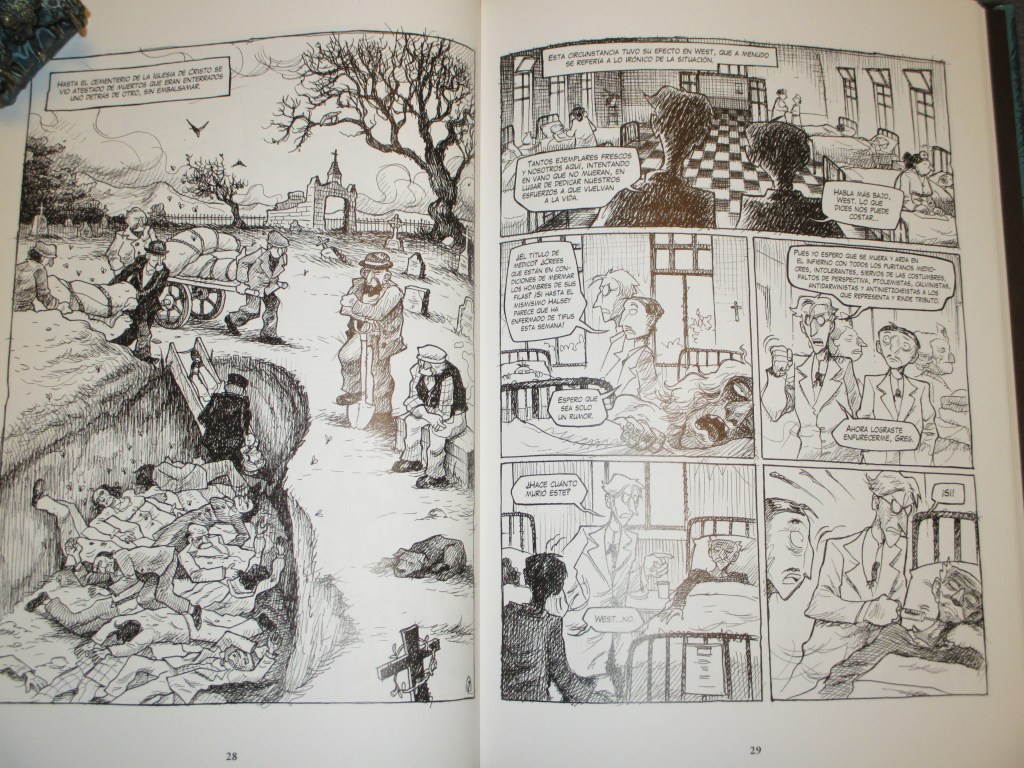
Saracino and López take a slightly different approach to Herbert West. The art style, in black and white, is more stylized. There is still great care and attention to detail, but the pages tend to more standard layouts, based around a six-panel grid, and there is much more dialogue. Herbert West himself is allowed to speak in his own words, instead of being relayed through his assistant.

So instead of doing a lot of telling, which Lovecraft was more or less forced to do by the nature of his medium, we get a lot more showing. Instead of a wraparound segment, we get more of an extended prologue, a demonstration of West’s experiments with animals.

West’s assistant gets a name and an identity beyond memoirist: Gregory Carter is a fellow medical student at Miskatonic University—and swiftly becomes West’s accomplice in his experiments—but here at least we get to see more interaction between the two. This isn’t Carter writing what has happened; the reader watches over his shoulder, so to speak, as events unfold.

Rodrigo López’ style shows a certain European influence; while the architecture, the dress, and the hairstyles are all very specifically old-fashioned in accordance with the setting, there are details that are more reminiscent of and older Europe than an older New England. There are roofs that look more like tile than anything you’d see in a New England winter, churches without steeples, police officers in kepi hats. A subtle transmigration of atmosphere that doesn’t change much of anything in the story, but reinforces the idea that this is not just an adaptation—it’s a localization.

Probably López’ best moments are when he gives himself a full page to really go while and showcase a scene, often from above to capture some of the landscape, to really play with broad white empty spaces and dark shadows. There’s a very Edward Gorey-like character to this splash pages. As always though, the horror is lurking near the climax of every episode.

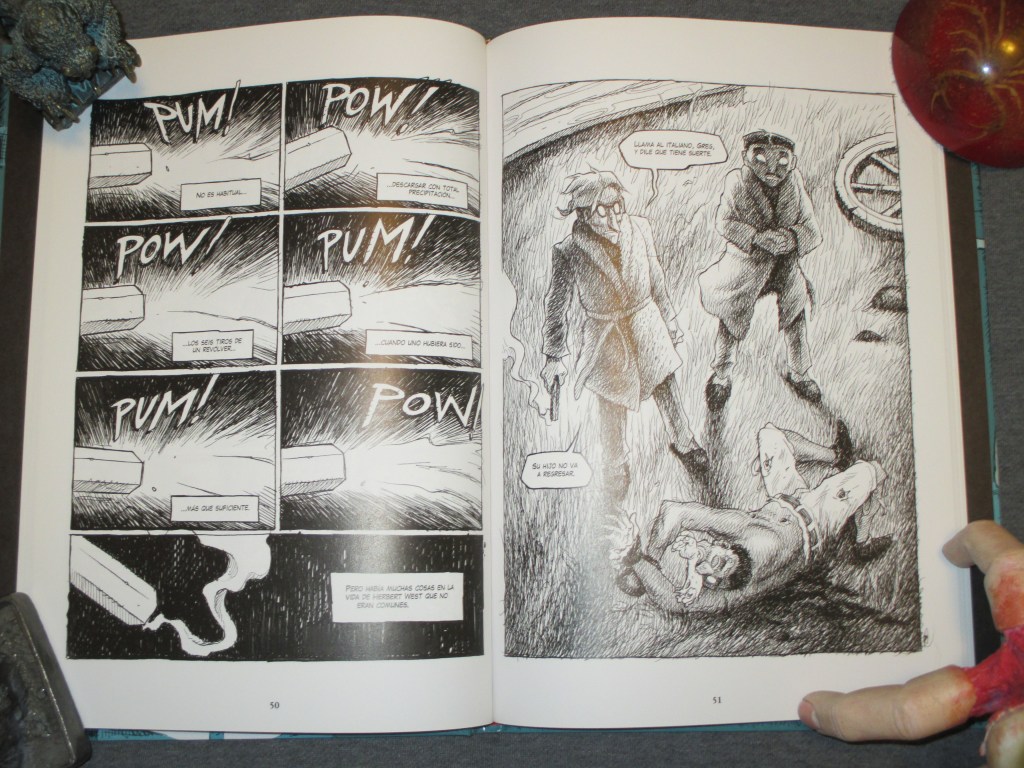
As with Calvez, Saracino & López gently excise the racism expressed by the narrator. It is enough that initial injections of the reanimation serum have no effect, the body is disposed of…and it comes back.

It is interesting how both artists focused on this moment as the climax of the episode; both were determined to present the stark horror, the rare bit of action and excitement in these stories, the most arresting visual image in perhaps the whole story. Yet they do it very differently; the reanimated corpse of Robsinon here is still half-dressed, more human-like, and despite the hatching, not as dark in complexion compared to the other characters (a common issue with black-and-white, which needs hair, facial features, and other cues to help delineate race to the audience visually).

Both stories approach the end with characteristic foreshadowing. Yet in this instance, López’ formatting standardization helps set up the scene better. We see the passage that leads from the old funeral home’s basement to the nearby cemetery; we see Carter and West bricking it up. Centrally placed, a Chekov’s gun loaded and with safety off.

When you’ve read “Herbert West—Reanimator” and seen so many different adaptions and variations on it over the years, there’s rarely any surprise in the ending, just as there is no real shock when Godzilla goes on a rampage through a city. The cities in Godzilla films are there to be squashed. Yet there is an aesthetic appreciation for how the job is done, how well the adaptation captures something of the tone and feel of the story, what grue the artist can supply—and how the writer and artist together choose to portray events.

It is not a question of whether Reanimator or Herbert West: Carne Fresca is the better adaptation: they each have their strengths, and they each have their differences. To convey the geographic setting, the period, the tone and atmosphere all requires going beyond just the words printed on the page in Lovecraft’s story. The adaptors need to block out the story, episode by episode, scene by scene, finally page by page and panel by panel. How to establish where the events take place. Leaving room for dialogue, for exposition. Finding the balance between showing and telling—and, in some cases, what not to say, to remain faithful to the spirit of the text without offending present audiences with old prejudices.

Neither of these works has been translated into English; non-English adaptations of Lovecraft rarely are. Yet there are few if any graphic adaptations of “Herbert West—Reanimator” in English to really equal them.

Reanimator (2008) by Florent Calvez is available in hardcopy and as a Kindle ebook.

Herbert West: Carne Fresca (2021) by Luciano Saracino and Rodrigo López is available in hardcopy.


Bobby Derie is the author of Weird Talers: Essays on Robert E. Howard and Others and Sex and the Cthulhu Mythos.

Deep Cuts in a Lovecraftian Vein uses Amazon Associate links. As an Amazon Associate I earn from qualifying purchases.
“Lovecraft in Brooklyn” (2008) by The Mountain Goats

And then the girl behind the counter
She asks me how I feel today
I feel like Lovecraft in Brooklyn
—final chorus

“Lovecraft in Brooklyn” is the eighth track on Heretic Pride (2008, 4AD) the eleventh studio album by The Mountain Goats, an indie/folk-rock project by singer/songwriter John Darnielle and his collaborators. The song was written and performed by Darnielle, and produced by Scott Solter and John Vanderslice. The tense 3:49 recording is narrated by an individual in a city, expressing muted frustration and horrific fantasies. References to Lovecraft and his work are few and vague, beginning with the second chorus:

Rhode Island drops into the ocean
No place to call home anymore
Lovecraft in Brooklyn

And ending with a reference to what might be the Fungi from Yuggoth:

Someday something’s coming
From way out beyond the stars
To kill us while we stand here
It’ll store our brains in Mason jars

…or perhaps just a paranoid ramble from an undiagnosed schizophrenic. While nothing happens in the narrative of the song, there is the implicit promise of violence about to occur, and “Lovecraft in Brooklyn” is the narrator’s common reference point for how they feel, a reference that they expect others to understand.

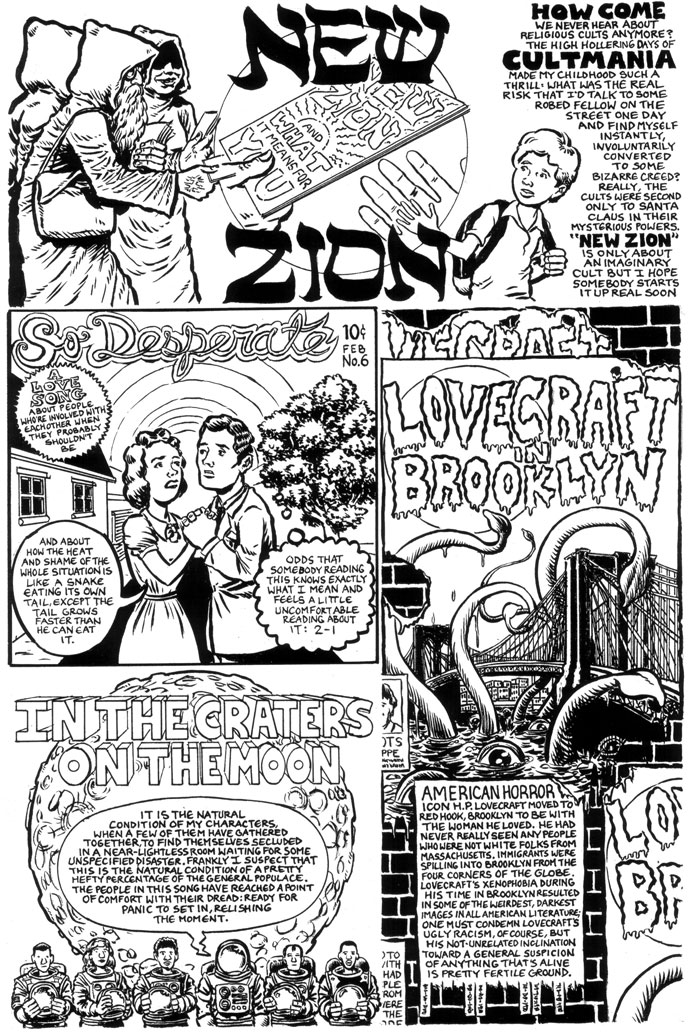
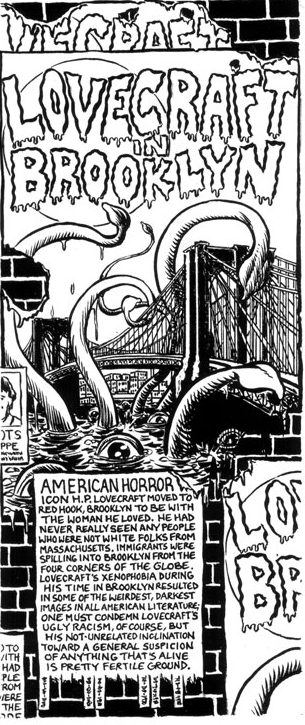
As part of the promotion of the album, comic book artist Jeffrey Lewis produced a three-page comic illustrating Darnielle’s notes about the songs.

American horror icon H. P. Lovecraft moved to Red Hook, Brooklyn to be with the woman he loved. He had never really seen any people who were not white folks from Massachusetts. Immigrants were spilling into Brooklyn from the four corners of the globe. Lovecraft’s xenophobia during his time in Brooklyn resulted in some of the weirdest, darkest images in all American literature; one must condemn Lovecraft’s ugly racism, of course, but his not-unrelated inclination toward a general suspicion of anything that’s alive is pretty fertile ground.

In a 2008 interview about the science fiction influence on his work, Darnielle was asked specifically about the song:

[Charlie Jane Anders]: Your new album includes a song about H.P. Lovecraft, “Lovecraft In Brooklyn.” Why should we identify with H.P. Lovecraft’s feelings of alienation and xenophobia during his exile in Red Hook? What about that image appeals to you? In Lovecraft’s case, that alienation leads to all his best speculative horror… do you think xenophobia creates better speculative fiction than xenophilia?

[John Darnielle]: Well the song is not really about Lovecraft — it’s sung by a guy who’s identifying with Lovecraft at his most xenophobic and terrified. Why does that appeal? I think I’m just attracted to hermits in general — to people who don’t feel like they’re part of the world, who have a hard time feeling like they’re really present in the same space as everybody else.
—Charlie Jane Anders, “The Mountain Goats Explain Why Ozzy Osbourne Is A Scifi Visionary” (Gizmodo, 27 Mar 2008)

An apocryphal account of the 22 March 2008 live session The Mountain Goats played at the Black Cat club in Washington, D.C. captures an opener John Darnielle gave before playing this song:

Once again, to express my affection for you, I’d like to play this song about a fellow who is really so filled with anger and rage that the mere sight of other human beings makes him feel even more angry. He’s angry already when he wakes up, before he remembers that there’s other people on the planet. But once he thinks of those other people, then he starts to really get going. And heaven help you if he should have to go and get some kleenex or whatever from the corner store, then he will really be filled with a special kind of contempt. Why? Because you have bodies and they make him sick. That’s what this song is about. I know everyone can relate to the tender feelings expressed in it.

John Darnielle is not a Lovecraft scholar; his understanding of Lovecraft as represented in the promotional materials, lyrics, and intra-show commentary reflects a popular depiction of Lovecraft as an angry xenophobe trapped in a place surrounded by people who weren’t like him, and it made him go crazy. “Lovecraft in Brooklyn” reflects the legend of Lovecraft’s 1924-1926 sojourn to New York, much like Victor LaValle’s “The Ballad of Black Tom” (2016) represents an interpretation of “The Horror at Red Hook,” one of the stories Lovecraft wrote during that period, with an emphasis on Lovecraft’s racism.

The reality was more complicated. 1924 wasn’t the first time Lovecraft had been to New York; it wasn’t the first time Lovecraft had been out of state, or seen people of color or different ethnicities. Lovecraft had experiences leading up to his 1924 elopement with Sonia H. Greene, who gave her version of their married life in The Private Life of H. P. Lovecraft (1985), which he thought prepared him for life in New York.

As it happened, Lovecraft was wrong. He failed to find employment; soon after marriage, his wife fell ill and required hospitalization and then rest. Without either of them working, money swiftly became an issue. Sonia eventually found a job out in the Midwest, but Lovecraft would not follow her there, so he was left alone, in the poor Red Hook neighborhood of Brooklyn. Largely alone, unable to make his own way, dependent on a wife he didn’t see for weeks and distant aunts, Lovecraft tried to make the best of it with his local friends.

Then thieves broke into his apartment.

Letters from Lovecraft to his aunts Lillian D. Clark and Annie Gamwell show how unhappy he was. While he never blamed the immigrants or people of color for his own failures, his letters to them during this period show how much Lovecraft’s prejudices were exacerbated during this final, stressful period in New York…until, at last, his aunts and wife prevailed upon him to return to Providence, Rhode Island, where he could be happier.

So he did.

Most of Lovecraft’s New York experiences did not make it into his fiction; not even the fiction he wrote while living in and set in the city. “The Horror at Red Hook” is unusual because through Lovecraft’s letters and various anecdotes in memoirs we can trace it back to a specific incident—overhearing some hardboiled toughs talking a little too loudly about criminal goings-on at a local cafeteria—from which Lovecraft spun out his fantasy of an immigrant gang-cum-cult involved in human trafficking, murder, and more esoteric activities.

“The Horror at Red Hook” reads pretty baldly racist; the equivalent today might be a story of an MS-13-type group that was also a survival of ancient Aztec religion that still practiced human sacrifice. That was very explicitly fiction, though—a play on contemporary prejudices, not Lovecraft just putting his own prejudices onto the paper. A fine distinction for a lot of readers who don’t always like to distinguish between what Lovecraft thought and how he portrayed things in the pages of Weird Tales.

New York-based rapper and producer Aesop Rock (Ian Matthias) did a remix of “Lovecraft in Brooklyn,” which at 3:31 retains all of Darnielle’s lyrics but quickens the beat and reworks the soundscape with added effects to add to the tension and air of alienation of the song, and providing a densely-packed fourth verse of his own. The added lyrics are grounded much more firmly in Brooklyn itself, and suggest a deeper understanding of Lovecraft’s time in New York (“Summer lovin’ snuck him toward the tarnished arms of liberty”), and perhaps reflect W. Paul Cook’s assessment that Lovecraft’s time in New York was pivotal toward his development as a writer (“Little Howie’s parachute has flowered down the rabbit hole”).

“Lovecraft in Brooklyn” is an expression of the pop cultural phenomenon that is Lovecraft; his legend used to evoke certain ideas, attitudes, and aesthetics completely rather than any attempt to relate a distinct biographical episode from his life. It showcases how Lovecraft’s reputation as a bigot and xenophobe has become so rampant; of course, the fact that he was racist (if not always to the degree or in the way folks like Darnielle portray) cannot be ignored and shouldn’t be downplayed.

While Darnielle’s particular impression of Lovecraft may be factually incorrect, Darnielle was right in that Lovecraft’s legacy continues to be fertile ground for artists to fuel their own imaginations.

“Lovecraft in Brooklyn” – The Mountain Goats (Youtube link)

“Lovecraft in Brooklyn” (remix) – The Mountain Goats / Aesop Rock (Youtube link)


Bobby Derie is the author of  Weird Talers: Essays on Robert E. Howard and Others  and  Sex and the Cthulhu Mythos .

Deep Cuts in a Lovecraftian Vein uses Amazon Associate links. As an Amazon Associate I earn from qualifying purchases.
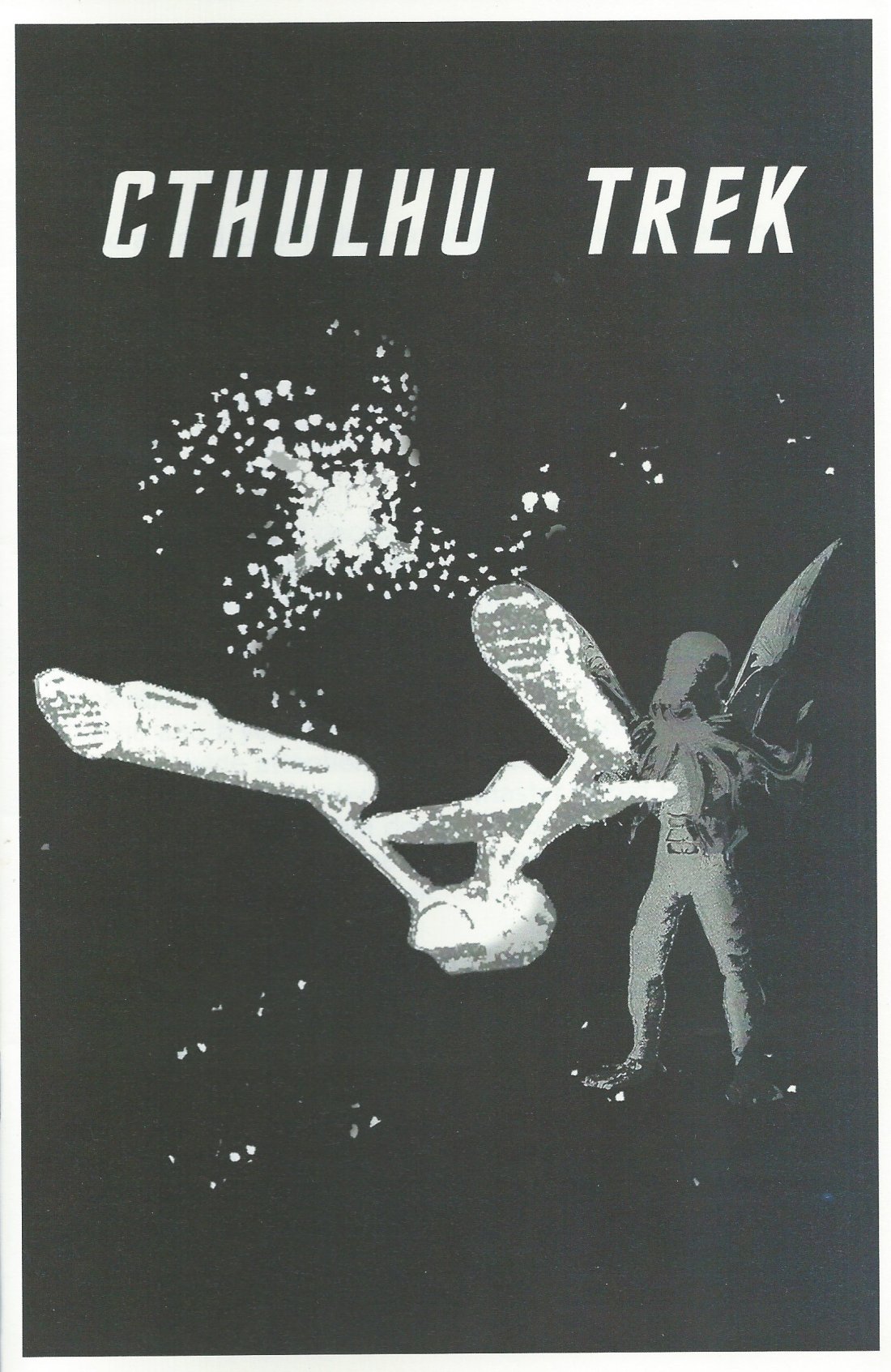
Cthulhu Trek (2008) by Leslie Thomas

Cthulhu Trek– Written and Edited Les Thomas, Layout and Illustrations Cabin Campbell, 1st. Edition, 2008. Star Trek collides with Lovecraftain horror. Robert Blochʼs Lovecraft/ Star Trek connection, Jeffery Combs HPL/ ST characters. Plus Sutter Cane (sometimes spelled Kane) Star Trek Fiction (Warning: Explicit sex and violence). $4.00
—Leslie Thomas, 13th Hour Books

In the early 1930s, science fiction fandom came into being. One of the characteristics of this fandom was the strong influence of the amateur journalism movement. It wasn’t just that there were fanatical readers of pulp fiction, but they documented their love and excitement, their fan art and fan poetry and fanfiction, their discussions and feuds.

Today, we talk about fandom studies with textbooks like the Fan Fiction Studies Reader because these early ‘zines are the trace fossils of the fans themselves, most of whom are sadly gone and can no longer give us living memories of what it was like to buy the magazines off the rack, to organize the first conventions, make their own costumes at home. To carry out debates by mail, and see the wonders and terrors of the Atomic Age and Space Age and finally the Digital Age be manifest around them.

As the fans grew up, fandom grew up with them. Scholars like Brian Wilson have traced the history of rule 34 from the first nude artwork that graced the 1930s fanzines to the Star Trek slashfic written and analyzed by Joanna Russ to the internet erotica of today. Things percolated together and got profoundly, lovingly, weird. Mash-ups between different genres, different properties, entirely different fandoms came together, often just for laughs or following some singular vision of “Hey, wouldn’t this be cool?” or “Hey, wouldn’t this be hot?”

Leslie Thomas is a fan of both Star Trek and the Cthulhu Mythos. His 2008 ‘zine Cthulhu Trek is a labor of love, an unpaginated 16-page staplebound black-and-white expression of profound and utter nerdiness—and it is, in many ways, an exemplar of what a fanzine can be: fun, scholarly by its own lights, and brimming with creativity and enthusiasm.

McCoy opened another cabinet and, from it he pulled out a small jar and handed it to Kirk. “I have to ask Jim, but did you have sex with a Yithian lately,” a slight smile crossed his kindly face as he place [sic] the alcohol back into its cabinet.
—Leslie Thomas, “Cream” in Cthulhu Trek

The first few pages of the ‘zine trace connections between Star Trek and the Mythos—principally via Robert Bloch, who wrote three episodes of the original series, and versatile actor Jeffrey Combs whose credits include multiple roles in both Star Trek series and various Lovecraftian films and adaptations, most especially the Re-Animator series, From Beyond, The Evil Clergyman, Necronomicon: Book of the Dead, and The Dunwich Horror (2009).

Like a good hoax, Thomas then transitions into fanfiction—presenting pieces of the Mythos-inflected Star Trek fiction of Sutter Kane. Of these, the bare two pages of Kirk picking up an extraterrestrial (or should that be extratemporal?) STD are perhaps the most memorable, although Chekov’s encounter with a dominatrix is certainly not something that will be forgotten in a hurry, barring blunt forced trauma to the head or the alcoholic equivalent.

Cthulhu Trek ends with the rather odd bit of trivia that Will Wheaton starred in The Curse (1987), a rarely-remembered film based on Lovecraft’s “The Colour out of Space.” Wheaton, of course, gained popularity by playing Wesley Crusher on Star Trek: The Next Generation, and if it feels weird to turn the page from Sulu in the grips of madness to a tidbit that feels straight out of the Internet Movie Database…well, it is. Like all fanzines, Cthulhu Trek is idiosyncratic, produced by one writer who was also his own editor, with Cabin Campbell as illustrator and layout artist.

Could Thomas have taken it further? Could he have produced a full-fledged erotic Star Trek/Cthulhu Mythos opus, self-published it, and reached the heights of fame that E. L. James did? Maybe. So could you. What he did instead was write and publish a funny little chapbook as a bit of amusement for himself and his fellow fans. Which is pratically the definition for what fanfiction is: the desire not just to create something inspired by some work, but to share it with others. That is what Cthulhu Trek is, ultimately; not a masturbation aid, but an endearing effort to share the love of Star Trak and the Cthulhu Mythos.


Bobby Derie is the author of Weird Talers: Essays on Robert E. Howard and Others and Sex and the Cthulhu Mythos.

Deep Cuts in a Lovecraftian Vein uses Amazon Associate links. As an Amazon Associate I earn from qualifying purchases.
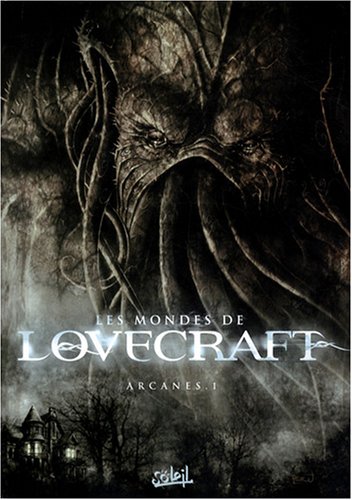
“Massacre à Miskatonic High School” (2008) by Jean-Jacques Dzialowski & Dimitri Fogolin

Depuis la nuit des temps,
Des dieux noirs corrompent notre monde.
Ce sont les Grands Anciens.

La folie est leur visage.
L’horreur est leur royaume.
Leur éveil approache…
Since the dawn of time,
The dark gods corrupt our world.
These are the Old Ones.

Madness is their face.
Horror is their kingdom.
Their awakening approaches…
Back cover, Les Mondes de Lovecraft

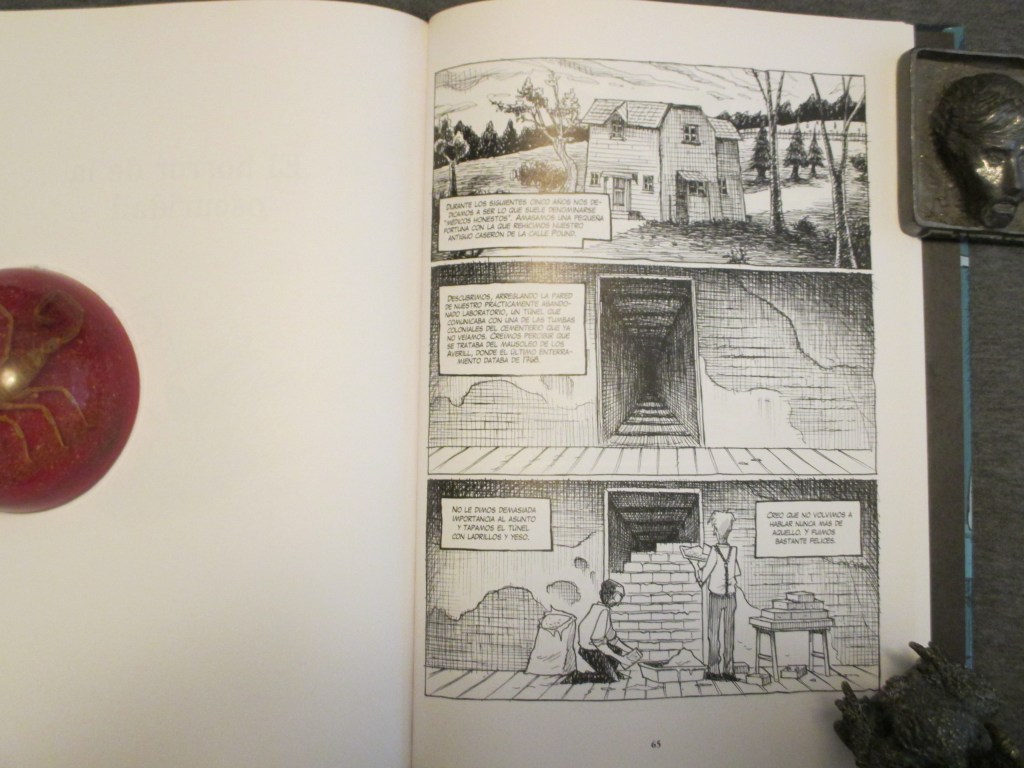
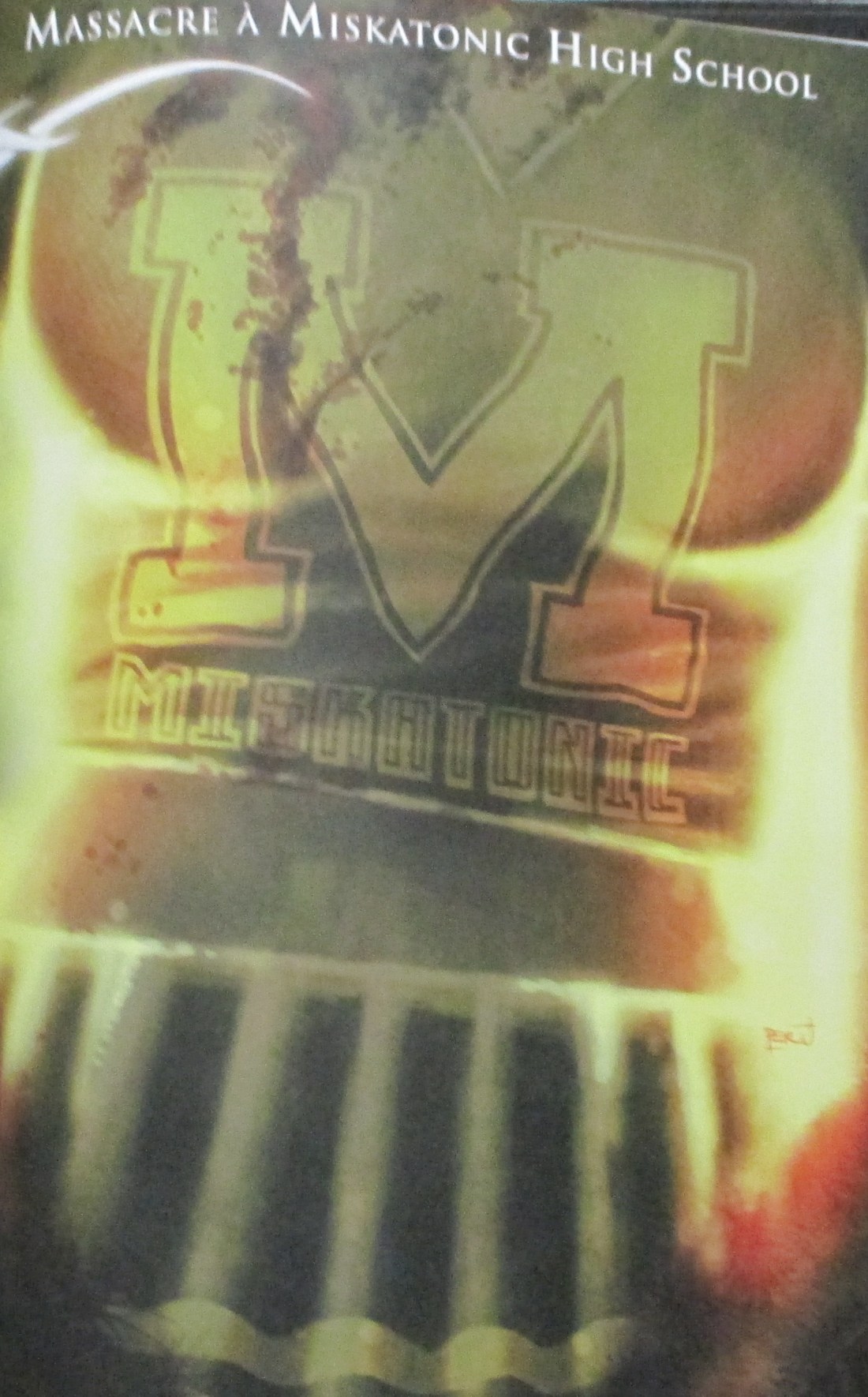
MondesLes Mondes de Lovecraft (“The Worlds of Lovecraft,” 2008, Soleil) is a standalone French-language comic anthology of stories set in the world of H. P. Lovecraft, including an adaptation of Lovecraft’s “Dagon.” Two of the stories in the book are the work of Jean-Jacques Dzialowski (writer) & Dimitri Fogolin (artist): “Le Signe sans Nom” (“The Nameless Sign”) and “Massacre à Miskatonic High School” (“Miskatonic High School Massacre”). The two works are complementary, in that they tell different sides of the same story from different perspectives. “Le Signe sans Nom” is given after-the-fact, during the deposition of a Sergeant McDermot, who responded to the events at Miskatonic High. “Massacre à Miskatonic High School” on the other hand gives the perspective of the school shooters. 


IMG_2591

The 1999 Columbine High School Massacre casts a long shadow over culture and pop culture alike. The media blitz helped to inspire numerous copycats; partisan politicians and pundits in the United States tend to quickly politicize shootings to minimize arguments over gun ownership as happened in the aftermath of the 2012 Sandy Hook Elementary School Shootings. Comic books have rarely touched on such controversial and emotionally-charged territory; DC Comics notoriously cancelled the Hellblazer story “Shoot” by Warren Ellis, Phil Jimenez, and Andy Lanning in 1999 over concerns of backlash.

At the bottom of most coverage of such shootings is one question: Why did they do it? What drove these kids to kill other kids?

Real-world causes are complex: psychological issues, a disturbed home life, access to firearms are all contributing factors. In the worlds of H. P. Lovecraft however…it’s rather simple.

They want the books.

Toute sa vie, grand-père a cherché les livres. Il en avait trouvé certains et il m’a laissé plein de notes…

All his life, grandfather searched for books. He had found some and he left me lots of notes …

In real life, the two Columbine Massacre shooters committed suicide in the library. In this Miskatonic Massacre, Dzialowski and Fogolin have something similar happen, but for very different reasons. Taking a page from Lovecraft’s “The Dunwich Horror,” the two shooters want access to the ancient tomes contained (somewhat inexplicably) in the Miskatonic High School library.

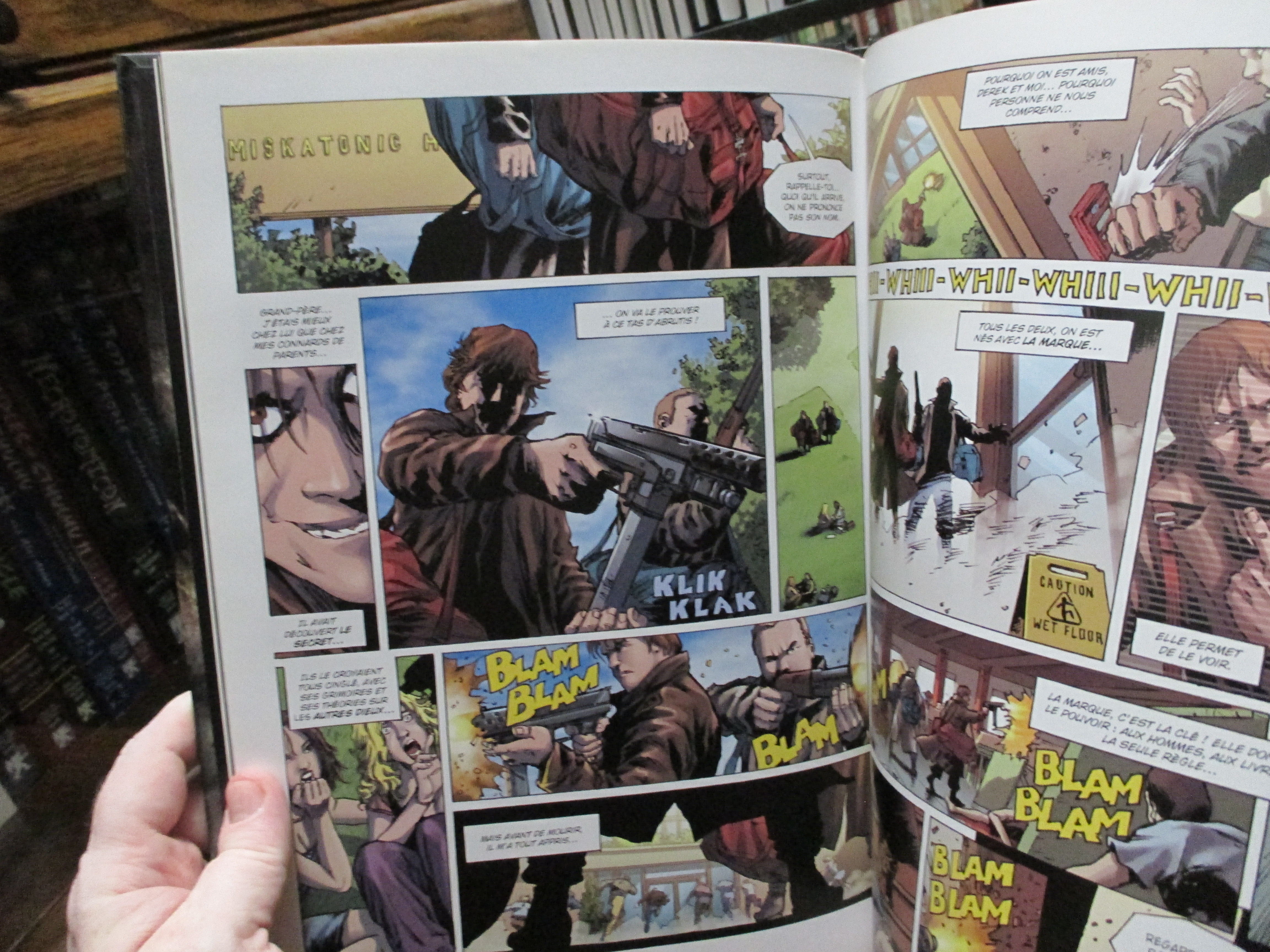
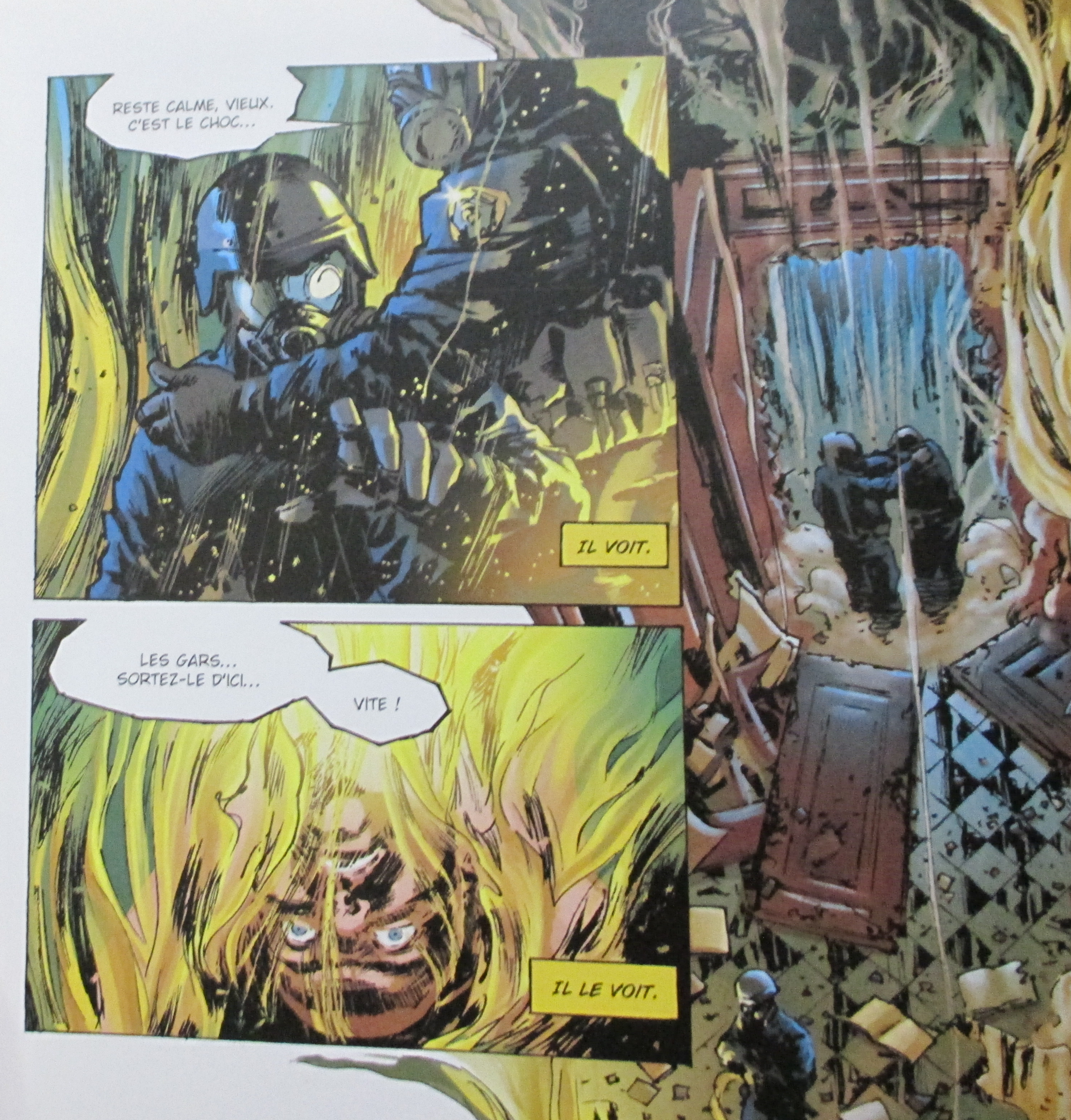
“Massacre à Miskatonic High School” is nine pages; “Le Signe sans Nom” is eight. The two works should really be considered as parts of the same story, and being parallel narratives, they have visual and textual echoes and references to one another—the final panels are largely identical. Fogolin, however, approaches each story separately. “Le Signe sans Nom” is darker, with more blacks, greys, and blues, while “Massacre” is brighter, dominated by yellows and greens—appropriate enough given the prominence of Hastur in this chapter of the story. The layouts for both stories also start the same: a regular nine-panel grid, which breaks down in the subsequent pages.

Given the subject matter, there is a certain amount of commendable reticence to show too much. We see bullets, blood, dead bodies, but we don’t actually see anyone get shot on the page, in close up or detail. Readers can be appalled at what is happening without seeing every last bullet hole or shard of bone. At the same time, this gloss of violence and the digital coloring lends a certain muddiness to the compositions; one wonders how it would have been different if Jacen Burrows or Raulo Cáceres might have handled the same material.

IMG_2600

Lovecraft never quite tackled such a mundane horror as a school shooting. Yet the horror in this story is a little different from real life. What if Wilbur Whateley had reached the Necronomicon? Would he have succeeded in clearing off the Earth, or would he have ended up as these two did? The central issue isn’t just the horrors perpetrated, but that the two shooters in this story very nearly succeeded. If someone had been a little more competent…how much more damage could they have wrought?

Perhaps more importantly, what’s to stop the same thing from happening again?

“Le Signe sans Nom” and “Massacre à Miskatonic High School” are both published in Les Mondes de Lovecraft. It has not been translated into English or reprinted, as far as I have been able to ascertain.


Bobby Derie is the author of Weird Talers: Essays on Robert E. Howard & Others (2019) and Sex and the Cthulhu Mythos (2014).

“The Vulviflora of Vuutsavek” (2008) by Charlotte Alchemilla Smythe

Eldritch Fappenings

This review deals with a work of erotic content, and the history of erotic art and writing. As part of this review, selected passages with descriptions of genitalia and/or sexually explicit contact will be included.
As such, please be advised before reading further.


As he went down the knoll into the valley, the enchanter heard an eery, plaintive singing, like that of sirens who bewail some irremediable misfortune. The singing came from a sisterhood of unusual creatures, half woman and half flower, that grew on the valley bottom beside a sleepy stream of purple water. There were several scores of these lovely and charming monsters, whose feminine bodies of pink and pearl reclined amid the vermilion velvet couches of billowing petals to which they were attached. These petals were borne on mattress-like leaves and heavy, short, well-rooted stems. The flowers were disposed in irregular circles, clustering thickly toward the center, and with open intervals in the outer rows.

Maal Dweb approached the flower-women with a certain caution; for he knew that they were vampires. Their arms ended in long tendrils, pale as ivory, swifter and more supple than the coils of darting serpents, with which they were wont to secure the unwary victims drawn by their singing. Of course, knowing in his wisdom the inexorable laws of nature, he felt no disapproval of such vampirism; but, on the other hand, he did not care to be its object.
—Clark Ashton Smith, “The Flower-Women” (WeirdTales, May 1935)

Weird Tales had three leading writers during the 1920s and 30s: H. P. Lovecraft, Robert E. Howard, and Clark Ashton Smith. While not always the most popular or published, or even the most successful during their lifetimes, they stand above more prolific writers such as Seabury Quinn and H. Bedford Jones, and their work in the pulps is esteemed above the early work of successful later peers like Robert Bloch, Manly Wade Wellman, C. L. Moore, and Margaret St. Clair.

Howard died in 1936; Lovecraft in 1937. Clark Ashton Smith survived until 1961, the only one of the three to outlive Weird Tales, though the latter portion of his life involved far less fiction and poetry than his fans and admirers would have liked, living for the most part a quiet life with his family, doing seasonal labor and working as a gardener for his livelihood. Smith is the only one of those three masters for which a record of his voice survives, in the Elder Tapes; and his published letters are an invaluable record of the creation of the Cthulhu Mythos, tracing his contacts with both H. P. Lovecraft during his life and, afterwards, with August Derleth at Arkham House.

Smith was wonderfully weird, and left behind a body of work that puts the romance in necromancy; stories such as “Mother of Toads” and “The Witchcraft of Ulua” could not be published uncensored in Weird Tales, and in later life he even wrote a drama titled “The Dead Will Cuckold You.” Which is not to say he was in any sense pornographic; his few efforts to sell to the Spicy pulps largely didn’t, unlike his friend Robert E. Howard. Rather, his prose was sensuous, often filled with long and curious words that conveyed shades of meaning and suggestions of eroticism that could not be put into print.

These scions were the various parts and members of human beings. Consumately, and with never faillng success, the magician had joined them to the half-vegetable, half-animate stocks on which they lived and grew thereafter, drawing an ichor-like sap. Thus were preserved the carefully chosen souvenirs of a multitude of persons who had inspired Dwerulas and the king with distaste or ennui. On palmy boles, beneath feathery-tufted foliage, tbe heads of eunuchs hung in bunches, like enormous black drupes. A bare, leafless creeper was flowered with the ears of delinquent guardsmen. Misshapen cacti were fruited with the breasts of women, or foliated with their hair. Entire limbs or torsos had been united with monstrous trees. Some of the huge salver-like blossoms bore palpitating hearts, and certain smaller blooms were centered with eyes that still opened and closed amid their lashes. And there were other graftings, too obscene or repellent for narration.

Adompha went forward among the hybrid growths, which stirred and rustled at his approach. The heads appeared to crane towards him a little, the ears quivered, the breasts shuddered lightly, the eyes widened or narrowed as if watching his progress.
—Clark Ashton Smith, “The Garden of Adompha,” (Weird Tales, Apr 1938)

For all of his longevity and enormous influence, Clark Ashton Smith remains the most under-studied, and often under-appreciated of the three masters of the weird tale. The amount of critical literature, biographical materials, published letters, etc. regarding him is an order of magnitude less than might be found for Robert E. Howard, which is itself less than that of H. P. Lovecraft. While Smith’s Mythos fiction and creations like Tsathoggua have inspired many authors to expand on his work, it is more often through the Lovecraftian lens of “The Mound” (1940) by Zealia Bishop & H. P. Lovecraft than Smith directly. There are simply fewer fans writing stories and novels set in Smith’s Zothique or Hyperborea than there are those writing works set in Robert E. Howard’s Hyborian Age.

More specifically, fans tend to be somewhat less apt to pastiche the work of Clark Ashton Smith, either in textual style or content. While many pasticheurs find some joy in aping H. P. Lovecraft’s occasionally ultraviolet prose and descriptions of the unnamable, or Robert E. Howard’s terse exclamations (“By Crom!”) and strive to emulate his fast-moving action, Smith doesn’t seem to attract quite the same effort. Whether the particular sardonic style and rich vocabulary is off-putting to would-be pastiche writers, or those who try simply fall a bit too far short of the real thing to be recognized as such, it remains that very few have tried to capture the peculiar and iconic mix of cosmic horror and sensuality that Clark Ashton Smith made seem so effortless in so many stories and poems.

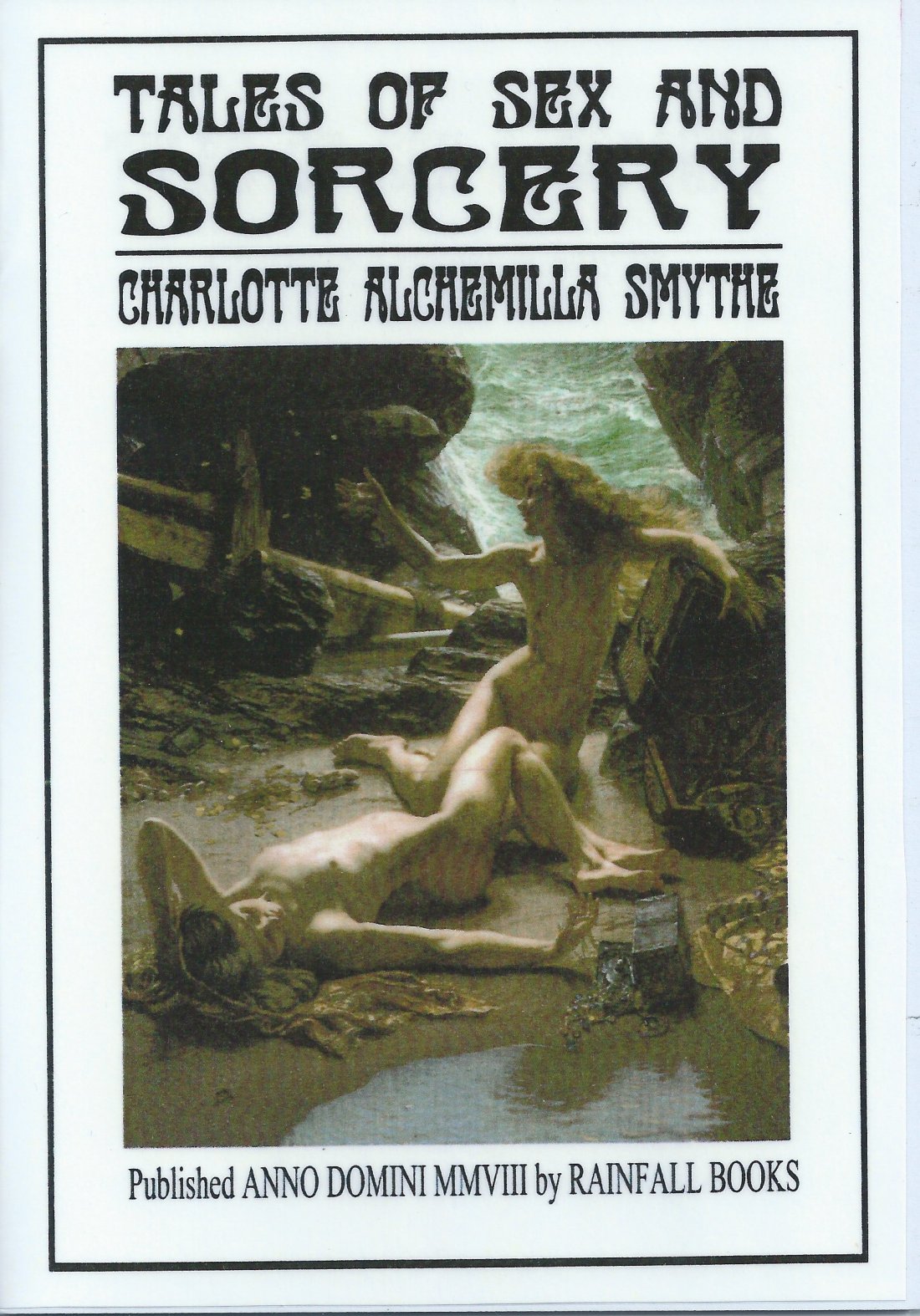
Which is what resulted in Tales of Sex and Sorcery (2008) by “Charlotte Alchemilla Smythe.”

Chained with gold in chaises percées, slender ankles pedicled apart and tender vulvae exposed between silken thighs, the garden-girls of the emperor Vuutsavek first cursed the youth and beauty that doomed them, but came in time to new gratitude therefor, dying with ecstasies greater and more numerous than a hundred lifetimes of ordinary length might have granted them.
—Charlotte Alchemilla Smythe, “The Vulviflora of Vuutsavek” in Tales of Sex and Sorcery 18

Tales of Sex and Sorcery is number 87 in the ongoing chapbook series published by Rainfall in the United Kingdom, who have been publishing original fiction, poetry, and artwork in the vein of weird fiction and the pulps for years; the print runs are small and several of their works have become collector’s items because they featured the work of notable Mythos writers like W. H. Pugmire and Ann K. Schwader.

The 36-page chapbook by Smythe is as close to an erotic pastiche of Clark Ashton Smith’s prose as has probably ever been seriously attempted. There are 11 stories, so each of these qualifies as a “short-short” in terms of length, usually no more than two pages; some like “The Quarry” are set in Averoigne or some other of Smith’s settings, while others are more ambiguous. There is no “Vuutsavek” in the writings of Clark Ashton Smith, yet neither would the name or the theme be out of place in the body of work cultivated by the author of “The Flower-Women” and “The Garden of Adompha.” The stories get a touch more explicit than Smith ever did, but the language is precise: Smith liked to weave exposition into his prose fiction as much as he liked to hint and suggest.

Girls swallowed; seeds sprouted; florists succored: till at last the buds of the vulviflora, the quim-flowers wherefor the emperor waited, began to show between the girls’ writhing netherlips, having crept down the quim-sheath between orgasms.
—Charlotte Alchemilla Smythe, “The Vulviflora of Vuutsavek” in Tales of Sex and Sorcery 18

Who is “Charlotte Alchemilla Smythe?” No clue is given; the style is sufficiently consistent that it is probably a single author, and the most likely candidate is Simon Whitechapel, a self-declared “Logomagician” who has written a respectable amount of interesting Smith pastiche before, a good chunk of it published by Rainfall in its chapbook series, and other Smith-related anthologies. “The Vulvilora of Vuutsavek,” “The Nyctonymph,” “The Mastophilia of Amlimla,” and “The WIldering of the Capnomancer” from Tales of Sex and Sorcery would certainly fit right in with Whitechapel’s “The Erotodendra of Silcud-Psunur” “The Tears of the Melomancer,” “The Ascent of the Lepidopteromacher,” and “Walpurgisnachtmusik.” Whitechapel, at the least, has studied Smith’s style in depth:

Anyone who can read a Clark Ashton Smith story without reaching for the dictionary at least half-a-dozen times is either extremely well-read in a lot of recondite corners of literature or has read the story a few times before. Or prefers to go with the flow and let the meaning look after itself. If it’s the last, then the reader isn’t getting the most out of Smith, because watching the way he deploys the illimitable resources of his lexicon is, for me, one of the most enjoyable things about his work. When he uses an unusual word, it’s always because it’s the right word for the occasion, never simply for the sake of it.
—Simon Whitechapel, “Wizard with Words: An Appreciation of Clark Ashton Smith”
in Tales of Science & Sortilege (2005), 76

Tales of Sex and Sorcery is out of print, and the contents have not been reprinted.


Bobby Derie is the author of Weird Talers: Essays on Robert E. Howard & Others (2019) and Sex and the Cthulhu Mythos (2014).

“Shoggoths in Bloom” (2008) by Elizabeth Bear

The sea-swept rocks of the remote Maine coast are habitat to a panoply of colorful creatures. It’s an opportunity, a little-studied maritime ecosystem. This is in part due to the difficulty of access and in part due to the perils inherent in close contact with its rarest and most spectacular object: Oracupoda horibilis, the common surf shoggoth.
—Elizabeth Bear, “Shoggoths in Bloom” in The Book of Cthulhu 150-151

Shoggoths appear or are mentioned only three times in the work of H. P. Lovecraft: they appear on the page in At the Mountains of Madness (written 1931, published 1936), and they are mentioned in passing but do not appear in “The Shadow over Innsmouth” (written 1931, published 1936) and “The Thing on the Doorstep” (written 1933, published 1937). It is in the latter story that we learn there are shoggoths in Maine.

In “The Mound”, Lovecraft had shown how an “advanced” yet alien race had used biological science to enslave and shape living creatures to their use. Intelligent beings became beasts of burden and livestock. The shoggoths extended this conception: where part of the horror in “The Mound” (as with the earlier story “The Rats in the Walls”) was that the creatures of K’n-yan were part-human, the shoggoths were entirely inhuman in their conception. Biological robots in all but name, engineered lifeforms created to serve…and for anyone raised in the United States of America, as Lovecraft and most of his readers would have been, there are connotations there. Because for centuries the slave system of the United States had been based entirely on race.

Lovecraft knew this. He commented on historical slavery in his letters with friends. Like many white people in the early 20th century, he was misled by the Lost Cause propaganda of the United Daughters of the Confederacy and the Dunning School—and by his own prejudices—about the horrors of slavery. His view of the plantation system in the antebellum South (and his own native Rhode Island and Providence Plantations, which was an historical nexus for the slave trade) was rose-colored. The best example of Lovecraft’s line of thought on this matter, when he and his friend and fellow pulpster Robert E. Howard had fallen into a discussion of what we would call wage-slavery today:

As for peonage or actual slavery—that is hardly a practical possibility except with inferior or badly-cowed race-stocks. The whole psychological equilibrium which made it possible in mediaeval and ancient times has been permanently destroyed. But it really wouldn’t be so bad to enslave niggers, Mexicans, and certain types of biologically backward foreign peasants. I’m no abolitionist—in fact, I’d probably have been almost ostracised in New England in the hectic days of Charles Sumner, Wendell Phillips, and Bostonese pharasaism in general. Of course, slavery ought to be regulated by stringent laws as to the treatment of slaves—laws backed up by frequent governmental inspections, and sustained by a carefully directed public sentiment as to humane conditions. In the 18th century, when we had negro slaves in Rhode Island, there was never any discontent or talk of ill-treatment. On the large estates of King’s County (estates duplicating the plantations of the South, and quite unique for the North) the blacks were in general simply contented—having their own festivities, and indulging in a kind of annual Saturnalia in which large numbers met and elected one of their number “King of Africa” for the ensuing year. One of my ancestors—Robert Hazard—left 133 slaves in his will. What caused slavery to decline in the north was the complex economic readjustment which rendered large-scale agriculture and stock-raising no longer as profitable as maritime commerce. When it no longer paid to keep niggers, our pious forbears began to have moral and religious scruples about the matter—so that around 1800 Rhode Island passed a law limiting slavery to black over 21, and declaring all others, and all subsequently born, free. Later this was amended to free the adult negroes—though most stayed right on with their masters as nominally paid servants. In the next generation, when slavery was defunct in the north but seen to be still a source of profit in the south, it occurred to northern politicians to become very Quixotic and devoted to the ideal of freedom—hence the impassioned frock-coated moralists of the abolitionist school, calling upon heaven to end the unrighteous curse of human bondage. But on the whole I don’t think slavery would form a practical policy for the future. Psychological conditions have changed. I don’t think inferior races, or persons of very inferior education or capacity in any race, ought to have the political franchise; but I think it is the best public policy to give them as much freedom as is consistent with the maintenance of the civilisation on an unimpaired level.
—H. P. Lovecraft to Robert E. Howard, 7 Nov 1932, A Means to Freedom 466-467

Howard, for his part, concurred and cited his own family’s history of slaveowningalthough as Rob Roehm pointed out on Howard History, Robert E. Howard appeared ignorant of the details of his own ancestors’ violence toward their slaves.

The shoggoths had rebelled.

Rebellion was the one great fear of all slave-owners; that the violence inflicted on slaves for years and generations would be returned. Lovecraft, writing in 1931, might have been inspired by the Haitian Revolution (1791-1804) mentioned in books he read that year such as William Seabrook’s The Magic Island (1929). The racial violence of that conflict was very clear to Lovecraft, and in discussing one of August Derleth’s voodoo stories of the period Lovecraft notes:

[…] you have the woman describe herself & family as Haitian, which conclusively implies nigger blood. There are no pure white Haitians. White persons living in Haiti are not citizens, & always refer to themselves in terms of their original nationalities—French, American, Spanish, or whatever they may be. The old French Creoles were wholly extirpated—murdered or exiled—at the beginning of the 19th century.
—H. P. Lovecraft to August Derleth, 9 Sep 1931, Essential Solitude 1.376

Shoggoths are not explicitly a metaphor for the Haitians throwing off the yoke of slavery, or of any African-American rebellion. Slavery in the pulps was not uncommon when it came to both historical and fantasy subjects, and the treatment was seldom sympathetic unless person enslaved was white, as is the case in “The Vale of Lost Women”(1967) by Robert E. Howard—and that involves a very different set of racial stereotypes, though white supremacy is still implicit.

It is notable that in At the Mountains of Madness, none of the characters are explicitly African-American. There is no one in that story who might sympathize with the shoggoths through the lens of their personal history. No one like Paul Harding, the protagonist of Elizabeth Bear’s “Shoggoths in Bloom.”

Harding’s an educated man, well-read, and he’s the grandson of Nathan Harding, the buffalo soldier. An African-born ex-slave who fought on both sides of the Civil War, when Grampa Harding was sent to serve in his master’s place, he deserted, and lied, and stayed on with the Union Army after.
—Elizabeth Bear, “Shoggoths in Bloom” in The Book of Cthulhu 150

It is interesting to compare and contrast Harding with Theotis Nedeau in “Jeroboam Henley’s Debt” (1982) by Charles R. Saunders. Both characters are Lovecraftian protagonists as they might have been. College-educated African-American men, with deep roots in American history. However, both Bear and Saunders take their characters further, exploring the black experience in the United States at the time. Throughout the story we get more hints of Harding’s background, his mother in Harlem, his experience with segregation and Jim Crow in the South, and even fighting prejudices from nominally sympathetic white Yankees like Burt Clay in Maine.

His Ph.D. work at Yale, the first school in America to have awarded a doctorate to a Negro, taught him two things other than natural history. One was that Booker T. Washington was right, and white men were afraid of a smart colored. The other was that W. E. B. Du Bois was right, and sometimes people were scared of what was needful.
—Elizabeth Bear, “Shoggoths in Bloom” in The Book of Cthulhu 155-156

There is no doubt that the Cthulhu Mythos needs more characters like Paul Harding, and more stories like “Shoggoths in Bloom.” Not because fans of the Mythos need to be beaten over the head with the historical horrors of racial violence and discrimination in the United States or any principle of forced inclusion as a form of political correctness, but because Harding brings a new and important perspective to shoggoths, both as a natural scientist and an African-American who remembered the scars of shackles around his grandfather’s back, and the dark lines of scar tissue on his back.

That is the advantage of inclusiveness: bringing in new points of view.

Bear makes this especially topical in that the story is implicitly set during the opening days of World War II—before there is a war, before the United States is in it. The Holocaust has begun, though the world may not yet know it. What can one man do, when faced with such a threat? Especially when the people around him seem devoted to doing nothing. To standing by while Jews are legislated against, forced out of public life and into concentration camps. This is a different tact than undertaken by “The Doom That Came to Innsmouth” (1999) by Brian McNaughton & “The Litany of Earth” (2014) by Ruthanna Emrys. In those stories, the comparison between the concentration camps at Innsmouth and the Nazi efforts fall apart a bit because the Innsmouth folk are confirmed as at least partially inhuman; but in “Shoggoths in Bloom,” it is their common humanity that makes Paul Harding sympathize with the Jewish people in Germany. A victim of racial violence and discrimination all his life, he feels for them as a fellow-sufferer.

In 2009, Elizabeth Bear wrote an article titled “Why We Still Write Lovecraftian Pastiche”, where she writes:

As for what it is about his worlds that brings me as an artist back to them time and again? It’s the holes, quite frankly. The things I want to argue with.

I want to argue with his deterministic view of genetics and morality, his apparent horror of interracial marriage and the resulting influence on the gene pool, as exemplified in The Shadow over Innsmouth. That leads me to write a story like “The Follow-Me Light,” in which a descendent of the Marsh and Gilman families meets a nice human girl and wants to settle down. I want to argue with his reflexive racism, which leads me to write a story like “Shoggoths in Bloom,” in which an African-American college professor confronts the immorality of slavery on the eve of one of our greatest modern atrocities.

Lovecraft is dead, so such an argument might strike readers as one-sided—but it isn’t, not really. Because people are still writing Mythos fiction and pastiche, still elaborating, reinterpreting, re-engaging with Lovecraft’s world and concepts. The context and syntax of the conversation changes, but it hasn’t stopped. People still find new things they want to talk about, and new ways to talk about it. That is in large part what keeps the Mythos alive as a mode of weird fiction.

“Shoggoths in Bloom” by Elizabeth Bear won the 2009 Hugo award for best novelette; it was also nominated for a Locus award the same year. It was first published in Asimov’s Science Fiction (Mar 2008), and has been reprinted many times, including in The Book of Cthulhu (2011) and New Cthulhu: The Recent Weird (2011), and it lent its title to Bear’s collection Shoggoths in Bloom (2012). Readers interested in a deeper analysis of the story may be interested in “How to Hack Lovecraft, Make Friends with His Monsters, and Hijack His Mythos: Reading Biology and Racism in Elizabeth Bear’s “Shoggoths in Bloom”” (2016) by Anthony Camara.


Bobby Derie is the author of Weird Talers: Essays on Robert E. Howard & Others (2019) and Sex and the Cthulhu Mythos (2014).

Windwalker’s Mate (2008) by Margaret L. Carter

She had been chose, she said, to be sacrificed to Ithaqua, the wind-walking elemental which the Stillwater people are said to have worshipped, and she had decided that she would flee, rather than die for a pagan god, of whsoe existence even she was not too sure.
—August Derleth, “The Thing That Walked on the Wind,” Strange Tales of Mysery and Terror Jan 1933

Ithaqua is one of August Derleth’s original contributions to the Mythos; the story that introduced him is first mentioned to Lovecraft in 1930, after Wright apparently rejected it (ES1.277). The sort of chequered history has dogged the Windwalker down the decades; few writers have made much use of Derleth’s creation, although Brian Lumley has made good use of Ithaqua—and given that entity a penchant for spawning children, a la Yog-Sothoth and “The Dunwich Horror”—in works such as “Born of the Winds” (1975) and Spawn of the Winds (1978).

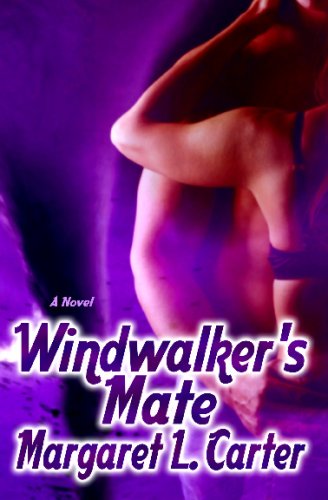
It is Lumley’s interpretation that almost certainly inspired M. L. Carter’s dark paranormal romance novel Windwalker’s Mate (2008), although she puts her own spin on the proceedings. Shannon is a survivor; after the Rite of Union, she left the cult that was trying to bring strange Mythos entities to overrun this world—and forty weeks later she gave birth to her son Daniel, never knowing if his father was Nathan, the son of the culture leader who had participated in the rite with her, or the Windwalker who had possessed him.

Romance may seem an odd genre for Lovecraftian fiction; Lovecraft himself saw little of it in his life and his stories focus very little on those kind of human relationships. Nor were many of Lovecraft’s followers very inclined toward such things. Yet there is a thin substratum of genuine Mythos romance, dealing with the complex tangle of human relationships in a Mythos milieu—and much more seriously than “I Wore The Brassiere Of Doom” (1986) by Sally Theobald or “Love’s Eldritch Ichor” (1990) by Esther M. Friesner. These are works that tend to get overlooked by the main audience of Mythos writers; stuff like Tide of Desire (1983) by Sheena Clayton, Arkham Dreams (2011) by Robin Wolfe, Widdershins (2013) by Jordan L. Hawk…and one might even include The Dunwich Romance (2013) by Edward Lee, although that gets a little more hardcore than the others.

There are a few steamy moments in Windwalker’s Mate. It is far from the elaborate sexual fantasies of, say, Shoggoth Butt Invasion (2016) by Jason Wayne Allen. The sex scenes serve the plot as much as the reader; Shannon is reconnecting with Nathan, worried about her kidnapped son, placing her hope that coitus will re-establish their telepathic bond (it makes sense in the context of the book)…

He deepened the kiss, drawing her back into the present. her tongue darted eagerly to meet his. His hand cupped her breast through the T-shirt and thin bra. The tingling in the nipple zapped to the pit of her stomach and the V between her legs. The explosion of colors crashed over her again.

Then she saw stars falling like snowflakes and the sky behind them splitting open.
—Margaret L. Carter, Windwalker’s Mate 105

…yet the emotional core of the novel is very serious. Shannon is trying to save her son; she’s a lonely single mother, the cops are useless, and the former cult leader is trying to use Daniel to summon Ithaqua and the Ancient Ones into the world…there is a great deal of drama, both of the mind-numbingly mundane and weird kind.

It works. Opinions will vary on the approach, but M. L. Carter succeeds at what she set out to do: write a paranormal romance with the Mythos as a setting. If Chaosium ever published a sequel to The Ithaqua Cycle (1998/2006), this would not be out of place. The basic premise is much like the question of what happens after Rosemary’s Baby? only with Rosemary having the hard practicality to not stay with the Satanic cult because she had a baby to think of now. Daniel might well be the spawn of the Windwalker, but he isn’t a Wilbur Whateley-esque monster…not yet, anyway.

Windwalker’s Mate was published in 2008 by Amber Quill Press. Carter’s other Lovecraftian works include “Prey of the Goat” (1994) and the erotic novella Tentacles of Love (2009).


Bobby Derie is the author of Weird Talers: Essays on Robert E. Howard & Others (2019) and Sex and the Cthulhu Mythos (2014).

The Queen of K’n-yan (2008) by Asamatsu Ken (朝松健)

This is Cthulhu Mythos fiction unlike any you have read before.
—Darrel Schweitzer, introduction to The Queen of K’n-Yan xiii
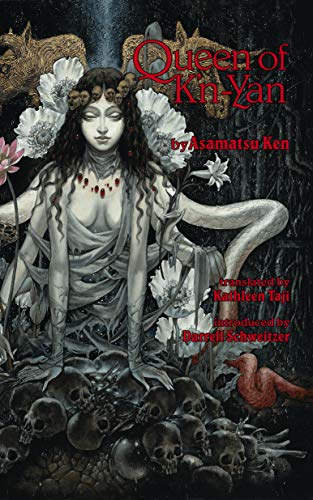
The Queen of K’n-yan (2008, Kurodahan Press) by Asamatsu Ken (朝松健) is the English-language translation of his 1993 novel 崑央の女王 (K’n-Yan no Joō); the translator was Kathleen Taji.
There is a world of Mythos fiction beyond the English language, and it depends on translation. The original works of Lovecraft and his contemporaries, their ideas, concepts, and language, have to be translated from their original English into the new language. This process is not automatic or uniform, not every word that Lovecraft & co. wrote has been translated or published; many of the letters especially have not yet made the jump into other languages, and may never. Imagine what it takes to read Lovecraft, filtered through someone else trying to capture his style and language, to twist the language to translate not just the literal words but the ideas and weird names which might not transliterate easily or cleanly.
Then imagine translating an original Mythos novel back into English. How much survives? How much is recognizable? What new cultural syntax is picked up?
It is more of an issue than you might think, because there is a cultural syntax to the Cthulhu Mythos already; the stories, and the secondary literature of pastiches, sequels, prequels, etc. are highly intertextual, sometimes metatextual—and not everything that is written in English gets translated. The result is that some ideas which are largely outmoded in current English-language Mythos fiction may be retained longer in non-English-language Mythos fiction; and of course some new bits are often added which English language Mythos fans have never seen before.
Kathleen Taji’s translation of The Queen of K’n-Yan is a good example. As a novel, Asamatsu Ken’s work is definitely atypical for Mythos fare: the setting is a contemporary Japan and WW2-era China, the massive, secured corporate arcology and overall plot are something out of a cyberpunk novel, echoes of The Thing (1982), Aliens (1986), and Gunhead (1989). Archaeological mystery and psychic flashbacks to a Japanese war camp conducting medical experiments on Chinese civilians give way to a survival horror/body horror aesthetic somewhat foreshadowing works like Parasite Eve (1995) and Resident Evil (1996).
As the title suggests, the primary Mythos influence of the story is “The Mound” (1940) by Zealia Bishop & H. P. Lovecraft:
It isn’t too much of a spoiler to let you know that Asamatsu Ken’s The Queen of K’n-yan involves the discovery of a mummy from that same underground realm, but excavated in China […]
—Darrel Schweitzer, introduction to The Queen of K’n-Yan ix
Asamatsu Ken takes the idea of the people of K’n-Yan and expands them to a global scale, parts of their underground realm running throughout Asia, and ties them into existing history and mythology:
Before the advent of humanity, the world was divided and ruled by several races of intelligent beings. That’s to say, the dragon race, the denizens of Zhùróng – the fire deity – the earth wolf tribes, the wind bull people, and the star-spawn – as can be deduced, they symbolize the five elements of water, fire, earth, wood, and metal. The human descendants of the dragon race are the Han, the human descendants of the earth wolf are the Manchu, and the human descendants of the wind bull people are the Tibetans […] The denizens of Zhùróng, the symbol of fire, rose in revolt against the Yellow Emperor and were sealed underground in retribution. The underground cavern where they were imprisoned is called K’n-Yan. And the star-spawn were banished to the distant heavens.
—Asamatsu Ken, trans. Kathleen Taji, The Queen of K’n-Yan 85
For English-language Mythos fans, this might be sounding suspiciously like the early “elemental” theory of the Cthulhu Mythos first postulated by August Derleth in “The Return of Hastur” (1939). Derleth designated various entities according to the four elements of the Western tradition of Hermetic occultism (Cthulhu, water; Tsathoggua, earth; Hastur, air; and creating Cthugha as the missing “fire elemental”). Asamatsu Ken is certainly paying homage to this idea, even if he is taking it in a different direction:

What appeared were strange sentences containing a mix of Chinese characters, cursive Japanese hiragana, and roman letters. They read –

“Beseech the god of the western seas, THCLH, with sacred reverence.
Beseech the forefather of heat and flame, THGHC, with sacred reverence.

Beseech anon our birth lord, ZTHRNG, with sacred reverence.

The infant princess, through the black disease

When reborn as Queen

Even death will not die…”
—Asamatsu Ken, trans. Kathleen Taji, The Queen of K’n-Yan 112

Zhùróng is a complicated personage, but often considered a god of fire; THGHC is a reference to Derleth’s Cthugha, THCLH to Cthulhu. The complexities of Japanese, Chinese, and Japanese languages coming into play here were probably difficult to translate, but readers can recall how in “The Mound” Cthulhu was represented as “Tulu” and get the vague idea of how Japanese readers might have been piecing together clues.
As an aside, applying the five-element approach to the Mythos is not unique to Asamatsu Ken’s work either. Shirow Masamune in his manga Orion (仙術超攻殻オリオン) has a Cthulhu-esque entity arise from an occult effort involving an unbalanced water-element.
The discussion of “races” in the context of Mythos fiction is more complicated, and not unique to this work. Perhaps for the best, Asamatsu Ken doesn’t delve too deep into the geopolitics or genetics of it all. The main characters are left piecing together bits of history so old that they’ve faded into myth, trying to sort out bits of truth from the old legends.
As the story enters its penultimate phase, the survival horror aspect comes to the fore. A weird game of cat-and-mouse occurs between Morishita Anri (the novel’s protagonist, Japanese), Dr. Li (the novel’s secondary antagonist, Chinese), and the Queen of K’n-Yan, who a la The Thing has taken on the form of a human woman—hinted to possibly be either Morishita or Li. Reanimated body parts are combined together in was reminiscent of Bride of Re-animator (1990):
An ankle with eyes. A left hand with three lips. Orifices with fangs. A large intestine with wings on its back. Thirty upper arms congealed together, spherical in shape. A thigh with a face, knees with thin hands, and ankles growing out of shins. Eyeballs with tentacles, and most horrendous of all, hordes of internal organs, squirming and groping.
—Asamatsu Ken, trans. Kathleen Taji, The Queen of K’n-Yan 175
Strange as it may be with all these diverse elements, the novel does actually come together at the end, in a fairly satisfying way. Not every mystery is explained, nor do they need to be; background noise about large sinkholes in China where the Princess of K’n-Yan was discovered, outbreaks of disease, and rising heat suggest what is about to come, but that is a horror for the future beyond the last page in the novel.
For all that works, at least within the internal rationale of the novel, there are a few things that don’t translate well. There are elements of style and plot which simply don’t come across to English-language readers as nicely as they could, and it is difficult (not having read, or able to read, the original) to tell whether this is a quirk of the translation being too literal or simply a faithful reproduction of Asamatsu’s style which doesn’t quite click.
Stylistically, the chunks of raw exposition embedded in the narrative stand out as exactly that; the Mythos references when they come aren’t exactly subtle. From the standpoint of characters, most are fairly weakly developed except for the protagonist Morishita Anri and the mysterious Dr. Li…and even then, there is a relatively late development in the novel which comes almost out of nowhere:

Something was trying to take shape. Akiyama Haruka’s face appeared in midair – three times larger than the actual face. This was followed by the appearance of a neck, shoulders, lithe arms, and lastly, shapely breasts. Akiyama winked at Anri, and her pupils sent an insinuating and lascivious look her way.

“Hold me, please…pretty please.”

On hearing her words, Andri felt like retching.

The queen knows?! Somehow she’s found out that I’m gay.
—Asamatsu Ken, trans. Kathleen Taji, The Queen of K’n-Yan 199

The issue of Mosihita Anri’s homosexuality, for about the first hundred and ninety-eight pages up until this point, is so low-key as to be completely absent. Going back to re-read the novel, there are only extremely vague hints which maybe point to that if the reader already knows she’s a lesbian; this feels like a character development which was either not communicated well in the original or which was so subtle that the translation didn’t quite convey it. Which is not in any way a dig at Kathleen Taji, only an exemplar of how difficult the job of translation is. How do you communicate someone’s sexuality in Japanese culture when they do not have any immediate love interest? Were there cues that would have made sense to a Japanese audience that an English reader would miss?
These are the kind of questions that consume the reader in The Queen of K’n-Yan. It is an effective Mythos novel; Asamatsu Ken knows what he is doing. Yet it is undoubtedly a very different Mythos novel from August Derleth’s The Lurker at the Threshold (1945) or Robert Bloch’s Strange Eons (1978). The setting and the syntax are in line with Japanese horror of the late 1980s and early 1990s, the Mythos translated, adapted, and integrated into a post-WW2 world with computers, genetic engineering, wuxing, and the People’s Liberation Army.
Perhaps most importantly, The Queen of K’n-Yan is an example of what translation offers to the English-speaking audience: something different, a new way to think about the old Mythos. For those of us who cannot read Japanese, it is only through translation that we can approach these works—even if, like Wilbur Whateley in “The Dunwich Horror,” thumbing through the English translation of the Necronomicon, we know that there is something missing from the original.

Bobby Derie is the author of Weird Talers: Essays on Robert E. Howard & Others (2019) and Sex and the Cthulhu Mythos (2014).

“Machines Are Digging” (2009) by Reza Negarestani

H. P. Lovecraft has an alarming but over-neglected passage about this holey space or ()hole complex (with an evaporative W) as the zone through which the Outside gradually but persistently emerges, creeps in (or out?) from the Inside. A complex of hole agencies and obscure surfaces that unground the earth and turn it to the ultimate zone of emergence and uprising against its passive planetdom and onanistic self-indulgence of the Sun with its solar capitalism. “Great holes secretly are digged where earth’s pores ought to suffice, and things have learnt to walk that ought to crawl.” (H. P. Lovecraft, The Festival)
—Reza Negarestani, “Machines Are Digging: Lovecraft and Poromechanics of Horror” in Songs of the Black Würm Gism (2009) 167

“Machines Are Digging” is an excerpt-cum-recension of a section of Reza Negarestani’s experimental novel Cyclonopedia: Complicity with Anomalous Materials (2008); the two texts are not identical, but represent different iterations of the same concept. The piece represents the crossroads between Negarestani’s philosophical horror and Lovecraft’s cosmic horror, the aesthetic point of contact where they come together and, while approaching the material from different angles, arrive at about the same conclusion.

Negarestani’s approach to horror fiction is with the same care, and to a degree with the same attitude, as writing an essay on philosophy or physics. The format and language of his work echoes that of a very intelligent post-graduate student engaging with concepts at a high level, a straight-faced presentation which is ever so delicately off, so that the reader isn’t quite sure whether the author is a genius or genuinely deluded. Even the select choice of word and phrase underlines the academic tendency to define and re-define a technical language for itself.

There is an art amounting to poetry in the suggestive but probably meaningless phrase, and that is the kind of texture that high-level philosophical works tend to have. “Solar capitalism,” for example—what does that mean? On the surface, it does not connect with any familiar phrase or concept. If you pick it apart to try and find meaning—ah, now the reader is playing Negarestani’s game. They’ve bought into the piece enough to start thinking about it, and once you do that you’re getting into the slightly-warped logic, the madman thinking where the view of reality is skewed, like the first step down the rabbit hole of a conspiracy theory.

Philosophical word-games aside, “Machines Are Digging” works in large part because there is something to the connection with Lovecraft that Negarestani talks about. When he writes:

According to Lovecraft, the realism of horror is built upon poromechanics. The poromechanical universe of Lovecraft or ()hole complex is a machine to facilitate the awakening and return of the Old Ones through convoluted compositions of solid and void. (ibid., 168)

He is, knowingly or not (always hard to tell with Negarestani; it’s tricky with any philosopher or madman to know whether they actually have some secret knowledge or are making shit up as they go along) echoing some solid critical scholarship regarding Lovecraft’s themes. Because Lovecraft did like big holes dug in the Earth and could not lie; the idea of underground caverns and large enclosed spaces feature prominently in stories such as “The Festival,” “The Rats in the Walls,” “The Transition of Juan Romero,” “The Horror at Red Hook,” “The Nameless City,” At the Mountains of Madness, etc. and even featured in essays such as “A Descent to Avernus.”

Critics have speculated on the whys and wherefores of Lovecraft’s fascination, from Jungian womb-symbols to shamanic thresholds between the waking and dreaming worlds; the latter a significant plot point in Alan Moore & Jacen Burrow’s Lovecraftian graphic novel Providence. Scott R. Jones compiled an anthology of tales based around the concept, titled Chthonic: Weird Tales of Inner Earth (2018)One of the collections of memories dedicated to Lovecraft is Caverns Measureless to Man (1996).

Which is a long way to say: Negarestani is on to something.

In pulp-horror fictions and cinema and in Lovecraft fiction, it is the abode of the Old Ones, worm-entities and the blob (petroleum) that surpasses the tentacled-heads in sentience and foreignness. R’lyeh is the every dream, motion and calculation of Cthulhu on the solid part of the earth’s body. (ibid., 173)

Whether or not you buy into what Negarestani is selling is something different. Few people fall headlong into philosophy, because the empirical world is quite a bit messier than the general truths espoused, and conclusions arrived at after torturous paragraphs of twisted logic sometimes don’t seem quite so significant and valid in the harsh light of day when your tea has grown cold. But sometimes, you can pull out some wonderful idea or turn of phrase buried in there, a little treasure to wonder at and turn over in your head. “Machines Are Digging” is, regardless of its other merits, a source of inspiration.

In poromechancial cosmology of Lovecraft, exhumation is undertaken and exercised by units called Rats. In fact, ‘the dramatic epic of the rats’ (Lovecraft) can be found in their act of exhuming surfaces, solid bodies and structures resisting perforation. Rats are exhuming machines, not only full-fledged epidemic vectors but also ferociously dynamic lines of ungrounding. (ibid., 175)

Now who can argue with that? I think we’re all indebted to Gabby Johnson for clearly stating what needed to be said. I’m particularly glad that these lovely children were here today to hear that speech. Not only was it authentic frontier gibberish, it expressed a courage little seen in this day and age.
—Olson Johnson, Blazing Saddles (1974)

“Machines Are Digging” is experimental fiction, or at least is not concerned with a traditional narrative or format. It is perhaps as close as any writer has come to something like genuine Lovecraftian literature, in the sense of trying to write something that genuinely challenges the reader’s preconceptions and introduces a few new ones; a Necronomicon Lite, fiction and fact and big ideas woven together into something which leaves the reader’s mind spinning off into unfamiliar branches of thought. As bizarre and occasionally baffling as it may be, there are rewards to be gained from Negarestani’s challenging read.

As mentioned above, “Machines Are Digging” is an excerpt, or variant text, from Negarestani’s Cyclonopedia. The major differences between the two are a slight truncation of the version in Songs of the Black Würm Gism, and the lack of the surrounding context provided by the novel.

In Cyclonopedia, “Machines Are Digging” is explicitly a pseudo-text among pseudo-texts, a found document that is part of a cache of data for the user to sift through; a part rather than a whole. Reading it in Songs of the Black Würm Gism, wedged between Wakamatsu Yukio’s black-and-white photographs of naked women covered in worms, frogs, octopi, and insects and “Frater Monstrum’s” Chaos Magick-inflected account of “H P Lovecraft and the Loch Ness Monster,” the reader doesn’t necessarily get the full burn of Negarestani’s thesis—but it is certainly in good company.


Bobby Derie is the author of Weird Talers: Essays on Robert E. Howard & Others (2019) and Sex and the Cthulhu Mythos (2014).