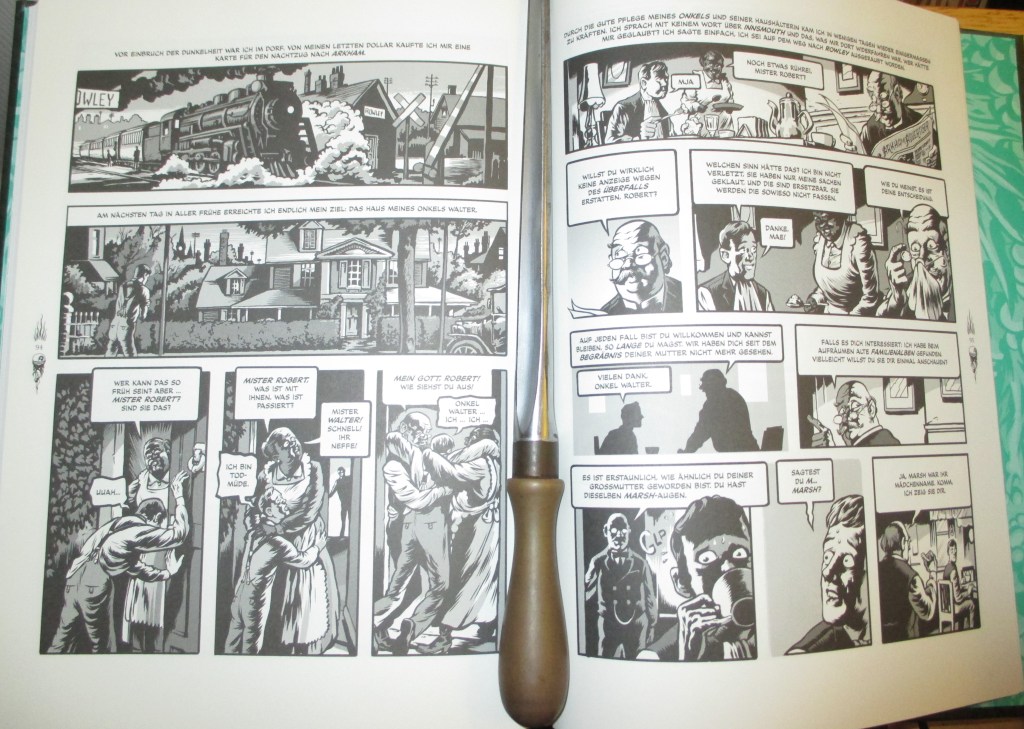
In H. P. Lovecraft’s body of work, the town of Innsmouth is mentioned by name only in four stories (“Celephaïs,” “The Shadow over Innsmouth,” “The Thing on the Doorstep,” and “The Dreams in the Witch House”) and a couple “Fungi from Yuggoth.” The core of Lovecraft’s Mythos, which so many writers have expanded upon over the decades, tends to be fairly scanty. Lovecraft country, that literary realm where the Old Ones walk, was painted in broad strokes and a few fine details, and it is everyone else who has filled in the gaps.
Writers who came after Lovecraft have, when not playing in his sandbox, carved out their own spaces. The most famous are Ramsey Campbell’s Severn Valley stories set in and around the literary Brichester and Goatswood in the United Kingdom; and W. H. Pugmire‘s Sesqua Valley and associated towns and mountains set in the Pacific Northwest of North America. Since these writers lived much longer than Lovecraft, and had more opportunity to write and publish, it might not be surprising that they have produced correspondingly more lore for their associated locales than Lovecraft did for his.
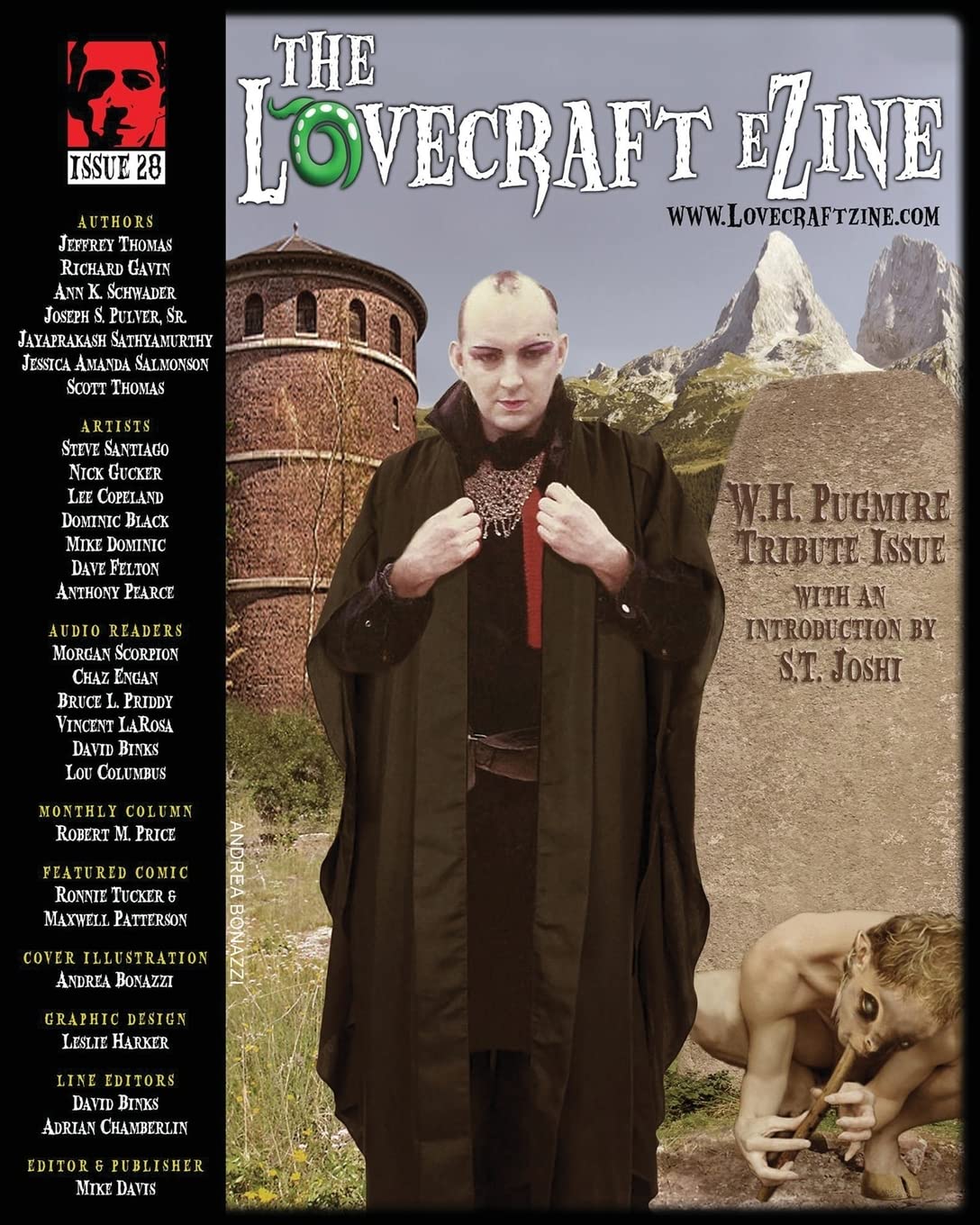
And yet, these places often feel smaller, because the voices associated with them tend to be singular. While anybody can write a tale of Innsmouth, it is generally considered uncouth to poach a living author’s copyrighted creations without permission. Some of them have consented to letting other writers splash in their ponds—Ramsey Campbell, for instance, consented to Made in Goatswood (1996), a tribute anthology; and in 2013 the Lovecraft eZine #28 did a similar tribute to W. H. Pugmire.
These tales represented a first step at a wider Sesqua Valley Mythos. New ideas, new perspectives, new angles. Pugmire was never dogmatic about his Sesqua Valley lore, preferring to expand it in hints and suggestions, a tale at a time, and there has not yet been an effort to correlate all the contents of his fiction into a single concordance or wiki. Perhaps, in the future, there will be more. For now, one particular tale from Lovecraft eZine #28 is worth discussing, because it does something different than the rest. Something very Pugmire-like in its approach to the Sesqua Valley tales.
“Vyvyan’s Father” by Jayaprakash Satyamurthy does not mention Sesqua Valley. Simon Gregory Williams and William Davis Manly do not appear on the page. Uniquely of the tribute stories in the eZine, Satyamurthy chose to write a story that is definably set in the world of Sesqua Valley—for anyone who is familiar with Pugmire’s work, at least, it is obvious from the clues and details as much as the context of the issue—without falling into the same trap of Mythos pasticheurs who load up a story with familiar names. It is an approach that echoes Pugmire’s own insistence that writing Lovecraftian fiction should echo the aesthetics of Lovecraft, not just pay lip-service to Arkham and Innsmouth, Dunwich and Kingsport, Cthulhu and the Necronomicon.
His eyes beguiled me, being slightly slanted and of a silver hue that seemed to contain particles of other shades in their pale irises.
—W. H. Pugmire, “The Horror on Tempest Hill” in An Imp of Aether 142If his eyes were open, they would startle you with their timeless, silvery-grey depth.
—Jayaprakash Satyamurthy, “Vyvyan’s Father” in Lovecraft eZine (2013)
There is something very appropriate in how Satyamurthy’s tale is a bridge between India and Sesqua Valley; the lost child, the orphan of the Valley, is caught between two worlds in a way that echoes something of India’s own history as a crossroads of empires, with those who fall outside the established social orders caught like nuts in a pulau: a part of the whole, yet apart from the rest. This between-two-worlds tension defines Vyvyan’s character, but it also echoes the story as a whole: instead of just playing in Pugmire’s backyard, Satyamurthy builds a bridge between the setting of many of his own stories and Pugmire’s. Instead of submitting himself to Pugmire’s aesthetic, he shows how their themes can connect. Like New World tomatoes incorporated into a quintessentially Indian paneer gravy.
The slow expansion of Sesqua Valley beyond the bounds of Pugmire’s fiction is not the trauma-driven diaspora that marks much of contemporary Innsmouth tales. It is a different kind of cultural diffusion, spread by wanderers and their children, artifacts and ideas that spread out and draw strangers in. Where it goes from here…who can say?
“Vyvyan’s Father” by Jayaprakash Satyamurthy can be read online at Lovecraft eZine #28, and print edition is also available.
Bobby Derie is the author of Weird Talers: Essays on Robert E. Howard and Others and Sex and the Cthulhu Mythos.
Deep Cuts in a Lovecraftian Vein uses Amazon Associate links. As an Amazon Associate I earn from qualifying purchases.







 Deep Cuts in a Lovecraftian Vein