The oldest and strongest emotion of mankind is fear, and the oldest and strongest kind of fear is fear of the unknown.
—H. P. Lovecraft, “Supernatural Horror in Literature”
While many horror stories grapple with fear of the unknown, there are elements within and without the narrative of cozy horror stories that bring the work in question into a safer, more knowable realm, allowing for a sense of comfort to take hold.
—Jose Cruz, “The H Word: Getting Cozy With Horror”
“Cozy horror” is the current term for a broad swathe of horror-flavored creative works. It is probably more properly a mode of weird fiction than a subgenre. A kind of attitude and approach that reaches across genre conventions. Not everything with horror trappings is necessarily horrific in the pure sense of the term. With experience comes familiarity. Bela Lugosi capes, Boris Karloff neck-bolts and flat top, plush Cthulhus all come from the same Hallowe’en-store aesthetic of cozy horror.
Parts of Lovecraftian horror have been cozy for a long time.
In part, this is because Mythos fiction, more than most, tends to be intensely self-referential. Writers want the readers to make connections with other stories, they want to be part of something bigger. Sometimes this bleeds over into full-blown nostalgia; “The Discovery of the Ghooric Zone” (1977) by Richard Lupoff and “Down into Silence” (2018) by Storm Constantine are both stories that bank on the reader not only being able to catch the hints, but to share in that sensation of quiet longing and awed recognition. Others just go for straight-up humor, even to the point of parody and satire: what is “At the Mountains of Murkiness, or From Lovecraft to Leacock” (1940) by Arthur C. Clarke if not taking the piss out of Lovecraftian horror, in a gentle and ribbing British manner?
The balancing point of “cozy Lovecraftian horror” is going to be subjective. It needs to at least work as a weird tale on its own; it needs to be a part of or allude to the Mythos in a way that the readers can recognize and respond to. Jose Cruz’ four elements of Familiarity, Sensuousness, Distance, and Fun are all important—but three of those, at least, are typical of most Mythos stories by default. Readers rarely identify with finding our great-great-great-grandma was a Deep One or Ape Princess, or experience the anxiety of living in the attic room of a witch house and dealing with an extradimensional rodent infestation when they really should be focusing on their finals. The Fun aspect of cozy horror is probably the trickiest and most argumentative aspect of the whole business.
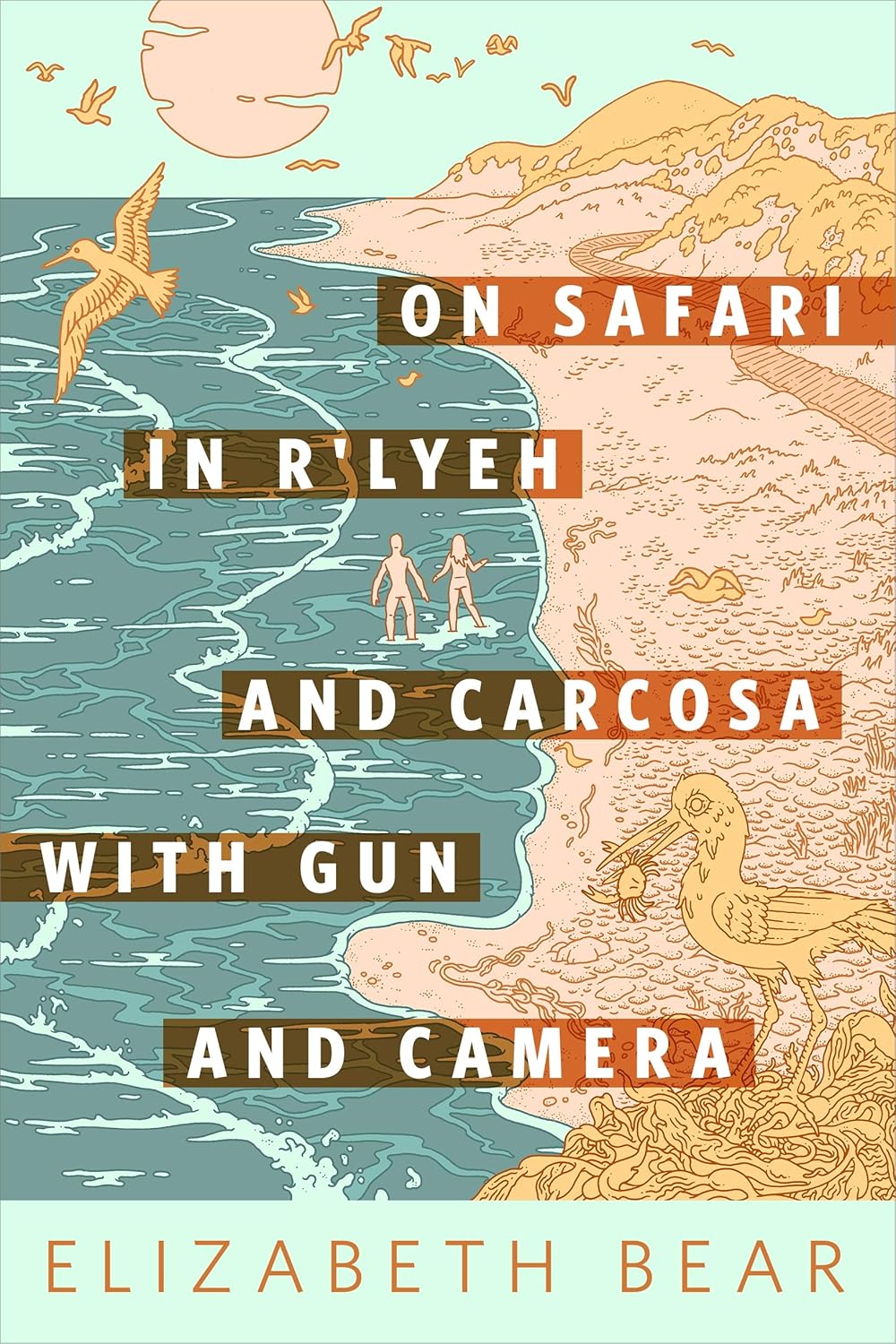
That being said, I believe “On Safari in R’lyeh and Carcosa with Gun and Camera” (2020) by Elizabeth Bear stands out as a very good representation of cozy Lovecraftian horror. The overall shape of the narrative is intensely familiar: how many scions of Innsmouth (never mentioned under that name) have come back home, in how many different variations? Yet the way the story is told is relatively light and novel: a fifty-something female physics professor with tenure and a penchant for sushi. A perfect setup for any number of funny-because-its-true comments about the lives of women in academia.
I note, entirely for the record and apropos of nothing, that I am the only female tenured faculty in the physics department. I note, entirely for the record and apropos of nothing, that I do an estimated thirty-six percent of the emotional labor in my sixteen-person department.
Female grad students and admins do the rest. And it’s not like we’re any less introverted and non-neurotypical than the dudes. We’re just forced to learn to endure more discomfort in order to have careers.
—Elizabeth Bear, “On Safari in R’lyeh and Carcosa with Gun and Camera” (2020)
If the story was just a whine, no matter how well-deserved, it probably wouldn’t sustain interest. Yet Bear is very good at composing her narratives, and has structure the story with an in media res action sequence right at the start to let us know that yes, the safari with guns and cameras are real, we’re getting to that. Then she gets to that. It’s not exactly a novel story structure, but it’s a workhorse of fiction for a reason: putting a bit of action first as a hook to draw the reader in, and then it can build up again.
The actual horror in the story is slight. The monsters aren’t very monstrous, the characters aren’t really scared as much as driven by scientific curiosity; blasting away at byakhees like Hunter S. Thompson in bat country is a select aesthetic that doesn’t really encourage the same kind of comforting glow of, say, a mountain that walked or stumbled, or the remnants of an ancient cannibal feast that happens to have the unmistakable physical tell-tales of your own peculiar family. This is not quite on the level of a hypothetical Abbott and Costello Meet Cthulhu, but it’s not far from it.
It is the kind of good, clean fun that you can have when you learn to stop worrying and love the Lovecraft Mythos—and it managed to do it without naming Deep Ones, without running across a copy of the Necronomicon, and only mentioning Miskatonic Univeristy once and in regards to a failed graduate thesis in genetics. If the rules at play seem to owe a little more to the Call of Cthulhu Roleplaying Game than Lovecraft’s original, then at least Bear has the good sense not to recapitulate the entire Mythos, August Derleth style. She gives just enough lore to keep things moving, and no more.
“On Safari in R’lyeh and Carcosa with Gun and Camera” (2020) by Elizabeth Bear is available as an ebook. It has also been republished in The Year’s Best Dark Fantasy and Horror: Volume 2 (2021) and The Long List Anthology: Volume 7 (2022).
Bobby Derie is the author of Weird Talers: Essays on Robert E. Howard and Others and Sex and the Cthulhu Mythos.
Deep Cuts in a Lovecraftian Vein uses Amazon Associate links. As an Amazon Associate I earn from qualifying purchases.







 Deep Cuts in a Lovecraftian Vein