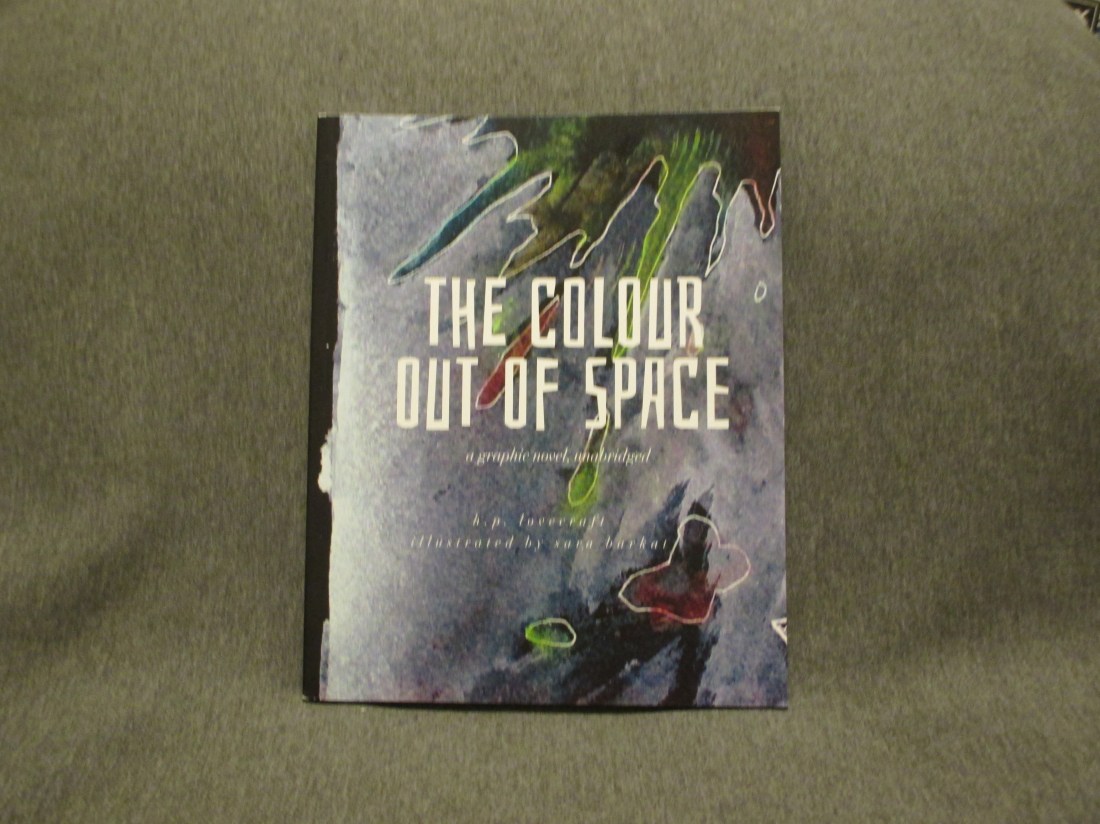
The Colour Out of Space (2024) by H. P. Lovecraft & Sara Barkat

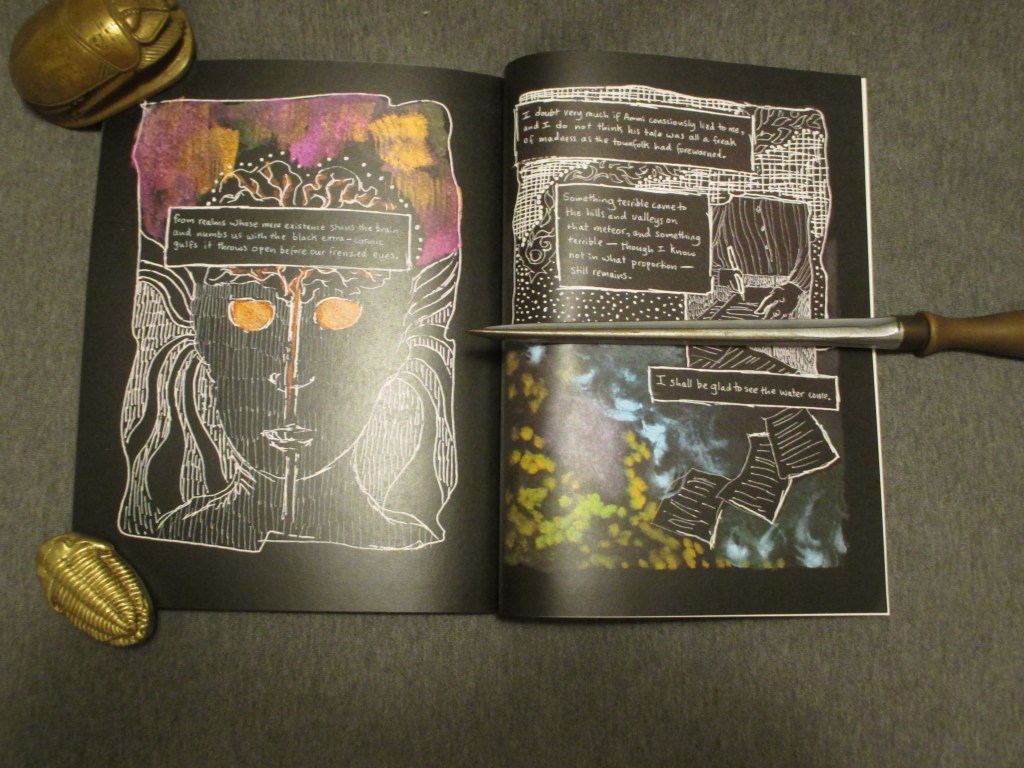
It was just a colour out of space—a frightful messenger from unformed realms of infinity beyond all Nature as we know it; from realms whose mere existence stuns the brain and numbs us with the black extra-cosmic gulfs it throws open before our frenzied eyes.
—H. P. Lovecraft, “The Colour Out of Space”

Comic and graphic novel adaptations of prose and verse literary works have always held a fascination. Because while you might declare one text as canonical, as a true text, immutable and eternal, the graphic adaptations of that text will always be different, unique to their vision and skill and ability to realize that text in illustrated form. Every artist has to pick and choose what images to convey and how to convey them, how to frame the story and the text, what to leave in and out, what to emphasize and how to do it. Give three artists the same story to draw, and you have three variations on the same story.

This sometimes arouses—at least among some readers and critics—the urge to compare different variations on the same works to each other. Because it can be fascinating to see the divergence and the commonalities, to look at all the different flowers that may blossom from identical seeds. Not necessarily to point out any one graphic adaptation of Lovecraft as better than the others, but to enjoy the diversity of views and skills.

When it comes to “The Colour Out of Space” in particular, however, there’s a fundamental question that every artist has to struggle with: how do you depict a color that is outside the visible spectrum?

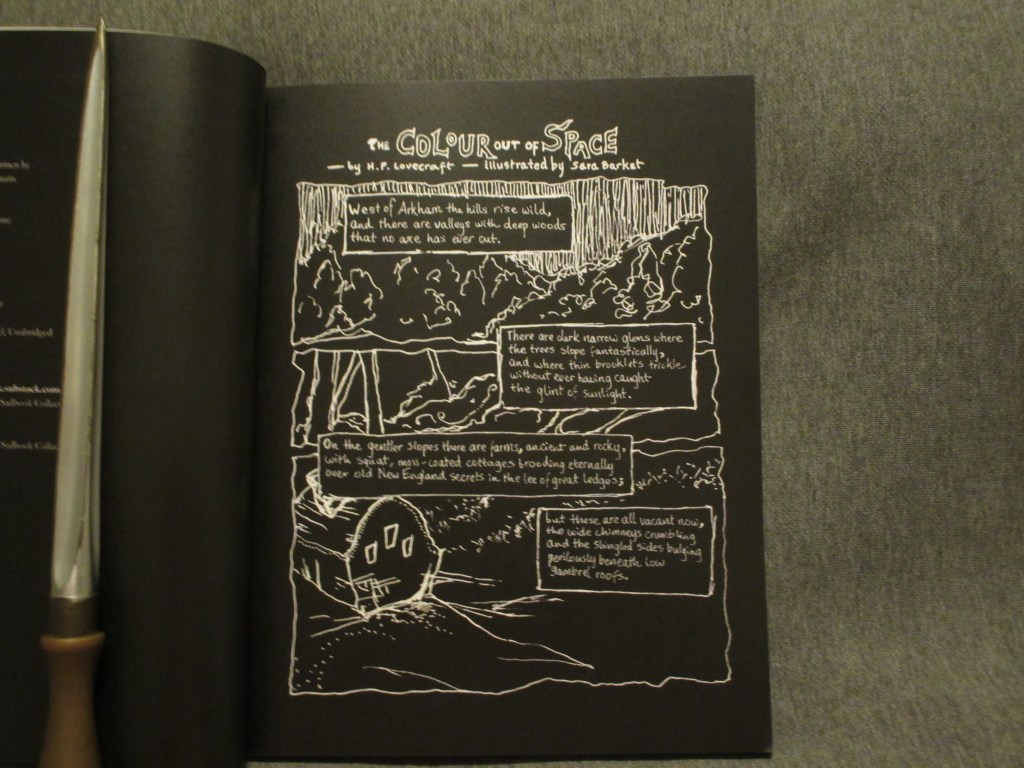
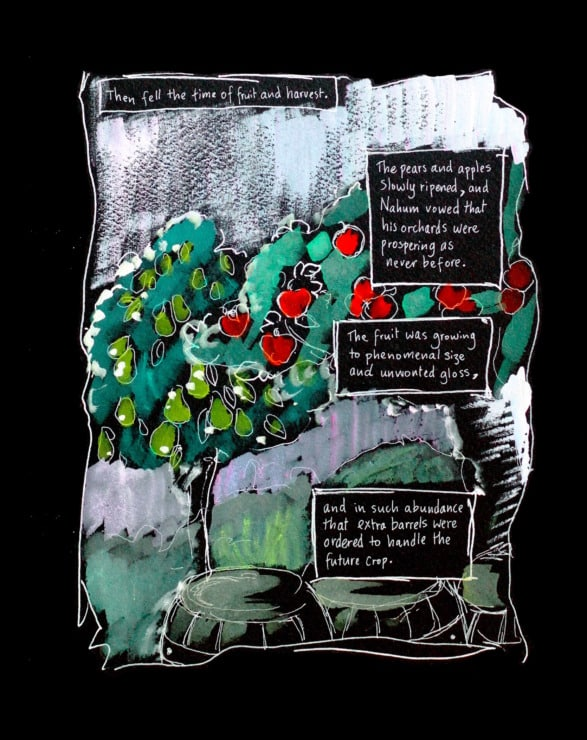
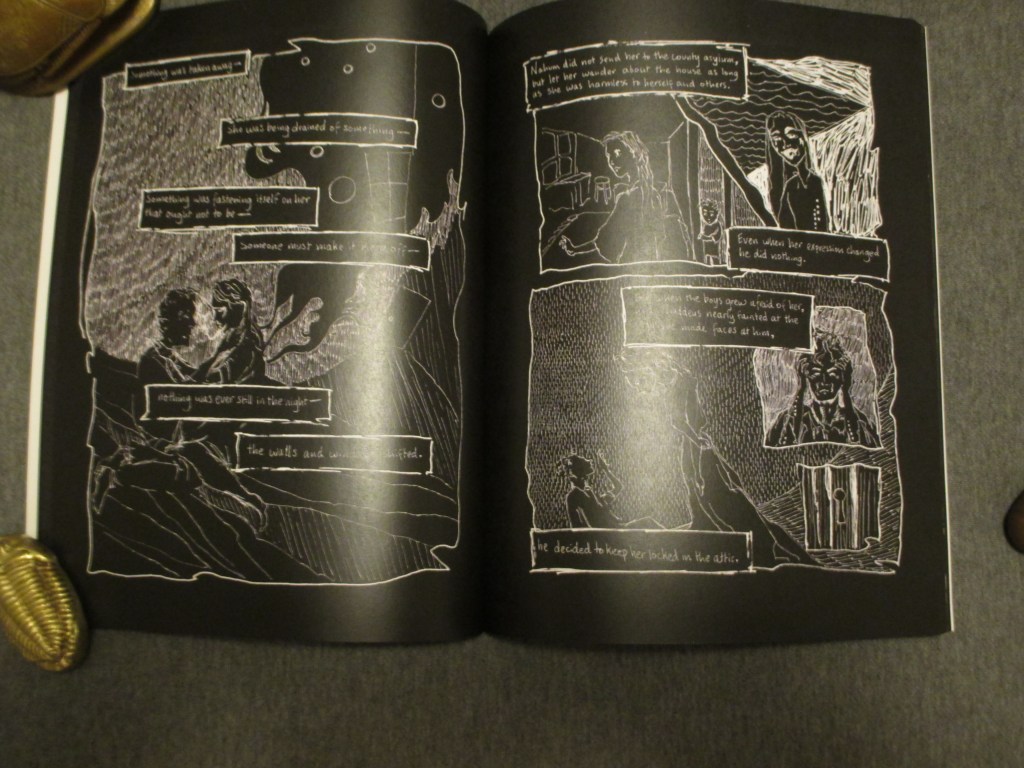
Strictly speaking, outside of a technical trick like polarized lenses, you cannot. What usually happens instead is that the artist has to use visual rhetoric to convey the sense of the unknown color, even while using the colors that are available for printing. In the case of Sara Barkat’s The Colour Out of Space (2024) this is mostly accomplished by having the majority of the art in black-and-white.

However, instead of having the colored portions represent just the color itself, the color is used to illustrate those people and objects that the color has infected. So the addition is not just a single splash of magenta or red in a monochrome world, it is a spectrum of colors in a landscape, or a room, or a person.

Barkat’s style isn’t a demonstration of technical excellence in the same sense of Gou Tanabe’s The Colour Out of Space (2025), nor does it have the minimalist book-as-object approach of Amy Borezo’s The Colour Out of Space (2016). What she has is a loose, sketchy but heavily detailed pencil that captures a certain underground aesthetic, the rawness of the art adding a certain texture to the text, especially with the use of mixed media (primarily watercolors) to add color. As with Alberto Breccia’s Cthulhu Mythos adaptations, the result is a more profound experience than either the art or the text would accomplish on their own.

Which is ultimately what a lot of people are looking for in any graphic adaptation. Not a simplification of a text, or the addition of some pretty pictures to look at, but a new way of experiencing the story.

The Colour Out of Space (2024) by H. P. Lovecraft and Sara Barkat was published by T. S. Poetry Press. Barkat’s other works include a graphic adaptation of The Yellow Wallpaper (2020) by Charlotte Perkins Gilman and Drawing Dracula Daily (2023).


Bobby Derie is the author of Weird Talers: Essays on Robert E. Howard and Others and Sex and the Cthulhu Mythos.

Deep Cuts in a Lovecraftian Vein uses Amazon Associate links. As an Amazon Associate I earn from qualifying purchases.
“En Tierra Baldía” (2024) by Miguel Almagro & Lord Dunsany

Libre adaptación del relato escrito por Lord DunsanyFreely adapted from the story by Lord Dunsany
Cthulhu #30 (2024)English translation

“On the Dry Land” by Lord Dunsany was first published in the small magazine Neolith #4 (Aug 1908), and was collected in The Sword of Welleran and Other Stories that same year. It is the last story in the book, and it is one of those Dunsany short-shorts that is more than a drabble but less than a tale. Call it a prose poem or flash fiction; it has a certain poetry to it, and there is more that is left unsaid than is said. It has a mythic quality, but it is not a story of any particular mythology, whether of Pegāna or any other tradition. A kind of story so universal in its outlines it might slip easily into the tradition of any culture that has the concept of love and death.

How do you illustrate that? How do you put into images and words, the unspoken understanding, the loneliness and heartache?

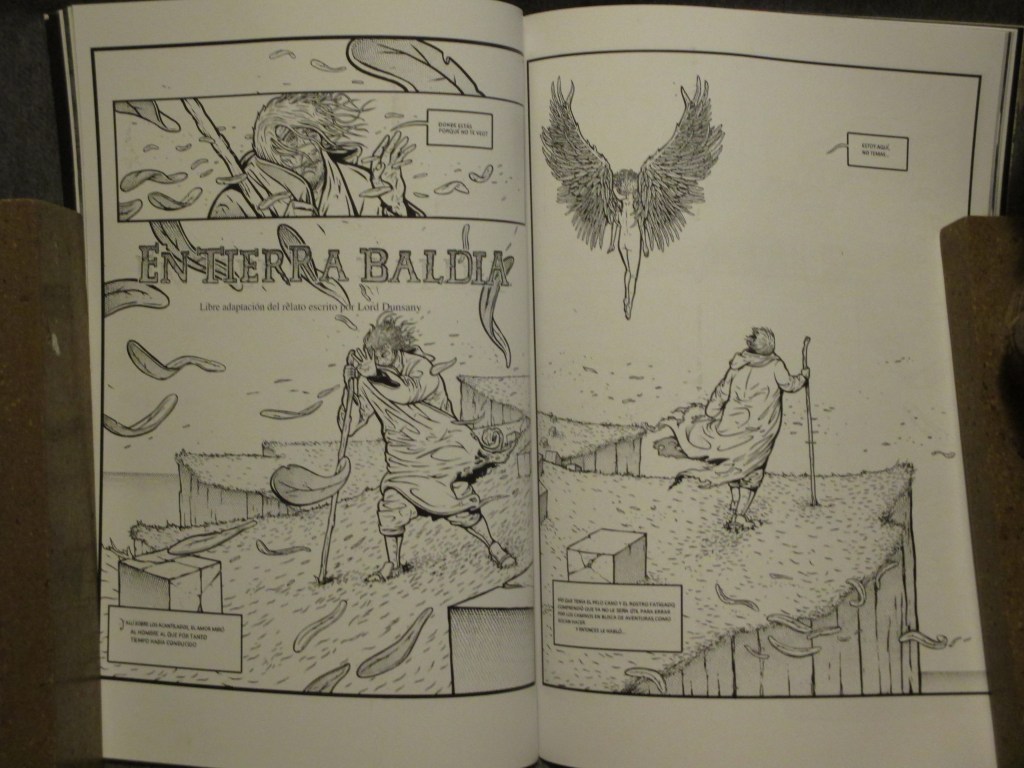
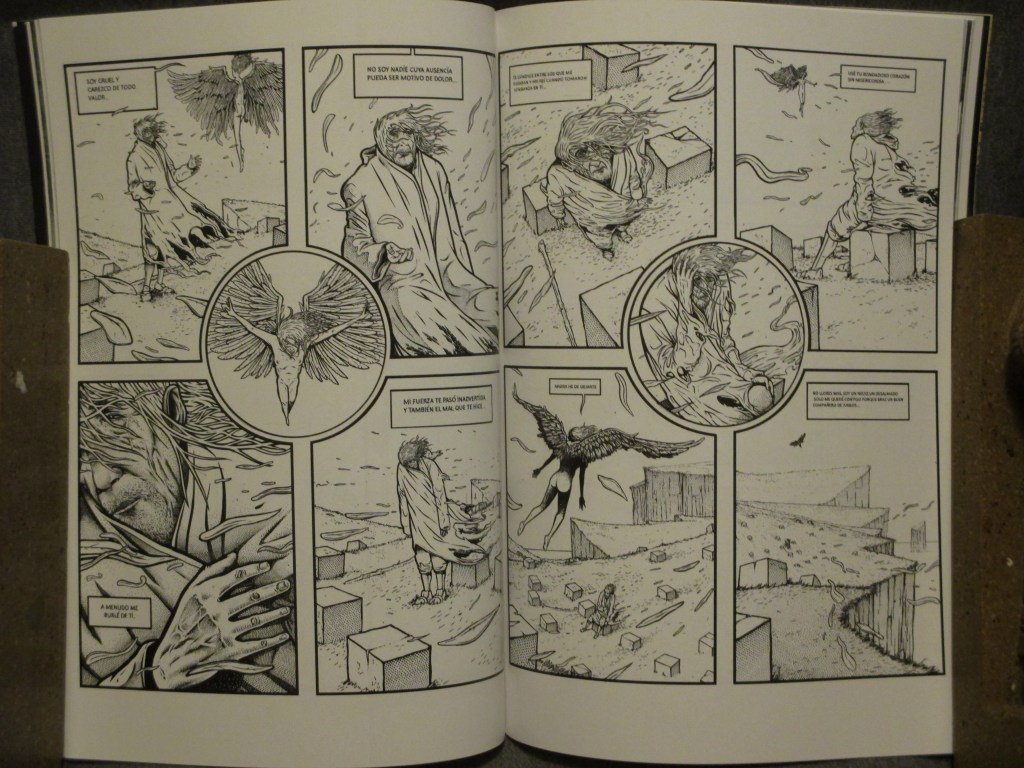
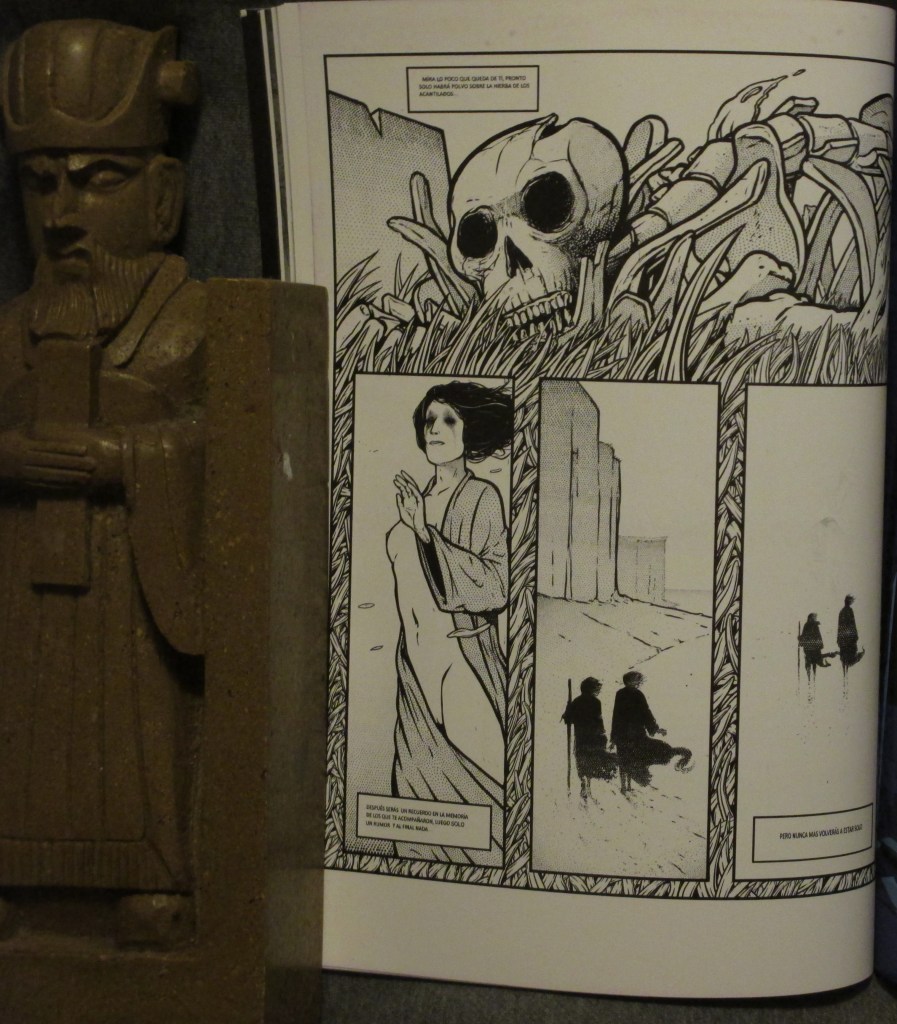
For one, the adaptation allows the text to be decompressed. Dunsany’s pithy text is stretched out by Miguel Almagro into 9 black-and-white pages. For two, the scene and many details are expanded to silently add to the storytelling. Rather than the marsh where Dunsany had first set the scene, the story unfolds on a cliff overlooking the sea; the blowing of grass and the stance of the unnamed man show the direction of the wind that blows strongly throughout, and blocks of stone suggest some ancient construction or ruin, marks of the passage of time. The layout of the panels helps control the pacing of the story.

Te conduje entre los que me odíaban y me reí cuando tomaron venganza en tí…

Usé tu bondadoso corazón sin misericordia…

Ahora he de dejarte

No llores más, soy un necio, un desalmado, solo me quedé contigo porque eras un buen compañero de juegos…
I led you among those who hate me and laughed when they took revenge on you…

I used your kind heart without mercy…

Now I have to leave you

Don’t cry anymore, I’m a fool, a heartless man, I only stayed with you because you were a good playmate…
Cthulhu #30 (2024)English translation

As a free adaptation, Almagro is not making an attempt at an exact replication of Dunsany’s text; lines are told out of sequence, rearranged to meet the needs of the artistic arrangement. Maintaining the core of the short short while shifting the representation. So for example, this scene as Dunsany wrote it:

And Love said to the old man, ‘I will leave you now.’

And the old man made no answer, but wept softly.

Then Love was grieved in his little careless heart, and he said: ‘You must not be sorry that I go, nor yet regret me, nor care for me at all.

‘I am a very foolish child, and was never kind to you, nor friendly. I never cared for your great thoughts, or for what was good in you, but perplexed you by leading you up and down the perilous marshes. And I was so heartless that, had you perished where I led you, it would have been nought to me, and I only stayed with you because you were good to play with.

‘And I am cruel and altogether worthless and not such a one as any should be sorry for when I go, or one to be regretted, or even cared for at all.’

And still the old man spoke not, but wept softly; and Love grieved bitterly in his kindly heart.

And Love said: ‘Because I am so small my strength has been concealed from you, and the evil that I have done. But my strength is great, and I have used it unjustly. Often I pushed you from the causeway through the marshes, and cared not if you drowned. Often I mocked you, and caused others to mock you. And often I led you among those that hated me, and laughed when they revenged themselves upon you.
—Lord Dunsany, “On the Dry Land”

Pero nunca mas volverás a estar soloBut you will never be alone again.
Cthulhu #30 (2024)English translation

As with “Donde suben y bajan las mareas” (1978) by Alberto Breccia, Carlos Trillo, and Lord Dunsany, we have to read this from the perspective of both a translation and an adaptation. Dunsany’s title “On the Dry Land” is a key to the story because the dry land represents the end of journey and parting of ways; the nameless man with Love has been wading through the marshes, the wet lands, and that trudge and effort and peril are metaphorically, life and hardship and struggle. The dry land is what comes after. The Spanish title, “La tierra baldía” translates most literally to “The Wasteland,” which isn’t quite the same meaning, suggesting as it does barrenness, though the metaphor still works: the nameless man has come to the undiscovered country:

To grunt and sweat under a weary life,
But that the dread of something after death,
The undiscover’d country from whose bourn
No traveller returns, puzzles the will
And makes us rather bear those ills we have
Than fly to others that we know not of?
—Shakespeare, Hamlet, Act III, Scene 1

Dunsany is putting his own spin on it; rather than clinging to life, the man is clinging to Love, despite all the pain that has come from clinging to love, and dreads the loss of it. Yet there is that reassurance, that final promise, of a more constant, faithful, and comparing companion—a character more akin to Death in Terry Pratchett’s Discworld novels than the medieval grim reaper, or even Death as sometimes personified in Dunsany’s other stories.

In adaptation, Miguel Almagro is taking that story in translation and moving it a bit further. It is not a wasteland in the sense that there is nothing living; there is grass, insects, but it is devoid of people or shelter, a land gone fallow and wild. Even the sky and sea are empty and desolate. Death, when she appears, is not frightening, merely a dark-eyed psychopomp—and the man has accepted Death, even as he has accepted the loss of Love. Dunsany wrote in the last line:

And after a while, with his face towards the morning, Death out of the marshes came up tall and beautiful, and with a faint smile shadowy on his lips, and lifted in his arms the lonely man, being gentle with him, and, murmuring with his low deep voice an ancient song, carried him to the morning to the gods.

Almagro foregoes the song, and the gods; the last we see of them are two shadows side by side on a new and different journey. There is something more poignant in that image, that acceptance and continuance. Perhaps a man literally cannot live without Love, but so too, now Love can no longer hurt him.

Thanks to Martin Andersson for his help.


Bobby Derie is the author of Weird Talers: Essays on Robert E. Howard and Others and Sex and the Cthulhu Mythos.

Deep Cuts in a Lovecraftian Vein uses Amazon Associate links. As an Amazon Associate I earn from qualifying purchases.
“U.S. Fish and Wildlife Services Inspection Report No. IF-32651” (2024) by Sarah Hans

Have any of these yokels even seen a Black woman before?
—Sarah Hans, “U.S. Fish and Wildlife Services Inspection Report No. IF-32651” in Arkham Institutions (2024) 137

“The Shadow over Innsmouth” is one of Lovecraft’s most quintessential tales, not just in the sense that it has become one of the core stories for his artificial mythology, but because when you strip down the story to its fundamentals it is one of the quintessential stories of its type: a civilized intruder tale. Someone from wider civilization travels to a liminal community, someplace that is, whether or not it is physically far away, somehow isolated culturally from the wider network of the world we know, and there’s something wrong there.

What is wrong and who does the intruding vary. In The Wicker Man (1973), a police officer finds a neo-pagan religion up to no good. In Midsommar (2019), tourists go to a remote Swedish village and find a pagan survival group up to no good. The essential framework is supremely adaptable, and most importantly, it leaves a great deal of room for novelty and reinvention. When Lovecraft used the idea in “The Shadow over Innsmouth,” the idea wasn’t new; he was riffing off stories like Herbert Gorman’s “The Place Called Dagon” (1927) and Algernon Blackwood’s “Ancient Sorceries” (1908). What Lovecraft added was the twist: that the intruder was not really an intruder at all, but was akin to the horrors.

Innumerable versions of this basic idea have played out through the Cthulhu Mythos, sometimes revisiting and recapitulating “The Shadow over Innsmouth,” sometimes with other locations. Stories like “Satan’s Servants” (1949) by Robert Bloch and “The Moon Lens” (1964) and “The Horror Under Warrendown” (1997) by Ramsey Campbell all riff on the basic concept, while La Planète aux Cauchemars (2019) by Mathieu Sapin & Patrick Pion, “The Chabad of Innsmouth” (2014) by Marsha Morman, and now with “U.S. Fish and Wildlife Services Inspection Report No. IF-32651” (2024) by Sarah Hans are examples of revisiting and updating the Innsmouth story itself.

With a few changes.

Before I exit the truck, I get my gun out of the glovebox. I do have a permit for it, but I’m not supposed to carry one while I’m on official duties. I can’t risk being caught in the middle of nowhere unarmed, though. I work alone most of the time and sundown towns don’t exactly advertise themselves
—Sarah Hans, “U.S. Fish and Wildlife Services Inspection Report No. IF-32651” in Arkham Institutions (2024) 138

The pitch for Arkham Institutions is “to explore how the people who run these towns and their institutions deal with the eldritch abominations of Lovecraftian terror” (back cover text). Which is as good a reason why a Fish & Wildlife Service agent will pop into Innsmouth for an inspection of the Innsmouth Fisheries as any other reason why someone might intrude on this liminal community.

Hans’ Innsmouth isn’t exactly Lovecraft’s, and the story doesn’t try to recapitulate the whole narrative. It is a contemporary setting, there’s no mention of the government raid of 1927, no reference to the Marsh Refinery. The business of the town is fishing, and Agent Cherise Brown has no ancestral links to the inbred locals. What plays out is a very different story that takes inspiration from Lovecraft—and probably wouldn’t be very comprehensible unless you’re familiar with that story—but tries to do something original with the idea.

The central idea is one I can dig: no liminal community can remain unvisited forever. Innsmouth was always going to receive some outside visitor who would cause problems. The question was not a matter of if it would happen, but who would intrude and when, and how the community would respond to that intrusion. It is an idea that suggests different possibilities—when would Innsmouth be no longer able to hide? As timeless as the locale seems in Lovecraft’s tale, in the context of how the world has developed after his death, it is easy to see how fragile Innsmouth’s isolation really was.


Bobby Derie is the author of Weird Talers: Essays on Robert E. Howard and Others and Sex and the Cthulhu Mythos.

Deep Cuts in a Lovecraftian Vein uses Amazon Associate links. As an Amazon Associate I earn from qualifying purchases.
Requiem for a Siren: Women Poets of the Pulps (2024) ed. Jaclyn Youhana Garver & Michael W. Phillips, Jr.

Dorothy Quick was one of almost three hundred women who published fiction and poetry in sci-fi and horror pulp magazines before 1960.

Have you heard of her?
—”Introduction: A Place for Wild Women” in Requiem for a Siren (2024) 1

The pulp reprint anthology has long had a place in genre fiction. In the 1920s and 30s, the Not at Night series and its imitators mined Weird Tales to package pulp stories for audiences in hardback. In the 1960s and 1970s, as fantasy and science fiction boomed, authors like H. P. Lovecraft, Robert E. Howard, and Clark Ashton Smith found a strange afterlife alongside the paperback reprints of The Lord of the Rings and Edgar Rice Burrough’s Tarzan and John Carter of Mars novels. Editors like Helen Hoke, Margaret Ronan, and Betty M. Owen were not above reprinting pulp tales to fill out their anthologies for youngsters, and as copies of pulps decayed and rose in price, anthologists like Sam Moskowitz and Peter Haining saw a market in reprinting classic tales from the pulps.

They were right. There was a market for repackaging the best of Weird Tales from the 30s in hardback or paperback, and readers were eager to read the science fiction of the 40s, or themed anthologies of evil plants, drug use, vampire tales. Anthologies proliferated, and continue to proliferate—because now many of the contents of those original pulps have entered the public domain, their text has been scanned, transcribed, and posted online. Every laptop is capable of word processing, layout, and desktop publishing work that used to take an entire office, or at least a some dedicated space in the garage; print-on-demand publishing and ebooks mean it has never been easier for free content to be collated, packaged, and presented for sale at prices that range from the bargain-basement for a cheap ebook with content pulled from Wikipedia to a substantial sum for a high-end hardback, like Weird Tales: The Best of the 1920s (2024, Centipede Press).

The question presented is one of value: what have the editors and publishers provided in their anthology that makes it worth the reader’s hard-earned dollars? Does it save them time or effort? Is there some unique insight provided in the way of explanatory essays? Or is it merely a luxury good, designed to be enjoyed as an aesthetic experience for its own sake, and priced accordingly?

Personally, I tend to be leery of cheap pulp reprints in the print-on-demand era. The return on investment for the cheapest work seems to be low, so the folks attracted to that market are either bottomfeeders or rank amateurs, and the products reflect that. Aim a little higher, however, at the level of some of the self-published scholars and small independent presses, however, and some much more interesting books start to emerge.

Night Fears: Weird Tales in Translation (2023, Paradise Editions), edited by Eric Williams, is a collection of the non-English weird fiction that was translated and published in Weird Tales during the 20s and 30s, with explanatory essays and notes on the works. While you could go out and find the individual stories, these aren’t works that were ever published together before, and the essay adds history and context to why and how they appeared in the Unique Magazine.

So too, the women of Weird Tales, who so often never got collections of their own during their lifetimes when their male counterparts did, are finally getting some posthumous recognition in print. Today, those who want to read Francis Stevens can pick up The Citadel of Fear (2022, Flame Tree) with scholarly introduction by Melanie R. Anderson; Everil Worrell’s The Canal and Other Weird Stories (2023, Weird House) with introduction by S. T. Joshi; Greye la Spina’s Fettered and Other Tales of Terror (2023, From Beyond Press), with introduction by Michael W. Phillips, Jr.; Dorothy Quick’s The Witch’s Mark and Others (2024Sarnath Press), also introduced by Joshi.

Collecting these disparate stories from half-forgotten authors and bringing them together with a bit of information about their lives and works produces a whole that is more than the sum of the parts, because it effectively presents these women authors of weird fiction in the same way that their male counterparts have often been presented. In effect, it gives readers a chance to get to know an entire body of work by an author, instead of randomly running across a story or two, often presented without context.

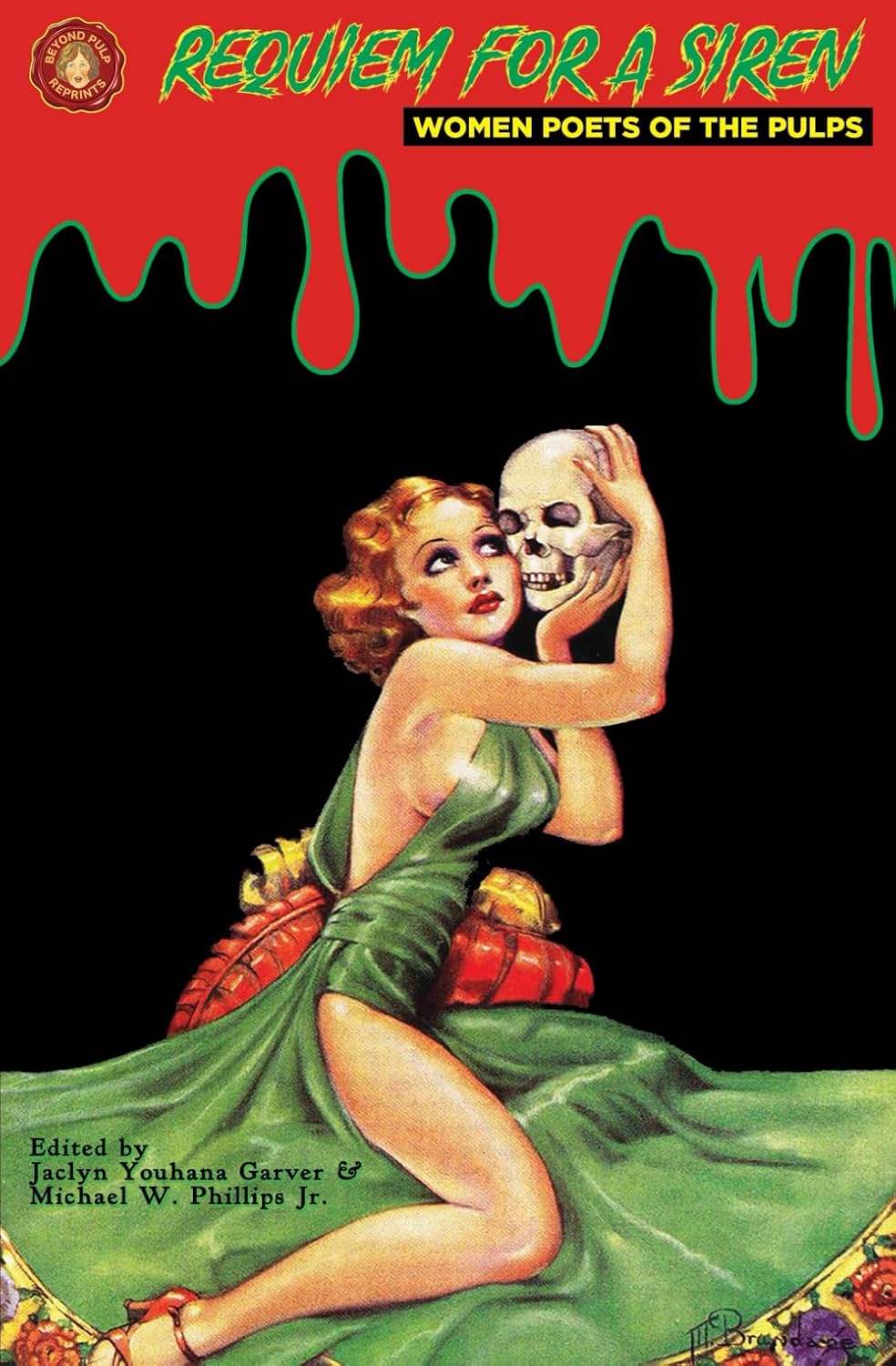
Requiem for a Siren: Women Poets of the Pulps (2024, From Beyond Press) is representative of the best of this impulse to not just reproduce the work of women pulpsters in danger of being forgotten, but to arrange and comment on them in a way that highlights both the publishing history of poetry in pulp magazines and the lives of these women. While many of the poems are taken from Weird Tales, including “The Woods of Averoigne” (1934) by Grace Stillman and “The Eldritch One” (1948) by Pauline Booker, the collection also includes science-fiction poetry from the pages of Amazing Stories and other pulps. Much of the background information for the women is credited to Terence E. Hanley’s Tellers of Weird Tales blog, which is good as Hanley has put in tremendous work into his biographies of the authors and artists of Weird Tales.

Full disclosure at this point:

I would like to thank Bobby Derie, proprietor of the blog Deep Cuts in a Lovecraftian Vein (deepcuts.blog), for his invaluable assistance in researching the introduction to this chapter, and Timaeus Bloom for reading an early draft.
Requiem for a Siren (2024) 1

My help consisted solely of a few brief discussions on social media, to try and help provide a few sources; I had no input into the selection or editing process. The final product is due to the hard work of the editors Haclyn Youhana Garver & Michael W. Phillips Jr., who made an effort to present a representative core sample of poetry by women in the fantastic pulps, covering not just multiple genres and themes, but tone and mood. The black humor of Lilith Lorraine’s “Mutation” to the fey rhythms of Frances Elliott’s “The Hill Woman,” the utter silliness of Julia Boynton Green’s “Radio Revelations” to the somber antique mystery of Alice I’Anson’s “Teotihuacan.” The brief biographies and introductory essays in between sections are functional and sometimes insightful.

Is it a perfect volume? I would have preferred an index of titles and/or first lines, to assist in finding a particular poem again without having to flip through the whole book. The selection is overall solid, but certain names predominate—as was the case in Weird Tales. Poets like Leah Bodine Drake, Dorothy Quick, and Cristel Hastings dominate a bit. If I had my druthers, I would have included more fan poetry, include Virginia “Nanek” Anderson, and perhaps Lilith Lorraine’s “The Acolytes” (1946) or “The Cup-Bearer” (1951)—but that would have been going outside of their own self-circumscribed ambit. This was a look at the women pulp poets, not all genre poetry from the period.

Requiem for a Siren: Women Poets of the Pulps provides value for the money. More than just saving the reader the time of flipping through thousands of pages of pulp magazines and reading a vast amount of dross, this curated collection of poetry is presented in a way to highlight not just some of the best weird and science fiction poetry of the period, but to highlight the women poets as well.


Bobby Derie is the author of Weird Talers: Essays on Robert E. Howard and Others and Sex and the Cthulhu Mythos.

Deep Cuts in a Lovecraftian Vein uses Amazon Associate links. As an Amazon Associate I earn from qualifying purchases.
Earth is a Breeding Ground For Monstrous Creatures (2024) by Starbound HFY & Chikondi C

Darwinism is older than space opera. The epic scales and timelines of interstellar travel and alien worlds with their own unique forms of life gave writers and artists the opportunity to depict different evolutionary paths than life took on Earth. How different environments shaped and nurtured these extraterrestrial forms of life. From the rubber-forehead aliens of Star Trek and Star Wars to more non-humanoid lifeforms of H. G. Wells’ The War of the Worlds (1898) or Arthur C. Clarke’s Rendezvous with Rama (1973).

Social Darwinism and eugenics are also older than space opera, and the idea emerged that survival-of-the-fittest and particularly challenging environments would lead to hardier organisms. The thinking went that the harsh conditions would weed out the weak and force the survivors to be toughened up. To many, this might seem self-evident: wild animals are often leaner and more ferocious than domesticated pets and farm animals; rural people who work physically demanding jobs are often stronger and physically fit than city folk working office jobs. In practice, this is a misconception: survival of the fittest doesn’t necessarily mean the strongest or the toughest, and the forces that shape an individual over their lifetime aren’t necessarily passed down to the next generation (Lamarkism).

However, the idea had legs in science fiction.

“But every report on Salusa Secundus says S.S. is a hell world!”

“Undoubtedly. But if you were going to raise tough, strong, ferocious men, what environmental conditions would you impose on them?”
—Frank Herbert, Dune (1965)

Earth is a diverse world with many biomes, and evolution has made plenty of weird stuff on our own planet. Some of them are harsher than others, and the same basic idea that science fiction authors applied to “hell worlds” in their space opera could also be applied (jocularly) to, say, Australia.

POSSIBLY IT WOULD BE SIMPLER IF I ASKED FOR A LIST OF THE HARMLESS CREATURES OF THE AFORESAID CONTINENT?

They waited.

IT WOULD APPEAR THAT—

“No, wait, master. Here it comes.”

Albert pointed to something white zigzagging lazily through the air. Finally Death reached up and caught the single sheet of paper.

He read it carefully and then turned it over briefly just in case anything was written on the other side.

“May I?” said Albert. Death handed him the paper.

“Some of the sheep,” Albert read aloud.
—Terry Pratchett, The Last Continent (1998)

The ideas came together online in a series of Tumbr posts in 2016 in a thread titled “Humans Are Weird,” which started out with unusual traits of human beings as a species and then transitioned to Earth is Australia. The basic idea is a Star Trek or Star Wars-style universe with multiple intelligent, technologically advanced species, and they come across Earth…and compared to the rest of the inhabitable planets in the universe, Earth is a deathworld.

Which would make humans, as those who survive and thrive on said deathworld, incomparably awesome compared to the rest of the galaxy.

The idea has legs, and has inspired several memes, microfiction on social media sites, fanart, and entire novels and audiobooks. Variations and spinoffs include “Humans Are Space Orcs,” “Space Australia,” and “HFY” (Humanity, Fuck Yeah!). While initially light-hearted and at least mildly grounded in real-world science, as the ideas have developed and spread different themes have emerged—often involving environmentalism, military conflicts, morality, ethics, and above all human ingenuity and determination. Strong insirpirations from military science fiction are evident, with humans often being depicted with unshakeable resolve, peaceful unless provoked, relentless when provoked, and alternately surprisingly passionate or unstoppable horrors depending on the tone of the story.

Enterprising creators are commercializing these themes; one such endeavor is Starbound HFY, which might be most politely described as a fiction factory. Writers are solicited to submit stories that meet certain guidelines, get paid for their work; the stories are then read by voice actors, who are also paid; and the resulting audiobooks are posted online, usually accompanied by AI-generated artwork to lend some visual clutter to the production.

The use of generative AI has led to speculation about whether the audio productions use AI-generated text or are read by AI, or whether they plagiarize the stories of other creators. Part of the problem is that the titles for the stories are very clickbait-y, authors are rarely credited (although this has been getting better lately), and the voice actors who read the stories are often completely uncredited, although they usually appear at the beginning of the videos to confirm that yes, real human beings were involved in this production (though it appears they might have used narration software on the early videos). Competition in the field for clicks and views has led to a lot of imitation; how often this results in actual plagiarism or bots scraping content and repackaging it on different channels isn’t clear.

The whole process reminds me weirdly of the ultra-competitive nature of science fiction pulp magazines circa 1940, when there was an explosion of titles on the stands, all competing for the same dimes and quarters, often using the same writers or riffing on the same themes. Robots, bug-eyed aliens, women in distress, etc. were the order of the day. In the 2020s, the HFY-themes tend toward militarism, cultural exchange, and an elevated sense of how badass and cool humans are. In that respect, it reminds me of the men’s adventure fiction magazines of the 1950s. The emphasis on human strength, durability, and ingenuity over extraterrestrials—and the humans almost always being well-meaning, peaceful unless provoked, and utterly terrifying when not—tends to put human failings and weaknesses in the past tense, as cultural traits that have been overcome.

To be fair, this isn’t exactly a new idea. Larry Niven’s Man-Kzin Wars that began in 1966 and David Drake’s Hammer’s Slammers in 1979 was almost exactly this kind of quasi-hard-sci fi where humanity turns out to be very good at war and is surprisingly effective against alien species when conflict breaks out. Unlike those works, humans are usually depicted in HFY stories as possessing innate advantages thanks to evolving on a deathworld, including greater strength, ability to sustain and heal injuries, and quick reflexes—although sometimes the ability to metabolize oxygen and liquid water or exist at room temperature is enough to impress some alien species.

Starbound HFY publishes both stand-alone stories and has multiple separate canons which follow a particular setting or characters. On 1 August 2024, they published Earth Is A Breeding Ground For Monstrous Creatures—which is not to be mistaken for Earth is a Breeding Ground For Fearsome Creatures (12 Aug 2024, Galaxy’s Sci-Fi Story) or Earth is a Breeding Ground For Monstrous Creatures (23 Nov 2024, HFY Sci-Fi Story)—which is an interesting departure from the norm as it is a crossover between HFY and the Cthulhu Mythos.

The story itself is very much Delta Green or the SCP Foundation in a space opera setting. The HFY setting elements are a balance between popular conceptions of the Mythos (e.g. looking at a shoggoth or other Mythos entity drives someone insane). There very little taken directly from Lovecraft in the script compared to other Mythos-inflected space operas like the Boojumverse series by Elizabeth Bear & Sarah Monette (“Boojum” (2008), “Mongoose” (2009), “The Wreck of the Charles Dexter Ward” (2012)) or La Planète aux Cauchemars (2019) by Mathieu Sapin & Patrick Pion, but the emphasis of the danger and difficulty of dealing with the Mythos does balance out the “humans are awesome” elements a little bit, which can get ludicrous at times.

A large part of the effectiveness for the audio narration is due to the voice actor, Chikondi C, who does an admirable job of trying to render R’lyehian as well as the different voices of the characters and the over all narration. The emphasis and emotion that come through in his reading goes a long way to bring alive a competent story. I highly doubt that the prose story by itself would be nearly as effective without Chikondi’s careful and clear narration and effective emoting.

“Earth is a Breeding Ground For Monstrous Creatures” (2024) is, effectively, a contemporary pulp story. In an era when print magazines are increasingly less relevant in the fiction publishing landscape, the edge of popular publishing has moved online, into spaces like Tumblr, Reddit, TikTok, and Youtube. Listen to it like that and you might know what it was like, back in the 40s or 50s, when a sci fi fan picked a magazine off the rack of the local newsstand, never know what might be a silly potboiler with bug-eyed aliens—or an early work by a writer destined to be a big name in science fiction in the future.

Update (15 Jan 2025): As of this writing the StarboundHFY Youtube channel has been removed and their content banned from the r/HFY subreddit following claims of stealing content, using generative AI when they claimed they weren’t, and basically unethically content farming. When or if it ever returns is ever unknown.


Bobby Derie is the author of Weird Talers: Essays on Robert E. Howard and Others and Sex and the Cthulhu Mythos.

Deep Cuts in a Lovecraftian Vein uses Amazon Associate links. As an Amazon Associate I earn from qualifying purchases.
“Jirel and the Mirror of Truth” (2024) by Molly Tanzer

“You have succeeded today;” it said, “but you have lost yourself, Jirel, once of Joiry.[“]
—Molly Tanzer, “Jirel and the Mirror of Truth” in New Edge Sword & Sorcery #3

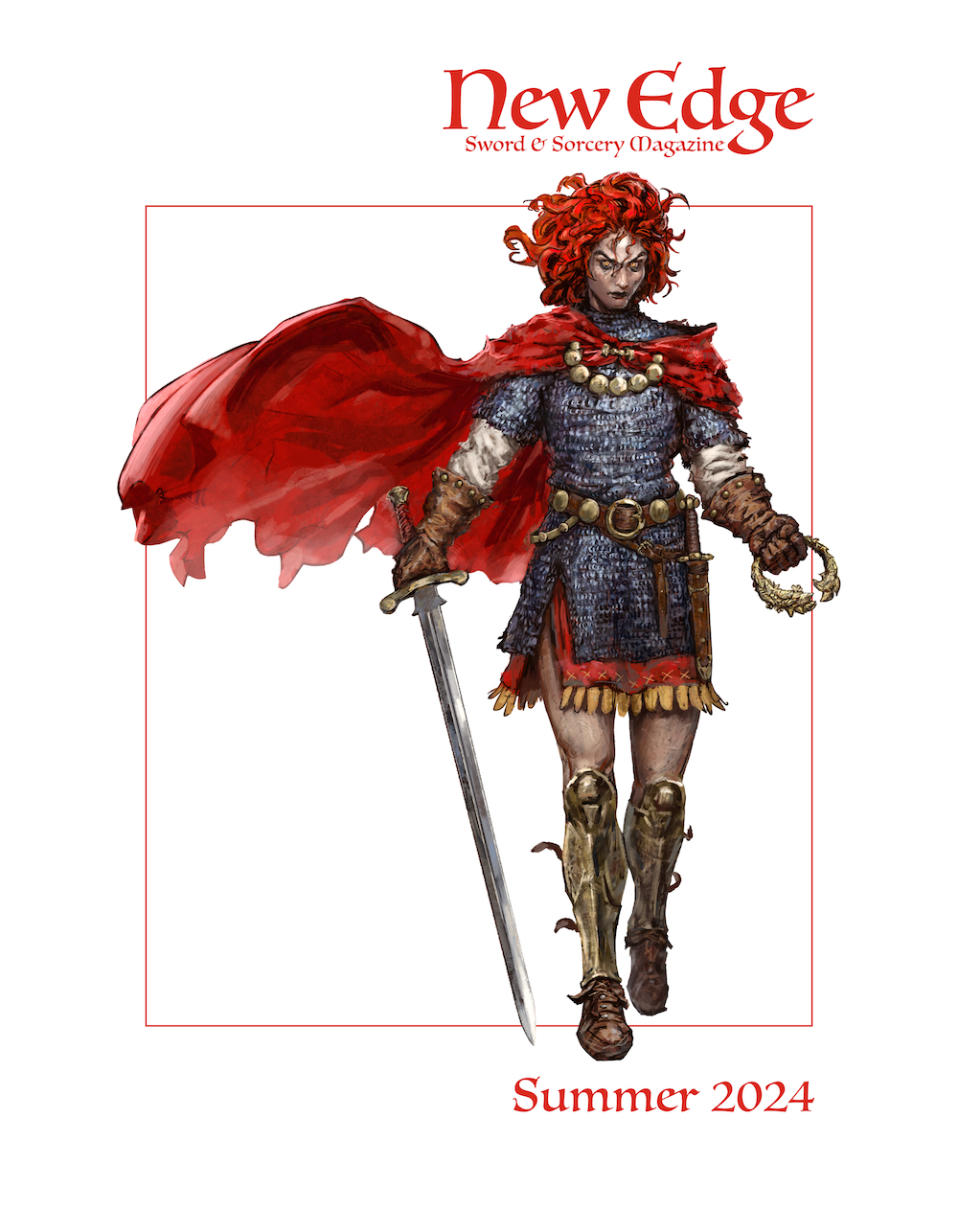
Jirel of Joiry appeared in Weird Tales with “Black God’s Kiss” (1934) by C. L. Moore. That style of story had no name yet, and very few peers to compare it to. Readers immediately saw in Jirel a warrior akin to Conan the Cimmerian and Kull of Atlantis, embattled against wizards and stranger foes that blended adventure and horror, might thews and magic, swords and sorcery.

As a consequence, the initial spate of adventures from C. L. Moore’s typewriter were a bit raw. There was little continuity and less worldbuilding. Jirel herself was a boldly sketched character, and her personal trials shaped her development—yet Moore never tried to portray her at different ages as Robert E. Howard had done with Conan, never sought to reconcile her fantastic France with the real world, and the adventures she went on were the definition of episodic. Where readers could look forward to Conan as a king and know he spent a varied career as a thief, pirate, and mercenary soldier, Jirel was little different in her last adventure than she was at her first.

Jirel of Joiry had no destiny, no future, almost no past to speak of.

So when Molly Tanzer received permission from C. L. Moore’s heirs to do a new authorized Jirel story, she had some decisions to make. Ninety years of steady development has refined heroic fantasy fiction far from its roots in pulp fiction. There have probably been a hundred stories about mystic Mirrors of Truth, not least because Robert E. Howard had a go at the idea with “The Mirrors of Tuzun Thune” (1929), and the pages of at least ten thousand paperback novels is stained with the blood of cunning wizards and magical gewgaws who learned, far too late, what the tip of the blade feels like as it cleaves their liver (or black heart, or festering brain, etc.) in two.

In this respect, “Jirel and the Mirror of Truth” reads like a fairly competent and well-written sword & sorcery story in a fairly old-school mode. If the heroine wasn’t Jirel, readers would still have no doubt that Jirel’s literary DNA was in the mix, much as most barbarians in fiction have a little bit of Howard’s Cimmerian in them. If it lacks something of the raw and sensual language of C. L. Moore, that’s because Tanzer is a smart enough writer not to fall in the trap of trying to pastiche Moore’s prose style. Better, it shows a solid understanding of one of Moore’s central themes: the Jirel stories are always about a contest of spirit as much (or more) than flesh.

It doesn’t take much genre savviness to glance at the title and decide the question will emerge, sooner or later, “Who is Jirel of Joiry?” The answer, however, might surprise a few folks. Molly Tanzer doesn’t regurgitate bits of old Moore stories, though she draws on elements of them; she illustrates who Jirel is through her actions and interactions with others, especially her new companion, Thevin Galois. Less a girlfriend and more than a sidekick, Thevin is a kind of Enkidu to Jirel’s Gilgamesh; the two are alike, but they complement each other. Perhaps they reflect one another’s strengths and weaknesses, their potentialities. Thevin is what Jirel might have been; Jirel is what Thevin might yet be.

When it came to amorous matters, Thevin preferred the company of women, and did not give much notice to men’s attentions.
—Molly Tanzer, “Jirel and the Mirror of Truth” in New Edge Sword & Sorcery #3

Tanzer likes LGBTQ+ characters in her stories, and in this respect Thevin as a lesbian works well. Her sexuality is stated, there’s a hint of tension and attraction with Jirel, but this isn’t Thirsty Sword Lesbians or Dagger Kiss where the question is whether they’ll kiss. If anything, it’s nice to just see the representation of a character where their sexuality is relevant to their character but not the main focus of the story or present just to fulfill a lurid scene or two—there is actual porn out there for folks that want erotic tales of lesbian swordswoman. Tanzer is focused on telling Jirel’s story.

For readers who start with “Black God’s Kiss” and read through the whole C. L. Moore-penned Jirel of Joiry saga to “Hellsgarde” (1939), “Jirel and the Mirror of Truth” might be a bit of a jolt in style. There’s a bit more of Michael Moorcock and Joanna Russ in the style than Robert E. Howard and C. L. Moore. Yet it is a well-written story, and a cut above the pastiche of yesteryear. With a little luck, Jirel’s new adventures may have just begun.

“Jirel and the Mirror of Truth” by Molly Tanzer was published in New Edge Sword & Sorcery #3 (Summer 2024).


Bobby Derie is the author of Weird Talers: Essays on Robert E. Howard and Others and Sex and the Cthulhu Mythos.

Deep Cuts in a Lovecraftian Vein uses Amazon Associate links. As an Amazon Associate I earn from qualifying purchases.
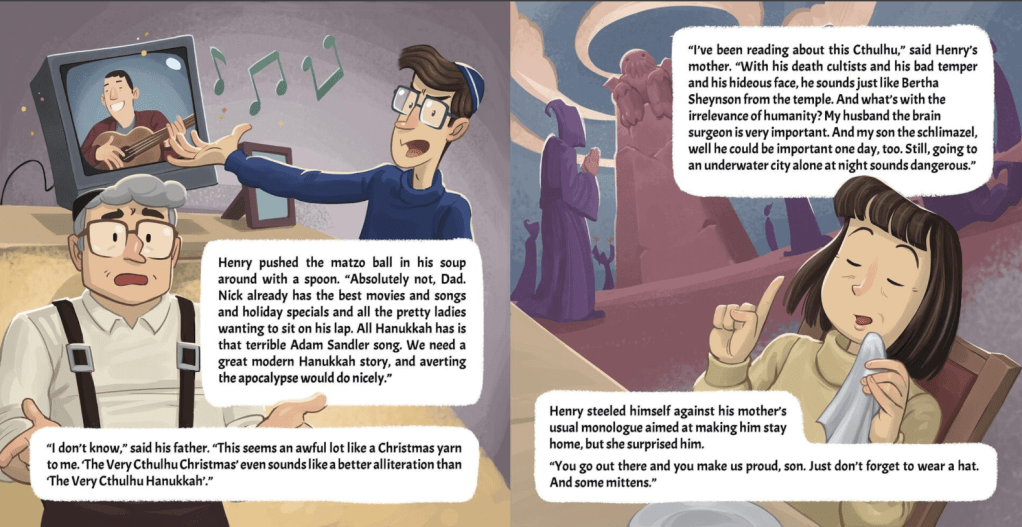
Dreidel of Dread: The Very Cthulhu Hanukkah (2024) by Alex Shvartsman and Tomeu Riera

Hanukkah is an ancient holiday, but a modest one. The holiday of the
Hasmoneans is new, yet it is full of spiritual exaltation and national joy. What
was Hanukkah forty years ago? ‘Al ha-nissim’ and Hallel; a short reading in
the synagogue; lighting the tiny, slender wax candles or oil lights; at home,
levivot [latkes–potato pancakes], cards for the older children, and sevivonim
[dreidels–spinning tops] for the little ones. But what is Hanukkah today? The
holiday of the Hasmoneans. A holiday of salvation. A great national holiday,
celebrated in all the countries of the Diaspora with dances and speeches,
melody and song, outings and parades, as if a new soul has been breathed
into the ancient holiday, another spirit renewed within it. One thing is clear:
if those tiny, modest candles had been extinguished in Diaspora times, if our
grandparents had not preserved the traditions of Hanukkah in the synagogue
and at home . . . , the holiday of the Hasmoneans could never have been
created. There would have been nothing to change, nothing to renew. The
new soul of our times would not have found a body in which to envelop itself.
—Chaim Harrari, Sefer ha-Mo’adim, Sefer Hanukkah (1938),
quoted in “Zionist Awareness of the Jewish Past: Inventing Tradition or Renewing the Ethnic Past?” (2012) by Yitzhak Conforti

On the 25th day of Kislev in the Hebrew calendar is the feast of Hanukkah. Originally a very minor holiday in the Jewish holy calendar, Hanukkah gained increasing prominence during the 20th and 21st centuries as it was embraced as a nationalist holiday by Zionists, and because Hanukkah often occurred near the major Christian holiday of Christmas. The massive increase of secular pop culture surrounding Christmas, especially in English-speaking countries, has led to the increased awareness of Hanukkah, and sometimes its depiction as an equivalent holiday among both religiously observant and secular Jews.

In some cases, elements of secular Christmas celebration have influenced or been adapted for Hanukkah, a process sometimes referred to as Chrismukkah. Jewish families might put up a Hanukkah Bush, or watch Hanukkah-themed movies and animated specials like A Rugrats Chanukah (1996) or Eight Crazy Nights (2002). The influence of Christmas pop-culture on secular Hanukkah media is often very notable. Even when things get a little weird and Lovecraftian.

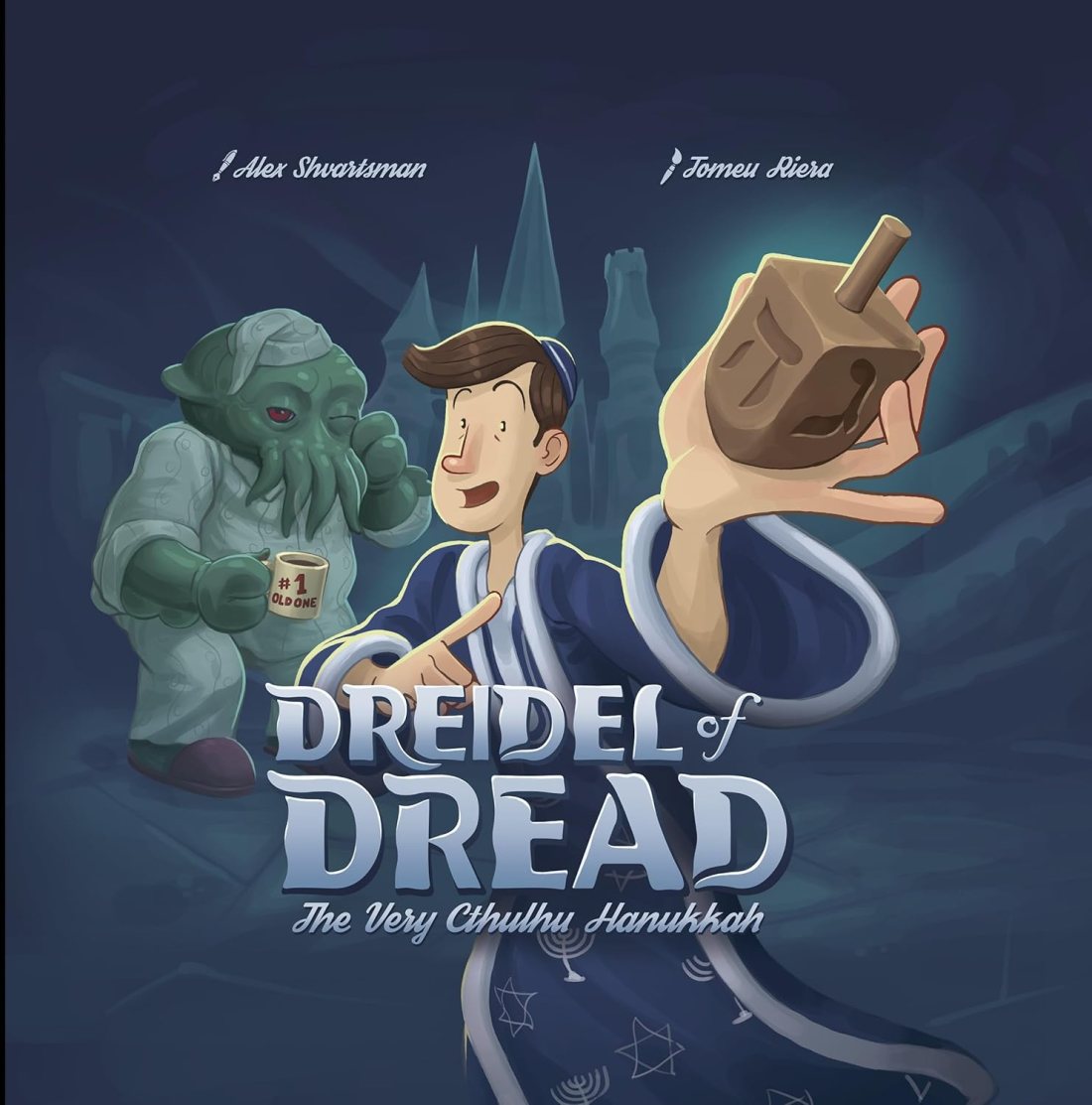
So, when Alex Shvartsman (writer) and Tomeu Riera (artist) set about making Dreidel of Dread: The Very Cthulhu Hanukkah (2024), they took as their initial model the classic Christmas verse “A Visit from St. Nicholas” (1823).

To be fair, Shvartsman and Riera are very aware of it. In fact, that’s quite the point. The book gets very meta very fast, directly addressing how much Hanukkah has played second-fiddle to Christmas in pop culture. Cthulhu is just the catalyst for an ongoing dilemma about the cultural footprint of Hanukkah in a world dominated by Christmas. So with a mix of Yiddishisms and Lovecraftian references, Hanukkah Harry goes off to save Hanukkah from the apocalypse of Cthulhu.

Which he does with a sly insinuation about Lovecraft’s antisemitism and a dreidel.

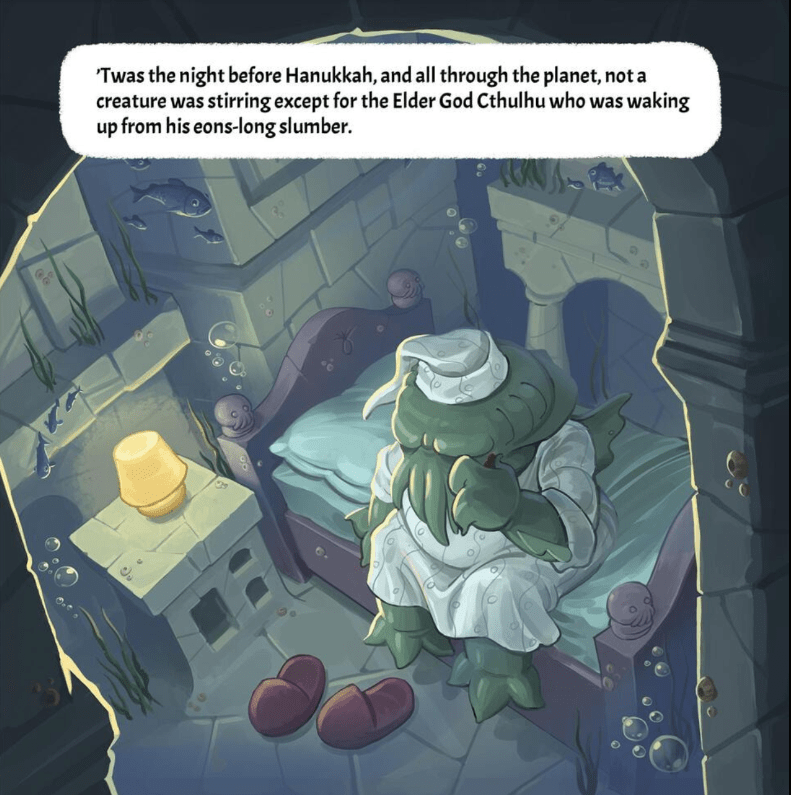
Riera’s heart is lovely, a soft-focus blend of stylized and detailed that could easily serve as the basis for an animated short. The colors in particular strike a fine balance between the traditional greens and purples favored for eldritch horrors and the more subdued coloring of Harry’s mother and father’s modest dress, while Harry himself favors blue and white. Implicit details of dress suggest the family are probably Reform Jewish, since Harry lacks the payot and none of them wear the typical clothing associated with the hasidim (whose distinct garb Lovecraft noted and commented on in New York City).

It is not a very long book, and thematically it’s not a very deep book. Cthulhu goes down without devouring so much as a latke. Cosmic horror takes a back seat to wanting to sort things about before Christmas comes for Cthulhu. While suitable for and probably geared toward a young adult audience, the youngster would have to be perspicacious enough to be aware of the cultural references for both Hanukkah and Cthulhu to really grok it—and maybe get a chuckle at some of the jokes.

Dreidel of Dread: The Very Cthulhu Hanukkah (2024) is a fun little book, but readers looking for something a little more serious or action-packed might want to check out Edward M. Erdelac’s Merkabah Rider or “The Chabad of Innsmouth” (2014) by Marsha Morman. As Jewish/Cthulhu Mythos mash-ups go, this is distinctly light-hearted and tongue-in-cheek, less concerned with either the details of Lovecraft’s Mythos or the origins of the holiday.

It’s about Hanukkah Harry saving Hanukkah from Cthulhu. Which is, really, all it claims or needs to be.


Bobby Derie is the author of Weird Talers: Essays on Robert E. Howard and Others and Sex and the Cthulhu Mythos.

Deep Cuts in a Lovecraftian Vein uses Amazon Associate links. As an Amazon Associate I earn from qualifying purchases.
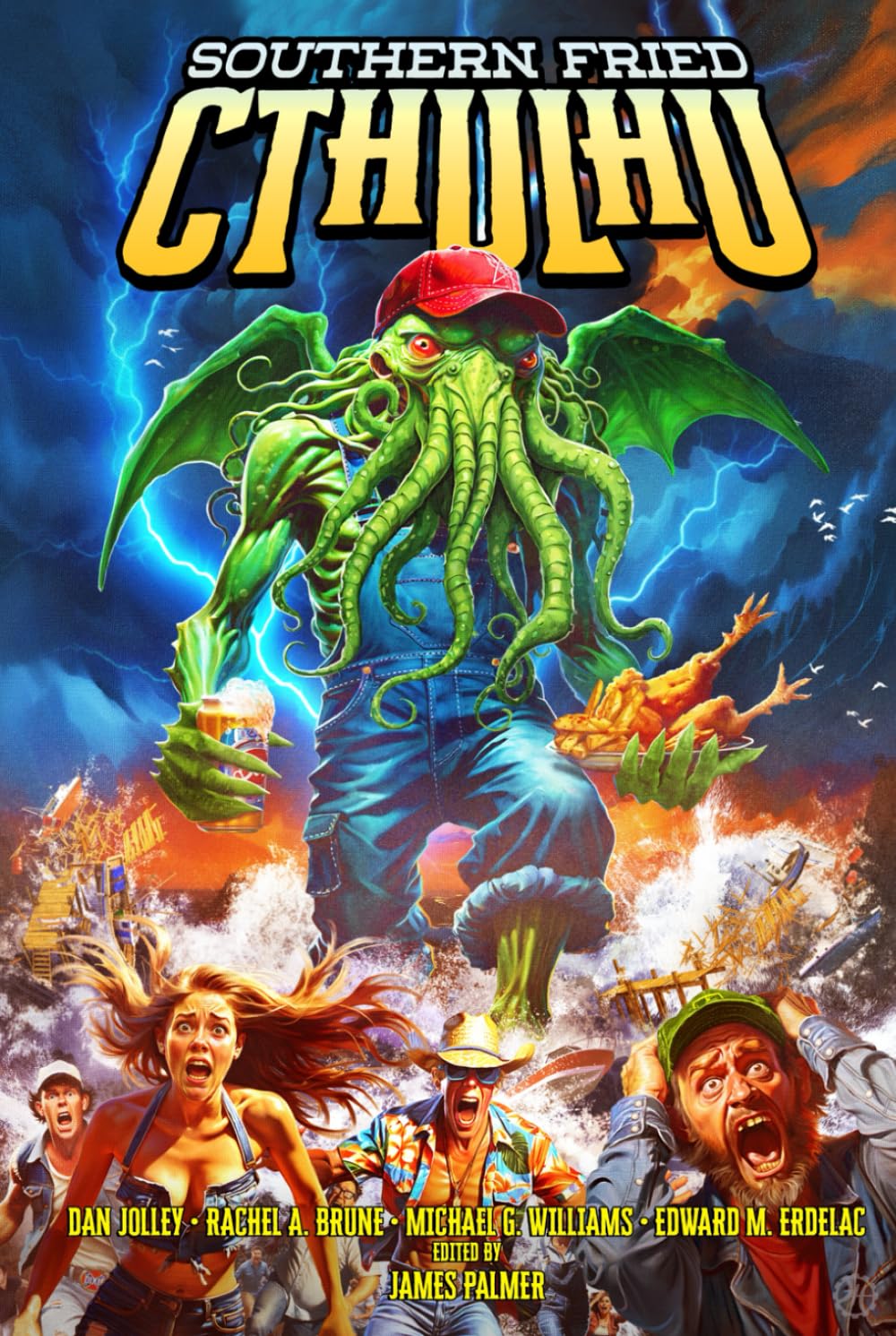
“Glory Be to the Father and Mother” (2024) by Bernadette Johnson

“Since you are a church-going type, I wanted to extend an invitation to our service.”
—Bernadette Johnson, Southern Fried Cthulhu 200

There are many cultural fault lines and divides in the United States, fuzzy though they have grown over time as the country becomes more integrated, the population more mobile. The Bible Belt is largely co-terminous with the Southern and Southwestern states and parts of the Midwest. Christian church attendance is high in this area, but the Christian churches involved are varied, multitudinous, and often evangelical, independent, fractious, and unregulated.

Anyone can buy a collar and a Bible. Anyone can preach and call themselves a preacher. The charismatic preachers may be itinerant or fixed; sermons may be preached from multi-million dollar megachurches or from tents or old rented commercial buildings. Some churches are part of large established denominations like the Southern Baptists and Methodists, and may have organized seminaries and organizations like the Southern Baptist Convention, but as many or more may be independent and idiosyncratic.

If you live and grow up in the Bible Belt, affiliation with a given church is a personal as well as cultural choice. Even small towns might support a number of independent churches, sometimes with unfamiliar names, quirks on ideology, theology, and ritual.

Good cover for older, stranger religions.

“”Glory Be to the Father and Mother” by Bernadette Johnson plays on the frisson of the unfamiliar-and-near-familiar. Set in an unspecified small town, a newcomer is courted by opposing congregations, and there is a space of wariness—which is the Mythos cult, and which is just a weird little independent church? Where’s the line between the two? It’s a tension that can’t last very long; especially in a short story, and before too long before the strange altars and human sacrifices come out. Old tropes die hard.

If there’s a criticism for the story, it’s that the premise has enough potential it would have been nice to see more done with it. A more developed setting that spent more time to flesh out the churches and temples involved, the cults, to give them more personality instead of relying on the familiar Mythos Cultist imagery, would have added welcome depth to the story, which races to try and get through its plot points before the end.

In general, few Lovecraftian stories really come to grips with what it means to be a part of a cult, to be recruited, to live inside the group. Stories like “The Book of Fhtagn” (2021) by Jamie Lackey, “The Well” (2023) by Georgia Cook, and “The Things We Did in the Dark” (2024) by Julia Darcey show different approaches to how Mythos cults can work, and it’s not all cowled robes and wavy daggers. The interaction with charismatic evangelical Christianity is rarer; Charles Stross played with the idea in The Fuller Memorandum (2010), and the idea crops up in other stories, but it is a rich and varied field, because of the wide array of churches in the region.

“”Glory Be to the Father and Mother” by Bernadette Johnson was published in Southern Fried Cthulhu (2024).


Bobby Derie is the author of Weird Talers: Essays on Robert E. Howard and Others and Sex and the Cthulhu Mythos.

Deep Cuts in a Lovecraftian Vein uses Amazon Associate links. As an Amazon Associate I earn from qualifying purchases.
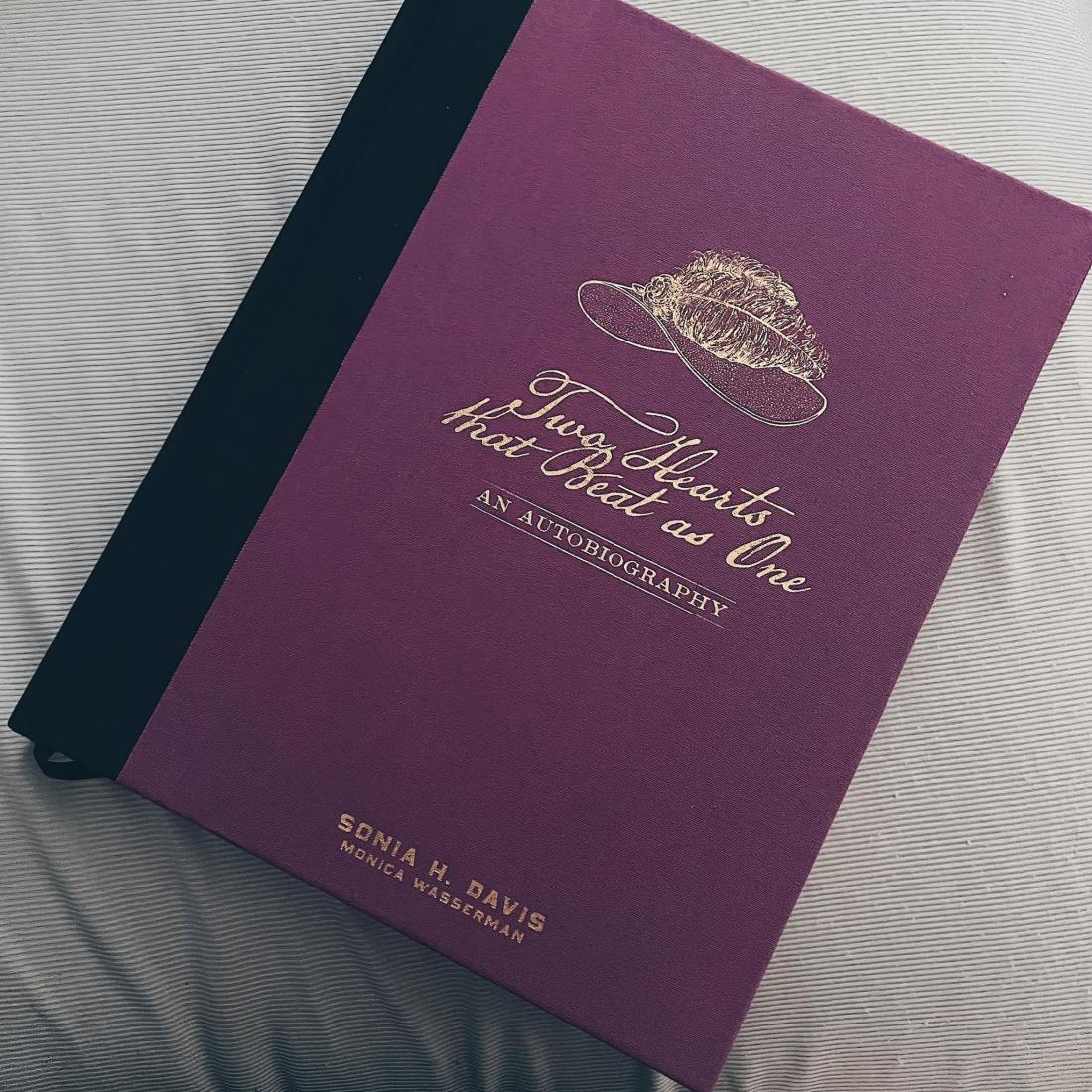
Two Hearts That Beat As One (2024) by Sonia H. Davis & Monica Wasserman (ed.)

In the small village of Itchno, which is on the outskirts of the town of Konotop, in the small Province of Chernigov, on the cold and wintry night of March 16, 1883, with the temperature several degrees below zero, an infant girl was born.
—Sonia H. Davis, Two Hearts That Beat As One (2024) 1

In February 2022, when the Russian Federation invaded Ukraine, I noted the news as the invaders moved through Konotop, the birthplace of Sonia H. Davis, who had once been Sonia H. Lovecraft. In 2019, when I prepared my notes for a panel at NecronomiCon on Lovecraft’s ex-wife, I had wondered if there were any records of her early life still there in the city. As the Russians overran the city, any hope I had of some original documents about Sonia or her family surviving to fill in the gaps in her early life faded.

It was mid-October 2022 when I got in touch with Monica Wasserman (The Papers of Sonia H. Davis), and to my surprise found there were better sources closer at hand than Konotop. We shared a common interest in the former Sonia H. Greene, who had become Mrs. Lovecraft. However, Monica’s dedication to the subject far outstripped mine. Her considerable research on Sonia’s life included access to the papers of Sonia and her third husband at Brown University, tracking down some of Sonia’s books and the extremely scarce second issue of The Rainbow, and scouring newspaper archives and genealogical databases. She even managed to access photographs of Sonia that had never been published, and contacted Sonia’s living relatives for family lore.

My own research was more modest, though complementary: while Monica had focused on her subject, I’d been focused on everything else around Sonia. I had been meticulously reading H. P. Lovecraft’s letters for references to Sonia, and had obtained access to other correspondence from or related to Sonia in various archives. Monica had unearthed the goods: I could offer a bit of context and insight from the Lovecraftian side of things. When Monica followed through on her project of actually publishing Sonia’s autobiography, unearthed from the archive and supplemented by additional autobiographical materials like The Private Life of H. P. Lovecraft (1985) by Sonia H. Davis, she was very gracious in allowing me to be a beta reader and to comment on it before publication. Because a few of my suggestions found their way into the final product, I’m listed as a contributor.

Which is a very long way to say, I’m biased when it comes to Two Hearts That Beat As One.

Most readers come to Sonia H. Davis as an adjunct to their interest in her second husband, H. P. Lovecraft. Her memoirs of their marriage shed light on a critical period of Lovecraft’s life, and fans and scholars alike sought her out for what she could give them about him. Yet that interest never manifested in any profitable form. Lovecraftian scholarship and publishing in the 1930s-early 1970s was almost entirely a small-scale endeavor, dominated by amateurs and small presses like Arkham House that sometimes seemed more labors of love than businesses that could produce actual revenue. There was no major biography of Lovecraft released during Sonia’s lifetime, though every major biography since has depended at least in part on her memoirs.

Pretty much no one seemed interested in Sonia’s own story. Until Monica Wasserman, that is.

Sonia’s autobiographical manuscript is, first and foremost, the story of her life. Born to Jewish parents in Ukraine (then a part of the Russian Empire), the loss of her father, her travels to the United Kingdom and then the United States, the new family her mother made, her need to work at a young age, marry at a young age, to become a mother, a successful businesswoman, an amateur journalist…long before she met Lovecraft, Sonia lived a life worth telling about. Her story is the story of many immigrants that came to the United States, living by her wits and the sweat of her brow, striving for education to better herself, dreaming of her own business and financial freedom, and yes, even of love.

While Sonia is very honest in her autobiography, there are things she doesn’t talk about very much. This is where Monica added footnotes, stitched-in material from The Private Life of H. P. Lovecraft and other autobiographical writings, to fill in some of the gaps. The result is more complete than just the individual works by themselves would be; the formatting by Helios is carefully done so it is easy to see at a glance when another text is “pasted-in,” and perhaps most importantly, in a way that preserves the intent of the book:

To tell Sonia’s story in her own words.

To appreciate Monica’s work, it is important to realize that Sonia desperately needed an editor. While some of her autobiographical writings proceed in a fairly linear manner, she had a tendency to hop around in time, or to put down sudden thoughts and recollections as they occurred to her, and there is much that might be forgotten (or omitted) when writing for a general audience decades later. We see little of her daughter, Florence Carol Greene, who grew up to be the journalist Carol Welde, for example, though we know their relationship was fraught and eventually irrevocably sundered. Endings seemed to be particularly difficult for Sonia; she struggled to wrap things up. The raw manuscripts aren’t unreadable, but they benefit immensely from someone taking the time and care to put them in order and to clarify a few obtuse points with cogent endnotes.

Monica put in the work so that the reader can access Sonia’s story more easily.

Two Hearts That Beat As One is, as of the moment it saw print, the definitive text on Sonia’s life. In a format accessible to both scholars and casual readers, it provides a unique glimpse into the life of a woman who suffered, strove, and finally achieved much of what she hoped for—love, a degree of economic comfort, and purpose—with her third husband, Nathaniel Davis. In time, old age would take this all away. All lives end, and the last chapters are rarely pleasant. Here, at last, Sonia is the star and subject of her own story, not a brief and shadowy chapter in H. P. Lovecraft’s.

After a successful crowdfunding campaign, Two Hearts That Beat As One is available both as a standard edition and a collector’s edition (with handsome slipcase). Helios House has made a beautiful, well-laid out project that does great service to Sonia’s text and Monica’s scholarship and hard work bringing this project together.


Bobby Derie is the author of Weird Talers: Essays on Robert E. Howard and Others and Sex and the Cthulhu Mythos.

Deep Cuts in a Lovecraftian Vein uses Amazon Associate links. As an Amazon Associate I earn from qualifying purchases.
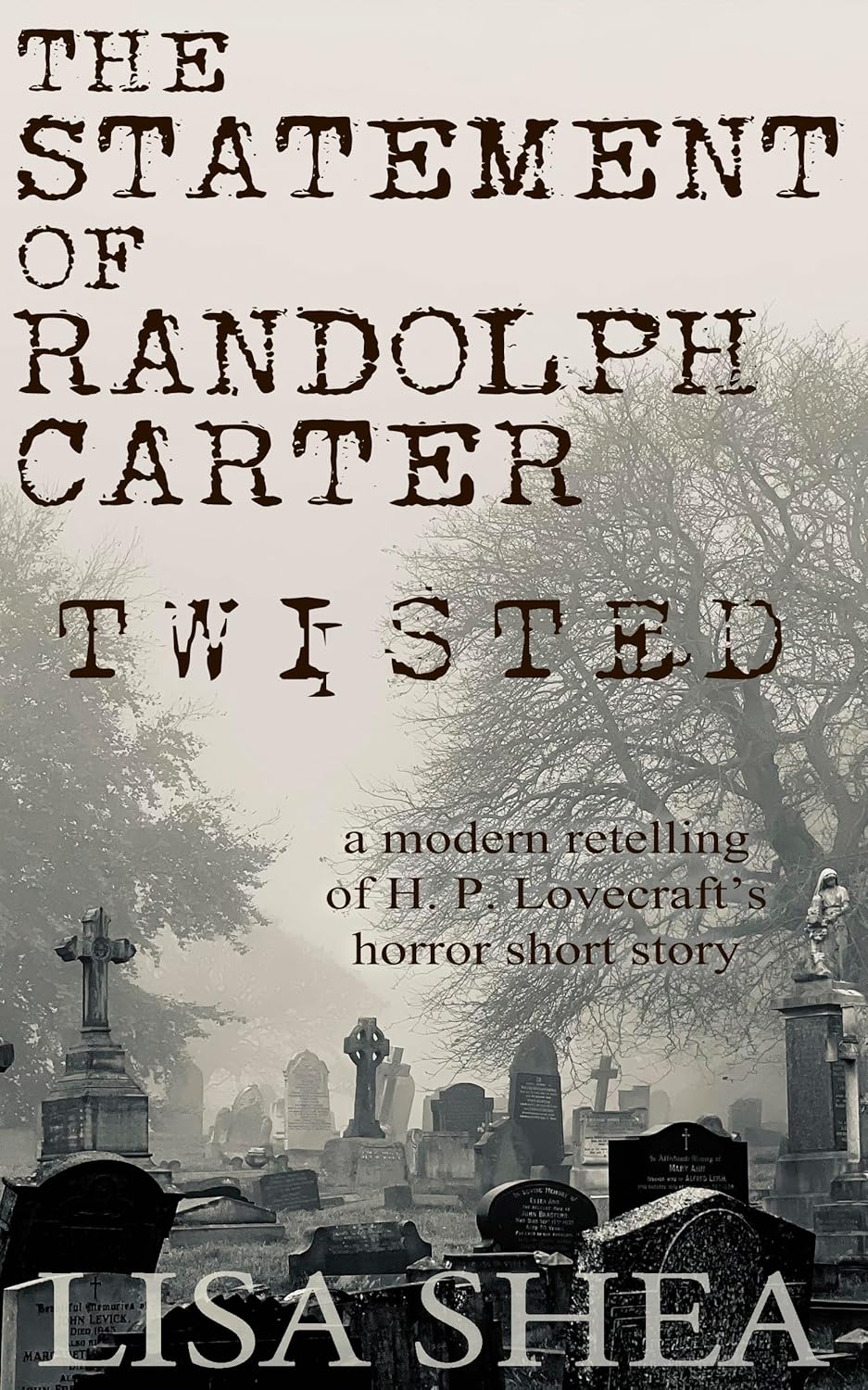
“The Statement of Randolph Carter Twisted” (2024) by Lisa Shea

The dream originally took place in New England, in a cemetery there. For some reason, Lovecraft decided to relocate it to Florida, which makes NO sense to me. Florida doesn’t have a history of ancient cemeteries stretching back hundreds of years. Also, Florida is barely above ocean level!
—Lisa Shea, “Author’s Note” in “The Statement of Randolph Carter Twisted” (2024)

The only topographical features of H. P. Lovecraft’s “The Statement of Randolph Carter” are the “Gainsville pike” and the “Big Cypress Swamp.” This has led many to believe the story takes place in Florida, near the city of Gainesville. It is possible that Lovecraft actually intended the location to be Georgia—his friend Samuel Loveman, who appeared in his dream and is depicted as Harley Warren, was stationed at Camp Gordon, only about 40 miles from Gainesville, GA.

I don’t point this out to nitpick, but to applaud. Lisa Shea’s author’s note gives evidence she really thought about Lovecraft’s story. Looked at how he framed it, what he did and did not achieve in a narrative sense. There have been many efforts to revise, revisit, revamp, and rewrite Lovecraft’s stories, from “His Mouth Will Taste Of Wormwood” (1990) by Poppy Z. Brite to “The Ballad of Black Tom” (2016) by Victor LaValle to “Kanye West—Reanimator” (2015) by Joshua Chaplinsky. Like old folktales, there is room for infinite variation. The first version of a story isn’t necessarily the best one, even if it’s the one repeated most often.

Shea’s “twist” to “The Statement of Randolph Carter” is an update to setting, characters, and attitude. No ambiguous Southern swamp in the 1910s and military telephones with long wires; this is set in Massachusetts in the 21st century with smartphones. The characters are younger, but their relationship is less ambiguous. The shift in setting and character requires a few tweaks in the plot; but the end result is tight. Nothing superfluous, no attempts to cram in a random “fhtagn!” where it isn’t needed. True to the spirit of Lovecraft’s original, but adapted to the current syntax.

There’s even a nice little flourish at the end. A little twist of the knife that Lovecraft didn’t do.

As a twisted tale, it works. What works best about it, however, might be the approach. Instead of approach Lovecraft’s tales as canon, they are approached as examples to study and learn from. Jumping-off points rather than fixed stars in the firmament.

If you read the original “The Statement of Randolph Carter” by Lovecraft, how would you change the scenes so they were more scary to you?
—Lisa Shea, “Author’s Note” in “The Statement of Randolph Carter Twisted” (2024)

Lisa Shea has done some other Mythos ebooks including Sailing Downward To The Cthulhu Call (2022) and Dagon Twisted (2024).


Bobby Derie is the author of Weird Talers: Essays on Robert E. Howard and Others and Sex and the Cthulhu Mythos.

Deep Cuts in a Lovecraftian Vein uses Amazon Associate links. As an Amazon Associate I earn from qualifying purchases.