“Bat’s Belfry” (1926) by August Derleth

Vampirism is still a force to cope with; it has been in flower since Bram Stoker’s Dracula.

August Derleth, “The Weird Tale in English Since 1890” (1930) in The Ghost #3 (1945) 6

Before August Derleth pastiched H. P. Lovecraft, and coined the term “Cthulhu Mythos”; before Derleth pastiched Sherlock Holmes, and created the detective Solar Pons; before he published anything else—Derleth pastiched Bram Stoker and Dracula with “Bat’s Belfry,” his first professional sale.

Dracula in the mid-1920s was not the cultural sensation that it is today. In 1924, Hamilton Deane wrote the first authorized dramatic adaptation of Stoker’s novel. In 1927 John L. Balderston would revise the play for Broadway. American audiences thrilled to the stage production, starring Hungarian actor Bela Lugosi in the title role with a characteristic opera cape—and in 1931, director Tod Browning featured Lugosi and other actors from the production in the first Hollywood film adaptation. With each step, Dracula’s exposure increased, and the image and reputation of the Count expanded by magnitudes.

In 1925, however, Dracula was known as a modestly successful horror story, the best and most popular of Bram Stoker’s novels, still in print 13 years after his death. While readers of Weird Tales could be sure to have at least heard of the book, even if they hadn’t read it, the vampire count had not yet hit icon status. Yet a young August Derleth was inspired by Dracula to write a story—or, perhaps more accurately, to market a story he had already written:

A long time ago, it seems (the year was 1925), when I had written forty stories, none of which had sold, I thought it time to take stock I looked over everything I had written—most of it pretty bad—and selected one story which I thought might be sold. The result was felicitous.

August Derleth, foreword to Evening in Spring (1945 edition)

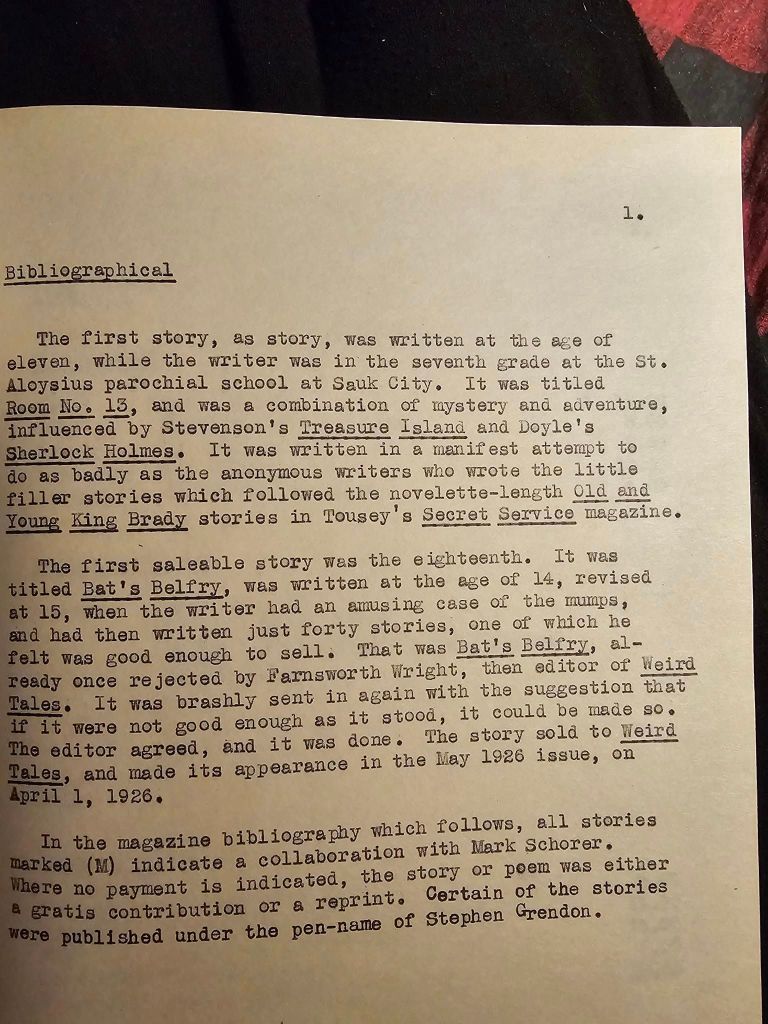
It isn’t exactly clear when Derleth wrote this story, and various details get muddled in the telling and retelling. Various sources claim he began writing at 13, and that “Bat’s Belfry” was written when he was 13, 14, or 15. In his personal publication record, Derleth wrote:

Later, Derleth would write:

I began at thirteen, and I sold at fifteen. The selling of my first story involved a direct challenge to the ego. I had written forty stories before I sold one, and that I should then have sold one ways purely an accident of determination. I had fixed upon the figure forty, resolving that when I had written forty stories without selling one, I would re-examine my determination to become a writer, because I had read somewhere that Charles Dickens had taken his first book to forty publishers before it was accepted. By that accident of reading, I fixed upon forty, and when I had written forty, most of them weird stories which had been duly rejected by Farnsworth Wright of Weird Tales, I looked them all over, one after the other, and endured my own private soul-struggled. On one or two rejection slips Wright had penned a brief, encouraging note—”Try us again!” or “Sorry. Try once more.”—and I read the stories thus rejected with especial interest. They did not seem to me to merit re-submission, but my eighteenth story did. I felt that it was honestly as good as many of the things which Wright had been publishing, and, if it was not up to acceptable status, it could be brought up to that level. So, firmly but politely, I resubmitted the story, stating that I felt it could be made acceptable, and in response received a most agreeable letter from Wright suggesting certain changes, calling my attention to my error in the matter of the Cockney dialect, with the felicitous result that the story, revised, was ultimately sold.

August Derleth, Writing Fiction 164-165

This version of the story, straight from Derleth, is probably the most detailed and accurate version—with a few caveats. The original title of the story wasn’t even “Bat’s Belfry,” and there was much more involved in the revision than removing a Cockney accent. Fortunately, we can track the development of the story because Derleth saved Wright’s rejection letter:

Dear Mr. Derleth:-

I have again given a careful reading to THE LOCKED BOOK. The workmanship is very uneven, almost as if you had written part of it under the fever of an urgent inspiration, and the rest merely as a matter of routine hack-work. But—I think it can be made acceptable for WEIRD TALES. The last half of the story is well handled, except the ending. You have adduced no reason why Sir Harry Barclay should wish to summon Satan, when all he wants to do is the pious deed of staking the bodies of the vampires. You have made no connection between the skeletons and the final scene where Satan appears. In other words, the whole story is left “up in the air”—you have braided a rope, but left the ends out without bringing them together in one cord. And the beginning contains altogether too much of the grocer’s conversation—I think the whole scene with the grocer is irrelevant and merely interrupts the flow of the narrative. All that the grocer incident does for the story is to establish the fact of the disappearances of four girls, and the fact that the last Baronet Lohrville was a devil incarnate. This fact can be much more naturally established than by interrupting your story to drag in a dialect-speaking grocer for two pages of conversation. Your narrative first takes on vigor and movement on page 7, where you begin: “Three days ago Mortimer came to me,” etc., and it keeps up nearly to the end, where it sags by reason that nothing is decided, and that the ending is no true denouement at all, for it has very little connection with the facts of the narrative itself, neither explaining them nor being a development or working-out or consequence of the facts of the story itself. What possible connection, the readers would think, exists between the vampire-talk that has gone before, the finding of the skeletons, the extinguishing of the lights, the bat-wings in the dark—what possible connection between these things and the ending of the story, the appearance of Satan? I fear the reader would be disappointed. The story is very well handled in part, yet awkwardly treated in other parts.

Farnsworth Wright to August Derleth, 24 Sep 1925, MSS. Wisconsin Historical Society.

At the end of its first year in business, Weird Tales was in a bad way; a company shake-up in 1924 ousted then-editor Edwin Baird, and Farnsworth Wright (formerly first reader for the magazine, who would sift through the slush pile of submissions for stories worth publishing) ended up in the editorial chair, and after the owner J. C. Henneberger was forced out of management, Wright had the creative freedom to run Weird Tales his own way. This still involved, at first, running stories bought under Baird—but as they went through the issues, Wright would be in the market for new material. Enter August Derleth.

Of immediate notice in this letter is that this isn’t the first time Derleth has submitted this story; it would become Derleth’s practice to submit and re-submit stories until they sold, and that so many of his works did sell to Weird Tales shows the value of his persistence (and Wright’s need for material). As Derleth would later tell it:

Since that time I learned fairly accurately to judge when stories were being rejected because there were a fair number of stories on hand, and the editor could afford to be more selective; and in every such case, without exception, I simply waited several months, retyped the manuscript, and submitted the story in question again, and in every case it was duly accepted on some resubmission, ranging from the first resubmission to the ninth, an opening having appeared for it and the story being good enough for filler if not feature. Something like fifty stories have been sold in this fashion, though I do not recommend it as a steady practice, and cite it only as an example of a) ego, b) a certain ability to judge from the editorial point of view as well as from that of the writer.

August Derleth, Writing Fiction 165

Derleth’s strategy worked in part because of Wright’s extreme conscientiousness as an editor. Wright’s willingness to work with a new potential writer and give detailed advice and criticism on how to improve a story was not limited to Derleth; his encouragement extended to many new writers trying their luck with Weird Tales. That was one of Wright’s more endearing characteristics, well-remembered by many writers who might otherwise just receive a pre-printed rejection slip.

For his part, Derleth seems to have taken Wright’s criticism to heart, for in the published version of the story there is no lengthy dialogue sequence. The grocer’s tale is rendered down to a single long paragraph. Later in life, Derleth would recall:

The danger in distant settings lies in inadequate knowledge. In the original version of my first published short story (Bat’s Belfry, Weird Tales, May 1926), which was set in the country down from London (which, for a beginner of fifteen, seems in retrospect to be the height of self-assurance), I introduced a pub-keeper who spoke in Cockney dialect. Possibly due to saturation reading of Conan Doyle, Sax Rohmer, Edgar Wallace, et al, I had somehow conceived the impression that most of the lower classes in England habitually dropped their h’s from many words and added them to many others where they did not belong. The late Farnsworth Wright, then editor of Weird Tales, pointed out that the Cockney dialect was limited to a bounded area within the city of London, and that it was not likely that such a speech pattern would make its appearance in the down country, or, if it did, that it would last for any length of time, since all dialects are naturally subject to change under the influence of the prevailing speech patterns. Had I checked on this simple fact before submitting the story, I would not have made an error, which now necessitated revision; but I made the mistake of taking the dialect more or less for granted—I ascribed it to a class of people rather than to a district; a little unbiased interpretation would have enlightened me even without reference to any source of information, for dialects are never a matter of class, but always of region.

August Derleth, Writing Fiction 64-65

The story was revised and resubmitted to Wright, who responded back:

Dear Mr. Derleth:-

Almost! And with a little touching up of the ending, THE LOCKED BOOK will be ready for the pages of WEIRD TALES. (And please number your pages; to avoid confusion in case the pages get misplaced).

The story is vastly improved. You are on the right track in the present ending, but you have fallen down badly just the same. For in a story of this kind, does the reader want to enjoy the spectacle of the appearance of the vampires before Barclay, or does he want ’em to appear and then finis? You know the answer. You have deliberately turned from the high spot in your story as if you had suddenly become tired of writing. You have not squeezed out all the horror you could from the situation; in fact, you have hardly squeezed out any. Drain it dry (the situation, I mean). Touch up the ending, let us see the gloating eyes of the vampires as they move on Barclay—let us see Barclay immovable under the hypnotic, glittering, evil gaze of the old Baron, and the sinuous, gliding movements of the four women as their red lips part in a smile and they gently caress those lips with a soft lapping motion of their tongues—while Barclay continues to write—let him fight the spell, let him drop his eyes and start to his feet—let the most beautiful of the vampires come before him, arms outstretch or all for at once, perhaps—I am resisting with all the power of my will, he cries—the rememberance of that parted mouth, those crimson lips remains—she is still here, in front of me, as I write; I will take one more look at her face, and then pray—I look—her face approaches mine and—My God! I no longer want to pray!—a sharp stinging sensation at my throat—my God—it is—

Some such ending. Write it yourself. You don’t need to rewrite what has gone before, hwoever.

Farnsworth Wright to August Derleth, 6 Oct 1925, MSS. Wisconsin Historical Society.

For fans who have rolled their eyes a little at the protagonist continuing to write as the horror takes them, as in H. P. Lovecraft’s “Dagon” and “The Diary of Alonzo Typer,” there is a certain irony in Wright actually suggesting such an ending to the impressionable young Derleth. For his part, Derleth took Wright’s advice on how to write the ending rather literally, presumably to give the editor exactly what he wanted:

I can not tolerate their virulence . . . . I endeavored to rise but I could not do so. . . . I am no longer master of my own will! The vampires are leering demoniacally at me. . . . I am doomed to die . . . and yet to live forever in the ranks of the Undead. Their faces are approaching closer to mine and soon I shall sink into oblivion . . . but anything is better than this . . . to see the malignant Undead around me . . . A sharp stinging sensation in my throat. . . . My God! . . . . it is—

August Derleth, “Bat’s Belfry” in Weird Tales Mar 1926

Still, this final revision did the trick:

Dear Mr. Derleth:-

Your story, BAT’S BELFRY (I prefer your new title), is acceptable for publication in WEIRD TALES, in its new form. Our minimumr ate of half a cent a word, on publication, is unfortunately our standard rate at present except in very exceptional circumstances, and we must keep this rate until we clear off the debts left us by the old company. As your story measures about 3600 words, this will amount to $18 on publication for BAT’S BELFRY. Is this satisfactory?

Farnsworth Wright to August Derleth, 15 Oct 1925, MSS. Wisconsin Historical Society.

It apparently was, and Derleth had his first professional sale. The story would be published in the March 1926 issue of Weird Tales.

One of the interesting things about “Bat’s Belfry” is its format: the first part consists of a letter, there is a brief narrative interlude, and then the rest of the story consists of excerpts from Barclay’s diary. Stoker’s use of the epistolary novel format was something of an archaic device when Dracula appeared in 1897, and was prone to misuse by inexperienced writers. Wright noted this in a follow-up letter when Derleth apparently tried to follow the success of “Bat’s Belfry” with another story in a similar format:

Dear Mr. Derleth:-

I am returning THE PIECE OF PARCHMENT. The diary form is particularly hard to use in a story, altho many of our writers, under the influence of Bram Stoker’s “DRACULA,” have tried to use it, and sometimes they succeed. But it ordinarily is the surest device for killing reader-interest.

Farnsworth Wright to August Derleth, 9 Jan 1936, MSS. Wisconsin Historical Society.

Derleth would take this advice to heart too, recapitulating this advice to others:

Very probably the success of Bram Stoker’s Dracula inspired a flood of similarly conceived stories written in the form of a diary, but on the whole, this form is very difficult to do well. That is because the writer is always caught between the necessity of getting on with his story and of keeping a semblance of verisimilitude about the entries as they are likely to be made.

August Derleth, Writing Fiction 126

More interesting perhaps is that for those familiar with Derleth’s later creative efforts, “Bat’s Belfry” has many hallmarks of his later Cthulhu Mythos fiction. Aside from the obvious characteristics of pastiche, where Derleth apes or recaps some of the key imagery or elements from Stoker’s original (compare the vampire women seducing Harker and Barclay), there is the emphasis on the library of occult books which foreshadow the development of a five-foot shelf of eldritch tomes in later Mythos fiction. This includes a very Derlethian, weirdly self-referential element when the protagonist, digging through an old trunk, comes across an early edition of Dracula! This is strongly reminiscent of how in some of his later Mythos fiction such as “Beyond the Threshold” (WT Sep 1941), Derleth would place copies of Arkham House books such as The Outsider and Others next to the Necronomicon. Indeed, the Book of Thoth in this story serves much the same function as the Necronomicon might in later Mythos fiction, being almost a prototype for the Necromonicon-as-grimoire trope.

To be frank, “Bat’s Belfry” is far from Derleth’s best work, borderline juvenalia. While it may not be hack-work, it is plainly a potboiler, and one which Wright himself seems to have partially dictated. Derleth skews from Stoker in having Barclay attempt to use actual magic against the vampires (Leon, a Catholic like Derleth himself, fares a bit better), but the diary format of the final encounter renders is a bit ridiculous. Nevertheless, the story had its attractions for editors. While it didn’t place among the best stories in the issue, it was selected for reprint in the British More Not at Night anthology by Christine Campbell Thomson. This was the first of what would be many reprints in various horror and vampire anthologies over the decades.

As his first publication, “Bat’s Belfry” became part of Derleth’s own personal legend, and on the twentieth anniversary of his becoming a writer, his people threw a party to celebrate:

The Capital Times 28 Mar 1946

Another article suggests 130 guests attended Derleth’s 20th anniversary of becoming a writer (The Capital Times 4 Apr 1946). Yet that is not the end of “Bat’s Belfry.”

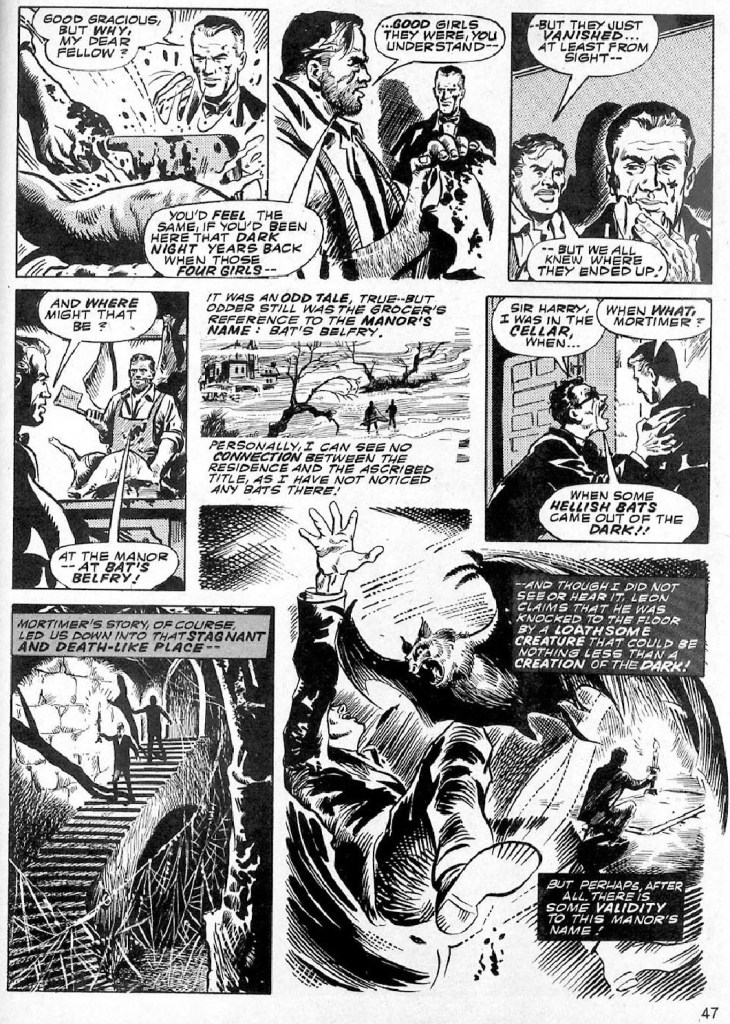
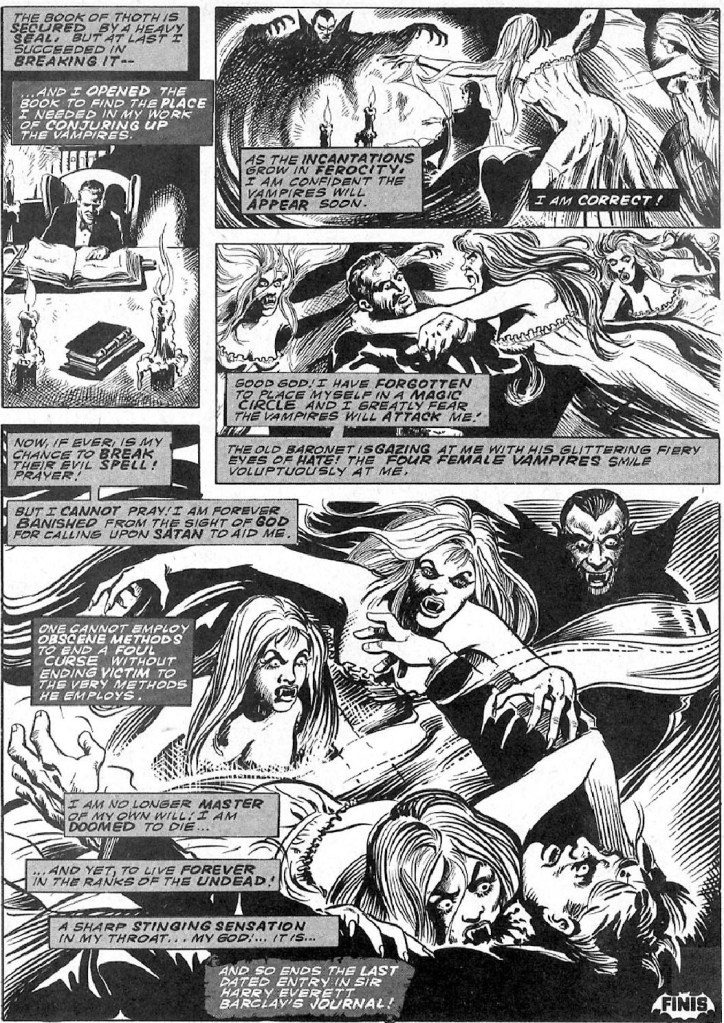
In the 1970s, Marvel Comics circumvented the restrictive Comics Code Authority, which effectively prevented them from publishing adult-oriented comics, particularly horror and the more lurid and grisly sword & sorcery, by publishing full-sized comic magazines, initially under their Curtis imprint. One of these efforts was the black-and-white Vampire Tales, and in the third issue (February 1974), they published an adaptation of “Bat’s Belfry,” with writing by Don Macgregor and pencils and inks by Vicente Ibáñez.

The best that can be said of this adaptation is that Macgregor and Ibáñez highlight the most compelling and evocative images in Derleth’s story, emphasizing the Gothic atmosphere, while preserving much of Derleth’s prose. Ibáñez’ layouts in particular sometimes break from a strict grid format, to give the suggestion of action in a story that has little of it. The encounter with the grocer, for example, is no longer a paragraph in a diary, but is now a sequence where a burly man butchers a carcass and splashes bystanders with blood as he warns them about the old baron.

Because the comic adaptation was set well after the success of the 1927 play and the 1931 film, the Baron wears an opera cape and has slicked-back hair, very much in the Lugosi mold, while all of the vampires have prominent fangs—an element that first appeared in Turkish and Mexican film vampires, but gained wide popularity in the United States from the Hammer Dracula films starring Christopher Lee that began in 1958. It is characteristic of adaptions to update older bloodsuckers to fit the expectations of a contemporary audience.

H. P. Lovecraft never evinced an opinion on “Bat’s Belfry” in any surviving letter; indeed, Derleth did not ask Wright for Lovecraft’s address until after the story had been accepted. However, there is reason to believe that Lovecraft did note Derleth’s first publication in Weird Tales. In The Village Green (192?) by Edith Miniter, H. P. Lovecraft was depicted in the novel as “the man with the long chin” (in reference to Lovecraft’s prognathous jaw), and in one scene she wrote:

Indeed the large man with the long chin, who had received a letter from “Bob” Davis containing the startling words: “It (The Bats in the Belfry) is splendidly written, but it exceeds the speed limit . . . . I have been some time coming to a conclusion about this story, but I didn’t want to push the matter hastily. Even now I may be wrong. . . .” took the confession in a nonchalant manner that shocked his confreres. When he tried to introduce the Elizabethan Dramatists he was drowned by outcries, “Man you don’t know your luck. An editor owning up that he may be wrong! Ye Gods and little walruses. Send him a weird one not quite as weird.[“]

Edith Miniter, The Village Green and Other Pieces 147

The title, “The Bats in the Belfry” is too close to “The Bat’s Belfry” for coincidence. Given the talk of editors, it seems likely that “Bob” Davis in this case is based on Farnsworth Wright; possibly Derleth had shared one or more of Wright’s letters ruminating on or rejecting “Bat’s Belfry.” Or perhaps Miniter garbled Lovecraft’s message. In either case, it is an odd denouement to an odd little story, that began as “The Locked Book” and ended up as “Bat’s Belfry.”

Readers interested in the story “Bat’s Belfry” can read it online.

In 2010 Marvel Comics reprinted Vampire Tales as a collected edition in three volumes; “Bat’s Belfry” can be read in the first volume, in both hardcopy and as an ebook.


Bobby Derie is the author of Weird Talers: Essays on Robert E. Howard and Others and Sex and the Cthulhu Mythos.

Deep Cuts in a Lovecraftian Vein uses Amazon Associate links. As an Amazon Associate I earn from qualifying purchases.

“This Great Lover Won Women by Magic Powers” (1931) by Tally Mason

In November 1930, Fawcett Publications released a new pulp: Mystic Magazine. This lavishly illustrated, large-size pulp covered all manner of mystical phenomena, from seances to mediumship, palmistry to graphology, astrology to vampirism. In content, Mystic Magazine was a mix of nonfiction articles and the occasional story, written in the confessional style of Ghost Stories. In tone, the pulp seemed to cater more toward women—there was a kind of spiritualist lonely hearts column, regular features about what numerology or astrology said about your husband or love prospects, and the stories tended to have a romantic bent.

The pulp ran for four issues. With the fifth issue, Fawcett changed the title and approach; it became True Mystic Crimes (April 1931), adding in sensationalist material about Chinese tongs in San Francisco, murders caused by cults or solved by dreams or clairvoyance, zombies in Haiti, and all that sort of thing. Complete as the change was, the pulp still failed to find an audience among the crowded newsstands. The pulp ended there, to be no more than a rare collectible for pulp aficionados.

August Derleth earned his Bachelor of Arts from the University of Wisconsin in 1930. Derleth’s earliest letters from Clark Ashton Smith, addressed to him in Milwaukee in November 1930, occasionally touch on Mystic Magazine. Despite not being listed on the masthead, Derleth was an associate editor for the magazine, and published at least three stories and articles in Mystic under the byline “Tally Mason.” Still, the writing for the pulp was on the wall:

Dear Smith. In view of the fact the Fawcetts have discontinued Mystic together with its editor, my address after 17 February will be Sauk City, Wisconsin.

As Always,
August

August Derleth to Clark Ashton Smith, 6 Feb 1931, Eccentric, Impractical Devils 37

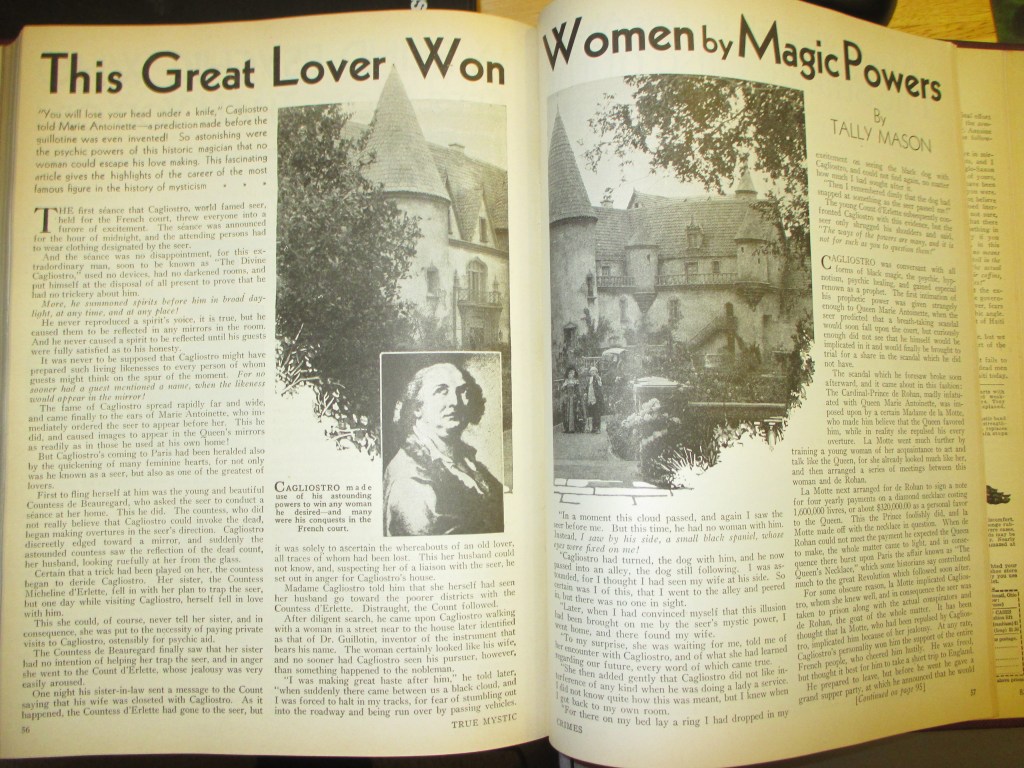
Back in his native Sauk City, August Derleth would begin writing for a pulp magazine titled Weird Tales. The date of his departure suggests the Fawcetts might have let him go before the transition to True Mystic Crimes—but that issue still contained two pieces from “Tally Mason,” whose manuscripts still survive among Derleth’s papers at the Wisconsin Historical Society. Both pieces were nominally nonfiction articles; “Your Picture Can Be Your Death Warrant” was about how images could contain a mystical link to their original subject, citing The Portrait of Dorian Gray as one example; the second, “This Great Lover Won Women by Magic Powers” was about the 18th-century occultist Alessandro Cagliostro, whose reputation and infamy has, over the centuries, become the stuff of legend and a great deal of fiction.

Yet “This Great Lover Won Women by Magic Powers” is interesting because of one particular thread that Derleth wove into the mix of facts and fiction:

But Cagliostro’s coming to Paris had been heralded also by the quickening of many feminine hearts, for not only was he known as a seer, but also as one of the greatest of lovers.

First to fling herself at him was the young and beautiful Countess de Beauregard, who asked the seer to conduct a séance at her home. This he did. The countess, who did not really believe that Cagliostro could invoke the dead, began making overtures in the seer’s direction. Cagliostro discreetly edged toward a mirror, and suddenly the astounded Countess saw the reflection of the dead count, her husband, looking ruefully at her from the glass.

Certain that a trick had been played on her, the countess began to deride Cagliostro. Her sister, the countess Micheline D’erlette, fell in with her plan to trap the seer, but one day while visiting Cagliostro, herself fell in love with him.

This she could, of course, never tell her sister, and in consequence, she was put to the necessity of paying private visits to Cagliostro, ostensibly for psychic aid.

The Countess de Beauregard finally saw that her sister had no intention of helping her trap the seer, and in anger she went to the Count d’Erlette, whose jealousy was very easily aroused.

One night his sister-in-law sent a message to the Count saying that his wife was closeted with Cagliostro. As it happened, the Countess d’Erlette had gone to the seer, but it was solely to ascertain the whereabouts of an old lover, all traces of whom had been lost. This her husband could not know, and, suspecting her of a liason with the seer, he set out in anger for Cagliostro’s house.

Madame Cagliostro told him that she herself had seen her husband go toward the poorer districts with the Countess d’Erlette. Distraught, the Count followed.

After diligent search, he came upon Cagliostro walking with a woman in a street near to the house later identified as that of Dr. Guillotin, inventor of the instrument that bears his name. The woman certainly looked like his wife, and no sooner had Cagliostro seen his pursuer, however, than something happened to the nobleman.

“I was making great haste after him,” he told later, “when suddenly there came between us a black cloud, and I was forced to halt in my tracks, for fear of stumbling out into the roadway and being run over by passing vehicles.

“In a moment this cloud passed, and again I saw the seer before me. but this time, he had no woman with him. Instead, I saw by his side, a small black spaniel, whose eyes were fixed on me!

“Cagliostro had turned, the dog with him, and he now passed into an alley, the dog still following. I was astounded, for I thought I had seen my wife at his side. So certain was I of this, that I went to the alley and peered in, but there was no one in sight.

“Later, when I had convinced myself that this illusion had been brought on me by the seer’s mystic power, I went home, and there found my wife.

“To my surprise, she was waiting for me, told me of her encounter with Cagliostro, and of what she had learned regarding our future, every word of which came true.

“She then added gently that Cagliostro did not like interference of any kind when he was doing a lady a service. I did not know quite how this was meant, but I knew when I got back to my own room.

“For there on my bed lay a ring I had dropped in my excitement on seeing the black dog with Cagliostro, and could not find again, no matter how much I had sought after it.

“Then I remembered dimly that the dog had snapped at something as the seer passed me!”

The young Count d’Erlette subsequently confronted Cagliostro with this evidence, but the seer only shrugged his shoulders and said, “The ways of the powers are many, and it is not for such as you to question them!

Tally Mason (August Derleth), True Mystic Crimes 56-57

A sequel to this episode quickly followed, on the occasion of Cagliostro giving a dinner-party after the Affair of the Diamond Necklace, just before leaving France for England. Once again, the Count d’Erlette featured prominently:

[Cagliostro] followed this prediction with that of the fall of the great French prison, the Bastille, and the creation of July 14 as National Day.

At this point, the Count d’Erlette asked rather scoffingly whether Cagliostro could see into his future and tell him what would become of the house of Erlette in the Revolution.

Cagliostro nodded and replied, “First, I see your father dead in this bed of heart failure at the same time that the mob is clamoring at the gates of your house in Paris.

“Then, I see the lovely Countess, your wife, killed by order of the provisionary government.”

“And me?” Asked the Count jovially. “What is to become of me?”

“You will flee with your son, Michel, but not before you have seen your younger brother, Auguste, killed by the mob. You will go to the German countries; I see you in Bavaria. Only for a short time will you be there. Your son will wed, and in turn have a son named Michel. Both you and your son will return to Paris during the time of Napoleon, but your grandson will remain in Bavaria.

“The House of Erlette will come to being once more during a decade many years from now, but the line that you represent will never again return to Paris. Your grandson, Michel, will go to America, and his sons will Iive there for all time. I see your grandson buried near the great American river called ‘Father of the Waters!'”

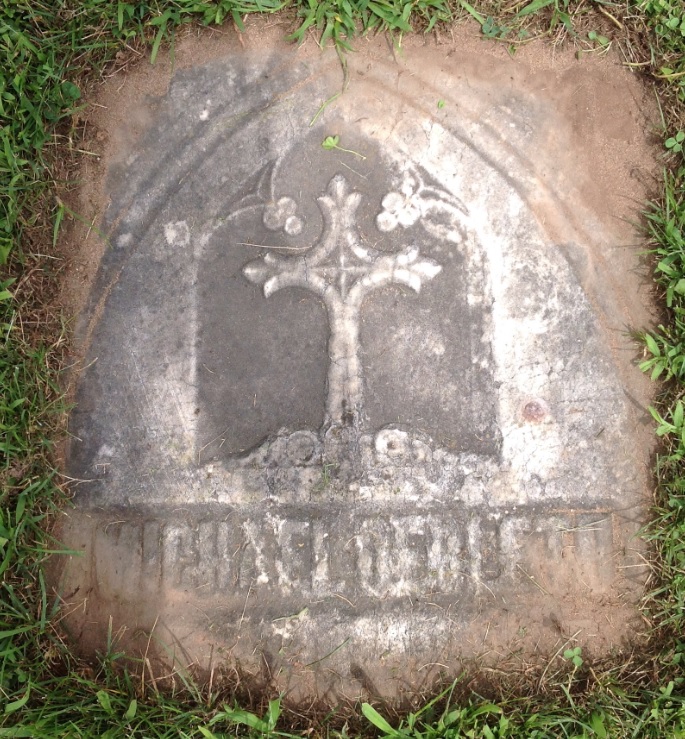
This Count d’Erlette ridiculed word for word, but every pronouncement came to pass, and even to this day the grave of Michel, the grandson, may be seen in a small town in southern Wisconsin.

Tally Mason (August Derleth), True Mystic Crimes 95

For readers familiar with Mythos fiction, the name “d’Erlette” might ring a bell.

Only a wizard would possess those mouldering, maggoty volumes of monstrous and fantastic lore; only a thaumaturgical adept would date the darker mysteries of the Necronomicon, Ludvig Prinn’s Mysteries of the Worm, the Black Rites of Luveh-Keraph, priest of Bast, or Comte d’Erlette’s ghastly Cultes des Goules.

Robert Bloch, “The Suicide in the Study,” Weird Tales June 1935

Lovecraft would shed some light on this little mystery in a letter:

Comte d’Erlette’s Cultes des Goules? An invention of Bloch’s. The name Comte d’Erlette, however, represents an actual (& harmless) ancestor of August W. Derleth’s, who was a royalist emigré from France in 1792 & became naturalized in Germany under the slightly Teutonised name of Derleth. His son, emigrating to Wisconsin in 1835, was the founder of the Derleth line in America.

H. P. Lovecraft to Willis Conover, Jr., 14 Aug 1936, Letters to Robert Bloch & Others 382

In other words, Derleth incorporated his own slightly-fictionalized family history to pad out his article on Cagliostro.

The gravestone of Michael Derleth, great-grandfather of August W. Derleth

The letter in which August Derleth revealed this heritage to Lovecraft does not appear to survive, but in their correspondence, Lovecraft begins to refer to him as “Auguste-Guillaume, Comte d’Erlette” (ES 2.455) in February 1932, so the subject probably came up in early 1932 or late 1931. Lovecraft would refer to Derleth as the “Comte d’Erlette” in his letters occasionally from then on, and the Cultes des Goules was added to the shelf of eldritch tomes that appear in his stories, and that of their contemporaries and literary heirs, though Bloch’s choice of attributing the volume to d’Erlette sometimes led to some confusion as to who actually invented it.

Derleth himself never chose to expand on his fictional ancestor in any of his Mythos fiction, though in his Solar Pons story “The Adventure of the Six Silver Spiders” (1950), the premise of the story is a Mythos red herring involving the sale of the private library of Paul Guillaume, the Comte d’Erlette, which reads in part:

I glanced at several of the other titles listed—d’Erlette, Paul Henri, Comte de: Cultes des Goules, Rouen, 1737; Prinn, Ludvig: De Vermis Mysteriis, Prague, 1807; Liber Ivonis (Author Unknown), Rome, 1662;—all manifestly occult literature.

August Derleth, “The Adventure of the Six Silver Spiders,” The Solar Pons Omnibus 2.848

Solar Pons is quick to point out to his companion Parker that the whole catalogue is a hoax.

“But the Count d’Erlette?”

“Erlette is a provincial name in France. The family existed in some numbers before the Revolution, but the last member to carry a title died in 1919.[“]

August Derleth, “The Adventure of the Six Silver Spiders,” The Solar Pons Omnibus 2.849

Derleth was not the only one to have a bit of fun with his fictitious ancestor, as many subsequent writers did write about the author of Cultes des Goules and his family.

It is not too much to say that “Tally Mason’s” article on Cagliostro is part of the secret history of the Mythos—not a direct part of the web of interconnecting stories that Lovecraft & Co. wrote, but a precursor and bit of background. One has to wonder if Derleth ever showed the piece to Lovecraft.


Bobby Derie is the author of Weird Talers: Essays on Robert E. Howard and Others and Sex and the Cthulhu Mythos.

Deep Cuts in a Lovecraftian Vein uses Amazon Associate links. As an Amazon Associate I earn from qualifying purchases.

Editor Spotlight: Cynthia Asquith & Dorothy L. Sayers

Weird Tales was not far from the sole source of weird and fantasy fiction available to readers in the 1920s and 30s. In many ways, weird pulp fiction—and reprints of the same like Christine Campbell Thomson’s Not at Night series—were seen as the lower end of popular fiction publishing. Yet there were anthologies that were often considered of a higher standard. It is notable that two of the leading editors for this sort of anthology were women, Cynthia Asquith (1887-1960) and Dorothy L. Sayers (1893-1957).

H. P. Lovecraft and his contemporaries, aficionados of weird fiction that they were and on the hunt for top-class fiction, read several of Asquith’s and Sayers’ anthologies and commented on them in their letters. These were not the most detailed reviews, and that sort of reflects the spirit of the anthologies and how they were received. The idea of a collection of weird stories wasn’t new, but neither Asquith nor Sayers had set out to try and define or redefine a theory of weird fiction. These were editors who were obviously intimately familiar with the genre, but by and large were content to let their selections speak for them—with the notable exception of Sayers’ introduction to The Omnibus of Crime (1929), which may be read as a detective-fiction parallel to Lovecraft’s “Supernatural Horror in Literature”—especially the section on “Tales of Mystery and Horror,” within which she lumps many works that Lovecraft recognizes as weird fiction.

Cynthia Asquith and Dorothy L. Sayers were creating anthologies with staying power, the influential building blocks of many libraries of weird fiction, far beyond whatever influence they had on Lovecraft and his contemporaries; that influence should not be overlooked or forgotten. These women editors helped define the weird fiction landscape during the heyday of Weird Tales and beyond.

Cynthia Asquith

My next addition to my library is to be Niccolo Machiavelli’s THE PRINCE. After that follows THE GHOST BOOK (Machen, Blackwood, Bierce, de la Mare, and others) edited by M. Asquith.

August Derleth to H. P.. Lovecraft, 22 Jan 1927, Essential Solitude 1.66

British aristocrat Cynthia Asquith was educated, erudite, creative, and connected. When she compiled The Ghost Book in 1926, she brought together what might arguably be called the cream of the crop for contemporary British weird fiction, including Algernon Blackwood, Oliver Onions, Arthur Machen, Walter de la Mare, and L. P. Hartley—and perhaps reflecting the prominence of women ghost story writers or her own tastes, has a higher-than-average number of women contributors—including one of her own stories, “The Corner Shop,” published under the pseudonym C. L. Ray.

“The Ghost Book” sounds alluring—are the stories very new, or do they contain any familiar ones? Of course the well-known names argue semi-classics. Which of De la Mare’s is represented?

H. P. Lovecraft to August Derleth, 2 May 1927, Essential Solitude 1.73

The Ghost Book provided all-new stories by “name” authors, not reprints from pulp magazines by virtual unknowns—and perhaps because of that, it charged more for the higher quality. At a time when More Not at Night (1926) was retailing for 2/- (two shillings, pre-decimalization, or about 50¢ in 1926 US dollars), The Ghost Book went for 7/6 (seven shillings, six pence; about US$1.82).

I’m on the Asquith anthology of ghost tales now—the best things in it so far being Blackwood’s “Chemical”, L. P. Hartley’s “Visitor from Down Under”, Walpole’s “Mrs. Lunt”, & De la Mare’s “A Recluse”.

H. P. Lovecraft to August Derleth, 6 Sep 1928, Essential Solitude 1.156

All of these stories were included in Lovecraft’s list “Books to mention in the new edition of weird article” (CE 5.234), and worked into “Supernatural Horror in Literature.”

Lovecraft appears to have missed Asquith’s next editorial effort The Black Cap: New Stories of Murder and Mystery (1927), though it contains stories by Walpole, Hartley, D. H. Lawrence, and Marie Belloc Lowndes, who had stories in The Ghost Book. In 1929, however, Asquith returned with another premier collection of supernatural fiction: Shudders: A Collection of New Nightmare Tales, published by Hutchinson.

That new Hutchinson anthology sounds good—wonder if the firm is going to specialise in the weird?

 H. P. Lovecraft to August Derleth, 26 Sep 1929, Essential Solitude 1.216

We can only wonder if Lovecraft’s idle comment inspired Derleth a decade later to co-found Arkham House, as a publisher specializing in weird fiction. There are no other references to Shudders in Lovecraft’s letters, so it isn’t clear if he managed to read that anthology. However, it’s clear that Lovecraft and Derleth were excited when Asquith’s third effort at a purely weird anthology, When Churchyards Yawn (1931):

By the way, before I forget it, Lady Cynthia Asquith has just brought out WHEN CHURCHYARDS YAWN, a new anthology of new ghost and weird stoies, by Walpole, Maugham, Onions, Chesterton, and the usual group, excepting only, I think, M. R. James. I have it on order, will let you know how it is as soon as I get it. It is not yet printed in the U.S.

August Derleth to H. P. Lovecraft, 2 Nov 1931, Essential Solitude 1.402-403

I’ll be glad to hear your report on “When Churchyards Yawn”. These anthologies come thick & fast, & some of them are excellent.

H. P. Lovecraft to August Derleth, 6 Nov 1931, Essential Solitude 1.404

The point about When Churchyards Yawn is that all the tales are new, haven’t even seen magazine printing before, and all by masters of writing. I order such a book posthaste without any further notice.

August Derleth to H. P. Lovecraft, 9 Nov 1931, Essential Solitude 1.407

Keep in mind that unless a book was picked up by a US publisher and issued in a local edition, the cost of the importation would be added to the cover cost, which with an already higher-than-average book could become expensive. This is likely one of the reasons Lovecraft didn’t read more of Asquith’s anthologies.

I sent today for When Churchyards Yawn, the anthology of brand new tales by Asquith, which has just reached Chicago from England. I will let you have the report on this as soon as it reached me and I have read it through.

August Derleth to H. P. lovecraft, 17 Nov 1931, Essential Solitude 1.412

I shall welcome your report on “When Churchyards Yawn”. The first Asquith anthology had some good stuff in it.

 H. P. Lovecraft to August Derleth, 20 Nov 1931, Essential Solitude 1.416

Derleth’s report does not survive, but in Lovecraft’s next letter we read that Derleth was less than impressed:

Sorry the new Asquith anthology doesn’t equal the first—but would give a good deal to see that new Machen tale!

H. P. Lovecraft to August Derleth, 25 Nov 1931, Essential Solitude 1.418

Perhaps because of Derleth’s report, or lack of cash, or simply lack of opportunity to pick up the book, Lovecraft didn’t read When Churchyards Yawn until 1934, when a friend lent him a copy:

Had an interesting shipment of loaned books from Koenig during my absence—before he learned I was in his town. Baring-Gould’s werewolf volume (which I’ve always wanted to see), the second & latest Asquith anthology “When Churchyards Yawn”, & a small book of short tales by Francis C. Prevot entitled “Ghosties & Ghoulies”. Hope I can get at reading them before long—though at present I am utterly submerged in the mass of accumulated work & correspondence which I found on my return. The Asquith book contains Machen & Blackwood tales which I’ve never read–though they may be old.

H. P. Lovecraft to Clark Ashton Smith, 11 Jan 1934, Dawnward Spire, Lonely Hill 516

H. C. Koenig was a fan who opened his library to Lovecraft for borrowing, including the works of William Hope Hodgson. Lovecraft’s assessment of the new book was muted:

The Asquith anthology was fair—Blackwood’s contribution being the best.

H. P. Lovecraft to Clark Ashton Smith, 11 Feb 1934, Dawnward Spire, Lonely Hill 525

Lovecraft also wrote of his intention to borrow Shudders from Koenig, but there is no evidence that he did so. Lady Cynthia Asquith edited no more anthologies during Lovecraft’s lifetime (he did read My Grimmest Nightmare, 1935, which is commonly though erroneously credited to Asquith), but she did not cease, following up The Ghost Book (1926) with The Second Ghost Book (1952) and The Third Ghost Book (1955). While the British Not at Night and Creeps series would be remembered as cheap, garish, and as close as one could get to pulp between hard covers (which, to be fair, is what they were), Asquith’s collections were as respectable as weird fiction could get in the 1920s and 1930s, and would be reprinted many times in various editions, ensuring a large influence on subsequent decades.

Dorothy L. Sayers

In nothing is individual fancy so varied and capricious as in its perception of the horrible.

Dorothy L. Sayers, “Introduction” in The Omnibus of Crime (1929), 45

In the 1920s, the distinction between crime, mystery, horror, and supernatural fiction was murky. While pulp magazines did a great deal to differentiate genres in popular literature, carving out sometimes incredibly narrow niches as evidence by pulps like Range Romances and Zeppelin Stories. Yet the roots of weird fiction, going back at least to Edgar Allan Poe and his detective C. Auguste Dupin, are tied up in mystery and detective fiction; through the 1930s there would be considerable overlap between detective fiction, weird crime, supernatural fantasy, and horror fiction—and it was that ambiguity and versatility of approach that defined Weird Tales and his primary contributors, including H. P. Lovecraft.

Dorothy L. Sayers was British, well-educated, and had practical experience as a novelist and copywriter, and specialized in detective fiction. In 1928, Sayers edited Great Short Stories of Detection, Mystery and Horror. This was a massive book (1,229 pages), prefaced by a long and thorough introductory essay, designed to take the reader through the whole history of detective and mystery fiction up to this point. Nor did Sayers neglect the supernatural horror side of the field, M. R. James, Oliver Onions, Sax Rhomer, Arthur Machen, Ambrose Bierce, Robert Louis Stevenson, Majorie Bowen, May Sinclair, A. M. Burrage, Walter de la Mare, and H. G. Well, among many others. If Sayers was influenced by gender or fame, it isn’t immediately obvious; while there are many famous names among the contents, there are also stories that are rarely commented on today, like Bram Stoker’s “The Squaw” and “Proof” by Naomi Royde-Smith.

In 1929, US publishers Harcourt, Brace, & Co. brought out an American edition titled The Omnibus of Crime.

This “Omnibus of Crime” volume sounds rather good, & I find I have no read half of the items listed. I shall surely try to get hold of it. Thanks exceedingly for quoting the contents.

H. P. Lovecraft to August Derleth, 20 Aug 1929, Essential Solitude 1.208

There is some excellent weird stuff—standard material reprinted—in the second half of the anthology called “The Omnibus of Crime”, which has lately been reprinted in a dollar edition. But perhaps you are already familiar with this.

H. P. Lovecraft to R. H. Barlow, 4 Nov 1931, O Fortunate Floridian 13

I intend to get “The Omnibus of Crime” (whose second half you described to me) now that it is issued for a dollar.

H. P. Lovecraft to August Derleth, 6 Nov 1931, Essential Solitude 1.404

I have not found a dollar edition of The Omnibus of Crime (whose normal list price was $3.00); it may be that this was a marked-down remainder price, as other writers like Clark Ashton Smith write of buying the book at a steep discount (EID 91). Lovecraft did finally get the loan of a copy of the book from his friend, W. Paul Cook:

I at last have the “Omnibus”, & have read “Green Tea.” It is certainly better than anything else of Le Fanu’s that I have ever seen, though I’d hardly put it in the Poe-Blackwood-Machen class. There are many other items in the book that I am particularly glad to have on hand—indeed, it is really one of the best of all recent anthologies.

 H. P. Lovecraft to Clark Ashton Smith, 16 Jan 1932, Dawnward Spire, Lonely Hill 342

“Green Tea” was one of Lovecraft’s unicorns; when he wrote “Supernatural Horror in Literature,” the story was out-of-print and relatively scarce. Lovecraft noted to a friend:

I now have the first one, & have read “Green Tea.” The latter isn’t at all bad, & I would probably have spoken less lightly about Le Fanu had I previously read it.

H. P. Lovecraft to J. Vernon Shea, 5 Feb 1932, Letters to J. Vernon Shea et al. 90

Ironically, Weird Tales would publish it as part of its weird fiction classics reprint series in the July 1933 issue.

Smith himself was more critical than Lovecraft in his assessment of the anthology:

I’ve been reading The Omnibus of Crime, which has some excellent weird stories in the latter section (I can’t read detective tales, to which the major part of the book is given.) Le Fanu’s Green Tea, Hichens’ How Love Came to Professor Guildea, The Novel of the Black Seal, Metcalf’s Bad Lands, White’s Lukundoo, and one or two others were enough to give me my money’s worth and more. I can’t see though why Bierce and M. R. James were so weretchedly represented in this collection. Moxon’s Master by the former is so obviously mediocre in comparison to real stuff such as The Death of Halpin Frayser; and almost anything of James that I remember reading would have been preferable to the somewhat tedious Martin’s Close. But I suppose my criticism proves nothing–except that Dorothy Sayers and I have different taste.

Clark Ashton Smith to August Derleth, 31 Dec 1931, Eccentric, Impractical Devils 92-93

Dorothy L. Sayers did not rest on her laurels. Great Short Stories of Detection, Mystery and Horror (1928) was followed up by Great Short Stories of Detection, Mystery and Horror, Second Series (1931).

I have greatly enjoyed the “Omnibus”, & hope the second one (just announced by booksellers) is of comparable quality. Like you, though, I don’t care especially for the first or “deteckatiff” half of the book.

H. P. Lovecraft to Clark Ashton Smith, 28 Jan 1932, Dawnward Spire, Lonely Hill 344

This second selection lacked the introductory material of the first, and when it was released in the United States as The Second Omnibus of Crime (1932), some of the weird contents were cut out of the American edition (the page count went down from 1,147 in the UK edition to 855 in the US edition, and that’s not because they printed it in a smaller font!) Unfortunately, it doesn’t appear that Lovecraft read The Second Omnibus of Crime, although others in his correspondence did. Derleth judgment was fierce:

I’ve just finished the new Omnibus of Crime; Sayer[s]’s weird tale choice is abominable.

August Derleth to Clark Ashton Smith, 20 May 1932, Eccentric, Impractical Devils 118

The Second Omnibus of Crime gave way to a third in 1935, though there is no reference to it in Lovecraft’s letters. As with the second omnibus, the contents of the US edition are cut down from the British, although the US publishers added A. Merritt’s “The People of the Pit” and “The Head” by Manuel Komroff. Whether Lovecraft missed hearing about this book, or simply lacked the cash to pick up a copy or the time to read it, we don’t know. Given the relatively high price, the lack of interest in the non-weird material in each anthology, and considering that some of those weird stories were reprinted from author collections Lovecraft & Co. already had or read…it wouldn’t be hard to see why The Third Omnibus of Crime failed to gather significant attention.

The major importance of Sayers’ anthologies to Lovecraft & Co. was as a common touchstone; that is what omnibus editions are ideal for, providing a single book reprinting enough tales to serve as a common reference point for other authors. Yet more important perhaps was what these books represented to Weird Tales authors: a proof of the commercial viability of their work:

If there were only one or two more editors in the market for that sort of thing, I believe I could sell nearly all my weirds: Individual taste differs more in regard to horror and fantasy, as Dorothy Sayers observes, than in regard to anything else.

Clark Ashton Smith to H. P. Lovecraft, early Mar 1932, Dawnward Spire, Lonely Hill 352

In this, Smith was unknowingly predicting the future of speculative fiction, as anthologies would eventually overtake magazines as the primary market for weird fiction. Yet the time for cheap mass-market paperback anthologies wasn’t yet; weird anthologies were a growing field, but still predominantly hardback, expensive, and dominated by reprints rather than the first appearance of stories.


Looking at Lady Cynthia Asquith and Dorothy L. Sayers in the context of their time, outside of the particular comments and concerns of Lovecraft and his circle of correspondents, these anthologies, as well as those edited by Christine Campbell Thomson and others, showed there was a potential market for weird fiction in anthology form. Each of these women was very much experimenting with the form, and in the Americanized versions probably dealing with local publisher interference, but there was a definite inching toward the kind of anthology that editors like Ellen Datlow and Silvia Moreno-Garcia and Paula R. Stiles would be able to put together: thematically focused, expressive of the editor’s own attitudes to define the scope of the anthology as well as its contents. To make something more than the sum of its parts by giving their work a unified aesthetic or historical context.

For Lovecraft and Co., they were reading these books both as average consumers (with all their own opinions on what was fit to print or re-print), and as writers of weird fiction who were beginning to be conscious of the fact that “Hey, if there were more of these things, I bet I could sell stories to them…” Alas, it didn’t quite work out that way for Lovecraft, though he did see some of his stories reprinted in anthologies; the market just wasn’t there yet. One day, it would be; and it may be that August Derleth, who became an anthologist of note, took a few lessons from what he saw Asquith and Sayers do and not do in their books.


Bobby Derie is the author of Weird Talers: Essays on Robert E. Howard and Others and Sex and the Cthulhu Mythos.

Deep Cuts in a Lovecraftian Vein uses Amazon Associate links. As an Amazon Associate I earn from qualifying purchases.

Psyche (1953) by August Derleth

Never send to know for whom the bell tolls;
it tolls for thee.

For ego and satyr,
for lover and beloved;

ask to know for whom the heart beats,
send to ask for whom the quickened pulse,
bend to hear the hushed impassioned voice
sobbing your name or mine in all the body’s rapture:
or send to know for whom arms’ clasp,
eyes’ love, the hot possessive mouth;

for lover and beloved,
islandless man, of sea and land equally,
of sky and stars, of heaven and hell—
but never need to ask for whom the bell tolls;
make each man’s answer to yourself:
It tolls for me.

August Derleth, canto XIV of “Enigma: Variations on a Theme of Donne,” in Psyche (1953) 25

No man is an island, entire of itself; every man is a piece of the continent, a part of the main. If a clod be washed away by the sea, Europe is the less, as well as if a promontory were, as well as if a manor of thy friend’s or of thine own were: any man’s death diminishes me, because I am involved in mankind, and therefore never send to know for whom the bell tolls; it tolls for thee.

John Donne, Meditation XVII in Devotions Upon Emergent Occasions, and severall steps in my Sicknes (1623)

August Derleth’s greatest fame today is as a publisher, co-founder of Arkham House in 1939 with Donald Wandrei. Derleth was also an editor and anthologist of note, and a writer of diverse works of fiction and nonfiction, from the quiet regional portrayals of his Sac Prairie Saga to the potboiler horrors of Weird Tales, from the delicately plotted pastiches of Solar Pons to young adult and juvenile fiction; in non-fiction his works included everything from a book on Wisconsin’s rivers to newspaper columns on his nature walks to his biography of Henry David Thoreau.

Yet before, and during, and among all this other writing, August Derleth was a poet. He wrote, and what is more importantly published, reams of verse from the fantastic and the macabre to the lighthearted, odes on nature to sonnets on love, in many different meters and forms. Poetry was a sensibility and avocation that Derleth shared with many of his contemporaries, including Lovecraft, Clark Ashton Smith, Robert E. Howard, and many other writers for Weird Tales. Some of it has been republished here or there, particularly those bits of verse dedicated to or relevant to Lovecraft fans such as “Providence: Two Gentlemen Meet at Midnight” and “On Reading Old Letters, For H. P. L.,” but for the most part Derleth’s poetry remains unreprinted and largely unexamined.

This is a pity as such works provide, if nothing else, an interesting study of the importance of historical context. Derleth’s 1953 collection of love poetry Psyche is a good example.

These are poems of love and anguish. In this cycle of thirty-one poems, August Derleth tells the moving story of a love from its first awakening through uncertanty and agony to its foreseen dissolution.

These poems not only represent August Derleth at this best, but bid fair to take a place among the finest love poetry of our time.

Psyche, inner jacket flap

To anyone that holds this book in its hands, it may appear the prosaic but well-made product of a small press—in this case, the Prairie Press of Iowa City, Iowa—72 pages of good paper on cloth boards with a floral print; the dust jacket, when intact, is often rather tanned by sun and age. The contents are divided into two sections; “Enigma: Variations on a Theme of Donne” runs to 14 cantos, each taking inspiration from John Donne’s lines, and the second cycle of thirty poems runs the gamut of a love affair, from “I. When first I saw you” to “XXX. Beloved, now you are gone.” A few of these later poems have erotic elements, such as:

Something speaks for the essential you scattered here
in the black skirt and the blue blouse,
and the aqua pants with the embroidered I love you
and Forget-Me-Not (and who could?),
the slip in the usual pink and the gold slippers,
and the little bra from which the breasts
have spilled tightly above the taut belly
and Venus’ mound and the indolent legs
in their skilled proportions where you lie
waiting for love, savoring your victory
sweet in your smile, in your eye,
aloof, serene: the thin shoulders,
the slender arms, the small round
still firm nates behind,
all waiting for love, to be possessed
and to possess in ecstasy of union,
knowing my Achilles’ heel:
with that small cat’s contentment of triumph
the smile aware and the eyes
confident and the legs parted
where the dark hair already glistens
and the lips, there shadowed, opening
to sheathe my sword, waiting for love and lust,
knowing I will cross the room and touch and feel,
knowing I will possess and be possessed,
not alone because our mutual wish dictates
but because I must.

August Derleth, “XVII.” in Psyche 46

This collection of thirty poems was apparently a selection from a much longer cycle of love-poetry, which came to light after Derleth’s death when Peter Ruber, who had become editor of Arkham House in 1997, went through some of Derleth’s old files:

Another very important find was the entire Psyche lyric love poems cycle. Derleth published 30 in a 72-page book of that title in 1953. In reality, he had written 233 Psyche poems, and we have them in chronological order. The entire group will be published late 1997 or early 1998.

M. Dianne Bergenske, “Hidden Literary Treasures Revealed: Unpublished Works of Wisconsin Author August Derleth” in BookLovers (V5, N1), 7.

As with Ruber’s projected biography of Derleth and other projects, this never came to pass. However, Psyche did reach a wider audience in another form: as an LP.

Sauk Prairie (2015) 80
“S-P STAR,” June 16, 1960

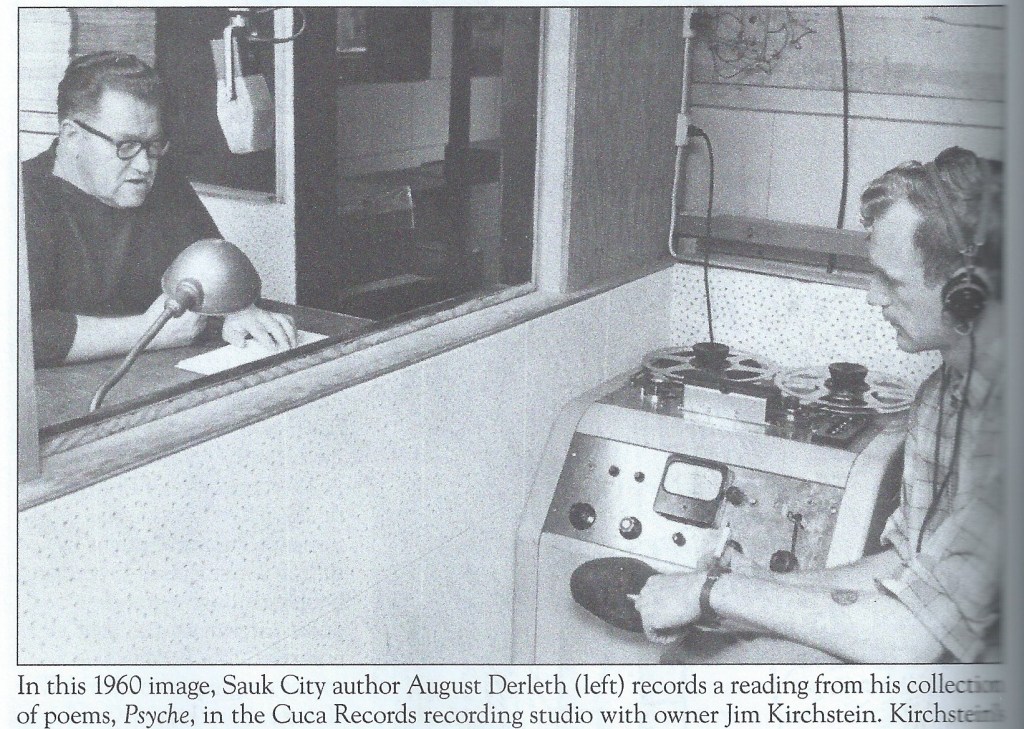
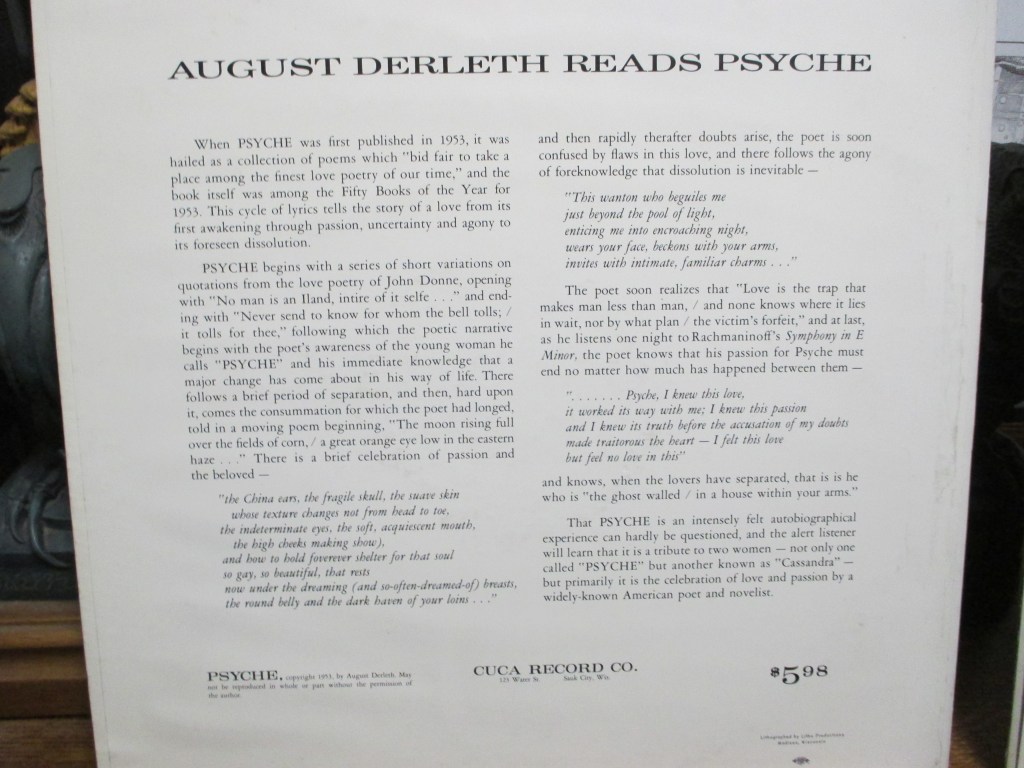
It isn’t clear how well Psyche sold, but it evinced enough interest that in 1960 Derleth recorded the lyrics onto vinyl at the Cuca Records Company in his native Sauk City:

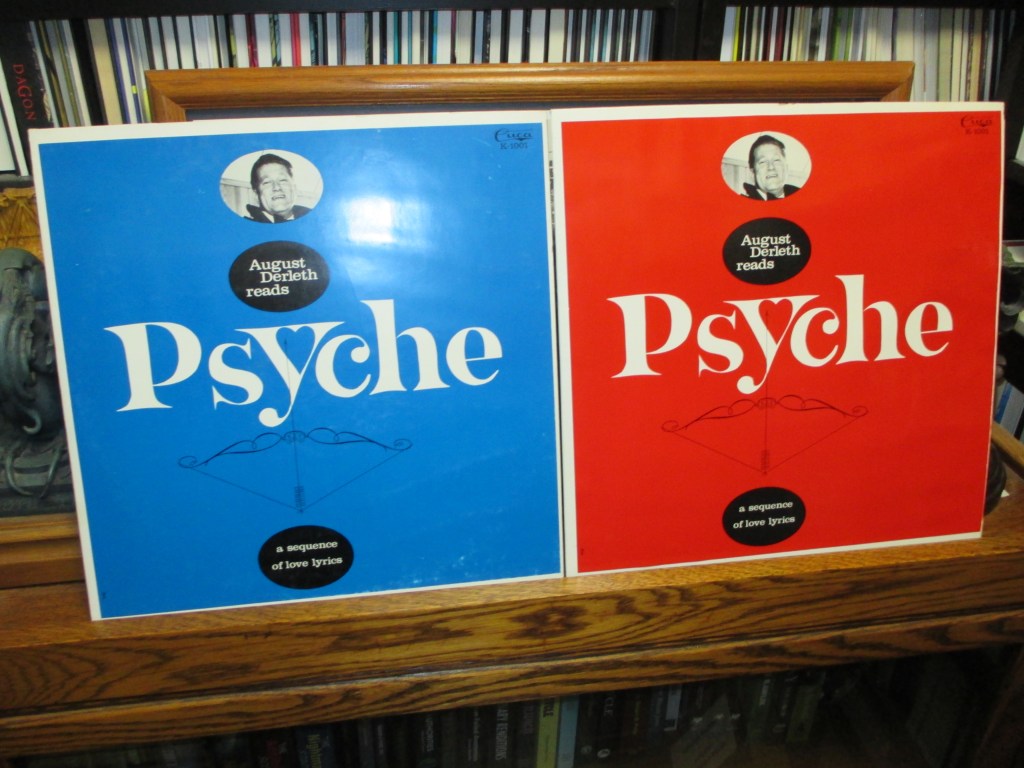
The LP was released with both a blue and a red slipcase; it isn’t clear if this represents separate printings or one printing, as the discs and backmatter are otherwise identical.

The title Psyche is in reference to the tale of Cupid and Psyche from the Metamorphoses of Apuleius, and Derleth’s dedication in the book is: “for the woman who was Psyche and is gone…” which casts Derleth as Cupid, overcoming obstacles to achieve union. Such dramatic romances were not unusual within Derleth’s fiction, and there was often a quasi-autobiographical element, for example, the teenaged romance with “Margery” (a local Sauk City girl) which formed the basis for his first novel, Evening in Spring (1945).

The liner notes are clear on the autobiographical element of Psyche:

That PSYCHE is an immensely felt autobiographical experience can hardly be questioned, and the alert listener will learn that it is a tribute to two women—not only one called “PSYCHE” but another known as “Cassandra”—but primarily it is the celebration of love and passion by a widely-known poet and novelist.

Liner notes to Psyche (1960)

“Cassandra” had been the subject of a previous book of primarily nature poems, Habitant of Dusk: A Garland for Cassandra (1946). In Psyche, Cassandra is mentioned by name only in a single poem:

Death is my mistress; what name I give her matters not—
call her Psyche or Cassandra,
Call her by any name you will,
Death it is in love’s own guise,
my mistress.

August Derleth, canto XIII of “Enigma: Variations on a Them of Donne,” in Psyche (1953) 24

According to Derleth: Hawk…and Dove (1997) by Dorothy M. Grobe Litersky, Cassandra was another romantic entanglement of Derleth’s in the early-mid 1940s, and their affair would be the subject for his unpublished novel Droughts of March.

For all that Derleth mined his personal experiences for fictional and poetic material and inspiration, he was not keen to publish his love affairs and generally avoided providing sufficient information in print for the average reader to identify who he was talking about. Sauk City was, after all, a small town and people would talk. Still, students of Derleth’s life would not be surprised at reading in Litersky’s biography that “Psyche” was none other than Sandra Winters, who married August Derleth in 1953, the year that Psyche was published. There is nothing unusual about a man writing love-poems to his wife, after all.

Except for one important detail.

PSYCHE is now virtually done in its 4th draft, and it seems to stand up very well in amatory verse, at which I have never pretended to be very good. But then, I have always had that as a poet I am at best a second-rater, which is saying a good deal, because there are a lot of poets far worse than that. But this book is most revealing and cannot be published for some (3) years because it is plainly about an affair with a girl who is not more than 15, and the facts wd currently be too obvious to local readers.

August Derleth to Carl Jacobi, 9 Jul 1949, MSS. Bowling Green University Library

Sandra Evelyn Winters was born 1 March 1935; according to Litersky she met August Derleth in 1948, and they married on 6 April 1953. That his relationship with her before their marriage was sexual is not much doubted; in another letter, he wrote:

Oh, yes, I would not deny that Sandra has done me a lot of good. Not just making love to her, Sandra herself. Of course, she is sharp enough to know that, and I think that in this lies the ultimate dissolution of the affair, unless an accident makes it necessary for us to be married. For, being young, she is entirely likely, even with her mother’s advice, to take me for granted, and that might well be fatal. She has been frank enough to say that she intended all along that I should ultimately need her more than she needs me, and, while she intends to marry me, she intends also to have as much of her cake and eat much of it too, as possible. That never works, manifestly. But whatever takes place, it is certain that I have already benefited a great deal, and all the clothes and jewelry I’ve bought her won’t balance my own benefits.

August Derleth to Zealia Bishop, 18 Aug 1949, MSS. Wsconsin Historical Society

Given the age gap (August Derleth was born in 24 February 1909, making him 40 years old in 1949 when these letters were written), Derleth may have had more to worry about than his reputation; statutory rape charges were a real possibility. As Litersky points out, this fact rather changes how Psyche is read. When Derleth writes:

When first I saw you,
but one among a sea of faces,
my glance swept past, came wondering back
in search of something from alien places
to see the countenance of little more than child,
demure, aloof, and bland,
not akin to what I felt—that wild,
strange beauty, that warm impassioned spirit
lurking deep,
hidden by a child’s serene and lovely face,
inscrutable as sleep.

As Iseult, Helen of Troy,
immortal Psyche—you, too, in this child’s guise:
something from deep within gazed tranquil back,
the challenge of your untamed spirit looked
from out your eyes.

August Derleth, “I.” in Psyche 26

At what age would you as the reader have put Psyche and Derleth based on this poem? Do you read it differently now that you know he met his future wife as a thirteen-year-old girl, and this poem might be an attempt to capture—or at least capitalize on—the beginning of that relationship? Without that piece of information about who Psyche was based on and her age at the time, Psyche is little more than an innocuous curiosity. With that bit of historical context, it becomes a different thing entirely, and a reader might not only look for new meaning in the lines, but find it. Comparable in some ways to “Doom of the Thrice-Cursed” (1997) by Marion Zimmer Bradley, it is impossible to turn back the clock to before you knew, and read the words they wrote with innocent eyes.

With thanks and appreciation to John Haefele for his help with this article.


Bobby Derie is the author of Weird Talers: Essays on Robert E. Howard and Others and Sex and the Cthulhu Mythos.

Deep Cuts in a Lovecraftian Vein uses Amazon Associate links. As an Amazon Associate I earn from qualifying purchases.

“I Hate Queers” (1936) by R. H. Barlow

Meanwhile let me wish you all success with the realistic novel or character study—”No Right to Pity”. Material which ‘must be written out of one’s system’ has a very excellent chance of being genuine art—no less so when it comes hard than when it comes easy. And semeblance to a ‘chronicle of actuality’ is not to be deplored unless all dramatic modulation & implied interpretation be absent. Don’t hurry with the work—but let it unfold itself at whatever rate makes for maximum effectiveness. A subjective or quasi-autobiographical novel is often a stepping-stone to work of wider scope. Certainly, many books of the kind have received the highest honours in recent years.

H. P. Lovecraft to R. H. Barlow, 24 Jul 1936, O Fortunate Floridian 353

By early Summer 1936, Robert Hayward Barlow’s focus had turned to prose, poetry, and publication—the amateur journals The Dragon-Fly that Barlow managed to print using the press in the small shack (which Lovecraft had helped with during his last visit) were well-received by many. Barlow’s original fiction efforts ranged from fantasies like the “Annals of the Jinns” to post-apocalyptic vignettes like “The Root-Gatherers.” They showed promise, and Lovecraft was keen to encourage his young friend’s literary efforts.

Yet all was not quite well with R. H. Barlow’s home life.

Col. Everett D. Barlow suffered from what today is called post-traumatic stress disorder. From the hints and suggestions in R. H. Barlow and Lovecraft’s letters, it appears that the colonel was irascible, with periods of depression. Retired from the army and spending most of his time with his wife and youngest son at their homestead in DeLand, Florida, the old man was probably difficult to escape, for both R. H. Barlow and his mother, Bernice. The strain in the marriage would eventually lead to separation and divorce, but for Bobby Barlow, there were few opportunities to escape…

…which is what, essentially, R. H. Barlow’s sudden trip to Providence, Rhode Island to visit Lovecraft was.

It isn’t clear from R. H. Barlow’s autobiographical writing as to when exactly he came to realize he was gay, but there is evidence that around 1936 he was grappling with issues of sexuality and sexual identity. While it isn’t clear if he ever broached these matters with Lovecraft directly, there are hints elsewhere:

Don’t allow yourself to be influenced in any way by Cities of the Plain. This remarkable study in sexual perversion is sui generis.

August Derleth to R. H. Barlow, 8 Jul 1936, MSS. Wisconsin Historical Society

Cities of the Plain was the 1927 translation of Marcel Proust’s Sodome et Gomorrhe (1921/1922), a novel which deals with homosexuality and jealousy. By itself, this isn’t necessarily telling; Derleth was notably relatively open on reading about and discussion of sexuality (there are claims that he was bisexual, see Derleth: Hawk…and Dove (1997) by Dorothy M. Grobe Litersky), and perhaps Barlow felt more comfortable bringing up the book with Derleth than Lovecraft. Yet it could be a sign of Barlow’s growing interest and awareness of gay issues, especially as related to himself.

R. H. Barlow visited H. P. Lovecraft in Providence from 28 July to 1 September 1936, Since they were seeing each other every day, there was no need to write letters, so the surviving accounts of the trip come from Lovecraft’s letters to his other correspondents. One thread from such an exchange with Derleth stands out:

Speaking of impromptus—enclosed are a triad of modernistic character sketches which Barlow wrote the other day without any effort or premeditation whatsoever. He pretends to despise them, but I rather think he’d like to see them in one of the little magazines which you so kindly listed for Pabody. What do you think of them? Would you encourage R H B to revise & submit them, & to pursue further endeavours along the same line? He could grind out this stuff endlessly if there were any demand for it. It seems rather in the Story line.

H. P. Lovecraft to August Derleth, 22 Aug 1936, Essential Solitude 2.746

I read Barlow’s stuff with a good deal of interest, but must regretfully report that while it has the promise it is as yet pretty unformed, and not likely to see publication. Also, it is extremely difficult to read, owing to the fact that RHB is not up on paragraphing, etc. Structurally, the pieces are pretty bad. I Hate Queers has the most promise, but before the really chief characters are introduced, we get 4 pages of tripe about people who do not concern the leads at all. Nobody would take a story like that, though the best bet for Barlow’s emergence into little magazine print would be Manuscrupt, 17 West Washington, Athenos, Ohio. I have made a few marks here and there in one or two of the stories, though I did not contribute the usual amount of marginal notes owing to close typing. […] The use of long-winded, platitudinous expressions annoys, but despite all this I should think there is hope that RHB may make something out of such material as this. Let him drop at once any air of sophistication he may have. Affectations may serve a purpose to one’s self, but not in print. […]

No, RHB’s tales are far from the Story line: Story’s are crisp and clear, Barlow’s are jumbled. I Hate Queers might be revised to some good end, but much of it would have to be cut, and some staple point-of-view maintained throughout. He shifts point-of-view constantly, which is very confusing and not good creation. Frankly, the stuff shows sloppy writing: I can easily believe that he just dashed it off.

August Derleth to H. P. Lovecraft, 26 Aug 1936, Essential Solitude 2.747, 748

Barlow appreciated your criticisms immensely, & will doubtless be guided by them in future attempts. He is now, of course, in a purely experimental stage—scarcely knowing what he wants to write, or whether he wnts to write at all…as distinguished from painting, printing, bookbinding, &c. My own opinion is that writing best suits him—but I think he does better in fantasy than in realism. A recent atmospheric sketch of his—“The Night Ocean”—is quite Blackwoodian in its power of dark suggestion. However—it’s just as well to let the kid work the realism out of his system. At the moment he seems to think that the daily lives & amusements of cheap and twisted characters form the worthiest field for his genius. Plainness in style will develop with maturity.

H. P. Lovecraft to R. H. Barlow, 23 Sep 1935, Essential Solitude 2.748-749

This is the first and last mention of R. H. Barlow’s “I Hate Queers”—a piece that is not known to survive and has never been published. In another letter around this time, Lovecraft briefly mentions the plot of one of Barlow’s stories in comparison with The Last Puritan (1935) by George Santayana, though whether this is “I Hate Queers” or another piece is unclear:

As for your parallel betwixt Oliver’s admiration of the coarse Lord Jim & your artist’s anomalous devotion to a cheap prize-fighter—I can’t see that it holds. Lord Jim—a character vital & engaging personality despite his feet of clay—was a symbol to young Oliver. He was a symbol of the unrestraint for which one side of Oliver—because of his one-sided education & conventional antecedents—subconsciously longed. Meeting him in extreme youth at a time of suddenly enlarged horizons, Oliver always associated Jim with the abstract quality of liberation & expansion—the associative image persisting even after the basic commonness of the concrete Jim became manifest. Nothing of this sort is apparent in the case in your story. There is not the slightest reason in the world why any sane & mature artist would wish to see or talk with a cheap & undistinguished prize fighter. And I’d some tragic disease or malformation gave the artist an abnormal interest, he would naturally spend all his time in Fi ghting & eradicating the disease—not in displaying or encouraging it as a lower-grade character might.
—H. P. Lovecraft to R. H. Barlow, 30 Sep 1936, O Fortunate Floridian 365-366

Most likely, like much juvenalia it ended up in the ash bucket, never to see the light of day. Yet it is impossible to read that title, and the surrounding comments on the work, without delving into some speculation. The suggestion of autobiographical elements and the need to write something out of his system recalls Barlow’s later, very much explicit “Autobiography,” which was written as an extension of the psychoanalytic therapy he underwent in his twenties. One can easily imagine a literate young man attempting a quasi-autobiographical story; Robert E. Howard had done much the same thing with Post Oaks & Sand Roughs, and Arthur Machen with The Hill of Dreams, so Barlow was in good company.

The title itself is plainly homophobic, yet Barlow himself was homosexual, even if he hadn’t had his first experience with another man yet. Barlow’s “Autobiography” opens in 1938 at age 18 as he roomed with the Beck family in California, with his attraction to the male form already fully developed, at least if such passages as this are any to go by:

I could not decide which if the Beck boys to fall in love with and vacillated continually. Claire had a mania for bathing, and I saw him once or twice quite naked. he had a nice prick, uncircumcised. At other times he found excuses to go downstairs from the bath to the living room, dressed only in skin-tight drawers, which also showed him off to advantage.

R. H. Barlow, “Autobiography” (1944) in O Fortunate Floridian 410

Keep in mind that this was Barlow in 1944 looking back at himself in 1938, so he could have been impressing his then-current comfort level with his sexuality on his past self—but if it is accurate to his teenage feelings, this may suggest that Barlow had passed through any phase of doubt or confusion before this point—and perhaps he was still in that period of self-discovery in 1936 when he dashed off this short story.

This is important because the title “I Hate Queers” is very provocative, designed to establish and evoke an emotional response from the reader. After all, in the very homophobic 1930s, who would publicly disagree? Who would stand up and say they don’t hate queers? This suggests that the expressed prejudice of the title might be performative: the closeted gay character who emphasizes their homophobia to deflect suspicion about their own sexuality…or, perhaps, a heterosexual character who is preoccupied with being mistaken for gay because they know what discrimination that will bring.

It is fun to speculate; certainly Barlow would not have been able to be open about his burgeoning sexuality with his family, and perhaps not even with his few friends like Lovecraft and Derleth. Even discussing Proust or showing them “I Hate Queers” might have represented a risk, albeit a considered one, with any hint of personal interest disguised as literary interest or effort…and there was reason for Barlow to be concerned. Derleth was upfront about it:

Barlow is for sure a homo; from what I have heard, so was the late minister-weird taler Henry S. Whitehead. Any anybody with a mandarin moustache is vulnerable to the kind of flattery, larding I can do very well.

August Derleth to Donald Wandrei, 21 March [1937]

“I Hate Queers” stands out in Lovecraft’s correspondence as one of those fascinating possibilities which have been lost to time. We’ll never really know what the story was, unless an archive of Barlow’s teenage stories shows up at some point. It was a different world then, for LGBTQ+ folks, and it took decades of hard work and legislation to begin to win them recognition and equal rights with heterosexuals…rights and recognition which, sadly, have continually faced opponents dedicated to restrict, redefine, and rescind them. To turn back the clock to when gay men like R. H. Barlow struggled to express themselves even to their closest friends and relatives for fear of imprisonment and fines, censorship and blacklisting; and faced blackmail and violence simply for appearing to be different.

Barlow’s title is expressive of an age and attitude I had hoped was dead and buried, but there are still bigots today who would say it proudly…and that, perhaps, is a more subtle horror than the realism which Barlow had tried to express. For it is still as real today as it was in that earlier century.


Bobby Derie is the author of Weird Talers: Essays on Robert E. Howard & Others (2019) and Sex and the Cthulhu Mythos (2014).

Deep Cuts in a Lovecraftian Vein uses Amazon Associate links. As an Amazon Associate I earn from qualifying purchases.

“The Murky Glass” (1957) as by August Derleth & H. P. Lovecraft

While men are thinking of the planets, other worlds may be thinking of us. At least the curious phenomena of that old New England house suggested that possibility… An unforgettable new story of uneathly wonder by two masters of the science-fiction terror tale.

Epigraph to “The Murky Glass” in Saturn: The Magazine of Fantasy & Science Fiction May 1957

August Derleth was one of the original creators of what became known as the Cthulhu Mythos. His contributions started while Lovecraft was alive with “The Lair of the Star Spawn” (1932) and “The Thing That Walked on the Wind” (1933). After the death of H. P. Lovecraft in 1937 and the creation of Arkham House in 1939 to publish Lovecraft’s work, August Derleth would continue to write a number of tales of the Cthulhu Mythos and in the Lovecraftian vein. These were not written immediately with an eye toward filling out the Lovecraft collections or even his own anthologies, but for sale to magazines, mostly Weird Tales, and published over a series of years. The stories can be divided into three groups:

  1. Older stories written with Mark Schorer that were not published until later (“Spawn of the Maelstrom” (1939) and “The Evil Ones” (1940, later reprinted as “The Horror from the Depths”).
  2. Pulpy horror tales (“The Return of Hastur” (1939), “Passing of Eric Holm” (1939), “The Sandwin Compact” (1940), “Ithaqua” (1941), “Beyond the Threshold” (1941), “The Dweller in Darkness” (1944), “Something in Wood” (1948), “The Whippoorwill in the Hills” (1948), “The House in the Valley” (1953), “The Seal of R’lyeh” (1957, also as “The Seal of the Damned”), and the Trail of Cthulhu series (“The Trail of Cthulhu” (1944, also as “The House on Curwen Street”), “The Watcher from the Sky” (1945), “The Testament of Clairmont Boyd” (1949, also as “The Gorge Beyond Salapunco”), “The Keeper of the Key” (1951), and “The Black Island” (1952)).
  3. “Posthumous collaborations” with H. P. Lovecraft: The Lurker at the Threshold (1945), “The Survivor” (1954), “Wentworth’s Day” (1957), “The Peabody Heritage” (1957), “The Gable Window” (1957, also as “The Murky Glass”), “The Ancestor” (1957), “The Shadow Out of Space” (1957), “The Lamp of Alhazred” (1957), “The Shuttered Room” (1959), “The Fisherman of Falcon Point” (1959), “Witches’ Hollow” (1962), “The Shadow in the Attic” (1964), “The Dark Brotherhood” (1966), “The Horror from the Middle Span” (1967), “Innsmouth Clay” (1971), and “The Watchers Out of Time” (1974); and Robert E. Howard: “The House in the Oaks” (1971).

The individual merit of these stories varies considerably, but it should be apparent that taken together they represent a substantial body of “Lovecraftian” fiction: 34 short stories, novelettes, and a novel—and Lovecraft’s own published fiction only amounts to 65 stories (plus ~33 revisions and collaborations like “Four O’Clock” (1949), “The Curse of Yig” (1929), “The Night Ocean” (1936), etc.)…and Derleth had, as well as his fictional input to the Mythos, a strong editorial influence on how Lovecraft’s fiction was interpreted, through his introductions to various anthologies and collections of Lovecraft’s work, analyses of his fiction, press releases etc. This is why after Derleth’s death in 1971 there was pushback from fans like Richard L. Tierney in “The Derleth Mythos”—and this in turn lent impetus to a Lovecraft purest movement in publishing and scholarship.

Much of the animus against Derleth is centered on his “posthumous collaborations” with Lovecraft. To better understand the reasoning behind these, it is important to understand what Derleth publicly claimed and presented these stories as:

Not for twelve years has the byline of the late, great Howard Phillips Lovecraft appeared on any new work–and it appears now only because, among the papers of the late R. H. Barlow are found Lovecraft’s notes and/or beginnings for the seven stories which go to make up this collection–all now completed by August Derleth, just as he completed Lovecraft’s unfinished novel, The Lurker at the Threshold.

Here are seven tales–two novelettes and five shorter stories–which belong to virtually every period of Lovecraft’s work–from the early fantasies (The Lamp of Alhazred), through the New England pieces (Wentworth’s Day and The Peabody Heritage) to the Cthulhu Mythos (The Gable Window, The Shadow out of Space, The Survivor). Taken together, these seven stories are a nostalgic backward look to the macabre world in which H. P. Lovecraft was supreme.

These are tales of terrifying witchcraft, of cosmic horror, of quaint magic, such as only H. P. Lovecraft could have conceived. Here in these pages Great Cthulhu walks again, the Dunwich-Arkham country lives once more, and, in a final allegory, Lovecraft himself is portrayed in a quasi-autobiographical manner.

August Derleth’s completion of these stories was a labor of love. Perhaps no other contemporary writer has so closely emulated the Lovecraft style as he–as these stories testify.

The Survivor and Others 1957, inside front jacket flap

Among the papers of the late Howard Phillips Lovecraft were various notes and/or outlines for stories which he did not live to write. Of these, the most complete was the title story of this collection. These scattered notes were put together by August Derleth, whose finished stories grown from Lovecraft’s suggested plots, are offered here as a final collaboration, post-mortem.

The Survivor and Others 1957, copyright page

The works in The Survivor and Others and the novel The Lurker at the Threshold were all presented as “unfinished” works, or works built up from Lovecraft’s notes. The truth was quite different: Lovecraft left no such incomplete stories. What he did leave was a commonplace book containing various bare ideas for stories, some fragments of prose, and a body of correspondence that included Lovecraft’s dreams and other ideas for stories never written during his lifetime. From these, Derleth wrote his “posthumous collaborations”—some of them (“The Lamp of Alhazred”) contained some genuine text from Lovecraft, but most of them were little more than stories vaguely suggested from Lovecraft’s commonplace book, as close to pure Derleth as most of Lovecraft’s “ghostwriting” efforts were pure Lovecraft. Derleth’s marketing of these works as “by Lovecraft and Derleth” was seen by some as dishonest…and worse than that, those that took Derleth at his word often took the works to be primarily Lovecraft’s, such as David Punter’s influential textbook The Literature of Terror (first edition 1980, second edition 1996).

It should be noted thas as much as the publication of these stories always emphasized Lovecraft’s name and contribution, this was first and foremost a marketing gimmick. In private, just as Lovecraft would acknowledge his own contributions in his revision and ghostwriting work, Derleth would frankly acknowledge the full extant of his authorship:

[…] & Ballantine’s paperback of THE SURVIVOR & OTHERS (emphasizing Lovecraft, understandably, over Derleth, who did 97% of the writing) […]

August Derleth to Ramsey Campbell, 23 Aug 1962, Letters to Arkham 79

The pushback against Derleth’s interpretation of and contributions to the Mythos has led to his stories being largely neglected by scholars and fans. Yet many of Derleth’s stories are worth at least a little study, and some understanding of how and why they were written and published can help elucidate the picture of Mythos publishing post-Lovecraft.

As should be clear, August Derleth didn’t start out writing “posthumous collaborations” as soon as Lovecraft’s corpse was cold. His first was The Lurker at the Threshold, which has the distinction of being the first Mythos novel, wasn’t published until 1945. Including Lovecraft’s name in this work can be barely defended—the ~50,000 word novel contains two unrelated fragments from Lovecraft’s papers, “The Round Tower” and “Of Evill Sorceries Done in New-England, of Daemons in No Humane Shape” which come to ~1,200 words—but it is clear that Derleth is using Lovecraft’s name predominantly for marketing purposes, and did not assay another “posthumous collaboration” until late 1953 or early 1954:

You already have “The Survivor,” which I hope can appear in the July or September issue. Three others are now ready–

“Wentworth’s Day,” at 4500 words

“The Gable Window,” at 7500 words

“The Peabody Heritage,” at 7500 words

There will be at least two more–or enough for an entire year of Weird Tales. And we might be able to turn up more thereafter, if the use of them has any noticeable effect on the sales of the magazine.

August Derleth to Dorothy McIlwraith, 24 Feb 1954, A Look Behind the Derleth Mythos 211

By 1954, Weird Tales under editor Dorothy McIlwraith was on its last legs, having switched to bimonthly and a digest format, and even re-instated reprints to cut costs—which included reprinting some of Lovecraft’s fiction. Derleth was a loyal contributor and could have resurrected the “posthumous collaboration with Lovecraft” gimmick in an effort to help save the magazine—or, considering that Derleth had married in 1953 and his wife was pregnant, perhaps he simply needed the money. In either case, it was too little, too late to save Weird Tales, which folded with the September 1954 issue, before any of Derleth’s “posthumous collaborations” except “The Survivor” (WT July 1954) could be published.

I have here: “The Gable Window,” “The Ancestor,” “Wentworth’s Day,” “The Peabody Heritage,” “Hallowe’en for Mr. Faukner,” also “The Seal of R’lyeh.” It might be that whoever takes over WT might see the value of the Lovecraft tie-in, but I don’t know…

Dorothy McIlwraith to August Derleth, 15 Nov 1954, A Look Behind the Derleth Mythos 219

Despite McIlwraith’s hopes, no one picked up publication of Weird Tales, and August Derleth was left with a handful of “posthumous collaborations” and very few markets in which to publish them. Eventually, Derleth would publish these stories through Arkham House in a volume titled The Survivor and Others (1957)…yet there is an interesting note in that book regarding one of the stories:

The Gable Window, copyright 1957, by Candar Publishing Company, Inc., (as The Murky Glass), for Saturn, May 1957.

The Survivor and Others 1957, copyright page

Derleth had managed to get “The Gable Window” published, albeit under a different title—which is no great surprise, many editors change titles to suit their tastes, and some editors go further: they might break up or combine chapters and paragraphs, revise wording, even excise extraneous text or revise endings. Lovecraft decried these practices and would in later years be adamant that the editor not even change a comma, but Derleth was probably more practical and less particular: weird fiction was, for Derleth, often more of a potboiler effort than a major form of personal expression as it was with Lovecraft.

As it happens, a close (line-by-line) comparison between the Saturn text of “The Murky Glass” and the Survivor text of “The Gable Window” shows a number of differences between the two texts, most relatively minor. Without access to surviving drafts, it’s difficult to reconstruct the exact sequence of revision or editorial interference, but by looking at a handful of the differences we might get an idea of the editorial thought behind those changes—and this is especially the case since “The Gable Window” text in The Survivor and Others is the basis for all other publications of the text. “The Murky Window” has never been reprinted as-is.

“The Murky Glass”“The Gable Window”
It seemed, therefore, that the first order of business was a restoration of the rightful way of existence in the house, a resumption of life on the ground floor. To tell the truth, I found myself from the beginning curiously repelled by the gable room; in part, certainly, because it reminded me so strongly of the living presence of my dead cousin who would never again occupy his favorite corner of the house, and in part, also, because the room was to me unnaturally alien and cold, holding me off as by some physical force I could not understand, though this was surely consistent with my attitude about the room, for I could understand it no more than I ever really understood my cousin Wilbur. (SA103)It seemed, therefore, that the first order of business was a restoration of the rightful way of existence in the house, a resumption of life on the ground floor, for to tell the truth, I found myself from the beginning curiously repelled by the gable room; in part, certainly, because it reminded me so strongly of the living presence of my dead cousin who would never again occupy his favorite corner of the house, and in part, also, because the room was to me unnaturally alien and holding me off as by some physical force I could not understand, though this was surely consistent with my attitude about the room, for I could understand it no more than I ever really understood my cousin Wilbur. (SO79-80)

One of the characteristics of Derleth’s pastiche style of Lovecraft is long, run-on sentences; a tendency that is more marked when sentences (and paragraphs) that were separate in “The Murky Glass” are conjoined in “The Gable Window.” Whether this was a result of an editor chopping up Derleth’s initial draft, or Derleth splicing together things to make longer sentences and paragraphs when preparing it for book publication is unclear, and either is likely. Derleth’s choice to omit “cold” from the description of the gable room probably reflects that he never refers to the room as particularly cold in the remainder of the story; a little clean-up.

My cousin’s will had been probated, the estate had been settled, and no one challenged my possession of the house. (SA105)My cousin’s will had been probated, the estate had been settled, and no one challenged my possession. (SO82)

Pulp writers typically had to shave words from a manuscript to meet tight wordcount limits, so the question here is: did Derleth include “of the house” originally and decide to excise it as unnecessary in “The Gable Window?” Or did the editors of Saturn think the line was unclear and add “of the house” to clarify?

Dear Fred, he wrote, The best medical authorities tell me I have not long to live, and, since I have already set down in my will that you are to be my heir, I want to supplement that document now with a few final instructions, which I adjure you not to dismiss and want you to carry out faithfully. There are specifically three things you must do without fail, and these are as follows:

One: All my papers in Drawers A, B, and C of my filing cabinet are to be destroyed.
Two: All books on shelves H, I, J, and K are to be turned over to the library of Miskatonic University at Arkham.
Three: The round glass window in the gable room upstairs is to be broken. It is not to be simply removed and disposed of elsewhere, but it must be shattered.


You must accept my decision that these things must be done, or you may ultimately be responsible for loosing a terrible scourge upon the world. I shall say no more of this, for there are other matters of which I wish to write here while I am still able to do so. One of these is the question… (SA108)
Dear Fred, he wrote, The best medical authorities tell me I have not long to live, and, since I have already set down in my will that you are to be my heir, I want to supplement that document now with a few final instructions, which I adjure you not to dismiss and want you to carry out faithfully. There are specifically three things you must do without fail, as follows:

“1) All my papers in Drawers A, B, and C of my filing cabinet are to be destroyed.
“2) All books on shelves H, I, J, and K are to be turned over to the library of Miskatonic University at Arkham.
“3) The round glass window in the gable room upstairs is to be broken. It is not to be simply removed and disposed of elsewhere, but it must be shattered.

You must accept my decision that these things must be done, or you may ultimately be responsible for loosing a terrible scourge upon the world. I shall say no more of this, for there are other matters of which I wish to write here while I am still able to do so. One of these is the question… (SO86)

The most notable changes between the two texts are format. The Saturn editors preferred italics to quotation marks, and spelling out words and months to abbreviations, The Survivor text is pithier. Which is better for reading is a bit of an open question; as a digest Saturn had to be divided into two columns per page, which might encourage shorter paragraphs, more frequent breaks, and the more streamlined experience italics give…or perhaps Derleth changed his mind.

What was I to make of these curious instructions? (SA108)What was I to make of these strange instructions? (SO86)

Case in point, “curious” and “strange” in this context are basically synonymous, so the changing from one to the other is essentially down to personal preference rather than any kind of artistic or editorial justification. These are the kind of changes in word choice that you might expect to see either from an editor determined to change something or a writer that just liked to fiddle.

Most of the differences in “The Murky Glass” and “The Gable Window” are like that: formatting, word choice, a little cutting or rearranging, mostly in The Survivor and Others text. There are a handful of typos as well: “scratching” (“Murky”) becomes “cratching” (“Gable”); “Shanteks” (“Murky”) becomes “Shantaks” (“Gable”), “myths” (“Murky”) becomes “Mythos” (“Gable”), “subterranean” (“Murky”) becomes “subterrene” (“Gable”) and other bits like that. There is one rather significant and noticeable difference, however, in a particular passage:

These books were in various languages; they bore titles such as the Pnakotic Manuscripts, the R’lyeh Text, the Unaussprechlichen Kulten of von Junzt, the Book of Eibon, the . Celano Fragments, the Cultes des Goules of the Comte d’Erlette, the Book of Dzyan a photostatic copy of the Necronomicon, by an Arabian, Abdul Alhazred, and many others, some of them apparently in manuscript form. (SA109)These books were in various languages; they bore titles such as the Pnakotic Manuscripts, the R’lyeh Text, the Unaussprechlichen Kulten of von Junzt, the Book of Eibon, the Dhol Chants, the Seven Cryptical Books of Hsan, Ludvig Prinn’s De Vermis Mysteriis, the Celano Fragments, the Cultes des Goules of the Comte d’Erlette, the Book of Dzyan a photostatic copy of the Necronomicon, by an Arabian, Abdul Alhazred, and many others, some of them apparently in manuscript form. (SO87)

Either Derleth decided to insert several eldritch tomes in “The Gable Window,” or whoever was setting text or type for “The Murky Glass” dropped a line; given the odd period right before Celano, I lean toward the latter. Little printing errors like that just happen sometimes.

Even taken all together, the sum of these small textual differences do not substantially impact the story; this is not a Mythos equivalent of the Wicked Bible, but it shows that you should not take a given version of a text for granted. How do you know that the text you are reading in a Lovecraft book is what Lovecraft set down—or is by Lovecraft at all? How many editors have had their hands on it? Textual errors and variations have propped up and been carried forward…sometimes for decades and through multiple versions. In many online versions of “Herbert West—Reanimator” for example, you will find the text prefaced with a spurious quote from Dracula—which was not in Lovecraft’s original text or any major subsequent printing; it appears to have been added on to a freely available text on the internet sometime in the 2000s and to have spread from there, even into print editions that use Wikisource as their source.

You might well imagine how a reader in the 1950s might have felt as they sat down with their “new” book of Lovecraft stories, and wondered to themselves: did Lovecraft write this?

The point is all the more cogent because “The Murky Glass”/”The Gable Window” is one of Derleth’s most poorly-received “posthumous collaborations.” We’ve focused so far on textual criticism and publishing history, but we haven’t discussed the content of the story or how it fits into the larger body of Mythos fiction. To understand that, let’s rewind back to how this story came to be.

After writing “The Survivor” (which was based on some actual notes Lovecraft left for a story of that name), Derleth turned to Lovecraft’s Commonplace Book, which had been preserved by R. H. Barlow, for inspiration. Two plot-germs probably inspired “The Gable Window”:

Something seen at Oriel window of forbidden room in ancient manor house. (29)

Pane of peculiar-looking glass from a ruined monastery reputed to have harbored devil-worship set up in modern house at edge of wild country. Landscape looks vaguely and unplaceably wrong through it. It has some unknown time-distorting quality, and comes from a primal, lost civilization. Finally, hideous things in other world seen through it. (41)

The Notes and Commonplace Book of H. P. Lovecraft

Derleth identified the second entry (“Pane of…”) as the genesis for the story in The Shuttered Room and Other Pieces (1959); Derleth scholar John Haefele adds the other (“Something seen…”) as a probable inspiration in A Look Behind the Derleth Mythos 224, and I have to agree (the distinction between “oriel” and “gable” in this case being close enough for amateurs to mistake one for the other). The story is, although this is not immediately apparent, a tie-in to Lovecraft’s “The Whisperer in Darkness,” since the protagonist’s uncle is Henry Akeley—Derleth would be the first pasticheur to exploit genealogical connections, adding cousins to Lovecraft’s family trees in stories like “The Shuttered Room,” though far from the last.

The set-up for the plot is familiar: a relation has died, and the heir must goes to the old house and finds they’ve inherited a bit of a Mythos mess. Lovecraft himself never used this exact formulation, though “The Moon-Bog” and “The Rats in the Walls” both involve an heir rebuilding an ancestral manse or castle. Derleth had already written something similar in “The Return of Hastur” and “The Whippoorwills in the Hills,” and would use the premise again in “The Seal of R’lyeh,” “The Peabody Heritage,” “The Shuttered Room,” “The Shadow on the Attic,” “The Horror from the Middle Span,” and “The Watchers out of Time.” It is ultimately a variation on the haunted house tale, or even of the Gothic inheritance of an ancestral house or castle, and there are a million different variations on that familiar theme, and Derleth was well-versed in such tales.

The pseudo-haunting takes its time to develop. While not every “posthumous collaboration” that Derleth wrote was explicitly part of the Mythos, “The Gable Window” was intended to be such a story, and so Derleth is careful to place it not far from Dunwich and Arkham, to drop references to Miskatonic University, and to build up to the succession of revelations. His prose doesn’t try to capture Lovecraft’s more ultraviolet style, and there is at least one passage which is very un-Lovecraftian:

No matter how I tried, I failed utterly to catch any sight of the cat, though I was disturbed in this fashion fully half a dozen times, until I was so upset that, had I caught sight of the cat, I would probably have shot it.

August Derleth, “The Gable Window” in The Survivor and Others 83

It is always difficult to tell with Derleth whether certain details are drawn from his great familiarity with Lovecraft’s correspondence and life and how many are original to him. The name of the cat “Little Sam,” for example, recalls “Little Sam Perkins,” one of the neighborhood cats that Lovecraft doted on while he lived at 66 College St. If Derleth had incorporated some of Lovecraft’s material from his letters about Sam Perkins, we could say for certain, but Derleth didn’t. Instead, Little Sam occupies largely the same purpose in the text as the cat in “The Rats in the Walls” does, as an animal attuned to the strange dangers in the house.

As the story progresses, Derleth presents his interpretation of the Mythos. Keep in mind, “The Gable Window” was originally intended for magazine publication, and not necessarily to an audience that would be immediately familiar with any of the preceding Mythos fiction, so this is a point he tends to bring up more often and more explicitly in his 1940s and 1950s fiction to introduce it to new audiences; when reading chunks of his fiction at once, it can get a bit repetitive:

It was the old credo of the force of light against the force of darkness, or at least, so I took it to be. Did it matter whether you called it God and the Devil, or the Elder Gods and the ancient Ones, Good and Evil or such names as the Nodens, Lord of the Great Abyss, the only named Elder God, or these of the Great Old Ones—the idiot god, Azathoth, that amorphous blight of nethermost confusion which blasphemes and bubbles at the center of all infinity; Yog-Sothoth, the all-in-one and one-in-all, subject to neither the laws of time nor of space, co-existent with all time and con-terminous with space; Nyarlathotep, the messenger of the Ancient Ones; Great Cthulhu, waiting to rise again from hidden R’lyeh in the depths of the sea; the unspeakable Hastur, Lord of the Interstellar Spaces; Shub-Niggurath, the black goat of the woods with a thousand young?

August Derleth, “The Gable Window” in The Survivor and Others 83

Derleth was capable of subtlety in his fiction and the slow and careful development of mood, but this recital or regurgitation of blasphemous names and casting the whole implicitly complex artificial mythology into a Manichaean dichotomy is not an example of it. This tendency to cram everything into a story is very fannish, but in the case of this story it also serves as build-up for the next section: the reader is basically given a crash course on the Mythos so that they can be prepped to see where the story is heading. Mythos fans can pat themselves on the back for catching the references, and new readers can at least sort of follow along.

In portraying the Mythos this way, Derleth also repeats many of the inherent prejudices in Mythos fiction in brief and in miniature. For example:

There were also more recognizable human beings, however distorted—stunted and dwarfed Oreintals living in a cold place, to judge by their attire, and a race born of miscegenation, with certain characteristics of the batrachian beings, yet unmistakably human.

August Derleth, “The Gable Window” in The Survivor and Others 90

The “stunted and dwarfed Orientals” are probably the Tcho-Tcho; the “race born of miscegenation” probably the inhabitants of Innsmouth. It’s notable that Derleth is more explicit in his language here than Lovecraft ever was in “The Shadow over Innsmouth,” and he gets even more explicit on the next page when he writes: “Deep Ones together with humans of partly similar origin: hybrid white” (91). The dry technical nature of the language robs the idea of Innsmouth hybrids of their mystery and mystique; he might as well be describing a creole colony…and that kind of misses the entire point of Lovecraft’s story. “Innsmouth” presented miscegenation (without ever using the word) as the intended accepted explanation for why the people of Innsmouth were hated and feared by their neighbors; racial discrimination was the red herring that concealed the much weirder revelation that the horror wasn’t a mixed race Pacific Islander or Asian community, but something altogether less homo sapiens.

Like many of Lovecraft’s stories, there isn’t an excess of plot. The use of the journal excerpts allows Derleth to indulge himself a bit in describing exotic landscapes and beings, and to build mood. The result is something of an orgy of evidence for the Mythos, touching on many different entities and places, some of which would be unfamiliar to Mythos fans. Yet at the same time, there’s a certain laziness to Derleth’s approach. Why would the words that activate the glass from Leng be “Ph’nglui mglw’nafh Cthulhu R’lyeh wgah’nagl fhtagn?” That is the motto of the Cthulhu cult in “The Call of Cthulhu,” but here Derleth uses it where another writer of a more mundane demonology might have used “abracadabra.”

Pedantic nitpicking aside, “The Gable Window” comes to a well-telegraphed end…and a relatively light legacy. Readers of “The Murky Glass” in Saturn might have been intrigued by the idea of an extraterrestrial glass that showed alien worlds, which has had its fair number of variations in fantasy already (e.g. “The Wonderful Window” by Lord Dunsany), but Mythos fans took very little notice of it. Derleth introduces the Sand-Dwellers in this story, for example, but never used or referenced them elsewhere again, and very few other authors have picked up the threads of this story (most notably Adam Niswander in his 1998 novel The Sand Dwellers). The biggest impact the story had has been on the Call of Cthulhu Roleplaying Game, which gladly incorporated both the Glass from Leng and the Sand-Dwellers into its version of the Mythos, and has continued to make some small use of them in every edition since.

While it is impossible to say if Derleth himself was unsatisfied with “The Gable Window” as written, but there is the suggestion that he might have been inspired to make another attempt:

This glass also has attributes similar to the tower window in The Lurker at the Threshold, which Derleth derived from Lovecraft’s “The Rose Window” prose fragment. Referring to the fragment as the “notes relative to the mysterious window or ‘carved surface with convex glass circle seven inches in diameter in centre’ related primarily to a story to be set on ‘Central Hill, Kingsport’ in the ancient house of ‘Edward Orne,'” Derleth admits how, “This story remains in essence to be written, since not enough was borrowed from this set of notes to invalidate a second story; and I mean to write it, possibly in novel length, time and circumstances permitting, under the title The Watchers Out of Time” (“Unfinished Manuscripts”).

John Haefele, A Look Behind the Derleth Mythos 228

Derleth would not live long enough to finish “The Watchers Out of Time,” but it may well be that the fragment of a story he did write owes something to “The Gable Window,” since he felt he hadn’t quite exhausted the possibilities of the glass from Leng. One had to wonder if the massive spread of televisions in United States homes after World War II played any influence in what was, in many ways, an eldritch audiovisual receiver.

Taken as a whole, “The Murky Glass”/”The Gable Window” represents much of what has soured Derleth’s reputation among Lovecraft fans and scholars: it is neither a terrible or a terrific weird tale, but a relatively average story that remixes some very familiar tropes and adds a smorgasbord of Mythos references, in addition to a somewhat preachy version of Derleth’s particular take on the Mythos (although it leaves out the elemental associations). Perhaps most damning, in every publication it was presented as a joint work with Lovecraft, who had nothing to do with it. Derleth was a competent weird fictioneer, and that’s what this story was intended to be when it was written with Weird Tales in mind: the Mythos as a reliable product, with Lovecraft’s name as a marketing draw.

Which is probably the most damning thing. Lovecraft was an auteur who took painstaking efforts with his stories, and whether or not you like his person or his prose, his stories represent a great deal of work from the initial plotting to the craft of writing. Derleth, by comparison, was much more restricted in the time and energy he could or would devote to his weird fiction, and while the stories might have been passable to pulp audiences in the 1950s, they are consistently outshone by Lovecraft’s actual fiction, and Derleth’s conception of the Mythos is shown to be much more limited and imperfect than that of his friend…as though viewed through a murky glass.

“The Murky Glass” was published in Saturn May 1957, and was not published again under that title. “The Gable Window” has been published in multiple anthologies and collections of Lovecraft and Derleth’s Mythos fiction, including The Watchers Out of Time (2008, Del Rey).


Bobby Derie is the author of Weird Talers: Essays on Robert E. Howard and Others and Sex and the Cthulhu Mythos.

Deep Cuts in a Lovecraftian Vein uses Amazon Associate links. As an Amazon Associate I earn from qualifying purchases.

The Shuttered Room (1966) by Julia Withers

Incidentally, I’ve just sold Heritage Productions THE SHUTTERED ROOM. No doubt they’ll flesh out the “romance” between Dunwich boy and Innsmouth girl to give it “body” and we’ll have a shilling shocker out of it, but I couldn’t care less, really….
—August Derleth to Ramsey Campbell, 6 Feb 1964, Letters to Arkham 170

“The Shuttered Room,” the title story for the collection The Shuttered Room and Other Pieces (1959), is arguably Derleth’s greatest work of fanfiction. While originally billed as one of Derleth’s “posthumous collaborations,” and Derleth had claimed to base it on unspecified notes by Lovecraft. In one letter, Derleth described it as:

[…] wedding of the Innsmouth and Dunwich themes, as manifestly HPL intended to do, judging by his scant notes.
—August Derleth to Felix Stefanile, August 11, 1958, MSS. Wisconsin Historical Society

Whether or not these notes actually existed is open to speculation; no surviving letters suggests Lovecraft had any intention to unite the two themes. Nevertheless, in 1958 Derleth sat down to write the story (A Look Behind the Derleth Mythos 215, 231). The result is not his best Mythos story, or even his best pastiche, but probably the best fanfiction story that Derleth would ever write, a literal union of the Whateley and Marsh family trees from “The Dunwich Horror” and “The Shadow over Innsmouth,” paying detailed homage to both.

In the 1960s, August Derleth and Arkham House began to have some success in selling the film rights to various Lovecraft & related properties, resulting in five films:

Despite the fact that every film except The Shuttered Room was distributed by American International Productions, this wasn’t an early effort at a cinematic universe or franchise along the lines of the Universal monsters. While a couple of the films shared a few elements such as the Necronomicon, each was produced separately and without any direct tie-ins to the others in the form of characters, sets, props, or storylines.

The films all received different marketing promotions and led to the creation of associate media: Die, Monster, Die! got a comic book adaptation and there was an Italian fotonovela created for Curse of the Crimson Altar, for example. In 1966, released before the film came out, The Shuttered Room received a film novelization—as a kind of Gothic romance.

The novel was written by “Julia Withers,” a pseudonym used by prolific novelist and ghostwriter Jerrold Mundis who had worked on several different screenplay novelizations in the late 1960s. It’s difficult to tell how successful the slim paperback (only 156 pages) was. It is even more difficult to tell if Mundis ever bothered to read Derleth’s original story. Probably not; there is little enough let of Derleth’s original story in the screenplay by D. B. Ledrov and Nathaniel Tanchuck. Much of the best writing in the short story is in the descriptive passages that Derleth wrote so well, and the best part of the film is the cinematography; the novel lacks both.

The Shuttered Room (novel) is a very barebones kind of contemporary thriller dressed up (at least in terms of the cover) as a kind of Gothic romance, where family secrets, an old building, and a family curse threaten a nice young couple. There is no Mythos content beyond the name of Dunwich itself—here an isolated island rather than a town. Even “Whateley” is rendered as “Whately,” and there is no reference to Innsmouth at all. What Mundis does add above and beyond what is in the film is a touch of the grotesque, some backstory that either never made it to the final film or was cut out, and one important thing…

There, squatting in the midst of the tumbled bedding from that long-abandoned bed, sat a monstrous, leathery-skinned creature that was neither frog nor man, one gorged with food, with blood still slavery from its batrachian jaws and upon its webbed fingers—a monstrous entity that had strong, powerfully long arms, grown from its bestial body like those of a frog, and tapering off into a man’s hands, save for the webbing between the fingers…
—August Derleth, “The Shuttered Room” in The Watchers Out of Time 158

Something vaguely resembling a woman crouched in that doorway. Its hair was long and matted and tangled. A tattered filthy garment hung from its twisted body. Its eyes were large and bulbous. Its nose was non-existent, only two gaping holes. A slit with jagged teeth served for a mouth. It’s skin was leathery and cracked—scale-like, actually—and it glistened with moisture.
—Julia Withers (Jerrod Mundis), The Shuttered Room 149

Imagine trying to describe a Deep One/Whateley hybrid, in a setting which has already expunged every reference to Innsmouth and to an audience that has no familiarity with “The Dunwich Horror.” The solution in Mundis’ The Shuttered Room was to describe the nameless Whately child as a monstrous freak: “stillborn…or it should have been…but it lived.”

“Ontogeny recapitulates phylogeny,” as Lovecraft would put it. The idea was that living things re-experience the stages of evolution as they grow; so that human embryos have gills…tails…which are lost as they develop. The idea that an embryo might get “stuck” at a certain stage and yet successfully be born and grow to adulthood is not unique to The Shuttered Room novel. In fact, it is strongly reminiscent of the 1953 horror film The Maze—and one has to wonder if Derleth might not have taken a bit of inspiration from this film too. Some years after Derleth wrote “The Shuttered Room,” Ramsey Campbell mentioned the film to Derleth:

There have been movies with a definite slant toward the conceptions of the Mythos, however […] there was the one starring Richard Carlson titled THE MAZE, which was about the hideous frog-creature which is kept and fed in an ancient castle, and finally turns out to be the first in a line who now live in the castle!
—Ramsey Campbell to August Derleth, 10 Aug 1961, Letters to Arkham 12-13

Did Derleth borrow from The Maze? Did Jerrold Mundis? In such a case as this, where the original work has been so translated, and so changed in the transformation from short story to screenplay to short novel, it’s difficult to say…but the various works stand as distinct iterations of a very odd cadet line of the Mythos.

The film was not so creative. Or perhaps it just wasn’t in the budget. The company forewent any supernatural or preternatural explanation; there was no monster, and almost no explanation. In that sense, at least, the novel is an improvement on the film, or at least a step closer to Derleth’s original story. The idea of a madwoman trapped in the attic is closer to Jane Eyre than Cthulhu; perhaps that’s why the marketing of The Shuttered Room (novel) bears the hallmarks of the Gothic romances of its day, rather than any effort to market it to Lovecraft fans. The novel stands as an example of how truly weird and diffuse Lovecraftian influence can get.


Bobby Derie is the author of Weird Talers: Essays on Robert E. Howard & Others (2019) and Sex and the Cthulhu Mythos (2014).

The Curse of Yig (1953) by Zealia Bishop

After the death of H. P. Lovecraft in 1937, his friends August Derleth and Donald Wandrei (founders of Arkham House), and R. H. Barlow (Lovecraft’s literary executor) began a concerted effort to get his fiction, poetry, and letters into print. This process took decades, publication being relatively slow and expensive, and the audience being mostly restricted to hardcore fans. Among all the legendary Arkham House publications, Zealia Bishop’s The Curse of Yig (1953) stands out as the first Mythos collection attributed to a woman—and would remain the sole such book for some decades. The contents are fairly succinct:

Like many books, The Curse of Yig didn’t just happen. At the time of Lovecraft’s death, only “The Curse of Yig” (1929) was published; both “The Mound” and “Medusa’s Coil” had been rejected by Farnsworth Wright, editor of Weird Tales, and apparently failed to find a home elsewhere. One of the first jobs that Derleth & co. faced was finding out what revision-work and collaborations that Lovecraft had actually done and obtaining manuscripts and permission to publish them.

H. P. wrote stories for a half dozen, some of which I can prove by documents. Bloch (Don’t quote me—there are amenities to be preserved), Heald, Reed, Lumley, had outright jobs done, Rimel & others his enormous tinkering resulting in a wholly re-written ms. These things are—some of them worth collecting–but not in his own books. He said many times he would not permit a collaboration in his collected stories, so certainly he’d resent these things. We’re going to have a hamper full as it is.

Mrs. Reed had him do 3 stories,

  1928 – YIG – pub. – written outright for her
*1929 – THE MOUND – novelette – ditto
*      ”  – Medusa’s Coil – embodying a notion of hers, but all HPL nonetheless

* I have only the ms. of these

[…] Perhaps the works he ghosted could be called “collaborations” without scaring off the ghostees, & made another book. There’s years of work to be sorted & printed.
R. H. Barlow to August Derleth, 31 Mar n.d. [1937], MSS. Wisconsin Historical Society

Derleth managed to get in contact with Zealia Bishop in 1937, and they discussed Lovecraft’s letters and revisions. In an early letter, Zealia promised:

I shall prepare an article or—data—on what I think may be of general interest in regard to Howard’s revision work—and send you within the next week—but shall await your reply and if I have anything which you can use I shall compile it for you—and do all in my power to assist you in every way.
—Zealia Bishop to August Derleth, 8 Apr 1937, MSS. Wisconsin Historical Society

The article didn’t come. What did happen is that Derleth apparently edited these stories and then apparently acted as Bishop’s agent to sell them to Weird Tales. The timeline on how exactly this happened is a little unclear, but over a year later in the January 1939 issue of Weird TalesDerleth’s version of “Medusa’s Coil” was published. Fan response was positive, and ‘The Eyrie’ for March 1939 reveals it was voted the second-favorite story in the issue. The success of “Medusa’s Coil” might explain why Bishop’s “The Curse of Yig” was included as a “Classic Reprint” in the April 1939 issue of Weird Talesand it was also positively received in “The Eyrie.” “The Mound” did not see print until the November 1940 issue of Weird Tales, possibly due to its length. None of these stories were presented with any mention of Lovecraft’s authorship in Weird Tales.

Following Barlow’s suggestion, Arkham House initially focused on publishing H. P. Lovecraft’s fiction on its own: The Outsider and Others (1939) and Beyond the Wall of Sleep (1943) collects nearly all of his fiction. The latter book, however, also included some of his “collaborations,” including “The Curse of Yig” and “The Mound”—this would have been the first time Lovecraft’s hand in Zealia Bishop’s stories was publicly acknowledged. “Medusa’s Coil” was republished in Marginalia (1944), alongside other revisions and collaborations; these Arkham House texts both used Derleth’s edited versions of “The Mound” and “Medusa’s Coil,” rather than the original Lovecraft/Bishop version.

Was it your intention to make them appear as his stories?
—Zealia Bishop to August Derleth, 28 Jan 1949, MSS. Wisconsin Historical Society

Zealia Bishop’s letters with Derleth in the mid-to-late 1940s defend her authorship of the three weird stories, other evidence of Lovecraft writing them from synopses notwithstanding. She also continued to promise him an article on her relationship with Lovecraft:

I hope you won’t find too many things wrong with the Lovecraft article. If that passes, then I shall not worry about the others, for he is not an altogether easy subject about whom one can write, yet a very interesting one.
Zealia Bishop to August Derleth, 13 Jan 1950, MSS. Wisconsin Historical Society

Arkham House was slowing down publication in the late 1940s and early 50s. Derleth had repeatedly cited low sales, with books selling out only very slowly despite the relatively small print runs. By the 1950s most of the weird fiction pulps had folded, and even the venerable Weird Tales was on its last few years of existence. So it is somewhat surprising that around 1952, Zealia’s letters start to discuss a print collection of her fiction…and she was also working on not just the long-promised article on Lovecraft, but another on Derleth himself:

You’re wrong, fellow, I haven’t fallen down on the job about the articles on you and H. P. L. I finished them two years ago, but kept rewriting them, unable to throw off that damnable self-consciousness instilled in me by Lovecraft. Now, however, I’ve developed more positiveness and will send them to you for approval and corrections where you feel necessary.

I plan to use both of them in the story collection but if, after reading them, you wish to suggest a market, it might be well to have them previously published.

After you read them and also see the assembled collection, how about writing a “Foreword”? You know I worked and studied hard before I began studying under Lovecraft and Long. Considering that it was during the darkest years of the depression, I paid them both well for their instructions, criticism and any revision. My record at Columbia University will bear out my years of studying and ambition. What shall I do about reprints of stories published in magazines now out of print? […]

What about the reprinting of stories once published in stories now out of business or publications discontinued by a publisher tho’ still in business? What of those published in Confessions?
—Zealia Bishop to August Derleth, 12 Aug 1952, MSS. Wisconsin Historical Society

Derleth’s reaction to this had to be a bit mixed. The time and place for Zealia’s memoir of Lovecraft would ideally have been earlier—in Marginalia maybe, or The Arkham Sampler (1948-1949)—and it didn’t seem that Zealia Bishop had anything genuinely weird to offer besides the three Lovecraft revisions, and those had already been published and re-published. “The Curse of Yig” in particular had been published twice in Weird Tales, three times in hardcover, and most recently in the paperback Avon’s Fantasy Reader No. 14 (1950).

At last here is the article. I hope that it does not fall far short of my opinion of you and that you will see some improvement in my writing. Feel free to augment and delete as you see fit. […] At the time I began the article on you I started one on Lovecraft this should be finished for your approval before I get there—you understand I will need photographs for both? […] In the event my short stories are published as a collection I plan to include both articles. Does that meet with your approval? If only the weird are selected for one book then both articles—DERLETH-LOVECRAFT—would be most appropos—Zealia Bishop to August Derleth, 15 Oct 1952, MSS. Wisconsin Historical Society

Will have some time to redo my DERLETH and LOVECRAFT articles. If they meet with your approval do you have a market for them or will you suggest one to me, though later they will go in the book with the weird short? Why don’t you quote me a price for publication (by ARKHAM HOUSE) for such a volume? I would like to have such a book done well, such as ARKHAM HOUSE does.
—Zealia Bishop to August Derleth, 18 Nov 1952, MSS. Wisconsin Historical Society

The discussion with Derleth now takes on a more business-like tone. The moment that Derleth might have been dreading arrived: Zealia had fixated on Derleth as a possible publisher for her collection. Vanity publishing was a skeleton in Arkham House’s closet: not a service that was widely advertised or ever publicly acknowledged, but a circumstance occasionally resorted to, at least with old Weird Tales authors that Derleth was familiar with and presumably whose material was not vastly divergent from Arkham House’s core focus. Given the relatively expensive costs of publishing, the high cost of the resulting books, the small print numbers, and the slow sales, it also wasn’t likely to be a strong financial investment—and that’s before you consider that most of the volume’s contents would be reprints. Derleth presumably expressed at least some of these risks to Zealia Bishop:

What you say about the publishing of the stories interests me. In the event we come to an agreement, how must this money be paid your company? You say you must get $2.50 for you to break even—then what of the author?

I would like to do this, followed by at least three other books, if you could pass on the work, but I would not want the weird tales published if you feel more credit should go to LOVECRAFT. After all, August, he was the teacher and I  the pupil and he was polishing my efforts, trying to direct me, but he did not do any more than you and Frank Long did. While erratic and always in need of money, Frank was an excellent and driving tutor even though we could not always see “eye-to-eye”. I was always pulling between the two teachers trying to write as I wished, not as they were determined I should, but I gained much from both of them as well as from your own kind interest and advice. Yet I would not want to publish the stories as my own efforts if you do not feel I am justified in claiming them. So be perfectly frank and we shall proceed from there.

Am re submitting the articles with the one on H. P. L. Maybe this time you will like the Derleth one better.
—Zealia Bishop to August Derleth, 14 Dec 1952, MSS. Wisconsin Historical Society

I would like very much to work out a plan with you for the publishing of not only the one volume but possibly several more. I feel after your editing, they will all be good and should have reasonable sales. […] My reason for asking how the money is to be paid is that under the circumstances, I cannot draw from a personal fund. I have talked to our banker who has told me “if the contract warrants it” I may borrow the sum.

It is now up to you about the contract. […] I will have the weird tales and articles to you immediately after Christmas. What you choose and assemble will be, of course, entirely up to you.
—Zealia Bishop to August Derleth, 22 Dec 1952, MSS. Wisconsin Historical Society

It isn’t clear what Zealia means by “editing” here—that is, whether she means the usual services of copy-editing by removing typos and grammatical errors and checking for factual accuracy, or editing that was more along the lines of wholesale revision, as Lovecraft would have done. Possibly she didn’t know herself. At the very least, he seemed to have convinced her that the volume should consist solely of the three weird tales revised by Lovecraft, plus her articles (if she ever finished them). The issue of cost and “breaking even” is another key issue: assuming that Zealia Bishop was paying for the printing, who was getting what percentage of the cover cost? Without the actual contracts or the Arkham House business records it is difficult to assess, but we get further hints as their correspondence addresses more details of the project.

First, though, Zealia had to finish her articles on Lovecraft and Derleth.

In three days I wrote exactly four words on the revision of the DERLETH article. Howarver [sic], after your letter I set up all night finishing it as well as the ESCHUTECHEON [sic]—so go over them both with a “curry comb”—streamline them where necessary-especially with newspaper publication in mind for DERLETH—and elaborate upon the “HOUSE OF GHOSTS” as I have no details on that other than behind it is: that ARKHAM HOUSE was founded on the memory of LOVECRAFT and his fictious [sic] name of ARKHAM – Incorporate that as you see fit.

I do not think, however, that for the book the real meaty stuff should be deleted.

But revise both article and story as necessary and have both retyped and send me a statement. Do please send the ESCHUTCHEON to your editor friend if it passes your approval. I will work on the LOVECRAFT article tonight and tomorrow night and it will follow as quickly as typed to be handled the same as the DERLETH one. If you find these two articles and the three Weird stories adequate for publication in book form, then let’s get down to figures, publicity plan etc;.

You know I told you I would have to know how muchwhen the bills had to be met and so on. After all, I have to plan ahead for any unusual expense or it would not pass D. W.’s approval—certainly not for writing. He loathes publicity and does not encourage my writing—maybe I should use my little granddaughter’s name—LESLIE S. REED—and become an individual-new-unknown-etc.-and after the successful publication of several things bring out a good personality story—?
—Zealia Bishop to August Derleth, 14 Apr 1953, MSS. Wisconsin Historical Society

This was a little over a week after August Derleth’s marriage; one can imagine that it had begun to dawn on him that for the monies to get the book published, she apparently wanted him to put her articles into printable shape as well as every other task involved with assembling a manuscript. D. W. Bishop was Zealia’s husband, and at that time was essentially an invalid, although he apparently still largely controlled the couple’s finances. The idea of using a pseudonym was probably vetoed by Derleth: one of Zealia’s most bankable assets was likely name recognition from Weird Tales fans from over a decade prior.

Evidently you misunderstood me that day at lunch in Madison. I thought I was very explicit—as well as Helen—that I told you “everything was ready to go except I wanted to rewrite the DERLETH and LOVECRAFT articles. And that I would positively have to rewrite the LOVECRAFT article entirely.”

I have done what I could on it and am sending it as is, “but I am not in the slightest pleased with it and feel that I should be the one to rewrite it.”

The material is here and could be redone beautifully but it would take me at least another two weeks so I am sending it so that you may pass judgement edit it and then if you think I should rewrite it return or bring it.

I will do the foreword as quickly as possible.
—Zealia Bishop to August Derleth, 25 Apr 1953, MSS. Wisconsin Historical Society

The Lovecraft article is finished—but you’ll have to have it retypedHelen cannot type fast enough & my secretary has had a baby, has to stay home—etc—etc—so—take it as is—but it must be slicked up & retyped.
—Zealia Bishop to August Derleth, n.d. (after Apr 1953), MSS. Wisconsin Historical Society

Ultimately The Curse of Yig was published without a foreword, so presumably it was either cut or never finished.

In the correspondence, there are suggestions that Derleth may have been trying to agent the Lovecraft and Derleth essays to magazines or fanzines before the book was published. If this was the case, no record of a prior publication has been found. It’s reasonable to assume that the original manuscripts for the two profiles “H. P. Lovecraft: A Pupil’s View” and “A Wisconsin Balzac: A Profile of August Derleth” required more than a little copy-editing, and possibly wholesale re-writing, including lengthy bibliographical lists in Derleth’s profile, which elicited a comment:

Approve manuscript-with exceptions: some typographical errors and suggest Derleth profile be cut to eliminate so much commercialism and cataloging which should be in a separate pamphlet. Suggest I proof read—What about contract? We should settle on that before printer begins work—
—Zealia Bishop to August Derleth, 29 Jun 1953, MSS. Wisconsin Historical Society

The contracts arrived—but you do not mention in your letter that the DERLETH & LOVECRAFT articles are included in THE CURSE OF YIG. Without them the publications would be of little, if any, value to me. I merely mentioned that I thought the article about you included too much listing of your works and killed the interest about the writer and man. […] Your prices do not correspond with those in the printers’ letter. I shall send a check to the artist. Also, watch for proofs from photographers.
—Zealia Bishop to August Derleth, 19 Jul 1953, MSS. Wisconsin Historical Society

Before desktop publishing, print costs would be a bit vague: the printer’s letter would have included the quote for costs for an approximate number of books at so many pages; the addition of photographs, large changes in the text, etc. could require substantial rework in terms of layout and raise the cost of the final product. Which is apparently about what happened with The Curse of Yig.

I am going to ask that you proofread this manuscript—particularly the Lovecraft. It needs some smoothing—it seems a little jerky—Maybe you will not think so—. […] I’m much too anxious about publicity, August—that can come with my new name—But I do wish the picture of Derleth & Lovecraft included in the Curse of Yig.
—Zealia Bishop to August Derleth, 16 Sep 1953, MSS. Wisconsin Historical Society

You should add that I have done journalism or writing for several newspapers including an historical series around Clay County Missouri—That I am a member of the National Federation of Press Women & the Missouri Womens Press Club. These women hold pretty well together & would feel slighted if mention were not mad on the blurb.

It would be better if the book dd not come out too soon or at least that the printers bill does not come before Dec if you can so arrange it.

Our Dispersion sale is Oct 21—Final settlement & especially in the case of a dispersal, if normally takes from 60 to 90 days—
—Zealia Bishop to August Derleth, n.d. (Sep 1953?)

The “dispersion sale” refers to the selling off of the livestock of Highland View Farms, which the Bishops owned; presumably with D. W. Bishop incapacitated they were no longer able to manage the rigorous cattle business. The blurb on the inside rear flap of her book jacket does include all of the points she wished included in the above letter.

Zblurb

We have not yet had the bill from Banta, but it will be coming along in a week or ten days, and it will be due thirty days from its date. I will send you a copy of it promptly, but I will not notify you how much you will have to pay until some time later, since we will want to wait at least until November 10th to give payments and orders time to come in. We have had 27 advance orders to date, and of course we have about 100 standing orders with the shops, though their payments will very probably not come through at once, and you will have to be remitted to you after you have met the bill.  Our shipment indicates that somewhere between 1200 and 1220 copies of THE CURSE OF YIG were printed; the book itself is very handsome, I feel.
—August Derleth to Zealia Bishop, 20 Oct 1953, MSS. Wisconsin Historical Society

I enclose a copy of the bill from the printing company for THE CURSE OF YIG. This is due November 15. You will note its details, please, and then return it to me in the envelope enclosed for that purpose. You will see that 1217 copies of the book came to $1,698.23, or a cost over all of approximately $1.40 per book. The deduction of $14.45 is listed as “150 copies of last section” which I had printed for lecture platform use, and it is thus my personal expense, and is included here only because it is part of the “job” of printing for Banta.

Now, then, as of today, the book has actually brought is, with the per copy deduction for our handling charge already taken off, a total of $127.40, which, deducted from $1698.25, would leave you—as of today, that is—the sum of $1,5580.73 to send to me. However, this sum will be further reduced by still further orders to come in and to be paid for. $127.50 represents only 50 copies of the book at $3 the copy, less .45$ handling charge […] We have, however, sold 157 copies of the book thus far, and there are thus manifestly more payments due to us. I do not know how many of those payments will come in before the bill must be paid, but it seems certain that the total amount you will have to pay will be not less than $1,400.00, judging by previous experience with payments to us.

A study of the bill will show you some interesting things. For instance, the inclusion of the two photographs, which you wanted inserted, added a total of $55.78 to the cost of production. Alterations in text and jacket, at $5.50 an hour, added a further total of $73.60. These were potentially avoidable expenses, of course; to offset them I could arrange only for an $11.58 deduction as indicated in the final credit entry. On the other hand, the 200 extra copies I added to the print order, cost only another hundred dollars, which, it seems to me, is well worth the additional expense, since we have just 200 copies more with which to come into the black from the red on this title. We should come out all right; happily, we are discovering that patrons who do already have your stories in our earlier collections are still ordering this title because they want a complete Arkham House collection. […] Do now please arrange to send the required sum as soon as I let you know; figure on paying at least $1,400.00 […]
John Stanton to Zealia Bishop, 27 Oct 1953, MSS. Wisconsin Historical Society

Arkham House contracted with George Banta Publishing Company of Wisconsin for the physical publication of the books; John Stanton was an Arkham House employee that handled some of the business matters. Copies of the “lecture platform” edition of “A Wisconsin Balzac” appear to be extremely rare ephemera.
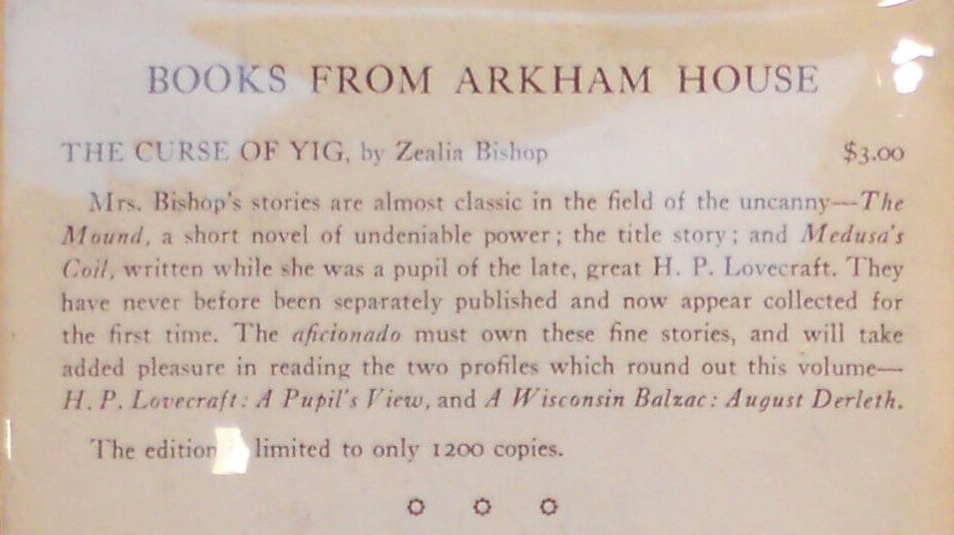
s-l1600

As the bill comes due, the question of reimbursement and profits comes up again. The stock price of the book was $3, and the “handling fee” was $0.45/book, so the gross value of each book was $2.55. At 1217 books, that left a potential gross of $3103.35—but how much of that would Zealia be getting? How many copies would have to sell for her to recoup the cost of printing? There’s no doubt that Derleth had to be getting at least a portion of the cover price to keep the lights on at Arkham House. Nevertheless, the terms must have been acceptable enough, because Zealia footed the printer’s bill.

Herewith is check on account for 300.00—leaving a balance of 1100.00 which you shall have not later than November 14th. I may be in Madison on that day or before—but you may depend on the check on that day in any eventuality. This has been a little difficult to handle as you told me that the bill would come in on Nov 10th & be payable in thirty days—If this is the fact let me know as it would be easier for me & I would not have to borrow any money—as I will have checks coming in to cover the amount early in Dec—Write me about this at once. It means a great deal to me—as previously explained. […]

I’m not interested in publicity–merely that sales pay the amount used to publish it—
—Zealia Bishop to August Derleth, n.d. (c. late Oct 1953), MSS. Wisconsin Historical Society

Herewith is the 1100.00 balance on the printing bill etc.—in three checks. I would like, if possible, for you to deposit them a few days intervals. The money is on deposit—but we have a devil of a banker—who is just as apt as not to call me out of a sound sleep & say “why are this….”  knowing that D. W. would know nothing of the deal & that I would be called upon to explain. Things will not always be like this—at present, however, to antagonize anyone could be disastrous. Since you can be assured that the money is in the bank I know you will arrange to handle the amount with your usual diplomacy.

It is impossible to say now how “Yig” is going or will go over. I’m receiving “fan” mail, of course—but that’s all happened before— […]

D. W. took one fleeting glance at the book. He did not so much as touch  it & has never mentioned it. That has cut me deeply—the girls, too, are wounded over his attitude—but it has only made me more determined to continue on—to do something more as often as I can—I cannot be destroyed—so many & so much depend upon me & my well being. […]

I hope “Yig” is successful enough to offset the printer’s bill & that we may publish one or two more under this plan then perhaps the other things will sell outright.
—Zealia Bishop to August Derleth, n.d. (c. Nov 1953), MSS. Wisconsin Historical Society

If Zealia Bishop hoped that the book would sell quickly, she had either deluded herself or else Derleth hadn’t been entirely forthright about the economics of the situation. As it was, it was not many months later when he was forced to write the kind of letter a writer hates to get.

I’m afraid you haven’t read your contract with Arkham House. There is no money due you by February 10th, I am sorry to say. The very earliest that any payment would be earned, would be in June, and I am not sure that there will be a payment then. The contract specifies that royalty reports on earnings shall be made after every half year, and that payments shall be made thereon not later than June and December respectively, following. Thus your first royalty reportwhich I shall try to have made up and enclose for youcarries you up to 1 January 1954, and covers the sale of only 250 books. And we have sold just 20 books since then, for a total of 270 books so far.

You will recall, too, that the total bill was $1,712.68, of which $14.45 was my personal responsibility—see my letter of 27 October 1953—leaving the actual cost of THE CURSE OF YIG—not counting other expenses incurred here which I did not put on the bill—at $1,698.23. Of this sum, you were asked to pay only $1,400.00, in the hope that the remaining figure would be earned by the time the bill was met. It was not quite earned; so you do not begin to receive monies until some months after (the first June to December) our royalty reports show that your book has earned the full $298.23. That is to say, form the first report of earnings, we must deduct no less than $298.23 plus a .45¢ per title handling charge, as per contract. If my estimate, purely off the cuff, is correct, the payment to you in June will be approximately $150.00, $20 more or less. My rough estimate puts it at just short of $150.00, but if I can have Alice make up the royalty statement in time to enclose it in this letter, than you will know for certain just what is due you in June; following which, the next payment will be made to you in December of this year, and on the same basis, at the same intervals, thereafter.

I am sorry that THE CURSE OF YIG has not sold faster; we are now just under 25% of the edition sold, and I know we will sell all the books, but they are just not moving fast, and none of our titles do so move. It took us 10 years to sell 1200 copies of THE OUTSIDER & OTHERS; yet, on the other hand, we sold 4,000 copies of SLAN in short of 4 years. But you will recall that I told you in advance not to expect any miracle sales, but a slow, steady accretion of sales. An initial payment of $150 or slightly less does represent 10% of your investment, and that is not too bad for two months’ sales, considering. […] We published Seabury Quinn’s ROADS in a 2000 copy edition in 1948 under a similar arrangement; it took him 4 years to recoup his $900 investment, and he is still earning his royalties now. We published David Keller’s TALES FROM UNDERWOOD in 1951 under a similar arrangement; he invested $1725, and still has $1450 to be earned for him.
—August Derleth to Zealia Bishop, 22 Jan 1954, MSS. Wisconsin Historical Society

25% would equate to about ~300 books sold in only two months (or a bit longer, counting advance sales); that should have grossed $900, or $765 minus the handling charges. If Zealia still owed ~$300 on the printing and might still expect $150 in June, that suggests her share or 300 books sold amounted to $450 net, so she was getting something like $1.50 per book (and remember that the printing cost was $1.40 per book). That leaves a full dollar of the cover cost unaccounted for, so either Derleth’s math is fuzzy, or (hopefully) there is a large piece of the accounting picture missing, because at $1.50 a copy Zealia would have to sell almost the entire run to earn out her initial investment ($1,698.23 / $1.50 per book = 1133 books), much less expect to see a profit.

We can compare these estimates with the one extant earnings statement:
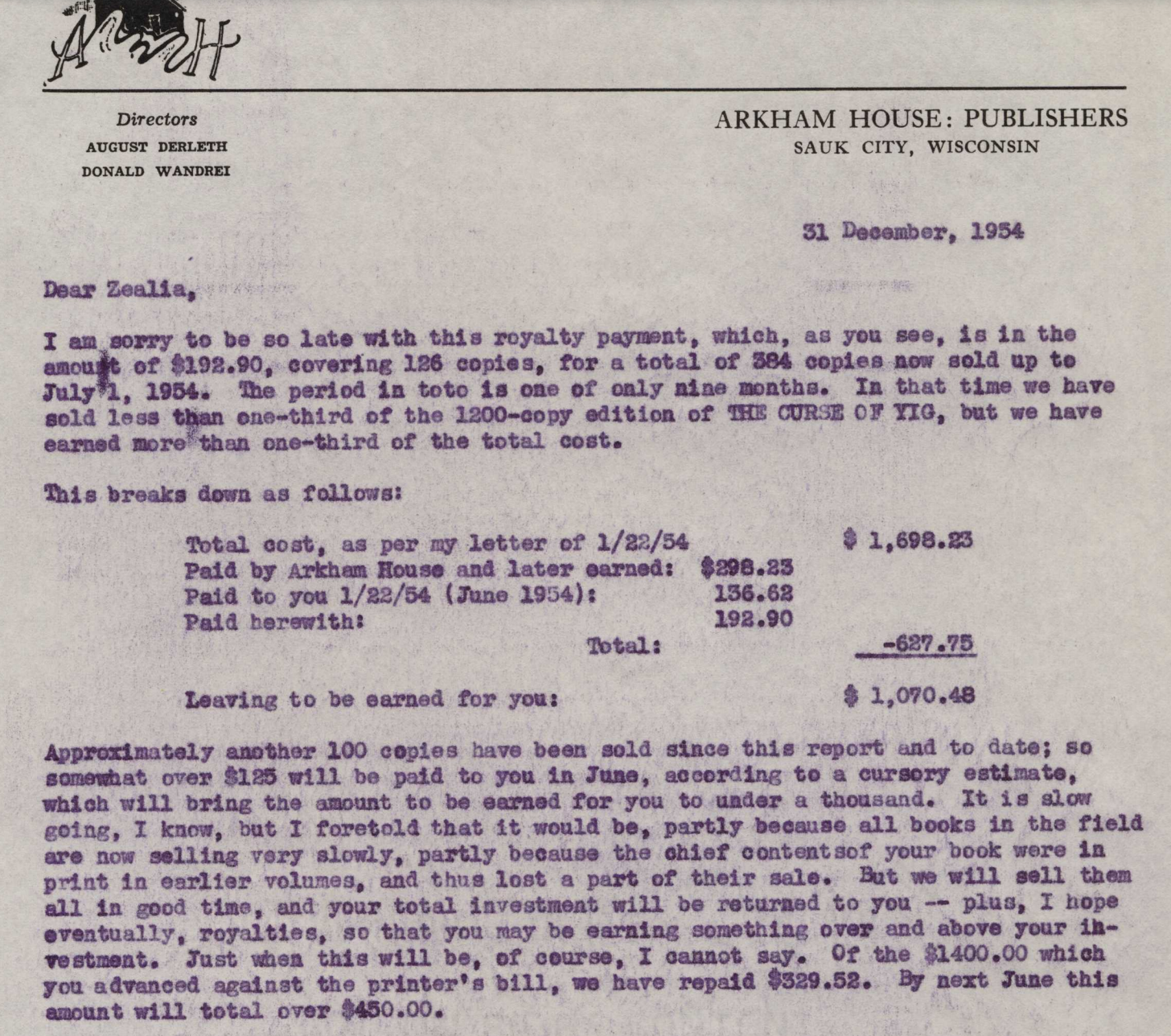
Screenshot 2020-12-20 at 6.52.30 PM

$627.75 / 384 books = $1.63 per book, which isn’t far off from the estimate (presumably Derleth is rounding somewhere), but the basic picture is the same: to actually earn back her money, much less make a profit, The Curse of Yig would need to sell most of the edition. Just to break even, Arkham House would need to sell ($1,070.48 / $1.63 per book = 657 books), and there were only 833 left in the edition—and some of those might probably be author’s copies, archival copies, etc. At the current rate (384 books/year) the book wouldn’t be expected to show a real profit until 1956.

Unfortunately, that didn’t happen. Instead of sales remaining steady, they appear to have decreased:

Our Bishop book, done in October 1953, has sold only 450 copies so far; and our Metcalfe, done in April 54, only 400. The one was largely reprint material, true, but the other was new work, though by a British author.
—August Derleth to Clark Ashton Smith, 26 May 1955, Eccentric, Impracticable Devils 451

Several of Zealia’s later letters to Derleth, tracking her economic decline, include requests for checks ahead of the agreed-upon schedule, no matter how small. In at least some cases, Derleth appears to have done his best to comply…but any hopes of actual profit, much less further publication, probably vanished quickly.

Certainly there seems to be an even interest in Yig—What do you think about a paperback for it—& in Airports etc?
—Zealia Bishop to August Derleth, n.d., MSS. Wisconsin Historical Society

The reason it’s called vanity publishing is because it is vain.

At the end of the day, The Curse of Yig would seem to largely be a book for Arkham House collectors more than general fantasy or horror readers. One contemporary review probably said it best:

Zealia B. Bishop’s The Curse of Yig (Arkham House, $3) contains three negligible stories from Weird Tales, plus two first-rate biographical profiles: one plausibly presenting H. P. Lovecraft in a somewhat less favorable light than that in which he is shown by his idolaters, and one which comes close to doing justice to the fabulous career of August Derleth.
—”Recommended Reading” in Fantasy and Science Fiction, vol. 6, no.2 (Feb 1954) 95

Much of the enduring legacy of The Curse of Yig lies not with the stories themselves—these were the Derleth-edited texts, later superseded by corrected texts compiled and edited by S. T. Joshi in The Horror in the Museum and Other Revisions (1989, Arkham House). “A Wisconsin Balzac” has never been reprinted, and may well have been written entirely by Derleth himself.

What has been reprinted, and is perhaps the most remembered inclusion to The Curse of Yig is “H. P. Lovecraft: A Pupil’s View”—Zealia’s long-simmering, often re-written memoir of being Lovecraft’s student-cum-revision client. While not without its flaws, this was until the publication of their letters the only account of Lovecraft and Zealia Bishop’s professional and personal relationship available.

Which in its own way is what The Curse of Yig is: a testament to the lasting impact of these two human beings on one another, and through their fiction on the world. No other woman would be so associated with Lovecraft for decades afterwards; no other woman would have her own Mythos anthology until after the death of August Derleth in 1971. The Curse of Yig might have been a commercial failure, but those books still exist, and are purchased and read today. While every writer might hope for profit during their own lifetime, what more could a writer hope for, after they’re dead and gone, but to be read and remembered?


Bobby Derie is the author of Weird Talers: Essays on Robert E. Howard & Others (2019) and Sex and the Cthulhu Mythos (2014).
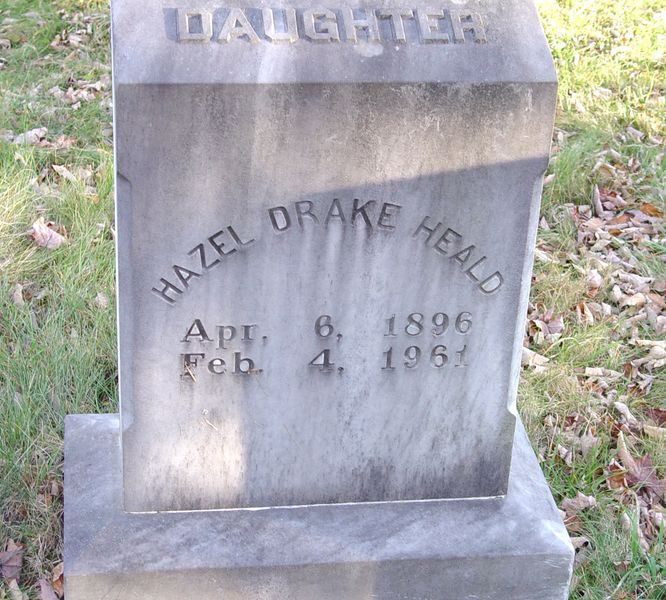
Derleth: Hawk…and Dove (1997) by Dorothy M. Grobe Litersky

He was known for his prolific writing production—at one time 10,000 words a day. He was also bisexual.

This book moves through Derleth’s many talents, from a five-year-old’s first reading experience to the man’s present statue as the only classic author to come out of the 20th century. It speaks eloquently of the hellish life endured by homosexuals in a society where their kind of living was confined to the boundaries of “closet” walls.
—Back cover copy of Derleth: Hawk…and Dove

Dorothy M. Grobe Litersky was a Wisconsinite, a charter member of the August Derleth Society, and one of the founders of the Rhinelander School of Arts where Derleth was engaged as a Writer in Residence. By her own account, this book—so far the only full biography of August Derleth’s life—was the result of 25-30 years of research, including interviews with family and friends and reference to Derleth’s private journals and correspondence, archived with his other papers at the Wisconsin Historical Society.

Before going into the particulars of Derleth: Hawk…and Dove, it’s important to place Derleth’s life in its proper context. He was born in 1909 in Sauk City, Wisconsin; sold his first story, “Bat’s Belfry” to Weird Tales at age 16, and from that point on never looked back at the writing game. He was a regular at Weird Tales, but prolific beyond that pulp magazine and that genre; a friend and correspondent of H. P. Lovecraft, Robert E. Howard, Clark Ashton Smith, E. Hoffmann Price and others, when Lovecraft died in 1937 it was Derleth and his friend Donald Wandrei that conspired to publish Lovecraft’s fiction and letters in hardcover. When they could not convince an established publisher to do it, they founded their own small press. Arkham House would, for the next fifty years, be one of the most important publishers of weird fiction, fantastic poetry, and Lovecraft-related materials in the world.

Derleth had a literary life outside of Arkham House. He became an important regional writer with the Sac Prairie Saga, a series of novels and short stories about his native Wisconsin and especially his home tome of Sauk City and the adjacent Prairie du Sac. For mystery fiction he created the detective characters Judge Peck and Solar Pons, the latter a deliberate pastiche of Sherlock Holmes, who remains popular. Beyond that, he wrote nonfiction histories and biographies, children’s books (including a series for which the authors received the Apostolic Blessing of Pope John XXIII) and poetry, articles and reviews. Awarded a Guggenheim fellowship in 1938, Derleth used the money to bind his collection of newspaper comics; those archives are now an important source for comic strips that may otherwise have been lost to time.

Much of this would have been opaque to even dedicated fans and readers of Arkham House. Derleth was a capable self-promoter, as his volumes, August Derleth: Twenty Years of WritingAugust Derleth: Twenty-Five Years of Writing, and August Derleth: Thirty Years of Writing attest, but he rarely wrote publicly about his marriage, love life, children, or the full details of his business. He had a diverse fanbase, but their interests typically appear narrow: the weird fans had little interest in his Sac Prairie saga, the Solar Pons fans little interest in his poetry, etc. So while there was no little interest in Derleth as a writer, bookman, publisher, and individual, there were few works that could—or even tried—to encompass all of the man and his range of writing. Those few works were mostly published by the August Derleth Society, which continues to work today to keep his writing in print and his memory alive.

Derleth’s death in 1971 saw an opening up of both Lovecraft scholarship and wider dissemination of the Mythos. During his time at the helm of Arkham House, Derleth had strongly claimed proprietary interest on Lovecraft’s fiction and letters, assuming effective (if not legal) control from Lovecraft’s literary executor R. H. Barlow. Derleth limited the ability of others to publish Mythos and Lovecraft-related works beyond Arkham House’s control (see the C. Hall Thompson affair and the publication of The Private Life of H. P. Lovecraft (1985) by Sonia H. Davis). Without him, and with the 12-year lawsuit between Arkham House co-founder Donald Wandrei and Derleth’s estate over the rights to the Lovecraft material, Mythos fiction began to proliferate. Derleth himself became criticized posthumously, both for his actions as editor and publisher, and for his Mythos fiction; Richard L. Tierney’s “The Derleth Mythos” (1973) was a watershed moment that emphasized the critical pushback against Derleth among Lovecraft studies.

Yet for all this, there was still relatively little on Derleth as an individual. The August Derleth Society Newsletter and volumes such as Remembering Derleth (1988), Return to Derleth (1993), and August Harvest (1994) are memoirs and essays by those who knew him, but approach hagiography at points. While valuable in their own right, there was for some decades after Derleth’s death no one willing or able to do the kind of initial work comparable to L. Sprague de Camp’s Lovecraft: A Biography (1975).

Not until Dorothy M. Grobe Litersky, who had been gathering material for the book since before Derleth’s death, finally wrote and published it.

Her book is, even from the most generous reading, far from perfect. Readers interested in a detailed account of his writing career, the development and publication schedule of Arkham House and its imprints, even his friendship with Lovecraft will be disappointed. There are no real revelations on these aspects of his life. It is not that Litersky ignores these things, but her interest is more focused on Derleth’s personal life.

As Derleth’s biographer, I have, to the best of my ability, tried to present as accurate a profile as possible. He wanted a portrayal of the whole man, free of the closet of lies he had been forced to hide in throughout his lifetime.
—Litersky, Derleth: Hawk…and Dove ix

While written without malice, Litersky’s “warts and all” approach to Derleth’s life includes a number of statements and assertions that are serious eye-openers to those who had only known Derleth through his fiction, essays on Lovecraft, and introductions to Arkham House books. Some of these are unequivocally true; many are simply impossible to verify without more information—and Litersky’s citations are minimal, often frustrating to work with, missing dates or page numbers, and typically take the form of “A. D. Journal” or “Robert Marx to A.D.” (ibid. 130); dates and page numbers are rare. Where they do exist, they are almost invariably accurate; there is every evidence that while she had access she was drawing directly from Derleth’s correspondence. However, the citations are still sparse and often lacking critical information, making it difficult to verify the contents.

One example of an event that we can confirm:

A group of about fifty young people converging upon the Place of Hawks on an evening in mid-October, 1948, included a precocious fourteen-year-old beauty who had made up her mind a year earlier that she was going to marry August Derleth.
—Litersky, Derleth: Hawk…and Dove 113

August Derleth’s marriage to Sandra Winters in 1953, which resulted in two children (April and Walden Derleth) and ended in divorce in 1959 is a matter of public record. They became engaged when she was 16 and still attending high school, and married shortly after she turned 18 in 1953, when Derleth was 44 years old (Rhinelander Daily News, 7 Feb 1953). The relationship appears to have been sexual even before they were married—and that Derleth was far from head-over-heels in love with the apparently infatuated teenager:

Oh, yes, I would not deny that Sandra has done me a lot of good. Not just making love to her, Sandra herself. Of course, she is sharp enough to know that, and I think that in this lies the ultimate dissolution of the affair, unless an accident makes it necessary for us to be married. For, being young, she is entirely likely, even with her mother’s advice, to take me for granted, and that might well be fatal. She has been frank enough to say that she intended all along that I should ultimately need her more than she needs me, and, while she intends to marry me, she intends also to have as much of her cake and eat much of it too, as possible. That never works, manifestly. But whatever takes place, it is certain that I have already benefited a great deal, and all the clothes and jewelry I’ve bought her won’t balance my own benefits.
—August Derleth to Zealia Bishop, 18 Aug 1949

Litersky’s account of the marriage goes into further detail, but there remains much unspoken about the entire relationship. The biographer never cites Sandra’s version of events; she appears to have relied entirely on Derleth’s accounts, despite the fact that the former Mrs. Derleth was still alive. There are no interviews with or letters from Sandra that might shed light on her side of the story. Derleth is apparently the sole source of all of the lurid details (her affairs, his affairs, the nude photography, the surprise pregnancy, etc.), as filtered through Litersky’s gloss of Derleth’s letters and journals.

The issue of statutory rape is hardly discussed. Sandra Winters as portrayed in the book is described as sexually precocious, and it beggars belief that a girl at fourteen could seduce a 40-year-old man. Derleth had to know what he was getting into, and it feels weird that in the context of the book more attention is not given to how the difference in ages was felt by both the immediate family or the community at large, or to how this reflected in the wider context of Derleth’s personal life. This is characteristic of Litersky’s style throughout the book; she presents the events as a fait accompli, not laying any moral judgment on Derleth’s flaws or foibles, but her portrait of others is colored by Derleth’s own perceptions—they become supporting characters, sympathetic when Derleth loves them and flawed or monstrous when he turns against them.

How reliable Litersky’s information is remains an open question. The book is not without errors of fact, and there are certainly instances where error of interpretation seem likely. The nature and paucity of the citations makes it difficult to assess the overall accuracy of the text, or even of specific sections. As a researcher, the book must be considered more as a guideline than a source of concrete data. Each instance has to be independently verified as much as possible.

That being said, very few of the claims in Derleth: Hawk…and Dove claims appear to be entirely baseless. If the interested reader can track down Litersky’s original sources or supplement them with other primary materials, usually there is at least some evidence to support them. To take one example:

Years later after Derleth’s death Sara told her story to a class of young students and reporters of her walk in the woods with August. She was relaxing on a blanket when he proceeded to discard all his clothes except his socks and to dance under the trees. She said she was shocked and embarrassed and pretended to be asleep.
—Litersky, Derleth: Hawk…and Dove 206

While somewhat inexplicable to Sara (and Litersky), a letter from Derleth to Lovecraft may suggest that nudism was a common practice for him, at least when the weather permitted: “I am brown as a berry, and have managed to rouse some indignation by being a one-man nudist colony on the hills only a  third of a mile across the river from the village” (Essential Solitude 632–33). So while we cannot say that this event actually happened, we can at least say that there is evidence that Derleth may have at least engaged in this behavior at some point. The anecdote is at least plausible, even if it isn’t provable.

A more complicated matter is Litersky’s assertion that August Derleth was bisexual, especially that he maintained long-term sexual relationships with both men and women. For reasons of privacy, Litersky does not name all of Derleth’s sexual partners outright; even her citations in this regard appear more circumspect than usual. This makes it especially difficult to verify; and there are no published letters where Derleth specifically states he has ever engaged in a homosexual relationship.

The importance of this aspect of Derleth’s character is arguable: it would make him the first bisexual author in the Cthulhu Mythos, and perhaps lend insight into readings of his fiction. Certainly it would cast some of Derleth’s occasional homophobic comments into new perspective, e.g.:

Barlow is I am sure a homo; from what I have heard, so was the later minister-weird taler Henry S. Whitehead.
—August Derleth to Donald Wollheim, 21 Mar n.d. [1937]

Could this be performative homophobia from a closeted bisexual? Or the genuine mild prejudice of an individual who, regardless of their sexuality, conformed to early 20th-century cultural norms regarding gender behavior and sexuality? Hard to tell. But the possibility of Derleth being on the LGBTQ+ spectrum is interesting, and deserves a deeper look.

When the subject turned to sex, August stated, “…I have no inhibitions, had few all my life sexually, that if I wanted to masturbate, I did so without guilt; if I wished to make love to a member of my own sex, likewise; if I wished to make love to a woman, again, likewise, the only condition being that sexual pleasure must rise from love, or at least a deep and genuine affection….”
—Litersky, Derleth: Hawk…and Dove 211

Here, Litersky is apparently relaying a snippet from a private conversation, as no other source is cited, so no separate confirmation is possible. Some of her statements in this line are even more unreliable; for example when she wrote:

The name Mara was mentioned only casually. He’s in love with her, the correspondent realized suddenly. Her fingers, holding the letter, felt a strange vibration. She met Mara a few years later, and had another shock. Mara was not a young lady, as she’d assumed. It wasn’t until after August’s death, a decade later, that she’d discovered her psychic flash had been 100% correct. August was bisexual and was indeed in love with Mara.
—Litersky, Derleth: Hawk…and Dove 180

“Mara” was a name used in some of Derleth’s poetry and fiction, notably in an eponymous 1948 ghost story about an unfaithful female lover; the volume of poetry This Wound (1962), which includes love poems, is dedicated to “Mara.” So while there was apparently a Mara (probably a nickname of a pseudonym), there is no indication Mara was male—also but not enough information for positive identification.

August Derleth never admits to a homosexual liaison or relationship in his published letters, but he did discuss sexuality in his correspondence, and there are several letters which are suggestive of the idea that he might be open to it, at least intellectually:

I must confess, that though I am steeped in abnormal sex, having studied all kinds of perverts at first hand, the suspicion of necrophilia in A Rose for Emily never once entered my mind. [. . .] Here is a woman starved for something—what is it, love perhaps? Let us assume it is. But she knows nothing about it. Love to her means a possession, a having. What she had come to regard as hers seems to be too independent. She kills. Thus, she keeps, she possesses, she loves. Necrophilia may or may not enter into this relation; it’s a minor point to me, since my own experience with people in this existence has led me to look on such things as part and parcel of life, though I am still conservative enough to be horrified by them, deeply. Yet I would be the first to jump tot the defense of a necrophiliac, a homosexual, &c., largely because I know that so often these poor creatures are incapable of helping themselves, have had their nerve systems tortured and twisted permanently from birth.
—August Derleth to H. P. Lovecraft, 9 Nov 1931, ES 406

I can understand your detestation of sex irregularities in life as violations of harmony and I here fully agree with you. I had previously misunderstood you to mean protestation from a basis of morals, and on this basis I would have stood squarely opposed to you. I have known and still know many people who are sexually irregular, both homosexual men and women, and except for three cases out of perhaps 21, I have always found these people highly intellectual, fully aware of what they were doing, and in all cases quite helpless. Speaking perspectively and in the abstract, I could as easily conceive myself entering upon a monogamous homosexual relation as a heterosexual one—though perhaps practice would change that pointofview. To quibble about mere words, I should not say that perverts necessarily lived inartistically.
—August Derleth to H. P. Lovecraft, 14 Feb 1933, ES 543

The idea that Derleth had an interest in the psychology of sex is supported by evidence he took out a subscription (under a pseudonym) to ONE Institute Quarterly, the journal of homosexual studies, in 1962. He would discuss the issue with others besides Lovecraft as well:

As for homosexuals—my only feeling is that I abhor promiscuity and I dislike violently to see children troubled; but this holds true also for heterosexuals, so there is actually no prejudice. Consenting behavior between adults is not offensive to me. But I do detest the flamboyant homo, the almost professional gay. To tell the truth I don’t know many real homos, though; I do know quite a number of bisexuals, and I never found one offensive, indeed, many of them strike me as brilliant, and most of them appear to be limited to one lasting affection, and are not promiscuous, that is one woman, and one man—oddly, there seems to be no conflict despite what the head-shrinkers insist  upon.
—August Derleth to Ramsey Campbell, 24 May 1966, Letters to Arkham 277-278

The subject comes up more than once in the Derleth-Campbell letters, and it is this sort of substantial quote which perhaps could have lent authority to Derleth: Hawk…and Dove. Therein lies what is arguably the single major issue with the book, beyond any question of Litersky’s style, sourcing, or quality of her analysis:

Missing Journal dates and dates of letters to and from August Derleth resulted from biographer’s incomplete notes, and a loss of actual copies of those items, journal entries and letters, beyond her control. When her lawyers accidentally discovered that the failure of Derleth’s lawyer to renew copyrights on all of Augie’s works, as requested by the U. S. Copyright offices, and informed April and Walden Derleth of the fact, the children not only moved quickly to remedy the mistake, they froze the Derleth papers in the Wisconsin State Historical Society’s Museum archives to prevent anyone access to them until the year 2020. Only then will it be possible to verify some of the material in Chapter 22, and elsewhere throughout the book.
—Litersky, Derleth: Hawk…and Dove 201-202

This is essentially the claim for why the book is not cited better than it is. Unfortunately, like everything else in the book, it is impossible to take Litersky at face value. It is true that there are some restrictions on access to portions of the Derleth archive, as described in the Administrative/Restriction Information; not all of the details quite align with Litersky’s version of events given above, but circumstances can change over time—or perhaps she misunderstood or misrepresented the reasons for the sealing. We don’t know.

It also isn’t clear why Litersky chose to publish this through the National Writers Press—a vanity press—rather than the August Derleth Society; one can imagine the content might have given the ADS pause. To say that Litersky’s assertions or interpretations of August Derleth’s life are “contested” or “controversial” would be inaccurate; most scholars don’t engage with Litersky’s biography at all. In part, this is more a reflection of a failure of the scope of Derleth: Hawk…and Dove than the question of its scholarship or distribution.

Readers who want to learn more about Derleth and Arkham House or Derleth and the Cthulhu Mythos will pick up John Haefele’s August Derleth Redux (2010) or A Look Behind the Derleth Mythos (2014); those interested in his Sac Prairie writings will pick up Evelyn Schroth’s The Derleth Saga (1979). For those who want more information on the man himself, his volumes of letters with H. P. Lovecraft and Ramsey Campbell are the major primary sources available in print.

In many ways, Litersky’s biography is characteristic of many first biographies of authors, in that it is only a beginning. Derleth: Hawk…and Dove is not the last word in Derleth studies; it is at best the start of the serious study of his life and work, and any subsequent biographer of Derleth will be forced to read Litersky and tackle the errors and weaknesses in her approach if they hope to produce anything that can surpass her work. Such a biography, when and if it written, can at least take advantage of sources that Litersky herself did not have available: the published letters, digital scans of unpublished correspondence, databases to help track down errant Derleth publications and criticism—and it would be worthwhile to see such a book published.

August Derleth was an important figure in the life and literary afterlife of H. P. Lovecraft, Robert E. Howard, Clark Ashton Smith, and many other writers. His vast body of work and his personal life are of interest in and of themselves, but he also touched on the lives of so many others—it was largely through his hard work and diligence that Arkham House became a legend, and that Lovecraft, the Mythos, and even weird fiction are still known and loved today. Whatever his personal flaws and foibles, and Derleth was certainly no saint, the ripples his life left on the world continue to expand and touch others. 


Bobby Derie is the author of Weird Talers: Essays on Robert E. Howard & Others (2019) and Sex and the Cthulhu Mythos (2014).
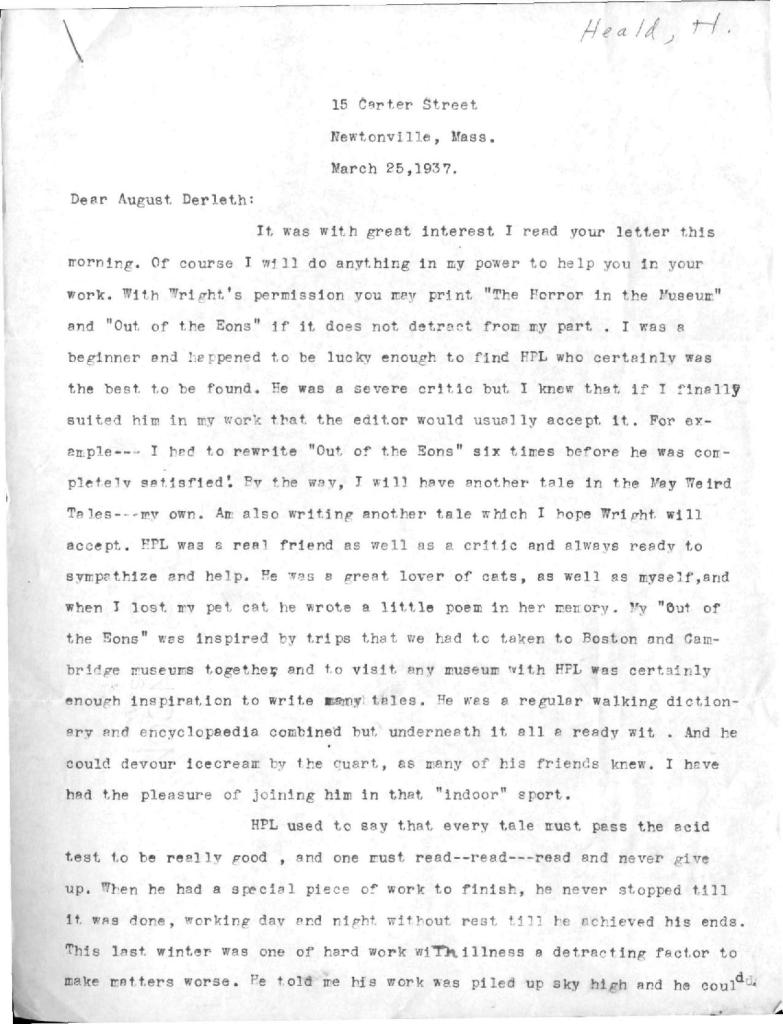
“An Imp of Aether” (1997) by W. H. Pugmire

To ye memory of August William Derleth
—original dedication

“Lovecraft Country” was the name given to that fictional setting in New England where so many of his stories were set, or at least referred to. The Miskatonic River that flowed through Arkham and gave is name to the university there down to Innsmouth, Dunwich and Kingsport—all based on real places that Lovecraft visited in Massachusetts, but occupying an unreal estate in the mind; Lovecraft country is a character itself in stories like “The Dunwich Horror.”

Some subsequent writers in the Mythos have carved out their own geographies; Ramsey Campbell, on the suggestion of August Derleth, set his early Lovecraftian tales in a fictional Severn Valley with towns like Brichester and Goatwood, which continues to be developed today. W. H. Pugmire set his Sesqua Valley in the Pacific Northwest, and populated the place shadowed by the mountains with his own strange creations, including the poet William Davis Manly and the sorcerer Simon Gregory Williams.

In this story, set in the shadows of Sesqua Valley, Pugmire pays homage to August Derleth.

We thought at first that it was some kind of poem, but upon further study discovered that it was a prayer to something called Cthugha. Known as ‘the Burning One.’
—W. H. Pugmire, Tales of Sesqua Valley 39

We thought at first that it was some kind of poem or unholy psalm, but upon further study discovered that it is a prayer to something called Cthugha. Supposedly a fire element. You know the idiotic notion that Great Old Ones represent terrestrial elements, as if these cosmic creatures could be molded by corporeal law or understanding. Utterly absurd; but in this case, there seems some sustainment.
—W. H. Pugmire, Sesqua Valley & Other Haunts 94-95

We thought at first that it was some kind of poem or unholy psalm; but with further study we discovered it to be a prayer to something called Cthugha, supposedly a fire elemental. You know the idiotic notion that the Great Old Ones represent terrestrial elements, as if these cosmic creatures could be molded by corporeal law. Bah! However, in this case, there seems to be some sustainment.
—W. H. Pugmire, An Imp of Aether 129

As a writer, Pugmire was a tinkerer; many of his stories show the result of revision between printings, so that while the title, plot, and overall characters are the same, the text in each publication is different—sometimes slightly, sometimes markedly. The revised texts tend to be cleaner, in general; the result of looking back at a work from a decade ago and tidying it up after one’s younger self.

In the February 1933 issue of Weird Tales, Donald Wandrei published “The Fire Vampires”; a tale of the 24th century involving the fiery alien entity Fthaggua; and the idea of elementals in the Mythos dates back to Derleth’s “The Thing That Walked On The Wind” (Strange Tales of Mystery and Terror, Jan 1933). Wandrei’s tale was not explicitly of the Cthulhu Mythos, although later writers adopted it, or elements from it, into the Mythos; Derleth’s was deliberate pastiche. After Lovecraft’s death, August Derleth and Donald Wandrei came together to form Arkham House to publish Lovecraft’s fiction and letters—and Derleth himself continued to publish Mythos pastiches.

The “elemental theory” as a paradigm for the Cthulhu Mythos (as Derleth called Lovecraft’s artificial mythology) as a whole came after Lovecraft’s death, detailed by fan Francis T. Laney in “The Cthulhu Mythology” in The Acolyte #2 (1942), where he noted:

The fire gods were not covered by Lovecraft, so it is up to other writers to fill in this section of the Mythos. (8)

August Derleth was paying attention. He wrote to Laney, asking him to expand the article for a further book of Lovecraft’s fiction—which became “The Cthulhu Mythos: A Glossary” in Beyond The Wall of Sleep (1943, Arkham House). This expanded article includes mention of a fire elemental, Cthugha, created by Derleth:

I’m certainly agog to read “The Dweller in Darkness.” Cthugha will certainly fill a gaping hole; I well remember how disgusted I was when I found the “fire department” had been completely neglected. I’m not trying to appear conceited, but by any chance did my mention of this in my article start you off on this tack, or was it just a coincidence?
—Francis T. Laney to August Derleth, 29 Mar 1943

Whether it was Laney that inspired Derleth, or two fans arriving at the same conclusion, Derleth determined to “fill the gap” and embraced the elemental theory wholeheartedly, making it his own (and borrowing elements of Wandrei’s Fthaggua in the process). As it happened, publication of fiction didn’t always go in order—the story that effectively introduced Cthugha was “The Dweller in Darkness” (Weird Tales Nov 1944), but the first story that saw mention of Cthugha in print was “The Trail of Cthulhu” (Weird Tales Mar 1944), later titled “The House on Curwen Street.”

Derleth’s conception of the Mythos did not long survive him; Richard L. Tierney famously exploded the idea in “The Derleth Mythos” (1972), beginning a period when fans and scholars seriously re-assessed what Lovecraft did and did not write, and interest increased in textually accurate versions of Lovecraft’s fiction—but selective elements of Derleth’s Mythos fiction, such as Cthugha, were adopted by others.

Hence, Pugmire’s dedication.

This is a story with a nod-and-a-wink toward Mythos fans who can pat themselves on the back that they know about Derleth and the elemental theory and can scoff at such notions along with the sorcerer Simon Gregory Williams. And yet…that is just the beginning of the story, the set-up. That is Pugmire laying the groundwork.

Because there is potential in Cthugha, and some of Derleth’s other ideas—and as much as Derleth’s memory was somewhat hounded in latter years because of his flaws as a writer, a businessman, sometimes even as a human being, he was still a good writer, and he promoted and published Lovecraft unceasingly during his life, and there are ideas which he introduced to the Mythos that are worth exploring and expanding on. So Pugmire did.

No, no. It was the fire vampire. You looked too long and deeply into its burning eyes. Your cool silver eyes took in too much of its property, and thus you burn with strange agitation. One born of the valley’s shadow cannot withstand such cosmic brilliance.
—W. H. Pugmire, Sesqua Valley & Other Haunts 97

No, lad. It was the fire vampire, an essence of the Old One that burns in Fomalhaut. You looked too long, too deeply, into its ember eyes. Your cool silver orbs are slightly scarred, so potent was your engagement with the valet of Cthugha.
—W. H. Pugmire, An Imp of Aether 132-133

Pugmire never shied away from making his creations sensual; but this is a rare story where he plays with gender as a concept. Wilus Shakston (original) or Jacob Wirth (revised) has encountered the old witch of Cthugha…plaited a lock of her hair with his own…and so began a transformation. Whether the transition can be said to be transgender or genderqueer is largely up to the reader to interpret; the nature of the transition is slower and less total than in “The Thing on the Doorstep.” But in a setting where the children of Sesqua Valley seem to be predominantly male, the acquisition of feminine attributes is marked—and not-unwelcomed by Wilus/Jacob.

In an afterword to this story, Pugmire wrote:

In 1995, after my lover’s heroine overdose and death, I began to write a series of Sesqua Valley stories dedicated to deceased members of the Lovecraft Circle. I suppose I was trying to take my mind off personal tragedy by sinking into creativity. It worked quite well, and many of those tales became the core of my first American collection of fiction, Tales of Sesqua Valley, published by my good buddy and fellow author Jeffrey Thomas. With these stories I mentioned breifly the addition to the Mythos created by the gent to whom the story was dedicated. It was a fun wee game, although the results were not stories of importance. The original version of this story had its first appearance in the chapbook that Jeff published in 1997 under his Necropolitan Press imprint; it has been susbtantially rewritten for this edition.
—W. H. Pugmire, Sesqua Valley & Other Haunts 99

Whatever version of the story you read, it is worth reading. Proof that the Mythos can be reimagined and reworked by different hands, and that ideas that had their start in the nigh-forgotten pulp fiction of the 1930s can inspire strange and wondrous things.

“An Imp of Aether” was first published in Tales of Sesqua Valley (1997), it was revised and republished in Sesqua Valley & Other Haunts (2008) and The Tangled Muse (2011); and revised again for publication as the title piece in Pugmire’s posthumous collection An Imp of Aether (2019).


Bobby Derie is the author of Weird Talers: Essays on Robert E. Howard & Others (2019) and Sex and the Cthulhu Mythos (2014).