In the letters of H. P. Lovecraft to R. H. Barlow compiled by S. T. Joshi and David E. Schultz in O Fortunate Floridian! an individual named “Clara” is mentioned five times:
I see by the paper that your friend Clara has just lost a brother—not the one in Providence, but another dwelling in Mass.
—H. P. Lovecraft to R. H. Barlow, 26 September 1935, OFF 296My aunt vows she is going to shew Clara your binding of the “Shunned House” . . . . . Which reminds me that both Loveman & Brobst have seen this job & praised it to the skies.
—H. P. Lovecraft to R. H. Barlow, 21 October 1935, OFF 299My aunt ran into your friend Clara the other day, & they talked considerably about you. Clara is very anxious to see your job on The Shunned House, & I think my aunt will show her the book very shortly.
—H. P. Lovecraft to R. H. Barlow, 25 October 1935, OFF 303Meanwhile my aunt & Clara Buffner send you their best regards—the former having an intention of writing you ere long.
—H. P. Lovecraft to R. H. Barlow, 30 November 1936, OFF 377-378Here’s something about Aunt Clara (who always enquires admiringly about you) which you can keep for Yoh-Vombis.
—H. P. Lovecraft to R. H. Barlow, 27 January 1937, OFF 397
Taken together, the overall impression is that Clara is a friend or associate of Lovecraft’s surviving aunt Annie E. P. Gamwell, that she was a resident of Providence c.1935 with a brother in the city, and that she had some interest in Barlow’s job of binding a set of sheets for Lovecraft’s The Shunned House. This book had been printed by W. Paul Cook in 1928, but never bound or widely distributed during Lovecraft’s lifetime. Barlow and Lovecraft prevailed on Cook to send the sheets to Barlow in De Land, Florida, which eventually happened. While in Washington, D.C. in early 1935, Barlow had bound the sheets in full leather, hand-tooled with raised bands, which was presented to his friend when Lovecraft had visited De Land in June (Dawnward Spire, Lonely Hill 618; Lovecraft’s Library 106).
The only difficulty with these letters is the identity of Clara Buffner, who does not appear in any census or city directory for Providence in the 1930s. However, a close reading of a scan of the original letter shows that Clara’s last name is not Buffner but Buffum—an easy misreading, given Lovecraft’s sometimes cramped handwriting—and this makes a great deal more sense.

Clara Buffum was born 24 January 1873 to Joshua and Clara Maria Southwick Buffum in New York City. Census data and gravestones sketch a life: In the 1900 census she is listed as a secretary in the household of John C. Brown in Manhattan, which included nine servants. Joshua Buffum died in Providence on 10 July 1906. By the time of the 1910 census, Clara was living with her mother, aunt (Annie K. Southwick), and brothers Harrison (b. 7 March 1866) and Frederick (b. 20 July 1871) in Providence, Rhode Island and working as an artist at “book building.” Around 1915, brother Harrison (“Buff”) became a parole patient at Brattleboro Retreat in Vermont; his death certificate says he suffered from dementia praecox. Clara M. Buffum died on 3 January 1921. Another brother, Albert (b. 17 Sep 1870), was in business in Blackinton, Massachusetts, where he died on 4 August 1935—this would be the brother in Massachusetts Lovecraft mentioned in his first letter (OFF 296), with the other brother being Frederick. Harrison would die in Vermont on 13 September 1935. Clara Buffum passed away on 6 July 1938, and was buried in Swan Point Cemetery in Providence, where she had lived most of her life.
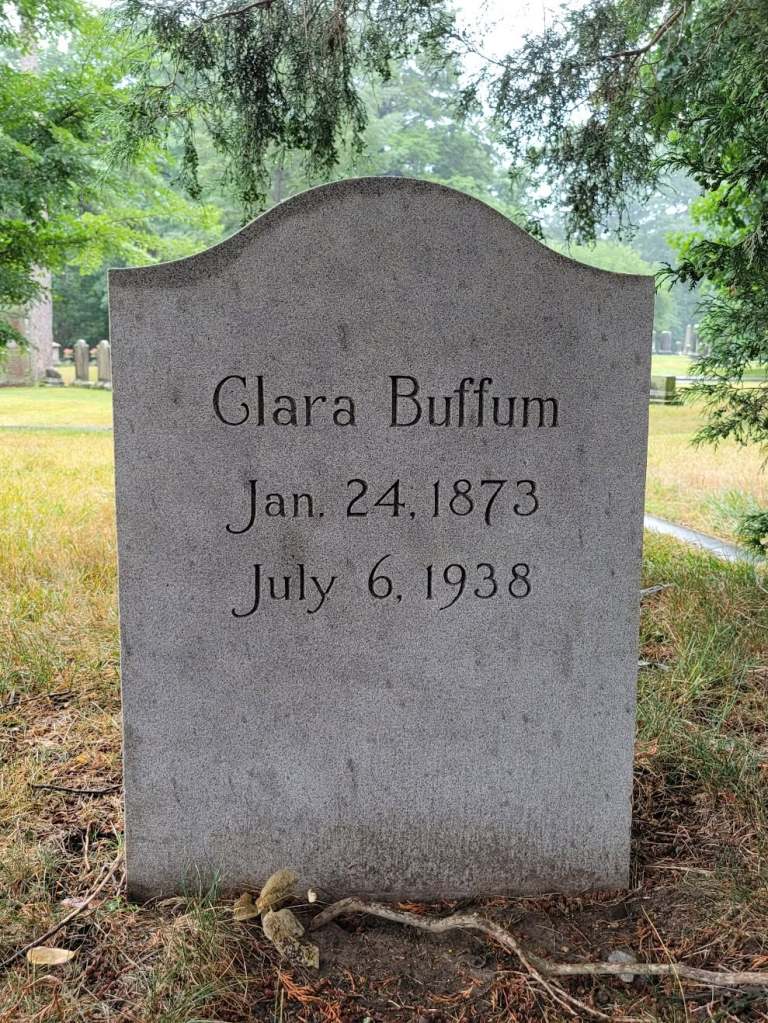
What the raw data doesn’t mention is that Clara Buffum was a skilled bookbinder that traveled to the United Kingdom to expand her skills, operated her own private business in a studio in Providence, consulted with universities, lectured, exhibited her work at the Rhode Island School of Design, and in 1935 published a book: Hand-Bound Books: A Guide for Amateur Bookbinders, in a limited edition of 500 copies. Her preface to that work declares:
It was my good fortune to learn the arts of book-binding and gilding from two men who belonged to the old type of craftsman. They were thorough, conscientious, and skilful [sic] workmen who never lowered their standards. My first teacher was Mr. F. P. Hathaway, for twenty years binder at the Boston Athenaeum, and later in charge of the bindery at the John Carter Brown Library in Providence, R. I. The teacher who instructed me in the art of decorative tooling and lettering with gold leaf was Mr. Charles McLeish of London, who was at one time connected with the famous Doves Bindery of Mr. Cobden-Sanderson at Hammersmith. It seems advisable to record the knowledge gained from them, to which has been added over twenty years’ experience in my own bindery in Providence.
Clara Buffum’s obituary expanded on this a little more:
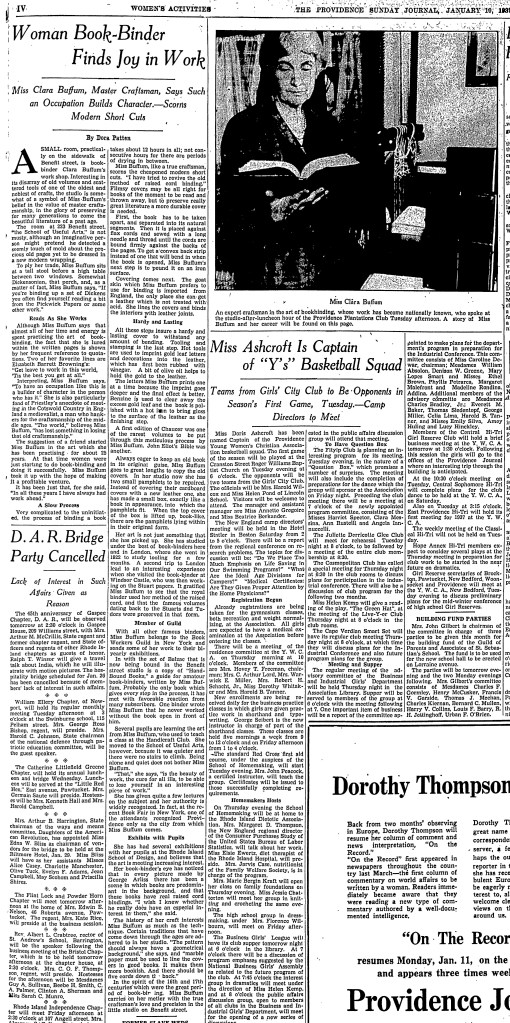
Miss Buffum, who made a wide circle of friends during her residence here, was long recognied as one of the leading master craftsmen in the art of fine bookbinding in the East. She maintianed for many years a studio in Providence, where she bound many famous and valuable books, including a first edition fo Chaucer and the original Bible of John Bunyon, author of Pilgrim’s Progress. […] Miss Buffum studied under the leading masters of her craft in this country and in London. Every year for a long period, she exhibited with the Guild of Bookworkers of New York and also held occasional exhibitions at the Rhode Island School of Design where she taught bookbinding.
Other articles in newspapers and journals give evidence of Buffum’s lectures to various groups in Providence, including the New England Historic Genealogical Society (“Miss Buffum Talks Here of Bookbinding”). Given how active Annie Gamwell was in Providence society, including the Providence Art Club and attending public lectures and art exhibitions, it seems likely that was how Annie and Clara met—and probably continued to meet periodically, hence the latter occasional references in Lovecraft’s letters of 1936 and 1937. The article that Lovecraft mentions to Barlow in the 27 Jan 1937 letter is probably this article that ran in the Providence Sunday Journal 10 Jan 1937 (46):
It would be speculation at this point to try to sketch out any more of the relationships Clara had with Annie Gamwell, H. P. Lovecraft, and R. H. Barlow, but the confirmation of the few facts of her identity with the specific points in Lovecraft’s letters connects several dots. Barlow and Buffum’s shared interest in bookbinding, and the shared connection of Annie and Clara through Providence’s social circles, forged the brief connection accounted for in Lovecraft’s letters to Barlow.
Additional Reading
“Albert J. Buffum Succumbs To Sudden Heart Weakness” (5 August 1935). North Adams Transcript. Page 3. https://www.newspapers.com/article/the-north-adams-transcript-albert-j-buf/128473557/
“Funeral Services for Miss Buffum” (11 July 1938). North Adams Transcript. Page 3. https://www.newspapers.com/article/the-north-adams-transcript-clara-buffum/129506445/
“Harrison Buffum” (14 September 1935). The Burlington Free Press. Page 2. https://www.newspapers.com/article/the-burlington-free-press-obituary-for-h/129511598/
“Miss Buffum Talks Here of Bookbinding” (13 November 1930). The Boston Globe. Page 25. https://www.newspapers.com/article/the-boston-globe-miss-buffum-talks-here/128476580/
Dave Goudsward has also written about Clara Buffum, H. P. Lovecraft, and R. H. Barlow in Adventurous Liberation: H. P. Lovecraft in Florida.
Thanks and appreciation to Donovan Loucks for his help.
Bobby Derie is the author of Weird Talers: Essays on Robert E. Howard and Others and Sex and the Cthulhu Mythos.
Deep Cuts in a Lovecraftian Vein uses Amazon Associate links. As an Amazon Associate I earn from qualifying purchases.

