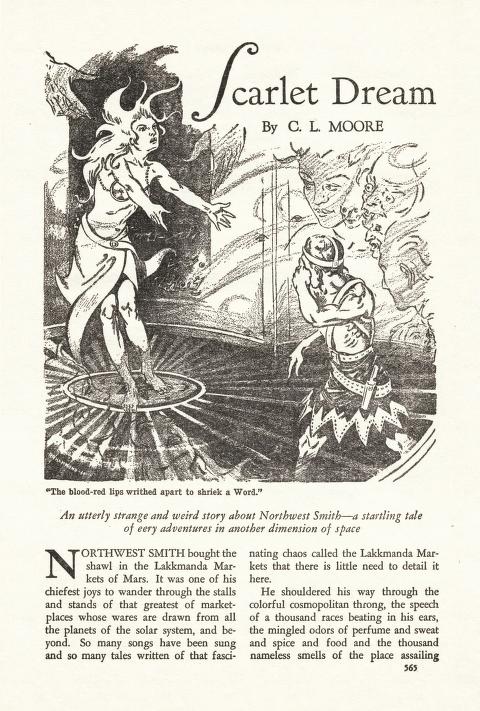
“Scarlet Dream” (1934) by C. L. Moore

And speaking of Cabell, wait till you read my May story! I hadn’t realized until I read over the proof-sheets they sent me last week how closely it follows the Cabell-Dunsany phraseology. For instance “—so it might have been no mortal twilight, but some strange and lovely evening in a land where the air was suffused with colored mists, and no winds blew”. It’s almost trite, it’s so Cabellian-Dunsanyesqe. (Heavens! Excuse that! I didn’t mean to coin words so flagrantly.)
—C. L. Moore to R. H. Barlow, 28 Apr 1934 MSS Brown Digital Repository

The third tale of Northwest Smith after “Shambleau” (Weird Tales Nov 1933) and “Black Thirst” (WT Apr 1934) followed in the very next issue after the second episode, appearing in the May 1934 issue of Weird Tales. Smith is once again on Mars, though at this point there is no strict chronology in the series, no reference to previous episodes. Each is essentially a standalone story, a separate episode in Smith’s checkered career, much as Robert E. Howard’s characters Conan the Cimmerian and Solomon Kane did not have episodes that followed in any strict chronological order.

In gist, “Scarlet Dream” follows several familiar tropes: an exotic market, a strange purchase, a fabulous dream. Yet the tropes are those of fantasy, adapted to the science fiction setting. There are hints of worldbuilding—a Martian emperor, ivory from Jupiter’s largest moon, a unit of currency called a cris that is more than five dollars—some of which have appeared in previous stories and will appear in future ones, and others which are throwaway details. The idea of a cloth or pattern as a focus of strangeness was nothing new either: “The Yellow Wallpaper” (1892) by Charlotte Perkins Gilman, “The Diary of Mr. Poynter” (1919) by M. R. James, and “The Cloth of Madness” (1920) by Seabury Quinn all being iterations of that idea.

Yet for Northwest Smith, the cloth does not bring madness, but transportation. This was the first of Moore’s stories that would feature the protagonist on a journey to a different world in the sense of another dimension rather than just another planet; a transition fundamentally different from rocketships and standard interplanetary tales fare. However, it is couched in the sort of imagery of Dunsany or Lovecraft’s Dreamlands tales, like “The Silver Key” (1929):

“There are many dream countries,” she said, “many nebulous, unreal half-lands where the souls of sleepers wander, places that have an actual, tenuous existence, if one knows the way. . . . But here—it has happened before, you see—one many not blunder without passing a door that opens one way only. And he who has the key to open it may come through, but he can never find the way into his own waking land again. Tell me—what key opened the door to you?”
—C. L. Moore, “Scarlet Dream”

There’s a woman; nameless and beautiful, tragic and doomed. While many fans and critics will point out the women in Howard’s Conan tales, Northwest Smith is seldom at a loss for a beautiful woman, whether human or otherwise, though his relationships tend to be brief and often marked by strangeness, she was not averse to the possibilities of romance that Lovecraft shunned in his own fiction, nor prone to the kind of nudity, bondage, or flagellation that marked the stories of Seabury Quinn and Robert E. Howard when they sought to make the cover of Weird Tales with a particularly enticing scene.

The nameless Thing that stalks the dream-world, preying as it will, recalls in part Robert E. Howard’s “The Slithering Shadow” (WT Sep 1933), where the amorphous Thog preys upon the dreamers of the city of Xuthal. Whether that was direct inspiration or coincidence, Moore never makes clear in any letter. It is interesting to think of this story as a kind of complement to Howard’s tale; as Conan deals with a city of sleepers and the horror that stalks them, Northwest Smith deals with a dreamer and the shadowy predator that hunts them, and both find a way to hurt their foe, and to escape. Yet it would probably be more accurate to say that without deliberately tying her Northwest Smith story to any Mythos of Lovecraft or Howard’s, Moore was drawing on familiar elements in crafting her own unique tale.

The fan-response was, once more, very positive, though there was a slight trend against interplanetary stories—the criticism being aimed more at Edmond Hamilton than C. L. Moore. “Scarlet Dream” was voted the favorite tale of the issue, beating out Robert E. Howard’s Conan tale “Queen of the Black Coast.” Among her writer peers, H. P. Lovecraft noted the story’s excellence in brief:

“Scarlet Dream” is also the real stuff—full of the tension & mystery needed by a weird tale.
—H. P. Lovecraft to Clark Ashton Smith, [May/June 1934], Dawnward Spire, Lonely Hill 557

The May W T was much above the average, with “Scarlet Dream”, “Queen of the Black Coast” & “The Tomb Spawn”.
—H. P. Lovecraft to Duane W. Rimel, 1 Jun 1934, Letters to F. Lee Baldwin, et al. 180

The plot of “Scarlet Dream” is relatively slight, though evocatively written; if there’s a criticism to be made, then it has to do with the episodic nature of what was now quite clearly a series. All three stories feature broadly the same three-act structure: Northwest Smith is minding his own business; falls into some strange business involving a beautiful woman, has a horrific encounter with some alien entity; and then emerges with the woman dead and Smith strangely affected by an experience beyond normal human ken. Beauty and vampirism are recurring themes. Something that her fellow-Weird Talers noticed:

I can’t get excited over Moore; too feminine stories, for one thing, and the effect rests too much on being outside this earth.
— August Derleth to CAS, 22 May [1934], Eccentric, Impractical Devils 221

Personally, I rather like the Moore stories; though I notice that the three already published all have the same recipe of ingredients. The ray-gun stuff is a drawback. What I do like is the hint of unearthliness. After all, very few writers achieve anything that even suggests the possibility of non-terrestrialism; and I admit that I value this particular imaginative quality.
— Clark Ashton Smith to August Derleth, 4 Jun 1934, Eccentric, Impractical Devils 222-223

Not that there’s anything wrong with that; far from it. The stories had sold and been well-received by fans. Formula by itself is often misinterpreted as a drawback, which it is when someone tries to define and follow it too rigidly. Moore was taking inspiration from her favorite weird fiction and filtering it through her own imagination. What she was concerned about, however, was growing stale.

I was tremendously pleased at your confidence about Mr. Lovecraft’s flattering opinion of me. So much so that I’m ashamed to have you read the sort of stuff I’m turning out now. Those first three of mine I did think were pretty fair, but I just don’t have ideas like that all the time, and meanwhile have got to eat, you know. I mean that quite literally.
—C. L. Moore to R. H. Barlow, 1 Jun 1934, MSS Brown Digital Repository

Farnsworth Wright, editor of Weird Tales, was apparently pleased with what he had read and published so far, and another Moore story would be published just a few months later.

C. L. Moore’s “Scarlet Dream” can be read for free online here.


Bobby Derie is the author of Weird Talers: Essays on Robert E. Howard and Others and Sex and the Cthulhu Mythos.

Deep Cuts in a Lovecraftian Vein uses Amazon Associate links. As an Amazon Associate I earn from qualifying purchases.
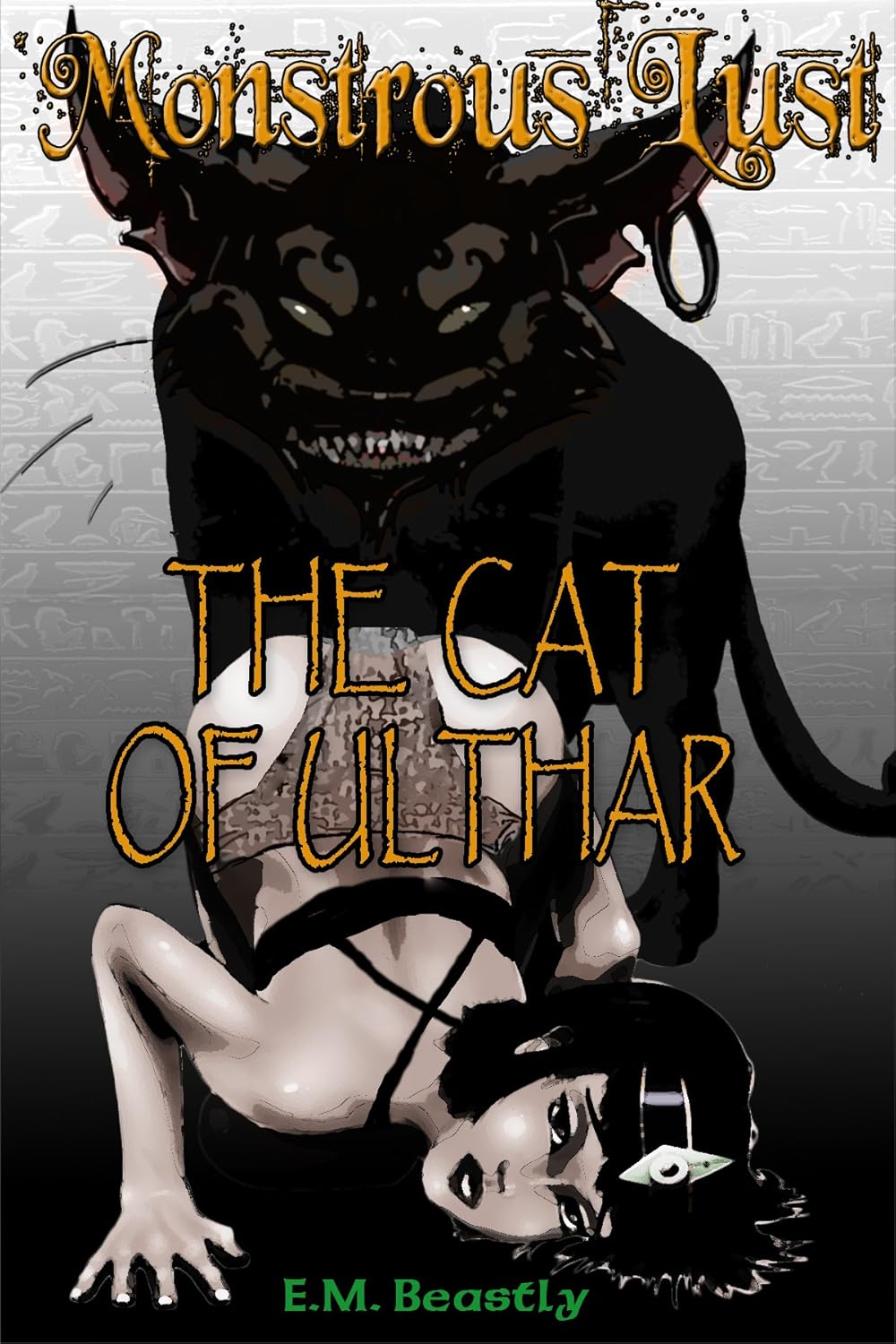
Monstrous Lust: The Cat of Ulthar (2017) by E. M. Beastly

Eldritch Fappenings
This review concerns a work of explicit adult literature. Reader discretion is advised.


There is an old legen in Ulthar, which lies beyond the river Skai, that no person can kill a cat. The legend speaks of a caravan full of strange wanderers. Some say they brought with them a blessing, others say a curse. From that day when a little boy lost his previous black kitten to an old cotter and his wife, the people of Ulthar did not dare kill a cat.

In Ulthar the cat became revered, cherished and praised. His the kind of the jungle’s lords, and heri to the secrets of hoary and sinister Africa. The Sphinx is his cousin, and he speaks her language; but is more ancient than the Sphinx, and remembers that which she hath forgotten.

As time went by, visitors to Ulthar said the cat became a powerful symbol.
—E. M. Beastly, Monstrous Lust: The Cat of Ulthar (2017)

According to Rule 34 of the Internet, there is porn of it. No exceptions. Strictly speaking, this is not true. It would be more accurate to say that the potential for erotic art and literature exists for every human conception. Diligent researchers would struggle to find, for example, a more explicit re-telling of H. P. Lovecraft’s “Sweet Ermengarde,” or lovingly rendered erotic fan-art of “Winged Death” (1934) by Hazel Heald & H. P. Lovecraft. There’s no reason for those adult works to not exist, but searchers after erotic horror will find vastly greater numbers of images dedicated to Cthulhu, Deep Ones, and shoggoths, shoggoths, shoggoths.

If porn of everything exists, it isn’t very evenly distributed. Some works and ideas attract more erotic attention and creativity than others.

Erotic works derived from Lovecraft’s “The Cats of Ulthar” exist in a relative minority compared to the erotic library spawned by “The Shadow over Innsmouth.” Lovecraft’s Dunsany-esque fantasy, part of the Dreamlands cycle, has no named characters, and as the name implies is primarily concerned with an episode involving domestic felines, told with the distinct style of a fable or just-so story. The erotic potential isn’t absent, but how to best adapt the themes and characters of the story to adult entertainment.

Well, there are the cats…

Erotic fanworks involving animal characters (expressive, talking animals, or fully anthropomorphic) have been around since at least the 1930s/1940s, when Tijuana bibles depicted erotic episodes of popular comic strip (e.g. Napoleon) and cartoon characters (e.g. Donald Duck). The emergence of an organized furry fandom from science fiction and comic book fandom would come in the 1970s and 80s, as a result of a convergence of factors, including the increased prevalence of fur-clad aliens in science fiction, the increase in shapechangers in fantasy, the success and sophistication of anthropomorphic characters in comics, cartoons, and animated films especially Disney’s Robin Hood (1973), and the late 60s/early 70s underground comic movement which included strong currents of parody, satire, and explicit sexuality that gave birth to characters like Fritz the Cat.

Technically speaking, Lovecraft got into the talking animals game in the 1920s when he wrote “The Dream-Quest of Unknown Kadath,” where the cats of the Dreamlands are not just intelligent but conversant with Randolph Carter. While Lovecraft isn’t usually seen as a precursor to contemporary furry fandom, it is clear that he was drawing from the idea of talking animals stories from stock collections of fairie tales and fables, and that he conceived the cats of Ulthar as capable of being characters in their own right. So when E. M. Beastly decided to riff off of Lovecraft for another entry in their Monstrous Lust series, the step from talking animal to anthropomorphic animal was less of a stretch than it might seem at first glance.

“Monstrous Lust: The Cat of Ulthar” is at once a sequel to and continuation of Lovecraft’s “The Cats of Ulthar,” and an erotic novella that takes the basic premise of the story in unexpected directions. While Lovecraft’s tale is horrible in the sense of Poe or Dunsany, Beastly takes things in a direction that seems to owe more to “The Shadow over Innsmouth,” where the cat-friendly law of Ulthar leads to more profound cultural changes, the rise of a dark cult, and finally physical expression in the bodies of the people of Ulthar. Until at last they disappear entirely, leaving behind a monstrous creature…the Cat of Ulthar.

While the concept is interesting, the execution is the real key. Here, the actual plot and writing of the story may disappoint readers. While the set-up of an Ulthar haunted by a sexy creature caught between human and cat with aspects of both has promise, in personality the eponymous Cat has a personality not unlike a sexually promiscuous version of the Cheshire Cat, and the two human characters who go to confront the creature are seduced and corrupted with a bare minimum of conflict. The stakes are low-to-nonexistent, the characters barely sketches, and the premise a bit weak. If you’re interested in passages discussing furry breasts and sexually explicit encounters between humans and a mystical cat-human hybrid, the story checks those boxes—but it doesn’t go far beyond that.

It is important to emphasize that there’s nothing inherently more taboo, weird, or perverted about anthropomorphic literature than any other kind. Nearly everyone has seen or read talking animal stories in some format, from Bambi to Br’er Rabbit, and anthropomorphism can apply to inanimate objects as easily as animals, as shown by the Transformers and Cars (2006). The same standards and good storytelling principles which apply to other literature also apply to anthropomorphic lit. As one reviewer put it:

On the surface, Bambi’s story is just what the subtitle says: A Life in the Woods. Yet one can find so much more in the story. The entire novel can be read as an existentaist parable, suggesting how one might make meaning in one’s own life. The novel is often seen as a disatribe against hunting, or more generally, a warning of the danger human beings pose to the natural world. The story can be read as castigating any system where the powerful exploit the weak, whether aristocracy or capitalism.

Yet Bambi is not a sermon. Salten’s beliefs and values are suggested on every page, but he doesn’t beat the reader over the head with them. He’s created characters that we as readers care about. Seeing them go through their struggles better enables us to contemplate our own lives. It is a story about its characters, not about issues; the issues become important to us because of the characters.
—Donald Jacob Uitvlugt, “Re-Reading a Classic: Bambi for the Furry Writer” in
A Glimpse of Anthropomorphic Literature (2016), 85-96

This is where “Monstrous Lust: The Cat of Ulthar” tends to fall flat; the characters fail to engage emotionally, and the story scenario doesn’t make sufficient use of the Lovecraftian setting and premise—which is, in Lovecraftian lit., a character in its own right. There’s humping and pumping, but without characters we care about. The setting is nominally Ulthar, but an Ulthar twisted into a Lovecraftian pastiche of itself, warped, twisted, depopulated, and barely present during the sexytimes. It is a fantasy sexual encounter that might easily be moved into any generical medieval setting with minimal effort.

Which is not to say that E. M. Beastly’s story is a failure, if that is exactly what the reader wants.


Bobby Derie is the author of Weird Talers: Essays on Robert E. Howard and Others and Sex and the Cthulhu Mythos.

Deep Cuts in a Lovecraftian Vein uses Amazon Associate links. As an Amazon Associate I earn from qualifying purchases.
“The Message of Thuba Mleen” (1911) by Aleister Crowley

“Was it because of the Desert’s curse?” I asked. And he said, “Partly it was the fury of the Desert and partly the advice of the Emperor Thuba Mleen, for that fearful beast is in some way connected with the Desert on his mother’s side.”
—Lord Dunsany, “The Hashish-Man” in A Dreamer’s Tales (1910)

To properly review “The Message of Thuba Mleen” (1911) by Aleister Crowley requires a little background on Crowley’s relationship with the Cthulhu Mythos and Lovecraft’s references to Crowley in his letters. Since this background is a bit long with numerous quotes, some handy links are provided above to help readers navigate to whichever section they want to go to.

Crowley & Cthulhu

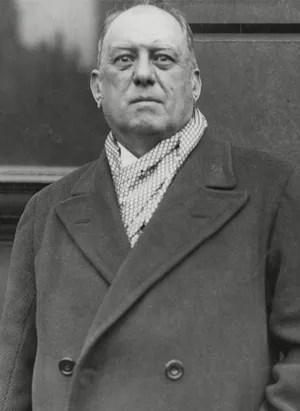
Aleister Crowley (1875-1947) never met H. P. Lovecraft (1890-1937) in life. Crowley was an English occultist, writer, poet, and artist who became notorious both for personal life and his mystical philosophy, which coalesced into the development of Thelema in the early 20th century. After his death, his systems of ceremonial magic and philosophy were developed by various successors and fed into the growing interest during the post-WWII spiritual awakening. Notably, his secretary Kenneth Grant worked to expand and integrate Crowley’s system of “magick” with other esoteric practices and even fictional material from writers like H. P. Lovecraft.

Although Lovecraft seems to have been unacquainted with Crowley’s work, it is evident that both were in touch with a source of power, ‘a prater-human intelligence’, capable of inspiring very real apprehension in the minds of those who were, either through past affiliation or present inclination, on the same wavelength. Whether this Intelligence is called Alhazred or Aiwaz (both names, strangely enough, evoking Arab associations) we are surely dealing with a power that is seeking ingress into the present life cycle of the planet.
— Kenneth Grant, “Dreaming Out of Space” in Man, Myth, and Magic (1970), vol. 23, 3215

Grant wasn’t the first to draw associations between weird fiction and magic; Le Matin des magicians (1960) by Louis Pauwels and Jacques Bergier referenced the perceived connection between Arthur Machen’s fiction and his membership in the Hermetic Order of the Golden Dawn (an occult organization of which Crowley was also a member). However, Grant did more than draw parallels; in his writing, he directly associated his understanding of Lovecraft’s Mythos into his exegesis of Crowley’s magick.

Fiction, as a vehicle, has often been used by occultists. Bulwer Lytton’s Zanoni and A Strange Story have set many a person on the ultimate Quest. Ideas not acceptable to the everyday mind, limited by prejudice and spoiled by a “bread-winning” education, can be made to slip past the censor, and by means of the novel, the poem, the short story be effectually planted in soil that would otherwise reject or destroy them.

Writers such as Arthur Machen, Brodie Innes, Algernon Blackwood and H. P. Lovecraft are in this category. Their novels and stories contain some remarkable affinities with those aspects of Crowley’s Cult deal with in the present chapter, i.e. themes of resurgent atavisms that lure people to destruction. Whether it be the Vision of Pan, as in the case of Machen and Dunsany, or the even more sinister traffic with denizens of forbidden dimensions, as in the tales of Lovecraft, the reader is plunged into a world of barbarous names and incomprehensible signs. Lovecraft was unacquainted both with the name and the work of Crowley, yet some of his fantasies reflect, however, distortedly, the salient themes of Crowley’s Cult. The following comparative table will show how close they are:
— Kenneth Grant, The Magical Revival (1972), 114

Grant then followed with a table of correspondences he perceived between Crowley and Lovecraft. A similar, though distinct, table was also included in the Necronomicon (1977) written by “Simon.” This was the first commercial hoax Necronomicon which was also explicitly a grimoire, something that was intended to mimic other collections of ceremonial magic rites, sigils, lore, etc. intended for use by practicing occultists. The introduction by “Simon” leaned heavily on the supposed correspondences between Lovecraft’s Mythos and Crowley’s magick.

We can profitably compare the essence of most of Lovecraft’s short stories with the basic themes of Crowley’s unique system of ceremonial Magick. While the latter was a sophisticated psychological structure, intended to bring the initiate into contact with his higher Self, via a process of individuation that is active and dynamic (being brought about by the “patient” himself) as opposed to the passive depth analysis of the Jungian adepts. Lovecraft’s Cthulhu Mythos was meant for entertainment. Scholars, of course, are able to find higher, ulterior motives in Lovecraft’s writings, as can be done with any manifestation of Art.
— “Simon” (Peter Levenda), Necronomicon (1977) xii

The ceremonial magic presented in the Simon Necronomicon was distinct from that in Grant’s system derived from Crowley; though they shared some common references in Lovecraft and Crowley’s respective mythos & magick. This unexpected complexity invited comparison, and sometimes fusion. From a metafictional perspective, it became the beginning of a parallel body of literature alongside the growing body of Cthulhu Mythos fiction: a Lovecraftian occult scene. One that started to flower when another Necronomicon, edited by George Hay, was published in 1978:

I had also been reading the works of Aleister Crowley—collected by my friend Roger Staples of Michigan University—and found the parallels so striking that I owndered if Lovecraft and Crowley had been acquainted.

Derleth was positive that they had never met—in fact, he doubted whether Lovecraft had ever heard of ‘the Great Beast’. If he had, Derleth seemed to think, he would have dismissed him as a charlatan and a poseur.
— Colin Wilson, “Introduction,” The Necronomicon: The Book of Dead Names (1978), 14

Wilson refers to a meeting with Derleth in 1967; later in the same introduction, he cites Grant’s merging of Lovecraftian Mythos with Crowleyian magick. The introduction was written with all the care of a good hoax; starting from a basis of facts and gradually weaving in fictional elements, to build up to the idea that Lovecraft’s Necronomicon wasn’t just a fictional book, but had been based on a genuine occult document from the Middle East—which is what the Hay Necronomicon was presented as.

So as the 1980s dawned and the Simon Necronomicon became available in an affordable paperback edition to grace New Age shelves forevermore, would-be Lovecraftian occultists had at least three separate sources to draw upon. All of them tried to tie H. P. Lovecraft to Aleister Crowley. The two men, who had never met in life, found elements of their legends entwined posthumously.

With the advent of the internet, it became easier for misinformation to spread. Colin Law’s Necronomicon Anti-FAQ (1995) was, like Wilson’s introduction, just a bit of fun—but it fostered certain misconceptions about Crowley and Lovecraft, despite repeated debunkings:

In 1918 Crowley was in New York. As always, he was trying to establish his literary reputation, and was contributing to The International and Vanity Fair. Sonia Greene was an energetic and ambitious Jewish emigre with literary ambitions, and she had joined a dinner and lecture club called “Walker’s Sunrise Club” (?!); it was there that she first encountered Crowley, who had been invited to give a talk on modern poetry. […]

In 1918 she was thirty-five years old and a divorcee with an adolescent daughter. Crowley did not waste time as far as women were concerned; they met on an irregular basis for some months.

In 1921 Sonia Greene met the novelist H.P. Lovecraft, and in that same year Lovecraft published the first novel where he mentions Abdul Alhazred (“The Nameless City”). In 1922 he first mention the Necronomicon (“The Hound”). On March 3rd. 1924, H.P. Lovecraft and Sonia Greene married.

We do not know what Crowley told Sonia Greene, and we do not know what Sonia told Lovecraft. 

Edwin C. Walker (1849-1931) was a radical liberal who founded the Sunrise Club in 1889; this interracial club held dinner meetings at which speakers were invited to discuss on a wide range of topics. According to L. Sprague de Camp’s H. P. Lovecraft: A Biography (1975), Sonia joined the club c. 1917 (160-161); and there is a reference to Sonia’s membership in one of Lovecraft’s letters (LFF 1.83). I have yet to find any reference to Crowley addressing or attending the club. Given he lived in the United States from 1914-1919 and was often living in New York City at the time, it is possible, if not necessarily plausible that he could have attended some evening.

There is no reference to Crowley in any of Sonia’s surviving letters, essays, or autobiography; no mention of grimoires or the Necronomicon. The idea that Lovecraft got the idea of the Necronomicon from Crowley by way of Sonia is unsupported by any evidence and relies on the idea that the Necronomicon bears some similarity to Crowley’s The Book of the Law—the same supposition pushed by Grant and Simon, among others. It is rather telling that nothing in Crowley’s own writings supports his meeting with Sonia either, and that all references to the idea of their meeting ultimately derive from Low. For more on this and other Necronomicon-related hoaxes and occult history, see The Necronomicon Files by Daniel Harms & John W. Gonce III.

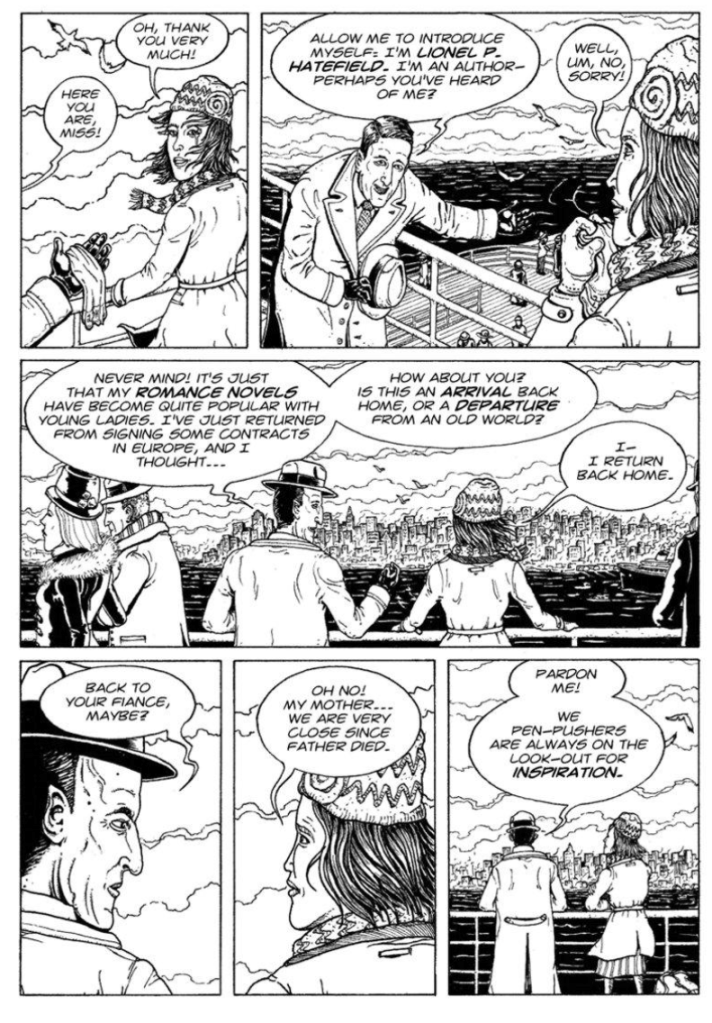
It’s easy to go on, although facts and fiction get furiously muddled. Despite Grant’s assertion that Lovecraft had never heard of Crowley and Derleth’s assertion (as related by Wilson) that Lovecraft may not have heard of Crowley and certainly never met him, fictional meetings between the writer of the weird and the prophet of Thelema have increasingly featured in books and comics, one notable example being The Arcanum (2007) by Thomas Wheeler. Yet my favorite hypothetical meeting is a 1927 chess game between Aleister Crowley and Wilbur Whateley:

If Derleth did tell Colin Wilson that he doubted Lovecraft had ever heard of Crowley and this wasn’t another part of the hoax, then he was badly mistaken and should’ve known better. Lovecraft’s letters give considerable detail on his thoughts regarding Aleister Crowley.

H. P. Lovecraft on Aleister Crowley

The Crowley cutting is interesting. What has the poor devil-worshipper been up to now? When I was in Leominster (near Athol) with Cook & Munn last month, calling on a bookseller, I saw a copy of a book by Crowley—“The Diary of a Drug-Fiend.” The merchant informed me that it has been suppressed by some branch of the powers that be—though he agreed to part with his copy for three thalers. I did not take him up—but I told Belknap about the offer.
–H. P. Lovecraft to Wilfred B. Talman, [8 Jun 1929], LWT 114

In 1929, French authorities deported Crowley, which led to sensationl articles (Why France Finally Kicked Out the High Priest of the Devil Cult), and a similar cutting was no doubt passed to Lovecraft. From this first reference in Lovecraft’s letters, it isn’t clear when exactly the Old Gent from Providence became aware of Aleister Crowley, but the suggestion seems to be that Lovecraft was at least passingly familiar with the magus by the late 1920s, probably from similar newspaper clippings. From Lovecraft’s comments, his friend Frank Belknap Long, Jr. had an interest in Crowley…a greater interest than Lovecraft himself had:

Aleister Crowley still keeps in the news! Don’t take any especial trouble to send the clipping unless you find it lying around, for my interest in the gent is perhaps less intense than Belknap’s.
–H. P. Lovecraft to Wilfred B. Talman, [7 Jul 1929], LWT 116

In 1930, Percy Reginald Stephensen’s The Legend of Aleister Crowley: Being a Study of the Documentary Evidence Relating to a Campaign of Personal Vilification Unparalleled in Literary History was published, ostensibly to ameliorate Crowley’s reputation. Lovecraft apparently caught a few reviews:

And speaking of your precious files—have you seen reviews of the new book about that suave diabolist Aleister Crowley? Belknap sent me a cutting from the Tribune. The biographer—abetted by the reviewer—(Hebert S. Gorman, who claims to have dined with Crowley) tries to depict the reputed ally of Satan as a much-wronged and basically blameless poet—whose eccentricities are merely the harmless foibles of genius!
–H. P. Lovecraft to Wilfred B. Talman, [Sep 1930], LWT 133-134

Years passed. Crowley’s infamy was such that he served as the basis for several fictional magicians, most notably the character of Oliver Haddo in Somerset Maugham’s The Magician (1908); the black magician Oscar Clinton in H. R. Wakefield’s “He Cometh and He Passeth By” (1928) (and later, Apuleius Charlton in “The Black Solitude” (1951)); and, though Lovecraft never lived to see it, Rowley Thorne in the stories fellow Weird Tales writer Manly Wade Wellman, in one such story, “The Letters of Cold Fire” (WT May 1944), Thorne attempts to obtain a copy of the Necronomicon!

Lovecraft had not read Maguham’s novel, but was aware of its association with Crowley:

I’ve never seen the Ramuz & Maugham items. Poor old Crowley figures more than once in fiction—for I believe it is her upon whom the villain in Wakefield’s “He Cometh & He Passeth By” is modelled.
–H. P. Lovecraft to Richard Ely Morse, 22 Mar 1932, LHB 42

“Ramuz” may be a reference to C. F. Ramuz La Regne de l’esprit Malin (1917) tr. by James Whitall as The Reign of the Evil One (1922). The novel seems to draw no direct inspiration from Crowley, being about a stranger (who might be the devil himself) who comes to a small Swiss town and turns it into hell.

Lovecraft did read Wakefield, however, and was appreciative.

Wakefield’s stuff is generally very good, & I’m glad you’ve had an opportunity to read it. Of the tales in the first book my favourites are “He Cometh & He Passeth By” (the villain in which is a sort of caricature of the well-known living mystic & alleged Satanist Aleister Crowley), “The Red Lodge”, “The 17th Hole at Duncaster[“], & “And He Shall Sing”.
–H. P. Lovecraft to Robert Bloch, [22 Jul 1933], LRBO 62

Glad to see the item about Crowley. What a queer duck! He is the original of Clinton in Wakefield’s “They Return at Evening.”
– H. P. Lovecraft to Clark Ashton Smith, [14 Dec 1933], DS 507

Wakefield is pretty good—I’ll enclose “They Return at Evening” as a loan in the coming shipment. You’l probably find at least four of the tales especially absorbing—“The Red Lodge”, “He Cometh & He Passeth By” based on Aleister Crowley), “And He Shall Sing”, & “The Seventeenth Hole at Duncaster.”
–H. P. Lovecraft to Clark Ashton Smith, [Jan 1934], DS 515

Clark Ashton Smith, when he read the “He Cometh and He Passeth By,” gave his own opinion to Lovecraft:

I read one of the Wakefield stories last night—“He Cometh and he passeth by—” and found it excellent, especially in the suggestion of the diabolic Shadow. Crowley is surely a picturesque character, to have inspired anything like Clinton! I know little about Crowley myself, but wouldn’t be surprised if many of the more baleful elements in his reputation were akin to those in the Baudelaire legend . . .  that is to say, largely self-manufactured or foisted upon him by the credulous bourgeoisie.
– Clark Ashton Smith to H. P. Lovecraft, [Jan 1934], DS 520

Lovecraft’s reply reveals something new—an acquaintances of his had actually met Crowley:

As for Aleister Crowley—I rather thought at first that his evil reputation was exaggerated, but Belknap says that Harré has met him & has found him indescribably loathsome in mind, emotions, & conduct. This from Harré is quite a damning indictment, for Belkanp tells me that T. Everett himself is far from squeamish or fastidious in his language & anecdotes when amidst the sort of company that dissolves inhibitions. But Crowley was too much for him. He didn’t relate particulars—but said that the evil magus made him so nauseated that he left abruptly. I guess Crowley is about as callous, unclean-minded, & degenerate a bounder as one can often find at large—though he undoubtedly has talents & scholarship of a very high order. It seems to me I heard that he is in New York now—London won’t stand him any longer. And this reminds me that I forgot to return that old cutting of yours which mentions him—permit me to repair the omission now.
–H. P. Lovecraft to Clark Ashton Smith, [11 Feb 1934], DS 525

In 1933-1934, Crowley appears to have primarily been in London, dealing with a libel suit (which he lost). I have not discovered anything to suggest he went to New York at this time. However, Harré’s papers contain a folder associated with Aleister Crowley, so they may well have met or interacted at some point. It is also known that Harré and Crowley were published together in The International in 1915, so possibly the meeting occurred over a decade and a half earlier, when Crowley was in New York, and Lovecraft misunderstood.

Smith responded:

Judging from Harré’s reactions, it would appear that Aleister Crowley is a pretty hard specimen. I had discounted the legends on general principles, knowing nothing whatever about the mysterious magus.
–Clark Ashton Smith to H. P. Lovecraft, [Mar 1934], DS 536

At this point, Crowley became a reference point for diabolists and occultists of all stripes.

The case of the Boer lady—Mevrouw van de Riet—certainly offers dark food for the imagination. She seems to be a sort of female Aleister Crowley—or a striga, lamia, empusa, or something of the sort.
–H. P. Lovecraft to Clark Ashton Smith, [18 Nov 1933], DS 479

The subject would next come up when Lovecraft began corresponding with the young fan Emil Petaja in 1935, when the subject turned toward the Black Mass, Satanism, and the occult. Lovecraft was an atheist and materialist, but he had read something of the occult for research purposes over the years, and picked up other tidbits:

In the 1890’s the fashionable decadents liked to pretend that they belonged to all sorts of diabolic Black Mass cults, & possessed all sorts of frightful occult information. The only specimen of this group still active is the rather over-advertised Aleister Crowley . . . . who, by the way, is undoubtedly the original of the villainous character to H. R. Wakefield’s “He Cometh & He Passeth By.”
–H. P. Lovecraft to Emil Petaja, 6 Mar 1935, LWP 414

Petaja apparently pursued the subject with Lovecraft, who responded at greater length, apparently still under the misconception that Crowley was in New York:

Regarding the Black Mass & its devotees—it is really even more repulsive than fascinating. The whole thing is described minutely in Joris-Karl Huysmans’ “Las Bas”—which was posthumously translated into English in 1923 & promptly suppressed. The Black Mass consisted in general of a malevolent & incredibly obscene parody on the Catholic Mass—involving public actions & natural substances almost impossible to describe in print. It originated in the Middle Ages, & has [ev]er since been secretly celebrated by groups of half-crazed, psychologically degenerate sensation-seekers—largely in the great metropolitan centres. Paris, Berlin, London, & New York are probably its greatest centres today. It seems to draw its devotees almost equally from the decadent artist class & from the general run of over-sophisticated psychopathic personalities. Aleister Crowley is a now-elderly Englishman who has dabbled in this sort of thing since his Oxford days. He is really, of course, a sort of maniac or degenerate despite his tremendous mystical scholarship. He has organised secret groups of repulsive Satanic & phallic worship in many places in Europe & Asia, & has been quietly kicked out of a dozen countries. Sooner or later the U.S. (he is now [in] N.Y.) will probably deport him—which will be bad luck for him, since England will probably put him in jail when he is sent home. T. Everett Harré—whom I have met & whom Long knows well—has seen quite a bit of Crowley, & thinks he is about the most loathsome & sinister skunk at large. And when a Rabelaisian soul like Harré (who is never sober!) thinks that of anybody, the person must be a pretty bad egg indeed! Crowley is the compiler of the fairly well-known “Oxford Book of Mystical Verse”, & a standard writer on occult subjects. The story of Wakefield’s which brings him in (under another name, of course) is in the collection “They Return at Evening”, which I’ll lend you if you like.
–H. P. Lovecraft to Emil Petaja, 5 Apr 1935, LWP 420-421

The Oxford Book of English Mystical Verse (1918) was compiled by D. H. S. Nicholson and A. H. E. Lee; but the book contains three poems by Crowley. The reference to “phallic worship” suggests that Harré may have confided something to Lovecraft about Crowley’s practice of sex magick, but this is as close as Lovecraft would ever come to mentioning the subject. Lovecraft apparently lent Petaja a cutting about Crowley:

Keep the review of the O’Donnell book—& here’s another from the Times. I’d like to see the Crowley one again—though there’s no hurry.
– H. P. Lovecraft to Emil Petaja, 31 May 1935, LWP 433

Elliott O’Donnell was a well-known collector of ghost and haunted house stories.

As it turned out, Lovecraft wasn’t the only one who knew someone that knew Crowley:

Conversation with one who has known the fabulous Aleister Crowley must surely have been interesting! I’ve seen several articles on this curious & repulsive entity, & am familiar with the portrayal in “He Cometh & He Passeth By”—though I have not read Maugham’s “Magician.” One other side-light comes from the amiable & picturesque source T. Everett Harré—editor of “Beware After Dark.” Harré has met Crowley; & although himself something of a specialist in corpological diction & anecdote, avers that the Hellish Archimage actually sickened him with the tone & subject-matter of his conversation. And anything or anybody capable of sickening the hard-boiled & perpetually pickled T. Everett must be—in the language of Friend Koenig—pretty strong meat! Crowley is evidently a tragic example of diseased & degenerate development in certain lines. Whether such a mass of psychological putrescence ought to be allowed at large is a sociological question too tough for a layman to tackle. The answer would really depend upon just how much social effect he has. But in any case he is obviously one of those “gamey” specimens who are much pleasanter to read & speculate about than to meet! Of his genius—of a sort—there can be no doubt. I believe he is an important contributor to a standard anthology which I’ve never read—“The Oxford Book of Mystical Verse.”
–H. P. Lovecraft to Richard Ely Morse, 25 Apr 1936, LHB 125

This is Lovecraft’s final published letter on Aleister Crowley—and it’s interesting to note that Lovecraft’s information is entirely second- or third-hand. At no point does he give any indication of having read any of Crowley’s prose or poetry, much less any of his magickal writings. To Lovecraft, Crowley was already essentially a living legend. There is no indication that any information passed between them.

Which doesn’t mean there isn’t a connection between Aleister Crowley and the Lovecraft Mythos.

“The Message of Thuba Mleen” (1911)

Many believe that it was a message from Thuba Mleen, the mysterious emperor of those lands, who is never seen by man, advising that Bethmoora should be left desolate.
—Lord Dunsany, “Bethmoora” in A Dreamer’s Tales (1910)

In 1911, Aleister Crowley was in France, writing prolifically as he finished the books of Thelema, a considerable body of poetry, and the occasional review. One work that particularly caught his imagination was A Dreamer’s Tales (1910) by Lord Dunsany. This was the fourth collection of Dunsany’s fantasies, and a strong influence on H. P. Lovecraft. Crowley was inspired by the book to write a review titled “The Big Stick,” published in his own magazine The Equinox in 1911. Appended to the review is Crowley’s poem “The Message of Thuba Mleen.”

The Message of Thuba Mleen

I.

Far beyond Utnar Véhi, far beyond
The Hills of Hap,
Sits the great Emperor crowned with diamond,
Twitching the rosary in his lap—
The rosary whose every bead well-conned
With sleek unblinking bliss
Was once the eyeball of an unborn child of his.

II.

He drank the smell of living blood, that hissed
On flame-white steel.
He tittered while his mother’s limbs were kissed
By the fish-hooks on the Wheel
That shredded soul and shape, more fine than mist
Is torn by the bleak wind
That blows from Kragua and the unknown lands behind

III.

As the last flesh was flicked, he wearied; slaves
From bright Bethmoora
Sprang forward with carved bowls whose crimson craves
Green wine of hashish, black wine of datura,
Like the Yann’s earlier and its latter waves!
These wines soothed well the spleen
Of the Desert‘s bastard brother Thuba Mleen.

IV.

He drank, and eyed the slaves “Mwass, Dagricho, Xu-Xulgulura,
Saddle your mules!” he whispered, “ride full slow
Unto Bethmoora
And bid the people of the city know
That that most ancient snake,
The Crone of Utnar Véhi, is awake.”

V.

Thus twisted he his dagger in the hearts
Of those two slaves
That bore him wine ; for they knew well the arts
Of Utnar Véhi—what the grey Crone craves!—
Knew how their kindred in the vines and marts
Of bright Bethmoora, thus accurst,
Would rush to the mercy of the Desert’s thirst.

VI.

I would that Māna-Yood-Sushāī would lean
And listen, and hear
The tittering, thin-bearded, epicene.
Dwarf, fringed with fear,
Of the Desert’s bastard brother Thuba Mleen!
For He would wake, and scream
Aloud the Word to annihilate the dream

Thuba Mleen appeared in two of the stories in A Dreamer’s Tales: “Bethmoora” and “The Hashish Man.” Lovecraft never used the mysterious emperor directly, but Bethmoora appeared in a long list of names and places:

I found myself faced by names and terms that I had heard elsewhere in the most hideous of connexions—Yuggoth, Great Cthulhu, Tsathoggua, Yog-Sothoth, R’lyeh, Nyarlathotep, Azathoth, Hastur, Yian, Leng, the Lake of Hali, Bethmoora, the Yellow Sign, L’mur-Kathulos, Bran, and the Magnum Innominandum—and was drawn back through nameless aeons and inconceivable dimensions to worlds of elder, outer entity at which the crazed author of the Necronomicon had only guessed in the vaguest way.
—H. P. Lovecraft, “The Whisperer in Darkness” (1931)

So it was that Crowley and Lovecraft shared at least one influence; and in Lord Dunsany they both found inspiration, and they both created new works that tied into his dreamer’s tales—and by extension, because they were both building off Dunsany’s Dreamlands, so did their own dreams touch, or were in communion, all unknowing. “The Message of Thuba Mleen” stand easily with any of the other dream cycle stories and verses inspired by Dunsany and Lovecraft, with their strange names and dark, suggestive hints.

Many occultists looked for a common source between the two, and sought to create a shared origin for the Necronomicon and the Book of the Law; to tie Crowley to Cthulhu, and Magick to Mythos. Yet the shared Mythos was there all along, in a half-forgotten poem. The two were not tied together by any dark secret or occult truth, but by an appreciation for the great fantaisiste, Lord Dunsany.

And always will be, ’til wakes Māna-Yood-Sushāī.


Bobby Derie is the author of Weird Talers: Essays on Robert E. Howard and Others and Sex and the Cthulhu Mythos.

Deep Cuts in a Lovecraftian Vein uses Amazon Associate links. As an Amazon Associate I earn from qualifying purchases.
Yuggoth Rising: Erster Act (2012) by Sebastien Dietz

En Episches Abenteuer in den Welten H. P. Lovecrafts

Back cover copy of Yuggoth Rising #1

“An Epic Adventure in the world of H. P. Lovecraft,” is what is promised, and that is what writer/artist Sebastien Dietz sets out to deliver. Yuggoth Rising is a German-language black-and-white 9-issue independent comic series, originally produced by Undergroundcomix.de in 2012. While physical issues were limited in number and now quite scarce, the series is collected in both German and English through Comixology/Amazon Kindle in three acts, beginning with Yuggoth Rising: Erster Act (Deutsch) / Yuggoth Rising: First Act (English, translated by Craig Stanton).

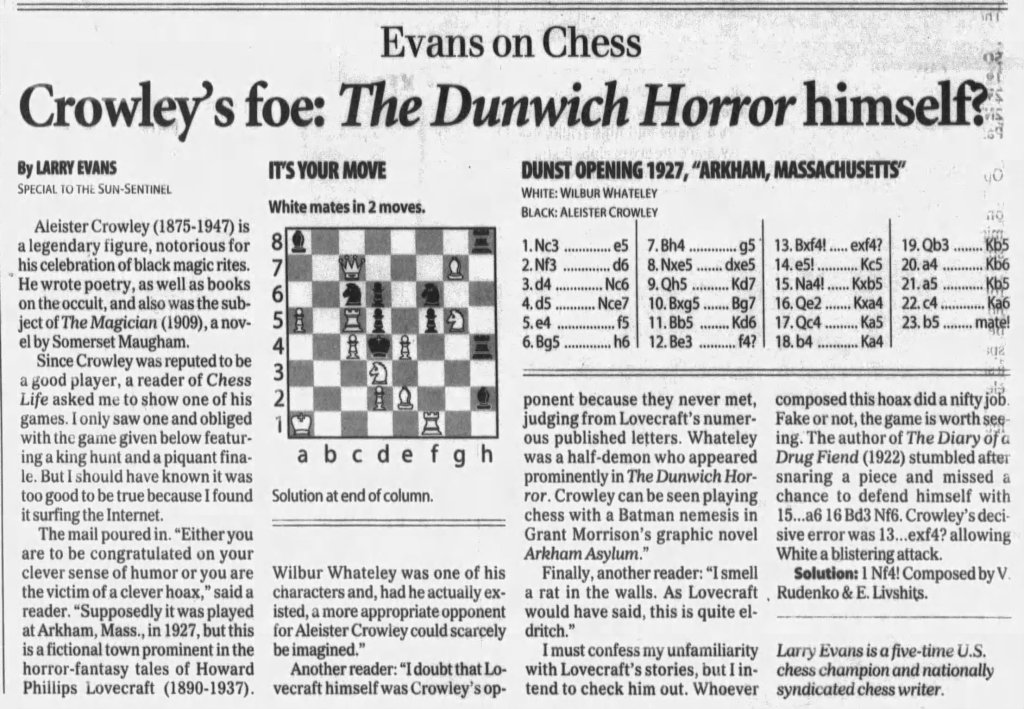
The epic adventure gets off on a bit of a left foot. February 1930, the Great Depression is settling in as our protagonist, an unemployed but educated young woman, returns to New York City—and on the ship runs into Lionel P. Hatecraft, author of popular romances.

At first glance, this is a set-up for a farce; in light of what comes later, it may be more appropriate to think of it as an unsubtle hint that while this takes place in the world of Lovecraft’s Mythos, this is not the world we know, the one that Lovecraft inhabited. Like the future envisaged by Robert W. Chambers in “The Repairer of Reputations,” or the 1920s and 30s envisaged in the Call of Cthulhu Roleplaying Game, this is a subtly different setting.

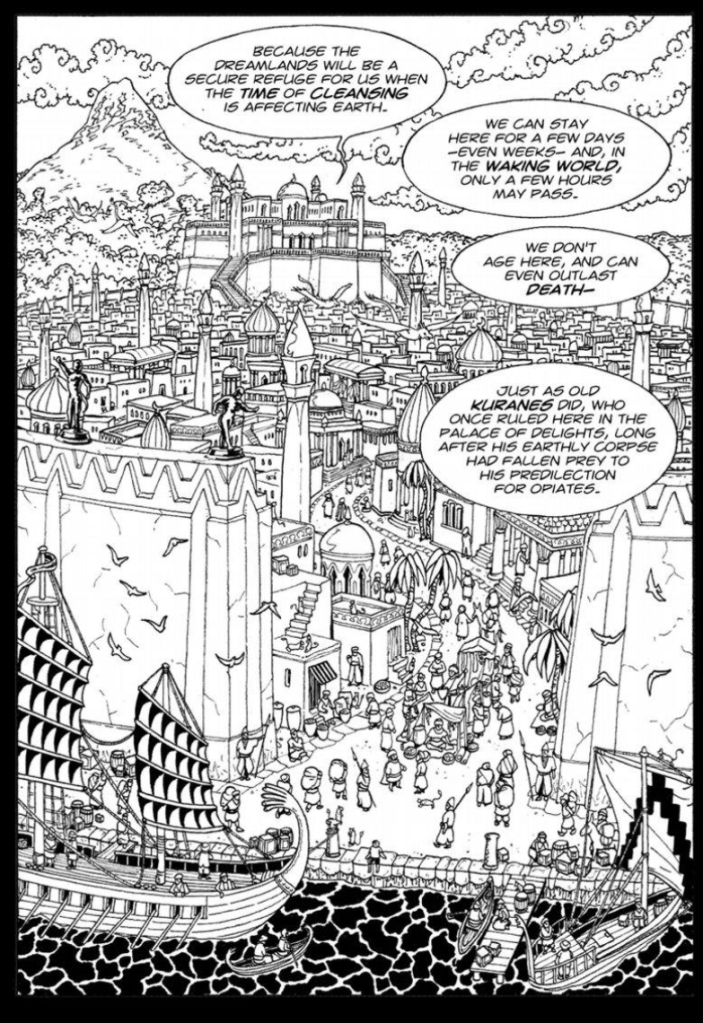
Dietz’ art is detailed, and cityscapes, streets, buildings, and ships are especially well-executed; he has an eye for splashes of darkness that stand out against the page. If there’s a criticism of his work, it is his human figures, whose heads are often slightly oversized in proportion to their bodies—but that’s more in the nature of a stylistic convention than a flaw. When he does break out for splash pages, the effect is worth it.

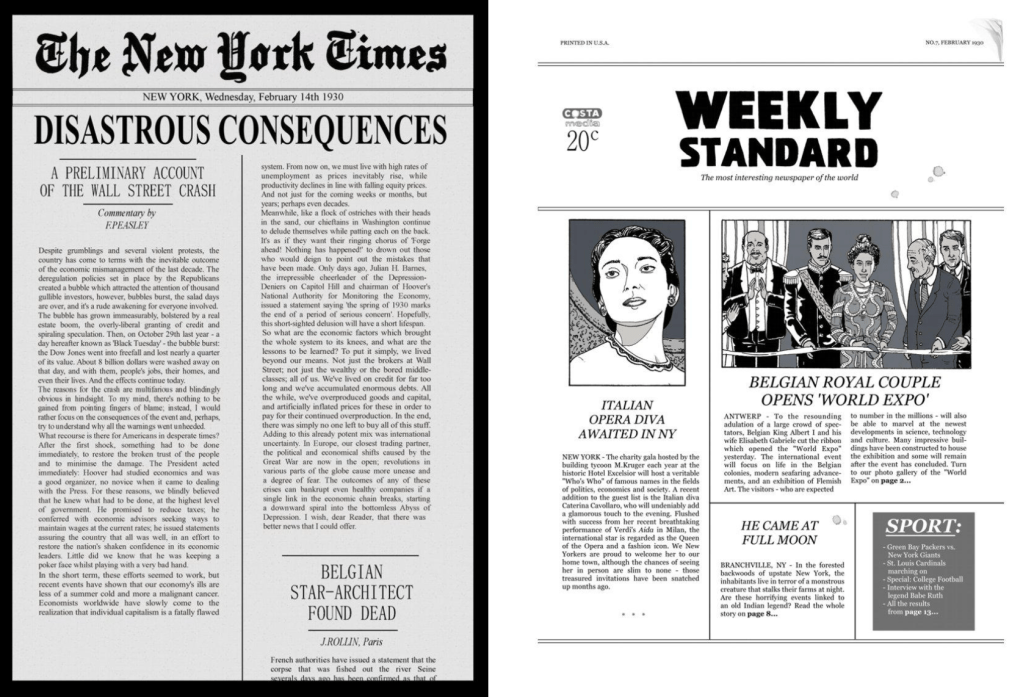
It’s not a tale told exclusively in comic panels. The end of each issue is punctuated by letters, articles, pages from magazines and newspapers, a convention used in other works to give the series a lived-in feel, to expand on things happening in many places during the same time period. Some of which are connected, and some of which are not.

Dietz’ story takes a broadly familiar shape: different threads, interweaving; widely separated characters working their way together until they meet. A young woman down on her luck, a brilliant expert in Mayan script, a millionaire embroiled in an international conspiracy, a slightly seedy newspaper porter on the werewolf-and-alien beat…ancient mysteries, the hunt for Planet X, and the Unaussprechlichen Kulten. The story moves at its own pace, neither too slowly or too quickly in this first act, these first three issues…

…but it just the opening act, the preliminaries. What revelations are here are just the beginning; our characters haven’t all met yet, the epic adventure has just begun. Taken by itself, it is promising…but readers shouldn’t be expecting “At the Mountains of Madness” or “The Shadow Out of Time,” although it takes a few cues from those works. Dietz’ inspirations more likely lie in Call of Cthulhu the Roleplaying Game, or the slightly pulpier adventures of August Derleth’s Trail of Cthulhu. The story of Yuggoth Rising—if the name isn’t clue enough—is things moving into place, the stars becoming right, cults and investigators getting into position, to destroy the world or redeem it.

If that sounds familiar, it’s because “when the stars are right” is the natural end-game of the Mythos; the Ragnorok or End Times, the eschatological frontier that looms in the unspecified future. Alan Moore and Jacen Burrows worked with that idea at the end of Providence, Jonas Anderson & Daniel Thollin did the same in 1000 Ögon: Cthulhu, and there are dozens of literary examples, in Cthulhu’s Reign and elsewhere. As with every Mythos story, it is less the tropes that are important than how it is told, how the characters develop and toward what end.

None of which a reader can tell in Yuggoth Rising: Erster Act, not on a first reading. On subsequent readings, readers can pick out more details, foreshadowings, hints that maybe they overlooked. Dietz has done a very credible job in setting the stage…and it is fortunate that this is a case where readers of both English and German have the opportunity to read it to the end, even if only digitally.


Bobby Derie is the author of Weird Talers: Essays on Robert E. Howard and Others and Sex and the Cthulhu Mythos.

Deep Cuts in a Lovecraftian Vein uses Amazon Associate links. As an Amazon Associate I earn from qualifying purchases.
The Dream-Quest of Vellitt Boe (2016) by Kij Johnson

In a land defined by dreaming men and bickering gods, there were no sure rules, but there was also no certain randomness.
—Kij Johnson, The Dream-Quest of Vellitt Boe 133-134

You don’t have to have read Lovecraft or Dunsany to appreciate The Dream-Quest of Vellitt Boe. Without those references, it is still a very competent fantasy novelette. Johnson has a good eye for detail, characterization, description; the plot moves quick, never gets hung up too long in one place, one peril. Vellitt Boe is on a mission, after all.

That being said, without the historical context of Lovecraft and Dunsany, The Dream-Quest of Vellitt Boe is in danger of being misunderstood as a generic fantasy novel, of the sort inspired by a thousand sessions of Dungeons & Dragons, Tunnels & Trolls, or Fighting Fantasy. This comes almost as a consequence of how you get from Lord Dunsany to Kij Johnson, and to really appreciate what she is doing in this novelette and how it got there requires a bit of background. 

H. P. Lovecraft discovered Lord Dunsany in 1919. The Anglo-Irish peer had created an artificial mythology in his tales of Pegāna, which would inspire Lovecraft’s own mythos, and the stories of “Beyond the Fields We Know” in Tales of Three Hemispheres (1919) including “Idle Days on the Yann” and “The Shop in Go-By Street” would lay the groundwork for Lovecraft’s Dreamlands.

It is important to remember that Lovecraft built his Mythos over time, defining and re-defining it as time went on and other influences came to bear. “The Cats of Ulthar” (written June 1920) was not originally set in the Dreamlands; it was a generic fantasy. The first actual Dreamlands story was “Celephaïs” (written November 1920). In later fiction, these early fantasies and their names and geographies would be subsumed into the Dreamlands—and the “Dream Cycle” with its vagaries and contradictions (were exactly is Leng?) have given compilers of Mythos-lore much to chew on and argue about.

Randolph Carter came into existence in 1919 as well, in “The Statement of Randolph Carter.” This early story had nothing to do with the Dreamlands either; Lovecraft recorded a dream in his letters involving himself and his friend Samuel Loveman. In turning the dream into a story, Loveman became “Hartley Warren” and Lovecraft himself became “Randolph Carter.” The character became a self-identified counterpart for Lovecraft himself in his stories, though he appeared in only a few of them, notably “The Silver Key” (1926), which is the only one that was a Dreamlands tale until The Dream-Quest of Unknown Kadath (written 1926-1927).

Lovecraft’s Dream-Quest is fundamentally different from anything he wrote before or since. Maybe that is why in part it found no publication during his lifetime. Too long, too weird, too inexplicably full of adventure—it is this novelette which binds together Lovecraft’s “dream” stories, early fantasies, and Randolph Carter stories. Without Dream-Quest, you could argue the Dreamlands are still a part of the Mythos, but places like Ulthar wouldn’t be a part of it. This was the story that really gave the scope and connective tissue that bound much of Lovecraft’s early fiction together. In structure and conception, it is much more similar to David Lindsay’s A Voyage to Arcturus (1920) or E. R. Eddison’s The Worm Ouroboros (1922) than anything else.

There aren’t really any women in it.

Which is true for much more of Lovecraft’s fiction than just The Dream-Quest of Unknown Kadath. As discussed in Sex and the Cthulhu Mythos, Lovecraft does have female characters in his stories, but the gender balance is distinctly skewed towards male characters. In large part, this seems to be simply because Lovecraft seldom made a character female unless there was a reason for her to be female. Which is why the only absolute reference to women in Dream-Quest is:

It is known that in disguise the younger among the Great Ones often espouse the daughters of men, so that around the borders of the cold waste wherein stands Kadath the peasants must all bear their blood. 

That’s it. There are other references to women in some of the other stories, if you look hard enough—the cat-killing wife in “The Cats of Ulthar” for example—but for the most part, women are implicit. Priests, but no priestesses. “Men” as a generic term for all persons of every gender, in the very 18th century sense. Rapacious gods of the Greco-Roman school, but no lusty goddesses bedding the handsome young men around Kadath.

It was in this context that Kij Johnson wrote her own Dream-Quest, and it is in many ways both a continuation of the tradition of Dunsany and Lovecraft, and a reflection on those works.

And I must of course acknowledge Lovecraft’s The Dream-Quest of Unknown Kadath. I first read it at ten, thrilled and terrified, and uncomfortable with the racism but not yet aware that the total absence of women was also problematic. This story is my adult self returning to a thing I loved as a child and seeing whether I could make adult sense of it.
—Kij Johnson, “Acknowledgements” in The Dream-Quest of Vellitt Boe 167

Johnson did the work, sifted the stories. The story is set between “The Silver Key” and “Through the Gates of the Silver Key”; it references Lovecraft’s geography and zoology, but also subtly grounds and expands them. The Dreamlands are seen through the eyes of a native, an intelligent and experienced woman who knows more of how things work and finds delight in them. The skill of her construction is such that she never needs to cite a story specifically; it is never written that “In Ulthar no man may kill a cat,” because the idea is implicit in the story: no one even thinks of trying to kill a cat in Ulthar. It simply doesn’t come up. More amusingly and refreshingly, we get little anecdotes like how a young Vellitt Boe tried to climb Hatheg-Kla under the logic that it was only said no man could climb it. A neat bit which feels a bit like Éowyn taking a swing at the Witch-King of Angmar.

The story is at its best when it is showing rather than telling. Why not a woman’s college in Ulthar? Why not a female far-traveler? Nothing in Randolph Carter’s dream-quest required him to have a penis, so what’s to stop a woman from having her own adventure in the Dreamlands? Absolutely nothing.

The story is arguably at its weakest when it stops showing and starts telling.

She had never met a woman from the waking world. Once she asked Carter about it.

“Women don’t dream large dreams,” he had said, dismissively. “It is all babies and housework. Tiny dreams.”

Men said stupid things all the time, and it was perhaps no surprise that men of the waking world might do so as well, yet she was disappointed in Carter. Her dreams were large, of trains a mile long and ships that climbed to the stars, of learning the languages of squids and slime-molds, of crossing a chessboard the size of a city. That night and for years afterward, she had envisioned another dream land, built from the imaginings of powerful women dreamers. (ibid. 71-72)

In narrative terms, the characterization of Randolph Carter as a bit of a straw-man serves its purpose only in highlighting Boe’s struggles as a woman. Even in the Dreamlands, there are gender norms and imbalances; the women’s college of Ulthar is the youngest and most vulnerable of the seven universities, and even a hint of scandal could see it closed, upper education cut off. In that sense, Johnson needed some character to personify the casual misogyny that Boe quested against as much as anything else.

Carter as a mouthpiece is problematic mainly because he never voices such views in Lovecraft’s fiction, and as he is implicitly Lovecraft’s alter-ego (though Johnson does not make this point) it can be read as Johnson putting words in Lovecraft’s mouth. While Lovecraft did evince a few chauvinistic statements during his life, he never wrote anything like what Carter says in Johnson’s Dream-Quest. The statement (“powerful women dreamers” is a great line) needed to be made at some point, if for no other reason than it sets up the finale, but the characterization seems off; rather like Ervin Howard in “The Ballad of Black Tom” (2016) by Victor LaValle. If a dead horse is going to be beaten, at least beat it for something it actually did.

There is a line in the story that may be uncomfortable, but then it would be a sad world where such a line would be otherwise:

As a young woman, when she had been beautiful and had worn her hair short and her clothes loose to conceal that fact, she had known all the signs of men and read them well enough that she had been successfully robbed only three times and raped once; but none of those had burned from her the hunger for empty spaces, strange cities, new oceans. (ibid. 83)

Nothing of the act, which happened sometime in the far past, is shown. Which is good; the last thing the story needed was an exploitative recap, some trauma porn of the effect and slow recovery. The event happened, it didn’t define her. It is also not the only mention of rape in the story; Vellitt Boe is traveling mostly alone in a quasi-Early Modern fantasy world. Sexual assault need not have a gender bias (the setting rarely hints at lesbianism as a possibility, and male homosexuality is completely absent from the text) but old habits die hard. How many women traveling alone today have the same fear?

Which is perhaps the one real criticism of The Dream-Quest of Villett Boe. It is great for what it is, but if the purpose was to have a message as well tell a story, it feels like it could have been that much better. Why aren’t there any female gods in the Dreamlands? Why aren’t there any female dreamers? Johnson wasn’t obliged to stick to Lovecraft or Dunsany in every regard, and doesn’t. Yet her Dreamland is almost too close to the waking world in some of its gender constructs and mores.

You might be interested to know that at the party one very bright young woman described her adolescent reading of SF as a genuinely subversive force in her life, a real alternative to the fundamentalist community into which she had been born. This alternative had nothing to do with the cardboard heroes and heroines or the imperial American/engineering values which she had skipped right over. What got to her were the alien landscapes and alien creatures. We scholars perhaps tend to forget how much subversive potential both SF and fantasy have, even at their crudest.
—Joanna Russ, To Write Like A Woman 64

Russ, of course, wrote her own Dreamlands tale: “My Boat” (1976). Ironically, Russ’s story features a powerful woman dreamer (who also happens to be black), exactly the kind of character that Villett Boe lamented never meeting in her own Dreamlands. It’s a pity that the two characters didn’t run across each other—but the tales remain complementary. The Dreamlands is big enough for both characters, and more besides.

The book is at its most subversive when just letting Vellitt Boe find her own way, rather than being escorted by guards or ghouls or rescued by gugs. The Dreamlands through her eyes is a delight, and just having a female character be the protagonist of a Dreamlands story in itself is more of a statement that See? Women can explore the Dreamlands too! than any of the casual misogyny attributed to Randolph Carter (or, implicitly, Lovecraft). If Johnson’s goal beyond writing the story was to write a Dreamlands where the women aren’t invisible and mute, she can certainly be said to have succeeded. Above and beyond that, The Dream-Quest of Vellitt Boe is a very rare thing: a good Dreamlands story, written in a way that is not a pastiche of Dunsany or Lovecraft.

Kij Johnson’s The Dream-Quest of Vellitt Boe was published in 2016 by Tor.


Bobby Derie is the author of Weird Talers: Essays on Robert E. Howard & Others (2019) and Sex and the Cthulhu Mythos (2014).

Orphne #1 & #2 (2018) by Mani C. Price

We live in a Golden Age of Mythos comics. More Mythos comics have been published in the last two decades than in the four that came before that. Lovecraftian references can, and do, appear in everything from webcomics to manga, from The Woman of Arkham Advertiser (A・Aの女): Article 01: In The Vault (2019) by Takata Yuki (高田 悠希) to “The Elder Sister-like One, Vol. 1” (2016) by Pochi Iida (飯田ぽち。) to Innsmouth (2019) by Megan James and Calla Cthulhu (2017). Independent presses have risen with the advent of affordable print-on-demand comic publishing services like IndyPlanet and digital comic marketplaces like Comixology have made it much easier for creators to get their work out there—and to highlight more diverse voices.

orphne002

When Randolph Carter was thirty he lost the key of the gate of dreams.
—H. P. Lovecraft, The Silver Key

“The gods travel into men’s dreams by way of a key hole and exit from whence they came once their divine mission is complete.”
—Artemidorus, quoted in Orphne #1

Mythos comics cover all the ground that prose Mythos fiction does, from pastiche and parody to genre-bending and genre-blending; it is rarely four-color superheroes punching out the minions of Great Cthulhu. There is room for comedy, erotica, dark fantasy, science fiction, and sometimes quite subtle and atmospheric horrors. What sets comics and graphic novels apart from their pure prose counterparts, or even illustrated stories, is the ability of art and words to come together a such a way as to create a unique reading experience—there are things that can be done in a graphic novel that would be difficult or impossible to pull off in a prose story.

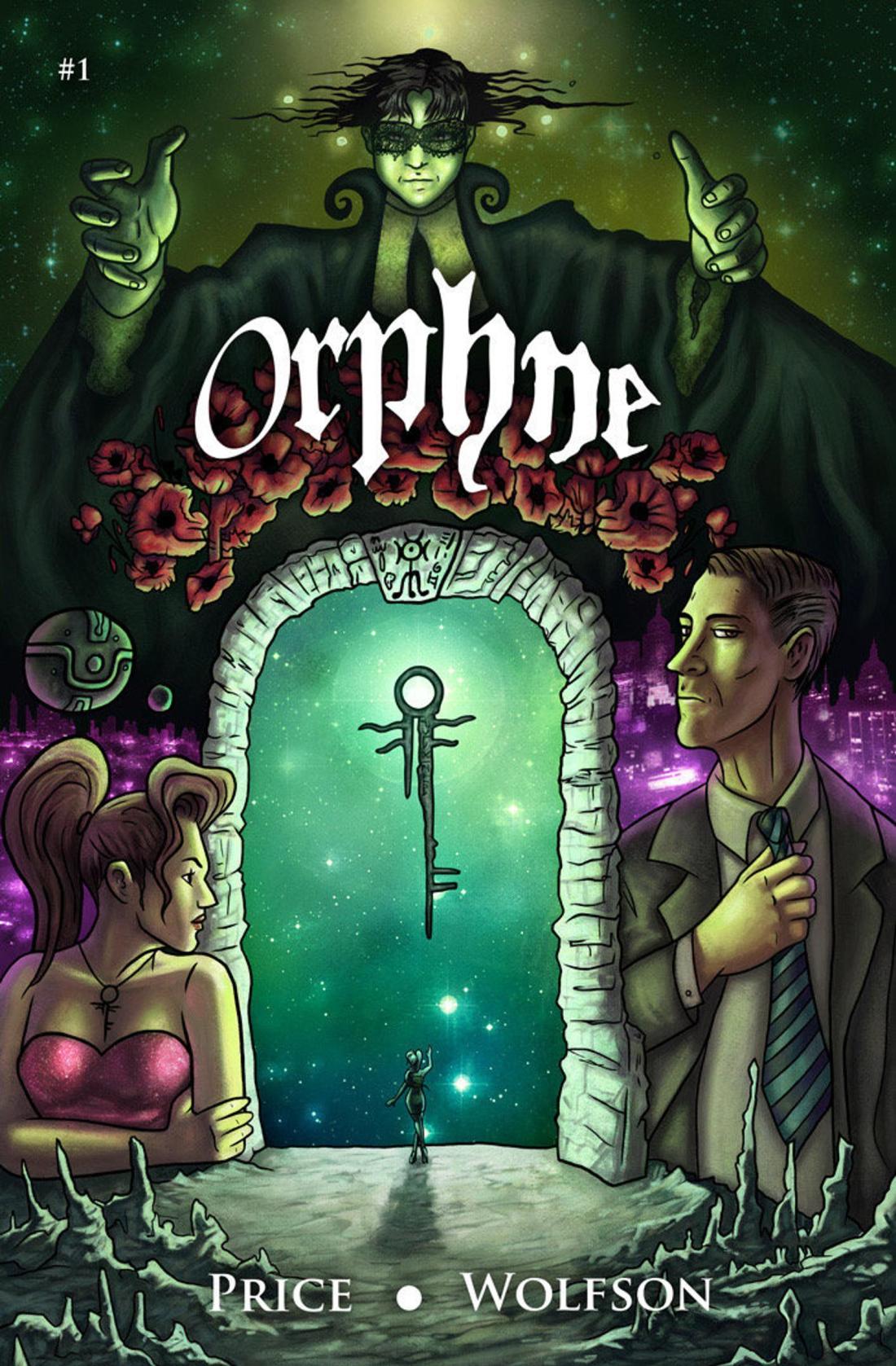
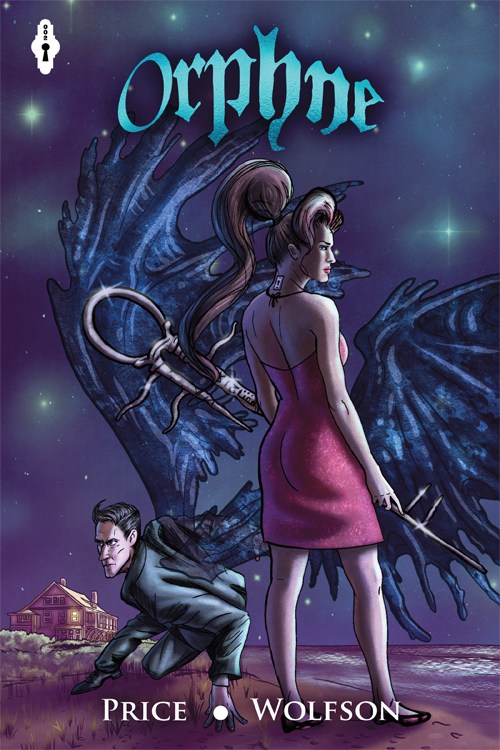
Mani C. Price is a visionary artist and diviner; her penchant for Lovecraft and mythology is evident from her artwork. As the writer and artist for Orphne, Price brings her interests to bear with references to Classical Greek mythology, magic, and Lovecraftian references that are present but not pressed on the viewer. There is no mention in these stories to Lovecraft’s “The Silver Key,” yet the artistic theme of both issues emphasizes keys and key-holes; the figure of Mr. Angell is the image of H. P. Lovecraft—whom Muriel Eddy described as “The Man from Angell Street,” referring to his family’s house in Providence, Rhode Island.

Orphne prefers to show rather than tell; there are mysteries for the reader to unravel, characters are not introduced, and their identities must be divined by what they say and do. We know little about the main character Victoria, but that little we do know is intriguing…she is, more than Mr. Angell, the central character and mystery of the story so far. What key will unlock those answers?

But always I shall guard against the mocking and insatiate Hypnos, lord of sleep, against the night sky, and against the mad ambitions of knowledge and philosophy.
—H. P. Lovecraft, “Hypnos”

Lovecraft also had a penchant for Greek and Roman myth, and in the second issue this brings in the figure of Hypnos, Lord of Dreams. Some readers may draw parallels between this character and another popular comics character: Dream of the Endless, created by Neil Gaiman for his run on Sandman (1989-1986). The similarities are superficial, however; Gaiman and Price (and Lovecraft) are drawing in common from the well of Greco-Roman mythology in populating their Dreamlands. As the holder of the artifact that Victoria seeks, Hypnos is being set up as the primary antagonist in a story where most of the conflict so far is unseen—a combination of internal conflicts and unknown forces acting on Victoria, secrets unspoken, hints of supernatural influence.

Where the story goes from here is another question that goes unanswered. Issues #1 and #2 were published in 2018, but the series is not yet finished. Art takes time, and as Orphne is being produced by an individual rather than a big company, some delay is to be expected before we see issue #3. Yet it seems certain that it will be worth the wait.

Orphne #1 and #2 are written and illustrated by Mani C. Price, coloring and layout by Justin Wolfson, lettering by Jason Price, editing by Jason Price and the late Sam Gafford. Issues can be purchased directly from the website Mani The Uncanny.


Bobby Derie is the author of Weird Talers: Essays on Robert E. Howard & Others (2019) and Sex and the Cthulhu Mythos (2014).

“A Night at Yuan-Su” (2005) by Nanjo Takenori (南條竹則)

My heart is gently warmed, in particular, by the many works left by an obscure writer who lived in Providence in the early twentieth century. when I read his work, I am strangely suffused with warmth, as though I have found a friend from beyond the seas.
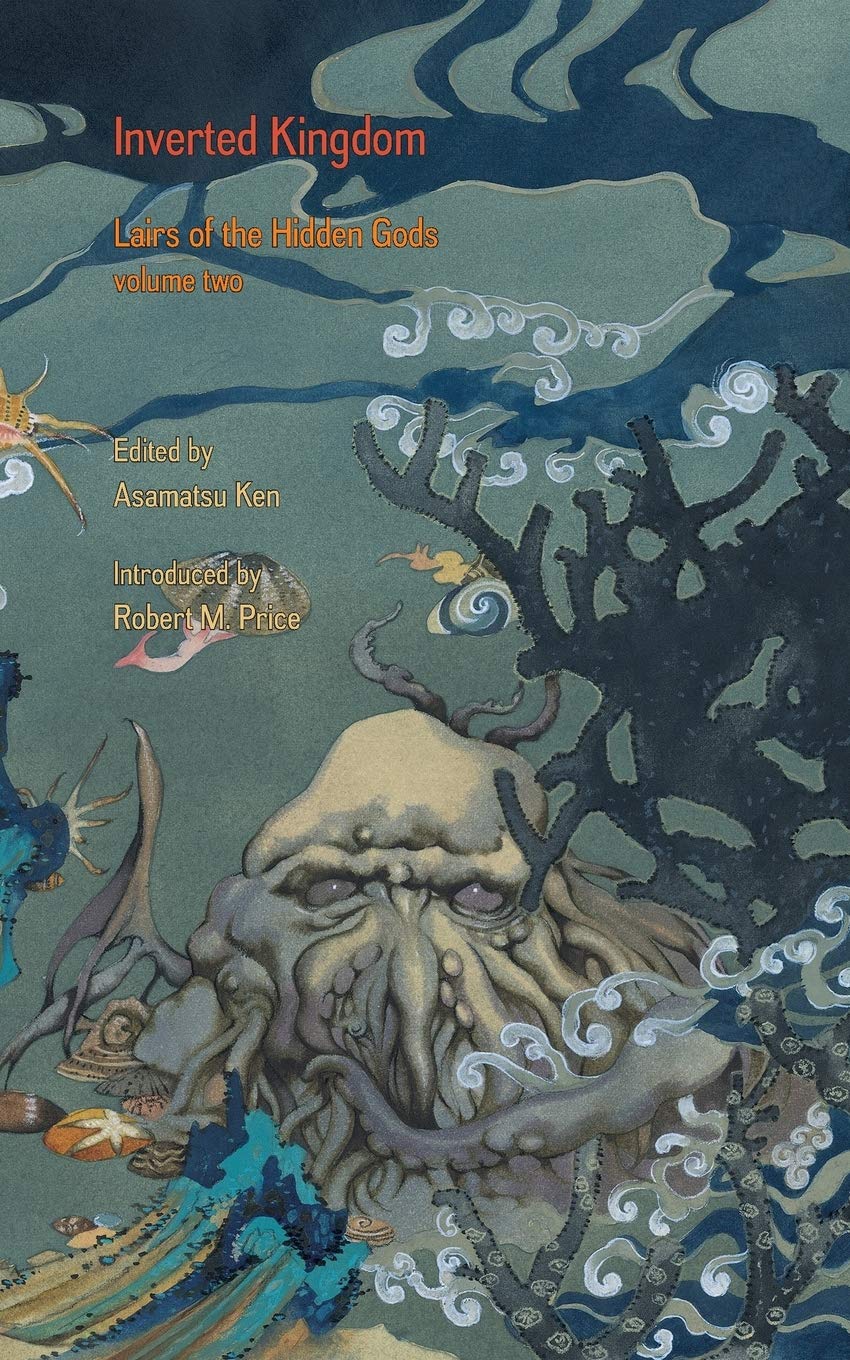
—“A Night at Yuan-Su,” Inverted Kingdom: Lairs of the Hidden Gods Vol. Two 279

“A Night at Yuan-Su” (2005) by Nanjō Takenori (南條竹則) was published in the second volume in the Lairs of the Hidden Gods series from Kurodahan Press, edited by Asamatsu Ken (朝松健). It is the English-language translation of the 2002 story ユアン・スーの一夜 (Yuan Sū no Yoru); the translator was Usha Jayaraman.

In his letters, H. P. Lovecraft decried the loss of old buildings, old ways of life. He was not a Luddite, but his sense of aesthetics was tied to antique styles, and he despaired when an old block of buildings was torn down to make way for something new, as a piece of the past was lost. In this sense, he felt a stranger in his own century. Some of these sentiments are apparent in his fiction, in stories like “He” and “The Outsider.” The idea is expressed most succinctly in sonnet XXX of the Fungi from Yuggoth cycle, “Background”:

I never can be tied to raw, new things,
For I first saw the light in an old town,

In this brief tale, Nanjō Takenori sketches the story of a different outsider, thousands of miles away, lamenting the slow loss of historic Tokyo. There are nods to Lovecraft here and there—and a certain kind of humor. The narrator’s deprecation of human beings could almost have turned into one of Lovecraft’s rants about immigrants, the new people displacing the old, but stops short; “A Night at Yuan-Su” is not “The Street” or any other kind of racist fable. It is, ultimately, about a lonely creature out for a drink and a bit of quiet companionship.

This is where the narrative takes a turn, from the atmospheric descriptions of Yuan-Su (really Harajuku in Tokyo), its old buildings torn down to make way for housing developments, to the more fantastic. Reminiscences of a bar named HE, where Imhotep serves araq to an odd clientele. Odd reactions, fragments of names. Unlike Lovecraft’s eponymous Outsider, there is no final revelation in the story…but there is still that peculiar sense of humor. Earlier in the tale, the nameless narrator describes the evil spell of Betelgeuse, the red star, has on them. At the end, finally settling down with a beer and a bowl of tofu, they are thwarted by a shot of ergoutou (Chinese sorghum liquor)—one of the popular brands of which is Red Star.

Given the setting, I almost suspect there are parts of the joke I’m missing. Perhaps the narrator’s particular attributes reflect some specific species of yōkai which Japanese readers might be more familiar with; perhaps the fragmentary names of bars contain more half-hidden meanings for those familiar with Mandarin and Japanese. Whether this is the case or not, doesn’t really matter for the enjoyment of the story. It’s a mood piece, a snapshot of a night, a moment, an attitude. We have all been outsiders, at times; there’s an empathy there for those who desire simple comforts which are then denied.

Never again will I go into that dirty town. Not even on a bright, moonlit night! I have no need to. If my loneliness gets the better of me, if I feel like visiting a friend, I can always go to Celephaïs, the city of dreams, wrapt in its golden aura…
—”A Night at Yuan-Su,” Inverted Kingdom: Lairs of the Hidden Gods Vol. Two 285

In a dream I fled from that haunted and accursed pile, and ran swiftly and silently in the moonlight. When I returned to the churchyard place of marble and went down the steps I found the stone trap-door immovable; but I was not sorry, for I had hated the antique castle and the trees. Now I ride with the mocking and friendly ghouls on the night-wind, and play by day amongst the catacombs of Nephren-Ka in the sealed and unknown valley of Hadoth by the Nile. I know that light is not for me, save that of the moon over the rock tombs of Neb, nor any gaiety save the unnamed feasts of Nitokris beneath the Great Pyramid; yet in my new wildness and freedom I almost welcome the bitterness of alienage.
“The Outsider”

The end of “A Night at Yuan-Su” is curiously ambiguous. Does the nameless narrator mean literally that they will go to Celephaïs, or is that a poetic statement to refer to diving once more into Lovecraft’s fiction, finding comfort in the old familiar tales? It can be read either way; nothing the narrator says or does up to this point is explicitly supernatural. Whether they are a human recluse or something else is left up to the reader—and many readers will want to believe in the stranger, more fantastic option. It is a meaner, uglier world that doesn’t allow for a bar named HE to stand on some corner of Harajuku, where exiles from fantastic lands can sip anise-flavored liquors with their collars turned up and their big hats dipped low over their faces, speaking of distant planets and the depths of the sea.


Bobby Derie is the author of Weird Talers: Essays on Robert E. Howard & Others (2019) and Sex and the Cthulhu Mythos (2014).

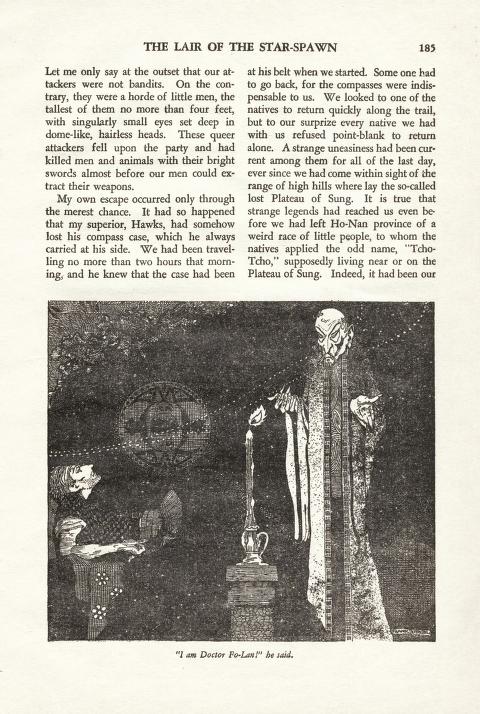
“Polaris” (1920) by H. P. Lovecraft & “The Lair of the Star-Spawn” (1932) by August Derleth and Mark Schorer

That night had the news come of Daikos’ fall, and of the advance of the Inutos; squat, hellish, yellow fiends who five years ago had appeared out of the unknown west to ravage the confines of our kingdom, and finally to besiege our towns. Having taken the fortified places at the foot of the mountains, their way now lay open to the plateau, unless every citizen could resist with the strength of ten men. For the squat creatures were mighty in the arts of war, and knew not the scruples of honour which held back our tall, grey-eyed men of Lomar from ruthless conquest. […]

They say there is no land of Lomar, save in my nocturnal imaginings; that in those realms where the Pole Star shines high and red Aldebaran crawls low around the horizon, there has been naught save ice and snow for thousands of years, and never a man save squat yellow creatures, blighted by the cold, whom they call “Esquimaux”.
—H. P. Lovecraft, “Polaris”

At the end of the 19th century, the Yellow Peril or Yellow Terror had gripped the imagination of the Western world; works such as weird fiction author M. P. Shiel’s The Yellow Danger; Or, what Might Happen in the Division of the Chinese Empire Should Estrange all European Countries (1898) were pure invective, fueling racist and Orientalist fantasies about Asia and the prospect of a global conflict on the lines not of nation-states, but of race. The victory of an industrialized Japan in the Russo-Japanese War (1904-1905) stoked these fears, and a year before the Great War broke out found an avatar in Dr. Fu Manchu, the villainous star of what would become thirteen novels by Sax Rohmer. Fu Manchu would inspire hundreds of copycats, not a few of whom appeared in Weird Tales, and even by favorite authors; Robert E. Howard’s “Kathulos” from the serial “Skull-Face” (1929) definitely has Fu Manchu in its literary DNA. The Yellow Peril, in more generalized form, would be familiar in Weird Tales throughout its entire run from 1923-1954, as was the case in many pulps.

Throughout his life H. P. Lovecraft was clear in his genuine belief in the Yellow Peril, at least as an impending threat. One passage from a letter will suffice to give the general substance of this racialist paranoia, although in many other instances Lovecraft wrote admiringly of Japanese culture and aesthetics, and of Japanese actors and artists:

Of Japan I have not so far spoken, because I think it a certain enemy of the future, which no plan can permanently make a friend. It demands free access to Anglo-Saxon soil for its citizens, and this can never be given. Orientals must be kept in their native East till the fall of the white race. Sooner or later a great Japanese war will take place, during which I think the virtual destruction of Japan will have to be effected in the interests of European safety. The more numerous Chinese are a menace of the still more distant future. They will probably be the exterminators of Caucasian civilisation, for their numbers are amazing. But that is all too far ahead for consideration today.
—H. P. Lovecraft to Alfred Galpin, 30 Sep 1919, Letters to Alfred Galpin 57

Despite this belief, which was relatively common during the period, the Yellow Peril is scarce in Lovecraft’s fiction. He never quite develops a Fu Manchu type character, the cult in “The Horror at Red Hook” has overtones of the multiethnic criminal enterprise of Rohmer’s villain, the “corpse-eating cult of inaccessible Leng” in “The Hound” is located in Central Asia, and Castro in “The Call of Cthulhu” claims that he has spoken to the “undying leaders of the cult in the mountains of China,” likely a reference to the mythical Shambala and the claims of the Theosophical Society to receive their guidance from the Great White Brotherhood in Asia. There are only two stories where the idea of a racial conflict on these lines is suggested in Lovecraft’s fiction: a glancing reference in “Through the Gates of the Silver Key” (“that Pickman Carter who in the year 2169 would use strange means in repelling the Mongol hordes from Australia”) written with E. Hoffmann Price, and the very short story “Polaris.”

The story came from an odd start. In 1918, Lovecraft was arguing about religion in one of his letters, which led to a discussion of truth and recalling a recent dream:

Several nights ago I had a strange dream of a strange city—a city of many palaces and gilded domes, lying in a hollow betwixt ranges of grey, horrible hills. There was not a soul in this vast region of stone-paved streets and marble walls and columns, and the numerous statues in the public places were of strange bearded men in robes the like whereof I have never seen before or since. […]
—H. P. Lovecraft to Maurice W. Moe, 15 May 1918, Letters to Maurice W. Moe 70

Shortly thereafter, Lovecraft shaped the dream into “Polaris,” about a man who dreams (or is possessed by the spirit) of an ancestor from 26,000 years before, in the land of Lomar situated in the far north. This would be familiar to audiences at the time as a reference to racialist theories of Caucasians originating from Northern Europe. Lomar is under peril from the Inutos—and these are explicitly Asian stereotypes, which Lovecraft near the end directly associates them with the Inuit people, foreshadowing his reference to the “degenerate Esquimaux” in “The Call of Cthulhu” a decade later.

At this point in his life, Lovecraft’s racialist beliefs were strongly influenced by Thomas Henry Huxley, who categorized the Inuit and other Native Americans and trans-polar peoples as “Mongoloids” alongside many Asian ethnicities. Lovecraft typically shortened this to reference to “Mongolians” or “Mongols,” regardless of nationality or ethnicity. The fantasy racism that Lovecraft engages in here, equating a contemporary group of people with a mythical precursor, was not unknown—the entire “Lost Race” subgenre of scientific romance depends on such linkages, and the basic ideology can be seen in Robert E. Howard’s “The Hyborian Age” (1936) essay and in some of the worldbuilding of J. R. R. Tolkien, who at the same time was crafting what would the background of The Hobbit (1937) and The Lrod of the Rings (1955).

Lovecraft’s use of the term “Esquimau” and its plural “Esquimaux” was a touch archaic in the 1910s, 20s, and 30s, but not necessarily intended as a pejorative. The term “Eskimo” was in general use (as evidenced by the 1933 film Eskimo, which Lovecraft had seen), and Lovecraft’s preference for the older form an apparent affection. The term “Inutos” suggests he was at least aware of the term “Inuit,” even if he chose not to use it; the suffix “-os” would make the name match the other pseudo-Grecian names in the story. While there are no contemporary accounts of Lovecraft’s thoughts on the Inuit, later in life his few references in his letters categorize them as a “degenerate offshoot” of the “Mongolian race.” (A Means to Freedom 1.482) This was a very typical distinction for Lovecraft to make, when regarding a culture that he was generally ignorant of but perceived as “primitive” compared to contemporary (and white) civilization.

Which is a great deal to unpack from a few lines in a story of a little over 1,500 words. Nor was it an immediate success; Lovecraft shared it in the amateur Transatlantic Circular, and it was published in the amateur journal The Philosopher in 1920. In 1925, Lovecraft submitted it to editor Farnsworth Wright at Weird Tales, but it was rejected as a “prose-poem.” In 1931, Lovecraft submitted it to editor Harry Bates at Strange Tales of Mystery and Terror, who likewise rejected it, and in 1932 to Carl Swanson’s projected magazine Galaxy, which never came out. “Polaris” was finally reprinted in the fanzine The Fantasy Fan (Feb 1934), where it was well-received by readers. The first professional publication of “Polaris” was posthumous, in Weird Tales (Dec 1937). August Derleth and Donald Wandrei included it in their initial Arkham House publication The Outsider and Others (1939), sealing its place in the Lovecraft canon.

That wasn’t necessarily the case. Lovecraft had a soft spot for the little tale, but soured on it nearer the end of his life:

“Polaris” is a sort of semi-favourite of mine—written in 1918 & therefore largely experimental.
—H. P. Lovecraft to Clark Ashton Smith, 28 Aug 1930,
Dawnward Spire, Lonely Hill 229

I’ve expunged both from my list of acknowledged writings—relating them to the oblivion now enjoyed by such failures as “The Street” & “Juan Romero”. Before long I shall strike other times out in the same way—”The Tree”, “Polaris”, “The Hound”, “The White Ship”, “He”, & perhaps a few more. It doesn’t do me any good to have my name associated with absurd crap.
—H. P. Lovecraft to R. H. Barlow, 19 Mar 1934, O Fortunate Floridian! 120

The real legacy of “Polaris” and the impact it had on Lovecraft and his writings is that the idea of Lomar as this mythical ancient northern land became an intertextual element in Lovecraft’s fiction, mentioned in “The Other Gods,” “The Quest of Iranon,” “The Dream-Quest of Unknown Kadath,” “The Mound” (with Zealia Bishop), At the Mountains of Madness, “Through the Gates of the Silver Key” (with E. Hoffmann Price), and “The Horror in the Museum” (with Hazel Heald), and “The Shadow out of Time,” which contains Lovecraft’s only other reference to the Inutos:

I talked […] with that of a king of Lomar who had ruled that terrible polar land 100,000 years before the squat, yellow Inutos came from the west to engulf it […]
—H. P. Lovecraft, “The Shadow out of Time”

Which is where things get a little weird. In “The Dream-Quest of Unknown Kadath,” Lovecraft says:

[…] the hairy cannibal Gnophkehs overcame many-templed Olathoë and slew all the heroes of the land of Lomar.
—H. P. Lovecraft, “The Dream-Quest of Unknown Kadath”

Just to make things complicated, a very different entity with a similar name and geographic bound is given in another story:

A small bulge in the canvas far to the right suggested the sharp horn of Gnoph-keh, the hairy myth-thing of the Greenland ice, that walked sometimes on two legs, sometimes on four, and sometimes on six.
—H. P. Lovecraft & Hazel Heald, “The Horror in the Museum”

The accounts are contradictory and at a glance irreconcilable; it is difficult to tell if Lovecraft was deliberately muddying the waters of his own Mythos, or if his conception of what caused the fall of Lomar had shifted from 1918 when he wrote “Polaris” to 1926 when he wrote “Dream-Quest” to 1932 when he wrote “The Horror in the Museum” for Hazel Heald. Later writers made efforts to gloss these contradictions, which resulted in stories such as “Nautical-Looking Negroes” (1996) by Peter Cannon & Robert M. Price.

It is too much to suggest that Lovecraft made the change from Inutos to Gnophkehs because he recognized the Yellow Peril influence of the work and wished to change it; the last appearance of the Inutos is in “The Shadow out of Time,” written in 1934, and there is no evidence in Lovecraft’s letters that his basic prejudices regarding the Inuit changed substantially by that point in his life.

When we talk about talk about the effect that Lovecraft’s prejudices had on his fiction, and by extension the fiction of other writers, it is not necessarily the very blatant examples of an N-word in print, or even the infamous ending to “Medusa’s Coil.” It is the much more subtle impact of racialist thought and tropes, however common and accepted they may have been in Lovecraft’s time, which persist as part of the Mythos. The Inutos, thankfully, are not especially pervasive in the wider Cthulhu Mythos; Lomar and Gnoph-Keh/the gnophkehs are more popular.

This is not always the case.

One of us was home for the summer from a year of teaching at a military academy in Missouri and preparing for post-graduate work at Wisconsin and Harvard, the other was back to stay in Sauk City, Wisconsin, having resigned an editorial position with Fawcett Publications in order to do or die as a writer. Though both our homes were in Sauk City, we chose not to work in them but to rent what had once been a summer cottage on the village’s main street, just north of the business section, in a relatively quite zone on the west bank of the Wisconsin. […] the method of work was this—the basic outline for each story was set down by Derleth, the entire first draft then written by Schorer, a final revision made by Derleth. […] he went over the manuscript, sometimes rewriting, sometimes simply retyping selected pages or paragraphs; and prepared the story for submission—usually to Weird Tales or Strange Tales, and rounded out the evening by outlining the next story to be done.
—August Derleth & Mark Schorer, Colonel Markesan and Less Pleasant People

The industrious collaboration during the summer of 1931 netted the two young writers 17 stories, one of which was a Mythos story titled “The Statement of Eric Marsh,” echoing Lovecraft’s “The Statement of Randolph Carter,” and it would introduce a new element to the expanding artificial mythology:

Though your major field will probably be much broader, you nevertheless have a very distinct aptitude for convincing spectral creation; & it would be a pity if things like the Tcho-Tchos & Rigelian daemons were to remain for ever unchronicled.
—H. P. Lovecraft to August Derleth, 3 Aug 1931, Essential Solitude 1.354

Herewith the Tcho-Tcho story, The Statement of Eric Marsh; I don’t like the story. Have you any suggestions for a better one? But then, the story is rotten, too.
—August Derleth to H. P. Lovecraft, 21 Aug 1931, ES1.365

As for a new title—how would “The City of Elder Evil” do? Or “The Lair of the Star-Spawn”? I’m not much for fancy titles, but I presume something on this order is what you’re looking for. I shall undoubtedly use the Tcho-Tchos in some later story—let Wright say what he please!
—H. P. Lovecraft to August Derleth, 26 Aug 1931, ES1.367

“The Lair of the Star-Spawn” became the title; the story was accepted and published in Weird Tales (Aug 1932). Among the elements that Derleth & Schorer added or referenced in the story were the Tcho-Tcho:

It is true that strange legends had reached us, even before we had left Ho-Nan province, of a weird race of little people, wo whom the natives applied the odd name, Tcho-Tcho, supposedly living near or on the Plateau of Sung.

So the Hawk Expedition proceeded into Burma (present-day Myanmar). The story in many ways is a very typical Lost World/Lost Race narrative, comparable to H. Rider Haggard’s She (1886), Edgar Rice Burrough’s At the Earth’s Core (1914), Robert E. Howard’s “The Slithering Shadow” (1933) and “Red Nails” (1936), C. L. Moore’s “The Tree of Life” (1936), and many others—only with a Mythos twist, as the Tcho-Tcho are servants of Lloigor and Zhar. The descriptions of them are stereotypical:

[…] the tallest of them no more than four feet, with singularly small eyes set deep in dome-like, hairless heads. These queer attackers fell upon the party and had killed men and animals with their bright swords almost before our men could extract their weapons. […]

The Tcho-Tcho people could not believe them dead, since it is impossible for them to conceive of such a weapon as a gun. At base, they are very simple people. Yet they are inherently malevolent, for they now that they are working for the destruction of all that is good in the world. […]

Then the Old Ones, the Elder Gods, returned to the stars of Orion, leaving behind them ever-damned Cthulhu, Lloigor, Zhar, and others. But the evil ones left seeds on the plateau, on the island in the Lake of Dread which the Old Ones caused to be put here. And rom these seeds have sprung the Tcho-Tcho people, the spawn of elder evil, and now these people await the day when Loloigor and Zhar will rise again and sweep over all the earth!

Damning an entire species to be unapologetically or uncomplicatedly “evil” from birth is a gross oversimplification—but easy moralities play well in politics, pulp stories, and fairytales; J. R. R. Tolkien would do much the same thing with Orcs in his legendarium, with all the unfortunate implications still being worked out decades later. It’s not necessarily a problem of having a group of antagonists depicted as irredeemable—its the use of racialist language, ideas, and reasoning behind it.

Like the Inutos of “Polaris,” the Tcho-Tcho are depicted as aggressive, primitive, and adversarial to the main viewpoint of the story; Lovecraft doesn’t make the Inutos explicitly evil (or the men of Lomar good), but the framing of the story as a quasi-fable of the Yellow Peril would establish those relationships with the readers. Derleth & Schorer are if anything more explicit, even if they make the Tcho-Tcho a “race apart,” from both the Caucasian Eric Marsh and the Chinese Dr. Fo-Lan.

If it had been a one-off story where the Tcho-Tcho were never mentioned again, this would be worthy of a footnote—none of them appear to survive the end of Derleth & Schorer’s tale, though Derleth references them again in “The Thing That Walked On the Wind” (1933) and a few later stories; “The Sandwin Compact” (1940) moves them from Burma to Tibet—but of course, it didn’t end there.

“Do you remember,” he shouted, “what I told you about that ruined city in Indo-China where the Tcho-Tchos lived? You had to admit I’d been there when you saw the photographs, even if you did think I made that oblong swimmer in darkness out of wax. If you’d seen it writhing in the underground pools as I did. . . .”
—H. P. Lovecraft and Hazel Heald, “The Horror in the Museum”

Of earthly minds there were some from the winged, star-headed, half-vegetable race of palaeogean Antarctica; one from the reptile people of fabled Valusia; three from the furry pre-human Hyperborean worshippers of Tsathoggua; one from the wholly abominable Tcho-Tchos; two from the arachnid denizens of earth’s last age; five from the hardy coleopterous species immediately following mankind, to which the Great Race was some day to transfer its keenest minds en masse in the face of horrible peril; and several from different branches of humanity.
—H. P. Lovecraft, “The Shadow out of Time”

Lovecraft doesn’t expand much on the original conception of the Tcho-Tcho, aside from adding the “s” for a plural; he places them alongside the Serpent-People of Robert E. Howard’s “The Shadow Kingdom,” the Voormi of Clark Ashton Smith’s “The Seven Geases,” and his own Elder Things from At the Mountains of Madness—all in good fun, just an inside joke for astute readers and members of the gang. Yet it cemented, if that was necessary, the Tcho-Tcho as part of the Mythos.

For many readers the occasional references to the Tcho-Tcho people encountered in Cthulhu Mythos fiction do not really register. Aren’t these hard-to-prounounce people just one more of the so-called “servitor-races” of the Old Ones? So what?
—Robert M. Price and Tani Jantsang, “The True History of the Tcho Tcho People”
in Crypt of Cthulhu #51, 24

Unlike the Inutos, several later authors decided to elaborate on the Tcho-Tcho, to various purpose and effect. The term “servitor-races” that Price and Jantsang use is particular to the Call of Cthulhu Roleplaying Game, and is exemplary of the problem that the Tcho-Tcho embody: the long shadow of the Yellow Peril, sliding uncomfortably into the contemporary day. Call of Cthulhu came out of Runequest which came out of Dungeons & Dragons, which based itself on the borrowed racialist terminology of later 19th and early 20th century popular fiction: scientific romance, science fiction, fantasy, pulp fiction, Lost World and Lost Race tales, The Hobbit and The Lord of the Rings, Robert E. Howard, H. P. Lovecraft, Clark Ashton Smith, Fritz Leiber…and more, but the gist is that in the translation to the roleplaying milieu, the Tcho-Tcho, Deep Ones, and other strange critters of the Mythos were translated into D&D-esque terms: where Tolkien (and thus D&D) had “races” of Elves, Dwarves, Orcs, and Humans, CoC had Humans, Deep Ones, Serpent People, Voormis, and Tcho-Tcho.

The habit of thinking of groups of sentient humanoid entities as biologically and culturally distinct from anatomically modern humans and essentially not human and morally irredeemable can be problematic in and of itself—there are plenty of parallels to scientific racialism and racial discrimination, which some authors of the Mythos have explored, such as in “The Doom That Came to Innsmouth” (1999) by Brian McNaughton & “The Litany of Earth” (2014) by Ruthanna Emrys.

In the case of the Tcho-Tcho, there are added wrinkles: their original placement in Southeast Asia, and subsequent movement around Asia by different authors, their depiction as inherently autochthonous and antagonistic to “human” life, and their initial description aspects of Asian visual stereotypes (short stature, different eyes), has allowed them to pick up several more Yellow Peril characteristics in their general depiction. Many Call of Cthulhu Roleplaying Game products, including spin-offs like Delta Green, depict the Tcho-Tcho as Asian characters, often conflating them with negative stereotypes as criminals and drug-dealers.

The issue of the Inutos and the Tcho-Tcho is a problem that transcends the Cthulhu Mythos. Those are symptoms, the result of many different writers working independently toward different goals, not stepping back to consider where some of the conceptions they were using came from or how they were being used. Fantasy racism can be used to explore some of the consequences of real-life racial discrimination and prejudice in a way that echoes the experience of ethnic minorities without calling them out…and it can be used very lazily, so that Tcho-Tcho (or Orcs,  etc.) can serve as easy villains and faceless fodder for the heroes to kill without moral compunction.

It is seductively easy to use stereotypes to apply to entire groups of people. That’s why pulp fictioneers did it; painting with a broad brush, using tropes the readers were familiar with, they could sketch out stories quickly and the reader could suspend disbelief. It is also why many people use it today; discrimination is terribly easy, appreciating the nuance and complexity of human relationships and seeing them as individuals rather than representatives of a group is hard.

Perhaps because of the initial complexity of “The Shadow over Innsmouth,” and their tremendous popularity, the Deep Ones have gotten a lot of attention and engendered a good deal of sympathy from later Mythos writers. The Tcho-Tcho have not attracted anything like the same level of development or empathy, and have fallen into a very weird space where they have largely become “acceptable villains” in Mythos roleplay and fiction—and, if they have not already, are in danger of becoming nothing more than a Mythos-flavored Yellow Peril.


Bobby Derie is the author of Weird Talers: Essays on Robert E. Howard & Others (2019) and Sex and the Cthulhu Mythos (2014).

“On A Dreamland’s Moon” (2017) by Ashley Dioses

The cats of Ulthar steal across my dreams
On paws of softest fur and blure the seams
Of my subconscious with their purrs and eyes
Of molten gold that twinkle and that gleam
Like Beacon lights toward where their kingdom lies.
—Opening stanza of “On A Dreamland’s Moon” by Ashley Dioses,
Diary of a Sorceress (2017), 120

Poetry is an inextricable part of the Mythos, there from the beginning. Lovecraft and many of his contemporaries were poets, from the sonnet-cycle “The Fungi from Yuggoth” published in Weird Tales by the grace of editors Farnsworth Wright and Dorothy McIlwraith, to Robert E. Howard’s “Arkham” and the verses of the mad poet Justin Geoffrey capture in “The Black Stone.” Fans got in on the act fairly early on, including “Shadow Over Innsmouth” (1942) by Virginia Anderson & “The Woods of Averoigne” (1934) by Grace Stillman, and the poetic tradition of the Mythos has continued down to the present day, through practitioners such as Ann K. Schwader, and to Ashley Dioses.

“On A Dreamland’s Moon” takes its most direct inspiration from Lovecraft’s The Dream-Quest of Unknown Kadathbut the object of this dreamer’s quest is not the hidden gods of dream, but Nyarlathotep, the crawling chaos. In language and imagery, however, the influence of Clark Ashton Smith is more evident, echoing some of his narrative poems such as “The Nightmare Tarn.” The purpose for which the narrator seeks out the soul and messenger of the Other Gods is revealed in such lines as:

Hail Nitokris, my patron, grant me skill
In amorous endeavors so the thrill
Of His enchantment will coil round my soul!
—”On A Dreamland’s Moon,” Diary of a Sorceress 121

Again, very much in the tradition of Clark Ashton Smith, whose work so often dealt with love, sorcery, and death. The carnality by contemporary standards is subdued and artistic; erotic fantasies are better hinted at for the imagination to paint than spelled out explicitly, and there is always beauty in it, nothing as gritty as “Cthulhu Sex (ahem!)—a poem—” (1998) by Katherine Morel.

One thing that jumps out in this work is the clever expansion of the role of Nitocris in the Mythos from her original appearances in both Lovecraft’s “The Outsider” and “Under the Pyramids” (as “Nitokris”). A relatively minor character, seldom-used by other Mythos writers (Brian Lumley’s “The Mirror of Nitocris” comes to mind), the idea of the ghoul-queen as a spiritual patron—someone to model yourself after—is both entirely appropriate and offers interesting possibilities. Dioses expands on the character further in the subsequent poem, titled simply “Nitokris.”

Diary of a Sorceress is based after the Sorceress in the poem. This is her diary.
—Ashley Dioses, “Afterword” in Diary of a Sorceress 166

For context, within the book itself “On A Dreamland’s Moon” is sandwiched between the poems “Nyarlathotep” and “Nitokris” in the fourth section of the book. The three poems together form a thematic unit, but not a narrative one, in that they share characters and can be seen to speak about the same setting, but are not linear entries in the same story. The same in general could be said for the book as a whole: this is a collection, and there is a thread of a narrative that binds some of the poems together, but it is not a case that every poem is an integral part of the eponymous sorceress’ descent, and most can be enjoyed on their own.

What is interesting in considering “On A Dreamland’s Moon” in the context of the collection is how the Sorceress in her dreams is drawn by dark attraction to seek an inevitable yet destructive meeting. This puts the shoe on the other foot compared to how she initially responded to the love letter in the waking world, where she herself was the object of attraction…and the consummation and dissolution that the Sorceress faces in dream perhaps foreshadows what is to come, in the diary’s final entries.

“On A Dreamland’s Moon” was first published in Black Wings VI: New Tales of Lovecraftian Terror (2017), and then collected in Diary of a Sorceress. Ashley Dioses has published a good deal of weird and Lovecraftian poetry in places such as Weirdbook, Vasterian, Necronomicum, Skelos, Hinnom, and Infernal Ink.


Bobby Derie is the author of Weird Talers: Essays on Robert E. Howard & Others (2019) and Sex and the Cthulhu Mythos (2014).


“The Man Who Sold Rope To The Gnoles” (1951) by Margaret St. Clair

A HYMN OF HATE

Margaret St. Clair, of Berkeley, California, writes: “I’ve been a good quiet uncomplainng reader of WEIRD TALES for about ten years—but the prospect of another story by Edmond Hamilton moves me to hysterical outcry. He makes me want to scream and bite my nails—’captured thirty-six suns’ indeed! His style is nothing but exclamation marks; his idea of drama is something involving a fantastic number of light-speeds; he is, in the words of one of my favorite comic strip characters, flies in my soup. He is science-fiction at its worst: all WEIRD TALES needs to make the science-fiction atmosphere perfect is a letter from Forrest J. Ackerman and a story by Hamilton. Oh, and another gripe—I dislike the blurbs you are printing at the first of the stories. They are just a waste of space. I hate vampire and werewolf stories—my blood refuses to congeal for any number of undead clammily hooting about. There was a time when I could be made to shiver by the mention of garlic, but now it’s just something to put in salad. Things like Shambleau are what I like. As long as WT prints stories by Clark Ashton Smith, however, I’ll keep on reading it. His tales have a rounded jewel-like self-containedness that is, artistically, a delight. … And Smith’s drawings are, I think, by far the best in the magazine. … In conclusion, Jules de Grandin is a pain in the neck.”
—WEIRD TALES, June 1934

Margaret St. Clair could be considered a peripheral member of the gang of writers commonly called “the Lovecraft Circle.” She met Clark Ashton Smith while a student at the University of California at Berkeley, and began corresponding with him as early as 1933. (Selected Letters of Clark Ashton Smith 208n1) St. Clair broke into the pulps after World War II, and her stories graced the pages of Weird Tales beginning in 1950, one of the last new voices to find a home at the magazine before its inevitable demise.

“The Man Who Sold Rope To The Gnoles” (first published in The Magazine of Fantasy and Science Fiction, Oct 1951), is one of Margaret St. Clair’s most famous stories. Her tale is inspired by and directly references Lord Dunsany’s own famous jocular fantasy “How Nuth Would Have Practiced His Art Upon the Gnoles” (The Book of Wonder, 1912). Dunsany was a substantial influence on Lovecraft’s early fiction, and some later writers have worked to tie the Lovecraft Mythos more directly to Dunsany, such as “My Boat” (1976) by Joanna Russ and “Meet Me on the Other Side” (2002) by Yvonne Navarro.

Margaret St. Clair is drawing directly from Dunsany here, pursuing her own homage to the British master of fantasy instead of trying to tie it into anything larger, expanding his Mythos but staying true to the spirit of the original story. There is something essential of Postwar America in the piece, a lightness of tone and a focus on money and its pursuit, with an ironic dark twist at the end reminiscent of Charles Addams’ The Addams Family and Robert Bloch’s light-hearted Mythos story “Philtre Tip” (1961).

Nuth looked on for a while from the corner of the house with a mild surprise on his face as he rubbed his chin, for the trick of the holes in the trees was new to him; then he stole nimbly away through the dreadful wood.
—Lord Dunsany, “How Nuth Would Have Practiced His Art Upon The Gnoles”

The gnoles were watching him through the holes they had bored in the trunks of trees; it is an artful custom of theirs to which the prime authority on gnoles attests.
—Margaret St. Clair, “The Man Who Sold Rope To The Gnoles”

Dunsany has inspired any number of writers, Lovecraft not least among them. The error most writers make is trying to write like Dunsany, to capture something of his style. Like pasticheurs who ape the cosmetic aspects of Lovecraft’s prose and miss the deeper stylistic structures, themes, and philosophical underpinnings which make his fiction work. St. Clair here does not attempt pastiche, but homage: she pays reverence to Dunsany’s story and the details he gave, while writing her own, in her own voice.

Which is why this is one of the few “Dunsanian” stories which works.

It is not by any stretch of the imagination a story that Dunsany would have written, which is half the point. J. R. R. Tolkien once criticized Dunsany’s story “The Distressing Tale of Thangobrind the Jeweller”, also published in The Book of Wonder, lamenting:

Dunsany at his worst. Trying so hard for the shudder. But not for a moment making the tale ‘credible’ enough

Whether or not Dunsany was trying for a shudder or a chuckle, readers can decide for themselves. St. Clair by contrast was militantly angling for the lighter side, and the way in which she does so showcases, perhaps, how closely allied some of Lovecraft’s style of hinting was to Dunsany’s:

It was the parlor the gnole led him to. Mortensen’s eyes widened as he looked around it. There were whatnots in the corners, and cabinets of curiosities, and on the fretwork table an album with gilded hasps; who knows whose pictures were in it?
—Margaret St. Clair, “The Man Who Sold Rope To The Gnoles”

The juxtaposition of the Gnoles, strange and terrible as they are, having a very British or American-style parlor full of knickknacks and an album is the same sort of intimate contrast of “the fields we know” and the exotic and impossible which is such a hallmark of Dunsany’s early work. St. Clair’s leading question is in line with the unspoken horrors which Tolkien was so displeased with and which Lovecraft often used to such great effect: letting the reader’s imagination fill in the blanks.

The gnoles, it seemed, would be regular customers; and after the gnoles, why should he not try the Gibbelins? They too must have a need for rope. (ibid.)

“The Hoard of the Gibbelins” immediately proceeds “Gnoles” in The Book of Wonder, and St. Clair’s references to it in this story could have been a step toward stitching together some of Dunsany’s standalone stories into something like a larger Mythos, though she never pursued such a design. It is something readers of Lovecraft take almost for granted—didn’t Lovecraft borrow elements from Dunsany, Arthur Machen, Robert W. Chambers (and Chambers himself from Ambrose Bierce)?

Certainly Margaret St. Clair, who was reading Weird Tales so early and so long, knew what she was doing.


Bobby Derie is the author of Weird Talers: Essays on Robert E. Howard & Others (2019) and Sex and the Cthulhu Mythos (2014).