In The Essential Dracula (1979), Bram Stoker scholars Raymond T. McNally and Radu Florescu revealed a letter (H. P. Lovecraft to R. H. Barlow, 10 Dec 1932) that had been drawn to their attention by horror anthologist and scholar Les Daniels, where H. P. Lovecraft claimed that an old woman he knew had turned down the chance to revise Stoker’s Dracula. The letter had not been published before this. Although Lovecraft’s claim had been made in print as early as 1938, and a letter with the anecdote was published in the first volume of Lovecraft’s Selected Letters from Arkham House in 1965, this seems to be the first time the Stoker scholar community became generally aware of the claim. The authors were intrigued by the possibilities:
This is very intriguing! Lovecraft believed that someone else had written the final draft of Stoker’s book. Now that we have found Stoker’s notes, it is clear that Stoker at least did all the basic research for the book, as well as the outline of its contents. But was he capable of completing this massive re-write? If he was in the early stages of syphilis would he have been able to finish the work, or did he assign the final task to someone else?
We wrote to Professor Barton L. St. Armand of Brown University and [L.] Sprague de Camp, both the leading experts on Lovecraft, but neither could identify the “old lady.”
McNally & Florescu, The Essential Dracula 24
Without much supporting detail in Lovecraft’s letter, there was little that McNally and Florescu could do to authenticate the claim. St. Armand quotes the same letter from Lovecraft to Barlow in The Roots of Horror In the Fiction of H. P. Lovecraft (1977), two years before The Essential Dracula was published, but apparently had not found the letters identifying the potential reviser yet.
The connection between Lovecraft and Stoker, however ephemeral, and the influence this had on Lovecraft’s opinion of Stoker and his work excited some interest. While Lovecraft’s anecdote did not single-handedly invent the idea that Stoker did not write Dracula in totality, it did add fuel to the fire for those who wanted to speculate who else may have had a hand in writing the great vampire novel. Periodically Lovecraft’s claim about a Dracula revision has re-emerged in Stoker scholarship; the most extensive treatment of the story was by the late great David J. Skal in Something in the Blood (2016) 329-331.
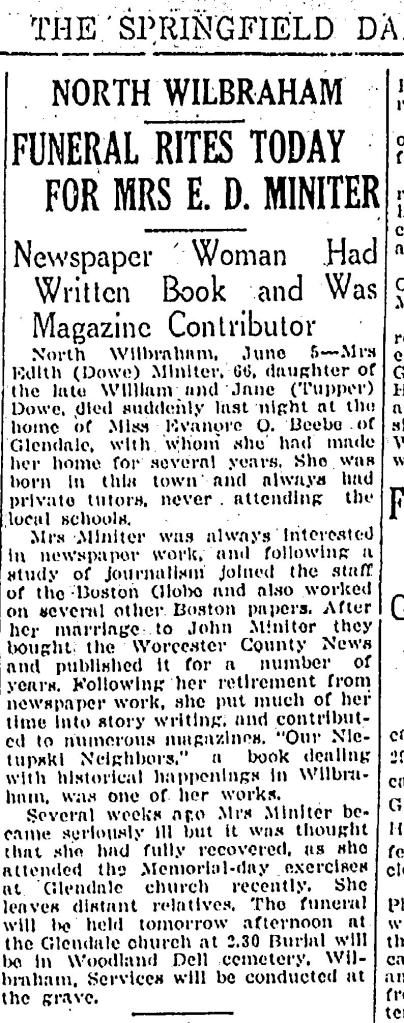
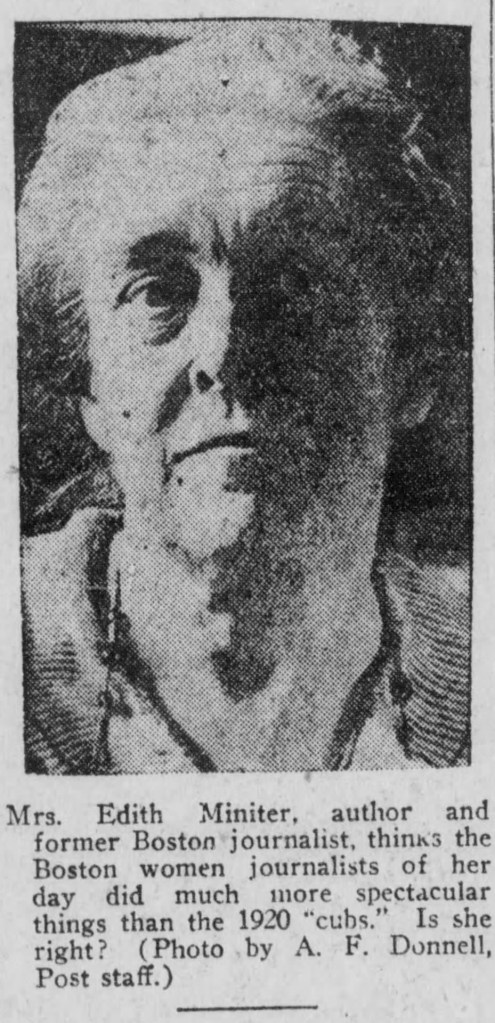
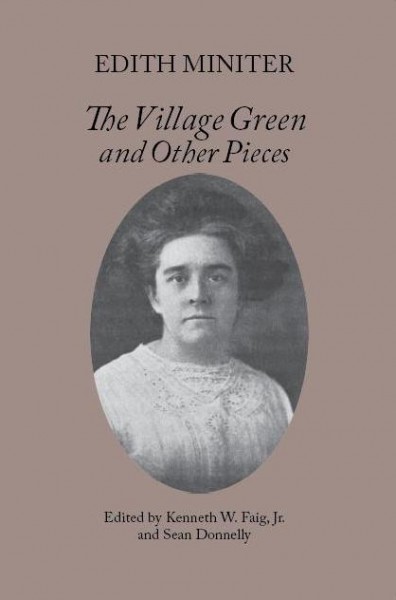
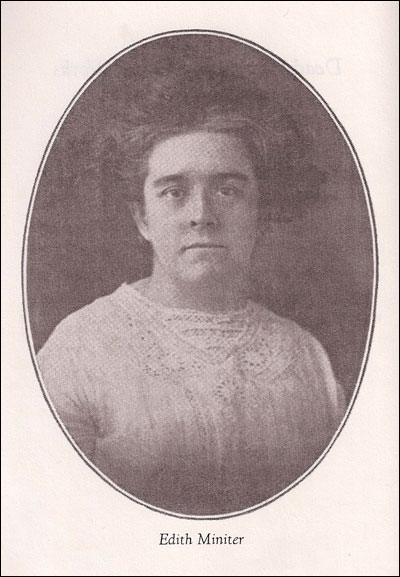
Skal devotes several pages to the claim and cites two additional appearances of the anecdote in Lovecraft’s letters (HPL to Frank Belknap Long, Jr., 7 Oct 1923, which appeared in Selected Letters, and HPL to Donald Wandrei, 29 Jan 1927) that provide much more detail than most, as well as Lovecraft’s 1938 essay. Through these additional sources, Skal discovered that the “old lady” was noted amateur journalist Edith Miniter, and he dug into her life (his bibliography notably cites Dead Houses & Other Works by Edith Miniter), to see if there was any evidence to support the claim.
Something in the Blood zooms in on Miniter’s employment by the Boston Home Journal in January 1894 and the uncredited reviews of the Lyceum’s plays being performed in Boston at that time. Skal noted that Bram Stoker, as the business manager of the Lyceum, was also the company’s press contact and would have bought the advertising. However, Skal stops short of saying that Lovecraft’s anecdote actually happened or that any actual contact between Miniter and Stoker took place. While the idea that Stoker may have had help in drafting Dracula was intriguing—Skal addresses several theories that had been put forward about this—he obviously failed to find any convincing evidence to support Lovecraft’s claims.
Rickard Berghorn in Powers of Darkness: The Unique Edition of Dracula, traces over the same steps (and the same letters Skal quoted, as well as references in O Fortunate Floridian), and draws a hypothetical connection between the apocryphal Dracula draft and Lovecraft’s “The Rats in the Walls”:
The anecdote about Stoker’s draft apparently captured Lovecraft’s interest, and he must have asked questions of Mrs. Miniter; for example, if she could remember any differences between the draft and the finished novel. A scene like the one with the blood rite and the Count’s degenerate relatives in forgotten caves under the castle is so bizarre, original, and magnificent that Edith Miniter ought to have remembered at least that one among other scenes that might have been included in Stoker’s draft and later were deleted. (Berghorn 33)
A full response to this claim would be an essay in itself. On its face, the claim is speculative: Lovecraft never mentions Miniter or Dracula anywhere as an inspiration for the story, and no details are ever given of the draft as Miniter saw it. Even if Lovecraft wasn’t inspired by Miniter’s account, the potential influence of Dracula on “The Rats in the Walls” cannot be completely ruled out. Barton Levi St. Armand in The Roots of Horror In the Fiction of H. P. Lovecraft dedicates a long endnote on pages 94-95 to the possible influence of Dracula on the story, and also noted that Carfax, the Virginia home of the Delapores, is the same as Dracula’s English home in Stoker’s novel (St. Armand 21).
Berghorn’s further suggestion that Lovecraft may have read “The Judge’s House” in Dracula’s Guest and Other Weird Stories (1914) and that this inspired the story deserves greater attention (Berghorn 34). If Dracula or Miniter’s account of the Stoker’s unrevised draft seems an unlikely influence on “The Rats in the Walls,” then the idea that “The Judge’s House” served as inspiration seems impossible: “The Rats in the Walls” was written in 1923 and Lovecraft’s letters indicate that he did not read “The Judge’s House” until 1935, when the story was reprinted in Weird Tales (ES 2.683, DS 595). Of course, to know that, Berghorn would have had to delve through much more of Lovecraft’s published correspondence.
Which brings up the point: there are more instances in Lovecraft’s letters dealing with the speculative Dracula revision than McNally, Florescu, Skal, or Berghorn reported, or were probably aware of. Most of these instances have been noted in passing by Lovecraft scholars who, looking at what Dracula scholars have written, reported in turn that there was not enough information to confirm the anecdote. A typical annotation from Lovecraft’s published letters might help illustrate the issue; this is the one that accompanies the infamous 1932 letter to R. H. Barlow that McNally and Florescu quoted:
HPL refers to Edith Miniter (186[7]-1934), an amateur associate and the author of a professionally published novel, Our Natupski Neighbors (1916) and other works. HPL tells this story repeatedly in letters, and presumably heard it directly from Miniter, with whom he was in touch since at least 1921, but it has not been independently confirmed.
S. T. Joshi & David J. Schultz, O Fortunate Floridian 45n4
Between the two camps, there is thus a bit of a gap: the Stoker scholars largely haven’t been fully aware of or made full use of the Lovecraft material, and Lovecraft scholars have largely rested on the fact that Stoker scholars have not turned up anything new regarding the issue. Yet in the intervening years, a good deal more of Lovecraft’s letters have been published, and more data on Miniter and Stoker’s lives have emerged that provide considerable historical context to both Lovecraft’s claims and the development of Dracula.
What is needed is a joint approach. By compiling all of Lovecraft’s claims about the Dracula revision from his letters and examining them in the context of recent scholarship that shed light on Stoker’s life and the writing of Dracula, a better assessment of Lovecraft’s claims about Miniter and the Dracula revision—and whether they amount to anything—can be made.
What Lovecraft Claimed
The first reference to the Dracula revision in Lovecraft’s surviving letters dates to 1923:
Speaking of [W. Paul] Cook, he hath just lent me two books, one of which is Bram Stoker’s last production, The Lair of the White Worm. The plot idea is colossal, but the development is so childish that I cannot imagine how the thing ever got into print—unless on the reputation of Dracula. The rambling and unmotivated narration, the puerile and stagey characterisation, the irrational propensity of everyone to do the most stupid possible thing at precisely the wrong moment and for no cause at all, and the involved development of a personality afterward relegated to utter insignificance—all this proves to me either that Dracula (Mrs. Miniter saw Dracula in manuscript about thirty years ago. It was incredibly slovenly. She considered the job of revision, but charged too much for Stoker.) and The Jewel of Seven Stars were touched up Bushwork-fashion by a superior hand who arranged all the details, or that by the end of his life (he died in 1912, the year after the Lair was issued) he trickled out in a pitiful and inept senility. But the book is a painful thing!
H. P. Lovecraft to Frank Belknap Long, 7 Oct 1923, Selected Letters 1.255
When H. P. Lovecraft encountered Edith Dowe Miniter (1867-1934) c. 1918, she was already a grand dame of amateur journalism, a writer who had been placing short stories, poetry, and articles in Boston newspapers and magazines since the early 1890s, and a novelist (Out Natupski Neighbors, 1916). In 1923, Lovecraft was an amateur journalist and writer of short stories who eked out a small income doing ghostwriting and revision work for popular author David Van Bush (hence “Bushwork”), which may have colored his perspective a bit.
It is worth noting that Lovecraft’s anecdote was written in 1923, before the first authorized play based on Dracula written by Hamilton Deane, which premiered in 1924 and toured for three years. American producer Horace Liveright bought the rights and John L. Balderston revised it for Broadway, which opened in New York in 1927 and went on to great success. Broadway actors like Bela Lugosi would be cast in the 1931 film from Universal Pictures. Lovecraft’s anecdote thus predates the broad popularity of Dracula as a character, when its reputation was far less than it is today, and so was likely not inspired by the later popularity of Dracula as a cultural phenomenon.
In his influential essay “Supernatural Horror in Literature” (written between 1925-1927, and later revised and expanded), his opinion of Stoker is the same as in 1923, although more politely phrased and (as it was intended for the public) without reference to Miniter or any hypothetical reviser:
Better known than Shiel is the ingenious Bram Stoker, who created many starkly horrific conceptions in a series of novels whose poor technique sadly impairs their net effect. The Lair of the White Worm, dealing with a gigantic primitive entity that lurks in a vault beneath an ancient castle, utterly ruins a magnificent idea by a development almost infantile. The Jewel of Seven Stars, touching on a strange Egyptian resurrection, is less crudely written. But best of all is the famous Dracula, which has become almost the standard modern exploitation of the frightful vampire myth. Count Dracula, a vampire, dwells in a horrible castle in the Carpathians; but finally migrates to England with the design of populating the country with fellow vampires. How an Englishman fares within Dracula’s stronghold of terrors, and how the dead fiend’s plot for domination is at last defeated, are elements which unite to form a tale now justly assigned a permanent place in English letters.
H. P. Lovecraft, “Supernatural Horror in Literature” Collected Essays 2.112
In private, however, Lovecraft leveled his charge with characteristic self-assurance:
Have you read anything of Stoker’s aside from “Dracula”? “The Jewel of Seven Stars” is pretty fair, but “The Lair of the Whie Worm” is absolutely the most amorphous & infantile mess I’ve ever seen between cloth covers; & that in spite of a magnificent idea which one would ordinarily deem well-nigh fool-proof. Stoker was absolutely devoid of a sense of form, & could not write a coherent tale to save his life. Everything of his went through the hands of a re-writer, (except, perhaps, the “White Worm”) & it is curious to note that one of our circle of amateur journalists—an old lady named Mrs. Miniter—had a chance to revise the “Dracula” MS. (which was a fiendish mess!) before its publication, but turned it down because Stoker refused to pay the price which the difficulty of the work impelled her to charge. Stoker had a brilliantly fantastic mind, but was unable to shape the images he created.
H. P. Lovecraft to Donald Wandrei, 29 Jan 1927, Letters with Donald and Howard Wandrei and to Emil Petaja 37-38
By this point, Lovecraft seems convinced that Stoker used revisers for his fiction, as when he wrote:
Stoker had creative genius but no sense of form. He couldn’t write any decent connected novel without extensive help & revision. Have you ever seen the pitiful mess “The Lair of the White Worm”? Poor Bram makes a fizzle of a truly magnificent horror idea which I’d ordinarily consider fool-proof. Do you know his “Jewel of Seven Stars”? That is much better.
H. P. Lovecraft to Donald Wandrei, 12 Apr 1927, Letters with Donald and Howard Wandrei and to Emil Petaja 89
It is worth pointing out that Lovecraft’s references to Stoker’s fiction in his letters show that he had only read Dracula and weirder stories such as The Lair of the White Worm and The Jewel of Seven Stars. When Weird Tales ran Stoker’s “The Judge’s House” in the March 1935 issue, Lovecraft wrote: “The Stoker reprint could have been worse—& it was absolutely new to me.” (ES 2.683).
Stoker’s stuff, aside from “Dracula” & “The Jewel of Seven Stars” is pretty poor. He depended almost wholly on revisers. One book of his—”The Lair of the White Worm”—is about the most puerile thing I’ve ever seen between cloth covers. Many insist that it is a dry conscious burlesque of his own work, but I feel certain that it represents his one solitary attempt to get before the public without revisers. It was, by the way, his last book. “Seven Stars” isn’t at all bad in its way.
H. P. Lovecraft to Richard Ely Morse, 28 Jul 1932, Letters to Hyman Bradofsky & Others 36
The subject of Miniter’s potential revision does not come up often in Lovecraft’s letters, but the argument, denuded of most detail, finally appeared in the original letter cited by McNally and Florescu, and so the most-cited by other Dracula scholars, in 1932:
I never heard of the Stoker book you mention—is it any good? Stoker was a very inept writer when not helped out by revisers, & his “Lair of the White Worm” is so bad that many have mistaken it for burlesque. I know an old lady who almost had the job of revising “Dracula” back in the early 1890s—she saw the original MS., & says it was a fearful mess. Finally someone else (Stoker thought her price for the work was too high) whipped it into such shape as it now possesses.
H. P. Lovecraft to R. H. Barlow, 10 Dec 1932, O Fortunate Floridian 44-45
It is worth pointing out how sparse this version of the anecdote is—not even mentioning Miniter by name—and while pithy, it may have spurred suspicions that someone other than Stoker had a hand in Dracula. R. H. Barlow was a consummate fan of weird fiction and a noted collector, even as a teenager, who wrote to pulp writers asking for autographs and manuscripts. No doubt such a query is behind Lovecraft’s response:
As for the old lady who almost revised Dracula—I know that she has not any reliquiae of the incident. She never was in direct touch with Stoker, a representative of his having brought the MS. & later taken it away when no terms could be reached.
H. P. Lovecraft to R. H. Barlow, Sep 1933, O Fortunate Floridian 81
This is the first added detail to the anecdote since Lovecraft first told it in 1923—and it would make a lot of sense, if Stoker and Miniter were never in direct contact, for why there is no record of this supposed offer to revise Dracula. At times, Lovecraft would even walk back his assertion that Dracula was revised a little by noting it was a personal theory, not established fact:
About “The Lair of the White Worm”—I may have told you that my theory of its spectacular inferiority to the other Stoker products is that it represents the one thing which the author published unrevised. It is certain that all the rest were extensively gone over by others—I know someone who turned down the job of revising the original crude “Dracula” MS. Some have thought that the “White Worm” was written as a joke—a sort of satire on the terror-novel—but to me this theory is absurd & untenable.
H. P. Lovecraft to Richard Ely Morse, 29 Apr 1934, Letters to Hyman Bradofsky & Others 78
Edith Miniter died on 5 June 1934. Lovecraft wrote quite a bit about the doyenne of amateur journalism, and the reference to the Dracula revision was slipped in here and there, including for the first time a firm date:
Hope you can catch up with your correspondence—right now I owe 8 letters, have one revision job to do, & have one elegy to write . . . . the latter on Mrs. Miniter (the lady who almost revised “Dracula” in 1893), who died last June.
H. P. Lovecraft to R. H. Barlow, 1 Sep 1934, O Fortunate Floridian 173
Lovecraft also drew on his own experience as a ghost-writer or reviser when discussing Stoker, as he did in a longer discussion about those who rely on book doctors:
Systematic, long-term deception is always difficult—& before long 95% of all literary bubbles burst. The biggest surviving unburst bubble I know of is that of the late Bram Stoker. Usually, the literary parasite finds it impossible after a while to get aid from accustomed sources—so changes his reviser or tries to go on alone, & makes a spectacular flop.
H. P. Lovecraft to R. H. Barlow, 25 Sep 1934, O Fortunate Floridian 179
Which adequately describes Lovecraft’s interpretation of Stoker and The Lair of the White Worm. Lovecraft only discussed this matter with Barlow because they’d already gone over the Miniter anecdote. Mostly, however, the anecdote was repeated to those who hadn’t heard it before:
[W. Paul Cook] had with him some tremendously interesting antiquarian material—old papers of the ancestors of the late Mrs. Miniter (prominent amateur journalist who 40 years ago turned down a chance to revise “Dracula”), whose literary executor he is. The items included letters from a soldier at the front in the War of 1812, letters from 49ers in California, Civil War letters, & other documents of kindred historic value. I am now keeping this material pending the discovery of suitably appreciative blood-heirs of Mrs. Miniter.
H. P. Lovecraft to August Derleth, 4 Dec 1934, Essential Solitude 2.669
Notwithstanding her saturation with the spectral lore of the countryside, Mrs. Miniter did not care for stories of a macabre or supernatural cast; regarding them as hopelessly extravagant and unrepresentative of life. Perhaps that is one reason why, in the early Boston days, she had declined a chance to revise a manuscript of this sort which later met with much fame—the vampire-novel “Dracula”, whose author was then touring America as manager for Sir Henry Irving.
H. P. Lovecraft, “Mrs. Miniter—Estimates and Recollections” (written 1934, published 1938) Collected Essays 1.381
“Mrs. Miniter—Estimates and Recollections” was the only time Lovecraft publicly asserted the claim that Miniter had been offered the chance to revise Dracula (after all, by that point both Miniter and Stoker were dead), and adds the intriguing detail that the offer was made when Sir Henry Irving was touring the United States in 4 Sep 1893-17 Mar 1894, which included a Boston leg at the Tremont Theater for four weeks starting 1 Jan 1894. Lovecraft’s continued references to 1893 suggest he wasn’t aware that the tour didn’t hit Boston until 1894, and was possibly simply counting back 30 years from 1923.
This led to a slight expansion of the original anecdote, embedded in general commentary that reveals Lovecraft’s overall opinion of Dracula as an author, apparently occasioned by some comments by young fan Lionel E. Dilbeck:
About “Dracula”—while I doubt the value of Dilbeck’s comments, I must say that I really think the novel is considerably overrated. It has some magnificent high spots—the Castle scene, & the coming of Dracula to Whitby—but as a whole it drags woefully toward the end, & is here & there pervaded by a certain mawkishness. Stoker was a queer bird—absolutely devoid of literary ability yet full of splendid ideas & images. ______ his work __________ the pitifully ludicrous “Lair of the White Worm” was revised by others. As coincidence would have it, I knew an old lady (Mrs. Miniter of Wilbraham, Mass. [the original of “Dunwich”], who died a year ago) who saw the original [MS]. version of “Dracula” in 1893, when a newspaper woman in Boston. Stoker was then in the U.S. as a manager of Sir Henry Irving’s company, & was submitting his MS. to various revisers. He offered the job to Mrs. Miniter, but she found it too difficult to accept at the offered price. She read the MS., & always said it was one of the poorest & most rambling pieces of writing she ever saw. Whatever merits of form the published book may have are due not to Stoker but to whatever unknown person did the revision. The same, of course, is true of his other better products—”The Jewel of Seven Stars”, &c.
H. P. Lovecraft to Emil Petaja, 6 Mar 1935, Letters with Donald and Howard Wandrei and to Emil Petaja 414-415
Subsequent mentions in Lovecraft’s letters are few, and add no other details:
Mrs. Miniter (who, incidentally, once turned down a chance to revise the unpublished manuscript of “Dracula” in 1893!) is buried in Wilbraham’s spectral “Dell”—not far from the grave of her robustious great-uncle George.
H. P. Lovecraft to Clark Ashton Smith, 26 Mar 1935, Dawnward Spire, Lonely Hill 596
Anent Stoker—I read “The Jewel of Seven Stars” years ago, & thought it not at all bad. On the other hand, “The Lair of the White Worm” is almost the worst novel I have ever seen in cloth covers! [Henry St. Clair] Whitehead used to insist that Stoker wrote this latter as a joke or parody—it is so much worse than anything else of his—but I convinced him that the case is probably somewhat different. The fact is that all his successful works were drastically revised—I knew an old lady, now dead, who in 1893 was offered the job of revising “Dracula” (a frightful mess in MS.) but turned it down because of the inadequate pay offered. Probably the “Lair” (his last book, published just before he died) forms his one single attempt to get across a book without revision—hence the abysmal difference from all his former tales. The idea is a splendid one, but he spoils it in the telling. I wish somebody else would write a novel on this theme!
H. P. Lovecraft to Duane W. Rimel, 12 Nov 1935, Letters to F. Lee Baldwin et al. 298
That is, barring any further discoveries among Lovecraft’s letters, all of the times Lovecraft made the claim that Miniter was offered the chance to revise Dracula. This is the body of work that needs to be evaluated.
Evaluating The Claims
The first and most critical point in evaluating these claims is that there is no direct reference to such a revision being offered in the surviving works of either Bram Stoker or Edith Miniter. H. P. Lovecraft is the sole source for this claim, which he repeated in his letters for at least 12 years (1923-1935). The lack of a direct reference from Stoker or Miniter is lamentable, as that would be first-hand, rock-solid evidence; however, the lack of such evidence is certainly plausible under the circumstances.
Lovecraft claims Stoker had no direct dealings with Miniter, and that she interacted with a representative, so Stoker might not even know who had been offered the job, if he did seek a reviser. Likewise, Miniter seldom if ever published anything about her proofreading or editing work, and what private papers remain don’t seem to concern that aspect of her life and work. Lovecraft’s statement that Miniter had “no residue” of the job offer is also plausible in context; after all, why would she keep any correspondence or notes about a job she had refused thirty years ago?
Why Lovecraft? Lovecraft and Miniter met, and probably began to correspond, c. 1920. The Dracula revision story might have been a natural anecdote to relay to a teller of weird tales, though Lovecraft never discusses the circumstances under which he heard it. Of all of Miniter’s friends and correspondents, Lovecraft is the one most remembered, most studied, and arguably most likely to spread gossip about a classic work of horror literature. So the fact that the anecdote has been preserved only through the auspices of Lovecraft’s incorrigible nature and correspondence isn’t unusual under the circumstances.
Since Lovecraft is our sole source of data for the anecdote, it has to be asked: how reliable was Lovecraft? Was he the type to make false claims, exaggerate, invent details, etc? Would the years have affected his memory?
Lovecraft did like the occasional literary hoax, such as The Battle That Ended The Century (1934) with R. H. Barlow, which was mailed anonymously to various of their friends and correspondents as a tongue-in-cheek joke. Yet he did not have a habit of inventing anecdotes in letters. Lovecraft had a penchant for prejudice in that he tended to seize on data that supported his suppositions and doggedly held to such views—it can be seen how the Miniter anecdote informed his belief that Stoker had someone revise his text, and in repeating the story and reading some of Stoker’s later work, Lovecraft became dead certain about it—and he could also be wrong. Yet he seldom knowingly spread false information in his letters (mostly related to private matters; he referred to his aunt’s case of breast cancer and mastectomy as a case of the “grippe” in letters to friends), and was generally very honest and had a good memory. While his anecdotes could wax poetic at points, he was a solid technical observer.
Concerning the Dracula revision anecdote in particular, for 12-odd years and to multiple correspondents, Lovecraft tells essentially the same story, sometimes adding a bit of detail but with no grand embellishments or ludicrous claims (beyond, possibly, the assertion that Stoker had to be revised). If Lovecraft was wrong, he was wrong from the start.
The most notable shift in the telling is the slight ambiguity of the date. In 1923, Lovecraft claims the revision offer was made “about thirty years ago”; in 1927 “before its publication” (i.e. before 1897); in 1932 “in the early 1890s”; in 1934 it was “40 years ago” and the very concrete “1893.” All of these coincide closely, but it appears Lovecraft was initially a bit ambiguous about the dating because he didn’t know, and then gelled on a more specific date (1893) later. It is perhaps notable that Lovecraft did not offer the detail that Stoker was “then touring America as manager for Sir Henry Irving” until 1934. In fact, both Miniter and Stoker were in Boston during late December 1893/January 1894, and their geographic proximity at the same time certainly makes the claim more plausible, but the lateness of the recollection might also suggest that Lovecraft shifted his date to accord with the dates of the tour.
Lovecraft’s motivation in repeating this anecdote, time and again, with slight variations and sparse additional details, was because it was interesting and because it supported his personal assessment of Stoker’s flaws as a writer. There seems little reason for Lovecraft to have invented the anecdote out of whole cloth, nor was he prone to such tall tales. Miniter, we can only presume, told the tale to Lovecraft because she thought it would interest him as an aficionado of horror fiction. There is no evidence she told it to anyone else. We have to accept the possibility that Edith Miniter told Lovecraft a fib, and he believed it wholesale. However, it seems odd that they could be friends for ~14 years and Miniter would never let Lovecraft in on the joke, if this was the case.
Accepting for the moment that Lovecraft heard the anecdote from Miniter, believed the anecdote, and reliably told the anecdote to others with little change or embellishment, how plausible is the scenario that he puts forth? What state was the Dracula manuscript in 1893/1894, would Stoker have been looking for someone to revise it, and would Edith Miniter be someone who might have been contacted to do the job?
What did the Dracula MS look like in 1893/1894?
Bram Stoker’s original notes for Dracula were sold at auction by his widow in 1913 (the year after his death) and surfaced again in 1970 when purchased by rare book dealer Abraham Rosenbach. The existence of these notes gained wider awareness when Raymond McNally and Radu Florescu reported on them in their book In Search of Dracula (1972). The entire collection of written notes, outlines, newspaper clippings, drawings, and assorted materials were reprinted in full as Bram Stoker’s Notes for Dracula: A Facsimile Edition (2013) and Drafts of Dracula (2019). A memo on an undated page notes possible titles as The Un-Dead or The Dead Un-Dead (Notes 91).
In 1984, bookseller John McLaughlin acquired the typescript draft for the novel, which was later sold at auction. The handwritten first page gives the title as The Un-Dead, and is dated 1897; this title also appears on the contract Stoker signed in 1897. The state of the draft manuscript shows a good deal of hand-correction, including by cutting and re-arranging sheets:
STOKER, Abraham (“Bram”) (1847-1912). Typescript of The Un-Dead, published as Dracula (London, 1897), WITH AUTOGRAPH ADDITIONS, CORRECTIONS AND DELETIONS IN INK BY THE AUTHOR, signed or initialed by Stoker in some 26 places, and with his name and address (“Bram Stoker, 17 St. Leonard’s Terrace, Chelsea, London”) on versos of some chapter endings, preceded by a hand-lettered title-page by Stoker (using the title The Un-Dead), dated 1897. Carbon and ribbon typescript (largely carbon, with some words, usually names of places or characters, typed directly into blank spaces), comprising Stoker’s revised typescript used as the printer’s setting copy, with the printer’s occasional blue pencil markings. Probably typed by Stoker in London and perhaps in Cruden Bay, Scotland, 1890-97.
530 sheets (comprising unnumbered title and pp. 1-541, with irregularities), lacking 8 pp. (175, 233, 297, 521, 525, 532, 534, 537), pp. 177 and 295 skipped in pagination but text continuous. Typed on the rectos of sheets of wove paper of varying size (ranging from 8.5 to 14.5 inches in height). Stoker (like his contemporary, Arthur Conan Doyle) cut and reassembled some pages of his manuscript as part of the editorial process, often adding necessary connecting text in ink (see below under “Pagination”). Several marginal notes in the text are perhaps in the hand of William Thornley Stoker, the author’s brother, some pencilled punctuation possibly added by an editor. A few marginal tears, not affecting text and without loss to paper, occasional minor soiling, otherwise IN AN EXCELLENT STATE OF PRESERVATION THROUGHOUT.
From Sotherby’s catalog entry, quoted in Simone Berni’s Dracula by Bram Stoker: The Mystery of the Early Editions 17-18
The manuscript text is followed closely by that of the published work (for comparison, a copy of the first edition, lacking ads, with a July, 1897 presentation inscription was used). Minor variations in the text occur such as “done” for “finished”, etc., all of which could have easily been altered in proofs. It seems apparent that this is a hybrid assemblage, prepared as setting copy (hence the editorial notations), but distilled from the pages of Stoker’s actual working document. The peculiar features leading to this conclusion are manifold, as follows:
Organization. Nearly all leaves bear three different page numbers; two written in Stoker’s hand, the third typewritten. Of the three, the typewritten and one handwritten numeral have been crossed off. The final hand-numbered sequence begins with page 3 (preceded by the preface note and the first page of the text) and continues through the final leaf, numbered 541. The ms. is complete save for five pages, the remaining discrepancy in the number of leaves to numbered pages accounted for in Stoker’s method of organization, some leaves bearing two consecutive numbers (more on this later). The hand-numbered page 3 also bears the partially obliterated typewritten page number 103, indicating that at one point in the evolution of the novel, the published opening was actually the 102nd page of the text. […]
Of particular interest is the method by which Stoker apparently reorganized the early form of the novel…by cutting the manuscript into pieces, then glueing it back together in the desired sequence. This practice is evident on many pages throughout the text, with gaps bridged by lengthy holograph inserts between the pasted-up portions. The second set of page numbers in Stoker’s hand might indicate that this shifting of the text was accomplished more than once. An attempt to re-assemble the work in the original order was stymied by the fact that some chapters were never numbered within the original context, but begin anew, the first page of each bearing the number 1. This occurs in chapters 19 and 23 through 27, the final chapter.
From The Book Sail 16th Anniversary Catalogue (1984)
The first thing that should be apparent is that if Edith Miniter ever saw a manuscript, it wasn’t even titled Dracula yet: both the final draft manuscript and the 1897 contract are for a book titled The Un-Dead. Dracula has been suggested to be a change insisted upon by Stoker’s publisher Archibald Constable & Co. (Berni 16), although no one really knows when it was changed between the final draft and the typesetting stage (Skal 363).
The second notable feature is that the few dates on the notes cover a broad range (1890-1896); there is reason to believe that the novel was set in the 1893 calendar year, as the dates and days of the week coincide with 1893, and Elizabeth Miller has made the cogent argument that by summer of that year “much of the novel had already taken shape” (Dracula: Sense and Nonsense). An 1896 news snippet suggests Stoker was working on the final chapters in c. June 1896 (Washington D.C. Times 21 Jun 1896), and in an 1897 interview with Jane “Lorna” Stoddard, Stoker claimed it took him three years to write the book (“Mr. Bram Stoker: A Chat with the Author of Dracula.”) That being said, even at a relatively late date (1897, the year Dracula went to press) it is evident that the manuscript was being whipped into final form with many insertions, corrections, deletions, and interpolations.
So what, hypothetically, could Miniter have seen in 1893/1894 if she had been presented with the job? The handwritten notes contain both a rough outline of the book (Notes 29-31), and synopses for several chapters (Notes 32-83), often in very fragmentary form, along with miscellaneous notes, timetables, vampire lore, etc. Much of this material cannot be effectively dated, though any pages or materials dated 1895 or later can be effectively ruled out. Theoretically, Stoker could have had the bones of the novel on paper, waiting to be written. Or he could have had a (very) rough draft, either handwritten or typed.
Robert Eighteen-Bisang and Elizabeth Miller in “Dracula: The Novel We Could Have Read” point out:
Had Bram Stoker adhered to his initial plans for his masterpiece and dashed it off with the same haste that marks many of his other works, Dracula would be a very different book. A German professor named Max Windshoeffel would confront Count Wampyr from Styria. Lucy Westerna would be engaged to Dr. Seward, and one of the vampire hunters (possibly Mina) would be slain by a werewolf.
Drafts of Dracula 287
So the plot and characters could well have been substantially different, though apparently similar enough for Miniter to recognize it in Stoker’s published novel. Even the format could have been markedly different.
Somewhere during the drafting process, the chapter or story that was later published as “Dracula’s Guest,” published after Stoker’s death, may have been cut from or spun out from the main text. In the preface to Dracula’s Guest and Other Weird Tales (1914), the widow Florence Stoker wrote:
To his original list of stories in this book, I have added an hitherto unpublished episode from Dracula. It was originally excised owing to the length of the book, and may prove of interest to the many readers of what is considered my husband’s most remarkable work.
Harry Ludlam, who mined Bram Stoker’s son Noel for family lore, added:
Florence Stoker lived to see “Dracula” become a sensation both as a play and a film—and enter the world’s language. It was she who decided to publish the forgotten chapter of “Dracula” which had been cut from the book before its publication in 1897. A former check taker at the Lyceum named Jarvis, who had been a loyal assistant to Bram, was appointed literary executor, and he discovered the manuscript while going through Bram’s papers. The episode, titled “Dracula’s Guest”, headed the short stories Bram had been selecting as he died, when the book was published in 1914.
A Biography of Dracula: The Life Story of Bram Stoker 151
Both accounts are a little lacking in detail; but it is clear that “Dracula’s Guest” is not in an epistolary format like the 1897 novel, but a rather straightforward narrative stylistically similar to Stoker’s stories written in the 1890-1892 period such as “The Squaw” (1893). Further, the characters and plot show many differences from both Stoker’s notes for Dracula and the 1897 text of the novel. Aside from Florence Stoker’s word on the matter, there is little in the story itself to suggest it was ever a part of The Un-Dead, and it is not clear when “Dracula’s Guest” was written or how it would fit into the drafting process.
Scholars like Clive Leatherdale and Elizabeth Miller have pointed out in books like Dracula Unearthed and Dracula: Sense and Nonsense the inconsistencies between short story and novel, and conjecture a more complicated relationship with “Dracula’s Guest” than as an excised chapter from the final novel. It is possible that “Dracula’s Guest” was an original story that Stoker set aside and expanded into The Un-Dead, for instance, or that it was part of a much earlier draft of the novel that lacked the epistolary format. Rickard Berghorn notes that references to the events of “Dracula’s Guest” appear to survive in the 1897 final draft, but not the 1897 novel (Berghorn 27). This suggests some version of “Dracula’s Guest” probably survived relatively late into the drafting process, but it likely wasn’t the 1914 narrative.
Whatever the case, it can be said with some certainty the working copy of The Un-Dead in 1893/1894 could not have looked much like the finished 1897 product, though several of the key characters and scenes might have been in there—enough to be recognizable to Miniter, apparently. Stoker’s notes for the novel certainly existed at the time, and that is enough to say that the idea of The Un-Dead existing in 1893/1894 as either a draft or an outline and set of chapter synopses has to be considered plausible. It is also apparent that Stoker would add to his notes and continue to write and revise the book almost right up to publication is proven by the existence and state of the 1897 draft.
Edith Miniter (through Lovecraft) is supposed to have said of Dracula as she saw it: “It was incredibly slovenly,” “a fearful mess,” and “one of the poorest & most rambling pieces of writing”—and this could possibly represent either a single sentiment refracted through the lens of Lovecraft three times or three separate statements she made. Certainly, if someone dumped a pile of handwritten notes a la the facsimile edition of the notes to Dracula in her lap, Miniter’s response might seem likely. If the manuscript was typed and in better order than that—effectively, a lost draft of The Un-Dead rather than a collection of outlines, synopses, and notes—it would be more of a reflection on Miniter’s appraisal of Stoker’s prose than anything else.
Did Bram Stoker need a reviser?
While it might not be obvious, this is actually three related questions wrapped up into one:
- Did Bram Stoker actually write Dracula?
- Did Stoker look for someone to proofread, edit, revise, or ghostwrite his material?
- To what extent was Dracula written, revised, or edited by unseen hands?
Every book has to go through several hands, the text can change in any number of different ways without a record of who made the changes, and Dracula has always been lacking somewhat in the bibliographic details. We don’t know, for example, exactly how many drafts that Stoker went through from 1890 to 1897, or who all may have had a hand in it at various stages. On top of that, there has been considerable speculation on the authorship and editing of Dracula for many decades. A final determination is not possible here, but with respect to the question of where Stoker was at as a writer in 1893/1894, we can say a few things.
At the time The Un-Dead was conceived and written, Stoker’s primary occupation was as the manager of the actor Sir Henry Irving and the Lyceum Theater in London, a position which required him also to go with the company on tour, interact with press agents, etc. He found time to write both fiction and nonfiction, beginning with short stories like “The Crystal Cup” (1872) and the book The Duties of Clerks of Petty Sessions in Ireland (1879)—a rather dry and unimaginative handbook for civil servants—but encompassing everything from fairy stories for children to novels. In 1893-1894, while touring and managing Irvign’s company, collecting notes for and (possibly) drafting The Un-Dead, Stoker also wrote two rather modest novels, The Watter’s Mou’ (1895) and The Shoulder of Shasta (1895); and several short stories including “The Man from Shorrox” (1894), “A Dream of Red Hands” (1894), “The Red Stockade” (1894), “When the Sky Rains Gold” (1894), “Crooken Sands” (1894), and “Our New House” (1895).
“Modest” is a subjective assessment for Stoker’s early novels, but critics don’t offer shock and surprise that the author of The Duties of Clerks of Petty Sessions in Ireland wrote The Shoulder of Shasta. By almost universal agreement, Dracula was much more complex and polished work than any of his previous novels—and, as Lovecraft noted, better than later works such as The Lair of the White Worm (1912), which even Clive Leatherdale in Dracula Unearthed admits “bears signs of an ailing mind[.]” Was it just the fact that The Un-Dead percolated for at least six years, and went through an unknown number of drafts before it was polished into the horror gem that it is—or did somebody else have a hand in it?
To be clear, Stoker’s notes leave no doubt that the primary conception and details of Dracula were his. Even beyond the notes and annotations in his own hand on the final draft, there are themes and elements from his other work that carry through in Dracula and lend credence to his authorship of the novel. Given the long gestation of Dracula compared to his other novels and stories, which were written relatively quickly and with less careful planning, it is no surprise that the final product is much more polished than his other works, even if the final race to the finish seems to have been a rush job. Perhaps importantly, there is no evidence that Stoker ever employed a ghostwriter, or even a proofreader, to touch up any of his other works. While Bram Stoker’s other novels may be less than brilliant, he was a competent writer on his own with a distinct voice.
However, as pointed out above, the publishing process means that manuscripts go through several hands. The change of the title from The Un-Dead to Dracula is one clue that the editor at Archibald Constable & Co. might have had an influence on the final product. More than that, several small changes were apparently made to the galley proofs which make for textual differences between the 1897 final draft and the 1897 book text. The final draft would be re-typed, galleys read and corrected, then typeset for printing, at least some of which would have been outside of Stoker’s direct participation. What else might have been changed between the point where Stoker submitted the manuscript and it went to print?
It is important to recognize that the Dracula that went to print in 1897 shows all the scars of a somewhat arduous development, not the smooth and error-free prose of a work that has been gone over carefully by someone being paid to do the job. While Stoker might have benefited from a careful proofreader or detail-oriented editor or reviser making a pass at the draft, errors and contradictions in the text (none of which are very substantial to the plot) suggest that this did not happen—or if it did, that subsequent passes undid a lot of hard work.
The 1897 text contains numerous inconsistencies in spelling, geography, and detail, most of them minor, but some rather odd. For example, in the 1897 text Dracula says “I bid you welcome, Mr. Harker”—except Dracula was expecting Harker’s employer, Mr. Hawkins, and only learned Harker would replace him when Harker hands Dracula a letter. In the 1901 abridgment, this error is corrected by removing “Mr. Harker” from the line. In the 1897 final draft, a passage exists that shows Castle Dracula disappearing in a volcanic eruption; this was excised from the novel, but an earlier passage referring to volcanic energies designed to set up this climax was inadvertently retained.
Whether or not other hands than Stoker’s helped shape the text that would be Dracula, it is clear that the text of Dracula wasn’t completely sacrosanct, even after the first publication:
- The 1901 paperback edition by Constable was abridged; Elizabeth Miller in “Shape-shifting Dracula: The Abridged Edition of 1901″ (The Green Book #5) says that it is not clear whether Stoker himself, an editor, or both were responsible for cutting ~25,000 words from the 1897 text. Part of the clean-up of the text involved correcting some of the inconsistencies and errors in the 1897 edition.
- Various newspaper editors who serialized the text chopped it up basically as needed to fit, and sometimes added synopses (e.g. Buffalo Courier 21 Feb 1900) and variant titles (see The Forgotten Writings of Bram Stoker 8-9).
- The 1899 American edition from Doubleday and McClure corrected some minor errors and introduced new ones.
- An 1899 Swedish translation by the pseudonymous “A—e” was published as Mörkrets Makter (translated into English as Powers of Darkness); this adaptation, serialized in the newspaper Dagen, contains significant differences from Stoker’s novel, and a new preface claimed to be written by Stoker himself. Mörkrets Makter was later abridged in another serialization in the Swedish newspaper Aftonbladet Halfvecko-Upplaga.
- The 1901 Icelandic edition Makt Myrkanna (also translated into English as Powers of Darkness) translated and abridged by Valdimar Ásmundsson from the abridged Swedish version of Mörkrets Makter published in Aftonbladet Halfvecko-Upplaga, was both serialized in the newspaper Fjallkonan and later published as a standalone book.
- Other translations during Bram Stoker’s lifetime include the Hungarian (1898), Russian (1902), and German (1908) editions; these are not noted as diverging widely from the English text, though are obscure (Berni 69). Most of the early translations were likely unauthorized; only Germany was a signatory of the Berne Convention regarding international copyrights at the time, and no evidence in the form of contracts, etc. has come down to us suggesting they were authorized.
- Stoker also wrote the first theatrical adaptation (really, a staged reading) in 1897, Dracula: or The Un-Dead to secure the performance copyright; a surviving manuscript shows excerpts from the novel’s galley proofs were amended with Stoker’s handwritten directions, very similar to the cut-and-paste method used in the 1897 final draft (Greg Buzwell, “Bram Stoker’s Stage Adaptation of Dracula“).
- Skal has suggested that Jarvis (or someone other than Florence Stoker) had a hand in editing “Dracula’s Guest” for the 1914 edition (Skal 503).
There has been some speculation that Mörkrets Makter (and thus Makt Myrkanna) was based on some earlier draft of The Un-Dead, given similarities between details present in Stoker’s notes (but not the final novel Dracula) and the Scandinavian version(s). Rickard Berghorn in “Is Mörkrets Makter Based On An Early Draft of Dracula?” in Powers of Darkness: The Unique Version of Dracula and Hans de Roos in Appendix B in Powers of Darkness: The Lost Version of Dracula highlight the character of a deaf-mute housekeeper, a police detective character, a secret red room, the odd Anglicisms in the translations, and the similarity of the blonde vampire woman in Mörkrets Makter with the golden-haired female vampire in “Dracula’s Guest” among other parallels that are including in Stoker’s notes but not in the 1897 final draft or published 1897 text. Berghorn also notes how Mörkrets Makter includes a scene strongly reminiscent of Stoker’s story “A Gipsy Prophecy” (1885).
However, nothing conclusive is drawn by Berghorn and de Roos; there is no individual element or scene which can indisputably be traced back to the notes for The Un-Dead but not to Dracula. Each individual element could be a coincidence or drawn from standard tropes of literature at the time, as Jason Colavito pointed out concerning the deaf-mute housekeeper (Why the Icelandic “Dracula” Adaptation Is Probably Not Evidence for a Lost Original Version of Bram Stoker’s Classic Vampire Novel). While the possibility remains that Mörkrets Makter was partially translated or expanded from an earlier version of the draft, it cannot be definitely proven; and Berghorn notes in particular that “Mörkrets Makter cannot be a straight translation of an early draft” (Berghorn 29); there are simply too many elements added by the anonymous Swedish translator.
An earlier draft would add another drop of ink to the already murky issue of what The Un-Dead looked like before the 1897 final draft. Taken with Stoker’s notes and the heavily annotated and cut-and-paste nature of the 1897 final draft, we get a picture of the text of The Un-Dead as fairly fluid up until its 1897 publication, and even after that, there was room for abridgment, adaptation, and translation—sometimes of a transformative nature. This both suggests that Stoker was flexible enough on the final product to accept editorial input on changes to be made and that any changes made by someone other than Stoker could well have gotten indiscernibly lost on the way to the final 1897 text.
Lovecraft’s repeated assertion that Dracula was “touched up” by someone else is based on his own private assessment of Stoker’s later fiction, inspired by Miniter’s anecdote, and informed by his own experience as a reviser and ghostwriter. That it found resonance with critics and scholars who believed someone else had a hand in Dracula must be considered a kind of atemporal synchronicity: different people coming to similar conclusions at different times. This chain of speculation that Stoker had help in writing the novel is found throughout Dracula scholarship, and various names have been offered as potentially having a hand in the final draft, such as Hall Caine (“Hommy-Beg,” to whom Dracula is dedicated). McNally and Florescu floated this possibility in The Essential Dracula 24, and Skal casts doubt on the claim in Something in the Blood 338, noting Caine’s own writing commitments at the time.
Other writers have disavowed any claim that anyone but Stoker could have written Dracula, e.g.:
Perhaps the most important effect of Stoker’s interpolations is to explode the myth, first put forth by horror writer H. P. Lovecraft, that Stoker got into such a muddle writing Dracula that he eventually found an American ghost-writer to finish it for him. Lovecraft, who spent his time ghosting other people’s material, should have known better. An admirer of Dracula, he unashamedly used its first four chapters for a whole section of his own book, The Case of Charles Dexter Ward. It is obvious that no British ghost-writer or editor, let alone an American, could have produced the text of Dracula with all of its little nudges in the ribs. The only person who could have written it is Stoker himself.
Bernard Davis, “Inspirations, Imitations and In-Jokes in Stoker’s Dracula” in Bram Stoker’s Dracula: A Documentary Journey into Vampire Country and the Dracula Phenomenon 225
Davis makes his point, though he probably takes the umbrage a bit too far. The “whole section of his own book” Davis is referring to amounts to a single paragraph in Lovecraft’s short novel:
The next card was from Klausenburg in Transylvania, and told of Ward’s progress toward his destination. He was going to visit a Baron Ferenczy, whose estate lay in the mountains east of Rakus; and was to be addressed at Rakus in the care of that nobleman. Another card from Rakus a week later, saying that his host’s carriage had met him and that he was leaving the village for the mountains, was his last message for a considerable time; indeed, he did not reply to his parents’ frequent letters until May, when he wrote to discourage the plan of his mother for a meeting in London, Paris, or Rome during the summer, when the elder Wards were planning to travel in Europe. His researches, he said, were such that he could not leave his present quarters; while the situation of Baron Ferenczy’s castle did not favour visits. It was on a crag in the dark wooded mountains, and the region was so shunned by the country folk that normal people could not help feeling ill at ease. Moreover, the Baron was not a person likely to appeal to correct and conservative New England gentlefolk. His aspect and manners had idiosyncrasies, and his age was so great as to be disquieting. It would be better, Charles said, if his parents would wait for his return to Providence; which could scarcely be far distant.
H. P. Lovecraft, The Case of Charles Dexter Ward
This probably is a nod to Dracula—Lovecraft enjoyed his in-jokes too—but to say he “unashamedly used” the first four chapters of Dracula (where Harker is at Castle Dracula) is a misrepresentation.
Details about Lovecraftian borrowings from Stoker aside, Davis’ main issue is illustrative: Lovecraft’s anecdote about a potential reviser was a claim Stoker scholars took seriously, if only so they could dismiss it. Lovecraft’s claim strengthened the belief that someone other than Bram Stoker might have had in writing Dracula. The documentary evidence, however, doesn’t seem to support this. Bram Stoker may have desperately needed a proofreader, editor, or reviser at various points while writing this novel, but he doesn’t seem to have actually had one except near the end when the final draft was prepared for publication.
Was Edith Miniter a candidate to revise Dracula?
This is really the crux of the matter. Even if Miniter and Stoker were both in Boston in 1893/1894, and Stoker had The Un-Dead in some form ready to be revised, edited, ghostwritten, or whatever, and had been on the look-out for someone to do the job for him, why would the job be offered to Edith Miniter of all people?
Edith Miniter owned and edited the Worcester County News with her husband from 1887-1890; the inexperienced couple mismanaged the business and, after being sued for libel, sold it off. Edith separated from her husband, an alcoholic, and worked several jobs as a newspaper proofreader and editor over the next several years before joining the Boston Home Journal in 1893 (see Kenneth W. Faig, Jr.’s “Edith Miniter: A Life” in Dead Houses and Other Works). At least some of her work must have involved theatre reviews, as she gave a lecture “on weekly journalism and its attitude to the theatre” to the Playgoers Club in 1898 (The Boston Globe, 14 Aug 1898); Skal in Something in the Blood notes reviews for Irving’s Boston 1894 performances in the Boston Home Journal, but as they are unattributed they cannot be tied directly to Miniter (and, oddly, weren’t even overly positive reviews). According to Lovecraft, Miniter had been employed at some point as a proofreader in Cambridge, Mass.:
[…] only last week I asked Mrs. Miniter for exact particulars of the occasional proofreading she used to do for Ginn & Co. at their plant in Cambridgeport.
H. P. Lovecraft to Lillian D. Clark, 29 Mar 1926, Letters to Family & Family Friends 2.583
Ginn & Company was an American textbook publisher; it is not clear when Miniter may have worked for them, or on what. So we can say at least that Miniter did do proofreading and editing, for newspapers, magazines, and books, possibly more or less freelance, and had at least a vague connection to the theatre as a journalist, but no proven connection to Stoker.
A notable element of Lovecraft’s claims is that “She never was in direct touch with Stoker” but with “a representative of his[.]” This makes eminent sense, considering that Stoker was on tour at the time and as Irving’s manager was probably incredibly busy with coralling actors, luggage, and setpieces between cities; managing receipts and hotels; etc. Lovecraft gives no hint to the identity of this hypothetical representative, but there was at least one common contact that both Stoker and Miniter knew or had dealings with.
William Henry Rideing was the editor of the Youth’s Companion magazine; he had bought poems from Stoker for the magazine in the 1880s, and had encouraged Stoker to write fiction (Paul Murray, From The Shadow of Dracula 147). Youth’s Companion also published some of the poetry of Edith Miniter, and she is known to have toured the magazine’s offices in 1894 (as part of an amateur journalism convention), meaning someone had the connections to arrange such a tour (The Boston Globe, 19 Jul 1894). Beyond the fact that both Stoker and Miniter were in contact with Rideing at some point in their lives, however, it isn’t clear if they both knew him at the same time. The existence of Rideing proves that there was a potential point of contact, but it doesn’t prove that Rideing was that point of contact.
While Miniter may have been in the job market for freelance proofreading, revision, and editing jobs in late 1893/early 1894, The Un-Dead would seem a poor fit for her particular talents and inclinations. Her prose fiction is marked by a concern with realistic subjects and a sardonic wit; she does not appear to have liked fantastic fiction and wrote little supernatural or Gothic fiction. At that point in her literary career she had never worked at novel length. If we conjecture that Rideing or someone else connected with Stoker made the offer directly to Miniter, they would have to be someone who knew Miniter and her professional skills, and confident of her ability to work at book length, but was ignorant of her tastes and style. It seems an ill-fit.
One particular point in Lovecraft’s claims is that Stoker’s representative “was submitting his MS. to various revisers”—the implication being that Miniter was not the only one approached for the job, but also that Miniter was not the only one to turn the job down. On the one hand, this seems perfectly reasonable and might make the claim more plausible: Miniter wasn’t singled out for her particular skills, she was one of many potential revisers approached to whip up a mass of notes or draft into publishable shape, but the pay was too low for the work. On the other hand, that also implies that multiple people were approached to revise The Un-Dead in 1893-1894 and not a single one of them mentioned it after Dracula was published in 1897 or exploded on the stage in 1927 or on the silver screen in 1931. Granted, given 30-40 years between events many of the approached revisers might have died, but it seems odd that no such claims emerged during the explosion in Dracula‘s popularity.
There is a possible resolution to this inconsistency: Stoker or his representative may have placed an advertisement in a newspaper for a proofreader or editor, which Miniter answered (or vice versa, Miniter could have placed such an ad looking for work and received an inquiry in response). Such ads were often anonymous, not using any identifiable names, but were publicly listed and could reach a wide audience. The problem with the theory is that neither Stoker nor Miniter were known to place and answer such ads, and no such advertisement has been clearly linked to either of them. So while it may fit the facts, it is, again, no more than just another conjecture without evidence, the most plausible of several unprovable scenarios.
Conclusions
The chronology of the writing of Dracula is poorly documented. We have Stoker’s notes and a final draft, but we have no idea how many drafts proceeded that, or what they look like. There is no evidence that Stoker had The Un-Dead in any shape for a reviser or editor to look at in 1893-1894, and he clearly continued to work on the book on his own right up until publication in 1897.
We know that some editing influence happened between that final draft and the text that went to print in 1897 (if only a change in title), but it is also clear that such editing, revision, or proofreading was not sufficient to address the numerous small inconsistencies that pepper the 1897 text. We don’t know if Stoker was ever even looking for a reviser, editor, or proofreader at any point prior to submitting the book for print. If he did, their influence in the text is not apparent because we don’t have any of those earlier drafts of the book. Stoker’s own hand is clearly marked in the 1897 final draft.
If you look hard enough for connections between two disparate persons, you’re likely to find some common thread or potential point of contact. To see Miniter as a possible reviser, we have to accept Lovecraft’s statements at face value, and then work from there to imagine how the pieces fit together. Yet we cannot lose sight of the fact that there is, except for Lovecraft’s letters, no evidence that Miniter and Stoker had any contact at all, even through a representative.
In the end, the addition of several more quotes from Lovecraft’s letters has not substantially improved what we know. Nothing can be confirmed or denied. There is nothing in Lovecraft’s account that directly contradicts the known facts of how Bram Stoker came to write Dracula, and there is also nothing in the known facts that directly supports Lovecraft’s second-hand anecdote. Yet by interrogating all of this evidence, we can at least show what we don’t know and why. It may even point to some potential avenues of future research: if more of Lovecraft’s letters or additional material from Edith Miniter’s papers come to light, or if Stoker’s correspondence in 1893/1894 contains some subtle hint that has been heretofore overlooked in its relevance, it might shed more light onto the drafting process of what became Dracula.
That is kind of the point of this whole exercise: it’s not just a question of what we know, but how we know it. Not just what evidence is available, but how we interpret that evidence critically and in its historical context. We may still not know much about what happened with Stoker’s unborn Dracula in 1893/1894, but now we know a lot more about Lovecraft’s anecdote.
As Stoker scholar Elizabeth Miller points out in Dracula: Sense and Nonsense, Lovecraft’s claims are hearsay. This is true. It is very interesting hearsay, if for no other reason than it scribbles in something on an otherwise blank spot in the history of the book that would be Dracula, but until some new evidence comes to light, fans and scholars alike will have to decide for themselves what they believe did or did not happen in Boston in that winter, and whether or not Edith Miniter sat down and carefully read page after page of the manuscript entrusted to her, evaluating the cost of her labor for this odd project, The Un-Dead, by Mr. Bram Stoker.
Addendum: Lovecraft on Stoker
While the majority of the references to Bram Stoker or his work in Lovecraft’s letters and essays have been quoted above, this probably gives a fairly skewed impression, and it is worth taking a moment to briefly go over what we know and don’t know regarding Lovecraft and Stoker aside from the Miniter anecdote.
Lovecraft does not appear to have read much of Stoker’s work, nor to know much of his life. This isn’t unusual given Lovecraft’s preference for weird fiction, the fact that he was only six years old when Dracula came out in 1897, and there was no biography of Stoker published until long after Lovecraft’s death. That Lovecraft heard of Stoker at all before the increased popular awareness that came with the plays and then the film is probably due entirely to the modest success of Dracula as a horror novel, cited as it was by reference works such as The Supernatural in Modern English Fiction (1917) by Dorothy Scarborough & The Tale of Terror (1921) by Edith Birkhead.
We don’t know exactly when Lovecraft first read Dracula (sometime before 1923, when he first makes mention of it in his letters) or in what edition, although it seems likely to have been an American edition and was probably a borrowed copy or read in a library, as he still didn’t have a personal copy by 1931. When it comes to Dracula, it is clear that Lovecraft enjoyed the first four chapters with Harker at Castle Dracula, but struggled to maintain interest as more characters were introduced and the melodrama heightened:
I agree very few good vampire tales exist. “Dracula” wouldn’t be so bad if it were all like the first or castle section, but unfortunately it doesn’t maintain this level. It is really very hard to work with a superstition as well-known & conventionalised as those of the vampire & werewolf. Some day I may idly try my hand, but so far I have found original synthetic horrors much more tractable.
H. P. Lovecraft to Clark Ashton Smith, 7 Nov 1930, Dawnward Spire, Lonely Hill 262
Your library acquisitions sound highly interesting. I must get “Dracula” some time; though it is really very uneven, with long slack passages & many bits of puerile sentimentality.
H. P. Lovecraft to Clark Ashton Smith, 27 Dec 1931, Dawnward Spire, Lonely Hill 338
“Dracula” isn’t bad—but it is very mediocre as compared with the real classics of supernatural literature.
H. P. Lovecraft to Natalie H. Wooley, 18 Jul 1933, Letters to Robert Bloch & Others 188
We know Lovecraft read The Jewel of Seven Stars in 1920 because he says so in a letter:
I have just finished Stoker’s “Jewel of Seven Stars”, lent me by Cook. It has defects, but is on the whole splendid—much better than Blackwood.
H. P. Lovecraft to Rheinhart Kleiner, 10 Feb 1920, Letters to Rheinhart Kleiner & Others 156
Lovecraft was also lent a copy of The Lair of the White Worm in Fall 1922 by W. Paul Cook (Selected Letters 1.255), and it was this story as much as anything that seems to have permanently spoiled Lovecraft’s conception of Stoker as a writer. It isn’t clear what else of Stoker’s that Lovecraft might have read, aside from “The Judge’s House” which was reprinted in Weird Tales in 1935 (ES 2.683, DS 595).
We know that Lovecraft had books in his library with reprints of “The Squaw” and “Dracula’s Guest,” but there is nothing in his letters about these stories. Nor is there any mention of The Mystery of the Sea or The Lady of the Shroud, though he was probably at least aware of them from his friends (Donald Wandrei mentions The Mystery of the Sea LWH 82). When Lovecraft updated his essay “Supernatural Horror in Literature” in the 1930s, he left the paragraph on Stoker as it was.
Unsurprisingly, Lovecraft seems to have generally missed the 1924 British theatre adaptation of Dracula, but when the American edition of the play was announced in 1927, a friend let him know, possibly sending him a program or newspaper announcement:
As for “Dracula”—bless my soul, but I never thought that anybody’d ever make a stage-play of it! I observe that there seem to be no castle scenes, & fear that Mr. Stoker would feel himself somewhat curtailed were he to mingle in the sophisticated throng of dramatic presentation. I shou’d bewail with much profundity my inability to witness this enactment; but as it is, I seem to have outlived all my response to the theatre—finding in it no imaginative nourishment, & never feeling really satisfied till I get the subject in visualisable form on the printed page. Therefore my periwig-rendings are less Sabazian than they might otherwise prove. If the play were in town and cost less than two bucks for a decent seat, I’d surely sop it up–but since it ain’t, I feel that I can deny myself a glimpse & still live unshadowed by any cloud likely to affec the major part of my after years. Incidentally—it will be interesting to watch the developments of the shew, & see how well your predictions regarding its vitality are verify’d.
H. P. Lovecraft to James F. Morton, 20 Oct 1927, Letters to James F. Morton 149
At this point, Lovecraft had separated from his wife and returned to Providence after his brief interlude in New York, so he no longer had access to Broadway theatres and would have had to wait for the production to travel to Rhode Island, even if he had any interest in it. The disparaging comment on Stoker and the “sophisticated throng” suggests Lovecraft might not have been aware of Stoker’s theatre connections at this point.
Lovecraft seems to have missed all the drama surrounding Nosferatu (1922) and never mentions that silent film. He did mention the the 1931 Universal Studios production of Dracula (1927):
Of the [Lon] Chaney cinemas which you list, I have seen “The Miracle Man”, “The Hunchback of Notre Dame”, & “The Unholy Three.” I believe he would have appeared in “Dracula” had he lived. I saw that film in Miami on Whitehead’s recommendation, but didn’t get much of a kick except for the castle scenes at the very beginning.
H. P. Lovecraft to J. Vernon Shea, 14 Aug 1931, Letters to J. Vernon Shea 35
“Frankenstein” was the only cinema I attended during the autumn of 1931, & I was woefully disappointed. No attempt to follow the noble was made, & everything was cheap, artificial, & mechanical. I might have expected it, though—for “Dracula” (which I saw in Miami, Fla. last June) was just as bad.
H. P. Lovecraft to Clark Ashton Smith, 28 Jan 1932, Dawnward Spire, Lonely Hill 344
And the screen “Dracula” in 1931–I saw the beginning of that in Miami, Fla.—but couldn’t bear to watch it drag to its full term of dreariness, hence walked out into the fragrant tropic moonlight!
H. P. Lovecraft to Farnsworth Wright, 16 Feb 1933, Letters to Woodburn Harris & Others 78
Yes—& kindred apologies for overrating your esteem for Signor Lugosi. However—if I recall the film “Dracula” aright, this bird is far from bad. The trouble with that opus was (a) the sloppiness of Stoker himself, & (b) the infinitely greater sloppiness of the cinematic adapters. The acting was fully as good as the lousy text would permit!
H. P. Lovecraft to R. H. Barlow, 1 Sep 1934, O Fortunate Floridian 173
None of these views are a surprise (except possibly the reference to “Signor” Lugosi; Lovecraft was apparently under the misapprehension from his name that Lugosi was Italian rather than Hungarian, a not-uncommon misconception). Lovecraft was exactly the kind of literary-minded person who wanted accuracy in his adaptations, and the 1931 film, being adapted from the 1927 play which was a slimmed-down version of the 1924 play that abridged the 1897 novel in translation—well, it wasn’t aimed to please Lovecraft. One can quite imagine his displeasure as the film transitioned away from the castle scenes, and wonder how long he tolerated the drama before he slipped out of the theatre, bored and unhappy, to take in the moonlit Miamai night.
In this context—with Lovecraft so relatively ignorant of Stoker’s life and work, with Dracula not quite measuring up to what he had hoped the disappointment that was Lair of the White Worm, that Lovecraft seems to have been willing to so readily accept the Edith Miniter anecdote, and even to use it as a basis for his much more expansive declaration that everything Stoker did was revised. For Lovecraft, that was the theory that fit the facts. Of course, Lovecraft did not have all the facts—and so came to an erroneous conclusion.
Even so, Lovecraft lived and wrote in the shadow of Dracula. When he wrote about how difficult it was to write a vampire story, it was because Dracula (novel, play, and film) had increasingly defined what a vampire was and what their attributes and habits were for generations of weird fiction fans and writers. Stoker’s depiction of a vampire in Dracula set a standard in weird fiction which all other writers who came after had to deal with. When Lovecraft did eventually assay his own vampire story (“The Shunned House”), it is easy to see he was attempting something almost as far from Stoker as could be managed while still being a vampire yarn.
Bobby Derie is the author of Weird Talers: Essays on Robert E. Howard and Others and Sex and the Cthulhu Mythos.
Deep Cuts in a Lovecraftian Vein uses Amazon Associate links. As an Amazon Associate I earn from qualifying purchases.



 Deep Cuts in a Lovecraftian Vein