It is true that I once used the pseudonym of “Elizabeth Berkeley” in conjunction with its more rightful owner W. V. J.—in 1916 the name covered certain verses by both authors, in an effort to mystify the public by having widely dissmilar work form the same nominal hand.
H. P. Lovecraft to the Gallomo, 12 Sep 1921, Miscellaneous Letters 121
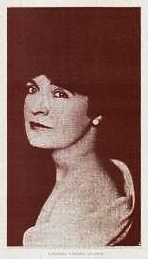
Winifred Virginia Jackson was the normal owner of the pseudonym “Elizabeth Berkeley,” but Lovecraft borrowed it from his collaborator for two poems: “The Unknown” (1916) and “The Peace Advocate” which was published in the May 1917 issue of The Tryout.

On 4 April 1917, the U. S. Senate voted to declare war on Germany. Like many Americans, Lovecraft had followed news of the unfolding Great War since its opening stages. Lovecraft was firmly on the side of the Allies, no surprise given his ancestral affinity for the United Kingdom. Having joined amateur journalism in 1914 near the start of the war, Lovecraft found the amateur press an outlet for his thoughts and feelings with essays such as “The Crime of the Century” (The Conservative Apr 1915) and “The Renaissance of Manhood” (The Conservative Oct 1915), and once war was declared, poems such as “The Crime of Crimes: Lusitania 1915” (Interesting Items Jul 1915), “The Volunteer” (Providence Evening News 1 Feb 1918), and “To the Nurses of the Red Cross” (1917).
Lovecraft’s position with regard to the war was complicated. He was not in a normal sense an American patriot, reserving his greatest affinity for England and the British monarchy. His support for the British Empire meant his opposition to the Irish home rule movement and Irish nationalism; Lovecraft’s bitterest anti-Irish statements date from around the period of the Easter Rising in 1916 and its aftermath. Racial hierarchies and white supremacist doctrine in the early 20th century lauded the “Teutonic race,” to which the “Anglo-Saxons” of Britain were either a part or close cousins; which is why Lovecraft decried the war as “The Crime of Crimes”—because white people were fighting white people.
It should come as no surprise that Lovecraft was, once hostilities broke out, in favor of war with Germany, yet Lovecraft was not a war-hawk in the normal sense, later writing:
No—we can’t justly endorse any sort of killing except in defence of oneself, or of some racial or national fabric representing one’s larger self.
H. P. Lovecraft to Robert E. Howard, 7 May 1936, A Means to Freedom 2.929
This is to say, Lovecraft did not advocate wars of aggression, but was impassioned in his support for defensive wars, especially when it was his beloved England and its allies (and later, fellow Americans) who were attacked. The initial neutrality of the United States to the war in Europe incensed Lovecraft, who bitterly attacked Woodrow Wilson’s position, and wrote in letters and essays passages like this:
This neutrality hath been a source of the keenest distress and humiliation to me ever since the war began, since I believe that the rightful place of America is at the side of her mother nation, defending the Anglo-Saxon civilisation and ideals which both countries hold in common. In fact, I have more than once blushed at the base and selfish attitude of the States at a time when all the forces of humanity should be engaged in warding off the Hun. Never before was I more disposed to make ostentation of the legal provision which makes me still able, as the grandson in direct male line of a true-born Englishman, to call myself a rightful British subject. England is my country as well as America—let those call me “hyphenate” who so desire!
H. P. Lovecraft to the Kleikomolo, Oct 1916, Miscellaneous Letters 28
Lovecraft’s dislike of neutrality also found expression in his personal discontent with pacifists and anti-war protestors; those who argued either for concessions to the Central Powers to buy peace, or simply opposed the United States sending troops to join a foreign war, or selling weapons and materiel to the Allies, which would only extend the war and its suffering—or as in the case of the Irish-American John T. Dunn, who opposed aiding Britain because he supported Irish nationalism. Dunn would later be drafted, refused to serve, and was sentenced to prison.
When Lovecraft’s Jewish friend Samuel Loveman faced the draft, the man from Providence had no sympathy:
By the way—our mutual friend & fellow-bard Samuel Loveman is in CLass I Div. A, expecting to be called for active duty. In the first draft he was exempted for poor vision, but the requirements are now less strict. If I were Loveman I should enlist. I have no patience at all with a strong man sans dependents who deliberately stays home till dragged out from under the bed. Loveman admts he is “unpoetically robust” & that his sight is not at all seriously impaired. But Jews will be Jews, & I will judge neither harshly nor hastily. He is certainly a very pelasant & exceedingly gifted person, & now that he is subject to call, shews no sign of timidity or unrest. I trust his career may be honourable, & tht he will meet with an easier fate than the other soldier-poets, Brooke, Seeger, Ledwidge, et al.
H. P. Lovecraft to Rheinhart Kleiner, 23 Feb 1918, Letters to Rheinhart Kleiner & Others 103-104
As it happened, Loveman spent most of his military service 1918-1919 at Camp Gordon in Georgia, and did not serve overseas.
A recurring theme in Lovecraft’s war-poems, essays, and letters is masculine identity and its ties with white supremacist national identity. Anglo-Saxons and Teutons were in the racial rhetoric of the day supposed to be warriors and conquerors who had dominated the globe because racial superiority was synonymous with martial superiority. It was a white man’s place to show courage and gladly answer the call. For Lovecraft, these were not just armchair ideals: not long after “The Peace Advocate” was published he attempted to enlist.
Some time ago, impressed by my entire uselessness in the world, I resolved to attempt enlistment despite my almost invalid condition. I argued that if I chose a regiment soon to depart for France; my shear nervous force, which is not inconsiderable, might sustain me till a bullet or piece of shrapnel could more conclusively & effectively dispose of me. Accordingly I presented myself at the recruiting station of the R. I. National Guard & applied for entry into whichever unit should first proceed to the front. On account of my lack of technical or special training, I was told that I could not enter the Field Artillery, which leaves first; but was given a blank of application for the Coast Artillery, which will go after a short preliminary period of defence service at one of the forts of Narragansett Bay. The questions asked me were childishly inadequate, & so far as physical requirements are concerned, would have admitted a chronic invalid. The only diseases brought into discussion were specific ailments from which I had never suffered, & of some of which I had scarce ever heard. The medical examination related only to major organic troubles, of which I have none, & I soon found myself (as I thought) a duly enrolled private in the 9th Co. R.I.N.G.! As you may have deduced, I embarked upon this desperate venture without informing my mother; & as you may also have deduced, the sensation created at home was far from slight. In fact, my mother was almost prostrated with the news, since she knew that only by rare chance could a weakling like myself survive the rigorous routine of camp life. Her activities soon brought my military career to a close for the present. It required but a few words from our family physician regarding my nervous condition to annul the enlistment, though the army surgeon declared that such an annulment was highly unusual & almost against the regulations of the service. The fact is, I had really gotten the best of that astute medicus; for without making a single positive misstatement I had effectively concealed the many & varied weaknesses which have virtually blasted my career. Fortune had sided with me in causing no attack of blurred eyesight to come upon me during the physical examination. But my final status is that of a man “Rejected for physical disability.” On the appointed day I shall register for conscription, but I presume my services will not be desired. My mother has threatened to go to any lengths, legal or otherwise, if I do not reveal all the ills which unfit me for the army. If I had realised to the full how much she would suffer through my enlistment, I should have been less eager to attempt it; but being of no use to myself it was hard for me to believe I am of use to anyone else. […] And so I am still in civil life, scribbling as of old, & looking with envious eye upon the Khaki-clad men who are now so frequently seen upon the streets of the business section & in the cars everywhere. […] Had my enlistment matured successfully, I wonder how I should have kept up! And yet—I will wager that I would have kept up some way or other. Now that death is about to become the fashion, I wish that I might meet it in the most approved way, “Somewhere in France”.
H. P. Lovecraft to Rheinhart Kleiner, 23 May 1917, Letters to Rheinhart Kleiner & Others 83-84
The effect on Lovecraft was dejection. While readers today might be glad that Lovecraft did not die as part of the American Expeditionary Force, for Lovecraft it was as those who hold their manhood cheap on St. Crispin’s Day. In a subsequent letter, he lamented:
I am feeling desolate & lonely indeed as a civilian. Practically all my personal acquaintances are now in some branch of the service, mostly Plattsburg or R.I.N.G. Yesterday one of my closest friends entered the Medical (not as a doctor, but as an assistant—carrying stretchers, driving ambulances, &c. &c.) Corps of the regular army. The physical tests for this corps are very light, & in spite of my previous rejection for Coast Artillery I would try to enter, were it not for the almost frantic attitude of my mother; who makes me promise every time I leave the house that I will not make another attempt at enlistment! But it is disheartening to be the one non-combatant among a profusion of proud recruits.
H. P. Lovecraft to Rheinhart Kleiner, 22 Jun 1917, Letters to Rheinhart Kleiner & Others 85
As it was, Lovecraft had to content himself by offering what moral support he could, in the form of poems in praise of those who could serve. This is the context we must imagine for when Lovecraft was writing “The Peace Advocate”: fighting had been going on for almost three years, yet the United States retained its stubborn neutrality as the Allies and the Central Powers engaged in bloody trench warfare in Europe, allied shipping faced German submarines, Britain itself was bombed from the air by zeppelins, and around the world the colonies and allies of the two sides clashed in a truly global conflict.
“The Peace Advocate” is a narrative poem about a conscientious vicar who opposes war (implicitly on religious grounds), even as his son goes off to fight, until the invaders literally land on his doorstep, destroying his church. The vicar regains his masculine ferocity (“manhood’s thought,” “with the manhood he had found,” “wak’d to man’s estate”) and fights to defend his home—too late, for his wife and daughter both die in the fray.
The politics and philosophy are not complex, and would be counted as propaganda if published by some government outlet. The fore are faceless, the reasons and causes of the war utterly unknown and opaque. It’s enough that they are the invaders in the universe of the poem. Lovecraft makes no effort to understand the peace advocate’s position or give them any arguments for opposing war; the combat and loss, on the other hand, are effective and brutal to support the moral. In failing to join the fight in time, the vicar has failed as a husband and father…and perhaps importantly, burns his book.
Prieſt. Give peace in our time, O Lord;
1662 Book of Common Prayer
Anſw. Becauſe there is none other that fighteth for us, but only thou, O God.
Lovecraft was a materialist and atheist; while not militantly anti-Christian, he did oppose the passivity and turn-the-other-cheek theology as counter to his ideas of the natural character of white people. Influenced by Nietzsche and similar thinkers, Lovecraft attributed this attitude to the Jewish origin of Christianity. As he would put it after the war:
Semiticism has never done anything save harm when forced upon us or adopted by accident. It gave us the puling hypocrises of the Christian doctrine—us, who by every law of Nature are virile, warlike, and beauty-loving pagans and Northern polytheists!
H. P. Lovecraft to Frank Belknap Long, 21 Aug 1926, Selected Letters 2.67
It is a rhetorical trick to make the subject of the poem a Christian priest, because Lovecraft can imply a religious motivation for antiwar sentiment without actually engaging with any religious arguments.
Of all the stanzas in the poem, one in particular stands out in its imagery as possibly being inspired by another poem:
His son had buckled on his sword,
The first at the front was he;
But the vicar his valiant child ignor’d,
And his noble deeds in the field deplor’d,
For he knew not bravery.
While “buckled on his sword” could be a metaphor for joining the Army and taking up arms against the foe, there is a parallel with another very well-known war song:
The Minstrel-Boy to the war is gone,
Thomas Moore, “The Minstrel Boy”
In the ranks of death you’ll find him;
His father’s sword he has girded on,
And his wild harp slung behind him.
“Land of song!” said the warrior-bard,
“Tho’ all the world betrays thee,
One sword, at least, thy rights shall guard,
One faithful harp shall praise thee!”
This could be simply parallel imagery: Moore was after all writing specifically from an Irish nationalist perspective, while Lovecraft was in the midst of his anti-Irish period, and there wasn’t much common purpose there. On the other hand, there would be a certain irony in appropriating the image of the boy who clads on his father’s sword to go to war, when the father himself stays home as a take-that to Irish nationalists who refused to fight in Britain’s aid. Lovecraft’s letters are silent on the subject, no doubt to maintain the illusion that “Elizabeth Berkeley” had written the verses.
Lovecraft’s motivations and ideology in writing this piece were wrapped up in contemporary politics and ideas of masculinity, national identity, and racial identity; he failed to attempt to accurately understand or present anti-war arguments in his letters, essays, and poems, because his rhetorical purpose was in support of the side of the conflict he identified with. It is one thing to understand, from an intellectual standpoint and the distance of years, how Lovecraft’s ideas and rhetoric were shaped by the forces of his life…and there are flaws in both.
Yet how would “The Peace Advocate” be received in Ukraine if it was published in 2023? As the men and women of that nation strive to defend their people, their culture, and their borders from the invading military forces of the Russian Federation? Would they not see parallels between the parable of “Elizabeth Berkeley” and Russia’s indiscriminate bombing of civilians and the Transfiguration Cathedral in Odessa?
While Lovecraft’s ideology is flawed and his rhetoric ignores real tenets of and arguments for pacifism, or conscientious objection, there is an argument to be made that in the face of unprovoked aggression, there exists a moral justification to take up arms and resist. Every individual, and nation, has the right to self-defense—and if necessary, to meet deadly force with deadly force. Slava Ukraini.
“The Peace Advocate” is not one of Lovecraft’s more influential works, in part because he never openly acknowledged authorship and it has seldom been reprinted. There is nothing weird or supernatural about it, there are no connections to the Mythos, and it was written years before Weird Tales first hit the stands or Cthulhu was conceived. That it holds any resonance to events in 2023, over a century after it was first published, is due only to the fact that war is as much a reality today as it was then. In that respect at least, less has changed than we might have hoped.
“The Peace Advocate” may be read in its entirety at https://hplovecraft.com.
Bobby Derie is the author of Weird Talers: Essays on Robert E. Howard and Others and Sex and the Cthulhu Mythos.
Deep Cuts in a Lovecraftian Vein uses Amazon Associate links. As an Amazon Associate I earn from qualifying purchases.
 Deep Cuts in a Lovecraftian Vein