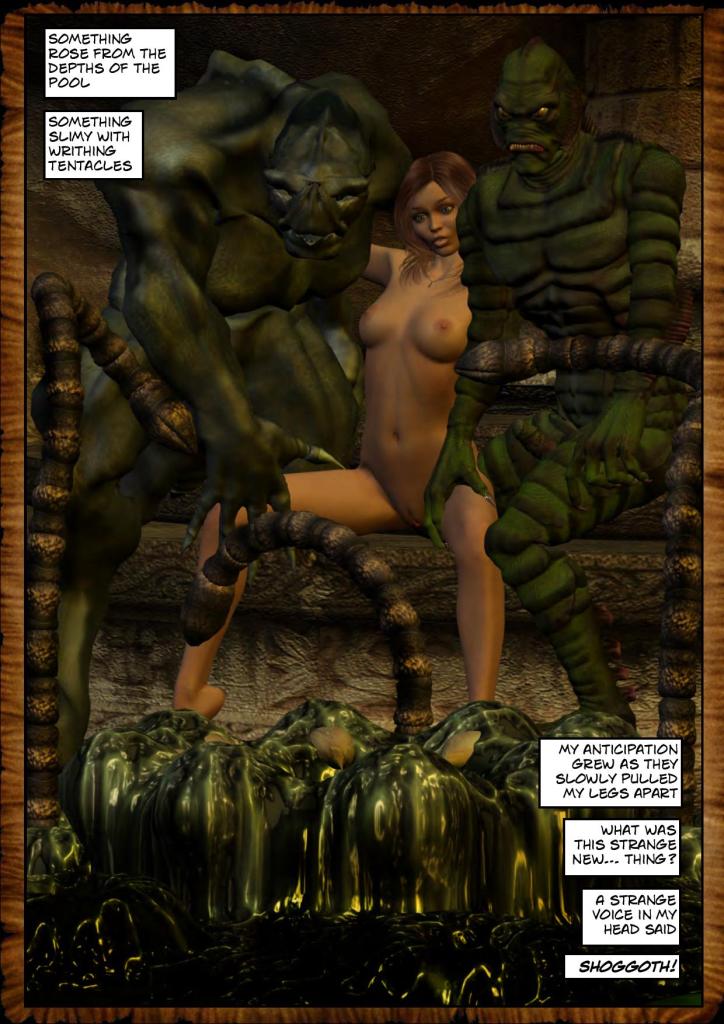
“A Loobelier Licking” (1998) by Maxi Dell

Lois Gresh writers her erotic fiction under the nom de plume Maxi Dell. […] She says about her story: “Perception marks the boundaries of reality. What seems strange to us, what we fight the most, may be the only thing that matters. In a world of cold darkness the heat of love ignites sex even if the lover is a so-called demon.”
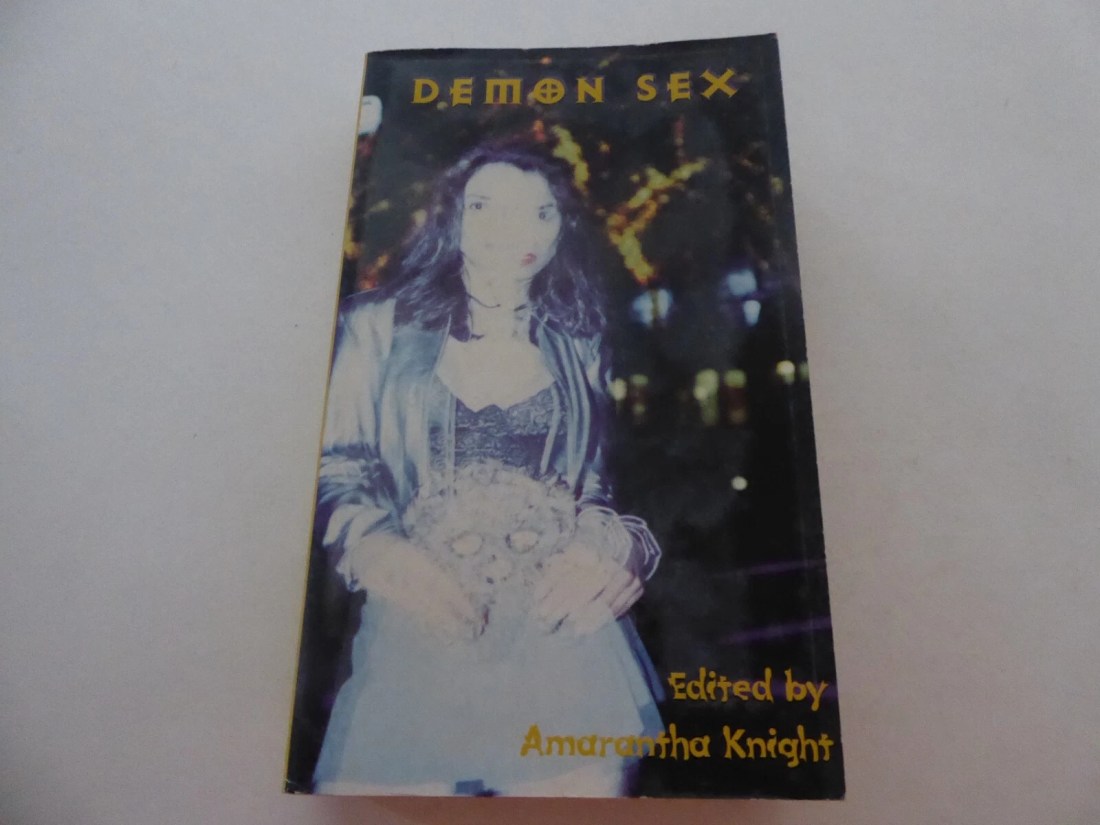
Demon Sex (1998), 45-46

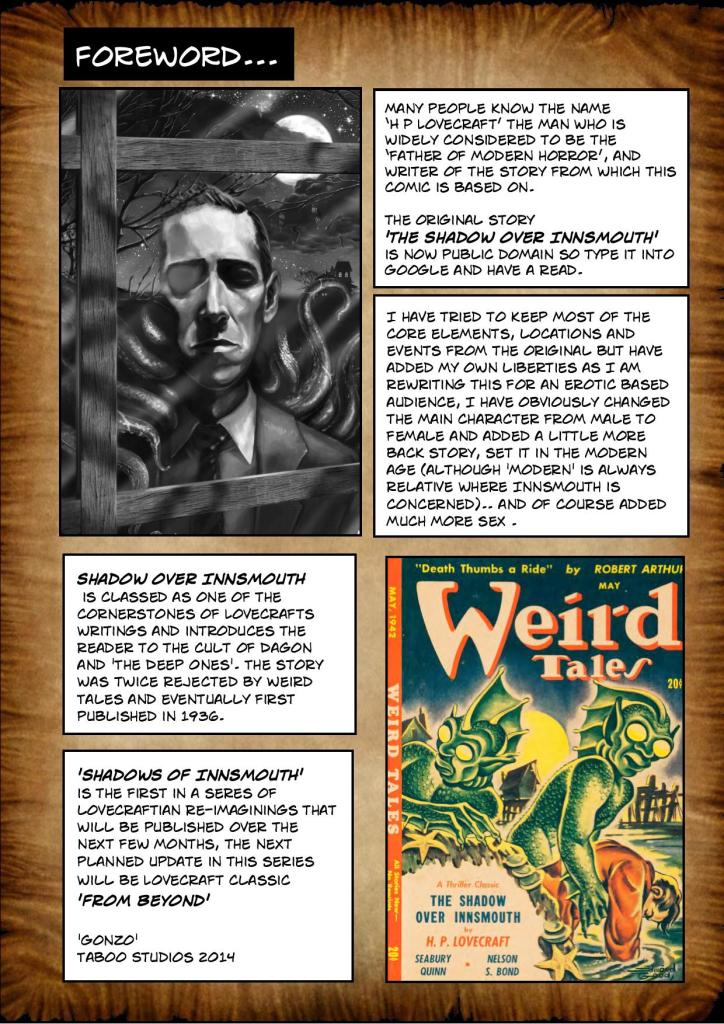
Some writers of Cthulhu Mythos fiction approach the project with the care of a pasticheur working another episode into a series of canonical tales—like writing an unofficial sequel to a classic Sherlock Holmes story, they might write “what happened next” for Lovecraft’s “The Dunwich Horror” or “The Shadow over Innsmouth”; such is the case with “The Shuttered Room” by August Derleth. Other writers prefer to reinterpret the story, providing an alternate take on what really happened, this is what you see with “The Black Brat of Dunwich” (1997) by Stanley C. Sargent.

In her Mythos fiction career, Lois H. Gresh’s approach is closer to that of a DJ, remixing familiar songs and beats but putting her own spin on it. She doesn’t re-tell old stories, she doesn’t try to abide by anyone’s canon, and the result is something that at once has a lot of familiar elements, but is nothing like what you’ve heard before—and perhaps not what you would expect, either. None of which is a bad thing, unless you go into her stories expecting something else.

You’ll be twenty tomorrow, Emilie. It’s time for us to share The Gift.” Rolfe’s voice was hoarse, gravel grating against the fishdead air.

She said, “The Gift is something I definitely don’t want for my birthday. How about if we just say here in Innsmouth and never have sex?”
—Maxi Dell, “A Loobelier Licking” in Demon Sex 48

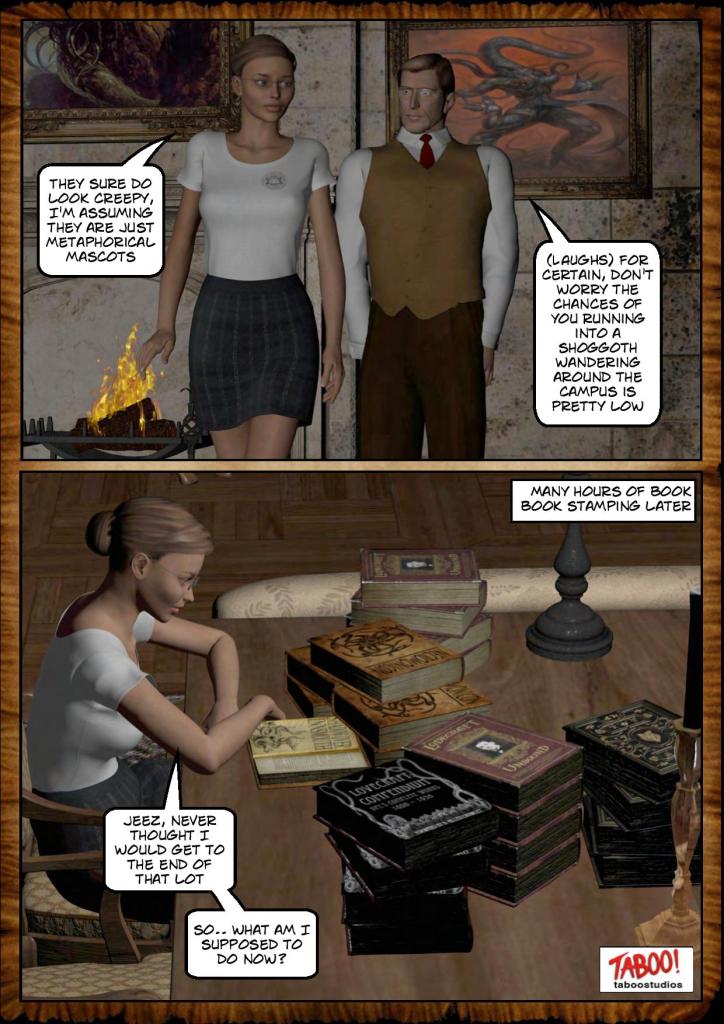
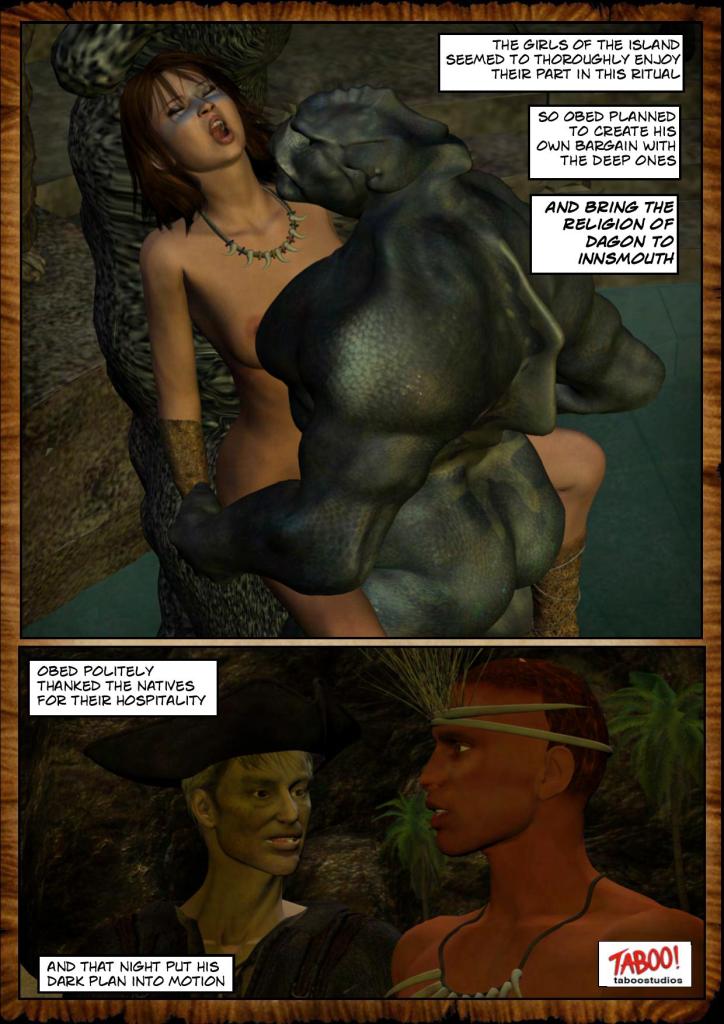
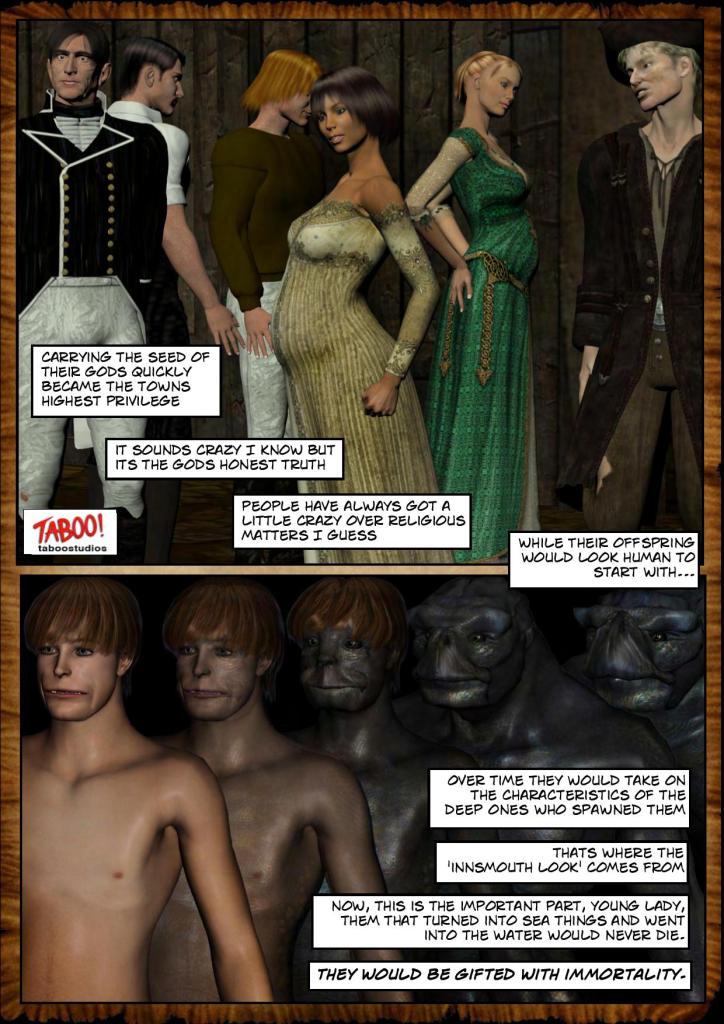
The story is set in Innsmouth, though not quite the same Innsmouth readers will find familiar. It deals with Yog-Sothoth and Eihort, the latter an eldritch entity that was created by Ramsey Campbell for his Mythos stories. Emilie and Rolfe are best friends, 19 years old, irrepressibly horny, outsiders among outsiders—and is stuck in a tricky situation. Emilie is the cosmic equivalent of an ugly duckling, physically unlovely and ostracized because she carries the genes of a Great Old One. The Innsmouthers want to kill her. The brood of Eihort, the Loobeliers, Yog-Sothoth, and most especially her friend Rolfe want to impregnate her.

Except if she gets pregnant, she dies and Cthulhu gets loose and ends the world.

If that sounds a little complicated—well, yes. It’s also sexually explicit, more than slightly surreal, and probably doesn’t make too much sense if you think about it too long. Emilie’s negative body image, search for love, and the apparent fact of her imminent demise or translation to another reality if she gives in to her teenage lust plays as very nearly a parody, a kind of cosmic teenage sex comedy. While it plays a little more serious than that (at least from Emilie’s point of view), in an era when “monsterfucker” is a tag for a vast swathe of fiction, I think audiences today might have more sympathy for Emilie.

It’s not just that she wants to get laid. She wants love, too.

Rolfe, on the other hand, is utterly inept. By his logic, he and Emilie are two of a kind, and he’s the only option for her to survive—his every effort to get laid, however, reinforces the problem. In the end, he’s been friendzoned so hard the reader would almost feel sorry for him, if he wasn’t so utterly without romance.

[“]Our only chance is to mate with each other before they get to you.”

He was being ridiculous. As if her only choices were sex with Rolfe or sex with a fish. What an absurd thought. Of course, if it came down to it, she’d choose Rolfe. He wasn’t a fish, after all, and he did have a certain raw masculinity that she found appealing. Plus, she’d known him since they were children, and he was her only friend. But still…

Maybe it was the way he put it: mating.
—Maxi Dell, “A Loobelier Licking” in Demon Sex 49

(Readers may, at this point, wonder what the heck a loobelier is. As near as I can tell, they appear only in this story and nowhere else, so it would be a terrible spoiler to reveal that. Trust me, knowing what they are does not significantly make much more sense in context.)

As an erotic horror story, if you don’t invest too much time in thinking about it, this is fun. Gresh has a knack for entertaining prose and slightly surreal situations (see “Showdown at Red Hook” (2011) by Lois H. Gresh), and this is no exception. While probably never going to appear in any list of canonical Innsmouth tales, I think the subversion of expectations, as much as the anticipation of Emilie’s final decision, is what makes this story work.

“A Loobelier Licking” as by Maxi Dell was published in Demon Sex (1998). It has not been reprinted.


Bobby Derie is the author of Weird Talers: Essays on Robert E. Howard and Others and Sex and the Cthulhu Mythos.

Deep Cuts in a Lovecraftian Vein uses Amazon Associate links. As an Amazon Associate I earn from qualifying purchases.
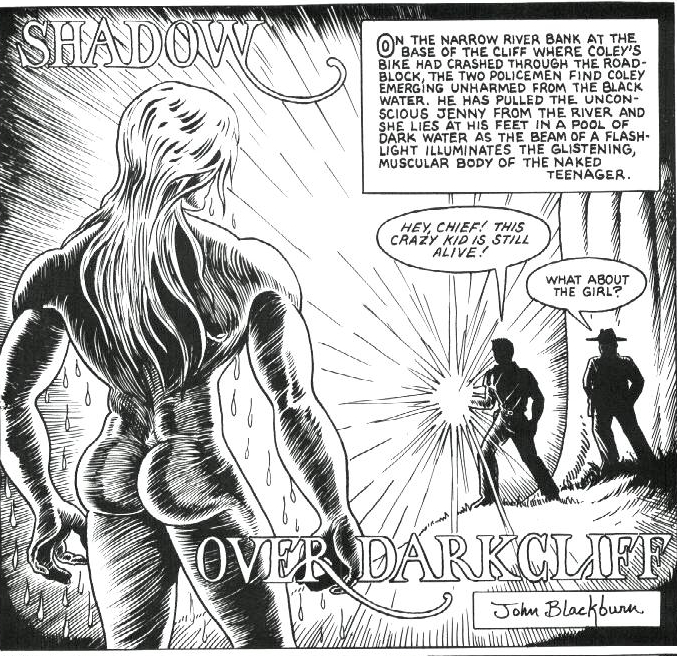
“Shadow over Darkcliff” (1993) by John Blackburn

Eldritch Fappenings
The following review of LGBTQ+ comic history includes images from selected works that depict cartoon nudity, sex, and violence. Reader discretion is advised.


Marriage and Sex

(1) Divorce shall not be treated humorously nor represented as desirable.
(2) Illicit sex relations are neither to be hinted at nor portrayed. Violent love scenes as well as sexual abnormalities are unacceptable.
(3) Respect for parents, the moral code, and for honorable behavior shall be fostered. A sympathetic understanding of the problems of love is not a license for morbid distortion.
(4) The treatment of live-romance stories shall emphasize the value of the home and the sanctity of marriage.
(5) Passion or romantic interest shall never be treated in such a way as to stimulate the lower and baser emotions.
(6) Seduction and rape shall never be shown or suggested.
(7) Sex perversion or any inference to same is strictly forbidden.
Comic Book Code of 1954

LGBTQ+ characters and themes received little coverage in the comic strips and comic books in the United States before 1954. When looking at the Pre-Code Lovecraftian Horror Comics, there are no characters or themes that jump out as explicitly gay or lesbian, transgender or genderqueer. After the Code was created in 1954, LGBTQ+ representation in commercial comics was implicitly forbidden.

Without access to mainstream publications, LGBTQ+ comics shifted to venues that were not controlled by the Comics Code Authority. Pornographic comics and underground comix formed a creative outlet for LGBTQ+ characters, stories, and creators—at the risk of being charged with obscenity. The late 60s and 70s in particular saw the birth of the underground comic scene, an outlet for readers and artists who wanted comics that were forbidden, transgressive, or mature—featuring themes of realism, sex, violence, drugs, politics, mysticism, and horror, often in some combination.

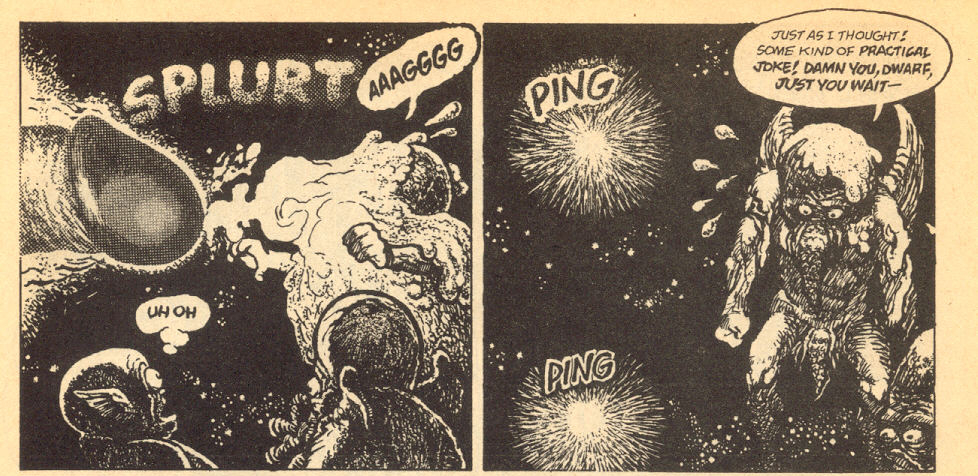
Tales from the Leather Nun (1973), for example, was an underground nunsploitation anthology comic. One of the episodes, “Tales of the Leather Nun’s Grandmother” by Spain Rodriguez, mixes Lovecraft’s Mythos with hardcore pornography, as Abdul Alhazred’s spells have accidentally turned the Leather Nun’s Grandmother’s vagina into a gateway to the realm of Cthulhu. Thus, one of the earliest appearances of Cthulhu in comics has the eldritch horror getting a face full of spunk.

Tales from the Leather Nun (1973); art by Spain Rodriguez

Cthulhu’s facial is a gag, not a homoerotic act. Tales from the Leather Nun isn’t the first LGBTQ+ Lovecraftian comic, just one of the first to begin to transgress in ways that combined sexual themes with Lovecraftian horror. It is difficult to say for sure what was the first LGBTQ+ Lovecraftian comic, if only because we have to look outside of the well-indexed mainstream.

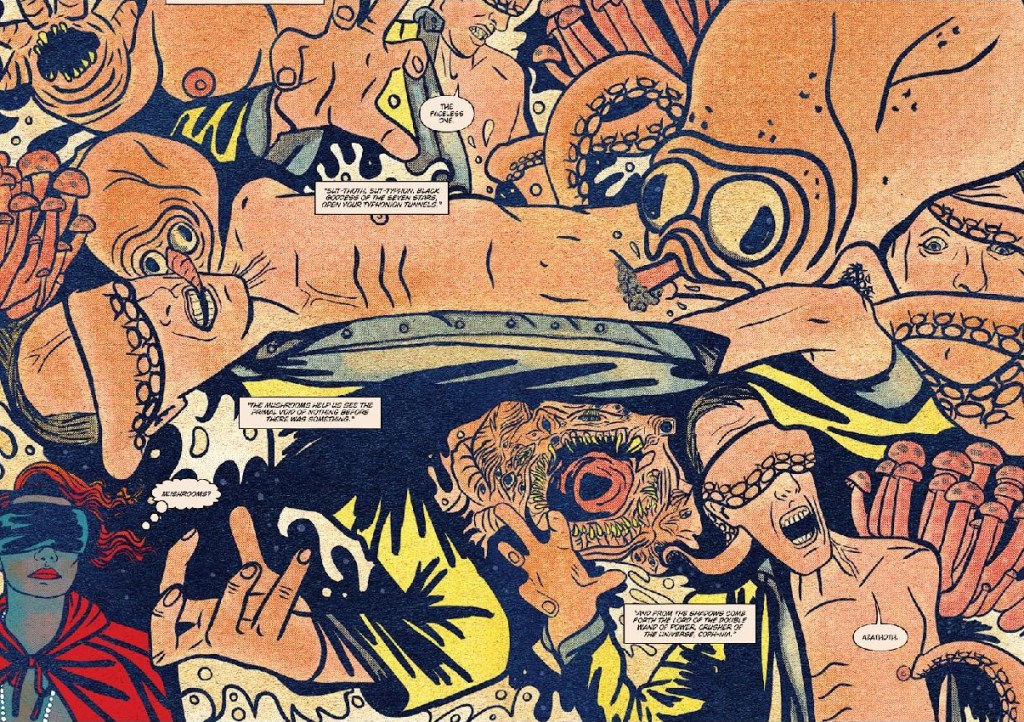
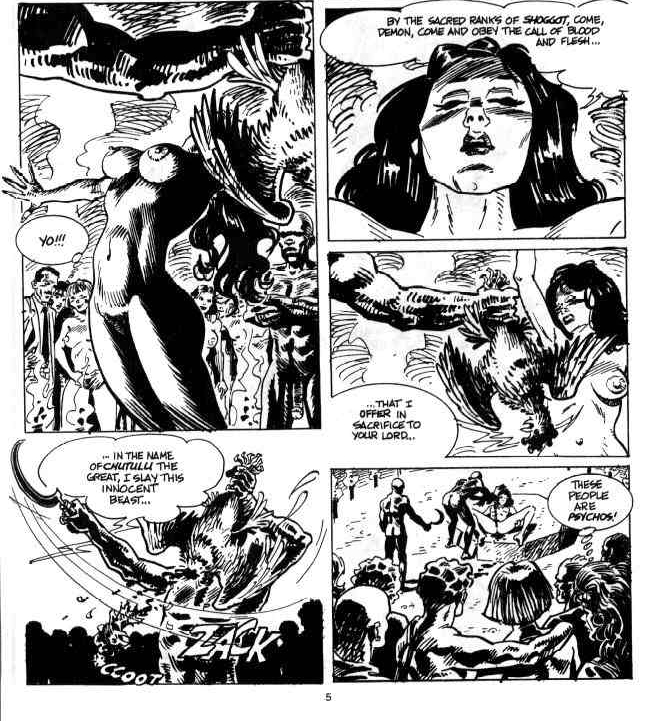
“R. H. B.” (1978) by Andreas and Rivière is a likely candidate, because it focuses on R. H. Barlow, who was gay. However, Barlow’s homosexuality isn’t really the focus of comic, barely mentioned at the end. A later example is the Italian erotic comic Ramba #4 (1989), which features the bisexual Ramba facing down a demon named Azatoth summoned during a voodoo-esque ceremony:

Ramba #6 (Eros Comix), Marco Bianchini (script) and Fabio Valdambrini (art)

Of course, most of Europe never had an equivalent to the Comics Code Authority, so they had a freer hand to explore such themes. In the United States, works like Ramba appeared in translation in the early 90s, after the CCA had been weakened or ignored by independent publishers. If we can’t quite answer the question of who came first (whether into Cthulhu’s visage or elsewhere), we can at least say there was another notable work that emerged in that period that combined Lovecraftian horror and explicit LGBTQ+ characters and themes.

In the 1970s, comic writer and artist John Blackburn created the character Coley Cochran, a 19-year-old uninhibited bisexual character with a penchant for sex, violence, and the occult and antipathy to prudes and authority figures. In the late 80s/early 90s Blackburn self-published four books of Coley’s sex-drenched adventures, a combination of erotica, character-driven drama, and graphic violence. In the first book, Coley on Voodoo Island (1989), Coley is kidnapped and transformed into a sex god in a voodoo ceremony; this supernatural element would re-emerge periodically throughout Coley’s adventures, such as Breathless (1991), which includes an adventure at a ruined temple titled “Flowers of Evil.”

In the 1990s Fantagraphics picked up the Coley adventures under their Eros Comix imprint, publishing a series of 2-3 issue miniseries, beginning with Return to Voodoo Island (1991). The problem with the Eros Comix series is that they never reprinted Coley’s earlier adventures (except when Blackburn summarized them for reprints), so that new readers come into a series that has already been going on for hundreds of pages.

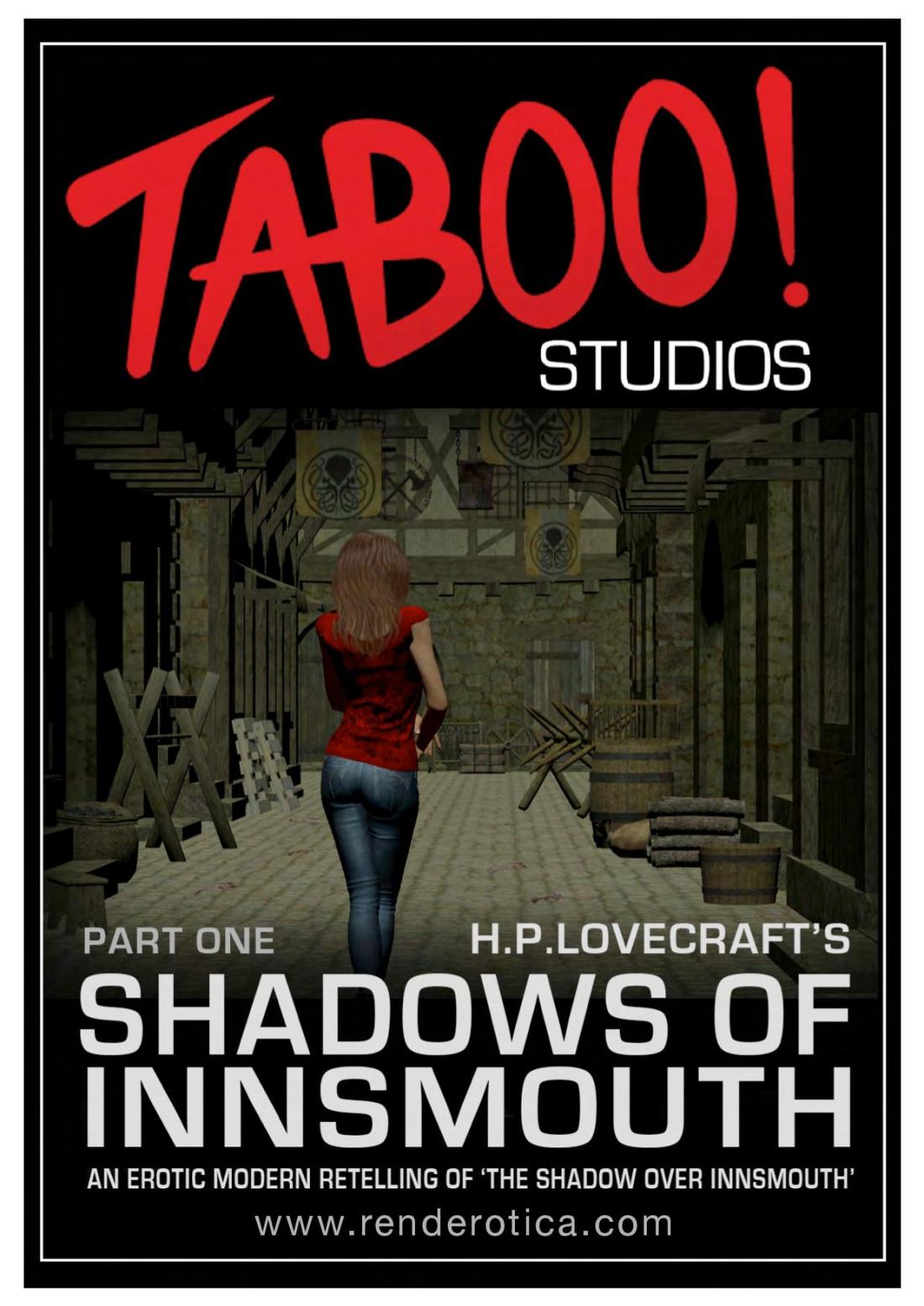
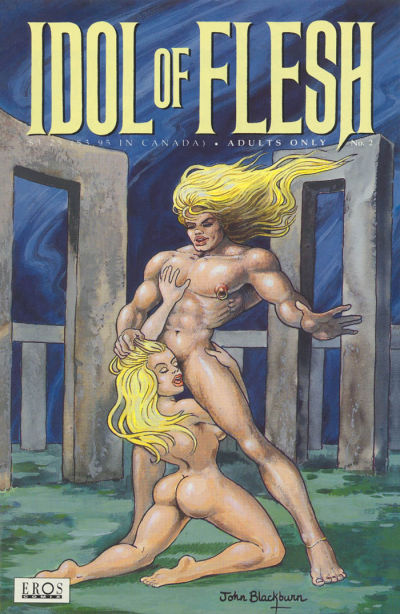
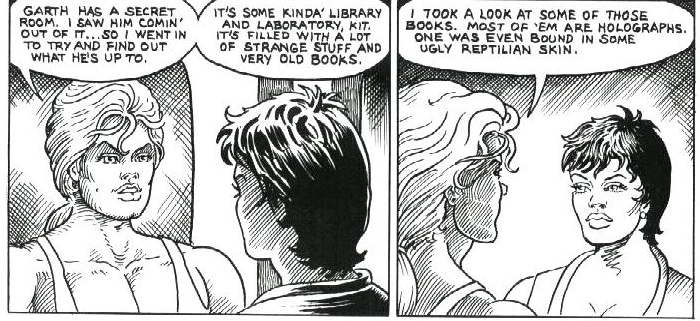
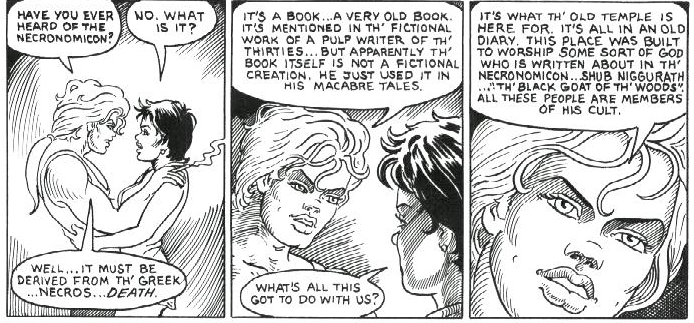
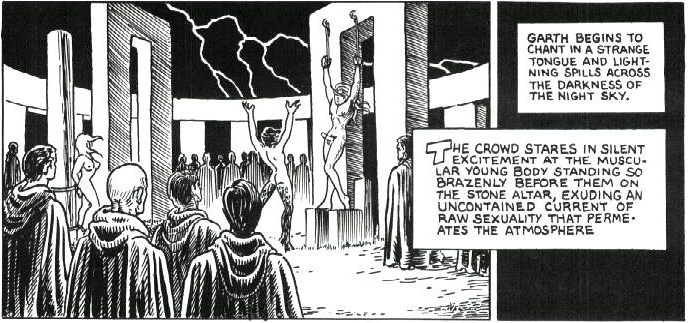
John Blackburn’s “Shadow over Darkcliff” is the second part of the two-issue series Idol of Flesh (1993), and sees Coley and friends return to the temple ruins of “Flowers of Evil”—but this time featuring a strange cult, led by a man named Garth. While the 32-page episode involves a bit of drama and a good bit of sex, the core story is explicitly Lovecraftian:

Idol of Flesh (1992) #2, by John Blackburn

Garth, it turns out, isn’t exactly human and wants Coley for sex and sacrifice. This isn’t the first or the last time Coley would be in this sort of position, the magnetic sexual attraction to both men and women is one of his supernatural traits throughout all of Blackburn’s series, as are scenes of flagellation, bondage, and sexual violence—especially the threat of castration, which appears in Return to Voodoo Island and reappears here. As in “Flowers of Evil,” Coley’s escape from this particular peril is somewhat miraculous—not a great storytelling trick, and one which Blackburn overuses a bit. Not that readers would know that unless they hunted out some of the stories that Fantagraphics did not reprint.

Blackburn would return to Coley and the Cthulhu Mythos in a longer, more involved, and even weirder storyline titled Dagger of Blood (1997), which makes brief reference to Garth and the events of “Shadow over Darkcliff.” Yet it reading the stories in order gives a better sense of the ideas that Blackburn was developing. Coley is presented as this perfect bisexual heartthrob, while characters like Garth and the antagonist of Dagger of Blood are both attracted to and hate Coley because of their own deformed bodies. There is a strong element of body dysmorphia to those characters, really only implicit here and more fully developed (and exploited) in Dagger of Blood, which fixates on genital mutilation.

It feels like Blackburn was working through some things, if only in art and writing, and perhaps only for his own entertainment. Certainly Blackburn was aware of the main focus of his comics—Coley has no shortage of sexual partners on the page, in explicit detail, both men and women—and the mundane drama of trying to keep his lovers happy is a counterweight to the more fantastic elements of Lovecraftian horror, even as the action and horror plots provide some relief from the soap opera.

When you look back at the history of LGBTQ+ characters and themes in comics, Blackburn’s work arriving when and where it did—first in self-published underground comix, and then after the CCA waned in series from an independent press which stressed the erotic angle—makes sense. It took decades after the Stonewall Riots for LGBTQ+ folks to gain greater recognition, acceptance, and basic rights in the United States, and such works were slow to find a place in mainstream comic books and strips. The underground was more willing to accept these nonconforming works with LGBTQ+ characters and to have discussions about subjects like homosexuality, polyamory, bisexuality, kink—and, yes, how the occasional bit of Lovecraftian horror fit into the mix. At the time, homosexuality in the Mythos was limited to stories like Ramsey Campbell’s “Cold Print” (1969), and those were few and far between.

Reading all of John Blackburn’s Coley saga is damn near impossible these days. Fantagraphic’s individual issues and reprint collections are long out of print and command collectors’ prices; the Idol of Flesh comics are reprinted in Coley Running Wild Book One: The Blade and the Whip. Several other adventures by Coley were published or re-printed in the gay comics anthology Meatmen, though there is no complete index for that series as yet.


Bobby Derie is the author of Weird Talers: Essays on Robert E. Howard and Others and Sex and the Cthulhu Mythos.

Deep Cuts in a Lovecraftian Vein uses Amazon Associate links. As an Amazon Associate I earn from qualifying purchases.
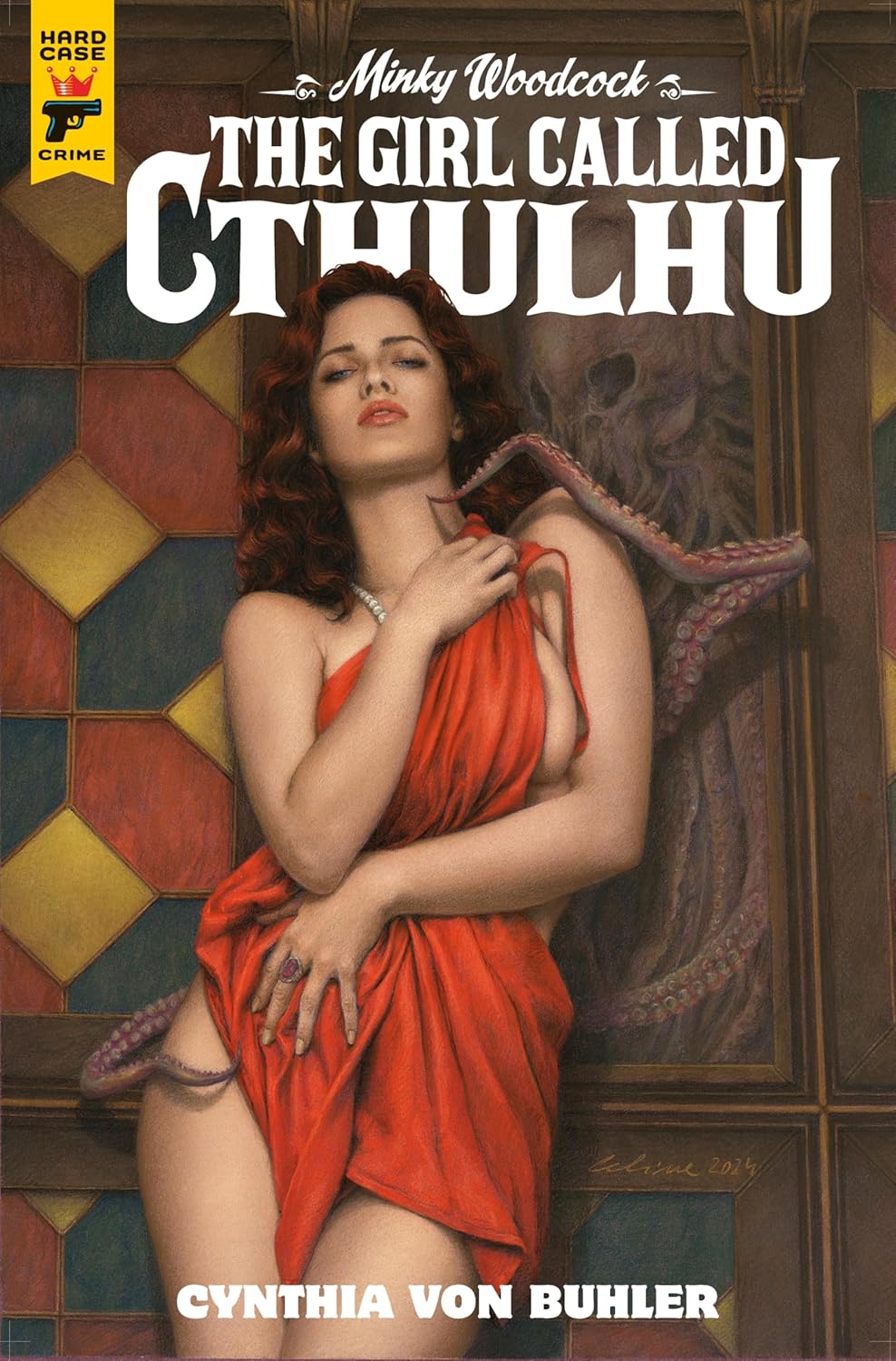
Minky Woodcock: The Girl Called Cthulhu (2025) by Cynthia von Buhler

Eldritch Fappenings

The following review is of a work that contains cartoon nudity, and some images are reproduced.
Reader discretion is advised.


In 2017, writer-artist Cynthia von Buhler introduced the world to Minky Woodcock, private detective, in a 4-issue series The Girl Who Handcuffed Houdini, published under the Hard Case Crime imprint of Titan Comics. The series was a clever mix of hardboiled detective themes with historical characters, with the bisexual and extraordinarily intelligent and adaptable Minky Woodcock often ending up in dangerous situations and/or sans her clothes—but also finding or fighting her way out again. The series was followed up with a sequel, The Girl Who Electrified Tesla (2021), and then The Girl Called Cthulhu (2024), which was lettered by Jim Campbell.

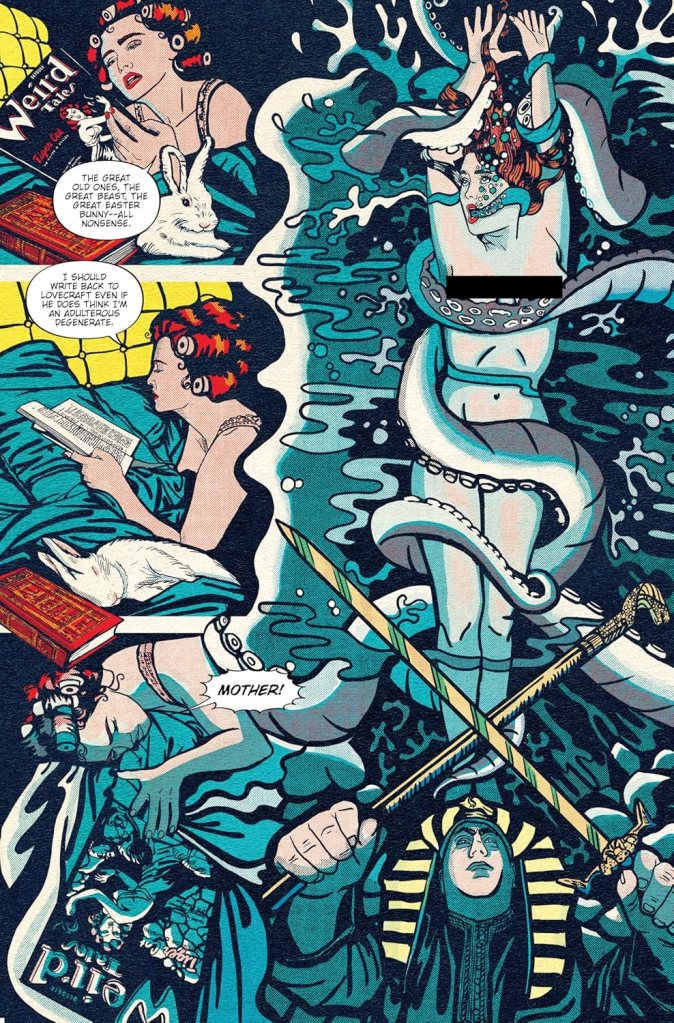
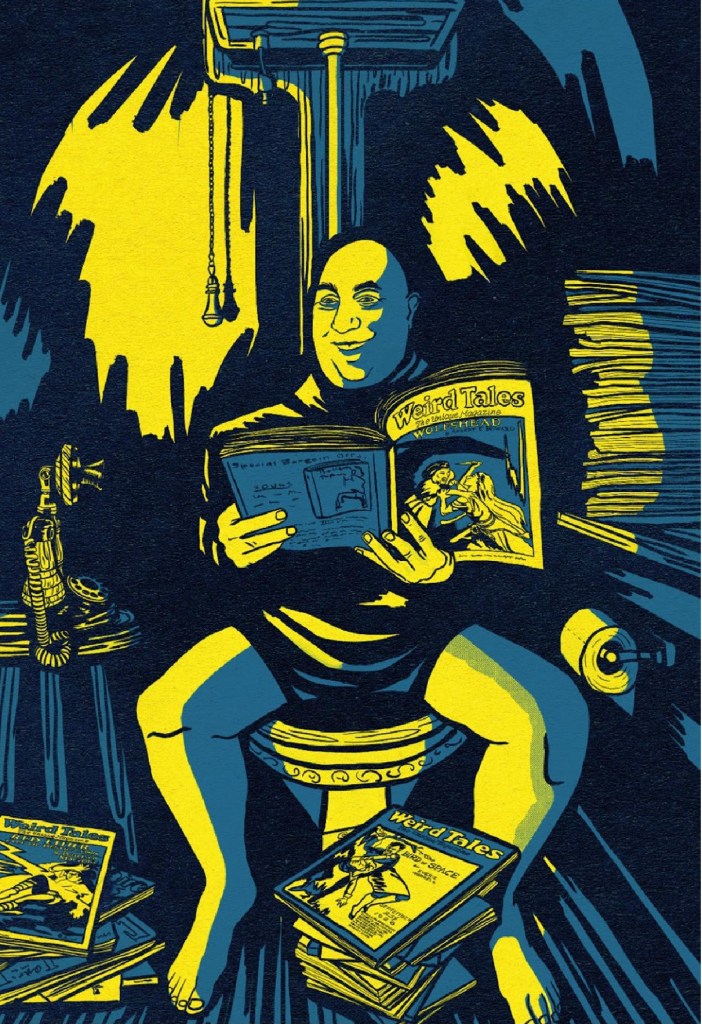
The plot is drawn from history, dealing with Lovecraft’s relationships with Harry Houdini and Aleister Crowley, slightly fictionalized for purposes of the plot, but in general faithful to the timeline—with careful reproductions of Weird Tales covers and effort made to reproduce real people, places, and events. There are a number of fun little Easter eggs for Weird Tales fans in the pages, captured in von Buhler’s own style, who favors a heavy line and stylized coloring that echoes noir and giallo films.

At its heart, Minky Woodcock: The Girl Called Cthulhu is a rather traditional detective/mystery story, tied up in a historical setting and with some added titillation thrown in. The depiction of H. P. Lovecraft and his wife Sonia are synthesized from various sources, notably The Private Life of H. P. Lovecraft (1985) by Sonia H. Davis, but aren’t particularly cruel or inaccurate given the needs of the story. Buhler flaunts her artistic homages, such as Hokusai’s “Diver and Two Octopi,” and is one of the few artists not afraid to depict Howard’s penis. Whether that’s a warning or an enticement to read the book is something I leave up to the readers.

It is a fun book, and plays to both Lovecraft and Crowley’s particular legends. Cynthia von Buhler has obviously done a good bit of research, and she wears it on her sleeve, including a section at the rear of the collected edition (and in the individual issues) explaining some of the details:

The investigations portrayed in the Minky Woodcock series are grounded in fact, the result of my extensive research. I acknowledge that some of the details may seem peculiar leading to numerous questions. Here are my responses to them. – CvB

Is all the research correct? Well, there’s no evidence Sonia H. Greene heard Crowley at the Sunrise Club (though she did attend the club), and no evidence Crowley read Lovecraft. The comparison between Lovecraft’s fiction and Crowley’s magical writing is the stuff of wishful occultists, as shown in the opening of the Simon Necronomicon. But for fictional purposes, these are pedantic niggles, and certainly other authors that have posited Lovecraft/Crowley interactions have gone further and been more ahistorical. A more interesting tidbit is the question of Lovecraft’s prejudices:

Lovecraft was a racist and anti-Semite. Why would you honor him with the title of your book? I highly doubt he would have married a Jewish woman.

Lovecraft was married to Sonia H. (Haft), a successful Jewish milliner and amateur pulp fiction writer, from 1924 to 1937. She tried to educate him as best as she could, and by the end of his life, his views had changed somewhat, but he said some pretty awful things in his day. I make his outrageous beliefs absolutely clear in my book.
—Cynthia van Buhler, Minky Woodcock: The Girl Called Cthulhu

While von Buhler doesn’t answer the first question directly, I think the book itself makes the point clear: Lovecraft was weird, and is the connective tissue between Houdini and Crowley, the three together providing a bridge from rationality to occultism and weird fiction. Lovecraft comes across as a bit stiff and surreal, but that’s not unusual for fictional depictions of HPL, and if the effort is made not to hide Lovecraft’s prejudices, neither does she make the effort to depict him as a cartoon caricature of a bigot. Sonia gets less attention, unfortunately, but her part in the proceedings is a minor one.

Ultimately, this isn’t Lovecraft’s story, or Crowley’s, but Minky Woodcock’s. A dame detective who finds herself in strange company and dangerous situations, surviving largely by her ample wits. While not quite as bloody and fierce as Max Collins’ Ms. Tree, there is that same sense of a woman in a primarily male occupation dealing with society’s preconceptions and some quite ruthless characters—and, sometimes by the skin of her teeth, coming out alive if not always on top.


Bobby Derie is the author of Weird Talers: Essays on Robert E. Howard and Others and Sex and the Cthulhu Mythos.

Deep Cuts in a Lovecraftian Vein uses Amazon Associate links. As an Amazon Associate I earn from qualifying purchases.
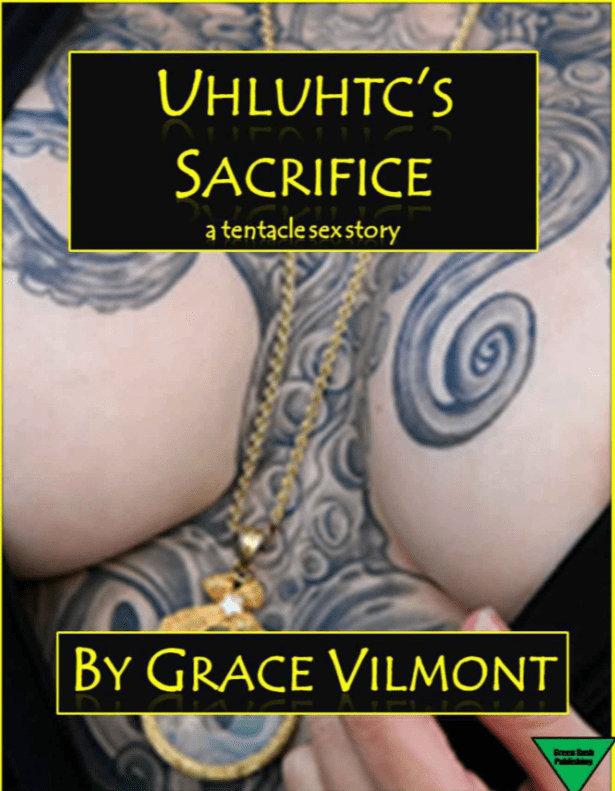
“Uhluhtc’s Sacrifice” (2013) by Grace Vilmont

Eldritch Fappenings

This review concerns a work of erotica, and as such may involve text and images of an adult nature.
Reader discretion advised.


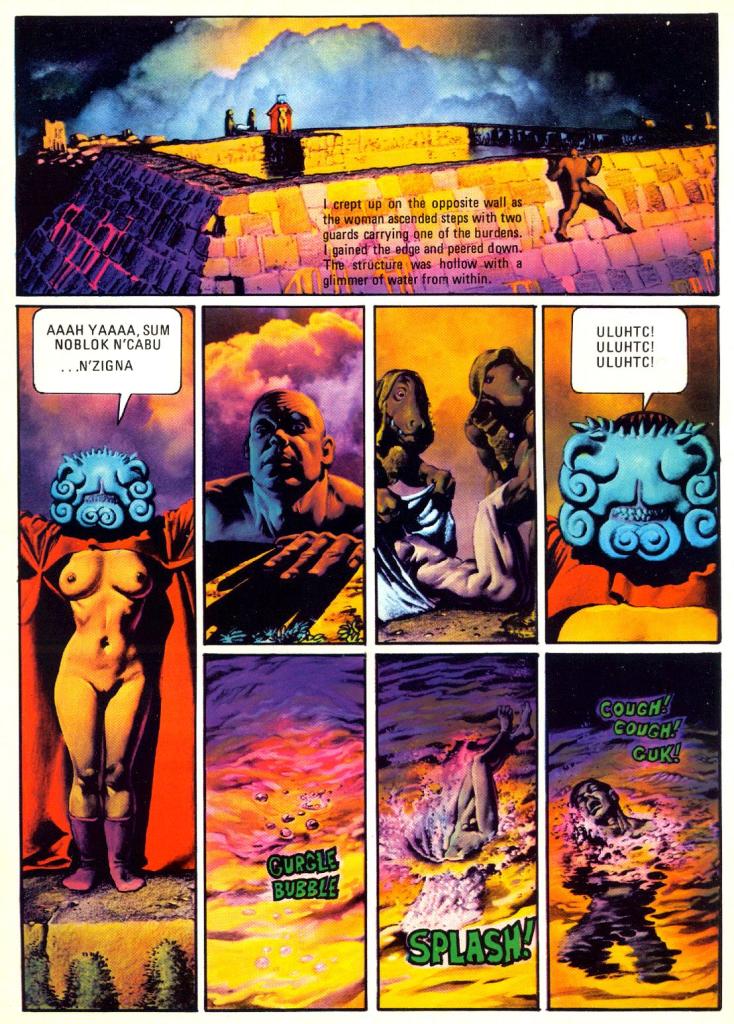
Yes, if you spell Uhluhtc backwards it becomes Cthulhu. It’s not terribly clever as an authorial tool, but it is a semi-smart homage to that fine animated filme Heavy Metal.
—Grace Vilmont, “Author’s Note,” “Uhluhtc’s Sacrifice”

Uhluhtc appears in the segment “Den” in the film Heavy Metal (1982); this was an adaptation of Richard Corben’s character and story of the same name in Heavy Metal Magazine and Métal Hurlant—there being a lot more Lovecraftian material in the pages of those magazines than just in the Métal Hurlant/Heavy Metal/Metal Extra Lovecraft Special. Corben had used “Uhluhtc” in one of his early Den episodes.

Heavy Metal Magazine (June 1977)

Corben was likely inspired by “Count Alucard” in Son of Dracula (1943), a transparent anadrome used as an alias by the vampire played by Lon Chaney, Jr. In both cases, the purpose of the reversal isn’t really to conceal the identity as much as to plant an Easter egg for fans to find. It’s a nod and wink, a signal to readers that the writer is a horror fan too.

What makes it an appropriate title for Grace Vilmont’s tentacle and cultist erotic novella, a light-hearted and sexually explicit horror-sex-comedy that leans heavier on the sex comedy than the horror, is the way Vilmont’s approach to the Lovecraftian tropes inverts traditional ways of casting sexuality as evil or depraved. The way it plays with the tropes is very explicitly tongue-in-cheek (and tentacle-in-cheek, and every other orifice), but there is a core of message there. It is good unclean fun that manages to be sex-drenched and irreverent without being nasty or raunchy in the way of some erotica titles that play more with violent or onerous taboos, but is also very expressly contrasting itself against negative depictions of sexuality.

It does get a little silly at parts:

“I probably should have told you more. But I never expected this. You’re carrying Uhluhtc’s spawn—”

“I know,” Cassie said proudly.

“Brenda continued as if Cassie hadn’t spoken. “—and your body needs a near constant supply of human semen. I don’t pretend to understand the reasons why or the logic behind it. But you need to get fucked and fertilized right now.”
—Grace Vilmont, “Uhluhtc’s Sacrifice”

Vilmont’s tale is one of a spate of tentacle-sex-with-optional-impregnation stories that have appeared, often in waves, in ebook format; a sister to Booty Call of Cthulhu (2012) by Dalia Daudelin and its sequels. While readers may or may not be titillated by the tentacle sex, it is the approach to the setting and characters that is often more interesting from the perspective of historical context.

This tale is centered on the completely consenting cultists; who, aside from their tendency toward orgies and summoning eldritch entities, have less malice per capita than the average book club. Their robes have zippers and while race is seldom explicitly mentioned, it’s clear that the majority of characters at least are coded as Caucasian; the racial dynamics of Lovecraft’s cult of Cthulhu were left at the door, no one is being violently sexually assaulted or hurt. If there is any shade thrown in this story, it is a swipe toward the sexual repression and bigotry associated with Evangelical Christianity:

“I was sick of the way Mom used Christianity as a hammer to control me and everything else around her.” […]

“Nothing we do here is illegal in any way.”

Cassie nodded. “But the evangelicals she fell in with would consider this an affront to God.” She nodded sagely then broke character and giggled. “I used Mom’s journal and her descriptions of the orgies and everything else when I masturbated for the first time. That’s why I’m here.”
—Grace Vilmont, “Uhluhtc’s Sacrifice”

There is an example of an important broader point in horror and erotic literature. Both horror and erotica are often fundamentally concerned with transgression, whether of social and moral norms or physical laws and reality. The corpse that rises from the grave is unnatural and violates our sensibilities of the distinction between life and death; incest violates sexual norms regarding appropriate partners (and often involves some complicated relationships and power dynamics, to boot). When they come together, this collision of transgressions can sometimes achieve a greater frisson than either could alone.

However, the narrative desire for sex positivity also means that the rhetoric of the story can easily get flipped.

Satanic and Lovecraftian cults are staples of horror fiction in large part because they are cast in contrast to Christianity, the dominant religious and moral framework for much of the intended audience. This emphasis on Christianity is useful because Christian dogmatic norms of sexual behavior means you can get that element of sexual transgression—the Black Mass with the body of a naked woman as an altar, the wild ritual orgies, the occasional sexual sacrifice to an eldritch entity—which really works in stories like “The Black Stone” by Robert E. Howard.

When those sexual antics are displayed as evil, corrupting, illegal, etc.; the cult itself and its members assume those attributes. When those same cults are aligned in a sex positive manner to contrast with the often reactionary and sexually repressive ideology of Christian sects, you get to an odd place where you are essentially confirming the biases of the majority in one regard (look at all the sex they’re having!) while at the same time casting the Christians as the real bad guys (look at those prejudiced, sexless bigots.

If that sounds familiar, it’s because it is very much a real-world issue translated onto the page and dressed up in horror clothes. Progressive and open attitudes towards sexual activity are nothing new, but they are very much still contentious and topical issues because the folks trying to repress that sexuality (whether or not they claim to be Christian) have never given up on the topic. The cult of Cthulhu (well, Uhluhtc in this case) becomes a stand-in for all of those who have suffered prejudice from those attempting to control or repress their sexuality.

Except they can summon some tentacles to really spice things up. It is a fantasy, after all.

This progressive framing of what would traditionally be “evil” cults, particularly in terms of their approach to sex, is in part driven by the real-world shift in attitudes regarding sex and religion, and ongoing cultural clashes between opposing ideologies and questioning of traditional narratives of sexual morality and religious dogma. The syntax of the era continues to find expression in the fiction of that era, even when it’s tentacle porn. While Lovecraft and Vilmont Grace may not have been consciously modelling their respective works to reflect ongoing societal issues, it is clear when reading them in historical context that the how and why of their cults’ approach to sex was in part shaped by the issues they faced at the time.

While I had initially first found this as an Amazon ebook, it seems to no longer be available from Amazon, but is still available on Goodreads.


Bobby Derie is the author of Weird Talers: Essays on Robert E. Howard and Others and Sex and the Cthulhu Mythos.

Deep Cuts in a Lovecraftian Vein uses Amazon Associate links. As an Amazon Associate I earn from qualifying purchases.
“The Tunnel” (2025) by Zoe Burgess

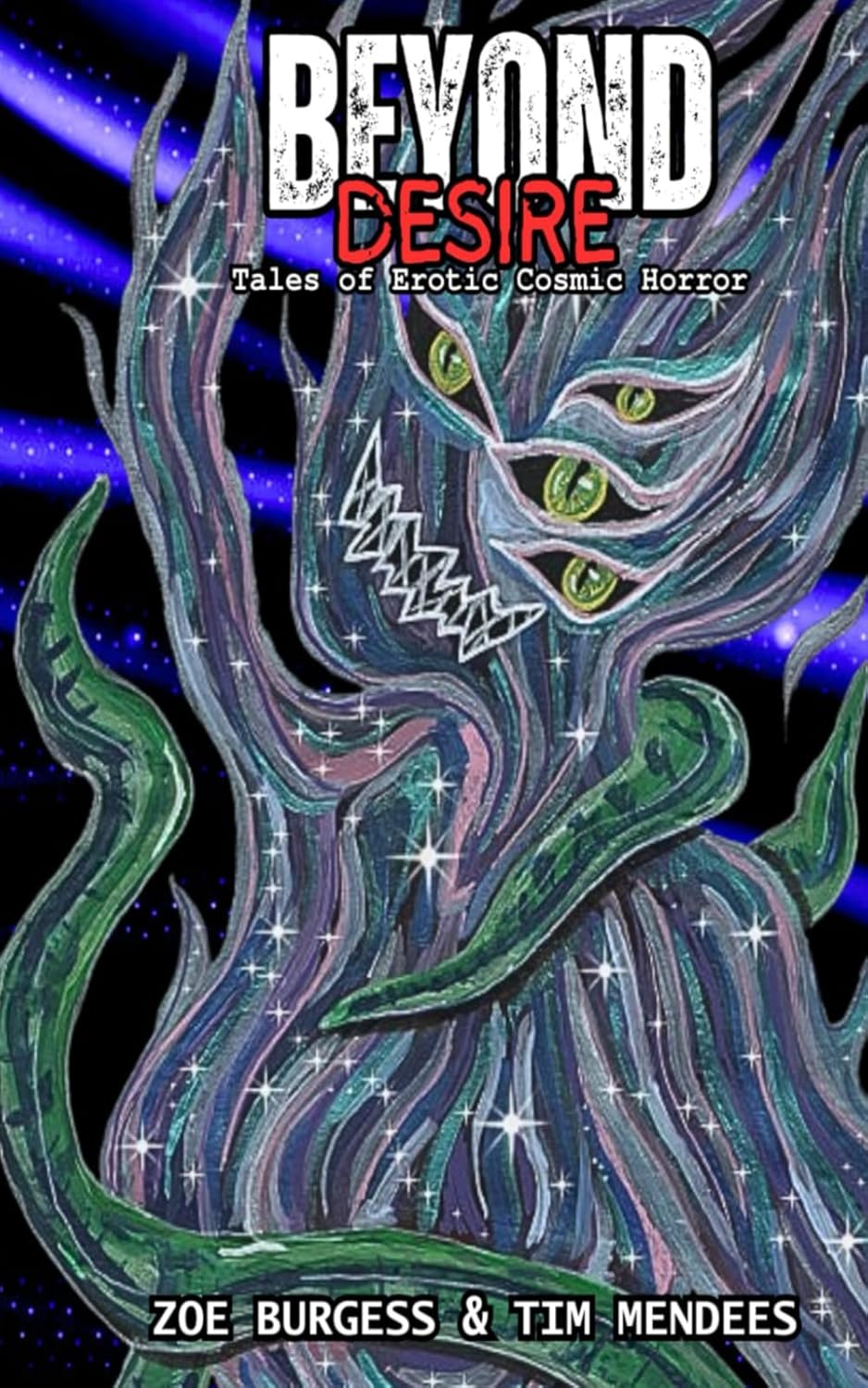
Ever since Helen Vaughan saw ‘the face of The Great God Pan’ and Lavinia Whately gave birth to the spawn of Yog-Sothoth, a sexual undercurrent has existed in cosmic horror. Rarely seen but its effects often felt, eroticism helps to shape tales of the uncanny and unfathomable.
—Back cover copy of Beyond Desire (2025)

Lovecraftian erotica is not the same as erotic horror. However horrific some elements of Lovecraftian erotica may be, it is a rare story that manages to mingle terror and titillation, rather than just use the tropes of the Mythos in another erotic fantasy with eldritch entities. “Cthulhu for Christmas” (2023) by Meghan Maslow or Tentacles and Wedding Bells (2022) by Margaret L. Carter owe more to cozy romances than horror for their structure, just as Booty Call of Cthulhu (2012) by Dalia Daudelin is more of a straight sex tale, and “The Vulviflora of Vuutsavek” (2008) by Charlotte Alchemilla Smythe is an exercise in pastiche. It is a relatively rare story that tries to find the balance between fear and lust, that plays the two forms of excitement against each other on a knife’s edge, that is unsettling in its sensuality.

This is a difficult balance, yet it seems to be what Zoe Burgess aims for in “The Tunnel.” The beginning of this story was featured in the Flash Horror 250 Contest in 2024, and if that visceral opening whets a reader’s whistle, Burgess goes much deeper—and gets more explicit—as the story is developed in her joint collection with Tim Mendees: Beyond Desire: Tales of Erotic Cosmic Horror (2025); the volume also contains “Writhing Mind” (2022) by Zoe Burgess.

Like in that story, “The Tunnel” is a tale of obsession, of an almost fetishistic desire for knowledge and sensation. There’s a quality reminiscent of Clive Barker’s “The Hellbound Heart,” the familiar outlines of which have been seen in many weird and erotic stories over the decades. Shades of Dr. Raymond’s search in Mary’s brain for the Great God Pan, or of William’s desire to uncover real magic through the artifact in The Invitation (2017) by InCase The language of the story is deliberately decadent, emphasizing the physical, the intimate, and hinting at something more than merely carnal.

This was what awoke Izzy’s companions, and they were greeted by faces of fear and adjective horror as the iron shell melted away to reveal the throbbing flesh-like pages of the manuscript inside.
—Zoe Burgess, “The Tunnel” in Beyond Desire (2025) 166

There is a literalness to the descriptions that is reminiscent of “Night Voices, Night Journeys” (2005) by Inoue Masahiko (井上雅彦), but it is probably more accurate to say that Burgess knows the tropes of the genre and plays to them. Familiar images remixed, recombined, carefully arranged. The tunnel of the title is both physical distance for the protagonist Izzy to transverse and the metaphysical vagina to be reborn from. The reader is just along for the ride, the voyeur of a journey of discovery and self-discovery:

Izzy held onto tarlike hips and almost felt like they were pushing deeper into the unknown, as that hot cavern pulsated and caressed as well.
—Zoe Burgess, “The Tunnel” in Beyond Desire (2025) 175

Metaphor and description break down on such an ecstatic psychosexual journey. Burgess strives to capture both novel sensations and something beyond that, some spiritual contagion that warps and fills and makes the sex act something profoundly more than just sticking tab A into slot B, repeat as desired. The story is essentially a spiritual descendant of the climax of Ramsey Campbell’s “The Moon Lens,” a story of initiation and transformation; while the cosmic horror is not called Shub-Niggurath, Burgess’ Void Walker has some of the same attributes.

More than anything else, “The Tunnel” by Zoe Burgess is an effort to tell an erotic horror story in the Lovecraftian mode. Not by invoking Cthulhu and the Necronomicon, but by trying to invoke familiar images and aspects as she tells a raw, uncensored story of transgression, transfiguration, and finally a kind of transcendence. When Izzy goes back out into the world, born from the tunnel, they are a carrier of a strange and terrible disease of knowledge, one which they desire to spread—and isn’t that so very familiar, readers of the Mythos?


Bobby Derie is the author of Weird Talers: Essays on Robert E. Howard and Others and Sex and the Cthulhu Mythos.

Deep Cuts in a Lovecraftian Vein uses Amazon Associate links. As an Amazon Associate I earn from qualifying purchases.
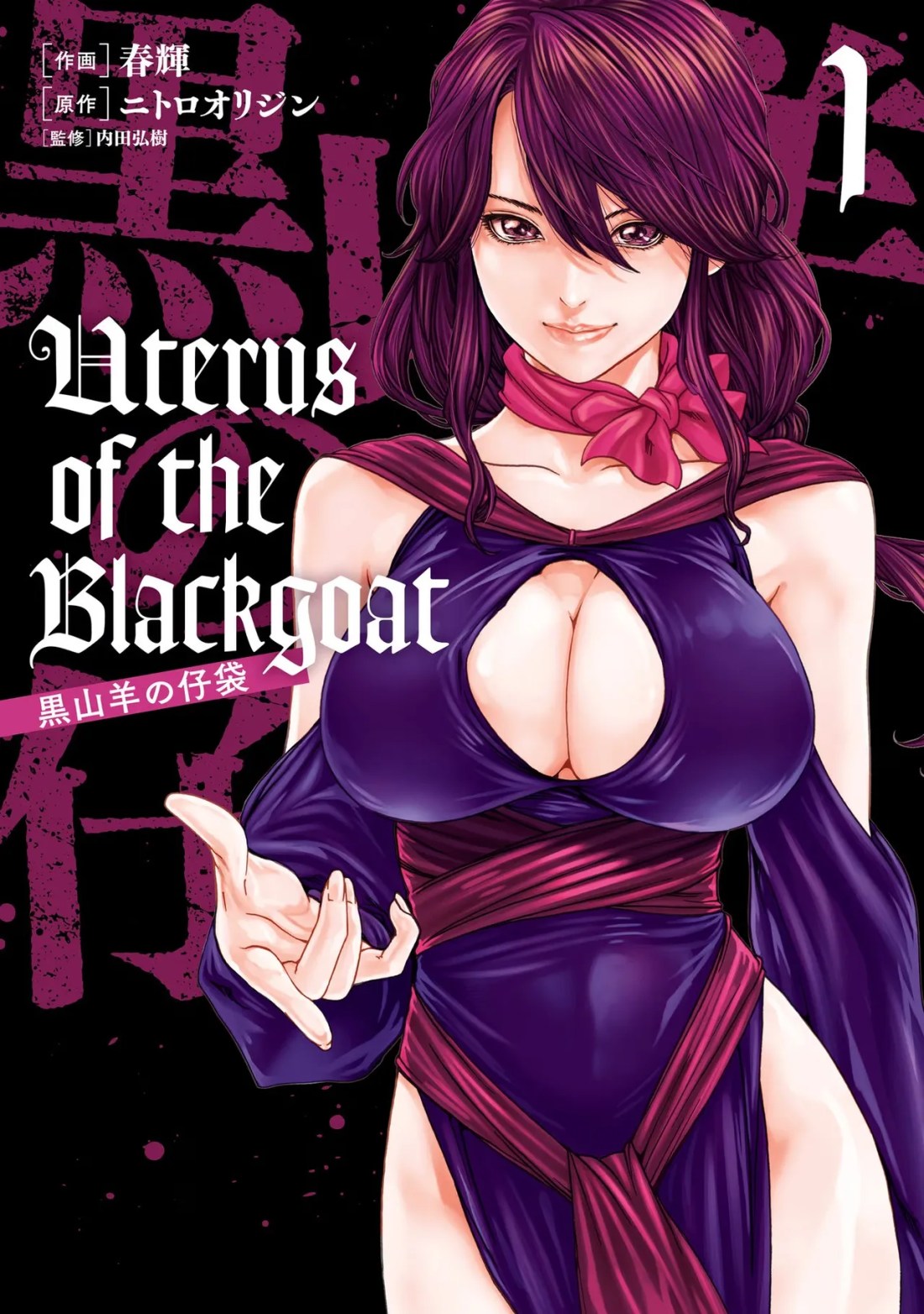
Uterus of the Black Goat Vol 1.(黒山羊の仔袋 1, 2022) by Haruki (春輝)

Eldritch Fappenings
This review concerns a work of adult literature. Some images contain nudity. Reader discretion is advised.


Powers of Darkness

The lifting of the curtain on the massive horrors of Germany’s prison and concentration camps recalls the supernatural tales of H. P. Lovecraft, a writer who was relatively unknown until August Derleth undertook his popularization, says a Chicago Tribune column. To conjure up the mood of unearthly terrors, Lovecraft invented the mythology of Cthulhu in which there are many monstrous spirits of evil, forever seeking to take possession of this planet.

Lovecraft wrote of his work: “All my stories, unconnected as they may be, are based on teh fundamental lore or legend that this race [sic] was inhabited at one time by another race who, in practicing black magic, lost their foothold and were expelled, yet live on outside, ever ready to take possession of this earth again.”

Perhaps Othulhu [sic] has come back through the cracks in Hitler’s mind. Lovecraft, who died in 1937, would be staggered by the revelation.

The Windsor (Ontario) Star, 2 May 1945, p4

In the aftermath of World War 2, the combination of Allied propaganda and the real-world horrors and atrocities committed by the Nazis and central powers created a perfect icon of evil. The Nazis became the epitome of cruelty, madness, violence, lust, and decadence; while Hitler and the Nazis became occasional figures of ridicule in works like Hogan’s Heroes, they also became the perfect embodiment of sin in post-war men’s adventure magazines, comic books, Stalag novels, and the Nazisploitation films like Ilsa, She-Wolf of the S.S. (1974), The Night Porter (1974), and Salon Kitty (1976).

H. P. Lovecraft died before the German invasion of Poland in 1939 that sparked the European beginnings of World War 2, and long before the Final Solution was decided upon and enacted. He did not live to see the Holocaust laid bare, and certainly not the pop-culture cross-pollination as the Nazis, the ultimate figures of taboo, became enmeshed in erotic and sadistic art and literature. Yet perhaps it is not surprising that, over time, Lovecraft’s Mythos and Nazis have mixed and mingled on occasion.

Dagger of Blood (1997) by John Blackburn, for instance, featured a former Nazi scientists in South America, inspired by Mengele and works like The Boys from Brazil (1976). Hellboy fought any number of Nazis in comics and film, some of whom had connections with Lovecraftian critters (a point called out specifically in the crossover Batman/Hellboy/Starman). Brian McNaughton brought the Reanimator to the Nazis with “Herbert West—Reincarnated: Part II, The Horror from the Holy Land” (1999). Insania Tenebris (2020) by Raúlo Cáceres also includes scenes where the Third Reich mixes with the Mythos, and Kthulhu Reich (2019) by Asamatsu Ken (朝松健) is an entire collection of stories that re-imagines the Nazis in a Lovecraftian context, and Charles Stross’ outstanding novel The Atrocity Archives (2004) also riffs on the wedding of these two taboos, the eldritch evils of Lovecraft and the visceral cruelty of Hitler and the Nazis.

Most of these works take as a jumping-off point the Nazi’s real and fictional investigations into the archaeological and the occult, which became widespread in popular culture thanks to films like Raiders of the Lost Ark (1981) and Indiana Jones and the Last Crusade (1989). There is some basis for truth in this, as Kenneth Hite explores in The Nazi Occult (2013), but the pop culture legacy of Nazi mystics dabbling in the Mythos has grown very far from reality. Intersections between sex and the Nazi occult exist, and so do works that combine sex and Lovecraft’s Mythos, but the combination of all three flavors is relatively rare.

Most works that deal with Lovecraftian Nazism eschew the erotic.

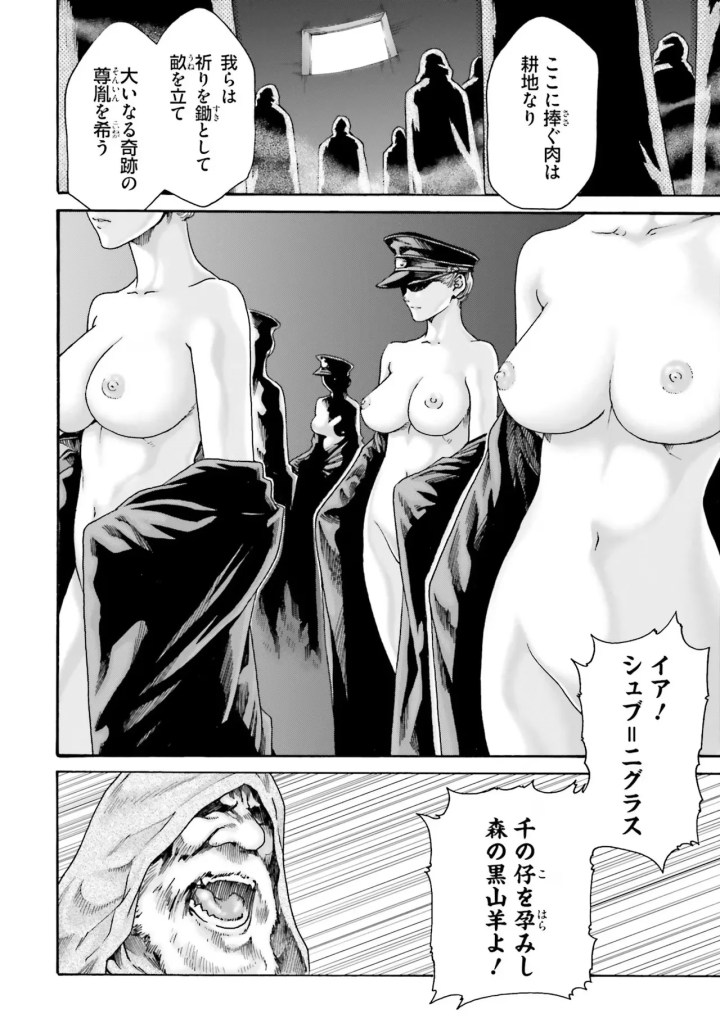
Uterus of the Blackgoat Vol 1.(黒山羊の仔袋 1, 2022) by Haruki (春輝) is a standout in that it very specifically does just that. This historical occult action manga’s prologue opens in Nazi Germany, where Hitler’s disciples are trying to unlock a Lovecraftian artifact with sex magick.

Nazi sacrifices disrobe for a ritual to Shub-Niggurath

Haruki (春輝) is an established mangaka whose works include the Ero Ninja Scrolls and Parasite Doctor Suzune series. Like all legal erotic works in Japan, the actual genitalia is obscured, often by carefully placed speech bubbles, figure-work, and blurring out the genitals. However, this work is more than “tits and tentacles”; there is a considerable amount of detail given to period dress, architecture, and background to ground the story, including some very effective splash pages that appear to have been referenced from period photographs.

Post-War Berlin

The bulk of the story takes place during the early days of the Cold War, as both the USSR and United States attempt to seize the Nazi’s research into Shub-Niggurath for themselves. At the center of their separate and competing investigations is a former maid, Mia Olbrich, who worked in the house where the rituals took place. Trying to keep both the Americans and the Soviets from getting the information is a woman named Macleod (who may actually be Mata Hari) with supernatural powers, who is also the secret agent codenamed Black Goat.

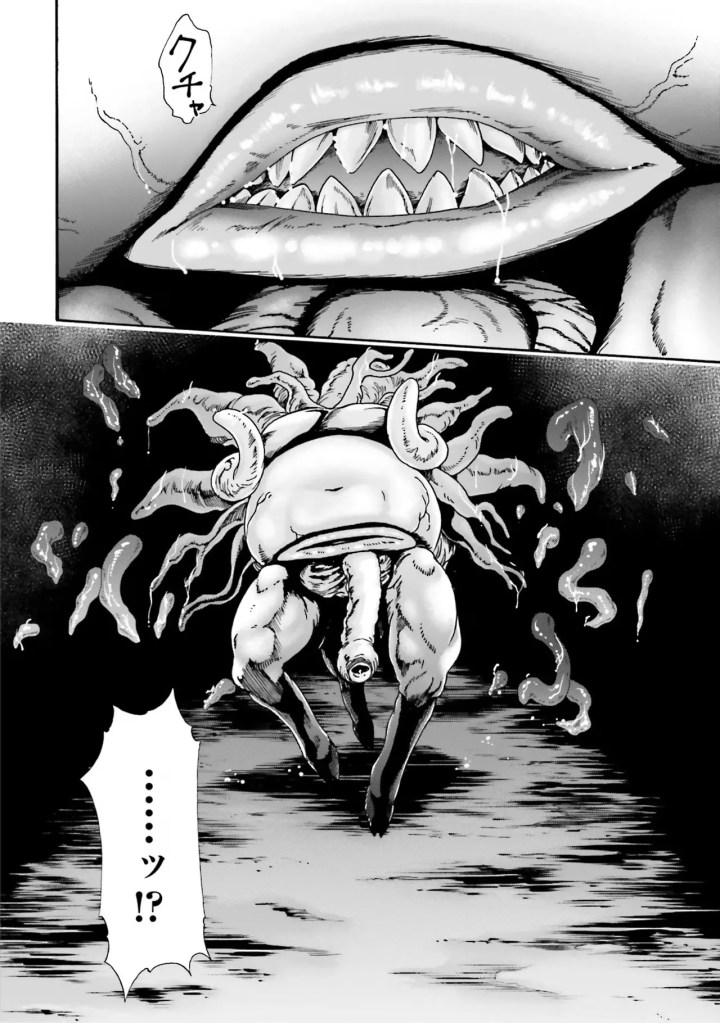
What readers get is thus a three-way struggle involving a lot of sex, some body horror, and Cold War spy shenanigans with some interesting plot twists and revelations (and this only in volume 1, there are 3 volumes in the series). While there are many typical tropes of the eromanga genre (all of the main characters are willowy, busty young women; there’s a sex scene in every chapter, etc.), it is sort of refreshing to see a work that strongly leans into the sexual aspect of Shub-Niggurath in as explicit a means as they can given the limits of the medium. While we don’t get a lot of actual Nazis in this volume after the prologue, the emphasis on sex, sexual violence, and the setting is what draws comparisons to exploitation films; there is a similar aesthetic, the idea that this is a serious story that is being played for titillation as well as action and intrigue.

There are some cosmetic parallels with “The Elder Sister-like One, Vol. 1” (2016) by Pochi Iida (飯田ぽち。) and The Mystery of Lustful Illusion -Cthulhu Pregnant- (2015) by Takayuki Hiyori (宇行 日和); the manga creators are each drawing from similar manga artistic traditions and Lovecraftian stories and roleplaying games, which shows variations on similar themes, less in any plot sense as in similarities between the depictions of Shub-Niggurath, playing with tentacles, etc. However, the emphasis on erotic content in each work is different and distinct and reflects the tone of the stories, with Uterus of the Black Goat aimed more toward erotic horror than the other two.

A Dark Young of Shub-Niggurath, as inspired by the Call of Cthulhu roleplaying game

Uterus of the Black Goat has not yet had an official English translation or release, but Japanese editions are available from various outlets, including Amazon.co.jp and Ebay.


Bobby Derie is the author of Weird Talers: Essays on Robert E. Howard and Others and Sex and the Cthulhu Mythos.

Deep Cuts in a Lovecraftian Vein uses Amazon Associate links. As an Amazon Associate I earn from qualifying purchases.
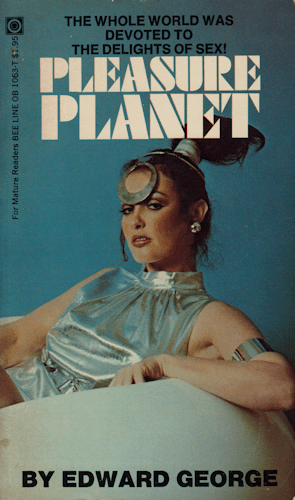
Pleasure Planet (1974) by Edward George

Eldritch Fappenings
This review concerns a work of adult literature. Reader discretion is advised.


Around November 1923, H. P. Lovecraft sent a letter to Weird Tales editor Edwin Baird, commenting on the contents of the magazine during its first year of existence. The letter was published in the March 1924 issue of Weird Tales, and included a challenge to writers of weird fiction:

Popular authors do not and apparently cannot appreciate the fact that true art is obtainable only by rejecting normality and conventionality in toto, and approaching a theme purged utterly of any usual or preconceived point of view. Wild and ‘different’ as they may consider their quasi-weird products, it remains a fact that the bizarrerie is on the surface alone; and that basically they reiterate the same old conventional values and motives and perspectives. Good and evil, teleological illusion, sugary sentiment, anthropocentric psychology—the usual superficial stock in trade, and all shot through with the eternal and inescapable commonplace. Take a werewolf story, for instance—who ever wrote a story from the point of view of the wolf, and sympathising strongly with the devil to whom he has sold himself? Who ever wrote a story from the point of view that man is a blemish on the cosmos, who ought to be eradicated?
—H. P. Lovecraft to Edwin Baird, c. Nov 1923

This inspired H. Warner Munn, a weird fiction enthusiast from Athol, Massachusetts, to write a story and submit it to the magazine. “The Werewolf of Ponkert” (WT Jul 1925) and earned the coveted cover spot. It was Munn’s first professional publication, the start of a long career in science fiction and fantasy, and perhaps most importantly the start of a long series of tales. Subsequently in the pages of Weird Tales, Munn published “The Return of the Master” (WT Jul 1927), “The Werewolf’s Daughter” (WT OctNovDec 1928), and a series of Tales of the Werewolf Clan published as “The Master Strikes” (WT Nov 1930), “The Master Fights” (WT Dec 1930), and “The Master Has A Narrow Escape” (WT Jan 1931).

Munn also became friends and correspondents with Lovecraft, who referred to the whole work in one letter as the “master” cycle—much as he referred to his own mythos as the “Arkham” cycle. Yet for Lovecraft, Munn had missed the mark:

It is my constant complaint that allegedly weird writers fell into commonplaceness though reflecting wholly conventional & ordinary perspectives, sympathies, & value-systems; & in this instance (as in others) I sought to escape from this pitfall as widely as I could. It pleases me that you grasp this matter so spontaneously—for some persons seem unable to understand what I mean when I bring it up. For example—I once said that a werewolf story from the wolf’s point of view ought to be written. H. Warner Munn, taking me up, thereupon produced his “Ponkert” series; in which, however, he made the werewolf an unwilling one, filled with nothing but conventionally human regrets over his condition!
—H. P. Lovecraft to J. Vernon Shea, 19 Jun 1931, LJS 16

The series also suffered from a relative lack of overt weirdness, as Lovecraft put it:

The trouble with Munn’s tale is that it subscribes too much to the conventional tradition of swashbuckling romance—the Stanley J. Weyman cloak & swordism of 1900.
—H. P. Lovecraft to Clark Ashton Smith, [17 Oct 1930], DS 245

Yes—Munn does get into arid and sterile regions when he tries to hitch his romantic-adventure mood and technique to the domain of the weird. He is drawing the poor Master out to such lengths that one cannot keep track of the creature’s nature and attributes—indeed, the impression is that he merely retains the supernatural framework as a matter of duty—or concession to Wright—whereas he really wants to write a straight historical romance. But the kid’s young, and we can well afford to give him time. Let him get Ponkertian werewolves out of his system, and see what he can do with a fresh start!
—H. P. Lovecraft to August Derleth, [Dec 1930], ES1.305

“Romance” in this case doesn’t refer to stories about love or lust, but the older sense of romance as a fictional prose narrative of heroic adventure, in the traditional of medieval romances. The sentiments echo some thoughts by Lovecraft with regard to Robert E. Howard, whose weird fiction often contained a strong action-adventure element, sometimes with the monster or magic a bit of an afterthought. Still, Weird Tales editor Farnsworth Wright was impressed enough to consider the publication of Munn’s werewolf tales as a standalone volume:

Munn’s effort—I read the whole tale in MS. a year ago—has romantic facility, but to my mind he seldom achieves real weirdness. He is, though, a very capable writer, & ought to have quite a future ahead of him. Wright tells him that his collected “Ponkert” tales will form the third book of a W.T. series beginning with “The Moon Terror”—my own tales forming the second. Personally I’d wager that much time will elapse before W.T. publishes any more volumes.
—H. P. Lovecraft to August Derleth, [6 Sep 1928], ES1.155-156

Unfortunately, Lovecraft was correct: The Moon Terror failed to sell, and the idea of Weird Tales publishing collections or anthologies was largely abandoned. The Werewolf of Ponkert series would finally be collected in 1958, and when Munn expanded the series with additional tales in the 1970s and 80s was reprinted and recollected again. Of his friend, Lovecraft wrote:

Frank B. Long, Jr., Donald Wandrei, Wilfred B. Talman, H. Warner Munn, August W. Derleth, & Clark Ashton Smith are indeed all friends of mine, but it would hardly be fair to their own talents & initiative to call them my “proteges”. I have tried to encourage the younger ones & help them with their style whenever such help seemed in order, but they all succeed on their own merits. I am proud, though, to have been the first to persuade Long & Talman & Munn to send stuff to W.T.
—H. P. Lovecraft to J. Vernon Shea, 19 Jun 1931, LJS 18

So what does this have to do with Pleasure Planet (1974) as by Edward George (pseudonym for Robert E. Vardeman and George W. Proctor), an erotic science fiction novel? Well…read the back cover copy:

Step aboard the sex-computer equipped Intergalactic Vessel Werewolf along with Captain Chad Ponkert and his very horny co-pilot, Janet. Their mission—to find a planet to be used as a sex playground—a place where creatures from all over the galaxy can come together and get it on!

Chad Ponkert, I. V. Werewolf. Yes, it does appear that Lovecraft’s innocent suggestion in 1924 had, fifty years later, inspired a sleazy erotic novel, by way of one H. Warner Munn (who was probably utterly unaware of the borrowing).

The novel itself is almost a parody, although it might be more accurate to call it a pastiche. The oversexed everyman Chadwick Ponkert the Third is a spaceship pilot with a raging libido and a black belt in karate, who plays a few BDSM games with his co-pilot Janet where she refers to him as ‘Master.’ Their ship crash lands on a planet called Keller, which is like medieval Europe if there were no Christian church, a rather open and eager attitude toward sex, and the occasional alien beast. Which is to say, not much like medieval Europe, but not unlike a thousand sword & planet stories that ran in the pulps. Ponkert and Janet quickly establish themselves as lords and ladies in the oversexed land, happily screwing pretty much anyone and everyone they encounter page after raunchy page.

The girl was a veritable wealth of information about Keller. During their endless hours of bouncing on the backs of their sturdy steeds, he had never tired of her explanations of various sights they passed. She had also provided a history of Keller’s development. From what Ponkert could make of the various legends and myths she told, Keller had grown from the remnants of a derelict colonial rocket from Earth. The lost voyage had long been forgotten by the mother planet, which was to his advantage. If the Earth’s residents had known about Keller, they would have come in the teeming millions.
Pleasure Planet 113

Aside from the names mentioned, Vardeman and Proctor make no overt reference to Munn’s werewolf stories, nor are they parodying them. It is, rather, a rather basic and straightforward sword & planet tale fluffed out with a lot of hardcore sex. The difference between this and a mainstream science fiction novel is a matter of degree rather than kind, although there really isn’t anything to recommend it as science fiction. The story hits most of the weaknesses that Lovecraft noted about interplanetary stories in the 30s, following the Edgar Rice Burroughs model of a strong Earthman arriving at an Earth-like planet, rescuing a very human princess, etc.

As with many erotic novels, Pleasure Planet went through a number of titles and author pseudonyms. While it may be of interest to some folks for its place in the history of erotic science fiction, it also demonstrates the ripple-effect that Lovecraft had on science fiction and fantasy—how inspiration spreads out, from one little letter, to a series of werewolf tales, to an erotic novel—and who knows where it might end?


Bobby Derie is the author of Weird Talers: Essays on Robert E. Howard and Others and Sex and the Cthulhu Mythos.

Deep Cuts in a Lovecraftian Vein uses Amazon Associate links. As an Amazon Associate I earn from qualifying purchases.
“Shethulhu: The Elder Goddess Returns” (2017) by T. G. Cooper

Eldritch Fappenings
This review concerns a work of adult literature. Reader discretion is advised.


The work of H. P. Lovecraft hints at weird sex. Generations of incest in “The Lurking Fear” lead to a rapid devolution among the fecund family; Arthur Jermyn in “Facts Concerning the Late Arthur Jermyn and His Family” is the byproduct of an ancestor not quite human; Audrey Davis in “The Curse of Yig” killed the children of Yig, and bore them in return; the men and women of Innsmouth in “The Shadow over Innsmouth” take on Deep Ones as their mates to spawn the next generation; Lavinia Whateley gives birth to the childer of Yog-Sothoth in “The Dunwich Horror.” The common theme that runs through these stories is one of procreation; these are stories of the aftermath of sex for the purpose of reproduction.

So what if a character is infertile? Asexual? Gay?

After 1921, Lovecraft was aware that homosexuality was a sexual practice and preference in the present day, as well as in ancient historical accounts. Specifics were not something he went into in his letters in any great detail; and because of the mores and censorship at the time, homosexual characters or acts in fiction could often only be alluded to obliquely, if at all. Lovecraft could mention the decadence of the people of K’n-yan in “The Mound” or the delvers in “The Hound” and let readers fill in the blank with their imaginations, but that was about the limit of how explicit he could go in Weird Tales.

So it has been up to other creators to wonder how homosexuality fits into the Mythos.

There have been several different attempts at this. Grant Cogswell & Daniel Gildark and Cthulhu (2007) use the absence of overt homosexuality in the Mythos to essentially tell a story of being gay in a very restrictive social environment that is focused on heterosexual relationships and procreation; it’s a familiar story with a weird twist. Widdershins (2013) by Jordan L. Hawk, “Moonshine” (2018) by G. D. Penman, and “Cthulhu for Christmas” (2023) by Meghan Maslow all depict rather straightforward homosexual romances in settings with real-world prejudices, with no focus on the cultural issue of reproduction within a Mythos milieu. “Le Pornomicon” (2005) by Logan Kowalsky and Strange Bedfellows (2023) by Caroline Manley (Raph) ditch the reproductive and heterosexual angle entirely, focusing on homosexual characters and relationships.

All of the above stories involve cisgender male/male relationships where neither partner is capable of being impregnated through any normal sexual action (an important caveat). Lesbians and transgender relationships are also present in the Mythos; such as in “Pages Found Among the Effects of Miss Edith M. Teller” (2005) by Caitlín R. Kiernan and “The Artist’s Retreat” (2011) by Annabeth Leong; for some of these characters, the reproductive theme rears its head again, simply by virtue of a functionary womb. However, in general there seem to be relatively fewer lesbians, transwomen, and transmen in Lovecraft country than homosexual men.

Weird and erotic literature can blur issues of gender, sexuality, and reproduction to play to various kinks. The Invitation (2017) by InCase depicts with characters that exhibit different combinations of genitalia and secondary sexual characteristics (all functional); Dagger of Blood (1997) by John Blackburn uses some weird surgery to swap the genitalia of two characters; Devil’s Due: A Transgender Tale (2021) by Diane Woods uses magic to effect a gender transition. These kinds of gender-bending play to specific sexual fantasies, and while these examples don’t deal with pregnancy, there is an entire mode of gender-bending weird fiction that does.

“Shethulhu: The Elder Goddess Returns” (2017) by T. G. Cooper (who also writes as Cooper Kadee) stars Charles Ward Dexter as a private detective hired to find the Femnomicon—and who is dealing with personal issues:

Back in his room, he crawled back onto his damp, smelly bed, and lay on his back, staring at the full moon outside his window. As he did so, he felt a thump inside his belly and put a hand on his tummy, grimacing. He didn’t want to sleep. Didn’t dare, really, and so he just lay there, staring at the moon and waiting for the dawn.

In his dream he’d been a woman, again, and that memory disturbed him. He’d always been a dude, a bro, a man’s man, and he didn’t know what it meant in his dreams now, which came every night, he always found himself in a woman’s body, helpless and afraid.

T. G. Cooper specializes in gender-bending fiction, and this particular story is pretty typical of the genre, adapted as a Lovecraftian pastiche. This is not a politically correct tale of an individual coming to an awareness of themselves as trans. There’s magic and tentacles involved, and the tongue is firmly in cheek:

“You should get yourself a real dog,” Ward said, pausing to scratch the white poodle under the chin.

“She was a Pitbull named Butch when I read that damn book,” the girl said. “We both got turned into girls.”

The pace flows quickly as Cooper runs through some familiar feminization tropes—including a marriage to Dexter’s former secretary, Asenath Waite. The Lovecraftian references are a bit basic; instead of the Necronomicon it’s the Femnomicon; instead of Miskatonic University, it’s Chthonic College; instead of Cthulhu it is Shethulhu. The erotic content is slight; there is no traditional humping and pumping; the eroticism is bound up in Ward’s situation, their transformation, their strong sense of gender identity and powerlessness as it is changed, and above all the pregnancy itself.

The kink aspect of “Shethulhu” plays up the crisis of masculinity that characters feel during the unwanted transition, the helplessness and despair at finding themselves in their new body; and in this case the shock and terror at being pregnant. The crisis—and, as in the end of “The Shadow over Innsmouth,” the final acceptance—is all-important; it is the arc that Charles Ward Dexter completes, the ultimate submission to the new self which is so terribly taboo in toxic masculinity. Not that gender-bending and pregnancy need always play to those specific ideas, but that’s the set-up here.

It is important to distinguish that there is a difference between erotic fiction starring trans characters vs. gender-bending erotic fiction that is firmly grounded in and plays to cisgender sexual mores and ideology. This is less Emilia Pérez (2024) and more Dr. Jekyll and Sister Hyde (1971). This is not a positive depiction of transition as much as it a vehicle for a specific set of kinks.

The Lovecraftian names and setting are played mostly for laughs, and we don’t get any deep meditation on the reproductive themes in Lovecraft’s work. Rather, it is played straight: horror is what a man would feel to suffer through what Lavinia Whateley did.

There are many permutations of pregnancy, birth, and gender-bending as kinks in Mythos fiction, this is just a relatively scarce example that puts them all together. It is especially scarce because it is less available than it once was: the story was previously available on Amazon Kindle, but is no longer purchasable through the store. T. G. Cooper’s DeviantArt page for the story indicates that it is available on their Patreon, for anyone interested in reading it.

E-books, unfortunately, are often subject to the whims of corporations and hosting services. “Shethulhu” and the Femnomicon may well be lost entirely someday.


Bobby Derie is the author of Weird Talers: Essays on Robert E. Howard and Others and Sex and the Cthulhu Mythos.

Deep Cuts in a Lovecraftian Vein uses Amazon Associate links. As an Amazon Associate I earn from qualifying purchases.
“Wicked Walter” (1981) by Mark Bloodstone

Eldritch Fappenings
This review concerns a work of explicit adult literature. Reader discretion is advised.


Men’s adult magazines emerged during the 1950s. Titles like Modern Man (1952) and Playboy (1953) featured softcore nude pictorials of women models, intermixed with a combination of editorials, articles, interviews, advertisements, cartoons, letters from readers, and quite a bit of fiction. The relative success of Playboy in particular inspired numerous imitators of various degrees of sophistication and quality. Loosening censorship restrictions in the United States and other countries in the 1970s saw some magazines become more explicit, directly depicting genitalia, sex acts (including penetration), and sexual fluids, but every magazine publisher and editor had to find the right balance for the time and place—to sell the magazine to readers, and not to get thrown in jail if they went too far.

Weird fiction has a surprisingly long history in men’s adult magazines; Playboy published William Hope Hodgson’s “The Voice in the Night” in the July 1954 issue, and various other publications have published articles on pulp magazine art, Robert E. Howard’s Conan character, H. P. Lovecraft, and related subjects. Even a revised version of “The Rats in the Walls” (1956) by H. P. Lovecraft first appeared in a minor men’s magazine. So it might not come as too big of a surprise that there’s a small body of Cthulhu Mythos fiction which has appeared first—and only—in men’s adult magazines.

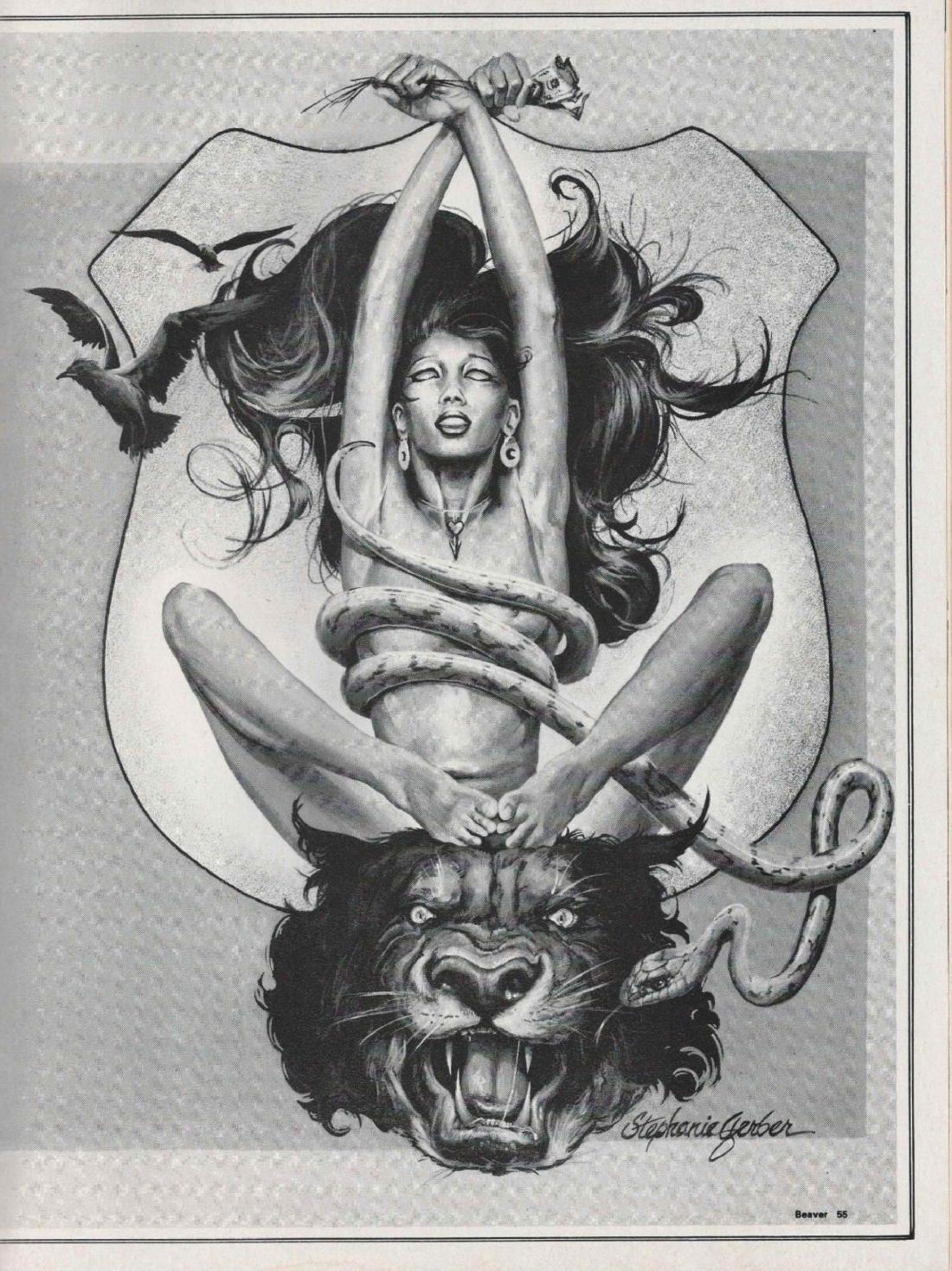
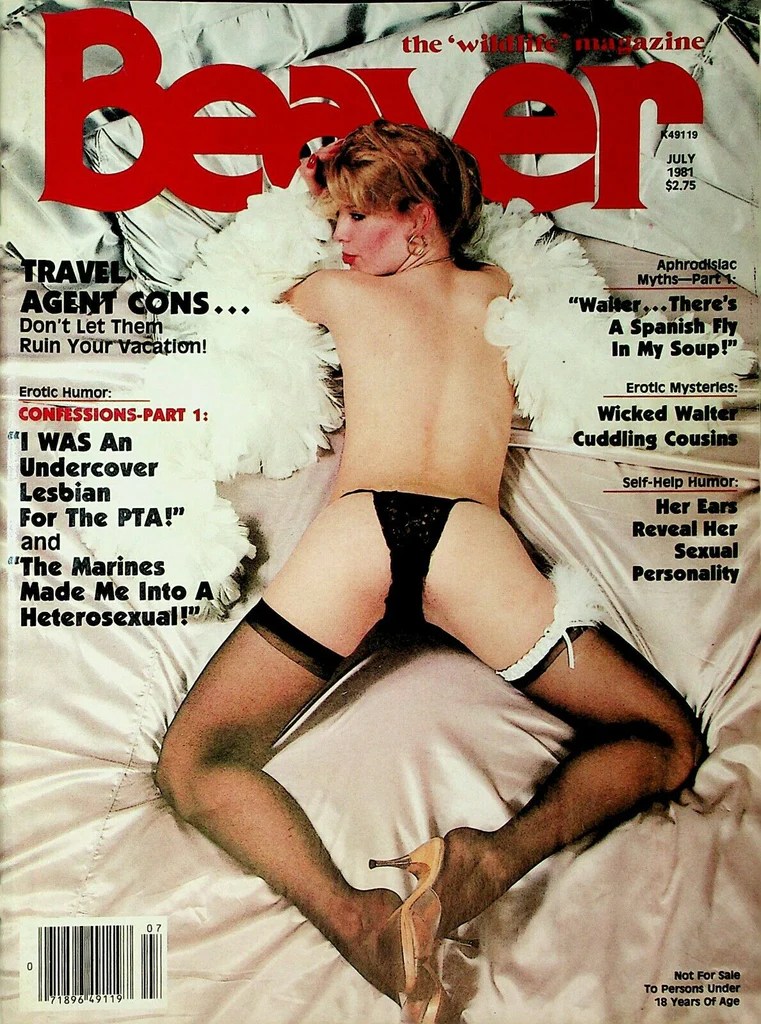
Such is the case of the “Wicked Walter” series by grandmaster of horror Brian McNaughton (under his pseudonym Mark Bloodstone), which ran in the magazine Beaver from 1981 to 1983, and are comprised of “Wicked Walter” (July 1981), “The Panty Demon” (October 1981), “They Don’t Write Them Like They Used To” (November 1981), “Glamour Puss” (February 1982), “The Enchanted Dildo” (July 1982), “The Great Cat-House Raid” (January 1983), “How Are They Hanging?” (February 1983), “I’ll See You In My Dreams” (May 1983), and according to Robert M. Price a final unpublished story “Her Night to Howl.”

The eponymous “Wicked Walter” is about an Arkham cop and Miskatonic University graduate named Walter Finn, a hereditary witch who uses his powers to solve other magical crimes.

You don’t expect a red-blooded American cop to pack every room of his partment from floor to ceiling with mouldy old books, some of them in Latin and Greek. Nor do you expect him to have a pet crow named Dr. Dee who squawks that he’s a raven when you call him a crow, and whose favorite perch is a human skull on Walter’s desk. Walter didn’t even have a television set. She would have laid odds that he didn’t have a bowling ball in his closet or a six-pack in his icebox, either, like every other guy on the force. But he did have a bed, and once he got her into it she forgot everything else.
—Brian McNaughton (as Mark Bloodstone), Beaver July 1981, 66

Wicked Walter came along at an odd time and place for McNaughton.

McNaughton began his career in the fanzines of the 1950s while in high school; he attended Harvard but did not take a degree, and for a decade worked as a newspaperman at the Newark Evening News until the paper folded, and he turned to other work, including a decade as night manager of a motel. In 1971 he began writing adult fiction with In Flagrant Delight (1971) by Olympia Press. Under his own name and pseudonyms he would go on to write at least twenty erotic novels and a couple dozen short stories published between 1971 and 1983. The vast majority of these works have no reference to the Mythos, nor does McNaughton’s thriller Buster Callahan (1978; also released as The Poacher).

McNaughton’s breakthough came in the late-1970s, when he convinced longtime publisher Carlyle Communications to print a series of non-erotic horror novels. Although stuck with editorially mandated titles by Carlyle, the novels Satan’s Love Child (1977), Satan’s Mistress (1978) and its sequel Satan’s Seductress (1980), and Satan’s Surrogate (1982) proved successful enough to help relaunch McNaughton as a writer of dark fantasy and horror fiction. Aside from the middle two books, the Satan novels are not part of the same series as the titles would indicate, and the share little with one another besides a common writer and certain common themes. However, the success of these novels signaled McNaughton’s transition (or return) to weird and horror fiction, including contributions to Weirdbook (1968–97) and Lore (1995–98), and culminated in such masterpieces as The Throne of Bones (1997).

Brian McNaughton also wrote a number of pornographic “romance” novels under the pen names Sheena Clayton and Mark Bloodstone as well as his own, mainly for Carlyle Communications under imprints like Beeline, Tigress, and Pandora. The exact number and titles of his books I have been unable to determine, but the ones written as Sheena Clayton include Love and Desire (1982), The Aura of Seduction (1982), Tide of Desire (1983), Danielle Book Two (1983), There Lies Love (1983), and Perfect Love (1983)—all of which to greater or lesser extent contain supernatural elements and references to the Mythos. It was during this same time frame that McNaughton wrote his Wicked Walter stories.

In the first story, Walter Finn encounters a new cult in Arkham, run by a woman who calls herself Isobel Gowdie. Finn takes a magical precaution before he confronts Gowdie, and once inside her office he confirms she’s up to no good.

He hadn’t needed more proof, but it was all here in the decor of her office. One of the supposedly modern paintings on her wall was in fact the very old and awesome Yellow Sign. The tapestry on the opposite wall incorporated secret symbols of Nodens and Magna Mater, whose worshippers had been driven underground by the horrified pagans of ancient Rome. The paper-weight on her desk was a statuette of the dread Cthulhu. Few people would recognize the significance of these clues, but they alerted Walter that he was in the presence of a power darker and more terrible than he had suspected.
—Brian McNaughton (as Mark Bloodstone), Beaver July 1981, 70

The language is very pulpy, with lots of straightforward action and declarations, not getting too bogged down into details but offering enough details to tantalize, titillate, and even assure readers that they’re reading about consensual sexual encounters and not rape or coercion…this time.

Walter seldom used his occult powers to overcome a girl’s resistance, partly from masculine pride and partly because it took some of the spontaneity out of it. He was glad he hadn’t done that with Isobel. Apart from taking her dress off, everything she’d done had been done of her own free will. Maybe she was hoping to con him in some way, but she sure as hell wasn’t faking her responses.
—Brian McNaughton (as Mark Bloodstone), Beaver July 1981, 70

The character of Walter Finn very much falls into a certain male archetype of the period; a guy who is confident, amiable, willing and able to have sex at nearly any opportunity, but who isn’t extraordinarily strong, good-looking, rich, intelligent, cruel, or overly moralistic. A kind of hypersexual everyman, not unlike many characters in period films like Animal House (1978), Stripes (1981), Police Academy (1984), or Revenge of the Nerds (1984).

It isn’t a very long story, and McNaughton sets things up and wraps them up quickly, with two very explicit sex scenes taking up a considerable chunk of the word count. Yet “Wicked Walter” is, without a doubt, a bit of fun. McNaughton had no need to build up Walter Finn’s character as well as he did, didn’t need to add in the Mythos references. Yet they don’t come across as padding, either. McNaughton was finding a happy middle ground between erotic fiction and what today we might call urban fantasy. The series as a whole makes entertaining light reading, if the mandatory sex scenes often throw the pacing off a little.

McNaughton’s “Wicked Walter” stories, with their occasionally dated references and language, are artifacts of erotic fiction from an age before shaving pubic hair was commonplace, and practically unique for their content at the time of publication. Unfortunately, unless you’re a collector of vintage men’s adult magazines, you will probably never read them. “Wicked Walter” and its sequels have never been reprinted since their original publication, and anyone who did desire to do so would probably have an interesting time sorting out who owns the rights and getting the correct permissions to do so.


Bobby Derie is the author of Weird Talers: Essays on Robert E. Howard and Others and Sex and the Cthulhu Mythos.

Deep Cuts in a Lovecraftian Vein uses Amazon Associate links. As an Amazon Associate I earn from qualifying purchases.
The Invitation (2017) by InCase

Eldritch Fappenings
This review concerns a work of explicit adult art and literature, and will touch on aspects of historical pornographic works, including NSFW images. Reader discretion is advised.


By the way—Cthulhu isn’t a she but a he. He’d feel deeply enraged if anyone regarded him as sissified!
—H. P. Lovecraft to Willis Conover, Jr. 29 Aug 1936 Letters to Robert Bloch & Others 389

In “The Call of Cthulhu,” Lovecraft defaults to referring to Cthulhu as male. Whether human gender binaries can encompass Great Cthulhu is something for later writers in the Mythos to decide. Lovecraft, for his part, only addresses it in his letters in a joking matter, with the typical cultural disdain toward “sissies”—men who display effeminate manners or dress, often misconstrued as homosexuals; Lovecraft had made another comment about the “sissy” Gordon Hatfield.

Throughout human history, in pretty much every culture, there has existed a minority who do not fit into rigid gender or sexual binaries. Whether this was a physical condition such as being intersex, or an individual’s identification with a different gender than assigned at birth, or taking on cultural attributes and attire associated with different genders—there is a broad range of physical, psychological, social, and sexual aspects involved. Each culture and language has their own nomenclature involved. In English in the 20th century, terms like hermaphrodite have fallen out of use in favor of words like intersex; the term transvestite, once identified largely as a sexual fetish or mental disorder, has largely fallen away from use in favor of transgender.

The rich vocabulary includes both contemporary efforts to define identities (e.g. genderqueer, gender fluid), pejorative terms (e.g. tranny, cross-dresser), and a grey middle ground of terminology most often associated with sex work, erotic literature, and pornography (e.g. ladyboy, shemale). Loanwords from other languages also enrich the language, e.g., futanari, from the Japanese ふたなり. The term futanari has come to be a pornographic genre unto itself, both in adult comics and literature, with its own specific tropes, and generally presents a fetishized ideal: an individual that possesses (sometimes exaggerated) sexual traits of both male and female.

Despite the term futanari coming from the Japanese language and popularized by Japanese erotic comics, the basic idea is not unique to Japan. In the 1980s, for example, U.S.-born adult artist Eric Stanton created his “Princks” or “Ladyprinckers” or “Princkazons,” women with Amazonian physiques who also possessed pensis (often of exaggerated proportions) and used their great strength and sexual organs to dominate and emasculate men. So example in Stantoons #49 (“Makeover”), he presents a scenario where the men, unable to resist, are forcibly transformed and feminized. Stanton takes this idea to its cartoonish limit, and plays it for body horror and black humor as much as sexual titillation.

For the most part, however, “Princks” died with Eric Stanton. By the 1990s and 2000s, gender transition surgery and hormone replacement therapy had progressed substantially from the gland stories of early science fiction (see The Hormonal Lovecraft); the legal recognition of homosexuality and rights led to greater awareness of different LGBTQ+ identities outside of fetishized pornographic stereotypes. Besides this, futanari proved to be a more popular fetishized pornographic stereotype.

More importantly, the increasing acceptance of transgender individuals and the process of gender transition opened up literature for more positive stories of gender transition. While feminization as a sexual fantasy, voluntary or involuntary, will always remain, the acceptance and embrace of such a change as a positive metamorphosis instead of body horror gained more traction (see Seabury Quinn’s “Lynne Foster is Dead!” (1938): A Mistaken Gender Identity by Sophie Litherland).

Which doesn’t mean that a clever and skilled creator couldn’t combine the two. Lovecraft in “The Shadow over Innsmouth” presented a narrator who, at first horrified at the changes happening to their body, comes to accept their metamorphosis and the new identity that comes with it. For Lovecraft, the reader is allowed a peak as someone that fear and hated the alien and other becomes the other—and in fact, was one of them all along. The completeness of their change is indicated by how thoroughly they embrace who they are now, and reject who they thought they were.

In 2017, erotic comic artist InCase began producing “The Invitation,” a sexually explicit webcomic. The second chapter was published in 2019. At first glance shares many hallmarks with feminization and futanari adult comics. Part of what sets it apart, however, is the framing and development of the story.

William Loving III, starts out as a very Lovecraftian protagonist, an obsessive delver in the obscure and occult, who had finally found an artefact that promises to put him in touch with a strange, eldritch entity…and he goes a little mad with the revelations.

As their transformation progresses, William’s priorities and attitudes shift, their old mores fall away as they embrace a broader and more inclusive attitude toward gender and sexuality attraction. Above all, the Master who brought these changes to body and mind is imprisoned, and members of their cult, like William, seek to free them. Idol, old one, madness, cult…while InCase is not using Lovecraft’s Mythos directly, there are some clear parallels to aspects of Lovecraft’s work and the broader genre of stories inspired by the Mythos.

Then, whispered Castro, those first men formed the cult around small idols which the Great Ones shewed them; idols brought in dim aeras from dark stars. That cult would never die till the stars came right again, and the secret priests would take great Cthulhu from His tomb to revive His subjects and resume His rule of earth. The time would be easy to know, for then mankind would have become as the Great Old Ones; free and wild and beyond good and evil, with laws and morals thrown aside and all men shouting and killing and revelling in joy. Then the liberated Old Ones would teach them new ways to shout and kill and revel and enjoy themselves, and all the earth would flame with a holocaust of ecstasy and freedom. Meanwhile the cult, by appropriate rites, must keep alive the memory of those ancient ways and shadow forth the prophecy of their return.
—H. P. Lovecraft, “The Call of Cthulhu”

In the second half of the first chapter, InCase shifts the focus away from William pursuing the transformation on their own to interacting with the Master and their other servants. Sexual activity slowly grows more transgressive, with rougher action, bigger penetrations, more and less human (and more tentacular) participants…and the wonder of transformation and the bliss of sex is juxtaposed against the cosmic horror of the Master’s true face, and a glimpse of their true nature.

For a story about transformation and sex, and the gorgeously rendered artwork that conveys both sexuality and teratophilia, corruption and indulgence, these two characters are essentially character-driven. William is obsessed with magic, and having followed that obsession it consumes them utterly. What he left behind was his fiancé Annie, who becomes the protagonist of the second chapter.

In the Victorian milieu of The Invitation, Annie more than William represents a character whose body and identity are repressed by society; she is bound up in expectations of behavior (social and sexual) that she strains again; a woman of science at a period when women are not widely tolerated in science. A woman whose social standing is in peril from a broken engagement. A person who is, like William, innately curious.

There is a strong fantasy element to InCase’s work, both in The Invitation and in their other erotic comics. Without going into clinical detail, many of their characters fall into the spectrum of the sexualized fantasy of intersex characters rather than the reality. There are rarely true hermaphrodites, but there are often characters who appear to be women in every aspect save for having a penis and testes, which is fully functional (often incredibly so). Characters don’t undergo costly top and bottom and facial surgeries, they don’t take regimens of hormones their entire lives to achieve some semblance of the body they desire, that matches their gender identity. In real life, things are messy and imperfect; in comics, they can be idealized.

It is the fantasy that allows the exploration of these ideas. What would a Victorian woman do if she suddenly had a penis? If she was no longer restricted to the sexual role that biology and society had deigned for someone of her sex and gender? If you grew gills in Innsmouth, would you avoid the sea?

The Invitation is not a body-positive story about gender transition. It is an erotic horror story with themes of body horror and cosmic horror. William and Annie are not individuals who seek transition as a means to express and assert their gender identity. They are cultists who reject the world that they feel has rejected them; they are the outsiders who having finally given up on belonging to the world around them, with all the repressive mores, have turned to a being for whom all laws and mores are oppressive. Even natural laws.

It is important to distinguish between the reality of transgender and the fantasy. Not everyone who is trans undergoes surgery or takes hormones; nor are trans folk mere sexual objects for others to fetishize and covet. InCase is drawing specifically on the tropes of trans and intersex characters as they have developed in erotic comics art over the last several decades; Annie and William are not Stanton’s Princks, but they are conceptual cousins. Where the Princks’ purpose is entirely driven by kink, the transition of Annie and William is much more moral.

Stanton’s Princks are domineering and cruel; they degrade and make fun of the men they transform, they revel in their strength and the men are helpless to resist. The suffering of the Princks’ victims is the point; that’s the relationship that Eric Stanton often pursued, regardless of whether it was Princkazons vs. men, or women vs. men, or women vs. women. The Master never taunts her victims, never degrades them, never says a cruel word; the Master’s inhuman hunger is frightening, but what really breaks Annie at the end is the realization that it is entirely voluntary. Like the Cenobites in Clive Barker’s “The Hellbound Heart” (1986), the Master does not seek out new victims—they find her. Drawn in by curiosity, they find a moral universe at odds with what they know.

A universe both horrific and addictive. Twisted, unnatural, and yet utterly freeing. Is it any wonder why some folks have embraced it as a positive example of gender transition, at least in jest?

In the end, it isn’t about whether or not William has a vagina or Annie has a dick. Their final acceptance of each other was to move beyond their conceptions of sex and gender, to discard all labels. This is presented as both horror…and a short of transcendence. As old de Castro said in “The Call of Cthulhu,” they had become like the Master themselves, they had moved beyond the need to define themselves in human terms, and had come at last into a more complete marriage, through and within the Master.

Which is about as Lovecraftian an ending as one could hope for.

InCase’s work can be found on their website and their Patreon account.


Bobby Derie is the author of Weird Talers: Essays on Robert E. Howard and Others and Sex and the Cthulhu Mythos.

Deep Cuts in a Lovecraftian Vein uses Amazon Associate links. As an Amazon Associate I earn from qualifying purchases.
All images copyright their respective owners.