Charles David Isaacson was born in Brooklyn in 1892. He studied the violin with his father, Mark N. In 1916, he became associated with “The New York Globe” as editor of the feature “Club Family” music. In connection with this newspaper feature, Mr. Isaacson organized and directed several thousand free concerts in all parts of the city. He was associated with other newspapers, including the Brooklyn Daily Eagle, as musical critic, and was the author of “Face to Face With Great Musicians,” “Simple Story of Music,” “Jews, Money and Such,” and “Stories from the Hindu.” He died in 1936.
—History of Brooklyn Jewry (1937), 169
ISAACSON, CHARLES DAVID: Writer, publicist; b. Nov. 9, 1891, Brooklyn, N.Y.; s. Mark Napoleon and Kate Cohen (Aarons) Isaacson; ed. Public schools; m. Emolyn Gloria Silverman, 1915, Brooklyn, N.Y. Founder and dir. of Charles D. Isaacson free concerts, totaling over 4,000 in number, covering period of 12 years; over 3,000,000 in N.Y.C. have attended; first under auspices N.Y. Globe and then N.Y. Evening Mail, of which was music editor; over 6,000 foremost artists contributed services. Toured U.S., lecturing and writing for newspapers and syndicates on music and art; associated with Chicago Opera, San Carlo Opera, Soc. of American Singers, etc.; contributes articles and short stories to Collier’s, Pictorial Review, Musical Quarterly, Musical America, Theatre Magazine, Jewish Tribune, Arts and Decorations, Motion Picture News, Ladies’ Home Journal, Outlook, American Hebrew, and others, many as regular editor. Author: Face to Face with Great Musicians (6 vols., Appleton); Music of David Minden (novel); THe Music Garden (Pictorial Review, 2 years); New Democratic Philosophy; Journeys of Modern Wandering Jew (Jewish Tribute); On Tour with Temperament (Hearst’s). Inventor; holds several patents. Director, Radio Station WRNY. Wrote several motion pictures, traveled in Chautauqua three seasons and carried on many civic “Art revivals” in Dallas, Philadelphia, Tulsa, Chattanooga, Memphis, Pittsburgh, Washington, etc. Res.: 51 Charlton St. Office: Roosevelt Hotel, N.Y. City.
—Who’s Who In American Jewry (1926), Vol. 1, 288
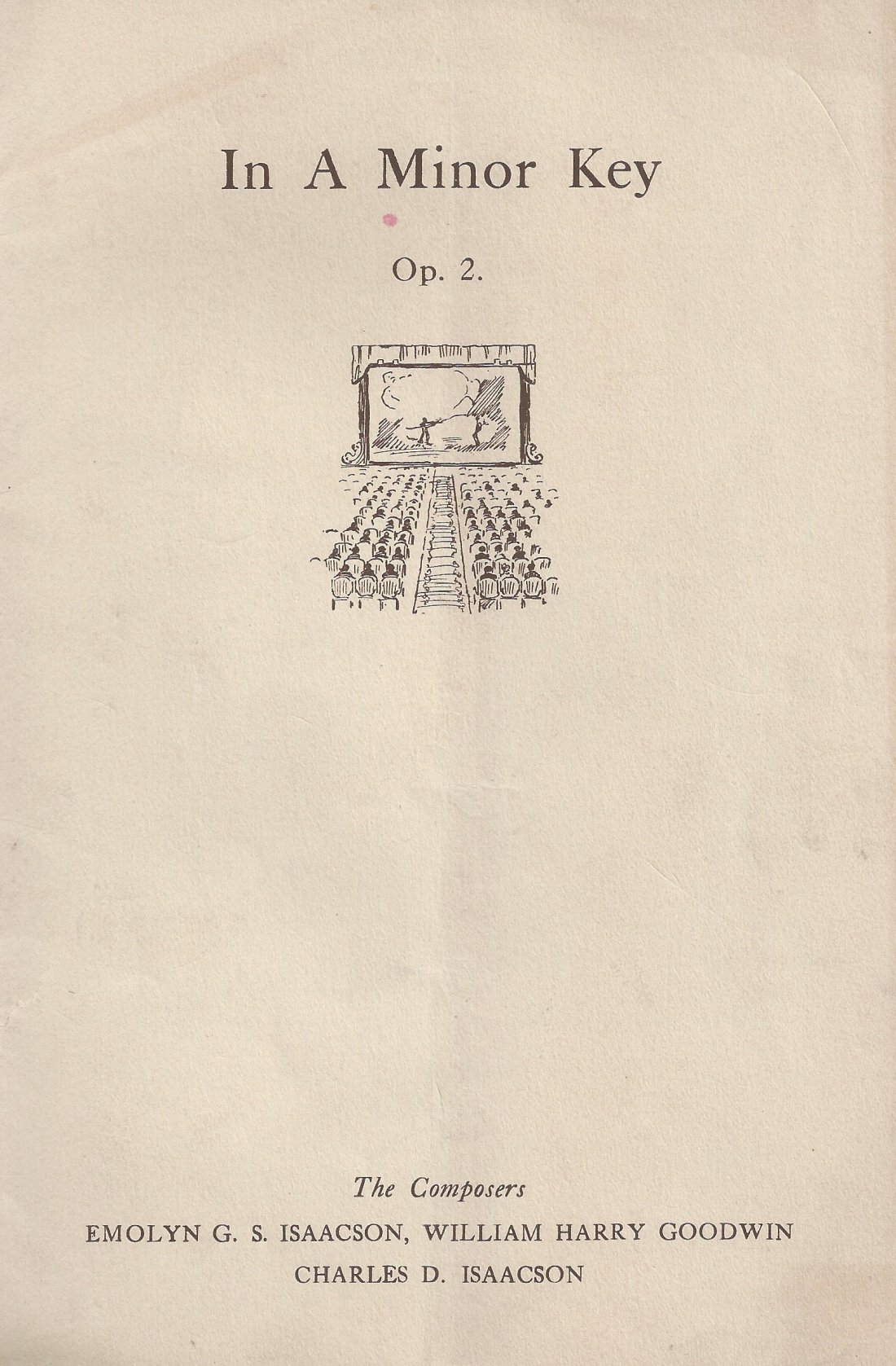
In early 1915, Charles D. Isaacson, along with his new wife Emolyn G. S. Isaacson and William Harry Goodwin, published the first issue of In A Minor Key, an amateur journal which followed his musical upbringing and social and aesthetic interests, including: “advocated pacifism, condemned prejudice against African Americans and Jews, and praised Walt Whitman” (An H. P. Lovecraft Encyclopedia 127). He was a member of the National Amateur Press Association, and would receive a laureateship for his sketch “Andante Appasionato [sic]” in 1916 (The History of Amateur Journalism 222). Edward H. Cole in 1917 lauded Isaacson’s participation in the Blue Pencil Club (an amateur journalist group, whose members would include James F. Morton and Sonia H. Greene, the future Mrs. H. P. Lovecraft).
H. P. Lovecraft had joined amateur journalism in 1914, and began publishing his own amateur journal The Conservative in 1915, around the same time as Isaacson. Pretty much from the beginning, Lovecraft and The Conservative attracted attention; the second issue included “The Conservative and His Critics,” a rebuttal to an unflattering review of the first issue which had appeared in William B. Stoddard’s amateur periodical The Brooklynite. In the same issue, Lovecraft also sets his critical sights on another amateur journal:
It was the good fortune of THE CONSERVATIVE to receive from The Blue Pencil Club a pamphlet entitled “In a Minor Key”, whose phenomenal excellence furnishes emphatic evidence that the old National still retains some members who would have done it credit even in its palmiest days. But great as may be the literary merit of the publication, its astonishing radicalism of thought cannot but arouse an overwhelming chorus of opposition from the saner elements of amateur journalism.
Charles D. Isaacson, the animating essence of the publication, is a character of remarkable quality. Descended from the race that produced a Mendelsshon, he is himself a musician of no ordinary talent, whilst as a man of literature he is worthy of comparison with his co-religionists Moses Mendez and Isaac D’Israeli. But the very spirituality which gives elevation to the Semitic mind, partially unfits it for the consideration of tastes and trends in Aryan thought and writings, hence it is not surprising that he is a radical of the extremest sort.
—H. P. Lovecraft, “In A Major Key,” The Conservative (July 1915)
reprinted in Collected Essays of H. P. Lovecraft 1.56-58
Lovecraft then goes on to criticize Isaacson’s appreciation of Walt Whitman (whose Leaves of Grass was sometimes considered obscene), his arguments regarding prejudice (including the film The Birth of a Nation released in 1915, based on the book and play The Clansman, which inspired the second incarnation of the Ku Klux Klan), and the call for pacifism. The point/counter-point approach of Lovecraft’s critique in The Conservative can be read in The Fossils #331.
Isaacson answered these claims in the next issue of In a Minor Key with a lengthy double-spread editorial:
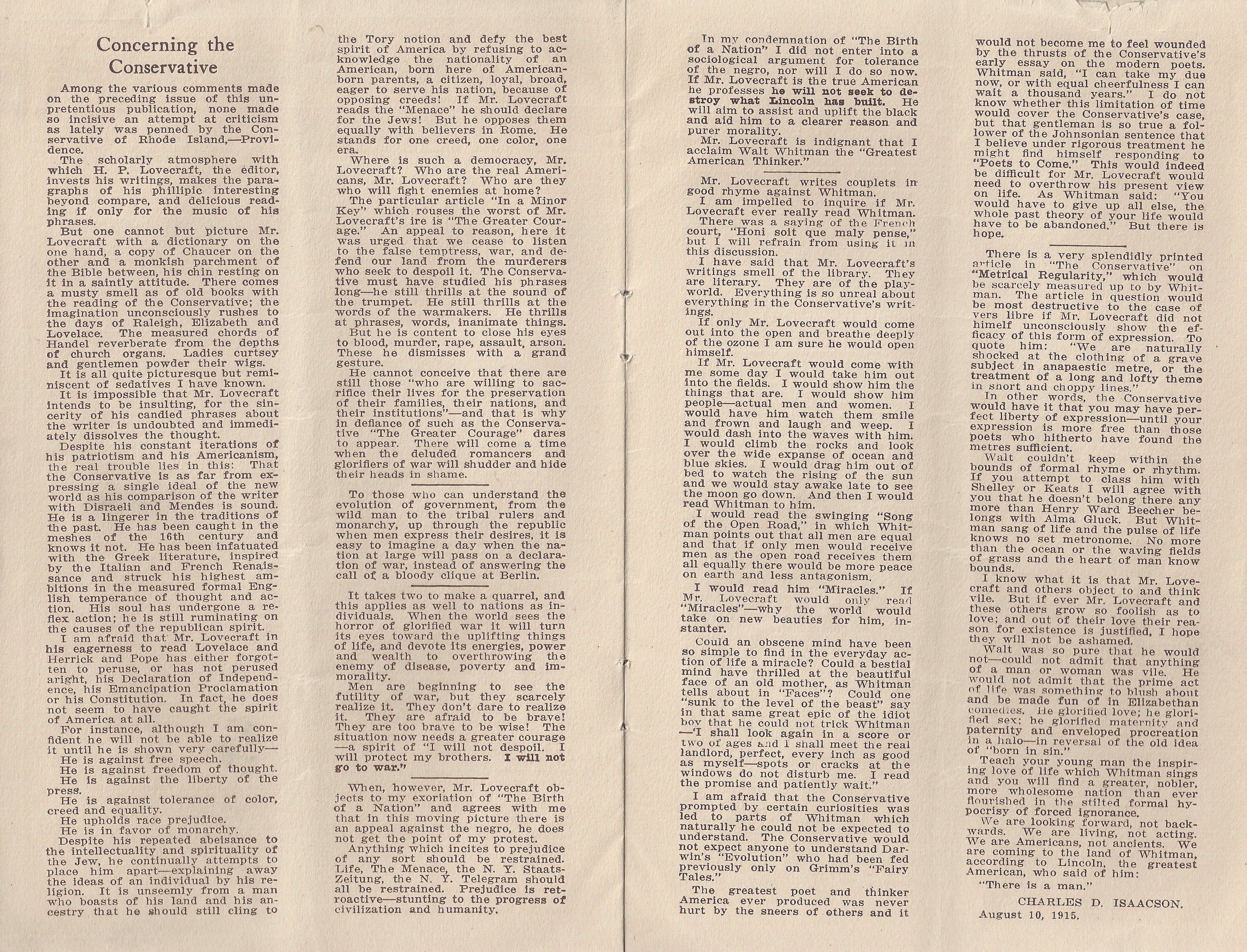
“Concerning the Conservative” has the distinction of being the first public address of Lovecraft’s antisemitic views in print. It may be the first real criticism that he had received regarding his views on Jews in his entire life. Such views were evident in his juvenile writings, beginning with a Latin inscription in the Poemata Minora (1900-1902) when Lovecraft was 10-12 years old. By his own account in his letters, his first encounters with Jews were fellow students at Hope Street English and Classical High School in 1904; the teachers appeared to tolerate this attitude without disciplining Lovecraft, giving tacit acceptance to his antisemitism (Letters to Rheinhart Kleiner 74-75).
In his rebuttal to Lovecraft, Isaacson strikes a chord when he describes his critic as “a lingerer in the traditions of the past.” The Eighteenth Century was the period that Lovecraft most identified with, aesthetically and personally; while Isaacson could not have known about Lovecraft’s Anglophilism (unless he had read the previous issue of The Conservative), he was absolutely correct when he identified that Lovecraft did not believe in the spirit of Republicanism, and the list of assertions that follows shortly after is basically accurate:
He is against free speech.
He is against freedom of thought.
He is against the liberty of the press.
He is against tolerance of color, creed and equality.
He upholds race prejudice.
He is in favor of monarchy.
—Charles D. Isaacson, “Concerning the Conservative,” In A Minor Key 2, Aug 1915
Lovecraft would eventually change his mind regarding censorship, but most of these were traits that the Old Gent from Providence would continue to espouse in his letters for the rest of his life. What is really striking about these comments, however, is how clearly and accurately they strike at the flaws in Lovecraft’s own method of argument. When Isaacson adds:
Despite his continued abeisance to the intellectuality and spirituality of the Jew, he continually attempts to place him apart—explaining away the ideas of an individual by his religion. (ibid.)
This was a direct counter to Lovecraft’s own claim that “Mr. Isaacson’s views on race prejudice […] are too subjective to be impartial.” Again, the insight is incredibly accurate.
Throughout his life and letters, Lovecraft would dismiss views regarding racial equality or attacking scientific racialism by saying that the individuals who held such views were either biased or sentimentalists—not, as he himself maintained to be, objectivists who held that scientific racism was a proven and unassailable fact. This is in direct contrast to many other fields of science, where Lovecraft would change his world view when new evidence presented itself. Scientific racism supported Lovecraft’s prejudices, and Lovecraft’s prejudices largely prevented him from considering the errors of scientific racism.
Isaacson’s comments regarding The Birth of a Nation are worth examining in some detail:
When, however, Mr. Lovecraft objects to my excoriation of “The Birth of a Nation” and agrees with me that in this moving picture there is an appeal against the negro, he does not get the point of my protest. […] In my condemnation of “The Birth of a Nation” I did not enter into a sociological argument for tolerance of the negro, nor will I do so now. If Mr. Lovecraft is the true American he professes he will not seek to destroy what Lincoln has built. He will aim to assist and uplift the black and aid him to a clearer reason and purer morality. (ibid.)
At this point, Abraham Lincoln had been dead for some 50 years, and Reconstruction had been over since before either Lovecraft or Isaacson had been born. The United Daughters of the Confederacy and the Dunning School were quite literally re-writing the history of the Civil War and its aftermath, recasting the Southern rebels as heroes and martyrs to the Lost Cause, erecting monuments and having unfavorable school books labeled “unfair to the South.” Isaacson missed the mark here; Lovecraft had already been exposed to these views and expressed sympathy for the Confederacy:
In history classes we used to have thunderous debates, for while “Abbie” was the daughter of a Union veteran, the Munroe boys & I were Confederate sympathizers. How we used to annoy her with our “compositions”—all flaming with love & glorification of the South! I subjoin for some verses which I once placed upon her desk. I have the original copy, for I composed them on the back of a half-tone illustration in Montgomery’s “American History”—a book still on my shelves. (LRK 72)
So it is not that Lovecraft did not get Isaacson’s initial point, but that Lovecraft did not see anything wrong with the work in question (even though Lovecraft had not seen the film, he had read the book and seen the play it was based on.) Isaacson’s argument that the film incited racial hatred ultimately fell on ears that were not deaf, but heard nothing wrong. Neither man could foresee that in November 1915, the Ku Klux Klan would be re-founded, inspired by the film. Nor could they envisage the domestic terrorism that this second Klan would be responsible for.
The subject which both Lovecraft and Isaacson dance around is the issue of Whitman’s sexuality, an issue which has been the subject of continued debate, although the general consensus is that Whitman was either homosexual or bisexual. This, as much as any particular language of Whitman’s poetry, is what Lovecraft hints obliquely at when he wrote: “His joys were sordid, and his morals mean.” Isaacson’s answer to this is equally circumlocutive:
I know what it is that Mr. Lovecraft and others object to and think vile. But if ever Mr. Lovecraft and these others grow so foolish as to love; and out of their love their reason for existence is justified, I hope they will not be ashamed.
—Charles D. Isaacson, “Concerning the Conservative,” In A Minor Key 2, Aug 1915
Again, Isaacson hits home: Lovecraft had no real romantic experience at this point, and would not marry until some years later. Given that both men were of about the same age, it may be that Isaacson’s careful and mostly correct dissection of Lovecraft suggests experience dealing with such arguments and prejudices. In the end, Isaacson’s final statement is about as clear a distinction of how far apart their two positions were:
We are looking forwards, not backwards. We are living, not acting. We are Americans, not ancients. We are coming to the land of Whitman, according to Lincoln, the greatest American, who said of him:
“There is a man.” (ibid.)
Unsurprising that he should find himself in disagreement with Lovecraft, who would declare in 1929: “The past is real—it is all there is.” (Letters to James F. Morton 180).
Lovecraft’s “In A Major Key” apparently demanded a response from Isaacson, and at least one friend apparently warned Lovecraft that it was coming and suggested an apology. In a letter that apparently dates before “Concerning the Conservative” was published, Lovecraft responded:
From your hint regarding Isaacson I imagine that my reply will differ very much from the apologetic form! A Jew is capable of infinite nastiness when he seeks revenge, & I believe I shall have ample grounds for making this particular Israelite the hero of a spirited Dunciad. I can almost predict his line of attack. he will call me superficial, crude, barbaric in thought, imperfect in education, offensively arrogant & bigoted, filled with venomous prejudice, wanting in good taste, &c. &c. &c. But what I can will say in reply is also violent & comprehensive. […] I am an anti-Semitic by nature, but thought I had concealed my prejudice in my remarks concerning Isaacson. I showed him every consideration in my article, carefully saying that I attacked not the man, but the ideas. […] The Jew is an adverse influence, since he insidiously degrades or Orientalizes our robust Aryan civilization. The intellect of the race is indisputably great, but its nature is not such that it may be safely employed in forming Western political & social ideas. Oppressive as it seems, the Jew must be muzzled. Wherefore Isaacson has reason to expect a warfare of the bitterest kind if he uses his revengeful sarcasm on me. I shall not utter the first word, but shall hold the CONSEVATIVE until the serpent strikes. Then—LET HIM BEWARE. Like old Marcus Fabius on his mission to Carthage, I come with folded toga, ready for peace or war.
—H. P. Lovecraft to Rheinhart Kleiner, 10 Aug 1915, LRK 18-19
That Lovecraft thinks he concealed his antisemitism in “In A Major Key” speaks to how far out of touch he was with the daily realities of prejudice; the grandstanding regarding the war of editorials in amateur journals has all of the drama of an internet forum flamewar in this century. As it happened, Isaacson did not make the arguments that Lovecraft predicted, refraining from ad hominem attacks and addressing the substance of Lovecraft’s own claims.
When “Concerning the Conservative” did appear, Lovecraft’s response in private was irate at the intellectual challenge to his criticism:
Isaacson’s predilection for obscenity has robbed him of all the delicacy inherent in real white men, & he views Nature without its beauty & its refining adornments. It is a mistake to allow Jews to mingle with Aryans as social equals. I have never been forced to do this, & at high school I drew the colour line at Jews as well as negroes, though of course there is no racial comparison between the two classes of undesirables. How diabolically Isaacson tries to compare different classes of prejudices, & trace to one source those arising from race, religion, & politics. As fellow sufferers with himself he groups races both above & beneath him; he calls everyone “persecuted”, from the masterful Aryan German, representative of the world’s highest racial stock, to the bestial nigger, link between man & the apes! If this be radicalism, let me thank heaven I am a conservative!
—H. P. Lovecraft to Rheinhart Kleiner, 25 Nov 1915, LRK 25
Lovecraft’s distinction of different sources of prejudice and discrimination rings a bit hypocritical, considering that his own justifications often combine aspects of historical prejudice, religious bias, scientific racism, and classism. Considering that this was, from all appearances, his first real interaction with a Jewish person in his adult life, and that the individual happened to hold largely opposite views to Lovecraft’s own, the reaction is not entirely unexpected. Challenged and called out on his views for basically the first time, Lovecraft’s response is an ugly diatribe—and might have been nastier, except for one thing.
Morton is a problem. I can feel the more wholesome nature of his work—with him I can come to grips as man to man—there is no slimy Jewry or Orientalism there—while Isaacson defies analysis with his shifty Asiatic caprices. Morton is harsh, insolent, overbearing, but not nasty. (ibid.)
James Ferdinand Morton had also published “Conservatism Gone Mad,” his critique of The Conservative in In A Minor Key No. 2; as Lovecraft recognized, he was not Jewish and could not be dismissed via prejudice as easily. Morton was the author of a tract, The Curse of Race Prejudice (1906), an early member of the National Association for the Advancement of Colored People, and very much the social progressive to Lovecraft’s social conservative—but also literate, intelligent, and insightful.
Lovecraft prepared an epic poem insulting both men: “The Isaaconio-Mortoniad”, in imitation of Alexander Pope’s “The Dunsiad”—but it was never published. In the next issue of The Conservative, Lovecraft still apparently had not read “Concerning the Conservative,” and gave some brief remarks in “The Conservative and His Critics”:
It appears that The Conservative’s review of Charles D. Isaacson’s recent paper was not accepted in the honestly critical spirit intended, and that Mr. Isaacson is preparing to wreak summary verbal vengeance upon the crude barbarian who cannot appreciate the loathsome Walt Whitman, cannot lose his self-respect as a white man, and cannot endorse a treasonable propaganda designed to deliver these United States as easy victims to the first hostile power who cares to conquer them. In view of The Conservative’s frank and explicit recognition of Mr. Isaacson’s unusual talent, the predicted reprisal seems scarcely necessary; yet if it must come, it will find its object, as usual, not unwilling to deliver blow for blow.
—H. P. Lovecraft, The Conservative Vol. 1, no. 3, Oct 1915
As it happened, Lovecraft made no public rejoinder to either Isaacson or Morton. Whether Kleiner or someone else in amateur journalism impressed on Lovecraft the need to let it drop, or he came to the conclusion on his own, Lovecraft chose not to continue. This may have simply been a matter of time to cool off more than anything else; the general substance of Lovecraft’s prejudices would not change, although experience in the coming years would considerably broaden his horizons.
There were three perhaps surprising outcomes of Charles D. Isaacson’s rebuttal to Lovecraft. The first came on 1 July 1916, when Isaacson and Kleiner passed through Providence on their way to a NAPA convention, stopping off to meet Lovecraft. The meeting was apparently amicable, and Lovecraft was invited along, but couldn’t go. The second came when he met James F. Morton at another amateur convention; this initiated a friendship that would last until the end of Lovecraft’s life, and Morton would continue to challenge his friend regarding the prejudices that he held.
The third and final outcome came late in 1936. Lovecraft and Isaacson had gone their separate ways for the most part, and there are no indications that they had conversed for twenty years, though one or two references to Isaacson’s work appeared in Lovecraft’s essays. Then, within months of succumbing to his terminal illness, he wrote:
Dominating the contents of this issue is the satiric mythological allegory on certain phases of human nature entitled “The God and the Man, a Saga of the Uphrigees”, by the late Charles D. Isaacson. Here we have grace, brilliancy, and wit of a high order; clever parallels, gentle irony, and apt imagery clothed in musical and well-balanced prose. this allegory, we are told, would have appeared some years ago in The American Mercury but for H. L. Mencken’s withdrawal from that magazine.
—H. P. Lovecraft, The Californian vol. 4, no. 3 (Winter 1936)
reprinted in Collected Essays of H. P. Lovecraft 1.404
Charles D. Isaacson spoke out, in “Concerning the Conservative.” It is good that he did. He would not be the last to challenge Lovecraft’s preconceptions. Lovecraft’s response in his private letters speaks to how thoroughly ensconced he was in that worldview at that time; his lack of response—and effective letting go of the feud, aside from a few snide remarks in letters—and ability to praise Isaacson in later years speaks well for Lovecraft.
What would have happened if Isaacson had kept his peace? How long would Lovecraft have gone on, blissfully confident that no-one would challenge his prejudices? No one can do more than speculate. Yet we can say that this confrontation brought the subject out in the open, where Lovecraft’s views would be challenged repeatedly by Kleiner, Morton, and others. Isaacson was far from the last Jewish person that Lovecraft would meet—he would come into contact with the Jewish poet Samuel Loveman in 1917, and Jewish expatriate Sonia H. Greene of the Blue Pencil Club, who would become his wife in 1924. These relationships were not free from the shadow of Lovecraft’s antisemitism either, but they certainly influenced his life and writings.
It would be accurate to say that the brush with Lovecraft was but a footnote in Charles D. Isaacson’s life, one devoted chiefly to music and music journalism. So too, from the standpoint of Lovecraft’s career as an author of weird fiction, the incident is an early contretemps, from years before the founding of Weird Tales. Yet for both men, it is a tangent point, one where their stories collided—and, perhaps, changed them both.
Bobby Derie is the author of Weird Talers: Essays on Robert E. Howard & Others (2019) and Sex and the Cthulhu Mythos (2014).
 Deep Cuts in a Lovecraftian Vein