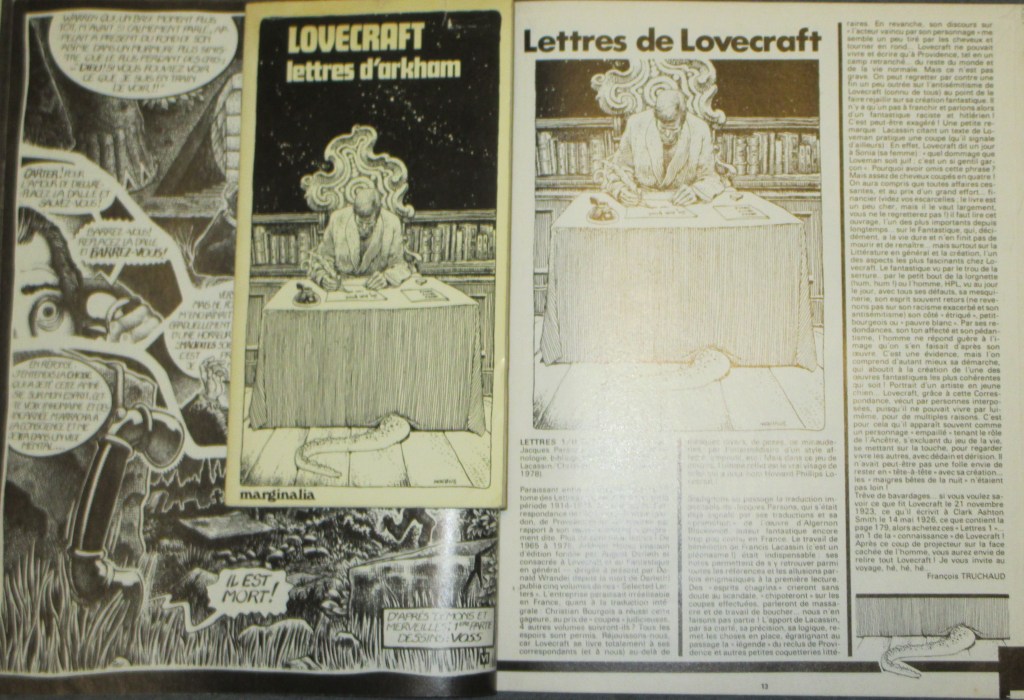
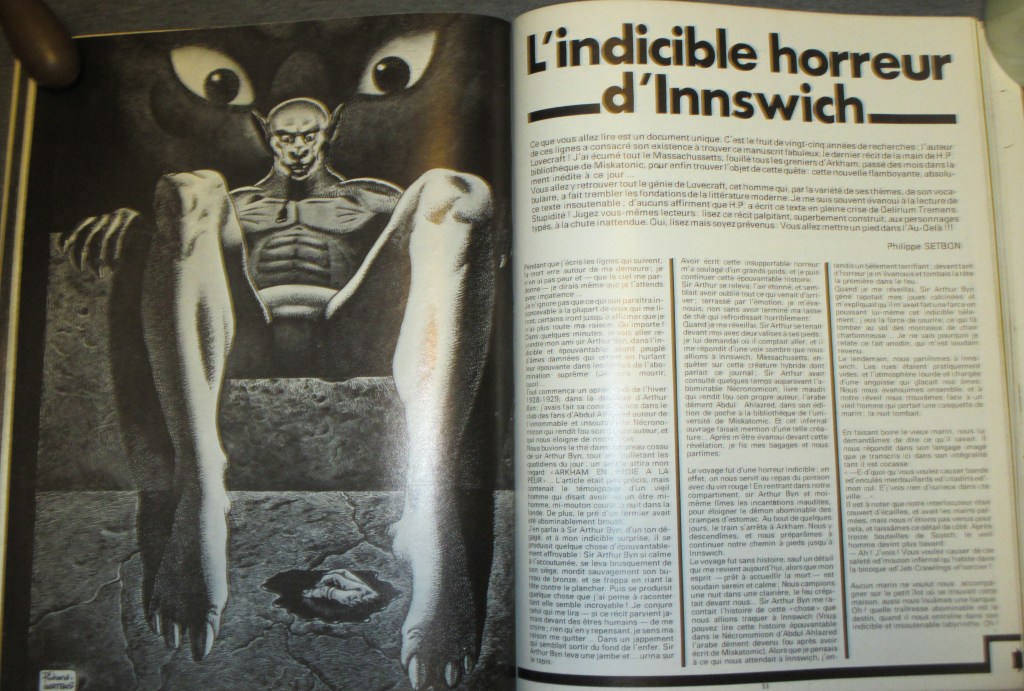
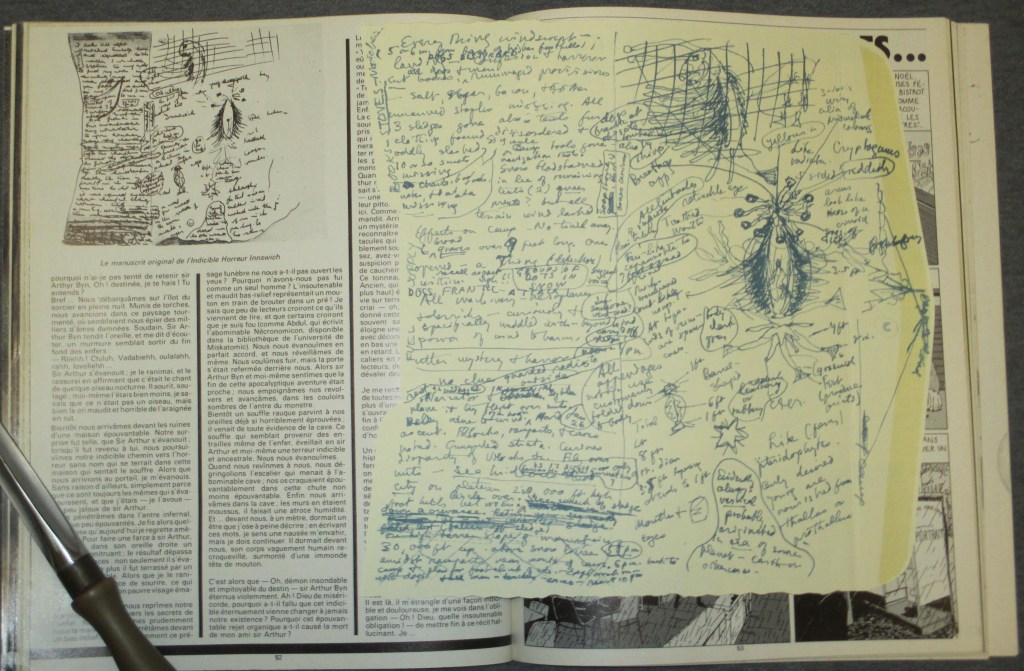
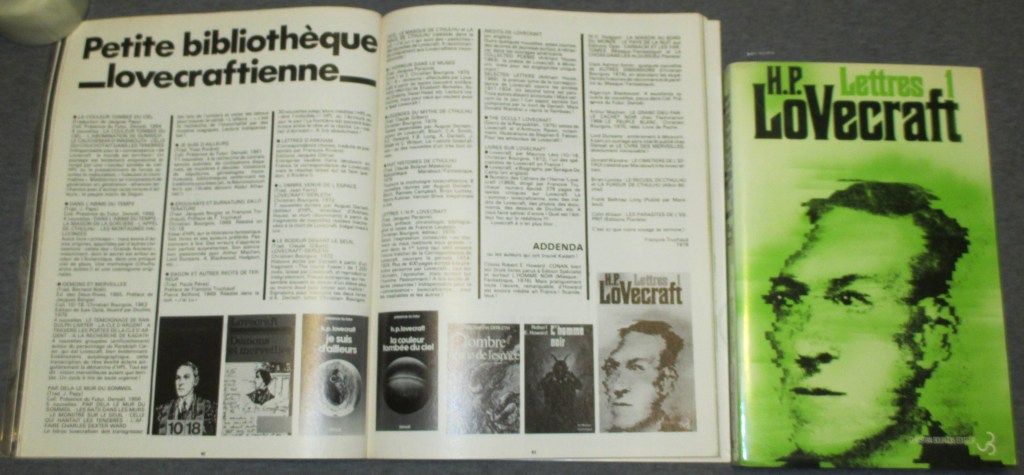
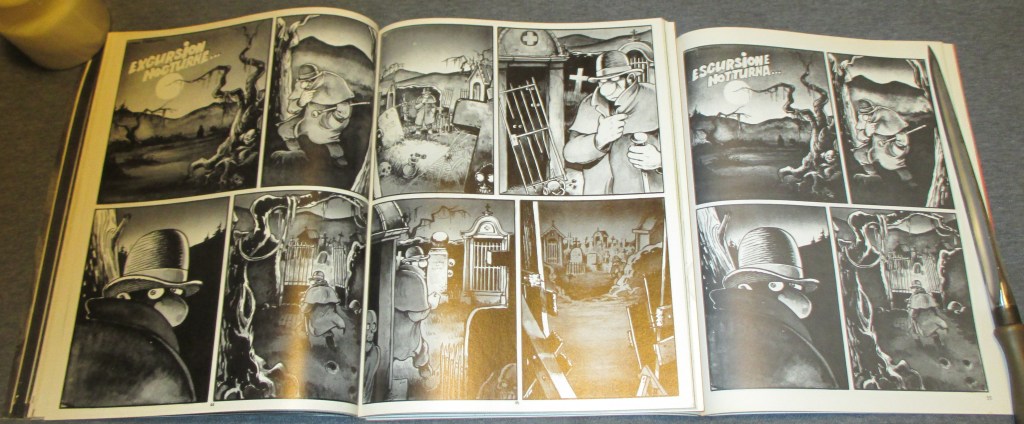
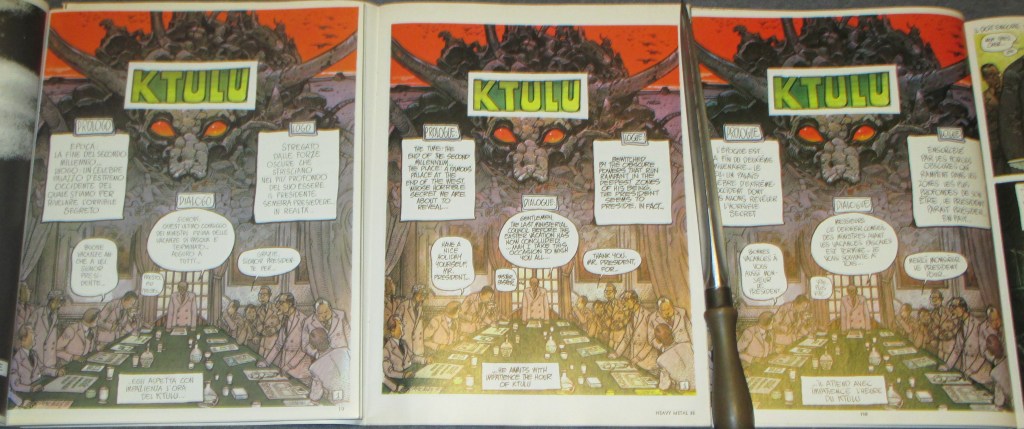
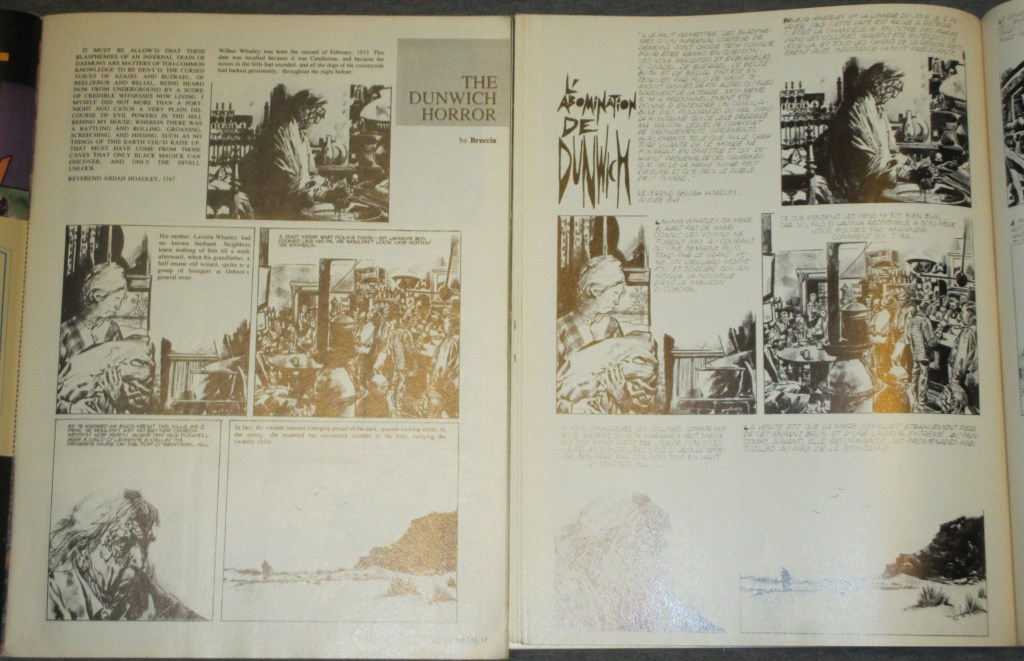
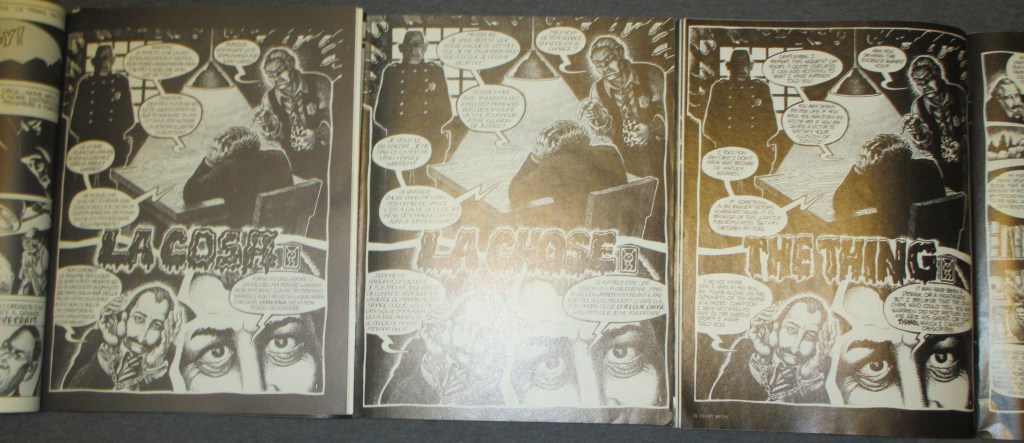
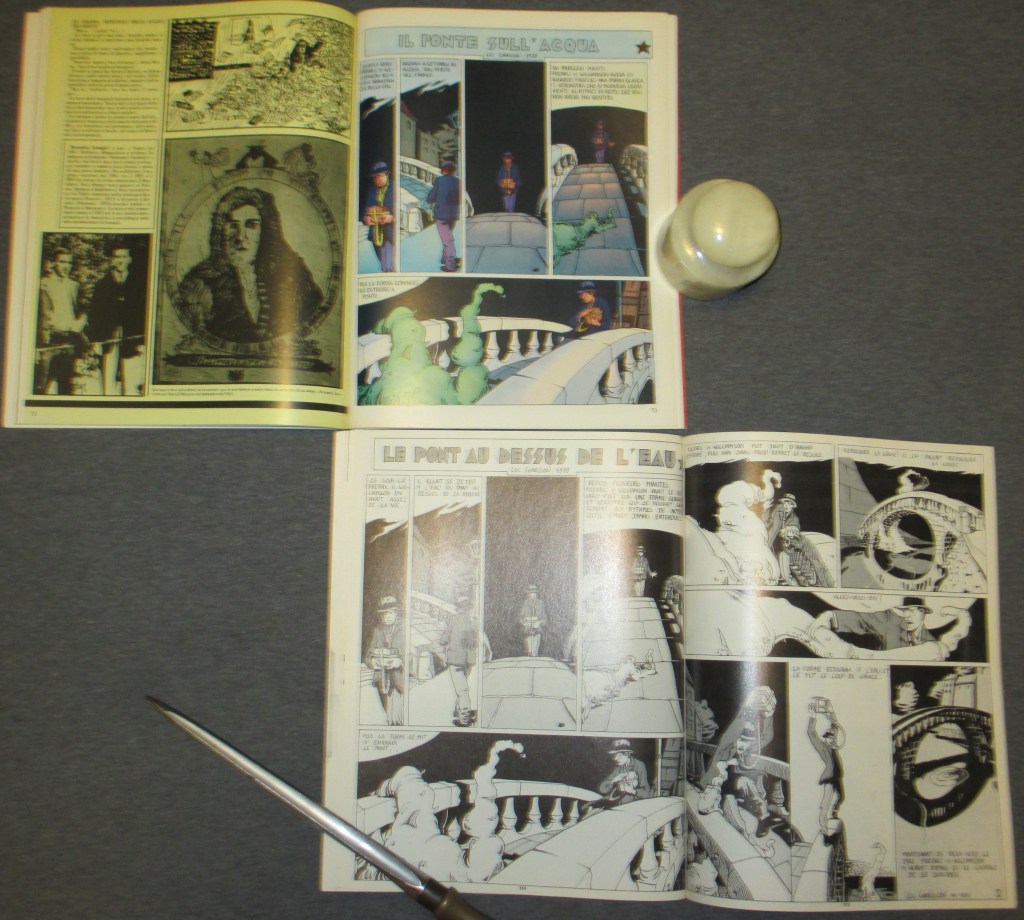
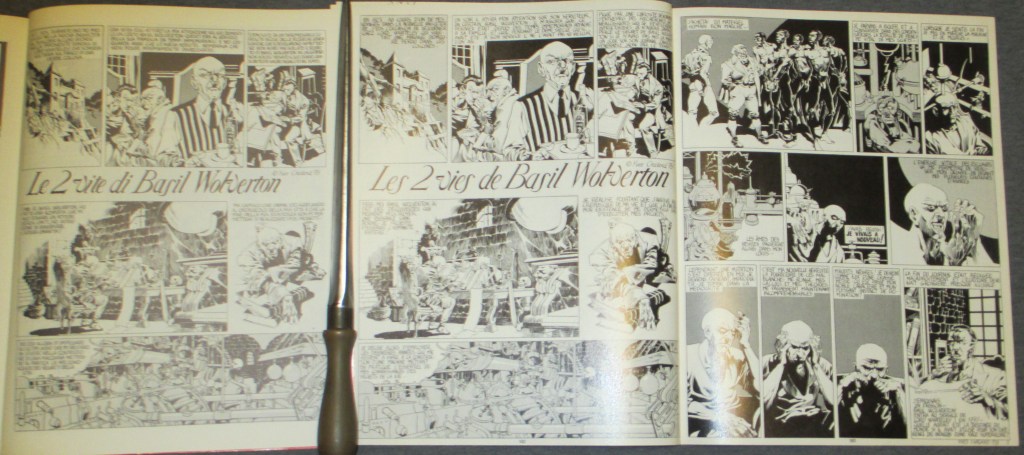
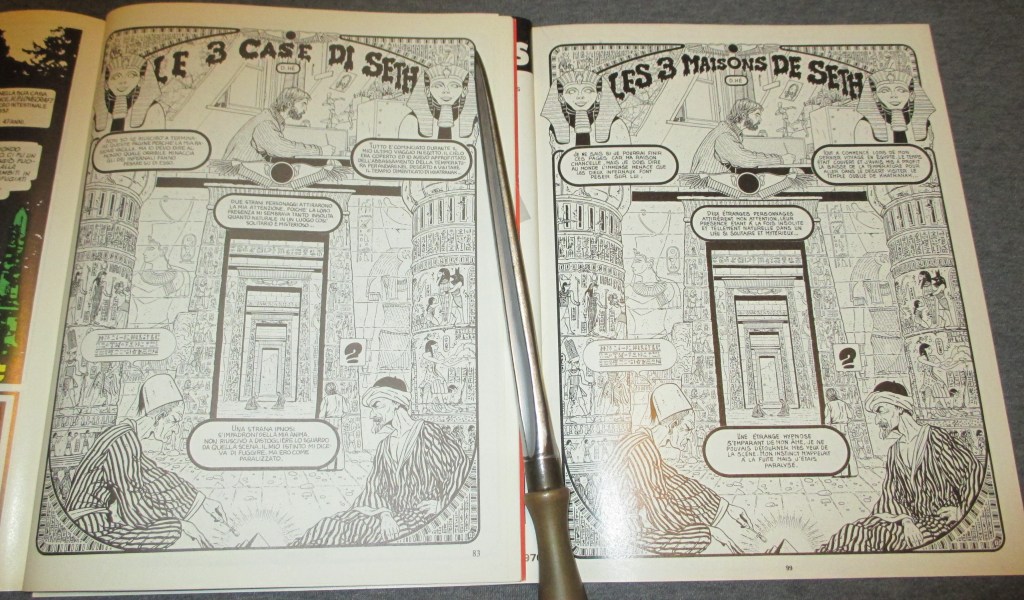
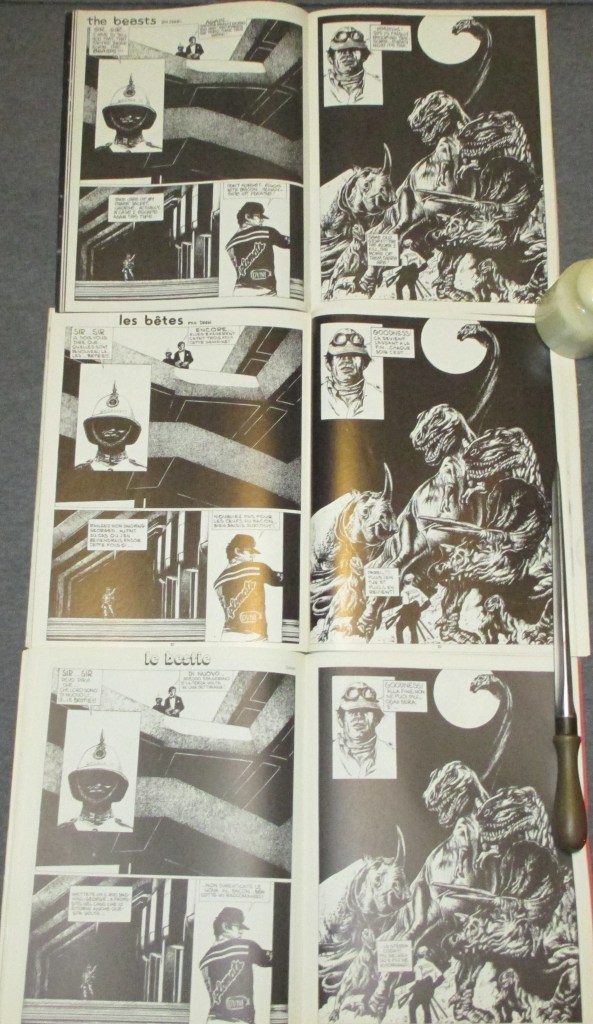
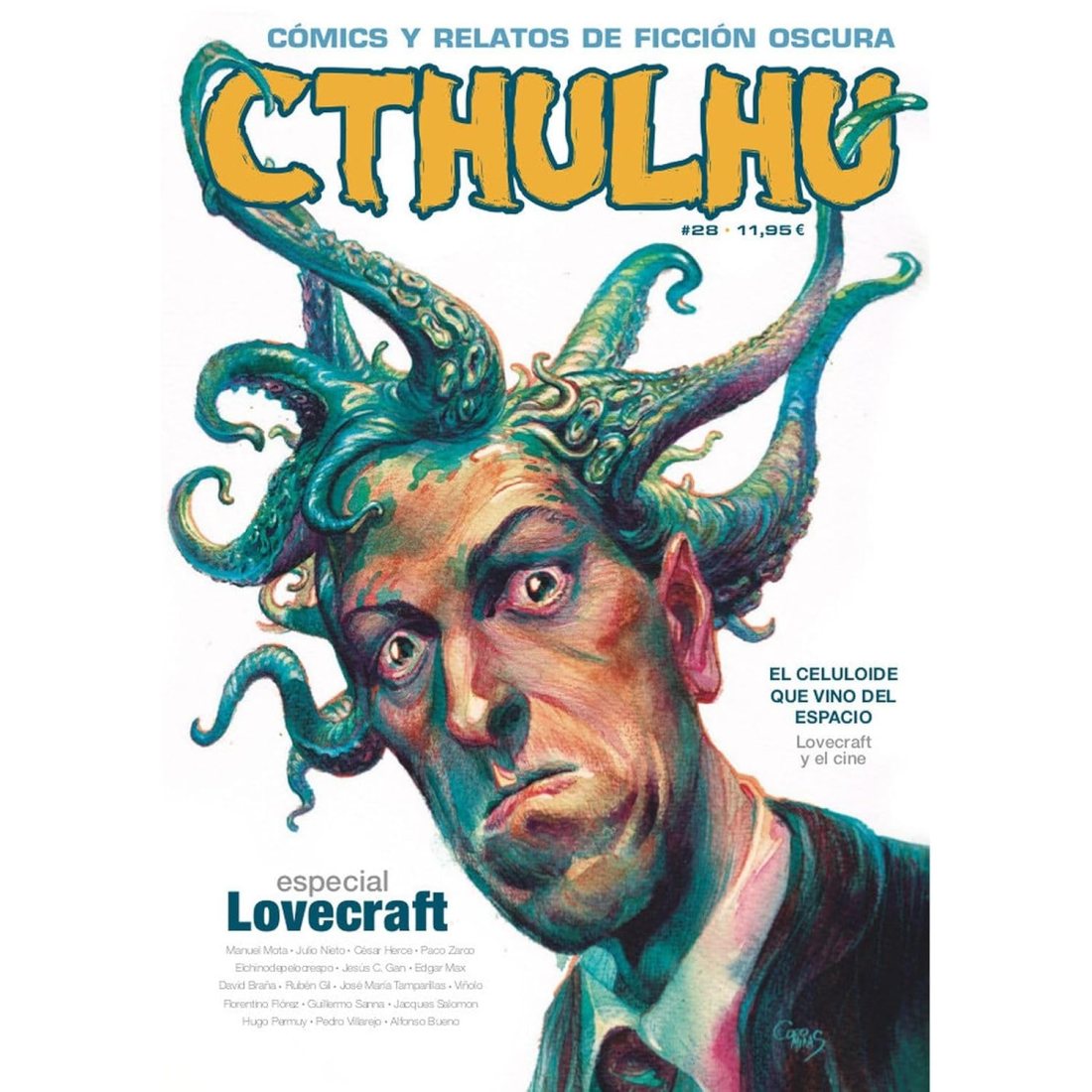
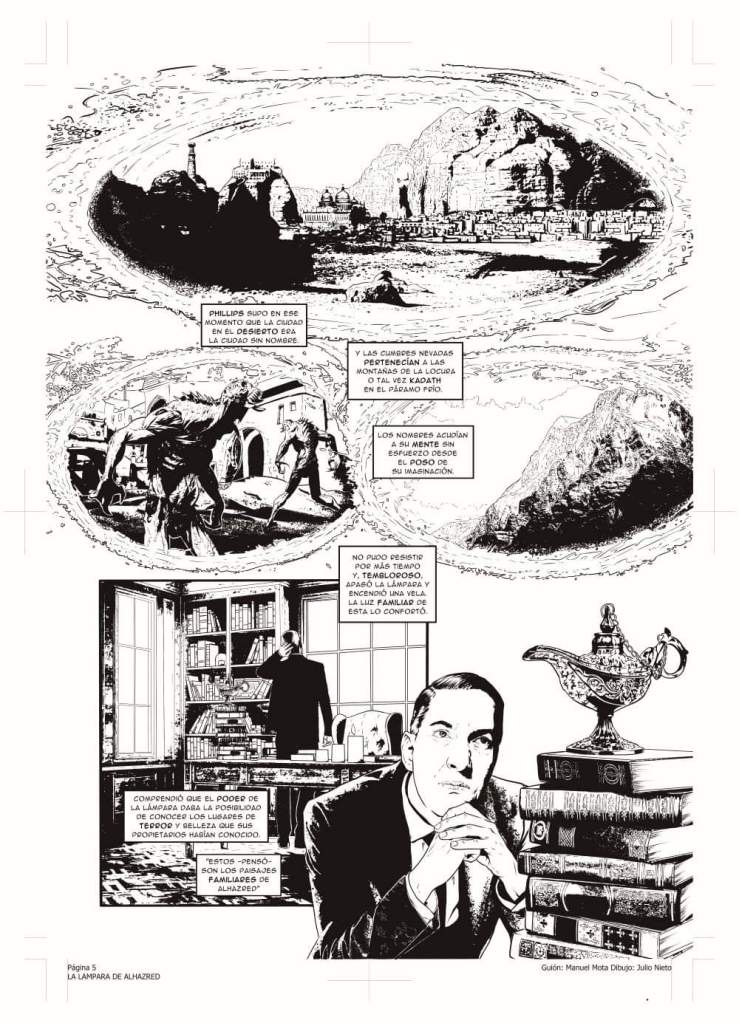
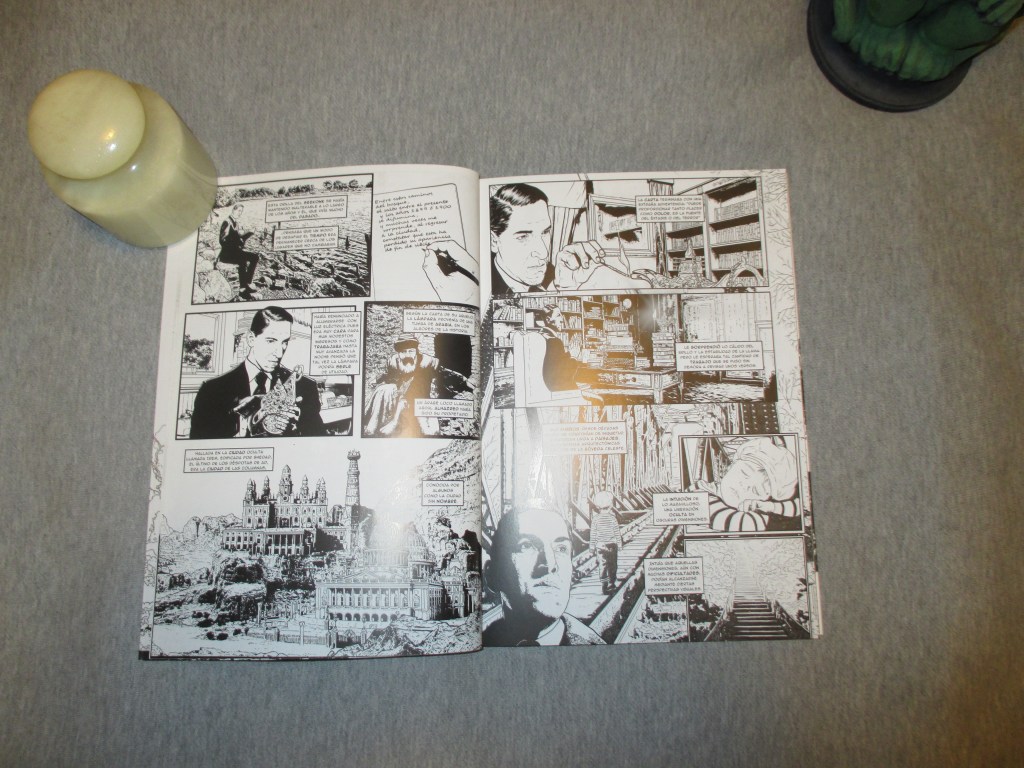
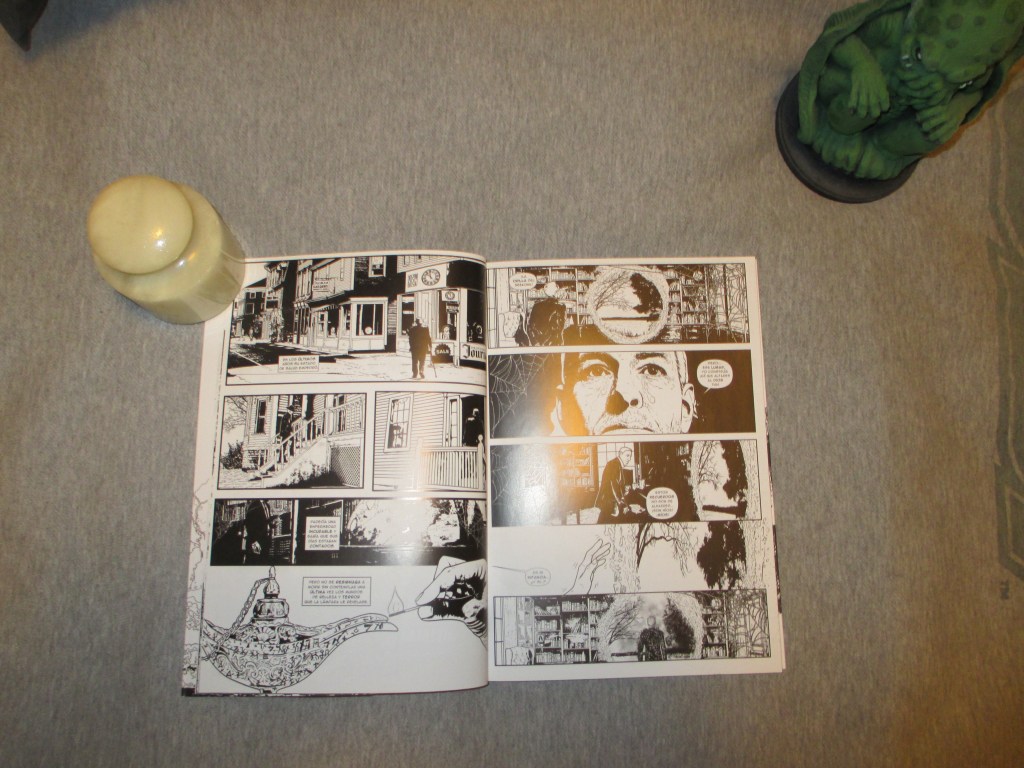
“La Lámpara de Alhazred” (2023) by Manuel Mota & Julio Nieto

Habían pasado siete años desoe la desparaición de su abuelo Whipple cuando Ward Phillips recibió la lámpara.Seven years had passed since the disappearance of his grandfather Whipple when Ward Phillips received the lamp.It was seven years after his Grandfather Whipple’s disappearance that Ward Phillips received the lamp.
“La Lámpara de Alhazred” (2023) by Manuel Mota & Julio Nieto,
Cthulhu #28.5
English translationAugust Derleth, “The Lamp of Alhazred” (1957), The Watchers out of Time 114

Many of August Derleth’s “posthumous collaborations” with H. P. Lovecraft have been derided as pastiches. Yet “The Lamp of Alhazred” is more homage—and more accurately a collaboration than most of Derleth’s stories, since it incorporates a large chunk of text from Lovecraft’s letter to Derleth dated 18 Nov 1936, where Lovecraft described coming across a previously unknown wood west of Neutaconkanut Hill.

On Oct. 28 I penetrated a terrain which took me half a mile from any spot I had ever trod before in the course of a long life. I followed a road which branches north 7 West from the Plainfield Pike, ascending a low rise which skirts Neutaconkanut’s Western foot & which commands an utterly idyllic Vista of rolling Meadows, ancient stone walls, hoary groves, 7 distant cottage roofs to the west & south. Only 2 or 3 miles from the city’s heart—& yet in the primal rural New-England of the first colonists!He penetrated a terrain which took him almost a mile from any spot he had ever before trod in the course of his life, following a road, which branched north and west from the Plainsfield Pike and ascending a lot rise which skirted Nentaconhaunt’s Western foot, and which commanded an utterly idyllic Vista of rolling Meadows, ancient stone walls, hoary groves, and distant cottage roofs to the west and south. he was less than three miles from the heart of the city, and yet basked in the primal rural New England of the first colonists.
H. P. Lovecraft to August Derleth, 18 Nov 1936, Essential Solitude 2.756August Derleth, “The Lamp of Alhazred” (1957), The Watchers out of Time 119

Derleth also took inspiration from an entry in Lovecraft’s commonplace book:

From Arabia Ency. Britt. II.–255. Prehistoric fabulous tribes of Ad in the south, Thamood in the north, and Tasm & Jadis in the centre of the peninsula. “Very gorgeous are the descriptions given of Irem, the City of the Pillars (as the Koran styles it) supposed to have been erected by Shedad, the latest despot of Ad, in the regions of Hudramant, and which yet, after the annihilating of its tenants, remains entire, so Arabs say, invisible to ordinary eyes, but occasionally, and at rare intervals, revealed to some heaven-favored traveler.” Rock excavations in N. W. Hejaz ascribed to Thamood tribe.It had once been the property of a certain half-mad Arab, known as Abdul Alhazred, and was a product of the fabulous trident of ad—one of the four mysterious, little-known tribes of Arabia, which where ad—of the south, Thamood—of the north, Tasm and Jadis—of the center of the peninsula. it had been found long ago in the hidden city called Irem, the city of Pillars, which had been erected by Shedad, last of the despots of Ad, and was known by some as the Nameless City, and said to be in the area of Hadramant, and, by others, to be buried under the ageless, ever-shifting sands of the Arabian deserts, invisible to the ordinary eye, but sometimes encounter by chance by the favorites of the Prophet.
The Notes and Commonplace Book of H. P. Lovecraft 21-22August Derleth, “The Lamp of Alhazred” (1957), The Watchers out of Time 115-116

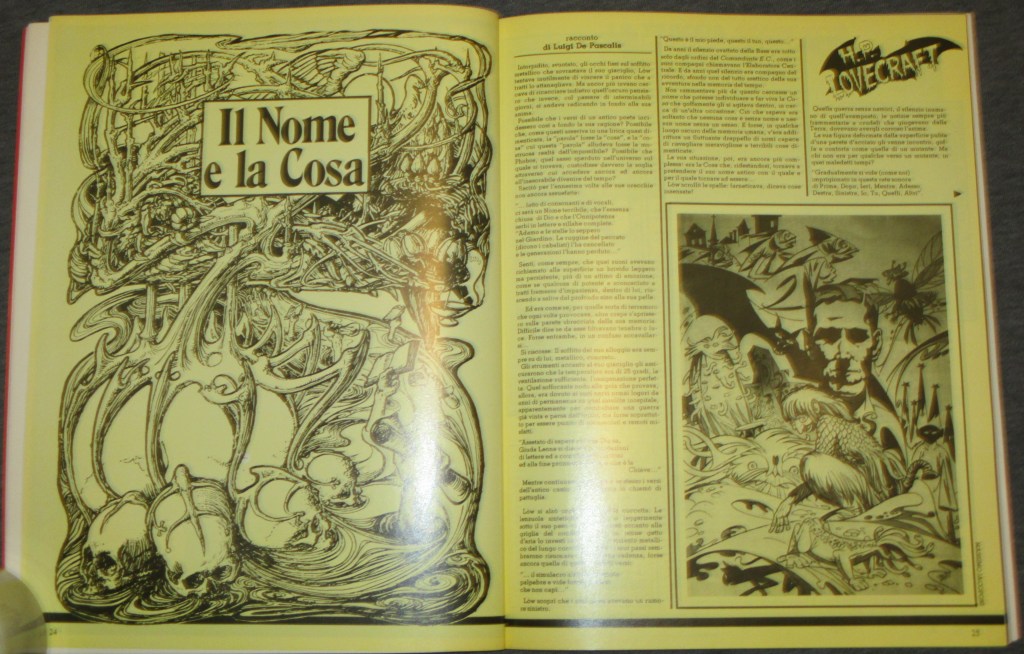
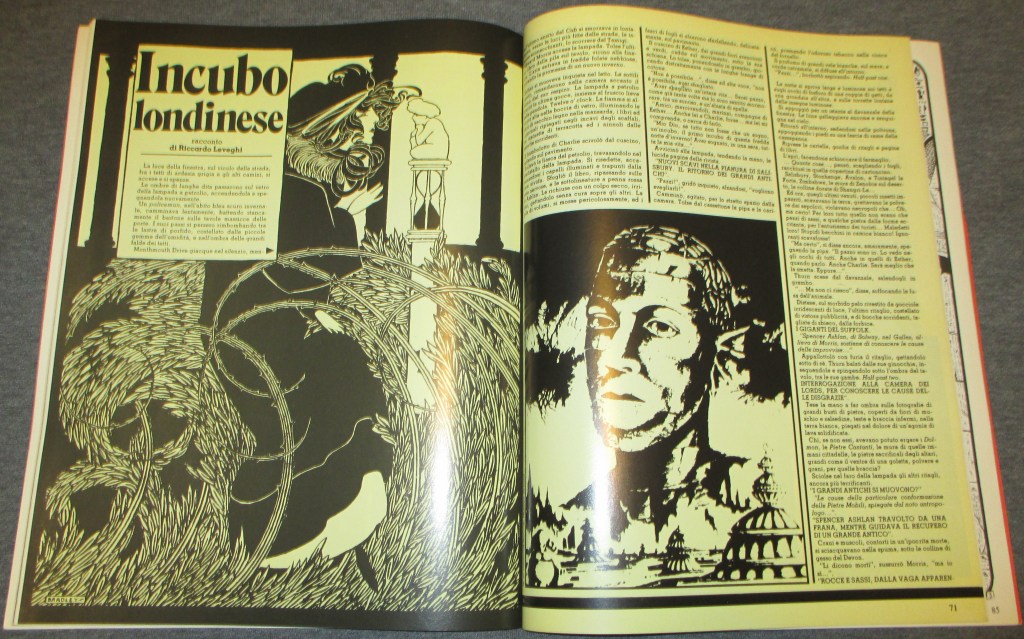
While nearly every Lovecraft story has been adapted to comics at some point, rather fewer of Derleth’s stories have attracted the same treatment. Yet it makes sense that Manuel Mota (script) and Julio Nieto (artwork) would adapt “The Lamp of Alhazred” for Cthulhu #28, the Lovecraft special issue. Because there are homages which capture as much of the pathos of H. P. Lovecraft as well as this one.

Manuel Mota’s script is a fairly straight translation of Derleth text, albeit truncated for space and with the illustrations serving in place of much of the description, which inadvertently cuts out most of Lovecraft’s text. Yet the presentation and framing of the words and Julio Nieto’s art does much to lend a sense of action to what is a largely contemplative story that draws on both Lovecraft’s life and the sentiment of “The Silver Key.” Readers feel Ward Phillips loss and loneliness, his refuge in his imagination, and the visions of other worlds, other times.

It is escapist in the most literal sense of the word, and one of several stories that reflect that quiet, profound desire to abandon the daily grind of life, with its quiet indignities, defeats, and injuries.

Nieto’s artwork is carefully realistic, the page layout traditionally grid-like; it is a straight-forward presentation that puts the more fantastic sequences, the break-outs where the panel cannot contain a wondrous scene, in context. The weirdness isn’t a part of Ward Phillips world; it is the way out.

Jamás se encontro el cuerpo de Ward Phillips.

La policía aún espera queue sus restos aparezcan en Alguno de los lugares queue solía frecuentar en sus solitarios paseos.

Con el paso de Los años, la vieja casa fue derribada, la biblioteca adquirida por librerías anticuarias y lo queue quedó gue vendido como chatarra incluida una vieja lámpara Árabe a la que nadie encontró utilidad alguna.
The body of Ward Phillips was never found.

Police are still hoping that his remains will turn up in one of the places he used to frequent on his solitary walks.

Over the years, the old house was demolished, the library was acquired by antiquarian bookstores and what remained was sold as scrap, including an old Arabic lamp that no one found any use for.
Though desultory searching parties were organized and sent out to scour the vicinity of Nentaconhaunt and the shores of the Seekonk, there was no trace of Ward Phillips. The police were confident that his remains would some day be found, but nothing was discovered, and in time the unsolved mystery was lost in the police and newspaper files.

The years passed. The old house on Angell Street was torn down, the library was bought up by book shops, and the contents of the house were sold for junk—including an old-fashioned antique Arabian lamp, for which no one in the technological world past Phillips’ time could devise any use.
“La Lámpara de Alhazred” (2023) by Manuel Mota & Julio Nieto,
Cthulhu #28.14
English translationAugust Derleth, “The Lamp of Alhazred” (1957), The Watchers out of Time 123-124

It is a story that almost demands a familiarity with Lovecraft to truly appreciate; those who have read his letters, who knows what Lovecraft struggled with during his life, can recognize more of the man in Derleth’s framing of the Nentaconhaunt narrative. Mota and Nieto do well to capture and depict as much of this atmosphere as they can, and the sensibility of the story is necessarily both sad and romantic in the older sense—this is not a Mythos story, despite the name “Alhazred.” it is a fantasy, a myth, so much more elegant than the reality that saw Lovecraft end his days in pain in a hospital as the cancer consumed him.

“La Lámpara de Alhazred” (2023) by Manuel Mota & Julio Nieto is an excellent overall adaptation of Derleth’s homage to Lovecraft, one that captures the spirit of the original—the echo of Lovecraft, as it were—for a new medium and a new audience.


Bobby Derie is the author of Weird Talers: Essays on Robert E. Howard and Others and Sex and the Cthulhu Mythos.

Deep Cuts in a Lovecraftian Vein uses Amazon Associate links. As an Amazon Associate I earn from qualifying purchases.
Deeper Cut: Lovecraft, the Rabbi, & the Historical Jesus

Charlie Brown: Isn’t there anyone who knows what Christmas is all about?

Linus Van Pelt: Sure, Charlie Brown, I can tell you what Christmas is all about.
A Charlie Brown Christmas (1965)

The true season of Christ’s nativity is not definitely known, that event having once been celebrated on the 6th of January in connexion with the feast of Epiphany. The selection of December 25th as Christmas day occurred in the fourth century, and was undoubtedly a result of a desire to make the celebration coincide with the ancient Roman Saturnalia, which was a development of the primitive winter festival called Brumalia. Many of our present Yuletide customs are derived from the winter festivals of the Druids and of our Saxon ancestors.
—H. P. Lovecraft, “The December Sky” (1914), Collected Essays 3.131

It was the Yuletide, that men call Christmas though they know in their hearts it is older than Bethlehem and Babylon, older than Memphis and mankind.
—H. P. Lovecraft, “The Festival” (1923)

As a child, H. P. Lovecraft went to Sunday school at the local Baptist church. These lessons (and mandatory church attendance) appear to have begun around age 5 and ended around age 12. From then on Lovecraft’s religious education happened on his own, in his readings of history and the Bible. Several books in Lovecraft’s library speak to at least a general interest in the history of Christianity, or as reference works including The Evolution of Christianity (1892) by Lyman Abbott, The Life of Christ (1874) by Frederic William Farrar, The Comprehensive Commentary on the Holy Bible (1835-1838) by William Jenks, An Epitome of General Ecclesiastical History, from the Earliest Period to the Present Times (1827) by John Marsh, A Summary of Biblical Antiquities (1849) by John Williamson Nevin, and Martin Luthor (1881) by John H. Treadwell, among others.

While happy to celebrate Christmas as a secular holiday (see Lovecraft’s Last Christmas and Her Letters To Lovecraft: Christmas Greetings), Lovecraft seemed to be weaker on theology. His dismissiveness of anything supernatural and lack of churchgoing apparently extended to being uninterested in the finer points of Christian metaphysics and doctrine. As an ardent materialist, his approach to Christianity was colored by his reading in anthropology and his prejudices against superstition and Jewish culture.

So when it came to the historicity of Jesus Christ—the question as to whether Jesus of Nazareth actually existed, as depicted in the gospels of the New Testament—Lovecraft took a euhemeristic approach:

The word “Christianity” becomes noble when applied to the veneration of a wonderfully good man and moral teacher, but it grows undignified when applied to a system of white magic based on the supernatural. Christ probably believed himself a true Messiah, since the tendencies of the times might well inculcate such a notion in anyone of his qualities. Whether his mind was strictly normal or not is out of the question. Very few minds are strictly normal, and all religious fanatics are marked with abnormalities of various sorts. It is well known that psychologists group religious phenomena with other and less divine disturbances of the brain and nervous system. Whether, as the novel of Mr. Moore implies, Christ was alive after his nominal execution; or whether the whole resurrection legend is a myth, is immaterial. Very little reliable testimony could come from so remote a province as Judaea at that time.
—H. P. Lovecraft to the Gallomo, Oct 1916, Miscellaneous Letters 35

This was in regard to The Brooke Kerith: A Syrian Story (1916) by George Moore, a novel about an historical and non-divine Jesus who did not die on the cross and was subsequently nursed back to health. A decade later, the subject arose again when Georg Brandes’ Sagnet om Jesus was translated and published in English as Jesus: A Myth (1926), which argued against the idea of a historical Jesus.

I assume that the “Jesus Myth” review touches on the late Georg Brandes’ recent book—a thing I mean to read some day. I’m frankly undecided about the possible historicity of any one character corresponding to the crucified saint of tradition. He may be only a cultus-figure like Atys or Adonis, as some contend; but the East is so full of preaching ascetics & mildly touched Gandhis & such messiahs that I almost fancy it’s easier to assume that the Christ tradition was built up around some actual one of the thousand itinerant exhorters of the period. The whole affair was really as insignificant to the civilized world as a local squabble among the Moros in the Philippines would be to use today, & on account of its obscurity—an obscurity overridden by some very amusing post-facto developments—we are never likely to get any conclusive data. Brandes can really prove little or nothing either way—but it will be interesting to see what he says.
—H. P. Lovecraft to Paul J. Campbell, 2 Mar 1927, Letters to Rheinhart Kleiner & Others 357

Lovecraft’s position is based on the relative paucity of contemporary or near-contemporary accounts of Jesus outside of the gospels, principally in the works of Flavius Josephus and Tacitus. The idea of Jesus as the latest embodiment of a common myth-cycle of death and resurrection was current in anthropological circles. Sir James George Frazer included Jesus, Attis, Adonis, Zagreus, Dionysus, and Tammuz in his work of comparative mythology The Golden Bough (1890/1922).

It has always seemed doubtful to me whether any one person answering to the traditional Jesus ever existed in fact. In many respects the forms of Christianity closely followed those of the popular mystery-cults of the period—Dionysiac, Apollonian, Pythagorean, etc.—which joined Oriental and Hellenic concepts in a variety of ways. With this cult-background (wherein the idea of sacrifice and atonement was so marked) to start with, and with the age-old Jewish idea of a messiah superadded, it would be easy to build up a religious and heroic myth around any one of the sporadic evangelists of the East—or around several of them, fusing their personalities into one idealiased hero or demigod. This, it seems to me, is what must have happened. The tissue of miracles and too-neatly-dramatic episodes undoubtedly represents the purely mythos element; but certain touches of verisimilitude now and then suggest a substratum of fact. Incidents in the lives of several rustic preachers may be involved—though possibly one figures more extensively than others. Just who this one was, and to what extent the padded and myth-decked Gospel narratives relates his actual history, it seems to me can never quite be settled except through the discovery of hitherto unknown source-material. Parts of the popular tale—sacrifice, resurrection, etc.—are obviously derived from the nature-myth of Linus, Dionysus or Zagreus. Other parts—trial, etc.—might be tested by certain comparisons with contemporary accounts. But the lack of really reliable sources is almost fatal. That is, so far as general scholarship knows.
—H. P. Lovecraft to Robert Hartley Michael, 20 Sep 1929, Miscellaneous Letters 217-218

Without going into detail, Lovecraft is touching on the contentious nature of Biblical scholarship. While there are Biblical literalists who believe that the 27 canonical books of the New Testament (and maybe some apochryphal gospels) are literal truth and may be taken as accurate historical accounts, discrepancies between Biblical accounts and non-Biblical historical records and archaeology have inspired much scholarship and debate that suggests a more complicated history. This has resulted in competing ideas of Jesus as a historical figure with mythical attributes grafted on posthumously, and of Jesus as purely a myth.

Lovecraft accepted the idea of Christianity as a syncretic religion, based in 1st century C.E. Judaism but incorporating ideas and materials from other Mediterranean cultures and religions as it grew and spread. The idea of Christianity co-opting elements of pagan holidays into Christmas, and therefore the distorted survival of some elements of ancient pre-Christian religion, featured in his tale “The Festival,” which was inspired by reading The Witch-Cult in Western Europe (1921) by Margaret A. Murray.

Regarding Jesus, Lovecraft would continue to hold to the same line a few years later:

This annual course of the sun, with its mark’d effects upon terrestrial life, seems to produce a wholly independent cycle of myth in which the central figure is not the sun-hero himself, but a weak, lovely youth typifying terrestrial fertility—Dionysus—Iacchus—Zagreus—Adonis—Linus—Hylas—Taummuz etc. etc.—who is annually slain but later resurrected from the tomb to a new and glorify’d existence. There is scarce any doubt but that this myth, engrafted upon the Jewish legend of a coming Messiah and the feminine ethical notions of Syria in the age of the earlier Caesars, form’d the basis of the Christ-legend which wove itself about some itinerant Syrian enthusiast or enthusiasts of the time of Augustus, Tiberius, Caligula, or Claudius—indeed, many of the earlier forms indicate the beautiful youth is meeting his cruel but temporary death for the sake of mankind; it being assumed that the perishing of autumnal things is needed for the new vivifying of the earth in the spring.
—H. P. Lovecraft to Maurice W. Moe, 18 Sep 1932, Letters to Maurice W. Moe & Others 339

For “Syrian” read “Middle Eastern,” or even more narrowly “Jewish.” “Syria” was historically applied to a wider region than just the contemporary country of the same name, and Lovecraft would use reference to Syria as general reference to the Middle East or to peoples historically associated with the region—including Jews. Muslims and Jews were often categorized as Oriental in origin and/or culture, and Nietzsche’s On the Genealogy of Morality categorized Christianity as sklavenmoral (slave morality), derived from Judaism. Lovecraft, in particular, often categorized Jews, Jewish culture and religion, and by extension Christianity in this context as an “Eastern” religion throughout his life, although there were some small shifts in his viewpoint as he met more Jews and learned a little more about Jewish life and culture, as when he saw The Dybbuk (1925) by S. Ansky.

One of the Jews that Lovecraft met was Adolphe Danziger de Castro, an immigrant originally from Poland who came to the United States in the late 1800s. De Castro had an adventurous and slightly checkered life which saw him as a rabbi, journalist, dentist, lawyer, poet, writer, diplomat, and bigamist. Lovecraft would revise three stories for de Castro, two of which were published in Weird Tales: “The Last Test” and “The Electric Executioner,” though he would turn down the offer to revise Portrait of Ambrose Bierce (1929).

In 1934, de Castro had a new book he wished Lovecraft to revise: The New Way. Part of this dealt with the true paternity of Jesus Christ. Lovecraft brought his familiar views on the subject to bear, as tactfully as he could:

That this & the other books contain live material, as one could well doubt. Naturally much would be controversial—but that is all good advertising! Incidentally, I imagine that your genealogy of Jesus would draw challenges from many diverse sources—since the authenticity of all known ancient references to this shadowy figure is so doubtful. I believe it is fairly established that all allusions to Christ in Josephus & Tacitus are spurious interpolations, so that only the carefully & far from impartially edited gospels of the New Testament remain as even roughly contemporary accounts. And even they probably do not antedate in final form the latter part of the 1st century. It has always seemed doubtful to me whether any one person answering to the traditional Jesus ever existed in fact. In many respects the forms of Christianity closely floor those of the popular mystery-cults of the period—Dionysiac, Appollinian, Pythagorean, etc.—which joined Oriental & Hellenic concepts in a variety of ways. With this cult-background (wherein the idea of sacrifice & atonement was so marked) to start with, & with the age-old Jewish idea of a Messiah super-added, it would be easy to build up a religious & heroic myth around any one of the sporadic evangelists of the East—or around several of them, fusing their various personalities into one idealised hero or demigod. This, it seems to me, is what must have happened. The tissue of miracles & too-neatly-dramatic episodes undoubtedly represents the purely mythic element; but certain touches of verisimilitude now & then suggest a substratum of fact. Incidents in the lives of several rustic preachers may be involved—though possibly one figures more extensively than others. Just who this was, & to what extent the padded & myth-decked gospel narrative relates his actual history, it seems to me can never quite be settled except through the discovery of hitherto unknown source-material. Parts of the popular tale—sacrifice, resurrection, etc.—are obviously derived from the nature-myth of Linus, Dionysus, or Zagreus. Other parts—trial, etc.—might be tested by certain comparisons with contemporary accounts. But the lack of really reliable sources is almost fatal. That is, so far as general scholarship knows. The new sources you mention certainly sound exciting—although of course their authority in representing events which must vastly antedate them would have to be defended. Germanic lore would necessarily be purely oral as far back as the time of Christ—& anthropologists would see many opportunities for interpolation before it reached the written stage. Semitic lore, on the other hand, has been so carefully examined that any new interpretation would doubtless evoke a food of criticism from traditional academic quarters. Jewish allusions, I believe, are scattered, hostile, & fantastic—either reflecting the mythos of the gospels or enlarging upon them with matter equally improbable. Islamic references are all uncertain & derivative—merely echoes from already myth-strewn Christian & Jewish sources… & oral sources, at that. Of Pontius Pilatus singularly little is known from reliable accounts. Even his supposed suicide, I believe, has no better or earlier authority than the late christian writer Eusebius—a contemporary of Constantius. And of course the so-called “Acts, Epistola, Paradosis, & Mors Pilati” are all late concoctions—none of them antedating the 2nd century. Amidst this labyrinth of myth & forgery, the discovery of any really dependable source—a source that could prove its dependability both through internal evidence & through correlation with external evidence—would be a triumph indeed! So, as before mentioned, you certainly have a prize topic on your hands—* one which will bring plenty of debate. Tyrus of Mayence, I must admit, is a new figure to me. In the time of any grandfather of Christ, Mayence could have been no more than a crude wattled village of the Celts, for it was not until B.C. 13 that the Roman camp forming the nucleus of the classical & modern town was established by Drusus Claudius Nero. I know that links between the Celts & the Near East existed in & after the 3d century B.C., but I hardly though any relations with the homeland were maintained by the expatriate Galatians. I knew, though, that they retained their Gallic speech—even far into the Byzantine period. In any case your mention of a Tyrus of or from the Vangionian capital of Magontiacum on the Rhine excites my profoundest curiosity!
—H. P. Lovecraft to Adolphe de Castro, 14 Oct 1934, Letters to Alfred Galpin & Others 358-359

It is not clear exactly what sources de Castro was using. However, there was a tradition that gives Tyrus of Mayence (Mainz, Germany) as the father of Pontius Pilate. The legend is at least several centuries old, Thomas Decker’s early 17th century play Pontius Pilate relates one version of the story. Jesus (1868) by Charles F. Deems includes the passage:

The praenomen of Pilate is lost. Of his early history we have no authentic information. There is a German legend which represents him as the bastard son of Tyrus, king of Mayence. The story further goes that having been guilty of a murder in Rome, whither his father had sent him as a hostage, he was sent into Pontus, where, having subdued certain barbarous tribes, he rose to honor, received the name of Pontius, and was sent as procurator to Judea.

This legend, whatever its original source, was repeated, sometimes almost verbatim, sometimes with expansions, both in learned-sounding books like The Life of Jesus According to Extra-Canonical Sources (1887), A Dictionary of the Bible (1860), as well as numerous periodicals. The Voluminous podcast found a 1924 article “New Light on Pontius Pilate” by Henry W. Fisher, and we might add a 1924 newspaper clipping by Harry Stillwell Edwards and an anonymous newspaper clipping (The South Bend Tribune, 3 Apr 1928) that show a nearly identical legend. So there were numerous print accounts in English that de Castro might have run across at any point before 1934. The multilingual de Castro might even have read it originally in a German text.

So where does Jesus come in?

There are some possible references to Jesus in the Talmud, and the philosopher Celsus recorded a tradition informed by them that Jesus of Nazareth was actually the bastard son of a Roman soldier named Pantera (or Pandera, Pantiri, etc.). If de Castro combined the Tyrus/Pilate narrative with the Pantera/Jesus narrative by equating Pontius Pilate with Pantera, it would form the gist of the narrative of the “true” parentage of Christ.

Despite Lovecraft’s qualms, de Castro appears to have been adamant about the correctness of this narrative:

I judge from your letter that you would choose, as the first piece of revision, the section of your new book which treats of the possible parentage of Christ—plus perhaps the section on Wages; this text to be made self-sufficient & independent enough for separate publication if current opportunities dictate that and the most feasible policy. That choice, I imagine, is eminently sensible—particularly if you know of some publishing house especially receptive toward material of this kind. I sincerely hope that the project—either with the cooperation of some other reviser at the present time, or with my revision later on when I can handle more work. Of the possibilities of profit, I am of course too poor a business-man & judge. It is well, however not to be unduly optimistic; since even in case of publication a lucrative sale can by no means be counted on. Still, that would not form any good reason against the undertaking of the project if it were feasible; since the presentation of a powerful argument is indeed any enrichment of scholarship, is a primary end in itself. So, as indicated above, I’ll surely let you know whenever I can tackle any new task of the sort—unless previously notified that you have secured another collaborator. In any event I hope the ultimate outcome will be favourable.

Regarding the subject-matter of the book—I of course made no pretension to any sort of scholarship in stating what my vague & inconclusive guesses are. All that I have picked up are the odds & ends of common knowledge everywhere easily available. Perforce, I have to rely on the statements of others regarding the authenticity of this or that historical source. It is years since I have given this field any attention; & even in the past my attention was merely that of a superficial reader driven into occasional shallow dealings in order to justify my complete absence of all religious belief. Personally, I have not the slightest interest in any religion or its history; for I approach the whole problem of cosmic organization from a totally opposite angle—that of objective scientific analysis based on the evidence of the visible universe. Nothing seems more certain to me than that nature altogether lacks any indication of conscious governance. On the other hand, psychology & anthropology clearly explain why people in pre-scientific ages feal the so-called religious emotions & invented the various systems of poetic mythology to account for these emotions & to explain the then unknown phenomena of the earth & sea & sky around them. Although as technical disproof of a “cosmic mind” exists there are five almost indisputable reasons for not believing in such: first, the fact that it is the most awkward & least evidentially justified of all possible explanations of things; & second, that it is so obviously a human invention….a product of the animistic attribution of human qualities to the non-human & abstract. Thus to one all traditional considerations of religion seems essentially irrelevant, & even trivial except in connexion with historical & anthropological research. We can see too plainly behind all religions to take any of them seriously, or to prefer any one of them to any other except in terms of social, intellectual, & ethical effects. So far as truth or justification is concerned, they are all alike—hence I can look up their tales & characters…. Zeus, Brahma, Odin, Jesus, Gautama, Yahwe, Mohammad, Ahura-Mazda, Moses, Gitche Manitou, Quetzalcoatl, Mary Baker Eddy, Damballah, the angel Moroni, & all the rest…..only with such objective & analytical detachment as one finds in Frazer’s “Golden Bough.” What interests I have in the well-known religions of the ancient & modern world is purely historical—measured by their effect on the stream…or varied streams…of civilization. Thus Jesus & Yahwe—& all the folklore behind them— mean no more to me than Apollo or Thor or Mavors or Tanit or Huitzilopotchli; & do not command any more of my study & attention than do these fellow-objects of deific regard. Hence my lack of special scholarship in their direction. What interests me is the whole human pageant, & not any especial corner of it—except so far as environment & caprice have given me a particular concern for Anglo-Saxon civilization in the ancient world…a concern not exclusive enough to to destroy the scope & objectivity of any larger general perspective.

It is, then, only as an incident of history that the question of Christ’s personality, origin, existence, or non-existence interests me. I have not explored the subject in detail, & do not pretend to have any but casual, second-hand knowledge. When I have a guess, it was only a rough tentative one—based on what data are commonly floating around. In saying that a new theory would be hard to establish, I meant that there must be scholars who have minutely gone over all the available evidence many times before, & who would therefore challenge any interpretation of that evidence which might differ from their own interpretations…or from the interpretations of earlier scholars. In the case of obscure Jewish records, it is natural to assume that these must have been minutely explored by the vast number of profound Jewish scholars who have lived since the period of Christ. These scholars would have no motive for concealing any facts they might have discovered, or conclusions they might have reached, concerning the existence & parentage of Jesus. Standing outside the religion which seeks to make this figure a demigod or god, they would naturally be perfectly frank in setting down what they know of him—just as they would be in describing any figure whose significance is purely historical to them. Nay, more—they would probably be eager to bring forward any facts about Christ which would overthrow the claims of these who make a god-begotten Heracles or Theseus or Castor or Pollux of him. That the erudite Jewish scholars of nineteen centuries have not done this, despite their access to vast reservoirs of Hebraic traditional & records, would seem to indicate that the evidence on which any estimate of Christ’s parentage could be based is either newly discovered or else subject to controversy regarding interpretation. That is what I meant when I said a book containing a theory of this sort would have to withstand a general fusilade of debate. But of course you realize this yourself, & are doubtless prepared to welcome the discussion. If it turned out that your interpretation of Talmudic & other records could successfully establish itself against the negative interpretations of antecedent scholarship, your position could become one of vast importance indeed! My own opinion, as I have said, is in a state of flux—as all laymen’s opinions must necessarily be. All I can do is to judge at third or fourth hand relying on the extent to which real scholars agree or disagree—of the validity of the sources on which various historians base their arguments. I must endeavor to see a copy of your “Jewish Forerunners of Christianity”—which must be an extremely interesting & historically revealing book all apart from its framing on the present topic. Too bad it is out of print—or perhaps that is not so unfortunate after all, since you say that its method of approach to its theme is not what you would prefer to use today. I’ll see if any of the local libraries have a copy.

Regarding Moses here again is a figure which I have often felt must be at least partly mythical….a typical tribal hero around whom have clustered numberless legends, & to whom are perhaps attributed the deeds of many other heroes of many ages. I believe that some of the anecdotes related of him are clearly from Babylonian sources. But of course all my impressions are fragmentary & unsystematic. I shall be interested in seeing what your views on this shadowy figure are.

Yes—there surely is a curious irony in the series of accidents which have imposed upon the Western world a dominant faith of Semitic origin. Nietzsche, I believe, was the first of the moderns to point this out with emphasis. The general effect of this faith has been in part good—in that it has inculcated certain ethical factors more strongly than another faith might have done—& is part unfortunate, since it has raised certain demands &  expectations impossible of fulfilment by men inheriting the Western culture-streams. Itself springing out of the racial experience of a people vastly different from our own culture forerunners, it naturally fails to embody & express those deeply-grounded feelings & aspirations which are really ours. Embodying other feelings & aspirations which we cannot share except in a superficial & artificial way, it leads to a curious duality between formal ideals on the one hand, & real ideals & actual conduct on the other hands….a duality leading to wholesale & systematic hypocrisy. We pretend to follow a philosophy of justice, meekness, & brotherhood, while actually continuing to base our secret working standards on strength, personal inviolateness & unbrokenness, & the struggle for domination. We go to church on Sunday—yet continue to fight, grab, & exploit in the most approved pagan fashion. And the deep springs of action which really move us are never based on the weak Christian concept of virtue but always on the strength-prideful Teutonic concept of honour. We can laugh good-naturedly when anyone tells us we are unjust, vicious, or impious (i.e. delinquent in our relations to the governing forces of the universe), but are aroused to the fighting point when anyone dares question our honour (i.e., the straightforwardness of a man so strong that he has no need for subterfuge) or independence or courage. The difference in our instinctive emotions when confronted by these five different types of ethical attack is tremendously significant as regards the placement of our real & profound loyalties. Thus in spite of all the centuries of ostensible Christian belief we are not Christians except in name. It would have been more honest & less hypocritical if we had continued to adhere to the polytheistic pantheism which is our culture’s natural heritage, & which therefore more truly embodies & expresses what we really think & feel. A system synthesizing the God of Epicureanism & Stoicism would have served us much better than our accidental importation has done. It is, however, rather late in the day to change back—especially since the part played by any religion in the life of our civilization is rapidly waning. Forces & feelings far removed from the ecclesiastical are the things which really count in the crisis of transition around & ahead of us.
—H. P. Lovecraft to Adolphe de Castro, 22 Oct 1934, Letters to Alfred Galpin & Others 364-367

Jewish Forerunners of Christianity (1903) was one of de Castro’s earlier books, published under the name Adolph Danziger; chapter II discusses evidence of Jesus in the Talmud, but doesn’t dwell overlong on the parentage of Jesus. There are endnote citations for de Castro’s sources but, again, nothing really relevant to this new book.

Lovecraft’s lengthy reply was in keeping with his tendency to humor and encourage writers in his circle, even as he himself had no desire to take on a non-remunerative revision of such length and subject matter. In the later portion of the letter about Christian morals, Lovecraft is careful to tip-toe around actually badmouthing Jews or Judaism, focusing on the perceived hypocrisy of Christianity rather than critizing the Jewish religion that preceded it. In subsequent letters, Lovecraft continued to encourage de Castro in his writing:

I hope you will eventually prepare the life of Christ as once planned—it ought to have a wide appeal, & any points contrary to the orthodox case, thus could excite less opposition than they would have a few decades ago.
—H. P. Lovecraft to Adolphe de Castro, 14 Nov 1934, Letters to Alfred Galpin & Others 372

Because we lack de Castro’s letters for this part of the correspondence, there are many specifics about what specifically he wrote that aren’t entirely clear. Fortunately, Lovecraft was willing to describe it at length with another correspondent, which gives us much more insight into the subject:

About my current revisery work—I assume it is of the de Castro job which you wish to hear, since other odds & ends are of no distinctiveness at all […] Well—to begin with, I think I’ll have to refuse Old Dolph’s assignment—since he can’t pay in advance & since it’s so great a mess as to be virtually hopeless. What I will do—to cheer the old boy up amidst his present misery—is to touch up the phraseology a bit, & point out the more easily recognisable historical & scientific errors, & give some general critical advice. That will make it easier to revise later on if he ever finds anybody to do it. The MS. is a full-length book of miscellaneous social, political, & historical essays rather vaguely entitled “The New Way”, & has very little internal coherence. It appears to endorse the philosophy of Lenin & the bolsheviks, & in certain parts tries to give new & sensational interpretations of accepted history. In this latter field de Castro’s inescapable passion for charlatanry comes to the fore, & leads him into statements, theories, & alleged “discoveries” of every sort.

His climactic essay is a claim of having discovered the real facts concerning that most baffling of historico-mythical figures, Jesus Christ, including his true parentage on both sides. One can realise how important such a discovery would be, if it were true. Actually, we have so little reliable information about Christ that there is much doubt as to whether such a person really existed. Actually, we have so little reliable information about Christ that there is much doubt as to whether such a person really existed. Many of the stories told in the Gospels are old myths which have been told about others before. Probably there was some prophet or leader like Gandhi or Buddha at large in Judaea around the time of Tiberius, about whom a vast body of fabulous & ethical lore clustered, & whose legendary eventually became condensed into what we know as the New Testament. More than that it is unlikely that we shall ever know, since records are next to non-existent.

But old de Castro says he has all the unknown inside facts—which he claims he has discovered in “Germanic & Semitic sources.” According to him, Jesus was the illegitimate son of the imperial procrator Pontius Pilatus (who later tried him) by a Galilean gentlewoman named Mary, who later married the carpenter Joseph. Pilatus himself, continues Old Dolph, was likewise illegitimate—the offspring of a Roman named Tyrus & a German princess of Mainz, on the Rhine. As the story goes, Tyrus was a “king” or governor of Germany sent out by Augustus. At the capital Mainz he met & wooed the princess, but was forbidden to wed her by the Roman rule against the presence of wives abroad with proconsular officials. The result was Pilatus’ unsanctioned birth. Later the youth Pilatus went to Rome, killed a man in a duel, & was given a choice of two penalties by Augustus—to fight in the arena, or join a forlorn-hope expedition against a city called Pontus, where the Etruscans were in revolt. Choosing the latter, he behaved so bravely that Augustus gave him the complimentary name Pontius & appointed him a tax-collector in Syria. There at the age of 20 he met & courted the fair Galilean—who refused to wed him because he was a pagan idolater. Her delicate Judaic scruples did not, however, prevent her from giving rise to the anniversary about to be celebrated for the 1934th (or so) time. Pilatus, recalled to Rome, never knew that there had been a chee-ild until years later when—back in Iudaea as procurator—he condemned Jesus to death & learned only too late that he was his father! Such is de Castro’s dramatic story—offered as a true historic discovery. He isn’t very specific about his “sources”—& overlooks the fact that the German tribes had no written speech in Tiberius’ time, so that “Germanic sources” couldn’t be very first-handed at best. Also—who supposed that the Germans of that age gave a damn about what was happening in Syria? I can’t criticise his “Semitic sources” (the Jewish Talmud &c.) because I don’t know anything about them. But on the other hand, the yarn touches Roman history at several points—& there I have something to say. See how the “true historic discovery” stands up under the following undoubted facts:

  1. Tyrus is not a Roman name.
  2. Maguntiacum (mod. Mainz) was not the capital of any part of Roman Germany till later in the imperial age. It was an originally Celtic village, & was merely the tribal capital of the (probably Germanic) Vangiones in the Augustan period. It became the site of a fortified Roman post in B.C. 12.
  3. Augustus appointed no civil governors of Germany till A.D. 17. The rule against having wives with them did not apply to the military commanders who ruled Germany before it was a civil province—or pair of provinces. Thus Germanicus Caesar was accompanied by his wife, & their daughter Agrippina the younger was born in camp at Oppidum Ubiorum—later named Colonia Agrippinensis (Cologne) after her.
  4. Allowing for certain corrections in chronology, the date of the birth of Christ is traditionally set at what we now call B.C. 4. That would make it necessary for his father, if he begot him at the age of 20, to have been begotten at Mainz in B.C. 26. But there was no Roman occupation of Rhineland Germany till the expedition of Claudius Drusus Nero in B.C. 12. Prior to that date, all the fresh western conquests were below the Danube—Noricum, Rhaetia, & Pannonia (Tyrol, Austria, Hungary). In B.C. 26 the Rhineland was not subject to Roman rule—Caesar’s raids in B.C. 55 & 53 having come to nothing. Therefore Augustus could have appointed no governor there. As a matter of fact, there was never any Roman commander in Germany with any such name as “Tyrus”. The following are the only commanders appointed to Germany prior to the organisation of the civil provinces of Germania Superior & Inferior in A.D. 17:

    B.C. 12— Claudius Drusus Nero stepson of Augustus, brother of Tiberius, & father of the Emperor Claudius. he first brought the Roman power to the Rhine, & formed the string of forts now surviving as the cities of Coblenz, Bonn, Bingen, Mainz, etc.
    B.C. 9— Tiberius Caesar
    A.D. 9— Quintilius Varus massacred with all his army in the Saltus Teutobergiensis by the German leader Arminius or Hermann
    A.D. 14— Germanicus Caesar

    There were no others. “Tyrus” is obviously a myth.
  5. The duel did not exist in classical times.
  6. There is no town or city in Italy or elsewhere called Pontus. Pontus was a nation in Asia Minor or the Black Sea—famed for its Mithridatic kings.
  7. The Etruscans were never in revolt as late as the Augustan age. By that time they were cordially assimilated into the Roman people, so that Romans affected Etruscan fashions & boasted of Etruscan ancestry. G. Cilnius Maecenas was of Etruscan descent.
  8. The honorary surname bestowed for conquering a place called Pontus would never be Pontius. According to Roman usage, it would be PONTICUS. On the other hand, Pontius was a very common gens-name of Samnite origin. (cf. C. Pontius, who sent a Roman army under the yoke in B.C. 321, & Pontius Telesinus, who fell in the wars of Marius & Sulla B.C. 82.) The name Pilatus probably came from the word pileatus (from pileus, a freedman’s cap), signifying a freedman. Probably Pontius Pilatus, though himself an eques, was descended from some Fred slave of a Samnite named Pontius.
  9. There is no record of Pilatus’ ever having been in Syria before his appointment by Tiberius (through the pull of the infamous Aelius Sejanus) as procurator of Judea in A.D. 26. Very little is known of P.—all the accounts of his later life & suicide being definitely apocryphal. There is nothing of this short of thing antedating the biassed Christian writer Eusebius (A.D. 324).

In view of these things, you can judge for yourself what Old Dolph’s “historical discovery” really amounts to. It is, in truth, so crude that I have had to warn the old geezer that he can’t possibly get away with it. How a scholar of his calibre could be so ignorant of Roman history—or imagines others to be so—is quite beyond me. Whether he made the whole thing up himself, or found some crude German myth to base it on, I really haven’t the slightest idea. Of course, in discussing the matter with him I’ve had to be tactful & imply that his Germanic sources are unreliable. I can’t tell him to his face that he’s an old faker!  But I’ve warned him that the legend has fatal flaws.
—H. P. Lovecraft to F. Lee Baldwin, 23 Dec 1934, Letters to F. Lee Baldwin etc al. 116-119

Lovecraft was inadvertently correct in that it was the original legend de Castro relied on was the source of the errors, rather than de Castro himself. De Castro’s response is unclear, as he had other immediate concerns:

As for poor old de Castro—he couldn’t have seen us if we had called, for I’ve since learned that he was laid up all through January with a nervous breakdown—through worry over his wife’s illness. And to cap the climax, she died Jany. 23 at St. Joseph’s Hospital. We certainly do feel sorry fro the old cuss, for he is really an enormously likeable & generous chap aside from his incurable penchant for charlatanry. Hope he’ll gradually recover from the strain & bereavement. His chapter on the ancestry of Christ surely was grotesque & vulnerable.
—H. P. Lovecraft to F. Lee Baldwin, 16 Feb 1935, Letters to F. Lee Baldwin etc al. 124

Months later, de Castro seems to have recovered sufficiently from his bereavement to return to the topic:

The diverse losses I suffered, the grief that attacked me has not left my mind unscathed. I cannot for the moment lay my hands—or my memory—on the authorities I read (in German, Mommsen, Niebuhr, Ranke and others) not to mention Gibbon and others relative to my assertions. But there is a vast literature in ancient and modern Hebrew (I mean during the 8th century A.D.) that have a variety of suggestions—for you may believe me that I did not concoct this statement just to be “smart,” or sensational. If the suggestion is taken up at all, it will bring forth the originals. These are not from some unknown author, but, as I recall, by the great classical historians, whether in German, French, Spanish or any other of the languages I read for research purposes, I cannot at the moment tell.

[[See how old Dolph tried to bluff out the hilarious historical boners in his “parentage of Jesus” fake!]]

—Adolphe de Castro to H. P. Lovecraft, 24 Sep 1935, Letters to Alfred Galpin & Others 380

Lovecraft shared this letter with one of his correspondents, and the comments in [[brackets]] are Lovecraft’s annotations. The authorities de Castro cites are Theodor Mommsen, Bartold Georg Biebuhr, Leopold von Ranke, and Edward Gibbon, all historians who wrote extensively on the Roman Empire. Still, having received the letter, Lovecraft had to answer it—at length.

Regarding the historical points—I did not mean to imply that the account was concocted for purposes of sensationalism. I simply pointed out that, in present form, it might “go over” best if given the semblance of an historical novel. Just how the material could be given in any other way—lacking correction & verification from original authorities—I really can’t see. As you may readily perceive, this account states & implies dozens of things at direct variance with well-known historic facts—such as the presence of Roman rule in Germany before B.C. 13, the use of “Tyrus” as a Roman name, the location of provincial rule at Magontiacum at too early a date, the identification of Pontus as an Italian city, the idea of Etruscans in revolt after their full absorption into the Roman people, the false derivation of the common Samnite gens-name Pontius, the existence of the duel in pre-medieval times, & other points which could not pass inspection for a moment. No matter what original source supplied the general thesis, these specific points (& others like them) would cause it to be attacked at once—hence is is absolutely necessary to remove these obvious errors (however they may have crept in) before the text can go before the public. With these absolute & unmistakeable errors, the thesis could never be judged on its own merits. It would be dismissed at the outset because it would seem to rest on overt & flagrant contradictions of common fact. It is not fair to the thesis to offer it under such an insurmountable handicap—nor do I think that any publisher would be willing so to offer it. Thus it seems imperative at this stage to get the mistakes cleared up, so that the message will be in deliverable form.

I realise of course the difficulty of reassembling authorities when no notes have been kept—but how else is the original account to be rediscovered? The existing mistakes could not have been in any of the solid sources…so what was it that the solid sources really said? I can assure you that Mommsen, Niebuhr, & Gibbon do not sustain any contentions contrary to accepted history, for I have in my day read them (M. & N. in Eng. translation). In view of the bold & revolutionary nature of the assertions, it ought not to be difficult to narrow down the search for their origin by eliminating many of the standard authorities. In any case, you can see how impossible it is to present revolutionary claims without any visible sources—especially when linked with dozens of palpable errors.

Of course, the most important thing is to eliminate the flagrant errors. If that were done, the lack of accessible authorities would be a less immediate handicap—especially if the quasi-fictional style were adopted. But in the end, of course, the lack of visible originals would weigh heavily.

So it is clear that the one thing which must be done now is to clear up the errors. This might not need a consultation of the original sources—but could perhaps be done at once by yourself with the actual historic facts in mind. Remember that there was no Roman rule along the rhine till the time of Drusus Nero—B.C. 13-12, & that the region did not have a civil governor anyhow till A.D. 17, when the provinces of Germania Superior & Germania Inferior were formed. Remember also that Pontius was a common Samnite nomen—& that Pontus was a Black Sea province pacified long before & joined administratively with Bithynia…nothing to do with Italy or the Etruscans—the latter element being, by the way, fully absorbed by the Roman people. Surely the narrative could be re-cast in harmony with these absolutely certain & widely known historic truths.

I am sure you realise that all these suggestions of mine are made without any hyper-critical intent, & simply to aid the success of the book. It obviously cannot be published until the errors are straightened out—hence the one imperative thing is to get them straightened as soon as possible. And that is something which only you can do, unless your original authorities become accessible to others.

Of course, the entire omission of the historic chapters of the book at this time would be possible. Indeed, much might be said in favour of this—since they will clearly appear under a handicap until the sources are found. The time for publication is, very plainly, after all the knotty points are straightened out.

The necessary thing is to throw the controversy back from yourself to the authorities from whom you derived your narrative. Then you will not be responsible for the weaknesses in the account. It seems to me very probably that these stories originated in mediaeval times, when the sense of history was slight, & critical standards lax. Close examination of the account discloses such a theatrical quality that one can hardly doubt the development after the wide popularisation of the original New Testament narrative—adding a dramatic coherence & climax dependent upon the significance attached to the original tale. The element of coincidence involved in having the son of Pilatus tried before him is typical of the older school of dramatic construction. Now of course this was probably a natural growth over a long period—just like other folk-tales throughout the world. It may well recur in different mediaeval writings both Christian & Jewish—& Mohammedan also for that matter—as for other apocryphal legends. But the genesis of the tale as legend would of course form no guarantee of its genuineness as history. Still—this latter point need not bother you. Your purpose is to show that the legends exist—& once you do that, you can let the critics tackle the original legends as best they may. But you can do that only by rediscovering & citing your sources. Without such backing, you yourself instead of your sources will have to bear the brunt of the attack.

So my earnest advice is that you bend every effort toward the elimination of errors & rediscovery of sources before the account is again offered for publication. I’d recommend an easier & simpler course if I could, but I can’t see any, try as I may. You may get further suggestions from your agent, or from the publisher to whom he has submitted the book. And more—when you re-read the chapters in question more closely, you may recall the primary sources more readily than you could off hand. But remember also that the book would be quite suitable for submission without the debatable chapters. You could, if you wished, remove them for later investigation & verification.
—H. P. Lovecraft to Adolphe de Castro, 26 Sep 1935, Letters to Alfred Galpin & Others 381-383

To say that Lovecraft didn’t want to do the job of revising de Castro’s manuscript is putting it mildly; but his argumentsand critiques are well-meant. Lovecraft could foresee exactly the kind of attacks that would be made on de Castro’s claims, and Lovecraft was not even a specialist in early Christian history. Nevertheless, de Castro was dogged in the defense of his theory, and Lovecraft didn’t back down from the debate:

I am greatly interested in the researches you have made concerning those debate-filled historic chapters. I did not doubt but that the original sources would turn up in the end—after sufficient searching—& I trust that they will be duly cited in the final version of the text.

Vilmar is an authority unknown to me—but as you see, his account (if it is literally the same as that presented in the text) is obviously legendary. The stubborn fact remains, that no Roman occupation of the Rhineland existed until about 8 or 9 years before the traditional date of the birth of Christ…which is 4 B.C., as commonly reckoned. Also—even if certain writers refer to a rebellion in Pontus during the Augustan period, it is obvious that the Etruscans had nothing to do with it—since Pontus lies far off on the Euxine, while the Etruscans had long been assimilated into the Roman fabric. Just how this connexion of Pontus & the Etruscans could have arisen—except through the inaccurately (sic) associative process of mediaeval legend—I can’t imagine…unless perhaps the revolt mentioned involved troops or colonists in whom the Etruscan element was strong. Furthermore—the derivation of the name “Pontius” from Pontus is obviously false. All agree that the name as borne by anyone in the Roman world must have come from membership in the ancient gens Pontia—the Samnite family so frequently encountered in the history of the Republic. An honorary cognomen or “adnomen” bestowed for exploits in Pontus could have but one form—PONTICUS—according to the linguistic laws governing such formations.

I’ll look in Suetonius for the account of that earlier Syrian appointment of Pilatus. Curious that I don’t recall it—though it’s fully 30 years since I’ve read Suetonius—an author whom I unfortunately do not own. I really must pick up a copy when I find one reasonably priced. Regarding Tertullianus (yes—I recall his praise of Pilatus—”iam pro sua conscientia Christianum”) & the Talmud—of course the late dates of these writings causes them to be open to legends arising out of the earlier Judaeo-Christian accounts…legends consciously or unconsciously built dramatically from the first crop of mingled fact & myth, & coloured with religious zeal or prejudice one way or the other. As you know, Pilatus was an especially favoured subject of myth-making-Eastern & Coptic traditions giving him a Christian wife (Claudia Procala or Procia) who is to this day a Greek church saint, while the subjects of the just-now-limelighted Halie Selassie make Pontius himself a saint & Martyr! Then there are of course the apocryphal Acta Pilati, Epistola Pilati, Paradosis Pilati, & Mors Pilati (probably Judaeo-Christian)—full of fantastic tales of pilatus’ sight of the resurrection, of his trial & sentence by Claigula, his penitent conversion to Christianity, his suicide to escape sentence (which contradicts another legend that he was beheaded at Nero’s order), the removal of his body to Vienna (where a structure* called “Pilate’s Tomb” is still exhibited. The chronicler naively traces the name VIENNA to VIAGEHENNAE! This place also figures in legend as the seat of Pilatus’ banishment during his lifetime.) & later to a mountain pool near Lucerne because the Tiber & Rhine both refused to harbour it. (the site of this pool is now called “Mt. Pilatus,” & according to legend the water displays strange agitation if anything is thrown into it. The devil removes the still-preserved body of Pilatus each year—on good Friday—& forces it to go through a curious hand-washing ceremony on a throne.) These apocryphal books probably date from the 2nd century A.D. & afterward. Eusebius (circa 325 A.D.) in his famous [Ecclesiastical History] (& after exposure to all the current Christian legends) is the source of the statement (which may or may not have a basis in fact) that Pilatus was banished to Vienna by Caligula & committed suicide there because of various misfortunes. Regarding Talmudic sources—of which I have no knowledge—one may only point out that later recordings of lost records are often coloured with legendary which did not exist in the original versions. Obviously, only a profoundly erudite student of Jewish antiquities could form a just verdict on the extent to which fragmentary transcripts & recensions of these early Palestinian Evangels (themselves probably derived to some extent from purely oral legends of a century’s growth) can be accepted as historical. All that is beyond me. The remarkable thing is, though, that the indicated origin of Jesus has not been more widely accepted if the documents are generally regarded as dependable. One could understand a wish to suppress these documents in the Christian world—where the myth of a divine paternity was to be sustained at any cost—but I cannot see what reason the Jewish would would have to suppress them. The existence of a fanatical preacher of left-handed origin & wholly human parentage would mean nothing one way or the other to the Jewish religion. He would be grouped with other heretics who lived & founded false sects & died—& there would be no object in concealing any facts pertaining to him. And yet, so far as I know, the version here given is not endorsed by the main stream of Jewish scholarship. Though I have no exact knowledge of the views of Jewish historians, orthodox or otherwise, I seem to recall references here & there which indicate a conflict of opinion—some regarding christ as a local impostor while a few accept the cult idea & disbelieve in his objective existence. At any rate, I believe there is no attempt to take seriously the hostile & widely conflicting Talmudic references (none of which, so far as I know, mentions Pilatic parentage) which influenced Judaism in the late imperial & mediaeval periods. Just what modern Jewish scholarship thinks of christ could make an interesting subject for study—I must look it up some day in the Jewish Encyclopaedia, which is generally accessible in libraries. But I feel very sure that the Pontian theory would be more widely noted & cited if it were accepted by any responsible body of Jewish scholars & historians. In the absence of such general acceptance one is forced to the provisional conclusion that the legends in question are vague & apocryphal. At least, that is the conclusion of one without special information based on new historical discoveries.

The whole matter is certainly highly interesting, & I would indeed be glad to use the notes you have so generously offered to send. I may not be able to follow them up at once, for my programme is desperately crowded but I would be grateful for a copy to have on hand for gradual following-up. Probably most of the sources could be located in Providence libraries. I have Smith’s Bible Dictionary—but unfortunately an old abridged edition which sheds no light on the points in question. Meanwhile I must get a look at Suetonius somewhere—for I can’t recall any reference to the earlier service of Pilatus in Syria. The statement that he served under Archelans is also puzzling—insomuch as that tetrarch did not succeed in Judaean throne till after the birth of Christ according to the received account. Archelans’ father Herod the Great (who may or may not have conducted the “slaughter of the innocents”) was on the throne when Christ is said to have been born…. The Roman governor (legatus pro pratore) then being P. Quinctilius Varus, afterward so tragically overwhelmed by the Germans with his legion in the Saltus Teutoburgiensis (A.D. 8). Archelans became tetrarch during the first year of Christ’s reputed existence—Varus being then replaced as propraetor by the rather low-bown P. Sulpicius Quirinius, an ex-consul who had been proconsul of Africa. Varus was such a close friend of Archelans that Augustus didn’t dare to trust them in the province together—between them they’d have doubtless looted it completely. Later Archelans was banished to Vienna—a circumstance which may or may not have some connexion with the tale that Pilatus also was banished thither. With him ended the tetrarchate—the region of Syria Palestine being then (A.D. 6-7) organised as the imperial province of Judaea under a procurator. When, then, did the young Pilatus first serve in Syria? Before the birth of Christ under Herodes the Great, or after it under Archelans? Or did Archelans have some minor office wherein he was Pilatus’ chief prior to his accession to the tetrarchate? It is odd how every new angle of this legendry brings up some fresh problem. But I must get hold Suetonius & see what I have forgotten or overlooked.

I’m greatly interested to learn that you find grounds for believing the Christ reference in Josephus not interpolated. hitherto the tendency to reflect this—as well as a corresponding reference in Tacitus—has been well-nigh universal. An article on the subject alone, it seems to me, would be well worth writing.
—H. P. Lovecraft to Adolphe de Castro, 5 Oct 1935, Letters to Alfred Galpin & Others 384-386

If anyone ever asked St. Nicholas for a history of Christ-era Judea from the pen of H. P. Lovecraft, then their Christmas wish has been answered at long last. Lovecraft’s confession to a lack of knowledge of Jewish history and scriptures is honest—he had to consult the Jewish Encyclopedia to uncover the mystery of the mezuzah just the previous year (see The House of Rothschild (1934)), and elsewhere admitted to ignorance of basic matters such as what kosher meant. Much of his apparent erudition above probably came from encyclopedia articles and books from his library.

Whether de Castro finally took Lovecraft’s critique to heart or not, the subject appears to have passed out of their letters—though Lovecraft wasn’t above talking about it to others.

The author’s imagination has in these cases gone off on rather a romantic spree! In the climactic chapter on the parentage & ancestry of Jesus there are more historic boners per square inch than in any other historic hoax I have ever encountered! But for all that Old ‘Dolph is a good soul—& now & then an idea or synopsis of his might be well worth developing.
—H. P. Lovecraft to Rheinhart Kleiner, 16 Aug 1936, Letters to Rheinhart Kleiner & Others 234

The subject of the historicity of Jesus Christ does not come up often enough in Lovecraft’s letters to really track a change of opinion—by the time Lovecraft was an adult, he seemed fairly set that Christianity was primarily a superstition, and that a historical Jesus, if he existed, was no more than one of many evangelists in the Middle East during that period, who had by fluke of history inspired the religious movement that would dominate European (and, through colonization, world) history over the coming centuries.

In the strictest sense, Lovecraft did not believe in Christmas. He did not have faith that a messiah had been made manifest in human flesh, did not celebrate the miracle of the virgin birth, the symbol of hope for the redemption of sinful mankind. Yet the spirit of Christmas, the spirit of giving and fellowship, shorn of religious trappings—that Lovecraft believed in, and when he counseled Adolphe de Castro on his manuscript, it was not religious scruple or dogmatic belief that made him reject a heretical notion of Christ as a bastard and the son of a bastard, but because he wished to keep his friend from making mistakes that would open him up to harsher criticism and ridicule.

Late in life, when the subject of Christmas and Christ came up, Lovecraft would write:

The Jesus-myth always left me cold, & even my worship of beauty & mystery in the form of Apollo, Pan, Artemis, Athena, & the fauns & dryads ended when I was 8.
—H. P. Lovecraft to C. L. Moore, [7 Feb 1937], Letters to C. L. Moore & Others 222

Linus in A Charlie Brown Christmas (1965), gave an honest and scripturally accurate answer when asked what Christmas is all about. Lovecraft gave an honest Lovecraftian answer. For him, the holiday was not the celebration of a miraculous event; it was the remembrance of a long tradition that connected back into the hoary ages of things. A link to the ancient and forgotten past—and, as well, a time of thanksgiving to be shared with friends and family. That is what Christmas meant to H. P. Lovecraft.


Bobby Derie is the author of Weird Talers: Essays on Robert E. Howard and Others and Sex and the Cthulhu Mythos.

Deep Cuts in a Lovecraftian Vein uses Amazon Associate links. As an Amazon Associate I earn from qualifying purchases.
“A Lovecraft Postscript” (9 Jan 1944) by Philomena Hart

Winfield, do you ever think of Philomena Hart? She used to be so interested in H.P.L. and many’s the letters we exchanged…re: him. I always had the greatest of respect for BOTH the Harts … B.K.H. was HPL’s good friend. (By mail, at least. HPL used to adore BKH’s column.)
—Muriel E. Eddy to Winfield Townley Scott, 23 Sep 1947, Brown Digital Repository

Mary Philomena Hart (née Kelly) (1894-1944), journalist and book reviewer, was the wife of Bertrand K. Hart (1892-1941), who for many years was the literary editor of the Providence Journal. Betrand Hart had a long-running article series titled “The Sideshow,” known colloquially in Providence as “bekes” according to H. P. Lovecraft, because he would sign each article “B. K. H.” Sideshow articles tended to be relaxed, positive, and centered on small affairs local to Providence and Massachusetts (where the Harts made their home).

H.P.L. and B.K.H. became friends by mail. In 1929, “The Sideshow” had a discussion about the weirdest tales, and Lovecraft couldn’t resist writing in. Letters went back and forth, and excerpts from some of them ended up in “The Sideshow”; these are all reproduced in Miscellaneous Letters. Following B.K.H.’s death in 1941, his widow Philomena edited a collection of these columns into book form, published as The Sideshow of B. K. Hart (1941).

She didn’t stop there.

It is the business of the living to keep on living, and so Philomena Hart continued her own column in the Providence Journal. On 9 January 1944, a few months before her own death, she published an article on H. P. L. and B. K. H.:

A Lovecraft Postscript Based on Barnes Street Letters.—The Providence Poe and His Decade of Mail to “The Sideshow”

Of all the fascinating mail which made its way through the years to the desk of “The Sideshow” there was nothing more exciting than the frequent postcards and letters that carried the initials, “H. P. L.” Winfield Scott and I talked at length about them when he was preparing his rewarding paper on Mr. Lovecraft for the Book Page a fortnight ago. They were written in tiny, clear script, their message was always pertinent to something that had appeared in B. K. H.’s column and usually they dealt with the eldritch, the supernatural, the oblique.

Mr. Lovecraft hoped one day to compile an anthology of horror-tales meeting his own exact requirements. “I fight shy,” he wrote in a long letter on the theme, “of tales dependent on a trick ending. Best horror dwells in atmosphere—even in language itself—and not in obviously stage-managed denouments and literary cap-pistol shots.” Once he wrote for B. K. H. a Providence ghost story of such eerie wonder that speaking of it the next morning in the Journal B. K. H. said “Personally I congratulate him up on the dark spirits he has evoked in Thomas Street but I shall not be happy until joining league with wraiths and ghouls I have plumped down at least one large and abiding ghost by way of reprisal upon his own doorstep on Barnes Street. I think I shall teach it to moan in a minor dissonance every morning at three o’clock sharp with a clanking of chains.

* * *

Only a couple of days later came Mr. Lovecraft’s answer to this threat in the form of a sonnet dedicated to B. K. H.

“The Thing, he said, would come that night at three
From the old churchyard on the hill below.
And, crouching by an oak-fire’s wholesome glow
I tried to tell myself it could not be.
Surely, I mused, it was a pleasantry
Devised by one who did not truly know
The Elder Sign bequeathed from long ago
That sets the trailing forms of darkness free.
He had not meant it—no—but still I lit
Another lamp as starry Leo climbed
Out of the Seekonk and a steeple chimed
THREE—and the firelight faded bit by bit—
Then at the door that cautious rattling came
And the mad truth devoured me like a flame.”

* * *

It was an oddly enduring friendship, that of B. K. H. and Lovecraft, for they met only through correspondence. There was never through the years even a telephone conversation though they must have often been at shouting distance from one another. Sometimes there would be post-cards nearly every day, occasionally two long arresting letters in one week coming from Barnes Street, then when matters discussed in “The Sideshow” were out of the range of Mr. Lovecraft’s particular interests there would be a spell of silence. Then suddenly some allusion in the column, some provocative line would start the welcome flood in motion again.

B. K. H. always valued Lovecraft highly, always felt that one day our Providence Poe would meet the recognition he so richly deserved. B. K. H. would have been delighted indeed that the present literary editor of the Journal saw fit to devote an article to the personality and the writings of H. P. Lovecraft.

The correspondence did not last a decade; Lovecraft was only at 10 Barnes Street from 1926-1933, when he moved to 66 College Street, and the last “Sideshow” to mention Lovecraft was published in 1931. The excerpts from Lovecraft’s letters, and the poem “The Messenger,” are all borrowed from B. K. H.’s columns.

Winfield Townley Scott, the literary editor of the Providence Journal, had published “The Case of Howard Phillips Lovecraft of Providence, R. I.” on 26 Dec 1943, an extensive review of the first two volumes of Lovecraft’s fiction from Arkham House, The Outsider and Others (1939) and Beyond the Wall of Sleep (1943). Scott would go on to write the first extensive biographical treatment of H.P.L.: “His Own Most Fantastic Creation: Howard Phillips Lovecraft” (1944).

It is always the unexpected that jars loose old memories, and sometimes sets one to sit down and write it out before they are forgotten again. So it seems to have been with Philomena Hart, who recalled happier days when her husband was still alive, and strange letters and postcards would come in the mail to brighten their life.


Bobby Derie is the author of Weird Talers: Essays on Robert E. Howard and Others and Sex and the Cthulhu Mythos.

Deep Cuts in a Lovecraftian Vein uses Amazon Associate links. As an Amazon Associate I earn from qualifying purchases.
“Mrs. Hinckley’s Providence” (4 Jun 1967) by Anita W. Hinckley

While going through the letters from Muriel E. Eddy to August Derleth, one passage caught my eye:

Dear August Derleth,

The moment I saw this article I knew I had to send it to you! Her memories of H. P. L. do not coincide with ours—neighter of us remember that H. P. L. wore a black cloak (shades of Dracula!) or a wide-brimmed hat! Also, that he sat often in the railway station. (Only when he was about to meet one of his literary friends!)

—Muriel E. Eddy to August Derleth, 4 Jun 1967, MSS. Wisconsin Historical Society

The brief description was unfamiliar; I knew of no such published account of Lovecraft. The enclosure did not survive in the file, however Muriel often sent Derleth clippings from local papers. An online search quickly located the article she discussed: “Mrs. Hinckley’s Providence,” which ran in the 4 Jun 1967 issue of the Providence Sunday Journal. Running for six pages (with ads and photographs), this article consists of a slightly rambling memoir of Rhode Island native Anita Wheelwright Hinckley (1884-1972), who wrote a number of memoirs of Rhode Island, including Wickford Memories (1972).

Lovecraft fans will note many familiar street names as Mrs. Hinckley reflects on the changes that the city went through over the course of her life, including Angell St. and Benefit St. She was most definitely familiar with the same geography of where Lovecraft lived and worked, and reference to the Providence Art Club suggests their families probably moved within the same general social circles.

But what did Mrs. Hinckley have to say about Lovecraft?

Before I forget it I want to write about Mr. Lovecraft. He was an unusual person, medium height, always dressed in black, with a cape coat and a wide-brimmed hat winter and summer. He wrote gruesome stories rather like Edgar Allan Poe, and some charming poetry.

Dorothy Walter, a member of our Short Story Club, said Mr. Lovecraft used to call on her when she was young. About 20 years ago a stranger came from Baltimore and asked Miss Walter and me many questions. I only remember that my father knew Mr. Lovecraft and always spoke to him. When we came from Wickford to go to school, Mr. Lovecraft was usually sitting in the Providence railway station, probably because it was nice and warm there.

It isn’t clear when Mrs. Hinckley saw H. P. Lovecraft. The 1910 Federal Census has her living in North Kingston, Rhode Island; but that same year she married Frank Hinckley of Providence, and their first child was born there in 1911. On the face of it, Mrs. Hinckley’s residence in Providence seems to have covered most of Lovecraft’s adult life. Yet the recollection “When we came from Wickford to go to school” recalls one of her other memoirs:

One day a week [George Cranston] would go to Providence to replenish his stock. He went on the early train, the one we children took to go to school spring and fall, and the one my father always took as long as we lived in Wickford. Winters, when the weather was bad, we had governesses and studied at home.
—Anita W. Hinckley, “Wickford Tales” (1965)

This suggests that a school-age Hinckley saw Lovecraft at the train station in Providence sometime in the 1890s or early 1900s (her father died in 1906, and she would have graduated high school in 1902). The problem is that Hinckley is older than Lovecraft; unless she saw him hanging out at the train station when he was 10-12, it seems unlikely.

When comparing Mrs. Hinckley’s account, written thirty years after Lovecraft was in his grave and probably at least 60 years after she saw him, we can confirm very little and might wonder at the accuracy of her memory. Lovecraft wasn’t known to go about in a cape coat and wide-brimmed hat, though a 1905 photograph does show Lovecraft in a dark coat and hat, so it isn’t improbable that he could have been wearing something similar.

Dorothy C. Walter (1889-1967) was the author of “Lovecraft and Benefit Street,” which appeared in The Ghost and Rhode Island on Lovecraft (1945), and “Three Hours with Lovecraft” in The Shuttered Room and Other Pieces (1959). Walter doesn’t mention Hinckley in those pieces, but there’s not necessarily any reason why she would. Nor is there any mention in Lovecraft’s letters of David Sherman Baker (1852-1906), whom Mrs. Hinckley claims knew Lovecraft—but, then again, since Mr. Baker died when HPL was only 16, before we have many letters, that might be understandable. The inquisitive stranger might have been science fiction fan and Lovecraft scholar George T. Wetzel (1921-1983) of Baltimore, although the description is scanty.

Ultimately, there is very little we can confirm from Mrs. Hinckley’s brief memoir. Yet there is no reason to think it is a deliberately false or exaggerated account, as with “The Ten-Cent Ivory Tower” (1946) by John Wilstach. While Mrs. Hinckley may not have had much insight to give on Lovecraft’s life, tidbits like this are an example of the little invisible connections and influences that folks have on each other all the time.


Bobby Derie is the author of Weird Talers: Essays on Robert E. Howard and Others and Sex and the Cthulhu Mythos.

Deep Cuts in a Lovecraftian Vein uses Amazon Associate links. As an Amazon Associate I earn from qualifying purchases.
Deeper Cut: H. P. Lovecraft, Three Letters to the Editor, 1909

Historical Racism
Included below are excerpts from period newspapers that contain historical racism and racist language.
As such, please be advised before reading further.


A nervous breakdown and poor attendance prevented H. P. Lovecraft from graduating high school in 1908. A spat in the letter columns of the Argosy led to Lovecraft joining amateur journalism in 1914. The period in between these events are the most mysterious of Lovecraft’s adult life. It is the era when we have the fewest letters to guide us on his daily activities, when he seems to have been the recluse that he later pretended to be.

We know, from Lovecraft’s later letters, that Lovecraft did not find a job or complete his education, although he took some correspondence courses and perhaps night school classes. He lived at home with his mother, read voluminously, and occasionally wrote letters and poems that were published in newspapers and pulp magazines. Yet he seemed to have no close friends during this period, no occupation; it is difficult to form an impression of his mental and physical health. The letters to the editor, and the rare responses such as “Not All Anglo-Saxons” (1911) by Herbert O’Hara Molineux, appear to have been his main social outlet and feedback; at least, those are what we have to go on.

So it is always interesting to run across “new” letters from Lovecraft in this period. The digital archive of the Providence Journal in Rhode Island have revealed three letters from Lovecraft to the paper published in 1909. They provide an insight not only into Lovecraft’s thoughts during his “hermitage,” but provide some continuity with his later conflicts once he joined amateurdom and came into more regular contact with other people. It is easiest to discuss these letters with regard to their subject and context.

H. P. Lovecraft on Robert E. Lee

In January 1909, the outgoing president Theodore Roosevelt wrote a letter to the Robert E. Lee Memorial Association, encouraging them to work on a permanent memorial for the Confederate general. The letter was widely published and reported on in the newspapers, and a succinct notice appeared in the Providence Journal:

Providence Journal, 22 Jan 1909

Memorials to Lee were not entirely lacking; Washington College was renamed Washington and Lee after Lee’s many years of service there, and the University Chapel (formerly the Lee Chapel) contains the remains of Robert E. Lee and many of his immediate family. The announcement stirred emotions, since the Confederates were traitors and fought for the cause of slavery. Charles F. Janes wrote a letter to the editor in response.

This in turn inspired a lengthy response from one H. P. Lovecraft, which reply was printed in the 31 Jan 1909 edition of the Providence Journal:

Robert E. Lee

To the editor of the Providence Sunday Journal:

In the Journal of Jan. 24 I notice a letter of Charles F. Janes relating to Roosevelt’s proposed memorial to Gen. Robert E. Lee, in which several statements somewhat derogatory to the great Confederate leader’s motives are made. Mr. Janes asserts that our President honors Gen. Lee only because he was an able warrior, insinuating that the cause for which he so valiantly labored and bravely suffered was wrong, indirectly accusing him of attempting to “destroy this Government of the people, by the people and for the people,” and calling him a “foe of the country.” This unjust treatment of Gen. Lee can be construed as nothing more than a survival of the rabid, unreasoning spirit which pervaded the North before, during and immediately after the Civil War. When Robert E. Lee became a General in the Confederate Army, he did so not as an enemy, but as a friend of the Republic. He saw that no peace could come to the Union if Southern affairs were to be managed by Northerners who had no definite ideas of the actual conditions in the South, and who derived their information as to slavery from false and exaggerated reports, or from hystical effusions like “Uncle Tom’s Cabin,” which portrayed the darkest side of the situation. In other worse, he clearly saw that his State had seceded only because the yoke of the Union bore too heavily upon it, and that its secession was within the limits of constitutional right.

It was not without regret that Gen. Lee entered into battle against the flag under which he had once nobly fought; it was not that he loved the Union less, but Virginia more. Believing in the best of faith that he was benefiting the country by separating the two discordant sections, fighting up to the very last for the cause he knew to be right, yet supported only by a pitifully small band of hungry, sick and ragged heroes, Gen. Robert Edward Lee deserves not one word of censure from the American people, but volumes of praise and veneration. As Senator Hill of Georgia once truly said: “He was Caesar without his ambition. He was Cromwell without his bigotry. he was Napoleon without his selfishness. He was Washington without his reward.

H. P. LOVECRAFT
Providence, Jan. 24

During Lovecraft’s childhood in the 1890s, groups like the United Daughters of the Confederacy and the United Confederate Veterans made concerted efforts to promote the “Lost Cause” mythology of the C.S.A.—painting the Confederate soldiers as heroes fighting against overwhelming odds to preserve Southern white culture. These groups promoted the construction of Confederate military monuments and the censoring of school books that published narratives “unfair to the South.” Lovecraft was at the perfect age to absorb this pro-South, white supremacist message, and he did, characterizing himself and his friends as “Confederate sympathizers” (LRK 70) and composing poems such as “C.S.A. 1861–1865: To the Starry Cross of the SOUTH” around age 12.

In adulthood, Lovecraft continued to view the South through the lens of Lost Cause ideology, and wrote: “The more I learn of the South, the more my Confederate bias is strengthened” (LJM 355)—which attitude is perhaps understandable when most of what Lovecraft absorbed would have likely continued to promote those same slanted views. Lovecraft also showed some admiration for Southern leaders such as Jefferson Davis and Robert E. Lee. One visitor to his room noted small pictures of Robert E. Lee and Jefferson Davis on the wall by his desk (AAV 100). This 1909 letter to the editor exemplifies Lovecraft’s rose-tinted view of the antebellum South.

In his letters, Lovecraft specifically emphasized Lost Cause viewpoints such as emphasizing the legitimacy of secession, the legality of slaveholding, and the evils of Reconstruction by “the diabolical freed blacks and Northern adventurers” (ML 434), “ignorant adventurers and politically exploited blacks” (MF 1.289), and “carpet-baggers and scalawags” (MF 1.476).

Lovecraft was not alone in his support of Robert E. Lee and the proposed memorial; a Mrs. Bliss also had a letter published in support in the same edition. In the 7 Feb 1909 edition of the Providence Journal, three letters were published that responded to these. While all of them were indirectly addressing Lovecraft’s points, only one, that by Charles F. Janes, named Lovecraft explicitly:

Providence Journal, 7 Feb 1909

Perhaps to give Lovecraft his due, one final letter was published in response, in the 14 Feb 1909 edition:

General Lee and His Lost Cause.

To the editor of the Sunday Journal:

Of the three letters regarding Gen. Robert E. Lee in the Journal of Feb. 7, each seems to present a different amount of condemnation of the great warrior. The article signed “Prescott” appears to be the most unjust, hence demands first attention. In the course of this letter, it is stated that Lee was “lured on by the ambition, not only of becoming victor in the finals, but the Washington of the South.” That Lee was, in intent, and purpose, the “Washington of the South,” cannot be disputed by any intelligent observer, but to aver that the hope of victory and unswerving principle, the object which spurred him on, is most unfair to a man of such a type as Robert E. Lee represents.

The General was not ambitious; he was, instead, of a character unexcelled by that of any other American, save possibly Washington. Had he been less upright, had he possessed less Virginian honor, or had he felt less sincerity of purpose, he would not have remained loyal to his oppressed and troubled State, but would have accepted the tempting offer of Lincoln to command the Union forces in place of Gen. Winfield Scott. His glorious honor is shown by his words to Gen. Hampton in 1869, when he told the noted cavalry leader that he did nothing but his duty in fighting with the Confederacy, and that he would repeat this course if the same conditions existed. His was the truest patriotism, a rigid devotion to the state, which had been forced into battle by its oppressors.

That the United States Government declined to accept the citizenship of Lee after his surrender is a fact which must always throw a shadow on its reputation for justice and fairness, for after the war, the great commander realized his defeat, recognized the union, and said to his men, “Remember that we are one country now. Do not bring up your children in hostility to the Government of the United States. Bring them up to be Americans.” In the face of such a magnanimous sentiment, is it not rather small and petty to suggest, as does the “Prescott” letter, that the erection of a Lee memorial be left ot those on the Virginia side of the Potomac?

The letter of Charles F. Janes makes as its principal point an attempt to prove Gen. Lee a “foe of the country.” Mr. Jane asserts that in telling how the brave military leader “entered into battle against the flag, under which he had once nobly fought.” I admit that he was a “foe of that flag and the country which it represents.” That he was a very reluctant foe of the American flag is a fact, which no one desires to controvert, but that that, or any one cflag, could truly represent the divided country of 1861, is a point which requires thought. A country is, in the last analysis, essentially composed of nothing but its people, and when these become divided into two sections, who shall say which section is actually the true country, even though one retains the old name and flag?

When the war cloud first menaced America, the Southerners desired to retain the Union banner and simply fight for their rights, but as this would have been rebellion, they decided to adopt a more peaceful course, and secede, which they did, without the intention of war. The war was caused by attempts to force the seceded States back, for which there was no constitutional justification. Horace Greeley, himself a Northerner, said: “We hope never to live in a republic whereof one section is pinned to the residue by bayonets.” Southern States were as much as if not more truly American than their Northern neighbors, hence Gen. Lee in fighting with the Confederacy, did not wage war against his country, but fought with one part of it against another part, for a cause which would have benefited both. That his section did not bear the old name, nor carry the old flag was no fault of his, for he and his men were all Americans, seeking their rights from those who would not grant them willingly.

The letter of Bertha G. Higgins contains an inquiry as to where in the United States Constitution will be found an admission of the right of a State to seced from the Union. The answer is, in articles IX. and X. of the amendments. Article IX. reads: “The enumeration in the Cosntitution of certain rights shall not be construed to deny or disparage others retained byt he people.[“] The text of article X. is: “The powers not delegated to the United States by the Constitution, nor prohibtied by it to the States, are reserved to the States respectively, or to the people.” As there is nothing prohibitory of secession in the Constitution, these articles may be considered as tacit admissions of the rights of States to withdraw from the federation. They are from the first set of amendments, having been proposed in 1789. Without them , it is doubtful if some of the Southern States would have ratified the Constitution and entered the Union in the first place.

The moral right of secession is a different and more weighty matter than the legal right, but an impartial observer cannot fail to see that it was not without great deliberation, long suffering, and patient waiting that the eleven Confederate States exercised their constitutional prerogative and withdrew from the Union. The provocation was great, far greater than the average Northerner can imagine. It was not one act alone, but a series of persecution that forced the Southern States to a choice between withdrawal and ruin. The excessive tariff whereby the North waxed rich at the expense of the South, coupled with the unfair legislation against slavery, was more than enough to give a moral right to secession, even had no legal right existed.

However, the outcome of the war has proved not only the futility of the Constitution, but the practical permanence of the Union, therefore the people of both sections should now be unanimous in attempting to make the Union one in spirit as well as fact, in attempting to dispel those last drops of bitterness against the Government, which linger in so many Southern minds, and that remaining vestige of Northern prejudice which applaud the Union side of the great civil struggle without more than a superficial glance at its causes, events, and effects. What could accomplish such a unification more than a memorial, erected by a reverent and united people, to Robert Edward Lee, the brave Confederate general, who labored so valiantly to benefit his country by division?

H. P. LOVECRAFT
Providence, Feb. 10.

If that reads like a 19-year-old NEET on social media—that’s pretty much what it is. Lovecraft was not a historian or lawyer, and his spurious arguments are those made by an intelligent but enthusiastic layman who has bought completely into the Lost Cause and has never been seriously challenged on his views. Nor would Lovecraft appear to receive any substantial pushback to his views of the Confederacy, the American Civil War, Reconstruction, or the institution of chattel slavery in the antebellum South during his lifetime.

While the argument over Robert E. Lee seems to have ended there, a third letter to the editor later in 1909 highlights another aspect of a young Lovecraft’s beliefs, one which would have a more lasting impact on his life.

H. P. Lovecraft on The Clansman

The Ku Klux Klan was founded after the American Civil War, as an organization to organize and promote racial violence and opposition to Reconstruction. In response, Congress passed a series of Enforcement Acts, including the Ku Klux Klan Act of 1871, to combat these terror tactics and prosecute the organizers. By the end of Reconstruction, the first incarnation of the KKK was largely suppressed, though other groups like the White League and Red Shirts continued.

This band of terrorists was romanticized by Thomas Dixon, Jr. in his trilogy of novels The Leopard’s Spots: A Romance of the White Man’s Burden—1865–1900 (1902), The Clansman: A Historical Romance of the Ku Klux Klan (1905), and The Traitor: A Story of the Fall of the Invisible Empire (1907). Dixon’s The Clansman became a popular play of the same name (1905), which became a massively successful film titled The Birth of a Nation in 1915—which in turn directly inspired the second incarnation of the Ku Klux Klan.

The Clansman play was not met without controversy; the openly racist nature of the content sparked concerned citizens to protest. In some places, the increased racial tensions contributed to violence, as in the 1906 Atlanta race massacre. In Providence, a petition was raised against the holding of the play.

Providence Journal 8 Sep 1909

The Clansman was performed in Providence, despite the protests of BIPOC citizens. Lovecraft had read the novel, and saw the play (when exactly we don’t know, but quite possibly during Sep 1909). In a letter to the editor of the Providence Journal, Lovecraft wrote about The Clansman. The letter was published in the 26 Sep 1909 edition:

“The Clansman’s Other Side”.

To the Editor of the Sunday Journal:

The action of the Police Commission and the court in permitting the presentation of the Rev. Thomas Dixon, Jr.’s, drama of reconstruction times, “The Clansman,” during the week of Sept. 13, is a hopeful sign, inasmuch as it is indicative of the fact that, despite the protest of the negroes, the truth may be publicly shown and spoken. “Magna est veritas, et praevalebit.” In the North, where only scattered portions of the black race are found, the play no doubt seems exaggerated, and the depths of African racial character portrayed in it seem almost incredible to those accustomed to the relatively superior negroes of the Northern States, but to condemn this drama as some have lately done is unfair.

“The Clansman” teachs us a lesson of which some are sadly in need, namely, tht we must never, under any circumstances, at any time, or in any place, again allow the negro, with his dark ancestry of innumerable centuries of savagery, to become in any way a political power, or to hold any office whatsoever over persons of the superior Aryan race, and that never must the Ethiopian approach the Caucasian on the plane of absolute equality, lest, as is said by “Stoneman” in the play, the noble Anglo-Saxon population of this country degenerate into a puny brood of mulattoes. “Race prejudice” is often condemned, but is it not an essential instinct for the preservation of the purity and distinction of races, an instinct almost as important as that of self-preservation? To “uplift” the blacks in masses to our level is impossible. Ethnology, even more than history, shows us that the African has still far to progress in the upward trend of natural evolution before he can call the Aryan “brother.” To study the negro in his native savage state is enough to disprove the oft-repeated platitude that slavery is the cause of the inferiority of the race in this country.

Another point of error in some denunciations of “The Clansman” regards the mortal status of the Ku Klux Klan. The Klan was illegal, no one desires to controvert that point. But the “law” that it defied was but a travesty on justice, but a ruinous series of revengeful attacks on the decent people of the South by ignorant and malicious “carpet-baggers,” “scalawags,” and blacks. The Ku Klux Klan was composed of the noblest of young Southrons that the land could afford, an organization of Honor, Chivalry, Humanity, Mercy and Patriotism, to protect the weak, innocent and oppressed from unjust “law,” and the more hideous and unspeakable terrors of the black peril. To deny that such a black peril existed, and would exist again if the negroes once more came into power, is prejudiced folly. As a slave, the average negro was happy, contented and peaceable; free, the innate demon comes uppermost, especially if aided by unscrupulous whites who have interests of their own in the matter. To say that “The Clansman” arouses “hate” against the negro is untrue. “Hate” for a race as a race is unthinkable. The black at his normal level is a part of the perfect scheme of nature, harmonious and unobtrusive. “Hate” is due only to those of our own race who seek to disturb nature and raise the African above, or depress him beow his natural place. The black, according to everything that is right, should not be in America. Two distinct races can never peaceably inhabit the same continent, a fact that should have occurred to the slave traders when they unwittingly planted the seeds of African barbarism on the soil of our fair land. But that evil having been done, the only true way to escape from the difficulty would seem to be continued slavery, together with gradual emancipation, and colonization of large numbers of the black in Africa, the land from which they unwittingly came, and where they normally belong. Negro slavery was a poor system of labor, it is true, to exist in a civilized nation, but it was the only system by which the blacks could be held to their place among a superior race. While in individual cases negroes have risen high, it cannot be denied that the race is utterly unfit in the mass to hold power. Negro crime was unknown in slavery, but after a premature emancipation had loosed upon the South an enormous pack of dusky savages, with but a thin veneer of civilization to offset a world-old heredity of barbarism, led by crafty, evil-minded and grasping “white trash,” who directed their ever-changing and childish minds into channels even more ruinous than those which they themselves would have followed if allowed to drint on alone, is it a wonder that the men of the South banded together in order to secure for themselves and their families the protection tha the United States Government refused them? As was written on the title page of the revised prescript of the Klan: “Damn[a]nt qu[o]d non intelligunt.” Therefore, the Aryan who denounces the Ku Klux Klan, and, incidentally, the play which truly shows its noble activity, shows himself to be no very staunch friend of his race, nor of his country.

H. P. LOVECRAFT
Providence, Sept. 21.

From a scientific and historical viewpoint, nearly everything Lovecraft wrote in that letter is incorrect. What Lovecraft got right was when he wrote “Magna est veritas, et praevalebit.”—”Truth is great, and will prevail.”

Although Lovecraft would not live to see the lies of Thomas Dixon, Jr. overturned, Lovecraft would be alive at the birth of the second incarnation of the Ku Klux Klan in 1915, to see its meteoric rise and its tremendous fall from grace. In time, the reactionary, pseudohistorical image of the American Civil War which emphasized States’ rights and de-emphasized the horrors of slavery would diminish. The Civil Rights Movement would push to complete the work begun during Reconstruction, and though great progress has been made, it has not been without decades of perseverance, violence, and setbacks. Racism is still deeply entrenched in U.S. culture.

An editor read this long letter from a 19-year-old Lovecraft and chose to publish it. Perhaps they agreed with him, perhaps they merely wished to cater to “both sides” in the debate over The Clansman play and book. That sort of thing sells papers. We don’t know; we can only look at what Lovecraft wrote, and see what he wrote—in his period away from the world, with few friends, few opportunities, little outlet for his thoughts and emotions, and no one to tell him he was wrong.

What Lovecraft’s letters to the editor in 1909 tell us is not that Lovecraft was racist—we knew that—but what the context was in which his prejudices took shape and found such early expression. An editor could have tossed these letters; they chose to publish them, without comment, because they were topical to issues of the day. These were issues of race and prejudice that were living, ongoing concerns, and perhaps the publication of these letters gave Lovecraft a little boost in the recognition that he had been heard. They certainly did not prepare him for what was to come.

When Lovecraft quoted “Damnant quod non intelligunt.”—”They condemn what they do not understand,” he himself did not understand his own errors and shortcomings. Lovecraft condemned those who protested against The Clansman because he thought he had the facts—as many intelligent but inexperienced 19-year-old men who post on social media do. While it is tempting to say that “this was Lovecraft when he was young, before he wrote any of his mature fiction,” that’s an explanation, not an excuse. Many of the attitudes expressed in these letters would remain with him throughout his adult life, expressed here and there, rarely changing in any substantial degree. Yet not entirely without challenge.

When Lovecraft finally joined amateur journalism, he was confronted with people different from himself, with their own views—intelligent people he could not immediately dismiss, and who were willing to argue with and denounce his views. It is perhaps unsurprising that in his first major public denunciation, “Concerning the Conservative” (1915) by Charles D. Isaacson, Lovecraft’s views on The Clansman—and its new film adaptation, The Birth of a Nation—were at the heart of the conflict with his peers.


Bobby Derie is the author of Weird Talers: Essays on Robert E. Howard and Others and Sex and the Cthulhu Mythos.

Deep Cuts in a Lovecraftian Vein uses Amazon Associate links. As an Amazon Associate I earn from qualifying purchases.
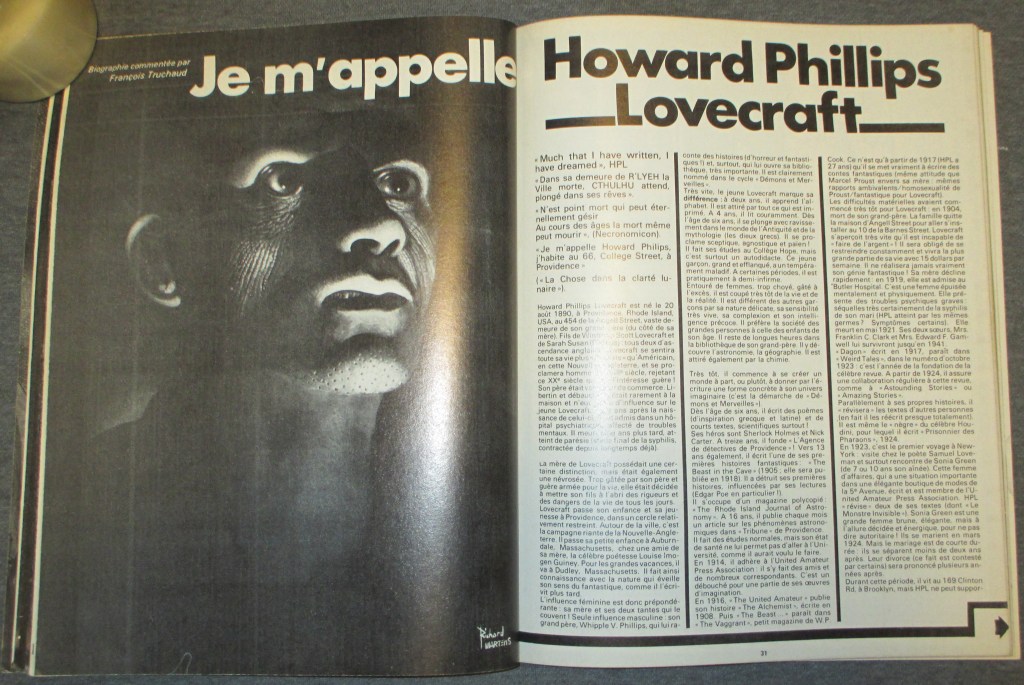
Deeper Cut: Lovecraftian Newspaper Oddities

Historical Racism

This miscellany includes excerpts from period newspapers, one of which (“Iwo Jima & Innsmouth”) contains historical racism and racist language. As such, please be advised before reading further.


Any tool is also a toy. The only question is whether you’re using it for work or for play. When it comes to online newspaper archives, they are a wonderful tool that has made available a vast amount of minute detail of the past that would otherwise be inaccessible to the average researcher. They are also, however, vast fun if you’re in the right mindset—because newspaper writers are inherently creative, highly literate, hungry for content, and often have a wonderful sense of humor. The result is bits and pieces that are often bizarre or brilliant, though sometimes sober and horrific.

Most of them are effectively noise when considered in terms of “serious” research into Lovecraft’s life, but as a reflection of the growing popularity of Lovecraft and the influence of his work, they stand out as tide water marks: examples of the spread of awareness of Lovecraft and his work. They are sometimes incredibly fun, if only because of how weird they are. I’ve culled out a dozen of the best clippings to showcase the wacky and sometimes fascinating Lovecraftian oddities that have appeared in newspapers over the past century.

Quick links for readers who want to jump to a particular clipping:


The Wood Demon (1930)

Bangor Visitor Tells Odd Yarn Of North Woods

“Are strange stories ever enacted in the North woods? repeated an old-time lumberman from the Ashland district, who has been spending a few weeks in Bangor. “Well, I know one—as weird a yarn as ever was told. If you print it, people will say either that I tried to ‘kid’ you or I should be examined by an alienist; and yet, in my own mind, I believe it true.

“I can’t say from personal experience, for it happened at least 75 years ago. but it’s a tradition among some of the old lumbermen, and it’s been handed down from father to son. Personally, I’m not imaginative, and I don’t believe in any kind of ghosts. I never read Edgar Allen [sic] Poe or Ambrose Bearce [sic] or Harold [sic] Lovecraft. Yet here, as I heard it from many lips, was a tale like Bearce’s [sic] ‘Damned Thing’ and Lovecraft’s ‘Dunwich Horror’ rolled into one.

“Seventy-five years ago, then, in the lumber camps of the great woods and on lonely, outlying farms, hroses and cattle were being slaughtered in considerable numbers. Always it was done in the same way—their throats were ripped open, as though from the teeth of some savage dog or wild animal. And yet gradually, through the countryside, there spread a belief that it was not an animal at all. Tracks sometimes were left near the stables or tie-ups—tracks something like those of a man’s bare foot, and yet were not a man’s. Sometimes a shadowy form, ape-like and hairy, was seen gliding through the darkness—or so imaginative persons said. But the cries of the cattle were real and tangible; and the following morning—for few dared venture out in the dark—always disclosed that the ‘wood demon’, as some called him, had been at his deadly work.

“Finally there arose one who loudly announced he didn’t care for man or devil; he was going to get to the bottom of the mystery, if it was the last thing he did in the world. I don’t recall just what led this man to suppose that, on a certain night, he was due for a visit from the strange marauder. But the story goes that he insisted on staying in the tie-up, and so became the one human witness of the horror that followed.

“The hours passed; nature had never been more placid or calm. And the man was about to return to camp, laughing at himself for having believed in old wives’ tales, when—the thing happened.

“It was a clear night, and a ray of moonlight fell through a hole chopped in the roof that the steam rising from the cattle might escape—a crude but popular system of ventilation in those days. And through this hole, filtering through the moonlight and the shadows, came as strange an object as ever found its way from the Inferno. It was like a huge ape, yet the man swore it was not an ape; it was like a man yet it was not a man; it had hairy, strangely contorted limbs, and cruel teeth that gleamed in the darkness—for the man had put a burlap bag over the lantern he carried.

“It sprang upon the cattle, ripped open their throats, drank of their blood, and disappeared through the roof—as an ape might have done. But, as I have told you, it was not an ape. And the man who had said that he feared nothing in the world just stood there in a corner, a high powered rifle in his hand, too paralyzed by fright to so much as stir. He said afterward that, even had the Thing turned and attacked him, he couldn’t have moved a muscle.

“What was the thing? I don’t know! I never heard how the story ended; but I believe the mystery was never solved. if there is any moral, it is simply that it points the truth of what Hamlet said: ‘There are more things in Heaven and earth, Horatio, than are dreamt of in your philosophy.'”

The Bangor (Maine) Commercial, 25 Feb 1930, p16

One seldom thinks of vampiric sasquatch as having anything to do with H. P. Lovecraft. Yet vampirism of animals is a key plot point of “The Dunwich Horror” Weird Tales (Apr 1929); just as an orangutan formed an essential feature of Edgar Allan Poe’s “The Murders in the Rue Morgue” (1841), and an unseen menace is the key to Ambrose Bierce’s “The Damned Thing” (1893). One suspects that the errors in the names of Edgar Allan Poe, Ambrose Bierce, and Howard Phillips Lovecraft are probably intentional, to give an air of rusticity to a tale that is probably fabricated out of whole cloth. No name is given for the author of the piece, and it may have been a friend or friend-of-a-friend of Lovecraft. Whoever it was had at least a modest affection for weird fiction.

A Quote from the Necronomicon (1937)

Abdul Alhazred, the mad Arab of Lovecraft fame, once wrote in the “Necro[no]micon”—”Science and fact, as seen by our little minds, are but dew-spangled cobwebs that catch the light of a tiny candle; and the resulting glitter [b]linds us to the horrible expanse of black doom behind the puny light.

“For that cobweb and that candle are instable as a breath. The breeze can make them tremble, a wind will rend them. And afar, even now, I hear the trampling of a mighty storm.”

The Knob Noster Gem was a small local paper; Dan Saults was the publisher, editor, and probably wrote a good chunk of the daily output. Judging by this little space-filler figment, he was also a Lovecraft fan.

Robin Hood, Bran Mak Morn, and Cthulhu (1937)

Friar Haw Foresees The Twentieth Century

As Robin Hood’s Prophet Might Have Outlined The Ills Of Our Day

by L. W. S., Eaton, O.

Sherwood forest was aflame with the torches of autumn, bringing all of its robust life. Robin Hood and his merry men had cast aside every care and fathered again beneath the mighty brown oaks and beeches. The silver tang of life was in the air and lusty merriness was in the hearts of Robin’s men.

Of course they were spilling great quantities of the favorite cool brown ale down their throats and singing its praises until the song rang and echoed far down the dark rows of mossy tree trunks, as jolly Friat Truck continually banged his tankard on the rough oak table, swinging his head from side to side.


And brawny Little John Arose, flinging the rumble of his deep bass into the depths of Sherwood forest:

So, laugh lads, and quaff lads
‘Twill make you stout and hale,
Thro’ all my days I’ll sing the praise
Of brown October ale.

Really Robin Hood had called his men together for the purpose of hearing once again the strange prophecies of Friar Haw, but he always had to allow them their little fling first, as a prelude. The men had arrived at some degree of respect for the words of Friar Haw, and they usually sat engrossed. Even the snorts of Friar Tuck had grown fewer.

Friar Haw, grim and ascetic, had been taking Robin’s men into the dream-world of the 20th century. Today he had sat oblivious of the roistering men, his face like a white autumn sickle moon. The men could see that he wasn’t going to talk today about streamlined chorus girls and elaborate movies.


He arose. “Few people,” he began, “who shall live in the 20th century shall realize fully the abysmal depths to which the world conflict in the early part of that century shall plunge the races with the blood of long centuries in theri veins. yea, dark forces of life, far more ancient than the ancient oaks of Sherwood, as ancient as the ideas of Chthulhu [sic], Yog Sothoth, Gol-goroth and the blood of the Gaelic, Cymric and Teutonic. The king of the Dark Empire of the Stone Age, covered so long by the imposition of a new god called Reason, shall break loose again in the emotional abandon of those dark years of 1914-18, and shall continue long afterwards.

“The surface of the collective civilized mind shall be torn adunder and the long-buried emotional elements of the days of a Bran Mak Morn shall break loose, and the 20th century would shall be puzzled and at a loss to understand what forces are driving men.”

“And,” interposed Little John, who had a common sense kind of mind, “what are you driving at, or trying to say? It sounds crazy to me.”

“Oh, doubtless!” said Friar Haw, his sickle face growing a shade colder. “Yet the original minds of the 20th century shall see that strange things are happening. Now, in the country called Germany, age-old psychic forces break loose again. Wotan, who is half rage and frenzy and half seer who understands ‘the runs and interprets destiny.’ Wotan shall be personified in a man named Hitler, a strange figure whose reasoning shall be guided by very, very ancient emotional forces.

“You are to remember that men taken collectively in a nation are not dominated by reason. A wise man of that century shall say: ‘Where the mass rather than the individual is in motion, human control ceases. And at at that point the archetypes begin to operate.'”

“In Germany the stormy personality of Wotan shall come to life again in the youth movement. The waking will be celebrated with the slaughter of more than one sheep. Aye, men called Nietszsche, Schuler, Stephen George and Klages shall anticipate the waking, as shall one called Richard Wagner put it into his music.

“But I have taken only Germany as one example in the Old World, where the 20th century shall see the troubled awakening on every hand of the most ancient archetypes, the most powerful emotional forces. Frightened men shall shout ‘Peace! Peace!’ where there shall be no peace. men shall come to understand somewhat the things that Wotan whispered through Mimir’s head. mean shall come to appreciate what Valhalla means, and the Valkyries and the Fylgjur.”


Whereupon Robin Hood jumped to his feet and shouted: “Engouh for today! I’d rather go and rob a bishop. This chatter makes me uneasy inside.”

“Yes,” came from the sickle autumn moon face of the prophet, “it is a far cry from your simple Sherwood forest and your October ale drinking. yet it shall be the sap in the roots of your Sherwood conflicted with a conflict of world cultures.”

Dayton (Ohio) Daily News, 14 Nov 1937, p13

This is fanfiction. Yet L.W.S. (Leonard W. Sharkey) of Eaton, Ohio must have been a serious fan indeed, to weave references to Lovecraft (Cthulhu, Yog-Sothoth) and Robert E. Howard (Gol-goroth, Bran Mak Morn) into his narrative of Robin Hood in Sherwood Forest, on the run-up to World War II. A likely inspiration for these references is “The Children of the Night” (Weird Tales Apr-May 1931) by Robert E. Howard—which is probably the only story at the time that mentions Cthulhu, Yog-Sothoth, Gol-goroth, and Bran Mak Morn all in the same tale. Sharkey did at least one more Robin Hood/Friar Haw tale, albeit without Mythos references (The Camp of Robin Takes A Forward Look).

Lovecraft & Whippoorwills (1945)

Whip-poor-wills will remind some readers of the stories of the late H. P. Lovecraft.

You never heard of Lovecraft?

Many persons have not, but they will, in time, and all through the affectionate remembrance of two young men in Wisconsin.

They founded a press to put his stories sold to pulp magazines into book form. Extremely limited editions have made these books collectors’ items.

Lovecraft’s tales are somewhat Poe-like in character. They are laid in New England, and bring in visitors from “the outside,” strange beings always ready to push into our own known world.

Some of the stories incorporate the whip-poor-wills, which set up a constant cry, according to legend, every time one died.

If they missed getting his soul, they screamed unusually loudly, and then died out. In this way it was possible to tell what happened to the departing soul.

Evening Star (Washington, D.C.), 7 Apr 1945, p6

In 1939, August Derleth and Donald Wandrei founded Arkham House in Wisconsin to publish the work of H. P. Lovecraft in book form. It was a beginning to establish Lovecraft’s literary legacy, and awareness of the Providence-born horror writer was slowly trickling out into public awareness, although this was slow going, and involved many misunderstandings.

Whippoorwills are a key example. They only feature in one of Lovecraft’s stories, “The Dunwich Horror”; but the idea seems to have appealed to August Derleth, who incorporated the idea of the whippoorwill as psychopomp in several Cthulhu Mythos stories, notably the novel The Lurker at the Threshold (1945). Derleth’s repetition of the idea—and articles like this one—contributed to the spread of certain basic conceptions (and misconceptions) of what Lovecraft wrote.

Iwo Jima & Innsmouth (1945)

Journalettes
by Charles B. Gordon

Friday, this newspaper used a cut of three Japanese prisoners, taken on Iwo Jima, and their American guards. The three Japs were three of the most repulsive looking human beings whose faces we have ever gazed upon.

. . . — V . . . —

We think he’s dead now, but some years ago, there was a writer named H. P. Lovecraft. This voracious reader made acquaintence with his works through the current 25-cent pocket books, but it is our belief that most of his output was printed first in pulp “horror” magazines. At any rate, he was the greatest master of the “horror[“] story specializing in stories about beings, things, or whatever you might want to call them, which emerged from places under the earth, under the water, or from ages thousands of years past, but were generally possessed of at least a few human qualities, enabling them to “get by” on the earth of the present day.

. . . — V . . . —

The pictures of those Japs taken on Iwo Jima gave us for the first itme a partial realization of what the creatures of such books of Lovecraft’s as “Weird Shadow Over Innsmouth” and “The Dunwich Horror” must have resembled.

McComb (Mississippi) Daily Journal, 19 Mar 1945, p1

War doesn’t just breed prejudice, it encourages its expression. The enemy is described in terms that downplays or denies their humanity. As things instead of people. The bloody battle of Iwo Jima ran 19 February–26 March 1945. Casualties were horrific, especially on the Japanese side; of 20,933 troops, only 216 Japanese were taken prisoner from the main battle, with an additional 867 taken prisoner post-battle. A photo of three such prisoners was made available to the press—men who, like their counterparts in the US military, had served their country, be it right or wrong, and lived through a terrible and terrifying conflict.

The racist depiction of Japanese military and civilians was sadly common—though as far as I have found, this is the first and only instance where they were compared directly to Lovecraft’s Innsmouth folk during the conflict.

Paper shortages during World War II put a severe crimp in the publishing plans of Arkham House, but also opened up other opportunities. Bartholomew House was a small New York publisher that put out two cheap (25 cents) paperback editions of Lovecraft with the permission of Arkham House: The Weird Shadow over Innsmouth (1944) and The Dunwich Horror (1945). Another cheap paperback readily available to the military was the Armed Services Edition of The Dunwich Horror and Others (n.d., 1945?). These books helped spread the word of Lovecraft during the war years—and beyond.

Lovecraft & Hitler (1945)

Two pieces appeared in the Chicago Tribune in April 1945 which tied Lovecraft to the ongoing world war.

Werewolf Hunt

The werewolf myth, which the frenzied and frightened Nazis threaten to revive as a romantic disguise for a post-war assassination cult, has haunted hte lower levels of the human mind since the era of the cavemen. Its roots are in primitive cannibalism. The word means man-wolf; that is, a betwitched creature which has human form by day and lupine hide, teeth, and appetite by night. The superstition is one of the unwholesome ideas that have survived from pre-history among European peasants to provide material for folklorists and themes for authors who have a bent toward the weird, grotesque, and horrible.

* * *

Hitler, whose career has a werewolfish flavor, comes froma stock in which this notion was likely to breed and influence character. We quote from his best and msot objective biographer, Konrad Heiden, who says in “Der Fuehrer” while discussing his pedigree:

“The Waldviertel in lower Austria, from which both the Hitler and Pölzl families came, is a gloomy, remote, impverished section; like many such regions it has no lack of superstitions and ghost stories. The ancestors were mostly poor peasant people; ‘small cottager’ often stands in the church records.”

* * *

The myth is closely related to the vampire bugaboo, and, therefore, in the novel called “Dracula,” a veritable case book of vampirism, you will find werewolves as auxiliary phantoms. The anthologies of terror stories which ahve become quite an article of commerce in the war time book trade contain numerous examples of werewolf tales. We expect to find out in “Best Supernatural Stories of H. P. Lovecraft,” edited by August Derleth and new on the counters.

* * *

To kill a werewolf according to the folklore formula, yo umust use a gun that has been blessed at a shrine of St. Hubert and fire a silver bullet.

Chicago Tribune, 9 Apr 1945, p12

In this, the unnamed newspaper writer would be disappointed. Vampires and werewolves were not Lovecraft’s normal schtick. However, we know that they did read the new collection—and the horrors in those pages probably compared to those that came in over the news wire. U.S. forces liberated the Buchenwald concentration camp on 11 Apr 1945.

Powers of Darkness

The lifting of the curtain on the massive horrors of Germany’s prison and concentration camps recalls the supernatural tales of H. P. Lovecraft, a writer who was relatively unknown until August Derleth undertook his popularization. To conjure up the mood of unearthly terrors, Lovecraft invented the mythology of Cthulhu in which there are many monstrous spirits of evil, forever seeking to take possession of this planet.

* * *

Lovecraft wrote of his work: “All my stories, unconnected as they may be, are based on the fundamental lore or legend that this world was inahbited at one time by another race hwo, in practicing black magic, lost their foothold and were expelled, yet live on outside, ever ready to take possession of this earth again.”

* * *

Perhaps Cthulhu has come back, thru the cracks in Hitler’s mind. Lovecraft, who died in 1937, would be staggered by the revelation.

* * *

During his lifetime, Lovecraft’s work appeared in pulp paer magazines, chiefly in Weird Tales. Arkham House of Sauk City, Wis., a publishing enterprise over which August Derleth presides, has been assembling this scattered material and putting it between covers in limited editions. A collection of 14 tales, regarded as the best of Lovecraft’s 50-odd, was recently issued by the World Publishing company. Derleth, its editor, says in his introduction:

“The weird tradition was particularly his. In the scarcely two decades of his writng life he became a master of the macabre who had neither peer nor equal in America. . . . It has been said of ‘The Outsider’ that if the manuscript had been put forward as an unpublished tale by Edgar Allan Poe, none would have challenged it.”
Chicago Tribune, 27 Apr 1945, p14

Lovecraft never wrote that “black magic” quote. The unnamed author of this little piece is drawing on The Best Supernatural Stories of H. P. Lovecraft (1945). To place Lovecraft’s horrors with those of Nazi Germany is understandable, journalists must have grasped for any straw of comparison. Three days after this was published, Adolf Hitler committed suicide.

Unlike many of these small newspaper pieces, another journalist picked up on this thread and glossed it in another paper:

Powers of Darkness

The lifting of the curtain on the massive horrors of Germany’s prison and concentration camps recalls the supernatural tales of H. P. Lovecraft, a writer who was relatively unknown until August Derleth undertook his popularization, says a Chicago Tribune column. To conjure up the mood of unearthly terrors, Lovecraft invented the mythology of Cthulhu in which there are many monstrous spirits of evil, forever seeking to take possession of this planet.

Lovecraft wrote of his work: “All my stories, unconnected as they may be, are based on teh fundamental lore or legend that this race [sic] was inhabited at one time by another race who, in practicing black magic, lost their foothold and were expelled, yet live on outside, ever ready to take possession of this earth again.”

Perhaps Othulhu [sic] has come back through the cracks in Hitler’s mind. Lovecraft, who died in 1937, would be staggered by the revelation.

The Windsor (Ontario) Star, 2 May 1945, p4

It is like a telephone game, as Derleth’s jumbled quote gets increasingly jumbled with every step. Yet the tying-together of Lovecraft and Hitler in this instance shows how relevant Lovecraft’s fiction could be, how plastic and adaptable his work was to a new syntax—and how new editions helped spread knowledge of Lovecraft and the Mythos to new audiences.

Lovecraft’s Men From Pluto (1955)

Space Travel

Friday Dr. Wernher von Braun, an expert in the field of astrophysical and astronomical lore, spoke at Rensselaer Polytechnic Institute. he talked chiefly of efforts being made to study the areas beyond the earth’s atmosphere. he talked of artificial satellites and of space travel, topics which tickle the imagination of young and old alike in these days of scientific discussion.

Dr. von Braun asserted that there was no doubt of the capacity of man to leave earth, point toward the moon, circle it and return to earth again. As one who is an expert in the designing of rocket propellants and in all the developments in this sphere he speaks with authority. He insists that we know enough now to launch a space ship and be reasonably sure of its safe voyage moonward and its return.

To the layman all this is fantasy. How can man survive in the intense heat which must exist beyond the atmosphere? How can direction be assured where there is no air friction against which rudders can press when a craft is to be turned? We have to ahve water to direct a ship, air to direct a plane. What possiblity of management exists in the ether where every object runs free?

And to make such a voyage the start must be swift. Through the great spaces where there is no atmosphere presumably the speed would not generate sufficient heat to decompose the ship. But what about the start and the finish? How can the ship begin its flight without at least a speed of 5,000 miles an hour? And how can it be toned down to reason when it returns to the lst hundred miles of its voyage?

We are still skeptics on the whole matter. Those who say such a trip to the moon is possible are the delight of the small boy and the radical scientist. but to the down-to-earth citizen, accustomed to keep his feet on the ground or rise only moderately above it, the natural comment is a Bronx cheer. If such a voyage is possible today, as Dr. von Braun asserts, let’s get at it and stop expending our energies in talk.

The usual reply from the space scientists to such suggests is that the cost is tremendous and there is no source for the funds. That is a complete answer, the best in the world if discussion is preferable to achievement. We have heard people say you could abolish certain diseases in the world if had ten or fifteen billions to spend on them. We have noted those who think permanent peace could be achieved by the careful expenditure of a few hundred billions. The poist that there isn’t any such money so it is easy to talk about it.

If a space ship would cost a few billions there can be no space ship. it would not be worth the price. The scientists, instead of telling us such a craft is possible today, might better expend their time and energy in seeking ways of bringing their creations down to the possible range of expenditure. Otherwise space travel lies in the same domain as the weird tales of Jules Verne, Lovecraft’s story of the men from Pluto who visited earth or Wells’ novel about the coming of the Martians.

The Troy (New York) Record, 5 Dec 1955, p10

The Luna 3, the first spacecraft to manage a successful circumlunar trajectory, did so in 1959; the first manned trip in lunar orbit, however, was Apollo 8 in 1968. It turned out, probably much to the anonymous author’s chagrin, that there actually were billions of dollars to spend on the space race.

The reference to “Lovecraft’s story of the men from Pluto” is a bit bizarre; as near as I can tell this has to be a reference to “The Whisperer in Darkness” (Weird Tales Aug 1931), which featured the Fungi from Yuggoth. Who were about as far from the stereotypical 1950s humanoid aliens as one might imagine—but this is a good example of a typical misreading or misunderstanding. I wonder how many science fiction fans wondered where they could read about Lovecraft’s men from Pluto?

Apocryphal Alhazred (1960)

Man has a back, and if you beat it he works. (Alhazred Bhati Khan, 11th century despot of Samarkand).

The labor policies of Alhazred Khan are frowned upon in the more enlightened areas of the world today. But if his theories on back-beating have fallen in esteem, his basic goal of increasing production has never been held in higher regard.

The actual title of the piece was “Bosses ‘Whip’ Workers With Musical Gimmicks,” and it was about how employers use new psychological tools to manipulate the workplace and motivate their employees. However, the author Ted Smart apparently thought it needed a hook, and so created Alhazred Bhati Khan—who never existed—presumably by combining Lovecraft’s Alhazred, the Hindu word bhati (भाटी), and the Turkic or Mongolian title khan. Samarkand was a reality, however, and if anybody ever checked to see who was ruling it in the 11th century, they did more work than Ted Smart did. I have to wonder if any Lovecraft fans noticed.

Aside from the appearance in the Chicago Daily Herald, the article also appeared in the Arlington Heights (Illinois) Herald, 21 Jan 1960, p27, and possibly ran in other local papers in Illinois.

A Lovecraftian Cipher (1968)

Cipher puzzles are fairly common amusements in newspapers, and have been for decades. As an exercise, they’re fairly simple substitution ciphers: each letter of the alphabet is replaced by another letter, to render what appears on the surface is gibberish. However, the relationship between the letters remains; and there are only 26 letters in the alphabet. Figure out a word or two, either by frequency analysis or trial and error, and the rest of the cipher alphabet falls in place pretty easily. In this case, the puzzle designer has been a little clever: one word has been encoded as the English word FRIGHT, which gives a hint to the solution of the puzzle.

The answer, on the other hand, is a bit of a cheat:

The answer is a cheat because this isn’t a real Lovecraft quote, but a highly abridged version of a line from Lovecraft’s “Supernatural Horror in Literature”:

Children will always be afraid of the dark, and men with minds sensitive to hereditary impulse will always tremble at the thought of the hidden and fathomless worlds of strange life which may pulsate in the gulfs beyond the stars, or press hideously upon our own globe in unholy dimensions which only the dead and the moonstruck can glimpse.

The reason why the full quote isn’t used is pretty obvious: space. While not intellectually any more challenger than the briefer text to decipher, 59 words is a lot more daunting in terms of sheer volume of words to be deciphered. On the plus side, at least Lovecraft wasn’t reminding the readers of the San Francisco Examiner to drink their Ovaltine.

Necronomicon For Sale (1972)

Tucked in at the end of a column of classifieds ads, just above a threat from the Mafia against a fratboy, this is one of a number of ads for a copy of the Necronomicon for sale that have cropped up here and there. Such hoaxes are classics of fan-activity, and vary from carefully-constructed and believable to error-ridden and silly. This one is fairly restrained and detailed, and the writer probably was familiar with Lovecraft’s “History of the Necronomicon,” which had been most recently republished in The Necronomicon: A Study (1967).

Such ads seem to have become rare after the first widely-available commercial Necronomicons began to hit the market in the 1970s.

Old Ben Lovecraft (1978)

Mulligan’s Stew
by Hugh A. Mulligan
AP Special Correspondent

RIDGEFIELD, Conn. (AP)—My old aunt used to say you never really know who your neighbors are until one day you read about them in the paper being appointed to the White House transportation staff or taken off in the patrol wagon for wife-beating or graduating with high honors from welding school.

And, by George, she was right.

This town, for instance, is chock full of interesting people, what you might call real characters just waiting to be discovered by some sharp-eyed reporter or a playwright in search of a sequel to “Our Town.”

Over on Ludlow Hill there’s a man who never in all his born days has seen a flying saucer. Old Ben Lovecraft has lived in these rocky, rolling hills of Connecticut for nigh onto half a century, since moving up from the Bronx, without catching so much as a glimmer of an outer world touchdown on his two acre zoned spread there behind the town dump.

The other night he thought he saw an eerie light reflecting from an elliptical shaped object in his driveway that wasn’t there when he took in the cat and turned off the carriage lamps. he put on his new Christmas cardigan, grabbed a flash light from the hall closet and made his way stealthily along the hedges bordering the garage. he could hear chattering and the sound of equipment being unloaded.

There in the moonlight, he saw five tiny creatures no bigger than a breadbox with enormous shiny eyes filing out of an aluminum cylinder. They fled in panic the instant his beam hit them.

“You know how racoons scamper after they’ve tipped over a garbage can to get at a turkey carcass,” Ben drawled in his matter of fact way. “I called the Air Force and they didn’t want to hear about it. They already had four people on hold with positive sightings.”

Fascinating fellow, Ben. A real skeptic. He’s seen “Star Wars” twice and “Close Encounters of the Third Kind” three times and doesn’t believe a word of either of them. […]

The Orange (Texas) Leader, 8 Mar 1978, p7

At the time of this writing, there are 91 hits for “Old Ben Lovecraft” on newspapers.com. The Associated Press spread the “Mulligan’s Stew” humor column far and wide. While some of the other bits and pieces mentioned above are diamonds in the rough, this is closer to what constitutes noise in search results. Half the country might have read about “Old Ben Lovecraft” between March and April 1978, when the article ran. Perhaps a few had a chuckle; the flying saucer craze of the 50s had given birth to the impressive big box-office sci fi spectacles of Star Wars (1977) and Close Encounters of the Third Kind (1977). No doubt a lot of the country had no idea why some folks got so excited.

Why Lovecraft? I suspect it was simply because Lovecraft was still known as a science fiction writer, and the “Old Ben” part was borrowed from “Old Ben” Kenobi in Star Wars. It’s also possible that the author simply wanted a distinctive name and typed out the first that came to mind; certainly a fan would probably have added a reference to Cthulhu in there at some point.

Lovecraft, C. M. Eddy, Jr., and Dark Swamp (1995)

What happened that night in the swamp?

Editors: I am in my 75th year of life as I write this, and I do not wish to allow a few things to pass unnoticed before I go. My mother, Muriel Eddy, was a gifted author; for several years she was the poet laureate of Rhode Island, the state in which we lived.

My father was also an author—of uncanny horror stories. he had a buddie named H. P. Lovecraft, the famous author of many books about strange things.

Lovecraft was a night person, and back in 1922 and 1923 he and my father would often walk through Providence’s Chinatown at midnight. One night they decided to go into the woods of the “great swamp” of Chepatchet, R.I., because they had heard that “It” (a ghost or monster) had been seen there.

Nobody knows whether or not they encounted the “It” being; they did survive their night in the great swamp, but neither would talk about it. I wonder to this day what they saw.

Clifford Eddy
Macon

The Macon (Georgia) Telepgraph, 10 Jan 1995, p5

Clifford Myron Eddy (1918-2003) was the only son of Clifford Martin Eddy, Jr. and Muriel Elizabeth Eddy. He was about 3-5 years old when H. P. Lovecraft came to the Eddys’ house, located a few miles away from his own in Providence, R.I. Too young, probably, to have much in the way of direct memories of Lovecraft, though no doubt he heard and read his mother’s and father’s stories, in works like The Gentleman from Angell Street (2001) by Muriel E. Eddy & C. M. Eddy Jr. and “Message in Stone” (1956) by Muriel E. Eddy.

Perhaps that telephone-game is why his facts are slightly garbled. For while Lovecraft and C. M. Eddy, Jr. did certainly survive the Dark Swamp in Chepatchet, they weren’t exactly silent about it. We have first-hand accounts from Lovecraft’s letters, a memoir by C. M. Eddy, Jr., and memoirs from Muriel E. Eddy, who would have had the facts from her husband. Unfortunately, the accounts do not all agree.

Lovecraft’s Version
In four letters written c. Oct-Dec 1923, Lovecraft mentions Eddy and Dark Swamp. These are the only accounts that were published at the time of the trip, and Lovecraft goes into some considerable detail.

I find Eddy rather a delight—I wish I had known him before. Next Sunday we are going on a trip which may bring you echoes in the form of horror-tales from both participants. In the northwestern part of Rhode Island there is a remote village called Chepachet, reached by a single car line with only a few cars a day. Last week Eddy was there for the first time, and at the post office overheard a conversation between two ancient rustic farmers which inspired our coming expedition. They were discussing hunting prospects, and spoke of the migration of all the rabbits and squirrels across the line into Connecticut; when one told the other that there were plenty left in the Dark Swamp. Then ensued a description to which Eddy listened with the utmost avidity, and which brought out the fact that in this, the smallest and most densely populated state of the Union, there exists a tract of 160 acres which has never been fully penetrated by any living man. It lies two miles from Chepachet—in a direction we do not now know, but which we will ascertain Sunday—and is reputed to be the home of very strange animals—strange at least to this part of the world, and including the dreaded “bobcat”, whose half-human cries in the night are often heard by neighbouring farmers. The reason it has never been fully penetrated is that there are many treacherous potholes, and that the archaic trees grow so thickly together that passage is well-nigh impossible. The undergrowth is very thick, and even at midday the darkness is very deep because of the intertwined branches overhead. the description so impressed Eddy that he began writing a story about it—provisionally entitled “Black Noon”—on the trolley ride home. And now we are both to see it . . . we are both to go into that swamp . . . and perhaps come out of it. Probably the thing’ll turn out to be a clum p of ill-nourished bushes, a few rain-puddles, and a couple of sparrows—but until our disillusion we are at liberty to think of the place as the immemorial lair of nightmare and unknown evil ruled by that subterraneous horror that sometimes cranes its neck out of the deepest pot-holes . . . It.
—H. P. Lovecraft to Edwin Baird, c. Oct 1923, Letters to Hyman Bradofsky & Others 45

Lovecraft’s letters to Baird was published in Weird Tales (Mar 1924), and forms the first account in print.

My next trip, on which I had as a companion my new adopted son Clifford Martin Eddy, Jr., was on Sunday, Novr. 4; and led thro’ much the same territory as did my trip of Septr. 19 with out amiable confrere Mortonius. It was a quest of the grotesque and the terrible—a search for Dark Swamp, in northwestern Rhode-Island, of which Eddy had heard sinister whispers amongst the rusticks. They whisper that it tis very remote and very strange, and that no one has ever been completely thor’ it because of the treacherous and unfathomable potholes, and the antient trees whose thick boles grow so closelytogether that passage is difficult and darkness omnipresent even at noon, and other things, of which bobcats—whose half-human howls are heard in the night by peasants near the edge—are the very least. It is a peculiar place, and no house was ever built within two miles of it. the rural swains refer to it with much evasiveness, and not one of them can be induc’d to guide a traveller through it’ altho’ a few intrepid hunters and woodcutters have plied their vocations on its fringes. It lies in a natural bowl surrounded by low ranges of beautiful hills; far from any frequented road, and known to scarce a dozen persons outside the immediate country. Even in Chepachet, the nearest village, there are but two men who ever heard of it. Eddy discover’d its rumour at the Chepachet post office one bleak autumn evening when huntsmen gather’d about the fire and told tales and express wonder why all the squirrels and rabbits had left the hills and fled across the plain into Connecticut. One very antient man with a flintlock said that IT had mov’d in Dark Swamp, and had cran’d ITS neck out of the abysmal pothole beneath which IT has ITS immemorial Lair. And he said his grandfather had told him in 1849, when he was a very little boy, that IT had been there when the first settlers came; and that the Indians believed IT had always been there. This antient man with the flintlock was the only one present who had ever heard of Dark Swamp.

So on that Sunday my son and I took the stage for Chapachet, and in due time alighted before the tavern. In the tap-room they had never heard of Dark Swamp, but the landlord told us to ask the Town Clerk, two houses down the road beyond the White Church, who knows everything in the parish Upon knocking at this gentleman’s pillar’d colonial house, we were greeted by the genial owner him self; a prefect rural magnate and Knight of the Shire, than whom Sir Roger himself cou’d not be more oddly humoursome. he told us, that the Dark Swamp had a very queer reputation, and that men had gone in who never came out; but confest he knew little of it, and had never been near it. At his suggestion we went across the road to the cottage of a very intelligent yeoman nam’d Sprague, whom he reported to have guided a party of gentlemen from Brown-University thro parts of the swamp in quest of botanick specimens, some twelve years gone. Sprague dwells in a trim colonial cottage with pleasing doorway and good interior mantels and panelling;a ND tho’ it turn’d out that ’twas not he who guided the gentlemen, he prov’d uncommon genial and drew us a map by which we might reach the house of Fred Barnes, who did guide them […] After a long walk over the same highroad travers’d by Mortonius and me, we came to Goodman Barnes’ place; and found him after waiting Al of thirty-five minutes in his squalid kitchen. When he did arrive, he had not much to say; but told us to find ‘Squire James Reynolds, who dwells at the fork of the back road beyond the great reservoir, south the the turnpike. Again in motion, we stopt not till we came to [Cady’s] Tavern, built in 1683 […] The tavern lyes on the main Putnam Pike; but shortly after quitting it and passing the reservoir we turn’d south into the backwoods, coming in proper season to Squire Reynolds’ estate. We found the gentleman in his yard; a man well on in years, and having a very market rural speech which we had thought extinct save in stage plays. he told us, we had better take the right fork of the road, over the hills to Ernest Law’s farm; declaring, that Mr. Law owns Dark Swamp, and that it was his son who had cut wood at the edge of it. Following the Squire’s directions, we ascended a narrow rutted road betwixt picturesque woods and stone walls; coming at last to a crest […] We found Mr. Law […] He inform’d us, that Dark Swamp lyes in the distant bowl betwixt two of the hills we saw; and that ’tis two miles from his house to the nearest part of it, by a winding road and a cart0path. He said, the peasants have a little exaggerated its fearful singularities, tho’ it is yet a very odd place, and I’ll to visit by night. We thanked him greatly for the civilities he had shewn us, and having complimented him on the fine location of his seat, set out to return to town with the information we shall use upon our next trip.
—H. P. Lovecraft to Frank Belknap Long, Jr., 8 Nov 1923, Selected Letters 1.264-267

[…] setting a time and place of next meeting December 2nd, 6:45 a.m., west facade of the Federal Building—whence leaves the coach for Chepachet and the Dark Swamp.
—H. P. Lovecraft to Maurice W. Moe, 24 Nov 1923, Letters to Maurice W. Moe 137

We were on a still hunt for the grotesque & the terrible—the ghoulish & the macabre—in the form of a hideous locality which Eddy had heard certain rusticks whispering about . . . . . Dark Swamp. The peasants had mutter’d that it is very remote & very strange, & that no one hath ever been completely across it because of the treacherous & fathomless potholes, & the ancient trees whose thick boles grow so closely together that passage is difficult & darkness omnipresent even at noon, & other things, of which bobcats—whose half-human cries are heard in the night by cotters near the edge—are the very least. It is a very peculiar place, & no house was ever built within two miles of it. The rural swains refer to it with much evasiveness, & not one of them can be induc’d to guide a traveller thro’ it. It lies near where we were lost south of the pike—there & westerward—& probably brushes the foot of Old Durf himself. Very few know . . . . or admit they know . . . . of it. Eddy discover’d its rumour at the tavern in Chepachet one bleak autumn evening when huntsmen gather’d about the fire & told tales. One very ancient man said that IT dwells in the swamp . . . . & that IT was alive even before the white man came.

Well, anyway, we took the nine-twenty-five for Chepachet on Nov. 4, & wasted all the noon period getting shunted from one villager to another for directions. One bimbo—a bearded chap named Sprague, who lives in a colonial house—was especially valuable, & gave some extra tips on Durf. […] The last Swain we were directed to was Ernest Law, who owns Dark Swamp, & who was reached by a rutted road that climbs upward betwixt woods & stone walls. […] He told us how to reach Dark Swamp, & inform’d us it is a very odd place, tho’ the peasantry have a little exaggerated its fearful singularities. We thank’d him for the civilities he shew’d us, & having congratulated him on the fine location of his seat, set out to return to town with the information we shall use upon our next trip. […]
—H. P. Lovecraft to James F. Morton, 5 Dec 1923, Letters to James F. Morton 58-59

“Durf” in this case is Durfee Hill, the second-highest point in Rhode Island, located near Chapechet. On 19 September 1923, Lovecraft and James F. Morton had gone to Chapechet to climb the hill, as detailed in a letter to Frank Belknap Long, Jr. (Selected Letters 1.250), which makes no mention of Dark Swamp. According to Lovecraft, C. M. Eddy, Jr. heard about Dark Swamp in Autumn (say, October), they went there on 4 November 1923, but couldn’t find it, though they got directions to find it next time, made plans for such a trip in December—and ultimately never returned to Chepachet.

One unanswered question is what Eddy was doing in the Chepachet post office to overhear these rumors of Dark Swamp. We know Lovecraft was in Chepachet in September, but why would Eddy be there? Stephen Olbrys Gencarella in “Lovecraft and the Folklore of Glocester’s Dark Swamp” (Lovecraft Annual #16) notes several other discrepancies in Lovecraft’s account that suggests that whatever the original story, HPL elaborated the tale with subsequent telling.

Ken Faig, Jr. in “Searching for Dark Swamp” in Lovecraftian Voyages, traced through old maps and records and confirmed much of the geography and named personages that Lovecraft mentions in his letters regarding the search for Dark Swamp, which he believes is currently inundated and forms the northern part of the Ponaganset Reservoir.

C. M. Eddy, Jr.’s Version
In 1966, Eddy’s brief memoir “Walks With Lovecraft” was published in The Dark Brotherhood by Arkham House. Near the end of the memoir, Eddy recalled the trip to Chapachet:

One other jaunt with Lovecraft is retained rather vividly in memory, for all that it was in a way a frustrating one. It was a trip made into the country in August 1923, in search of a blighted area called the “Dark Swamp”—a place of such stygian darkness that the sun reputedly never shone there, never penetrated its fastnesses, even at high noon. Lovecraft had no very clear idea of its setting, but had been told that it was located off the Putnam Pike, about halfway between Chepachet, Rhode Island, and Putnam, Connecticut.

The day we set out was blisteringly hot; though we took the first trolley in the morning to the end of the line in Chepachet, it was already very warm at that hour. In Chepachet, we started out on foot on the road toward Putnam. The heat increased as the day wore on. We had brought sandwiches with us, and from time to time we stopped at farmhouses along the way for water and to inquire about Dark Swamp. But no one seemed to have heard of it, and after four miles, Lovecraft, considerably wilted by the heat, decided reluctantly that we would have to give up the quest. So we found some reasonably comfortable stones at the side of the road and sat there until one of the Putnam-Providence cars stopped for us and put an end to our search. We never afterward took it up again, though, despite the discomfort of the summer day, it was as rewarding as any walk with Lovecraft, in that he found many of the old farm buildings fascinating and conveyed that fascination to me.
—C. M. Eddy, Jr., “Walks With Lovecraft” (1966)
in The Gentleman from Angell Street 49-50

The most immediate discrepancy between the two accounts is that while Lovecraft places the search for Dark Swamp in early November 1923, Eddy places it in August. The comments about the heat make sense if it was a summer hike, but in the autumn?. Lovecraft doesn’t mention the heat in his own accounts, but did allow that he was “monstrous weary, and cou’d scarce stand” at the end of the hike (SL1.267), which would jive with Eddy’s account (though Lovecraft avers that they hiked 17 miles around Chepachet, not 4 miles).

Granted that Eddy was remembering back ~43 years, so some details could be hazy; Lovecraft mentions they were walking about noon, and if it was an All-Saints summer, perhaps that might account for Eddy’s memory of summer heat. More odd is that Eddy makes no mention that he was the originator of the search; by his account, it was Lovecraft that had been told about the swamp, rather than Eddy that told Lovecraft about it. However, we know Lovecraft had been in Chapechet before; perhaps it was Lovecraft who heard of Dark Swamp when he went to Chepachet with Morton, and later asked Eddy to go with him to find it.

Muriel E. Eddy’s Version
There are three versions of the story in Muriel Eddy’s memoirs of Lovecraft, two published before C. M. Eddy’s 1966 memoir and one after. All versions agree largely with each other, and more with C. M. Eddy’s version than with Lovecraft’s—this makes sense given that all of Muriel’s information probably came from her husband or memories of what Lovecraft mentioned about the trip. Though Selected Letters 1, with Lovecraft’s lengthy account of the trip to Long, was published in 1965, the Eddys do not seem to have referred to it.

It was during the hot summer months that Lovecraft expressed the desire to have Mr. Eddy accompany him on a quest to find a so-called “Black Swamp” somewhere, it was said, in the wilds of Chepachet, R.I.—a swamp so overhung with trees that no sunlight ever penetrated it. Always on the lookout for oddities of nature, the idea of seeing such a swamp intrigued Lovecraft to such an extent that he took the whole day off, leaving his writings, as eager as any schoolboy to witness nature’s phenomenon. The whereabouts of that swamp—if such a swamp truly exists—is still a msytery—at least, it was never located, and Mr. Eddy almost had to carry Lovecraft back from the rural excursion, at least a mile, to the trolley line, for, unaccustomed to such vigorous jaunts at that time, the writer of tales macabre soon became so exhausted he could hardly move one foot after the other. It was a great disappointment to Lovecraft that the trip was failure, as far as finding the swamp was concerned; but the rural characteristics of the village delighted him, and found place, I am sure, in many of his later stories.
—Muriel E. Eddy, “Howard Phillips Lovecraft” in Rhode Island on Lovecraft (1945) 18

It was during the summer of 1923 that Lovecraft expressed the desire to have Mr. Eddy accompany him on a quest to find a so-called “Black Swamp” somewhere near the small village of Chepachet, Rhode Island. It was said to be a swamp so overhung by trees that sunshine never penetrated it.

The thought of visiting such a swamp intrigued H.P.L. and he discarded his habit of staying in during the bright hours of the day to join my husband in the long hike. They took a trolley to Chepachet, and from then on they were on their own. It was a long walk to any kind of swamp land from the civic center of the community, and hours later, after viewing several small swamps but not finding any to answer the description of Black Swamp, they were about to turn back when Lovecraft suggested that they stop in and rest at one of the farmhouses dotting the section. besides, he averred, some of the farmers in that region might possibly know where (and if) there was such a swamp in the vicinity.

The wife of one farmer invited them into the kitchen and offered refreshment in the form of a glass of milk and gingerbread. H.P.L. eagerly accepted it, and he listened attentively as their hosts assured them that Black Swamp was virtually unknown to them, and it must have been a pipe dream somebody had, writing up a non-existent place. There were plenty of swamps, but none, they were sure, through which sunlight never filtered. Sometimes their cows got lost in the swampland, but they always found them sooner or later.

Lovecraft, later, jotted down in a little notebook he carried, tidbits of their quaint Yankee talk, saying the trip was not entirely a failure, as he had gleaned quite a bit from hearing the antiquarians converse. It would come in handy when he wrote his next story, he assured my tired-out husband.
—Muriel E. Eddy, “The Gentleman from Angell Street” (1961)
in The Gentleman of Angell Street 11-12

My husband often accompanied Howard on trips to get new ideas. One day they took a trolley car from Providence to the village of Chepachet, Rhode Island, to find a black swamp. it was said to be so overhung by trees that sunshine could not penetrate it.

They hiked for hours, and saw several swamps, but found nothing to answer the description.

But H.P.L. made many notes for future reference. He told Cliff that no trip was ever wasted.

Although Howard never wrote a story about the non-existent swamp, my husband used this as a basis for the last story he wrote during his retirement. Entitled “Black Noon,” it will be published in 1970 by August Derleth of Arkham House, Sauk City, Wis.

—Muriel E. Eddy, H.P.L. “The Man and the Image” (1969) 4
Later revised as “Lovecraft Among the Demons” (1970)
in The Gentleman from Angell Street 54

Muriel E. Eddy’s accounts add certain details lacking in both Lovecraft and her husband’s accounts, such as being served milk and gingerbread by a farmer’s wife (perhaps while waiting in the kitchen of Fred Barnes?) which might be authentic; others might be invented (no notes related to Dark Swamp are in Lovecraft’s Commonplace Book) or the result of the telephone game from husband to wife (neither of them mention any smaller swamps, either).

Both Lovecraft and Muriel Eddy reference “Black Noon,” a story begun by C. M. Eddy, Jr. If the story was begun in 1923, as Lovecraft suggests, it was not completed at that time. C. M. Eddy, Jr. attempted to complete the story in the 1960s, but ill-health made it difficult to impossible for him to write, and the story went unfinished at the time of his death in 1967. In the Arkham Collector Summer 1968, August Derleth announced “Black Noon” would appear in the forthcoming anthology Dark Things, but Derleth died in 1971, before this fragment could be published, and it was not included in Dark Things. “Black Noon” was eventually published in Eddy’s posthumous collection Exit Into Eternity (1973).

“Black Noon” is set in Eddy’s fictional Fenham, with a thinly-disguised Weird Tales (as Uncanny Stories), Lovecraft (as Robert Otis Mather), and Dark Swamp (as Witches’ Swamp). Although little of their adventure features in the fragment, some of the description of the swamp echoes Lovecraft’s:

[…] the trees on either side of this new construction had grown so close together that their trunks touched one another, and so tall that their leafy branches had interlocked to form a well-night impenetrable covering. In addition, hybrid vines, whichh grew rampant in the swamp, had over-grown both oaks and branches to eliminate all light from the canopy thus formed. The only thing that could find a way through this natural barrier was the fog which, during the early Fall, hung over the entire swampy area!

Even at high noon, the portion of the road was black as a moonless midnight! (117-118)

Neither of the Eddys ever mention Lovecraft’s “IT”; whether this was an invention of Lovecraft’s or a local legend that he picked up on but the Eddys failed to mention is unclear. Thomas D’Agostino in “Dark Swamp’s IT” (2020) leans into local legends; Stephen Olbrys Gencarella in “Lovecraft and the Folklore of Glocester’s Dark Swamp” (Lovecraft Annual #16) goes even deeper, and critically analyzes D’Agostino’s claims. Personally, I’m inclined to agree with Gencarella that Lovecraft may have been pulling his correspondent’s legs a bit—whether or not there was a germ of local lore at the heart of it, Lovecraft let his imagination elaborate with each telling.

However, it is interesting that Clifford Myron Eddy mentioned “IT,” when his parents did not. Did the elder Eddys decide it was more believable to leave out the legendary critter, or did the younger Eddy read Lovecraft’s account in his letters? Alas, we may never know. All we are left with is an intriguing bit of data, and it isn’t clear if it is fool’s gold or the real thing; if it is just a bit of glitter among the dross of clippings, or a valuable addition to Lovecraft studies. All researchers can do is sieve through the data.

Lucky for some of us, it is good fun to pan for digital gold in newspaper archives.


Bobby Derie is the author of Weird Talers: Essays on Robert E. Howard and Others and Sex and the Cthulhu Mythos.

Deep Cuts in a Lovecraftian Vein uses Amazon Associate links. As an Amazon Associate I earn from qualifying purchases.
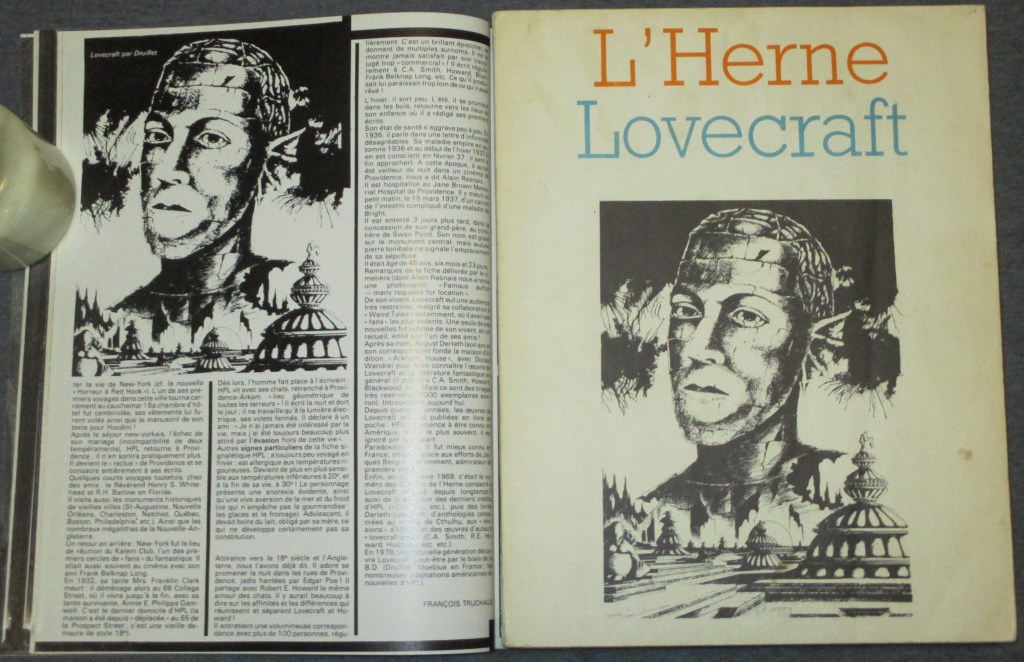
Deeper Cut: Lovecraft, Racism, & Humor

Racist Language
The following article deals explicitly with racism in humor, many examples of which use racial pejoratives. Frank discussion of these matters requires the reproduction of at least some samples of racist pejoratives and ideas in quotes, titles, etc.
As such, please be advised before reading further.


Mr. Snow, I believe these to be Negro eggs.
—The Author, Planetary/The Authority: Ruling the World (2000) by Warren Ellis & Phil Jimenez

Few authors have been as personally identified with their work as H. P. Lovecraft. Even during his own lifetime, Lovecraft’s friends began to incorporate fictional versions of them into his stories—as “Howard” in “The Space-Eaters” (1928) by Frank Belknap Long, Jr.; as the unnamed mystic dreamer in “The Shambler from the Stars” (1935) and Luveh-Keraph, Priest of Bast in “The Suicide in the Study” (1935) by Robert Bloch; and as “the man with the long chin” in The Village Green (192?) by Edith Miniter.

In life, Lovecraft was a self-effacing and ready correspondent who made many contacts with his fans and peers in pulp fiction and amateur journalism; he liked to project the image of himself as older and more reclusive than he actually was. After his death, this personal myth-making took on a life of its own, as his legend developed and spread. There was no absence of humor from the early decades as awareness of Lovecraft and his Mythos grew, with both parody and satire present in works like “At the Mountains of Murkiness, or From Lovecraft to Leacock” (1940) by Arthur C. Clarke.

A notable absence in early humor directed at Lovecraft is any mention of his racism. The biographical facts of Lovecraft’s life were generally slow to emerge, and not always readily available to fans. So while comments on Lovecraft’s racism and antisemitism were made public by the first version of his wife’s memoir in the 1940s (see The Private Life of H. P. Lovecraft (1985) by Sonia H. Davis), and August Derleth felt the need to address the issue in print in Some Notes on H. P. Lovecraft (1959), Lovecraft did not develop a widespread reputation as a racist until the publication of L. Sprague de Camp’s Lovecraft: A Biography (1975). De Camp, who had studied Lovecraft’s published and unpublished letters and other materials, emphasized Lovecraft as neurotic, a flawed human being, a possible homosexual, and especially as a racist—and published the entirety of the poem “On the Creation of Niggers” which is attributed to Lovecraft.

De Camp’s biography came at a time when Lovecraft was beginning to spread to a much larger audience, due to reprint of his work in paperback, films like The Dunwich Horror (1970), and growing influence on music, adaptations in comic books, and other media—and as Lovecraft was gaining more critical awareness and acceptance. The same year as de Camp’s book came out, the first World Fantasy Convention was held in Lovecraft’s hometown of Providence, Rhode Island, with the theme “The Lovecraft Circle,” and the first World Fantasy Awards were given out—in the form of a bust of Lovecraft, carved by noted cartoonist Gahan Wilson. So, just at a time when Lovecraft’s popularity blossomed and more information on his life emerged, de Camp released a highly influential book.

Many Lovecraft scholars criticized de Camp’s approach, presentation, and conclusions—though not the underlying facts: while speculation about Lovecraft’s sexuality or mental health were subjective, Lovecraft’s prejudices were clearly expressed in his letters. The critiques, however, didn’t have the reach of the book itself, and many of de Camp’s misconceptions continue to color perceptions of Lovecraft to the present day. This has been very apparent in various fictional depictions of Lovecraft in various media, which often exaggerate Lovecraft’s characteristics and prejudices for humorous effect.

When the little kitten darted from the door and fled into the hall, the apparition in the darkness shouted out loud. It shouted in the high nasal accent native only to that part of New England once known as Rhode Island and the Providence Plantations. And its words were these:

Come back!” it cried. “Come back, my pet! Come back, NIGGER-MAN!
—Gregory Nicoll, “The Man Who Collected Lovecraft,” The Diversifier (May 1977) 68

As a subject of satire and ridicule, Lovecraft might seem to be a particularly strange dead horse to choose to whip. Obviously, Lovecraft is dead and is unaffected by mockery; he can’t regret or reform his reviews, and won’t roll in his grave no matter how hard you make fun of him. Humorous takes on Lovecraft are thus aimed at the living: at fans who are familiar with Lovecraft and his fiction, whether or not they enjoy either. In the case of Lovecraft’s racism in particular, this effectively serves as a kind of damnatio memoriae: unable to condemn a living Lovecraft for his prejudices, they make fun of a dead Lovecraft. These humorous portrayals, with all of their exaggerations, have influenced Lovecraft’s posthumous reputation and image.

Does making fun of a dead man constitutes “punching down?” Certainly, Lovecraft has no ability to defend himself from false accusations or inaccurate claims about his prejudices. On the other hand, he doesn’t really need any such defense. While Lovecraft may have no power to answer now, Lovecraft was racist, and part of the white majority that kept racial and ethnic minorities as second-class citizens during his life. Empathy in cases of historical racism should be on the victims of discrimination, not the perpetrators. Lovecraft may not have been a member of the Ku Klux Klan or participated in any racial violence directly, but he was still part of the majority of U.S. citizens that supported the legalized racism of Jim Crow and the social norms that prevented racial equality.

The occasional depiction of Lovecraft as “Genre’s Racist, Crazy Uncle” has exactly that much truth in it: Lovecraft’s prejudices were largely tolerated during his lifetime, and for some decades beyond that, because they were the same prejudices that millions of other people in the U.S. held. Just because those prejudices were common does not make them universal. Just because other people were racist does not make Lovecraft’s racism okay. The broad cultural background radiation of racism during Lovecraft’s lifetime is an explanation for his views, not an excuse for them.

The fact that Lovecraft is often depicted as much more cartoonishly racist than he was in real life, or than his peers, is in part down to the needs of the writer or artist to make a joke, but also in part due to lack of understanding of what Lovecraft’s prejudices were and how they fit into the historical context. Pretty much no one that mentions “On the Creation of Niggers” in any context wants to read a dissertation on the tradition of racist light verse in English poetry, just as few people who are familiar with the name of Lovecraft’s cat in “The Rats in the Walls” want a lecture on the propensity for naming pets racial epithets around the turn of the 20th century. They care about the current context, when the N-word is a racial epithet of unique power, not a historical context when such usage was more broadly accepted by a more openly racist society.

Many expressions of prejudice that were commonplace in the early 20th century seem egregiously racist now. Plain statements of Lovecraft’s life may seem ludicrously racist by the standards of the present, because many plain statements of racism in the 1930s and 30s are ludicrously racist by today’s metric. It is difficult for today’s readers to get a grasp of what a “normal” amount of racism was in the 20s and 30s when minstrel shows, coon songs, and the African Dodger were still socially acceptable.

In 1897 I was trying for Beethoven—but by 1900 I was whistling the popular coon songs & musical comedies of the day.
—H. P. Lovecraft to J. Vernon Shea, 3 Sep 1931, Letters to J. Vernon Shea et al. 46

As a consequence, when combined with a general ignorance of the actual nature and scope of Lovecraft’s prejudices, the exaggerations of Lovecraft’s bigotry are often much more extreme to get a laugh.

Ah! Look, it’s attempting to communicate. No doubt the savage thing knows language as a house pet knows its reflection in the mirror. The sense is taken in, but the process, the meaning is forever lost.
—H. P. Lovecraft, Atomic Robo and the Shadow From Beyond Time by Brandon Masters

There is a certain irony in that the more that we know of the facts of Lovecraft’s prejudice, the more ridiculous and far from Lovecraft’s actual beliefs that humorous takes on Lovecraft’s racism tend to get. The earliest humor was written by weird fiction fans who were generally aware of who Lovecraft was, his work, and some of the scholarship about his life. Later writers tend to be less familiar with the minutiae of Lovecraftiana and base more of their image of Lovecraft off the memes and stereotypes of Lovecraft and his work, or lean into a particular presentation that relies on such a specific image of Lovecraft as cartoonishly bigoted.

As a case in point:

Original Twitter post. Used with permission. All rights reserved.

In terms of accuracy, there’s a kernel of truth here: Lovecraft did express some prejudice against Italian immigrants, especially those in the Federal Hill area of his native Providence, RI. Lovecraft had even made mention of Italian immigrants in some of his publications, such as his very first widely-published poem, “Providence in 2000 A.D.”:

In 1912 my first bit of published verse appeared in The Evening Bulletin. It is a 62-line satire in the usual heroic couplet, ridiculing a popular movement on the part of the Italians of the Federal Hill slums to change the name of the main street from “Atwells’ Avenue” to “Columbus Avenue”. I pictured Providence in 2000 A.D., with all the English names changed to foreign appellations. This piece received considerable notice of a minor sort, I am told, though I doubt if it had much effect in silencing the Italians’ clamour. The idea was so foolish that it probably died of its own weakness.
—H. P. Lovecraft to the Kleicomolo, 16 Nov 1916, Letters to Rheinhart Kleiner & Others 76

The humor comes from the juxtaposition of the prosaic (and to contemporary eyes, ridiculous) prejudice against the harmless (if stereotypical) Italian immigrant and the eldritch entity breaking its way through the dimensional barriers. The cartoon also draws on and supports the misconception that Lovecraft’s fiction was largely driven by his personal fears and prejudices.

In real life Lovecraft actually liked Italian food, generally had congenial relationships with Italian immigrants he got to know, and rarely included Italian characters in his fiction. But that is a lot more nuance than can be expected in six panels. The joke doesn’t work if Lovecraft is presented as someone who isn’t triggered by the fact an Italian offered him a calzone, whose cosmic horrors aren’t inspired by more prosaic prejudices.

My taste has become so prodigiously Italianised that I never order anything but spaghetti & minestrone except when those are not to be had—& they really contain an almost ideal balance of active nutritive elements, considering the wheaten base of spaghetti, the abundant vitamines in tomato sauce, the assorted vegetables in minestrone, & the profusion of powdered cheese common to both.
—H. P. Lovecraft to Lillian D. Clark, 18 Sep 1925, Letters to Family & Family Friends 1.402

If there is a problem with the humorous expression of Lovecraft’s racism, it isn’t in the fact of making fun of a dead racist, or of painting racism as ridiculous or illogical. The problem is what it is often wrapped around in: the normalization of negative depictions of someone with mental health issues, and the downplaying of the dangers that contemporary racism represents. While a few scholars and pedants may decry the propagation of misinformation about Lovecraft and his fiction, that is ultimately a minor quibble compared to the bigger issues of propagating negative stereotypes like de Camp’s neurotic picture of Lovecraft, or of ignoring the really scary part about Lovecraft’s prejudices:

Many people held them then, and many people still hold them today.

Racist humor always has the caveat that to a certain audience, it isn’t funny because it’s ridiculous or breaking a taboo, but because it appeals to their own prejudices. Dave Chappelle mentioned in a 2006 interview with Oprah about someone laughing at him, rather than with him. The same thing cannot happen in the same way with Lovecraft because Lovecraft is white, and even prejudicial words like “cracker” and “honky” don’t have the same bite or weight as the N-word. Yet at the same time, making fun of Lovecraft’s prejudices has become a popular excuse for continuing to spread that language—the name of his cat, the poem “On the Creation of Niggers”—many writers find it acceptable to repeat that in a humorous context, as the punchline of the joke.

So might their audience.

The use of nigger by black rappers and comedians has given the term a new currency and enhanced cachet such that many young whites yearn to use the term like the blacks whom they see as heroes or trendsetters.
—Randall Kennedy, Nigger: The Strange Career of a Troublesome Word (2003) 36

The moral problem with the humorous portrayal of Lovecraft’s racism isn’t about making fun of Lovecraft, who is already dead and long past injury. It is that the jokes themselves do little but reiterate and spread prejudice. They don’t teach the audience anything about Lovecraft’s racism, and often only work when predicated on an audience already aware of Lovecraft’s racism in some form.

Is there any hidden moral or germ of insight in these portrayals?

A case in point might be made for the Midnight Pals, which takes as its set-up the idea of famous writers, living and dead, sitting around a campfire and having brief conversations. The nature of the form means that the personalities are exaggerated and deliberately satirical. Lovecraft is often portrayed as neurotic, racist, although often ultimately harmless (as opposed to J. K. Rowling, who also appears.) In most cases, Howard’s portrayal makes him the butt of the joke, and the series is clear in demonstrating that racism is bad and Lovecraft is cringe for his prejudices—though not ostracised. Indeed, despite the differing beliefs presented, the campfire group is specifically accepting, even of members who are wildly far apart in their views on race, sex, etc.

The series doesn’t work without some butt to the jokes. Like Archie Bunker, Lovecraft in the Midnight Pals has become the mostly-lovable racist, whose prejudices are played for laughs rather than evidence of malice.

Humor is only one way of portraying Lovecraft in fiction, and Lovecraft’s racism is often used to make him a figure of ridicule. Yet even to do that, humorists often have to go far beyond Lovecraft’s own recorded words and actions. As racist as Lovecraft was, and with the unusually deep record we have from his letters and essays to give evidence to that racism, many people remain ignorant of what Lovecraft actually wrote and said, and many humorists invent new ways for Lovecraft to be racist—which perpetuates the idea of Lovecraft as racist, but isn’t very useful for refuting his actual beliefs. Lovecraft the racist is more often than not effectively a straw man when it comes to humorous portrayals.

It’s not conclusive, Clark, but it appears this dark-haired woman is your ancestor. Please, take no offense…university rules, you know. I’ll have to ask you to leave the premises.
—Prof. Upsley, Rat God (2015) by Richard Corben

A very rare form of humor when it comes to Lovecraft’s prejudices is irony. In Richard Corben’s Rat God, the very Lovecraftian protagonist discovers that he is less of a WASP than he thought he was—thanks to the late revelation of a long-forgotten Native American great-great-grandmother. The story takes obvious inspiration from Lovecraft’s “Arthur Jermyn” and “The Shadow over Innsmouth,” as well as the prejudices expressed in Lovecraft’s own life and letters. The result is not funny in a ha-ha sense, but a grim irony in that the character who exhibited such terrific prejudice throughout the story has discovered that he himself is now subject to the same prejudice by others.

Corben’s ironic unmasking of Lovecraftian prejudice does something that a lot of riffs on Lovecraft’s prejudices don’t: it moves the plot forward. It has something to say beyond “look at how racist Lovecraft is! Isn’t that funny?” It is a bit more subtle, but it also has a point, and illustrates that prejudice is a doctrine which is, ironically, color-blind to its targets. Who knows who every ancestor of theirs is, after all? Who do you think you are?

It has to be recognized that the depiction—accurate or exaggerated—of Lovecraft’s racism goes far beyond humorous jokes and portrayals. There are quite serious fictional depictions of or references to Lovecraft as a racist, as in Richard Lupoff’s Lovecraft’s Book (1985, later re-released as Marblehead), Alan Moore and Jacen Burrow’s graphic novel Providence, Lovecraft Country (2016) by Matt Ruff, The Ballad of Black Tom (2016) by Victor LaValle, Ring Shout (2020) by P. Djèlí Clark, and The City We Became (2020) by N. K. Jemisin. Accuracy is always a challenge for any historical character incorporated into a fictional work, and each author’s usage of Lovecraft is determined by their own research (or lack thereof) and their understanding—and perhaps especially, by the point they want to make.

In several of the latter novels, the point is specifically to bring attention to Lovecraft’s racism, as part of the point of their narrative is the acknowledgment and refutation of Lovecraft’s prejudices. Where a humorous depiction of Lovecraft’s racism shows prejudice as laughable, the serious depiction shows racism as no laughing matter. Either approach is workable depending on what point or mood the creator is trying to get across, one is not superior to the other, and many of the same observations about humorous depictions of Lovecraft’s racism also applies to non-humorous depictions.

Both humorous and non-humorous depictions of Lovecraft tend to be strongly driven by the myth of Lovecraft, rather than historical reality. The neurotic, cartoonishly racist caricature of a horror writer is often an easier character to work with than the more complex and nuanced historical human being, just as bumbling or villainous Nazis are easier to depict than stalwart German troopers with wives and kids who enlisted in a rush of patriotic spirit or economic need and ended up participating in a genocide. Lovecraft is not alone in being depicted first and foremost as a racist; many characters based on historical persons are essentially caricatures.

Lovecraft stands out in this respect only in that he is a pulp author from the period that humorists and their readers are still familiar with. Would the same jokes work if the subject was Ernest Hemingway or Catherine Lucille Moore? Probably not. Not because such jokes wouldn’t be as accurate (or inaccurate) as applied to Lovecraft, but because readers are less familiar with those writers and their prejudices. Lovecraft’s continued relevance, name recognition, and a vague awareness of his life are the main drivers for his continued humorous portrayals—racist warts and all. These depictions have been shaped by previous characterizations of Lovecraft, and in turn continue to shape his myth.

Real historical people are messy and complicated. Myths are easier to deal with. Yet the more the myth is repeated—the more extremes the depiction of a fantasy Lovecraft’s racism become—the harder it is to see the real historical individual. Many people, if they have the image of an individual as racist, take any correction of that image as an attempt to downplay or deny that racism. It can be very difficult to correct such a reputation once it takes hold.


Bobby Derie is the author of Weird Talers: Essays on Robert E. Howard and Others and Sex and the Cthulhu Mythos.

Deep Cuts in a Lovecraftian Vein uses Amazon Associate links. As an Amazon Associate I earn from qualifying purchases.
Deeper Cut: “The Loved Dead” & The Indiana Magazine War of 1924

One of his stories in Weird Tales was so frightening that it caused removal of the magazine from the newsstands in at least one city.
—Howard Wolf, “Variety” column, The Akron Beacon Journal 12 Dec 1927, p10

In his 1927 article on H. P. Lovecraft, Howard Wolf relates the above brief anecdote, which probably came from Lovecraft himself, or one of his close associates. In writing to his aunt Lillian D. Clark about the article, Lovecraft explained:

He is wrong in saying that it was a tale of mine which caused an issue of Weird Tales to be barred from the stands in Indiana. The story in question was Eddy’s “The Loved Dead”—which, however, had much of my work in it.
—H. P. Lovecraft to Lilian D. Clark, 10 May 1928, LFF2.652-653

Lovecraft had mentioned a brush with censorship and “The Loved Dead” in his letters since late 1925, although details were vague. One of the key points seemed to be that it involved Indiana and, strangely enough, the Parent-Teacher Associations.

“In the Vault” he rejected because he feared its gruesomeness would get him into trouble with the censors—O Gawd! O Montreal!
—H. P. Lovecraft to Clark Ashton Smith, 4 Nov 1925, DS 86

Glad you like “In the Vault”. Wright’s rejection of that was sheer nonsense—I don’t believe any censor would have objected to it, but ever since the Indiana senate took action about poor Eddy’s “Loved Dead”, he has been in a continual panic about censorship.
—H. P. Lovecraft to Lilian D. Clark, 13 Dec 1925, LFF1.507

About poor Eddy’s tale—it certainly did achieve fame of a sort! His name must have rung in tones of fiery denunciation all through the corridors & beneath the classic rotunda (if it has a rotunda) of the Indiana State Capitol!
—H. P. Lovecraft to Lillian D. Clark, 22-23 Dec 1925, LFF1.520

This worthy editor has been amusingly timid about very bizarre tales ever since he had had some trouble with state censors and parent-teacher associations over a story he printed three years ago—a story, as coincidence would have it, by an acquaintance of mine in Providence.
—H. P. Lovecraft to Bernard Austin Dwyer, [June 1927], LMM 455

C. M. Eddy, Jr. and his wife Muriel E. Eddy were pulp writers that lived a few miles from Lovecraft in Providence, Rhode Island. In the early 20s, Lovecraft and the Eddys were fairly close, and Lovecraft would have a hand in several of C. M. Eddy’s weird stories “Ashes” (Weird Tales Mar 1924), “The Ghost-Eater” (Weird Tales Apr 1924), “The Loved Dead” (Weird Tales May-Jun-July 1924), and “Deaf, Dumb and Blind” (Weird Tales Apr 1925), as well as work on The Cancer of Superstition for Harry Houdini. The degree of Lovecraft’s involvement in the stories is difficult to trace; the Eddys and Lovecraft gave different accounts of his work in “The Loved Dead,” though all agree the initial idea was Eddy’s, and it appeared under his byline when it was published in Weird Tales‘ large anniversary number in 1924, which was an oversize issue on the stands for several months.

The reason for the oversize issue is that Weird Tales itself was going through a critical re-organization. Initially, Weird Tales was published by the Rural Publishing Co. with Edwin Baird as editor, and Farnsworth Wright as first reader for the magazine; the offices were in Chicago. Mounting debts forced a change: Baird departed, and Weird Tales was now published by Popular Fiction Publishing of Indianapolis, Ind., with Wright as editor. The oversize 1924 May-Jun-Jul issueof Weird Tales marks the transition from Baird’s editorship to Wright’s, and the move from Illinois to Indiana.

This, then, at the beginning of Wright’s career as editor of Weird Tales, is when something happened—at least, according to Lovecraft, who would continue to refer to the event in his letters for the rest of his life:

Of course,  you would have to use vast care & subtlety in suiting the tale to Wright’s idea of its reception by the Indiana Parent-Teacher Association—& even so, his timidity might bring about rejection in the end. Poor chap—he’ll never forget the row that Eddy’s “Loved Dead” stirred up some seven years ago!
—H. P. Lovecraft to Clark Ashton Smith, [8 Nov 1931], DS 301

Quinn’s new offering would surely seem to be strong stuff—hope it doesn’t produce another situation like that aroused by Eddy’s “Loved Dead”.
—H. P. Lovecraft to R. H. Barlow, [3?-6 Aug 1934], OFF 157

Poor Farny! That censorship of ‘24 absolutely broke his nerve, so that he has ever since been timid about publishing anything with a corpse over 10 hours old! As you may know, he once rejected my “In the Vault” as “too horrible”—although he did take it later on. It may interest you to know that I revised the now-notorious “Loved Dead” myself—practically re-writing the latter half. Eddy is a Providence man, & I was in fairly close touch with him in ‘23. I did not, though, devise the necrophilic portion which so ruffled the tranquility of parents & pedagogues on the banks of the Wabash.
—H. P. Lovecraft to Robert Bloch, [mid-Mar 1935], LRBO 132

Did I tell you that he rejected a splendid corpse story by Kid Bloch because it was ‘too horrible’? He brought up the spectre of C. M. Eddy’s “Loved Dead” again after 10 years. Poor chap—he’ll never forget the Indiana Parent-Teacher’s Association!
—H. P. Lovecraft to R. H. Barlow, [24 Mar 1935], OFF 230

A recent experience of little Bobby Bloch does not form an encouraging omen—for Pharnabozus turned down a yarn of his (about a chap who found that his bedfellow in an hotel was a badly decomposed cadaver) on the ground of excessive horror, bringing up the now-classic case of 1924 . . . . .  C. M. Eddy’s “Loved Dead” (the latter half of which re-wrote!) & the Indiana Parent-Teacher’s Association. Poor Farny—he’s like a dog that has received a nerve-breaking scare, & cringes every time anything reminds him of it!
—H. P. Lovecraft to Clark Ashton Smith, [26 Mar 1935], DS 594

Poor Farny has been timid ever since 1925, when he had a run-in with the Indiana bourgeoisie over a yarn by C. M. Eddy Jr. of Prov., which I revised!
—H. P. Lovecraft to Robert Bloch, [mid-May 1936], LRBO 170

As with Edith Miniter and the Dracula revision, Lovecraft’s accounts are generally consistent throughout the years, and many scholars and critics have taken him at his word that perhaps the May-Jun-Jul 1924 issue of Weird Tales was banned in Indiana, or at least Indianapolis, and that the Parent-Teacher’s Association had something to do with it. The problem is, no specific evidence of such a ban has ever been uncovered. Unfortunately, the Lovecraft-Farnsworth Wright correspondence has a gap in that timeframe when it would have occurred, and the surviving letters do not mention it; the same goes for Lovecraft’s letters to C. M. Eddy, Jr. and his wife Muriel. While Lovecraft’s data for the anecdote must have come from Wright or Eddy—there would hardly seem to be anybody else in a position to know—we are left with speculation as to what really happened.

John Locke in The Thing’s Incredible! The Secret Origins of Weird Tales (2018) offered one possible explanation:

The editorial offices for Weird Tales at this time were at 854 North Clark Street, Chicago; thier business address was 325 North Capitol Avenue, Indianapolis, the address of a brick building constructed and owned by the Cornelious Printing Company, a well-known, family-owned Indianapolis company of solid standing, who happened to be the printer of Detective and weird Tales, and the largest creditor of Rural Publishing. Their building sat a mere block-and-a-half from the capitol. We suspect that Lovecraft’s initial comment—”His name must have run . . .”—was based on infortmation he misunderstood and which he tuned into a delectable joke. What fun to imagine that Eddy’s devilish little story threw a puritanical state goverment into a tizzy! In fact, what probably happened was that the PTA, a member, or even a state senator, visited the Cornelius office to complain about “The Loved Dead,” and the unwholesome influence it might have on the youth of America, etc. et.c, and that the company, which had financial leverage, asked Henneberger to exercise more caution in the future. Then when “In the Vault” was rejected, Lovecraft converted his initial faulty suppostion into a fact. (173)

New evidence, however, suggests there was at least a germ of truth in Lovecraft’s account.

The Indiana Magazine War of 1924

In the Spring of 1924, a grassroots campaign of concerned parents, educators, and other busybodies had enough of salacious pulps on the newsstands. With a cry of “think of the children!” (or a foreshadowing of the later campaign against comic books by Frederic Wertham), the Parent-Teacher Associations of Indiana came together to petition Governor Warren T. McCray to do something about the pulp menace.

McCray dropped the issue in the lap of Indiana State Attorney-General U. S. Lesh. The focus of the petition was not on all pulp magazines, but seemed to be centered on confession pulps and the slightly risque (for the time) spicy pulps, confessionals, and the men’s humor magazines such as Hot Dog, which might have a few pin-ups that bared a shoulder, an ankle, and a filmy veil through which a reader might catch a glimpse of a nipple. Indiana, like most states, already had legislation on the books to deal with obscene publications (Sale of Obscene Magazines To Be Halted In State part 1, part 2), which had occasionally resulted in successful prosecutions (Johnson County Bars Magazines).

Lesh decided now was the time to enforce these laws, and sent out letters to state prosecutors naming 22 pulp titles that the PTA had put forward as wanting off the stands.

Weird Tales was not on the list; it was neither a confession pulp or a spicy pulp, and the covers during that period were often done by Andrew Brosnatch, and fairly unsalacious.

The news spread quickly in Indiana’s newspapers. Immeditately, there was question of enforcement, cries of censorship, and pushback from newsstands, distributors, and pulp magazine publishers. Several state prosecutors such as Frank T. Strayer, Henry T. Hardin, John Summa, Mark I. Thompson, William H. Remy, and P. H. Hurd garnered notices and grabbed headlines (1924 was, after all, an election year) as they moved forward with enforcement, which initially meant seeing what was actually being sold at the local newsstands and bookstores and making the owners aware of possible legal consequences. As the focus was on the point of sale, several news agents removed the magazines from their stock rather than face arrest, fines, and possible imprisonment:

On Monday, 24 Mar 1924, raids were made at newsstands throughout Indiana. Police and prosecutors confiscated thousands of magazines. Macfadden Publishing, who had three confession pulps on the ban list (True Romances, True Stories, and Dream World) organized a meeting of news agents in Chicago (Publishers To Fight Seizure of Magazines). It was the opening salvo in what several Indiana newspapers would dub the “Magazine War.”

However, there was little that pulp publishers could do except circle the legal wagons. One of the first layers of censorship in the United States in that era was the U. S. Post Office, which had the authority to prevent the sending of obscene matter through the mail. Pulp magazines were classified as second-class mail, and subject to inspection; lawyers for the pulp publishers argued that if the post office accepted it, the content must have passed the postal censor (Ignore Attorney-General). This argument, however, did not hold water with the state attorneys. (Publishers Protest, Briefs Are Sent To Prosecutors).

Soon, rumors started of a “test case”—someone to actually be charged with a crime, tried in court, to see if the law would hold against legal reasoning (A “Test Suit”, Seen and Heard About Richmond). Lesh knew that this would be the litmus test of the campaign, and urged prosecutors to proceed cautiously (Lesh Changes Magazine Rule). Such a case soon became reality. State prosecutor B. H. Hurd had set a deadline of 1 April for local dealers to stop selling the banned pulps; one dealer resisted (One Dealer Selling Tabooed Magazines).

The affadavit charged the appellant on April 4, 1924, at Huntington county, in the State of Indiana, did unlawfully sell to one Sophronia Wannas an obscene, lewd, lascivious and licentious publication in the form of a pamphlet, to wit, a pamphlet bearing the name and title of, “Hot Dog, The Regular Fellows Monthly, price two bits,” being then and there of the issue of the month of April 1924, Vol. 3, which printed matter of said pamphlet being then and there too lewd, lscivious and licentious to set out herein and to incumber the records of the court therewith.
—Sunderman v. State of Indiana, Reports of Cases Decided in the Supreme Court of the State of Indiana, vol. 197, p705

William F. Sunderman was the manager of the South Side News Agency in Huntington, Ind. (The American News Trade Journal, vol. VII, no. 8, p4); Sophronia Wannas was Huntington’s first policewoman (Huntington Mayor-Elect Completes Apopintments). Charges were filed both for the circuit court and the local justice of the peace, Willis A. Jones (News-Agent Is Arrested For Sale of “Peppy” Magazines). The latter trial was speedy; Sunderman was charged on 4 April 1924 and by 12 April the jury had rendered a guilty verdict, with the guilt man fined $10 (the minimum)and costs, with no jail time (Jury in “Snappy” Magazine Test Case Finds Sunderman Guilty part 1, part 2; State Wins First Test on Lurid Magazine Sale). Sunderman vowed to appeal the decision. The PTA was pleased at the result (P. T. A. Members Here Pleased by Victory in Magazine Case).

At the same time as the PTA celebrated, however, Lesh was modifying his order. Macfadden’s pressure had succeeded in getting their publications off of the banned list, and there were outstanding questions about mail subscriptions (News-Agent Is Arrested For Sale of “Peppy” Magazines). At the same time, it appears that the PTA was attempt to add titles to the blacklist (Magazine Blacklist Order Is Forthcoming). Some publishers sent copies of their publications directly to state prosecutors, in an attempt to prove they weren’t obscene (Waltz Will Put A Ban on Severl Publications), and others held conferences with them in an attempt to change their mind (Persuasive Talk Fails To “Take”). Some dealers openly threatened to enjoin prosecutors from enforcing the ban (Evansville Magazine Dealers May Go To Court, Evansville Men Defy “Obscene” Ban); in reply, prosecutor Henry T. Hardin threatened to posecute anyone in possession of a banned magazine (Obscene Literature War in Vanderburg County, Death Knell for 22 Barred Magazines Will Be Sounded Here at Midnight Tonight).

Enforcement of the pulp ban was uneven. While Attorney-General Lesh could send letters to direct and guide state prosecutors, local authorities had considerably leeway into how hard they pursued the matter. When the new governor, Emmett Forrest Branch took office in May 1924, he pushed Lesh to send another letter to aid enforcement , but not every county took up the ban (No Objection to Magazines Heard, Obscene Magazine Fight Gets Impetus, The Indiana Anti-Pulp Crusade). On the other hand, other prosecutors appear to have been more keen: William H. Remy presented evidence before a grand journey to see if he could prosecute (Grand Jury May Get Bad Magazine Cases). Others set a deadline of August 1st to remove offending magazines from their county.

Pulp publishers such as Macfadden and distributors such as the Hoosier News Agency continued to resist however they could. Macfadden managed to convince several Indiana ministers to come out in favor of the moral stories in their confession pulps (Pastors Aid Magazines Banned Here), and Lesh apparently agreed to allow Macfadden’s pulps to be sold until a test case could be resolved (Magazines Under Ban Are Being Sold Thru “Truce”), but the individual district attorneys were the ones who decided which magazines to ban…which may explain why, in September 1924, Macfadden took out a large advertisement against the Richmond District Attorney.

As autumn turned to winter, the magazine war slowed. Lesh consulted with postal inspectors, presumably to stop the offending periodicals from coming into the state (In Postal Campaign). Some pulp publishers were accused of having changed tactics, producing pulp magazines with new titles that didn’t appear on the ban list (New Magazines Are Suspected), but this seems unlikely—or at least, the turnover of old pulps folding and new ones forming doesn’t seem to fit with Lesh’s list or the publishers of the pulps on that list. In practice, the pulp field was so fecund, with new magazines published and ceasing publication every year, that any static blacklist could not possibly keep up.

1925 brought a change: U. S. Lesh was no longer Attorney-General of Indiana. Lesh and the PTA had shifted their attention from enforcing existing laws to pushing new legislation. Their reasoning behind this was clear:

In a report submitted by the state committee it showed that among the 92 counties in the state, only eight had prohibited the sale of this literature. It was also found tha tmost of the books were being bought by high school students.
“Women Behind Bill Against Obscene Books,” The Evansville Journal, 29 Jan 1925, p10

Lesh prepared the bill, which provided for magazine sellers to be licensed by the state. The bill died in the Indiana house of representatives (Magazine Bill Goes Down in the House).

William Sunderman filed an appeal for the case he lost on 7 Jan 1925 (First Appeal Is Filed); the second case, which apparently never went to trial, was dismissed in July 1925 (Session Closes Cir. Court Term). The Indiana Supreme Court finally heard Sunderman’s appeal in May 1926; the court was not convinced by arguments that the issue of Hot Dog was not obscene, and conviction was affirmed (Higher Courts’ Record; Supereme Court Abstracts of Opinions on May 21, 1926; Magazine Fine Upheld; Court Rules Magazine Lascivions [sic]). Huntington city directories suggest Sunderman continued to work as a newsdealer.

Weird Tales entered into the picture near the end of the drama. While Lesh was out, individual prosecutors could and did continue to enforce magazine bans. Henry T. Hardin was a particularly tenacious and truclent. In June 1925, he published a list of 46 pulp titles banned in Evansville, Indiana—based on the initial list of 21 titles provided to Lesh by the PTA, it also included Weird Tales. Hardin’s reasons for including the weird fiction pulp among the spicies, romance pulps, and girlie magazines is not stated. Perhaps someone really did read “The Loved Dead” and got offended.

In addition, Jim Dyer, the grandson of C. M. Eddy, Jr., wrote in the introduction to The Loved Dead and Other Tales:

Farnsworth Wright, who took over as editor of Weird Tales from Edwin Baird, wrote in a September 1924 letter, “The Richmond (Indiana) Parent Teachers’ Association tried to get an injunction out against the further publication of Weird Tales because of ‘The Loved Dead.'” (vi)

Without access to that letter, this quote cannot be confirmed, and no news notice in support of this has yet been located. Yet if accurate, that would be another instance of Weird Tales being targeted.

While the stated intent of the campaign was to save the children, the magazines targeted had an audience largely comprised of older teens and adults, many of them women (“Bootlegging” of Magazines is Predicted). Confession pulps like True Romance and True Confessions more often than not contained morality tales where women expressed their regret for terrible decisions or circumstances that left them wiser and dealing with the consequences; yet to hear state prosecutor William H. Remy tell it:

They make a heroine of the unfaithful wife and a martyr of the renegade husband. The divorce evil is already serious enough in Marion county, and so is the matter of crime, and magazines which tend to encourage either or to condone offenses against the laws of the land ought to be blacklisted by public opinion as well as by law.
“To Prosecure Sellers of Obscene Magazines” part 1, The Indianapolis News, 3 May 1924, p1

Even the spicy pulps like Breezy Stories and Saucy Stories sold the sizzle, not the steak—no pulp publisher was going to print an explicit account of sex. Yet to the stolid men of the state attorneys offices, these were considered obscene.

Conservative groups largely supported Lesh and the state attorneys on their anti-pulp crusade. They received endorsements from the Indianapolis Local Council of Women (Women Indorse Lesh Drive on Obscene Books), the North Indiana Methodist Episcopal conference (Election of Laymen to M. E. Conference Center of Interest), the Indianapolis Ministerial Associtation (Ministers Back Lesh In Fight on Magazines), the Duaghters of the Union (Magazine Blacklist Order Is Forthcoming), and other groups. Meanwhile, Lesh and the PTA reached out for support from the local Chambers of Commerce, Rotary Clubs, and Kiwanis Clubs (Civic Clubs to Be Asked to Aid in Magazine War), PTAs in other states (To Indorse Magazine War, Start Crusade on Obsene [sic] Magazines), and the powerful Anti-Saloon League of America (Lesh Asks Drys To Fight Lurid Literature Sale).

Yet despite all the hullaballoo, it is clear this was not a popular crusade. At a time when the state prosecutors and law enforcement were wrestling with the Volstead Act, Indiana’s Magazine War went unsupported in a majority of its counties, seems to have resulted in few prosecutions or fines, and did not apparently change or diminish the content of any of the pulp magazines involved—unless Lovecraft was correct, and Farnsworth Wright, wet behind the ears as editor of Weird Tales, was scared because his magazine was numbered, however briefly, among the obscene materials that might be banned from the newsstands.

The players in this little drama are little more than footnotes in Indiana state history, but the outlines of the conflict are an old, ugly tale, one which has played out again and again—censorship by an outspoken minority, and the rule by fear.

Loose Ends

As with any old puzzle, there are a few pieces that don’t quite fit, and those deserve to be briefly addressed. In one letter recounting various experiences he has and has not had, Lovecraft wrote:

I have several times been in a police station—usually to inquire about stolen property, & once to see the Chief of Police about the banning of a client’s magazine from the stands—but never in the part devoted to cells.
—H. P. Lovecraft to J. Vernon Shea, 29 May 1933, LJS 131

Lovecraft does not give a date or place for his incident, and some have suggested that this might be a reference to the banning of Weird Tales‘ May-Jun-Jul 1924 issue. However, on the balance this seems unlikely—Lovecraft was never in Indiana, and there doesn’t seem to be anything the Chief of Police in any city he did visit could have done. It is possible that this is a forgotten incident with another magazine—one can imagine the New York Society for the Suppression of Vice getting a hold of a copy of Home Brew and squinting at the phallic shapes of Clark Ashton Smith’s vegetation—but lacking any hint of that in Lovecraft’s letters, it must remain a mystery.

In a memoir of Lovecraft, his friend and literary executor R. H. Barlow wrote:

He tells me he ghostwrote “The Curse of Yig,” “The Last Test,” “The Electric Executioner”; some Houdini stuff in WT—“The Loved Dead”; that the latter was nearly suppressed in Milwaukee because of the necrophilic theme.
—R. H. Barlow, “Memories of Lovecraft (1934)”, OFF 402

Milwaukee is in Wisconsin. In this case, I believe Barlow simply misremembered what Lovecraft had said.


Bobby Derie is the author of Weird Talers: Essays on Robert E. Howard and Others and Sex and the Cthulhu Mythos.

Deep Cuts in a Lovecraftian Vein uses Amazon Associate links. As an Amazon Associate I earn from qualifying purchases.
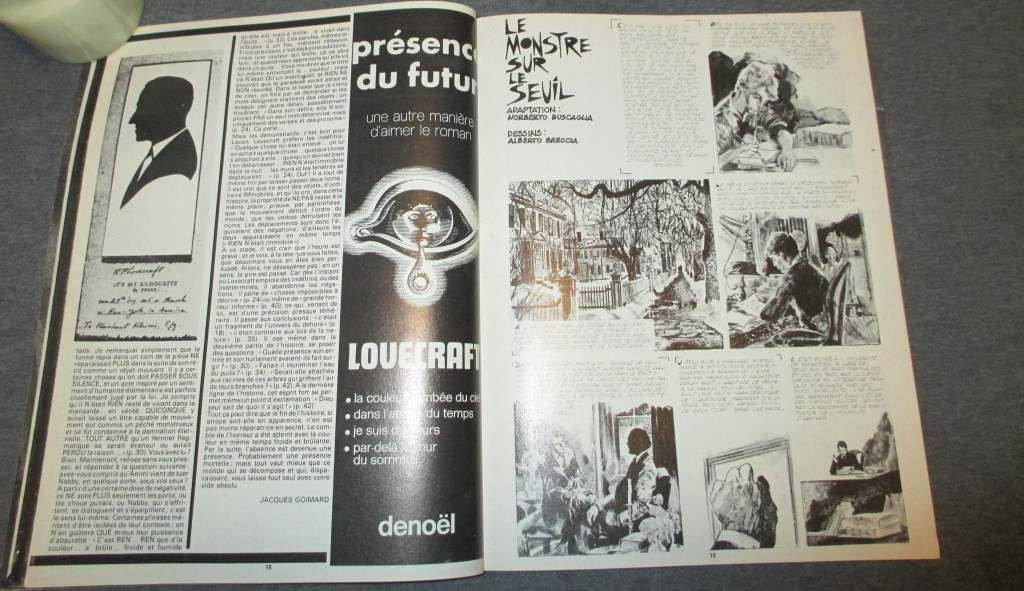
Deeper Cut: Lovecraft and the Boer Witch

Thanks extremely for the interesting cuttings, which I herewith return. I also have kept a file of these things for years—would you care to see some of the choicest items? I’d be glad to lend any number of envelopes full. That fog in Washington surely was a curious ‘colour out of space’ . . . . . I wonder if the preparations to reprint my story in that state had anything to do with it? The case of the Boer lady—Mevrouw van de Riet—certainly offers dark food for the imagination. She seems to be a sort of female Aleister Crowley—or a striga, lamia, empusa, or something of the sort. An odd—& potentially evil—face. Actually, she probably has the same degenerate psychology found in the old maleficae whom Sprenger & Kramer & Boguet & the other Renaissance prosecutors encountered—no doubt seeking to start cults or groups of loathsome practices wherever she settles. For fictional purposes you could use the South African birth—hinting at a childhood visit to the ruins of Zimbabwe by moonlight, & at whispers overheard there . . . . . . for is that not one of the points visited by the Fishers from Outside?
—H. P. Lovecraft to Clark Ashton Smith, postmarked 18 Nov 1933, Dawnward Spire, Lonely Hill 479

I’m glad the newspaper clippings were of interest. Thanks for your suggestion about the Boer witch-woman: she might well have gone to Zimbabwe and imbibed certain vaporous or shadowy outside influences from those unholy ruins. I may yet use her in a story; she certainly looks the part assigned to her.
—Clark Ashton Smith to H. P. Lovecraft, postmarked 4 Dec 1933, Dawnward Spire, Lonely Hill 491

Today, friends widely separated geographically can easily send each other news articles and images from different parts of the world through social media and the internet. In Lovecraft’s day, they would stick clippings from newspapers and magazines to each other alongside their letters. As the clippings themselves often do not survive, researchers are left to figure out what Lovecraft and friends were talking about via the references left in their letters—which, for Mevrouw (“Madam” or “Mrs.” in Dutch/Afrikaans) van de Riet, little has come to light.

Fortunately, the ongoing scanning and uploading of newspaper archives has at last put forward a promising candidate:

Crash Is Laid To Woman

Witchcraft, darkly sinister, fraught with all the mystery that has coursed uncertainly through the ages, found its way into the port of San Francisco yesterday.

A tale of black magic was told by men of the sea who shuddered fearfully as they whispered of the strange curse that has pursued the Silver Palm, British freighter, which collided with the cruiser Chicago in an “unnatural” fog off Point Sur.

Woman in Mystery
As this saga of sorcery was recounted, it was almost as if a a marrow chilling wind from a long forgotten civilization swept through the city, desstrying every concept belonging to this generation.

The story concerns a woman. The only passenger aboard the Silver Palm at the time of the fatal crash, whose very presence on the freighter caused high seas to run and desne fogs to fall. Whose familiarity with gods of the underworld brought disaster upon the shop, and whose artful malevolence resulted in a near collision with the Tattosh lighthouse and the unforseen accident with the Chicago.

This is what members of the Silver Palm’s crew are whispering about Mrs. Maude A. C. Van der Riet, former resident of Marin county, who is now being detained at Angel Island at the request of the British Government, pending the arrival of another ship to take her to South Africa.

Fear Seals Lips
So convinced are they that she is a “witch woman,” and that she along was responsidble for the ship’s misfortunre, that two Hindu sailors refused to testify under oath at the inquiry board session at Mare Island for fear she would put a curse on them.

And yet, as Mrs. Van de Riet basked in the bright sun yesterday at Angel Island, watching her three kittens scamper about, she seemed anything but a “jinx woman.” She exuded no mysterious force, and spoke in simple terms of her weariness and her desire for beauty.

She boarded the Sil[v]er Palm at Vancouver at the request of the British Government who tactfully insisted upon her immediate return to South Africa, the land of her brith.
—S. F. Chronicle

As this article doesn’t include a photograph of Mrs. van der Riet, this wasn’t exactly the clipping that Smith sent Lovecraft—probably it was the original version from the San Francisco Chronicle, whose 1933 issues are not yet available. Still, it seems to be the only article that attributes witchy attributes to van der Riet, whose story is a bit more prosaic.

The 1930 Federal census lists Maude van der Riet as a resident alien from South Africa, a widow living on her own in Marin, California. A card from a 1925 crossing to Mexico gives her full name as Maude Anna Catherine Vander Riet. She was about 46 in 1930, and is listed as having entered the U.S. in 1926. A 1925 passenger departing/arriving list for Hawaii lists her occupation as “Nurse,” as does her entry in the 1928 San Francisco city directory. A 1925 newspaper article says that she was a Red Cross nurse, and that when denied to go to shore in the port of Los Angeles, she jumped off a ship, the Rakuyo Maru (same as the 1925 passenger list above), and swam ashore before walking back to the ship (Defies Law By Swim To Reach Land).

In 1933, Van der Riet was in Vancouver, Canada when she was apparently requested by the British government to return to South Africa. She boarded the M.S. Silver Palm as the only passenger when it left Vancouver on 20 October. On 24 October, the Silver Palm collided with the U. S. S. Chicago off Point Sur during a heavy fog. The collision left three U.S. seamen dead (Paymaster John W. Troy, Lt. H.A. McFarlane, Lt. F. S. Chappelle,), and one injured (machinist J. A. Oehlers) (Warship in Crash, Two Killed In Crash In Fog Off Point Sur). Later newspaper accounts reveal gruesome details: Oehlers had a “fractured arm and mashed hand” which required amputation of the army just below the elbow; Troy was crushed to death in his stateroom; the head and face of Chapelle was found as the wreckage was torn away, and McFarlane was initially believed missing, but the crushed and mangled body was found after hours of work with torch and saw—his stateroom had been directly hit (Mystery Ship in Crash).

Newspaper accounts list the Silver Palm arriving in San Francisco regularly; the Chicago was on the way to San Francisco for Navy Day celebrations. The Point Sur lighthouse could not see clearly what happened. As details emerged in the paper, Capt. Herbert E. Kays of the Chicago claimed that he was attempting to avoid a collision with a third, unknown ship (later described as a “rusty tramp freighter”) in the fog when the Silver Palm emerged from the fog to starboard. The third made of the Silver Palm, George Ellis Stanley, confirmed Capt. Kays’ report of a third ship (Quiz Pressed In Ship Crash).

Oakland Tribune, 24 Oct 1933, p3
The Oakland Post Enquirer 25 Oct 1933, p3
Ventura Capital Star, 26 Oct 1933, p1
Progress-Bulletin, 26 Oct 1933, p2

The first articles were focused on the crash itself, and the dead and missing officers of the Chicago. An official inquiry would be made and interviews taken (Naval Inquiry Board Starts Probe of Ship-Cruiser Crash), yet there was one witness that got into print the day after the accident: Maude van der Riet.

Petaluma Argus-Courier, 25 Oct 1933, p3

The news of the collision was widely reported; the aftermath a little less so. Reporters followed the inquiry, and the testimony given by crew and officers. Libel suits by the freighter company and the U.S. Navy were filed, and the tragic accident took on the narrative of a legal drama. Mrs. van der Riet is not mentioned in the lists of witnesses called—nor, perhaps, was she expected to be, as she was only a passenger. The sensational claim that Maude van der Riet was a witch appears to be only a bit of yellow journalism. They couldn’t even get the number of kittens she had correctly.

What happened to Maude van der Riet? Presumably, she was put on another ship to go back to South Africa; the why and wherefore of that trip and her earlier and later life aren’t recorded in sources I have access to, though possibly someone with better sources in South Africa, Canada, Australia, or the U.K. might have better luck.

Lovecraft and Smith probably had little more to go by than the one article declaring van der Riet a witch, and that is what tickled Lovecraft’s imagination. He would set a story partially in South Africa, “Winged Death” (1934) by Hazel Heald & H. P. Lovecraft, which was published a few months later, and the reference to Great Zimbabwe and the “Fishers from Outside” is a reference to “The Outpost” (1930) and his conception of an African Mythos. The idea of a woman who had learned witchcraft in the ruins of Great Zimbabwe was also a minor plot point in “Medusa’s Coil” (1939) by Zealia Bishop & H. P. Lovecraft, written c. 1930. The reference to Aleister Crowley is simply a reflection of the Great Beast’s reputation, which Lovecraft commented on elsewhere in his letters.

In the end, Clark Ashton Smith doesn’t seem to have used Maude van der Riet in any of his stories, and this potential plot idea was dropped by both men. Yet it is a good example of the kind of oddness that could crop up in newspapers during their lifetime, how this information (or disinformation) could be spread, and could inspire stories in pulp authors. It shows too how easily Lovecraft could adopt new material into his existing framework as the Mythos slowly grew.


Bobby Derie is the author of Weird Talers: Essays on Robert E. Howard and Others and Sex and the Cthulhu Mythos.

Deep Cuts in a Lovecraftian Vein uses Amazon Associate links. As an Amazon Associate I earn from qualifying purchases.
Deeper Cut: H. P. Lovecraft & The Shaver Mystery

What follows is an extended deep-dive into the history of one of the most contentious affairs in pulp science fiction in the 1940s, the Shaver Mystery, and its interactions with H. P. Lovecraft’s Mythos, which was also beginning to coalesce in the same period. The ramifications of their interactions would spill over into science fiction fandom, conspiracy circles, and occult literature, with long-lasting effects on popular culture. Because this is very long, the following internal links are provided for those who would like to jump to specific sections.


I am certainly inclined to believe that [Shaver] has been inspired by the success of Lovecraft in attempting to create a literary mythos with much the same basic motif as he developed in his stories of the Old Ones. But, unlike Lovecraft, Mr. Shaver is not an artist.
—Alan Devereux, “Mr. Shaver’s Memories” in Fantasy Review (Oct-Nov 1948) 11

The entire Shaver mythos is so obviously derived from the Lovecraftian fictional background that it is hard today to imagine that it impressed any experienced readers. The first Shaver story told how the people of ancient Earth were endangered by a degenerated elder, how the hero and his followers learned of the danger, and how escape was achieved with the help of immortal elder gods.
—Harry Warner, Jr., All Our Yesterdays: an informal history of science fiction fandom in the 1940s (2004), 234

In 1926, Hugo Gernsback had founded Amazing Stories as the first pulp magazine devoted to science fiction. Mismanagement cost Gernsback the magazine, and it went through several hands; by the late 1930s it was owned by pulp publisher Ziff Davis and its readership in decline. In 1938, the editorship of Amazing was given to Ray Palmer, a young and enthusiastic pulp writer and editor who had cut his teeth in science fiction fandom, writing, editing, and publishing fanzines.

Palmer worked to improve the magazine’s circulation by aiming at younger readers, with more adventure, sensational illustrations, and less hard science. Small hoaxes in the pages of Amazing were not uncommon, with stories written by pseudonymous authors accompanied by fake biographies and critical comments from Palmer. At the same time, editor John Campbell had just taken over rival magazine Astounding Stories and was aiming for a more high-brow market. The dichotomy polarized science fiction fandom—Palmer became known as a hack, or at least a purveyor of junk fiction. But Amazing’s circulation increased.

In the October 1943 issue of Writers’ Digest, in the small personal ads are buried two notices from a “Shaver, Barto, Pa.” One was a lonely heart advertisement, the other was more unusual: advice requested for a newly discovered ancient language.

What response was received from these advertisements is unclear, but the response was likely unsatisfactory, because in December 1943 a letter from a Pennsylvania steelworker named Richard S. Shaver arrived at the offices of Amazing Stories. Shaver claimed to have discovered an ancient alphabet for a universal language (later called “Mantong”), supposedly of a pre-human race with connections to Atlantis.

Crank letters were a part of the business every pulp editor had to deal with, along with unsolicited manuscripts and fanmail. However, Palmer saw potential reader interest, and printed the entire letter as “An Ancient Language?” in Amazing Stories Jan 1944. Moreover, Palmer encouraged readers to try out Shaver’s language. Readers responded. As Palmer put it:

Many hundreds of readers’ letters came in, and the net result was a query to Richard S. Shaver asking him where he got his Alphabet.

The answer was in the form of a 10,000 word “manuscript” typed with what was certainly the ultimate in non-ability at the typewriter, and entitled “A Warning To Future Man.”

I read it through, every single word, and then sat back. What was it I had here? Certainly not an attempt by an “author” to sell a story. Mr. Shaver wanted no money for hia manuscript. It wasn’t a manuscript, but a letter. Mr. Shaver seemed anxious that it be published, not for notoriety, but out of sincere (apparently) desire that the world be warned of a terrible danger it faced, and informed of a wonderful heritage it had lost, and which should be recovered if at all possible.
—Ray Palmer, The Secret World (1975), 36-37

Palmer continued to correspond with Shaver, who sent him a 10,000-word letter or manuscript titled “A Warning to Future Man.” Ray Palmer bought the manuscript, and re-wrote it.

I put a clean piece of paper into my typewriter, and using Mr. Shaver’s strange letter-manuscript as a basis, I wrote a 31,000-word story which I titled “I Remember Lemuria!” although I added all the trimmings, I did not alter the factual basis of Mr. Shaver’s manuscript except in one instance. Here, perhaps, I made a grave mistake. However, I could not bring myself to believe that Mr. Shaver had actually gotten his Alphabet and his “Warning to Future Man” and all the “science” he propounded from actual underground people. Instead, I translated his thought-records into “racial memory” and felt sure this would be more believable to my readers, and a reasonable and perhaps actual explanation of what was going on was in Mr. Shaver’s mind—which is where I felt it really was going on; and not in any caves or via any telaug rays or telesolidograph projections of illusions from the cavern ray operators.
—Ray Palmer, The Secret World (1975), 38

So it was “I Remember Lemuria!” appeared in Amazing Stories in the March 1945 issue, as by Richard Sharpe Shaver.

For those of you who will read on and carefully weigh what I am about to tell you I am convinced there will be no thought of puns. Instead, when you consider the real truths behind what I say—and even better, experiment and study to corroborate them—it seems to me to be inevitable that you will forget that I am Richard Sharpe Shaver, and instead, am what science chooses to very vaguely define as the racial memory receptacle of a man (or should I say being?) named Mutan Mion, who lived many thousands of years ago in Sub Atlan, one of the great cities of ancient Lemuria!
—Richard S. Shaver & Ray Palmer, The Shaver Mystery Compendium, Vol. 1, 8

In the original manuscript, Shaver had made more explicit reference to Atlantis, not Lemuria; Palmer’s change brought a Theosophical bent to the re-written work (see The Book of Dzyan for other examples of Theosophical influence on the pulps). A footnote interpreted “Mutan Mion” through Shaver’s universal language, which shows the long build-up to this particular story.

In the words of Mutan Mion (amplified by many explanatory footnotes from Palmer), the readers are introduced to a scientifically advanced civilization that lives in underground caverns as protection from the damaging rays of the sun. As the advanced, nigh-immortal Titans and Atlans prepare to migrate to a different solar system, Mutan Mion and Sub Atlan are faced with the threat of the dero.

Pressed for a more complete explanation, Mr. Shaver has defined ‘dero’ for us:

“Long ago it happened that certain (underground) cities were abandoned and into those cities stole many mild mortals to live, at first, they were normal people, though on a lower intelligence plane; and ignorant due to lack of proper education. It was inevitable that certain inhabitants of the culture forests lose themselves and escape proper development; and some of them are of faulty development. But due to their improper handling of the life-force and ray apparatus in the abandoned cities, these apparatii became harmful in effect. They simply did not realize that the ray filters of the ray mechanisms must be changed and much of the conductive metal renewed regularly. If such renewals are not made, the apparatus collects in itself—in its metal—a disintegrant particle which gradually turns its beneficial qualities into strangely harmful ones.

“These ignorant people learned to play with these things, but not to renew them; so gradually they were mentally impregnated with the persisitently disintegrative particles. This habituates the creature’s mind, its mental movements, to being overwhelmed by deterimental, evil force flows which in time produce a creature whose every reaction in thought is dominated by a deterimental will. So it is that these wild people, living in the same rooms with degenerating force generators, in time become dero, which is short for detrimental energy robot.

“When this process has gone on long enough, a race of dero is produced whose every thought movement is concluded with the decision to kill. They will instantly kill or torture anyone whom they contact unless they are extremely familiar with them and fear them. That is why they do not instantly kill each other—because, being raised together, that part of their brain that functions has learned very early to recognize as friend or heartily to fear the members of their own group. They recognize no other living thing as friend; to a dero all new things are enemy.

“To define: A dero is a man who responds mentally to dis impulse more readily than to his own impulses. When a dero has used old, defective apparatus full of dis particle accumulations, they become so degenerate that they are able to think only when a machine is operating and they are using it; otherwise they are idiot. When they reach this stage, they are known as ‘ray’ (A Lemurian word not to be confused with ray as it is used in English.) Translated, ray means ‘dangerous or deterimental energy animal.’ Ray is also used to mean a soldier—one of those who handles beam weapons (note how the ancient meaning has come into our modern word).”
—Richard S. Shaver & Ray Palmer, The Shaver Mystery Compendium, Vol. 1, 28-29

Mutan Mion finds aid from Mars and the Nortans (yet another advanced subterranean people), sometimes referred to as Elder Gods and Goddesses. After getting some upgrades and falling in love, Mutan Mion returns to free the Atlans from the dero—who, it turns out, are also cannibals:
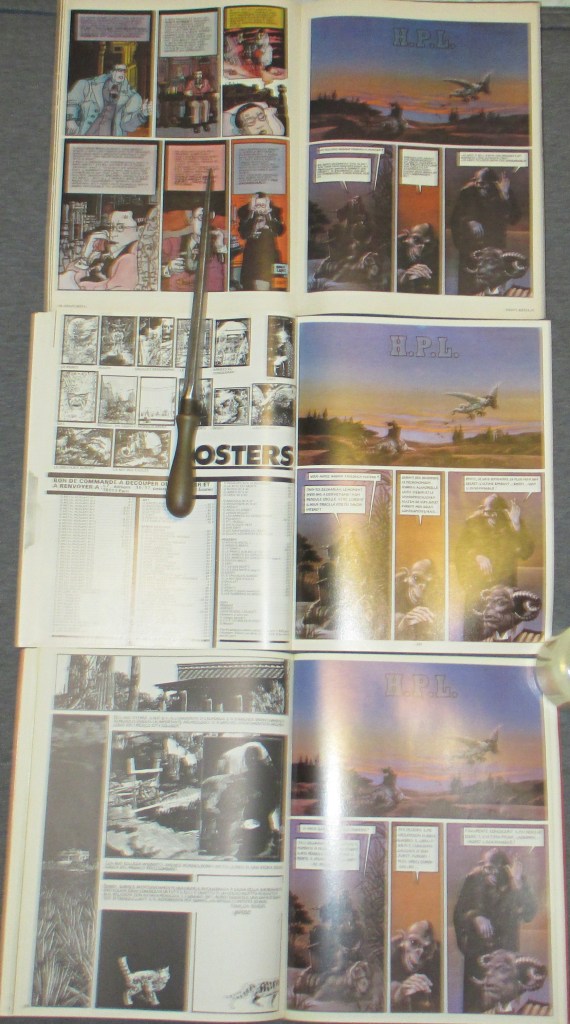
These devilish abandondero had a meat market in the lower floors, filled with human flesh; and a pile of choice cuts I saw was composed mainly of Atlan girl breasts! These dero things were cannibals and lived off immortal Atlan flesh!
—Richard S. Shaver & Ray Palmer, The Shaver Mystery Compendium, Vol. 1, 73

The story ends with Mutan Mion victorious, the dero temporarily thwarted but not utterly destroyed, and he heads off to a new planet with his love. His warning to the future is inscribed on “telonian message plates” and left for the wild men left behind on the planet to discover. Implicitly in this story, those wild men are the ancestors of homo sapiens today—and the threat of the dero remains.
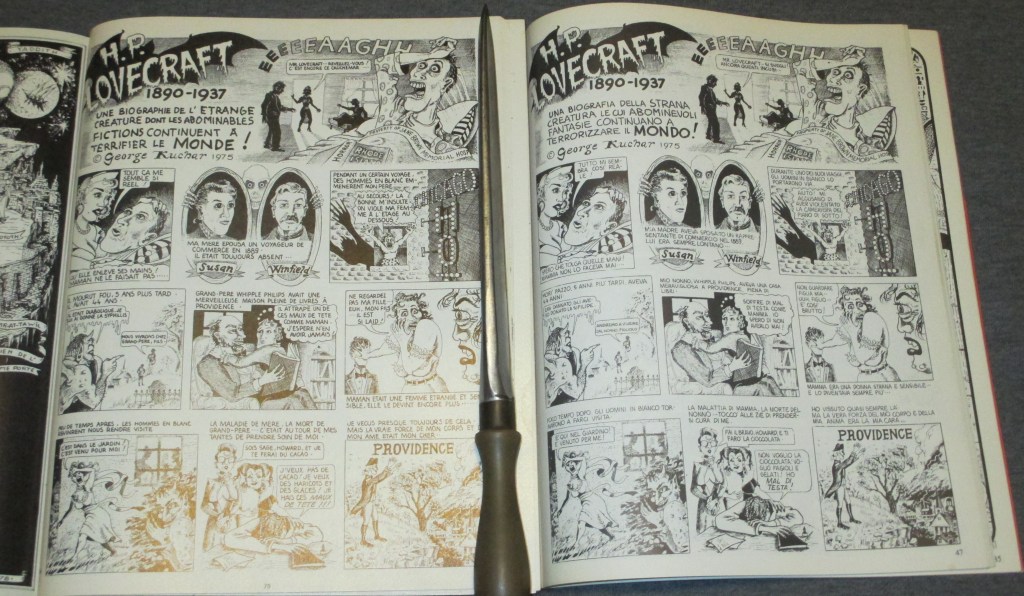
“I Remember Lemuria!” took clear inspiration from hollow earth fiction such as Jules Verne’s Voyage au centre de la Terre (“Journey to the Center of the Earth,” 1864), Edgar Rice Burrough’s Pellucidar novels beginning with At the Earth’s Core (1914), and A. Merritt’s “The Moon Pool” (1918) and “Conquest of the Moon Pool” (1919)—the latter of which are known to have been in Shaver’s library (see “Dick Shaver’s Library” in Shaverology); Shaver also specifically cited Merritt’s works in his “Open Letter To The World” (Amazing Stories Jun 1945). Palmer’s re-casting of the story as one of “racial memory” or recalling a past life was not novel. Past-life stories such as Jack London’s The Star Rover (1915), Lovecraft’s “Polaris” (1920), and Robert E. Howard’s “People of the Dark” (1932) were well-known among science fiction and weird fiction fans.
Yet these works were all presented as fiction. What was remarkable about “I Remember Lemuria!” was not the content—but because Shaver insisted it was true, and Palmer steadfastly claimed to believe him. The reader response, both positive and negative, was tremendous. Letters poured in. Fans debated and denounced the stories. Issues of Amazing Stories sold well.

From 1945 to 1948, more Shaver material appeared in Amazing Stories. Palmer assisted with the prose, but encouraged by publication Shaver continued to develop and expand on his new artificial mythology. Many science fiction fans derided it as a hoax; others bought into it. There’s always a wild conspiratorial fringe in any population, and Shaver’s talk of malicious dero, conspiracies to restrict access to technology, and invisible rays afflicting people caught the imaginations of few.

Palmer left Ziff Davis in 1949, and would go on to help publish more of Shaver’s material in smaller independent magazines and fanzines; he would also be influential in the development of ufology, and founded Fate magazine, among others. He was a titan in the development, spread, and popularization of fringe ideas like flying saucers and various conspiracy theories, and thanks to him Shaver’s Mystery has an outsized cultural footprint, such as the subterranean Derro race in Dungeons & Dragons. Shaver himself continued to write, publish, and evolve his strange little world of paranoid fantasies, with the dero becoming more sexually sadistic and voyeuristic.

In 1934, the death of Shaver’s brother severely impacted his mental health; he began experiencing auditory hallucinations, and was institutionalized at the Ypsilanti State Hospital. When he got out two years later, he found his wife had died (accidentally electrocuted) and their daughter taken into the custody of her maternal grandparents. The following years are poorly-documented but apparently involved rough living and an arrest trying to cross the border to Canada, and culminated in a stay at the Ionia State Hospital for the Criminally Insane in Michigan, from which Shaver was discharged in May 1943 into the care of his parents. (This is a highly abridged version of the account given in The Man from Mars: Ray Palmer’s Amazing Pulp Journey (2013) by Fred Nadis). The letter to Amazing Stories would come about six months later after his release from Ionia.

Shaver was not unique, however. In the 1930s, a fan named G. P. Olson (or Olsen) of Sheldon, Iowa began to write bizarre fan letters expounding theories about vampires and physics to writers like H. P. Lovecraft, Robert E. Howard, Hugh B. Cave, Henry S. Whitehead, August Derleth, and Clark Ashton Smith. In 1932, Cave wrote to Carl Jacobi suggesting that he mine Olson for ideas for his own fiction (see “The Fool Olson” in Weird Talers)—and I suspect that is ultimately what Palmer did with Shaver, at least in the early part of their correspondence and friendship. Whether Palmer’s encouragement of Shaver’s paranoid fantasies, and the resultant negative response from fans, was detrimental to his mental health is hard to say; that Palmer ultimately exploited Shaver is impossible to ignore.

Lovecraft’s influence on Shaver is also difficult to assess. “I Remember Lemuria!” includes references to Elder Gods, but these do not seem to be the Elder Gods of Lovecraft’s fiction. Nor did Lovecraft go in very much for hollow earth stories, though he certainly had cannibalistic underground peoples in stories like “The Lurking Fear” and “The Rats in the Walls,” and the ruins of an advanced alien civilization feature prominently in At the Mountains of Madness (1936). Probably the closest Lovecraft approached Shaver’s mythos was in “The Mound” (1940) by Zealia Bishop & H. P. Lovecraft—and, as it turns out, this is the one Lovecraft story we know Shaver read.

Palmer published a number of letters from fans in the pages of Amazing Stories as the Shaver Mystery stories unfolded. Being typical fans, some of these were hoax letters, and slipped past the editorial radar. One such letter that saw print:

THE NECROMINICON [sic]

Sirs:

In line with your research on the Lemurian question, may I refer you to the “Necrominicon” [sic] of Abdul Alhazred, and also, the singularly famous “Das Inausprechlichen Kulten” [sic] by Von Junzt.

Both of these volumes may be found in the reserve room of Miskatonic University’s library at Arkton [sic], Massachusetts.

I am a graduate in occult sciences of this university, and have been engaged in conflict with Mr. Shaver’s “underground deros” since my graduation there in 1935.

Translation of the seventh chapter of the “Necronominicon” [sic] using the “Lemurian alphabet” should aid greatly in discovering the missing plates.

I regret deeply that a certain interest in the (deleted by the editor for very good reasons) keeps me from aiding you materially in your search, but a hint to so fertile a brain as Mr. Shaver’s should be enough. And I feel quite sure that after you have read the above-mentioned volumes, many things should be clear that are now confused and dark.

John Poldea
(address deleted)
Amazing Stories Nov 1945

This was all in good fun, and Palmer seemed to know that Poldea was pulling his leg—yet it may also have suggested possibilities to Palmer. In an undated letter to August Derleth of Arkham House publishers, Palmer wrote asking for copies of Lovecraft’s The Outside and Others (1939), Beyond the Wall of Sleep (1943), and Marginalia (1944), and added:

I wonder if you were right when you said Lovecraft did not believe a word of what eh wrote. Strangely enough, I have received some interesting comments on “truth” contained in his writings which, together with corroborative evidence in support of those comments, intrigues me very much.

Also, do you have on your lists the name of John Poldea? An affirmative answer would be very interesting to me.

A copy of Derleth’s answer is not in his file of correspondence with Palmer at the Wisconsin Historical Society, but it was likely very much in the negative on both accounts. In a follow-up letter, Palmer wrote:

I am slightly amazed at your reaction to my question concerning Lovecraft. I understand little about the matter, except that it seems you’ve built up a “legend” about Lovecraft and his creations. Would you mind explaining briefly.

I published a letter which I knew was fake, in order to get the reaction, which was terrific, regarding the Miskatonic U and the books Das Unaussprechlichen Kulten and the Necronomicon of Alhazred.

Maybe you wouldn’t be surprised to know how many people believe there are such things—and maybe you wouldn’t be surprised to know how many people know there are not—and yet are fascinated by your “legend”.

You say you’d jump on any statement that Lovecraft believed what he wrote with both feet. This fascinates me. Personally I believe he did believe what he wrote, and further, I think I could even prove it.

I might even be able to produce what he wrote about!
—Ray Palmer to August Derleth, 20 Jun 1945, MSS. Wisconsin Historical Society

For Palmer, this was just another possible dimension by which to extend the Shaver Mystery; and even Shaver wasn’t sure how much of it he believed in or not, so long as it got a reaction from people. What Palmer probably had no idea of was how he was crossing nearly every possible line with Derleth, who had worked and sweated to build Arkham House in part on Lovecraft’s reputation as a literary figure, not a general pulp writer and certainly not as part of some cockamamie hoax running in Amazing.

A carbon copy of Derleth’s answering letter was immediate, and makes the Arkham House founder’s position clear—including an unsubtle legal threat if Palmer decided to push the matter any further:

You ask about Lovecraft. Contrary to your belief, we have NOT been building any “legend” about Lovecraft and his creations. We have been doing all in our power to keep him a straight literary figure, even to the extent of my taking time to write a brief critico-biography of him when I have little time for anything off-trail, and when you write that you “believe he did believe what he wrote and think” you “could prove it” this is simply to anyone who knows a plain bid to use the memory of a dead man in a cheap bid for publicity, which I construe as plain fraud and which would force me and the Lovecraft estate into legal action against the Ziff-Davis Company, regrettable as that is. I know very well what you are getting at when you say you might “even be able to produce what he wrote about”—crackpots have offered to write a NECRONOMICON for us, and you may be sure that such a purely Lovecraft creation would again, if fraudulently offered, bring action from us.

Where you got the idea we have built up a legend about HPL and his creations is beyond me. Certainly there are a lot of people who believe in the NECRONOMICON, and so forth; the origin of all these things is correctly set down in my H. P. L.: A MEMOIR, coming in book form in a month or so. I suggest you get hold of a copy and inform yourself before falling into any belief pattern. The UNAUSSRPECHLICHEN KULTEN was Howard’s invention, and I still have in my possession letters between R. E. Howard and HPL, with some of my own, showing that I contributed the UNAUSSPRECHLICHEN to the title in place of another word Howard wanted to use. Other titles came from other writers with Lovecraft’s permission.

Naturally, when, in the face of the contention of the man who has read more of the Lovecraft papers and letters than any man alive, you still say you “believe” to the contrary and contemplating offering “proof”, I have no other course but to think that you are contemplating some cheap plan to involve HPL and his mythos in a publicity plan for the Z-D magazines. I might expect that from Davis, but hardly from you, and you are right when you suggest that I might be “shocked”. I frankly hope that I am very much wrong.

Before going into the publication of any NECRONOMICON etc., you might look into the legal aspects of copyright in this matter; you will find that we have very solid grounds to take action against anyone purporting to offer “THE” book. I am thoroughly familiar with the copyright laws, and your use of a NECRONOMICON in this way is the equivalent of anyone else’s use of a w–k character or device under copyright.
—August Derleth to Ray Palmer, 21 Jun 1945, MSS. Wisconsin Historical Society

In strict point of fact, Derleth’s legal position was probably weaker than it looked. He had an arrangement with the estate of Lovecraft to reprint his works, in cooperation with Lovecraft’s literary executor R. H. Barlow (then in Mexico), but his stated control over the copyrights was mostly bluff and bluster. Yet it was an effective threat, because Palmer had no way of knowing that. Nor was Palmer aware that he had inadvertently threatened everything Derleth had built at Arkham House by confusing the nascent Mythos with Shaver’s Lemurian stories. Certainly, Palmer didn’t appear to have any idea of Derleth’s personal involvement with the Mythos, as with the naming of Robert E. Howard’s Unaussprechlichen Kulten (for which see “Unspeakable! The Secret History of Nameless Cults”).

For Palmer, it was all potential fodder for the expanding Shaver Mystery—and his own weird capability of believing things. As it was, in Palmer’s answering letter he did his best to defuse the situation and cover his ass.

Your information is interesting. Some of my readers informed me there was a “business” being built up about the “cthulhu mythos”. I understand Esquire has purchased an article about Lovecraft hinting such a buildup. You see, I am not without foundation for that idea. […]

Nor did I mean that I had any mss to present. I meant that I (and numberless readers) believe Lovecraft’s writings to a certain extent, and that excludes those fictional books and university. You see, what I said I could prove was the existence of the “beings” Lovecraft writes about. I’ve had some quite entertaining experiences with them of a personal nature. But before you think me mad, we’ll drop my little dabblings into demonology, as they are personal, and get back to the “proof” I could offer that many readers believe in Lovecraft, and dis-believe in his Necronomicon and Kulten books, and the Miskatonic U. they believe in his demons, because they’ve seen them. I have dozens of sincere letters addressed to my Discussions columns, affirming that these experiences are true, and that they are identical with Lovecraft’s so-called fictional ones. Of course, suggestion is a powerful thing, and Lovecraft’s writings can be said to be powerful. Believing them is a matter of personal choice. I believe that more people believe them sincerely than accept Lovecraft asa great writer. This should interest you, since you are not trying to build up anything but his reputation as a writer.

On a purely personal vein, I know Lovecraft believed his basic theories, and his choice in taking that field for expression of his art was not just because he liked weird things. But of course, this has nothing to do with your reaction.

Regarding “hoaxes”, you remember I asked if you had a certain name on your list? You said no, which absolved you of being an innocent party to a rather filthy trick that was played on me, to discredit my Lemurian stories through the Lovecraft “mythos”. I have since discovred the unprincipled gentlemen were those who call themselves the “fans” of science fiction, and you know who they are.

[…] But, since the “fans” have taken up Lovecraft’s creations as a club to show that mine are the same attempt at “falsifying”, I will retaliate by publishing those letters which show a sincere belief in Lovecraft does exist Naturally these letters are authentic. I have thousands of letters from persons who believe in Shaver, many more than those who believe in Lovecraft. but most significant, all belief in both because they present the same basic theory (I’ll not call it fact, because I’d rather have the scientific world go on calling the Shaver material “metaphysics” or whatever they choose. I am prepared to present the positive scientific proof of the Shaver stories, by producing the caves, the machines, and the people. But this must wait until I am prepared scientifically. Amazingly, we have uncovered a vast storehouse of new knowledge, which if not handled carefully, might be very ineptly applied to our bloodthirsty civilization.)

But please be assured I have no manuscripts, or any ideas of producing Lovecraft’s fictional pieces as the real McCoy. But perhaps I will produce one of his “monsters”. It would look very well in the local park along with the giraffes and the anteater.
—Ray Palmer to August Derleth, 22 Jun 1945, MSS. Wisconsin Historical Society

In his memoir The Secret World (1975), Palmer wrote of some remarkable experiences he had when he visited Shaver and his wife in Pennsylvania; this may or may not have been the personal experiences that Palmer spoke of. It is hard to tell because Palmer never seemed to be able to turn the huckster or hoaxer part of himself off; it wasn’t just a poise, it seemed to be fundamental to his being to believe whatever he was selling at the moment, at least to some degree. However, he had badly miscalculated his audience: Palmer had misunderstood or misread Lovecraft, and Derleth knew it.

The end result was that Shaver and Palmer never made any attempt to shoe-horn the Cthulhu Mythos into the Shaver Mystery, at least not in the pages of Amazing. Ray Palmer acknowledged Poldea’s fake letter in Amazing Stories Dec 1945 with a good-natured shrug and didn’t pursue that particular development of the Shaver Mystery further.

However, some of the fans were more critical than Poldea. In the popular fanzine Vampire published by Joe Kennedy, a scathing review was published in issue #4 of Maxin 96, a Lemurianist/occultist/Shaver Mystery zine published by fan David D. Dagmar. The review caught the eye of Amazing Stories’ competitor Startling Stories, which reprinted it in the Summer 1946 issue as part of a regular feature that reviewed science fiction fan publications. In response, Shaver sent a rebuttal to Kennedy, who would report:

Up until a couple moths ago, I corresponded with Shaver. He wrote me when a highly unfavorable comment on the Lemurianist fanzine, Maxin-96, was reprinted from Vampire in Startling’s fanzine review. Shaver seemed to welcome the chance to blast somebody’s ears off for the opposition which the “Shaver mystery” had evoked from the majority of actifandom. Misspellings and simple errors displaying marked ingorance of the fundamental rules of English grammar abounded in his letters. For the publication in Vamp he forwarded me a four-page “prose poem” which, as a piece of literature, was mildly amazing. The thing started off in undistinguished blank-verse style, rambled on another page, with references to Palmer and the deros becoming more and more frequent, bubbled and forthed into an attack on the opposing fan element (supposedly dero-controled!), then broke into straight prose, meandered on as a letter for a page or two, with intermittent ravings, then came to a decidedly abrupt conclusion. I sent it back to him. However, the main reason it was impossible to correspond with the guy, although I tried to give his side of the story a fair chance, was that all my arguments concerning the Shaver “truths” were either completely ignored or raidly passed over with but sparse comment. You can’t argue with a chap who just keeps drilling, over and over, THE DEROS ARE POWERFUL! YOU MUST BELIEVE! I’ve compared the Shaver letters and certain portions of his Palmer-rewritten published stories with examples of psychoneurotic literature quoted in psychology texts. The resemblance is remarkable, and indicative of far more than pure coincidence… No, I don’t correspond with R.S. Shaver any more.
—Joe Kennedy, Gruzlak #1 (Oct 1946), 14-15

Eventually, Kennedy and Shaver agreed to a rewritten version of this rebuttal as “Lovecraft and the Deros” by Richard S. Shaver. This piece was first published in the fanzine Vampire #6 (1946); it was later republished in another fanzine, Spicy Armadillo Stories #5 (1991). The entire text is reproduced below.

LOVECRAFT AND THE DEROS

((EDITOR’S NOTE: Since much has been written in the fan press against the Lemurian series in Amazing Stories, we believe that it is no more than fair that Dick Shaver be given an opportunity to tell his side of the story. We are completely convinced of the author’s sincerity, although the following article does not necessarily reflect the views of Vampire’s staff.))

Up to twelve years ago I was a stf fan, much like yourself, I suppose. I thought I knew exactly what was true in science and what could happen and that I could draw a precise line in my reading between fact and fantasy.

Then it happened, almost exactly as I tell it in the stories I write. Things that couldn’t happen except through a wonder-science never produced by modern men of science at all.

There were three conclusions. The first that these machines and rays came from space (visitors). The second was that they were modern secret science—things that science had developed and kept to itself as a monopoly, for the power and wealth the advantages of using these apparatuses would give them. This second conclusion was my conclusion until I knew more about it, which took many years. It is the usual deduction of the person first contacting secret ray.

The third deduction came after long experience with the phenomena I talk about in my stories. That this thing was a persistence of the same thing the medieval were talking about when they raised such a hullabaloo about witchcraft. The same thing Homer was talking about when he mentioned the immortal gods. I did a lot of research, believe it or not. And this last deduction is the correct one. The caverns I saw were not modern—they were not even built fairly recently by space travelers who stopped here long enough to leave such gigantic traces—were built before Man had a history. They are the big missing portion of history, and they have a history all of their own far more important in many ways than our own surface history.

Witchcraft, fairy tales, legends of the underworld—are not all antique fiction. It is surprising how well they describe some things that are done with with the machines. Merlin, in King Arthur, had a cave full of machines; and he died in it. In Deirdre—a ray from nowhere cuts down the heroes at the climax. The list of references is endless—I know—I looked them up. Take “The Destruction of Da Derga’s Hostel”—a fifth century Irish MSS.—translated in the Five Foot Shelf—The Men From the Elfmounds are mentioned over and over. The underworld was well known in the past and it shall be in the future. It has been the monopoly of a little group of savagely monopolistic people for a few centuries.

Read Lovecraft’s rewrite for a woman friend of his—”The Mound” in Beyond the Wall of Sleep, quite a long story and as good a picture of the underworld as ever I read. Take off about twenty per cent for Lovecraft’s weird ideation and ornamentation—and you have an exact picture of the underworld—except for the radioactive light.

As for Maxin 96 ((The Lemurianist fanzine—ed.)) I find it unfortunate that all the occultists have leaped to my banner—for I never meant to inferno that spirits had anything to do with what I am talking about. In fact the ray phenomena I mention explain away all spiritualist phenomena as ray work—of my despised dero—incidentally—the real explanation of all evil is dero, detrimental energy robot. These mysterious ray phenomena do exist and occur regularly. I always thought it was wool and lies and fakers myself just as you probably do—’till they happened without benefit of a medium within miles. No, I didn’t leap to the conclusion that they were spirits. I figured out the real reason—and it is some answer. naturally it is hard to swallow offhand, mainly because you don’t get all the background. Read “Da Derga’s Hostel” and Lovecraft’s “The Mound.”

I note in Vampire how the fans booed me at the convention in Newark. All this active fan opposition hurts like hell—but the truth of it is—they lose so darn much I could give them—if THEY UNDERSTOOD! But they are not my worst worry. My worry is the mad dero of the caverns—and they do our country even more harm. Some of those fans who are most loud in denouncing my “LIES” are directly used by the dero ray for that purpose. DON’T BE USED! The very copulation by which those same fans were conceived was watched over a telaug by a dero or a tero—humans who inherit a long line of conditional variational factors from a surrounding entirely different from our own—was watched for the vicarious entertainment received from the augmented emotional and sensory impulses which is greater than ordinary human.

Under our feet is a world of scientific wonder beyond any writer’s power of description, but there before Earth had a sun. Those metals don’t rust—those caves are as dry and hot as a desert—perfectly preserved, they wait for modern scientists to wrest their ancient secrets from those machines. That no scientist will accept this “impossible” truth is the only stumbling block between men and a wonder world. Our race was not the only race on earth; there were greater races and greater times. We are in truth the degenerate descendants of a great race, and not the apre’s mutant brother evolutionists would have us think. If you had been to Mars on an unannounced trip—how would you tell about it? Prove it, people would say. Well, it’s a hard job, but we may get it done—this proof you want is growing every day. Pluto did live, and strangely enough Dante’s concept of the nether world and the city of Dis has its counterpart in actuality.

:: Richard S. Shaver

“The convention in Newark” was presumably the First Post-War Eastern Science Fiction Conference, organized by Sam Moskowitz and the Null-A Men fan group. Joe Kennedy was a member and in attendance; he mentions that the club discussed boycotting Amazing Stories over the Shaver Mystery business (“After the Atom: Some Fannish Memoirs” by Joe Kennedy).

There was a semi-sequel to this article, in the form of an answer to a letter to Shaver from J. O. Cuthbert in 1948 that opens “Dear Mr. Shaver: L—la-ngai-ygg—Ia—Shub-Niggurath. Ph’nglui mglw ‘nafh Cthulhu R’lyan wgah ‘hagl fhtagn.”, Shaver’s response to that reads:

Dear J. O. Cuthbert:

Did you ever read Lovecrafts [sic] protege’s story, The Mound? Better than Lovecraft, and it has some true data on the caves mingled with Lovecraft expansion. In a Lovecraft collection of storys [sic].
—Richard S. Shaver, The Shaver Mystery Magazine (1948), vol. 2, no. 2, 34

Beyond the Wall of Sleep, which reprinted “The Mound,” was published in 1943, the same year that Shaver began corresponding with Palmer, and a year before Shaver wrote “A Warning to Future Man.” It isn’t clear when Shaver read Beyond the Wall of Sleep, though, and there are many disparate threads of science fiction, fantasy, and folklore that could (and probably did) work to inspire Shaver besides Lovecraft. The Togail Bruidne Dá Derga is a real Irish story reprinted as part of Harvard Classic’s Five-Foot Shelf of Books line in volume 49, Epics and Sagas (1937).

In 1964, a portion of Richard S. Shaver and Ray Palmer’s correspondence in the 1940s was published in the Shaver Mystery zine The Hidden World (issues A-13, -14, -15, and -16). These letters give some insight into Shaver’s life, thoughts and habits, and working relationship with Palmer. Direct references to Lovecraft only occur in two of the published letters, but are relevant. The first is:

The mention of Merritt is good I think—there are several reasons—the Lovecraft cult of writers uses his name all the time to good effect—and certainly Merritt is more worthy of such honor—as well as the corroboration of my contentions which his work offers and the enticement of his followers is also commercially valuable as they are legion.
—Richard S. Shaver to Ray Palmer, [n.d., c.mid-Oct 1944], The Hidden World A-14, 2443-2444

There are a number of mentions of A. Merritt and his stories, particularly “The Snake Mother” (1930) in Shaver’s letters and other writings. Shaver was likely discussing “Open Letter to the World” (Amazing Stories Jun 1945), which mentions Merritt repeatedly. The “Lovecraft cult of writers” references the growing popularity of Lovecraft (who was published in an Armed Services Edition during the war), and emulators and pasticheurs like August Derleth.

The second reference to Lovecraft in Shaver’s letters to Palmer is more extensive:

Reading in Lovecraft’s “Marginalia” which Bob sent me—noted a concept of his directly opposed to one of yours—wish you would think about it—for to a degree he is right.

He is talking in a chapter entitled “Notes on Interplanetary Fiction”.

“The characters, though they must be natural, should be subordinated to the central marvel around which they are grouped. The true ‘hero’ of a marvel tale is not any human being, but simply a set of phenomena.”

I have thought that perhaps you said the reverse in order to get me to think more carefully of character work in my writing, and in the main you agree with Lovecraft here. Personally, I think he is right, and that if the characters are too natural, we lose the illusion of other worldliness we are trying to create. I think then motivations of such characters should be different, as out of the ordinary as the settings, and thus the whole behavior of your characters, too, becomes the reverse of what we call “natural”—so here I disagree to an extent with Lovecraft, too. I admit the characters behaviour [sic] should be logical, and I stop there.

Personally I think Lovecrafts [sic] buildup for his marvels gets a little tiresome, but old stf fans are apt to be immune to the usual fanfare of intense surprise attempted by the stf writer.

In stf we have to write about marvels, we have to do it in a way that the average man can understand and enjoy as much as he does his Sunday supplement, and it is here that I agree and endorse your views. But that does not necessarily mean the characters can all be “natural”, meaning everyday people, at all. Some of the characters must of course be natural to set off the unnaturalness of those who are motivated by an other-world set of values.

Granted we all agree if boiled down to it. I thought you would be interested in his idea—the “hero of a marvel tale is a set of phenomena.”
—Richard S. Shaver to Ray Palmer, [n.d., c. Mar 1945], The Hidden World A-15, 2632-2633

“Bob” is Robert McKenna, a friend of Shaver’s who would also help improve Shaver’s prose and ghostwrite for him. Arkham House published Lovecraft’s Marginalia in 1944; which included his essay “Some Notes on Interplanetary Fiction,” which Derleth had excerpted from one of Lovecraft’s letters. The fundamental idea of the weird phenomena taking center stage rather than the human characters who witness it is very much at the core of Lovecraft’s fiction, exemplified in stories like “The Dunwich Horror” and “The Colour out of Space,” and more fully expressed in his essay “Supernatural Horror in Literature.”

Shaver’s focus on this bit of writing advice is a glimpse behind the curtain of the Shaver Mystery. While Shaver seems to have very much believed in Deros, rays, et al, he was also keenly aware that what he and Ray Palmer were creating was fiction—perhaps as a way to get the truth out there to the masses, but still very clearly a creative exercise, which involved plotting, narratives, characters who required development, motivations, etc. Palmer, as something of a pulp hack, knew the advantages of character-driven stories, and probably steered Shaver in this direction with his fiction in Amazing Stories; Shaver’s fiction outside of those pages tends to be far less character-focused. With Lovecraft’s advice opposing Palmer’s, Shaver struggled to find his own course and his own voice somewhere between the two.

Despite Harry Warner’s proclamation that Shaver’s Mystery was derived from Lovecraft, in the corpus of Shaver’s writing references to Lovecraft and his work are so few that it cannot be said that the Lovecraft Mythos inspired the Shaver Mystery—but Lovecraft certainly seems to have been one of the influences on Shaver. Lovecraft and Shaver shared some inspirations in common, such as A. Merritt’s “The Moon Pool,” which explains a few of their similarities, but at no point does Lovecraft’s artificial mythology impinge on Shaver’s Atlantis and Lemuria. “Lovecraft and the Deros” emphasizes how much Shaver dismisses Lovecraft’s Mythos in favor of recasting “The Mound” in terms of his own artificial mythology. I suspect that if Lovecraft was a more substantial influence on Shaver, more references to “The Mound” would have found their way into Shaver’s writing at some point…yet all we have, really, is “Lovecraft and the Deros.”

For more on Ray Palmer, Richard S. Shaver, and their shared Mystery, I recommend The Man from Mars: Ray Palmer’s Amazing Pulp Journey (2013) by Fred Nadis and War over Lemuria: Richard Shaver, Ray Palmer and the Strangest Chapter of 1940s Science Fiction (2013) by Richard Toronto.

Henry S. Whitehead, “Bothon,” & the Shaver Mystery

Recalling the “old days” brings us to a mention of Henry S. Whitehead’s “Bothon” in this issue. Reverend Whitehead is, of course, dead, but this unpublished story of his is far from dead. We consider it a very fine piece of work, and as we read it, we remember that Henry S. Whitehead was himself a researcher into the unusual, and we wonder what he would have said about the stories of Mr. Shaver? It is a very astounding fact to consider that in this story “Bothon,” Reverend Whitehead’s story is similar in all details to many letters we have from readers who claim to remember, or be reincarned, or have contact with some weird occult record which describes the events Whitehead describes so graphically in his story. Could it be that “Bothon” is itself a “thought record or a “racial memory” or did he believe eh was reincarnated and the story that formed in his mind was really memory of that former life? It is introguing to wonder what the truth behind “Bothon” really is.
—Ray Palmer, Amazing Stories Aug 1946

The Reverend Henry St. Clair Whitehead was an Episcopal priest and pulp writer, a friend and correspondent of H. P. Lovecraft, E. Hoffmann Price, and Robert E. Howard who wrote for pulps like Adventure, Weird Tales, and Strange Tales of Mystery and Terror. He was best known for his “jumbee” stories, based on the folklore of the U.S. Virgin Islands, which he would visit during the 1920s, as well as “The Trap,” a story written with Lovecraft, and “Cassius,” a story written based on one of Lovecraft’s ideas. At the time of his death on 23 Nov 1932, Whitehead apparently had several unpublished manuscripts, including one called “The Bruise.”

I’m helping Whitehead prepare a new ending for a story which Bates rejected. It was about a man in 1923 who got a bruise on the head which caused him to hear strange cataclysmic sounds—that turned out to be the Tokyo earthquake. The bruise had made a sort of radio of his ears! In my new version, the bruise excites certain cells of hereditary memory & causes him to hear the destruction of one of the cities of fabulous Mu—the sunken continent of the Pacific—20,000 years ago.
—H. P. Lovecraft to August Derleth, 31 Mar 1932, Essential Solitude 2.469

I’m now helping Whitehead prepare a new ending & background for a story Bates has rejected. The original told of a young man who bumped his head & thereafter heard sounds of a mighty cataclysm, although the city around him was quiescent. It was supposed to be due to a result of the bruise—which made the fellow’s head a natural radio & enabled him to hear the Japanese earthquake—which was occurring at the time. Bates rightly thought this tame, so I am having the cataclysm & its cause somewhat different. I am having the bruise excite cells of hereditary memory causing the man to hear the destruction & sinking of fabulous Mu 20,000 years ago!
—H. P. Lovecraft to Clark Ashton Smith, 4 Apr 1932, Dawnward Spire, Lonely Hill 361

He had a splendid tale under way called “The Bruise”, which (at my suggestion) involved the lost & fabulous Pacific continent of Mu. I am wondering whether it was ever finished.
—H. P. Lovecraft to E. Hoffmann Price, 7 Dec 1932, Letters to E. Hoffmann Price & Richard F. Searight 38

Whitehead also had another story under way—his old tale “The Bruise”, with a new ending (suggested and mapped out by myself) involving the fabulous lost continent of Mu 20,000 years ago; but whether this was ever put in final publishable shape I don’t know.
—H. P. Lovecraft to Farnsworth Wright, 6 Jan 1933, Letters to Woodburn Harris & Others 75

Harry Bates was editor of Strange Tales of Mystery and Terror (1931-1933), a short-lived competitor to Weird Tales that Whitehead contributed to, and Astounding Tales of Super-Science (1930-1933).

Years after Whitehead and Lovecraft’s death, August Derleth, co-founder of Arkham House, pursued the publication of Whitehead’s collected weird fiction, which eventually resulted in two books: Jumbee and Other Uncanny Tales (1944) and West India Lights (1946). This required dealing with Whitehead’s heirs; a confusing situation where a woman named Edna Black owned the copyrights, but a woman named Mary Starr owned several of the actual manuscripts. Included in a letter from Starr to Derleth dated 8 Nov 1943 is a list of unpublished manuscripts; at the bottom are two stories labeled “Scar-Tissue” and “Bothon.”

Mss. Wisconsin HIstorical Society, August W. Derleth Archive

It isn’t clear what some of these annotations mean, such as the checkmarks; possibly those indicate that the completed manuscript had been submitted to a given market (which suggests that “Scar-Tissue” at least may have been sent to Weird Tales, and was presumably rejected).

“Scar-Tissue” involves Gerald Canevin, a series character in Whitehead’s fiction, and a Dr. Pelletier who encounter a patient named Joe Smith who not only remembers Lemuria, but carried a physical scar that corresponds with a wound obtained in a past life as a gladiator. Canevin and Pelletier had previously appeared together in “The Great Circle” (Strange Tales Jun 1932). “Bothon” follows the general plot laid down by Lovecraft: a man bangs his head, and the bruise unlocks memories of his past in Lemuria. The story ends with a reference to a man named Smith who had similar memories.

The interrelation between “The Great Circle,” “Scar-Tissue,” and “Bothon” is unclear. Canevin and Pelletier form a link between “The Great Circle” and “Scar-Tissue,” while “Scar-Tissue” and “Bothon” share much common ground, including the character Bothon, and the latter “Bothon” appears to reference the character of Smith in “Scar-Tissue”; but there is no Canevin or Pelletier in “Bothon.” Was this the aborted start of an intended series, or the tail end of an ongoing one? We may never know. All three stories are also somewhat uncharacteristic of Whitehead’s typical pulp product, with more action and fantasy, but that was a direction that some of his fiction was headed toward near the end of his life.

It is unknown if one or both stories were complete at the time of Whitehead’s death, or existed in draft. “Scar-Tissue,” if it was submitted to Weird Tales as the above list implies, must have been in decent shape. Lovecraft’s involvement appears to have been primarily suggestion and plotting for “The Bruise”—he never mentions “Scar-Tissue” nor contributed any actual text to “The Bruise.” Though there have been claims that someone else may have written or completed the stories:

It is not certain that Whitehead ever finished the revision and expansion of “The Bruise” before his death. As late as December 1932, Lovecraft speaks of the process being still “under way” ([see letter to Price above]). It is possible, therefore, that the story was finished and retitled by August W. Derleth, who oversaw the editing and assembling of West India Lights, where it appeared. Derleth fleshed out a number of Lovecraft’s plots and notes into complete stories (see The Survivor and Others, 1957), and frequently wrote fiction pseudonymously. It has been claimed, for example, that in Night’s Yawning Peal (1952), an anthology he edited, there were three such tales, Derleth appearing (in addition to an entry under his own name) as Stephen Grendon, Michael West, and—J. Sheridan le Fanu! See Jack L. Chalker, “Arkham House & Sons, part 2,” Fantasy Review, no. 97 (December 1986): 19.
—A. Langley Searles, “Fantasy and Outré Themes in the Short Fiction of Edward Lucas White and Henry S. Whitehead) in American Supernatural Fiction: From Edith Wharton to the Weird Tales Writers (1996), 75n62

As mentioned in the review of “The Murky Glass” (1957) as by August Derleth & H. P. Lovecraft, Derleth’s approach to “posthumous collaboration” was often one of entirely original writing based around an extent bit of text or story synopsis. Derleth did use pseudonyms as well; this was a common practice in the pulps, and “Stephen Grendon” was an established alternate name that Derleth used many times. So Derleth was certainly capable of writing or revising a story and publishing it under a different name, and had done so. But did he do it?

Before or concurrent with the publication of West India Lights, both “Scar-Tissue” and “Bothon” were published in Amazing Stories in 1946, in the July and August issues respectively. While there is no copyright notice or reference to Derleth attached to the stories, and unfortunately no letters with Starr or Black from this period attest to any deal or payments for publication, Derleth’s letters to Ray Palmer show that he submitted the stories, and brokered their sale at the same time as he was arguing with Palmer about Lovecraft:

Yes, I’d like to look at the Whitehead things concerning Lemuria, etc. Would appreciate your sending me the manuscripts.
—Ray Palmer to August Derleth, 20 Jun 1945, MSS. Wisconsin Historical Society

I will send along the Whitehead stories—BOTHON and SCAR-TISSUE—just as soon as my secretary gets around to typing them: in a fortnight or so. They are very good stories of the Lemuria type which you seem now to tbe seeking.
—August Derleth to Ray Palmer, 21 Jun 1945, MSS. WHS

Thanks for getting the Whitehead stories in shape for me to look at.
—Ray Palmer to August Derleth, 22 Jun 1945, MSS. WHS

This was followed up some months later by a receipt of sale:

MSS. Wisconsin Historical Society

Derleth submitting stories on behalf of Whitehead’s heirs isn’t unusual. In the early 1950s, Derleth had arranged for the reprinting of two of Whitehead’s stories in the pages of Weird Tales (“The Tree-Man,” WT Sep 1953 and “Passing of a God,” WT Jul 1954), so we know Derleth did sometimes act as agent for such stories. Whether Derleth was acting as agent or ghost-writer, some of this money should have gone to Edna Black; unfortunately, the correspondence for this period between Black and Derleth is lacking.

There are some substantial textual differences between the text in Amazing Stories and West India Lights, with the Amazing Stories version of the text being substantially shorter and punchier. Probably Palmer cut the text down for publication to better fit the space in the magazine. To give one example of the differences:

“Do you get that picture? Here we were, prisoners of war — after a couple of months of the hardest training I have ever known, in the Ludektan gladitorial school, about to shed our blood to make an Atlantean holiday! Yes, Ludetka was the southernmost province of Atlantis, the cultural center of the continent. There had been innumerable wars between the Atlanteans and Lemuria. Like Rome and Carthage.“Do you get that picture? Here we were, prisoners of war — after a couple of months of the hardest training I have ever known, in the Ludektan gladitorial school, about to shed our blood to make an Atlantean holiday!
“Scar-Tissue,” West India Lights 233“Scar-Tissue,” Amazing Stories (Jul 1946) 149

Practically all of the changes in the Amazing Stories text represent a condensation of the story, truncating some of the battle scenes and speeding up the pacing. The above is a rare instance where a bit of the “lore” of the setting was excised. Was this done by Palmer so that Whitehead’s story dovetailed more closely with the Shaver Mystery? Given that so much setting material was left intact, probably not.

What is remarkable about “Scar-Tissue” and “Bothon,” and what might be most suggestive of Derleth’s involvement, is not so much the existence of two salable manuscripts by Whitehead that finally saw print after fourteen years—but that both such stories were directly relevant to the current trend in Amazing Stories. The timing is key: just when Amazing Stories was pushing the Shaver Mystery hard, here comes two stories of essentially similar theme from a different, established author, that could almost have been written to order.

Whether Derleth saw an opportunity to market Whitehead’s stories and took it, or Derleth re-worked one or both of the stories to fit isn’t clear, but it seems more than coincidence that two such atypical stories from a fortunately deceased author could emerge at just this time in Amazing Stories. That topicality makes them suspect. Yet without access to the original manuscripts there is no way to know for sure.

Despite Searles’ surety that someone other than Whitehead was involved, the evidence for Derleth revising, completing, or writing “Scar-Tissue” or “Bothon” is entirely circumstantial. We know at least from Lovecraft’s letters that “The Bruise” contained recognizable elements to be found in “Bothon,” and the 1943 manuscript list from Mary Starr clearly lists both stories. So it seems likely that if Derleth did touch up the manuscripts, he at least had some manuscript to work with, rather than writing the tales out of whole cloth, or based only on the synopsis in Lovecraft’s letters about “The Bruise.”

There is undoubtedly more to the story of how these two Whitehead works ended up at Amazing Stories. It’s notable that the publication in those magazines does not mention Lovecraft, Derleth, Arkham House, or West India Nights; for a tireless self-promoter and champion of Lovecraft like Derleth, it seems odd he wouldn’t make more of the opportunity for some free advertising, or to at least promote the Lovecraft connection elsewhere. In fact, when Clark Ashton Smith commented on “Bothon” in a letter to Derleth after West India Nights came out, Derleth’s reply didn’t mention Lovecraft at all (Eccentric Impractical Devils 370).

There are several Lovecraftian traces in “Bothon” that are not present in “Scar-Tissue.” The simian slave-class is called “Gyaa-Hua”; compare with “The Mound” (1940) by Zealia Bishop & H. P. Lovecraft, where the slave-class is called the “gyaa-yothn.” Two transcribed bits of ancient Lemurian speech in “Bothon” are: “Iï, Iï, Iï, Iï;—R’ly-eh!—Ieh nya, —Ieh nya; —zoh, zoh-an-nuh!” and “Ióth, Ióth,—natcal-o, do yan kho thútthut,” which bare similarities to some of Lovecraft’s alien speech,” especially the appearance of”R’y-eh” is particularly close to “R’lyeh” from “The Call of Cthulhu,” and “kho thútthut” could be a phonetic rendering of “Cthulhu.” Either Whitehead or Derleth could easily have inserted these references; though given Derleth’s contretemps with Palmer over adding anything Lovecraftian to the Shaver Mysteries, why he would insert such a reference is unclear. It is perhaps notable that when Lovecraft used Mu in his fiction in “Out of the Æons” (1935) by Hazel Heald & H. P. Lovecraft, he made no reference to either R’lyeh or the gyaa-yothn/gyaa-hua.

The connection between Lovecraft, “The Bruise,” and “Bothon” does not appear to have become publicly known until after Derleth’s death, when Selected Letters IV (1976) was published, which book contains the references in letters to E. Hoffmann Price and Clark Ashton Smith. Without access to concrete evidence in the form of drafts, letters, or business records to clarify matters, this small tangent to the Shaver Mystery and its almost-connection to the Lovecraft Mythos must remain a mystery.

Manly Wade Wellman, The Necronomicon, & the Shaver Mystery

“Suppose,” said Thunstone, “that I wanted a copy of the Necronomicon?”

“Suppose,” rejoined the old woman, “that I gave it to you?” She turned to a shelf, pulled several books out, and poked her withered hand into the recess behind. “Nobody else that I know would be able to look into the Necronomicon without getting into trouble. To anyone else the price would be prohibitive. To you, Mr. Thun—”

“Leave that book where it is!” he bade her sharply.
—Manly Wade Wellman, “The Letters of Cold Fire” in Weird Tales May 1944

Lovecraft and Wellman overlapped a bit at Weird Tales, but never corresponded. Nevertheless, Wellman had respect for his elder in weird fiction, and paid homage to Lovecraft in several stories, including “The Terrible Parchment” (WT Aug 1937) and “The Letters of Cold Fire” (WT May 1944), which feature the Necronomicon, and “Shonokin Town” (WT Jul 1946) where Lovecraft is mentioned as an expert in eldritch lore.

Wellman came into his own in Weird Tales during the 1940s, when his occult detective character John Thunstone ran in a successful series of tales. Like Lovecraft, Robert E. Howard, and others, Wellman had learned to build up a degree of interconnectedness in his stories for greater verisimilitude—Thunstone mentions Weird Tales authors H. P. Lovecraft and E. Hoffmann Price, Seabury Quinn’s occult detective Jules de Grandin (who would also mention Thunstone in his own stories), and several of Wellman’s characters exist in the same general setting, and sometimes face the same enemies—notably the pre-human, magically adept beings known as the Shonokin.

One of the details revealed in Richard S. Shaver’s correspondence with Ray Palmer in The Hidden World is that Shaver himself read Weird Tales, at least occasionally, and even submitted short fiction to the magazine. One story that caught his eye was “The Letters of Cold Fire” by Manly Wade Wellman:

In a tale in Weird Tales mag. recently it spoke of THE DEEP SCHOOL of Magic. I think you will find this is pertinent. Men who had been through the school could no longer stand the light at all. The underworld – hereditarily – have extra large eyes. This was in the Rowley Thorne – Dunstone [sic] series – runs regularly in Weird Tales and the author may know something though it’s hard to tell among all his magic wool. He should not be hard to contact and writers can explain what they mean. I hope he is not one who believes really the common concept of magic.
—Richard S. Shaver to Ray Palmer, 8 Jun [1944], The Hidden World A-14 2338-2339

It isn’t known if Shaver ever attempted to contact Wellman. In Weird Tales Jul 1946 and in the fanzine Sunspots #28 (Fall 1946), Wellman claims to have received letters form those who were convinced the Shonokin were real and could tell him more. Could Shaver have been among them? Perhaps, perhaps not; Shaver’s further letters to Palmer don’t mention any such attempt.

What is known is that Shaver remembered “The Letters of Cold Fire,” and later when the subject of grimoire came up after reading William Seabrook’s Witchcraft: Its Power in the World Today (1940), Shaver was inspired to an elaboration on his theories.

Such writers as your firned [sic] friend of Weird Tales mention such EVIL books—the book from the DEEP SCHOOL etc. etc.—and such wonderful things can be done with formula in them—is standard weird talk for witch stories through the ages—why—because once that was true and magicians—or mag-neticians—did save those books and work wonders with but they were not numerous to save that wisdom for us—or they lived in the caves and all that history of theirs still lies down there waiting for us—but if my observations of dero are right they are still using the ancient libraries for toilet paper and fire starting as in the ancient days.
—Richard S. Shaver to Ray Palmer, Jan 12 [1945], The Hidden World A-15, 2570

There is something strange and terrible about the image of a Dero, after evacuating last night’s cannibalistic feast, reaching for the age-softened, crumbling pages of the Necronomicon to wipe themselves clean—and that is an aspect of Shaver’s mystery that readers of Amazing Stories perhaps did not appreciate, the degree to which Palmer and other ghostwriters cleaned things up, for Shaver could be quite brusque about subjects like torture, sex, and some of the more unpleasant aspects of life in his stories.

Muriel E. Eddy, David H. Keller, & the Shaver Mystery

In a 1948 interview, David H. Keller, a prolific author of science fiction and weird tales and a contemporary of Lovecraft’s, was asked about the Shaver Mystery:

“What is your opinion of the Shaver controversy?”

“A healthy affair in some ways. After all there is not much difference between Shaver and Lovecraft as far as the basic idea is concerned. Even Jules Verne hinted at it in his JOURNEY TO THE CENTER OF THE EARTH. Merritt talked about those Old Ones and Lovecraft wrote constantly in regard to such a menace. […]
—David H. Keller, interviewed by Jacob Hudson, Fantasy-Times #64 (Apr 1948), 5

Keller’s comparison of Shaver and Lovecraft is not unique; it’s a point that crops up repeatedly in the literature. One of the key points Keller makes is that “Lovecraft wrote constantly in regard to such a menace”—but did he really? At this date, Arkham House had brought Lovecraft into print in hardback, and in the mid-40s editions paperback editions were available through Bartholomew House and the Armed Services Edition. Weird Tales under Dorothy McIlwraith published or re-printed Lovecraft stories provided by August Derleth and Arkham House, as well as Derleth’s own pastiches. Derleth’s first “posthumous collaboration,” the novel The Lurker on the Threshold, was published in 1945.

While Lovecraft wrote of many terrors, some ancient and some underground, there was never a single unifying threat that ran through multiple stories as the Deros do through Shaver’s oeuvre. However, for casual readers who absorbed a great deal of Derleth along with Lovecraft, this fine distinction between the Mythos as Lovecraft wrote it versus how Derleth tended to play it up was easily lost. Derleth’s pastiches tended to emphasize a unity and structure to Lovecraft’s Mythos that wasn’t originally there, while Shaver seems to have had a very clear conception from the beginning of how things were in the underground caverns, even if he struggled with how to present this information to the audience.

This kind of comparison led to another tangential connection between Lovecraft and Shaver, in the pages of Fantastic Adventure, another Ziff Davis pulp magazine that was under the editorship of Ray Palmer. While the Shaver Mystery stories largely appeared in Amazing Stories, some of Shaver’s fiction also appeared in Fantastic Adventure, which was at least nominally dedicated to fantasy, although in practice Ray Palmer tended to run both fantasy and science fiction together in the magazine.

In Fantastic Adventure s(Feb 1948), Shaver’s story “Slaves of the Worm” ran. The story is not explicitly related to the Mystery—not a Dero in sight—and may owe something to Robert E. Howard’s “The Shadow Kingdom” (1929) and “The Valley of the Worm” (1934) as well as A. Merritt’s “The Face in the Abyss” (1923) and its sequel “The Snake Mother” (1930). Yet something about the story prompted a reader to write in and compare it to Lovecraft; and Ray Palmer agreed.

The letter caught the attention of Muriel E. Eddy, a friend and correspondent of Lovecraft’s during his life who later turned her energies to memoirs like “Message in Stone” (1956) and The Gentleman from Angell Street (2001). Her response letter was also published.

Not many would look to the letter-columns of Fantastic Adventures for a brief memoir about Lovecraft, yet that is part of the legacy of the Shaver Mystery too.

Robert E. Howard, Serpent People, & the Shaver Mystery

One of the hallmarks of conspiratorial literature is how quickly it is to absorb new ideas into its existing framework, and the same is true for the Shaver Mystery. In the August 1946 issue of Amazing Stories, Ray Palmer wrote a piece about the pamphlets of Maurice Doreal, an occultist, which presents his ideas of the hollow earth (drawing much inspiration from Theosophy), and wrote that:

I am advising that Doreal’s booklets be read by all students of the Shaver matter. I do not believe that he is correct in all his statements, but there may be a basis underlying them, and this knowledge should be known to students simply as a matter of theory.

In the October 1946 issue of Amazing Stories, an answering letter from Doreal was published, essentially confirming the subterranean evil Dero exist, and working the Dero into their schema.

Maurice Doreal (also M. Doreal, Morris Doreal, etc.) was a pseudonym for Claude Doggins, an occultist and conspiracy theorist inspired by both Theosophy and pulp fiction. One of Doreal’s most notable publications is The Emerald Tablets of Thoth the Atlantean (n.d.).  The esoteric poem includes a lot of material drawn from ancient Egyptian religion, Hermetic occultism, and Theosophy, but there’s one passage in particular which is basically a synopsis of Robert E. Howard’s story “The Shadow Kingdom (Weird Tales Aug 1929):

In the form of man they amongst us,
but only to sight were they as are men.
Serpent-headed when the glamour was lifted
but appearing to man as men among men.
Crept they into the Councils,
taking forms that were like unto men.
Slaying by their arts
the chiefs of the kingdoms,
taking their form and ruling o’er man.
Only by magic could they be discovered.
Only by sound could their faces be seen.
Sought they from the Kingdom of shadows
to destroy man and rule in his place.

While Doreal does not connect the dero to the serpent people directly, they share certain attributes, being evil, shape-shifting, and subterranean. It goes to show how flexible and adept at self-promotion Doreal was to latch onto the Shaver Mystery, however briefly. Doreal also borrowed from other pulp authors, notably referencing Frank Belknap Long Jr.’s “The Hounds of Tindalos” (Weird Tales mar 1929), also referenced in The Emerald Tablets:

Strange and terrible
are the HOUNDS of the Barrier.
Follow they consciousness to the limits of space.
Think not to escape by entering your body,
for follow they fast the Soul through angles.
Only the circle will give ye protection,
save from the claws
of the DWELLERS IN ANGLES.

Like Shaver, Doreal’s writings influenced popular conspiracy theories, and his works tied together aspects of Theosophy, pulp fiction, and the nascent ufology culture. Michael Barkun in A Culture of Conspiracy: Apocalyptic Visions in Contemporary America (2013) notes that Doreal also authored a pamphlet giving a revisionist history of the world featuring this serpent race (Mysteries of the Gobi), where the perverted, underground Lemurians were supposedly the ancestors of all Semitic peoples. Another pamphlet, Flying Saucers: An Occult Viewpoint postulated the serpent people were extraterrestrials, which would help set the stage for popular depictions of reptilian humanoid aliens, such as the television series V. All of these have uncertain publication dates, but based on this letter we can definitely say they were around in the 1940s.

Doreal would be quoted extensively in David Icke’s Children of the Matrix: How an Interdimensional Race has Controlled the World for Thousands of Years—and Still Does (2001), which collates and updates the whole idea of shapeshifting reptilians for a 21st-century audience. Icke is noted for his antisemitism, and for his identification of members of the Jewish Rothschild family as secret reptilians (Barkun 146); the entire shape-shifting reptilian alien idea in popular culture has been tinged by Icke’s prejudice.

Robert E. Howard did not invent the idea of serpent people or reptilian humanoids; H. P. Lovecraft had played with the idea in “The Nameless City” (1921), A. Merritt had the eponymous Snake-Mother of Yu-Atlanchi in “The Snake-Mother” (1923); Frank Belknap Long, Jr. had a woman-headed serpent in “The Were-Snake” (1925); Edgar Rice Burroughs had underground serpent people in Tarzan at the Earth’s Core (1929-1930); Clark Ashton Smith had made serpent a part of his stories in “The Double Shadow” (1933) and “The Seven Geases” (1934); Edmond Hamilton, famous for his space operas, included reptilian alien humanoids in “Monsters of Mars” (1931) and “The Snake-Men of Kaldar” (1933), and John Murray Reynolds had similar Scaly Ones in “The Golden Amazons of Venus” (1939); E. Hoffmann Price played on Southeast Asian beliefs about the Naga in “Snake Goddess” (1939), and there are many other precursors and cases of independent invention. There is even a famous case in 1934, an engineer named G. Warren Shufelt even advertized that there was an underground city of lizard people beneath Los Angeles.

Richard S. Shaver had serpent-people in his Shaver Mystery fiction too—most notably in “The Fall of Lemuria” in Other Worlds Science Stories (Nov 1949). These snake-people probably owe more to Merritt’s “Snake-Mother” than to anything Howard or anyone else wrote.

Yet Howard’s serpent-people have gained pop-culture precedence—and entered conspiracy circle legend—because of several contributing factors. For Lovecraft, Smith, and many others, the reptilians and serpent people, whether beneficient or inimical to humanity, hatched no conspiracies, and dwelt underground and apart from humanity and its affairs. Howard’s were actively seeking to undermine and manipulate human civilization, and doing so with the aid of magical disguises to impersonate others.

Marvel Comics introduced serpent people to their universe through works adapted from and inspired by the work of Robert E. Howard; in the pages of Conan the Barbarian, Kull the Conqueror, and (oddly enough) Marvel Premiere #4, where Dr. Strange fights the spawn of Sligguth in a story that combines aspects of “The Shadow Kingdom” and “The Shadow over Innsmouth.” Robert E. Howard’s version of the serpent-god Set, and his serpent-people followers, would play a major role in the Marvel Universe during storylines like Atlantis Attacks! (1989), although since Marvel subsequently lost the license to Conan, the serpent-people have played substantially less of a role.

Roleplaying games have featured a number of reptilian and serpent-people, some of whom were inspired by pulp fiction, others of which are original. The Call of Cthulhu roleplaying game adapted Howard, Smith, and Lovecraft’s serpent-people lore and glossed and expanded it. Dungeons & Dragons have the Yuan-Ti, who were largely humanoid serpent-people with shapeshifting powers, that first appeared in Dwellers in the Forgotten City (1980); whether they were originally based on Howard’s serpent people or not, they embody many of the tropes—but there are innumerable fantasy serpent- and reptile-people in fantasy and science fiction, too many to narrow them all down to one single source. Publisher White Wolf would also borrow from Howard when creating the clan called the Followers of Set for Vampire: The Masquerade (1991), whose discipline of Serpentis gives them serpent-like powers and attributes.

The Followers have an Egyptian theme, despite the fact that the Egyptian god known as Set, Seth, or Sutekh does not have serpentine attributes—a common misconception which also affected the Marvel comics (where the Egyptian god Seth was a separate deity, though still serpent-themed) and even Dungeons & Dragons (where the Mulhorandi god Set was largely based on the Egyptian god, but also took on serpentine characteristics). Robert Bloch would commonly err in making the serpentine Set an Egyptian god in some of his early horror and fantasy stories. The confusion comes because in the Conan tales, Set is the god of the Stygians—who are intended to be strongly reminiscent of ancient Egypt, and to be the precursor civilization to it:

Meanwhile, also, a tribe of Vanir adventurers had passed along the Pictish coast southward, ravaged ancient Zingara, and come into Stygia, which, oppressed by a cruel aristocratic ruling class, was staggering under the thrusts of the black kingdoms to the south. The red-haired Vanir led the slaves in a general revolt, overthrew the reigning class, and set themselves up as a caste of conquerors. They subjugated the northern-most black kingdoms, and built a vast southern empire, which they called Egypt. From these red-haired conquerors the earlier Pharaohs boasted descent.
—Robert E. Howard, “The Hyborian Age” (1936)

There is a terrible irony to Doreal and Icke’s adding bigotry to Howard’s serpent people: Howard was thinking about Jews when he wrote it. Howard’s original story “The Shadow Kingdom” was in part inspired by some of his own characterization of Jews in the Old Testament in his private letters (see Deeper Cut: Conan and the Shemites: Robert E. Howard and Antisemitism). However, a study of Howard’s letters do not show any definite awareness or belief in popular antisemitic conspiracy theories, and Howard never made any explicit connection between serpent people and Jews in his fiction. Howard did not confuse fantasy and real-world prejudice; he took a metaphor based on a personal reading of the Old Testament and wove into his fantasy fiction—making literal serpents out of the metaphorical manipulators of King Saul. This wasn’t a huge stretch for Howard, who had already included his antipathy to serpents and characters with snake-like attributes in several stories before Kull was created (see “Conan and the Little People: Robert E. Howard and Lovecraft’s Theory.”)

The 1930s and 40s saw the cross-pollination between pulp and popular fiction and fringe conspiracy theories, and what would become New Age movements, many of which were in a foundational stage during the interwar and WW2 period. Doreal’s letter in support of Shaver’s Mystery is an example of how easily these works incorporated ideas from science fiction and weird fiction into already-extent occult and conspiratorial ideologies about the hollow earth and hidden masters. It also demonstrates how antisemitic tropes can grow and spread, sometimes under unlikely guises.

Marebito (稀人, 2004)

Marebito (“Unique One,” 稀人) is a Japanese horror film from director Shimizu Takashi (清水 崇), based on a novel and screenplay by Konaka Chiaki (小中 千昭). As the film opens, freelance cameraman Masuoka (played by Tsukamato Shin’ya 塚本 晋也) is obsessed the nature of fear and with viewing the world through a camera lens. Masuoka investigates the apparent suicide of a terrified man underground that was captured on camera. His investigation leads him to a subterranean network of tunnels beneath Tokyo. Masuoka meets people who live in the tunnels and believe in Richard Shaver’s Deros; Masuoka himself finds a section of the underground that resembles ancient ruins and believes he has come to the Mountains of Madness spoken of by Lovecraft—although he acknowledges both Shaver and the hollow earth theory are fiction. Yet in that netherworld, fact and fiction seem to merge.

Throughout the film, possibly-supernatural events occur, and the line between what is real and what is just in Masuoka’s head is not clear. The film plays with aspects of voyeurism, documentary filmmaking, the nature of reality, and the uncertain nature of perception. The narrative is shot through with sudden transitions, artifacts of digital recording in settings of clear reality, impromptu encounters and conversations, and a growing uncertainty about who the characters really are and how much of this is really happening, or if Masuoka is just off his meds and reality and delusion are merging together inseparably.

The Deros are a repeated touchstone in the ideology of the film, not something seen on the screen much, but a pervasive idea. Likewise, while Lovecraft is seldom referenced directly, the questioning of the nature of fear is strongly reminiscent of his work. This is no accident, Konaka Chiaki has also written Cthulhu Mythos fiction, including the screenplay for a Japanese television adaptation of “The Shadow over Innsmouth” (インスマスを覆う影, 1992). In Marebito, Konaka gets to marry those ideas with the questioning of reality and memory that are trademarks of some of his anime work such as Serial Experiments Lain and The Big O.

Shimizu Takashi brings these ideas to the screen with an aesthetic that places it in the general oeuvre of the Ring films directed by Nakata Hideo (中田 秀夫) and the later documentary-style horror films of director Shiraishi Kōji (白石 晃士). While there is no single video artifact or ghost at the center of Marebito, the visual transition between watching what is “really” happening and watching the same through the lens of a camera introduces a layer of visual rhetoric that gives the film considerable depth. If Konaka adapted Shaver and Lovecraft for a new Japanese context, Shimizu adapted that script for a new Japanese syntax, translating the voyeuristic impulses of Shaver and the fear of the unknown in Lovecraft into present-day fears of video surveillance, the questionable fidelity of memory, and the pliable reality of recordings.

Which might be an interesting way of looking at the Shaver Mystery and the Lovecraft Mythos in the 21st century: not as literal truth, and not necessarily as something to copy and pastiche, but collections of ideas and images to use as a springboard for new work. Shaver and Lovecraft did not live to see the long tail of their creations influence popular culture, nor for the fringe of true believers to spread their ideas of ancient aliens from the pulps to the mainstream. Yet it is a new century now, and new voices find uses for old pulp ideas.

In this way, the Shaver Mystery and the Lovecraft Mythos live on.


Bobby Derie is the author of Weird Talers: Essays on Robert E. Howard and Others and Sex and the Cthulhu Mythos.

Deep Cuts in a Lovecraftian Vein uses Amazon Associate links. As an Amazon Associate I earn from qualifying purchases.