Eldritch Fappenings
This review concerns a work of adult literature. Some images contain nudity. Reader discretion is advised.
Powers of Darkness
The lifting of the curtain on the massive horrors of Germany’s prison and concentration camps recalls the supernatural tales of H. P. Lovecraft, a writer who was relatively unknown until August Derleth undertook his popularization, says a Chicago Tribune column. To conjure up the mood of unearthly terrors, Lovecraft invented the mythology of Cthulhu in which there are many monstrous spirits of evil, forever seeking to take possession of this planet.
Lovecraft wrote of his work: “All my stories, unconnected as they may be, are based on teh fundamental lore or legend that this race [sic] was inhabited at one time by another race who, in practicing black magic, lost their foothold and were expelled, yet live on outside, ever ready to take possession of this earth again.”
Perhaps Othulhu [sic] has come back through the cracks in Hitler’s mind. Lovecraft, who died in 1937, would be staggered by the revelation.
In the aftermath of World War 2, the combination of Allied propaganda and the real-world horrors and atrocities committed by the Nazis and central powers created a perfect icon of evil. The Nazis became the epitome of cruelty, madness, violence, lust, and decadence; while Hitler and the Nazis became occasional figures of ridicule in works like Hogan’s Heroes, they also became the perfect embodiment of sin in post-war men’s adventure magazines, comic books, Stalag novels, and the Nazisploitation films like Ilsa, She-Wolf of the S.S. (1974), The Night Porter (1974), and Salon Kitty (1976).
H. P. Lovecraft died before the German invasion of Poland in 1939 that sparked the European beginnings of World War 2, and long before the Final Solution was decided upon and enacted. He did not live to see the Holocaust laid bare, and certainly not the pop-culture cross-pollination as the Nazis, the ultimate figures of taboo, became enmeshed in erotic and sadistic art and literature. Yet perhaps it is not surprising that, over time, Lovecraft’s Mythos and Nazis have mixed and mingled on occasion.
Dagger of Blood (1997) by John Blackburn, for instance, featured a former Nazi scientists in South America, inspired by Mengele and works like The Boys from Brazil (1976). Hellboy fought any number of Nazis in comics and film, some of whom had connections with Lovecraftian critters (a point called out specifically in the crossover Batman/Hellboy/Starman). Brian McNaughton brought the Reanimator to the Nazis with “Herbert West—Reincarnated: Part II, The Horror from the Holy Land” (1999). Insania Tenebris (2020) by Raúlo Cáceres also includes scenes where the Third Reich mixes with the Mythos, and Kthulhu Reich (2019) by Asamatsu Ken (朝松健) is an entire collection of stories that re-imagines the Nazis in a Lovecraftian context, and Charles Stross’ outstanding novel The Atrocity Archives (2004) also riffs on the wedding of these two taboos, the eldritch evils of Lovecraft and the visceral cruelty of Hitler and the Nazis.
Most of these works take as a jumping-off point the Nazi’s real and fictional investigations into the archaeological and the occult, which became widespread in popular culture thanks to films like Raiders of the Lost Ark (1981) and Indiana Jones and the Last Crusade (1989). There is some basis for truth in this, as Kenneth Hite explores in The Nazi Occult (2013), but the pop culture legacy of Nazi mystics dabbling in the Mythos has grown very far from reality. Intersections between sex and the Nazi occult exist, and so do works that combine sex and Lovecraft’s Mythos, but the combination of all three flavors is relatively rare.
Most works that deal with Lovecraftian Nazism eschew the erotic.
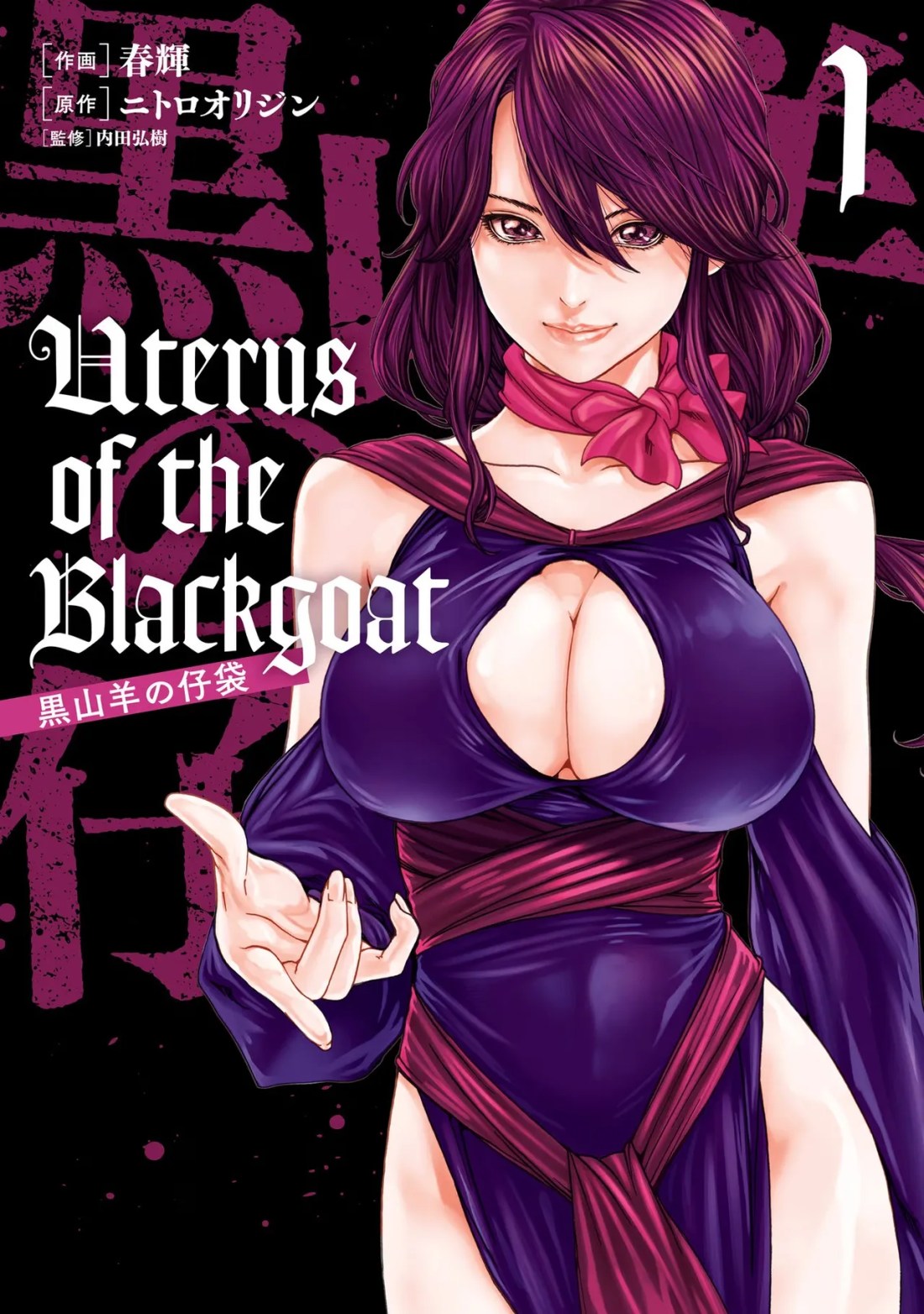
Uterus of the Blackgoat Vol 1.(黒山羊の仔袋 1, 2022) by Haruki (春輝) is a standout in that it very specifically does just that. This historical occult action manga’s prologue opens in Nazi Germany, where Hitler’s disciples are trying to unlock a Lovecraftian artifact with sex magick.
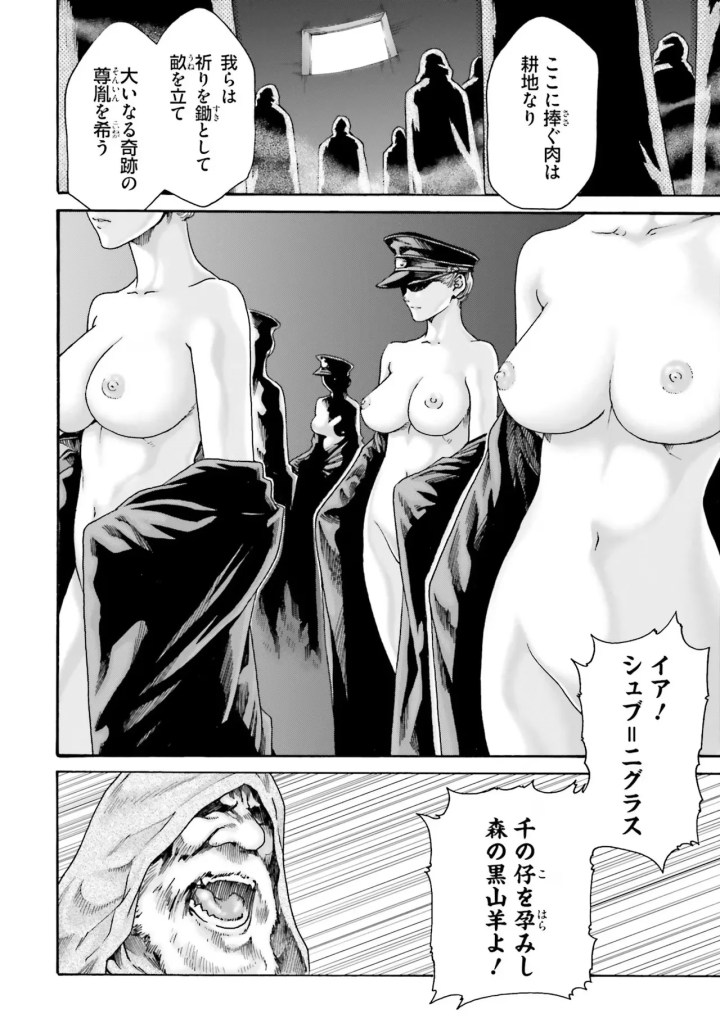
Haruki (春輝) is an established mangaka whose works include the Ero Ninja Scrolls and Parasite Doctor Suzune series. Like all legal erotic works in Japan, the actual genitalia is obscured, often by carefully placed speech bubbles, figure-work, and blurring out the genitals. However, this work is more than “tits and tentacles”; there is a considerable amount of detail given to period dress, architecture, and background to ground the story, including some very effective splash pages that appear to have been referenced from period photographs.

The bulk of the story takes place during the early days of the Cold War, as both the USSR and United States attempt to seize the Nazi’s research into Shub-Niggurath for themselves. At the center of their separate and competing investigations is a former maid, Mia Olbrich, who worked in the house where the rituals took place. Trying to keep both the Americans and the Soviets from getting the information is a woman named Macleod (who may actually be Mata Hari) with supernatural powers, who is also the secret agent codenamed Black Goat.
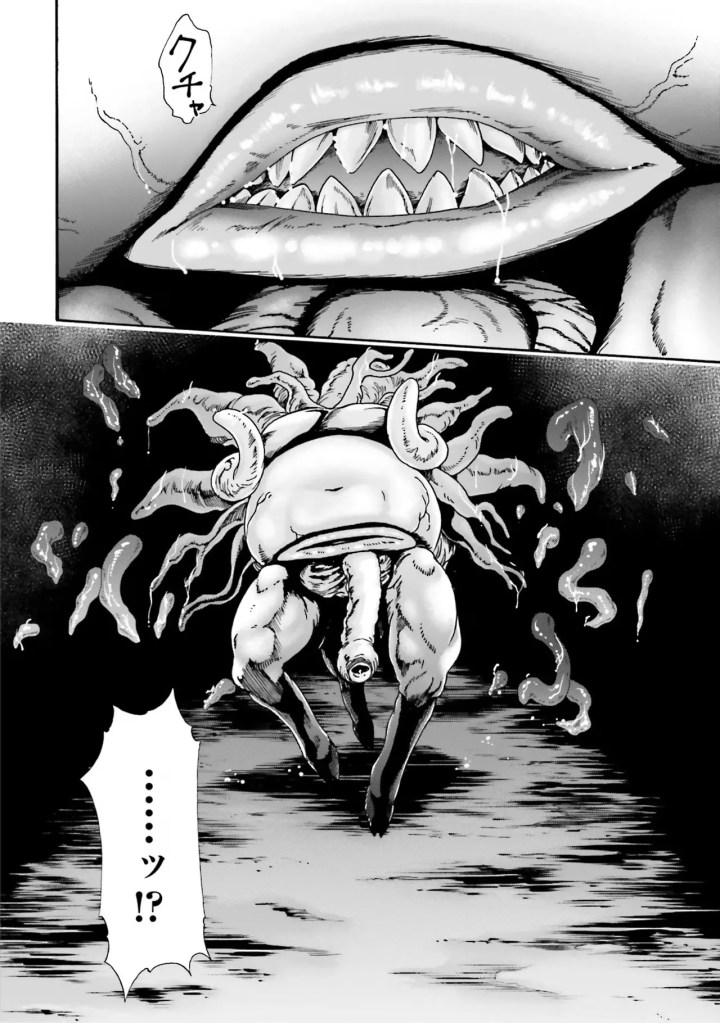
What readers get is thus a three-way struggle involving a lot of sex, some body horror, and Cold War spy shenanigans with some interesting plot twists and revelations (and this only in volume 1, there are 3 volumes in the series). While there are many typical tropes of the eromanga genre (all of the main characters are willowy, busty young women; there’s a sex scene in every chapter, etc.), it is sort of refreshing to see a work that strongly leans into the sexual aspect of Shub-Niggurath in as explicit a means as they can given the limits of the medium. While we don’t get a lot of actual Nazis in this volume after the prologue, the emphasis on sex, sexual violence, and the setting is what draws comparisons to exploitation films; there is a similar aesthetic, the idea that this is a serious story that is being played for titillation as well as action and intrigue.
There are some cosmetic parallels with “The Elder Sister-like One, Vol. 1” (2016) by Pochi Iida (飯田ぽち。) and The Mystery of Lustful Illusion -Cthulhu Pregnant- (2015) by Takayuki Hiyori (宇行 日和); the manga creators are each drawing from similar manga artistic traditions and Lovecraftian stories and roleplaying games, which shows variations on similar themes, less in any plot sense as in similarities between the depictions of Shub-Niggurath, playing with tentacles, etc. However, the emphasis on erotic content in each work is different and distinct and reflects the tone of the stories, with Uterus of the Black Goat aimed more toward erotic horror than the other two.
Uterus of the Black Goat has not yet had an official English translation or release, but Japanese editions are available from various outlets, including Amazon.co.jp and Ebay.
Bobby Derie is the author of Weird Talers: Essays on Robert E. Howard and Others and Sex and the Cthulhu Mythos.
Deep Cuts in a Lovecraftian Vein uses Amazon Associate links. As an Amazon Associate I earn from qualifying purchases.
 Deep Cuts in a Lovecraftian Vein