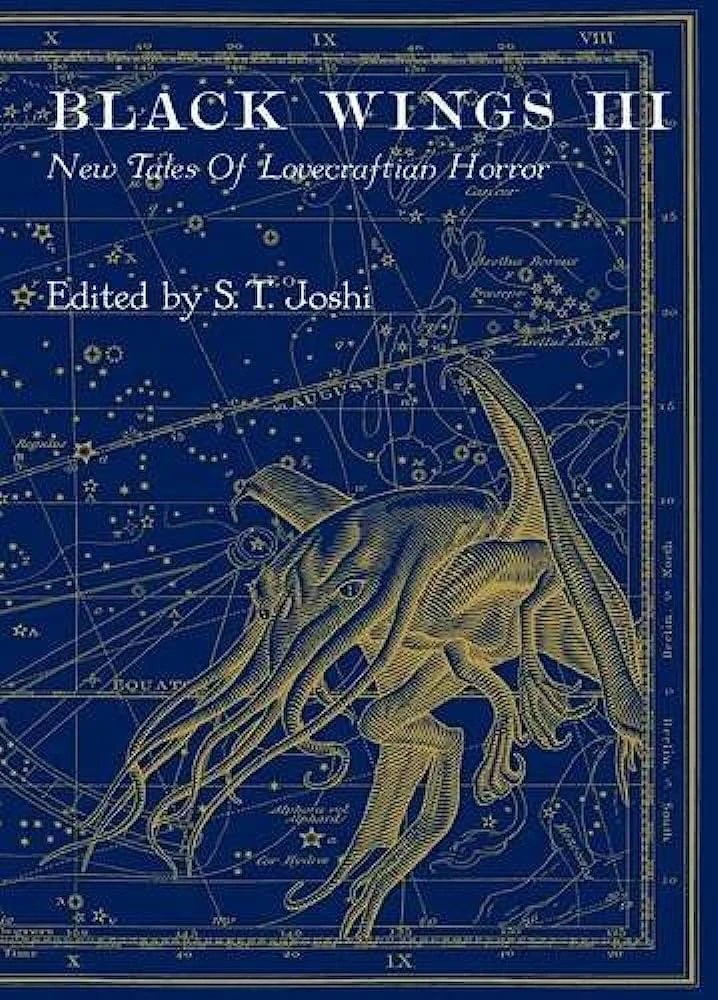
“Under an Arkham Moon” (2014) by Jessica Amanda Salmonson & W. H. Pugmire

(To the memory of Robert Bloch)
—Jessica Amanda Salmonson & W. H. Pugmire, “Under an Arkham Moon” in
Black Wings III (2014) 57

Teratophilia is the love of monsters and the monstrous. This can be love of any sort, the fondness of familiarity or a sibling-like bond of friendship to sexual desire or even some unchangeable, devoted, and obsessive agape. There are many forms of teratophilia on display in this short tale by Salmonson and Pugmire. The love of human oddities, so often misconstrued as monsters; the love of Arkham, that fictional town that is so steeped in evil it corrupts the dreams of those within it; and a hot, burning physical desire for the monster in the attic…but above all, there is the love for that very human monster H. P. Lovecraft, and the story is written in such a way to pay homage to his creations, while taking them a step or three further.

The dedication to the memory of Robert Bloch is a nod to his story “The Mannikin” (WT Apr 1937), and this story shares a character with a similar conjoined twin and a connection to De Vermis Mysteriis, and may owe itself to a certain idea from Lovecraft. The plot is essentially a sequel to Lovecraft’s “The Unnamable” (1925), evident from its references to “The Attic Window” in Whispers (albeit with a nod toward the Indiana Magazine War), and the thing with the blemished eye. However, for the most part this is a story that reveals in the decadent Lovecraftian aesthetic. That really soaks in the sensuous language, the dark atmosphere, the terrible hints and lore.

This was a story written by a pair of monster kids that grew up into adults still in love with a world of dark delights and evil that was something more than the banal of canceling school lunches or denying health care claims to the sick. A story that tells how someone might be drawn back to old haunts to, as Conan the Cimmerian once put it in “The People of the Black Circle”: “like a crippled snake to soak up fresh venom from some source of sorcery.”

Sometimes, we return to Arkham for renewal.

I had returned to Arkham from the “real” world with fewer victories than I expected. I had been defeated, I of noble blood, noble of its kind. I needed Ambrose’s familiariaty, even that part of him that could slip from poetry to venom in a single heartbeat.
—Jessica Amanda Salmonson & W. H. Pugmire, “Under an Arkham Moon” in
Black Wings III (2014) 59

The twist in this story, when teratophilia proves both sexual and reciprocal, is a delicious one of its kind. Lovecraft always left the nature of the Unnamable deliberately ambiguous, and Salmonson & Pugmire have kept it so here. The terrible truth behind Lovecraft’s original story was very different, but this is still a fine sequel. A return to Lovecraft country, a refreshing dip for dark spirits who remember when Lovecraftian fiction was less hung up in the trappings of the Mythos and evoked more of the strange, decadent mood of Lovecraft’s early fiction, when friends scared each other to look into a house haunted by something they could not give a name to.

“Under an Arkham Moon” by Jessica Amanda Salmonson & W. H. Pugmire was first published in Black Wings III (2014); it was reprinted in Pugmire’s collection An Ecstasy of Fear (2019, Centipede Press).

The Terrible Truth Behind The Unnamable

The thing, it was averred, was biologically impossible to start with; merely another of those crazy country mutterings which Cotton Mather had been gullible enough to dump into his chaotic Magnalia Christi Americana, and so poorly authenticated that even he had not ventured to name the locality where the horror occurred. And as to the way I amplified the bare jotting of the old mystic—that was quite impossible, and characteristic of a flighty and notional scribbler! Mather had indeed told of the thing as being born, but nobody but a cheap sensationalist would think of having it grow up, look into people’s windows at night, and be hidden in the attic of a house, in flesh and in spirit, till someone saw it at the window centuries later and couldn’t describe what it was that turned his hair grey.
—H. P. Lovecraft, “The Unnamable”

Lovecraft gets a bit of a ribbing for “unnamable,” “unspeakable,” or “indescribable” critters – which he never had a monopoly on and was never so addicted to as a lot of critics like to think; the story in question in fact begins by making fun of the tendency in stories like Ambrose Bierce’s “The Damned Thing” or Guy de Maupussant’s “The Horla.”

Beyond that though, Lovecraft would take his inspirations where he found them, and this includes the family copy of Cotton Mather’s Magnalia Christi Americana (1702), which purports to be a religious history of New England but manages to cram in so many weird bits and pieces that you’d be amazed—witchcraft narratives, ghost stories, sea monsters, the works. The bit which inspired Lovecraft’s story is a very obscure bit of gossip about a “thing with a blemished eye”:

At the Southward there was a Beaſt, which brought forth a Creature, which might pretend unto ſomething of an Humane Shape. Now the People minded that the Monſter had a Blemiſh in one Eye, much like what a profligate Fellow in the Town was known to have. This Fellow was hereupon examin’d; and having upon his examination, conſeſ’d his inſandous Beſtialities; for which he was deſervedly Executed.
—Mather, MCM Book VI, Chapter V, Tenth Remark

Which was a hard go, the worse so because while Mather names no names, we know what actually inspired the anecdote.

George Spencer, an ugly balding man with one “pearle” or false eye, had probably been whipped in Boston for receiving stolen goods, and had also been punished in New Haven for botching an attempt to escape to Virginia. He admitted that he had gained no spiritual benefit from the ministry of the famed John Davenport, that he had not said a single prayer during his five years in New England, and that he read the Bible only when ordered to do so by his master. In February, 1642, Spencer’s life took a cruel turn when a sow gave birth to a dead deformed piglet. The “monster” was completely bald and had “butt one eye in the midle of the face, and thatt large and open, like some blemished eye of a man.” Out of its forehead “a thing of flesh grew forth and hung downe, itt was hollow, and like a mans instrum’ of genration.”

The magistrates arrested Spencer and put him in prison. New Haven had not yet tried a capital crime. Spencer had seen enough of the colony’s system of justice to know that the magistrates expected offenders to confess and repent. He had recently seen a man merely whipped for molesting a child, and as Spencer made clear, he thought that child molestation was a more disgusting crime than bestiality. Yet he denied his guilt until one magistrate “remembered him of thatt place of scripture, he that hideth his sin shall not prosper, butt he yt confesseth and forsaketh his sins shall finde mercie.” Spencer then “answered he was sory and confessed he had done itt,” only to learn that his confession would get him hanged and that mercy would come only from the Lord, not the Colony of New Haven. He retracted and repeated his confession several times in a desperate attempt to find a formula that would save his life. But on April 8, 1642, two months after the birth of the monster, the sow was put to the sword in front of the unrepentant Spencer, and he was hanged, “a terrible example of divine justice and wrath.”
—John M. Murrin, “‘Things Fearful to Name’: Bestiality in Colonial America”

Lovecraft was no doubt taken by the layers of obfuscation in Mathers’ account, which only really hinted at the appearance of the unfortunate piglet. Stripped of this mystery and romance, we are left with a man who was wrongly accused and ultimately was executed for an accident of nature by an intolerant society of religious fanatics. A much more banal but frighteningly very real moment in history that served as the seed for some very strange stories.


Bobby Derie is the author of Weird Talers: Essays on Robert E. Howard and Others and Sex and the Cthulhu Mythos.

Deep Cuts in a Lovecraftian Vein uses Amazon Associate links. As an Amazon Associate I earn from qualifying purchases.

“Hode of the High Place” (1984) by Jessica Amanda Salmonson

For the first time he recognized that the possession of an object was never as ecstatic as the seeking; the reality never as pleasurable as the dream.
—Jessica Amanda Salmonson, “Hode of the High Place” in The Last Continent 201

There is no pithy word for stories that are inspired by Clark Ashton Smith, that partake of his style and essence, are reminiscent of his darker moods and most erotic intimations. When someone writes a tale that draws inspiration from H. P. Lovecraft, or involves him in some form, we call it “Lovecraftian.” For the Bard of Auburn, we might say “Smithian,” but there are many Smiths. “Klarkash-Tonian” is a bit of a mouthful. Nothing seems to succinctly embrace the whole concept.

It is a rare story where we have need of such a word.

“Hode of the High Place” is not set explicitly in Smith’s Zothique, or any other fantasy world we know. In mood, in device, in tone, it could well be. It fits neatly among the other neo-Zothique tales of The Last Continent: New Tales of Zothique (1999), one of the very few anthologies where authors are encouraged to play in Clark Ashton Smith’s imaginary worlds. Smith himself might well have smiled and recognized this story as a literary descendant, had he lived long enough to read it.

When considering those who follow Smith, there is a tendency toward pastiche, as in “The Vulviflora of Vuutsavek” (2008) by Charlotte Alchemilla Smythe. Salmonson is wise enough to not try and mimic the same tendency for arcane vocabulary, but there are elements of Smith that readers will recognize in the tone, the omniscient third-person perspective which is almost voyeuristic in following the triumphs and tragedies of this story. Then there is the erotic element.

A gelatinous mass flowed over him, oblivious to his thrashing, smothering him as the water had smothered the flames. Then he felt something expected and pleasant: gentle, rhythmic constrictions around his genitals.
—Jessica Amanda Salmonson, “Hode of the High Place” in The Last Continent 197

One of the hallmarks of Smith’s fiction was a fascination with scenes of unnatural carnal pleasures, necrophilia (or perhaps more accurately, a love that extends beyond death), assignations with witches, lamia, and succubi, etc. It isn’t in every work, and it isn’t in any sense explicit by contemporary terms, even his play The Dead Will Cuckold You (1951) is concerned with character and relationships rather than actually describing the actions of genitalia. Some of Smith’s stories which could only be published in expurgated form during his lifetime, such as “Mother of Toads” (Weird Tales Jul 1938), are quaint in terms of actual sexual content, though still potent in terms of image, plot, and suggestion.

This reticence toward explicit sexual description in Smith’s fiction, and his frustration with the standards of his day that censored even that, can be easily understood. Clark Ashton Smith was writing weird fiction of which sex was a part, but not weird erotica or pornography with a weird setting. The point of Smith’s stories was not to sexually excite the reader, not in the way of Victorian erotica like The Way of a Man With A Maid. The erotic element was always intimately tied to the weirdness in some fashion, as with the work of Arthur Machen. Perhaps Smith might have been more explicit if editors and laws had allowed it, but there was no way it could have been published in the 1930s under existing censorship laws.

Contemporary writers don’t operate under the same restrictions. It is much more acceptable these days to be much more explicit about sexual relations. Salmonson could no doubt have gotten away with far more sexual content in this story; other tales are more explicit. Yet this is not a case where the point is to titillate the reader; it is a necessary plot point for the story. Ultimately, I would say that “Hode of the High Place” shows admirable restraint, getting just explicit enough to cross that conceptual line between “suitable for young adults” to “suitable for adult audiences,” but not becoming particularly lurid or distracting from the rest of the story…indeed, the brief sexual scenes are ultimately critical.

It was fashioned in the shape of a bone with a serpent wrapped around, the universal insignia used on jars of poison, pictured on no-trespassing signs to prove the warning adamant, and marked on maps to show where wayfarers had best not go.
—Jessica Amanda Salmonson, “Hode of the High Place” in The Last Continent 206

If “Hode of the High Place” is not set in Zothique itself, it still feels like it could be set beneath a dying sun on a dying world, one last tragedy being acted out with all of its follies and its terrible inevitability.

Jessica Amanda Salmonson’s “Hode of the High Place” was first published in Beyond Lands of Never (1984), the second volume of the fantasy Lands of Never (1983). It was republished in The Last Continent: New Tales of Zothique (1999), and in her collection Dark Tales (2002).


Bobby Derie is the author of Weird Talers: Essays on Robert E. Howard & Others (2019) and Sex and the Cthulhu Mythos (2014).

“Pale, Trembling Youth” (1986) by W. H. Pugmire & Jessica Amanda Salmonson

Dykes, kikes, spics, micks, fags, drags, gooks, spooks…more of us are outsiders than aren’t, and that’s what the dear young ones too often fail to understand.
—W. H. Pugmire & Jessica Amanda Salmonson, “Pale, Trembling Youth”
in An Imp of Aether 173

This brief story could be a memory—and probably it is, several memories, all bundled up together. Pugmire & Salmonson had history like that. Punks. Not pop-punk, queercore, or Riot Grrrl, but the older, original punk rock, the substratum on which the newer sounds and aesthetics and even politics are built. Patti Smith and William S. Burroughs. The same visceral rebellion that John Shirley would pay tribute to in A Song Called Youth trilogy (1985-1990), the same energy and themes that would show up in the early cyberpunk fiction of Pat Cardigan, Bruce Sterling, and William Gibson. Writers whose vision of the future would give inspiration to Cthulhupunk works like “Star Bright, Star Byte” (1994) by Marella Sands.

“Pale, Trembling Youth” isn’t Cthulhupunk. There’s nothing of the Mythos in its few pages, no dark cults or alien entities. It is a spiritual by-blow, the kind of story that feels like it should have inspired something. Reminiscent of “Beckoner of the Nightwatch” (1989) by Jessica Amanda Salmonson and Pugmire’s editorial vision on Tales of Lovecraftian Horror. There’s Lovecraft in the literary DNA, but not the part of Lovecraft enshrined in pop media as Cthulhu and the Necronomicon.

It’s “The Outsider.”

Unhappy is he to whom the memories of childhood bring only fear and sadness. Wretched is he who looks back upon lone hours in vast and dismal chambers with brown hangings and maddening rows of antique books, or upon awed watches in twilight groves of grotesque, gigantic, and vine-encumbered trees that silently wave twisted branches far aloft. Such a lot the gods gave to me—to me, the dazed, the disappointed; the barren, the broken.
—H. P. Lovecraft, “The Outsider”

Lovecraft’s universe is amoral, mechanistic, often antagonistic to human life. Yet it is not without empathy, nor is it incapable of inspiring sympathy. Wilbur Whateley was recast as a sympathetic figure in stories like Stanley C. Sargent’s “The Black Brat of Dunwich” (1997) and Robert M. Price’s “Wilbur Whateley Waiting” (1987). The sympathetic view of the Innsmouth residents is at the heart of “The Litany of Earth” (2014) by Ruthanna Emrys and “All Our Salt-Bottled Hearts” (2016) by Sonya Taaffe.

At it’s heart, there is horror in “Pale, Trembling Youth”—but not quite eldritch horror. The real, visceral, street-level horrors of kids burning bright, ignorant of history but starkly brilliant, the stars that flare twice as bright and half so long—runaways tired of getting beaten by their parents, living rough on the street, burning the candle at both ends with speed, finding beauty in noise, seeking and finding their own self-destruction. Nameless kids dying sad deaths far too young.

So there’s nothing new. Least of all pain. It’s the oldest thing around. I want to tell them, “Yes, you’re outsiders. Yes, this thing you’re feeling really is pain. But you’re not alone.” Or not alone in being alone. A poison-bad planet. For everyone.
—W. H. Pugmire & Jessica Amanda Salmonson, “Pale, Trembling Youth”
in An Imp of Aether 174

The narrator is nameless. The place is real, in Seattle. You can go and visit the park, see the pipes. There is a very Lovecraftian construction to the story, though a sneaky one. A chance meeting, a tale that Zadok Allen might have told for a bottle, but offered for free. Sudden impulse driving the narrator on…and after that…maybe a touch of M. R. James. Mythos? No. Lovecraftian? Absolutely.

“Pale, Trembling Youth” was first published in Cutting Edge (1986); it has been reprinted many times, most recently in the collection An Imp of Aether (2019).


Bobby Derie is the author of Weird Talers: Essays on Robert E. Howard & Others (2019) and Sex and the Cthulhu Mythos (2014).

“Beckoner of the Nightwatch” (1989) by Jessica Amanda Salmonson

To the many authors who fired my sense of wonder as a child, and to the anthologists who drew my youthful attention to the best stories of the time. These people, some living, some gone, are cumulatively responsible for those stories of mine that I call “little horrors,” the kind mainly selected for the present collection. A handful of these people are named in dedications for individual stories.
—dedication in John Collier and Fredric Brown Went Quarrelling Through My Head

for H. P. Lovecraft and Robert Bloch
—dedication to “Beckoner of the Nightwatch” (ibid. 103)

Jessica Amanda Salmonson gives the date that “Beckoner of the Nightwatch” was given as 1974. She was 24 years old then, editor of The Literary Magazine of Fantasy and Terror, and coming out as transgender—one of the first fans to do so—and continued on to a long career as writer, poet, editor, and anthologist.

“Beckoner” was either only published once, fifteen years after it was written, or it was published the first time in 1974 in a ‘zine so scarce as to have been missed by catalogers, and then again for the final time in 1989. Such things happen; not every story finds a home or an audience the year it is written. It is a slight tale; at three-and-a-half pages it definitely counts as a “short-short,” and despite the dedication the story has no overt connections to the Mythos that might otherwise have guaranteed it a slot in innumerable anthologies.

Which is rather interesting in itself. What is it about this story, so brief and yet complete in itself, that speaks to Salmonson—and to readers—of Bloch and Lovecraft? Those names together bring to mind their quasi-collaboration “Satan’s Servants” (1949), their triptych of Mythos stories “The Suicide in the Study” (1935), “The Shambler from the Stars” (1935), and “The Haunter of the Dark” (1936). Yet “Beckoner” doesn’t quite suggest those.

It is reminiscent of, if anything, Lovecraft’s “The Unnamable” or “The Picture in the House”, or Bloch’s “The Unspeakable Betrothal” (1949). “Little horror” is as good a descriptor as any; the scene is set and the action begins not someplace and time long ago and far away, but in the now, right here. The kind of horror that can find you at work, or in the apartment building, when it’s dark and you’re alone; where your own imagination may be playing tricks at you as something moves in the dark and you fill in the details of what might cause those sounds.

Yet this isn’t a sedate M. R. James ghost story. The horror, when it appears on the page at last, stepping into the light of a flashlight, beckoning for the protagonist to follow, blood oozing from the bullet holes in its belly…is real. Some solid, physical thing. A real horror, however uncanny. That was the transition, the hand-off from Lovecraft to Bloch in many ways. It wasn’t all clanking chains and bloody bones, horror could be, had to be both of the mind and have a physical existence outside of it; had to both repel and attract us. Perhaps that’s what Salmonson was trying to capture here. Because at the end, we still don’t know what the Beckoner was trying to beckon us to.

[…] intent rather than length is what define’s “little.” In my earlier collection of little horrors, HAG’S TAPESTRY published in England, I called them cyanide-laced candies in a chocolate sampler, as opposed to a condemned man’s final banquet. Hardly earth-shaking in importance, but entertaining. Although I admit to numerous influences or inspirations, I trust the end result is strictly my own.
—Author’s notes in John Collier and Fredric Brown Went Quarrelling Through My Head

In “The Picture in the House,” Lovecraft famously began: “Searchers after horror haunt strange, far places.” Yet his point was that there were plenty of horrors right at home, if you cared to look. In 1984, Salmonson wrote a poem titled “Searchers After Horror (Paraphrasing Lovecraft),” which serves as the proem to this book, which begins:

We searchers after horror haunt strange, far places:

We. There’s a sense of community among horror readers. An affection for old familiar horrors, the thrill of the chase in hunting down obscure books and films, a recognition of that inexplicable drive that sets us apart to look for and experience the ghastly, the morbid, the dark and grotesque…yet it is also the same sense of community that lets us delight in the Addams Family, The Nightmare Before Christmas, Gahan Wilson, Warren Magazines and Famous Monsters of Filmland, Mike Mignola and Eric Powell and Steve Niles.

Not every horror story has to be epic in scale. Cthulhu need not rise from the depths every story, the zombies need not overrun the world in every episode. If they did, then the shock and awe and grandeur of those horrors gets lost; one of those things Neil Gaiman hinted at in Only the End of the World Again. In this sense, little horrors are necessary for we searchers after horror.

Jessica Amanda Salmonson’s “The Beckoner of the Nightwatch” was published in John Collier and Fredric Brown Went Quarrelling Through My Head (1989). It has not been republished.


Bobby Derie is the author of Weird Talers: Essays on Robert E. Howard & Others (2019) and Sex and the Cthulhu Mythos (2014).