Comic books arose during the peak of the pulp magazine era, and commonly shared writers, artists, and sometimes publishers. Given the crossover in creative talents, it is no surprise that several ideas and sometimes entire stories were lifted from the pages of Weird Tales and other pulps to appear in the pre-Code horror comics. Many of these stories were produced basically anonymously, with little or no credit given to the writers or artists involved, which makes it more difficult to determine who did what, or whether a particular idea was borrowed, stolen, or just carried over by a creator from one project to another.
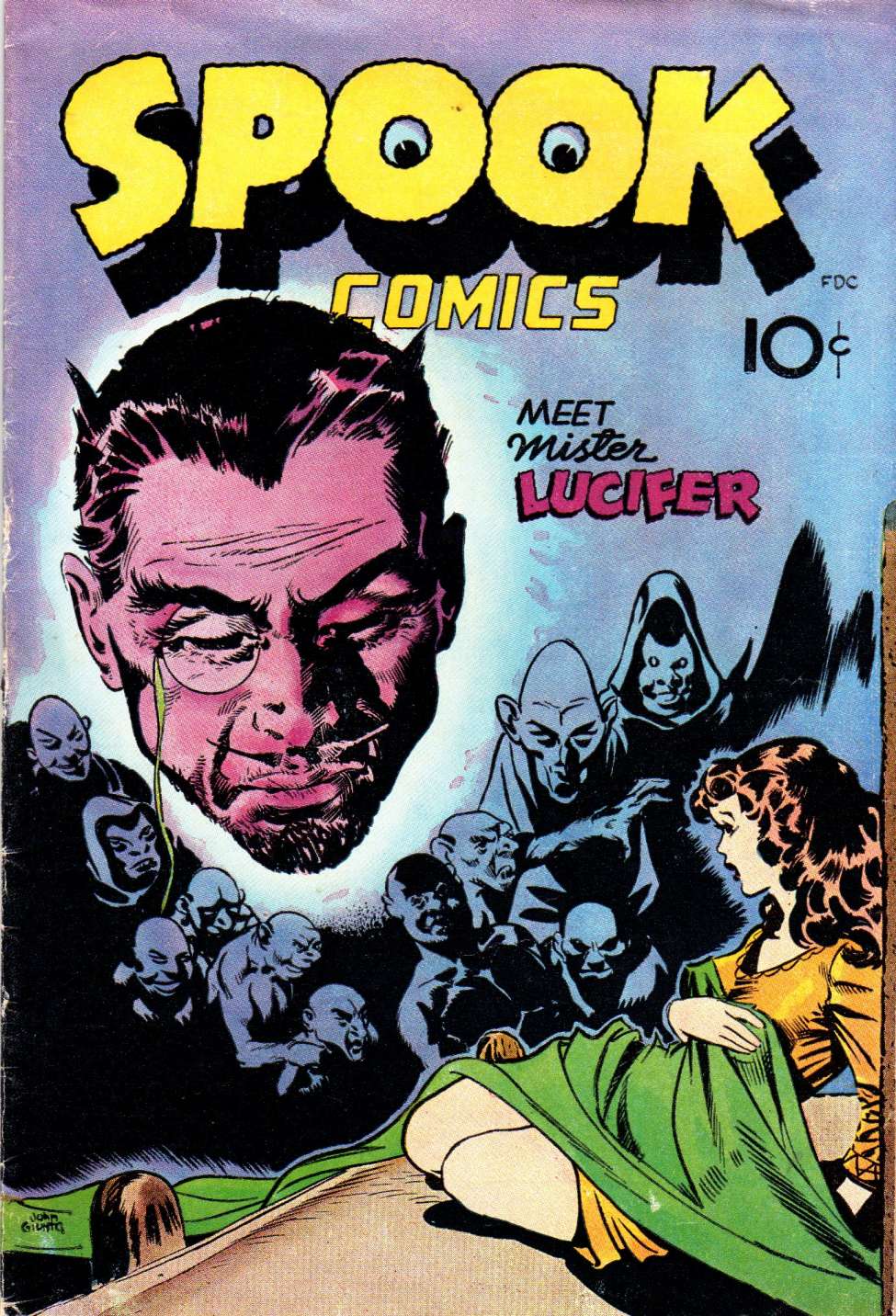
This is the case for “The Obi Makes Jumbee,” an 8-page story that first appeared in Spook Comics, a one-shot horror comic from Baily. Though not dated, the issue is thought to be published in 1945 or 1946 (in one panel, a character reads a newspaper with the date December 1945). No writer is credited. The Grand Comics Database says the art is credited to Robert Baldwin (I can’t find a signature on any of the pages, so I’m not sure where that came from), but also claims the art was actually done by Munson Paddock. Based solely on the art style, I lean toward Paddock. Since Paddock is only known to have worked with Baily in 1945, that would support that date.
The one thing we can say about the script is that it probably came from a Weird Tales fan.
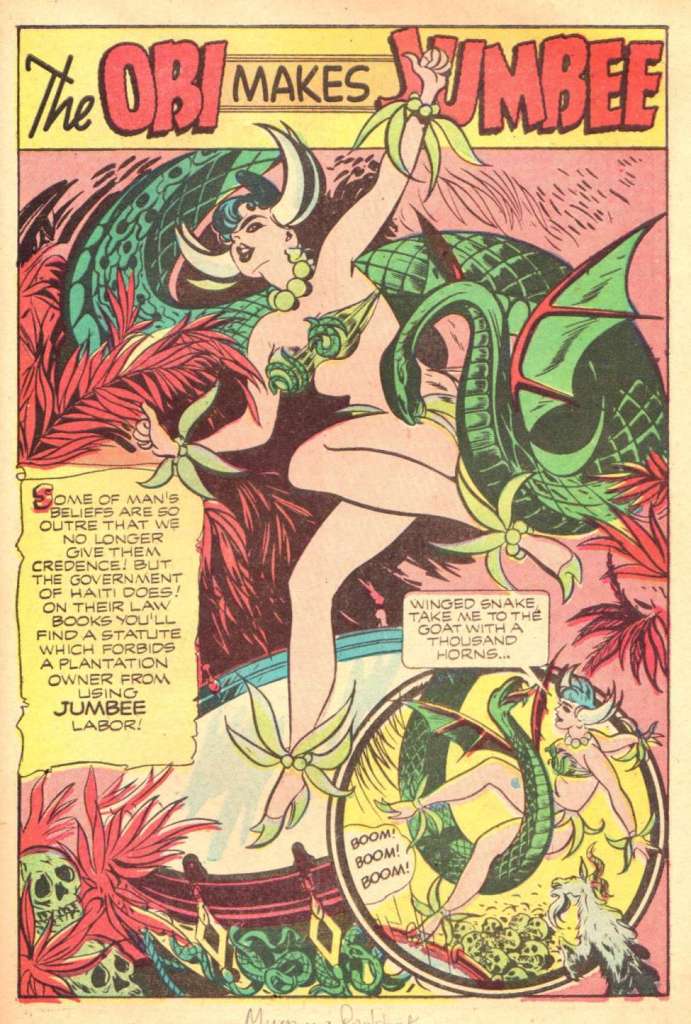
Spook Comics, p27
The U.S. invasion and occupation of Cuba (1906-1909, 1917), Haiti (1915-1934) and the Dominican Republic (1916-1924), and the purchase of the Danish Virgin Islands in 1917, brought more and more of the Caribbean into their sphere of influence. So too, more U.S. citizens gained contact with the island cultures, which differed radically from the hard racial limits of Jim Crow. More tantalizing to many would-be anthropologists or tourists were the syncretic African diaspora religions on these tropic isles—remnants of African indigenous religions, often hybridized and combined with elements of Roman Catholicism.
In the 1930s, zombies and Haitian Vodou were popularized in the United States through William Seabrook’s The Magic Island (1929), and works that were inspired by it like the film White Zombie (1931). Seabrook wasn’t the first to write about Vodou or Vodoun; novels like The Goat Without Horns (1925) by Beale Davis, but it was Seabrook who captured the imagination of a generation of writers, whose zombie stories trickled into first pulps and then comic books. H. P. Lovecraft read Seabrook, as did Seabury Quinn, August Derleth, and many others. While far from the only source of data on African diaspora religions—Zora Neale Hurston would write Tell My Horse (1938) and other works, to name one—Seabrook was the most sensational and popular, and his version of Haitian Vodou made a lasting impression on “voodoo” as it appeared in pulps, comics, and film.
“Jumbee” however, is something a bit different. As a category of supernatural being, jumbee is most often associated with the folklore and African diaspora religion (“Obi”) of the Virgin Islands, and Jumbee tales were told by a substantially smaller group of authors—especially Henry St. Clair Whitehead, H. P. Lovecraft’s friend, correspondent, and fellow Weird Tales writer. Although Whitehead died in 1932, in 1944 Arkham House published his first collection of supernatural fiction: Jumbee and Other Uncanny Tales. A follow-up collection, West India Lights (1946) includes Whitehead’s non-fiction article “Obi in the Caribbean.” Given how scarce Jumbee stories are in comics (“The Obi Makes Jumbee” is the only comic story with that word in the title on the Grand Comics Database), it seems likely the author of that comic script had to have read Whitehead.
They knew enough to differentiate Jumbee from zombies, Obi from Vodou. Yet they make what seems to be an odd mistake or artistic license. “The goat without horns” is a term used for human sacrifice in some works that discuss Haitian vodou. Seabrook didn’t originate the term, though he helped popularize it, and in his book he quotes from the March 1917 Museum Journal of the University of Pennsylvania, Philadelphia:
In Hayti the basis of Voodooism is the frank worship of a sacred green snake that must be propitiated to keep off the evil spirits. The meetings of the cult are held at night about bonfires in secret places in the forests. The presiding official is an old man “papaloi,” or woman “mamaloi” who has gained renown as a Voodoo sorcerer. After assembling, all present take an oath of secrecy and then the priest exhorts them to remember the sacred green snake, and to hate the whites. Prayer is offered to the divine serpent that is supposed to be present in a box placed near the fire. Then follows the sacrifice of a cock which the “papaloi” kills by biting off its head. With a great deal of drumming and incantation the blood is smeared over the faces of the worshipers and drunk by the officiating priest. A goat may be sacrificed with similar ceremony. After the goat there might be a human sacrifice, as was reported by a French priest. He said that it was the wish of some of the devotees that “a goat without horns,” that is a child, be sacrificed. This was done and the flesh, raw or partly cooked, was eaten by the members of the cult.
Readers familiar with blood libel will recognize the familiar tropes at work; similar accusations were made against witchcraft and against many non-Christian religions. For a horror comic dealing with Hollywood-style voodoo in the 1940s, a human sacrifice wouldn’t be unusual—but the odd thing is that the writer doesn’t use “the goat without horns.” Instead, the mamaloi dancer Caresse invokes “The Goat with a Thousand Horns.”
There’s no such figure in Seabrook’s book, or any other text or story on Vodou (and, in context, it is being used as another appellation for Damballah). But it is awfully close to the epithet of “the Black Goat of the Woods with a Thousand Young” associated with Shub-Niggurath in H. P. Lovecraft stories like “The Whisperer in Darkness” and “The Dreams in the Witch-House.” Is that a sub rosa reference to Lovecraft? Maybe. Certainly, it’s not the only oddity in the tale.
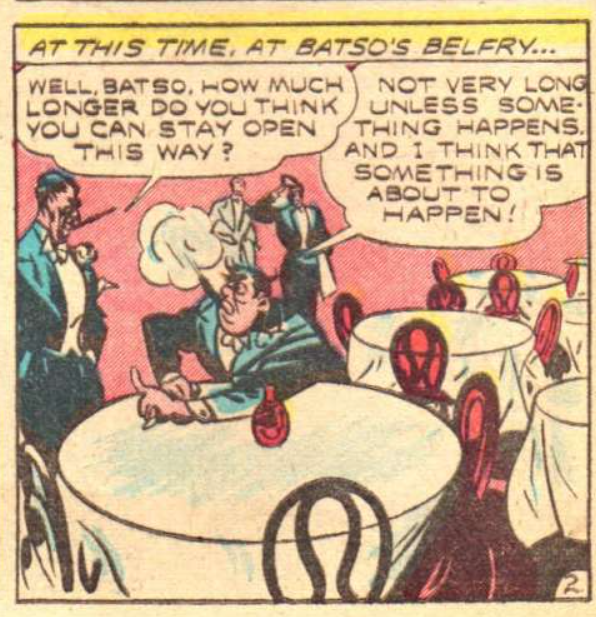
For example, the rival club is called the Belfry, and is owned by Batso…Batso’s Belfry… “Bat’s Belfry” (1926) by August Derleth. Coincidence? Or an Easter egg for Weird Tales readers?
Spook Comics, p28
The basic idea of the narrative seems to borrow very heavily from the beginning of Manly Wade Wellman’s “The Third Cry to Legba” (Weird Tales Nov 1943), where a new voodoo-themed club has a dancer (Illyria) that provides authentic Haitian dances for the clientele. In Wellman’s story, this is a plot by the evil magician Rowley Thorne to start a new cult, and he is thwarted by occult detective John Thunstone.
Interestingly, Wellman was inspired by real life, as he mentioned in ‘The Eyrie‘:
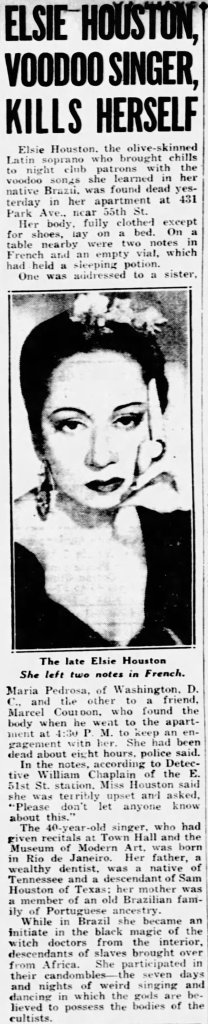
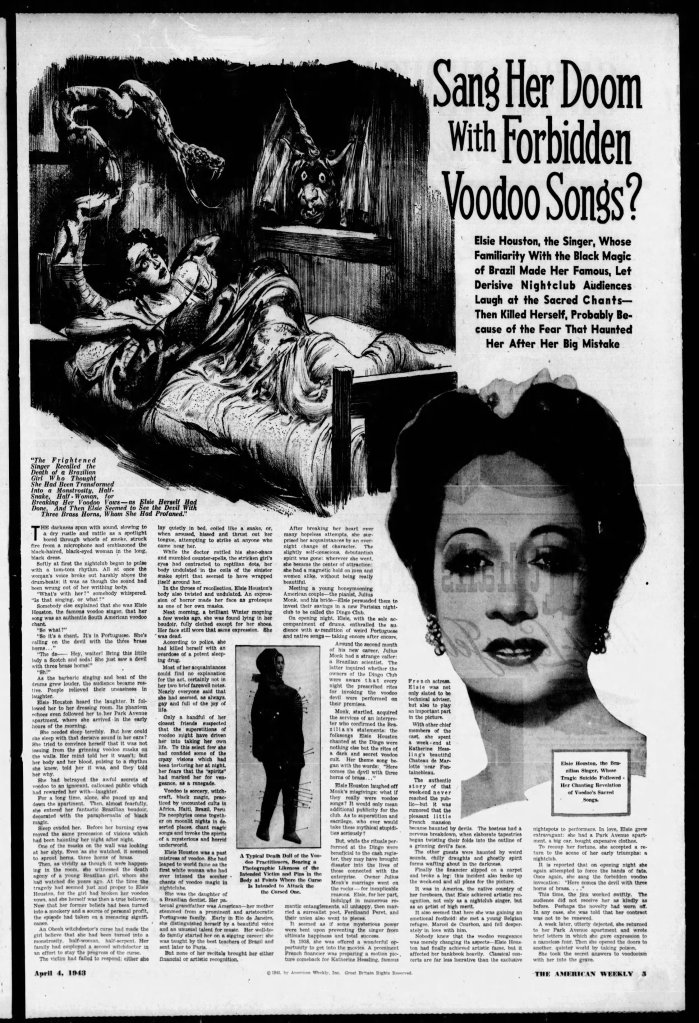
It is a fact that something appeared recently in New York newspapers that might be the public version of THE THIRD CRY TO LEGBA. Some may remember an account of how a certain singer chanted black magic songs and attracted big audiences, including at least one attentive being that she must have wished would stay away. We can’t check on that now, for the singer is untimely dead.
Wellman was probably referring to the case of Elsie Houston:
Ironically, the Brazilian singer was apparently claiming initiation in another African diaspora religion, Candomblé. To the general public of the United States of America, ignorant of the differences, it was all “voodoo” in their eyes. The Daily News article is actually fairly restrained; the American Weekly gave Houston an entire page to herself.
While the Weird Tales connections (real or apparent) are fun, “The Obi Makes Jumbee” also has a bit more plot than you might expect for a mere eight pages. The setup has readers expecting a zombie yarn—and they get gangsters, a fake death, a doublecross, a fake zombie, double murder, and then at the end—it’s all true. Which is as neat a bit of storytelling as you can expect. I might almost believe Wellman wrote it himself; he did a good bit of comic book scripting. Unless we find evidence to prove that, however, that remains speculative.
I come from Des Moines. Somebody had to. —Bill Bryson, The Lost Continent
Lovecraft country is often associated with New England, because that’s where Lovecraft set many of his most famous stories. Arkham, Dunwich, and Innsmouth are in the fictional Miskatonic River valley of a fantasy version of Essex County of Massachusetts. Yet Lovecraft country was never restricted to the Bay State.
The fictional stomping-grounds of the Old Ones encompassed the Oklahoma frontier of “The Curse of Yig” (1929) and “The Mound” (1940); the French provence of Averoigne in Clark Ashton Smith’s tales; the ancient town of Stregoicavar in Hungary in Robert E. Howard’s “The Black Stone” (1931). Other writers have staked out and developed their own corners of Lovecraft country: the Severn Valley in Ramsey Campbell’s tales, with Goatswood and Brichester; the Sesqua Valley in the Pacific Northwest by W. H. Pugmire; and any other of other additions, popular and obscure, by writers professional and amateur.
Yet this might be a first. Niceville USA meets Shub-Niggurath.
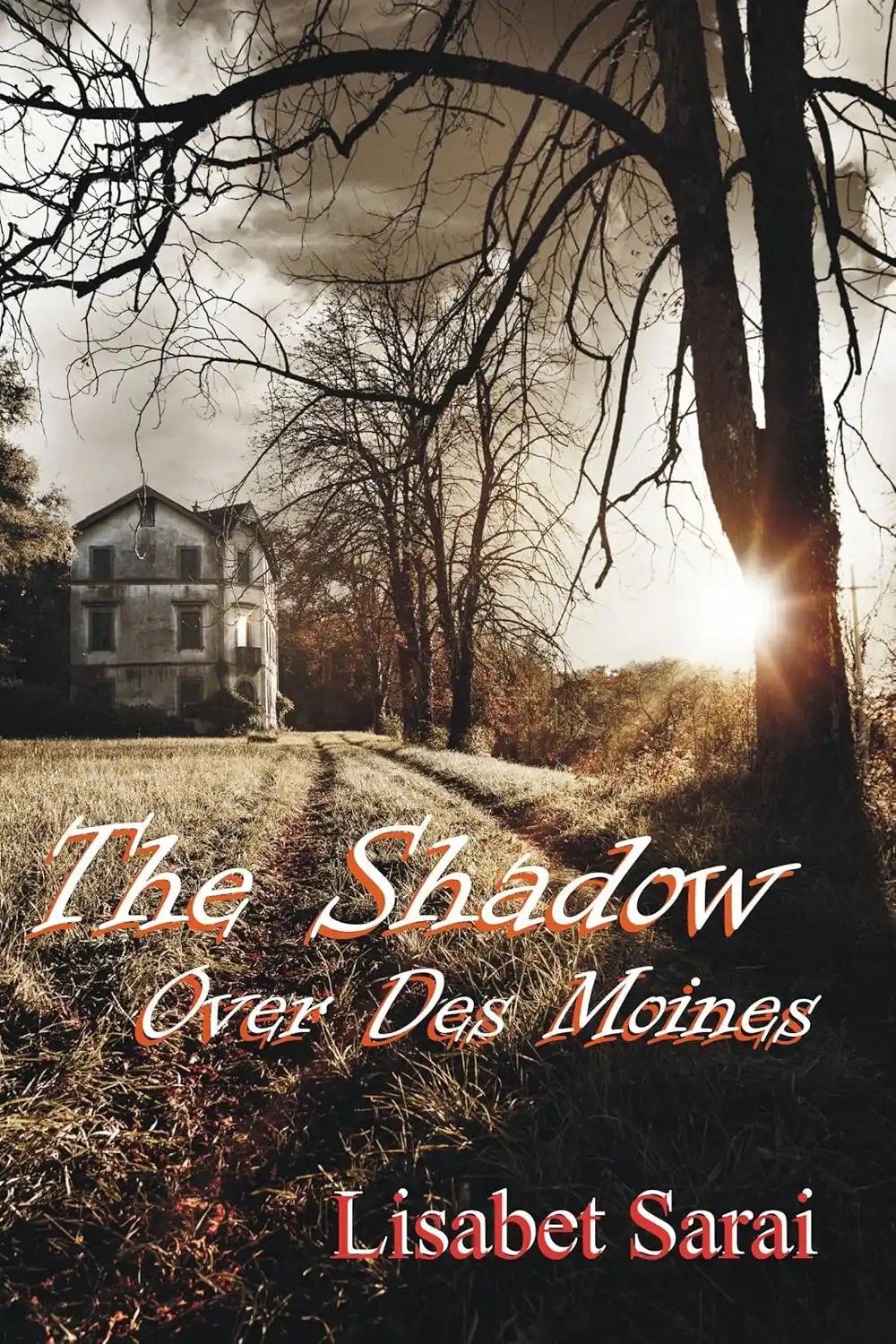
The Shadow over Des Moines is a parody written in the style of the great pulp horror author H.P. Lovecraft. if you are not familiar with his work, you are missing a treat. He’s perfect for Halloween. Check out The Dunwich Horror, At the Mountains of Madness or The Shadow over Innsmouth. I am not ashamed to say that Lovecraft has had a singificant influence on my own writing. —Lisabet Sarai, “The Shadow over Des Moines”
Two of the elements that make parody work are juxtaposition and exaggeration. The Lovecraftian parodist doesn’t just copy the most obvious or characteristic elements of Lovecraft’s prose, they often enhance them to the point of ridiculousness. Made all the more obvious by contrasting the Lovecraftian aesthetic with an area of the country least associated with anything eldritch.
The surprising thing is, it doesn’t come off badly. The prose is a little purple, but the Midwestern setting itself isn’t exaggerated. It’s more like a Lovecraftian protagonist moved into a suburb than an attempt to reveal the hidden horrors of home-made blueberry pie and calf-length skirts. The humor and horror of the story don’t come at the expensive of the innocent metropolis of Des Moines, but in the quirky Lovecraftian excess of the protagonist—and the fact that this is an erotic parody.
Leonora encouraged me to drop by and visit anytime, but I doubted that I would act on her suggestion. Shivers ran down my spine as a I watched her swaying hips retreat down my path and across the street to her own dwelling. Nevertheless, I found my body reacted to her as if I were fifteen instead of fifty four. I found it necessary to spend a quarter of an hour reading Popular Mechanics before my tumescence subsided. —Lisabet Sarai, “The Shadow over Des Moines”
The outlines of the story are familiar; basically Fright Night with a sexy Lovecraftian twist and trappings. The fact that so much of it is played straight-faced makes the occasional play on words all the more effective (“Mrs. Gratsky’s gate swung silenly open, as if well-lubricated.”) If it leans a little too hard into some of the stereotypes of Lovecraftian pastiche, it also works to deliver a carefully-curated erotic aesthetic that balances vivid description with an older, quainter verbiage. The end result is as absurd as it is utterly appropriate. Where else but in such a story as this will you get such turns of phrase as “unhallowed anus?”
Like most erotic Lovecraftian ebook fare, things wrap up fairly swiftly after the climax. The pacing is set up for this single encounter, not a longer series of repetitive erotic adventures a la the Booty Call of Cthulhu series. Yet this is a very competent, self-contained example of this mode of fiction. If I had any suggestion for a sequel, it would be to make more use of Des Moines itself; it feels like there was room to make more use of this most un-Lovecraftian addition to Lovecraft country.
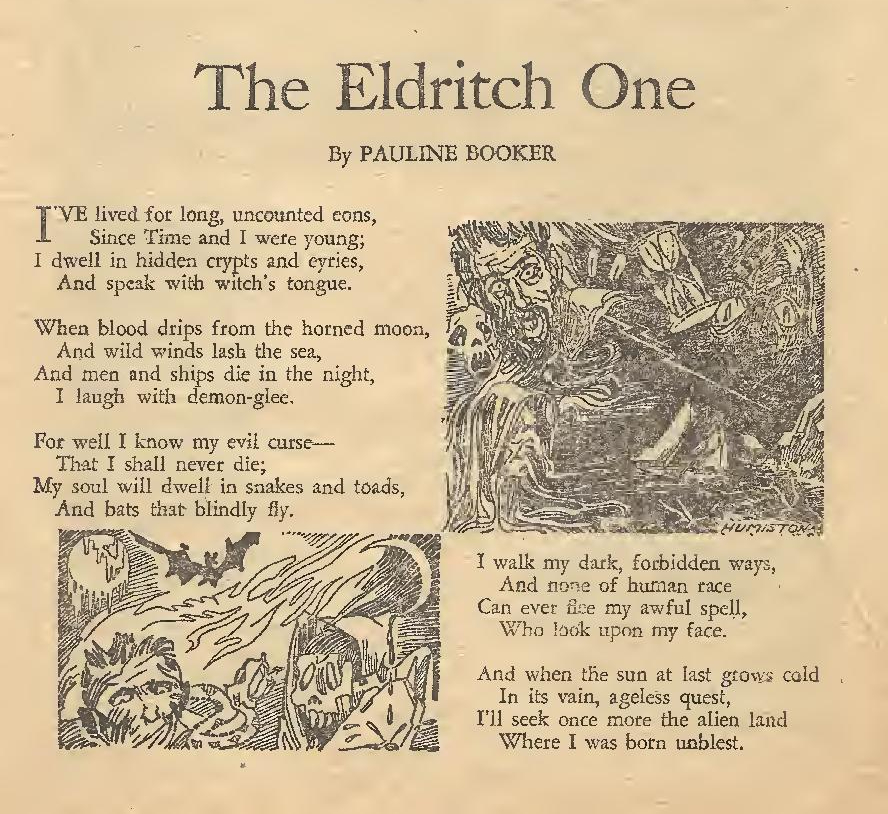
I’ve lived for long, uncounted eons Since Time and I were young; I dwell in hidden crypts and eyries, And speak with witch’s tongue.
When blood drips from the horned moon, And wild winds lash the sea, And men and ships die in the night, I laugh with demon-glee.
For well I know my evil curse— That I shall never die; My soul will dwell with snakes and toads, and bats that blindly fly.
I walk my dark, forbidden ways, And none of human race Can ever flee my awful spell, Who look upon my face.
And when the sun at last grows cold In its vain, ageless quest, I’ll seek once more the alien land Where I was born unblest. —Pauline Booker, “The Eldritch One”
※
Pauline Booker was a pulp poet during the 1940s and 50s with a long list of verse published in magazines like All-Story Love, Love Book Magazine, Max Brand’s Western Magazine, New Love Magazine, Rangeland Romances, Romance Western, Sweetheart Love Stories, Star Western—and three poems in Weird Tales. Of her life and broader career, practically nothing is known. All we can say for certain is that she had her finger on the pulse of weird fiction, at least a little.
H. P. Lovecraft did not coin the word “eldritch”—did not even use it in the majority of his stories, and only once or most twice in any given story (although he did use it three times in “Supernatural Horror in Literature.”) Yet it is a keyword that has become associated with Lovecraft and his mode of fiction as surely as “cosmic horror,” “squamous,” “non-Euclidean,” or “tentacle.” Eldritch has become part of the vocabulary of cosmic horror, used and abused with love and affection by all manner of writers.
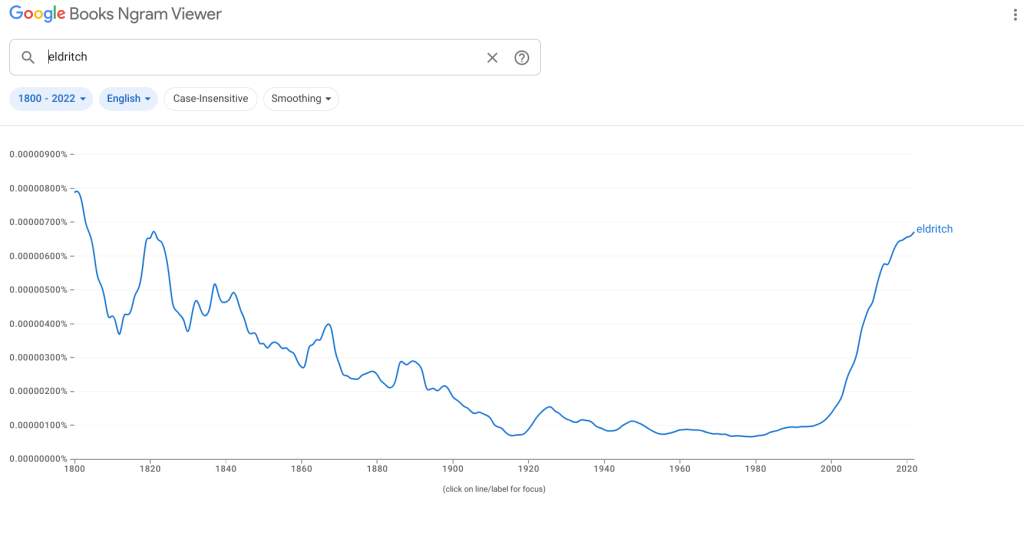
When did that transition happen? Google’s n-gram viewer is a handy snapshot for a word’s use, and the word was decreasing in frequency, almost at the nadir of its use until the 1910s—and forms a little peak around the time when Weird Tales began to be published in 1923. Is the recent spike in usage all down to Lovecraft and the fiction he inspired? Maybe. Andrew Eldritch, lead singer of Sisters of Mercy, and Philip K. Dick’s The Three Stigmata of Palmer Eldritch (1964) probably also contributes to the trend. Yet Pauline Booker was writing during a period when “eldritch” was on the decline again, at least outside of Mythos pastiches.
Yet how many fans of Lovecraft and weird fiction would not have caught her meaning, just from the title?
While it is tempting to try and connect “The Eldritch One” to some specific inspiration from Lovecraft, the imagery of the poem is rather traditional, combining favorite elements from Weird Tales, and not anything specific to one of Lovecraft’s stranger horrors. There are hints of witchcraft, of gorgons, immortality or the undead. A miscellany of horror, a real witch’s brew of familiar elements, but nothing concrete. Yet in its own way, as with all good poetry, it is timeless, as relevant and enjoyable to horror fans now as it was then.
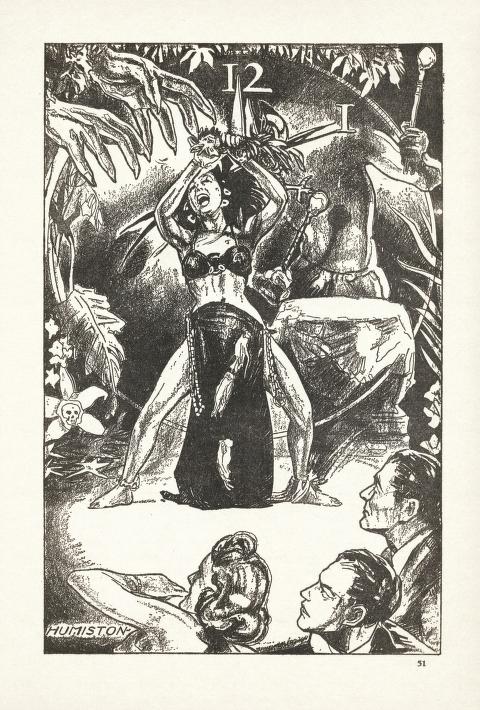
Weird Tales May 1948 (art by Fred Humiston)
“The Eldritch One” was published in Weird Tales May 1948. It has not been reprinted.
This review deals with a work of art that includes nudity. As part of this review, selected images with nudity will be displayed. As such, please be advised before reading further.
It was many and many a year ago, In a kingdom by the sea, That a maiden there lived whom you may know By the name of Annabel Lee; And this maiden she lived with no other thought Than to love and be loved by me. —Edgar Allan Poe, “Annabel Lee” (1849)
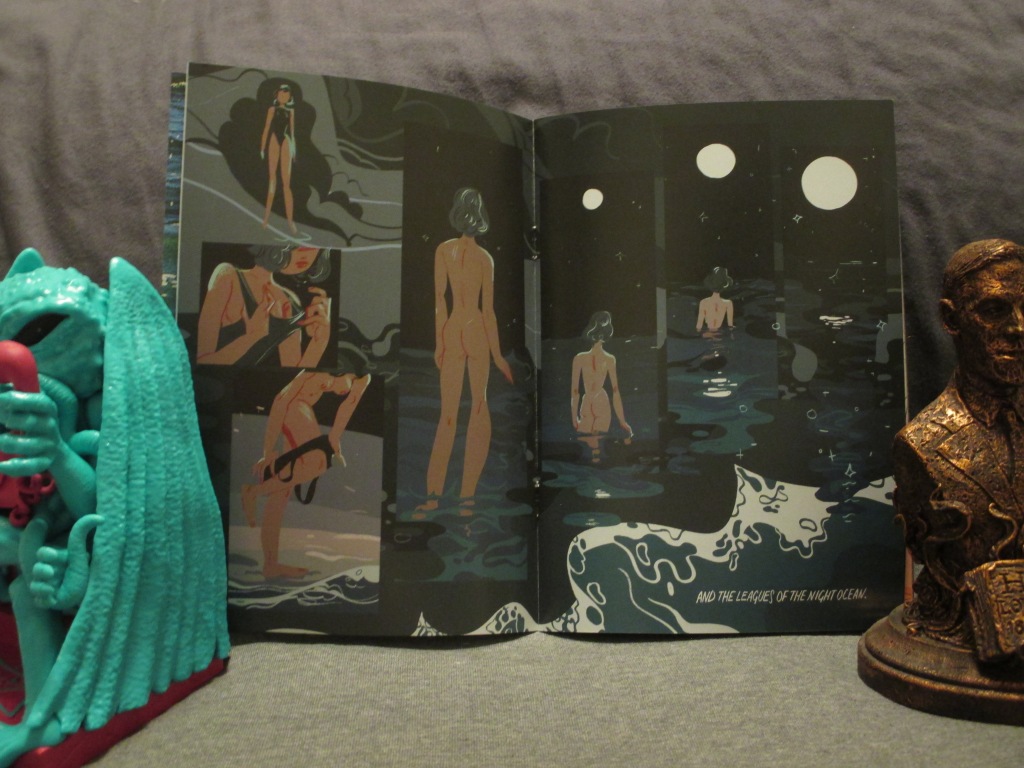
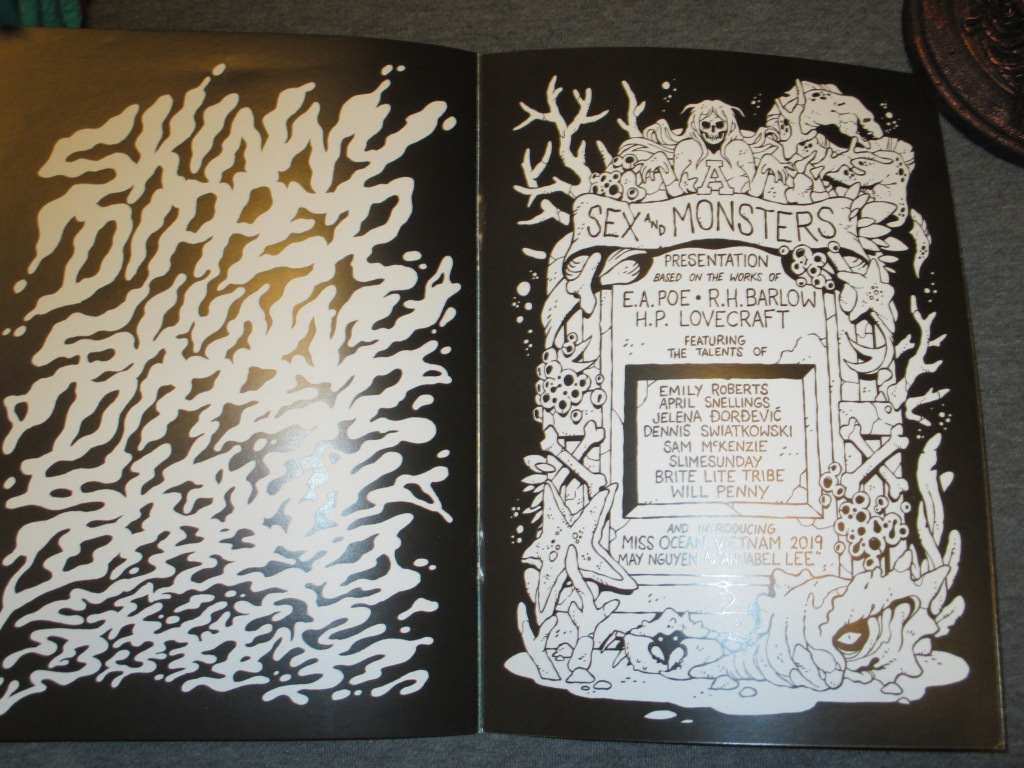
Skinny Dipper was a successfully crowdfunded multimedia project by Sex and Monsters, who are best known for their retro chic combinations of horror, pulp fiction, and tiki culture to produce works like the comic/cocktail booklet Tiki Surf Witches Want Blood.
The form of this particular project is a 32-page mixed-media comic ‘zine that remixes Poe’s “Annabel Lee” and “The Night Ocean” (1936) by R. H. Barlow with H. P. Lovecraft, re-imagining them against a palette of mixed comic and photographic work by Emily Roberts, April Snellings, Jelena Đorđević, May Nguyen, Dennis Swiatkowski, Sam McKenzie, Slime Sunday, Brite Lite Tribe, and Will Penny; and a 7″ vinyl record by Nite Jewel that contains a soundtrack to accompany the piece. Various Kickstarter bonuses to the campaign add decals, instant film shots of May Nguyen, and other goodies.
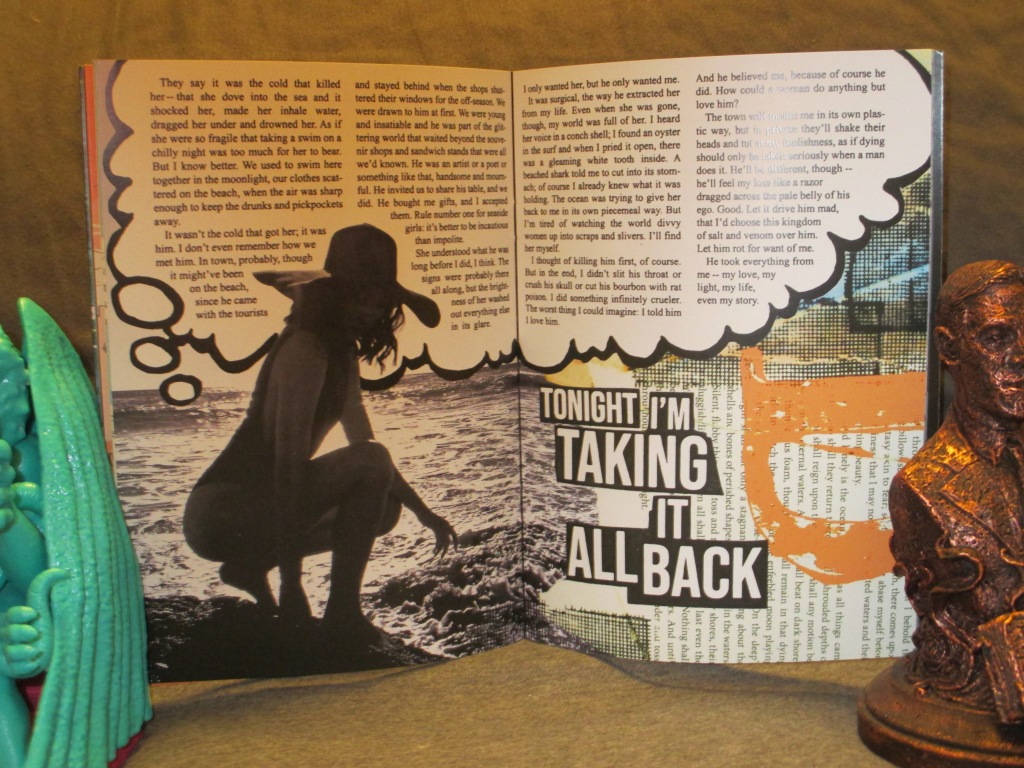
The crux of the re-imagining is model May Nguyen, who appears both in photographs and as the character model for the character of Annabel Lee in the story. Told in sparse, evocative images, Annabel Lee shifts from the bright and crowded daylit beach to a lonely moonlit scene, to go skinny dipping alone in the night ocean.
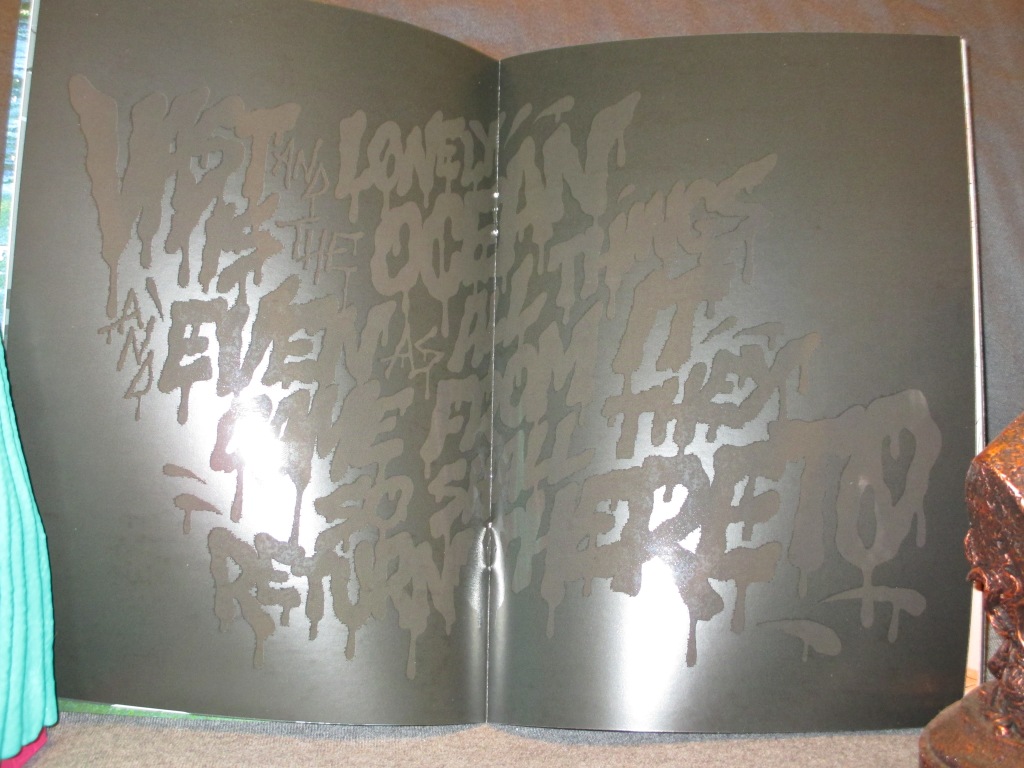
Chunks of Poe’s and Barlow and Lovecraft’s texts are taken out of context and reframed as poetry. The artists are each distinctive in their style and approach to the material; the center black-lettering on black-pages at the center of the story is incredibly evocative of the dark abysses hinted at in poem and short story, here rendered visually—and the combination of Poe’s verse and select snippets from Barlow and Lovecraft work well together with the visuals, terribly suggestive of far more than appears on the page.
Kitsch is a dirty word, but in this case the artists are trying to recapture specific moods and art styles, from the Charles Atlas bully-kicks-sand-in-your-face comics of the 50s to 80s glossy magazine photo spreads that are terribly suggestive of exotic vacations, where the sea foom can lap at your feet as you read and relax on holiday. It is a deliberate effort to reproduce an aesthetic that existed, even if that exact place never did.
One thing that both “Annabel Lee” and “The Night Ocean” capture is a sense of loneliness and longing; that may be why giving Annabel in Skinny Dipper such a distinctive face adds something to the text. May Nguyen provides a sense of reality that might have been missing if this a more traditionally-made comic book; there’s a fotonovella-style sense that these could be stills to some ancient straight-to-video movie that graced the shelves of mom & pop video stories.
It is not horror in any strict sense; not int he bloody bones and a shark coughing up a limb. It’s closer to a vacation where all the time away reminds you that the one thing ou can’t get a vacation from is yourself, can’t get out of your own head. That loneliness and the endless, ageless warm waters of the ocean might swallow you up forever, given half a chance.
Nite Jewel’s Skinny Dipper single is a soundtrack to the story; I’d call it synthwave or retrowave, while the tags for the album on call it chillwave and hypnogogic pop. Combined with the stylistic flourishes of the comic, it grounds the reader in that almost-never-when promised in a thousand 80s and early 90s magazines, comics, films, and music videos. The idea of the beach as this place of escape, the music a poppy invitation that’s a bit more upbeat than tiki exotica, but holds many of the same audio cues, just for a later generation.
At this time of writing, the album is the only thing available for direct purchase, although many stills and videos associated with the project are located on Sex and Monsters’ Facebook page.
Skinny Dipper is an interesting collaboration, one that showcases the abilities and visions of the individual artists that went into it. Copies are still available through the Kickstarter store (click “Order Now”), and will hopefully receive a wider release in the near future.
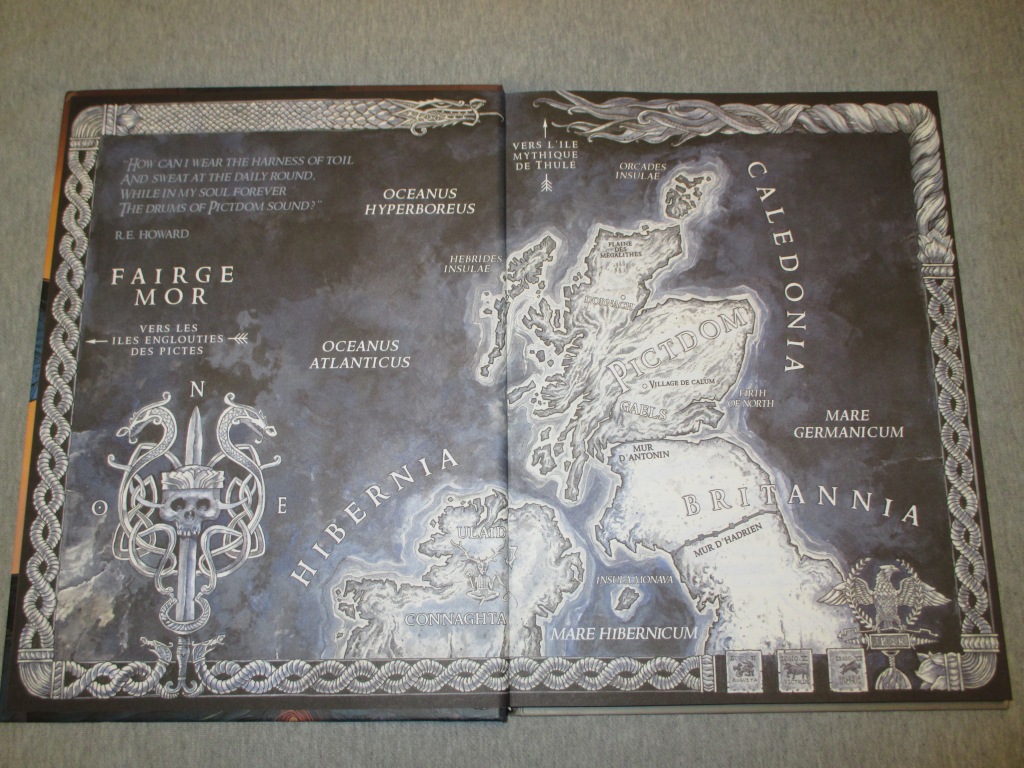
How can I wear the harness of toil And sweat at the daily round, While in my soul forever The drums of Pictdom sound? —Robert E. Howard, “The Drums of Pictdom,” Collected Poetry 2.72
Today, historians and archaeologists tell us that real-life Picts were a people in what is now Scotland during the early Middle Ages, who in time merged with or were subsumed by the other peoples in the region. When a 13-year-old Robert E. Howard ran across the mention of them in a New Orleans library in 1913, however, the Picts were a mysterious race. Pseudohistories like the Pictish Chronicle mingled with scientific racialism, and the early archaeological and anthropological theories of the British Isles to made the Picts a race apart from Gaelic peoples like the Irish and Welsh; Germanic invaders like the Angles, Saxons, and Jutes; Nordic raiders a-viking from Scandinavia; or more southernly European invaders like the Romans. The underdogs of the ancient world, the last hold-outs as waves of invaders washed over the British Isles, driven at last to one distant corner…and at last, snuffed out, to leave only a few enigmatic stone monuments behind.
Howard, with a penchant for underdogs, was enamored from the first.
Picts are one of the near-constants of Robert E. Howard’s imagination. They feature in nearly every era of his fantastic fiction, from the tales of Brule the Spear-Slayer and other Picts who aided King Kull in Valusia, to the howling tribespeople in the Pictish wilderness across the Black River in the age of Conan the Cimmerian, they play a major part in the history of the Hyborian Age, to Bran Mak Morn who fought the invasion of the Romans in the British Isles, to the time of Brian Boru when Turlough Dubh O’Brien encountered them among the small islands to the north of Britain, and into the modern day when a rumor of a surviving cult of Bran Mak Morn came in “The Children of the Night.”
Over the course of his writing career, Howard’s conception of the Picts changed and evolved. His initial depictions of them drew comparisons with the Little People, the elves and fairies of British folklore, but when he began a correspondence with H. P. Lovecraft in 1930, Howard began to differentiate the two concepts (see “Conan and the Little People: Robert E. Howard and Lovecraft’s Theory”), which eventually led to one of Howard’s most powerful stories: “Worms of the Earth,” which mingles references to Lovecraft’s Mythos with Howard’s Pictish lore (Lovecraft would return the favor by including the cult of Bran Mak Morn among others in his story “The Whisperer in Darkness.”)
While Picts are an important part of Robert E. Howard’s work, they do not tend to fare so well in adaptation and in the writing of others. Henry Kuttner, not long after Howard’s dead, began the Elak of Atlantis stories in Weird Tales, which included an antagonistic people called “Pikhts.” The success of the Conan the Barbarian comics, and by-blows like Kull the Conqueror, have seen many Pictish characters in the Hyborian and Thurian Ages, but these depictions tend to borrow from Native American imagery (which to be fair, Howard did himself in “Beyond the Black River”—see John Bullard’s article “‘Beyond the Black River’: Is It Really ‘Beyond The Brazos River?'”) Bran Mak Morn, Howard’s most singularly developed Pictish character, has had notable adaptations in the comics as well, especially two adaptations scripted by Roy Thomas: “Worms of the Earth” (art by Tim Conrad), and “Kings in the Night” (art by David Wenzel), and in prose was the subject of three notable pastiches: Legion from the Shadows(1976) by Karl Edward Wagner, For the Witch of Mists(1981) by David C. Smith & Richard Tierney, and Bran Mak Morn: Red Waves of Slaughter(2024) by Steven L. Shrewsbury.
For all that might sound like a lot, given the hundreds of Conan comics and dozens of novels, and even the dozens of Kull and Solomon Kane comics, the Picts might fair be said to have often been overlooked. Because Howard’s themes for the Picts evolved over time—covering so many disparate periods, and often involving stories not published until after his death—there isn’t really a cohesive Pictish Mythos in fiction, despite the fact that they are more of the connective tissue of Howard’s fantasy fiction than nearly anything else.
This is all a very long way to say that it’s nice to see some other creators take an interest.
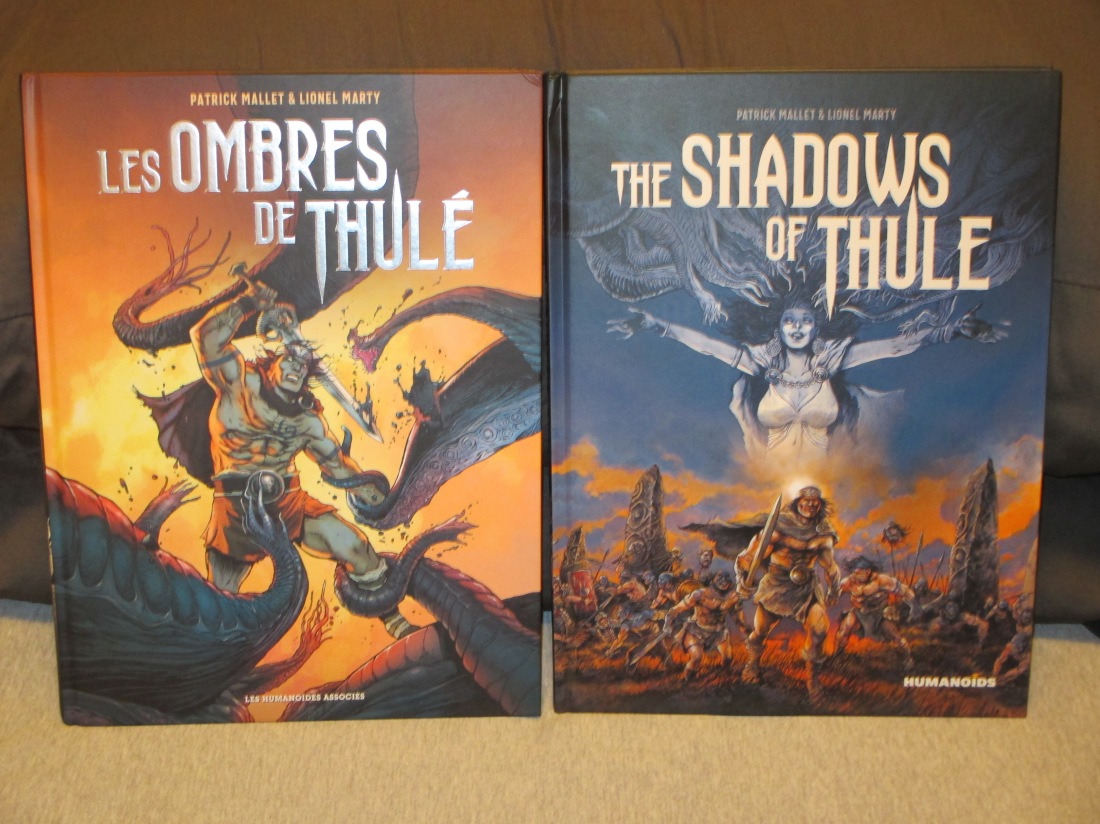
Les Ombres de Thulé (2023) by Patrick Mallet (script), Lionel Marty (art), & Axel Conzalbo (colors) is a French-language bande dessinée; there is also an English-language translation available, The Shadows of Thule, released the same year, translated by Montana Kane. The story is not an adaptation of any Howard tale, nor is it specifically tied to Howard’s setting or chronology, but it is clear that Mallet & Marty took inspiration from Howard and Lovecraft, and the tale contains many Echoes of “Worms of the Earth,” “Kings of the Night,” and “The Dunwich Horror.”
The Romans have pushed deep into Britain, and they’re here to stay. The Picts are a fading people, ancient, barbarous, and wise with magic, but more desperate every year. A Roman general is manipulated by a necromancer into releasing an ancient Lovecraftian horror that had been sealed away long ago…and it might take all the swords and sorcery of the King of the Picts to deal with this old enemy.
Map on the inner pages of the French edition; not included in the English translation.
If it sounds familiar, it is because it is. his is not quite as dark and brooding as Howard’s tales of Bran Mak Morn, and the scale of the action and magic owes more to the popular depictions of contemporary fantasy than to some of the more realistic or restrained proportions of older works. Readers today expect glowing eyes, towering tentacled terrors, and headlopping…and Les Ombres de Thulé delivers on all three.
Conzalbo uses color to heighten the distinction between the old man’s vision and the real-world scenes.
Like other bandes desinees such as Orcs et Gobelins T11: Kronan (2021) by Jean-Luc Istin, Sébastien Grenier, and J. Nanjan and Crom (2022) by Raule, Jaunfra MB, & Alejandro TM, there is a certain aesthetic that pervades this book. Digital coloring adds a certain studied muddiness to some of the artwork that looks better than plain, flat colors but doesn’t quite replicate the texture of real paint. Minor nudity is taken for granted, as are splashes of gore. While some of the pages may seem crowded with panels, there are often huge splash pages that give moments to admire the detail that larger page sizes allow.
Mallet and Marty wear their influences on their sleeves. This is a love-letter to Howard and Lovecraft as much as anything else. An original story, but also a remix that combines some of the highlights from their favorite weird fiction. If it dips into a bit more of Celtic myth (there are some definite overtones of Michael Moorcock’s Corum Jhaelen Irsei tales), or some Dungeons & Dragons-style mucking about with eldritch blasts and healing spells than Howard or Lovecraft would have had it, that speaks to how the fantasy aesthetic has changed in the hundred years since Weird Tales began publication.
Back covers of the French (left) and English (right) editions.
Les Ombres de Thulé / The Shadows of Thule is a fun experience, in French or English. Kane’s translation appears faithful to the original text and in keeping with the spirit of the work, not always an easy balance to achieve. It is nice to see creators who take inspiration from Howard and Lovecraft’s work without necessarily being slavishly devoted to a long and convoluted Mythos.
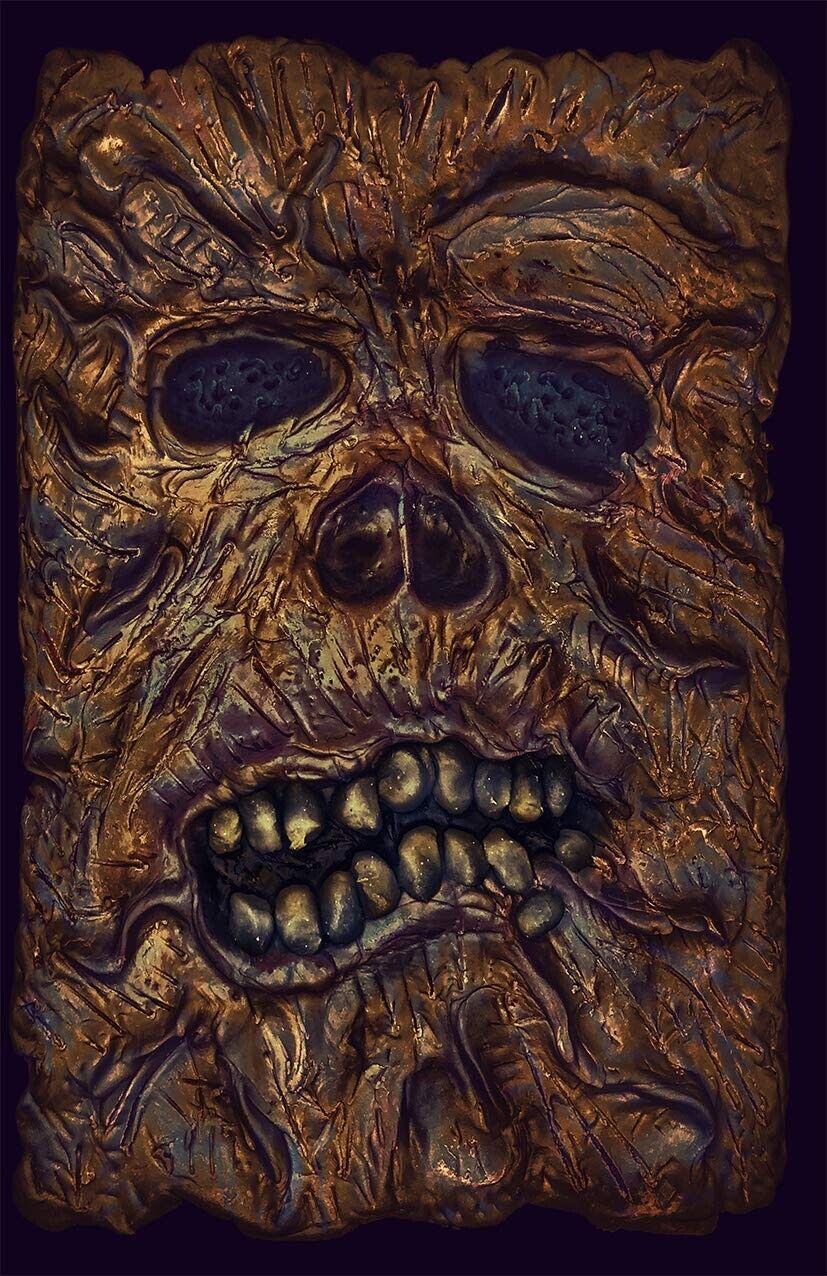
Os Mitos de Lovecraft (2020) is a crowdfunded Brazilian black-and-white graphic anthology edited by Douglas P. Freitas and published by Skript, probably best known for the deluxe hardcover edition which has a cover modeled on the bound-in-human-skin Necronomicon ex Mortis from Evil Dead 2 and Army of Darkness. Like its fellow Brazilian Lovecraftian anthology O despertar de Cthulhu em Quadrinhos (2016), while there is a common theme in terms of subject, the style and tone of the individual works inside varies considerably. Every style of comic art and horror can be represented under the broad remit of Lovecraftian comics, from straight adaptations of Lovecraft in exquisite realistic depiction to splatterpunk-esque gore fests with plenty of airbrush-style gore streaks to lighter works with more cartoonish tentacled Cthulhu-esque characters.
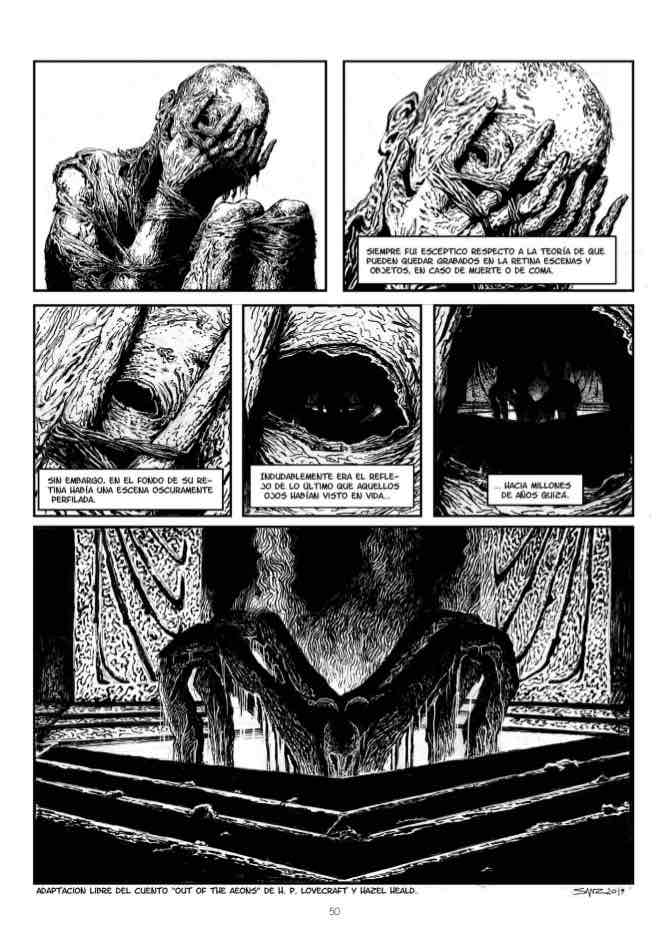
The anthology begins with an absolute masterpiece in two pages, by Argintenean artist Salvador Sanz, which originally appeared in the Spanish-language graphic horror anthology Cthulhu 23; for this anthology, it was translated into Brazilian Portuguese by Aline Cardoso and re-lettered by Johnny C. Vargas. This is a distillation of “Out of the Æons” (1935) by Hazel Heald & H. P. Lovecraft, subtracting all the human characters, the drama, and the fantastic history deciphered from the scroll in exchange for focusing on a masterful rendering of the mummy who caught a glimpse of Ghatanothoa—and paid the price.
In a cinematic journey, the reader is taken closer and closer to the ancient petrified horror. The panels zoom in on the one eye that peeks out between gnarled fingers. To the dark image that is still captured there, on the retina. The detail on the art, the pacing, and the execution of the concept, which boils down the essence of the Lovecraft/Heald horror story into two pages, is exquisite.
※
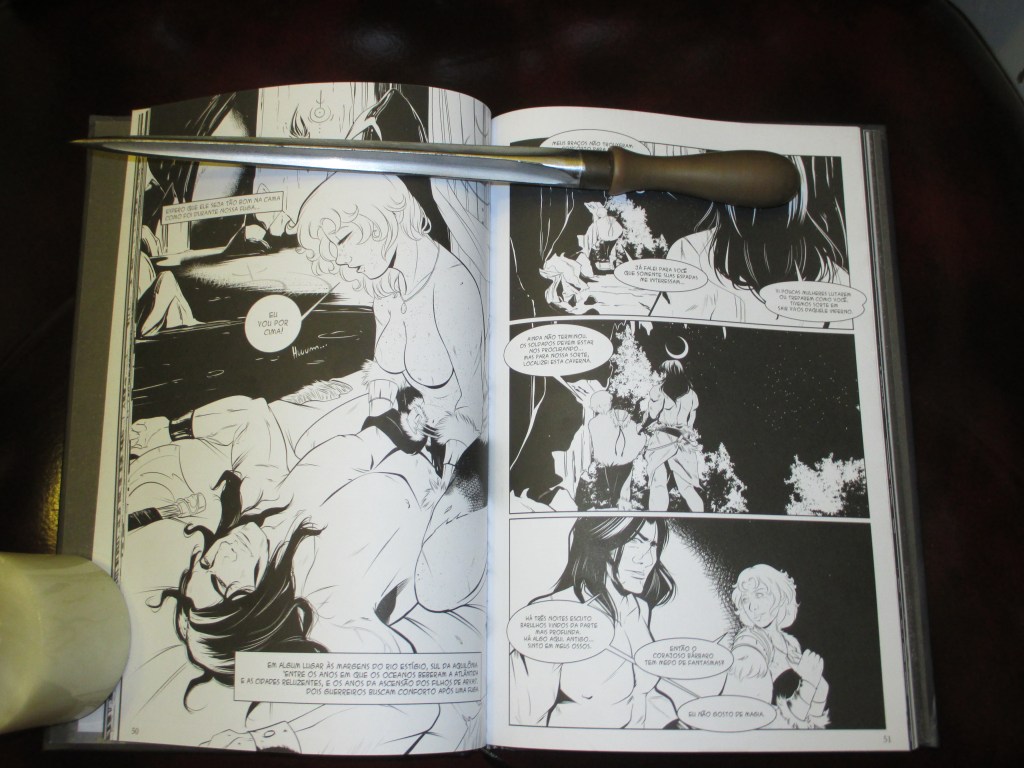
Freitas’ own contribution to Os Mitos de Lovecraft is “Sob As Trevas” (“Beneath the Darkness”), in collaboration with illustrator and comic creator Chairim Arrais. This is a tongue-in-cheek 8-page sword & sorcery story involving a nameless Cimmerian warrior and their female partner Ruivas (“Red”/”Red-hair”). Freitas & Arrais are clearly referencing Robert E. Howard’s most famous creation, Conan the Cimmerian, and aren’t coy about it:
Em algum lugar às margens do rio Estígio, sul da Aquilônia, ‘entre os anos em que os oceanos beberam a Atlântida e as cidades reluzentes, e os anos da ascensão dos filhos de Aryas’. Dois guerreiros buscam conforto após uma fuga.
Somewhere on the banks of the River Styx, south of Aquilonia, ‘between the years when the oceans drank Atlantis and the gleaming cities, and the years of the rise of the sons of Aryas’. Two warriors seek comfort after an escape.
“KNOW, oh prince, that between the years when the oceans drank Atlantis and the gleaming cities, and the years of the rise of the Sons of Aryas […]” —Robert E. Howard, “The Phoenix on the Sword”
The character Ruivas is depicted similarly to the eponymous character in Arrais’ standalone comic “Red+18”; whether this is intended as an unofficial crossover, an Easter egg for fans of Arrais’ work, or just a coincidence—the character could as easily be a play on Red Sonja for the Marvel Comics, albeit sans the trademark mail bikini—is unclear, and maybe unimportant.
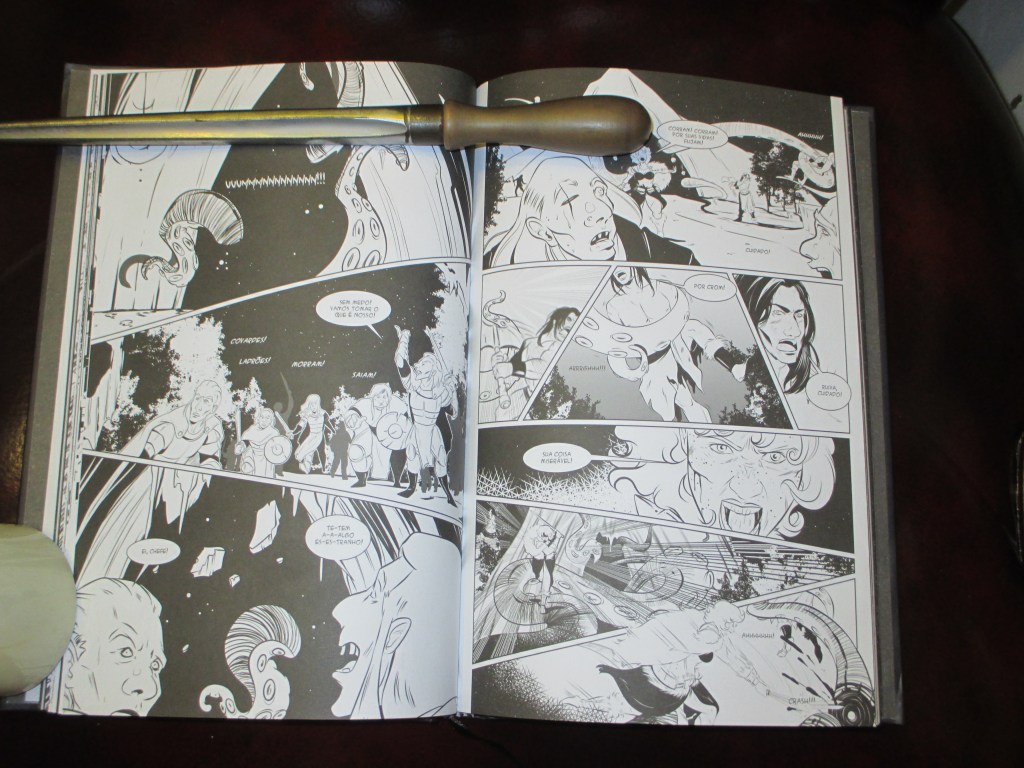
The story itself is fairly slight and straightforward: after successfully stealing a jewel, the pair of thieves hide out in a convenient cavern…which ends up being occupied by some nameless eldritch horror.
The story really wanted more pages; there’s little opportunity to really develop any atmosphere before the tentacles emerge from the darkness, and the action sequences are correspondingly cramped and staccato-like, crammed into increasingly more panels per page. With the in media res debut, the titillation, and the swift conclusion, this is strongly reminiscent of the kind of back-up feature that sometimes ran in Savage Sword of Conan, more of a sketch of an interlude than a full-fledged story.
Yet what there is there is fun. The writing is light-hearted, the chemistry between legally-not-Conan and Ruivas is alternately playful and rocky, and Arrais’ artwork does everything the script calls for. The brief sword & sorcery interlude sets a different tone than the other stories in the anthology, featuring more sex and action than horror or outright comedy. While I would have liked for it to delve more into the Howardian vibe of horror that permeated tales like “Xuthal of the Dusk” or “Red Nails,” limitations of space have to be acknowledged. Still, it would be nice if Freitas & Arrais had the opportunity to revisit the idea at a longer length more suitable to develop the characters and story at some point.
Duane W. Rimel (1915-1996) was still in high school when he came into correspondence with H. P. Lovecraft in 1933. Rimel came from a working-class background and the Great Depression hit his family hard, but Lovecraft’s letters and science fiction fandom gave him a creative outlet that he might not otherwise have found. With Lovecraft’s encouragement (and sometimes a bit of Lovecraft’s help), Rimel published stories like “The Sorcery of Alphar” and “The Disinterment” in fan magazines and even in Weird Tales; “The Tree on the Hill” is often counted among Lovecraft’s revision stories.
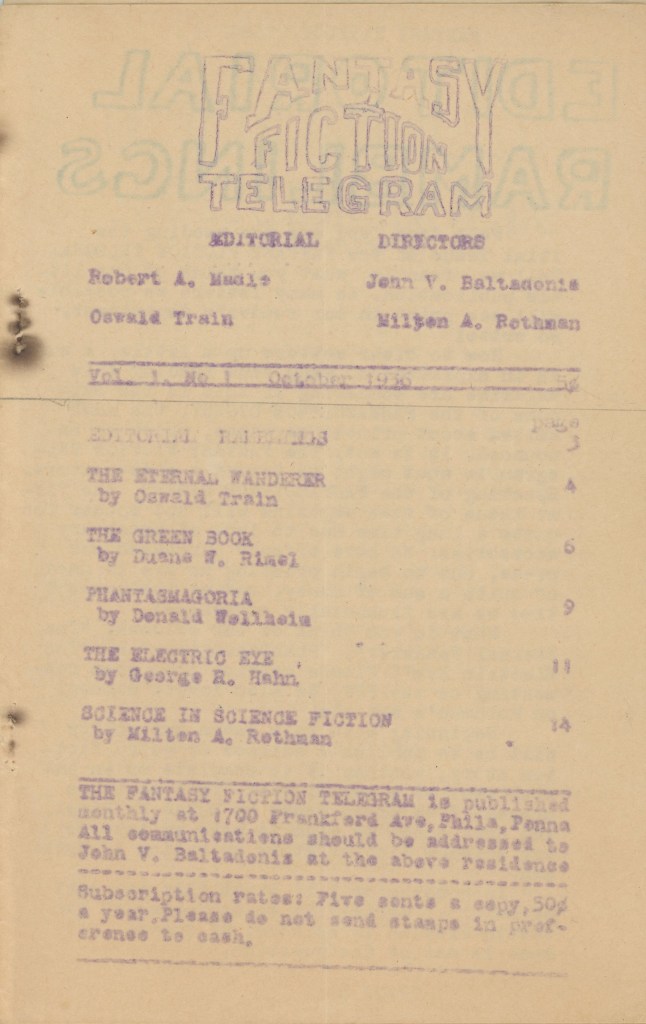
Yet there is a gap in the published letters of H. P. Lovecraft and Duane W. Rimel; and a gap too in his published fiction. In the October 1936 issue of the Fantasy Fiction Telegram, Rimel’s short story “The Green Book” was published, with little fanfare. While there is no mention of the story in Lovecraft’s letters, Lovecraft did write that he received a copy of the fanzines:
The other day I received a copy of The Fantasy Fiction Telegram (hectographed), published in Philadelphia, which I had never seen before.
The Fantasy Fiction Telegramwas the organ of the Philadelphia Science Fiction Society. Fanzines of the period were often produced by amateur printers, who could not afford traditional letterpress printing and made use of cheap printing methods such as spirit duplication, hectograph, and mimeograph. All of these printing methods had their advantages (typically, low cost for set up) and drawbacks:
My first issue is hectographed, not mimeographed. Letters on the typewriter clog because the ink on the ribbon is very thick and such letters as “a”, “e”, “o”, “d”, “b”, “s”, “n” and etc. clog very easily. The letters “a” and “e” clog very much. An example of such a thing is found in the Fantasy Fiction Telegram.
Weir was himself a fan-printer whose publications would include Fantasmagoria, which published “An Heir to the Mesozoic” (1938) by Hazel Heald. His description of “clogging” letters is accurate, but this is frankly the very least of problems, at least in terms of durability and legibility.
The problem with hectographing is that the ink is impressed on the page very lightly, and worse, fades very swiftly under ultraviolet light. Combined with the often cheap and acidic paper that such ‘zines were printed on, and the text on the fragile pages is often illegible, or fades to almost transparency. Even scanning such paper can be troublesome and insufficient to read the text.
In March 2024, my friend Matthew Carpenter asked if I had a copy of Rimel’s “The Green Room”; the story had never been reprinted since its first appearance in 1936, and the only scan online was particularly poor on some of those pages. I did not have a copy of the Fantasy Fiction Telegram #1 then, but soon acquired one that was fortuitously on sale on eBay. Unfortunately, I soon ran into the exact same problem: parts of the story were almost completely illegible.
The header illustration is by John V. Baltadonis (JVB), and was probably produced by mimeograph; mixed printing methods were not uncommon in ‘zines during the 1930s. Nevertheless, between the two versions it is just possible to make out a more-or-less full transcription of this very obscure story…with a few caveats.
Any text in [parentheses] is largely illegible, but there is enough of the word to make a reasonable guess at what it is. Any text in [bold] inside parentheses represents words that are completely or almost completely illegible and are filled in based on context, length, and the few letter shapes that can be discerned. With the understanding that these may not be 100% accurate, but are as best as can be read under the circumstances.
※
The Green Book by Duane W. Rimel
“It is a curious book,” Arnold was saying, as he fingered the green-covered tome on the table, “I picked it up at a book store down town for a nominal sum.”
“And the title?” I inquired, eyeing the object with growing relish, since I had already recognized signs of great age upon it. One glance was enough to arouse my interest.
“Apparently the thing has none—though the subjects it covers might give a hint as to a name. So far I have read only two chapters, and both of these are about a sort of mystic symbol. In a sense it is a physical study—and in places not altogether pleasant.”
“Is the book dated?” I took my eyes from it and looked about the large room which served Arnold as a combination study and library.
“No,” he replied, “and that makes it all the more puzzling—though the value is greatly reduced in spite of its apparent age. It might have been written anywhere between the sixteenth and the seventeenth centuries, and the English is very crude and ponderous.”
“I would like to read it some time,” I said quite truthfully, “but surely you can tell me more after reading the chapters—”
“Well, it dwells at length upon an unseen God of vague description, and it even gives crazy formulae for communicating with it . . .”
“Very interesting,” I said, though inwardly I decided that I would not, after all, care to peruse the volume. I had heard of such nonsense before.
I left some time later, learning nothing more about the book, but making Arnold promise to call us immediately if he found any points of real interest, for though I still feigned a longing for it, I was, in reality, quite suspicious of the thing. Knowing Arnold’s sensitive temperament; his obsession for obscure mental experiments and kindred twaddle, I could not comfortably associate him with an unknown work on the subject. Despite my own disbelief in the practice, I nevertheless held a half-hearted respect for certain branches of the study. His reluctance to discuss the book’s contents was not a good sign either.
With these thoughts in mind, I proceeded homeward, and as it was already late evening, I secluded myself in the library to read. But I could not keep my attention on the novel and soon cast it aside. It was near midnight, I think, when the phone rang. As I expected, Arnold was on the wire, and in a considerable state of excitement which he tried unpretentiously to hide.
“I’ve been experimenting with those formulae,” he said.
“Cut it out,” I replied sternly, “and leave the book alone”.
“But [listen]”, he went on, “I am getting [results!] The symbol—in the form of a [tangled] cord about a heart—has resolved out [into the air!]”
“Good God,” I cried, “stop it or—.”
“And,” he continued, disregarding my frantic plea, “there seemed to be something [behind] the symbol, but I couldn’t make out make out [sic] what it was . . . I think I’ll try again. . . .”
My protests were out shone his by his act of hanging up. In some heat I dashed from the room and made my way to his house, several blocks down the street. Perhaps I [could] tell little more of that fateful [evening] for when I finally reached Arnold’s study he was dead, with the strange green book open [on] the table before him. On his forehead [was] the mark of a pale red heart, and about [his] neck were dark welts like a [twisted] cord might have left. There had been little [struggle].
My first act upon recovering from the shock of reality was to secret the green book in my clothing. Then [retreating] from his house, I went home once more, for I [did] not want to be discovered near the place [where] Arnold met his death. I met no one along the way.
I placed the book in a secluded [corner] of my library, where it will not be readily noticed. Since Arnold’s passing I have often wondered just how far he had read in that green-covered volume, and some day I shall take it from the shelf and find out. Perhaps I may be able to discover the real cause of my friend’s death. . . .
※
Even though some of the most interesting parts of the story are the least legible, Rimel’s nearly-forgotten story does have a bit of a Lovecraftian flavor to it, with the eponymous Green Book suitable for shelving next to the Necronomicon, Book of Eibon, or Unaussprechlichen Kulten. It is hard to imagine that Rimel wouldn’t have shown it to Lovecraft in some form, but unfortunately any letter commenting on the matter seems to have been lost with the passage of years.
The entire scan of Fantasy Fiction Telegram #1 can be downloaded as a zip file at this link. In practice, it’s better to work with the actual pages, since different angles of light on the paper sometimes highlight the shapes of faded and nigh-illegible letters better, but in the absence of the real thing, a scan is often the only thing to work with.
The first regular movie screenings in Gold Coast colony took place in Accra shortly after 1900 when traveling showmen from other parts of West Africa began screening their wares in various coastal cities on tours that took place over a period of months. The Gold Coast’s first purpose-built movie theatre, constructed by the British businessman John Bartholomew on Station Road in Accra, dates from 1914, just seven years after the first purpose-built theatre appeared in the United Kingdom, illustrating the very rapid spread of cinema technology and film entertainment across the empire although the logistical and financial challenges of operating in a colonial location limited further expansion at that time.
The British Empire claimed the Gold Coast in Western Africa as a colony from 1821-1957, and for many years it was white British businessmen who dominated the modest cinema industry and controlled what kinds of films were shown and when—and sometimes to whom, as Batholomew’s theater sometimes staged “Europeans Only” showings (McFeely 142). The modest little industry expanded slowly through the period of silent films and into the era of sound, marketing primarily English-language British and American films to an increasingly English-speaking and English-literate audience. Films were subject to the approval of the Cinematograph Exhibition Censorship Board of Control and other British laws and regulations.
Even as neighborhood theaters continued to expand to meet the needs of a growing urban population, beginning in the 1940s, the colonial government’s Gold Coast Film Unit also used buses to distribute documentary films, newsreels, and government information films to rural areas, including propaganda films produced by the Colonial Film Unit. In 1957, Ghana achieved independence and operated as a commonwealth realm; the new government took over the colonial-era government’s production and showing of films, and this continued when Ghana became a republic in 1960, with the government-owned Ghana Film Industry Corporation established in 1964 and the state-owned West African Pictures Co. Ltd., which ran a chain of movie theaters. Foreign entities like AMPECA (American Motion Picture Export Company) had to deal not just with government regulations and censorship, but sometimes direct competition with private theater owners in Ghana.
Political unrest and economic hardship rocked Ghana for much of the later 20th century, notably the military coups of 1966, 1972, 1979, and 1981; the government finally transitioned back to civilian democratic rule in 1993. During this period of turmoil, film censorship in the country slackened:
Films such as Blacula and The Exorcist underline the mild nature of censorship in the mid 1970s: a decade earlier the censor banned almost all horror films, never mind ones that contained dramatic scenes of bodies rising from the dead or adolescent girls possessed by evil spirits.
Economic hardship still continued, with inflation, widespread unemployment, and sometimes radical shifts in government policies all making it more costly to import films and keep up ticket receipts. Worse, after the 1981 coup the government enacted a nighttime curfew that lasted for two years, effectively destroying the old business model of nighttime cinema screenings.
In the early 1980s, the first independent films were produced in Ghana, many taking advantage of the Video Home System (VHS) technology to film direct-to-video. Videocassette recorders (VCRs) first became commercially available in the mid-1950s, but it wasn’t until the 1970s that home systems became commercially viable, with VHS emerging as the dominant format. The increasing availability and lowering costs of VHS VCRs spurred the home video market; films that were previously only available in traditional movie theaters could now be rented or purchased to view at home for relatively little cost, and the smaller, more portable, and cheaper VHS cameras lowered costs for independent filmmakers. Video rental stores proliferated in countries like the United States of America and the United Kingdom, and some filmmakers and distributors increasingly skipped traditional theater releases, releasing their films directly to video.
In many ways, the VCR changed how people all over the world watched and interacted with movies. Video cassettes were now marketed directly to the public, with the art on the paper sleeve taking the place of the traditional cinema poster. The lowering cost and increasing availability of video cassette technology allowed it to penetrate new global markets. You no longer needed to build a special building just to show films, and entrepreneurs were no longer restricted to government-made entertainment or officially licensed imports. In the 1980s, as the first independent Ghanaian filmmakers were shooting direct-to-video, small VCR-based theaters and video clubs began to pop up in urban areas of Ghana like the capital Accra, often with pirated video tapes:
With the widespread introduction of foreign videocassettes into Ghana in the mid-1980s, a group of entrepreneurs created small-scale mobile film distribution empires, sending their agents out on the road with videocassettes, television monitors, VCRs, portable gas-powered generators and rolled-up canvas movie posters. This mobile cinema phenomenon quickly became a part of the cultural domain of even the smallest villages and hamlets in the Ghanaian countryside. In the early years a big city distributor or his aide would roll into town—often by bus—possibly for three or four days, and begin the local version of a movie marathon. By day this would generally occur within the confines of a family home or possibly some small communal meeting center, such as a social club; by night, weather permitting, in the open air. By the early 1990s, these mobile cinema operations had peaked and local businessmen at the village level had largely replaced their traveling predecessors, purchasing their own TV sets, generators and VCRs. In order to assist with marketing, the big city distributors continued to provide a hand-painted-on-canvas movie poster with each cassette they rented or sold.
Ernie Wolfe III, “Adventures in African Cinema, 1975-1998” in Extreme Canvas (2000) 25-26
The timeline for when exactly hand-painted posters emerged in Ghana is unclear; through the 1970s Ghanaian theaters would use standard industry posters:
The main methods of advertising to this varied clientele were posters outside the theatres and the projection of trailers for coming attractions. Until the 1970s, American and British film distribution companies supplied posters and other advertising materials at the same time as the reels of film, while locally hand-painted canvas posters, similar to the vivid panels used to publicize concert party performance, were also used at times.
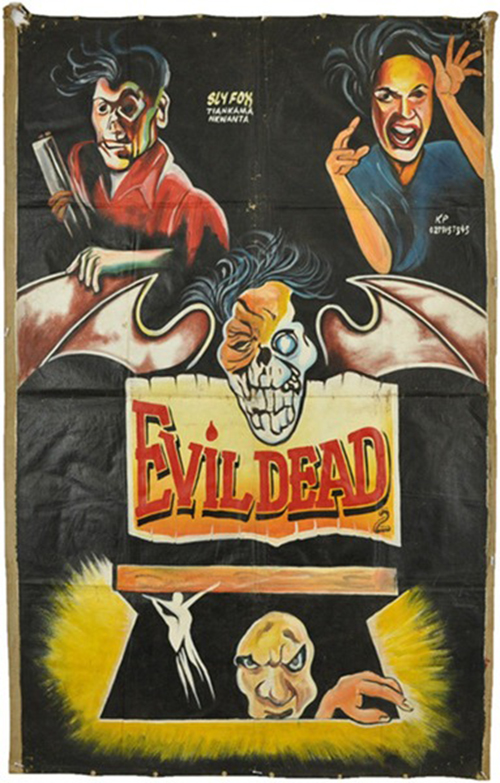
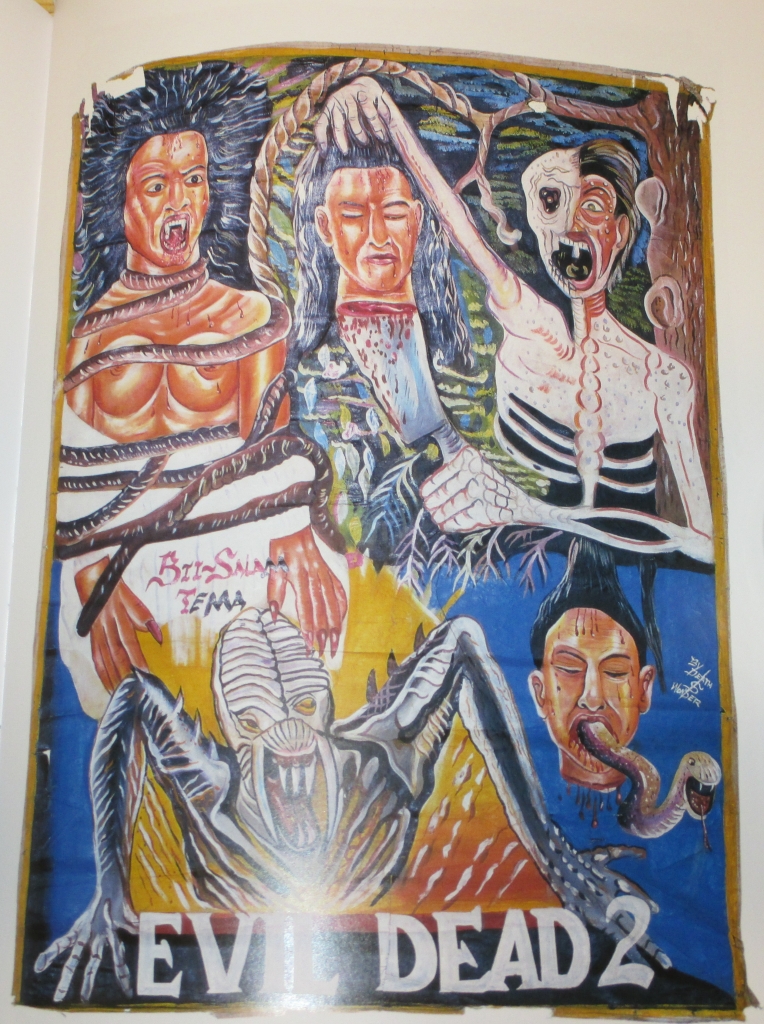
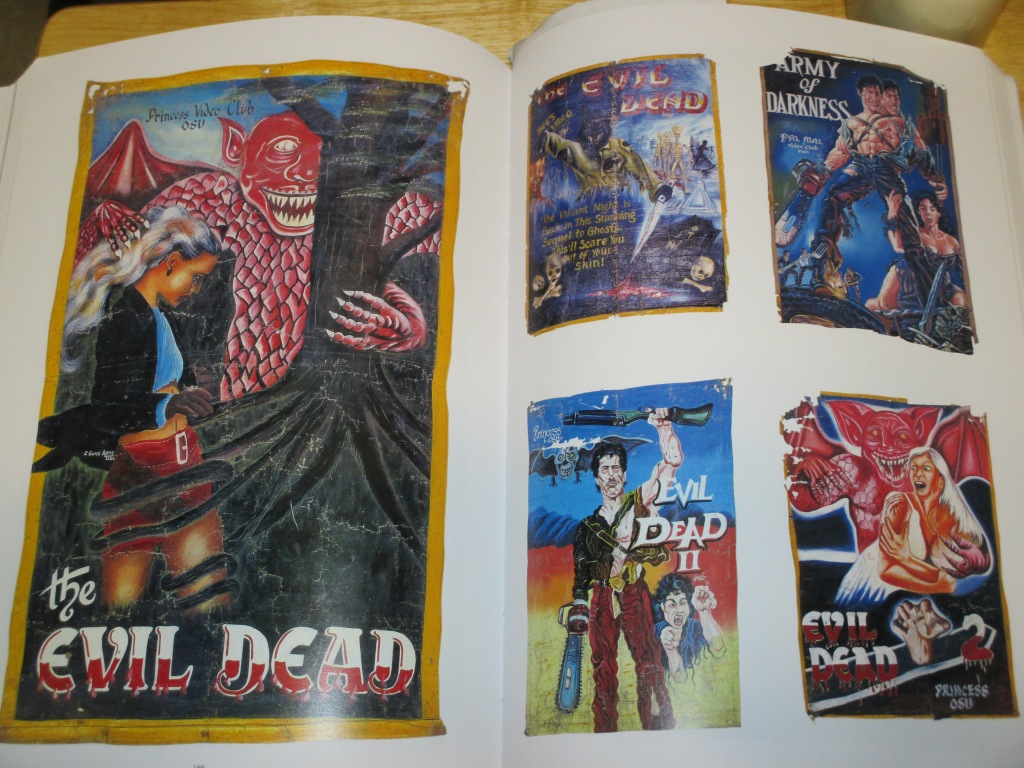
Using pirated VHS tapes would mean no official marketing materials, however; to advertise these films, local Ghanaian artists were commissioned to hand paint posters, often on cheaply available materials like flour sacks (and later, locally milled linen canvases, Wolfe 26). These were typically local commercial artists—sign painters and the like—who watched the film or used existing video cassette box art for inspiration. Many of these were foreign films, produced in Hong Kong, India, Nigeria, and the United States; as a consequence, the artistic sensibilities and commercial priorities for these handmade signs were very different from Hollywood or Bollywood counterparts. Few actor names appear, and the posters may feature nudity, graphic violence, gore, and spoilers that didn’t appear in the original advertising materials.
By the late 1990s cheap preprinted publicity materials had crowded local advertising traditions out, while the video club boom had also peaked, reducing the demand for eye-catching advertising materials in a market where profit margins were razor-thin.
Pure economics ultimately brought about the demise of this once-thriving and extremely localized contemporary African painting phenomenon. By 1996, with the Ghanaian economic boom of the late 1980s and early 1990s nearing its end, mobile cinemas were all but gone and video clubs had reached their peak. Business interests outside of Ghana, often from Europe, had begun providing many more video titles to the local marketplace, and with them for the first time came a large inventory of free offset-printed posters.
Ernie Wolfe III, “Adventures in African Cinema, 1975-1998” in Extreme Canvas (2000) 26, 28
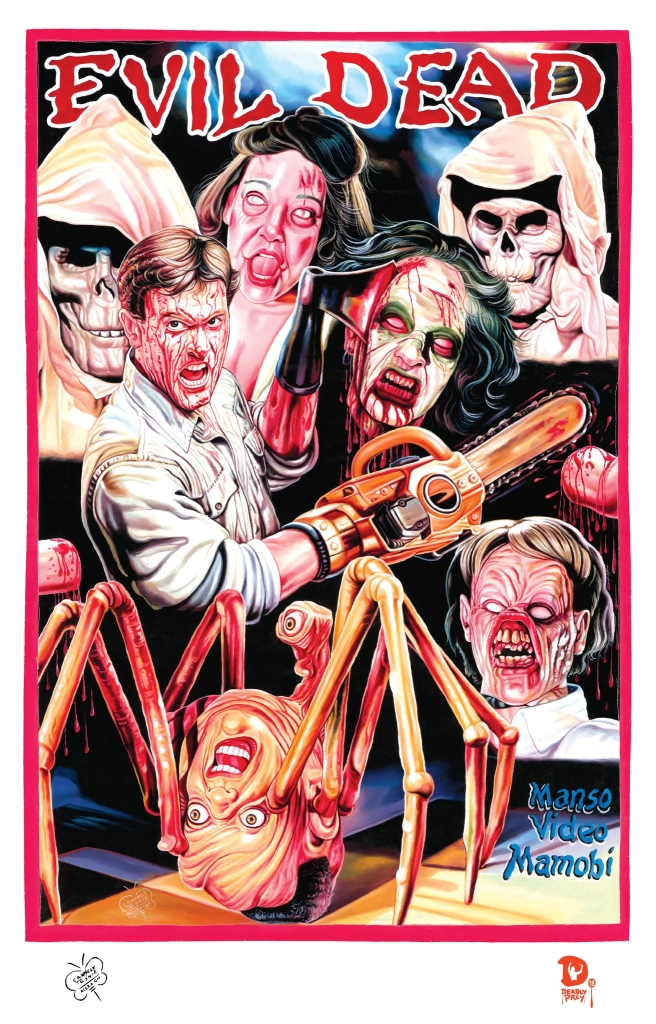
By the 2000s, the hand-painted movie poster tradition was in serious decline; the spread of television in Ghana, the advent of digital video discs, and mobile video streaming increasingly made home viewing more accessible and affordable to local audiences. The Ghanaian movie posters began to receive international recognition with the publication of works like Extreme Canvas (2000) and art gallery exhibitions. As local demand declined, the market for such art shifted. Original posters became collectibles to be displayed in art galleries and sold on eBay; new posters might be commissioned and prints sold through marketers like the Deadly Prey Gallery for a Western audience who appreciated the aesthetic, or produced for exhibitions of contemporary African art—but the original theaters and context in which these artworks first emerged is essentially gone.
Of all the films to receive the Ghanaian treatment, very few are examples of Lovecraftian cinema. While potentially any video cassette could make its way to Ghana, there were a few practical limitations when considering such works that have come to light: the film had to be released on video cassette between c. 1985-1999, a relatively available mainstream or direct-to-video release, and would need to be sufficiently lurid or gory to appeal to Ghanaian audiences—or at least, to produce a poster sufficiently striking or memorable to be subsequently noticed and reproduced for Western audiences. By no means has every handpainted movie poster from Ghana been preserved; these posters are the quintessence of ephemeral commercial art, aging quickly and destined to be eventually discarded once their purpose was served.
In practice, this rules out the early Lovecraftian films of the 1960s like The Haunted Palace (1963), Die, Monster, Die! (1965), or The Curse of the Crimson Altar (1968), and more obscure or international independent efforts like Cthulhu Mansion (1990) or Cthulhu (2000), leaving a handful of adaptations and more loosely Lovecraftian films.
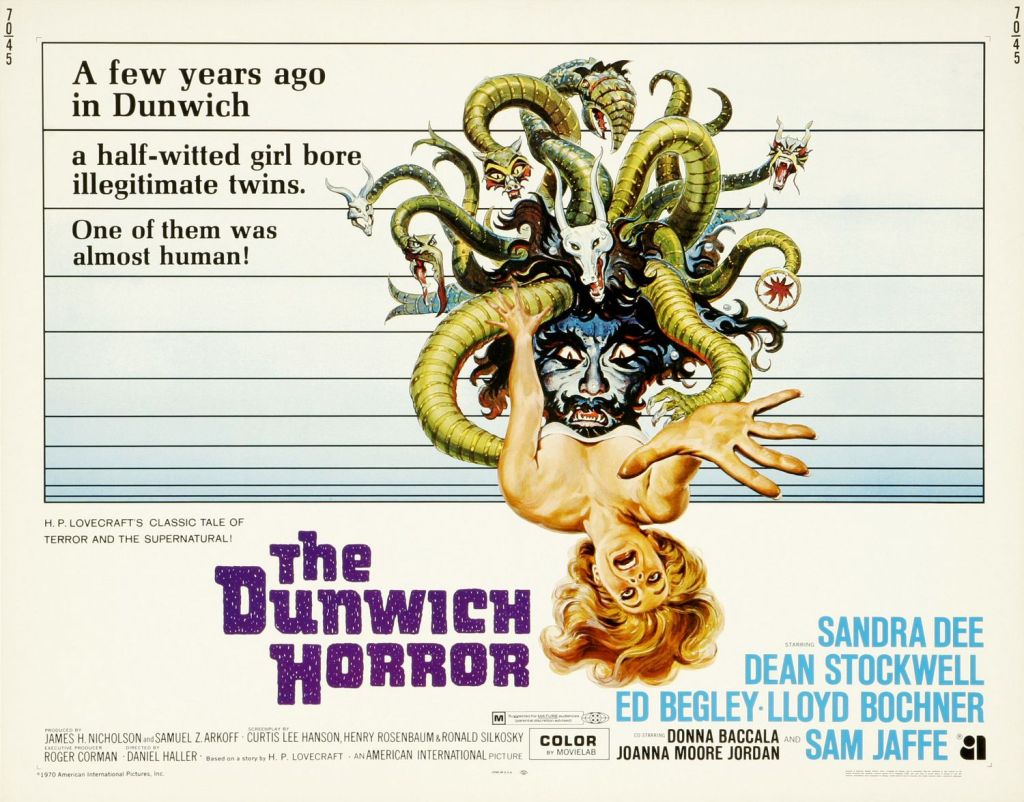
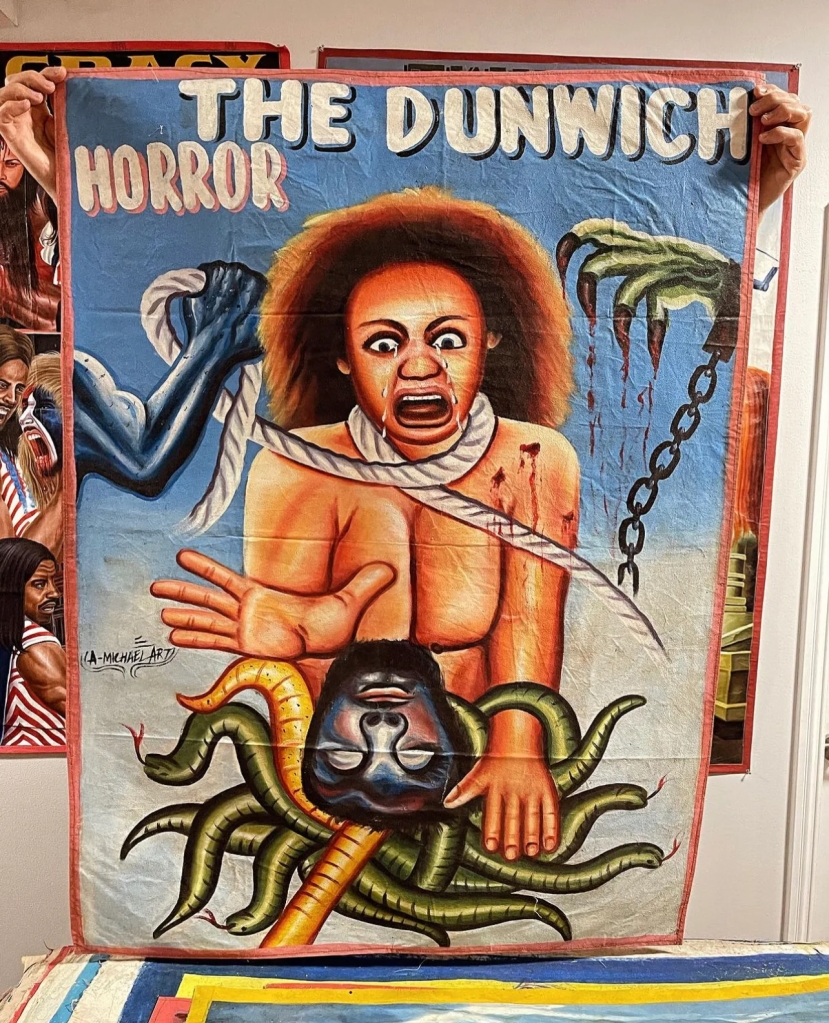
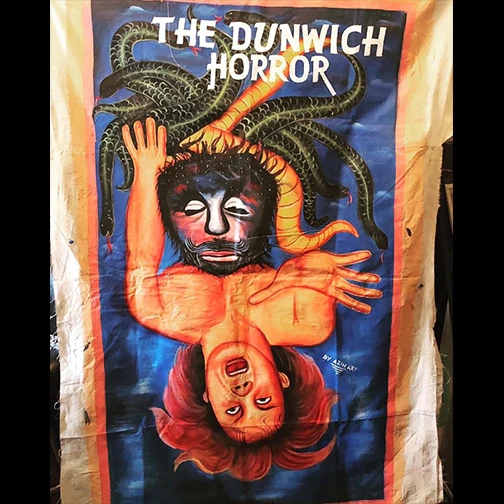
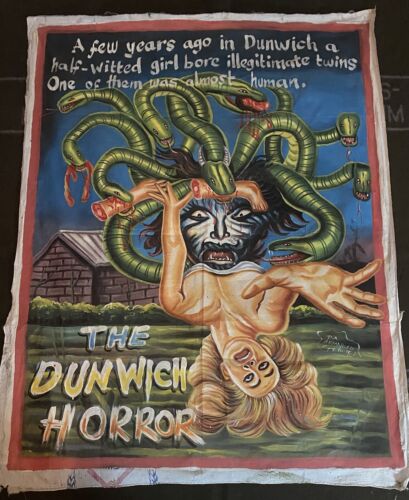
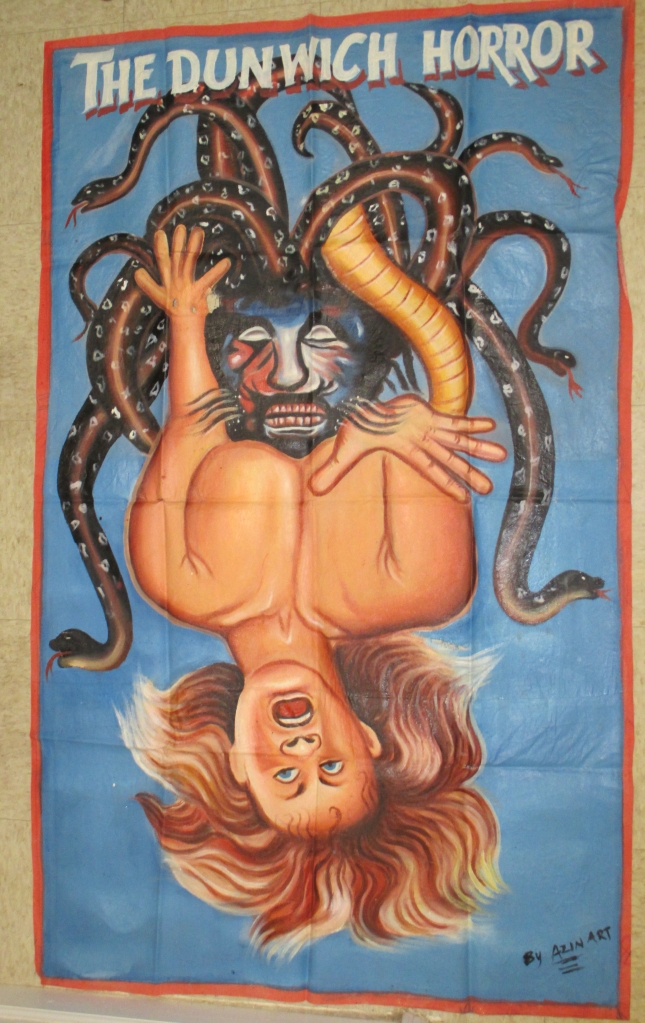
The Dunwich Horror (1970)
A loose update and adaptation of Lovecraft’s “The Dunwich Horror,” set in the contemporary late 1960s. While there are few gory scenes in the film, the psychedelic visuals, Rosemary’s Baby-esque plot, and a brief scene of Wilbur Whateley’s twin brother might all appeal to horror aficionados in Ghana.
Official poster for The Dunwich Horror for reference.
These posters all follow the official marketing for The Dunwich Horror (1970) fairly closely, and given when the film was released—before the “Golden Age” of hand-painted posters, when official posters were in circulation—some of the earlier artists may well have seen versions of that poster and consciously modeled their images on that. It’s notable that the poster signed A. Michael Art, which is probably the most recent, differs much more markedly in the design (even depicting actress Sandra Dee as Black!), and with several uncharacteristic elements not in the film (the grasping hands, the rope around her neck). What’s really striking is how all of the artists chose to depict the tentacles as snake-like hair, turning Wilbur Whateley’s twin into a gorgon-like figure.
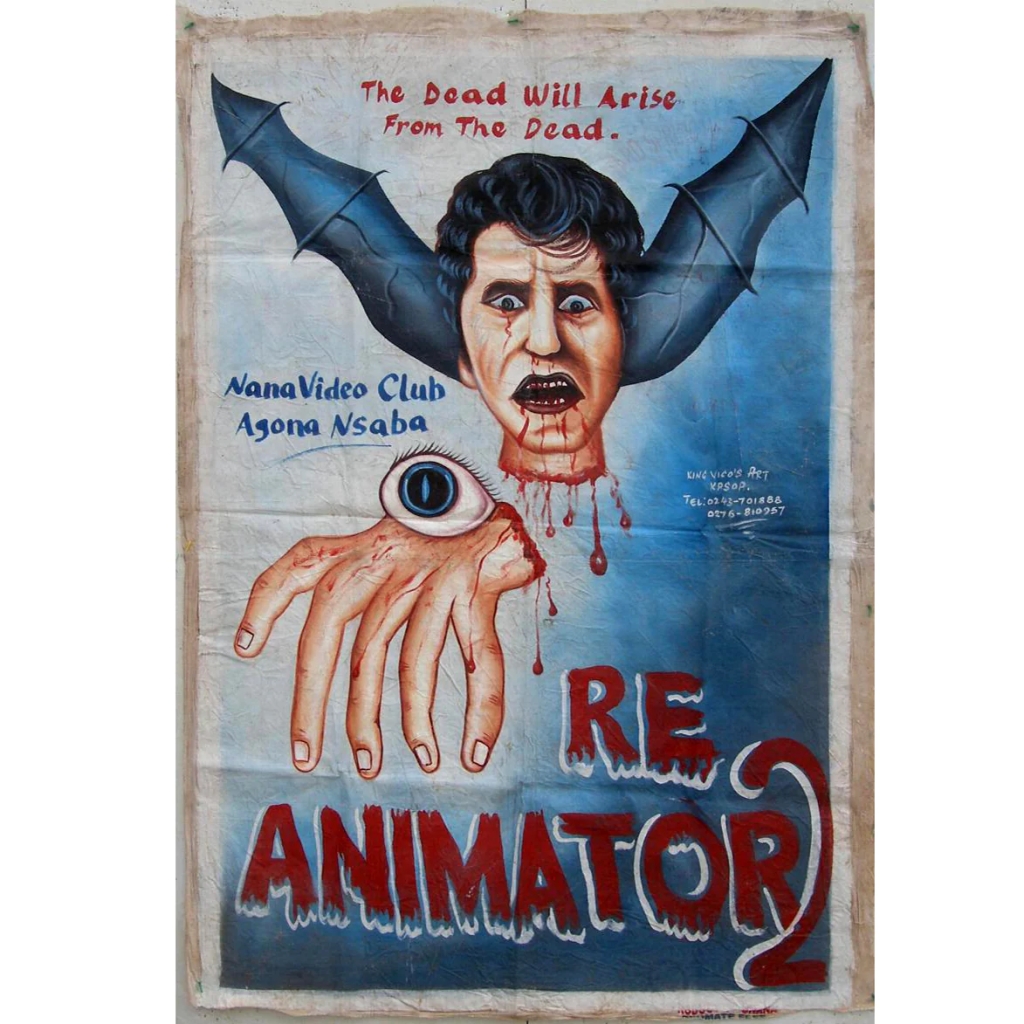
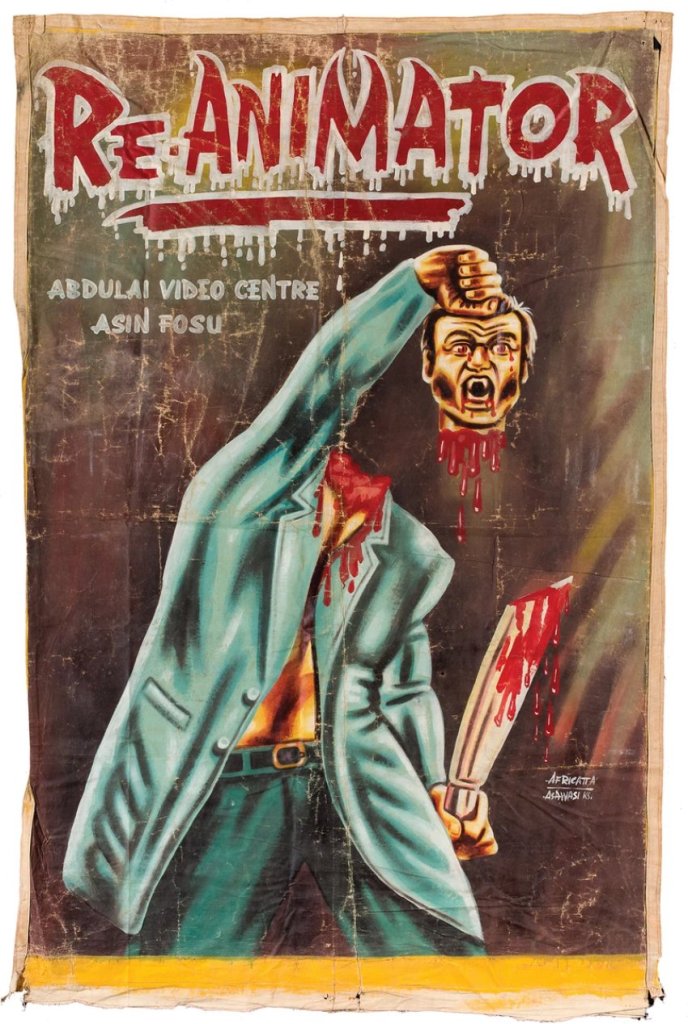
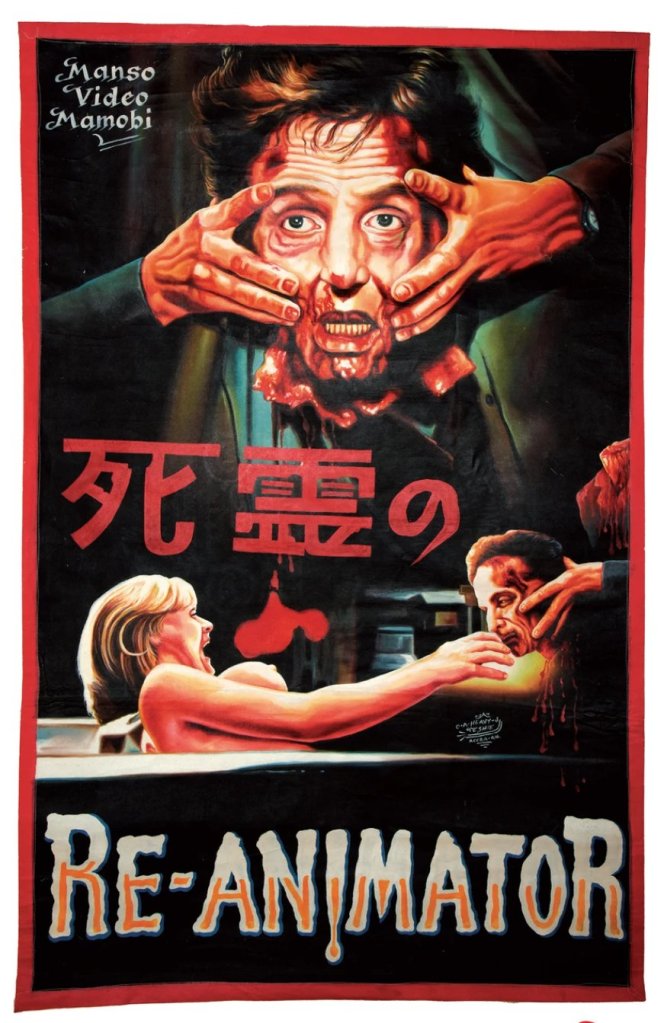
Re-Animator (1985), Bride of Re-Animator (1990), and Beyond Re-Animator (2003)
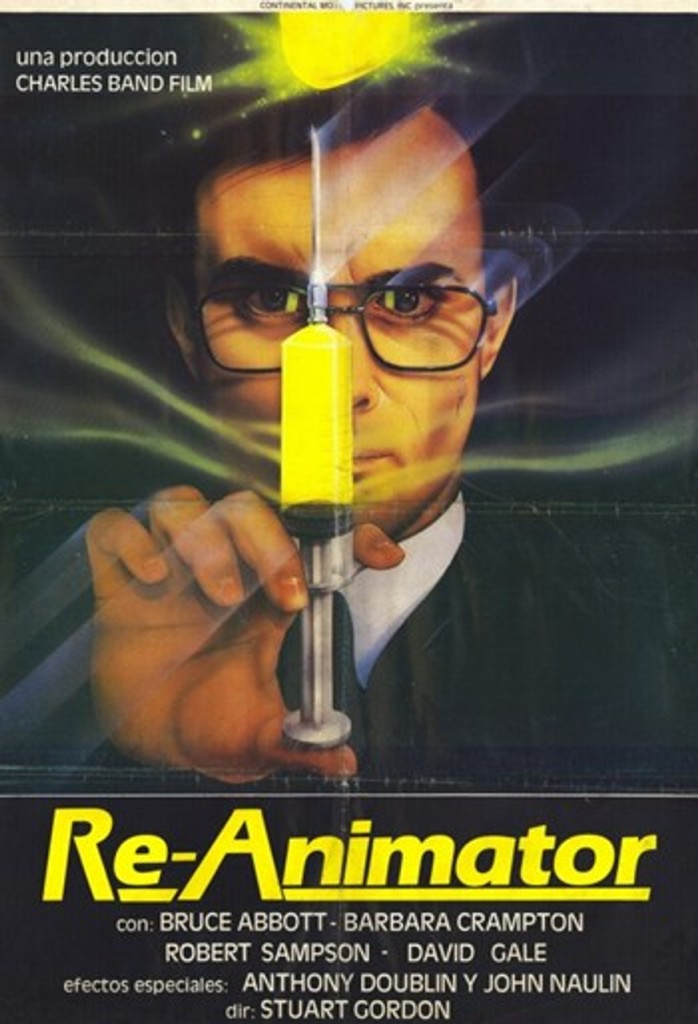
The first Lovecraftian film by director Stuart Gordon and producer Brian Yuzna was an update and adaptation of “Herbert West–Reanimator,” followed by sequels Bride of Re-Animator and Beyond Re-Animator. Unlike the rather sedate Lovecraft adaptations of the 60s, this was a horror comedy with outstanding practical gore effects, black humor, vivid action, and intense visuals. It is little surprise that it attracted the attention of Ghanaian audiences.
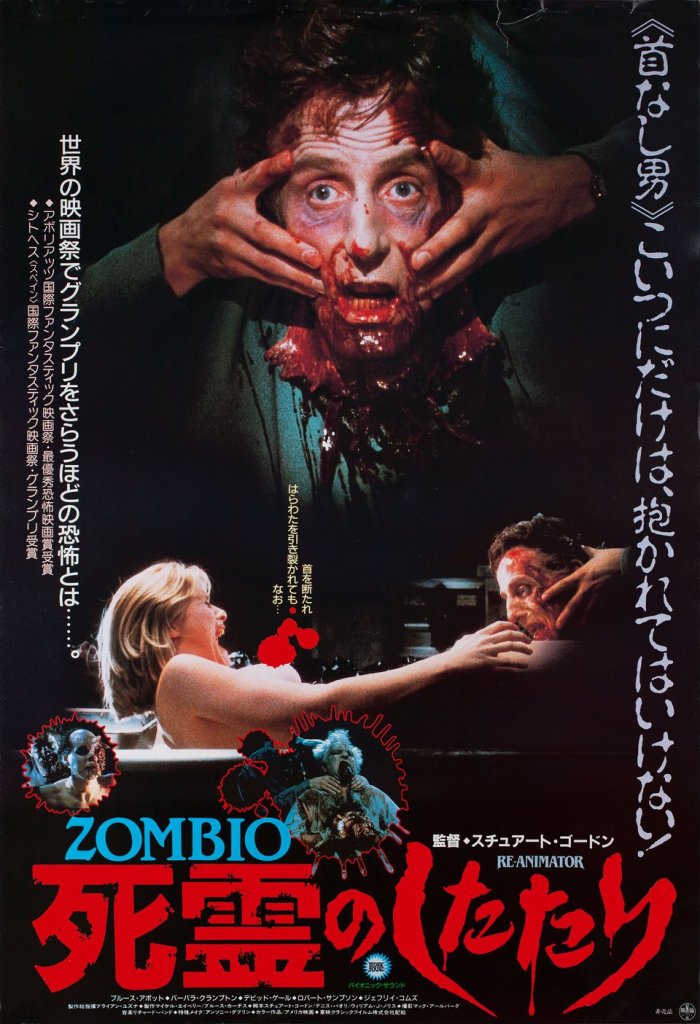
Official Spanish Re-Animator poster for reference.
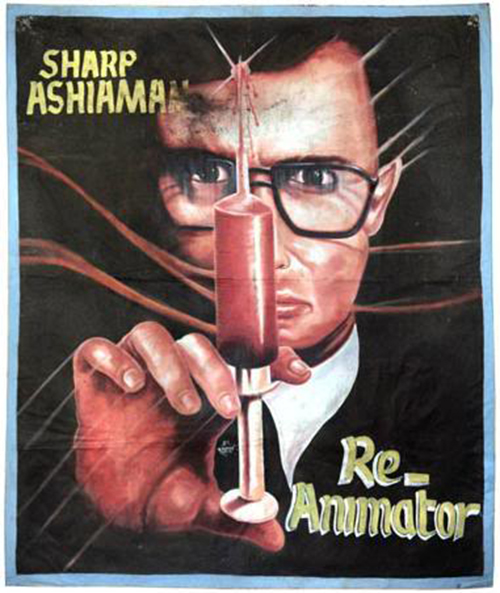
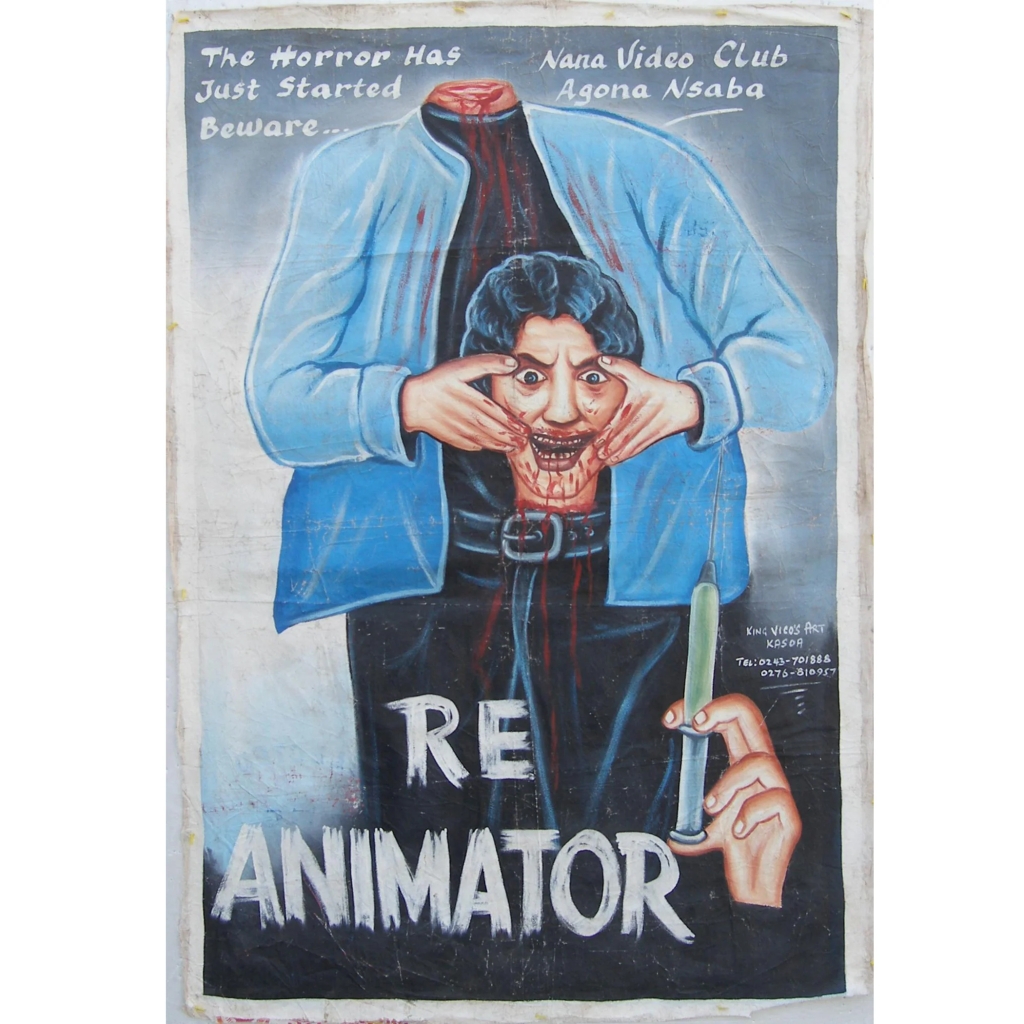
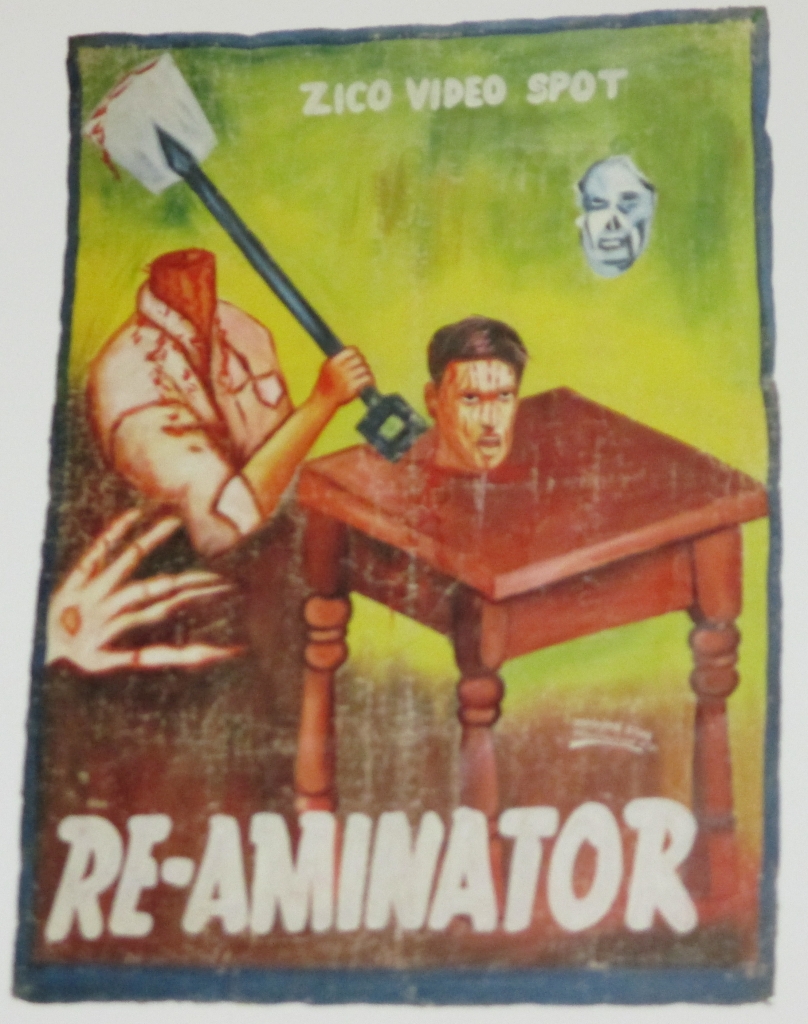
The gore and nudity in Re-Animator, Bride of Re-Animator (labeled as Re-Animator 2 above), and Beyond Re-Animator gave Ghanaian artists plenty of opportunity to use their own imaginations, with the decapitation of Dr. Carl Hill (David Gale) given the spotlight. Two of the posters closely follow international marketing materials, albeit with their own Ghanaian spin (the reanimating reagent is replaced with blood in the first poster featuring Jeffrey Combs as Dr. Herbert West, and Barbara Crampton appears to have gotten a breast augmentation and is no longer censored by the blood drop in the lovingly rendered head-giving-head scene). While not explicitly labeled as Beyond Re-Animator, the final poster is easy to identify as that film because of the distinct depiction of the scene where a rat fights a reanimated penis (although in the film, the testicles are not attached).
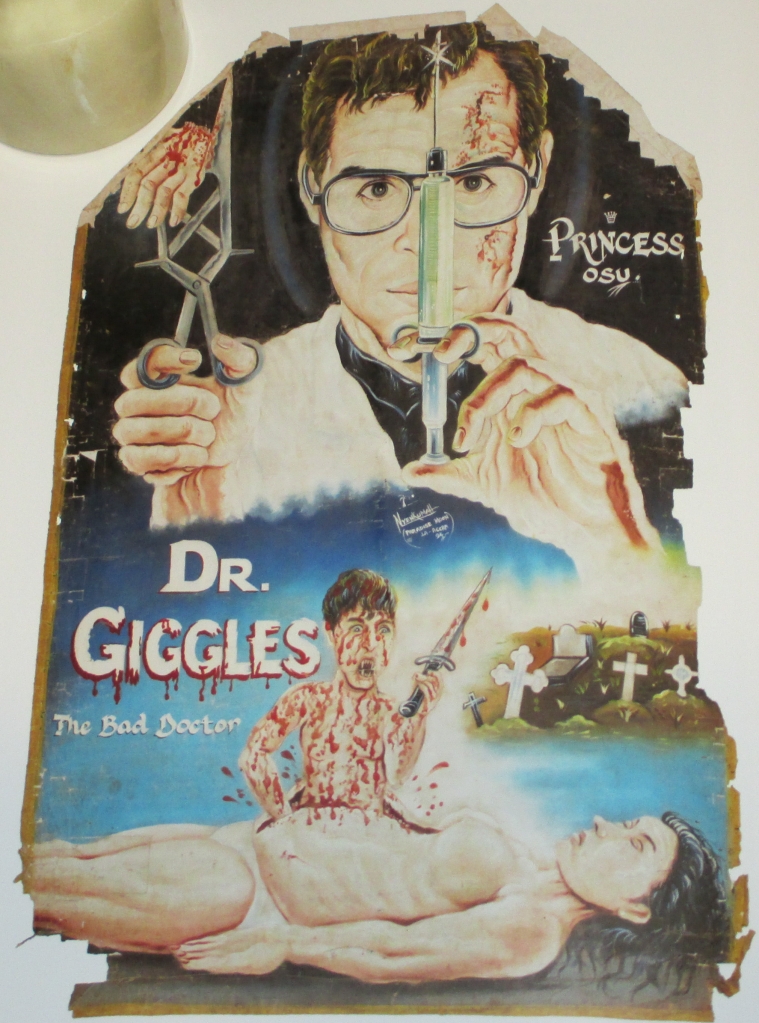
Very noticeable about these posters is the skill and attention given to the lettering; while some of the artists may have closely copied other posters or appear to have been told the plot of the movie instead of watching it, the lettering on the titles is terrific.
As a related piece of work, consider this poster for Dr. Giggles (1992). Jeffrey Combs doesn’t appear in this movie—the eponymous doctor was played by Larry Drake—but Dr. Herbert West obviously resonated with at least one Ghanaian artist.
From Beyond (1986)
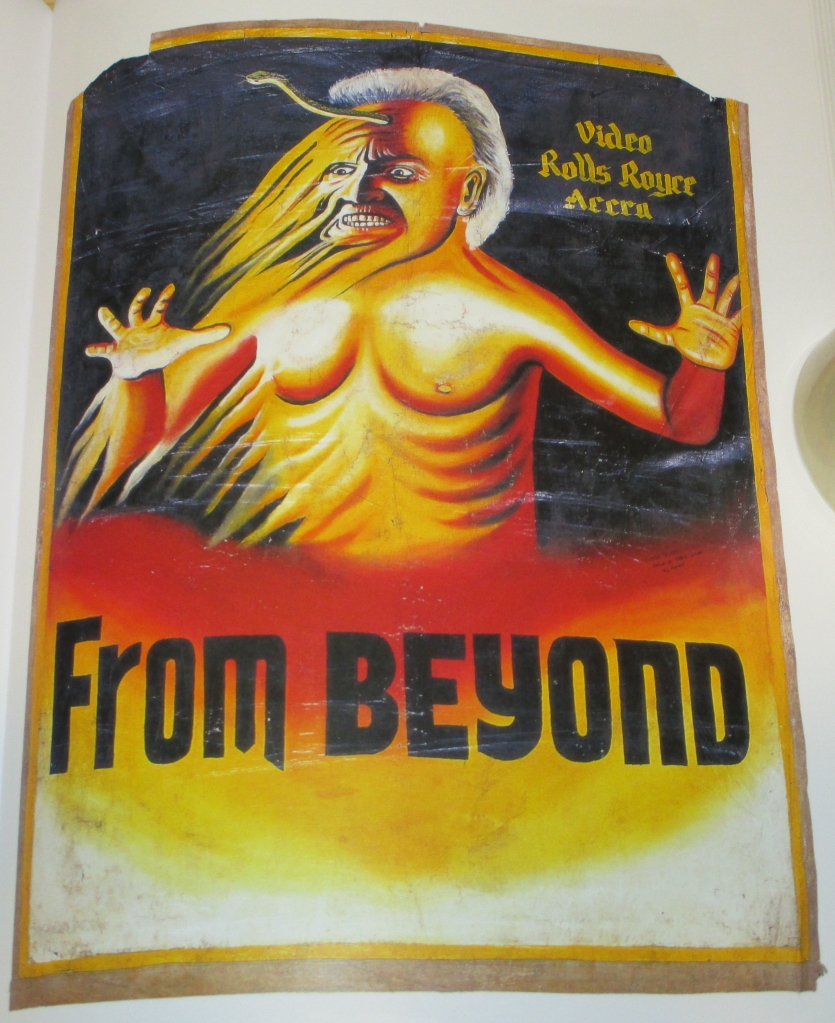
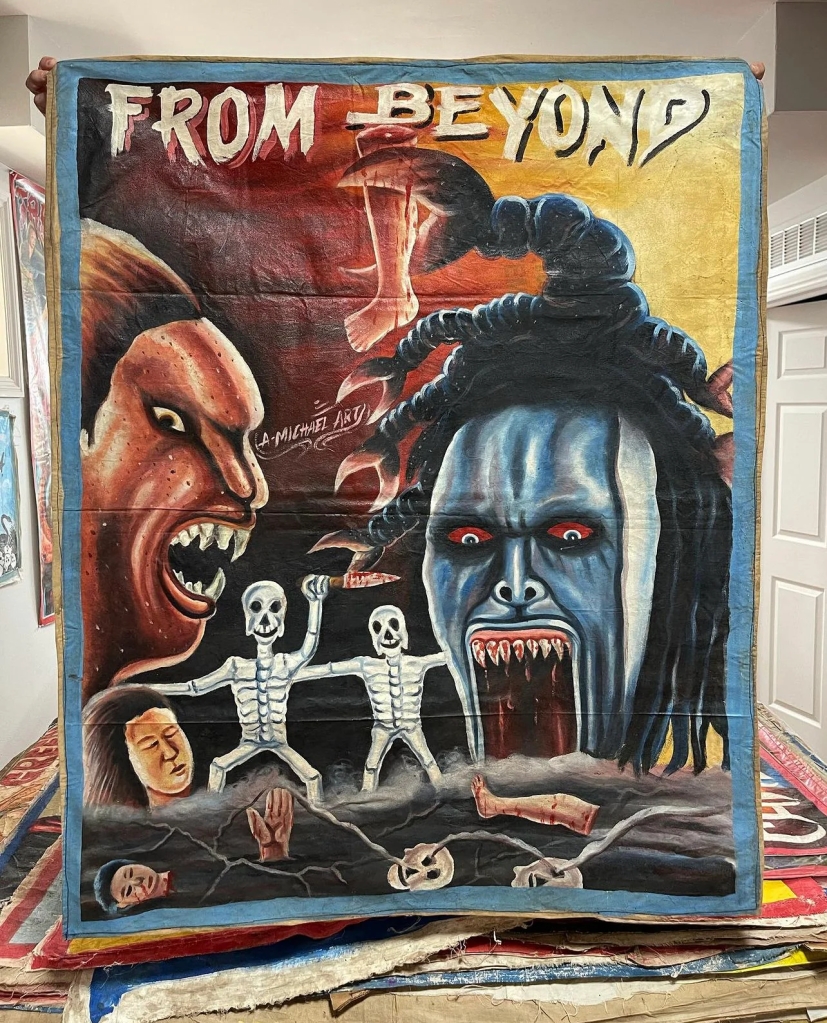
The second Lovecraftian film by director Stuart Gordon and producer Brian Yuzna is an update and adaptation of Lovecraft’s “From Beyond.” This film doubles down on suggestions of sex and the visual effects, with inhuman monsters and grotesque transformations. Fewer posters of this work have been preserved.
The first poster for From Beyond is a not-entirely-inaccurate rendition of Dr. Pretorius (Ted Sorel) in his makeup; although the enlarged, external pineal gland has been rendered as a snake (shades of The Dunwich Horror posters). By contrast, the second post is completely unrecognizable as any imagery from the film, and indicates that the artist probably painted it based on a description or straight from the imagination.
Evil Dead II (1987) & Army of Darkness (1992)
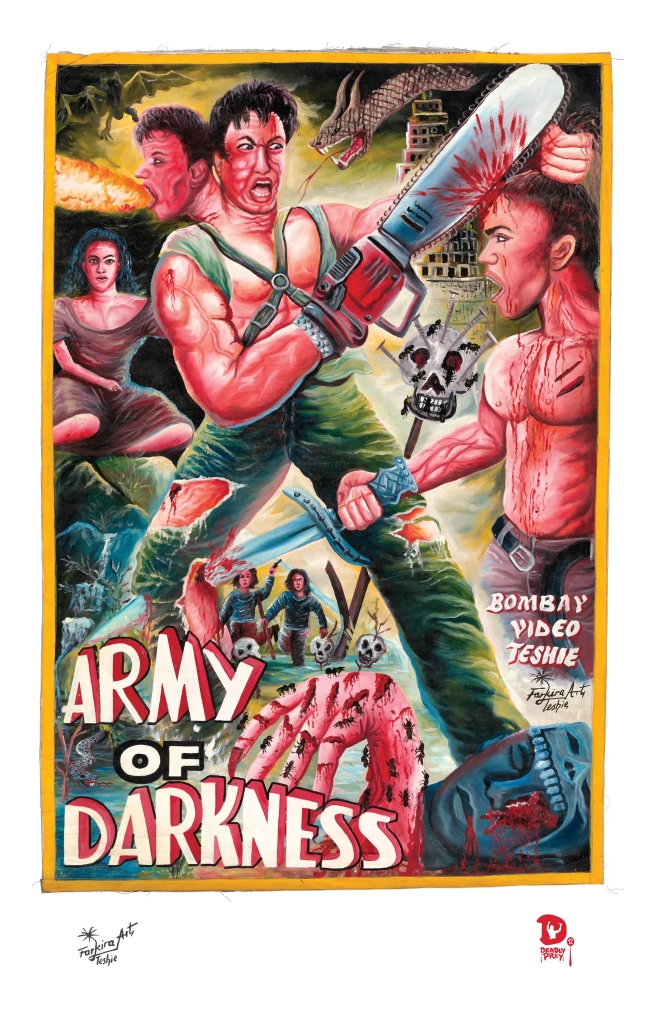
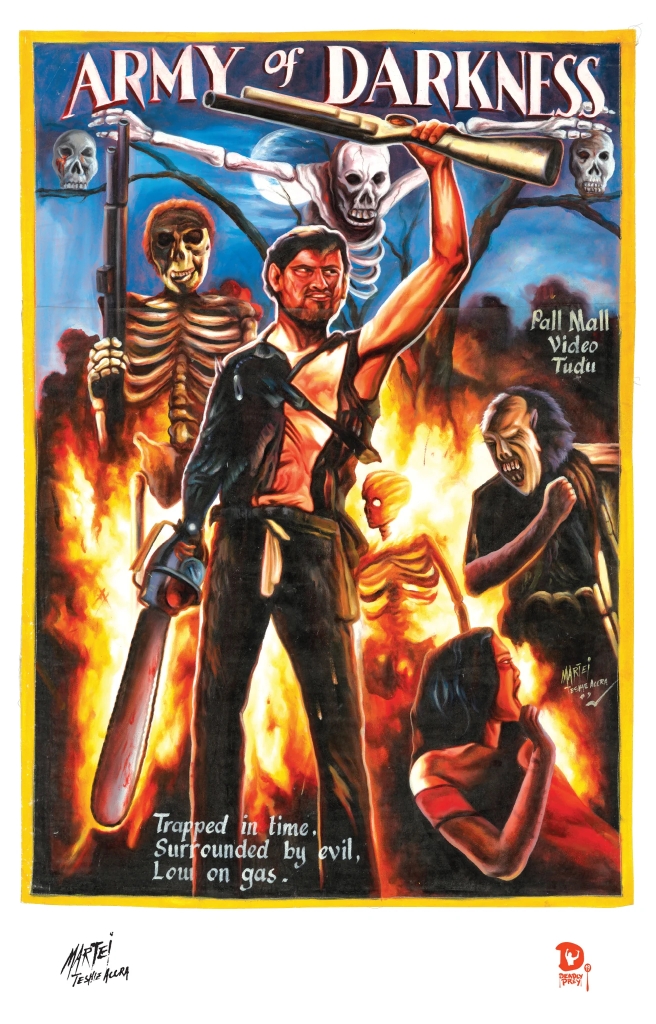
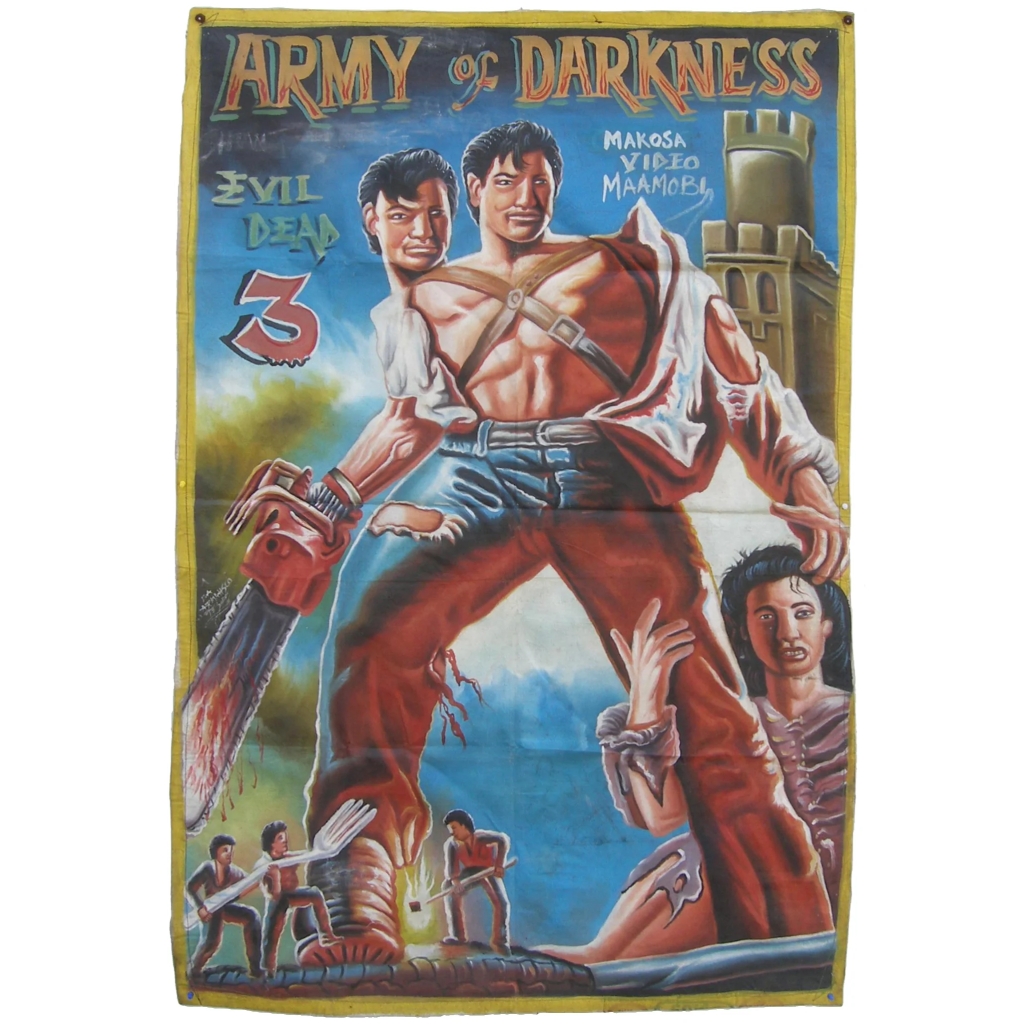
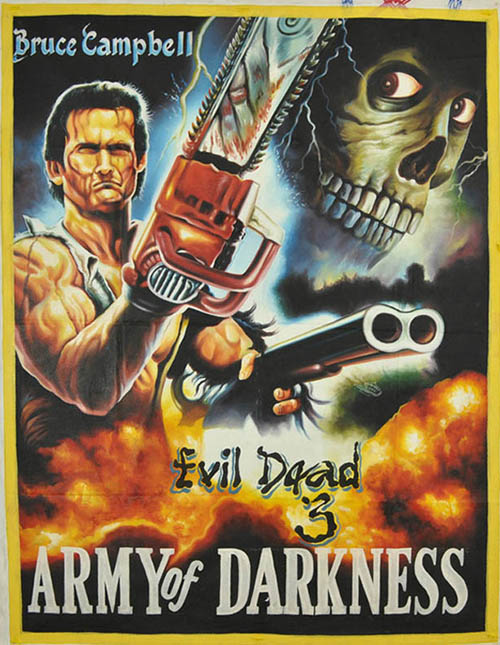
Director Sam Raimi’s Evil Dead II and its sequel Army of Darkness defined the look of the Necronomicon for moviegoing audiences for a generation, and the image of the book as roughly bound in human skin with an actual face visible on the cover continues to influence depictions of Lovecraft’s fictional tome today. Ghanaian artists seem less interested in depicting the Necronomicon ex Mortis, however, than they were with the character of Ash (played by Bruce Campbell) with his iconic chainsaw-prosthetic.
Between the two Sam Raimi films, there are a lot of great images and scenes for Ghanaian artists. Which is why it is surprising that the artists sometimes recombine the Evil Dead imagery with that drawn from other films, such as Amando de Ossorio’s Blind Deadseries, John Carpenter’s The Thing, and what might be Pumpkinhead. Which might be false advertising, but the important thing was to get butts in seats, and the more exotic imagery of some of the posters shows how syncrenistic these posters could be, borrowing horrific images from other films to fill in the space and spice up the post.
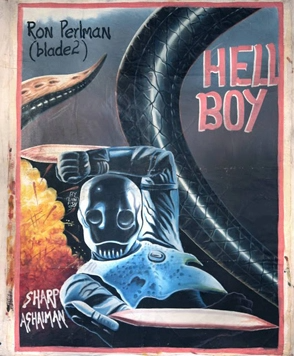
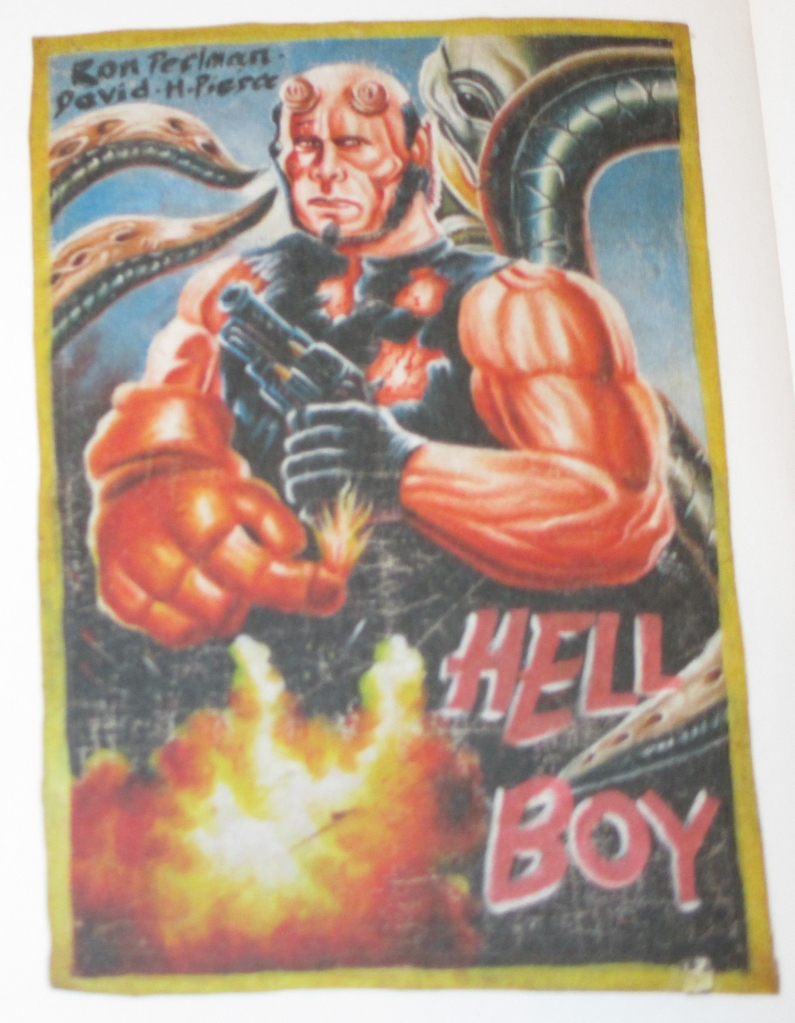
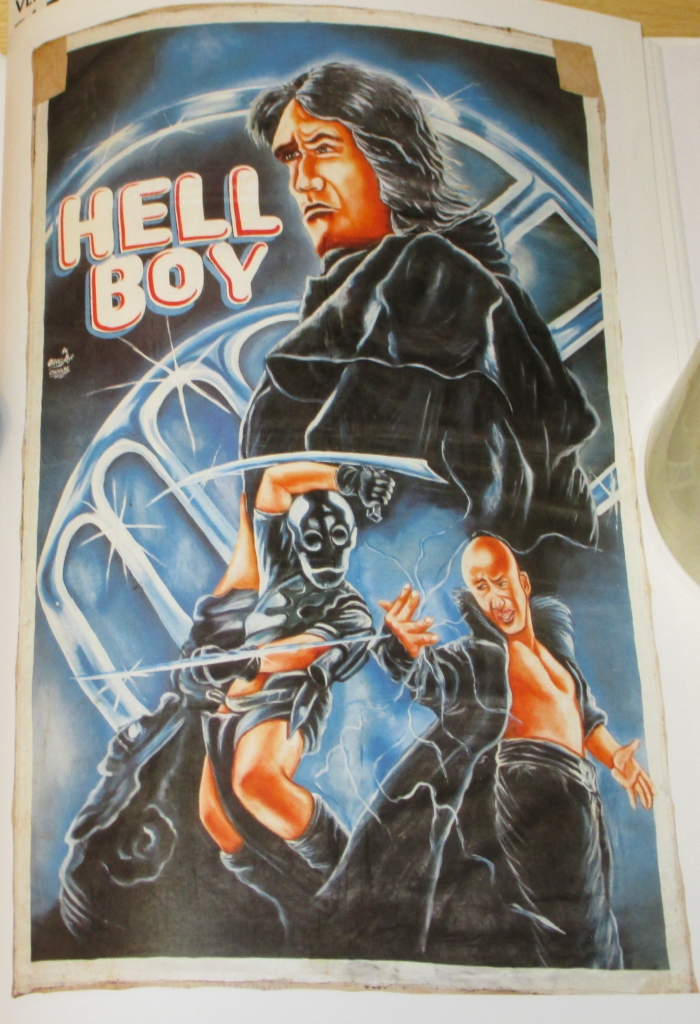
Hellboy (2004)
This adaptation of Mike Mignola’s comic book character to the silver screen by director Guillermo del Toro falls outside the “Golden Age” of Ghanaian movie posters, and posters for it may have been produced later for Western audiences. The final Lovecraftian villain for the film gets less attention than Hellboy (Ron Perlman) and Karl Ruprecht Kroenen (Ladislav Beran).
It’s interesting to note that the first two posters both mention Ron Perlman by name, which was rare during the Golden Age unless the lead was an international superstar like Arnold Schwarzenegger. Bizarrely, David Hyde Pierce is also mentioned; Pierce had provided the voice for Abe Sapien (played by Doug Jones), but went uncredited in the film.
Some readers might be disappointed that these hand-painted Ghanaian posters aren’t more “Lovecraftian” in the sense of emphasizing imagery familiar to Western audiences—there are scarcely any tentacles, nary a Necronomicon, no signs pointing to Dunwich or Arkham or Miskatonic University—but that is part of the point and the charm of these posters. They were being created outside the wider Western cultural milieu; they were at several removes from the original fiction H. P. Lovecraft wrote, and were working within their own cultural context, with images that stood out to them or made sense for their purpose.
This is Lovecraftian cinema as Ghanaians would have seen it in the 80s, 90s, and 00s. When school kids might wait for the sun to go down, praying it wouldn’t rain, and then crowding into an open-air theater, like a drive-in without cars, all eyes glued on the screen. There were people in Ghana that could chant “Klaatu barada nikto!” as loudly as anyone else anywhere else in the world, who would hold their breath as David Gale’s disembodied head was lowered between the nubile legs of Barbara Crampton, or cringe as Ken Forey was eaten alive by things just beyond the edge of perception. It was their part of a shared experience, and these posters are the remnants of that, as surely as any Mythos tome ever stood as a record and monument of a lost age.
Marvels and Prodigies is a game of contemporary Lovecraftian horror. It is intended for players who want the classic experience of investigation and horror, but who also want the possibility of exploring deeper into the Mythos—the possibility of themselves becoming dread sorcerers, ecstatic cultists, blessed avatars.
Marvels and Prodigies (2024) is an independent tabletop roleplaying game written and published by S.J.S. Hancox-Li, whose initial publication was the result of a successful crowdfunding campaign. The core books are the Seeker’s Handbook (which contains basic character creation and system rules; player characters are called Seekers) and Gardener’s Manual (advanced rules, rules for magic, Mythos lore, artifacts, adventure seeds, etc., people running the game are called Gardeners); there is also a separate character sheet and quick rules, and a starting adventure/scenario The Thing That Comes In Autumn. All are available through DriveThruRPG.
Ever since the Call of Cthulhu Roleplaying Game was first published by Chaosium in 1981, it has been the de facto tabletop roleplaying game experience for the Cthulhu Mythos. It has never been the sole roleplaying game to utilize the Mythos or attempt to capture the atmosphere of cosmic horror on the tabletop experience, but the widespread and long-lasting success of the game—seven editions over 40+ years, plus translations into many non-English languages—along with Chaosium’s efforts at publishing (and republishing) Mythos fiction have effectively made it the default for Mythos roleplaying in the same way Dungeons & Dragons is often considered a default for fantasy tabletop roleplaying in general.
Even if someone wants to make their own original Mythos game post-1981, it is often designed in the shadow of Call of Cthulhu, and the choices that the designers make are typically an express development from or response to something in the mother game. So, for example, the essential play space of Call of Cthulhu is that the player characters are investigators who investigate some phenomena. The details are vague because it’s a very broad and adaptable idea; the player characters might be a private detective agency in 1920s Harlem hired to look into something, or G-men trying to figure out why professors at Miskatonic University keep dying, or maybe one of the player character’s rich uncles died and left them a haunted house. Dungeons & Dragons features adventurers who go adventuring, Call of Cthulhu features investigators who go investigating.
In 2002, Ron Edwards coined the term fantasy heartbreakers in an article of the same name. While the term has come to be dismissive—a way to put down games that try to be “Dungeons & Dragons but better”—but, in a broader sense, the term effectively captures a certain segment of independent games that develop out of one game but which attempt to address some genuine issue (in terms of system, setting, or concept) that the original game lacks or does badly. Call of Cthulhu has generated any number of heartbreakers by this definition, from The Necronomicon Roleplaying Game to Yellow Dawn,Haunted West, and Space Madness!.
Marvels and Prodigies is a Mythos heartbreaker, in the best sense of the word. While obviously drawing thematic inspiration from Call of Cthulhu‘s play space, this aggressively independent roleplaying game takes a very different tack in terms of system (instead of the percentile roll-under skill system of Call of Cthulhu it uses a dice pool and hits system reminiscent of Shadowrun 4th edition or Vampire: the Masquerade) and ideology. Player characters are Seekers who want to investigate the occult, and are given access to abilities that reflect their interests, and clear ways to develop those abilities…and this is very different from the standard Call of Cthulhu scenario.
Call of Cthulhu has had magic in every edition. Characters (player characters and non-player characters alike) have the ability to learn and cast spells. However, the mechanics of the game make learning and casting spells relatively difficult, dangerous, and likely to fail, and almost always come with real drawbacks for the player character that makes the attempt. There are relatively few spells that provide some genuine benefit with minimal cost, and none of them are available at the start of play; they may never be available, since placement of tomes with spells is basically up to the gamemaster. Player characters generally can’t start out as wizards like in Dungeons and Dragons, and might never be able to be spellcasters unless the gamemaster specifically encourages that.
That is explicitly part of the design space of the game: Call of Cthulhu encourages a very different style of roleplaying to D&D. Every investigation may be an adventure, but that doesn’t mean the designers of Call of Cthulhu want you killing every non-player character and looting their corpse, like player characters adventurers might expect to do in a dungeon in D&D. Call of Cthulhu and Dungeons & Dragons both focus on excitement, but CoC leans more into horror, and one aspect of horror is helplessness. In D&D, if you run into a monster you can’t defeat because your characters aren’t at a high enough level, you might argue the encounter was poorly planned or unfair because there was no way to win; in CoC if you run in a monster you can’t kill, that’s just something you have to live with. The atmosphere of the game thrives on some situations never being winnable.
It’s not that casting a fireball at the shoggoth might take some players out of the 1920s setting, the designers of the game generally appear to not want players to have fun the wrong way.
As far as discouraging player characters wizards goes, this approach to magic could be called broadly successful; the fact that the magic “system” is essentially a grab-bag of random effects with little rhyme or reason and often very little thought to organization doesn’t help. While various products and heartbreaker RPGs would tweak the system mechanics to further encourage or discourage player characters using magic, it’s broadly accurate to point out that magic rules in Call of Cthulhu and its heartbreakers are generally pretty hodgepodge and discouraging compared to games where player characters might actually want to be occultists.
What’s different about Marvels and Prodigies is that it’s not just a roleplaying game about Lovecraftian horror, but also about Lovecraftian wonder:
In Marvels and Pridigies, there is not just horror in those alien vistas, but wonder and glory too. A major inspiration for the themes of Marvels and Prodigies is Ruthanna Emrys and Anne Pillsworth’s The Lovecraft Reread. On their reading, the power of Lovecraft’s best stories comes from a tension between xenophobia and xenophilia. Alien fungi remove human brains, but enable us to travel the stars and distant worlds. An ancient race of telepaths steals souls and exterminates entire species, but does so while maintaining the greatest library in history and a convocation of our timeline’s greatest geniuses. You are descended from inhuman monsters, but their blood enables you to live forever in wonder and glory.
S. J. S. Hancox-Li, Seeker’s Handbook 2
Emrys’ and Pillsworth’s Lovecraft Reread is particularly focused on re-reading weird fiction (not just Lovecraft’s) with a fresh perspective, and without fannish reverence that might get in the way of genuine criticism. As they put it in their Introduction: “Welcome to the H. P. Lovecraft reread, in which two modern Mythos writers get girl cooties all over old Howard’s original stories.” If a reader feels wound up by reference to “girl cooties” and Howard Phillips Lovecraft’s fiction, then they should probably go clutch their pearls somewhere else. Lovecraft is dead, his corpse isn’t going to spin in its grave, no matter what people say or feel about him.
Which is rather the point: Mysteries and Prodigies is not a game system to replace the d100s for Call of Cthulhu, it’s a game where the focus of the investigation is not just to be horrified, but perhaps to be enthralled. To find the beauty and meaning in the universe as much as the cosmic horror. A perspective that has been explored by many writers over the years, such as in the anthology Wonder and Glory Forever: Awe-Inspiring Lovecraftian Fiction(2020). The focus on occult-minded Seekers and the focus on improvement often adds a spiritual component to the game: it’s not about becoming the most powerful wizard per se, it’s about how your player character’s deepening knowledge of the Mythos and dedication to their path changes you. The journey, more than the destination.
But is it any good? As indie RPGs go, it’s fine. The system is fairly quick to learn and certainly a step up from Call of Cthulhu‘s normal resolution system; like a lot of heartbreakers, it’s got a lot of quirky little tables, lists, and the like. Some of the quirkiness is endearing, some it is just the rough edges of a product that hasn’t had several editions worth of proofreading, editing, and further development. Mythos games generally don’t have a robust system of metaphysics, and Marvels and Prodigies is no exception, so some of the abilities are still very much a grab bag of effects with gaps and potential for abuse—but powergaming is an emergent element of all roleplaying systems regardless of mechanics.
If there’s a criticism to be laid against the book’s writing, it’s that there’s not much actual sense of the setting. The game is implicitly in a contemporary real-world setting with smartphones and firearms, but the impact of things like the Internet or someone uploading the Necronomicon onto the Internet Archive isn’t really addressed, and any would-be Gardner is going to have to put in a bit of work fleshing out when and where the action takes place before introducing their Seekers.
Use of AI
Cover images and certain chapter headers were generated using Stable Diffusion XL. These images are openly licensed by CC BY-SA 4.0. […] The Stable Diffusion XL model constitutes transformative use of existing images.
Marvels and Prodigies uses AI-generated images to illustrate the book. The use of generative AI has been very contentious, given that the dataset used to train the AI was derived from human artists without credit or permission, and that the use of AI-generated images threatens the job market of human artists. In this particular case, the use of AI-generated images merits some discussion.
Independent roleplaying game books with a single creator generally have zero art budget; no human jobs were lost because no humans were going to be paid to create images for these books. Either the creator does their best to create their own art, or grabs public domain images and uses those.
The standards for fair use of copyrighted materials vary by country, but in the United States one important aspect is whether the use is transformative: simply copying an existing work is a violation of copyright, but if the work is transformed in some way—such as being part of a collage, or the addition of speech balloons to make it a kind of cartoon, etc.—it may be considered fair use.
In this respect, Stable Diffusion is being used as a fairly sophisticated spirograph (or, less charitably, a plagiarism engine where the results are so chopped up the original source(s) cannot be identified), and the resulting output is released under a Creative Commons license. While folks may still dislike that the work of various artists was used to train the AI and would have preferred blank covers to AI-generated images, from a practical standpoint this is basically little different from any creator grabbing images off the internet and tweaking them in Photoshop just enough to avoid a copyright claim, only the fiddling has been automated.
While folks should continue to push against the use of generative AI in commercial products, the availability of the technology is already making substantial inroads in non-commercial and ultra-low-budget productions like independent roleplaying games where art budgets are effectively non-existent. Expect to see a lot more of this kind of thing in the future, unless legal and technical restrictions on generative AI make the availability of such applications inaccessible.
I wasn’t afraid of the storms or earthquakes that visited the bay. I wasn’t afraid of the depths of the sea or the dark things that swam there. The shadows in our house made me anxious. They came out of the corners when my mother sang and knit, and flew across her face and hands. She sang about shepherds and Hastur and the sweet smell of lemon trees at night.
One of my favorite early pieces of Lovecraft criticism is the very brief essay “Cosmic Horror” (1945) by Dorothy Tilden Spoerl, who discovered that knitting was a cure to the eldritch horrors of H. P. Lovecraft. Amelia Gorman has taken that idea and inverted it: instead of exorcism, an invocation.
As a story, there is a vast amount that remains unsaid. The core is as perfectly beautiful and simple as Arthur C. Clarke’s “The Nine Billion Names of God” (1952), but it is framed through women’s history. Knitting was often relegated to women’s work. So was computing. As Margot Lee Shetterly wrote about in Hidden Figures (2016), it was women at NASA who checked and double-checked the calculations and code for the early space missions. You the reader don’t need to know that to understand the story, but it may deepen their appreciation to know that this isn’t some random programmer; this is a story implicitly set in that point of history where women’s work was transitioning outside the home or the factory and into government offices and research labs. Education was becoming more available, and while glass ceilings and discrimination still existed, the women were in the workforce to stay after World War II, as old trades died away and new careers in computing were just beginning to take shape.
The Mythos elements in this piece are few. Hastur’s appearance is an old, old call back to an often-forgotten aspect of his artificial mythology. Before August Derleth made him a counterpart to Cthulhu; before Robert W. Chamber’s borrowed some names for The King in Yellow(1895), Hastur was a god of shepherds in Ambrose Bierce’s “Haïta the Shepherd” (1891). Shepherds have sheep, sheep make wool. It is the kind of idea so obvious you might wonder why nobody thought to put the pieces together before.
Drawing down the moon is a Wiccan practice. Witchcraft was often seen as the domain of women as well…and while the unnamed protagonist and her mother are not skinning down to dance around outside, or making candles of unbaptized baby fat, there is a current of witchy thought to the whole story. The way that women of two different generations finally learn to communicate, despite the disconnect between their lives; the passing on of secret knowledge, the suggestion of how this knowledge and power can be used against those who discriminate against them because of their gender, all partake of the idea of witchcraft without breaking out a broomstick or pointy hat or Book of Shadows.
It’s a story that works on so many different levels, but perhaps most surprisingly, it’s a story that only really works because it’s told from a woman’s perspective. A young man working as a programmer at NASA talking to his father about weaving fishing nets isn’t facing the same prejudices, the same societal expectations; “the context wouldn’t work nearly so well.
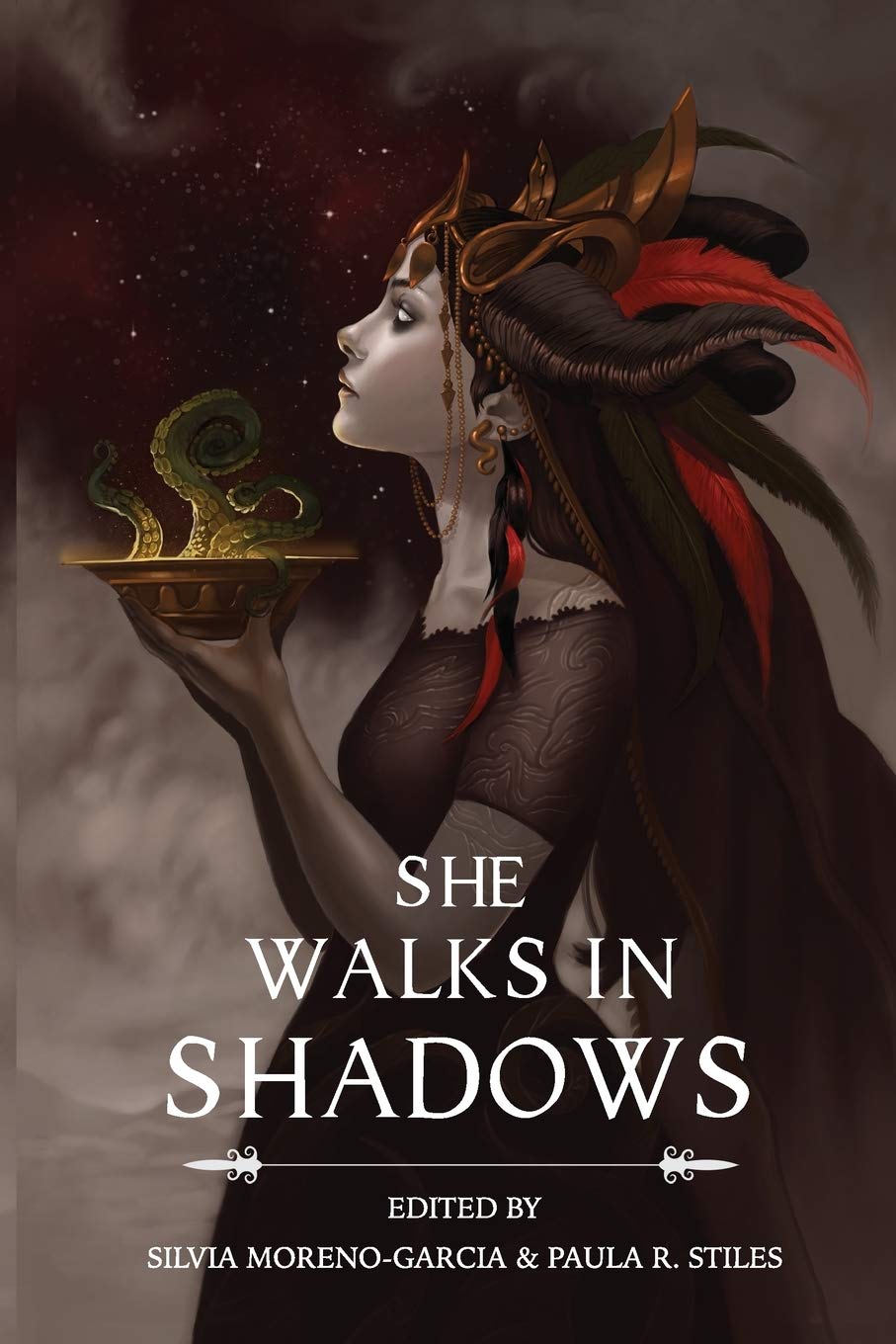
“Bring the Moon to Me” by Amelia Gorman was published in She Walks in Shadows(2015) and its paperback reprints; it was adapted as an audiobook on PseudoPod #538 in 2016.








 Deep Cuts in a Lovecraftian Vein