One summer between semesters at university, I visited some family in Portland, Oregon for a couple of weeks. There was a small hole-in-the-wall bookstore, the name long forgotten, and no longer there; little more than two long walls full of books through which browsers circled in a shuffling line. My prize that day was a slim little volume of ghostly and occult stories titled Unholy Relics (1947) by M. P. Dare, whose name I did not recognize.
It turned out I had read Dare before, because a few stories had appeared in various anthologies, and I recognized “The Demoniac Goat” from The Shub-Niggurath Cycle. What I didn’t know was anything about M. P. Dare. That would come later, in bits and pieces over the years. An amateur archaeologist and historian, a journalist and bookman, thief and forger, and finally: suicide. I suspect the criminal convictions, the divorces, the accusations, and his final resort to poison have raised M. P. Dare’s profile higher than his fiction alone would have; even the most generous literary critic has noted that Unholy Relics is cruder than M. R. James’ Ghost Stories of an Antiquary (1904) and other volumes, for all that Dare seems to be following in James’ footsteps.
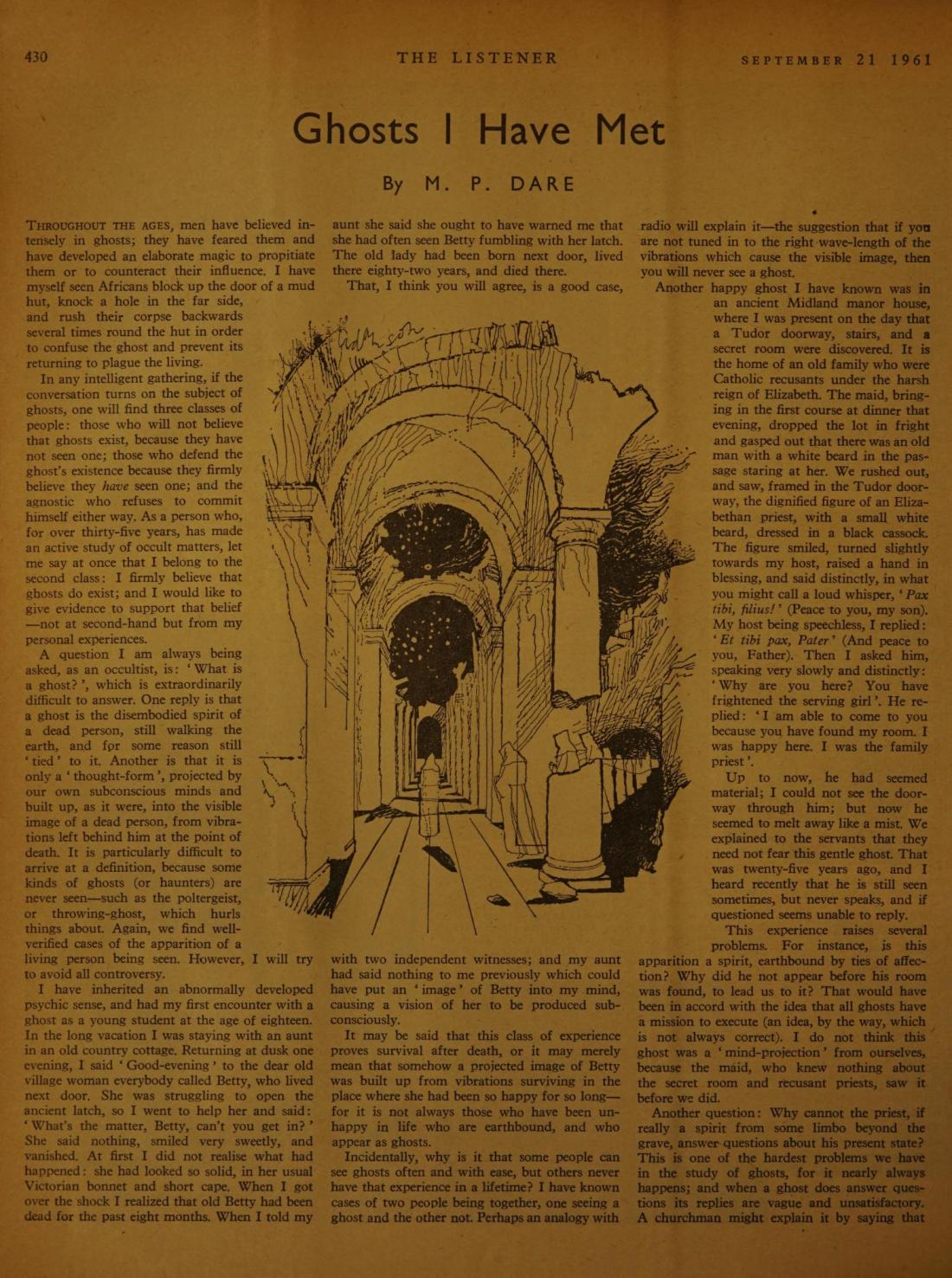
Near the end of his life, Dare went on the BBC radio and gave an account of the ghosts he had encountered in his life. It is his most explicit statement of a belief in the supernatural that survives, and has long been obscure, first published in The Listener 21 Sep 1961, and reprinted only twice: in Ghosts & Scholars #18 (1994), and in Ash-Tree Press reissue of Unholy Relics (1997), where it augments Reg Meuross’ biographical introduction.
This is a story of M. P. Dare that most people have not heard: his own story, in his own words.
※
Ghosts I Have Met
by M. P. Dare
THROUGHOUT THE AGES, men have believed intensely in ghosts; they have feared them and have developed an elaborate magic to propitiate them or to counteract their influence. I have myself seen Africans block up the door of a mud hut, knock a hole in the far side, and rush their corpse backwards several times round the hut in order to confuse the ghost and prevent its returning to plague the living.
In any intelligent gathering, if the conversation turns on the subject of ghosts, one will find three classes of people: those who will not believe that ghosts exist, because they have not seen one; those who defend the ghost’s existence because they firmly believe they have seen one; and the agnostic who refuses to commit himself either way. As a person who, for over thirty-five years, has made an active study of occult matters, let me say at once that I belong to the second class: I firmly believe that ghosts do exist; and I would like to give evidence to support that belief—not at second-hand but from my personal experiences.
A question I am always being asked, as an occultist, is: ‘What is a ghost?’, which is extraordinarily difficult to answer. One reply is that a ghost is the disembodied spirit of a dead person, still walking the earth, and for some reason still ‘tied’ to it. Another is that it is only a ‘thought-form’, projected by our own subconscious minds and built up, as it were, into the visible image of a dead person, from vibrations left behind him at the point of death. It is particularly difficult to arrive at a definition, because some kinds of ghosts (or haunters) are never seen—such as the poltergeist, or throwing-ghost, which hurls things about. Again, we find well-verified cases of the apparition of a living person being seen. However, I will try to avoid all controversy.
I have inherited an abnormally developed psychic sense, and had my first encounter with a ghost as a young student at the age of eighteen. In the long vacation I was staying with an aunt in an old country cottage. Returning at dusk one evening, I said ‘Good-evening’ to the dear old village woman everybody called Betty, who lived next door. She was struggling to open the ancient latch, so I went to help her and said: ‘What’s the matter, Betty, can’t you get in?’ She said nothing, smiled very sweetly, and vanished. At first I did not realise what had happened: she had looked so solid, in her usual Victorian bonnet and short cape. When I got over the shock I realized that old Betty had been dead for the past eight months. When I told my aunt she said she ought to have warned me that she had often seen Betty fumbling with her latch. The old lady had been born next door, lived there eighty-two years, and died there.
That, I think you will agree, is a good case, with two independent witnesses; and my aunt had said nothing to me previously which could have put an ‘image’ of Betty into my mind, causing a vision of her to be produced sub-consciously.
It may be said that this class of experience proves survival after death, or it may merely mean that somehow a projected image of Betty was built up from vibrations surviving in the place where she had been so happy for so long—for it is not always those who have been unhappy in life who are earthbound, and who appear as ghosts.
Incidentally, why is it that some people can see ghosts often and with ease, but others never have that experience in a lifetime? I have known cases of two people being together, one seeing a ghost and the other not. Perhaps an analogy with radio will explain it—the suggestion that if you are not tuned in to the right wave-length of the vibrations which cause the visible image, then you will never see a ghost.
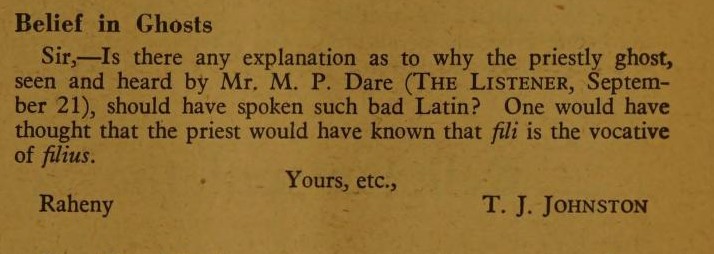
Another happy ghost I have known was in an ancient Midland manor house, where I was present on the day that a Tudor doorway, stairs, and a secret room were discovered. It is the home of an old family who were Catholic recusants under the harsh reign of Elizabeth. The maid, bringing in the first course at dinner that evening, dropped the lot in fright and gasped out that there was an old man with a white beard in the passage staring at her. We rushed out, and saw, framed in the Tudor doorway, the dignified figure of an Elizabethan priest, with a small white beard, dressed in a black cassock. The figure smiled, turned slightly towards my host, raised a hand in blessing, and said distinctly, in what you might call a loud whisper, ‘Pax tibi, filius!’ (Peace to you, my son). My host being speechless, I replied: ‘Et tibi pax, Pater’ (And peace to you, Father). Then I asked him, speaking very slowly and distinctly: ‘Why are you here? You have frightened the serving girl’. He replied: ‘I am able to come to you because you have found my room. I was happy here. I was the family priest’.
Up to now, he had seemed material; I could not see the doorway through him; but now he seemed to melt away like a mist. We explained to the servants that they need not fear this gentle ghost. That was twenty-five years ago, and I heard recently that he is still seen sometimes, but never speaks, and if questioned seems unable to reply.
This experience raises several problems. For instance, is this apparition a spirit, earthbound by ties of affection? Why did he not appear before his room was found, to lead us to it? That would have been in accord with the idea that all ghosts have a mission to execute (an idea, by the way, which 5 is not always correct). I do not think this ghost was a ‘mind-projection’ from ourselves, because the maid, who knew nothing about the secret room and recusant priests, saw it before we did.
Another question: Why cannot the priest, if really a spirit from some limbo beyond the grave, answer questions about his present state? This is one of the hardest problems we have in the study of ghosts, for it nearly happens; and when a ghost does answer questions its replies are vague and unsatisfactory. A churchman might explain it by saying that we are not permitted to know in advance the conditions of our future state.
Another ghost of my experience, in yet another English manor house, really did live up to tradition by having a mission; and this one belonged to the class of unhappy haunters. Also, it was an interesting case of a haunter that was never seen. Once its mission was accomplished it ceased to trouble the living. This was in a house near Rockingham, where the family suddenly became the victims of a most unpleasant and annoying form of haunting. It centred on a beautiful little Georgian writing-desk in the bedroom of the young daughter, who was thirteen years of age. It is a curious fact that many ghost-disturbances of this type seem concentrated on young girls on the threshold of womanhood: they seem to be a transmitting medium for the exercise of these violent forces. The trouble began when the girl, awakened by a noise of heavy tramping about the room, saw every drawer in the desk being wrenched open by some unseen force, and the contents pitched out on to the floor. The trouble stopped a few days later, but recurred regularly at monthly intervals. I was asked to investigate, occupied this room, and also saw the desk handled violently and heard the noises.
Concluding that a family ghost with a mission was responsible, and that its search was connected with the desk, I had it searched by an expert, who found no fewer than six secret drawers in it. In one of those was a packet of old faded letters, and these gave us the clue. They were written in 1756 to the son of the house by a village girl whom he had seduced, and who threatened suicide if he did not marry her. I feel absolutely certain that this was his room, and his desk, and that one of his last, intense thoughts when dying was of horror and fear lest someone should find these letters; and I am sure it was his uneasy spirit searching for them. The head of the house and I burnt those letters, and there was no further trouble.
Some of these hauntings by ghosts, both seen and unseen, are much more violent and malevolent than this one, and it is not wise lightly to laugh at them. I remember one awful house, an empty bungalow I went to inspect in India, with a view to renting it, where the atmosphere of evil and death that poured out as soon as one opened a certain door was absolutely incredible. My Great Dane dog, naturally a fearless animal, felt it, and cringed in terror. Enquiry revealed that in that room, five years before, a man had gone mad, killed his wife, and hacked the body to pieces. I did not actually see a ghost—I bolted hastily out of the house after opening that door. But I later learned that an Indian acquaintance who had tried to live in the place had to leave it because of its evil atmosphere. He told me that he had seen, three times, shadowy forms struggling in that same room.
This was certainly a very unhallowed spot; but even so holy a place as a church, surrounded by daily prayer and good influences, can be haunted by an unhappy personality, and in one of two such cases within my own experience I have not only seen the ghost, but recognized it. Here the building was a modern church attached to the Dominican priory in a Midland city. Not only myself, but the three priests officiating at High Mass, and several people known to me in the congregation, saw the apparition. What we saw, to our astonishment, was a fourth priest, in addition to the three who should alone have been there, and we recognized him as a Dominican of the house, who had died a month before in great spiritual distress (it was assumed), because after death his papers revealed a scandal in his private life. Hence he was haunting his priory, where several of the brethren saw him flitting about the corridors. After a special exorcism rite, and a Mass for the Dead had been said, he ceased to haunt.
‘The evil that men do lives after them’, said Shakespeare. How true this often is of the ghost-world, from the English Midlands to the jungles of India.
※
M. P. Dare was not the protagonist of some M. R. James story made flesh, though there are hints in his biography that maybe he wanted to be. This is nowhere more obvious than when comparing some of his anecdotes of ghostly encounters with his sole story collection, Unholy Relics and Other Uncanny Tales. In the introduction to that book, Dare wrote:
These tales are fiction—and yet not fiction. They are all founded upon actual experiences of the author in the realms of the uncanny. The antiquary, perhaps because he is in close touch with the human thought of all time, that is not dead, but sometime sleepeth, comes more into contact with that dim borderline region than most people.
Did Dare actually mean this, or was it just a “Based on a true story” line to help sell the book? Did he start out as critical and slowly become a believer, or did he always carry a belief in the supernatural that only publicly came out relatively late in life? If we accept “Ghosts I Have Met” as true, then Dare may have held a belief for much of his life, and that changes how we read some of his stories. Certainly, the incident of the letters in the secret drawer coincides closely with Dare’s story “The Haunted Drawers” (although thankfully he ages up the lady in that story).
There might be other elements of autobiography buried in Dare’s fiction, incidents from his life that informed or inspired his thin legacy. No one has yet collected all the bits and pieces of that life in one place. There are essays in The Leicester Mail during the 1920s that indicate an abiding interest in archaeology, history, and local superstitions (e.g., “Witchcraft and Superstition in Leicestershire – No. 1” by M. P. Dare), and here, too, we might wonder if a bit of Leicestershire folklore influenced his story “An Abbot’s Magic.”
Perhaps, someday, a scholar will have the patience and resources to correlate the contents of a broken life, like an archaeologist reassembling the shards of a cursed pot. What new light might be shed on these old tales, if only we knew what Dare was drawing on when he wrote them? It would be fitting if the key to Unholy Relics, the part that made the stories more than just Jamesian pastiche, was Dare himself.
Bobby Derie is the author of Weird Talers: Essays on Robert E. Howard and Others and Sex and the Cthulhu Mythos.
Deep Cuts in a Lovecraftian Vein uses Amazon Associate links. As an Amazon Associate I earn from qualifying purchases.

