“ZOMBIO/死霊のしたたり” (1987) by Abe Yutaka (阿部 ゆたか)

Only a fraction of the comics that Japan produces are ever translated for English-language markets. As a consequence, Anglophones miss out on a lot of great—and sometimes terrible—manga, and sometimes get a misleading impression of the diversity and quality of Japanese comic art and writing. There is far more to horror manga, for example, than luminaries like Junji Ito and Gou Tanabe.

Monthly Halloween (月刊ハロウィン, 1985-1995) was a monthly horror comics anthology publication focused on the shōjo (teenaged girls) market; horror movies being popular among that demographic at the time. It was the first such shōjo horror magazine, but quickly inspired many imitators, and among its publications were the first appearance of Junji Ito’s Tomie. While it wouldn’t be exactly analogous to say Monthly Halloween was like Weird Tales aimed toward Japanese teenage girls, it wouldn’t be entirely inaccurate either. The tales within varied in theme from traditional Japanese ghost stories to ripped-from-the-latest-horror-film-from Hollywood. For great overviews, check out Renzo Adler’s Monthly Halloween: How American Horror was Translated for Shoujo Manga (2021) and kevndr’s Halloween Hijinks: Hollywood Horror in Japanese Comics (2022).
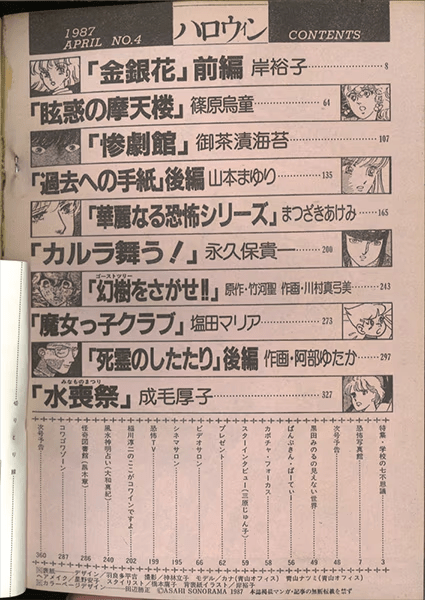
Table of contents for Monthly Halloween April 1987.
Herbert West can be seen, second row from bottom.

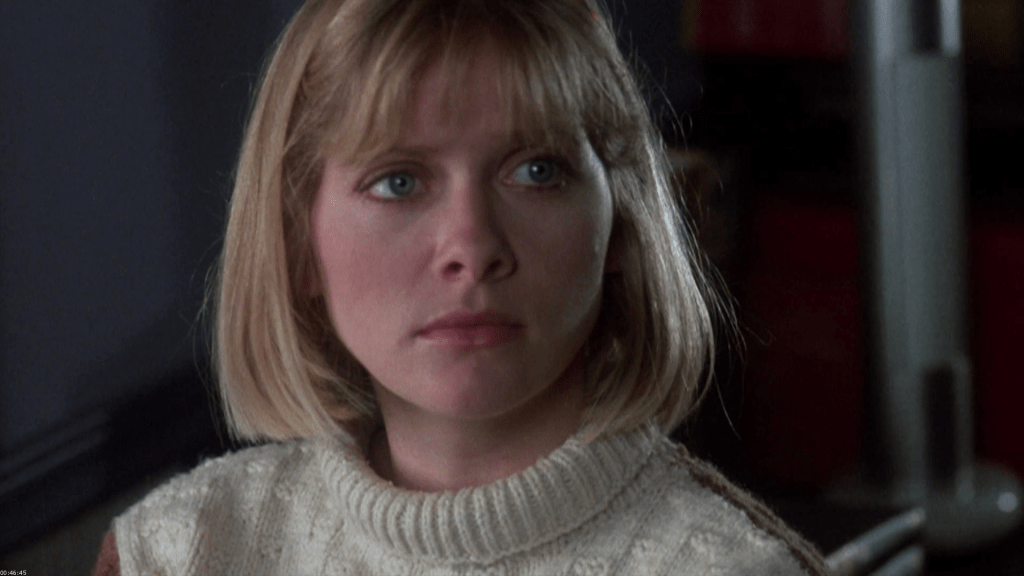
Director Stuart Gordon’s Re-Animator (1985) arrived in Japan on 14 March 1987 under the title “ZOMBIO/死霊のしたたり” (“Zombio/Dripping of the Dead”). Not coincidentally, in the March and April 1987 issues of Monthly Halloween, the story was adapted to manga by Abe Yutaka (阿部 ゆたか), probably better known to US audiences for his work on Detective Conan, who had previously adapted Day of the Dead (1985) for the magazine, which also had its Japanese release around the same time. The 64-page adaptation follows the film fairly closely, with a few artistic concessions given the intended audience, the younger characters (Herbert West, Dan Cain, and Megan Halsey) given more stereotypical teenaged appearances compared to the older characters.
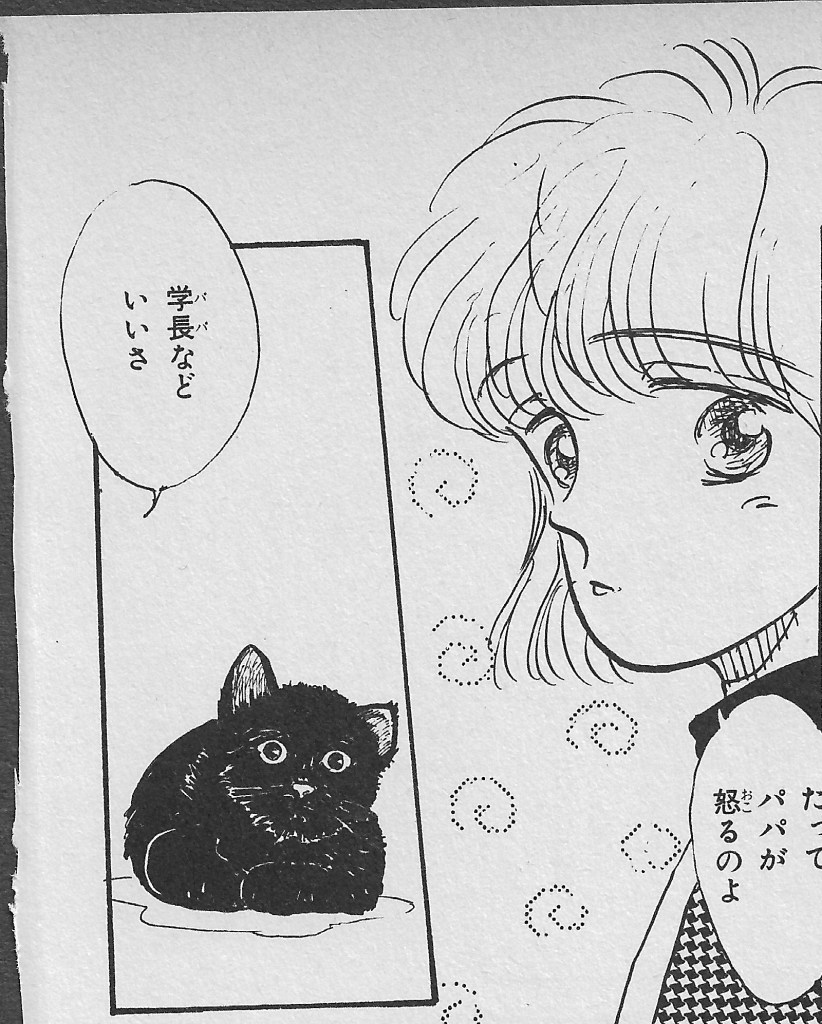
The nuances of the actors’ performances don’t really translate, but the somewhat slapstick action does, aided in no small part by an unflinching ability to depict a bit of gore and some common manga visual rhetoric that helps sell frantic energy and motion.
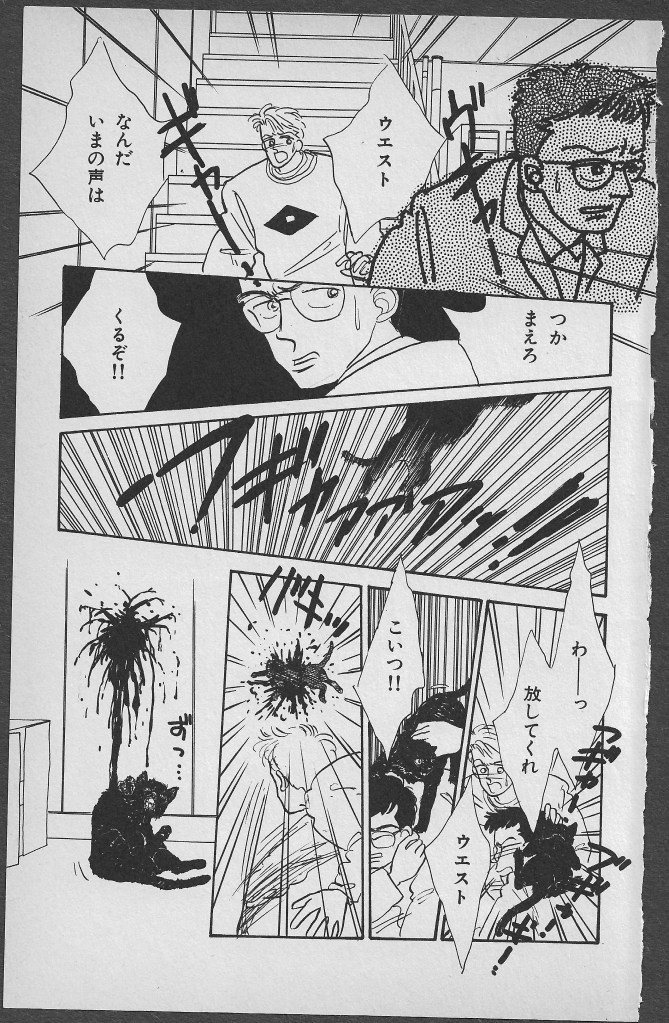
Top Panel:
Dan Cain: West! What is that sound?

Second Panel:
Herbert West: Grab it! Here it comes!

Third Panel:
<<Scream>>

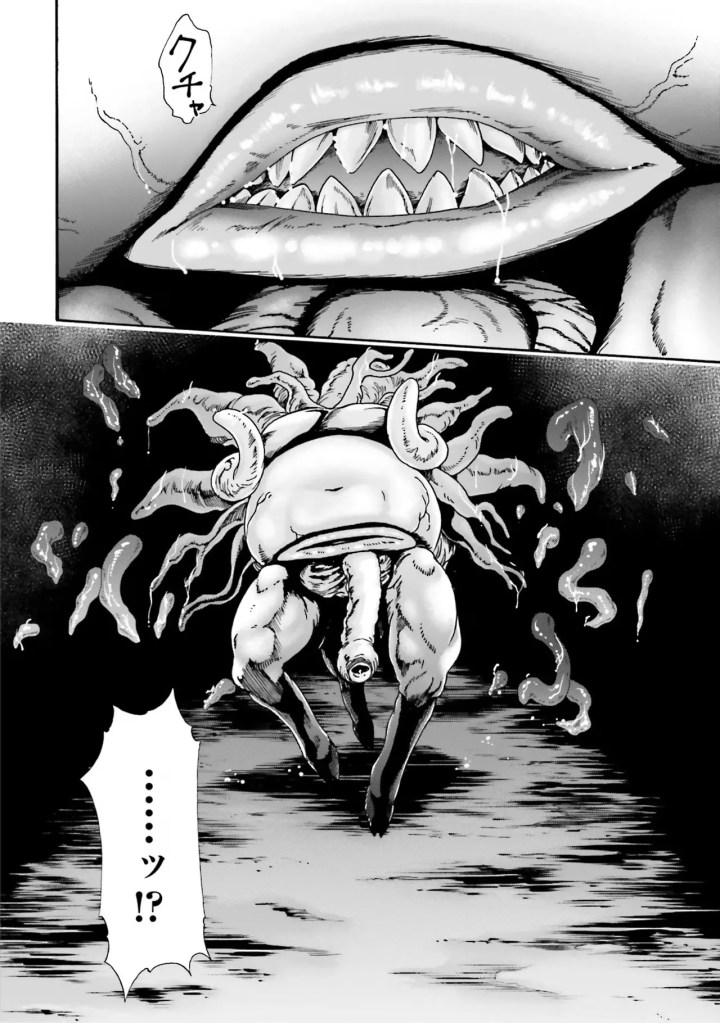
Bottom row, right to left:
West: Ouch! Let go of me!
Dan: West!
West: Damn thing!
<<Splat>>

The pacing is also kept up fairly well; while there might be a bit more emphasis on the Re-Animator sub-plot where Dr. Carl Hill is trying to convince Dean Halsey to give him Megan, balancing that romance angle, they don’t skimp on the actual reanimation, even if it lacks some of the visceral oomph of the film.
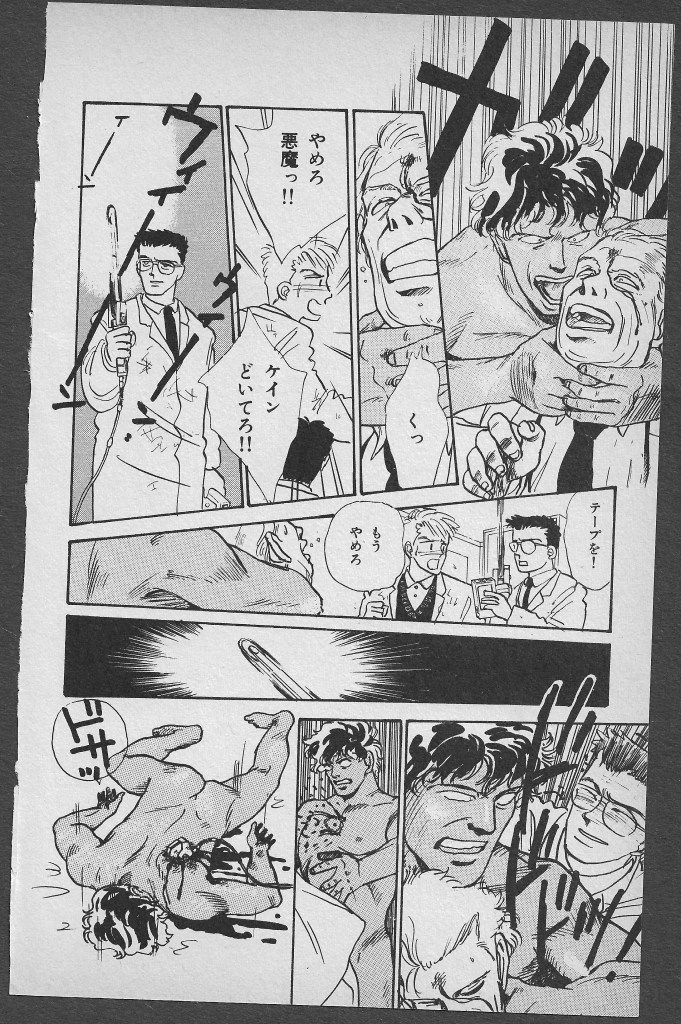
Top row, right to left:
<<choking sound>>
<<gulp>>
Dan: Get off him!!
West: Move aside, Cain.
<<buzz>>

Second row:
West: Keep the tape running! Take it, man.

Bottom row:
<<cutting noises>>

While the likenesses of the leads aren’t particularly close to the original actors, the faces are expressive and convey a lot of the emotion of the scenes, and Abe made sure to include many of the now-iconic shots from the film.
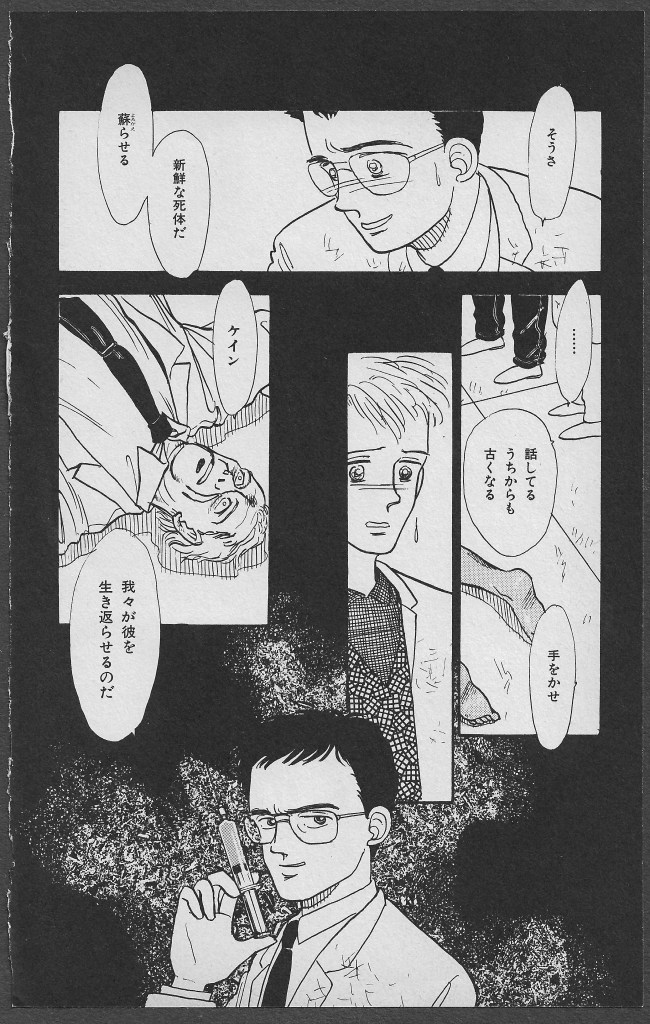
Top row, right to left:
West: You know… this is a fresh corpse. Let’s revive it.

Middle row, right to left:
West: As we speak, the corpse gets older. So give me a hand.

West: Cain. We will bring him back to life.

Omissions, there are a few. The infamous visual pun of the “head giving head,” which featured so prominently on some of the Japanese posters for the film (and the Ghana hand-painted equivalents) was rendered inert by keeping Megan Halsey fully clothed.
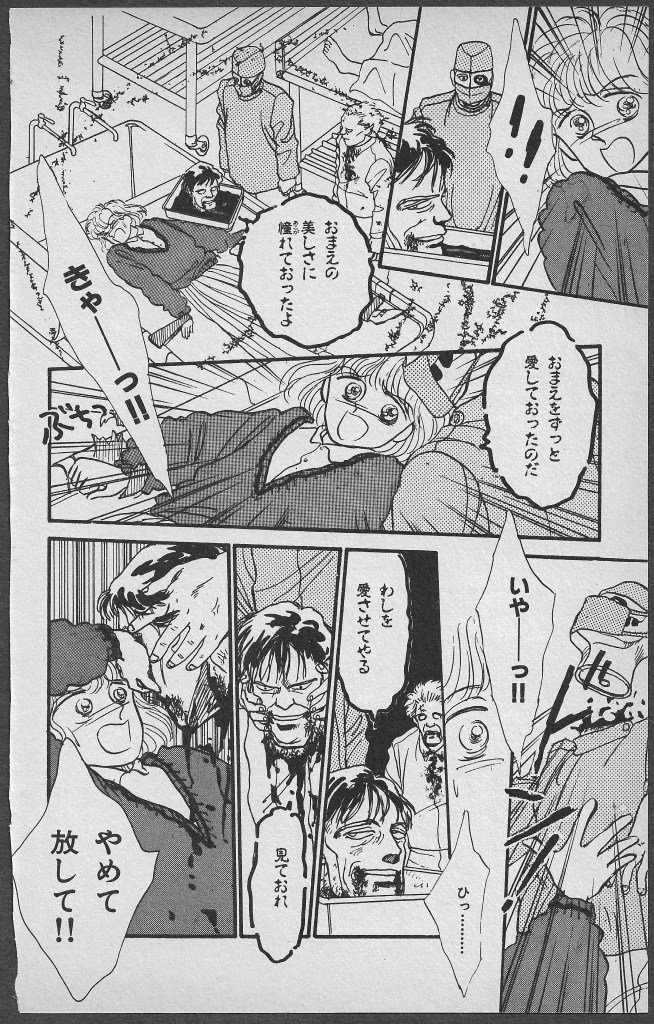
Top row, right to left:
Megan Halsey: !!
Dr. Carl Hill: I was always attracted to you…
Megan: NOOO!!

Middle row:
Hill: I have been in love with you for a long time!

Bottom row, right to left:
Megan: No!! Please…
Hill: Let me love you.
Hill: Look.
Megan: Stop it! Let me go!!

The emphasis on looking into Hill’s eyes is a reflection of a sub-plot in the film that is sometimes overlooked, that Dr. Hill has developed the power of mesmerism or hypnotism. A bit corny, but it gives him more agency than just as a disembodied head, and is implicitly how he can control his headless body through sheer will. It’s easy to see how the emphasis on the quasi-love triangle between Megan, Hill, and Dan might have appealed in adapting this story to an intended audience of young Japanese women.

The big action scene in the morgue is a bit perfunctory, although Abe covers all the critical moments:
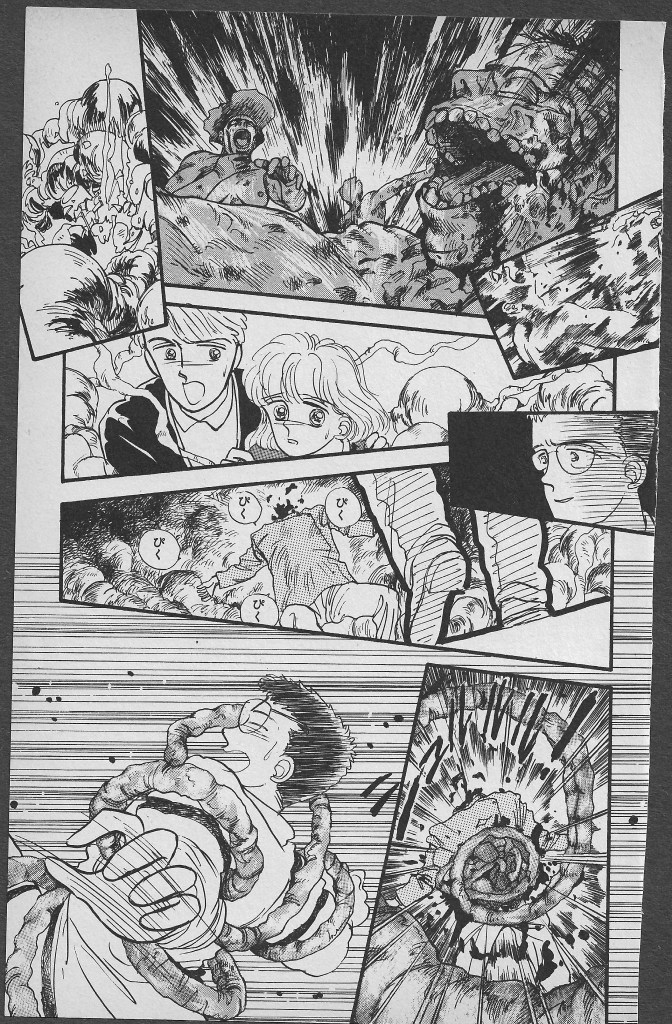
Fortunately, Abe and the editors of Monthly Halloween didn’t try to bowdlerized the ending. As in the original film, Dan Cain is left with a dead girlfriend and a choice:
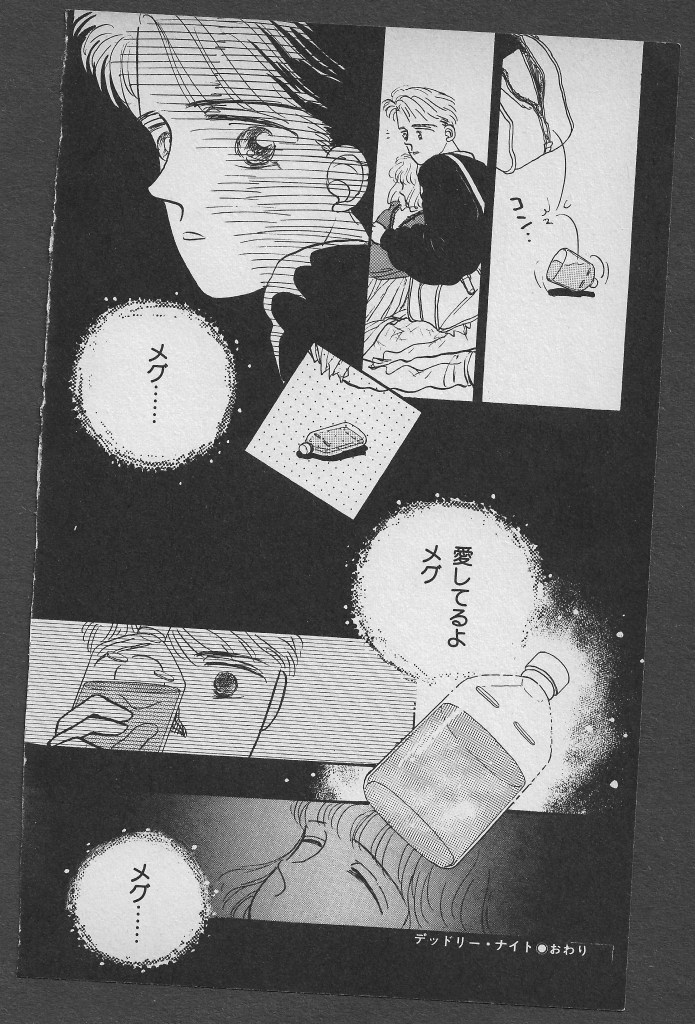
Top to bottom, left to right:
<<tink>>
Dan: Meg…

Dan: I love you Meg.

Dan: Meg…

Given the limitations of the medium—it would have been nice if they could afford a splash of luminescent green for the reanimation serum—this is a very solid adaptation of the film. There isn’t any indication that Abe Yutaka had access to the 1985 novelization of the film by Jeff Rovin, and it predates the first English-language Re-Animator comic adaption from Adventure, which ran in three issues in 1991, and had the advantage of a larger page size and color.
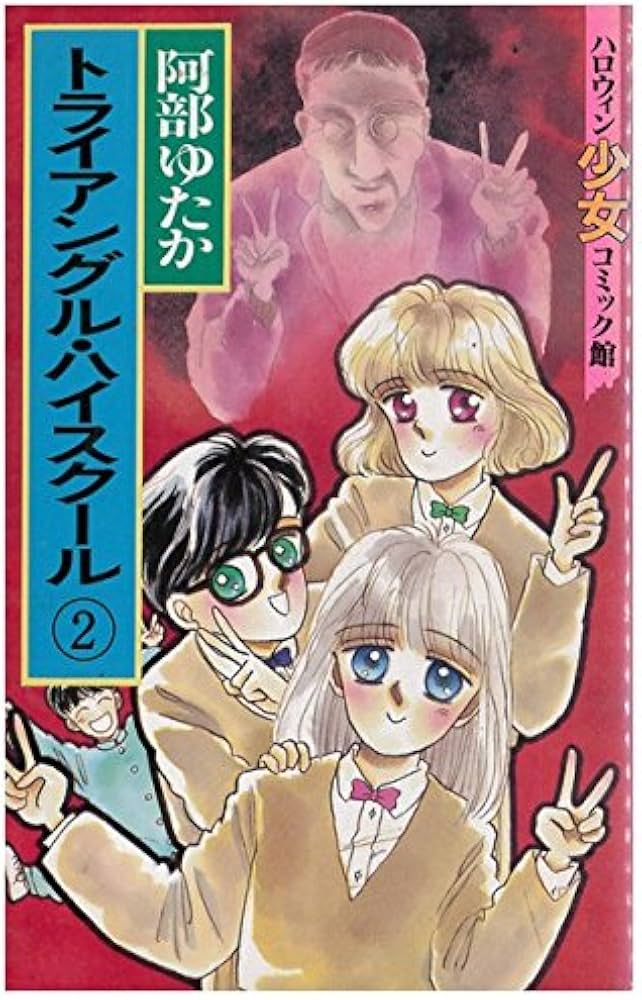
“ZOMBIO/死霊のしたたり” was reprinted in the back of トライアングル・ハイスクール 2 (Triangle High School 2), which collects another of Abe Yutaka’s series from Monthly Halloween; the first volume also collects Abe’s adaptation of Day of the Dead. Other than that, however, the Japanese manga adaptation of Re-Animator doesn’t seem to have been reprinted; it has never been officially translated into English, although raw scans have circulated on the internet for years.

With thanks and assistance to Dr. Dierk Günther of Gakushuin Women’s College for assistance and translation of the Japanese original.


Bobby Derie is the author of Weird Talers: Essays on Robert E. Howard and Others and Sex and the Cthulhu Mythos.

Deep Cuts in a Lovecraftian Vein uses Amazon Associate links. As an Amazon Associate I earn from qualifying purchases.
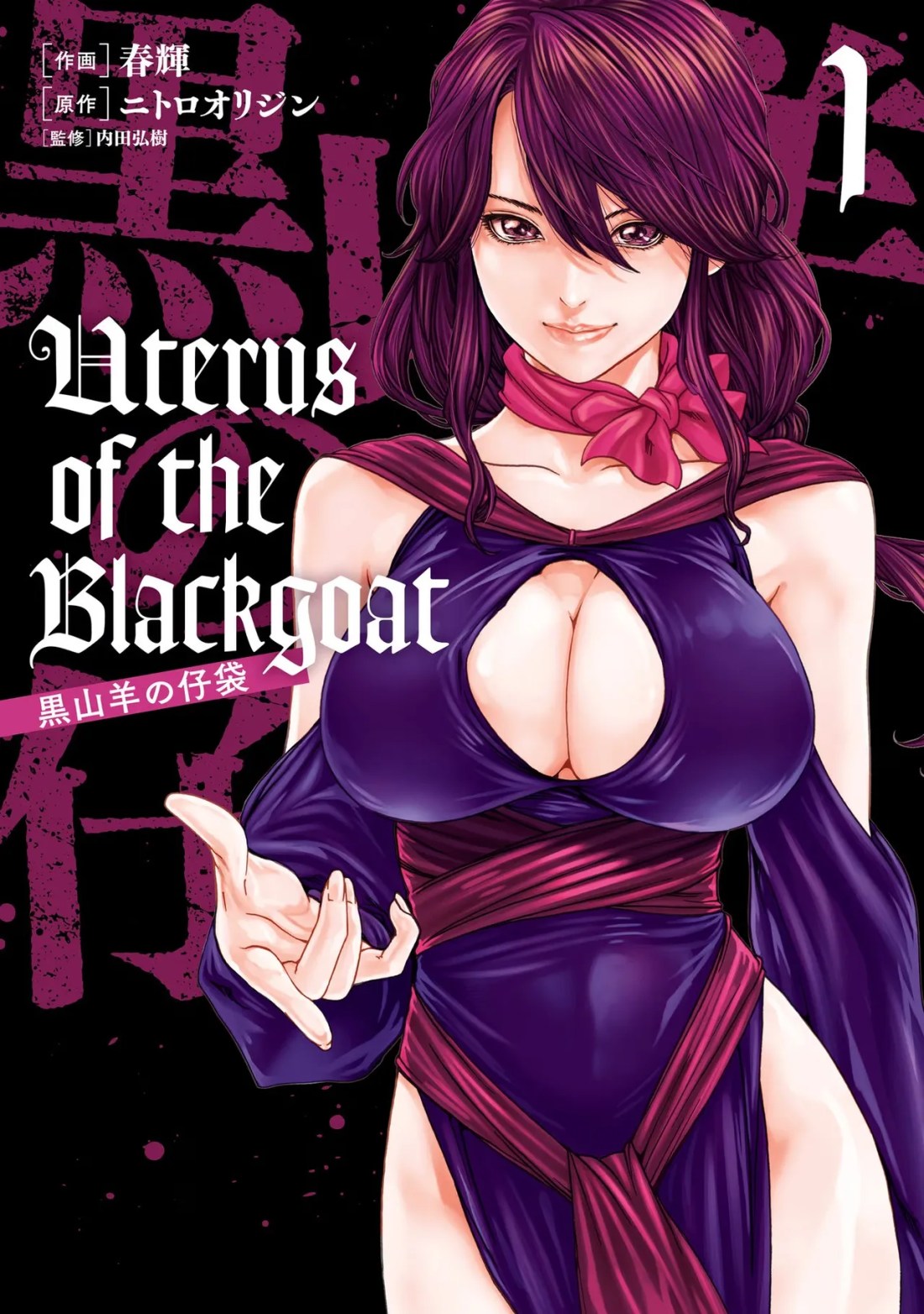
Uterus of the Black Goat Vol 1.(黒山羊の仔袋 1, 2022) by Haruki (春輝)

Eldritch Fappenings
This review concerns a work of adult literature. Some images contain nudity. Reader discretion is advised.


Powers of Darkness

The lifting of the curtain on the massive horrors of Germany’s prison and concentration camps recalls the supernatural tales of H. P. Lovecraft, a writer who was relatively unknown until August Derleth undertook his popularization, says a Chicago Tribune column. To conjure up the mood of unearthly terrors, Lovecraft invented the mythology of Cthulhu in which there are many monstrous spirits of evil, forever seeking to take possession of this planet.

Lovecraft wrote of his work: “All my stories, unconnected as they may be, are based on teh fundamental lore or legend that this race [sic] was inhabited at one time by another race who, in practicing black magic, lost their foothold and were expelled, yet live on outside, ever ready to take possession of this earth again.”

Perhaps Othulhu [sic] has come back through the cracks in Hitler’s mind. Lovecraft, who died in 1937, would be staggered by the revelation.

The Windsor (Ontario) Star, 2 May 1945, p4

In the aftermath of World War 2, the combination of Allied propaganda and the real-world horrors and atrocities committed by the Nazis and central powers created a perfect icon of evil. The Nazis became the epitome of cruelty, madness, violence, lust, and decadence; while Hitler and the Nazis became occasional figures of ridicule in works like Hogan’s Heroes, they also became the perfect embodiment of sin in post-war men’s adventure magazines, comic books, Stalag novels, and the Nazisploitation films like Ilsa, She-Wolf of the S.S. (1974), The Night Porter (1974), and Salon Kitty (1976).

H. P. Lovecraft died before the German invasion of Poland in 1939 that sparked the European beginnings of World War 2, and long before the Final Solution was decided upon and enacted. He did not live to see the Holocaust laid bare, and certainly not the pop-culture cross-pollination as the Nazis, the ultimate figures of taboo, became enmeshed in erotic and sadistic art and literature. Yet perhaps it is not surprising that, over time, Lovecraft’s Mythos and Nazis have mixed and mingled on occasion.

Dagger of Blood (1997) by John Blackburn, for instance, featured a former Nazi scientists in South America, inspired by Mengele and works like The Boys from Brazil (1976). Hellboy fought any number of Nazis in comics and film, some of whom had connections with Lovecraftian critters (a point called out specifically in the crossover Batman/Hellboy/Starman). Brian McNaughton brought the Reanimator to the Nazis with “Herbert West—Reincarnated: Part II, The Horror from the Holy Land” (1999). Insania Tenebris (2020) by Raúlo Cáceres also includes scenes where the Third Reich mixes with the Mythos, and Kthulhu Reich (2019) by Asamatsu Ken (朝松健) is an entire collection of stories that re-imagines the Nazis in a Lovecraftian context, and Charles Stross’ outstanding novel The Atrocity Archives (2004) also riffs on the wedding of these two taboos, the eldritch evils of Lovecraft and the visceral cruelty of Hitler and the Nazis.

Most of these works take as a jumping-off point the Nazi’s real and fictional investigations into the archaeological and the occult, which became widespread in popular culture thanks to films like Raiders of the Lost Ark (1981) and Indiana Jones and the Last Crusade (1989). There is some basis for truth in this, as Kenneth Hite explores in The Nazi Occult (2013), but the pop culture legacy of Nazi mystics dabbling in the Mythos has grown very far from reality. Intersections between sex and the Nazi occult exist, and so do works that combine sex and Lovecraft’s Mythos, but the combination of all three flavors is relatively rare.

Most works that deal with Lovecraftian Nazism eschew the erotic.

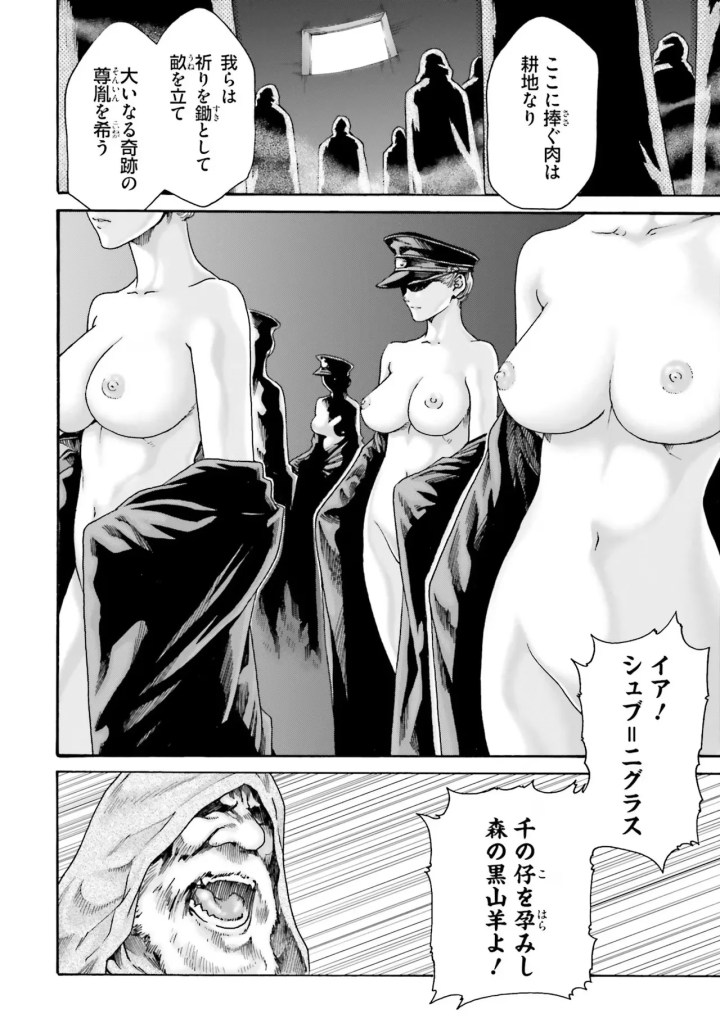
Uterus of the Blackgoat Vol 1.(黒山羊の仔袋 1, 2022) by Haruki (春輝) is a standout in that it very specifically does just that. This historical occult action manga’s prologue opens in Nazi Germany, where Hitler’s disciples are trying to unlock a Lovecraftian artifact with sex magick.

Nazi sacrifices disrobe for a ritual to Shub-Niggurath

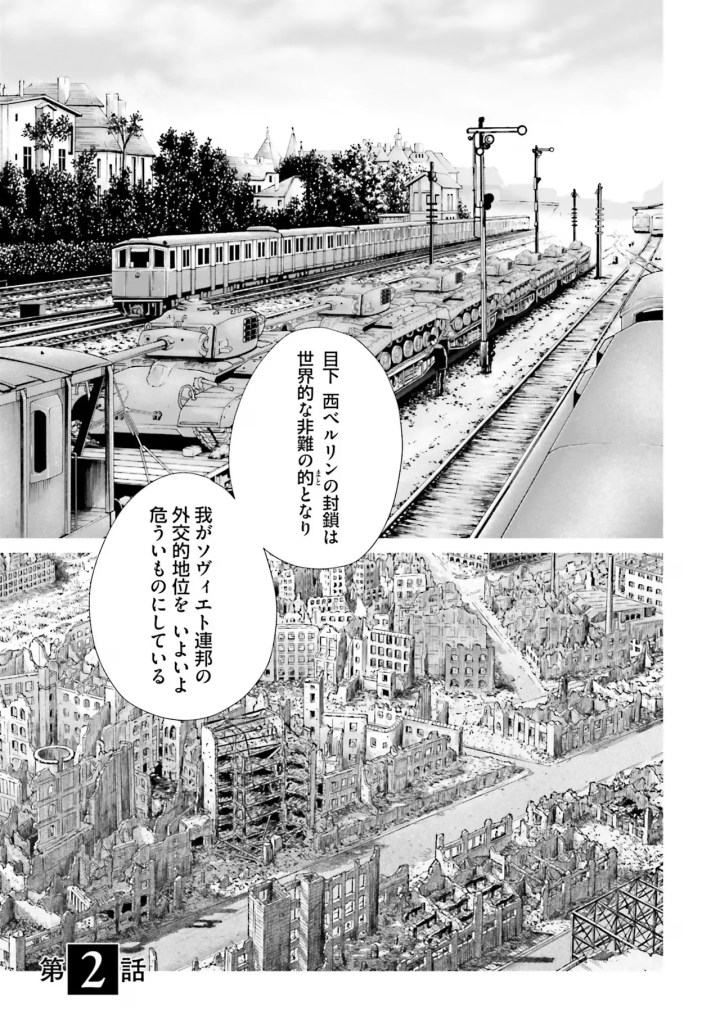
Haruki (春輝) is an established mangaka whose works include the Ero Ninja Scrolls and Parasite Doctor Suzune series. Like all legal erotic works in Japan, the actual genitalia is obscured, often by carefully placed speech bubbles, figure-work, and blurring out the genitals. However, this work is more than “tits and tentacles”; there is a considerable amount of detail given to period dress, architecture, and background to ground the story, including some very effective splash pages that appear to have been referenced from period photographs.

Post-War Berlin

The bulk of the story takes place during the early days of the Cold War, as both the USSR and United States attempt to seize the Nazi’s research into Shub-Niggurath for themselves. At the center of their separate and competing investigations is a former maid, Mia Olbrich, who worked in the house where the rituals took place. Trying to keep both the Americans and the Soviets from getting the information is a woman named Macleod (who may actually be Mata Hari) with supernatural powers, who is also the secret agent codenamed Black Goat.

What readers get is thus a three-way struggle involving a lot of sex, some body horror, and Cold War spy shenanigans with some interesting plot twists and revelations (and this only in volume 1, there are 3 volumes in the series). While there are many typical tropes of the eromanga genre (all of the main characters are willowy, busty young women; there’s a sex scene in every chapter, etc.), it is sort of refreshing to see a work that strongly leans into the sexual aspect of Shub-Niggurath in as explicit a means as they can given the limits of the medium. While we don’t get a lot of actual Nazis in this volume after the prologue, the emphasis on sex, sexual violence, and the setting is what draws comparisons to exploitation films; there is a similar aesthetic, the idea that this is a serious story that is being played for titillation as well as action and intrigue.

There are some cosmetic parallels with “The Elder Sister-like One, Vol. 1” (2016) by Pochi Iida (飯田ぽち。) and The Mystery of Lustful Illusion -Cthulhu Pregnant- (2015) by Takayuki Hiyori (宇行 日和); the manga creators are each drawing from similar manga artistic traditions and Lovecraftian stories and roleplaying games, which shows variations on similar themes, less in any plot sense as in similarities between the depictions of Shub-Niggurath, playing with tentacles, etc. However, the emphasis on erotic content in each work is different and distinct and reflects the tone of the stories, with Uterus of the Black Goat aimed more toward erotic horror than the other two.

A Dark Young of Shub-Niggurath, as inspired by the Call of Cthulhu roleplaying game

Uterus of the Black Goat has not yet had an official English translation or release, but Japanese editions are available from various outlets, including Amazon.co.jp and Ebay.


Bobby Derie is the author of Weird Talers: Essays on Robert E. Howard and Others and Sex and the Cthulhu Mythos.

Deep Cuts in a Lovecraftian Vein uses Amazon Associate links. As an Amazon Associate I earn from qualifying purchases.
The Mystery of Lustful Illusion -Cthulhu Pregnant- (2015) by Takayuki Hiyori (宇行 日和)

Eldritch Fappenings

This review deals with a work of pornography, and the history of erotic art and writing. As part of this review, selected images with cartoon depictions of genitalia and/or sexually explicit contact will be displayed.
As such, please be advised before reading further.


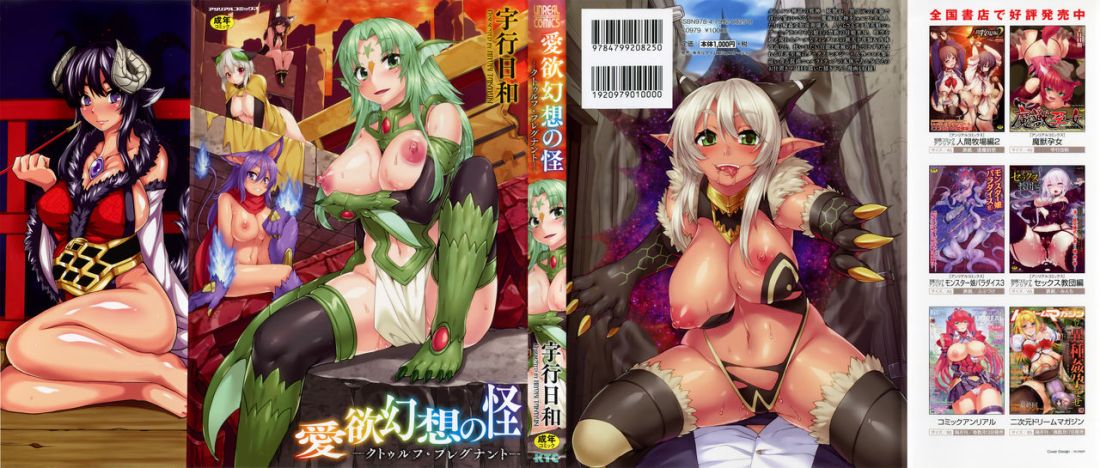
愛欲幻想の怪~クトゥルフ・プレグナント~ (The Mystery of Lustful Illusion -Cthulhu Pregnant-) by Takayuki Hiyori (宇行 日和) is a 2015 Japanese tankōbon hentai manga published by Unreal Comics (アンリアル). This book is divided into ten chapters, each of which contains a fully-illustrated and sexually explicit Cthulhu Mythos story.

In art style, the book is geared more toward erotic comedy than erotic horror; and many of the Cthulhu Mythos entities within are presented as monster girls. Takayuki Hiyori had been previously known for their dōjinshi based on popular monster girl harem manga Monster Musume, and their manga are essentially a pornographic parallel to the mostly non-explicit books like Monster Girl Encyclopedia II (2016) by Kenkou Cross (健康クロス).

Cthulhu_TOC

In terms of writing and storytelling, The Mystery of Lustful Illusion -Cthulhu Pregnant- is a disconnected collection of short works, much like most Lovecraft story collections or Lafcadio Hearn’s classic collection Kwaidan. There is no larger overarching story of narrative, the major appeal of the work being simply that it uses the Cthulhu Mythos for these erotic stories and sexualized versions of eldritch entities like Cthulhu, Hastur, Shub-Niggurath, the Deep Ones, the Hounds of Tindalos, and the Cats of Ulthar.

The contents are aimed toward some well-established tropes and kinks: as the title might imply, impregnation is a fairly significant theme in many of the stories, but there are also instances of multiple penetration, sex work, incest, nonconsensual sex, body transformation or modification, breast expansion, group sex, large genitals, etc. Readers familiar with tentacle erotica might wonder if such appendages play their part, as they do in Le Pornomicon (2005) by Logan Kowalsky, but in truth they don’t play a significant role in the proceedings.

Cthulhu_CalloftheAbyssIn point of fact, The Mystery of Lustful Illusion -Cthulhu Pregnant- is difficult to distinguish from Monster Musume or Monster Girl Encyclopedia products. While Takayuki Hiyori uses references to the Cthulhu Mythos in the crafting and telling of the stories, the manga itself is pretty straight forward monster girl erotica, and aimed more directly at that audience than Lovecraft fans. The depictions of the various Mythos entities is mostly original, but skewed toward “mostly human with a few non-human traits”—the Cats of Ulthar, for example, are indistinguishable from the generic manga or anime “catgirl,” with their primary feline traits being cat ears and tail on a nubile young woman’s body. Eldritch horrors are hinted at but seldom realized.

The contents of this book might be generally compared to the more sexually explicit chapters of The Elder Sister-like One by Pochi Iida (飯田ぽち。), but where Pochi is telling an extended narrative with a few characters with extended character development and exploring emotions, Takayuki Hiyori is necessarily more episodic, with varied content and swift-moving stories that tend to get to the sexual action fast, dwell on them for the majority of the length of the chapter, and come to a relatively swift conclusion.

Cthulhu - Ulthar

Arguably the most fun chapter in the book is a variation on “The Cats of Ulthar.” While the forms the cats take are stereotypical for hentai manga, and the results are pretty much what you might expect, it both pays homage to Lovecraft’s original work while playfully subverting aspects of it. One might compare it in some ways to the “erotic” versions of classic horror novels which achieved a bit of notoriety in the 1970s, like The Adult Version of Frankenstein and The Adult Version of Dracula by “Hal Kantor” (Ed Wood, Jr.). Erotic retellings of Lovecraft aren’t exactly new—for example, “Herburt East: Refuckinator” (2012) by Lula Lisbon—but illustrated or graphic adaptations are relatively scarce.

愛欲幻想の怪~クトゥルフ・プレグナント~ (The Mystery of Lustful Illusion -Cthulhu Pregnant-) by Takayuki Hiyori (宇行 日和) has not been officially translated into English or published in the United States; perhaps some company like FAKKU might do so in the future and make it more widely available. Until then, those interested in the Japanese original can still find copies available from retailers online.


Bobby Derie is the author of Weird Talers: Essays on Robert E. Howard and Others and Sex and the Cthulhu Mythos.

Deep Cuts in a Lovecraftian Vein uses Amazon Associate links. As an Amazon Associate I earn from qualifying purchases.
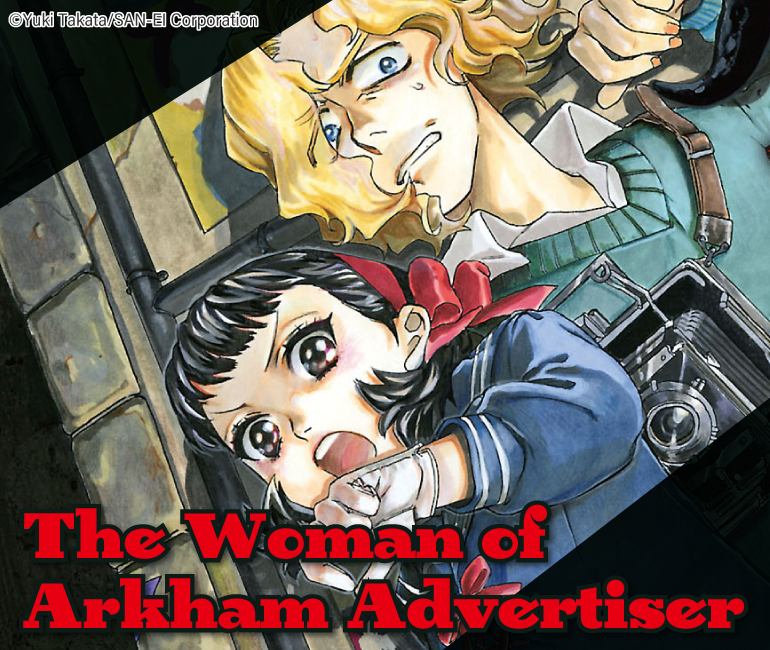
The Woman of Arkham Advertiser (A・Aの女): Article 01: In The Vault (2019) by Takata Yuki (高田 悠希)

It was the publicity attending this investigation which set reporters on the track of the Whateleys, and caused the Boston Globe and Arkham Advertiser to print flamboyant Sunday stories of young Wilbur’s precociousness, Old Whateley’s black magic, the shelves of strange books, the sealed second story of the ancient farmhouse, and the weirdness of the whole region and its hill noises.
—H. P. Lovecraft, “The Dunwich Horror”

The public knows of the Miskatonic Expedition through our frequent wireless reports to the Arkham Advertiser and Associated Press, and through the later articles of Pabodie and myself.
—H. P. Lovecraft, At the Mountains of Madness

As was only natural under the circumstances, this piquant debating finally got into print in the form of letters to the Arkham Advertiser; some of which were copied in the press of those Vermont regions whence the flood-stories came.
—H. P. Lovecraft, “The Whisperer in Darkness”

Lovecraftian manga have been undergoing a recent renaissance in Japan, with the critically acclaimed reception of Tanabe Gou’s adaptations of At the Mountains of Madness, “The Hound,” “The Colour Out of Space,” and most recently “The Call of Cthulhu,” all of which have been or are being translated and published in foreign language editions: Spanish, Italian, French, German, English, etc. Other popular adaptations include the Cthulhu no Yobi Koe series by Chuuou Higashiguchi (中央東口), and related manga include the Minase Yomu and the Really Scary Cthulhu Mythology (水瀬陽夢と本当はこわいクトゥルフ神話) series by Yoshihara Masahiko (吉原雅彦), and the many Zone of Cthulhu manga released by the SAN-EI Corporation (三栄)—which includes The Woman of Arkham Advertiser (A・Aの女) series by Takata Yuki (高田 悠希).

The conceit of the series is simple: Alice Allan is a cub reporter for the Arkham Advertiser, the local newspaper that appears in several of Lovecraft’s stories, and her “cases” cover a number of Lovecraft’s stories, both Mythos and non-Mythos, as set around Arkham. The result is a series of adaptations with a twist: we get to see the stories from a new perspective, that of a young newspaperwoman investigating the odd happenings. The series is categorized as a seinen (青年漫画), aimed at young men (18-30s), being more realistic and less action-packed than manga like One Piece or Dragon Ball, but readers of all genders and ages can appreciate it.

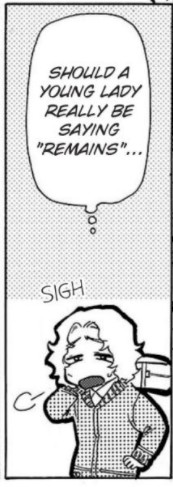
Chibi
Chibi version of Billy, a supporting character.

The adaptation is played seriously, but with more than a few laughs thrown in, the figures sometimes reduced to small chibi-style exaggerated figures to emphasize the one-off joke, familiar from manga like Shirow Masamune’s original Ghost in the Shell. The translation by Amimaru Translation and Localization Services Ltd. is mostly solid, although every now and again a joke may fail to land due to some cultural crossing of wires.

The small details and stark contrasts in the illustrations really shine though. Takata Yuki has worked hard to express the America of the 1920s, full of newsboys and the transition from the small industrial city of Arkham to out-of-the-way rural community of Peck Valley is like traveling back in time. Done in simple black-and-white, the bright outside scenes are given white backgrounds, while the moment the intrepid reporters step into the vault, the page is dominated by huge splashes of stark black, a very effective presentation that accentuates the emotional response of Alice Allan and her associate Billy.

Alice herself is the major focus and driver of the plot. She desires to prove herself as a reporter, and this is her first real opportunity to do so, by looking into the morbid details around the mysterious death and quick burial. While her enthusiasm is sometimes played for laughs, especially when contrasted against her long-suffering friend Billy, it is very effective at cutting right to the heart of Lovecraft’s story.

The story is not exactly a straight adaptation; Takata Yuki wisely doesn’t attempt to mimic the style of Lovecraft’s prose, and takes a few liberties with the ending, hinting at this being a small piece of a bigger picture that the reporters know they can’t quite see yet. Which works very well; Alice Allan is an engaging, energetic, enthusiastic protagonist, and starting slow with one of Lovecraft’s more low-key stories as their first “case” was a wise decision on the part of Takata Yuki.

The Woman of the Arkham Advertiser is available in Japanese on Kindle, and in English on Manga Planet subscription service.


Bobby Derie is the author of Weird Talers: Essays on Robert E. Howard & Others (2019) and Sex and the Cthulhu Mythos (2014).

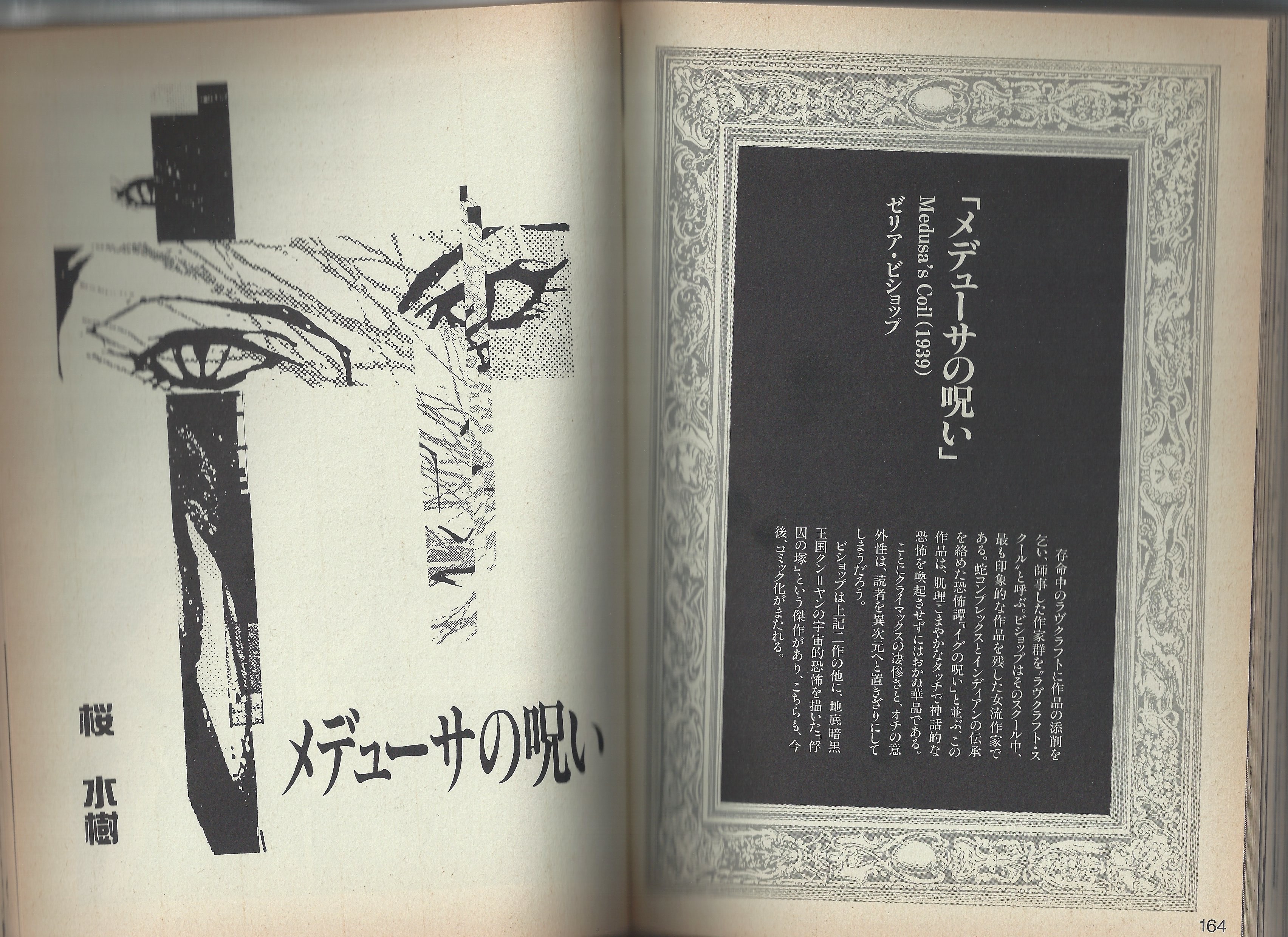
“Medusa’s Curse” (1995) by Sakura Mizuki (桜 水樹氏)

While many of H. P. Lovecraft’s tales have been adapted to the form of comics, and no few have been translated into other languages, it is comparatively rarer to see translations and adaptions of the revisions and ghostwriting stories into languages other than English. One of the very few such treatments is an adaptation of “Medusa’s Coil” (1939) by Zealia Bishop & H. P. Lovecraft entitled 「メデューサの呪い」(“Medusa’s Curse”) by 桜 水樹氏 (Sakura Mizuki), published in 妖神降臨―真ク・リトル・リトル神話コミック (1995), a collection of adaptations of comparatively lesser-known Mythos fiction by Robert Bloch, Henry Kuttner, and others. “Medusa’s Curse” is the final story in the volume, and begins with a preface:

The writers who during Lovecraft’s lifetime asked him to edit their stories are called ‘Lovecraft school’. Among this group the female author Z. Bishop left a most impressive work. Medusa’s Coil can be compared with Bishop’s other story “The Curse of Yig” which combines snake phobia and Native American folk tale. Due to its fine details, Medusa’s Coil is a special work that evokes mythological fear. Especially the outbreaking catastrophe at the story’s climax and the last unexpected twist take the reader into another dimension and leave him there.

Besides these two stories, Bishop also wrote the excellent story “The Mound” about the underground kingdom of K’n-yan and its cosmic terror. It is expected that this story will also be turned into a manga at one point.
—trans. Dr. Dierk Günther

SCAN0381

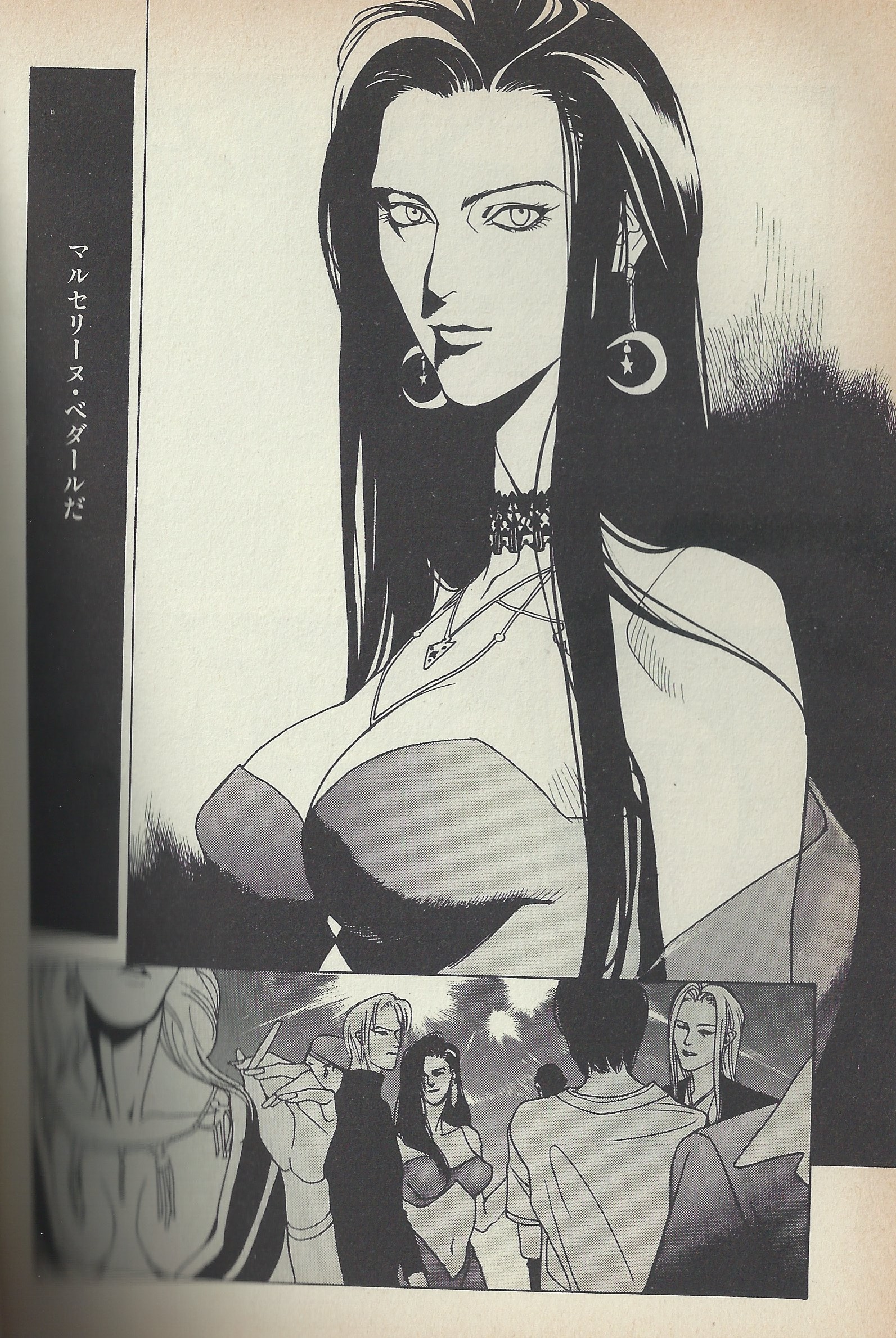
The adaptation removes the original Southern plantation setting, moving the story into a contemporary American South full of late 80s/early 90s styles. This transition also removes many of the objectionable elements from the original, as there are now no slaves (or people of color) in the story, no references to Africa, and the final revelations are focused much more on the cosmic horror of Marceline Bedard.

SCAN0382
“Marceline Bedard”

Sakura’s art style throughout is very subdued, realistic, with the slightly effeminate bishonen look to the younger male characters Denis and Marsh. It effectively communicates the quasi-love triangle set-up of the original story, the interplay between Denis, his friend Marsh, and Marceline as wife and nude model for the painting. For most of the story, the action is purely on that psychological level, no hint of the supernatural.

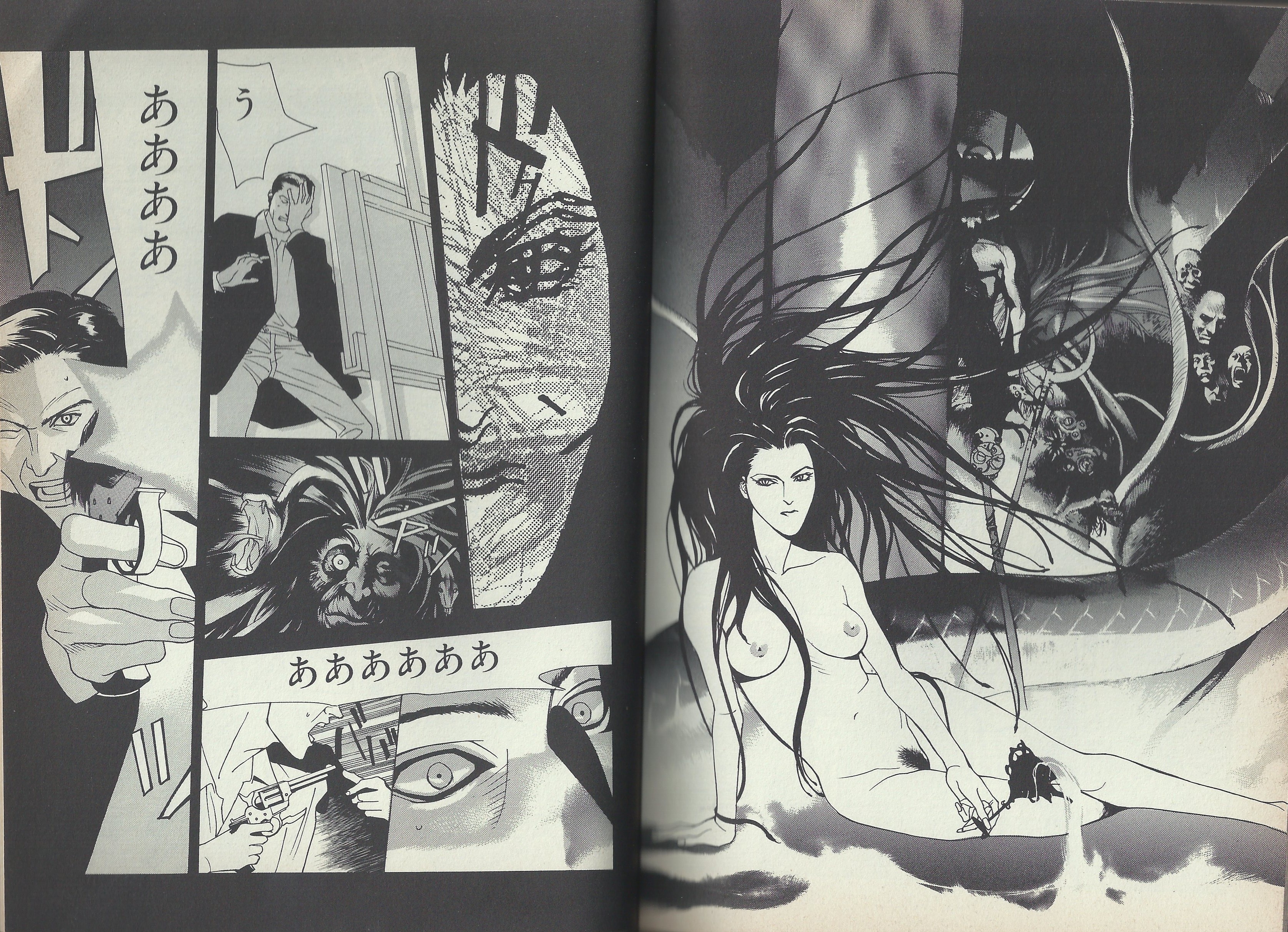
While there are liberties taken with truncating the story to fit in the space, overall this is a very faithful adaptation, with lines of dialogue borrowed directly from the story (sometimes in abbreviated form). The art tells more of the story than the dialogue, as a good graphic adaptation always does; little details like the ligature marks of the blood on the floor where the body was dragged, the shape of the handle and blade of the sword taken from a tulwar…and, of course, the painting itself, which attempts to express the inexpressible.

SCAN0383
Sound of heart beating
Shocked sound
Hissing sound of snake
Aaaaaahhhhhhhhhh
Sound of gunshot

One of the things the story adds is a literal emphasis on the serpentine aspect of Marceline Bedard and her hair which is lacking in the original story. Lovecraft and Bishop used the term “Medusa” metaphorically, the hair as an alien thing, perhaps closer to the strange tentacles of C. L. Moore’s “Shambleau” (1934) than to the monster of Greek myth. This becomes more obvious after her death, when the story goes from a bloody lover’s triangle to overt supernatural horror.

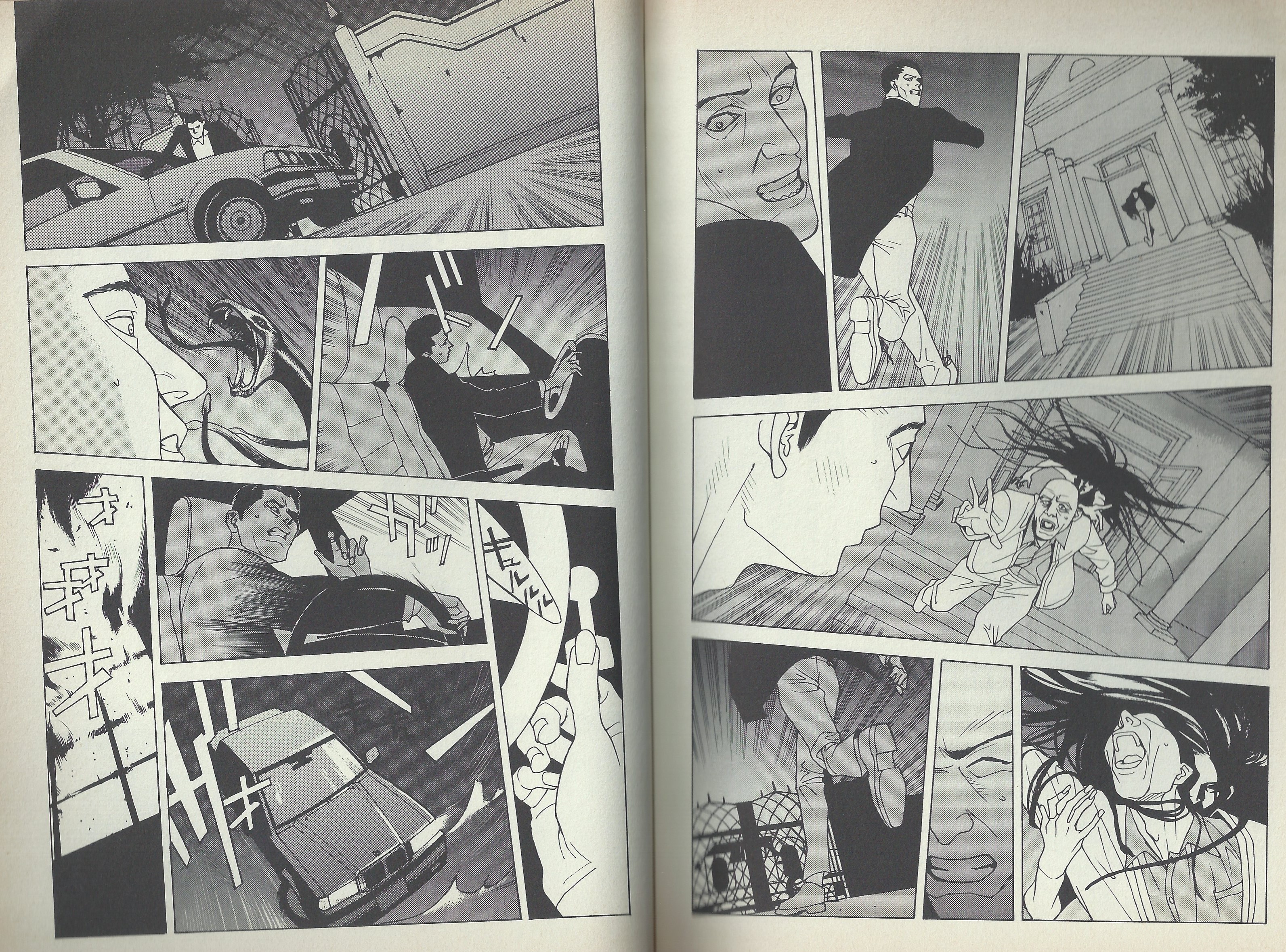
SCAN0384
Sound of car door, fire, screeching tires.

Note here how the narrator is in a panic, and the framework of the panels reflects that. No longer are they square and even, now everything is skewed and at Dutch angles, reflecting action and movement that the reader doesn’t see, but which happens in the gutters. It is a very effective way to show the disordered, chaotic state of mind, and is used to great effect on these pages. The very regularity and normality of the opening of the story makes it all the more jarring when the horror finally appears on the page.

All reference to Marceline as being mixed-race is gone, Sophonisba’s speech is gone, and with them all explicit references to Cthulhu and the Mythos. The story is certainly simpler for it, both from a narrative perspective and visually, while sacrificing none of the inherent power of the story. The tension builds nicely until the first bloody climax, and then the real horror begins… The final revelation now is less Marceline’s identity than the fact that the house had supposedly burnt down five or six years previously. Ending it in that way makes it more of a ghost story, similar to some of the tales in Lafcadio Hearn’s Kwaidan: Stories and Studies of Strange Things (1904).

Translations and adaptations are tricky, especially when going back and forth between different media and languages. How much did Sakura deliberately jettison from the starting text, which was probably a Japanese translation rather than the original English? There are obvious efforts to remain faithful to the general events and specific wording of the story, even as it is updated to a contemporary setting (as are most of the other adaptations in the manga anthology), lines of dialogue from the English original come through in recognizable form when translated back into English, which can be a remarkable achievement in itself.

「メデューサの呪い」(“Medusa’s Curse”) by 桜 水樹氏 (Sakura Mizuki), published in 妖神降臨―真ク・リトル・リトル神話コミック (1995); I have not been able to find any reprints or translations.

With thanks and assistance to Dr. Dierk Günther of Tokushima University for assistance and translation of the Japanese original.


Bobby Derie is the author of Weird Talers: Essays on Robert E. Howard & Others (2019) and Sex and the Cthulhu Mythos (2014).

“The Elder Sister-like One, Vol. 1” (2016) by Pochi Iida (飯田ぽち。)

My days with her were everything to me.
—Pochi Iida ( ぽち小屋。), The Elder Sister-like One, Vol. 1

Ane Naru Mono / The Sister of the Woods with a Thousand Young / The Demon Who Became My Sister (姉なるもの), translated and published in the United States as The Elder Sister-like One is an ecchi manga written and drawn by female writer/artist Pochi Iida (ぽち小屋。), translated into English by Sheldon Drzka with lettering by Phil Christie. Th story follows the day-by-day life of Yuu, an adolescent orphan who inadvertently summons Shub-Niggurath, the Black Goat of the Woods with a Thousand Young, and makes a pact with her…to become his big sister. The goddess takes a (mostly) human form and calls herself Chiyo, and strives to honor her obligation.

Adaptation and translation always carry with them layers of interpretation and reinterpretation, and the original syntax is often lost or re-envisioned, refitted to the appropriate cultural context. So Pochi’s take on the Cthulhu Mythos in this manga is definitely in the tradition of the supernatural/monstrous girlfriend trope of manga like Monster Musume (モンスター娘のいる日常) or Oh My Goddess! (ああっ女神さまっ), and the re-casting H. P. Lovecraft’s dark fertility goddess as a buxom young woman recalls works like the manga Fight! Iczer One (戦え!!イクサー1 ), the visual novel Demonbane (デモンベイン), and the light novel Nyaruko: Crawling With LoveHaiyore! Nyaruko-san (這いよれ! ニャル子さん) and their various incarnations as anime, manga, video games, etc.

What largely sets Pochi’s work apart from others is the bittersweet undercurrent that runs throughout the work. Told as a series of chapters (“First Night,” “Second Night,” etc.) the attitude of the first volume is one of discovery, as Chiyo adapts to the human world and strives to be a good big sister to the lonely Yuu, who is sometimes frightened by the glimpses of her inhumanity…and yet is so desperately happy to no longer be alone. Yet from the very start, we know that this happiness is to be somewhat fleeting. From the very first page, the reader is told that this co-occupation is only temporary. In the beginning, the seeds of the end are sown.

The bitter reminder is offset by the sweetness, however, and most of volume one is very light, and full of fanservice. Chiyo is buxom, and when she remembers to wear clothes tends to wear things that emphasize her breasts or curves, and Yuu is often faced with unexpectedly close circumstances (such as Chiyo hiding Yuu’s head under her skirt, giving him a point-blank view of her panties). Such fanservice is almost slapstick compared to the hints of a darker world which he story gives the reader as it progresses, but the balance and pacing are such that the themes blend together very satisfyingly. Readers will likely warm up to Chiyo and Yuu’s relationship as their attraction and understanding grows. All the more precious with the knowledge that summer must one day end.

It is worth mentioning that the story is published simultaneously in two separate “continuities.” The ecchi form above has plenty of exposed skin, but never any full frontal nudity or actual sexual contact—the attraction between Chiyo and Yuu is teased and developed along the lines of an eromanga where a teenaged boy might develop a crush on his kindly big sister. The hentai form released from the circle Pochi-Goya (ぽち小屋。) follows the same basic storyline but is sexually explicit, with Chiyo’s tentacles getting into all sorts of places and her relationship with Yuu being much more intimate (although censored in accordance with Japanese laws regarding depictions of genitalia, etc.) The dual release is a relatively mature approach to publishing: save the sex for the readers that are interested in it.

The actual Mythos elements are fairly light in the first volume. Chiyo is by and large the only blatant supernatural element, though at one point it is made clear that other monsters do exist in the world. There is no mention of the various tomes, Lovecraft country, other Mythos entities, etc. The question might be reasonably asked then: why use the Mythos at all?

The value may be that Lovecraft’s artificial mythology is explicitly inhuman, with only peripheral connections and parallels to traditional Buddhism, Shinto, and Christianity. If Chiyo was a succubus from a Judaeo-Christian Hell, or a traditional Japanese goddess or monster, the reader would have different expectations of behavior or interactions with humans, which would probably have to be explained away. Being Shub-Niggurath frees the character from those conceptual constraints or hurdles, allowing the emphasis is on personal development rather than world development, so that the story remains very focused on its two main characters.

Elder Sister-like One was first serialized in Dengeki G’s Comic in 2016, volume 1 and volume 2 have been translated and released in English in 2018 by Yen Press in both print and electronic format. Hentai volumes are released individually in Japanese by Pochi-Goya.


Bobby Derie is the author of Sex and the Cthulhu Mythos (2014)