Tell my sad little life story? I was a weird kid. Believed I was a Witch when very young, as did my older sister. She and I used to practice what we thought was magick. Grew up knowing I was a sissy (loved playing house with the neighborhood girls, but always dressed LIKE them, wearing play dresses &c) and being tormented for it by grown-ups, kids at school, and thus I became an introvert and created my own realms of reality where I could be safe. My best friend in high school was Jewish, and that began a Jewish identification. Later I learned that I AM Jewish on my mom’s side of the family.
—W. H. Pugmire, “An Interview with W. H. PUGMIRE” (28 Feb 2009) by Jeffrey Thomas
There is a fine distinction between Jewish weird fiction and weird fiction that takes Jews or Judaism as its subject. Jewish weird fiction should be, ideally, written from a Jewish point of view; that may or may not involve aspects of Jewish religion or culture, but it should definitely have that viewpoint—and ideally, it should be written by someone who has lived experience to lend verisimilitude and authenticity to the story, who can approach the story as someone other than an outsider looking in. A good example might be “My Mother Was A Witch” (1966) by William Tenn.
A story doesn’t have to have a Jewish point-of-view to be about Jews or Judaism. Innumerable examples of Christian supernatural fiction reach back to Jewish religion and folklore to tell a story that is still focused, primarily, on a Christian point of view. The Wandering Jew in legend and literature may be Jewish in name, but their characterization follows the narratives conceived by predominantly Christian writers.
“The House of Idiot Children” (2008) by W. H. Pugmire & Maryanne K. Snider is, I suspect, their attempt at Jewish weird fiction. It follows Rav Samuel Shammua, a teacher in a small Jewish community who works at a school for autistic students. The description of the students reflects common depictions of autistic savants, formerly and derogatorily known as idiot savants:
They sat there, some very still some moving slightly back and forth, all staring into the air before them. Samuel shocked himself to feeling suddenly jealous. What did they see as they looked into nothingness. What did they listen to with an inner ear? The world saw these children as idiots who would always have difficulty functioning with the normal ear; and yet these children each contained a singular degree of genius. One was a mathematical genius. Another had memorized huge portions of Torah and Talmud in both English and Hebrew. And Moshe, who sat awaiting him, had excelled in the art of gematria […]
—W. H. Pugmire & Maryanne K. Sinder, “The House of Idiot Children” in Weird Tales #308 (26)
As in many of his stories, Pugmire slightly reworked the language in subsequent publications, so for example in An Imp of Aether (2019) he wrote:
[…] saw some students who, sitting at various tables awaiting instructors, watched his entrance, some very still, some moving slightly to and fro. Samuel shocked himself with feelings of sudden jealousy. What did they see with their autistic senses, what could they hear with an inner ear? The world saw these children as idiots who would always have difficulty functioning in the “normal” world; and yet these children each contained a singular degree of genius. One excelled in mathematics, another had memorized weighty portions of Torah and Talmudic lore, in both English and Hebrew. And mOshe, who sat awaiting him, had excelled in the art of gematria […] (44)
Autistic savants have their in supernatural literature, like the young girl Tiffany in Hellbound: Hellraiser II (1988) who uses her knack for puzzle solving to solve the Lament configuration. Such peculiar aptitudes can interact oddly with certain aspects of Jewish culture. The Hebrew alphabet has 22 letters, each of which can also represent an associated number, a practice called gematria. This overlap of linguistic and mathematical concepts has significant interest with topics like cryptography, the interpretation of certain Jewish and Christian religious texts, as well as Kabbalah and other occult systems. The intersection of these different areas of interest has been a fruitful area for creatives, such as the film Pi (1998) where a genius Jewish mathematician’s investigations into the nature of π reveal a number which might be the secret name of God.
Pugmire and Snider play with this idea:
“A twenty-third Hebrew letter, a letter of fire.” The elder man raised his hand so as to thoughtfully stroke his beard. “An angelic letter. A letter out of which nothing is formed.”
Samuel’s face felt odd, and he ran his hands over it, trying not to shudder. “You know of this?” His voice was laced with fear, for never had he experienced such a conversation. The mysteries of cabalistic lore were something with which he had never trafficked. He had seen certain friends of his become utterly obsessed with studying the Zohar and other such books, to the detriment of everything else. It was a lure in which he had no wish to find himself entangled.
—W. H. Pugmire & Maryanne K. Sinder, “The House of Idiot Children” in Weird Tales #308 (26)
Unlike “The Chabad of Innsmouth” (2014) by Marsha Morman or Dreidel of Dread: The Very Cthulhu Hanukkah (2024) by Alex Shvartsman and Tomeu Riera, this story has nothing to do with the Lovecraft Mythos. Yet there is something indelibly Lovecraftian in how Samuel Shammua is drawn into this esoteric study—an idea that madness and genius as linked, even as savanthood and autism are linked in Shammua’s mind.
“They’re not like others, that’s the point!” Samuel suddenly shouted, his face flushed with anger. “They are special creatures, for whom we especially care. What the hell is normal, Avram? Were you a normal kid? Our religious and ethnic heritage makes us outsiders in the normal world, that’s why we’re hated, that’s why madmen seek to destroy us.”
—W. H. Pugmire & Maryanne K. Sinder, “The House of Idiot Children” in Weird Tales #308 (29)
All of these elements come together in this story in an ending that is expected, and yet powerful. We the readers never learn the final mystery, which Moshe and the autistic children know and which Samuel Shammua learns. It is a literally ineffable truth, a knowledge beyond the scope of human experience. Whatever flaws the story might have in its depiction of autistic children, this was a deliberate and researched effort to weave together these disparate threads into a story that tried to express a weird tale from a Jewish point of view.
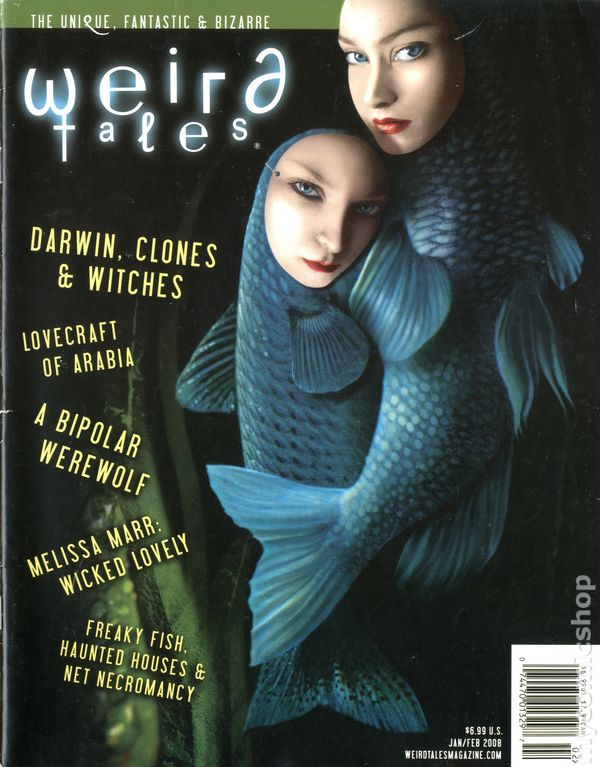
“The House of Idiot Children” was first published in Weird Tales #308 (Jan/Feb 2008). It was slightly revised and republished in The Tangled Muse (2008, Centipede Press), and then slightly revised again for An Imp of Aether (2019), which appears to be the authors’ final version.
Bobby Derie is the author of Weird Talers: Essays on Robert E. Howard and Others and Sex and the Cthulhu Mythos.
Deep Cuts in a Lovecraftian Vein uses Amazon Associate links. As an Amazon Associate I earn from qualifying purchases.

 Deep Cuts in a Lovecraftian Vein