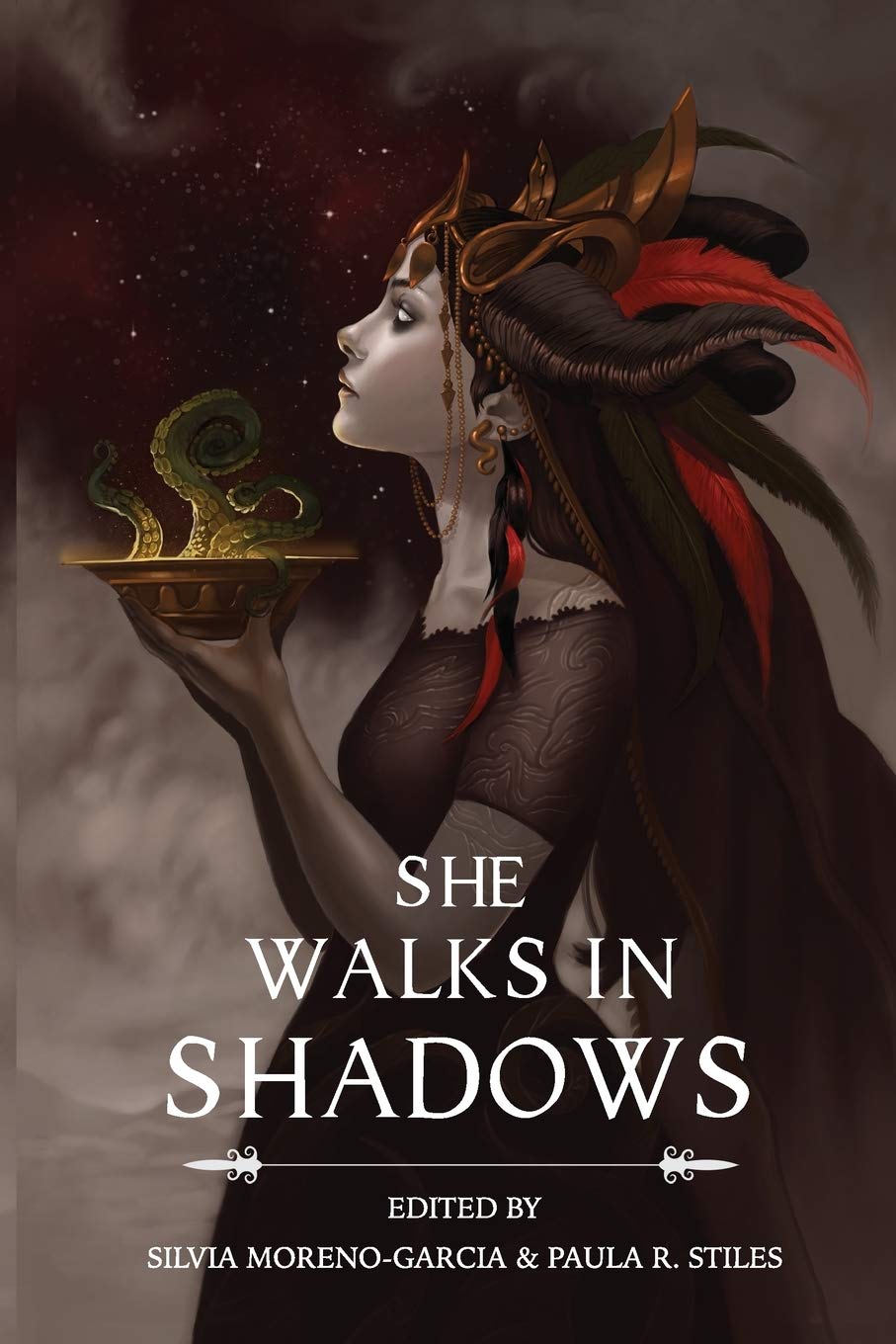
“Violet is the Color of Your Energy” (2015) by Nadia Bulkin

Absence of much conversation is probably a permanent feature of my style, because the tales I write concern phenomena much more than they concern people.
—H. P. Lovecraft to Natalie H. Wooley, 24 Oct 1933, LRBO 193

“The Colour Out of Space” is one of Lovecraft’s most evocative and best-loved stories. It has been interpreted by different folks as an environmental horror, as a rural Gothic, a precognitive flash of the dangers of nuclear radiation. It was not set in the far ago and the long away; H. P. Lovecraft set most of his horrors in his here and now. In the 1920s and 30s, close to home in Rhode Island, Massachusetts, and New York. They were horrors of the moment, and while he largely eschewed flappers and rumrunners, they took on the syntax of the time and place.

Which makes them interesting to update. How many horror stories would be different, if they took place after the invention of cell phones, or the advent of the internet, birth control pills, the Civil Rights Movement? How might that change the story? Not the phenomenon itself, but the people’s response to the phenomenon. Their perspective and understanding of it.

As is appropriate for a story that’s a reworking of H.P. Lovecraft’s “The Colour Out of Space,” “Violet is the Color of Your Energy” is named after two songs centered on color: 311’s laidback, beachy “Amber,” and Hole’s angry, feminist “Violet.” I doubt that MRA types would like this story. In my defense, though, “The Colour Out of Space” practically demanded a feminist revision. It’s fundamentally a story about a cranky farmer who keeps his family increasingly isolated, then imprisoned, resulting in the deaths of all. There’s a neighbor who seems to check in a lot. Oh yeah, and something’s off about the water and the crops. And the woman locked in the attic is the crazy one?
—Nadia Bulkin, “Violet is the Color of Your Energy” [The Playlist]

Nadia Bulkin’s “Violet is the Color of Your Energy” is, in effect, a contemporary re-telling of “The Colour Out of Space.” One that leaves out Arkham, and shifts the point of view focus to Abigail Gardner (née Cuzak), who followed her college-educated husband to Cripple Creek to try and make a go of an old-fashioned family farm. The shift in time and space and perspective skews the story from the phenomenon (Lovecraft’s interest) to the individual. Zeroes in from the impersonal observation of everything going on to the very personal look at how this phenomenon affects Abby and her relationship with her husband and children.

“Are you sleeping with him?”

“What?” her voice broke. “Nate, the boys are right . . . .”

His shout punched down like a hammer of God. “Answer me, Abby! Was this some whore’s bargain? Said you’d jump into bed if he’d just cut your poor idiot husband a break?”
—Nadia Bulkin, “Violet is the Color of Your Energy” in She Walks In Shadows 39

The result is something like Christina’s World by Andrew Wyeth in prose. Things said and unsaid. A woman trapped by the decisions she’s made, the man she trusted, until she has no decisions left at all; yet this is not a morality play about a woman who made the wrong decision. Something is happening, something he won’t tell her about. This isn’t just a tale of spousal abuse, or stress turned to paranoia. Something happened, in the opening paragraph, reverberating throughout the short story. Something that works, unseen, on the corn, the animals, the water, her husband…and her.

If you haven’t read “The Colour Out of Space,” the ending might be confusing. A Shirley Jackson-esque non sequitur, like a needle skipping across a record, jumping straight to the last track. It is like a variant telling of an old and familiar myth, reminiscent of “His Mouth Will Taste Of Wormwood” (1990) by Poppy Z. Brite in that sense. Not a replacement for Lovecraft’s story, but a complement to it; an old campfire tale told to a new generation of campers, a riff on the old motif, recycled and made new again.

Boys and dogs alike asked for things—food, drink—and eventually, after the sun began to set, Teddy put down his American History book and asked for an explanation of Croatoan.
—Nadia Bulkin, “Violet is the Color of Your Energy” in She Walks In Shadows 39

There is a certain synchronicity between “Violet is the Color of Your Energy” and the 2019 film The Color Out of Space; both seek to update and adapt Lovecraft’s text, both keep the story small, centered on what a small family farm looks like in the 2010s, the breakdown that occurs as something happens beyond their control or capability to understand. The beats are not the same, but they’re working in a similar groove with a sense of isolation and desperation. Of things that have suddenly and inexplicably gone wrong, and the added stress has cracked the facade of normality, to show that maybe, things weren’t right this entire time.

“Violet is the Color of Your Energy” by Nadia Bulkin was first published in She Walks In Shadows (2015), and republished in the paperback edition Cthulhu’s Daughters (2016), as well as Year’s Best Weird Fiction: Volume Three (2016), and Bulkin’s collection She Said Destroy (2017).


Bobby Derie is the author of  Weird Talers: Essays on Robert E. Howard and Others  and  Sex and the Cthulhu Mythos .

Deep Cuts in a Lovecraftian Vein uses Amazon Associate links. As an Amazon Associate I earn from qualifying purchases.

“Red Goat, Black Goat” (2010) by Nadia Bulkin

“The Goat is our real mother! She is everyone’s real mother!”
—Nadia Bulkin, “Red Goat, Black Goat”

From the 1930s on, fans and writers have tried to give shape and order to the Mythos. It is a participatory ritual: the reader’s understanding is always unique, built and shaped by what they have read, what connections their intellect has made, how their imagination fills in the blanks. There is no one canon. There are only possibilities.

In “Red Goat, Black Goat” Nadia Bulkin cracks opens up a new possibility.

It is a story of Shub-Niggurath only by inference. Bulkin eschews the tropes of Mythos pastiche. The Black Goat of the title is a hint, at best; a suggestion of the epithet “The Black Goat of the Woods with a Thousand Young.” Yet the entity in this story is never named as such; there are no tomes, no familiar place names. “Red Goat, Black Goat” does not partake of the “lore” of the Mythos in the tongue-in-cheek manner of “ALL THIS for the GREATER GLORY of the 7th and 329th CHILDREN of the BLACK GOAT of the WOODS” (2012) by Molly Tanzer or “Shub-Niggurath’s Witnesses” (2015) by Valerie Valdes.

Bulkin carves her own bit of lore, with the bloody skill of an Indonesian horror film. The setting is not played up as some exotic bit of the “mysterious Orient” as it might have been in Lovecraft’s day. She grounds and develops the setting as Lovecraft did Dunwich, the characters an organic part of the whole so that none of the non-English terminology that peppers their thoughts and speech seems false or unnecessary.

At the same time, “Red Goat, Black Goat” partakes of the essence of the Mythos. The Goat is something outside the system of superstition that the characters know; it exists beyond their framework of understanding. Aspects of it echo themes developed by other writers; the terrible all-mother Cybele of “The Rats in the Walls,” or “Koenigsberg’s Model” (2011) by Peter Tupper, but it is far less defined than even those incarnations.

Nor is the story leavened by any real attempt at humor, wry or otherwise; there is gore, but not the microscopic dwelling in viscera that is splatterpunk. Bulkin moves quick, lest the tale be bogged down in dirty details. Her horrors are passing, visceral images that build shortly toward mini-climaxes, her pacing cinematic as the narrative moves swiftly toward a point of finality—not the ending of a story, but the closing of one chapter.

It’s a good story that leaves you wanting more; Bulkin could have written “Red Goat, Black Goat” out as a Javanese Gothic novel and it wouldn’t have seemed out of place. There are no answers, really, and that’s okay. Readers will fit this into their own personal understanding of the Mythos just fine; one more incarnation of Shub-Niggurath, one more thread in the endless tapestry. It’s a story that should be part of more reader’s personal Mythos.

“Red Goat, Black Goat” was first published for free online in Innsmouth Free Press #4 (June 2010); it has been reprinted in Lovecraft’s Monsters (2014) and Nadia Bulkin’s collection She Said Destroy (2017).


Bobby Derie is the author of Weird Talers: Essays on Robert E. Howard & Others (2019) and Sex and the Cthulhu Mythos (2014).


“Pugelbone” (2010) by Nadia Bulkin

For it is of old rumour that the soul of the devil-bought hastes not from his charnel clay, but fats and instructs the very worm that gnaws; till out of corruption horrid life springs, and the dull scavengers of earth wax crafty to vex it and swell monstrous to plague it. Great holes secretly are digged where earth’s pores ought to suffice, and things have learnt to walk that ought to crawl.
—H. P. Lovecraft, “The Festival”

Set in an unknown but recognizable tomorrow. In the crowded urban structure known as the Warren, people live in close proximity. Isolated from the outside, both physically and economically, the Meers (Meerkats) grow up in the crush of humanity, amid an urban ecosystem grown subterranean and strange with a new horror, one the children call…Pugelbones.

“Pugelbone” is not a Cthulhu Mythos story; there are no quotes from the Necronomicon, no reference to any recognizable corner of the Miskatonic Valley, no alien gods and sinister cults. Yet Nadia Bulkin’s story is built up from a base of Lovecraftian literary DNA, like a slab of artificial meat grown in a lab. A product of the strange and marvelous now, hacking the genetic material of “The Lurking Fear” and “The Rats in the Walls” and building it back up into something you can sink your teeth into.

The protagonist Lizbet was born a Meer. A girl that just liked to break things. An outsider among an outsider group, she is at once sympathetic and unreliable. All she wants is custody of her daughter—and the only way to get it is to interact with the unsympathetic bureaucracy as represented by Dr. Roman. These are adult fears: poor people trapped in a system they never built or opted in to, trying to navigate the weird social spaces of interviews with indifferent people that decide their fate. “Pugelbones” is Lizbet’s story—the story she tells Dr. Roman, to try and win back her daughter, and the story of telling that story, as Roman deflates, dismisses, and directs the conversation. A “passive listener” that has all the power in the relationship, and diminishes Lizbet with insinuation.

Yet Dr. Roman never denies the essential reality of the Pugelbones.

In Lovecraft’s stories like “The Lurking Fear” and “The Rats in the Walls,” the underground space—a favored personal image which appears in his stories—contains or did contain other horrors: a teeming mass of humanity or near-humanity. Societies that set themselves apart, to live, work, breed, and die down there. Written before Lovecraft’s period in New York City, it is still tempting to see an echo in these stories of urban fears, the great crowded tenements and filthy streets. Contemporary concerns, expressed in Lovecraft’s own language and filtered through his own prejudices, but still tapping into the 1920’s zeitgeist. Lovecraft’s stories are told from the interloper’s perspective, from those who had not been born and  bred.

What would “The Lurking Fear” read like, if told from the perspective of a Martense?

[…] a degenerate squatter population inhabiting pitiful hamlets on isolated slopes. Normal beings seldom visited the locality till the state police were formed, and even now only infrequent troopers patrol it. […] With whimpering insistence the squatters told tales of a daemon which seized lone wayfarers after dark, either carrying them off or leaving them in a frightful state of gnawed dismemberment; while sometimes they whispered of blood-trails toward the distant mansion.
—H. P. Lovecraft, “The Lurking Fear”

Nadia Bulkin’s story works because some of those horrors present in the early 20th century still haunt us in the early 21st century. The poor may not be seen as “gently descending the evolutionary scale” as Lovecraft put it, but the Meers are no less the subject to prejudice and stereotype. Lizbet is subject to the same prejudices that Lovecraft’s Catskills white trash, with the added bonus of being a woman, and a single parent, with all the additional onus that brings. These are all adult fears, the kind of tangible horrors of desperation that can face anyone today. Bulkin taps into the same zeitgeist as Lovecraft did; her story works because the situation is presented so realistically.

The Pugelbones are the element of the weird which is interwoven with the more mundane horrors of child protective services and overpopulation, and like many Lovecraftian horrors they are very material entities. An undiscovered species, urban predators. The truth about them is not half as terrible as Dr. Roman’s towing the official government line about their existence, or her insinuations about Lizbet’s relationship with them. They are the great mystery of the piece, only half-glimpsed through the Meer’s story, their presence told in piles of trash and smears of blood.

Yet the story is theirs, as much as it is Meers: these Lovecraftian beasties are essential to the piece, and Bulkin wisely keeps them off the page for most of it. Readers get hints of them long before they see them, rumors and legend before the Pugelbones appear in a scene. Rather than being specifically horrific themselves, the Pugelbones are the catalysts for the human horrors; the outside element that disrupts the human narrative, like the xenomorphs of Ridley Scott’s Alien, the one terrible unpredictable event which starts off the cascade of adult fears.

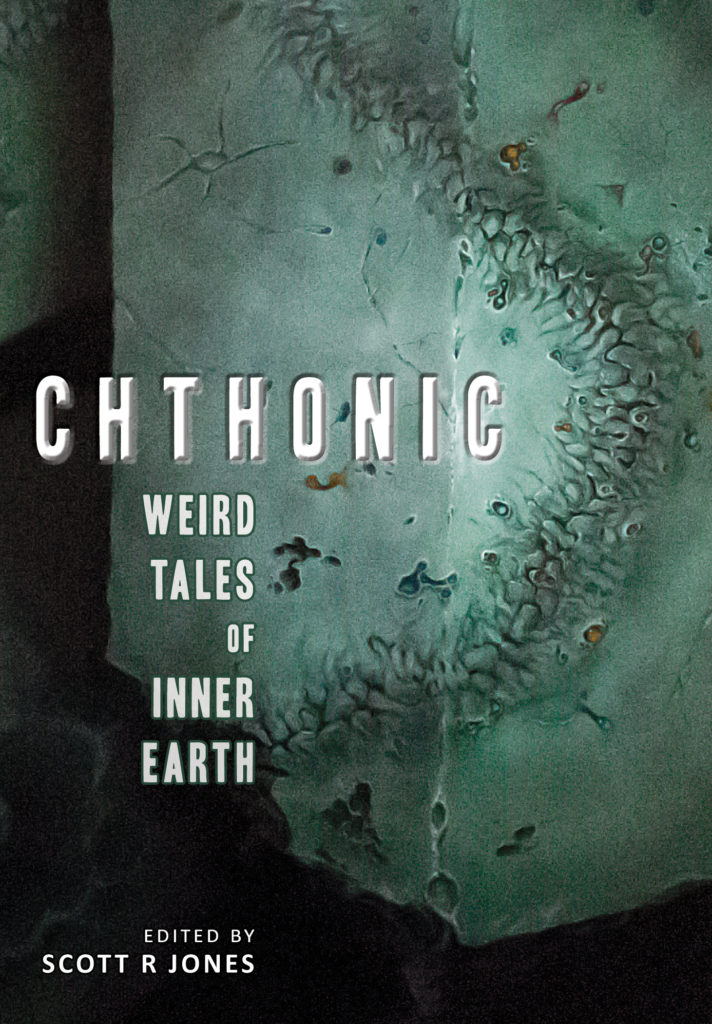
Chthonic_FC_01-712x1024Nadia Bulkin’s “Pugelbone” first appeared in ChiZine (Oct-Dec 2010), and was reprinted in her collection She Said Destroy (2017), and Cthonic: Weird Tales of Inner Earth (2018). Bulkin has been prominent the last few years in various anthologies, and her corpus of Lovecraftian and Mythos fiction includes “Red Goat Black Goat” (2010), “Truth is Order and Order is Truth” (2014), “Violet Is The Color Of Your Energy” (2015), “Pro Patria!” (2015), “There Is A Bear In the Woods” (2016), “I Believe That We Will Win” (2016), “Empire Down” (2017), and “A Dream, and a Monster at the End of It” (2017).


Bobby Derie is the author of Sex and the Cthulhu Mythos (2014)