Deeper Cut: Lovecraft, Racism, & Humor

Racist Language
The following article deals explicitly with racism in humor, many examples of which use racial pejoratives. Frank discussion of these matters requires the reproduction of at least some samples of racist pejoratives and ideas in quotes, titles, etc.
As such, please be advised before reading further.


Mr. Snow, I believe these to be Negro eggs.
—The Author, Planetary/The Authority: Ruling the World (2000) by Warren Ellis & Phil Jimenez

Few authors have been as personally identified with their work as H. P. Lovecraft. Even during his own lifetime, Lovecraft’s friends began to incorporate fictional versions of them into his stories—as “Howard” in “The Space-Eaters” (1928) by Frank Belknap Long, Jr.; as the unnamed mystic dreamer in “The Shambler from the Stars” (1935) and Luveh-Keraph, Priest of Bast in “The Suicide in the Study” (1935) by Robert Bloch; and as “the man with the long chin” in The Village Green (192?) by Edith Miniter.

In life, Lovecraft was a self-effacing and ready correspondent who made many contacts with his fans and peers in pulp fiction and amateur journalism; he liked to project the image of himself as older and more reclusive than he actually was. After his death, this personal myth-making took on a life of its own, as his legend developed and spread. There was no absence of humor from the early decades as awareness of Lovecraft and his Mythos grew, with both parody and satire present in works like “At the Mountains of Murkiness, or From Lovecraft to Leacock” (1940) by Arthur C. Clarke.

A notable absence in early humor directed at Lovecraft is any mention of his racism. The biographical facts of Lovecraft’s life were generally slow to emerge, and not always readily available to fans. So while comments on Lovecraft’s racism and antisemitism were made public by the first version of his wife’s memoir in the 1940s (see The Private Life of H. P. Lovecraft (1985) by Sonia H. Davis), and August Derleth felt the need to address the issue in print in Some Notes on H. P. Lovecraft (1959), Lovecraft did not develop a widespread reputation as a racist until the publication of L. Sprague de Camp’s Lovecraft: A Biography (1975). De Camp, who had studied Lovecraft’s published and unpublished letters and other materials, emphasized Lovecraft as neurotic, a flawed human being, a possible homosexual, and especially as a racist—and published the entirety of the poem “On the Creation of Niggers” which is attributed to Lovecraft.

De Camp’s biography came at a time when Lovecraft was beginning to spread to a much larger audience, due to reprint of his work in paperback, films like The Dunwich Horror (1970), and growing influence on music, adaptations in comic books, and other media—and as Lovecraft was gaining more critical awareness and acceptance. The same year as de Camp’s book came out, the first World Fantasy Convention was held in Lovecraft’s hometown of Providence, Rhode Island, with the theme “The Lovecraft Circle,” and the first World Fantasy Awards were given out—in the form of a bust of Lovecraft, carved by noted cartoonist Gahan Wilson. So, just at a time when Lovecraft’s popularity blossomed and more information on his life emerged, de Camp released a highly influential book.

Many Lovecraft scholars criticized de Camp’s approach, presentation, and conclusions—though not the underlying facts: while speculation about Lovecraft’s sexuality or mental health were subjective, Lovecraft’s prejudices were clearly expressed in his letters. The critiques, however, didn’t have the reach of the book itself, and many of de Camp’s misconceptions continue to color perceptions of Lovecraft to the present day. This has been very apparent in various fictional depictions of Lovecraft in various media, which often exaggerate Lovecraft’s characteristics and prejudices for humorous effect.

When the little kitten darted from the door and fled into the hall, the apparition in the darkness shouted out loud. It shouted in the high nasal accent native only to that part of New England once known as Rhode Island and the Providence Plantations. And its words were these:

Come back!” it cried. “Come back, my pet! Come back, NIGGER-MAN!
—Gregory Nicoll, “The Man Who Collected Lovecraft,” The Diversifier (May 1977) 68

As a subject of satire and ridicule, Lovecraft might seem to be a particularly strange dead horse to choose to whip. Obviously, Lovecraft is dead and is unaffected by mockery; he can’t regret or reform his reviews, and won’t roll in his grave no matter how hard you make fun of him. Humorous takes on Lovecraft are thus aimed at the living: at fans who are familiar with Lovecraft and his fiction, whether or not they enjoy either. In the case of Lovecraft’s racism in particular, this effectively serves as a kind of damnatio memoriae: unable to condemn a living Lovecraft for his prejudices, they make fun of a dead Lovecraft. These humorous portrayals, with all of their exaggerations, have influenced Lovecraft’s posthumous reputation and image.

Does making fun of a dead man constitutes “punching down?” Certainly, Lovecraft has no ability to defend himself from false accusations or inaccurate claims about his prejudices. On the other hand, he doesn’t really need any such defense. While Lovecraft may have no power to answer now, Lovecraft was racist, and part of the white majority that kept racial and ethnic minorities as second-class citizens during his life. Empathy in cases of historical racism should be on the victims of discrimination, not the perpetrators. Lovecraft may not have been a member of the Ku Klux Klan or participated in any racial violence directly, but he was still part of the majority of U.S. citizens that supported the legalized racism of Jim Crow and the social norms that prevented racial equality.

The occasional depiction of Lovecraft as “Genre’s Racist, Crazy Uncle” has exactly that much truth in it: Lovecraft’s prejudices were largely tolerated during his lifetime, and for some decades beyond that, because they were the same prejudices that millions of other people in the U.S. held. Just because those prejudices were common does not make them universal. Just because other people were racist does not make Lovecraft’s racism okay. The broad cultural background radiation of racism during Lovecraft’s lifetime is an explanation for his views, not an excuse for them.

The fact that Lovecraft is often depicted as much more cartoonishly racist than he was in real life, or than his peers, is in part down to the needs of the writer or artist to make a joke, but also in part due to lack of understanding of what Lovecraft’s prejudices were and how they fit into the historical context. Pretty much no one that mentions “On the Creation of Niggers” in any context wants to read a dissertation on the tradition of racist light verse in English poetry, just as few people who are familiar with the name of Lovecraft’s cat in “The Rats in the Walls” want a lecture on the propensity for naming pets racial epithets around the turn of the 20th century. They care about the current context, when the N-word is a racial epithet of unique power, not a historical context when such usage was more broadly accepted by a more openly racist society.

Many expressions of prejudice that were commonplace in the early 20th century seem egregiously racist now. Plain statements of Lovecraft’s life may seem ludicrously racist by the standards of the present, because many plain statements of racism in the 1930s and 30s are ludicrously racist by today’s metric. It is difficult for today’s readers to get a grasp of what a “normal” amount of racism was in the 20s and 30s when minstrel shows, coon songs, and the African Dodger were still socially acceptable.

In 1897 I was trying for Beethoven—but by 1900 I was whistling the popular coon songs & musical comedies of the day.
—H. P. Lovecraft to J. Vernon Shea, 3 Sep 1931, Letters to J. Vernon Shea et al. 46

As a consequence, when combined with a general ignorance of the actual nature and scope of Lovecraft’s prejudices, the exaggerations of Lovecraft’s bigotry are often much more extreme to get a laugh.

Ah! Look, it’s attempting to communicate. No doubt the savage thing knows language as a house pet knows its reflection in the mirror. The sense is taken in, but the process, the meaning is forever lost.
—H. P. Lovecraft, Atomic Robo and the Shadow From Beyond Time by Brandon Masters

There is a certain irony in that the more that we know of the facts of Lovecraft’s prejudice, the more ridiculous and far from Lovecraft’s actual beliefs that humorous takes on Lovecraft’s racism tend to get. The earliest humor was written by weird fiction fans who were generally aware of who Lovecraft was, his work, and some of the scholarship about his life. Later writers tend to be less familiar with the minutiae of Lovecraftiana and base more of their image of Lovecraft off the memes and stereotypes of Lovecraft and his work, or lean into a particular presentation that relies on such a specific image of Lovecraft as cartoonishly bigoted.

As a case in point:
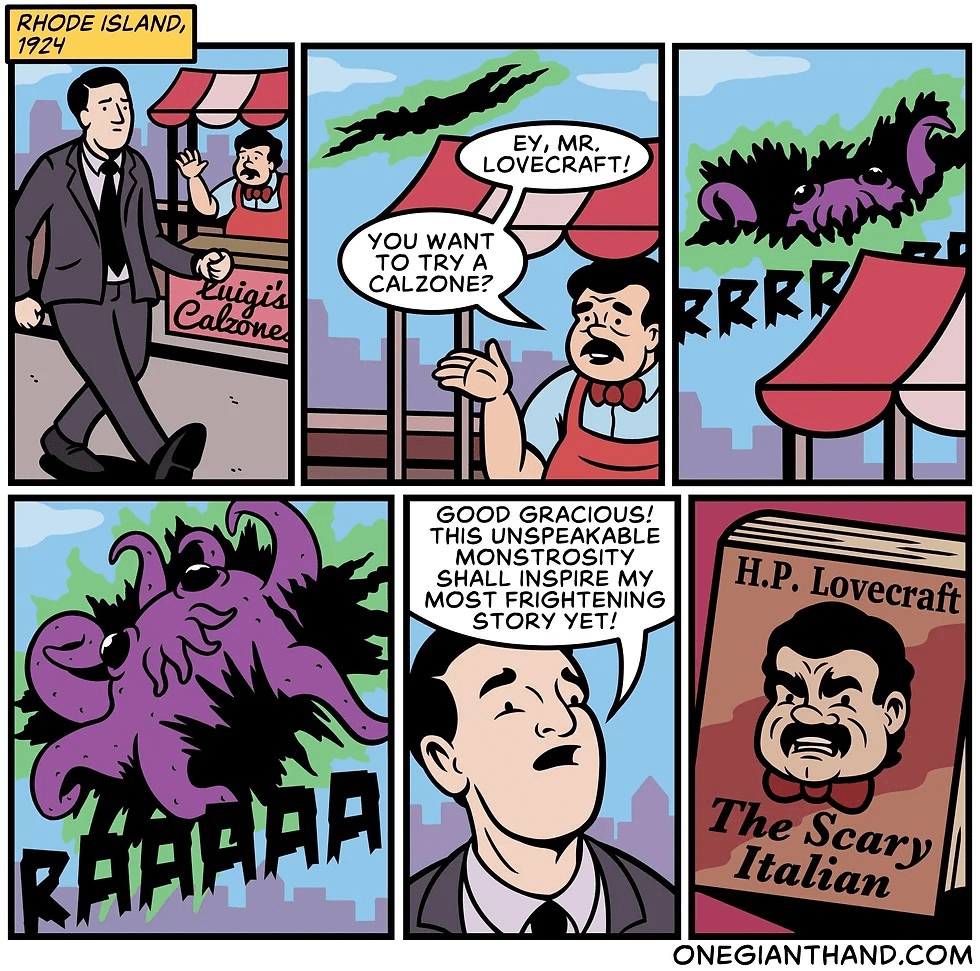
Original Twitter post. Used with permission. All rights reserved.

In terms of accuracy, there’s a kernel of truth here: Lovecraft did express some prejudice against Italian immigrants, especially those in the Federal Hill area of his native Providence, RI. Lovecraft had even made mention of Italian immigrants in some of his publications, such as his very first widely-published poem, “Providence in 2000 A.D.”:

In 1912 my first bit of published verse appeared in The Evening Bulletin. It is a 62-line satire in the usual heroic couplet, ridiculing a popular movement on the part of the Italians of the Federal Hill slums to change the name of the main street from “Atwells’ Avenue” to “Columbus Avenue”. I pictured Providence in 2000 A.D., with all the English names changed to foreign appellations. This piece received considerable notice of a minor sort, I am told, though I doubt if it had much effect in silencing the Italians’ clamour. The idea was so foolish that it probably died of its own weakness.
—H. P. Lovecraft to the Kleicomolo, 16 Nov 1916, Letters to Rheinhart Kleiner & Others 76

The humor comes from the juxtaposition of the prosaic (and to contemporary eyes, ridiculous) prejudice against the harmless (if stereotypical) Italian immigrant and the eldritch entity breaking its way through the dimensional barriers. The cartoon also draws on and supports the misconception that Lovecraft’s fiction was largely driven by his personal fears and prejudices.

In real life Lovecraft actually liked Italian food, generally had congenial relationships with Italian immigrants he got to know, and rarely included Italian characters in his fiction. But that is a lot more nuance than can be expected in six panels. The joke doesn’t work if Lovecraft is presented as someone who isn’t triggered by the fact an Italian offered him a calzone, whose cosmic horrors aren’t inspired by more prosaic prejudices.

My taste has become so prodigiously Italianised that I never order anything but spaghetti & minestrone except when those are not to be had—& they really contain an almost ideal balance of active nutritive elements, considering the wheaten base of spaghetti, the abundant vitamines in tomato sauce, the assorted vegetables in minestrone, & the profusion of powdered cheese common to both.
—H. P. Lovecraft to Lillian D. Clark, 18 Sep 1925, Letters to Family & Family Friends 1.402

If there is a problem with the humorous expression of Lovecraft’s racism, it isn’t in the fact of making fun of a dead racist, or of painting racism as ridiculous or illogical. The problem is what it is often wrapped around in: the normalization of negative depictions of someone with mental health issues, and the downplaying of the dangers that contemporary racism represents. While a few scholars and pedants may decry the propagation of misinformation about Lovecraft and his fiction, that is ultimately a minor quibble compared to the bigger issues of propagating negative stereotypes like de Camp’s neurotic picture of Lovecraft, or of ignoring the really scary part about Lovecraft’s prejudices:

Many people held them then, and many people still hold them today.

Racist humor always has the caveat that to a certain audience, it isn’t funny because it’s ridiculous or breaking a taboo, but because it appeals to their own prejudices. Dave Chappelle mentioned in a 2006 interview with Oprah about someone laughing at him, rather than with him. The same thing cannot happen in the same way with Lovecraft because Lovecraft is white, and even prejudicial words like “cracker” and “honky” don’t have the same bite or weight as the N-word. Yet at the same time, making fun of Lovecraft’s prejudices has become a popular excuse for continuing to spread that language—the name of his cat, the poem “On the Creation of Niggers”—many writers find it acceptable to repeat that in a humorous context, as the punchline of the joke.

So might their audience.

The use of nigger by black rappers and comedians has given the term a new currency and enhanced cachet such that many young whites yearn to use the term like the blacks whom they see as heroes or trendsetters.
—Randall Kennedy, Nigger: The Strange Career of a Troublesome Word (2003) 36

The moral problem with the humorous portrayal of Lovecraft’s racism isn’t about making fun of Lovecraft, who is already dead and long past injury. It is that the jokes themselves do little but reiterate and spread prejudice. They don’t teach the audience anything about Lovecraft’s racism, and often only work when predicated on an audience already aware of Lovecraft’s racism in some form.

Is there any hidden moral or germ of insight in these portrayals?

A case in point might be made for the Midnight Pals, which takes as its set-up the idea of famous writers, living and dead, sitting around a campfire and having brief conversations. The nature of the form means that the personalities are exaggerated and deliberately satirical. Lovecraft is often portrayed as neurotic, racist, although often ultimately harmless (as opposed to J. K. Rowling, who also appears.) In most cases, Howard’s portrayal makes him the butt of the joke, and the series is clear in demonstrating that racism is bad and Lovecraft is cringe for his prejudices—though not ostracised. Indeed, despite the differing beliefs presented, the campfire group is specifically accepting, even of members who are wildly far apart in their views on race, sex, etc.

The series doesn’t work without some butt to the jokes. Like Archie Bunker, Lovecraft in the Midnight Pals has become the mostly-lovable racist, whose prejudices are played for laughs rather than evidence of malice.

Humor is only one way of portraying Lovecraft in fiction, and Lovecraft’s racism is often used to make him a figure of ridicule. Yet even to do that, humorists often have to go far beyond Lovecraft’s own recorded words and actions. As racist as Lovecraft was, and with the unusually deep record we have from his letters and essays to give evidence to that racism, many people remain ignorant of what Lovecraft actually wrote and said, and many humorists invent new ways for Lovecraft to be racist—which perpetuates the idea of Lovecraft as racist, but isn’t very useful for refuting his actual beliefs. Lovecraft the racist is more often than not effectively a straw man when it comes to humorous portrayals.

It’s not conclusive, Clark, but it appears this dark-haired woman is your ancestor. Please, take no offense…university rules, you know. I’ll have to ask you to leave the premises.
—Prof. Upsley, Rat God (2015) by Richard Corben

A very rare form of humor when it comes to Lovecraft’s prejudices is irony. In Richard Corben’s Rat God, the very Lovecraftian protagonist discovers that he is less of a WASP than he thought he was—thanks to the late revelation of a long-forgotten Native American great-great-grandmother. The story takes obvious inspiration from Lovecraft’s “Arthur Jermyn” and “The Shadow over Innsmouth,” as well as the prejudices expressed in Lovecraft’s own life and letters. The result is not funny in a ha-ha sense, but a grim irony in that the character who exhibited such terrific prejudice throughout the story has discovered that he himself is now subject to the same prejudice by others.

Corben’s ironic unmasking of Lovecraftian prejudice does something that a lot of riffs on Lovecraft’s prejudices don’t: it moves the plot forward. It has something to say beyond “look at how racist Lovecraft is! Isn’t that funny?” It is a bit more subtle, but it also has a point, and illustrates that prejudice is a doctrine which is, ironically, color-blind to its targets. Who knows who every ancestor of theirs is, after all? Who do you think you are?

It has to be recognized that the depiction—accurate or exaggerated—of Lovecraft’s racism goes far beyond humorous jokes and portrayals. There are quite serious fictional depictions of or references to Lovecraft as a racist, as in Richard Lupoff’s Lovecraft’s Book (1985, later re-released as Marblehead), Alan Moore and Jacen Burrow’s graphic novel Providence, Lovecraft Country (2016) by Matt Ruff, The Ballad of Black Tom (2016) by Victor LaValle, Ring Shout (2020) by P. Djèlí Clark, and The City We Became (2020) by N. K. Jemisin. Accuracy is always a challenge for any historical character incorporated into a fictional work, and each author’s usage of Lovecraft is determined by their own research (or lack thereof) and their understanding—and perhaps especially, by the point they want to make.

In several of the latter novels, the point is specifically to bring attention to Lovecraft’s racism, as part of the point of their narrative is the acknowledgment and refutation of Lovecraft’s prejudices. Where a humorous depiction of Lovecraft’s racism shows prejudice as laughable, the serious depiction shows racism as no laughing matter. Either approach is workable depending on what point or mood the creator is trying to get across, one is not superior to the other, and many of the same observations about humorous depictions of Lovecraft’s racism also applies to non-humorous depictions.

Both humorous and non-humorous depictions of Lovecraft tend to be strongly driven by the myth of Lovecraft, rather than historical reality. The neurotic, cartoonishly racist caricature of a horror writer is often an easier character to work with than the more complex and nuanced historical human being, just as bumbling or villainous Nazis are easier to depict than stalwart German troopers with wives and kids who enlisted in a rush of patriotic spirit or economic need and ended up participating in a genocide. Lovecraft is not alone in being depicted first and foremost as a racist; many characters based on historical persons are essentially caricatures.

Lovecraft stands out in this respect only in that he is a pulp author from the period that humorists and their readers are still familiar with. Would the same jokes work if the subject was Ernest Hemingway or Catherine Lucille Moore? Probably not. Not because such jokes wouldn’t be as accurate (or inaccurate) as applied to Lovecraft, but because readers are less familiar with those writers and their prejudices. Lovecraft’s continued relevance, name recognition, and a vague awareness of his life are the main drivers for his continued humorous portrayals—racist warts and all. These depictions have been shaped by previous characterizations of Lovecraft, and in turn continue to shape his myth.

Real historical people are messy and complicated. Myths are easier to deal with. Yet the more the myth is repeated—the more extremes the depiction of a fantasy Lovecraft’s racism become—the harder it is to see the real historical individual. Many people, if they have the image of an individual as racist, take any correction of that image as an attempt to downplay or deny that racism. It can be very difficult to correct such a reputation once it takes hold.


Bobby Derie is the author of Weird Talers: Essays on Robert E. Howard and Others and Sex and the Cthulhu Mythos.

Deep Cuts in a Lovecraftian Vein uses Amazon Associate links. As an Amazon Associate I earn from qualifying purchases.
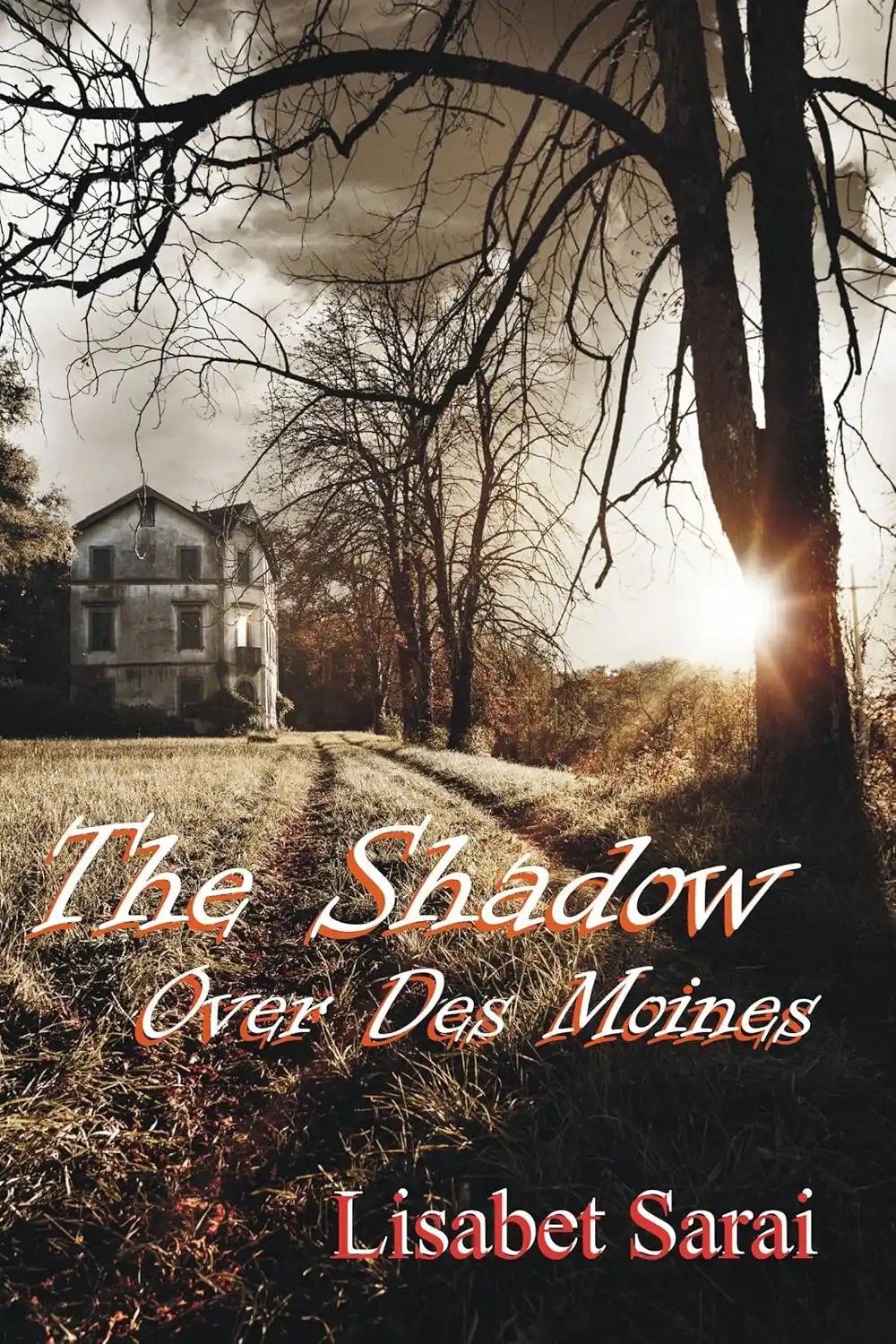

“The Shadow over Des Moines” (2016) by Lisabet Sarai

Searchers after horror haunt strange, far places.
—H. P. Lovecraft, “The Picture in the House”

I come from Des Moines. Somebody had to.
—Bill Bryson, The Lost Continent

Lovecraft country is often associated with New England, because that’s where Lovecraft set many of his most famous stories. Arkham, Dunwich, and Innsmouth are in the fictional Miskatonic River valley of a fantasy version of Essex County of Massachusetts. Yet Lovecraft country was never restricted to the Bay State.

The fictional stomping-grounds of the Old Ones encompassed the Oklahoma frontier of “The Curse of Yig” (1929) and “The Mound” (1940); the French provence of Averoigne in Clark Ashton Smith’s tales; the ancient town of Stregoicavar in Hungary in Robert E. Howard’s “The Black Stone” (1931). Other writers have staked out and developed their own corners of Lovecraft country: the Severn Valley in Ramsey Campbell’s tales, with Goatswood and Brichester; the Sesqua Valley in the Pacific Northwest by W. H. Pugmire; and any other of other additions, popular and obscure, by writers professional and amateur.

Yet this might be a first. Niceville USA meets Shub-Niggurath.

The Shadow over Des Moines is a parody written in the style of the great pulp horror author H.P. Lovecraft. if you are not familiar with his work, you are missing a treat. He’s perfect for Halloween. Check out The Dunwich Horror, At the Mountains of Madness or The Shadow over Innsmouth. I am not ashamed to say that Lovecraft has had a singificant influence on my own writing.
—Lisabet Sarai, “The Shadow over Des Moines”

Two of the elements that make parody work are juxtaposition and exaggeration. The Lovecraftian parodist doesn’t just copy the most obvious or characteristic elements of Lovecraft’s prose, they often enhance them to the point of ridiculousness. Made all the more obvious by contrasting the Lovecraftian aesthetic with an area of the country least associated with anything eldritch.

The surprising thing is, it doesn’t come off badly. The prose is a little purple, but the Midwestern setting itself isn’t exaggerated. It’s more like a Lovecraftian protagonist moved into a suburb than an attempt to reveal the hidden horrors of home-made blueberry pie and calf-length skirts. The humor and horror of the story don’t come at the expensive of the innocent metropolis of Des Moines, but in the quirky Lovecraftian excess of the protagonist—and the fact that this is an erotic parody.

Leonora encouraged me to drop by and visit anytime, but I doubted that I would act on her suggestion. Shivers ran down my spine as a I watched her swaying hips retreat down my path and across the street to her own dwelling. Nevertheless, I found my body reacted to her as if I were fifteen instead of fifty four. I found it necessary to spend a quarter of an hour reading Popular Mechanics before my tumescence subsided.
—Lisabet Sarai, “The Shadow over Des Moines”

The outlines of the story are familiar; basically Fright Night with a sexy Lovecraftian twist and trappings. The fact that so much of it is played straight-faced makes the occasional play on words all the more effective (“Mrs. Gratsky’s gate swung silenly open, as if well-lubricated.”) If it leans a little too hard into some of the stereotypes of Lovecraftian pastiche, it also works to deliver a carefully-curated erotic aesthetic that balances vivid description with an older, quainter verbiage. The end result is as absurd as it is utterly appropriate. Where else but in such a story as this will you get such turns of phrase as “unhallowed anus?”

Like most erotic Lovecraftian ebook fare, things wrap up fairly swiftly after the climax. The pacing is set up for this single encounter, not a longer series of repetitive erotic adventures a la the Booty Call of Cthulhu series. Yet this is a very competent, self-contained example of this mode of fiction. If I had any suggestion for a sequel, it would be to make more use of Des Moines itself; it feels like there was room to make more use of this most un-Lovecraftian addition to Lovecraft country.

“The Shadow over Des Moines” (2016) by Lisabet Sarai is available as a Kindle ebook. More of her work can be found at https://lisabetsarai.com and https://lisabetsarai.blogspot.com.


Bobby Derie is the author of Weird Talers: Essays on Robert E. Howard and Others and Sex and the Cthulhu Mythos.

Deep Cuts in a Lovecraftian Vein uses Amazon Associate links. As an Amazon Associate I earn from qualifying purchases.
“At the Mountains of Murkiness, or From Lovecraft to Leacock” (1940) by Arthur C. Clarke

Something about the scene reminded me of the strange and disturbing Asian paintings of Nicholas Roerich, and of the still stranger and more disturbing descriptions of the evilly fabled plateau of Leng which occur in the dreaded Necronomicon of the mad Arab Abdul Alhazred.
—H. P. Lovecraft, “At the Mountains of Madness” (1936)

Surely, I thought, the mad Arab, Abdul Hashish, must have had such a spot in mind when he wrote of the hellish valley of Oopadoop in that frightful book, the forbidden “Pentechnicon.”
—Arthur C. Clarke, “At the Mountains of Murkiness” (1940)

Four years after “At the Mountains of Madness” was published in the pages of Astounding, and three years after Lovecraft had died, his work was already being parodied (Clarke could not know that he was far from the first). “Murkiness” was only Clarke’s fifth story to see print, published in the amateur sci-fi zine Satellite #16 (vol. 3, no. 4, March 1940), and is a very respectable early work. Like many later pasticheurs, it focuses on the most obvious aspects of Lovecraft’s writing and imagery to lampoon; unlike many of them, it does so from a very British standpoint, with Clarke deliberately drawing inspiration from the humorist Stephen Leacock.

As a spoof, the work is quite fannish. One of the key plot points revolves around how the Elder Things authored the stories about themselves in Weird Tales, which is why no one believes in them—and at the end the explorers find and misapprehend a note:

Destroy human race by plague of flying jellyfish (?Sent through post in unsealed envelopes?). No good for Unknown – try Gillings.

Fans of science fiction would recognize Unknown as one of the premier fantasy pulps of its day; Walter Gillings was the editor of the British pulp Tales of Wonder. The explorers, unfamiliar with these nuances, take it for an actual insidious plot and flee. Exeunt, pursued by eldritch horror requesting whether they mind condensed milk in their tea.

It is difficult to say what lasting impact Lovecraft had on Clarke; certainly, he was a fan, but he never attempted to add to the Mythos as such, aside from noting that the Programming Manual for the HAL 9000 Computer: Revised Edition was published by Miskatonic University Press. Thematically, one could argue that Lovecraft’s science fiction may have been an inspiration for some of Clarke’s stories, particularly the sense of cosmic horror in stories such as “The Nine Billion Names of God” (1953), but “Murkiness” was the only time Clarke explicitly tried his hand at anything explicitly Lovecraftian. If there is a distinction to be had for Clarke’s “Murkiness,” it may be as one of the earliest Lovecraft-related works written by a homosexual author outside of Lovecraft’s immediate circle of friends such as Samuel Loveman and R. H. Barlow.

On New Year’s Day 1951, Robert H. Barlow, who had been Lovecraft’s friend, correspondent, and literary executor, took his own life. The motive is believed to have been the threat of exposure: Barlow was homosexual. It was a difficult time and place in which to be a homosexual; not just 1950s Mexico, but for most of the 20th century in most countries. In the United Kingdom a year after Barlow’s suicide, the British mathematician Alan Turing would be charged with “gross indecency” for having a homosexual relationship, and chemically castrated. Small wonder, then, that many homosexual men opted for extreme discretion, rather than submit themselves to prosecution. Turing would commit suicide in 1954.

This was the world of Arthur C. Clarke.

“At the Mountains of Murkiness or, From Lovecraft to Leacock” has nothing overtly to do with the fact that Clarke was homosexual—relatively little of Clarke’s fiction does. We will never know what quips or insinuations he might have made, without the hovering threat of discovery. Would he have made anything of the lack of women on Lovecraft’s expedition? Or the asexual reproduction of the Elder Things?

The chilling factor of the United Kingdom’s laws against homosexuality in 1940 cannot be measured, but no doubt it was far greater than whatever sub-zero temperatures populated the imaginary Antarctica of Poe, Lovecraft, and Clarke. What might he have written differently? Would it have been different at all? We will never know.

“At the Mountains of Murkiness” has been reprinted a number of times since it was first published, most notably in At the Mountains of Murkiness and Other Parodies (1973), The Antarktos Cycle: At the Mountains of Madness and Other Chilling Tales (2006), and The Madness of Cthulhu: Volume 1 (2014).


Bobby Derie is the author of Weird Talers: Essays on Robert E. Howard & Others (2019) and Sex and the Cthulhu Mythos (2014).


“Falco Ossifracus” (1921) by Edith Miniter

For the next few years I saw Mrs. Miniter quite often at meetings and festivals of the Hub Club, and always admired the effectiveness with which she devised entertainment and maintained interest. In April, 1921, her quaintly named and edited paper The Muffin Man contained a highly amusing parody of one of my weird fictional attempts… “Falco Ossifracus, by Mr. Goodguile”…thought it was not of a nature to arouse hostility.
—H. P. Lovecraft, “Mrs. Miniter—Estimates and Recollections” (1938) in the Collected Essays of H. P. Lovecraft 1.381

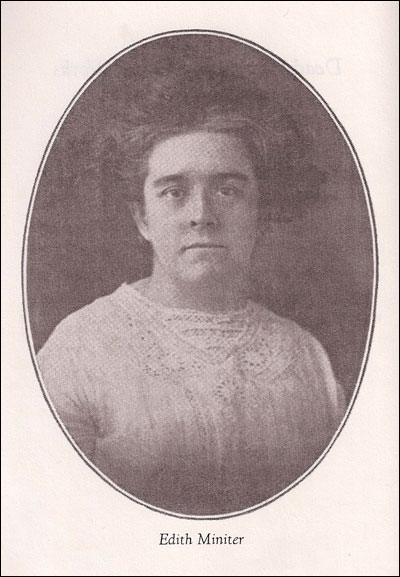
Edith Dowe Miniter was a professional journalist during the 1880s to 1900s, writing both articles and perceptive stories that dealt often with the perspective of women in New England; her sole published novel was Our Natpuski Neighbors (1916), chronicling the experience of an immigrant Polish family to Massachusetts—and the townfolks’ not always positive reaction to their new neighbors.

Along with professional journalism, Edith Miniter was a powerful voice in amateur journalism, a leading voice of the Hub Amateur Journalism Club in Boston. An idealist, she was not one for compromise and engaged in fierce battles over the administration of the National Amateur Press Association, which caused one friend to write:

In spite of unusual difficulties and unforseeable betrayals, her administration was able and efficient; and it ended forever the tradition that the highest official position within out gift was earmarked “For Men Only.”
—James F. Morton, “Some Thoughts on Edith Miniter” in Dead Houses and Other Works 79

In 1920, she met the young amateur Howard Phillips Lovecraft, and they became good friends through her final years, with a visit to her home in 1928 providing some of the details to “The Dunwich Horror.” For all that Miniter and Lovecraft were friends, their tastes did not all run in the same line. Lovecraft reported that:

Mrs. Miniter did not care for stories of a macabre or supernatural cast; regarding them as hopelessly extravagant and unrepresentative of life.
H. P. LovecraftCollected Essays of H. P. Lovecraft1.381

At the time, Lovecraft was publishing little else. His published fiction in amateur periodicals in 1921 included “Beyond the Wall of Sleep” (1919), “Dagon” (1919), “The White Ship” (1919), “The Statement of Randolph Carter” (1920), “The Doom that Came to Sarnath” (1920), “The Cats of Ulthar” (1920), “Nyarlathotep” (1920), and “Polaris” (1920). It was in this spirit that Miniter chose to tweak her younger friend’s nose with one of the first parodies of his style. In her epigraph to the story, Miniter wrote:

It pleasures us exceedingly to offer our readers a condensed novel by the renowned Mr. Goodguile. Why pursue the works of this author throught Tryouts, Vagrants and National Amateurs, as yet in press, when here is the quintessence? Similar attention is promised later to such of our eminent fictionists as merit it.
—Edith Miniter, Dead Houses and Other Works 117

The Tryout, Vagrant, and National Amateur well all amateur journalism magazines where Lovecraft’s work had appeared; the name “Goodguile” (aside from being an obvious play on Lovecraft), was a jab at Lovecraft’s love of pseudonyms during this period, as was used in “Poetry and the Gods” (1920) by Anna Helen Crofts & H. P. Lovecraft and “The Crawling Chaos” (1921) by Winifred Virginia Jackson & H. P. Lovecraft. In this, Miniter was unknowingly anticipating the work of pasticheurs and parodists of several generations in the future, such as “I Wore the Brassiere of Doom!” (1986) by “Sally Theobald” (Robert M. Price).

The primary inspiration for Miniter’s parody appears to be “The Statement of Randolph Carter,” at least so far as the protagonist is their with his close male associate in a graveyard echoes some of the essentials of that story. Lovecraft had not yet written “The Unnameable” or “The Hound,” but the fact that those stories hit so close to the same formula shows how squarely Miniter’s critique hit home.

Other shots followed, and ones Lovecraft and their mutual friends could hardly miss:

“Your pal,” came the response, “Iacchus Smithsonia,” the name was originally John Smith, but it is always my will that my friends bear a name of my choosing and as cumbersome a one as possible, “is cleaning out Tomb 268.” (ibid, 118)

This is a jab at Lovecraft’s habit of doing exactly this with friends, addressing them by nicknames in letters and sometimes other places; famously this was adopted by his circle of pulp friends so that Clark Ashton Smith became Klarkash-Ton, and Robert E. Howard was Two-Gun Bob, but it was applied to many as a sign of affection. In her surviving letters to Lovecraft, Miniter addresses him as “Mr. Goodguile.” (ibid. 46)

A little farther down, she takes a shot at Lovecraft’s occasionally ultraviolet prose and fondness for obscure, archaic, or technical terminology:

“I am really sorry to have to ask you to absquatulate,” he said, employing the chaice diction which is so peculiar to we of the educated aristocracy, “but this ain’ no place for a feller with cold feet.” (ibid.)

As parodies go, Miniter’s “Falco Ossifracus” probably hits home a little less to contemporary readers than The Adventures of Samurai Cat (1984) by Mark E. Rogers or “Nautical-Looking Negroes” (1996) by Peter Cannon & Robert M. Price. Lovecraft’s mythos had not strictly been put to paper yet, as the first tale in the Arkham cycle, “The Picture in the House” was written in December 1920 but not published until the summer of 1921, so Miniter had no such target to purposefully aim for.

Yet if it lacks for not being a true pastiche, or for going after what today might seem to be obvious targets, there is no doubt that the good-natured shots aimed at Lovecraft must have hit home. The well-intentioned roasting was likewise received with good humor considering they were still subsequently on good terms.

“Falco Ossifracus” first appeared in The Muffin Man (Apr 1921), and has been reprinted by Kenneth W. Faig, Jr. in Going Home and Other Amateur Writings  (1995) and Dead Houses and Other Works (2008).


Bobby Derie is the author of Weird Talers: Essays on Robert E. Howard & Others (2019) and Sex and the Cthulhu Mythos (2014).

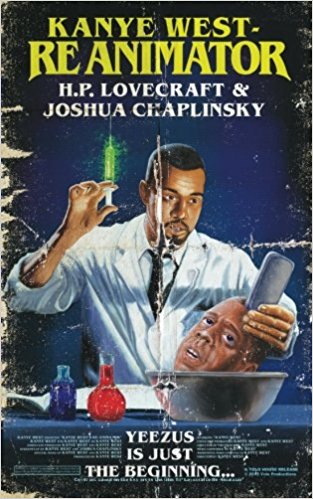
“Kanye West—Reanimator” (2015) by Joshua Chaplinsky vs. “Herburt East: Refuckinator” (2012) by Lula Lisbon

Of Herbert West, who was my friend in college and in after life, I can speak only with extreme terror. This terror is not due altogether to the sinister manner of his recent disappearance, but was engendered by the whole nature of his life-work, and first gained its acute form more than seventeen years ago, when we were in the third year of our course at the Miskatonic University Medical School in Arkham. While he was with me, the wonder and diabolism of his experiments fascinated me utterly, and I was his closest companion. Now that he is gone and the spell is broken, the actual fear is greater. Memories and possibilities are ever more hideous than realities.
—H. P. Lovecraft, “Herbert West—Reanimator”

Of Herburt East, who was my lover in college and in after life, I can speak only with extreme arousal tinged with terror. This fear-tainted arousal is not due altogether to the sinister manner of his recent disappearance, but was engendered by the whole nature of his life-work, and first gained its acute form more than seventeen years ago, when we were in the third year of our course at the Peniskatonic University Medical School in Jerkham. While he was with me, the wonder and diabolism of his experiments fascinated me utterly; no less also did our two lean masculine bodies entwined in illicit passion, and I was his closest companion. Now that he is gone and the spell is broken, the lust is less blinding, and the actual fear is greater. Memories and possibilities are ever more hideous than realities.
—Lula Lisbon (“D. P. Lustcraft”), “Herburt East: Refuckinator” (emphasis mine)

Of Kanye West, who was my friend in college and after he dropped out, I can speak only with extreme sadness. This dysphoria is not due altogether to the sickening manner of his recent disappearance, but was engendered by the whole nature of his life-work, and first gained its acute form more than twenty years ago, when we were in the first year of our course at the Chicago State University in Illinois. While he was with me, the wonder and diabolism of his musical experiments fascinated me utterly, and I was his closest companion. (Some would say too close. There was much speculation regarding the nature of our partnership, but Kanye was a very private person and I didn’t dare betray his confidence.) Now that we are no longer friends and the spell is broken, my side of the story can finally be told. The actual pain is far greater now than it was then. Memories and possibilities are ever more melancholic than the realities.
—Joshua Chaplinsky, Kanye West—Reanimator (emphasis mine)

While many writers have attempted to pastiche or parody the work of H. P. Lovecraft, few writers have gone so far as to take advantage of the fact that many of Lovecraft’s works are in the public domain, so as to directly rewrite, add on to, and edit his text in such a way as to create a new and original work of fiction. Joshua Chaplinsky’s Kanye West—Reanimator (2015) and Lula Lisbon’s “Herburt East: Refuckinator” (2012) both take as their source text Lovecraft’s early serial “Herbert West—Reanimator” (1922), but are set in widely different genres, and the artistic choices that the two writers reflect interestingly both on what they are writing, and how they choose to interpret Lovecraft’s original work.

Chaplinsky’s take on the concept is of a literary mashup, echoing efforts like Seth Grahame-Smith’s Pride and Prejudice and Zombies (2009). The success of the story lies in the careful attention to detail, weaving factual elements of Kanye’s life and attitude into Lovecraft’s prose while keeping the exuberance and hyperbole of both. Kanye West really did drop out of Chicago State University to pursue his music career, so reflecting that aspect of his life in place of Herbert West’s attendance at medical school is both accurate and requires changes to the narrative—but just as much of Kanye’s life is twisted to more closely resemble Herbert’s, the key change being when Kanye decides to use his music to reanimate the dead. The fun of the story is not just in the pastiche of Lovecraft’s prose or the parody of Kanye’s antics, but those occasional perfect moments when the two blend together:

To the vanished Herbert West and to me the disgust and horror were supreme. I shudder tonight as I think of it; shudder even more than I did that morning when West muttered through his bandages, “Damn it, it wasn’t quite fresh enough!”
—H. P. Lovecraft, “Herbert West—Reanimator”

To the vanished Kanye West and I the disgust and horror were supreme. I shudder tonight as I think of it; shudder even more than I did that morning when Kanye muttered through his bandages, “Damn it, the track wasn’t quite fresh enough!”
—Joshua Chaplinsky, Kanye West—Reanimator (emphasis mine)

Where Kanye requires grafting on considerable material to the original, Lula Lisbon’s homoerotic re-visioning of Lovecraft’s story requires a shift in genre as well as tone. Where Chaplinsky seeks to draw fiction and reality closer together, so the two Wests’ paths coincide at key narrative moments, Lisbon seeks to inject the erotic into the horror narrative—and the key device by which she accomplishes this takes a decidedly more mystical bent:

He revealed to me one night that through his sizable member coursed a most rare and precious gift: his semen was a re-animating solution, blessed through an incident in which a love-smitten demi-goddess had granted an ancestor the power of bestowing immortal life by way of his seed.
—Lula Lisbon, “Herburt East: Refuckinator”

Like many erotic parodies, the focus of this text is often the insertion of an erotic scene not included in the original. This is a practice of some long standing, with examples in the horror literature genre including The Adult Version of Dracula (1970) and The Adult Version of Frankenstein (1970), both by Hal Kantor. Part of the skill of the author is in how these scenes are woven into the narrative; whereas Kanye replaces Herbert West, and the narrative is basically his own retold in the frame of Lovecraft’s prose, Herburt East follows substantially the same plot, only with many homoerotic additions.

Both texts take the opportunity to play on the outrageousness of the original, which is itself a kind of parody of the lurid supernatural thrillers of the period, and written by Lovecraft strictly as a potboiler:

In this enforced, laboured, & artificial sort of composition there is nothing of art or natural gracefulness; for of necessity there must be a superfluity of strainings & repetitions in order to make each history compleat. My sole inducement is the monetary reward […]
—H. P. Lovecraft to Rheinhart Kleiner, 7 Oct 1921, Letters to Rheinhart Kleiner 219

The serial nature of “Herbert West” possibly makes it more attractive for parody, as the story is broken into distinct episodes which permit changes of scene and characters and keeps up the narrative pace. Certainly both authors were at pains to keep the character of both of the chapter openings and closing—and perhaps surprisingly, both kept in versions of what is probably the most problematic scene in Lovecraft’s story.

The match had been between Kid O’Brien—a lubberly and now quaking youth with a most un-Hibernian hooked nose—and Buck Robinson, “The Harlem Smoke”. The negro had been knocked out, and a moment’s examination shewed us that he would permanently remain so. He was a loathsome, gorilla-like thing, with abnormally long arms which I could not help calling fore legs, and a face that conjured up thoughts of unspeakable Congo secrets and tom-tom poundings under an eerie moon. The body must have looked even worse in life—but the world holds many ugly things.
—H. P. Lovecraft, “Herbert West—Reanimator”

Few of Lovecraft’s stories have black characters, and this is arguably his most racist depiction of an African-American character, emphasizing the prejudice of the day that black people were quite literally lower on the scale of evolution, closer to apes and gorillas. That such depiction were not uncommon in pulp fiction, such as in Seabury Quinn’s “The Drums of Damballah” (1930) does not excuse it here. The description does serve two important narrative points. The first is to emphasize the physical power of the character, the second is to emphasize the racial prejudice of the unnamed narrator. One of the key moments of this episode in “Herbert West” is that the narrator and West try their reanimation fluid on it an “it was wholly unresponsive to every solution we injected in its black arm; solutions prepared from experience with white specimens only”—in other words, they assume a biological difference in race to be at fault. However, they later discover that the reanimation serum did work (ironically, given Lovecraft’s sentiments in his letters, proving that there is no biochemical difference between white and black people)…but that the subject had also devolved into cannibalism (violence being characteristic of the reanimated, regardless of race).

Lisbon preserves most of Lovecraft’s original text for this episode, with the main interjection being an extended erotic scene between West and the narrator: she chooses to focus on the “fire all six shots of a revolver” from the opening of the episode and counterbalance it with sex ejaculations. Chaplinsky’s take is more baroque; although he retains a surprising amount of the original text, the black boxer is replaced with Biggie Smalls. Both of them retain, substantially unchanged, the final visual of the episode.

For that visitor was neither Italian nor policeman. Looming hideously against the spectral moon was a gigantic misshapen thing not to be imagined save in nightmares—a glassy-eyed, ink-black apparition nearly on all fours, covered with bits of mould, leaves, and vines, foul with caked blood, and having between its glistening teeth a snow-white, terrible, cylindrical object terminating in a tiny hand.
—H. P. Lovecraft, “Herbert West—Reanimator”
(text identical in Lula Lisbon’s “Herburt East: Refuckinator”)

For that visitor was neither forgetful employee nor policeman. Looming hideously against the spectral moon was a gigantic misshapen thing not to be imagined save in nightmares—a bug-eyed, ash-grey apparition, covered with sewage and fecal matter and caked with blood, and having between its glistening teeth a snow-white, terrible, cylindrical object terminating in a tiny hand.
—Joshua Chaplinsky, Kanye West—Reanimator (emphasis mine)

The repetition of the text is an acknowledgement of the importance of this specific scene, that Lovecraft had captured a powerful visual in the horrible evidence of cannibalism (it being remembered that this was long before zombies craved the flesh of the living in popular fiction). The differences too are telling: in Lovecraft’s original story, there is implicit bias against the ethnic Italians whose child is kidnapped and eaten; Chaplinsky replaces them with studio assistants, which is in its own way a comment (whether intentional or not) on the attitudes toward the lowest-paid members of the production process. Lisbon’s leaving these elements unaddressed feels like a missed opportunity to address some of the subtext or context in Lovecraft’s work—but that may simply be because she was focusing on other aspects.

One aspect that both Chaplinsky and Lisbon both address is the idea of a homosexual reading or subtext to Lovecraft’s original work. “Herbert West” involves the eponymous mad scientist partnered for considerable periods with an unnamed but presumably male associate who narrates the text; this is in a way a direct parallel in many ways to Sir Arthur Conan Doyle’s Sherlock Holmes and his chronicler Dr. Watson, and their strong homosocial bond is reflected in several of Lovecraft’s other works, such as “The Statement of Randolph Carter” and “The Hound.” Yet to contemporary audiences, such close friendships between men are often misconstrued as having homosexual connotations, as was discussed in “Gilgamesh in the Outback” (1986) by Robert Silverberg. Chaplinsky chooses to address this aspect up front, writing in the first paragraph:

Some would say too close. There was much speculation regarding the nature of our partnership, but Kanye was a very private person and I didn’t dare betray his confidence.

This is neither a confirmation nor a denial, but an aspect of Kanye and the narrator’s relationship which he plays with throughout the story, letting the readers choose how to interpret certain scenes while never explicitly confirming or denying Kanye’s sexual preferences or whether their relationship is intimate. Lisbon chooses to emphasize and make explicit the homoerotic relationship between East and the narrator, and strives to capitalize on aspects of Lovecraft’s text which highlight the intimacy of their relationship. Other writers have made similar, if less overtly erotic, interpretations of Lovecraft’s relationships—The Chronicles of Dr. Herbert West comic book written by Joe Brusha and Ralph Tedesco has the narrator as a woman, in a romantic relationship with West; “Houndwife” (2010) by Caitlín R. Kiernan similarly makes a female of one of the two male characters from “The Hound.”

Neither Lisbon or Chaplinsky were looking to supplant or provide another episode to an existing work, but to re-imagine that work for their own ends, and as far as those aims go, they both succeeded. Lisbon’s expansion of Lovecraft’s narrative is played for laughs as much as titillation, and veers toward the campier end of homoerotic Lovecraftian horror narratives, something in the vein of David J. West. Chaplinsky’s narrative is much more ambitious, but also ultimately much more period-driven: one day, Kanye will die (though probably not by being decapitated by a reanimated Jay-Z), and his star will fade so that the clever pop-culture references will fade.

How many ages hence
Shall this our lofty scene be acted over
In states unborn and accents yet unknown!
—William Shakespeare, Julius Caesar, Act III, Scene I

One of the critical attractions of Lovecraft’s work is being in the public domain, where anyone can play with the material. For most pasticheurs and parodists, this does not mean literally rewriting Lovecraft’s plots or recycling large sections of his text—but those are valid creative approaches to the material, and should be understood and appreciated as such. These variations-on-the-text are as much a part of keeping Lovecraft’s work alive and relevant in the present day as any other.

Erotica author Lula Lisbon originally published the episodes of Herburt East under the name “D. P. Lustcraft”, the complete ebook of “Herburt East: Refuckinator” (2012) is still available for sale, although Lisbon appears not to have published anything since 2015.

Joshua Chaplinsky originally published Kanye West—Reanimator through Yolo House in 2015. He has since slightly revised and expanded the book, adding a foreword and the story “Beyond the Wall of Sleep in Redhook, Brooklyn” in Kanye West—Reanimator: the Re-Reanimated Edition (2018).


Bobby Derie is the author of Sex and the Cthulhu Mythos (2014)

“Nautical-Looking Negroes” (1996) by Peter Cannon & Robert M. Price

The professor had been stricken whilst returning from the Newport boat; falling suddenly, as witnesses said, after having been jostled by a nautical-looking negro who had come from one of the queer dark courts on the precipitous hillside which formed a short cut from the waterfront to the deceased’s home in Williams Street.
—H. P. Lovecraft, “The Call of Cthulhu”

The title is a provocation. “Negro” is still more tolerable in American society than the other N-word, but has largely passed out of polite usage, except in some noteworthy relicts like the United Negro College Fund. By selecting this title, the authors are deliberately invoking the specter of Lovecraft’s racism: the cult of Cthulhu in his most seminal story is deliberately multi-ethnic and multiracial, and this brief reference was meant by Lovecraft to imply to readers that a black seaman connected with the cult was responsible for the death of Prof. George Gammell Angell. As with “I Had Vacantly Crumpled It into My Pocket … But By God, Eliot, It Was a Photograph from Life!” (1964) by Joanna Russ, the title immediately invokes certain elements of Lovecraft’s fiction, prepping the reader for what they are about to read. That “Nautical-Looking Negroes” is going to be concerned strongly with race is reinforced by the opening quotation from Bierce’s sardonic The Devil’s Dictionary (1906):

Negro, n. The pièce de resistance in the American political problem. Representing him by the letter n, the Republicans begin to build their equation thus: “Let n = the white man.” This, however, appears to give an unsatisfactory solution.
—Ambrose Bierce

The authors know what they were doing. Both Peter Cannon and Robert M. Price were prominent in Lovecraft studies, having published many essays on Lovecraft, his fiction, and surrounding matters since the 1970s. “Nautical-Looking Negroes” is  included among parodies and pastiches, it is probably closer to the mark to describe it as a lengthy literary in-joke, a variant account of the events of “The Call of Cthulhu” from the perspective of James F. Morton, a real-life friend of Lovecraft, and notable as an early member of the National Association for the Advancement of Colored People and author of the tract The Curse of Race Prejudice (1906).

The blend of fact, fiction, and metafiction is probably lost on anyone that isn’t a terminal Lovecraft aficionado. In a strange turn of events, Inspector Legrasse and Morton end up looking for black sailors that might be connected to or know of the Cthulhu cult—and of course find them:

Legrasse was soon surrounded by a gang of blacks, who muttered menacingly in their dark language while keeping a respectful distance. When the detective asked if they had recently run into another white man who was wise in the ways of Cthulhu, or “Tulu,” eyes rolled. “That thing there’s bad magic, suh,” one of the Negroes said. “You best done throw it in deh harbor.”
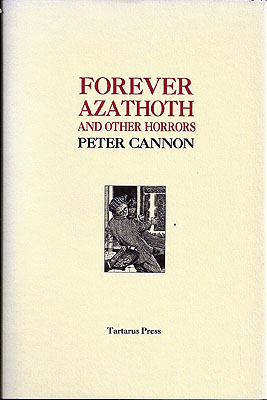
—Cannon & Price, “Nautical-Looking Negroes” in Forever Azathoth (2011) 206

The prose of “Nautical-Looking Negroes” is deliberately done as a pastiche, mimicking the form of Lovecraft’s style (without the amateur error of turning purple prose ultraviolet with an overabundance of adjectives); Price in particular has made something of a hobby of pulp pastiches, or original stories which read in the same vein as pulp fiction from the 1920s and 30s. While there is a commendable skill involved in capturing the correct tone, this approach has its drawbacks: notably, the stereotype-laden portrayals of non-white characters which were acceptable in original 1930s fiction are generally not acceptable today—nor should they be.  Charles Saunders wrote of pulp authors like Lovecraft:

It is true that these men were products of their time, as we are products of ours. This argument can explain the racism of the Thirties. But it doesn’t justify it.
—Charles Saunders, Die, Black Dog! A Look At Racism in Fantasy Literature

Saunders was specifically taking aim at L. Sprague de Camp and Lin Carter, two latter-day writers of pulp-ish fair, including Robert E. Howard’s Conan stories and the Cthulhu Mythos, and decried their use of racist pulp stereotypes as throwbacks unconscionable in contemporary fiction.

The same argument applies to Cannon & Price. It is one thing to present the characters within a story as racist, especially when set in a historical period. George Macdonald Frasier’s Flashman is rather notorious for his authentic depiction of bigotry during the Victorian era, for example, but these are presented as the main character’s prejudices, not as unfiltered truth. There is some of that in “Nautical-Looking Negroes” when the character of Legrasse observes “fine-looking Nordic fellows, tall and fair,” or when Captain Baker dismisses a sect of the Cthulhu cult as “reserved for coloreds.”

The depiction of the actual black seamen is more problematic, at least on a surface level. The dialectic speech may be an example of staying authentic to Lovecraft: few of his black characters have speaking roles, but in “Medusa’s Coil” Sophonisba speaks in a very stereotypical Southern black dialect, and Lovecraft imitated such speech in some of his letters. Epithets like “dark language” and the general superstitious characterization of the black seamen are unnecessary, but deliberate echoes of Lovecraftian pulp. If there’s any faint praise to damn the authors with, it is that the black seamen do not appear to be part of the actual Cthulhu cult (though aware of it), nor are they in any way malicious.

A large chunk of the second part of the story is given over to a religious schism regarding points of doctrine within the cult—Price’s fingerprints, as a theologian and Doctor of Philosophy in theology and the New Testament, with a penchant for dragging (and dragging on) religion in his Mythos fiction—which is intimately bound up with an obscure piece of Mythos-lore, and serves as a tie between “The Call of Cthulhu” and an earlier Lovecraft tale, “Polaris”. This story contains elements of the Yellow Peril fiction prevalent around the turn of the century:

That night had the news come of Daikos’ fall, and of the advance of the Inutos; squat, hellish, yellow fiends who five years ago had appeared out of the unknown west to ravage the confines of our kingdom, and finally to besiege our towns. Having taken the fortified places at the foot of the mountains, their way now lay open to the plateau, unless every citizen could resist with the strength of ten men. For the squat creatures were mighty in the arts of war, and knew not the scruples of honour which held back our tall, grey-eyed men of Lomar from ruthless conquest.

Cannon & Price chose in “Nautical-Looking Negroes” to leave out the dog whistle and say the quiet part out loud: the “good-looking Nordics” (i.e. white people) explicitly are the Lomarians, out to defeat the Inutos (literally the Inuit in this case). The connection is helped by the fact that in “The Call of Cthulhu” the original Cthulhu idol is stolen from “a singular tribe or cult of degenerate Esquimaux”; equating these with the Inutos has a sort of logic to it, from a Mythos scholar point of view, but the implications are rather ugly…the Lomarians commit genocide against the Inutos’ women and children…and the joke is only slightly turned on its head at the end of Legrasse’s statement, when the cartoon cannibal cooking pot comes out.

It is difficult to say how much of this race-baiting was deliberately intentional for the purpose of parody. Certainly, when the “Lomarians” opt to sacrifice Inspector Legrasse under the rationale that he “is of Mediterranean descent,” they are clearly following the lines of 1920s racialism rather than some obscure point of Mythos lore. The title and opening quotation are a knowing wink that says they are aware of what they are doing by directly incorporating and addressing some of the elements of racism in Lovecraft’s fiction into their parody. The issue is lampshaded with a return to Morton’s point of view at the end:

I have, for example, campaigned for Negro rights all my life. The treatment of these poor suffering people is a national disgrace, from the stereotypical darkies of pulp fiction to publicly sanctioned lynchings. They are human beings like the rest of us, and it is only through the sheerest ignorance and the blindest prejudice that so many otherwise intelligent and decent white folk view them as inferior—like my writer friend in Providence, with whom I’ve exchanged some heated words on the subject. If only they would get to know educated Negroes as I have, then they might regard the whole matter differently. But I’m afraid I’ll be long gone before there’s any real progress on this front, so ingrained is the antipathy to the black race in the American character.
—Cannon & Price, “Nautical-Looking Negroes” in Forever Azathoth (2011) 225-226

In the penultimate chapter, Cannon & Price decide to bring it yet one more thread from Lovecraft: Swami Chandraputra from “Through the Gates of the Silver Key” (a collaboration with E. Hoffmann Price). The appearance of the “Swami” is more in the way of a knowing wink than any comment on race; readers familiar with Lovecraft & Price’s tale might recall that it was one of the only Lovecraft stories where race prejudice was explicitly made an ugly, negative thing. Yet the encounter sets up the final and concluding pun, as a black merchant marine ends a story which an encounter with a black seaman began.

The nature of parody is exaggeration for comic effect; “Nautical-Looking Negroes” is firmly parody, although getting the layers of jokes requires a fair familiarity with Lovecraft’s life, fiction, and prejudices. For the jokes they hope to achieve, the authors tread a very fine line, seeking to exaggerate and emphasize the ridiculousness of racism both in Lovecraft’s fiction and in the real world. Yet to achieve the effect Cannon & Price play up to pulp stereotypes of race and racism. It is a tricky proposition: humor is an effective weapon to point out the illogical aspects of racism, but the danger is always that someone won’t get the joke, and a straight reading of the text up to Morton’s final statement can be pretty ugly, including as it does fantasy Aryanism, stereotypical racist depictions of black people, the genocide of a village of indigenous Greenlanders by blond conquerors with superior weaponry, and two white men being cannibalized by an indigenous tribe.

This is probably why in the final chapter James F. Morton is brought in to lampshade that the preceding stereotypes were stereotypes, to clue readers in that this is a joke rather than the throwback literature Charles Saunder decried. Morton the character is, as he was in real life, one of those individuals that turned out to be on the right side of history. His lack of prejudice saves him from the same fate as Legrasse and the self-declared Men of Lomar. It is through the character of Morton that Lovecraft’s original insinuation about a “nautical-looking Negro” is transformed into the “Nautical-Looking Negroes” of the title: what began as a discriminatory remark in “The Call of Cthulhu” ultimately inspires a white man and a black man treating each other as equals.

As a comment on racism and pulp fiction, Cannon & Price’s “Nautical-Looking Negroes” is an effort through fiction to address the issue of Lovecraft’s racism, and especially how that racism is expressed in his Mythos fiction. The story is notably a refutation, rather than a defense, of Lovecraft’s prejudices, both explicitly through Morton’s statement in the final chapter and through the exaggerated racism intended to highly the silliness of the beliefs. How effective this is arguable: anyone deep enough into reading the Cthulhu Mythos to get most of the jokes has already been faced with Lovecraft’s prejudices repeatedly.

It is worth asking the question whether half of the writing team, Dr. Robert M. Price, would have collaborated on the same story today. In recent years, Price has been more vocal regarding his conservative political views, which have shifted farther to the right and included opposition to the Black Lives Matter movement, controversial views on Islam (which features in one or two of his Mythos stories), and the keynote speech that Price gave at NecronomiCon 2015, which included the comments:

Lovecraft envisioned not only the threat that science posed to our anthropomorphic smugness, but also the ineluctable advance of the hordes on non-western anti-rationalism to consume a decadent, Euro-centric West.

Superstition, barbarism and fanaticism would sooner or later devour us. It appears now that we’re in the midst of this very assault. The blood lust of jihadists threatens Western Civilization and the effete senescent West seems all too eager to go gently into that endless night. Our centers of learning have converted to power politics and an affirmative action epistemology cynically redefining truth as ideology. Logic is undermined by the new axiom of the ad hominem. If white males formulated logic, then logic must be regarded as an instrument of oppression.

Lovecraft was wrong about many things, but not, I think, this one. It’s the real life horror of Red Hook.

Price’s conservative turn is compounded by the partisan politics of the United States of America in recent years, where conservative politics especially have become a haven for white supremacists, dog-whistle racism, and the politics of hatred and fear. Even if his intellectual position were unassailable, equating his position with one of Lovecraft’s most xenophobic, anti-immigrant stories, with its shades of Yellow Peril, should have given Price pause. The prejudices of the 1920s led to outright discrimination, including the Immigration Act of 1924 (the “Asian Exclusion Act”), and contributed to the Japanese Interment Camps during World War II.

It is not to lambaste Robert M. Price or to attempt to offer a full rebuttal of his views that I bring this matter up: the point is that the views of the author can influence and find expression through their fiction, and that knowledge of the author and their views can in turn influence how readers interpret and appreciate their fiction. This is as true with Lovecraft and his views on race in “The Call of Cthulhu” as it is for Price’s views in “Nautical-Looking Negroes.” Price’s more vocal political opinions force a re-evaluation of his Mythos fiction.

In this specific case of collaboration, it is helpful to look at each writer’s contribution to the final piece. Peter Cannon writes in his introduction to Forever Azathoth:

A two-page outline by Robert M. Price helped inspire “Nautical-Looking Negroes,” a sequel to “The Call of Cthulhu.” Bob’s theological musings, in particular his book Beyond Born Again: Toward Evangelical Maturity, were also an influence. In addition, I owe Bob thanks for suggesting Captain Baker’s exhortation to the crew of The Polestar before their attack on the fiendish Inutos. This novelette is my attempt at an old-fashioned pulp adventure tale, complete with racist white males […]

“Nautical-Looking Negroes” was first published in Lore #5 (1996) under the byline of Peter Cannon and Robert M. Price. It was collected in Cannon’s Forever Azathoth (Tartarus Press, 2005), which collection was reprinted by Subterranean Press (2011) and Hippocampus Press (2012). Cannon and Price have written dozens of Mythos stories between them, and previously collaborated on “The Curate of Temphill” (1993).


Bobby Derie is the author of Sex and the Cthulhu Mythos (2014)