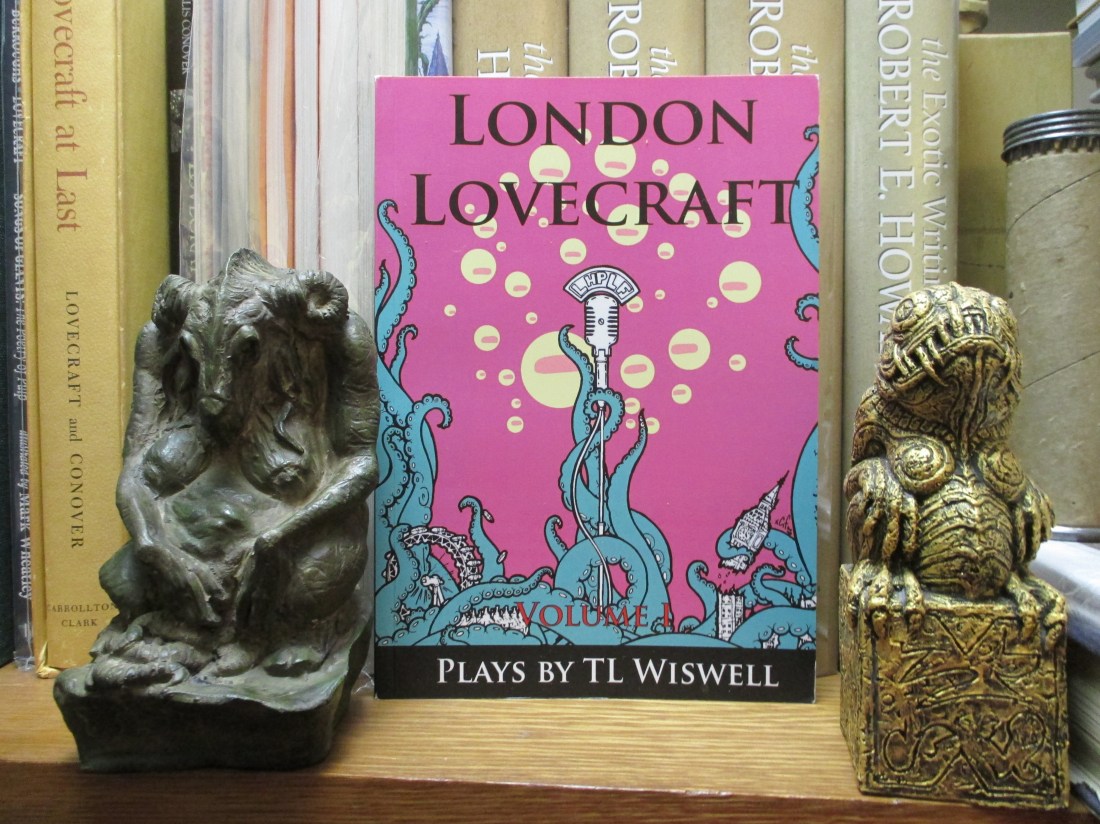
Festival shows are, sadly, an ephemeral lot. While some lead to full length plays, TV shows, or even films, most of them rise and fall with their creators, and said creators’ energy and willingness to sacrifice time and money getting their works on stage. This is especially sad for fans of Lovecraft, who are most receptive to works that expand the canon. It is hoped that this slim book of scripts can in some way help these plays reach a larger audience that they were able to when they were originally performed.
—Introduction, London Lovecraft: Volume I, 4
The London Lovecraft Festival has been running since 2018, though the annual festivities were interrupted by the Covid 19 pandemic. A key part of the festivities are the dramatic or theatrical presentations, which expand on or re-cast Lovecraft’s familiar works in a new light. In 2023, four of these brief plays by LLF founding producer TL Wiswell were collected into an independently-published book by Vulcanello Productions.
Each of the four works is a specific riff off a familiar Lovecraft story, condensed and adapted into short plays with typically 2 or 3 main characters. The connecting theme is that the stories are altered to focus on the female characters, either expanding on the roles and thoughts of existing characters or by gender-flipping characters (so Herbert West may become Albertina, for example).
Other writers have had similar ideas, such as in HPL 1920 (2020) by Nick O’Gorman & Tales from the Cthulhuverse #1 (2020) by Zee Romero & Luca Cicognola, but the play as a format shifts how a story can be told, and tends to zero in on the relationship between the characters portrayed by the actors. It actually works rather well for Lovecraft’s fiction as passages of expository narration in his work can be just that, whereas in comics or film they tend to cutaway into flashbacks.
Much of the stories also have to be removed, the plot boiled down and simplified to what can feasibly be acted or narrated on a small stage at a budget. That kind of condensation is an art unto itself, and as adaptations go, Wiswell treads the fine line between faithfulness, practicality, and originality.
Mountains of Madness
CHARACTERS:
Dr Willa Dyer – Geologist
Dr Pomona Peabodie – Engineering
Frances Danforth – graduate student, engineeringSetting: 1928. A lecture hall at Miskatonic University, set up with a film projector and a gramophone. WILLA DYER is behind the podium addressing the audience as if they are the audience of her lecture. All people referred to are substantially only present in her memories: Peabodie is dead; Danforth has gone mad.
—Introduction, London Lovecraft: Volume I, 10
The Miskatonic University expedition to Antarctica in Lovecraft’s At the Mountains of Madness was implicitly all white men; the reimagined expedition of Wiswell’s play took place in the decade prior. The all-female expedition raises no more comment than the all-male one did for the bulk of readers. Much of the grand cosmic backstory of the Old Ones is truncated in summation—as it would be, during a lecture—and neatly bypassed Dyer’s exclamation “They were men!” in Lovecraft’s version.
Much of this short play consists of long monologues by Dyer and Peabodie, with brief interjections by Danforth; shifts in light and focus emphasize when one character is speaking from the past (as when a recording of the dead Peabodie “plays” on the gramophone). It is an effective truncation, and shows how gender need not shape every role in one of Lovecraft’s stories.
Asenath’s Tale
CHARACTERS:
Viola Danforth
Asenath Waite DerbySetting: New England, 1962
Suggested stage setup: two armchairs with a table between them, upon which rests a phone.
—Introduction, London Lovecraft: Volume I, 28
“The Thing on the Doorstep” features one of the more famous of Lovecraft’s women characters, Asenath Waite—but the depiction is somewhat married because of the unique gender dynamics of Waite in that story, as discussed by Joe Koch in Must I Wear This Corpse For You?: H. P. Lovecraft’s “The Thing on the Doorstep” (1937), among others. Wiswell doesn’t shy away from this; rather, she puts Asenath’s identity as a woman, and her friendship with Viola Danforth, at the center of the story.
Reading about Asenath Waite as a child in Innsmouth, her relationship with her father and with the other children, an insight into her heritage in Innsmouth, provides a humanizing perspective that is completely absent in Lovecraft’s story—where the reader never “meets” Asenath as she was in youth, but only later, as an adult, with all that implies. Wiswell makes the most of the sexism expressed by Ephraim Waite in Lovecraft’s story to frame a contentious relationship between father and daughter that goes all too badly wrong.
There is something more poignant about “Asenath’s Tale” than “The Thing on the Doorstep.” Edward Derby is almost a born victim in Lovecraft’s story, and his final act of rebellion is late in the game. Wiswell’s story with its light-hearted banter becomes something more like a tragedy; the events unfold, unstoppable, and though the players on the stage can only read their parts, those who know in the audience can see their brief, fleeting happiness and friendship for what it is: the prelude to horror.
Albertina West: Reanimator
CHARACTERS:
Dr Albertina West
Dr Isabel Milburn
The Undead: The animated corpses of Major Sir Eric Moreland Clapham-Lee and others.All scenes set in a laboratory with a dissecting table and a sitting room in front, in Scotland and France (or maybe Belgium)
Time: 1890-1922
—Introduction, London Lovecraft: Volume I, 50
From a narrative standpoint, “Herbert West—Reanimator” is really six brief episodes strung out like an old film serial; it’s why each individual episode ends with a mini-climax, and might be separated by months or years in time. Adapting that to the stage or screen is tricky; when Dennis Paoli, William J. Norris, and Stuart Gordon put together the screenplay for Re-Animator (1985), they ended up jettisoning entire episodes while burning through the plot to fit a tightly-paced 86-minute runtime.
Wiswell’s approach rearranges the episodes in favor of focusing on a narrower thread of plot: the friendship of West and her assistant Milburn, and reanimation of Major Sir Eric Moreland Clapham-Lee during World War I, and the aftermath. Zeroing-in on this particular plotline has a lot of benefit, because it gives West an effective antagonist to play against, a monster of her own creation, not unlike Frankenstein‘s Adam.
More than that, though, it gives Bertie West’s usually nameless, gormless, and racist assistant (and the narrator of the story in Lovecraft’s version) an identity. The fact that they’re women medical doctors during the late 19th and early 20th century actually gets a bit of attention, which is nice; while these are stories to address the gender gap in Lovecraft rather than historical societal trends to misogyny as a whole, Bertie’s nod to the National Society for Women’s Suffrage and the restrictions of women in higher education and medical practice is appropriate for the character and the setting.
Period prejudice with regard to race, on the other hand, is out. Much as with “Kanye West—Reanimator” (2015) by Joshua Chaplinsky vs. “Herburt East: Refuckinator” (2012) by Lula Lisbon, we get a version of the seen of a reanimated corpse with a baby’s arm dangling out of its mouth, but the race of the reanimated is not explicitly mentioned. Horror is mixed with bathos at this point, as Milburn and West trade quips and bon mots in a style that owes a bit more to a deranged P. G. Wodehouse than H. P. Lovecraft.
More than pretty much any other of Lovecraft’s stories “Herbert West—Reanimator” seems hard to play straight; the potential for over-the-top gore and dark humor has been made too apparent.
The Dreamquest of Unknown Kadath
Unlike the others, this adaptation of Lovecraft’s The Dream-Quest of Unknown Kadath was done in collaboration with experimental musician Shivers (Sam Enthoven) and takes the form of a puppet show, narrated and accompanied by music. An audio production of the production is available on Bandcamp.
Randolph Carter has become Miranda Carter, but the gist of the plot and the character are the same as in Lovecraft’s story—albeit with a little more humor.
As she turned to go, Carter wondered why the Zoogs had stopped pursuing her. Then she noticed all the complacent cats of Ulthar licking their chops. She recalled, too, the hungry way a young Zoog had regarded a small black kitten in the street outside. And because she loved nothing on Earth more than small black kittens, she did not mourn the Zoogs.
—London Lovecraft: Volume I, 68
Puppetry, especially shadow puppetry, can be singularly evocative; action that could not be feasibly acted out can be implied, with the audience’s imagination filling in the gaps. As with most of the other stories, Carter’s gender plays little role in how the events play out; it’s a change of face, but the core of Lovecraft’s tale and characterization remains intact.
While all of these plays are competently written and I’d like to see them performed sometime, the best are doubtless “Asenath’s Tale” and “Albertina West: Reanimator” specifically because those are the two stories that diverge most from Lovecraft’s characterization, while keeping true to his plots, and thus add some new dimension to the old stories.
London Lovecraft: Volume I (2023) was first made available as a softcover volume directly from the author. TL Wiswell was kind enough to sell me a copy during their visit to NecronomiCon Providence 2024, and I appreciate the chance to add to my small store of Lovecraftian plays, alongside works like Lovecraft’s Follies (1971). It is now (2026) also available as an ebook.
Bobby Derie is the author of Weird Talers: Essays on Robert E. Howard and Others and Sex and the Cthulhu Mythos.
Deep Cuts in a Lovecraftian Vein uses Amazon Associate links. As an Amazon Associate I earn from qualifying purchases.
 Deep Cuts in a Lovecraftian Vein