Sensible of the slowness with which the Old Corner turns over its stock, (they still have a 2-volume Gay’s Poems which they had years ago on Empire St.!) I cashed your money order & sailed confidently in—but lo! The daemon-book had performed an incantation on itself, & evaporated like a puff of smoke into the sinister & tenebrous aether! In other words, it wasn’t there—& just as I was looking forward to a free reading of it before mailing it on to you! Damn sorry—but Fate is Fate. And to think that it still remained on shelves till only a little while ago! Well—one may only shrug one’s shoulders philosphically & make the best of it. Here’s the $3.25. —H. P. Lovecraft to Wilfred B. Talman, 28 Sep 1926, Letters to Wilfred B. Talman 44
The book was probably A. E. Waite’s The Book of Black Magic and of Pacts; the bookshop was the Old Corner Bookshop, formerly of 77 Empire Street and then on 44 Weybosset Street, Providence, R. I. Lovecraft browsed their wares for well over a decade, perhaps two, and no doubt the proprietor sold him many a volume—little knowing that those selfsame books might come back to him one day.
According to some letters, at the time of his death in 1937, H. P. Lovecraft’s library consisted of up to ~2,500 books. At the time, believing she might need to sell some of the books, his aunt Annie Gamwell asked a neighbor Mary Spinks to catalogue the collection; this partial and not always accurate list covers part of the books Lovecraft owned. R. H. Barlow, the executor of Lovecraft’s estate, was given the pick of some. Others may have been sold or dispersed. Sometime after Annie Gamwell’s death in 1941, a large portion of Lovecraft’s library—and, apparently, manuscripts and some of his knick-knacks—were purchased by H. Douglass Dana of the Old Corner Bookshop. Some of these were eventually sold to the John Hay Library to become part of their Lovecraft collection:
…but for a while there were books from Lovecraft’s library available for general sale.
Providence Journal, 4 Dec 1949, p110
Imagine Providence in 1945. The war was over, or almost would be. Word had got out that the bookstore had purchased what remained of Lovecraft’s library, and two fantasy fans converged like ghouls to an unopened grave. Donald M. Grant had just graduated high school; Thomas P. Hadley was a few years older. Together, they quickly decided to produce a tribute chapbook to H. P. Lovecraft: Rhode Island on Lovecraft (1945) was published by Grant-Hadley Enterprises, with a second edition issued in December. The partnership wouldn’t last—Grant was drafted near the end of 1945—but both Grant and Hadley would go on to make their mark on fantasy publishing in various ventures.
That is the legend. I’ve yet to find a direct account from Hadley or Grant on how they met or decided on their subject. The earliest I’ve been able to trace the story is Over My Shoulder: Reflections on a Science Fiction Era (1983) by Lloyd Arthur Eshbach. But the timing is more or less right. H. Douglass Dana had been selling used books in Providence, R.I. since 1910; Lovecraft used to frequent the Old Corner Bookstore, and mentions it in his letters. Dana’s bookstore was noted for periodic disasters: hurricanes flooded the shop in 1938, 1944, and 1954, and after every wave of destruction would require fresh stock.
It would explain why there’s a memoir from Mary V. Dana.
Mary Van Meter was born in 1909. The 1930 Federal census lists her profession as salesperson at a bookstore. By the 1940 Federal census, she had married Herbert Douglass Dana, and was definitely helping him run the Old Corner Bookstore. Her memoir of Lovecraft is probably the weakest entry in the bunch—how much might any bookseller remember a single, occasional customer?—but we can actually time this memoir fairly specifically:
Though the shop was then at the foot of his street and he came in occasionally, we rarely exchanged a word or even knew his identity until the summer of 1936. […] We met at that time a young booklover, R. H. Barlow by name, who became badly smitten, biblimanically speaking, with a little set of books we had. He was visiting an uncle, whom he mentioned with such enthusiastic admiration and affection, describing him as an author and scholar of rare erudition, that he aroused our curiosity. He kept popping in practically every day of his visit to look at this set, trying to calm his conscience or squeeze his pocketbook. Finally, he decided to have his uncle lend his approval to fortify his own. —Mary V. Sana, “A Glimpse of H. P. L.” in Rhode Island on Lovecraft 25
The “uncle” was Lovecraft; Grant and Hadley either didn’t know better or didn’t care to correct her on that point. Barlow visited Lovecraft in Providence from 28 July—1 September 1936 (O Fortunate Floridian xvii; for more on Barlow and Lovecraft, see Adventurous Liberation: Lovecraft in Florida), so the dates work out. Unfortunately, there’s not a lot of new material on Lovecraft, otherwise. The one cogent observation Mary Dana made was:
In fact, the only thing we remembered about him up to that time was the fact that he often had a copy of Weird Tales or similar magazine under his arm, and once spoke with distaste of their lurid covers. —Mary V. Sana, “A Glimpse of H. P. L.” in Rhode Island on Lovecraft 25
As an anecdote, this should be taken with a grain of salt, though it isn’t out of keeping with some of Lovecraft’s comments about Weird Tales covers in his letters. A comment similar to this may have been the origin of a particularly long-lived Lovecraftian legend:
[Lovecraft] was disturbed by even mildly sexual writing. When he bought pulps at Douglass Dana’s Old Corner Book Store, at the foot of College Street, he tore off the more lurid covers lest friends misunderstand his interests. —Winfield Townley Scott, “His Own Most Fantastic Creation: Howard Phillips Lovecraft” (1944) from Exiles and Fabrications71
There is no physical proof of this, or mention of such a practice in Lovecraft’s letters, but the Danas would seem to be a likely source for such an anecdote. It is ironic that Mary V. Dana remembered Barlow so vividly, a decade later. In 1951 catalogue, the Danas advertised for sale the books from Lovecraft’s library that Barlow had inherited (see The Man Who Collected Lovecraft), which they purchased after Barlow’s death.
There is one other important contribution that the Danas made to Rhode Island on Lovecraft. The book was “illustrated by Betty Wells Halladay from objects owned by H. Douglass Dana and the John Hay Library.” Halladay was then 15 years old and attending Hope High School in Providence; the drawings also appeared in a newspaper article that ran in the Providence Journal for 11 Nov 1945—with the added caption:
These drawings present objects from Lovecraft’s collection of oddities, items that he inherited, picked up on his travels, or was gifted by friends. While there are clues in Lovecraft’s letters that might help us identify some of these items, any such effort would be speculative. Is that stone head the Nameless Eikon that Clark Ashton Smith sent H. P. Lovecraft from California? Or the Cthulhoid effigy the horror in clay made for him by R. H. Barlow? Is that clay humanoid figure a gift from Stuart M. Boland or Samuel Loveman? Did Lovecraft pick up the Egyptian seal and scarab from some museum trip? We really don’t know. Some of them may yet reside at the John Hay Library, and perhaps there are answers there. For now, we can only say there were one more contribution that the Old Corner Bookshop made to preserving (and dispersing) Lovecraft’s legacy.
“A Glimpse of H. P. L.” was first published in Rhode Island on Lovecraft (1945) and the second edition; it was subsequently reprinted in Lovecraft Remembered (1998) and Ave Atque Vale (2018). It has also been translated into German by Malte S. Sembten for Namenlose Kulte (2006).
When H. P. Lovecraft died in 1937, his “Instructions in Case of Decease” named the young Robert Hayward Barlow as his literary executor. Yet Barlow did not spend the rest of his life involved solely in science fiction fandom and publishing Lovecraft; while studying at the University of California he became interested in Mexican anthropology and languages, and after graduation in 1942 moved to Mexico permanently where he became a noted expert on Mesoamerican languages and anthropology, and a printer in Nahuatl and Mayan languages. He finally became head of the Department of Anthropology at Mexico City College, where he drew the attention of a young William S. Burroughs.
Despite success in his field, including a 1948 trip to Europe to study Mesoamerican codices, Barlow died on New Year’s Day 1951, the result of an overdose of Seconal tablets. The suggestion has been made that his death was the result of blackmail or threats to expose him as a homosexual. Despite being cut off in the prime of his life, Barlow’s brief but brilliant career was a substantial influence on Mesoamerican anthropology; some of his papers and the concepts he originated are still cited to this day—such as the Codex Huitzilopochtli.
Barlow’s legacies as Lovecraft’s executor, poet, printer, and anthropologist are often very distinct; readers familiar with him for his connections to Lovecraft are often ignorant of his achievements as an anthropologist, and vice versa. The matter of the Codex Huitzilopochtli is a matter purely of anthropological bibliography; chasing a telephone game of citations back to its source to see what Barlow actually wrote about something, and how that got interpreted, misinterpreted, and finally re-interpreted over the course of decades. Misunderstandings about it continue to crop up occasionally today, due to the relative availability of some older sources over newer ones in academic publishing.
To give an example of this kind of issue, consider these two passages:
The story of Indian America must be written with soft chalk, easily erased and corrected. The conclusions which yesterday seemed tenable may tomorrow be overruled by the discovery of a handful of bones in a cave or hitherto unknown utensils in volcanic ash. —Hubert Herring, A History of Latin America, 2nd Ed.(1956) 25
“The story of Indian America,” Pablo Martínez del Río used to tell his classes, “must be written with soft chalk, easily erased and corrected.” —Michael C. Meyer & William L. Sherman, The Course of Mexican History (1991) 4
Depending on who is speaking or writing, an anthropologist or historian might cite either Hubert Herring (1889-1967) or Pablo Martínez del Río (1892-1963) as the originator of the “soft chalk” phrase. Herring seems to have gotten it into print (in English) first, but whether he paraphrased something del Río said or vice versa—well, we don’t know, exactly. The sentiment is generally agreed upon, but the lineage of transmission is confused. This is the kind of small problem that the Codex Huitzilopochtli and R. H. Barlow presents: not a major issue of anthropology and interpretation, but how the understanding of an idea has been transmitted over time, and how that has affected how that idea has been received and understood.
In brief, this is a story about citations, the lack thereof, and what Barlow originally wrote versus how it developed in the hands of others.
My hope in tracing the history of the Codex Huitzilopochtli as a concept is to both to give readers an idea of the influence that Barlow had on Mesoamerican anthropology, and to highlight the history of a specific idea from Barlow that continues to have some currency today. For readers more familiar with Barlow as an anthropologist, this might be a more straightforward exercise in tracing citations and how ideas are transmitted over time.
General Background on Mesoamerican Codices
At the time contact between Europe and Mesoamerica was made in the late 15th century CE, several indigenous cultures had written languages and scripts, which were used to record matters including history, cosmology, and religion on both durable materials (stone monuments and buildings, ceramics, etc.) and perishable materials (bark paper, animal skin, cloth, etc.). Codices took several forms, including a long strip (tira), which might be rolled (like a scroll) or folded in and out, concertina-, accordion-, or screenfold-style. The content of these books might include both pictorial and pictographic elements.
In the 16th century (1519-1521), the Spanish Empire came into conflict with and ultimately defeated the Aztec Triple Alliance in an armed conflict. The Spanish set up new administration of their possessions, expanded against other polities in the Americas, suppressed rebellion against their rule, and attempted to suppress local religion and convert the indigenous peoples to Catholic Christianity. Toward this end, the Spanish Crown banned the production of local bark paper (forcing the use of European-made paper or vellum) and religious authorities collected and destroyed many local manuscripts. Knowledge of many local scripts and records of pre-contact indigenous culture was ultimately lost. The Mayan script, for example, fell out of use, and would not be deciphered until the 20th century.
The term codex has come to refer to both pre-contact indigenous Mesoamerican manuscripts and post-contact manuscripts that were created in the early Colonial period in whole or in part by indigenous artists and/or that contain material copied from pre-contact manuscripts. The use of the term arose in part because Europeans who collected or preserved such materials sometimes prepared and bound them as European-style books (e.g. a set of sheets called a quire is folded and bound along one edge; multiple quires are bound together to make a book. When the outer folds are cut, the individual leaves move freely).
The majority of surviving codices probably date from after European contact. Some were written and illustrated by indigenous artists on European paper, others may have been prepared by European artists copying from indigenous originals as various Europeans commissioned, copied, recorded, or otherwise preserved some of these works for their own purposes. Post-contact codices may show the influence of European contact beyond just the material used: records of post-contact events, depictions of Europeans, formatting similar to European books, etc. These scanty writings provide valuable insight into Mesoamerican history and life during this period.
The bibliographic entry for each surviving codex is unique. Since these works have survived for centuries on relatively perishable materials, they often show wear and tear, may be missing pages, repairs, include annotations or glosses in various hands, etc. Scholars who study these codices for information on Mesoamerican history do not just read the words and interpret the pictures, but analyze the style, formatting, construction, and context of the codices, noting similarities and differences with other evidence. In some cases, codices contain sufficiently similar content or style to suggest a distinct tradition or line of transmission. Such is the case with the Codex Telleriano-Remensis and the Codex Ríos.
Codex Telleriano-Remensis
The codex was formerly known as the Codex Tellerianus and the Codex Le Tellier. It was once part of the Charles-Maurice Le Tellier collection. It is made of European paper with 50 leaves, and it measures 32 by 22 centimeters (approximately 12 /2 by 8 6/8 inches). It is currently housed at the Bibliothéque Nationale de Paris. —Manuel Aguilar-Moreno, Handbook to Life in the Aztec World (2007), 273
This Aztec codex was produced in 16th century Mexico and shows the evidence of many hands, indicating that several indigenous artists worked on various sections, and those sections were later annotated with glosses in Spanish by various writers:
Codex Telleriano-Remensis, glossed as “Heroglificos de que usavan lo…” on the cover, has three major pictorial sections in several native styles. Each is annotated in Spanish, in several handwritings. One of the latter is believed to be of Fray Pedro de los Ríos. The first section is an 18-month calendar with drawings of the gods of each period and a symbol for the nemontemi (the extra five days in the solar calendar). The second is a tonalpohualli (260-day divinatory almanac). The third is a pictorial annal for the period 1198-1562, in two major styles. Two final pages contain historical notices in Spanish without drawings, for the years between 1519 and 1557. There are leaves missing from each pictorial section […] —Manuel Aguilar-Moreno, Handbook to Life in the Aztec World (2007), 272-273
In 1948-1949, R. H. Barlow traveled to Europe to view Mesoamerican codices in archives, and as part of his ongoing work to translate and research the notes of Francisco del Paso y Troncoso (1842-1916), who had written extensively on the history of the Codex Telleriano-Remensis; it is not clear if Barlow accessed the original codex at the Bibliothéque Nationale during his time in Paris. Barlow’s Anales de Tlatelolco: históricos de la nación mexicana y Códice de Tlatelolco (1948) cites the Loubat facsimile of the Codex Telleriano-Remensis.
Codex Ríos
The Codex Ríos was formerly known as Codex Vaticanus A, Codex Vaticanus 3738, and Copia Vaticana. It is a European-paper codex with 101 leaves that each measure 46 by 29 centimeters (approximately 18 by 11 3/8 inches). It is currently housed at the Vatican’s Apostalic Library. —Manuel Aguilar-Moreno, Handbook to Life in the Aztec World (2007), 272
The Vatican Apostolic Library had two Aztec codices, which scholars labeled Codex Vaticanus A (3738) and Codex Vaticanus B (3773); Codex Vaticanus A is the only Aztec codex annotated in Italian, which in itself unusual. The name Codex Ríos comes from the friar Pedro de los Ríos, who is one of the Spanish annotators of the Codex Telleriano-Remensis and in the Italian text is indicated as the compiler of the codex that now bears his name. Ríos’ involvement adds to the mystery surrounding the book’s origins:
The Italian gloss on Codex Ríos associates Pedro de los Ríos with the compilation of its paintings, identifies him as a Dominican friar, links him with an episode in Mexico in 1566, indicates that he supplied the data for the glossed commentary, and provides incidental biographical data, such as his firsthand knowledge of Oaxaca. Aside from this gloss and similar statements in the glosses on Codex Telleriano-Remensis, only one further datum has been reported about this elusive monk. An apparent report of his death by 1565 (cited in Jiménez Moreno and Mateos Higuera, 1940) conflicts with the 1566 date in Codex Ríos and the presumption that he was present when the codex was painted and annotated in Rome ca. 1570. —John B. Glass, “A Survey of Native Middle American Pictorial Manuscripts” (1966) in Handbook of Middle American Indians, Volumes 14 and 15 (1975), 136
In terms of content, the Codex Ríos differs from the Codex Telleriano-Remensis in that it seems to have had a single artist with a consistent style, and the Italian-language glosses seem to be from a single writer (and, indeed, appear to be a translation and gloss of the Spanish commentary in the Codex Telleriano-Remensis). Much of the material is similar in both volumes, with the Codex Ríos containing pages missing in the Codex Telleriano-Remensis. It is organized differently than the Codex Telleriano-Remensis, however:
The manuscript has seven major sections: 1) cosmogenic and mytholoigcal traditions with some emphasis on the four previous epochs, or suns, including notices about Quetzalcoatl and the Toltec; 2) a 260-day divinitary almanac; 3) calendrical tables without drawings for the years between 1558 and 1619; 4) an 18-month festival calendar with drawings of the gods of each period; 5) sacrificial and other customs, including portratis of Indian types; 6) pictorial annals for the years between 1195 and 1549, beginning with the migration from Chicomoztoc and covering later events in the Valley of Mexico; and 7) glyphs for the years between 1566 and 1562 without written or pictorial entries. Most of the codex has a long written commentary in Italian, but only three pages of the historical section are annotated. —Manuel Aguilar-Moreno, Handbook to Life in the Aztec World (2007), 272
This comparison is slightly complicated by the fact that the original manuscript was apparently poorly bound with some pages out of order.
The Codex Ríos was the first Mexican manuscript codex to be reproduced in print, in part, through a series of woodcuts. In 1615 and 1626, Lorenzo Pignoria added his Seconda Parte delle Imagini de gli Dei Indiani(“Second Part of the Images of Indian Gods”) to Vincenzo Cartari’s Le Imagini con la sposizione dei dei de gli antichi (1556, “The Images of the Gods of the Ancients and their Explanations”), an expansive work of comparative mythology in which Pignoria reproduced Aztec gods from the Codex Ríos to feature alongside other world mythologies.
Codex Ríos 1 versoSeconda Parte delle Imagini de gli Dei Indiani v
A facsimile edition (chromolithographic reproduction) of the Codex Ríos with preface in Italian by Franz Ehrle was published by Joseph Florimond, duc de Loubat in 1900, correcting the order of pages; a second facsimile by Coroña Núñez with Spanish translations of the Italian text in 1964 followed the Loubat’s foliation, and a third facsimile without transcription or commentary and with photographic reproduction of the pages as they exist in the original was published by Akademische Druck- u. Verlagsanstalt (ADEVA) in 1979 as part LXV of their Codices Selecti series; the latter can be viewed at the Foundation for the Advancement of Mesoamerican Studies website. The most recent facsimile (photographic reproduction, with corrected page ordering) is Religión, costumbres e Historia de los antiguos Mexicanos: libro explicative del llamado Códice Vaticano A (1996, ADEVA) edited by Ferdinand Anders and Maarten Jansen.
It does not appear that Barlow made it to Rome during his European survey of codices in 1948-1949, so any research he did on the Codex Ríos would have involved photographs or reproductions, the Loubat facsimile, and second- or third-hand descriptions of the contents. Barlow’s Anales de Tlatelolco:históricos de la nación mexicana y Códice de Tlatelolco (1948) cites the Loubat facsimile of the Codex Ríos.
Codex Huitzilopochtli
While the Codex Ríos and Codex Telleriano-Remensis are distinct works, there are close similarities in the content of several sections. Correspondences between the two codices had been drawn up by Francisco del Paso y Troncoso in 1898; correspondences were incorporated in the commentary matter of the 1900 Loubat facsimile of the Codex Ríos by Ehrle; and John B. Glass in his “A Survey of Native Middle American Pictorial Manuscripts” (1966) provides a helpful comparative table between the two codices in English:
Handbook of Middle American Indians, Volumes 14 and 15 (1975), 138
To give an idea of how close the relevant sections of these two codices are, compare these two pages from the beginning of the pictorial annals in each codex:
Note: The footprint-trail on this page is left out of the Loubat facsimile of the Codex Ríos, so this is a lower-resolution photo from the 1979 ADEVA facsimile.
As codices go, this is an unusual level of similarity, not just in the details of the depiction of the figures, but in the arrangement of the figures on the page and the glosses applied to them. The figure in the upper left on each page is Huītzilōpōchtli, patron god of the Mexica, the dominant ethnic group in the Aztec Triple Alliance. The codices correspond so closely in parts that the scholarly consensus in the first half of the 20th century is that the Codex Ríos was a copy of the Codex Telleriano-Remensis (see “Algunas observaciones acerca del Códice Vaticano 3738 o Códice Ríos” (1925) by Dr. B. Reina), or at least very close to the original (i.e. a copy only one or two generations removed from the original).
Però il contenuto dei due codici in tutto ciò, che loro è comune, è essenzialmente identico, in maniera che il Telleriano, benchè non sia probabilmente l’ originale ommediato del Rios, è certamente ad esso molto vicino.
But the content of the two codices in all that is common to them is essentially identical, so that the Telleriano, although probably not the immediate original of the Rios, is certainly very close to it.
However, in 1941, J. Eric S. Thompson, the leading English archaeologist and ethnologist in Mesoamerican studies, published a paper titled “The Prototype of the Mexican Codices Telleriano-Remensis and Vaticanus A” that proposed a different theory: that the two codices both derived from an unknown original indigenous manuscript, and the similarities came from different artists copying from the same work. Thompson’s justification for this belief involved a close analysis of the art in the comparable portions, with an emphasis on irregularities in the Codex Telleriano-Remensis and its deviation from depictions of certain gods featured in other codices compared to the Codex Ríos. To give one example:
The figure of Xolotl in Codex Telleriano-Remensis (19v) is scarcely recognizable as that of a dog. The equivalent deity in Codex Vaticanus A is definitely canine. —Thompson, “The Prototype of the Mexican Codices Telleriano-Remensis and Vaticanus A” in The Carnegie Maya III: Notes on Middle American Archaeology and Ethnology (2011), 17
Codex Telleriano-Remensis 19 versoCodex Ríos 28 verso
The two images above are from the sections of the codices called tonalamatl (“pages of days”), a kind of divinatory almanac structured around the 260-day sacred year (tonalpohualli). Tonalamatl also appear in the Codex Borbonicus, Codex Borgia, and other codices.
Other cases might be cited in which Codex Vaticanus A is more correct in presenting details than its supposed prototype, Codex Telleriano-Remensis. It is hardly credible that the very poor artist who painted the figures of the former codex, and who himself omitted important attributes (e.g. black marking around Ixcuina’s mouth, 29v), had the skill or the knowledge to correct in his version errors in the work he was copying. The conclusion is inescapable that Codex Vaticanus A was copied or recopied. —Thompson, “The Prototype of the Mexican Codices Telleriano-Remensis and Vaticanus A” in The Carnegie Maya III: Notes on Middle American Archaeology and Ethnology (2011), 17
In essence, J.E.S. Thompson doesn’t find it credible that the Codex Ríos artist could have corrected some of the errors of the artists in the Codex Telleriano-Remensis and still made other errors of their own. Thompson also ruled out the possibility that the Codex Telleriano-Remensis was copied from the Codex Ríos: the Codex Telleriano-Remensis is dated 1563 and the watermarked paper is from about that time; the Codex Ríos is dated 1566—and was possibly created c.1570. (Full discussion of the dating of these two codices and their history is outside the scope of this article, but the general consensus is that the Codex Telleriano-Remensis came first.)
R. H. Barlow read Thompson’s article no later than 1948, because in that year in a footnote on the Codex Tlatelolco he wrote:
En los códices Telleriano y Vaticano Ríos, que Thompson ha señalado como copias de un original perdido, tenemos una representación vivida de la defensa del peñol de Nochistlán, de los ataques por las fueras del Virrey, y de la muerte de Alvarado.
In the Telleriano and Vaticano Ríos codices, which Thompson has pointed out as copies of a lost original, we have a vivid representation of the defense of the Peñol de Nochistlán, the attacks by the Viceroy’s forces, and the death of Alvarado.
“El Códice de Tlatelolco, Interpretación por R. H. Barlow” in Anales de Tlatelolco:históricos de la nación mexicana y Códice de Tlatelolco (1948; 1980 reprint) 108n2
Códice Huitzilopochtli. Migration map divided up and copied as pages of the twin codices Telleiiano and Vaticano Rios (141)
This is the first reference in print to what would become known as the Codex Huitzilopochtli.
In 1966 when John B. Glass (with Donald Robertson) did his monumental “A Survey of Native Middle American Pictorial Manuscripts,” a comprehensive survey of all known Mesoamerican codices and fragments, he placed the Codex Telleriano-Remensis and Codex Ríos together as related codices in what he called the “Huitzilopochtli Group.” His justification for that grouping and that name was Barlow’s use of the term.
J. E. S. Thompson (1941b) has advanced iconographic reasons to show that Ríos cannot be a copy of Telleriano-Remensis and that the two therefore derive from a common original. Barlow (in unpublished lecture notes) has named this hypothetical lost manuscript Codex Huitzilopochtli after the god who appears at the beginning of the migration history in both manuscripts “as a traveller guiding his people.” —John B. Glass and Donald Robertson, “A Survey of Native Middle American Pictorial Manuscripts” (1966) in Handbook of Middle American Indians, Volumes 14 and 15 (1975), 136-137
The fact that Barlow was apparently keen on the idea of a hypothetical precursor codex isn’t unusual. In 1945 Barlow published “La Crónica ‘X’: Versiones Coloniales de la Historia de los Mexica Tenocha,” a paper which postulated a hypothetical common textual or pictorial source (Crónica X/Chronicle X) for the Mexica histories in Durán’s Historia de las Indias…, Alvarado Tezozomoc’s Crónica Mexicana, and Tovar’s Relación del Origen… The idea was convincing enough that Glass even saw fit to group these works together as the Crónica X Group, just as he had formed the Huitzilopochtli Group.
While Lovecraft fans might compare how the Al Azif was the precursor to the Necronomicon, a more likely inspiration would probably be New Testament textual studies, whose scholars had hypothesized a Q document as a source for the Synoptic Gospels. As Mesoamerican scholars strove to document and analyze the mass of codex material, they would utilize all the textual analysis tools at their disposal, and they were already aware that the surviving codices represented a fraction of what had been a much larger literary corpus.
Glass is careful to specify that it is only the migration history portion—beginning with the appearance of Huītzilōpōchtli—which he claims Barlow attributed to the hypothetical Codex Huitzilopochtli in his unpublished lecture notes, not the calendar or other material. This distinction was noted and continued by others, for example:
Another Central Mexican pictorial which deserves special comment is the historical portion of Codex Telleriano-Remensis/Vaticanus A (apparently cognate derivatives from a common original—see Thompson 1940-43; Robertson 1959: 107-15). An atypical version of the Mexica migration and founding of Mexico-Tenochtitlan is followed by a more standard historical narrative (pictorial scenes until 1548-49, colored year count to 1554-55, final pen additions to 1562) featuring Tenochca history but also devoting considerable attention to other neighboring communities. Nothing is known concerning the original sources of this history, but particularly for the migratory portion (Barlow’s [1950] “Codex Huitzilopochtli”), an ultimately pre-Hispanic source(s) seems likely for the section covering events anterior to the Conquest. As in the case of the Matrícula-Mendoza, although a mid-sixteenth-century date for the completion of the prototype of Telleriano-Remensis/Vaticanus A is undeniable, I would regard significant Hispanic influence in the formation of its place and name signs as quite unlikely. —H. Be. Nicholson, “Phoneticism in the Central Mexican Writing System” in Mesoamerican Writing Systems: A Conference at Dumbarton Oaks, October 30 and 31st, 1971 (1973) 22-23
Nicholson cites the unpublished Barlow notes as his source:
Barlow, R. H. n.d. Anthropology 307-A: Codices and Mesoamerican Picture Writing. Unpublished lecture notes taken by Anne Garges and corrected by lecturer. Mexico, 1950. [ibid 37]
Robert H. Barlow, “Anthropology 307-A: Codices and Mesoamerican Picture Writing,” unpublished lecture notes taken by Anne Garges and corrected by Barlow, Mexico, winter 1950. (163n18)
Anne Garges de Forrest is listed among the Bachelor of Arts candidates on page 3 of the Mexico City Collegian for 1 June 1950, which puts her in exactly the right place and time to take Barlow’s class and those notes from his lecture. Together, Glass, Roberston, Nicholson, and others incorporated the idea of the Codex Huitzilopochtliinto their view of the Mesoamerican codices’ historiography, much as they did with Crónica X. However, unlike Crónica X, there was no readily available paper or textbook to refer to…so the idea began to change as others adopted it. For example:
In 1941 Thompson related TR and Vaticanus A (Codex Rios) to a lost prototype that Robert Barlow called Codex Huitzilopochtli. —Howard F. Cline, “The Chronology of the Conquest: Synchrologies in Codex Telleriano-Remensis and Sahugun” (1973) in Journal de la Société des Américanistes
Cline was doing a close analysis of correspondences between Codex Telleriano-Remensis, Codex Ríos, and similar Mexica calendar and historical material in other codices; he built tables to showcase what parts of these codices agreed and where they differed. Yet, he makes a slip: where Glass and Nicholson had been careful to say that Barlow’s hypothetical Codex Huitzilopochtli had been a precursor only to the historical portion, Cline’s gloss suggests the Codex Huitzilopochtli was the prototype for both codices en toto. Whether or not Cline understood and intended this meaning isn’t clear, but it is common misunderstanding, one possibly made easier by the name “Huitzilopochtli Group,” which perhaps implies more than it should.
Glass and Robertson’s use of the Codex Huitzilopochtli in the Handbook of Middle American Indians (1975) lent additional scholarly weight to the idea of its existence. In 1979 when ADEVA published a facsimile of the Codex Ríos, the introductory note cites their work and adds:
The manuscript itself was composed between 1570 and 1589 on the Plateau of Mexico or already in Italy, in the latter case similar to the Codex Telleriano Remensis which is preserved in Paris, as a copy of a joint model which Robert H. Barlow denominated “Codex Huitzilopochtli.”
Thanks in part to such scholarly consensus and repetition, the idea of a common source for both the Codex Telleriano-Remensis and Codex Ríos continued to enjoy popularity and currency in Mesoamerican codicological studies for decades. When Emily Good Umberger wrote her doctoral dissertation in 1981, she accepted the basic idea of the Codex Huitzilopochtli as a hypothetical source and worked it into her personal view of Mexica codicology:
The migration pictorials of note are the Codex Boturini (Fig. 140) and the historical sections of Codex Telleriano-Remensis and Codex Vaticanus A/Rios, which are cognates deriving from a hypothetical lost original called the Codex Huitzilopochtli. They start with the departure from Aztlan and show the Aztecs wandering from site to site until they reach the lake area. Boturini stops before the foundation of the city of Tenochtitlan, but Telleriano-Remensis and Vaticanus A/Rios continue past the Conquest. The original format of these histories (which Boturini still has) is a single long sheet of fiber paper on which the history proceeds from left to right, pretty much in a horizontal direction. The main organizing device is a stream of hieroglyphic dates representing the years, and every year is counted. Another important pictorial history, the Codex Mendoza (Fig. 141) begins at a later point in history, the foundation of Tenochtitlan. —Emily Good Umberger, Aztec Sculptures, Hieroglyphs, and History (1981) 33
Umberger is doing what good anthropologists and historians do: working with the information at hand and making reasonable extrapolations based on relevant examples. The Codex Huitzilopochtli is a hypothetical source for the historical migration material in these codices; what else looks like that? Answer: the Codex Boturini, whose historical material has been noted as having strong similarities to other codices, notably the Codex Aubin and the Codex Mexicanus. So now we’re getting the image of the Codex Huitzilopochtli as a 16th-century indigenous manuscript in the style of a single long sheet (tira) of locally-made paper, which is a very logical and reasonable extrapolation.
Which presents a problem. The Codex Huitzilopochtli was still essentially hypothetical, based on a series of surmises and some scanty material—the name itself came from an unpublished set of Barlow’s notes, if we can trust the citations. What if they were all wrong?
Corrections & Re-Evaluations
The idea of a single prototype codex for both the Codex Telleriano-Remensis and Codex Ríos never gained universal acceptance among Mesoamerican scholars. Even before Thompson, there was room for speculation:
For many years after Humboldt first noted their resemblance, scholars generally assumed that the Codex Vaticanus A was a copy of the Codex Telleriano-Remensis. Such a judgment seemed inevitable since the poorly drawn illustrations of the Vatican codex could not have served as the model for those of the more skillfully executed Paris manuscript and the glosses of the latter were inscribed by several hands, whereas those of the former were collated into a single text. This ordering was espoused by J. F. Ramirez ([1855] :217, cited by Paso y Troncoso 1898:337), the first serious scholar of the Codex Telleriano-Remensis after Humboldt. But discrepancies between the two manuscripts also led to alternative proposals. In his bibliographic study of the two manuscripts Francisco del Paso y Troncoso, who otherwise accepted most of Ramirez’s opinions concerning the Codex Telleriano-Remensis, proposed that both manuscripts had been copied from a lost original (Paso y Troncoso 1898:349-351). At about the same time, in his introduction to the Loubat edition of the Codex Vaticanus A, Franz Ehrle (1900:13-16, 21-22) suggested an intermediate copy between the two known manuscripts, as did B. Reina (1925:218-219) in a later detailed study of the texts of the two documents —Eloise Quiñones Keber, “The Codex Telleriano-Remensis and Codex Vaticanus A: Thompson’s Prototype Reconsidered” (1987) in Mexicon (Jan 1987), 9
Then came Thompson’s “The Prototype of the Mexican Codices Telleriano-Remensis and Vaticanus A” (1941). Donald Robertson cited Thompson’s essay in his critical 1959 survey of Mesoamerican manuscript painting, but felt the need to add:
Thompson discussed the prototype of Telleriano-Remensis. It would be more accurate to discuss the prototypes, for there were at least two sources for the present manuscript. Kubler and Gibson have pointed out the Texcocan affiliations of the first pages in the symbols of the months of the “vague” native year. These are followed by a Tonalamatl (Plate 10). The first part of the history follows the traditions of Texcoco and the eastern shores of the lake in relating how the Valley [of Mexico] was populated (Plate 28). Mexican influences in this essentially Texcocan account will be detailed below. The second part of the historical section derives from a separate tradition and probably a distinct manuscript and is reminiscent of the historical section of the Codex Mendoza (Plate 29). The manuscript is thus a synthetic work, rather than a simple document deriving from a single source, as Thompson implied, unless the immediate source was an earlier already synthetic manuscript. —Donald Robertson, Mexican Manuscript Painting of the Early Colonial Period (1959), 109
Robertson doesn’t mention the Codex Huitzilopochtli specifically, but the “second part of the historical section” “probably a distinct manuscript” would be equivalent to Barlow’s hypothetical source-document for the migration section. Roberston also believed that the migration section originated from a tira that showed the entire migration, which the artist then broke up into individual pages—the same conclusion Umberger would come to decades later, good anthropologists thinking alike and all that (ibid. 109, 115).
So even in the 1950s, the idea of a more complex relationship between the Codex Telleriano-Remensis, Codex Ríos, and hypothetical source document(s) was still there, and even Glass and Robertson acknowledged it:
The theory of a single common prototype may oversimplify a very complex historicgraphic problem that has been inadequately studied. It fails, for instance, to explain the remarkable coincidence of a change in artists and style in Codex Telleriano-Remensis at precisely the point where its page composition changes from one format to another. —John B. Glass and Donald Robertson, “A Survey of Native Middle American Pictorial Manuscripts” (1966) in Handbook of Middle American Indians, Volumes 14 and 15 (1975), 136
Forty-six years after Thompson suggested Codex Telleriano-Remensis and Codex Ríos shared a prototype and two decades after John B. Glass cited R. H. Barlow’s unpublished lecture notes and introduced the Codex Huitzilopochtliand the Huitzilopochtli Group to a wider audience of Mesoamerican scholars, the original concept was ripe for reexamination. Which is what happened when Eloise Quiñones Keber published “The Codex Telleriano-Remensis and Codex Vaticanus A: Thompson’s Prototype Reconsidered” (1987).
Thompson based his arguments primarily on discrepancies between pictorial details in the tonalamatl sections of the two manuscripts. Since he held that the Codex Vaticanus A was more “correct” in these instances than the Codex Telleriano-Remensis, its supposed model, he concluded that the Vatican codex was neither a direct or indirect copy of the Paris manuscript but that the two derived independently from a lost common prototype. Glass and Robertson (1975:136-138) later christened this hypothetical prototype the Codex Huitzilopochtli, although Robert Barlow (in Abrams 1976:70), who originated the term, clearly intended it for the native style tira that served as the common model of the migration section, not for the entire manuscript. (9)
Eloise Quiñones Keber made considerable use of artistic comparison with comparable figures in other codices drawing on pictorial depictions in the Codex Borgia, Codex Borbonicus, and the Codex Aubin to dispute J. Eric S. Thompson’s original arguments, and traced some of these arguments to the fact that Thompson referenced the chromolithographic reproduction of the Loubat facsimile, not the original or a photographic reproduction, whose color alterations led to some honest errors on Thompson’s part. She also appears to have done something relatively few folks had thought to do: go back and look at Barlow’s lecture notes.
Barlow’s Lecture Notes
So what did Barlow actually say about the Codex Huitzilopochtli? We know that references to it in the literature apparently came from his unpublished lecture notes. Well, as it turns out, someone actually published some of those lecture notes. While it isn’t clear if these are exactly the notes Anne Garges de Forrest saved that Robertson and Nicholson cited, they appear to be the right period and content.
Barlow’s death largely cut short his career, but the material he had produced continued to see publication and sometimes re-publication, so his influence on Mesoamerican studies was more pronounced than its duration might indicate. In 1976, H. Leon Abrams, Jr. published several of Barlow’s notes as a three-part series in Katunob: A Newsletter-Bulletin on Mesoamerican Anthropology (vol. IX, no. 1-3). The relevant section of Barlow’s notes is in part 2 (Katunob vol. IX, no. 2), which originally consisted of a mimeographed document for attendees at a February 1950 graduate seminar on Mesoamerican codices.
Over the course of the lecture, Barlow discusses the content of the various codices, including the migration narratives. He begins with the Codex Azcatitlan—Barlow had published a facsimile of this codex, with commentary, in Journal de la société des américanistes in 1949, so he would have been most intimately familiar with this work—but then the lecture turns to the Codex Huitzilopochtli. His focus is on the migration narrative, which was also a feature of the Codex Azcatitlan, and how it differs from other migration narratives:
Codice Huitzilopochtli – another deviant route, known only through copies in Codice Telleriano and Vaticano A. Both published by Loubat. Of this 3 part Ms. the 2d part is the “Huitzilopochtli” migration route, originally a long strip which has been copies [sic] in leaves and made unintelligible. By having the leaves stuck together again in a long strip, the footprints at least make sense. It has been called the Codex Huitzilopochtli, because that God appears on the 1st page as a traveller guiding his people.
Without Barlow’s actual spoken lecture to guide us, there are still gaps, but a few things are clear. When Barlow discusses the Codex Huitzilopochtli, he’s referring only to the migration segment of the Codex Telleriano-Remensis and Codex Ríos. He calls it a “deviant route” because the Telleriano-Remensis/Ríos sequence differs from other Aztec migration traditions, the pictographic elements beginning in the seven caves of Chicomoztoc rather than Aztlan, and the glosses identify ethnic groups more associated with the Puebla than the Mexica. For more detail, see Elizabeth Hill Boone’s Stories in Red and Black: Pictorial Histories of the Aztecs and Mixtecs(2000), which is a comprehensive comparison of the different migration accounts in surviving codices.
As with most of his fellow Mesoamerican anthropologists, Barlow presumes that the original manuscript they drew on was a tira, a long roll or folded document that could be extended out so that the entire migration narrative could be seen as a long strip.
A little later in the lecture, Barlow discusses the rest of the Codex Telleriano-Remensis and Codex Ríos, which he grouped together, and he notes:
The two Mss. seem to have been copied from a lost anthology. Eric Thompson wrote a comment on this Ms. reconstructing the original Ms. (J. Eric Thompson “The Prototype of the Mexican Codices Telleriano-Remensis and Vaticanus A. Notes on Middle American Archaeology and Ethnology, Carnegie Institution of Washington, Division of Historical Research, No. 6, page 24, October 1, 1941.)
The result is probably much more conservative than readers might have thought. Barlow was apparently working mostly from Loubat’s facsimiles. He basically followed Thompson in his assessment that the Codex Telleriano-Remensis and Codex Ríos were independently copied from a prototype, which in turn echoed similar thoughts Barlow had about prototype manuscripts like Crónica X. Barlow’s focus was on the migration section, which was most similar to the codices he himself had studied in detail, and he mainly notes that this migration narrative is divergent from those in other codices.
Interestingly, Barlow himself does not claim in his notes that he came up with the idea of the Codex Huitzilopochtli—but his use of it has led, as we have seen, to the convention. The relative obscurity and limited availability of these notes probably had much to do with the misconceptions about the Codex Huitzilopochtli over the years.
In addition to these notes, there are some scattered references to the Codex Huitzilopochtli in Obras de Robert H. Barlow volumes IV and V. This is a Spanish-language reprint of Barlow’s materials, published and previously unpublished, including materials in the Barlow Archive at the University of the Americas in Mexico. Volume IV is Extent of the Empire of Culhua Mexica, with the first instance of “Codice Huitzilopochtli,” already mentioned above.
Volume V opens with an incomplete draft for a project Barlow had begun between 1945 and 1948 on sources of pre-Hispanic history (“[Fuentes para la historia prehispanica]”); it is little more than a detailed outline (in English in the original, in Spanish in Obras de Robert H. Barlow V), but it includes:
Prototipo de los anales contenido en el Vaticano A y el Telleriano.
1. Estos códices copian otro documento aparte del Códice Huitzilopochtli, uno anales de los siglos XIV a XVI.
2. Es importante ver las pinturas y no el comentario anexo que a veces es muy equivacdo.
Prototype of the annals contained in Vaticano A and the Telleriano.
1. These codices copy another document apart from the Codex Huitzilopochtli, an annal from the 14th to 16th centuries.
2. It is important to see the paintings and not the attached commentary which is sometimes very misleading.
Obras de Robert H. Barlow V.10
English translation
The interesting thing about this brief reference is that it reiterates Barlow sees the Codex Huitztilopochtli as the prototype for the migration narrative, not the other material in the Codex Telleriano-Remensis and Codex Ríos. A little later in the outline, Barlow expands:
Códice Huitzilopochtli
Podemos dar este nombre al códice que está copiado en el Vaticano A (Ríos) y el Telleriano.
1. Thompson, Carnegie [Institution of Washington] Notes, [f.21] (No. 6, 1941). Señala que estos dos códices derivan de un original perdido.
2. El asunto es diferente de la Tira y el Sigüenza. Son varias migraciones, inclusive una tlaxcalteca y quizá no debe considerarse mexicana.
Codex Huitzilopochtli
We can give this name to the codex that is copied in Vatican A (Ríos) and the Telleriano.
1. Thompson, Carnegie [Institution of Washington] Notes, [f.21] (No. 6, 1941). He points out that these two codices derive from a lost original.
2. The subject is different from the Tira and the Sigüenza. There are several migrations, including one from Tlaxcala and perhaps it should not be considered Mexican.
Obras de Robert H. Barlow V.11
English translation
“Sigüenza” is a reference to the “El Mapa de Sigüenza” which is an Aztec cartographic migration narrative; “Tira” in this context is a reference to the Codex Boturini, which was also known as Tira de la Peregrinación de los Mexica since it too contains a migration narrative (and had been discussed almost immediately before this part of the outline). Again, Barlow is focused narrowly on the migration narrative of the two codices, and how they differ from others—the reference to Tlaxcala is in relation to the different ethnic names, which is a major point of divergence from other migration narratives. Near the end of the draft, Barlow wrote:
Figura una migración tlaxcalteca en el Códice Huitzilopochtli. (Véase: Valle de México. Pinturas).
A Tlaxcalan migration is depicted in the Codex Huitzilopochtli. (See: Valley of Mexico. Paintings).
Obras de Robert H. Barlow V.25
English translation
A Spanish translation of Barlow’s lecture notes from Katanub are also printed in volume V.
There may be some additional materials from Barlow on the Codex Huitzilopochtli which have not yet seen print. The volume Robert Hayward Barlow: Obra histórico-antropológica (2005) contains an index of the Barlow Archive, including a folder listing for the Codex Huitzilopochtli:
Carpeta 66
5 FF.
66.1 Foto sobre cartón de un detalle de algún códice del cual no se anota el nombre.
66.2-4 Notas referentes al Códice Huitzilopochtli.
66.5 Dibujo grande a lápiz y tinta del Códice Huitzilopochtli con anotaciones.
Folder 66
5 pages
66.1 Photo on cardboard of a detail of a codex whose name is not noted.
66.2-4 Notes regarding the Codex Huitzilopochtli.
66.5 Large pencil and ink drawing of the Codex Huitzilopochtli with annotations.
Robert Hayward Barlow: Obra histórico-antropológica 159
English translation.
Scanty detail, but intriguing. The pencil and ink drawing is probably a sketch trying to reproduce the tira form of the original Codex Huitzilopochtli from the pages of the Codex Ríos. Other notes from Barlow on the Codex Huitzilopochtli might be buried elsewhere, such as among his correspondence with Thompson, also in the archive. Perhaps someday an intrepid scholar will make the trip to the University of Americas, do a little digging, and report back.
The Codex HuitzilopochtliCannot Die!
Eloise Quiñones Keber’s study of and publications about the Codex Telleriano-Remensis and Codex Ríos and their historiography have substantially shifted the scholarly consensus. In part, this is because in 1995 the University of Texas published Codex Telleriano-Remensis: Ritual, Divination, and History in a Pictorial Aztec Manuscript, with transcription, translation, and commentary by Eloise Quiñones Keber. Here, she once again reiterates her reference to Barlow’s notes:
Because the figure of Huitzilopochtli dominates the initial folio of the migration, Barlow (in Abrams 1976:70) called this section the “Huitzilopochtli” migration route and “Codex Huitzilopochtli.” Glass and Robertson (1975:136-139) applied this name more broadly to the prototype(s) of the entire Codex Telleriano-Remensis and the Codex Vaticanus A, but it is doubtful that this was Barlow’s intent. As noted, the rule of the migration account differs from the rest of the historical section and undoubtedly derived from a different pictorial source. Because of its anomalous character, judgments based on the migration section should be applied very cautiously to other sections of the manuscript or to the manuscript as a whole. (203-204)
The exception is when a scholar is reiterating in a historical or historiographical context, in which case they might follow Quiñones Keber. For example, Henry B. Nicholson in Topiltzin Quetzalcoatl The Once and Future Lord of the Toltecs (2001) cites Eloise Quiñones Keber and recaps her interpretation of the Codex Huitzilopochtli. Notably, Nicholson does not cite Barlow’s notes, but only repeats Quiñones Keber. By 2001, these notes had been out of print for almost 25 years, and could be difficult to source.
However, there are still works that cite the Codex Huitzilopochtli, Barlow’s coining of the term, and even Glass and Robertston’s Huitzilopochtli Group without reflecting Quiñones Keber’s corrections to the common misconceptions that had crept in over the decades.
In 2006, Juan José Batalla Rosado published “Estudio codicológico de la sección del xiuhpohualli del Códice Telleriano-Remensis” in Revista Española de Antropologia American vol. 36 no. 2; in this codicological study Batalla Rosado concluded that the Codex Ríos was not a copy of the Codex Telleriano-Remensis, but was independently copied from the original manuscript that gave rise to the Codex Telleriano-Remensis. (This conclusion was later challenged by Gláucia Cristiani Montoro in 2010 with the more extensive study “Estudio codicológico del Códice Telleriano-Remensis” in Revista Española de Antropologia American vol. 40 no. 2.) This might be why when Batalla Rosado wrote Chapter 2 of the Oxford History of the Aztecs (2016), he resurrected the Codex Huitzilopochtli and the Huitzilopochtli Group.
The reliance of these sourcebooks in particular on older scholarship has the effect of perpetuating old ideas. For example, Batalla Rosado is cited as the source for this passage:
So instead of the Codex Huitzilopochtli being Barlow’s stand-in name for the tira of the migration route, it’s now being used as shorthand for the hypothetical anthology of manuscripts that were copied to make the Codex Telleriano-Remensis. Cynthia L. Stone references the Codex Huitzilopochtli in the same way in In Place of Gods and Kinds: Authorship and Identity in the Relación de Michoacán (2017), 237n28, which shows that this isn’t just a one-off.
It’s important to note that neither of these books is primarily concerned about the Codex Huitzilopochtli for its own sake; they just missed the correction that Quiñones Keber noted, depending on some standard source that had likewise missed her book and papers.
Conclusion
It’s important to note that the basic idea that the Codex Telleriano-Remensis and Codex Ríos represent an anthology of different indigenous texts, copied and then glossed or annotated by European writers, has seen more or less widespread agreement for a little over two centuries. J. Eric S. Thompson’s brief but influential article only reflected his difference of opinion on the line of transmission from those sources to the European-style codices that have come down to us. Yet neither Thompson or anyone else appears to have given this prototype a name until it crops up in Barlow’s lecture notes.
This is why R. H. Barlow’s Codex Huitzilopochtli has had sticking power. Like Lovecraft’s Necronomicon, it is an evocative name; more than that, it fills an ideological niche. While Barlow’s notes indicate he clearly intended this title to only apply to cognate parts of the two codices—the migration route—the way it was expanded by others to include the entirety of the hypothetical prototype manuscript, and even adopted by Glass and Robertson for the “Huitzilopochtli Group,” seems to indicate that Mesoamerican scholarship hadn’t really had a good terminology for blocking and discussing this material together before.
The continued use suggests maybe it still doesn’t have a better term. Although I’ve seen the reference “Ríos Pair” in at least one context, it doesn’t seem to have caught on broadly as a reference to the two codices, and there doesn’t seem to be a single more accepted term for the hypothetical prototype manuscript. Codex Huitzilopochtli is, if nothing else, pithy, catchy, and memorable.
I suspect, barring the re-publication of Barlow’s notes in a more available format or a concerted effort by Mesoamerican scholars and editors of books and journals to correct for it, the Codex Huitzilopochtliwill continue to crop up here and there. That’s an ongoing issue in all sorts of scholarship: it takes time and effort to stay current, and in the gaps, some zombie ideas can continue to lurch through bibliographies and footnotes for years or decades after they’ve been identified and corrected.
†††
Thanks to Martin Andersson and Dave Goudsward for their help sourcing some materials.
This review deals with a work of art that includes nudity. As part of this review, selected images with nudity will be displayed. As such, please be advised before reading further.
It was many and many a year ago, In a kingdom by the sea, That a maiden there lived whom you may know By the name of Annabel Lee; And this maiden she lived with no other thought Than to love and be loved by me. —Edgar Allan Poe, “Annabel Lee” (1849)
Skinny Dipper was a successfully crowdfunded multimedia project by Sex and Monsters, who are best known for their retro chic combinations of horror, pulp fiction, and tiki culture to produce works like the comic/cocktail booklet Tiki Surf Witches Want Blood.
The form of this particular project is a 32-page mixed-media comic ‘zine that remixes Poe’s “Annabel Lee” and “The Night Ocean” (1936) by R. H. Barlow with H. P. Lovecraft, re-imagining them against a palette of mixed comic and photographic work by Emily Roberts, April Snellings, Jelena Đorđević, May Nguyen, Dennis Swiatkowski, Sam McKenzie, Slime Sunday, Brite Lite Tribe, and Will Penny; and a 7″ vinyl record by Nite Jewel that contains a soundtrack to accompany the piece. Various Kickstarter bonuses to the campaign add decals, instant film shots of May Nguyen, and other goodies.
The crux of the re-imagining is model May Nguyen, who appears both in photographs and as the character model for the character of Annabel Lee in the story. Told in sparse, evocative images, Annabel Lee shifts from the bright and crowded daylit beach to a lonely moonlit scene, to go skinny dipping alone in the night ocean.
Chunks of Poe’s and Barlow and Lovecraft’s texts are taken out of context and reframed as poetry. The artists are each distinctive in their style and approach to the material; the center black-lettering on black-pages at the center of the story is incredibly evocative of the dark abysses hinted at in poem and short story, here rendered visually—and the combination of Poe’s verse and select snippets from Barlow and Lovecraft work well together with the visuals, terribly suggestive of far more than appears on the page.
Kitsch is a dirty word, but in this case the artists are trying to recapture specific moods and art styles, from the Charles Atlas bully-kicks-sand-in-your-face comics of the 50s to 80s glossy magazine photo spreads that are terribly suggestive of exotic vacations, where the sea foom can lap at your feet as you read and relax on holiday. It is a deliberate effort to reproduce an aesthetic that existed, even if that exact place never did.
One thing that both “Annabel Lee” and “The Night Ocean” capture is a sense of loneliness and longing; that may be why giving Annabel in Skinny Dipper such a distinctive face adds something to the text. May Nguyen provides a sense of reality that might have been missing if this a more traditionally-made comic book; there’s a fotonovella-style sense that these could be stills to some ancient straight-to-video movie that graced the shelves of mom & pop video stories.
It is not horror in any strict sense; not int he bloody bones and a shark coughing up a limb. It’s closer to a vacation where all the time away reminds you that the one thing ou can’t get a vacation from is yourself, can’t get out of your own head. That loneliness and the endless, ageless warm waters of the ocean might swallow you up forever, given half a chance.
Nite Jewel’s Skinny Dipper single is a soundtrack to the story; I’d call it synthwave or retrowave, while the tags for the album on call it chillwave and hypnogogic pop. Combined with the stylistic flourishes of the comic, it grounds the reader in that almost-never-when promised in a thousand 80s and early 90s magazines, comics, films, and music videos. The idea of the beach as this place of escape, the music a poppy invitation that’s a bit more upbeat than tiki exotica, but holds many of the same audio cues, just for a later generation.
At this time of writing, the album is the only thing available for direct purchase, although many stills and videos associated with the project are located on Sex and Monsters’ Facebook page.
Skinny Dipper is an interesting collaboration, one that showcases the abilities and visions of the individual artists that went into it. Copies are still available through the Kickstarter store (click “Order Now”), and will hopefully receive a wider release in the near future.
Meanwhile let me wish you all success with the realistic novel or character study—”No Right to Pity”. Material which ‘must be written out of one’s system’ has a very excellent chance of being genuine art—no less so when it comes hard than when it comes easy. And semeblance to a ‘chronicle of actuality’ is not to be deplored unless all dramatic modulation & implied interpretation be absent. Don’t hurry with the work—but let it unfold itself at whatever rate makes for maximum effectiveness. A subjective or quasi-autobiographical novel is often a stepping-stone to work of wider scope. Certainly, many books of the kind have received the highest honours in recent years.
By early Summer 1936, Robert Hayward Barlow’s focus had turned to prose, poetry, and publication—the amateur journals The Dragon-Fly that Barlow managed to print using the press in the small shack (which Lovecraft had helped with during his last visit) were well-received by many. Barlow’s original fiction efforts ranged from fantasies like the “Annals of the Jinns” to post-apocalyptic vignettes like “The Root-Gatherers.” They showed promise, and Lovecraft was keen to encourage his young friend’s literary efforts.
Yet all was not quite well with R. H. Barlow’s home life.
Col. Everett D. Barlow suffered from what today is called post-traumatic stress disorder. From the hints and suggestions in R. H. Barlow and Lovecraft’s letters, it appears that the colonel was irascible, with periods of depression. Retired from the army and spending most of his time with his wife and youngest son at their homestead in DeLand, Florida, the old man was probably difficult to escape, for both R. H. Barlow and his mother, Bernice. The strain in the marriage would eventually lead to separation and divorce, but for Bobby Barlow, there were few opportunities to escape…
…which is what, essentially, R. H. Barlow’s sudden trip to Providence, Rhode Island to visit Lovecraft was.
It isn’t clear from R. H. Barlow’s autobiographical writing as to when exactly he came to realize he was gay, but there is evidence that around 1936 he was grappling with issues of sexuality and sexual identity. While it isn’t clear if he ever broached these matters with Lovecraft directly, there are hints elsewhere:
Don’t allow yourself to be influenced in any way by Cities of the Plain. This remarkable study in sexual perversion is sui generis.
August Derleth to R. H. Barlow, 8 Jul 1936, MSS. Wisconsin Historical Society
Cities of the Plain was the 1927 translation of Marcel Proust’s Sodome et Gomorrhe (1921/1922), a novel which deals with homosexuality and jealousy. By itself, this isn’t necessarily telling; Derleth was notably relatively open on reading about and discussion of sexuality (there are claims that he was bisexual, see Derleth: Hawk…and Dove (1997) by Dorothy M. Grobe Litersky), and perhaps Barlow felt more comfortable bringing up the book with Derleth than Lovecraft. Yet it could be a sign of Barlow’s growing interest and awareness of gay issues, especially as related to himself.
R. H. Barlow visited H. P. Lovecraft in Providence from 28 July to 1 September 1936, Since they were seeing each other every day, there was no need to write letters, so the surviving accounts of the trip come from Lovecraft’s letters to his other correspondents. One thread from such an exchange with Derleth stands out:
Speaking of impromptus—enclosed are a triad of modernistic character sketches which Barlow wrote the other day without any effort or premeditation whatsoever. He pretends to despise them, but I rather think he’d like to see them in one of the little magazines which you so kindly listed for Pabody. What do you think of them? Would you encourage R H B to revise & submit them, & to pursue further endeavours along the same line? He could grind out this stuff endlessly if there were any demand for it. It seems rather in the Story line.
I read Barlow’s stuff with a good deal of interest, but must regretfully report that while it has the promise it is as yet pretty unformed, and not likely to see publication. Also, it is extremely difficult to read, owing to the fact that RHB is not up on paragraphing, etc. Structurally, the pieces are pretty bad. I Hate Queers has the most promise, but before the really chief characters are introduced, we get 4 pages of tripe about people who do not concern the leads at all. Nobody would take a story like that, though the best bet for Barlow’s emergence into little magazine print would be Manuscrupt, 17 West Washington, Athenos, Ohio. I have made a few marks here and there in one or two of the stories, though I did not contribute the usual amount of marginal notes owing to close typing. […] The use of long-winded, platitudinous expressions annoys, but despite all this I should think there is hope that RHB may make something out of such material as this. Let him drop at once any air of sophistication he may have. Affectations may serve a purpose to one’s self, but not in print. […]
No, RHB’s tales are far from the Story line: Story’s are crisp and clear, Barlow’s are jumbled. I Hate Queers might be revised to some good end, but much of it would have to be cut, and some staple point-of-view maintained throughout. He shifts point-of-view constantly, which is very confusing and not good creation. Frankly, the stuff shows sloppy writing: I can easily believe that he just dashed it off.
Barlow appreciated your criticisms immensely, & will doubtless be guided by them in future attempts. He is now, of course, in a purely experimental stage—scarcely knowing what he wants to write, or whether he wnts to write at all…as distinguished from painting, printing, bookbinding, &c. My own opinion is that writing best suits him—but I think he does better in fantasy than in realism. A recent atmospheric sketch of his—“The Night Ocean”—is quite Blackwoodian in its power of dark suggestion. However—it’s just as well to let the kid work the realism out of his system. At the moment he seems to think that the daily lives & amusements of cheap and twisted characters form the worthiest field for his genius. Plainness in style will develop with maturity.
This is the first and last mention of R. H. Barlow’s “I Hate Queers”—a piece that is not known to survive and has never been published. In another letter around this time, Lovecraft briefly mentions the plot of one of Barlow’s stories in comparison with The Last Puritan(1935) by George Santayana, though whether this is “I Hate Queers” or another piece is unclear:
As for your parallel betwixt Oliver’s admiration of the coarse Lord Jim & your artist’s anomalous devotion to a cheap prize-fighter—I can’t see that it holds. Lord Jim—a character vital & engaging personality despite his feet of clay—was a symbol to young Oliver. He was a symbol of the unrestraint for which one side of Oliver—because of his one-sided education & conventional antecedents—subconsciously longed. Meeting him in extreme youth at a time of suddenly enlarged horizons, Oliver always associated Jim with the abstract quality of liberation & expansion—the associative image persisting even after the basic commonness of the concrete Jim became manifest. Nothing of this sort is apparent in the case in your story. There is not the slightest reason in the world why any sane & mature artist would wish to see or talk with a cheap & undistinguished prize fighter. And I’d some tragic disease or malformation gave the artist an abnormal interest, he would naturally spend all his time in Fi ghting & eradicating the disease—not in displaying or encouraging it as a lower-grade character might. —H. P. Lovecraft to R. H. Barlow, 30 Sep 1936, O Fortunate Floridian365-366
Most likely, like much juvenalia it ended up in the ash bucket, never to see the light of day. Yet it is impossible to read that title, and the surrounding comments on the work, without delving into some speculation. The suggestion of autobiographical elements and the need to write something out of his system recalls Barlow’s later, very much explicit “Autobiography,” which was written as an extension of the psychoanalytic therapy he underwent in his twenties. One can easily imagine a literate young man attempting a quasi-autobiographical story; Robert E. Howard had done much the same thing with Post Oaks & Sand Roughs, and Arthur Machen with The Hill of Dreams, so Barlow was in good company.
The title itself is plainly homophobic, yet Barlow himself was homosexual, even if he hadn’t had his first experience with another man yet. Barlow’s “Autobiography” opens in 1938 at age 18 as he roomed with the Beck family in California, with his attraction to the male form already fully developed, at least if such passages as this are any to go by:
I could not decide which if the Beck boys to fall in love with and vacillated continually. Claire had a mania for bathing, and I saw him once or twice quite naked. he had a nice prick, uncircumcised. At other times he found excuses to go downstairs from the bath to the living room, dressed only in skin-tight drawers, which also showed him off to advantage.
Keep in mind that this was Barlow in 1944 looking back at himself in 1938, so he could have been impressing his then-current comfort level with his sexuality on his past self—but if it is accurate to his teenage feelings, this may suggest that Barlow had passed through any phase of doubt or confusion before this point—and perhaps he was still in that period of self-discovery in 1936 when he dashed off this short story.
This is important because the title “I Hate Queers” is very provocative, designed to establish and evoke an emotional response from the reader. After all, in the very homophobic 1930s, who would publicly disagree? Who would stand up and say they don’t hate queers? This suggests that the expressed prejudice of the title might be performative: the closeted gay character who emphasizes their homophobia to deflect suspicion about their own sexuality…or, perhaps, a heterosexual character who is preoccupied with being mistaken for gay because they know what discrimination that will bring.
It is fun to speculate; certainly Barlow would not have been able to be open about his burgeoning sexuality with his family, and perhaps not even with his few friends like Lovecraft and Derleth. Even discussing Proust or showing them “I Hate Queers” might have represented a risk, albeit a considered one, with any hint of personal interest disguised as literary interest or effort…and there was reason for Barlow to be concerned. Derleth was upfront about it:
Barlow is for sure a homo; from what I have heard, so was the late minister-weird taler Henry S. Whitehead. Any anybody with a mandarin moustache is vulnerable to the kind of flattery, larding I can do very well.
August Derleth to Donald Wandrei, 21 March [1937]
“I Hate Queers” stands out in Lovecraft’s correspondence as one of those fascinating possibilities which have been lost to time. We’ll never really know what the story was, unless an archive of Barlow’s teenage stories shows up at some point. It was a different world then, for LGBTQ+ folks, and it took decades of hard work and legislation to begin to win them recognition and equal rights with heterosexuals…rights and recognition which, sadly, have continually faced opponents dedicated to restrict, redefine, and rescind them. To turn back the clock to when gay men like R. H. Barlow struggled to express themselves even to their closest friends and relatives for fear of imprisonment and fines, censorship and blacklisting; and faced blackmail and violence simply for appearing to be different.
Barlow’s title is expressive of an age and attitude I had hoped was dead and buried, but there are still bigots today who would say it proudly…and that, perhaps, is a more subtle horror than the realism which Barlow had tried to express. For it is still as real today as it was in that earlier century.
On the second of May 1934, a little after noon, H. P. Lovecraft stepped off the bus into the Florida afternoon sunshine. He was met there by Robert H. Barlow—a young correspondent whose letters had first reached him via Weird Tales three years earlier. Lovecraft was shocked to find his friend, with whom he would be staying for several weeks during his Florida vacation, to be only 16 years old.
No account is given, in letters or memoir, of Lovecraft meeting his teenage friend’s mother, Bernice Barlow. That is rather typical for everyone involved; she was there—cooking meals, driving the car, and no doubt a million other things—but during his two trips to DeLand in 1934 and 1935, Lovecraft’s letters focused on his adventures with Bobby Barlow, and R. H. Barlow’s memoirs of the time focus on Lovecraft. Little interest was given to the woman who quietly held everything together.
She was born Bernice Leach in Leavenworth, Kansas on 12 May 1884. Her father Adoniram (“Nide”) Bostwick Leach was a schoolteacher associated with the Leavenworth Business College; her mother Myrtilla Emlin (Parker) Leach appears to have been a homemaker. Bernice was the third of five children, with her older sisters Mabel (b. 1877) and Minnie (b. 1879), and younger brothers Parker (b. 1888) and Elwood (b. 1889). Absent any biographies, much of her life has to be pieced together with census data and newspaper accounts.
Bernice graduated high school and continued to live with her parents. At about age 20 or 21, she met Lt. Everett Darius Barlow (b. 1881), who was stationed at Fort Leavenworth. Newspaper accounts report on the visits of Everett and his brother Warren with the family. In 1905, it was announced that Everett and Bernice were engaged; on 21 December 1907, after he returned from his first stint in the Philippines, they were married. About ten months later, their son Everett Wayne Barlow was born, on 10 October 1908.
Life for a military wife is hard, and hardly documented. Census data shows that in the ensuing ten years the family moved from one posting to the next. When E. D. Barlow shipped out to France in April 1918, Bernice was heavily pregnant with their second child. She would be with relatives in Kansas when Robert Hayward Barlow was born on 18 May 1918. We can only guess at the unspoken decade between children—miscarriages, stillbirths, long absences from home might have all played their part.
When E. D. Barlow returned from the Great War, he was not the same. Without his medical records it can be difficult to get at the heart of the matter, but there are suggestions that he suffered from post-traumatic stress disorder, which made family life difficult. Lovecraft, whose own mother had suffered a breakdown before her death in 1921, was sympathetic:
Glad to hear your father is somewhat improved, & hope he can arrange to make his gains permanent. These nervous breakdowns are no joke; no matter how much they may inconvenience & depress the bystanders, they are a damned sight worse for the victim himself.
In 1934 when Bernice Barlow and H. P. Lovecraft met they had been living pillar-to-post for about twenty-six years. With E. D. Barlow’s retirement at the rank of Lieutenant Colonel, the family ended up in rural Deland, Florida, far from family and friends. The house they built was named Dunrovin, and when Lovecraft arrived it was not quite finished. E. D. Barlow was up north, seeking medical treatment; Wayne Barlow had joined the army. So Bernice was on her own, with her precocious teenage son, and the Johnstons to help her out around the house. There is only one real anecdote about Lovecraft and Bernice from this period, but it bears repeating:
We had been in the habit of gathering blueberries beyond a shallow creek running between the swamp. Now HPL was no woodsman, as may be seen, and it was always perilous to trust his poor sight and lack of horse-sense. […] A series of recent rains had rendered the land very muddy, and the creek-channel had far overflowed, elaving a widespread thin puddle through which we had no choice but to wade. At the deeper creek had been placed a board to serve as bridge; and this was crossed without mishap. We spent some time gathering berries, but were through long before his dim eyes had attained even a half-basket. So we helped him filled it, and then all started home (Lovecraft, [Johnston], and myself). He lingered for possible other berried, and fearing just such a mishap, I stood uponthe makeshift bridge and called out its location to HPL.
[…] although I missed the scene myself (meeting him upstairs later) mother said he came in, soaking wet, and with most of his berries gone. In the God-awful rig he must have appeared very comical, thought it had also a tragic air about it. Promptly he said to mother, “I really must apologize!” She, amazed by this vision of a thoroughly wet HPL, said in surprise, “What for?”
He went on to explain he had been homeward bound when he came to the creek. Not seeing the board, he was abruptly pitched up to his neck into cold water. The berries were flung up and upset, most of them going on the slight current.
It surely seems odd, after so many weeks of enjoyment of the Villa Barlovia’s hospitality, to be absent from the familiar table’s west end, & to forego the evening promenades on the moonlit Cassia road! I scarcely need reiterate how keen a delight my protracted visit gave me—& how profoundly I hope that I did not occasion any gortesque extremes of inconvenience with my wild hours & habitual absences from scnes of constructive endeavour.
H. P. Lovecraft to Bernice Barlow, postmarked 21 Jun 1934, O Fortunate Floridian 140
This is, as far as survives, the only piece of correspondence directly between Lovecraft and Bernice Barlow. No doubt any important news would have been shared through Lovecraft’s continuing correspondence with her son; there is a note on the envelope of one letter (“No news—Mother” O Fortunate Floridian 351) which may or may not be intended for HPL. Yet for the most part, Lovecraft seems to have quickly and firmly settled in as a family friend. On his 1935 visit, Lovecraft met Everett and Wayne Barlow and got along well with both of them.
Lovecraft did not write about the invisible stresses in the family—between husband and wife, father and son. R. H. Barlow would leave Florida for Kansas and the Kansas City Art Institute; Bernice and Everett would divorce in 1941. Yet Bernice was a survivor…she would continue to rebuild her life, and would eventually outlive her younger son. Perhaps in her waning years, back in Florida, she would remember the strange man who came to stay with them, how he would talk and the incident with the berries…and the card he sent, which she had kept for many years before it was donated with so many other documents of Lovecraft’s life to the John Hay Library.
The full text of Lovecraft’s postcard to Bernice Barlow is published in O Fortunate Floridian.
À Suivre (“To Be Continued”, 1978-1997) was one of the major Franco-Belgian comic magazines of the period, publishing such great European comics creators as Alexandro Jodorowsky, Milo Manara, Mœbius (Jean Giraud), François Schuiten, and Guido Crepax, a contemporary of magazines like Métal hurlant and Pilote, focusing on comics for a more mature audience.
“R. H. B,” by Andreas (Andreas Martens) and Rivière (François Rivière) was published in À Suivre 6-7, the July-August double issue for 1978. The title stands for Robert Hayward Barlow, friend and literary executor to H. P. Lovecraft. This coincides with the increased enthusiasm for Lovecraft in France, particularly the publication of LETTRES, 1 (1914-1926), which was published May 1978—a translation of Lovecraft’s letters, taken from volume I and part of volume II of Arkham House’s five-volume Selected Letters series. By comparison, Métal hurlant‘s Lovecraft special issue was published in September 1978.
H. P. Lovecraft received a fan letter from a 13-year-old R. H. Barlow in June 1931; Lovecraft was then 41 years old, and the two continued corresponding for six years, until Lovecraft’s death in 1937. The two met in May 1934, when Lovecraft took a trip down to Barlow’s family home in DeLand, Florida, a visit which lasted seven weeks; they met again briefly in New York during the winter of 1934-1935, where Lovecraft was in the habit of meeting friends for New Years Eve, and Lovecraft repeated his trip to visit the Barlows in Florida in 1935, where he spent ten weeks with his hosts, but begged off the invitation to stay all summer. Their next visit was when Barlow came to visit Lovecraft in Providence, Rhode Island, 28 July 1936, when the teenager stayed more than a month at the boarding house behind Lovecraft’s residence. It was the last time the two would meet; Lovecraft would die of cancer on 15 March 1937. Lovecraft’s “Instructions in Case of Decease,” dating from 1936, named Barlow his literary executor…and it is through Barlow’s efforts that many of Lovecraft’s papers, unpublished stories, and letters were preserved at the John Hay Library.
The comic proper is presaged by an introduction by editor Marc Voline:
At the time the Ides et Autres (“Ides and Others”) fanzine published an unpublished poem by Lovecraft (3), (A Suivre) presents a comic strip approach of the great writer universe. “Biography of Robert H. Barlow and his relationship with HP Lovecraft” is the first of a five-part series, collected under the title Mythographies. Andreas and Rivière designed this as a kind of oblique exploration, referential and ironic, of sometimes poorly known literary universe. As for Lovecraft the famous “hermit of Providence,” we wanted—they say—to prove that the legend that he would, during his life, never leaves the perimeter of New England was all simply false. From the thick and rather indigestible biography of the author of La malediction d’Ansmouth (“The Shadow over Innsmouth”) written by Lyon Sprague de Camp, we briefly identify with the existence of an endearing and terribly pathetic “fan” most assiduous without doubt Lovecraft. Robert Barlow well deserved homage …
Marc Voline
Most of the material in the comic would come from L. Sprague de Camp’s H. P. Lovecraft: A Biography (1975); this would not be available in French until 1987 when Richard D. Nolane translated it as H. P. Lovecraft ; le Roman de sa Vie, so the creators of “R. H. B.” were working through some linguistic hurdles and miscommunications. As Lettres 1 doesn’t have any actual letters from Barlow, essentially all of the material for “R. H. B.” was drawn directly from de Camp’s book, with many phrases translated directly from the English edition.
Small issues of translation aside, this is a starkly beautiful comic, with fantastic linework by Andreas, who obviously referenced what photos of Lovecraft were available. Translation of the French above:
Robert’s is not a happy family. There are frequent conflicts between him and his father, who suffers from depression (he is paranoid and continually fears the coming of improbable enemies.) Bernice, the wife of the colonel, spoiled the only son and quarreled with his father.
In spring 1934, Robert makes a profit of the absence of his father to invite Lovecraft to De Land. In April this year, HPL makes this journey. Lovecraft, in contact with the hot climate of Florida, is in an unusual state. He presents himself to Barlow with hatless and coatless.
His first stay in the house of his admirer is as a dream thanks to Bobby, he will see for the first and last time in his life a river full of alligators, at Silver Springs!
By comparison, this is how de Camp described this encounter:
The family home was at De Land, Florida, seventeen miles inland from Daytona Beach. Barlow’s father, Everett D. Barlow, was a retired U. S. Army lieutenant colonel and something of a mental case. Subject to moods of intense depression, he suffered from delusions of having to defend his home against the attacks of a mysterious Them. He was cracked on religion and on sex.
Robert Barlow got on badly with his father. At this time, he told his friends that he hated the colonel; although later, after his parents had been divorced, he carried on a friendly correspondence with him. Robert Barlow’s mother, Bernice Barlow, spoiled and pampered her son (somewhat as Lovecraft’s mother had done with him) and quarreled with her husband over the boy’s upbringing.
In the spring of 1934, Barlow and his mother were at De Land while the father, in the North, recuperated with relatives from one of his attacks. In January, Robert Barlow began urging Lovecraft to come for a visit to Florida. By April, Lovecraft had planned the trip. […] At the Barlows’, the heat stimulated Lovecraft. In high spirits he went hatless and coatless and boasted of the tan he was working up. His one disappointment was in not being able to go on to Havana. He was consoled by a trip with the Barlows to Silver Springs. There he had his first view of a jungle-shaded tropical river and even glimpsed wild alligators. —L. Sprague de Camp, H. P. Lovecraft: A Biography 393-394
There are some errors in de Camp’s portrayal, which were repeated by Rivière. Lt. Col. Everett D. Barlow had seen action during World War I, and may have suffered from post-traumatic stress disorder; Lovecraft was aware of the elder Barlow’s mental illness and was notably more sympathetic than de Camp:
I surely am sorry that your father remains under the weather psychologically. These depressed states may be troublesome to others, & may seem exasperating when coupled with good physical health, yet they are really every inch as painful & unavoidable as any other form of illness. The victim can’t help himself any more than a victim of indigestion or cardiac trouble can. The more we know of psychology, the less distinction we are able to make betwixt the functional disorders known as “mental” and “physical.” —H. P. Lovecraft to R. H. Barlow, 10 April 1934, O Fortunate Floridian!125
The narrative is, like most biographies, not some action-and-romance-packed account. Artist and writer manage to convey a sense time passing with the arrangement of the panels, particularly an extended shot of a kitten falling through perfect blackness that stretches out over several pages. While Lovecraft is the principal focus of the story because of the narrative, he dies in 1937…and Barlow’s story goes on, to his university education in Kansas, California, and then Mexico.
He unfortunately suffers the cruel intolerance due to his particular sexuality, at present known to all. It is the subject of an odious blackmail as a result of links with a Mexican youth. On 2 January 1951, it takes a large amount of sedatives and falls asleep forever. He is 33 years of age.
There are large parts of Barlow’s life that are not included in this brief but poignant bio-comic, because de Camp was more focused on those parts of Barlow’s life that concerned Lovecraft. We don’t read much about his career as a poet or writer of fiction; the issue of his sexuality and how de Camp came to publicize it was touched on in “The Night Ocean” (1936) by R. H. Barlow with H. P. Lovecraft, and here we see an example of how information spreads.
Notably absent from “R. H. B.” is an accurate depiction of R. H. Barlow himself. De Camp didn’t include any photographs in his biography for Andreas to base his depictions on, and few photos of Barlow at that point had been published.
c. 1935
Left to right: H. P. Lovecraft, R. H. Barlow, Bernice Barlow, unknown cat, Wayne Barlow
“R. H. B.” stands as an artistic achievement, and one of (if not the first) graphic adaptations of Lovecraft’s life to feature R. H. Barlow, who did so much to preserve his legacy. Others appear in Alan Moore & Jacen Burrow’s graphic novel Providence (2015-2017); Henrik Möller & Lars Krantz’s Vägan Till Necronomicon | Creation of the Necronomicon (2017); Sam Gafford & Jason Eckhardt’s Some Notes on a Nonentity (2017); and especially in Alex Nikolavitch, Gervasio, Carlos Aón, & Lara Lee’s H. P. Lovecraft: He Who Wrote in the Darkness: A Graphic Novel (2018), which showcases Lovecraft’s first encounter with Barlow in 1934…and all of these showcase how Barlow’s story has assumed its own mythical proportion, entwined with Lovecraft’s own.
While it was not uncommon for works in À Suivre to be reprinted, other than the publication in ÀSuivre, the only other publication of “R. H. B.” that I have been able to confirm is in The Cosmical Horror of H. P. Lovecraft: A Pictorial Anthology(1991), a tri-lingual guide to Lovecraft comics published up to that point, which reproduces six of the eight pages of “R. H. B.” and Révélations posthumes (1980), a collection of Rivière and Andreas’ biographical comics from À Suivre.
For I have always been a seeker, a dreamer, and a ponderer on seeking and dreaming; and who can say that such a nature does not open latent eyes sensitive to unsuspected worlds and orders of being?
—R. H. Barlow with H. P. Lovecraft, “The Night Ocean” (1936)
From 28 July to 1 September 1936, R. H. Barlow visited H. P. Lovecraft for what would be the final time. Barlow had just turned 18 the previous May, and his parent’s marriage was on the point of deterioration; the young man was destined to stay with relatives in Kansas City, and a brief term at the Kansas City Art Institute. But for over a month he roomed at the boarding house near Lovecraft’s home on 66 College Street, and it was presumably at this time that Lovecraft made some revisions to Barlow’s story “The Night Ocean.”
A few paragraphs of this story had first been published as “A Fragment” in The Californian Winter 1935 issue. The Californian was the amateur journal of Hyman Bradofsky, one to which Lovecraft and a few of his friends such as Natalie H. Wooley also contributed, and Lovecraft was luring Barlow into amateur journalism, at least for a brief spell. Lovecraft mentions “The Night Ocean” among items he hadn’t seen before Barlow’s visit (O Fortunate Floridian! 353), so it seems clear that this was a story Barlow had been working on for quite some time. There is some evidence in Lovecraft’s letters that Barlow was at loose ends during this period, trying many different things—art, writing, printing, poetry—to see where his talents were best suited, and this included writing a passel of fiction, some of it carefully, some of it hastily.
Lovecraft apparently showed some of these fictional efforts to August Derleth during or shortly after Barlow’s stay, including an intriguing piece titled “I Hate Queers” which does not appear to have survived. After passing along Derleth’s criticism, Lovecraft wrote:
Barlow appreciates your criticism immensely, & will doubtless be guided by them in future attempts. He is now, of course, in a purely experimental stage—scarcely knowing what he wants to write, or whether he wants to write at all…as distinguished from painting, printing, bookbinding, &c. My own opinion is that writing best suits him–but I think he does better in fantasy than in realism. A recent atmospheric sketch of his—”The Night Ocean”—is quite Blackwoodian in its power of dark suggestion.—H. P. Lovecraft to August Derleth, 23 Sep 1936, Essential Solitude 2.748
Lovecraft’s suggested revisions for “The Night Ocean” were somewhat uncharacteristically light. While we often think of Lovecraft essentially re-writing stories, in this case his changes only amount to less than 10% of the work. A typed manuscript with Lovecraft’s handwritten revisions survives, and is reproduced in facsimile in Lovecraft Annual #8. Barlow then prepared a fresh typescript incorporating most (but not all) of Lovecraft’s suggested revisions, which was submitted and accepted by Bradofsky, who published it in Winter 1936 issue of The Californian. In his letters, Lovecraft praised Barlow and the story:
Glad to know that you’ve been in touch with Kansas City’s brilliant new citizen, & hope you’ll be able to meet the little imp in person before long. He is certainly one of the brightest & most promising kids I have ever seen—gifted alike in literature, art, & various forms of craftsmanship—& despite his present scattering of energies in different fields I think he will go far in the end. His studies at the Art Institute will undoubtedly be very good for him, & help him to establish a sort of aesthetic orientation. Hope he’ll meet your uncle amidst the academic maze—though the size of the institution doubtless minimises the chances of accidental contact. Barlow has been growing fast in a literary as well as artistic way—as you doubtless deduced from his “Dim-Remembered Story” in The Californian. A still later tale of his—”The Night Ocean”, also scheduled for The Californian—shows an even greater advance, being really one of the finest atmospheric studies ever written by a member of the group. —H. P. Lovecraft to Natalie H. Wooley, 21 Nov 1936, Letters to Robert Bloch & Others 213
As much as Lovecraft is sometimes held to include autobiographical elements in his stories, it’s hard not to see something of young Barlow in the the nameless narrator; a sensitive artist who holds himself apart from the crude masses of normal people. Whose sensitive soul opens him to vague fears when they finally achieve the isolation they had thought they wanted:
That the place was isolated I have said, and this at first pleased me; but in that brief evening hour when the sun left a gore-splattered decline and darkness lumbered on like an expanding shapeless blot, there was an alien presence about the place: a spirit, a mood, an impression that came from the surging wind, the gigantic sky, and that sea which drooled blackening waves upon a beach grown abruptly strange. At these times I felt an uneasiness which had no very definite cause, although my solitary nature had made me long accustomed to the ancient silence and the ancient voice of nature. These misgivings, to which I could have put no sure name, did not affect me long, yet I think now that all the while a gradual consciousness of the ocean’s immense loneliness crept upon me, a loneliness that was made subtly horrible by intimations—which were never more than such—of some animation or sentience preventing me from being wholly alone.
—R. H. Barlow with H. P. Lovecraft, “The Night Ocean”
Massimo Barruti, who has examined “The Night Ocean” in the greatest depth in his book Dim-Remembered Stories: A Critical Study of R. H. Barlow notes that the story is a “textbook example of the extreme sensitiveness and poetic attitude of Barlow’s personality” (102)—the mental degeneration brought by isolation and a too-active imagination causes the protagonist to question reality, even as he populates his nighttime seashore with nameless terrors. Imagine an Innsmouth without any Deep Ones, yet none the less haunting for their absence, to one of sufficient temperament to imagine croaking voices by night, or hear something sinister in the splash of water.
“The Night Ocean” is Barlow at his most Lovecraftian. He never tries to pastiche Lovecraft exactly, or to tie his artist’s strange fears, longing, and imagined horrors into anything from Lovecraft’s nascent Mythos, although readers can certainly draw such connections themselves. Instead, Barlow reproduces the atmosphere and themes of Lovecraft, tries to capture and express the cosmicism—perhaps in homage to his mentor, perhaps as a reflection to how much of an influence Lovecraft had on him. Brian Humphreys explored this in detail in “‘The Night Ocean’ and the Subtleties of Cosmicism” in Lovecraft Studies #30. One thing that Humphreys notes is: “He has left society to be alone, yet feels lonely in his solitude” (18).
Which could well be said of Barlow himself.
While he has achieved a posthumous notoriety as one of Lovecraft’s homosexual friends and correspondents, Barlow does not seem to have expressed his sexuality in his published fiction in any overt manner, or even by obvious metaphor or allegory. There might have been something in “I Hate Queers” that addressed his experience as a closeted homosexual growing up in a very homophobic society, but that piece no longer appears to be extant…and it is worth a little digression to ask what we know about Barlow’s sexuality and how we know it.
Like several of Lovecraft’s young proteges, Barlow became an active homosexual. His homosexuality, however, may not have developed until after Lovecraft’s death; at least, Lovecraft apparently never knew of his young friend’s deviation.
—L. Sprague de Camp, H. P. Lovecraft: A Biography (1975), 190
As far as I have been able to determine, de Camp was the first writer to publicly “out” Barlow as homosexual. Lovecraft never mentions this in his letters, nor does E. Hoffmann Price in his memoirs The Book of the Deadmentions Barlow in California, but gives no hint of homosexuality, and none of the memorial pieces after Barlow’s passing mention it. Given the atmosphere of prejudice regarding homosexuality at the time, if any of those who knew Barlow did know about his sexuality, they might have deliberately avoided mention to preserve his memory and reputation. That being said, rumors of Barlow’s sexuality had apparently been circulating for some time within some circles:
Barlow is for sure a homo; from what I have heard, so was the late minister-weird taler Henry S. Whitehead. Any anybody with a mandarin moustache is vulnerable to the kind of flattery, larding I can do very well.
—August Derleth to Donald Wandrei, 21 March [1937]
Derleth had not met either Whitehead or Barlow in person; it is possible that his intuition on Barlow’s sexuality was based entirely on the “I Hate Queers” manuscript and his own experiences. While this is speculative, it could be that the story dealt with a homosexual man who assumed a homophobic persona to better conceal his own sexuality. While this might seem like a stretch, in Barlow’s 1944 autobiographical essay he recalls something of this mindset:
Once I saw a man bring a sailor up to his room and thought of protesting to the management. A blond clerk and a Basque elevator boy—man, rather—caught my eye, and I took them out once or twice to drink at my expense.
—R. H. Barlow, “Autobiography” in O Fortunate Floridian! 411
This autobiographical essay is the most singularly definitive proof we have of Barlow’s sexuality; he very clearly describes his interests, even if he does not record any detailed encounters. When describing his stay with Claire and Groo Beck in California, he wrote:
I could not decide which of the Beck boys to fall in love with and vacillated continually. Claire had a mania for bathing, and I saw him once or twice quite naked. He had a nice prick, uncircumcised. At other times he found excuses to go downstairs from the bath to the living room, dressed only in skin-tight drawers, which also showed him off to advantage. (ibid. 410)
It’s not clear if de Camp read this essay among Barlow’s papers, or whether he picked up the rumors about Barlow’s sexuality. There are many inaccuracies in de Camp’s rendering of Lovecraft and other figures, so it is not beyond the pale to think that de Camp presented rumors as fact. His last word on Barlow in the book is a good example of what he could write without citing any sources:
All this time, however, Barlow energetically pursued his career as a homosexual lover. This was long before Gay Liberation, and Mexico has been if anything less tolerant of sexual deviation than the United States. On January 2, 1951, Barlow killed himself with an overdose of sedatives, because he was being blackmailed for his relations with Mexican youths.
—L. Sprague de Camp, H. P. Lovecraft: A Biography (1975), 431-432
This interpretation of Barlow’s death has since become generally accepted, mainly because no one else has come up with a better reason for Barlow’s suicide at about the height of his career. William S. Burroughs who was present in Mexico at the time and commented on Barlow’s suicide does mention that Barlow was “queer”, but does not mention blackmail. Barlow himself asserts in his autobiography that by 1944 he had “a good part of the material things I have desired—money, sex, a small reputation for ability […]” (O Fortunate Floridian! 407) so de Camp’s assertion is not impossible—merely unconfirmed, and perhaps unconfirmable.
Questions of how “out” Barlow was remain essentially unanswered. He did not, for the most part, grow up in any urban area which might have had an active homosexual subculture to be out in; and what can be reconstructed of his adult life shows him very candid about his sexuality but also not, apparently, flaunting it. The earliest possible hint of his burgeoning sexuality might have been an entry in his 1933 diary for May 23:
Back at George’s again, when he & Si arrived, Si went calmly about cleaning up, in a semi-nude condition. It is perhaps indiscreet to record such observations on paper, for my meaning might be misconstrued, but he looked lovely and young and strong and clean…He is a fine boy; the nicest, I believe, I have ever known. Too, he treats me decently, something no other has ever done.
It isn’t clear who “Si” is, although apparently George and Si are neighbors of the 15 year-old Barlow in or around Deland, Florida. If this is an indication of Barlow’s early awareness of his sexuality, it predated his first meeting with Lovecraft in 1934.
Which brings us back, after a long digression, to Barlow and “The Night Ocean.” Because however much of himself Barlow may have poured into the story, the mood he captured regards that which is not simply mysterious, but unknowable. There are secrets which we cannot fathom, no matter how hard we try…and the narrator accepts this as something essential to the very nature of the sea itself:
The night ocean withheld whatever it had nurtured. I shall know nothing more.
—R. H. Barlow with H. P. Lovecraft, “The Night Ocean”
There is much about R. H. Barlow’s life that we will never know; no matter what bits and pieces wash upon the beach for us to find, there are some things we cannot know. Why did he take his own life? Who did de Camp get his information from? Did Lovecraft ever pick up on his young friend’s sexuality? Shapes in the waves as the sun sets, shadows on the water that suggest more than they define. “The Night Ocean” is not a metaphor for Barlow’s life; he could not know when he wrote it in 1935-1936 what the skein of his career would be, in terms of who he would become Barlow had hardly been born yet. Yet it is a very Lovecraftian story…and R. H. Barlow lived, and ultimately died, a very Lovecraftian death.
“The Night Ocean” by R. H. Barlow with H. P. Lovecraft may be read for free online here.
When Lovecraft began to hit his peaks in the late 1920s a young William Burroughs was cultivating a lifetime hatred of authority during his tenure at the Los Alamos Ranch School in New Mexico. In August 1931, teenage Bill could have gone to a news-stand in Los Alamos town and picked up the latest issue of Weird Tales, there to read about “the monstrous nuclear chaos beyond angled space which the Necronomicon had mercifully cloaked under the name of Azathoth” from Lovecraft’s ‘The Whisperer in Darkness’. —John Coulthart, Architects of Fear
Thirteen years and change after Lovecraft’s death, in Mexico:
Somewhere in that grainy black-and-white photo are William S. Burroughs, who would become the godfather of the Beat generation and punk, and R. H. Barlow, the literary executor of H. P. Lovecraft. After Lovecraft’s death, Barlow had gone to university in Kansas City, MO and Berkeley, CA, before emigrating to Mexico in the 1940s. Barlow became an expert in Nahuatl and Mexica anthropology, a professor at Mexico City College, taught classes on Mayan codices and language.
Low tuition and cost of living combined with the G. I. Bill made Mexico City College a popular destination for American expatriates, including a young William S. Burroughs II, his wife Jean Vollmer, and their children. Burroughs studied the Mayan codices and mythology, suffered opiate withdrawal, experimented with orgone, and engaged in homosexual affairs. On the atmosphere of Mexico City, he remarked:
This is basically an oriental culture (80% Indian) where everyone has mastered the art of minding his own business. If a man wants to wear a monocle or carry a cane he does not hesitate to do it and no one gives him a second glance. Boys and young men walk down the street arm in arm and no one pays them any mind. It is not that people here don’t care what other’s think. It simply would not occur to a Mexican to expect criticism from a stranger, nor would it occur to anyone to criticize the behavior of others. —William S. Burroughs to Allen Ginsberg, 1 May 1950, The Letters of William S. Burroughs: 1945 to 1959, 69
Despite Burroughs’ assertion, homophobia was still present in Mexico in the ’50s, and many homosexuals remained closeted. It is believed that fear of being “outed” may have been the reason behind the suicide of R. H. Barlow, who took an overdose of sleeping pills after a New Year’s Eve party ringing in 1951. Burroughs remarked:
A queer Professor from K.C., Mo., head of the Anthropology dept. here at M.C.C. where I collect my $75 per month, knocked himself off a few days ago with an overdose of goof balls. Vomit all over the bed. I can’t see this suicide kick. —William S. Burroughs to Allen Ginsberg, 11 Jan 1951, ibid. 78
This was, as far as is known, the first of Burroughs’ brushes with things Lovecraftian.
The stay in Mexico City was short-lived. On 6 September 1951, Burroughs shot his wife Joan Vollmer in the head and killed her during a party. The children were sent back stateside to live with their grandparents, and after protracted legal proceedings, Burroughs left Mexico and was tried in absentia. Burroughs then spent several months traveling through South America, seeking out the drug yagé (ayahuasca), a fictionalized account of which was published as The Yage Letters (1963).
Burroughs’ writing became more experimental and nonlinear; Naked Lunch(1959) brought something like fame, as the book became the focus of an important 1966 obscenity case in the United States. He traveled: Rome, Tangiers, Paris, London. Mayan codices surfaced in his life again in London, as he sought to collaborate with artist Malcolm McNeill, even arranging to view the Dresden Codex at the British Library, for the work Ah Pook is Here. The complete work never quite came off, though both creators’ parts have been published since.
By 1974 he was back in the United States, in New York City—where just a few years later the Necronomiconby “Simon” was being put together at an occult bookstore called Magickal Childe. As Khem Caighan, the illustrator of the book, put it:
It was about that time that William Burroughs dropped by, having caught wind of a “Necronomicon” in the neighborhood. After going through the pages and a few lines of powder, he offered the comment that it was “good shit.” He might have meant the manuscript too—check out the “Invocation” on page xvii of his Cities of the Red Night. Humwawa, Pazuzu, and Kutulu are listed among the Usual Suspects. —quoted in The Necronomicon Files 138
The success of the first hardback editions of the Simon Necronomicon gave way to a mass-market paperback. In 1978 Burroughs wrote an essay on this development “Some considerations on the paperback publication of the NECRONOMICON” (ibid. 139), where he said:
With some knowledge of the black arts from prolonged residence in Morocco, I have been surprised and at first shocked to find real secrets of courses and spells revealed in paperback publications for all to see and use. […] Is there not something skulking and cowardly about this Adept hiding in his magick circle and forcing demons to do the dirty jobs he is afraid to do himself, like some Mafia don behind bulletproof glass giving orders to his hitmen? Perhaps the Adept of the future will meet his demons face to face. (ibid)
As Dan Harms and John Wisdom Gonce III note in the Necronomicon Files, Burroughs fails to speak specifically about any edition of the Necronomicon in his essay, but the editors of the paperback edition truncated a quote from the essay and slapped in on the back book anyway. The full and unadulterated version they quote:
Let the secrets of the ages be revealed. This is the best assurance against such secrets being monopolized by vested interests for sordid and selfish ends. The publication of the NECRONOMICON may well be a landmark in the liberation of the human spirit. (ibid, 140)
All of these factors—drugs, homosexual experiences, Mayan codicology and mythology, death and violence, studies in the occult, and travels in South America, Africa, and Europe—came together in the experimental novel Cities of the Red Night(1981). Among those ingredients were Burroughs’ tangential brushes with things Lovecraftian. As Khem Caighan and Harms & Gonce note, the opening invocation to Cities is:
This book is dedicated to the Ancient Ones, to the Lord of Abominations, Humwawa, whose face is a mass of entrails, whose breath is the stench of dung and the perfume of death, Dark Angel of all that is excreted and sours, Lord of Decay, Lord of the Future, who rides on a whispering south wind, to Pazuzu, Lord of Fevers and Plagues, Dark Angel of the Four Winds with rotting genitals from which he howls through sharpened teeth over stricken cities, to Kutulu, the Sleeping Serpent who cannot be summoned […] to Ah Pook, the Destroyer, to the Great Old One and the Star Beast, to Pan, God of Panic, to the nameless gods of dispersal and emptiness, to Hassan I Sabbah, Master of the Assassins.
To all the scribes and artists and practitioners of magic through whom these spirits have been manifested….
Harms & Gonce have called Cities of the Red Night a “surrealistic tribute to pulp fiction,” and it may even be that. We know little of what pulps that Burroughs read, but we do know that he read them. The manuscripts for The Yage Letters mention True; Cities of the Red Night includes reference to Amazing Stories, Weird Tales, and Adventure Stories (329); The Place of Dead Roads (1983) includes a short but accurate summary of Frank Belknap Long Jr.’s “The Hounds of Tindalos” from Weird Tales. In one interview, Burroughs said:
I read Black Mask; I remember Weird Tales and Amazing Stories—there were some very good ones in there, and some of them I’ve never been able to find I used some of those in my own work, but I’d like to find the originals, but never could. Who was that guy [who wrote about] “the Old Ones”?
H. P. Lovecraft?
There was somebody else.
Arthuer Machen?
He was another one, too. But anyway, Lovecraft was quite good and earnest. This place right by the—it’s always New England—where there’s vile rural slums that stunk of fish because they’re these half-fish people! It was great.
The book is nonlinear, bouncing back and forth between narratives that interconnect in odd ways, sharing characters, hinting at a bigger picture that never quite resolves. Burroughs had a skill for pulp-style genre fiction, but his greater talent lay in subverting readers’ expectations. Just when you think you know what is going on, the next chapter usually proves you wrong. Plot threads are laid down and then forgotten, or picked up a hundred pages later in a completely different context. The eponymous Cities of the Red Night are simultaneously physical locations that exist before all other human civilizations, places that can be visited, and spiritual stages in a journey of soul improvement.
If you had to give the whole text a label, “experimental novel” works as well as any. The book defies rational analysis because it defies conventions, full stop. The protagonists are almost exclusively violent and homosexual, the sexual situations graphic, genres blend together quickly and easily. Considerable chunks of the text are pure exposition, describing imaginary weapons, occult rites, the structure of a revolution that never happened, cities that didn’t exist, fantastic and impossible combinations of drugs and sexually transmitted diseases, conspiracy theories involving aliens and time travel, and complicated systems of reincarnation.
It is busy book, bursting with ideas and imagery, and quite lavishly indulges in breaking taboos. In many ways, Cities of the Red Night is a regurgitation of long-festering ideas and influences; chunks of the early book seem inspired by the Yage Letters, chunks of the later chapters from Ah Pook Is Here. Those who have read more of Burroughs’ earlier works may get more out of it than those who come in cold, but anyone expecting a trippy read that yet resolves itself into some kind of ongoing revelation a la Robert Anton Wilson’s The Eye in the Pyramid(1975) might want to brace themselves. The end of Cities of Red Night does not resolve; the plot threads are not tied up; characters and ideas are left where dropped, like a child’s playthings.
Maybe next book.
There were two more books, in what is generously defined as a “trilogy”: The Place of Dead Roads (1983) and The Western Lands(1987). There are some nominal connections between the stories, and a great many common themes, but as with Cities of the Red Night there is not really any sort of overarching plot. The scope and characters change, gunslingers in the Old West that seek escape into space, or away from death, and these things are tied together in different ways, but…they are books more suited to sortilege than casual entertainment.
They are also ugly. Burroughs’ sexual tastes at that point in his life were homosexual, and nearly all of the sexual encounters in the book are homosexual, which is fine and maybe to be expected—those squeamish about such things might consider what it is like for a homosexual man or woman to read a book that goes on at length about heterosexual encounters and how they might feel. Yet it is also true that many of the sexual encounters skew young, even to the point of pedophilia; this was noticeable in The Yage Letters and is hard to miss in Cities of the Red Night, which includes teenage prostitutes and sexually-active young boys. Female characters are almost absent, and those present often villainous or included solely for purposes of reproduction. At points in the trilogy this breaks out to straight misogyny where the characters hope to break free of women as essential for reproduction altogether.
Racism is prevalent, although a bit complicated. Burroughs’ protagonists are almost always white and male, like Burroughs himself. Stereotypes based on race and ethnicity are common, often exaggerated for comedic or scatological effect, and racial pejoratives aren’t uncommon. It’s unclear sometimes how much of this is Burroughs’ deliberate taboo-breaking and how much of it is just Burroughs’ own prejudice, the drug-addicted, homosexual gringo globetrotting the world, trying to keep one step ahead of the criminal convictions, carrying the remnants of early 20th century colonial attitudes with him where he went.
Is it Lovecraftian? Is anything of Burroughs? The Simon Necronomicon certainly had its influence, however small, on Cities of the Red Night and its sequels; The Place of Dead Roads has absorbed a chunk of “The Hounds of Tindalos” into its literary DNA. Burroughs even had a story published in a Lovecraftian anthology: “Wind Die. You Die. We Die.” (1968) appeared in The Starry Wisdom: A Tribute To H. P. Lovecraft (1994); it contains not one word in reference to the Mythos or Lovecraft. Yet Ramsey Campbell in the introduction to that book observed:
Burroughs has fun with pulp in very much the same way that Lovecraft parodied such stuff in his letters. (7)
Which is certainly true. Lovecraft and Burroughs were both working with some of the same building blocks—quite literally in the case of “The Hounds of Tindalos”—albeit to different purposes and with a vastly different sense of aesthetics. John Coulthart in his essay “Architects of Fear” draws this comparison as well, and says of Cities of the Red Night:
Burroughs’ cities are brothers to Lovecraft’s Nameless City, and to Irem, City of Pillars, described in ‘The Call of Cthulhu’ as the rumoured home of the Cthulhu Cult. The Cities of the Red Night are invoked with a litany of Barbarous Names, a paean to the “nameless Gods of dispersal and emptiness” that includes the Sumerian deities that Burroughs found catalogued in the ‘Urilia Text’ from the Avon Books Necronomicon, and which includes (how could it not?) “Kutulu, the Sleeping Serpent who cannot be summoned.” In Burroughs work the ‘Lovecraftian’ is transmuted, the unspeakable becomes the spoken and the nameless is named at last, beneath the pitiless gaze of Burroughs’ own “mad Arab”, Hassan I Sabbah, Hashish Eater and Master of Assassins. “Nothing is true, everything is permitted.”
Burroughs remains one of the most influential postmodernist writers of the 20th century. Lovecraft, through however many degrees of contact, was an influence on Burroughs. Distinguishing between the shades of their joint influence on subsequent authors is like trying to put a crowbar under a fingernail to see what lies underneath. That is the creeping nature of literary influence; like one of Burroughs’ fictional viruses, it gets into almost everything, and often comes from unlikely sources at unexpected times.
You don’t have to have even read Lovecraft to be influenced by him.
Which is both a very Lovecraftian and a very Burroughsian thought.

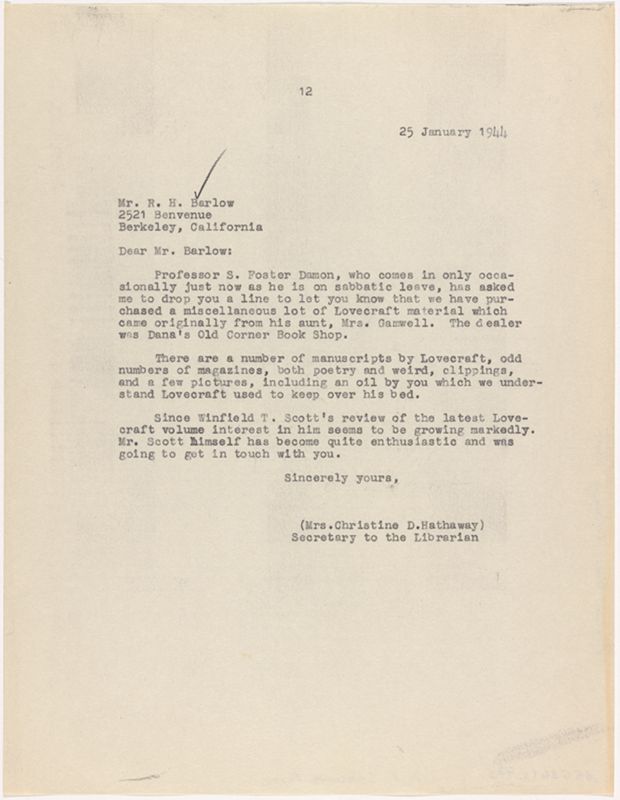

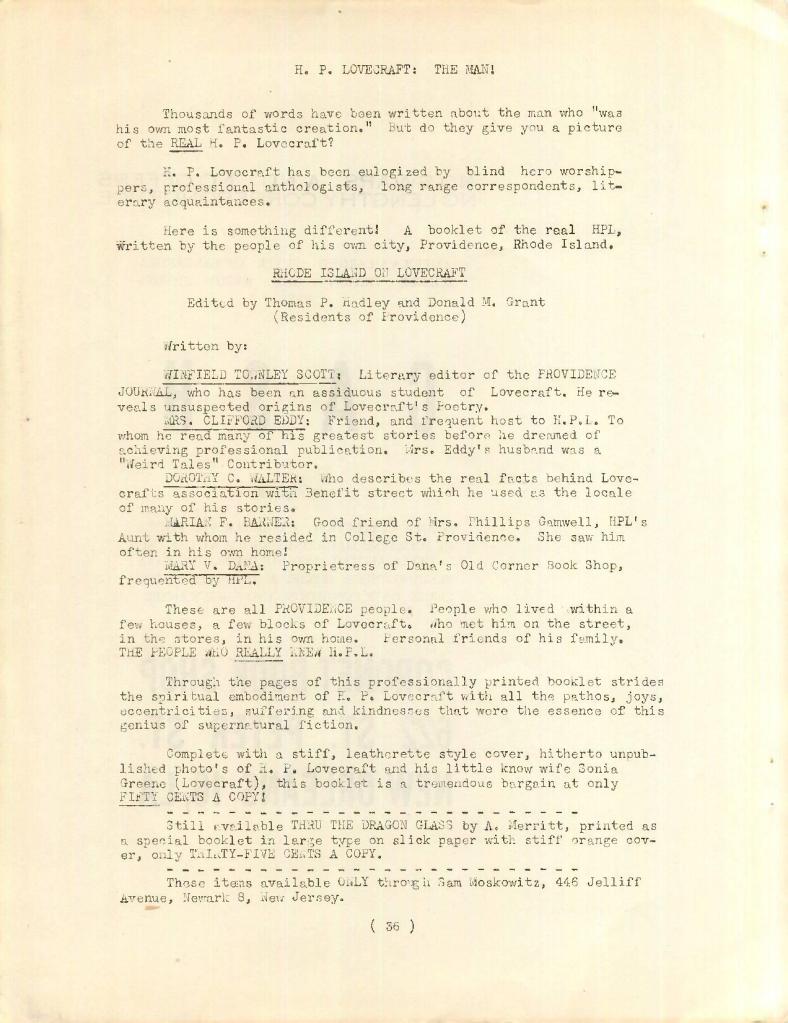

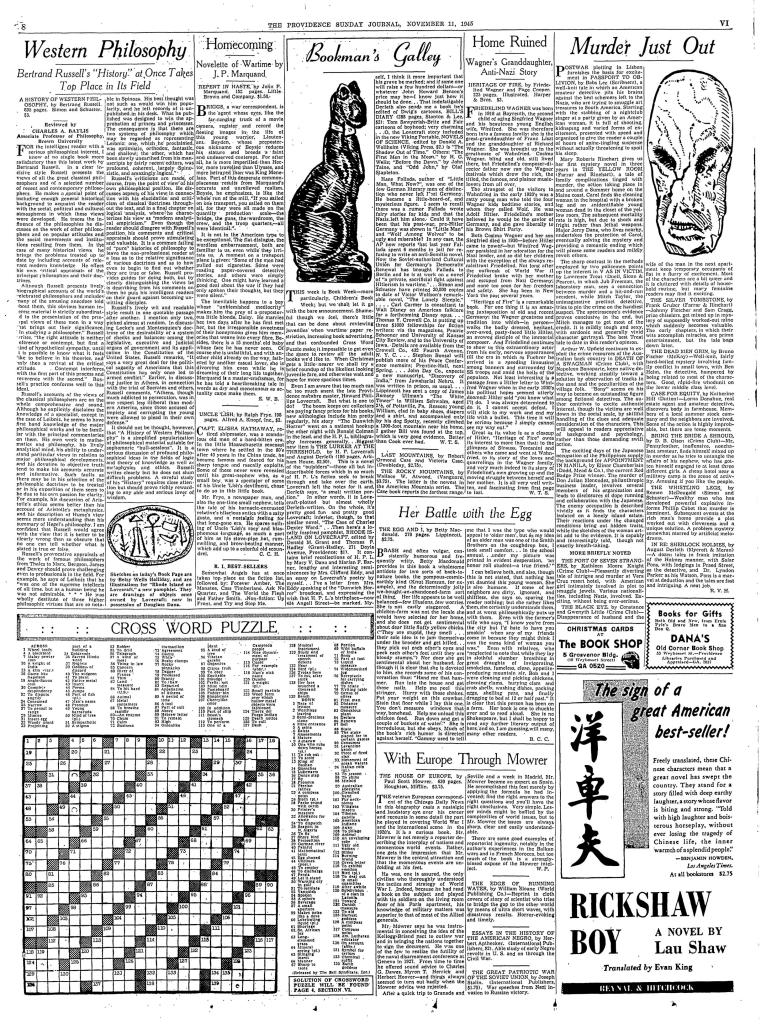
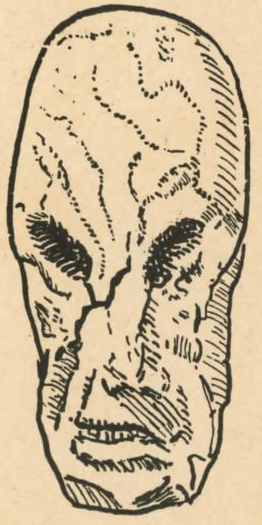
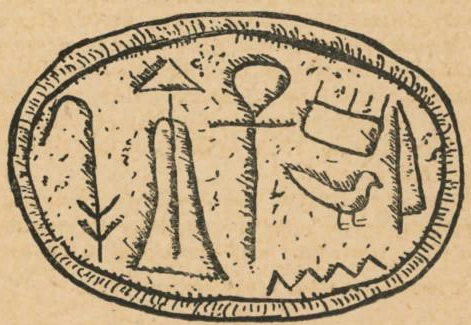
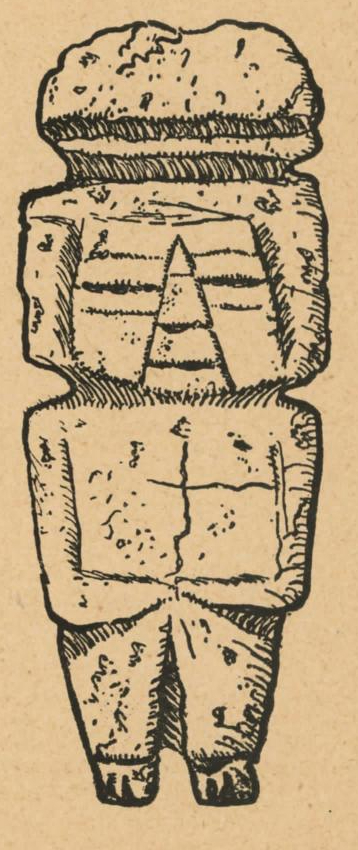
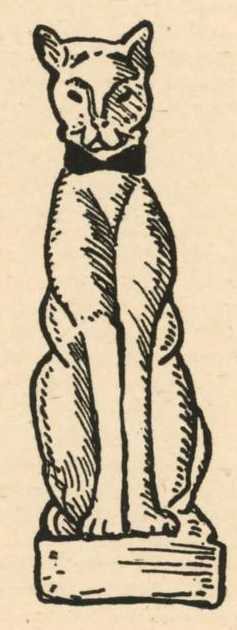

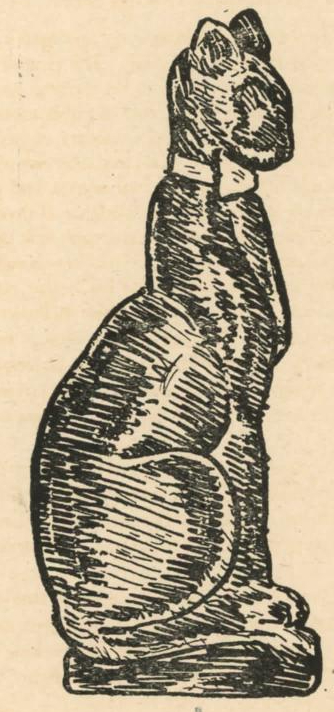
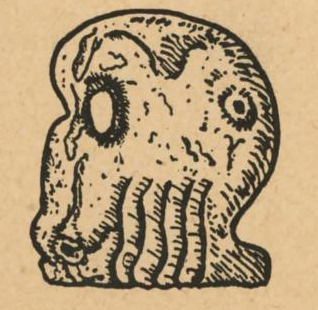

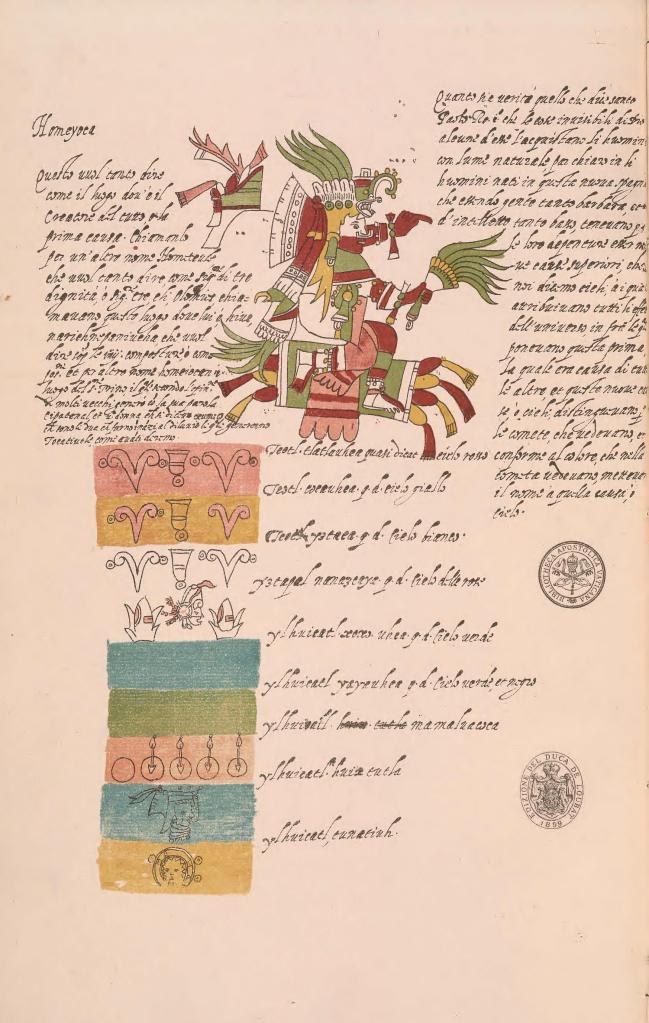
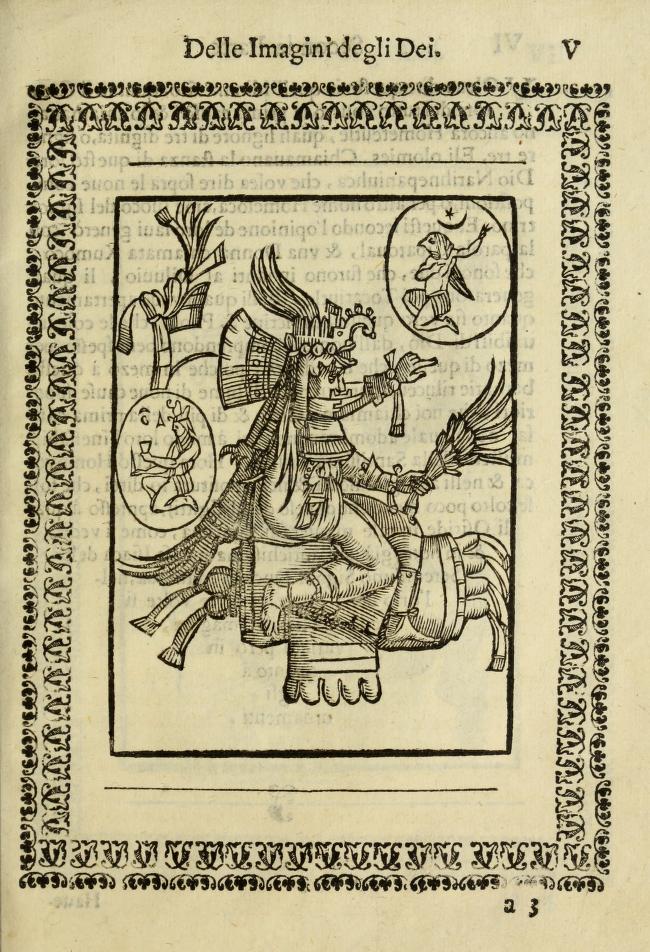

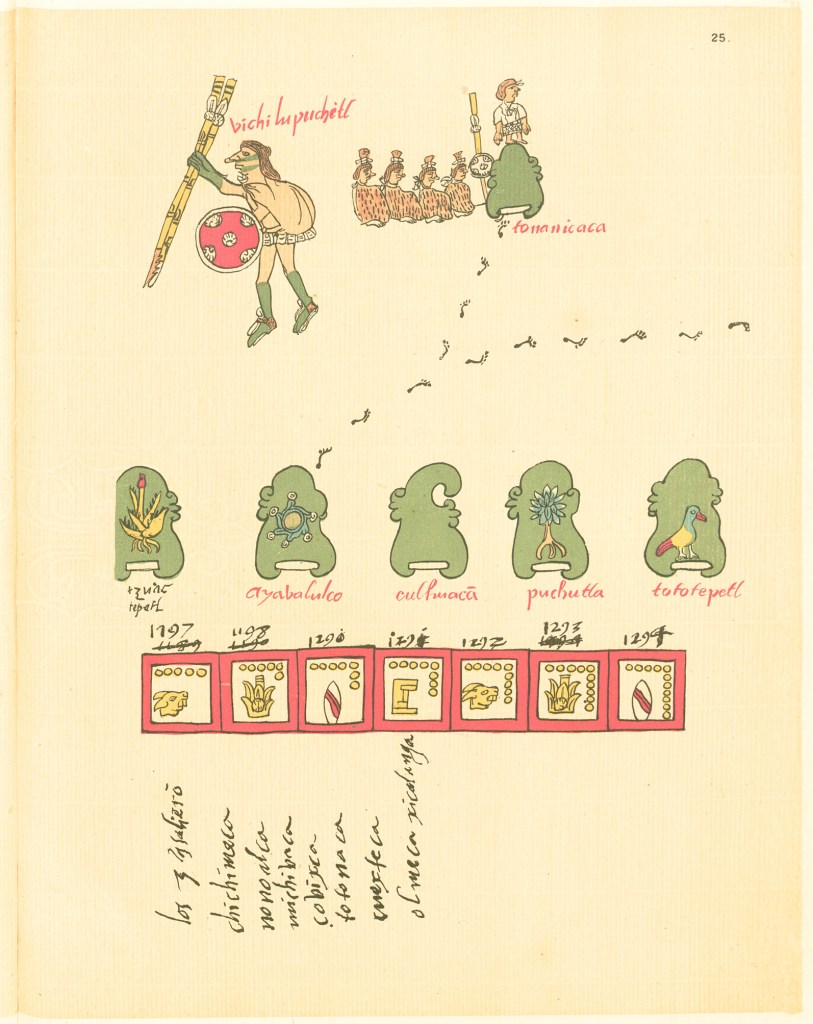

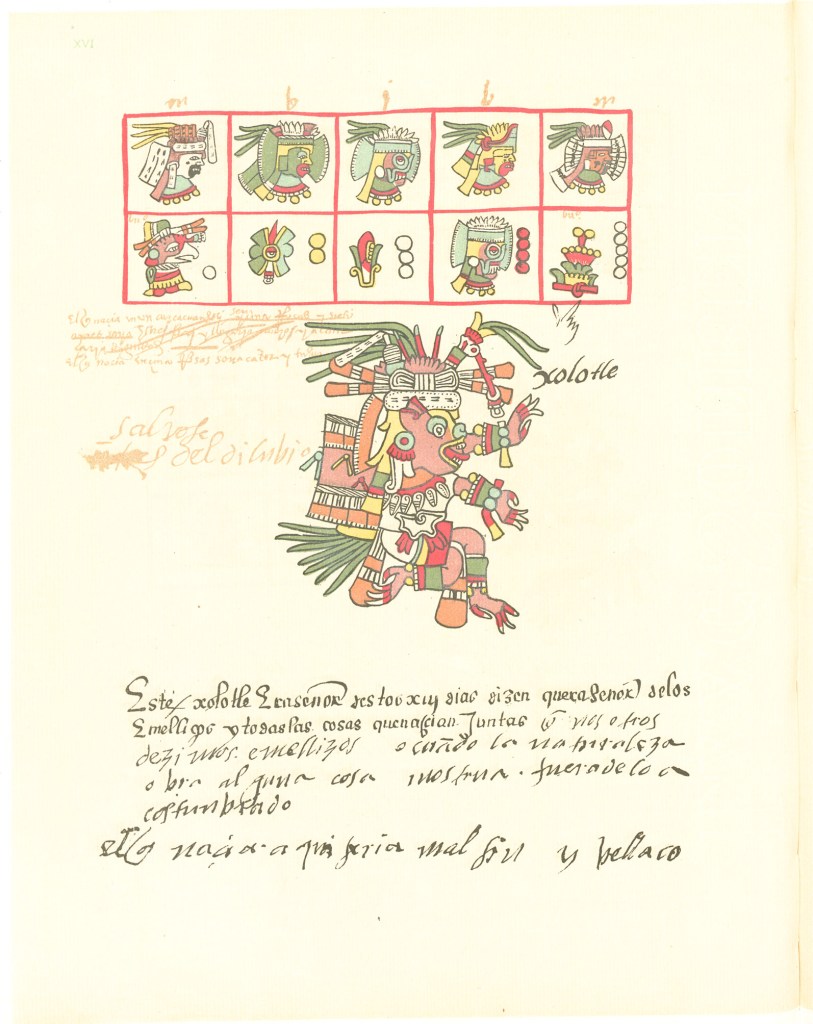
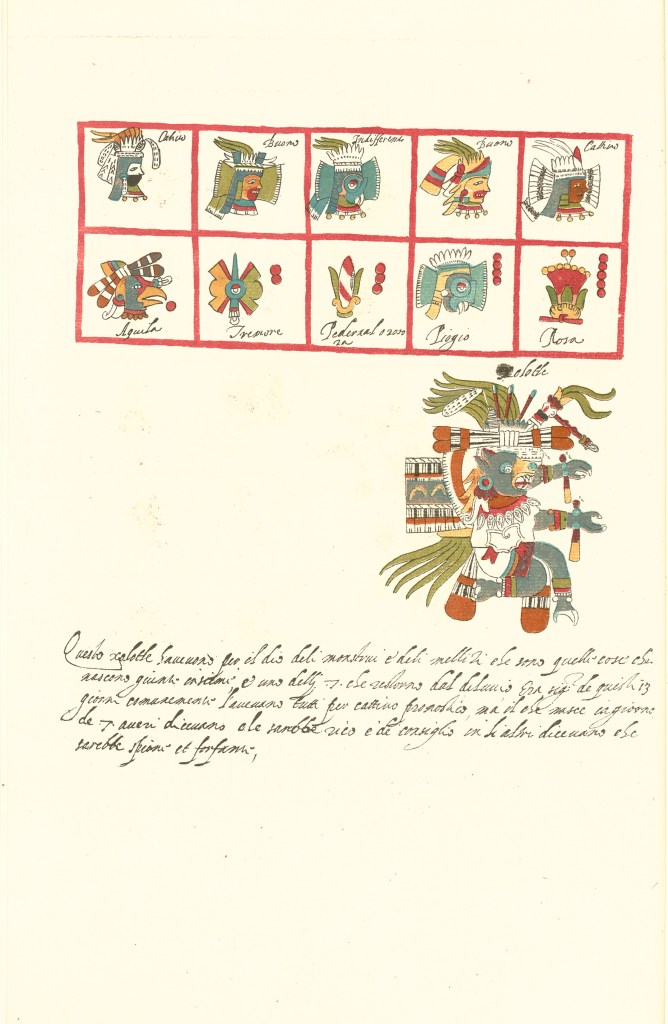
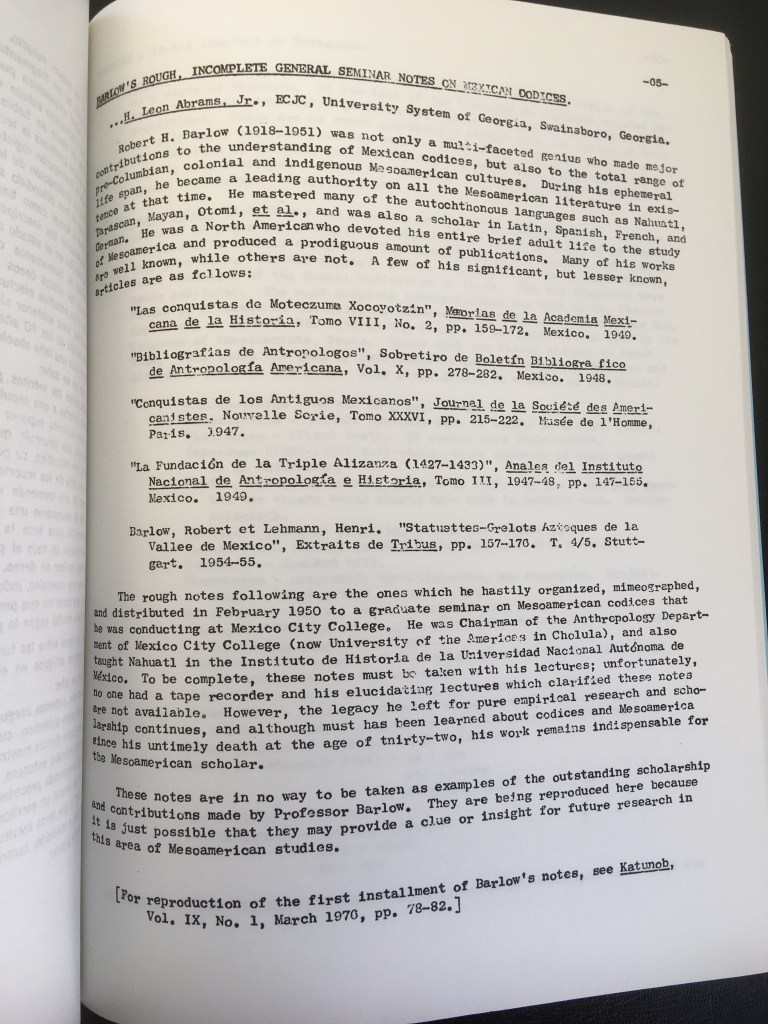
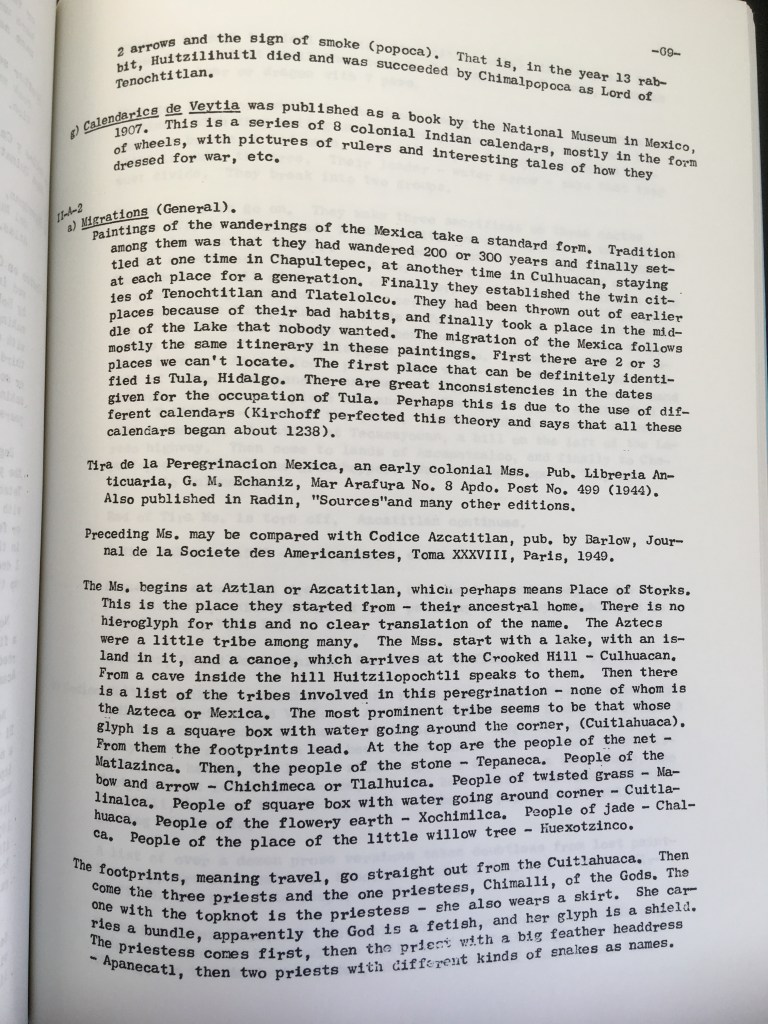
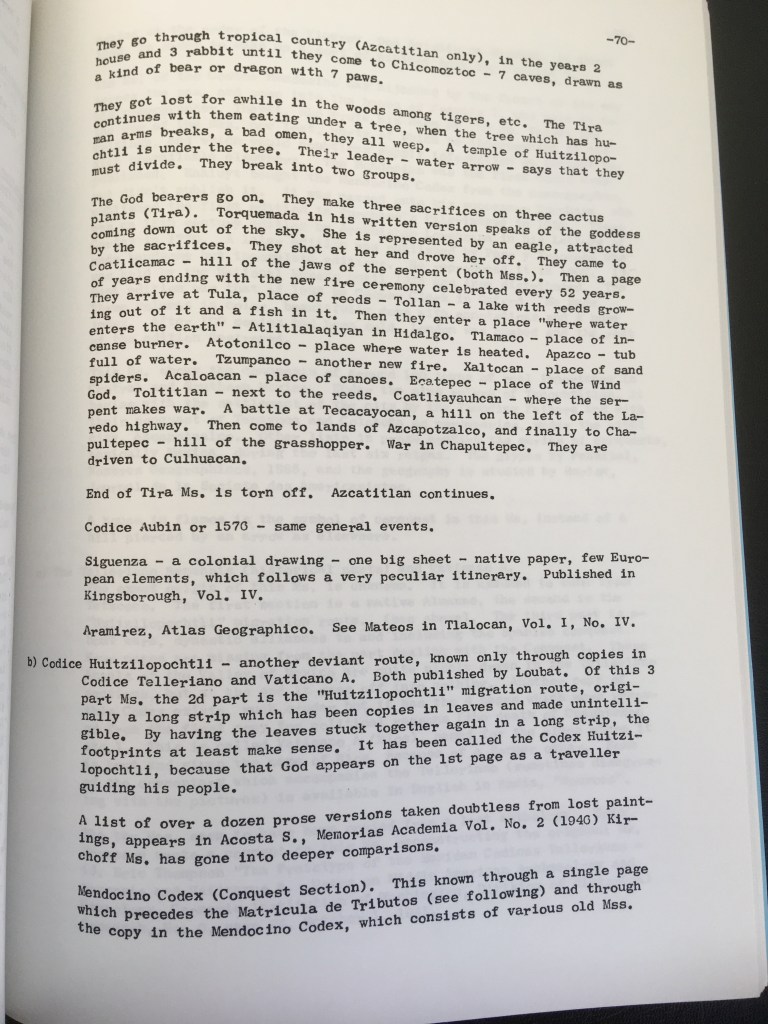
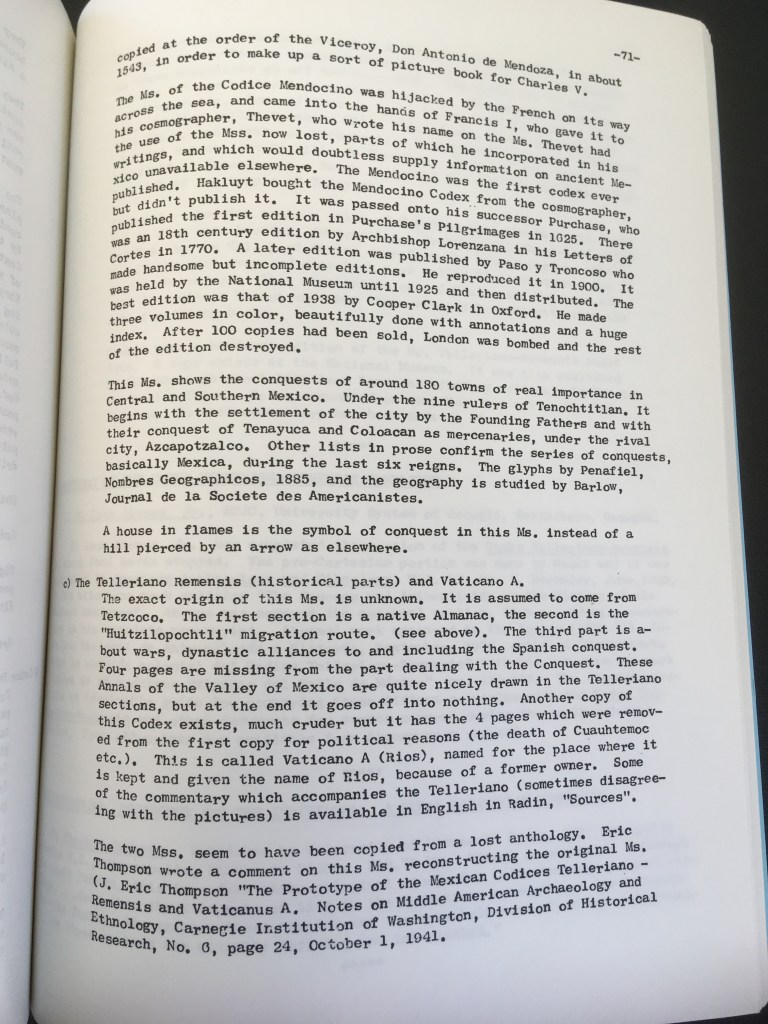
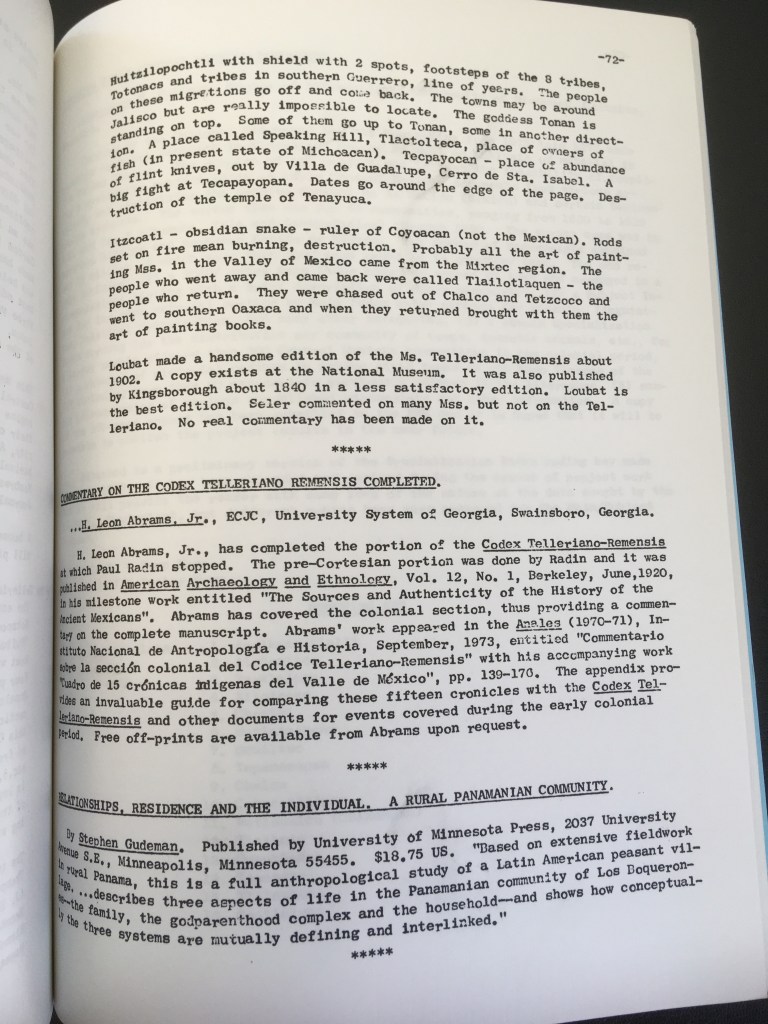

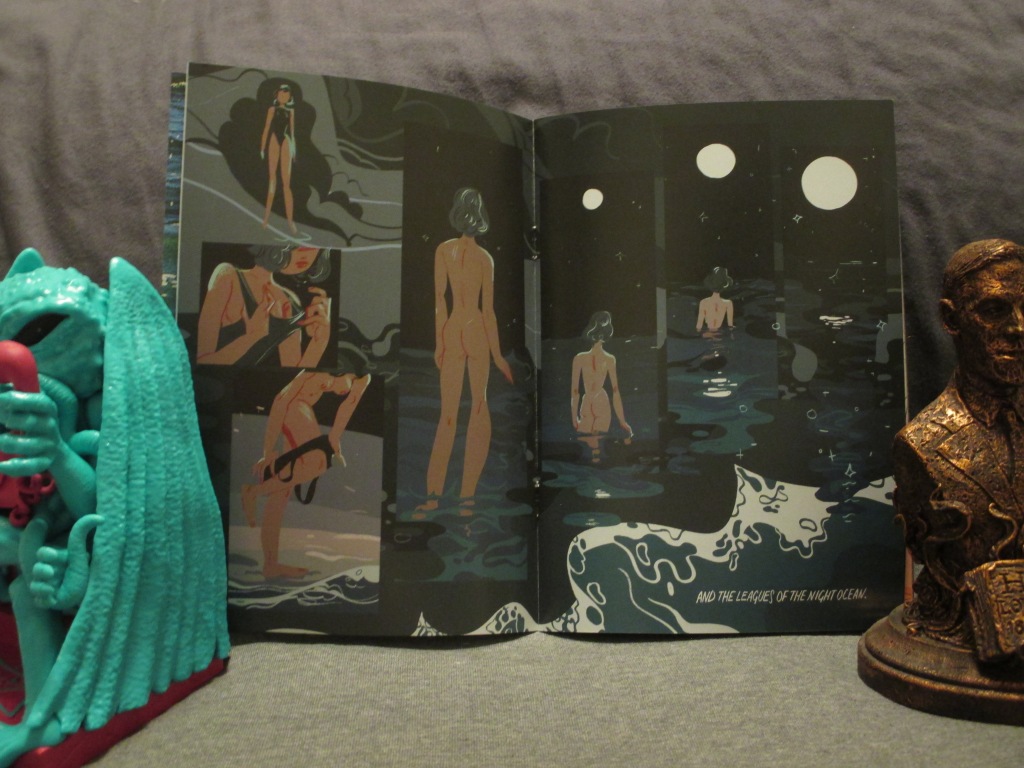
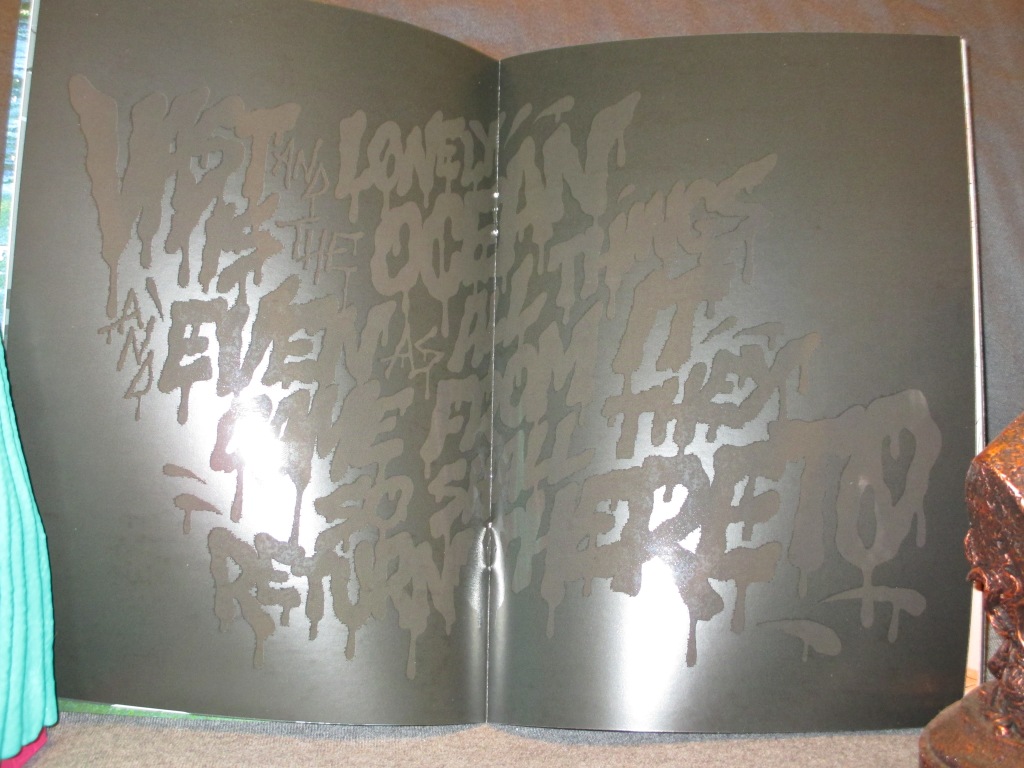
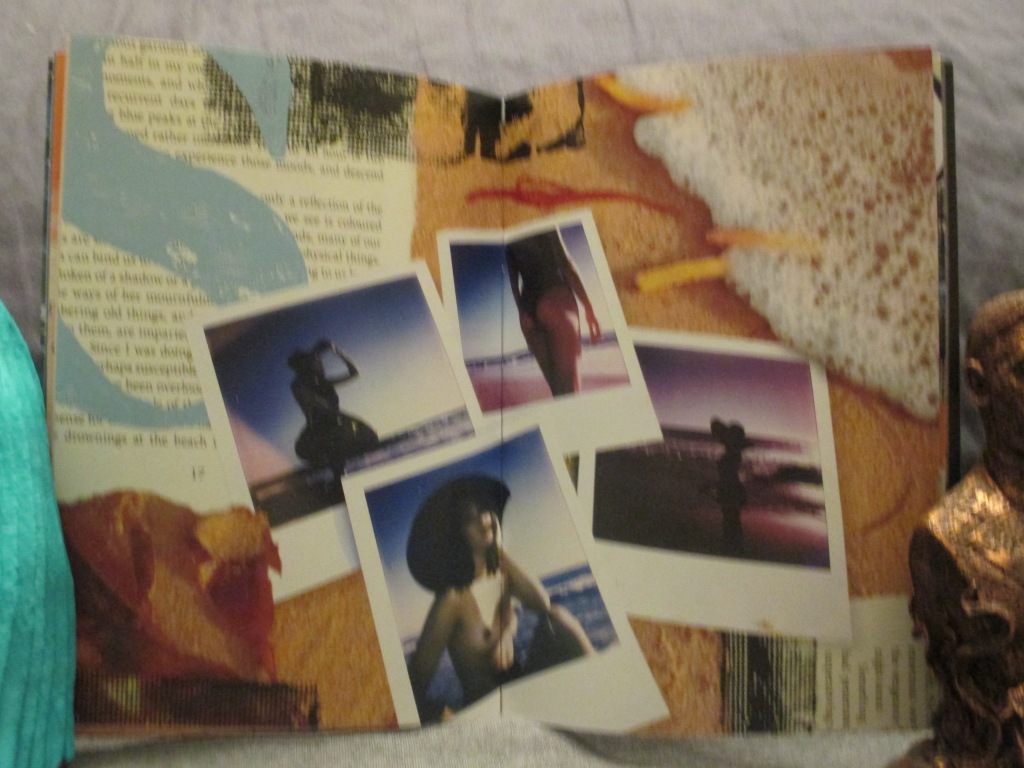
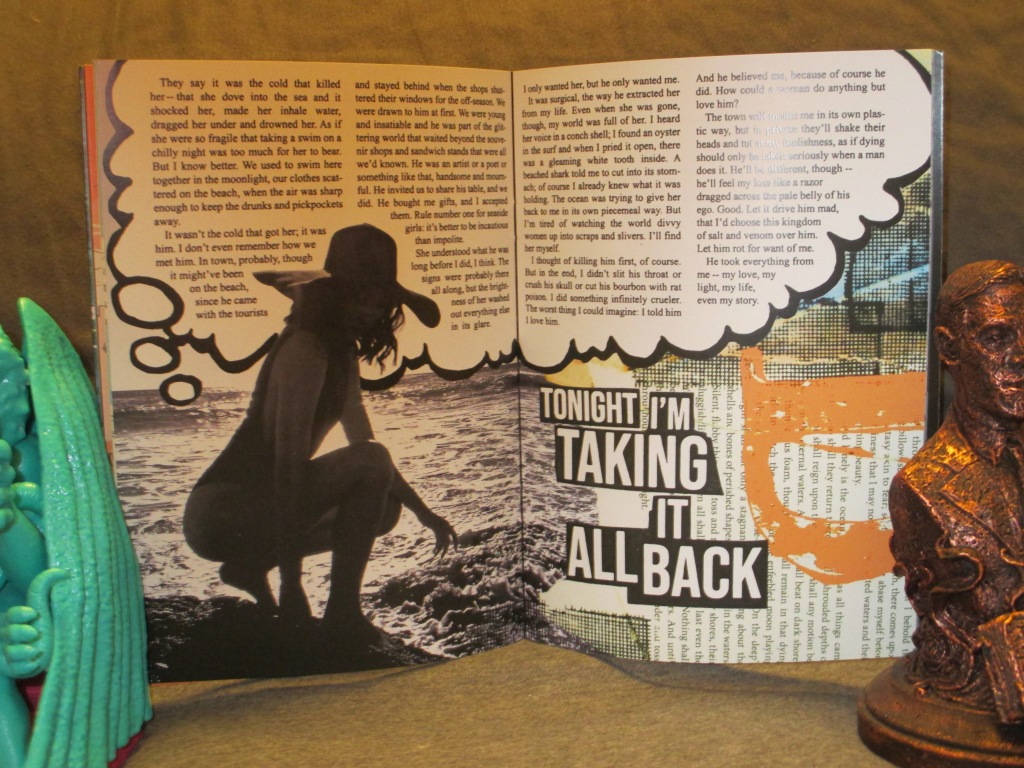
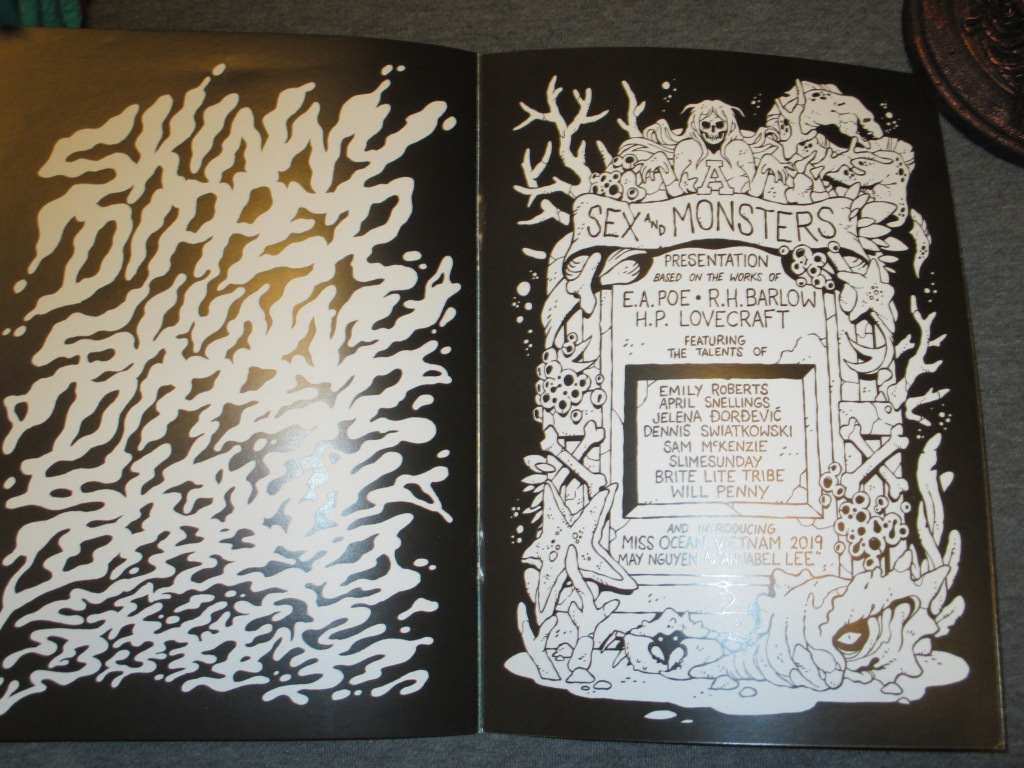
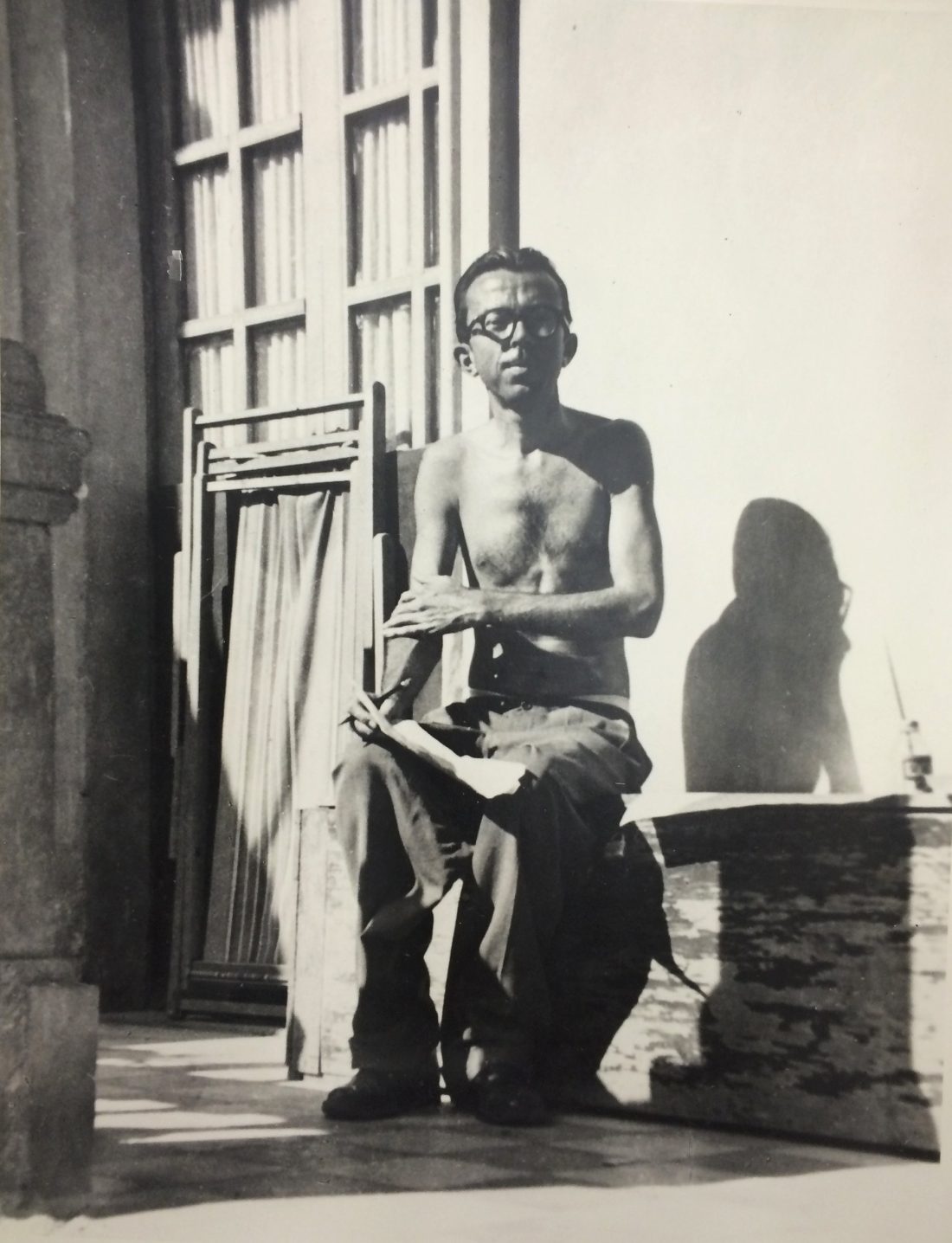


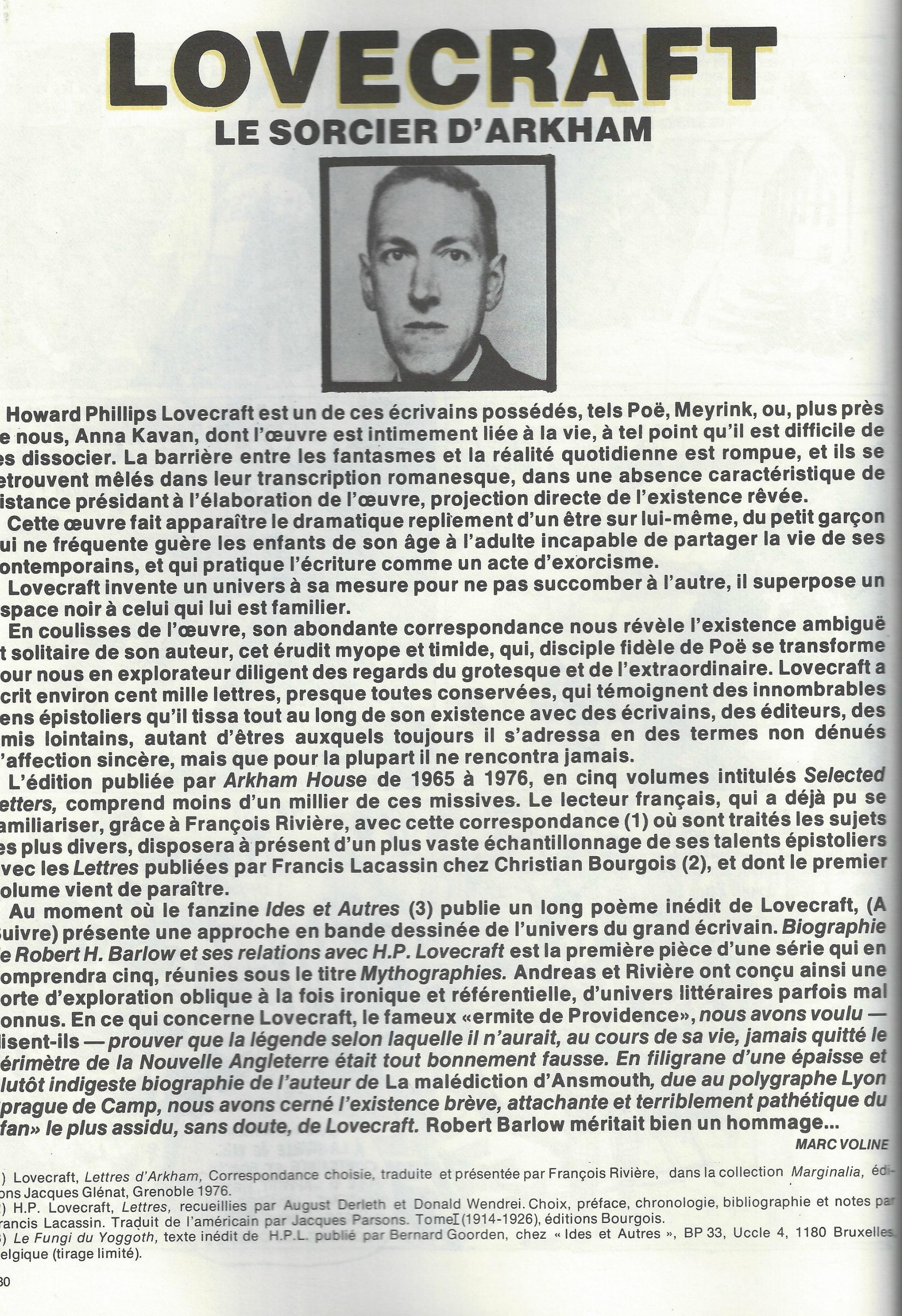
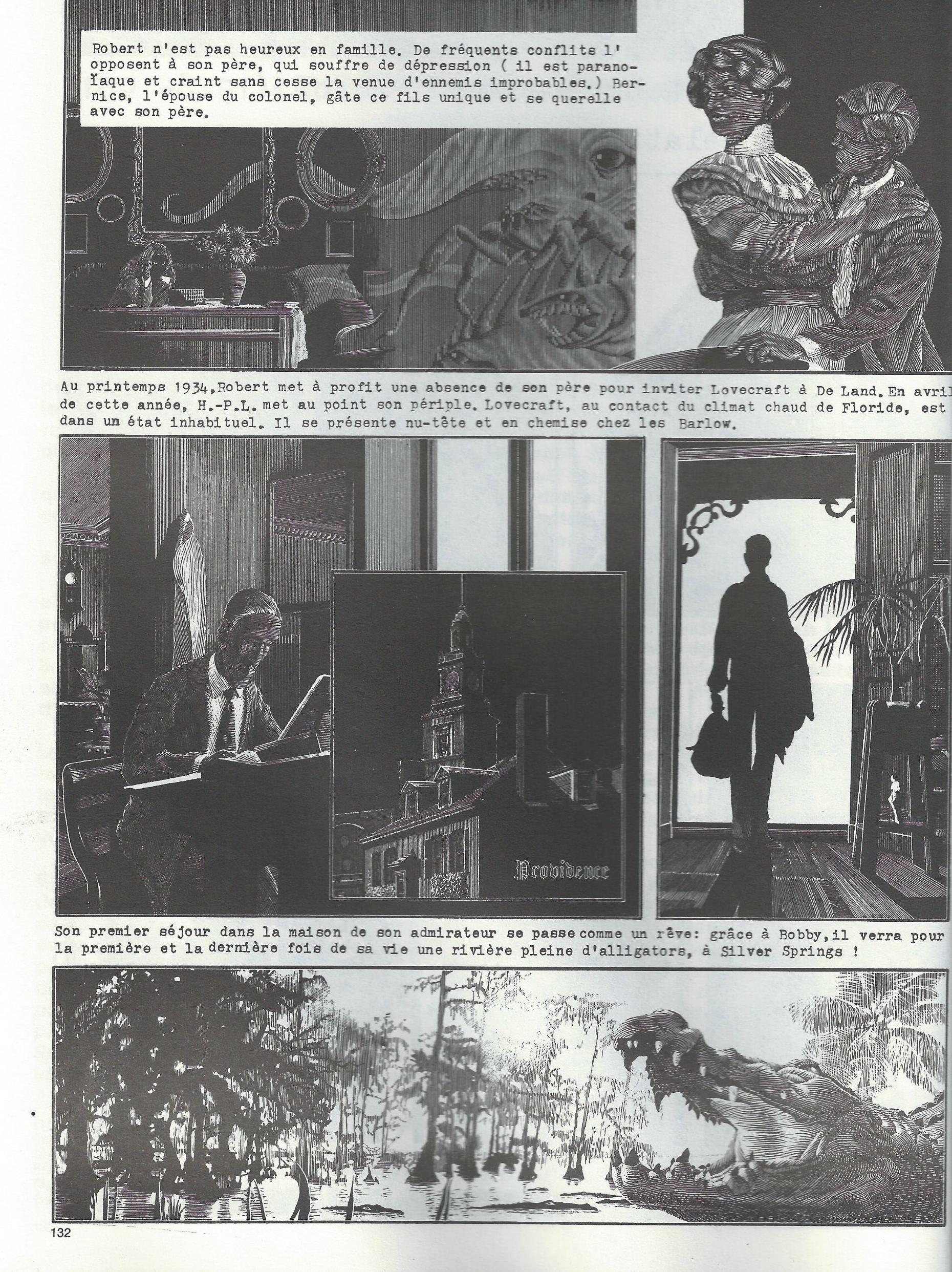
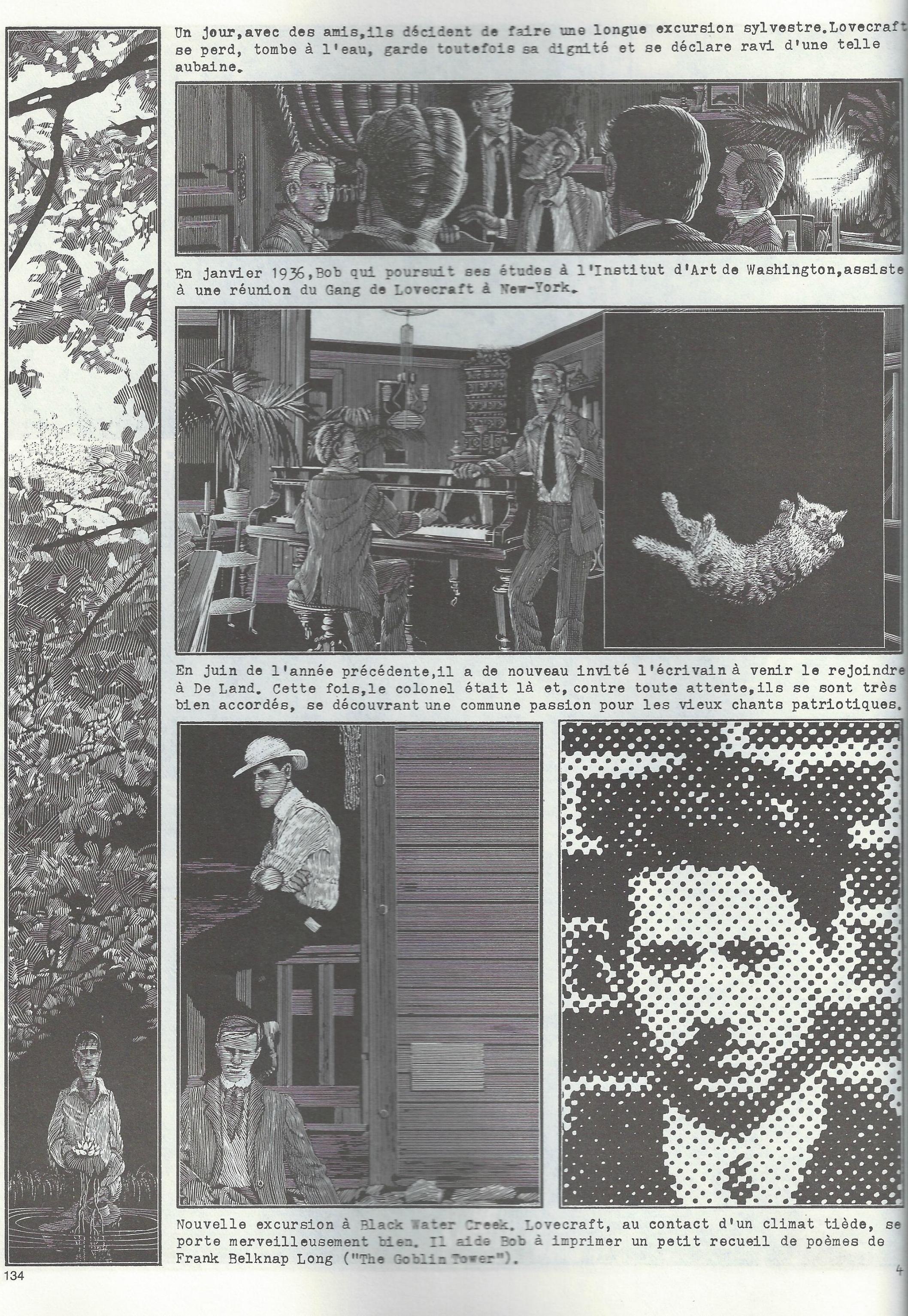
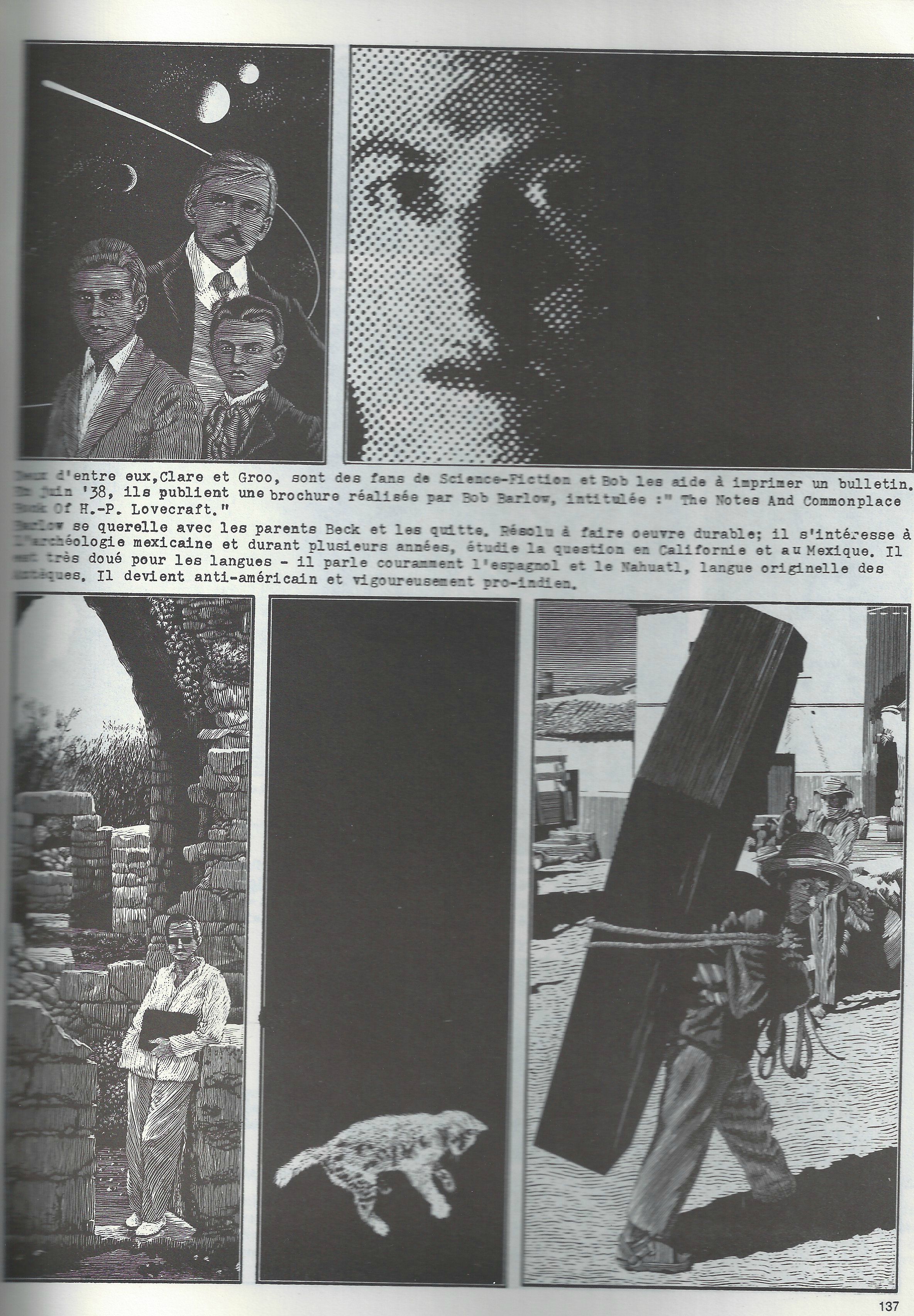
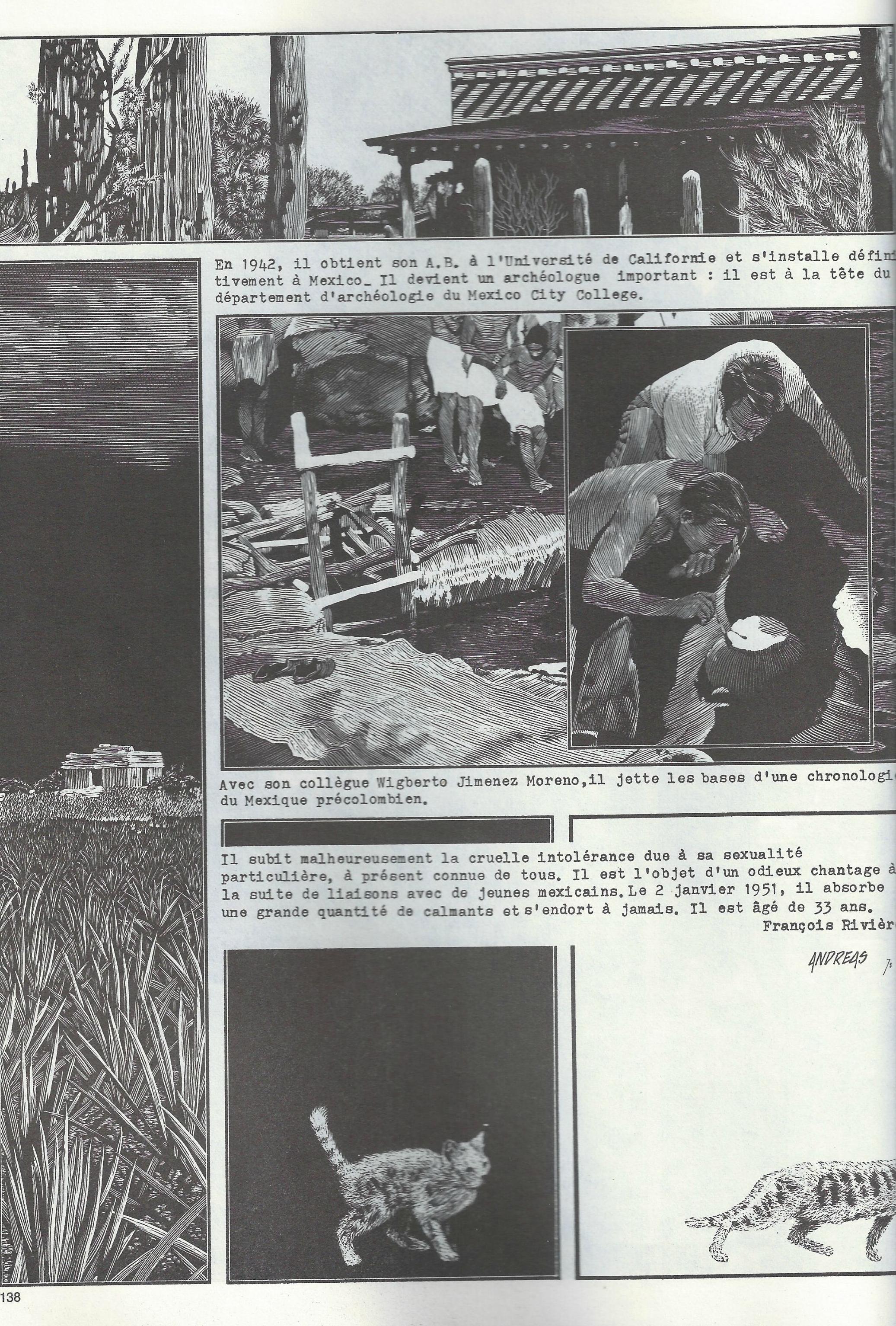
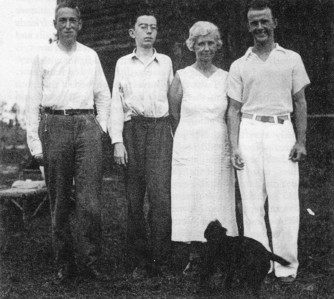
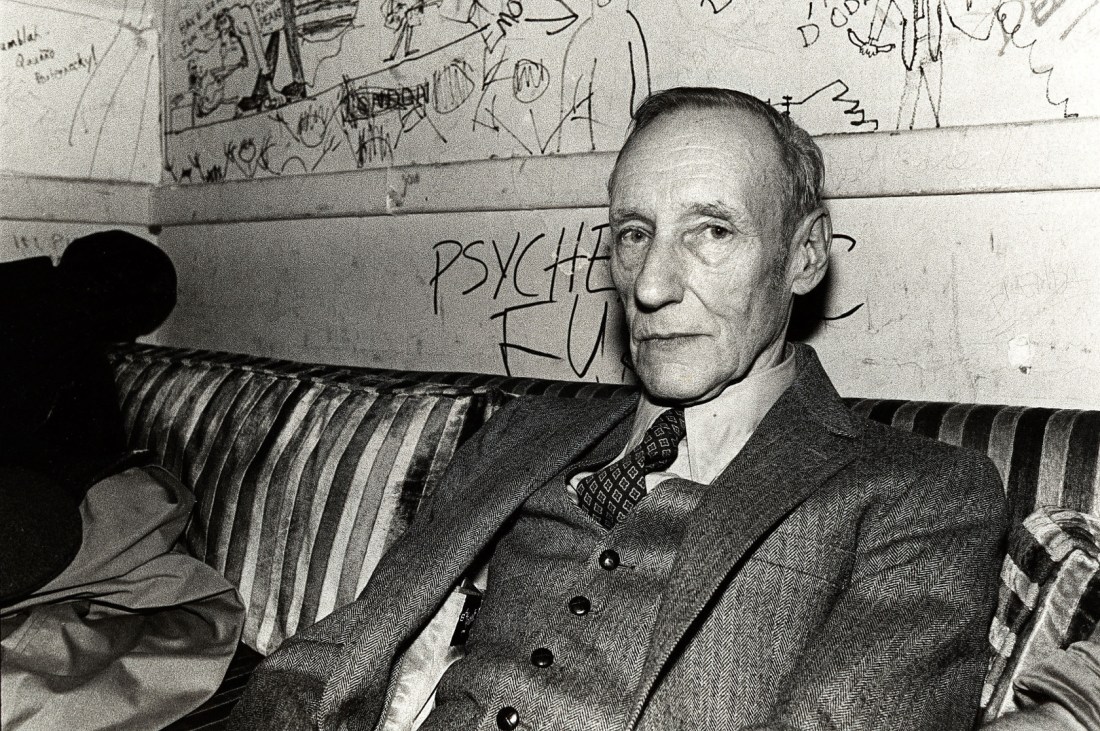
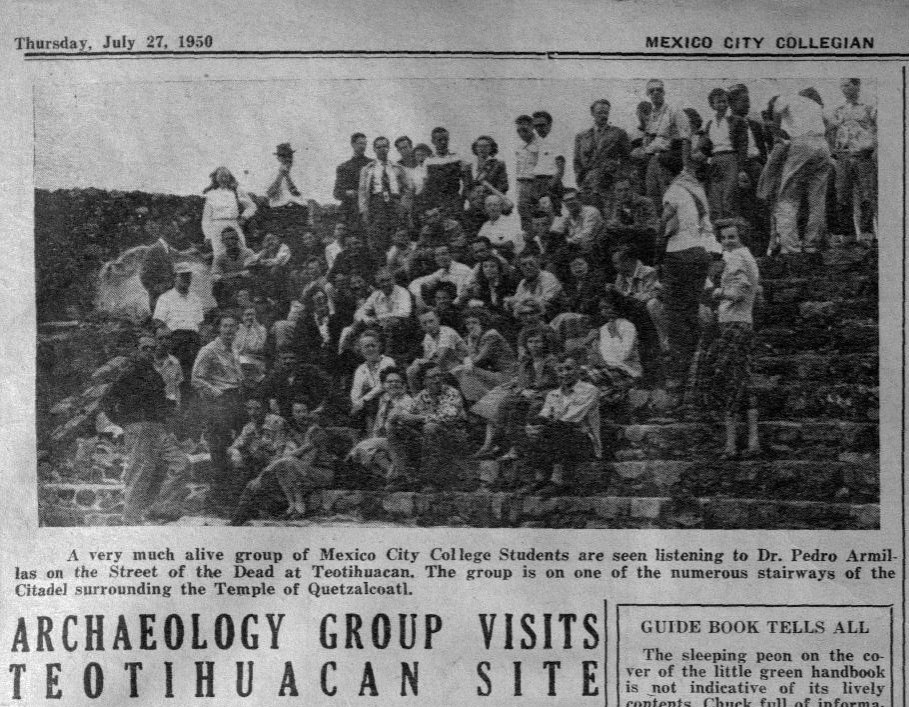
 Deep Cuts in a Lovecraftian Vein