What follows is an extended deep-dive into the history of one of the most contentious affairs in pulp science fiction in the 1940s, the Shaver Mystery, and its interactions with H. P. Lovecraft’s Mythos, which was also beginning to coalesce in the same period. The ramifications of their interactions would spill over into science fiction fandom, conspiracy circles, and occult literature, with long-lasting effects on popular culture. Because this is very long, the following internal links are provided for those who would like to jump to specific sections.
- Lovecraft and the Deros
- Henry S. Whitehead, “Bothon,” & the Shaver Mystery
- Manly Wade Wellman, the Necronomicon, & the Shaver Mystery
- Muriel E. Eddy, David H. Keller, & the Shaver Mystery
- Robert E. Howard, Serpent People, & the Shaver Mystery
- Marebito (稀人, 2004)
I am certainly inclined to believe that [Shaver] has been inspired by the success of Lovecraft in attempting to create a literary mythos with much the same basic motif as he developed in his stories of the Old Ones. But, unlike Lovecraft, Mr. Shaver is not an artist.
—Alan Devereux, “Mr. Shaver’s Memories” in Fantasy Review (Oct-Nov 1948) 11The entire Shaver mythos is so obviously derived from the Lovecraftian fictional background that it is hard today to imagine that it impressed any experienced readers. The first Shaver story told how the people of ancient Earth were endangered by a degenerated elder, how the hero and his followers learned of the danger, and how escape was achieved with the help of immortal elder gods.
—Harry Warner, Jr., All Our Yesterdays: an informal history of science fiction fandom in the 1940s (2004), 234
In 1926, Hugo Gernsback had founded Amazing Stories as the first pulp magazine devoted to science fiction. Mismanagement cost Gernsback the magazine, and it went through several hands; by the late 1930s it was owned by pulp publisher Ziff Davis and its readership in decline. In 1938, the editorship of Amazing was given to Ray Palmer, a young and enthusiastic pulp writer and editor who had cut his teeth in science fiction fandom, writing, editing, and publishing fanzines.
Palmer worked to improve the magazine’s circulation by aiming at younger readers, with more adventure, sensational illustrations, and less hard science. Small hoaxes in the pages of Amazing were not uncommon, with stories written by pseudonymous authors accompanied by fake biographies and critical comments from Palmer. At the same time, editor John Campbell had just taken over rival magazine Astounding Stories and was aiming for a more high-brow market. The dichotomy polarized science fiction fandom—Palmer became known as a hack, or at least a purveyor of junk fiction. But Amazing’s circulation increased.
In the October 1943 issue of Writers’ Digest, in the small personal ads are buried two notices from a “Shaver, Barto, Pa.” One was a lonely heart advertisement, the other was more unusual: advice requested for a newly discovered ancient language.
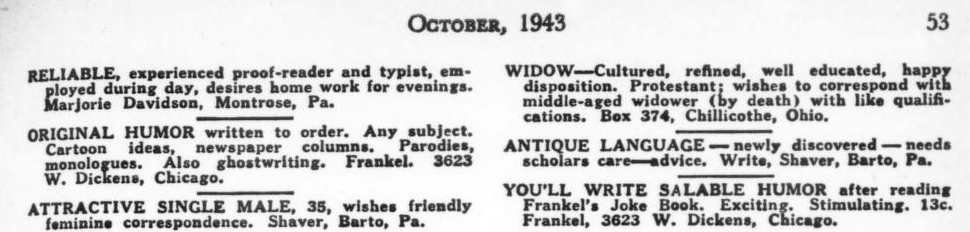
What response was received from these advertisements is unclear, but the response was likely unsatisfactory, because in December 1943 a letter from a Pennsylvania steelworker named Richard S. Shaver arrived at the offices of Amazing Stories. Shaver claimed to have discovered an ancient alphabet for a universal language (later called “Mantong”), supposedly of a pre-human race with connections to Atlantis.
Crank letters were a part of the business every pulp editor had to deal with, along with unsolicited manuscripts and fanmail. However, Palmer saw potential reader interest, and printed the entire letter as “An Ancient Language?” in Amazing Stories Jan 1944. Moreover, Palmer encouraged readers to try out Shaver’s language. Readers responded. As Palmer put it:
Many hundreds of readers’ letters came in, and the net result was a query to Richard S. Shaver asking him where he got his Alphabet.
The answer was in the form of a 10,000 word “manuscript” typed with what was certainly the ultimate in non-ability at the typewriter, and entitled “A Warning To Future Man.”
I read it through, every single word, and then sat back. What was it I had here? Certainly not an attempt by an “author” to sell a story. Mr. Shaver wanted no money for hia manuscript. It wasn’t a manuscript, but a letter. Mr. Shaver seemed anxious that it be published, not for notoriety, but out of sincere (apparently) desire that the world be warned of a terrible danger it faced, and informed of a wonderful heritage it had lost, and which should be recovered if at all possible.
—Ray Palmer, The Secret World (1975), 36-37
Palmer continued to correspond with Shaver, who sent him a 10,000-word letter or manuscript titled “A Warning to Future Man.” Ray Palmer bought the manuscript, and re-wrote it.
I put a clean piece of paper into my typewriter, and using Mr. Shaver’s strange letter-manuscript as a basis, I wrote a 31,000-word story which I titled “I Remember Lemuria!” although I added all the trimmings, I did not alter the factual basis of Mr. Shaver’s manuscript except in one instance. Here, perhaps, I made a grave mistake. However, I could not bring myself to believe that Mr. Shaver had actually gotten his Alphabet and his “Warning to Future Man” and all the “science” he propounded from actual underground people. Instead, I translated his thought-records into “racial memory” and felt sure this would be more believable to my readers, and a reasonable and perhaps actual explanation of what was going on was in Mr. Shaver’s mind—which is where I felt it really was going on; and not in any caves or via any telaug rays or telesolidograph projections of illusions from the cavern ray operators.
—Ray Palmer, The Secret World (1975), 38
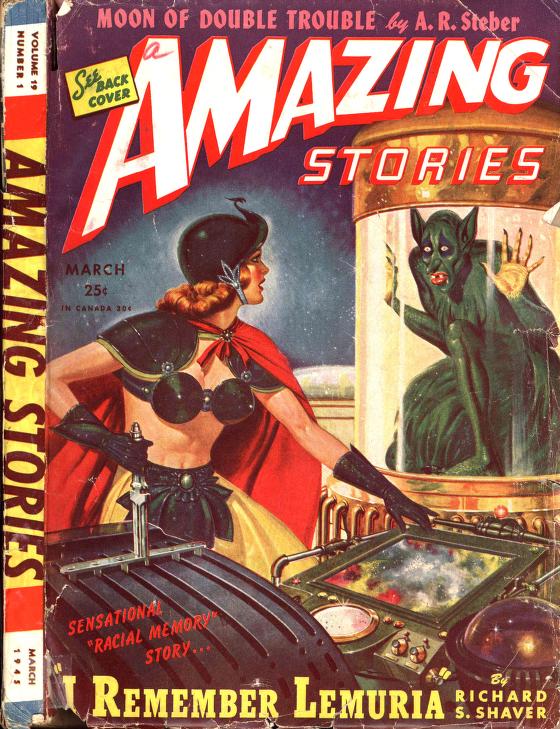
So it was “I Remember Lemuria!” appeared in Amazing Stories in the March 1945 issue, as by Richard Sharpe Shaver.
For those of you who will read on and carefully weigh what I am about to tell you I am convinced there will be no thought of puns. Instead, when you consider the real truths behind what I say—and even better, experiment and study to corroborate them—it seems to me to be inevitable that you will forget that I am Richard Sharpe Shaver, and instead, am what science chooses to very vaguely define as the racial memory receptacle of a man (or should I say being?) named Mutan Mion, who lived many thousands of years ago in Sub Atlan, one of the great cities of ancient Lemuria!
—Richard S. Shaver & Ray Palmer, The Shaver Mystery Compendium, Vol. 1, 8
In the original manuscript, Shaver had made more explicit reference to Atlantis, not Lemuria; Palmer’s change brought a Theosophical bent to the re-written work (see The Book of Dzyan for other examples of Theosophical influence on the pulps). A footnote interpreted “Mutan Mion” through Shaver’s universal language, which shows the long build-up to this particular story.
In the words of Mutan Mion (amplified by many explanatory footnotes from Palmer), the readers are introduced to a scientifically advanced civilization that lives in underground caverns as protection from the damaging rays of the sun. As the advanced, nigh-immortal Titans and Atlans prepare to migrate to a different solar system, Mutan Mion and Sub Atlan are faced with the threat of the dero.
Pressed for a more complete explanation, Mr. Shaver has defined ‘dero’ for us:
“Long ago it happened that certain (underground) cities were abandoned and into those cities stole many mild mortals to live, at first, they were normal people, though on a lower intelligence plane; and ignorant due to lack of proper education. It was inevitable that certain inhabitants of the culture forests lose themselves and escape proper development; and some of them are of faulty development. But due to their improper handling of the life-force and ray apparatus in the abandoned cities, these apparatii became harmful in effect. They simply did not realize that the ray filters of the ray mechanisms must be changed and much of the conductive metal renewed regularly. If such renewals are not made, the apparatus collects in itself—in its metal—a disintegrant particle which gradually turns its beneficial qualities into strangely harmful ones.
“These ignorant people learned to play with these things, but not to renew them; so gradually they were mentally impregnated with the persisitently disintegrative particles. This habituates the creature’s mind, its mental movements, to being overwhelmed by deterimental, evil force flows which in time produce a creature whose every reaction in thought is dominated by a deterimental will. So it is that these wild people, living in the same rooms with degenerating force generators, in time become dero, which is short for detrimental energy robot.
“When this process has gone on long enough, a race of dero is produced whose every thought movement is concluded with the decision to kill. They will instantly kill or torture anyone whom they contact unless they are extremely familiar with them and fear them. That is why they do not instantly kill each other—because, being raised together, that part of their brain that functions has learned very early to recognize as friend or heartily to fear the members of their own group. They recognize no other living thing as friend; to a dero all new things are enemy.
“To define: A dero is a man who responds mentally to dis impulse more readily than to his own impulses. When a dero has used old, defective apparatus full of dis particle accumulations, they become so degenerate that they are able to think only when a machine is operating and they are using it; otherwise they are idiot. When they reach this stage, they are known as ‘ray’ (A Lemurian word not to be confused with ray as it is used in English.) Translated, ray means ‘dangerous or deterimental energy animal.’ Ray is also used to mean a soldier—one of those who handles beam weapons (note how the ancient meaning has come into our modern word).”
—Richard S. Shaver & Ray Palmer, The Shaver Mystery Compendium, Vol. 1, 28-29
Mutan Mion finds aid from Mars and the Nortans (yet another advanced subterranean people), sometimes referred to as Elder Gods and Goddesses. After getting some upgrades and falling in love, Mutan Mion returns to free the Atlans from the dero—who, it turns out, are also cannibals:
These devilish abandondero had a meat market in the lower floors, filled with human flesh; and a pile of choice cuts I saw was composed mainly of Atlan girl breasts! These dero things were cannibals and lived off immortal Atlan flesh!
—Richard S. Shaver & Ray Palmer, The Shaver Mystery Compendium, Vol. 1, 73
The story ends with Mutan Mion victorious, the dero temporarily thwarted but not utterly destroyed, and he heads off to a new planet with his love. His warning to the future is inscribed on “telonian message plates” and left for the wild men left behind on the planet to discover. Implicitly in this story, those wild men are the ancestors of homo sapiens today—and the threat of the dero remains.
“I Remember Lemuria!” took clear inspiration from hollow earth fiction such as Jules Verne’s Voyage au centre de la Terre (“Journey to the Center of the Earth,” 1864), Edgar Rice Burrough’s Pellucidar novels beginning with At the Earth’s Core (1914), and A. Merritt’s “The Moon Pool” (1918) and “Conquest of the Moon Pool” (1919)—the latter of which are known to have been in Shaver’s library (see “Dick Shaver’s Library” in Shaverology); Shaver also specifically cited Merritt’s works in his “Open Letter To The World” (Amazing Stories Jun 1945). Palmer’s re-casting of the story as one of “racial memory” or recalling a past life was not novel. Past-life stories such as Jack London’s The Star Rover (1915), Lovecraft’s “Polaris” (1920), and Robert E. Howard’s “People of the Dark” (1932) were well-known among science fiction and weird fiction fans.
Yet these works were all presented as fiction. What was remarkable about “I Remember Lemuria!” was not the content—but because Shaver insisted it was true, and Palmer steadfastly claimed to believe him. The reader response, both positive and negative, was tremendous. Letters poured in. Fans debated and denounced the stories. Issues of Amazing Stories sold well.
From 1945 to 1948, more Shaver material appeared in Amazing Stories. Palmer assisted with the prose, but encouraged by publication Shaver continued to develop and expand on his new artificial mythology. Many science fiction fans derided it as a hoax; others bought into it. There’s always a wild conspiratorial fringe in any population, and Shaver’s talk of malicious dero, conspiracies to restrict access to technology, and invisible rays afflicting people caught the imaginations of few.
Palmer left Ziff Davis in 1949, and would go on to help publish more of Shaver’s material in smaller independent magazines and fanzines; he would also be influential in the development of ufology, and founded Fate magazine, among others. He was a titan in the development, spread, and popularization of fringe ideas like flying saucers and various conspiracy theories, and thanks to him Shaver’s Mystery has an outsized cultural footprint, such as the subterranean Derro race in Dungeons & Dragons. Shaver himself continued to write, publish, and evolve his strange little world of paranoid fantasies, with the dero becoming more sexually sadistic and voyeuristic.
In 1934, the death of Shaver’s brother severely impacted his mental health; he began experiencing auditory hallucinations, and was institutionalized at the Ypsilanti State Hospital. When he got out two years later, he found his wife had died (accidentally electrocuted) and their daughter taken into the custody of her maternal grandparents. The following years are poorly-documented but apparently involved rough living and an arrest trying to cross the border to Canada, and culminated in a stay at the Ionia State Hospital for the Criminally Insane in Michigan, from which Shaver was discharged in May 1943 into the care of his parents. (This is a highly abridged version of the account given in The Man from Mars: Ray Palmer’s Amazing Pulp Journey (2013) by Fred Nadis). The letter to Amazing Stories would come about six months later after his release from Ionia.
Shaver was not unique, however. In the 1930s, a fan named G. P. Olson (or Olsen) of Sheldon, Iowa began to write bizarre fan letters expounding theories about vampires and physics to writers like H. P. Lovecraft, Robert E. Howard, Hugh B. Cave, Henry S. Whitehead, August Derleth, and Clark Ashton Smith. In 1932, Cave wrote to Carl Jacobi suggesting that he mine Olson for ideas for his own fiction (see “The Fool Olson” in Weird Talers)—and I suspect that is ultimately what Palmer did with Shaver, at least in the early part of their correspondence and friendship. Whether Palmer’s encouragement of Shaver’s paranoid fantasies, and the resultant negative response from fans, was detrimental to his mental health is hard to say; that Palmer ultimately exploited Shaver is impossible to ignore.
Lovecraft’s influence on Shaver is also difficult to assess. “I Remember Lemuria!” includes references to Elder Gods, but these do not seem to be the Elder Gods of Lovecraft’s fiction. Nor did Lovecraft go in very much for hollow earth stories, though he certainly had cannibalistic underground peoples in stories like “The Lurking Fear” and “The Rats in the Walls,” and the ruins of an advanced alien civilization feature prominently in At the Mountains of Madness (1936). Probably the closest Lovecraft approached Shaver’s mythos was in “The Mound” (1940) by Zealia Bishop & H. P. Lovecraft—and, as it turns out, this is the one Lovecraft story we know Shaver read.
Palmer published a number of letters from fans in the pages of Amazing Stories as the Shaver Mystery stories unfolded. Being typical fans, some of these were hoax letters, and slipped past the editorial radar. One such letter that saw print:
THE NECROMINICON [sic]
Sirs:
In line with your research on the Lemurian question, may I refer you to the “Necrominicon” [sic] of Abdul Alhazred, and also, the singularly famous “Das Inausprechlichen Kulten” [sic] by Von Junzt.
Both of these volumes may be found in the reserve room of Miskatonic University’s library at Arkton [sic], Massachusetts.
I am a graduate in occult sciences of this university, and have been engaged in conflict with Mr. Shaver’s “underground deros” since my graduation there in 1935.
Translation of the seventh chapter of the “Necronominicon” [sic] using the “Lemurian alphabet” should aid greatly in discovering the missing plates.
I regret deeply that a certain interest in the (deleted by the editor for very good reasons) keeps me from aiding you materially in your search, but a hint to so fertile a brain as Mr. Shaver’s should be enough. And I feel quite sure that after you have read the above-mentioned volumes, many things should be clear that are now confused and dark.
John Poldea
(address deleted)
—Amazing Stories Nov 1945
This was all in good fun, and Palmer seemed to know that Poldea was pulling his leg—yet it may also have suggested possibilities to Palmer. In an undated letter to August Derleth of Arkham House publishers, Palmer wrote asking for copies of Lovecraft’s The Outside and Others (1939), Beyond the Wall of Sleep (1943), and Marginalia (1944), and added:
I wonder if you were right when you said Lovecraft did not believe a word of what eh wrote. Strangely enough, I have received some interesting comments on “truth” contained in his writings which, together with corroborative evidence in support of those comments, intrigues me very much.
Also, do you have on your lists the name of John Poldea? An affirmative answer would be very interesting to me.
A copy of Derleth’s answer is not in his file of correspondence with Palmer at the Wisconsin Historical Society, but it was likely very much in the negative on both accounts. In a follow-up letter, Palmer wrote:
I am slightly amazed at your reaction to my question concerning Lovecraft. I understand little about the matter, except that it seems you’ve built up a “legend” about Lovecraft and his creations. Would you mind explaining briefly.
I published a letter which I knew was fake, in order to get the reaction, which was terrific, regarding the Miskatonic U and the books Das Unaussprechlichen Kulten and the Necronomicon of Alhazred.
Maybe you wouldn’t be surprised to know how many people believe there are such things—and maybe you wouldn’t be surprised to know how many people know there are not—and yet are fascinated by your “legend”.
You say you’d jump on any statement that Lovecraft believed what he wrote with both feet. This fascinates me. Personally I believe he did believe what he wrote, and further, I think I could even prove it.
I might even be able to produce what he wrote about!
—Ray Palmer to August Derleth, 20 Jun 1945, MSS. Wisconsin Historical Society
For Palmer, this was just another possible dimension by which to extend the Shaver Mystery; and even Shaver wasn’t sure how much of it he believed in or not, so long as it got a reaction from people. What Palmer probably had no idea of was how he was crossing nearly every possible line with Derleth, who had worked and sweated to build Arkham House in part on Lovecraft’s reputation as a literary figure, not a general pulp writer and certainly not as part of some cockamamie hoax running in Amazing.
A carbon copy of Derleth’s answering letter was immediate, and makes the Arkham House founder’s position clear—including an unsubtle legal threat if Palmer decided to push the matter any further:
You ask about Lovecraft. Contrary to your belief, we have NOT been building any “legend” about Lovecraft and his creations. We have been doing all in our power to keep him a straight literary figure, even to the extent of my taking time to write a brief critico-biography of him when I have little time for anything off-trail, and when you write that you “believe he did believe what he wrote and think” you “could prove it” this is simply to anyone who knows a plain bid to use the memory of a dead man in a cheap bid for publicity, which I construe as plain fraud and which would force me and the Lovecraft estate into legal action against the Ziff-Davis Company, regrettable as that is. I know very well what you are getting at when you say you might “even be able to produce what he wrote about”—crackpots have offered to write a NECRONOMICON for us, and you may be sure that such a purely Lovecraft creation would again, if fraudulently offered, bring action from us.
Where you got the idea we have built up a legend about HPL and his creations is beyond me. Certainly there are a lot of people who believe in the NECRONOMICON, and so forth; the origin of all these things is correctly set down in my H. P. L.: A MEMOIR, coming in book form in a month or so. I suggest you get hold of a copy and inform yourself before falling into any belief pattern. The UNAUSSRPECHLICHEN KULTEN was Howard’s invention, and I still have in my possession letters between R. E. Howard and HPL, with some of my own, showing that I contributed the UNAUSSPRECHLICHEN to the title in place of another word Howard wanted to use. Other titles came from other writers with Lovecraft’s permission.
Naturally, when, in the face of the contention of the man who has read more of the Lovecraft papers and letters than any man alive, you still say you “believe” to the contrary and contemplating offering “proof”, I have no other course but to think that you are contemplating some cheap plan to involve HPL and his mythos in a publicity plan for the Z-D magazines. I might expect that from Davis, but hardly from you, and you are right when you suggest that I might be “shocked”. I frankly hope that I am very much wrong.
Before going into the publication of any NECRONOMICON etc., you might look into the legal aspects of copyright in this matter; you will find that we have very solid grounds to take action against anyone purporting to offer “THE” book. I am thoroughly familiar with the copyright laws, and your use of a NECRONOMICON in this way is the equivalent of anyone else’s use of a w–k character or device under copyright.
—August Derleth to Ray Palmer, 21 Jun 1945, MSS. Wisconsin Historical Society
In strict point of fact, Derleth’s legal position was probably weaker than it looked. He had an arrangement with the estate of Lovecraft to reprint his works, in cooperation with Lovecraft’s literary executor R. H. Barlow (then in Mexico), but his stated control over the copyrights was mostly bluff and bluster. Yet it was an effective threat, because Palmer had no way of knowing that. Nor was Palmer aware that he had inadvertently threatened everything Derleth had built at Arkham House by confusing the nascent Mythos with Shaver’s Lemurian stories. Certainly, Palmer didn’t appear to have any idea of Derleth’s personal involvement with the Mythos, as with the naming of Robert E. Howard’s Unaussprechlichen Kulten (for which see “Unspeakable! The Secret History of Nameless Cults”).
For Palmer, it was all potential fodder for the expanding Shaver Mystery—and his own weird capability of believing things. As it was, in Palmer’s answering letter he did his best to defuse the situation and cover his ass.
Your information is interesting. Some of my readers informed me there was a “business” being built up about the “cthulhu mythos”. I understand Esquire has purchased an article about Lovecraft hinting such a buildup. You see, I am not without foundation for that idea. […]
Nor did I mean that I had any mss to present. I meant that I (and numberless readers) believe Lovecraft’s writings to a certain extent, and that excludes those fictional books and university. You see, what I said I could prove was the existence of the “beings” Lovecraft writes about. I’ve had some quite entertaining experiences with them of a personal nature. But before you think me mad, we’ll drop my little dabblings into demonology, as they are personal, and get back to the “proof” I could offer that many readers believe in Lovecraft, and dis-believe in his Necronomicon and Kulten books, and the Miskatonic U. they believe in his demons, because they’ve seen them. I have dozens of sincere letters addressed to my Discussions columns, affirming that these experiences are true, and that they are identical with Lovecraft’s so-called fictional ones. Of course, suggestion is a powerful thing, and Lovecraft’s writings can be said to be powerful. Believing them is a matter of personal choice. I believe that more people believe them sincerely than accept Lovecraft asa great writer. This should interest you, since you are not trying to build up anything but his reputation as a writer.
On a purely personal vein, I know Lovecraft believed his basic theories, and his choice in taking that field for expression of his art was not just because he liked weird things. But of course, this has nothing to do with your reaction.
Regarding “hoaxes”, you remember I asked if you had a certain name on your list? You said no, which absolved you of being an innocent party to a rather filthy trick that was played on me, to discredit my Lemurian stories through the Lovecraft “mythos”. I have since discovred the unprincipled gentlemen were those who call themselves the “fans” of science fiction, and you know who they are.
[…] But, since the “fans” have taken up Lovecraft’s creations as a club to show that mine are the same attempt at “falsifying”, I will retaliate by publishing those letters which show a sincere belief in Lovecraft does exist Naturally these letters are authentic. I have thousands of letters from persons who believe in Shaver, many more than those who believe in Lovecraft. but most significant, all belief in both because they present the same basic theory (I’ll not call it fact, because I’d rather have the scientific world go on calling the Shaver material “metaphysics” or whatever they choose. I am prepared to present the positive scientific proof of the Shaver stories, by producing the caves, the machines, and the people. But this must wait until I am prepared scientifically. Amazingly, we have uncovered a vast storehouse of new knowledge, which if not handled carefully, might be very ineptly applied to our bloodthirsty civilization.)
But please be assured I have no manuscripts, or any ideas of producing Lovecraft’s fictional pieces as the real McCoy. But perhaps I will produce one of his “monsters”. It would look very well in the local park along with the giraffes and the anteater.
—Ray Palmer to August Derleth, 22 Jun 1945, MSS. Wisconsin Historical Society
In his memoir The Secret World (1975), Palmer wrote of some remarkable experiences he had when he visited Shaver and his wife in Pennsylvania; this may or may not have been the personal experiences that Palmer spoke of. It is hard to tell because Palmer never seemed to be able to turn the huckster or hoaxer part of himself off; it wasn’t just a poise, it seemed to be fundamental to his being to believe whatever he was selling at the moment, at least to some degree. However, he had badly miscalculated his audience: Palmer had misunderstood or misread Lovecraft, and Derleth knew it.
The end result was that Shaver and Palmer never made any attempt to shoe-horn the Cthulhu Mythos into the Shaver Mystery, at least not in the pages of Amazing. Ray Palmer acknowledged Poldea’s fake letter in Amazing Stories Dec 1945 with a good-natured shrug and didn’t pursue that particular development of the Shaver Mystery further.
However, some of the fans were more critical than Poldea. In the popular fanzine Vampire published by Joe Kennedy, a scathing review was published in issue #4 of Maxin 96, a Lemurianist/occultist/Shaver Mystery zine published by fan David D. Dagmar. The review caught the eye of Amazing Stories’ competitor Startling Stories, which reprinted it in the Summer 1946 issue as part of a regular feature that reviewed science fiction fan publications. In response, Shaver sent a rebuttal to Kennedy, who would report:
Up until a couple moths ago, I corresponded with Shaver. He wrote me when a highly unfavorable comment on the Lemurianist fanzine, Maxin-96, was reprinted from Vampire in Startling’s fanzine review. Shaver seemed to welcome the chance to blast somebody’s ears off for the opposition which the “Shaver mystery” had evoked from the majority of actifandom. Misspellings and simple errors displaying marked ingorance of the fundamental rules of English grammar abounded in his letters. For the publication in Vamp he forwarded me a four-page “prose poem” which, as a piece of literature, was mildly amazing. The thing started off in undistinguished blank-verse style, rambled on another page, with references to Palmer and the deros becoming more and more frequent, bubbled and forthed into an attack on the opposing fan element (supposedly dero-controled!), then broke into straight prose, meandered on as a letter for a page or two, with intermittent ravings, then came to a decidedly abrupt conclusion. I sent it back to him. However, the main reason it was impossible to correspond with the guy, although I tried to give his side of the story a fair chance, was that all my arguments concerning the Shaver “truths” were either completely ignored or raidly passed over with but sparse comment. You can’t argue with a chap who just keeps drilling, over and over, THE DEROS ARE POWERFUL! YOU MUST BELIEVE! I’ve compared the Shaver letters and certain portions of his Palmer-rewritten published stories with examples of psychoneurotic literature quoted in psychology texts. The resemblance is remarkable, and indicative of far more than pure coincidence… No, I don’t correspond with R.S. Shaver any more.
—Joe Kennedy, Gruzlak #1 (Oct 1946), 14-15
Eventually, Kennedy and Shaver agreed to a rewritten version of this rebuttal as “Lovecraft and the Deros” by Richard S. Shaver. This piece was first published in the fanzine Vampire #6 (1946); it was later republished in another fanzine, Spicy Armadillo Stories #5 (1991). The entire text is reproduced below.
※
LOVECRAFT AND THE DEROS
((EDITOR’S NOTE: Since much has been written in the fan press against the Lemurian series in Amazing Stories, we believe that it is no more than fair that Dick Shaver be given an opportunity to tell his side of the story. We are completely convinced of the author’s sincerity, although the following article does not necessarily reflect the views of Vampire’s staff.))
Up to twelve years ago I was a stf fan, much like yourself, I suppose. I thought I knew exactly what was true in science and what could happen and that I could draw a precise line in my reading between fact and fantasy.
Then it happened, almost exactly as I tell it in the stories I write. Things that couldn’t happen except through a wonder-science never produced by modern men of science at all.
There were three conclusions. The first that these machines and rays came from space (visitors). The second was that they were modern secret science—things that science had developed and kept to itself as a monopoly, for the power and wealth the advantages of using these apparatuses would give them. This second conclusion was my conclusion until I knew more about it, which took many years. It is the usual deduction of the person first contacting secret ray.
The third deduction came after long experience with the phenomena I talk about in my stories. That this thing was a persistence of the same thing the medieval were talking about when they raised such a hullabaloo about witchcraft. The same thing Homer was talking about when he mentioned the immortal gods. I did a lot of research, believe it or not. And this last deduction is the correct one. The caverns I saw were not modern—they were not even built fairly recently by space travelers who stopped here long enough to leave such gigantic traces—were built before Man had a history. They are the big missing portion of history, and they have a history all of their own far more important in many ways than our own surface history.
Witchcraft, fairy tales, legends of the underworld—are not all antique fiction. It is surprising how well they describe some things that are done with with the machines. Merlin, in King Arthur, had a cave full of machines; and he died in it. In Deirdre—a ray from nowhere cuts down the heroes at the climax. The list of references is endless—I know—I looked them up. Take “The Destruction of Da Derga’s Hostel”—a fifth century Irish MSS.—translated in the Five Foot Shelf—The Men From the Elfmounds are mentioned over and over. The underworld was well known in the past and it shall be in the future. It has been the monopoly of a little group of savagely monopolistic people for a few centuries.
Read Lovecraft’s rewrite for a woman friend of his—”The Mound” in Beyond the Wall of Sleep, quite a long story and as good a picture of the underworld as ever I read. Take off about twenty per cent for Lovecraft’s weird ideation and ornamentation—and you have an exact picture of the underworld—except for the radioactive light.
As for Maxin 96 ((The Lemurianist fanzine—ed.)) I find it unfortunate that all the occultists have leaped to my banner—for I never meant to inferno that spirits had anything to do with what I am talking about. In fact the ray phenomena I mention explain away all spiritualist phenomena as ray work—of my despised dero—incidentally—the real explanation of all evil is dero, detrimental energy robot. These mysterious ray phenomena do exist and occur regularly. I always thought it was wool and lies and fakers myself just as you probably do—’till they happened without benefit of a medium within miles. No, I didn’t leap to the conclusion that they were spirits. I figured out the real reason—and it is some answer. naturally it is hard to swallow offhand, mainly because you don’t get all the background. Read “Da Derga’s Hostel” and Lovecraft’s “The Mound.”
I note in Vampire how the fans booed me at the convention in Newark. All this active fan opposition hurts like hell—but the truth of it is—they lose so darn much I could give them—if THEY UNDERSTOOD! But they are not my worst worry. My worry is the mad dero of the caverns—and they do our country even more harm. Some of those fans who are most loud in denouncing my “LIES” are directly used by the dero ray for that purpose. DON’T BE USED! The very copulation by which those same fans were conceived was watched over a telaug by a dero or a tero—humans who inherit a long line of conditional variational factors from a surrounding entirely different from our own—was watched for the vicarious entertainment received from the augmented emotional and sensory impulses which is greater than ordinary human.
Under our feet is a world of scientific wonder beyond any writer’s power of description, but there before Earth had a sun. Those metals don’t rust—those caves are as dry and hot as a desert—perfectly preserved, they wait for modern scientists to wrest their ancient secrets from those machines. That no scientist will accept this “impossible” truth is the only stumbling block between men and a wonder world. Our race was not the only race on earth; there were greater races and greater times. We are in truth the degenerate descendants of a great race, and not the apre’s mutant brother evolutionists would have us think. If you had been to Mars on an unannounced trip—how would you tell about it? Prove it, people would say. Well, it’s a hard job, but we may get it done—this proof you want is growing every day. Pluto did live, and strangely enough Dante’s concept of the nether world and the city of Dis has its counterpart in actuality.
:: Richard S. Shaver
※
“The convention in Newark” was presumably the First Post-War Eastern Science Fiction Conference, organized by Sam Moskowitz and the Null-A Men fan group. Joe Kennedy was a member and in attendance; he mentions that the club discussed boycotting Amazing Stories over the Shaver Mystery business (“After the Atom: Some Fannish Memoirs” by Joe Kennedy).
There was a semi-sequel to this article, in the form of an answer to a letter to Shaver from J. O. Cuthbert in 1948 that opens “Dear Mr. Shaver: L—la-ngai-ygg—Ia—Shub-Niggurath. Ph’nglui mglw ‘nafh Cthulhu R’lyan wgah ‘hagl fhtagn.”, Shaver’s response to that reads:
Dear J. O. Cuthbert:
Did you ever read Lovecrafts [sic] protege’s story, The Mound? Better than Lovecraft, and it has some true data on the caves mingled with Lovecraft expansion. In a Lovecraft collection of storys [sic].
—Richard S. Shaver, The Shaver Mystery Magazine (1948), vol. 2, no. 2, 34
Beyond the Wall of Sleep, which reprinted “The Mound,” was published in 1943, the same year that Shaver began corresponding with Palmer, and a year before Shaver wrote “A Warning to Future Man.” It isn’t clear when Shaver read Beyond the Wall of Sleep, though, and there are many disparate threads of science fiction, fantasy, and folklore that could (and probably did) work to inspire Shaver besides Lovecraft. The Togail Bruidne Dá Derga is a real Irish story reprinted as part of Harvard Classic’s Five-Foot Shelf of Books line in volume 49, Epics and Sagas (1937).
In 1964, a portion of Richard S. Shaver and Ray Palmer’s correspondence in the 1940s was published in the Shaver Mystery zine The Hidden World (issues A-13, -14, -15, and -16). These letters give some insight into Shaver’s life, thoughts and habits, and working relationship with Palmer. Direct references to Lovecraft only occur in two of the published letters, but are relevant. The first is:
The mention of Merritt is good I think—there are several reasons—the Lovecraft cult of writers uses his name all the time to good effect—and certainly Merritt is more worthy of such honor—as well as the corroboration of my contentions which his work offers and the enticement of his followers is also commercially valuable as they are legion.
—Richard S. Shaver to Ray Palmer, [n.d., c.mid-Oct 1944], The Hidden World A-14, 2443-2444
There are a number of mentions of A. Merritt and his stories, particularly “The Snake Mother” (1930) in Shaver’s letters and other writings. Shaver was likely discussing “Open Letter to the World” (Amazing Stories Jun 1945), which mentions Merritt repeatedly. The “Lovecraft cult of writers” references the growing popularity of Lovecraft (who was published in an Armed Services Edition during the war), and emulators and pasticheurs like August Derleth.
The second reference to Lovecraft in Shaver’s letters to Palmer is more extensive:
Reading in Lovecraft’s “Marginalia” which Bob sent me—noted a concept of his directly opposed to one of yours—wish you would think about it—for to a degree he is right.
He is talking in a chapter entitled “Notes on Interplanetary Fiction”.
“The characters, though they must be natural, should be subordinated to the central marvel around which they are grouped. The true ‘hero’ of a marvel tale is not any human being, but simply a set of phenomena.”
I have thought that perhaps you said the reverse in order to get me to think more carefully of character work in my writing, and in the main you agree with Lovecraft here. Personally, I think he is right, and that if the characters are too natural, we lose the illusion of other worldliness we are trying to create. I think then motivations of such characters should be different, as out of the ordinary as the settings, and thus the whole behavior of your characters, too, becomes the reverse of what we call “natural”—so here I disagree to an extent with Lovecraft, too. I admit the characters behaviour [sic] should be logical, and I stop there.
Personally I think Lovecrafts [sic] buildup for his marvels gets a little tiresome, but old stf fans are apt to be immune to the usual fanfare of intense surprise attempted by the stf writer.
In stf we have to write about marvels, we have to do it in a way that the average man can understand and enjoy as much as he does his Sunday supplement, and it is here that I agree and endorse your views. But that does not necessarily mean the characters can all be “natural”, meaning everyday people, at all. Some of the characters must of course be natural to set off the unnaturalness of those who are motivated by an other-world set of values.
Granted we all agree if boiled down to it. I thought you would be interested in his idea—the “hero of a marvel tale is a set of phenomena.”
—Richard S. Shaver to Ray Palmer, [n.d., c. Mar 1945], The Hidden World A-15, 2632-2633
“Bob” is Robert McKenna, a friend of Shaver’s who would also help improve Shaver’s prose and ghostwrite for him. Arkham House published Lovecraft’s Marginalia in 1944; which included his essay “Some Notes on Interplanetary Fiction,” which Derleth had excerpted from one of Lovecraft’s letters. The fundamental idea of the weird phenomena taking center stage rather than the human characters who witness it is very much at the core of Lovecraft’s fiction, exemplified in stories like “The Dunwich Horror” and “The Colour out of Space,” and more fully expressed in his essay “Supernatural Horror in Literature.”
Shaver’s focus on this bit of writing advice is a glimpse behind the curtain of the Shaver Mystery. While Shaver seems to have very much believed in Deros, rays, et al, he was also keenly aware that what he and Ray Palmer were creating was fiction—perhaps as a way to get the truth out there to the masses, but still very clearly a creative exercise, which involved plotting, narratives, characters who required development, motivations, etc. Palmer, as something of a pulp hack, knew the advantages of character-driven stories, and probably steered Shaver in this direction with his fiction in Amazing Stories; Shaver’s fiction outside of those pages tends to be far less character-focused. With Lovecraft’s advice opposing Palmer’s, Shaver struggled to find his own course and his own voice somewhere between the two.
Despite Harry Warner’s proclamation that Shaver’s Mystery was derived from Lovecraft, in the corpus of Shaver’s writing references to Lovecraft and his work are so few that it cannot be said that the Lovecraft Mythos inspired the Shaver Mystery—but Lovecraft certainly seems to have been one of the influences on Shaver. Lovecraft and Shaver shared some inspirations in common, such as A. Merritt’s “The Moon Pool,” which explains a few of their similarities, but at no point does Lovecraft’s artificial mythology impinge on Shaver’s Atlantis and Lemuria. “Lovecraft and the Deros” emphasizes how much Shaver dismisses Lovecraft’s Mythos in favor of recasting “The Mound” in terms of his own artificial mythology. I suspect that if Lovecraft was a more substantial influence on Shaver, more references to “The Mound” would have found their way into Shaver’s writing at some point…yet all we have, really, is “Lovecraft and the Deros.”
For more on Ray Palmer, Richard S. Shaver, and their shared Mystery, I recommend The Man from Mars: Ray Palmer’s Amazing Pulp Journey (2013) by Fred Nadis and War over Lemuria: Richard Shaver, Ray Palmer and the Strangest Chapter of 1940s Science Fiction (2013) by Richard Toronto.
Henry S. Whitehead, “Bothon,” & the Shaver Mystery
Recalling the “old days” brings us to a mention of Henry S. Whitehead’s “Bothon” in this issue. Reverend Whitehead is, of course, dead, but this unpublished story of his is far from dead. We consider it a very fine piece of work, and as we read it, we remember that Henry S. Whitehead was himself a researcher into the unusual, and we wonder what he would have said about the stories of Mr. Shaver? It is a very astounding fact to consider that in this story “Bothon,” Reverend Whitehead’s story is similar in all details to many letters we have from readers who claim to remember, or be reincarned, or have contact with some weird occult record which describes the events Whitehead describes so graphically in his story. Could it be that “Bothon” is itself a “thought record or a “racial memory” or did he believe eh was reincarnated and the story that formed in his mind was really memory of that former life? It is introguing to wonder what the truth behind “Bothon” really is.
—Ray Palmer, Amazing Stories Aug 1946
The Reverend Henry St. Clair Whitehead was an Episcopal priest and pulp writer, a friend and correspondent of H. P. Lovecraft, E. Hoffmann Price, and Robert E. Howard who wrote for pulps like Adventure, Weird Tales, and Strange Tales of Mystery and Terror. He was best known for his “jumbee” stories, based on the folklore of the U.S. Virgin Islands, which he would visit during the 1920s, as well as “The Trap,” a story written with Lovecraft, and “Cassius,” a story written based on one of Lovecraft’s ideas. At the time of his death on 23 Nov 1932, Whitehead apparently had several unpublished manuscripts, including one called “The Bruise.”
I’m helping Whitehead prepare a new ending for a story which Bates rejected. It was about a man in 1923 who got a bruise on the head which caused him to hear strange cataclysmic sounds—that turned out to be the Tokyo earthquake. The bruise had made a sort of radio of his ears! In my new version, the bruise excites certain cells of hereditary memory & causes him to hear the destruction of one of the cities of fabulous Mu—the sunken continent of the Pacific—20,000 years ago.
—H. P. Lovecraft to August Derleth, 31 Mar 1932, Essential Solitude 2.469I’m now helping Whitehead prepare a new ending & background for a story Bates has rejected. The original told of a young man who bumped his head & thereafter heard sounds of a mighty cataclysm, although the city around him was quiescent. It was supposed to be due to a result of the bruise—which made the fellow’s head a natural radio & enabled him to hear the Japanese earthquake—which was occurring at the time. Bates rightly thought this tame, so I am having the cataclysm & its cause somewhat different. I am having the bruise excite cells of hereditary memory causing the man to hear the destruction & sinking of fabulous Mu 20,000 years ago!
—H. P. Lovecraft to Clark Ashton Smith, 4 Apr 1932, Dawnward Spire, Lonely Hill 361He had a splendid tale under way called “The Bruise”, which (at my suggestion) involved the lost & fabulous Pacific continent of Mu. I am wondering whether it was ever finished.
—H. P. Lovecraft to E. Hoffmann Price, 7 Dec 1932, Letters to E. Hoffmann Price & Richard F. Searight 38Whitehead also had another story under way—his old tale “The Bruise”, with a new ending (suggested and mapped out by myself) involving the fabulous lost continent of Mu 20,000 years ago; but whether this was ever put in final publishable shape I don’t know.
—H. P. Lovecraft to Farnsworth Wright, 6 Jan 1933, Letters to Woodburn Harris & Others 75
Harry Bates was editor of Strange Tales of Mystery and Terror (1931-1933), a short-lived competitor to Weird Tales that Whitehead contributed to, and Astounding Tales of Super-Science (1930-1933).
Years after Whitehead and Lovecraft’s death, August Derleth, co-founder of Arkham House, pursued the publication of Whitehead’s collected weird fiction, which eventually resulted in two books: Jumbee and Other Uncanny Tales (1944) and West India Lights (1946). This required dealing with Whitehead’s heirs; a confusing situation where a woman named Edna Black owned the copyrights, but a woman named Mary Starr owned several of the actual manuscripts. Included in a letter from Starr to Derleth dated 8 Nov 1943 is a list of unpublished manuscripts; at the bottom are two stories labeled “Scar-Tissue” and “Bothon.”
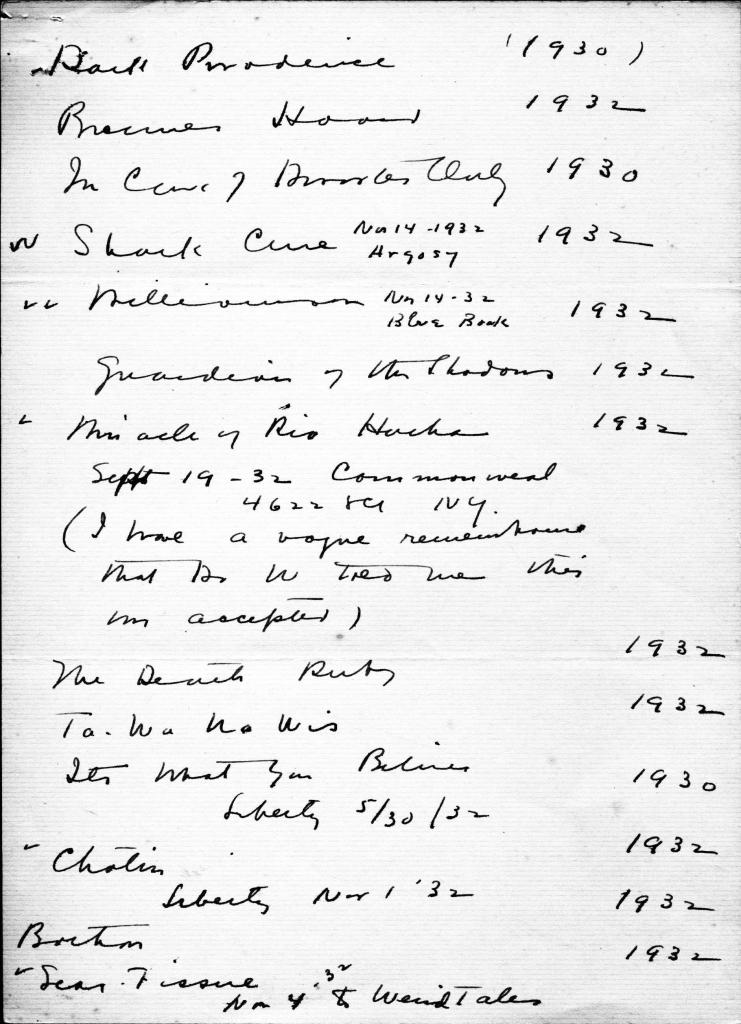
It isn’t clear what some of these annotations mean, such as the checkmarks; possibly those indicate that the completed manuscript had been submitted to a given market (which suggests that “Scar-Tissue” at least may have been sent to Weird Tales, and was presumably rejected).
“Scar-Tissue” involves Gerald Canevin, a series character in Whitehead’s fiction, and a Dr. Pelletier who encounter a patient named Joe Smith who not only remembers Lemuria, but carried a physical scar that corresponds with a wound obtained in a past life as a gladiator. Canevin and Pelletier had previously appeared together in “The Great Circle” (Strange Tales Jun 1932). “Bothon” follows the general plot laid down by Lovecraft: a man bangs his head, and the bruise unlocks memories of his past in Lemuria. The story ends with a reference to a man named Smith who had similar memories.
The interrelation between “The Great Circle,” “Scar-Tissue,” and “Bothon” is unclear. Canevin and Pelletier form a link between “The Great Circle” and “Scar-Tissue,” while “Scar-Tissue” and “Bothon” share much common ground, including the character Bothon, and the latter “Bothon” appears to reference the character of Smith in “Scar-Tissue”; but there is no Canevin or Pelletier in “Bothon.” Was this the aborted start of an intended series, or the tail end of an ongoing one? We may never know. All three stories are also somewhat uncharacteristic of Whitehead’s typical pulp product, with more action and fantasy, but that was a direction that some of his fiction was headed toward near the end of his life.
It is unknown if one or both stories were complete at the time of Whitehead’s death, or existed in draft. “Scar-Tissue,” if it was submitted to Weird Tales as the above list implies, must have been in decent shape. Lovecraft’s involvement appears to have been primarily suggestion and plotting for “The Bruise”—he never mentions “Scar-Tissue” nor contributed any actual text to “The Bruise.” Though there have been claims that someone else may have written or completed the stories:
It is not certain that Whitehead ever finished the revision and expansion of “The Bruise” before his death. As late as December 1932, Lovecraft speaks of the process being still “under way” ([see letter to Price above]). It is possible, therefore, that the story was finished and retitled by August W. Derleth, who oversaw the editing and assembling of West India Lights, where it appeared. Derleth fleshed out a number of Lovecraft’s plots and notes into complete stories (see The Survivor and Others, 1957), and frequently wrote fiction pseudonymously. It has been claimed, for example, that in Night’s Yawning Peal (1952), an anthology he edited, there were three such tales, Derleth appearing (in addition to an entry under his own name) as Stephen Grendon, Michael West, and—J. Sheridan le Fanu! See Jack L. Chalker, “Arkham House & Sons, part 2,” Fantasy Review, no. 97 (December 1986): 19.
—A. Langley Searles, “Fantasy and Outré Themes in the Short Fiction of Edward Lucas White and Henry S. Whitehead) in American Supernatural Fiction: From Edith Wharton to the Weird Tales Writers (1996), 75n62
As mentioned in the review of “The Murky Glass” (1957) as by August Derleth & H. P. Lovecraft, Derleth’s approach to “posthumous collaboration” was often one of entirely original writing based around an extent bit of text or story synopsis. Derleth did use pseudonyms as well; this was a common practice in the pulps, and “Stephen Grendon” was an established alternate name that Derleth used many times. So Derleth was certainly capable of writing or revising a story and publishing it under a different name, and had done so. But did he do it?
Before or concurrent with the publication of West India Lights, both “Scar-Tissue” and “Bothon” were published in Amazing Stories in 1946, in the July and August issues respectively. While there is no copyright notice or reference to Derleth attached to the stories, and unfortunately no letters with Starr or Black from this period attest to any deal or payments for publication, Derleth’s letters to Ray Palmer show that he submitted the stories, and brokered their sale at the same time as he was arguing with Palmer about Lovecraft:
Yes, I’d like to look at the Whitehead things concerning Lemuria, etc. Would appreciate your sending me the manuscripts.
—Ray Palmer to August Derleth, 20 Jun 1945, MSS. Wisconsin Historical SocietyI will send along the Whitehead stories—BOTHON and SCAR-TISSUE—just as soon as my secretary gets around to typing them: in a fortnight or so. They are very good stories of the Lemuria type which you seem now to tbe seeking.
—August Derleth to Ray Palmer, 21 Jun 1945, MSS. WHSThanks for getting the Whitehead stories in shape for me to look at.
—Ray Palmer to August Derleth, 22 Jun 1945, MSS. WHS
This was followed up some months later by a receipt of sale:
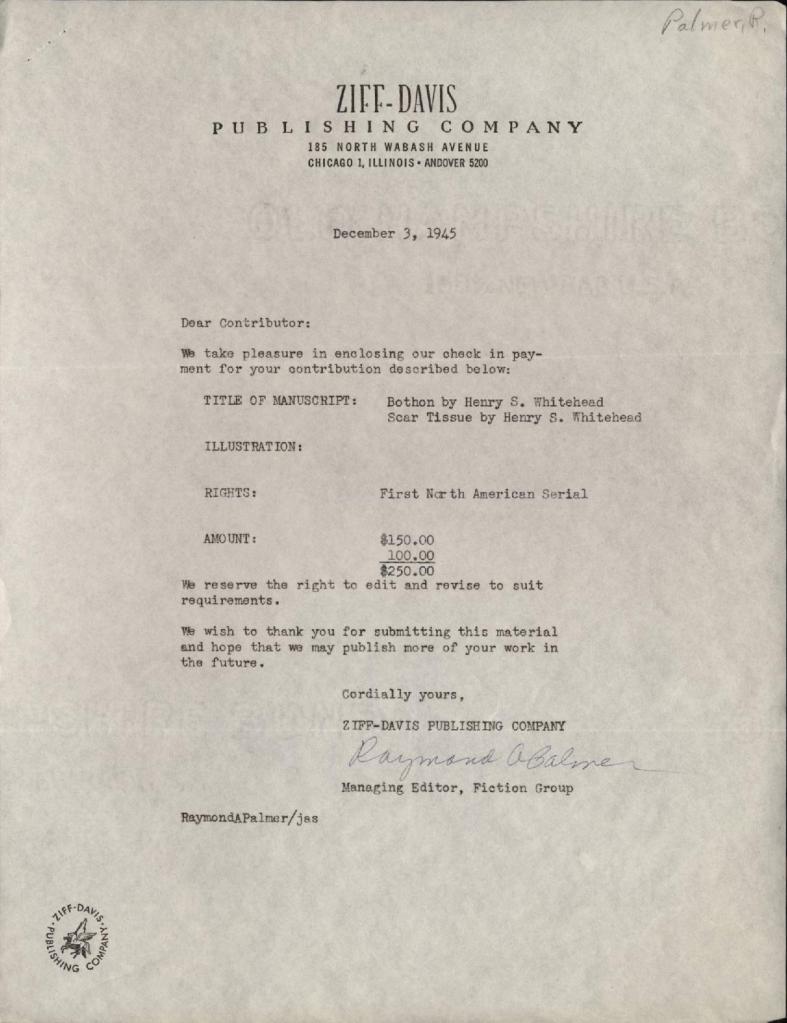
Derleth submitting stories on behalf of Whitehead’s heirs isn’t unusual. In the early 1950s, Derleth had arranged for the reprinting of two of Whitehead’s stories in the pages of Weird Tales (“The Tree-Man,” WT Sep 1953 and “Passing of a God,” WT Jul 1954), so we know Derleth did sometimes act as agent for such stories. Whether Derleth was acting as agent or ghost-writer, some of this money should have gone to Edna Black; unfortunately, the correspondence for this period between Black and Derleth is lacking.
There are some substantial textual differences between the text in Amazing Stories and West India Lights, with the Amazing Stories version of the text being substantially shorter and punchier. Probably Palmer cut the text down for publication to better fit the space in the magazine. To give one example of the differences:
| “Do you get that picture? Here we were, prisoners of war — after a couple of months of the hardest training I have ever known, in the Ludektan gladitorial school, about to shed our blood to make an Atlantean holiday! Yes, Ludetka was the southernmost province of Atlantis, the cultural center of the continent. There had been innumerable wars between the Atlanteans and Lemuria. Like Rome and Carthage. | “Do you get that picture? Here we were, prisoners of war — after a couple of months of the hardest training I have ever known, in the Ludektan gladitorial school, about to shed our blood to make an Atlantean holiday! |
| “Scar-Tissue,” West India Lights 233 | “Scar-Tissue,” Amazing Stories (Jul 1946) 149 |
Practically all of the changes in the Amazing Stories text represent a condensation of the story, truncating some of the battle scenes and speeding up the pacing. The above is a rare instance where a bit of the “lore” of the setting was excised. Was this done by Palmer so that Whitehead’s story dovetailed more closely with the Shaver Mystery? Given that so much setting material was left intact, probably not.
What is remarkable about “Scar-Tissue” and “Bothon,” and what might be most suggestive of Derleth’s involvement, is not so much the existence of two salable manuscripts by Whitehead that finally saw print after fourteen years—but that both such stories were directly relevant to the current trend in Amazing Stories. The timing is key: just when Amazing Stories was pushing the Shaver Mystery hard, here comes two stories of essentially similar theme from a different, established author, that could almost have been written to order.
Whether Derleth saw an opportunity to market Whitehead’s stories and took it, or Derleth re-worked one or both of the stories to fit isn’t clear, but it seems more than coincidence that two such atypical stories from a fortunately deceased author could emerge at just this time in Amazing Stories. That topicality makes them suspect. Yet without access to the original manuscripts there is no way to know for sure.
Despite Searles’ surety that someone other than Whitehead was involved, the evidence for Derleth revising, completing, or writing “Scar-Tissue” or “Bothon” is entirely circumstantial. We know at least from Lovecraft’s letters that “The Bruise” contained recognizable elements to be found in “Bothon,” and the 1943 manuscript list from Mary Starr clearly lists both stories. So it seems likely that if Derleth did touch up the manuscripts, he at least had some manuscript to work with, rather than writing the tales out of whole cloth, or based only on the synopsis in Lovecraft’s letters about “The Bruise.”
There is undoubtedly more to the story of how these two Whitehead works ended up at Amazing Stories. It’s notable that the publication in those magazines does not mention Lovecraft, Derleth, Arkham House, or West India Nights; for a tireless self-promoter and champion of Lovecraft like Derleth, it seems odd he wouldn’t make more of the opportunity for some free advertising, or to at least promote the Lovecraft connection elsewhere. In fact, when Clark Ashton Smith commented on “Bothon” in a letter to Derleth after West India Nights came out, Derleth’s reply didn’t mention Lovecraft at all (Eccentric Impractical Devils 370).
There are several Lovecraftian traces in “Bothon” that are not present in “Scar-Tissue.” The simian slave-class is called “Gyaa-Hua”; compare with “The Mound” (1940) by Zealia Bishop & H. P. Lovecraft, where the slave-class is called the “gyaa-yothn.” Two transcribed bits of ancient Lemurian speech in “Bothon” are: “Iï, Iï, Iï, Iï;—R’ly-eh!—Ieh nya, —Ieh nya; —zoh, zoh-an-nuh!” and “Ióth, Ióth,—natcal-o, do yan kho thútthut,” which bare similarities to some of Lovecraft’s alien speech,” especially the appearance of”R’y-eh” is particularly close to “R’lyeh” from “The Call of Cthulhu,” and “kho thútthut” could be a phonetic rendering of “Cthulhu.” Either Whitehead or Derleth could easily have inserted these references; though given Derleth’s contretemps with Palmer over adding anything Lovecraftian to the Shaver Mysteries, why he would insert such a reference is unclear. It is perhaps notable that when Lovecraft used Mu in his fiction in “Out of the Æons” (1935) by Hazel Heald & H. P. Lovecraft, he made no reference to either R’lyeh or the gyaa-yothn/gyaa-hua.
The connection between Lovecraft, “The Bruise,” and “Bothon” does not appear to have become publicly known until after Derleth’s death, when Selected Letters IV (1976) was published, which book contains the references in letters to E. Hoffmann Price and Clark Ashton Smith. Without access to concrete evidence in the form of drafts, letters, or business records to clarify matters, this small tangent to the Shaver Mystery and its almost-connection to the Lovecraft Mythos must remain a mystery.
Manly Wade Wellman, The Necronomicon, & the Shaver Mystery
“Suppose,” said Thunstone, “that I wanted a copy of the Necronomicon?”
“Suppose,” rejoined the old woman, “that I gave it to you?” She turned to a shelf, pulled several books out, and poked her withered hand into the recess behind. “Nobody else that I know would be able to look into the Necronomicon without getting into trouble. To anyone else the price would be prohibitive. To you, Mr. Thun—”
“Leave that book where it is!” he bade her sharply.
—Manly Wade Wellman, “The Letters of Cold Fire” in Weird Tales May 1944
Lovecraft and Wellman overlapped a bit at Weird Tales, but never corresponded. Nevertheless, Wellman had respect for his elder in weird fiction, and paid homage to Lovecraft in several stories, including “The Terrible Parchment” (WT Aug 1937) and “The Letters of Cold Fire” (WT May 1944), which feature the Necronomicon, and “Shonokin Town” (WT Jul 1946) where Lovecraft is mentioned as an expert in eldritch lore.
Wellman came into his own in Weird Tales during the 1940s, when his occult detective character John Thunstone ran in a successful series of tales. Like Lovecraft, Robert E. Howard, and others, Wellman had learned to build up a degree of interconnectedness in his stories for greater verisimilitude—Thunstone mentions Weird Tales authors H. P. Lovecraft and E. Hoffmann Price, Seabury Quinn’s occult detective Jules de Grandin (who would also mention Thunstone in his own stories), and several of Wellman’s characters exist in the same general setting, and sometimes face the same enemies—notably the pre-human, magically adept beings known as the Shonokin.
One of the details revealed in Richard S. Shaver’s correspondence with Ray Palmer in The Hidden World is that Shaver himself read Weird Tales, at least occasionally, and even submitted short fiction to the magazine. One story that caught his eye was “The Letters of Cold Fire” by Manly Wade Wellman:
In a tale in Weird Tales mag. recently it spoke of THE DEEP SCHOOL of Magic. I think you will find this is pertinent. Men who had been through the school could no longer stand the light at all. The underworld – hereditarily – have extra large eyes. This was in the Rowley Thorne – Dunstone [sic] series – runs regularly in Weird Tales and the author may know something though it’s hard to tell among all his magic wool. He should not be hard to contact and writers can explain what they mean. I hope he is not one who believes really the common concept of magic.
—Richard S. Shaver to Ray Palmer, 8 Jun [1944], The Hidden World A-14 2338-2339
It isn’t known if Shaver ever attempted to contact Wellman. In Weird Tales Jul 1946 and in the fanzine Sunspots #28 (Fall 1946), Wellman claims to have received letters form those who were convinced the Shonokin were real and could tell him more. Could Shaver have been among them? Perhaps, perhaps not; Shaver’s further letters to Palmer don’t mention any such attempt.
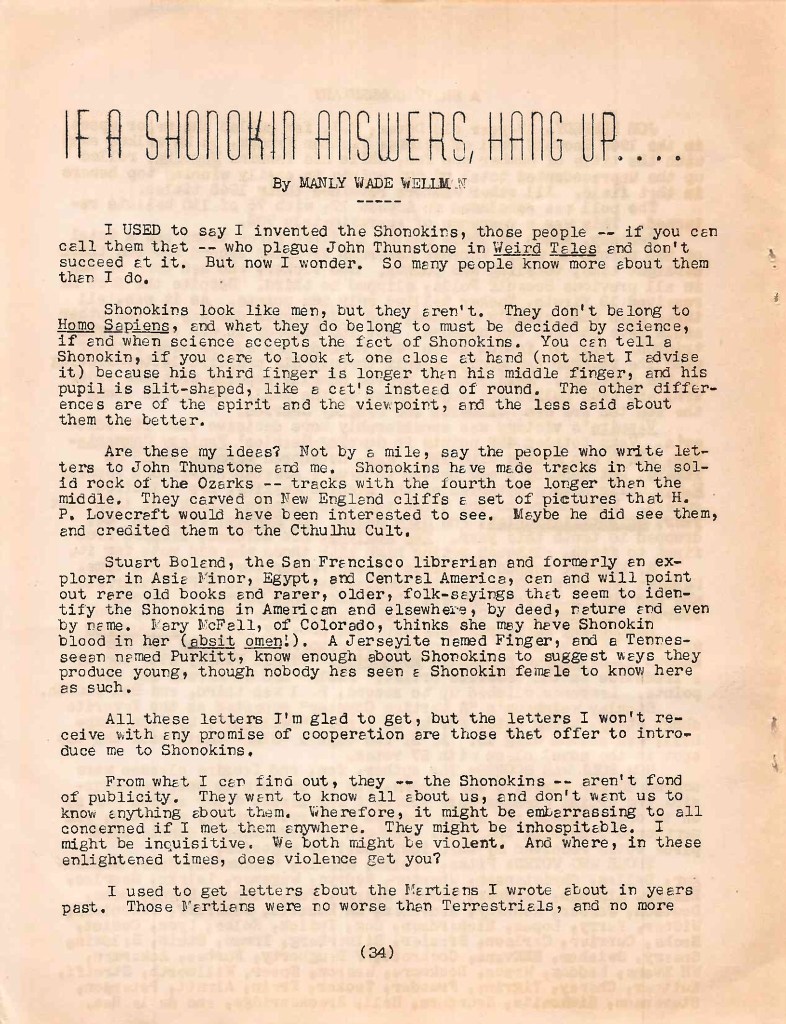
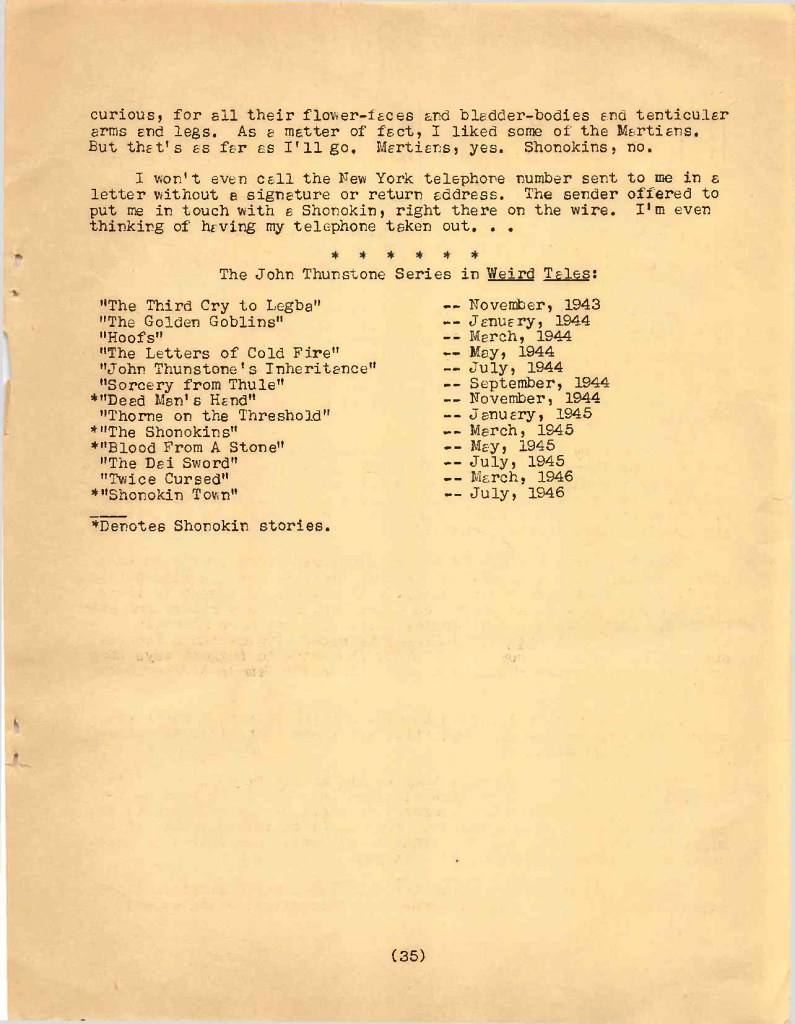
What is known is that Shaver remembered “The Letters of Cold Fire,” and later when the subject of grimoire came up after reading William Seabrook’s Witchcraft: Its Power in the World Today (1940), Shaver was inspired to an elaboration on his theories.
Such writers as your firned [sic] friend of Weird Tales mention such EVIL books—the book from the DEEP SCHOOL etc. etc.—and such wonderful things can be done with formula in them—is standard weird talk for witch stories through the ages—why—because once that was true and magicians—or mag-neticians—did save those books and work wonders with but they were not numerous to save that wisdom for us—or they lived in the caves and all that history of theirs still lies down there waiting for us—but if my observations of dero are right they are still using the ancient libraries for toilet paper and fire starting as in the ancient days.
—Richard S. Shaver to Ray Palmer, Jan 12 [1945], The Hidden World A-15, 2570
There is something strange and terrible about the image of a Dero, after evacuating last night’s cannibalistic feast, reaching for the age-softened, crumbling pages of the Necronomicon to wipe themselves clean—and that is an aspect of Shaver’s mystery that readers of Amazing Stories perhaps did not appreciate, the degree to which Palmer and other ghostwriters cleaned things up, for Shaver could be quite brusque about subjects like torture, sex, and some of the more unpleasant aspects of life in his stories.
Muriel E. Eddy, David H. Keller, & the Shaver Mystery
In a 1948 interview, David H. Keller, a prolific author of science fiction and weird tales and a contemporary of Lovecraft’s, was asked about the Shaver Mystery:
“What is your opinion of the Shaver controversy?”
“A healthy affair in some ways. After all there is not much difference between Shaver and Lovecraft as far as the basic idea is concerned. Even Jules Verne hinted at it in his JOURNEY TO THE CENTER OF THE EARTH. Merritt talked about those Old Ones and Lovecraft wrote constantly in regard to such a menace. […]
—David H. Keller, interviewed by Jacob Hudson, Fantasy-Times #64 (Apr 1948), 5
Keller’s comparison of Shaver and Lovecraft is not unique; it’s a point that crops up repeatedly in the literature. One of the key points Keller makes is that “Lovecraft wrote constantly in regard to such a menace”—but did he really? At this date, Arkham House had brought Lovecraft into print in hardback, and in the mid-40s editions paperback editions were available through Bartholomew House and the Armed Services Edition. Weird Tales under Dorothy McIlwraith published or re-printed Lovecraft stories provided by August Derleth and Arkham House, as well as Derleth’s own pastiches. Derleth’s first “posthumous collaboration,” the novel The Lurker on the Threshold, was published in 1945.
While Lovecraft wrote of many terrors, some ancient and some underground, there was never a single unifying threat that ran through multiple stories as the Deros do through Shaver’s oeuvre. However, for casual readers who absorbed a great deal of Derleth along with Lovecraft, this fine distinction between the Mythos as Lovecraft wrote it versus how Derleth tended to play it up was easily lost. Derleth’s pastiches tended to emphasize a unity and structure to Lovecraft’s Mythos that wasn’t originally there, while Shaver seems to have had a very clear conception from the beginning of how things were in the underground caverns, even if he struggled with how to present this information to the audience.
This kind of comparison led to another tangential connection between Lovecraft and Shaver, in the pages of Fantastic Adventure, another Ziff Davis pulp magazine that was under the editorship of Ray Palmer. While the Shaver Mystery stories largely appeared in Amazing Stories, some of Shaver’s fiction also appeared in Fantastic Adventure, which was at least nominally dedicated to fantasy, although in practice Ray Palmer tended to run both fantasy and science fiction together in the magazine.
In Fantastic Adventure s(Feb 1948), Shaver’s story “Slaves of the Worm” ran. The story is not explicitly related to the Mystery—not a Dero in sight—and may owe something to Robert E. Howard’s “The Shadow Kingdom” (1929) and “The Valley of the Worm” (1934) as well as A. Merritt’s “The Face in the Abyss” (1923) and its sequel “The Snake Mother” (1930). Yet something about the story prompted a reader to write in and compare it to Lovecraft; and Ray Palmer agreed.
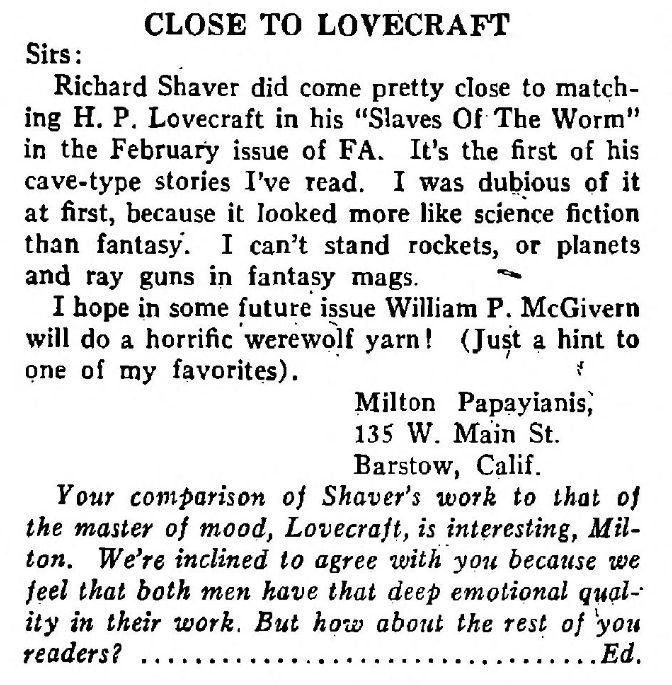
The letter caught the attention of Muriel E. Eddy, a friend and correspondent of Lovecraft’s during his life who later turned her energies to memoirs like “Message in Stone” (1956) and The Gentleman from Angell Street (2001). Her response letter was also published.
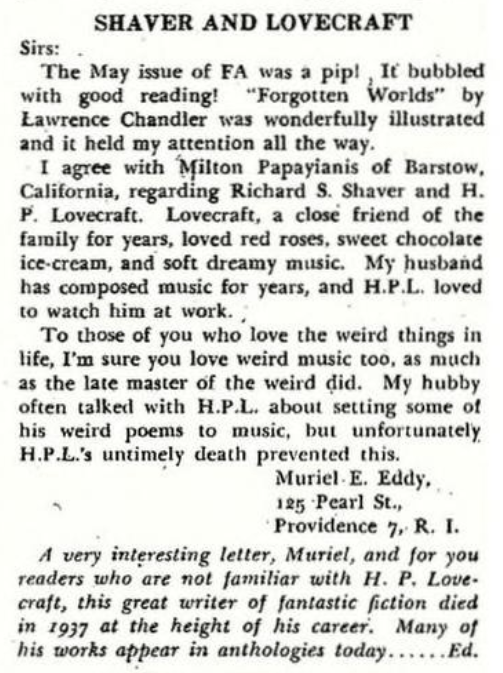
Not many would look to the letter-columns of Fantastic Adventures for a brief memoir about Lovecraft, yet that is part of the legacy of the Shaver Mystery too.
Robert E. Howard, Serpent People, & the Shaver Mystery
One of the hallmarks of conspiratorial literature is how quickly it is to absorb new ideas into its existing framework, and the same is true for the Shaver Mystery. In the August 1946 issue of Amazing Stories, Ray Palmer wrote a piece about the pamphlets of Maurice Doreal, an occultist, which presents his ideas of the hollow earth (drawing much inspiration from Theosophy), and wrote that:
I am advising that Doreal’s booklets be read by all students of the Shaver matter. I do not believe that he is correct in all his statements, but there may be a basis underlying them, and this knowledge should be known to students simply as a matter of theory.
In the October 1946 issue of Amazing Stories, an answering letter from Doreal was published, essentially confirming the subterranean evil Dero exist, and working the Dero into their schema.
Maurice Doreal (also M. Doreal, Morris Doreal, etc.) was a pseudonym for Claude Doggins, an occultist and conspiracy theorist inspired by both Theosophy and pulp fiction. One of Doreal’s most notable publications is The Emerald Tablets of Thoth the Atlantean (n.d.). The esoteric poem includes a lot of material drawn from ancient Egyptian religion, Hermetic occultism, and Theosophy, but there’s one passage in particular which is basically a synopsis of Robert E. Howard’s story “The Shadow Kingdom (Weird Tales Aug 1929):
In the form of man they amongst us,
but only to sight were they as are men.
Serpent-headed when the glamour was lifted
but appearing to man as men among men.
Crept they into the Councils,
taking forms that were like unto men.
Slaying by their arts
the chiefs of the kingdoms,
taking their form and ruling o’er man.
Only by magic could they be discovered.
Only by sound could their faces be seen.
Sought they from the Kingdom of shadows
to destroy man and rule in his place.
While Doreal does not connect the dero to the serpent people directly, they share certain attributes, being evil, shape-shifting, and subterranean. It goes to show how flexible and adept at self-promotion Doreal was to latch onto the Shaver Mystery, however briefly. Doreal also borrowed from other pulp authors, notably referencing Frank Belknap Long Jr.’s “The Hounds of Tindalos” (Weird Tales mar 1929), also referenced in The Emerald Tablets:
Strange and terrible
are the HOUNDS of the Barrier.
Follow they consciousness to the limits of space.
Think not to escape by entering your body,
for follow they fast the Soul through angles.
Only the circle will give ye protection,
save from the claws
of the DWELLERS IN ANGLES.
Like Shaver, Doreal’s writings influenced popular conspiracy theories, and his works tied together aspects of Theosophy, pulp fiction, and the nascent ufology culture. Michael Barkun in A Culture of Conspiracy: Apocalyptic Visions in Contemporary America (2013) notes that Doreal also authored a pamphlet giving a revisionist history of the world featuring this serpent race (Mysteries of the Gobi), where the perverted, underground Lemurians were supposedly the ancestors of all Semitic peoples. Another pamphlet, Flying Saucers: An Occult Viewpoint postulated the serpent people were extraterrestrials, which would help set the stage for popular depictions of reptilian humanoid aliens, such as the television series V. All of these have uncertain publication dates, but based on this letter we can definitely say they were around in the 1940s.
Doreal would be quoted extensively in David Icke’s Children of the Matrix: How an Interdimensional Race has Controlled the World for Thousands of Years—and Still Does (2001), which collates and updates the whole idea of shapeshifting reptilians for a 21st-century audience. Icke is noted for his antisemitism, and for his identification of members of the Jewish Rothschild family as secret reptilians (Barkun 146); the entire shape-shifting reptilian alien idea in popular culture has been tinged by Icke’s prejudice.
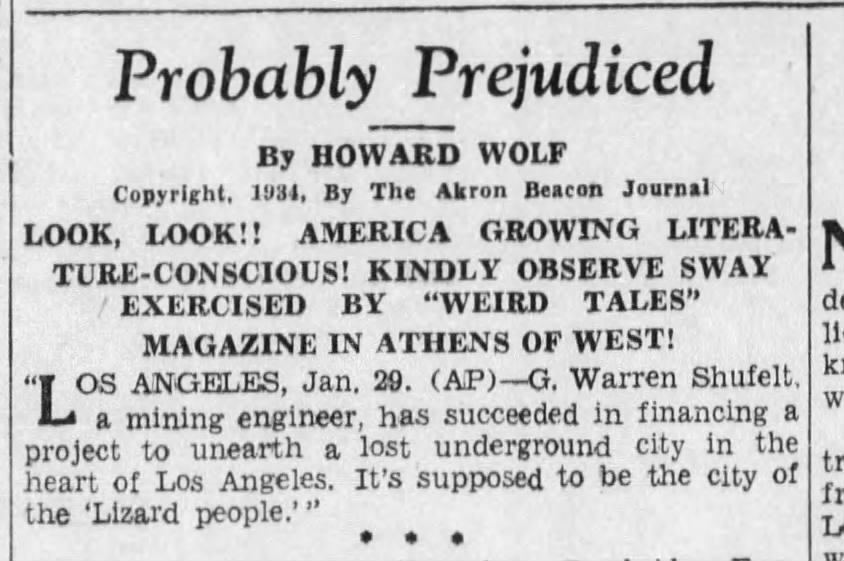
Robert E. Howard did not invent the idea of serpent people or reptilian humanoids; H. P. Lovecraft had played with the idea in “The Nameless City” (1921), A. Merritt had the eponymous Snake-Mother of Yu-Atlanchi in “The Snake-Mother” (1923); Frank Belknap Long, Jr. had a woman-headed serpent in “The Were-Snake” (1925); Edgar Rice Burroughs had underground serpent people in Tarzan at the Earth’s Core (1929-1930); Clark Ashton Smith had made serpent a part of his stories in “The Double Shadow” (1933) and “The Seven Geases” (1934); Edmond Hamilton, famous for his space operas, included reptilian alien humanoids in “Monsters of Mars” (1931) and “The Snake-Men of Kaldar” (1933), and John Murray Reynolds had similar Scaly Ones in “The Golden Amazons of Venus” (1939); E. Hoffmann Price played on Southeast Asian beliefs about the Naga in “Snake Goddess” (1939), and there are many other precursors and cases of independent invention. There is even a famous case in 1934, an engineer named G. Warren Shufelt even advertized that there was an underground city of lizard people beneath Los Angeles.
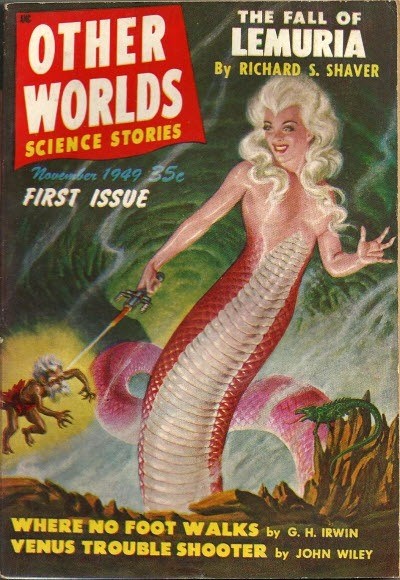
Richard S. Shaver had serpent-people in his Shaver Mystery fiction too—most notably in “The Fall of Lemuria” in Other Worlds Science Stories (Nov 1949). These snake-people probably owe more to Merritt’s “Snake-Mother” than to anything Howard or anyone else wrote.
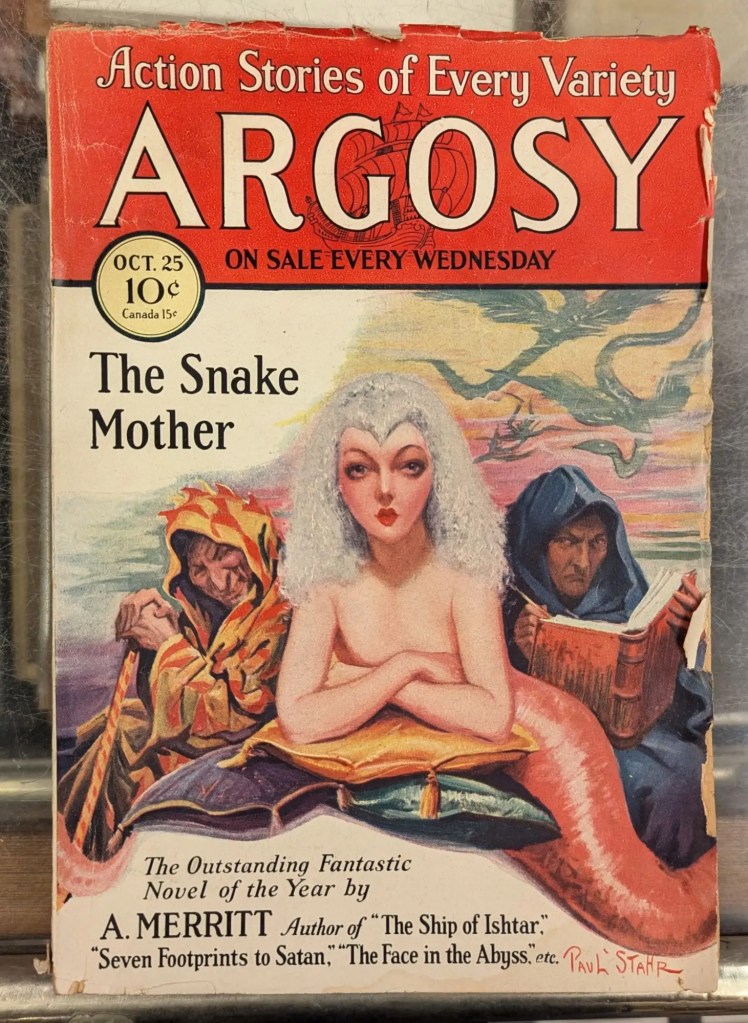
Yet Howard’s serpent-people have gained pop-culture precedence—and entered conspiracy circle legend—because of several contributing factors. For Lovecraft, Smith, and many others, the reptilians and serpent people, whether beneficient or inimical to humanity, hatched no conspiracies, and dwelt underground and apart from humanity and its affairs. Howard’s were actively seeking to undermine and manipulate human civilization, and doing so with the aid of magical disguises to impersonate others.
Marvel Comics introduced serpent people to their universe through works adapted from and inspired by the work of Robert E. Howard; in the pages of Conan the Barbarian, Kull the Conqueror, and (oddly enough) Marvel Premiere #4, where Dr. Strange fights the spawn of Sligguth in a story that combines aspects of “The Shadow Kingdom” and “The Shadow over Innsmouth.” Robert E. Howard’s version of the serpent-god Set, and his serpent-people followers, would play a major role in the Marvel Universe during storylines like Atlantis Attacks! (1989), although since Marvel subsequently lost the license to Conan, the serpent-people have played substantially less of a role.
Roleplaying games have featured a number of reptilian and serpent-people, some of whom were inspired by pulp fiction, others of which are original. The Call of Cthulhu roleplaying game adapted Howard, Smith, and Lovecraft’s serpent-people lore and glossed and expanded it. Dungeons & Dragons have the Yuan-Ti, who were largely humanoid serpent-people with shapeshifting powers, that first appeared in Dwellers in the Forgotten City (1980); whether they were originally based on Howard’s serpent people or not, they embody many of the tropes—but there are innumerable fantasy serpent- and reptile-people in fantasy and science fiction, too many to narrow them all down to one single source. Publisher White Wolf would also borrow from Howard when creating the clan called the Followers of Set for Vampire: The Masquerade (1991), whose discipline of Serpentis gives them serpent-like powers and attributes.
The Followers have an Egyptian theme, despite the fact that the Egyptian god known as Set, Seth, or Sutekh does not have serpentine attributes—a common misconception which also affected the Marvel comics (where the Egyptian god Seth was a separate deity, though still serpent-themed) and even Dungeons & Dragons (where the Mulhorandi god Set was largely based on the Egyptian god, but also took on serpentine characteristics). Robert Bloch would commonly err in making the serpentine Set an Egyptian god in some of his early horror and fantasy stories. The confusion comes because in the Conan tales, Set is the god of the Stygians—who are intended to be strongly reminiscent of ancient Egypt, and to be the precursor civilization to it:
Meanwhile, also, a tribe of Vanir adventurers had passed along the Pictish coast southward, ravaged ancient Zingara, and come into Stygia, which, oppressed by a cruel aristocratic ruling class, was staggering under the thrusts of the black kingdoms to the south. The red-haired Vanir led the slaves in a general revolt, overthrew the reigning class, and set themselves up as a caste of conquerors. They subjugated the northern-most black kingdoms, and built a vast southern empire, which they called Egypt. From these red-haired conquerors the earlier Pharaohs boasted descent.
—Robert E. Howard, “The Hyborian Age” (1936)
There is a terrible irony to Doreal and Icke’s adding bigotry to Howard’s serpent people: Howard was thinking about Jews when he wrote it. Howard’s original story “The Shadow Kingdom” was in part inspired by some of his own characterization of Jews in the Old Testament in his private letters (see Deeper Cut: Conan and the Shemites: Robert E. Howard and Antisemitism). However, a study of Howard’s letters do not show any definite awareness or belief in popular antisemitic conspiracy theories, and Howard never made any explicit connection between serpent people and Jews in his fiction. Howard did not confuse fantasy and real-world prejudice; he took a metaphor based on a personal reading of the Old Testament and wove into his fantasy fiction—making literal serpents out of the metaphorical manipulators of King Saul. This wasn’t a huge stretch for Howard, who had already included his antipathy to serpents and characters with snake-like attributes in several stories before Kull was created (see “Conan and the Little People: Robert E. Howard and Lovecraft’s Theory.”)
The 1930s and 40s saw the cross-pollination between pulp and popular fiction and fringe conspiracy theories, and what would become New Age movements, many of which were in a foundational stage during the interwar and WW2 period. Doreal’s letter in support of Shaver’s Mystery is an example of how easily these works incorporated ideas from science fiction and weird fiction into already-extent occult and conspiratorial ideologies about the hollow earth and hidden masters. It also demonstrates how antisemitic tropes can grow and spread, sometimes under unlikely guises.
Marebito (稀人, 2004)
Marebito (“Unique One,” 稀人) is a Japanese horror film from director Shimizu Takashi (清水 崇), based on a novel and screenplay by Konaka Chiaki (小中 千昭). As the film opens, freelance cameraman Masuoka (played by Tsukamato Shin’ya 塚本 晋也) is obsessed the nature of fear and with viewing the world through a camera lens. Masuoka investigates the apparent suicide of a terrified man underground that was captured on camera. His investigation leads him to a subterranean network of tunnels beneath Tokyo. Masuoka meets people who live in the tunnels and believe in Richard Shaver’s Deros; Masuoka himself finds a section of the underground that resembles ancient ruins and believes he has come to the Mountains of Madness spoken of by Lovecraft—although he acknowledges both Shaver and the hollow earth theory are fiction. Yet in that netherworld, fact and fiction seem to merge.
Throughout the film, possibly-supernatural events occur, and the line between what is real and what is just in Masuoka’s head is not clear. The film plays with aspects of voyeurism, documentary filmmaking, the nature of reality, and the uncertain nature of perception. The narrative is shot through with sudden transitions, artifacts of digital recording in settings of clear reality, impromptu encounters and conversations, and a growing uncertainty about who the characters really are and how much of this is really happening, or if Masuoka is just off his meds and reality and delusion are merging together inseparably.
The Deros are a repeated touchstone in the ideology of the film, not something seen on the screen much, but a pervasive idea. Likewise, while Lovecraft is seldom referenced directly, the questioning of the nature of fear is strongly reminiscent of his work. This is no accident, Konaka Chiaki has also written Cthulhu Mythos fiction, including the screenplay for a Japanese television adaptation of “The Shadow over Innsmouth” (インスマスを覆う影, 1992). In Marebito, Konaka gets to marry those ideas with the questioning of reality and memory that are trademarks of some of his anime work such as Serial Experiments Lain and The Big O.
Shimizu Takashi brings these ideas to the screen with an aesthetic that places it in the general oeuvre of the Ring films directed by Nakata Hideo (中田 秀夫) and the later documentary-style horror films of director Shiraishi Kōji (白石 晃士). While there is no single video artifact or ghost at the center of Marebito, the visual transition between watching what is “really” happening and watching the same through the lens of a camera introduces a layer of visual rhetoric that gives the film considerable depth. If Konaka adapted Shaver and Lovecraft for a new Japanese context, Shimizu adapted that script for a new Japanese syntax, translating the voyeuristic impulses of Shaver and the fear of the unknown in Lovecraft into present-day fears of video surveillance, the questionable fidelity of memory, and the pliable reality of recordings.
Which might be an interesting way of looking at the Shaver Mystery and the Lovecraft Mythos in the 21st century: not as literal truth, and not necessarily as something to copy and pastiche, but collections of ideas and images to use as a springboard for new work. Shaver and Lovecraft did not live to see the long tail of their creations influence popular culture, nor for the fringe of true believers to spread their ideas of ancient aliens from the pulps to the mainstream. Yet it is a new century now, and new voices find uses for old pulp ideas.
In this way, the Shaver Mystery and the Lovecraft Mythos live on.
Bobby Derie is the author of Weird Talers: Essays on Robert E. Howard and Others and Sex and the Cthulhu Mythos.
Deep Cuts in a Lovecraftian Vein uses Amazon Associate links. As an Amazon Associate I earn from qualifying purchases.
 Deep Cuts in a Lovecraftian Vein